Game Corner: The Legend of Zelda: Breath of the Wild (Nintendo Switch)

Released: 3 March 2017
Developer: Nintendo EPD

The Background:
As I detailed in my review of the first game, The Legend of Zelda (Nintendo EAD, 1986) was an extremely popular title when it released on the Nintendo Entertainment System (NES) and sold over 6.5 million copies. This, of course, was only the beginning for the series, which has become one of Nintendo’s most lucrative and popular franchises of all time, which made a successful jump to 3D with The Legend of Zelda: Ocarina of Time (ibid, 1998) and has largely aimed to be bigger and better with each successive entry. Development of Breath of the Wild began sometime after the release of The Legend of Zelda: Skyward Sword (ibid, 2011), a commercial success that was easily the largest and most complex Zelda title released at that time. For the next title, though, series producer Eiji Aonuma wanted to completely rethink the conventions of the franchise and create a much bigger, more interconnected world. After developing an 8-bit prototype to experiment with physics-based puzzles, Aonuma encouraged his team to rethink the game’s approach to puzzles and to create a grand, open world adventure more akin to The Elder Scrolls V: Skyrim (Bethesda Game Studios, 2011). To further separate it from other entries in the franchise, it was also the first Zelda title to use voice acting in cutscenes (though Link remained unnervingly silent), the physics were purposely built to be the most realistic yet, and the game was specifically designed so that players were free to explore and experiment (they could even skip the story entirely, if skilled enough). Breath of the Wild proved immensely popular upon release; many reviewers considered the game to be a “masterpiece” and one of the most immersive videogames ever made. Breath of the Wild also won numerous awards, was the third-bestselling Zelda title at the time, and earned itself a direct sequel after Aonuma’s team found they had too many ideas for the game to be limited to downloadable content (DLC).

The Plot:
After a botched resurrection attempt leaves Ganon little more than a calamitous force of nature, Princess Zelda and Link, the warrior chosen to wield the legendary Master Sword, found their forces overwhelmed when Calamity Ganon corrupted the machines they built to repel him. After Link was gravely injured, Zelda placed him in suspended animation and magically sealed herself within Hyrule Castle to hold Calamity Ganon at bay. One hundred years later, Link awakens, his memories fragmented, and begins a quest to rediscover his destiny and end Calamity Ganon’s threat once and for all.

Gameplay:
The Legend of Zelda: Breath of the Wild is a massive open-world adventure game in which players are once again placed into the role of Link, the elf-like hero who continually finds himself resurrected and reborn time and time again throughout the ages to oppose Ganon’s evil. Unlike the vast majority of Zelda titles, players have no option to rename Link, making Breath of the Wild one of the few games in the series to actually use the name “Link” as the character’s name; similarly, Link forgoes his traditional Peter Pan garb of green tunic and hat in favour of a multitude of different clothing options and these are the first indicators that the game is very different from traditional Zelda games.

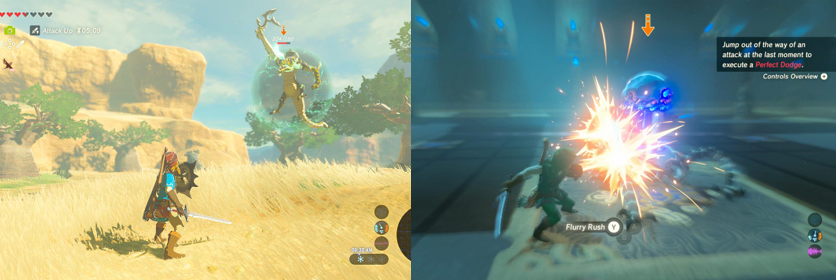
Link’s combat options are simple but quite varied and rely on timing and strategy.

If you’ve played a 3D Zelda title before, particular Ocarina of Time, you’ll be immediately familiar with most of Breath of the Wild’s controls: players can target nearby enemies by holding ZL (sadly, there’s no option to target without holding the bumper), which will cause Link to immediately raise whatever shield he is carrying to block enemy attacks or reflect certain attacks back by pressing A. Pressing Y will allow Link to attack with his equipped weapon and pressing ZR sees him whip out his bow and shoot arrows for a ranged attack. Returning from Skyward Sword is the stamina wheel, which depletes when you hold B to sprint or when swimming, gliding, or climbing one of the game’s many hills and mountains. In a major addition to the series, Link can now jump whenever he wants with a press of the Y button or charge up a spin attack by holding down X and perform some jumping strikes and dodges just like in the Nintendo 64 games; he can also throw his weapons and perform a flurry attack by dodging incoming attacks at just the right moment.

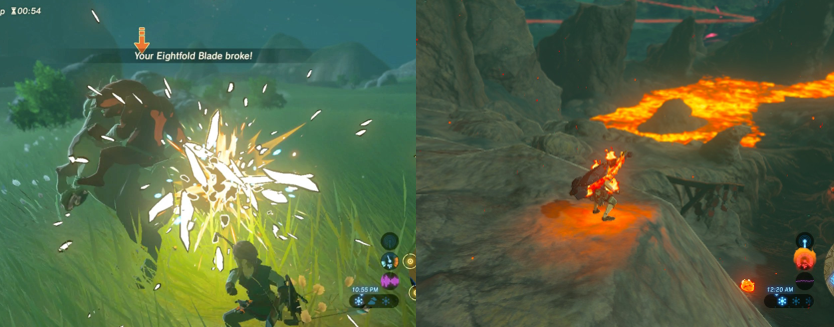
You can’t just rush into battle or areas as your weapons will break or burn up if you do.

The biggest addition to the combat is the inclusion of destructible weapons; every single melee weapon, shield, and bow you acquire in the game has a limited number of uses and, the more you use them, the more you’ll wear them out. Weapons that are made out of wood will also catch fire (causing Link to catch fire and take damage in the process) as well and many shatter in only a single use, meaning that Breath of the Wild’s combat is much more about strategy and it is often far better to simply avoid or run away from battles rather than break your more powerful weapons. Honestly, it’s an annoying and frustrating system that means you’re almost constantly worrying about the status of your weapons and being prepared for the game’s more challenging obstacles. I feel like there could have been a middle ground where there are some weapons (wooden ones, for example) that break and some situations where you lose them (enemies could knock your shield out of your hands with larger weapons, for example, and weaker steel swords could shatter on stronger rocks) but, instead, every single weapon has a finite number of uses, which made me very anxious and made combat more exasperating than enjoyable. Combat is made all the more troublesome by the fact that Link is the weakest he has ever been; as always, you begin the game with three hearts of health and, because the game is so big (even the relatively enclosed opening area), it’s very easy to be overwhelmed by even the bog standard Bokoblin enemies. Unlike in previous Zelda titles, defeated enemies will never drop health-restoring hearts, meaning the only way you can replenish your health is by picking up edible items (apples, acorns, meat, and so forth) and eating them. Indeed, the key to bolstering Link’s stamina, health, and attack prowess is to make use of the game’s cooking mechanic, whereby Link can toss up to five items into a cooking pot and brew up dishes or elixirs to increase his maximum hearts, his stamina, attack and/or defence, his stealth prowess, or resist certain elemental conditions. The only way to permanently increase your hearts is to conquer the game’s four dungeons (known as “Divine Beasts”) or acquire Spirit Orbs from the many Ancient Shrines scattered (and, often, hidden) throughout Hyrule.

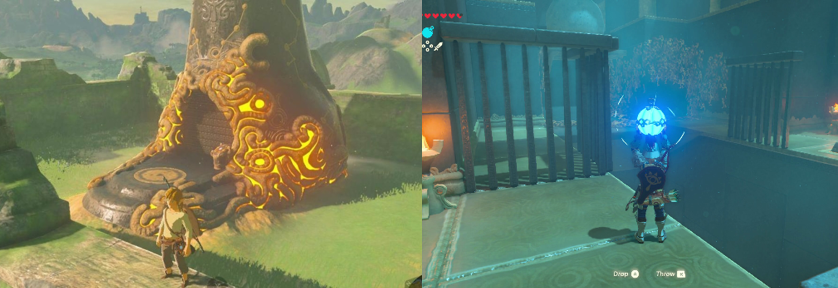
Track down and complete Shrines to earn Spirit Orbs and increase your health and stamina.

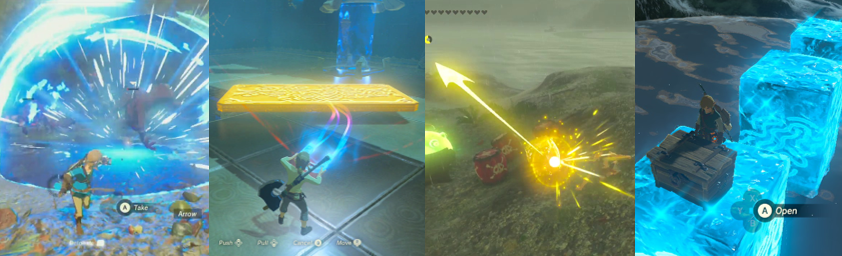
You’ll want to hunt down and visit these Shrines on a regular basis as, since the game has only a handful of traditional dungeons, these make up the bulk of your concern and are the only way of increasing your maximum health and stamina and, thus, your chances of success. Each Shrine also acts as a fast travel point once activated, allowing you to quickly teleport all across the vast kingdom of Hyrule from the main menu, but their primary function is to bestow Link with four (technically five, I guess) Shiekah Runes that are used to conquer puzzles both in and outside of the Shrines. These puzzles may be simple things such as activating switches, creating ice platforms to cross water, lifting metallic objects, creating electrical currents, or floating along on updrafts but they can also be extremely challenging combat scenarios against spider-like Guardian Scouts. As you progress and explore further, you’ll come up against some truly head-scratching puzzles that force you to freeze objects and attack them to build up kinetic energy, navigate through mazes, retrieve orbs from dangerous environments, and make full use of your inventory and abilities in order to solve them. Thankfully, the Shrines don’t need to be beaten to activate them as fast travel points but it’s highly recommended that you beat as many as you possibly can as you’ll refill your health upon successful completion and move one step closer to increasing your maximum health and stamina. And you’ll definitely need to do this as, while you can head straight to Hyrule Castle to take on Calamity Ganon without tackling the game’s story, I really wouldn’t recommend it as I had a great deal of difficulty taking on even minor enemies and puzzles with the game’s mechanics. Breath of the Wild throws absolutely everything in your path to keep you from succeeding: at night, Stalfos and similarly-skeletal enemies will rise from the ground to chase you down; every so often, gameplay is rudely interrupted by the rising of the Blood Moon, which resurrects all enemies you’ve defeated since playing; and you’ll even be beset by a variety of environmental hazards.

Rupees are hard to come by and items have a steep cost, keeping you on the back foot.

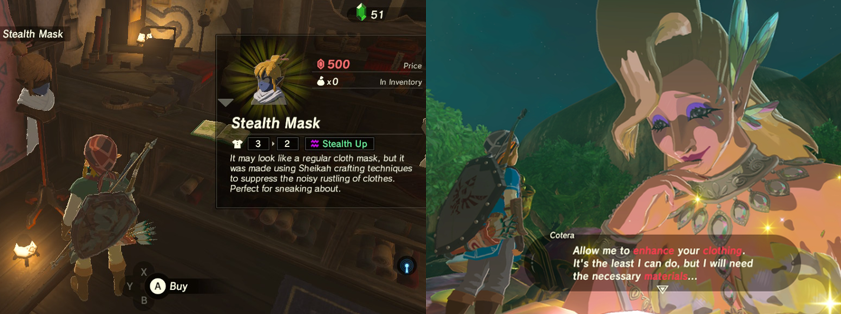
When climbing higher, the air temperature will drop, causing Link to shiver uncontrollably; when exploring Death Mountain, the air becomes unbearably hot, causing his wooden items to combust; and Hyrule is plagued by wind, rain, and thunderstorms that will causing Link to be struck by lightning if he’s got anything metal equipped! In many of these situations, Link will steadily lose hearts and be at great risk, meaning that you need to cook up something to stave off these debilitating effects or acquire, or buy, clothing to resist the elements. As in all Zelda games, Link can purchase new items using Rupees; however, similar to how enemies don’t drop hearts, it’s very rare that defeated enemies will drop Rupees. As a result, the main way you’ll earn Rupees is by finding them in chests (usually after defeating an enemy encampment) or selling some of the many items and minerals you pick up along the way. Sadly, the best armour and more useful elixirs and weapons carry a high price tag, meaning it’s quite difficult to save up enough to buy what you want (it doesn’t help that the four Great Fairies, who will upgrade your clothing using monster parts, charge up to 10,000 Rupees just to “restore their power”). As a result, like with the combat, it feels like you’re constantly on the back foot as you never have enough money, never have enough ammo, and your weapons could break at any moment, all of which makes it a very stressful experience at times as you might spend Rupees to replenish your health at an Inn only to be decimated by a random Guardian out in the field.

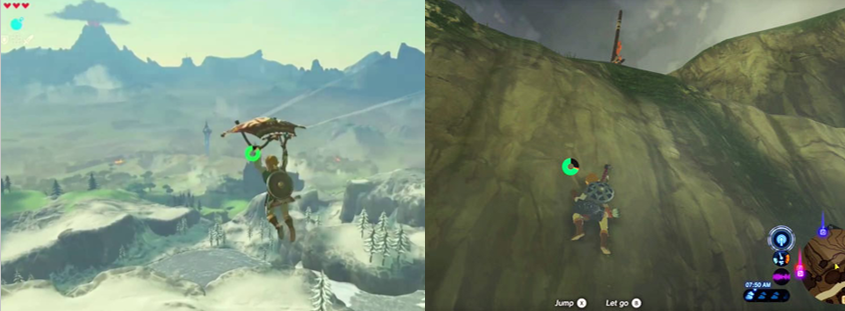
Paragliding and climbing are two pivotal mechanics in the game and essential for traversal.

While Link can pick up a great many items, ingredients, and monster parts, his weapon inventory is extremely limited; sometimes, you may have to discard or use up a weapon to grab a better, more powerful one and the only way to increase your inventory slots is to randomly find Koroks hidden all over Hyrule. Each one you find gifts you with a Korok seed, which can be used to buy one extra slot at a time, with the cost of these inventory slots increasing each time. Two of the game’s more prolific mechanics are the paragliding (which I believe is a carry over from Skyward Sword) and climbing mechanics; once you acquire the paraglider, you can jump from higher areas or use air currents to glide along, covering vast distances (for as long as your stamina holds out), which is great for spotting Shrines or avoiding dangerous areas. Climbing is also heavily dependant on your stamina but it’s generally better to get to the high ground to find secrets and survey the area and you’ll have to climb up a number of Sheikah Towers in order to painstakingly map out the massive overworld map. Since Hyrule is the biggest it has ever been, Breath of the Wild can be extremely daunting; travel is helped not just by the fast travel system but also the inclusion of horses and other ridable animals. When you come across a horse, you should press the left analogue stick to make Link crouch and take slow steps to approach it undetected, then you can mount the animal and sooth it with L. Once you’ve calmed the horse, you can ride it to one of Hyrule’s many stables to register it (for a price, of course); while your horse can’t follow you everywhere (they can’t cross the Gerudo Desert, water, or rockier areas, for example), you can call it by pressing down on the directional pad (D-Pad) to whistle and recover them from a stable (so, if you’re in the far West but left your horse in the far East, you can visit a stable and they’ll bring your horse to you). Horses can be named and have different statistics that determine how tough and fast they are but there are a couple of things to consider: thanks to the game’s dodgy physics, it’s easy to fall into water with your horse, which will cause it to become trapped if there’s no way for it to return to shore, and horses can also be killed if they take too much damage (usually by Guardians), though a Great Fairy will resurrect them if this happens. Similarly, as I mentioned, you can’t take your horse into the desert, but you can temporarily commandeer a Sand Seal to quickly traverse the temperate sandstorms.

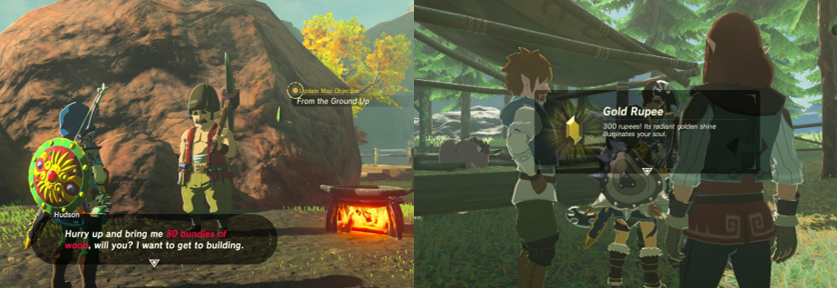
A number of NPCs have side quests and missions for you, which can earn you a few nifty rewards.

Link’s journey involves a great many side quests and interactions with the largest number of non-playable characters (NPCs) ever seen in a Zelda title; even when journeying from one town to another you may stumble across NPCs who have side quests and missions for you, ranging from collecting a number of items, photographic objects, defeating enemies, or bringing them something. In the game’s larger towns, you’ll find more substantial side quests, many of which are tied into the game’s main objectives; you can’t just climb up Death Mountain to reach the Divine Beast Vah Rudania, for example; you first have to cook up an elixir to resist the heat or complete a side quest to earn heat-resistant armour, rescue a Goron from captivity, and then make your way up the mountain shooting at the Divine Beast while defeating enemies and taking out drone-like Guardian Skywatchers first, all of which can take a good few hours. Every time you complete a main or side quest, you’ll be gifted with access to Rupees, weapons, or other items so it can be worth it to veer away from your main objective and help out the multitude of NPCs in their often strange and convoluted requests. There is, honestly, almost too much to do and see in Breath of the Wild: wild animals roam the countryside as often as enemies, many of which will randomly attack you but all of which can be killed off for ingredients; camp fires are scattered around, which allow you to advance time to avoid night-time attacks and weather; Beadle wanders around to give you the chance to buy supplies; NPCs randomly get attacked by monsters and will reward you with cooked dishes; towers can be climbed to find chests; enemies camp out all over the place; rafts often sit near bodies of water for you to sail to far off islands by using a Korok Leaf; chests must be magnetically pulled out from water, sand, and snow; and it’s super easy to stumble into ruins, small villages, and other areas of desolation or civilisation when trying to follow the main story. It can get a bit daunting at times: you’ve got the cooking, the breakable objects, and the Shrines to worry about, keeping you constantly on edge. Even when you conquer the Shrines, you need to travel to a town or village and find a Goddess Statue to pray at in order to receive your Heart or Stamina Container and, thanks to how easy it is for enemies to overwhelm you and defeat you, you’ll be seeing the “Game Over” screen over and over again without boosting your odds through food or clothing. Autosaves are frequent, however, and you can manually save whenever you like and it’s very easy to reload a previous save if you make a massive blunder along the way.

Graphics and Sound:
Full disclosure, the last 3D Zelda game I played with The Legend of Zelda: Twilight Princess (Nintendo EAD, 2005), which was the biggest Zelda adventure at the time so to say that Breath of the Wild blew my mind is an understatement. Without a doubt, the game is absolutely gorgeous to look at; the overworld is gigantic, ranging from wide, seemingly endless fields to the explosive, lava-filled region of Death Mountain, to the desolate wastelands of the Gerudo Desert and snowy mountain peaks, with some areas featuring more than one weather and seasonal effects to worry about (the Gerudo Desert, for example, can be boiling hot in the day and freezing cold at night).

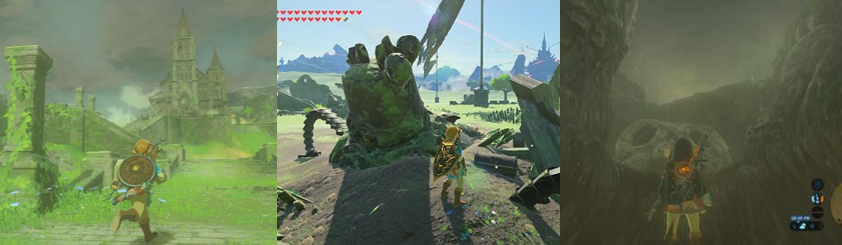
Hyrule is full of the remnants of lost civilisations and the ruins of a time long forgotten.

As soon as you step out of the Shrine of Resurrection, you can see the vastness of Hyrule but it’s not until you paraglide down into Hyrule proper that you see just how huge Hyrule now is. Without a horse or fast travel, it can take many actual, real-world minutes just to travel from one point to another and you’ll be beset by all manner of dangers along the way. Winds blow, rain falls, lightning strikes trees (and you…), and day turns to night turns to day in a constant cycle, all of which brings Hyrule to life as, perhaps, the most lively and realistic gaming environment I’ve ever seen. The remnants of Hyrule’s past glory and iconic locations from the Zelda series are everywhere, including destroyed outposts, the overgrown wreckage of the Temple of Time, and scattered, destroyed Guardians (be cautious when approaching for loot, though, as they’re often playing possum).

Each race of Hyrule lives in a distinct environment, which only adds more life and depth to the game.

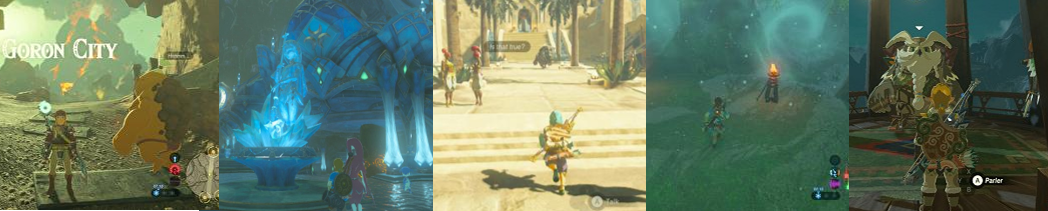
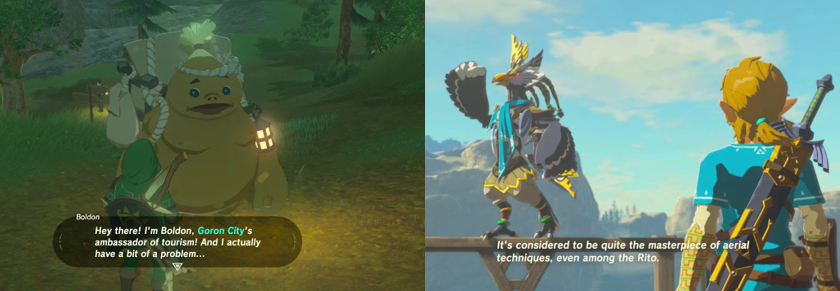
Like any good Zelda game, variety is the name of the game when it comes to Breath of the Wild; a degree of traditional society is retained throughout Hyrule thanks to places like Kakariko Village and Hateno Village but you can also visit the rock-eating Gorons, the sea-faring Zoras, the woodland imps known as Koroks, the desert-dwelling Gerudos (a society comprised entirely of women), and the man/bird hybrids the Ritos. Each one has their own visual style and a lives in a distinct area: the Gorons dwell in and around Death Mountain, working in mines nearby; the Zora’s live in the gorgeously ornate Zora’s Domain, which is full of water and waterfalls; the Rito are surrounded by snow and mountains; the Koroks are hidden deep within a dense, misty forest that will kick you out if you wander in unaided; and the Gerudo dwell within a desert town and set the guards on any males who dare intrude.

Dialogue is given through text boxes and voiced cutscenes, though Link stays eerily silent.

Character models are of equally high quality; they don’t necessarily move all that much but they are generally quite varied and full of life and personality. Each of Hyrule’s races can be found all over the land as well, with Gorons wandering around selling wares, Zora’s popping up in bodies of water, and Korok sprouting out of the most random of locations. Each one communicates using speech bubbles and text but, when the game switches to its higher quality cutscenes, characters will also talk as well. Link, however, remains silent which, to be honest, is a bit weird as the game’s story and script is often geared towards characters specifically addressing him or asking him questions, which makes his silence really stand out. Oddly, many conversations you have with NPCs give you the option of one or more answers, implying that Link can speak so it just feels like the game could have been tweaked a little to cover for his silence in speaking cutscenes. Cutscenes come in a variety of forms, from in-game graphics, higher quality cinematics, and distorted flashbacks to Link’s past as he uncovers more of his memories. Thankfully, you can speed up text scrolling with B and skip cutscenes if necessary and, often, the game skips over them for you (such as if you fall to a dungeon boss, for example). Musically, Breath of the Wild is the most elaborate of the series I’ve ever seen; a lot of the time, music gives way to ambient effects and slowly creeps in or suddenly kicks up to set the tone of an area or emphasise an enemy attack. It’s a grandiose, operatic score that escalates as you conquer the four Divine Beasts, defeat Ganon’s underlings, and take on the calamitous King of Evil himself in the finale, when the traditional Zelda theme kicks in with suitably dramatic impact.

Enemies and Bosses:
Hyrule is, as always, also populated by a wide variety of enemies, all of which freely roam its fields, mountains, and wastelands and will attack you on sight if they spot you, often calling for reinforcements if near an enemy camp, and all of which will drop weapons and monster items for your use. Some of the basic enemies include gelatinous Chuchus and bat-like Keese, which can be protected by elemental conditions, but, primarily, you’ll be fighting different varieties of Bokoblins. These goblin-like creatures like to set up camps, shoot at you from on high with arrows, and attack with spears and swords; they’re the most basic of enemies but are formidable through their sheer numbers and your comparative weakness and even rise from the grave to attack you in skeletal forms. They’re often accompanied by the much larger Moblins, which attack with kicks and bigger, longer weapons, but you’ll also have to contend with a variety of Lizalfos, who are often camouflaged or leap out at you from hiding, damn annoying Octorocs, who pop out from water to spit rocks at you that always seem to hit, and robe-clad Wizzrobes, who dance around mockingly shooting elemental magic at you and teleporting all over the place. Easily the most daunting of the regular enemies are the Lynels; these centaur-like creatures are basically like mini bosses and you won’t actually be able to defeat one for a long, long time as they’re just too tough. Once you get a healthy stock of hearts, food, and more powerful weapons (particularly the Master Sword), though, you’ll stand a much better chance of besting these ridiculously powerful enemies.

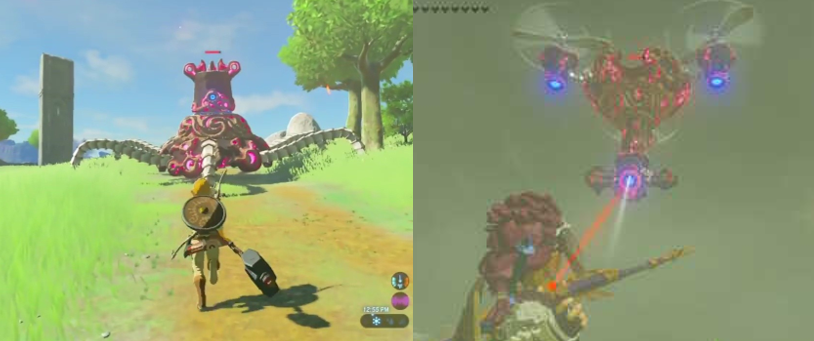
Guardians are a significant threat and extremely difficult to destroy or escape from.

However, there are only a handful of Lynels to worry about; the Guardians are far more frequent and troublesome as they often sit amongst the wrecked shells of their kind and fire what basically amounts to an instant-kill laser in your direction. At first, you have no chance of destroying these bastards and they’re only found in a handful of places but, once you conquer the Divine Beasts (and when you storm Hyrule Field on the way to Hyrule Castle), they’ll start to scuttle around the overworld in regular patrols. If they spot you, do everything you possibly can to avoid them, even if it means going far out of your way, and don’t even think about trying to outrun them without a horse! They can be defeated using special weapons and by targeting their limbs and eyes but, most of the time, it’s a fool’s errand and it’s simply easier to flee for your life! The flying variants are much easier to take out in comparison but once you see they’ve got a lock on, make sure you pace yourself to sprint away at the last second or else you (and your horse) will be toast.

The Divine Beasts need to be quelled before you can explore and restore them.

As there are only four dungeons in the game, Breath of the Wild is quite light on actual bosses; you will, however, have to do battle with Master Kohga of the desert-dwelling Yiga Clan in order to reach Vah Naboris, the Divine Beast of the Gerudo Desert. Kohga likes to hurl boulders your way but you can easily stun him with arrows and use Magnesis to repel his attacks in the brief windows of opportunity you get; honestly, sneaking through the clan’s hideout was more troublesome than the fight itself. The reverse is true of the dungeons, which focus on annoying puzzles and are largely devoid of enemies and populated mainly by “Malice”, a health-draining black/red goo that must be dispelled by shooting an eyeball. Just getting to the Divine Beasts and, thus, their bosses is like a boss battle in itself; each one can be tackled in any order and all of them must be quelled before you can enter them. I took on the Divine Beast Vah Ruta first, which spits ice projectiles at you that must be smashed with your Cryonis ability before using the bow and a special Zora outfit to swim up waterfalls and destroy the cannons on the Divine Beast. Similarly, Divine Beast Vah Rudania needs to be shot at by loading cannons with your bombs and a particularly hardy Goron. To bring down the Divine Beast Vah Medoh, you must protect yourself from the frigid cold and use the paraglider to destroy cannons on the Beast’s sides with Bomb Arrows while the Rito, Tiba, draws its fire away from you. Easily the most difficult of the Divine Beasts to bring down, though, was Vah Naboris, which forces you to stay within a protective field and surf, almost uncontrollably, across the sand using a Sand Seal while shooting a limited supply of Bomb Arrows at its feet.

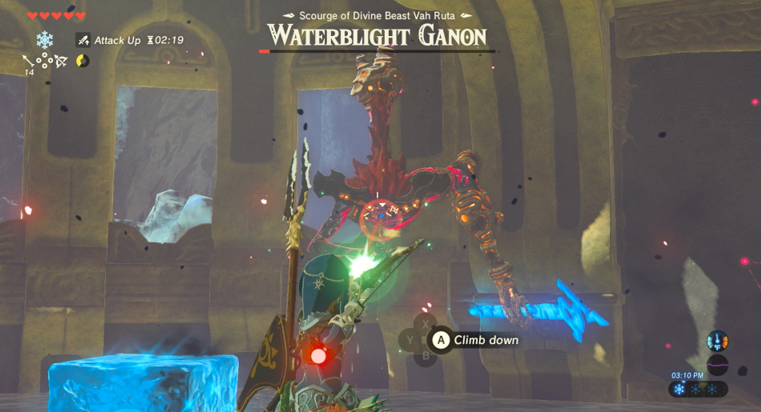
Waterblight Ganon attacks from a distance with a deadly spear and ice blocks.

Inside each of the Divine Beasts, you must first rotate, tilt, and manipulate the gigantic structures to activate five terminals and then you’ll do battle with a “phantom” aspect of Ganon, each of which sports two attack phases that will truly test your mettle, especially in the early going and if you’re underequipped. I first took on Waterblight Ganon and it was like hitting a brick wall! Teleporting around the arena and attacking with a long spear, Waterblight Ganon can be hurt with Bomb Arrows but can end you pretty quickly with just a couple of hits. In the second phase, the arena floods and you’ll need to shatter Waterblight Ganon’s ice blocks with Cryonis and dodge its thrown spear, again using Bomb or Shock Arrows (or Ancient Arrows if you manage to get some) to deal the most damage. This was a tough hill to climb for me and the first time I had to go off and cook up some defensive food to give me an edge as its attacks were too much at the time. Next, I took on Thunderblight Ganon, who was also quite the formidable foe thanks to his incredible speed! Thunderblight Ganon throws a few electrical balls your way, which are easy to dodge while firing arrows at him, but you have to have your shield up pretty quick when he dashes in for the attack or else you’ll miss your best opportunity to strike him. In the second phase, he drops a number of metal pillars into the arena and then electrifies them; you need to stay the hell away from these, grab one with Magnesis, and move it near him so he shocks himself, all of which is really hard to do as the camera and controls really get in the way here. This only stuns him, though, and he then follows up with even faster, more frequent attacks and you absolutely must make sure that you don’t have any metal weapons or armour equipped or else you won’t last long at all and eat or drink some concoctions to increase your defence, attack, and resistance to electricity.

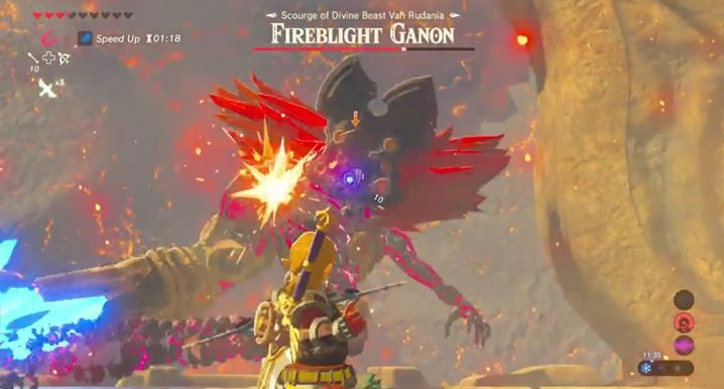
Fireblight Ganon wields a massive sword and tosses a huge fireball your way.

I then decided to give myself a break and tackle Fireblight Ganon next; this battle takes place in a much bigger arena, making it a bit easier to keep your distance and catch your breath, though Fireblight Ganon wields a massive sword so it helps to stay up close to him. In the second phase, he launches a massive fireball your way so be sure to hide behind the main terminal in the arena; you should also use this for cover if he busts out his Guardian laser and be sure to unequip any wooden weapons and utilise any Ice Arrows or ice-themed weapons you have to hand (though I also did some decent damage with Shock Arrows when I ran out of Ice Arrows). Finally, there’s Windblight Ganon which, again, takes place in a much bigger arena that is full or destructible columns that you can use for cover. Windblight Ganon hovers out of reach of your sword strikes and rapidly shoots at you with a laser pistol but you can bring him down using air currents to glide upwards and fire a few Bomb Arrows at him. In the second phase, he throws out tornados to wreck the arena and also sends out four drones to heavily magnify his laser attacks but I found it easier to simply concentrate on attacking him whenever possibly, scoffing down food as and when necessary, rather than be distracted by the drones.

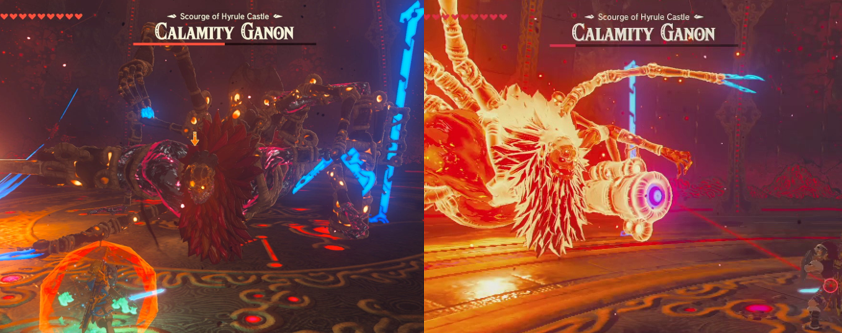
Calamity Ganon is a massive, spider-like monstrosity that borrows attacks from other bosses.

With the four Divine Beasts restored and taking aim at Hyrule Castle, you must then storm the Malice-ridden castle itself, which acts as a quasi-dungeon of sorts and is full of Guardians, enemies, and treasure, with only one Shrine for fast travel. There is, however, a shortcut up the West-side waterfall that takes you to the inner sanctum, where Calamity Ganon dwells. A monstrous, nightmarish amalgamation of the four phantoms, Calamity Ganon is the most horrific form I’ve ever seen Ganon in but this fight can be tipped greatly in your favour by defeating the other bosses as the Divine Beasts will drain half of Calamity Canon’s health. If you are stupid enough to go straight to the final boss without conquering the dungeons, or with less than four beaten, you’ll have to fight Ganon’s phantom forms before you can even take on Calamity Ganon so I really wouldn’t recommend going into this with just a stick and your undies. Calamity Ganon mixes and matches attacks from the other bosses, swinging a gigantic, flaming sword at you, causing flames and fireballs the scatter across the arena, throwing a spear at you, and blasting at you with a Guardian laser. I rushed up close and went to town on him as quickly as possible with the Master Sword (which doesn’t lose its charge in Hyrule Castle), dodging and hitting flurry attacks if I was lucky enough, and shooting at him with Ancient Arrows when he scuttled up the walls. In the second phase, Calamity Ganon protects himself in an impenetrable, flaming shield and is completely immune to your attacks; he ups his fire game with Fireblight Ganon’s fireball and also conjures Windblight Ganon’s tornados.

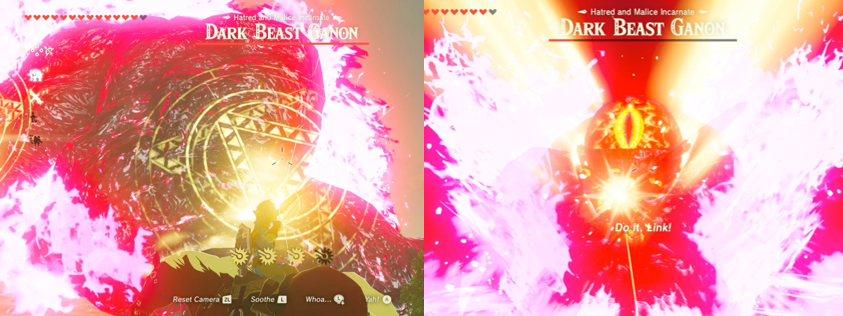
Ganon transforms into a rampaging beast and must be put down with some well-placed arrows.

In this phase, you really need to have mastered the “Perfect Guard” move (hold ZL to target and, right before an attack hits, press A to knock it away/back with your shield) as the only way to stun Calamity Ganon and thus damage him is to reflect his Guardian lasers back at him, which I found to be incredibly difficult to get right. Once defeated, Calamity Ganon transforms into a gigantic, Malice-infused, boar-like creature, Dark Beast Ganon, and rampages across Hyrule Field! Similar to the final boss of Twilight Princess, this battle takes place on horseback and the hardest thing about it, really, is keeping control of your horse as the camera and controls make manoeuvring around Ganon troublesome at times; touching Dark Beast Ganon will hurt you and cause you to be knocked from your horse so keep your distance and stay away from his face to avoid his big laser attack. When Zelda gives you the nod, golden symbols will appear on Ganon’s body and you must shoot at them with the Bow of Light (which, thankfully, has infinite ammo). When Dark Beast Ganon’s health is down to one sliver, a glowing weak spot appears on his forehead; now you must use the updraft from Ganon’s laser attack to glide into the air and use your arrows to strike the Malice eyeball and finally defeat Ganon and be treated to the game’s anti-climatic ending.

Power-Ups and Bonuses:
Breath of the Wild has an abundance of items, weapons, pick-ups, and power-ups for you; an overabundance, it seems at times, as you can pick up a variety of monster parts, minerals, food, and weapons to be equipped, sold, or cooked for a variety of effects. With all the food, meat, and fish (thankfully there’s no fishing mini games this time around) in the game, you can either eat some of them for a quick health boost or cook them up in a variety of combinations for stat boosts and extra help. I may have missed something but it doesn’t seem like there’s a way to keep track of your recipes so I kind of just tossed them in a pan and hoped for the best. When around a Great Fairy Fountain, you can sneak up on fairies and grab them, which is super helpful as they’ll restore your health a bit when all your hearts are empty. As you explore, defeat enemies, and open chests, you’ll acquire different melee weapons; these come in all shapes and sizes, from simple branches and torches, to skeletal arms, to rusty swords, double-handed blades and axes, and even elemental weapons. You can also grab Magic Rods for limited elemental attacks and a lot of these weapons have buffs applied to them that increase their attack and durability. Each handles differently as well; bigger weapons will deal more damage and break tough rocks but are painfully slow and you can’t use your shield at the same time. Eventually, you’ll be able to acquire the legendary Master Sword but, to even pull it from its pedestal, you’ll need at least thirteen permanent hearts (temporary hearts are no good) to yank it free and, though it’s the only weapon in the game that doesn’t break and you can shoot beams of energy if you have full health, it does run out of energy and become unusable for a few minutes.

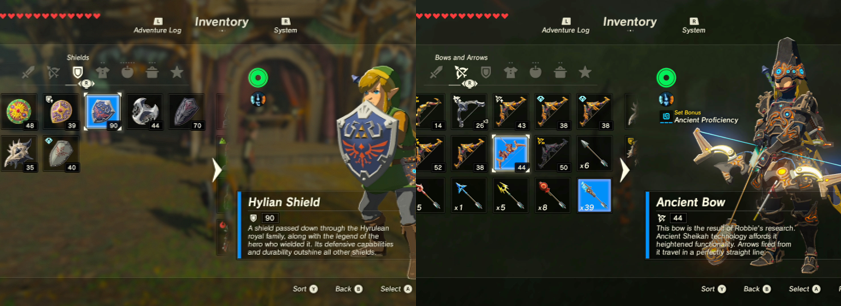
Sadly, no shield or bow is as durable as the Master Sword as they’ll all eventually break.

Still, it’s doing better than the game’s shields; again, these come in all shapes, sizes, materials, and with different buffs but the difference is that you can’t ever acquire a permanent shield. The best you can hope for is to liberate a powerful shield from Hyrule Castle but I found I was too afraid to equip it in case I wasted it defending against a regular Bokoblin attack. You can also acquire a number of different bows; some of these shoot further than others or even shoot multiple arrows at once, which I found to be more of a hinderance than a help as I was constantly running low on arrows. You can pick up elemental arrows (Fire, Ice, and Shock), which are super useful against water and fire enemies, Bomb Arrows (which are great for rock-based enemies and bosses), and the super powerful Ancient Arrows. Any Ancient gear is the most powerful in the game, especially against bosses and the Guardians, but they’re extremely rare and expensive. You’ll also acquire various items of clothing, each of which has different benefits; some protect you from extreme cold, heat, and lightning, some allow you to swim faster or up your defence, attack, or stealth, and others are more cosmetic or needed to enter specific areas. You can mix and match them, pay to dye them different colours (which is largely pointless), and upgrade and strengthen them at a Great fairy Fountain. Some are acquired through Shrines and side quests and the only way you’ll ever get Link’s trademark outfits is if you’re patient, skilled, and dedicated enough to conquer all one hundred and twenty Shrines (or fork out for special Amiibos).

The various Runes replace traditional magic and allow you to progress and solve puzzles.

Your first task at the start of the game is to power up your Shiekhah Slate (an obnoxious device that resembles a tablet or Nintendo Switch) with four Runes: the Remote Bomb allows you to throw or place either a spherical or square bomb; Magnesis allows you to push, pull, and move around magnetic metal objects; Stasis freezes certain objects in place and allows you to attack them to build up kinetic energy and move them about; and Cryonis allows you to form and shatter ice blocks. Later, you learn another Rune ability, Camera, which allows you to take photographs to solve side quests and such and each of these can be upgraded to make them more powerful or useful. Since Breath of the Wild is one of the few Zelda games to not give you a magic meter or other actual items (like the hookshot), these Runes take their place and the bombs are especially helpful for dealing some extra damage and saving your melee weapon from wearing out as you can throw an infinite supply and a limited only by a brief bit of cooldown.

Link earns helpful temporary abilities by taking down the Divine Beasts.

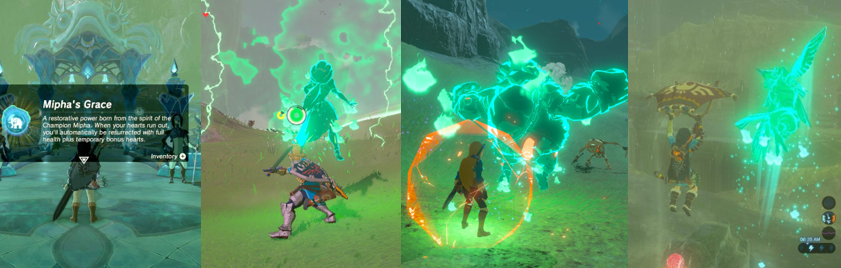
Similarly, every time you conquer a Divine Beast, you are awarded with a Heart Container and a key item that will greatly assist you in your quest: Mipha’s Grace is one of the best as it will completely restore your health and award you with additional temporary hearts upon death; Urbosa’s Fury allows your spin attack to unleash an electrical blast, which can be great for stunning enemies; Daruk’s Protection protects Link with a protective aura for as long as ZL is held down and will parry incoming attacks to give you a window to attack; and Revali’s Gale allows you to charge up a jump by holding down Y and blast you high into the air with an air current. You can activate and deactivate these at any time but, honestly, I don’t know why you would do that; each also comes with a limited number of uses and a cooldown period, meaning you have to wait about ten minutes before you can use them again.

Additional Features:
As I mentioned before, there are numerous side quests in Breath of the Wild and one hundred and twenty Shrines to find and conquer. The rewards for these vary from a few Rupees to new weapons and armour and, generally, it’s not always worth your time completing every single one of them unless you’re aiming for one hundred percent completion (which you thankfully don’t need to finish the game). However, the only way you’re going to see Link in his traditional outfit (or unlock the Dark Link outfit) is if you complete each of them; primarily, though, the side quests are there to emphasise how big and alive this version of Hyrule is and to strengthen your immersion in the game, so it’s entirely up to you, but it can lead to you acquire stronger weapons, armour, and some unique riding companions. Some of the Shrine challenges are very unique, though, like the one on Eventide Island that sees you stripped of all of your weapons and left to fend for yourself with whatever you can find as you strive to recover three orbs all without being able to save. Three others see you navigating labyrinths and one particularly long side quest sees you visiting specific areas of Hyrule to recover Link’s lost memories.

A number of sub-bosses and gigantic creatures can be found prowling around Hyrule.

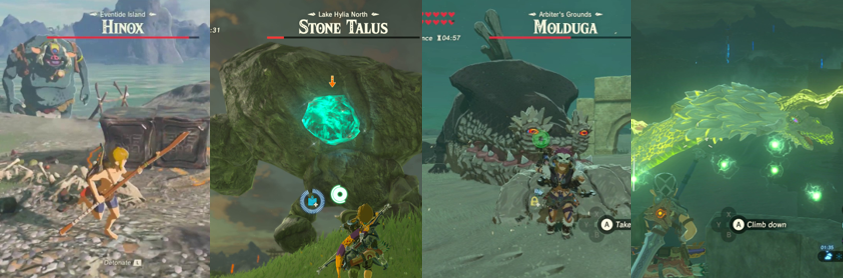
Hyrule is also populated by a number of gigantic sub-bosses; be wary when you approach a big stone as it will probably come to life as a Stone Talus, which can only be felled by bringing it to its knees and climbing up it to attack the weak spot on its “head”. Far more frequently, you’ll come across the massive cyclopean Hinox; these are much easier to take on and defeat as you can stun them with a shot to the eye and attack them at will but they do have a tendency to rip up trees to swing at you and chase you almost relentlessly. Out in the desert, you’ll also encounter the Graboid-like Molduga, which burrow under the sand to attack you and are best tackled with your bombs. While you’ll also encounter three elemental dragons in your travels, these cannot be defeated and are simply there to cause destructive weather occurrences and to be mined for rare materials. I mentioned before that the ending is very anti-climatic and it’s true; it’s much more sombre and reflective than the massive celebration seen at the end of Ocarina of Time, for example, and it kind of felt like the developers either ran out of time or didn’t put much effort into the ending as the journey was the primary focus. When you finish the game, your save file gets a star marked on it but that’s it; you can return to your last save (which should be an autosave right before the final fight) so you can go after anything you’ve missed along the way but the only way you’re going to get additional content is if you shell out for the DLC. The expansion pass adds new gear, enemies, and challenges to the game and also includes an even harder story mode to play through but, since I struggled so much with the base game, I don’t think I’ll be paying for this any time soon.

The Summary:
There’s no denying that The Legend of Zelda: Breath of the Wild is a stunning achievement for the series, and in videogaming; the game is massive, full of life and variety and things to do, and will keep you busy for hours on end (it took me at least thirty days just to clear the main story objectives). Never has Hyrule been bigger and more immersive; just travelling a short distance can be an adventure in itself and you’ll find yourself fighting tooth and nail against even the most basic of enemies for the smallest rewards but even a bundle of five arrows can be a blessing when you’re running short on supplies. The graphics are more than impressive, bringing the Zelda concept truly to life in a way that titles like Ocarina of Time and Twilight Princess hoped for but could never quite achieve; it never feels like anywhere or anything is off limits and you can travel to the highest, furthest points as long as you’re properly equipped and prepared without worrying about barriers or invisible walls. And yet…Breath of the Wild is one of the most frustrating an inaccessible videogames I’ve ever experienced. There really is far too much going on, way too much to think and worry about, and the simplicity and accessibility of earlier Zelda titles has been lost in service of appealing to fans of games like Skyrim. I think if Breath of the Wild had focused on one or two mechanics, or tweaked some of them a bit, it would have been much more enjoyable for me; as I said, not having every weapon break would be a good start, as would putting less focus on cooking and eating food to survive. In many ways, it feels like the most Zelda game ever but also, paradoxically, the least Zelda game ever as all the recognisable elements are there but they’re so drastically different, and the game is so dramatically difficult at times, that it was actually a turn off. I was expecting an epic, sprawling, immersive adventure and Breath of the Wild delivers but every battle is a stress as you can easily die or break your coveted weapons in the smallest of skirmishes, some mechanics like jumping, the frustrating instances of forcing you to use motion controls, and climbing can be a bit janky, as can the in-game camera and physics, and I just felt like the game was punishing me over and over again. To make matters worse, I didn’t even feel a cathartic sense of accomplishment after beating the game since the ending was so anti-climatic; I just felt drained and relieved and I’m hoping that approaching the remainder of the game’s Shrines and side quests in a more casual manner will allow me to think more highly of the game in time.

My Rating:

Rating: 3 out of 5.

Pretty Good

What did you think to The Legend of Zelda: Breath of the Wild? Where would you rank it amongst all the other Zelda titles, specifically the 3D adventures? Were you a fan of the new elements introduced in this game, the breakable weapons, and the difficulty and challenge offered by the game? Did you every conquer all the Shrines and which was your most, or least, favourite? What order did you tackle the Divine Beasts in and which of Ganon’s phantoms was the most difficult for you? Which area and/or race of the game was your favourite and what was your preferred clothing and weapon load out? What did you name your horse? Which Zelda game is your favourite and why? Whatever your thoughts on Breath of the Wild, drop a comment down below.

Game Corner [Zelda Day]: The Legend of Zelda (Nintendo 3DS)


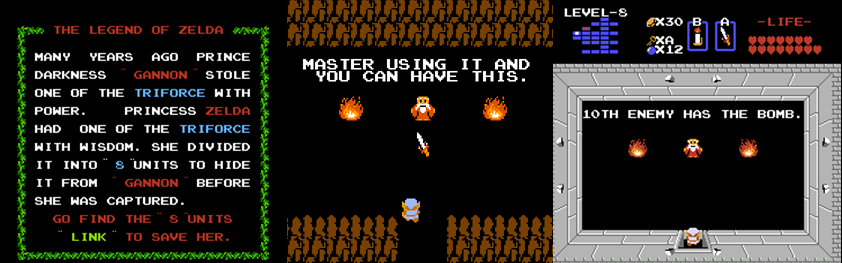
On 21 February 1986, The Legend of Zelda (Nintendo EAD, 1986) was first released in Japan. The creation of legendary game designer Shigeru Miyamoto and Takashi Tezuka, The Legend of Zelda launched one of Nintendo’s most popular franchises, with its silent protagonist, Link, and his vast fantasy world of sword and sorcery not only enduring over time but constantly evolving and improving as the series progressed.


Released: 7 June 2011
Originally Released: 21 February 1986
Developer: Nintendo
Original Developer: Nintendo EAD
Also Available For: Family Computer Disk System (Famicom), Game Boy Advance, GameCube, Nintendo Entertainment System (NES), Nintendo Switch, Nintendo Wii, Nintendo Wii U

The Background:
The Legend of Zelda was created by designer Shigeru Miyamoto (the man responsible for Nintendo’s popular mascot, Super Mario) and Takashi Tezuka; in fact, Zelda and Super Mario Bros. (Nintendo EAD, 1985) were developed simultaneously and so, to separate the two games, Zelda was purposely made far less linear and based around both exploration and experimentation, with Miyamoto drawing inspiration from his childhood love of exploring forests and caves. Although players are free to name the game’s protagonist, he was dubbed “Link” to suggest an emotional “link” between the player and their avatar and his story was framed as a “coming of age” tale that would allow the player to grow alongside their silent, but by no means less iconic, game character. The Legend of Zelda was hugely successful for Nintendo, with the game selling well over 6.5 million copies and Nintendo even commissioned a special gold cartridge variant for its North American release. The game was met with universal praise during its release and is still regarded as one of the greatest adventure game of all time. Although I was aware of the franchise thanks to the much-maligned animated series, being a SEGA kid growing up I didn’t play a Zelda title from start to finish until I got The Legend of Zelda: Link’s Awakening (ibid, 1993). This was enough to hook me on the franchise, however, which grew to a deep affection thanks, of course, to The Legend of Zelda: Ocarina of Time (ibid, 1998). The original title, though, had always eluded me so, with this year marking the game’s thirty-fifth anniversary, I figured now was as good a time as any to sit down and give it a go.

The Plot:
The peaceful kingdom of Hyrule is suddenly invaded by the malevolent Ganon (or “Gannon”, as he’s referred to in-game) and his monstrous army. Having already stolen the Triforce of Power, one part of the legendary Triforce, he kidnaps Princess Zelda to acquire the Triforce of Wisdom. However, after she separates the Triforce of Wisdom into eight fragments, it’s up to Link, a plucky young boy from the forest, to journey across the land, recover the Triforce fragments, and put an end to Ganon’s dreams of world conquest.

Gameplay:
The Legend of Zelda is a 2D, top-down action/adventure game set in the fantasy land of Hyrule. One of the few NES titles to feature a battery back-up save feature, players can create one of three save files and save their progress whenever they die in the game, which is a necessary feature given how large the game is. Unlike the majority of Zelda games, though, the name you give to your save file isn’t reflected in-game; when you rescue Princess Zelda at the game’s conclusion, she refers to you as “Link” no matter what you title your save file, making this original adventure one of only a handful of Zelda titles to actually use that name to refer to its green-garbed protagonist.

Defeat enemies with your trusty sword, which shoots out beams when you’re at full health.

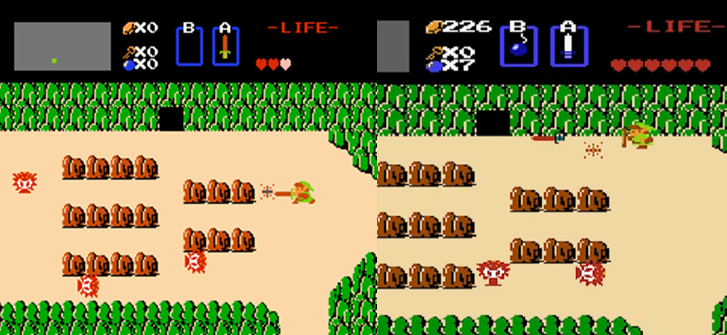
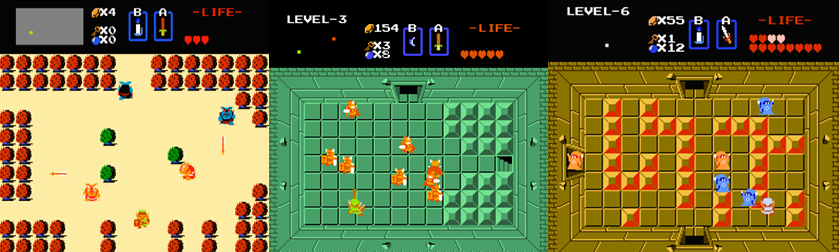
Once you’ve created your save file, you are immediately dropped into Hyrule and left to fend for yourself. Link moves in a grid-like pattern across the map and comes complete with a shield that will block most enemy projectiles as long as he is facing them. If you enter the cave at the top of the game’s first screen, you’ll acquire a sword, allowing you to dispatch most enemies in one of two ways: the first is a tried-and-tested sword swipe and the second is an energy bolt that fires from your sword as long as you are at full health, which really helps to clear the screen of enemies from a safe distance. Defeated enemies may occasionally drop hearts or fairies to refill your health, bombs to allow you to deal explosive damage to enemies and uncover secret passageways, or Rupees (or “Rupies”/”Rubies”), the in-game currency. Link can hold a maximum of 255 Rupees and will sporadically stumble across merchants hidden in dungeons or caves who will sell him a variety of items, weapons, and power-ups.

The majority of Hyrule and the game’s dungeons are accessible right from the start.

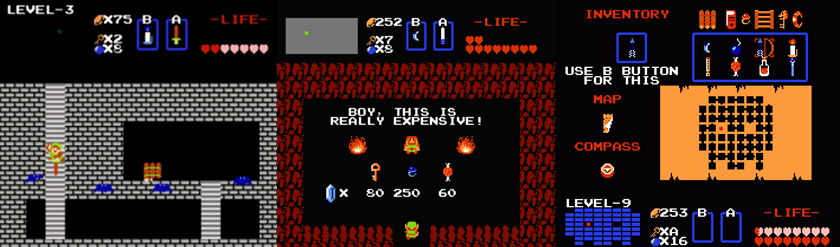
As you might expect from a Zelda title, the game’s overworld is pretty expansive, covering forests, mountains, and beachfronts. A mini map is present in the top-left of the game’s heads-up display (HUD) but, out in the overworld, is next to useless since all you can see is a little green dot (representing you) on a blank, grey background. In dungeons, you can collect a Dungeon Map to make navigation a lot easier but, again, it’s not as helpful as it could be since there’s no distinction between floors, meaning it’s very easy to get lost or turned around or to wander around Hyrule with no idea of where you are or need to go. Your goal in the game is to visit eight dungeons (referred to in the game as “Levels”) and retrieve the eight pieces of the Triforce of Wisdom; you can track your progress towards this goal from the game’s inventory menu and non-playable characters (NPCs) can offer you (extremely) vague hints about how to progress but, otherwise, much of the game’s adventure is in your hands. As a result, pretty much the entirety of Hyrule is available for you to explore and visit as long as you have, at least, some bombs available to you. This means that it’s very easy to wander around the overworld and stumble into the game’s harder dungeons before you’re ready, which can add an additional layer of challenge to the game if you’re brave enough to attempt to tackle these tougher levels out of sequence. It also means that you can acquire some of the game’s more powerful and useful weapons early, at the very least, though some can be useless without others (I, for example, acquired the Book of Magic long before I got the Magic Rod, making said book all but useless).

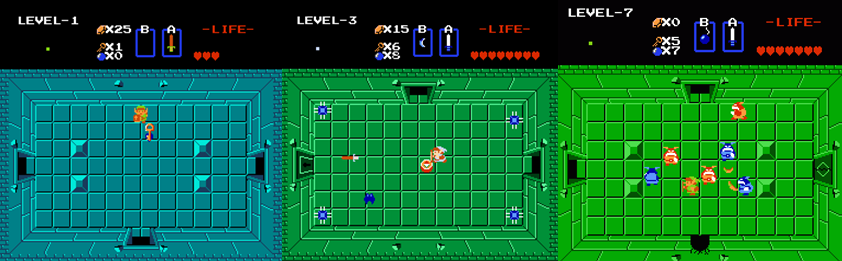
Zelda‘s dungeons are largely indistinguishable beyond their colour palette and enemy placements.

Given that I played through 90% of this game blind and without a guide, I have to say that that this is all-but-inevitable as, while the game’s first two dungeons are easily found almost right next to each other, it’s entirely up to you to explore your surroundings so it’s pretty easy to stumble into the harder levels when you only have three of four hearts in your health bar. As big as Hyrule is, though, many of the dungeons are actually quite small; inside, you’ll be tasked with defeating enemies and solving very (very) simple puzzles (generally as taxing as pushing a certain block or bombing a certain wall) to open doors, or collect keys to open doors, grabbing a new weapon or item, Dungeon Map and Compass to aid with your navigation within the dungeon, and then defeating a boss to extend your health bar and retrieve a piece of the Triforce of Wisdom. One interesting feature I was surprised to see was that you can carry keys from one dungeon to another, which can give you an edge with the game’s harder dungeons and allow you to take shortcuts here and there. Gameplay follows a very simple formula from start to finish: explore the immediate area, uncover secrets, find a dungeon, and retrieve a piece of the Triforce of Wisdom. The only time the gameplay is changed up is when you descend down hidden staircases inside the dungeons and enter a short 2D area where the level’s weapon or key item can be found. Otherwise, gameplay variety comes from utilising different weapons to battle enemies and bosses or factoring in the erratic patterns of the game’s enemies, who like to attack in something resembling a co-ordinated effort or en masse, requiring both some strategy on your part and a healthy supply of hearts in order to survive the damage put out by the game’s later enemies. As a result, Zelda’s difficulty is, largely, up to you; if you clear Level-1 and then stumble into Level-8, it’s probably best to leave that later dungeon and seek out Level-2 to 3 to give yourself a better chance of success.

Graphics and Sound:
The Legend of Zelda is a very basic 2D adventure; like Super Mario Bros. and many videogames of that era, the graphics are extremely simplistic and, largely, require quite a bit of imagination and suspension of disbelief on the part of the player. Link is immediately and instantly recognisable against the game’s many different backgrounds and compared to the enemy sprites thanks to his green tunic and cute little sword and shield but, obviously, you’re not going to see many frames of animation or layers of detail in this game. Additionally, I found that the game struggled a bit when there were a lot of sprites onscreen and/or sounds playing at the same time; the iconic Zelda theme plays constantly on the overworld and, when Link is low of health, the game emits a constant beeping to inform you and enemies make little noises when they shoot at you or are destroyed and all of these sounds can blend into each other and the game slows down noticeably when a hoard of Lynels incessantly shoot projectiles at you.

Though limited by the hardware of the time, Zelda is a vast and ambitious adventure.

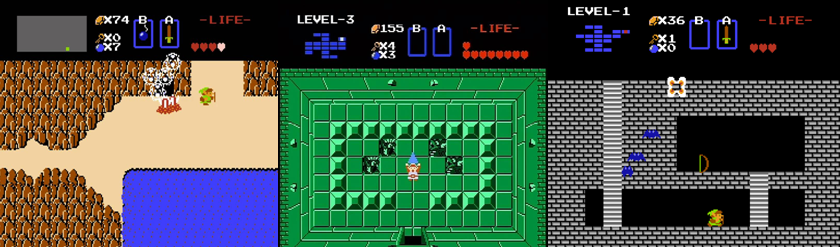
Despite the game’s limited graphical capabilities, Hyrule is surprisingly vast, varied, and detailed at times; the entire land is surrounded by sea that you cannot cross and made up of forests, mountains, beaches, and icy regions. You’ll have to navigate a series of repeating, identical screens in a maze-like puzzle, dodge boulders as they rain down from Death Mountain, explore a haunted graveyard, cross the water using a raft, enter a waterfall, descend into caves, and cross beaches while Leevers randomly pop out at you as you explore looking for merchants, additional items and weapons, and the elusive dungeon entrances. Dungeons are generally recognisable in the overworld but, sometimes, you’ll enter what appears to be a dungeon only to find a merchant or other NCP. When you do find a dungeon, you’ll be treated to a different in-game tune, which is refreshing, but will find that most dungeons are aesthetically very similar just with a different colour palette. Dungeons get progressively bigger as you progress, though, and are filled with more enemies; you’ll also find that you’re required to visit different floors using staircases and bomb walls more frequently to access different areas and properly progress, which adds an additional layer of challenge to the game. Each dungeon also has its own unique layout and appearance as seen on the map screen to help distinguish them but, for the most part, they’re quite similar and not themed around elements like later Zelda dungeons would be.

Zelda uses text and (very) simple and vague dialogue to convey its plot and your objective.

For an adventure game, The Legend of Zelda is extremely light on story and dialogue; the game’s story is told through some text when you wait around on the title screen but, beyond that, you’ll need to read the game’s instruction manual to learn more about the plot and the lore of Hyrule since the NPCs offer only cryptic clues and vague statements. Dialogue and character interaction is practically non-existent in The Legend of Zelda, which I find a bit surprising given how prominent it would become in the series and how heavy it featured in more traditional role-playing games (RPGs) released around the same time, such as Final Fantasy (Square, 1987). However, given the amount of grammatical errors and incongruous dialogue contained within the first Zelda this is, perhaps, a good thing; it also means that the onus is on the player to explore every nook and cranny and to experiment with every weapon on every screen on the game to uncover secrets and new areas, placing an emphasis on exploration and player immersion rather than hand-holding.

Enemies and Bosses:
Link will have to contend with a wide variety of enemies on his grand quest; the overworld is alive with numerous enemies, some of which are specific to certain areas and each of which presents a different challenge thanks to their attack patterns and difficulty. It’s very rare that you’ll take on just one or two enemies at a time and, generally, you’ll have to battle about four or five at once and often a mixture of different enemies, requiring a certain amount of strategy on your part as you can’t always take the direct approach in battle. One of the most common enemies in the game are the Octorocs (octopus-like creatures that spit projectiles at you), Peahats (bulbous vegetation that hover in the air and can only be destroyed when briefly stationary), Tektites (spider-like enemies that hop around the screen), aforementioned Leevers (spiked globs that burrow in and out of sand), and the Keese (bats that flutter around the screen). While you’ll encounter different coloured variants of most of these (and other enemies) that are tougher, these are the most common enemies and are easily dispatched with one sword swing.

Zelda‘s tougher enemies can be a real headache thanks to their numbers and attack patterns.

As you progress, though, you’ll encounter far more formidable enemies: Moblins launch spears at you, Goriyas toss boomerangs your way, Ropes (why they’re not called “snakes” is beyond me) charge at you head-first, and Wallmasters will drag you back to the first screen of the dungeon you’re in if you’re not careful. Some of the game’s toughest and most annoying enemies include the Wizzrobes (who constantly teleport around the screen, often directly into where you’re walking, and fire energy bolts that can easily drain your health if you’re caught in a crossfire), Darknuts (who can only be attacked from behind and wander around in an unpredictable pattern), and the aforementioned Lynels. You’ll also have to be careful about getting too close to seemingly harmless Armos statues in case they spring to life, avoid getting eaten by a Like-Like lest it take away your shield upgrade, and make sure you have plenty of health or arrows to make battling the Poe’s Voice that much easier.

The Dodongo might be pretty pathetic but the Manhandla was a pain in my ass!

The game features nine dungeons to explore, which means nine bosses to contend with; make sure you familiarise yourself with each of these bosses, though, as you’ll encounter all of them on multiple occasions as sub-bosses in the game’s later dungeons. Technically, you can battle them in whatever order you like as long as you’re tough enough to survive the dungeon and their damage output but it’s best to try and take them on in sequential order to give yourself the best chance at success. This means that the first boss you fight should be Aquamentus, a horned dragon that spits out three projectiles that you must dodge between. This boss is fought in Level-1 and Level-7 and is made all the easier if you have the energy to use your sword beam or ammo enough to shoot arrows at it, which will make short work of it. The Dodongo, in comparison, is a pretty pathetic excuse for a boss; it lumbers around the screen doing little to nothing and is easily dispatched by placing bombs before its mouth. Later on, you’ll have to contend with three of these at once but, since they don’t make any effort to attack you, they’re easily the weakest of all the game’s bosses. Unfortunately, the same can’t be said for the Manhandla boss; this piranha-like bastard was the bane of my life since it popped up three times throughout the quest. It slowly bounces around the arena firing projectiles at you and is very tricky to hit thanks to the limited reach of Link’s depowered sword and Link’s restricted range of movement; it’s much faster and more efficient to use bombs to deal massive, successive damage to the Mandhandla but be wary as, the more parts of it you destroy, the faster its movements become.

Bosses range from frustratingly awkward to ridiculously easy depending on how equipped you are.

One of the toughest bosses in the game, for me, was the multi-headed dragon Gleeok; this monstrosity sports two, three, or four heads, spits projectiles towards you that are difficult to avoid, and is only able to be damaged by awkwardly slashing at its neck or, more effectively, shooting arrows at it. Be careful, though, as when the Gleeok’s heads are severed they will float around the arena shooting projectiles at you and cannot be harmed. Compared to Gleeok, Digdogger and Gohma are a walk in the park, especially once you have acquired the recorder and the bow; Digdogger is completely invulnerable until you play the recorder and reduce it down to its core but, once you do, you can just whack it until it’s defeated. Similarly, Gohma can be a bit of a pain with its sporadic movements and projectiles but a few well-timed shots to its exposed eye will put it away without any real issues; the most difficult thing about many of these bosses is having enough health, the right weapons, and being able to navigate the arena when projectiles are being fired at you from both the boss and the nearby statues.

Despite his fearsome appearance, Ganon is quite a pushover once he’s out in the open.

Of course, the main objective of the game is to assemble the eight pieces of the Triforce of Wisdom, battle through Level-9 (which is accessed by bombing a specific rock formation on Death Mountain and features swarms of the game’s toughest enemies and a new sub-boss, the Patra, which can only be destroyed after first taking care of the tiny little eyes it shields itself with), and confront the evil Ganon. For the final boss of the game, Ganon isn’t that much of a challenge; he turns invisible and fires a series of projectiles at you, forcing you to swipe somewhat blindly around the screen until you hit him. Land four this and he appears in all his monstrous glory…and is easily destroyed with one hit from a Silver Arrow for a disappointingly anticlimactic end to the game.

Power-Ups and Bonuses:
Link begins the game with three hearts’ worth of health which, very quickly proves to be far too little to get past the game’s tougher enemies and dungeons. Fortunately, every time you defeat a dungeon boss, you expand your maximum hearts by one and can find additional Heart Containers hidden on the overworld or for sale from certain merchants, which will increase it to twenty units. Certain weapons also have similar limitations; for the majority of the game, you can only carry six bombs at a time until stumbling across a merchant who will allow you to carry double that amount (…for a small fee), the only way to get arrows is to buy them, and your usage of the Red Candle is restricted. Thankfully, the Blue Candle and Magic Rod are not so restricted, allowing you to light up dark areas and deal damage to enemies (but watch out because the flame you conjure can also hurt you!)

A number of key items and upgrades will vastly improve your chances at success.

As you might expect from a Zelda title, Link has access to a decent variety of weapons and items: enemies sometimes drop a clock (which causes enemies to freeze in place and gifts Link with invincibility for a brief period), the boomerang allows him to attack from a distance, the stepladder lets him cross one tile of water, the raft allows him to drift across water at certain points on the map, and he can also find a Power Bracelet to move blocks and upgrades for his sword and shield to block more projectiles and deal additional damage. Eventually, you’ll also be able to purchase health-restoring medicines and other expensive items to aid your quest: one such item is a Magic Key that renders all other temporary keys redundant and a piece of food to get past Goriyas (though you’d never know that you need to use this item). You can also buy a Blue Ring and find a Red Ring, both of which significantly reduce the amount of damage you take while also changing Link’s tunic to blue and red, respectively.

Additional Features:
Whereas later Zelda titles placed significant emphasis on a variety of side quests, I only really came across one in this first title (barring the hidden Heart Containers on the overworld) which involved taking a letter from one NPC to another to be able to purchase medicines. After finishing the game, you will unlock the “Second Quest”, which replaces your save file sprite to one of Link holding his sword aloft and overwrites your save file from the beginning but mixes up the locations of dungeons, enemies, and items and also increases the difficulty of the game’s enemies. You can, however, jump straight into this mode by naming for save file “ZELDA” and also make frequent, fragrant, and continuous use of the 3DS version’s save state ability to make beating this difficult and finicky first Zelda title much less of a headache.

The Summary:
After years of hearing so much hype about how good The Legend of Zelda is and having experienced a number of 2D and 3D Zelda titles, I was excited to finally experience the first in the series and, for the most part, The Legend of Zelda lived up to the hype. It’s definitely a product of its time and suffer somewhat from the limitations of the NES hardware and the simplistic graphics, gameplay, and sound but it’s still an ambitious little action/adventure title that was both offering something unique at a time largely dominated by space shooters and platformers. Everything on offer in The Legend of Zelda was expanded upon and improved as the series progressed but, for this first entry, the player is required to utilise a lot of exploration, experimentation, and utilise the bare minimum of information to find the pieces of the Triforce of Wisdom. I went in mostly blind and did okay, for the most part, and only had to turn to a guide for the last two dungeons and to track down a couple of the game’s more elusive items so it’s definitely do-able but the game is handicapped somewhat by this format since it’s very easy to just get lost and end up wandering around in circles or being absolutely bludgeoned by the game’s tougher enemies. Honestly, I have nothing but respect for those who managed to get through this game back in the day without the benefit of save states since it’s a deceptively tough title, one that I’m sure kept many kids busy for many hours or even days with its vast landscape and tricky bosses.

My Rating:

Rating: 4 out of 5.

Great Stuff

What are your thoughts on The Legend of Zelda? Did you own this on the NES back in the day or did you, perhaps, discover it later on a different console? How do you feel it holds up these days, especially against later Zelda titles? Which Zelda game, character, or dungeon is your favourite and why? Would you like to see a return to the top-down style of gameplay for Zelda or do you prefer to more action-orientated, open world approach? How are you celebrating The Legend of Zelda’s debut today? Whatever your thoughts, memories, or opinions of The Legend of Zelda, and the Zelda franchise overall, feel free to drop a comment below and check in next Sunday for more Zelda content.

10 FTW: Dark Doppelgängers

10FTW

If there’s one thing any hero can count on it’s that, at some point in their illustrious career, they’re going to have to face off against themselves. Sometimes, like with the classic Demon in a Bottle (Michelinie, et al, 1979) this is a metaphorical battle against their own inner demons and foibles but. More often than not, it’s a literal battle against an evil version of the themselves. Sometimes they’re from another world or a parallel dimension, perhaps they’ve used stolen technology or been cloned from the hero; other times, they are of the same race or seek to replicate the hero’s powers and usurp them. Whatever the case, I’ve always enjoyed a good doppelgänger, generally because they’re just like the hero but dark and edgy or more violent and, being as I grew up in the nineties, I like that kind of stuff. An evil version of a hero can help to elevate the hero by allowing them to overcome their failings and, sometimes, will even edge out of villain territory and become either a full-fledged hero in their own right or a line-towing anti-hero. In either case, today I’m going to run through ten of my favourite dark doppelgängers; evil versions of heroes who are just cool through and through.

10DarkLink
10 Dark Link / Shadow Link

First appearing in Zelda II: The Adventure of Link (Nintendo EAD, 1987) this shadowy version of the heroic Link gets the number ten spot purely because he isn’t really much more than a glorified henchmen for main series villain, Ganon. In true Peter Pan (Barrie, 1902) fashion, Dark Link often takes the form of a pitch-black shadow or a dark, distorted reflection and is able to perfectly mirror all of Link’s attacks and abilities. In recent years, he’s appeared more as a phantom and been given more definition but he’s generally relegated to being a sub-boss for a game’s dungeon and never the true threat to the land of Hyrule.

9Wario
9 Wario

Debuting in Super Mario Land 2: 6 Golden Coins (Nintendo R&D1, 1992), this bloated, disgusting, twisted version of Mario is everything Nintendo’s cute and cuddly mascot isn’t: he’s rude, crude, mad, bad, and dangerous. Where Mario jumps on blocks and Koopa heads to save a delightful Princess, Wario barges through walls and tosses his enemies at each other to steal, loot, or recover treasure. Wario even has his own version of Luigi, Waluigi (who exists more for the sake of existing, I would argue) but, while he crashed onto the scene in a big way by taking over Mario’s castle, Wario has softened over the years. He’s transitioned from an anti-hero and begrudging ally to simply a master of ceremonies as Nintendo moved him away from being the star of his own series of unique games and more towards party games and mini games.

8 Black Adam

Created by Otto Binder and C. C. Beck, Teth-Adam was originally gifted the magical powers of the wizard Shazam and chosen to be his champion, Mighty Adam. After being bewitched and corrupted, however, Adam was stripped of his powers and withered away to dust but, centuries later, was reborn when his ancestor, Theo Adam kills Billy Batson’s parents to lay claim to Adam’s power. Black Adam possesses all of the same powers as Captain Marvel/Shazam but is also gifted with a pronounced mean streak and tactical genius; he briefly reformed for a time, even joining the Justice Society of America and building a family of his own, but his quick temper and deep-seated contempt for humanity generally always drives him into a murderous rampage that few heroes can hope to oppose.

7Janus
7 Alec Trevelyan / Janus

Appearing in what is still probably the best James Bond film ever made, GoldenEye (Campbell, 1995), Alec Trevelyan (masterfully portrayed by Sean Bean) was one of MI6’s top 00 agents. However, wanting revenge against the British government for the death of his family and comrades during World War Two, Trevelyan faked his death and formed a criminal organisation named after his new alias, Janus. Trevelyan makes the list because he’s everything James Bond (Pierce Brosnan) was but twisted towards villainy; he and Bond were close friends and partners and his “death” weighed heavily on Bond’s conscious for nine years, making his betrayal even more sickening. In facing Trevelyan, Bond not only faces his biggest regret and mistake but also himself and what he could easily become if the fates were different.

6Slash
6 Slash

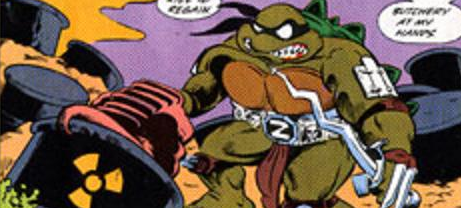
First appearing in ‘Slash, the Evil Turtle from Dimension X’ (Wolf, et al, 1990), Slash was originally an evil violent mirror of the heroic Teenage Mutant Ninja Turtles who often appeared in Turtles videogames and merchandise as a sub-boss for the Turtles to fight. For me, his most iconic look is when he’s sporting a black bandana, some spiked apparel, razor-sharp, jagged blades, and a heavy, armour-plated, spiked shell. Slash’s look and characterisation have changed significantly over the years as he’s gone from a somewhat-eloquent villain, to a rampaging monster, to an ally of the Turtles depending on which version you’re reading or watching.

5TheMaster
5 The Master

Originally (and, perhaps, most famously) portrayed by Roger Delgado, the Master was a renegade Time Lord who rebelled against his overbearing masters to freely wander through time and space. While this closely mirrors the story of his childhood friend, the Doctor (Various), the Master was the Doctor’s exact opposite: evil where the Doctor was good, malicious where the Doctor was kind, and wanted nothing more than to extend his lifespan, conquer other races, and destroy (or break) his oldest rival. Though sporting a deadly laser screwdriver and able to hypnotise others, the Master gets the number five spot simply because he’s been overplayed to death in recent years. Time and time again we’ve witnessed the Master at the end of his regeneration cycle, or destroyed forever, only for yet another incarnation to appear and wreck more havoc. He’s even redeemed himself and turned good before, and yet still returns to his wicked ways to plague the Doctor even when his threat should long have ended.

4 Metal Sonic

Speeding onto the scene in Sonic the Hedgehog CD (SEGA, 1993), Metal Sonic stands head-and-shoulders above all over robot copies of Sonic the Hedgehog simply by virtue of his simplistic, bad-ass design. A fan favourite for years, Metal Sonic has made numerous appearances in multiple Sonic the Hedgehog (Sonic Team/Various, 1991 to present) videogames, comic books, and other media. Sporting a sleek, aerodynamic design, chrome plating, and a massive jet engine on his back, Metal Sonic did something no one had done at the time of his debut and not only matched Sonic’s speed, but outmatched it on more than one occasion. While Sonic CD is far from my favourite Sonic title, it’s hard to downplay the iconic race against Metal Sonic in Stardust Speedway or his impact on the franchise.

3ReverseFlash
3 Reverse-Flash

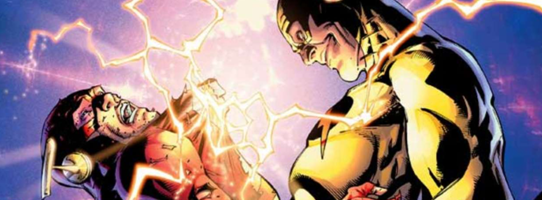
Versions of the Reverse-Flash have plagued DC Comics’ speedsters over the years, most notably Edward Clariss (The Rival), Eobard Thawne (Reverse-Flash), and Hunter Zolomon (Professor Zoom). Sporting a yellow variant of the classic Flash suit and shooting off sparks of red lightning, the Reverse-Flash is generally characterised as using his powers to torture the Flash out of a twisted desire to make him a better hero. Reverse-Flash’s threat is increased by his tendency to travel through time, evading death and plaguing different generations of the Flash; Professor Zoom was even able to manipulate the Speed Force to jump through time and appear to be faster than the Flash. Reverse-Flash has also been the cause of numerous agonies in the lives of multiple Flashes; he’s killed or threatened those closest to him (including Barry Allen’s mother) and delights in bringing the Flash to the brink of his moral code.

2JudgeDeath
2 Judge Death

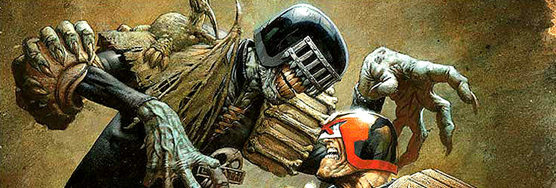
Hailing from an alternate dimension where life itself is a crime (as crimes are only committed by the living), Judge Death is the dark counterpart to no-nonsense lawman Judge Dredd. First appearing in 1980 and created by John Wagner and Brian Bolland, Judge Death assumes the appearance of the Grim Reaper and uses his demonic powers to kill with a touch. Rocking a metal design (recently evoked by the Batman-Who-Laughs, another contender for this list), Judge Death takes Dredd’s uncompromising enforcement of the law and ramps it up to eleven. Alongside his fellow Dark Judges, he once slaughtered over sixty million citizens of Mega City One and, despite his corporeal form being destroyed or trapped, has returned time and time again to bring judgement upon the living.

1 Venom

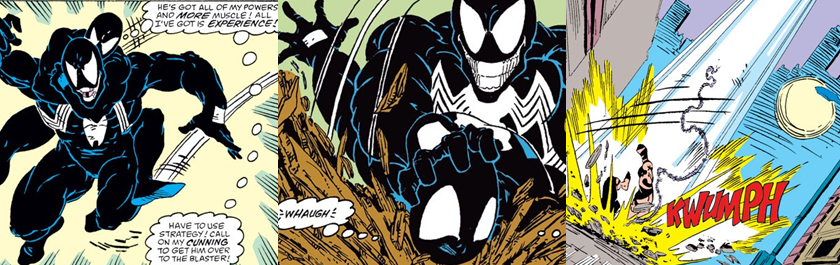
Perhaps the most popular (or, at least, mainstream) of all dark doppelgängers is the alien symbiote who, when bonded to Eddie Brock (or others), is known as Venom. Created by David Michelinie and Todd McFarlane, Venom began life as a black alien costume that absorbed Spider-Man’s powers and abilities and sought to permanently bond with him. When Spidey rejected it, it turned to Brock and, through their mutual hatred of Spider-Man, Venom was born. Sporting a super simple design (pitch-black with a white spider logo, emotionless white eyes, deadly fangs and claws, and a long, drooling tongue), Venom plagued Spidey for years. Immune to Spidey’s Spider-Sense and sporting all his powers, but double the strength and viciousness, Venom has evolved from a sadistic villain, to an anti-hero, to all-out hero over the years but, thanks to their equally violent offspring, has been the source of much death and woe to Spider-Man since day one.

0CrimeSyndicate

What dark doppelgänger is your favourite? Were there any I missed off this list, or do you, perhaps, feel the evil copy is a played out trope? Drop a line in the comments and pop back for more lists and articles.

Game Corner: The Legend of Zelda: Ocarina of Time 3D (Nintendo 3DS)

ZeldaLogo

Released: 16 June 2011
Originally Released: 21 November 1998
Developer: Grezzo
Original Developer: Nintendo EAD
Original Version Also Available For: GameCube, Nintendo 64, Nintendo Switch, Nintendo Wii, Nintendo Wii U  

The Background:
I’ve talked before about how my first introduction to the Legend of Zelda series (Nintendo EAD/Various, 1986) was with The Legend of Zelda: Link’s Awakening (ibid, 1993) on the original Game Boy, but even that brief experience was enough to suck me into the hype that surrounded Zelda’s highly anticipated jump to 3D. Development of Ocarina of Time began alongside other Nintendo 64 launch titles like Super Mario 64 (Nintendo EAD, 1996) and was originally planned for the ill-fated 64DD add-on and was originally conceived to use a similar painting-based world progression as Super Mario 64. While series co-creator Shigeru Miyamoto spearheaded the development of an expansive world and versatile combat, it was director Yoshiaki Koizumi who championed the use of the Z trigger to target enemies and Takumi Kawagoe who crafted the cinematic cutscenes to convey the game’s epic narrative. Initially released alongside some limited edition gold cartridges, Ocarina of Time was a phenomenal success, regularly amassing perfect review scores. Reviews were unanimous in their praise and the game became an instant classic that has stood the test of time. Ocarina of Time was ported numerous times over the years but development of a remake for the Nintendo 3DS was first hinted at in 2010, with the team taking the time to meticulous recraft the game for a new generation of players. The project was undertaken by Grezzo, who purposely left some of the original bugs in the game as fan service and not only included but reworked the rarely-seen “Master Quest” mode to be more challenging for even seasoned players. Like the original, Ocarina of Time 3D was met with universal critical acclaim; reviews praised the graphical overhaul and timeless gameplay, and the sales and perfect scores were more than enough to justify Nintendo and Grezzo collaborating to remake its sequel.

The Plot:
Kokiri boy Link is ecstatic to finally be assigned a fairy companion. However, Navi’s presence begins a sprawling adventure that sees Link realise his destiny to oppose the evil Gerudo King, Ganondorf. To do this, Link journeys through time to collect the mystical artifacts needed to rescue Princess Zelda and confront the King of Evil in his foreboding lair. 

Gameplay:
The Legend of Zelda: Ocarina of Time 3D is a remastered version of the classic Nintendo 64 action/adventure game. Players assume the role of Link, a young elvish child in a green tunic whose name they can customise when starting a new save file, of which there are three. Link’s journey takes him all across the land of Hyrule, and through time itself, and the Nintendo 3DS version of the game makes this quest more accessible than ever thanks to some much-needed improvements to the control scheme. Although Young Link starts out with only the ability to automatically jump from ledges, crawl through gaps, lift and toss puts with A, and roll along to smash crates with the same button, he soon acquires his first sword, which is mapped to the B button. The jump to 3D vastly improves Link’s combat prowess; not only can you hold B down or rotate the control stick to unleash a Spin Attack, but Link will also swipe with a series of slashes and can even duck and jab at foes. To make combat even easier, Link is joined by a fairy companion, Navi, who will target any enemies, non-playable characters (NPCs), or points of interest with a press (or hold) of the Left bumper. You can consult Navi for advice on an enemy’s weakness, chat to NPCs from long distance, or use the control stick, B, and A to hop, back flip, and leap at enemies to deal additional damage. Once you acquire a shield, this is mapped to the Right bumper, allowing you to press and hold R to block incoming attacks (and, later reflect certain elemental beams). In place of the Nintendo 64’s C-buttons, players can now map items to the X and Y buttons or to two additional item slots on the touch screen. Similarly, Link’s ocarinas, camera controls, and inventory and map options are also displayed on the touch screen, giving you greater ease of access to everything you need. 

Link’s world, arsenal, and options have been blown open by the expansive 3D engine.

The touchscreen also displays a map of the current area, a miniature version of which also appears on the main heads-up display (HUD), though you can toggle this on and off with the directional pad; his health (represented by hearts), magic meter, and current Rupees (the currency of Hyrule) are also displayed on the touchscreen, significantly decluttering the HUD. Key items you collect to advance the narrative will appear in your ‘Gear’ menu, while equippable items appear in the ‘Items’ menu, which you can customise to suit your preference. In addition to acting as your companion and aiding you in combat, Navi will frequently chime in to remind you of the plot of where you need to head next, ask if you need to take a break, or offer other hints. This can be annoying, especially for seasoned players, as are the constant interruptions from the mysterious owl Kaepora Gaebora, who pops up throughout Young Link’s journey to offer encouragement and advice. Thankfully, you can skip through their dialogue (or ignore Navi entirely, shutting her calls down by entering new areas) with the B button, though this version of the game also includes the ability to receive “visions” from special, obnoxious Sheikah Stones if you ever find yourself stuck. Thankfully, despite this handholding, the game remains as enjoyable as ever; now a fully realised 3D world, Hyrule is large and expansive and you’re free to explore as much as possible depending on what equipment you have. Link can enter water to swim along, for example, but won’t be able to dive until he acquires the Zora Scales, Zora’s Tunic, and Iron Boots. Similarly, destructible blocks, high temperatures, and impassable bridges will block your way until you find specific items or travel through time, though you can still explore much of the overworld field and surrounding areas right from the start. 

The ocarina is part of the game’s time travel mechanic, which affords Link greater options as an adult.

One of the game’s biggest gimmicks is the titular ocarina; by touching the bottom screen, players can play magical tunes to talk to Link’s childhood friend, Saria, for more tips, warp across Hyrule, open new paths, or even make blocks appear or disappear. As you explore and talk to NPCs, such as the mysterious Shiek, you’ll learn more songs that allow you to change the environment, such as turning day to night or causing rain. Link’s quest is split into two distinct parts: first, as a child, he needs to locate the three Spiritual Stones. Then, after awakening as an adult, he can explore new regions of Hyrule in search of five Sage Medallions, all of which are necessary to first access the Temple of Time and then confront Ganon in the desolate future. Link will need to both fight, sneak, and talk his way to these goals; one of your first objectives when you leave Kokiri Forest is to sneak into Zelda’s Castle, a task accomplished only by staying out of sight of her inept guards. When in Kokiri Forest, Link will have to bypass a rolling boulder to get the Kokiri Sword and slap down some Rupees for his first rudimentary shield, before putting these weapons to the test to try and save the Great Deku Tree. Indeed, the first three dungeons lay the ground work for the puzzles and actions you will need to overcome throughout the game; you’ll be lighting Deku Sticks on fire to burn away cob webs, climbing walls and plunging to new levels, hopping to moving platforms, hitting, standing on, or weighing down switches, and defeating all enemies to acquire keys, maps, and compasses all with the goal of acquiring the dungeon’s weapon and defeating its boss. Young Link is eased into all this quite well; the challenge increases with each dungeon he enters, putting new obstacles such as a raging volcano, destructible walls, a hungry fish deity, and a stubborn Zora princess in his path. Although his options are limited as a child, Young Link is key to forging relationships in the future; you’ll only tame the wild Epona by visiting Lon Lon Ranch as a child, for example, navigating the confusing maze of the Lost Woods is far easier as a child, and it’s only by returning to the past that Link can complete a brain-melting paradox, venture into a spooky well, and acquire the Lens of Truth. 

You’ll need both Links’ attributes to beat the game’s dungeons and enemies.

After acquiring the three Spiritual Stones, Link is sealed within the Light Temple until he’s old enough to wield the legendary Master Sword. Upon waking, he’s now older and tougher, but unable to use some of his childish items like the slingshot or boomerang. Adult Link, however, has access to a far greater arsenal of weapons, in addition to NPCs taking him seriously as a hero, though this is countered by the Temples he must conquering being longer and far tougher. Adult Link will explore strange winding corridors, rescue imprisoned Gorons, continuously alter water levels, hop to invisible platforms, and redirect sunlight in his quest for the Sage Medallions, frequently having to travel back to the past to help solve specific puzzles. He’ll also need to collect Silver Rupees to open gates, dissolve red ice, pound rusted switches, lift gigantic blocks and columns, and dodge spinning blades to progress. Adult Link also has the benefit of being big enough to ride Epona, who greatly speeds up foot travel; you can call Epona at any time when in Hyrule Field and mount her with A, speeding her up with taps of A for as long as you have carrots available and clearing fences with ease. If you ever need a break from all the adventuring, there’s a fishing hole available, shooting galleries to earn Rupees and weapon upgrades, a fun (if erratic) variation on bowling, and numerous side quests to complete to keep you playing. 

Graphics and Sound:
When it first released on the Nintendo 64, Ocarina of Time was the pinnacle of what the console could achieve; a large open(-ish) world with many varied locations, a sprawling narrative, and numerous NPCs and enemies to interact with. It had a day and night cycle, with skeletal enemies and ghosts spawning at night, areas changed as you journeyed through time, and Link was at his most expressive yet, swinging his sword, shivering and sneezing, or gasping when low on health. Unfortunately, the Nintendo 64 version hasn’t aged all that well; the graphics were quickly surpassed by its successor, which fixed multiple issues with Link’s model and other textures, and the presentation was soon noticeably lacking against subsequent games, though the performance and sheer impressiveness of the original still holds up overall. This version of the game gives Ocarina of Time a much-needed graphical overhaul; not only are the menus made far more intuitive, allowing you to quickly apply tunics and boots to Link, but all the character models (especially Link’s) have been given an upgrade to be more expressive and detailed, even on the Nintendo 3DS’s smaller screen. Speaking of which, there’s obviously the option to enable the 3D features of the system, though I’d recommend leaving it off as it can really make your eyes hurt after a while and it distracts from all the funky new textures and colourful revamp given to Hyrule, the text, and basically every aspect of the game. 

Hyrule’s colourful and ever-changing locales have been given a much-needed graphical boost.

Unfortunately, this hasn’t extended to expanding upon the admittedly barren Hyrule Field; while an impressive overworld, bolstered by a triumph theme song, Hyrule Field quickly becomes annoying to cross through even with the benefit of Epona and there’s not much happening there even in the grim future. Thankfully, the game’s towns and regions make up for this, Hyrule Market, Kakariko Village, and Goron City are all bustling urban environments with lots of back alleys, houses, and nooks and crannies to explore and you’ll marvel at the beauty of Zora’s Domain and the magical wonder of Kokiri Forest. Even better, every area always has ore toit; each opens up when you acquire new equipment or return as an adult, allowing you to brave the intense heat of Death Mountain, dive to the bottom of Lake Hylia, and tackle to hazardous Gerudo Desert. Each area is full of lively NPCs, from condescending guards to overbearing monarchs and mischievous forest imps. Each will flesh out the world and offer clues, both vague and explicit, on how to progress, with some even tasking you with fetching or delivering an item for them and others, like Mido, showing outright aggression towards you. Over the course of your adventure, the lives of Hyrule’s inhabitants and the nature of the world will noticeably change; in the seven-year time jump, the grotesque Dampé will die, Hyrule Market will fall into desolate ruin, construction work will be completed, Lake Hylia will dry up, and Zora’s Domain will be irreversibly frozen. Sometimes, you can impact these events, such as restoring the waters to Lake Hylia, reducing the windmill operator to tears, and restoring the family in the House of Skulltula, and other times monuments to Ganon’s evil will remain in the world, like the deceased Great Deku Tree and boiling lava pit where Zelda’s Castle once stood. 

Dungeons are more distinct than ever and the cutscenes and models have been nicely retextured.

Link’s journey also takes him into a variety of dungeons; the first three are visually very distinct, with you exploring the cobweb-infesting insides of the aforementioned tree, venturing into a dangerous rocky cavern, and trudging through the insides of Lord Jabu-Jabu while carrying (and tossing) the self-entitled Princess Ruto. Puzzle elements such as switches, platforms, and gated areas are personalised in these dungeons and noticeably more uniform when tackling the elemental Temples as Adult Link, though these make up for this by being bigger, more challenging, and no less visually distinct. Each dungeon has a memorable theme assigned to it, whether strangely upbeat or darkly ominous, and Link must utilise all his arsenal to best them, including returning as a child to solve puzzles or acquire new items. No two Temples are the same here; you’ll be tracking down naughty Poes and pushing puzzle blocks together in the Forest Temple, hopping over lava and vertically traversing the Fire Temple to free Gorons, desperately sinking, swimming, and altering the water level in the Water Temple (something made much easier by this version’s colour-coded areas), crossing an eery river on a large barge and uncovering invisible hazards in the Shadow Temple, and using sunlight and time travel to overcome the Spirit Temple. In addition, there are many smaller challenges to overcome; you can uncover fairy fountains to gain helpful buffs, endure the frigid dangers of the Ice Cavern, sneak around Gerudo’s Fortress sniping the all-female guards from afar to rescue the construction workers, and push gravestones to uncover secrets. While characters (and especially Link) will grunt, laugh, and make rudimentary sounds, all of the game’s dialogue and story is told through text, though it’s no less engaging, and each cutscene grabs your attention, with the tale of the three Goddesses, Link’s triumphant rescue of Epona, and the emotional reunion between him and Zelda being just three standout moments. 

Enemies and Bosses:
Almost all of the franchise’s classic enemies make their 3D debut here, with Link slashing at bat-like Keese, dropping bombs to destroy crazed Armos statues, reflecting projectiles back at Octoroks, avoiding the squeeze of Wallmasters, frantically chasing down Leevers, and cutting Tekties in two. Many of Link’s enemies are memorable for their disturbing nature; Gibdos and ReDeads, for example, will shamble and crush you with their embrace, screaming to freeze you in place, while disgusting Like Likes will shallow you (and your shield and optional tunic) whole, and Cuccos will take a spiteful revenge if attacked. Many enemies are specifically designed to take advantage of Link’s new combat abilities; you’ll engage the formidable Stalfos, Lizalfos, and Dinolfos in sword combat, striking when their guard is down and defending against their sword swings, and similarly only be able to attack the Wolfos when they’re not defending against your sword strikes. Likewise, you must wait for the Skulltula’s to show their bellies to destroy them, Poes will only be vulnerable for a short time, club- and lance-wielding Mobiles cannot be attacked directly and require the use of stealth and your ranged weapons, which will also keep you from getting shocked by Biris, and be temporarily unable to use your weapons upon touching bubbles. Other enemies, such as Fire Keeze and Dodongos, can set you on fire, burning any wooden equipment you have attached, freeze you in place, or are disguised as regular objects like doors to keep you on your toes. 

Young Link’s dungons and bosses will expertly teach you ky gameplay mechanics.

Young Link will have to defeat three bosses to obtain the Spiritual Stones which, like the dungeons themselves, set a precedent for the game as they are best fought with the weapons you obtain in their lair. First up is Queen Gohma, a massive, slobbering spider-like creature that scuttles about on the ceiling, drops Gohma Larva to attack you, and lurches or drops on you. Fortunately, you can shoot a Deku Seed at her big, glaring eye to stun her, easily allowing you to destroy her with a few sword swings. King Dodongo is a little tougher as he’s much bigger and rolls around an arena with lava in the middle. When he pauses to breath fire at you, you need to toss a bomb in his mouth to stun him for an attack, with the biggest issue here being avoiding his cannonball-like rolling. After chasing a Big Octo around a rotating spiked platform and slashing at its ass, you’ll battle Barinade within Lord Jabu-Jabu. This pulsating, electrical monstrosity protects itself with Giant Biri, which must be destroyed to expose its core, and blast of electricity from its artery-like appendages. Your best bet is to hang back with your guard up and continuously toss your boomerang to take care of Barinade’s defences, then leap in sword attacks when its stunned. Later, Young Link will need to venture to the Bottom of the Well to retrieve the Lens of Truth, which is guarded by the unsettling Dead Hand, which teleports in a burst of dust and holds you in place with a field of disembodied hands while it closes in to take a bite. Similarly, Young Link will battle an Iron Knuckle in the Spirit Temple, though this fight is both slightly easier and slightly harder than battling them as an adult. It’s easier because Young Link can completely hide under his Hylian Shield, but harder because his Kokiri Sword does way less damage; you also can’t get too close as the Iron Knuckles deals massive damage with its axe, though it can be tricked into destroying nearby columns to restore your health. 

Thankfully, the versatile combat system is capable of tackling even the most monstrous bosses.

Adult Link has a far greater challenge ahead of him as he must battle five monstrous bosses to acquire the Sage Medallions, with each Temple also sheltering at least one mini boss. The four Poe Sisters will give you the runaround in the Forest Temple before leading the way to Phantom Ganon, an apparition of the King of Evil who randomly appears from paintings strewn around the arena. Pick the right painting and fire an arrow at him until he ditches his steed and then engage in a game of dead man’s volley, smashing his magical projectiles back at him to bring him to his knees, but make sure you keep your distance as these exchanges intensify very quickly. After chucking bombs at the Flare Dancer and avoiding its explosive demise in the Fire Temple, you’ll take on the fire-spewing dragon Volvagia. Volvagia will fly around the small island, diving into and bursting from pools of magma strewn about; when it does, you’ll need to avoid its flame-like whips and smash it with the Megaton Hammer, then take shelter on the climbable walls of the island as Volvagia causes rocks to rain down. In the Water Temple, you’ll have a surreal encounter with Dark Link that’s easily won with the Megaton Hammer or Biggoron’s Sword before taking on the most annoying boss of the game, Morpha. Morpha is a sentient nucleus that brings the arena water to life, sprouting tentacles that will grab and throw you into the spiked walls that line the room, and which can only be damaged by snagging to with the Longshot and pummelling it before it can hop away. After besting another Dead Hand in the Shadow Temple, you’ll battle perhaps the strangest boss of the game, Bongo Bongo, a grotesque beast that can only be seen with the Lens of Truth. This battle is made tricky by the arena floor, which will vibrate as Bongo Bongo hits it, ruining your aim as you shoot arrows at its hands to stun them or its eye to open it to a more meaningful counterattack, 

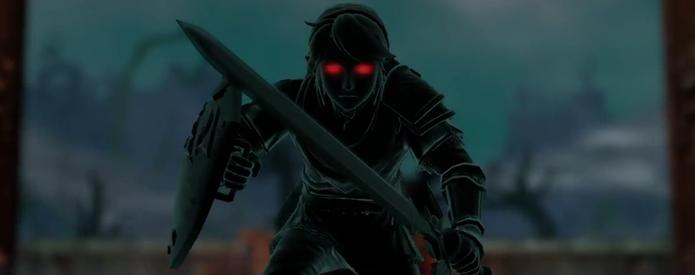
All of Link’s weapons and skills will lead him to a climatic confrontation with the King of Evil!

After overcoming another Iron Knuckles as Adult Link (revealed to be Nabooru in disguise), Link will battle Ganon’s surrogate witch-mothers, Kotake (who controls ice) and Koume (who controls fire). As they fly well out of range, you’ll need to use the Mirror Shield to reflect one element back at the other to bring them down; after enough hits, they’ll fuse together into the strangely alluring Twinrova and wield both elements. This time, you need to absorb three consecutive hits of each element on your Mirror Shield to blast them with a flame or ice burst, all while avoiding being charbroiled or frozen solid. Once you have all the Sage Medallions, the Six Sages will create a magical bridge for you to enter Ganon’s Castle, which contains mini challenges themed around each Temple, more Iron Knuckles, and a two-stage showdown with the King of Evil himself. In the first phase, you need to hang right back and avoid falling down to the lower levels as it’s a long journey back up to his throne room; Navi is useless here but you can still L-Target Ganondorf, reflecting his bolts back at him in another game of dead man’s volley that’s actually easier than when fighting Phantom Ganon as Ganondorf is largely stationary (though he does have a more powerful multi-blast attack). Damage Ganondorf enough and he’ll bring the whole castle down, forcing Link to run for safety as Princess Zelda magically opens gates, before transforming into the gargantuan, rampaging pig-beast, Ganon. This fight is ridiculously easy, though, even with the scripted loss of the Master Sword; simply roll between Ganon’s legs when he swipes at you and attack his tail with either the Megaton Hamme or the Biggoron’s Sword until you can retrieve the Master Sword. Eventually, Zelda will hold him in place with her magic, meaning all you have to do is land the final blow with the Master Sword to banish Ganondorf and restore peace to Hyrule. 

Power-Ups and Bonuses:
As ever, you can replenish Link’s health using hearts, fairies, or potions; enemies, crates, and bushes will drop hearts to restore your health bit by bit or you can assemble four Heart Containers by searching about, or gain an extra heart with each boss you defeat. Fairies and their larger variants will also restore your health and you can even capture them in one (or all, as I do) of the game’s bottles to restore some health when you’re defeated; similarly, potions will also replenish your health in the same way. You’ll also find Magic Jars to refill your magic meter, which drains as you cast spells, and Great Fairies will increase your meter just as they teach you these spells. These power-up your Spin Attack, allow you to cast a blaming attack, let you setup a mid-dungeon teleport that’s super useful in the Water Temple, and surround you with a temporary protective shield. Some weapons, like the elemental arrows, and items like the Lens of Truth also drain your magic, so use them sparingly to avoid being caught short. 

Link’s weapons, gear, and magic can all be upgraded to counter new enemies and areas.

Many of Link’s trademark items and weapons are featured here, either in chests, gifted to you by NPCs, or bought from shops. You can fire Deku Nuts and arrows with the slingshot and Fairy Bow, respectively, with the latter also able to fire flaming, freezing, and light arrows for additional damage, retrieve items, hit switches, and stun or damage enemies with the boomerang, and cross distances by latching onto special surfaces with the handy-dandy Hookshot. The Megaton Hammer will activate rusted switches, the iron Boots let you sink to and walk on the bottom of lakes, the Hover Boots let you briefly run on thin air at the cost of your traction, and you can toss bombs, let loose Bombchus, or stun enemies with a blinding Deku Nut. Link can also earn (or buy) coloured tunics to withstand extreme heat and breath underwater, dive deeper with Zora Scales, and acquire swords so powerful they need to be held with both hands. Additionally, Link can acquire three different shields and upgrade his wallet, ammo, and the range of the Hookshot by completing mini games and exploring dungeons, as well as use bracelets and gauntlets to heave large objects with ease. Secret grottos and areas can be sought out once you earn the Shard of Agony by destroying Gold Skulltulas, Link can rescue Epona from the greedy Ingo by outracing him as an adult, and Young Link can buy and plant Magic Beans that will sprout into floating leaf platforms in the future to find yet more goodies. 

Additional Features:
There are thirty-six Heart Containers to find here, which will increase your health to twenty hearts. This can then be doubled by visiting a Great Fairy outside Ganon’s Castle, who will effectively half the damage you take from enemies. There are also 100 Gold Skulltula’s hidden all over the game and they’re well worth seeking out, at least to start with, as destroying increments of ten will restore the family in the House of Skulltula and award helpful gear like a bigger wallet, the Shard of Agony, and a Heart Piece, though the final reward of a Huge Rupee is very disappointing. Both Young and Adult Link can choose to complete trading quests; Young Link’s is based around trading masks with various NPCs, sometimes being stiffed on the sale, all to acquire the Mask of Truth so he can talk to Gossip Stone, while Adult Link’s trading sequence is tougher, but yields a far better reward; by racing across Hyrule without warping, often against a tight time limit, and trading items back and forth, you can eventually acquire the unbreakable, super powerful Biggoron’s Sword that makes mincemeat of enemies and bosses. If you can’t be bothered and don’t mind wasting your Rupees, you can buy the destructible, nigh-useless Giant’s Knife instead, but this is a complete waste of time. It’s also worth completing the shooting galleries, even though the Gerudo one can be tricky due to being an auto-shooter and the tight window for landing bullseyes, as these will increase the ammo for your ranged weapons. Similarly, you can take on the Gerudo Training Ground, solving puzzles and besting enemies for keys to grab the Ice Arrows, but this is entirely optional and mainly for completion’s sake. 

Hunt down Gold Skulltulas, test yourself against the bosses, or take on the “Master Quest” challenge!

This version of the game comes with some lucrative additional features; while it unfortunately doesn’t add back in the Sword Beam or Unicorn FountainOcarina of Time 3D includes a “Boss Challenge”, accessible from Link’s house after clearing the Forest Temple, which is essentially a boss rush against all the game’s bosses against a time limit and with limited health and items. However, a far more substantial inclusion is “Master Quest”, which is unlocked upon first beating them game. Although previously included in the “limited edition” releases of The Legend of Zelda: The Wind Waker (Nintendo EAD, 2002), this much tougher version of the game has been tweaked here to mirror the entire game. “Master Quest” also noticeably mixes up the puzzles and enemy placements, offering a substantial challenge even for seasoned players as tougher enemies and more difficult puzzles appear as early as Kokiri Forest; even the Gold Skulltula locations have changed, and you can also test yourself against the “Boss Challenge” for this mode, too, which stands as a much appreciated inclusion for long-time players of Ocarina of Time. Finally, you can still teach a friendly scarecrow a custom song, win yourself a cow by racing Ingo, hunt down the Big Poes haunting Hyrule Field, try and snag the elusive Hylian Loach, and this version of the game gives the option of using the Nintendo 3DS’s gyroscopic controls (which, again, I wouldn’t recommend), and removes and changes some of the blood effects. 

The Summary:
When I was a kid, there were a handful of games everyone owned for the Nintendo 64 and Ocarina of Time was one of time. Although I’d only had a brief flirtation with the franchise when Ocarina of Time released, I knew it was a big deal as all the gaming magazines hyped it up and it was exciting to delve into this sprawling, action-packed, nuanced adventure. I replayed Ocarina of Time over and over, finding every secret and obtainable item possible, even exploring it with an Action Replay to wring more out of it. It was a seminal title, one that hooked me on the franchise forever more, and this 3DS revamp is everything the original was plus more. The graphical overhaul is very much appreciated, to the point where I’m sad that this port is stuck on the 3DS’s small screen because Ocarina of Time has never looked better. The quality-of-life features offered by the touchscreen and the additional hints are great, addressing every issue gamers had with the original version and offering even more content, including the fabled “master Quest” challenge. While I would’ve liked to see the game tweaked and expanded like its successor, Ocarina of Time 3D is still the definitive version of this classic game in my eyes. Being able to play on the go, reliving those memories and conquering those challenges and losing myself in this immersive fantasy adventure is a thrill that’s only gotten better with age. Everything from the memorable NPCs, the fun side quests, then intuitive and surprisingly deep combat, to the massive bosses, the quirky humour, and the entertaining time travel mechanics keep me as hooked now as they did as a teenager, and I still regularly plug this cartridge in to relive those memories. Honestly, you don’t need me to say it; Ocarina of Time has more than earned its flowers and all I’ll say here is that I highly recommend you add this version to your library as soon as possible, or dust off your Nintendo 64 and start a new playthrough today! 

My Rating:

Rating: 5 out of 5.

Fantastic

Have you ever played the Nintendo 3DS remaster of Ocarina of Time? If so, what did you think to the graphical overhaul and additional features included? Would you like to see this version ported to the Nintendo Switch to make it more accessible? Did you own Ocarina of Time back in the day? If so, which of the game’s bosses and dungeons was your most or least favourite? What did you think to “Master Quest”; did you manage to beat it? Which Zelda titles would you like to see remade in the future? I’d love to hear your memories of Ocarina of Time so leave a comment below or on my social media, and be sure to check out my other Zelda content across the site!