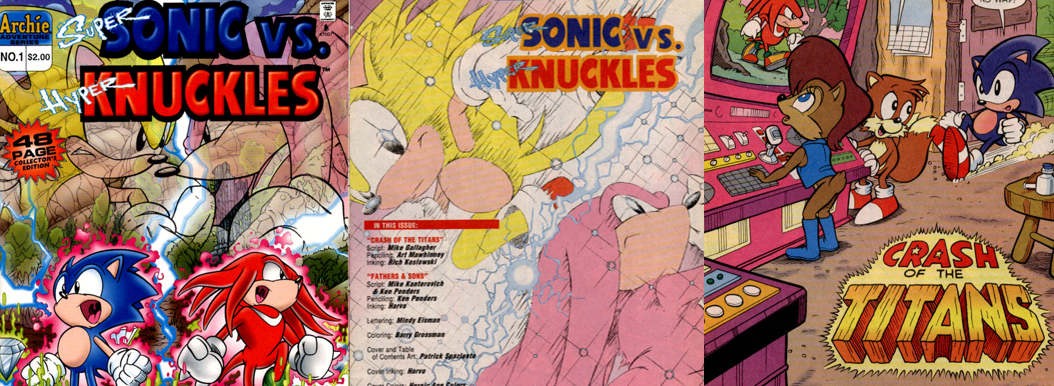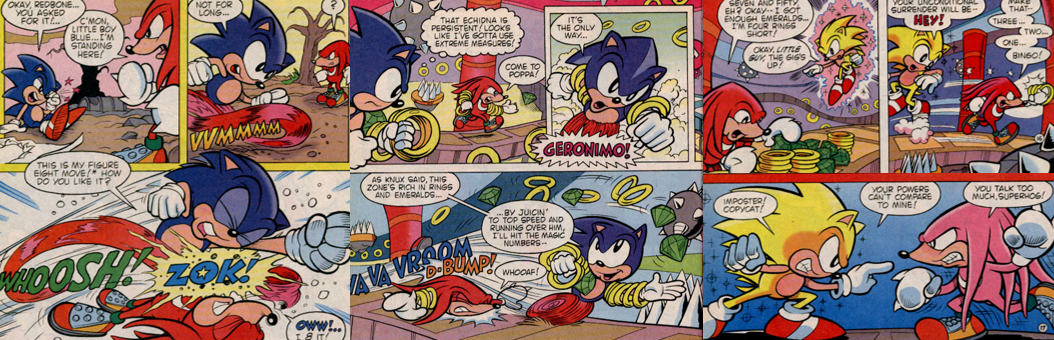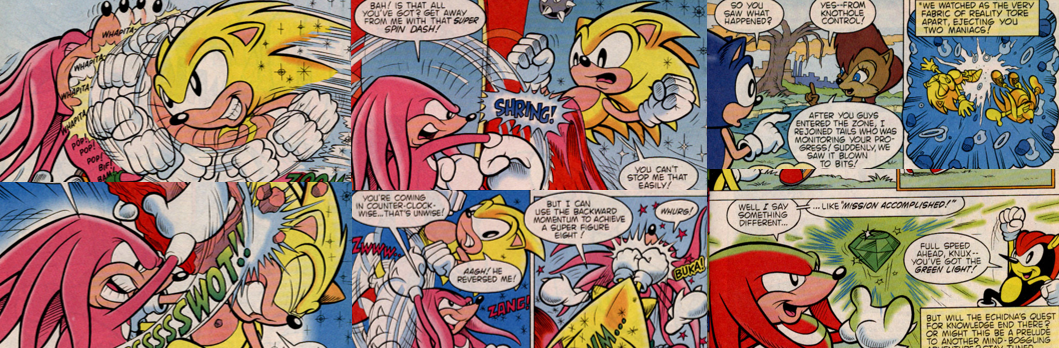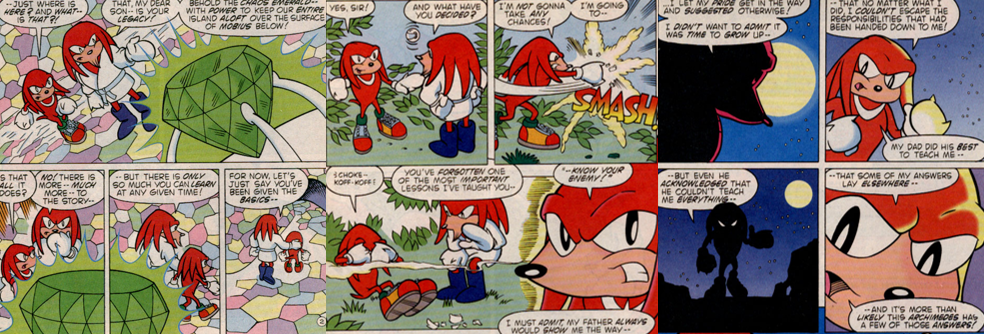
Back Issues & Knuckles: Sonic the Hedgehog #13


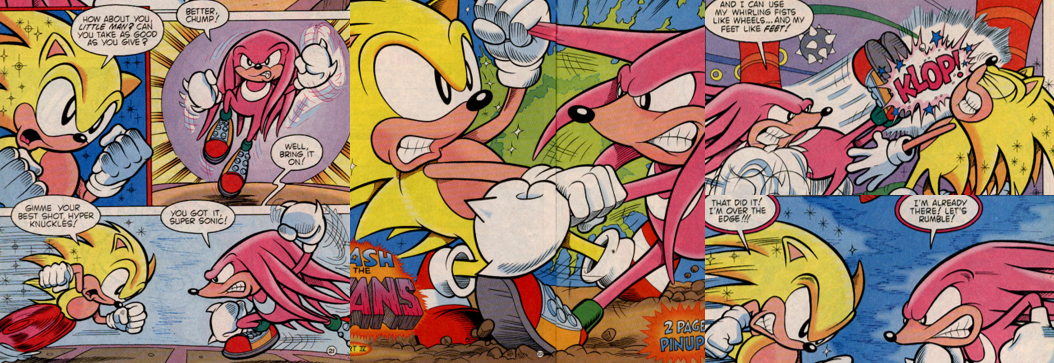
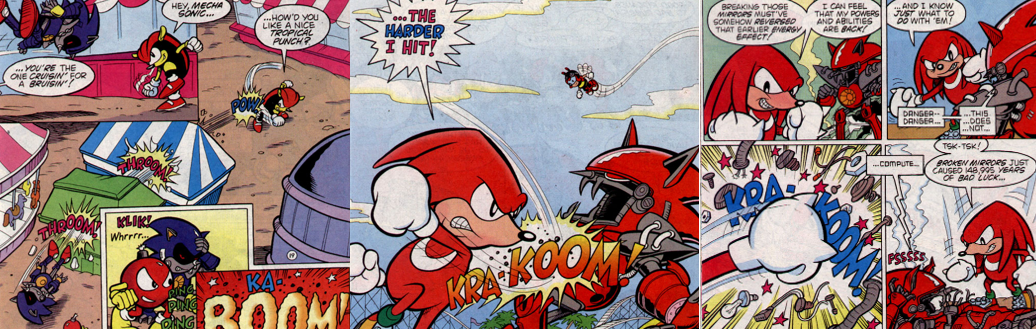
With the release of Sonic the Hedgehog 3 (SEGA Technical Institute, 1994) on this day in 1994, gamers were introduced to Knuckles the Echidna. This mischievous, dreadlocked antagonist was created by Takashi Yuda and is my favourite of Sonic’s supporting cast so excuse me while I celebrate his debut today (every Sunday in February!)


Story Title: “This Island Hedgehog” (Part 1 and 2)
Published: 16 May 1994 (cover-dated: August 1994)
Writers: Mike Kanterovich and Ken Penders
Artist: Dave Manak

The Background:
When Sonic the Hedgehog made his dramatic videogame debut in 1991, he was an immediate hit thanks to SEGA’s aggressive marketing campaign seeing his debut title being bundled with the Mega Drive. Sonic the Hedgehog 2 (SEGA Technical Institute, 1992) expanded his popularity and, suddenly, Sonic merchandise was suddenly everywhere! He was included not only in the Macy’s Day Parade, but in cartoons and numerous comic books. Following the initial four-part miniseries, which combined narrative elements of Sonic’s cartoon adventures, Archie Comics published what would become the longest-running videogame comic book of all time. In time, to better capitalise on Sonic’s continued popularity, Archie also produced various Sonic spin-off comics, with the Knuckles the Echidna sister series being the most prominent. Long before writers like Ken Penders lumbered Knuckles with a convoluted lore and launched a bitter lawsuit that forever changed Archie’s Sonic comics, Knuckles debuted in this issue as one of Archie’s many loose videogame adaptations.

The Review:
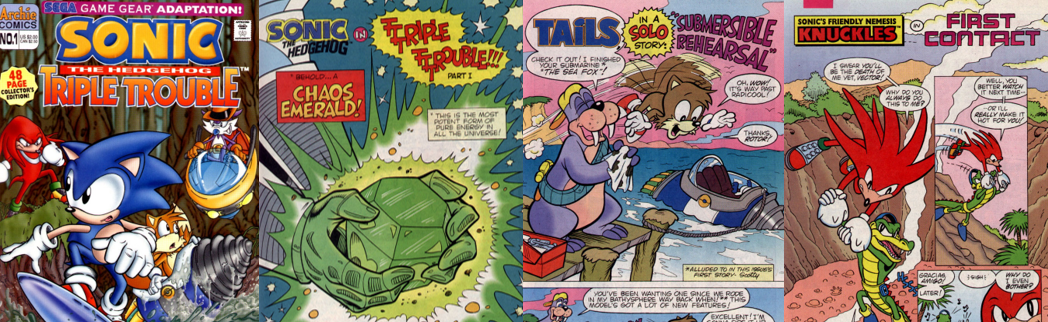
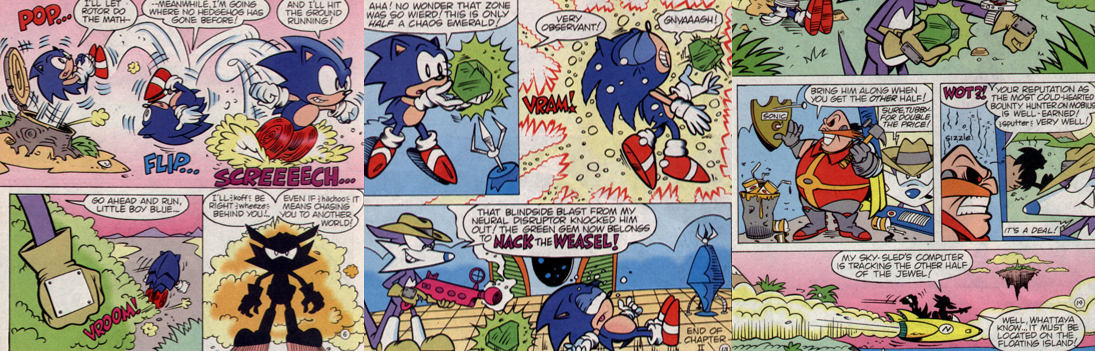
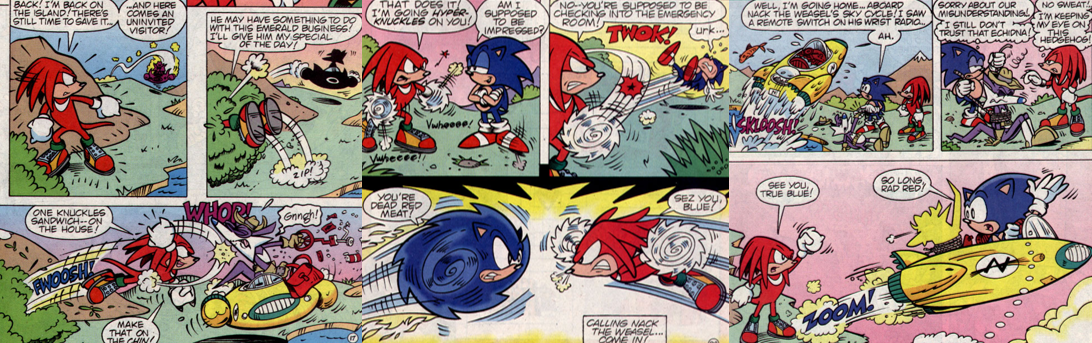
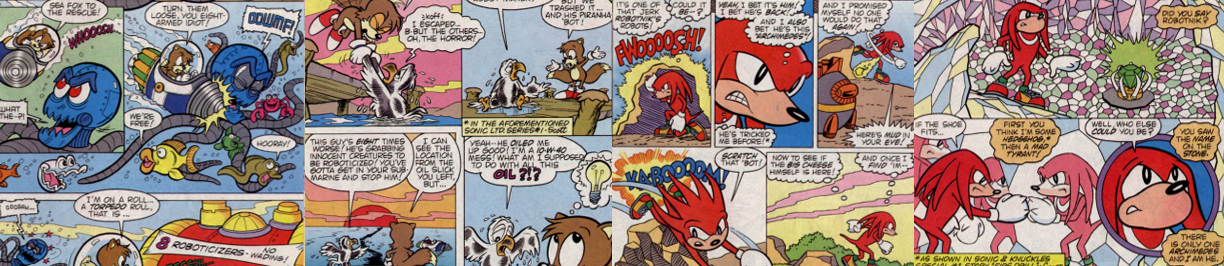
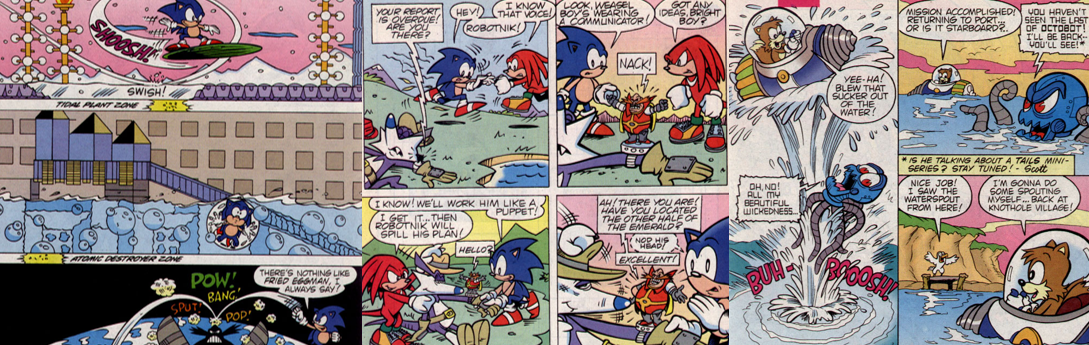
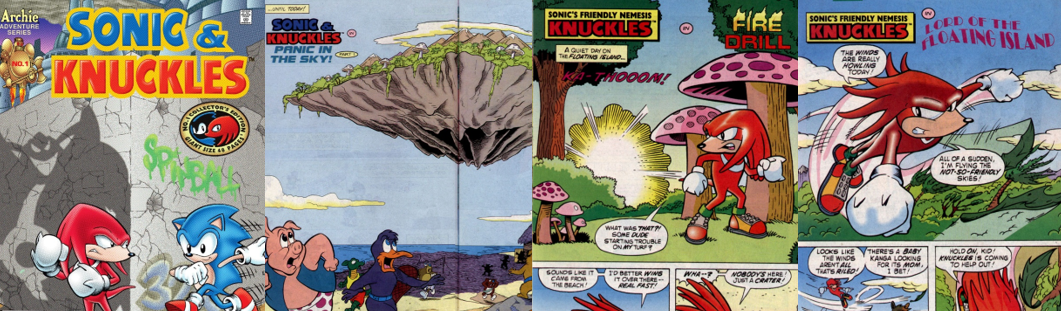
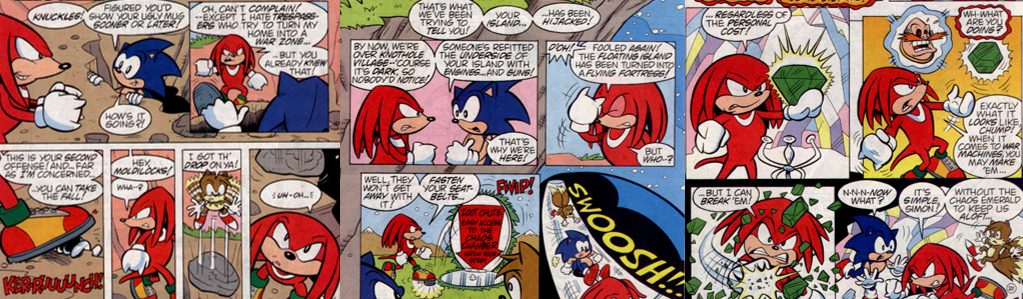
Sonic and his perennial kid sidekick, Miles “Tails” Prower, first encounter Knuckles, the last of the echidna race and guardian of what was then known as the Floating Island, completely by chance. While flying through the skies of Mobius in search of Doctor Ivo Robotnik’s “hovercraft”, the two stumble upon a mysterious island in the sky. Interestingly, unlike in Fleetway’s comics, the two have no knowledge of the Floating Island and can thus only speculate how it stays afloat, with Sonic guessing (correctly, it turns out) that it’s held aloft by one of the (many) Chaos Emeralds. As the two come in to land to investigate further, unaware that they’re being watched by a mysterious, spike-fisted individual, their biplane is knocked from the sky by a literal “unwelcome mat” and Tails is forced to air-lift the duo to the ground. With no choice but to investigate further to find some way back to Knothole Forest, Sonic and Tails venture into a close approximation of Angel Island Zone and are attacked by an “Assaulting Batter Blimp” (essentially the “Fire Breath” mech from Sonic the Hedgehog 3, but with a far less intimidating white paint job). Assaulted by the blimp’s flame bursts, Sonic is randomly shielded by “some sort of energy shield” (visually similar to his Insta-Shield ability, though Sonic seems unaware of how this happened) and forced to dive into the nearby water. Caught in an inescapable current and blasted past spikes and through crumbling walls in what I guess is supposed to be Hydrocity Zone (but which looks more like Labyrinth Zone), the duo find themselves blacking out from the strain and the force of the suction. They awaken in a dark room with their arms and legs bound and are stunned when they’re greeted by Knuckles, who steps from the shadows and introduces himself as the island’s guardian.

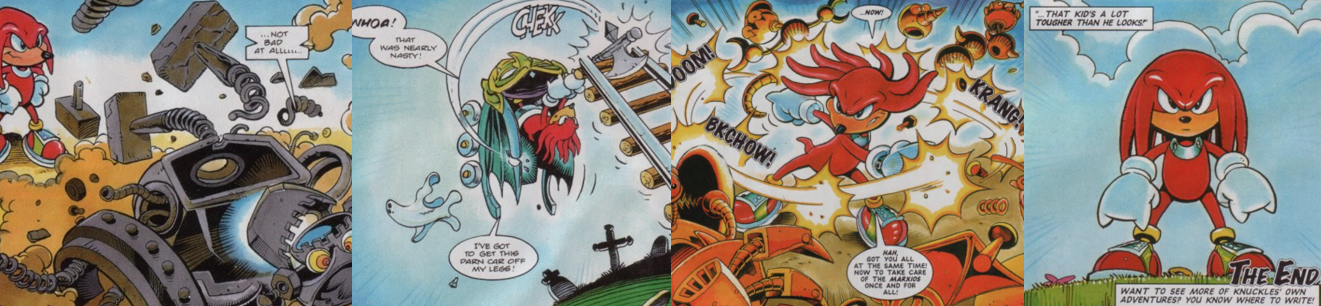
After Sonic and Tails prove their innocence, Knuckles joins them in fighting Dr. Robotnik.

Knuckles also reveals that he’s formed a friendship with Dr. Robotnik, who’s fed him lies about the two’s intentions to steal the island’s Chaos Emerald! Dr. Robotnik observes the events with glee alongside his long-suffering right-hand and nephew, Snively, and reveals that he’s misled the naïve echidna in order to steal the Chaos Emerald for himself to recharge his hovercraft. Having successfully duped Knuckles, Dr. Robotnik sits back and watches as the echidna’s riled up by Sonic and Tails’s defiant attitude. Still, Knuckles offers to give them ten minutes to get off the Floating Island before he hunts them down like wild dogs. While Sonic and Tails instead resolve to use the time limit to prove their innocence, Dr. Robotnik berates Knuckles for not finishing off the “jewel thieves” when he had the chance. Thus, Dr. Robotnik moves up his schedule and, after snatching the Chaos Emerald from his minion, Crabmeat, prepares to enact his dastardly plot. Angered that Sonic and Tails are still hanging around, Knuckles takes a short-cut to the Chaos Emerald and is horrified to find it’s been swiped from its simple stone pedestal. When Sonic and Tails arrive immediately after, Knuckles realise that he’s been duped and demands to be taken to Dr. Robotnik. The three arrive just as the semi-cybernetic dictator is preparing to take off and, after swiping the gem, reduce his SWATbot guards to scrap metal. However, Dr. Robotnik manages to elude them by powering up his hovercraft (how he does this without the Chaos Emerald is beyond me) and awkwardly escaping across the sea. To thank his newfound allies, Knuckles gathers the pieces of Sonic’s trashed plane so Sonic can reassemble it at super speed and then sees the two off, sure that it won’t be the last time their paths cross.

The Summary:
My first observation about this story is that the art is pretty atrocious. A lot of it was back then in the Archie comics as their artists opted for a more cartoony approach to these characters, one that emulated the cartoons that inspired them, yes, but which was also somewhat dumbed down and a far cry from SEGA’s official artwork. Most of this criticism is aimed towards Knuckles, who looks decidedly off-model here. Judging by the poses he strikes and the limited exploration of Sonic 3’s environments, I wouldn’t be surprised if the writers and artists only had access to limited materials to produce their story. It seems like they had footage or screenshots of Angel Island Zone (at least Act 1) and Hydrocity Zone and images of Knuckles, and that was it as this story explores even less of the Floating Island than in the Fleetway adaptation! As was the style at the time, “This Island Hedgehog” is seemingly more concerned with awful puns and pop culture references than emulating the source material. While the “unwelcome mat” was kind of funny, ““plane” crazy” was very cringe, Tails’s reaction when Sonic says they should “hit the drink” probably went over most kids’ heads, and “cute” references to Super Mario and the 1960s Batman television show just come across as corny. Sonic’s “energy shield” really bugged me since it appears out of sheer convenience to save him from being roasted, is never seen again, and never gets explained. Again, it’s like the writers just watched some footage of Sonic 3 and had no idea how the Insta-Shield works, making its inclusion even more egregious than how Fleetway handled it. Couple that with the Master Emerald and Hidden Palace Zone shrine being reduced to a simple, run-of-the-mill Chaos Emerald and a pile of rocks, and that Dr. Robotnik’s plot is to power up his hovercraft rather than the Death Egg, and you have a very poor representation of the source material, even by Archie’s standards!

More focused on bad art and worst puns, this story is a poor showing for Knuckles and Sonic 3.

I wish I could say that Knuckles, at least, comes off well, but it’s a bit of a mixed bag, to be honest. I liked that he was kept hidden, seen as merely a fist and speech bubbles for most of Part 1, and that he was shown to be responsible for the traps and pitfalls that deter Sonic and Tails. His reveal was somewhat dramatic, but a far cry from how he made an immediate impact in Sonic 3 and his impactful introduction to Sonic in Sonic the Comic. I will say, though, that I liked Knuckles’ more relaxed way of speaking (he often drops g’s from his words) and that he gave Sonic and Tails a fighting chance to leave the island, showing he has some pride and honour despite being duty-bound to protect his home. He’s still easily fooled by Dr. Robotnik (though we’re not seen how) and quick to assume Sonic and Tails are jewel thieves based on paltry evidence, but he’s also seen to be quite eloquent and intelligent rather than a meathead. However, in saying that, we don’t get to see any of Knuckles’ abilities here: he’s not seen gliding, digging, or climbing and never throws a punch. Sure, he and Sonic trash some SWATbots but the action is obscured by sound effects and dust, so there’s no indication of his physical strength…again, almost as though the writers only had promotional art to work from. Knuckles does part on far friendlier terms with Sonic and Tails than in most adaptations, however, but is a far cry from the character he should be. The story is also an extremely weak adaptation of Sonic 3, serving only to touch upon the most basic of elements and leave the door open for further adventures. Perhaps if Archie has spread the story out across a few issues, or dedicated this entire issue to Sonic dealing with Knuckles rather than wasting pages with a back-up story, things might’ve been different but, as is, this is probably the worst comic book adaptation of Sonic 3 I’ve ever read!

My Rating:

Rating: 1 out of 5.

Terrible

What did you think to Knuckles’ first appearance in Archie’s Sonic comics? Were you also disappointed by how poorly he and Sonic 3 were represented here? What did you think to Dr. Robotnik’s drastically reduced plot for the Chaos Emerald? Which of Archie’s Knuckles stories and/or characters was your favourite and why? Are you celebrating Knuckles’ debut this month? Whatever you think about Archie’s Sonic comics, and especially Knuckles, leave a comment down below and let me know, support me on Ko-Fi, and check out my other Knuckles content!

Screen Time & Knuckles: Sonic Underground & Knuckles


With the release of Sonic the Hedgehog 3 (SEGA Technical Institute, 1994), gamers were introduced to Knuckles the Echidna. This mischievous, dreadlocked antagonist was created by Takashi Yuda and his debut was made all the more impressive by virtue of the fact that Sonic 3 was too big to fit on one cartridge. This meant that Knuckles was the first of Sonic’s supporting characters to co-star in a main series videogame when Sonic & Knuckles (ibid) was released on this very day in 1994.


Episode Title: “Friend or Foe?”
Air Date: 28 February 1999

Episode Title: “Flying Fortress”
Air Date: 31 March 1999

Episode Title: “No Hedgehog is an Island”
Air Date: 7 April 1999

Episode Title: “New Echidna in Town”
Air Date: 13 April 1999

Directors: Marc Boreal, François Hemmen, and Daniel Sarriet
US Network:
BKN Kids II – UK Network: Channel 4

Stars: Jaleel White, Brian Drummond, Garry Chalk, Maurice LaMarche, and Peter Wilds

The Background:
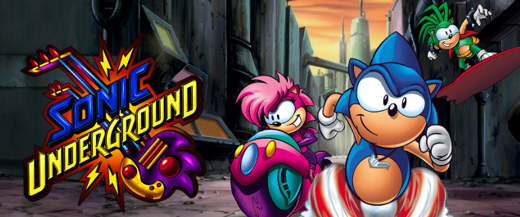
After Sonic the Hedgehog blasted onto the videogame scene with Sonic the Hedgehog (Sonic Team, 1991), SEGA’s aggressive marketing campaign paid off dividends. Sonic’s popularity exploded after the release of Sonic the Hedgehog 2 (SEGA Technical Institute, 1992) and, suddenly, Sonic was everywhere, including two concurrent cartoons courtesy of DIC. While Adventure of Sonic the Hedgehog (1993; 1996) is generally criticised for its slapstick comedy, its darker counterpart, Sonic the Hedgehog (widely known as “SatAM”) is regarded as one of the defining cartoons of the nineties for its darker tone and mature themes. Although the cartoon inspired the original Archie Sonic comics, fans were left confused and disappointed when SatAM ended on an unresolved cliff-hanger. When the time came for SEGA to promote their up-coming Dreamcast, a new Sonic cartoon was commissioned, one that oddly took many visual inspirations from SatAM but told an entirely original story, one that owned more to Alvin and the Chipmunks (1983 to 1990) than its fan-favourite predecessor. Although Jaleel White returned to voice Sonic and his new siblings and writer Ben Hurst had some influence on the show, Sonic Underground became notorious for its musical interludes and struggled to find an audience thanks to the episodes being aired out of order. While the concept had even less to do with the source material than its predecessor (Sonic’s sidekick, Miles “Tails” Prower is nowhere to be found) and is widely regarded as one of the worst Sonic adaptations, Sonic Underground featured the debut of Knuckles the Echidna in Western animation and there was a sadly cancelled attempt to publish an epilogue to the much-maligned cartoon in 2013.

The Plot:
Whilst searching Planet Mobius for their mother, siblings, rebels, and rock stars Sonic, Manic, and Sonia (all voiced by White) cross paths with the distrustful and hot-headed Knuckles (Drummond). However, when the dastardly Doctor Robotnik (Chalk) manipulates Knuckles into providing him with a legendary Chaos Emerald, these four conflicting personalities must set aside their differences to oppose the doctor’s latest evil scheme.

The Review:
I watched all of Sonic’s cartoons when I was a kid. I distinctly remember watching Adventures of Sonic the Hedgehog every weekend, usually recording episodes for prosperity, and enjoying Sonic’s slapstick antics so much that I was shocked and confused when the entire tone and cast of the show suddenly changed. Sonic was no longer ridiculing Dr. Robotnik (Long John Baldry) and his minions and was instead the point man in an outnumbered resistance movement against a far darker, semi-cybernetic dictator much like in Sonic the Comic (1993 to 2002). I adapted to the new format and found myself enjoying Sonic’s dark escapades, only to be left further confused when SatAM ended on a massive cliff-hanger that teased a larger role for Dr. Robotnik’s long-suffering nephew, Snively (Charlie Adler) and a mysterious, red-eyed figure who I hoped would be Metal Sonic or even Knuckles! Sadly, we never got to see this ending resolved, even in the comics, and I was forced to adapt once again to an all-new Sonic cartoon, one that looked very similar to SatAM but was widely different and made the bold and frankly bizarre choice to lumber Sonic with two siblings. Why Tails and Amy Rose weren’t used in these roles I’ll never know but I was still a Sonic fan so I tried to give it a go, but to be fair I was about fourteen in 1999 so I was starting to veer away from cartoons like this.

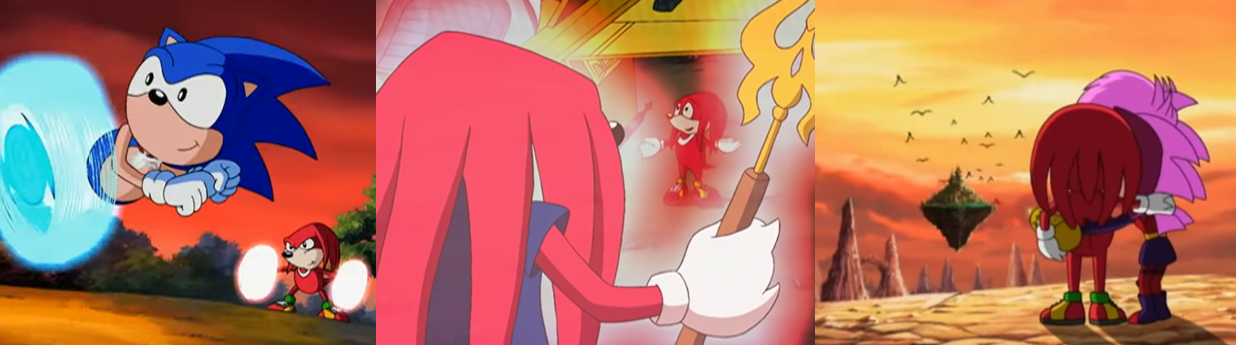
After some initial antagonism, Knuckles and Sonic team up to safeguard the Chaos Emerald.

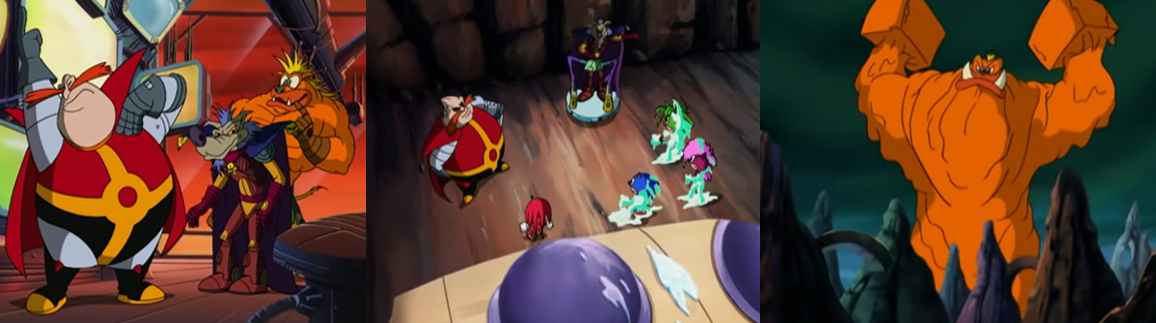
Although “Flying Fortress”, “No Hedgehog is an Island”, and “New Echidna in Town” make up a three-episode story arc revolving around Knuckles and the Chaos Emerald, they were broadcast out of order and the character actually made his first appearance in the standalone story “Friend or Foe?” Following the surprisingly catchy opening theme song (one of the few highlights of the cartoon), the episode finds Sonic, Sonia, and Manic travelling to the “dreaded” Floating Island in search of their long-lost mother, Queen Aleena Hedgehog (Gail Webster, and running afoul of boobytraps laid across the island by its mysterious echidna guardian. As ever, Dr. Robotnik is lumbered with two bungling minions: sleazy-but-cunning wolf Sleet (LaMarche) and the block-headed Dingo (Wilds), who transforms into different forms at the touch of Sleet’s remote controller. The two are ordered to the Floating Island to poison Knuckles’ mind against the hedgehogs, distracting him so they can steal the Chaos Emerald and send the island (and their enemies) plummeting to the ground. Thanks to a hilariously bad holographic fake, Knuckles is easily tricked and takes off to confront the three hedgehogs right as they learn from one of the island’s “sacred pools” that their mother was (and possibly still is) there. Despite Sonia’s best attempts to keep the peace, a sluggish and awkward scuffle breaks out between Knuckles and Sonic, which ends with the Sonia and Manic exploring the island’s underground caverns (in a close approximation of the Hidden Palace Zone) and learning of Knuckles’ deception. Although Sonic talks sense into Knuckles, they’re too late to stop Sleet and Dingo from stealing the Chaos Emerald and endangering the island. Luckily, Dingo is distracted by his lust for Sonia and the baddies are forced to flee without the emerald while the three fend off a contingent of SWATbots. In the aftermath, the siblings make amends with Knuckles, who reveals that he knows Queen Aleena and that she left a message indicating that he would become a pivotal ally in their crusade.

The siblings recruit Knuckles to help defeat the flying fortress, only for Sleet and Dingo to steal its Chaos Emerald.

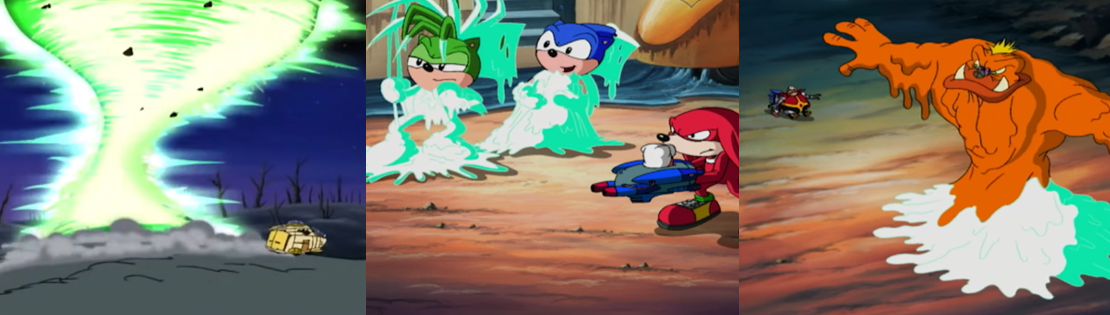
A few episodes later, the siblings are relaxing at the beach when they’re attacked by Dr. Robotnik’s spherical “Fortress of Altitude” (almost a downgraded version of the Death Egg or the Egg Carrier), a flying fortress capable of bombarding his foes and shrugging off the laser blasts from their magic weapons thanks not only to being comprised of “Mobibindum” but also being powered by a Chaos Emerald, which atomises everything it touches. After fending off Dr. Robotnik’s SWATbots and evading the flying fortress, the siblings seek out Knuckles’ help. Initially reluctant to leave the Floating Island, Knuckles is convinced by their awful song (“No One is and Island”), though his resolve falters when the astral spirt of his great-grandfather, Athair (LaMarche), warns that this will result in a greater calamity. After easily fooling Dr. Robotnik with a decoy, Knuckles and the others slip aboard the flying fortress, avoid the ship’s defences, and burrow their way to the Chaos Emerald thanks to Knuckles’ super strength. However, after being callously dismissed by Dr. Robotnik, Sleet and Dingo claim the Chaos Emerald for themselves to both stand on their own and to try and prove their worth to their master. This causes the fortress to fall from the sky and into the sea below. Crippled by hydrophobia and unable to swim, Sonic relies on his family and friend to help get him to safety, but Sleet is stunned when usually thick-headed Dingo swipes the gem for himself! However, Dingo accidentally drops the Chaos Emerald, shattering it and unleashing a wave of unbridled Chaos Energy across the land that causes storms, earthquakes, and threatens the entire planet.

The heroes forge unlikely alliances to save the planet from being torn apart by Chaos Energy.

After his despair is lifted by another of the band’s terrible songs (“Learn to Overcome”), Knuckles leads them to his great-grandfather, who gifts them a special canister to house the shattered pieces and reveals that the only way to save the world is to ally with Dr. Robotnik. Naturally, Sonic and his siblings are aghast at this, but Knuckles is reluctant to defy his elder, especially with the fate of the world at stake. With the planet literally shaking apart from the rising Chaos Energy, the siblings race to find Knuckles and find another way to solve their problem, only to find that he’s been coerced into capturing them on Dr. Robotnik’s orders in exchange for the tyrant’s help in saving the world. Regretfully, Knuckles betrays his friends, only to be immediately double-crossed when Dr. Robotnik reneges on his promise not to roboticize the hedgehogs. Angered by this, a remorseful Knuckles fights back and frees his friends from their sticky bonds and joins them in searching for the Chaos Emerald, but they’re too late to keep Sleet from finding it and containing it in Dingo. This results in Dingo absorbing a full dose of Chaos Energy and transforming into a mindless, clay-like beast that threatens friend and foe alike. In what could arguably be described as a very loose adaptation of Sonic Adventure (Sonic Team, 1998), Dingo goes on a rampage that not only causes a series of volcanic eruptions but also destroys Manic’s magic drum set before heading to nearby Robotropolis, forcing Sonic to manipulate Dr. Robotnik’s ego to help subdue the beast. Toppled by the band’s music (“The Mobius Stomp”) and Dr. Robotnik’s special glue, Dingo spits out the Chaos Emerald, reverting to normal and saving the world and earning him his master’s ire. Knuckles then delivers the reassembled Chaos Emerald to Athair. Although the old echidna charges him with safeguarding the gem on the Floating Island, but the band promises that Knuckles will always have a place with them whether near or far.

The Summary:
Although the show has little in common with SatAM, Sonic Underground’s Sonic remains the same boastful, reckless speedster. In place of Princess Sally Acorn (Kath Soucie), Sonia acts as the voice of reason and intelligence in the trio, chastising Sonic’s irresponsible nature and emphasising diplomacy over impulsiveness wherever possible. Manic is characterised as a laid-back surfer dude who’s not as reckless as Sonic but still isn’t as attentive as Sonia. However, while Sonia might be the smartest of the bunch, she’s from an entirely different world to both. Sonic was raised to be a Freedom Fighter by his beloved Uncle Chuck (LaMarche) and has been fighting Dr. Robotnik for as long as he can remember, Manic is a streetwise thief, and Sonia comes from a life of privilege and luxury. All three were united by a common enemy when Dr. Robotnik roboticized the only family they ever knew and wield magic medallions that transform into music instruments that act as weapons, but Sonic Underground continuously emphasised their strength as a unit more than any previous Sonic cartoon. While Sonic possesses incredible speed, he’s impulsive and also crippled by hydrophobia. Sonia might have some fancy martial arts moves but she’s often too easily trusting of wealthy folk, who are often in Dr. Robotnik’s pocket. And Manic generally gets himself into trouble since he can’t help but half-inch when the temptation arises.

Though tough and wily, Knuckles is easily duped and fiercely loyal to this duties as the island’s guardian.

Of the three Sonic cartoons that aired in the nineties, Sonic Underground is somehow the most bizarre. Its tone is all over the place, lacking the ominous menace of SatAM but also veering more towards comedy like Adventures. Despite still being lighting fast and capable of bending physics, Sonic is surprisingly weak here. Perhaps because of the need desire emphasise themes of teamwork and friendship, Sonic is not only hampered by recklessness but shows fear when confronted by large groups of SWATbots, sluggishly fumbles through his initial fight with Knuckles, and succumbs to an uncharacteristic panic when left floundering in the ocean. Although the Floating Island is common knowledge in Sonic Underground and easily accessible, it’s far more accurate compared to the small mass seen in SatAM. It’s large, with a variety of different environments and wildlife on its soil, and Knuckles is later seen using a radar and communications system, and anti-aircraft cannons to fend off intruders. Knuckles’ reputation proceeds him to the point where even Sleet is aware of how tough he is and his skill at laying traps, and he makes an immediate impression by capturing the two dolts and roasting them over a spit for the local wildlife! However, as fleet-footed and super strong as he is, and despite showcasing a distrustful and snarky attitude, Knuckles is easily duped by Slate and Dingo and, like every character here, suffers from atrociously bad animation, appearing pudgy and disproportionate every time he moves. Knuckles’ go-to move is to spin his arms like a buzzsaw to rapidly burrow through surfaces. Just doing this is enough to knock Sonic on his ass and impress Manic, and Knuckles proves durable enough to withstand Sonic’s patented “Triple Spin Attack” and wily enough to use his knowledge of the island against his foe. Knuckles takes his role of guarding the Floating Island very seriously, to the point where he’s isolated himself from the rest of the world, but he’s equal loyal to his newfound friends and defies his instincts, and the will of his great-grandfather to aid them even though he’s extremely uncomfortable with leaving his island unguarded.

As if Dr. Robotnik wasn’t bad enough, the siblings must content with Knuckles and a rampaging Dingo.

There are some benefits to this for Knuckles; namely, that he spends more time socialising with his friends and bonding with Sonia, with whom he develops a mutual attraction. However, there are major drawbacks, too. Most notably, Knuckles is naïve and easily fooled; not only does he fall for Sleet and Dingo’s lies about the hedgehogs, he trusts his great-grandfather’s word so blindly that he willingly allies with Dr. Robotnik despite knowing full well of the semi-cybernetic dictator’s malicious nature. While he looks just like SatAM’s Dr. Robotnik (save for sporting two robotic arms) and even resides in a similar citadel in the heart of Robotropolis, this Dr. Robotnik lacks the gravelly, mechanical voice, employs wildly different SWATbots, and often spares the aristocracy the indignation of roboticization in return for hefty bribes. Although Dr. Robotnik appears to be at his most dangerous when he launches his Fortress of Altitude, the airship is as disproportionate and inconsistent as everything else on the show. The Mobibindum apparently makes it super heavy and tough, yet both Sonic and Knuckles smash through its structure without issue and a simple drop in the ocean is enough to trash the fortress and leave it literally blowing up in the dictator’s face. Even when Mobius is being torn apart around him, Dr. Robotnik finds a way to turn things in his favour. He’s willing to see the world destroyed if it means being rid of Sonic and strong-arms Knuckles into doing his bidding so that he can have the final victory of his hated enemies. Honestly, there are only a few episodes of Sonic Underground that are worth watching and these four are a handful of them. The animation and voice acting is atrocious (it’s insane that Jaleel White voices all three siblings), with Knuckles sadly getting the worst of both, but it was nice to finally see him in a Western Sonic cartoon. It’s not enough to salvage the series but it certainly makes these episodes more enjoyable. If only it had been an actual continuation of SatAM, it could’ve been even better.

My Rating:

Rating: 2 out of 5.

Could Be Better

Were you a fan of Sonic Underground? What did you think of the four Knuckles-centric episodes? Were you disappointed that we never got a continuation of SatAM? Which of Sonic’s siblings was your favourite and what did you think to the use of rock music in the show? Are you celebrating Knuckles’ big day today? Whatever you think about Sonic Underground, and especially Knuckles, leave a comment down below or let me know by commenting on my social media.

Back Issues & Knuckles: Carnival Night Conspiracy


With the release of Sonic the Hedgehog 3 (SEGA Technical Institute, 1994), gamers were introduced to Knuckles the Echidna. This mischievous, dreadlocked antagonist was created by Takashi Yuda and his debut was made all the more impressive by virtue of the fact that Sonic 3 was too big to fit on one cartridge, which meant that Knuckles was the first of Sonic’s supporting characters to co-star in a main series videogame when Sonic & Knuckles (ibid) was released on this very day in 1994.


Story Title: “Carnival Night Conspiracy” (Parts 1 to 6)
Published: 12 November 1994 to 21 January 1995
Writers: Nigel Kitching
Artist: Richard Elson

The Background:
After Sonic the Hedgehog rocketed to mainstream success and helped SEGA to usurp Nintendo to capture the allure of the videogame industry, SEGA capitalised on Sonic’s popularity not just with videogames but also a slew of merchandise, including cartoons and comic books. About six months after Archie Comics began publishing a weird amalgamation of the Adventures of Sonic the Hedgehog (1993 to 1996) and Sonic the Hedgehog/SatAM (1993 to 1994) cartoons, United Kingdom publisher Fleetway Editions Limited brought us “Britain’s Official SEGA Comic”, Sonic the Comic (StC), a fortnightly comic book that I collected diligently until its unfortunate end. While StC pulled much of its lore from the now defunct Mobius and Doctor Ovi Kintobor storyline that was popular outside of Japan at the time, StC quickly veered away from the source material to recast Sonic the a mean-spirited leader of a gang of Freedom Fighters made up of both recognisable characters and anthropomorphic characters adapted from the videogames. Like the Archie comics, StC often included some loose adaptations of the videogames that adapted the source material to fit with its noticeably different lore. After his introduction in a multi-part story loosely based on Sonic 3, Knuckles almost immediately graduated to his own back-up stories in the pages of StC. While these initially tied up some loose ends from that story and cherry-picked ideas from Sonic 3 & Knuckles, they soon evolved into their own beast entirely to expand on Knuckles’s vague backstory and craft a version of the character entirely unique to any seen in other Sonic media.

The Review:
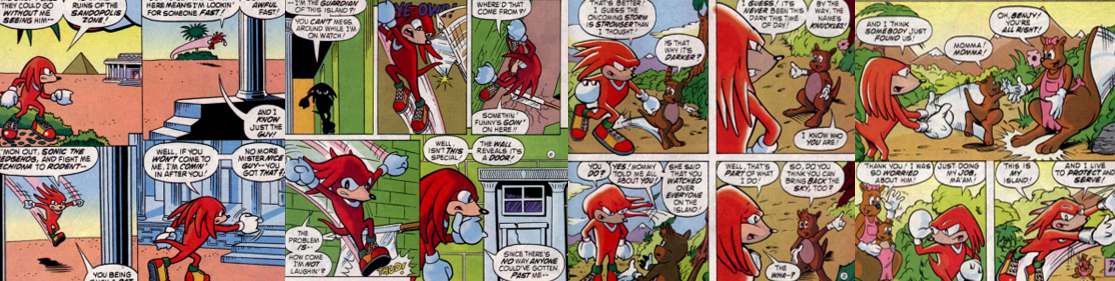
Although “Carnival Night Conspiracy” is Knuckles’ first solo story arc in StC, it wasn’t actually his first solo story; the Guardian of the Floating Island first appeared in a short story in a StC summer special, which basically showed how he met Dr. Robotnik and served as a tantalising prelude to his first multi-part appearance in the main Sonic the Hedgehog strip. “Carnival Night Conspiracy” takes place directly after that; thanks to Dr. Robotnik being unable to hide his true nature for too long, Knuckles soon realised that the egg-shaped dictator he had aligned himself with was actually plotting to merge the twelve Chaos Emeralds into six and absorb their powers. Fortunately, Knuckles was able to use the power of the elusive Grey Emerald (also known as the “Control Emerald”, kind of a precursor to the Master Emerald and something commonly found in Sonic lore at the time) to stop Dr. Robotnik. He then aided Sonic and the other Freedom Fighters to repent for exposing their secret base and, after a massive battle, left on frosty terms in one of Dr. Robotnik’s Egg-O-Matics. This is where we find Knuckles at the start of the story, making his way back to the Floating Island (as it was known then; “Angel Island” wouldn’t become its name until 1999), only to have his ride suddenly explode thanks to a self-destruct mechanism triggered by Dr. Robotnik. Thankfully, Knuckles wasn’t too far from his floating island home and bails out, using his unique ability to glide to reach safety. However, from the clouds above the island he spots a bustlingly casino city, one well-guarded by Dr. Robotnik’s Troopers and just one of many outposts and bases the mad scientist secretly constructed on the island without Knuckles’ knowledge. Insulted and peeved by this, Knuckles burrows his way into the heart of the city, confused by the bright lights and the purpose of the casinos and restaurants and unaware that he’s being watched until he’s confronted by a massive construction robot.

Knuckles reluctantly allows the Marxio’s to stay after being won over by their thrilling ride.

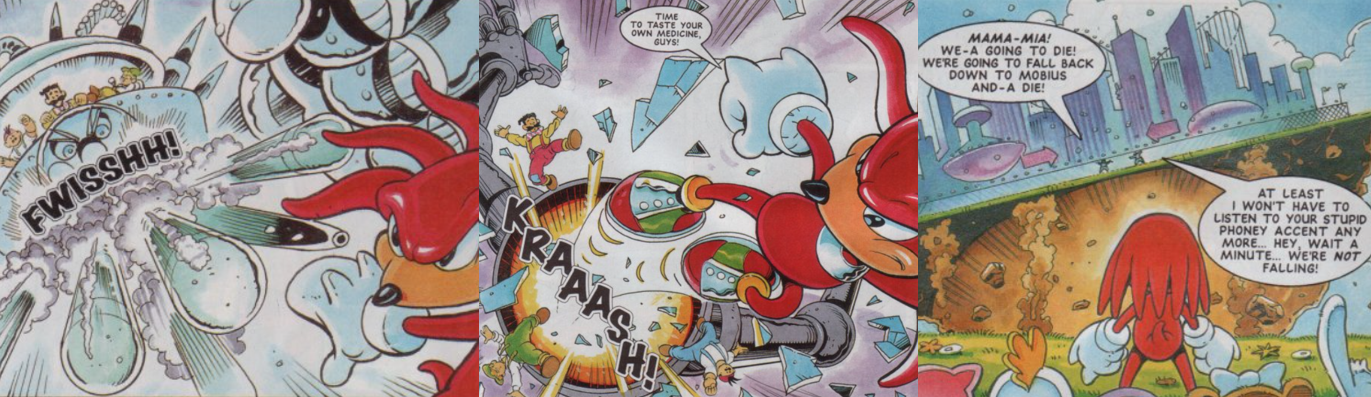
However, it’s no match for Knuckles’ super strength and he easily trashes it in one hit, but his heckles are only raised further when he barely avoids a sniper shot! Clambering up to confront his shooter, Knuckles is met by Carnival Night City’s owners and operators, the swindling conniving trio known as the Marxio Brothers. Led by the cigar-smoking Grouchio and made up of underpaid dogsbody Chicio and the mute Harpio, the Marxio Brothers are a composite of the comedians the Marx Brothers and the Super Mario Brothers and first appeared in StC some years prior where they were in charge of the similarly-themed Casino Night Zone. Although he initially demands that they pack up and leave, Knuckles is won over by Grouchio’s silver tongue and the smarmy salesman pitches that their casino will help Knuckles spruce up his island for when his lost people eventually return and easily explains away Dr. Robotnik’s Troopers as being security guards they purchased. Naturally, Knuckles is sceptical, but still somewhat naïve to the wider world and awestruck by the technology and allure of modern Mobius, so he allows the Marxio’s to give him a tour and take a ride on a high-speed rollercoaster, completely unaware that the trio do actually work for Dr. Robotnik. Strapped tightly into the Hell House Ride, Knuckles enjoys the thrill of the rollercoaster and admires the amount of effort the Marxio’s went to make the ride dangerous and exciting, using his super strength to smash through any hazards that come his way and being so won over by the fun and exhilaration offered that he agrees to let the slimy conmen stay on the Floating Island. Overjoyed, Grouchio makes Knuckles a partner in their endeavour, granting him a luxurious office (to the echidna’s chagrin) and the title of “Marketing Consultant” ahead of them opening the park to the public.

Knuckles smashes the Marxio’s craft and then forcibly removes them from the island!

However, when Knuckles leaves to take care of Dr. Robotnik’s Launch Base Zone, the Marxio’s pursue him in their three-seater craft and Chicio accidentally lets slip that the egg-shaped dictator is bankrolling their entre endeavour. Though frustrated by his brother’s stupidity, Grouchio has no qualms about transforming their craft into a heavily-armed combat mech and unleashing its full might against Knuckles, who is summarily beaten into unconsciousness. However, right as the first guest arrive on the Floating Island and Grouchio is regaling Dr. Robotnik with their victory and promises of fortune, Knuckles recovers and redoubles his efforts, easily dodging their missiles and massive mechanical fists and tearing the craft apart with a superpowered uppercut. To stave off Knuckles’ wrath, Chicio redeems himself by calling in and hoard of Badniks and Grouchio wows the park’s guests by spinning the resulting destruction as a performance celebrating Knuckles’ victory over Dr. Robotnik. Unable to destroy the Carnival Night City with so many innocent lives at risk, Knuckles allows the Badniks to close in on him so he can destroy them all in one fell sweep and comes up with a simple, direct, and effective solution to his problem. By striking a fault line with one massive punch, Knuckles just breaks the entire Carnival Night Zone off the Floating Island! Thankfully, this severed chunk of rock contains just enough residual power from the Chaos Emeralds to allow it to slowly drop to Mobius below rather than plummeting down and killing the three, and it crashes before the startled eyes of a young boy who was unable to make the trip. With his mission complete, Knuckles orders the startled guests to vacate his island and stoically prepares to rid the Floating Island of every trace of Dr. Robotnik.

The Summary:
I was super excited about Knuckles at the time; I was so stoked for Sonic 3’s release and absolutely captivated by this grinning, mysterious, antagonistic red echidna (often referred to as a “spiked monkey” in magazines). When he first appeared in the StC summer special, I couldn’t wait to see when he would make his StC debut and it seemed to take ages for him to show up, but boy was it worth it at the time! Then, after proving a formidable foe and a reluctant ally, Knuckles got his own back-up feature in StC beginning with this story and they quickly became my second favourite strip of the comic after Sonic’s. Nowhere is it more evident that “Carnival Night Conspiracy” was meant to be seen as an important feature, one second only to Sonic’s strips, than in the presence of artist Richard Elson, easily the comic’s most talented hand, who had illustrated Sonic’s stories for years and this definitely helps to bolster the tale as being important to the ongoing Sonic 3 adaptation in the comic at the time.

The story went a long way to establishing Knuckles as a bad-ass loner.

Knuckles retains much of his characterisation from his debut appearance; he’s hot-headed, proud, and incredibly naïve, easily awestruck by the ways of the surface world and manipulated by others. He is a little more guarded here thanks to being burned by Dr. Robotnik, but not so much that he doesn’t just forcibly eject the Marxio’s or that he can’t be won over by a rollercoaster ride. His focus is on safeguarding his home, however, and eradicating Dr. Robotnik’s influence from its surface; when the Marxio’s get in the way of that, and his reluctant hospitality, Knuckles doesn’t hesitate to fight back and trash their machine, but he’s not so single-minded in his vendetta as to endanger anyone’s lives. The Marxio’s have always been joke villains in StC but they work here as Dr. Robotnik’s proxies; Knuckles was never the airheaded, gullible fool in StC but many of the comic’s villains did manipulate and betray his trust, though the situation was a little different each time and he generally seemed to learn from each encounter. The primary thrust of this story, though, is to establish that Knuckles is a hot-headed loner who wants to live in peace and solitude on his island and that he’s an extremely tough physical specimen, able to glide, scale walls, and smash an entire chunk off his island with his incredibly strength. Lacking Sonic’s grating arrogance and proclivity for quips, Knuckles comes across as a bad-ass recluse who isn’t to be trifled with and who will unleash an incomparable wrath on anyone who threatens his home or tries to take advantage of him.  

My Rating:

Rating: 3 out of 5.

Pretty Good

Have you ever read “Carnival Night Conspiracy”? Did you pick the issues up when they were first released and, if so, what did you think about Knuckles’ first spin-off? What did you think to Fleetway’s introduction and characterisation of Knuckles and the way they handled his backstory? Were you a fan of the Marxio Brothers? What did you think to Knuckles’ early crusade against Dr. Robotnik? Which of Fleetway’s Knuckles stories and/or characters was your favourite and why? Are you celebrating Knuckles’ big day today? Whatever you think about Sonic the Comic, and especially Knuckles, leave a comment down below or let me know by commenting on my social media.

Game Corner & Knuckles: Knuckles’ Chaotix (SEGA 32X)


With the release of Sonic the Hedgehog 3 (SEGA Technical Institute, 1994), gamers were introduced to Knuckles the Echidna. This mischievous, dreadlocked antagonist was created by Takashi Yuda and his debut was made all the more impressive by virtue of the fact that Sonic 3 was too big to fit on one cartridge, which meant that Knuckles was the first of Sonic’s supporting characters to co-star in a main series videogame when Sonic & Knuckles (ibid) was released on this very day in 1994.


Released: April 1995
Developer: SEGA

The Background:
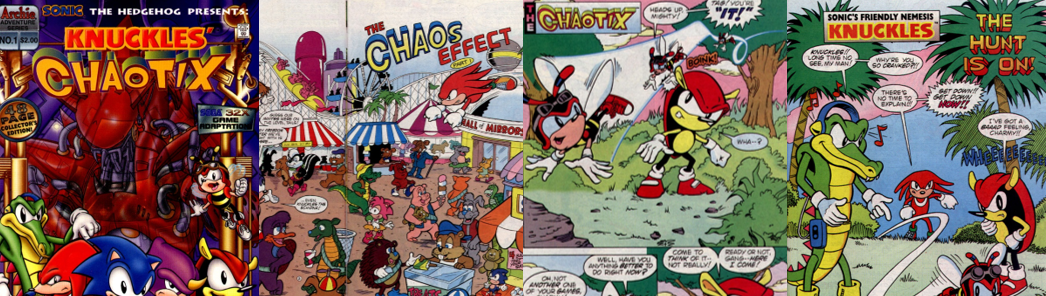
Following the release of Sonic 3 and Sonic & Knuckles, SEGA looked to be unstoppable with their Sonic franchise; the latter title was a huge game for SEGA, backed by an impressive marketing campaign, and the franchise had sold over $1 billion in total revenue by 1994. With the Mega Drive nearing the end of its life cycle, and the videogame industry on the cusp of entering a new generation of 3D gaming, SEGA attempted to prolong the Mega Drive’s lifespan and appeal with a series of expensive add-ons like the Mega-CD and the Mega Drive 32X. Like the Mega-CD, however, the 32X was doomed to failure primarily because SEGA were planning on releasing an entirely new console, the SEGA Saturn, just a few months later and gamers just couldn’t afford the clunky peripheral. With the benefit of hindsight, I truly believe that SEGA would have fared much better had they simply continued with the Mega-CD, producing a combination Mega Drive/CD console and releasing all 32X and Saturn games on this platform rather than wasting time, effort, and money on expensive add-ons. Regardless, one title that sticks out to me from the 32X library is Knuckles’ Chaotix; initially designed as Sonic Crackers, the game’s big mechanic was that players controlled two characters simultaneously and were joined by a special, elastic “Combi Ring”. The game, which was Knuckles’ one and only solo title, also saw the return and redesign of obscure Sonic character Mighty the Armadillo and Vector the Crocodile into fully playable characters. However, thanks primarily to the failure of the 32X, the title has largely been doomed to obscurity and SEGA’s continued refusal to port or re-release the game to modern consoles means that the only way to play the game is by using emulators or spending extortionate prices.

The Plot:
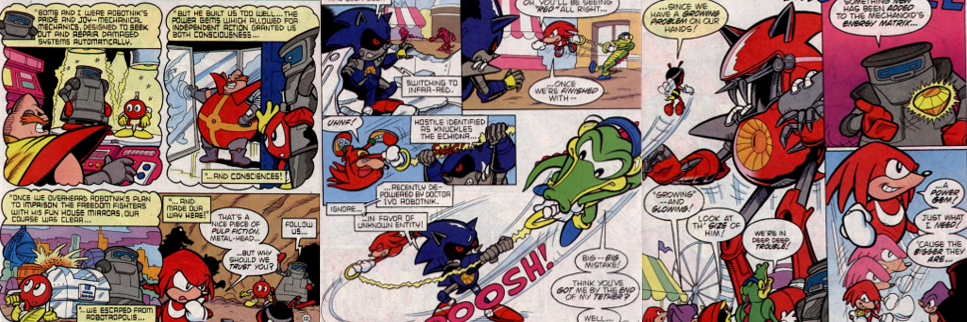
Doctor Eggman discovers the seven Chaos Rings on Carnival Island and attacks alongside Metal Sonic. When Knuckles investigates, he rescues Espio the Chameleon from Dr. Eggman’s Combi Confiner and joins forces with Espio’s cohorts (Mighty, Vector, and Charmy Bee – the titular Chaotix) to put a stop to Dr. Eggman’s schemes using the power of the Combi Ring.

Gameplay:
As is to be expected of a classic Sonic the Hedgehog title, Knuckles’ Chaotix is a 2D, sidescrolling action/platformer that is heavily geared towards speed but, in a change of pace, actually has far more emphasis on vertical platforming and progression that any of its predecessors. The game takes place in Newtronic High Zone and is comprised of six stages referred to as “Attractions”; each Attraction is made up of five levels (called “Acts”) rather than the usual two or three, and each of these pushes you to run up loops and walls or jump to higher areas in order to reach the end goal. In another change of pace, the game immediately begins with a practice area, in which you play as Knuckles. After scaring away Dr. Eggman, Knuckles rescues Espio from the mad scientist and players can choose to play through a quick tutorial to familiarise themselves with Knuckles’ Chaotix’s new mechanics.

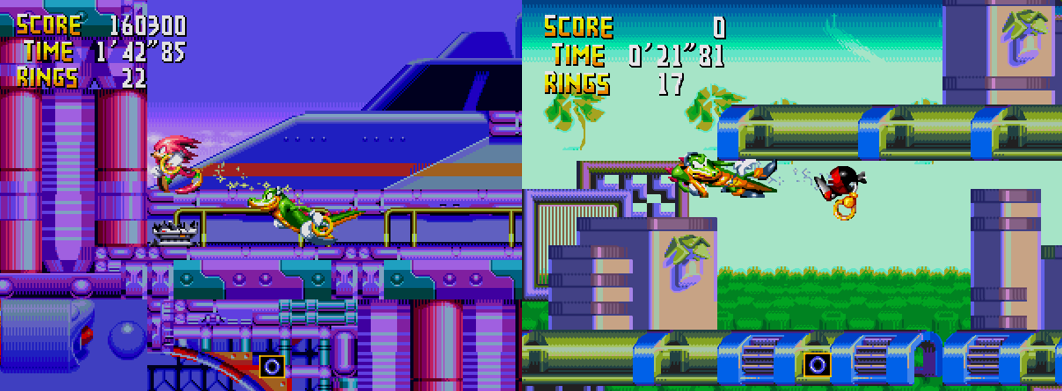
Knuckles and his new friends are inexplicably tethered together for some clunky gameplay.

All of the basic controls of a classic Sonic remain intact and as you’d expect; players can run, jump, and perform a Spin Dash to speed ahead with all but three of the available characters, and you’ll find that each playable character has their own unique qualities. Knuckles, for example, can glide and climb walls as in his previous appearances; Espio spins like a top instead of Spin Dashing and can cling to walls but cannot climb them; Vector is the biggest character and so has a greater chance of hitting Badniks or taking damage but he can also perform a double jump or mid-air dash; Mighty is basically a thinly veiled stand-in for Sonic and can perform a wall jump; and Charmy is the smallest and fastest character and constantly flies about but at the cost of severely reduced visibility. Players can also be impeded by Heavy and Bomb, two Badniks who cannot Spin Dash or climb walls, explode on contact or severely weigh you down, and you’ll have to leave it up to a mixture of fate and luck as to which character you get as your partner as the main Scenario Quest forces you to pick one at random using the “Combi-Catcher”, a mechanical claw game like you see at seaside amusements. Of course, the unique selling point of Knuckles’ Chaotix is the frankly bizarre decision to tether two characters together using the Combi-Ring. This means that there are always two characters on screen at once, and you can choose to play either with a computer-controlled partner or with a human friend. Players can call their partner to them at any time with the A button or hold down B to “hold” their partner in place to activate switches; when they stand in place, you can also build up a head of steam to blast ahead, which is honestly more beneficial than the Spin Dash in this game. This also allows you to grab your partner and fling them at switches, Badniks, bosses, or up to higher areas; however, it can be extremely clunky trying to slingshot your way up to where your partner is, and more often than not you end up hanging in place or ricocheting about like a pinball just trying to progress upwards. Furthermore, calling your partner back costs you Golden Rings, the lifeforce of the series, and you can even drop the Ring counter into negative numbers as a result of this.

You’ll must master (or bungle) the Combi-Ring and make use of gimmicks to progress ever upwards.

While each character is very visually interesting in their own right and the idea of working together to progress is an interesting one, tethering the characters together is extremely restrictive in practise; the majority of the time, your biggest struggle won’t be with the game’s Badniks or the tedious nature of the gameplay, it’ll be with trying to navigate the environment using this clunky, awkward mechanic and getting frustrated when you finally get where you need to be only to drop down a second later. Indeed, the level of difficulty in Knuckles’ Chaotix is extremely low compared to the games that came before it; the life system and checkpoints are now gone, there are no bottomless pits or bodies of water to worry about falling or drowning in, and you don’t even need to worry too much about being hit without any Rings as you’ll either lose your partner for a short time or be booted out to the main hub world to try again. Like Sonic 3, the game comes with a save system that allows you to have three saved games, though the only way you can replay the game’s Attractions is to play through the Training Mode. This mode also allows you to set your playable character and partner, which is more freedom than the main Scenario Quest offers, but the most tedious aspects of Knuckles’ Chaotix come from how unnecessarily long and annoying some of its gameplay elements are. While the Attractions are a visual eye fest there’s not much to distinguish each Act from the other within a set stage (I swear some of them have exactly the same layouts bar some very minor changes), there’s next to no hazards or Badniks to worry about, and you don’t even really need to worry all that much about the time limit.

Most stages are painfully barren and linear, but there are some instances of variety.

Instead, the game is built around randomness; it’s pot luck that you’ll pick a decent partner (I recommend a Knuckles/Espio team, personally) and as to which Attraction you’ll play. Between each stage, you’re returned to the hub world and must hit a bumper to randomly select your next area, meaning that you’re literally bouncing all over the place and will most likely play the game’s Attractions out of order. This may go a long way to explaining the uniformity and ease of the game’s stages, however, as it wouldn’t be fair to be randomly dropped into a tough stage before you’re ready, but it does make playing through the Scenario Quest quite a long old slog. While the basics of the gameplay are very much familiar to anyone who’s played a Sonic game before, Knuckles’ Chaotix feels very slow and sluggish at times and you won’t really find much here you haven’t seen both. Sure, there’s a few more switches and a bit of variety in the likes of Marina Madness and Amazing Arena (you can hop on a rising/falling ship in the background in the former and must light up each Act to get a successful clear in the latter) but, for the most part, you’re just running up walls, hopping over spiked balls, bouncing off springs and bumpers, and scaling upwards (always upwards) on platforms and elevators. The Acts do eventually appear to become more dangerous as you progress, but by then it’s too little too late and I can’t help but feel that things would have been much better if there had just been three Acts per Attraction and then a final area to play through before battling the final boss.

Graphics and Sound:
If there’s one area where Knuckles’ Chaotix excels, it’s the presentation; the game is undeniably gorgeous to look at, and easily the most vibrant and colourful Sonic title of its era. Each of the playable characters (with the exception of Heavy and Bomb) has an idle animation unique to them (Knuckles twirls his Combi-Ring in boredom, Espio cycles through different colours, Vector jams to his music, Mighty impatiently taps his foot like Sonic, and Charmy looks at you incredulously) and are some of the finest sprite work in the series. It’s such a shame, then, that Charmy is so goddamn small; obviously, he’s a bee and is supposed to be tiny but half the time you can barely see him, which is almost as disappointing as Mighty being a simple sprite swap of Sonic. Still, Espio and Vector look fantastic; each has unique and quirky running and jumping animations, and Knuckles’ sprites have been completely overhauled to make him more detailed and expressive than ever.

Sprites and environments are extremely colourful and detailed, sometimes to a fault.

Sadly, the game is let down by how bland and uninteresting its level design is. Knuckles’ Chaotix is very similar to Sonic the Hedgehog CD (SEGA, 1993) in a lot of ways but primarily in how confusing and clumsy its stages are laid out; when Badniks do appear, it seems completely at random, and the few hazards you come across are so oddly placed that it’s easy to run head-first into them. Stages are also extremely cluttered at times; there’s often too much colour, too much sensory overload, and it makes everything blend together or difficult to look at, which really doesn’t help when you’re trying to figure out where the hell you’re supposed to be going. The game’s Attractions play things extremely safe with the likes of Botanic Base being a lush forest, Speed Slider being an amusement park, and Techno Tower being Dr. Eggman’s industrial blemish on the natural environment, much like the classic Green Hill, Star Light, and Scrap Brain Zones. The aforementioned Marina Madness and Amazing Arena thus stand out even more thanks to the their unique gameplay mechanics and presentation, and the game does get extra points for featuring different colour palettes for each Act to indicate a different time of day (morning, noon, evening, and night), though this really doesn’t help to stave off the recycled nature of each Act.

Sprite manipulation, isometric graphics, and some funky effects hint to the 32X’s potential.

Also like Sonic CD, Knuckles’ Chaotix makes an impact with one of the best of the classic Sonic’s soundtracks; there are so many jaunty, catchy tunes peppered throughout this game that it really helps to take your mind off how empty the stages are and how monotonous the gameplay can be. Since it’s running on 32-bit hardware, the game also features a great deal of isometric 3D graphics; Dr. Eggman shields himself being a polygonal diamond, some lifts and bosses are built out of the same graphics, and you’ll find the bonus and Special Stages also contain a fair bit of this technique (and suffer from jerkiness, slowdown, and perspective issues as a result). There’s also a big emphasis on sprite manipulation; characters can grow or shrink with monitors, and bosses, Badniks, and sprites will fill up or fly into the screen. Unlike Sonic CD, however, the game doesn’t feature any anime cutscenes; in fact, even sprite-based cutscenes are few and far between here, relegated to the opening and before the final boss, and although the bosses are proceeded by a short cutscene, the game prefers to just show a partially animated image of the main cast for the title screen and credits. This is a bit of a shame, really; I wasn’t expecting full blown animated sequences but both Sonic 3 and Sonic CD featured more sprite-based cutscenes than Knuckles’ Chaotix, so the game ends up feel quite rushed and a bit of a step back.

Enemies and Bosses:
Dr. Eggman hasn’t really tried to reinvent the wheel in Knuckles’ Chaotix and is still using his tried-and-tested robotic creations, the Badniks, to hinder your progress. Unlike in the majority of other 2D Sonic titles, destroying Badniks doesn’t free a cute little woodland critter; instead, an uncollectible Dark Ring will drop out and disappear soon after, meaning that the few times Badniks do appear you’re robbed of any sense of satisfaction from destroying them. These Badniks are some of the oddest in the classic series, resembling a mish-mash of insects, tanks, and other creatures and mostly just floating around here and there. The only real standouts for me were Burboom and Blitz; Burboom can catch your partner and hold them captive and Blitz target you with homing missiles that fly across the immediate area to hurt you. While in Amazing Arena, you’ll also have battle a sub-boss, which is a massive mechanical version of Dr. Eggman that stretches its fists at you. The only way to damage it is to toss your partner into the head, which routinely floats back and forth at the top of the screen; although you can simply wait it out and the boss will deactivate, you won’t get the benefit of the Ring Monitors defeating it bestows upon you.

Bosses can be either stupidly simply or needlessly frustrating thanks to the Combi-Ring mechanic.

Since you’ll play the game’s Attractions at random, the main five bosses can be fought in any order, and you’ll probably tackle them at different times each time you play through the game. It’s also worth noting that you must play each Attraction’s entire fifth Act to reach the boss, and if you fail you’ll be kicked back to the hub world and have to play through the whole Act all over again, which can make these battles very tedious. I fought the Botanic Base boss first; in this fight, Dr. Eggman holds your partner in a mechanical claw and shields his craft with electrical currents, meaning you’re left frantically trying to figure out how to bounce around using the bumper and ram into the craft. After that, I took on the Amazing Arena boss, which sees Dr. Eggman spawn in Badniks using a projector screen and protecting himself with a sphere. Simply fend off the Badniks, avoid his mace-like arms, and toss your partner up into him to take him out. I then fought the Marina Madness boss, which sees Dr. Eggman hide behind a polygonal shield and then protect his craft with slivers of it, not unlike the Metropolis Zone boss, forcing you to time your attacks to avoid damage. The Speed Slider boss is one of the trickiest in the game as Dr. Eggman essentially commands a huge, dangerous carousel; the floor constantly moves you towards the spiked cups that rotate around the main machine, so you have to fight against the inertia, avoid the spikes, and ram the blue spherical weak spot of his machine. Contrasting this is the Techno Tower boss, which is easily the game’s simplest boss by far; despite the lasers and the swinging arms of Dr. Eggman’s rotund mech, I was able to batter the red sphere that is its weak spot in no time at all thanks to simply taking advantage of invincibility frames.

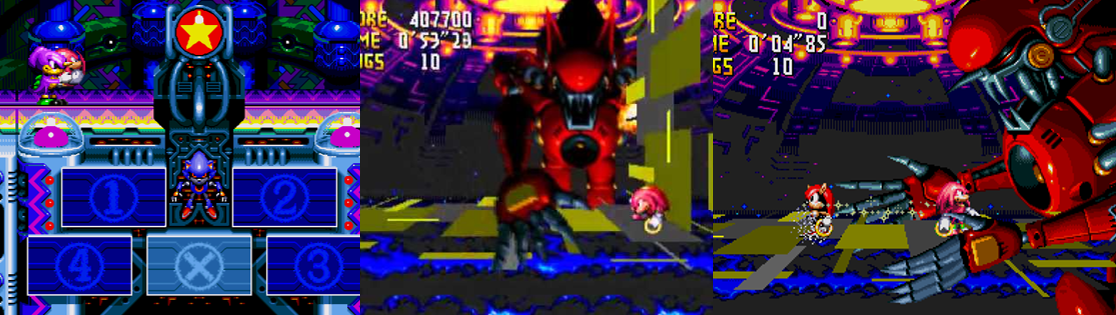
Metal Sonic transforms into a massive mechanical monstrosity for the finale.

Once you have defeated all five of the main bosses, you’re returned to the hub world, where Metal Sonic takes over the stage select machine. Just as you need to hit a bumper to select a stage, so to do you have to hit the bumper to try and deal damage to Metal Sonic; if the indicator lands on the X, one of the other numbered panels will be destroyed and the hub world will become more and more damaged. However, if you land on one of the numbered panels, you’ll have to dodge one of four different attacks as Metal Sonic tries to force you into spiked walls, rains missiles down on you, sends buzzsaws across the floor, and tries to hit you with bouncing tentacles. You’ll need to avoid these as you can only take two hits in this boss battle due to the lack of Rings; the first hit will cost you your partner, and you’ll need to wait for him to respawn or you’ll be kicked back to the hub world and have to start over. With Metal Sonic heavily damaged, Dr. Eggman repairs and powers it up with a huge Dark Ring, transforming it into the massive, monstrous “Metal Sonic Kai”. This is a three-stage boss battle in an enclosed, cyberspace-like arena, where you’re afforded ten Rings and must avoid its huge claw arm to strike its chest, then Spin Dash into its remaining arm while it hovers in the background, and then avoid its massive near-screen-filling chest beam to finish it off in a pretty simple, but surprisingly impressive, final battle.

Power-Ups and Bonuses:
Pretty much all of the classic Sonic power-ups are available to you in Knuckles Chaotix; while there are no Elemental Shields or extra life monitors, you can grab ten Rings, a speed up, a one-hit shield, and an invincibility from the different monitors you can find in each Act. There are some new power-ups here as well, though: you can briefly switch your playable character (or switch your partner to a different one depending on whose face is on the monitor when you smash it) and either grow to plough through the few enemies onscreen or shrink to find your jump and abilities painfully stunted for a short time. Perhaps the most useful item is the Combi-Ring Monitor, which stays with you until you’re hit; then, when you are hit, one large Ring is thrown from you rather than all of them scattering around and collecting that one Ring restores all of your Rings. Another interesting twist is that your partner can also collect and be affected by the monitors, meaning they could be invincible, big, small, or protected by a shield while you are not.

Additional Features:
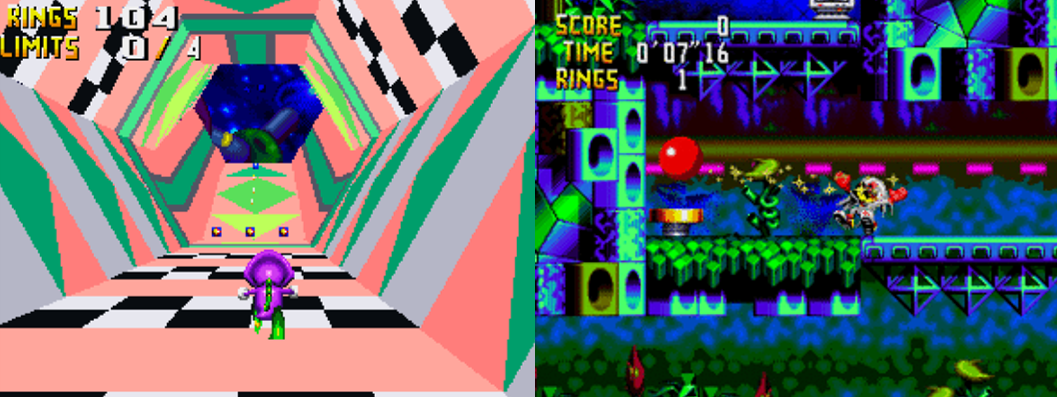
As you might expect, finishing any Act except the ones containing a boss while holding fifty Rings or more spawns a Big Ring. Entering it takes you (or your partner, if they enter or are thrown into it) to an isometric Special Stage where you continuously lap the environment until you have collected enough Blue Spheres to proceed. Collecting Rings will afford you more time to do this, and you must dodge buzzsaws and spiked balls and the myriad of gaps in the floor in order to reach your goal. While these aren’t necessarily the worst Special Stages I’ve ever played, they can be extremely difficult; it’s very hard to see what’s coming ahead of you or to anticipate which “lane” you need to be in to find a Blue Sphere, and all too easy to slip to failure. On the plus side, there are only six Special Stages; you’ll be awarded one of the six coloured Chaos Rings upon completion and will be treated to a slightly different end credits screen that adds Sonic and Miles “Tails” Prower to the cast and avoids Metal Sonic Kai wrecking havoc.

Snag the six Chaos Rings for the good ending, or mess about with the game’s debug mode.

Unfortunately, there are no Super transformations or additional bonuses; however, if you enter a Special Stage after collecting all the Chaos Rings, you’ll simply challenge them again in an even more headache-inducing wireframe mode. If you’re holding twenty Rings or more, you may encounter Big Rings hidden within the Acts; these transport you to a bonus stage that sees you constantly falling and trying to hit blocks for points and Rings. However, your Rings are constantly being drained in this stage, making it more of a hinderance than a benefit. Outside of the regular game, you’ll find a sound select and “colour test” in the main menu; messing around with this allows you to activate a debug mode, have Amy Rose appear in the sound test, activate a stage and character select, and even play as a glitched version of Knuckles. Since the only way you can play Knuckles’ Chaotix is to emulate it, you can obviously also make liberal use of the save state features included in most emulators to make the game a bit less annoying to play through.

The Summary:
Knuckles’ Chaotix is such an oddity to me. The entire game feels like a barely finished proof of concept, with empty environments and clunky mechanics that all needed to be addressed before the game was completed, and yet it’s such a lush and stunningly well-presented package that I find it all the more disappointing how lacklustre the actual gameplay and content are. Rather than trying to emulate the size, scope, and variety of Sonic 3, Knuckles’ Chaotix takes a step backwards for a far more linear and mundane experience and hedges all its bets on the unique Combi-Ring mechanic and the random, amusement park-like structure of the main campaign. Sadly, neither are all that much fun to play; five Acts per stage would be a lot to get through even in a traditionally paced Sonic title but the lack of enemies and variety are a real issue, despite how pretty the game looks. It’s a shame as the character designs are really unique and it could have been a really good continuation of the classic Sonic series, but it’s just lacking in a lot of ways that make it inferior to Sonic 3. The bosses aren’t too bad, especially the final battle, but the Special Stages are extremely disorientating and I can’t imagine the game is very enjoyable in two-player. At the same time, though, I’d love to see this get a remaster or a port to modern consoles with a few quality-of-life fixes, and it boggles my mind that we haven’t seen it re-released in all this time, but I can decisively say that you’re really not missing out on much by skipping over this one.

My Rating:

Rating: 2 out of 5.

Could Be Better

Have you ever played Knuckles’ Chaotix? If so, did you play it on the original hardware or, like me, did you discover it through emulation? What did you think to the Combi-Ring mechanic, and which combination of characters was your favourite? Were you a fan of the random aspects of the game and the five-Act structure? Did you ever collect all the Chaos Rings and what did you think to the Special Stages? How are you celebrating Knuckles’ big day today? Sign up to leave your thoughts on Knuckles’ Chaotix down below or drop a comment on my social media, and check back in for more Sonic content a little later in the year.

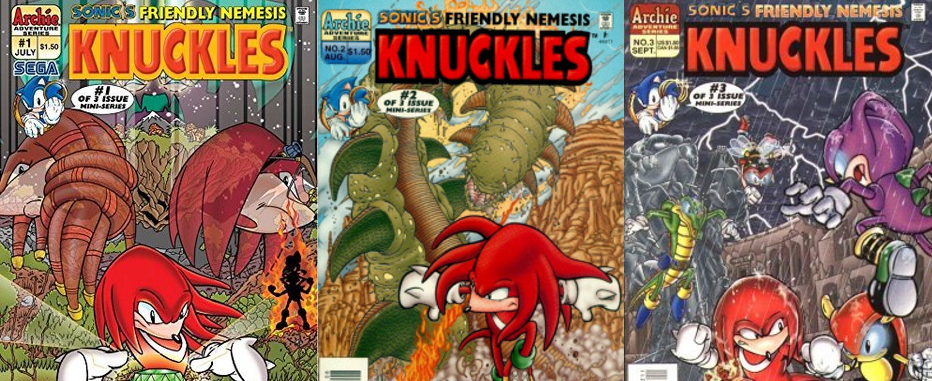
Back Issues & Knuckles: Sonic’s Friendly Nemesis: Knuckles


With the release of Sonic the Hedgehog 3 (SEGA Technical Institute, 1994), gamers were introduced to Knuckles the Echidna. This mischievous, dreadlocked antagonist was created by Takashi Yuda and his debut was made all the more impressive by virtue of the fact that Sonic 3 was too big to fit on one cartridge, which meant that Knuckles was the first of Sonic’s supporting characters to co-star in a main series videogame when Sonic & Knuckles (ibid) was released on this very day in 1994.


Writers: Mike Kanterovich and Ken Penders – Artist: Art Mawhinney

Story Title: “Rites of Passage, Part One”
Published: May 1996

Story Title: “Rites of Passage, Part Two”
Published: June 1996

Story Title: “Rites of Passage, Part Three”
Published: July 1996

The Background:
When Sonic the Hedgehog blasted onto the videogame scene in 1991, he was an immediate hit thanks to his debut title being bundled with the Mega Drive and SEGA’s aggressive marketing campaign. His popularity exploded with Sonic the Hedgehog 2 (SEGA Technical Institute, 1992), however, and Sonic merchandise was suddenly everywhere: not only did he feature in the Macy’s Day Parade and in cartoons but he also starred in a number of comic books. Following the initial four-part miniseries which mashed together narrative elements of Sonic’s cartoon adventures, Archie Comics  began regular publication of what would become the longest-running videogame comic book ever. In time, to capitalise on Sonic’s continued popularity, a number of spin-off comics were produced, with one of the most prominent being the Knuckles the Echidna sister series. What began as a simple enough three issue miniseries soon expanded into a convoluted lore that eventually became the subject of a bitter lawsuit between Archie and writer/artist Ken Penders that forever changed the way subsequent Sonic comic books were handled.

The Review:
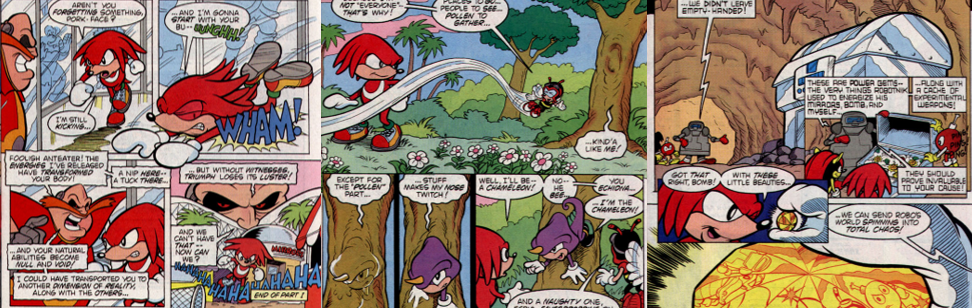
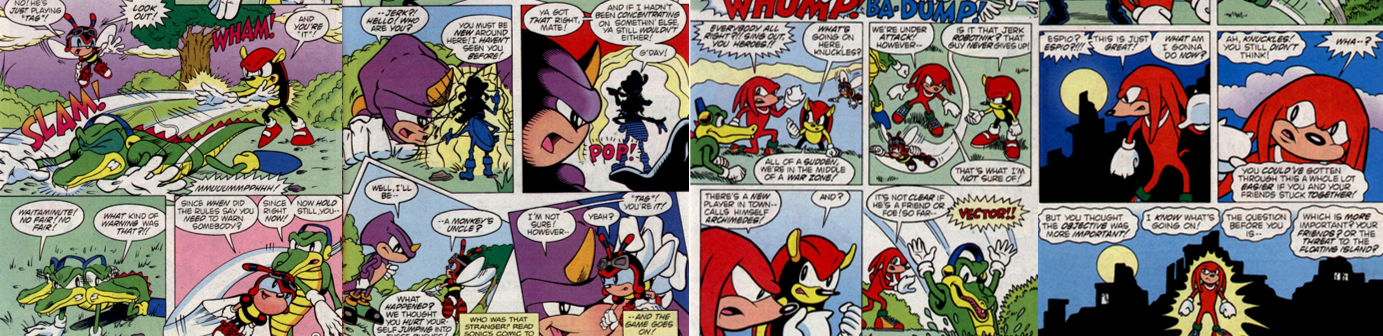
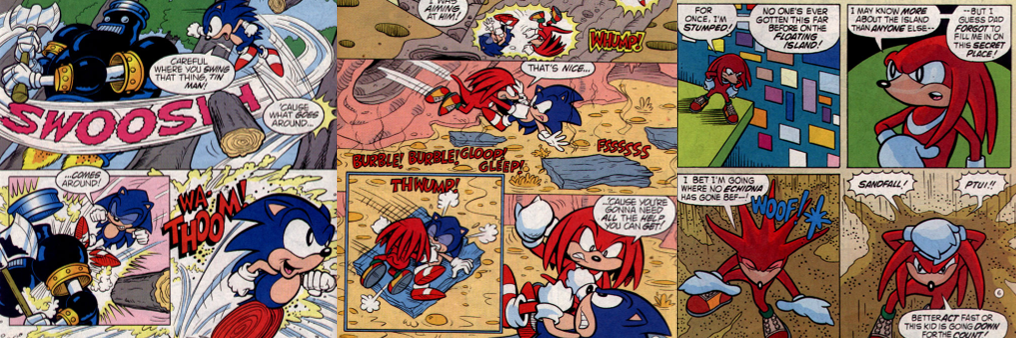
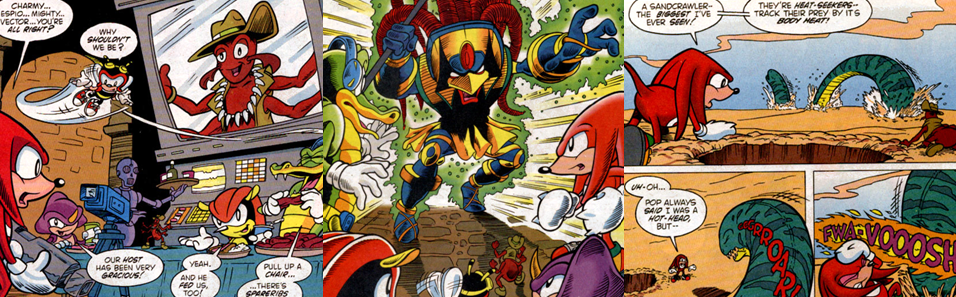
Sonic’s Friendly Nemesis: Knuckles begins by first promoting the “mystery of Archimedes” and then giving a very brief rundown on Archie’s take on Knuckles, the downfall of the Echidna society, and his floating home. In these early appearances, Angel Island was known by the Western name of Floating Island and, in Archie Comics especially, was held aloft through the power of just the one Chaos Emerald (and not even the Master Emerald at this point) and incredibly advanced technology. With the Echidna’s long gone, nature has reclaimed much of the island, leaving it in disarray and causing long-forgotten secrets to be buried. Knuckles pays a visit to Mount Fate in search of his missing friends, Mighty the Armadillo, Vector the Crocodile, Espio the Chameleon, and Charmy Bee (collectively known as the Chaotix), who he strongly suspects are being held captive there by the mysterious Archimedes. Archimedes has been making Knuckles’ life a bit of a misery in recent issues and stories, taunting him with riddles about his past, and led Knux to discover that, generations ago, the Echidna brothers Edmund and Dimitri tried to use the Chaos Emerald to return Floating Island to Mobius and, in the process, Dimitri became the evil entity later identified as Enerjak, the “Harbinger of Chaos”. The entire experience caused the Echidnas to renounce technology in all its forms and bury their secrets away beneath Mount Fate and, when Knux arrives, he finds that the chamber is well guarded by a number of electronic lasers, booby traps, and other obstacles specifically designed to keep out (or kill) any intruders.

Knuckles’ reunion with Chaotix is cut short by the sudden appearance of the all-powerful Enerjak.

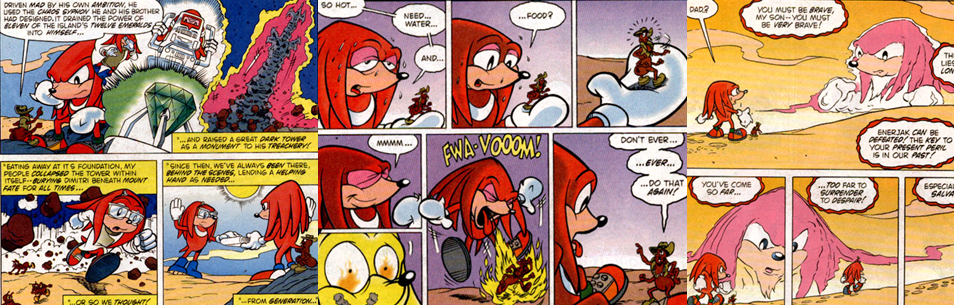
As Knuckles explores his surroundings, he arms himself with a concussive blaster (because that’s what I always think when I think of Knuckles: guns!) and forces his way into the grand observatory at the heart of the temple…only to find that his friends are being treated to a glorious spread as guests of Archimedes, who is revealed to be a weird-looking anthropomorphic fire-ant (yeah…I don’t know, either). Considering all of the games, subterfuge, and questionable behaviour shown by Archimedes, Knuckles is understandably enraged and demands answers but any hostilities between the two are interrupted by the arrival of Enerjak, who broke free from his prison when Knuckles triggered Mount Fate’s traps. Although Knuckles dismisses the Pharaoh-esque madman as a fraud, Enerjak boasts the incredible, unmatched power of eleven Chaos Emeralds (Archie Comics had an almost incalculable number of the gems at the time) and proves his power (and to be more than a match for the combined might of Knuckles, Chaotix, and Archimedes) by overpowering them all, taking Chaotix captive, and blasting Knuckles and Archimedes to the blazing hot desert of the Sandopolis Zone. As the two begin the bleak, day-long journey across the outback, they are attacked by a giant sandcrawler. However, the beast is easily defeated and turned into late-night kebabs for the two when Archimedes uses himself as bait (and his ability to teleport) to trick it into colliding head-first with a stack of rocks. Afterwards, Archimedes regales Knuckles (and bores the shit out of me…) with the story of how his people watched as the Echidnas harnessed the power of many Chaos Emeralds to move the entire city of Echidnapolis out of the path of an incoming comet (why they didn’t just evacuate is beyond me) thanks to the fire-ants performing the “ground-breaking ceremony” to effectively birth Floating Island. Archimedes then recounts, in a little bit more detail, how Dimitri later fashioned the “Chaos Siphon” to absorb the power of eleven Chaos Emeralds and ended up burying himself in the process.

Stuck in the boiling desert, Knux is subjected to endless exposition and visions of his father.

Since then, generation after generation of Echidnas were named Guardian of the Chaos Emerald and the fire-ants watched over them, testing them with a rite of passage to ensure that they would be read to combat threats such as Enerjak. While Knux and Archimedes resolve to work together to face Enerjak, they still need to cross the boiling desert; in his desperate hunger, Knux amusingly tries to eat Archimedes and ends up getting his mouth burned as a result. Later, while succumbing to the heat, Knuckles has a vision of his long-dead father, Locke, who does his best Mufasa (James Earl Jones) impersonation and gives him not only the resolve to continue onwards but also a cryptic clue as to how to defeat Enerjak: “The key to your present peril is in our past!” After reinvigorating himself at a mysterious oasis, Knuckles and Archimedes forge onwards towards Nekronopolis, a mighty city erected by Enerjak’s vast Chaos powers. The city, which Enerjak has built as a dark and corrupt reflection of Echidnaopolis, is home to an army of disposable mechanical minions (known as “Mecha-Nauts”) and Enerjak’s imposing citadel. Knuckles decides that the best approach is to tackle the Mecha-Nauts head on, which earns him Archimedes’ disapproval until he reveals that it was part of a plan to lure the machines to a gate so that he could crush them all (or, at least, a lot of them) in one move. However, while they manage to get into the citadel with a minimum of fuss, inside he is confronted by the Chaotix, who have been brainwashed by Enerjak’s magic and attack the two on his command. The fight (which includes a timely reference to The Mask (Russell, 1994) and even, surprisingly, The Shadow (Mulcahy, 1994), two films that both released in the year prior to this issue) goes poorly for the Chaotix; despite them having the numbers advantage, Knuckles and Archimedes are able to hold them off, forcing Enerjak to intervene and render them both unconscious using his powers (kind of making controlling the Chaotix a waste of time…) With Knuckles and Archimedes helpless against Enerjak’s powers, the would-be tyrant recaps his origins again just in case we didn’t realise how he came to be what he is.

Enerjak’s power may be awesome but the fight ends unresolved.

Despite acknowledging that the Guardian and his newfound fire-ant companion are the only two who could possibly oppose him, Enerjak prefers to boast and monologue rather than destroy them while he has the perfect opportunity. Indeed, Knux goads him into releasing them from his energy field, which gives Archimedes the opportunity to contact his fellow fire-ants. While Knuckles creates a distraction by taunting Enerjak and absorbing the brunt of his anger, Archimedes is able to teleport them out of danger so that Knux can (literally) get the drop on him and, though stunned to learn that he is Knuckles’ great-uncle, Enerjak attacks with a ferocity that is only matched by his augmented strength. Still, the two are relatively evenly matched, potentially because Knuckles has successfully goaded Enerjak into a straight-up fist fight and continues to chastise his great-uncle for his selfish ways and lack of honour. Their fight is cut short when Enerjak’s citadel suddenly transforms into a rocket and blasts into space; Knuckles and Archimedes escape thanks to the efforts of the fire-ants and Chaotix are freed from their pointless mind control. In the aftermath, despite Knuckles not really learning anything from him or really acting in a way that’s that impressive, Archimedes gives Knux his respect. Although Enerjak escaped to live to fight another day, the group is victorious and decide not to worry too much about the mysterious happenings that they experienced along the way (such as the oasis disappearing and the aforementioned rocket) but the story concludes with the revelation (to us) that Locke is actually alive and actively monitoring and assisting Knuckles from a hidden, high-tech bunker.

The Summary:
Jesus, what a slog. I’ll be the first to admit that Knuckles is my absolute favourite Sonic the Hedgehog character and I remember being so excited when he debuted in Sonic the Comic (1993 to 2002) and to learn that he was a prominent feature in the Archie comics, which were seen as kind of a continuation/parallel to Sonic the Hedgehog/SatAM (1993 to 1994). Knuckles the Echidna was one of the longest-running spin-off of the Archie Sonic comics, which is a testament to the character’s appeal and popularity, but every time I read his solo run I can’t help but be astounded at how boring and preposterous it is. I don’t usually lark to harp on about this sort of thing but my God is the art terrible in these issues! The covers, drawn by the always amazing Patrick “Spaz” Spaziante, are the best part of the artwork in this miniseries as, while Knuckles generally looks kind of okay, a lot of the characters just look really weird and disproportionate. I can kind of understand it as the majority of the Chaotix are really weird character designs already but Archimedes and the rest of the fire-ants just look ugly, man. Environments are very bland and nonsensical as well and all three issues suffer from the same artistic inconsistency that plagued the Archie Sonic comics for about fifty issues or so. There are, however, some impressive moments in the issues, though. In the rare instances where Knuckles is gliding or in action, he looks suitably bold and striking and, while Enerjak’s design is a bit “busy”, he looks pretty distinct and intimidating and I love how he has all this Egyptian-inspired apparel on his armour. Thanks to having absorbed the powers of eleven Chaos Emeralds, he can fly, wields Chaos energy, and is able to render targets under his control or unconscious and seems to have enhanced durability and strength, and can even erect a fully-functional city and robot minions in just a few panels.

Enerjak has a striking design and is certainly powerful but this was a poor outing for him.

Yet, the exact limits of his powers remains a mystery; he is regarded as a bogeyman-type figure by Archimedes and, as we learn, the reason why the Echidnas eventually renounced technology and he’s certainly a maniacal force but the story ends before we really get to delve into exactly what he wants. And that’s interesting because Sonic’s Friendly Nemesis: Knuckles is about 75% dialogue and exposition. Look, I get it; you can’t assume that people who read issue two or three will have read issue one but every issue starts with a bit of swirling text recapping the previous issue’s events so I really don’t think it was necessary to recap the (literal) rise and fall of Echidna society or Enerjak’s origin three Goddamn times! Sure, have Archimedes explain the fire-ant perspective on it all and introduce the idea of Dimitri there and yeah, Enerjak could share his perspective as well, but they’re largely the same and it just felt like needless filler. Add to that the fact that neither Knuckles nor Archimedes ever shuts up and constantly narrates his every thought and action and you have a story that is more a chore than a thrill to get through, which is a shame as I find Enerjak to be a compelling villain and his slug-fest with Knuckles was gearing up to be something good. It doesn’t help that Archie constantly shoe-horned the Chaotix into Knuckles’ stories, bloating the cast to kind of make it like an alternative to Sonic and the Knothole Freedom Fighters and, considering how useless the Chaotix were in this miniseries, it might’ve been better to omit them entirely and focus solely on Knuckles (and Archimedes, I guess, even though I am not a fan of the character) and his efforts to prove himself a worthy Guardian and oppose Enerjak’s ambitions.

My Rating:

Rating: 2 out of 5.

Could Be Better

Have you ever read Sonic’s Friendly Nemesis: Knuckles? Did you pick the issues up when they were first released and, if so, what did you think about Knuckles’ first spin-off? What did you think to Archie’s introduction and characterisation of Knuckles and the increasingly-complex depiction of the Echidna society? Were you a fan of Archimedes and Enerjak? Did you like the Chaotix being Knuckles’ running buddies? Which of Archie’s Knuckles stories and/or characters was your favourite and why? Are you celebrating Knuckles’ big day today? Whatever you think about Archie’s Sonic comics, and especially Knuckles, leave a comment down below and let me know.