Movie Night: Superman

Released: 11 July 2025
Director: James Gunn
Distributor: Warner Bros. Pictures
Budget: $225 million
Stars: David Corenswet, Rachel Brosnahan, Nicholas Hoult, Edi Gathegi, Nathan Fillion, and Gabriela de Faría

The Plot:
When xenophobic madman Lex Luthor (Hoult) orchestrates a smear campaign against and conspires to murder Clark Kent/Superman (Corenswet), the Man of Steel must prove to the world that he is its protector.

The Background:
When Superman was brought to the big-screen with Superman (Donner, 1978), it resulted in a critical and commercial (if chaotic) success. Although this was echoed with Superman II (Lester, 1980), things quickly took a nose dive, despite Christopher Reeve’s iconic performance. After a nearly twenty year hiatus from cinema screens, Bryan Singer tried to to recapture the magic of Richard Donner’s original film with Superman Returns (Singer, 2006), a critical failure that derailed sequel plans and led to Zack Snyder reinventing the character with Man of Steel (Snyder, 2013). Although a box office hit, Man of Steel divided critics and, while Henry Cavill’s portrayal was widely praised, the subsequent DC Extended Universe (DCEU) struggled to find its footing and, despite long-running plans for a Man of Steel sequel and Cavill (eventually) reprising his role, Warner Bros. opted for a complete reboot of the DCEU with James Gunn at the helm. Initially titled Superman: Legacy, the film was the first live-action chapter in Gunn’s DC Universe (DCU) and was inspired by many of Superman’s most beloved stories. This was reflected in the new Super-Suit; designed by Judianna Makovsky, it combined elements from many different comic book sources. With Cavill out, David Corenswet won the role specifically because he embodied Gunn’s vision of a younger, more optimistic interpretation of the character and it was Corenswet who insisted the costume had the iconic red trunks. After missing out on previous DC roles, Nicholas Hoult was cast as Lex Luthor, shaving his head and studying the work of Grant Morrison and Frank Quitely for the role. Gunn chose to skip the origin story and focus on a Superman in a world where costumed heroes are well established and was compelled to include Krypto the Superdog after connecting with his own adopted pup. Despite childish backlash from misguided die-hard Snyder fans, Superman was met with overwhelmingly positive reviews that praised a return to form for the inspirational hero, the action-packed fun, and the heartfelt narrative. Though some criticised the overreliance on CGI and cluttered runtime, Superman made over $560 million at the box office and paved the way for future DCU projects,

The Review:
In a fantastic change of pace for DC’s live-action efforts, Superman takes place in a world where superhuman individuals (or “metahumans”) are not only commonplace but accepted. In James Gunn’s DCU, metahumans have been public knowledge for about 300 years and Superman has been active for at least three by the time the movie starts, dropping us in a world where Guy Gardner/Green Lantern (Fillion), Kendra Saunders/Hawkgirl (Isabela Merced), and Michael Holt/Mister Terrific (Gathegi), the corporate sponsored “Justice Gang”, respond to alien, interdimensional, and metahuman threats alongside the world’s most powerful metahuman, Superman. In another change of pace, Superman distills the origin to a simple line of text and dialogue, giving us a Clark who’s already established as a reporter at the Daily Planet (one known for his exclusive interviews with Superman) and already in a relationship with feisty reporter Lois Lane. This also means that the world is well accustomed to Superman and other metahumans, with the Man of Steel celebrated as a symbol of hope and benevolent protector, though Superman is undergoing some scrutiny at the start of the film (and throughout) for taking it upon himself to intervene in a conflict between warring nations Boravia and Jarhanpur. While Boravian president Vasil Ghurkos (Zlatko Burić) launches a public tirade against Superman, the United States government refuses to act against the Man of Steel without proof of malicious intent, with General Rick Flag Sr. (Frank Grillo) being especially supportive of Superman, though even normal citizens question Superman’s unilateral actions when the “Hammer of Boravia” attacks. When grilled by Lois, Clark vehemently defends himself, claiming he did what was right and intervened to save lives. Thus, Superman sees the good in everyone and who has a very black and white view of the world; he knows what’s right and doesn’t hesitate to use his powers to help those in need.
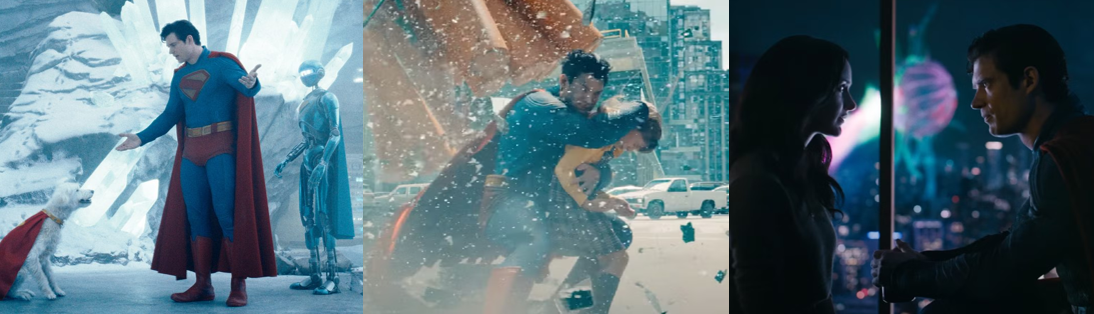
Superman finds his relationships tested by his determination to put his powers to good use.

This desire stems from a damaged message from his long-dead Kryptonian parents, Jor-El (Bradley Cooper) and Lara Lor-Van (Angela Sarafyan) in which they express their love and hopes for him to serve humanity as a protector. Superman takes great comfort in these words, finding solace in the knowledge that he has a higher purpose even if his people are long dead. Additionally, Clark was raised with the standard virtues of right and wrong associated with the character thanks to his adopted parents, Jonathan and Martha Kent (Pruitt Taylor Vince and Neva Howell), who nurtured his kindly nature and contributed greatly to his characterisation as a loveable goof. Despite his amazing powers, Superman struggles as much as any normal man, constantly swooping in to save those in danger and checking to make sure those around him are okay and always pushing to end conflicts with as little violence and death as possible. He’s therefore irritated when the Justice Gang mortally wound a rampaging kaiju and aghast at the idea that he should just stand back and let people die when he could intervene. While Clark and Lois have a very passionate relationship behind closed doors and keep up the pretence of being bickering co-workers, their views on this matter drive a wedge between them early on. While Clark wears his emotions on his sleeve and expects Lois to cut him some slack, Lois is more hesitant about long-term relationships and isn’t afraid to ask the big questions, even of Superman. Though she considers breaking up with him because of her doubts, Lois not only stands by Superman, she comforts him when Lex Luthor launches a smear campaign against him, and teams with Mr. Terrific to rescue him after he willingly surrenders to the authorities. This comes after Luthor raids his Fortress of Solitude and broadcasts the entirety of his parents’ message, which surprisingly reveals that Kal-El was sent to rule a backwoods people, severely shaking Superman’s outlook on himself and his mission to safeguard his adopted world.
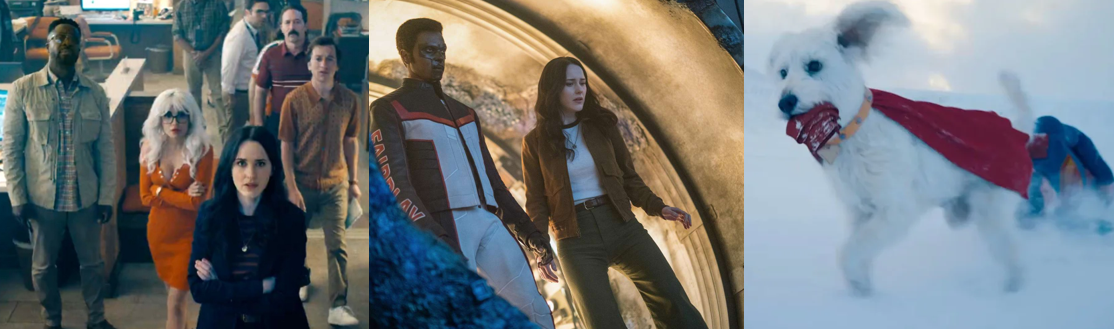
While Lois has a lot to do, even teaming with Mr. Terrific, the rambunctious Krypto steals the show!

Superman may well give Lois more to do than any previous Superman-centric movie as she gives the Justice gang (particularly the conceited Guy Gardner) a grilling for abandoning their friend, braves Luthor’s unstable “pocket dimension” to locate her lover, and even pilots Mr. Terrific’s T-Craft to ferry him around when he’s injured. While Lois doesn’t hold back when questioning Superman, her deep-rooted desire for the truth sees her digging deeper into Luthor’s malicious vendetta against Superman. She’s aided by peppy photographer Jimmy Olson (Skyler Gisondo), who uses his unexpected way with the ladies to convince Luthor’s current squeeze, Eve Teschmacher (Sara Sampaio), to give them the clues to both locate Superman and reveal that Luthor financed Ghurkos in return for half of Boravia. Lois is depicted as more than Superman’s equal, braving any danger for a scoop and meticulously presenting her evidence to crabby Daily Planet editor Perry White (Wendell Pierce), who supports her efforts to expose Luthor as a liar and a traitor. While his people are long gone, Superman’s aided by a handful of robotic helpers at his crystalline Fortress of Solitude and begrudgingly cares for the energetic and disobedient Krypto, the Kryptonian dog of his unruly cousin, Kara Zor-El/Supergirl (Milly Alcock). While this isn’t Krypto’s first venture outside of the comic books, he steals the show here with his unruly and feisty behaviour, causing chaos due to his super speed and strength much to Superman’s exasperation as he’s struggled to train the pup. An all-CGI creation (though you’d never know it), Krypto’s an adorable superpup who pounds around in a cape, goes for the face when threatened, and nips at Superman’s heels at every opportunity. Though he reluctantly tolerates the dog, Superman is enraged when Luthor pupnaps Krypto, further damaging his reputation by storming into Lex’s office, and endures horrendous torture at the hands of the reluctant Rex Mason/Metamorpho (Anthony Carrigan) when he surrenders to rescue the dog.
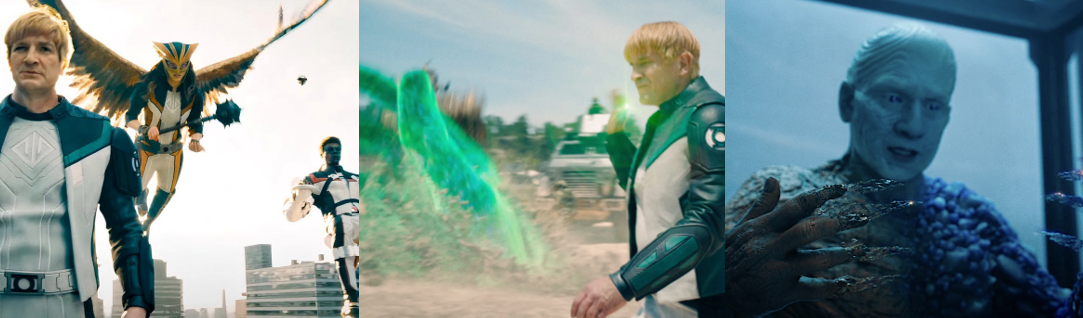
While the Justice Gang’s methods clash with Superman’s, it’s nice to see established metahumans.

Although the Justice Gang are clearly the tools of corporate mogul Maxwell “Max” Lord (Sean Gunn), garbed in uncomfortable matching outfits and showing up to avert any crisis and get some much-needed publicity, they are extremely competent superheroes in their own right. While we don’t get any meaningful backstory on any of them, especially the alluring and deliciously battle hungry Hawkgirl, beyond some snarky comments from Guy about how he was chosen to be a Green Lantern, the team is well established and close enough to Superman to know his true identity. Although Mr. Terrific takes centre stage, I enjoyed the abrasive and egotistical Guy Gardner the most and was very pleased to finally see a Green Lantern on the big screen again. Guy is rude, belligerent, and full of himself, believing himself the leader of the Justice Gang and stepping up to anyone who questions his motives, authority, or even the group’s name. Guy is the most vocal of the group in turning on Superman, immediately condemning him as an alien threat, while Hawkgirl is more dismissive and Mr. Terrific is more concerned with the facts. Shown to be a somewhat stoic but unrivalled genius, Mr. Terrific utilises various tech, most notably his T-Spheres, to analyse a threat and determine the best, most efficient course of action, lethal or otherwise. While Superman bemoans their recklessness, the Justice Gang disregard his complaints as they don’t hold themselves accountable for property damage or loss of life, painting them as very rough around the edges. Mr. Terrific is both impressed and horrified to learn the Luthor has harnessed a black hole to create dimensional portals all over the world and kit out a hazardous pocket dimension as his own prison, where the egomaniac throws any dissenters and forces monkeys to slander Superman online. Metamorpho is kept under heel there to save his baby son and forced to transmute his body into Kryptonite to torture Superman. While he initially demands that Superman not try to talk or reason with him, Metamorpho has a change of heart after witnessing how cruel Luthor is and restores Superman to full health, assisting him in fending off Luthor’s goons and even joining the Justice Gang to curb the invasion of Jarhanpur.
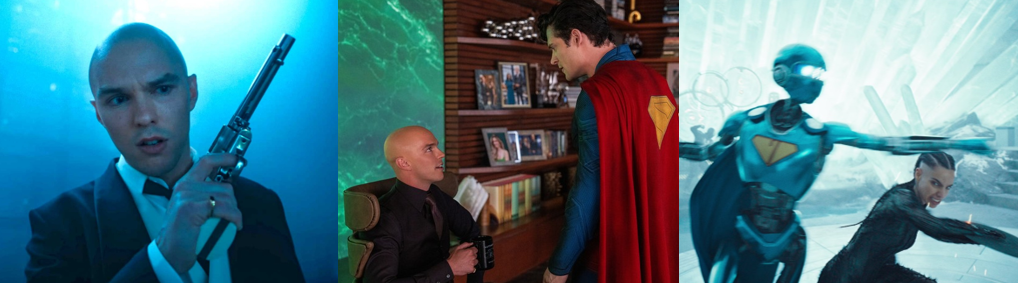
Vindictive Luthor schemes to discredit and destroy Superman with his self-made enforcers.

After years of enduring subpar or wildly eccentric cinematic interpretations of Lex Luthor, Superman finally gives us easily the greatest and most despicable version of the balding madman ever seen on the big screen. Nicholas Hoult excels in the role, effortlessly commanding every scene and bringing a cold, clinical focus to Lex that’s matched only by his ruthlessness and descent into abject tyranny. Already resentful of metahumans, Lex is driven to a self-confessed envious rage by Superman, whom he sees as an alien interloper who is stunting human growth and stealing the spotlight from hard-working, natural geniuses like himself. Committed to first discrediting Superman and then destroying him, Luthor concocts a convoluted scheme to turn the public against the Man of Steel to gain authority to apprehend and destroy him, all while funding the Boravia/Jarhanpur conflict to profit from the war. Constantly in command of every situation, Luthor easily infiltrates the Fortress of Solitude and steals Superman’s personal data, employing his homegrown metahumans – the cybernetic Angela Spica/Engineer (de Faría) and the mysterious Ultraman – to distract Superman while directing a team of all-too-willing underlings to commit horrendous atrocities. Sacrificing her humanity for Luthor’s dream, able to turn her body into any weapon she can imagine, the Engineer attacks with nanotech, easily hacking the Fortress of Solitude and almost suffocating him. Equally, Superman meets a physical match in the ruthless Ultraman, who mirrors his abilities and is directly controlled by Luthor, who’s meticulously studied Superman to counteract and predict his every move. Beneath his silky-smooth facade, however, Luthor is a raving lunatic who condemns anyone who questions him to his pocket dimension, happily tortures and executes those who get in his way or is even remotely tied to Superman, and who relishes the chance to prove his intellectual superiority over the Man of Steel.

The Nitty-Gritty:
It’s clear that James Gunn is influenced by many different sources for this film. Obviously, the classic Richard Donner films are the most prominent, with composers John Murphy and David Fleming sampling the iconic John Williams theme and giving it a glam-rock edge and the opening and closing titles mirroring Donner’s films. The design of the Fortress of Solitude is also ripped directly from Donner, though Gunn populates it with distinctly “Silver Age” Kryptonian automatons who tend to Superman’s needs. The entire film pops with colour and exciting action, just like a comic book, and Superman is purposely given a corny edge to make him a loveable throwback to a simpler time. Superman also takes place in a world where metahumans, Gods, and monsters have become an accepted part of everyday life. Therefore, while civilians still flee for their lives when the Hammer of Boravia and a fire-breathing kaiju attack, it’s treated as another day in Metropolis, with even Superman and Lois barely acknowledging an interdimensional imp threatening the city during their reconciliation. Superman goes one step further with this, introducing pocket dimensions, establishing the Hall of Justice as the Justice Gang’s headquarters, and hinting at a larger universe beyond our world through a Green Lantern and certain dialogue. Everything feels very “lived in”, like we’ve jumped into the third film in a franchise, without being overwhelming or difficult to follow as the focus is on the characters, their interactions and relationships, and their different dynamics. The world is in awe of Superman but turns on him immediately once Luthor broadcasts his message, with even his allies questioning his true purpose, and this twist is used to push Clark away from being beholden to his lost and unknown people and back towards his true heritage: namely, his Earth parents and their lessons.
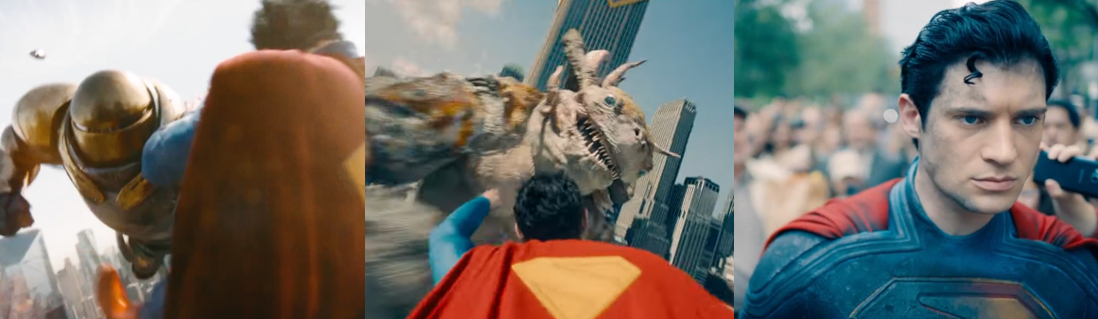
Even when Luthor turns people against him, Superman strives to do the right thing.

Although I wasn’t sold on the costume at first, seeing it as a mishmash of different elements from various Super Suits over the years, it looks fantastic on screen. It’s so gratifying to see the trunks and the cape symbol make a return and Corenswet fills the suit out beautifully, appearing as visually iconic as Christopher Reeve did all those years ago. Superman isn’t some invincible demigod here, either. Like in the John Byrne stories I grew up with, Superman is extremely powerful but still physical vulnerable, suffering a brutal defeat by the Hammer of Boravia and enduring incredible agony to return to full strength using a concentrated dose of solar radiation. Superman visibly struggles with his bigger, more impressive feats, increasing the stakes as it’s not always certain that he’ll succeed. Superman also makes a point to rescue civilians wherever possible, something the Justice Gang see as secondary, and even tries reasoning with the Engineer and Ultraman as he always sees the good in people. Superman’s greatest weakness here, however, isn’t just the Kryptonite Metamorpho synthesises to poison him but his own insecurities. Superman believed he was embarking on a sacred mission and is overwhelmed by doubt upon hearing his parents’ full message, but continues to fight anyway, determined to prove that he’s there to help regardless of what people say. The Kents, especially Jonathan, greatly contribute to this, encouraging him to forge his own path based on what he knows is right. To that end, Superman surrenders and allows himself to be imprisoned and tortured, all with the goal of rescuing Krypto and ending Luthor’s schemes, even if it causes him great pain, trusting that his actions will prove that he’s not a threat. Luckily for him, Lois helps turn public opinion back in his favour as Eve’s clandestine selfies reveals Luthor’s plot, though the people of Jarhanpur still believe in Superman since he helped liberate their people from tyranny.
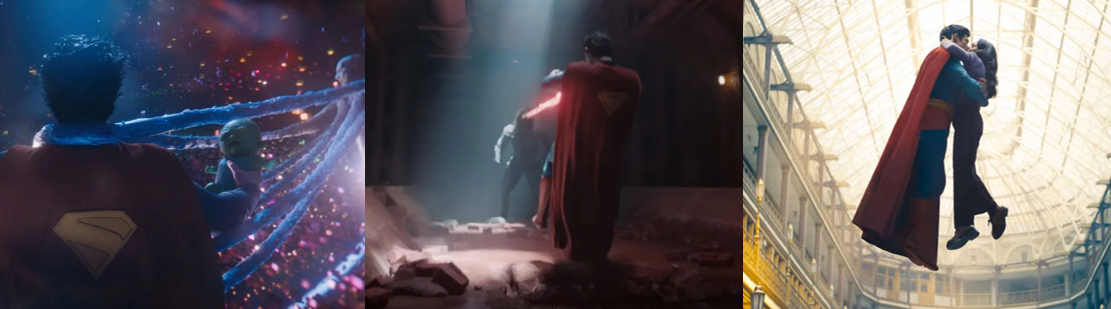
Superman rallies to redefine his mission, battle his crazed clone, and disrupt Luthor’s mad scheme.

Thanks to Lois, Mr. Terrific activates one of Luthor’s interdimensional portals and, after convincing Metamorpho to aid him, Superman escapes from the pocket dimension, recuperating at the Kent farm, reconciling with Lois, and determined to stop Luthor. In his mad ambition to publicly discredit and destroy Superman, Luthor overloads one of his portals and causes a rip in space and time to tear through Metropolis, literally splitting the city in two. Though a mandatory evacuation spares many lives, the entire planet is threatened by this tear, which can only be stopped using Luthor’s access codes. After narrowly escaping being suffocated by the Engineer’s nanites, Superman is horrified to learn that Ultraman is a mindless, brutal clone of his grown by Luthor with the sole purpose of destroying and replacing him. This revelation comes quite late in the film and is easily telegraphed as we never see Ultraman’s face and he’s there when Luthor access the Fortress of Solitude, and I don’t feel it landed all that well. It might’ve been better if Ultraman had been revealed to be a degenerating clone like Bizarro, but I feel the image of Superman battling his mirror image wasn’t as strong as the visual variety offered by the Engineer. It’s moot either way as Ultraman gets tossed into a black hole, leaving Superman free to confront Luthor and engage in a slanging match, one ended when Lois’s story breaks and Krypto manhandles Luthor. His reputation in tatters and his plans undone by Mr. Terrific’s genius, Luthor ends the film disgraced and incarcerated and Metropolis is sewn back together when the rip is shut down. Having declared their love for each other, Superman and Lois rekindle their relationship, the Justice Gang gets a new member in Metamorpho, and the world’s faith in Superman is seemingly restored. Although Superman despairs when his rowdy cousin returns from a bender out in space, he now finds comfort in viewing his memories of his childhood with his Earth parents.

The Summary:
I’ll be the first to admit that I was annoyed that we got another Superman/DC reboot after years of false starts and troubled efforts to get a live-action DC universe off the ground. I was hoping for a course correction with Henry Cavill and slightly sceptical of the new suit, but the colourful atmosphere and light-hearted action of the trailer gave me hope…and James Gunn certainly follows through on that promise. Superman is easily the best big screen adaptation of the Man of Steel perhaps ever, taking inspiration from many different interpretations and comic books and stitching together possibly the most accurate live-action distillation of the character and his chief nemesis. David Corenswet was fantastic in the title role, thankfully spending more time in the suit and just being a good man doing good things, while also not being infallible or so invulnerable that he’s not relatable. Nicholas Hoult was equally captivating as, in my opinion, the best Lex Luthor we’ve ever seen. He brought a malicious spite and smug energy to the role that blew his cinematic predecessors away, appearing as a true threat with an immense hatred for Superman. While I admit some of the supporting characters weren’t as developed as they could be, I’m intimately familiar with all of them so I’ll accept that in favour of a rich, fully realised world where superheroes are the norm. It is a bit odd that Supergirl never told Superman what Kryptonians were really like and somewhat reduces the emotional impact of Superman’s robots being trashed when they’re fully repaired by the end, but the engaging action and thought-provoking character interactions made up for it. I liked that Superman was questioned but not to the point where he was hated and feared, and the painfully relevant metacommentary on the state of politics and social media, and how people rallied behind Superman regardless of his bad press as they could see he was a good person. This was the Superman we should’ve gotten a decade ago, an inspirational hero who can spearhead a colourful and comic accurate live-action universe that finally does justice to these beloved characters while still offering a few fun twists along the way.

My Rating:

Rating: 4 out of 5.

Great Stuff

Did you enjoy Superman? What did you think to David Corenswet’s performance and his suit? Did you enjoy seeing him portrayed as fallible and vulnerable? Were you glad to see metahumans are the accepted norm in his new world? What did you think to Lex Luthor and would you agree this is the best cinematic portrayal of the villain? Were you a fan of Krypto and did you guess Ultraman’s true identity ahead of time? Feel free to share your thoughts on this new version of Superman, even if you’re a hardcore Snyder fan, in the comments, check out my other Superman content, and donate to my Ko-Fi to support more reviews like this.

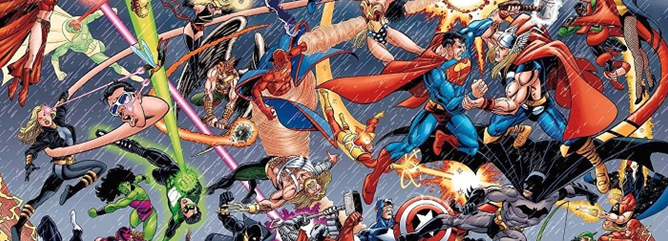
Back Issues [Crossover Crisis]: Crisis on Infinite Earths


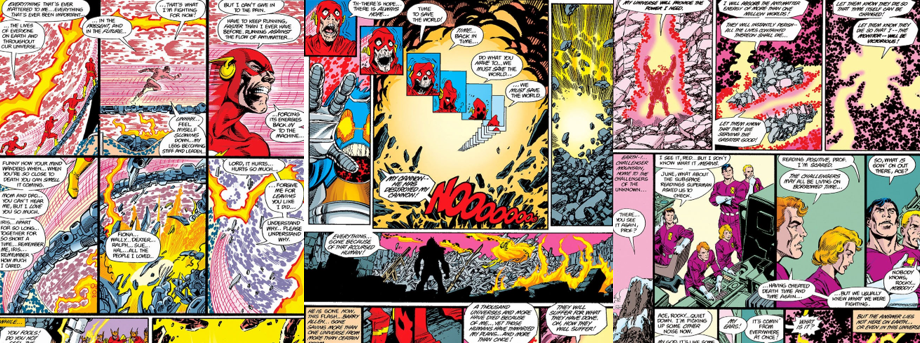
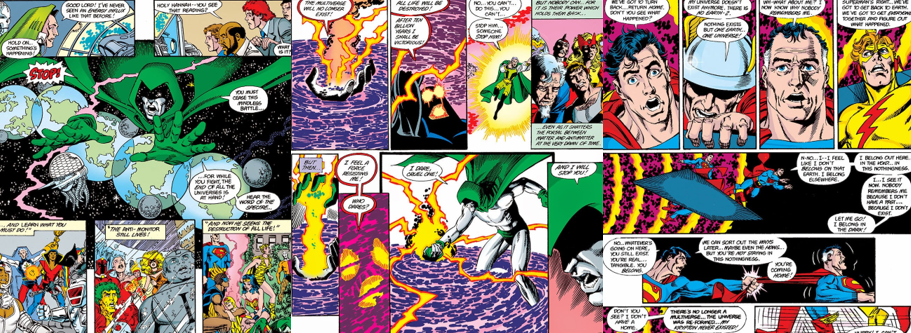
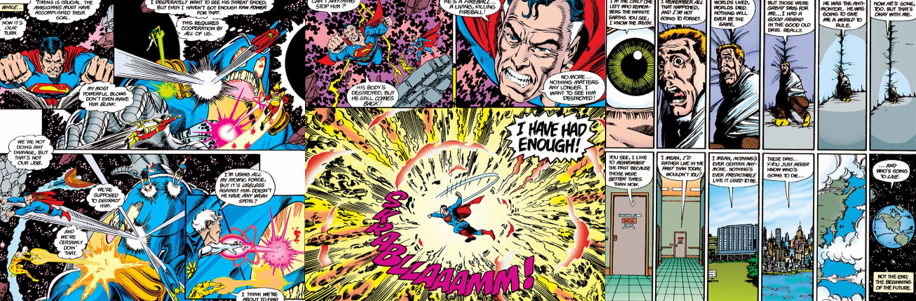
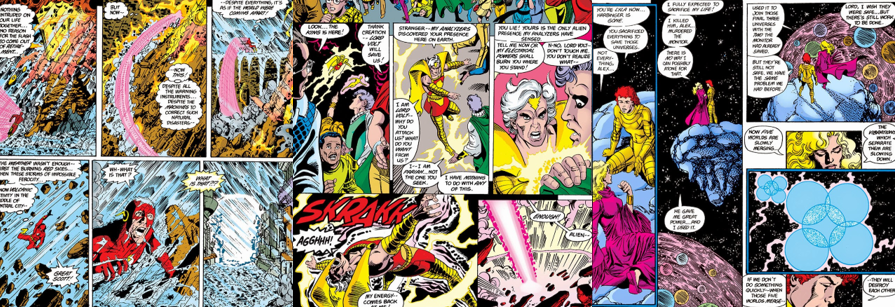
Cover-dated April 1985, the first issue of this ground-breaking event precipitated the destruction of the “Multiverse” in favour of a unified DC canon. Though DC returned to this concept again and again, that doesn’t change how influential this massive crossover was and what better way to celebrate than with a “Crossover Crisis” of my own?


Published: 3 January 1985 (cover-dated: April 1985) to March 1986 (cover date)
Writer: Marv Wolfman
Artist: George Pérez

The Background:
In Showcase #4 (1956), writer Robert Kanigher and artist Carmine Infantino debuted Barry Allen/The Flash, the successor to Jay Garrick, who was established as an alternative version of the Fastest Man Alive. This concept was taken to the next level when Barry and Jay met face-to-face, revealing an infinite number of parallel worlds. Regular crossovers between the likes the Justice Society of America and the Justice League of America soon followed, allowing alternative heroes and various stories to exist simultaneously. Over time, writers like Mark Wolfman became frustrated with this concept, which made keeping track of continuity difficult and it was hard for both writers and readers to connect with the stories. Wolfman initially pitched a reader guide to simplify the DC universe, which then evolved into a sprawling tale of multiversal destruction seen as a risky proposition as it meant erasing all continuity and starting from scratch to attract new readers. Such an event was unprecedented and DC spent two years laying the foundation for this Crisis, hiring researchers to document every character and event in their library and bringing in George Pérez to illustrate, with the artist excited at the idea of illustrating every DC character. Crisis on Infinite Earths became a bestseller for DC Comics and was heralded as a turning point for both the publisher and the industry. The fallout saw every DC character rebooted, with Clark Kent/Superman notably being reimagined as a more grounded character and Wally West taking over as the Flash, though Carter Hall/Hawkman was irrevocably damaged for years as DC struggled to reconcile certain elements of his character. Praised as the greatest comic book crossover in history, the event popularised massive, cosmic crossovers and DC revisited this concept numerous times in subsequent years. The event was even adapted into an ambitious and well received television event and an impressive three-part animated feature.

The Review:
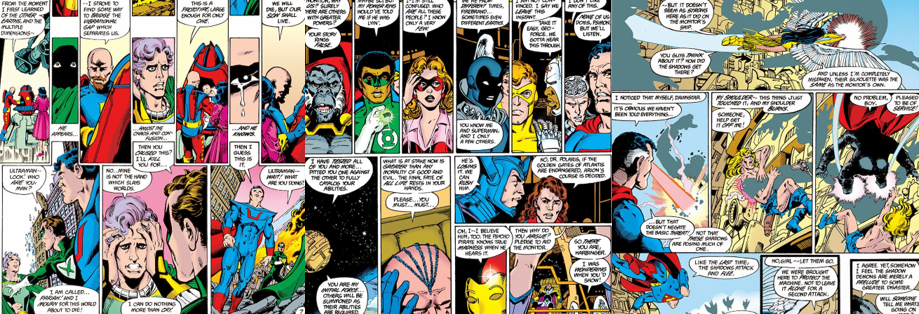
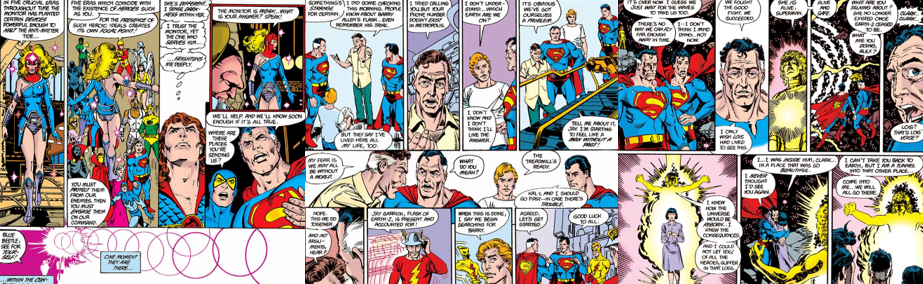
Confused by the concept of the multiverse? Well, Crisis on Infinite Earths has you covered, to a degree, as it opens with (and features throughout) narration and exposition from the tragic Kell Mossa/Pariah. In the beginning, before there was light and life, there was only darkness. Then, from nowhere, came a single light that grew and expanded and finally exploded in “pain [and] relief” as the multiverse was born. The idea is infinite parallel realities all co-exist at once, separated by vibrational planes, though this is noted to not have been the intention when the light burst into being. The story the shifts to one such Earth where the hooded, weeping Pariah witnesses the destruction of not only that world, but the entire reality, at the hands of an all-encompassing white light. As entropy erases everything it touches, Pariah begs to be taken with it, sparing him his grim fate, only to be teleported away as the universe meets its destructive end. We then jump to Earth-3, home of the Crime Syndicate, an evil alternative version of the Justice League. There, Harold Jordan/Power Ring and Clark Kent/Ultraman desperately try to stop the cataclysmic natural disasters springing up across their world as the anti-matter wave approaches. While Thomas Wayne Jr./Owlman and Jonathan Allen/Johnny Quick lament their helplessness against such awesome power, the world’s only superhero, Alexander Luthor, watches helplessly as lifelong enemies like Diana/Superwoman are devoured by the anti-matter wave. With no way to save his world, Alexander rushes to be with his wife, Lois, and baby son, Alexander Luthor, Jr. In a parallel to Superman’s iconic origin, the baby is loaded into a specially prepared rocket and spirited away to Earth-1 as his world dies.

With all universes at risk of annihilation, the Monitor assembles a team of heroes and villains.

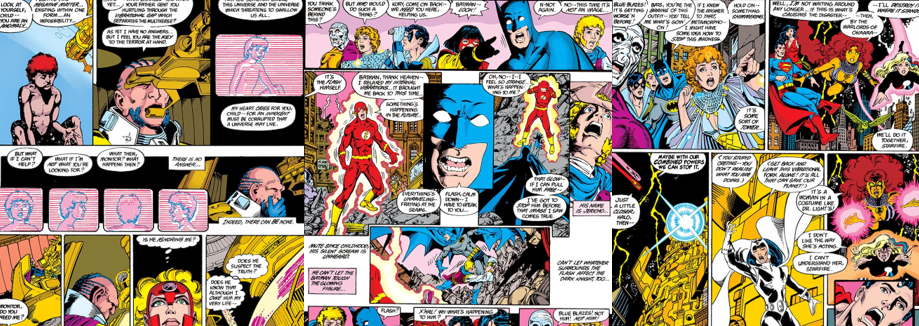
The mysterious Mar Novu/The Monitor observes this from his orbiting, spherical space station alongside Lyla Michaels/Harbinger, whom he sends to recruit Earth’s greatest heroes and villains to stop the pending Crisis. Harbinger recruits King Solovar from Gorilla City, Dawnstar from the 30th century Legion of Super-Heroes, Danette Reilly/Firebrand from Earth-2 1942, Ted Kord/The Blue Beetle from Earth-4, and Roger Hayden/Psycho-Pirate from present-day Earth-2. She returns Psycho-Pirate’s emotion manipulating Medusa Mask and coerces him into quelling Louise Lincoln/Killer Frost’s bloodlust and bringing both her and Ronnie Raymond and Professor Martin Stein/Firestorm to the cause. Though Harbinger is possessed by a Shadow Demon when recruiting Ahri’ahn/Arion the Sorcerer, he joins the other recruits, including Kal-L/Superman, John Stewart/Green Lantern, Neal Emerson/Doctor Polaris, Victor Stone/Cyborg, Simon Jones/Psimon, and Todd Rice/Obsidian. With tensions running high, the group are attacked by Shadow Demons, which seem impervious to physical, mental, and energy-based attacks. While the likes of the Blue Beetle can only run and Firestorm struggles with Killer Frost’s newfound affections, Obsidian and the arrogant Dr. Polaris put their shadow- and magnetism-based powers to good use. The Monitor halts the attack and introduces both himself and the threat to their universes. Weakened by the spread of anti-matter and facing suspicion from his assembled forces, the Monitor reveals that he’s judged them as the best hope of protecting five devices spread across the different eras that he hopes will halt the anti-matter wave. Meanwhile, reality is warped across the multiverse: in prehistoric times, Anthro the Cave-Boy is as astonished to spot a futuristic city amongst the wilds as Querl Dox/Brainiac-5 is to see mammoths stampeding through the 30th century. Half a galaxy away on Oa, the Guardians of the Universe prepare to summon their entire Green Lantern Corps to meet the threat, only for a mysterious voice to corrupt the Central Battery and trap them in a stasis beam. On Earth-1, Bruce Wayne/Batman is busy confronting the Joker during his latest crime spree and is astonished when an emaciated, confused Flash suddenly appears babbling about the end of the world and begging for help before disintegrating before the Dark Knight’s eyes!
As the Crisis worsens, the Monitors prepares Alexander and a new Dr. Light to face the threat.

On the post-apocalyptic Earth-AD, Kal-L, King Solovar, and Dawnstar meet Kamandi, the last boy on Earth, and discover the Monitor’s device, a towering, golden Cosmic Tuning Fork that’s immediately (though only briefly) attacked by Shadow Demons. Arion, Obsidian and the Psycho-Pirate watch over another tower in Atlantis, only for the Psycho-Pirate to be transported to a dark realm and coerced into turning against the Monitor just as Harbinger secretly conspires with that same dark force. Oblivious, the Monitor experiments on the rapidly aging Alexander Luthor, Jr., an impossible merger of matter and anti-matter who potentially holds the key to defeating the anti-matter spread, whom Harbinger’s dark master wants destroyed before he can threaten his schemes. Meanwhile, in the far future of Earth-1, the Flash races to keep his world from being torn apart from natural disasters but is forced to vibrate at super-speed to escape death. This same anti-matter energy arrives on present-day Earth-1, much to the horror of the Teen Titans, who desperately try to both halt the destructive wave and save lives alongside Batman and Superman. As Linda Lee/Kara Zor-El/Supergirl does the same, Barbara Gordon/Batgirl gives in to self-doubt, and John Constantine arrogantly believes it’ll all work out, Vril Dox/Brainiac coldly observes the events concludes that, if he’s to survive, he must team up with Lex Luthor. While defending a Cosmic Tuning Fork from both Nazi forces and Shadow Demons in 1942 Markovia, the Blue Beetle discovers the mysterious Scarab fused to his suit is lethal to the shadowy entities but is wounded before he can put this to good use and returned to his world by the Monitor to spare him. Back on Earth-AD, the skies turn red and King Solovar succumbs to his wounds while Cyborg, Firebrand, John Stewart, and Psimon team up with some local heroes (including Jonah Hex) in 1879 to defend another tower, only to be as overwhelmed by anti-matter as the far-flung future of the Legion of Super-Heroes. Elsewhere, the terrified heroes of Earth-6 blame Pariah for the looming threat, to no avail (though Pariah does save Tashana/Lady Quark to ease his suffering). While the unseen villain forcibly recruits the Red Tornado, the Monitor activates an “ion-based energy ray” to empower Doctor Kimiyo Hoshi, transforming her into the new Doctor Light and sending her to defend his tower on Earth-1.

Following the Monitor’s death, his champions are convinced to unite and save the remaining Earths.

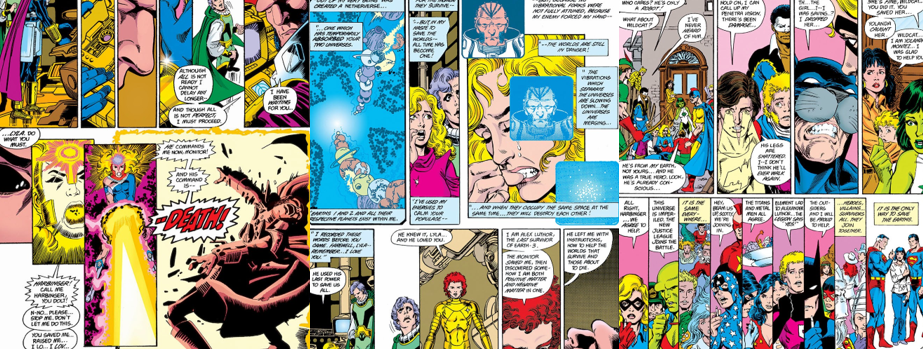
When the heroes attack her, believing she and the tower caused the entropy, Superman quells the fighting, though things take a turn when the Shadow Demons combine into one gigantic, terrifying entity in each era. Even Princess Diana Prince/Wonder Woman’s hopes of recruiting her Amazonian sisters fail. When Pariah berates the Monitor for not doing more to intervene, he reveals just how weak he’s become and then nobly faces his end at Harbinger’s hands. Distraught, Pariah weeps as Earth-1 and Earth-2 are finally consumed; confused to find his strength hasn’t increased as a result, the dark villain delights in having the Psycho-Pirate torture the Flash. Depowered, Lyla is distressed by her actions but a pre-recorded message from the Monitor reveals that his death allowed his essence to empower his Cosmic Tuning Forks and create a “netherverse”, a pocket dimension to keep Earth-1 and Earth-2 safe. After giving the Monitor an appropriate burial, Lyla, Pariah, and the now teenage Alexander Luthor, Jr. gather both world’s champions on the Monitor’s satellite to merge all existing realities into one lest all worlds and realities be lost. Since there are some doubters, Alexander has them witness the Red Tornado be forcibly transformed into a being of pure, primal force, one easily subdued by sorcerers like Kent Nelson/Doctor Fate and Zatanna Zatara (though Ted Grant/Wildcat’s legs are shattered during the fracas). Thus, even the most sceptical agree to defend their worlds, only for the satellite to disintegrate courtesy of the event’s big bad, the Anti-Monitor! Fleeing to the emptiness of limbo, Alexander moves to save Earth-4, -S, and -X, only for Harbinger to subdue him and take his place. While Yolanda Montez continues Wildcat’s legacy on Earth-2, the Freedom Fighters and the Monitor’s agents come to blows on Earth-X when the Psycho-Pirate, his powers augmented by the demonic Anti-Monitor, stirs fear and hatred amongst them. Similarly, on Earth-1, Billy Batson/Captain Marvel and his siblings mindlessly attack Supergirl and Wonder Woman, though the fighting ends when Harbinger forces Earth-4, -S, and -X into the netherverse alongside Earth-1 and Earth-2, exhausting her incredible powers but dooming them to be slowly merged together.

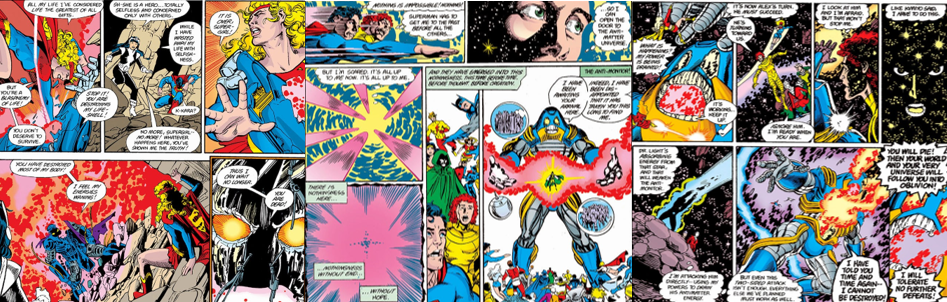
After Lyla relates the Anti-Monitor’s origin, Supergirl sacrifices herself to try and destroy him.

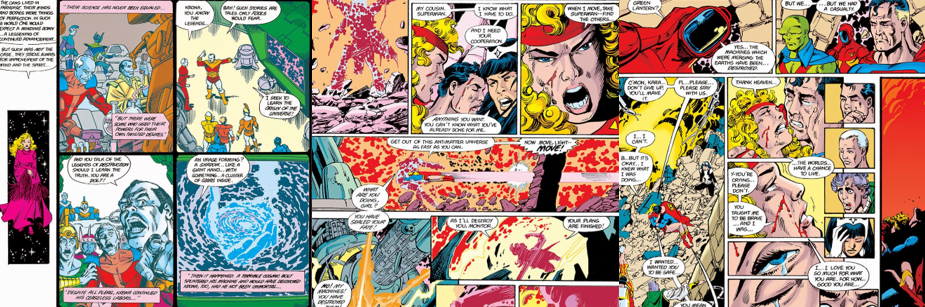
Thus, Lyla, Pariah, and Alexander assemble Earth-1’s Superman, Earth-2’s (Kal-L), Captain Marvel, the Blue Beetle, Lady Quark, and Uncle Sam and reveal that, ten billion years ago, the Oan scientist Krona dared to seek the beginning of the universe, witnessing a giant hand clutching a star cluster. This caused a cosmic fracture, creating not just the multiverse, but an anti-matter universe and a counterpart to Oa, Qward. After banishing Kronoa, the Oans created peacekeeping forces like the defective Manhunters and the Green Lantern Corps but were fractured by a civil war, birthing the Controllers. Amidst the fighting, the Monitor and his evil, anti-matter counterpart came into being. The Anti-Matter conquered Qward and created the Shadow Demons to spread his influence throughout the anti-matter universe before waging war against the Monitor upon sensing his presence. Evenly matched, they were rendered unconscious for nine billion years before being awoken by the misguided Pariah, once a celebrated healer and scientist who also investigated the origin of the universe. Pariah’s world paid the price, and he was damned to live forever and watch all worlds die, though the Monitor also saw him as instrumental in saving all reality. Alexander uses his unique matter/anti-matter powers to create a dimensional tear to the anti-matter universe, which Pariah leads the heroes to the Anti-Monitor’s vast stone fortress. Enraged that the Psycho-Pirate is too drained to corrupt them, the Anti-Monitor has his stronghold attack, injuring the usually invulnerable Kal-L. Dr. Light and Superman discover the Anti-Monitor’s solar collector but are attacked before they can destroy it and halt the merger of the Earths. Hearing her cousin’s agony, Supergirl flies to Superman’s aid, brutally beating the villain in a rage and chastising his disdain for life, tearing through his protective armour. Furious, the Anti-Monitor prepares to explode with all his energy and, in a last-ditch effort to destroy him, his machine, and save everyone, Supergirl tackles him, destroying his machine but being fatally blasted. As the Anti-Monitor’s deteriorating, incorporeal form slinks away, Superman mourns his cousin’s death and vows to kill the Anti-Monitor. Kal-L calms his counterpart and they escape, and a memorial service is held on Earth-2, where Superman pays homage to Supergirl, vowing to remember her and fight in her name. Despite the loss, the five worlds are saved; similarly, the Green Lantern Corps free their masters and almighty Darkseid wisely cloaks Apokalips from the Anti-Monitor’s gaze. However, the Anti-Monitor reconstitutes himself on his ship, where the Flash is imprisoned, and prepares a counterattack from Qward.

Despite the Flash’s noble sacrifice, the Anti-Monitor gains God-like power from his anti-matter universe.

Though saved, the five worlds are still overlapping, causing anomalies and damage to each while  the Anti-Monitor oversees the creation of the anti-matter cannon, which he plans to use to obliterate the worlds. Just as the Psycho-Pirate feels his powers return, the Flash escapes and angrily attacks the sadistic villain, forcing him to turn the Anti-Monitor’s slaves against their master as a distraction. Though stunned to find the anti-matter cannon is powered by concentrated anti-matter and realising that destroying it would kill him, the Flash bravely circles the weapon’s core to turn its destructive energy back on it. Staving off the agony with memories of his loved ones, the Flash runs fast enough to move back in time (explaining his earlier, sudden appearances). Though Barry successfully destroys the weapon, it costs him his life. Enraged, the Anti-Matter absorbs the anti-matter universe, literally sucking the life out of over a million worlds to feed his lust for power and vengeance, an act so awesome that it’s detected by both the Challengers of the Unknown and the embodiment of the Lord’s wrath, Jim Corrigan/The Spectre. In the face of multiversal destruction, the Guardians of the Universe offer Guy Gardner the chance to become a Green Lantern once again and, when all but one of them are all slaughtered by a sudden explosion, Guy vows to avenge them as their champion. The Brainiac/Luthor team then recruit dozens of villains to strike while the remaining Earths are weak and in disarray. As time runs amok on Earth-1 and Alexander, Lyla, and Pariah address the United Nations, the villains make their move, having conquered Earth-4, -S, and -X, encasing them within impenetrable barriers, and threatening to destroy the remaining worlds. Lyla and Jay recruit a reluctant Wally West/Kid Flash to breach the barrier with the cosmic treadmill, though neither Luthor or Brainiac care much about their losses since they still possess the power to destroy everything. However, the Spectre ends the hostilities by revealing that the Anti-Monitor still lives and plans to corrupt the flow of time and formation of life by travelling to the dawn of time.

The Spectre demands co-operation, resulting in a singular world being created.

With the villains back on side, Kal-L bids an emotional farewell to his wife, Lois Lane, to join the counterattack, alongside a surprising newcomer: the Superboy from Earth-Prime (a fictional approximation of the real world where he’s the only superhero). After a rousing speech from Uncle Sam, heroes and villains alike pool their technology and powers to travel to the dawn of time and confront the anxious Anti-Monitor. The Anti-Monitor reveals that he, not Pariah, was responsible for the destruction of Pariah’s world after he took advantage of Pariah’s experiments to rebuild his power, absolving the tragic figure of his sins. Now grown to immense proportions, the Anti-Monitor withstands the assault of those assembled (with guys like Batman offering only support), absorbing their life energy to add to his power and allowing his hand to be the one that shapes all reality, as witnessed by Kronoa. His grasp is intercepted by the Spectre and the combined magic of the unified sorcerers, reducing the battle to a literal arm wrestle between the Anti-Monitor and the Spectre. Thanks to their bickering, Luthor’s underlings fail to kill Kronoa before he can cause the creation of the multiverse and the Anti-Monitor, and all seems lost. However, following a blinding light and the literal shattering of all time and space, Kal-L awakens on present-day Earth to find he’s on the same world as his Earth-1 counterpart. Sharing the same fragmented memories, Superman explains that time seems to be healing (albeit wonkily) and that elements of multiple Earths have been merged into one. For example, everyone knows Supergirl died but not how, the Flash is presumed vanished, and Earth-2’s Keystone City and Jay Garrick now live on this Earth. Jay, Wally, and the Supermen use the cosmic treadmill to discover Earth-2 is missing. Realising that the multiverse no longer exists, Superman has to force his older counterpart to return rather than throw himself into the endless void in despair. With the cosmic treadmill irreparably damaged, Wally assembles everyone at Titans Tower, discovering guys like Captain Marvel, Superbody-Prime, Uncle Sam, and the Earth-2 Dick Grayson/Robin also exist on this world, where they’re all shocked to see Harbinger alive and powered back up. The refugees are despondent and horrified to learn their worlds, pasts, and many loved ones are gone thanks to “cosmic irony” as Harbinger explains that there is now one Earth with one coherent timeline that folds their disparate lives into its flow, sending Kal-L into a crazed distress at having lost his wife and home.

A final, all-out assault ends the Anti-Monitor and starts the universe anew, with some casualties.

After questioning the imprisoned Lex Luthor, Batman, Jason Todd/Robin, and Alexander confirm that, while some duplicates remain and some lives were restored, others weren’t and only those who present at the dawn of time remember the multiverse. Just as they’re processing this, the skies turn red and the world suddenly shifts to the anti-matter universe, where the titanic, disembodied Anti-Monitor still lives! Though incensed by their efforts, the Anti-Monitor congratulates them for handing him his first defeat in ten billion years and then decrees that they must all die. Wally’s shock at his mentor’s death is mirrored by the abject panic that sweeps the civilians following the Anti-Monitor’s threat, which doubles when the Shadow Demons kill Don Hall/Dove, Helena Wayne/Huntress, and Tula Marius/Aquagirl. While the sorcerers remove the Shadow Demons, Harbinger assembles one last effort to stop the Anti-Monitor on Qward. Though the Anti-Monitor is too large and powerful to be damaged, Harbinger has Dr. Light absorb the star feeding him power, weakening him enough for Alexander to breach the villain’s armour. With the threat seemingly ended by a combined energy blast, Alexander struggles to return Earth home and the Anti-Monitor absorbs his exiled Shadow Demons to rise again and vaporise Wonder Woman. Rather than see anyone else die, Kal-L tackles the Anti-Monitor, believing he’s got nothing to lose, and Alexander and Superboy-Prime are trapped with him. Though Darkseid, watching from Apokalips, strikes a fatal blow through Alexander’s eyes, the Anti-Monitor refuses to die, so Kal-L delivers a final strike that obliterates the tyrant. Faced with the pending destruction of the anti-matter universe, Kal-L and Superboy-Prime prepare to meet their end only for Alexander to teleport them, alongside Kal-L’s Lois, to a pocket dimension. In the aftermath, Wonder Woman returns to the clay that forms Themyscira, her Earth-2 counterpart is welcomed among the Gods, the dead heroes are memorialised, and Wally assumes the Flash mangle. Confined to Arkham Asylum, the Psycho-Pirate is dubbed a raving lunatic since he’s the only one who remembers the multiverse and the catastrophic events of the Crisis.

The Summary:
Whew, there’s a lot happening in Crisis on Infinite Earths. There’s a reason I’ve put off reviewing it for so long, and why I rarely revisit it. It’s a very dense and complex story, full of exposition and cameos and faces both obscure and iconic. As a celebration of DC’s rich history and characters, it’s hard to find much better than Crisis on Infinite Earths, which stuffs just about every costumed character, hero or villain, into its dense twelve issues! My hat’s off to George Pérez; it must’ve been painstaking to sketch all these group shots, action sequences, montages, and dramatic events. Equal praise to Marv Wolfman as I can’t imagine how difficult it was to make sense of all these different worlds and come up with a cohesive way to explain, link, and destroy them all. In the end, the solution was simple: pure, destructive, unstoppable entropy. It’s fitting that the anti-matter wave is depicted as a blinding white light that erases everything it touches, for it symbolically represents a blank page or an artist’s eraser, indicating that these colourful and convoluted worlds are being literally wiped clean for a new status quo. Our guide through most of this is Pariah, a tragic figure doomed to watch each world die as penance for kick-starting the events that follow. Immortal but seemingly powerless to intervene, all he can do is shout desperate warnings and is powerless to rescue anyone and constantly met with aggression, suspicion, and accusations. He’s merely a pawn in a much larger game, however, much like Harbinger, who acts as an all-powerful emissary of the Monitor and deliver exposition in his stead. A conflicted individual burdened with the knowledge that she will betray and murder the man to whom she owes her life, Harbinger, nevertheless works to uphold the Monitor’s legacy and bring together heroes and villains alike to stand against his dark counterpart.

The Anti-Monitor’s power sends shockwaves through the multiverse and those who’ve witnessed it.

The dreaded inevitability of death is a focal point in Crisis on Infinite Earths. When the anti-matter wave hits, heroes and villains set aside their differences and use all their powers and resources to either stop it or save people from its destructive touch. Even the abhorrent Crime Syndicate find themselves fighting to save their world and Ultraman willingly enters the wave to die on his terms. Even before the wave arrives, the worlds are shaken to their core by natural disasters; volcanoes, tsunamis, and ominous, crackling red skies precipitate the disaster as much as Pariah. Perhaps no character is more synonymous with the coming destruction than the Flash; thanks to his super-speed, he ends up travelling through time, arriving before the likes of Batman and Wally as an omen of what’s to come and taking on an appearance that resembles Death itself. The Anti-Monitor echoes this in his design; though shrouded by his all-powerful armour, he sports a skull-like visage and dark, piercing eyes. Commanding demonic shadows, he’s very much the embodiment of Death and his lust for utter annihilation drives him to snuff out all life and light. Sadistic to the core, he employs the Psycho-Pirate to foster fear and hate, turning his would-be opponents against each other and causing countless more deaths. His ruthlessness seemingly knows no boundaries as he gleefully corrupts Harbinger, relishes the death of his counterpart, and nonchalantly obliterates his rebellious slaves without a second thought. His power and cruelty are so great that even the mighty Darkseid is driven to hide rather than confront him, striking when the villain is at his most vulnerable and largely avoiding the greater conflict. For all his God-like power, the Anti-Monitor still relies on technology; his merger and destruction of worlds can be halted or stopped by Cosmic Tuning Forks or destroying his solar collector. Indeed, it’s only after his massive, world-ending cannon is destroyed that the Anti-Monitor eschews all other methods and absorbs the entire lifeforce of the anti-matter universe into himself to literally take matters into his own hands.

The Supermen anchor the story, leading the assembled champions in battle and saving all reality.

There is no one central character in Crisis on Infinite Earths. Instead, it’s a team-up story through and through, meaning some of your favourites may be sidelined. In some respects, I don’t mind this; Batman outright admits how useless he is against the Anti-Monitor and it’s clear only beings of incredible power can stand against him. Yet, the Blue Beetle is said to be pivotal in opposing the villain, the Red Tornado is briefly said to be incredibly important, and Lex Luthor comes close to co-ruling five entire worlds and even leads the charge to assassinate Kronoa. The Earth-2 Superman, Kal-L, is often at the heart of the conflict, leading the others and inspiring confidence, as is his Earth-1 counterpart. It’s therefore more tragic seeing Superman’s grief-stricken reaction to his cousin’s death; holding Supergirl in his arms, the Man of Steel briefly forgets his morals and vows to kill the Anti-Monitor as recompense. This is but one of the unforgettable deaths featured in Crisis on Infinite Earths as the Flash sacrifices himself to deal a critical blow to the Anti-Monitor, making a martyr of himself for decades before DC made the bone-headed decision to revive him. There’s an odd dichotomy in Crisis on Infinite Earths; these alternative worlds and characters co-exist and are even folded into one by the end. Rather than wiping everything away and starting afresh by the conclusion, the story clunkily has the survivors forget key events and weaves characters like Captain Marvel and the Justice Society into a unified timeline. This works for me as I prefer a coherent narrative, but it essentially means Crisis on Infinite Earth takes place mid-way through the early years of the post-Crisis reboot and reimaginings like John Byrne’s Superman stories happen before and during this event, rather than after it.

Worlds lived, worlds died, and the DC Universe was never the same…for about twenty years…

These days, Crisis on Infinite Earths may be a lot for modern readers to take in. Many of its characters and concepts are either forgotten, wildly different, or have been done to death thanks to the multiple reality-altering events that followed (many specifically to address loose ends from this story). At the time, though, I’d wager many long-term DC readers appreciated the cameos and call-backs weaved into the story. I’m glad DC devoted twelve issues to the story and didn’t rush it, but it does get repetitive and convoluted as it drags on. The secondary threat of Brainiac and Luthor directing a team of villains to conquer the five worlds, for example, could probably be skipped or relegated to a tie-in comic. Similarly, the defending of the Cosmic Tuning Forks isn’t very interesting and doesn’t really add to the story since we barely see any action around this, the Shadow Demons are too powerful to be interesting, and it’s all negated by the Monitor’s death. In this respect, I think the event could’ve been cut down to eight or ten issues and still been just as effective, especially as many Earths and characters feature as quick cameos to be obliterated. The remaining five Earths are said to be the most important, which is a little disrespectful to those that perished by the Anti-Monitor’s hand and a bit of an insult to any fans of those worlds. I liked seeing new heroes rise during the chaos, like a new Dr. Light (who was an aggressive bitch throughout), Wildcat, and Guy being Green Lantern again, though it falls a little flat when you know the canon is going to be altered after this to return the status quo. I liked the Anti-Monitor’s design and his characterisation as a reprehensible being who craved only power and destruction, but it was hard to get a sense of his power and limitations. One minute he’s weakened by giant towers, then his armour is containing his energy, and then he’s being powered by a black sun despite having absorbed the lifeforce of his anti-matter universe. Still, the unification of heroes and villains to oppose him was fun to see, the sacrifices and determination were poignant, and the weaving together of a singular continuity, while flawed, was ambitious and visually engaging to behold.

My Rating:

Rating: 4 out of 5.

Great Stuff

Have you ever read Crisis on Infinite Earths? What did you think of this unprecedented mash-up of DC’s various worlds and characters? Which parallel world was your favourite and were you upset to see destroyed? What did you think to the Anti-Monitor, his vast power and his stubborn refusal to die? Were you shocked to see Supergirl and the Flash die so dramatically? Do you agree that the story dragged on a bit by the end? Which of the subsequent Crisis events was your favourite and what are some of your favourite cosmic events? Drop a comment below to share your thoughts about Crisis on Infinite Earths and feel free to check out my reviews of other notable crossovers.

Back Issues [Brightest Month]: All-American Comics #16


Although February 2014 was dubbed “Green Lantern Day” (because, by the American calendar, the date read as “2814”, the sector of space assigned to Earth in DC Comics), the significance of this date has passed as the years have changed. Instead, as perhaps the most popular iteration of the character, Hal Jordan, first appeared in October of 1959, I’m choosing to dedicate every Sunday of October to the Green Lantern Corps!


Story Title: “The Origin of Green Lantern” (or simply “The Green Lantern”)
Published: July 1940
Writer: Bill Finger
Artist: Martin Nodell

The Background:
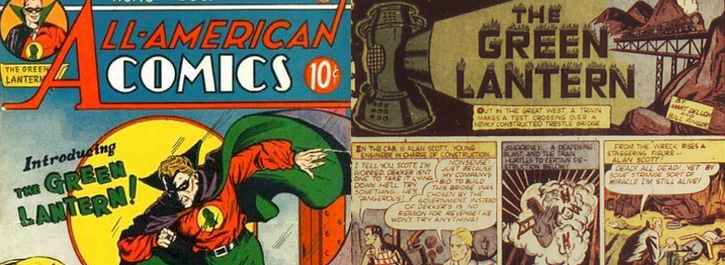
The peacekeepers of the galaxy, the Green Lantern Corps, are popularly known as a space-faring force comprised of various creatures and aliens from across the cosmos, but this depiction of the Emerald Warriors has only been around since 1959. Originally, there was only one colourful superhero known as Green Lantern, Alan Scott. The brainchild of artist Martin Nodell, the Green Lantern was inspired by Richard Wagner’s Der Ring des Nibelungen (The Ring of the Nibelung), the sight of a trainman’s green railway lantern, and elements of Greek mythology. After his pitch for a superhero who wielded a magical ring was approved by DC Comics publisher Max Gaines, Nodell set to work crafting Alan Scott’s first story and soon brought in the legendary (and often forgotten) Bill Finger to help with the project, cementing a partnership that lasted for seven years. After his debut in this issue of All-American Comics, Alan Scott became a regular fixture of both the publication and DC’s first super team, the Justice Society of America (JSA). It’s this association with the JSA that I best know Alan for. As chairman of the group, he fought numerous intergalactic and Lovecraftian threats, gained a degree of eternal youth thanks to various magical enhancements and time dilations, and mentored a new generation of heroes, including his wayward son. Even after he was supplanted by his more sci-fi-orientated successors, Alan Scott remained a prominent figure in DC Comics, gaining additional relevance when he came out as gay in 2020, retroactively establishing him as DC’s first-ever gay superhero. Outside of the comics, however, Alan hasn’t been quite as significant. He missed out on appearing in Justice League (2001 to 2004) and has been largely absent or relegated to brief cameos in other cartoons and live-action shows, potentially due to Warner Bros. often blocking Green Lantern appearances after the critical mauling of Green Lantern (Campbell, 2011). 

The Review:
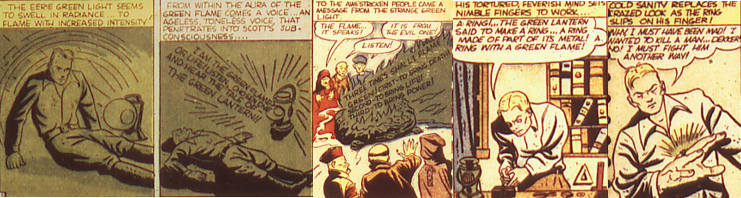
The story opens “out in the Great West”, where s train is making a test crossing over a new-constructed trestle bridge. Alan Scott, the young engineer who spearheaded the bridge’s construction, is in the cab with a colleague to oversee the test run, which seems to be asking for trouble, in my opinion. Indeed, Alan’s colleague is anxious that Alan’s rival, Alert Dekker, might try to sabotage the operation since Alan’s “company” outbid Dekker’s and cost him a big, fat government contract. Although Alan is confident that Dekker wouldn’t try anything, his optimism is immediately proven wrong as the bridge explodes beneath them, sending the train, its carriages, and all aboard crashing into a ravine. By “some strange miracle”, Alan is the sole survivor, merely being shaken up and coming over all queasy as he holds onto a mysterious green lantern. Suddenly, the artifact bursts to life, emitting an “eerie green light” and, even more incredibly, speaking to him! The lantern tells a tale that begins back in ancient China, where a village’s evening prayers were suddenly interrupted by the arrival of a huge meteor. The meteor cracked open before impact, depositing a pool of flaming emerald liquid before their amazed eyes. This Green Flame spoke to them and delivered a fairly ominous prophecy: “Three times shall I flame green! First – to bring death! Second – to bring life, and third – to bring power!” The villagers were in awe, believing the Green Flame had come from the “Evil One”, a subject about which Chang, the lamp maker, knew a great deal thanks to his studies of the “Old Book”, which had raised some suspicions about his intentions. 

After surviving a train crash, Alan Scott is gifted incredible power by a green lantern.

Chang used the Green Flame to forge a lamp, which the paranoid villagers believed will anger their Gods and bring them only suffering, so they barged in, burned Chang’s books, and attacked him, causing the lamp to burst to life and punish them all, bringing death as it foretold. Over the years, the strange lamp passed between many hands, bringing destruction to the bad and luck and fortune to the good, eventually appearing in the rubbish bin of an insane asylum. The staff decide to give the lamp to Billings, a harmless Chinese patient of theirs known for forging lanterns, and it’s Billings who transfigures the lamp into its more familiar lantern shape. In return, the lantern awakens once more an brings “life” by curing Billings of his insanity, allowing him to leave the asylum as a sane, free man. And, from there, the green lantern eventually made its way onto Alan Scott’s train and into his hand (how isn’t detailed here) to fulfil the final stage of its prophecy, bringing power to the dazed engineer. The lantern tasks Alan with using this great power to seek out and oppose evil, to be a light against the darkness, and that he will retain this power as long as he has “faith in [himself]” for “will power is the flame of the Green Lantern”. After seeking clarification, Alan is instructed to craft a ring for himself from the lantern’s metal so he can always carry its power with him, though he must touch the ring to the lantern every twenty-four hours to recharge it (because…ugh…I guess faith and will power isn’t all that powers the magic?) After gathering his wits, Alan initially believes the whole experience to have been some mad dream but, when he grabs the lantern and feels its power, he knows that it was all true and, angered at the sight of his dead colleagues and Dekker’s amoral actions, he vows to make his rival pay for his murderous ways. To that end, Alan does as the Green Flame instructed and makes himself a ring; but, when he puts it on, he realises that his murderous lust for revenge is wrong and that he must find a more virtuous way to fight Dekker. 

Alan’s magical powers see him confront his rival and begin a career as the Green Lantern.

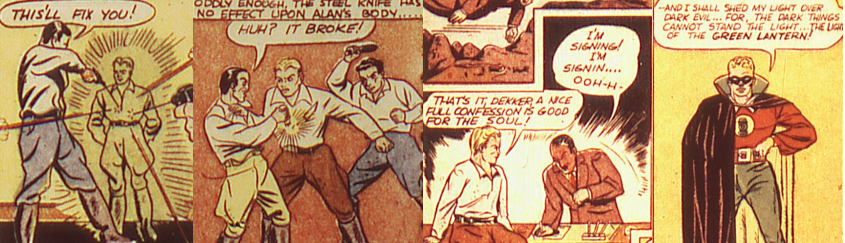
Alan then spends a few panels testing out his newfound powers; he wishes to fly to Dekker’s house and the ring allows it to be so. His desire to “[go] through the fourth dimension” allows him to easily pass through the walls of Dekker’s place and appear before the callous businessman and his mooks in a puff of green smoke and light. Appearing as a “wraithlike figure”, Alan seems to be a ghost to the astonished goons, but Dekker assumes it’s simply a trick and orders them to shoot the young engineer. Although the bullets just pass through Alan’s body and a knife simply breaks against his chest, a wooden club to the temple surprisingly brings Alan down, so he assumes that wood is his vulnerability. He also notes that he doesn’t possess superhuman strength (though, presumably, he could will himself to if he actually bothered…), but thankfully he’s skilled enough to overpower Dekker’s minions and scare them off. Fearing for his safety, Dekker attempts to barter, offering Alan money and his friendship, so Alan toys with his rival by flying him through the sky and threatening to drop him to his death to force a confession. Terrified, Dekker admits that he caused the explosion and promises to cover the payments and sign a confession. However, right after he does this, the stress of it all causes him o suffer a fatal heart attack. Mourning the waste of life, Alan retires to his unseen “sanctum” and pledges himself to fighting against evil in all its forms, realising that he needs a “bizarre” costume that will ensure evildoers never forget him once they encounter him. To that end, he fashions one of the gaudiest red and green numbers in all of comicdom and vows to “shed [his] light over dark evil” as the Green Lantern. 

The Summary:
I don’t always have the greatest track record when it comes to Golden Age superhero stories; they’re often messy, rushed, and incredibly simplistic, echoing the pulp sensibilities that were so popular at the time. Thus, a degree of leeway must always be shown towards such stories, which are products of their time and restricted by the artistic style and expectations of the period. Having said that, I actually didn’t mind “The Origin of Green Lantern”. We don’t learn a great deal about Alan Scott beyond his profession, optimism, and thirst for justice, making him a bit of a blank slate in many ways, but there’s enough here to make him relatively intriguing. I liked that he was naïve enough to think Dekker would simply take losing out on the contract like a man, and his shock at seeing how far his rival will go to secure that government grant. It was very relatable that Alan’s first thought was to kill Dekker, though it’s not entirely clear why he has a sudden change of heart and opts to force a confession rather than kill his enemy. Alan doesn’t do anything particularly creative once he acquires the green ring, learning as he goes and testing the limits of his power with a whimsical theatricality that shows he’s getting a kick out of spooking Dekker’s men and shrugging off their attacks. Still, his stance towards injustice proves that the Green Flame chose wisely in bestowing him with its seemingly limitless power and thus leaves the door open for future stories to explore Alan’s abilities in more depth. It also allows enough wriggle room for the writers to pull whatever powers or limitations they can think of out of their asses. 

The mysterious green lantern has an ominous aura and some strange limitations.

While Dekker is simply a gangster posing as a businessman, Alan doesn’t don his awful costume until the final panel, and it’s not really clear how Alan survives the crash (though I assume it’s because he was holding onto the green lantern), the titular emerald lamp is the true enigma of the story. A miracle from the stars, the Green Flame is a seemingly menacing sentient element that promise to bring, death, life, and power, apparently at random and not just once since it changes the fortunes of numerous people during a time jump. Those who witness the Green Flame are filled with awe and dread, immediately believing it to be the work of some vague “Evil One” and lashing out in fear, meaning the prediction of “death” becomes a self-fulfilling prophecy. The Green Flame also seemingly supernaturally inspires individuals to forge it into new forms, such as a lamp, lantern, and a ring, so it can pass between new hands over the years. I’ve always found the idea of a magically empowered lantern to be one of the most random concepts in comics. Surely just the magic ring is more sensible, after all, and a superhero taking the name “Green Lantern” not only feels redundant but also announces his source of power to his enemies, not unlike his later JSA colleague, Rex Tyler/Hourman. The Green Flame is also quite vague in its limitations here. It’s said that willpower will allow Alan to wield great power, but he also needs to have a piece of the lantern on him at all times and recharge his ring every twenty-four hours. He’s then strangely injured by wood, of all things, a vulnerability that seems particularly dangerous when you stop and think about it. Still, the ring allows him to fly, pass through walls, and deflect all other attacks, and I have to assume that Alan is still too new to the superhero life to think about increasing his strength or trying anything fancy like creating hard-light constructs and such. In the end, this was a mostly inoffensive tale. It definitely could’ve been better in many ways, but I think it established its bizarre premise just enough to give us a colourful new superhero with a strong sense of justice. The story is worth a read just to see how the sprawling Green Lantern mythos started with one young train engineer and an ominous lantern from the stars. 

My Rating:

Rating: 3 out of 5.

Pretty Good

Have you ever read Alan Scott’s debut story? What did you think to it and how do you think it compares to other superhero origins from the Golden Age? Were you surprised that Alan Scott’s origins are so different from other Green Lanterns? Would you have liked to see more of the Green Flame’s time influencing others? What are some of your favourite Alan Scott stories and where does he rank for you in the Green Lantern hierarchy? How are you celebrating Green Lantern this month? Whatever your thoughts on Alan Scott, and the Green Lantern Corps, leave them down below orand be sure to check out my other Green Lantern content. 

Movie Night: Black Adam

Released: 21 October 2022
Director: Jaume Collet-Serra
Distributor:
Warner Bros. Pictures
Budget: $195 to 200 million
Stars:
Dwayne Johnson, Marwan Kenzari, Sarah Shahi, Bodhi Sabongui, Aldis Hodge, Noah Centineo, Quintessa Swindell, and Pierce Brosnan

The Plot:
After nearly five thousand years of imprisonment, Teth-Adam (Johnson), an ancient magical champion said to have liberated Kahndaq, is unleashed into modern times. His brutal form of justice attracts the attention of the Justice Society of America (JSA), who try to stop his rampage and bring him into custody whilee investigating a centuries-old evil force whose power matches that of Teth-Adam.

The Background:
Following the incredible success of Clark Kent/Superman and Bruce Wayne/Batman, Fawcett Publications looked to get in on the superhero craze. While the initial plan was for a team of heroes, Ralph Daigh combined them into one superpowered entity to directly oppose Superman. Originally dubbed “Captain Thunder”, trademark issues led to artist Pete Costanza suggesting the name “Captain Marvelous”, soon shortened to Captain Marvel, and the character proved a big success. Captain Marvel soon became a franchise all unto himself after sharing his powers with a colourful extended family and, about six years after his debut, he and his Marvel Family met their dark opposite in the form of Black Adam, a corrupted version of the Big Red Cheese. Although Black Adam only appeared once in Fawcett’s original run, he saw a new lease of life after the publisher was absorbed into DC Comics, becoming a complex anti-hero often as reprehensible as the villains he opposed. Ranked as one of comics most interesting anti-heroes, Black Adam has featured in animated ventures but this live-action adaptation has spent nearly twenty years in Development Hell. Dwayne “The Rock” Johnson has been attached to the role since the project first stumbled to life in 2006 and, given Johnson’s prominence in Hollywood, the decision was made early on to keep Black Adam separated from Shazam! (Sandberg, 2019) in order to best capitalise on his star power before an inevitable confrontation with Billy Batson/Shazam (Asher Angel/Zachary Levi). Initial plans to feature Black Adam in The Suicide Squad (Gunn, 2021) were scrapped in favour of pitting him against the JSA. Johnson was keen to play up the character’s no-nonsense nature and went all-in with marketing Black Adam as a game-changer in the DC Extended Universe. After numerous delays due to the COVID-19 pandemic, Black Adam finally released to mixed reviews; the film did pretty well with a $393.5 million box office but, while many praised The Rock’s performance and the implications Black Adam has on the future of the DC Extended Universe (DCEU), others took issue with the film’s conflated plot and pacing, though all involved (and especially Johnson) were adamant that Black Adam represented a new phase of the DCEU.

The Review:
What a strange, long, and winding road this film has been on; it’s been in production for so long that I was starting to wonder if it would ever come out, especially after the character failed to appear in Shazam! I kinda get why he didn’t; it’s possible that the Rock’s star power would’ve dwarfed that movie’s heart-warming, handholding introduction to this side of the DCEU and people always complain that superhero films rely on the dark doppelgänger trope too much, which I get, but I think the contrast between Black Adam and Captain Marvel helps to elevate the latter into a more wholesome hero. Black Adam also would’ve been a great fit for either of the Suicide Squad films, especially the God-awful first one, but I do understand the idea of capitalising on the Rock’s star power to give him his own feature film, even if I don’t fully agree with it or his insistence on hyping up a clash between him and Superman (Henry Cavill) rather than him and Shazam, which would be my first choice, but maybe all three could meet up in a future movie, that would be a happy compromise. I am pretty familiar with Black Adam, though; I’ve read a bunch of his stories, especially during his time on the JSA, and really dig his no-nonsense attitude and the complex relationship he has with Captain Marvel, which is aways one clash of ideals away from degenerating into all-out war. I also really hope that the Rock is committed enough to the role that he sticks around for a bit; obviously, Dwayne Johnson is a massive Hollywood star and is in high demand so I do wonder about his longevity in the DCEU, especially considering how quickly Ben Affleck burned out (and I was worried that he would when he was cast), but he’s pursued the role for a good ten years and really threw himself into the marketing so I’m hoping he gets to reappear a few more times, though I do somewhat disagree with the idea of rebuilding the DCEU entirely around a character like Black Adam instead of, say, Superman. Black Adam gets off to a shaky start, with a ten-to-fifteen-minute opening and narration that rushes through the titular anti-hero’s origins in ancient Kahndaq and sets up the McGuffin that much of the film’s plot revolves around. Centuries ago, a tyrant named Ahk-Ton (Kenzari) enslaved Kahndaq and forced its people to dig for a rare and incredibly powerful mineral known as “Eternium”, the only material powerful enough to force the Crown of Sabbac, an item powerful by six demonic entities from what can only be described as Hell.

Awakened in modern times, Teth-Adam’s violent ways earn him the adulation of the oppressed Kahndaq.

Kahndaq’s spirit was well and truly broken but one boy, Hurut (Jalon Christian), dared to try and inspire an uprising. For this, he was sentenced to public execution but, at the last second, was spirited away to the Rock of Eternity and infused with the stamina of Shu, the speed of Horus, the strength of Amon, the wisdom of Zehuti, the power of Aten, and the courage of Mehen by the Council of Wizards. The legend becomes sketchy after the defeat of Ahk-Ton, but Kahndaq has revered their Champion ever since, with great statues erected celebrating their saviour; in modern day Kahndaq, their symbolism has all but faded thanks to the oppression of Intergang, a mercenary military force that has imposed martial law throughout the city and is seeking to strip it of all its natural resources. With Kahndaq virtually a police state, young Amon Tomaz (Sabongui) echoes the rebellious spirit of Hurut in his desire to fight back against their oppressors, but his mother, Adrianna (Shahi), is more concerned with keeping him safe from reprisals and tracking down the legendary and forgotten Crown of Sabbac to keep it out of Intergang’s hands. Here efforts lead her, her bumbling technician brother Karim (Mo Amer), and Ishmael Gregor (Kenzari) to a mountain where they successfully recover the crown but, after being accosted by Intergang’s forces, Adrianna speaks the magical word of Shazam to awaken the Champion from his long slumber. Thus, Teth-Adam arrives, garbed in a form-fitting black suit and sporting both the Wizard’s (Djimon Hounsou) lightning symbol and a hooded cape and immediately dispatches the Intergang thugs without mercy or quarter. His superhuman speed, strength, and command over lightning make him virtually indestructible to all man-made weapons; his skin is only pierced by Eternium, and his powers even allow him to cauterise and recover from wounds in moments. Bulletproof and capable of reducing a man to a chargrilled skeleton or a pile of ashes with a single bolt of lightning, Teth-Adam lays wastes to the armed thugs but, in the chaos, notably makes the effort to save Adrianna from being crushed by a falling boulder. A stoic, grim-faced man, Teth-Adam tears through Intergang with ease, mocking their “weak magic”, catching bullets, and swatting aside missiles like they were nothing. When he’s injured by an Eternium blast, Adrianna and Karim take him back to their flat to recuperate; there, he quickly learns English (how is never explained but I’ll assume it was through the wisdom of Zehuti) and is accosted by Amon, who very much fills a similar role to Frederick “Freddy” Freeman (Jack Dylan Grazer) in Shazam; he’s an absolute superhero nut, with posters and comics and action figures of all of DC’s heroes plastered around his bedroom, and enthusiastically runs down the gamut of Teth-Adam’s powers and tries to teach him to embrace his role as a superhero, somewhat similar to young John Connor’s (Eddie Furlong) relationship with the Terminator (Arnold Schwarzenegger). However, Teth-Adam has about as much interest in being a hero as he does using doors or being polite; he simply floats and flies around, barging through walls, spouting his dogma regarding lethal force to Amon, and rejecting claims that he’s Kahndaq’s fabled Champion. Despite this, he does have something of a moral code; when Intergang arrive looking for the crown and put Amon in danger, Teth-Adam continues his merciless slaughter, amusingly struggling to deliver the-ass one-liner Amon taught him as he kills people too quickly for such traditions and attracting the attention of Amanda Waller (Viola Davis).

Black Adam’s rampage brings him into conflict with the morally-righteous Justice Society.

Oddly, Waller’s first port of call isn’t the Suicide Squad or the Justice League, but Carter Hall/Hawkman (Hodge) of the JSA; it seems Waller has been reconfigured into a character more akin to Nick Fury (Samuel L. Jackson), someone who recruits and directs a variety of metahumans, which I find is an ill-fitting role for her and I would’ve preferred to see her interaction with Hawkman tweaked or removed entirely and saved her appearance for when they bring the depowered Teth-Adam into custody later in the film. Regardless, Hawkman recruits his old friend and team mate Hector Hall/Doctor Fate (Brosnan) and two rookie metahumans, Albert “Al” Rothstein/Atom Smasher (Centineo) and Maxine Hunkel/Cyclone (Swindell), to intercept and subdue Teth-Adam in Kahndaq. I really like the inclusion of the JSA here; it’s fitting, given that Black Adam spent some time with the team in the comics, and helps to open up the DC Universe to new heroes and stories, while also not overshadowing Teth-Adam with more recognisable heroes. Unfortunately, we don’t learn a great deal about them; Atom Smasher and Cyclone are relatively one-dimensional, despite a budding attraction, Al’s need to consume food to maintain his size-changing abilities and desire to live up to his uncle’s (Henry Winkler) legacy and a brief mention of Cyclone’s traumatic background. Similarly, there’s a history and a strong bond between Hawkman and the mysterious Dr. Fate that is only briefly touched upon; we learn nothing about their origins, the nature of their powers, or even their limits. Dr. Fate is able to see visions of the future through his magical, alien helmet and conjures doubles of himself, mystical barriers, and crystalline weapons and Hawkman clearly has some form of superhuman durability since he can go toe-to-toe with Teth-Adam, as well as sporting his trademark wings and mace, but Black Adam doesn’t waste any time digging into the depths of the JSA’s background. Instead, they’re there as a peacekeeping force, one who strive to set an example to the world and their peers by upholding justice and sparing lives, rather than taking them. This not only contrasts with Teth-Adam’s more totalitarian methods and leads to many a conflict, both physical and philosophical, with the team (especially the proud and hot-headed Hawkman) but also raises the ire of Adrianna and Kahndaq. After decades of oppression and being left to fend for themselves, she and her fellow countrymen reject the JSA’s involvement and holier-than-thou attitude, especially as Hawkman’s temper and Atom Smasher’s inexperience leads to more damage to their country. Indeed, Kahndaq openly cheers for Teth-Adam, revering him as their Champion and approving of his more direct, lethal measures, a feeling Adrianna also shares despite her wishes to spare Amon from inflicting violence upon others. Teth-Adam is doing what needs to be done and actually fighting back against the likes of Intergang, whereas the JSA and the wider world simply ignored Kahndaq’s problems, thus casting the JSA in an interestingly villainous role as they go to great lengths to try and end Teth-Adam’s rampage before his rage gets out of control.

Despite their technology, and being possessed by a demonic force, Intergang is little threat to Teth-Adam.

Their justification comes from having access to ancient texts that detail that Teth-Adam isn’t as righteous as Kahndaq believes; it turns out that, while Hurut was celebrated as Kahndaq’s Champion (Uli Latukefu), Teth-Adam and his wife, Shiruta (Odelya Halevi), paid the price with their lives. When Hurut shared his powers with his father to spare his life, he left himself vulnerable and was killed by Ahk-Ton’s assassins, driving Teth-Adam into a murderous rage so severe that the Wizard was forced to imprison him to contain his power and anger. Now unleashed into the world, the JSA bsaelieves that it’s only a matter of time before history repeats itself and, when Hawkman’s attempts to instil qualities of mercy into Teth-Adam fail (despite almost all of DC’s superheroes having a notable body count), the JSA attempt to force him into submission or to speak his magic word so he can be delivered into Waller’s custody. Ultimately, it’s Teth-Adam’s rage that sees him willing return to his mortal form (Benjamin Patterson) and be taken into custody after he accidentally injures Amon with his powers. With Teth-Adam left in suspended animation and unable to speak his magic word, the JSA believe they’ve accomplished their mission but a greater threat emerges from their conflict with Intergang. While Intergang aren’t really much to shout about, being simply a military force to intimidates Kahndaq’s citizenship, they do inexplicably wield Eternium weapons and hoverbikes, though none of this really matter sin the face of Teth-Adam’s awesome power. They’re the very definition of nameless, faceless, disposable goons for Teth-Adam to tear through; I quickly lost count of how many he turns to ash and bones and the film makes his toying with their lives into a bit of a gag. Intergang also disappear for the film’s final act, their threat and control over Kahndaq forgotten in favour of the power of the Crown of Sabbac, a power that Ishmael craves so badly that he not only aligned with Intergang, but betrayed Adrianna, shot Karim (though, thankfully, he doesn’t kill him as Karim is one of the film’s comedic highlights), and purposely put Amon in danger all to claim the crown for himself and to make Teth-Adam so bad that he would kill him. Sadly, for all the gravitas Pierce Brosnan brings to the film and the awesome, charismatic presence of The Rock, Ishmael ends up being a pretty weak villain; I literally forgot he was even in it for big chunks of the movie, and you can see his heel turn coming a mile away. His transformation into a literal devil for the finale isn’t exactly inspiring either, and his final confrontation with Teth-Adam is very similar to the ending of Shazam!, though the primary focus of Black Adam is on exploring Teth-Adam’s morality and methods and this is a very interesting and entertaining aspect of the film so I can ignore the lame villain, though I do think the film would’ve benefitted from someone like Arnold Vosloo in the role instead.

The Nitty-Gritty:
It’s these themes of morality that form the heart of Black Adam; having witnessed the enslavement and subjugation of his people, the death of his beloved wife and child, and the hypocrisy of the Wizard and the Gods, Teth-Adam has been left a cold, emotionless, rage-filled force of nature. This is a very different role for The Rock, one that downplays his usual affable nature in favour of a more stoic demeanour, one that showcases a different side of his charisma. He still has a presence and a biting wit, but it’s one seeped in rage and tragedy; initially, Teth-Adam was a mere powerless slave, one who tried to keep his son from speaking of rebellion, but he was driven into a fury after losing everything and has no qualms about lashing out at those who seek to harm or oppress others. His no-nonsense morality most notably conflicts with Hawkman, who believes heroes shouldn’t kill and tries to emphasise the benefits of sparing lives as it allows one to learn information about their enemy or objective. Teth-Adam is much more direct; even when he begrudgingly teams up with the JSA to rescue Amon, he just flies off and storms Ahk-Ton’s ruins, completely ignoring Hawkman’s plan of attack, an approach that works perfectly well for him as he’s functionally invulnerable. There are some interesting dichotomies at work in Black Adam; Hawkman coms across as a bit of a hypocrite because, while he’s all about saving lives, he does put people in danger with his insistence on beating Teth-Adam into submission and there’s a grey question mark hovering over the JSA’s moral high ground since they only came to Kahndaq’s aid once a superhuman presence emerged there. Similarly, Teth-Adam never harms or kills innocent people; he might claim to have no interest or care for the lives of mortals, but he repeatedly goes out of his way to help Adrianna and Amon and only kills Intergang’s mercenaries, something that the people of Kahndaq naturally cheer for as they just want to be free of their oppressors.

The film looks amazing and is full of fun action scenes, despite some dodgy CGI shots.

Visually, Black Adam is quite the spectacle; the whole movie is shot beautifully, and the costume design is absolutely on-point. The Rock looks like a walking mountain of ashen black in his comic-accurate costume and even the always-ridiculous Hawkman ends up being realised very well onscreen, though I could’ve done without the nanotechnology that allows his helmet to magically form over his head and his wings to fold away. Dr. Fate looks magnificent, if a little rubbery at times since he’s a mostly CGI creation, but the effects fall apart a little when bringing the gigantic Atom Smasher and the wind-bending Cyclone to life; I applaud the filmmakers for choosing such effects-heavy characters but I do think the film might’ve benefitted from picking less visually demanding characters since Atom Smasher doesn’t really get a lot of play (and is portrayed as a bit of a buffoon) and Cyclone just dances around in slow motion whipping up projectiles and dirt. There’s a surprising amount of slow motion here, almost Zack Snyder levels of the effect, as Black Adam goes out of its way to emphasise Teth-Adam’s incredible superhuman speed; for the most part, it works, though some parts that are clearly supposed to be dramatic can come off as a little hokey thanks to The Rock’s grimacing or screaming face lunging at the camera in su-u-per sl-lo-ow mo-tion. Mostly, though, the effects are pretty good; the sequence where the JSA’s futuristic place takes off is a bit over the top and the final form of Sabbac is disappointingly underwhelming, but Teth-Adam’s many fight scenes against Intergang and the JSA work really well. Similar to some surprisingly violent scenes in Shazam!, there’s a level of violence in Black Adam that nicely skirts the limits of what’s acceptable for a 12A film; while there’s no gore or blood splattering everywhere, Teth-Adam rams grenades in people’s mouths, causes aircraft to collide in mid-air, and indiscriminately blasts at his enemies with his lightning and comically sends them flying into the sea or across the screen. Charbroiled skeletons, ashes, and even severed limbs are all over the film as Teth-Adam tears through his opponents without remorse, culminating in a pretty gruesome end for Sabbac when Teth-Adam rips him in two, spilling not blood but molten lava.

While Teth-Adam ultimately chooses to defend the world, the question of his morality is left up in the air…

All throughout the movie, Dr. Fate is haunted by a vision of the future in which the world is reduced to a burning cinder, presumably because of Teth-Adam’s rage, and his good friend Hawkman is killed in conflict. When Teth-Adam finally surrenders and his threat is naturalised, Dr. Fate is disturbed to find his vision remains unchanged; this is because they were too slow to realise that Ishmael’s plan all along was to die at Teth-Adam’s hands so he could meet the six demons of Sabbac in Hell and become their demonic champion. Imbued with their demonic power, Ishmael returns to life as Sabbac, a literal horned demon with a pentagram carved into his chest and with designs of claiming his birth right as Kahndaq’s true ruler (since he’s the last living descendant of Ahk-Ton). Thanks to the demons’ powers, Sabbac sports all the same abilities as Teth-Adam but wielding fire instead of lightning; Ishmael’s humanity is completely consumed by this underwhelming CGI form, which has little motivation other than death and destruction. Although they’re able to battle Teth-Adam and even Sabbac on equal ground thanks to their superhuman powers, the JSA are no match for either of them; in a bid to change the future and save his friend’s life, Dr. Fate willingly meets Sabbac head on and sacrifices himself to free Teth-Adam from his confinement and convince him to live up to Hurut’s example by becoming the world’s saviour. What follows is a pretty intense brawl between Sabbac and Teth-Adam; since both are capable of hurting the other, and yet are also equally matched, there’s a degree of uncertainty about the battle but, thanks to Dr. Fate’s words, Teth-Adam learns to co-operate with the JSA, setting aside his differences with Hawkman long enough for the latter to use Dr. Fate’s helmet to distract Sabbac and allow Teth-Adam to deliver not only his one-liner but a killing blow to the raging demon. In the aftermath, a begrudging respect between Teth-Adam and the JSA is acknowledged, though Hawkman warns him not to step out of line, and Teth-Adam adamantly rejects Kahndaq’s throne and vows to instead be the country’s protector. A mid-credits scene then sees Amanda Waller also warning Teth-Adam, now rechristened as “Black Adam”, against stepping out of Kahndaq; she even calls in a favour and sends Superman to have a chat with him, returning not only Henry Cavill to the DC Universe but also John Williams’ iconic theme, and setting the stage for a showdown between the two that would never happen.

The Summary:
Truthfully, I was unsure about Black Adam; I still maintain that it’s a little self-indulgent to give him his own solo movie simply because of The Rock’s star power and he’s a strange character to rebuild the mess that is the DCEU around since there’s only so much you can do with him. However, I am a big fan of the character, and The Rock, and was excited by the trailers and the hype surrounding the film, and to see the JSA and Pierce Brosnan in a superhero film. Despite a troublesome start, which rushes through what seems like a whole movie’s worth of story, Black Adam soon found its groove and settled into an enjoyable action romp designed to showcase a meaner side of The Rock, who is clearly enjoying himself in revelling in Teth-Adam’s power. I enjoyed the complexity of Teth-Adam’s character; he’s burdened by loss and rage and not only feels like he has no place in the world but also that he’s unworthy of his powers since his first instinct is the hurt and kill others. The entire film is geared around showing him that he can just as easily b the saviour of humanity, but there’s still a question about his motivations by the finale; he seems content to remain in Kahndaq as its defender, but there’s literally nothing stopping him going out and enforcing his will in the wider world. The JSA came off really well; while we don’t learn much about them and I think I would’ve preferred Atom Smasher and Cyclone to be a little more experienced, they added some visual variety to the fight sequences and nicely opened up the DCEU to new superpowered characters, as well as helping to set an example for the violent anti-hero. While the villains weren’t much of a threat, or very interesting even when turned into a literal demon, but I can overlook that (and some of the wonkier CGI) because of The Rock’s undeniable charisma. The jury’s out on what’s next for Black Adam and how his presence will really affect the hierarchy of the DC Universe, but this was an entertaining spectacle that I enjoyed far more than I expected to.

My Rating:

Rating: 3 out of 5.

Pretty Good

Did you enjoy Black Adam? Do you think the character deserved his own solo movie, one that skipped over his relationship with Shazam? What did you think to The Rock’s portrayal of the character, his violent tendencies, and the realisation of his powers and costume? Were you also disappointed by the villains? What did you think to the JSA? Would you have liked to learn more about them, and which member of the team was your favourite? What did you think to Henry Cavill’s long-awaited return to the DCEU and where do you think Black Adam will go next? Whatever your opinions on Black Adam, feel free to share your thoughts down below or leave a comment on my social media.

10 FTW: Comic Book Crossovers We Need To See

If there’s one thing comic books allow, it’s the grandiose crossover between characters. Ever since Barry Allen met Jay Garrick all the way back in 1961 and introduced the idea of multiple parallel universes, comic book characters have existed in both isolated shared universes and travelled across a near infinite multiverse. However, while it’s relatively common to see Bruce Wayne/Batman and Clark Kent/Superman interact with the Justice League or the Teen Titans, or to have Peter Parker/Spider-Man randomly join forces with the Fantastic Four or the X-Men, we’ve also seen the characters of DC and Marvel Comics interact with each other. We’ve seen Superman and Batman both cross paths with Spider-Man, the X-Men team with the New Teen Titans, and both publishers’ greatest heroes go head-to-head in the epic DC Versus Marvel Comics (Marz and David, et al, 1996) crossover.

10FTWCrossoversWeird
There have been some weird crossovers in comics.

In addition, Dark Horse Comics snapped up multiple science-fiction and horror film franchises, giving us crossovers such as RoboCop Versus The Terminator (Miller, et al, 1992) and a whole slew of Aliens vs. Predator (Various, 1989 to present) comics. It doesn’t end there, either; we’ve seen Batman cross paths with Judge Dredd on multiple times and Frank Castle/The Punisher team up with not only Eminem but also pop up in Archie Comics, and it was thanks to such comic book crossovers that we finally got to see the three-way mash-up between Freddy Kruger, Jason Voorhees, and Ash Williams! Yet, as many and varied and seemingly limitless as these crossovers can be, it seems like we’ve missed out on a few seemingly-obvious crossovers. Maybe it’s because of licensing issues or the fact that DC and Marvel Comics don’t tend to do a lot of business together lately, but, either way, I figured I’d talk about ten crossovers I’d love to see in comic books.

10FTWCrossoversJSWM
10 Justice Society/Watchmen

After DC Comics finally put an end to the largely-awful New 52 run, they teased Alan Moore’s seminal work, Watchmen (ibid, et al, 1986 to 1987), becoming part of DC canon when Edward Blake/The Comedian’s iconic smiley-face button turned up in the Batcave. Cue the extremely delayed publication schedule of Doomsday Clock (Johns, et al, 2017 to 2019), a storyline that revealed that Doctor Jon Osterman/Doctor Manhattan had been influencing DC canon for decades. While this, obviously, brought the characters of Watchmen (or, at least, versions of them) into conflict with Superman, Batman, and other versions of the Justice League, it’s the older, more seasoned members of the Justice Society of America (JSA) I’d like to see have extended interactions with the Crimebusters. The JSA were at their peak around the time of World War Two, meaning they are decidedly more optimistic and pragmatic about their approach to crimefighting. The Crimebusters, meanwhile, existed in a largely dystopian version of the 1980s that was pretty bleak and constantly on the verge of another World War, meaning this team up could produce an interesting clash of styles and philosophies that would probably be more in keeping with Moore’s more reflective text rather than an all-out brawl. Plus, who doesn’t want to see who would win a battle between Jim Corrigan/The Spectre and Doctor Manhattan?

10FTWCrossoversPulp
9 Pulp Heroes United

Before Batman and Superman, there were the pulp heroes of the 1930s to 1950s. Names like the Phantom, the Shadow, the Spirit, the Rocketeer, and Green Hornet may have faded from mainstream relevance in recent years, but they live on thanks to publications from Dynamite Comics and crossovers with DC Comics. Speaking of Dynamite Comics, they came very close to this crossover with their Masks (Various, 2014 to 2016) series, which saw the Shadow teaming up with the Green Hornet and Kato, a version of Zorro, and the Spider but this crossover has so much potential to really pay homage to the heroes of yesteryear. Ideally, such a comprehensive team up would be similar to The League of Extraordinary Gentlemen (Moore, et al, 1999 to 2019) in its scope and legacy; hell, I’d even have the Phantom, the Shadow, the Spirit, the Rocketeer, Green Hornet and Kato, Zorro, Doc Savage, the Lone Ranger and Tonto, and the rest of their ilk butting heads with the Martians from The War of the Worlds (Wells, 1897) at the turn of the century. A proper sepia-toned, steampunk-filled piece that sees these wildly different pulp heroes begrudgingly working together to save the world could be a great way to thrust these overlooked classic heroes back into the spotlight.

10FTWCrossoversRHWS
8 Red Hood/Winter Soldier

If the comic industry was like it was back in the mid-nineties, we would surely have already seen this crossover, which is as obvious and as fitting as the team up between the Punisher and Jean-Paul Valley/Azrael during his brief tenure as Batman. Speaking of which, a team up between Jason Todd/Red Hood and the Punisher is just as enticing but, in terms of thematically complimentary characters, you’re hard pressed to find two more fitting that Jason Todd and Bucky Barnes. Both characters were well-known sidekicks to greater heroes whose deaths shaped, influenced, and affected their mentors for years, and both even returned to life as violent, broken anti-heroes around the same time.

10FTWCrossoversJTBB
Jason and Bucky’s deaths weighed heavily on Bat and Cap for years.

Yet, while Bucky has gone on to not only redeem himself and assume the mantle of Captain America (and is largely far more mainstream thanks to his prominent inclusion in the Marvel Cinematic Universe), Jason Todd has floundered a little bit. It didn’t help that Jason’s resurrection was directly tied to DC’s latest reality-shattering Crisis for years (even though there have since been far less convoluted explanations, and he really should have been Hush all along) but, even ignoring that, Jason’s place is skewed as one minute he’s a sadistic killer, then he’s a violent anti-hero, then he’s wearing the Bat embalm and is an accepted (however begrudgingly) member of the Bat Family. However, both characters have carved a name out for themselves as being willing to go to any lengths to punish the guilty; each has blood on their hands, a butt load of emotional and personal issues, and a degree of augmented strength, speed, and skill thanks to their training or resurrection. While both are similar, Bucky is far more likely to be the bigger man and take the more moral ground, which would be more than enough to emphasise the differences between the two (provided Jason feels like being more antagonistic in this theoretical crossover).

10FTWCrossoversRCJD3
7 Judge Dredd/RoboCop

It’s no secret that RoboCop exists almost solely because of Judge Dredd; without 2000 A.D.’s no-nonsense lawman, we’d likely never have seen the excellently gore-and-satire-filled sci-fi action that is RoboCop (Verhoeven, 1987). While Batman has had more than a few run-ins with Judge Dredd, Detroit’s resident cyborg supercop has yet to meet his cinematic counterpart. The story is so simple is basically writes itself; you could have RoboCop awakened from suspended animation or reactivated after decades of being offline in the war-ravaged dystopia of Mega City One and briefly come into conflict with Dredd. I’d wager that RoboCop would be the more likely of the two to be more morally inclined; RoboCop generally operates based on very specific, law-abiding directives (or, depending on the version, his own conscience) that justify violence in service of protecting the innocent. Dredd, meanwhile, is just as likely to arrest victims of crimes as those who perpetrate them and is generally more an example of totalitarianism and uncompromising brutality in the name of the “law!” Yet, just as Dredd and Batman were able to work together despite coming to blows over their methods and philosophies, these two would make quite the formidable team once they’d ironed out their differences…though RoboCop may need an upgrade or two to survive in the future.

10FTWCrossoversDPTM
6 Deadpool/The Mask

DC Comics have had many crossovers with Dark Horse over the years, resulting in numerous interactions between DC’s finest and the Xenomorphs, Predators, and Terminators. Similarly, both companies worked together on a number of crossovers revolving around the violent, big-headed cartoon anti-hero “the Mask”. It stands to reason, then, that if the Joker acquiring the magical mask and gaining its powers is a natural fit, a crossover between the near limitless power of the mask and everyone’s favourite fourth-wall breaking Mutant, Wade Wilson/Deadpool, would be just as fitting. Both characters are known for their over-the-top, cartoony violence, springing weapons out of thin air, directly addressing the reader, and busting heads with a maniacal glee. Hell, DC and Dark Horse had Lobo team up with “Big-Head” and even acquire the mask in another crossover and, given Lobo’s similarities to Deadpool, it wouldn’t bee too hard to imagine a crossover between these two being little more than a non-stop bloodbath as they tried in vain to damage each other, before Deadpool inevitably acquires the mask for himself and, in all likelihood, reduces all of conscious reality to a cheesy puff.

10FTWCrossoversRvTvAvP
5 RoboCop vs. Terminator vs. Aliens vs. Predator

Speaking of Dark Horse Comics, they really have brought us some great crossovers over the years; RoboCop Versus The Terminator and Aliens vs. Predator were natural stories to present in comics, videogames, and toys that were (arguably) too big for movies. They also merged three of these franchises together in Aliens versus Predator versus The Terminator (Schultz, et al, 20000), though that story was more a sequel to Alien: Resurrection (Jeunet, 1997) and a continuation of the Aliens vs. Predator comics than anything to do with the Terminator (Various, 1984 to 2019) films. Instead, this four-way crossover would give Dark Horse a chance to take the time-hopping, action-packed story of RoboCop Versus The Terminator and merge it with their complex Aliens vs. Predator comics. RoboCop would probably be best served as the central character of the story; a member of the human resistance could travel back in time to try and eliminate RoboCop, only to run into a T-800 right as Predators come to clean up a Xenomorph outbreak in Detroit. A time dilation could transport them to the war-ravaged future, where RoboCop could team up with a reprogrammed T-800 (or John Connor) against the aliens, or perhaps the future war would be changed by the reverse-engineering or Predator technology. There’s a lot of potential in this crossover but, for me, it only really works if you include RoboCop. Without him, you end up with a poorly-executed concept like Aliens versus Predator versus The Terminator, which really didn’t utilise the Terminator franchise enough. But imagine a Terminator/Xenomorph (or Predator) hybrid exchanging plasma blasts with a Predator-tech-upgraded RoboCop and tell me that doesn’t sound cool!

10FTWCrossoversHBJC
4 Hellboy/Constantine

We’re scaling back a bit with this one. Honestly, I am very surprised we’ve never seen these two team up before, especially considering the amicable relationship DC and Dark Horse Comics have had over the years. Hell, we did get a brief team up between Hellboy and Batman but, arguably, this is the far more fitting choice. In this concept, I would go with the idea that John Constantine and Hellboy co-exist in the same world and have them cross paths when investigating the same supernatural threat or mystery. Obviously, they’d have to fight before teaming up (or, perhaps, they’d just rub each other the wrong way after being forced to team up), but can you imagine the quips and taunts and insults Constantine would have for Hellboy all throughout this crossover? Toss in guys like Swamp Thing and Etrigan, or even the Justice League Dark and the rest of Hellboy’s buddies (and absolutely have Mike Mignola provide his distinctive art style to the piece alongside co-authoring the story with either Grant Morrison or Neil Gaiman) and you could have a very dark, moody, and entertaining paranormal crossover.

10FTWCrossoversBGSG
3 Batgirl/Spider-Gwen

This one is more of a light-hearted pick but there’s nothing wrong with a bit of unapologetic fun amidst all the big action set pieces and violent action. After her debut in the “Spider-Verse” (Slott, et al, 2014 to 2015) storyline and prominent inclusion in Spider-Man: Into the Spider-Verse (Persichetti, Ramsey, and Rothman, 2018), this alternative version of Gwen Stacy has gained quite the fan following over the years and has become firmly entrenched in Marvel canon as Ghost-Spider. Meanwhile, since the New 52, DC have returned Barbara Gordon to the role of Batgirl; this wasn’t without some controversy as, for years, Barbara had operated just fine as a paraplegic and the Batgirl mantle had been assumed by other, far more suitable candidates. Yet, DC have continued unabated, largely changing Barbara from a smart and capable tech and information wizard, to a far more catty, athletic, and socially-conscious young lady. Despite this, this has the potential to be a really fun crossover between these two; while Babs should really be the older and more mature of the two, they’re both around the same age these days (somewhere between fifteen and twenty-one, depending on DC and Marvel’s sliding timelines), meaning there would be a lot of common ground between the two. No doubt they would have plenty to say about each other’s costumes, hair, and ex boyfriends (throw Nightwing in there and have that cause a bit of tension between the two) and I would even have them team up against C-list villains, like the Vulture, Chameleon, Shocker, Mad Hatter, or Killer Moth, just to keep the focus on fast-paced, witty action rather than getting all sour and bleak.

10FTWCrossoversSM2099BB
2 Spider-Man 2099/Batman Beyond

I know what you’re thinking: Shouldn’t this be a crossover between Batman Beyond (1999 to 2001) and Spider-Man Unlimited (1999 to 2001), considering both cartoons aired at the same time and both characters wore similar, futuristic costumes? Well, you might be right, but Spider-Man Unlimited really should have been based on the initial Spider-Man 2099 (Various, 1992 to 1996) comics as that cartoon is largely remembered for being a poor follow-up to the superior Spider-Man (1994 to 1998) animated series and for featuring a pretty neat new costume for Spidey. Instead, I’d go with Spidey’s futuristic counterpart, Miguel O’Hara, who is more famous for operating in an alternative future of Marvel Comics. Again, the easiest way for him to interact with Terry McGinnis would be to have them exist in the same world but there’s a bit of an issue with that: Batman Beyond was set in 2039 when Terry was sixteen. The Justice League Unlimited (2004 to 2006) episode “Epilogue” (Riba, 2005) jumps to fifteen years later and Terry is a thirty-one-year-old Batman but the story would probably need some kind of time travel plot to bring these characters together at their peak.

10FTWCrossoversSM2099BB2
Both characters come from similar futuristic worlds.

Luckily, neither character is no stranger to time-hopping adventures; perhaps the best way to do this would be to have two similar villains in each world experimenting with time/reality-bending technology and cause a dilation that threatens to merge both timelines unless Miguel and Terry can stop them. I’d even have them both swap places; have Miguel wake up one morning in Neo-Gotham, running into the aged, grouchy Bruce Wayne (Kevin Conroy) and battling some of Terry’s foes, while Terry randomly finds himself dumped in Nueva York and running afoul of Alchemax. After two issues of them exploring each other’s world, the third issue would be the obligatory fight between the two before they agree to team up for the fourth and final issue and sort out the problem. Both characters’ futuristic costumes have very similar traits and exist in visually interesting futuristic worlds, making a potential clash and eventual team up between them an exciting prospect for the art work and banter alone.

10FTWCrossoversDetective
1 Batman/The Crow

Easily the top choice for me, and the genesis of this list, I literally cannot shake how perfect a crossover between Batman and Eric Draven/The Crow would be. Neither are strangers to inter-company crossovers but, while the Crow has had to settle for teaming up with the likes of Razor, The X-Files (1993 to 2018), and Hack/Slash (Seeley/Various, et al, 2014 to 2018), Batman has met Al Simmons/Spawn, Spider-Man, Judge Dredd, and even Elmer Fudd and the Teenage Mutant Ninja Turtles. Yet, this crossover provides the opportunity to get Batman back to the gritty, noir-inspired style of stories like The Long Halloween (Loeb, et al, 1996 to 1997) utilising an art style that is part Dave McKean and part James O’Barr. As for the plot, I’d have Eric return to his undead life once again after it is revealed that there was another figure pulling the strings of Top Dollar’s gang. This would, of course, bring Eric to Gotham City, where he’d start killing members of this extended gang of thugs with his usual brand of violence and poetic justice. Naturally, this would lead him into conflict with Batman but, rather than the two descending into a poorly written, childish brawl as in Spawn/Batman (Miller and McFarlane, 1994), it would probably be better to focus on Batman’s detective skills as he investigates Eric’s murder, those behind the murder, and Eric’s violent actions on the streets of Gotham. In fact, I probably would only have the two interact right at the conclusion of the story, just as Eric is about to kill his final target; they could have a discussion on morality and the meaning of justice but, ultimately, Eric would fulfil his mission and return to the grave regardless of Batman’s protestations, leaving Batman to ponder the line between justice and vengeance.

10FTWCrossoversEnd

What comic book crossover would you like to see? Which comic book crossover has been your favourite, or most reviled? Whatever you think about comic book crossovers, leave a comment below.