In April of 1940, about a year after the debut of arguably their most popular character, Bruce Wayne/Batman, DC Comics debuted “the sensational find of [that year]”, Dick Grayson/Robin. Since then, Batman’s pixie-boots-wearing partner has changed outfits and a number of different charactershave assumed the mantle as the Dynamic Duo of Batman and Robin have become an iconic staple of DC Comics. Considering my fondness for the character and those who assumed the mantle over the years, what better way to celebrate this dynamic debut than to dedicate every Sunday of April to celebrating the character?
Released: 27 July 2010 Director: Brandon Vietti Distributor: Warner Home Video Budget: Unknown Stars: Bruce Greenwood, Jensen Ackles, John DiMaggio, Wade Williams, and Jason Isaacs
The Plot: Gotham City’s underworld is terrorised by a murderous vigilante known only as “The Red Hood” (Ackles). In investigating this new threat, Batman (Greenwood) is forced to face the greatest failure of his career as old wounds reopen and old, once buried memories come into the light.
The Background: As I detailed in my review of A Death in the Family (Starlin, et al, 1988), readers were first introduced to Jason Todd in March 1963. With the original Robin, Dick Grayson, having grown up and gone away to college, Jason was initially almost indistinguishable from his predecessor until he was given an “edge” by writer Jim Starlin following the Crisis on Infinite Earths(Wolfman, et al, 1985 to 1986). Readers didn’t take kindly to the new Robin and, in a moment that went on to define Batman for years to come, DC Comics made the decision to kill the character off in the aforementioned Death in the Family storyline. For over fifteen years, Jason Todd stayed dead and his death haunted Batman; his monument in the Batcave served as a constant reminder of Batman’s greatest failure and he was long considered one of only a handful of comic cook characters who would stay dead. The character made a surprise return during the “Hush” storyline (Loeb, et al, 2002 to 2003) before being officially brought back to life (through cosmic, reality-bending shenanigans, of course) in the “Under the Hood” arc (Winick, et al, 2004 to 2005; 2005 to 2006). Jason’s resurrection was generally positively received and he has gone on to become a popular anti-hero as the Red Hood and, 2010, Winick came onboard to write the animated adaptation of his influential storyline. Batman: Under the Red Hood was the eighth animated feature of the DC Universe Animated Original Movies line-up, which aimed to be more mature than the DC Animated Universe popularised by Bruce Tim and Paul Dini. Batman: Under the Red Hood was one of the most successful of DC’s animated ventures, making over $12 million in sales and being critically applauded; a follow-up even surprisingly landed in 2020 in the form of an interactive animated feature that was also quite well received.
The Review: I never really had any strong feelings for or against Jason Todd as I read comic books so sporadically as a kid that, by the time I even read A Death in the Family, Dick Grayson had already become Nightwing and Tim Drake was already the third Robin so, if I didn’t like what happened to him, it was too late to be mad about it. I do feel, though, like the idea of bringing him back was great…on paper….but that DC Comics screwed it up in execution. Personally, I think Jason should have been Hush all along as his outfit in Hush was way better than the Red Hood look and, considering DC kind of retconned that Jason was present during Hush anyway, I think this would have made a lot more sense. Plus, it took DC a long time to find a way to mention Jason’s dramatic return without having to reference the reality-breaking shenanigans of Infinite Crisis (Johns et al, 2005 to 2006) and, in that regard, if feels like Under the Red Hood tells a far simpler and much more coherent version of events surrounding Jason’s resurrection thanks to the benefit of hindsight.
Still haunted by Jason’s death, Batman hears of a new player muscling into Gotham’s underworld.
Under the Red Hood opens with its interpretation of the events of A Death in the Family; in this adaptation, Ra’s al Ghul (Isaacs) allied with the Joker (DiMaggio) in his latest bid to disrupt Europe’s economy. He realises the error in his judgement all-too-late as the Joker captured Jason Todd/Robin (Vincent Martella) and was busy amusing himself by taunting Robin and mercilessly beating him with a crowbar. Although Jason remained defiant, even with a collapsed lung and having been beaten half to death, he was helpless against the Harlequin of Hate. Despite Jason struggles with all his failing might to hold out for Batman, who raced to aid his young partner, he was killed when the warehouse that he was trapped in explodes (again, take note: Jason is killed by the explosion and not by the crowbar!) The film then jumps ahead five years to find Gotham’s criminal figureheads lured into a meeting and confronted by the mysterious Red Hood. Red Hood delights in taunting the criminals and muscles his way into the operation, promising to protect them from both Batman and Roman Sionis/Black Mask (Williams) on the proviso that they don’t peddle their wares on young kids and proves himself a credible threat by presenting a bag full of the severed heads of their lieutenants. Meanwhile, Batman continues to operate within the city; however, his experiences with Jason have left him more of a loner than ever, to the point where he even out-right refuses Nightwing’s (Harris) help in taking down Amazo (Fred Tatasciore), a superpowered android with all of the powers of the Justice League. Nightwing, of course, completely disregards this and helps anyway and, in the process, the two learn of the Red Hood’s bid to muscle the Black Mask out of power and control Gotham’s underworld.
The Red Hood makes an enemy of both Batman and Black Mask through his violent actions.
When the Red Hood kills the thugs transporting Amazo, Batman gives chase in the Batwing but loses him in the Axis Chemical Plant (though not before having a flashback to his first encounter with the Joker, who, at that time, was hidden under the guise of the original Red Hood). Back at the Batcave, Batman and Nightwing analyse the footage of the biker-gear-clad vigilante and note that, since he arrived in town, crime has fallen significantly. Suspecting that the Joker may be behind the new Red Hood, they head to Arkham Asylum to interrogate the Clown Prince of Crime, who denies any involvement in his activities but takes the opportunity to rile Batman up over failing to save the former Robin. Meanwhile, the Red Hood’s activities have angered Black Mask, the ruling mob boss of Gotham City. In this incarnation, Black Mask is similar to Johann Schmidt/The Red Skull in that, rather than wearing a mask or a helmet, his head is literally a charred black skull. Apart from that, he’s a bombastic, maniacal gangster who viciously beats anyone who dares to stare at his gruesome appearance. His efforts to kill the Red Hood meet in failure as he is closely monitoring Black Mask’s meetings and movements so that he can steal his weapons and merchandise. Thankfully, Batman has also been monitoring Black Mask, correctly guessing that the Red Hood would hijack his latest shipment, and as a result comes face-to-face with Gotham’s newest vigilante once more after an exhilarating chase through a construction site, across the city rooftops, and even across the city’s famously impractical blimps.
Revived by the Lazarus Pit, Jason enacts a plan of revenge against the Joker.
Thanks to the Red Hood’s impressive skills, physical aptitude, and apparent knowledge of Batman’s weapons and tactics (all of which Nightwing, and even Batman, admit to being amazed by), this proves to be a trap as Batman and Nightwing are lured into an explosion that leaves Dick’s leg injured. Both of them marvel at the Red Hood’s physical abilities and skills and knowledge of Batman’s tactics but Batman is stunned when he reviews the playback of their encounter and hears the Red Hood calling him “Bruce”. Black Mask steps up his campaign against the Red Hood, beating, threatening, and killing all of those who have sold out to him and hiring mech-wearing mercenaries to hunt him down, but Batman interrupts the fracas and takes the mercs out alongside Red Hood. Although Batman is disgusted when the Red Hood uses lethal force to kill one of the mercenaries, he nevertheless attempts to offer Red Hood help but the helmet-clad vigilante angrily refuses, believing that his willingness to kill is making an actual difference as opposed to Batman’s more merciful ways. By analysing the Red Hood’s blood, Batman confirms, without a doubt, that he is Jason Todd resurrected. Realising that only one man could possibly have been responsible for Jason’s return to life, Bruce angrily confronts Ra’s and learns about what happened all those years ago: remorseful for allowing the Joker to kill Bruce’s young partner, Ra’s recovered Jason’s body (leaving a dummy in his grave) and revived him by submerging him in the restorative Lazarus Pit.
The Nitty-Gritty: Aesthetically, Under the Red Hood greatly resembles many of DC’s other animated efforts; characters aren’t quite as exaggerated or cartoony as they are in the DCAU but are still quite stiff and rigid. Luckily, this allows the film’s many chase and fight sequences to shine even more, but it does make prolonged scenes of dialogue and exposition to appear a bit inflexible. The voice cast, however, is pretty stellar; Bruce Greenwood makes for a gravelly and intimidating Batman, even if he is imitating the iconic Kevin Conway somewhat, and the film does a pretty good job of showcasing the impact Jason’s death had on him and his rage at allowing himself to be so easily duped by Ra’s’ deception. John DiMaggio makes for a serious and menacing Joker who appears to be evoking both Mark Hamill and Heath Ledger’s take on the character, and Neil Patrick Harris makes for a great Nightwing as well and makes an impression despite being taken out of the film before long (although it’s a bit odd that common thugs know about his past as Robin) but it’s Jensen Ackles’ wit and biting tongue as the Red Hood and Wade William’s explosive portrayal of Black Mask that are the highlights of the feature for me.
Jason goes from carefree youth to violent and unhinged vigilante as he grows and changes.
The film is peppered with flashbacks to Batman’s time working alongside Jason; during the boy’s (Alexander Martella) first year as Robin, he was an excitable, carefree Boy Wonder who Batman first met as he was in the process of stealing the tyres off the Batmobile and delighted in being Batman’s brightly-coloured, hyper-chatty crimefighting partner. As he grew into a teen, however, he became and angry and bitter young man who constantly defied Batman’s orders and brutalised criminals without mercy. His dip in the Lazarus Pit saw him awaken from death half-crazed and unstable and set him on the path towards becoming a murderous vigilante and making both Batman, and the Joker, pay for their actions. Driven to the edge by the Red Hood’s disruptive actions, and the vigilante’s direct assault on his offices with a rocket launcher, Black Mask arranges for the Joker to be smuggled out of Arkham and sets him loose to kill the Red Hood on his behalf. This, however, was exactly what the Red Hood wanted as it allows him to get his hands on the man who murdered him and deliver a measure of payback with a crowbar.
Batman refuses to compromise his moral integrity and remains haunted by his failures.
Luring Batman to Crime Alley, the Red Hood finally reveals his face to his former mentor and demands to know why the Joker is still alive after everything he’s done but especially for taking Jason away from Bruce. He makes a damn good point, one that has been endlessly debated, and states that he can forgive everything Bruce has done and that he’s not talking about mass murder of every two-bit thug or supervillain, but he cannot forgive (or understand why) the fact that Batman hasn’t killed the Joker in recompense for his years of slaughter and for killing him (as in Jason). After a brutal fist fight between the two, Batman apologises but states that he could never kill anyone, not even the Joker, because it would be “too easy” and lead to him becoming just as bad as the criminals he hunts on a nightly basis. Enraged and distraught, Jason demands that Batman shoot him before he executes the Joker; when Batman adamantly refuses to betray his morals, Jason triggers an explosion and disappears once again. In the aftermath, Bruce refuses to have Jason’s monument removed from the Batcave as he never wants to forget how badly he failed young Jason and turned him from a cheery youth and into a damaged, violent killer.
The Summary: Batman: Under the Red Hood is an incredibly bleak and sombre examination of Batman’s greatest failure; one thing I always liked about Jason being dead was how this incident weighed heavily on Batman’s mind and that a constant reminder sat in the Batcave for years so that he (and the reader) would never forget those dramatic events. When Jason returns to life as a violent and unhinged vigilante and twists Batman’s teachings and moral codes into a spiteful vendetta, Batman is forced to confront his failure, and his past, head-on and the film does an excellent job of not only adapting the source material it is based on but also adding to it and, in many ways, improving it. Having Ra’s be the one responsible for Jason’s resurrection as opposed to an alternative version of Superman punching reality just makes so much more sense and seeing Jason snark, shoot, and muscle his way into Black Mask’s dealings was really great thanks to Ackles’ portrayal of the character. I also enjoyed the flashbacks to Jason’s youth and even the Joker’s origin, which helped add some additional context to those who may be unfamiliar with these elements, and overall the film is a great example of the unwavering commitment Batman has to his “no-kill” rule and the impact that has on his never-ending war against crime.
My Rating:
⭐⭐⭐⭐
Rating: 4 out of 5.
Great Stuff
Are you a fan of Batman: Under the Red Hood? How do you feel it works as an adaptation of A Death in the Family and Under the Hood and did you enjoy the changes that the film made to the story and Jason’s resurrection? What did you think to the voice cast, particularly Greenwood, DiMaggio, and Ackles? Were you a fan of Jason Todd when he was Robin, or do you prefer his anti-hero persona? Would you like to see elements of this story make their way into a live-action Batman movie someday? Who is your favourite Robin and how are you celebrating the Boy Wonder’s debut this month? Whatever your thoughts on this film, Jason Todd, and Robin, leave a comment below and check back next Monday as Robin Month continues!
In April 1985, the first issue of the ground-breaking Crisis on Infinite Earths(Wolfman, et al, 1986) released and saw the temporary destruction of the “Multiverse”. To celebrate this momentous event, I’m discussing multiversal crossovers all throughout April in an event I dubbed “Crossover Crisis”.
Released: 16 April 2013 Developer: NetherRealm Studios Also Available For: Arcade, Mobile, PC, PlayStation 3, PlayStation 4, PlayStation 5, PlayStation Vita, Xbox One and Xbox Series One X/S (Backwards Compatible), Wii U
The Background: When it was first released, Mortal Kombat (Midway, 1992) was a phenomenal success for Midway because of its focus on gore and violence, and it offered some real competition for Street Fighter II: The World Warrior(Capcom, 1991) in arcades and on home consoles. For a time, the series seemed unstoppable during the 2D era of gaming but struggled to find a footing in the emerging 3D fighter arena and Mortal Kombat seemed to be in jeopardy after Midway went bankrupt in 2010. The main reason for this was the poor reception of Mortal Kombat vs. DC Universe(Midway Games, 2008), the first collaboration between Midway’s Mortal Kombat and the DC Comics characters owned by Warner Bros. Interactive, which was hampered by age-related restrictions. Luckily, Warner Bros. Interactive stepped in and the team, now rebranded to NetherRealm Studios, immediately set about getting their violent franchise back on track; Mortal Kombat(NetherRealm Studios, 2011) was subsequently very well-received for its “back to basics” approach and, bolstered by the reboot’s success and eager to take advantage of the vast library of characters of their parent company, NetherRealm Studios sought to expand upon the game’s mechanics with a new, all-DC brawler. Although the game wasn’t as bloody and violentas its sister series, Injustice: Gods Among Us was a massive critical and commercial success that was followed up by not only a bunch of additional fighters and skins added as downloadable content (DLC) but also a sequel in 2017 and a critically-acclaimed comic book series.
The Plot: In an alternate reality, Clark Kent/Superman has become a tyrant and established a new world order after the Joker tricked him into killing Lois Lane before destroying Metropolis with a nuclear bomb. In an effort to stop him, Bruce Wayne/Batman summons counterparts of the Justice League’s members from another universe to join his insurgency and end the totalitarian regime that threatens to subjugate the entire world.
Gameplay: Just like Mortal Kombat, Injustice: Gods Among Us is a 2.5D fighting game; however, this time you’re able to select one of twenty-four characters from the DC Universe and battle it out in the game’s single-player story mode, one-on-one against another player or computer-controlled opponent (both on- and offline), tackle numerous arcade-style ladders, or take on character-specific missions in Scientific and Technological Advanced Research Laboratories (S.T.A.R. Labs) training scenarios. Just as you’d expect from a Mortal Kombat videogame, Injustice’s fights take place in a best-of-three format (although there are no longer announcements or screen text between each round) and against a time limit, though you can alter these settings (and many others, such as the game’s difficulty) to your heart’s desire in the game’s options to suit your playstyle. If you’ve played the Mortal Kombat reboot then you’ll be immediately familiar with this game’s fighting mechanics and controls, although there are subtle differences: X, Y, and A are assigned to light, medium, and heavy strikes, for example, and may be either punches, kicks, or weapon-based melee attacks depending on which character you’re playing as. You can still grapple and throw your opponent with the Left Bumper (or X and Y and a directional input), dash towards or away from the opponent with a double tap of the directional pad (D-Pad), but now you must hold back on the D-Pad while standing or crouching to block, which can make blocking a bit trickier as sometimes you’ll simply walk or dash backwards when trying to block. If your opponent is crouch-blocking, you can land an attack by pressing towards and A for an Overhead Attack, and string together light, medium, and heavy attacks with directional inputs and your various special moves to pull off quick and easy combos.
Attack with strikes, grapples, and combos to pummel a number of DC’s most recognisable characters.
As is the standard for NetherRealm Studios’ releases these days, you can practise the game’s controls and mechanics as often as you like and take part in a very user-friendly tutorial to learn the basics of the game’s simple, but increasingly complex, fighting mechanics. You can also view your character’s moves, combos, special attacks, and “Character Power” from the pause menu at any time, allowing you to also see a range of information (such as where and how to pull of certain moves, the damage they inflict, and frame data). Each character has a range of special attacks that are unique to them; these mostly consist of certain projectiles or grapples and strikes but can also include various buffs for your character or to slow down your opponent. Each character also has a specific Character Power that is performed by pressing B; this sees Batman summon and attack with a swarm of bats, Oliver Queen/Green Arrow fire different trick arrows at his opponent, Doctor Harleen Quinzel/Harley Quinn gain various random buffs, and allows characters like Diana Prince/Wonder Woman and Rachel Roth/Raven to switch between different fighting styles and thus access different special attacks. While some Character Powers have a cool-down period, others don’t, but they can also be detrimental to you; for example, Slade Wilson/Deathstroke can briefly give his shots perfect aim but, once the Character Power is expended, he’ll miss every shot until it refills. Another new addition to the game is the annoying “Wager” system; when the Super Meter is filled up by two bars, you can press towards and RT when blocking an attack to play a quick mini game where you and your opponent select how much of your Super Meter to gamble. If you win, you’ll regain some health; if you lose, the opponent regains health; and if you tie then you both lose. Personally, if find these “Clash Breakers” even more annoying than the usual “Breakers” seen in the modern Mortal Kombat games as I never win them and they generally just unnecessarily prolong a fight (and, even worse, there’s no option to turn them off).
Different characters attack and interact in different ways according to their strengths.
In a bridge between the differing character movesets of Mortal Kombat and the “Variation” mechanic seen in Mortal Kombat X(NetherRealm Studios, 2013), Injustice features a limited “Class” system whereby characters are split into two camps: Gadget- or Power-class characters. Gadget characters are generally smaller, faster, and rely on various tricks and weapons in fights while Power-class characters are typically bigger, often slower, and rely more on brute strength. One of the main ways you’ll notice the difference between playing as, say, Barry Allen/The Flash and Cyrus Gold/Solomon Grundy is that they interact with the game’s fighting stages in different ways. As in Mortal Kombat X, you can press the Right Bumper when indicated to use (or attack your opponent with) various environmental hazards, such as firing missiles at them or knocking them into the background. But, whereas Superman will wrench a car out of the air and slam it on his opponent, someone like Dick Grayson/Nightwing will rig the same car to explode or somersault off the environment to get behind their foe rather than try to crush them with a wall. As you might naturally expect, there are no Fatalities or gruesome finishing moves in Injustice (not even “Heroic Brutalities”). However, when your Super Meter is full, you can still press LT and RT together to pull off a devastating Super Move; while you won’t see bones breaking and organs shattering like in Mortal Kombat’s X-Ray Moves, it’s still pretty fun to see Hal Jordan/Green Lantern transport his opponent to Oa to pummel them with his constructs, Ares shower his foe with arrows and stamp on them while grown to gigantic proportions, Arthur Curry/Aquaman force his enemy into the jaws of a ferocious shark, and Bane demolish his opposition with a series of throws and grapples, culminating in his iconic backbreaker.
In addition to powerful Super moves, you can bash your foe into new areas using stage transitions.
Another way the game separates itself from Mortal Kombat is stage transitions; when near the far edge of certain stages, you can hold back and A to wallop your opponent through the wall or off into the background where they’ll be smashed up, down, or across to an entirely new area of the stage which often allows more stage interactions and new stage transitions available for your use. You might wonder exactly how someone like Louise Lincoln/Killer Frost can survive being blasting through the brick walls of Wayne Manor or go toe-to-toe with the likes of Doomsday but the game’s entertaining story mode explains that, on this alternative world, the tyrant-like Superman has developed special pills that bestow superhuman strength and dexterity to his generals. As is also the standard in NetherRealm’s titles, the story mode is broken down into twelve character-specific chapters, which is again a great way to experience a wide variety of the game’s roster (though Batman does feature as a playable character in two chapters, which seems a bit lazy). You can replay any chapter and fight you’ve cleared at any time, which is great, and skip through the cutscenes after they’ve loaded a bit, and the story mode isn’t all constant fighting either as you’re asked to pull off a handful of quick-time events (QTEs) at various points, such as blasting cars with Superman’s heat vision. The story is a fairly standard multiverse tale of the main canon heroes fighting against their corrupted or misled counterparts but it’s pretty fun and easy to blast through in no time at all.
Fight to earn XP and level-up, unlock additional perks and modes, and take on a series of challenges.
Every time you win a fight, you’ll earn experience points (XP) that will eventually level-up your character profile. This, and performing a certain number of specific attacks, playing through the story mode, and tackling the game’s other modes and mechanics, unlocks icons and backgrounds for your profile card as well as additional skins in certain circumstances. You’ll also be awarded “Armour Keys” and “Access Cards” to spend in the “Archives”, which allows you to unlock concept art, music, more skins, and certain boosts that will increase how much XP you earn, to name just one example. Like in Mortal Kombat, you can also take on ten opponents in arcade ladders in the “Battle” mode; these range from the basic tournament-style ladder to specific challenges against heroes, villains, or battling while poisoned, injured, or with certain buffs (such as a constantly full Super Meter or health falling from the sky). We’d see a similar system be incorporated into the “Towers” modes in later Mortal Kombat games and similar scenarios exist here, such as a survival mode, battling two opponents, or being forced to fight against the computer set to the hardest difficulty.
Graphics and Sound: Like its violent sister-series, Injustice looks fantastic; there’s almost no difference between the high-quality story mode cutscenes and the in-fight graphics (which, again, makes it all the more frustrating that NetherRealm Studios insist on having character’s endings represented by partially-animated artwork and voiceovers), though it has to be said that the graphics are much more palatable when in a violent fight. I say this purely because I am not a big fan of some of Injustice’s character designs: The Flash looks a bit too “busy”, for example, and Batman’s suit (and cowl, especially) look really janky to me, though I love the representation of Green Lantern and Thaal Sinestro.
In addition to various intros, outros, and Wager dialogue, characters also take on battle damage.
Each character gets a nice little fitting intro and outro for each fight and, between rounds, will perform and quip a variety of taunts to the opponent. In a nice little touch, different character skins get different intros and outros; when playing as the evil Superman, for example, he enters and exits the fight differently to his more heroic counterpart. When playing as different skins, like John Stewart or Hank Henshaw/Cyborg Superman, you’ll also be treated to slightly different dialogue and animations, which is a much-appreciated touch on the developer’s part. Although there aren’t any character-specific interactions in the intros, there are during the Wager cutscenes and, even better, both characters and the arenas will accrue battle damage as the fight progresses! This means that you’ll not only see Selina Kyle/Catwoman’s cat suit rip and her skin be blemished by bruises and blood but arenas will degenerate or change around you the more damage you dish out, which can also allow different intractable options to become available to you.
Stages include a range of recognisable DC locations and take damage as you fight.
Speaking of the stages, Injustice really goes above and beyond to make the best use of the DC license; while it’s a little disappointing to see Arkham Asylum and Wayne Manor feature twice in the game, they are made distinctive by having Joker-ised and night-time variants, respectively (and also being clearly modelled after, and featuring cameos by, the Batman: Arkham (Rocksteady Studios/Various, 2009 to 2015) videogames and villains). Additionally, the use of stage transitions really helps to add a whole new dimension to combat, with some stages featuring more than others (or even none at all), to help ensure that every fight can be a little different. Stages also feature a bevy of other little cameos and DC references, such as the Fortress of Solitude being clearly modelled after Superman(Donner, 1978) while also featuring a portal to the Phantom Zone and a cameo from Starro the Conqueror. Similarly, J’onn J’onnz/Martian Manhunter floats in the background of the Watchtower space station, Floyd Lawton/Deadshot is just hanging out at Stryker’s prison, and Amazons are preparing a boat to launch on Themyscira. Every single stage has a number of intractable elements and changes as you fight, cause damage, or smash foes around, with Gotham City being my favourite as you can battle on the roof with the Bat-Signal and then down to the grimy streets below and then blast your foe back up to the roof using a nearby truck!
Enemies and Bosses: Injustice helpfully separates its character-selection screen into heroes (on the left) and villains (on the right) but, despite their different alignments (and that their loyalties change due to the multiverse shenanigans of the story), every single one of them will be an enemy of yours at some point as you play through the story, Battles, S.T.A.R. Labs missions, and on- or offline. Consequently, it’s worth keeping track of which character suits your playstyle as some have easier combos and special moves to pull off compared to others, or more useful Super Moves and Character Powers.
Play as, and against, the game’s characters to learn their strengths, weaknesses, and skills.
Additionally, the Class system should also be factored in; Lex Luthor, Doomsday, and Solomon Gundy may be powerful and capable of gaining armour to tank through attacks but they’re also a lot slower on their feet and with their jumps. Superman and Shiera Hall/Hawkgirl are much faster Power-class characters but can also have their own drawbacks at times depending on your playstyle (Superman’s Character Power, for example, simply powers up his attacks rather than being a more offensive move like, say, Areas being able to conjure massive magical weapons). Personally, I tend to lean more towards Gadget-based characters, like Nightwing (who can switch between using quick batons or a longer bo staff to attack) or Green Arrow (whose arrows and bow allow for both ranged attacks and blindingly fast melee attacks).
Take on the corrupted Superman and banish him to the Phantom Zone for his crimes!
Unlike Mortal Kombat, Injustice doesn’t really feature any secret or hidden fights or unplayable sub-bosses or boss characters; the story mode and basic arcade ladder culminates in a battle against the corrupted Superman that is a far fairer and more competitive fight compared to the finales of NetherRealm’s recent Mortal Kombat games. While Superman is definitely a bit more of an aggressive foe, even on the game’s easiest difficulty, he doesn’t gain inexplicable armour, can be stunned, and doesn’t deal ungodly amounts of damage or spam his attacks like a cheap bitch. Additionally, he doesn’t transform into some monstrous final form and, instead, the final battle is a far better use of the skills you’ve built up through regular gameplay rather than forcing you to resort to cheap tactics and tricks.
Power-Ups and Bonuses: Because it lacks a “Test Your Luck” mode and “Kombat Kodes” for multiplayer fights, there aren’t really any in-game power-ups available to you outside of the various status effects seen in the Battle mode. As before, though, some characters can gain in-game buffs with their special attacks and Character Powers: Lex Luthor, for example, can erect a shield, Doomsday can cover himself in impenetrable armour for a brief period, and Solomon Grundy slows time down and drains his opponent’s health with his swamp gas. However, you’ll earn yourself additional XP if you mix up your fighting style and take advantage of stage interactions and transitions, which will allow you to unlock further customisation options for your profile card, and you can also earn additional skins and rewards by playing and linking up to the mobile version of the game.
Additional Features: There are fifty Achievements up for grabs in Injustice, with three of which being directly tied to the story mode (50- and 100% completion and succeeding at all of the QTE mini games). Others are tied to the game’s online modes, levelling-up to specific levels, customising your profile card, and finishing Classic Battle with one (and every) character. There are also some character-specific Achievements on offer, including performing every character’s Super Move or a ten-hit combat and winning a fight using only arrows as Green Arrow, or landing at least twelve shots without missing as Deathstroke. Batman is the only character to have two specific Achievements tied to him, though, as you’ll get some G for winning a match using all of his special moves and his Super Moves and for defeating every villain as him. Another standard of NetherRealm Studios is their addition of further skins and characters through DLC; you can get skins to play as John Stewart, Cyborg Superman, and the Flashpoint (Johns, et al, 2011) Batman, among others, and they’re all easily applicable when selecting a character (no need for extraneous “Gear” here).
Injustice included some surprising DLC fighters; even Scorpion showed up!
While the game’s DLC characters have no additional Achievements tied to them, Injustice included some fun and interesting extra fighters; Lobo, General Dru-Zod (who also sports his Man of Steel(Snyder, 2013) look as a skin), Barbara Gordon/Batgirl, Zatanna Zatara, and the Martian Manhunter were all great choices to add to the roster and it was nice to see NetherRealm Studios exercise a little restraint and not overload the DLC with additional Batman characters. By far the most exciting DLC fighter was the inclusion of Scorpion, who sports a Jim Lee redesign and began a trend of DC and Mortal Kombat characters appearing in each other’s games. When you’ve had enough of the story mode and regular battle options, you can take the fight online in a series of matches; here; you can participate in ranked and unranked fights and “King of the Hill” tournaments where you watch other players fight until it’s your turn and bet on who’s going to win. The S.T.A.R. Labs missions will also keep us offline, solo players occupied for some time; these are expanded upon when you download the DLC fighters, which is much appreciated and, similar to Mortal Kombat’s “Challenge Tower” mode, basically serve as extended tutorials for each of the game’s characters. You’ll take on ten character-specific missions, with each one getting a little bit of text and maybe a picture to set the context of the mission, and these range from performing certain combos or attacks, winning fights, or completing tricky challenges (such as guiding Catwoman’s cat through laser trip wires, avoiding damage or debris, or racing against Superman).
The Summary: Injustice: Gods Among Us is a far better marriage of Mortal Kombat and DC Comics than Mortal Kombat vs. DC Universe and a fantastic expansion of the gameplay mechanics and features NetherRealm Studios revitalised their violent fighting game series with in Mortal Kombat (2009). While Injustice is obviously not as gory or violent as its sister-series, that doesn’t make it any less fun and it’s still a very brutal fighter; the Super Moves, especially, and certain character’s outros (such as the Joker’s) are definitely in the Mortal Kombat mould. With gorgeous in-game graphics, a fantastic amount of variety thanks to all of the character’s different special attacks and gameplay mechanics and the stage transitions, and a simple to learn, easy to master fighting system, Injustice is an extremely enjoyable game for anyone who’s a fan of either franchise or fighting games in general. The story is a breeze to get through (thought it is essentially every basic multiverse story ever told in comics) and nicely varied with some QTE sequences; the S.T.A.R. Labs missions and different arcade ladders are much more enjoyable and challenging than in its sister-series and there are plenty of character options, variety, and unlockables to keep you busy. Best of all, the game isn’t bogged down by endless grinding to unlock Gear, skins, or other perks and is a much more user-friendly and accessible fighting game, and overall experience, than its sequel.
My Rating:
⭐⭐⭐⭐
Rating: 4 out of 5.
Great Stuff
Were you a fan of Injustice: Gods Among Us? What did you think to it as a blend of Mortal Kombat and DC Comics? What were your thoughts on the game’s story and its depiction of a parallel world terrorised by a corrupted Superman? Which of the game’s fighters was your favourite and why? Did you buy the base game and all the DLC packs separately or did you pick up the Ultimate Edition when it released later? What did you think to the additional DLC characters and skins? Were there any characters or features missing from the game for you? Which DC Comics videogame, movie, comic, or other piece of media is your favourite? Are you a fan of multiverse stories and crossovers? Whatever you think about Injustice, leave a comment down below and be sure to check back in next Wednesday for more Crossover Crisis content!
In April 1940, about a year after the debut of Bruce Wayne/Batman, DC Comics introduced “the sensational find of [that year]”, Dick Grayson/Robin. Since then, many have assumed the mantle and the Dynamic Duo have become an iconic staple of DC Comics.
Story Title: “A Death in the Family” Published: September 1988 to November 1988 Writer: Jim Starlin Artist: Jim Aparo
The Background: Having been a regular part of Batman’s adventures since his debut, Dick Grayson eventually grew from a “Boy Wonder” and into a “Teen Wonder” as part of the Teen Titans; to continue the Batman and Robin dynamic, writer Gerry Conway and artist Bob Newton created Jason Todd to, quite literally, fill Grayson’s boots as the new Robin. Originally having a background and personality that was almost an exact copy of Grayson’s, Jason’s backstory and demeanour were dramatically altered by writer Jim Starlin following the Crisis on Infinite Earths(Wolfman, et al, 1985 to 1986). Now a rebellious, impulsive brat from the streets with a volatile temper, readers came to dislike the new Robin and it was writer Jim Starlin who first proposed the idea of killing the character off. Dennis O’Neil decided to run a telephone campaign where the fans themselves would decide whether Jason lived or died following a brutal encounter with the Joker. Starlin and artist Jim Aparo crafted the story and produced two potential outcomes, one where Jason lived and one where he died but, despite some controversy, the results were heavily in favour of the young Robin’s demise. Jason’s death was a pivotal moment in Batman’s career; he kept a monument in the Batcave as a constant reminder of his greatest failure, mentally and physically struggled with the boy’s death even after Tim Drake took on the Robin mantle, and for fifteen years Jason was one of only a handful of comic cook characters whose death actually stuck.
The Review: A Death in the Family begins by immediately emphasising that the dynamic between Batman and Robin has gotten a bit out of whack lately thanks to Jason’s reckless and impulsive attitude. After spending three weeks tracking down a kiddie-porn ring and cutting Commissioner Jim Gordon and the Gotham City police department in on the bust, Jason decides to go off script and attack the thugs head-on. Once they have subduing the pornographers, Batman chews Jason out since not only did his actions mean that Gordon missed out on the bust but they also lead to him (as in Jason) almost being shot in the back.
Jaosn’s reckless ways lead to him being grounded right when the Joker escapes from Arkham!
Although enraged at the time, Batman is left stunned at Jason’s cavalier attitude towards their job and, once back at Wayne Manor, confides in his butler and long-time confidante, Alfred Pennyworth, about Jason’s recent chaotic actions. Alfred suggests that Jason is still struggling to come to terms with the deaths of his parents and that being Robin is probably not the most productive way to work through his grief, a suggestion that Bruce begrudgingly agrees with. Jason, however, is angered at them talking about him behind his back and even more outraged when Bruce grounds him from being Robin and tries to get him to talk about his parents. As if that wasn’t bad enough, Batman is called out to Arkham Asylum (during the day, no less), where Gordon informs him that the Joker was able to get into the janitor’s storage room, mix up a version of his lethal laughing gas, kill a bunch of guards, and escape. Both Batman and Gordon are determined to use every resource available to track Joker down after he crippled Gordon’s niece, Barbara, in Batman: The Killing Joke (Moore, et al, 1988). Joker, however, is fully aware of the heat hanging over him and has a big plan to dismantle a cruise missile he has stored away in a warehouse and sell it off to terrorists and buy his way into politics.
Jason’s solo venture to find his real mother coincides with Batman’s search for the Joker.
Still fuming, Jason wanders around Gotham City and ends up at his old home near Crime Alley. This provides the story with the perfect opportunity to recap how Jason’s mother, Catherine, died of a “disease” when he was young and his father, two-bit criminal Willis Todd, ended up being murdered by his boss, Harvey Dent/Two-Face, leaving Jason in the care of an orphanage. Quite coincidentally, Mrs. Walker, a friend of Catherine’s, recognises Jason and provides him with a box of his personal effects, much to his stunned amazement. However, when looking through these documents, he discovers that Catherine wasn’t his real mother; thanks to the Batcave, Jason narrows down his mother’s true identity to one of three people and, believing that neither Bruce or Alfred would approve or support his endeavour, steals Bruce’s credit cards and heads out to track his true mother down. Although obviously wishing to chase after Jason, Batman is forced to continue tracking down the Joker after discovering the madman’s plot; this leads him to Lebanon, but he is constantly one step behind the Harlequin of Hate. Thankfully, though, Batman’s investigation and Jason’s search for his mother align when they come across each other in Beirut. Despite being angered at the boy’s impulsive actions, Batman is pleased to be working alongside his young partner once more and, together, the two are able to disrupt the Joker’s sale of his missile, something made all the easier when the missile explodes on its launcher and takes the Joker’s money with it. On the downside, the Joker escapes and Sharmin Rosen, an Israeli agent who helps the Dynamic Duo, turns out to not have ever sired a child, though Batman vows to help Jason track down the other two names on his list.
Shiva turns out to be a dead end and Sheila, Jason’s true mother, is in league with the Joker!
However, when they track down Shiva Woosan, they find that she has been kidnapped by Shite terrorists. Thankfully, Batman and Robin are able to infiltrate the Shite camp, where Shiva is revealed to be the deadly assassin and martial artist Lady Shiva and responsible for training the terrorists. A brutal fist-fight ensues between the Dark Knight and Shiva but Batman get the upper hand thanks to Jason choosing to help his mentor in subduing her. After destroying the camp, though, Jason is once again left disheartened when (after being subjected to sodium pentothal), Shiva reveals that has also never had a baby. This leaves Sheila Haywood, the last name on Jason’s list, who turns out to actually be Jason’s birth mother. While Jason is overjoyed to be reunited with his mother, he’s horrified when it turns out that she’s being blackmailed into helping the Joker get his hands on some medical supplies to help with his financial woes. This time, Jason does go to Bruce for help and Batman explicitly orders Jason to stay behind while he intercepts the supply trucks tainted by the Joker’s laughing gas. True to form, Jason doesn’t listen; he reveals his duel identity to his mother and she immediately sells him out to the Joker.
Superman is sent to keep Batman from avenging his partner’s death at the Joker’s hands.
While Batman disrupts the Joker’s plot, he’s left relying on one of the supply trucks to get him back to Jason since he loses his little Bat-mini-copter. As a result, Jason is left entirely at the Joker’s mercy and subjected to a brutal beating; he smacks Jason with his pistol, kicks him in the face, has henchmen put a beating on him, and then beats him to a bloody pulp with a crowbar! Note that the Joker does not beat Jason to death with the crowbar; he “merely” bludgeons him into a broken, bloody mess. Indeed, Jason is still cognizant enough to free his mother when the Joker betrays her but the two are caught in a massive explosion when the bomb the Joker left in the warehouse with them explodes. Batman arrives just in time to witness the explosion and, despite hoping against hope and knowing better, is devastated to find that not only has Sheila perished in the blast but so has Jason. Again, while it is a bit unbelievable that Jason’s body isn’t strewn over the wreckage in bloody chunks, it is the bomb that killed Jason; not the crowbar! Anyway, Bruce immediately sets about coming up with a suitable cover story for how and why Sheila and Jason were there and laying him to rest. However, Bruce refuses Alfred’s offer to contact Dick Grayson to help track down the Joker but Batman’s desire to bring the Joker to justice for his actions are complicated by the arrival of Clark Kent/Superman. Although sympathetic to Bruce’s plight, Superman reveals that he has been explicitly asked by the State Department to stop Batman’s vendetta since the Joker has been made he new Iranian ambassador and has thus been granted diplomatic immunity from all prior crimes!
Batman goes out looking for blood and remains unsatisfied with the Joker’s apparent end.
Unimpressed, Bruce ignores Superman’s warnings, and those of the United States government, and prepares for a final showdown. He (as Batman) makes one final attempt to appeal to the Joker’s decency and sanity but that obviously fails, and he spends a great deal of his inner monologue postulating on the mysterious connection between him and his enemy. Here, we learn that Bruce regrets not killing the Joker years ago, lamenting that he let Joker’s clear insanity stay his hand, but he can no longer justify allowing him to live any longer. Equal parts driven by rage and a moral obligation to spare the world (and other children) the Joker’s wrath, Bruce sets aside his usually strict moral code and commits himself to killing the Joker…or dying in the attempt. When Batman’s suspicions about the Joker’s true intentions at being a United Nations ambassador come to fruition, Superman is luckily on hand to put a stop to his attempt to gas everyone but, thanks to panic caused by his explosive back-up plan, the Clown Prince of Crime is able to escape to his helicopter on the roof. Batman, fuelled by a desire for revenge, pursues his enemy and, in the fracas, both are shot by one of the Joker’s henchman. Though Batman is only wounded, the Joker takes a slug in the chest and, with the helicopter in a death spiral, Batman bids his archenemy adieu and dives to safety. However, he remains unsatisfied when the helicopter crashes since he knows that no-one, not even Superman, will be able to recover a body to confirm the kill.
The Summary: A Death in the Family is the quintessential Batman for me. Never mind your Frank Miller’s and Scott Snyder’s; I grew up with the likes of Jim Starlin and the simple, agile elegance of Jim Aparo. Although I’ve never been a fan of Batman’s blue-and-grey suit with yellow oval, it is still an iconic and timeless look for the character and Starlin’s characterisation of the Dark Knight is pretty much spot-on. Under his pen, he’s not just some grim, stoic avenger of the night; he’s a trusted ally of Jim Gordon’s, a respectable partner of the G.C.P.D., a stern (yet, crucially, fair) mentor, and a master detective. Indeed, as adept and skilled as Batman’s physical prowess was during this time (and in this story), it’s his intellect that is often given just as much time to shine, which really help to redefine the character as a more intellectual superhero. Still, that’s not to say that Batman doesn’t get his fair share of action in this story. Both he and Robin get more than enough chances to shine; Starlin is sure to characterise the two as being a well-oiled unit even when Jason’s explosive temperament causes him to go off the rails. Batman is depicted as being cool, calm, and collected even when facing multiple armed foes and having to account for Jason’s volatile nature. While the everyday, run of the mill goons Batman fights don’t pose that much of a challenge to him, the story still goes to lengths to emphasise the physical skill, co-ordination, and special awareness Batman has to do what he does and it thus makes even more of an impact when Lady Shiva is able to match him blow-for-blow and deal some decent damage to Batman. Indeed, while Batman is characterised as being a master at what he does, he is by no means infallible; not only does his rage drive him into a wholly justified murderous vendetta by the story’s end but he also suffers a few significant physical injuries, including a bullet wound to his arm.
Jason’s reckless nature eventually leads to his brutal death.
Of course, a focal point to this story is Jason. While far from the insolent little prick he’s often characterised as being in flashbacks these days, Jason is still an emotionally-charged liability. He’s an angst-ridden teenager, one struggling to deal with the worst tragedy of his life and given free reign to unload his anger and resentment on Gotham’s underworld. While Dick was a daredevil and a risk-taker due to his background in the circus, Jason is just reckless and leaps into battle without a plan or a care for his own safety or the intricacies of Batman’s operation. Enraged at being shut out from his responsibilities as Robin, Jason finds renewed purpose in his search for his true mother; this helps mend the fences between him and Bruce, who of course sympathises with his young partner’s plight and genuinely wishes to help him in any way he can. Bruce agonises over having to pursue the Joker instead of Jason and this only adds to the grief and guilt he feels weighing upon him when he arrives all too late to save his headstrong partner from a gruesome fate. This is an interesting story for the Joker; like Batman, Joker went through a period of time where he was either absent from DC Comics or significantly altered but his threat really ramped up after Dennis O’Neil came onto the main Batman book. Now a calculating, vindictive, and incredibly intelligent villain, the Joker’s usual madcap nature is supplanted by a desperate need to quickly build up his finances and assume a position of real power through a political career. This backfires on him when he is arrogant enough to think he can assemble and reassemble a cruise missile, costing him his cash in the process, but also drives him to spiking medical supplies and trying to gas the United Nations while being protected from reprisals by diplomatic immunity.
Jason is beaten to a pulp with a crowbar and dies in a desperate attempt to save his mother.
This is a story very much driven by the Joker’s psychopathic and callous ways but not necessarily overwhelmed by him; it remains a dramatic tale of Batman struggling to help his unpredictable partner that culminates in a showdown with the Joker rather than him becoming the sole focus of the story like in a lot of later Batman/Joker stories. Of course, you can’t really talk about A Death in the Family without mentioning the brutal and sadistic torture and death of Jason Todd. One of the things I like about the story is that, as much of a little ass as Jason is, you can totally see where he’s coming from; he’s young, hurting, and lashing out in blind anger. His demeanour shifts from being reckless with his safety to trying to find his birth mother once he finds out that she’s still alive and there’s a definite sense that he just wants to have that gaping hole in his heart filled, which is again obviously something Batman can very much relate to. This is emphasised to the fullest when Jason, beaten and clearly dying, uses the last of his strength to try and save his mother from the blast that kills them despite the fact that she betrayed him to the Joker. In the end, he died every bit the hero Batman raised him to be and is fully deserving of Bruce’s adulation in death. Indeed, while Jason was talented and gifted, he wasn’t quite the all-rounder that Dick was and nowhere near the suitable protégé Tim Drake would prove to be and yet, in making the ultimate sacrifice, he gave himself to Bruce’s cause in a way beyond his other partners and it was fascinating seeing Bruce slowly self-destruct in subsequent stories because of his guilt over Jason’s death, and seeing the incident being brought up every so often to remind him of his greatest failure.
My Rating:
⭐⭐⭐⭐
Rating: 4 out of 5.
Great Stuff
Have you ever read A Death in the Family? What did you think to DC’s decision to kill Jason off? Were you a fan of the character back then or did you think he was an annoying little brat who deserved what he got? What did you think to the characterisation of Batman during this time? Were you a fan of the Joker’s inclusion in this story, and did you like the wrinkle of Superman being brought in to keep Batman in check? Did you realise that Jason died by a bomb and not the crowbar? Whatever your thoughts on A Death in the Family, and Jason Todd, leave a comment below and stick around for more Robin content this month.
To celebrate the simultaneous worldwide release of Mortal Kombat (Midway, 1992) on home consoles, 13 September 1993 was dubbed “Mortal Monday”. Mortal Kombat’s move to home consoles impacted not only the ongoing “Console War” between SEGA and Nintendo but also videogames forever thanks to its controversial violence. Fittingly, to commemorate this game-changing event, I’ve been dedicating every Monday of September to celebrating the Mortal Kombat franchise.
Released: 17 November 2020 Originally Released: 23 April 2019 Developer: NetherRealm Studios Also Available For: Nintendo Switch, PC, PlayStation 4, PlayStation 5, Stadia, Xbox Series X
The Background: Mortal Kombat was a phenomenal success for Midway; thanks to its controversial violence and unique digitised graphics, the game stood out from the likes of Street Fighter II: The World Warrior(Capcom, 1991). While the franchise went from strength to strength during the 2D era of gaming, Mortal Kombat struggled to really stand out amidst a slew of revolutionary 3D fighters and, following the lacklustre release of Mortal Kombat vs. DC Universe(Midway Games, 2008), the series looked to be in serious trouble after Midway went bankrupt in 2010. Thankfully, Warner Bros. Interactive stepped in and the Mortal Kombat team was rebranded as NetherRealm Studios. Their first order of business was to get their violent franchise back on track, which they did with Mortal Kombat (NetherRealm Studios, 2009), a particularly well-received reboot of the surprisingly convoluted lore. This gritty, violent reboot again stirred controversy but sales of the game alone were enough to cover the costs of Midway’s acquisition and work on a follow-up soon began.
After the disappointing Mortal Kombat vs. DC Universe, Mortal Kombat made an impressive comeback.
Mortal Kombat X (ibid, 2015) instantly impressed and out-did its predecessor in every way, being both the most violent entry and having the biggest launch in the franchise’s long history at the time. Mortal Kombat X also scored very well and the success of the game earned it not just a host of additional downloadable content (DLC) but also an expanded version, Mortal Kombat XL, in 2016. Keen to capitalise on the good will they had earned back with these releases, NetherRealm announced the development of Mortal Kombat 11 at the Games Awards 2018, a game that saw the triumphant return of actor Cary-Hiroyuki Tagawa to the role of Shang Tsung and sold over eight million copies by October 2020. Like its predecessors, Mortal Kombat 11 received an expanded addition that included all of its DLC fighters and even additional story mode content and was met with favourable reviews, though some criticised the randomisation of the game’s unlockables and the overreliance on grinding, mechanics that, for me, affected the appeal of Injustice 2 (ibid, 2017).
The Plot: After the defeat of Shinnok at the conclusion of Mortal Kombat X, Raiden has become corrupted by the Elder God’s amulet and, angered at the Thunder God’s repeatedly meddling in the fabric of space and time, the keeper of time (and Shinnok’s mother), Kronika, plots to rewrite history to erase Raiden from existence. With past versions of classic Mortal Kombat characters showing up all over the place, and Earthrealm’s most dangerous and long-dead enemies forging an alliance to usher in Kronika’s “New Era”, Earthrealm’s Special Forces and allies face a battle against time itself to keep the realms from being torn asunder.
Gameplay: As you might expect by now, Mortal Kombat 11 Ultimate is a 2.5D fighting game in which players can pick from one of thirty-seven characters and battle through the game’s single-player story mode, fight one-on-one against another player or computer-controlled opponent, battle their way though a variety of arcade-style towers, or challenge other players to a variety on online battles. Battles take place in a best-of-three format and against a time limit, though you can alter these settings (and many others, including the difficulty of computer-controlled opponents) from the game’s comprehensive menu to speed up gameplay or make it more accessible.
One of the things I love about Mortal Kombat is that gameplay and combos are generally easy to pick up.
As in the other 3D Mortal Kombat fighters, fights in Mortal Kombat 11 are extremely accessible and easy to master. You can attack your opponent with punches with either X or Y, kicks with A or B, block with RT, throw (again, this is more like a grapple) with LB or X and Y and a directional input, and interact with the game’s environments when indicated with RB. You can also dash towards and away from your opponent, jump in or crouch down to attack or avoid projectiles, and string together combos by pressing the attack buttons and using directional inputs quickly. The game features a comprehensive tutorial mode that teaches you all of the basics and intricacies of the game’s combat, which gets deeper and more complex depending on your skill level and who you play as but is still extremely easy for even novice players to pick up and pull off a few simple combos.
In addition to trademark special moves, characters can also pull off gruesome Fatal Blows.
Each character also boasts a number of special moves, also pulled off by a few simple button and directional inputs (back, forward, X, for example, or forward, down, B); these can be stringed together with combos and augmented with a well-timed press of RB (this will, however, drain a meter at the bottom of the screen but this will quickly refill in time). Unlike in the last two games, though, you can no longer build your meter towards a gruesome X-Ray move; instead, when your health is sufficiently depleted, you’ll have the option of pulling off a “Fatal Blow” once per fight (not per round) to mash your opponent into mush. While these are suitably impressive, violent, and gory, I have to say that I miss being able to build up to and pull off a momentum-changing special move whenever I want rather than when I’m near death. While special moves are pretty easy to perform, you can review them at any time from the pause menu and even “tag” team so they appear onscreen for easy reference, but I would have liked the option to pick and choose which ones are displayed for quick reference.
Fatalities are more visceral and gory than ever and see you dismembering and eviscerating your opponent.
As horrific as the Fatal Blows can be, though, the real star of the show is, once again, the game’s Fatalities, the trademark of the franchise. At the end of the deciding round (usually round two), you’ll be told to “Finish Him!!” (or her…) and given a short period of time to stand in a specific spot and enter another button combination to tear your opponent to pieces, usually resulting in their guts, brains, and eyes bursting from their body or them being shredded and blown apart. Every character has three Fatalities available to them: one that is readily available, one that is locked and must be unlocked in the Krypt (or looked up online…), and one that is assigned to pulling off special Fatalities in certain stages (“Stage Fatalities”, like the classic uppercut into an acid pit) and you can also find (or purchase) “Easy Fatality Tokens” to pull them off more easily and practice them in the Fatality Tutorial.
There’s more than one way to finish your opponent, including a couple of non-lethal options.
Fatalities aren’t the only way to finish your opponent, though; by following a specific set of instructions during a fight (such as not blocking or hitting a certain number of moves and ending the decisive round with a specific attack), you can once again end your foe with a “Brutality” (although, as Factions are no longer included, Faction Kills are also not present this time). You can also pull off a non-lethal “Friendship” if you don’t wish to eviscerate your opponent and even replenish a small portion of their health by showing “Mercy” to allow the fight to continue a little longer. There are benefits to finishing off your opponent, though, as this will award you Hearts, one of four different forms of in-game currency, additional Koins (the primary form on in-game currency), and contribute to your player level and allow you to unlock additional bonuses.
Once again, it’s going to take a lot of grinding to earn enough to unlock everything in the game.
One of the biggest complaints I had about Injustice 2 was the sheer abundance of different in-game currencies and the unfortunate emphasis on grinding for levels and unlockables and the randomness of the game’s loot crates. Sadly, Mortal Kombat 11 carries a lot of this forward; there are numerous customisation options available to you, from backgrounds and icons for your gamer card to individual gear and skins for each character but pretty much all of them are locked behind the game’s time-consuming grinding system. You earn Koins, Soul Fragments, Hearts, and Time Crystals by playing every single one of the game’s modes; while each of these can be spent in the Krypt to unlock chests and release souls (which will net you additional currency, skins, gear, augments, and Konsumables), Time Crystals can be spent in the in-game shop but, as items in the shop at so expensive, you’re encouraged to spend real world money to unlock additional stuff.
Battle through Klassic and online towers to earn rewards, see character endings, and unlock gear.
Unfortunately, while each character has a whole load of gear and skins and customisation options available to them, these are locked behind grinding; you can find many of these in the Krypt but others are unlocked by playing story mode, completing the character tutorials, or besting the game’s many towers. As in the classic 2D games, you can once again pick between three different towers (Novice, Warrior, and Champion); which tower you pick determines the amount of fighters you’ll face and the degree of the rewards you’ll earn from completion. You can also take on the Endless tower to face and endless number of opponents until you quit or are defeated and the Survival tower in which the damage you receive from each fight carries over to the next. Similar to Mortal Kombat X and Injustice 2, you can also challenge a number of different online towers, the “Towers of Time”; these provide you with a variety of challenges but are only available for a set amount of time before they’re replaced with a fresh challenge. However, you even access this mode you first need to clear a number of tutorials first, which seemed a bit redundant, and you will need to pay and also perform certain tasks (such as a certain amount of attacks or specials) to complete each character’s specific tower and unlock more gear and skins for them.
Timelines collide in the story mode, which occassionally asks you to pick between two fighters.
A big part of the game is its story mode; once again, the story is broken down into twelve chapters, with each chapter assigned to at least one character but, every now and then, you’ll be given the option of picking between two characters. It doesn’t really matter which character you pick, though, as you don’t even need to tick off all of these options to 100% the story mode and it hardly affects the narrative at all. Despite the fact that you can’t finish off and kill your opponents, the story mode is a great way to earn Koins and gear and get to grips with each character; the story sees characters from the past return to life as Kronika attempts to rewrite history, which effectively undoes a lot of the development done to the series in Mortal Kombat X but it’s a good excuse to have classic characters return to the series. You can set the difficulty setting for the story mode whenever you like but there are no Achievements tied to beating it or any of the other mode son higher difficulties but you do generally earn better rewards for taking on more difficult challenges.
Graphics and Sound: Mortal Kombat 11 looks fantastic; character faces still look a bit shiny and odd at times (particularly the females) but there’s even less distinction between the in-game graphics and the many cutscenes you’ll see as you play through the story. Every character is full of life and little quirks, such as Liu Kang constantly hopping from foot to foot in true Bruce Lee style, Kano nonchalantly spitting on the floor, and Skarlet cutting herself open. If the winning fighter is too close to their fallen foe when a round ends, they’ll back away with their own unique animation and voice clips and taunts can be heard throughout each fight as you pull of special moves, combos, and gain victories. Unfortunately, as always, the developers continue to render the character’s different endings using a motion comic aesthetic and voice over rather than utilise the full motion CGI cutscenes used to great effect in the game’s story, which continues to be a disappoint for me and I’ve never really understood this choice.
While environmental interactions seem limited, they’re still a great way to deal some damage.
Where Mortal Kombat 11 fails a little bit is in the stages; stages are a big part of any fighting game but especially Mortal Kombat and NetherRealm Studios’ recent efforts since they introduced the concept of interacting with various parts of the environment. This returns again, allowing you to skewer opponents with spears, throw bodies at them, wall run out of harms way, or toss or wield a variety of weapons (such as a chainsaw and a sledgehammer) to deal additional damage. These will often finally utilise the gruesome x-ray feature that was a big part of the last two games (which can also be triggered with certain special moves and augmented specials) but it feels as though there are a lot less opportunities to interact with the background and pull off Stage Fatalities than normal, making environments look and feel very alive but being disappointingly light on interactive elements despite all of the cameos and interesting elements at work in the background.
The game goes to great lengths to recreate iconic environments and locations from the first two games.
One thing I did like, though, was the return of some classic stages from past Mortal Kombat games, such as the courtyard and the dead pool; the best stage for this is, easily, the Retrocade stage, which randomly generates pixel-perfect recreations of classic Mortal Kombat stages complete with music. The game also goes above and beyond to recreate Shang Tsung’s island in immaculate detail in the Krypt; not only does it feature every stage from the first Mortal Kombat but it also recreates scenes and locations from the brilliant Mortal Kombat (Anderson, 1995) and cameos and references to numerous Mortal Kombat characters, which makes it a fantastic area to explore that is sadly let down by how confusing the Krypt’s map system is. Not only that but Cary-Hiroyuki Tagawa lends his voice and likeness to Tsung once again, adding his unmatched gravitas to the character, and you can even buy a skin pack that adds skins for Sonya Blade, Johnny Blaze, and Raiden that adds three more likenesses and voices from the film.
As gruesome and visceral as the Fatalities are, the Fatal Blows are gloriously rendered in macabre detail.
While the game does excel in its many cutscenes and does a great job of telling its story with just the right level of cheese and seriousness, the main draw of the game is in its violence and gore and Mortal Kombat 11 certainly delivers in that respect. Skin is literally peeled from the bones, eyeballs fly in geysers of blood, bodies are dismembered, split into pieces, dissolved, and shredded, and limbs are torn apart in a variety of ghastly ways and it’s always a joy to see the horrifying ways characters are going to mutilate their opponents. The Fatal Blows are sometimes just as good, if not better, as any of the game’s Fatalities, with characters being stabbed, shot, and blasted in ways that would surely kill them only for the characters to hop right back up afterwards. While character’s clothes and accessories don’t rip or tear during the fights, they do seem to get stained by blood at times and skin can be seen baring wounds and scars from battle.
Enemies and Bosses: As a fighting game, every single character in Mortal Kombat 11 is your enemy and you’ll be forced to do battle with all of them at least once, at some point, as you play through the story mode and arcade towers. Because every character controls and fights a little differently, with some focusing on ranged attacks or brawling while others emphasis slow but hard-hitting attacks, it’s best to sample each for yourself and to get an idea of your favourite character’s different abilities and variations in order to achieve success. Also crucial is mastering a handful of the game’s combos; many are as simple as X, X, Y or X, Y, X but others require directional inputs, longer button presses, and the co-ordinated stringing together of frame-perfect attacks and special moves. Luckily, though, every character usually has one or two simple combos for you to master so it’s simple enough for players of any skill level to pick up and play.
Your attack strategy may have to change depending on who you are fighting or playing as.
Some characters, though, play a little differently to others and this affects not only how you play but also how you fight them. Shang Tsung, for example, can not only steal the soul of his opponent, which not only drains their health but also has him assume their form and moveset for a short period, but can also morph into various masked ninjas from the franchise; Shao Kahn primarily attacks with his massive hammer, which can make his attacks slower; Jax Briggs can charge up his metal arms with punches and other attacks, which allows him to pull off his projectile attacks; and Erron Black can whip out a shotgun, which allows him to fire at and melee attack his opponent but also needs reloading and to be manually put away. Other opponents can be a lot cheaper than others; Noob Saibot, for example, is always a bit of a pain because of his vast array of teleporting attacks and the same applies to Mileena, who’s capable of quickly teleporting about the place and launching sais at you. There are also some returning favourites you’ll have to watch out for, such as Sub-Zero’s ice ball, Scorpion’s kunai spear, and Liu Kang’s lightning quick kicks and fireballs but the new characters have their own tricks to watch out for, too. Geras, for example, loves to spam his little sand pit trap and Certrion will spawn elemental hazards out of thin air to trap and hurt you.
Cyrax and Sektor can only be fought in the story and you’ll face tough boss battles in the Towers.
When playing through the game’s story mode, you’ll also have to fight a couple of familiar faces in the form of Cyrax and Sektor. These cybernetic ninjas sadly don’t make the cut this time around so they essentially fill the role of mini bosses, in a way, despite appearing quite early on in the story mode. In addition, there will also be time sin the story (and in certain towers) where you have to face two opponents in a handicap match very similar to the “Endurance” matches from the first game, which see your opponents automatically tag into battle once their comrade has fallen while you’re forced to continue with whatever health you have left. When taking on the Towers of Time, you’ll get to battle against a character that has been augmented to “boss” status; this means that you can’t use Konsumables and that your opponent will be super tough, requiring multiple players to take on the challenge while its active to help bring them down and earn rewards.
After Kronika is defeated you must choose between facing Fire God Liu Kang or Shang Tsung.
When you play the story mode or battle through one of the other towers, your final opponent will be Kronika, an unplayable boss character who presents a unique challenge compared to the likes of Shinnok and Shao Kahn. The battle against Kronika takes place in one round but is split between three fights against her and three different locations and time periods, with each phase seeing you having to battle a randomly generated opponent. Unlike other characters, Kronika cannot be thrown, staggered, or hit with a Fatal Blow; when you try any of these attacks and certain combos, she’ll take damage but you won’t see the usual animations play out, which can leave you open to one of her devastating attacks. Kronika likes to teleport around the arena and summon energy balls and projectiles but her most lethal attack is a time warp that renders you helpless and drains a massive chunk of your health bar, which basically means that it’s best to reach her final phase with as much health as possible or else you have to replay the entire fight from the beginning. At the conclusion of the Aftermath story mode, you have the choice of facing either Shang Tsung (who has usurped Kronika’s powers) or “Fire God” Liu Kang (a merged form of Liu Kang and Raiden) as your final opponent. Unlike Kronika, though, these are standard battles and subject to all the normal gameplay mechanics, meaning you’re free to hit your Fatal Blows and augmented special moves and combos without fear of being left vulnerable. Indeed, as long as you’re proficient enough with a few combos and special moves, these fights should be noticeably easier than the one against Kronika though be wary as Shang Tsung and Liu Kang are also much more versatile in their attacks than Kronika, who favours bursts of temporal energy over combo strings.
Power-Ups and Bonuses: Like in Injustice 2, each character has a number of gear that can be equipped but, thankfully, unlike in that game, these do not affect the character’s stats or abilities and are merely cosmetic. As you battle with your character, their gear will level up and unlock up to three augment slots and you can then equip augments to their gear to increase their special attacks, defence, and other attributes to make them more efficient. Similar to Mortal Kombat X, each character has a number of variations available to them but, this time, it’s up to you to equip and assign these variations to each character; these are limited to three slots, which allow you to assign different special moves and abilities to each character to differentiate them (you can have Scorpion, for example, focus on flame or kunai attacks, or mix and match them). You can also assign different intros and outros for each variation (once you unlock these) and tweak their artificial intelligence (A.I.) stats to make them more focused on reversals or brawling, for example, or a more balanced fighter when taking part in A.I. Battles.
Equip Konsumables and augments to give you buffs and power-ups and make Towers a little easier.
To help you clear these modes, you can choose to have the computer battle through each tower on your behalf and also use up to four Konsumables to tip the odds in your favour. These allow you to flick the right analogue stick and call upon assistance from other characters or effects (such as a brief acid rain, missiles, or similar projectiles) and/or earn additional rewards from battle or performing finishers. Other times, especially in the Towers of Time, your opponents will have access to similar Konsumables and augments, which essentially recreates the Test Your Luck feature from Mortal Kombat (2009), and you’ll again have the option of teaming up with others to take on super tough boss battles.Each time you take on a tower, you’ll be asked to take on a number of “Dragon Challenges”; these appear at the bottom of the screen and ask you to do such tasks as switching stance, ducking, jumping, or performing (or not performing) a certain number of actions throughout the fight and the more you complete, the more additional Koins you can earn so I recommend drawing the fight out so that you can pull off as many as possible.
Additional Features: There are fifty-eight Achievements on offer in Mortal Kombat 11 and, unlike most games, most of these are tied to repetitive actions rather than playing though the story mode. You’ll earn an Achievement for pulling off a certain number of Fatalities and Brutalities, one for performing two Fatalities with every character who isn’t a DLC fighter (which is a good way to test out each fighter), using a certain number of Konsumables, and opening a certain number of chests in the Krypt, for example. You’ll also earn Achievements for clearing the Klassic Tower with first one and then ten characters (why not all of them is beyond me), running five miles in the Krypt, and for taking part in A.I. and online battles and clearing half of (and all) of the main story mode.
All of the DLC is included as standard but, sadly, there are no additional Achievements tied to these.
Sadly, however, the Achievements do not extend to any of the DLC fighters or story content; there are no Achievements to be earned from clearing Aftermath or specifically tied to any of the DLC fighters, which is a real shame when you’ve got RoboCop and the Terminator in your game and when you consider that Mortal Kombat XL had sixty Achievements to earn, with an extra thirteen added with its DLC fighters. On the one hand, this does mean that it’s a lot easier to get Achievements in Mortal Kombat 11 since there are far less devoted to online play but, on the other, I was disappointed that the Achievements didn’t encourage more replayability and variety; instead, it’s all repetitive actions and nonstop grinding and I’d be pretty pissed off to have paid £40-odd for the Aftermath DLC and all those fighter packs only to find that they don’t come with any extra Achievements.
Some familiar faces and movie icons feature as guest fighters…and also the Joker, who I could live without.
Speaking of which, Aftermath and all of the DLC fighter packs and skins are included in Mortal Kombat 11 Ultimate (…except for those released after the game) but you should be aware that your previous save data from the base Mortal Kombat 11 is not compatible with Ultimate. This means that you can play Aftermath right away, if you want, and thus complete the actual story since the main story just kind of ends unresolved. The additional fighters include the likes of Spawn, RoboCop, the Terminator, and even John Rambo (with Keith David, Peter Weller, and Sylvester Stallone all lending their voice talents (and likeness, in Rambo’s case) to the game. You can also play as returning characters such as Sindel, Fujin, and one of my favourites, Rain though I question the inclusion of the Joker as I really think Pennywise the Dancing Clown would have fit a lot better. There are also a number of cheeky DC Comics skins and gear to equip that turn Cassie Cage into Harley Quinn, Geras into Darkseid, Kitana into Catwoman, and Baraka into Killer Croc and you can even dress Jacqui Briggs up in Spawn’s costume.
The Krypt is full of Easter Eggs and references to both the 1995 movie and the franchise’s long histor.y
Aside from fighting, much your time is also spent exploring the Krypt and spending all of your hard-earned currency on skins, gear, augments, and the like. The Krypt is the biggest it has ever been, encompassing the entirety of Shang Tsung’s island and is full of treasure chests, death traps, and references to the videogames and movies. Unfortunately, though, as great as the Krypt is for Easter Eggs and such, it’s a bitch to navigate; you can create shortcuts by smashing through walls and pulling levers and such but the map is dreadful and it can be extremely difficult to get to where you need to be as it relies on an awkward coordinate system. It’s also ridiculously expensive to open the chests, which can lead to you spending over 10,000 Koins just for some useless icons and concept art and it’ll cost you 100 Soul Fragments and 250 Hearts every time you want to open one of those chests. There’s a lot to see and do, though, with new areas to stumble across and fun little Easter Eggs to find but, again, no Achievements really tied to this; when I find the statue of Reptile’s reptilian form from the movie or examine Drahmin’s mask or find Goro’s corpse, I’d expect at least a fun little 5G Achievement but…nope.
The Summary: I knew that we would eventually be getting Mortal Kombat 11 Ultimate and specifically held off from purchasing the base game or Aftermath while waiting for this release, which bundles 99% of the game’s content all onto one disc (well…technically it’s two…) for you to play at your leisure (after the lengthy download and installation process, of course). In many ways, I wasn’t disappointed; Mortal Kombat has never looked better, with blood and guts and gore being rendered in exquisitely visceral detail and the recreation of Shang Tsung’s island for the Krypt is stunning, full of little details and references that really reward my many years of fandom. Equally, the story mode and fights are brought to life fantastically and the scaled back approach to gear and customisation is appreciated since it means I don’t have to worry about my character being underpowered if they look how I want.
Mortal Kombat has arguably never looked better but the emphasis on grinding lets the game down.
Unfortunately, though, there are a few things that let it down. The Fatal Blow system is great but seems catered more to new players and a defensive playstyle; tying so much of the game to online servers results in a lot of dodgy slowdown and loading on the menus at times; locking everything behind the towers and such is fine but forcing players to grind for in-game currency to spend on even challenging those towers is not; the handful of Achievements might be pretty simple to get but there’s not a lot of variety or fun to them; and I question some of the choices made for the roster. First of all…why thirty-seven fighters? Why not go all-in and bring it up to a nice, even forty? Where are Takeda Takahasi and Kung Jin, the actual descendant of the Great Kung Lao? They weren’t exactly my favourite characters from Mortal Kombat X but they were just as important to the “new generation” of fighters as Cassie and Jacqui but they’re missing yet that lumbering oaf Kotal Kahn is still there. In the end, there’s a lot of fun to be had in Mortal Kombat 11 but it’s notably more finite and time-consuming than in the last two Mortal Kombat games; it’s not as bad with the randomness and loot boxes as Injustice 2 but some of the better skins and gear and such is still annoying locked away and will take a lot of time and effort to unlock, which is especially aggravating when the game uses four different types of in-game currency and yet your options for actually purchasing new stuff in-game are severely limited.
My Rating:
⭐⭐⭐
Rating: 3 out of 5.
Pretty Good
What are your thoughts on Mortal Kombat 11: Ultimate? Did you wait for this version to come out or did you buy the base game and DLC separate? Either way, do you think there was enough value for your money or, like me, were you disappointed to find the DLC didn’t have any new Achievements to earn? Which fighter in the game (or the franchise) is your favourite and why? What did you think to the story mode and the use of competing timelines to bring back classic characters? Were there any characters or features missing from the game for you? What did you think to the online options and the different towers the game had to offer? Which Mortal Kombat game, movie, comic, or other piece of media is your favourite? Whatever your thoughts on Mortal Kombat 11, or Mortal Kombat in general, leave a comment down below.
In the decades since his first dramatic appearance in the pages of Detective Comics, Bruce Wayne/Batman has become a mainstream, worldwide, pop culture icon. The brainchild of writer Bob Kane, Batman was brought to life by artist Bill Finger and has been a popular staple of DC Comics and countless movies, videogames, and cartoons over the years. Although “Batman Day” was a few days ago, any day is a perfect excuse to celebrate comic’s grim and broody vigilante.
Released: 23 June 1989 Director: Tim Burton Distributor: Warner Bros. Pictures Budget: $34 million Stars: Michael Keaton, Jack Nicholson, Kim Basinger, Robert Wuhl, and Michael Gough
The Plot: Criminals of Gotham City are terrified by the armour-clad vigilante, the “Batman” (Keaton), secretly wealthy loner Bruce Wayne. Wayne’s vendetta against crime is confused when he falls for intrepid reporter Vicki Vale (Basinger) and mobster Jack Napier (Nicholson) transformers into the hideous Joker and begins terrorising Gotham with tainted beauty products.
The Background: By the end of the eighties, Batman had undergone a long period of reinvention to transform him from a colourful, camp, family friendly figure and into a more serious, darker character. A lot of this can, of course, be attributed to the works of Frank Miller, which fully embraced the darker aspects of the character and it was this version of the character that producers Benjamin Melniker and Michael E. Uslan wanted to bring to life after they purchased the film rights to the character from DC Comics. The script underwent numerous drafts before Sam Hamm was brought in by director Tim Burton to produce the final screenplay. Burton, despite not being much of a comic book aficionado, related to the duality of the Bruce/Batman dynamic and the dark, gothic undertones of the character and was hired off the back of the financial success of Pee-wee’s Big Adventure (Burton, 1985) andBeetlejuice(ibid, 1988). While Jack Nicholson was the top choice for the Joker, Burton ultimately cast Keaton in the title role (despite many of Hollywood’s leading men being considered) after directing him in the aforementioned Beetlejuice and considering him perfect for his (as in Burton’s) subdued, haunted, “Everyman” interpretation. The casting of “Mr. Mom” caused much controversy at the time, as did chaotic script rewrites during filming. Despite all this, Batman was a tremendous critical and commercial success. “Batmania” swept the nation, resulting in a mammoth gross of over $411 million and a slew of tie-in merchandise. Despite some criticisms concerning its dark tone and Batman’s lack of screen time, Batman was met with largely favourable reviews, kick-starting a slew of sequels and forever setting the bar for live-action adaptations of the character going forward.
The Review: Batman begins by immediately establishing its tone as a far darker take on the character thanks, largely, to Danny Elfman’s fantastic and unparalleled Batman theme; bombastic, operatic, and tinged with a gothic undertone, Elfman’s Batman theme was as much a part of Batman as the suit or the cinematography. There’s no messing about with Batman having to “earn” his theme or building towards some kind of heroic crescendo; it simply blasts at you alongside the film’s title to literally scream “Batman”. Following this, we’re introduced to Gotham City, a dark, dreary, and grimy city that has a timeless quality thanks to its mixed of thirties, fifties, and eighties clothing and architecture. The city is almost a character unto itself with its gothic trappings, dingy back alleyways, and looming, ominous presence that is only made more threatening by the abundance of street crime.
Batman has a reputation as an urban myth amongst the street thugs of Gotham City.
Thankfully, we’re quickly introduced to the titular vigilante but, while Batman makes an impression by slowly dropping into frame and then dispatching two thugs with ease and efficiency, what really adds to his mystique is horror stories of his presence that literally has criminals in fear of “The Bat”. Batman then adds to his mystique by taking two shots directly to the chest and rising again and threatening one of the thugs to spread the word about his presence. It’s a powerful, incredibly effectively introduction to the character, who speaks with a low, threatening whisper and is seen to actually strike fear into the hearts of the city’s criminals rather than simply targeting organised crime. This is something I feel is key to Batman’s character; he was, after all, born out of a random act of violence so it bothers me when it gets unduly distracted by corruption or supervillains. Indeed, Gotham’s biggest crime boss, Carl Grissom (Jack Palance), and his “number one guy” Jack Napier are more concerned with district attorney Harvey Dent (Billy Dee Williams) than they are with the Batman. Having operated for six months and earned a reputation as an urban vigilante, Batman is, instead, the dread of criminals everywhere, the ire of policemen like Lieutenant Max Eckhardt (William Hootkins) and Police Commissioner Jim Gordon (Pat Hingle), and the obsession of Gotham Globe reporter Alexander Knox (Wuhl). That’s not to say that corruption isn’t rife in Gotham, however, as Eckhardt is on Grissom’s take, and the city is slowly crumbling under Grissom’s influence and the state of their economy.
Vicki becomes besotted with Bruce but ends up little more than a damsel in distress.
Batman is also a fascination of news photographer Vicki Vale, who specifically comes to Gotham after reading Knox’s stories and “likes bats” (which is a…little weird, to be honest). Intrigued by Bruce upon first meeting him, she agrees to meet with him on a date (which is amusing in its awkwardness, with Bruce’s confusion at the dining room a particular highlight) and ends up in bed with him. She is then greatly perturbed when Bruce fails to show any interest in her or return her calls, slowly becoming as interested obsessed with Bruce as Knox is with Batman; she senses that the opulence of luxury doesn’t seem to fit with Bruce’s demeanour and is shocked to discover the trauma he experienced as a child. While an emotional catalyst and an interesting enough character in her own right, Vicki very quickly becomes little more than a screaming damsel-in-distress; the Joker becomes infatuated with her, turning his rivalry with Batman into more of a love triangle than a violent battle of wills and ideals, and Batman’s final confrontation with the Joker is as much about rescuing her as it is about revenge. It’s telling that Bruce Wayne doesn’t actually appear in the film until after Batman and Napier have been introduced; Bruce, a wealthy bachelor, is not as prominent a figure as you may expect. While he hosts a fundraiser at Wayne Manor, he’s like a ghost in his own home and is known more for his affluent wealth than his physical appearance (while I can understand Vicki not knowing who he is since she’s new in town, Knox doesn’t recognise him either). An awkward, distracted individual, he seems uncomfortable in his own skin but this may be because he’s (shock-of-shocks!) secretly the Batman! With cameras secretly hidden all over his mansion, Bruce monitors his guests from the cavernous Batcave and seems far more comfortable hiding behind the grim visage of the Batman. Haunted by his parents’ deaths and driven by an obsession to use his pain for good, Bruce has crafted a ferocious persona to dispense justice but is losing his grip on his humanity in the process.
Sadistic mobster Jack Napier is a turned into a maniacal lunatic by an acid bath.
Napier, who has a reputation for being a “nutball” even before he takes an acid bath, is Grissom’s right-hand man; egotistical and self-absorbed, Napier is so arrogant that he’s even sleeping with Grissom’s moll, Alicia (Jerry Hall), on the side and considers himself untouchable. Unfortunately for him, this isn’t the case as he is set up by Grissom and supposed to be killed by the police while cleaning out Axis Chemicals; while he gets a measure of payback by shooting Eckhardt in cold blood, he ends up taking a bullet to the face thanks to his shot ricocheting off Batman’s gauntlet and then plunging into an acid pit despite Batman’s best efforts. Although he survives the dip, he is horrifically scarred and mutilated by the injury, and the acid, which breaks his already fractured psyche and gives birth to a colourful, maniacal supervillain: The Joker! Sporting a wicked permanent smile and clearly off his rocker, the Joker is a flamboyant, sadistic villain who quickly executes his former boss and assumes control of his operation. Though initially a glorified gangster with a flair for the comedic, the Joker quickly becomes a charismatic and dangerous threat to the city when he plots to taint beauty supplies with the same concoction that transformed him. Obsessed with art, he believes himself to be a living work of art and wishes to turn all of Gotham into a pale-faced, permanently-smiling pile of bodies but quickly becomes jealous of Batman for stealing all of the headlines and “[getting] all of [his] press”. As random and weird as all this seems, it’s very similar to a lot of the Joker’s madcap plots from the comics and eventually culminates in him riding an elaborate parade through the city while his “Smilex” gas covers those in attendance.
Batman and his gear all look bad-ass, if incredibly impractical.
You might have noticed that I haven’t spoken about Batman all that much and there’s a reason for that; Nicholson’s energetic charisma and scene-stealing performance dominates the majority of the film, with scenes such as when he fries a mob boss with his lethal joy buzzer and executes another with a poison pen being notable highlights. Still, when Batman does appear, he immediately takes control of the screen; dressed head to toe in black armour, Batman cuts an intimidating (if restrictive) figure. However, while it is noticeable that Keaton cannot turn his head, the film does a commendable job of hiding the limitations of the suit and it is always perfectly shot, seeped in darkness and shadow and always shown in the most dynamic way possible. While Batman’s fight scenes are a bit clunky and awkward, he has a bevvy of gadgets at his disposal, the most impressive of which is his sleek, powerful Batmobile. Rather than a sports car or a tank, this is an aerodynamic and intimidating vehicle which bursts through the city streets with a burst of flame and sports such optional extras as machine guns and an impenetrable shield. However, if the Batmobile is, somehow, too blasé for you, Batman also pilots the Batwing for the finale! This, as you might expect, results in some very impressive and detailed model shots and miniatures as Batman glides gracefully through the dark night skies…only to be promptly shot down by the Joker’s comically oversized pistol!
The Nitty-Gritty: While Batman remains a very impressive and engaging take on the character, it does over emphasise his “Everyman” qualities a little too much. There’s no suggestion that Bruce spent any time travelling the world or training to be the peak of human mental and physical perfection; instead, it seems like Bruce spent all his time, effort, and money in building his suit, cave, and many Bat-gadgets. Still, while the lack of any real physical presence on Bruce’s part is a little disappointing, he makes up for it with his intelligence; a common part of the character that is often downplayed is his status as the world’s greatest detective and, while this isn’t massively emphasised in Batman, it does get some exposure in Bruce’s ability to figure out how the Joker is poisoning the city. It’s easy to forget that Batman features some fantastic actors; Jack Palance was a big name in the eighties and, while his role is small, he’s perfectly cast as a cantankerous mob boss and it’s great to see Billy Dee Williams but he hardly factors into the film at all and it’s a real shame that he got shafted in the sequels as he’s a charismatic and magnetic presence even in his brief screen time. Similarly, Commissioner Gordon is barely in the film but Pat Hingle plays the character with a gruff weariness that helps him to stand out in his few scenes. The upside to this, though, is the exploration of Bruce’s psyche through Vicki’s investigation; while Batman doesn’t go into massive amounts of detail in exploring why Bruce does what he does, there’s enough here to give a sense of the character’s obsession and trauma and the film is more concerned with portraying Batman as an urban myth (which I absolutely love as I feel this is how the character should be portrayed most of the time) and his eventual acceptance as an ally of the city and its police department.
Batman’s suit might be restrictive but it looks absolutely amazing and cuts an imposing silhouette.
Bruce also makes up for his unimpressive physique and stature with a focused intensity; it’s all about the eyes with Keaton and he exudes a tortured demeanour, especially in private, where he lapses into a brooding countenance and pushes away all other distractions in favour of focusing purely on his investigation into the Joker. This is a version of Bruce Wayne who categorically needs the suit to become Batman; even now, the Batsuit is impressive and remains one of my favourites for the way it manages to balance being anatomically correct, somewhat impractical, and intimidating all at the same time. Yes, Keaton is a bit clumsy and awkward at times but, as I said, the film makes every effort to hide the suit’s limitations and it works fantastically; Keaton looks threatening and absolutely bad-ass in the suit and it played a large part in throwing off Batman’s reputation as a camp and colourful superhero.
Alfred’s concern for Bruce’s well-being sees him subtlety attempt to deter Bruce’s crusade.
Perhaps the most interesting aspect of this portrayal of Batman, though, is how unhinged the character appears to be; Vicki even tells Batman that many believe him to be as dangerous and psychotic as the Joker and Bruce definitely seems to be on the razor’s edge of sanity throughout the film. This is best seen in one of my favourite scenes in the film, which is the confrontation between Bruce and the Joker in Vicki’s apartment; here, Bruce’s façade slips noticeably, outrageously, and he flies into a maniac rage as he threatens the Joker. It’s intense and massively over the top and punctuated by the Joker’s ridiculous admonition: “Never rub another man’s rhubarb!” Bruce’s mental stability is of particular concern to his long-serving butler and father figure, Alfred Pennyworth (Gough), who dotes on Bruce like a grandfather and supports his endeavours but is continuously seen to be concerned for Bruce’s welfare and encourages him to leave his double life behind and settle down with Vicki, whom he sees as a positive influence on Bruce’s life and demeanour. This is explicitly stated at least twice in the film (once when Bruce is laboriously going over Napier’s criminal file and later when Alfred voices his wish to not have to grieve for Bruce as he does for his parents) and is precisely the reason why Alfred later allows Vicki into the Batcave. Unlike so many people, I never had a problem with this plot point as it makes perfect sense; Alfred wants Bruce to settle down, live a normal life, and to abandon his crusade and, when Bruce flounders in admitting his double life to Vicki, Alfred intercedes and forces him to reconcile his two lives.
The decision to tie the Joker to Batman’s origin has somewhat tarnished the film.
Of course, the real star of the show here is Jack Nicholson as the Joker; clearly revelling in the role, Nicholson looks to be having the time of his life and his Joker, despite being middle-aged and lacking the slim figure of his comic book counterpart. As colourful and iconic as his portrayal may be, however, it’s forever tarnished by the decision to have Napier be the man responsible for killing Bruce’s parents. As a kid, I didn’t really mind this all that much as this event hadn’t really been a major part of any of the Batman stories I’d read at the time and, even now, it doesn’t really enrage me that much and I can see why the change was made. It’s a quick and easy way to add a little more animosity to the Joker and Batman’s relationship and, without it, the love triangle aspect of the film would have been far more noticeable but I can’t say I’m a massive fan of the change, or the decision to give the Joker a name. Sadly, subsequent films learned very little from Batman’s few mistakes, with Spider-Man 3 (Raimi, 2007) making a similar bizarre retcon and Joker (Phillips, 2019) crafting an entire new alter ego for the character.
The Summary: Batman remains an iconic and enduring film, for me at least; nostalgia plays a big part in this, of course, but I still maintain that this is one of the best adaptations of the character ever made. Keaton was fantastic in the title role and I had absolutely no problem with his Batman killing; he’s hardly a serial killer and subdues criminals far more often than killing them and, considering the Joker’s role in the death of his parents, it makes sense that he’d go out of his way to kill the Joker. It’s harder to explain the death of that random Joker thug in the bell tower but, as I’ve stressed on numerous occasions, Batman’s line of work is violent and dangerous and collateral damage is to be expected. With a fantastic and memorable soundtrack and absolutely spectacular sense of visual style, Batman is definitely more style over substance but there is a lot of nuance to the film; as a deconstruction of this version of the character, it works really well and Burton definitely explores the dark, tortured, lonely aspects of Bruce’s character in his own unique way. His interpretation of the character may be a little skewed but the spirit of Batman’s character is masterfully evoked and Batman definitely set the standard not just for subsequent adaptations of the character but for all superhero films by proving that superhero movies could be dark, serious adaptations while still being over the top, comedic, and entertaining.
My Rating:
⭐⭐⭐⭐⭐
Rating: 5 out of 5.
Fantastic
What are your thoughts on Batman? How does it hold up for you today and where would you rank it against other Batman movies? What did you think to Michael Keaton’s portrayal of the character? Do you think he managed to embody Batman’s brooding nature or were you put off by his unimpressive physique? Were you a fan of Jack Nicholson’s turn as the Joker? What did you think to the reveal that he was responsible for the Wayne’s deaths and Alfred’s decision to let Vicki into the Batcave? Were you a fan of the Batsuit, the Batmobile, and the film’s visual style or do you think Burton maybe missed the point of Batman? How did you celebrate Batman Day and what are some of your favourite stories, characters, moments, and adaptations of the character’s long history? Whatever you think, share your comments down below.
Released: 23 April 2002 Originally Released: 31 October 2000 Director: Curt Geda Distributor: Warner Home Video Budget: Unknown Stars: Will Friedle, Mark Hamill, Kevin Conroy, Angie Harmon, and Dean Stockwell
The Plot: When the Joker (Hamill) suddenly returns from his apparent death and begins terrorising Neo-Gotham, Terry McGinnis/Batman (Friedle) is forced to go against the advice of his mentor, Bruce Wayne (Conroy), and begin an investigation into the darkest chapter of the former Batman’s career.
The Background: Although a Batman animated series had been in the works during 1990, the release, and relative success, of Batman (Burton, 1989) and Batman Returns (ibid, 1992) caused a wave of “Batmania” and renewed interest in the character. Consequently, quite by chance, the idea of a new animated series influenced by both films and the 1940s Superman cartoons by Fleisher Studios, was thought up Bruce Timm, Paul Dini, and Eric Radomski, who spearheaded one of the most beloved and influential animated shows ever. Batman: The Animated Series aired eighty-five episodes between September 1992 and 1995 before being succeeded by twenty-four episodes of The New Batman Adventures (also known as The Adventures of Batman & Robin here in the United Kingdom) between 1997 and 1999. Once the show wrapped up, Warner Bros. brought many of the show’s creators back to continue the story in the then-futuristic world of 2019 with Batman Beyond (known as Batman of the Future in the U.K.) Batman Beyond introduced a younger Batman under the tutelage of an aged and long-retired Bruce Wayne and taking on all-new villains in a cyberpunk-style future. Though not quite as well-received and lauded as its predecessors or sister series, Batman Beyond was popular enough to warrant a direct-to-video feature film over other potential Batman concepts. Because the film’s production occurred in the wake of the 1999 Columbine High School shooting, numerous cuts and edits were made to the film upon its release, with an “uncut” version being released once the controversy had died down. Regardless, Batman Beyond: Return of the Joker released to critical acclaim, winning (or being nominated for) a number of awards, and is frequently regarded as one of the finest pieces of Batman media to ever be produced.
The Review: My exposure to Batman Beyond is, admittedly, very limited; I watched Batman: The Animated Series on and off back in the day, never seeming to be able to get into a proper routine with it, but saw very little of its futuristic follow-up. When I did catch the odd episode, I can’t say that it really bowled me over; it was too different, too far removed from what I expected from Batman, with virtually none of the recognisable cast or characters. Hell, even Gotham City looked and felt different, and the show had very bleak and depressing connotations for fans of Batman: The Animated Series in its portrayal of Bruce as a grouchy, lonely, recluse. Still, the idea of an older, infirm Bruce mentoring a young successor had a lot of appeal to me and is definitely something I would have liked to see the comics do (particularly during the character’s “death” between 2008 and 2010). Despite that, Batman Beyond: Return of the Joker is well deserving of all the praise it gets; while I wouldn’t go as far as to say that it’s better than, or even on par with, the excellent Batman: Mask of the Phantasm (Radomski and Timm, 1993), very few of Batman’s animated features are able to reach that pinnacle and I’d say Return of the Joker does a decent job of coming pretty damn close.
Terry is a very different kind of Batman, sporting more futuristic tech and a more agile physique.
While I’m lacking a lot of context for many of the film’s newer rogues, it’s not much of an issue since the “Jokerz” are generally just minions and cannon fodder to do the Joker’s bidding and to oppose Batman, though I did appreciate how their designs harkened back to Batman foes of old (with Stewart Carter Winthrop III/Ghoul (Michael Rosenbaum) resembling Doctor Jonathan Crane/Scarecrow and Delia and Deidre Dennis/Dee Dee (Melissa Joan Hart) aping Doctor Harleen Quinzel/Harley Quinn). The feature opens with an exciting action sequence featuring lots of laser blasts, explosions, mid-air chases, and action as Batman tries, and fails, to stop the Jokerz from stealing some high-tech computer parts. Despite all the advantages of Terry’s advanced Batsuit (including rocket boots, invisibility, and augmentations to his speed and strength), and the fact that he’s been Batman for a while now, Terry is still in training in many ways; he’s more experienced and capable but he’s still fallible and capable of messing up or being hurt. At times, though, I find him to be very reliant on the suit and the strength and other benefits it provides; it often feels like he was playing into the cliché of the role rather than being his own man at times but he manages to stand out by being a far more agile and witty Batman and approaching situations slightly differently than Bruce would/advises.
Terry has a complex relationship with Bruce and pulls no punches when fighting with the Joker.
Despite Bruce commending his work and commitment to the role, Terry is insulted when his mentor requests that he return the Batsuit in the wake of the Joker’s return. Terry initially refuses to acquiesce, seeing the role as a chance to make up for his past sins and troubled youth and confirming his commitment to helping others as Batman, and pushes both Bruce and Commissioner Barbara Gordon (Angie Harmon) for the truth about the Joker. This becomes a recurring element in the film, with Terry disliking the comparisons to Bruce’s old partners and striving to prove his worth as Batman rather than a pale imitation or a failed apprentice. This comes to a head in his inevitable confrontation with the Joker, in which Terry fights dirty with a crotch shot and constantly taunts the Joker, laughing at him, criticising his methods, and mocking him to drive the Joker into an angered frenzy.
Bruce is visible stunned by the Joker’s sudden and dramatic return to Gotham.
Bruce, of course, is now a grouchy, crotchety, tough mentor figure who has an interesting relationship with Terry, one that he clearly prefers to keep professional and mutual but you can tell that he values Terry as a replacement/apprentice. Though he’s clearly carrying a lot of ghosts and pain from his past, Bruce is as committed to both Batman and reclaiming his business and has absorbed a lot of wisdom from the long-dead Alfred Pennyworth, showing concern for Terry’s health and well-being and advising against going out on the town after a rough night as Batman, but lacks Alfred’s tact or bedside manner. Bruce’s stoic resolve is shaken upon the Joker’s return; he is visibly horrified by the Clown Prince of Crime’s reappearance and lapses first into moody silence and then into overprotectiveness after verifying the Joker’s identity. Bruce is disgusted at Terry’s sentiment, believing he is as misguided as his other teen partners who never knew what they were getting into, and a rift briefly forms between them because of Bruce’s refusal to explain his troubled past with the Joker. They make amends, however, when Terry saves Bruce from a dose of the Joker’s laughing gas, which is a horrifying sight since Bruce is accosted in his most private abode and the Joker explicitly reveals that he knows Bruce was Batman. Disturbed by being attacked in his civilian identity, Terry races to Wayne Manor and discovers the ‘cave in disarray and Bruce a cackling, grinning corpse-like figure. Succumbing to the Joker’s deadly toxin, Bruce just about manages to direct Terry to the anti-venom, and he is saved from certain death.
The Joker plans to unleash an orbital laser on Gotham to commemorate his return.
The Joker is, perhaps obviously, the star of the show here; as always, Mark Hamill delivers a sinister, maniacal performance that perfectly encapsulates Batman’s most persistent of foes. The Joker immediately establishes himself as a menacing and cold-hearted villain by callously shooting Benjamin Knox/Bonk (Henry Rollins) through the heart with the old “fake gun” trick and brazenly attacks the gala welcoming Bruce back to Wayne Enterprises. Though the Joker is critical, but admiring, of the new Batman, he dismisses him at every turn (referring to him as “Bat-Fake”) in favour of Bruce and wastes little time in setting in motion his plot to take control of an orbiting satellite and use its laser-firing capabilities to deliver massive damage to Gotham and commemorate his return.
Terry’s deductive skills aren’t quite on par with Bruce’s but he brings a unique approach to the role.
Due to the unexpected and impossible nature of the Joker’s return, much of the film revolves around Terry trying to uncover the details of his last appearance and how and why the Joker has resurfaced, apparently from the grave. With Bruce and Barbara being tight-lipped on the matter, Terry pays a visit to the aged Tim Drake (Stockwell), formally Robin, believing him to be involved somehow. Though now happy, healthy, married, and long retied from the role, Drake is still able to detect Batman even with his fancy cloaking technology, but denies any involvement in the matter, expressing only regret and bitterness at the entire debacle and his gratitude at having left the life behind. When Terry’s next suspect, Jordan Pryce (Hamill), also turns out to be little more than a middle man, he briefly despairs at his inability to duplicate Bruce’s deductive skills and reasoning only to finally solve the mystery by observing the deliberate nature of the Joker’s attack on the Batcave and the common thread that links all the materials he’s stolen, proving again that Terry might not be quite on the same level as his predecessor but is still capable of solving mysteries in his own, unique way.
The Nitty-Gritty: Of course, the true extent of the Joker’s villainy and viciousness isn’t exposed until Barbara reveals the tragic details of their last encounter with the Joker through a flashback to some thirty years ago when Batman, Barbara-as-Batgirl (Tara Strong), and Robin were acting as a crimefighting trio; one night, while out solo, Robin was kidnapped by Harley Quinn and held captive by the Joker for three weeks. After aggressively hounding the underworld, the duo was finally lured to the rundown, partially demolished Arkham Asylum by the Joker. There, they are horrified to find that Joker and Harley (Arleen Sorkin) have brainwashed and tortured Robin into being their surrogate son, Joker Jr/J.J. and that, despite Tim’s willpower and strength, he eventually cracked and told them everything about Batman and his operation, revealing his true identity (much to the Joker’s disappointment) and transforming Tim into a disfigured, cackling little Joker-boy
The Joker subjects Tim to endless torture and unwittingly seals his fate.
During the highly emotionally-charged fight that consequently breaks out, Harley appears to fall to her death (despite Batgirl’s attempt to save her) and Batman, overwhelmed by his anger, is baited by the Joker, who gleeful shows video footage of Tim’s torture, taunting Batman and his crusade/motivation and receiving a vicious beating as a result (Batman even threatens to “break [him] in two!” in a chilling moment). However, after being incapacitated by the Joker, Batman can only watch helplessly as Tim shockingly chooses to shoot the Joker through the heart rather than kill his mentor, breaking down into a cackling flood of tears afterwards. It’s a truly horrific and terrifying fate for poor little Tim Drake and which, clearly, has fundamentally soured Batman’s character ever since and led to him alienating all of his closest allies in his twilight years. Though Drake recovered from this horrendous experience, it turns out that the Joker has been “possessing” Tim’s body using a special chip he implanted during Robin’s capture and torture; Tim is completely unaware of the Joker’s influence and the Joker has been able to take over more and more often to the point where he can make the change at will and is on the verge of possessing Tim forever. When Batman confronts Drake about his involvement with the Joker, the former Robin grows confused and disorientated before becoming more and more agitated and crazed, incapacitating Batman’s suit and descending into maniacal laughter, literally transforming into the Joker before our eyes in a spine-chilling moment.
The Joker is destroyed and Bruce finally begins to reconcile with his former allies.
With the Joker’s destructive laser damaged and now heading directly towards their location, Batman and Joker engage in a surprisingly evenly-matched fist fight; it seems possessing Drake’s body as afforded Joker the means to go toe-to-toe with the much younger and more formidable Terry but, just as the Joker is about to throttle the life out of him, Batman uses the Joker’s own electrified joy buzzer to short out and destroy the chip on Tim’s neck, defeating the Joker once and for all and returning Tim to his body, sanity, and consciousness. In the end, Batman gets Tim to safety, allowing the former Robin to finally reconcile with Bruce, Harley is revealed to be alive (though a grouchy old woman), Tim (and, more importantly, Bruce) commends Terry’s abilities as Batman, and Terry flies off into the night to continue the never-ending fight as the Batman of the future.
The Summary: Batman Beyond: Return of the Joker is an action-packed adventure, to be sure, but also easily the darkest of Batman’s animated features; Batman Beyond was already quite a bitter and cynical end for Batman and his allies, with Bruce ending up a grouchy old man with none of his friends or family left, but Return of the Joker really hammers home how bleak Batman’s later years became. Using elements of the “Death in the Family” storyline (Starlin, et al, 1988), Return of the Joker really sticks it to any fans of Robin by having Tim relentlessly tortured and abused and even hinting that Dick Grayson is just as bitter and full of regret as Tim and Bruce. Thankfully, amidst all this bleakness, there is new hope in the form of Terry, a young and very capable but also very different Batman who helps to bring some of the fire and meaning back to an otherwise jaded Bruce. Return of the Joker is framed as Terry’s ultimate test, one that no one else believes he is ready for thanks to the danger and near-mythical threat of the Joker. Throughout it all, though, Terry remains resolute and confident and is able to defeat the Joker in a way that Bruce never could.
My Rating:
⭐⭐⭐⭐
Rating: 4 out of 5.
Great Stuff
What did you think of Batman Beyond: Return of the Joker and where would you rank it against other animated Batman films? Which version of the film do you prefer? Were you a fan of Batman Beyond? Whatever your thoughts, leave a comment down below and check back in next Tuesday for Batman Day!
Released: 4 October 2017 (Hey, that’s my birthday!) Director: Todd Phillips Distributor: Warner Bros. Pictures Budget: $55 to 70 million Stars: Joaquin Phoenix, Frances Conroy, Zazie Beetz, Brett Cullen, and Robert De Niro
The Plot: In 1981, party clown Arthur Fleck (Phoenix) suffers from a medical disorder that causes him to laugh at inappropriate times and lives with his mother, Penny (Conroy), in Gotham City. With Gotham overwhelmed by crime and unemployment, Arthur’s dreams of being a stand-up comedian and meeting his idol, talk show host Murray Franklin (De Niro), soon give way to a nihilistic insanity that inspires a violent counter-cultural revolution against the wealthy.
The Background: The Joker has long been a staple of DC Comics and is widely regarded as Bruce Wayne/Batman’s arch-nemesis. First appearing all the way back in 1940, the self-styled “Clown Prince of Crime” was created by Bill Finger and Bob Kane and has been responsible for a great many tragedies in the Dark Knight’s life, from the death of Jason Todd/Robin to the crippling of Barbara Gordon/Batgirl, and has gone through a number of iterations over the years, from madcap extortionist, to demented serial killer, to self-mutilating madman. The Joker has also been adapted to film on numerous occasions; Cesar Romero famously refused to shave his moustache for the role in the sixties Batman show, Jack Nicholson brought the character to life in Batman(Burton, 1989), Heath Ledger was posthumously honoured for his incredible performance as the Joker in The Dark Knight (Nolan, 2008), and Jared Leto had his time in the role significantly cut from the theatrical release of Suicide Squad (Ayer, 2016). Development of a standalone Joker movie was initially planned as a spin-off of Suicide Squad and would have featured Leto returning to the role; however, after a series of blunders caused Warner Bros. to rethink their strategy regarding the DC Extended Universe (DCEU), production shifted towards an unrelated interpretation of the character. Phoenix, who had previously turned down superhero roles, shared director Todd Phillips’ desire to produce a gritty character study that delved into the psychosis of the character, which is traditionally left ambiguous in the source material. Afforded a far smaller budget than other DC movies and also the first DCEU film to earn an “R” rating, Joker was a phenomenal commercial success and made over $1 billion at the box office. The critical reception was generally very positive as well; many praised the film’s uncompromisingly bleak narrative and for subverting the norms of comic book movies. Although others were disturbed by the film, which controversially inspired both protesters and deplorable violence, Joker spawned an unlikely musical sequel a few years later.
The Review: When Joker was first announced, I have to admit that I was sceptical; I wasn’t a massive fan of Leto’s performance in Suicide Squad but, if it’s one thing I desire in my comic book movies these days, it’s continuity. The idea of producing a standalone Joker film didn’t sit right with me in general, much less that it wouldn’t be a part of the DCEU. Instead, Warner Bros. made the decision to lean into the idea of the multiverse, a concept that has been used for decades in comic books to present wildly different, alternative takes on characters and which, essentially, allows everything to be canon even when it’s not. Even as a die-hard, life-long comic book fan, this concept is confusing and I was surprised when the general audience, and many comic book fans, reacted positively to the idea of two Joker’s being active in cinema at the same time. I found it difficult to consolidate these feelings, though, and still firmly believe that the DCEU would be in a much better shape now if the producers had taken the Joker and Birds of Prey (and the Fantabulous Emancipation of One Harley Quinn) (Yan, 2020) and combined the two into something that could actually fit in with the janky continuity of the mainstream DCEU. Thus, I was hesitant to even give Joker the time of day; no matter how much praise I heard or how many awards it won or how much money it made, I just found the idea of having another version of the character active that is separate from the DCEU was a bit daft, to say nothing of favouring a dive into the motivations of one of comic’s most notoriously ambiguous characters over a sequel to Man of Steel(Snyder, 2013).
Arthur is just barely able to function in society by putting on a false face.
When we first meet Arthur Fleck, he’s a pathetic excuse for a man; reduced to dressing up in clown make-up and forcing himself to be a smiley, jolly clown for hire, he’s beaten down (literally) by both life and society. Right away, it’s pretty clear that something’s very wrong in his head and with his demeanour; his social skills are questionable, his self-confidence almost non-existent, and his ironic pathological need to laugh uncontrollably at the most inappropriate times make him an inherently damaged individual. In a city drowning in chaos and unemployment, with life at its bleakest, Arthur may be one of the lowliest and most despondent citizens of Gotham. Although he attends regular therapy sessions and is encouraged to write his thoughts and feelings in a journal, these outlets are of little help to his mental state. Awkward, insecure, full of nervous ticks and tricks, he’s kept in a fragile stability only by numerous ambiguous medications and his desire to be a stand-up comedian. Ironically, just as he tends to descend into maniacal laughter in uncomfortable and awkward situations, his comedy routines and sense of humour are openly ridiculed and his medication seems to be holding him back from unleashing all of the pent up aggression and emotion bubbling just beneath his surface.
Arthur searches for surrogate father figures to fill a void in his life.
Arthur’s reality is one of pain and suffering and oppression; when not eking out a mediocre living during the day, he’s looking after his bed-ridden and increasingly confused mother, Penny (Conroy). Arthur’s main source of escapism is in watching Live! With Murray Franklin and imaging forming a bond with its host, and his idol, Murray Franklin. Lacking a true father figure, Arthur imagines himself connecting with Murray to fill that void in his life and this sense of abandonment and desperate need for acceptance, love, and understanding only fuels his despondency and anger. However, already on the razor’s edge of sanity at the best of times, Arthur snaps after first losing his beloved job as a clown and then taking a beating on the subway from three Wayne Enterprises employees, whom he shoots in cold blood. In this version of Gotham City, Thomas Wayne (Cullen) is a Mayoral candidate and both directly and indirectly responsible for Arthur’s state of mind and living conditions, and eventual turn into an anarchistic figure. Condemning the shootings as the work of “clowns”, Thomas champions the social elite and the top one percent over fixing the problems of the destitute and unemployed and, as a result, inspires a great deal of the social unrest and crime that plagues the city. It’s a very different and disturbing take on the character, who is normally a moral and socially just individual; he reacts with anger when Arthur confronts him and seems to care very little for actually improving the lives of the city’s destitute populace.
Arthur finds a freedom in embracing his violent urges, which transforms his demeanour.
The discovery that Thomas may in fact be his biological father fractures Arthur’s already damaged psyche almost as much as Murray’s subsequent mocking of his awkward and embarrassing stand-up act and he is driven further to the edge by the discovery that he was actually adopted. No longer able to rely on his medicine to hold him at bay and finding a freedom in his murderous actions, when Arthur finally does give in to his base urges, his entire demeanour changes; in the beginning of the film, he slouches and slumps around the place like little more than a zombie. A gaunt, lowly speck of a man, it’s all he can do to get through each day much less trudge up the now iconic flight of stairs but, after killing for the first time, he finds himself liberated. No longer bogged down by his inhibitions and embracing his newfound freedom, he stands upright, moves with a grace and flamboyance and breaking into disturbing dances, and his descent into madness and violence only escalates from that moment on.
The Nitty-Gritty: Joker goes to extreme lengths to evoke the spirit of the eighties; not only is the old school Warner Bros. Pictures logo featured at the beginning of the film, but the whole movie is full of a dirty, grimy appearance indicative of movies such as Taxi Driver (Scorsese, 1976) and The King of Comedy (ibid, 1982), both of which play as big an influence in the film’s plot and Phoenix’s portrayal as classic Joker-centric stories like Batman: The Killing Joke (Moore, et al, 1988). Additionally, Gotham City itself becomes as central as a character to the film as any of the living actors. A desolate, crime-ridden, bleak place overrun with violence, this is probably the best look at the seedy, street-level crime that plagues Gotham. I find this very appealing as, normally, Batman stories tend to focus more on organised crime, supervillains, and corrupt officials rather than the very random acts of violence that caused his creation in the first place.
As many have noted, Phoenixsteals the showwith hiscaptivating performance.
Of course, the real star of the show here is Phoenix’s performance; thanks to a dramatic weight loss, he appears almost emaciated and constantly on edge, as though his very skin is crawling with repressed emotion. He runs through a gamut of emotions throughout the film, from despondency and oppression to passion and anger, to a cold disgust and an unhinged mania. Phoenix perfectly encapsulates the random, volatile chaos that is the Joker, humanising this traditionally ambiguous and unpredictable madman in an unsettling way. Pathological laughter aside, Arthur is exactly the kind of unassuming, downtrodden man you’d walk past in the street on any given day without a second’s thought; until he finds solace in killing and carnage, Arthur’s only comfort comes from living in a dream world of his own creation where he’s beloved and successful and accepted, but, when that shatters before his eyes, he replaces it with the euphoria of inciting anarchy through his actions as the Joker.
Arthur is tipped over the edge when he realises this relationship is a figment of his deranged imagination.
Nowhere is Arthur’s fragile and demented mindset more apparent than in his relationship with Sophie Dumond (Beetz); as you might imagine, considering he still lives with (and has a worryingly close dependency on) his increasingly frail mother, Arthur’s attempts to woo Sophie are clumsy and disturbing. He follows her (stalks, you might say) across the city but apparently seems to win her over with his sense of humour; feeling the rush of killing, he goes to her and she attends his stand-up routine, which is a hit, and supports his endeavours. After finding out the truth about his parentage, Arthur goes to Sophie for comfort…only to discover that their entire relationship was another aspect of his dream world. Frightened and disturbed by his presence, she begs him to leave and, already driven to the edge by his mother’s lies and the knowledge that his stand-up act was actually a complete screw up that his idol mocked on live television, Arthur reacts to the loss of his last tenuous grip on sanity by brutally killing his mother.
Freed from his inhibitions, the Joker inspires chaos and revels in the adulation of the oppressed.
Thomas’s derogatory comments about the “clowns” of Gotham incite the downtrodden and the desperate, like Arthur, into a rampant mob who don clown masks and believe that the Joker is sticking it to the wealthy and the oppressive elite. Seeing this, and his unintentional influence on people, excites Arthur, who finds himself in a position of power for the first time in his life. Betrayed by everything and everyone he’s ever known, Arthur is apathetic when he’s invited to fulfil his life’s dream and appear on Live! With Murray Franklin and instead sees it as an opportunity to spread his unique message and brand of chaos by shooting Murray in the head on live television while a city-wide riot breaks out. Although immediately arrested for the crime, the chaos that grips the city allows Arthur, now fully embracing his role as the Joker, to escape and stand amidst the adulation of his admirers having finally found his place in the world.
The Summary: Joker is definitely an intense psychological thriller; as an exploration of the mind of a psychopath, it’s right up there with films like American Psycho (Harron, 2000) for the surreal and disturbing way it presents Arthur’s world and perception of reality. A traditional comic book movie it is not and that is immediately clear from the grounded, dirty aesthetic and twisted nature of the narrative, which focuses on an already disturbed and fractured man’s descent into complete anarchy. Joaquin Phoenix, of course, delivers a spellbinding performance and seems completely lost in the role; his commitment to the physicality and mentality of the character is commendable and he deserves all the praise in the world for delivering one of the most nuance and unsettling interpretations of the Joker ever seen. Sadly, my initial misgivings about the film continue to hold true; the fact that the film ends with the suggestion that all of the events we witness may have been as much a figment of Arthur’s imagination as Sophie or anything else we see really doesn’t help with that, either. It’s perfectly in keeping with the Joker’s status as an unreliable narrator but it just adds to the pointlessness of the film in many ways. Sure, Phoenix is great and the film does a fantastic job of telling a self-contained Joker story without Batman but what is the point of really getting under the Joker’s skin if we’re never going to see him clash with his long-time nemesis? If Arthur isn’t the true Joker, as is also suggested, then again what’s the point as it adds nothing to the actual Joker’s story, which continues to run contrary to Joker in both comics, movies, and television. As a result, while Joker is an impressive and disturbing psychological thriller, it’s not really a very good Joker story and I can’t help but feel that it’s handicapped by being associated with DC Comics as a result. I get why it did so well and got so much praise but it just seems like a waste of time, money, and talent when it’s going to mean nothing in the big picture of the DCEU.
My Rating:
⭐⭐
Rating: 2 out of 5.
Could Be Better
Do you agree with my assessment of Joker or do you think I’m just talking bollocks? If you’re a fan of the film, what was it about it that you enjoyed? Do you agree that it’s disappointing that we won’t see this version of the character play a role in the DCEU or do you think such concerns aren’t as important as telling a good story? What did you think to Joaquin Phoenix’s portrayal of the character and how does it hold up for you compared to other Jokers? Are you a fan of the DC movies exploring the multiverse and producing disconnected films or, like me, do you prefer them to be part of a larger shared universe? What are some of your favourite Joker-centric stories over the years? Whatever you think, good or bad, about Joker, drop a comment down below and let me know your thoughts.
Released: October 2018 Developer: Traveller’s Tales Also Available For: PlayStation 4, Nintendo Switch, and PC
The Background: You’ve heard of Lego, right? Those little Danish plastic blocks that you can slot together to build all kinds of shit and make you wish you were dead when you step on them? Well, some time ago (around 2014), they started producing playsets based on DC Comics characters. After the release of Lego Star Wars: The Video Game (Traveller’s Tales, 2005) laid the groundwork for what would become numerous licensed Lego videogames, Traveller’s Tales released Lego Batman: The Videogame (ibid, 2008), the first in a series of Lego-themed videogames based on DC Comics characters. Lego DC Super-Villains came hot on the heels of The Lego Batman Movie (McKay, 2017) and was a spin-off of its immediate predecessor, Lego Batman 3: Beyond Gotham (Traveller’s Tales, 2014). While the gameplay and narrative may have expanded beyond simple pantomiming in enclosed environments to fully-voiced open worlds, the core blueprint of building increasingly ridiculous Lego constructs in a DC-themed world remained unchanged.
The Plot: When the evil Justice Syndicate arrive from Earth-3, pose as superheroes, and promptly dispose of the Justice League, the super-villains of the DC Universe must join forces with a mysterious new villain in order to expose the Syndicate as frauds and reclaim their place as the world’s number one villains.
Gameplay: If you’ve ever played a Lego videogame before, you’ve played them all; gameplay is ridiculously simple and yet fun, with the games designed to be accessible to younger players and emphasising pick-up-and-play, co-operative gameplay, and simple, easy to master mechanics. The first thing you’ll do is design your own Lego supervillain from a range of available heads, costumes, and powers, which you’ll unlock more of as you play through the game’s story mode and find hidden Gold and Red Bricks. Once you have your Rookie, you’ll adventure with some of DC’s most notorious super-villains (including Harley Quinn, Lex Luthor, and Black Adam) across some of DC’s most recognisable locations (from Slaughter Swamp, to Metropolis, to the fire-pits of Apokolips).
Learn new abilities as you play through the story mode.
Gameplay couldn’t be simpler; you can attack enemies with combos, ranged weapons, energy blasts, and crowd-clearing ground pounds, or fly and flip across the skies of the game’s various open worlds, amongst many other attributes. The Rookie’s abilities can be customised as you play and his ability to absorb and learn new powers is a crucial part of the game’s amusing story mode.
There are many secrets to find in the game’s many locations.
Considering the Lego videogame formula hasn’t changed since their first Lego Star Wars videogame, there’s a lot to see and do here; every time you complete a chapter of the story mode, you unlock it for use in Free Play mode. As each environment has many hidden secrets that can only be uncovered by using characters and abilities not initially available in the story mode, this encourages a great deal of exploration and replayability if you want to find everything and earn all of the Achievements. Combat and gameplay are simple enough, and the game’s puzzles aren’t generally much to worry about; Lego DC Super-Villains’ challenge comes in the multitude of secrets hidden in the game’s multiple overworlds and individual chapters and in the vast amount of side missions on offer. You’ll be tasked with photographing goons, destroying certain objects, or collecting certain items, all to either obtain another hidden brick or unlock an extra playable character in the game’s already stacked roster.
You’ll need to build all manner of Lego toys to progress.
A crucial aspect of any Lego videogame is smashing everything in your path, collecting Lego studs, and building, building, building. Holding down B near a cluster of Lego pieces will see your character piece together all manner of Lego constructs, from weapons, to computer terminals, vehicles, and even the Flash’s Cosmic Treadmill, all of which will spew out yet more Lego studs, open up new areas, or allow you to progress further.
Everyone is represented, from the iconic to the obscure.
Collecting studs is vital to your progression; although you have a heart-based life system, you can return to the game as many times as you like after dying as long as you have enough studs. However, as they’re scattered across every inch of the Lego DC world, you’ll never be running short of these, and enemies will often drop hearts upon their defeat. Studs can also be used to purchase new characters and vehicles, both of which are essential to earning some of the game’s Achievements.
Graphics and Sound: A key aspect of all of Lego’s multimedia ventures is just how well they recreate the feeling of playing with actual Lego toys; everything in their movies, animated shorts, and videogames has some basis in reality and is either based on, or available as, an existing Lego playset.
You’ll visit some of DC’s most iconic locations.
To that end, all of the characters look and act exactly as a Lego toy would; they’re made of shiny, stiff plastic and it always feels as though you’ve just dropped a bucket of your Lego out on the floor and started playing with them. Iconic DC locales are lovingly crafted out of the iconic bricks to the point where you’re smashing your way through a dark and stormy Gotham City that evokes exactly the same sense of gloomy dread as anything produced by Rocksteady.
You’ll recognise a lot of the voices in Lego DC Super-Villains.
While early Lego videogames based on movie properties utilised the soundtrack and vocal performances of their source materials, Lego DC Super-Villains favours a largely original score and goes all-in with the quality of its voice actors. You’ve got the likes of Kevin Conroy, Clancy Brown, and Michael Ironside reprising their roles from various DC cartoons and animated movies alongside John Barrowman, Zachary Levi, and Brandon Routh voicing their respective characters from DC’s live-action television shows and movies.
Enemies and Bosses: As you journey to expose the Justice Syndicate, you’ll naturally face opposition from local law enforcement and rival goons before squaring off with members of the Justice Syndicate and the Justice League.
You’ll eventually take on Darkseid in an epic encounter!
As a result, you’ll inevitably end up in battle against the likes of Ultraman, Mazahs, Owlman, Johnny Quick, and Superwoman but you’ll also fight against Solivar, Doomsday, and the titanic New God Darkseid. Each boss battle has a unique twist, forcing you to use different abilities to break through their defences and chip away at their health.
Bosses are grandiose, but simple, affairs.
In many instances, bosses will use the environment to their advantage (such as Sea-King, who attacks with a giant octopus) or send waves of goons against you. Luckily, however, you can utilise different abilities to uncover building bricks around these environments to construct weapons and other Lego that will turn the tide in your favour.
Power-Ups and Bonuses: As you play Lego DC Super-Villains, you’ll find Gold and Red Bricks, hidden Batman-branded Minikits, and various graffiti points. Each of these, and the collecting of studs, will unlock and allow you to purchase a treasure trove of in-game modifiers which will double your stud bonus, detect secrets, enable one-hit kills, and even flash up the Batman (1966 to 1968) “Pow!” sound effects.
Some characters drastically change form to reach new areas.
Additionally, every Lego character has their own unique weapon and playstyle; some, like Clayface, can increase or decrease in size to smash through obstacles or fit through vents; others, like Livewire, can charge electrical conduits with their electricity powers. The likes of the Joker and Scarecrow can collect special items to brew up fear gas or laughing gas, respectively, while also commanding goons found in each level to form bridges or activate switches. Similarly, there are some characters, like Tigress, who can dig up hidden treasures or use their acrobatic abilities to jump across rooftops. While it would be wrong to say that no two characters play the same, as there are many who share recognisable traits, playing as Superman is a markedly different experience to playing as Chang Tzu. Add on to that the Rookie’s ability to learn and combine these different abilities and you have a lot of different options available to you to progress through the game’s story and side quests.
Additional Features: Once you clear the game’s substantial story mode, which will see you take command of various different DC villains across multiple locations, you unlock five bonus levels that are narrated by Lobo and located around Apokolips. These extra missions allow you to play as the various members of the Justice League as they battle their way to freedom out of Darkseid’s hellish homeworld. There’s also a fair amount of downloadable content on offer that adds characters and levels based on DC films like Shazam! (Sandberg, 2019) and Aquaman (Wan, 2018) and DC’s live-action shows, like Arrow (2012 to 2020) and The Flash (2014 to present), among others.
The Summary: I’ve always enjoyed the simple pleasure of the Lego videogames; they’re not exactly taxing to play through and are easy to slip right back into after years away as the fundamental basics have remained unchanged since 2005. Not only are they harmless fun to play, they’re also pretty funny; Traveller’s Tales have put a lot of work into the game’s story and dialogue and much of the game’s humour comes from genuinely funny jokes, gags, one-liners, Easter eggs, and sight-gags. Saying that, though, Lego DC Super-Villains is best played with a friend so you can easily smash your way through the story mode and side quests and uncover every hidden trinket on offer. As a solo experience, it’s serviceable enough but these are games built to be enjoyed with a friend or, more ideally, a younger sibling or a child (preferably yours…) as the challenge on offer is tailor made for a younger audience. There’s a lot to like, here, though, especially if you’re a fan of DC Comics or their animated endeavours.
My Rating:
⭐⭐
Rating: 2 out of 5.
Could Be Better
What did you think about Lego DC Super-Villains? Are you a fan of the Lego videogames or do you find the formula to be wearing a bit thin by now? Feel free to leave a comment and give me your thoughts and feedback.
Given that Warner Brothers bought Midway back when they were forced to shut up shop, it should have been seen as inevitable that a videogame would be made that mashed together characters from the Mortal Kombat series with those of the DC Universe. Of course, Mortal Kombat vs. DC Universe(Midway Games, 2008) was quite the barebones, lacklustre effort compared to the spiritual successor, Injustice: Gods Among Us (NetherRealm Studios/Warner Bros. Interactive Entertainment, 2013).
Brainiac is coming to collect the Earth!
Injustice was generally applauded not only for its graphics, gameplay, and competitive fighting mechanics but also its story mode; NetherRealm Studios have seemingly perfected the art of infusing their fighters with an in-depth and genuinely captivating single play story and Injustice 2 (ibid, 2017; 2018) continues this trend. After the Justice League travel to a parallel world to help end the reign of a dictator-like Superman and his regime of similarly-evil former heroes, the Injustice-world faces a new threat in the form of Brainiac. Though Batman attempts to rally a new generation of heroes against Brainiac, they have no choice but to free Superman from his red sun prison cell in order to combat the threat and enter into an uneasy alliance.
A good roster, bogged down with one-too-many Batman characters.
A fighting game is only as good as its roster; like Injustice, Injustice 2 has an unhealthy obsession with Batman characters – Batman, the Joker, Robin, Poison Ivy, Red Hood, Scarecrow, Bane, Catwoman, Harley Quinn, and Deadshot bloat out the roster. While it is a little disappointing that this appears to have caused other, unique characters such as Booster Gold or Doctor Sivana miss the cut, Injustice 2 does bring some welcome new faces to the game; Firestorm, Blue Beetle, Atrocitus, Gorilla Grodd, and Doctor Fate are just some of the new heroes and villains available to play as. The Legendary Edition also includes some fantastic downloadable characters, such as Hellboy, Black Manta, and even the Teenage Mutant Ninja Turtles!
Every character has a unique play style.
Every character boasts their own unique combos, special moves, and super moves and plays a little differently; Darkseid, for example, is slow and methodical, Supergirl is a much faster character, while characters like Green Arrow and Batman rely more on their gadgets and skills to succeed. Successfully pulling off combos, counters, and landing attacks allows players to build up their super meter and power up their special moves or execute a world-ending super move. Each character starts with three loadout slots, which can be increased to five, that allow you to gear up Aquaman, for example, to have one loadout the favours attack, one that favours health, one that favours special moves, and so on, depending on the gear you apply. You can also apply this gear to AI Loadouts and have them fight for you, which is kind of weird and I’m not sure why you would want to do that rather than play the game yourself but it is useful for the game’s Endless and Survival modes.
Injustice 2‘s stage selection levels much to be desired.
While Injustice 2 has a decent roster, it doesn’t have much in the way of stages; there are only twelve stages to pick from and they’re not really that dynamic or interesting. You can still send characters flying to other parts of the stage, which is fun, but it seems there’s a lot less opportunities to do this than in Injustice. There are also some fun stage interactions to be had, like smashing Swamp Thing over the head with a crocodile in Slaughter Swamp, but, again, it seemed that there were more and better stage interactions in Injustice. The primary selling point of Injustice 2 is the Gear System; winning matches not only earns experience points for each character and the player’s profile but also awards numerous gear. Players can then apply this gear to each character to boost their attributes, gain performance buffs (such as greater attack strength against Metahumans), alter the character’s costumes, and even unlock different special moves. Winning matches also earns the player coins and crystals, which can used to buy Mother Boxes and unlock more gear, transform or combine gear to make it stronger, or unlock Premier Skins for certain characters.
Premier Skins are available…at a price.
Premier Skins allow you to play as new characters; Cheetah, for example, has a Premier Skin that turns her into Vixen and Raiden’s Premier Skin is Black Lighting. This is great, as it effectively adds even more characters to the game’s roster; the only downside is that, to purchase Premier Skins, you need Source Crystals, which are few and far between. You’re therefore forced to grind over and over, levelling up your profile and characters, to earn a pittance of Source Crystals or spend real money. This latter appears to be what NetherRealm Studios want you to do as it is extremely difficult to earn enough Source Crystals as the Premier Skins carry a hefty price tag, and only the best Mother Boxes and rewards can be earned through spending real money, it seems, making the in-game currency all but worthless. Unlocking gear and applying it to characters is fun but, let’s be honest, you won’t be applying all of your gear to every character as some characters are better than others and some or just dead weight. The biggest downside to the Gear System is that, unlike in Injustice, it is the gear that determines what your character will look like; therefore, you can’t just select Green Lantern and choose to play as Yellow lantern, you have to unlock the correct gear and colour palette (which also require Source Crystals), which is quite disappointing and annoying.
The clash mechanic as as annoying as ever.
In terms of gameplay, Injustice 2 is very similar to its predecessor with a noticeable increase in AI competency; I played the entire game on Very Easy and, on more than one occasion, noticed that the AI doesn’t take any shit. If you spam moves or favour a certain tactic, the AI calls you out on it and gives you a competitive match more often than not. The story mode is fun to play through but a breeze; I finished it in within two casual days of gameplay and only went back to it to finish off the branching paths. The clash mechanic returns from Injustice and it’s just as annoying as ever; as you take damage, you can spend your super meter initiating a clash and pressing a button in a rock/paper/scissors type of mini game, which will either deal additional damage or restore your health. It seems that the AI always busts out a clash at the worst or most annoying opportunities and it’s easily to most frustrating part of the game.
Take on the entire Multiverse…once you’re levelled up enough…
Similar to Mortal Kombat X (ibid, 2015), Injustice 2 utilises an ever-changing Multiverse mode that allows players to fight a number of opponents and obtain better rewards. These change hourly, daily, weekly, and monthly and often carry certain themes that will be familiar to DC Comics fans; you can also use the Battle Simulator to play traditional tournament modes or battle endless opponents. One thing I will praise about Injustice 2 is that every battle is different; I don’t think I ever fought the same version of a character twice as it seems every match sees random gear and colour schemes applied to the opponent. You can also join a Guild and take part in Guild Multiverses and challenges to unlock even more Mother Boxes and rewards; these are far more challenging than the regular Multiverse modes and, similarly, the best Multiverse rewards are only available when you’ve levelled a character up to level twenty or thirty, meaning that you’re going to have to play again and again and grind over and over to reap the benefits. Honestly, maybe I’m a bit jaded, but I don’t find myself particularly enthusiastic about stepping up to this challenge; Injustice 2 features a wealth of Achievements, many you can sweep through regular gameplay, but the more specific ones (such as maxing every character’s level out) just seem like too much of a chore. I really don’t like that I have earned so many in-game coins and yet I cannot use them to purchase Premier Skins or extra colour palettes; I don’t really want to spend my actual money buying them, was disappointed to see that they weren’t already unlocked in the Legendary Edition, and am not sure I can be bothered to grind over and over to unlock them.
Want the best stuff? You better have deep pockets!
In the end, Injustice 2 is good; it’s fun to play, the story mode is decent, and the graphics are very impressive but there’s not too much calling me back to it. I played Injustice pretty much to death working my way through the challenge mode but you have to put some serious effort in to challenge the best Multiverses and the motivation is severely lacking this time around just because the best gear and rewards are either really rare or too expensive. Maybe, next time around, NetherRealm Studios should limit the in-game currency to two forms (one to buy stuff, one to upgrade stuff) and move away from forcing players into spending their real-world money on additional extras, especially if they’re going to bring out a Legendary Edition after the initial versions.


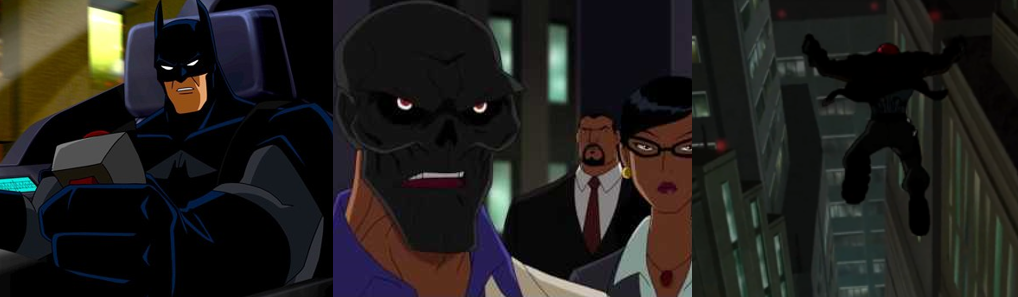
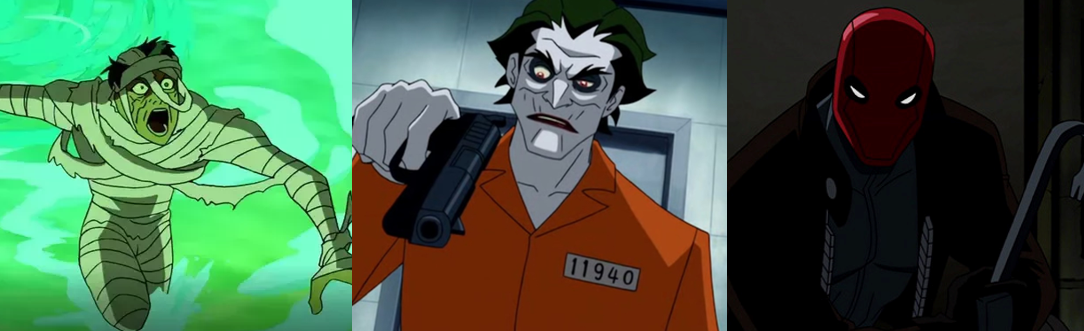






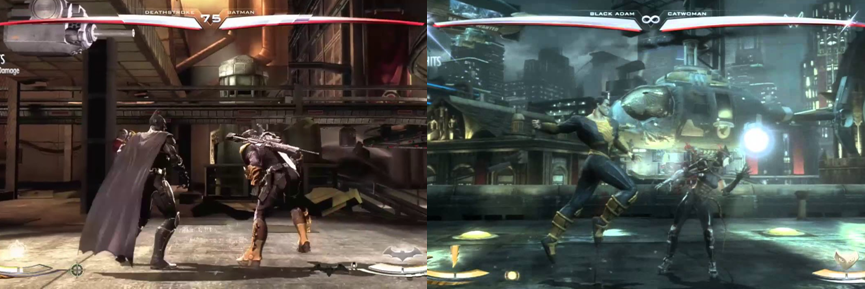

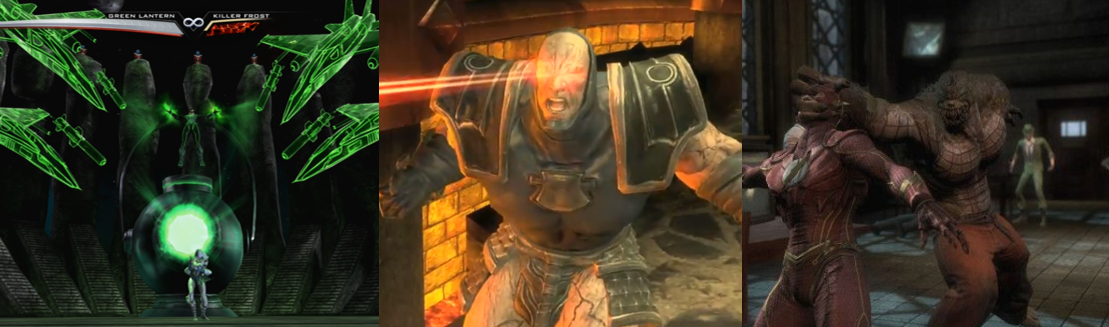
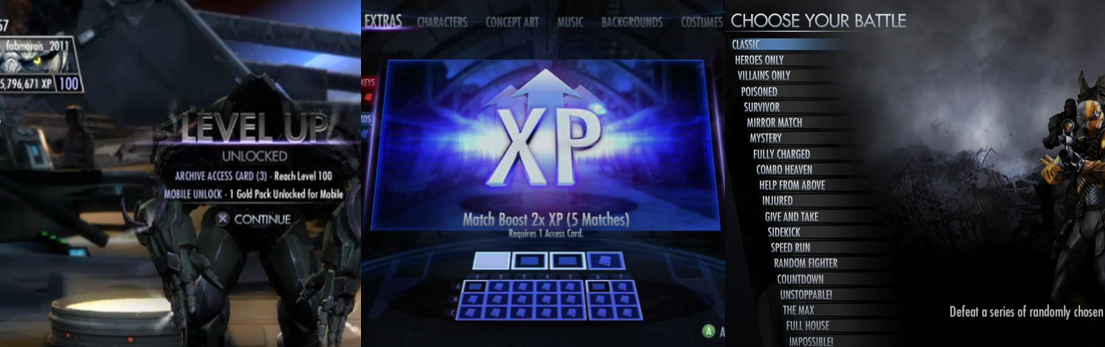
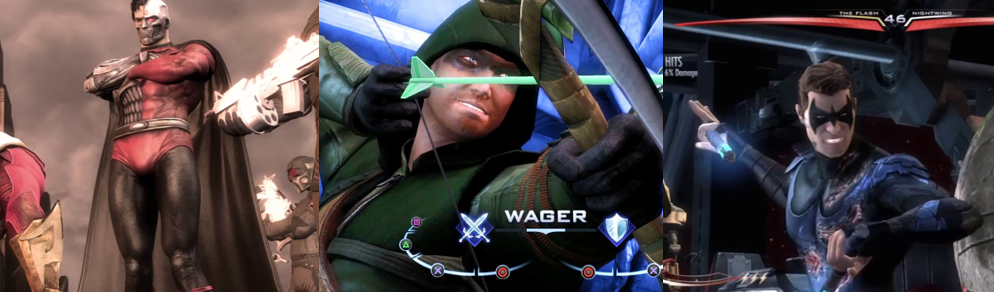
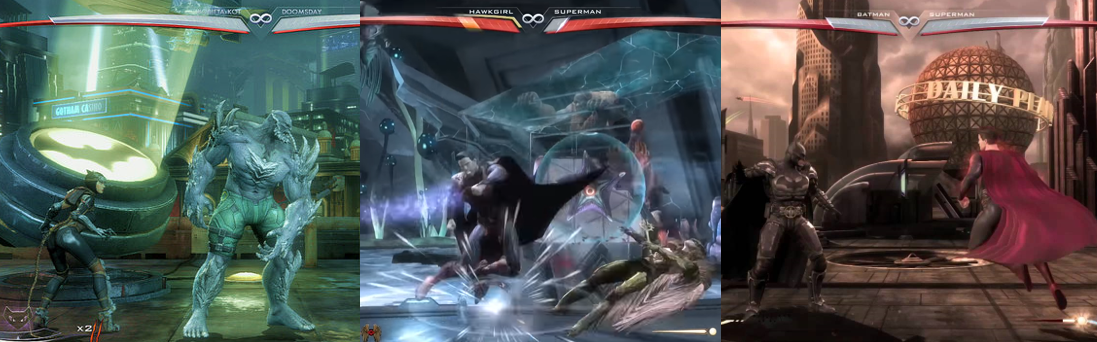





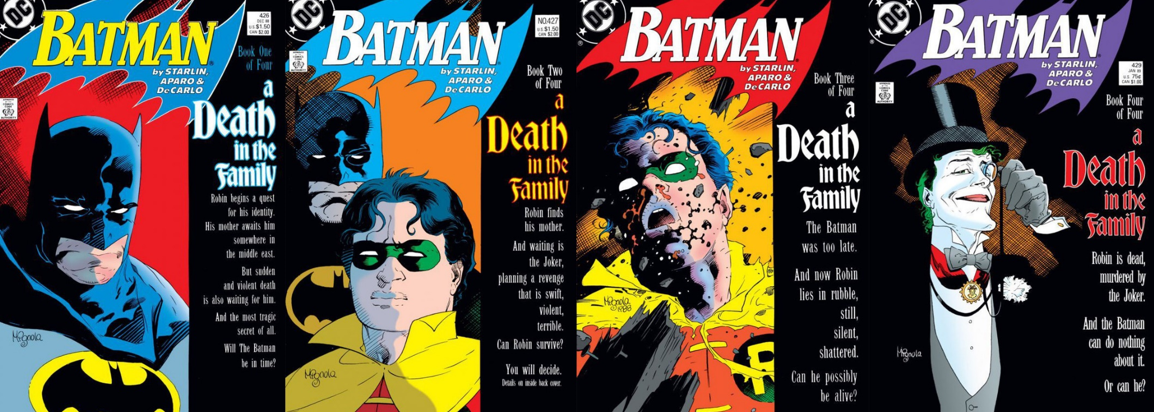
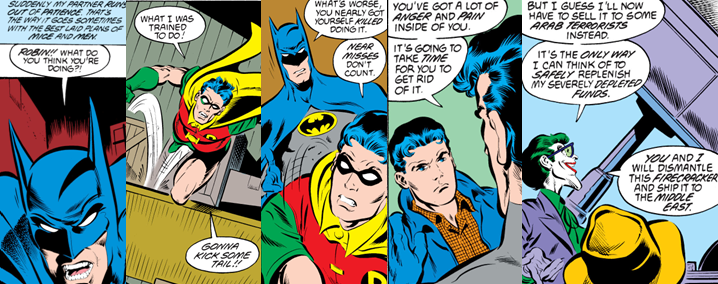
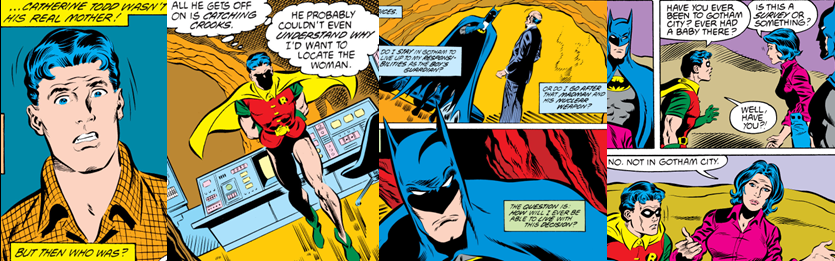
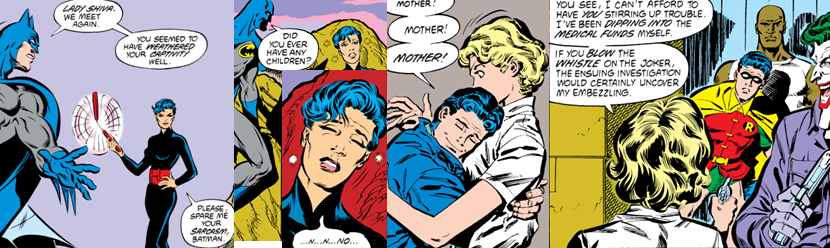
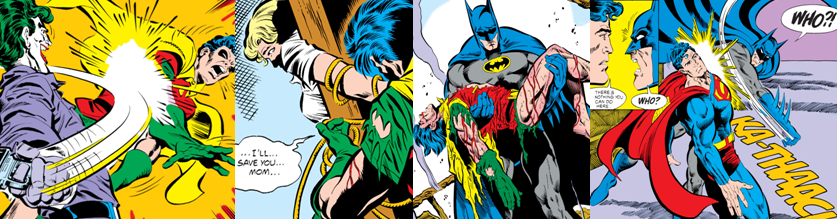
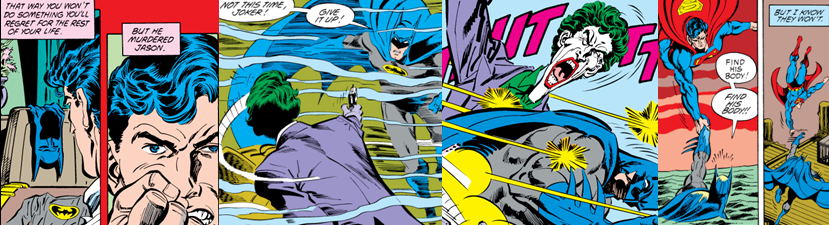
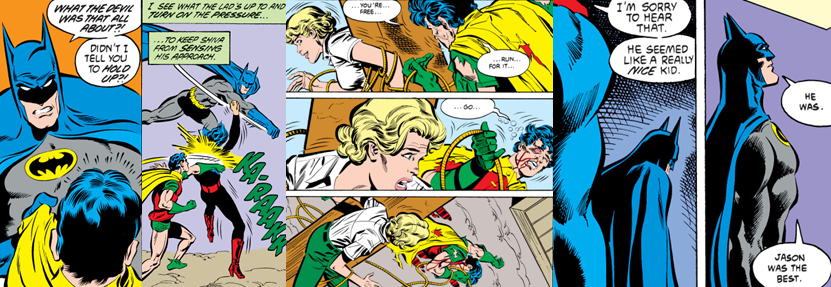
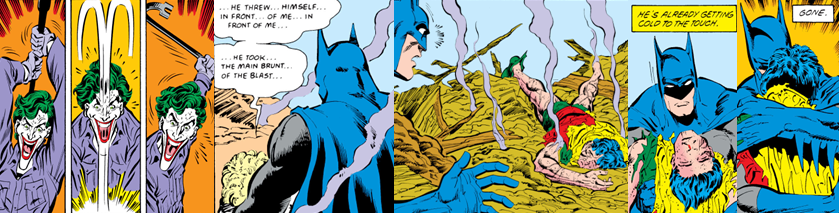



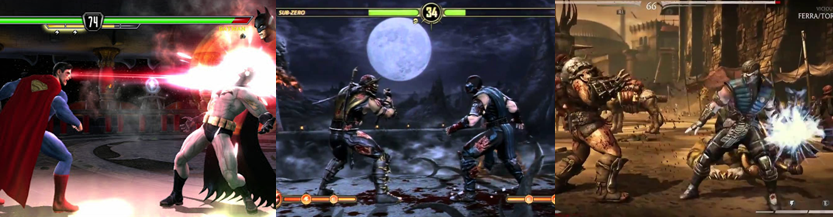
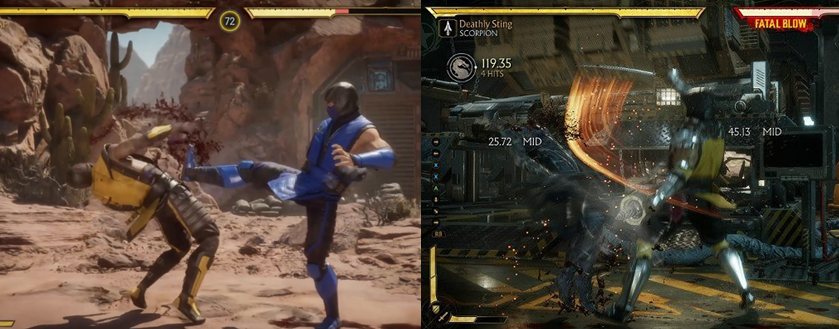


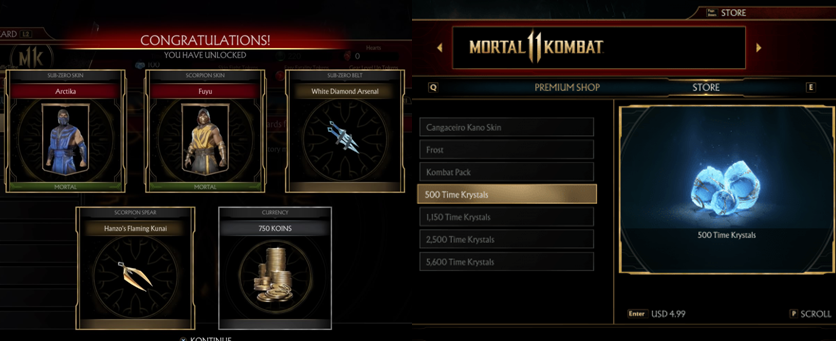
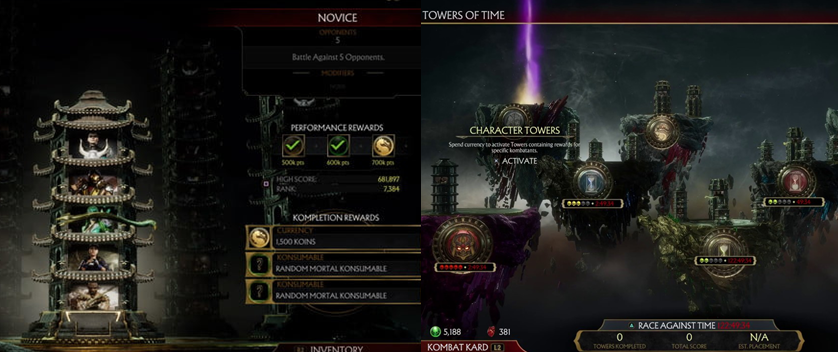
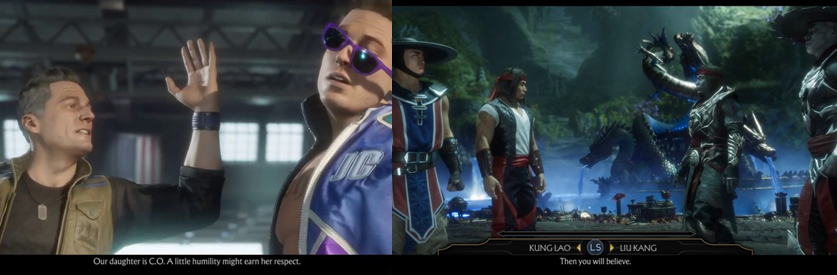
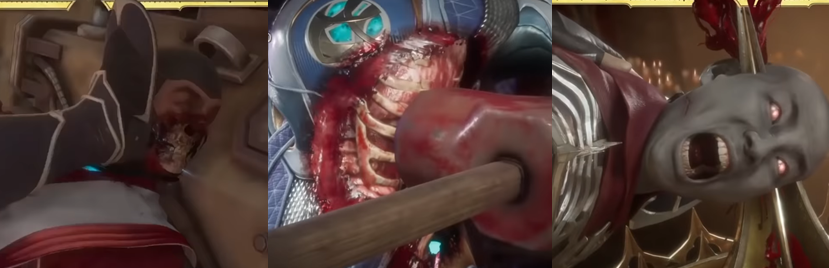


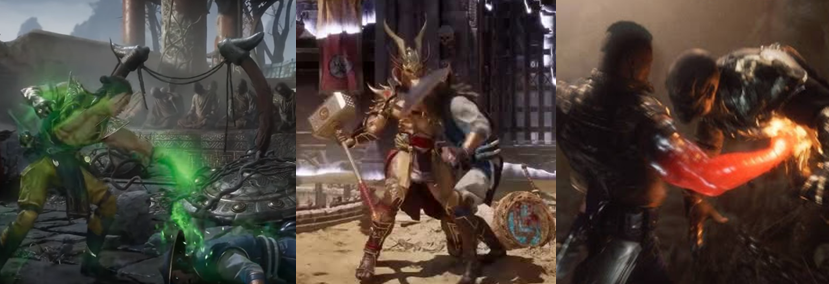
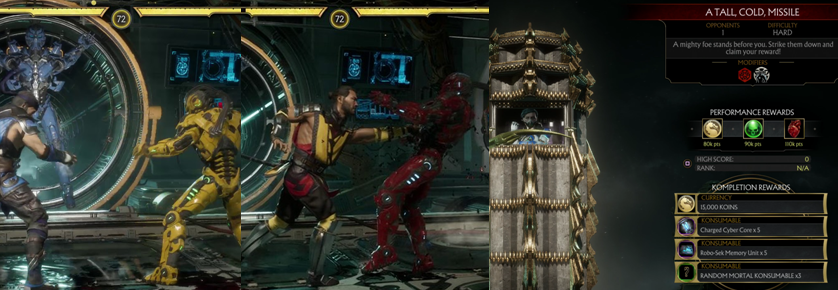


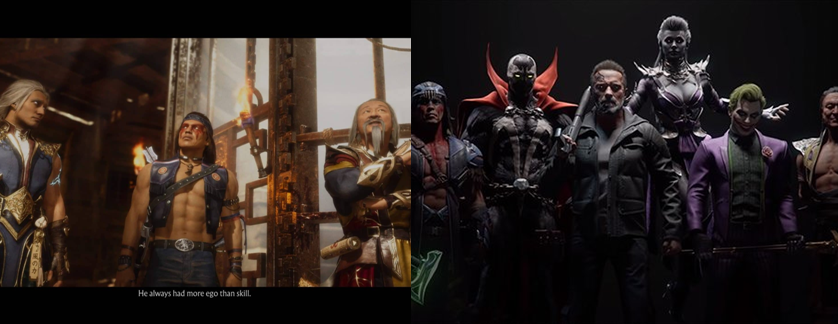
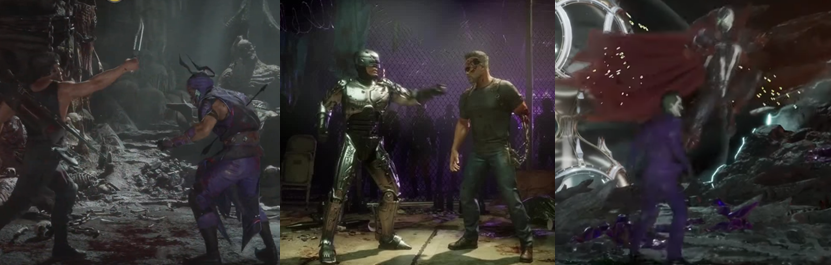



















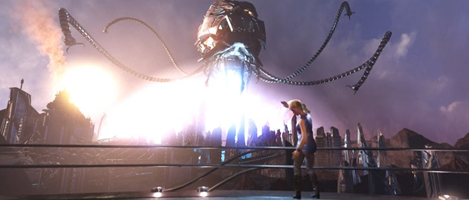
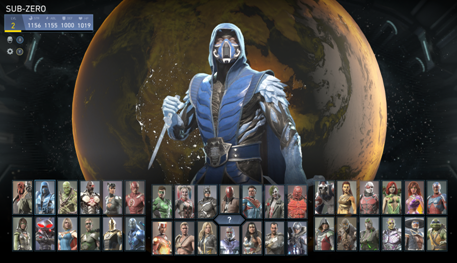


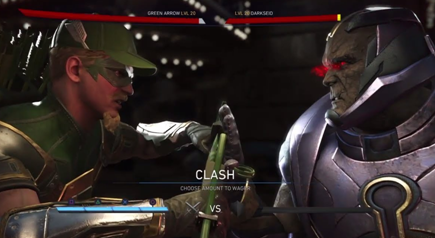
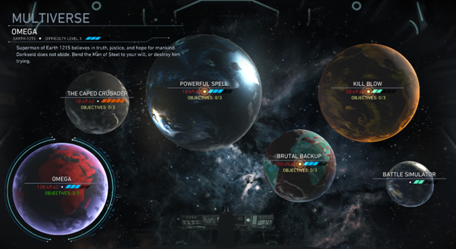


You must be logged in to post a comment.