Game Corner: Marvel: Ultimate Alliance 3: The Black Order (Nintendo Switch)

Released: 19 July 2019
Developer: Team Ninja

The Background:
For decades, few videogame publishers were as synonymous with Marvel Comics as Activision, who produced adaptations Marvel’s most popular properties. While some were better than others, Activision’s efforts were largely praised, especially after they partnered with Raven Software on the X-Men Legends games (2004; 2005). Activision and Raven Software expanded their scope to the rest of the Marvel universe with Marvel: Ultimate Alliance (2006), a largely successful team-based brawer praised for improving upon its predecessors. Though now delisted, it was followed by a sequel three years later, courtesy of Vicarious Visions, which tweaked the gameplay with team-based attacks to encourage experimentation. Though Marvel: Ultimate Alliance 2 (2009) was praised for its branching storyline, the stripped down roleplaying mechanics were criticised. While it was also delisted in 2020, fans were clamouring for a follow-up and, just ten years later, Team Ninja stepped in to work alongside Marvel in reviving the franchise. Seeking to place additional emphasis on combat, the developers explored the cosmic scope of the Marvel universe by including the Infinity Stones and lesser-known characters and chose to make the title a Nintendo Switch exclusive after developing a close relationship with Nintendo. Although Marvel: Ultimate Alliance 3: The Black Order was the sixth best-selling game in its first week and was later bolstered by extensive downloadable content (DLC), it was met with mixed reviews that praised the colourful action but criticised its lack of innovation.

The Plot:
While battling Nebula and Ronan the Accuser, the Guardians of the Galaxy stumble upon a plot by the mad titan, Thanos, to collect the six Infinity Stones. Although they scatter the Stones, Thanos’s acolytes, the Black Order, pursue the gems, prompting an alliance of Earth’s mightiest heroes to retrieve them first.

Gameplay and Power-Ups:
Like its predecessors, Marvel: Ultimate Alliance 3: The Black Order is a team-based action role-playing game in which players assemble a squad of four heroes from across the Marvel universe to battle various nefarious baddies, primarily the titular Black Order, who are hunting the six all-powerful Infinity Stones on behalf of their master, Thanos. The game offers five save slots, two initial difficulty levels, and a base roster of thirty-six playable characters, with many being encountered as you play through the story and joining your alliance either after fighting alongside you or being freed from some kind of mind control. Marvel: Ultimate Alliance 3 offers three controller configurations, thankfully none of which involve motion controls, and allows you to toggle overlays, notifications, tips, and other onscreen elements from the “Settings” menu. These include altering the camera placement, which enables a lock-on feature by pressing in the right stick, though the camera generally remains more focused on whichever character you’re controlling rather than offering a bird’s eye view as in the last two games. Although you can fight alongside friends either locally or online, you switch between your teammates with the directional pad (D-pad) when playing alone and your computer-controlled partners are very useful in a fight, attacking, enabling team attacks, and reviving defeated characters without any input from you. Pressing A sees you interact with the environment to activate consoles, pick up or move certain objects, and talk to other characters. You jump with B, executing a double jump, swinging from webs, or flying depending on which character you’re playing as, and throw light attacks with X and heavy attacks with Y. These can be strung together to perform basic combos and you can also perform a mid-air attack and throw objects (like bombs and missiles) by pressing Y. You block incoming attacks by holding the Z trigger and tap it to dodge, and collect glowing red orbs from defeated enemies or smashed crates to restore health, blue orbs to refill your Energy Point (EP) gauge, and credits to spend on upgrades.
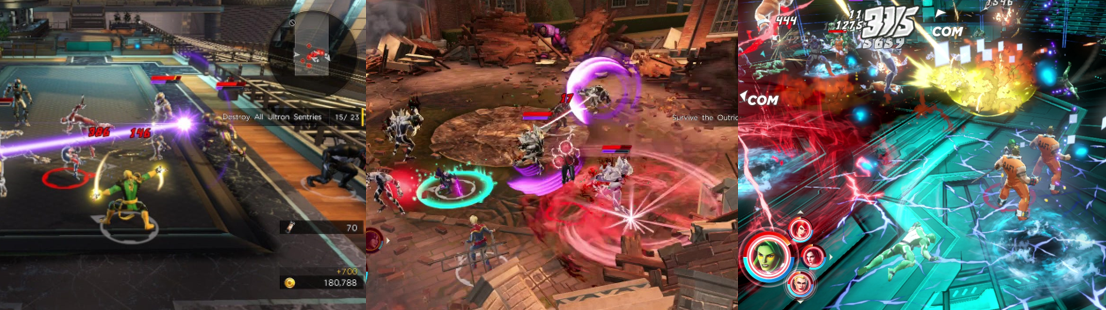
Combat is thick, fast, chaotic, and constant thanks to loads of enemies and character abilities.

As in the last two games, each character has specific abilities tied to their superpowers or superhero traits. You activate these by holding the Right trigger and selecting an icon using the D-pad; using Abilities drains your EP, however, and each Ability comes with a different cost. However, these attacks allow you to stun, stagger or deal elemental damage to enemies using Peter Parker/Spider-Man’s webs, Thor Odinson’s lightning, and Doctor Robert Bruce Banner/The Hulk’s incredible strength. Many characters have projectile attacks in their arsenal, such as Wade Wilson/Deadpool firing guns and Scott “Slim” Summers/Cyclops blasting his eye beams, while others cause splash damage or specific buffs, like Piotr Rasputin/Colossus being able to reflect projectiles and Wanda Maximoff/The Scarlet Witch healing her allies. Some, like James “Logan” Howlett/Wolverine, have passive abilities that allow them to automatically regenerate health as they walk around; others, like Johnny Blaze/Ghost Rider and Ororo Munroe/Storm, specifically deal in elemental damage. Character’s Abilities can also be mixed and matched by holding ZR and pressing one of the face buttons (or pressing A when prompted); this sees two characters attack in a combo for additional damage. As you dish out and take damage, you’ll also build the Extreme (EX) Gauge). Once full, you can press L and R up to three times to have two to four of your teammates perform a devastating combination attack that’s great against bosses. While the various cannon fodder you fight are easily dispatched, larger commanders and bosses need their “stun” meter drained before you can really put a beating on them and others (and certain treasure chests) require specific combination attacks to breach their shields. Defeating enemies sees your characters gain experience points (XP) to level-up, increasing their statistics (attack, defence, etc), though you can also use the various Orbs you find to manually level-up. Each character’s special Abilities can also be further enhanced using Ability Orbs and credits, reducing the EP cost and increasing their damage, among other benefits. You can also earn “Team Bonuses” depending on your team selection: pick a group of X-Men, for example, and your strength or resistance stat will increase, while picking characters of royalty ups your maximum energy stat.
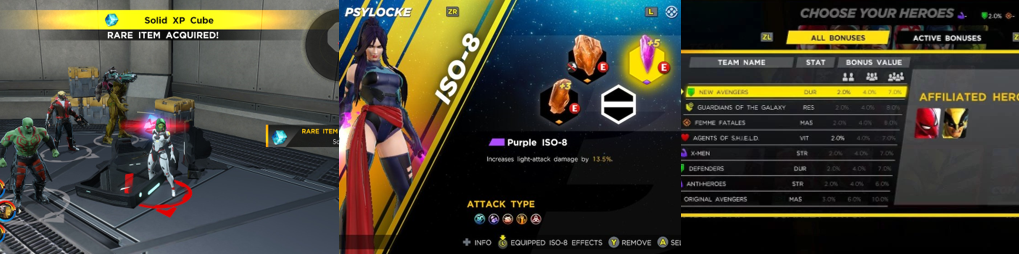
Search for chests to gain currency and other expendables to upgrade and buff your alliance.

Although you can’t equip gear to your characters, the boss battle against the Destroyer armour sees you temporarily empowered by Asgardian magic and you can eventually equip your team with “ISO-8” crystals, coloured stones that enhance their attack power, resistance to elements, or critical hit ratio, among others. You can further upgrade these with credits and ISO-8 capsules, though some of the rarer ones will also debuff you (for example, your attack my increase but your defence will decrease accordingly). You’ll also inevitably gain access to the Strategic Hazard Intervention Espionage Logistics Directorate (S.H.I.E.L.D.) Lab, which acts as the game’s skill tree. By spending credits and Enhancement Points (EP), you can further increase your team’s overall attack, defence, resistance, vitality, and such and even unlock additional ISO-8 slots (with more being earned by levelling-up). You can also enter the S.H.I.E.L.D. Depot from the main menu to purchase additional costumes and social icons by spending S.H.I.E.L.D. Tokens. Marvel: Ultimate Alliance 3 is pretty forgiving (on the “Friendly” difficulty, at least), with multiple checkpoints in each area. When you activate a S.H.I.E.L.D. checkpoint, your team is fully healed, and you can swap or enhance them if you wish. If a teammate is defeated, you can hold A to revive them, but I wouldn’t recommend it unless you absolutely have to. Not only are revives limited, but downed characters will eventually return to full health even before you reach a checkpoint so it’s not worth risking another character taking damage by healing a partner. Exploration generally leads you to treasure chests or special walls that require a special combination attack to open, or to a “Rift” challenge that takes you away from the main game to tackle a special challenge (usually a boss rematch or enemy gauntlet) for extra rewards. Your path is incredibly linear most of the time, hence why there’s no map, and the game’s primary focus is on chaotic combat and visually manic team-based attacks. Unlike in the last two games, you can no longer grapple or throw enemies (though you can still send them flying off certain platforms) and there are no character-specific team-up moves, meaning the action can quickly get quite tiresome.
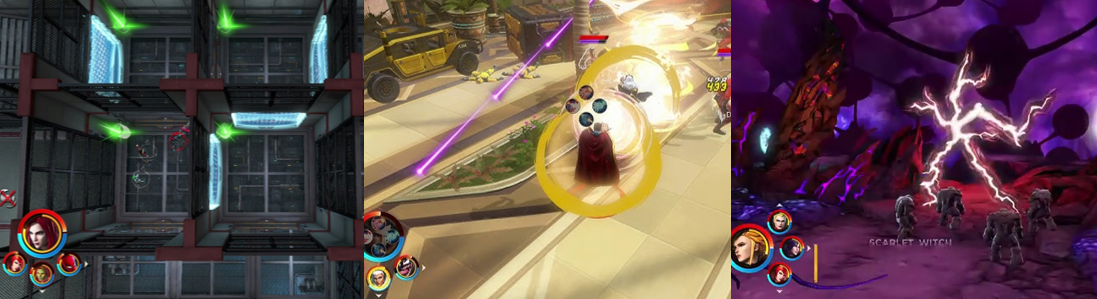
Sadly, puzzles are practically non-existent, with only Rifts offering additional challenges.

Because of its focus on hectic combat, there’s even less room for puzzles than there is for exploration in Marvel: Ultimate Alliance 3. Puzzles boil down to activating a console to open a door or making a platform move and that’s it. Sometimes, you’ll hold A to move a block and avoid lasers or cannons, but mostly you’ll be timing jumps between said lasers to progress and simply hurling missiles at those cannons. Sometimes, you’ll rotate statues or press switches to progress; others, you’ll be avoiding toxic ooze in Hel or solving door puzzles at the Raft or in Avengers Tower. After hopping across the rooftops of New York City, you’ll infiltrate the heavily fortified fortress of the Hand, dealing with ninjas that drop from the sky and hidden arrow hazards. When in Wakanda, Advanced Idea Mechanics (A.I.M.) corrupt T’Challa/The Black Panther’s defences, leading to an exasperating section where you must avoid snipers and being roasted by a giant panther statue’s energy blast. When transported to the Dark Dimension, you must use portals to reach new areas and defeat waves of demonic enemies to lower magical barriers and progress. Some attacks also screw up your controls or temporarily freeze you; some enemies are best defeated by tossing explosives at them; and many missions have an additional character fighting alongside you who’s often unlocked afterwards. However, a lot of the additional features of the previous games are missing; you can talk to other characters, but there are no dialogue options or character-specific interactions. There are no trivia quizzes, no optional side missions beyond the Rifts, and no character specific challenges to unlock extra stuff for each character. There aren’t even hub areas, in the traditional sense, with characters just appearing around S.H.I.E.L.D. checkpoints at times, though you can destroy a fair bit of the environment, and some encounters have you fleeing towards the camera as bosses chase you or present you with unwinnable battles.

Presentation:
Whereas the last two games primarily based their aesthetics on the comics books, especially the Ultimate comic line, Marvel: Ultimate Alliance 3 adheres very closely to the Marvel Cinematic Universe (MCU), especially in the visuals of its locations. I was hard pressed, for example, to tell the difference between Asgard here and the Asgard to the MCU, with both the golden city and the rainbow bridge, the Bifrost, appearing almost exactly as they’re depicted in the films. The same is true for Wakanda, the Dark Dimension, and Knowhere, all of which are virtually indistinguishable from how they appear in the MCU. There are some differences, of course: Taneleer Tivan/The Collector’s museum, for example, uses coloured cube cages and Wakanda leans much more into traditional architecture than the pseudo-futuristic science of the films (likely because Black Panther (Coogler, 2018) released a year before this game was made). Xavier’s School for the Gifted is lifted almost exactly from the 20th Century Fox X-Men movies (Various, 2000 to 2020), however, including a hedge maze, 1:1 Cerebro room, and basketball court that doubles as a landing pad for the Blackbird. While the Dark Dimension and the cosmic mind trip that is Sanctuary also heavily borrow from the bizarre cosmic imagery of the MCU, the Raft and Avengers Tower are much more akin to their comic book counterparts, though they’re comparatively bland locations, lacking fun areas like the Danger Room or Wakanda’s Necropolis (though you do pass through Anthony “Tony” Stark/Iron Man’s Hall of Armours in the tower). Although you only make a brief stop in Attilan to try and get help from the Inhumans, the architecture is far more visually interesting than that awful television show, seemingly being comprised of Celestial technology, and I enjoyed the ominous gothic presentation of Hel, with its restless Viking warriors and damaging sludge. Unfortunately, Marvel: Ultimate Alliance 3 continues the trend of having disappointingly bland and forgettable music, opting for generic themes for each location, event, and character that are lost amidst the constant fighting.
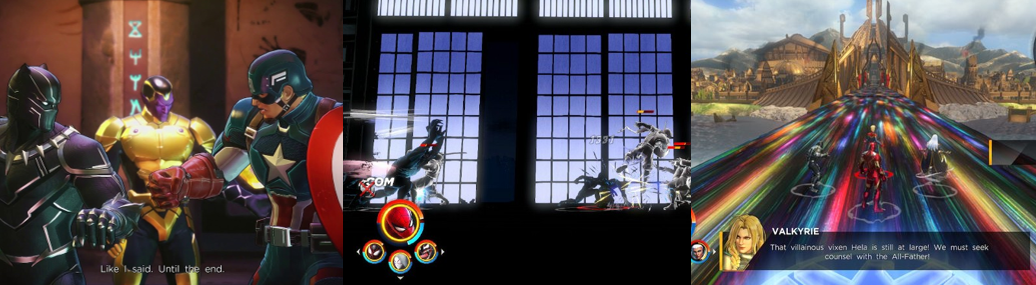
A visually impressive brawler that takes obvious inspiration from the MCU films.

The game also opts for an almost cel-shaded, action figure-like aesthetic for its colourful cast of characters. While many again both look and sound like their MCU counterparts, there are some exceptions: Peter Quill/Star-Lord, for example, looks nothing like Chris Pratt and the X-Men are far closer to the comic books than Fox’s films. Despite you assembling a custom team of heroes, cutscenes depict either everyone or characters specific to the location you’re in (the corrupted Doctor Stephen Strange in the Dark Dimension, for example) as they’re better suited to advance the plot against the local baddies. With the game shifting to a more third-person perspective, you’re closer than ever to the action and can see more of the environment than in the previous games. However, this comes with some drawbacks: mainly, there are far less opportunities or incentives to explore. Second, environments are painfully linear, with dead ends or locked doors barring your progress. Third, and most frustrating, is the camera, which easily loses track of your opponent/s and often lumbers you with wireframe representations when the foreground blocks the view. Thankfully, you won’t be falling down pits and rarely have to worry about onscreen hazards, but it can be aggravating trying to figure out which platforms and crates can be jumped on and which can’t. Marvel: Ultimate Alliance 3 offers a diverse cast of characters, each with their own idle poses and quips, though these do inevitably repeat. The game’s also surprisingly light on Easter Eggs: you’ll spot Deadpool singing away as he makes tacos in the X-Mansion, but not much else, and there are no optional missions or choices to encourage replaying missions. It’s a far cry from the first game, where there was always something to collect or an additional character to help out. Instead, it’s basically all combat, all the time in Marvel: Ultimate Alliance 3. Luckily, the game looks pretty good (everything’s very colourful and true to its inspirations) and performs really well, though there are some long load screens and it is annoying being forced to continue your game every time you challenge a Rift.

Enemies and Bosses:
All the usual suspects appear here as disposable cannon fodder for you to endlessly beat up, with many of the game’s goons sharing traits across the various locations. You’ll encounter Kree, Ultron Drones, agents of A.I.M., and Doombats who all pack various energy blasters. Ultron’s clones are the worst for this, relentlessly firing energy blasts and crashing through windows. The Raft’s unscrupulous prisoners attack in large groups, as do the restless Viking warriors who populate Hel, tossing axes from afar and luring you into toxic goop. Gargoyle-like Fire Demons also dwell here, offering a greater challenge with their swoop attack and fire breath, not unlike the monstrous Outriders and Mindless Ones who make up Thanos and the dread Dormammu’s forces, respectively. Alpha Primitives, Hydra goons, and towering Sentinels also appear, with the latter firing huge energy blasts from the palms and best attacked by throwing their explosive energy cores back at them. No matter where you are and what enemies you fight, more powerful commanders will also appear. Larger, tougher, and sporting a stun meter, these commanders should be your top priority as they’ll charge across the screen, cause shockwaves, and generally offer a far greater challenge even when you’re at a higher level. These minions often fight alongside their masters, generally so you can recover some health and EP to better damage the bosses, and will endlessly spawn in one of the additional modes unless you destroy their teleporters. Some of the game’s challenges or story-based missions charge you with defeating a certain number of enemies to progress. Other times, bosses appear in these waves, and you must occasionally flee or purposely lose some fights. This happens when Cain Marko/The Juggernaut comes tearing through the X-Mansion, for example, and in early encounters with the Black Order, who cannot be beaten or will chase you, raining lightning or other attacks from the sky and across the ground.
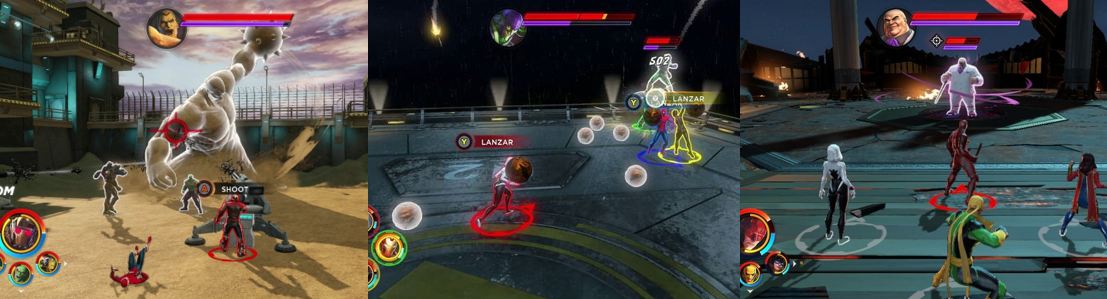
Few bosses require more than just hit-and-run tactics, even when augmented by an Infinity Stone.

There are loads of bosses to fight in Marvel: Ultimate Alliance 3, with some returning from the previous games, some teaming up, some having a couple of phases, and all boiling down to whittling down their stun bar, unleashing an EX attack and/or your most powerful Abilities, and avoiding damage until you can repeat this. The first ones you’ll face are Nebula and Ronan the Accuser, who often appear as a duo in optional challenges. Nebula is faster and more nimble, wielding blades where Ronan uses a massive warhammer. Both set a standard all bosses follow, which is that they’ll use either a jumping slam or an explosion of energy (or both) to send you flying. While quelling the riot in the Raft, you’ll encounter a version of the Sinister Six, with some unique variations to each battle. Flint Marko/The Sandman, for example, flings waves of sand and erupts his big sand fist from the ground as a large sand creature. You must use A to mount the nearby cannons and unload on him to chip away at his stun meter. Maxwell “Max” Dillon fights alongside Eddie Brock/Venom, raining lighting and electrocuting you with bursts of electricity, before he’s eaten by Venom and starts busting out electrically-enhanced symbiote powers. Venom joins the team after this fight and is tested against Quentin Beck, who first brainwashes Mile Morales/Spider-Man, Gwen Stacy/Spider-Woman, and Kamala Khan/Ms. Marvel to fight you and then unleashes a poisonous mist, teleports about, and confuses you with duplicates, Doctor Otto Octavious/Dr. Octopus is fought in a two-stage fight where you must first avoid his tentacles and scurry charge and then attack each arm to stun him. Finally, you’ll battle Norman Osborn/The Green Goblin for the Time Stone. The Green Goblin swoops overhead and lingers slightly out of reach, peppering the arena with his pumpkin bombs, charging at you, and freezing time to bombard you. He’s noticeably weak to his pumpkin bombs, however, so try and toss them at him before they explode in your face! After battling into the Hand’s fortress, you must first free Elektra Natchios from the Hand’s influence and then face Lester/Bullseye and Wilson Fisk/The Kingpin in separate fights. You must take out the ninjas feeding Elektra power, avoid Bulleye’s spread of razor sharp and explosive cards, and dodge the furniture and massive energy beam thrown by the Power Stone-enhanced Kingpin. The Kingpin also charges like a rhino, leaps at you to cause shockwaves, and even rips up stone columns to use as melee weapons!
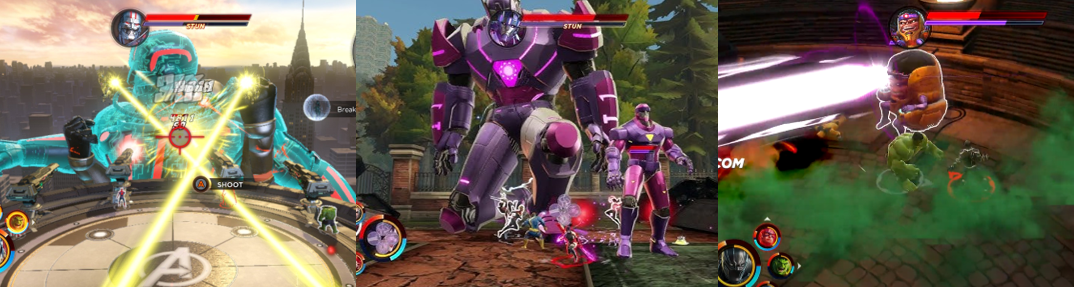
Gigantic bosses and the quirkier villains help mix-up the otherwise tedious combat.

Avengers Tower is then attacked by Ultron and his drones, who assist him in battle. Not that he needs it as the Mind Stone allows Ultron to mess up your controls, to say nothing of his signature face and palm beams. Ultron then grows to gigantic proportions, sweeping the area with his eyebeams before Clint Barton/Hawkeye intervenes and Ultron merges with Ultimo. This is the first giant boss battle in the game and sees you blasting Ultimo with cannons and avoiding his massive swipes. The Infinity Sentinel is comparatively smaller, but no less dangerous thanks to its own face beam and missiles. Though you can damage it with Sentinel cores, it’s finished in a cutscene by Erik “Magnus” Lehnsherr/Magneto, who then tosses debris and throws you off balance with magnetic pulses while Juggernaut pummels you and Raven Darkholme/Mystique tosses daggers. After surviving Mystique’s Danger Room trials, you face Magneto, now even tougher thanks to the Power Stone, before being chased away and banished to the Dark Dimension by the Black Order. There, you battle past Loki Laufeyson (who boasts elemental attacks and duplication tricks) to eventually face the dread Dormammu, who wields the Reality Stone and is the second giant boss. You must subdue his minions and avoid his flame bursts, whittling down his magical barrier either directly or be destroying three nearby orbs, all while dodging his giant fists and ground spikes. The brief fight with Maximus Boltagon is far easier, even though the mad Inhuman carries a massive energy cannon and you must take cover in Thane’s energy bubble to avoid Maximus’s barrage of lasers. Ulysses Klaue/Klaw awaits in Wakanda and his sound-based energy blasts and waves must be overcome to rescue and recruit James Buchanan “Bucky” Barnes/The Winter Soldier. You then fight past A.I.M. to confront their master, George Tarleton/Mental Organism Designed Only for Killing (MODOK), who uses the Soul Stone to turn the Dora Milaje against you and attacks with a slew of appendages, from buzzsaw arms, poison gas, failing tentacles, and his signature forehead blast.
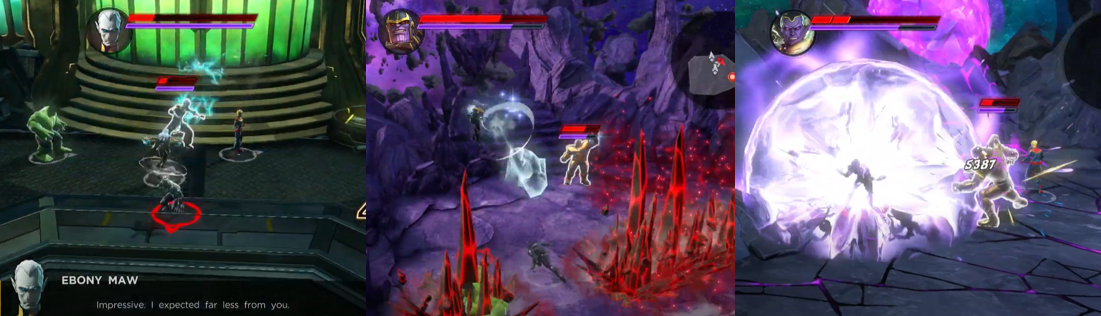
Battles with the empowered Black Order, Thanos, and Thane offer some of the most enjoyable challenges.

Though your goal in Hel is to confront Hela, you’ll actually battle the fire demon, Surtur, in another giant boss battle. This was a bit of a difficulty spike for me as Surtur’s flaming sword has a long reach and he causes the ground to erupt in flames, to say nothing of stun locking you with repeat sword strikes! Best him and Hela sets Johann Schmidt/The Red Skull on you, with the Nazi madman firing a powerful revolver and sapping your health with his “Dust of Death”. Hela gives the Red Skull a boost, protecting him with a shield and allowing him to fire a Bifrost-like laser, before placing his consciousness into the Destroyer armour. Though bolstered by Hydra forces and boasting a sweeping face beam, you can get a power-up from glowing crystals to overcome this destructive force. Finally, you venture to Knowhere and must run the Black Order gauntlet to retrieve the Infinity Stones, with checkpoints between each fight. Ebony Maw is first, firing a spread of projectiles and rocks and using the Soul Stone to create portals to trip you up. Supergiant tosses dark spheres and a golden homing shot that messes up your controls, though you can toss explosive cores from her minions to deal big damage. Cull Obsidian infuses his battleaxe with the Power Stone, sending out waves of purple energy and massive purple shockwaves, though he’s far slower and also susceptible to the nearby bombs. Corvus Glaive is much faster, landing multiple hits with his lance and using the Reality Stone to spring spikes form the ground and conjure duplicates who fill the arena with energy waves that can stun lock you. Finally, Proxima Midnight takes her fellow’s teleportation trick to the next level with the Space Stone and fills the arena with lightning bolts and strikes. All these powers are then recycled when you face Thanos, who gathers the six Infinity Stones into the Infinity Gauntlet to rain meteors, teleport, mess up your controls, freeze time, and fire his signature eyebeams. Thanos then joins you to battle Thane, who usurps him and boasts similar powers, though also upgraded by the Infinity Armour. Thane exhibits superhuman speed, traps you in a cube, fills the arena with portals and flames, and explodes in fury, though both battles were fun challenges rather than impossible tasks.

Additional Features:
Unlike in the previous two games, you won’t be finding data logs, action figures, or meeting certain requirements to unlock new attacks or costumes. You just fight over and over, earning whatever you need to unlock, buy, or upgrade whatever you wish and finding some concept art in treasure chests. A far harder (but more rewarding) “Superior” difficulty unlocks upon clearing the game alongside an additional “Nightmare” mode, accessible via the “Curse of the Vampire” campaign. You also unlock Thanos and can freely replay any mission on any difficulty (though you must start a new save to play on “Superior”) to grind and enhance your characters and ISO-8. Dimensional Rifts transport you to special challenges (not unlike the S.H.I.E.L.D. Simulator discs from the first game) that are often rematches with bosses or gauntlet challenges, though far tougher and gifting better rewards if you succeed. There are also three additional modes; however, though you can play a taster of each, you must purchase the expansion pass to fully unlock them. “Curse of the Vampire” adds vampiric enemies to the main story in “Nightmare” mode and offers a “Gauntlet” mode where you battle waves of enemies and bosses against both a time limit and a range of debuffs (including limited health restoration and draining EP). You can also tackle an “Endless” mode that’s pretty self-explanatory, and unlock additional characters like Frank Castle/The Punisher and Eric Brooks/Bladeif you buy the DLC. “Rise of the Phoenix” sees you form a four-person team and go head-to-head with a friend or the computer in three-round Danger Room scenarios. These see you tackling bosses again or wiping out hordes of enemies, awarding additional buffs and effects if you meet certain criteria (such as using any Ability or Synergy attack four times). You can only tackle the first challenge without the DLC, so I didn’t get very far, but this could be a fun distraction for those looking to test their skills against a friend. “Shadow of Doom” adds an epilogue story campaign that sees you return to Wakanda to oppose Doctor Victor Von Doom’s invasion. Dr. Doom’s Doombots endlessly spawn unless you destroy their teleporters, and you even battle the arrogant dictator in the recycled Necropolis, with him teleporting, firing lasers form his palms, and having his health restored by his Doombots. You’ll add Marvel’s First Family to your roster (alongside an alternative Thanos and other characters) by buying the expansion pass and battle Annihilus, a gigantic Celestial, and even “God Emperor” Doom!
The Summary:
I quite enjoyed the first two Ultimate Alliance games. They were mindless and largely repetitive, but I liked the large cast of characters and all the different references and locations from the comic books. Still, I put off Marvel: Ultimate Alliance 3: The Black Order for some time, mainly because I was annoyed by it being a Nintendo Switch exclusive; however it turned out to be a decent enough brawler. Despite the different development team, a few tweaks, and an apparent disconnection from the previous games, Marvel: Ultimate Alliance 3 offers a lot of the same gameplay and enjoyment as its predecessors, which is great for long-time fans of the franchise. Unfortunately, it doesn’t improve on these elements in a meaningful way and actually removes some content that I found enjoyable from the last two. There are no optional missions, for example, no alternative endings, no choices, and no character-specific challenges beyond fighting and levelling-up. I found this made the tedious combat even more aggravating after a while as I wasn’t being rewarded with gear or costumes or anything other than stat boosts. Even the skill tree was limited since you must grind to acquire enough credits and expendables to enhance your team, and I found the ISO-8 mode to be more confusing than engaging. The game also does little to improve the boss battles. Very few were very innovative or required more of you than to strike fast, avoid shockwaves and projectiles, and unleash your Extreme attack. The giant bosses were more of a challenge and I liked the final fight against Thanos and Thane, but I was hoping for a bit more complexity, especially given the possibilities offered by the Infinity Stones. There is a fun selection of characters, but they don’t offer much more than what we saw in the last two games and actually offer less as there are no character-specific team-up moves. While I enjoyed the visual influence from the MCU and the variety, I feel like Marvel: Ultimate Alliance 3 played things a little too safe by relying so heavily on combat and not mixing up the gameplay with a few other puzzles and challenges. Overall, it’s a good enough game and a worthy entry in the series, but it’s a shame that the developers didn’t try to be a bit more innovative and offer some more incentive to keep slogging away in endless fights.

My Rating:

Rating: 3 out of 5.

Pretty Good

Did you enjoy Marvel: Ultimate Alliance 3: The Black Order? How do you think it holds up against the previous two games? Which characters did you choose for your team? Were you disappointed that the combat was so similar to the last two games and the bosses so repetitive? Did you ever conquer all the Rift challenges? What did you think to the MCU influences and the final battle with Thanos and Thane? Did you ever play through the DLC? Would you like to see another Ultimate Alliance game? Whatever your thoughts, leave a comment below, support me on Ko-Fi, and go check out my other superhero content across the site.

Back Issues [F4iday]: Fantastic Four #48-50


In November 1961, Marvel Comics readers witnessed four intrepid explorers be forever changed by mysterious cosmic rays. Marvel’s “First Family” of superheroes were the first of many colourful superheroes for Marvel Comics and are more than deserving of some attention today.


Writer: Stan Lee – Artist: Jack Kirby

Story Title: “The Coming of Galactus!”
Published:
9 December 1965 (cover-dated March 1966)

Story Title: “If This Be Doomsday!”
Published: 11 January1966 (cover-dated April 1966)

Story Title: “The Startling Saga of the Silver Surfer!”
Published:
10 February 1966 (cover dated May 1966)

The Background:
In 1961, Stan Lee and Jack Kirby introduced readers of Marvel Comics to the dysfunctional Fantastic Four in a direct response to DC Comics’ Justice League of America. While the team’s creation has been contested by both, Lee and Kirby popularised the “Marvel Method” of writer/artist collaboration and brought comic fans real and relatable characters who introduced pivotal Marvel staples in the following years. Perhaps none are more crucial than the cosmic devourer of worlds himself Galactus. Created by Lee and Kirby and debuting in this trilogy of issues, the entity once known as Galan had Biblical connotations and was specifically designed to challenge pre-conceived notions of “good” and “evil”. Many subsequent stories have characterised Galactus as a force of nature, if not the universe, as inevitable and necessary as life and death. A complex being who spreads genocidal destruction to satiate his never-ending hunger, Galactus is typically served by equally mighty “heralds”, most notably Norrin Radd/The Silver Surfer, and either at the forefront or lurking in the background of Marvel’s cosmic crossover events. Galactus has brought to life in Marvel’s various animated ventures, often appears in Marvel videogames, and was notoriously represented as an indistinct swirling cloud in Fantastic Four: Rise of the Silver Surfer (Story, 2007) before finally being brought to life in live-action in the Marvel Cinematic Universe in 2025.

The Review:
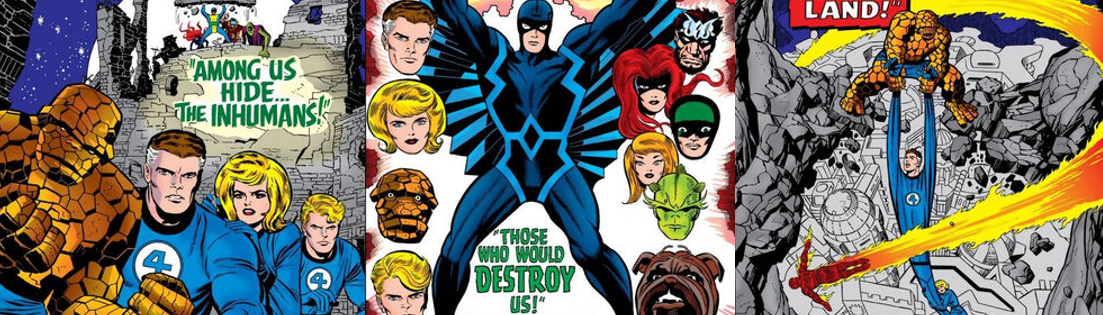
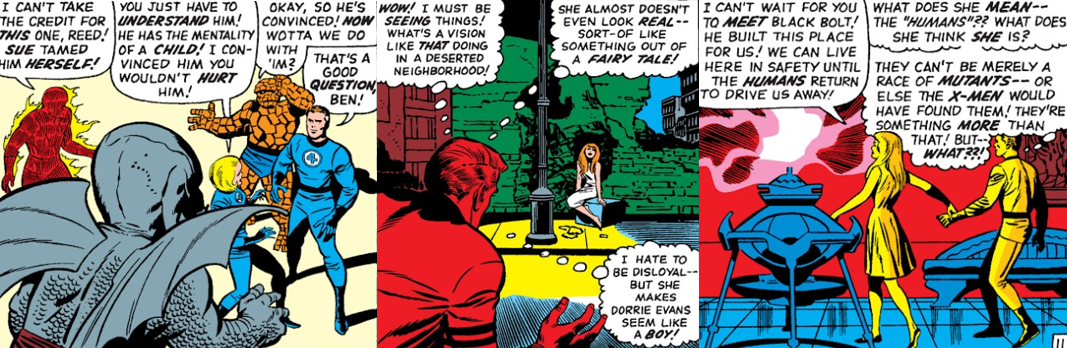
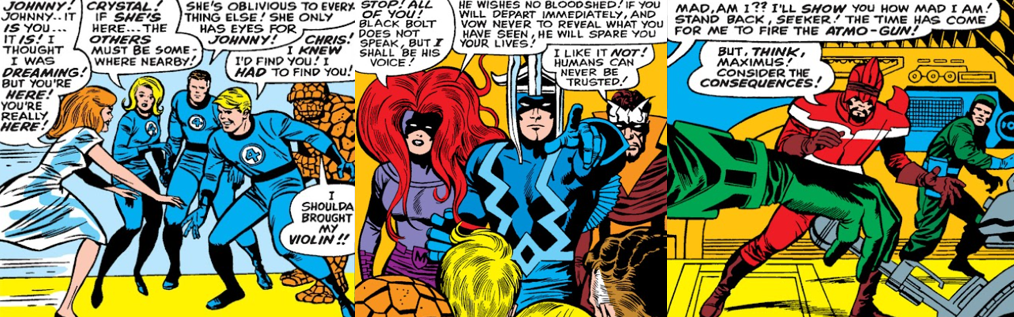
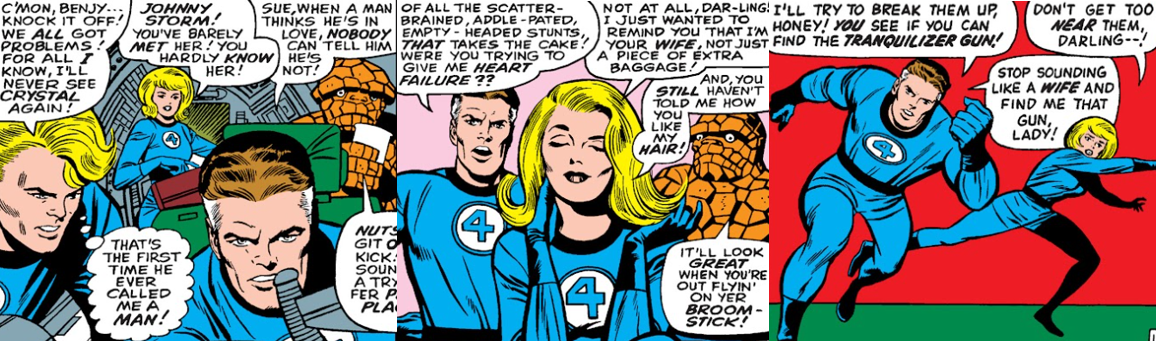
The Fantastic Four’s greatest threat begins with them still struggling against Marvel’s newest batch of bizarre costumed superhumans, the Inhumans. Specifically, Maximus Boltagon/Maximums the Magnificent (or, more accurately, Maximus the Mad) has set off the dreaded “Atmo Gun”. While this has no effect on his Inhuman brethren, it’s caused deadly planet-wide vibrations that threaten all human life. While even the hyper-intelligent Doctor Reed Richards/Mister Fantastic cannot fathom the cause of such an event, Blackagar Boltagon/Black Bolt, leader and monarch of the Inhumans, immediately confronts his insane brother, a creature so vile and spiteful that he’d happily destroy every human just so the Inhumans could walk the Earth uncontested. For his mad schemes, Maximus earns a swift backhand from the dangerously mute Black Bolt and is both astonished to find the Fantastic Four still alive and dismayed when his brother easily disables the Atmo Gun’s effects. Regardless of the pleas of the beautiful, red-headed Inhuman Medusalith Amaquelin/Medusa, who’s pledged her life, heart, and loyalty to Black Bolt, Maximus refuses to accept any similarities between the two races. Stubborn to the end, he throws off the Inhumans restraining him and lunges for the Atmo Gun once, more, maliciously reversing its effects before anyone can stop him. The result is the entire Inhuman sanctuary, Attilan, being encased within an impenetrable “Negative Zone”. Thinking fast, the Fantastic Four race to safety and escape before they are also trapped inside, leaving Johnny Storm/The Human Torch heartbroken at being separated from Crystal Amaquelin, Medusa’s pretty little sister who Johnny immediately fell for and who unwittingly brought the two groups together in the first place. Johnny reacts with anger, desperate to burn his way back into Attilan and pleading with Reed to find some way to be reunited with Crystal. However, Johnny’s left to despondently realise that there’s no hope and, sympathetic to his plight, Ben Grimm/The Thing secretly vows that none of them will ever give up hope that the two can see other someday.

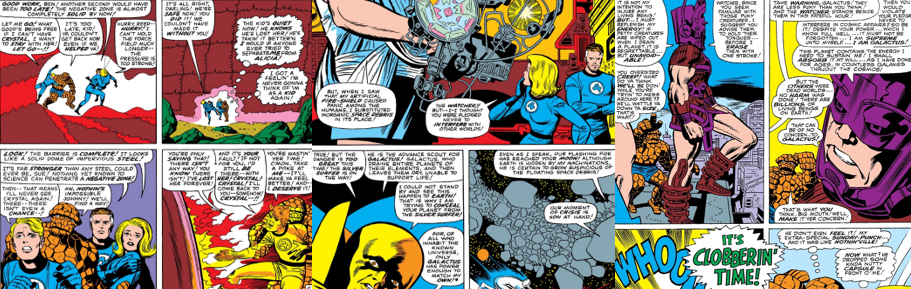
Johnny’s anguish at being separated from crystal is supplanted by Galactus’ dreaded arrival.

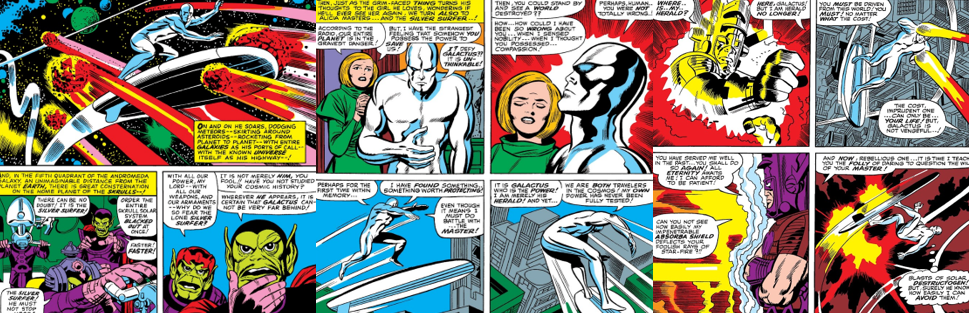
With the Inhuman saga wrapped up for now, the story then switches to the vast depths of the cosmos where we’re introduced to the enigmatic Silver Surfer for the first time. Deftly dodging a meteor shower as he rides through the void, the Silver Surfer catches the watchful eyes of the Skrulls, who react with panic at detecting his presence, knowing that where the Silver Surfer rides, mighty Galactus is sure to follow. Using their incredible technology, the Skrulls “[black] out” their solar system, apparently causing the dreaded Silver Surfer to pass by. Thus, the Silver Surfer rockets to our solar system, spotting a lush and fertile planet that will satisfy his master’s needs. Meanwhile, while returning from Attilan, the Fantastic Four are stunned to see a second Sun appear in the sky and then flames seemingly engulf the atmosphere. When the Human Torch investigates, the predictably fickle and understandably panicked New Yorkers blame him for the phenomenon and attack. Thankfully, Reed, Ben, and Susan Storm/The Invisible Girl arrive on a suitably Kirby-esque sky cycle and the Thing quickly quells the enraged mob, and Reed ushers them back to his lab to investigate further. A time jump apparently occurs between panels as Reed is suddenly sporting some five o’clock shadow and working himself into a stress, snapping at Sue for interrupting him and, predictably, upsetting her since he’s too busy trying to figure out what’s going on to pay attention to his wife. More concerned for her husband’s wellbeing than the mysterious rocks that’ve now appeared in the sky and determined to not be shut out, Sue forces her way into his lab and is stunned to find Uatu the Watcher has been causing the strange events using his “Matter Mobilizer”. Though normally unable or unwilling to interfere in human history, Uatu has tried to shield the Earth from the Silver Surfer, knowing that catastrophe that will come if he arrives. Unfortunately, the Watcher was unsuccessful; the Silver Surfer arrives, easily evades the Human Torch, and signals for Galactus.

Even the Fantastic Four are powerless to oppose Galactus, who seeks to devour the Earth.

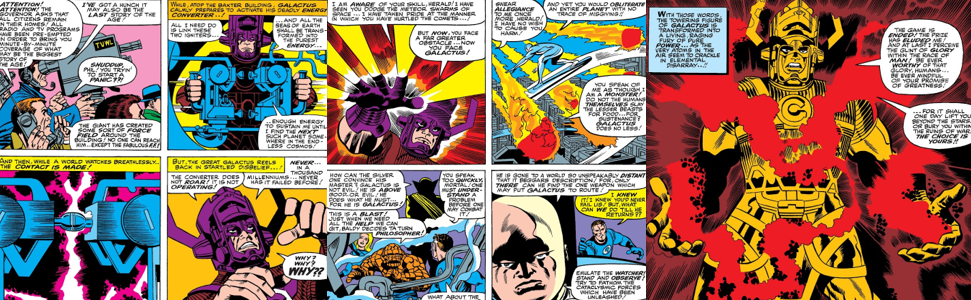
Although the Thing gives the gleaming alien a good clobberin’, the Silver Surfer simply uses the attack as a good excuse to depart and prepare for his master’s arrival, which comes moments later courtesy of an oddly surreal, photorealistic depiction of the being’s incredible technology. A gigantic ship then lands and from it steps forth not the purple/blue, armour clad devourer you may recognise by a massive titan decked out in green and red with a big, stupid “G” on his chest. This colour issue is corrected in the next issue (and can be explained by the Watcher’s statement that “[Galactus] is what he wishes to be!”), in which the giant ignores the Fantastic Four as though they were less than gnats and argues morals with the defiant Watcher. Galactus immediately reveals himself to be a creature of surprising depth by expressing his displeasure at having to harm living creatures, though he’s no less determined to destroy the Earth to sustain his vast energy and quell his never-ending hunger. Displeased by the Thing’s insolent tone, Galactus refuses to find a suitable dead world and, when the enraged Thing dares to strike him, gasses the stony superhero like an insect. Despite the Watcher’s warnings, the Human Torch tries his luck, only to be blasted by Galactus’ eye beams and have his flame doused by soot and ash. Humbled, the Fantastic Four regroup within the Baxter Building, bickering with each other as they lick their wounds, completely unaware that the unconscious Silver Surfer has collapsed into blind sculptor Alcia Marsters’ apartment. Ben’s caring, concerned love immediately tends to the stranger and reveals himself to be a melancholy creature, one baffled by Earth customs and seemingly resigned to sweeping such lives away in service of his demanding master. Galactus sets to work achieving this by constructing an elaborate machine – the “Elemental Converter” – around the Baxter Building, one that will siphon Earth’s very elements into his being as a source of sustenance. The Fantastic Four are horrified when the Watcher shows the destructive impact this weapon will have, reducing the Earth first to a lifeless husk and the shattering the remains before Galactus searches for another world to repeat the process.

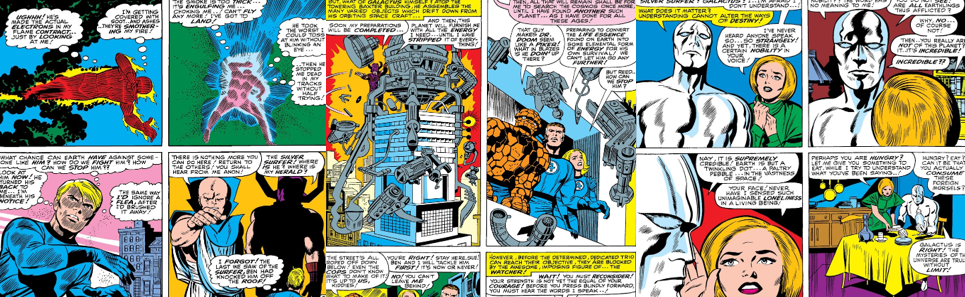
It’s only when the Silver Surfer is convinced to help that the battle turns in Earth’s favour.

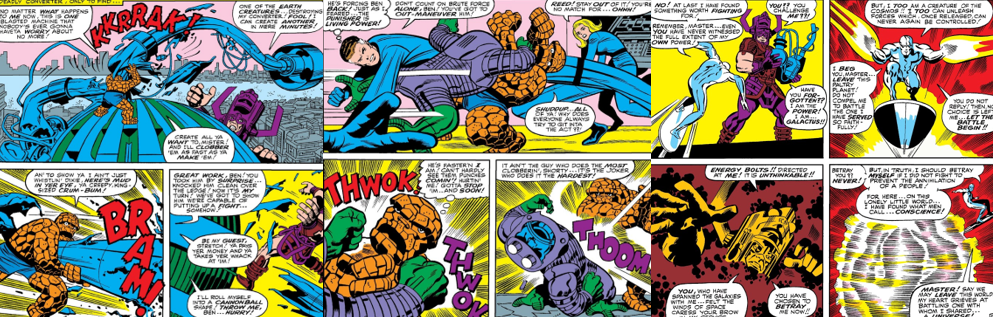
Alicia is similarly horrified to learn this from the impassive Silver Surfer. She lashes out at him with an emotional outburst, emphasising the strength of the human heart and questioning his aloof servitude. For a moment, the Silver Surfer falters, admiring her courage and feeling the first stirrings of an emotion, one he soon identifies as pity as he sees the panicked masses react to Galactus. The titan is enraged, however, when the Thing delays his plan by trashing a vital part of the Elemental Converter. Angered and insulted when Mr. Fantastic dares to strike him, Galactus summons the Punisher (no, not that one), a strange, frog-like android, to deal with the impudent mortals while he repairs the damage. Though Johnny is eager to help his family in the fight, he’s held back by the Watcher, who has a plan to stop Galactus that requires Johnny’s abilities. Trusting the stoic overseer, Johnny is teleported across space and time to Galactus’ massive, mechanical space station at “the center of infinity”. While the pig-headed Thing tests his mettle against the Punisher’s raw power, Sue keeps the creature at bay with her forcefield long enough for Galactus to tire of the conflict and withdraw his pet. Meanwhile, the Silver Surfer is aghast at the suggestion that he use his great Power Cosmic to defy his master; yet he cannot deny that Alicia’s belief in his quiet nobility has some merit. Thus, having found a world worthy of his protection, the Silver Surfer pleads with Galactus to spare the human race. However, mighty Galactus is unimpressed by his newfound compassion, forcing the Silver Surfer to turn his powers against his master. Amazed by his herald’s betrayal, Galactus is trapped within a vortex and encased within a cocoon, for the Silver Surfer wishes only that they leave the Earth rather than to harm his master. Unfortunately, Galactus is not so easily caged and quickly breaks free, enraged and easily deflecting his herald’s attacks, bombarding him with flaming meteors and offering to spare him harm if he but reaffirm his allegiance.

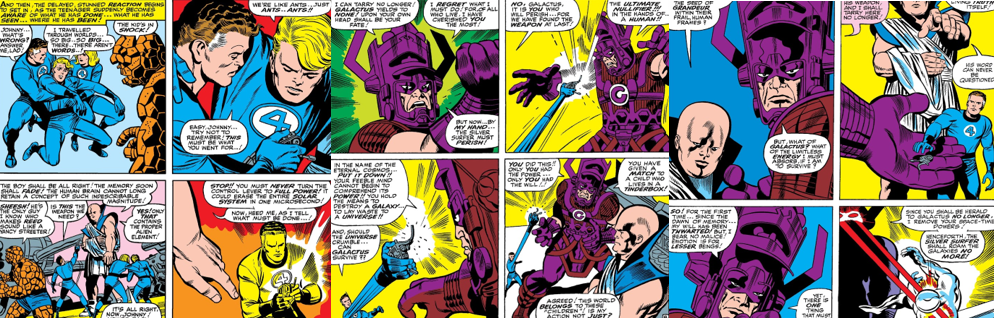
Galactus begrudgingly leaves to avoid his destruction. but not without punishing his herald.

Powerless to aid their new ally, the Fantastic Four place their faith in the Watcher, a faith rewarded when the Human Torch arrives back on the Earthly plane, briefly overwhelmed by the cosmic wonders he’s seen, and hands Reed a mysterious device he acquired from Galactus’ space station. The Watcher immediately advises caution lest Reed foolishly annihilate the entire solar system trying to explore the machine, which Galactus identifies as the “Ultimate Nullifier”. The Silver Surfer fights valiantly, despite his blasts having no effect on Galactus, who effortlessly conjures giant icicles and threatening to turn his wrath against the humans. Tired of the conflict, Galactus prepares to destroy his once loyal herald, only to react with shock when Reed threatens him with the Ultimate Nullifier. Astonished to see a mere human wielding a weapon so powerful that it could destroy the entire universe, Galactus demands that Reed relinquish the weapon and then chastises the Watcher, stunned that he would “[give] a match to a child who lives in a tinderbox!” However, the Watcher simply affirms that humanity has the right to defend themselves and emphasises their great courage. Weary of the battle and in need of sustenance, Galactus agrees to spare the Earth in return for the weapon. Reed hands it over peacefully as the Watcher swears Galactus to stay true to his word, however the world devourer makes sure to punish his herald before departing. With a blast of his eye beams, Galactus removes the Silver Surfer’s ability to roam the galaxies and banishes him to the planet he defended so bravely. And, with that, Galactus disappears in a brilliant flash of light, leaving the Fantastic Four relieved and amazed. In the aftermath, Ben is distraught by how captivated Alicia seems by the eloquent Silver Surfer and falls into a depression. The Silver Surfer departs to explore his new world, Reed continues to anger Sue by focusing on his work, and Johnny heads off to college, meeting the annoying Wyatt Wingfoot for the first time and still pining for Crystal.

The Summary:
The “Galactus Trilogy” is unquestionably one of the most important story arcs not just for the Fantastic Four, but for Marvel Comics in general. It wraps up the initial Inhumans arc, trapping them in Attilan for a spell and adding some significant character growth for Johnny, who spends his days pining over his lost love. While I question how he can be so attached to Crystal despite barely knowing her, it’s a humbling experience for the outspoken Human Torch, who reacts with equal parts and anger and despair, and this informs his defiance of Galactus. Indeed, he shows an unprecedented emotional maturity when he willing goes along with the Watcher’s plan to steal the Ultimate Nullifier, despite being transported to a part of the universe so unknowable and strange that it briefly warps his mind. His characterisation is more akin to the Thing’s at times, since Ben is so often decrying his monstrous appearance and feeling like an outcast. This isn’t a factor until the final parts of the story, where he feels incomparable to the articulate and mysterious Silver Surfer. His reaction, however, comes from his own insecurities and the commonplace reaction to his appearance rather than being reflective of Alicia’s true feelings. Though she finds the Silver Surfer alluring and wishes to foster his emotions and humanity, Alicia breaks a common cycle in comics from this time by not instantly falling in love with the mysterious stranger and is instead more focused on encouraging him to turn on his master and spare the planet. Relationships are a focal part of this arc, as is often the case with the Fantastic Four. As ever, Sue is constantly, selfishly slighted by Reed pouring more of his time into his research than her, a characterisation I normally can’t stand but I enjoyed the wrinkle that Sue is concerned for his welfare rather than simply being upset at being ignored. Though Reed works tirelessly to understand what’s happening, he’s as astonished and powerless as the others against Galactus’ threat. While Ben and Johnny are happy to attack without thinking, Reed holds back and tries to think up a more viable plan, only to end up relying on the Watcher to provide a solution to their unbeatable foe.

The mysterious, enigmatic Silver Surfer is convinced to defy his all-powerful master.

Before I talk about Galactus, let’s discuss the Silver Surfer a bit. An impassive and stoic individual, we learn nothing of the Silver Surfer’s origins here. Indeed, he doesn’t even speak until partway through the second part, though his mere presence is enough to terrify even the mighty Skrull empire. The Silver Surfer’s powers are vast and unquantifiable; slicing through the skies and the cosmos on his signature board, his very appearance summons a being beyond human understanding and, once Galactus arrives, the Silver Surfer simply lets nature take its course. Unlike their previous exploits, the Silver Surfer makes an emotional connection with Alicia. Though confused by human customs such as eating and emotions, Alicia’s mere presence stirs feelings in him long forgotten and, having heard her pleas and seen the panic in the streets, the Silver Surfer comes to admire the human heart and spirit. Thus, he does the unthinkable and turns his powers against his master. These powers are, of course, vaguely defined; he has no need for air or sustenance and simply converts matter into energy to sustain himself, but it’s enough to stun and even briefly imprison his titanic master. Despite Galactus regarding humans, and even the Fantastic Four, as mere annoyances and little more than insects, he’s aghast when his herald turns on him. Indeed, Galactus goes to great lengths to avoid injuring or killing the Silver Surfer during his attack, showing that he does care for and value his herald, but even Galactus’ patience has its limits. Thus, though Galactus admires his herald’s passion, he spitefully banishes him to Earth to teach him a lesson, proving that Galactus triumphs even in defeat. Of course, the star of the show here is Galactus himself, a being so powerful and terrifying that the Skrulls choose to hide themselves rather than risk his attention and the Watcher, a cosmic being sworn never to interfere in human lives, breaks his sacred vows to defend the Earth. Bizarre colourations and stupefying “G” emblem aside, Galactus is an awe-inspiring being, a creature said to be capable of altering his appearance at will and who travels the space ways in a spherical craft around the size of our Moon.

Galactus is a terrifying, complex cosmic being who defies general conventions.

Galactus is an imposing presence, one so vast that he barely acknowledges the presence of humans, even ones as awesome as the Fantastic Four. He sees them as peons, meaningless lives beneath his stature, and refuses to listen to their pleas, much less those of the Watcher. While he and the Watcher don’t come to blows, Uatu does provide the Fantastic Four with the means to deter Galactus, showing that even a being as mighty as he fears utter annihilation. In fact, Galactus shows a lot of depth, far more than you might expect from a cosmic, world-devouring being. He doesn’t relish or enjoy snuffling out billions of lives and has no interest in conflict, shrugging or swatting away attacks or unleashing his cybernetic lapdog on the Fantastic Four when they interfere with his Elemental Converter. Though the Punisher probably could’ve broken through Sue’s forcefield (her strength was already weakening during its attack), Galactus calls it off. Similarly, he tires of the debate and conflict at the end and simply acquiesces. However, he does this on the condition that Reed hand over the Ultimate Nullifier, a small weapon powerful enough to lay waste to the entire universe. Faced with the very real possibility of his destruction and weary from hunger and moral debates, Galactus leaves, promising never to return. While the public naturally debate whether the whole thing was some elaborate hoax, Galactus fundamentally changes the nature of the Marvel Universe, not least because he remains a viable threat but also because the Silver Surfer ends up trapped on Earth. Thus, Marvel’s characters and readers were introduced to two of the most powerful and important beings in this colourful universe. The story is essentially a humbling experience for the Fantastic Four, who are powerless to intervene without the Watcher’s aid, and a debate on the morality of the fickle and dangerous human race. The conflict between the heroes and Galactus is enjoyably one-sided and devolves into a Mexican standoff, with Reed having to bluff his way to a temporary victory, and Galactus is presented as a strangely compelling, morally dubious force of nature, making him a fresh (if ungainly designed) take on the standard depiction of a villain.

My Rating:

Rating: 3 out of 5.

Pretty Good

What did you think to the first appearance of Galactus and the Silver Surfer? Were you impressed by his stature and complex characterisation? What did you think to the Silver Surfer’s change of heart and the battle between him and Galactus? Were you surprised at how powerless the Fantastic Four were against Galactus? Can you name some of your favourite Galactus stories and moments? Whatever you think about Galactus or the Fantastic Four, go ahead and leave a comment below and check out my other Fantastic Four content.

Screen Time: Inhumans

Air Date: 29 September 2017 to 10 November 2017
UK Network: Sky One
Original Network: ABC
Stars: Anson Mount, Serinda Swan, Iwan Rheon, Isabelle Cornish, Ken Leung, Eme Ikwuakor, and Ellen Woglom

The Background:
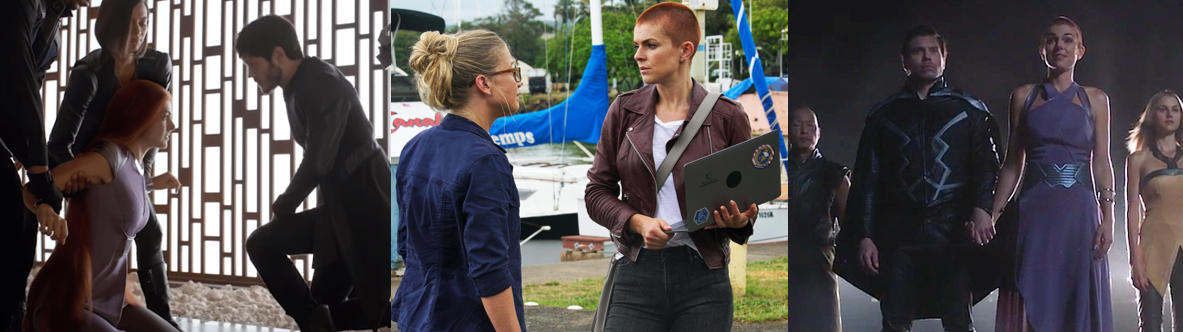
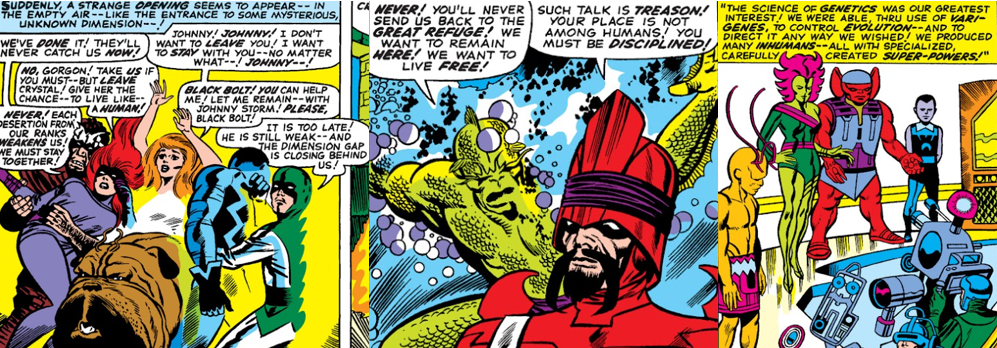
In 1965, the legendary duo of Stan Lee and Jack Kirby expanded upon their earlier work with the X-Men with an entire race of superpowered beings, the Inhumans, initially antagonists to Marvel’s First Family, the Fantastic Four. Brought about as a result of of Kree experimentation with “Terrigen Mist”, the incredible and often monstrous Inhumans have been at the forefront of some of Marvel’s most contentious storylines but gained a new level of infamy when the publishers unsuccessfully and bizarrely tried to have them replace the far more popular and mainstream X-Men. Development of a live-action Inhumans adaptation can be traced back to 2011 and Marvel Cinematic Universe (MCU) mastermind Kevin Feige initially planned for the team to feature in a big-screen movie that would expand the scope of the MCU in new directions. The first seeds of this were planted in the spin-off television show, Agents of S.H.I.E.L.D. (2013 to 2020) but, while the planned movie was soon removed from Marvel’s line-up, Feige remained hopeful that the property would come to life in some form or another. This eventually came to pass in shape of an eight-episode series headed by showrunner Scott Buck, who immediately set about stripping the Inhumans of many of their more recognisable traits and making unpopular decisions regarding the tone and direction of the show. With the first two episodes airing in cinemas courtesy of IMAX, Inhumans sought to tell a more grounded family drama but was notable for both being the first television show to include an entirely CGI character and altering the character’s costumes into something far more sterile and ruining the presentation and characterisation of Inhuman Queen, Medusa (Swan). The $3.5 million IMAX gross of the debut episodes was considered a failure, but this was nothing compared to the critical mauling the series received from reviews; critics slammed the show’s execution, its lack of exciting action, and its overall presentation, though Anson Mount’s performance as Blackagar Boltagon/Black Bolt was generally praised. The failure of the show led to plans for a second season being scrapped and the Inhumans quietly disappeared from the MCU until fairly recently, and rumours of a reboot for the concept continue to circulate online.

The Plot:
Having fled persecution on Earth, a group of Inhumans founded the secret settlement of Attilan on the Moon under the rule of the Inhuman Royal Family. Jealous and slighted at having never developed the same fantastic powers as his peers, Maximus (Rheon) leads an uprising that sees the Inhuman leader, Blackagar Boltagon/Black Bolt (Mount), and his Royal Family trapped on Earth and desperately fighting to return to Attilan to put a stop to Maximus’s power-hungry schemes.

The Review:
Inhumans came out at a weird time in Marvel history; at this time, Marvel Comics made a conscious effort to downplay the X-Men and the Fantastic Four, splitting up and neutering both groups to try and scupper 20th Century Fox’s film franchises to force a deal where those characters could appear in the MCU. The Inhumans thus became very prominent in Marvel Comics, a decision that was met with considerable backlash not because the characters are bad, per se, but more because they were trying to replace two of Marvel’s most popular and iconic teams and they weren’t as compelling as either. I was confused by this decision, but then I’ve never been a die-hard fan of the Inhumans; for me, they’ve cropped up in numerous Fantastic Four comics and that’s about it. I’ve not read much, if any, of their adventures but I was intrigued at the announcement that they’d be getting a movie, and the attempt to incorporate the Inhumans into the MCU in Agents of S.H.I.E.L.D., something subtly alluded to in Inhumans as many, even random humans, are aware of the Inhumans thanks to their recent appearances after the water supply was contaminated by Terrigen Mist. Accordingly, Inhumans are actively hunted by some when they appear, mainly out of fear but also to cut them open and understand their strange powers. This perceived fear and distrust of Inhumans is made explicit right from the first scene of the show, in which a recently transformed girl (Nicola Peltz) is chased by armed soldiers and unceremoniously killed as she flees. Inhuman fishman Triton (Mike Moh) arrives to offer her safety and sanctuary in Attilan, only to fail to save her and be presumed dead, and his death is a major inciting incident in the narrative of the show.

A stoic ruler who must contain his destructive powers, Black Bolt learns to view his relationships differently.

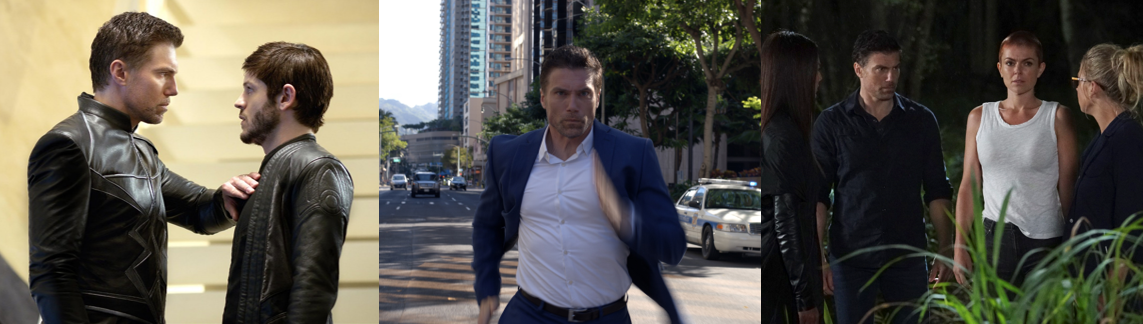
Triton was sent to Earth on the orders of his king, the stoic and perpetually silent Black Bolt, specifically to help Earth-born Inhumans as they are remnants of those left behind after their society fled to the Moon. In a show full of questionable performances and decisions, Anson Mount is one of the highlights; while he only wears a vaguely comic-accurate costume on a couple of occasions (including a crappy little leather-like crown), he conveys a great deal of emotion and character despite being rendered silent due to the destructive nature of his voice. Black Bolt is widely believed, and continuously stated, to be the most powerful and dangerous of all the Inhumans; even the feared living weapon Mordis (Bridger Zadina) pales in comparison as the slightest whisper from Black Bolt could destroy all of Attilan. Consequently, Black Bolt is a man of intense focus; as a child, young Black Bolt (Lofton Shaw) had no interest in being king, much to the chagrin of his morally dubious parents, King Agon (Michael Buie) and Queen Rynda Boltagon (Tanya Clarke). Black Bolt was overcome with grief and feared by his people after accidentally vaporising his parents and it was only the affection of young Medusalith Amaquelin-Boltagon/Medusa (Victoria Isabella Piemonte) that gave him the motivation to master his powers within a specifically constructed chamber. Bonded in their mutual grief, as Medusa had also lost her parents, the two eventually married and became much revered rulers of Attilan, with Black Bolt gaining a reputation for safeguarding his people through a strict policy of secrecy to shield them from Earthly eyes. Due to the nature of his powers, Black Bolt communicates through stern looks, body language, a version of sign language, and relies on the adult Medusa (Swan) as an interpreter. The series is strangely reliant on this, and other characters translating Black Bolt’s “words”; I would’ve liked to see subtitles being used to avoid this as it can be a bit awkward when characters repeat what he’s signed back to him just for our benefit. Black Bolt’s sign language is also entirely unique; few others can understand his “words”, so he’s shit out of luck when his eventual arrival in downtown Honolulu causes a stir and leads to his imprisonment. Despite the fact that he could easily escape prison at any time with his voice, Black Bolt largely co-operates with his incarceration, a fact made even stranger given how quick he was to lash out when the cops tried to subdue him. Black Bolt is an Inhuman of many layers; he secretly colluded to fake Triton’s death in order to force Maximus’s hand and is openly criticised by Locus (Sumire Matsubara) for perpetuating Attilan’s caste system, which sees those with useful, beautiful powers living in luxury and everyone else being forced to toil in the Terrigen mines.

Though rude and utterly unlikeable, Medusa eventually campaigns for positive change for the Inhumans.

Indeed, despite her loyalty to Black Bolt and her love of Attilan, Medusa eventually comes to speak out against the system. When we first meet her, Medusa is the alluring right-hand woman of the king who is traumatised when Maximus kicks off his coup d’état by shaving her hair and forcing her and the rest of the royal family to flee to Oahu. Though a strong and forthright woman who’s more than capable of defending herself, Medusa’s authority is openly criticised by Maximus, with whom she has a tumultuous relationship. We’re told on many occasions that the two used to be close friends, to the point where Medusa unsuccessfully attempts to talk him into halting Attilan’s destruction in the finale, though we’re never given much insight into their past so it almost feels like it was shoe-horned in since Black Bolt can’t speak. Similarly, surprisingly little time is spent dwelling on Medusa’s relationship with her younger sister, Princess Crystal Amaquelin (Cornish); there’s a brief flashback showing Medusa comforting young Crystal (Leila Bootsma) and that Medusa’s always had responsibilities and someone to care about, and she’s later unexpectedly cool with Crystal’s friendship with young farmer Dave (Chad Buchanan). However, Medusa’s screen time is largely spent debating and contrasting with enthusiastic Louise Fisher (Woglom), a scientist from the Callisto Aerospace Control Center who teams up with Medusa after tracking the Inhumans’ arrival. While all of the Inhumans are strangely baffled by Earth, Medusa initially cares only about reuniting with Black Bolt and making Maximus pay; this leads to her having little regard for Earth customs and sees her demanding money from an ATM machine simply because of her royal status in much the same way as Black Bolt simply strolled out of a clothing shop without paying. Though used for comedic effect, this makes her seem stupid and rude; it doesn’t make sense for any of them to be this confused since we saw the Inhumans monitoring Earth, yet she just openly steals from people and is overly rude and aggressive towards Louise. Medusa forces Louise to co-operate by holding a gun on her, is constantly ungrateful and impatient and even ditches Louise once she manages to pinpoint Black Bolt’s location. They have many heated discussions about Attilan’s caste system, a system Medusa’s own parents spoke out against and were killed for trying to change; she thus initially finds idealism to be overrated but comes to be changed through her time with Louise and Locus’s eventual death, which sees her going from wanting Maximus dead to literally begging Black Bolt to set a better example. Upon learning of Black Bolt’s deception and his secret war bunker, Medusa chastises him for keeping her in the dark; her time on Earth makes her realise that she wants to have a greater say in Attilan society as his equal, not just his interpreter, though it’ll take more than a brief bit of despair over her shaved locks and her awkward attempts to learn humility to make me sympathise with such an unlikeable character.

With Karnak’s powers on the fritz, Gorgon’s more blundering nature comes in handy.

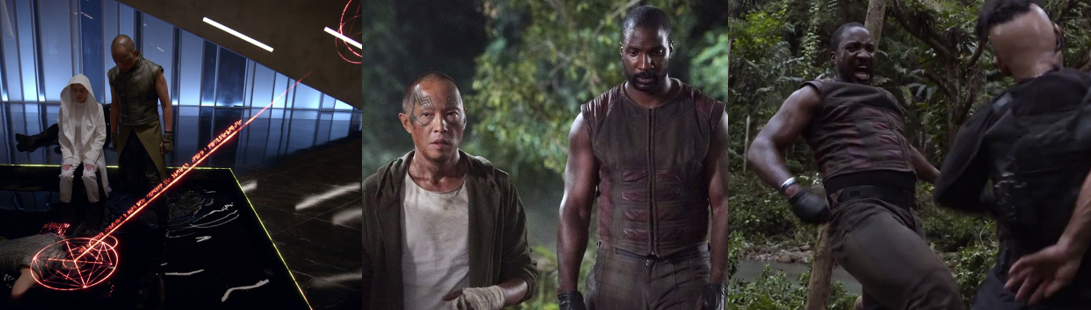
While Black Bolt blunders his way around and Medusa begrudgingly finds herself relying on Louise for help, their cousins, Karnak Mander-Azur (Leung) and Gorgon Pentragon (Ikwuakor), end up mixed up in their own side adventures. While we rarely see Black Bolt’s power and Medusa’s is forcibly stripped from her, Karnak’s unique ability to “see the flaw” in anything and predict outcomes so accurately that it’s almost as if he can see the future is a central point of his narrative as this character who always sees what’s coming takes an unforeseen tumble and hits his head, throwing his powers out of whack and making him doubt himself and his usefulness. Conversely, Gorgon is the meat-headed captain of the royal guard; his childish nature and preference to go charging head-first into any situation are a constant aggravation to Karnak and see him almost drown upon arriving on Earth and forced not only to rely on a group of surfers – including Holo (Ty Quiamboa), Makani (Kala Alexander), and Pablo (Albert Ueligitone) – for aid but also learn the value of foresight and planning, two things he normally relies on Karnak for. While this alliance is short-lived as Gorgon doesn’t want to be responsible for the deaths of his newfound friends, Karnak is irrevocably changed by his unreliable powers and the influence of Jen (Jamie Gray Hyder), a kindly Earth woman who treats his wounds and teaches him to relax. The kindest of the three cannabis farmers who initially take Karnak hostage, Jen finds Karnak alluring; she’s captivated by his tattoos and stories of Gorgon and the Moon and their relationship quickly develops into a romance. Her influence has a profound effect on him, changing him from being dismissive of sexual encounters to being appreciative of them and infusing his cold, analytical nature with a sense of compassion. While this astounds his fellow Inhumans, it also leads Karnak to making uncharacteristically rash decisions; when Gorgon is killed defending the group, Karnak openly defies Black Bolt and Medus (and strict Attilan law) to put his friend through a second Terrigenesis, a purely selfish act reunite him with his aggravating cousin and which results in Gorgon being restored to life but sporadically overcome with a mindless rage.

Crystal, like the other Inhumans, is changed by her time on Earth and encounters with humans both good and bad.

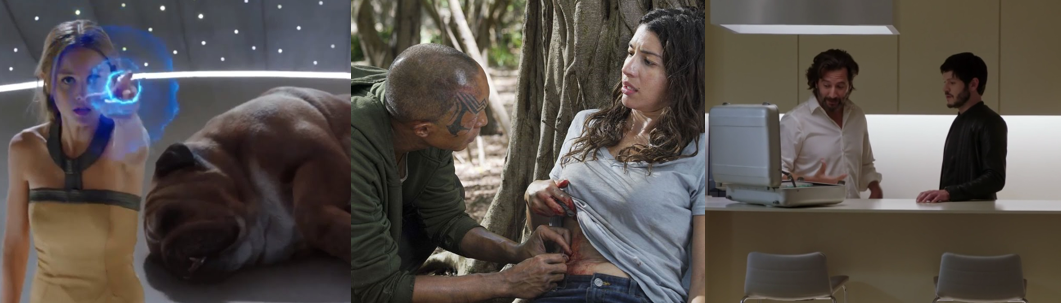
Although Crystal is the youngest of the Inhumans and rarely uses her elemental powers, she serves an important use as she’s able to have her gigantic pet dog Lockjaw instantly teleport people around. There’s a brief subplot where she’s held hostage by Maximus, who subtly threatens Lockjaw and her family unless she agrees to spread his influence across Attilan, but she easily fools him and flees to Oahu with Lockjaw to reunite with Medusa, only to end up falling in with Dave after he accidentally injures Lockjaw with his quad bike. Interestingly, when with Dave, Crystal takes on characteristics of a sheltered and spoiled princess, one who’s used to getting her way and has never been touched by a human; their relationship fulfils a dual role of teaching her not to be so uptight and showcasing that not all humans are as dangerous as she has been taught. Naturally, because they’re both young and attractive, they also end up smooching and Crystal ends the series wishing to live a normal life with this bland, if kind-hearted, young man, a decision Medusa is happy to support since she too comes to regard humans more favourably. In fact, the Inhumans find a surprising number of allies on Oahu; Gorgon just happens to fall in with a bunch of former soldiers who are not only aware of Inhumans but willingly put their lives on the line to aid him, but the standout is obviously Louise. Having lived her whole life dreaming of visiting the Moon so she can scatter her father’s ashes there, she’s captivated by Medusa and the Inhuman race but quickly comes to question their caste system and treatment of their enemies. Of course, not every human is so willing to aid them; Reno (Michael Trotter) is immediately suspicious of Karnak and tries to kill him out of jealousy, a crusade picked up by Tua (Mark Medeiros) after he murders Reno for his disloyalty. Then there’s Doctor Evan Declan (Henry Ian Cusick), a scientist conducting extensive Inhuman research on Maximus’s payroll, though he’s unaware of the truth behind his benefactor. Dr. Declan is a curious character; he aids Black Bolt, facilitating his escape from prison alongside fellow Inhuman Sammy (Olo Alailima) and agrees to help him in exchange for some blood tests. While he’s clearly been experimenting on Inhumans, he doesn’t make any aggressive moves towards them and is instead fascinated by the different physiology; his research is vital to Maximus, who plots to use it to undergo Terrigenesis for a second time and gift himself powers, and Dr. Declan seems happy to help both sides simply out of sheer scientific curiosity, which results in him being killed during Gorgon’s rampage.

Maximus has a forked tongue but leaves the dirty work to his loyal flunkies.

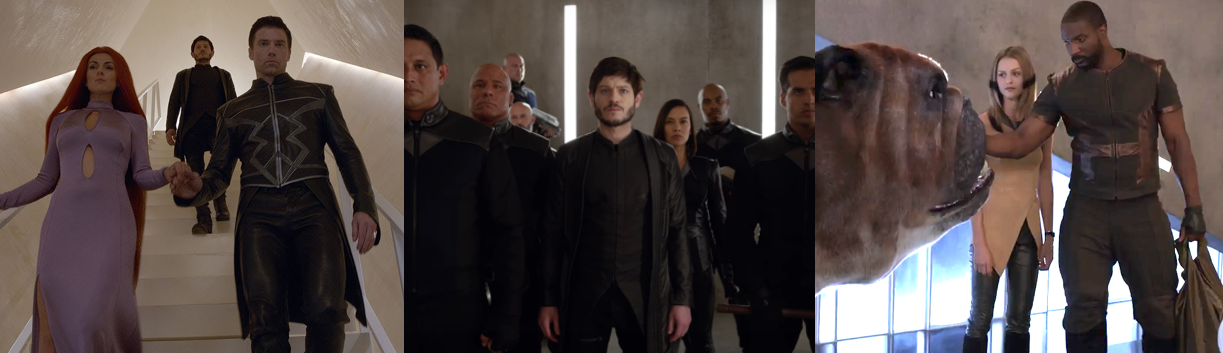
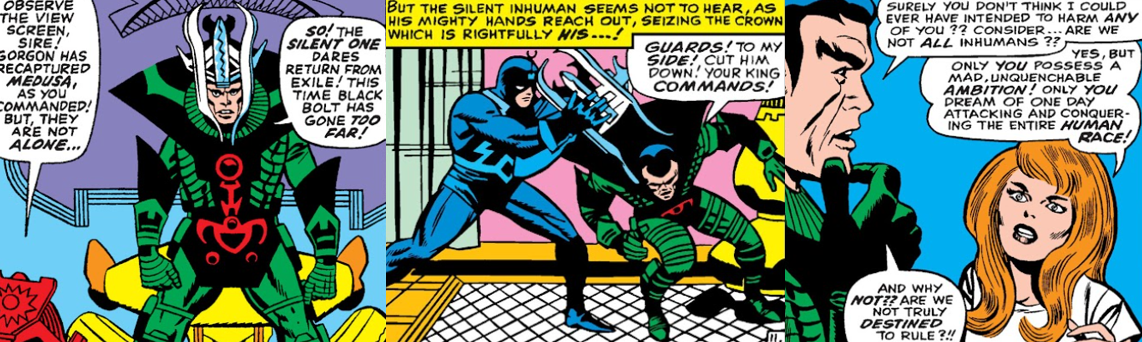
Though he’s firmly pigeon-holed as the antagonist of the series, Maximus is actually something of a revolutionary; carrying a lifetime of resentment towards his brother and father, Maximus is unique among the Inhumans in that Terrigenesis rendered him a mere human and he was only spared a lifetime in the mines because of his royal blood. Maximus openly and routinely criticises Black Bolt’s decisions; he fully believes that the humans will inevitably one day discover them and destroy them once they do and challenges the caste system, earning himself a small but vocal following of Inhumans wishing to rise above their allotted stations. Sporting a silver tongue and prone to elaborate monologues, Maximus seeks to twist every situation in his favour, against the ruling class, or into a veiled threat; he subtly suggests that the royal family have caused death and chaos and fled, assumes the throne in their absence, and sets about abolishing the caste system and conscripting the miners into becoming soldiers to hunt down and kill his family. While he’s no fighter, having failed to learn even basic self-defence from Gorgon, Maximus is an accomplished manipulator and politician; however, his doubters are everywhere, not just because he’s a lowly human but also because he threatens to change Inhuman society in ways that would be disruptive to the genetic council. Because of the threats, disloyalty, and political minefield of his coup, Maximus frequently manipulates Bronaja (Ari Dalbert) into sharing his prophetic visions of the future; while these can be vague, they’re enough for him to intercept a rebellion, kill insurgents and betrayers, and stay one step ahead on most occasions. When he needs more direct action, Maximus employs the services of Auran (Sonya Balmores), a cold-hearted assassin capable of regenerating, to first kill and then capture his family so that he can make better use of Dr. Declan’s research. Although fiercely loyal to Maximus, Auran comes to realise her mortality and turn away from his cause as the series progresses and is at constant odds with Mordis, an Inhuman who emits destructive energy blasts from his face. Mordis’s snarky attitude and rivalry with Auran actually lends the series some much-needed appeal and he’s a surprisingly interesting character; like Black Bolt, he has vast destructive potential, but he was simply locked up and forgotten about because he wasn’t of royal blood and would rather dramatically kill himself than be locked up again. Although Maximus states is plot is based around changing Attilan’s archaic society and allowing them to begin a new life on Earth, by force if necessary, it’s really just a cover for his selfish desire for the throne and to become Inhuman; this obsession not only saw him manipulate young Black Bolt into killing their parents but also endangers the entire city. Ultimately, though he proved to be an unstable and unfit ruler, Maximus does see his dream achieved; the Inhumans migrate to Earth to start over as equals, but Maximus doesn’t get to be a part of this as he’s sealed away in a bunker by his brother and left to rule over the remnants of Attilan alone on the Moon.

The Summary:  
I will say that one thing Inhumans has going for it is its Earth setting; setting the series in and around Hawaii offers a unique visual setting unlike anything seen in the MCU at the time but, in many ways, I think it might’ve been better to just set the show on Earth, with the Inhumans scattered around the globe, and do flashbacks showing their time in Attilan and have the finale take place there because, for a hidden, technologically advanced city on the Moon, Attilan is a massive disappointment. Attilan lacks the grandiose architecture and fantastical visuals of Asgard or Wakanda; everything is made of cold, grey stone, resulting in a lacklustre and cheap presentation akin to old sci-fi television serials. While this may have been a conscious choice, or dictated by the budget, it comes across as lifeless and uninspiring compared to Jack Kirby’s original artwork. I may not always be the biggest fan of his complex and colourful machinery and environments, but a least they popped on the page and impressed; nothing about Attilan impresses and it screams low budget, minimalist, and low quality, three things the MCU was and still is definitely not known for. This extends to the Terrigen Mist ceremony (which, like Attilan, is disappointingly barebones and small-scale), Callisto’s dull warehouse interiors, and the stark emptiness of Attilan’s unimpressive throne room, dining room, courtyard, and bunker. While Maximus notes that the city is small and crammed with too many people, even the streets resemble a backlot or claustrophobic set rather than a thriving cityscape and there’s little appealing or alien about Attilan. Similarly, the costume design and effects are more miss than hit; while Medusa’s hair and wig aren’t great (especially when animated) and her purple dress does her no favours, Black Bolt’s attire looks pretty good, if a bit of a half-hearted attempt to reproduce his comic book outfit. Though Karnak has simple facial tattoos, Triton has some decent enough prosthetics going on, but Gorgon’s hooves mysteriously appear and disappear with no explanation and Crystal barely showcases any of her powers. Lockjaw looks pretty good, considering he’s a massive slobbering bulldog; yes, he obviously looks quite cartoonish, and the teleport effect isn’t great, but I think that’s to be expected of such a ludicrous character and CGI effect.

Sadly, the visuals, effects, and costumes all fail to impress and just come across as cheap.

The show’s action sequences also fail to impress; thanks to the Inhumans spending most of the show scattered across Hawaii and unable to use their powers for one reason or another, we’re denied any grandiose or mind blowing spectacles and are left to rely on car chases, simple fistfights, and shootouts more often than not. Black Bolt, Medusa, and Karnark showcase a blunt efficiency in their movements, easily overpowering and besting multiple armed foes either with their hands or their hair, but these pale in comparison to action sequences seen in the likes of Agents of S.H.I.E.L.D., which is really saying something. Much of the heavy lifting is performed, fittingly, by Gorgon and Auran; Gorgon favours a ground-trembling foot stomp and tossing foes around with his brute strength, which is in stark contrast to Auran’s swifter, more precise fighting style and I enjoyed seeing them clash but these fights were always in boring environments and over far too quickly. Karnak’s action scenes are the most visually interesting and have so much potential; we see him engaging with foes in hypothetical scenarios and learning the most efficient way of dispatching his enemies, but his powers are on the fritz for the entire show, so we rarely get to see this or are simply treated to him being knocked out from behind. The show makes a big deal about the destructive nature of Black Bolt’s voice but we never really get to see this in action; there’s a ludicrous scene of him accidentally atomising his parents, he sends a police car flying which is strangely treating like a huge deal in a world where literal Gods walk amongst us, and he ultimately buries Maximus with a simple whisper but his powers are never showcased to the fullest extent, meaning all that build up was for nothing. Mordis offers some consolation for this, frequently blasting away with his energy beams, but we’re even denied the spectacle of a huge explosion during his and Gorgon’s death scene and, similarly, whatever potential there was in Medusa’s hair or Crystal’s elemental powers is undone simply because the plot and budget demand it, meaning these superhuman characters are more likely to hold people at gunpoint, something hardly befitting their colourful nature.

The focus on human/Inhuman relations and the budget sadly overshadows the family drama.

There’s a general theme of the Inhumans being out of their element and learning new things about themselves and humanity, but it really doesn’t make much sense; we literally see the Inhumans observing Earth and yet, when they arrive, they have no concept of money, our society, no respect for our laws, and little understanding of humans beyond them being dangerous. This results in Black Bolt looking like a complete moron when he wanders about the city and is spirited from place to place; he’s silent and alien in nature but he’s not an idiot and it’s really jarring to see him, Medusa, and Crystal suddenly act like entitled assholes when that wasn’t the case on Attilan. We never even got much of a sense that they were anything but beloved and respected monarchs; we see them freely walking among the people and going out of their way to safeguard the city, and it’s only later that we’re told about the caste system and how awful Attilan can be for those with less desirable or attractive gifts. Since he’s been genetically transformed into a lowly human and his only gift is his forked tongue and unquenchable pursuit of power and adoration, Maximus seeks to change this system, to give the lower caste a chance to shine and take what they want by force. However, perhaps again due to the budget, we see very little of this and most of Maximus’s time is spent trying to win over the genetic council before he just kills them all, being overly reliant on Bronaja’s sketchy visions, and flip-flopping on whether he wants his family dead or alive. Despite being a silent role, Mount does a good job here, but I feel like he’s not in it as much as he could be; instead, Medusa seems to have a larger role and she’s a pretty awful character, and Crystal’s performance is probably the weakest of all involved. Karnak had some interesting development but it’s robbed of a lot of its potential as we never get to see his powers (or any of their powers) showcased in a visually interesting way; we’re just told stuff about them and then they’re forced to adapt to their new situation. Maximus was clearly the standout in terms of intrigue and acting; however, while there’s a central conflict between Black Bolt and Maximus, this really should have been given more focus. While Iwan Rheon is certainly giving it his all and is almost Shakespearian in his performance, Thor Odinson (Chris Hemsworth) and Loki Laufeyson (Tom Hiddleston) they are not. They should be akin to these two, but the production and budget just doesn’t allow it, and they share very little screen time together so we’re mainly informed of their animosity and relationship through other characters, flashbacks, and their individual moments.

Whatever potential the show had was undone by a lacklustre presentation and low budget.

This is a problem faced by the entire show. The Inhumans is a concept that has the potential to be as visually interesting and grandiose as the X-Men, Thor, and the Eternals; Attilan should have been as memorable and impactful as Asgard or Wakanda but, instead, it’s just a series of dull sets. Nothing in Attilan is interesting to look at; they have fancy communicator devices but they don’t incorporate visuals or holograms so they’re useless whenever anyone calls Black Bolt, which is weird as we clearly see the do have this technology. They’re protected by an invisible shield and yet idiots like Gorgon go out and steal flags and smash rovers; they can teleport anywhere they like but only if Lockjaw is at full strength or living wall Eldrac (Moses Goods) feels like cooperating. They’re supposed to be this advanced civilisation, yet the Terrigensis chambers look like shit and they’re more likely to use guns than their powers, and their society is more primitive and backwards than ours since it’s based completely around having impressive and wonderful powers; anything else and you’re in the mines, meaning Maximus is completely right in his pursuit and our “heroes” look pretty awful. Thankfully, Maximus is an unlikeable asshole in all the right ways, so I never found myself rooting for him; but then I wasn’t rooting for the royal family, either. Instead, I was just bored. Inhumans should have been a movie, there’s no question about that; afforded a bigger budget and a two-hour runtime, we could have had something at least more pleasing to look at, if not actually enjoyable. As is, though, it comes across as being cheaper and more half-hearted than an episode of Agents of S.H.I.E.L.D.; arguably, the Inhumans were realised far better there and maybe Inhumans would’ve worked better if some its plots and characters had been woven into Agents of S.H.I.E.L.D. and then spun-off into a ninety-minute feature or something. Instead, what we’re left with is what basically amounts to a contractual obligation; there’s some good performances here, and I’m glad Anson Mount revisited his role later (even if he was still treated like a joke), but it’s hard to care about Inhumans when even Marvel Studios clearly didn’t give a crap about it. There’s a reason this is buried away on Disney+ and was never released on home media and you’re better off just skipping this one and watching Eternals (Zhao, 2021) instead, which really is saying a lot.

My Rating:

Rating: 2 out of 5.

Could Be Better

What did you think to Inhumans? Do you agree that it’s one of the most disappointing ventures in the MCU or did you actually enjoy it? What did you think to Anson Mount and Iwan Rheon’s performances? Were you disappointed by the poor visuals, costumes, and action sequences? What did you think to the themes of the Inhumans finding humility and the depiction of their society? Are you a fan of the characters and, if so, what did you think to the show as an adaptation? How did you react to Marvel’s attempts to increase the exposure of the Inhumans at the time? Would you like to see the Inhumans return to the MCU or do you think it’s better to just ignore them? Whatever your thoughts, drop a comment below or let me know on my social media.

Back Issues: Fantastic Four #45-47

Writer: Stan Lee – Artist: Jack Kirby

Story Title: “Among Us Hide… The Inhumans”
Published:
9 September 1965 (cover-dated December 1965)

Story Title: “Those Who Would Destroy Us”
Published:
12 October 1965 (cover-dated January 1966)

Story Title: “Beware the Hidden Land!”
Published:
11 November 1965 (cover dated February 1966)

The Background:
In 1961, Stan Lee and Jack Kirby came together to introduce comics readers to the Fantastic Four, a dysfunctional family of superheroes created as a direct response to DC Comics’ Justice League of America. While the exact circumstances behind the team’s creation has been contest by both creators, Lee and Kirby’s partnership not only popularised the “Marvel Method” of writer/artist collaboration but also impressed readers with their characters’ real and relatable humanity, essentially birthing Marvel Comics as we know it today. Over the years, numerous characters and concepts that would be pivotal to Marvel Comics would debut in the pages of Fantastic Four, and one of the most contentious of these were the Inhumans. Debuting a couple of years after Lee and Kirby’s similar concept, the X-Men, the Inhumans were first introduced as antagonists to Marvel’s First Family before being expanded to include an entire race of superpowered beings under the lordship of the Inhuman Royal Family. The result of Kree experimentation, the Inhumans were granted their incredible powers and often monstrous appearances by a substance dubbed “Terrigan Mist” and took the dysfunctional family dynamic and unsettlingly aesthetic of both the X-Men and Benjamin Grimm/The Thing and dialled it up to eleven for their colourful and wacky cast of characters. Following their three-issue debut story, the Inhumans graduated to a short-lived solo title and have gone on to be prominent fixtures in Marvel Comics. Their leader, Blackagar Boltagon/Black Bolt, has served on the omniscient supergroup the Illuminati, an Inhuman girl was involved in an ongoing romance with Johnny Storm/The Human Torch, and the species has been at the core of numerous domestic and cosmic wars against both humans, fellow superheroes, and themselves. Perhaps their most infamous legacy, however, comes from that time when Marvel actively tried to downplay the X-Men in favour of the Inhumans, a plan that ultimately backfired when their foray into live-action proved to be a rare misfire for Marvel Studios.

The Review:
Our three-issue saga begins with Marvel’s First Family in a spot of bother; a gigantic android gargoyle known as Dragon Man has kidnapped Susan Storm/The Invisible Girl and allowed the mysterious Tomi Shishido/Gorgon to take off with Medusalith Amaquelin/Medusa, a founding member of the Fantastic Four’s evil counterparts, the Frightful Four. In the fracas, Gorgon caused Doctor Reed Richards/Mister Fantastic and the Thing to be buried beneath the stone rubble of an entire building; however, thanks to Mr. Fantastic’s incredible (and unnerving) elasticity and the presence of the Human Torch, all three are carried to safety and given the precious moments needed to gather their wits and catch their breath after the devastating attack. Reed doesn’t waste any time and sends Johnny ahead to search for Sue and he quickly locates her being carried away by the gruesome gargoyle. Although his flaming projectiles have no effect on the beast, a burst of white-hot nova light temporarily blinds Dragon Man but, before the Human Torch can go to town on the creature, Sue talks him down and demonstrates her ability to tame Dragon Man by talking to him as she would a child, and thus the team are reunited without issue.

After taming Dragon Man, Johnny is besotted by the mysterious Crystal and led to a hidden sanctuary.

Well, not entirely. While Medusa’s Frightful Four cohorts wallow in prison, a restless Johnny hits the streets after his current flame, Dorrie Evans, turns him down. There, he just happens upon a gorgeous redhead and is instantly smitten; however, when he attempts to approach her, a gale-force wind knocks him flying, which only further arouses his…well, let’s just go with “curiosity”. The next day, as the team begin shuffling around their gigantic (and nonsensical) Kirby-machines and equipment to make room for Dragon Man, Johnny is too distracted by thoughts of the redhead to offer any assistance, which earns him an ear-bashing from Sue and Ben that riles the lovelorn youth so much that he heads out to the streets once more. Hanging around near where he saw the girl like an absolute creep, he pursues her relentlessly, even as piles of wood explode into flames to stop him and despite her begging to be left alone lest “they” learn she was seen. However, when she sees his ability to control and burst into flames, she assumes that he’s “of us” and immediately stops running to chat, share her name (Crystal), and strike up a friendship. Naturally, Johnny plays along just to get close to her, but even he’s astounded when she introduces him to her friend, a gigantic slobbering dog called Lockjaw who not only loyally follows her everywhere but opens a set of massive hidden doors using a “force ray” from his antennae. Eager to introduce Johnny to her “family”, Crystal leads him into an elaborate sanctuary built for her and her race by the mysterious Black Bolt. Along the way, Johnny is introduced to the deftly powerful Karnak Mander-Azur, who’s strong enough to shatter a block of marble with one karate chop and swift enough to toss any assailant before they can move.

The team race to Johnny’s aid and are tossed about by the powerful Black Bolt!

Although Johnny’s impressed, his awe and confusion soon turn to horror when he spots Gorgon and Medusa amongst the other strangers, whom he correctly assumes are a race of super-powered beings. Despite Medusa (revealed in the chaos to be Crystal’s sister) pleading with her peers to spare Johnny from harm, Gorgon knocks him from his feet with one stomp of his foot and the lizard-like Triton conjures a glass wall to trap him and then attempts to douse his body with water. Acting swiftly, Johnny bursts into flame and manages to escape through the unprotected ceiling, signalling his teammates with a flaming 4 in the sky and interrupting their efforts to calm down the raging Dragon Man with a tranquiliser gun. Spotting the alert, Reed, Sue, and Ben leap into action using a bizarre flying motorcycle seemingly cobbled together from pipes! This “Airjet-Cycle” may not be much compared to the Fantasti-Car but it’s fast enough to carry them to Johnny’s location, where he warns them of the strange “Inhumans” protecting Medusa. The four venture ahead, unaware of their foes watching them from above; thankfully, the Thing’s strength is enough to repel Karnak’s projectile but the four are stunned when the Inhumans’ enigmatic and much-revered leader, Black Bolt, bursts onto the scene. Black Bolt immediately asserts himself by staggering the hardy Thing with one blow and proving fast enough to sidestep Johnny’s attack thanks to the wing-like appendages under his arms. Though he braces for Black Bolt’s next blow, the Thing learns that their foe is as skilled as he is powerful as he’s able to throw even his rock-hard weight without issue.

The threat of the Seeker drives the Inhumans to fight with all their might.

Reed, Sue, and Ben regroup, and two things come to light: one is that Black Bolt hasn’t uttered a single word since he arrived and the other is Reed’s suggestion that he’s drawing power from the strange tuning fork-like antenna on his forehead. Whilst searching for Johnny, Reed is pounced upon by Triton; the scaly-man-monster’s attempts to keep the Inhumans hidden are foiled, however, when Reed discovers that Triton’s suit is actually a special moisture bag that allows him to survive outside of water. With his water supply ruptured, Triton panics, lashes out, and desperately stumbles into the nearby water to keep himself from suffocating. Karnak launches a counterattack but, when his well-trained blows are repelled by Sue’s invisible force field, Gordon sends the two flying into the air with a ground-shaking stomp. While fighting with Reed, Triton lets slip about an enemy of theirs known as “The Seeker”; while Reed and Sue ponder the threat of the Inhumans and the mystery of the Seeker, the story shows that this individual captured Triton from the water and then led an assault on the Baxter Building to get his hands on the unconscious Dragon Man. Armed with his “Universal Control Rod” and commanding a legion of followers, and with a mighty airship at his command, the Seeker is determined to round up any and all Inhumans and orders his men to search the city for more while he heads back to base with his newest prisoners. Meanwhile, back in the city, the Thing presses his attack against Black Bolt, taking his shots and throwing all of his weight behind his blows, but Black Bolt is able to subdue the hot-headed rockman with his “master blow”, a shot that would have spelt death for the Thing were it not for his super tough exterior and Black Bolt running out of energy at the precise moment he was about to land the finishing strike. The sudden reappearance of the teleporting Lockjaw keeps Ben and Johnny from pursuing Black Bolt and Gorgon continues to keep Reed and Sue off balance with his hefty stomps, but the Inhumans abruptly retreat when Crystal brings word that Triton has been captured by the Seeker. Despite Crystal’s desperate attempts to say goodbye to Johnny before they flee, the strange group make a run for it, for without Black Bolt’s might they would be helpless against the Seeker.

The Seeker reveals his motivations and a brief origin for the mysterious Inhumans.

Medusa’s pleas to leave Crystal behind so that she can live a normal life amongst the humans are unheeded and Johnny arrives just in time to see the Inhumans teleported away by Lockjaw’s power; while Johnny’s strong affection for Crystal is weird and has little merit considering he knows basically nothing about her, Reed is determined to uncover the Inhuman riddle and takes the team back to the Baxter Building, where he reviews security footage of the Seeker’s attack and whips up a probe to take after the villain. Speaking of whom, the Seeker is seen gloating before Triton and expositing his desire to imprison his entire race within the “Great Refuge”; he also orders Dragon Man disposed of or released since he’s not an Inhuman and proves more than prepared for the Fantastic Four’s attack, easily trapping them within a bonkers circular device and keeping them under the watchful eye of his guards. The Seeker then regales the Fantastic Four with the origins the Inhuman race; they enjoyed the benefits of a highly advanced technological society while humans still hid in caves and, through the use of impossible advanced genetics, birthed an entire Inhuman species, each with superhuman abilities. However, the Inhumans fled to the Great Refuge when humans evolved the means to persecute them, and the Seeker has been rounding up his fellow Inhumans ever since to keep them from being attacked by humanity. It’s at that moment that Dragon Man comes to and goes on a rampage, swatting aside the Seeker’s guards and rampaging through the city, leaving Triton suffocating outside of his water bubble. Sue’s compassion for the Inhuman wins over Reed, who orders Johnny and Ben to find and subdue Dragon Man while he and Sue tend to Triton; the pressure of worrying about the destruction Dragon Man could cause sees Reed bark orders at his wife, but they’re able to encase him in a forcefield filled with water. The Seeker is impressed, but no less determined to continue his mission as per the orders of “Maximus the Magnificent”. As Ben and Johnny tangle with Dragon Man, they just so happen to crash through the wall of Alicia Masters’ apartment; Ben endures incredible punishment in a bid to keep his blind love from being hurt and begs her to flee, but also finds the strength needed to finally stagger Dragon Man and leave him wide open for a barrage of the Human Torch’s ultra-violet rays, which finally subdues the beast.

Though quickly deposed, Maximus remains determined to wipe out the human race.

The Seeker arranges for Triton to be transferred to a new water tank moments before the strain of maintaining her forcefield becomes too much for Sue; however, the Seeker demands the two leave since Inhuman affairs don’t concern them. This is the second time Reed admonishes Sue for “sounding like a wife” and yet the Seeker’s logic is infallible: his orders come from the Inhuman ruler and the Fantastic Four have no legal right to interfere, so Reed reluctantly leaves but not before planting a homing device on the Seeker’s ship and remaining so determined to track the Seeker to the Great Refuge that he coldly ignores Sue’s pleas. Black Bolt and the others materialise in the Great Refuge; it seems Johnny’s not the only one who’s ridiculously in love as Crystal cannot stop banging on about the Human Torch despite the fact that they’re all facing the wrath of their ruler, Maximus. Speaking of whom, the garishly attired Maximus offers nothing but anger and reprisals for the group and orders his “Alpha Primitives” to be set upon them while he prepares to use his “Alpha Weapon” to conquer the human race, even though this will surely mean the death of Black Bolt, his own brother! The savage, ape-like Alpha Primitives attack and, in an effort to protect his people and his beloved (if clueless) Medusa, Black Bolt doesn’t hesitate to tackle them head-on. However, even his mighty power cannot hope to fend all off all of Maximus’s greatest assassins but, luckily, the other Inhumans realise that they also have superpowers and can help out as well; although Gorgon cannot use his mighty stomp without fear of hurting his friends, Medusa’s flailing locks and Karnak’s uncanny ability to hit the weak spot of any target are enough to push back the swarming enemies. Maximus then enters the fray, commanding a stop to the violence and feigning friendliness and claiming to have ruled with honour since assuming the crown in Black Bolt’s place. While there’s some question about whether the incident which cost Black Bolt his voice (and the crown) was accidental or not, Medusa is duty-bound to marry her king but the sight of seeing her in his brother’s arms proves too much for Black Bolt to bare and he suddenly yanks the ornate crown from Maximus’s head and claims it as his own. In Inhuman society, this is apparently enough to officially be declared the ruler; even if it wasn’t, Maximus is wily enough to realise that his cunning is little compared to his brother’s power and the support of his allies. Thus, Maximus silently chooses to hang onto his “Atmo-Gun” and bide his time, faking loyalty and admiration for Black Bolt until the time is right for him to strike.

Incensed that Black Bolt may be swayed by the four’s pleas, Maximums activates his machine…

Meanwhile, tensions are high between the Fantastic Four; Sue tries to be the voice of reason and calm everyone down with some hot chocolate but Ben is too worked up over Alicia and Johnny can’t get Crystal out of his head. Feeling spurned by the group, Sue does the only logical thing she can think of; she fusses with her hairdo in a bid to make Reed realise that she’s not “one of the boys” (because marrying her wasn’t enough to prove that…) Their drama is thankfully interrupted when Johnny spots a man flying around outside and Ben is easily able to follow the strange Inhuman and land their aeroplane right on top of the Great Refuge. In the midst of this dangerous and unknown situation, Sue decides to turn herself invisible and damn near cause the three to go into full-blown panic stations just to show off her new hairdo, proving herself to be the same scatter-brained bimbo she always was at this time! While the group struggle with their issues and the dangerous terrain, Maximus continues to play coy with his fellow Inhumans over his intentions and yet he cannot deny his desire to rule over the inferior humans. Spotting the four’s troubles outside, Crystal rushes into the arms of her beloved, but the two groups soon threaten to come to blows when Black Bolt intercepts them. Reed demands a parlay and, through Medusa, Black Bolt decrees that the Fantastic Four may leave without quarrel providing they never reveal the location of the Great Refuge, while Reed counters with the belief that the Inhumans have hidden away for no reason for far too long and could make a home for themselves amongst humankind. While the tensions and the debate rages, Maximus storms into the city, enraged at the very idea of Black Bolt being swayed into thinking the humans aren’t a threat, and casually activates his Atmo-Gun against even the Seeker’s advice! Although the Atmo-Gun sends out vibrations across the Earths atmosphere that will spell the destruction of humanity, the exact nature and extent of its threat is left ambiguous for now as the Fantastic Four face an even greater and more present threat to the world starting from the next issue

The Summary:
I haven’t really had much experience of the Inhumans, if at all; I would even go as far as to say that this is the first story I’ve read where they’re a major part of the plot, so I wasn’t really sure what to expect from the Inhumans saga. The story goes to great lengths to explain how the race are different from Mutants; they were explicitly created through science and genetic-engineering for one thing, and their powers are even more wild, for the most part, but principally the difference is that fact that they’re so isolated and mysterious. Mutants like the X-Men are all over the place, prancing around in colourful costumes and showcasing their powers for the world to see and fear, but the Inhumans have been in hiding for centuries and are only now being identified as this new superpowered race (hough in reality they’re about as complex as Mutants, the Kree, and Asgardians thanks to Marvel having a very predictable storytelling methodology during this time). We don’t get to learn too much about the Inhumans, their society, or their way of life but that would all be fleshed out later; we known they live in a monarchy, one based presumably on birthright and where the right to rule can be challenged at any time, and that they have elaborate and advanced weaponry and technology at their disposal, though we don’t really see too much of that here as the story is more focused on their powers.

Each of the Fantastic Four are insufferable and pompous in their own way.

I’m having a hard time working out which of the Fantastic Four I was most annoyed with throughout this story. Reed is a sexist, dismissive, pompous jerk half the time, constantly belittling his wife and enforcing a patriarchal rule in the guise of competent and rational decision-making. He’s all business when they’re out in the field and expects his orders to be obeyed without question; upon encountering the Inhumans, his first thought is to assess and contain any possible threat but, by the end, he’s advocating for them to come out of the shadows and re-join the world despite knowing full well how despicable humanity has treated Mutants (and each other) in the past. The Thing was his same hot-headed, antagonistic self for the most part; he traded barbs with Johnny and delighted in testing his mettle against Karnak and Black Bolt but was thrown off his game the minute that Alicia was put in danger, revealing a vulnerable side to be sure but also just adding to the relationship angst so prevalent throughout this story. Sue was a royal pain in the butt as ever; she’s such a paradox at this time as she constantly fusses and admonishes the others (especially Johnny) and yet yearns to be accepted, trusted, and seen as a valuable member of the team. Indeed, she plays a pivotal role throughout; she’s able to subdue Dragon Man, fends off Gorgon and Karnak’s attacks while Reed is powerless to oppose them, and even saves Triton’s life despite Reed’s constant reprimands. And yet, she craves attention; even amidst a life-or-death situation, she wants Reed to stop and admire or compliment her and she seems just as incapable of setting aside her vanity as he is his scientific curiosity, making for some irritating moments. But the worst of the bunch is easily Johnny; instantly falling in love with Crystal upon first sight, despite him having a girl on the go, he pouts and mopes about and constantly whines about her safety or never being able to see her despite having known her for a day, at most. Even when he learns that she’s an Inhuman, he refuses to acknowledge that she’s anything other than human, showing he really doesn’t get her in the slightest, and yet she’s equally smitten by him simply because…I dunno, he’s cute? Persistent? Can burst into flames? Their romance is one of the most contrived in all of Marvel and really could’ve benefitted from more time, like if Crystal had been a side character for a few issues before this.

It’s fitting that the Inhumans are the most intriguing aspect of this story arc.

Still, the whole point of this story is to introduce Marvel readers to the Inhumans, and, in that regard, it does pretty well. What better way to prove the strength and capability of your new race of superbeings than by having them go toe-to-toe with Marvel’s First Family, and come out on top quite often? Long-time Marvel readers will already be aware of Medusa and Gorgon, whose tendril-like hair and superhuman strength had already been a headache for the Fantastic Four, but they’re joined by some formidable allies in this story. Although Crystal doesn’t demonstrate any superhuman capabilities, meaning she’s always in need of protection, her faithful friend Lockjaw proves to be a key component in teleporting the Inhumans from place to place and entering their hidden sanctuary. The sanctimonious Karnak boasts of being able to pinpoint the weakness of anything, living or otherwise, to strike with precision blows; although he’s not able to pierce Sue’s forcefield, he proves a more challenging adversary than the blunt and inefficient Gorgon. Triton seems like he might be quite powerful, but we never really get to see what he’s capable of since he’s constantly on the verge of suffocating to death, and the same goes for Maximus and the Seeker, who favour subterfuge and technology, respectively (though also in near equal measure). Even in his first appearance, Maximus has much in common with Loki Laufeyson; both covet the throne, seek to rule, have a silver tongue, and rely on minions to do their dirty work, though Maximus is portrayed as being more explicitly unstable since he dares to activate the dreaded Atmo-Gun and is fully willing to wipe out all of humanity. Thankfully, the Inhumans’ greatest asset is their rightful ruler and leader, the stoic Black Bolt; depicted as being fast as lighting and just as powerful, Black Bolt makes an immediate impression with his iconic costume and his ability to battle the ever-lovin’ Thing to a standstill. Although we learn little about him, we see that he is besotted with Medusa, as brave as he powerful, and a noble Inhuman deep down since he’s willing to let the Fantastic Four go at the end. As a showcase for the Inhumans, this arc works quite well; it suffers from a lot of the same handicaps as other Marvel stories, to be sure, but there’s a lot of mystery and unanswered questions raised by the Inhumans and a fair amount of appeal behind the likes of Black Bolt even though the relationship drama really bogs the narrative down.

My Rating:

Rating: 3 out of 5.

Pretty Good

What did you think to the debut of the Inhumans? Were you put off by the relationship drama or is that something you find appealing in the Fantastic Four’s stories? Which of the four team members is your favourite and why? What did you think to the Inhumans, the depiction of their powers and society, and which of the group was your favourite? Can you name some of your favourite Inhumans stories and moments? Whatever you think about the Inhumans or the Fantastic Four, go ahead and let me know by leaving a comment down below or on my social media.