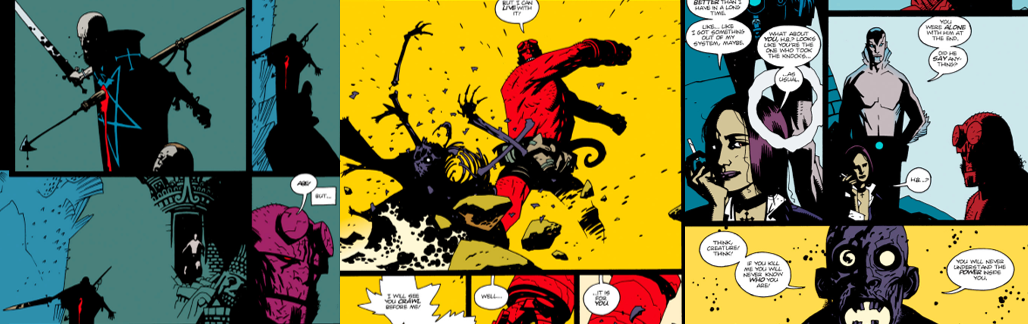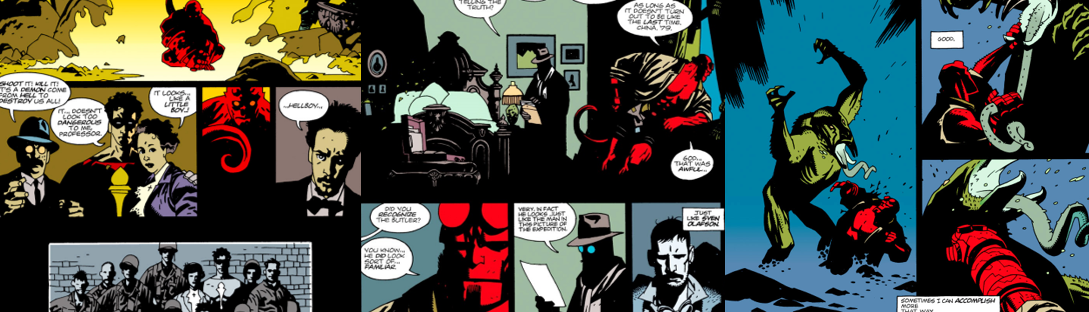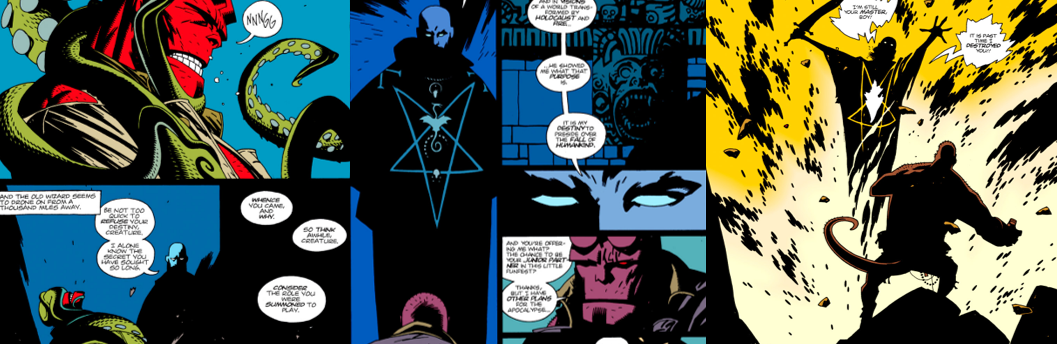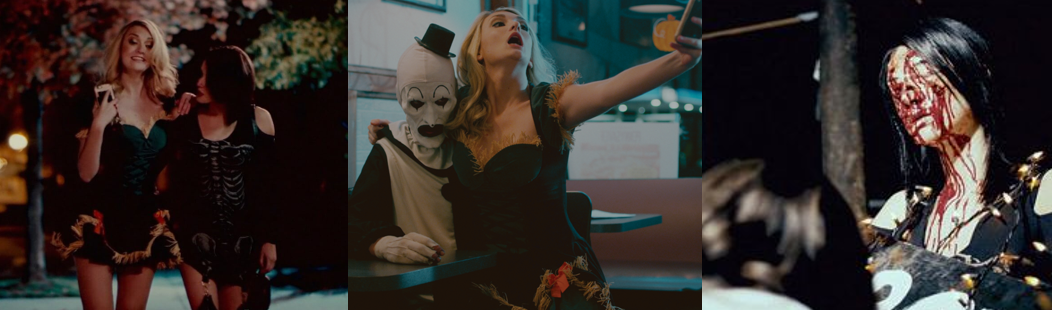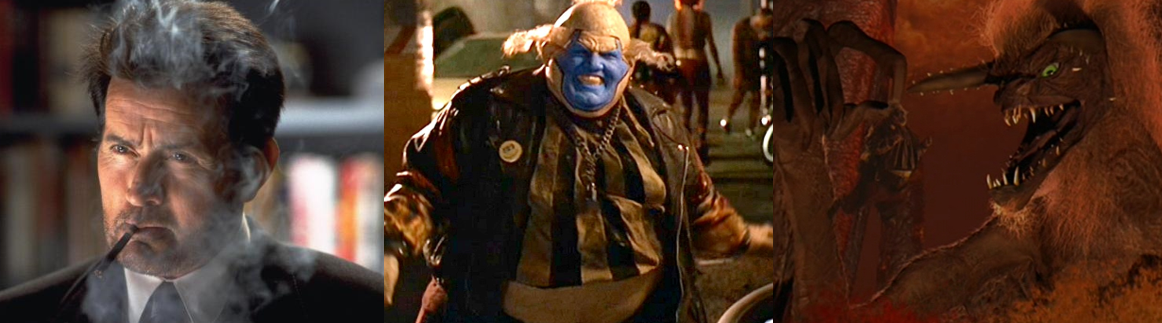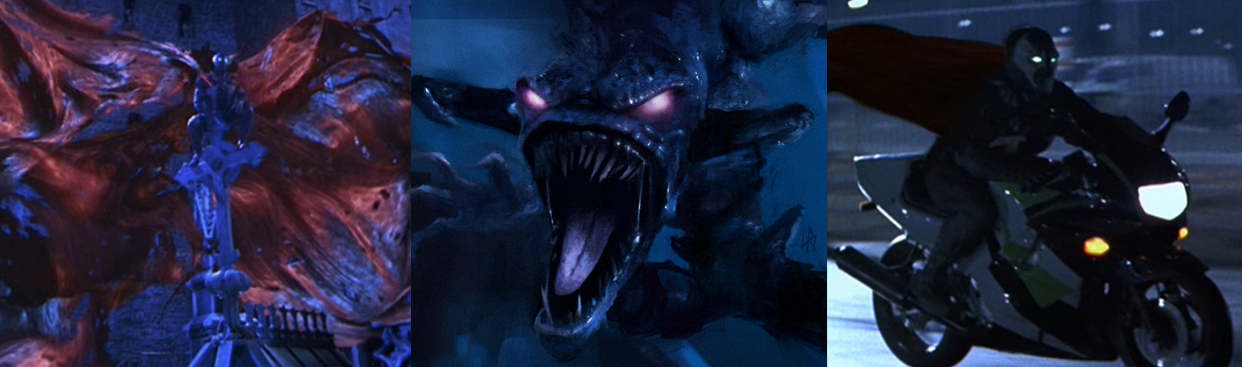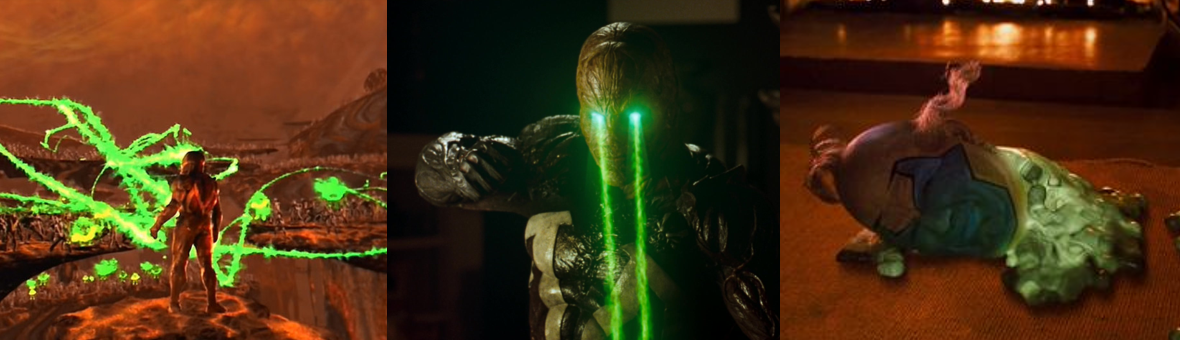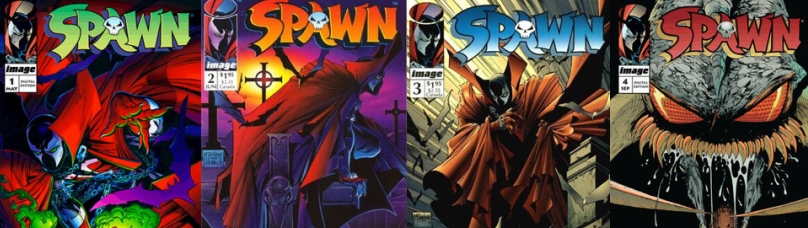
Back Issues: Spawn #1-4

Story Title: “Questions” (Part One to Four)
Published: May 1992 to September 1992
Writer / Artist: Todd McFarlane

The Background:
Born in Calgary, Alberta, Canada, artist and comic creator Todd McFarlane started drawing at an early age and cut his teeth in the comic book industry working on Coyote before getting his big break illustrating Batman: Year Two (Barr, et al, 1987). After jumping to Marvel Comics and working on The Incredible Hulk, McFarlane made a name for himself for his dynamic and kinetic work on The Amazing Spider-Man. Bringing new life to Spidey through his art and his hand in creating popular anti-hero Eddie Brock/Venom, McFarlane eventually became dissatisfied with his lack of creative control over stories and, alongside other Marvel creatives, quit the company and formed their own independent comic book publisher, Image Comics. To spearhead this new venture, McFarlane revisited an old sketch from his teenage years and revised the concept into Al Simmons/Spawn, a former mercenary reborn as a brooding warrior for Hell’s army. Spawn’s debut issue became a record-setting release; selling 1.7 million copies, it was the most successful creator-owned comic of all-time. This success put Image Comics on the map and, aside from a few slumps here and there, Spawn has remained a popular and successful publication for the upstart publisher. This success catapulted McFarlane to new heights, leading to a successful line of action figures, solo and guest spots in videogames, a cult hit animated series, crossovers with DC Comics, and even a muchmaligned live-action adaptation in 1997.

The Review:
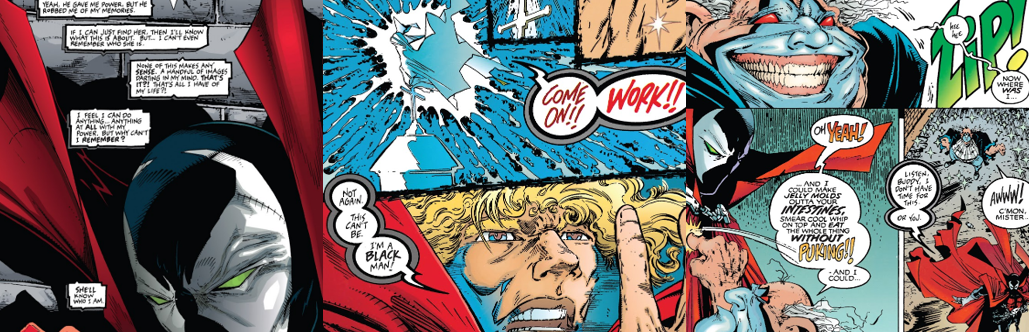
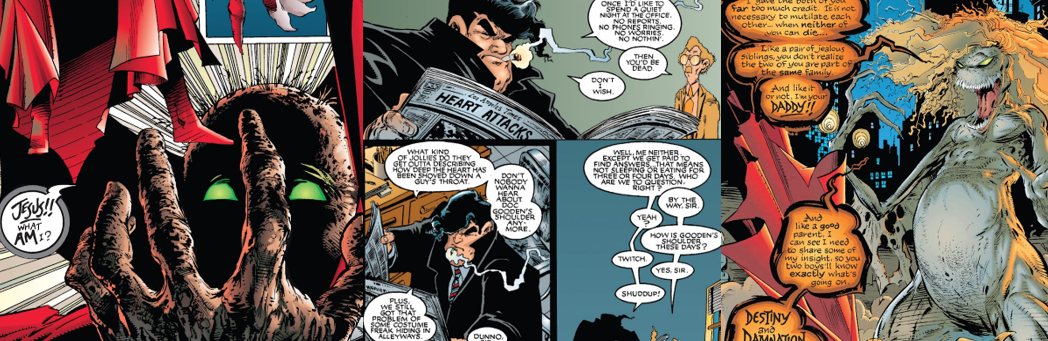
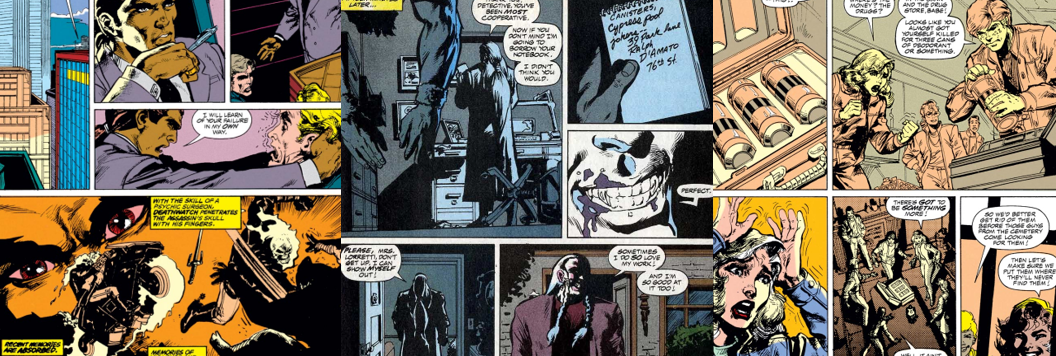
The saga of Spawn begins with Al Simmons, fittingly, tormented by questions. Although Al’s aware of some aspects of what’s happened to him (he died and made a deal to return), he doesn’t know what compelled him to come back from the beyond and feels separated from the mortal realm. His memories are fragmented, giving him flashes of a life he can’t quite recall. He remembers he was in love, though he can’t picture her face; he remembers there’s someone he hates, though he can’t recall his name; and he remembers that he was a good and loyal soldier for his country. Crucially, he’s haunted by the grinning visage of a skull and the feeling of being betrayed and brutally murdered. The more Al broods on his disparate memories, the more scant images come to mind. He pictures a beautiful woman, one who he was so desperate to return to that a wicked demon granted his request but on his terms, dumping him back on Earth with incredible power and an awesome costume but with no idea who he is or what any of his memories mean. Confident that the beautiful woman he sold his soul for will remember him and fill in the blanks, Spawn heads into the night to find her and the one who betrayed him, his thoughts already turning to revenge. Of course, we get scant clues to his true origin through McFarlane’s employment of media reports relating to Al’s decorated career, his untimely death, and Wanda Blake’s grieving process. These are presented in a very Dark Knight Returns (Miller, et al, 1986) format, showing reporters and pundits addressing the reader next to blocks of text, all accompanied by a mysterious countdown that we later learn tracks Spawn’s current power supply. Such interludes are juxtaposed with our first introductions of detective duo Sam Burke and Maximillian Williams/Twitch, who are currently baffled by gruesome murders that’ve left the victims without their hearts.

The tormented Spawn finds only further pain and questions at every turn.

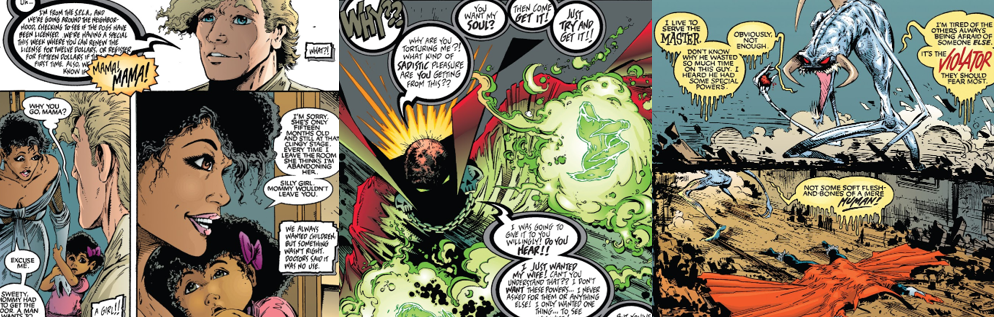
Spawn’s journey across town takes a detour when he spots a gang of lowlifes attacking a woman. Though he effortlessly dispatches the punks, Spawn terrifies the young lady when he’s suddenly bombarded by memories. The woman’s face taunts him and bleeds into memories of his funeral, where his disembodied soul cried out in anguish only to be ignored by his love. Thanks to the girl he rescued comforting him and bringing him back to reality, Spawn slowly realises that the woman he’s been seeing was his wife and that he’s been gone for five years. Desperate for answers, he claws away his mask and talon-like gloves, horrified to find a scarified body beneath his skin-tight leather and chains. While Spawn weeps in the dank alley and Sam and Twitch stew over reports of a costumed figure in a red cape and chains taking out street punks, the wicked, horned demon Malebolgia relishes in Spawn’s pain from his burning inferno. As Spawn broods, questioning his humanity and feeling comforted by his costume and defending the innocent, he ponders the limits of his powers. Focusing his will, he turns his power on himself to restore his human visage and is aghast to find he’s been transformed into a bleach-blonde surfer dude instead of his true form as a Black man. Enraged, realising that he’s being toyed with, Spawn explodes with anger, trigging a fresh set of memories. He puts a face to new name of his employer and mentor: Jason Wynn moulded him into the perfect soldier, only for them to clash when Simmons took issue with Wynn’s increasingly brutal and cold-hearted ways. Overcome with emotion, Spawn collapses in the alley, where he’s approached by a comical, clown-like figure. Spawn had spotted this squat, colourful individual earlier and readers were treated to him dramatically introducing himself and all the ways he plans on torturing and humbling Spawn to appease his boss, the aforementioned Malebolgia. The clown, introducing himself as the Violator, piques Spawn’s interest when he dubs him a Hellspawn and quickly blows his cover.

Spawn’s outrage at having his life stolen is preyed upon by the demonic Violator.

The Violator goes on a tirade, listing all the ways he could slaughter Hell’s newest soldier. Naturally, given the clown’s diminutive stature, Spawn scoffs at his threats and walks away, completely missing the clown’s transformation into a large, horned, slack-jawed demon, the same creature that’s been ripping the hearts out of mafia bosses all over town. Still, for now, the Violator is content to let Spawn go, primarily because Malebolgia gets off on making his creation suffer. As he aimlessly wanders, Spawn is elated to finally remember his wife’s name. He also remembers having parents and brothers and the location of the Central Intelligence Agency (CIA) headquarters and an armoury. He stops by the CIA skyscraper first, accosting creep Billy Miller and threatening him to keep his hands to himself and pay his child support, and retrieves Wanda’s file. However, Al’s distraught to learn she’s moved to Queens and engaged to his former best friend, Terry Fitzgerald. With no other choice, Spawn assumes his blonde visage and heads over there with the vague hope of convincing her to see past his façade, only to be left speechless by her beauty and the unexpected presence of a child, Cyan. The added realisation that he was the problem when it came to giving Wanda a child adds to Spawn’s mental anguish and causes him to black out. Wanda and Terry tend to him and he shares some of his pain with them, only to be met with warmth and kindness. Retreating back to the alleys, Spawns rages, openly challenges the being that’s toying with him and fed up with playing games. Luckily for him, the Violator answers his challenge and, this time, Spawn witnesses the clown’s transformation into his true, horrific form. Caught completely off-guard, Spawn is powerless to keep the Violator from plucking his still-beating heart from his chest. However, the crude, leering demon is stunned when Spawn gets up, a burning hole in his chest and all fired up for a scuffle.

Malebolgia interrupts his “children’s” squabbling to torment and punish them.

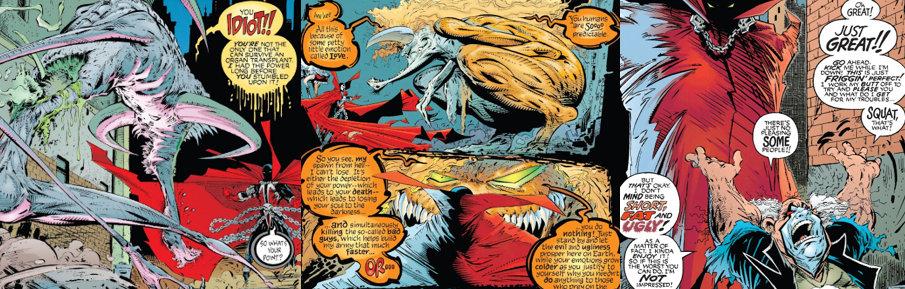
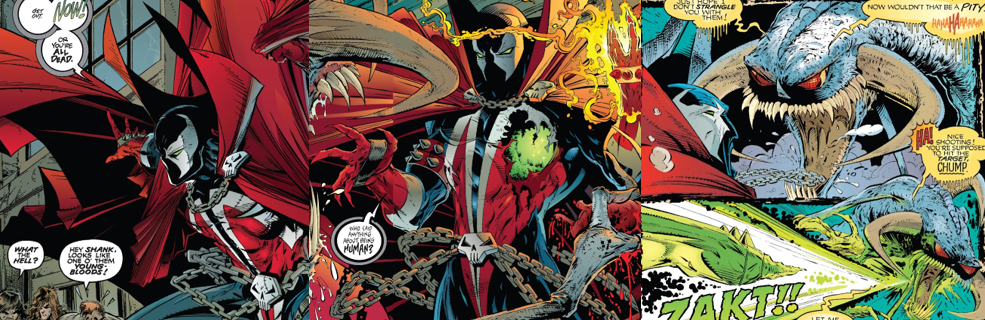
This leads into the final issue of this four-part arc, which finds the Violator incensed to learn that Malebolgia lied to him about Spawn’s powers. Fully expecting to have killed the Hellspawn with his attack, apparently unaware that humans are being gifted powers greater than the denizens of Hell. After expending energy reattaching his heart and healing from the damage, Spawn launches a blast of hellfire at his foe, returning the favour by blasting a hole right through the demon. However, the Violator easily survives the attack, boasting of his superiority, and manhandles Spawn. To the Violator’s frustration, Spawn meets his arrogance with disrespect and the two start shamelessly mutilating each other over a two-page spread consisting solely of dismembered limbs and sound effects. The mindless battle grows so intense that Malebolgia himself manifests in the alley to break them up, chastising such pointless escapades. Addressing the two as unruly siblings, Malebolgia lays out his grand plans to storm the gates of Heaven and go to war with God, a concept baffling to a lifelong atheist like Simmons. Still, Malebolgia emphasises that God is now Spawn’s enemy and details that Spawn’s past life as a hired killer made him the perfect candidate to become a Hellspawn. Malebolgia also explains that Spawn’s power, though vast, is not infinite and relishes in giving him a simple choice: bow to Hell’s whim, expend his power killing “bad guys” and accelerate his return to Hell while bolstering Malebolgia’s armies, or do nothing and watch innocents suffer. Malebolgia then fully heals Spawn, reattaching his arm so as not to waste any more of his energy, and angrily rebukes the Violator when he takes exception to this. Malebolgia punishes him by banishing him to Earth, removing his ability to switch forms, and returns to Hell. Insulted and frustrated, the Violator storms off in a huff, leaving Spawn to brood over his newfound lot in life. Meanwhile, across town, Wanda awakens from a terrible nightmare in which she sees Al begging for help and it’s revealed she’s as haunted by her memories and love for him as he is of her.

The Summary:
I mean…first things first, let’s talk about Todd McFarlane’s unparalleled artwork. Every page, every panel, is so detailed and full of edgy, moody visuals. Barely a scene takes place in the daytime, bathing New York City, its depressing alleys, and, crucially, Spawn himself in oppressive darkness and shadow. Thus, when Spawn goes to Wanda’s in his forced guise of a blonde, white man, the juxtaposition of colour is like a slap in the face. It clearly shows that a normal, human, happy life is now far beyond Spawn’s reach and he stands out, despite his seemingly normal appearance, due to his jagged and distorted speech bubbles, hammering home that he doesn’t belong in that world any more. Spawn himself makes an immediate visual impression. Sure, there’s a lot of Spider-Man, Venom, and Danny Ketch/Ghost Rider in his design but he’s actually more like Bruce Wayne/Batman since he’s mainly brooding or dramatically standing rather than web-slinging across the city. Garbed in a sleek, black costume, Spawn casts an intimidating figure with his burning green eyes and flowing, blood-red cape and McFarlane never wastes an opportunity to depict him against gargoyles, crosses, cutting through the air like a tiger, or seeped in darkness. Considering his monstrous visage is hidden behind his mask for most of these issues, Spawn expresses a lot of emotion. Tormented by memories, he cries out in pain and anguish and lashes out at every opportunity, unaware that even by doing good he’s fuelling Malebolgia’s will since he’s either expending his finite energy or sending more despicable souls to Hell. While the news report sections are less visually engaging for me and simply a copy of Frank Miller’s narrative style, McFarlane makes up for it with his depiction of demons. The Violator and Malebolgia are horrific, gruesome creatures with a constant cackling visage and they represent an explicit, external personification of the dark power Spawn now wields. This, as much as anything else, is what angers the Violator so since he believes humans are unworthy of such vaulted positions in Malebolgia’s ranks.

Spawn and his demonic adversaries shine thanks to McFarlane’s merticulous artwork.

These first four issues set a precedent that would continue throughout Spawn’s publication, creating a constant air of mystery around the titular anti-hero. Simmons walks the alleys with fragmented memories, barely remembering anything of his past life and being tormented by scattered faces, feelings, and recollections of a previous life that eludes him. This brings him great torment and is the design of Malebolgia, who delights in torturing his “child”, fostering his dark ambitions, and humbling him. Malebolgia gets off on spoon-feeding Spawn memories and information, never once letting him forget who he really serves, and takes great glee in explaining that Spawn serves him no matter what action or inaction he takes. Malebolgia’s chief agent on Earth is, of course, the rancid Violator, a boastful little sprite with a chip on his shoulder. He seeks to spread chaos throughout the city by tearing the hearts from his victims and inciting a gang war, confident in his Hell-born power being greater than Spawn’s and eager to showcase his worth to his master by maiming and killing his newest recruit. Instead, the Violator finds himself in a brutal deadlock, with neither he or Spawn able to land a killing blow. Of course, neither thinks to go for the head and this isn’t strictly true as Spawn would inevitably lose due to his reckless use of his powers. At this point, Spawn barely understands what he is let alone the nature of his “Necroplasm” so he expends his energy without thinking. Healing wounds, firing energy blasts, and transforming his appearance all cause the helpful countdown to decrease, showing the reader just how close Spawn is to ending his new unlife and returning to Hell. Malebolgia explains these rules to him, leading to Spawn constantly considering his energy cost in future issues, but it does give a taste of what Spawn’s capable of since we see him reattach his heart, blow a hole through the Violator, and alter his appearance using his dark magic.

These issues perfectly set the scene for Spawn’s subsequent battle against the dark forces.

Sam and Twitch are also introduced in these issues and offer a fun side plot to Spawn’s constant brooding and rage. Essentially a reimagining of Commissioner James “Jim” Gordon and Detective Harvey Bullock, the two couldn’t be more different: where Sam is loud, gruff, and obnoxious and a lot like the Violator, Twitch is quiet, subdued, and methodical. The two are baffled by the Violator’s brutal murders and somewhat at odds regarding the caped vigilante stalking the streets, since Sam is far more lenient regarding Spawn as he doesn’t have to worry about due process. Spawn’s path doesn’t directly cross with these two here, but they’re nicely set up as supporting characters, as are Wanda and Terry. Again, we don’t learn too much about them at this point, especially Terry, but the story does a decent job of emphasising Wanda’s beauty and Al’s undying love for her. He’s haunted by her face, in agony at being denied her and being able to give her a child, and torn between wanting to confess everything to her and stay away from her idyllic new life. These emotions only fuel his anger and Malebolgia’s glee, driving him to chastise others who so freely take their blessings for granted or brutalise rapists and demons alike to vent his frustrations. While I admit the first issue doesn’t have much going on and largely exists to whet the reader’s appetite and the fourth issue devolves into an exposition dump from Malebolgia, there’s a lot to like in these first four issues. The mystery surrounding Al’s life and death is nicely set up, leaving breadcrumbs regarding Wynn and Al’s killer, as is the uncertainty regarding Spawn’s powers. The artwork is the main reason to delve into these issues, and all of McFarlane’s work, but the narrative is intriguing and strong, appealing to the brooding, edgy nineties kid in me. All the key players make a great first impression through McFarlane’s stunning and visceral art and the stage is set from a dramatic and explosive exploration of the dark path Spawn will eventually follow as he tries to piece together his past, have his revenge, defend the innocent, and defy his demonic master.

My Rating:

Rating: 4 out of 5.

Great Stuff

What did you think to Spawn’s first four issues? Did you pick up a copy of issue one? What did you think to Spawn’s costume and powers? Are you a fan of Todd McFarlane’s art style? What did you think to the demonic antagonistic and the mystery surrounding Spawn? Which Spawn characters and story arcs are your favourite? Whatever you think about Spawn, feel free to leave your thoughts below and be sure to check out my other Spawn and horror-related content on the site.

Back Issues: Ghost Rider #1-3

Writer: Howard Mackie – Artist: Javier Saltares

Story Title: “Life’s Blood”
Published:
13 March 1990 (cover-date: July 1990)

Story Title: “Do Be Afraid of the Dark”
Published:
10 April 1990 (cover-date: June 1990)

Story Title: “Deathwatch”
Published:
8 May 1990 (cover-date: July 1990)

The Background: 
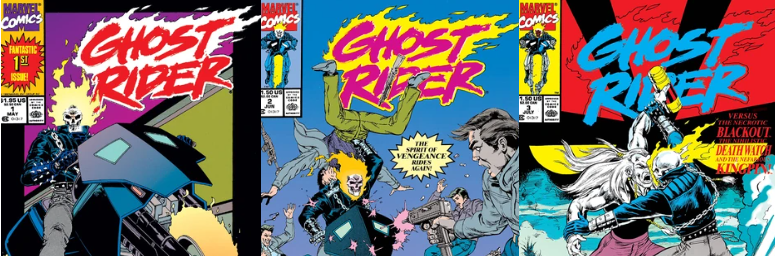
In 1967, Dick Ayers, Gary Friedrich, and Roy Thomas introduced Marvel Comics readers to Western gunslinger Carter Slade/Ghost Rider, who later became known as the Phantom Rider in the wake of his more popular successor, Johnny Blaze. Initially planned to be a villain, Friedrich lobbied to do more with the character, with artist Mike Ploog asserting that he provided Ghost Rider’s trademark look and the legendary Stan Lee dreaming up his civilian name. After ridding himself of the Ghost Rider curse and the demon who caused it, Zarathos, Blaze and his flame-headed alter ego vanished from Marvel Comics for the better part of seven years. However, the Spirit of Vengeance rose again in this story, which introduced a new host for the demon in teenager Danny Ketch, who would later be revealed to be Blaze’s half-brother. During his tenure as the Ghost Rider, Ketch teamed up with both his half-brother and other supernatural or bloodthirsty Marvel anti-heroes, being a prominent member of the Midnight Suns and even temporarily giving his life to stop Zarathos and vampire queen Lilith from conquering the world with their demonic army. While it’s Blaze who is generally depicted as the go-to Ghost Rider whenever the Spirit of Vengeance appears in other media, many of the character’s most recognisable traits come from his successor. Ketch had a sleeker, more streamlined Hellcycle, employed the Penance Stare, and sported a more fearsome, spiked attire, all of which would later be adopted by Blaze when he resumed the mantle. Still, Ketch has appeared in various Marvel cartoons throughout the nineties, though a planned videogame was cancelled and his sole live-action appearance as of this writing is as a child in the poorly received Ghost Rider: Spirit of Vengeance (Neveldine and Taylor, 2011). 

The Review:
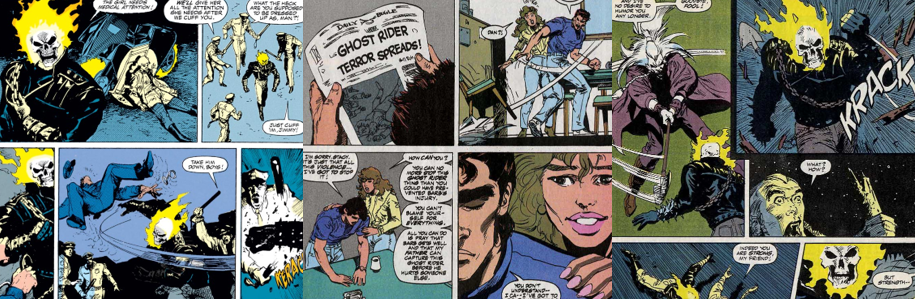
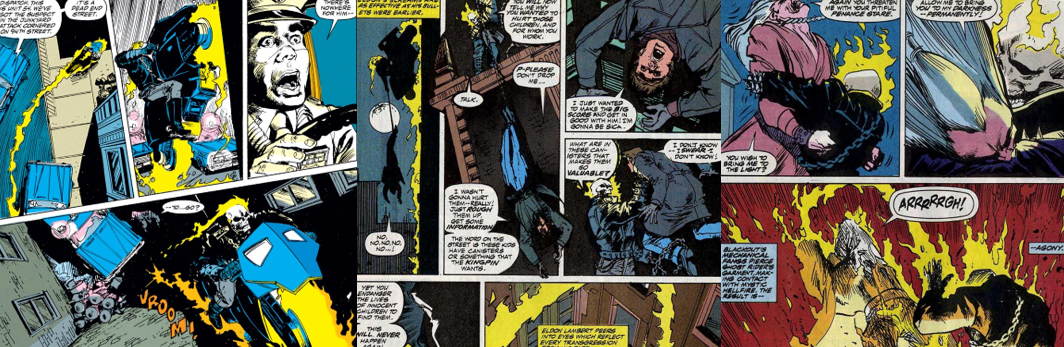
Our story begins in Cypress Hills Cemetery, where bickering siblings Danny and Barbara Ketch have come to scope out Harry Houdini’s gravesite…on Halloween Eve, no less…so Barb can take pictures of alleged psychics trying to commune with him. Anxious Danny, not so quick to dismiss the cemetery’s morbid reputation, is spooked when a bunch of kids (the so-called Cypress Hill Jokers) in Halloween masks give them a fright and try to steal Barb’s camera. She sends them packing with a swift kick and forces Danny to investigate sounds of a gunshot and a scream. Peering into Gallagher’s junkyard, they see some of Wilson Fisk/The Kingpin’s goons threatening the mysterious Deathwatch after the masked man shot dead one of their couriers. When the mobsters are executed by the killer’s crossbow-wielding hoodlums, Barb lets out a scream, landing her with an arrow through the chest. While one of the kids, Paulie Stratton, swipes the case Deathwatch killed for, Danny desperately props the bleeding Barb against an abandoned motorcycle; touching it with his bloodstained hands, he undergoes a sudden and dramatic transformation into the Ghost Rider! His body possessed by the Spirit of Vengeance, Danny’s personality gives way to that of the Ghost Rider’s, who takes out the hooded foes using his demonic chains and his signature Penance Stare, which forces his victim to “suffer the pain” they inflicted on others. Paulie slips away as the cops arrive; they fail to apprehend the Ghost Rider, humbled and manhandled when his bitchin’ new Hellcycle blasts him up a wall to safety. Under the light of dawn, Danny regains his senses and his self, eventually collapsing before his terrified mother and Police Captain Arthur Dolan. When he comes to, Danny learns that Barb is stable, but stuck in a coma, and is devastated at having let her down.

The new Ghost Rider on the block is quickly tormented by failure, bad press, and brutes.

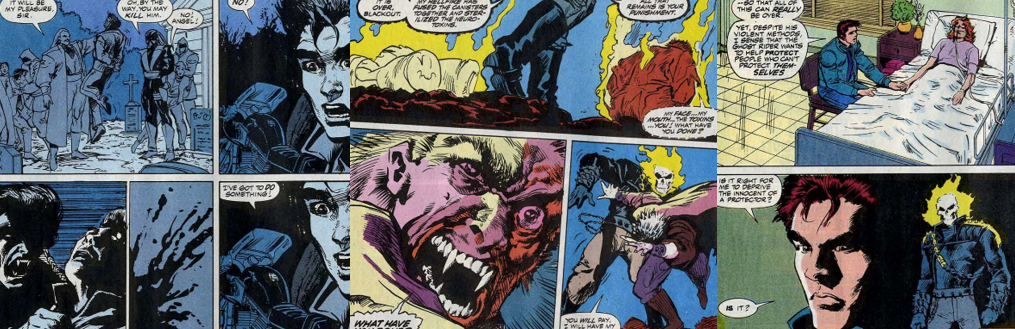
Feeling responsible, Danny tests to see if his demonic experience was real or some fantastical dream and soon finds himself possessed by the Ghost Rider again when the resulting turf war between Deathwatch and the Kingpin leaves Paulie’s friend Raphie critically injured. Luckily, the Ghost Rider arrives in time to intervene, easily shrugging off bullets and even a bazooka, retaliating with lethal force and spiriting Ralphie to safety. However, Danny is stunned to find Captain Dolan has pinned everything on the Ghost Rider, a monstrous force that renders Danny a passenger and leaves him tormented at having failed his sister. Regardless, the Ghost Rider continues to defend innocent lives, specifically the Cypress Hill Jokers, who are constantly threatened by both sets of mobsters. Though still using lethal and violent force, the Ghost Rider is sure to interrogate one of the Kingpin’s goons, subjecting him to the Penance Stare but getting no closer to learning what’s in the briefcase the two crime lords are so willing to kill for. His newfound life already taking its toll on him physically and mentally, Danny is as horrified by Captain Dolan’s smear campaign as he is by the terrifying allure of the Ghost Rider. Elsewhere, the sadistic Blackout enters the fray, murdering a cop and his family to learn where the Cypress Hill Jokers hang out and offering to tie up loose ends for Deathwatch, who’s more than pleased by the brute’s cruel methods. Despite a sensitivity to light, Blackout can freely move through shadows, easily slipping into Ralphie’s home, killing his parents, and attempting to defenestrate him in search of the canisters. Once again, the Ghost Rider is on hand to save the boy, and a brief fight ensues between the two superpowers. While Blackout’s attacks are useless against the Ghost Rider’s power, he demonstrates an uncanny deftness and swiftly flees using the shadows, eager to match blows with the Spirit of Vengeance in another time and place.

Though he triumphs as the Ghost Rider, Danny remains conflicted about his violent alter ego.

Strangely unable to recall exactly where she and the Cypress Hill Jokers stashed the briefcase, Paulie is of little help to the cops and even less help when Deathwatch, Blackout, and their goons storm the station, kill everyone, and kidnap her. In response, Captain Dolan steps up the guard around the comatose Barb, leading to Danny returning to the cemetery to try and help. There, he finds Deathwatch and Blackout in the process of murdering Paulie’s friends to try and find the final canister, which contains a mutated biotoxin Deathwatch plans to unleash upon the city. Angered by Deathwatch’s insolence and aptitude, the Kingpin orders his aide, Oswald Silkworth/The Arranger, to intervene and the bureaucrat successfully convinces Deathwatch to hand over the cannisters by surrounding the duo with dozens of armed men. Unfortunately, Blackout isn’t so willing to comply and violently lashes out, taking the cannisters for himself, ordering his men to attack everyone (even Deathwatch), and salivating at the prospect of blanketing the world in a cold, dark nuclear winter. However, the Ghost Rider enters the fray, taking out Blackout’s goons and tackling him before he can open a canister. Though still able to use the Ghost Rider’s strength against him and resist the Penance Stare, Blackout is burned by the demon’s flames, horrifically scarring him and twisting his already warped mind. The next day, the Kingpin muses over his heroic deeds and vows to watch Deathwatch closely. As for Danny, he returns to Barb’s side, still torn between giving up the cursed motorcycle and his dark alter ego and continuing his dual life as a violent (but effective) protector of the innocent.

The Summary:
Although my reading experience with the Ghost Rider is limited, Danny Ketch’s time in the role is the one I’m most drawn to. As a typical 1990s comic anti-hero, Danny ticks all the boxes: he’s a reluctant hero, tormented by his violent powers, rides a bad-ass motorcycle, and transforms into a cackling, flame-skulled demon who shreds baddies with chains! Just in terms of the art and the storytelling, Danny’s debut blows Johnny Blaze’s out of the water; but then, the 1990s was a different time. Interestingly, Danny’s debut issues aren’t as over the top and fantastical as you might first expect; the story is firmly grounded, save for the supernatural elements, quick to return time and again to Danny’s turmoil over his sister. In bringing Danny to life, the creators have drawn from multiple other heroes to set the tone: Danny’s as unsure of himself as Peter Parker/Spider-Man, as ruthless in his superheroics as Frank Castle/The Punisher, and is faced with violent gang wars headed by the Kingpin, much like Matt Murdock/Daredevil. Indeed, the story closely echoes the tone and atmosphere of Frank Miller’s time with the Man Without Fear and definitely veers more towards a grounded, gritty aesthetic than fantastical, supernatural adventures. The city police only reinforce this by adopting a “shoot first, ask questions later” mentality towards the Ghost Rider, one exacerbated by catching him in the middle of breaking a man’s neck. Captain Dolan’s J. Jonah Jameson levels of persecution against who he sees as a dangerous individual also see the entire force’s efforts focused on the Ghost Rider rather than the turf war between the two crime lords.

Deathwatch and Blackout make for an enigmatic and sadistic bad guy duo.

Deathwatch makes for an interesting, enigmatic, and mysterious individual. Unlike the Kingpin, he hides behind a literal mask and employs hooded assassins not unlike the ninjas of the Hand. He also exhibits supernatural abilities, forcefully reading his victim’s mind with a touch, and isn’t afraid to get his hands dirty. While the Kingpin prefers to operate from the shadows as an elusive puppet master, Deathwatch readily joins Blackout and his men in terrorising the Cypress Hill Jokers, though he slips away when the Ghost Rider shows up. How Deathwatch obtained his powers and what his true origin is remains as much of a mystery as Blackout’s backstory, but I assume these villains were further fleshed out in subsequent issues. Blackout makes quite the first impression, threatening a child and murdering his family with relish, and appears quite happy to kill others, even children, to get his hands on the bioweapon. No mere mindless brute, Blackout is eloquent, savvy, and well trained in martial arts, to the point he can use an opponent’s momentum and strength against them and therefore knock even the overpowered Ghost Rider off his feet. He also possesses seemingly supernatural powers, moving through shadows and showcasing a near-superhuman durability…until he tries to mess with the Ghost Rider’s flames. Deathwatch and the Kingpin’s underlings are no less lethal, happily shooting and stabbing kids to threaten their victims, and engaging in all-out firefights in the middle of the street. The Kingpin’s goons even break out heavy-duty ordinance like bazookas, while Deathwatch’s are happy to destroy an entire junkyard to ensure they take care of any witnesses. The Cypress Hill Jokers, in comparison, are less than small fry; they’re just kids trying to be tough who get in way over their heads when they steal Deathwatch’s briefcase. Paulie largely exists to repeat this plot and look dumb when she can’t remember where they stashed the third canister, resulting in her friends being badly hurt or killed. Still, protecting her and the other Jokers becomes the Ghost Rider’s short-term mission as, despite their assumed petty crimes and rebellious ways, they remain “innocent”.

The new Ghost Rider reinvigorates the character with a visual bang.

As for the Ghost Rider himself…well, he steals the show. Sporting what I would argue is his definitive look, the Ghost Rider bursts to life whenever Danny touches the cursed motorcycle (which, I assume, is Johnny Blaze’s) and immediately seeks to avenge the innocent with brutal and efficient force. Commanding sprawling chains and easily flipping police cars, the Ghost Rider is a physics-defying, unstoppable force of Hell-born justice; immune to bullets, blunt weapons, and most attacks, it takes a lot to even get him off his feet let alone injure him. In fact, his only weakness appears to be daylight and Danny’s troubled conscience since barricades, walls, and near-superhuman foes barely slow him down. These issues finally helped shed a little light on the nature of this transformation. Danny’s personality takes a back seat when the Ghost Rider takes over, leaving him in a dark place both alluring and terrifying. He appears to have little to no control over the Ghost Rider, even struggling to resist making the change at one point, while retaining full knowledge of his actions as the Spirit of Vengeance. Yet, for all the Ghost Rider’s power, he cannot help Barb and his abilities are used to punish, not heal. His demonic visage terrifies most people, making it difficult for him to earn the trust of the innocent and get the injured to safety, but he perseveres, even though his lethal methods see him branded a menace and a killer. The Ghost Rider’s primary personality is spouting his sacred mission and he will allow nothing, and no one, to keep him from defending the innocent and punishing the wicked, making him an extremely dangerous and driven anti-hero. The conflict within Danny is palpable; he can see the potential for good in the Ghost Rider but is worried about hurting others or losing himself to the darkness. This dichotomy makes me interested to read more, to learn what happens to him and Barb, and to find out more about Deathwatch and Blackout. Thus, I really enjoyed these three issues, especially as it injected a bit of the macabre and supernatural into the gritty, urban warzone Marvel calls New York.

My Rating:

Rating: 4 out of 5.

Great Stuff

What did you think to Danny Ketch’s debut as the Ghost Rider? Is this the look you most associate with the character? What did you think to Deathwatch and Blackout, especially their ruthless natures? Did you like the more grounded depiction of the fantastical elements? What are some of your favourite Danny Ketch stories or moments? Whatever your thoughts on Ghost Rider, share them below and be sure to check out my other Ghost Rider content.

Movie Night: Event Horizon

Click here to listen to my guest spot on the Silver Screen Podcast discussing this film

Released: 15 August 1997
Director: Paul W. S. Anderson
Distributor: Paramount Pictures / United International Pictures
Budget: $60 million
Stars: Laurence Fishburne, Sam Neill, Joely Richardson, Richard T. Jones, Sean Pertwee, and Jason Isaacs

The Plot:
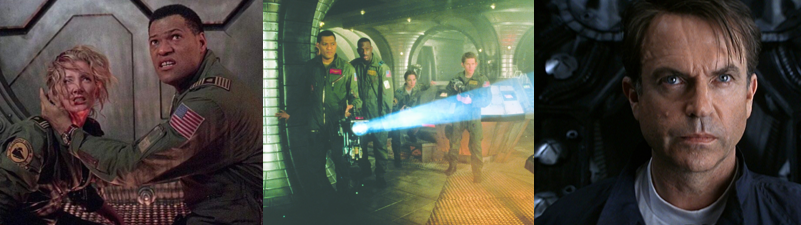
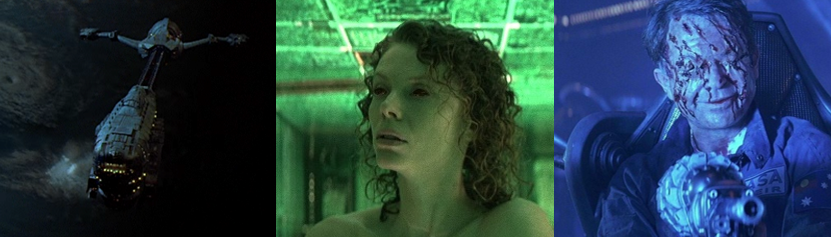
The experimental Event Horizon returns after a mysterious seven-year absence. However, when its designer, Doctor William Weir (Neill), and Captain S.J. Miller’s (Fishburne) crew investigate, they find the ship haunted by a presence from beyond our universe.  

The Background:
It’s not hyperbole to say that Mortal Kombat (Anderson, 1995) made Paul W.S. Anderson’s career. The film’s critical and commercial success saw him bombarded by offers; he turned them all down, even a Mortal Kombat sequel, to make an R-rated horror. Attracted to Philip Esiner’s pitch of a “haunted house in space”, Anderson and producer Jeremy Bolt worked to tweak the script to emphasise these elements and veer away from comparisons to Alien (Scott, 1979), though fans later considered the film a spiritual prequel to Warhammer 40,000 due to similarities between the two. Many effects were done practically, such as constructing moving sets to bring the ominous Gravity Drive to life and harnesses to simulate zero gravity, all on sets said to be oppressive and claustrophobic for the cast. A rushed shooting schedule and pressure from studio executives led to Anderson struggling to deliver a final edit. Test screenings later complained of the extreme gore and subsequent cuts led to the excised footage disappearing, despite fan outcry for a director’s cut. With a box office of just $42 million, Event Horizon was a commercial failure; reviews were equally negative, saved for some praise for the special effects and visuals. However, it has since been re-evaluated and considered a cult classic, inspiring the Dead Space franchise (Various, 2008 to 2023) and getting its due from contemporary reviews, to the point where additional films and even a television series have circled the rumour mill.

The Review:
In the world of Event Horizon, humanity has finally spread its reach beyond our home planet and started to colonise space. First, there was an outpost established on the Moon; then commercial mining began on Mars (where promiscuous women are said to frequent). Then, finally, mankind strived to expand further into the galaxy. To facilitate this, the United States Aerospace Command (U.S.A.C.) first built hyper-fast ion drives and stasis booths to protect their crew from the intense g-forces, then turned to Dr. Weir to develop a prototype for faster-than-light travel. As pilot W. F. Smith/Smitty (Pertwee) and Dr. Weir correctly point out, all the laws of science make light speed unobtainable but, luckily, Dr. Weir found a way around this small hurdle. He developed an elaborate spherical engine, the Gravity Drive, that used focused particles and other complicated pseudo-science to generate an artificial black hole, essentially “folding” space and time and allowing the Event Horizon to instantaneously travel across the galaxy. However, the Event Horizon vanished during its maiden voyage; dubbed the worst disaster in space history, its failure has weighed heavily on Dr. Weir, who focused all his time and attention into the project to the detriment of his marriage. He was so consumed with his work that he failed to notice the failing mental health of his wife, Claire (Holley Chant), until it was too late, and by then she’d already slit her wrists in their bathtub. Haunted by guilt and grief and suffering from constant nightmares of his loss, Dr. Weir is exuberant when the Event Horizon suddenly reappears in Neptune’s orbit transmitting a distress signal and seeks to investigate in hopes of salvaging his life’s work. The true fate of the Event Horizon hasn’t been made public; U.S.A.C. instead concocted a story about it being destroyed due to a power overload. Thus, the rag-tag crew Dr. Weir partners up with to investigate the ship are initially sceptical both of the mission and the Gravity Drive’s ability to tear a hole in the fabric of the universe.

Miller and his crew are roped into a nightmare when Dr. Weir investigates his haunted ship.

Consequently, Dr. Weir is met with a cold reception when he joins the crew of the deep space salvage vessel the Lewis and Clarke. The crew, led by their “skipper”, Captain Miller, are already disgruntled at being recalled from a well-deserved leave and sent to the outer reaches of the galaxy, especially as the last rescue attempt that went that far never returned. They therefore react with hostility when Dr. Weir explains his research to them. Despite also harbouring a resentment towards Dr. Weir, Miller, a by-the-book commander who inspires respect amongst his tight-knit crew, nevertheless chews out some of his more unruly crewmen when they dismiss Dr. Weir’s explanations and is determined to see the mission through as quickly and efficiently as possible. Miller is close to each of his crew, with all of them regarding young engineer Ensign F.M. Justin (Jack Noseworthy) as a surrogate son (they dub him “Baby Bear” and he frequently refers to the ship’s medical technician, Peters (Kathleen Quinlan) as “Mama Bear”). Miller’s served with each of them for a long time and they have a natural rapport based on mutual respect. Miller allows Smitty to light up a cigarette for a job well done and isn’t above joining in with the banter between the crew, ribbing smooth-talking rescue technician T.F. Cooper (Jones) by questioning his contribution to the ship. Like Dr. Weir, however, Miller is carrying a secret pain. He’s wracked by guilt at having left behind a young bosun, Edmund Corrick (Noah Huntley), a decision that has haunted him ever since and driven him to be the efficient commander he is today, expecting nothing less than the highest standard from his crew. As his second-in-command, he expects a lot from communications officer Lieutenant M.L. Starck (Richardson). As their situation worsens, his demands for answers become more forceful, though Miller’s reluctant to entertain her theory that the Event Horizon brought back some lifeforce from wherever it’s been. As Miller is tormented by visions of Corrick and witnesses that suffering of his crew, he directs his grief and anger towards Dr. Weir and the two quickly clash since Dr. Weir comes to be mesmerised and possessed by the ship and Miller’s efforts to escape are constantly thwarted by forces beyond his comprehension. Eventually, Miller’s forced to see that Starck was right and that something has tainted the ship, especially as its influence drives his crew to hysteria and costs him his beloved Lewis and Clarke.

Things go from bad to worse as the ship’s evil influence tortures the crew with visions.

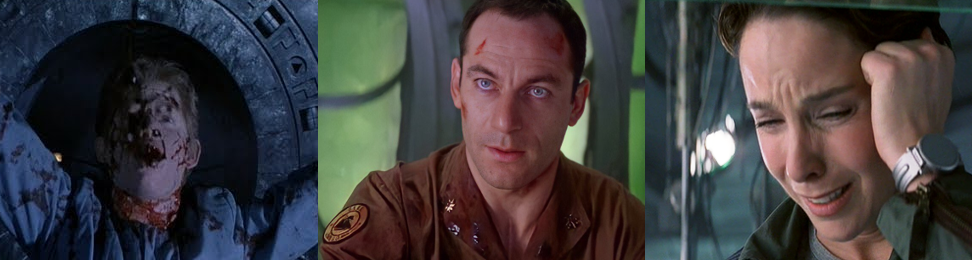
Upon first reaching the Event Horizon, the crew find it to be an ice-cold “tomb” devoid of all life signs (despite driving their scanners crazy) and filled with an ominous dread. When Justin investigates the Gravity Drive, the ship suddenly comes to life; the core (or “gateway”) opens and sucks him in and, though Cooper rescues him, Justin is left catatonic and the Lewis and Clarke is badly damaged. While Smitty works around the clock to repair the damage and the crew risk suffocation aboard the Event Horizon, Peters toils through the ship’s log and is dismayed to find Captain John Kilpack (Peter Marinker) and his crew were driven to a macabre insanity, slaughtering and mutilating ach other in a gore-drenched orgy, the remains of which are still plastered to the ship’s walls. Dr. Weir’s nightmares also come to him while he’s awake. He sees visions of Claire’s eyeless face and hears her voice whispering to him and is enthralled by the Gravity Drive, which slowly influences his decisions and turns him against the crew, dismissing their claims and concerns and causing Smitty to fly at him in a rage. Following a disturbing seizure in which he warns of the impending arrival of “The Dark”, the traumatised Justin is compelled to enter an airlock and kill himself to avoid going back there. To the horror of his crew, Justin is almost killed by decompression, though Miller gets him back in the ship and their resident doctor, the grim-faced D.J. (Isaacs), stabilises him. With Justin sedated in a stasis tank, D.J. is forced to reveal that Kilpack’s distress call, which consisted of Latin, was actually a warning to others to “save [themselves] from Hell”. Though neither Miller or D.J. are the religious type, it seems something evil has latched onto the ship and their situation only worsens when Dr. Weir sabotages their escape plan by blowing up the Lewis and Clarke with an emergency explosive, killing Smitty in the process and trapping the survivors on what is now clearly a very haunted ship.

The ominous Event Horizon transforms Dr. Weir into its demonic agent.

The Event Horizon is the primary antagonist of the film. A needlessly ominous, gothic ship, it looms in space like a haunted cathedral and creates a foreboding presence with its dark, claustrophobic hallways, abundance of spikes and chilling silence, to say nothing of the remnants of Kilpack’s gory orgy the crew eventually find. From the moment the crew step onboard, the ship influences them; not only do Miller and Dr. Weir hear and see their worst fears but Peters is routinely tormented by visions of her infirm son, Denny (Barclay Wright). These are so traumatic that she refuses to work in the medical room, much less alone, and later drive her to a tragic and brutal death when she chases what she thinks is Denny around the Gravity Drive and takes a fatal fall in the process. Of course, the Event Horizon has the greatest influence on Dr. Weir, arguably getting inside his head before he even reaches his beloved ship. Once onboard, his visions intensify; he’s already very protective of the ship and comes up with quasi-logical explanations for the strange events happening, but the crew don’t buy it. Eventually, the ship forces him to relive Claire’s suicide and he’s driven completely off the deep end; he comes to see the ship as “home” and gouges out his eyes, leaving him a half-crazed, demonic figure who coldly destroys the Lewis and Clarke. Miller is deeply affected by Smitty’s death but this explosion also flings Cooper out into space; however, thinking fast, the jovial rescuer blows his air tank and jets back to the Event Horizon. However, he finds Dr. Weir determined to reactivate the Gravity Drive and return to whatever lies beyond. It’s not clear where, exactly the Event Horizon has been; even Dr. Weir doesn’t know where the Gravity Drive leads to. Kilpack dubs the space between dimensions as “Hell”, a name that sticks even for the scarified, possessed Dr. Weir. Rather than jumping from one point in space to another, the Event Horizon punched a hole in reality itself and ventured to “a dimension of pure chaos… pure evil”. While there, the ship was infected by the dimension’s influence and drove its crew mad, apparently gaining a level of sentience and satiating itself on taking their lives (and, presumably, their souls). Accordingly, it delights in torturing Miller and his crew with their worst fears and toying with its prey. It constantly creates roadblocks, forcing them aboard and then trapping them there, intent on dragging the survivors back to Hell to expose them to even more macabre sights and suffering.

The Nitty-Gritty:
Although Anderson may have sought to move away from being compared to Alien, the sci-fi/horror classic’s influence is greatly felt in Event Horizon. For one thing, this is a very gritty, “lived-in” sci-fi world. The controls and technology and aesthetic of the Lewis and Clarke, in particular, are very low-tech, full of buttons and exposed gears, and her crew are very much analogous to the Nostromo’s complement of “truckers in space”. These are working-class space farers, paid a minimum wage and doing the best they can with obsolete technology, and their down-and-dirty attitude makes them very relatable characters who are easy to root for. Miller can be a bit uptight, but he has a great rapport with his crew, even if he gives Starck a hard time more often than not. D.J. is their more sullen crew mate, bluntly introducing himself and even threatening Smitty with a scalpel when he rages at Dr. Weir for perverting the laws of physics. Smitty and Cooper are the most grounded of the crew; however, whereas Cooper is cheerful and fancies himself a ladies’ man, Smitty is more gruff and would rather leave as soon as possible. Honestly, I’m so glad Cooper survived as he’s a fantastic character. He calls Dr. Weir out on his bullshit, earning himself a dressing down from Miller, and brings some infectious levity through his ridiculous return to the ship, which always makes me grin. Peters was perhaps the least interesting for me but she’s given emotional depth through her clear love for her son, while Starck was just trying to be pragmatic and keep her cool. Smitty and Starck immediately sense the bad vibes from the Event Horizon, a ship bathed in a perpetual thunderstorm courtesy of Neptune and constantly seeped in ominous darkness. All too late, Miller turns on the ship, ready to escape and blow it to pieces, only to be scuppered by the cruel-hearted Dr. Weir and his crew picked off one at a time by the ship’s visions or Dr. Weir’s mad designs.

The macabre, gory imagery and effects are especially disturbing, even in brief flashes.

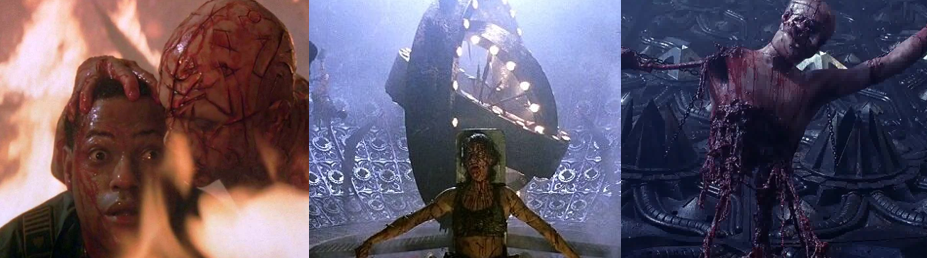
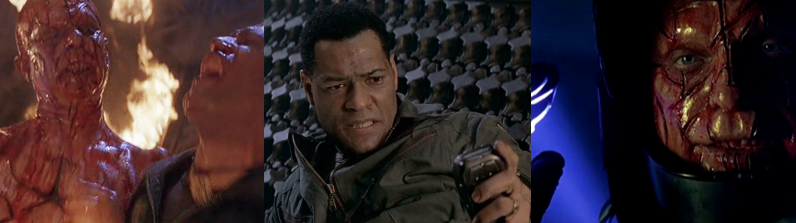
Describing Event Horizon as a haunted house in space is extremely apt, but it’d also be just as fitting to dub it “Hellraiser (Barker, 1987) in space”. In this latter regard, the film performs exceedingly well, offering a far more entertaining and disturbing experience than the actual Hellraiser in space we got. There’s a constant sense of dread as the crew wanders the ship’s dark and claustrophobic corridors. Flashes of lightning reveal disgusting gore on the walls and the frenetic ship logs offer but a taste of the horrors Kilpack and his crew endured while in Hell. The Event Horizon itself is a menacing construction; there’s no reason for it to be as long or intimidating as it is, and yet the Gravity Drive is protected by a “meatgrinder” corridor and full of spikes, creating an unsettling vibe even before the gateway opens. Obviously, there is some dated CGI and green screen effects, most notably in rendering the gateway and when the crew are wandering around the frigid, zero-g interior of the Event Horizon. However, the film makes up for this was some incredible set design (again, everything feels very Alien and suffocating in its aesthetic) and practical effects. Unfortunately, due to studio mangling, we’re denied seeing the full extent of Hell’s wrath and exactly what Dr. Weir does to D.J. but the horror of the unknown lands just as hard. When the scarified Dr. Weir assaults Miller in the finale, he forces Miller to see visions of his crew being raped, tortured, mutilated, and brutalised in Hell. Maggots, scenes of D.J. being strung up in a blood eagle, and flashes of Starck, Justin, and Cooper being flailed and impaled bombard Miller (and the audience) like a fever dream. It’s a disturbing cacophony of frenzied editing, but it works since it forces you to experience Miller’s visions as he’s being shown them. The makeup effects on Dr. Weir are particularly gruesome; first, he tears his eyes out and is left a mutilated, taunting villain obsessed with taking Miller and his crew to Hell. Then, after being blown out of the ship, he’s returned as a completely naked, demonic entity covered in weeping scars, completing his transformation into the personification of the ship’s evil.

Though Miller sacrifices himself to stop Dr. Weir, the ending suggests the nightmare is far from over…

After working tirelessly to repair the Lewis and Clarke, Smitty is dismayed to learn that Dr. Weir has planted an explosive on the ship. Though he frantically searches for it, Smitty’s too late to deactivate it and is blown up with his beloved craft. Angered, Miller arms himself with a harpoon-like nail gun and prepares to make Dr. Weir pay for costing him his ship and his crew. Though he finds Starck alive, he’s left at the scarified Dr. Weir’s mercy, horrified to find the doctor has lost his mind and gouged his eyes out. Now completely consumed by the ship’s influence and determined to defend it at all costs, Dr. Weir activates the Gravity Drive, though he’s seemingly killed when he decompresses the bridge trying to kill Cooper. Miller gets Starck and Cooper to safety and concocts a plan to utilise the Event Horizon’s emergency lifeboat feature. As related by Dr. Weir earlier, the ship was designed to be split in half using explosives placed along its otherwise unreasonably long central corridor. After ordering Starck and Cooper to prepare the foredecks for their departer, leaving them to be assaulted by a very Shining (Kubrick, 1980) inspired torrent of blood, Miller is attacked by Corrick’s enflamed spirit and driven towards the Gravity Drive. There, he sees through the vision and is confronted by the now-demonic Dr. Weir. Subjected to horrifying visions and outmatched by the doctor’s augmented strength, Miller is left with no choice but to set off the explosives to deny Dr. Weir his full victory, sacrificing himself to the Hell dimension to save his crew. Many days later, the wreckage of the Event Horizon is discovered. However, the experience has left Starck traumatised and the film ends with the suggestion that the remains of the ship may be just as haunted as the half that was sucked back to Hell.

The Summary:
I discovered Event Horizon by accident. As a kid, I taped some other movie off the television and accidentally left the VHS running, recording the next movie, which just so happened to be this one. Despite not being into horror back then, I gave it a watch and was immediately enthralled and, to this day, Event Horizon is one of my all-time favourite, go-to horrors. I love the aesthetic of this movie, with its lived-in, gritty, clunky technology and the depiction of Miller and his crew as average Joes caught up in a nightmare they wanted no part of. Laurence Fishburne makes for a great, hard-assed leading man but he’s bolstered by some of Hollywood’s most underrated character actors. Sean Pertwee is always a delight and he’s great as the outspoken Smitty; Jason Isaacs brings a quiet intensity to D.J. who’s just barely keeping his shit together; but the standout was Richard T. Jones as Cooper. He’s just such an infectious and charismatic personality that steals every scene he’s in with his cocksure bravado and blunt honesty. Sam Neill also puts in a great performance as the haunted Dr. Weir; this is a man wracked with guilt who seems on the verge of suicide, and yet who sees the Event Horizon as a second chance. While he’s initially shocked and dismayed by the horrors and death that infest the ship, Dr. Weir is mesmerized by its influence and comes to protect and even love it, willing to butcher Miller’s crew to satisfy his creation’s macabre lust. The horror on offer here is palpable; the Event Horizon is a menacing presence throughout and looms over every scene, seemingly watching and infecting the characters’ every movement. It’s a shame we’ll never see the full extent of the gory visuals but the film works incredibly well despite that. The brief, frantic bombardment of torture and death are enough to hammer home how desolate and wicked Hell is and there’s still plenty of gore on offer. The fantastic use of disturbing practical effects, the unsettling depiction of Justin’s decompression, and Dr. Weir’s transformation into an eloquent and cruel demonic sadistic all make Event Horizon an unnerving and terrifying cult classic. With great performances, some incredible visuals and set design, and a truly frightening premise, Event Horizon will always be highly recommended by me and, if you haven’t seen it or want to see Hellraiser in space done right, now’s the time to change that!

My Rating:

Rating: 4 out of 5.

Great Stuff

Have you ever seen Event Horizon? Do you agree that it’s an under-rated cult horror classic? What did you think to the visuals, the gothic construction of the titular ship, and the foreboding atmosphere? Which member of the crew was your favourite? What did you think to Dr. Weir’s descent into demonic insanity and Miller’s selfless sacrifice? Would you like to see the excised footage full restored to this movie? I’m always happy to talk about Event Horizon so please leave your thoughts below and go check out my other horror content across the site!

Game Corner: Resident Evil Village: Gold Edition (Xbox Series X)

Released: 28 October 2022
Originally Released: 7 May 2021
Developer: Capcom
Also Available For: Nintendo Switch, PC/Mac, PlayStation 4, PlayStation 5, Stadia, Steam, Xbox One, Xbox Series S

The Background:
Helmed by Shinji Mikami, Resident Evil (Capcom, 1996) was a seminal title for the up-and-coming PlayStation, one whose focus on atmospheric horror and resource management popularised the “survival-horror” subgenre. A critical and commercial success, Resident Evil was quickly followed by a numerous sequels that continued to refine the gameplay, add to the lore, and be equally successful. After a troubled development, Mikami re-invented (and once again re-defined) the genre with the ridiculously successful Resident Evil 4 (Capcom Production Studio 4, 2005), though Capcom soon drew heavy criticism for over-relying on an increasingly action-orientated and over the top presentation. Thus, Capcom shook the franchise up again with Resident Evil VII: Biohazard (Capcom, 2017), which took the series in an all-new direction, featured an immersive first-person perspective, and introduced new mechanics and lore that would impact subsequent releases. Although Resident Evil VII was a critical and commercial success, development of an eighth instalment began about a year and a half before VII released. Inspired by Resident Evil 4, the developers purposely focused on a village as the central location and sought to create a balance between combat, exploration, and puzzle-solving. In addition to tying up the story of VII’s protagonist, Ethan Winters, the developers aimed to encourage exploration with an ever-shifting, more open-world environment and drew from gothic horror to design the game’s new werewolf-like enemies. Resident Evil VIII’s marketing heavily focused on Lady Alcina Dimitrescu, a towering, alluring, vampiric figure whose sex appeal helped boost interest in the game, which led to over three million copies being shipped within the first four days alone. The game’s new direction and ties to Resident Evil 4 were praised, as was the gameplay variety and emphasis on exploration, though the bosses and puzzles drew some criticism. Still, the game was a hit, more than justifying the release of additional downloadable content (DLC) within the following year. All of this DLC, which included additional gameplay modes and an epilogue story, was then made available on this Gold Edition release.

The Plot:
Three years after escaping the Baker family, Ethan Winters faces an all-new terror when his infant daughter, Rose, is kidnapped by Mother Miranda, the fanatical leader of a cult-like coven, after being seemingly betrayed by Chris Redfield.

Gameplay:
Like its predecessor, Resident Evil Village (stylised as Resident Evil VII.I.age) is a first-person survival/horror title in which players are again placed into the bland, faceless shoes of Ethan Winters, easily the franchise’s dullest character. Ethan has been fleshed out a little more this time around, though, to be fair. Between games, he and wife Mia have relocated, starting their lives anew with baby Rose; he has much more to say and far more agency this time around since he’s trying to rescue (and restore) his baby daughter; and he’s a little more competent after his experiences in the last game. If it’s been a while since you played Resident Evil VII, you can watch a helpful recap before setting up your subtitle, screen, and sound settings and, thanks to this Gold Edition of the game, you can play in third-person mode, which was my preference. Resident Evil Village offers four control setups, but the default is serviceable enough. You aim with the Left Trigger, guard against enemy attacks with the Left Bumper (with successful timing shoving enemies away), shoot with the Right Trigger, use a recovery item (such as First Aid Med) with the Right Bumper (a godsend in sticky situations), examine points of interest and pick things up with A, reload with X, and open your inventory with Y. By default, B does nothing except perform a quick turn in conjunction with the left stick, which can also be pressed in to break into a run. Pressing in the right stick allows you to crouch behind cover or through tunnels and small gaps, and you can switch weapons using the directional pad, with four different weapons able to be applied to this weapon “wheel”. There are also options to adjust aim assist, the intensity of the damage display, onscreen tutorials, and how much of the heads-up display is visible, allowing you to customise a more cinematic experience if you wish.

Craft health and ammo and purchase new items and upgrades from the Duke.

There are three difficulty settings to choose from at the start of the game, with a fourth, “Village of Shadows”, unlocked after beating the game on any difficulty. Naturally, the harder the difficulty, the tougher the enemies will be, with even basic foes tearing your throat out in a few hits on “Hardcore” difficulty. Unlike in the classic Resident Evil titles, there are no fourth dimensional Item Boxes here. You’ll need to combine and craft items to save inventory space, or spend the Lei dropped by enemies or found in destructible crates to expand your carry capacity. Yes, the crafting system is back; by finding items such as herbs and gunpowder, Ethan can craft recovery items, ammunition, and even explosives like pipe bombs and mines. New “recipes” can be purchased from the game’s rotund merchant, the mysterious Duke, who will happily purchase any treasure you’ve found, sell you ammo, weapons, and healing items, and also tunes up your existing weapons to make them more powerful. If you kill local wildlife, you can bring the meat to the Duke to cook food that increases your movement speed, maximum health, and reduces the damage you take while defending, though the Duke’s prices increase over time and he can even sell out of items, so it’s best to keep an eye out for craftable pickups. I’d also recommend caution with your weapon choices; eventually, better weapons will become available and you can only carry so much, so it’s easy to invest a lot of money tuning up your default handgun only to then have to sell it for the stronger upgrade. You can buy back any weapons you sell, but you can’t remove any charms or attachable tools (such as the scope for the sniper rifle or the extra magazines) from your weapons, so I definitely think it’s better to wait for the W870 TAC shotgun to become available and spend your money upgrading that as opposed to the first shotgun you find.

Alongside some challenging combat, you’ll solve rudimentary puzzles and acquire elaborate keys.

In addition to a decent weapon selection to choose from, Ethan can also use his environment to fight back against the lycan-like enemies that infest the titular village. Explosive barrels will blow enemies away and can hold A to barricade doors with furniture against enemies. You can shoot them off rooftops, sometimes you’ll need to rapidly tap A to escape an enemy’s grasp, and some larger enemies will even attack their smaller cousins. Even on the “Standard” difficulty, Resident Evil VIII is pretty tough. You often have just enough on hand to survive an enemy onslaught, after which you’ll be in dire need of resources to fend off the next enemy encounter, so it’s worth searching every drawer and cupboard, even if many of these are empty. Luckily, your map will indicate any missed items in the local area; it highlights treasures, locked doors, and missed items. You can then backtrack when you have the right keys or the environment has altered to grant you access, and you can still find helpful files that flesh out the game’s lore, Mother Miranda’s connection to the Mold and the Umbrella Corporation, and provide clues or solutions to the game’s puzzles. These may be as simple as finding bolt cutters to break chains, using a key to unlock a door, or finding and entering combination codes, but also become a wild goose chase as you search for masks, examine items for keys or add-ons for existing keys, insert glass eyes into holes, awkwardly swing flaming lanterns, and pull levers to open doors. As ever, you can save your progress at any time using a typewriter. You don’t need to worry about ink ribbons here, and the game also includes an autosave function so you’ll respawn from checkpoints when you die, but I’d recommend making a couple of save files so you can backtrack for missing items or optional side quests as you’ll eventually reach a point where you can’t return to the village that acts as a central hub, of sorts.

While the game peaks early, there’s enough variety and intrigue to keep you hooked throughout.

Resident Evil Village tasks Ethan with venturing to four distinct areas from the titular village, which alters (along with the title screen) as the game progresses, becoming infested with tougher enemies, set on fire, and ransacked by the Mold. Each of these areas presents a unique, but also familiar, challenge; Lady Alcina Dimitrescu’s castle, for example, is very reminiscent of the original game’s ornate mansion, and Lady Dimitrescu herself patrols the hallways, pursuing you throughout the estate like her predecessors, Mr. X and Nemesis. When trapped in House Beneviento, Ethan loses all his gear to the childlike Donna Beneviento and her malevolent puppet, Angie, who force you to complete a series of puzzles, including finding items to investigate a mannequin, rearranging film cells, and searching for fuses, to escape and reclaim your items. The toad-like Salvatore Moreau dwells in a mine, one infested with slime-like pustules, outside a massive lake strewn with wreckage that you must cross, lowering and raising temporary platforms, to power up the generators. Finally, the rebellious Lord Karl Heisenberg dwells in rundown factory populated by horrific cybernetic monstrosities. Here, you’ll use the smelting equipment to craft key items to progress, take a maintenance lift, and battle Heisenberg’s cyborg creations. After defeating Heisenberg, you’ll take control of the far more capable Chris for an all-action infiltration of the village and the catacombs beneath it. Chris has better weapons on hand, utilises ample supply drops, and calls in air strikes by holding down RT,  making short work of Mother Miranda’s Mold defences and the hammer-wielding Uriaș who plagues Ethan so often in the main story.

Graphics and Sound:
It’s almost astounding how good Resident Evil VIII looks; the environments, especially, are moody, dank, and claustrophobic while also being genuinely creepy and unsettling, and the use of ambient noise, distant scratching and screaming, and sporadic music really adds to the tension. The level of detail is incredible at times, with Ethan panting and showing visible pain when low on health, blood splattering on his weapons, snow and frost ransacking the village, bullets and blood alike marking doors, windows, and the environment, and heads sporadically exploding in a shower of gore. Playing in third-person allows you to finally see Ethan’s character model, though he’s still just a guy, one whose face is oddly obscured no matter how much you wriggle the camera. Interestingly, many of the character models (basically anyone who isn’t Chris, who’s been redesigned once again) sport a shiny, uncanny look that makes them seem not quite real. This is fine for the monstrous enemies, but makes human characters a little unsettling to look at in the wrong lighting (though, admittedly, this may be due to the brightness settings I chose). Resident Evil VIII ventures towards the supernatural for many of its enemies, depicting werewolves, witches, and shambling wretches alongside cyborg brutes fitted with drill arms! If these get too close to you, you’re gonna be in for a bad time and treated to some gruesome death scenes, but it’s equally satisfying seeing them be blown to pieces by a well-timed grenade round.

There are some creepy and visually impressive locations beyond the titular, ever-changing village.

As you might’ve guessed from the game’s title, the village plays a prominent role here. It’s your central hub you’ll return to time and again and have to explore and defend throughout the story, housing a church, graveyard, ruins, rivers, and more. Largely barren due to the events taking place, there’s a constant dread hanging in the village that’s mirrored by its adjacent locations. While some areas (stately homes, mostly) are guilty of recycling assets such as ornaments and furniture, others are more visually unique and unsettling, such as the cyborg factory and the creepy doll’s house-like House Beneviento. Resident Evil VIII continues to move away from the futuristic laboratories of Umbrella and takes more cues from Resident Evil 4, bringing an Eastern European flavour back to the franchise. I’m actually surprised it didn’t try to harken back to the backwater locations of the last game. However, these are partially evoked in your encounter with Moreau and when the Mold starts bursting from the ground and overtaking the village, but it’s a tenuous link, at best. The game’s story is engaging enough and mostly related through in-game cutscenes that retain the first-person perspective. You’ll be falling or sent crashing through floors and walls, have your limbs and organs cut off or ripped out, and be constantly interrupted by surprise attacks or jump scares. Everything’s played very seriously here, with very few glib remarks from the increasingly tested Ethan, with the exception of Mother Miranda and her lieutenants, who are almost as over the top as the crazed Baker family from the last game. Sadly, much of their personality is lost when they transform into gigantic, boil-infested monstrosities as per Resident Evil tradition.

Enemies and Bosses:
In place of zombies, bio-organic weapons, parasite-infected villagers, and Mould creations, players battle werewolf-like lycans upon first entering the village. These snarling brutes are nimble and voracious, lunging for you and trying to tear your throat out and taking a fair few shots to be put down. A larger, armour-clad variant is also encountered, one that is better shielded from headshots, and bigger, more monstrous Vârcolacs pose a significant challenge if you’re caught unprepared. The spirit of the classic games is evoked through the shambling, sword-wielding Moroaicǎ, hooded, gaunt figures that rise from shallow water and attack in groups, while bat-like Samcas nest on the rooftops of Castle Dimitrescu. While the mindless Haulers are little more than cannon fodder in Heinsberg’s factory, his cyborg Soldats aren’t to be trifled with. Sporting up to two drill-like appendages and a variety of cybernetic armour, these lumbering walls of muscle can only be put down by blasting the exposed core on their chests, a task easier said than done when they attack in groups and are protected by quasi-mech suits. Most of the game’s more formidable enemies, like the Vârcolacs and Soldats, are introduced as mini bosses, giving you a chance to sample their abilities before they become commonplace and are joined by even stronger variants as the game progresses.

Monstrous and grotesque abominations are the order of the day, however unfitting some of them are.

The first boss you encounter is the aforementioned Uriaș; although it is technically possible to defeat him when he first appears, this isn’t necessary, you just need to survive until the plot progresses. Uriaș shows up as a proper boss twice during the main campaign; first, Ethan fights him in a confined space full of pillars to take cover behind. You’ll need to stay well clear of Uriaș’ giant hammer and leaping attack, and fend off the lycans for resources, preferably blasting him with your shotgun or grenade rounds to put him down. Uriaș also shows up when playing as Chris, but this fight is much easier as you simply need to target him for a few air strikes, surviving until he’s put down once more. As if frantically avoiding Lady Dimitrescu’s appearances isn’t bad enough, her three witch daughters – Bela, Daniela, and Cassandra – also haunt Castle Dimitrescu, appearing as a swarm of bugs that will whittle your health down and then taking physical form to dash at you with scythes. These three can only be made vulnerable by pulling switches or breaking windows to let in a blast of cold wind, with you constantly strafing to keep them in the cold, or pulling levers to keep the pressure on, while blasting at them until they turn to ash. Lady Dimitrescu herself cannot be harmed or killed when she’s pursuing you, but will transform into a massive, dragon-like bat-thing for a boss battle that sadly loses much of her visual appeal. The mutated Dimitrescu will stomp, charge, and try to eat you on the castle rooftop. Luckily, there are lots of resources on hand and her head is wide open for your shotgun blasts. When she flies into the distance, you can use the sniper rifle to shoot her down, repeating this process even as she forces you to take refuge higher up.

There are some unique elements to the bosses, though the later ones lack the iconography of earlier foes.

Donna Beneviento prefers to toy with you than take you on directly; her game of hide and seek will increasingly freak you out as the lights flicker and go out, the environment changes, and a massive, slug-like foetus thing lumbers down the narrow hallways of her doll’s house. To defeat her, you’ll need to track her doll, Angie, three times, ending her threat in a cutscene. This intense, genuinely creepy encounter is juxtaposed by the battle against the mutated Moreau, who transforms into a monstrous aquatic creature that lumbers around a drained lake, spitting and raining acid and thrashing its tail at you. Fortunately, there’s a lot of convenient cover to avoid damage and Moreau pops out to taunt you, allowing you to blast at him, though he’s certainly not an easy target despite his size. In Heinsberg’s factory, you’ll constantly run from Sturm, an armour-clad brute with a propeller mounted to his head! When you eventually battle him, it’s a tense affair as he crashes through walls and shoots flame bursts as you desperately try to hit the vent on his back. Heinsberg proves one of the more formidable of Mother Miranda’s lieutenants purely because of his mental control of metal, which allows him to constantly get the drop on you throughout the game. When Ethan finally reaches him, he’ll construct a massive, spider-like form for himself out of scrap metal, forcing Ethan to man a tank gifted to him by Chris. This made for a fun, action-packed battle where you fire a massive cannon and machine gun at Heinsberg’s glowing weak spots, until Heinsberg destroys your tank. Then, you frantically run around looking for ammo to blast him in the face until he whips you up in a tornado, which allows you to fire one last shot from the tank’s cannon and finish him off.

Alongside also battling Mother Miranda, Rose has her own boss battles to contend with.

With all of her lieutenants defeated, Mother Miranda attacks the village with tentacles and tree-like constructs of Mold, forcing you into a final confrontation that is easily the toughest of the game. Even with the Duke stationed nearby and some resources appearing in the enclosed arena, this is an uphill battle as Mother Miranda causes Mold to burst from the ground, quickly dashes about and swipes at you, traps you in pitch black and attacks in the blink of an eye, and spews lava and fireballs to whittle you down. Your best defense is a good offense; blast at her with everything you have, taking cover when you can and crafting as need be, until a scripted event is triggered, which requires you to hit RT to cut yourself free and finish her off. Well, not entirely, as you’ll fight her again at the conclusion of the “Shadow of Rose” DLC story. Although Mother Miranda has a similar attack pattern, your strategy for defeating her is very different as Rose must absorb her projectiles with LB and then press towards and B to unleash a Mold attack that stuns Mother Miranda long enough for you to blast her. She also goes into a full-blown rampage as a gigantic Mold beast, requiring you to make liberal use of the dodge and a final power boost from Ethan to dispel her for good. Before Rose fights her, though, she’ll have to contend with the troll-like Amalgam, a grotesque beast who relentlessly pursues you before you face it in an enclosed dungeon, where it freely teleports around, summons minions, and spawns weak spots on different parts of its body. Rose has her own terrifying adventure in Beneviento as well, first fleeing from unsettling animated mannequins, then avoiding killer dolls (while shrunk down), before finally facing the vengeful spirit of Eveline in a psychic battle that sees you avoiding being blasted and corrosive Mold, and blasting the embittered wraith when she’s exhausted from hrr enraged attack.

Power-Ups and Bonuses:
As you explore high and low, you’ll find a bunch of treasures, ammo, items, and pick-ups scattered around. In Resident Evil Village, a herb is useless unless combined with chem fluid, so you’ll be relying on the crafting system to restore your health, unless you happen upon ready to use restoring items. Gunpowder is similarly used to craft ammo, though you’ll also find these in crates and drawers and such. You can also purchase these from the Duke, though his prices increase as the game progresses and he can even sell out of ammo and healing items. Generally, you’ll be gifted or will find your main weapons, such as the handgun and shotgun, as well as a few explosives, like throwable pipe bombs or proximity mines you can lay to take out groups of enemies. However, you can buy additional weapons from the Duke; the selection is nothing you haven’t seen in previous Resident Evil titles, including machine guns, a grenade launcher, and a magnum revolver, with upgrades available for most, and a knife for when all else fails. Ethan can utilise Chris’s weapons, and others, when you beat the game on other difficulty settings and accumulate points playing “The Mercenaries”, but things really take a twist when playing the “Shadow of Rose” story. Rose has some additional superhuman abilities that are unlocked as you play. When you find special flasks, Rose gains a meter that allows her to use RB to destroy Mold cores, opening new areas, and briefly freeze enemies, with this meter expanded by flasks and refilled with the new White Sage item. As a trade-off, Rose can’t use healing items with RB and has no need for Lei or the Duke’s services (he takes on a mysterious antagonistic role instead), but she can expend her meter with RB when grabbed to escape an enemy’s attack.  

Additional Features:
There are forty-nine Achievements up for grabs in Resident Evil Village, with a further seven included in the “Winters’ Expansion” DLC that’s included with this Gold Edition, bringing the total to fifty-six. You’ll get Achievements for finishing the game, and “Shadow of Rose”, on each difficulty setting, defeating the game’s bosses and reaching story-specific sections, and for simple stuff like using a lockpick, entering Photo Mode, and killing a wild animal. Other Achievements pop when you defeat three enemies with one attack, take down Uriaș early on, equip add-ons and upgrade your weapons, and far more tedious tasks, such as breaking every window in Castle Dimitrescu and opening every outhouse in the village. As you explore, you may come across little wooden goats that should be destroyed for additional Achievements. You’ll also get another Achievement for having 777, 7,777, or 77,777 Lei, using only a knife, or finishing the game in under three hours and/or with four or less recovery items.

Complete challenges, play Rose’s epilogue, or put your skills to the test in “The Mercenaries”.

Some of the Achievements align with the list of in-game challenges you can work through to earn Completion Points (CP). CP is spent in the ‘Bonuses’ menu to purchase new weapons, infinite ammo, concept art, and character models in the form of figurines. You can also acquire CP by playing “The Mercenaries”, a Resident Evil staple that sees you playing as either Ethan or Chris (plus Lady Dimitrescu and Heinsberg once you unlock them), each with different attributes and weapons, and clearing out all enemies across various maps. You’re working against a time limit here, so you must be quick and accurate and use the hourglasses to extend your time. You can also buff yourself and your weapons with power-up stations found on each map, which offer additional health or greater accuracy with specific weapons. It’s a fun little side-game, though you’ll need to have your wits about you as you’ll only unlock new maps and gain the best awards with an A-rank or more. Finally, you can play tilting ball games, hunt down rare treasure and wild beasts, and find the game’s files to go for 100% completion, which requires additional playthroughs and possibly multiple save files in case you miss stuff you can’t go back for, in addition to the “Shadow of Rose” epilogue. This sees you returning to some of the game’s key areas, now warped and nightmarish, as Rose follows a mysterious disembodied voice to rid herself of her strange powers. It’s a fun extra few hours of gameplay that’s spiced up just enough with her extra abilities, a few new and rearranged areas (including the super creepy mannequin section), and some new bosses and twists on existing enemies.

The Summary:
I put off Resident Evil Village for some time, specifically because I was waiting for this Gold Edition of the game so I could experience the entire thing in one go. Although I didn’t mind the jump to first-person horror, I immediately switched the game to third-person as that’s my preference and I feel this suits the game and its action much more. The immersion felt by first-person is outweighed by the frustration of never being able to see all around you, so the third-person option was a godsend for me. Gameplay-wise, there’s not much you haven’t seen from Resident Evil before here; everything is suitably creepy, tense, and incredibly well put together, with a fantastic level of grimy and gruesome detail given to the game’s environments. I was surprised by how much I came to enjoy revisiting the village; it’s not the most engaging hub world and I sometimes felt the narrative was a little too mission-based at times, but it changed enough to hold my attention and I liked how each area offered different gameplay challenges. It’s true, however, that the game peaks quite early; Castle Dimitrescu and House Beneviento were the most engaging areas of the game for me, and neither Moreau or Heisenberg had the same visual appeal or creep factor as Lady Dimitrescu and Angie, which was a shame. It was equally disappointing how often the antagonists degenerated into monstrous abominations; I know it’s a “thing” in Resident Evil, but I don’t think Lady Dimitrescu or Heisenberg needed transformations to be interesting or scary. Still, there’s a lot to enjoy here; Ethan, while still bland, is far more interesting this time around with his heartfelt desire to rescue his baby girl, and the franchise continues to evolve its story, even if the direction it’s going down is becoming increasingly bizarre. Best of all, there are plenty of reasons to come back to this one for additional playthroughs. The addition of playable antagonists to “The Mercenaries” is a goal to reach for, and the game itself a fun distraction from the main story, which was as gruesome and disgusting as we’ve come to expect from this long-running franchise.

My Rating:

Rating: 4 out of 5.

Great Stuff

What did you think to Resident Evil Village? Did you buy the game upon release, or did you wait for this Gold Edition, like me? Are you a fan of Ethan Winters and, if so, what did you think to his character progression? Which of the game’s areas and bosses was your favourite and what did you think to the new enemies on offer? Did you ever beat the “Village of Shadows” difficulty and find all those goats? Which Resident Evil game is your favourite and where would you like to see the franchise go next? Whatever your thoughts on Resident Evil, drop a comment below and be sure to check out my other Resident Evil content across the site.

Back Issues: Vampire Tales #8/9

Story Title: “Beware the Legions”
Published:
1 October 1974 (cover date: December 1974)
Writer:
Don McGregor
Artist:
Mike Vosburg

Story Title: “Bloodmoon”
Published:
3 December 1974 (cover date: February 1975)
Writers:
Marv Wolfman and Chris Claremont
Artist:
Tony DeZuniga

The Background:
Eric Brooks/Blade, the creation of Marv Wolfman and Gene Colan, was inspired by the 1970’s “Blaxploitation” and came about once comic creators were allowed to publish stories involving vampires and other supernatural creatures. Marvel Comics took advantage with their Tomb of Dracula series, where vampire hunter Blade would battle the titular Count and other supernatural creatures. Heavily inspired by the classic Hammer Horror films, it took some time for The Tomb of Dracula to find its feet as different writers and artists came and went, before Wolfman and Colan turned things around. Originally depicted as a jive talking, mortal vampire hunter, elements of Blade’s origin and motivation were first revealed in these two issues. However, Blade was basically a bit-player in Marvel Comics, despite his association with groups like the Nightstalkers and the Midnight Sons. Regardless, New World Pictures purchased the character rights in 1992, and the subsequent success and popularity of Blade (Norrington, 1998) transformed the character into a stoic, bad-ass Dhampir and saw him become an integral part of Marvel’s supernatural and horror stories.

The Review:
This gothic, black-and-white tale kicks off down a squalid London side-street, a back-alley slum for the poor and destitute suddenly brought to macabre life as “Billy-Blue’s” lifeless body is tossed through a window, drained of his blood, with “Beware the Legions” carved into his chest. His body is stumbled upon by courtesan Meva Whytte, leaving her distraught and vowing to avenge herself against “The Legion”. Next, we find exotic dancer Safron Caulder heading back to her dressing room when she’s suddenly grabbed by an unseen assailant, who turns out to be smooth-talking Blade. Since they’re lovers, she’s perfectly happy to be grabbed, smothered by a kiss, and get a playful smack to the ass by the jive Blade, though he’s far too jetlagged for much else. Blade heads to his hotel for a relaxing shower but is interrupted by Neva, who breaks down in tears and blames herself for not running away with Billy-Blue when she had the chance. Since Blade owes his life to Lady Vanity, the head of Neva’s vampire stalking organisation, he doesn’t hesitate to comfort Neva and get involved in the situation. On the drive, Blade relates how Lady Vanity saved and delivered him, how his mother was butchered by a mysterious vampire posing as a doctor, and how Lady Vanity raised him, teaching him everything he knows. Since then, Blade has devoted his life not just to hunting down vampires but also searching for the one who killed his mother, and that extends to defending Lady Vanity’s promiscuous cohorts from the judgemental comments of the local coppers.

When Blade’s allies are threatened, he leaps into action, despite being outnumbered.

One of Lady Vanity’s girls, Tamsin Ling, relates that Billy-Blue came knocking for Neva, like usual, but he was anxious, shaking, desperate for them to leave that very night. Then, a strange man arrived, one reeking of rotting fish and appearing little more than a gaunt skeleton. He commanded Ling to direct him to Billy-Blue and she was forced to obey by the power of his mesmerising gaze, leading to him being jumped and slaughtered by a bunch of bloodsuckers. Blade spends the next three nights preparing and sharpening his stakes, then visits Billy-Blue at the city morgue. The corpse awakens, sporting vampiric fangs, and Blade forces him to reveal where the vampire coven hangs out before regretfully cutting his throat, severing his head, stuffing it with garlic, and burning the remains. His thorough work accomplished, Blade heads to the address Billy-Blue gave and crashes in, stake at the ready, killing the vampires with a near-superhuman deftness. Though one pins him down and threatens to force him into joining their Legion, Blade easily stakes him through the back and tackles the remaining hoard with the same moxie, only to be subdued by the sadistic Lord Anton Vierken. However, while Vierken bites Blade’s neck, he refuses to kill him, instead revelling in his bite having made the vampire hunter little more than a mindless zombie. Blade is therefore helpless as Vierken boasts of their plot to use science to walk freely in the daylight and conquer the humans, even the accursed Van Helsings, enslaving them as livestock, slaves, and entertainment. Vierken’s speech is interrupted by a summons from his mistress, Marguerite D’Alescio, a sultry vampire queen who acts as a mediator between the Legion and their true master, Count Dracula.

Blade’s hatred of vampires only intensifies after Vierken kills his closest allies.

Speaking through Marguerite, Dracula orders Vierken to remain focused on eliminating threats to their species rather than getting distracted by his science projects. The irony is, of course, that Dracula’s distraction allows Blade to slip away, and with crucial data as well, since he has “a built-in immunity to vampire bites” that meant he was simply playing along this whole time. Through sheer tenacity and experience, Blade eliminates the one vampire who tries to stop him and returns to Lady Vanity for some backup, realising the even he can’t take on the entire Legion alone. While they tend to him, Blade calls up Quincy Harker to lend his aid and check out the information he stole from the Legion, but the call is interrupted when a swarm of vampires come crashing in as bats. They target Lady Vanity, biting her and cracking her skull against a wall, enraging Blade, who makes creative use of the nearby fireplace to take out the murderous vampire bats and avenge the only mother he’s ever known. However, the vampires also kill Ling and Neva, spilling their life’s blood across the floor, and flee before the breaking dawn, leaving Blade distraught and incensed at having witnessed his closest allies so brutally murdered before his eyes. A few days later, the crippled Quincy arrives, only to chastise Blade for being so caught up in his need for revenge that he refuses any further help. Marguerite (and, by extension, Dracula) is furious at Vierken for failing to kill Blade. Despite Blade being just one man (though an incredibly lucky one), Vierken is stunned to learn that Dracula fears the hot-headed vampire killer. Despite the  superior strength and numbers of the vampires, Marguerite orders that Blade’s death be Vierken’s top priority from now on…or his life will be forfeit, and the story ends with the two seemingly on a collision course.

The Summary:
Ooh, baby! The jive is funky in this one! While the Blaxploitation aspects of Blade’s early appearances are problematic, at best, they certainly do add a lot to Blade’s characterisation. This, as much as Blade’s English heritage, adds a distinctive “voice” to the character you don’t see with many, if any, other Marvel heroes from this time. It’s not exactly politically correct, but it sure makes Blade a jivin’, silver tongued bad ass. He’s alluring even to a coven of promiscuous ladies of the night, cocksure, and full of bravado, happily dropping into a gaggle of vampires without hesitation. His cavalier attitude towards his mission is juxtaposed with an incredible efficiency. The narration is almost poetic in describing how his movements are fast, sure, and precise, painting him as a character his overconfident, vicious foes often underestimate. At the same time, Blade’s hatred of vampires is a very personal one; he wants to make them all pay for one vampire killing his mother. More broadly, he has been searching for the one responsible for her death and come up short but is happy to settle for any other bloodsucker that crosses his path. This vendetta only gets more personal by the end of this two-part arc as Vierken and his hoard kill the closest thing Blade had to a mother, Lady Vanity, his lover, and a close friend of his. This enrages the already hot-headed Blade so much that he refuses even old ally Quincy Harker’s aid (despite calling him for exactly that reason) and he’s determined to make the Legion of the Damned pay for their senseless slaughter of his closest allies.

His depiction might be dated, but Blade sure brings a lot of personality to his vampire slaying.

Vampires are presented as demonic, voracious creatures. They’re eloquent enough, showcasing an awareness of impending danger (daylight, fire, and such) but seem overcome by an insatiable bloodlust. They’re also depicted as overconfident; sporting supernatural powers, they’re used to easily swarming and manhandling their prey. Blade, however, has twenty-eight years of training and experience under his belt and is purposely armed specifically to kill the undead. Therefore, he easily catches them unawares, staking them through the heart and even taking the time to properly dispose of Billy-Blue’s body when simply staking him would’ve been sufficient (say what you will about Blade, but he’s thorough!) Lord Vierken appears to be an anomaly among his kind; despite sporting a traditional, decrepit look, he turns to science to improve his race. He’s been so focused on perfecting his daylight research that Count Dracula himself is starting to question his focus, especially as his Legion seems happy to indulge and draw attention to themselves by leaving carved up bodies for the police to find. Vierken’s followers are onboard with his project, but far more comfortable sinking their teeth into human prey or attacking as a swarm of bats. There’s not much to note about Marguerite D’Alescio; indeed, the story doesn’t explicitly state that Dracula is talking through her. Sometimes (especially at the end), it’s not clear which character is meant to be talking. However, she appears to be revered as Dracula’s emissary and shares his goal of wanting Blade dead, simply because he’s a very dangerous man the other vampires constantly fatally underestimate. In the end, this was an interesting glimpse into Blade’s backstory, the scope of his operation, and his reputation amongst the vampire nation. The black-and-white style captures that atmosphere of classic Hammer horrors and allows for some surprisingly bloody action, though it did seem to end anti-climatically and to primarily exist to establish an ongoing vampire threat.

My Rating:

Rating: 3 out of 5.

Pretty Good

What did you think to this glimpse into Blade’s backstory and world? Did the Blaxploitation aspects of the character bother you? Were you surprised by the violence on show her? What are some of your favourite Blade stories? No matter what you think, share your thoughts below and be sure to check out my other Blade content.
Movie Night: Hellraiser (2022)

Released: 7 October 2022
Director: David Bruckner
Distributor:
Hulu / Paramount+
Budget: $14 million
Stars:
Odessa A’zion, Brandon Flynn, Drew Starkey, Adam Faison, Goran Višnjić, and Jamie Clayton

The Plot:
Recovering drug addict Riley McKendry (A’zion) steals a mysterious puzzle box that summons the Cenobites, who demand six sacrifices. When her brother, Matt (Flynn), is taken by the Cenobites, Riley attempts to uncover the truth behind the box and avoid her fate.

The Background:
In 1986, British novelist, playwright, and filmmaker Clive Barker published volume three of his Night Visions anthology series, which included the novella The Hellbound Heart, a horror story heavily influenced by his time as a hustler and experiences in S&M clubs. Just as Barker was being heralded by iconic horror author Stephen King as “the future of horror”, The Hellbound Heart caught the attention of Hollywood and, unsatisfied by previous adaptations of his writings, Barker insisted on writing and directing the adaptation himself despite his lack of experience. Thanks to the macabre Cenobites and the alluring presence of actor Doug Bradley, Hellraiser proved to be a critical and commercial hit, kick-starting a horror franchise that, unfortunately, failed to live up to the original and quickly descended into direct-to-video releases that removed all subtlety and nuance from the concept. For years, Barker distanced himself from later entries, particularly the rushed “ashcan” sequel/remake that was so awful that slasher icon Bradley refused to participate for the first time. The series finally got a shot in the arm with the generally well-received Hellraiser: Judgment (Tunnicliff, 2018) and, after years of fighting to regain the rights to produce a much-needed reboot, Barker finally got his wish to revitalise and return to the franchise when this remake was announced in 2019. Although Bradley turned down a chance at a cameo to preserve his legacy, the real story here was the announcement that his iconic role as “Pinhead” would be played by a woman, a decision that caused a ridiculous amount of backlash that even Bradley admonished. Specifically said to be drawing more from Barker’s original novella and film and with make-up effects by Josh and Sierra Russell, this new Hellraiser made its debut exclusively on streaming platforms like Hulu and Disney+. Hellraiser made a modest $12,640 and garnered mostly positive reviews. Critics lauded the return to form for the redesigned Cenobites and praised it as the best entry in years, despite criticisms of the characterisations. The film’s success was enough to warrant the production of a sequel, though development of an unrelated television series continued to tread water.

The Review:
At first glance, Hellraiser has much in common with another horror remake, Evil Dead (Álvarez, 2013). Not only is it more of a “re-imagining” of the source material, but the main plot revolves around a damaged, recovered addict. Riley McKendry has wasted most of her life to drink and drugs but, after putting her brother, Matt, his boyfriend, Colin (Faison), and their friendly roommate, Nora (Aoife Hinds), through hell with her mood swings and antics, she’s finally on the right path towards sobriety. However, for the long-suffering Matt, there’s still a problem: Riley’s boyfriend, Trevor (Starkey), who she met while going to group therapy and following the “12 Step” program. Not only is Matt immediately suspicious of Trevor because of this and because he so obvious looks like a drug dealer and user, he’s also worried that Riley mixing with a recovering addict will only drag her down when Trevor inevitably relapses. Riley naturally lashes out against Matt’s judgements; whatever trauma drove her to addiction is clearly deep-rooted within her and she latches onto Trevor as a source of escape and sexual comfort. Indeed, when Matt suddenly vanishes after being cut by the mysterious puzzle box, the first thing Riley does is find comfort in Trevor’s arms and it’s in him, not her friends, that she confides in and turns to to help her figure out what the deal is with the box. Speaking of which, it’s Trevor’s fault the puzzle box even ends up in Riley’s hands in the first place. When she mentions that she needs to find a “better job” to start paying her share of the rent and get Matt off her back, Trevor encourages her to help him break into an abandoned warehouse and swipe whatever’s inside, said to belong to some rich asshole, and split the profits. Unfortunately for her, and all of them, what they find is a strange, gold-and-brass puzzle box that immediately enthrals Riley. However, when she returns home drunk and gets into a blazing row with Matt, her brother finally snaps and throws her out, leaving her wandering the city streets late at night in an alcohol and pill-fuelled daze.

Troubled Riley is desperate to solve the mysterious puzzle box when her brother vanishes.

Riley finds solace in a playground. There, her head spinning from the drugs, she tinkers with the puzzle box and is amazed when it starts to move and shift, changing form in her hands. Unlike hapless stooge Joey Coscuna (Kit Clarke) in the film’s prelude, Riley avoids a nasty cut from the box’s blade but is suddenly overwhelmed by a bout of nausea and the distant tolling of bells. As she drifts in and out of consciousness, Riley spies a horrific, scarified creature –The Gasp (Selina Lo) – who demands that Riley offer a blood sacrifice since she missed being sliced. Riley’s thoughts turn to Matt who, either sensing his sister’s plight or enchanted by the Cenobites’ power, heads out to find her, suddenly convinced she’s in danger. Though Matt finds her half out of it in the playground, he accidentally stabs himself on the box and, when he goes to clean up, the Cenobites hungrily abduct him. When Colin and Nora accompany the ambulance crew in finding Riley, they’re all driven out of their minds with worry by Matt’s disappearance. None of them believe Riley’s claims that it’s tied to the box, believing she was off her head at the time. Frustrated, terrified, and burdened by guilt (to say nothing of being haunted by visions of the Cenobites), Riley turns to Trevor to get answers. Though he claims to believe her and shelters her, Trevor’s clearly disturbed by the box. When he tries to dispose of it, Riley launches into a tirade, obsessed with understanding its secrets so she can find her brother and atone for her awful behaviour. Reluctantly, Trevor accompanies Riley to an assisted living facility, where they question former lawyer Serena Menaker (Hiam Abbass), who’s listed as the owner of the warehouse they found the box in. She reveals that box belongs to disgraced corporate mogul Roland Voight (Višnjić). She also exposits some titbits about the box, freaking Riley out as she describes a lot of the same stuff she’s been seeing, and then forcibly tries to take it for herself, ending up cut in the process and being claimed by the Cenobites. Riley then uses the power of the internet to read up on Voight, a hedonistic millionaire who disappeared and was presumed dead, and fixates on breaking into his fortress-like mansion, no matter how hard Trevor tries to dissuade her.

Despite Trevor’s concerns, Riley gets her friends mixed up in her nightmarish situation.

While Matt takes an instant dislike to Trevor, primarily out of concern for Riley’s wellbeing, his assumptions are a little off the mark, at least initially. Trevor’s a surprisingly attentive miscreant; he genuinely seems to care for Riley, even accidentally letting slip that he loves her during sex, and enables her wild claims at every turn. He does, however, try to inject some logic into her increasing mania, which she doesn’t appreciate. No matter how often he tries to dissuade her from investigating the box and Voight, Riley persists like a rebellious child and Trevor’s forced to tag along to keep her safe, seemingly presenting himself as the opposite of the bad influence Matt believes him to be (even if Trevor does encourage her to steal the box in the first place). Matt doesn’t get much screentime but he’s a pivotal plot point since Riley’s entire journey is first about finding and making amends with him, and then about saving and resurrecting him. It’s clear he loves his sister and desperately wants her to turn her life around, but he’s grown tired of her reckless and self-destructive ways and can’t help but lose his patience when she repeatedly throws her life away with Trevor, drink and drugs. Matt’s spectre haunts Riley as much as the Cenobites; she dreams of him, hears him calling for help, and is even confronted by his presence in Voight’s mansion. This is potentially a Cenobite trick since he asks, “Do you want me to be?” when she asks if it’s really him. Embracing him and tearfully apologising for her actions, Riley’s horrified when she catches a glimpse of Matt’s true, skinless form. Reading Voight’s notes teaches Riley about the “gifts” offered by the Cenobites’ “God” and she becomes obsessed with solving the box and bringing Matt back using the box’s dark magic. Matt’s disappearance devastates Colin, who struggles to wrap his head around what’s happened and understand Riley’s babbling about the box and its demons. Then there’s Nora. Nora’s kinda just…there. She’s friendly enough and clearly has Riley’s best interests at heart, but she’s mainly there to add to the body count once they all end up trapped in Voight’s mansion.

Voight desperately seeks to summon the malformed Cenobites and relieve his pain.

The Cenobites are very different to what we’ve seen before. Gone is the bondage leather and dark robed façade, replaced with rendered, pinky-white flesh. It’s a startlingly alternative look, making them more like mutilated angels than gothic demons. They walk around completely naked, exposed muscles and weeping genitals on full display, unashamed of what they perceive as their “beauty” and “perfection”. While I’m not against a drastic redesign for the Cenobites and they each have enough similarity to their predecessors to be identified as suitably Clive Barker-esque, I do think a slightly more traditional look should’ve been used for the pin-headed Hell Priest (Clayton). As is, the Priest is easily mistakable for the Gasp from a distance, and I just feel a being of their stature and authority would’ve benefited from some slick, gory black leather robes. Still, Clayton exudes a cold menace akin to that of the legendary Doug Bradley in bringing this androgynous creature to life. The Hell Priest is ruthlessly stoic, demanding Riley make blood sacrifices – or sacrifice herself – to appease their carnal desires. The Hell Priest may speak in riddles but they’re brutally honest, promising gifts like “power”, “sensation”, and “resurrection” to those who complete ethe puzzle box. Voight, however, learned too late that the Cenobites’ idea of “pleasure” is twisted and sadistic, offering only exquisite suffering, relishing in the agony of their victims. A decadent, self-serving millionaire who thinks nothing of sacrificing others to the Cenobites’ lusts, Voight relished an audience with their God, Leviathan, desiring to experience true sensation. He was rewarded with a horrendous device lodged in his chest that continuously twisted his nerve endings, keeping him in perpetual agony and unable to die. Desperate for relief, Voight spent the next six years trying to summon the Cenobites once more, finally manipulating and bribing Trevor into bringing him a suitable patsy while he lurked in the hidden passageways of his mansion. The box is also very different, sporting six “configurations”, each with a different solution and thankfully being more taxing to solve than just…rubbing it like in previous Hellraiser films. Interestingly, neither the box or the Cenobites care who is sacrificed to its power, allowing Riley to stab and summarily tear apart the gruesome Chatterer (Jason Liles) and concoct a scheme to use Voight’s specially prepared mansion to do the same to the remaining Cenobites and escape her predicament.

The Nitty-Gritty:
It’s inaccurate to describe Hellraiser as a “remake”. It’s more akin to a re-imagining or an all-out reboot since its ties to The Hellbound Heart and Barker’s original adaptation are tenuous, at best. Indeed, this isn’t a suburban tale of hedonistic sex, violence, and lust; instead, it’s a rumination on an addict’s guilt and torment. The characters are all original to the series, with only Voight being analogous to one of Barker’s characters, and the situation is very different. Thanks to the changes made to the Cenobites and the puzzle box, there’s a persistent sense of dread hanging over Riley. She’s not braining unsuspecting bankers to sacrifice them to her lover, or even her brother. Matt may be trapped in what we’ll call “Hell” for simplicity’s sake and sport a skinned form, but he doesn’t escape the Cenobites nor does he truly appear after being taken. Instead, Riley has a ticking clock hanging over her head as she desperately tries to figure out what the box is and how it works to find a way around the Hell Priest’s demands for a sacrifice. The box has a mesmerising power, seemingly calling to any who see it and compelling them to mess with it. Once cut, its victims become dazed and confused and reality shifts, allowing the Cenobites to arrive and claim their victim. When Riley drags her feet appeasing the Hell Priest, the mutilated cleric forcibly cuts her, delivering a final ultimatum and spurring Riley to venture to Voight’s ominous mansion. Although Voight claims that the box is one of a kind, I feel there’s enough leeway here to imagine this is one of many puzzle boxes (we’ve seen copies before, after all) and you could easily think of Hellraiser as a re-quel without too much effort (the Hell Priest has changed forms before, as well). Still, the links to the original are strong, both visually and thematically. The Cenobites favour barbed chains, we see their spinning column of human flesh, Hell is represented as a cold, stone maze, Leviathan (a welcome and unexpected return) is visually similar to what we’ve seen before, the Hell Priest grimly and expertly delivers some of Doug Bradley’s most famous threats and, above all, Ben Lovett’s haunting score draws upon Christopher Young’s previous work, the music now diegetically linked to the puzzle box and the coming of the Cenobites.

The Cenobites return to their roots as disturbing, terrifying, and alluring creatures.

Of course, it wouldn’t be a Hellraiser film without some sex and gore, and there’s plenty of that here. Riley throws herself at Trevor whenever she’s stressed to try and block out her pain and guilt, only to be tormented by visions of the Cenobites or face the judgemental looks of her friends and family. Voight has a fully stocked sex dungeon and is said to be a sadistic hedonist, though it’s very much a case of “tell, don’t show” when it comes to exploring the depraved things he got up to before solving the puzzle box. Hellraiser wisely takes its time building up to the reveal of the Cenobites and their power; Joey’s torn apart in the background and Matt vanishes offscreen with a scream. When the Cenobites appear, they’re initially visions that bombard the drug-addled Riley. However, they soon appear in all their scarified glory, callously observing and patiently stalking their prey, savouring every moment. Of course, we have the familiar Hell Priest with their signature pins, and the ghastly Chatterer, but the Gasp is somewhat analogous to the Female Cenobite (Grace Kirby) as well. Like the Hell Priest, the Gasp is eloquent and vindictive, taking a perverse pleasure in Serena’s pleas for forgiveness just as the Priest delights in tormenting the strung-up Nora. There’s also the strangely fish-like Weeper (Yinka Olorunnife), the Asphyx (Zachary Hing) which wanders around blindly, its vision obscured by its own taught flesh, a disturbing pregnant Cenobite (Gorica Regodić), and, briefly in the finale, the Masque (Vukašin Jovanović), a Cenobite whose face has been removed from its skull! While their primary method of subduing and torturing their victims is their hooked chains, the Cenobites also employ metal wire, pins, and sheer brute force when necessary. Flesh tears and wounds spurt with gore as the Cenobites impale and torment their victims, stringing them up like puppets, drinking their blood as they bask in their agony, and finally tearing them apart. Perhaps the most memorable is poor Nora, who’s stabbed by Voight and drawn into Hell while in the back of a van. It’s a disturbing visual, seeing the back of the van extend into the Labyrinth’s stone corridors. While Riley catches a glimpse of Nora’s predicament, she’s too late to help her and all that’s left is a splatter of blood.

Riley’s research proves key to evading the Cenobites, who further reward Voight’s carnal desires.

Riley pours through Voight’s diaries and learns of the different gifts offered by the puzzle box, believing that she can bring Matt back by asking for his resurrection. When she learns that that the Cenobites are happy to slaughter one of their own as a sacrifice, Riley desperately plots to use Voight’s mansion to lure in the remaining demons and stab them with the box, sparing herself and her friends. While Voight has transformed his mansion into the perfect trap for the Cenobites, keeping them and their chains at bay with a series of gates and doors, Riley’s horrified when Voight, half-mad from his constant torment, lurches from the shadows and stabs Colin to solve the box. She’s even more enraged to learn that Trevor was working for Voight all along, though is numb to his claims that he tried to warn her off and blind to the fact that he did everything he could to keep Riley and her friends from being harmed. When Colin gets tied up in the Cenobites’ metal wire and prepared for a filleted, Riley first begs the Gasp to spare him then offers Trevor as a substitute, stabbing him in the gut when he tries to retrieve the box from her and sparing Colin from a gruesome fate. Meanwhile, Voight finally gets the audience with God he so longed for when Leviathan descends from the tumultuous skies. Confronted by the Hell Priest, Voight demands to be relieved of his pain so he can finally die and is distraught to learn that his gift cannot be taken away, merely exchanged. Impassively stunned that Voight is displeased by his agony, the Hell Priest offers to grant him that which he has truly coveted his entire life: power. Voight readily accepts and is giddy with euphoria when the archaic device falls from his chest and his wounds heal, restoring him and freeing him from his pain. His elation is short-lived, however, as he’s summarily impaled by Leviathan’s gigantic chain and dragged into the heavens to be granted the Cenobites’ greatest gift. With Voight taken away to be brutally transformed into a new Cenobite, a process that sees his flesh peeled back and his body and mind horrifically altered by Leviathan’s unknowable lights, Riley has her own confrontation with the Priest. Although she’s offered her brother, Riley realises that Matt is gone and that the Cenobites gifts are twisted promises and choses to live with her guilt. The Hell Priest is pleased since choosing a life of regret with bitter and brief suffering is almost as torturous as their barbed chains. The Cenobites then vanish and Riley leaves the puzzle box behind, her and Colin wondering if they made the right choice in the end.

The Summary:
Despite my childhood trauma watching Kirsty Cotton (Laurence) unwittingly summon the Cenobites, I’ve become quite accustomed to the Hellraiser franchise. I consider the first the best, have a soft spot for the fourth, and have long hoped for a dark, gritty, atmospheric remake that returns to the ambiguous and intriguing notions raised in the first film rather than muddying the concept with overtly religious nuances that don’t really fit with the franchise since the “Hell” depicted isn’t the Judeo-Christian version. It took a while but, thankfully, we finally got there! Hellraiser may be as far removed from the source material as the other sequels, but it captures its spirit far better than any previous entry. The Cenobites are once again unknowable, strangely alluring creatures that callously mix pain and pleasure into a cacophony of vindictive torture and, while they appear as twisted angels and are referred to as demons, they’re not tied down to religious constructs. I love their redesign, and the changes made to the box; the torment Riley feels trying to figure it out before they take her and her friends is palpable and presented the narrative in a fresh, new way. Riley was a compelling protagonist; damaged and flawed, she’s ripe for the Cenobites’ manipulations, but she’s constantly trying to find ways to outsmart them. Her desire to be reunited with Matt drives her forward and her arc is learning to let him go, to live with what she’s done and, hopefully, grow from it. While Nora and even Colin weren’t much to shout about and Goran Višnjić was hamming it up a bit as Voight, the characters were decent enough and it was a blast seeing them be so cruelly tormented by the Cenobites. Hellraiser has a lull in the middle and a few performance flaws but, overall, is a fantastic reimagining of the concept. It mixes and matches elements from the book and the various films into a bold new presentation that finally makes the Cenobites scary again and leaves an indelible impression that’s on par with the original movie, finally delivering a Hellraiser worthy of the name.

My Rating:

Rating: 4 out of 5.

Great Stuff

Did you enjoy this reimagining of Hellraiser? How did you think it compares to The Hellbound Heart, the original adaptation, and the other sequels? What did you think to the redesign of the Cenobites and Jamie Clayton’s performance as the Hell Priest? Did you like the changes made to the puzzle box and Cenobite lore, and the influences from the other films? What did you think to Riley, her issues, and her desire to resurrect Matt? Which of the Hellraiser sequels was your favourite, if any, and would you like to see a sequel to this movie? Whatever your thoughts on Hellraiser, feel free to share them below and go check out my other horror content on the site!

Movie Night: Doom

Released: 21 October 2005
Director: Andrzej Bartkowiak
Distributor: Universal Pictures
Budget: $60 to 70 million
Stars: Karl Urban, Dwayne “The Rock” Johnson, Rosamund Pike, Raz Adoti, Richard Brake, and Dexter Fletcher

The Plot:
In the year 2046, the Union Aerospace Corporation (UAC) sends a squad of marines – led by Sergeant Asher Mahonin/Sarge (The Rock) – to answer a distress call at their Mars facility, where an alien chromosome has transformed the inhabitants into bloodthirsty demons.

The Background:
The influence of Doom (id Software, 1993) cannot be understated. It popularised first-person shooters (FPS) with its online “Deathmatches”, controversial violence, and addictive acclaim. Followed by bigger, faster sequel within less than a year, Doom remained relevant through its many ports and some obscure ancillary media before the long-awaited release of Doom 3 (ibid, 2004), which reinvigorated the franchise with its claustrophobic atmosphere and bloody gameplay. Development of a live-action adaptation can be traced back to the mid-nineties, when Universal Pictures and Columbia TriStar vied for the rights, though real-world tragedies kept the film from being produced. After production stalled at Warner Bros., producers Lorenzo di Bonaventura and John Wells returned to Universal and a script, heavily influenced by Doom 3, finally emerged, courtesy of screenwriter David Callaham, though many aspects were cut due to time and budgetary reasons. With director Andrzej Bartkowiak onboard, The Rock was offered the lead role after Arnold Schwarzenegger and Vin Diesel declined, only to gravitate towards the darker role of Sarge, and he and the other actors underwent two weeks of rigorous military training for the movie. The demonic creatures were created by Stan Winston Studios using a combination of practical effects and animatronics and CGI. Visual effects guru Jon Farhat also directed an extended first-person sequence, which was painstakingly edited to appear as one continuous shot and divided critics with its execution. Failing to make even $60 million at the box office, Doom was critically panned. Yet, while The Rock disowned the movie and Rosamund Pike expressed embarrassment at her unfamiliarity with the source material, Doom co-creator John Carmack enjoyed the film. Though few had anything good to say about Doom, the success of the 2016 reboot saw Universal produce a direct-to-DVD restart, one that did little to improve the franchise’s silver screen prospects.

The Review:
Unlike the videogame source material it’s based on, Doom follows not one half-crazed, nigh-superhuman space marine but a whole squad of trigger happy, overconfident soldiers seemingly influenced by Aliens (Cameron, 1986) but who occasionally come across as bland and one-dimensional as the troopers seen in Jason X (Isaac, 2001). The film opens with the Rapid Response Tactical Squad (RRTS) anticipating a well-deserved shore leave, only to be frustrated when their tight-ass commanding officer, simply known as “Sarge”, cancels their leave and orders them to gear up for a “game”. The UAC research facility Olduvai, based on Mars around the site of an ancient, fossilised remains, sends a distress call following a mysterious attack, a call Sarge is only too happy to answer. Stern and by the book, he absorbs his orders without question but also interprets them to suit his needs. While “extreme prejudice” is authorised, he’s fully prepared and committed to “search and destroy” despite first being ordered to contain and protect the UAC scientists and research data based in Olduvai. Still, at the start, Sarge is tough but fair; he’s sympathetic to his men being denied a break but demands nothing but professionalism from his soldiers. Therefore, he reprimands Gregory Schofield/Duke (Adoti) when he voices his frustrations the loudest and Duke responds by immediately reaffirming his loyalty to the corps, like a good soldier. Sarge is also proud to welcome Mark Dantalian/The Kid (Al Weaver) into the RRTS for his first mission. Though excited to finally be getting some action that isn’t cleaning floors, the Kid quickly becomes anxious and hesitates at facing the unknown, earning him not just ribbing from the likes of the lewd Dean Portman (Brake) but a dressing down from Sarge. However, while Sarge orders all his men to fall in line, he initially recommends that his point man, John Grimm/Reaper (Urban) take the leave and stay behind since he has history (both past and present) with Mars and the Olduvai facility, though Reaper naturally chooses to come along and “face his demons”.

Sarge leads his team to Mars, where Reaper’s forced to confront his past.

Specifically, these are events related to Reaper’s past. Ten years previously, he and his sister, Doctor Samantha Grimm (Pike), worked and learned alongside their parents on the dig site, only for them to witness their parents dying in a freak cave-in. Since then, Reaper has stayed away from Mars and grown apart from his sister, who followed in their father’s footsteps to become a genetic researcher. Sarge is sympathetic to this awkward situation in the first act or so and, though Reaper maintains his professionalism, it’s clear there are unresolved issues between him and Sam. For one thing, she doesn’t exactly approve of his dangerous and violent lifestyle; for another, he feels guilty at his estranged relationship with his non-identical twin sister. Sam has orders to download Doctor Todd Carmack’s (Russell) research data which, as far as she’s aware, isn’t anything troublesome or unethical. Instead, she believes they’ve been researching the mysterious humanoid remains found in the dig site, remains that speak to a Martian race that eliminated all diseases and gained superhuman strength through an additional fourth chromosome. As the bodies start piling up and monstrous demonic creatures start attacking the RRTS, Sam discovers Dr. Carmack was actually using C-24 in human experiments, creating the abominations that run riot throughout Olduvai. While Reaper shares her horror at these revelations, Sarge remains focused on their orders; he chews Reaper out for suggesting they destroy UAC property and refuses to believe that the infected masses can be cured of their condition. Indeed, the more the demons attack and the more men Sarge loses, the more the commander loses his grip on reality. At first, he’s seemingly willing to listen to reason and even has the civilians evacuated from the quarantine zone to Earth via the disturbing teleportation system (known as the Ark), but soon he’s ordering a mass purging to contain what he sees as an uncontrollable and violent outbreak. Sam’s the first to see the change in him, though Sarge’s own men and, soon, Reaper question his methods and orders. His obsession with killing all the scientists leads to him being dragged away by the demons, a fate he vehemently rejects, and being infected by C-24, which is naturally drawn towards the vile and wicked.

Despite some undesirable character quirks, the RRTS amount to glorified dead men walking.

The RRTS are a colourful bunch at times. Each one has their own gamer tag handler ID and a couple even have unique weapons; Roark Gannon/Destroyer (Deobia Oparei), Duke’s surrogate family, carries a massive chaingun, for example. This tells you everything you need to know about Destroyer; he’s the big muscle who seldom speaks and gets up close and personal with his foes. Duke is far more outspoken and much more likely to crack wise; he’s immediately smitten by Sam and puts the moves on her even as she’s dissecting a demonic corpse. Excited by her passion, he even braves a nanowall, a piece of technology which he greatly fears, and is distraught when Destroyer is found beaten to death by a Hell Knight (Brian Steele). Eric Fantom/Goat (Ben Daniels) is even more uptight than Sarge, rightly expressing disgust with Portman’s filthy mouth and imagination. He’s also devoutly religious, ritualistically scarring himself whenever he takes the Lord’s name in vain. This means he’s the first to identify the mutated creatures as demons, and his faith also drives him to bash his brains in after he’s infected and begins to transform into a demon. Katsuhiko Kumanosuke Takahashi/Mac (Yao Chin) doesn’t get much to do or say; he’s left in charge of Marcus Pinzerowski/Pinky (Fletcher) and then gets his head lopped off before he can do much of anything. Luckily, the repulsive Portman is on hand to carry the load; a vile, self-styled ladies’ man, Portman disgusts his team with his antics (even Sarge rolls his eyes at his demeanour). However, he’s also the first to outright question Sarge’s orders; despite them facing a clearly unprecedented situation, Sarge stubbornly refuses to call in reinforcements and the two almost come to blows. Portman then takes it upon himself to defy orders and call for help, though his abrasive personality keeps Pinky from alerting the team when he’s attacked and killed. Finally, there’s the Kid, who’s so shaken up by the bloody situation that he begs Portman to slip him some pills. Inexperienced and hesitant, the Kid struggles with his abandonment issues as much as he struggles with Sarge’s orders, eventually standing up to his commander and being summarily executed for daring to defy him.

It’s a shame the film relies so heavily on zombies as the demons look great.

Sam’s research reveals that C-24 (and, by extension, the demons) triggers specific changes in different people based on their genetic makeup. For some, it grants accelerated healing and superhuman strength; for others, it turns them into unholy, monstrous creatures somewhat similar to the demons from the videogames. This means there’s no portal to Hell and no true demonic invasion; Goat coins the creatures demons based on his religious beliefs and Grimm dubs Olduvai “Hell” simply because bad things always happen there. Still, Olduvai is haunted by ravenous, mindless zombies; many of the scientists, including Dr. Carmack, are found this way, with limbs missing or greedily feasting on their victims. Others undergo a more extreme metamorphosis, become analogous to Imps (Doug Jones) and Hell Knights. This is about where Doom ends with its monsters; there are no Cacodemons, Lost Souls, or Cyberdemons here. However, Pinky is apprehended by an Imp and summarily infected. Apparently, his treatment of Portman was enough to trigger a disturbing transformation into a handicapped, bullish demon that catches Reaper off-guard and gnaws on his leg. The overreliance on zombies is disappointing (we’re even denied armed zombies), doubly so because the Imps and Hell Knights are brought to life through some great practical effects. Thanks to some great use of lighting (parts of the film are fittingly as dark as Doom 3), there’s a constant sense of dread in Olduvai’s tight, claustrophobic corridors. When the monsters do appear, it’s in low lighting and quick cuts, with them manhandling even the brutish Destroyer, tearing off limbs, and splattering arterial blood across the walls. Since the RRTS are unprepared for such a threat, their numbers are whittled down across the first two acts. However, when Sam takes a chance and injects C-24 into Reaper to save his life from an errant ricochet, he easily puts down zombies, Imps, and Hell Knights alike in a sequence most akin to the videogames (specifically Doom 3) but which also seems oddly out of place and literal for a videogame adaptation.

The Nitty-Gritty:
The primary human element in Doom is the troubled relationship between Sam and Reaper. Though she sent birthday cards over the years, it appears they haven’t spoken since their parents died and their paths and personalities couldn’t be more different. Sam revels in scientific exploration, excited at the prospect of learning more about Mars’ long-dead natives and potentially curing diseases, while Reaper is the consummate soldier, following orders without question until he sees the heinous experiments performed by Dr. Carmack. This even drives him to turn on Sarge, a man he’s seen to have a very amicable relationship based on mutual respect. Indeed, it’s Reaper who chides Portman’s insubordination, making it all the more significant when he first raises his weapon against Sarge after the demented soldier kills the Kid in cold blood. The C-24 thing is a bit odd, and not very Doom. It’s much more like Resident Evil (Capcom/Various, 1996 to present), as is the overuse of zombies; ironically, the inclusion of more vaguely recognisable demon-like creatures actually makes Doom a more accurate Resident Evil adaptation than Pul W.S. Anderson’s dismal efforts. It’s odd that the film takes this scientific angle on the source material, especially considering the rest of the film borrows so heavily from Doom 3. Like, it’s still set on Mars, still has the teleporter, still uses the recognisable weapons (even if “Big Fuckin’ Gun” is just a nickname here), and mirrors the dark, claustrophobic horror of Doom 3. Hell, there’s even blood writing on the walls, a 3D map system, and the screens all look very similar to those in Doom 3. So, you have a lot of visuals and the basic plot lifted from the game, but draw the line at literally having demons invade from Hell? Maybe it was a censorship thing, but then Doom has a lot of curses and bloody action, so it’s just weird to get so close to the source material and pull away from what really made the games so unique.

Doom‘s faithful recreation of the source material extends a little too far to a dedicated FPS sequence.

On the plus side, as I mentioned, the demons do look great. You never really get a good look at them but, like Alien, this only adds to the allure and horror. By its very nature, the film’s more Aliens than Alien, placing heavily armed Marines and gunfights at the forefront, but the foreboding atmosphere and mounting dread occasionally recalls Alien. The Imps and Hell Knights are grotesque, monstrous abominations; they don’t throw fireballs and plasma blasts, but one is wielding a chainsaw at one point and they’re not afraid to tear limbs and head off. In this version of the story, the demons attack everything in sight but only infect those whose DNA marks them as wicked or “evil”. The RRTS are perfect targets in this regard as even the most virtuous of them are marked by their violent lives and high body counts. Even being a spiritual man doesn’t spare Goat, so naturally Reaper is hesitant to get shot up with C-24 lest he be transformed into a monster. Instead, it turns him into a super soldier and essentially gives him the Berserk, Quad Damage, and Invincibility power-ups from the games as he embarks on an action-packed search for Sam, blasting anything that gets in his way, parkouring around the tight corridors and shaking off any damage. This entire sequence is shot in a first-person perspective, a dramatic shift from the rest of the film, and it’s certainly a choice. I enjoy it as an action sequence; it’s definitely unique and helps the scene stand out, but I wonder if it’s maybe too literal an adaptation of the videogames. Like, an earlier scene established the RRTS all have “kill cams”, a system barely utilised unless it’s to suggest the team’s in danger. This FPS sequence could’ve been reworked to an over-the-shoulder perspective that switched to the kill cam whenever Reaper took a shot. Or maybe we could’ve seen Pinky watching the team killing zombies from the kill cam’s perspective just to prepare us for this shift. It reminds me of the shifting comic panels used in Hulk (Lee, 2003), a stylistic visual choice that’s memorable, for sure, but lands a little hollow considering it just makes me wish I was playing the game instead of watching Reaper.

Disappointingly, the film ends with a fist fight rather than pitting Reaper against a demon overlord.

So, yeah, Sam has a look at the demonic corpses and realises they’re the Olduvai staff, infected by the creatures and transformed based on their DNA. She surmises (correctly, it pans out) that some will be empowered by C-24, but her and Reaper’s pleas fall on deaf ears and Sarge orders Duke and the Kid to execute everyone to contain the outbreak. Sarge is dragged off during an attack that also leaves Reaper bleeding out from a bullet, but he’s saved and becomes superhuman thanks to Sam’s intervention. However, by the time they catch up to Sarge, his morals and mind warped by the C-24’s influence, he’s killed all the survivors; he even murders the Kid, chastising his remaining men for their insubordination and firmly setting Reaper against him. However, Sarge has armed himself with the BFG, a massive cannon that fires an acidic plasma burst, leading to an explosive shoot out between the two that sees them exhaust their rounds and resort to settling things mano-a-mano. Yes, the Doom adaptation doesn’t end with Reaper facing off against a Cyberdemon or the Spider Mastermind, but in a fist fight with the Rock. Luckily, Reaper is super strong at this point and the fight is pretty brutal, with some tight, fun choreography (Sarge pulls out some ridiculous, physics-defying throws and slams) but it’s still a bit disappointing. Sarge doesn’t even mutate all that much from the C-24; he just grows some fangs and gets funky eyes and roars a bit, adding to the disappointment. I mean, at least give him a demon arm with claws, maybe screw up half his face, have him sprout spikes…just, something other than being the Rock looking annoyed. Thanks to them both having accelerated healing, the fight’s stakes are further lowered as they can’t really hurt each other. In the end, Reaper sacrifices his hand, impaling it on a length of metal Sarge wraps around his fist, to toss his demonic commander through the Ark. Naturally, Reaper immediately heals from this wound and finishes off Sarge by tossing a simple grenade through the portal; he doesn’t even blast Sarge in the face with the BFG or anything remotely cool. Reaper than gathers up Sam and takes the elevator back up to the surface, apparently relieved at having literally slayed his demons, and the film doesn’t even have the balls or the courtesy to end on a cliff-hanger to show the Earth’s been overrun by demons (or killed Reaper’s rabbit).

The Summary:
I’ve always had a soft spot for Doom. I first watched it when I’d only really played the first game and I enjoyed it for what it was, impressed by the practical effects, the dark atmosphere, and the obvious influence of Aliens. The Rock is pretty good here, playing against type and giving us a surprisingly nuanced character. You’d naturally expect him to be the main protagonist and, though he’s harsh, he’s a fair commander for the most part. But then he slips further into madness, before being infected and becoming a spiteful, vindictive antagonist. As I remember, Doom was the first time I became aware of Karl Urban and he’s great here. He plays the tortured, morally conflicted Reaper really well, being the likeable but tough soldier who steps up against injustice even if it means defying his commander. The rest of the RRTS are decent supporting players; some are more one-dimensional than others and just there to make up the body count, making me wonder if a smaller team wouldn’t have been better. It’s not like there weren’t civilians and scientists to be slaughtered by demons, after all. Speaking of, the demons look great; they’re shot just right so you never really get a good look at them and they’re absolutely brutal when they appear. Sadly, they’re just not in it enough and the film spends too much time building up to all Hell breaking loose. Consequently, Doom flounders in the middle, losing what momentum and intrigue it has. It tries to claw it back with the FPS sequence, but I wouldn’t blame you if you didn’t enjoy this as it is tonally odd with the rest of the film and, again, too literal an adaptation. Film is a completely different medium from videogames; no one pays to watch a movie to sit there and wish they were playing the game. It’s more miss than hit, as unique as it is, but the final fight between Reaper and Sarge is the most disappointing thing about Doom. Well, that and not committing to the Hell angle of the source material. Thus, Doom is a decent enough sci-fi action/horror with some fun moments but fails to live up to its potential and merely stands as a basic distillation of the videogames mixed with some liberal borrowing from other, better movies of the same ilk.

My Rating:

Rating: 3 out of 5.

Pretty Good

Did you enjoy Doom? Do you think it did the source material justice or were you put off by the more science-based angle? Were you surprised that the Rock turned out to be the bad guy? What did you think to the FPS sequence? Were you impressed by the practical demons or annoyed by the dark lighting? Would you like to see Hollywood take another crack at adapting Doom? Whatever you think about Doom, or videogame adaptations, share your opinion in the comments and go check out my other Doom content.
Back Issues: Doom

Story Title: Untitled (or, perhaps, simply “Doom” or “Kneed Deep on the Dead!”
Published: May 1996
Writers: Steve Behling and Michael Stewart
Artist: Tom Grindberg

The Background:
First-person shooters (FPS) existed before Doom (id Software, 1996) but, thanks to having been ported to every console and format available, the genre was basically defined by Doom, which inspired a craze of copycats and popularised online “Deathmatches”. The brainchild of id co-founder and lead programmer John Carmack, Doom’s deathmatches were so popular that it caused servers to crash and it was installed on more computers than Windows 95! Doom’s success inspired both controversy and sequels, but also some ancillary media. Of course, there was the critically-mauled live-action adaptation, but there was also a one-shot comic book created a part of a 1996 giveaway. An obscure piece of merchandise that was as gory and over-the-top as its source material, Doom was a true collector’s item for fans of the game that fetches a high price for those unlucky enough to have missed out winning a copy.

The Review:
The Doom one-shot comic book doesn’t waste any time getting to the advertised “scenes of graphic violence”, beginning with the unnamed Union Aerospace Corporation (UAC) marine (henceforth referred to as the “Doomguy”) in the midst of a Berserker rage. Doomguy’s bloodlust is so overpowering that even his inner monologue reads like a man half-addled by insanity. Enraged and empowered, he believes himself to be invincible, untouchable, and effortlessly rips a roomful of Imps, zombies, and other assorted demons to shreds with his bare hands. Driven to a gibbering madness, the Doomguy screams at his felled foes, clutching a severed spinal cord, and eagerly kicks a door down in search of his next victim. Despite coming face-to-face with a mammoth Cyberdemon, the Doomguy launches into a full-frontal attack, determined to “rip and tear” the horned demon’s guts out, only for his punch to have no effect. The Berserker rage quickly leaves him, returning his thoughts and speech bubbles to normal and turning him to more rational ideas, such as fleeing for his life in such of “a gun […] a big gun”. Running head-first into a roomful of gun-packing zombies, the Doomguy grabs a convenient nearby chainsaw and gets to slicing, severing their heads with one swipe and taking a double-barrelled shotgun for himself. Faced with a pitch-black room and fresh out of torches (or “flashlights”), the Doomguy fires off a few shots to light his way before finding a light switch and revealing his errant shots have blown holes in a fresh crop of demonic nasties. Poking around in their corpses, the Doomguy is elated to upgrade his arsenal to a hefty chaingun, which he readily turns on an Imp that catches him from behind with a burst of flame.

Despite his maniac rage, the Doomguy desperately seeks a big gun to destroy the demons.

Suitably emboldened, the Doomguy guns down more Imps and zombies, daring any and all challengers to try their luck against him. Even when he’s tackled to a sewer full of radioactive ooze by a slobbering Pinky, the Doomguy is ceaseless in his slaughter, tearing through the bullish demon with round after round and leaving it little more than two dripping halves. Covered in radioactive goop, the Doomguy takes a moment to decry humanity’s inability to safely dispose of such dangerous materials and our predication for poisoning future generations with our reckless ways….then notices his gun’s out of ammo and realises the environment is the least of his concerns. Taking a convenient teleporter, the Doomguy materialises right in front of a couple of Cacodemons. Luckily, a plasma rifle is lying right there, allowing him to fry the grinning spheres and flee into a storage room full of barrels of toxic waste. When he’s blindsided by an invisible Spectre, the Doomguy lights up the barrels, blowing the demon to pieces, before finally spotting his goal: the Big Fucking Gun (BFG). All that stands in his way is a slaughter of bloodthirsty demons currently engaging in in-fighting. However, the Doomguy simply shrugs his way through the fracas and tearfully claims his prize, strolling over to the Cybderdemon and taking it out with one shot from the massive cannon. Having proven his superiority over the demonic masses, the Doomguy stands victorious and prepares to head to Earth and take out the rest of the invading creatures, his resolve boosted by the knowledge that “righteous” power in the hands of a “strong man with the biggest, baddest gun in the world” can restore order to chaos.

The Summary:
Doom is a very brief and shallow reading experience. In many respects, it’s the perfect adaptation of the source material, which honestly had the simplest plot you could ask for. Rather than wasting time establishing the setting, the plot, or even delving into the Doomoguy’s life before things literally went to Hell, Doom just drops us right into the middle of the action and barely lets up across its scant page count. Driven into an insane bloodlust by the Berserker rage, the Doomguy’s thought and comments dwell on nothing other than his physical superiority and his lust for demon blood. How did he get in this state? What does the Berserker power-up look like in this context? Who knows…and who cares? All that matters is that the Doomguy is powerful enough to render skin and muscle from bone…until the power fades and leaves him desperately seeking the biggest gun he can find. Though his thoughts are no longer clouded by the Berserker rage, the Doomguy is no less crazed. When he’s not stealing other hero’s catchphrases, he’s flip-flopping between childishly simple comments and strangely eloquent mediations on the nature of humanity, the struggle of good against evil, and our destructive nature, especially regarding our environment. These polarising character changes paint the Doomguy as either out of his mind or suffering from a personality disorder and there’s little compassion or nuance to the Doomguy beyond these conflicting moments. He offers no explanation of what’s happened or how, doesn’t seem to care that his fellow marines are either being slaughtered or have been turned into zombies. He is simply a ravenous, crazed lunatic giving a taste of what the first two Doom games have to offer players.
A brief, bloody story that offers a tease of the mayhem available to players.

In this regard, Doom works quite effectively. You get a sense of what one of the most iconic power-ups does to a player, see the chainsaw and double-barrelled shotgun in action, and witness the Doomguy retrieving bigger, better guns from corpses or the environment. The battle for the BFG is a simple affair for the Doomguy, one that effectively brings the story and any further conflict to a close due to the gun’s awesome power (here sadly represented as merely a streak of energy that shreds holes in the Cyberdemon). Similarly, Doom showcases some of the game’s most common and memorable enemies and even gives hints on how to defeat them. The Doomguy is surprised by an Imp, which pops up out of nowhere and tosses a fireball just like in the games. A Pinky tackles him out the blue and he expresses brief concerns about the dangers of toxic waste, two things that can sap your health in seconds in the game. A Spectre also blind-sides him and the Doomguy demonstrates the effectiveness of using explosive barrels as an assist and, most notably, he showcases the intelligence of fleeing from an unwinnable fight until you have a more powerful weapon. In fact, the only gameplay mechanics Doom doesn’t delve into are the collection of keys and maze-like structure of the games, but the bare basics of the Doom experience are on offer, however briefly. While I didn’t really care for the Doomguy’s characterisation (an omniscient narrator talking us through things would have been better than the traditionally mute avatar gnashing his insanity all over the pages), the depiction of blood and gore satiate my needs as a Doom fan. It’s not an especially deep or complex story, but Doom does an effective job of advertising the first two videogames, though you’re not missing much if you’ve never flicked through its obscure pages.
My Rating:

Rating: 2 out of 5.

Could Be Better

Were you lucky enough to snag a copy of Doom? What did you think to the Doomguy’s characterisation? Did you enjoy the gore and monster selection on offer? Do you prefer it when the Doomguy is mute? Would you like to see more Doom comics be published? Whatever your thoughts on Doom, drop a comment below and go seek out my other Doom reviews.

Movie Night: Thanksgiving

Released: 17 November 2023
Director: Eli Roth
Distributor: TriStar Pictures / Sony Pictures Releasing
Budget: $15 million
Stars: Nell Verlaque, Patrick Dempsey, Gabriel Davenport, Tomaso Sanelli, Jenna Warren, Jalen Thomas Brooks, and Rick Hoffman

The Plot:
After a Black Friday riot ends in tragedy, a mysterious Thanksgiving-inspired killer (voiced by Adam MacDonald) terrorises Plymouth, Massachusetts – the birthplace of the holiday. Picking off residents one by one, what begins as random revenge killings are soon revealed to be part of a larger, sinister holiday plan.  

The Background:
In 2002, Eli Roth made his directorial debut with Cabin Fever, a surprisingly successful (if divisive) low-budget horror film that nonetheless started his ascension up the horror ranks as a figurehead for a modern take on the genre. Quickly becoming (in)famous for splatterpunk and “torture porn” productions, Roth got to work with one of his idols, noted auteur Quentin Tarantino, on the movie Grindhouse (ibid and Rodriguez, 2007), producing a fake trailer for a Thanksgiving-themed slasher movie. Plans to expand this into a full-length movie began almost immediately, though the production was delayed when Roth got side-tracked with other horror projects. Filming finally got underway in January 2023, with the principal cast being announced soon after, with Roth aiming to up the ante with the shocking gore and lean into the shock horror that made his career. As of this writing, Thanksgiving has barely cleared $12 million at the box office but the critical reception has been largely positive; critics lauded the film as a throwback to “grindhouse” cinema and for creating an engaging horror atmosphere, with a particular (if expected) celebration for the gore, though others took issue with the pacing and predictably nonsensical execution of the plot. 

The Review:
We don’t have Thanksgiving here in the United Kingdom for…obvious reasons…so I’ve always felt a bit of a disconnection with the famous American tradition. Much like the Fourth of July, it’s a celebration I always feel I’m missing out on as I love a good excuse to sit around and stuff my face with food, so I was a little wary of Thanksgiving simply because I just didn’t have that investment in the holiday (or the concept), and the visual of a John Carver/pilgrim-themed killer didn’t strike me as very intimidating. Still, the trailer intrigued me as a throwback to the mindless slashers of old and I’ve enjoyed a lot of Eli Roth’s work, so I was wiling to give the film a shot, if only to fill a spare day with a cinema trip and to have a Thanksgiving-themed review to link back to year after year. The film begins with a lengthy cold open that establishes not just the core group of characters for the movie – principally the influential Wright family, their daughter Jessica (Verlaque), and her group of friends – but also the inciting incident for the entire plot of the movie, that being a chaotic Black Friday sale at Thomas Wright’s (Hoffman) bustling mall, RightMart. The scenes of the townsfolk yelling and shoving and growing increasingly aggressive to enter the store and grab their reduced purchases (and be in the first hundred shoppers to nab a free waffle iron) are particularly striking as they’re all-too-realistic in this day and age, where “Black Friday” lasts about a week and people really do fight, trample over each other, and act like complete assholes just to get a cheaper coffee maker. This subject could be a horror movie all on its own, but it acts as a prelude to the focus of this film, establishing animosity between Jessica’s jock friend Evan (Sanelli) with football rival Lonnie (Mika Amonsen), an unrequited love triangle between Jessica, her boyfriend Bobby (Brooks) and lovelorn loner Ryan (Milo Manheim), and showing Jessica’s resentment towards her stepmother, Kathleen (Karen Cliché), who is partially responsible for the ensuing violence as she insisted on opening the store that night.

After indirectly causing a terrible riot, Jessica and her friends are targeted by a masked killer.

While the aggressive insanity of holiday shoppers is something I’ve seen before, I’ve not seen it depicted in such startling black comedy, or violent gore. Despite the best efforts of security guards Manny (Tim Dillon) and Doug (Chris Sandiford), store manager (and close friend of the Wright’s) Mitch Collins (Ty Olsson), and resident sheriff Eric Newlon (Dempsey), the townsfolk are riled up into an incessant mob when Lonnie spots Jessica and her friends entering through a side door and taunting them from inside the shop, causing the crowd to trample Doug to death, one shopper (Nicholas Reynoldson) to slit his throat on a shard of glass, fighting and arguing over items, and the brutal death of Mitch’s kind-hearted wife, Amanda (Gina Gershon). The film then jumps to a year later; thanks to the mysterious erasure of the shop’s CCTV footage, no arrests were ever made, Bobby left town after the riot broke his famed throwing arm, allowing Ryan to move in on Jessica, and many of the townsfolk – led by an embittered Mitch – stage regular protests against RightMart and the Wright family. Jessica and her friends have largely moved on; they’re still friends, despite indirectly causing the riot, though they’ve vowed not to talk about the incident, even Evan, who tried to go viral with his live stream of the bedlam. Of them all, it’s main character Jessica who feels the impact of that night the most; not only does she carry the shame of having the Wright family name, but she feels responsible as she was the one that led her friends into the shop before opening time. Her guilt is compounded by feelings of rejection, as Bobby left and ghosted her for a year, and her mourning for her birth mother, who died prior to the film, which is matched only by her resentment towards Amanda for creating a rift between her and her father. It’s all very paper-thin characterisation, for sure, but it’s more than her friends get throughout the film; still, Jessica isn’t the most compelling protagonist or very believable as a high schooler, with her near-supermodel beauty and largely dull performance that honestly had me mixing her up with her friends Gabby (Addison Rae) and Yulia (Jenna Warren), the former being completely disposable and the latter only gaining prominence once her blunt and aggressive Russian father, Boris (Frank J. Zupancic) makes an all-too-brief appearance.

Many supporting characters, and even the protagonists, are potential suspects.

It didn’t take long into Thanksgiving for me to make a couple of immediate comparisons; the general concept of a masked killer stalking “teenage” victims is reminiscent of John Carpenter’s Halloween (1978), while the more modern iteration, with the sexy cast who feel responsible for a tragedy, harkens back to I Know What You Did Last Summer (Gillespie, 1997). It’s this latter comparison where my thoughts on the rest of Jessica friends land: Gabby is basically a forgettable blank slate who doesn’t even add to the body count, much less the plot; Evan is a loud-mouthed jock who bullies other students into doing his assignments and whose first instinct is to puff out his chest and antagonise others; Yulia is another warm body on the screen who is brutally offed just as she’s about to become interesting; and “Scuba” (Davenport) doesn’t become anything other than a slightly more level-headed jock until the third act and even then he doesn’t have the good sense to get eviscerated to help raise the stakes. The group are united in their desire to move on from the Black Friday massacre and their dislike of Ryan, an awkward kid whose lust for Jessica is readily apparent. Even after Jessica relents in the time jump, having been burned by Bobby’s disappearing act and become grateful for Ryan’s dependency and affection, the group struggles to accept him. Similarly, they’re largely dismissive of McCarty (Joe Delfin), the son of a gun store owner who’s constantly badgering them to come to his party-come-orgy and sell them firearms, something both Scuba and Jessica are vehemently against because of the escalation of gun violence in high schools and Jessica’s past experiences with guns. Still, as forgettable as many of Jessica’s friends are, the film does a good job of setting many of them up as red herrings; since his baseball career was delayed and endangered by the riot, Bobby has a great motivation for revenge, as does Evan, whose constant lashing out paints him as unstable, and Ryan, who’s constantly portrayed as being a little “off” and forceful.

Newlon works tirelessly to track down and stop the vicious masked killer,

When a mysterious masked individual known as “John Carver” starts tagging them in ominous Thanksgiving-themed social media posts and the bodies start piling up, the group scrambles to find information that may help identify the killer. Each of them is questioned by Sheriff Newlon for more details on the massacre and Jessica even accesses her dad’s personal computer to view the backup CCTV footage, which not only identifies Carver’s potential victims but also casts more suspicion on Ryan. Joined by an equally suspicious and somewhat rude new deputy, Bret Labelle (Jeff Teravainen), Newlon has been haunted by that night for a whole year, frustrated at a lack of tangible leads and frantic to protect Carver’s potential victims. It quickly becomes apparent that Carver is targeting specific individuals from the riot, including mouthy waitress Lizzie (Amanda Barker) and Manny, and he delights in taunting Jessica and her friends by tagging them in explicit content on social media, something the press and the townsfolk quickly react to. Since the film takes place in Plymouth, Massachusetts, the veritable birthplace of Thanksgiving, John Carver masks and costumes are everywhere, easily allowing the killer to blend in and his ability to set up fake streaming locations and mask is IP address constantly throws Newlon off the scent. The movie makes a point of showing Carver at work in his hideout, an abandoned, very 1970’s style house, sharpening his axe and obsessing over his wall of photographs and newspaper clippings and declarations of revenge. A silent killer who communicates only through online taunts.kr a voice modulator, he stalks his victims and toys with them and is both surprisingly creative and surprisingly emotive with his body language. When he comes for Manny, he makes a point to spare and even feed his cat, and he’s always shown handling his axe in a merry way and exploding in a rage whenever his prey escapes him. Sadly, I don’t think the film leans into the anonymity of the killer as much as it could; Thanksgiving is approaching fast so there could’ve been more paranoia and suspicion with randomers dressed as John Carter, but this only really happens during the parade, where Jessica and her friends work with the cops to set a trap for the killer.

The Nitty-Gritty:
I must give props to Thanksgiving for being a throwback to the slasher films of old; it’s like a weird blending of the late-70’s and early-00’s style slashers, a genre of horror we really don’t see all that often these days, especially on the big screen. While it doesn’t really provide anything we haven’t seen before in the likes of the HalloweenLast Summer, and Scream (Various, 1996 to present) franchises, with the film explicitly borrowing from them to characterise its leads, main killer, and frame the mystery of John Carver’s identity, it does do a few interesting things with the premise. The first (and most obvious) is the Thanksgiving setting; snow falls, an elaborate parade rolls through town, John Carver masks are sporadically found around town, and the killer’s modus operandi is intrinsically linked to the holiday. Not only does he dress like a pilgrim, don a John Carver mask, and generally favour an axe, the killer arranges their bodies around a sumptuous Thanksgiving dinner table, thrusts corn sticks into Yulia’s ears, and takes this theme to the next level when he bastes and roasts Kathleen, stuffing her and serving her before his bound and gagged victims. Another element I enjoyed was the incorporation of social media; Jessica and her friends are glued to their phones more often than not and Carver taunts them through social media, live streaming the aforementioned macabre dinner and ultimately being ousted on social media. Another aspect I enjoyed was that the killer doesn’t kill indiscriminately; if he’s met with opposition or obstacles that aren’t on his kill list, he simply renders them unconscious with a dart gun and spares them, with only one accidental victim coming as a result of his actions (though it’s a doozie and involves a car accident that, while smaller in scale to Final Destination 2’s (Ellis, 2003) iconic carnage, is none the less gruesome in its execution).

While the kills are creative, that creativity is sadly limited and inconsistent,

That seems to be the perfect segue to talk about the film’s kills. The opening sequence sets a high bar and I’m sure will go down in history infamy as one of the all-time great horror openings as rabid shoppers trample over each other and clutch at their products even as they’re being beaten or bleeding out. Naturally, it’s Amanda who comes out the worst in this scene, getting her neck broken by two clashing trolleys and then part of her scalp torn off when her hair’s caught in the wheels. John Carver’s first victim, Lizzie, endures a fair bit of torture as she’s splashed with water and partially frozen against a freezer door, tearing the skin from her fingertips and cheek before she’s unceremoniously split in two by a rubbish bin and her bottom half (guts and all) is displayed outside the RightMart. Manny’s end is more simplistic in comparison, with him being stabbed and then having his head severed by a wire, but Yulia’s death is the obvious highlight. Held at knifepoint by Carver, who’s confronted by a gun-wielding Scuba and Jessica, Yulia is suddenly and violently disembowelled by a buzzsaw. While this is an admittedly gory and brutal kill, it does feel quite random; without an earlier scene to establish that Yulia’s house is undergoing renovations, it lacks some of the punch it might’ve had if this instrument had been established earlier. Similarly, while Lonnie is offed by a sudden and impactful head twist, his cheerleader girlfriend, Amy (Shailyn Griffin), makes up for this with a creative kill where she’s repeatedly stabbed while bouncing on a trampoline. Although Kathleen makes a good go of escaping from Carver, she’s impaled by a pitchfork and shoved into a massive oven, which cooks her alive in unspectacular fashion, though Roth’s gross-out sensibilities quickly rear their head when she’s served to Carver’s other victims and Carver bashes Evan’s brains out, on livestream, with a meat hammer. Unfortunately, again, I feel we were denied a few more victims; sure, Carver lops off a kid’s head with his axe, but there was really no reason for Gabby, Scuba, or Thomas to live, especially as they weren’t all that memorable to begin with, ridiculous moustache or not. I was sure that Scuba was going to meet his end when he fought Carver to cover Jessica’s escape, but he made it out with only a flesh wound and the others were just rescued offscreen by the cops, denying us a higher body count and more gore.

In a surprise twist, Newlon is unmasked as the killer, costing the villain his ominous aura.

Naturally, a primary concern of Thanksgiving is the killer’s identity. A resourceful, meticulous, and well-armed individual, it’s clear that “John Carver” has been preparing his revenge to the letter, utilising numerous disguises and even smoke and flash grenades in his bloody campaign. I will say that, while I had my suspicions about many of the film’s red herrings, I was impressed by how well the film established that any of the potential suspects, from Ryan to Bret to Bobby, could be the killer. Weighed down by her guilt, Jessica readily provides Newlon with printouts of the CCTV footage and even the names of potential victims and suspects, reluctantly agreeing to use herself and her friends as bait to lure out the killer, only for all their planning to result in more bodies and their abduction when the killer easily attacks the Thanksgiving parade. Strapped up and facing a live execution, Jessica only escapes thanks to McCarty handing her his father’s spiked ring beforehand, which she uses to cut through her binds (why she didn’t just take the small knife he offered her earlier is beyond me). Thanks to Scuba covering her escape, Jessica flees through the woods and comes across Newlon’s downed and injured body, taking his gun and pursuing Bobby, who appears the be their killer, into a warehouse full of parade costumes and props. With Bobby in custody, Newlon comforts Jessica and prepares to take her home, only to be rumbled when she notices the same bramble debris on his shoes that she has. Newlon then dramatically reveals that Amanda was pregnant with his child and planning to leave Mitch for him; when she was killed in the massacre, he assumed the John Carver guise and took his revenge, manipulating Jessica into identifying those he deemed responsible. Thanks to Bobby’s intervention, Jessica slips away, and a final chase ensues through the warehouse, with Newlon stalking, taunting, and screaming for them while wielding an axe. Despite his persistence, the two ultimately prevail when Jessica inflates a parade balloon and blows it up with a musket, seemingly immolating Newlon, though his body isn’t found, and she’s left haunted by nightmares of his burning form. While the execution of this reveal was done well, I feel the finale was lacking since we completely lost the iconography of the killer; instead of it being intimidating mute John Carver chasing Jessica, it was a crazed sheriff, uniform and all, which felt a bit odd considering how hard the film worked to establish its pilgrim killer as a threatening force.

The Summary:
I wasn’t expecting much from Thanksgiving, but it did surprise me; of all the Eli Roth films I’ve seen, this is easily his most mainstream horror, being a throwback to a bygone genre of slasher films that’ve largely been relegated to straight-to-streaming features these days. Given the execution of Thanksgiving, it might not be hard to see why that’s the case; the film is as predictable and nonsensical as you’d expect of the genre in many ways, offering little we haven’t seen from hundreds of other teen-revenge-slasher movies in the past beyond its Thanksgiving setting, and owing a huge debt to the likes of Halloween and I Know What You Did Last Summer for its narrative, direction, and presentation. The film is almost like a satire at some points, being so absurd that it’s laughable, while paradoxically playing most of it completely straight, resulting in a somewhat inconsistent execution held up only by the surprising effectiveness of its killer and moments of gruesome gore. Roth exercises incredible restraint here, only drawing on his trademark brutality in the third act, which is a shame as I think Thanksgiving would’ve been bolstered by the kills being more over the top. I can’t help but think the film botched the finale, too; I think it would’ve been better if Bret had helped Jessica at the end and then Newlon had come in to check on her, jacket zipped up and hiding the pilgrim outfit, so he could’ve at least chased her and Bobby in an unmasked version of his John Carver persona. Instead, the ending lost the menace and anonymity of the killer, leaning a little too heavily into the finale of Friday the 13th (Cunningham, 1980) and losing its identity in the process. Still, I commend the film for breathing new life into old concepts and daring to revisit this kind of slasher film; we don’t see it very often and the Thanksgiving aesthetic and aspects of modern society help to keep the film’s head above water, making this a decent enough time if you’re having a few mates over for a slasher marathon.

My Rating:

Rating: 3 out of 5.

Pretty Good

Did you enjoy Thanksgiving? What did you think to the concept and the visual of a pilgrim-themed killer? Did you guess the killer’s identity or were you surprised by the final reveal? Which of the kills was your favourite and what did you think to the characterisations of the protagonists? Do you also think Black Friday has gotten too crazy in recent years? How are you celebrating Thanksgiving this year? The comments section is down below so feel free to use it, or share your thoughts on my social media.

Movie Night [Halloween]: Halloween II (1981)


Starting life as the ancient Celtic festival of Samhain, when people would light bonfires and wear costumes to ward off ghosts, Halloween is largely associated not just with ghosts, ghouls, and confectionery but also a long-running series of horror movies. Beginning with John Carpenter’s Halloween (Carpenter, 1978), the franchise is largely credited with birthing the “slasher” sub-genre of horror films and has endured numerous remakes and reboots and is one of the most influential films in all of horror.


Released: 30 October 1981
Director:
Rick Rosenthal
Distributor:
Universal Pictures
Budget:
$2.5 million
Stars:
Jamie Lee Curtis, Donald Pleasence, Lance Guest, Ana Alicia, Nancy Stephens, Hunter von Leerand Dick Warlock

The Plot:
Mere hours after narrowly surviving an attack by the merciless Michael Myers (Warlock), Laurie Strode (Curtis) has been taken to Haddonfield Memorial Hospital to recover from her injuries. However, desperate to put an end to the missing killer, Michael’s psychiatrist, Doctor Sam Loomis (Pleasence), tries to track Myers down and, in the process, discovers a horrifying motive behind the Shape’s murderous rage.

The Background:
Although largely dismissed upon release, John Carpenter’s Halloween was a financial success; its final box office gross of over $63 million against a paltry $300,000 to 325,000 budget made it one of the most successful independent films ever made and the film not only popularised the clichés of the slasher sub-genre but came to be regarded as one of the most influential movies of its kind and one of the greatest horror films of all time. This success meant that a sequel was all-but-inevitable but writer/director John Carpenter was, initially, less than enthusiastic at the prospect of a follow-up and, though he returned to write and produce Halloween II, he declined the director’s chair and struggled to formulate a compelling story, which led to a plot twist that he later came to regret. Although many of the cast returned from the first film, stuntman Dick Warlock replaced Nick Castle as Michael Myers/The Shape and was forced to wear a mask that had noticeably aged since the first film. Afforded a much bigger budget, on Carpenter’s suggestion the sequel also contained far more blood and gore compared to the first film, which irked director Rick Rosenthal. Critics also took issue with the rampant violence, though Halloween II was still a financial success; it made over $25 million and became the second-highest grossing horror film of 1981, and Myers’ popularity would ensure his eventual return to the franchise after a failed effort to turn Halloween into an anthology series.

The Review:
Any true horror fan will tell you how influential John Carpenter’s Halloween was on the genre; thanks to Halloween and the relentless, emotionless void that was Michael Myers, an entire sub-genre of horror swept cinemas throughout the 1980s and directly led to the creation of similarly-themed films such as the Friday the 13th franchise (Various, 1981 to 2009). It’s not for everyone, and fans of faster, more visceral modern horrors may struggle to adapt to Halloween’s slow pace and the sheer randomness of Michael’s actions, but it was truly a benchmark moment for the horror genre. I can’t rightly say that I’ve ever seen Halloween II held in such high regard, however, and for the longest time it was one of the franchise’s many sequels that eluded me until I finally picked up the then-complete series boxset.

Halloween II picks up right where the first film left off and deals with the aftermath of Michael’s rampage.

Halloween II begins by basically repeating the finale of the first film, picking up right as Myers attacks Laurie and is shot off a balcony by Loomis, with three noticeable changes: the first is the replacement of Carpenter’s iconic score over the finale’s recreation (which doesn’t kick in until the opening credits roll, and even then it’s a bit of a funky remix, which definitely robs the ending of its haunting power), the second is how poor the video transfer is on the 2004 DVD release I’m watching, and the third is that the film continues going after Loomis sees the Michael’s body has disappeared. In an attempt to recreate the memorable first-person opening of the first film, Halloween II then follows Michael through his eyes as he wanders around in the shadows of Haddonfield with the only sounds being his heavy breathing and Loomis’ near-maniacal screams that he “shot him six times!!” Much of the original film’s suspense was built around keeping Michael elusive and mysterious; he was seen stalking his prey from a car, peeking around corners, and in fleetingly appearances that definitely lent a lot of credibility to his allure as being pure evil. In Halloween II, this is completely thrown out of the window as, within about fifteen minutes, we’ve seen Michael walking around in the darkness, stealing a kitchen knife, and offing a random bystander in her home (with more blood appearing in this one kill than almost the entirety of the first film).

Laurie is rendered a bedridden victim for most of the film and only gains agency by the finale.

Injured, exhausted, and suffering from shock, Laurie is strapped to a gurney and taken to Haddonfield Memorial Hospital, where she attracts the affections of paramedic Jimmy (Guest); considering the murder spree that just befell the town, the hospital is basically empty and staffed primarily by strict head nurse nurse Virginia Alves (Gloria Gifford), the promiscuous nurse Karen Bailey (Pamela Susan Shoop), and the crude-tongued staff paramedic Budd Scarlotti (Leo Rossi), so Jimmy definitely stands out as the more stable and kind-hearted of the hospital’s staff. However, he’s also a largely bland and one-dimensional character whose single defining trait is that he has a thing for Laurie; traumatised by her experiences, Laurie fears being put to sleep and is shocked to learn from Jimmy that her attacker was local bogeyman Michael Myers. Although bedridden for the majority of the film, and with much of her personality stripped away because of the trauma she suffered, we learn a little more about Laurie’s past in this film through her dreams, where it’s revealed that she was adopted and that she visited young Michael (Adam Gunn) while he was locked up. Realising that Michael will come for her, Laurie feigns a reaction to her medication and outwits the Shape, becoming a little more reminiscent of her adaptable and competent self about an hour or so into the movie, though her injuries and shock preclude her from being as capable as she was in the first film.

Loomis is driven to near-madness in his desperate search for his murderous former patient.

While Laurie recuperates from her injuries, Loomis continues his desperate search for his murderous patient; he finds Sheriff Leigh Brackett (Charles Cyphers), his reluctant ally from the first film, increasingly disgruntled with his’ abrasive demeanour but, already blaming Loomis for Michael’s escape, the sheriff abandons the crusade completely when he finds his daughter, Annie (Nancy Loomis), dead at Michael’s hands. He’s replaced by the much more reciprocal Deputy Gary Hunt (von Leer), who orders the town’s police to continue the search for Michael, accompanies Loomis throughout much of his search, and even disperses an unruly mob who descend upon the old Myers’ house (though he largely fulfils the same role as Brackett from the first film as a sceptical sounding board for Loomis’ horror stories about Michael). However, there’s no question that Loomis has been driven to near-madness by his pursuit of Michael and the fact that the Shape absorbed six shots to the heart; this causes Loomis to become wild and paranoid during the search and, when he spots young Ben Tramer (Jack Verbois) dressed as Michael and walking through the street, he crazily chases after him with a gun and indirectly causes the young man’s sudden and explosive death! Considering the media circus surrounding Michael’s actions, and Loomis’ increasing obsession with the killer, the sanatorium orders Marion Chambers (Stephens) and a United States Marshal to escort him back to the facility to limit their association with the murders, though Loomis is able to overpower them both with his trusted revolver and hasten his return to Laurie’s aid for the finale.

The Nitty-Gritty:
I think one thing that definitely holds Halloween II back is how redundant a lot of it is; I can just about forgive the film opening with a recap of the first film, since it had been about three years since the last film and home video wasn’t exactly prevalent back then, but so much of the opening is just going through the same motions as in Carpenter’s original: Loomis is desperate to find and kill Michael, just as in the first film, and even delivers his famous speeches about Michael’s evil and patience almost word-for-word as in the last film, and the gaggle of interesting and colourful (if a bit underdeveloped) babysitters from the last film are replaced by bland paramedics and a number of nurses and hospital staff. While the film is definitely bloodier and a bit more explicit in its shocks compared to the original, it feels largely toothless because, rather than slowly build up to the reveal of Michael or see him lurking in the background, he just appears in a jump scare.

Halloween II added the infamous twist that Laurie and Michael were siblings.

It’s therefore understandable that many bemoan Halloween II for destroying much of Michael’s mystique by providing him with a janky motive; while trying to track down Michael, Loomis discovers that the Shape randomly broke into the local school and scrawled the word “Samhain” on a wall, which I honestly feel would have been enough of a mysterious addition to allow audiences to speculate on the potential supernatural abilities afforded to the masked killer but the series wouldn’t circle back around to that for another few films so Carpenter instead shoe-horned in a familial connection between Michael and Laurie. Until Marion informs him that Laurie is Michael’s younger sister, who was put up for adoption after his psychotic break as a child, Loomis was completely unaware of this fact and, upon learning it, realises that Laurie was no random or coincidental target. Instead, the implication is that Michael is compelled (possibly by supernatural forces) to murder his teenaged siblings on and/or around Halloween, which is still a frightening concept but nowhere near as interesting as a young boy just snapping one day, biding his time for years as little more than a vegetable, and then exhibiting superhuman strength and tenacity in a random killing spree. Also, it doesn’t really explain why he didn’t just attack Laurie right away; after all, he didn’t kill his sister’s boyfriend as a boy, so it doesn’t make much sense for him to slaughter Laurie’s friends in his pursuit of her. Still, to play Devil’s advocate for a second, not every horror villain suffers from having clear cut motivations and backstories; it can help to make them a bit more sympathetic and to lend an additional layer of horror and madness to their motives, but I do think that expanding upon Michael’s motivations in this way diluted some of his horror. Yes, he’ll still kill you if you get in his way, but as long as you’re not related to him in some way, you’re probably okay, which makes him less a force of pure evil and more a focused maniac with a specific target in mind.

Michael’s body count is far higher, and bloodier, and yet somehow far more underwhelming.

Halloween II not only ups the nudity and sexual content compared to the first film, it also ups violence, gore, and kill count from the first film, so it’s only fair that I talk about the kills on display in the film: Michael stabs a woman in the chest with a knife, delivers a sickening hammer shot to the head of security guard Bernard Garrett (Cliff Emmich), strangles Bud with a piece of wire while he’s tending to the hydrotherapy pool’s temperature controls, and then drowns Karen in the boiling hot water of that same pool in perhaps the film’s most horrifying and gruesome kill (but which, again, hearken back to Michael’s famous bedsheet kills from the first film). Michael also offs a doctor and a nurse with a syringe (with one stabbed in the aforementioned doctor’s eye!), goes to the ridiculous effort of draining Virginia of her life’s blood using surgical equipment, and impales another nurse through the back with a scalpel right before Laurie’s eyes, easily hoisting his victim up with one arm in the process. Unfortunately, Michael’s iconic mask, with its dark eyes and expressionless visage, leaves a lot to be desired; rather than create a new mask that actually resembled the one from the first film, the filmmaker used the same exact mask, which is noticeably aged and looks cheap and ugly as a result. While I appreciate the variety in Michael’s weaponry in this film, he only uses his trademark kitchen knife the one time and spends the majority of the film wandering the darkened hallways of a deserted hospital with a piddling little scalpel that is nowhere near as horrifying as a big, sharp knife.

Loomis sacrifices himself to see Michael’s reign of terror end in a blazing inferno.

Having tracked his long-lost sister to the hospital, Michael leaves a trail of bodies in his wake that is far more gruesome and creative than the comparatively tame body count and murders from the last film though, sadly, Jimmy escapes his grasp (however, he does appear to be dead after foolishly slipping on a pool of blood). As Michael prowls around the hospital, Laurie’s sole objective is to escape, so she stumbles and crawls around the place, hides, and generally spends most of the finale desperately fleeing from her relentless pursuer. While I won’t lie and say that Laurie was the most compelling and interesting character in the first film (she was basically a kind-hearted, if bland, bookworm), Halloween II doesn’t do her character too many favours and basically just paints her as a helpless victim for the entirety of its runtime. Luckily for Laurie, Loomis once again arrives in the nick of time to save her; however, as has been established throughout the movie, mere bullets can’t stop Michael and the Shape is able to shake off Loomis’ shots, stabs his former doctor, and corners the two in an operating theatre. Here, Laurie gets a very brief moment to be a proactive protagonist as she demonstrates her uncanny aim by shooting out Michael’s eyes (something every subsequent film has simply ignored), leaving him blind and swinging his “deadly” scalpel wildly. Loomis fills the room with flammable gas and orders Laurie to run before setting off his lighter, immolating himself and his disturbed patient in a massive explosion. Although Michael emerges from the blaze engulfed in flames, he quickly collapses to the ground and burns to death before Laurie’s eyes, finally ending his threat once and for all (or for about seven years…).

The Summary:
It’s tough to really find anything positive to say about Halloween II; yes, the gore and the nudity are a bit more pronounced and Michael is the same relentless killer he’s always been, but the whole film seems like such a waste of time and potential. It spends so much of its runtime trying to recreate or repeat the story beats of the first film that the pace meanders as a result; Michael wanders all over town, slowly making his way to the hospital, simply to add to the body count when we know he could easily just drive there. Setting much of the film in the hospital could have been a good way to make it visually distinct from its predecessors but the hospital is so barren and lifeless and full of throwaway, nothing characters that I just find myself bored watching it. Donald Pleasance remains a highlight, of course, but so much of his dialogue is lifted from the first film’s script that it feels like we’re just going over the same information again and again, though I did enjoy seeing how traumatised by Michael’s killing spree the doctor has become and the culmination of his guilt around the horrific events his patient has wrought (what better way to go out than in a literal blaze of glory?) The twist of Michael being Laurie’s brother was clunky, at best, and would go on to largely dominate the series for some time; I’m largely numb to it at this point and don’t really mind it all that much, but again the potential of this reveal is completely squandered and poorly implemented here (it would be incorporated far better in some of the sequels, and even then it could never have the impact the filmmakers intended because of the studio’s reluctance to end their profitable franchise). Overall, I feel like Halloween II really isn’t worth your time; you can just as easily skip from this film to one of the many sequels thanks to the numerous reboots that have diluted this franchise and it definitely feels as though this was thrown together simply because slasher films had become popular after the success of Halloween, resulting in a by-the-numbers slasher that lacked all of the nuance and subtle horror of the original.

My Rating:

Rating: 2 out of 5.

Could Be Better

Are you a fan of Halloween II? What did you think to the twist that Michael and Laurie were siblings? Do you like horror villains to have clear motivations or do you prefer them to be more ambiguous? Which of the kills was your favourite and what did you think to the new characters? What did you think to Loomis’ maniacal obsession and his ultimate sacrifice? Do you think the series should have ended here or is one of the subsequent films a favourite of yours? How are you celebrating Halloween this year? Whatever your thoughts on Halloween, and the Halloween franchise, sign up to drop a comment below, or leave a comment on my social media, and have a spook-tacular Halloween!