Movie Night: Hellboy: Director’s Cut

Released: 19 October 2004
Originally Released: 2 April 2004
Director: Guillermo del Toro
Distributor: Columbia Pictures / Revolution Studios[
Budget: $60 to 66 million
Stars: Ron Perlman, Selma Blair, Doug Jones/David Hyde Pierce, Rupert Evans, Karel Roden, and John Hurt

The Plot:
Raised by the kindle Professor Trevor Bruttenholm/Broom (Hurt) to be a paranormal investigator, unruly half-man, half-demon Hellboy (Perlman) finds his dramatic life upended when immortal warlock Grigori Rasputin (Roden) conspires to bring about the apocalypse.

The Background:
After years of bringing his trademark dark, moody art style to both independent and mainstream comics, monster-loving artist and comic creator Mike Mignola got his big break in 1993 with Hellboy, a character he evolved over time into distinctively Lovecraftian comics and spin-offs. Long-time fan and celebrated auteur Guillermo del Toro campaigned for years to bring the character to the big-screen with Ron Perlman in the role, forming a close relationship with Mignola when the artist consulted on Blade II (del Toro, 2002), with production finally starting after that film’s critical and commercial success. Largely inspired by Hellboy’s debut story, del Toro tweaked both his origin and characterisation to focus on Hellboy being torn between right and wrong and add a tragic romanticism to his character. Jake Garber brought Hellboy to life with some impressive make-up and prosthetics, which required Perlman to spend at least four hours getting kitted out, while Rick Baker designed his prosthetic stone hand and the CGI was handled by Tippett Studios. David Hyde Pierce provided the voice of Abe Sapien but refused to take credit or be associated with the marketing out of respect for Doug Jones’s physical work while Spectral Motion handled the many practical effects used to bring Mignola’s distinctive art to life. Though it attracted criticism for its controversial title its $99.8 million gross made it a box office bomb, Hellboy became an instant cult classic. Reviews praised the fun action, horror-adjacent visuals, and Perlman’s engaging performance, while criticising some of the characterisations. This Director’s Cut released to home media the same year, offering a little over ten minutes of additional footage, a critically and commercially successful sequel followed four years later, but plans for further entries stalled and, much to the dismay of many, led to some comparatively inferior reboots.

The Review:
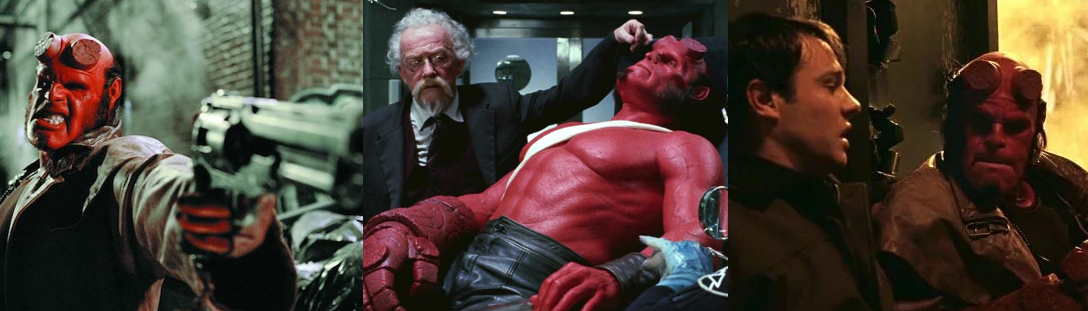
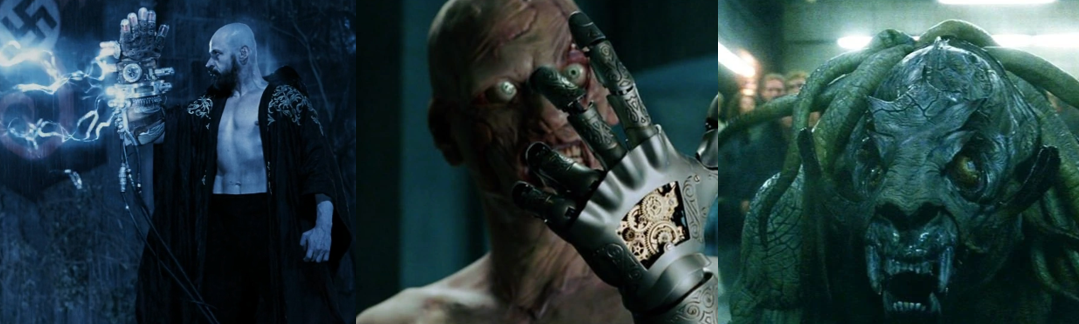
Much like Hellboy’s first story, “Seed of Destruction” (Mignola, et al, 1993), Hellboy begins near the end of the Second World War. In fact, Hellboy quite faithfully recreates and expands upon the circumstances which led to Hellboy coming to our world, with a young Professor Broom (Kevin Trainor) joining an Army regiment to intercept a Nazi ritual off the coast of Scotland. While the Army is understandably sceptical of the “parabnormal”, Professor Broom’s fears are realised when they find zealot warlock Rasputin in the midst of merging arcane magic with the Third Reich’s advanced technology alongside his lover and devout right hand, Ilsa Haupstein (Bridget Hodson), and Adolf Hitler’s top assassin, the mute, semi-undead Karl Ruprecht Kroenen (Ladislav Beran). Although Rasputin successfully opens a portal to a nightmarish realm beyond our understanding, where the Lovecraftian terror known as the Ogdru Jahad slumber, the Allies interrupt them and successfully close the portal, seemingly killing Rasputin and Kroenen in the process. However, while the portal was open long enough to bring through a tiny demon child. Though startled by the demon’s unsettling appearance, the regiment stands down when Professor Broom proves he’s just a curious and frightened little boy and he’s soon adopted by both the troop and the “unready father”, nicknamed Hellboy and spending the next sixty years secretly working to stop supernatural threats as part of the Bureau for Paranormal Research and Defense (BPRD). While Professor Broom ages in that time, Hellboy is said to be barely out of his twenties and is presented as both an urban legend and unruly child who constantly yearns to be in the public eye, shaving his horns to “fit in” and being grounded whenever he breaks out of the BRPD’s super-secret facility.

Professor Broom despairs of his reckless son, who he sees as the saviour of humankind.

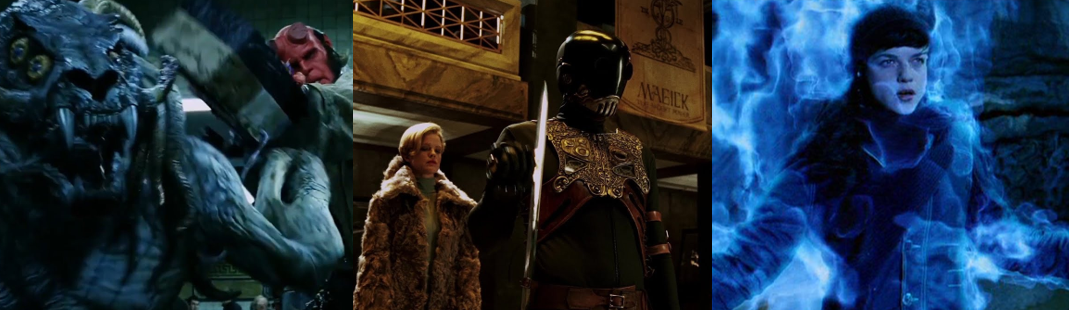
While Professor Broom is exasperated by Hellboy’s irresponsible nature, Federal Bureau of Investigation (FBI) director and BRPD liaison Thomas “Tom” Manning (Jeffrey Tambor) is tired of doing damage control whenever Hellboy makes headlines and eager to shut the “freak show” down. Realising that his time is running short and concerned that Rasputin and his followers are making a return, Professor Broom recruits FBI agent John Myers (Evans) to take over as Hellboy’s caretaker, confidant, and mentor, casting Myers as our audience surrogate and earning him much distrust and resentment from the unimpressed Hellboy. Presented as a cat-loving, physically imposing and nigh-superhuman figure, Hellboy is fireproof, extremely durable, and well versed in the mystic arts. While he’s a lousy shot with his massive handgun, the “Samaritan”, he loads it with special rounds and carries numerous trinkets, charms, and reliquaries to ward off curses and such. Yet, Hellboy is restless and stubborn, eager to be amongst the public and refusing backup, even from long-time allies like merman-like Abraham “Abe” Sapien (Jones/Pierce) and Agent Clay (John William Johnson), the closest he has to friends. Though deeply ashamed whenever he disappoints his father, Hellboy is snarky and constantly gives Myers a hard time for being a glorified nanny while also being recklessly confident that he can overcome any foe. To be fair, he’s usually right but Hellboy’s arrogance sees him constantly run afoul of the bestial Sammael (Brian Steele), leading to him being beaten up a fair bit, having eggs laid in his forearm, and the deaths of a BRPD squad, much to Manning’s disgust. Having known no other life than the BRPD, Hellboy sees it as “[his] job” to protect the innocent and regards any risk worthwhile to stop monsters and demons from threatening others. While he’s crushed when Abe and Clay are seriously wounded because of his actions, Hellboy lashes out at Manning and Myers, seeing them as threats to both his livelihood and his ego.

Myers makes for a dull surrogate and the chemistry between Hellboy and Liz is severely lacking.

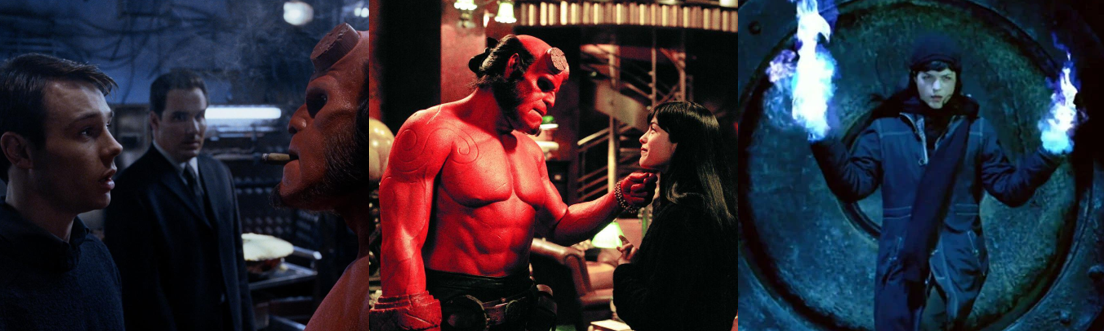
As tough as Hellboy is, his emotions often get the better of him. Indeed, he often escapes from the BRPD to visit Elizabeth “Liz” Sherman (Blair), a troubled pyrokinetic and former BRPD agent who committing herself to an asylum. It’s obvious that Hellboy is madly in love with Liz, but he struggles to articulate these emotions and often makes a fool of himself, descending into a bitter jealousy when Myers gets close to Liz initially to convince her to return and then because he also develops feelings for her. Traumatised by her unpredictable pyrokinetic abilities, Liz chooses the discomfort and security of an asylum over the BRPD largely because it helps her control her abilities and because she wants to fit in, not be surrounded by monsters who remind her that she’s a freak. This draws her closer to the boyish, everyman Myers but she can’t help but be pulled towards Hellboy, who she largely sees as a sibling but clearly has an attraction to since he’s so devoted to her. Abe councils Hellboy, trying to help him move on and using his telepathic and empathic powers to give him advice, but Hellboy’s stubborn nature sees him desperately find the words to express his love for Liz. As awesome as Perlman’s performance is as Hellboy, Jones impresses as the unnerving Abe, who moves like liquid in water and uses his clairvoyance to offer valuable insight. Sadly, Selma Blair lets the trio down, appearing bored and delivering her lines with a distinct lack of emotion. While this does tie into her adopting a stoic guise to keep her powers under control, it makes for a distinct lack of chemistry between her and Hellboy that isn’t helped by some dodgy CGI flame effects.

Though they have their disagreements, Hellboy’s pained by his father’s death and forced to rely on others.

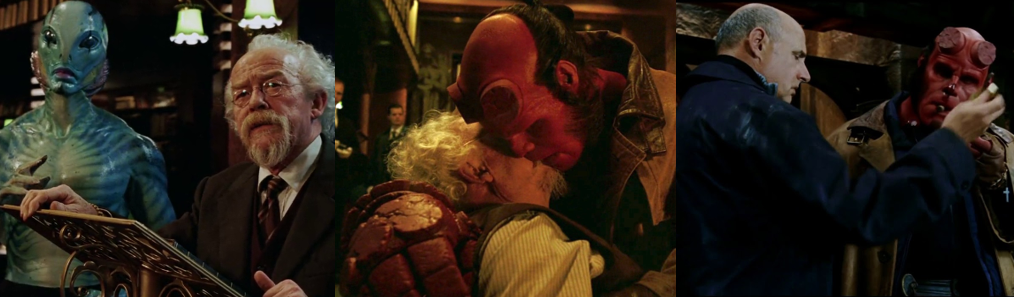
As far as I can tell, Myers has no comic book counterpart and sticks out like a sore thumb. Clay has far more charisma and already has a rapport with Hellboy and the others, so it would’ve been much more interesting to follow a day in his life for the first twenty minutes or so than be stuck with the forgettable Myers, who only exists to give Professor Broom someone to exposit to. As you’d expect, the late, great John Hurt excels as Hellboy’s strict, but fair, father figure. Commanding a wealth of paranormal knowledge and experience, Professor Broom is committed to protecting the world from supernatural threats and sees Hellboy not only as the bridge between the two worlds, but also as the saviour of humankind. This is why he’s so disappointed whenever Hellboy goes off half-cocked. Knowing that he hasn’t got much time left, Professor Broom works to ensure that Hellboy will be both cared for and helped stay on the straight and narrow. His fears about Rasputin again turn out to be true when the BRPD investigates the museum break in that kickstarts the plot, leading to Hellboy’s many run-ins with Sammael, Agent Clay’s ill-fated confrontation with Kroenen, and Professor Broom’s discovery of a message leading them to Moscow. Professor Broom is the. confronted by the mad mage and his clockwork assassin, afforded a brief glimpse of the apocalyptic future Hellboy is destined to bring about, but fearlessly defies Rasputin, ready to face his death. Naturally, Hellboy is devastated by his father’s murder, falling into a brief depression, but willingly joins the BRPD strike team, stomaching Manning’s antagonistic demeanour to get a chance to settle the score and surprisingly finding himself in the hostile director’s debt after finishing off Kroenen, the two developing a mutual respect that again dwarfs Myers’ inclusion.

Rasputin and his monstrous, nigh-immortal followers are fixated of ushering in the apocalypse.

As in “Seed of Destruction”, Hellboy’s primary antagonist is the mad warlock Rasputin, a mysterious and functionally immortal wizard granted incredible dark magic by the Ogdru Jahad. Using an ancient tome and bizarre Nazi science, Rasputin almost achieves his goal of unleashing the “Seven Gods of Chaos” before he’s stopped by the Allies. Death is a mere inconvenience for Rasputin, however, thanks to his eternally youthful and equally immortal followers, who return their master to life with a blood sacrifice and willingly follow him in resurrecting Sammael, a ferocious beast whom Rasputin empowers to resurrect twofold each time it falls. Eager to capture Hellboy, knowing that his stone hand is the key to unleashing the Ogdru Jahad, Rasputin keeps Hellboy occupied and drive him towards his elaborate mausoleum in Moscow to complete his ritual. Returning from death more powerful, and with more of the Ogdru Jahad’s influence in him, Rasputin is a malicious, cold-hearted villain who nonetheless shows respect towards Professor Broom and permits him a merciful death. Though Ilsa doesn’t get much to do beyond lusting after her master and following his every whim, Kroenen makes a hell of an impression with his wind-up body, deft skill with blades, and intimidating masked visage. A heavily scarified, zombie-like figure, Kroenen easily cuts down groups of armed foes (though largely bloodlessly) and seems to delight in murdering anyone who gets in his way, easily fooling the BRPD by playing dead and killing those closest to Hellboy. Hellboy primarily tussles with Sammael and its kin throughout the film, finding the creature ruthless and as pig-headed as him thanks to its supernatural ability to rapidly heal and resurrect upon death. A slobbering, voracious beast who pounces upon its prey, Sammael tears through the BRPD, injures Abe, and constantly dogs Hellboy in some fun, action-packed fights.

The Nitty-Gritty:
My knowledge and experience of Hellboy may be lacking since I mainly know him from the films, but as far as I’m aware Hellboy sticks somewhat close to the source material while also diverging in numerous ways. For starters, Hellboy is presented as an urban legend, one Manning is keen to keep under wraps, rather than being the “World’s Greatest Paranormal Investigator”. This acts as the backbone for much of the plot and Hellboy’s arc, with him eager to get into the spotlight and relishing showing off before the public. Secondly, Hellboy changes Hellboy’s relationship with Liz, giving him a long-standing crush on the apathetic pyromaniac and presenting a largely humorous side plot of him sabotaging Myers when he gets close to Liz. Ironically, Hellboy asks Myers for help in articulating his feelings and Myers reluctantly offers him advice, despite his own feelings for Liz. Ultimately, Professor Broom’s death gives Hellboy the courage to admit his devotion to Liz, understanding that his demonic visage reminds her that she’s different and she’s looking for someone who makes her feel normal, seemingly stepping aside in favour of Myers while still vowing to always be there for her. Thirdly, Hellboy places far greater emphasis on Hellboy’s relationship with Professor Broom, who was offed pretty quickly into “Seed of Destruction.” Here, we see the dynamics of the unlikely father/son relationship, with Professor Broom despairing of Hellboy’s reckless antics and this brutish demon reduced to an ashamed child whenever his father gives him a disapproving look. It’s a great twist and makes Professor Broom’s death even more of a blow since we see how close they are, best showcased when Professor Broom refuses to learn Hellboy’s true name from Rasputin since he already knows what to call him: son.

Despite some dodgy CGI, the practical effects and prosthetics are genuinely impressive throughout.

While Hellboy’s personality may be noticeably different from the source material, painting him as an arrogant and rowdy teenager who pointedly refuses help and must learn to grow up, Ron Perlman delivers a fantastic performance. He nails every nuance of Hellboy’s characterisation, which sees him be sarcastic, enraged, and lovelorn throughout the film. despite clearly being swamped by uncomfortable make-up and prosthetics, Perlman’s emotions still shine through, and I’ve always been a fan of his gravelly delivery. Hellboy looks incredible, sporting a sledgehammer-like stone fist and prehensile tail, crashing through walls and wrestling his foes into submission. While the CGI does the practical effects a disservice, making Hellboy and Sammael unfortunately cartoonish at times, the practical effects more than make up for it. Hellboy and Sammael demolish a subway station, crash through stone walls in a hidden cavern, and tear through the busy night-time streets, with Hellboy flipping a car to protect Myers and Sammael eventually being smushed by a subway train. Kroenen equally impressed in his appearances, slinging his blades around with superhuman dexterity and cutting foes down with a supernatural efficiency. When his true, gruesome form is revealed, it’s a hideous and wholly practical sight that makes me want to know more about this bizarre half-zombie. Practical effects also take centre stage when Hellboy resurrects the desiccated corpse of Ivan Kilimatovich (Unknown), a skeletal torso who guides them through Rasputin’s boobytrapped mausoleum. While many of the hazards contained within are equally practical, such as the heavy doors and crumbling bridge, much of the danger is lost when the obvious CGI rears its head, but it’s all good fun for the most part. The Director’s Cut largely splices deleted and slightly extended scenes back into the film, giving us a scene where Ilsa gifts Rasputin artificial eyes, showing Liz has a touch of OCD and adding a bit more depth to her time with Myers, but there’s nothing all that substantial added.

Hellboy ultimately rejects his demonic heritage to save the world and finally express his love for Liz.

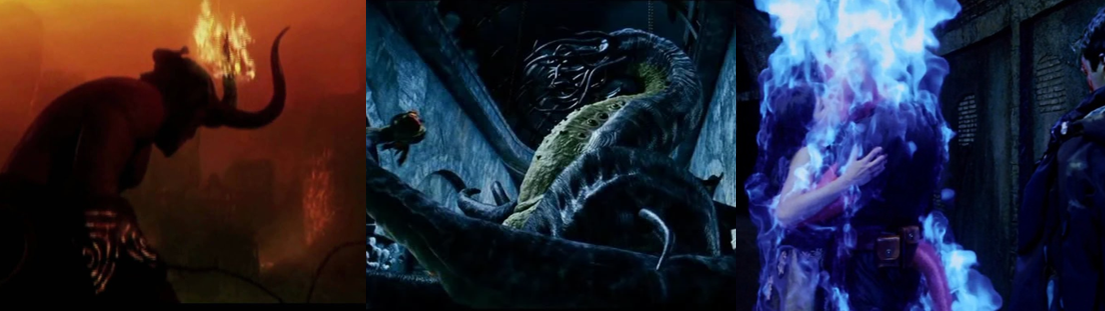
Journeying to Moscow to avenge Professor Broom and stop Rasputin’s maniacal scheme, Hellboy buries the hatchet with Manning after they work together (somewhat) to finish off Kroenen, impaling him on spikes and trapping him under a giant gear. While all the BPRD agents who accompany them are lost to the mausoleum’s booby-traps, Liz destroys Sammael’s nest with a burst of unbridled fury. However, this leaves her and the others weakened, easily allowing Rasputin to capture them. Even Hellboy is rendered powerless by a heavy trap that can only be unlocked by saying his true name, which he’s compelled to do when Rasputin maliciously sucks out Liz’s soul. Defeated and disheartened, Hellboy reluctantly whispers his name (“Anung Un Rama”) and undergoes a horrific transformation, his horns growing out and a flaming crown appearing on his brow. He then willingly uses his stone hand to free the Ogdru Jahad from their crystalline prison and have them begin to manifest amidst a blood moon. However, just as he’s about to unlock the final seal, Hellboy’s brought to his senses by Myers, who begs him to remember his father’s teachings, leading him to break his horns and mortally wound Rasputin with them, having chosen to be a man rather than a demon. Though the Ogdru Jahad are prevented from invading, Rasputin’s death frees a spawn of theirs, the gigantic, tentacled Behemoth, that Hellboy tackles alone after make amends with Myers. Thankfully, Hellboy brought a grenade belt, which he uses to blow the beast to bloody chunks. Heartbroken by Liz’s death, Hellboy whispers a threat to those “on the other side” to let her go or face his wrath, prompting her swift resurrection and the two to finally embrace as lovers. Myers, having earned Hellboy’s trust, delivers the film’s closing narration about nature versus nurture, echoing Professor Broom’s opening narration, though Manning is left waiting impatiently to be rescued!

The Summary:
Although I had no idea who Hellboy was when I first saw this film, I was intrigued by the premise, its ludicrous main character, and the promise of a fun, action-packed supernatural adventure. Indeed, the only reason I am a fan of Hellboy is because of this movie, which is still a favourite of mine. Sure, I have some issues with Myers (he makes for a painfully bland audience surrogate), Linda Blair’s performance (if it’s meant to be this way, it really misses the mark), and some of the dodgy CGI, but the pros far outweigh the cons. Hellboy has a great tongue-in-cheek sense of humour that makes the title character a joy to watch since he’s such a smart ass doofus, while also delivering some decent action sequences that have stood the test of time thanks to top-notch practical effects. The make-up and prosthetics are fantastic, with Hellboy, Abe, and Sammael all having a very tangible and tactile quality to them. Little touches like Abe’s blinking, his malformed hands and gills, and Sammael’s bone-wrenching healing add so much life to these characters, to say nothing of how imposing and impressive Perlman appears under all that getup. Although Hellboy’s characterisation is noticeably different from the comics, it works really well in this context, giving him a meaningful and surprisingly emotional character arc as he learns to focus on the big picture and stop messing around while also accepting help from his allies. I loved his father/son relationship with Professor Broom, his dynamic with Manning, and even appreciated his devotion to Liz, despite their lack of chemistry. Mignola’s art and Lovecraftian inspirations were brought to life wonderfully here, with the Ogdru Jahad being horrifically bizarre, vivid colours popping when necessary and heavy, ominous shadows being used effectively where possible. It’s got some flaws, for sure, but Hellboy is still an extremely enjoyable romp that doesn’t really get talked about all that much these days, which is a shame as there’s a hell of a lot to like here.

My Rating:

Rating: 4 out of 5.

Great Stuff

Did you enjoy Hellboy’s big-screen debut? What did you think to Ron Perlman’s performance, his appearance, and the changes made to Hellboy’s character? Did you also find Myers a dull audience surrogate and the chemistry lacking between Hellboy and Liz? Were you happy with the way the film adapted elements from the comic books? Which Hellboy adaptation is your favourite? Share your thoughts on the first Hellboy movie in the comment and donate to my Ko-Fi to suggest more Hellboy content for the site.

Movie Night: Terrifier 2

Released: 6 October 2022
Director: Damien Leone
Distributor: Cinedigm / Iconic Events Releasing
Budget: $250,000
Stars: David Howard Thornton, Lauren LaVera, Elliott Fullam, Sarah Voigt, Kailey Hyman, and Casey Hartnett

The Plot:
After being mysteriously resurrected, the demonic Art the Clown (Thornton) stalks grieving Sienna Shaw (LaVera) on Halloween night, unaware that Sienna may hold the key to stopping his senseless slaughter for good.

The Background:
The fear of clowns (also known as Coulrophobia) is a surprisingly common trope in both horror and everyday life thanks to fictional “Evil Clowns” like Stephen King’s Pennywise and twisted killers like John Wayne Gacy. Writer director Damien Leone tapped into this fear with his short film, The 9th Circle (2008), a which included a prototype of Art the Clown (Mike Giannelli). Despite his small role, Art proved popular enough for Leone to revisit the character in his subsequent films, Terrifier (2011) and All Hallows’ Eve (2013). Seeing Art as a chance to create a truly iconic slasher villain for a modern audiences. Terrifier made a modest profit and attracted largely positive reviews that praised David Howard Thornton’s performance as Art as much as the stunning gore. Dissatisfied with some elements of the film, Leone sought to craft a truly captivating and well-rounded protagonist for the sequel, while also expanding the scope of the franchise. Despite the discomfort of her Valkyrie costume, Lauren LaVera enjoyed her time on setand worked closely with Leone to give Art a heroic counterpart. With an increased budget thanks to a successful Indiegogo campaign, Leone worked around the COVID-19 pandemic to depict a prolonged and arduous murder scene that attracted much controversy. Despite some criticisms regarding the unnecessary brutality towards women and reports of audiences vomiting or fleeing screenings, Terrifier 2 was a critical and commercial success, with reviews praising LaVera’s nuanced and appealing protagonist as much as Thornton’s continued physical commitment to the killer clown. Sweeping the 2023 Fangoria Chainsaw Awards, Terrifier 2’s success more than justified another sequel in 2024 and unquestionably established that Leone had a franchise on his hands, for better or worse.

The Review:
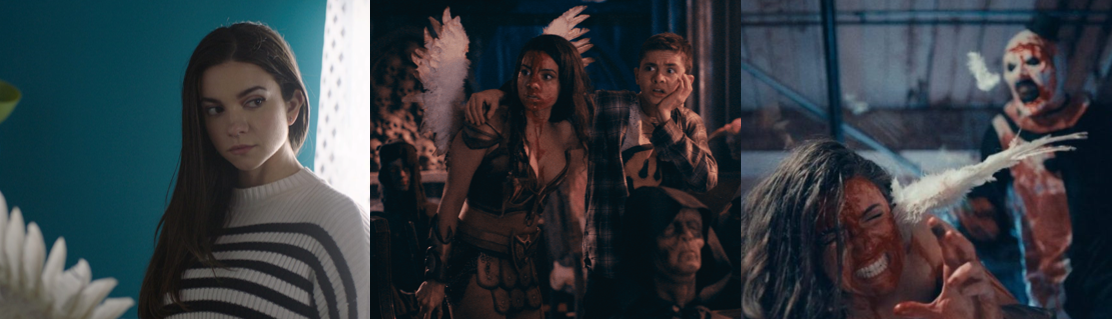
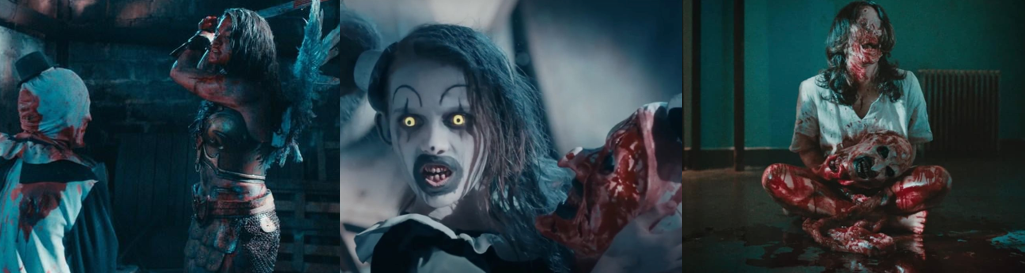
Terrifier 2 picks up right where the first one ended. After terrorising Miles County, Art the Clown shot himself in the head to avoid arrest, leaving a sole survivor – the horribly mutilated Victoria Heyes (Samantha Scaffidi) – confined to a mental hospital after going mad from the experience. Despite his fatal injury, Art bursts to life and attacks coroner, Seth Bolton (Cory DuVal), slicing his throat, ripping his eye out to temporarily “replace” his own, and finally bashing his head in with a surgical mallet. Garbed in a blood-soaked clown outfit, Art retrieves his bin bag full of “toys” and heads to a laundromat to freshen up, silently giggling over the bad news in the local paper and being approached by a mysterious cherub dressed almost identically to him. This “Little Pale Girl” (Amelie McLain) appears to be an unidentified demonic spirit, one only Art or those close to him can see, and it’s implied she causes his otherwise inexplicable resurrection. The Little Pale Girl appears throughout Terrifier 2, often sporting glowing eyes and imitating voices, and is seemingly a spiritual guide to the murderous mime as she encourages and somewhat directs his actions. The film then jumps ahead to the following Halloween Eve, when the fallout from Art’s killing spree is still felt throughout Miles County. Jonathan Shaw (Fullam) is strangely obsessed with Art, who’s presumed dead but also missing, to the point where he wishes to dress up as Art for Halloween, a decision his overworked and short-tempered mother, Barbara (Voigt), vehemently shoots down. Jonathan’s macabre imagination and fascination with serial killers disturbs his older sister, Sienna, though her concerns fall on deaf ears since her mother is more concerned with work and expressing her grief by scolding her children for any right- or wrongdoings.

Alluring Sienna makes for a sympathetic, relatable, and well-rounded protagonist.

The Shaws are in turmoil following the death of their patriarch, a talented artist who once envisioned his daughter as a Valkyrie warrior before succumbing to an unnamed disease. While Sienna remembers her father fondly, spending months constructing an elaborate recreation of her father’s drawing to wear to a Halloween party and “feel close” to him, it’s heavily implied that her father underwent a dramatic character change as his disease worsened. He barely knew who he was by the end and is said to be abusive towards Sienna, which perhaps is what drove him to drown his sorrows and kill himself in a car wreck. Either way, the Shaws deal with their grief in different ways: Barbara focuses on work and has a short fuse, Jonathan veers down a more morbid path, and Sienna focuses on her costume project. Having already struggled with her mental health and still relying on pills to curb her anxiety attacks and nightmares, Sienna is barely holding together; all she has is her project and the ornate sword her father gifted to her. Well, that and her friends, Brooke (Hyman) and Allie (Hartnett), who treat her like an adopted sister. While the three are close, Sienna’s condition and trauma keeps a wedge between them. She’s easily triggered by talk of gore and Brooke later chastises her for being so uptight and doom-and-gloom all the time. Sienna’s life is made more difficult by Jonathan, who lands in hot water when visions of Art and the Little Pale Girl see him reprimanded at school, aggravating his already borderline abusive mother. Haunted by ominous dreams of Art and his “Clown Café”, Sienna’s mental state is often questioned, especially when her room spontaneously combusts, to the point where few share her concerns when she sees Art in the flesh. While the main protagonists victims of Terrifier were largely forgettable, Sienna is a far more well-rounded character. Vulnerable, beautiful, and creative, she’s determined to make an impression with her costume and goes to great lengths to try and keep Jonathan safe by the finale.

Sienna rightfully gets most of the screen time, though her friends and family do add to her plight.

After going through their father’s sketchbook, Jonathan surmises that he was aware of Art and depicted Sienna as angelic warrior to combat the evil clown. Her outfit echoes this, painting her as a Valkyrie and setting her up as a flawed and suffering representation of light versus Art’s twisted evil. Focusing on Sienna and her family strife was a fantastic idea; it removes some of the grimy “Grindhouse” atmosphere of the first film but gives us someone to sympathise with and root for. Unfortunately, Allie is just kind of…there…empathetic to Sienna’s troubles but struggling to fully relate to them. Brooke is much more outspoken and reckless, snorting coke with her boyfriend, Jeff (Charlie McElveen). Still, they exude more personality than their predecessors and we care about them by proxy since they’re close to Sienna rather than simply being throwaway victims. However, Elliott Fullam seems out of his depth, portraying Jonathan as a weird, obnoxious, conflicted brat who hyperventilates his way through most scenes and spends most of his time riling everyone up or wailing on the floor. It’s clear that he and Sienna have a bond, one that’s frayed since their father died, and they come together nicely in the end when Art kidnaps the boy to lure in his sister. To be fair, it’s no wonder Jonathan and even Sienna are messed up with a mother like Amanda. She can barely hold herself together to care for her kids and is far more likely to strike them than encourage or comfort them. Amanda’s inability to keep her cool sees her literally lose her head courtesy of Art, further scarring Jonathan when he finds the clown he’s been obsessed with stuffing mashed potatoes into the remains of his mother’s head! The Little Pale Girl callously uses Sienna’s family against her, imitating Jonathan’s voice and even assuming Amanda’s form just to trap and taunt the girl, and learning of their condition only serves to further agonise the already suffering Sienna, who’s literally put through hell in order to realise her father’s destiny for her.

Art gets a supernatural, demonic edge that makes him even more cruel and sadistic than before!

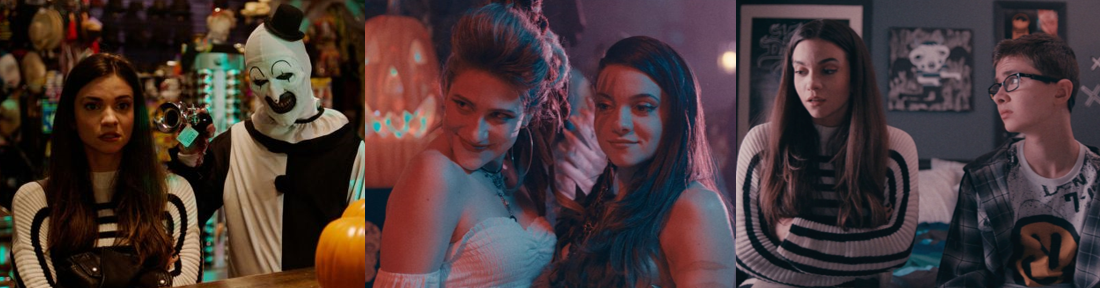
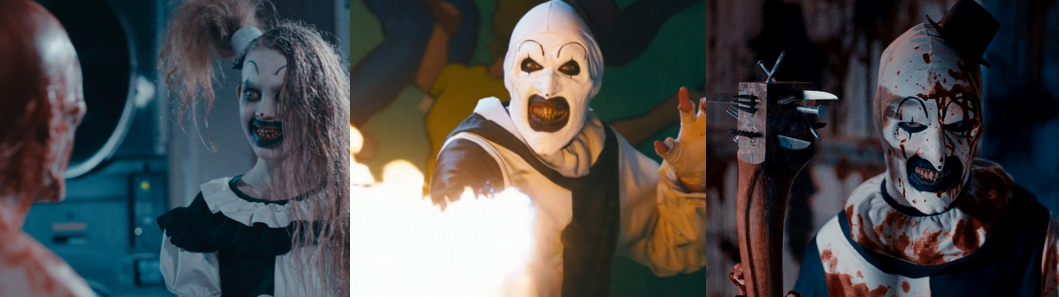
While Art was previously portrayed as a disturbing but nonetheless human figure, he’s now got one foot in the supernatural. Reborn not as a zombie or some undead spirit, Art retains the same twisted sense of humour and sadistic streak as before, but we spend more time with him between kills. We see him swiping supplies from Seth’s office, washing his clothes with mirth, constructing new weapons, and express visible disgust and frustration when his prey fights back. Art becomes fixated on Sienna, possibly because they seem to share a strange mental connection (Sienna often dreams about or has visions of Art, for example). When he finally gets his hands on Sienna, Art doesn’t rip her to pieces like his other victims; he brutally beats her and leaves her alive. Indeed, Art is far more elaborate with his kills this time, stalking and taunting them with his clown-like antics and then drawing out their deaths with a cruel malice. Art is functionally superhuman now, shrugging off gunshots, spiked implements to the head, and easily ripping off limbs and through chest cavities. He remains vulnerable, however, being slowed by weapons, bleeding, and being temporarily subdued by a sawn-off shotgun. However, he returns each time, spurred on by the Pale Little Girl, and eager for his victims to scream in agony. When Jonathan lays unconscious at his feet, for example, Art is visibly disappointed and resorts to chewing on the boy’s ankle to hear his screams. As his victims scream and bawl, Art gleefully mocks them, his silent laughter and crocodile tears mirroring the very real pain and suffering of his prey, who are forced to endure more agony than appears humanly and scientifically possible. We also get a few titbits about a possible backstory for Art: he holes up in an abandoned theme park, specifically the Terrifier fun house where it’s said the Pale Little Girl died some years prior, and it’s almost implied that he was somehow brought to life by Sienna’s father’s drawings. Naturally, Terrifier 2 doesn’t go into detail with this but the Pale Little Girl’s presence, Art’s seemingly supernatural edge, and the breadcrumbs offered by Sienna and Jonathan certainly go a long way to suggest that there’s more to Art than simply being a mute, killer clown.

The Nitty-Gritty:
The visual and narrative upgrade from Terrifier to Terrifier 2 is both impressive and very welcome. While the first was a grimy, shocking piece of splatter-gore, the second is a far “cleaner” and more mainstream horror offering. However, while its indie, Grindhouse-inspired roots may have been downgraded, Terrifier 2 remains a disturbing and twisted watch. The increased budget clearly allowed Damien Leone to utilise better camera, better lighting, more elaborate gore effects, and far more visually interesting locations. I liked the gritty, back alley setting of the first film, but it did become stagnant at times and very much felt like Terrifier was merely an appetiser for what Leone and Thornton are truly capable of. Terrifier 2 opts for a suburban setting for a disturbing amalgamation of the suburban horror of John Carpenter’s Halloween (Carpenter, 1978) and the “Gallio” horror cinema. In Terrifier, the horror wasn’t so much the over-the-top gore but more the randomness of Art’s attacks; he seemingly picked victims at random and was unpredictable. That unpredictability is still present in Terrifier 2, only now locking yourself in your home isn’t enough. Art simply forces his way into Allie’s house, and the Shaw’s, brutalising his victims and cropping up in a laundromat and Halloween store without a care in the world. Art’s presence is unnerving even considering the spooky season since he acts so aloof; even him trying on goofy sunglasses and honking horns at Sienna is enough to rattle her. This is given a raw edge through Sienna’s visions and nightmares, where Art massacres a children’s television show as a figure of mirth warped into a violent psychopath. Just researching Art and seemingly being fascinated by his legend is enough to cause Jonathan to see the Little Pale Girl, though Terrifier 2 suggests there’s more to this and some mysterious link between the Shaws and Art since Barbara is incensed by the mere mention of him and Sienna is seemingly positioned as Art’s polar opposite.

Art gleefully subjects his victims to gruesome, brutal torture before tearing them to pieces!

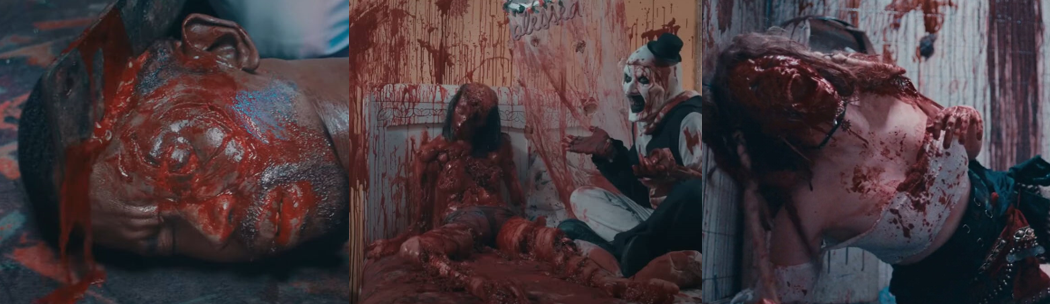
Art is now obsessed with raking flesh and tends to target eyes, possibly because he’s missing one at the start. He pulls out Seth’s eye, stabs the Halloween store clerk (Johnath Davis) in the orbital area with a broken bottle, and slices a scalpel through Allie’s eye to start her torturous death. No one is spared Art’s wrath, even an exhausted laundromat patron (Thomas Smith) gets a broken mop jammed into his head just because he woke up! Art’s bag of tricks has been expanded; he carries corrosive acid that he tosses in Brooke’s face and a sawn-off shotgun to blow Amanda away. Art also brutalises the melting Brooke with a custom-made nail bat and other implements, used a tommy gun and blowtorch in Sienna’s dream, and even stabs Jeff in the dick and hacks it off to taunt Brooke! Art lashes Sienna and Jonathan with a barbed whip, slashes them with a scalpel, and hacks off the clerk’s head with a rusty hatchet! However, Allie takes the prize for the film’s most memorable and morbidly fascinating kill! When Art breaks into her house, he chases her to her bedroom and slashes her eye, then savagely descalps her with a pair of scissors before slicing into her back to expose her ribcage. He then wrenches off one arm, splits the other down the middle, and dumps bleach and acid over her as she whimpers, bleeding on the floor. Art then tears half her face off and mutilates her to the muscle and bone when Allie’s mother (Amy Russ) returns home. Despite being little more than a flayed corpse, Allie still has the strength to call for her mother, leaving the woman a screaming wreck as Art silent cackles away, Allie’s flesh still stuck in his teeth! It is, honestly, a painfully disturbing sequence of brutality that I just cannot turn away from. The sheer ruthless nature of Allie’s suffering trumps anything, even that kill, from the first movie and certainly suggests that Art exudes an aura that prolongs his victim’s suffering and empowers him, since he clearly gets off on their agony!

Although Sienna powers up and defeats Art, the demonic clown is reborn through his former victim…

After suffering a panic attack thanks to her condition and Brooke spiking her drink, Sienna heads home with Brooke and Jeff. However, Sienna forces them to redirect to the abandoned funfair when Jonathan calls for help. This is, however, a trap laid by Art and the Little Pale Girl. As Sienna searches for her brother, Art castrates Jeff in an attack that’ll make your eyes water and brutalises Brooke, ripping out and partially eating her heart. Although Sienna valiantly attacks Art, she gets cut up and beaten unconscious, though this is where Terrifier 2 loses much of its momentum as the final act descends into an extended chase and attack sequence where Sienna and Jonathan run around looking for each other. Art delights in cutting Jonathan with a scalpel, shrugs off having his own bat lodged in his skull, and maniacally whips both Shaw siblings, gouging their flesh and repeatedly throttling Sienna. Although Jonathan tries to help, Sienna ends up stabbed in the abdomen with her own sword and drops down a mysterious hole from which the screams of Art’s victims echo. Transported to the Clown Café, Sienna ultimately drowns in a glass chamber. While Art feasts on Jonathan’s ankles, Sienna hears his screams and is mysteriously resurrected by her father’s blade, which heals her stomach wound (though not her others) and allows her to claw out of whatever part of Hell spawned Art and the Little Pale Girl. Sienna attacks Art with the magical sword and fatally wounds him. Like the last film, Art offers no resistance to this; indeed, he not only joyfully offers his neck but also seems to nod in respect for Sienna’s strength. Full of righteous vengeance, Sienna hacks off Art’s head but is too traumatised and injured to stop the Little Pale Girl taking it. A mid-credits scene sees an agonised Victoria Heyes spewing vile liquids from her nether-regions. Drawn to the normally docile patient’s cries, Victoria’s nurse (Leah Voysey) finds she has written curses and a declaration of love to Art on the walls with her blood and faeces. Oh, and Victoria is also seemingly possessed by the Little Pale Girl, since she sports the same glowing eye…and chortles maniacally as she cradles Art’s newly born severed head!

The Summary:
Terrifier 2 certainly improves on many of the flaws and shortcomings of its predecessor. Not only is the scope widened, but the locations and effects greatly benefit from the additional budget, to say nothing of Rostislav Vaynshtok and Paul Wiley’s synth-style score. The greatest trump card Terrifier 2 has over the first film is in Sienna. Lauren LaVera captivates with a natural beauty, charismatic appeal, and sympathetic vulnerability. She may get the lion’s share of screen time and characterisation, but it greatly benefits the film and her friends, while less developed characters, still add to her plight. Terrifier 2 does a decent job of exploring how grief affects different people, from Amanda focusing on work and lashing out at her kids to Jonathan’s odd obsession with serial killers like Art. Sienna choses to focus on her artistic expression to remember the good times she had with her father and feel closer to him, honouring his memory with her attractive (but clearly uncomfortable) Valkyrie outfit. As a pure, almost angelic figure, she’s perfectly positioned as Art’s archenemy and opposite, being traumatised and insecure where he’s bold and colourful. While Art’s mystery is only deepened here, with supernatural and potentially demonic elements being weaved into his character and him showing a burning rage at times, he’s also more unhinged and brutal than ever! Terrifier 2 turns the dial up to twenty-one, never mind eleven (!), with its deranged and sadistic kills that border on torture porn. It’s shockingly gruesome seeing Art maim, hack, and assault his victims and the film certainly isn’t forgetting its Grindhouse roots in these long, uncomfortable sequences that will have you questioning your obsession with horror. While this is enough to satisfy me as a horror fan, and to rate Terrifier 2 as the superior compared to its sequel, everything about this film justifies this rating since its so much more polished compared to the original. Whereas Terrifier seemed like an expensive proof of concept, Terrifier 2 has an actual plot, a developed main character, and adds a touch more intrigue to its inhuman villain. It feels less like a random assortment of grimy, shocking gore and more like a more complete and nuanced movie. It’s still not for everyone, the third act drags a bit and squanders the momentum of the second half, and some may even be offended by its content, but Terrifier 2 was a far more enjoyable experience for me as a film and horror fan and I would highly recommend it to anyone looking to take a dive bomb into the more extreme end of the genre.

My Rating:

Rating: 4 out of 5.

Great Stuff

Do you think Terrifier 2 surpasses the original? What did you think to the additional supernatural elements given to Art? Were you also a fan of Sienna, her eye-catching outfit, and her position as Art’s reluctant opposite? What do you think is happening with the Little Pale Girl? Do you agree that the gore was far more brutal this time, or did you find it too unrealistic? Are you scared of clowns and, if so, why? Which of the Terrifier films is your favourite and how are you celebrating horror this month? Share your thoughts about Terrifier 2 in the comments, support me on Ko-Fi, and check out my other horror content!

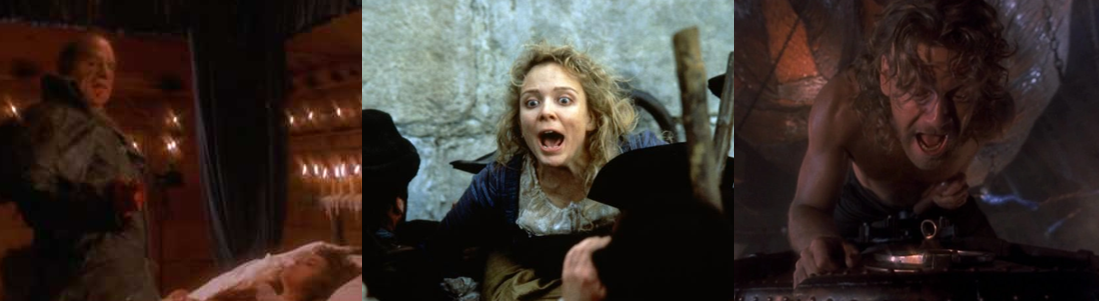
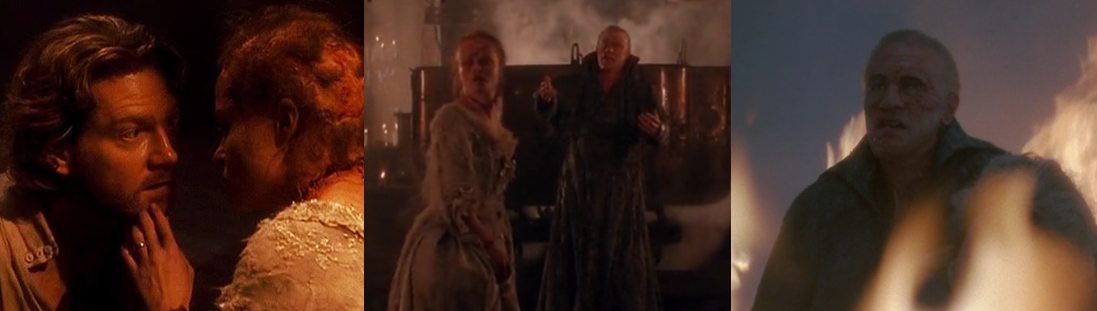
Movie Night: Mary Shelley’s Frankenstein

Released: 4 November 1994
Director: Kenneth Branagh
Distributor: TriStar Pictures / Sony Pictures Releasing
Budget: $45 million
Stars: Kenneth Branagh, Robert De Niro, Helena Bonham Carter, Aidan Quinn, and Ian Holm

The Plot:
Obsessed with preventing death, eccentric scientist Victor Frankenstein (Branagh) patches together a monstrous being (De Niro), who embarks on malicious crusade when its creator rejects it.

The Background:
In a bid to tell a story that spoke to “the mysterious fears of our nature” while snowed in in Geneva, eighteen year old Mary Shelley dreamed up Frankenstein; or, The Modern Prometheus in 1818, attracting much controversy for its blasphemous content and producing a celebrated piece of literary fiction. Following a short silent film in 1910, Frankenstein saw considerable success on the stage and silver screen thanks to James Whales’ 1931 horror classic and Boris Karloff’s iconic performance. Following numerous additional reinterpretations, and the incredible critical and commercial success of Bram Stoker’s Dracula (Coppola, 1992), director Francis Ford Coppola wanted to helm a more faithful adaptation of the book before moving into a producer role. Coppola’s first mandate was that Robert De Niro be cast as the tragic creature and that Kenneth Branagh should direct. Next, Frank Darabont was drafted to rewrite Steph Lady’s initial script, though he later lamented that Branagh had heavily altered his vision for the film. Alongside a far more fantastical depiction of the Monster’s reanimation, Mary Shelley’s Frankenstein presented a dramatically different version of the creature, one far closer to Shelley’s text than other adaptations. With a box office of $112 million, Mary Shelley’s Frankenstein was a modest financial success met with mostly mixed reviews that criticised the manic pace and surprisingly bland execution, while praising De Niro’s heart wrenching performance and the intriguing exploration of Victor’s haunting obsessions.

The Review:
Mary Shelley’s Frankenstein immediately gets off on the right food by establishing a framing narrative the echoes the original text, beginning by following Captain Robert Walton as he leads his crew in a desperate bid to find a path through the ice to the North Pole. Unfortunately, the journey is so perilous and difficult that his crew are close to breaking point. Even when the ship gets trapped in ice, Captain Walton refuses to turn back, having spent his entire fortune funding the trip and being driven by an obsession with etching his name in history, no matter the cost. As the crew frantically try to free the ship and entertain thoughts of mutiny, they’re startled by an inhuman howl and amazed when a dishevelled cloaked figure appears from the storm, babbling about some “thing” out on the ice. Captain Walton takes the exhausted stranger in and cares for him, curious about what’s waiting in the frigid wasteland, only to be introduced to the manic, wild-eyed rantings of Victor Frankenstein, who begs Captain Walton to give up his crusade due to the danger of the mysterious thing pursuing him. When Captain Walton refuses, scoffing and enraged at the idea of being denied his destiny, Frankenstein is distraught to see the stubborn captain shares his madness and, in a bid to convince him to turn back before he destroys himself and his crew, tells Captain Walton his life story. This is related through the remainder of the film, with some correspondence between Frankenstein and his adopted sister, Elizabeth (Carter), and excerpts from Frankenstein’s journal mirroring the epistolary nature of the novel, and being bookended by Captain Walton’s reaction to Frankenstein’s crazed story of scientific obsession turned to destruction.

Obsessed with defeating death, Frankenstein employs immoral and outlawed sciences to create life.

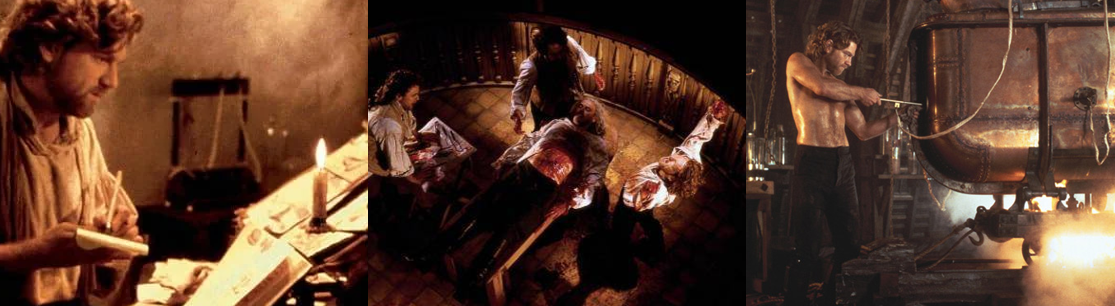
Frankenstein met Elizabeth when they were children (Rory Jennings and Hannah Taylor-Gordon) and spent his whole life caring for her as though she were his own, as instructed by his beloved mother, Caroline (Cherie Lunghi), and expert surgeon father, Baron Alphonse Frankenstein (Holm). Even from an early age, Frankenstein hungered for knowledge and conducted many eccentric experiments using ancient tomes, mostly concerning the transfer and nature of energy, to the amazement of his family. Unfortunately, Frankenstein’s youth was marred by tragedy as his mother died giving birth to his younger brother, William/Willie (Charles Wyn-Davies/Ryan Smith), an event that traumatised Frankenstein and began his obsession with defeating death. Upon arriving at the University of Ingolstadt to follow in his father’s footsteps, Frankenstein immediately gains notoriety for studying and championing unconventional texts and authors long considered heretics or sorcerers, angering his more rational and scientifically minded tutors, who believe their focus should be on saving lives using the scientific method. Obstinate and arrogant, Frankenstein secretly continues his experiments alongside his enthusiastic (if medically conventional) friend Henry Clerval (Tom Hulce), but his outbursts attract the curiosity of Professor Waldman (John Cleese), who touted similar beliefs in the past and was tarnished because of it. Frequent discussions and experiments with Professor Waldman further Frankenstein’s obsession with preventing or reversing death, discovering that the applying electricity to key areas of the body can reanimate corpses, though even Professor Walden refuses to share his notes and divulge how close he came before giving up his crusade. Frankenstein, however, is undeterred and only redoubles his efforts after his mentor is senselessly murdered trying to prevent an outbreak of cholera. Despite Clerval’s objections, Frankenstein studies Professor Walden’s notes and arrogantly believes he can succeed where his mentor failed by acquiring the right “raw materials” for his “reanimate”, locking himself in his attic laboratory and ignoring his friends and loved ones as he works himself to exhaustion stitching together a monstrosity that he believes will be both smarter, stronger, and superior to man.

Frankenstein’s work sees him shun those closest to him, including his devoted adopted sister and lover.

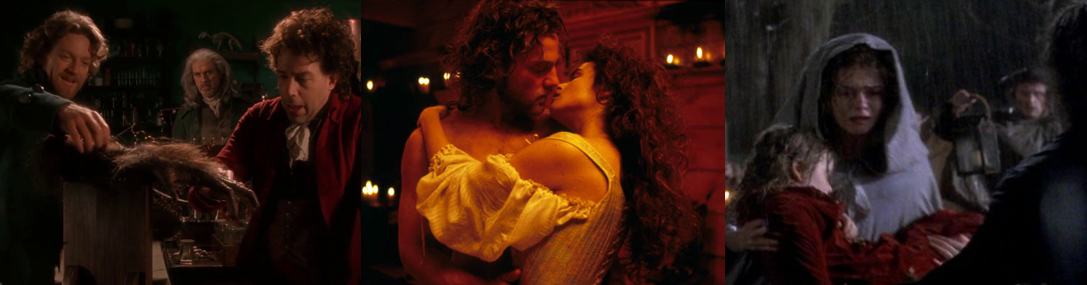
Frankenstein’s fixation on overcoming death sees him become a recluse; he locks Clerval out and stops writing letters to his family and Elizabeth, who’s particularly distraught as the two became so close over the years that they couldn’t deny their feelings and vowed to be married once Frankenstein finished his studies. While it is admittedly quite disturbing to see these “siblings” suddenly lustful for each other, no one bats an eyelid at their romance because it’s been obvious to everyone, especially nursemaid Justine Moritz (Trevyn McDowell), who’s been in love when Frankenstein since they were children, that that two have always cared deeply for one another, Elizabeth is besotted by Frankenstein, eagerly anticipating consummating their relationship on their wedding night and desiring to bring new life to their family home through their children. Encouraged by Justine, Elizabeth travels to Ingolstadt to be with her lover, concerned for his welfare, only to find him a physical and emotional wreck living in squalor. Erratic and fixated on his work, Frankenstein shuns Elizabeth and sends her away, breaking her heart. However, when he’s discovered in a feverish stupor by Clerval, Frankenstein is nursed back to health by his friend and his love, reconciling with Elizabeth and suddenly vowing to give up his bizarre and secretive experiments. Frankenstein returns to his family home in Geneva, ready to commit himself to medical science alongside Clerval, and joyously announcing his engagement to his father, who celebrates the union as a blessed event. However, Frankenstein remains tight-lipped about his dark days isolated in his lab and refuses to speak of what transpired there, taking solace in his newfound happiness. Elizabeth and Alphonse are left devastated when Frankenstein’s past comes back to haunt him, however, as poor little Willie is brutally murdered on the family grounds and poor Justine is unfairly and unlawful lynched as the primary suspect, thrown off the prison roof and hanged by the bloodthirsty local despite the true culprit being a hideous creature of Frankenstein’s own making.

Robert De Niro disappears behind the creature’s monstrous make-up.

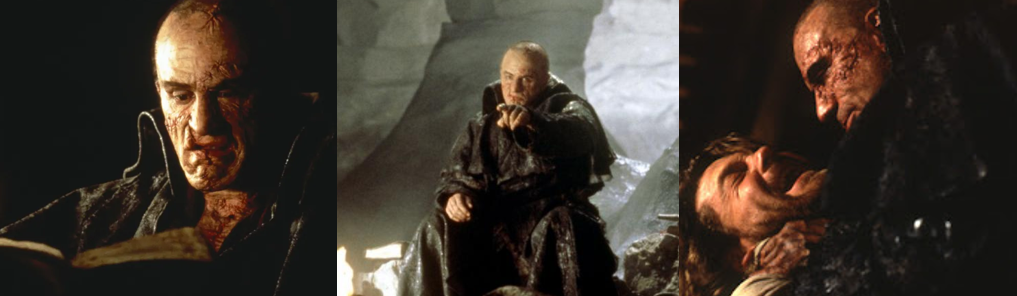
Following Professor Walden’s notes, Frankenstein cobbles together a brutish patchwork creature from bits and pieces of others, including the man who killed his mentor and Professor Walden’s brain. Using a bizarre contraption filled with amniotic fluid and powered by electric eels, Frankenstein maniacally sees his experiment through and is initially overjoyed when his creature comes to life. However, he immediately regrets his actions, echoing Professor Walden’s own conclusions, when the Monster appears ungainly, deformed, and brain damaged. Believing the creature to be dead, a remorseful Frankenstein forgets the entire thing, unaware that his creature stumbled through Ingolstadt in a daze before being driven to the countryside by paranoid locals who, upon seeing the monstrous visage, assumed it was the cause of the cholera outbreak. While in the woods, the Monster shelters in the barn of a kindly family of farmers, who are struggling to survive due to the bitter winter cold. Touched by their kindness towards each other and their plight, the creature secretly helps harvest their crops and learns (or, as it later says, remembers) how to read and write by observing them. When the creature defends the family’s blind grandfather (Richard Briers), it’s welcomed by the grateful old man, who shows compassion, only for the rest of the family to misread the situation and drive the Monster away before fleeing. Learning of its origins from Frankenstein’s journal, the enraged creature hunts down its creator and confronts him on “the sea of ice”, desperate to learn the purpose of its existence. Though a deeply sympathetic and pitiable creature, it’s hard to feel too bad for Frankenstein’s being when it delights in detailing how it crushed the life from Willie and set Justine up for her execution. It vows to indulge its insatiable rage if Frankenstein refuses to build it a mate, promising to disappear from the world if it has a companion to ease its suffering, and is presented as the personification of Frankenstein’s folly.

The Nitty-Gritty:
It’s been a while since I read the book, but Mary Shelley’s Frankenstein is certainly the most accurate adaptation of the text I’ve ever seen. It has the framing narrative, showcases his family life, details his studies, and presents the Monster as being intelligent and articulate, all things largely ignored in the 1931 version. Frankenstein has always been a favourite of mine, largely because of this movie, which I believe was my first exposure to the story. It’s amusing to watch in some ways, however, since Frankenstein’s rantings about hair and fingernails regrowing after death have long been proven to have nothing to do with the body still being alive. Similarly, his experiments with electricity are shown to literally reanimate a frog when we know that any convulsions and movements are due to the electrical current. Frankenstein does touch upon some valid aspects of medicine in his rantings, however, like organ transfers, very much making him ahead of his time (and thus a heretic to the God-fearing scientific community). I’ve always found it odd, though, that Frankenstein stitches together his creation. Professor Walden’s notes state that the right “raw materials” may result in success, though it’s not clear what makes any of the body parts Frankenstein gets more “right” than others except when he harvests “the very finest brain” from his mentor. It seems like it’d be much easier to simply zap Professor Walden’s body to bring him back but, instead, Frankenstein cobbles together a creature he feels will be the perfect lifeform, only to be disgusted and ashamed of his feeble creation once he realises he’s made a massive mistake. I really enjoyed that we got to see the Monster learning from the family and the exploration of how its mind works. Many of its memories and abilities are presented as “trace memories”, as though each body part remembers something different from its previous life and the creature can use that knowledge to learnt to speak and play the flute while also being a completely unique personality, one driven by incredible love and equally powerful rage.

A visually memorable, gory, and faithful adaptation of the thought-provoking text.

It’s astounding to me that Robert De Niro, of all people, was cast as the creature but he does an excellent job depicting the Monster’s confusion, anguish, and hatred. Initially a mindless, wailing creature acting on instinct, the Monster comes to realise it is a living thing (in a sense) and has been abandoned by its creator. Its conversation with Frankenstein echoes the bitter resentment a man may have towards God and Frankenstein’s blunt, clinical answers about the creature’s purpose and origin speak to the disappointment one might feel upon asking God, “Why am I here?” Rather than being a bulky, block-headed giant lumbering about with bolts through it sneck, the Monster is a patchwork of skin and body parts, with De Niro’s eyes conveying the bulk of the emotion as the impressive make-up distorts his features. Instead of channelling a lightning bolt into his creation, Frankenstein constructs an elaborate and frankly ridiculous contraption that uses special chemicals, electrodes, and electric eels in an unsettlingly sexualised sack to birth his creature, somewhat overcomplicating the process but providing some unique visuals, if nothing else. The creature is depicted as being incredibly unstable, boasting superhuman strength and agility and seemingly impervious to the cold, and flip-flopping between loving and gentle and abhorrently brutal as it relishes killing Willie and tormenting Frankenstein. Mary Shelley’s Frankenstein gets very gory, with death, especially, depicted as a messy and traumatising affair. Caroline and Professor Walden’s deaths are particularly gruesome, leaving the Frankenstein’s covered in blood, and Justine’s is notably harrowing given the senselessness of it all. Things come to a head when the Monster, enraged when Frankenstein breaks his vow, makes good on its promise and brutally murders Elizabeth on their wedding night, ripping out her heart and mangling her corpse with glass and fire. It’s no wonder that Frankenstein is so obsessed with defeating death considering these experiences, but his obsession is tainted by arrogance and a God complex that makes him foolhardy and stubborn, refusing to entertain any notions contrary to his or apply his admittedly keen mind towards perfecting surgeries and medicines to achieve his goal.

Frankenstein’s obsession ends in heartbreak and death when his creation demands recompense.

Although Frankenstein reluctantly agrees to create a mate for the Monster, desperate to atone for his mistakes and to give his creation some peace, he backs out on the deal when the experiment again alienates him from Elizabeth. Marshalling his family guards, Frankenstein abandons his work to marry Elizabeth, only to be devastated and horrified when the Monster tears out her heart in recompense. With his lover dead and his father dying of a broken heart following Willie’s murder, a grieving Frankenstein shuns Clerval’s objections and frantically stitches Elizabeth’s disfigured head to Justine’s corpse and recreates his experiment, desperate to be reunited with his love and lost to his insane obsession once more. Even when the confused, clearly disfigured and inept Elizabeth returns to life, Frankenstein refuses to realise what he’s done, begging her to say his name, slipping on her wedding gown and ring, and dancing with her with manic joy even as she flops around like a lifeless puppet. Frankenstein’s bliss is shattered when the Monster appears and claims Elizabeth for itself, her being drawn to the monstrous being on some primal instinct. While Frankenstein is elated when she finally chokes out his name, Elizabeth is horrified when she catches sight of her mangled reflection and incensed when the two fight over her, eventually choosing to immolate herself, taking Frankenstein’s home with her. Returning to Captain Walden, we learn that Frankenstein pursued his creature for months, always being drawn north, intent on killing the beast. However, Frankenstein succumbs to pneumonia and dies, much to the despair of his creation, who weeps for its “father”. Taking pity on the Monster, Captain Walden organises a funeral, only for the ice to crack and the Monster to choose to die alongside his father rather than return to the world of man. Finally, after seeing how destructive obsession can be and touched by Frankenstein’s story, Captain Walden agrees to abandon his crusade before he’s destroyed in the same way.

The Summary:
I’ve always had a soft spot for Mary Shelley’s Frankenstein as it was my introduction to the story and sparked a lifelong fondness for the text, its stirring themes, and its complex, monstrous creature. However, it’s not a film I watch all that often as it is quite long and it does have some flaws. While Kenneth Branagh did an excellent job conveying Frankenstein’s obsession and mania, I think it was quite self-indulgent to cast himself in the movie. I’m not always convinced by Helena Bonham Carter or her relationship with Frankenstein, which is a bit questionable in this day and age, and the film overly complicates iconic moments like the construction and birth of the Monster, seemingly to be more grounded and realistic despite how fantastical the story is. Robert De Niro did a surprisingly great job as the Monster, however. I never would’ve pegged him for a role like this, but he showcases an unexpected emotional depth that perfectly captures the creature’s intense love and blinding fury, presenting a very different and much more accurate portrayal of the creature that challenges the popular depiction of it as a mindless, lumbering giant. This is a very beautiful film, with some fantastic sets and costumes, that really captures the period setting. It’ll always be weird to seeing the bizarre equipment used to bring the creature to life but it’s certainly memorable, and doubly unsettling when viewed as an allegory for birth. Frankenstein’s obsessions are very relatable, as is the Monster’s rage, and both are flawed, justified characters in different ways that really make you think about the nature of “good” and “evil”. The creature is like the personification of karma, relentlessly causing death and torment for its creator, literally destroying Frankenstein’s entire family for revenge. Had Frankenstein embraced and nurtured his creation, or simply destroyed it, much of the anguish he suffers could’ve been avoided but Frankenstein’s arrogance and superiority complex constantly prove his undoing. Ultimately, I can understand why many dislike Mary Shelley’s Frankenstein as it’s not the easiest film to watch, but it’s always been a not-so-guilty pleasure of mine and it remains as evocative today as it did when I was a teenager, so I have a lot of fondness for this flawed creation.

My Rating:

Rating: 3 out of 5.

Pretty Good

Are you also a fan of Mary Shelley’s Frankenstein or did you find it too much of a slog to sit through? What did you think to the cast and their performances and were you surprised to see Robert De Niro in such a role? Did you like how different the creature’s make-up effects were? Do you consider this the most faithful adaptation of the text? How are you celebrating horror this year? Leave your thoughts on Mary Shelley’s Frankenstein in the comments, check out my other horror reviews, and donate to my Ko-Fi to suggest more Frankenstein content.

Movie Night: Frankenstein (1931)

Released: 21 November 1931
Director: James Whale
Distributor: Universal Pictures
Budget: $262,007
Stars: Colin Clive, Boris Karloff/?, Mae Clarke, Dwight Frye, and Edward Van Sloan

The Plot:
Obsessed with playing God, eccentric scientist Henry Frankenstein (Clive) cobbles together a monstrous being (Karloff/?) whose child-like nature sees it embark on a rampage.

The Background:
“I busied myself to think of a story […] One which would speak to the mysterious fears of our nature, and awaken thrilling horror…” And so it was that Mary Shelley, while effectively snowed in in Geneva, thought up the concept for Frankenstein; or, The Modern Prometheus at just eighteen years old. First published anonymously in 1818, what began as a ghost story that attracted much controversy due to Shelley’s gender and its blasphemous content, evolved into a celebrated piece of literary fiction whose scientific, gothic, and religious themes have been discussed endlessly for over two hundred years. Frankenstein was first adapted into a short silent film in 1910 but saw considerable success on the British stage, courtesy of Peggy Webling, despite numerous changes to the source material. Following their surprising success with Dracula (Browning, 1931), Universal Studios gave producer Carl Laemmle Jr. the go-ahead to produce more horror movies, with them acquiring the rights to the Frankenstein stage play. Though Laemmle Jr. initially planned to play the Monster, Dracula star Bela Lugosi was approached for the role but (in)famously turned it down as the initial script had stripped the creature of all nuance and humanity. Instead, the Monster was famously embodied by Boris Karloff, who endured long, painful hours in make-up to bring the creature to (un)life with a look that was noticeably removed from the book. Though subjected to rigorous censorship demands, Frankenstein was a remarkable box office hit at the time thanks, in part, to clever marketing. Despite its many differences from the book, Frankenstein was widely praised for Karloff’s captivating performance and as one of the best films of its year. The film stood the test of time as a horror classic, popularising this interpretation of the Monster for generations and leading to numerous sequels and reinterpretations of the text.

The Review:
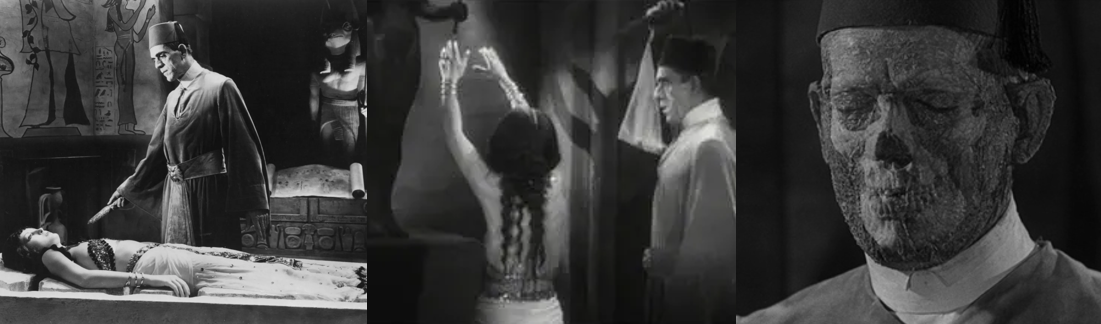
Surprisingly, I do have some experience with Shelley’s Frankenstein, having studied it at secondary school and during my undergraduate years, if only briefly. Although I’ve read and written about the text before, it has been a while since I revisited the book and most of my experiences come from the movies, as with all the Universal Monsters characters. Still, I remember enough to know that Frankenstein is a very loose adaptation, missing many details and supplanting them with others, though some of the missing material was utilised in the sequel, Bride of Frankenstein (Whale, 1935), so literary purists may have a better time watching both back-to-back. The first and most obvious change is that Frankenstein is named “Henry” here, with his title given to his cantankerous father, Baron Frankenstein (Frederick Kerr) and his original first name given to his friend, Victor Moritz (John Boles), who’s essentially an adaptation of the book’s Henry Clerval. Frankenstein also has a simple-minded, hunchbacked assistant in the movie (named Fritz (Frye) rather than the more mainstream “Igor”) rather than working alone, the Monster is deathly afraid of fire and never speaks, and many events are shuffled around. This is largely because, like Dracula, Frankenstein is based more on the stage play than the text, but it does mean the movie hits differently and explores alternate, if tangentially similar, themes regarding science, playing God, and the nature of man. The very fact that Frankenstein deals with such issues, no doubt shocking to a God-fearing world, potentially explains why the film opens with star Edward Van Sloan warning audiences to turn away if they’re shocked by such content. Indeed, the horror of Frankenstein, at the time, was just as much about a man playing God as it was the titular (or not so titular) Monster, since the idea that anyone but God can create life would’ve been deeply blasphemous and the fear of the unknown (in this case, science) would’ve made the subject matter particularly upsetting, I’m sure.

Despite warnings from his friends and loves ones, Frankenstein creates monstrous life with science.

Anyway, in Frankenstein, Henry comes from a wealthy family with a great deal of influence on a small village in the Bavarian Alps. While the curmudgeonly Baron Frankenstein despairs of his son’s bizarre experiments and decision to isolate himself in an ominous stone tower laboratory with Fritz, Henry’s correspondence to his fiancée, Elizabeth Lavenza (Clarke), tells of his need for privacy and solitude. This is primarily because he and Fritz are sneaking out at night and digging up bodies, selecting organs and body parts for a patchwork man Henry aims to bring to life through the awesome power of electricity. While they scavenge everything they need for the body, Henry’s frustrated that the recently deceased can’t provide a viable brain, so he has Fritz steal a preserved brain from his old mentor, Doctor Waldman (Van Sloan), not realising that it’s a “criminal brain” seemingly hardwired for evil (that’s also further damaged by the clumsy Fritz). Concerned for her love’s welfare, Elizabeth politely shrugs off Victor’s advances and convinces him to ask Dr. Waldman for advice, with the three braving a horrific thunderstorm to visit Henry. Though frustrated by their interference, Henry invites them to witness his crowning achievement when Victor (fully aware of his intentions) accuses him of being mad. While Henry denies this claim, it’s obvious that he is a little bonkers, as seen in his exuberant and iconic cry of “It’s alive!!”, his claims to “be God”, and his initial denial regarding his creation once it comes to life. Ecstatic to have brought the creature to life, Henry insists that the childlike being needs time to adjust rather than rejecting it on first sight as in the novel. This is despite the protests of Dr. Waldman, who correctly warns that the “Monster” is an abomination to God and a threat to all due to its capacity for evil and its unpredictable nature.

Thanks to its unnatural origin, Frankenstein’s Monster is confused and quick to wild emotions.

Despite his efforts to teach the Monster, Frankenstein is forced to agree when the creature flies into a rage at the sight of fire and acts like a wild animal while chained in the basement, murdering Fritz, attacking Dr. Waldman, and almost throttling Henry before Dr. Waldman subdues it with what’s supposed to be a lethal injection. During Henry’s recuperation, his madness lifts and he returns to a normal life, finally marrying Elizabeth (to the joy of his father and the village). Ever the curious scientist, Dr. Waldman leads the vivisection on the Monster, becoming its second victim when it reanimates and strangles him to death. Though initially oblivious to the threat, Henry (and the entire village) are alerted of a wicked murderer after learning that local girl Maria (Marilyn Harris) has been drowned, Dr. Waldman killed, and after Elizabeth is attacked. Much of this is similar to the book, such as the Monster stumbling across a little girl, murdering a child, and going on a bit of a killing spree, but it’s framed as the actions of a confused and misunderstood creature rather than acts of wickedness. While the film goes to great lengths to assert that Frankenstein’s experiments are immoral and inhuman, the tone is awkwardly balanced between Henry’s madness, the darker sequences, and some strange comedic moments. These largely involve the blustering Baron Frankenstein, who’s convinced his son’s having an affair, demands that he forget his experiments, and constantly rambles about his grandmother’s wine. The Baron has no patience for Burgomaster Herr Vogel (Lionel Belmore) or the expectant masses…until Henry snaps out of his obsession and returns to the real world, and then the Baron’s all smiles and jokes. Elizabeth is the quintessential supporting fiancée, deeply devoted to Henry despite him isolating himself and Victor being right there, and far more suitable. Victor is basically a blank slate, shouting accusations at Frankenstein and offering little else, and honestly his role could’ve easily been merged into Dr. Waldman’s to speed things up.

Madness and science birth a confused and potentially dangerous abomination.

As ever, “Frankenstein” is both the Monster and the creator as Henry brings the wretch to life and is the subject of the film but does so through abhorrent acts like grave robbing and stealing. The Monster is seemingly a mishmash of different parts and pieces, with no true personality of its own, but it does retain rudimentary memories. These initially encourage Frankenstein as the Monster’s capable of stumbling about and obeying basic instructions, but his enthusiasm quickly dies when he sees how savage the Monster becomes when confronted by fire. The Monster’s rage is only fuelled when Fritz beats it and Henry gives up on it, reluctantly agreeing to kill the creature only to find Fritz strung up. Depicted as simple-minded but incredibly strong, the Monster easily overpowers two or three men at once and gleefully throttles Dr. Waldman, perhaps out of sheer muscle memory from its “criminal brain” or perhaps because it recognises the threat those around him pose to its existence. Indeed, when the Monster stumbles upon Maria, it sits and plays, laughing and seemingly content. However, it misunderstands the girl’s game of tossing flowers into the river and chucks her in for a laugh, drowning her despite her landing in the shallow end and unintentionally whipping the villagers into a lynch mob. It’s not clear why the Monster pays a visit to Elizabeth, especially as it seemed to be wandering at random, but she’s horrified by its grotesque appearance, and it attacks her when she tries to flee. Luckily for her, it leaves her alive, which only motivates Frankenstein to join the mob. Although the Monster looks nothing like Shelley’s descriptions, its design is certainly iconic and striking. A tall, lurching, shambling wretch with its eyes largely rolled back, two bolts in its neck, and misshapen skin, the Monster is an unnatural man-thing that mocks the beauty of natural life. Yet, interestingly, Henry isn’t immediately disgusted by it and the Monster is shown only to be confused and scared, lashing out accordingly and in need of guidance rather than persecution.
The Nitty-Gritty:
Frankenstein was certainly ambitious for the time. Boris Karloff’s make-up looks both impressive and extremely uncomfortable, with the actor perfectly stomping about and making stiff, jerky movements to show the creature is unnatural and undead. Although the film lacks a score to emphasis dramatic moments, there’s some great use of sound during the thunderstorm, which delivers the film’s most impressive moment. Sure, it’s weird that Henry’s visitors aren’t drenched when they enter the laboratory and his whole setup takes a lot of liberties with the source material, but Frankenstein’s laboratory is the quintessential “mad scientist” setup and a wonderful way to show the awesome and seemingly unknowable power of nature (in this case, lightning). Baron Frankenstein’s residence also impressed in its opulence, and I liked that Frankenstein incorporated many different locations, though some sets were a bit too obvious (which is to be expected). The film utilised a decent miniature to depict the windmill and its destruction and I was impressed by how often flaming torches appeared onscreen, and how fast and loose everyone played with getting up close to them! While the Monster’s jerky movements made his “fight scenes” a joke, I did like seeing these normal guys and scientists struggling to subdue the savage Monster, who easily overpowered them and left a decent body count in its wake. It’s a shame that we don’t get to see the Monster learning to speak or being more than a near-mindless creature, but the intention seems to be to emphasise that Henry came so close to playing God but screwed it up because man isn’t meant to meddle in such things. It’s always amused me as it surely would’ve been easier for Frankenstein to reanimate a fresh body than to stitch together a grotesque behemoth, and he arguably pays the price for that approach since the Monster is as much a victim of its disparate pieces as it is the situation it finds itself in.

A dramatic showdown between man and creation ends this startling loose adaptation.

Upon discovering Maria’s dirty, drowned body, her shellshocked father (Michael Mark) carries her through the village and to the Burgomaster to warn of a murderer and immediately incites a lynch mob. The seething masses are only further incited when Dr. Waldman is found dead and Elizabeth is attacked, for the village holds the Frankensteins in high regard and is outraged at such an act. Frankenstein joins the search, which is split between different areas of the village and the surrounding grounds, with Henry venturing into the jagged mountains alongside rabid dogs and villagers wielding flaming torches. Unaware that his Monster is to blame for the deaths (since Henry believes the creature perished from Dr. Waldman’s serum), Henry is stunned when the Monster attacks him in the wastelands. The scuffle is brief and one-sided, with Frankenstein easily bested and hauled to a nearby dilapidated windmill with the mob in hot pursuit. Desperate to escape to the high ground, the Monster tangles with Frankenstein when he wakes, with Henry proving no match for his creation and being tossed from top floor. Luckily for him, the slow-moving windmill blades break his fall, leaving Frankenstein a gravely injured (but inconceivably alive) wreck on the ground. While some villagers carry Henry home, the others set the windmill on fire, sending the trapped Monster into a frenzy and seemingly causing its destruction when it’s consumed by the fire. In the aftermath, Frankenstein recovers at home alongside Elizabeth and his father celebrates with another shot of the family wine, toasting his family house and blissfully unaware that the rampage was caused by another “son of the house of Frankenstein”. It’s obviously a very different ending from the book, with the entire sub-plot and bookend of Captain Robert Walton dropped, Elizabeth and Henry surviving the events, and the omission of the Monster’s bride and vengeance upon Frankenstein’s family. Still, the Monster does seemingly perish in a fire like in the book and I don’t expect filmmakers from 1931 to try and bring the Arctic to life.

The Summary:
Since the stage play that Frankenstein is more directly adapted from has essentially been lost to the mists of time, it can be difficult to reconcile how loose an adaptation the film is from the source material. The film omits and changes many elements from the book, distilling the key events and themes to a feature-film length and losing much of the complex charm and horror of Shelley’s book. Yet, these elements are still present and, even in this modern day, there’s still a chilling message about man’s arrogance in using science to play God. While Henry Frankenstein insists that he’s the model of sanity, he is out in the dead of night digging up corpses, isolating himself from friends and family, and practically frothing at the mouth when his Monster comes to life. Though he lacks much of the nuance of the source material, Frankenstein is depicted as an egotistical and obsessed scientist who claws back some sympathy after initially appearing somewhat unlikeable, ultimately paying for his arrogance not with his life, but with a traumatic experience. Frankenstein’s lasting legacy is, without a doubt, the design and portrayal of the Monster. Boris Karloff gives a remarkable physical performance, lumbering about, throwing clubbing blows, and growling at his prey as the Monster struggles to adapt to its newfound unlife. The visual of the Monster, with its cuboid head, large suit, and metal bolts, is enduring and iconic and is so burned into the cultural consciousness that I’d wager most people don’t realise that the Monster looks nothing like that in the book. Frankenstein also impresses in its ambition, featuring many different locations and sets, some superb set design, and a surprisingly high body count (including a child, no less!) The film distils the book’s warnings about meddling in the unknown into a far more simplistic message about reaping what you sow, but it’s still a decent watch, despite some unavoidable flaws, that no doubt galvanised this version of Frankenstein’s Monster into the cultural zeitgeist.

My Rating:

Rating: 2 out of 5.

Could Be Better

Are you a fan of Frankenstein’s big-screen debut? What did you think to the changes to the source material and which parts did you miss the most? Did you also find Baron Frankenstein a bizarre character? What did you think to Boris Karloff’s performance and the dramatic redesign of the Monster? Where do you stand on who should or shouldn’t be called “Frankenstein”? Which adaptation of Frankenstein, or Universal Monsters movie, is your favourite? How are you celebrating Halloween this year? Share your opinions on Frankenstein in the comments, check out my other horror reviews, and donate to my Ko-Fi if you want to see more Frankenstein content.
Back Issues: Hellboy #1-4

Story Title: “Seed of Destruction” (Part One to Four)
Published: March 1994 to June 1994
Writers: Mike Mignola and John Byrne
Artist: Mike Mignola

The Background:
Born in Berkeley, California, artist and comic creator Mike Mignola grew up with a fascination of monsters and a love of gothic, Victorian fiction. Mignola started his career as a comic book artist working for The Comic Reader before bringing his trademark dark, moody art style to mainstream publications DC and Marvel Comics. After years of working for hire, Mignola teamed with legendary writer and artist John Byrne for his first creator-owned comic book, Hellboy. Hellboy’s visual appearance evolved over Mignola’s career, beginning as a drawing for the 1991 Great Salt Lake Comic Convention booklet before eventually becoming the “World’s Greatest” gruff and witty paranormal investigator. Hellboy’s adventures began with these four distinctively Lovecraftian, widely successful issues and expanded into a wealth of further comics, spin-offs, and crossovers thanks to Mignola’s unique blend of folklore, horror, and pulp adventure. Hellboy has also seen not inconsiderable success beyond the comic books, featured in a handful of largely mediocre videogames, some well-regarded animated ventures, and some amazingly detailed action figures. Hellboy also made a splash on the big screen, especially in Ron Perlman’s peerless portrayal of the character in Guillermo del Toro’s cult favourite films. While Hellboy’s subsequent silver screen ventures was somewhat divisive, he remains one of the most enduring and visually iconic cult comic characters whose adventures have seen him effortlessly jump between multiple genres.

The Review:
Hellboy’s story begins in 1944 at the tail end of World War Two where a special squad of Army commandos, representatives from the British Paranormal Society, and costumed adventurer Paul Gibney/The Torch of Liberty gather in a remote village in East Bromwich to tackle a lingering Nazi threat known as “Project Ragna Rok”. While First Sergeant George Whitman is sceptical, Professor Malcolm Frost, “paranormal Wiz Kid” Trevor Bruttenholm/Broom, and medium Lady Cynthia Eden-Jones believe that Adolf Hitler’s “spook squad” are experimenting with black magic to raise the dead. Thanks to Broom’s meticulous research and Cynthia’s clairvoyance, the squad learns that maniacal mage Grigori Rasputin is performing a dark ritual powered by a mystical incantation and bizarre equipment, including two hefty gauntlets worn by Rasputin. Although Klaus Werner von Krupt is unimpressed by Rasputin’s light show, Broom and the others are surprised by a sudden burst of supernatural fire and the appearance of a child-like demon. Despite Professor Frost wishing to kill the creature, Broom accidentally names it “Hellboy” and the demon is adopted by the regiment, spending the next thirty-five years being raised by Broom, whom he sees as a surrogate father. Thus, Hellboy is pained to see his mentor aged and struggling with his memory of the “Cavendish expedition”. Thanks to Hellboy’s encouragement, Broom recalls that he accompanied the renowned Cavendish explorers to the ruins of an ancient temple. There, flanked by a statue of the monstrous, cephalopod-like Sadu-Hem, Broom discovered Rasputin in deep hibernation. Barely escaping from or remembering the carnage that followed, Broom summoned Hellboy for aid, only for his adopted son to watch in horror as a plague of frogs herald the arrival of a vicious frog-like monster, which kills Broom and attacks the enraged Hellboy.

When his father is murdered, Hellboy investigates a cursed family and uncovers an apocalyptic threat.

At a disadvantage in the dark, Hellboy is disarmed and wounded by the creature’s caustic tongue, so Hellboy gives the frog-thing a taste of his mysterious, stone-like right hand and sends it crashing into a sarcophagus. When the creature tries to flee, Hellboy puts it down with a single shot from his pistol, stunned when the monster disintegrates. Concerned, Hellboy calls the Bureau of Paranormal Research and Defense (BPRD), receiving condolences from Doctor Thomas “Tom” Manning and ordered to assemble a team to investigate. Hellboy recruits pyrokinetic Elizabeth “Liz” Sherman and fish-man Doctor Abraham “Abe” Sapien to accompany him to the decrepit Cavendish Hall to question Lady Emma Cavendish about her sons. Welcoming their direct questions, Lady Cavendish relates that her family were keen explorers for nine generations and that their fortune was built by Elihu Cavendish, who cursed his bloodline seeking the temple Broom found in the mountains. While she offers them sanctuary, the trip seems to be a dead end and the group are unaware that Rasputin is manipulating Lady Cavendish from the shadows, promising to return her sons for her co-operation. While the group rests, Hellboy’s inner monologue provides some background on Liz and Abe, revealing that Liz accidentally killed her family and several others before mastering her pyrokinesis with the BRPD and Abe was discovered in an abandoned basement of Saint Trinian’s Hospital on the day President Abraham Lincoln died. After Abe and Hellboy ponder Lady Cavendish’s butler, who seems familiar to them, Abe takes to the water to scout around and is horrified when Liz mentions frogs being in her room. Rushing to her aid, Hellboy finds only a smouldering cigarette and the aforementioned butler, who turns out to be a frogman in disguise! While Hellboy fights and ultimately defeats the creature, Abe discovers only “old death” beneath the flooded mansion and Hellboy is distraught to find Lady Cavendish has been killed in the same manner as his father.

Overpowered, Hellboy’s forced to endure Rasputin’s many monologues and rabid boasts.

While mourning the old lady, Hellboy is approached by the enigmatic Rasputin, who takes credit for bringing him into the world and demands he kneel in his presence. When Hellboy naturally declines, he’s suddenly ensnared by a gigantic tentacle and dragged into the darkness to fulfil what Rasputin calls his “destiny”. Hellboy is deposited in a dark, cavernous pool beneath the house, which Rasputin declares is rich with the screams of those sacrificed to the “Serpent”. For eight centuries, mortal men sought to free the unknowable “Seven Beasts”, the Ogdru Jahad, who whispered to Rasputin (through his dreams) the means to release them. Though Rasputin claims to be able to command Hellboy, the demon blasts him in the head with his pistol, only to be sent reeling from an incantation by the seemingly immortal wizard. Stunned, realising the talismans he’s collected over the years have been neutralised, Hellboy opts to stall Rasputin until he can think of a solution. This leads to another long monologue about how Rasputin has constantly evaded death thanks to the Ogdru Jahad, who wish him to cause the apocalypse. Hellboy is then attacked by another, even bigger frogman, one of the Cavendish twins hideously transformed by black magic, and is hopelessly manhandled. While Abe follows the trail left by the other frogmen, the battered Hellboy learns of Rasputin’s travels to Europe, how he researched Ragna Rok and allied with the Nazis to gain the resources to enact the Ogdru Jahad’s plot. Though disheartened after Hitler’s death, Rasputin took solace in knowing he’d summoned Hellboy and was drawn to the temple where, while hibernating, he learned from the Sadu-Hem that the horrific Ogdru Jahad is actually seven creatures imprisoned beyond our understanding and longing to avenge themselves upon the Earth.

Though Hellboy triumphs with some help from his allies, he’s left shaken by Rasputin’s words…

After untold years of planning and preparing, Rasputin prepares to fulfil his master’s wishes using Liz’s raw power, much to Hellboy’s dismay, alongside the restored (and enlarged) Sadu-Hem. While using the enchanted Liz as an unwilling a conduit, Rasputin offers Hellboy the chance to join them in death and destruction, which Hellboy naturally rejects despite being near-paralysed from the frogman’s saliva. As Rasputin begins his incantations, Hellboy forces himself to retrieve a concussion grenade from his belt and stuffs it down the frogman’s throat, obliterating it. Rasputin’s dark magics see the Ogdru Jahad slowly awaken and attack their prison, but his mad plot is suddenly interrupted by Abe, who’s possessed by Elihu’s vengeful spirit and first impales the wizard on a spear before releasing Liz from his grasp, sparking an inferno. As Sadu-Hem and the Cavendish estate erupt in flames, the restored Abe rushes Liz to safety, leaving Hellboy behind as he insists on finishing the wraith-like Rasputin. Despite Rasputin boasting incredible power, Hellboy easily trounces the wizard, rejecting him and his offer to know the truth of his origins and shattering Rasputin with his mighty stone fist. From the ruins of Cavendish Hall, Abe relates his confusion about his possession, which Hellboy believes was the old man’s way of putting things right and avenging the many years of losses suffered by his family. While Liz also doesn’t remember much from her time under Rasputin’s spell, she feels an inexplicable relief at having unleashed her full power for once. Though Abe and Liz show concern for Hellboy, he keeps quiet about Rasputin’s final words and his own doubts about himself, and the story ends with the awakening of Rasputin’s old allies, Ilsa Haupstein, Karl Kroene, and Leopold Kurtz, in an abandoned Nazi laboratory…

The Summary:
I’ll be the first to admit that my primary source of exposure to Hellboy comes from the movies and cartoons. In fact, “Seed of Destruction” is the only Hellboy story I’ve ever read as of this writing, which may or may not be blasphemy. It’s not that I don’t like the character and his world, which has a fun, gothic horror aesthetic that speaks to the Lovecraft fan in me. My hesitancy is largely because of my dislike of Mike Mignola’s art style which, again, is probably sacrilegious. I liken Mignola’s heavy use of shadows and simplistic forms to Frank Miller, who made a career out of exaggerated shadows and sketches. It’s a very eccentric and unique art style, for sure, and don’t get me wrong: it really works for Hellboy. However, it’s just not very visually appealing for me so I tend to veer away from Mignola’s works. That’s a “me” thing, obviously, as like I say the art really adds to this unique comic book world. Mignola clearly has a reverence for horror, gothic architecture, the arcane arts, steampunk-style technology, and Lovecraft, seeping every panel and page in dark, brooding inks, sparingly using bold colours and relying on silhouettes and murky darkness to create a constantly foreboding atmosphere. Mignola’s writing is also far better than a lot of Miller’s, if I’m comparing the two, with Hellboy being a somewhat snarky, eccentric character who’s respectful to Broom and treats his associates with respect but isn’t afraid to talk a bit of trash to his enemies. Hellboy’s inner monologue reveals a half-human creature fully aware of his flaws (his quick temper, rash decisions, and poor marksmanship chief among them), somewhat curious about his true origins, and with fifty-odd years of paranormal investigating under his belt.

While the unique Hellboy makes a visual impression, he’s a largely mysterious figure in his debut.

Unlike the films, where he’s portrayed as an unruly child at times, Hellboy is largely professional here, calling in situations for the BRPD to investigate and largely conducting himself well while at Cavendish Hall. While Liz admonishes his curt demeanour, Lady Cavendish welcomes the discourse and, most notably, shows no fear or panic when met by a literal demon. While it doesn’t play a big role in this story, it’s clear Hellboy and his allies are far more public figures in the comics and have been accepted by society. Interestingly, the only person who shows any fear or suspicion of Hellboy is Professor Frost; everyone else accepts, respects, and shows concern for him. While Hellboy and Liz have a purely platonic relationship here, unlike in the films, he seemingly admires her for overcoming her traumatic past and she asks if he’s okay in the finale, showing they’re more than just colleagues. Hellboy is seen to be closer to Abe, discussing their suspicions and the case, and these three have clearly worked together in the past. Interestingly, Broom is offed very early on and his relationship with Hellboy isn’t as deep as in the movies. Sure, Hellboy thinks of him as a father figure and is seen to be angered by his murder and driven to track down those responsible, but he’s noticeably more blasé about it, even in his inner monologue. Similarly, Hellboy seems to either be not bothered by his true origins or hiding it extremely well, sparing little thought of where he came from and what his true purpose is. Although Rasputin inspires him to think differently about this, the true extent of Hellboy’s origin and purpose is merely alluded to here, with him said to have a part in the end of the world but it’s not clear what that is. Hell, Rasputin doesn’t even use him in his summoning ritual, instead focusing his power through Liz, leaving me with a sense of intrigue regarding Hellboy’s true purpose in the comics.

The horror and Lovecraftian themes are an undeniable highlight in this intriguing introduction.

Indeed, we learn more about the maniacal Rasputin that we do Hellboy, which has its pros and cons. The pros come from maintaining a sense of mystery about Hellboy to be explored in subsequent issues, while the cons come from having to suffer through panels and panels of exposition and monologuing from the depraved mage as he rambles on about his past. It’s somewhat necessary as it shows just how long the Ogdru Jahad have been influencing him and longing for their release, and how many others have tried to free them through less refined rituals and means, but it does get a bit tedious after a while. I liked that the Ogdru Jahad are kept largely mysterious despite Rasputin’s many words, appearing to be interdimensional, alien, demonic, or even divine monsters trapped within a crystalline prison somewhere beyond our comprehension. They establish a foothold on Earth through the equally monstrous Sadu-Hem (a similarly Lovecraftian beast that barely factors into the plot as it just looms there, grabs Hellboy, and then bursts into flames) and Rasputin, who’s revealed to be unnaturally long-lived and partially undead. Wielding incredible arcane magic and having manipulated the Nazis into providing him the resources to summon Hellboy, Rasputin is obsessed with being the linchpin for the apocalypse, delighting in deceiving others into doing his bidding and giddy at the thought of his masters raining destruction upon the Earth (though, again, it’s unclear what role Hellboy would play in this apocalypse). I feel it might’ve been better to have Rasputin merge with Sadu-Hem rather than take Liz hostage, or as well as using her powers, to give a bit more punch to the ending. It was interesting seeing Elihu get his revenge through Abe, but it did mean Abe and Liz played diminished roles in the finale. Still, while this isn’t a perfect story, I enjoyed this introduction to Hellboy, the familiar elements I recognise from the films, and I am interested in reading more of his adventures…I’m just not sure where to go from here.

My Rating:

Rating: 3 out of 5.

Pretty Good

Were you a fan of Hellboy’s first four issues? Did you pick these up at the time or did you discover Hellboy later, as I did? Do you think I’ve committed blasphemy by criticising Mike Mignola’s art style? What did you think to Hellboy’s appearance and demeanour? Which Hellboy stories are your favourite? Whatever you think about Hellboy, feel free to leave your thoughts below, check out my other horror-related content on the site, and donate to my Ko-Fi to suggest other Hellboy stories for me to review.

Movie Night: Terrifier

Released: 15 May 2018
Director: Damien Leone
Distributor: Epic Pictures Releasing
Budget: $35 to 55 million
Stars: David Howard Thornton, Samantha Scaffidi, Jenna Kanell, Catherine Corcoran, and Matt McAllister

The Plot:
After being creeped out by a lewd, mute clown named Art (Thornton) on Halloween night, Tara Heyes (Kanell) and her best friend, Dawn Emerso (Corcoran), are hounded and brutalised by the sadistic killer.

The Background:
Coulrophobia (or the fear of clowns) is a common trope not just in horror, but in everyday life. Personally, I’ve never found clowns to be scary but the media is full of examples of “Evil Clowns”, with two of the most notable being the Joker and Stephen King’s It. It’s this fear that writer director Damien Leone tapped into when he made his directorial debut with The 9th Circle (2008), a short film that introduced the first prototype of Art the Clown (Mike Giannelli). Though only a supporting character, Art proved popular with audiences and Leone revisited the character in his next short film, Terrifier (2011), and the feature-length anthology All Hallows’ Eve (2013). Afterwards, Leone decided to make an entire film focusing on the character, one that would pay homage not just to slasher film icons and franchises, but to Giallo and splatterpunk cinema. Primarily geared towards showcasing gory, practical effects at the expense of characterisation, Leone put a lot of care into his kill scenes, ensuring Catherine Corcoran’s safety in what became one of the film’s most notorious moments. Seeking to create a truly iconic slasher villain for a new millennium, Leone recast Mike Giannelli as Art the Clown after being impressed by David Howard Thornton’s physical awareness and penchant for improvisation. After premiering at the 2016 Telluride Horror Show, Terrifier released in a handful of cinemas and made a modest profit considering its low budget. Reviews were largely positive, praising the performances and the jaw-dropping gore, However, while Thornton’s portrayal of Art was lauded, some felt the film didn’t quite live up to its potential, a sentiment Leone agreed with and aimed to address in the sequel. Indeed, Terrifier impressed enough not just to earn a critically and commercially successful sequel in 2022, but to kick-off a whole new slasher franchise (for better or worse).

The Review:
Terrifier establishes a few things right from the opening sequence, in which shots of Art applying his makeup and getting dressed for a jaunt on the streets are interspersed with talk show host Monica Brown (Katie Maguire) interviewing a severely disfigured woman. This sets the stage for how creepy and off-kilter Art is; he seemingly purposely adopts a clown-like guise to unsettle his victims and disguise his cruel intentions. These shots of Art getting ready and hauling his bin bag full of tricks echo the opening of A Nightmare on Elm Street (Craven, 1984), a clear influence given the reference to “Craven’s” Halloween supplies and Art’s depiction as a silent version of Freddy Kruger (Robert Englund). Next, this opening establishes that the film isn’t going to be pulling any punches as Monica’s guest is horrendously disfigured after surviving an attack from Art a year previously, to the point where she chooses to isolate since her appearance is so horrifying. Finally, this opening shows that there’s a mean streak in Terrifier that extends beyond its mysterious and silent killer. While Monica appears sympathetic and attentive on-air, she ridicules her guest to her boyfriend after the cameras stop rolling. The embodiment of beauty and drive, Monica arrogantly dismisses her guest’s suffering and expresses disgust and even fear at even being sat with her. Luckily, it turns out Monica was right to be afraid as her guest pounces on her, brutally maiming Monica’s face and cackling like a witch as she lays a bloody, equally disfigured mess on the floor. Therefore, within around ten minutes, we learn everything we need to know about Terrifier: it’s going to be an unsettling spectacle of gore and depravity featuring somewhat unlikeable characters being torn apart in ways that may shock and disgust.

Fun loving Dawn and sensible Tara run afoul of a cruel-hearted and vicious killer clown.

As a long-time horror fan, I’m here for it. I’ve become largely desensitised to a lot of horror and much prefer it when movies don’t hold back. And Terrifier certainly isn’t holding back at times. Unfortunately, it does suffer from an uneven pace and comes across more like an extended proof of concept for what Damien Leone and his instantly iconic killer are capable of. Although the film’s set on Halloween night, the spooky season is primarily used to semi-explain Art’s clown-like appearance. It is the perfect excuse for Tara and Dawn to hit the town and get wasted, however. Clearly long-time friends, these two are an incorrigible duo, teasing each other and having a fun rapport. Dawn is the more promiscuous and reckless of the two, joking about her sexual lusts, drunkenly accosting Mike the Exterminator (McAllister) to let Tara pee, and insisting on a selfie with Art when they spot him leering at them in a pizzeria. While Tara is instantly creeped out by Art, Dawn brushes off her worries and chastises her for being a buzzkill, lamenting that Tara always has to be the “good girl” and overthink things. Rattled by the encounter in the pizzeria, Tara’s anxiety only increases when they find Dawn’s tyres slashed. Luckily, Tara calls her sister, college student Victoria (Scaffidi), who heads out to pick them up, and Tara convinces Mike to let her pee inside the house he’s spraying for rats. Unfortunately, Tara’s concerns about Art catch up to them when he attacks and subdues them both. Strapped and bound to a chair, Tara can only watch helplessly as Dawn is strung upside down and sawed in two from her crotch to her head with a rusty hacksaw! Though Tara shows some fighting spirit and manages to escape and even attack Art, she’s slowed by a severe injury to her ankle and unceremoniously executed by multiple gunshots when Art surprises her with a pistol.

In a film full of underdeveloped characters, Victoria might be the least fleshed out of them all.

Thus, Leone pays homage to Psycho (Hitchcock, 1960) by spending a good half-hour or so building up Tara as the film’s plucky, underdog “Final Girl” only to abruptly kill her off and switch the focus to her sister, Victoria. It takes Victoria some time to reach Tara’s destination and, when she does, she’s too late to help and is distraught to see Dawn’s remains and her sister’s mutilated corpse set up to taunt her. A college student studying for her midterms, Victoria drops everything to help her sister but is extremely out of her depth when confronted by Art, who delights in mocking and tormenting her. When Victoria stumbles upon what she believes is her sister’s injured body, her first thought is to call for help, but she’s horrified when it turns out to be Art in disguise, having ripped the scalp and much of the torso off a deluded resident (Pooya Mohseni). This disturbed but ultimately harmless lady shared a moment with Tara and tried to offer Art a mother’s comfort to spare her baby, a simple child’s doll, only to be left a gory mess. After Art relentlessly shreds her body with a cat-o’nine-tails, Victoria is saved by Mike, who survived a mallet to the face and gets her to safety, finally calling the cops. However, Mike gets his head literally caved in when Art renews his attack, leaving Victoria to desperately try and escape the building and the crazed maniac pursuing her. Although Tara’s characterisation is pretty paper-thin (she’s a fun loving but ultimately sensible young girl), I think it’s a lot better than Victoria’s. We don’t learn much about Victoria except that she’s studying for her midterms (we don’t even know what her major is) and that she’s loyal to her sister. Beyond that, she’s just a vessel to follow and witness and react to Art’s brutality and honestly has less appeal than Tara because at least she was dressed in the Halloween spirit. Horror films, especially slashers, aren’t generally known for their compelling victims but the “Final Girl” is usually more well-rounded and memorable. Sadly, Victoria and her fellow victims are simply window dressing in Art’s first outing, failing to really make much impact until the film’s twist is revealed.

Art’s cruelty and unpredictability make him an especially dangerous and bloodthirsty killer.

Therefore, Terrifier lives and dies through the depiction of its mean-spirited killer. Art barely tries to mask his creepiness, sporting a leering grin, crooked nose, and mangled teeth and setting people on edge simply by walking into a room. To make matters worse, he follows this with some truly disturbing physicality, beaming at Tara with an upsetting sneer and creeping her out by presenting her with a ring. While Steve (Gino Cafarelli) from the pizzeria is aggravated by Art’s nonchalant stare and refusal to speak, he’s incensed to find the clown defecated all over the toilets and throws him out, much to Art’s feigned chagrin. Of course, the slighted Art has the last laugh, hacking Steve’s head off with a hatchet and leaving it burning on the counter like a jack-o-lantern for Steve’s fellow employee (or possible his brother?) Ramone (Erick Zamora) to find. Lugging a bin bag full of hacksaws, knives, ammo, and other implements, Art’s unpredictability is as shocking as his brutality. You never know what weapon he’s going to whip out next or what he’ll do with it, leading to him hacking Ramone’s hand in two with a clever, sawing through and then ripping off another exterminator’s (Michael Leavy) head, and drawing a pistol to repeatedly blast Tara in the face. We learn nothing about Art except that he’s on a killing spree and that he relishes in torturing and maiming his victims. He never utters a single word, not even a cry or breath, though his visible frustration at being out of bullets and his agony when stabbed or beaten is clear thanks to Thornton’s masterful physical performance. What really seals it, however, is that Art will silent cackle when assaulting his victims, toying with them and mocking their suffering while delighting in the arterial spray and steaming organs spilling to the floor. At one point, it seems Art is subdued by a mother’s touch, however this proves only a temporary reprieve and Art is truly depicted as a chaotic force without mercy who tortures and kills for the sheer fun of it.

The Nitty-Gritty:
I can respect this approach. Although horror is full of iconic killers, many lose much of their mystique when too much of their backstory is revealed, humanising them and making them sympathetic. There is absolutely nothing sympathetic about Art, who gleefully mocks his prey, smears his faeces over walls, and chortles manically (but silently) when sawing Dawn in half. Still, there’s something to be said about giving some hint about who Art is and what drives him. He’s clearly mortal, since he bleeds and reacts to pain, and clearly a nomad, holing up in whatever filthy squalor he finds and seemingly targeting people at random. He’s capable of anger, since he flips Victoria off when she stabs him and spitefully maims anyone who dares to fight back. He also appears inhumanly strong, taking a beating from Tara and manhandling his victims at times. Despite appearing a very childish and immature figure, Art is cold, calculating, and vindictive, slashing Dawn’s tyres and drugging Tara and even texting Victoria to lure her into the building. Consequently, Terrifier presents what little narrative it has as a series of random and shocking events that could’ve happened to anyone. This is where the film’s true horror lies as while Art’s murderous acts are enough to traumatised unsuspecting audiences, they’re so over the top that they’re less scary and more disgusting. While none of the actors give particularly stirring or award-winning performances, they’re depicted as normal, everyday folk who unwittingly attract a depraved serial killer and I think the random nature of this is far more (dare I say it…) terrifying than all the hacksaws and knives. The idea that you, or anyone, could just be walking the streets and be set upon by such a crazed maniac is unsettling, to say the least, and Art only serves to heighten this fear by brutalising his victims in ways that would make Ed Gein blush.

Terrifier supplants characterisation with shocking splattergore and unapologetic brutality.

Yes, you shouldn’t really go into Terrifier expecting some game-changing plot or emotionally charged characters. I like the three female leads but there isn’t much to them and, let’s not mince words, it’s clear that Terrifier is simply an excuse to show off incredible and revolting gore and unsettling practical effects. Things start strong with Monica’s host appearing more like a mincemeat skeleton than a person, sporting an emaciated grin and one barely functional eye. She leaves Monica in an even worse state, clawing at her face and leaving her a gibbering mess of bloody, meaty chunks, and Tara is repeatedly stabbed in the ankle, hobbling her to keep her from running at full speed. While we only see Steve’s burning head, we get to watch Art hack up Ramone on the pizzeria floor and see in gory detail when he crushes Mike’s had under his heel. Tara’s death is easily the film’s weakest and least creative kill, but there’s something shocking about the cold-hearted nature of her being mercilessly shot to death. The other exterminator, Will, gets a more spectacular end as he’s stabbed in the skull before he can even react and then has his head partially sawn off before Art nonchalantly kicks it away. The doll-pampering resident pays for her kindness by getting scalped and having most of her skin torn off; Art then parades around in her flesh, clearly enjoying his new look. However, it’s Dawn’s death that’s the showstopper. Strung upside down by chains and hanging completely nude, she’s sawn in half and we (like Tara) are forced to watch as her guts spill to the floor and Art silently cackles maniacally. It’s a truly sadistic and brutal moment made more uncomfortable by where he starts sawing, and the sheer shock of the sequence is enough to keep you from questioning how a simple hacksaw easily cuts through flesh, bone, and muscle.

Art somehow reanimates after blowing his brains out and Victoria’s left a mangled mess.

Although Tara fights back, she lets rage cloud her judgement and is caught off-guard when Art pulls out a pistol, leaving her writhing helplessly on the floor as he blasts her face full of bullets. When Victoria arrives, she discovers a full-blown massacre, with bodies strewn everywhere and Art relentlessly pursuing her. Unprepared and overwhelmed, the grief-stricken Victoria can only run, scream, and cower as Art targets her next. Though she exhibits some of the same fighting spirit as her sister, Victoria’s ultimately more reliant on Mike to help fend off the psychotic clown. Unfortunately, Art quickly recovers from Mike’s attack, kicking and finally crushing Mike’s skull with his oversized clown shoes. Victoria manages to squeeze through a locked door to safety, only to be mercilessly taunted by Art as he swipes at her and blows a clown horn in her face. Although she appears to have escaped him, Victoria is blindsided when Art suddenly drives Mike’s van through the doors and into her, knocking her unconscious. Luckily, Mike got through to the cops and a couple of officers (Jason Leavy and Steven Della Salla) show up to apprehend Art. Clearly frustrated at being interrupted, Art toys with the cops and then whips out his gun. However, rather than fire at the cops, he instead shoots himself in the head rather than be arrested. Art’s mangled body and those of his victims are then bagged and taken to the county coroner, Seth Bolton (Cory Duval), who begrudgingly agrees to process the corpses in return for a bacon sandwich. However, after unzipping Art’s body bag, Seth’s perplexed by a sudden and mysterious power outage. Though he shrugs it off, he’s horrified when Art suddenly springs to life, a disgusting grin on his face, and starts choking him. This cliff-hanger ending then cuts to a hospital, where Victoria was taken after surviving Art’s assault. Unfortunately, Art decided to eat her face, leaving her with a mangled and hideously disfigured visage and revealing that she was the mutilated guest who attacked Monica at the start of the film…!

The Summary:
Terrifier is, perhaps, the most notable independent horror of the last ten years. Shot and styled very much like a “Grindhouse” picture, the film wears its influences on its sleave and is very much a celebration of the splatterpunk and slasher genres. While this is a positive, it also works against it, particularly in the characterisation of its leads. Damien Leone has since stated dissatisfaction with these elements and I’m forced to agree. While I didn’t mind Tara, Victoria was essentially a blank slate and many performances were questionable, at best. It’s irrelevant, in many ways, however, since Terrifier is just an excuse to show off some depraved gore and showcase its sadistic serial killer. Accordingly, it’s no surprise that David Howard Thornton steals the show as he throws his all into Art, embodying the character with manic glee and showcasing a range of emotions simply through body language and facial expression. Art’s unlike many horror icons as he’s silent but entirely expressive, cruel and vicious and yet wholly unpredictable and spontaneous. His entire visage is his gimmick rather than any one weapon and he kills simply for the thrill, and the mindlessness of his character and actions add not only to Terrifier’s allure and mystery, but its horror. It’s increasingly all-too-easy to imagine some sick fuck stalking the streets, accosting young women and engaging in deplorable acts and the random nature of Art’s killing spree is just as unsettling as his gore-drenched kills. And damn, does Terrifier deliver on the gore! Leone’s twisted imagination is a joy to see; even if the effects stretch the limits of physics and logic at times, it all comes together as a celebration of the genre. However, I do feel Terrifier was lacking in some regards that keep it from being a true classic. It certainly gave the genre a kick up the ass and it’s worth a watch, but Terrifier views more as an extended pitch for a bigger, more refined movie, especially in retrospect having seen the sequels. I’m therefore not as impressed or awed by the film as I would like as it’s lacking in some basic filmmaking areas, resulting in a special effects and physical acting showcase whose soul appeal are the disturbing gore and instantly iconic serial killer.

My Rating:

Rating: 3 out of 5.

Pretty Good

Did you get a kick out of Terrifier? What did you think to Art and David Howard Thornton’s performance? Were you also disappointed that his victims were largely forgettable? Did the gore make up for these moments or did you find it a bit too depraved and over the top? If not, which of Art’s sickening acts was your favourite and what did you think to these effects? Would you have liked to learn more about Art or do you think it’s better he stayed mysterious? Which of the Terrifier films is your favourite and how are you celebrating horror this month? Share your thoughts about Terrifier down in the comments, support me on Ko-Fi, and go check out my other horror content!

Movie Night: Bram Stoker’s Dracula

Released: 13 December 1992
Director: Francis Ford Coppola
Distributor: Columbia Pictures
Budget: $40 million
Stars: Gary Oldman, Winona Ryder, Keanu Reeves, Richard E. Grant, Billy Campbell, and Anthony Hopkins

The Plot:
Having renounced God after the suicide of his love, ruthless vampire Count Vlad Dracula (Oldman) travels to London to seduce her lookalike, Mina Harker (Ryder), indulging his bloodlust and inspiring a rag-tag band of would-be vampire killers to stand against him.

The Background:
Inspired by Irish folklore and age-old vampire myths, Bram Stoker’s Lord of Vampires undeniably popularised the vampire as we know it today and inspired many critical and academic discussions. About thirty years after the book was published, World War I infantryman Bela Lugosi first embodied the role of Dracula for a stage production, eventually transitioning to the silver screen for Tod Browning’s horror classic before the legendary Christopher Lee made the role his own in 1958. After decades of reinterpretations and filmic appearances, Dracula lived again in 1992 thanks to the efforts of star Winona Ryder, who brought James V. Hart’s screenplay to director Francis Ford Coppola as a project for them both. Attracted to the haunting, disturbing sensual nature of the material, Coppola agreed and Gary Oldman jumped at the chance to work with the prolific director, who spared no expensive crafting the film’s ornate costumes. Veteran production artist Mentor Huebner and even comic book writer and artist Mike Mignola worked on the film’s extensive storyboards while hair and makeup designer Michèle Burke crafted Oldman’s signature look. After Christian Slater turned down the Jonathan Harker role, Keanu Reeves stepped in, though his hard work to convey a British accent drew much criticism. Oldman apparently lost himself in the sexuality and intensity of the role so completely that fell out with Ryder for a while and Coppola’s eccentric demands drew some criticism at the time. Finally, Coppola also insisted on utilising practical, in-camera, and old-school special effects technique utilising forced perspectives, miniature effects, and matte paintings. Opening at number one at the US box office and with a final gross of over $215 million, the award winning Bram Stoker’s Dracula was largely praised as a visual masterpiece. While many criticised some of the performances and its overly dramatic elements, just as many praised it as a tragic, alluring mixture of romance and horror, lauding Oldman’s performance and the tangible nature of its presentation.

The Review:
Bram Stoker’s Dracula mixes folklore, fiction, and history to present the titular Lord of Vampires as having started life as a Vlad III Drăculea, a warrior for the Romanian Orthodox Church, a commander and soldier so ruthless and bloodthirsty that he single-handedly slaughtered many in the Ottoman Empire and impaled their bodies and heads on pikes as a way to destroy their moral. Back in 1492, Dracula’s campaign against the Turks was seen as a righteous one, fought to defend his church in the name of almighty God, who Dracula praised and devoted himself to above all else save his beloved wife, Elisabeta (Ryder). However, while Dracula was successful in slaughtering his enemies, Elisabeta took her life after receiving false reports of his death, unable to face living life without her husband. Upon discovering this, and learning that Elisabeta’s suicide had damned her soul, Dracula cursed and renounced God, desecrating the chapel and drinking a strange blood spewing from its altar. In the process, Dracula became the first vampire, an undead thing with powers over the elements (he conjures great storms and winds), dominion over the “children of the night” (wolves, rats, and such), and the ability to transform into a monstrous bat-like form, mist, and rats. Contrary to most popular depictions, Dracula is merely weakened by sunlight, though he does draw strength from the cursed soil of his homeland, Transylvania, and renew himself by drinking the blood of his victims. Yet, Dracula spends four centuries isolated in his decrepit, ominous castle on the outskirts of a nearby village with only his lustful, ravenous concubines (Florina Kendrick, Michaela Bercu, and Monica Bellucci) for company, presumably terrorising and feeding upon the locals whenever the thirst or fancy takes over. When the film jumps ahead to 1897, however, visits to Transylvanian to liaise with the mysterious Count have driven solicitor R. M. Renfield (Tom Waits) insane, leaving him in the care of Doctor Jack Seward (Grant), who’s both disgusted and amazed by Renfield’s hunger for flies and mad rantings about his “master”.

When Dracula pays a visit to London, he terrorises the aristocracy with his perverse lusts.

Since Dracula wishes to purchase properties around London and represents a substantial investment, Renfield’s duties are passed to fresh-faced, well-spoken, and somewhat frigid solicitor Jonathan Harker (Reeves). Though his fiancée, Wilhelmina “Mina” Murray, is saddened to hear he will be gone for some time, eager to consummate their marriage, she recognises that this is a big opportunity for Harker and takes solace in his frequent correspondence. Though well-mannered and good-natured, Harker is unnerved by Transylvania, where wolves freely wander, darkness looms ominously, and his client is prone to bizarre outbursts. Dracula treats Harker as a guest, welcoming and feeding him and expressing his desire to be amongst civilisation once more, but is erratic and eccentric, lamenting his cursed family bloodline, driven to a frenzy by the sight and smell of blood, and generally testing Harker’s civil nature. While I love Keanu Reeves, he is dreadful in this role, delivering perhaps the worst British accent I’ve ever heard and appearing lost and confused. This is a case where it might’ve been better to let him use his natural accent, if only to make his line readings less awkward, but that wouldn’t have helped with his awful haircut/wig and robotic tone. Harker’s effectively held prisoner in Dracula’s castle, feasted upon by his brides for at least a month before he finds the willpower and courage to escape and being left severely traumatised. While pining for her love, Mina takes solace in the courtship of her dear friend, the promiscuous Lucy Westenra (Sadie Frost), giggling over sex acts while Lucy flits between her suitors, Dr. Seward, wealthy Lord Arthur Holmwood (Cary Elwes), and gunslinger Quincey P. Morris (Campbell). Though she settles on Holmwood (presumably for the financial security, accustomed as she is to such a lifestyle), the other two continue to hang around and curry her favour, forming first a dysfunctional friendship and then a rag-tag group of vampire hunters when the peculiar Professor Abraham Van Helsing (Hopkins) alerts them to the vampire’s threat.

While Mina succumbs to Dracula’s charm and Harker’s tortured, Van Helsing offers his expertise.

Betrayed by his faith, Dracula is presented as a far more tragic and sympathetic figure. Upon seeing Mina’s photograph, Dracula alters his plans for London to include seeing his reincarnated love, mercilessly slaughtering the crew of the Demeter to restore his youth. Unlike other adaptations of Dracula, where he integrates into London society and socialises with Dr. Seward and the others, Dracula is a largely enigmatic figure once he reaches Ol’ Blighty. Appearing as a peculiar foreign prince, Dracula stalks Mina through the streets, using his hypnotic and persuasive powers to entrance her and slowly unearth her forgotten memories of their past life and love. Though initially rude towards him, Mina comes to be captivated by Dracula and begins a love affair in Jonathan’s absence, naturally unaware that her handsome prince has been feeding upon Lucy in the night as a wolf-beast. However, when she receives word of Jonathan’s condition, Mina goes to him, encouraged by her sick friend, to rekindle their love and get married, though it’s obvious that her feelings have changed and that her thoughts constantly drift to her passionate and mysterious prince. When Lucy’s condition worsens and defies Dr. Seward’s expertise, he calls Van Helsing for aid, only for the outlandishly blunt priest to conclude that she’s been targeted by Nosferatu, a subject he’s well versed on. Although Van Helsing tries to stave off the infection with a questionable blood transfusion, Mina’s beset by a fever, constantly wandering off in a daze, and undergoes radical personality changes, resembling Dracula’s ever-horny, ever-hungry brides and quickly making believers out of Lucy’s bemused suitors.

Dracula is depicted as a demonic, yet ferociously tragic and aggressively sexual romantic figure.

Jonathan’s return to London confirms Van Helsing’s worst fears, that Dracula himself is amongst them, and he leads the fledgling vampire to hunters to “where the basturd sleeps” so they can destroy Dracula’s cursed soil. However, Dracula is agonised when Mina breaks off their tryst, conjuring violent winds and fully transforming Mina into a vampire out of spite. This process sees her rise as an undead seductress with the same unnerving taste for children as Dracula’s concubines. While Dr. Seward, Quincey, and Holmwood falter against Lucy’s monstrously sexual transformation, Van Helsing leads the charge, wielding a holy cross and easily placing Lucy into a vulnerable slumber so she can be staked and decapitated. While Jonathan is startled about how blasé Van Helsing is about this, he eagerly joins their cause to deal a measure of revenge against Dracula, who murders Renfield for running his mouth to Mina before appearing before her, all pretence dropped. Although Mina is horrified and angered to learn that her lover murdered her best friend, she cannot deny her feelings for him or the strength of her vague memories and begs to be with him, forever. While elated to hear this and desperate to inflict his curse upon her to be reunited with his lost love, Dracula hesitates at the last second, unable to bring himself to watch her suffer from eternal torment as he has. However, horny little minx that she is, Mina refuses to listen and gladly, hungrily drinks his blood in an explicitly sexual act that sees her undergo a similar transformation to Mina. This means that she constantly interferes with the hunters’ attempts to intercept and destroy Dracula when he flees to Transylvania, attempting to seduce Van Helsing and even holding her husband at bay with a rifle to defend her dying love, having willingly sacrificed her humanity for some real passion in her life.

The Nitty-Gritty:
Since I haven’t read the original book, I’m not really qualified to comment on how accurate an adaptation Bram Stoker’s Dracula is. However, from what I’ve heard, it’s one of the most faithful retellings and I did like that the film incorporated voice overs and diary entries to mimic the book’s epistolary nature. Dracula is undeniably a vastly different character to other, more popular depictions, appearing as a once proud and seemingly noble (if ruthless) soldier who slaughtered armies in the name of his God. He cherished Elisabeta more than anything in the world and felt betrayed when the church turned on him after his many years of faithful service, renouncing God since he’d forever be denied his love even in death due to her damning her soul through suicide. His quest to London thus becomes a desperate desire to reunite with Elisabeta, who’s seemingly been reincarnated in Mina, and he wastes no time in captivating and wooing her. Whereas Jonathan is reluctant to give in to carnal desires, Dracula is an extremely passionate man whose romantic way with words entrance Mina as much as his hypnotic gaze and the shadows of her former life. While he’s overjoyed to reunite with his love, Dracula hesitates to subject her to his curse, knowing it cannot be undone and will lead to eternal earthly damnation for them both. Interestingly, he doesn’t spare this same concern for his other concubines or show mercy to the children he regularly feasts on, but these are apparently secondary concerns for the lovelorn Mina, who’s so desperate to get laid that she gleefully renounces her humanity. And make no mistake about it, Bram Stoker’s Dracula is the horniest, sexiest adaptation of the text you’ll ever see! Lucy is super horny for all her suitors, Dracula’s many attacks are framed as blatantly sexual acts, the vampire brides all exude succubus energy, and then there’s the scene where Mina drinks Dracula’s blood and he reacts with orgasmic pleasure!

Despite some impressive visuals, the monster designs are questionable, at best.

Bram Stoker’s Dracula may also be the most visually impressive version of the book. It’s clear that the filmmakers spared no expensive on the elaborate costumes and sets, with the woman, especially, being strapped into extravagant gowns and the men all dressed in their finest regalia. While I dig Dracula’s beehive hairdo and opulent robes, I do question the design of his blood red armour, which seems awfully devilish for a man of God and also looks far too much like heavy leather for my tastes. The film uses practical effects and traditional optical trickery to fantastic effect to overlay miniatures with backgrounds and diary entries and project Dracula’s gaze into the storm clouds. The film is surprisingly sparing with the gore, but it makes quite an impression when it does appear, with arterial spray drenching drapes, Lucy spewing up blood when Van Helsing shoves a cross in her face, and heads flying after being severed by the vampire hunters. Dracula has quite a few forms here, though some are better than others. His aged, withered appearance is one of my favourites, though his youthful guise makes the girls wet and his unnerving mist proves suitably deadly to the rabid Renfield. Sadly, Dracula’s monstrous forms leave a lot to be desired, his man-bat form is the superior of the two, but even this looks awkward and uncomfortable, especially as his arms are literally bent-back wings. His wolf-man form is even worse, however, appearing very fake and shaggy looking, with only the facial prosthetics and his unsettling sexual attack saving it from being ludicrous. Dracula’s decaying appearing in the finale is far more striking, as is his mysterious horseman and the techniques used to show him and his concubines moving with unnatural grace. Unfortunately, little of this keeps the film from being an absolute slog to sit through. At just over two hours long, Bram Stoker’s Dracula sure does drag things out, inflating its runtime with bizarre editing choices and unnecessary cutaways and perhaps sticking a little too close to the text for its own good.

Thankfully, the entranced Mina ends Dracula’s torment, and mine, by ending this dull movie.

Thanks to Jonathan, Van Helsing and the others destroy all but one of Dracula’s boxes of earth. When his seduction of Mina is interrupted, Dracula’s forced to flee to Transylvania in his last box, his powers fading and his appearance quickly degenerating, to regain his strength. Van Helsing leads his group in intercepting Dracula, bizarrely taking Mina with them despite her being less of a liability in London. While Harker and the others try to cut off the gypsy slaves transporting Dracula’s carriage, Van Helsing and Mina head directly for his castle, with the eccentric vampire expert desperately fending off the brides with his flaming torch and subduing Mina with a communion wafer when they try to seduce and bite him. When the brides kill their horses, Van Helsing takes a swift revenge and claims their heads before joining up with the others at Dracula’s castle. Although Quincey is fatally stabbed in the hectic fracas, he does stab the decaying Dracula through the heart and Harker gets a measure of revenge by slitting the Count’s throat. However, Mina stops them from finishing off the monstrous abomination and Harker and Van Helsing reluctantly allow her to get Dracula into the chapel where he once turned his back on God. There, the demonic Dracula shares a kiss with his beloved and is amazed when the chapel undergoes a supernatural restoration; the candles ignite and the cross he disgraced repairs itself, restoring Dracula to his youth. However, he’s still mortally wounded and, with his dying breath, Dracula begs Mina to bring him peace. Although she’s heartbroken, Mina agrees to end his suffering and stake shim through the heart before decapitating him, undoing the curse inflicted upon her and seemingly allowing Dracula to reunite with Elisabeta in the afterlife.

The Summary:
I’m going to be honest and say I’ve never liked Bram Stoker’s Dracula. I never watch it because I remember it being a long, boring, overly stylised affair with some atrocious performances. And that isn’t just a knock against Keanu Reeves, either, as Winona Ryder and Sadie Frost are just as bad with their accents and delivery. Hell, even Gary Oldman and Anthony Hopkins are hamming it up, though I at least give them credit for bringing a Shakespearean gravitas to this tediously dull movie. While I’m sure Bram Stoker’s Dracula is exceedingly faithful to the book, there’s something to be said for condensing the text when making an adaptation. For example, did we really need Dr. Seward, Holmwood, and Quincey all in the film? I feel it would’ve been far simpler to combine them into Dr. Seward for the sake of brevity. Additionally, we spend way too long in Dracula’s castle with him, Harker, and the brides. Like, I get it; Dracula’s manipulated Harker and imprisoned him there, but this sequence goes on for what feels like an age and yet the Demeter scenes are a glorified montage? I did like how tragic and human Dracula is, with him depicted as a disgraced former believer who’s spent centuries yearning for his lost love and yet hesitates to afflict her with his curse as it’s been such a tortured unlife for him. Paradoxically, Dracula is still a monstrous fiend who feasts upon innocent souls (and children) to prolong his life and make others suffer for his own amusement. While the film is undeniably beautiful and the old-school filmmaking techniques are appreciated, giving the film a tangible quality that makes it seem like a big-budget stage play, Dracula’s monstrous forms leave a lot to be desired. His man-bat form is a major disappointment and the man-wolf effects are laughable, though it is intriguing how sexually aggressive the film is, explicitly depicted Dracula’s attacks as sexual misdeeds. It may be the most faithful adaptation of Stoker’s text, but Bram Stoker’s Dracula is just too tedious for me to rate much higher. I dreaded revisiting it for this review and hoped my opinion would’ve changed, but it’s just as dull and painful to sit through as ever, despite its strong visuals and atmosphere.

My Rating:

Rating: 2 out of 5.

Could Be Better

Are you a fan of Bram Stoker’s Dracula? If you’ve read the book, how faithful is this adaptation and would you say it stuck too close to the text in some areas? Do you agree that the film is too long or were you captivated by the gothic atmosphere? What did you think to Gary Oldman’s performance and Keanu Reeves’s atrocious accent? Which adaptation of Dracula is your favourite and how are you celebrating Halloween this year? Tell me I’m wrong about Bram Stoker’s Dracula in the comments, read my other horror reviews, and donate to my Ko-Fi if you want to see more Dracula content.
Movie Night: Dracula (1931)

Released: 14 February 1931
Director: Tod Browning
Distributor: Universal Pictures
Budget: $341,191
Stars: Bela Lugosi, Helen Chandler, David Manners, Dwight Frye, and Edward Van Sloan

The Plot:
When R.M. Renfield (Frye) travels to Transylvania to oversee the purchase of a London abbey to the enigmatic Count Dracula (Lugosi), he unwittingly facilitates the malicious vampire lord’s trip to London, where he terrorises beautiful maiden Mina Harker (Chandler).

The Background:
In 1897, the literary world was introduced to Count Dracula, Lord of Vampires, courtesy of Irish author Bram Stoker. Inspired by Irish folklore and long-standing vampire myths, Dracula undeniably popularised many characteristics of vampires that are still used to this day. Dracula also inspired many critical and academic discussions regarding its narrative and subtext, becoming a literary classic, and was said to be a big hit at the time, despite its controversial content. About thirty years later, Dracula was adapted for the stage, with former World War I infantryman Bela Lugosi first assuming the role that would make (and haunt) his career. Though the production was a hit, Lugosi wasn’t the first choice for the role when Universal Pictures began producing a feature film adaptation and only got the part after accepting a significantly lower salary. Although Browning’s film was the first official film adaptation of Stoker’s novel, Nosferatu: A Symphony of Horror (Murnau, 1922) owed its existence to Dracula, to the point that Stoker’s widow sued the filmmakers and ordered all copies to be destroyed. After acquiring the rights to the property, Universal Pictures funded what was said to be a disorganised shoot, with Lugosi alienating some cast members and Dracula stage veteran Edward Van Sloan expressing displeasure with the film. Despite some apprehension surrounding the film, Dracula was bolstered by reports of audience members fainting and it was well received by critics. Of course, nowadays, Dracula is regarded as a classic of the silver screen, with Lugosi’s portrayal being the quintessential standard of all subsequent screen Draculas. Its success not only led to additional big-screen outings for the count and a slew of horror releases from Universal Pictures, but also defined the titular character for generations.
The Review:
I think it’s important to preface this review by saying that I’ve never gotten around to reading Stoker’s Dracula. My experience with the Lord of Vampires is all based on movies and other media rather than books, so I can’t speak to Dracula’s status as an adaptation. If I had to guess, it seems it’s more an adaptation of the original stage production than the epistolary text, but I’m sure a lot of the most prominent elements of the book are represented here. Dracula is initially the story of Renfield, a painfully polite and well-to-do Englishman who travels to a morbidly superstitious town in Transylvania to oversee the sale of Carfax Abbey. Respectful and courteous to the locals, Renfield insists on meeting a midnight carriage, as arranged by his client, Count Dracula, only to be warned off by villagers. In a lengthy, awkward opening scene with many obvious insert shots, the locals react with horror at Renfield’s plan to meet Count Dracula and insist he carry a crucifix to ward off the vampires they believe live in the ominous, gothic castle. Undeterred by superstition and enthusiastic about closing the deal, Renfield maintains his composure even when Dracula’s carriage driver vanishes, his luggage is left behind, and the enigmatic count appears to pass through an enormous spider’s web. Renfield enjoys Dracula’s hospitality, complimenting his home despite it being quite dilapidated and eagerly partaking of his food and wine, only to be duped by the charismatic vampire, who easily hypnotises him with his alluring glare and then samples his blood to turn Renfield from a chirpy and pleasant solicitor into a grinning, cackling nutjob with a taste for insects and an unwavering devotion to his “master”. With Renfield’s help, Dracula not only legally secures Carfax Abbey, but also loads crates of his home soil onto the Vesta, ensuring he can maintain his full strength on the journey to London and while hobnobbing about the city as an eccentric aristocrat.

Vampire lord Dracula corrupts Renfield and heads to London to target an innocent young lady.

Once Dracula enslaves Renfield, the film juggles between the alluring count and Doctor John Seward (Herbert Bunston) and his inner circle. A renowned physician, Dr. Seward operates the sanatorium that sits alongside Carfax Abbey and where Renfield is committed after being discovered as the crazed sole survivor of the Vesta. Dr. Seward lives with his beautiful daughter, Mina, who’s engaged to his protégé, Jonathan Harker (Manners) and best friends with Lucy Weston (Frances Dade). The four are rarely seen apart, enjoying the opera together when they’re first introduced to Count Dracula, who shuns Harker and takes a shine to Lucy. Captivated by the count’s charisma, Lucy jokes to Mina of her attraction to him but quickly becomes his next victim when he enters her room and feast on her blood. Despite Dr. Seward’s best efforts, Lucy dies and Mina is left devastated, haunted by terrifying nightmares of wolves and bats. As Renfield keeps mysteriously leaving his cell, perplexing bumbling attendant Martin (Charles K. Gerrard), and ranting about all kinds of nonsense, Dr. Seward has his colleague, polymath Professor Abraham Van Helsing (Van Sloan), analyse the madman’s blood. Van Helsing concludes that Renfield has been bitten by a vampire and constantly exposits folklore about Nosferatu, who assume various animal forms, drink blood, and cast no reflection. While Harker is sceptical, Mina takes them to heart and they’re seemingly proven true when Renfield reacts violently to wolfsbane, a vampire repellent. During a tense meeting with Dracula, Van Helsing reveals that the count has no reflection and deduces that he’s their vampire, though Dr. Seward and the others are only convinced to do something other than just stand around discussing the threat after Dracula easily coaxes Mina into the garden for another suck session, eventually leading Van Helsing to give her wolfsbane for her protection.
Despite his allure and incredible powers, Dracula is surprisingly vulnerable if you know his weaknesses.

Of course, the main draw of Dracula is the titular count, played masterfully by the magnetic Bela Lugosi. A charming, gracious man with a silver tongue, Dracula oozes charisma but is as unnerving as he is appealing thanks to his raspy accent and peculiar behaviour. Dracula relishes the sound of wolves, the sight and taste of blood, and particularly enjoys getting close to his quarry, captivating with his steely gaze and wooing with his words. Van Helsing instantly distrusts Dracula and they have some tense face-offs, with the professor’s willpower resisting the count’s hypnotism and his knowledge of vampires giving the protagonists the edge. Since Dracula is vulnerable to sunlight and needs Transylvanian soil to maintain his strength, he rests in a coffin of dirt during the day but easily enters Dr. Seward’s residence by becoming the fakest bat you’ve ever seen. Dracula showcases superhuman strength but his greatest assets are his charming personality and alluring gaze, though his brides (Cornelia Thaw, Dorothy Tree, and Geraldine Dvorak) flinch at his command and he clearly instils fear in the locals. This fear isn’t felt by Dr. Seward and the others since they see him as a polite, if eccentric, foreign count, and isn’t felt by Van Helsing, who’s clearly wise to the vampire’s tricks. Unfortunately, many of these are kept offscreen, merely told by Harker and Renfield, because of the limitations of the time. I was also a bit unclear about what Dracula’s endgame was. He buys Carfax Abbey and targets Dr. Seward and his wards, but I’m not sure why? I guess to spread his wings beyond his stuffy old castle but it’s not clear why he targets Mina beyond enjoying torturing Harker and turning something innocent into an abomination, as he did Renfield, who spends the film conflicted and wrestling with his loyalties and his wish to die without blood on his hands. Lugosi plays the role so well that it’s easy to forget these criticisms, but it was frustrating seeing everyone just standing around or him just glaring at people or randomly being inserted into shots to show him lurking on the grounds.

The Nitty-Gritty:
I usually cut black and white films a lot of slack. It was a different time with many limitations compared to today, where almost anything is possible in cinema. Therefore, I can forgive the obvious sets and painted backgrounds, and the slight imperfections in the camera movements and film quality. This extends to the few special effects, such as cutting to Renfield’s reaction rather than showing Dracula pass through the web, having Harker describe the wolf running across their grounds, and Renfield’s mad rant about the “thousands … millions!” of rats promised to him by his master. Dracula’s bat form is silly, for sure, but the effort put into Lugosi’s costume and lighting his eyes is impressive, even if his close-ups often feel awkward and out of place. Dracula gets ambitious by using a passable model ship for the Vesta’s trip (though some water effects over Lugosi would’ve helped sell the sequence) but strangely relies on voice overs to describe the massacre Dracula leaves on the ship. I did like how theatrical the whole production was, which isn’t surprising considering the time period and Lugosi’s experience portraying the role on stage, with the actors (especially Dwight Frye) largely overacting and chewing the scenery. I do feel Dracula suffers from a lack of music, though, as the film basically has no soundtrack and some scenes would’ve greatly benefitted from some ominous tunes. Dracula, especially, needed a haunting theme accompanying him and some ambient music would’ve really helped to liven up the film’s many dull exposition scenes.

Dracula’s brief and confusing rampage is easily ended when Van Helsing stakes him in his sleep…

Despite Van Helsing’s best efforts, Mina falls under Dracula’s spell, confessing to Harker that she’s becoming a creature of the night and breaking off their engagement. While Van Helsing is unflinching against Dracula’s threats, Mina’s maid (Joan Standing) is easily coerced into removing the wolfsbane from the entranced girl and spiriting her away. Luckily for her, Harker and Van Helsing spot Renfield fleeing to Carfax Abbey (although, honestly, where else would Dracula be?) and they pursue the crazed lunatic. This leads to a tragic end for Renfield as Dracula is incensed that his witless minion has betrayed his location (though…again…that should be the first place anyone would look!) and, despite Renfield begging to be tortured or punished, the sad fool is nonchalantly tossed down a flight of stairs to his death. While you might expect a tense showdown between Dracula and Harker, or perhaps a battle of wits between the count and Van Helsing, with the two perhaps buying time to expose Dracula to the rising sun and turn him to ash, the finale is far more disappointing. Dracula flees into Carfax Abbey with Mina in his arms and Harker and Van Helsing muddle about in search of him, knowing full well that he must rest in his coffin to avoid the rising sun. Van Helsing also knows that the only way to kill a vampire is with a wooden stake through the heart, so he improvises such an implement from the dilapidated abbey and the two stumble upon a coffin. While Mina isn’t inside, Dracula is, already fast sleep despite mere minutes passing, allowing Van Helsing to easily stake him to death with no resistance or the count’s death even being shown onscreen. Harker then finds Mina, who conveniently returns to normal, and the film abruptly and anticlimactically ends with the firm belief that Count Dracula has been destroyed forever.
The Summary:
Dracula’s never really been a favourite of mine. Out of all the classic gothic horror novels and all the Universal Monsters films, I can think of at least three others I’d rather watch or read than this one. Dracula lives and dies by the allure of its main star, the enigmatic Bela Lugosi, who brings an unmistakable gravitas to the role (and the screen) every time he appears. The man embodied the role so perfectly that it set the standard not just for future portrayals of Dracula, but most vampire characters (especially their leaders). Charming, sophisticated, and with a glare that can chill to the bone, Lugosi’s Dracula commands the screen and effortlessly woos all around him. Except, of course, for Van Helsing, played with stoic confidence by Edward Van Sloan as the natural foil to the malicious count. Honestly, I wish we’d gotten more interactions between these two in a battle of wits and wills as Van Helsing employed his vast knowledge to reveal Dracula’s true nature. Instead, we get a lot of sitting and standing around as characters describe stuff I would’ve loved to see, reiterate the plot or discuss vampire lore, or wonder what’s to do in their quirky, oh-so-British way. Dracula is visually impressive at times, especially the Castle Dracula set, though obviously its effects and techniques are painfully dated these days. The film touches upon the fear of the unknown, of being preyed upon by a conniving and manipulative, lustful predator, and Dracula’s tortured immortality but never fully commits. Similarly, the film’s ending seems to be very different and far less grandiose than the book’s, which definitely hurts it as it just…ends, leaving you unfulfilled. Ultimately, no one (least of all me) is denying the cultural significance of Dracula, but I absolutely feel it’s lacking in ways other Universal Monsters movies aren’t. Watch it to witness history but don’t expect much to hold your attention, especially if Lugosi isn’t on the screen.
My Rating:

Rating: 2 out of 5.

Could Be Better

Are you a fan of the 1931 big-screen adaptation of Dracula? If you’ve read the book, what did you think to the changes it made and the elements it brought to life? Do you agree that the film drags in the middle or were you as captivated by the narrative as Mina was by Dracula? What did you think to Bela Lugosi’s performance and would you agree that he’s the standard all Draculas should be compared to? Which adaptation of Dracula, or Universal Monsters movie, is your favourite? How are you celebrating Halloween this year? Let me know your thoughts on Dracula down in the comments, go read my other horror reviews, and donate to my Ko-Fi if you want to see more Dracula content.

Game Corner: Doom (2016; Xbox Series X)

Released: 4 August 2020 
Originally Released: 13 May 2016
Developer: id Software 
Also Available For: Nintendo Switch, PlayStation 4, PlayStation 5, Stadia, Xbox, Xbox One, Xbox Series S

The Background:
First-person shooters (FPS) existed before Doom (ibid, 1993), but that celebrated title popularised the genre with its online “Deathmatches” and multiple ports. Although sparking much controversy, Doom was incredibly successful and this translated into a bigger, equally successful Doom II (ibid, 1994). It then took ten years for id Software to release Doom 3 (ibid, 2004), a more story-focused title that was celebrated for its claustrophobic atmosphere and gory combat. Following this, id Software tried to launch a new FPS series with Rage (2011) and outsource a fourth Doom as they had with their Wolfenstein franchise (Various, 1981 to 2019), a difficult proposition that Bethesda Softworks revised after purchasing id Software. Originally set on Earth as a spin on Doom II, Doom 4 struggled to build momentum and was eventually retooled into a series reboot. Now simply titled Doom, the game sought to emphasise fast-paced combat rather than story, taking inspiration from the bloody action/horror movies of the 1980s and rewarding bloodthirsty players. Lauded as one of the best games of 2016, Doom received top scores from critics, who praised the gory visuals, heavy metal soundtrack, and action-orientated gameplay. Doom was further bolstered by three packs of downloadable content (DLC) that added extra content to the uncharacteristically divisive multiplayer mode, all of which was later bundled alongside the first three games in one handy collection. Having successfully revitalised the franchise, Doom was followed by an even bigger, widely praised sequel in 2020 and a fantasy-orientated prequel in 2025.

The Plot:
In the far future, crippled Union Aerospace Corporation (UAC) researcher Olivia Pierce opens a portal to Hell to enslave humanity, prompting UAC cyborg scientist Doctor Samuel Hayden to awaken the legendary Doom Slayer to combat the invading demons.

Gameplay and Power-Ups:
Unsurprisingly, Doom is a first-person shooter in which you assume the role of the legendary Doom Slayer, a mute, violent warrior greatly feared by the demons of Hell. Before beginning Doom, you may wish to tweak the game’s settings. Alongside the standard difficulty modes, you can change the heads-up display, crosshair, compass and objective display, and even the position of your weapons. Naturally, the game’s controls are equally adjustable, but the default settings are perfectly fine. You jump with A (eventually upgrading to a double jump), crouch with B, and switch to the chainsaw or Big Fucking Gun/BFG with X and Y, respectively, once you acquire them. Pressing the left stick activates photo mode to share your bloody accomplishments, while pressing the right stick interacts with consoles, switches, map stations, etc. The Right Bumper switches your weapon; holding it opens the weapon wheel and you can toggle whether you want to automatically switch to new weapons. The Right Trigger fires (no need to worry about reloading here and there’s even aim assist), the Left Bumper uses items (typically a grenade), and the Left Trigger activates your weapon’s currently equipped modification to deal additional damage. You need Medikits of different sizes and special stations to replenish health and armour pick-ups to reduce the damage you take.

Blast, tear, and slaughter your way through hordes of demons.

Health and ammo are further replenished by slaughtering demons with the chainsaw (though fuel is limited) and performing “Glory Kills”. Shooting enemies eventually stuns them, which is your prompt to press the right stick and tear them to shreds with your bare hands. Similarly, you occasionally find more traditional power-ups (Berserk, Haste, Invincibility, Quad Damage, etc) to temporarily empower you. The Doom Slayer begins with a simple pistol that boasts unlimited ammo and a charged shot modifier. You soon grab a shotgun (which can be modified with either a charged or explosive shot), the heavy assault rifle (which can be modified into a sniper rifle or to fire cluster missiles), a plasma cannon (which can emit a stun or heat blast), and my personal favourite, the Super Shotgun (which fires two shots at once). You’ll also grab a massive chaingun (which can become a sentry turret), the Gauss Cannon (a heavy-duty laser cannon that I struggled to aim), and the ever-reliable rocket launcher (which can fire homing missiles). You can toss frag grenades, siphon grenades (which replenish your health at the cost of your target’s), and distract enemies with a hologram. Enemies also attack each other, especially in Hell, and you can shoot explosive barrels to thin out their numbers. Of course, the most powerful weapon is the BFG, acquired quite late in the game, which obliterates all nearby enemies. Weapon modifications are purchased from field drones and applied using Upgrade Points earned from completing various Mission Challenges (such as finding secrets or killing certain enemies in certain ways). To master a weapon, you must perform specific kills on certain enemies (such as 50 headshots with the sniper function). Furthermore, you occasionally find dead UAC soldiers who yield Praetor Tokens that upgrade your suit to increase your resistance to environmental damage, better spot secrets, and reduce weapon charge time, amongst other buffs.

Conquer Rune Trails, activate switches, and complete tricky platforming sections.

You also find UAC crates containing Argent Cells that increase your maximum health, armour, and ammo. Various datapads contain lore about each area, weapon, and monster, and you download map data to locate secrets, such as Doom Slayer figurines. Eventually, the game introduces hidden Rune Trails that warp you to Hell and challenge you to defeat enemies or destroy barrels or other timed tasks. Completing these earns your demonic Runes; you can eventually equip and upgrade up to three of these, which offer buffs like increasing your pick-up rate, performing faster Glory Kills, and negating ammo cost when you’re at full armour. These are worth seeking out and, like each mission, can be replayed from the main menu (which also carries over your upgrades and weapons). You’ll often venture onto the rocky wastelands of Mars, but you thankfully won’t have to worry about zero gravity sections or maintaining your oxygen supply. To counteract this, you must frequently destroy demon nests to spawn increasingly difficult demons fought under lockdown. As in the classic games, you search for coloured keys and skulls and activate switches, though thankfully I never had trouble navigating even the more confusing areas. Mostly, you must simply kill everything in your way, but you’re often forced to perform some awkward platforming (without fall damage, but at risk of bottomless pits) and clambering ledges to higher areas. You must avoid being cut to ribbons by the BFG’s laser grid system, a puzzle that took me way too long to figure out (get to safety and shoot the power nodes on the energy ring…and don’t fall!) Otherwise, you’ll activate portals, overload power cores, lay demonic souls to rest, and destroy specific targets to progress. Occasionally, you use the right stick to muscle open doors or grates and be forced to battle increasingly difficult waves of seemingly never-ending demons without a checkpoint, which can get tiresome.

Presentation:
Doom wisely drops the obsession with flashlights and nigh-impenetrable darkness that dogged the third game. Every area is nicely lit and makes effective use of shadows, steam, flickering lights, and darkness to create a foreboding atmosphere. Even when you enter slick, clean, futuristic facilities, it’s not long before you see dismembered corpses, blood tails, or gripping gore plastered everywhere. These, alongside pentagrams, altars with still-beating hearts on, skewered bodies, screaming skeletons, and a bloodbath of carnage, make Doom a gore-fest for the eyes. The Doom Slayer is entirely mute and never seen in full; windows are conveniently smashed and you barely catch a glimpse of his visage, which is great as I’d much rather have a silent killer than a generic Jarhead. He’s aided by the cybernetic Dr. Hayden, who gives directions and exposition over the comms, though the Doom Slayer rarely listens to his advice. Demonic whispering and screaming add to the creep factor, while rocking music kicks in whenever demons appear. Unfortunately, while Doom runs incredibly smoothly, with short load times and highly detailed, gory environments, textures sometimes take a second to render properly, which surprised me for such a top-tier title. Still, the over-the-top gore makes up for it. Even the Doom Slayer’s death scenes see his entrails or limbs blowing off, and you’ll see demons get blown to bloody chunks with each shot, which makes the combat very satisfying.

Gore is everywhere but the game’s gothic, cosmic horror excels in the underworld.

The game’s story is as simple as the original games, but also amusingly convoluted thanks to Dr. Hayden’s constant exposition, Dr. Pierce’s manic desire to unleash Hell, and even the moments where you learn the lore of Hell. These are easily ignored in favour of the action, however, and I enjoyed the attention to detail in each area. The developers clearly drew inspiration from sci-fi/horror classics when putting the UAC facilities together, and their Mars outpost features all kinds of laboratories, offices, a monorail system, and more. Sometimes, you’ll rip limbs and even torsos off bodies to access high-level areas; you’ll activate turbines, overload the reactor core in the frigid cooling room, encounter Nests in storage facilities, and traverse large vertical shafts, hopping to gantries and walkways as you desperately try to curb the demonic infestation. While many UAC areas are still brightly lit, others are in utter disarray. Darkness and jump scares (like steam vents, pop-up holograms, and flickering consoles) make it more terrifying when enemies suddenly appear from behind walls or portals. Things take a turn towards the industrial as you venture to the less refined areas of the Mars base, encountering pistons, chasms, and more rundown areas. You’ll often be transported to Hell, like Doom 3. Hell is a desolate, warped environment made up of rocky structures, floating boulders, chains, medieval dungeons, and depraved scenes of torture and agony. With a tumult in the flaming clouds and demons lurking around every corner, Hell is where Doom really shines, especially with its gigantic skeletal remains, looming stone statues, and ominous demonic structures imbedded with depictions of Hell’s finest, like the Icon of Sin. Acid pits, tricky platforming, and torture chambers are the order of the day, with demons fighting and constantly swarming each area to keep you on your toes.

Enemies and Bosses:
As near as I can tell, all the classic Doom enemies are back and looking better than ever. Common enemies include the zombie-like Possessed, who shamble about and swipe at you, and their more demonic counterparts, the Unwilling, who are functionally the same cannon fodder. The Possessed can be soldiers and security forces wielding bio-organic hand cannons, the security variants hide behind energy shields, some are missing arms, and others have explosives strapped to them that you can use to take out multiple enemies. Imps scurry up walls and ceilings, tossing fireballs while their armoured cousins, the Hell Razer, fires concentrated energy beams. The ever-annoying Lost Souls fly at you in a shrieking kamikaze attack and are as frustrating as the bulbous Cacodemons, which float about spitting energy blasts and biting you and, for some reason, I found far more difficult to deal with in this game. You’ll also encounter the equally frustrating Summoner, a regal and effeminate demon that teleports about, fires energy waves, and must be prioritised to keep it from spawning more demons. The screaming, skeletal Revenants are also back, still packing missile launchers on their back and now leaping and flying about using a jet pack. Pinkies (and their invisible counterparts, the Spectres) are also back and equally aggravating, charging at you from behind and taking a lot of shots to be put down. These enemies are bolstered by some bigger, tougher demons who are initially introduced as mini bosses, of sorts, but quickly become regular enemies. The most common are the Hell Knights, large, brutish demons who leap in with a slam and run at you like a rhino.

Gigantic demons and near-endless swarms represent a significant difficulty spike.

Hell Knights are often joined by a Mancubus or two and their cybernetic variants; these rotund ghouls pack arm cannons that spew flames, push you back with an energy wave, or fire toxic blasts. And then there’s the Baron of Hell, a massive, horned, goat-legged monster who tosses green energy balls and stomps about. These larger enemies will have you switching to the BFG or employing a fully fuelled chainsaw, or madly spitting rockets, and make each encounter a fight for survival. It’s a good thing you’re constantly tearing through these hordes as Doom only has three boss battles. These all occur in Hell and feature big, stubborn health bars. The Cyberdemon is initially fought in the Lazarus Labs and then finished off in Hell. This gigantic demon pelts you with rockets, charges a big laser cannon, and throws energy waves that must be ducked or jumped over. It also traps you in stone walls and, like all bosses, can be stunned with the BFG and will drop resources to aid you. The Hell Guards guard the Crucible and are invulnerable within their shields, attack with a staff, erratically spin and throw fireballs, or swing a massive hammer for a gruelling two-stage fight. The damnable Spider Mastermind slashes with its metallic claws, fires a chain gun, sweeps the area with laser, erects pillars, electrifies the floor, and psychokinetically tosses boulders. Its skull-like face is its weak point, and you’ll want to stun it with the BFG and blast it up close with the Super Shotgun, keeping your distance otherwise and hoping you get lucky with its frequent and damaging attacks.

Additional Features:
Doom yields fifty-four Achievements, with six awarded simply for playing the main campaign. You can easily snag a few more by performing 200 Glory Kills, killing fifty enemies with a chainsaw, 100 more with explosive barrels, and by upgrading any of the Praetor suit categories. You’ll get additional Achievements for finding and upgrading all Runes, completing all Mission Challenges, and mastering first one and then all weapons. You can play on harder difficulties and take on the game’s more casual ‘Arcade’ mode, earning medals and Achievements for your performance, and even create and publish your own levels using the ‘SnapMap’ option (though you need an Xbox Live subscription to do this). Similarly, there is no couch co-op or multiplayer here; you need to get online to play the various deathmatches. This version includes all the DLC, allowing you to play as demons (including the new Harvester variant) and use different weapons in this mode. I couldn’t play it so I can’t speak to it, but I imagine the multiplayer offers the standard free-for-all, king of the hill, and team-based slaughter popularised by the original Doom. Finally, every stage contains a hidden room modelled after the classic Doom, old-school graphics and all, which are fun Easter Eggs even if there are no Achievements tied to these beyond finding every secret in the game.

The Summary:
After being disappointed by Doom 3, I was hesitant to get into Doom, despite hearing nothing but praise for it and its sequel. However, I was wrong to hesitate as this is a phenomenal first-person shooter that perfectly marries old-school sensibilities (an action-orientated focus) with modern gameplay mechanics. I was so relieved to find I could see what was going on, that I wasn’t wandering a pitch-black maze, and that the focus on searching for keys and alternate paths was put to the side. The focus on gory action was very satisfying; it’s fun ripping demons apart with your bare hands, shredding them with a chainsaw, and blowing them to bloody chunks with the Super Shotgun. However, it’s true that I did find the mindless combat tiresome at times. When you’re forced to fight waves of increasingly difficult demons with no checkpoints between them, it can become aggravating. However, the satisfaction of getting better skilled at dispatching these enemies and using nearby power-ups or the benefits of the chainsaw and BFG can’t be understated. I loved the gore-infested environments; it truly seemed like these idiot scientists had unleashed the furies of Hell and had their entrails painting across the walls for their efforts. The demons were monstrous and many, sporting little quirks like fleeing from you or fighting each other, and I enjoyed that you were constantly earning upgrades or motivated to master your weapon’s abilities. While the Doom title might seem derivative, it’s incredibly fitting as Doom really felt like a modern reimagining of the original games. Retaining that arcade-style accessibility with the constant euphoria of bloody combat made me happy to push on past the more troublesome sections and made this a bloody good time that I’d be happy to revisit to mop up the remaining Achievements.

My Rating:

Rating: 5 out of 5.

Fantastic

Were you a fan of Doom? Did you enjoy its modern reimagining of the original game’s simplicity? Which weapon was your favourite, and did you ever master them all? What did you think to the outrageous gore and the Glory Kills? Did you also struggle against the demon hoards and the Spider Mastermind? Did you ever play the multiplayer and, if so, how does it hold up? Whatever your thoughts on Doom, or FPS games in general, drop a comment below and go check out my other Doom reviews.

Movie Night: Spawn

Released: 1 August 1997
Director: Mark A.Z. Dippé
Distributor: New Line Cinema / Todd McFarlane Entertainment
Budget: $40 to 45 million
Stars: Michael Jai White, John Leguizamo, Martin Sheen, Melinda Clarke, and Nicol Williamson

The Plot:
United States Marine Force Recon Lieutenant Colonel and Central Intelligence Agency (CIA) operative Al Simmons (White) is betrayed and murdered by his employer, Jason Wynn (Sheen), and his enforcer, Jessica Priest (Clarke). After agreeing to lead Hell’s armies, Simmons returns heavily-scarred and bound to a symbiotic suit, but determined to avenge himself.

The Background:
After cutting his teeth in the comic book industry with Coyote, avid artist Todd McFarlane made a name for himself by revitalising The Amazing Spider-Man with his signature art style. However, McFarlane grew dissatisfied with his lack of creative control at Marvel and formed his own independent comic book publisher, Image Comics, alongside other Marvel creatives, in 1992. At the forefront of this was Spawn, a hellborn anti-hero first sketched by McFarlane as a teenager. Spawn #1 was an immediate hit; its 1.7 million sales set records and made it the most successful creator-owned comic of all-time. Naturally, Hollywood was eager to capitalise on this success, with McFarlane eventually selling the rights to New Line Cinema for a mere $1 in exchange for creative input and merchandising rights. New Line president Michael De Luca, himself a comic book fan, was eager to remain true to the source material while reaching a wider audience with a PG-13 rating and brought in Alan B. McElroy to pen the script. Attracted to Simmons’ tragic backstory, martial artist-turned-actor Michael Jai White eagerly signed on, enduring hours in the make-up chair and stuck in uncomfortable prosthetics. He didn’t suffer alone though as co-star John Leguizamo suffered from claustrophobia and heat exhaustion to be transformed into the Violator’s diminutive Clown form. Most of the film’s budget was naturally spent on digital effects, courtesy of Industrial Light & Magic, which included a digital rendition of Hell, digitally bringing Spawn’s living cape to life, and the creation of both an animatronic and CGI representation of the Violator’s true, demonic form. Unfortunately, a box office return of just over $87 million meant Spawn failed to match the success of the comic book. The movie was widely panned, criticised for its muddled plot and overreliance on special effects, though Leguizamo’s performance and some visual aspects have been praised. Michael Jai White was dissatisfied with the film, and a sequel was quickly halted. Since then, rumours of a reboot have persisted, with McFarlane constantly claiming that an R-rated reimagining is in the works, only to run into dead ends each time.

The Review:
Spawn immediately gets off to a bit of a bad start by presenting a chronological tale. One of the appeals of the original comic was its disjointed narrative; Simmons was dumped on Earth with fragmented memories and slowly pieced together his background over many issues. Hell, new revelations were being revealed and retconned in years after he first appeared, which added extra layers to his character and tragedy. Instead, Spawn spends some time with Simmons, a callous and deathly efficient CIA operative who meticulously and ruthlessly eliminates his targets. However, Simmons isn’t some cold-hearted killing machine; he has a conscience and is enraged when his latest mission causes the deaths of innocent bystanders. Later flashbacks show that his beloved wife, Wanda Blake (Theresa Randle), feared his life as a glorified assassin was slowly stripping him of his humanity and this, coupled with Director Jason Wynn’s increasing disregard for collateral damage, drives Simmons to bluntly state his intentions to resign his commission. While his rival, the sadistic Jessica Priest, scoffs at this and mocks Al’s decision, Wynn seemingly accepts his resignation on the condition that he completes one last mission for A-6, the counterterrorism offshoot of the CIA that Wynn commands. This mission sees Simmons sent to North Korea to destroy an extremely dangerous biological weapon. However, he finds the facility has already been rigged to blow and is blindsided by Wynn and Priest. Wounded and doused in flammable liquid, Simmons is helpless to keep the two from blowing the factory and spreading their pathogen to a nearby town, infecting and killing thousands to engineer “Heat-16”, a particularly aggressive virus that Wynn plots to use to manipulate the world’s governments into bowing to his every whim.

Assassin with a conscience Al Simmons is resurrected as a warrior for Hell.

In a flash of burning fire, Simmons awakens in a dank, filthy alley – Rat City – wracked with pain and covered in horrendous burns. Here, he’s immediately accosted by young Zack (Miko Hughes) and the mysterious Nicholas Cogliostro (Nicol Williamson). Confused and disoriented, Simmons heads home, only to discover that five years have passed and that Wanda is now married to his best friend, Terry Fitzgerald (Sweeney), who now acts as A-6 public relations correspondent. Wanda and Terry also have a young daughter, Cyan (Sydni Beaudoin), and have found a happiness that no longer includes Al. Tormented by heartbreak and agony, Simmons is hounded by the rancid Clown (Leguizamo), who delights in Al’s pain and takes great pleasure in jogging his memory by transporting him to his gravesite. Simmons learns he was burned alive and blown up by Wynn and, for his many murderous actions, sent to Hell. There, the gigantic demon, Malebolgia (Frank Welker), promised to “let [him] see Wanda again” if he agreed to lead Hell’s armies against the forces of Heaven. Desperate to be reunited with his love, Simmons readily agreed, only to miss out on five years and be bonded to a symbiotic, “Necroplasmic” armour. This painfully emerges from his scarified skin and sprouts chains, a ridiculously large CGI cape, and heals any wounds near instantly. Dubbed “Spawn”, Simmons is left festering with rage at Wynn’s betrayal and immediately arms himself to get revenge, despite Cogliostro warning that giving in to anger and Hell’s whims will only make things worse for him (and, indeed, the entire world). True to the source material, Simmons struggles to reconcile his newfound life. He angrily rejects Zack and Cogliostro (while also being disgusted by the Clown) and even accuses Terry of betraying him, only to eventually learn that he’s part of a far bigger (and unnecessarily convoluted) plot by Hell to bolster their forces. Michael Jai White does a decent enough job in the title role; he certainly looks the part, especially in his comic accurate suit. However, his line deliveries often leave a lot to be desired and the nature of the suit means he gets few opportunities to show off his fighting prowess, so Spawn’s fantastical abilities are often disregarded in favour of simple gunfights.

Spawn struggles to reconcile his past with his new cursed destiny.

Although he prefers to work alone in his vendetta, Spawn has some allies to both steer him in the right direction and appeal to what’s left of his humanity. Zack, a homeless child left scrounging through rubbish for rotting food alongside his abrasive father, Glen (Michael Papajohn), immediately offers Simmons aid and tries to befriend him. While Spawn repeatedly rebukes him, he defends Zack when Glen gets a bit too handsy and eventually opens up to the boy, entrusting him to care for his dog, Spaz, and is guilt-ridden when his battle with the Clown’s true demonic form, the Violator, causes Glen’s death (among others). Spawn is mentored by vague former Arthurian Knight turned Hellspawn, Cogliostro, a wise (if cryptic) old man who pleads with Simmons to let go of his anger, and his former life, and embrace his new destiny as Spawn, while also turning that hell-born power against his demonic creators. While he mainly observes and offers ambiguous advice, Cogliostro has enough Necroplasm left to conjure a sword and even fights alongside Spawn in the finale. Pained to see Wanda, Terry, and Cyan as a loving, happy family, Simmons largely distances himself from them both because of his horrific appearance and because he’s determined to kill Wynn. Still, he befriends Cyan, finding her sympathetic to his plight, and Terry aids him by association by using his high-ranking position to earn Wynn’s trust and obtain incriminating evidence regarding his Heat-16 plot. Still, Simmons is haunted by memories of and his love for Wanda; flashbacks portray them as a loving couple, and he literally sells his soul just to see her again. However, as attractive as Melinda Clarke is, she’s easily the weakest part of the film. In the five-year time skip, Wanda has been advocating to help the children affected by the incident in North Korea, but her address is so dry and her delivery so robotic that it impacts her relationships with other characters. Sydni Beaudoin is similarly cringe-worthy as Cyan but I can forgive a young child for struggling and, ironically, the relationship between Wanda and Cyan was the only one I believed in. She has little onscreen chemistry with Al or Terry, meaning the core emotional hook of Spawn’s journey fell flat for me and left me with an angry, stubborn soldier wielding incredible powers.

The forces of Hell hatch a convoluted plan to commit mass genocide.

Spawn’s target is Jason Wynn, the gruff, boisterous director of A-6 with designs for world domination. He colludes with the Clown to kill off Simmons, his best operative, and create Heat-16, a pathogen he uses to strong-arm governments into joining his “consortium” but which Hell plans to unleash to wipe the Earth clear for conquest. At Clown’s suggestion, Wynn has a heart monitor installed, ensuring that he cannot be assassinated without unleashing the virus, though he’s unaware that the Clown is purposely riling Spawn up specifically so that he’ll kill Wynn and set off the bomb. Why, exactly the Clown doesn’t kill Wynn or set off the bomb himself is beyond me but Wynn, for all his authority and intellect, unquestionably follows Hell’s orders, believing he’ll rule the world for his obedience. He’s joined by Priest, a highly killed assassin in her own right, but she’s quickly felled by Spawn when she defends Wynn. Thus, Spawn’s greatest physical challenge is the Clown, a belligerent and vile creature who constantly badgers Spawn, spitting threats that Simmons laughs off until the squat antagonist transforms into a towering, slobbering demon and attacks him in Rat City. Seemingly able to teleport and showcasing superior physical strength and durability, the Violator easily trounces Spawn, leaving him impaled on a railing, and promises to kill him if he ever steps out of line. The Clown is jealous of Spawn’s high standing in Hell’s army and wishes to prove himself superior in Malebolgia’s eyes, though acquiesces to his demonic overlord’s orders out of fear of reprisal, which only fuels his antagonistic relationship with Simmons. Leguizamo is the film’s highlight, relishing the Clown’s sadistic, spiteful demeanour with a devilish glee and chewing the scenery at every opportunity. Malebolgia is correctly positioned as the mastermind behind the film’s events, but has little direct influence on Earth; instead, he acts through the Clown, who in turn manipulates Wynn. While the Violator is the Devil’s primary agent on Earth, Simmons openly opposes and rejects Malebolgia. However, it takes him some time to realise that, while he thinks he’s acting independently in targeting Wynn, he’s actually playing right into Malebolgia’s hands and needs to choose a different path to make the most of his hell-given powers.

The Nitty-Gritty:
If, for some reason, you’re confused by Spawn’s premise, the movie has you covered. The unnecessarily mysterious Cogliostro is on hand to provide both an opening and closing narration, interludes, and even describe what’s happening onscreen at various points. Then, he and the Clown and even the Devil himself, constantly reiterate both the plot, the details of Spawn’s powers, and the deal Simmons made to be returned from the underworld. After a while, it feels a bit like padding and gets quite insulting. After all, the premise is extremely simple (former soldier is betrayed, murdered, sent to Hell, and returns with funky powers) so it baffles me that we need so much exposition. The film’s pacing is woefully disjointed; I can’t help but think the narrative would’ve been better served by telling the story out of sequence, like The Crow (Proyas, 1994). Skipping Cogliostro’s obnoxious narration and opening with Simmons awakening in Rat City, only to be tormented by fragmented memories of his former life and then experiencing more complete flashbacks as the film progresses, would’ve better captured the mystery so prevalent in the source material. The film is also shot like a music video; while the kinetic editing calms for exposition, the camera is all over the place during action scenes. Insufferable jump cuts and a barrage of demonic imagery are thrown at the viewer for scene transitions or tossed in whenever we need another reminder of what happened to Simmons and what his motivations are. Characters also not only routinely narrate their actions, but Terry even interacts with a touchscreen computer that helpfully displays and announces his surreptitious actions. Some scenes also appear to be missing from the final film, resulting in Spawn speeding through Cogliostro’s training without so much as a montage and Wynn inexplicably sporting a broken wrist for the finale.

Occasionally, the film brings McFarlane’s art to life with striking visual fidelity.

It’s a shame as there are some instances where the film really impresses, at least visually. Rat City is suitably desolate, rainswept, and gothic, perfectly capturing Spawn’s unkempt dwellings from the comic books. Spawn himself also looks fantastic and, thankfully, spends most of the film garbed in his slick, sticky armour. While he looks best when his glaring mask envelops his scarified face, the make-up effects used to bring Al’s burns to life are very impressive and make the actor barely recognisable. Unfortunately, as good as Spawn’s suit looks, its abilities aren’t featured all that much. Mostly, he sprouts spikes and chains as a defensive measure and his cape is entirely absent except in dire emergencies or to give us bad-ass (if dated) shots of Spawn brooding or sweeping into action. There are a few offhand warnings that draining his power will kill Spawn, but no visual indicator of how limited his abilities are like in the comics. Simmons breezes through Cogliostro’s training and quickly masters the suit, conjuring solid armour during his explosive motorcycle chase with the Clown rather than the suit instinctively hiding him or flying him from danger. When in Hell, Spawn unleashes a barrage of Necroplasmic lasers to eliminate most of Malebolgia’s forces and even uses eye beams to extract Wynn’s heart monitor, but it appears the effects budget ran out at this point as these are poorly executed. Similarly, Hell itself is an unsightly mishmash of flaming rocks, lava plumes, screaming Hellspawn hoards, and an absolutely abhorrent CGI rendition of Malebolgia that apparently replaced a far more impressive puppet. The Devil’s mouth doesn’t even move, for God’s sake, and the film just looks like an early PlayStation cutscene whenever the action shifts to Hell. Again, it’s a shame as the Violator looks fantastic (thanks, in part, to also having an animatronic counterpart). The Clown’s transformation is suitably gruesome and it’s clear more time, effort, and money went into animating the Violator, which looks like Todd McFarlane’s artwork come to life. Sadly, he’s only onscreen for one brief fight scene in the alley, a confusing acid trip of a Hell fight, and a surprise jump scare at the end.

Though triumphant, Spawn’s victory is tainted by some ugly-ass CGI.

So, yeah… Hell’s plot was to recruit Simmons before “the other side” since he somehow has the largest kill count in human history and is the perfect candidate to lead Malebolgia’s armies. Malebolgia then immediately ensured Spawn would defy him by screwing him over, then had Clown manipulate Wynn into creating a genocidal pathogen that they want Spawn to unleash by taking his revenge, for some reason. It’s all a bit confusing, needlessly so, but the thrust is that they’re trying to foster Spawn’s hatred and anger and strip him of his morality and humanity. Although he tethers on the edge of fulfilling this destiny, Spawn is pulled back from the brink by Cogliostro, Zack, and the happiness Wanda and Terry have found with Cyan. Still, his love for Wanda is so strong that he speeds to her house to save her from the Clown, who shows up with Wynn to take the Fitzgeralds hostage. There, Wynn threatens Wanda at knifepoint to force Simmons into reaffirming his allegiance to Hell and stabs her when he hesitates, causing Spawn to fly into a rage. Despite having seen the love of his life killed, Spawn opts not to kill Wynn and simply removes and destroys his heart monitor, ending his threat. However, it turns out to have been another double cross as the Clown was masquerading as Wanda and gleefully pulls Spawn and Cogliostro into Hell for a big, blurry CGI fight scene. There, the two Hellspawn fend off the Violator and Spawn finally rejects Malebolgia, eradicating most of his army and fleeing in a burst of Necroplasm, only for the Violator to appear one last time to try and bite Spawn’s head off. However, thanks to Cogliostro’s training, Spawn skewers the Violator and then beheads him with his chains, reducing the Clown to “a little head” and sending him back to Hell. Finally accepting that his old life is gone, Spawn seemingly agrees to take up Cogliostro’s fight, returning to Rat City and watching over the city like a dark protector, ready to oppose Hell should it ever try to resurface.

The Summary:
My first introduction to Spawn was when I was a pre-teen; a friend of mine randomly had a Violator action figure and the design obviously stuck with me because I recognised it in the Spawn trailer and was super excited to see the film at the cinema at the time. I remember enjoying the film as a kid and, for the longest time, I had a soft spot for it due to my deep love for the character, but Spawn hasn’t aged well at all. The visual effects are all over the place (and, I suspect, too ambitious even at the time), presenting a cartoonish version of Hell and a horrendous representation of Malebolgia that drags the film down considerably. This is juxtaposed with a fantastic recreation of Spawn’s suit and an impressive CGI and animatronic Violator. I can even defend Spawn’s terrible CGI cape, but none of these aspects make up for the shoddy CGI elsewhere. Even if the effects were up to scratch, the pacing and narrative is all over the place. Often resembling a frantic music video, Spawn is an almost insulting barrage of visuals and exposition that spells everything out to the audience like they’re children. The performances are similarly disjointed: John Leguizamo is the obvious standout, embodying the role with a rancid glee, and Martin Sheen desperately tries to elevate the material. But Michael Jai White falters as a leading man and Theresa Randle fails to impress as Wanda. I just didn’t buy into their chemistry or their relationship, which is the entire crux of Spawn’s motivation. It’s a shame as the film is a pretty accurate adaptation of at least the early days of the comic book and occasionally brings Todd McFarlane’s artwork to life with impressive fidelity. The rocking soundtrack fits with the quasi-gothic/urban setting and I enjoyed seeing Spawn in action but seeing him rely on toothless gunfire and stumble through what should be emotionally impactful moments hurts my enjoyment. In the end, it’s a decent effort but relies too much on nonsensical, explosive action, terribly dated CGI, and frantic, disjointed editing, bombarding the audience with clunky exposition and failing to hold together under close (or even cursory) scrutiny.

My Rating:

Rating: 2 out of 5.

Could Be Better

What did you think to Spawn? Were you a fan of the character back in the day? Did the constant exposition and barrage of visuals also put you off? Were you also disappointed by some of the performances? Do you think the plot was needlessly convoluted and muddied? What did you think to Spawn’s suit, the Violator effect, and John Leguizamo’s turn as the Clown? Do you think we’ll see a live-action reboot before the heat death of the universe? Whatever you think about Spawn share your thoughts in the comments and take a look at my other Spawn content.