Game Corner: Doom 3 (Xbox Series X)

Released: 4 August 2020 
Originally Released: 3 August 2004
Developer: id Software 
Also Available For: Nintendo Switch, Nvidia Shield, PC/Mac, PlayStation 3, PlayStation 4, PlayStation 5, Xbox, Xbox 360, Xbox One

The Background:
Although the first-person shooter (FPS) genre existed before Doom (ibid, 1993), it was definitely popularised by the online “Deathmatches” featured in this heavily ported and much celebrated title. Despite its controversial violence and Satanic imagery, Doom was so popular that it was banned from workplaces, met with widespread critical acclaim. and followed by a sequel just ten months later. Bigger and faster than the original, Doom II (ibid, 1994) was equally successful despite being a glorified expansion and was followed by numerous expansion packs, but it would take ten years for gamers to get their hands on a third entry. This was partially due to concerns within id Software that the company was too reliant upon their existing franchises. However, the success of Return to Castle Wolfenstein (Various, 2001) saw development of Doom 3 begin in earnest. Pitched as a reboot of the franchise, Doom 3 was always planned to be a more story-focused title, one that took advantage of then-modern technology to bring the concept to life. This included utilising dynamic lighting to create ambiance and realistic shadows in the game’s environments and increasing the focus on interacting with said environments, This contributed to Doom 3’s critical success; the game became id Software’s best-selling title at the time and proved a big hit for its claustrophobic atmosphere and gore-infested combat, despite some repetitive gameplay loops. Eight months after its release, it was followed by the Resurrection of Evil expansion pack that added twelve new missions alongside new weapons and enemies and with positively received, with the additional Lost Mission campaign added when it was re-released in the BFG Edition (id Software, 2012). All of this additional content was also included alongside the game, its predecessors, and the 2016 reboot in the Slayers Collection, a nifty compilation release that I played for this review.

The Plot:
In the year 2145, the Union Aerospace Corporation (UAC) conducts groundbreaking teleportation research on their Mars facility under the direction of Doctor Malcolm Betruger. However, when their experiments open a portal to Hell and unleash a horde of demons throughout the facility, it’s up to one lone Marine to fend off the demonic forces and seal the Hellmouth. 

Gameplay:
Like its predecessors, Doom 3 is a third-person shooter in which you take control of an unnamed space marine and blast seven kinds of shit out of the hordes of Hell on a futuristic Mars facility. However, given the huge gap between Doom II and Doom 3, many things have changed, primarily the fact that you can now utilise two control sticks for a greater range of movement, bringing the Doom franchise more in-line with what we now consider to be a modern FPS. One holdover I am grateful for is that the Marine can hold multiple weapons at once. You can fire these with the Right Trigger, cycle through them with the Left and Right Bumper (or use the inventory menu, though this won’t pause the game so you’ll still be vulnerable), manually reload them with X (yes, weapons now need to be reloaded), and select certain weapons (your bare fists, grenades, and others) using the directional pad. The Marine can also duck if you press in the right stick, temporarily run by pressing in the left stick (there’s a stamina meter on the heads-up display (HUD) that automatically refills), jump with A, and interact with the environment and non-playable characters (NPCs) with Y. There are also options to switch to a “Southpaw” playstyle, swap the jump and interact functions, toggle aim assist (though I recommend having it on), and toggle whether you automatically switch to newly acquired weapons or not. 
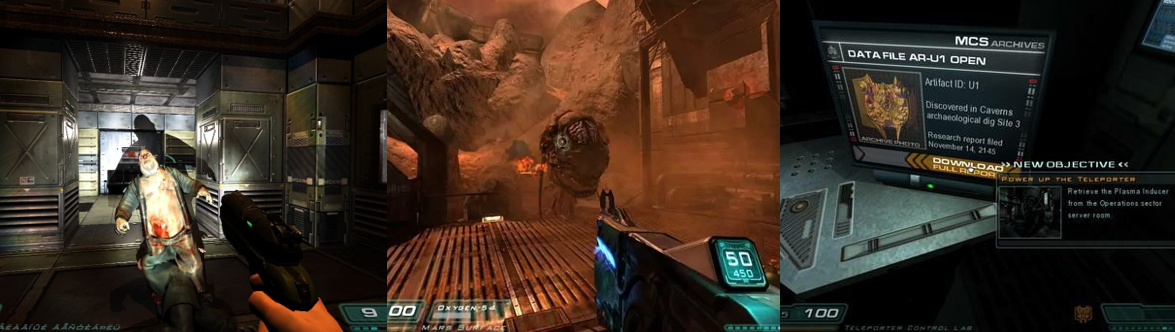
Unlike the previous games, Doom 3 has a strong survival/horror element to it.

Doom 3’s biggest change to the series is its course correction towards survival/horror. 90% of the game’s environments are dark, moody, claustrophobic, and full of poor or malfunctioning lighting, meaning you’re heavily reliant upon your torch (or “flashlight”). In the original release of the game, you had to pick between using the flashlight or using a weapon, a bizarre and ridiculous system that’s thankfully corrected here, though the flashlight can’t be used indefinitely as it’s tied to a cool-down meter. You can whip it out with the Left Trigger to light up areas, which is essential to finding your way around Doom 3’s many horrific, wrecked, and samey environments, and you’ll need to keep an eye on the meter so you’re not left being attacked in the dark. Another new mechanic is the Marine’s occasional jaunts out onto the Mars surface. In these brief sections, you’ll run and hop around, blasting enemies and collecting air cannisters to keep from suffocating before you reach the next airlock. These sections help to break up the monotony of the game and connect the many large military complexes of the UAC facility, but they’re sadly not utilised as often as I’d like or in massively interesting ways. You’ll need to turn to the Dead Space franchise (Various, 2008 to present) for more in-depth space and zero gravity gameplay. Although Doom 3 eschews the classic Doom mechanics of searching for coloured keys or artifacts to open doors, you’ll still be searching for key cards and access codes to download to your Personal Digital Assistant (PDA) to access new areas. You can bring up the PDA using the ‘View’ button; from here, you can switch weapons and read e-mails and listen to audio logs that help flesh out the game’s lore, provide hints, or give you codes open storage lockers for ammo and resources. 
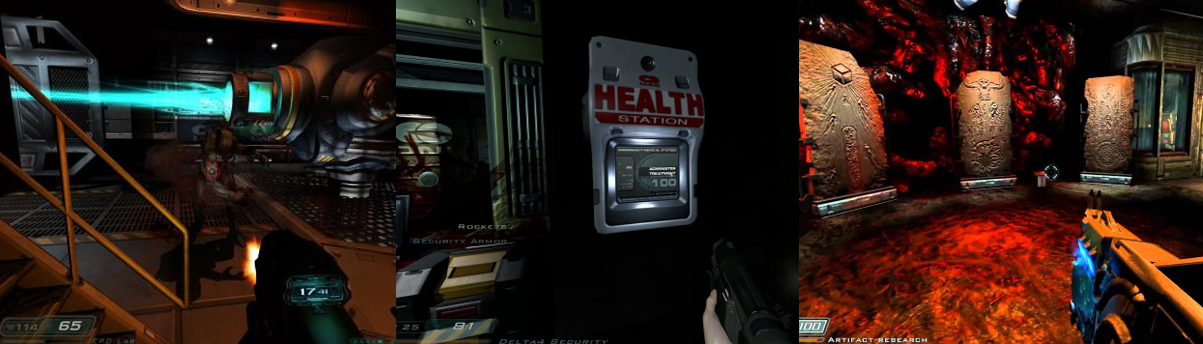
Hazardous and demonic elements are as commonplace as health and resources.

Unlike in previous Doom games, there’s no map system in Doom 3. This isn’t a massive issue as the game is fairly linear, but it can be difficult to find your way around as a lot of the areas look the same and it can get quite dark so it can be tricky to spot doors, vents, and stairways. There’s also no compass system, so you better pay attention when the story objectives pop-up onscreen and NPCs tell you where to go (especially as there’s no way to remind yourself of either of these). Luckily, one easy way to know that you’re going in the eight direction is if enemies appear before you. These either shamble or pounce from the darkness or hidden cubbyholes or literally teleport in in a flash of lightning and demonic chanting. Whichever campaign you choose to begin here, you’ll start with only your fists or a pistol and have to acquire new weapons along the way. Ammo is dropped by gun-toting zombies, found in lockers, on eviscerated bodies, and scattered all around the environment, as are Med Kits, various armour, and healing stations used to top up your health until they’re depleted. Saving is a manual process, as ever, and I recommend making regular saves once you’ve cleared out a room or stocked up on health and ammo as it doesn’t take much to whittle your health and armour down to nothing. Environmental hazards like fire, high (or endless) drops, and flaming Hellpits are commonplace, and it can be easy to miss a jump during the game’s tricky platforming sections and plummet to your death. You’ll also need to be on the lookout for ladders, teleportation devices or rips in the fabric of reality, and elevators to take you to new locations, laboratories, or even the depths of Hell itself. There’s some light puzzle-solving present in Doom 3 that usually, involves a series of fetch quests as NPCs send you after key cards, access codes, or various power cells to open up new areas. Other times, you’ll be powering up or down reactors, security measures, and other futuristic equipment to progress, extending bridges and activating and riding monorails and moving platforms to traverse the sprawling facility.  
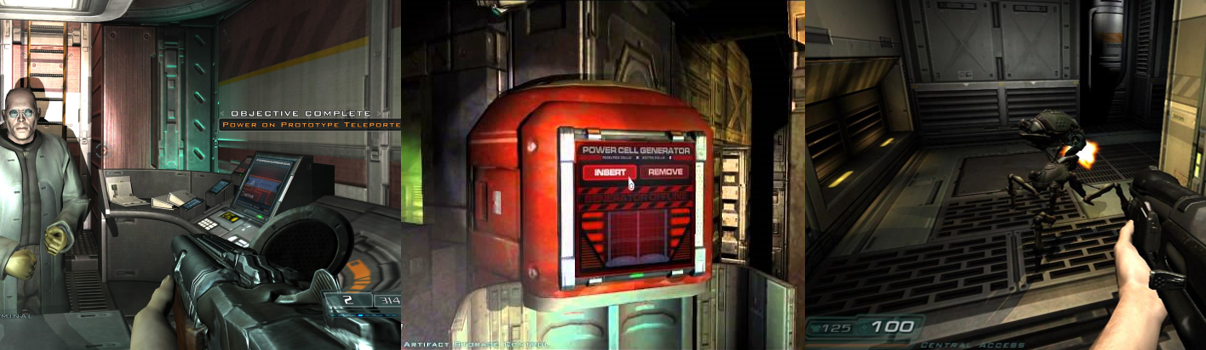
There are some minor, repetitive puzzles here, and helpful Sentry Bots to assist you.

You’ll also be activating cranes and grabbers to clear out toxic waste, deactivating gun turrets, extinguishing fires, and can even use security cameras to check out areas you’re heading to. Sometimes, you’ll be forced to fight off waves of enemies while waiting for lifts or other machinery to power-up, but mostly you’ll be skulking around every corner expecting a demon to pounce in your face. Thankfully, you can use exploding and flammable barriers to even the odds and there are many times when you’re accompanied by (or, more accurately, have to follow) a spider-like Sentry Bot to a new area. These scuttling little robots will urge you onwards and rain fire upon any enemies that appear before them, which is super helpful. Unfortunately, they’re not indestructible or infallible, so you’ll still have to keep your wits about you and make an effort to cover them to increase your chances of survival. Although Doom 3 is nowhere near as confusing or maze-like as its predecessors, it walks a fine line between action-orientated gameplay and ominous exploration. Whenever you enter an area that seems quiet and invites exploration, be sure to keep your finger ready over the trigger as it’s normal for enemies to pop out or teleport in and ruin your day. These aspects come to a head whenever you venture into Hell, where resources are limited and enemies come thick and fast, or when you explore the more desolate areas of the facility where even the health stations have been rendered inoperable. There are three difficulty settings available at the start of the game, with a fourth unlocked through gameplay, so don’t be ashamed to dial the difficulty down if you’re having trouble as Doom 3 is quite a tough and harrowing experience that basically sees you fighting to survive from one room to the next thanks to enemies constantly appearing all around you. 

Graphics and Sound:
Compared to its predecessors, Doom 3 is a quantum leap ahead. It’s astounding to think that the Doom series missed out on the early, polygonal 3D graphics era but it really benefits the presentation of this game as the last time we played a Doom game, everything was cleverly designed 2D textures rather than 3D graphics. In this regard, the game looks amazing. Areas are dark, desolate, and constantly foreboding; bodies, blood, ominous messages, and even oozing tentacles litter many of the game’s environments, especially as you venture closure to Hell. Pentagrams, candles, runes, sacrifices, and bloodbaths are commonplace, as are jump scares from bodies or enemies falling from ceilings or bursting from vents. Occasionally, you’ll be beset by demonic visions; the screen turns red and hazy, the demonic chanting intensifies, and you’ll even endure some poltergeist activity as furniture and bodies and wildly tossed around. Mostly, you’ll be exploring claustrophobic, futuristic corridors in low lighting. Doors will jam, machinery sparks and stutters with static, and voices come over the speakers to either direct or taunt you or create an unsettling ambiance. Sometimes, the environment will collapse around you as you cause meltdowns and explosions. Other times, you’ll be warped through a Hellmouth to the Malebolge itself. Even relatively normal looking areas quickly turn to shit as demons teleport in, the power goes out, or Hell’s influence seeps in. 
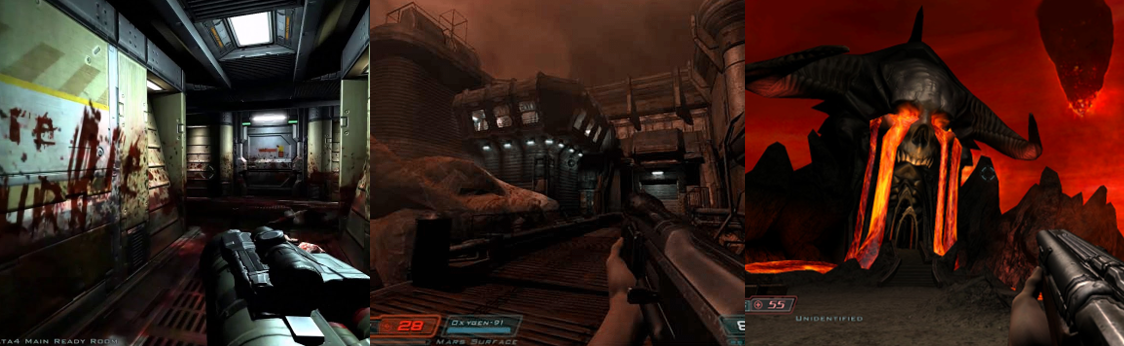
While samey at times, the environments are beautifully (and gruesomely) presented.

Unfortunately, many of these areas are extremely repetitive. You’ll travel through so many laboratories, industrial areas, warehouses, and offices that it’s easy to get bored of the aesthetic. Sure, these are often shaken up by gore, bodies, or flickering lights but it’s still the same assets being recycled again and again, which doesn’t help make each area all that distinctive. Sometimes you’ll see space or the surface of Mars out of windows, which adds a lot of scope to the game, but it’s usually painfully obvious when the game is masking loading times behind elevators and airlocks and other such doors. Your trips onto the Mars surface really help to break up this monotony, as do your ventures into Hell, which is a desolate, volcanic wasteland full of elaborate gothic ruins, castles, and titanic demonic skeletons, but sadly these sections don’t appear that often or are mainly saved for the finale, respectively. I would’ve liked to see you doing more on the surface, maybe acquire a more permanent upgrade to allow you to survive the vacuum for longer. As it is all you really do is move across the rocks or gantries to an airlock, occasionally activating consoles and such. In Hell, you mainly just explore the shifting stone architecture and fend off waves of powerful demons. There are no keys or puzzles to solve, it’s just a fight for survival, and thus, the majority of the action takes place in the UAC facility. While there are some fun distractions and elements, like arcade machines, various stages of disrepair and slaughter, and elaborate sights like the teleports, industrial lasers, and the like, it all gets very old very quickly and I found myself rushing through and making mistakes as a result. 
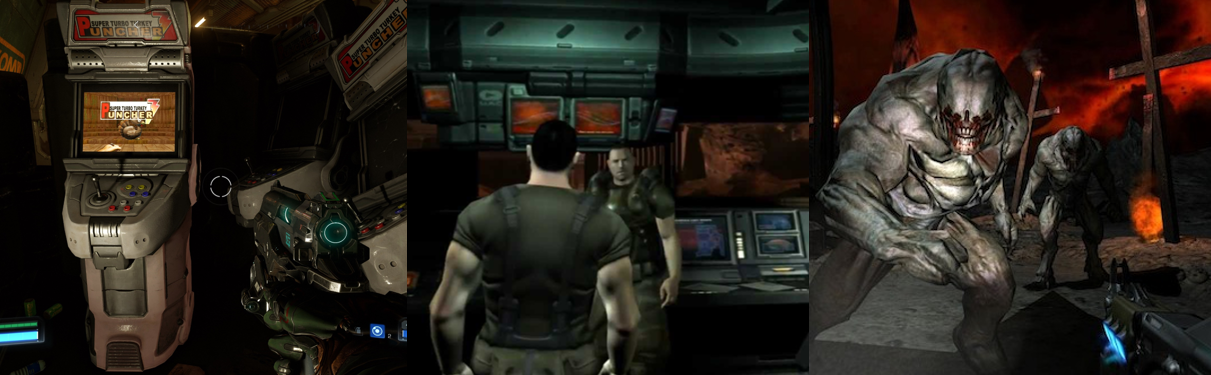
There’s a lot of emphasis on story and ghastly demonic creatures.

Doom 3 uses the power of its new graphical engine to greatly expand upon the narrative aspects of the series. Serving as a gritty, overbearingly serious reboot, the tense gameplay is broken up by unskippable cutscenes and overblown conversations with NPCs who beg for your help or threaten your life. Even your character (who I hesitate to call the “Doomguy”) is quite chatty throughout the game, though he has lost a lot of the charm of his predecessor as he just looks like a generic Jarhead, something not helped by the lack of a traditional Doom HUD. It also doesn’t help that the human character models are painfully stiff; while the voice acting is suitably over the top, the characters have that same plastic, action-figure-like look to them that dogged many games during this time. Thankfully, the enemies make up for this; enemies from previous Doom games have been given a gruesome makeover, appearing bloodier and more horrific than ever. You’ll see blood and gouges formed in their skin from your bullets, bodies bursting into flames and disintegrating into skeletal dust upon defeat, and even exploding into bloody chunks if you use the right weapons. I enjoyed the parts when enemies would teleport in and burst from the shadows, as frustrating as these aspects were, and the overall look of the environments despite how samey they could get, though the game’s soundtrack leaves a lot to be desired. While I appreciate it relying on ambient noise and ominous sounds of enemies, I miss the hard-rock infused tunes of the previous games. 

Enemies and Bosses:
Many classic Doom enemies make a ghastly reappearance in Doom 3, now more terrifying and gruesome than ever. You’ve got regular cannon fodder such as slow moving, moaning zombies who swipe at you (either with their hands or wrenches) and try to bite you, flaming and emaciated variants, and gun-toting bastards who hide behind cover or riot shields and can whittle your health down from afar. Also on the smaller end of things, spider-like Ticks and Trites will scuttle down webs or out from vents to swarm you, fairy-like Cherubs buzz about in your face, and those damn Lost Souls and Forgotten Ones will fly right at you from out of nowhere. Once all Hell (literally) breaks loose, you’ll be bombarded will all manner of demonic forces. The standard Hell grunt are the Imps who pounce at you and toss fireballs at your face, quadrupedal two-headed Maggots who rush at you, and bat-like Wraiths who can teleport about the place. You’ll also contend with bulbous Cacodemons, chainsaw- and Gatling gun-wielding zombies, and a brutish Commando variant who charges at you with a tentacle-like arm. You’ll initially be introduced to many of the more monstrous enemies in the form of a sub-boss battle. Demons like the Pinkies and Vulgars are given short cutscenes and enclosed areas in which you fight them before they pop up at random and in the worst places.  
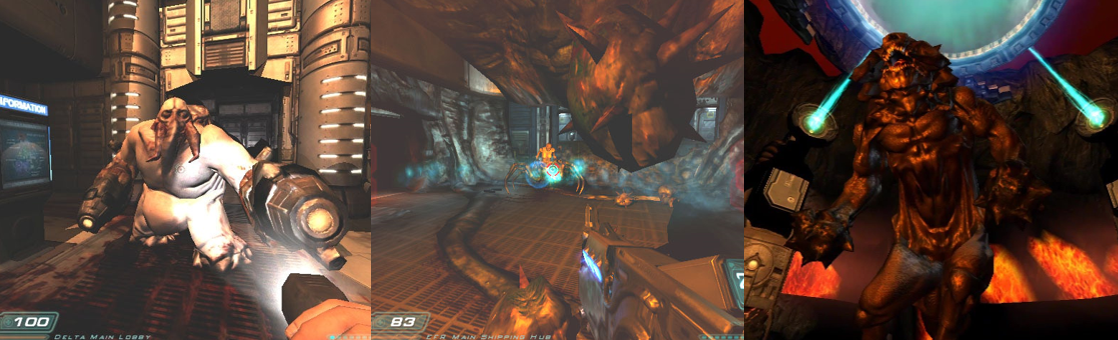
Larger, horrific demons offer the greatest challenge ad require more than just endless shooting.

The massive, dog-like Pinkies charge at you, biting and slobbering, and seem threatening at first until you blast them point-blank with a shotgun. Resurrection of Evil’s Vulgars can also be formidable until you use the Grabber to reflect their projectiles back at time. Additionally, you’ll often run into the screaming Revenants; these skeletal demons fire rockets and can make your day go downhill fast when they appear alongside more melee-based demons. Be sure to prioritise Arch-Viles; while they can’t heal enemies like before, they can summon flames and even Hell Knights, making them a real pain in the ass. Also, keep your distance whenever a Bruiser or Mancubus appears; these huge demons blast at you with their massive cannons so hang back and use your rocket launcher, strafe around them with your Plasma Gun or Chaingun, or utilise the “bullet time” features of the Artifact when playing Resurrection of Evil. There are four bosses to face in Doom 3, with six more appearing in Resurrection of Evil and two being recycled for The Lost Mission. The first is the spider-like Vagary who scuttles about, slashes you, and tosses objects with telekinesis, but she’s simple to take down if you strafe and unload with the Chaingun. You’ll battle two Vagary’s at the end of the game and another in The Lost Missions; in this latter fight, she can’t use her telekinesis but is accompanied by Cherubs, but the arena is much bigger, making this fight even easier. Before you visit Hell, you’ll have to face two Hell Knights at once in a very claustrophobic area; because of the tight quarters, it can be difficult strafing and dodging their stomps and fireballs, and especially dangerous if using explosive weapons, meaning later encounters with these enemies are usually much easier. To escape Hell the first time, you’ll have to defeat the Guardian of Hell, a large crocodilian-type beast who stomps about trying to bite you and rains fireballs. It’s blind, so it sends out “Seekers” to pinpoint your location and destroying these is the only way to expose the Guardian’s weak spot, a blue sphere over its head. When you battle it again in The Lost Mission, it is no longer blind, doesn’t use the Seekers, and can be damaged more conventionally but is also a lot tougher than before. 
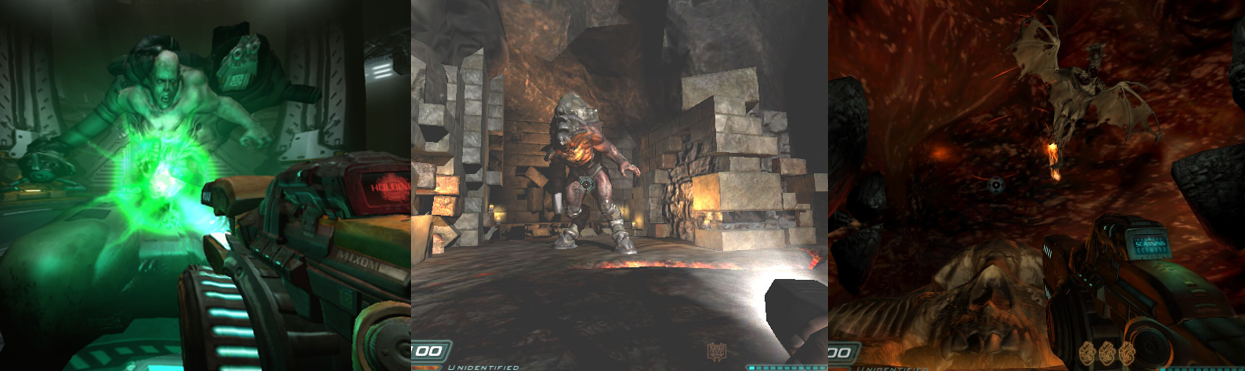
The massive, aggressive final bosses will test your skills with the game’s mechanics,

Fittingly, the bosses really ramp up at the end game. Sabaoth (the Marine’s demonically transformed superior officer) attacks you in the Primary Server Bank, his legs mutated into tank-like treads and his torso sporting heavy armaments such as the BFG9000! Thankfully, your victory over the Guardian of Hell awards you with the Soul Cube, which is crucial for defeating Sabaoth and his successor, the Cyberdemon. Sabaoth also makes use of four pillars, electrifying them (and you, if you’re close by) but he’s also slow and predictable so you can use the Soul Cube to deal massive damage to him. Blast his BFG shots before they can hurt you (the closer to him the better), and unload with your Chaingun or Plasma Gun to end him. The semi-cybernetic, minotaur-like Cyberdemon is an entirely different beast. Fought around a Hellmouth and assisted by infinite lesser demons, this brute unloads with its arm-mounted rocket launcher and can only be harmed, and killed, by you charging up and unleashing the Soul Cube four times, making this a gruelling bout at times. When playing Resurrection of Evil, you’ll need to defeat four demonic Hunters to acquire new abilities for the Artifact: the Helltime Hunter blasts about in flaming bursts and tosses fireballs that you must reflect back with the Grabber as this is the only way to hurt it. The Berserk Hunter leaps at you with slashes and spits fireballs and can only be damaged by targeting the beating heart in its chest, and you’ll need to open up and destroy four power cores to disable the Invulnerability Hunter’s shield, avoiding its electrical shockwaves and attacks. Resurrection of Evil concludes with a final showdown with Dr. Betruger, now transformed into a demonic bat, in what was the toughest fight of the game for me. This bastard flies around, blasts flames across the ground, rains fireballs and flaming meteors, and is both fast, extremely difficult to hit, and incredibly durable. A lack of ammo and health items and a fatal drop add to the difficulty, though you can use the Artifact to get a better lock on with your BFG before the fight abruptly and anti-climatically ends in a cutscene. 

Power-Ups and Bonuses:
It pays to explore every room, nook, and cranny when playing Doom 3. Be sure to crouch through vents and under stairs and tables to search out Med-Kits, armour shards, and ammo and check every desk and body for PDAs and other resources. Computer terminals and e-mails (and handy online guides) will provide locker codes and access to resource caches, which are invaluable at times, and be sure to make strategic use of any healing stations dotted about the place. As you explore and play, many familiar Doom weapons will become available to you, including the standards pistol, the always enjoyable chainsaw, and my personal favourite, the shotgun. Automatic weapons like the Machine Gun, Chaingun, and Plasma Gun are great for unloading on enemies, but you must factor in charge up and reload time, so be sure to make use of cover or quiet spots to reload. 
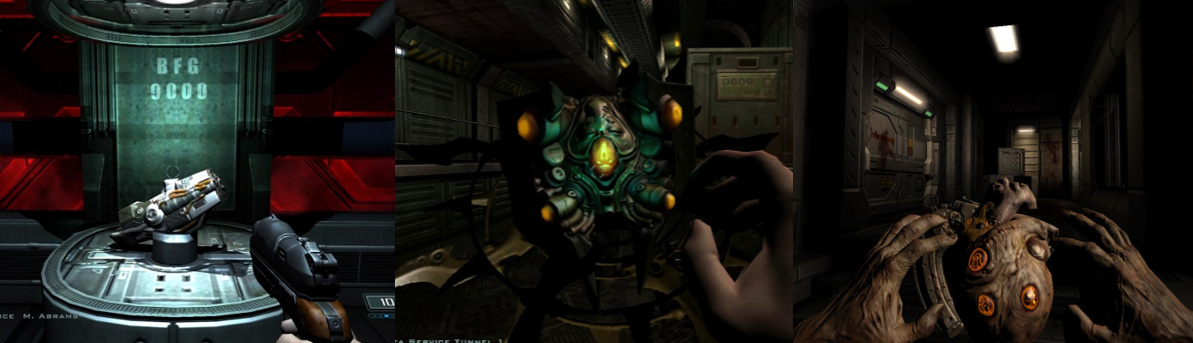
Classic Doom weapons get an overhaul and are joined by some weird, hell-spawned armamants.

You can also utilise grenades, a handy-dandy rocket launcher, and the series staple, the ultra-powerful BFG9000, but take care as these can often explode in your face if you’re not careful! When playing Resurrection of Evil and The Lost Missions, you’ll also get to use the Super Shotgun, a far more powerful version that fires two shots at once but takes twice as long to reload, and the Grabber, a gun-like appendage that can snag objects (even enemy projectiles) and blast them at enemies. It’s a clunky bit of kit that’s sadly underutilised andz while I’m glad there aren’t loads of annoying physics-based puzzles that use it, it does feel like a superfluous inclusion, unlike Resurrection of Evil’s other new mechanic, the Artefact. This beating Hell Heart is charged using human souls and allows you to slow down time, strengthen your attacks with a brief “Beserek” mode, and temporarily become invincible. Similarly, in the main game, you can charge up the Soul Cube by defeating enemies; when unleashed, it passes through all objects and instantly kills most enemies, restoring your health in the process. Finally, various armours boost your resistance to attacks, ammo belts and backpacks boost your ammo and you can temporarily buff yourself with various one-use items. Adrenaline affords you infinite stamina, Beserker renders you invulnerable and triples your attack power, while you can also make yourself invisible and invulnerable in multiplayer.  

Additional Features:
There are forty-five Achievements up for grabs in Doom 3, with many of them earned simply by completing the main campaign. You’ll get an Achievement for defeating each boss, for example, and for finishing the game on each difficulty setting (these stack, too, so you can earn multiple Achievements in one playthrough if you’re good enough). You’ll also get Achievements for earning a high score on the arcade machine, having two demons fight each other, acquiring the BFG9000, finding hidden secrets, defeating certain enemies with certain weapons, and finishing the game in ten hours or less. Interestingly, considering Doom pioneered multiplayer Deathmatches, there are no Achievements tied to the game’s multiplayer component, which allows you and you friends to go head-to-head on various game maps in traditional Deathmatches, tournaments, last man standing, and team-based campaigns. Scattered throughout each campaign are PDAs and lockers, all of which need to be found and accessed for Achievements. There’s no level select or New Game+ feature here, though, so you’ll need to make multiple saves or have a guide handy if you want to avoid replaying entire sections. In addition to the main campaign, you can play the two DLC campaigns, Resurrection of Evil and The Lost Mission, right off the bat; both recycle enemies and environments from the main game but introduce new elements, such as the Grabber, Artifact, and Vulgars, in addition to concluding the main story by including a showdown with Dr. Betruger. 
The Summary:
I’d been putting off Doom 3 for a long time. I first played it in the BFG Edition on PlayStation 3 but was put off by the claustrophobic environments, low lighting, and tense, frustrating combat mechanics. These elements remain nagging concerns in Doom 3; I never felt like I could relax or really enjoy myself as enemies would pop up or swarm at a moment’s notice and drain my health and ammo, meaning I was constantly on edge and became aggravated at being forced to kill more and more demons as they kept teleporting in. However, as a fan of the series and survival/horror games, it’s true that this sense of constant dread, worry, and anticipation about what lurks behind every door and around every corridor really added to the horror vibe of the game, and was surely the intention. It’s just a very different gameplay experience to the more straight-forward nature of the original games and more horror-themed FPS titles, so I recognise that this is very much a “me” problem rather than a fault of the game, which wants you to always feel endangered. The game plays well; gunplay is satisfying, and the gruesome aesthetic is truly macabre. I just wish it was more prevalent; there are only so many futuristic hallways and laboratories I can skulk down before I get bored, so I would’ve liked to see more blood, more of Mars, and more Hell-based locations sprinkled throughout the game. Having said that, the environments look amazing; the lighting (or lack thereof) and graphics do the game justice here, it’s just a shame that doesn’t translate to the human character models. I’m glad the game wasn’t a confusing labyrinth, but I did get turned around a bit without a map or compass and because of the samey environments and I felt the constant fetch quests dragged the pacing down a bit. When you’re fully armed and engaged with the game’s horrific enemies, Doom 3 shines. I loved the sense of dread and how formidable the enemies were, and the scale of the bosses, I just think a better balance between survival/horror, action, and puzzle solving was needed. Ultimately, it’s a decent enough game; a little too much like a bland FPS at times thanks to the gritty, military aesthetic but easily the most graphically impressive Doom for its time. However, I can’t say that I will throw it on for a quick burst of action like I do the originals as this is a game that insists upon your time and energy. 

My Rating:

Rating: 3 out of 5.

Pretty Good

Did you enjoy Doom 3? Did you think it was toomuch of a departure from the original games? Did you find the environments too repetitive? What did you think to the new looks for the demons and the new weapons? Were you glad that the gamewas changed to allow simultaneous use of the flashlight? Which boss was your favourite to fight, and would you have referred to see more of Hell? Whatever your thoughts on Doom 3, or FPS games in general, drop a comment below or let me know on my social media.


Movie Night [Halloween]: Halloween III: Season of the Witch


Starting life as the ancient Celtic festival of Samhain, when people would light bonfires and wear costumes to ward off ghosts, Halloween is largely associated not just with ghosts, ghouls, and confectionery but also a long-running series of horror movies. Beginning with John Carpenter’s Halloween (Carpenter, 1978), the franchise is largely credited with birthing the “slasher” sub-genre of horror films and has endured numerous remakes and reboots and is one of the most influential films in all of horror.


Released: 22 October 1982
Director: Tommy Lee Wallace
Distributor: Universal Pictures
Budget: $2.5 million
Stars: Tom Atkins, Stacey Nelkin, Brad Schacter, Dick Warlock, and Dan O’Herlihy

The Plot:
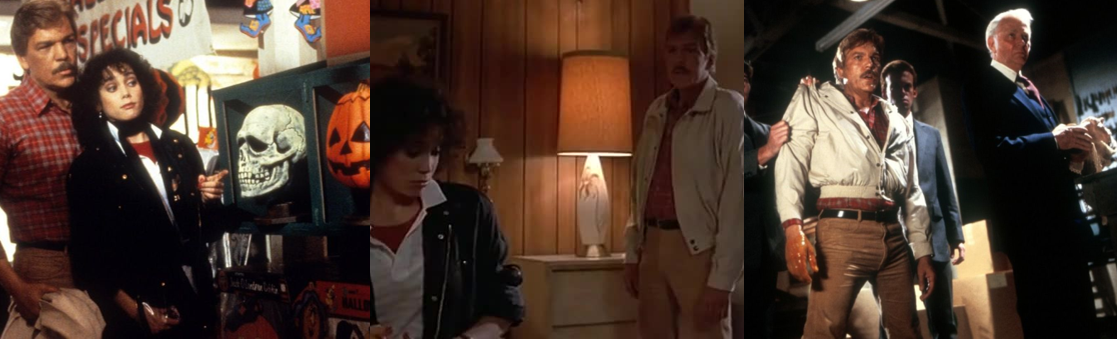
Doctor Dan Challis (Atkins) and Ellie Grimbridge (Nelkin), the daughter of a murder victim, uncover a terrible plot by small-town mask maker Conal Cochran (O’Herlihy) to mass murder of children on Halloween using an ancient Celtic ritual and a triggering device contained in a television commercial.

The Background:
Despite critics largely dismissing it at the time, John Carpenter’s Halloween’s box office gross of over $63 million against a paltry $300,000 to 325,000 budget made it one of the most successful independent films ever made. The film not only popularised the clichés of the slasher genre, but is also now regarded as one of the most influential movies of its genre, all of which meant that a sequel was all-but-inevitable. Writer/director John Carpenter wasn’t enthusiastic about this, or his final script, but (despite the usual critical mauling), Halloween II (Rosenthal, 1981) was a box office success, so the studio pushed for a third entry. Carpenter and his producer partner Debra Hill only agreed to deliver another film if it went in a different direction, one that didn’t focus on the iconic Michael Myers/The Shape (Various). They, and director Tommy Lee Wallace, instead wanted to create a horror anthology movie series, with yearly films focusing on different aspects of the season and this one drawing inspiration from the sci-fi classic, Invasion of the Body Snatchers (Siegel, 1956). The film’s creepy Halloween masks were created by special effects guru Don Post out of latex and the cast was comprised of character actors and former Carpenter collaborators (though veteran actor Dan O’Herlihy later admitted that he didn’t think much to the film), and Wallace later stated that he enjoyed the entire experience and was disheartened by the film’s negative response. Indeed, Halloween III: Season of the Witch brought in just $14 million at the box office and was met with largely negative reviews; critics disliked the execution, the nonsensical plot, and the ludicrous antagonists, with Michael’s absence being particularly noted for many. Although some regard the film as an under-rated horror classic, Carpenter’s experiment didn’t pay off and the decision was made to bring Michael back some six years later, and he’s been the star of the franchise ever since.

The Review:
This one’s a tough one for me. Unlike, say, the Friday the 13th series (Various, 1980 to present), which potentially could’ve lived on (at least for a film or two) with other killers donning the iconic hockey mask of Jason Voorhees (Various), I’m not entirely certain if Halloween was meant to involve anyone or anything other than Michael Myers. I think maybe if the second film hadn’t been a direct sequel then this anthology format might’ve had more legs, but it feels weird to do two Myers-centric movies and then suddenly veer into anthology territory. Honestly, more than anything I’m surprised it got made at all; the idea of producing a horror sequel without its main villain and with no ties to the previous movies seems unusual today but even more so back in the eighties, when horror franchises were churning out yearly films featuring their popular slasher villains. Although Myers was very clearly and definitively killed off in Halloween II, it took the bare minimum of handwaving to explain his return in subsequent films, and I’m genuinely baffled that the producers didn’t simply accelerate that logic for a Carpenter-less third movie and produce this film as a separate endeavour, but clearly it was an attempt to cash-in on Halloween’s success and placate John Carpenter, because why wouldn’t you want him around? The film begins in October, some eight days before Halloween, and finds shop owner Harry Grimbridge (Al Berry) pursued by mysterious, stoic men in suits. Exhausted, hurt, and clutching one of Silver Shamrock’s coveted Halloween masks, he’s barely able to escape and is taken to a hospital, where he’s placed under the care of Dr. Challis.

Dr. Challis and Ellie investigate the mysterious Silver Shamrock company and stumble upon a mad plot!

As if being consumed by a demanding and stressful job wasn’t bad enough, Dan’s relationship with his ex-wife, Linda (Nancy Kyes), is further strained by him being a borderline alcoholic. His attempts to be a good and doting father are admirable, but he’s constantly one step behind; he brings his kids, Bella (Michelle Walker) and Willie (Joshua Miller), Halloween masks but they already have two of the Silver Shamrock ones and he’s constantly being called back to work. Dan’s attempts to treat Harry are made more difficult by his ranting, which nobody notices is triggered by the Silver Shamrock commercials, and the arrival of one of the men in black, who cracks his skull through the eye sockets! For a doctor, Dan sure does enjoy extracurricular activities; while his flirtations towards Nurse Agnes (Maidie Norman) seem to all be in good fun and appreciated, it’s still inappropriate behaviour in the workplace and he seems very friendly with the assistant coroner, Teddy (Wendy Wessberg), which leads me to believe that his marriage broke down due to him being unfaithful. Indeed, after Harry is murdered and his killer immolates himself, all it takes is one look at Harry’s daughter, Ellie (Nelkin), and Dan abandons his patients and responsibilities and travels to the Silver Shamrock factory in Santa Mira, California to investigate further. Ellie is absolutely heartbroken and incensed at her father’s random and vicious murder; after spotting Dan at the funeral, Ellie tracks him down to find out more and he reluctantly reveals that Harry was paranoid that he was going to be killed. She takes him to her father’s store and shares her research into her father’s records, which points them towards Santa Mira, and Dan’s so moved by her plight that he passes up seeing his kids (much to Linda’s fury) to join her. She’s surprisingly happy to share a bed with him without much coercing (it must be the moustache because he looks old enough to be her father!…unless that’s what she’s into…) and to masquerade as potential customers to get a tour of Cochran’s factory, which is like something out of Roald Dahl. While she has a fair amount of spunk and is determined to get to the bottom of her father’s death, there’s not much to Ellie; she’s certainly not shy about her sexuality but, despite claiming to be “older than she looks”, she’s still prone to emotional outbursts and is thus easily captured by Cochran’s men, disappearing for a big chunk of the film and returning simply to be a pretty hostage for our surprisingly gung-ho male protagonist to rescue.

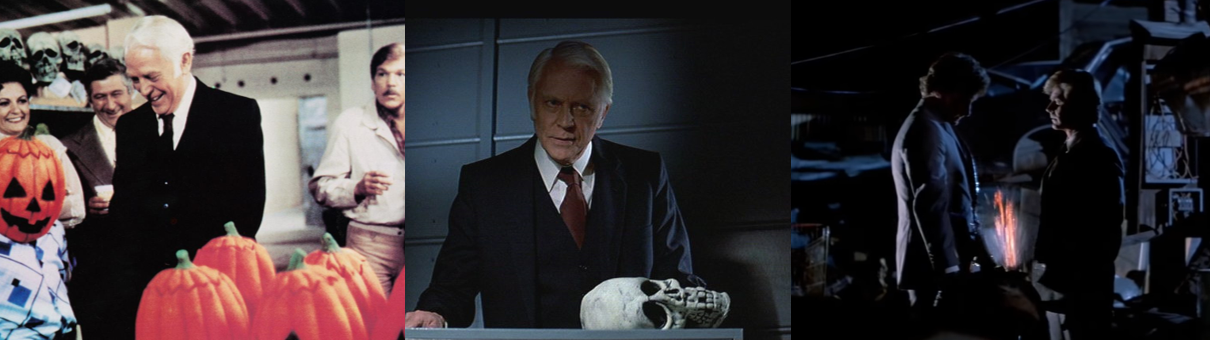
Despite his friendly persona, Cochran employs killer androids and plans to murder countless children!

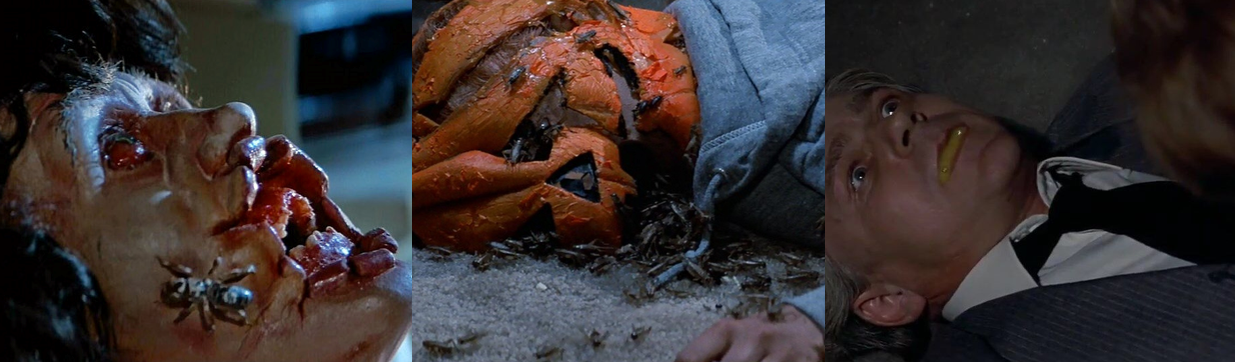
Silver Shamrock made its fortune manufacturing toys; with Halloween fast approaching, they’ve embarked on an aggressive and aggravating marketing campaign for their special Halloween masks, which all the kids are dying to get their hands on. The company is headed by Irish entrepreneur Cochran, whose factory and business brings prosperity to Santa Mira; played with an alluring glee by expert villain Dan O’Herlihy, Cochran is a magnetic and generous old man who takes great pride in his work, his attention to detail, and the prosperity he’s brought to Santa Mira. Although he brought in his own workers from overseas and much of the town is made up of his fellow Irishmen, hardly anything happens in town without his say-so or involvement and he’s extremely eager to please his customers and investors with accolades and generosity. However, while he appears a friendly and courteous old man, Cochran hides a dark secret within his factory walls and, thanks to O’Herlihy’s presence, is constantly shrouded in a sinister cloud. Many of his workforce are mute, relentless android assassins who carry out his every whim without question; garbed in suits and pursuing their targets relentlessly, they are superhumanly strong, capable of gouging out eyes, ripping off heads, and enduring a great deal of punishment. In many ways, their silent implacability conjures memories of Michael Myers (fitting since the head android was played by the Shape himself, Dick Warlock), but even these unsettling minions are just a fraction of Cochran’s true intent. It turns out that his masks contain a special microchip that gruesomely kills whoever is wearing them and causes writhing snakes and bugs to burst from their heads!  This is all part of his insidious plot to evoke an ancient pagan ritual from his native Celtic lands of sacrificing children during the time of Samhain, a plot that requires a chunk of Stonehenge which he was somehow able to steal and transport to the United States without being detected!
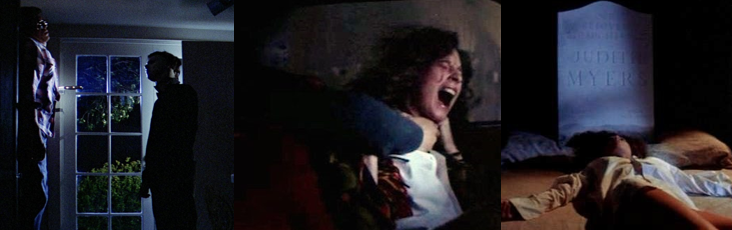
The Nitty-Gritty:
You can tell that Halloween III is going for something completely different right away; gone is the haunting, atmospheric “Halloween” theme and unsettling pumpkin in the credits, replaced by an ominous synth theme courtesy of John Carpenter and Alan Howarth, basic credit text, and a decidedly eighties computer-generated credit sequence that merges the themes of Halloween and technology (specifically evoking the pixelated aesthetic of television and computer screens). The film also goes out of its way to make it clear that its events aren’t set in the same continuity as the previous films since a trailer for Halloween plays on a television at one point. However, while the score is fitting for what basically amounts to a techno/horror piece and evokes memories of John Carpenter’s The Thing (Carpenter, 1982) and The Terminator (Cameron, 1984), your days will be tormented forever more by the incessant Silver Shamrock jingle, which cheerily counts down the days until Halloween to the tune of “London Bridge is Falling Down”. The intention is pretty obvious, to capture kids’ attention with dancing images, a memorable song, and encourage them to buy the masks and it’s pretty evocative of the aggressive and shameless marketing campaigns of toys and videogames over the years, but the subtext is quite clever as well: it can’t be a coincidence or just a financial decision that “London Bridge is Falling Down” is used as the base tune since Cochran’s ultimate plan is the cause widespread death and destruction, after all.

Some gory scenes and bizarre events help make the film a little more memorable, as weird as they are.

If there’s one thing Halloween III has going for it, it’s a somewhat decent sense of atmosphere; when Dan and Ellie roll into Santa Mira, they’re met with suspicion and intrigue by the townsfolk since. For the most part, the film is a bit of a murder-mystery tale, with Dan and Ellie posing as a couple and trying to find out more about the company and investigating the strange town with its many surveillance cameras and even a curfew (which doesn’t stop Dan going out at night to an open liquor store, making you wonder why there’s a curfew in the first place…), and Dan proves to be quite the sleuth. Of course, his habitual lying and infidelity goes a long way to helping with his subterfuge; Linda is so fed up of his constant excuses and lies that she offers little support or compassion when he’s rattled by the deaths at the hospital and he gets so into his little charade with Ellie that it’s not long (barely a day) before they’re getting it on in their motel room. While they suspect that there’s more going on behind Silver Shamrock’s walls, they could never have guessed the truth but we get to see it in gory detail as one of Cochran’s androids trips the head off a hobo (Jon Terry) for daring to disparage the company’s name. Disgruntled buyer Marge Guttman (Garn Stephens) also indirectly feels Cochran’s wrath after she fiddles around with a mask and gets a mouthful of laser due to a “misfire” that leaves her a mutilated husk for creepy-crawlies to wriggle out of! After Ellie is kidnapped by Cochran’s androids, Dan is fights one off, punching right through its stomach and rendering it immobile, but the realisation that Cochran utilises life-like machines leaves him shellshocked and he’s easily apprehended by the toymaker. Instead of killing the nosy doctor, Cochran decides it’s far better to take him into the hidden laboratory beneath his toy factory and to explain his master plan in minute detail (well, except for explaining how the fuck he got that chunk of Stonehenge there, which he simply laughs off).

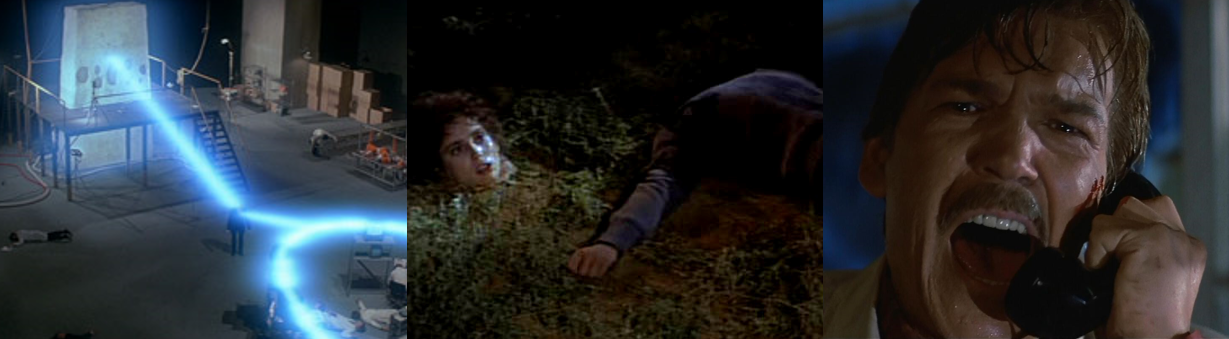
Although Dr. Challis destroys Cochran’s operation, it’s left ambiguous whether he stopped his evil scheme…

Fascinated and enamoured by the power of even a fragment of the ancient rock, Cochran delights in showing off exactly what his masks can do by forcing Dan to watch as his best seller and his family (Ralph Strait, Jadeen Barbor, and Brad Schacter) are subjected to the final Silver Shamrock commercial, which sucks the life out of the boy and sees him torn apart by bugs and snakes, which then attack his family. As kids all over the country eagerly await the “big giveaway” at nine, and Teddy is murdered via a drill to the head by one of Cochran’s androids (a scene that might’ve worked better if it had come earlier in the film before we knew for sure that they were androids…), Cochran straps Dan to a chair, fits him with a mask, and explains his motives: not only does he think it’s a lark, but he’s disgusted that people have forgotten Halloween’s roots and relishes bringing back the old ways of ritual sacrifice. With little more than an hour and ten minutes to go, Dan cuts himself free without much effort and escapes using a conveniently oversized ventilation shaft. His caricature of John McClane (Bruce Willis) continues as he sneaks across the factory roof and through the warehouse to rescue Ellie (…her door wasn’t even locked…) and he even reaches the control panel, figures out its controls, and activates the Silver Shamrock commercial without being spotted! He then dumps a load of the microchips over Cochran’s androids and equipment, shorting them both out and sending everything haywire, earning him a little appreciative applause from Cochran before he’s zapped by the rock. Fleeing from the horrendously rendered factory explosion, Dan races to interrupt the commercial, only to be attacked by Ellie, who turns out to be a robot duplicate (or…maybe she was a robot all along? Who even knows at this point!) Luckily, he avoids having his head ripped off and beheads her with a tyre iron, but we’ll never know if he succeeded in shutting off all the deadly commercials since the film dramatically cuts to the credits right as he’s desperately screaming at the television network to cut the feed…

The Summary:
I think everyone can agree that Halloween III: Season of the Witch is a bit of an anomaly; not only does it not include or even have anything to do with Michael Myers or the previous two films, it doesn’t even have anything to do with a witch beyond a brief reference to the pagan rituals of Samhain. I’d wager that this film is known for two things: not including the franchise’s masked killer and its surprisingly bleak ending, and only one of those points actually works in its favour. An altogether bizarre film from start to finish that awkwardly blends together technology and the supernatural, I think Halloween III was maybe trying a little too hard to be something different. Cochran’s plot might’ve been easy to swallow if it had fallen into one side or the other but having these lifelike android assassins existing alongside a magical piece of Stonehenge that he was…somehow…able to turn into killer microchips that spawn insects from Halloween masks and leave countless children dead is all very hodgepodge and none of it really feels like it fits together. It’s like the film was two scripts that got jumbled up and, while I applaud the attempt to try something different, the bleak ending, and the dark, sinister undertones (it’s rare that even horror films kill kids, after all), the final execution is quite sloppy. Tom Atkins does a decent job but he’s not much of a leading man; the visual of this middle-aged, womanising alcoholic being our unlikely protagonist doesn’t inspire much confidence, though I did enjoy his investigation into Silver Shamrock and his wife constantly admonishing him for being a lying, selfish asshole. Dan O’Herlihy’s captivating, menacing screen presence and some deliciously gory death scenes help this film limp along towards its memorably grim ending but, overall, you can easily skip this one in favour of any other horror film and have a far better time. I do believe that there was some potential in a Halloween anthology series, but the third film wasn’t the time to do that and this concept certainly wasn’t capable of matching its predecessors; I’d also wager that if this film didn’t have “Halloween” in its title then no one would have ever seen it and it’d be lost to the mists of time, which really tells you everything you need to know about this misfire of a movie.

My Rating:

Rating: 2 out of 5.

Could Be Better

Are you a fan of Halloween III : Season of the Witch? What did you think to the attempt to take the series in a new direction with an unrelated story? How clued up are you on Samhain and the pagan origins of the season? Did you enjoy the mystery element of the film and the gory kills? What did you think to Cochran’s plan and his execution? Were you a fan of the sudden, potentially bleak ending and do you think Dan was able to interrupt the broadcast? How are you celebrating Halloween this year? Whatever your thoughts on Halloween, and the Halloween franchise, drop a comment below, or leave a comment on my social media, and have a spook-tacular Halloween!

Movie Night [Halloween]: Halloween II (1981)


Starting life as the ancient Celtic festival of Samhain, when people would light bonfires and wear costumes to ward off ghosts, Halloween is largely associated not just with ghosts, ghouls, and confectionery but also a long-running series of horror movies. Beginning with John Carpenter’s Halloween (Carpenter, 1978), the franchise is largely credited with birthing the “slasher” sub-genre of horror films and has endured numerous remakes and reboots and is one of the most influential films in all of horror.


Released: 30 October 1981
Director:
Rick Rosenthal
Distributor:
Universal Pictures
Budget:
$2.5 million
Stars:
Jamie Lee Curtis, Donald Pleasence, Lance Guest, Ana Alicia, Nancy Stephens, Hunter von Leerand Dick Warlock

The Plot:
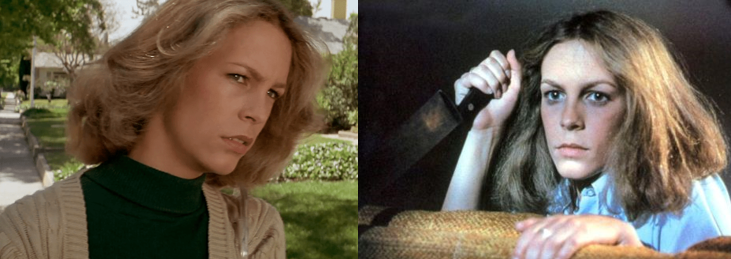
Mere hours after narrowly surviving an attack by the merciless Michael Myers (Warlock), Laurie Strode (Curtis) has been taken to Haddonfield Memorial Hospital to recover from her injuries. However, desperate to put an end to the missing killer, Michael’s psychiatrist, Doctor Sam Loomis (Pleasence), tries to track Myers down and, in the process, discovers a horrifying motive behind the Shape’s murderous rage.

The Background:
Although largely dismissed upon release, John Carpenter’s Halloween was a financial success; its final box office gross of over $63 million against a paltry $300,000 to 325,000 budget made it one of the most successful independent films ever made and the film not only popularised the clichés of the slasher sub-genre but came to be regarded as one of the most influential movies of its kind and one of the greatest horror films of all time. This success meant that a sequel was all-but-inevitable but writer/director John Carpenter was, initially, less than enthusiastic at the prospect of a follow-up and, though he returned to write and produce Halloween II, he declined the director’s chair and struggled to formulate a compelling story, which led to a plot twist that he later came to regret. Although many of the cast returned from the first film, stuntman Dick Warlock replaced Nick Castle as Michael Myers/The Shape and was forced to wear a mask that had noticeably aged since the first film. Afforded a much bigger budget, on Carpenter’s suggestion the sequel also contained far more blood and gore compared to the first film, which irked director Rick Rosenthal. Critics also took issue with the rampant violence, though Halloween II was still a financial success; it made over $25 million and became the second-highest grossing horror film of 1981, and Myers’ popularity would ensure his eventual return to the franchise after a failed effort to turn Halloween into an anthology series.

The Review:
Any true horror fan will tell you how influential John Carpenter’s Halloween was on the genre; thanks to Halloween and the relentless, emotionless void that was Michael Myers, an entire sub-genre of horror swept cinemas throughout the 1980s and directly led to the creation of similarly-themed films such as the Friday the 13th franchise (Various, 1981 to 2009). It’s not for everyone, and fans of faster, more visceral modern horrors may struggle to adapt to Halloween’s slow pace and the sheer randomness of Michael’s actions, but it was truly a benchmark moment for the horror genre. I can’t rightly say that I’ve ever seen Halloween II held in such high regard, however, and for the longest time it was one of the franchise’s many sequels that eluded me until I finally picked up the then-complete series boxset.

Halloween II picks up right where the first film left off and deals with the aftermath of Michael’s rampage.

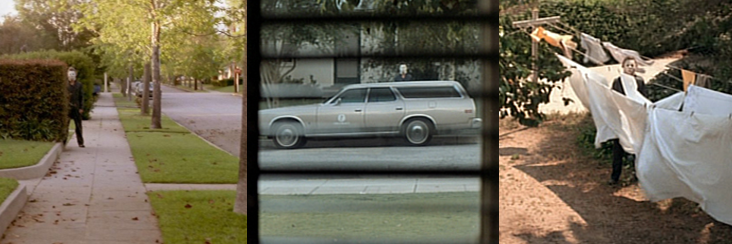
Halloween II begins by basically repeating the finale of the first film, picking up right as Myers attacks Laurie and is shot off a balcony by Loomis, with three noticeable changes: the first is the replacement of Carpenter’s iconic score over the finale’s recreation (which doesn’t kick in until the opening credits roll, and even then it’s a bit of a funky remix, which definitely robs the ending of its haunting power), the second is how poor the video transfer is on the 2004 DVD release I’m watching, and the third is that the film continues going after Loomis sees the Michael’s body has disappeared. In an attempt to recreate the memorable first-person opening of the first film, Halloween II then follows Michael through his eyes as he wanders around in the shadows of Haddonfield with the only sounds being his heavy breathing and Loomis’ near-maniacal screams that he “shot him six times!!” Much of the original film’s suspense was built around keeping Michael elusive and mysterious; he was seen stalking his prey from a car, peeking around corners, and in fleetingly appearances that definitely lent a lot of credibility to his allure as being pure evil. In Halloween II, this is completely thrown out of the window as, within about fifteen minutes, we’ve seen Michael walking around in the darkness, stealing a kitchen knife, and offing a random bystander in her home (with more blood appearing in this one kill than almost the entirety of the first film).

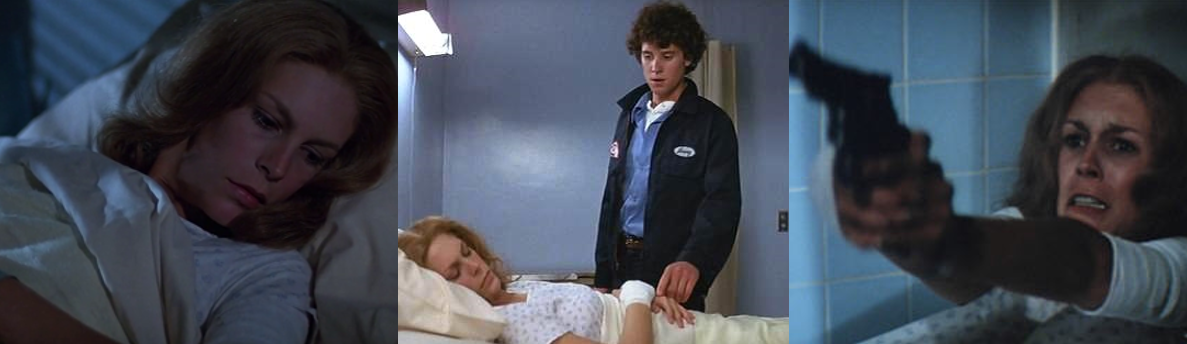
Laurie is rendered a bedridden victim for most of the film and only gains agency by the finale.

Injured, exhausted, and suffering from shock, Laurie is strapped to a gurney and taken to Haddonfield Memorial Hospital, where she attracts the affections of paramedic Jimmy (Guest); considering the murder spree that just befell the town, the hospital is basically empty and staffed primarily by strict head nurse nurse Virginia Alves (Gloria Gifford), the promiscuous nurse Karen Bailey (Pamela Susan Shoop), and the crude-tongued staff paramedic Budd Scarlotti (Leo Rossi), so Jimmy definitely stands out as the more stable and kind-hearted of the hospital’s staff. However, he’s also a largely bland and one-dimensional character whose single defining trait is that he has a thing for Laurie; traumatised by her experiences, Laurie fears being put to sleep and is shocked to learn from Jimmy that her attacker was local bogeyman Michael Myers. Although bedridden for the majority of the film, and with much of her personality stripped away because of the trauma she suffered, we learn a little more about Laurie’s past in this film through her dreams, where it’s revealed that she was adopted and that she visited young Michael (Adam Gunn) while he was locked up. Realising that Michael will come for her, Laurie feigns a reaction to her medication and outwits the Shape, becoming a little more reminiscent of her adaptable and competent self about an hour or so into the movie, though her injuries and shock preclude her from being as capable as she was in the first film.

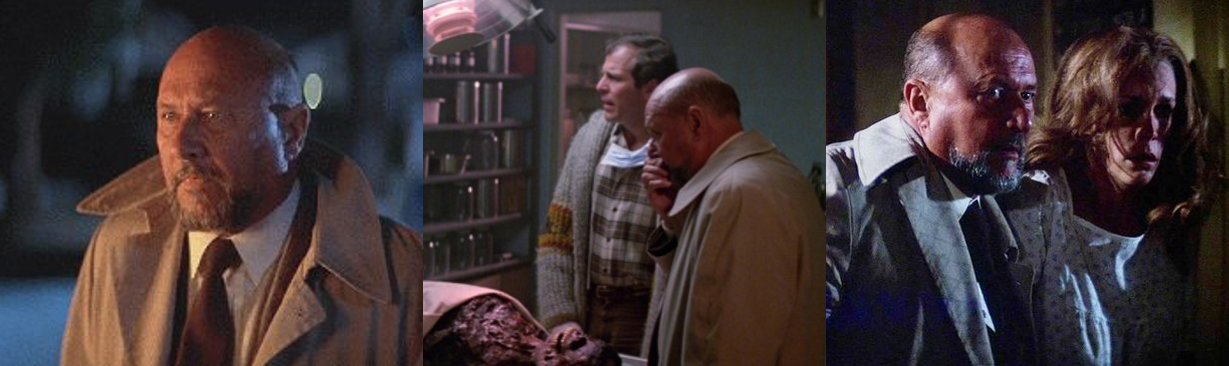
Loomis is driven to near-madness in his desperate search for his murderous former patient.

While Laurie recuperates from her injuries, Loomis continues his desperate search for his murderous patient; he finds Sheriff Leigh Brackett (Charles Cyphers), his reluctant ally from the first film, increasingly disgruntled with his’ abrasive demeanour but, already blaming Loomis for Michael’s escape, the sheriff abandons the crusade completely when he finds his daughter, Annie (Nancy Loomis), dead at Michael’s hands. He’s replaced by the much more reciprocal Deputy Gary Hunt (von Leer), who orders the town’s police to continue the search for Michael, accompanies Loomis throughout much of his search, and even disperses an unruly mob who descend upon the old Myers’ house (though he largely fulfils the same role as Brackett from the first film as a sceptical sounding board for Loomis’ horror stories about Michael). However, there’s no question that Loomis has been driven to near-madness by his pursuit of Michael and the fact that the Shape absorbed six shots to the heart; this causes Loomis to become wild and paranoid during the search and, when he spots young Ben Tramer (Jack Verbois) dressed as Michael and walking through the street, he crazily chases after him with a gun and indirectly causes the young man’s sudden and explosive death! Considering the media circus surrounding Michael’s actions, and Loomis’ increasing obsession with the killer, the sanatorium orders Marion Chambers (Stephens) and a United States Marshal to escort him back to the facility to limit their association with the murders, though Loomis is able to overpower them both with his trusted revolver and hasten his return to Laurie’s aid for the finale.

The Nitty-Gritty:
I think one thing that definitely holds Halloween II back is how redundant a lot of it is; I can just about forgive the film opening with a recap of the first film, since it had been about three years since the last film and home video wasn’t exactly prevalent back then, but so much of the opening is just going through the same motions as in Carpenter’s original: Loomis is desperate to find and kill Michael, just as in the first film, and even delivers his famous speeches about Michael’s evil and patience almost word-for-word as in the last film, and the gaggle of interesting and colourful (if a bit underdeveloped) babysitters from the last film are replaced by bland paramedics and a number of nurses and hospital staff. While the film is definitely bloodier and a bit more explicit in its shocks compared to the original, it feels largely toothless because, rather than slowly build up to the reveal of Michael or see him lurking in the background, he just appears in a jump scare.

Halloween II added the infamous twist that Laurie and Michael were siblings.

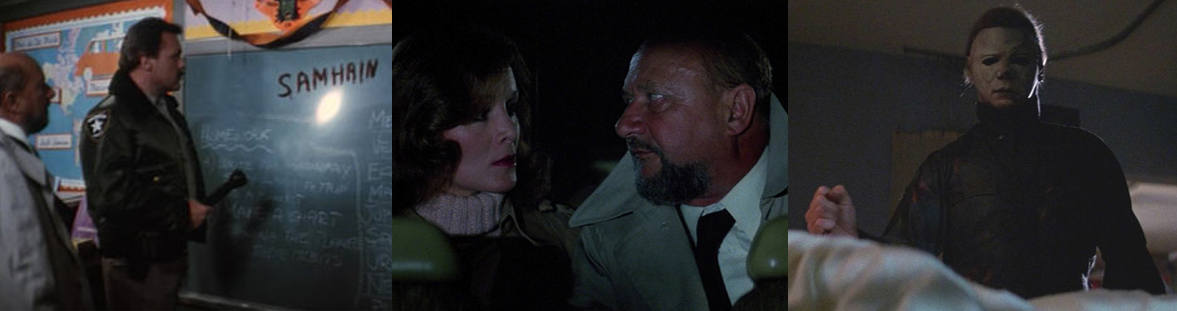
It’s therefore understandable that many bemoan Halloween II for destroying much of Michael’s mystique by providing him with a janky motive; while trying to track down Michael, Loomis discovers that the Shape randomly broke into the local school and scrawled the word “Samhain” on a wall, which I honestly feel would have been enough of a mysterious addition to allow audiences to speculate on the potential supernatural abilities afforded to the masked killer but the series wouldn’t circle back around to that for another few films so Carpenter instead shoe-horned in a familial connection between Michael and Laurie. Until Marion informs him that Laurie is Michael’s younger sister, who was put up for adoption after his psychotic break as a child, Loomis was completely unaware of this fact and, upon learning it, realises that Laurie was no random or coincidental target. Instead, the implication is that Michael is compelled (possibly by supernatural forces) to murder his teenaged siblings on and/or around Halloween, which is still a frightening concept but nowhere near as interesting as a young boy just snapping one day, biding his time for years as little more than a vegetable, and then exhibiting superhuman strength and tenacity in a random killing spree. Also, it doesn’t really explain why he didn’t just attack Laurie right away; after all, he didn’t kill his sister’s boyfriend as a boy, so it doesn’t make much sense for him to slaughter Laurie’s friends in his pursuit of her. Still, to play Devil’s advocate for a second, not every horror villain suffers from having clear cut motivations and backstories; it can help to make them a bit more sympathetic and to lend an additional layer of horror and madness to their motives, but I do think that expanding upon Michael’s motivations in this way diluted some of his horror. Yes, he’ll still kill you if you get in his way, but as long as you’re not related to him in some way, you’re probably okay, which makes him less a force of pure evil and more a focused maniac with a specific target in mind.

Michael’s body count is far higher, and bloodier, and yet somehow far more underwhelming.

Halloween II not only ups the nudity and sexual content compared to the first film, it also ups violence, gore, and kill count from the first film, so it’s only fair that I talk about the kills on display in the film: Michael stabs a woman in the chest with a knife, delivers a sickening hammer shot to the head of security guard Bernard Garrett (Cliff Emmich), strangles Bud with a piece of wire while he’s tending to the hydrotherapy pool’s temperature controls, and then drowns Karen in the boiling hot water of that same pool in perhaps the film’s most horrifying and gruesome kill (but which, again, hearken back to Michael’s famous bedsheet kills from the first film). Michael also offs a doctor and a nurse with a syringe (with one stabbed in the aforementioned doctor’s eye!), goes to the ridiculous effort of draining Virginia of her life’s blood using surgical equipment, and impales another nurse through the back with a scalpel right before Laurie’s eyes, easily hoisting his victim up with one arm in the process. Unfortunately, Michael’s iconic mask, with its dark eyes and expressionless visage, leaves a lot to be desired; rather than create a new mask that actually resembled the one from the first film, the filmmaker used the same exact mask, which is noticeably aged and looks cheap and ugly as a result. While I appreciate the variety in Michael’s weaponry in this film, he only uses his trademark kitchen knife the one time and spends the majority of the film wandering the darkened hallways of a deserted hospital with a piddling little scalpel that is nowhere near as horrifying as a big, sharp knife.

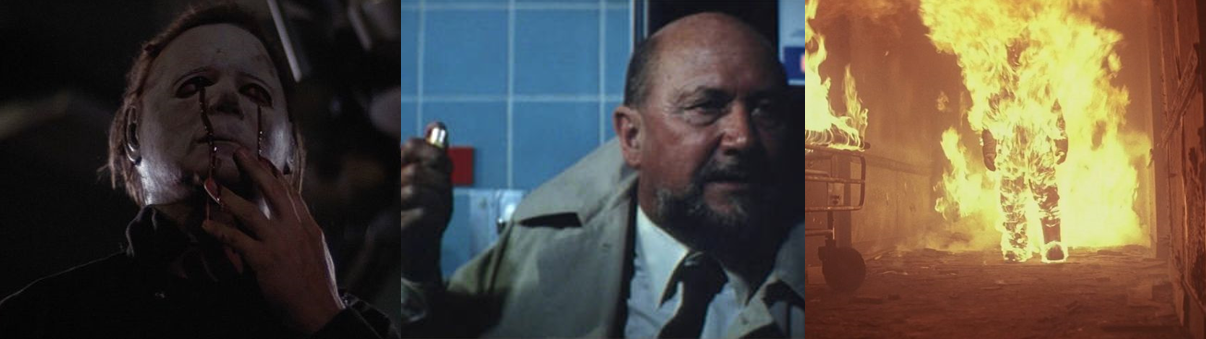
Loomis sacrifices himself to see Michael’s reign of terror end in a blazing inferno.

Having tracked his long-lost sister to the hospital, Michael leaves a trail of bodies in his wake that is far more gruesome and creative than the comparatively tame body count and murders from the last film though, sadly, Jimmy escapes his grasp (however, he does appear to be dead after foolishly slipping on a pool of blood). As Michael prowls around the hospital, Laurie’s sole objective is to escape, so she stumbles and crawls around the place, hides, and generally spends most of the finale desperately fleeing from her relentless pursuer. While I won’t lie and say that Laurie was the most compelling and interesting character in the first film (she was basically a kind-hearted, if bland, bookworm), Halloween II doesn’t do her character too many favours and basically just paints her as a helpless victim for the entirety of its runtime. Luckily for Laurie, Loomis once again arrives in the nick of time to save her; however, as has been established throughout the movie, mere bullets can’t stop Michael and the Shape is able to shake off Loomis’ shots, stabs his former doctor, and corners the two in an operating theatre. Here, Laurie gets a very brief moment to be a proactive protagonist as she demonstrates her uncanny aim by shooting out Michael’s eyes (something every subsequent film has simply ignored), leaving him blind and swinging his “deadly” scalpel wildly. Loomis fills the room with flammable gas and orders Laurie to run before setting off his lighter, immolating himself and his disturbed patient in a massive explosion. Although Michael emerges from the blaze engulfed in flames, he quickly collapses to the ground and burns to death before Laurie’s eyes, finally ending his threat once and for all (or for about seven years…).

The Summary:
It’s tough to really find anything positive to say about Halloween II; yes, the gore and the nudity are a bit more pronounced and Michael is the same relentless killer he’s always been, but the whole film seems like such a waste of time and potential. It spends so much of its runtime trying to recreate or repeat the story beats of the first film that the pace meanders as a result; Michael wanders all over town, slowly making his way to the hospital, simply to add to the body count when we know he could easily just drive there. Setting much of the film in the hospital could have been a good way to make it visually distinct from its predecessors but the hospital is so barren and lifeless and full of throwaway, nothing characters that I just find myself bored watching it. Donald Pleasance remains a highlight, of course, but so much of his dialogue is lifted from the first film’s script that it feels like we’re just going over the same information again and again, though I did enjoy seeing how traumatised by Michael’s killing spree the doctor has become and the culmination of his guilt around the horrific events his patient has wrought (what better way to go out than in a literal blaze of glory?) The twist of Michael being Laurie’s brother was clunky, at best, and would go on to largely dominate the series for some time; I’m largely numb to it at this point and don’t really mind it all that much, but again the potential of this reveal is completely squandered and poorly implemented here (it would be incorporated far better in some of the sequels, and even then it could never have the impact the filmmakers intended because of the studio’s reluctance to end their profitable franchise). Overall, I feel like Halloween II really isn’t worth your time; you can just as easily skip from this film to one of the many sequels thanks to the numerous reboots that have diluted this franchise and it definitely feels as though this was thrown together simply because slasher films had become popular after the success of Halloween, resulting in a by-the-numbers slasher that lacked all of the nuance and subtle horror of the original.

My Rating:

Rating: 2 out of 5.

Could Be Better

Are you a fan of Halloween II? What did you think to the twist that Michael and Laurie were siblings? Do you like horror villains to have clear motivations or do you prefer them to be more ambiguous? Which of the kills was your favourite and what did you think to the new characters? What did you think to Loomis’ maniacal obsession and his ultimate sacrifice? Do you think the series should have ended here or is one of the subsequent films a favourite of yours? How are you celebrating Halloween this year? Whatever your thoughts on Halloween, and the Halloween franchise, sign up to drop a comment below, or leave a comment on my social media, and have a spook-tacular Halloween!

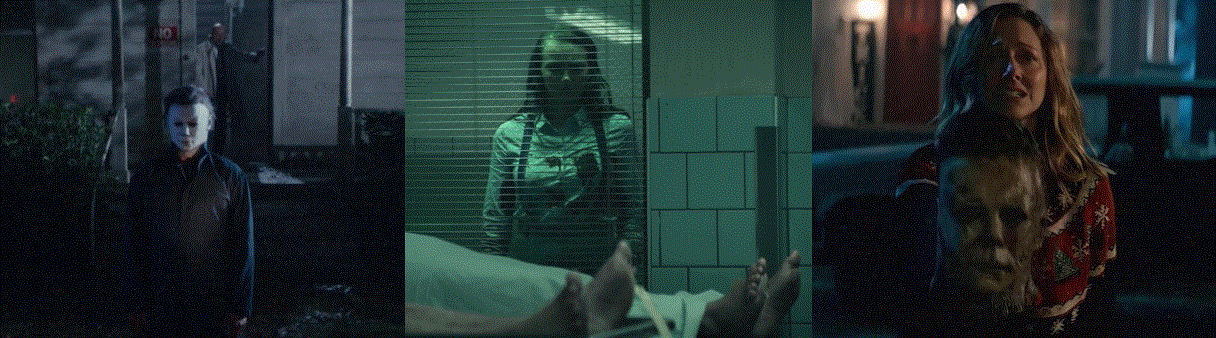
Movie Night: Halloween Ends

Released: 14 October 2022
Director: David Gordon Green
Distributor: Universal Pictures
Budget: $20 to 30 million
Stars: Jamie Lee Curtis, Andi Matichak, Rohan Campbell, and James Jude Courtney/Nick Castle

The Plot:
Four years after Michael Myers/The Shape’s (Courtney/Castle) last killing spree, Laurie Strode (Curtis) is trying to move on with her granddaughter, Allyson Nelson (Matichak). However, when local pariah Corey Cunningham (Campbell) starts down his own dark path of violence, Laurie is forced to confront her bogeyman one last time.

The Background:
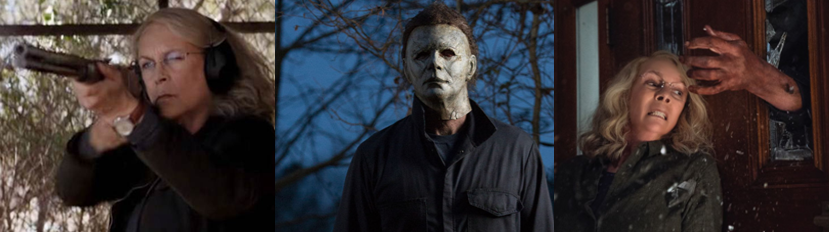
In 2018, director David Gordon Green helmed a direct sequel to John Carpenter’s seminal horror classic to largely positive reviews and an impressive $255.6 million box office. Initially, Green and his co-writer, Danny McBride, pitched filming two movies back-to-back but, after their “requel” proved to be a success, they chose to focus on one film at a time. Although Jamie Lee Curtis and Nick Castle returned for the sequel, Halloween Kills (Green, 2021) received mixed reviews and fell a bit short of its predecessor’s success with its $131.6 million box office, but performed well enough to justify a third and final entry in Green’s new trilogy. Although his stars were set to return, Halloween Ends was understandably delayed due to the COVID-19 pandemic, an element that Green stated would be addressed in the film’s story. Both legacy star Jamie Lee Curtis and franchise producer Malek Akkad hyped the film as being a more self-contained film, one they hoped would enrage audiences with its content, as well as confirming that Halloween Ends would be the final entry in Blumhouse’s trilogy due to rights issues. Ultimately, Halloween Ends released to largely negative reviews; critics were unimpressed by the monotonous presentation of the violence and themes, its status as a definitive finale, and its unexpected focus on someone other than Michael. Some praised it as the best of this new trilogy, however, and praised Jamie Lee Curtis’s performance, though, as of this writing, the film has made only $64.4 million at the box office and the general consensus was that it was a lacklustre finale for the franchise.

The Review:
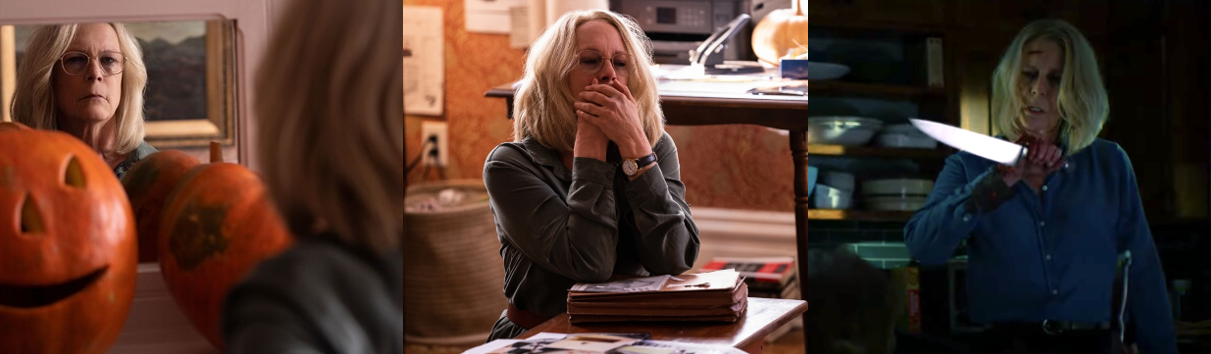
I think I’ve made my feeling about this new string of Halloween “requels” pretty clear but, just as a reminder…I wasn’t massively impressed by Halloween; we’ve seen the whole “decades later Laurie comes back to face Michael” thing and I really hated how it just swept away everything but the original film and went out of its way to criticise what the sequels did without really offering anything new. As the film ended, I was begging to see Michael go up in flames and be definitively killed off because at least it’d be something new but, of course, that was never going to happen. Halloween Kills somehow managed to be even worse; the film spent its entire runtime musing on Michael’s motives without coming at any real conclusion, making all of that discussion pointless, and having idiotic characters running around trying to end him and just acting like crazy fools who all ended up being slaughtered. It was filler and nothing more and smacked of a creative team who weren’t properly thinking out their three-film plan, which just made me question why it was even made in the first place. Again, if he’d actually been killed and someone else had took up his mantle then maybe I could’ve gotten behind it but it gave us probably the best chance to legitimately kill Michael (what better visual than the town he’s haunted rising up to stamp him out?) and just went “oop, no, he’s somehow supernatural, or maybe he’s not, we don’t know…he wants to go home! Even though he was at home earlier…look over there!” and then just snapped to the credits like it was clever. So, yeah, my excitement for Halloween Ends wasn’t exactly tipping the scale heading in; it’s hard to deny the allure of these movies and Michael’s iconography, but it’s also very difficult for me to care about these films as they so rarely do anything new because, when the formula is changed, the general audience flip out.

Although she appears to be in a far healthier state, Laurie’s fighting spirit is as strong as ever.

Unfortunately, Halloween Ends doesn’t exactly break the mould when it comes to improving my perception of these new films. In the four years that have passed since the last film, Michael has mysteriously vanished again, the Myers house has been demolished (quite how or why that was able to happen when the last film made it explicitly clear that his entire goal was to reclaim his former home. I guess he didn’t like the décor?), and Laura and Allyson live together in a fancy new house that the former was somehow able to purchase despite the fact that she doesn’t appear to have a job. Instead, Laurie is working on her memoirs, which provides a convenient and entirely pointless excuse to give a recap of the original film and the last two, with footage and such being spliced in to catch us up with the plot, something no Halloween film has ever needed to do before. Framed as a survivor of an extremely traumatic series of events, Laurie has abandoned her paranoia and now throws herself into helping others cope with similar trauma and providing a safe and happy home for Allyson, who’s lost her parents and friends thanks to Michael’s rampage. Laurie even decorates the house for Halloween and considers rekindling her romance with the criminally underutilised Deputy Frank Hawkins (Will Patton), a character who, quite frankly, could easily have been removed from this film (or actually been left as dead as he clearly was in Halloween) and the plot wouldn’t have been affected at all. personally. I would’ve liked to see him take on a Doctor Samuel Loomis-style (Donald Pleasance) role as an aging, somewhat unhinged Myers expert whose warnings are ignore but, instead, he gets a couple of scenes where he flirts with Laurie and talks to her about food and flowers and that’s it. No longer intent on preparing for an encounter with a nigh-supernatural force of evil, Laurie seems to be happy and excitable; she encourages Allyson to put herself out there more, shares drinks with the equally-underutilised Lindsey Wallace (Kyle Richards) and seems to be in a far healthier place than in the last two films.

Corey brings out the worst of the traumatised Allyson and fuels her desire for a new life.

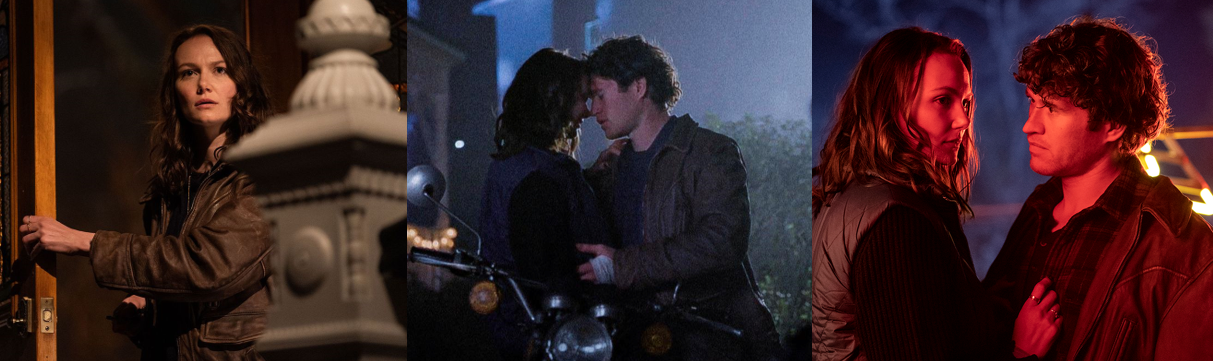
It takes time, but this is eventually, awkwardly, revealed to be a bit of a lie. Haddonfield has been left irrevocably scarred by Michael’s actions; the town openly blames Laurie for “provoking” him, an accusation that makes absolutely no senses, especially as it was the idiotic Tommy Doyle (Anthony Michael Hall) who riled up the mob in the last film and lead to all those deaths while Laurie was given the shaft and confined to a hospital. At first, it seems both Laurie and Allyson are coping quite well despite all of this, but it’s not all sunshine and rainbows; Allyson is now working as a nurse, where she’s treated very poorly by her lecherous boss, Doctor Mathis (Michael O’Leary), and she’s constantly harassed by her obsessive ex-boyfriend, Officer Doug Mulaney (Jesse C. Boyd). Although Laurie is the only family she has left, put herself at risk to defend her, and actively advised against joining the mob in the last film, Allyson secretly resents her grandmother and longs to escape the confines of Haddonfield, where treasured memories of her family and friends are mired by unwanted accusations and looks from the public. When Laurie brings an injured Corey to the hospital for treatment in a thinly-veiled attempt to set them up, Allyson is surprisingly and ridiculously instantly attracted to him; it’s not clear exactly why (he’s not that cute, after all), but it’s implied that she feels a kinship in him as the town also turned on him, and that she wants to “fix” him in some way. Corey allows Allyson the chance to indulge herself and to act a little naughty; this only exacerbates when Laurie realises something’s terribly wrong with Corey and tries to warn her granddaughter off, which sees all of her pent-up resentment bubble to the surface and her even encouraging Corey to give in to his dark side, despite her also appearing to have no knowledge of what he’s been up to even though he openly admits to killing people, regularly breaks down before her about the conflict inside him, and is clearly a deranged psychopath.

Chance encounters with Laurie and Michael turn Corey from a pariah into an unhinged psychopath.

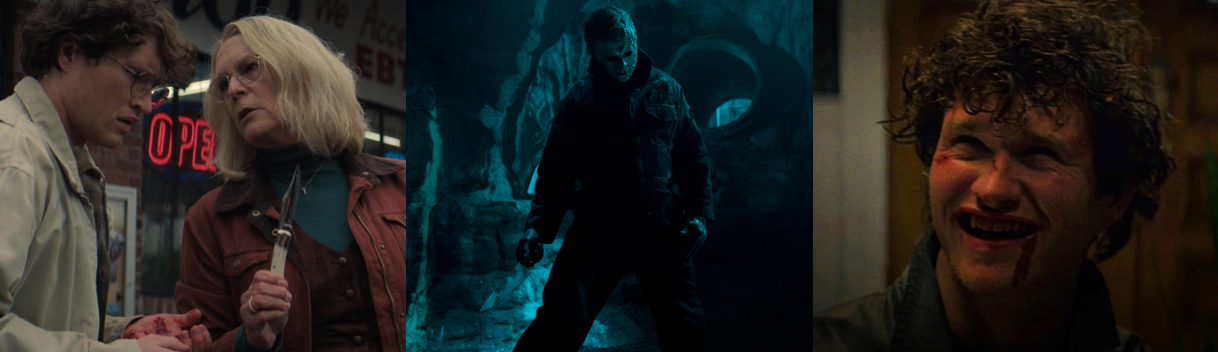
If you go into Halloween Ends based on the trailers and posters alone, you’d be fooled into thinking this is the climactic showdown between Laurie and Michael. Nothing could be further from the truth, however, as the main focus for the vast majority of the film is Corey’s downward spiral into madness and murder. The film begins with Corey as a simply twenty-one-year-old babysitter with aspirations of going off to college; however, when he accidentally kills the bratty little kid he’s babysitting in what is clearly a freak accident, the town turns against him and he’s forever labelled as a baby-killing pervert. Although he tries to pull his life together and earn a modest living as a mechanic, he’s constantly berated by his overbearing mother, Joan (Joanne Baron) and targeted by a local gang of bullies who go out of their way to antagonise him. It’s because of Terry (Michael Barbieri) and his shit-kicking friends that Corey ends up injured and meeting Allyson, that he gets his first taste of vengeance when Laurie encourages him to flatten Terry’s tyre, and when he has a fateful encounter with Michael Myers. Far from the invincible, inexhaustible supernatural force he was painted as in the last two films, Michael is now decrepit and pitiful, surviving in a storm drain on the outskirts of town and burdened by the injuries he’s suffered in recent years. When he gets his hands on Corey, a strange moment passes between them; either a transfer of power or evil or a recognition that the same darkness that dwells within Michael lies dormant in Corey, and the Shape inexplicably lets him go as a result (despite the fact that he unceremoniously murdered Doctor Ranbir Sartain (Haluk Bilginer) when he tried to take over Michael’s legacy). Shaken by this near-death experience, Corey descends down a dark path; accidentally manslaughter leads to accidental murder, then premeditated murder, until he’s donning his own Halloween mask and adding more numbers to his body count. Corey even leads Michael to Doug and Dr. Mathis in order to see the Shape in action with his own eyes, which only pushes him further over the edge, to the point where he effortlessly overpowers the once almighty Shape of Evil and steals his mask to reignite the terror Michael started decades ago.

The Nitty-Gritty:
Although every Halloween movie has a thematic undercurrent concerning the power of literal and metaphorical masks, Halloween Ends attempts to explore this a little more explicitly, but ultimately fails in its execution. Laurie is hiding behind a mask of good-natured enthusiasm; far from the paranoid and unhinged drunk she was before, she seems to be much healthier and attempting to let go of her hate and fear, however this mask slips pretty quickly once she gets a look at Corey’s eyes and seems the same darkness dwelling within him as she saw in Michael. Allyson has a similar mask, ignoring the maltreatment she receives at work and from her ex simply to try and get on with her life, but she quickly casts this aside and turns on her grandmother with such vitriol that it appears like she’s encouraging Corey’s killing spree. Corey attempts to hide away, burying his head in the sand and avoiding conflict, but is constantly goaded into fight or flight situations by bullies and accusing townsfolk. When he dons a Halloween mask of his own and goes dancing with Allyson, he finds a freedom and a joy that have been lost for some time, but it doesn’t take much to snap him back into a guilt-ridden, morose state, one that makes him easy prey for the likes of Terry and the infectious evil of Michael Myers. Michael, obviously, famously hides behind a mask, one now aged and heavily damaged, but which still has such an allure and power to it that Corey claims it as his own to foster his bloodlust.

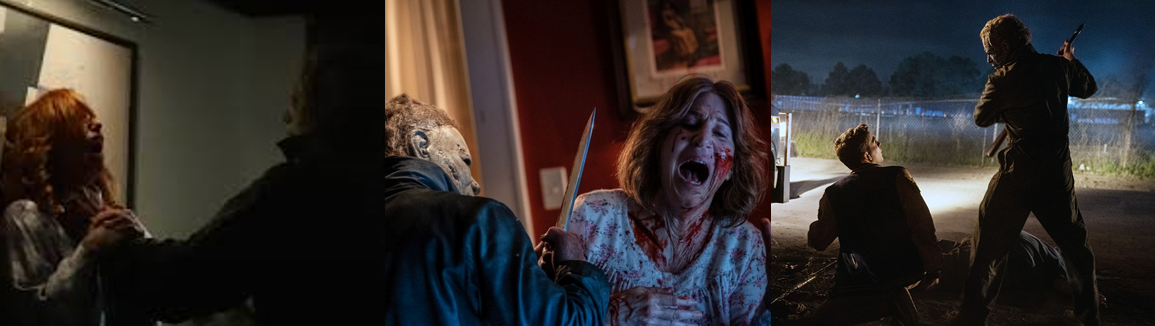
Sadly, only a couple of the film’s kills live up to the legacy of the franchise.

As much I disliked the previous Halloween films, they were mildly salvaged by three factors: Michael, the conflict between Michael and Laurie (and the greater town of Haddonfield), and the kills. As Michael is largely absent until the last act of Halloween Ends, and the film completely wastes the potential of Haddonfield descending into anarchy and increasing violence as a result of Michael’s “curse”, we’re left to rely on the kills. Sadly, these aren’t all that impressive as it’s left up to Corey to shoulder this burden and, as a largely reluctant killer, he lacks the supernatural skill and power of the iconic Michael Myers. I will say, though, that a couple stood out; Corey’s accidentally murder of obnoxious Jeremy Allen (Jaxon Goldberg) in the opening sequences was as shocking as it was amusing, and it was pretty gruesome seeing him take a blowtorch to Terry’s mouth. Probably the best kill is when Corey, now donning the Shape’s visage, mercilessly beats shock DJ Willy the Kid (Keraun Harris) until his jaw is hanging from his face and then cuts his tongue off and leaves it spinning on the record player. For the most part, Corey opts for simple murder tools such as a switchblade and bottle opener, resulting in some unfortunately tame and lacklustre kills; when he lures his bullies to the scrapyard where he works, he switches to using a truck to chase after them and borrows Michael’s head-stomp kill to finish of the unfortunate Margo (Joey Harris). Michael’s kill count is pathetically low in this film and relies entirely on nostalgia for John Carpenter’s original as he stabs and kills Allyson’s work frenemy, Deb (Michele Dawson), in exactly the same way as he killed Bob Simms (John Michael Graham) in the first film. Call-backs such as this are scattered throughout Halloween Ends; not only does the film ape the opening credits of the original, it uses the same font as Halloween III: Season of the Witch (Wallace, 1982) – fitting considering this mess of a film is on par with that ill-fated entry – and there’s even a short sequence shot from Corey’s perspective to mimic the iconic opening of Carpenter’s original. Sadly, though, it takes far too long for the blood and bodies to start piling up; Halloween has always traditionally been a more psychological franchise but the psychology on offer here is weak and flawed. The film attempts to paint Corey as a victim of society and nurture, rather than the pure natural evil embodied by Michael, but we learn paradoxically too much about him and at the same time not enough, meaning he lacks the mysterious menace of Michael and just comes across as a pouty kid lashing out at people who, for the most part, deserve to be punished, rather than killing innocent and otherwise likeable characters.

Unfortunately, Halloween Ends doesn’t live up to its premise and makes a mockery of Michael’s menace.

Upon first meeting, Allyson is instantly smitten by Corey and is inexplicably horny for him throughout the film; Corey initially tries to warn her off, since associating with him is bad news for her, but he can’t resist how good she makes them feel and they’re soon head over heels with very little motivation beyond being young, damaged, and wanting to escape. When Laurie recognises Corey’s turn to the dark side, she tries to warn both of them off but is labelled as a paranoid hypocrite, forcing her to take matters into her own hands. Somehow realising that Corey is walking the same dark path as Michael, she lures him to her house by staging a suicide attempt and shoots him down, apparently prepared to kill him before he can harm Allyson, or anyone else, and thus keep Michael’s curse from growing stronger. However, Corey’s mania is so complete that he willingly kills himself rather than live without Allyson, making the entire runtime up until that point a waste of time as he’s unceremoniously offed and then his thunder is stolen by Michael, who finally gets his shit together after spending the whole movie cowering in hiding and attacks Laurie. Although vulnerable after Allyson caught her holding a knife over her lover’s dead body, it turns out that Laurie isn’t as meek and content as she first seemed, and she engages in a brutal knife fight with Michael in her kitchen. Age, injury, and this film’s efforts to piss all over Michael’s legacy have left him a shell of his former self, however, and it’s not long before he’s pinned helpless to a table and has his throat slit by Laurie. Allyson arrives in time to help finish the Shape off and the two drive his dead body to the scrapyard with a police escort so all of Haddonfield can finally witness their bogyman by unquestionably killed off in pretty gruesome fashion; Laurie shoves his mutilated and lifeless body into an industrial shredder, which crushes him into bloody chunk and finally ends Haddonfield’s long, dark night. Unfortunately, the film really doesn’t deserve this definitive finale; the climactic and emotional finale of Halloween H20: 20 Years Later (Miner, 1998) remains unbeaten, in my eyes, as the most cathartic and dramatic end to Michael and Laurie’s story. I also feel like the finale might’ve benefitted from taking place at the scrapyard, with Michael being forced into the shredder by Laurie and Allyson, but I do give it props for actually killing the Shape off, even if 90% of the movie was focused on an entirely different and far less interesting plot and killer.

The Summary:
Just like with Halloween Kills, I went into Halloween Ends with low expectations; I admit that a lot of this was based on my dislike for Green’s Halloween movies, especially Halloween Kills, but even setting that aside it’s pretty despicable how this movie treats one of cinema’s most iconic slashers. Michael’s absence is to the film’s detriment; at one point, it seemed like him and Corey were going to go on a killing spree together, but that evaporated almost immediately, and it’s depressing seeing this jumped-up loser wrestle the Shape to the ground and steal his mask like it’s nothing, especially after the last two films tried to sell Michael as this unstoppable supernatural force. In another film, Corey’s story might’ve been interesting, and I have longed to see someone else take up Michael’s ways, but it just doesn’t stick the landing here; maybe if Corey had used Michael’s mask all along and Haddonfield had been led to believe the Shape was back, it might’ve worked better but, as is, he’s a very underwhelming character. Jamie Lee Curtis tries her best to get this movie on track, but Laurie’s character turn is so sharp from the last two that she feels like a completely different person, one who I have a hard time believing could go toe-to-toe with Michael. Michael himself makes an impact for the finale, but the ending feels like it was slapped on to an unrelated psychological slasher film and then the script was hastily rewritten to be a Halloween sequel. Ultimately, this entry was as unnecessary as the last one; I didn’t care for Halloween but it would’ve made poetic sense to end things ambiguously and then try another reboot, but these last two films have just dragged the story on for no reason except to cash-in on the franchise name and I was left underwhelmed by this apparent definitive end to the story.

My Rating:

Rating: 1 out of 5.

Terrible

What did you think to Halloween Ends? Where would you rank it against the last film and the other entries in the franchise? What did you think to the shift towards Corey and his descent into madness? Did you buy his relationship with Allyson or did it fall flat for you? What did you think to Laurie’s portrayal and the side-lining of her vendetta against Michael until the ending? Were you also annoyed by Michael’s absence and how easily he was dispatched? Which of the kills was your favourite and where would you like to see the franchise go in the future? Feel free to sign up and leave your thoughts down below and drop a reply on my social media to let me know what you thought about Halloween Ends.  

Movie Night: Halloween Kills

Released: 15 October 2021
Director: David Gordon Green
Distributor: Universal Pictures
Budget: $20 million
Stars: Jamie Lee Curtis, Judy Greer, Andi Matichak, Anthony Michael Hall, and James Jude Courtney/Nick Castle

The Plot:
Minutes after Laurie Strode (Curtis), her daughter Karen (Greer), and granddaughter Allyson (Matichak) left masked killer Michael Myers/The Shape (Courtney/Castle) caged and burning in Laurie’s basement, Laurie is rushed to the hospital with life-threatening injuries, believing she finally killed her lifelong tormentor. However, when Michael frees himself and continues his relentless killing spree, Tommy Doyle (Hall), a former victim of Michael’s, rallies all of Haddonfield to rise up against the unstoppable monster.

The Background:
In 2018, director David Gordon Green’s direct sequel to John Carpenter’s seminal horror classic was released to largely positive reviews and amassed a startling $255.6 million box office against a $10 to 15 million budget. Initially, Green and co-writer Danny McBride pitched the idea of filming two movies back-to-back and, after their “requel” proved to be a success, the two briefly revisited this concept for the follow-up. However, while Halloween Kills is the first of two sequels, this plan was abandoned to focus on one film at a time. In addition to the returning Jamie Lee Curtis and Nick Castle, the film sees the return of many characters from Carpenter’s original and filmmakers even initially approached Paul Rudd to reprise a new version of his role as Tommy Doyle but (wisely, in my opinion, given how convoluted Halloween’s timeline is now) cast Anthony Michael Hall since Rudd’s schedule wouldn’t allow him to sign on. After the COVID-19 pandemic saw the film’s release to be delayed by a year, Halloween Kills eventually received somewhat mixed and confused reviews that nonetheless praised the kills and atmosphere, and fell a bit short of matching its predecessor’s success with its $131.6 million box office.

The Review:
Honestly, I wasn’t the biggest fan of Halloween (…the 2018 one, not the 2007 one…or the 1978 one…); if I had to sum it up in one word, it would be: redundant. The film really didn’t provide anything we haven’t seen before in any of the many Halloween sequels and reboots and I maintain that, for all its flaws, Halloween H20: 20 Years Later (Miner, 1998), did a much better job of tying up Laurie’s lingering issues with Michael Myers. Halloween decided to scrub away everything after John Carpenter’s original, which is fine, but went so far out of its way to dump on the other films and the established lore that it was honestly distracting. It also injected a bunch of new lore and characters that just felt a bit shoe-horned in and spent a great deal of time focusing on the nature and motivation of Michael Myers without actually addressing it; I get not liking the old revelation that Michael and Laurie are siblings and wanting to erase it from continuity, but what’s the point of doing that and doing away with that established motivation if all you’re going to do is dance around what motivates him? I don’t particularly want to know, and think it’s much scarier for him to be this random force of nature, but the film kept pretending like it had more to say about this and it just didn’t.

Michael goes on a new killing spree, inciting a full-blown mob determined to stop him.

Sadly, much of the same issues plague Halloween Kills (terrible title, by the way), which definitely suffers from scrambling to find ways to continue what should have been a definitive end for the infamous killer and then filling it runtime with busy work because the filmmakers are determined to make a third entry in their new trilogy. If you’ve seen the trailer, it’s pretty clear that Michael survives the fire at Laurie’s booby-trapped home; firefighters arrive on the scene to fight the blaze but end up getting absolutely decimated by Michael, who hid from the flames behind a convenient shutter in Laurie’s basement rather than thanks to any kind of supernatural powers. Sporting a burnt and wrecked mask and suit, as well as still carrying the damage he received in the previous film (including his missing fingers), Michael certainly cuts a fearsome, monstrous figure this time around and definitely isn’t messing around as he attacks his prey with an aggressive fury that is a far cry from his usual, more methodical strategies. Michael’s return sparks fear and outrage throughout Haddonfield, particularly in Tommy Doyle, Lonnie Elam (Robert Longstreet), Lindsey Wallace (Kyle Richards), and Marion Chambers (Nancy Stephens), all returning characters (and, in some cases, cast members) from John Carpenter’s original film who were left traumatised by Michael’s original killing spree. Tommy’s determination to pay reverence to Michael’s victims and Laurie’s survival turns to a desire to hunt Michael down and end his threat once and for all, and he becomes the rally force behind getting all of Haddonfield up in arms and on the lookout for Michael. Tommy’s transformation from a terrified little kid into this wannabe bad-ass is a little jarring, to say the least; the film’s marketing heavily pushed Laurie as being the one to bring Haddonfield together but it’s actually Tommy, who grabs a baseball bat and repeatedly offers advice and insight into Michael’s abilities, motivations, and methods, which just didn’t work for me as I had a hard time buying him as any kind of expert on the iconic killer just because he happened to be scared shitless by Michael as a little kid.

Returning cast and characters join the mob, who only cause more chaos and bloodshed.

Marion and Lindsey may as well have not even been in the time for how little they do; they seem to primarily be there so that the filmmakers can make a big deal about bringing these actors and characters back, and to spout overly enthusiastic diatribe about how “Evil dies tonight!” and to appear as hopelessly outmatched as the rest of Haddonfield. Lonny plays a slightly larger role as it turns out that he’s the father of Cameron Elam (Dylan Arnold), who you may remember was Allyson’s scummy boyfriend in the last film. Cameron and Allyson come back together to join Tommy’s increasingly aggressive and mindless mob, united in their grief over Michael murdering their friends and family, much to the chagrin of Karen, who is perfectly happy for the authorities to handle the matter and under the belief that Michael will eventually make his way to Haddonfield Memorial Hospital to finish off her mother. Haddonfield, however, has been driven to the brink by the continued spectre and threat of Michael Myers and are whipped into an absolute frenzy by Tommy, who openly defies the local police department and determines that mob rules are the best and only way to put Michael down once and for all. The result is an unwieldy, paranoid gaggle of terrified, angry townsfolk grabbing whatever weapons they can and desperately hunting Michael down. Their exuberance leads to them targeting another escaped mental patient (Ross Bacon), whom they mistakenly (and stupidly) believe to be Michael (despite the fact that he wears completely different clothes, is obviously shorter and squatter, and runs around unmasked, which are all decidedly non-Michael Myers traits but, apparently, an “expert” like Tommy doesn’t consider these facts) and results in his death. The sudden narrative switch towards mob mentality makes Halloween Kills easily one of the most political in the entire series; the message of the film is the dangers of fear and anger on an increasingly large group of people as the mob tramples over each other and is literally frothing at the mouth to get their hands on Michael no matter what, which ultimately only results in further chaos and bloodshed.

Laurie and Frank find themselves bed-ridden in hospital and powerless to act against Michael.

You might be wondering where Laurie is during all of this, and why I’ve barely mentioned her. Well, despite receiving to billing, Jamie Lee Curtis is pretty much benched throughout this entire film as, just like in the God-awful Halloween II (Rosenthal, 1981), she is bed-ridden with serious injuries and confined to a hospital for the entire movie. At first, she’s overwhelmed at the knowledge that Michael is finally dead but she quickly insists on getting back into the fight, despite her injuries, when she learns of his survival, however her injuries are exacerbated by the unruly mob and she just heads back to bed and taps out of the rest of the film to ponder Michael’s mindset and the nature of his evil rather than actually doing anything. Surprisingly, Deputy Frank Hawkins (Will Patton) is revealed to have survived his clearly fatal wounds from the last film and, like Laurie, is equally determined to kill Michael once and for all since (as flashbacks show) he is the one who kept Michael from being outright executed back in 1978 but, despite him being extremely motivated to make up for this mistake, he also spends the entire movie recovering in a hospital bed and I question why the filmmakers even bothered to have him survive since he doesn’t factor into the plot at all beyond ruminating on Michael’s evil. Similarly, Karen really doesn’t have anything to do beyond beg Allyson not to join the mob and plead with hospital staff to prepare for Michael’s arrival, though both she and Allyson do finally factor into the final showdown with Michael but, by then, I had honestly checked out.

The Nitty-Gritty:
One aspect where Halloween Kills does really well is in the music, sound design, and presentation; there’s a dark, gritty brutality to the film that really ties into the escalating terror and paranoia of the local mob and the various remixes of the classic Halloween theme do a great job to help punctuate the tension and the kills. There’s a decent attempt to build some tension and a sense of dread here, especially as Michael is now a very publicly acknowledged figure rather than being just a local bogyman for people to deny or laugh off. There’s a definite sense that the people of Haddonfield have had enough of his shit and are determined to put him down once and for all, but they’re a disorganised and rowdy bunch who are much better at shouting and getting all worked up than they are at actually chasing the killer down or holding their own against him. I definitely enjoyed all the throwbacks and the returning characters and actors, and the film even opens with and includes a couple of flashbacks to Halloween night, 1978, to absolutely, emphatically, unequivocally erase Halloween II from continuity and replace it with what basically amounts to a far more-populated remake of that film.

All subtlety has been tossed aside as Michael is at his most brutal and vicious here.

Easily the best part of Halloween Kills are the kills; Michael is at his most brutal here, ramming broken light tubes into people’s throats, smashing in skulls with axes, gouging eyes out with his bare hands, stabbing people in the brain through the eye, and causing his attackers to look like complete idiots at every turn as he’s easily able to shrug off their attacks and even cause them to kill themselves in almost comical fashion. All sense of subtlety and quiet menace have been completely lost here as Michael brutalises his victims in gruesome and gratuitous fashion; sure, he stalks most of them and there are some creepy moments where you’re never sure where he is (or you do know where he is but character’s are hiding in fear and waiting for him to move on), but Michael generally attacks with a sudden and ruthless spite that sees many of his victims suffering terribly as they bleed out from spurting wounds and are forced to watch Michael bludgeon their loved ones and be placed in ghastly positions for others to find. As impressive and gory as the kills are, however, they definitely seem to have been ramped up to make up for the film’s middling plot; it’s not that Halloween Kills is poorly paced or necessarily too slow, but its plot definitely seemed to run out of steam  pretty quickly, so I was left watching random characters doing weird stuff while the mob grew more and more unruly until Michael finally got around to murdering these oddballs just to add to the film’s kill count.

Halloween Kills returns to the question of the nature of Michael’s evil and motivations.

A great deal of Halloween Kills returns to the question of Michael’s nature, but these new movies seem to be struggling to fill the void left by eliminating his familial link to Laurie. Originally, Michael was just this murderous force of nature; compelled by some dark urge to be this remorseless, near superhuman killer who embarked on a seemingly random killing spree. It was disturbingly simple and chilling in its premise as you were never really sure if he was a man or something more, but sequels and remakes subsequently convoluted Michael’s backstory and motivations by adding the familial link to Laurie and all this shit about runes and a cult or whatever. Halloween altered that by finally doing away with the idea of Laurie and Michael being siblings and replaced it with this desperate desire to learn what motivates Michael and to try and figure out, or get him to say, what’s going through his dark mind. Halloween Kills mostly continues this; Michael has become this local legend and a figure of fear in Haddonfield, a force whose presence weighs heavily on the town and forces them to take up arms against him since he is, after all just a man. And, yet, he’s not; bullets don’t stop him and he exhibits a superhuman strength and durability to makes him more than a man, and Laurie speculates that the fear of Michael is what makes him such a terrifying figure. Halloween Kills does a pretty good job at infusing Michael with this kind of intangible, unhinged, completely random murderous intent while still dancing around the idea that there has to be more to him without actually saying what that is, but I can’t help but feel like it fails to properly stick the landing with any of its themes and messages and is fully aware of this, hence all the senseless gore and violence.

The Summary:
I had pretty low expectations going into Halloween Kills; I was still sour about the last movie, which nonsensically ignored all previous continuity again to tell a redundant story of Laurie having a showdown with the iconic killer many decades later, which he’d already seen done much better (in my opinion) in Halloween H20. Halloween Kills also feels incredibly redundant because it’s just full of bloody violence and busy work to allow the filmmakers to make a trilogy of new films. It doesn’t take long for the films’ disparate narratives to completely lose steam: we’ve got Tommy and his friend son a bit of a side quest that’s not very interesting, Laurie and Frank laid up in hospital as a mob grows around them, and Michael out and about offing random weirdos in increasingly gruesome fashion and none of these elements are really that engaging so I found myself just kind of tuning out about halfway through. The film is, essentially, another go-around at a Halloween II and, while it’s nowhere near as bad as that film is, it probably is just as redundant; Halloween really seems to struggle when it comes to sequels and I can’t help but think that the franchise would have been better off if we’d never seen a follow-up to the original until some time later (be it ten, twenty, or forty years) as every sequel, remake, or reboot has struggled to find ways to continue the story as you kinda have to add a little more to Michael and his lore to do that and every time that happens it dilutes the random terror of Michael Myers. Here, Michael is clearly the best part of the movie and even he acts very out of character for me; never has Michael been so brutal and vindictive in his kills and it definitely feels like this was done because the other storylines just weren’t interesting enough to carry the story. Benching Laurie and Frank, who have the most motivation to go after Michael, and shoe-horning in this political statement about mob mentality was a bit of a mistake for me; I like the idea of Haddonfield rising up against Michael but they really didn’t do anything with this concept beyond the obvious message that angry mobs only make a terrible situation worse. Overall, I can’t say that the film did much to defy my expectations and instead ended up being a mean-spirited, redundant entry in the franchise (and the new trilogy) that exists simply to set the stage for what I hope will be the final entry in the series for a good long while.

My Rating:

Rating: 2 out of 5.

Could Be Better

Have you seen Halloween Kills? If so, what did you think to it and where would you rank it against the last film and the other entries in the franchise? Did you enjoy Michael’s newfound brutality and the grisly nature of the kills or did you find the violence a little too gratuitous? What did you think to the return of Tommy, Lonny, and other characters and actors form the original Halloween? Were you a fan of the mob-based aspects of the story and the ruminations on Michael’s nature? What did you think to Laurie taking a back seat in this entry and would you like to see the franchise come to an end in the next movie? Feel free to sign up and leave your thoughts down below and drop a reply on my social media to let me know what you thought about Halloween Kills.  

Movie Night [Halloween]: John Carpenter’s Halloween


Starting life as the ancient Celtic festival of Samhain, when people would light bonfires and wear costumes to ward off ghosts, Halloween is largely associated not just with ghosts, ghouls, and confectionery but also a long-running series of horror movies. Beginning with John Carpenter’s Halloween (Carpenter, 1978), the franchise is largely credited with birthing the “slasher” sub-genre of horror films and has endured numerous remakes and reboots and is one of the most influential films in all of horror.


Released: 25 October 1978
Director:
John Carpenter
Distributor:
Compass International Pictures/Aquarius Releasing
Budget:
$325,000
Stars:
Jamie Lee Curtis, Nancy Kyes, P.J. Soles, Donald Pleasence, and Nick Castle

The Plot:
After murdering his sister on Halloween night, Michael Myers (Castle) escapes from a sanatorium to stalk babysitter Laurie Strode (Curtis) and her friends while his doctor, Sam Loomis (Pleasence), desperately tries to hunt him down before he can kill again.

The Background:
After being impressed with his work on Assault on Precinct 13 (ibid, 1976), producer Moustapha Akkad sought out writer/director John Carpenter to work on an idea he had for a horror film that revolved around a psychotic killer who stalked babysitters. It was Carpenter, however, who conceived of the idea to set the film on Halloween night and collaborated with long-term friend and colleague Debra Hill on refining the script. Although the film’s low budget meant that Carpenter was unable to attract veteran horror actors Peter Cushing or Christopher Lee, he was able to cast accomplished actor Donald Pleasence, who was the highest paid actor in the film. Michael Myers’ iconic, expressionless mask was the work of Tommy Lee Wallace, who famously altered a mask of Captain James T. Kirk (William Shatner) and Carpenter himself wrote the iconic score, which convinced producers of the film’s potential. This paid off at the time as a worldwide gross of over $63 million made Halloween one of the most successful independent films ever made, although Halloween was largely dismissed upon release for its graphic content and macabre narrative. Although movies like Black Christmas (Clark, 1974) laid the foundation for the “slasher” sub-genre, Halloween is now regarded as one of the most influential slasher movies and one of the greatest horror films ever made thanks to popularising the clichés of this popular sub-genre.

The Review:
Halloween has, perhaps, one of the most iconic and chilling openings in all of horror cinema; shot entirely from a first-person perspective, the film builds a great deal of tension as we follow an unseen character on a tour of the Myers house and brutally stab Judith Myers (Sandy Johnson) to death. It’s quite a long sequence but it effectively establishes a foreboding and unsettling ambience as the anticipation build and builds to a gruesome finale and, right as we’ve taken in the sight of Judith being stabbed to death, it’s dramatically revealed that the perpetrator was small child with an inhuman, unflinching look etched on his features. The randomness and brutality of this opening act is all the explanation we really need for Michael Myers in this first movie, where he’s portrayed more as a force of nature (evil in the shape of a man) than an actual person.

Loomis is horrified when Michael gets loose and determined to track him down.

Of course, nobody sells the horror and menace of Michael Myers more than his doctor, Sam Loomis, who is vehemently opposed to Myers being transferred from his facility and of the unwavering opinion that Michael is evil incarnate and a significant threat to all of those around him. Having worked with Michael over the course of fifteen years (eight spent trying to reach him and another seven spent committed to keeping him locked away), nobody knows Michael (whom Loomis refers to as “It” rather than “him”) better than Loomis and he is horrified to find that Michael has managed to escape. Fully aware that Michael will head straight to Haddonfield to kill again, Loomis’s first priority is to illicit the help of Sheriff Leigh Brackett (Charles Cyphers) but, while the Sheriff indulges Loomis, he remains incredulous since they find little evidence of Michael’s presence, all of which simply gives Loomis further excuse to exposit the danger that Michael poses through a series of outbursts.

Laurie might be quite unremarkable to begin with but she proves herself capable by the finale.

As one of the original “Final Girls” of slasher cinema, Laurie is, honestly, not all that spectacular a character but that’s kind of the point. The main crux of Halloween’s horror is that it takes place in a normal, everyday, boring suburban environment filled with normal, unextraordinary people and Laurie pretty much embodies that. Sure, she smokes a little weed at one point and has the hots for the elusive Ben Tramer but she’s a much more responsible and level-headed young woman than her friends Annie Brackett (Kyes) and Lynda Van Der Klok (Soles); she’s generally more of a bookworm and takes her duties as a babysitter much more seriously than  her friends and seems much less interesting as a result. However, as unremarkable as she seems at first, Laurie really comes into her own once all of her friends are dead and she’s left at the mercy of Michael Myers; here, she really comes into her own as she’s the only one of Michael’s victims to have the gumption to actually fight back as, while she does become an emotional wreck at times, her quick thinking and adaptability are key factors in keeping her alive.

Michael stalks Laurie throughout the day, seemingly appearing and disappearing at will.

Like Laurie, Annie and Lynda also do a bit of babysitting to help supplement their income; however, unlike her, they generally use this as a good excuse to hook up with their boyfriends and pay the price as a result. Annie, the Sheriff’s daughter, is the clumsier and ineffective of the three as she spills butter all over herself and is happy to simply let Lindsey Wallace (Kyle Richards) watch The Thing from Another World (Nyby, 1951), but is a bit of a rebel as she smokes pot behind her Dad’s back. Lynda, meanwhile, is a total rebel and a complete airhead as she cuts out the middleman completely and simply spends her night have sex with Bob Simms (John Michael Graham) and spouting her catchphrase, “Totally!”, at every opportunity. Each of them fall victim to Michael Myers in some way, shape, or form; Myers’ reputation in Haddonfield has become something of a neighbourhood legend as the kids believe his house is haunted and taunt Tommy Doyle (Brian Andrews) over his fear of the “bogeyman”, but very few seem to be aware of what happened all those years ago and even fewer mention Michael by name. He spends the entirety of his day first making his way down to Haddonfield (inexplicably fully able to drive, despite fifteen years in confinement), acquiring his now-iconic mask, and stalking Laurie. While Tommy runs across Michael at one point, the only one of the girls to constantly stop Michael stalking them is Laurie, who is disturbed at his ability to seemingly appear and disappear at will, but his presence is quickly felt by all three girls when night falls and he begins his killing spree in earnest.

The Nitty-Gritty:
Of course, one of the most horrifying and memorable aspects of Halloween is John Carpenter’s iconic score; a simple few notes of a piano are enough to send a chill down the spine as Michael suddenly appears onscreen or looms into view, always seen from a distance, the neck down, or bathed in shadow with only his mask standing out against the pitch darkness of night. It’s a fantastically simple and effective score that is perfectly used to build a sense of dread and tension and, by the conclusion, ramps up significantly to reflect Laurie’s growing fear and desperation as she frantically tries to escape from Michael’s wrath. Of course, few films are perfect and Halloween has a few dodgy moments; as chilling and effective as the opening shot is, the angle and perspective of the young Michael’s attack is a bit awkward (it looks like he stabs Judith in the stomach or leg but the blood is splashed over her ample bosom) and Haddonfield is very green for October.

Halloween is surprisingly light on kills and favours mounting tension over gory effects.

Compared to many of its sequels and contemporaries, Halloween is also relatively light on the gore; Michael wields a massive kitchen knife, which he uses to cut Annie’s throat and stab Bob through the stomach, but he also heavily relies on his brute strength to choke, strangle, and manhandle his victims. The body count and use of gore is quite low and limited but it actually adds to the film’s terror since it’s all very subdued and realistic rather than relying on gruesome and over the top effects. Michael is the forefather of all the hulking, masked, silent killers who came after him; while Leatherface (Gunnar Hansen) proceeded him, he was a far more mentally unbalanced and animalistic killer, whereas Michael is like a force of nature. Eerily silent and ominous, he stands perfectly still and watches his prey with all the patience in the world and every movement is premeditated and efficient, almost like a machine; at the same time, he exhibits a curious nature, cocking his head like a dog as he watches Bob choke to death on his own blood, and slowly, deliberately turning his head towards Laurie after sitting bolt upright from her assault. Seemingly impervious to pain, inexhaustible, and possessing superhuman strength (he’s able to life Paul clear off the floor with one arm), Michael is easily able to overwhelm his prey by taking them completely by surprise. He’s even got a flair for the dramatic and likes to toy with them as he dresses up like a ghost to get close to Lynda and goes to the trouble of stealing his sister’s gravestone and laying Annie’s corpse out before it for Laurie to stumble across (he also leaves the bodies of her other friends for her to find, which became a recurring trope in the finale of slasher films for years to come).

Though resembling a man, Michael’s exact nature (and ultimate fate) is left ambiguous.

According to Loomis, Michael is more like an animal, an inhuman perversion of a man, and we see this on numerous occasions, such as the revelation that Michael has been eating dogs for sustenance and the fact that that he’s fully capable of recovering from a coat hanger to the eye and being stabbed within a few seconds. Indeed, the only real proof we have that Michael even is a man is the fact that…well, he clearly is and he is heard breathing, which only adds to his horror as he simply stands, breathing deeply and heavily, and watches his prey. Loomis’s evaluation of Michael is that, somehow, all traces of emotion and empathy and humanity were stripped away and all that is left is pure malice and evil (showcased best not in the fact that he kills teenagers without a thought but also that he commits the ultimate sin by killing a dog!) Michael spends the entire film hidden behind an unsettling, expressionless mask; though we do get to see him unmasked for the briefest moment, it’s not an especially pretty sight and he quickly covers his face up again to reassume his true guise. The question of Michael’s supernatural nature is left ambiguous; he gets stunned and reacts to pain a few times and seems to be finished off by Loomis’ gunshots but, when he goes to check on him, Myers has mysteriously vanished and the film ends with his fate and true nature left uncertain.

The Summary:
Halloween is a classic piece of horror cinema that has stood the test of time purely through a masterful execution of its simple premise, an alluring and disturbing villain, and a chilling score. Michael’s evil is pure and uncomplicated in this original film; he is simply an inexorable and unrelenting force of nature who completely lacks anything in the way of humanity and empathy and lives only to kill. Michael’ motivations are a mystery, despite the theories and beliefs of Loomis, and are have little meaning anyway once his killing spree begins. While some of the performances are a little janky in retrospect, the film is elevated by Pleasance’s presence; he brings a real gravitas to the film and does a fantastic job of selling Michael’s threat and walks a fine line between paranoia and madness as his desperation to stop Michael, and warn others of his danger, becomes a frantic obsession. Halloween proves that slasher films don’t need to be complicated by complex lore or problematic conspiracies and supernatural events and can be as simple as a masked madman slowly stalking and murdering teenage girls while shrugging off physical pain and, arguably, the Halloween franchise peaked with this influential original for that fact alone. The legacy and influence of Halloween cannot be understated as, without it, the slasher genre and popularity of masked, silent killers would arguably be very different or non-existent. It’s slower, measured pace and lack of gruesome gore may not be for everyone but Halloween set the standard for the genre, establishing all the now-cliché tropes, and changed the horror genre forever and, while subsequent sequels and a myriad of reboots and one of the most screwed up timelines in all of cinema can’t change how influential John Carpenter’s seminal original was.

My Rating:

Rating: 4 out of 5.

Great Stuff

What are your thoughts on the original Halloween? Do you think it still holds up today, especially compared to its sequels and all the other horror franchises it inspired? What did you think to Michael Myers’ portrayal in this film; did the vague descriptions of his motivations work for you or do you prefer horror villains to have a more tangible backstory? Which of the girls was your favourite and what did you think of Laurie as the final survivor? Did the emphasis on tension work for you or would you have preferred to see more gore? What did you think to Dr. Sam Loomis and his unique relationship with Michael? Which of the Halloween films is your favourite and why? How are you celebrating Halloween this year? Whatever your thoughts on Halloween, and the Halloween franchise, drop a comment below and have a spook-tacular Halloween!

Movie Night: Halloween (2018)

HalloweenLogo

Released: October 2018
Director: David Gordon Green
Distributor: Universal Pictures
Budget: Approximately $10 to $15 million
Stars: Jamie Lee Curtis, Judy Greer, Andi Matichak, Will Patton, Haluk Bilginer, and James Jude Courtney

Plot:
Forty years after surviving an attack by serial killer Michael Myers (Courtney), Laurie Strode (Curtis) has become a recluse, alienating her entire family as she prepares for Michael’s inevitable return. When Michael escapes from captivity, Laurie is forced to confront both her past and her worst fears.

Background:
In 1978, legendary director John Carpenter brought us Halloween for the first time and, with it, effectively gave birth to what became known as the slasher genre of horror movies. Make no mistake, without Halloween we may never have seen the popular portrayal of masked, silent killers stalking suburban teenagers, and the film created and popularised many other troupes of the genre for years to come. Given Halloween’s success, it is perhaps of no surprise that a sequel soon followed. Halloween II (Rosenthal, 1981) continued the story, picking up immediately where the first film left off and introducing the idea that Michael Myers and Laurie Strode were brother and sister. Following this, a whole slew of sequels soon followed, with each one adding new dimensions to Michael’s backstory and diluting his mysterious nature. It soon reached the point where Michael’s backstory was so convoluted and confusing that the only things worth watching about the films were the kills and the Donald Pleasence’s scene-stealing performance. Rob Zombie’s 2007 remake was met with mixed results, though I quite enjoyed how violent and insane this film was. Despite earning a sequel (which was inarguably much, much worse), Zombie’s turn with the franchise effectively left it dead in the water. Now, forty years after the original movie, Carpenter, Curtis, and many of their collaborators have returned to the franchise with a direct sequel to the 1978 original that ignores every other entry in the series. Of course, this isn’t the first time this has happened; before Zombie’s remake, Halloween H20: 20 Years Later (Miner, 1998) ignored every entry after Halloween II and even returned Curtis to her famous role for a final showdown with her brother. As a result, this new sequel feels largely unnecessary, but does it return the franchise back to its genre-defining roots and throw further dirt onto the grave of Michael Myers?

The Review:
As mentioned, Halloween takes place forty years after the end of Halloween (the 1978 one…not the 2007 one…) and slightly alters the ending of Carpenter’s original; Myers was apprehended shortly after his killing spree and has been incarcerated under the care of Dr. Ranbir Sartain (Bilginer). In all that time, Michael has not uttered a single word despite Sartain’s attempts to reach him. Two British podcasters arrive to try to learn more about Michael’s motives but are unsuccessful; they are equally unable to convince Laurie Strode to visit Michael before he is transferred. Traumatised by her experiences decades earlier, Laurie has become a recluse who has shut herself off from the world and her family in preparation for Michael’s return; however, while her relationship with her daughter, Karen (Greer) is strained, she is much closer to the granddaughter, Allyson (Matichak). When news breaks that Michael’s transport bus has crashed and Michael has escaped, Laurie is forced to try and convince her family to return to her fortified house for safety so she, aided by Officer Frank Hawkins (Patten), can hunt Michael down and end him once and for all.

Despite their advanced age, both Michael and Laurie are more capable than ever.

Halloween is a masterful return to form for a franchise that has, to say the least, lost its way through numerous sequels, knock-offs, and convoluted additions to the narrative. Rather than worry about any of that, the film ignores everything after Halloween II, including the Carpenter-crafted idea that Laurie and Michael are related, and returns Michael to a mysterious serial killer. Michael’s face, though clearly scarred from his many battles in 1978, is kept hidden either behind his trademark mask or though clever editing so we never truly see his face and the emphasis on character’s desperately trying to get him to speak and explain his motives keeps Michael as a mysterious, unstoppable force of nature rather than a puppet or spelling out his motivations. Halloween closely apes Carpenter’s original, returning to many of the same themes and even recreating shots from new perspectives to bring perhaps the best and most effective sequel in the franchise, and marries this with some truly violent kills. While nowhere near the level of Zombie’s splatter-gore, this Halloween portrays Michael as being more powerful than ever, capable of twisting heads around backwards and stamping heads into mush. The kills are sudden and violent, with many taking place off screen and most of them being completely random (even more random than the kills in the original movie), which only adds to their horrific nature. This is Laurie’s movie, first and foremost, and she is portrayed as being very damaged from her experiences but also incredibly well prepared. Her house is rigged with flood lights, booby traps, and guns and other weapons to arm herself with against Michael but, at the same time, she’s clearly very vulnerable and afraid. In H20, Laurie was ruled by her fear and desperate to hide away, only becoming a proactive individual once Michael returned and she was forced to face him. Here, though, Laurie has been preparing her entire life to face Michael again and kill him, for better or worse.

While the kids did okay I couldn’t buy into the random knock-off of Dr. Loomis.

Curtis is joined by a decent supporting cast, who are all written pretty well and naturally and appear believable. More time could perhaps have been devoted to Karen’s equally-traumatic upbringing, as this is only really touched upon, and many of Allyson’s friends are nothing more than disposable filler, but they’re fine for the most part. Sartain, however, is a poor substitute for Loomis (Laurie even outs him as “the new Loomis” at one point, which was a bit too on the nose for my tastes); even Malcolm McDowell’s Loomis wasn’t as obtrusive to the plot as this guy, who gets a whole sideplot that really never goes anywhere. And that’s quite a problem at a few points, really. There are characters who have little impact on the plot, plot threads that are underdeveloped and just dropped or don’t go anywhere, and plot holes that go against what the film has already established (for example, Laurie’s house is all decked out and fortified but she doesn’t flood the inside with lights and instead prefers to sneak around in pitch blackness). It also doesn’t help that we have seen much of this film already from other entries in the franchise, particularly Halloween, Halloween II, and Halloween H20. While it may do a lot of things well, it doesn’t change the fact that this entry is perhaps the least necessary of all the sequels.

The Nitty-Gritty:
It’s Halloween, so there really isn’t too much to spoil; Michael escapes, goes on a killing spree, and evil is vanquished in the end (…or is it?!) The biggest change here is that Michael and Laurie are no longer brother and sister, which is apparently being heralded as a good thing but I kind of disagree. John Carpenter created this as part of his forced involvement in Halloween II and, while he has since lamented this addition and regretted it, it has been a pivotal plot point of the franchise ever since and disregarding it, and outright mocking it as Allyson does at one point, leaves a sour taste in my mouth. Without this motivation, Michael returns to being an emotionless, remorseless killer with no objective other than to kill. However, the 1978 Halloween seemed to suggest that he had a particular fondness for killing babysitters and teenagers, especially girls, but here he just…kills everyone and anyone he comes across. Which is fine but, as I say, seems way more random than originally depicted; I always liked the idea that Michael’s attacks seemed random but were premeditated and methodical in some way, but that no longer seems the case.

HalloweenShape.png
This certainly was the Shape of a decent Halloween film…

The big twist of this movie is that Dr. Sartain actually turns out to be a complete nutjob; he suddenly stabs Hawkins to death in an attempt to “feel” what Michael feels when he kills and even briefly wears Michael’s mask. It was at this point that I was really worried as, for a moment, it seemed as though Sartain was going to take over as the villain of the film. Instead, he is summarily executed by Michael only a short time later; it seemed like they were in cahoots and that Sartain had been aiding Michael but, no…he just went nuts and then got killed and that as it. It was such an out-of-nowhere twist and was dropped so quickly that it really makes you question what the purpose was at all. Sartain should have died in the bus crash as he really wasn’t integral to the plot at all; between both Laurie and Hawkins we had enough of a Loomis type of character without Sartain clogging up screen time. Perhaps if he had died in the crash instead, more time could have been spent on developing Karen’s character, which was sorely lacking; she doesn’t want anything to do with her mother because of a hard upbringing, but it was hardly abusive or traumatic.

The Summary:
Halloween is an entertaining return to form for the series; Michael returns to his murderous ways as an unstoppable force of nature and the franchise appears to be back on track, rather than being bogged down in trying to add new kinks to the narrative. It’s easily the best Halloween sequel we’ve had in a long time but, for me, seems so unnecessary that I can’t, in all honesty, rate it too high. It retreads familiar ground and, while it seems new and fresh since it’s been so long since we saw this from the franchise, it’s still the same ground we have seen before, and better in many ways, so maybe it would be better recommended for those more unfamiliar with the franchise. For me, this movie was already told with Halloween H20, which is one of the stronger entries in the franchise in my view. It really allowed Laurie to gain some closure and put an end to Michael’s threat but, instead, we have to tread the same ground again only this time it’s far more ambiguous. Laurie manages to trap Michael in her basement and sets it, and her whole house, on fire, which appears to have forever killed Michael but, of course, Michael mysteriously vanishes and his body is not seen so the assumption is that he could still return for more kills (though, I still prefer the visual of Laurie lopping his head off with an axe; it was the definitive end we needed).

My Rating:

Rating: 2 out of 5.

Could Be Better

10 FTW: Surprisingly Good Horror Remakes

We’ve heard it all a thousand times by now: “when will Hollywood stop with the remakes!?”, “Why can’t Hollywood come up with new ideas!?”, “Remakes suxxorz1!!” Honestly, while some films should never be re-made and some remakes do baffle the mind, remakes aren’t the plague of cinema that a lot of people like to think they are. In fact, some are pretty damn good.

If you’re one of those bleeding heart Twitter people, though, who just like to decry remakes in general, maybe you should take a moment to consider this small list of horror remakes that are not only surprisingly good but, in some cases, actually surpass their originals:

Halloween
10 Halloween (Zombie, 2007)

We’re kicking things off with quite the controversial choice here. I’ll argue until the end of time that John Carpenter’s Halloween (Carpenter, 1978) is the forefather of all modern horror, particularly the slasher genre. It’s a subtle, atmospheric piece with a fantastic, mysterious antagonist and the truly frightening prospect that random unspeakable acts of horror can happen in a suburban environment. Rob Zombie’s take, however, is a loud, frenetic, uncomfortably gruesome take on the property. Michael Myers (Daeg Faerch/Tyler Mane) is an incredibly disturbed young boy from a violent and abusive family who becomes a remorseless, emotionless, unstoppable tank of a killing machine. Zombie delves right into his own take on Michael’s backstory, presenting in grotesque detail the exact events that turn Michael into a nigh-supernatural killer.

In many ways, the initial focus of the film acts as a kind of prequel to the events of Carpenter’s original, as the remainder of the film’s runtime is devoted to recreating Michael’s killing spree in Haddonfield, with the primary difference being that nearly the entirety of the film is told from Michael’s perspective. Sure, Malcolm McDowell, great as he is, cannot hope to compete with the fantastic Donald Pleasence but the film is bolstered by the incredibly cute Scout Taylor-Compton (who is arguably more attractive and relatable to modern audiences than Jamie Lee Curtis) and even appearances by Brad Dourif and Danielle Harris (and what an appearance hers is!) While it’s unlikely to be as iconic or influential as Carpenter’s benchmark film, for those who find the original and its sequels dated and slow, Rob Zombie’s remake is a much-needed kick up the ass that, for better or worse, dragged Halloween kicking and screaming out of obscurity.

Poltergeist
9 Poltergeist (Kenan, 2015)

I know, right? How could Hollywood ever even entertain the idea of remaking Tobe Hooper/Steven Spielberg’s 1982 horror classic? Well, they did, and don’t be mistaken; it’s not actually that bad. While it lacks probably my favourite scene from the original, where corpses rise from the Freeman’s unfinished swimming pool, the remake is just as terrifying and engaging as the original, with the added bonus of having a modern-day make-over that is far more accessible than the now-dated original. Don’t get me wrong, the original is still a classic, but Sam Rockwell and Kennedi Clements put in some great performances, easily on par with those of Craig T. Nelson and the late JoBeth Williams. Did Poltergeist necessarily need a remake? Probably not, and the fact that numerous haunted house stories since the original have all pulled from or mirrored Hooper’s seminal horror classic probably didn’t help to differentiate Kenan’s new take on the property, but I feel it’s a largely misrepresented film that is nowhere near as bad as some people think.

It
8 It (Muschietti, 2017)

Although I spoke about this film quite recently, it is deserving enough to make this list. Watching Tommy Lee Wallace’s 1990 miniseries, great as it is and as amazing as Tim Curry’s performance in that is, you can’t help but think that Stephen King’s novel deserved to be told without the restraints of a television miniseries. Focusing exclusively on the child side of King’s story, and bringing the events forward to the 1980s rather than the 1950s, Muschietti adheres closely to King’s text while still putting his own spin on events. Bill Skarsgård’s take on Pennywise is suitably unsettingly and otherworldly; what he lacks in Curry’s charisma he more than makes up for by being genuinely creepy and a fearsome menace. Muschietti also focuses on the friendship and troubles of his child protagonists incredibly well, anchoring them to the film’s central narrative and allowing King’s themes of childhood and loss of innocence to play out beautifully. With a lengthy runtime and concluding on a fantastic tease for a second chapter, this new version of It, while not without its issues (primarily regarding screen time for the many characters), did not disappoint in realising the gruesome potential that the miniseries could only hint at.

7 Dawn of the Dead (Snyder, 2004)

Released at the peak of Hollywood’s new-found fondness for zombie films in the early-to-mid-2000s, largely spearheaded by 28 Days Later (Boyle, 2002) and the God-awful Resident Evil (Anderson, 2002) and its decent-enough sequel, Resident Evil: Apocalypse (ibid, 2004), Zack Snyder’s remake of George A. Romero’s massively-influential 1978 film of the same name takes the general themes and premise of its source material and ramps them up with some incredible action, grotesque gore effects, and a much-needed modern day gloss. While zombie purists may lament the inclusion of the fast-moving, animalistic undead introduced in 28 Days Later, Snyder’s rapid editing and penchant for style over substance make the creatures more vicious and scary than in Romero’s original film. With some great supporting performances by the likes of Ving Rhames and Michael Kelly (and even a brief cameo by Ken Foree, repeating his iconic line from the original film), Snyder’s Dawn of the Dead is a non-stop masterpiece of zombie cinema that never slows down to the snail’s pace that Romero’s introspective original prefers to adopt.

Texas Chainsaw Massacre
6 The Texas Chainsaw Massacre (Nispel, 2003)

One of the primary reasons I was inspired to make this list, The Texas Chain Saw Massacre (Hooper, 1974) was a film that desperately needed this remake! Seriously, the original might have been shocking and gruesome at the time but, since then, it has not aged well; it’s a slow, dull piece of cinema that drags on way too long, with questionable acting and a lifeless soundtrack. The only redeeming quality comes from the maniacal Sawyer family, and even they are a hooting, loud bunch of camp. Produced by Michael Bay’s Platinum Dunes, which would go on to be responsible for a variety of horror remakes, The Texas Chainsaw Massacre is much better than it had any right to be. With an uncomfortable gradient, shocking soundtrack, and even some decent performances by Jessica Biel and Eric Balfour, Nispel’s remake downplays the cannibalistic nature of the franchise in favour of grotesque torture-porn levels of horror.

While the film reintroduces Leatherface (Andrew Bryniarski), one of horror’s most iconic figures, and even suggests a tragic backstory for the character, Nispel’s Chainsaw brought us one of the most despicable and significant horror icons in years in the form of Sherriff Hoyt (masterfully embodied by the great R. Lee Ermey). Hoyt, a tobacco-chewing, foul-mouthed sadist, drives the plot of this remake, raises its quality to another level, and his popularity was arguably responsible for the equally-enjoyable prequel, The Texas Chain saw Massacre: The Beginning (Liebesman, 2006). On a side note, though, am I the only one shocked that, including remakes and reimaginings, the Chainsaw franchise is made up of eight separate movies? Crazy!

The Blob
5 The Blob (Russell, 1988)

Now we’re getting somewhere! Irvin Yeaworth’s original 1958 film, starring Steve McQueen, was a campy piece of B-movie mush that has come to resemble a comedy more than a science-fiction piece. Channelling the likes of David Cronenberg and John Carpenter, Chuck Russell’s reimagining, however, takes the story of the bulbous alien lifeform to far more grotesque levels. Incorporating some incredibly disgusting practical effects, the population of a small town is literally dissolved by the titular amoeba. Although some of the composite shots are obviously dated by today’s standards, an entirely CGI rendition of the Blob would probably have aged incredibly poorly by now. Instead, The Blob retains a level of camp in its premise but, with its gruesome effects and no-nonsense attitude, is a great example of how effective and impactful practical effects can be.

Friday the 13th
4 Friday the 13th (Nispel, 2009)

We’re back with Marcus Nispel and Platinum Dunes for this masterfully well-crafted remake of not only the original 1980 classic but, also, the first three sequels. Similar to Halloween, for those who find the original movies to be dated and cut-and-pasted, by-the-numbers slasher films with very little to differentiate them from each other until Friday the 13th Part V: A New Beginning (Steinmann, 1985) then this is the film for you! In fact, I often encourage newcomers to the franchise to watch this film and then jump straight to Jason Lives! Friday the 13th Part VI (McLoughlin, 1986); not because the continuity would tie together but, by doing that, you watch one kick-ass film with loads of gratuitous mid-2000s sex (which is far more graphic, enjoyable, and realistic than sex scenes from the 1980s) and horror imagery that sums up the first four entries of the franchise incredibly well and then you can delve into the enjoyable nonsense of zombie Jason Voorhees.

Beginning with the brutal decapitation of Mrs. Voorhees (Nana Visitor) and detailing how Jason (Caleb Guss/Derek Mears) witnessed her murder and grew up alone in the wooded forests of Camp Crystal Lake, as well as detailing Jason’s transformation from the lesser-known burlap sack look to the now-iconic hockey mask, Friday the 13th is filled with some incredibly gruesome kills as Jason uses bear traps, snares, and other tricks to entrap and kill hapless teenagers all over the shop. Add to that some strong performances by Danielle Panabaker, Aaron Yoo, and Jared Padalecki and you have an intense, non-stop horror film that, like Jason, comes at you a mile a minute. Honestly, the only bad thing I have to say about this film is that, despite making $92.7 million on a budget of $19 million, we never saw a sequel; even Rob Zombie’s Halloween got a shitty sequel!

The Thing
3 John Carpenter’s The Thing (Carpenter, 1982) and The Thing (Heijningen Jr, 2011)

Here’s some more controversy for you: I actually liked Matthijs van Heijningen Jr’s version of The Thing. It starred Mary Elizabeth Winstead, who I absolutely adore, and, while marketed as a remake, was actually, ingeniously, a prequel to John Carpenter’s 1982 horror/sci-fi classic. Based exclusively on a brief scene from Carpenter’s film, van Heijningen Jr’s The Thing details how a Norwegian research team unearth an extraterrestrial craft and unwittingly awaken a shape-changing, parasitic alien lifeform and concludes with the survivors attempting to hunt down and eliminate the creature’s final form, which leads directly into the beginning of Carpenter’s The Thing.

Drawing loosely from both Christian Nyby’s 1952 B-movie classic The Thing From Another World! and the story that inspired it, Who Goes There? (Campbell, 1938), John Carpenter’s The Thing is one of the quintessential examples of the effectiveness of practical special effects to the horror genre. Kurt Russell and Keith David lead the charge when their small Antarctic outpost is slowly assimilated by the titular alien creature, leaving the survivors to descend into distrust and anarchy as they struggle to fight off the ever-growing menace both outside and within their number. Carpenter’s film features some truly incredibly moments of practical effects wizardry, from a torso sprouting razor sharp teeth, to a severed head growing spider-like appendages and a dog literally splitting in two as tentacles blast out from its head; yet, while its similarly-impressive practical effects were tampered with in post-production, I never felt like Heijningen Jr’s The Thing was sub-par to Carpenter’s film. Instead, it works amazing well as a companion piece, allowing one to binge-watch both movies side-by-side and be suitably entertained.

2 Evil Dead (Alvarez, 2013)

Similar to The Texas Chain Saw Massacre, Sam Raimi’s landmark 1981 horror film The Evil Dead was in desperate need of a remake. Sure, the stop-motion, puppetry, and practical effects were great considering the limited time and budget Raimi had available to him but, over time, neither they nor the acting have aged incredibly well. In fact, for me, Evil Dead II: Dead by Dawn (Raimi, 1987), which retells the events of the original in its opening moments, already surpassed Raimi’s original film by leaps and bounds: Ash (epitomised by Bruce Campbell) is a far more capable, well-rounded character, the effects are much better, and the film adopts a quirky style of black comedy that was sorely missing in the original. Fast forward to 2013 and, rather than attempt to emulate Raimi’s black comedy style, Fede Alvarez approaches his remake with an intense seriousness.

The horror is brutal and horrendous to look at; there’s no laughing deer heads here. Instead, characters saw their arms off, are attacked by nail guns, get beaten by crowbars, and are forced to tear their arms off at the elbow in gruesome fashion. The plot is largely the same, with a group of largely likeable characters accidentally awakening an ancient evil, but the stakes are much higher; here, the evil seeks to take on a physical form and bring about the apocalypse whereas in Raimi’s original film it simply wanted to claim the souls of those trapped in the cabin. While it lacks a character as iconic as Ash, Evil Dead makes up for it with some truly difficult to watch moments that are both sickening and perversely entertaining; even Raimi’s controversial tree rape scene is included and utilised in a far more effective and plot-relevant way and that alone is reason enough to place this film over the original, in my view.

The Fly
1 The Fly (Cronenberg, 1986)

This is it, the quintessential argument that not all remakes are bad and that they can, in some cases, vastly surpass their originals. While Kurt Neumann’s 1958 film of the same name may be closer to the original story and is still a pretty decent piece of 1950s science-fiction, despite its now campy tone, Cronenberg took the idea of a man teleporting himself with a fly and took it to whole new levels. Before, the man bore the head and arm of the fly as a result of the accident and slowly deteriorated into madness; here, though, thanks largely to an absolutely stellar performance by the always-amazing Jeff Goldblum, Cronenberg details the physical and mental degradation of his main character, Seth Brundle, in painstakingly brutal detail. Brundle, a brilliant scientist, initially embraces his newfound physical attributes before realising that he has been stricken by an infection on a cellular level not unlike AIDS or cancer. Soon, his body deteriorates at an alarming rate, with top-notch special effects being employed to make Goldblum practically unrecognisable through heavy make-up and full-body prosthetics.

As he alienates those around him, Brundle’s mind also begins to depreciate; initially desperate to reverse the effects, he soon comes to believe that he was never a man to begin with and prepares a gruesome legacy for himself whereby he will merge his crippled body with that of his lover (a strong, heartwrenching performance by Geena Davis) and his unborn child. In the process, he not only dissolves his rival’s hand and foot with corrosive fly vomit but literally bursts out of the remains of his decrepit human skin to emerge as a grotesque fly-like creature, before finally, tragically, forcing his lover to end his torment. The Fly transcends boundaries; it is a horrific tale of science gone wrong, a body horror with terrifying consequences but, at its heart, it is also an extremely tragic love story. Cronenberg did what many fail to do with their remakes; he took the original concept and not only put his own spin on it but also transformed it into something entirely separate from the source material and yet vastly superior to it in many ways.

Arguably, remakes like A Nightmare on Elm Street (Bayer, 2010) (which attempted to put a unique spin on the franchise and ended up becoming a carbon-copy retelling of Wes Craven’s seminal 1984 original), Total Recall (Wiseman, 2012), RoboCop (Padilha, 2014) could really learn a thing or two from The Fly, and many of the remakes on this list. If you’re going to remake a movie, don’t just retread the same material as before; go back to the source, back to the text, and either produce a more faithful adaptation or extrapolate the core themes and general premise and produce a great movie, rather than a simple, insulting cash-grab.

10 FTW: Horror Movies Where Evil Triumphs in the End

These days, it’s probably one of the most clichéd elements of the horror movie genre to have the antagonistic force terrorising the protagonists rise again by the end of the last act. Yet, this staple of the genre can have a dramatic impact on the viewer, sometimes altering entire events that preceded it, salvaging a mediocre film at the last second, or (more often than not) setting up a sequel or even an entire franchise.

With that in mind, here are ten of the most memorable moments in horror movies where evil ultimately proved triumphant:

10.png
10 Final Destination (Wong, 2000)

The definition of a mediocre horror picture, Final Destination follows a group of teens who evacuate a plane moments before it explodes in mid-flight, only to find themselves falling victim as death stalks them to rebalance the scales. Hardly a classic in terms of horror, the sequels eventually descended into near-slapstick parody in their efforts to set up increasing complex and contrived ways of killing the unfortunate protagonists. After deciphering “death’s plan” and escaping to Paris, Alex Browning (Devon Sawa) is saved from a gruesome fate by former bully-turned-friend Carter Horton (Kerr Smith). Just as the audience breathes a sigh of relief at seeing the protagonist pushed to safety, a massive neon sign comes hurtling towards Carter before the film changes to black and the credits run. While this ending became a hallmark of the franchise, in the first movie, the predictability that would befall the series had yet to be established and the ending was new, fresh, and somewhat unpredictable.

9
9 The Last Exorcism: Part II (Gass-Donnelly, 2013)

Unlike its predecessor, which adopted the “found footage” approach, this sequel utilised more straight-forward techniques. Though these failed to make it any better than the film that preceded it, The Last Exorcism: Part II turned the events of the first film on its head by having its antagonistic demon be in love with the main character, Nell Sweetzer (Ashley Bell). In a surprising turn of events, at the brink of death, Nell opts to take the hand of the malevolent force that has been stalking her and allow it to possess her. She then kills a bunch of people, burns a house down, and drives off into the night as trees and vehicles combust around her, signalling the beginning of the apocalypse on Earth.

8
8 Saw: The Final Chapter (Greutert, 2010)

Saw is a horror/thriller franchise where evil triumphant at the end of every movie since the first instalment; John “Jigsaw” Kramer’s (Tobin Bell) meticulous planning and attention to detail dictated that, even when his victims escaped alive from his death traps, they often did so only as part of his grander plan or fell victim to his successors. By the end of the seventh movie, Jigsaw’s goal to teach people to value their lives has been perverted and his successor, Detective Mark Hoffman (Costas Mandylor) as devolved into a serial killer looking to tie up the last of his loose ends and flee before he can be exposed. However, just as it looks as though he is about to get away with his murder spree, he is attacked and locked up in the disused bathroom from the first movie by none other than Doctor Lawrence Gordon (Cary Elwes). Flashbacks reveal that, after severing his foot and crawling to safety, Gordon also became one of Jigsaw’s helpers and that Jigsaw tasked him with protecting his estranged wife. With her dead at Hoffman’s hands, Gordon enacts Jigsaw’s final revenge and ensures that his legacy lives on.

7 Friday the 13th (Cunningham, 1980)

Although the first film, and many of its sequels, has not exactly aged too well, the original Friday the 13th inspired countless slasher knock-offs looking to capitalise on its success. In the first movie, Camp Crystal Lake is terrorised by an unknown killer who systematically kills off the counsellors looking to re-open the camp; it’s the uncanny practical effects and atmosphere that steal the show here more so than anything else, and its effective use of the unknown killer became a common motif in horror for years to come. After the killer, revealed to be Pamela Voorhees (Betsy Palmer) seeking revenge after her son drowned due to the negligence of the former counsellors, is finally dispatched by lone survivor Alice (Adrienne King), all seems calm and well. Alice collapses into a raft and drifts out onto Crystal Lake, only to suddenly be attacked by a rotting, disfigured boy (Ari Lehman) who emerges from the water and drags her under. Although the subsequent sequels made better use of Jason as an unstoppable, unkillable supernatural killer, without the original shot of Jason’s mangled form leaping from the lake we may never have had the opportunity to classify this as a cliché much less have had the multitude of sequels that followed.

6
6 Drag Me to Hell (Raimi, 2009)

Sam Raimi returned to horror with a bang in 2009 with this surprisingly fun and gruesome tale of Christine Brown (Alison Lohman), a young, aspiring bank worker who finds herself placed under a gypsy curse whereby the demon Lamia will torment her for three days before taking her to Hell. What follows is a montage of terrifying imagery and events as Christine races against time and Raimi’s trademark semi-slapstick horror to salvage what’s left of her soul. After surviving these trials, Christine learns that she can pass her curse on to another and successfully passes it back onto the gypsy who placed it upon her. However, just as she is ready to celebrate her newfound life with her boyfriend, Professor Clayton Dalton (Justin Long), she realises that she made a mistake and that she is still carrying the curse upon her. Dalton can do nothing but watch in horror as Christine is set upon by demonic hands, which grasp at her from beneath the ground and pull her down into the hellish fiery pits.

Still, an eternity in Hell has got to be preferable than spending the rest of your life with Justin Long!

5
5 The Grudge (Shimizu, 2004)

Now I’m sure this won’t win me any fans but I haven’t actually seen the original Japanese version of this film. Considering that the Americanised version is set in Japan, directed by the man behind the original Ju-on series, and includes numerous elements that are shot exactly as in their Japanese counterparts, though, I don’t really regret that. Plus, it’s a damn creepy, horrifying film in its own right. Although featuring a non-linear narrative, The Grudge primarily follows exchange student Karen Davis (Sarah Michelle Gellar), who finds herself haunted and tormented by a vengeful spirit that seeks to kill anyone who enters a cursed house. After her boyfriend goes to the house to look for her, Karen goes to rescue him, only to find him dead. Witnessing the violent events that led to the houses carrying its curse, Karen sets the houses ablaze but is prevented from escaping by Kayako Saeki (Takako Fuji), who contorts herself towards her, looking to claim her life too. However, Karen is rescued from the house and taken to a hospital where it appears as though she has miraculously survived the never-ending curse. There she learns not only that the fire was subdued and that the house is still intact but also that Kayako is right behind her, bringing the film to a dramatic close and proving that Japanese spirits just don’t know when to quit.

4 The Cabin in the Woods (Goddard, 2012)

I’m not going to lie: I consider this movie to be an absolute masterpiece. Not only does it subvert all expectations for a horror film, it’s also an extremely clever, incredibly enjoyable movie that pokes fun at the tropes of the genre and tells an incredibly original story. After a zombie family terrorises their friends and leaves them the sole survivors, Dana Polk (Kristen Connolly) and Marty Mikalski (Fran Kranz) stumble into a large underground facility where they discover that a covert organisation ritualistically sacrifices victims such as themselves to appease the malevolent Lovecraftian Ancient Ones. After defying the Director’s (Sigourney Weaver) urging that they complete the ritual through self-sacrifice and save humanity, they share one last joint as the facility is ripped apart by the awakening Ancient Ones as they emerge from beneath the Earth to doom humanity forever.

3 A Nightmare on Elm Street (Craven, 1984)

Wes Craven’s seminal horror film ensured that no ne was ever going to go to bed easily ever again as a group of teenagers are stalking in their dreams by a hideously burned killer sporting a glove adorned with razor blades. The idea that a vengeful spirit could cause you harm or even kill you simply through your dreams was a poignant, original, and terrifying idea and Craven created one of horrors most enduring, popular, and horrifying horror icons in Freddy Krueger (Robert Englund). As her friends are killed one by one, sole survivor Nancy Thompson (Heather Langenkamp) learns that she can pull things out of her dreams. Fortifying her house with booby traps, she manages to bring Freddy into the real world in an attempt to kill him. However, after Freddy kills her mother, Nancy realises that she is still asleep and, understanding that her fear has been making Freddy more powerful, she denounces him and her fear of him, apparently dissipating his spirit. Nancy awakens to a new day that is overly bright and cheerful where all of her friends are alive and her mother is no longer a chronic alcoholic. However, just as she begins to drive away into a literal happy ending, Nancy realises that the car sports Freddy’s trademark red-and-green colours and that she is trapped inside. She then watches on as Freddy bursts through the little window in her front door, grabs her mother, and violently pulls her through the opening. Although a somewhat confusing and odd ending, this shocker set up the idea that Freddy’s threat can never truly end no matter what tactics his victims use, something that the later sequels would drive into the ground.

2 John Carpenter’s Halloween (Carpenter, 1978)

Before Friday the 13th there was Halloween, without a doubt the grandfather of the slasher genre. John Carpenter’s atmospheric, tension-filled masterpiece brings horror to the suburban homestead as the cold-hearted Michael Myers (Nick Castle and Tony Moran) returns fifteen years after killing his sister to stalk and kill a group of babysitters. Having worked his way through the neighbourhood, Myers closes in on the last girl standing, Laurie Strode (Jamie Lee Curtis) with his psychiatrist, Doctor Sam Loomis (Donald Pleasence) in hot pursuit. After shrugging off a coat-hanger to the eye and a knife attack, Myers looks ready to claim his final victim only to be shot by Loomis. Stumbling backwards, he falls from the balcony to the ground below, lifeless and prone. However, when Loomis looks again, Michael has vanished into the night and he stares into the darkness with a look of horror on his face as he knows not only that Michael is still out there but also that a number of mediocre sequels and remakes are still to come.

1
1 The Omen (Donner, 1976)

Could it really have been any other film? Richard Donner’s horror classic takes the top spot simple because it depicted the birth and rise of the ultimate evil and then concluded with the threat that a little boy would grow up to bring humanity to its end. After his son dies during childbirth, US diplomat Robert Thorn (Gregory Peck) agrees to adopt another without telling his wife, only for the child – Damien (Harvey Spencer Stephens) – to actually be the son of the devil. Having uncovered the truth behind Damien’s blasphemous conception and his true destiny as the destructor of humanity, Thorn witnesses enough death and evidence to spirit Damien away to a church. Just as Thorn is about to drive seven sacred daggers into Damien before the alter of Christ, he is gunned down by policemen. At his father’s funeral, Damien smiles to the camera as he holds the hand of his newly adopted father – the President of the United States – leaving the audience with the knowledge that the Anti-Christ is perfectly positioned to usher in the end of humanity.