Game Corner [Sci-Fanuary]: Earthworm Jim 2 (Mega Drive)


January sees the celebration of two notable dates in science-fiction history, with January 2 christened “National Science Fiction Day” to coincide with the birth date of the world renowned sci-fi writer Isaac Asimov, and HAL 9000, the sophisticated artificial intelligence of Arthur C. Clarke’s seminal 2001: A Space Odyssey (1968), being created on 12 January. Accordingly, I dedicated January to celebrating sci-fi in all its forms.


Released: 15 November 1995
Developer: Shiny Entertainment
Also Available For: Game Boy Advance, Nintendo Switch, Nintendo Wii, PC, PlayStation, SEGA Mega Drive Mini II, SEGA Saturn, Steam, Super Nintendo Entertainment System (SNES)

The Background:
Back in the eighties and nineties, anthropomorphic characters were all the rage, with toys, cartoons, and videogame mascots seeking to capitalise on the popularity of the likes of the Teenage Mutant Ninja Turtles (TMNT) and Sonic the Hedgehog (Sonic Team, 1991). The TMNT were successfully licensed by Playmates Toys, who sought to follow this by basing a franchise of their own around Doug TenNapel’s sketch of an earthworm. Their efforts were met with early success; Earthworm Jim (Shiny Entertainment, 1993) was a big hit that earned widespread praise for its zany action and was accompanied by toys, comic books, and even a sadly short-lived cartoon. For the sequel, the developers expanded upon the original’s gameplay mechanics but, unlike the first, was developed first and foremost for the Mega Drive before being ported elsewhere. As before, the PC port included additional features, though a version for the Atari Jaguar never saw the light of day. Like its predecessor, Earthworm Jim 2 was widely praised, despite its greater difficulty and increased focus on the bizarre. Sadly, Earthworm Jim 2’s mostly positive reception couldn’t keep the franchise from being lost to time after failing to translate this early success into 3D and handheld ventures.

The Plot:
Annelid superhero Jim and his new sidekick Snott head out across the galaxy to rescue Jim’s beloved Princess What’s-Her-Name from a forced marriage to the nefarious Psy-Crow.

Gameplay and Power-Ups:
Like its predecessor, Earthworm Jim 2 is a 2D, run-and-gun action platformer that sees you reassume control of videogaming’s most bizarre superhero, Earthworm Jim, and blast your way through various bizarre levels. However, while much of the core gameplay remains the same, Earthworm Jim 2 veers away from the purely action-orientated focus of the first game and introduces more puzzle solving elements and gameplay variety. Unlike the previous game, your control scheme is set from the start: A fires your current weapon, B sees Jim’s suit crack his worm self like a whip, and C jumps. If you’re playing other versions of the game (like the SNES port), you can switch weapons with X but that feature isn’t available in this version. You can, however, pick between three difficulty settings (I chose “Easy” this time) and the game also employs a password system, though it’s not as simple as being presented with a series of icons after clearing a stage. Instead, players must search high and low for three flags (an Earth flag, a Jim flag, and a worm flag) to gain the password to skip ahead. You can still pass by continue lights to setup a respawn point, however, and collect extra lives, with the added bonus of also earning extra continues if you find cans of worms. Otherwise, Jim’s health and ammo are replenished by finding Suit Power and various ammo types. Jim’s suit can be fully replenished to 100% with the returning Super Suit Power pick-up, and boosted to 200% with the new chip sandwich power-up; his shot power can also be increased with a new power-up. Finally, Jim can duck (though this isn’t that useful) and climb up ledges, which I always appreciate in a 2D platformer.

Jim’s arsenal and repertoire has been expanded, for better and for worse.

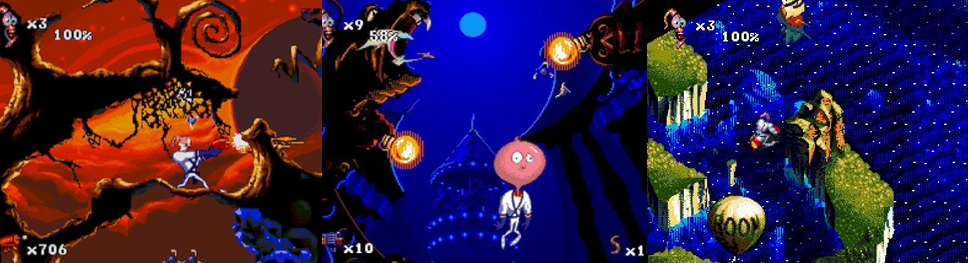
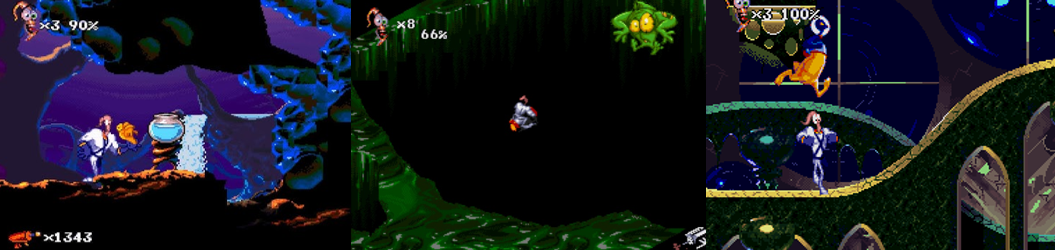
This time around, Earthworm Jim can collects a bunch of different ammo types for his Plasma Blaster. The default rapid-fire setting is still present, as is the Mega Blaster, but you can now grab a homing missile, a worthless bubble gun, a three-way spread, and the screen-clearing Barn Blaster. When you grab a different weapon, your gun automatically switches to it so be wary of wasting your more powerful shots; however, it’s not like there are many bosses to use them against. Jim can whip his worm self to conserve ammo but no longer uses this attack to swing from hooks. In fact, the swinging mechanic is thankfully downplayed and toned down compared to the last game. You can still do it but only when near snot-covered ceilings and sections, and by pressing C when jumping to have Snott latch onto these access points. The mechanic is much smoother and easier to control, and rarely appears. The tricky sections in See Jim Run, Run Jim Run are the exception as you must swing from moving sections, though the swinging is more of an afterthought this time. Similarly, Jim’s helicopter hover is also thankfully gone, replaced by a Snott parachute that’s much easier to perform (press A when jumping). Jim’s pocket rocket returns, but sadly only in one stage and now as a clunky isometric shooter. In The Flyin’ King, you must awkwardly nudge a TNT-carrying hot air balloon across a series of islands floating in the sea to take out Major Mucus in this snot-covered lair. Jim’s rocket has infinite ammo and firework-like turbos give a burst of speed but the screen quickly outpaces the balloon, forcing you to clumsily turn around with C to push it back on track. In the reverse of Buttville, Jim finds himself floating upwards in Inflated Head, deflating his head to avoid explosive lightbulbs and Flagitious the Cat’s attacks and slow down with B, and inflating with C (or using the many helium stations). Jim doesn’t get separated from his body this time, but he does assume the guise of a blind cave salamander to navigate through the intestinal layout of The Villi People. In this form, he can swim about by holding C and fire his regular shot with C, avoiding sticky amoebas, pinball bumpers, and being challenged by a nonsensical quiz and to bash bumpers in the correct sequence.

Quirky innovations are one thing but Earthworm Jim 2 is bogged down by a lack of focus.

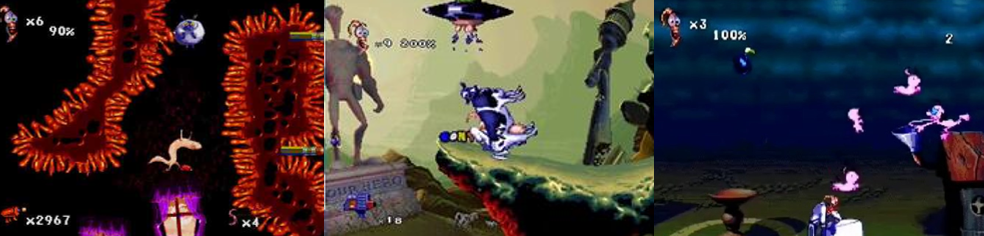
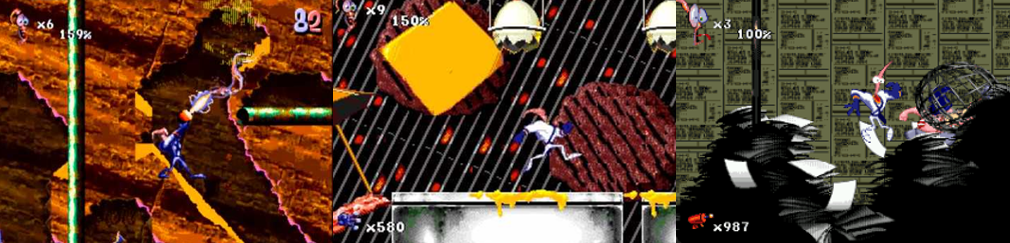
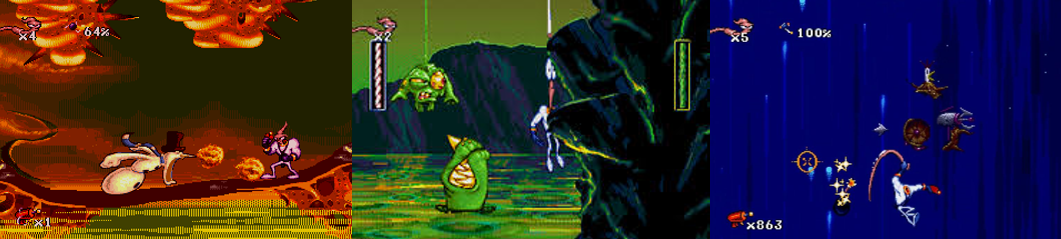
Most levels task players with doing more than just running and gunning. The first stage, for example, has you holding down to pick up pigs to weight down weighted platforms and open doors. A similar mechanic appears in Udderly Abducted, where you pick up and heft cows to barns to open gates. This is made more troublesome by some cows being on fire, giving you a few seconds to find a bathtub, the fragile platforms that break under your combined weight, and the indestructible UFOs seeking to abduct the cows. You can fend these off with your whip and use them to carry to cows up tricky sections, as well as blast cows across gabs with a cannon, but this level quickly becomes tedious when you are forced to find multiple cows. In Lorenzen’s Soil, you’re given 90 seconds to blast your way through dirt with an infinite Electro-Gun. You can grab stop clocks to gain more time, raise yourself higher by blasting dirt above you, and douse flaming hazards to progress, which is much easier and more fun than the numerous Puppy Love mini games. These replace Andy Asteroids and see you bouncing puppies to safety using a giant marshmallow. If you miss too many, Peter Puppy transforms and attacks, and you can only clear each of the three rounds by bouncing a bomb to Peter so he can take out Psy-Crow. This bonus stage nets you passwords and such, but quickly outstays its welcome when you’re bouncing multiple puppies at once. ISO 9000 sees you picking up hamster balls to power printing presses to jet across the stage, hitting switches to temporarily shut off boilers, and climbing dangerous filing cabinets to new areas. Level Ate takes place on a giant barbecue and sees you taking cover under sizzling meat to avoid killer saltshakers, alongside the usual worries of spikes and pits. One fun section of Anything But Tangerines sees Jim riding a stairlift and avoiding cantankerous grannies, who’ll rain down and beat him with their umbrellas, and many stages contain lightbulb teleporters that transport him to mini games or an oddball ending, as well as hidden areas behind the foregrounds.

Presentation:
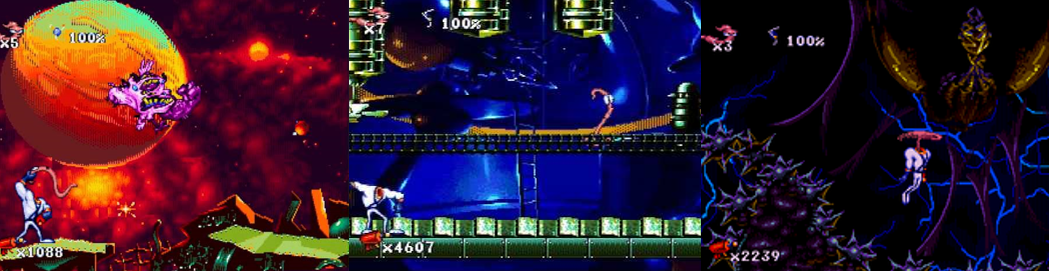
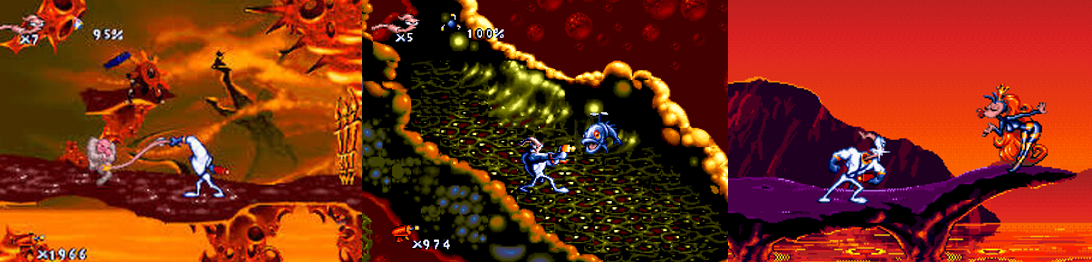
Once again, Earthworm Jim 2 shines as one of the most visually interesting and colourfully cartoonish titles on the Mega Drive, or any system for that matter. Jim’s sprite has been overhauled, appearing slimmer and slightly more akin to his cartoon counterpart. He still has a bevvy of slapstick idle animations but is ready and raring to go this time, constantly jogging on the spot. Jim has more voice clips and reactions this time around, celebrating every time he picks up items and wailing whenever he’s in danger; even his life icon reacts to the game! The music’s also very much of the same ilk as before, occasionally favouring a calypso-like jingle or even shameless borrowing from “Cuban Pete”. Earthworm Jim 2 once again confines the details of its story to the hilarious instruction manual but you do get a brief gist of the plot during the company logos, when Princess What’s-Her-Name is kidnapped by Psy-Crow as Jim is serenading her with an accordion. Though Jim no longer exits levels on his pocket rocket, he does spring away using a weighted seesaw or calls for an intergalactic taxi. In ISO 9000, he has to literally chase down the exit door, which must be tricked into tripping over a giant wardrobe you toss in its way. Levels are still full of oddities to marvel at, though they largely serve a practical purpose this time. Dunking a pig in water seems pointless but using them to open doors isn’t, and cows are now carried and used to open gates rather than randomly being launched into space. While a large pixel art rendition of Jim displays the name of each level, you’re greeted by a bizarre photorealistic image of a cow complimenting your ability after clearing each stage. Completing the game sees Jim reunited with Princess What’s-Her-Name and a scroll of text congratulating your efforts, only for the Princess, Psy-Crow, and Jim to be revealed to be cows in disguise and the text to rewrite each time!

The visuals are more outlandish than ever, and perhaps trying too hard to be weird.

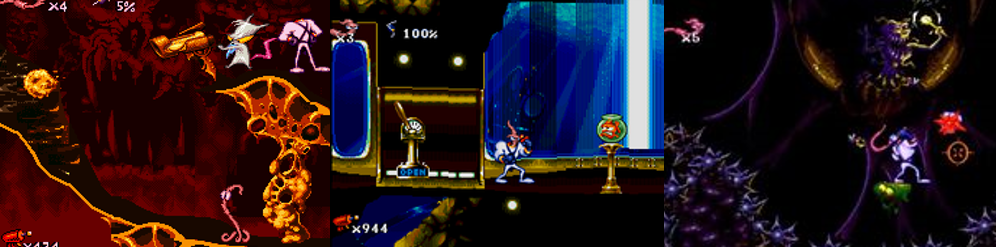
Earthworm Jim 2 features a bunch of new, bizarre environments that up the wackiness to eleven. While things start fairly innocuous in Anything But Tangerines, which boasts waterfalls and a blood-orange sunset, you’re soon blasting through crumbling soil, swimming about inside some giant unknowable creature (that’s apparently swallowed a pinball table and part of a house), and hauling cows across a post-apocalyptic landscape (which includes several half-destroyed monuments in the PlayStation version). Inflated Head stood out as one of the more memorable locations; it’s set against the background of a nightmare amusement park, with rollercoasters and such in the distance. I also enjoyed ISO 9000, which takes place in a giant printing press and sees you jumping to stacks of papers (with newspapers flying as you move) while more scroll in the background. I also really enjoyed Level Ate, with its platforms made of bacon, skewered fried eggs and meatballs, fork hazards, and flaming grills. Earthworm Jim 2 impresses with some prerendered backgrounds in the Puppy Love sections, which add a three-dimensional skew to the game. The Flyin’ King tries to capture this feeling more explicitly by being an isometric shooter, though it’s let down by the clunky controls. The level is impressive, though, with little pirate ships and cannons firing from the sea and islands and the level transforming into a snot-encrusted hellhole at the end. The final stage is a huge alien cathedral full of spinning beams, moving platforms, and bottomless pits. It can be a bit difficult telling which platforms you can walk on and which are part of the background, but I enjoyed the chase against Psy-Crow and seeing the detailed, ominous background loom past as I ran. Quirky humour is everywhere in Earthworm Jim 2, almost to its detriment. Sure, it’s fun seeing electric chairs as hazards, references to Mortal Kombat (Midway, 1992), and the crazy-ass enemy designs but I wonder if the developers were trying too hard to top the zaniness of the original here since gameplay is often bogged down by odd layouts and objectives.

Enemies and Bosses:
Similar to the first game, Earthworm Jim 2 only features a handful of enemies, though most are exclusive to each level they appear. These are also absolutely bonkers, ranging from floating octopi carrying blunderbusses and cantankerous grannies to cow-stealing UFOs and sentient straws looking to skewer you. Bob’s henchcat, Number Four, is said to appear in Anything But Tangerines but I must’ve missed him on my playthrough (though I was attacked by his rolling goldfish ball). Notably durable and aggressive ants and little larvae globs attack in Lorenzen’s Soil; sheep-like creatures float about in The Villi People and will explode, knocking you into bumpers or the health-draining tentacles; and you’ll find your pocket rocket weighed down by sumo wrestlers in The Flyin’ King. Waves of snot also push you back in this stage, while caped penguins fly into you as you’re carrying cows to safety in Udderly Abducted. While Flagitious is your main obstacle in Inflated Head, you must watch for lightbulbs to avoid having your wormy head popped. Lawyers return in ISO 9000, now resembling executioners and driven mad by all their paperwork. The filing cabinets are the worst hazard in this stage, though, as they bound around, immune to your shots, and are the only way to reach higher ground. Level Ate features snails seeking shelter from the evil saltshakers, forks that act as spikes, eggs that crack their yolks onto your head, and grills that’ll burn your feet alongside killer straws, of all things! While no enemies appear in See Jim Run, Run Jim Run, you’ll blast through barriers (both solid and rotating on gears), make tricky jumps, and snot swing from moving overhead access points to beat Psy-Crow to the end.

There’s a distinct and disappointing lack of bosses here, especially challenging ones.

Strangely, Earthworm Jim 2 is surprisingly light on boss battles; many stages end with a bizarre challenge rather than a boss battle, which is disappointing considering how imaginative the first game’s bosses were. You’ll encounter Bob the Killer Goldfish at the end of the first stage and he’s defeated similar to before; simply walk up to his bowl and Jim automatically eats him. The Villi People sees you answering obscure questions and bouncing into bumpers before the stage just abruptly ends, Udderly Abducted asks you to rescue cows, and ISO 9000 has you trip the exit door to leave. Bosses are present, though, they’re just not as interesting as before: I barely realised that Lorenzen’s Soil’s unicycle-riding maggot was a boss, for example. This guy cycles back and forth spitting goop and spawning maggoty minions, but is easily blasted to death with your basic shot. Major Mucus returns, spitting snot from atop a snotty column in the snot-filled finale of The Flyin’ King. As long as you’ve brought the bomb-carrying balloon safely to the end, you can simply explode it to easily take him out. Though Evil the Cat seems to return, it’s actually his cousin, Flagitious, who spits darts and pounces from above in Inflated Head, though you just have to avoid him to reach the level’s end. Level Ate has a boss, an anthropomorphic T-bone steak fought on a giant pepperoni pizza! It hops up and down, dropping a plate on your head and spitting fireballs, leaving him vulnerable to your shots. Psy-Crow has been upgraded from a pest to the main antagonist; not only will he toss Peter’s puppies to their doom in bonus stages, but Jim must race against him in the final stage. While a 2D perspective isn’t the best for a race, this is more of an obstacle course. You can blast Psy-Crow to stun him but your main concern is making jumps and clearing your path, making for a finale so anti-climactic I was convinced a true final boss was looming…but, sadly, not.

Additional Features:
There are a lot more collectibles in Earthworm Jim 2 compared to the first game, but sadly they’re not all that useful. Sure, the flags will grant you a password to skip ahead but they’re quite tricky to track down and there’s no indication of which ones you have or how many are left to find. Similarly, Jim’s new ammo types are great, but I rarely had many opportunities to properly use them. You’re rarely surrounded by enough enemies to justify using the Barn Burner, for example, and it’s not like the game is packed with tough-as-nails bosses for you to use your stronger weapons on. Hidden areas make a return, of course, with lightbulbs teleporting you to a granny avoiding section or a test of strength. Most prominently, you can brave a spiky end in Level Ate to access the hidden Totally Forked stage, a level set in an abattoir and filled with useful power-ups. There’s still no high score table, though you can challenge harder difficulties and input various cheats. These refill your health, grant extra lives, continues, or invincibility, give you access to different guns, and let you skip stages. You can also input a debug mode cheat, like before, and take advantage of save states and rewind features if playing the Nintendo Switch Online version of the SNES port.

The Summary:
I adored Earthworm Jim and have been a huge fan of the character and franchise since I was a kid glued to the hilarious cartoon. I’d long coveted Earthworm Jim 2, a game much more expensive and harder to find than the original, and was eager to finally get into it, expecting more of the same but with the wackiness dialled up to eleven. While this is certainly true, I do wonder if the game is trying too hard to be more bonkers than the original. Things were weird in Earthworm Jim but they’re borderline nonsensical in Earthworm Jim 2, throwing a bunch of bizarre locations and enemies at you that don’t make a lot of sense in this world (I love Level Ate but, c’mon, what’s a giant grill got to do with a space-faring earthworm?) The game looks as fantastic as before, with shadows and details and a cartoonish appeal infused into every animation, making Earthworm Jim just as appealing and zany as ever. Every stage is packed with innovative features that have you solving puzzles in outlandish ways, like carrying cows to barns to using their milk to open gates. However, I wasn’t a huge fan on this focus on puzzle solving. It slowed the pace down considerably and was often a waste of the larger, more intricate stages. Equally, while Jim’s expanded arsenal is welcome, it feels superfluous to give him all these awesome weapons and have little to no enemies to use them on and next to no bosses to blast with them. Gone are the troublesome bosses of the first game, who forced you to think your way around their attacks, replaced by…a door that runs from you, a unicycling maggot, and Evil the Cat’s lesser-than cousin who you don’t even fight. The Puppy Love sections wore me out with their three-round structure, the quirkiness of Jim’s salamander form and inflated head felt wasted, and the isometric shooter felt out of place. I’m all for mixing up the gameplay and trying new things, but it felt like there was too much going on in Earthworm Jim 2. In trying so hard to throw new mechanics and increasingly bonkers scenarios at the player, the game lost some of the charm that made the original so appealing and was much more of a chore to play, despite being notably easier than its predecessor.

My Rating:

Rating: 3 out of 5.

Pretty Good

How do you think Earthworm Jim 2 compares to the first game? What did you think to Jim’s tweaked abilities and expanded arsenal? Did you also struggle with the Puppy Love sections? Were you disappointed by the lack of boss battles? Which of the new gameplay mechanics was your most or least favourite? Do you think Earthworm Jim deserves a comeback? What are some of your favourite sci-fi-orientated videogames? Tell me your thoughts on Earthworm Jim 2 in the comments and then check out my other sci-fi content on the site.

Game Corner [Sci-Fanuary]: Earthworm Jim (Mega Drive)


January sees the celebration of two notable dates in science-fiction history, with January 2 christened “National Science Fiction Day” to coincide with the birth date of the world renowned sci-fi writer Isaac Asimov, and HAL 9000, the sophisticated artificial intelligence of Arthur C. Clarke’s seminal 2001: A Space Odyssey (1968), being created on 12 January. Accordingly, I dedicated January to celebrating sci-fi in all its forms.


Released: October 1994
Developer: Shiny Entertainment
Also Available For: Game Boy, Game Boy Advance, Game Gear, Master System, Nintendo Switch, Nintendo Wii, PC, SEGA CD, Super Nintendo Entertainment System (SNES); PlayStation 3 and Xbox 360 (HD remake)

The Background:
During the eighties and nineties, anthropomorphic characters were king. It seemed every cartoon, toy, or company mascot was some kind of humanoid animal, generally fighting otherwordly or intergalactic forces. The most prominent examples from this time were, of course, the Teenage Mutant Ninja Turtles (TMNT), though mascot platformers were prevalent in videogames thanks in no small part to the phenomenal success of Sonic the Hedgehog (Sonic Team, 1991). After successfully licensing the TMNT, Playmates made the bold decision to develop a franchise of their own. Impressed by Doug TenNapel’s sketch of an earthworm, they purchased the rights and TenNapel joined programmer David Perry and the rest of the team at Shiny Entertainment, simultaneously programming for both the Mega Drive and the SNES using custom-made tools. Created as a satire of the genre, the developers enjoyed exploring their creativity, free from the restrictions of licensed characters, and the project was expanded upon with a line of action figures, comics books, and a hugely enjoyable cartoon. This was made possible by Earthworm Jim’s critical and commercial success; critics praised the quirky story, fluid animations, and zany action. Sadly, Earthworm Jim’s time in the spotlight wasn’t to last. Though followed by a highly-regarded sequel, even a later high-definition remake couldn’t atone for Jim’s failure to capitalise on his early success in 3D and handheld ventures, leaving him another videogame icon sadly lost to time.

The Plot:
A renegade ship steals an ultra-high tech super suit from the evil Queen Pulsating, Bloated, Festering, Sweaty, Pus-filled, Malformed, Slug-for-a-Butt. Although intercepted by the Queen’s henchman, Psy-Crow, it lands on unassuming earthworm, Jim, transforming him into an anthropomorphic superhero.

Gameplay and Power-Ups:
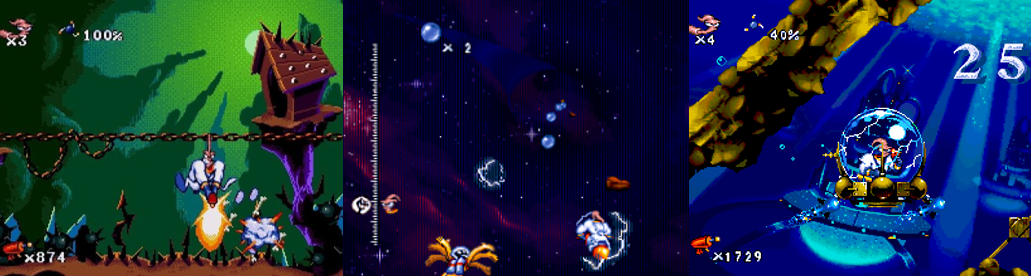
Earthworm Jim is a 2D, run-and-gun action platformer in which you assume to role of perhaps the most unlikely and bizarre superhero in all of videogaming, an earthworm given incredible powers by an alien suit. Players guide Jim through various surreal worlds, from a crow-infested junkyard to claustrophobic underwater base, to Hell itself, blasting at everything in their way and pulling off some tricky platforming feats. Earthworm Jim has two attacks: one is to throw his worm body like a whip and the other is to unload with his Plasma Blaster. You can change the button configurations from the main “Options” menu, though I got along fine with the default: A to whip, B to fire, and C to jump. Jim has a good jump and can grab ledges to pull himself up. He can also spin his worm self like a helicopter blade to glide across gaps or down narrow shafts (though I had difficult pulling this off). For longer gaps, Jim can snag his worm self onto various hooks and swing across gaps, a finnicky system, especially when you must perform successful swings or make your way up hooked columns. The hit detection on the hooks is iffy at times and Jim is very cumbersome when swinging, but I found holding up on the directional pad helps. Jim can also cross chains using his hands and head to bypass gaps and spike beds, or whip wheels to open doors and gates. Jim’s default shot is a rapid-fire, ammo-chewing burst that cuts through most enemies. When your ammo runs dry, it’ll slowly refill but you can boost it by grabbing Plasma Power. Just be aware that your ammo isn’t refilled at the start of each stage.

Blast away with Jim’s Plasma Blaster or struggle to master the game’s vehicles and mechanics.

Earthworm Jim can also grab Mega Plasma to fire a massive, concussive blast that’s great or blowing enemies away or whittling down bosses. Unfortunately, there’s no way to save this ammo for boss battles; once you grab the “Plasma!”, it becomes your default until you run out so choose your shots wisely. You replenish Jim’s health, which is measured in percentages, by grabbing Suit Power or a Super Suit Power for a full refill, grab extra lives, and Continue markers to respawn when you inevitably die. While everything in each level is out to hurt you, there are some things that’ll aid you. You must free hamsters in Down the Tubes, pressing A to chomp up Bob the Goldfish’s kitten guards, and also take control of extremely fragile spherical underwater craft to navigate between Bob’s lair. When in this craft, you have thirty seconds of air that you can replenish at air stations (if you’re careful enough) but you must avoid the narrow caves and walls as you boost around with A as the craft can only take so many hits. Jim also possesses his own pocket-sized rocket ship, which he’ll hop onto when finishing a stage. You’ll then race against Psy-Crow in numerous Andy Asteroids bonus levels, dodging asteroids and grabbing shields and accelerators for a burst of speed. You must hold A to accelerate and can collect “Fuel Pods” (though they do nothing) and even bash into Psy-Crow to slow him down. Fail to beat him to the end and you’ll have to battle him, but succeed and you’ll gain nothing except pride. Occasionally, Jim will be separated from his super suit. This first happens in the boss battle against Evil the Cat but also occurs in Level 5. Without his super suit, Jim’s just a regular earthworm and can only hop about, but you can jump into fan blades to be tossed ahead to reunite with your suit before Professor Monkey for a Head ditches it down a pit. Other times, you’ll be running on jewels to reach higher areas or teleport around, or take more traditional teleporters to reach new areas.

Bizarre levels and oddball gameplay mechanics make for a very challenging experience.

Earthworm Jim is quite the challenging experience. You can set the game’s difficulty in the “Options” menu, but even “Practice” gets pretty difficult as you progress further. Most stages are very linear, but you’ll be climbing, jumping, and running about in twisted, winding environments, often falling to lower levels or spike pits when you miss swings. Environmental hazards start quite mundane, such as debris falling down conveyor belts, flame bursts, electrical bolts, and such, but soon you’re facing monsters and bugs that bite you in two or being assaulted by voracious dogs and ghosts. In Down the Tubes, you won’t stand a chance against Bob’s muscular cat bodyguards and must jump to the alcoves above them and hold up until the past by, and ride ravenous hamsters to even the odds. Andy Asteroids stages get faster and more difficult as you progress, with more asteroids to avoid and Psy-Crow blasting ahead and stealing your power-ups, just as the very environment in later stages conspires against you. You’ll be whipping wheels to open gates, hitting levers to release hamsters, smacking switches to reverse escalators, and jumping to Dyson spheres that burst with electrical energy. The difficulty really ramps up in For Pete’s Sake, an escort mission where you must keep Peter Puppy safe from UFOs, tentacles, pits, and meteor strikes by either blasting hazards or whipping him. If he gets attacked, he transforms into a bestial form and shreds your health, setting you back a bit, too. This is a cakewalk compared to Buttville, though, a nightmare realm made almost entirely of spikes and tricky swing challenges. You’ll need to master Jim’s helicopter float just to get past the maddening first section, a narrow shaft full of spikes, to say nothing of avoiding swinging into the jagged spikes lining the floor of the stage.

Presentation:
Earthworm Jim is one of the most impressive games on the Mega Drive. It has a surreal, bonkers cartoon presentation that elevates it above the competition and gives it endless visual appeal. Jim is at the forefront of this, featuring numerous idle animations (from off-key singing, flexing, and blasting himself in the face), sound bites, and slick animation frames that make him a joy to control and watch. He reacts to everything, yelling in pain, swinging his worm self like a lasso, and reacting in horror at times, infusing him with a madcap personality that perfectly matches the insanity offered by the game. Between stages, partially animated pixel art compliments your gameplay and Jim turns into Tex Avery when meeting Princess What’s-Her-Name in the finale, only to be dejected when she’s crushed by an errant cow and consoling himself by swiping her crown! The cow isn’t even that random since players launch it in New Junk City, and weird, quirky humour like this is all over Earthworm Jim. From lawyers making up Evil’s minions in Hell, to the Professor literally having a monkey attached to his head, Earthworm Jim is crammed with visual gags and personality. The soundtrack compliments this, often being subdued or a simply bop, though What the Heck? does impress with a remix of “Night on Bald Mountain” underscoring the action. I did notice some instances where the music cut out, though, especially after pausing the game, though Earthworm Jim otherwise runs as smooth as butter and is a joy to play in terms of how responsive everything is. If you’re looking for story and cutscenes, you won’t find either here. The manual details the narrative alongside a few comic book pictures, but the game itself just starts up with no context and never tries to explain anything that’s happening, which is actually pretty great.

Earthworm Jim is one of the most colourful, cartoonish, and bonkers games on the system.

Earthworm Jim’s stages are absolutely bonkers. You start in New Junk City, a junkyard filled with bouncy tyres, fragmented cliffs, and monstrous dogs just waiting to bite your leg. There’s an impressive art deco effect to the background but it’s nothing compared to What the Heck?, where Evil the Cat hangs out in the distance and you must platform across sinister-looking Hell structures. Down the Tubes makes everything much more claustrophobic, restricting you to the glass tubes and rooms of Bob’s lair, but a water effect over the action and a beautiful rendition of the lair make this a visually memorable location. The simply named “Level 5” is a mad scientist’s dream of conveyers, escalators, 1950s-style machinery, and Dyson spheres. You’ll regularly by separated from your suit here and will briefly be encased in a mesh cage as the Professor toys with you. For Pete’s Sake is a simple barren, alien landscape but the looming planet, weighted platforms, seesaws, and never-ending onslaught of hazards bring it to life, to say nothing of Peter’s looming threat if your aim is a little off. Intestinal Distress is easily the most disgusting level, being made up of gross, mucus-like platforms and tubes, while Buttville is a spike-ladened nightmare hive. A lightning storm looms in the background, insta-kill hazards pop out from holes, and hooks and spikes close in all around you, really upping the threat level. The Andy Asteroids stages are simple chases through high-speed wormholes but those sensitive to flashing lights may struggle at the finish line, which bombards you with a strobe effect. Finally, the Snot a Problem challenges see Jim bouncing down a cliff on a bungee cord, bashing into Major Mucus and avoiding the Mucus Phlegm Brain below. If you’re lucky enough to own the HD version, you’ll be treated to a comic book-style intro sequence that gives a largely wordless account of Jim’s origin. There are also graphical differences between the Mega Drive, Mega-CD, and SNES versions and improved audio quality on the Mega-CD version.

Enemies and Bosses:
Surprisingly, there aren’t that many enemies in Earthworm Jim. The stage layouts and hazards are generally your most persistent enemy, with baddies merely existing as another obstacle to overcome. Defeating them makes your life easier since they won’t dog you when you inevitably miss a jump or a swing. None of them drop health or ammo and there’s no scoring system, so it’s literally a case of killing them to not lose health. New Junk City houses crows and ravenous dogs; crows swoop down and bite your head while the dogs bite your legs, though you’ll also have to watch for falling junk. What the Heck? sees you fighting off dark spirits (essentially a combination of the crows and dogs) and suited-up lawyers who block your shots with their cash-firing briefcases. Bob’s cat minions are completely invulnerable in Down the Tubes, requiring you to avoid or eat them with a hamster, but you’ll also encounter weird gas-spewing spheres that show up later in the game, too. Level 5 sees you attacked by the Professor’s weird science experiments, which explode into maggots when hit or see eyeballs constantly spawning to swarm you and disembodied brains pouncing in your face. Strange helicopter fish spit small fish at you in Intestinal Distress and bugs burst from nests in Buttville, compounding your attempts to safely navigate the spike-filled environment.

Quirky, often disgusting mini bosses have you rethinking your attack strategies.

For Pete’s Sake charges you with temporarily subduing the many tentacles bursting from the ground and finding off UFO attacks and meteor storms. If Peter is hurt or falls, he becomes a bestial creature that attacks you, shrugging off your shots and setting you back. However, your most persistent foe is Queen Pulsating, Bloated, Festering, Sweaty, Pus-filled, Malformed, Slug-for-a-Butt’s main henchman, Psy-Crow. You’ll race him in the Andy Asteroids stages, barging him to slow him down and snagging power-ups to beat him to the end, but must battle him if you fail. Fortunately, this fight isn’t too hard; simply fire at him to stun him and then whip him until he flees. Some stages see you facing off with mini bosses, too, such as the living trashcan in New Junk City and the snowman waiting in What the Heck? The trashcan is tougher than it looks not just because of its powerful uppercut and it constantly launching debris, but also because it can only really be damaged by the Mega Plasma or from behind. The snowman is much easier, despite warping around by turning into goo and spitting fireballs. Similarly, battling Major Mucus in a bungee fight isn’t too bad; it’s similar to the rope section from Battletoads (Rare, 1991) and sees you barging the living snot ball into walls to whittle away its snot bungee. Still, you have to be careful of his counterattack, spinning top move, and the one-shot Mucus Phlegm Brain. Although you encounter Professor Monkey for a Head, you don’t get to fight him. Instead, you fire at him and chase him around his lab, and he sets his steampunk-style robot chicken on you. This thing is completely immune to your attacks and clucks about spitting egg bombs. You need to whip a target to drop explosives on it, the shoot or whip it while in freefall not unlike the Snot a Problem stage.

While some bosses are innovative or ridiculous, others are unnecessarily difficult.

The first real boss you face is Chuck, the owner of the junkyard, though he’s actually easier to face than his sentient trashcan. Chuck drops anvils and crates and such from an overhead crane; simply avoid these and whip the crates onto the spring beneath him to deal damage. He’ll spit up fish and eventually move back and forth but he’s way easier to defeat if you time your whips properly. Evil the Cat is a touch trickier; he randomly pops up in What the Heck? to toss bombs and cause stalactites to rain down, then somehow separates Jim from his suit. In this phase, you must jump over his flame bursts until he destroys his platform, reuniting you with your suit. In the second phase, Evil attacks from the darkness and you must blast him nine times, avoiding the flame bursts, to finally put him down. Bob the Killer Goldfish is a joke by comparison, potentially because of how difficult Down the Tube’s underwater sections are. Simply walk up to Bob and Jim tips over his bowl, leaving him flailing on the ground. At the end of Intestinal Distress, you’re attacked by Doc Duodenum, a strange, mucus-like being that hops about and spits goo but it’s easily put down with your regular attacks. Queen Pulsating, Bloated, Festering, Sweaty, Pus-filled, Malformed, Slug-for-a-Butt herself awaits at the end of Buttville, her gigantic egg sac looming overhead not unlike the Xenomorph Queen. Gloop leaks from this and hurts you and you must hop to temporary spinning platforms, avoiding her scepter swipe and taking out the bugs swarming around her. The biggest threat here is the bed of spikes and potentially running out of ammo, but simply fire at her as you spin around and she’ll soon burst like a pimple. Frankly, the weird growth you fight before her is far harder. This…thing…spits goo, which is bad enough, but the ground is constantly moving you towards a spike wall and the ground also has spikes in it. It gets faster as you deal damage, too, and can really burn through your health and lives!

Additional Features:
With no high score table and no collectibles or unlockables, there isn’t much else on offer in Earthworm Jim. You can challenge the game on a harder difficulty, of course, and replay the game to try and reach new areas of each level for additional goodies, but your main reason for going back will be to discover the hidden areas. Not only are there secret areas hidden behind the foregrounds, you can access the secret stage Who Turned Out the Lights?, the Professor’s dark and dingy basement where spotlights briefly illuminate your surroundings and a hungry, unkillable creature stalks from the shadows. Other replay incentives include the cheat codes, inputted from the pause screen, that refill your health, ammo, grant an extra life, and allow you to skip stages. There’s also a debug mode that allows you to freely move the camera around each stage and grants invincibility (though, oddly, some enemies can still hurt you) that also protects you in underwater sections. Those playing the Mega-CD version can also play through an additional level, Big Burty, and battle the blind dinosaur of the same name. This stage (and Who Turned Out the Lights?) was missing from the HD version but was replaced by digital fantasy stages where a keyboard-playing cat ruled supreme. The HD version also included online and offline co-op mode where up to four players navigated all-new levels, in addition to leaderboards and Achievements/Trophies that challenged you to such tasks as collecting stuff, beating single and multiplayer levels, and finishing the game in under fifty minutes. Finally, if playing on Nintendo Switch Online, you can take full advantage of the save state and rewind features to really level the playing field on this challenging game.

The Summary:
I’ve played Earthworm Jim before, mainly on emulators, and have been a big fan of the series since it first came about. I loved the cartoon and have long coveted the action figures, so it was a must buy for my Mega Drive library once I started seriously collecting for the system. However, I’d previously played through the HD version on PlayStation 3, a game I remember beating without cheats. That wasn’t the case here. Earthworm Jim is almost unforgiving in its later stages, throwing spikes and pits and platforming challenges that will have you gripping your controller in frustration. So, yes, the debug mode helped a lot for this playthrough since it meant I didn’t have to worry about my health or oxygen, but it was no help at all with whipping those hooks or navigating the spiked, nigh-impossible nightmare that is Buttville. It also wasn’t much use against the damn trashcan, or that robot chicken, both of which can be a pain in the ass to defeat, especially as the game rarely indicates when your attacks deal damage. Racing against Psy-Crow can also become very difficult; fighting him isn’t so bad but it’s a waste of ammo, something you desperately need when navigating stages and defeating bosses. I do think the game would’ve benefitted from a meter system to measure Jim’s ammo. Like, firing his gun depletes a meter that refills over time, rather than forcing you to wait around for your ammo to slowly replenish. Still, while the game is very difficult at times, a lot of the time it’s simply challenging and you do get better at judging when to whip at hooks and how to navigate past hazards. It helps that Earthworm Jim looks fantastic; it has sprite animation so smooth and slick that it rivals the likes of Aladdin (Virgin Games, 1992) and Sonic the Hedgehog 2 (SEGA Technical Institute, 1992), basically resembling a playable cartoon. It plays really well, offering a quirky, action-packed experience while also making you think outside the box at times, especially when Jim loses his suit. Jim is also a wonderfully realised, bonkers character with so much life and personality and his enemies are equally memorable for their bizarre appearances and attack patterns. It’s not the most accessible game and at times will have you tearing your hair out, but my God is Earthworm Jim an enjoyable experience, if only to look at!

My Rating:

Rating: 4 out of 5.

Great Stuff

Are you a fan of Earthworm Jim? How do you think the game holds up against other action platformers? Did you also find the game challenging at times, and struggle with the swinging mechanics? Which of Jim’s outrageous villains was your favourite? Did you ever beat the game on the hardest difficulty? Would you like to see Earthworm Jim make a comeback? What are some of your favourite sci-fi-orientated videogames? Feel free to share your memories of Earthworm Jim in the comments and then check out my other sci-fi content on the site.

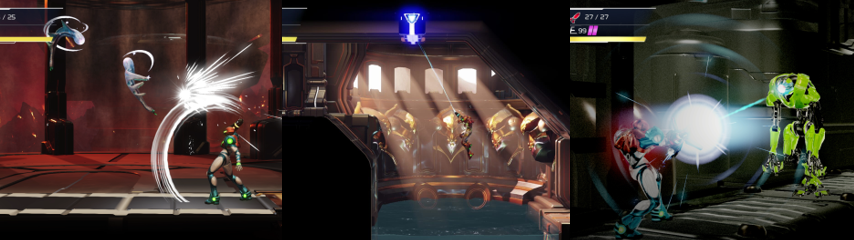
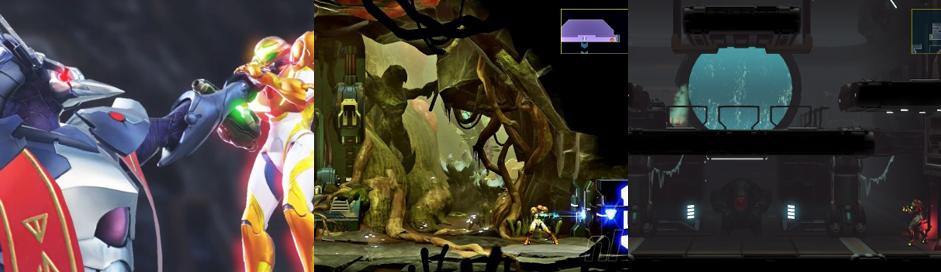
Game Corner [Sci-Fanuary]: Metroid Dread (Nintendo Switch)


January celebrates two notable dates in science-fiction history, “National Science Fiction Day” on January 2 and Arthur C. Clarke’s HAL 9000’s birthday on January 12. Accordingly, I’m dedicating January to celebrating sci-fi with an event I call “Sci-Fanuary”.


Released: 8 October 2021
Developer: MercurySteam / Nintendo EPD

The Background:
Despite popularising the “Metroidvania” subgenre and the hefty praise heaped upon the franchise, it’s fair to say that the Metroid series (Various, 1986 to present) is one of Nintendo’s under-rated properties. The original release is known as one of the greatest games ever made, to say nothing of the universal acclaim shown to its 16-bit sequel and successful jump to 3D first-person shooting. After suffering a blow with the poor reception of Metroid: Other M (Team Ninja/Nintendo SPD, 2010) and Metroid Prime: Federation Force (Next Level Games, 2016), Metroid bounced back with Metroid: Samus Returns (MercurySteam/Nintendo EPD, 2017), a remake of the divisive Metroid II: Return of Samus (Nintendo R&D1, 1991) that was successful enough to see MercurySteam develop a new Metroid title. Conceived as a sequel to Metroid Fusion (Nintendo R&D1, 2002) and initially developed for the Nintendo DS, producer Yoshio Sakamoto wanted to place further emphasis on stealth gameplay but the project remained dormant for several years when initial prototypes failed to meet his standards. After much speculation, the project was eventually revived for the Nintendo Switch, largely thanks to MercurySteam’s work on Samus Returns. Returning to the series’ roots with a 2.5D perspective and forcing players to swiftly and silently avoid mechanical pursuers, Metroid Dread aimed to live up to its title by marrying the traditional exploration and combat mechanics of the series with a constant sense of dread. The result was a warmly received title that was praised for its return to form, vast exploration options, and challenging gameplay and bosses.  

The Plot:
The Galactic Federation dispatches versatile Extraplanetary Multiform Mobile Identifiers (E.M.M.I.) robots to investigate the X Parasites. However, when the E.M.M.I. go haywire, Samus is deployed, uncovering a sinister plot by rogue Chozo to exploit the Metroids. 

Gameplay and Power-Ups:
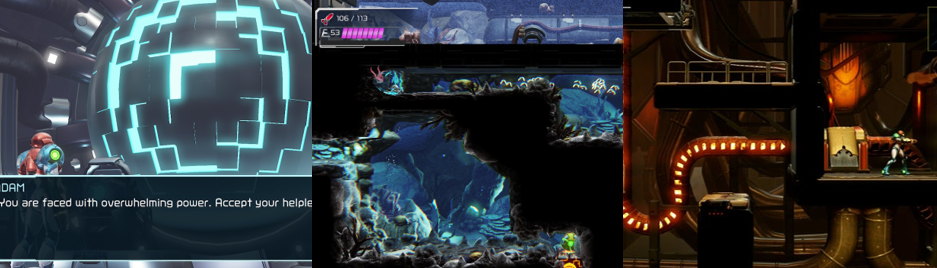
Metroid Dread is a 2.5D action/adventure game very much in the style of Super Metroid (Nintendo R&D/Intelligent Systems, 1994) in which players once again assume the role of famed bounty hunter Samus Aran, fresh off Metroid Fusion, and navigate the many corridors, caves, and laboratories of the creatively named planet ZDR, picking up new items and upgrades and returning to previous areas to obtain even more items or progress further. As ever, Samus comes equipped with her arm blaster, which you fire with Y. Later upgrades allow you to charge up a more powerful shot by holding the button, and you can also switch to Samus’s missiles with the R trigger, holding it to fire and using the L trigger to freely aim with a laser sight. B allows you to jump; holding it lets you jump higher while the Space Jump and the Screw Attack allow infinite jumping and a spinning attack. Samus can slide under narrow gaps or past certain enemies with ZL, transform into her Morph Ball with the same button when standing still (or tilt the left stick down when crouching) and gains the ability to jump, place various bombs, and cling to certain surfaces while in this form with the Spider Magnet ability. Samus’s weapon and suit upgrades are managed from the + menu, where you view an expanded map, which is unlocked at various map stations (though the onscreen mini map is extremely useful). The + menu also allows you to view your mission log and place helpful markers on the map. You can enter a separate menu with – to alter in-game settings such as the rumble feature, use any compatible Amiibos, load previous checkpoints, or quit to the main menu.

All Samus’s old and new abilities are nothing against the E.M.M.I, who require a special cannon.

All of Samus’s signature abilities make a return in Metroid Dread. They’re once again waiting at various Chozo Statues and will open up the game in various ways, such as allowing free movement when underwater and resisting extreme heat or cold. You’ll grab the Charge Beam for a stronger charged shot, the Wide Beam to fire three simultaneous shots to open certain doors, the Diffusion and Plasma Beam to fire through the environment and destroy tougher, metallic enemies, and the Grapple Beam to swing or hang from certain blocks and platforms and shunt blocks out of the way. Samus can also utilise various missiles, freezing enemies with the Ice Missile and targeting multiple enemies or weak spots at once with the Storm Missile. Unlike her beam shots, these use up ammo so you’ll need to defeat enemies to refill your stock or find upgrades to increase your maximum capacity. Samus’s newest weapon is the Omega Cannon, a situational, finite upgrade acquired by defeating various eye-like Central Units. This temporarily allows you to hold L and Y to fire a concentrated beam that eventually melts metallic shielding and hold L and R to charge the Omega Blaster, which you must then fire with Y to dispatch the aggravating E.M.M.I. robots encountered throughout ZDR. In multiple instances, Samus will enter an E.M.M.I. Zone and must stealthily avoid the clambering, relentlessly E.M.M.I. Until she gets the temporary Omega Cannon, her only hope of avoiding detection is the Phantom Cloak (which consumes Aeion energy to allow temporary invisibility by pressing in the right-stick) and the new Parry function. When E.M.M.I. or other enemies attack, there is a brief flash that’s your indication to tap X. This will Parry the attack, stunning the enemy and allowing you to one-shot them for additional resources, stun them, or deliver massive damage. It’s absolutely essential that you master this technique as some enemies are a chore to fight without it, though the timing required to stun the E.M.M.I. is so tight that you may never get it right. Samus can also find upgrades that allow her to run at super-fast speed, shift past sensors and across gaps (again at the cost of Aeion energy), scan her environment to uncover hidden blocks, and even obliterate enemies and obstacles in the final escape sequence of the game.

ADAM’s advice will direct you to the next area or terminal that needs activating.

As ever, you’ll grab ammo and health orbs from defeated enemies, who respawn when you leave the screen, and can find upgrades the increase your maximum health, missile, and Power Bomb capacity. You won’t find and upgrades for the Aeion meter as it automatically refills over time, but you can still find ammo and health restoration points all over ZDR, as well as interfaces where you are given hints and objectives by the initially condescending ADAM. This also allows you to manually save your game and a waypoint marker will appear on your map, with teleporters, elevators and other transports allowing for a degree of fast travel. However, you will be revisiting several areas of ZDR over and over again, particularly the elaborate halls of Ferenia, a once thriving Chozo temple. As you obtain new abilities, previously impassable ways open up. You can squeeze through gaps and blast around small tunnels with the Morph Ball, clamber up or cling to blue surfaces with the Grapple Beam, and blow up or run through blocks, and better navigate underwater. For such a large and interconnected map, Metroid Dread is surprisingly linear; areas are often impassable due to flaming obstacles or debris, forcing you to go a certain way, though you can acquire abilities and upgrades out of order if you’re persistent enough. Large areas are a death sentence without the temperature resistant suit upgrades, many areas are seeped in darkness and require you to power up generators, awakening enemies and hazards, and you’ll redirect thermal flows to reach new areas more than once. Other times, you’ll blast several targets to open doors, push or drag them out of the way entirely, or use temporary platforms or your Phase Shift ability to bypass gaps or breakable blocks. Typically, though, the game has a very clear structure that it rarely deviates from. You enter a new area, restore power or redirect thermal flow, maybe blow open a glass corridor or dodge flaming or buzzsaw hazards, and endure a gruelling E.M.M.I. Zone until you destroy the E.M.M.I. and gain a new ability to repeat this process in another area.

Presentation:
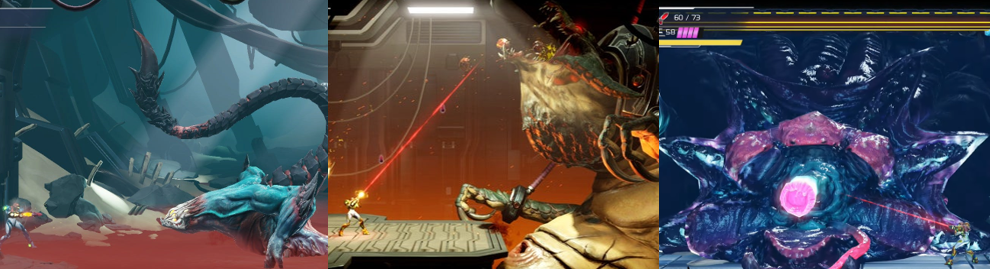
Overall, Metroid Dread looks really good. The whole game has a dark, foreboding feel to it that’s reflected in its ominous soundtrack and the various environments, which are either dank or in disrepair or swarming with monstrous enemies. Samus herself looks both familiar and different; she’s had a bit of a glow up and doesn’t come to resemble her usual orange and red colour scheme for some time. Her suit changes colour and reflects the environment around her as you progress, which was a great way to add to the ambiance and visually show her becoming more powerful and capable. Though largely silent, taking in ADAM’s patronising tone and the exposition spouted by the likes of Raven Beak and Quiet Robe, she does utter a line at one point (though in the Chozo language) and screams in agony when defeated, her suit exploding and revealing her form-fitting costume beneath. Although the game doesn’t make a great first impression with its surprisingly plain title screen, motion comic-like opening, and long loading times, the pre-rendered cutscenes showcase Samus’s capabilities and wary nature through her body language and action-focused mentality. Each E.M.M.I. is introduced through a suitably ominous cutscene that showcases its different abilities, such as increased shielding or speed or climbing ability, and everything becomes very tense when you’re trapped in an E.M.M.I. Zone, desperately trying to escape to the nearest exit before it inevitably skewers you with its spiked appendage.

While the game looks and sounds great, it’s rare that areas make much of a visual impression.

While character and enemy models are very impressive and detailed, I wasn’t massively impressed with the variety in the game’s environments. Sure, there are some nice touches here and there, like rain and water raging outside Burenia, Chozo Soldiers scampering about in the background, various wildlife (from insects to writhing tentacles to disgusting slug-like barriers obstructing doors), and areas changing as they crumble and collapse around you, but there are often far too many dark, samey corridors and areas for my liking. While you’ll venture into dripping caves, explore flooded laboratories, wade through lava, and frantically flee from extreme cold, many areas are just the same dark, futuristic locations repeated over and over. You’ll quickly see a pattern of having to traverse these foreboding areas, repute with sparking power lines and small jump scares, and restoring power to them or redirecting thermal energy to access new areas, with little separating one area from the next. Similarly, the E.M.M.I. Zones are all largely indistinguishable, being very cold and grey and military in their appearance, with only more complicated layouts changing things up. Maybe there’s some water, or more E.M.M.I. probes, or you need to slide and destroy blocks a bit more, but the general look of each E.M.M.I. Zone doesn’t change much, which is odd considering the E.M.M.I. have different colour schemes. Thankfully, Ferenia and the Itorash are on hand to mix things up a bit. These ornate, gold-themed Chozo environments are filled with large Chozo statues, banners, windows, and a sense of grandeur that are in stark contrast to ZDR’s other more bland environments, though again you revisit Ferenia so often that each screen starts to become indistinguishable. I think it would’ve helped a lot to give each area a more prominent theme. Like, have a dark, dishevelled lab but just on one section of the map, lump the frozen and water sections together, combine the caves with the lava/red-hot sections, and maybe do a little bit more to make things feel more varied than they actually were.

Enemies and Bosses:
ZDR is crawling with bug-like enemies for you to Parry away and blast with your arm cannon. Many are small and simple cannon fodder, like the slug-like Plys, amorphous blobs, squid-like creatures, spider-like Yampas, swarming eels, and various burrowing insectoids that chase you in narrow tunnels and fly out of the dark. While these are easily bested with your basic attacks, larger enemies (like the crab-like Muzbys and rock-encrusted Obsydomithons) require your Parry to stun and defeat. As you progress, robotic enemies become more prominent; large tetrapot robots blast at you with a powerful eye beam, the spherical Autclast causes flames to burst across the ground, and E.M.M.I. probes either float in place or explode when you get close, dealing damage and giving away your location. When exploring Ghavoran, you’ll encounter the whale-like Hecathon that slowly floats overhead, draining your health with its wide energy beam; a similar enemy awaits in Burenia, but even basic enemies become a formidable threat when Raven Beak unleashes the X Parasites. These gelatinous blobs infect any onscreen enemies, turning them into gooey zombies that absorb a great deal of shots and utilise additional attacks. While you can defeat them in much the same way as before, you must absorb the X Parasite that’s released to refill your health and/or ammo or else it’ll simply attach to another enemy or cause another foe to spawn, which can be quite a headache. Interestingly, though, neither the titular Metroids or the traditional Space Pirates appear as enemies in Metroid Dread.

Fights between the Central Cores, E.M.M.I.’s, and Chozo Soldiers quickly become laborious.

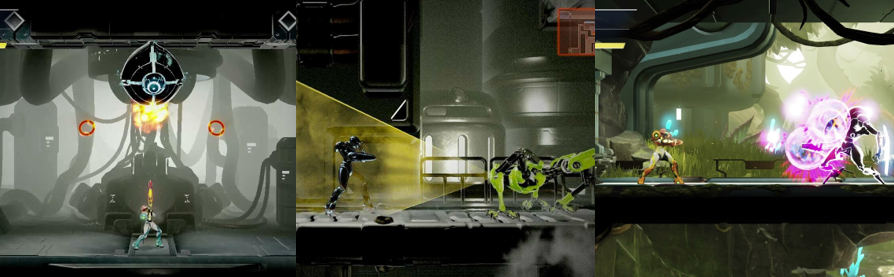
Easily the most persistent foes in Metroid Dread are the E.M.M.I. robots. There are six of these bastards to contend with, with each encounter being more difficult that the last. Similar to the SA-X from Metroid Fusion, Samus can only avoid the E.M.M.I. upon first entering an E.M.M.I. Zone since her weapons are useless against it. If it catches her, you can try and Parry its instant-kill attacks but the timing is so tight that I rarely managed to succeed. Instead, you must flee through the E.M.M.I. Zone until you find the Central Core. These eye-like mechanical spheres float overhead while numerous projectiles fly at you from the walls and ceilings. You must blast the Central Core with missiles and your charged shot to destroy it and temporarily gain the Omega Cannon, but even then it’s not so easy to put the E.M.M.I. down. Not only does the Omega Cannon take time to charge, the E.M.M.I. are ridiculously fast and often shielded, meaning you need to get some distance and use the Omega Spread before you can even fire your kill shot. E.M.M.I. are soon joined by probes that give away your location, scamper across walls and ceilings, squeeze through gaps, and can even freeze or outright kill you with their spotlight. The Phantom Cloak helps you avoid detection, but keep an eye on your Aeion meter and avoid touching the robots as it’ll instantly give you away. Over time, they become more aware of your presence, and you have less room to charge your shot, though it’s always a relief to blast them in the head and put them down for good. As if the dread caused by these persistent assholes isn’t bad enough, you’ll also be forced to battle numerous Chozo Soldiers, both mechanical and organic and sometimes faced with two at a time! These nimble, heavily armed and armoured warriors leap about the screen taking shots at you and charge with a lance, hiding behind a shield and crashing to the ground from above. Luckily, you can Parry their attacks if your timing’s right and use the Storm Missiles to deal a lot of damage very quickly, but you’ll have to watch out for a massive mouth laser and a wide goo attack when they become infected by the X Parasite and increase in their aggression.

Monstrous bosses require all of your skills to get around and dish out damage.

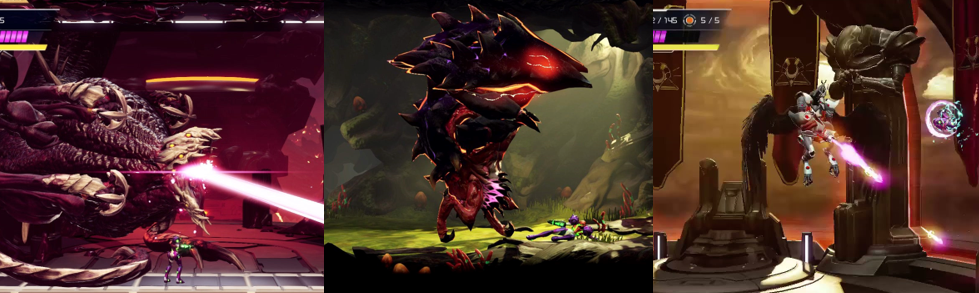
Other, more monstrous bosses also await on ZDR. Corpius (a horrendous mixture of a lizard and a scorpion) lashes with its tail, requiring you to jump or slide under it and pepper its ugly face with missiles or a charged shot. Corpius also boasts an acid spit and the ability to turn invisible, though a shining weak spot remains for you to target, and you must cling to the walls to avoid its acid belch. When it reappears, you have a small window to Parry its attacks and deal massive damage, provided you remember to keep hammering R during the Parry sequence, which is true for all subsequent boss battles. Metroid Dread also includes a rematch with the gargantuan Kraid. At first, he’s chained up and can only swipe at you or rain claws from above (which you can shoot for resources). Blast his head, avoiding his fireballs, and the battle descends to a lower level, where you must rain fire on Kraid’s bulging belly button, which spews purple blobs and splash damage. After enough hits, you must scramble up the temporary platforms to the magnetic strip above to hit his head, which is easier said that done given how much crap is on the screen (though you can make quick work of him if you grabbed the Morph Ball out of sequence). While in Burenia, you’ll battle the tentacled mollusc Drogyga. This takes place entirely underwater and sees you blasting Drogyga’s orbs and tentacles until a button lights up. You must quickly blast it to lower the water, then use the overhead grapple point to reach another and drain the water entirely, leaving Drogyga briefly vulnerable. You must repeat this multiple times and be quick to avoid its massive tentacle counterattack or Parry its attacks for additional damage, which is good practise for the more aggressive and versatile Escue. This enlarged, X-empowered winged beetle shields itself with an electrical field and lunges at you with an attack that can be tough to dodge. Escue also fires destructible orbs that either home in on you or cause massive splash damage, and even keeps up its attack when you whittle it down with missiles and charged shots, reducing itself to a hardened shell of X that spits out smaller parasites and must be bombarded with Ice Missiles.

As they become bigger, more aggressive, and tougher, bosses will test your mettle to the limit!

While exploring Cataris, you’ll’ve noticed the corpse of a massive, mutated spider-like creature in the background. You’ll fight one of these, Experiment No. Z-57, to defrost the region, with the battle taking place in multiple phases. At first, Experiment No. Z-57 lingers in the background, firing a massive mouth laser that briefly irradiates the floor and taking a massive swipe at you. The Space Jump and Storm Missiles are essential here, as is a successful Parry when Experiment No. Z-57 comes into the forefront to take a shot at you. Parrying initiates the second phase where you blast its limbs to keep it from charging a powerful shot, then frantically Space Jump to avoid screen-filling plasma waves and a double-sided claw swipe, before initiating another Parry sequence that should finish it off. Similar to Escue, Golzuna is an enlarged, X-empowered variant of a typical enemy, the Muzby, now completely invulnerable thanks to its rock-like hide save for a single weak spot on its rear. Due to its bulk, Golzuna is slow and difficult to jump over; it charges at you and fills the screen with explosive pink orbs, restricting your movements. Staying on the move is the key to this battle, which eventually reduces Golzuna to a hardened shell that, like with Escue, is destroyed with Ice Missiles. After several encounters, you’ll eventually confront the maniacal Chozo, Raven Beak, aboard the Itorash in a true test of your skills. In the first phase, Raven Beak is shielded by a golden aura and completely invulnerable. He’ll launch a devastating three-hit melee attack, bathe the arena in a health-sapping red beam, and spawn giant orbs that can be destroyed for resources, but take multiple shots to pop. When he stands at the far end, you must Parry his rush to deal damage; similarly, when he taunts, get in close and immediately Parry his attacks to move to the next phase. Here, Raven Beak is much faster and there is no health or ammo to help you. He spawns wings, darts at you (easily slid under), fires a big charged shot (easily dodged), or spews a stream of shots that you must desperately Space Jump to avoid in a circle motion, all while bombarding him with Storm Missiles. The final phase is much like the first, but Raven Beak sports faster, more powerful attacks and a barrage of energy waves. Again, you must hit your Parries and unload all your missiles and charged shots at least three times to win. With no checkpoints between phases and very little health and ammo, this is a gruelling final bout even with maximum health and ammo capacity.

Additional Features:
While you require all of Samus’s weapon and suit upgrades to clear the game, many of the health and ammo-increasing power-ups can be missed. These are marked on your map and it’s highly recommended that you seek them out as you’ll need that extra ammo and health in the later stages, and Samus tends to take quite a bit of damage even with expanded health. If you look at your save file, you’ll see a percentage completion counter for the number of items you’ve found. Your map indicates where items can be found in each area and finding 100% in all areas unlocks art to view in the game’s ‘Gallery’ mode. As is usually the case for a Metroid title, you’ll see different endings and unlock different artwork depending on how fast you beat the game and on which difficulty. At the start, you can pick between “Rookie” and “Normal” mode, and you’ll unlock “Hard” mode after your first playthrough on “Normal”. This is selectable when beginning a new game, though your original save file can be returned to at any time, allowing you to seek out items you’ve missed. You can also unlock and play through a “Boss Rush” mode and grant yourself health and ammo refills using Amiibos. However, there are no other costumes to unlock, data files to scan, or hidden collectibles to find beyond the health and ammo upgrades.

The Summary:
I was excited to get stuck into Metroid Dread. After largely enjoying four of the classic Metroid titles and being impressed by the detailed, moody 2.5D aesthetic, I was eager to get to grips with this more traditional Metroid adventure. Graphically, the game impresses; I may not have liked how samey many environments were or the repetitive gameplay loop, but the depth to each screen and the attention to detail in the ominous lighting, foreboding atmosphere, and detailed character models was very impressive. The controls are tight and responsive; I wasn’t a big fan of the aiming system at times, and the Parry mechanic became laborious as enemies became faster and more aggressive, but Samus has never controlled better, overall, than here, in my experience. I even enjoyed how comparatively linear the game was. I rarely felt like I was lost and enjoyed exploring, even if I potentially played out of sequence at times. Sadly, though, I did not enjoy the E.M.M.I. encounters, which quickly became a frustrating chore, with little variation except it getting harder to line up your shot. I also didn’t like how the E.M.M.I. basically killed you the moment they grabbed you. I liked the tension (the “dread”, if you will) at times, but I wonder if these sections might’ve been better if restricted to certain areas. Like, maybe you travel to Cataris and avoid an E.M.M.I. the entire time. Or if the encounters had been more varied and less restrictive, like maybe an E.M.M.I. stalks you throughout Ghavoran, causing cave-ins and changing the environment as you go. Similarly, the Central Core battles were all basically the same, which is a shame considering how varied the other bosses were. I think merging the E.M.M.I. and the X-Parasite concept might’ve worked better; maybe E.M.M.I. nanobots infect enemies instead of the X, just to mix things up. It’s hard not to be a little disappointed by the gameplay loop in Metroid Dread. It’s fun the first few times but there’s only so many times you can restore power, flee from and destroy an E.M.M.I., then fight a boss before it starts to feel repetitive.

My Rating:

Rating: 3 out of 5.

Pretty Good

What did you think to Metroid Dread? Did you enjoy the E.M.M.I. encounters or did they start to become annoying for you as well? What did you think to the Parry mechanic and the more linear nature of the game? Which of the bosses and upgrades was your favourite? Did you ever get 100% completion? Which of the Metroid games is your favourite? Whatever your thoughts, feel free to leave a comment below and be sure to check out my other Metroid content across the site.

Game Corner [Sci-Fanuary]: Metroid Fusion (Nintendo Switch)


January celebrates two notable dates in science-fiction history, “National Science Fiction Day” on January 2 and Arthur C. Clarke’s HAL 9000’s birthday on January 12. Accordingly, I’m dedicating January to celebrating sci-fi with an event I call “Sci-Fanuary”.


Released: 8 March 2023
Originally Released: 18 November 2002
Developer: Nintendo R&D1
Also Available For: Game Boy Advance (Original); Nintendo 3DS, and Nintendo Wii (Virtual Console)

The Background:
Nintendo introduced gamers to Samus Aran in August 1986. Her debut title was celebrated for its challenging gameplay, is now regarded as one of the greatest games ever, and helped popularise the action/explorationMetroidvania” subgenre. Nintendo followed Metroid with the Game Boy-exclusive Metroid II: Return of Samus (Nintendo R&D1, 1994), a contentious and divisive title whose narrative nevertheless directly influenced Samus’s jump to Nintendo’s ground-breaking 16-bit console. After two years in development, Super Metroid (Nintendo R&D1/Intelligent Systems, 1994) was universally praised for its impressive visuals and tight gameplay, becoming a must-have title for any Super Nintendo owner. Despite this, it would take over ten years for Samus to receive another solo title, with the first footage of “Metroid IV” being shown at the 2001 E3 convention. The team behind Super Metroid returned for Metroid Fusion, introducing a mission-based structure to the gameplay to guide players towards objectives rather than them having to figure things out blindly as before. The developers also took the opportunity to revamp Samus’s appearance and the way she replenished her health and missiles, as well as simplify the controls compared to Super Metroid. Like Super Metroid, Metroid Fusion received critical acclaim; the gameplay, graphics, and mechanics were praised, though many were disappointed by its short length. While Metroid ventured into the 3D arena after Fusion, a sequel came less than ten years later, and the game eventually became available outside the Game Boy Advance (albeit digitally) as Nintendo branched out into virtual consoles.

The Plot:
While exploring planet SR388, bounty hunter Samus Aran is attacked by the parasitic “X” organisms. Though saved by a Metroid-based vaccine, Samus is physically altered. Despite this, she investigates a Biologic Space Laboratories (BSL) space station overrun by the X, now led by “SA-X”, an X parasite mimicking Samus at full power!

Gameplay and Power-Ups:
Metroid Fusion is a 2D, action-orientated exploration title that takes a lot of inspiration from Super Metroid. As in that game, you (as Samus Aran) will be exploring a vast space station home to numerous elevators and hidden tunnels to various high-tech laboratories, caverns, flooded and lava-filled areas, and other regions, all infested by the X parasite. This time around, Samus’s abilities are restricted by her superiors, represented by a station computer that gives the player objectives, points you in the right direction, and offers advice about how to tackle each area. In this regard, Metroid Fusion is the most linear Metroid game so far; the station computer warns you of nearby hazards, says what weapon or upgrade you need to overcome them, and highlights your objective on the game’s map screen. That’s not to say you won’t be backtracking and searching high and low for secret passages and hidden power-ups, but it definitely helps to have an in-game system guiding you along. This, in conjunction with the helpful mini map and the larger full map (accessed with the + button), means it’s easier than ever to navigate the station’s different environments, at least at the start of the game. The + menu also allows you to review Samus’s current suit, abilities, and weapons, refresh yourself on your current objective, and enter sleep mode if you ever need a break. As always, Samus can only save at designated Save Stations (though you can make liberal use of the Switch’s save state and rewind feature to compensate for this) and she can replenish her health, and missile and bomb ammo, at various Recharge Stations. Defeated enemies will also replenish these, but things are a little different this time around. When defeated, enemies release an X parasite that must be collected to refill your health or ammo. If you linger too long, it’ll spawn another enemy, or a tougher variant, adding a level of anxiety that was missing from the previous games.

All of Samus’s abilities return, though she’s strangely light on new tricks.

Samus’s abilities are limited at the start of the game, narratively explained by her being fragile following her encounter with the X. To begin with, you can fire her trademark arm cannon with B or Y, holding the button to charge it and aiming in all directions. A allows her to jump, and she’ll jump higher the longer you hold the button, and you can enable precision aiming while holding down the Left trigger. As you explore the game’s locations and defeat bosses, you’ll gradually regain all her signature abilities. Samus will gain missile upgrades that deal additional damage, open different doors, and even freeze enemies, eventually allowing you to charge up a wider shot by holding the R trigger. She can also morph into a spherical ball to pass through vents and narrow tunnels, eventually dropping bombs and hopping to higher tunnels. Her arm cannon can be upgraded to increase her rate of fire and pass through enemies and walls, shredding enemies who normally take multiple shots to defeat. Her jumping ability can also be enhanced, allowing her to jump higher and continuously and adding her signature “Screw Attack”, though abilities like the Space Jump can be difficult to master due to the finnicky timing required to sustain her jumps. This is equally true of Samus’s aggravating wall jump, which is just as frustrating as in Super Metroid, though thankfully I found it wasn’t necessary to clear the game. Samus’s suit can also be upgraded to withstand extreme temperatures, allowing her to enter frozen areas, freely move through water, and even endure lava. While Samus’s suit will change with each upgrade, she doesn’t showcase anything new her with two exceptions: Samus can grab ledges, making platforming and entering tunnels much easier, and absorbs the different coloured X parasites to refill health and ammo. However, her maximum health, missile, and bomb count can still be expanded by searching around. While you’re told how to use all these abilities and the map even highlights when there’s something in each area, you’ll get no direction on how to use her wall jump or her “Shinespark” ability. The Speed Boster lets Samus crash through certain blocks, but you can press down when she’s at full speed to store that energy and then direct her to smash through higher blocks, which I found extremely aggravating and difficult. I still don’t know why simply jumping while running and pressing A at a wall isn’t enough to pull off these manoeuvres.

Activate consoles, clear areas of hazards, and stay far away from the SA-X!

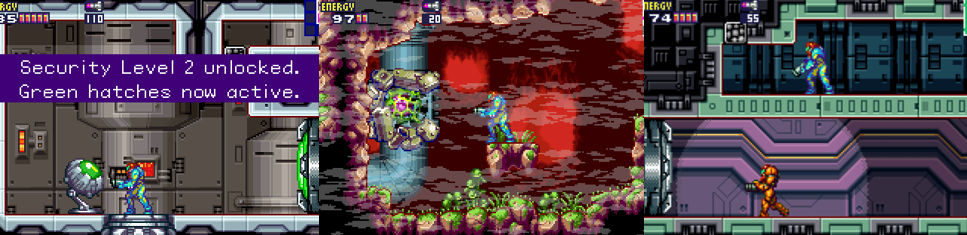
The level layout of Metroid Fusion again owes a lot to Super Metroid, with long vertical shafts, bio-organic areas, and ominous facilities being the order of the day. Puzzles are generally solved using Samus’s abilities; you can uncover destructible blocks by blasting the environment or laying a Power Bomb, though sometimes you need to find an alternative route to access them. Lifts, doors and tunnels will take you to new areas, with the game’s bosses often wrecking the environment and forcing you to take a longer path around blockades or hazards. Samus will be constantly searching for Data Rooms, Navigation Rooms, security consoles, and the like to discover her objective, restore power to an area, or unlock coloured doors. Sometimes, these will remove obstacles such as water or encroaching darkness from an area, though her suit upgrades often circumvent these. Sometimes, you’ll need to drop Power Bombs to break open tubes; often, you’ll be climbing ladders or clinging to overhead rails; occasionally you have to race against a timer to solve overloads or escape areas; and you can again freeze enemies to make temporary platforms. Enemies respawn after you leave a screen, as ever, but the unique X parasites revive corpses or spawn new enemies while you’re on the screen. Some doors are barricaded by disgusting, energy-shooting eye growths that need to be destroyed, some blocks and platforms crumble under your feet, and some areas are veritable mazes that have their pathways hidden within the foreground. Easily the biggest edition to the game is the nigh-unstoppable SA-X, a twisted doppelgänger of Samus that occasionally stalks the corridors or wrecks the background. When the SA-X appears, take the computer’s advice and stay out of sight or run as it can drain your health in seconds with its advanced abilities. On the few occasions when you’re chased by the SA-X, you can use your Ice Missiles to (very) briefly freeze it, adding a great deal of tension to the game in these instances.

Presentation:
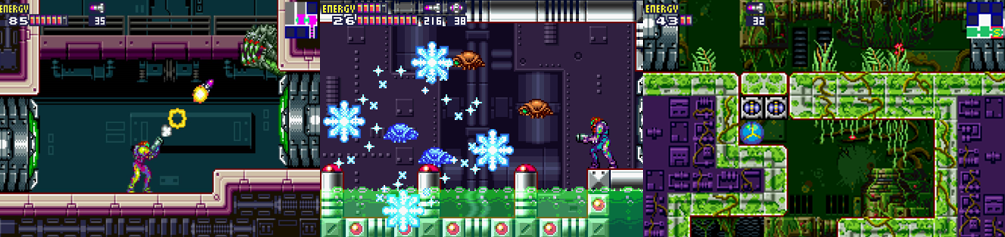
Visually, the game also owes a lot to Super Metroid and its Aliens (Cameron, 1986) inspirations. The BSL space station is ominously empty, often devoid of music, and home to a huge docking bay (where Samus’s ship is parked), a series of large ventilation shafts, and elevators that take you to the station’s other areas. As you progress, you’ll return here a few times and explore new areas, such as the Sub-Zero Containment area that houses Ridley’s frozen husk, a teeming Habitation Deck (where Samus frees the friendly Dachoras and Etecoons from confinement), and the sprawling Reactor Silo, with Samus exploring each to tackle various issues with the space station. There are six “Sectors” to explore, all accessed by a main elevator system (though you can take alternative paths when this system fails or is inaccessible) and each with new areas to uncover as you expand Samus’s repertoire. You won’t explore these in numerical order, and you’ll also have to backtrack to them both as part of the story and to find all of Samus’s upgrades and power-ups. Sector 1 is a cavernous area, featuring rocky platforms spotted with vegetation, not unlike SR388, where Samus initially has to find and destroy atmospheric stabilisers to dispel the mist filling the area. Later, she ventures into mechanical hallways similar to Tourian, discovers Metroid husks in lava-filled caves, and battles Neo-Ripley in a large, cargo hold-like room. Sector 2 is like a Mayan temple, full of ancient ruins completely overtaken by foliage. Plants, vines, and flowers swarm the environment, creating a jungle-like feel and masking pathways, and these are married with a coral reef-like subsection. Sector 3 is both a sweltering laboratory and an arid desert, featuring a desolate, muddy aesthetic and a baking boiler room that threatens to destroy the entire station.

The surprisingly chatty Samus visits some interesting, if familiar, locations.

Sector 4 is basically an aquarium; it features a blue theme, lots of water, exposed power nodes that’ll sap your health, and beautifully detailed underwater sections full of anemones and a tranquil water effect. Sector 5 is a frozen laboratory filled with glass panels in the background and that’s eventually wrecked when an X-infused creature, the Nightmare, escapes captivity. Sector 6 is another cavern, but this time dank and dark, save for areas sporting vivid mushrooms. It’s also home to a restricted laboratory; Samus needs a beam upgrade to enter, where she’ll find various Metroids held captive. These are then unleashed when the SA-X arrives and blasts the environment, forcing Samus to make a desperate escape up a shaft while avoiding the panicked jellyfish. The SA-X and other bosses are prone to affecting the game’s environments; they’ll crash through walls, block off doors, and seal off some areas, forcing you to either escape, find alternative paths, or battle them in enclosed areas. Metroid Fusion focuses on story more than any previous game, featuring lovely cutscenes at the start and at various points throughout the story that showcase the SA-X’s power and Samus’s reaction to the events happening around her. This is further reinforced through various cutaways that detail Samus’s inner thoughts as she thinks of her former commander and ponders her newfound physiology. The game’s soundtrack is a further extension of Super Metroid; remixes of classic Metroid themes are featured, as are ambient sounds and suitably ominous tracks, but nothing really stood out to me as particularly new or memorable. Everything looks and sounds and plays really well, but the game owes so much to Super Metroid that it almost feels like a remake at times. I would’ve liked to see more variety in the locations and more effort put into the soundtrack, rather than playing it so safe.

Enemies and Bosses:
The BSL space station and its six Sectors and various areas are teeming with all kinds of alien lifeforms that are all hostile to some degree thanks to the X. The theme here is bugs and vegetation, as every enemy is some kind of insect or mollusc or plant-life turned monstrous, with only a few exceptions. We’ve got scuttling bug-like Gemmers, slug-like Choots that spring up from the ground and lazily float down, crab-like Dessgeegas that jump at you sideways, weird coloured balls floating around pumping out toxic gas, the Xenomorph-like Genesis creatures pouncing from above and below, and the armoured Gerubus crabs that need missiles to be dispatched. Piranha-like fish, tiny snails, and even zombified corpses are all infected by the X and, occasionally, stronger versions will be spawned upon defeat or you’ll need to defeat enemies a certain way to open up doors. Some enemies will be more than familiar to players of Super Metroid: the crustacean-like Evirs swim about firing projectiles from their tails, worm-like Funes snap at you from walls, and the Space Pirates even make an appearance. Kind of. The Zebesians are functionally the same, clambering up walls, firing shots from their claws, and even resisting your shots unless you charge up a beam or blast them from behind with missiles. Each defeated enemy releases an X parasite that must be collected, but you’ll also encounter blue X parasites that damage you until you upgrade your suit. Metroids also make a brief appearance, though they’re more of an annoyance than a threat as they simply knock you back rather than causing damage.

The X parasites assume some monstrous forms to keep you from your full arsenal.

There are twelve bosses to battle in Metroid Fusion, though one is encountered twice. Many of the bosses will not only be familiar to Super Metroid players but are simply super-powered X parasites. Defeating them reveals their true form, the eye-like Core X, which floats around firing lasers or protecting itself with spikes or electricity. Defeating this restores your health and ammo and bestows a new ability, but their inclusion essentially means every boss fight is a two-stage affair. The first you encounter, the Arachnus X, is an armadillo-like creature that stomps around, rolls at you, slashes with its pinchers, or unleashes an energy wave attack. Luckily, there are small tunnels you can retreat into to avoid these, though you’ll need to be wary of its widespread fireball attack, and it’s only vulnerable from the front and to your missiles. Next, you’ll battle the weird, plant-like Zazabi X, a strange jellyfish-like tentacle that hops around and tries to squash you. While it’s overhead, you can shoot up to bombard it with missiles but be sure to move as it saps your energy if it envelops you. Serris X presents quite the challenge. This serpentine beast bursts from the ground and circles the screen, taking up a lot of real estate and getting faster the more damage you deal to its head. You’ll then have your first encounter with the Security Robot B.O.X., a crab-like walker that charges you and spits bombs that spew fire plumes. Luckily, there’s a rail overhead you can grab to fire missiles into its opening from above, which eventually causes it to flee. When you battle it again later, these overhead rails are essential to avoid the electrified water in the arena, and it now sports a missile barrage in its arsenal!

Gigantic, disgusting bosses will test you patience and skill.

Since you get a lot of experience battling Core X’s, targeting their eyes and dodging them as they float about, the Barrier Core X doesn’t pose much of a problem beyond being bigger, surrounded by smaller variants, and retreating to the water. The giant spider, Gedo X, is much more formidable; if this thing gets you in its mandibles, you’re in for a bad time! Luckily, you can retreat to the corners of the cargo bay in your Morph Ball to leave it bouncing around aimlessly. Gedo X also spits a spew of fireballs you’ll need to avoid and eventually starts dropping garbage on you, so you’ll need to dodge this as well as you frantically target its head with Super Missiles. Plant Core X reminded me of the Mother Brain battles from the first two games. This tangled mess of vines and thorns has infested a Chozo Statue and is protected by spore-spitting flowers and carnivorous plants. Pieces of the boss fall off and become hazards as you pepper it with Super Missiles and, while the spores eventually stop, the creature rears to life and blasts you with Plasma Beams! Like SA-X, Nightmare X’s threat is foreshadowed as soon as you venture into Sector 5 and see its shadow flying about it. Later, it wrecks the area and you’re forced to confront it, where it’s revealed to be this gigantic, bio-mechanical…thing that takes up most of the screen! Nightmare X hovers around erratically, fires a barrage of lasers from its arm/wing/things, and is only vulnerable to Super Missiles and the Charge Beam, and only in its mewling face. You must lure it to one side of the room and clamber up the ladders to attack it, marvelling as its face bleeds and degenerates as it takes damage, but your missiles will be useless when it engages it gravity-warping abilities so make sure to switch to the Charge Beam.

Some familiar faces, a formidable doppelgänger, and a ghastly Metroid beast await in the finale.

After a tense, manic escape from the Restricted Zone that sees you blast the SA-X into space, you’ll come face-to-face with an X masquerading as Samus’s archenemy, Ridley. Another gigantic sprite, Ridley flies about the place and charges at you, testing your reaction time and agility. It also breathes fire and tries to grab you. While this drains your energy, you can pummel it with Super Missiles to deal big damage, though it’s also recommended to use the Charge Beam. Eventually, the shrieking creature crumbles and you defeat one more Core X before finally facing SA-X. This X is a perfect copy of Samus in her classic suit and with all her abilities; it pops up throughout the game searching for you or chasing you down, decimating you with its Screw Attack and Ice Beam. You can finally settle the score in this fight but the SA-X is fast and powerful and you can only damage it with a fully charged Plasma Beam. Your Ice Missiles briefly freeze it but the window of opportunity is very small so be ready to Screw Attack to safety. After enough hits, it mutates into a monstrous form, one much easier as it simply tries to crush you, but it surprisingly saves you in the final fight when it sacrifices itself to empower you in the battle against the Omega Metroid. This gargantuan, insectile, alien monstrosity rips through the docking bay and is fought against a time limit. Initially, it’s invulnerable, but the SA-X’s Ice Beam lets you to damage it. However, you need to hit hard and fast and escape to safety. If its slashes land, you’ll be stun locked and killed in seconds or waste valuable time, so rush in, blast its head, and quickly retreat to end it. With the timer ticking down and the Omega Metroid’s huge hit box, this can be a frustrating test of patience and sadly lacks much strategy beyond shooting and retreating.

Additional Features:
Scattered all around the space station and its Sectors are numerous power-ups that will increase your maximum health and the number of missiles and Power Bombs you can carry. These are invaluable as the game progresses and tougher enemies and specialised hidden blocks become more prominent. You’ll gain all of Samus’s weapon and suit upgrades by defeating bosses, Core Xs, or from the odd Chozo Statue, so you don’t have to worry about missing anything. Maps are automatically provided when you interact with the Navigation Room or activate consoles as well, and as ever you can utilise the Nintendo Switch’s save state and rewind feature to drastically reduce the game’s difficulty. You get three save slots with Metroid Fusion and each one tracks your completion percentage, which is tied to how many power-ups you’ve found as well as how quickly you’ve played through the game. These factors also impact the ending you get upon finishing the game, with five on offer in the North American and European versions and eleven in the Japanese version, ranging from seeing Samus pose in her suit to showing off her form-fitting blue suit. If this is incentive enough for you to challenge the game again and finish it faster, then by all means go ahead, but there is nothing else on offer here, which is a bit of a shame as it would’ve been nice to see an SA-X skin or Samus’s blue suit form unlocked.

The Summary:
Although I’ve played a few Metroid games now, I still feel unaccustomed to the franchise. Nostalgia and a longing for Super Nintendo games means Super Metroid is probably my favourite of the series, so I was naturally very pleased with Metroid Fusion. As mentioned, the game has so much in common with Super Metroid that it’s basically a remake, with Samus’s abilities copied wholesale alongside many familiar locations and bosses. I didn’t expect the call-backs to Metroid II though, that was pretty neat, and I enjoyed seeing the game’s environments change as you explore the space station. There’s always something happening, be it an overload or a power drain or an escaped monster, and it’s a fun reason to backtrack and try out Samus’s new abilities. Pitting you against a ticking clock was a great way to break up the action, and adding an element of danger to defeating enemies with the X parasites was a neat touch, too. I also enjoyed the threat of the SA-X; this formidable double increases the tension and causes nothing but trouble throughout your adventure. Unfortunately, I don’t think it was utilised enough. There were some areas where the SA-X was entirely absent, and I think running from it, sneaking around it, or engaging with it multiple times would’ve helped the game stand out more from Super Metroid. Like, one of Samus’s power-ups could’ve been left lying in the open and be stolen by the SA-X and maybe you have to sneak around to retrieve it. Or you’d see it in the background or something. I would’ve liked to see more done to each area, too, to properly embrace each theme. All of them share similar high-tech features, just with different colours, which was a bit disappointing. Still, I imagine this was a great Metroid experience upon release as Super Metroid wasn’t available on the go like it is now and it still holds up really well as a companion piece to Super Metroid that does just enough to make it unique.

My Rating:

Rating: 4 out of 5.

Great Stuff

Did you enjoy Metroid Fusion? Did you like how similar it was to Super Metroid or would you have liked to see it stand out a bit more? What did you think to the SA-X and do you think more could have been done with the concept? Which of the areas was your favourite? Did you ever achieve 100% completion and Samus’s true form? Which Metroid game is your favourite? Whatever your thoughts, feel free to leave a comment below, and be sure to check out my other Metroid reviews across the site.

Mini Game Corner [Sci-Fanuary]: Mega Man 2: The Power Fighters (Xbox Series X)


January celebrates two notable dates in science-fiction history, “National Science Fiction Day” on January 2 and Arthur C. Clarke’s HAL 9000’s birthday on January 12. Accordingly, I’m dedicating January to celebrating sci-fi with an event I call “Sci-Fanuary”.


Released: 22 July 2022
Originally Released: August 1996
Developer: Capcom
Also Available For: Arcade, GameCube, GameTap, Nintendo Switch, PC, PlayStation 2, PlayStation 4, PlayStation 5, Xbox, Xbox One, Xbox Series S 

A Brief Background:
After ushering in Capcom’s debut in the home console market, the excessively difficult (but no less lauded) Mega Man (Capcom, 1987) eventually spawned enough of a franchise to become a Nintendo staple. Despite this, Capcom remained at the forefront of the popular arcade scene thanks to their blockbuster tournament fighter, Street Fighter II: The World Warrior (1991), which soon spawned numerous imitators to its throne. While Capcom later appeared reluctant to create new Mega Man games, a well-received (if simplistic) spin-off fighter was released to arcades in 1995. The following year, Capcom released a sequel, one that expanded upon the original’s cast and mechanics to produce a more fleshed-out version of the concept. Like its predecessor, Mega Man 2: The Power Fighters was included in various home console ports and featured as part of Capcom Arcade 2nd Stadium, which is the subject of this review.

The Review:
Like its predecessor, Mega Man 2: The Power Fighters is a 2D, largely one-on-one tournament fighter (though two players can team up to dominate their foes). The original playable cast (the titular Mega Man, his loner older “brother” Proto Man, and grim anti-hero Bass) are joined by the mysterious Duo and again pick from three story paths. Although I’ve heard that each of the four characters has different attributes, I noticed only minor differences between them, with the except of Duo. While the others all fire shots from their arm cannons, Duo attacks with an extendable arm and fires out a fist; he’s also a bigger target and potentially a bit slower. The controls remain unchanged, with players attacking with A and holding the button to charge a more powerful shot or using a rapid-fire variant with X. You jump with B (jumping higher the longer you press it), executing either jumping shots or wall jumping off the arena sides to dodge incoming attacks. Pressing down and B sees you dash ahead, while Y switches between your available Special Weapons. As ever, you acquire these by defeating Robot Masters and they’re tied to an energy meter, though this time you must pick up the Special Weapon orb after a victory and your friend can steal it from under you. Finally, you can press in the right-stick to enter a coin and continue fighting where you left off if you’re defeated, selecting a new character if you wish, with your health and weapon energy fully restored. Visually, sprites and attack animations are lifted wholesale from its predecessor. I didn’t find the all-new backgrounds as interesting as the first game’s and it was a little disappointing to not see more detailed environments or additional cameos included. The same can be said of the music, which is more of the same, though more sound bites are included here alongside additional cutscenes. These often feature Roll bestowing you an upgrade or Doctor Thomas Light giving exposition on your enemy and advancing the paper-thin plot, with the more impressive sprite art being saved for the endings, as you’d expect.

New abilities, new allies, and a new character slightly expand the scope of this sequel.

Some other tweaks include the pre- and post-fight text being more animated, characters having victory poses, and enemies dropping health and weapon energy pick-ups as you attack, giving you a bit more leeway in tougher bouts. Enemies can also block your attacks and reflect your shots, two abilities that you’re denied, and will enter a “pinch” mode when their health drops to half, increasing and varying their attacks and putting you on the defensive. To even things up, each character has a special attack they can perform by pressing up and X with a fully charged shot, with Mega Man unleashing a jumping uppercut, Proto Man firing a short-range burst of energy, Bass performing a crescent kick, and Duo hitting an uppercut/slam combination. Furthermore, Eddie appears during fights and bestow a robot helper who temporarily replaces your Special Weapon function until their life bar runs out. Mega Man is aided by Rush, allowing him to spring higher by jumping on the robo-dog’s back and send him flying at foes by charging his primary shot. Proto Man and Duo are aided by Beat, who grants them a temporary invincibility, and Bass is joined by Treble, who fires his own attack when you press X and can also be sent charging at enemies. Additionally, each story path sees you gifted an “upgrade” that either increases your attack power, adds a super jump (performing by pressing up and B), or increases the length of your weapon energy bar. These additions appear alongside the same features as the first game, including customisable borders and filters, a helpful rewind and save state feature, the ability to alter the game’s speed, difficulty, and the length of the one-round fights, and an optional invincibility mode that will disable both Capcom Arcade 2nd Stadium’s Achievements and the in-game “Triumphs” you can earn by playing. Again, you shouldn’t really need this option with the rewind and save state features. No Achievements are tied to beating the game without taking damage, earning a perfect no-damage victory bestows only points, and the game is just as easy as before, with the exception that I noticed enemies seem to take more hits to defeat this time around.

Alongside new Robot Masters, foes gain additional attacks when their health drops.

In true Mega Man fashion, you can circumvent this by acquiring specific Special Weapons to target specific Robot Masters. This time, you can freely select which enemy you face, though the damage you take in each fight still carries over to the next, so it pays to think about the order you tackle the Robot Masters. You’ll have an easier time against Plant Man, for example, if you defeat Heat Man and get the Atomic Fire weapon; similarly, Dive Man is weak to the Thunder Beam and Napalm Man is weak to the Gemini Laser. Gameplay is largely unchanged from the last game, with no stage hazards to be concerned about and the backgrounds noticeably changing to different times of day, locations, or other visuals depending on which path you take. There are no chases to worry about this time (though you can fight on stages that appear to spin or bob up and down in water or lava) and battling the Robot Masters still consists of an arcade-style rendition of the main games’ boss battles. Your foe will jump about firing their signature weapon, then add a few extra attacks when their health drops. Those that return from the last game (Heat Man, Plant Man, Gyro Man, Slash Man, Cut Man, Shade Man, Gemini Man, Napalm Man, and Guts Man) remain largely unchanged except for their “pinch” attacks, though I did notice that their health bars increase as you gain victories. New Robot Masters fit in very well with their counterparts, with Air Man blowing you back with his chest fan and firing mini tornados, Bubble Man capturing you in his slow but powerful bubbles, Centaur Man charging you and firing arrows, Dive Man bestowing homing torpedoes, Elec Man blasting three-way Thunder Beam, Pharaoh Man floating around with telekinesis and utilising a two-way wave attack, Quick Man moving with a shadow effect and speeding up your attacks with the Quick Boomerang, Shadow Man bombarding you with Shadow Blades, and Stone Man erecting stone walls and giving you a slow stone hand to fire as a ground shot. With enemies able to block, reflect, and power up, bouts do last a little longer, but the continued absence of combos and other mechanics means you can simply plough through to win as before.

It’s surprising how much of the game is a tease for Mega Man 8

After defeating the six Robot Masters in your chosen path, you’ll enter Dr. Wily’s fortress and fight one of three additional bosses before meeting the mad doctor face-to-face. Returning from the last game is the Yellow Devil; slightly redesigned and far tamer than before, the Yellow Devil jumps more, fires a barrage of cubes and a focused laser blast from its eye, as well as slapping you, firing projectiles, and transforming into a sphere. The Mad Grinder from Mega Man 7 (Capcom, 1995) appears to fire buzzsaws and flatten you with his steamroller appendage, flinging his mohawk and spitting fireballs but being notably weak to the Centaur Arrow, while Mega Man 2’s (ibid, 1988) Mecha Dragon pops up to roast you with large fireballs, deal continuous damage with its flame breath, and spawn smaller minions. Defeat each other these and Dr. Wily will attack in his newest contraption for a three-stage final bout. In the first phase, Dr. Wily summons a robot minion to distract you, fires a robotic fist to punch or flick you, and defends himself with those same hands, firing small projectiles or a larger mouth cannon. In the second phase, he takes to the air as a smaller target, launching bombs, taking shots, and trying to target you with an explosive attack. Take this out and you’ll be given ten seconds to finish him off as he teleports between pods, though you’ll only be denied seeing Dr. Wily beg for mercy if you fail to finish him. You’ll get different endings depending on which character or character combination you play as, with Duo’s being a massive tease for Mega Man 8 (ibid, 1996) and the introduction of Zero, Mega Man briefly questioning his morals, Proto Man refusing Dr. Light’s help, and Bass continuing to disrespect his creator. After viewing these, and the end credits, you can enter your name in the high score table and try a different story path or play again to try and beat your best score.

The Summary:
Although Mega Man 2: The Power Fighters expands on the original game with a few new features, it remains as barebones as the original and thus there isn’t too much to say about it. I definitely think it’s a superior game thanks to the deeper variety in the playable characters, Robot Masters, and in-game action, but it’s not enough to bump the overall score any higher. I wasn’t exactly blown away by what Duo brought to the table and, while I liked the robot helpers, it bugged me that you have to pick between using them or using your Special Weapons. Having health and weapon energy drop in fights made things a touch more interesting, and I like the competitive nature of two players fighting to snag the Special Weapon after defeating a Robot Master, but it remains a colourful, enjoyable, but strangely shallow arcade interpretation of the boss battles from the mainline games. The new story paths weren’t bad, though I could’ve done with more story being included in each, and the addition of upgrades and special attacks helped mix things up, but the combat is still ridiculously simplistic compared to other fighters so there’s not much incentive to come back, especially as Capcom Arcade 2nd Stadium doesn’t include game-specific Achievements. I’ll give it this: the fights lasted longer and were more engaging this time, both because the Robot Masters seem tougher and have that “pinch” mode, and Dr. Wily’s sub-bosses were definitely more impressive this time around. But the uninteresting backgrounds, the lack of a tangible differences between the fighters, and the simplistic nature of the combat keep this from being the glow up it had the potential to be. It’s still a nice bit of cartoonish arcade fun, but you’ll quickly be returning to deeper, more challenging fighters after blasting through this one.

My Rating:

Rating: 3 out of 5.

Pretty Good

Did you ever play Mega Man 2: The Power Fighters in an arcade? What did you think to Duo and the added combat mechanics? Which of the new Robot Masters was your favourite? Did you like the addition of robot helpers? Would you like to see Mega Man tackle the fighting genre again someday? How are you celebrating the science-fiction genre this month? Whatever your thoughts on Mega Man 2: The Power Fighters, share then below and check out my other Mega Man reviews!

Mini Game Corner [Sci-Fanuary]: Mega Man: The Power Battle (Xbox Series X)


January celebrates two notable dates in science-fiction history, “National Science Fiction Day” on January 2 and Arthur C. Clarke’s HAL 9000’s birthday on January 12. Accordingly, I’m dedicating January to celebrating sci-fi in an event I call “Sci-Fanuary”.


Released: 22 July 2022
Originally Released: October 1995
Developer: Capcom
Also Available For: Arcade, GameCube, GameTap, Nintendo Switch, PC, PlayStation 2, PlayStation 4, PlayStation 5, Xbox, Xbox One, Xbox Series S 

A Brief Background:
Created to be Capcom’s big debut in the home console market, Mega Man (Capcom, 1987) was a big hit despite its excessive difficulty and, by 1995, the Blue Bomber was a staple of Nintendo’s consoles, with no less than twelve different titles available. At the same time, the arcade scene was as popular as ever thanks, largely, to Capcom’s game-changing 2D tournament fighter, Street Fighter II: The World Warrior (1991). Before long, fighting games swamped arcades as developers and publishers sought to have a piece of the action, though Capcom remained at the forefront of the genre. Unlike in later years, when Capcom seemed reluctant to make new Mega Man games, we got this relatively obscure fighting game in the mid-nineties, one that garnered largely positive reviews despite its simplistic gameplay. It was followed by a sequel the very next year and enjoyed a healthy post-arcade life as it was ported in numerous home console collections, most notably in Capcom Arcade 2nd Stadium, which is the version I’m reviewing here.

The Review:
Mega Man: The Power Battle is a 2D, one-on-one tournament fighter in which players pick between the super fighting robot Mega Man, his mysterious “brother” Proto Man, and edgelord anti-hero Bass. Two players can choose to play simultaneously, teaming up against Doctor Albert Wily’s refurbished Robot Masters, and you can pick one of three different story paths to play through, with each one boasting different Robot Masters and therefore different obtainable Special Weapons. Regardless of which character you pick, they all play the same and have the same attacks, though they’re visually very different. Mega Man attacks with his patented Mega Buster, Proto Man carries a useless shield and has a flame effect to his shots, and Bass fires purple energy. As far as I can tell, there are no other differences between them (although Proto Man seemed like he was a touch slower). Your primary attack is unleashed with A; you can hold the button to charge a more powerful shot and fire mid-jump, but there’s no ducking or directional attacks here and you can’t string together combos. X offers a rapid-fire setting to your attacks, the speed of which you can customise from the main menu, while B lets you jump (with you jumping higher the longer the button is pressed) and wall jump off the sides of the arena to avoid damage. You can also press down and B to dash across the screen, and switch between your Special Weapons with Y. Special Weapons are obtained by defeating Robot Masters just like in the mainline games, and just like them they’re tied to an energy meter. If you’re defeated in battle, you can choose to continue (pressing in the right-stick as many times as you like) and even switch characters, returning where you left off with full health and weapon energy.

Players can team up to defeat refurbished Robot Masters and acquire their signature Special Weapons.

This version of the game offers quite a few options to the player, from adjusting the game’s difficulty (though it’s pretty easy, overall), changing the borders and filters, switching to the Japanese version, rewinding the action with the Right Bumper, creating save states, and even enabling an invincibility. However, Capcom Arcade 2nd Stadium has nineteen Achievements to earn (which are further represented in the game as “Triumphs”) and these will be deactivated if you use the invincibility. Not that you really need it with infinite continues and the rewind, and with the game being so easy. Whichever route you pick, you’ll be taken to a world map and must select which stage and Robot Master to challenge on a roulette wheel. You then have as long as 99 in-game seconds to defeat your foe in a one-round match that basically amounts to an arcade remake of previous Robot Master boss battles. Any damage you take carries over to the next match and you’ll obtain your foe’s Special Weapon, as well as a score tally, upon victory. As in the mainline games, each Special Weapon is effective against a different Robot Master so it can be useful to time your button presses on the world map to make things easier on yourself. Depending on which route you pick (and, potentially, the game’s difficulty), you’ll face different Robot Masters and the stages will even change. The time of day will be different, elements in the background will have changed or, in Gyro Man’s case, you’ll be chasing your foe in a bit of sidescrolling action. There are no stage hazards or in-game power-ups to concern yourself with, with the exception of Magnet Man causing his arena to raise as you fight and the ability to score extra points for avoiding any damage, which will in turn put you higher on the high score table.

Each Robot Master has a specific weakness, though you can just plough through regardless.

Mega Man: The Power Battle sees you battle Robot Masters from the first seven Mega Man games and acquire their signature weapons. Each has a very similar attack pattern consisting largely of jumping, hopping, or stomping about and firing their weapon, though some also charge at you or suck you in. Considering your limited move pool, this means that your overall attack strategy will be to dodge their projectiles and pepper them with shots, either a charged one or a suitable Special Weapon, to make mincemeat of their health bar. Each Robot Master gets a signature intro, both before the stage and before the round starts (such as Cut Man literally cutting his way through the background and Wood Man dropping down in a log), and most are pretty simple. I had little issue powering through Ice Man’s Ice Slasher arrows or Guts Man’s Super Arm that sees him tossing boulders, though Heat Man represented a tougher challenge thanks to him being invulnerable when on fire and immolating you to cause continuous damage. Similarly, Wood Man and Magnet Man erect elemental shields and cause leaves and magnets to rain down, respectively. Gemini Man duplicates himself and fires a ricocheting shot, Plant Man spawns pellet-shooting minions and also has a shield, and Cloud Man summons lightning bolts to electrify the ground. As mentioned, Gyro Man was probably the most unique regular battle as the stage auto scrolls as you fight. Freeze Man peppers the ground with icicles that are all-but impossible to avoid, Turbo Man (not that one) charges as a racing car, and Slash Man is easily the most agile foe, dive-bombing you and slashing when you’re up close. Shade Man stays in the air firing ring blasts and sending out little smoke projectiles, Dust Man spits a cube of trash and draws you in with his cannon, and Crash Man tosses explosive Crash Bombs that can be tricky to dodge.

Your path inevitable leads to Dr. Wily’s fortress and a character-specific ending.

Once you’ve bested the six Robot Masters, you enter Dr. Wily’s fortress and fight either what seems like two versions of the Yellow Devil or this funky pumpkin robot. The Yellow Devil is a gigantic, slow foe who can only be damaged by shooting its eye. It’ll jump about, squash you with is hand, explode into fists or balls, or split itself into three smaller forms. Just target the eye or its exposed core, cycling through your Special Weapons, to cream it. Similarly, the pumpkin robot is invulnerable when closed up and fills the screen with projectiles when open, but it easily bested by pummelling its inner core. Dr. Wily battles you in a three-phase final boss at the end, with players receiving different endings for each character. In the first phase, his robotic fists will fly at you, flick you, or defend or deflect your projectiles. In the second, he floats up high and sends buzzsaws your way, and in the third you have ten seconds to finish him off as he teleports between pods. Successfully finish him and he’ll beg for mercy; but fail and he’ll escape, though you’re victorious nonetheless. Visually, the game looks great; there’s a short introduction that showcases the playable cast, and the different endings all boast big, cartoonish sprite art and ludicrous translation errors. The game’s music features remixes of classic Mega Man themes and character sprites change colour when you have Special Weapons equipped, as you’d expect. Although the stages are quite empty and small, they’re very detailed and change depending on which path you pick. You’ll see a big robot whale coming up through ice, robotic crows, Dr. Wily’s take on Jurassic Park, and even battle in the clouds. The time alters depending on your path and you’ll also be placed at different points: you fight Guts Man on a busy highway of a futuristic city and can see cars racing by in the foreground, but you’re right in the middle of the road when you come back here to fight Turbo Man, and Dr. Wily’s background can either be a rushing tunnel or a weird psychedelic vortex.

The Summary:
There really isn’t a whole lot to Mega Man: The Power Battle, hence the short review. The game looks great, with sprites being big and colourful arcade-style renditions of their 16-bit counterparts and the stages, though simple, changing up depending on which path you take was a nice touch. I also liked that the final bosses slightly changed with each path, though I didn’t notice the difficulty of the Robot Masters altering all that much. The game is very easy overall, to be honest, but I’m not really that bothered by this as sometimes it’s fun to sit down and have a quick gaming session with a fun title. However, those expecting a Street Fighter II-level experience will be disappointed. Gameplay is ridiculously simple, with no combos, counters, or blocking involved. Instead, you’re simply dropped into an arena and face off against a refurbished Robot Master, essentially giving you an arcade rendition of the early games’ boss battles and not much else. It’s cool that you can play as the different characters and team up with a friend, but I barely noticed any differences between them, which was a shame. It’s also weird to me that this wasn’t ported to home consoles at the time as it might’ve been found a home there, especially on the Super Nintendo. Ultimately, while Mega Man: The Power Battle is a fun-but-brief experience, there’s not much else happening here and, oddly, the Capcom Arcade 2nd Stadium doesn’t even include Achievements specific to this game, meaning you can plough through it in about an hour and be done.

My Rating:

Rating: 3 out of 5.

Pretty Good

Have you ever played Mega Man: The Power Battle out in the wild? Which story path was your favourite to take? Were you disappointed that there wasn’t much distinction between the playable characters? Which of the Robot Masters do you think got the best glow up? Do you think the game suffered by not being a more competitive experience? How are you celebrating the science-fiction genre this month? Whatever you think to Mega Man: The Power Battle, share your thoughts below and check out my other Mega Man reviews across the site!
Mini Game Corner: Mega Man V (Nintendo Switch)


January celebrates two notable dates in science-fiction history, “National Science Fiction Day” on January 2 and Arthur C. Clarke’s HAL 9000’s birthday on January 12. Accordingly, I’m dedicating January to celebrating sci-fi with an event I call “Sci-Fanuary”.


Released: 7 June 2024
Originally Released: 22 July 1994
Developer: Minakuchi Engineering
Also Available For: Game Boy and Nintendo 3DS

A Brief Background:
Notorious for its high level of difficulty, Mega Man (Capcom, 1987) represented Capcom’s shift away from the arcade scene and into the burgeoning home console market, eventually establishing a franchise that expanded to the Game Boy in 1991. Capcom outsourced development to Minakuchi Engineering, whom they reunited with for the Blue Bomber’s subsequent handheld ventures after a brief collaboration with Thinking Rabbit left series artist Keiji Inafune allegedly disappointed by their efforts. Mega Man V was the last of these efforts, and was said to have taken the longest to develop of the Game Boy titles. Furthermore, Infaune struggled to create new designs for the game, particularly the debuting “Stardroids” and Mega Man’s newest robotic companion, Tango. Mega Man V was also one of the first games developed specifically to connect with the Super Game Boy peripheral, allowing players to experience the game in full colour on their televisions. Seen as one of the system’s most ambitious titles, Mega Man V is largely regarded as one of the best in the franchise’s handheld library, demonstrating better graphics, mechanics, and narrative elements. Although this didn’t lead to a collection of the portable Mega Man games, these were all eventually ported to Nintendo’s online shops and services.

The Review:  
Mega Man V retains the core gameplay mechanics of its predecessors and main console titles, charging players with battling through four initial stages and powering the fighting robot Mega Man up before heading into space to take on four additional stages and Robot Masters. Consequently, the controls remain unchanged (with one exception): B or X fires the Mega Buster, which can be charged to unleash a stronger shot. This time, Mega Man flings out his fist thanks to his creator, Doctor Thomas Light, upgrading his abilities since his usual charged shot won’t work against the game’s new Stardroids. However, the “Mega Arm” is functionally the same as the old charged shot except it deals additional when it flies back to Mega Man and it can be upgraded to snag items and pass through walls. B is for jumping, with Mega Man jumping higher when underwater or in outer space, and down and B performs a slide that’s useful for avoiding hazards and attacks. There’s no longer a recoil to the charged shot, which is a bit of a shame, but you’ll still collect P-Chips to trade in for upgrades at Dr. Light’s lab between stages. These allow you to buy those upgrades for the Mega Arm, refill some or all your weapon energy, replenish your health, or purchase a 1-up or E- and S-Tanks to refill your health and energy on the go. Enemies drop most of these items upon defeat, though your chances of getting them are again more restricted since they also drop P-Chips (which are mostly useless with the Switch’s rewind and save state features). These goodies may also be found in stages by taking alternative paths and destroying certain walls, and Mega Man’s little friend Eddie and mysterious brother Proto Man occasionally gift items. Mega Man’s robotic bird companion Beat is absent, so you won’t have to worry about collecting any letters, though four crystals are hidden in the later stages that will grant you the Power Generator, which halves the usage cost of your Special Weapons. Finally, if you exhaust all your lives and use a continue, you’ll gain the Turbo Accelerator for your Mega Arm to help you out.

Mega Man V mixes things up with some unique bosses, weapons, and items.

Brace yourself for a shock but…Mega Man V features all-new Robot Masters and Special Weapons! Yes, for the first time in Mega Man’s handheld career, the stages and bosses are all new (save for some inspirations from previous games). Like previous Robot Masters, Terra’s Stardroids are weak to specific Special Weapons, making the game more difficult depending on the order you challenge them. They’re all fought in enclosed arenas, as usual (though Mega Man V gives you more room to manoeuvre than the previous Game Boy games) and all fought again during the endgame. I started with Mercury, a Stardroid with liquid metal properties who transforms into blobs but who you can put down with the regular Mega Arm (or, later, Salt Water). Mercury grants you the Grab Buster, which leeches health from your target, though the Mega Arm alone was enough to take down Neptune, who simply hops about like a frog. Weak to Photon Missile and Electric Shock, Neptune bestows you with the Salt Water shot which, while slow, damages enemies with splash damage (a common mechanic in this game). Salt Water also gives you the edge over Mars, who fires the slow but very powerful Photon Missiles and even lays mines across the floor. Like the Crash Bomber, you must time Photon Missile shots to defeat Venus, who mostly just stomps about but gets some serious airtime when he’s filling the screen with explosive bubbles. The Bubble Bomb is one of the more useful Special Weapons thanks to it travelling upwards, making it perfect against Pluto when he pounces to the ceiling, and Jupiter since he’s always hovering overhead. Jupiter fires a concentrated beam of electricity and is invulnerable in this state, a weapon you can use to fry enemies up close. Saturn was next; a big target, he tosses a ring, slides at you, and sucks you in with his Black Hole attack, which Mega Man uses with explosive effect. Defeating Pluto nets you the Break Dash, which sees you charging across the screen to barge through enemies and walls. It’s also great against Uranus, who you fight in close quarters. Defeating him grants you the Deep Digger which, like the Super Arms, lets you toss certain blocks.
New mechanics and hazards make this the most unique of Mega Man’s portable games.

You’ll also obtain an additional Special Weapon by defeating Terra; the Spark Chaser is like the Gemini Laser in that it ricochets about and is best saved for the game’s true final boss. Beat may be gone but Rush is still here; unfortunately, you get Rush Coil and Rush Jet quite late in the game and they’re nowhere near as useful as before. Mega Man V finally addresses Rush’s potential by having you fly about in a sidescrolling shooter to approach and then blast into Doctor Albert Wily’s newest space station. Mega Man also gets a new robotic companion right from the start of the game. Tango is summoned with a charge attack and will spin about the screen to attack anything in range, though I honestly had little use for this and kept longing for the Rush Coil to reach out of reach goodies. While you’ll find many familiar hazards in this game, such as bottomless or spike-ladened pits, insta-kill spikes, moving and disappearing platforms, and rising tides, there are a fair few different obstacles to overcome. Mega Man spends some time either out in space or dealing with gravity mechanics inside, not unlike his encounter with Gravity Man. The floor threatens to crush you rather than the ceiling coming down, and you’ll do your fair share of tricky platforming up in the clouds. Water rushes at you and pipes vent steam, rocket-powered blocks drive you towards ceiling spikes, snow and ice make platforms slippery, and rocks and girders drop from above. Except for Metall’s new annoying shield and sniper variants, all the enemies in Mega Man V are new. There are robotic apes that hop up and down and toss bananas, bubble-shooting crabs that push you to your doom, fan-like owls, walking bombs, spiked turtles, and armoured foes who are invulnerable when charging. Many attacks feature splash damage, which is an additional hazard, though Mega Man V handles slowdown and screen tearing much better than its predecessors. Mega Man will also battle some bigger mini bosses, including an attack helicopter, a giant cannon, and a Sphinx-like wall that constantly threatens to drop you onto insta-kill spikes.

New bosses exhibit a lot of character and offer a new challenge.

Battling past the first four Stardroids sees you confront Terra in a strangely deserted base. Here, he sics an upgraded Yellow Devil, the “Dark Moon”, on you. While his body parts are still tricky to avoid, the battle is the same as in Mega Man in that you must time shots of the Photon Missile to hit his eye and the hardest thing about this fight is all the waiting around to land hits. Defeating the second set of Stardroids sees Terra finally face you in battle for “[mettling]” with his plans. Terra teleports about, fires his Spark Chase, and can briefly freeze you but, for all his hype, he’s easily defeated with the Deep Digger. Mega Man and Rush then blast at the exterior of Dr. Wily’s space station (something that’s tricky to do as you can only attack its laser-firing mouth) before Mega Man battles through a gruelling torture chamber within and encounters the four previous “Mega Man Killers”. While each is weak to one of Mega Man’s new Special Weapons, the fights are unchanged: you still fire at Enker when he holds his sword aloft, still target Punk’s head as he pogos about, still jump over or slide under Punk’s buzzsaw-like attack, and must still avoid Ballade’s Ballade Cracker. Still, it was nice to face them again and I liked the added touch of seeing copies of each held captive in the stage. With them defeated, you’ll take on Dr. Wily’s newest, biggest mech in a four-stage battle. The first two see you avoiding giant robotic fists, blasting its wrist eyes with the Grab Buster and avoiding its homing missiles. Next, you’ll find the Brain Crusher impervious to all your attacks. Instead, you must avoid its missiles and destroy the Pikashus before their gravity attacks drive you into the ceiling spikes, then fire at the walking bombs it spits out to deal damage. You’re then forced into a tight, spiked corridor and must hop over Dr. Wily’s ground shots and pummel his glass dome to finally put him down. However, in desperation he awakens the ultimate Stardroid doomsday weapon, Sunstar, who frequently destroys the ground and forces you to drop to lower areas. Weak to the Spark Chaser, Sunstar boasts a particularly devesting arm cannon, fires scattered shots and tiny sparks, and spins at you like a buzzsaw.

The Summary:
Well, it took five games, but the developers finally gave Game Boy players something unique to get their teeth into. Mega Man V is the first of the handheld titles not to shamelessly recycle and reuses bosses, stages, and weapons from the previous games. Instead, it presents an all-new (if familiar) narrative pitting Mega Man against the planet-themed Stardroids and giving you new Special Weapons to play with. Unfortunately, as ever, I had little use for these outside of boss battles; you can use them to make stages easier, but I got along just fine with the Mega Arm. Similarly, it’s a shame Tango wasn’t used more; like, he could’ve let you climb certain walls and perhaps fulfilled the Grab Buster mechanic. However, I was glad to finally see a sidescrolling shooting stage implemented with Rush (including a boss battle, no less) and Dr. Light’s items were much more useful, giving me an incentive to collect at least some P-Chips. There’s a greater emphasis on story in Mega Man V, with many sprite-based cutscenes and dialogue boxes, which are bolstered by the best pixel art in the portable series. Unfortunately, while stages are more detailed than ever, there wasn’t much variety or logic to them. Like, Mercury could’ve been any other underwater base stage, Saturn had an Aztec theme, and Jupiter went with electricity instead of raging storms. Venus and Mars mixed things up with their weird, tumour-like enemies and spinning gears, respectively, but I feel the developers could’ve done a lot more with the space theme. Still, I really enjoyed Mega Man V, particularly the rematches with the Mega Man Killers and the new antagonists. Terra and Sunstar were a nice change of pace and even Dr. Wily’s presented a bit differently in his boss battles. Mega Man V is what we should’ve seen from some of the Blue Bomber’s previous handheld titles; familiar elements in a new setting. This, it feels less like you’re playing a downgraded version of the home console games and more like a unique experienced tailored to the Game Boy.

My Rating:

Rating: 4 out of 5.

Great Stuff

Did you own Mega Man V back in the day? Were to happy to finally see some original content for the Game Boy? What did you think to Terra and the Stardroids? Were you disappointed that the developers didn’t do more with the planet theming? Which of the new Special Weapons was your favourite? How would you rank Mega Man’s portable adventures? What are your plans for celebrating the science-fiction genre this month? Whatever opinions on Mega Man V you have, leave them below and be sure to check out my other Mega Man reviews!

Mini Game Corner: Mega Man IV (Nintendo Switch)


January celebrates two notable dates in science-fiction history, “National Science Fiction Day” on January 2 and Arthur C. Clarke’s HAL 9000’s birthday on January 12. Accordingly, I’m dedicating January to celebrating sci-fi in an event I call “Sci-Fanuary”.


Released: 7 June 2024
Originally Released: 
29 October 1993
Developer: 
Minakuchi Engineering
Also Available For: Game Boy and Nintendo 3DS

A Brief Background:
After Mega Man (Capcom, 1987) allowed Capcom to stake a claim in the revitalised home console market, the franchise became a Nintendo staple known for its challenging difficulty. Capcom expanded their reach to the Game Boy in 1991 by outsourcing the franchise, resulting in the highly regarded Mega Man: Dr. Wily’s Revenge (Minakuchi Engineering, 1991). When the quickly produced sequel divided critics, series artist Keiji Inafune allegedly blamed the inexperience of developers Thinking Rabbit, leading to Capcom collaborating with Minakuchi Engineering once again for the for a third, better regarded effort. For Mega Man IV, the developers again borrowed elements from the main console games, mixing and matching them into a bite-sized title that was largely praised for pushing the limits of the Game Boy and better emulating the main series titles. Unfortunately, like its predecessors, Mega Man IV was stuck as a Game Boy exclusive for many years as a collection of these games was cancelled, though this eventually changed when they were all ported to Nintendo’s online shops and services.

The Review:
Mega Man IV continues the time-honoured tradition of the Blue Bomber’s handheld adventures by recycling and remixing elements from the franchise’s release on the Nintendo Entertainment System (NES), namely Mega Man 4 (Capcom, 1991) and Mega Man 5 (ibid, 1992). In many ways, these portable titles are delivering what I came to hope from the mainline series in that they’re combining elements of two games into one, and a common complaint I had about Mega Man’s console games was how redundant some of them are since the changes were so minimal. Without a doubt, Mega Man IV is the closest to the console games so far in terms of presentation, length, and gameplay mechanics. The basic setup is all here: Mega Man runs-and-guns through four initial stages, defeating Robot Masters to gain their Special Weapons, then battles through four additional stages in his quest to defeat Doctor Albert Wily. B and X fire your Mega Buster or currently equipped Special Weapon. Holding down the button charges a shot with either the Mega Buster or Pharoah Shot, with the added wrinkle that Mega Man’s basic charged shot now has a little recoil you’ll need to account for. B jumps, with Mega Man being lighter when underwater, and down and B slides beneath jumping enemies, projectiles, and through narrow tunnels. While enemies will still drop health and weapon energy, and the occasional 1-up, and you can still collect these and energy filling E-Tanks in stages, Mega Man IV introduces a new collectible. During your adventure, you’ll collect P-Chips; collect enough of these and, between stages, you can visit Doctor Thomas Light and purchase various single-use power-ups. You can fully refill Mega Man’s health or weapon energy, gain a 1-up, store an E-Tank (or purchase a small one to trade in for a large one), and refill one or all your weapons. Personally, I found this a bit tedious; the P-Chips simply meant more grinding for health or energy and the power-ups weren’t really worth the extra effort of collecting them.

A new shop mechanic adds additional power-ups to the formula but they’re not that special.

Mega Man’s robotic companions return in Mega Man IV, though Rush sadly doesn’t get much play. Rush Coil is primarily used to reach higher platforms containing goodies or the odd alternative path, while Rush Jet didn’t really factor into the game until I reached Dr. Wily’s space station and needed to fly over some insta-kill spikes. Beat also returns, with him summoned when you collect four letters to spell his name from the first four stages. I was actually able to accomplish this this time around, meaning I made use of Beat to chip away at the latest “Mega Man Killer”, Ballade. Eddie also pops up to offer you helpful power-ups and you can even take alternative paths to find Proto Man, who’s standing near some helpful pick-ups. Finally, you must collect the WILY letters from the second set of stages to access Dr. Wily’s newest stronghold, and you’ll gain a brand-new Special Weapon, Ballade Cracker, which tosses an explosive in all directions and is very handy when escaping Dr. Wily’s exploding base and battling the mad scientist. Otherwise, Mega Man’s Special Weapons are the same as in Mega Man 4 and Mega Man 5: you douse flames and hit all enemies with Rain Flush, freeze enemies (and Pharaoh Man) in their tracks with Bright Flasher, fire diagonally or charge an overhead energy ball with Pharaoh Shot, and toss a quick returning Ring Boomerang. Defeating the second set of Robot Masters adds the slow, explosive Crystal Eye, the bouncy explosive Napalm Bomb, the twirling Power Stone, and the sliding Charge Kick to your arsenal. As ever, these Special Weapons are best saved for use against specific Robot Masters and bosses, but they’re also useful for attacking aerial or tougher enemies and destroying certain walls. Though Rush Marine isn’t present, you can jump to propeller platforms to cross spike beds and ride slow moving, insta-kill drills to cross gaps.

Mega Man IV is the closest the portable games have gotten to recreating their NES counterparts.

Mega Man IV does a commendable job of recreating the stages from its NES counterparts and features more story than of the previous handheld Mega Man games. Dr. Light appears, as do frequent text boxes, and big pixel art is the order of the day; you even get a quick demonstration of Mega Man’s new abilities and a new stage introduction. Unfortunately, slowdown and sprite flickering are still a problem, particularly when using the Power Stone. Enemies constantly respawn and bottomless pits and various spikes are everywhere, but Mega Man IV feels fairer than the last game. The perspective hasn’t changed and sprites, though detailed, are still too big (like some hit boxes), but the difficulty was way more accessible for me this time around. Many gimmicks from the console games are faithfully recreated here, such as the light gimmick from Bright Man’s stage (where you must destroy Dompans or activate switches to light up the area), the quicksand from Pharaoh Man’s stage, and the zipping platforms from Ring Man’s stage. Crystal Man’s stage is full of glittering crystalline trappings and spikes, Napalm Man’s stage features destructible blocks and collapsible walkways, and Charge Man’s stage again takes place in and on top of a train, with the screen juddering to simulate the train’s movement. Magnetic hazards await prior to Ballade and you’ll blast at missiles across the deck of Dr. Wily’s ship before venturing inside, where a very detailed mechanical hellscape awaits you. Mega Man IV really pushes the Game Boy to the limit, featuring blinking lights, numerous medium-to-large enemy sprites, and a far more detailed enemy roll call at the end that shows Mega Man battling each Robot Master. The sprite-based cutscenes are entertaining to see on the handheld and the larger pixel art is impressive, it’s just a shame the hardware is still struggling to render everything that’s happening. Luckily, the rewind and save state feature can help you out, and the game still includes a password feature (which has also received a new coat of paint).

Dr. Wily’s newest creation and biggest mech yet make up for the recycled Robot Masters.

There’s far greater enemy variety in Mega Man IV, which faithfully recreates some of Mega Man 4 and Mega Man 5’s most recognisable foes. Crystal and Gunner Joes will dog you, Mummira’s appear from hidden doors and toss their heads, Metall’s drive little choo-choos or split into miniature versions of themselves, and tiger-like Sumatran pounce at you. Coccos sit in place and spawn little chicks, bombs and rocks are tossed at you, and four familiar, giant mini bosses also return. The large snail Escaroo again tosses bombs and its vulnerable eyes at you, the hippo-like Kabatoncue stays high up out of reach and spits homing missiles (it’s best to use Pharaoh Shot rather than waste time bringing him to the ground), a giant Metall shoots at you from a massive cannon (easily destroyed by hopping on the gun barrel and blasting his eyes), and you’ll want to use Bright Flasher to expose Whopper’s weak spot. The Robot Masters are much easier in this game thanks to the arenas being a little bigger, meaning you’re less likely to take damage from their massive hit boxes. Charge Man was an exception as he was tricky to jump over, but guys like Toad Man and Pharaoh Man are a joke thanks to the former just hopping around and the latter being powerless against Bright Flasher. You’ll fight Ballade twice, with his second form being a bit tougher, but he’s a big target for your charged shot. Dr. Wily’s base is protected by a large energy cannon and mechanised bridge, with the latter firing some of the Robot Masters’ attacks, as well as eyeball-like drones and the traditional rematch against the eight Robot Masters. Dr. Wily attacks in a machine so vast it is the background; he’ll punch you or slam the ground, causing debris to fall, and fire a shot from his central core. Simply avoid these hazards and time your Power Stone to knock out this first stage, then his bird-like cockpit lowers and fires electrical blasts from its antenna. In this phase, you must toss Ballade Cracker into the mech’s mouth and unload with the Mega Buster when it tries to crush you. Finally, Dr. Wily pulls the old disappearing trick in his UFO but with a twist; he drops bombs that’ll destroy sections of the ground, and you’ll need to chase after him, relentlessly tossing the Ballade Cracker until he’s begging for mercy!

The Summary:
Well, it’s taken four games, but the developers finally brought something that closely mirrors Mega Man’s console outings to the Game Boy. Mega Man IV is a clear step up, visually, from its predecessors; the added focus on story and sprite- and pixel-based cutscenes alone speak to that. It’s also a lot bigger than its predecessors; the main content is about the same length, but the stages definitely feel longer and more challenging. Yet, the challenge is notably fairer than normal and the game’s way more forgiving than Mega Man III. I liked the little touches, like the recoil from Mega Man’s charged shot and the optional paths, which included cameos from Proto Man. While the developers haven’t played around with the format too much, the action was a lot smoother and less aggravating than before, with less cheap deaths and enemy and hazard placements, to the point where I was actually enjoying myself rather than tearing my hair out with the rewind function. It’s still a tough game and I still question how anyone completed it back in the day, but the margin for error is much wider this time around. This is best seen in the Robot Masters; while still big targets and difficult to avoid, I didn’t feel as much pressure to go in with full health and it felt satisfying offing them rather than a chore. The P-Chip system was a bit weird and unnecessary; Dr. Light doesn’t sell anything you can’t get with a bit of exploration ot pre-boss grinding and the mechanic just reduces the drop rate of health and energy. Like, why not purchase Proto Man’s shield or a passive item that instantly respawned you when you fall down a pit, or a rapid-fire power-up? Similarly, it’s a shame Rush was sidelined and that the Ballade Cracker was little more than a secondary explosive. Still, I liked the sidescrolling chaser sections where you have to outrun the exploding environment and the faithful recreation of some of Mega Man 4 and Mega Man 5’s more recognisable enemies and mechanics. It was still a short, shallow, and tricky experience, but Mega Man IV is much closer to the level of quality I’d expect from the series and therefore where your handheld Mega Man journey should start, in my opinion.

My Rating:

Rating: 3 out of 5.

Pretty Good

Was Mega Man IV a part of your Game Boy library growing up? Do you agree that it’s one of the better portable Mega Man adventures? Were you disappointed by the Ballade Cracker? Did you ever collect all the letters and utilize Beat? Which Robot Master was your favourite to fight? Do you have a favourite portable Mega Man game? How are you celebrating the science-fiction genre this month? Whatever opinions on Mega Man IV, leave them below and be sure to check out my other Mega Man reviews!

Mini Game Corner: Mega Man III (Nintendo Switch)


January celebrates two notable dates in science-fiction history, “National Science Fiction Day” on January 2 and Arthur C. Clarke’s HAL 9000’s birthday on January 12. Accordingly, I’m dedicating January to celebrating sci-fi with an event I call “Sci-Fanuary”.


Released: 7 June 2024
Originally Released: 
11 December 1992
Developer: 
Minakuchi Engineering
Also Available For: Game Boy and Nintendo 3DS

A Brief Background:
Mega Man (Capcom, 1987) successfully saw Capcom graduate to the growing home console market and. by 1992, the Blue Bomber was a Nintendo staple thanks, in part, to the challenge offered by his titles. In 1991, Capcom outsourced the development of Mega Man’s Game Boy debut to Minakuchi Engineering, resulting in the highly regarded Mega Man: Dr. Wily’s Revenge. Though it borrowed elements from Mega Man’s main console outings, the portable adventure was followed by a 1991 sequel so divisive even series artist Keiji Inafune allegedly believed the inexperience of developers Thinking Rabbit was to blame. Thus, Capcom reunited with Minakuchi Engineering for a third handheld title, one that was noted to have produced something much more akin to the mainline games. In keeping with its predecessors, reviews are somewhat mixed (despite notable improvements), especially concerning the limitations of the hardware and the recycling of elements over creating something truly unique to the series. While a collection of the Blue Bomber’s portable adventures was cancelled, Mega Man games continued to appear on the Game Boy and were later ported to Nintendo’s online shops and services.

The Review:
Mega Man III takes its inspirations from Mega Man 3 (Capcom, 1990) and Mega Man 4 (ibid, 1994), maintaining many of the same gameplay mechanics as the previous two handheld adventures and deviating very little from the established formula. When you first start the game, you must battle past four stages and defeat the Robot Masters waiting at the end. As you’d expect from a Mega Man title, each Robot Master has a specific weakness so it’s best to tackle them in a certain order. I’d recommend this more than usual because Mega Man III is particularly unforgiving, even for a Mega Man game. The restricted screen space of the Game Boy and the large sprites and hit boxes remain a constant headache, but I also found the game to be full of far more insta-kill hazards (bottomless pits and various spikes) than usual, and that enemies were far less likely to drop health and weapon power-ups. By default, Mega Man is armed with his signature arm cannon, which you fire with B or X. For the first time in the handheld series, you can charge up a shot by holding either of these buttons and this is far more useful here for cutting through the constantly respawning enemies. B lets you jump and pressing down and B lets you slide under enemies and projectiles (a feat trickier than it sounds thanks to their large hit boxes), through tunnels, and under ceiling spikes. You can replay any stage until you reach Doctor Albert Wily’s new sea fortress and the game comes with the usual password feature, though the Nintendo Switch’s save states and rewind features make this redundant. They were, however, far more essential here than usual as the game is littered with enemies and hazards, with airborne robots, projectiles, and temporary platforms screwing up your jumps and dropping you to your doom.

A visual boost doesn’t relieve the aggravation of an outrageous difficulty spike.

Players of Mega Man 3 and Mega Man 4 will instantly recognise the stages on offer here, and Mega Man III does a commendable job of recreating its 8-bit counterparts. One positive I can definitely say is that the developers were becoming more familiar with the Game Boy’s limited hardware and adding more depth and detail to the backgrounds and foregrounds. Snake Man’s stage, for example, boasts rippling snake platforms and fireball-spitting turrets; Gemini Man’s stage features a catchy tune and a beautiful crystalline aesthetic; and Shadow Man’s stage begins set before a rushing waterfall. Each Robot Master is fought in a claustrophobic, enclosed arena that makes it near-impossible to avoid taking damage. Thus, it’s recommended you “farm” nearby enemies to bump up your health and weapon energy. Each one drops a Special Weapon that’ll defeat another, and they all function exactly as in their home console counterparts. The Search Snake sends little snakes slithering across the floor and up walls, the Gemini Laser ricochets about, the Shadow Blade can be directed, and the Spark Shot fires a powerful electrical blast. Battling the Robot Masters is compounded by the atrocious slowdown and sprite flickering at work here that crops up in stages with larger enemies, such as Jumbigs, Pickelman Dadas, and frustrating Skeleton Joes (who reassemble far too quickly for my liking). As before, besting the first four Robot Masters sees you taking on four additional ones in four more stages. You’ll battle through Dust Man’s junkyard, avoiding being sucked up by him, and acquire his slow but explosive Dust Crusher, navigate Skull Man’s boneyard stage and hop around his Skull Barrier to gain a temporary shield, test your platforming skills in Dive Man’s flooded damn and grab his useful homing Dive Missiles, and blast through Drill Man’s mine to fire the Drill Bomb, which can also be remote detonated.

The restrictive screen size is compounded by unforgiving stage designs and large bosses.

Dr. Wily’s personal defences are somewhat lacking this time around; you’ll battle the Giant Suzy twice, a fight I found extremely aggravating thanks to being stuck in a narrow corridor and the erratic robot attacking at random each time I rewound. Dr. Wily puts a lot of faith in his new “Mega Man Killer”, Punk, who makes a dramatic entrance and attacks by spinning at you like a buzzsaw and firing similarly themed projectiles. He’s not too tricky but also varies his high and low attacks, making him an unpredictable foe who I’m not how you’d defeat with the rewind feature. Dr. Wily attacks in a ridiculously large machine that hops about and fires diagonal missiles in its first phase. Thankfully, you can avoid damage completely by staying at the far left of the screen, but it can only be damaged with a well-timed, fully charged blast of your Mega Buster to its pupils (not the eyes; the pupils!) In its second phase, it stays still and spits out bouncy spheres at reflect your attacks. You must position yourself between them and chuck the Screw Crusher at the cockpit to reduce Dr. Wily to tears and destroy his base. Stages are the usual affair here, featuring many repurposed gimmicks such as ladders (with and without damaging clamps), vertical shafts (with and without spikes), lightbulbs that must be destroyed to light up dark areas, disappearing and reappearing blocks, long gaps that must either by leapt across or crossed using Rush Jet, higher areas you can only reach with Rush Coil, and a tense gimmick where the ceiling tries to crush you and you must blast blocks to reach safety. Dive Man’s stage was a standout for me thanks to the large Moby enemies and the rising/falling water gimmick recreated from Mega Man 4. Skull Man’s stage was also great because of the giant bones and skull theming, and I especially liked the swaying trees in Snake Man’s stage. Unfortunately, Mega Man III had a hell of a sharp difficulty curve, with some stages assaulting you with offscreen enemies right at the start. Tricky jumps, timed explosive platforms, and Hammer Joes were all placed in the worst locations and the margin for error is so frustratingly low thanks to the tiny screen size and the ridiculously large sprites (as impressive as they are).

The Summary:
I’m not against a challenge as long as it’s fair and fun. In this day and age, with quality-of-life features like save states and rewinds, it seems hypocritical to complain about a game’s difficulty. But Mega Man III is quite possibly one of the cheapest games I’ve ever played. It’s easily up there as one of the hardest Mega Man games I’ve experienced, and not in a fun way. The number of times I had to rewind or reload a save state tells me that I probably wouldn’t even clear a single stage if I was playing “legitimately”. Three games into the Blue Bomber’s portable career and the developers still haven’t figured out to just zoom out a bit, or reduce the size of their fun, expressive sprites. Sure, they’re way more detailed and impressive than the home console sprites, but they take up far too much screen space. It was almost impossible to avoid taking damage, especially with the brutal slowdown and sprite flickering slowing the game to a snail’s pace. Enemies respawn way too quickly, flying and jumping at you in the smallest of spaces and eating away your health in the blink of an eye. Sure, you can find the odd E-Tank to refill it, but that’s not going to help you when a couple of enemies appear at just the right position to batter you into an explosion of pixels. The Special Weapons were more useless than ever; considering their energy drains so quickly, you don’t want to waste them on anything but the Robot Masters so you’re stuck charging your Mega Buster. The Robot Masters were more unfair than ever, clogging up the screen and peppering you with their signature shots; Gemini Man was the worst thanks to him duplicating, firing a regular shot, and bouncing his Gemini Laser around. The Game Boy just couldn’t handle all that and your movements and attacks so the battle was an aggravating one. Sure, the sprite art in the ending and between stages is impressive, as is the soundtrack and the impressive recreation of the home console games. But the Game Boy just can’t handle everything happening onscreen and Mega Man III suffers because of it. The difficulty spike is immediate no matter which stage you pick and playing this game was a chore as a result, making it one of my worst experiences with the franchise so far.

My Rating:

Rating: 2 out of 5.

Could Be Better

Did you find Mega Man III a challenge and a half? Do you think the Game Boy’s screen size was too small for the action? Were you disappointed by the lack of other bosses? What did you think to Punk and Dr. Wily’s obnoxiously large final machine? Which of Mega Man’s handheld games is your favourite? How are you celebrating the science-fiction genre this month? Whatever your thoughts on Mega Man III, share them below and be sure to check out my other Mega Man reviews!

Mini Game Corner: Mega Man II (Nintendo Switch)


January celebrates two notable dates in science-fiction history, “National Science Fiction Day” on January 2 and Arthur C. Clarke’s HAL 9000’s birthday on January 12. Accordingly, I’m dedicating January to celebrating sci-fi in an event I call “Sci-Fanuary”.


Released: 7 June 2024
Originally Released: 
20 December 1991
Developer: 
Thinking Rabbit
Also Available For:
 Game Boy, Nintendo 3DS, Nintendo Wii, Nintendo Wii U

A Brief Background:
Capcom developed Mega Man (Capcom, 1987) to establish their name in the renewed home console market, landing themselves a popular franchise known for its excessive difficulty. By 1991, Mega Man was a staple of the Nintendo Entertainment System (NES) thanks to its many sequels and, with the developers busy with Mega Man 4 (1994), Capcom outsourced Mega Man’s first Game Boy title and earned themselves another well regarded success despite Mega Man: Dr. Wily’s Revenge (Minakuchi Engineering, 1991) recycling many elements from Mega Man’s NES titles. Capcom then doubled down and outsourced the franchise to another developer to release a second Game Boy title later that same year, a decision series artist Keiji Inafune apparently believed caused Mega Man II to differ somewhat from other games in the series. Despite a later compilation of Mega Man’s Game Boy adventures being cancelled, this lukewarm remix of a game represented another of the Blue Bomber’s lengthy outings on the Game Boy and has subsequently been ported to Nintendo’s online shops and services.

The Review:
It’s interesting learning that Keiji Inafune believed Thinking Rabbit’s inexperience with the franchise led to Mega Man II feeling “different” from the other Mega Man titles as, for me, the game plays, looks, sounds, and feels exactly like a Mega Man game and is as different from Mega Man: Dr. Wily’s Revenge as Mega Man 3 (Capcom, 1990) is to Mega Man 2 (ibid, 1988). For example, Mega Man II is still a 2D, sidescrolling action/platformer; players can still pick one of four initial stages; and you’ll face a Robot Master (recycled from Mega Man 2) to acquire their signature Special Weapon. Not only that but the game’s controls are exactly the same as those of Dr. Wily’s Revenge, with A allowing you to jump, B or X firing your currently equipped weapon, and + bringing up the pause menu where you can equip a different Special Weapon or use an E-Tank (making their Game Boy debut) to restore your health. Health is again restored by picking up or finding restorative orbs, extra lives are gained from 1-Ups, and your Special Weapons can be recharged by collecting Weapon Energy pods. In addition to Mega Man 3’s password system also returning, Mega Man can now slide through narrow tunnels, beneath enemies and projectiles, and through gaps by pressing down and A. As in Mega Man 3, this feature is useful only in certain stages and circumstances and not explored much beyond taking different forks in paths or perhaps reaching hidden goodies. The same is true of certain ladders, which lead to power-ups or hazards depending on which path you take, though your slides often have to factor in drills, spikes, and potential pitfalls. As ever, you can circumvent much of the game’s difficulty with the Nintendo Switch’s rewind and save state features, though you still have to battle the knockback and large hit boxes that dogged Dr. Wily’s Revenge.

Mega Man’s repertoire has been expanded to include more of his NES abilities.

Anyone who’s played Mega Man 2 will recognise the four initial Robot Masters, their stages, their attack patterns, and their Special Weapons and battling them is no different to that game except the arena and screen is much smaller so it’s a lot harder to dodge their attacks. As always, you’re better off tackling each in a specific order to obliterate them with whichever Special Weapon is most effective against them, meaning I tackled Metal Man first to grab his Metal Blade, which cut down Wood Man despite his large Leaf Shield and leaf barrage, which in turn clogged up Air Man (despite his mini tornados filling the arena), which of course gave me the edge over “Clash Man”. This latter was probably the toughest fight as “Clash Man” doesn’t just jump around and damage you with his giant hit box like the others; he also drops a delayed explosive charge that can be tricky to dodge. Defeating Metal Man, Air Man, and “Clash Man” awards the three Rush “items” that debuted in Mega Man 2. These allow you to spring up to higher platforms, fly over bottomless spits or spike beds, or easily cut through underwater areas with Mega Man’s robotic canine, Rush. While these turn the game into a short sidescrolling shooter, you must keep an eye on your energy meter or you’re like to be sent plummeting mid-flight. After besting the first four stages, you’re transported to four more levels from Doctor Albert Wily’s space station, with these themed around stages and bosses from Mega Man 3. You’ll face Needle Man, Magnet Man, Hard Man, and Top Man, with each being exactly the same as in their NES title and bestowing the same Special Weapons (which, honestly, I only found useful for defeating their counterparts). Finally, you’ll battle Quint, an upgraded and corrupted future version of Mega Man who bounces around on Sakugarne, a pogo-stick-like item that is surprisingly useful against the final boss.

Stages are longer, more detailed, and more accurately reflect their NES counterparts.

The difference between Dr. Wily’s Revenge and Mega Man II isn’t readily apparent from the title screen alone, despite the noticeably jauntier music, but does become more obvious once you get into the game. Stages are longer and far more detailed, with gears, cogs, and a mess of drill-like platforms adorning Metal Man’s stage (alongside those conveyer belt-like platforms from Mega Man 2). Wood Man’s stage features a surprisingly detailed forest and tree trunk interior, Air Man’s stage is in the clouds and features girders and Mega Man 2’s “Goblin” platforms, and “Clash Man” resides in an ugly mess of pipes. As in the last game, Mega Man flies into space to confront Dr. Wily, though there’s now an additional cutscene where he drops you into a trap and you’re teleported to four additional stages rather than battling through different levels of Dr. Wily’s base. Needle Man’s stage has a large city in the background and essentially takes place on a construction site, while Magnet Man’s is also in the sky, with clouds obscuring enemies and you crossing gaps using the Mag Fly enemies. Hard Man’s stage is much more basic, being simple steel platforms and a plain background, while Top Man’s reminded me of a botanical garden with its glass tubes containing leaves. This latter stage, and Wood Man’s, contain underwater sections where you’re better off using Rush Marine than risk the floaty jumps. Disappearing/reappearing platforms make a return, as do insta-kill spikes, and you’ll be taking out Kaminari Goros to ride their cloud platforms across gaps. Large vertical shafts, different ladder designs (now with transparency), cannons, blind drops, and those rail-based platforms from Mega Man 2 all make appearances. When you explore Dr. Wily’s base, it sports a bizarre clock aesthetic and multiple narrow shafts and tunnels, while the ending cutscene again mirrors Dr. Wily’s Revenge by being in space and featuring a roll call of the game’s bad guys. Speaking of which, Mega Man II features far more enemy variety, recycling baddies from Mega Man 2 and 3 but I’ll take that over the handful of lame enemies seen in Dr. Wily’s Revenge.

Recycled Robot Masters are joined by a new foe and Dr. Wily’s newest three-stage weapon.

While Mega Man II performs much better than its predecessor and sports a greater number of large enemy sprites, there are still many moments where the game suffers from slowdown, screen tearing, and sprite flickering. It feels like a far bigger game thanks to you being transported to additional stages rather than straight to boss battles in Dr. Wily’s space station, though it still suffers from a lack of originality in its level design and a failure to better incorporate the various Special Weapons into each stage beyond using Rush Marine or Rush Jet to bypass certain obstacles. Drills, clamps, respawning enemies, rushing robot chickens, mechanical apes, and robots with fans in them dog your progress as much as totem poles, robotic birds, and giant mechanical cats. Bola-throwing Joes, spiked hedgehogs, and large spiked weights all make appearances alongside the usual bottomless pits, with some enemies positioned in ways that require your Special Weapons (though you’ll need all your energy for the Robot Masters). This game’s newest “Mega Man Killer” is Quint, but he’s a pretty lame penultimate boss despite his lack of a health bar. You simply slide under his pogo jump, watch for the rocks he kicks up, and blast him in the head. His Sakugarne is pretty difficult to control, but you can use it to land a lot of hits on Dr. Wily in the final confrontation, since his only weak spot is his cockpit. Dr. Wily battles you in three craft, flying between them in his little UFO vehicle, with the first being a mech walker that fires bouncy bombs and a low needle shot. Defeating that sees him switch to a tank-like vehicle and gain a cannon shot, while the third phase has him in a stationary dragon-like mech that drops missiles, rains enemy robots onto you, and tries to smash you with its extendable skull. If you’ve collected a bunch of E-Tanks, these battles are tough but mostly do-able. It helps that there’s not loads of projectiles and slowdown to deal with, though the rewind feature is obviously your saving grace.

The Summary:
Mega Man II represents a bit of a step up from Dr. Wily’s Revenge, but not much. It’s literally the same as the differences between Mega Man 2 and Mega Man 3, with Mega Man II adding only one brand new weapon to your arsenal (the Sakugarne), though it does recycle Special Weapons and the Rush abilities from those two NES titles. Sadly, they’re not utilised all that much; again, I can forgive this given the restrictions and limited hardware of the Game Boy, but it would still be nice if the game had found some way to incorporate Rush more prominently. Although the Game Boy still struggles to render all the action, Mega Man II performs far better than its predecessor, is much bigger, and features far more detailed environments. Some of them might be an eyesore but it’s still impressive given the hardware, and I always enjoy seeing it render large enemy sprites (even if they are immobile). The enemy variety was also much appreciated and a big step up from the last game, even if they are all recycled, and the music was pretty catchy, too. The hit boxes remain a frustrating obstacle, but Mega Man II seemed more forgiving in this regard, though more challenging overall with its longer stages, greater hazards, and the inclusion of four additional stages prior to the additional Robot Masters. In many ways, it’s simply a repeat of the last game but with more to look at and accomplish, which is enough to bump the score up ever-so-slightly, but there’s still a lot of room for improvement for it to match-up to its NES counterparts.  

My Rating:

Rating: 3 out of 5.

Pretty Good

Did you own Mega Man II back in the day? How do you feel it compares to Mega Man: Dr. Wily’s Revenge? Which order did you challenge the Robot Masters? Were you disappointed by Quint? What did you think to the inclusion of four additional stages in Dr. Wily’s space station? Which portable Mega Man game is your favourite? How are you celebrating the science-fiction genre this month? Whatever opinions on Mega Man II, leave them below and be sure to check out my other Mega Man reviews!