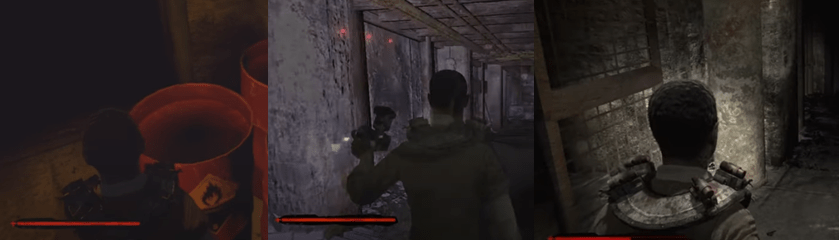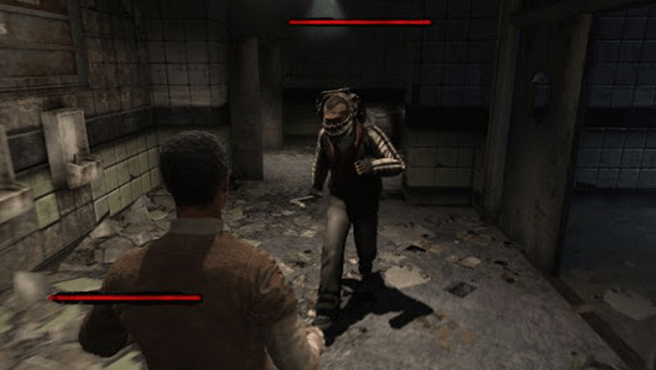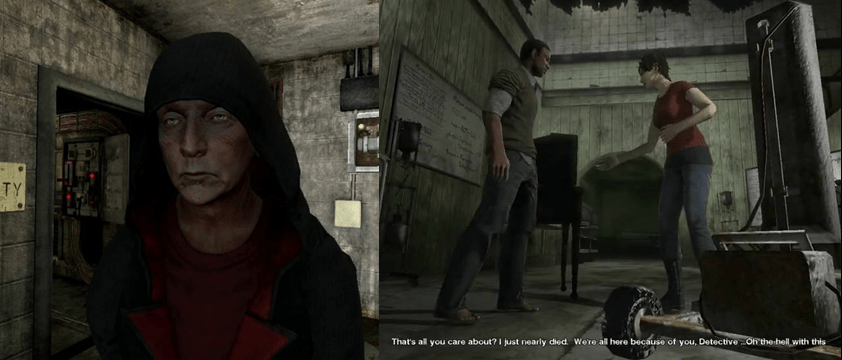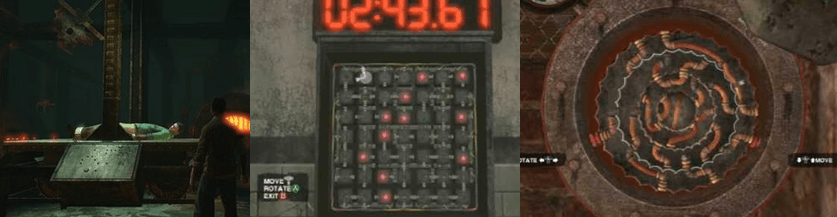
Game Corner: The Evil Within 2 (Xbox One)

Released: 13 October 2017
Developer: Tango Gameworks
Also Available For: PC and PlayStation 4

The Background:
After a long and illustrious career at Capcom in which he created and spearheaded the Resident Evil franchise (Capcom/Various, 1996 to present), Shinji Mikami left to help found Tango Gameworks in a bid to develop new properties and titles, such as The Evil Within (Tango Gameworks, 2014). Although critical reception of the game was somewhat mixed, The Evil Within sold well enough to justify a sequel, which began development shortly after Mikami’s team had finished up working on the first game’s downloadable content (DLC). In response to some of the criticisms regarding the first game’s convoluted plot, the team sought to make The Evil Within 2 more comprehensible while also placing greater emphasis on psychological horror elements. Despite a much shorter production period and some notable technical hiccups, The Evil Within 2 fared much better with critics than its predecessor and was generally regarded to be an improvement over the original.

The Plot.
Three years after the events of the first game, Sebastian Castellanos has left the Krimson City Police Department and continues to be haunted by his experiences. Driving to alcoholism by the death of his child, Lily, and the break-up of his marriage, he reluctantly agrees to re-enter the nightmarish world that plagues his dreams when it is revealed that Lily was actually being used as the Core for a new STEM system.

Gameplay:
The Evil Within 2 is, fundamentally, extremely similar to the first game but also noticeably different in many ways. Where the first game really emphasised a twisted, nightmarish world where anything was possible and that was populated by a variety of gruesome creatures and restricted your resources to keep you constantly fighting for survival, The Evil Within 2 is much more linear and action-orientated title. The difficulty setting you pick for your playthrough will determine how much ammo and damage you can take, which is pretty standard, but even on the “Normal” difficulty, “Survival”, there’s quite a bit of ammo, crafting items, and opportunities to replenish your health through the game, certainly more than in the first game.
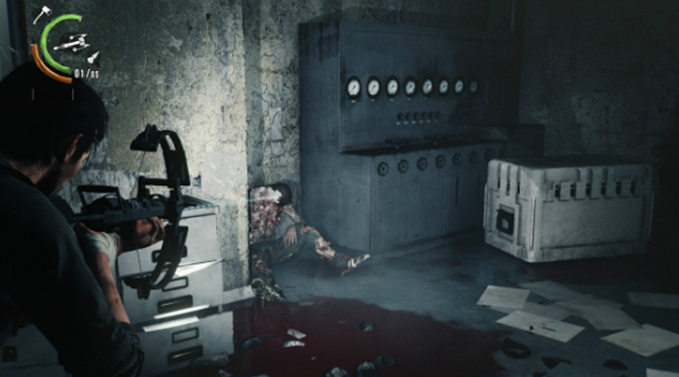
The game’s controls are largely the same as before but tweaked for the better.

Control wise, however, the game is basically exactly the same; you can aim your weapon with LT, shoot with RT, and reload with X, and interact with your environment with A but, this time around, your melee attack is also mapped to RT and Y brings out your Communicator, which allows you to lock on to signals and help lead you towards objectives and objects of interest. Thankfully, you no longer need to worry about burning bodies so, rather than tossing matches with B, B activates your flashlight (Sebastian is no longer hampered by a large lantern this time around), though you can still sprint by pressing in the left analogue stick.
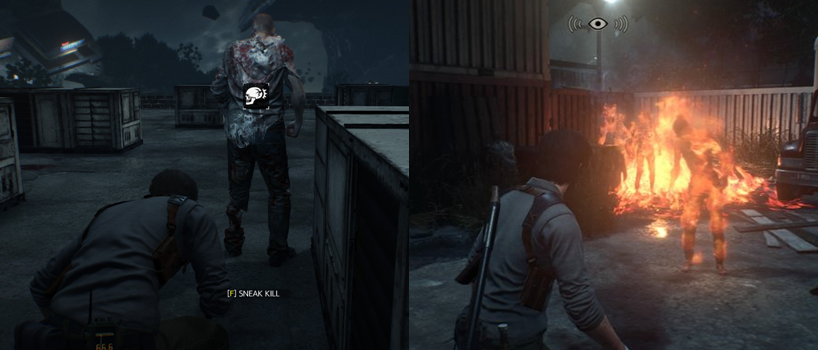
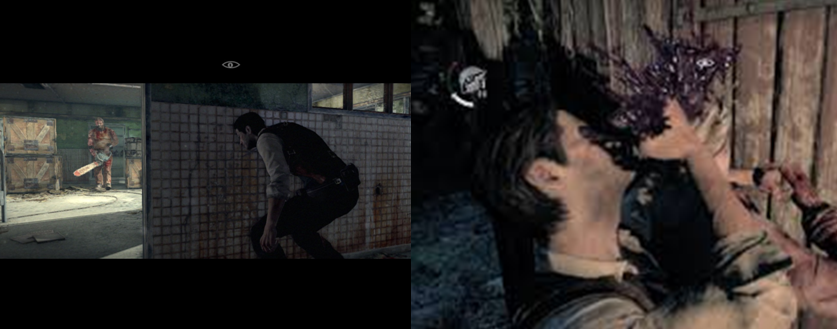
Stay low and sneak around to avoid detection and perform an instant kill move.

Like before, stealth and taking cover is a big part of the gameplay; you can snap to nearby cover by pressing the Right Bumper and shift from cover to cover by pressing up on the left stick. Pressing in the right analogue stick will see you crouch down and sneak around and, when enemies are nearby, you’ll again see the return of the eye-themed “Enemy Alertness” icon that will help you to know when you’ve been spotted. This time around, though, it is much easier to spring away from enemies and out of sight to keep them from pursuing you and there are far ore opportunities for you to sneak up behind enemies and perform a one-hit Sneak Kill, and you’re also given the option to enable or disable an “aim assist” that is super helpful in targeting enemies but combat is much more fluid and far less awkward this time around even without this.
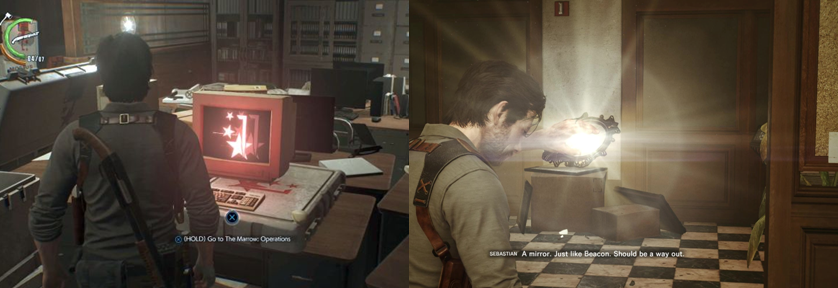
Save areas have now been expanded into two locations to allow you to heal up and upgrade you attributes.

Interestingly, the game also offers the option to enable a first-person perspective; I didn’t play with this as first-person games aren’t really my thing but there was a point in the story that forced you into this perspective and it’s unusual to see this feature included in a game, so it’s interesting, if nothing else. There are far opportunities available to you to heal and craft resources; by exploring your environments, you’ll find Weapons Parts, gunpowder, fuses, and other items that can all be used in workbenches in “Safe Houses” to craft ammo and upgrade your weapons. In these Safe Houses, you’ll usually find similar resources to top up your inventory and will always find a coffee maker, which will fully refill your health with one soothing sip. You can’t abuse this mechanic, however, as it takes time for the machine to refill but you can warp through a cracked mirror like in the last game. This takes you to Sebastian’s office, where you can view documents, slides, access another workbench, and upgrade Sebastian’s other abilities (such as health and stealth) using the torture chair from the last game. In both Safe Houses and Sebastian’s office, you’ll find a terminal for you to insert your Communicator and save but, like before, the game is pretty generous with autosave points.
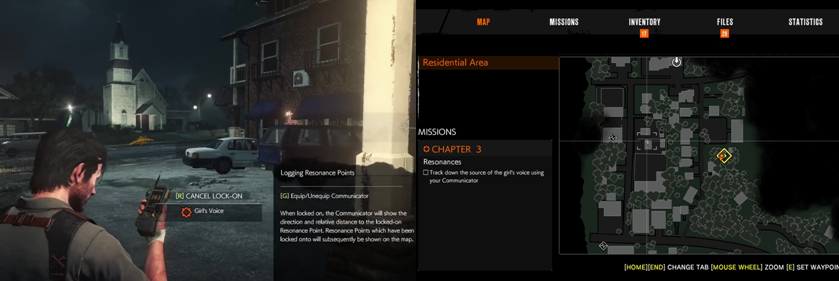
The addition of a Communicator, map, and waypoints makes navigation a breeze this time around.

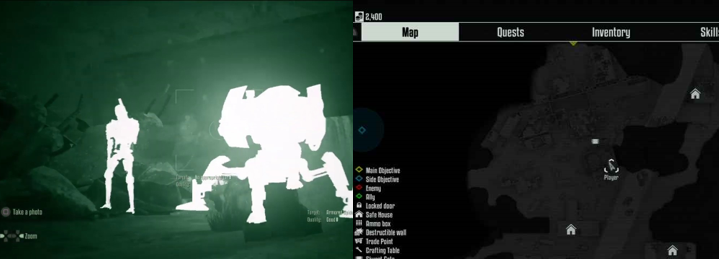
The Communicator is a pretty big addition to the game and, yet, paradoxically not that integral at the same time. At a number of key moments in the story, you’ll have to hold X to tune into a frequency that will lead you to your next story-based objective and Sebastian will often stop (or continue walking) to chat with the game’s various non-playable characters (NPCs) and expand the story. Perhaps the best addition to the game is the inclusion of a map, which is accessed from the inventory menu; from here, you can see a simple to understand layout of the immediate area, key locations like Safe Houses, and set up a waypoint marker that allows you to easily navigate towards any location. It’s amazing how much of a difference this makes, though it is slightly unnecessary as the game is far more linear than the first game despite the fact that you’re often exploring much larger and more open areas this time around.

Access your weapons on the fly without fear of attack and chat with NPCs for side quests and exposition.

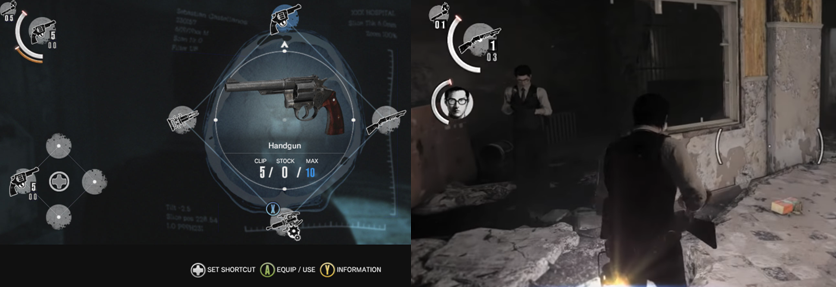
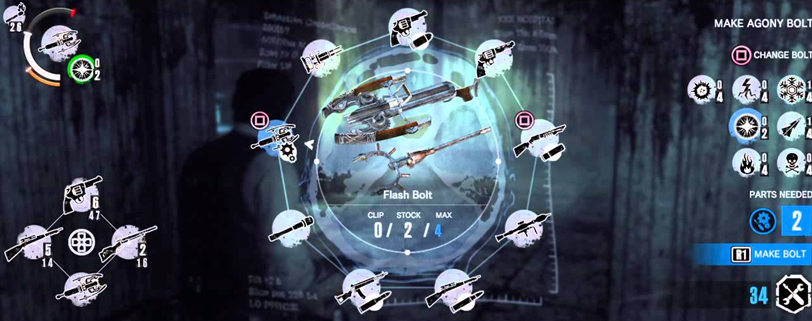
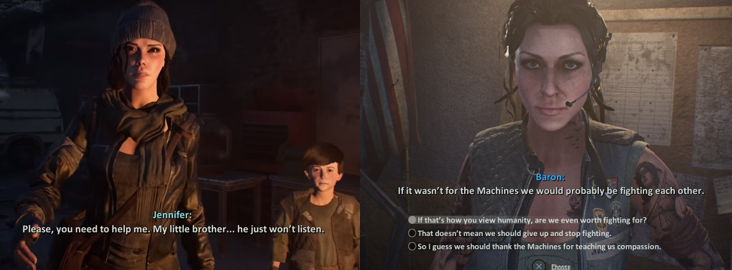
The heads-up display (HUD) remains very similar to the last game and is noticeably sparse to help with your immersion in the game but, this time, you can completely disable it (and all onscreen indicators) from the game’s settings. When you access the “Arsenal Menu” with the Left Bumper, the game actually pauses to allow you to time to select weapons or map them to the directional pad for quick access, which is super helpful. Later on, you can also craft ammo on the go from this menu as well, though it costs you more Weapon Parts to do this on the go as opposed to at a workbench. When talking to NPCs, you’ll often be given a number of different dialogue options that allow you to learn a bit more about these characters, the world around them, and activate side missions. Thankfully, you can skip through or ignore these entirely if you want and the game’s plot and ending don’t really change based on your choices.
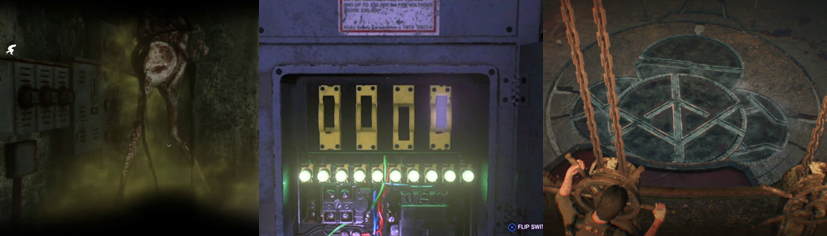
Puzzles are few and far between and extremely simple, even when compared to the first game.

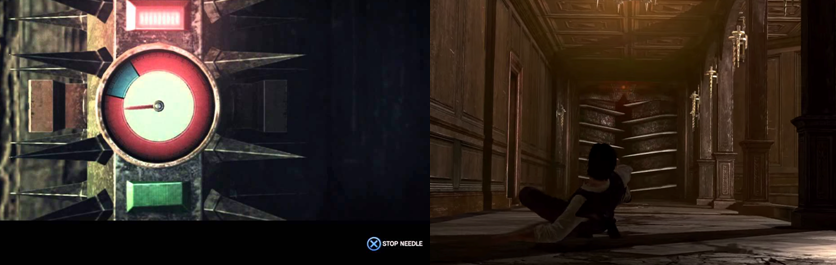
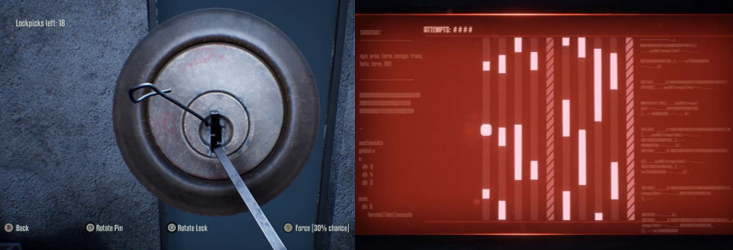
The first game was often littered with traps, many of which would kill you in a heartbeat, but the same isn’t true for The Evil Within 2. There are only a handful of moments where explosive trap wires will dog your progress (this time around, you can’t disable them and must simply duck under them or trick enemies into tripping them on your behalf) and absolutely no instant death traps, which is nice but also removes a lot of the tension and trial and error. The most consistent trap you’ll have to navigate is a series of electrified wires that require you to duck under and inch around to reach your target but one area that did slightly stand out was when you were forced to don a gas mask and forgo the use of your firearms to avoid causing a fatal explosion. There are also a few more instances where you’ll be asked to mask buttons (usually just A) to open doors, pull levers, or turn cranks or rotate the analogue sticks to line up frequency waves to open doors but puzzles are generally extremely simple (even more so than the last game) and boil down to maybe finding a key, flicking switches in the correct order, using a door’s markings to decode a cipher, or shooting a Shock Bolt at a fuse box to open a door.

The game is much more linear but there are still opportunities for exploration..

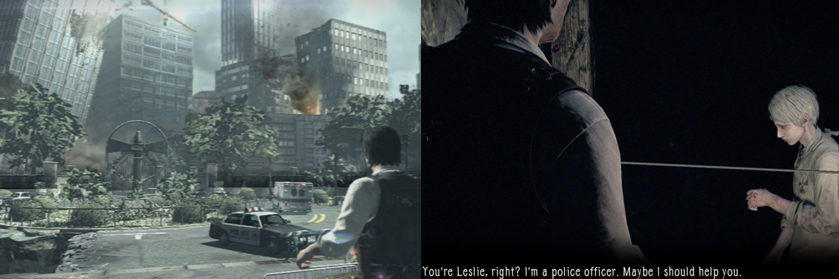
Gameplay is broken up a little bit but has far less variety than in the first game; alongside the aforementioned brief first-person sequence, there is one moment where you and Esmeralda Torres have to hold out against waves of enemies but you’re never asked to take the controls of a mounted machine gun or battle enemies on a moving vehicle or distract larger enemies with bodies this time around. Instead, the emphasis is largely more on exploration; there are numerous instances where you must access a computer and travel through “The Marrow” (which is a sparse, poor attempt at masking a loading screen) to access an underground bunker and different areas of the town of Unity and you’re generally given free reign to explore, which can lead to you partially completing side quests without realising it. As you explore, you’ll get notified whenever your Communicator picks up a signal, which can lead you to viewing “Residual Memories” to understand a bit more about STEM, Mobius, and Unity and the usual documents, newspaper clippings, and diaries will also help flesh things out but it can’t be denied that the story is much less complex this time around.

Graphics and Sound:
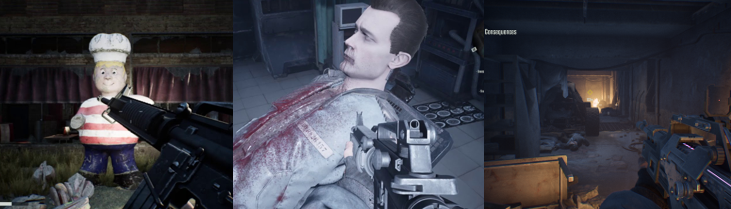
Honestly, The Evil Within 2 doesn’t look that much different to its predecessor; character models are really well done and lifelike (though Sebastian remains a visually uninspiring character) but, despite areas being much bigger, the game’s environments lack much of the foreboding atmosphere and horrific imagery of the first game.
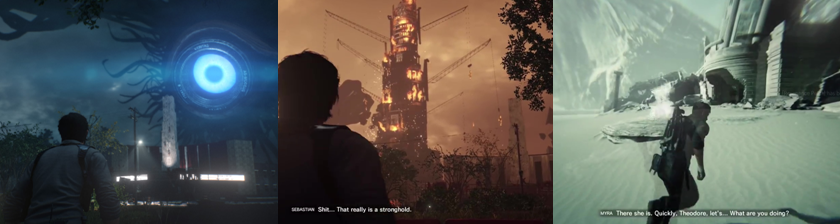
While surreal imagery is still prominent, it’s not as visually interesting or macabre as before.

Unity is quite an uninspiring town; though the influence of the game’s first antagonist, Stefano Valentini, is often felt through the presence of disturbing pictures, a giant camera eye lens in the sky, and murdered Mobius agents frozen in time and staged as “art”, the more bizarre aspects of STEM (twisted hallways, crumbling cities and landscapes, and macabre, nightmarish locations) are downplayed in favour of more sterile locations. The game progressively gets more warped and strange as you progress, though, and by the time you reach the final chapter you’ll be wandering around Unity as it collapses around or and through a desolate limbo trying to rescue Sebastian’s wife but I have to say that I miss the emphasis on gore and disgusting, disconcerting imagery over The Evil Within 2’s more subdued and cerebral presentation.

Graphically, the game doesn’t seem much better than its predecessor and is arguably worse in a lot of ways.

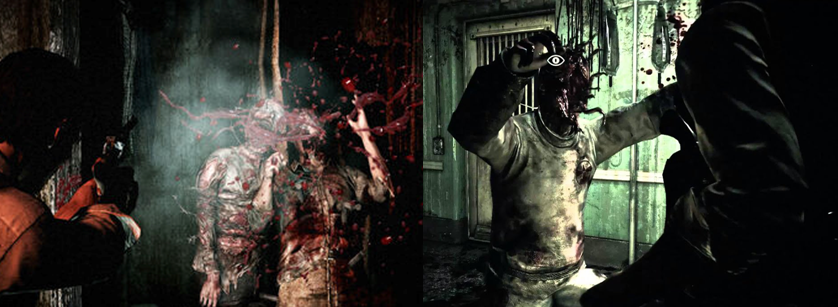
The enemies also suffer a bit because of this; before, they were twisted, terrifying creatures that drew inspiration from a wide variety of media and came in all different variants but here they’re mainly just moaning zombies or flaming brutes. That’s not to say that there aren’t some disturbing enemies and locations in the game (the Obscura and Anima are two of the more horrific enemies and the stronghold of the game’s true antagonist, Father Theodore Wallace, is like a Lovecraftian cathedral) but the problem is that they’re just not as prevalent or as immediately creepy as in the last game. It’s telling, to me, that the finale sees Sebastian forced to relive a few key encounters from the first game and seeing the return of the Keeper enemy only served to reinforce how the sequel’s creature designs are somewhat lacking compared to the original. Add to that the fact that I glitched through some steps once, that there was occasionally a delay in textures loading and graphics popping up around me, and the fact that the game flat out soft locked on me once right before I was about he save and The Evil Within 2 seems like a bit of a step back in terms of its presentation despite appearing to be bigger and the gameplay largely being much more fluid and enjoyable.

Enemies and Bosses:
The enemies in The Evil Within 2 are known as “The Lost” and, as mentioned previously, are far less visually interesting than in the last game, where the looked like weird Cenobite/zombie hybrids that had crawled out of some nightmarish fever dream. Shambling, zombie-like creatures, the Lost shuffle about and are generally found tearing into corpses, wandering around, or rising from apparent death. They were charge at you if they spot you, throw you to the ground, attack with knifes or axes, and like to try and take a bite out of your neck but, as also mentioned, it’s pretty easy to outrun them, stealth kill them, and take out large numbers using explosive barrels, setting fire to oil pools, or electrocuting them by shooting Shock Bolts into pools of water.
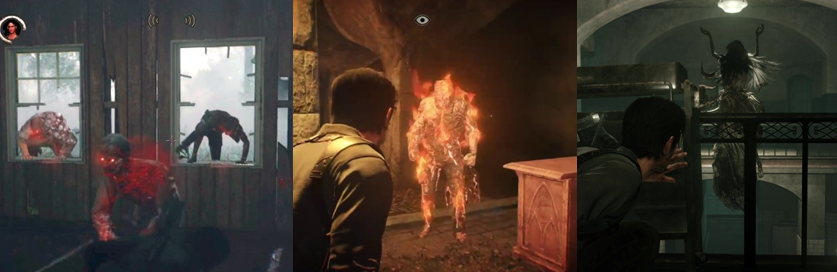
Enemies, while still horrific at times, seem much more generic and predictable compared to their predecessors.

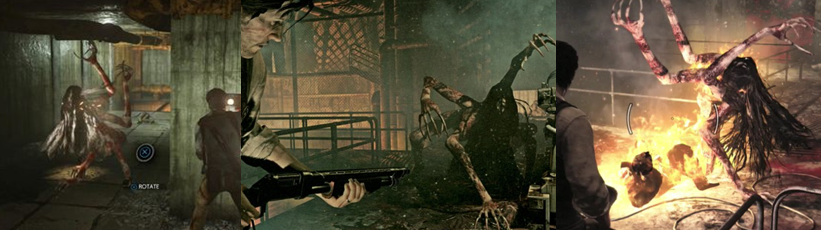
While many of the game’s creatures leave a lot to be desire, there are some interesting and disturbing enemies on offer here: Spawn are gruesome, scuttling corpses that leap at you with their huge jaws full of sharp fangs; Hysterics attack you with knives; the bulbous Glutton creatures will explode when they reach you or are attacked; and the Disciples cause additional damage thanks to their flaming bodies. You’ll also occasionally be tormented by the onryō-like Anima who, similar to Ruvik in the last game, appears every now and then and is completely immune to your attacks; she also drains your health if she gets close to you and forces you to crouch and dash through an ever-shifting maze and you’ll also have to sneak around the glob-like Watcher at one point (or risk trying to kill it by shooting it in the face).

The monstrous Guardian is a nightmareish mish-mash of linbs and giggling heads with a buzz saw for a hand!

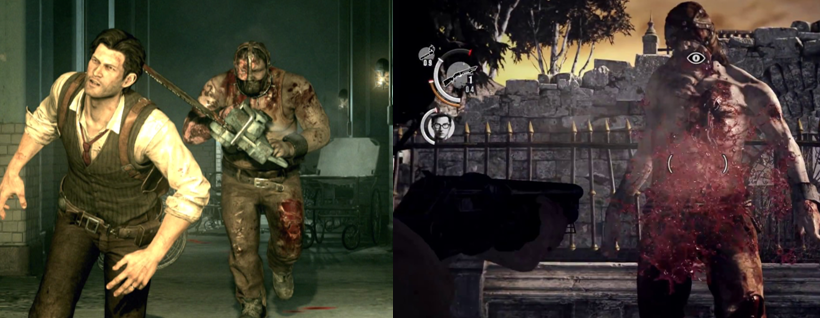
Similar to the last game, the game only really features a handful of bosses, many of which function more like sub bosses and return as regular enemies after being defeated. The first of these you’ll encounter is the abominable Guardian, a gruesome miss-match or bodies and limbs that wields a buzz saw for a hand and pursues you relentlessly at the beginning of the game. Later, you’ll be forced to battle one outside of Cit Hall but, while there’s lots of ammo, health, and places to get a reprieve nearby, you can also dart down an alley way and cause it to be damage by trap wire traps as you escape into the building through a side door. Similarly, you’ll battle the flamethrower-wielding Harbinger first as a boss (where you can shoot at the fuel tank on its back to disable its weapon and set it alight and use nearby levers to douse its flames with the sprinklers overheard) and then as regular enemies out in the streets.
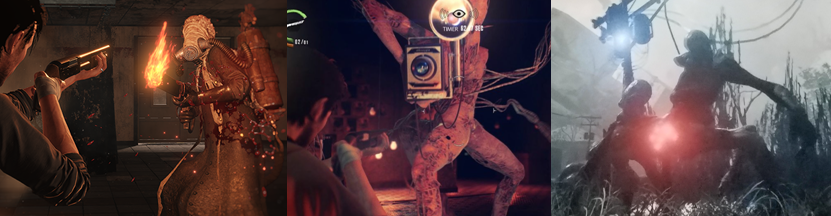
It’s a shame more of the game’s enemies aren’t as disturbing as these bosses…

The aforementioned Obscura also appears more than once; this demonic creature is one of the game’s most striking and memorable monsters in the game and resembles a weird, mangled corpse with an old style camera for a head! It scuttles about on the ceiling in the first encounter and you’re forced to hold it off and survive while waiting for an emitter machine to activate and, if you’re caught in its camera flash, time will slow to a crawl, allowing it to grab at you and attack you. Later, you’ll also encounter the monstrous Effigy, which merges with a nearby telephone pole and tries to smash you with both the pole and its claw-like hands.

After getting past Stefano, you’ll be tasked with fending off some familiar faces from the first game.

When you finally confront Stefano, the battle is one of the more subdued in the game in its first phase, which sees him teleport around his gallery in a puff of smoke and slashing at you with his knife. Once enough damage has been done to him, though, he’ll distort the area into a hellscape and get backup from his gigantic camera eye. Later, during your pursuit of Theodore, you’ll be forced to battle the chainsaw-wielding berserker (more of an interactive cutscene where you simple press A to slice him in two), three of the Keepers (easily dispatched with your more powerful weapons), and even Laura from the first game. This latter battle takes place in the furnace as before but, by that point, you’ll have access to a flamethrower than can make short work of her, too.
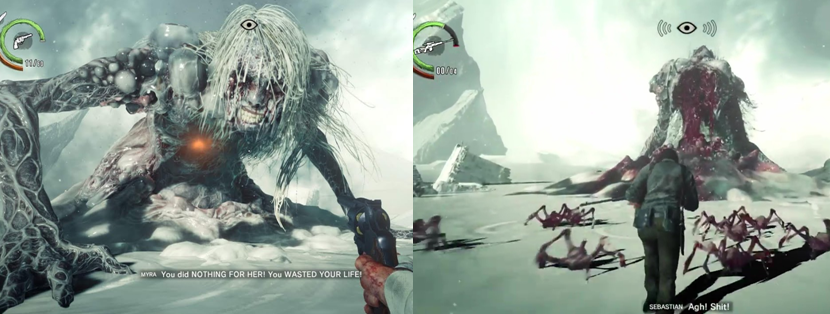
Myra’s horrific final form is a much more difficult finale compared to the simplistic battle against Ruvik.

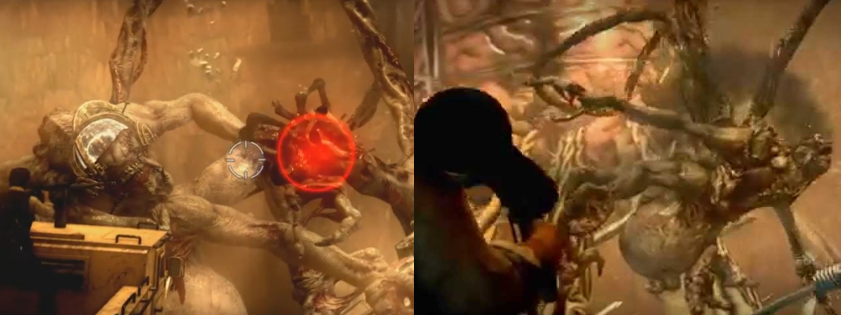
Battling the Effigy is basically a taster of the game’s final battle against Sebastian’s corrupted with, Myra, who transforms into a similar gigantic creature for the finale. Unlike the final fight against Ruvik, this actually requires you to use your own weapons and ammo and a far greater degree of skill as you have to dodge her massive arms and shoot at her stomach to expose her first weak spot. Destroy this and you’ll have to stomp a load of spiders (which will drop ammo and resources) before blasting her arm fro her torso. When this severed limb grabs you, you’ll have to shoot its glowing stump in slow motion before blasting the glowing weak spot in her head. Compared to Ruvik, it’s a much tougher and more involved boss battle but, even then, the game drags out its ending to an uncomfortable degree, featuring a number of long-winded cutscenes and even a brief sequence where you take control of Juli Kidman to shoot down some Mobius agents.

Power-Ups and Bonuses:
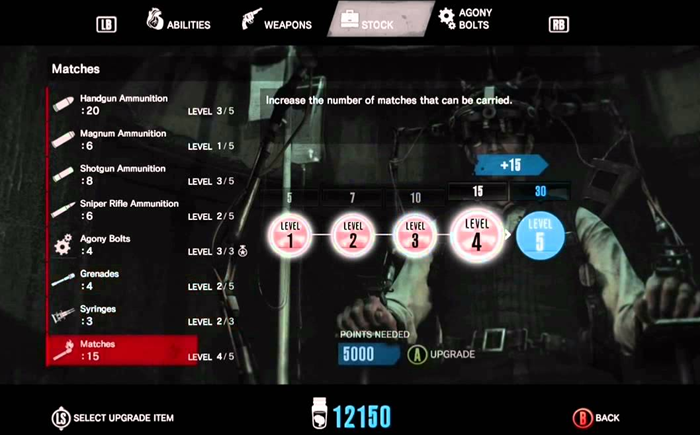
Like before, The Evil Within 2’s locations contain a great deal of resources for you to find by interacting with the environment and smashing wooden crates. Syringes and medical kits will restore your health and you can also find ammo, new weapons in special cases, and both the returning Green Gel and the brand new Red Gel. These can also be earned when, soon into the game, a shooting gallery becomes accessible from Sebastian’s office that places you in a simplisic recreation of areas from the first game and tasks you with hitting high scores to earn Green Gel, Weapon Parts, and other resources. Sebastian’s office also allows you to sit in the familiar torture chair and use your Green Gel to upgrade his abilities; this will increase your maximum health and stamina, your ability to recover both of these, and a number of new abilities. For example, you can upgrade to break free of an enemy’s grip with a bottle if you have one in your inventory, dodge out of the way of enemy attacks, perform Sneak Kills under cover of your Smoke Bolts, or Ambush Kills by stealthily approaching from cover. The Red Gel is used in this skill tree to unlock additional skill levels, which seems a little pointless but it gives you something else to look out for, I guess.

Weapons can be upgraded at workbenches at the cost of Weapon Parts.

From the chair, you can also use the keys you find by smashing special statues to once again open up lockers for additional resources. Many of the weapons Sebastian has access to return, or are very similar, to those from the previous game; he carries a knife for melee combat but can instantly kill enemies if he grabs a one-use axe or distract them by throwing bottles, which can now be stacked in your inventory. Very soon, you’ll get hold of a handgun and, in time, acquire such familiar weapons as a shotgun, sniper rifle (which I had very little use for), assault rifle, and the returning crossbow (now called the Warden Crossbow and capable of firing only explosive, smoke, shock, freeze, or harpoon rounds). Later, you’ll also grab a flamethrower and, after completing the game, gain access to the magnum but you can also find better versions of the handgun and shotgun by exploring your environments. Each weapon can be upgraded from a workbench using Weapon Parts; this allows you to increase their ammo capacity, firepower, and reloaded rate, among others, and this skill tree is similarly expanded with High Grade Weapon Parts. You can also find ammo pouches of certain corpses to increase your ammo capacity and, while pipebombs are missing, the Warden Crossbow is much more accurate and wieldy this time around.

Additional Features:
There are fifty-one Achievements available in The Evil Within 2, the majority of which are earned by simply playing through and completing chapters of the story mode. You’ll also earn Achievements for defeating a certain number of enemies (both in general and in certain ways, like with Stealth Kills and your crossbow bolts), upgrading weapons, and finding collectibles. There are a number of special items you can find that will appear in Sebastian’s office, which are tied to Achievements, and you’ll also earn them for clearing certain sections in certain ways, which will require you to reload a previous save point to pop them in one go.
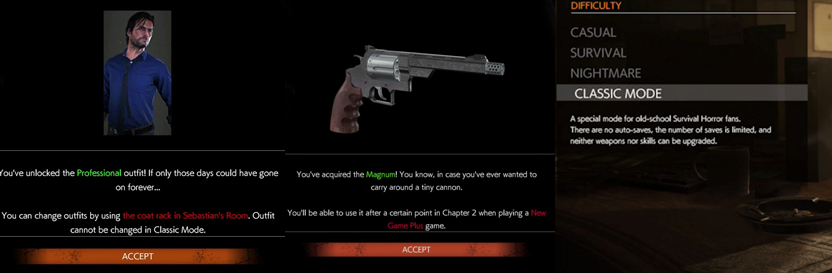
A few unlockables and bonus content add a little replay value but there’s no additional story DLC this time.

Right off the bat, there are free difficulty levels to choose from; when you clear the game, you’ll unlock another, access to the magnum, 40,000 Green Gel points, and a number of skins for Sebastian (which, while nothing too groundbreaking, help to mix up subsequent playthroughs). By signing up for a Bethesda account, and depending on how you purchase the game, you can also access additional perks, such as the “Last Chance Pack” code, which adds a bunch of bonus items to your inventory but, most usefully, the ability to toggle on one-hit kills, infinite stamina, and infinite health. As you’re not penalised for using these “cheats”, the game is made a complete cakewalk with these activated and means you can stack Achievements by just ploughing through on the hardest difficulty without fear of being killed. Also accessible after clearing the game is “New Game Plus”, which carries over all of your upgrades and unlocks and skins and such to a new save file. Unfortunately, you can’t upscale the difficulty when playing New Game Plus and must, instead, start a new file to play on a harder difficulty. There is also no other downloadable content to expand the game’s story or add in new modes like in the last game, no unlockable rocket launcher, and, worst of all, you can no longer freely jump to the game’s chapters, which means that you’ll have to play through the game from the start to mop up any missing Achievements.

The Summary:
In many ways, I preferred The Evil Within 2 over the original; just the inclusion of a map and waypoint system makes it a much more user-friendly experience and the combat has been tweaked just enough so that you’re not hesitating to engage with enemies. The story, which focuses much more on Sebastian and makes him a far more proactive figure, is also far less convoluted (at least until the ending) and the options available for combat make it much more interesting to play. However, it’s undeniably a much more linear game despite how big the locations are and lacks a lot of the features that make The Evil Within interesting and horrific; enemies and environments are rather drab and uninspired, the puzzles are simple and barely a factor, gameplay variety leaves a lot to be desired, and it’s just far less disturbing than the original. Interestingly, while I found the first game frustrating at times, I didn’t consider it to be so hard that it needed cheats for infinite health and stamina and, while I appreciated these inclusions, making it so that you can finish the game and get all the Achievements with these activated really renders any tension redundant and I simply ran around melee attacking enemies and killing them in one hit to complete alleviate the survival aspects of the game as much as the developers eliminated the horror elements by toning down the macabre, disturbing visuals.

My Rating:

Rating: 3 out of 5.

Pretty Good

What did you think to The Evil Within 2? Do you think it was better, worse, or just as good as the original? What did you think to the change in presentation, mechanics, and tone? Were you disappointed with the enemy designs and presentation like I was or did you find it just as disturbing as before? What did you think to the story and the new antagonists? Did you play the game with the cheats activated; if not, what did you think to the game’s difficulty? Would you like to see another entry in this franchise or do you think it’s best left alone now? Whatever your thoughts on The Evil Within games, feel free to drop a comment below.

Game Corner: Saw (Xbox 360)

Released: October 2009
Developer: Zombie Studios
Also Available For: PC and PlayStation 3

The Background:
In 2004, writer Leigh Wannell and director James Wan brought us Saw, a psychological horror film in which two men find themselves trapped in a grimy bathroom, victims of the twisted John Kramer, also known as the Jigsaw Killer (Tobin Bell), and forced to play a demented game of survival where one must die or both must cut through their feet to escape their shackles. Saw was a surprise success; produced on a budget of $1.2 million, it grossed over $100 million at the box office, making it (at the time) the most profitable horror film in about eight years and kick-starting not only an ongoing horror franchise but also inspiring a whole other sub-genre of horror cinema, the “torture porn” genre. By 2009, Saw’s success had translated into six sequels that continued the story, each of varying quality. This, apparently, was the perfect time to capitalise on the franchise’s success with a puzzle-based, quasi-survival/horror videogame. While the game was initially announced in 2006, development stalled somewhat despite the creators of the franchise working closely on the game’s narrative, aesthetics, and gameplay elements. Konami eventually took over the production of the game, viewing it as a potential spiritual successor to their Silent Hill (Various, 1999 to 2012) franchise; however, while the game did well enough to get a sequel in 2010, it received little more than average to mediocre reviews at the time of release.

The Plot:
Disgraced police detective David Tapp, who ran afoul of Jigsaw in the first Saw movie, finds himself trapped in a former mental asylum at the mercy of the Jigsaw Killer. Forced to confront his mistakes and the demons of his past, he must solve a series of gruesome traps and puzzles in an attempt to earn his freedom.

Gameplay:
Saw is a third-person action/puzzle game with an emphasis on puzzle-solving, collecting items, and evading or smartly dispatching of a few foes similar to other survival/horror titles. Players are put into the shoes of a familiar character from the franchise who looks and acts absolutely nothing like the character as portrayed by Danny Glover; here, Tapp is far from the broken, semi-insane former cop with a  grouchy voice thanks to a scar across his throat and is, instead, more like a desperate, guilt-ridden cop.

Former detective Tapp finds himself trapped in one of Jigsaw’s demented “games”.

The game’s story is pretty standard Saw fare; Tapp must try to survive the asylum, which is filled with traps and other victims looking to kill him, solving puzzles and freeing victims chosen specifically to test Tapp’s morals and conscious. Unlike in the movies, though, you must past these tests and free these victims; they then promptly flee through means apparently unavailable to you and you continue on, learning a bit more about Tapp’s character and backstory as you go through Jigsaw’s cryptic taunts, audio tapes, and various documents and clippings found strewn throughout the asylum. However, while this does a lot to flesh out the Saw world beyond the movies and the game does a decent job at recreating the aesthetics of its source material, it’s tough to really enjoy it since Tapp controls like a lump of clay; slow, sluggish, and awkward, your options for exploration and combat are made needlessly complicated thanks to the game’s janky, tank-like controls (Tapp literally walks in reverse when you could back on the analogue stick) that see you jogging around the asylum at a listless pace as though the ground is made of sticky mud. Collision issues will see you sometimes clip into the environment or clip onto of it (the closest Tapp ever gets to jumping) and it can be difficult to navigate thanks to the grey, nondescript surroundings and next-to-useless map.

If you have to choose a light source, always choose the flashlight!

In true Saw fashion, your field of view is limited thanks to ambient, broken lighting, dark corners, and the asylum being little more than a blood, trap, and debris-strewn environment. To help with your navigation, you can acquire three different times to light your way; a lighter (which lights the immediate area a little bit, can cause certain barrels to explode, and goes out when you move too fast), a camera (which illuminates the immediate area in a burst of light but for such a brief period that it’s next to useless), and a flashlight (easily the best source of light as it lights up the largest area and is far more reliable). You can to manually activate these with the Y button, and have to do so every time you restart from a death, but often automatically lose them as the story progresses. Although Jigsaw saved him from the bullet that clearly killed him in the first movie, Tapp must still be feeling the effects as he’s quite a fragile man. A few blows from enemies will send him crumbling to the floor like a ragdoll, you need to constantly be alert from shards of broken glass that will drain your health, and he constantly runs afoul of Jigsaw’s many booby traps scattered throughout the asylum. If you don’t disarm the traps, you’ll get your head blown off, and if you can’t keep your balance you’ll plunge to your death at numerous points.

Combat is something you’ll come to dread in Saw thanks to the game’s sluggish controls.

Luckily, there’s a generous autosave feature and you can simply retry from your last checkpoint and Tapp can pick up bandages, a sewing kit, or bottles of water, or water fountains to instantly refill his health or carry around five syringes to heal your wounds. Combat, however, is a diabolical affair; luckily, there aren’t many enemies to engage with and they usually come at you one at a time because Tapp is a poor fighter in every sense of the word. Tapp can punch with his fists, swing destructible weapons, or shoot at enemies with limited ammo, or lure his enemies into traps to dispatch of them but you better be well prepared for when enemies come at you as they generally attack faster than you can “block” or “dodge” and faster than you cans wing, too. It also doesn’t help that the camera zooms in and kind of freaks out a bit when enemies appear, making it way too easy for you to get trapped in the environment or stuck behind a door or some piece of scenery. Most enemies go down pretty easily, which is helpful, and you can knock them down to finish them off or use the proximity alarms on their collars to blow their heads off but, more often than not, you’ll be trying to land a few strikes as quickly as possible and then backing away to clear some room. Often, I found fleeing from enemies caused them to either stand around aimlessly or despawn completely, which can be helpful, and you’ll often come across a number of enemies fighting with each other so you can sneak past or take care of whoever’s left.

Tapp must endure horrific injuries and situations to progress further.

In place of fighting hoards of enemies, you’ll be tasked with exploring your surroundings (carefully, to Jigsaw’s many instant-death traps), solving a few rudimentary puzzles before tackling Jigsaw’s more gruesome “games”. These range from shoving your hand into barrels of acid or toilet bowls fill of syringes to grab keys, attaching different-sized gears to access better weapons, pressing A, X, B, and Y at the right time or aligning certain screws to unlock doors and such, and (my personal favourite) aligning pipes to stop Tapp being gassed to death. Most of the time, solving these leads you to items and things of interest but you’ll also have to endure a few timed puzzles to progress further; these involve moving racks of pig carcasses before you freeze to death, shutting off steam valves, finding fuses to open doors of shut off electrified floors, bashing down weak walls and slipping through, trying not to get crushed to death, and rewiring fuse boxes.

Saw‘s puzzles are so commonplace that they quickly outstay their welcome.

While many of these puzzles are found throughout the game, some see you battling against the clock; linger too long and you’ll be caught in an explosion, which does help add to the tension and immersion of the videogame but the puzzles are always the same at varying levels of difficulty, meaning it all gets very monotonous very quickly. You’ll also often be tasked with using and exploring your environment to find clues, such as codes and keys for doors or other items to unlock sealed doors, which is very much in keeping with the movies but, again, these generally amount to you visiting a new area (that looks strikingly similar to other areas of the game), maybe navigating a few traps or variations of these same puzzles, dispatching the odd enemy or two, and then getting back to where you need to be. It’s not massively difficult since you pretty much see everything the game has to offer within the first hour or so and it’s not too difficult to find your way around, which is helpful as the game’s map is absolutely rubbish.

Graphics and Sound:
While Saw does a pretty good job of emulating the dismal, gritty, dank visual style of many of the Saw movies, in particular the first three films, and the environments look suitably “lived-in” and dangerous, the game really doesn’t look all that great. Character models are hopelessly low quality, using none of the voices or likenesses of any of the actors save for Tobin Bell, and resemble little more than flailing puppets at times. Cutscenes are little more than simplistic cutaways from the main action and all utilise the in-game graphics and models which, while giving the game come consistency and, again, aligning very closely with the fast-paced, frantic cuts of the movies, serve to only emphasise how lacklustre and mediocre the game looks.

As great as it is to see, and hear, Tobin Bell, Saw‘s graphics aren’t up to much.

Where the game excels, as with the movies, is in its depiction of graphic and gruesome death traps and the gravelly, alluring tones of Tobin Bell’s Jigsaw. Thanks to Bell providing near-constant commentary throughout the game, there’s a continual feeling of dread and suspense as you wonder what is waiting around the next corner or in the next area. While many of the puzzles do outstay their welcome, they’re always punctuated by Bell’s distinct voice and his presence definitely elevates the quality of the game…but not quite enough to ignore its many failings.

Enemies and Bosses:
Tapp isn’t alone in the asylum; he’s been trapped with other victims of Jigsaw’s game, all of whom have been told their only way to freedom is to kill Tapp and retrieve a key from his body. These enemies are few and far between but do have some variations; some have the reverse bear trap on their head, some have metal boxes over their heads, others wield weapons, some have explosives attached to their wrists or shotgun neck braces on that will explode you if you don’t keep your distance, and some toss Molotov cocktails at you. the fact that they can easily attack you without mercy and either kill you outright or knock you to your death makes even the game’s standard enemies a tough obstacle to overcome as you need to be well-prepared before engaging in combat, which helps make every enemy a meaningful encounter but also frustrating thanks to the game’s janky camera, collision detection, and combat controls.

The Pighead fight is the closest thing Saw gets to a traditional “boss” battle.

In terms of actual bosses, though, Saw only really has one encounter that could be deemed as a true “Boss battle”; as you progress through the story, you’ll catch sight of the infamous Pighead, an apprentice of Jigsaw, who haunts the asylum, trapping others in death traps and stacking the odds against Tapp. Eventually, you’ll have to battle the Pig head to get a key to progress; armed with a nail bat, Pighead can be a formidable foe but it’s just as easy to rush past him and lure him into a metal cage, lock him in, and then activate a switch to fry his ass alive. In place of traditional boss battles, each chapter of the game ends with Tapp having to same Jigsaw’s victims from death traps; the first of these is another familiar name (though not a familiar face), Amanda Young, and straight away this trap sets the tone for how annoying Saw can be. Amanda and Tapp are both strapped into a machine and the player must cause red or blue antidotes to correctly drop to the left and right, respectively, using the shoulder buttons. This can be a tedious task as it’s not very clear how to do this and you only get about three chances to make a mistake before you fail and must retry from the beginning. The trap’s difficulty spikes in the second stage where you’ll have to sometimes guide two blues and two reds to the same pathway, which means a lot of forward planning and trial and error.

Many of the games are simply harder versions of Saw‘s regular puzzles.

To rescue Melissa Sing, you’ll have to solve three magnetic maze puzzles before she’s chopped to pieces. If you had one of these games as a kid, this trap isn’t too difficult, especially compared to the previous two traps, but it can be tricky to find a safe path to the spiral symbol that is your goal as it’s often not possible to avoid moving over an x strike and speeding up the threat to Melissa’s life. Three of the victims require you to solve increasingly-difficult variations on common puzzles found throughout the game; the gear puzzle, the fuse box puzzle, and the pipe dial puzzles. How difficult you find these traps will depend on your skill at solving these different puzzles but the ones found in these traps are of considerable difficulty, at times, thanks to being much more complex than those you’ll find elsewhere in the game. While they aren’t massively difficult, it can be tricky to remember the order and sequence needed to quickly solve each part and move on to the next mini game before time runs out; it also doesn’t help that the game constantly cuts away from the mini game so you can see the victim suffering further or edging closer to death the longer you take.

The final test is a question of matching images, which are always randomised for extra frustration.

The final victim can only be freed by matching up items on television screens; shotgun shells must match with a shotgun, for example, and a severed foot with a saw. While this isn’t as difficult or as stress-inducing as some of the other traps, it is frustrating as you only get some many chances to make mistakes and the images are randomised with each retry, making it a tedious game of trail, error, and luck as you’re all-but-guaranteed to make at least one mistake when solving this puzzle. Once you complete this test, though, the final test is yours as you must choose between two doors, “Freedom” and “Truth”, with each one leading to a suitably bleak ending for Tapp and the game in general.

Power-Ups and Bonuses:
Tapp certainly has the odds against him; in keeping with the game’s close adherence to the source material, you won’t find anything helpful like shields or speed-ups here. Instead, you must explore and solve puzzles and search everywhere for health-restoring items or weapons. Though he can bash enemy’s heads in with his bare fists, Tapp isn’t much of a pugilist so it’s best to grab one of the many weapons found throughout he asylum; you can grab steel pipes, crowbars, shovels, bottles (and use your lighter to create a Molotov cocktail and set enemies alight), table legs, hatchets, mannequin arms, and nail bats to break and bludgeon over your enemy’s skulls.

Use a gun, a variety of bombs, or re-wire Jigsaw’s traps to tip the odds in your favour.

These weapons will break apart the more you use them but, luckily, there’s often another weapon nearby or to be retrieved from a downed enemy. You can also obtain a revolver at a couple of points; you only get six shots, though, so it’s best to sue this weapon wisely as it’ll pretty much kill any enemy (bar Pighead) in one shot. You’re also able to cobble together traps of your own to stun, gas, and explode enemies though I found this more cumbersome and annoying than useful; it’s far more useful to simply rearm one of Jigsaw’s existing traps to blow or fry enemies away quickly and efficiently.

Additional Features:
Saw comes with forty-six Achievements for you to earn; many of these are can’t be missed as long as you complete the game’s story mode while others require you to defeat a certain number of enemies, use every weapon in the game, and unlock a certain number of doors. They’re not especially difficult to get in one playthrough and you can always load up a previous chapter to get any you’ve missed by killing the same enemy over and over again. Although Saw comes with two difficulty modes, there’s no real reason to play the harder difficulty as there’s no Achievement tied to it. You can also go into the “Features” menu to view character, environment, prop, and trap concept art, if you like that sort of thing, but that’s about it.

The Summary:
I am a big fan of the Saw franchise; I find the character of Jigsaw intriguing and fascinating because of how skewed and warped his motivations and philosophies are and the gruesome death traps make for some of the most horrific pieces of horror cinema in recent memory. Sadly, while Saw does go to a great deal of effort to match and recreate the look, feel, and atmosphere of the movies it is based on and part of, it fails to really hold the attention for too long. The game is average, at best, and a frustrating mess at worst; with a dodgy camera, janky controls, wonky physics, and a piss-poor combat system, Saw could have been a tense and atmospheric survival/horror game with a focus on numerous increasingly tough, imaginative puzzles but is, instead, an uninspiring experience that is over pretty quickly, adds little to the lore, and requires very little from you other than battling past the game’s screwy controls and mastering a handful of different puzzles until you reach which depressing ending you choose to indulge.

My Rating:

Rating: 1 out of 5.

Terrible

Did you ever play Saw; if so…why, and what did you think of it? Did you struggle with the game’s presentation and gameplay or did you actually enjoy it for what it was? Are you a fan of the Saw franchise? Which of the films do you think is the best, or how would you rank the movies? Whatever you think about Saw, drop a comment below.
Game Corner [Back to the Future Day]: Back to the Future: The Game: 30th Anniversary Edition (Xbox One)


In Back to the Future Part II (Zemeckis, 1989), Marty McFly (Michael J. Fox) travels to October 21, 2015, which is known asBack to the Future Day” to celebrate the franchise and science.


GameCorner

Released: 13 October 2015
Originally Released: 29 September 2011
Developer: Telltale Games
Also Available For: Mobile, Nintendo Wii, PC, PlayStation 3, PlayStation 4, Xbox 360

The Background:
The Back to the Future trilogy is one of the most beloved, iconic, successful, and influential film trilogies, and science-fiction movies, of all time. Sitting in a rare category where each film is as good, if not better, than the last, the trilogy made over $960 million in worldwide gross and has seen numerous adaptations in comic books, cartoons, and other media. For years, talk and rumours of a sequel and reboot have, thankfully, been shot down by both co-writer Bob Gale and co-writer and director Robert Zemeckis. Despite this, a pretty decent animated series and a series of comic books could have been seen as the official continuation of the films until Telltale Games secured the license to create videogames based on some of Universal Pictures’ most successful film franchises. With Gale brought onboard as a story consultant and reworking several of Zemeckis’ original concepts for Part II, the game has been stated to being the closest to a fourth film fans can expect but also taking place in an alternative timeline in the Back to the Future multiverse. With Christopher Lloyd returning to voice his iconic character Doctor Emmet “Doc” Brown and even Michael J. Fox popping up in a cameo appearance, Back to the Future: The Game featured music ripped straight from the films and an extremely faithful recreation of the trilogy’s distinct visual aesthetic despite its cartoonish graphical style. The game was originally released in five individual, downloadable episodes before being collected in a physical edition and, a little later, re-released for the next generation of consoles with Thomas F. Wilson returning to lend his voice to this updated release. Though the game was eventually delisted after the closure of Telltale Games, it received generally positive reviews upon release and, despite some reservations about certain aspects and mechanics of the game, it was Telltale’s most successful title prior to the release of The Walking Dead: The Game (Telltale Games, 2012).

The Plot:
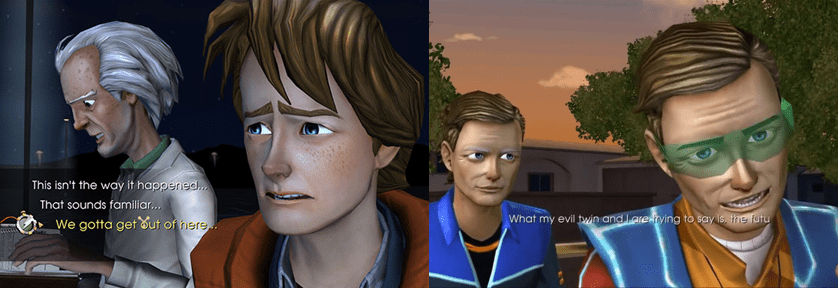
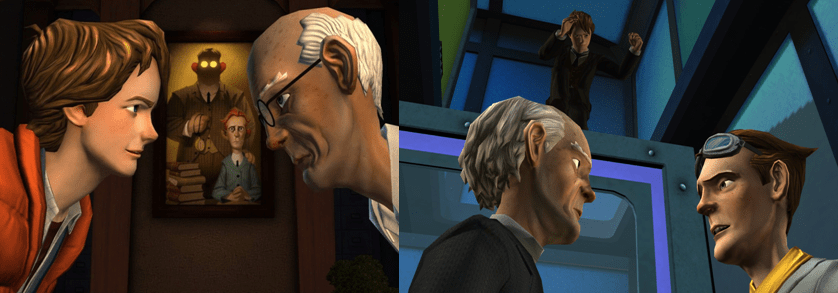
Six months after the events of Back to the Future: Part III (Zemeckis, 1990), Doc Brown has gone missing and is presumed dead. However, when his DeLorean time machine randomly reappears in 1986, Marty McFly travels back to 1931 to find his old friend and bring him home only to run into Doc’s younger self, his own father as a youth, and inadvertently create a dystopian alternative timeline that the two must work together to repair to finally return back…to the future.

Gameplay:
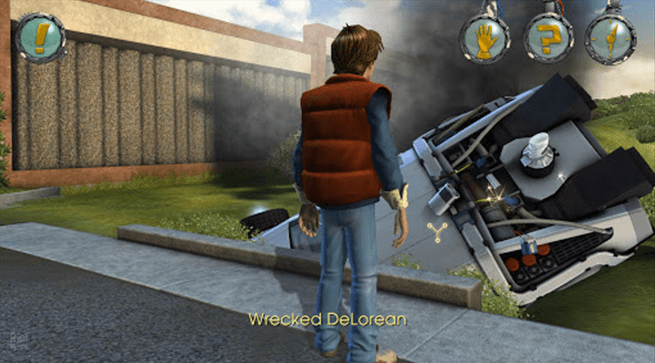
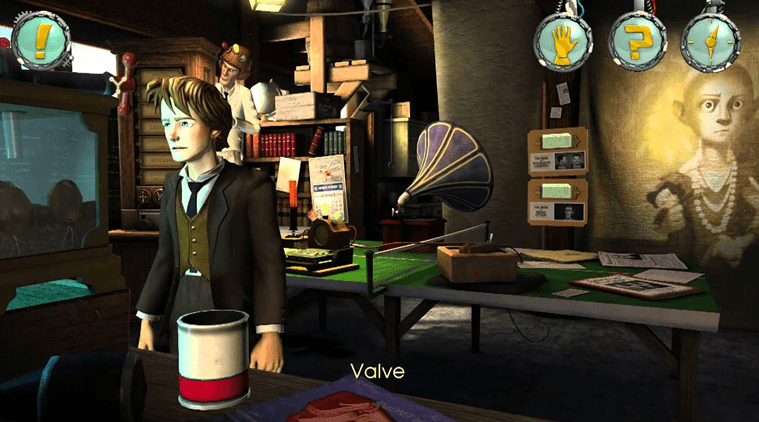
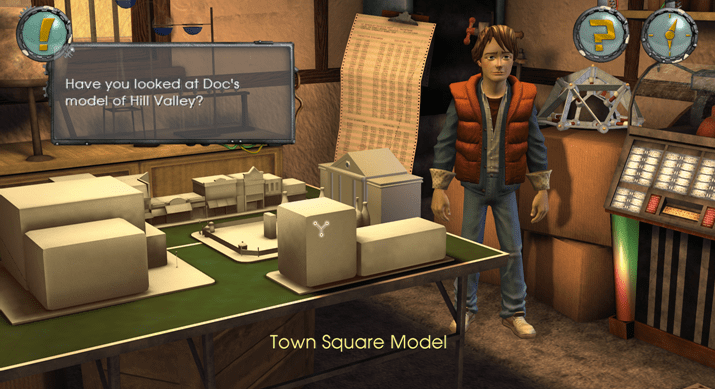
Back to the Future: The Game places you firmly in the role of Marty McFly, the young protégé of crackpot scientist “Doc” Emmet Brown. As Marty, you’ll explore various locations and time periods in the fictional town of Hill Valley, interacting with both new and familiar Back to the Future characters, solving rudimentary puzzles, and obtaining and using items to progress the plot further. Telltale Games were famous for creating digital adventures games, essentially interactive movies, rather than traditional action-orientated videogames. My experience with their titles has, so far, been limited to playing free episodes of some of their other titles and Back to the Future: The Game is the first time I’ve sat down and played one of their games from start to finish.

Player interactions seems more of an emphasis than in other Telltale Games.

Interestingly, Back to the Future: The Game plays very differently from the Telltale Titles I’ve played before; unlike titles like Batman: The Telltale Series (Telltale Games, 2016), Back to the Future features much more emphasis on exploration and player movement over quick-time events or altering the story through a variety of responses. Sadly, though, the game’s controls are quite stiff and clunky; Marty plods around like wading through thick sludge and, while you can hold B to “run”, you’ll never move much faster than a sluggish pace. Considering the game is a glorified point-and-click adventure rather than an action-packed game, this isn’t a massive issue except that the game’s dodgy camera and some awkward map layouts can make it more of a chore to control Marty than it needs to be and I found myself getting unnecessarily turned around or confused thanks to the camera’s positioning or stuck on parts of the environment.

Sadly, you can’t skip cutscenes, which can make repeated playthroughs tedious.

As the game was originally released in five separate chapters, this collected edition is similarly divided in such a way; from the main menu, you can select any chapter at any time and begin a new game as you wish but you’ll need to make liberal use of the game’s save function if you want to earn all of the game’s Achievements with a minimum of fuss as there’s no way to jump to different parts of each chapter. This also affects the game’s replayability as there’s no way of skipping cutscenes or quickly advancing through story elements, which can make subsequent playthroughs far more tedious than they need to be and make gameplay frustrating when you’ve made a mistake and have to sit through entire cutscenes or lines of dialogue with no way of skipping them.

It can be amusing to try out different dialogue options and items just for the hell of it.

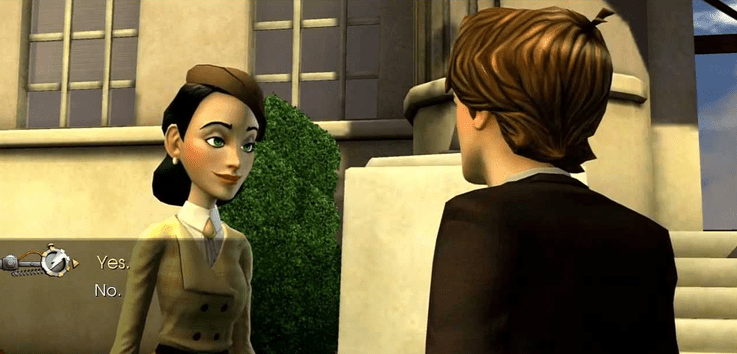
As far as I can tell,  unlike other Telltale Games, there’s no way to really “lose” when playing Back to the Future: The Game; even if you fail to figure out some puzzles or events, you won’t get a traditional game over screen and can simply continue until you get the right sequence or choose the right dialogue option. It can be amusing to select the wrong option and see how characters react or to try and use various items on other characters or parts of the map as Marty, or other characters, will generally have something funny to say or will chew you out for being stupid. The bulk of Back to the Future: The Game’s “action” is made up of character interactions and interacting with the various detailed environments you find yourself in. You can talk to and interact with pretty much everything, learning more about these familiar and new characters and the various timelines Marty ends up in, which can be fun and interesting. Generally, you’ll pick up subtle hints and tips by talking to certain characters but you can also enable or disable in-game hints and mission objects to give you a vague idea of where you need to go and what you need to do. Because of this, it can sometimes be a little difficult to figure out exactly what it is you need to do; you can take your time and explore multiple options at your leisure but, if you’re chasing Achievements, you might want to use a guide as there are a lot of missable Achievements in this game and it can be tiresome having to play through the majority of one of the game’s five chapters just to get to the part you need.

It can be awkward to target people and items with the game’s clunky controls.

Compounding the issue is that the game’s interface is quite clunky at times; you can access your inventory at any time with X. From here, you can examine items and place them into your hands to use on other characters or your environment but, oddly, items will automatically remove themselves from your hands after a few seconds, which gets very annoying as you might find an item you need to use has randomly vanished from your hands right as you need to use it. Similarly, it can be difficult to interact with characters and other elements thanks to the game’s clunky “targeting” system; as you wander around, points of interest will be automatically highlight so you can interact with them but your point of interest might suddenly switch as you get closer, meaning you talk to the wrong person at the wrong time. By holding down the R trigger, you can see every element in the immediate area highlighted and use the right analogue stick to select the one you want but I found this to be equally awkward and clunky and that it was generally easier to just position myself near where I needed to be and edge myself closer to my intended target.

Some of the game’s puzzles are needlessly obtuse and annoying.

Even without these issues, some of the game’s puzzles can be needlessly frustrating; most are a simple case of talking to the right people to learn what you need or where to go but others involve pressing panic switches at the right time, selecting items around your environment to distract other characters, or finding certain items to convince a character to help you. While most of them boil down to a simple case of trail and error, and some are quite fun (like getting into a play-off against Marty’s rival and recreating his iconic and elaborate guitar performance from the first film), others are extremely complex or annoying. In particular, you’ll be required to listen out for certain code words from Doc’s younger self to correctly make rocket fuel (which must be done flawlessly to earn an Achievement), tediously manipulate your environment to create an incriminating Mind Map, or rescue your younger father with as little disruption as possible.

Graphics and Sound:
Like all Telltale Games, Back to the Future: The Game utilises a distinctly cartoony visual aesthetic that takes the general likeness of the franchise’s iconic characters and transforms them into amusing and charming caricatures of themselves. It’s a unique aesthetic, to be, sure and, while it does work for this style of game, characters can tend to look a little…off, at times, plodding and jerking around like marionettes and looking quite basic. I also noticed a few oddities and graphical glitches at times, such as items not breaking like you might realistically expect, background elements glitching out, or items and graphics randomly vanishing from cutscenes.

The graphics and aesthetic are decent if a bit bland at times.

The game’s environments can be quite bland, at times, but all the iconic locations you remember from the films are here: Marty’s house, Doc’s lab, and, of course, the iconic clock tower and town square. While the maps and environments aren’t especially large, they are varied in that you can enter different buildings in different chapters to learn more about different characters, and there’s generally a lot to do, see, and interact with despite how empty and lifeless some of the locations can be. It’s simple but largely very effective and, thanks to the game visiting new time periods (mainly 1931 and another alternative timeline), adds new wrinkles to the lore of the franchise.

The game’s soundtrack and voice acting elevate it and add to its appeal.

Honestly, my only real complaint with the game’s visual style is that Marty takes his appearance largely from the first movie; I don’t know why it is that so much Back to the Future merchandise only ever seems to recreate his attire from the first film rather than giving him a new look but it’s a little disappointing so I was glad to see him dress in period-appropriate clothing as the story progressed. Of course, what really makes Back to the Future: The Game an attractive prospect is the top-notch voice acting (A.J. Locascio does a great Michael J. Fox impression, Lloyd is fantastic as always as Doc (if noticeably aged in his gravelly delivery), and Fox himself even crops up in the game’s final chapter for a voice cameo) and the soundtrack, which is largely comprised of Alan Silvestri’s iconic score from the movies. It’s just a shame, then, that a lot of the game’s dialogue is muted or drowned out by the music or sound effects, meaning you may need to adjust the audio settings from the main menu.

Enemies and Bosses:
Given the nature of the game, there aren’t traditional enemies or bosses as in other videogames; instead, as per the plot, you will be stopped or obstructed by numerous characters who require you to say the right thing, bring them certain items, or you to perform a certain action before they will help you or let you pass. As you might expect, you’ll run into Biff Tannen and his various ancestors and incarnations throughout the game’s story. His father, mobster Irving “Kid” Tannen is one of the game’s primary antagonists while you’re back in 1931. You’ll need to work with Marty’s father to get Kid arrested, lie to him about your credentials as a mobster, and set up an elaborate series of events to burn him out of a high-rise window as he shoots at you with a Thompson machine gun. After Marty and Doc inadvertently alter their future, you’ll also have a confrontation with Biff and his newly-acquired brothers, dodging swings from their baseball bats until you can get them all in position to be electrocuted.

Citizen Brown is an antagonistic version of Doc who plots to keep his timeline intact.

After altering the past in 1931, Marty crash-lands in an alternative version of his present in which Hill Valley is a veritable utopia thanks to a stringent police state lorded over by none of than a heavily altered version of Doc, known as “Citizen Brown”. While Marty is able to win Doc over and make him see that his dreams have been perverted by his new wife, Edna Strickland, this version of Doc later grows directly antagonistic when he has second thoughts about restoring Marty’s timeline. This leads Marty into directly opposing his friend and mentor to ensure that Doc’s younger self stays on the path towards science rather and societal correction.

Edna comes in many forms and is the game’s primary antagonist and all-around pain in the ass.

As a result, the game’s primary antagonist turns out to be Edna Strickland, a seemingly harmless character in the game’s first chapter who ends up manipulating Doc’s brilliance into brainwashing the “hooligans” of Hill Valley into being more law-abiding and docile civilians. So committed against sin and vice is Edna that it leads her to not only burn down the local speakeasy, setting in motion the events of the game’s plot, but also stealing the time machine and accidentally erasing Hill Valley from existence. When Doc and Marty travel back to 1876 to confront her, they must manipulate her fragile state of mind to learn the date and time of her arson to set things right, which ultimately leads to the player having to set up an elaborate trap involving sand bags and a chandelier to end her misguided plot.

Power-Ups and Bonuses:
As an interactive movie, there aren’t really any power-ups in the traditional sense of the word to be found. Instead, as you interact with others and further the plot, you’ll acquire a variety of items to be used in specific situations. Some of these will need to be handed to Doc’s faithful dog, Einstein, to progress the story or set up distractions and events you need to move the plot along, others will need to be brought to specific characters to convince them to help you or otherwise alter their destinies.

Additional Features:
There isn’t really much else to Back to the Future: The Game; as mentioned, there are a number of Achievements to acquire, with a lot of them being easily missed without a guide, which is probably where the bulk of your next playthrough will be concentrated. Don’t get me wrong, the game’s story (essentially a new take on the familiar story beats of the original trilogy) and the voice acting is entertaining enough to warrant another playthrough but, as you can’t really affect characters in the same way as in other Telltale Games, there isn’t as much incentive to try different dialogue options as in the studio’s other releases. The 30th Anniversary Edition of the game also comes with a behind the scenes video…that can no longer be viewed as the servers and Telltale’s website have long been shut down. I would have expected this edition of the game to come with, at least, a gallery of concept and development art but apparently this was too much to ask for and you simply get a questionably improved version of the base game.

The Summary:
Your enjoyment of Back to the Future: The Game will most likely depend on how enjoyable you find glorified point-and-click adventures and your level of patience. It’s not an especially hard or lengthy title (each chapter takes maybe an hour or so, depending on how you get on with the game’s vague hints and fetch-quests), nor or is an especially attractive or complex game, but it’s a fun enough distraction for what it is, with far more required of the player than other Telltale Games I’ve played. What elevates the game is, of course, the voice acting and the level of fidelity it has to its source material. As a continuation of the trilogy’s storyline, the game works incredibly well, advancing each character’s story while still exploring new, unseen avenues into their pasts and characterisation. Like Ghostbusters: The Video Game (Terminal Reality/Red Fly Studio, 2009), Back to the Future: The Game is a worthy continuation of a beloved franchise that is let down only by some graphical and gameplay hiccups and, perhaps, the genre of game the films have been adapted into. Had the game, perhaps, mixed up some of its methodical pace and adventure aspects with a few more action-orientated sections (like actually driving the DeLorean or taking part in one of the iconic chase scenes) and had some actual branching pathways, it might have been even better but, as is, it’s an inoffensive and decent enough little game.

My Rating:

Rating: 2 out of 5.

Could Be Better

Did you ever play Back to the Future: The Game? If so, what did you think of it? Did you find any oddities or get scuppered by the odd camera and control scheme? What did you think of its plot and attempts to continue the Back to the Future trilogy? Which Telltale Game, or Back to the Future film, is your favourite and why? How are you celebrating Back to the Future Day today? Whatever you think about Back to the Future, feel free to share your thoughts in the comments below.

Game Corner: The Evil Within (Xbox One)

Released: 14 October 2014
Developer: Tango Gameworks
Also Available For: PC, PlayStation 3, PlayStation 4, Xbox 360

The Background:
Shinji Mikami joined Capcom in 1990 and worked on a number of successful handheld, 8- and 16-bit titles during his first six years with the company. In 1996, though, Mikami developed the first Resident Evil (Capcom, 1996) videogame, which not only popularised the “survival-horror” subgenre but was an incredible success upon release. Since then, Mikami spearheaded or was heavily involved in Resident Evil’s sequels and spin-offs, including taking over as director of Resident Evil 4 (Capcom Production Studio 4, 2005) and changing the direction of the franchise. However, by 2010, Mikami had left Capcom to develop new properties and titles under Tango Gameworks; the first of these was The Evil Within (known as Psycho Break in Japan), a title which Mikami aimed to return to the roots of the survival-horror genre, which had become increasingly actionorientated over the years. Despite some criticism regarding technical issues, The Evil Within was received rather favourably; while some struggled with the game’s difficulty and convoluted plot, the atmosphere and horror elements were notably praised. The game was also the second-best selling game in the United Kingdom upon release and earned an even more highly regarded sequel in 2017.

The Plot:
After arriving at a brutal massacre, Detective Sebastian Castellanos is pulled into a distorted world full of nightmarish locations and horrid creatures after pursuing a mysterious, seemingly supernatural hooded figure known as Ruvik. Trapped with limited resources and relentlessly hunted, Sebastian is left to fight for his survival and uncover the mystery of Ruvik and the horrific world Sebastian’s found himself trapped in.

Gameplay:
The Evil Within is a survival-horror videogame very much in the style of Resident Evil 4 in many ways; my experience with the Silent Hill franchise (Konami/Various, 1999 to 2014) is sadly limited but, from the bit I’ve played of the first game, The Evil Within is clearly heavily borrowing from the more nightmarish and twisted reality of Silent Hill than the virus-heavy narrative of the Resident Evil franchise. Like in Resident Evil 4, you have full 3600 control of your character and the camera rather than being restricted by tank controls and set camera angles, and you’re also given much more options in terms of combat. You can melee attack with Y using your fists or bottles, interact with the environment with A, burn bodies and pools of gasoline with your limited supply of matches with B, aim with LT and shoot your weapons with RT, reload with X, and spring with LB. you can’t hold the sprint trigger down for too long, though, as you’re hampered by a stamina meter and Sebastian will be left vulnerable and out of breath if you run for too long.

Sneak past enemies or creep up behind them to pull off an instant kill move.

One of the big mechanics of The Evil Within is the sneaking and stealth-based gameplay that is pushed as a big thing in the first few chapters of the game’s story and then all but vanishes for the bulk of the gameplay as you’re given more ammo and weapons, before rearing up again near the finale of the game. You can use RB to sneak around when enemies are nearby and a helpful eye-themed “Enemy Alertness” icon will let you know when enemies are unaware of you or actively searching for you. When the eye widens, you should sprint out of site or hide inside a nearby locker or wardrobe until the danger has passed but be careful as enemies will pull you out of your hiding place if they see you try to hide. Still, if you manage to sneak up behind enemies, you’ll be able to pull off an instant kill move with a press of the A button but I found enemies become very aware of your presence even when you’re being super stealthy so this was often quite tricky to pull off. As much of the game is seeped in an unsettling darkness, you can also use your lantern by pressing in the left analogue stick to light the way but this will also attract nearby enemies (though, again, this becomes less of an issue hen you gain more resources).

Set your weapons and healing items to the D-pad for quick use and take advantage of any backup.

Like all great survival-horror titles, The Evil Within excels in building a horrific, foreboding atmosphere thanks to its unsettling, often gruesome visuals and twisted, reality-bending narrative. To help with this, the heads-up display (HUD) is extremely sparse to increase your immersion in the game’s horrifying locations and narrative. You’ll see your health, stamina, and currently-equipped weapon and ammo and that’s about it unless you’re joined by one of Sebastian’s partners, like Joseph Oda, who often help you out with some additional firepower. If they’re attacked, you can fend off their attackers and heal them by holding down A (which helpfully doesn’t waste your own healing resources). You can set your weapons and healing items to the directional pad (D-pad), which helps you to quickly switch weapons or replenish your health without going into the inventory wheel, which slows the in-game action to a crawl but doesn’t pause it completely and can thus leave you vulnerable.

Puzzles are few and far between in The Evil Within but are suitably macabre (and a bit unfair, at times).

Interestingly, The Evil Within is surprisingly light on puzzles, labyrinthine environments, and the use of keys and other items to progress. Occasionally, you’ll have to acquire a key to open a door or work your way through a grim and grimy location avoiding instant death traps, fending off enemies, and running from Ruvik as you try to open a central door, but these moments are few and far between. Instead, The Evil Within is a much more linear game than its forefathers, meaning that you’re not afforded a map this time around. For the most part, this isn’t an issue but it wouldn’t have hurt to have a map available since a lot of the environments are a bit grey, dark, and look alike so it can be easy to get turned around sometimes. As a result, though, you never really have to worry about pushing statues or getting a bunch of extraneous items or combining them together and, instead, will be more focused on blasting enemies or bashing their heads in than worrying about jewels. However, when puzzles do crop up, they’re fittingly gruesome: you’ll have to insert probes into brains while looking at nearby diagrams and listening to audio tapes, press the right buttons on surgery tables to avoid being skewered and reveal a hidden exit, sneak past wire traps and rush through spiked traps, and shut off valves of steam or activate flames to get past certain areas, and turn a few dials here and there in order to progress, take out enemies, or free your comrades.

You’ll need to constantly watch out for traps and hazards that threaten to skewer or explode you.

During Chapter 11, though. you’ll also have to shoot down corpses hanging above the flooded streets in order to distract and swim past a monstrous creature, which can get pretty tense as your window of opportunity is very small, and you’ll also be chased by chainsaw-wielding berserker’s and suddenly ensnared in traps that you must shoot or run out of or face a grisly end. Indeed, traps and hazards such as these are one of the most recurring dangers in the game; these are dotted around every location, springing up on you when you least expect it and often skewing you or blowing you into bloody chunks with little warning. Many of these will result in instant death, requiring you to retry from your last save point, but others can be disarmed by holding A, sneaking up on them, or pressing A at the right time in a small mini game. Disarming traps such as these will net you additional junk (which you can also acquire by smashing crates and such), which is used in the game’s (thankfully) extremely limited crafting system to create ammo for your “Agony Bolt” crossbow. You’ll also find Green Gel in jars and bubbling on the floor after you defeat enemies; be sure to grab this whenever you see it as you’ll need it to upgrade Sebastian’s abilities and weapons in the game’s haunting save areas.

Graphics and Sound:
Honestly, The Evil Within is quite a bland game in many ways; much of the environments take place in such uninspired locations as a hospital, sewer, grimy caverns, and gothic laboratories, meaning that a lot of the colours are subdued and feature a lot of black, grey, and brown. However, the game excels in the use of lighting and a perverse, macabre atmosphere that really adds to the sense of dread and tension in every area. Things may look perfectly normal one minute and then, very quickly, become warped either by Ruvik, Sebastian’s apparently fragmenting mental state, or the presence of certain enemies.

Environments are forboding and ominous, if a bit drab and interchangeable at times.

Bodies, bloodstains, and gore are in abundance in almost every area you visit; you’ll find dismembered corpses, flickering lights, smashed up areas and some truly disturbing labs and operating theatres that more closely resemble torture chambers or slaughter houses. Sebastian’s journey takes him through a variety of locations, all of which are generally seeped in a thick, ominous darkness or carry an menacing sense of dread thanks to the carnage that surrounds him or the use of screams and ambient sounds (mostly haunting, almost taunting voices). There’s also some cool weather effects on display; rain splatters on the screen, wind blows through trees and grass, and environments twist and change as Ruvik bends them to his will with often devastating effects.

Much of the game draws visual inspiration from Resident Evil, Silent Hill, and other horror franchises.

When The Evil Within breaks free from restrictive corridors filled with barbed wire, wreckage, and corpses, it really starts to feel much more unique amongst other survival-horror videogames; you’ll wander through the castle-like ruins of weird mish-mash of cultures, venture through a city that is constantly shifting and changing and collapsing around you like something out of Inception (Nolan, 2010), but you’ll also recognise a number of the tropes and references to Resident Evil along the way. The hospital and laboratories of the game, for example, are very reminiscent of Umbrella’s facilities, as is the mansion you eventually explore; you’ll also spot a few familiar typewriters but the game also evokes imagery from Silent Hill through its narrative and horror franchises like The Ring (Various, 1991 to 2019) and Hellraiser (Various, 1987 to present) in its enemy designs.

Sebestian might not be the most compelling character but he’s thrust into some horrific situations.

While the game’s use of music and ambient sounds is pretty good, if uninspiring at times, it’s the lapses in sound and use of ominous groaning or wails of some unspeakable eldritch abomination that really add to the game’s unsettlingly atmosphere. The voice acting is okay, for the most part, but kind of reminds me of the B-movie delivery of games like The House of the Dead (SEGA AM1, 1996) and even the original Resident Evil while still treating the events of the game with a grim seriousness that further emphasises that its meant to be unsettling and disturbing rather than thrilling or cheesy. Sadly, thanks to the nature of the game’s narrative, the plot is all over the place; much of the narrative is focused on Sebastian trying to figure out the mystery of Ruvik while the world literally falls apart around him and questioning his sanity but it turns out to be this weird, pseudo-virtual reality environment of sorts that really isn’t elaborate don all that much in the game’s cutscenes or dialogue. Instead, you’ll have to root through the many mysterious and ominous documents and the comments of non-playable characters (NPCs) around you to get a better idea of what the hell is actually going on which, while creating a bit of a disconnect between me and Sebastian’s plight, I found did lend to the nightmarish appeal of the game as it was literally like playing through some ghastly nightmare where nothing makes sense and the world is full of shrieking, gabbling zombie-like creatures and unspeakable horrors and gore.

Enemies and Bosses:
As you desperately plough your way through the game and try to figure out just what the hell is going on, you’ll find yourself besieged by a number of grisly creatures that literally come to life before your eyes as corpses stagger upwards, seemingly innocent blood stains burst free with screaming ghouls, and enemies burst apart into freakish abominations. The most common types of enemy you’ll encounter are known as “The Haunted”; these dishevelled reanimated corpses are like a cross between zombies, Cenobites, and the Las Plagas enemies of Resident Evil 4 and will stagger and rush at you in a blind fury looking to take a bite out of your neck. They’re also capable of attacking as a group and with weapons such as knives, crossbows, and even guns, and will eventually don body armour and wield machine guns, shotguns, Molotov cocktails, and can even activate traps by pulling levers. Thankfully, they go down relatively easily, especially after a few shots to the head, but you’re also encouraged to burn their bodies upon defeat to avoid them springing to life once more.

Ghastly, zombie-like enemies will rush at you and attack using edged weapons, explosives, and even firearms!

The haunted come in all shapes and sizes, including much bigger and more rotund enemies who can tank your shots, ones who rush at you in a suicide run, and even ones that appear invisible until the moment before they strike. You’ll also have to contend with some disturbing little baby versions of the Haunted that seep out through walls and drop from the ceilings, but these are easily dispatched with your melee attacks. You’ll also encounter far larger versions (who are best avoided rather than tackling directly unless you have some heavier weaponry on hand) and the disgusting AlterEgo variants who shamble about the place, take far more damage to defeat, and puke up viscera onto you when they got close to you!

The game’s bigger, more dangerous sub bosses will require your more powerful weapons to put down.

Such larger, more grotesque enemies serve as The Evil Within’s mini bosses; the first enemy you encounter, for example, is the chainsaw-wielding Sadist who cannot be harmed. Instead, you have to frantically run from him and sneak around him to avoid being sliced in two but, later in the game, you’ll encounter these brutes as mini bosses in increasingly confined areas; thankfully, by then you’ll be packing a shotgun and some explosive weaponry so they’re not too difficult to put down as long as you keep away from the wild swing of their chainsaws. Similarly, while exploring Cedar Hill Church, you’ll have to fight past the misshapen, monstrous formally conjoined twins Neun and Zehn, who rush at you and try to smash you into a bloody puddle in a confined area. Luckily, Joseph is on hand to offer support with a sniper rifle and you can use your more powerful weapons to slow them and finish them off one at a time.

The Keepers are similar to Pyramid Head but are much easier to put down…with the right weapons…

Another prominent sub boss, of sorts, is the Keeper; these hulking creatures wield meat cleavers and pursue you with a screen-distorting effect and dropping barbed wire mine traps on the floor. Because their heads are protected by a metal safe, the only way to kill these bastards is to aim for the ample chests but, quite often, killing one will simply cause another to spawn out of nearby safes, which can also spring to life and attempt to attach to your face. As a result, a mixture of stealth and tactics are advised when facing the Keepers, which can often be avoided altogether and mainly serve as a formidable distraction while you try to shut off steam valves and progress further.

The Amalgam Alpha was a horrendous boss figh, especially when it enters its second phase and eats you!

As you might expect from the man behind Resident Evil, you’ll also have to battle a number of bizarre and monstrous creatures to progress; one, the Sentinel, is a giant wolf-like creature transformed into a hideous monstrosity and which likes to hide in nearby bushes before pouncing on you and trying to bite your face off. Another is Quell, a massive octopus-like creature that attacks you in the sewers and likes to hide in pipes and grab you with its tentacles; when it does, you have a small window to shoot its face to damage it and save yourself from a gruesome end. Easily the most prevalent and annoying, however, is the Amalgam Alpha creature, which appears to be an eldritch, nightmarish spider/scorpion hybrid that rampages through an underground car park and was, easily, the toughest and most annoying boss fight of the game. This thing is really big and its weak point (an eye on either its tail or within its gaping mouth) can be really tricky to hit; luckily, the car park is full of ammo and other resources but you’ll have to be quick on your feet to avoid its super frustrating instant kill move.

Laura is a shrieking, persistent threat best staved off with fire and avoided lest she pummel you to death!

As Ruvik remains elusive for most of the game, the most prominent antagonist you’ll face for most of the game is Laura, an onryō-like girl who emerges, shrieking and wailing, from bubbling bloodstains in certain parts of specific chapters and scuttles after you like a spider, instantly smashing your head in if she gets a hold of you. You’ll encounter Laura three times over the course of the game and she gets more aggressive and difficult to face each time: in the first encounter, you simply have to run around a corner and set alight a pool of gasoline to scare her off but you’re then forced to battle her in an incinerator room. Here, she demonstrates her ability to teleport and emerge from nearby corpses so you’ll have to make sure that you burn these and arm yourself with nearby torches to stave her off but the only way you’ll defeat her is to trick her into spawning inside of one of the incinerators and pulling the lever. The last battle against her is even worse as it has multiple stages that see you fending her off by shoot levers on pipes to spew fire at her and desperately making your way towards an elevator before she can grab you. While it is possible to do her in using nearby flame traps and your conventional weapons, it’s worth coming back after you’ve unlocked the rocket launcher to make these fights easier as she’s basically indestructible otherwise.

You’ll battle Ruvik’s monstrous final form without fear of exhausting your precious resources.

Finally, there’s the primary antagonist himself, the mysterious Ruvik, who is apparently the mastermind behind all of the game’s events. Occasionally, Ruvik will spawn into a location and begin to chase you; if this happens, my advice is to run as fast as you can and hide in a wardrobe or under a bed until he disappears as he’ll explode you into bloody chunks otherwise. Later, you’ll encounter Haunted who assume his guise, who can be easily put down without much trouble, and the entire final chapter of the game is dedicated towards making your way to a final confrontation with Ruvik. Here, he merges with the Amalgam Alpha to become the Amalgam, a Lovecraftian beast that you must run from as it chases you up the side of a building before commandeering a machine gun and a rocket launcher to finish him off for good. In this final boss fight, you don’t need to worry about expending your ammo or running around in a panic; you simply have to move to the left or right to avoid his claws, aim for his head, and try not to miss withy our rockets. Eventually, you’re given a split second to shoot the final bullet at Ruvik’s exposed head but it’s okay if you miss as the autosave point is right before this section so take your time and put an end to him for good by stomping on his exposed brain.

Power-Ups and Bonuses:
As you explore the many nightmarish environments of The Evil Within, you’ll find a lot of junk and helpful items to pick up, especially if you smash open crates and open up any drawers or cupboards. You’ll acquire syringes and medical kits to restore your health (these latter will also briefly extend your health at the cost of a few seconds of disorientation), ammo for your weapons, matches, and Green Gel. You’ll want to grab as much of these as you can (be sure to reload your weapons and cycle through your Agony Bolt variants to stockpile as much ammo as possible) in order to have the best chance of success in combat.

In addition to the usual firearms, your Agony Bolt can fire a number of different arrows.

Sebastian is afforded all the usual weapons you should expect from a survival-horror videogame; begins with a simple pistol but soon acquires a shotgun, the aforementioned Agony Bolt, a sniper rifle, and even a magnum as the game progresses. These can usually be found in attaché briefcases so be sure to explore your environments fully to get your hands on more weapons and ammo, and Sebastian can also make use of nearby bottles to throw at and bash enemies with, pipebombs, and explosive barrels (which he can also awkwardly kick around to best destroy enemies). In addition, the Agony Bolt can shoot multiple different types of arrows, from explosives to freezing blasts to stun shots, all of which can be either found in the environment or crafted with a simple press of a button from the inventory menu.

Find Green Gel to upgrade Sebastian’s abilities, ammo, and weapons.

At numerous points throughout each chapter, you’ll find mysterious cracked mirrors that transport you to the save room. Here, you can use any keys you find from breaking special statues to open up lockers and access some extra ammo and also use your Green Gel in a very ominous looking chair. This allows you to upgrade Sebastian’s abilities, such as his maximum health and stamina and melee damage output, and weapons, allowing you to increase your maximum ammo capacity, reload time, accuracy, and overall effectiveness for each weapon. It’s worth stockpiling Green Gel and spreading it wisely to increase Sebastian’s health and the amount of matches he can carry while also focusing on each weapon at a time; I favoured upgraded the shotgun and saved that for the more troublesome enemies but you may prefer to upgrade the Agony Bolt or sniper rifle.

Additional Features:
There are forty-one Achievements on offer in The Evil Within, many of which require a bit more strategy to unlock than simply clearing every chapter. Indeed, almost every chapter of the game has a specific requirement to unlock an Achievement, such as defeating a Sadist with a stealth kill, surviving an onslaught of enemies without Joseph being hurt, or killing Laura rather than simply outrunning her. You’ll also get Achievements for more mundane things, such as stealth killing five enemies in a row without being discovered, upgrading weapons and skills, or killing a certain number of enemies in specific ways, as well as finishing the game on higher difficulties or without any Green Gel upgrades.

Clear the game to unlock bonus weapons, new difficulty levels, or purchase the DLC for extra story content.

The game has four difficulty settings, with two available right from the start; while you can lower the difficulty at any time, you can’t raise it and, after finishing the game, you’ll unlock additional weapons to use in the ‘New Game+’ mode, which allows you to replay any chapter on the difficulty you cleared it on. You’re also given 50,000 Green Gel points to spend and unlock a model viewer but, annoyingly, your rocket launcher and machine gun have limited ammo, meaning you can’t just plough through the game’s chapters willy-nilly. Still, it does give you the edge in tracking down any statue key, map pieces, and documents you missed the first time through and working toward 100% completion. There are also a couple of expansion packs available to download that add an extra thirty Achievements to the game in addition to expanding upon the story with new playable characters and enemies to battle. I haven’t actually bought this, however, so it’s not my place to comment upon it but the game was appealing enough that I may explore this extra content later down the line (or if there’s a sale on).

The Summary:
The Evil Within certainly was a disturbing head-trip of a videogame; very little about it makes sense as you play it, with the events appearing to be the result of Sebastian slowly going insane but eventually being revealed to be the results of some bizarre experiment that, even now, I’m a bit unclear on. The result is a very unpredictable and gameplay experience full of unsettling imagery and enemies, gore, and ghastly creatures of all shapes and sizes that pull from a variety of other media and horror elements and mash them together in a truly nightmarish and ominous videogame that maintains a constant sense of dread and anticipation as you’re never quite sure what’s going to happen next as Sebastian is battered and tossed all over the place through a constantly shifting nightmare world.

While it can be annoying and tedious, the game does a great job of conveying a macabre and ominous dread.

Having said that, though, there were a few flaws in the game. It’s not always immediately clear where you need to go as environments tend to look the same (especially in chapters set within the hospital or similar locations), some of the boss battles and enemies were ridiculously unfair thanks to them having one-hit kill moves in their arsenal (something I’m always frustrated by), and expanding Resident Evil’s save rooms out to a whole area was a bit laborious at times when I just wanted to quickly save without having to trudge about in the slowly-dilapidating hospital foyer. Still, it was a harrowing experience, one that really conveyed a tangible sense of dread and horror; Sebastian might not be the most compelling or dynamic character but his “Everyman” persona worked well with the increasingly insane and macabre things he was faced with and it was nice to feel that sense of foreboding menace once again, even if the game does veer more towards action than survival-horror thanks to you have just enough ammo and resources to get through each chapter rather than having to constantly worry about inventory management.

My Rating:

Rating: 3 out of 5.

Pretty Good

Are you a fan of The Evil Within? Did you enjoy the game’s ominous atmosphere and mind trip of a story or was it too derivative for you? What did you think of Sebastian as a protagonist, his supporting cast, and Ruvik as the main antagonist? Did you enjoy all the allusions and references to other survival-horror videogames and horror media or do you feel like that got in the way of the game’s more unique qualities? Would you like to see more from the Evil Within franchise? Which survival-horror videogame or franchise is your favourite and why? Whatever your thoughts on The Evil Within, or survival-horror in general, drop a comment down below.

Game Corner [MK Month]: Mortal Kombat 11 Ultimate (Xbox One)


To celebrate the simultaneous worldwide release of Mortal Kombat (Midway, 1992) on home consoles, 13 September 1993 was dubbed “Mortal Monday”. Mortal Kombat’s move to home consoles impacted not only the ongoing “Console War” between SEGA and Nintendo but also videogames forever thanks to its controversial violence. Fittingly, to commemorate this game-changing event, I’ve been dedicating every Monday of September to celebrating the Mortal Kombat franchise.


Released: 17 November 2020
Originally Released: 23 April 2019
Developer: NetherRealm Studios
Also Available For: Nintendo Switch, PC, PlayStation 4, PlayStation 5, Stadia, Xbox Series X

The Background:
Mortal Kombat was a phenomenal success for Midway; thanks to its controversial violence and unique digitised graphics, the game stood out from the likes of Street Fighter II: The World Warrior (Capcom, 1991). While the franchise went from strength to strength during the 2D era of gaming, Mortal Kombat struggled to really stand out amidst a slew of revolutionary 3D fighters and, following the lacklustre release of Mortal Kombat vs. DC Universe (Midway Games, 2008), the series looked to be in serious trouble after Midway went bankrupt in 2010. Thankfully, Warner Bros. Interactive stepped in and the Mortal Kombat team was rebranded as NetherRealm Studios. Their first order of business was to get their violent franchise back on track, which they did with Mortal Kombat (NetherRealm Studios, 2009), a particularly well-received reboot of the surprisingly convoluted lore. This gritty, violent reboot again stirred controversy but sales of the game alone were enough to cover the costs of Midway’s acquisition and work on a follow-up soon began.

After the disappointing Mortal Kombat vs. DC Universe, Mortal Kombat made an impressive comeback.

Mortal Kombat X (ibid, 2015) instantly impressed and out-did its predecessor in every way, being both the most violent entry and having the biggest launch in the franchise’s long history at the time. Mortal Kombat X also scored very well and the success of the game earned it not just a host of additional downloadable content (DLC) but also an expanded version, Mortal Kombat XL, in 2016. Keen to capitalise on the good will they had earned back with these releases, NetherRealm announced the development of Mortal Kombat 11 at the Games Awards 2018, a game that saw the triumphant return of actor Cary-Hiroyuki Tagawa to the role of Shang Tsung and sold over eight million copies by October 2020. Like its predecessors, Mortal Kombat 11 received an expanded addition that included all of its DLC fighters and even additional story mode content and was met with favourable reviews, though some criticised the randomisation of the game’s unlockables and the overreliance on grinding, mechanics that, for me, affected the appeal of Injustice 2 (ibid, 2017).

The Plot:
After the defeat of Shinnok at the conclusion of Mortal Kombat X, Raiden has become corrupted by the Elder God’s amulet and, angered at the Thunder God’s repeatedly meddling in the fabric of space and time, the keeper of time (and Shinnok’s mother), Kronika, plots to rewrite history to erase Raiden from existence. With past versions of classic Mortal Kombat characters showing up all over the place, and Earthrealm’s most dangerous and long-dead enemies forging an alliance to usher in Kronika’s “New Era”, Earthrealm’s Special Forces and allies face a battle against time itself to keep the realms from being torn asunder.

Gameplay:
As you might expect by now, Mortal Kombat 11 Ultimate is a 2.5D fighting game in which players can pick from one of thirty-seven characters and battle through the game’s single-player story mode, fight one-on-one against another player or computer-controlled opponent, battle their way though a variety of arcade-style towers, or challenge other players to a variety on online battles. Battles take place in a best-of-three format and against a time limit, though you can alter these settings (and many others, including the difficulty of computer-controlled opponents) from the game’s comprehensive menu to speed up gameplay or make it more accessible.

One of the things I love about Mortal Kombat is that gameplay and combos are generally easy to pick up.

As in the other 3D Mortal Kombat fighters, fights in Mortal Kombat 11 are extremely accessible and easy to master. You can attack your opponent with punches with either X or Y, kicks with A or B, block with RT, throw (again, this is more like a grapple) with LB or X and Y and a directional input, and interact with the game’s environments when indicated with RB. You can also dash towards and away from your opponent, jump in or crouch down to attack or avoid projectiles, and string together combos by pressing the attack buttons and using directional inputs quickly. The game features a comprehensive tutorial mode that teaches you all of the basics and intricacies of the game’s combat, which gets deeper and more complex depending on your skill level and who you play as but is still extremely easy for even novice players to pick up and pull off a few simple combos.

In addition to trademark special moves, characters can also pull off gruesome Fatal Blows.

Each character also boasts a number of special moves, also pulled off by a few simple button and directional inputs (back, forward, X, for example, or forward, down, B); these can be stringed together with combos and augmented with a well-timed press of RB (this will, however, drain a meter at the bottom of the screen but this will quickly refill in time). Unlike in the last two games, though, you can no longer build your meter towards a gruesome X-Ray move; instead, when your health is sufficiently depleted, you’ll have the option of pulling off a “Fatal Blow” once per fight (not per round) to mash your opponent into mush. While these are suitably impressive, violent, and gory, I have to say that I miss being able to build up to and pull off a momentum-changing special move whenever I want rather than when I’m near death. While special moves are pretty easy to perform, you can review them at any time from the pause menu and even “tag” team so they appear onscreen for easy reference, but I would have liked the option to pick and choose which ones are displayed for quick reference.

Fatalities are more visceral and gory than ever and see you dismembering and eviscerating your opponent.

As horrific as the Fatal Blows can be, though, the real star of the show is, once again, the game’s Fatalities, the trademark of the franchise. At the end of the deciding round (usually round two), you’ll be told to “Finish Him!!” (or her…) and given a short period of time to stand in a specific spot and enter another button combination to tear your opponent to pieces, usually resulting in their guts, brains, and eyes bursting from their body or them being shredded and blown apart. Every character has three Fatalities available to them: one that is readily available, one that is locked and must be unlocked in the Krypt (or looked up online…), and one that is assigned to pulling off special Fatalities in certain stages (“Stage Fatalities”, like the classic uppercut into an acid pit) and you can also find (or purchase) “Easy Fatality Tokens” to pull them off more easily and practice them in the Fatality Tutorial.

There’s more than one way to finish your opponent, including a couple of non-lethal options.

Fatalities aren’t the only way to finish your opponent, though; by following a specific set of instructions during a fight (such as not blocking or hitting a certain number of moves and ending the decisive round with a specific attack), you can once again end your foe with a “Brutality” (although, as Factions are no longer included, Faction Kills are also not present this time). You can also pull off a non-lethal “Friendship” if you don’t wish to eviscerate your opponent and even replenish a small portion of their health by showing “Mercy” to allow the fight to continue a little longer. There are benefits to finishing off your opponent, though, as this will award you Hearts, one of four different forms of in-game currency, additional Koins (the primary form on in-game currency), and contribute to your player level and allow you to unlock additional bonuses.

Once again, it’s going to take a lot of grinding to earn enough to unlock everything in the game.

One of the biggest complaints I had about Injustice 2 was the sheer abundance of different in-game currencies and the unfortunate emphasis on grinding for levels and unlockables and the randomness of the game’s loot crates. Sadly, Mortal Kombat 11 carries a lot of this forward; there are numerous customisation options available to you, from backgrounds and icons for your gamer card to individual gear and skins for each character but pretty much all of them are locked behind the game’s time-consuming grinding system. You earn Koins, Soul Fragments, Hearts, and Time Crystals by playing every single one of the game’s modes; while each of these can be spent in the Krypt to unlock chests and release souls (which will net you additional currency, skins, gear, augments, and Konsumables), Time Crystals can be spent in the in-game shop but, as items in the shop at so expensive, you’re encouraged to spend real world money to unlock additional stuff.

Battle through Klassic and online towers to earn rewards, see character endings, and unlock gear.

Unfortunately, while each character has a whole load of gear and skins and customisation options available to them, these are locked behind grinding; you can find many of these in the Krypt but others are unlocked by playing story mode, completing the character tutorials, or besting the game’s many towers. As in the classic 2D games, you can once again pick between three different towers (Novice, Warrior, and Champion); which tower you pick determines the amount of fighters you’ll face and the degree of the rewards you’ll earn from completion. You can also take on the Endless tower to face and endless number of opponents until you quit or are defeated and the Survival tower in which the damage you receive from each fight carries over to the next. Similar to Mortal Kombat X and Injustice 2, you can also challenge a number of different online towers, the “Towers of Time”; these provide you with a variety of challenges but are only available for a set amount of time before they’re replaced with a fresh challenge. However, you even access this mode you first need to clear a number of tutorials first, which seemed a bit redundant, and you will need to pay and also perform certain tasks (such as a certain amount of attacks or specials) to complete each character’s specific tower and unlock more gear and skins for them.

Timelines collide in the story mode, which occassionally asks you to pick between two fighters.

A big part of the game is its story mode; once again, the story is broken down into twelve chapters, with each chapter assigned to at least one character but, every now and then, you’ll be given the option of picking between two characters. It doesn’t really matter which character you pick, though, as you don’t even need to tick off all of these options to 100% the story mode and it hardly affects the narrative at all. Despite the fact that you can’t finish off and kill your opponents, the story mode is a great way to earn Koins and gear and get to grips with each character; the story sees characters from the past return to life as Kronika attempts to rewrite history, which effectively undoes a lot of the development done to the series in Mortal Kombat X but it’s a good excuse to have classic characters return to the series. You can set the difficulty setting for the story mode whenever you like but there are no Achievements tied to beating it or any of the other mode son higher difficulties but you do generally earn better rewards for taking on more difficult challenges.

Graphics and Sound:
Mortal Kombat 11 looks fantastic; character faces still look a bit shiny and odd at times (particularly the females) but there’s even less distinction between the in-game graphics and the many cutscenes you’ll see as you play through the story. Every character is full of life and little quirks, such as Liu Kang constantly hopping from foot to foot in true Bruce Lee style, Kano nonchalantly spitting on the floor, and Skarlet cutting herself open. If the winning fighter is too close to their fallen foe when a round ends, they’ll back away with their own unique animation and voice clips and taunts can be heard throughout each fight as you pull of special moves, combos, and gain victories. Unfortunately, as always, the developers continue to render the character’s different endings using a motion comic aesthetic and voice over rather than utilise the full motion CGI cutscenes used to great effect in the game’s story, which continues to be a disappoint for me and I’ve never really understood this choice.

While environmental interactions seem limited, they’re still a great way to deal some damage.

Where Mortal Kombat 11 fails a little bit is in the stages; stages are a big part of any fighting game but especially Mortal Kombat and NetherRealm Studios’ recent efforts since they introduced the concept of interacting with various parts of the environment. This returns again, allowing you to skewer opponents with spears, throw bodies at them, wall run out of harms way, or toss or wield a variety of weapons (such as a chainsaw and a sledgehammer) to deal additional damage. These will often finally utilise the gruesome x-ray feature that was a big part of the last two games (which can also be triggered with certain special moves and augmented specials) but it feels as though there are a lot less opportunities to interact with the background and pull off Stage Fatalities than normal, making environments look and feel very alive but being disappointingly light on interactive elements despite all of the cameos and interesting elements at work in the background.

The game goes to great lengths to recreate iconic environments and locations from the first two games.

One thing I did like, though, was the return of some classic stages from past Mortal Kombat games, such as the courtyard and the dead pool; the best stage for this is, easily, the Retrocade stage, which randomly generates pixel-perfect recreations of classic Mortal Kombat stages complete with music. The game also goes above and beyond to recreate Shang Tsung’s island in immaculate detail in the Krypt; not only does it feature every stage from the first Mortal Kombat but it also recreates scenes and locations from the brilliant Mortal Kombat (Anderson, 1995) and cameos and references to numerous Mortal Kombat characters, which makes it a fantastic area to explore that is sadly let down by how confusing the Krypt’s map system is. Not only that but Cary-Hiroyuki Tagawa lends his voice and likeness to Tsung once again, adding his unmatched gravitas to the character, and you can even buy a skin pack that adds skins for Sonya Blade, Johnny Blaze, and Raiden that adds three more likenesses and voices from the film.

As gruesome and visceral as the Fatalities are, the Fatal Blows are gloriously rendered in macabre detail.

While the game does excel in its many cutscenes and does a great job of telling its story with just the right level of cheese and seriousness, the main draw of the game is in its violence and gore and Mortal Kombat 11 certainly delivers in that respect. Skin is literally peeled from the bones, eyeballs fly in geysers of blood, bodies are dismembered, split into pieces, dissolved, and shredded, and limbs are torn apart in a variety of ghastly ways and it’s always a joy to see the horrifying ways characters are going to mutilate their opponents. The Fatal Blows are sometimes just as good, if not better, as any of the game’s Fatalities, with characters being stabbed, shot, and blasted in ways that would surely kill them only for the characters to hop right back up afterwards. While character’s clothes and accessories don’t rip or tear during the fights, they do seem to get stained by blood at times and skin can be seen baring wounds and scars from battle.

Enemies and Bosses:
As a fighting game, every single character in Mortal Kombat 11 is your enemy and you’ll be forced to do battle with all of them at least once, at some point, as you play through the story mode and arcade towers. Because every character controls and fights a little differently, with some focusing on ranged attacks or brawling while others emphasis slow but hard-hitting attacks, it’s best to sample each for yourself and to get an idea of your favourite character’s different abilities and variations in order to achieve success. Also crucial is mastering a handful of the game’s combos; many are as simple as X, X, Y or X, Y, X but others require directional inputs, longer button presses, and the co-ordinated stringing together of frame-perfect attacks and special moves. Luckily, though, every character usually has one or two simple combos for you to master so it’s simple enough for players of any skill level to pick up and play.

Your attack strategy may have to change depending on who you are fighting or playing as.

Some characters, though, play a little differently to others and this affects not only how you play but also how you fight them. Shang Tsung, for example, can not only steal the soul of his opponent, which not only drains their health but also has him assume their form and moveset for a short period, but can also morph into various masked ninjas from the franchise; Shao Kahn primarily attacks with his massive hammer, which can make his attacks slower; Jax Briggs can charge up his metal arms with punches and other attacks, which allows him to pull off his projectile attacks; and Erron Black can whip out a shotgun, which allows him to fire at and melee attack his opponent but also needs reloading and to be manually put away. Other opponents can be a lot cheaper than others; Noob Saibot, for example, is always a bit of a pain because of his vast array of teleporting attacks and the same applies to Mileena, who’s capable of quickly teleporting about the place and launching sais at you. There are also some returning favourites you’ll have to watch out for, such as Sub-Zero’s ice ball, Scorpion’s kunai spear, and Liu Kang’s lightning quick kicks and fireballs but the new characters have their own tricks to watch out for, too. Geras, for example, loves to spam his little sand pit trap and Certrion will spawn elemental hazards out of thin air to trap and hurt you.

Cyrax and Sektor can only be fought in the story and you’ll face tough boss battles in the Towers.

When playing through the game’s story mode, you’ll also have to fight a couple of familiar faces in the form of Cyrax and Sektor. These cybernetic ninjas sadly don’t make the cut this time around so they essentially fill the role of mini bosses, in a way, despite appearing quite early on in the story mode. In addition, there will also be time sin the story (and in certain towers) where you have to face two opponents in a handicap match very similar to the “Endurance” matches from the first game, which see your opponents automatically tag into battle once their comrade has fallen while you’re forced to continue with whatever health you have left. When taking on the Towers of Time, you’ll get to battle against a character that has been augmented to “boss” status; this means that you can’t use Konsumables and that your opponent will be super tough, requiring multiple players to take on the challenge while its active to help bring them down and earn rewards.

After Kronika is defeated you must choose between facing Fire God Liu Kang or Shang Tsung.

When you play the story mode or battle through one of the other towers, your final opponent will be Kronika, an unplayable boss character who presents a unique challenge compared to the likes of Shinnok and Shao Kahn. The battle against Kronika takes place in one round but is split between three fights against her and three different locations and time periods, with each phase seeing you having to battle a randomly generated opponent. Unlike other characters, Kronika cannot be thrown, staggered, or hit with a Fatal Blow; when you try any of these attacks and certain combos, she’ll take damage but you won’t see the usual animations play out, which can leave you open to one of her devastating attacks. Kronika likes to teleport around the arena and summon energy balls and projectiles but her most lethal attack is a time warp that renders you helpless and drains a massive chunk of your health bar, which basically means that it’s best to reach her final phase with as much health as possible or else you have to replay the entire fight from the beginning. At the conclusion of the Aftermath story mode, you have the choice of facing either Shang Tsung (who has usurped Kronika’s powers) or “Fire God” Liu Kang (a merged form of Liu Kang and Raiden) as your final opponent. Unlike Kronika, though, these are standard battles and subject to all the normal gameplay mechanics, meaning you’re free to hit your Fatal Blows and augmented special moves and combos without fear of being left vulnerable. Indeed, as long as you’re proficient enough with a few combos and special moves, these fights should be noticeably easier than the one against Kronika though be wary as Shang Tsung and Liu Kang are also much more versatile in their attacks than Kronika, who favours bursts of temporal energy over combo strings.

Power-Ups and Bonuses:
Like in Injustice 2, each character has a number of gear that can be equipped but, thankfully, unlike in that game, these do not affect the character’s stats or abilities and are merely cosmetic. As you battle with your character, their gear will level up and unlock up to three augment slots and you can then equip augments to their gear to increase their special attacks, defence, and other attributes to make them more efficient. Similar to Mortal Kombat X, each character has a number of variations available to them but, this time, it’s up to you to equip and assign these variations to each character; these are limited to three slots, which allow you to assign different special moves and abilities to each character to differentiate them (you can have Scorpion, for example, focus on flame or kunai attacks, or mix and match them). You can also assign different intros and outros for each variation (once you unlock these) and tweak their artificial intelligence (A.I.) stats to make them more focused on reversals or brawling, for example, or a more balanced fighter when taking part in A.I. Battles.

Equip Konsumables and augments to give you buffs and power-ups and make Towers a little easier.

To help you clear these modes, you can choose to have the computer battle through each tower on your behalf and also use up to four Konsumables to tip the odds in your favour. These allow you to flick the right analogue stick and call upon assistance from other characters or effects (such as a brief acid rain, missiles, or similar projectiles) and/or earn additional rewards from battle or performing finishers. Other times, especially in the Towers of Time, your opponents will have access to similar Konsumables and augments, which essentially recreates the Test Your Luck feature from Mortal Kombat (2009), and you’ll again have the option of teaming up with others to take on super tough boss battles.Each time you take on a tower, you’ll be asked to take on a number of “Dragon Challenges”; these appear at the bottom of the screen and ask you to do such tasks as switching stance, ducking, jumping, or performing (or not performing) a certain number of actions throughout the fight and the more you complete, the more additional Koins you can earn so I recommend drawing the fight out so that you can pull off as many as possible.

Additional Features:
There are fifty-eight Achievements on offer in Mortal Kombat 11 and, unlike most games, most of these are tied to repetitive actions rather than playing though the story mode. You’ll earn an Achievement for pulling off a certain number of Fatalities and Brutalities, one for performing two Fatalities with every character who isn’t a DLC fighter (which is a good way to test out each fighter), using a certain number of Konsumables, and opening a certain number of chests in the Krypt, for example. You’ll also earn Achievements for clearing the Klassic Tower with first one and then ten characters (why not all of them is beyond me), running five miles in the Krypt, and for taking part in A.I. and online battles and clearing half of (and all) of the main story mode.

All of the DLC is included as standard but, sadly, there are no additional Achievements tied to these.

Sadly, however, the Achievements do not extend to any of the DLC fighters or story content; there are no Achievements to be earned from clearing Aftermath or specifically tied to any of the DLC fighters, which is a real shame when you’ve got RoboCop and the Terminator in your game and when you consider that Mortal Kombat XL had sixty Achievements to earn, with an extra thirteen added with its DLC fighters. On the one hand, this does mean that it’s a lot easier to get Achievements in Mortal Kombat 11 since there are far less devoted to online play but, on the other, I was disappointed that the Achievements didn’t encourage more replayability and variety; instead, it’s all repetitive actions and nonstop grinding and I’d be pretty pissed off to have paid £40-odd for the Aftermath DLC and all those fighter packs only to find that they don’t come with any extra Achievements.

Some familiar faces and movie icons feature as guest fighters…and also the Joker, who I could live without.

Speaking of which, Aftermath and all of the DLC fighter packs and skins are included in Mortal Kombat 11 Ultimate (…except for those released after the game) but you should be aware that your previous save data from the base Mortal Kombat 11 is not compatible with Ultimate. This means that you can play Aftermath right away, if you want, and thus complete the actual story since the main story just kind of ends unresolved. The additional fighters include the likes of Spawn, RoboCop, the Terminator, and even John Rambo (with Keith David, Peter Weller, and Sylvester Stallone all lending their voice talents (and likeness, in Rambo’s case) to the game. You can also play as returning characters such as Sindel, Fujin, and one of my favourites, Rain though I question the inclusion of the Joker as I really think Pennywise the Dancing Clown would have fit a lot better. There are also a number of cheeky DC Comics skins and gear to equip that turn Cassie Cage into Harley Quinn, Geras into Darkseid, Kitana into Catwoman, and Baraka into Killer Croc and you can even dress Jacqui Briggs up in Spawn’s costume.

The Krypt is full of Easter Eggs and references to both the 1995 movie and the franchise’s long histor.y

Aside from fighting, much your time is also spent exploring the Krypt and spending all of your hard-earned currency on skins, gear, augments, and the like. The Krypt is the biggest it has ever been, encompassing the entirety of Shang Tsung’s island and is full of treasure chests, death traps, and references to the videogames and movies. Unfortunately, though, as great as the Krypt is for Easter Eggs and such, it’s a bitch to navigate; you can create shortcuts by smashing through walls and pulling levers and such but the map is dreadful and it can be extremely difficult to get to where you need to be as it relies on an awkward coordinate system. It’s also ridiculously expensive to open the chests, which can lead to you spending over 10,000 Koins just for some useless icons and concept art and it’ll cost you 100 Soul Fragments and 250 Hearts every time you want to open one of those chests. There’s a lot to see and do, though, with new areas to stumble across and fun little Easter Eggs to find but, again, no Achievements really tied to this; when I find the statue of Reptile’s reptilian form from the movie or examine Drahmin’s mask or find Goro’s corpse, I’d expect at least a fun little 5G Achievement but…nope.

The Summary:
I knew that we would eventually be getting Mortal Kombat 11 Ultimate and specifically held off from purchasing the base game or Aftermath while waiting for this release, which bundles 99% of the game’s content all onto one disc (well…technically it’s two…) for you to play at your leisure (after the lengthy download and installation process, of course). In many ways, I wasn’t disappointed; Mortal Kombat has never looked better, with blood and guts and gore being rendered in exquisitely visceral detail and the recreation of Shang Tsung’s island for the Krypt is stunning, full of little details and references that really reward my many years of fandom. Equally, the story mode and fights are brought to life fantastically and the scaled back approach to gear and customisation is appreciated since it means I don’t have to worry about my character being underpowered if they look how I want.

Mortal Kombat has arguably never looked better but the emphasis on grinding lets the game down.

Unfortunately, though, there are a few things that let it down. The Fatal Blow system is great but seems catered more to new players and a defensive playstyle; tying so much of the game to online servers results in a lot of dodgy slowdown and loading on the menus at times; locking everything behind the towers and such is fine but forcing players to grind for in-game currency to spend on even challenging those towers is not; the handful of Achievements might be pretty simple to get but there’s not a lot of variety or fun to them; and I question some of the choices made for the roster. First of all…why thirty-seven fighters? Why not go all-in and bring it up to a nice, even forty? Where are Takeda Takahasi and Kung Jin, the actual descendant of the Great Kung Lao? They weren’t exactly my favourite characters from Mortal Kombat X but they were just as important to the “new generation” of fighters as Cassie and Jacqui but they’re missing yet that lumbering oaf Kotal Kahn is still there. In the end, there’s a lot of fun to be had in Mortal Kombat 11 but it’s notably more finite and time-consuming than in the last two Mortal Kombat games; it’s not as bad with the randomness and loot boxes as Injustice 2 but some of the better skins and gear and such is still annoying locked away and will take a lot of time and effort to unlock, which is especially aggravating when the game uses four different types of in-game currency and yet your options for actually purchasing new stuff in-game are severely limited.

My Rating:

Rating: 3 out of 5.

Pretty Good

What are your thoughts on Mortal Kombat 11: Ultimate? Did you wait for this version to come out or did you buy the base game and DLC separate? Either way, do you think there was enough value for your money or, like me, were you disappointed to find the DLC didn’t have any new Achievements to earn? Which fighter in the game (or the franchise) is your favourite and why? What did you think to the story mode and the use of competing timelines to bring back classic characters? Were there any characters or features missing from the game for you? What did you think to the online options and the different towers the game had to offer? Which Mortal Kombat game, movie, comic, or other piece of media is your favourite? Whatever your thoughts on Mortal Kombat 11, or Mortal Kombat in general, leave a comment down below.

Game Corner [MK Month]: Mortal Kombat XL (Xbox One)


This image has an empty alt attribute; its file name is mortalmonday.png

To celebrate the simultaneous worldwide release of Mortal Kombat (Midway, 1992) on home consoles 13 September 1993 was dubbed “Mortal Monday”. Mortal Kombat’s move to home consoles impacted not only the ongoing “Console War” between SEGA and Nintendo but also videogames forever thanks to its controversial violence. Fittingly, to commemorate this game-changing event, I’ve been dedicating every Monday of September to celebrating the Mortal Kombat franchise.


Released: 1 March 2016
Originally Released: 13 April 2015
Developer: NetherRealm Studios
Also Available For: PlayStation 4 and Xbox Series X (XL Edition); PC and Mobile (Standard Edition)

The Background:
After gaining equal parts success, popularity, and controversy thanks to its peerless use of gore and violence and unique digitised graphics, the Mortal Kombat franchise (Various, 1992 to present) offered not only the first real competition for Street Fighter II: The World Warrior (Capcom, 1991) but also redefined videogames (especially fighting games) for years to come. After the series hit its peak in the mid-to-late nineties, Mortal Kombat struggled to find a footing in the emerging 3D fighter arena; however, after recovering from the poor reception of Mortal Kombat vs. DC Universe (Midway Games, 2008) and bankruptcy, Midway was bought by Warner Bros. Interactive, rebranded to NetherRealm Studios, and successfully got their ultra-violent fighting game franchise back on track after Mortal Kombat (NetherRealm Studios, 2011) was very well-received for its “back to basics” approach.

After MK9 breathed new life into the franchise, Mortal Kombat X took the story in a new direction.

Production of the next game in the series began in 2012 and much of the hype and marketing focused on the game featuring the most brutal and gruesome Fatalities in the series to date. Mortal Kombat X expanded upon not only the mechanics and story of its predecessor but also the content, featuring a wealth of new online modes that would come to be a signature of NetherRealm Studios, alongside far more downloadable content (DLC) than its predecessor. Sales and reviews of the game were incredibly strong, leading to the release of the XL version of the game about a year later; this version included all of the DLC and additional content released and continuing the game’s strong critical response and all but guaranteeing the production of the eleventh entry in the series.

The Plot:
Although Shao Kahn and his Outworld forces were defeated in Mortal Kombat (2009), much of Earthrealm’s forces were killed and enslaved by Quan Chi’s dark sorcery and put in service of his master, the fallen Elder God Shinnok. After Johnny Cage uses his mysterious latent powers to defeat Shinnok and many of their friends and allies are restored, a new generation of Earthrealm warriors are forced to put aside their egos and arrogance in order to prevent Shinnok’s resurrection and continue the uneasy truce Earthrealm has forged with Outworld.

Gameplay:
Like its predecessor, Mortal Kombat XL is a 2.5D fighting game in which players select one of thirty-three characters and take on the game’s single-player story mode, battle one-on-one against another player or computer-controlled opponent, or challenge a variety of arcade-style towers or other players in a variety of online battles. As is the Mortal Kombat tradition, fights take place in a three round format and against a time limit, though you can customise these settings (and many others, such as the difficulty of computer-controlled opponents) from in game’s options to speed up gameplay or make things more accessible.

While the controls stay the same, the overall fighting mechanics have been improved upon considerably.

Essentially, the game’s fighting mechanics are exactly the same as in the last game but tweaked and improved in numerous ways. You can throw punches with either X or Y, kicks with A or B, hold RT to block, perform a grapple-like throw with LB (or X and Y and a directional input), dash towards or away from your opponent (or hold RT to run, though this consumes the new stamina meter), jump in or crouch to attack or avoid projectiles, and string together combos by pressing the attack buttons and using directional inputs quickly. The game also expands on the tutorial of its predecessor to teach you the basics of the in-game combat, which gets deeper and more intricate as you learn more about the game’s combo system and stringing together basic attacks, combos, and special moves but, thanks to a refined and simplified control scheme and a much more user-friendly move list that is accessible by pausing a fight at any time, it’s very easy for even new players to perform a few simple combos and succeed in most fights.

You can now select three different fighting styles and X-Rays are more brutal than ever!

With a few simple directional and button inputs, you can also pull off a number of special moves, ranging from projectiles to grapples and elemental or telekinetic slams. This time around, though, every character has at least three different “variations” that alters their special moves and fighting style; this adds a great deal of variety to the game’s fights and means that you can focus on ranged attacks, grapples, or even summon minions to provide a modicum of assistance and can help make each character accessible to your fighting style. As you perform combos, special moves, and absorb damage, you’ll once again fill up the Super Meter at the bottom of the screen; this meter fills much faster than in the last game, allowing you to enhance your special moves with RT and pull off combo breakers much faster and more frequently. Once it’s completely full, you can once again pull off a devastating X-Ray move but, this time, you also have the option of enhancing your moves further with another tap of RT (though this will burn up your meter) and perform reversals and “block breakers” without draining your meter.

Grab an interactable object to put beat your foe and then rip their head off in gruesome fashion.

While the tag team system has been completely abandoned in Mortal Kombat XL, there are numerous opportunities in every stage for you to interact with the environment with a press of RB. This allows you to swing from vines, flip up walls, throw innocent bystanders, or use weapons to avoid incoming attacks or dish out a bit more damage to your opponent. Most stages have at least three of these but some have more, or less, and you can even set the game up to give you an audio indication of when you can interact with the environment or turn them off completely (though I don’t get why you’d do that). Of course, once you’ve drained your opponent’s health bar completely and won the decisive round of the fight, you’ll be given the chance to finish off your foe; by positioning yourself correctly and inputting some directional inputs and button presses fast enough, you’ll pull off a gruesome Fatality that will leave your opponent dismembered (usually with their brains, eyes, and/or other organs spilling from their remains).

Brutalities and Faction Kills offer new and horrific ways to leave your opponent a mangled corpse.

Every character has at least two Fatalities (in addition to special “Stage Fatalities” that can be performed on certain stages) available to them and, while you’ll have to unlock their inputs in the Krypt or look them up online in order to pull them off, you can view them at any time from the pause menu, practice them in the Fatality Tutorial mode, and earn (or buy) “Easy Fatality Tokens” to assist you. While “Babalities” (and all silly elements) are no longer present, Mortal Kombat XL sees “Brutalities” return to the franchise; by following a specific set of instructions during a fight (such as ending the fight with a throw or a stage interaction or performing a certain number of attacks during the final round), you’ll mutilate your foe with a sudden, vicious kill move. Another new addition to the game is that you’ll be asked to join one of four “Factions” for the purposes of online play; as part of this, you’ll also be able to pull off one of five “Faction Kills” by standing a jump distance away from your opponent during the “Finish Him/Her!!” command, holding block, and entering specific directional inputs.

Mortal Kombat XL expands upon your options for on- and offline play to add a lot of variety.

Every time you win a fight, you’ll earn Koins to spend in the Krypt, experience points (XP) to level up your user profile (which can also be customised with unlockable icons and backgrounds by winning fights, exploring the Krypt, and completing simple daily challenges), and points to aid your Faction. This allows you to increase your rank in your Faction, unlock access to more Faction Kills, and help your Faction to beat the others in an ongoing struggle for dominance. This is further aided by full on Faction War through a variety of towers and the regular Invasion of a super tough boss character that everyone in your Faction has to work to whittle down for more rewards, and you can change your Faction at any time to explore their different Faction Kills. Towers themselves are greatly expanded this time around; the traditional arcade ladder still has you tackling eight random opponents before battling Goro and Shinnok and unlocking your character’s ending but you can also take on daily, hourly, and premium challenge towers, and Test Your Might returns (though the other “Test” mini games are absent) in the tower mode as well. You can also tackle an Endless tower and a Survival mode that sees any damage you take carry over to the next fight and you can even create Tower Challenges for your friends to try out.

The story is a generational tale of new warriors rising up to combat the resurrected Shinnok.

Mortal Kombat (2009) sought to revitalise the franchise by retelling the events of the first three games in a cohesive way and making big changes for the series and Mortal Kombat XL’s story expands upon this greatly. Essentially a retelling of the events of Mortal Kombat 4 (Midway Games, 1997), the story deals with the emergence of a new generation of fighters and the building of inter-realm relations between Earthrealm and Outworld. Divided into twelve chapters, the story again has you playing as one character for each chapter, which continues to be an effective way of getting to grips with a wide variety of the game’s roster (though, again, you still can’t perform Fatalities in the story mode), and you can replay them at any time. While you won’t have to worry about fighting two characters at once this time, you will have to be on your toes as you’ll be asked to perform a handful of quick-time events (QTEs) during the story, which also features cameos not only from unplayable characters like Sareena, Li Mei, and Smoke but DLC characters like Tanya and Bo’ Rai Cho. Because the last game left many of the series staple character undead minions of Quan Chi, much of the story’s focus is on Johnny Cage rather than Liu Kang and the new generation of fighters (Cassie Cage, Kung Jin, Takeda Takahasi, and Jacqui Briggs) but, sadly, a lot of the unique appeal of these new characters is somewhat undermined by the inclusion of their parents (the more popular series staples like Johnny, Sonya Blade, and Jax). Equally, the story immediately backpedals on a lot of the changes made in the last game; Sub-Zero is no longer a cyborg, Scorpion is human now, and both of them (and Jax) have been freed from Quan Chi’s influence, which is a shame as it would have been cool to see a streamlined design for Cyber Sub-Zero but it is cool seeing Scorpion’s human form.

Graphics and Sound:
As great as Mortal Kombat (2009) looked, Mortal Kombat XL is a massive step forwards in terms of its graphics, presentation, and gore; character faces can be a bit shiny and unnerving in the story mode cutscenes but you won’t really notice this minor issue when locked in combat. Similarly, there’s basically no distinction between the cutscenes and in-game graphics, with only a change of lighting and camera positioning separating the two.

Mortal Kombat has never looked better but these improvements still don’t carry over to the endings.

This means that the game is presented so convincingly that it’s basically like playing a high quality CG cutscene and the character’s little quirks and mannerisms are emphasised even further; the winning character will back away from their fallen opponent between rounds, characters spit taunts after landing combos and special moves, and each one is injected with a high degree of personality to make them shine (Ferra and Torr, being two characters fighting in tandem with each other, are the perfect example of this but you’ll also get little moments like characters reloading or straightening their outfit). Even better is the fact that pre-fight introductions have been greatly expanded; characters will now trade dialogue with their opponent, which changes depending on who you’re facing and leads to some interesting references to previous games and rivalries. It thus remains a shame that NetherRealm Studios continue to offset all these impressive graphics with the motion comic-like sequences used to convey each character’s ending.

Stages come to life through numerous interactable elements, which also offer more unique Stage Fatalities.

Mortal Kombat XL’s stages are equally far more detailed and full of even more life than ever before thanks to the wide variety of stage interactions on offer. Aside from the returning Pit stage (which still has random fighters battling it out in the background), stages in Mortal Kombat XL are both new and immediately familiar; the Dead Woods and Sky Temple stages recall the Living Forest and the Courtyard, respectively, for example. You’ll also battle on a boat in the middle of a tumultuous storm as bodies rise and fall with the waves in the background, outside of the Lin Kuei palace, in the middle of a dense jungle, and even before the very life force of Earthrealm itself. Each stage has a fantastic field of depth and brought to life through the different interactions and Stage Fatalities on offer, which allow you to bash your foe’s skull in, toss hot coals at them, uppercut them into the sights of a machine gun, or feed them to a hungry kraken. 

X-Rays and Fatalities are more gruesome and disgusting than ever and emphasise dismemberment.

Characters still carry cuts and the wounds from their battle but their clothing no longer rips or tears as fights progress. However, the game’s graphical upgrade does mean more gore and more brutal Fatalities and X-Ray moves. X-Rays now lose the distorting x-ray effect and clearly show bones, muscles, and arteries snapping and splitting in gruesome, over the top detail as characters stab their foe through the eyes and deliver bone-breaking shots to their limbs. Similarly, Fatalities are much longer and gorier than ever and make Mortal Kombat (2009)’s look tame in comparison: Kung Lao forces his opponent face-first into his razor sharp buzzsaw-like hat, Kenshi cuts them into little bloody chunks with his telekinetically-controlled sword, Takeda and Ermac uses their whip and psychic powers, respectively, to rip out their opponent’s insides, and Reptile dissolves his foe in pools of acid. The game takes full advantage of its greater processing power to show guts and brains plopping out from their dismembered remains and characters being torn apart in explicit, sickening detail and there’s a definite sense that Mortal Kombat XL’s Fatalities were purposely designed to be as entertainingly disturbing as possible.

Enemies and Bosses:
As before, every character in Mortal Kombat XL will be your enemy at some point as you play through the story mode and many different towers; this time around, though, you don’t just need to worry about the fact that every character plays and controls a little differently but also has a variation that can fundamentally alter the way they fight. You might be expecting Scorpion, for example, to fight with his trademark kunai and fire breath but one of his variations adds additional sword attacks and another allows him to toss demons at you or hold you in place. This means that you’re asked to adapt your playstyle on the fly and experiment not only with different characters but their different variations as well; Kotal Kahn might be a lumbering, unwieldy lug but his War God variation affords him greater reach with his sword and D’Vorah might be a massive pain in the ass of a character but her different variations give her different rush and projectile attacks. It’s all about experimenting and seeing which variation of which character best suits your play style and finding ways to counteract the different moves and abilities afforded by your opponent’s variations.

The new characters are okay, if a little redundant and underwhelming, with Takeda shining the most.

Of course, there are quite a few new characters on offer in Mortal Kombat XL but, as unique as characters like Erron Black and Takeda are thanks to their long-range weaponry and whips, respectively, characters like Cassie and Jacqui are merely faster, weaker shadows of their parents (Johnny, Sonya, and Jax). Personally, as much as I like Johnny, Sonya, and Jax, I feel like the game missed a trick by not removing them from the roster and simply having their moves represented solely in the variations of their kids as it would help them stand out more but, as it is, I’d always pick to play as the iconic and capable Johnny than Cassie. Kung Jin, despite being related to Kung Lao, is basically a new version of Nightwolf, which hurts him a little, and Ferra/Torr (despite their unique symbiotic gameplay) are little more than an ape-like beast. Of all the new characters, Takeda was my favourite to play as thanks to how overpowered and versatile his whips were but the four generational characters left a lot to be desired in terms of their design and attire (but then, to be fair, Johnny also gets a pretty disappointing default attire this time around).

While there aren’t any secret fighters, Goro has been tweaked to be less of a cheap spam artist.

When playing the story mode, you’ll have to battle against Tanya at one point, which was the first hint towards some of the DLC characters that would round out the game’s roster. Similarly, originally, Goro was only available as a pre-order bonus and would await you as the penultimate boss in the traditional arcade ladder. Thankfully, Goro is nowhere near as cheap or as tough as in Mortal Kombat (2009); a far more balanced character, he still tanks your attacks with armour and is capable of dishing out a great deal of damage but it doesn’t feel like the game (and the character) has suddenly been ramped up when you face him (you can even perform finishing moves on him this time around). Fighting Goro really helps to emphasise how much fairer Mortal Kombat XL is over its predecessor; Breakers and parry moves are still a pain in the ass but the computer no longer hides behind their blocks and is nowhere near as cheap and frustrating as in Mortal Kombat (2009).

Even in his most demonic form, Shinnok is no Shao Kahn, which a good thing as the fight is actually fair!

At the conclusion of the story mode (and waiting at the end of the classic tower) is Shinnok (who is, unlike Shao Kahn in the last game, also a playable character). The fight against Shinnok is a standard two round affair that is far easier than battling Shao Kahn; first of all, you don’t have to worry about Shinnok hiding behind armour and spamming moves that drain half or all of your health in a few attacks and can freely jump in and attack Shinnok with a string of combos rather than camping out at the far edge of the screen and spamming your projectiles. Defeat him, however, and he transforms into the boss-exclusive “Corrupted Shinnok”, a demonic form that looks far more intimidating than it actually is. You are still free to attack at your leisure and however you prefer, which makes beating the arcade ladder much easier and far less frustrating than in the last game. Sadly, though, there are no secret or hidden fights to be found this time around, which is a shame.

Power-Ups and Bonuses:
Although it scales back on the available mini games and distractions, Mortal Kombat XL sees the return of the Test Your Might mini game and the Test Your Luck mode. Test Your Might is now confined to the towers and has you, once again, mashing buttons until the targeting reticule is in optimum position so you can hit LT and RT to smash a variety of materials. This quickly becomes incredibly difficult, though, and sees you frantically mashing buttons only to fail and see your character being killed as a result. Test Your Luck allows you to have up to seven different modifiers that will randomly select your opponent and cause a number of positive and negative effects to alter the fight; this can cause acid to rain down, Cyrax’s bombs to fly into the fight, dashing, blocking, or Breakers being disabled, an instant boost for your Super Meter or health, or characters to randomly fall asleep among many others. It remains a very fun and entertaining additional mode that adds a lot of chaos and variety to the game and there’s even a whole tower dedicated to this mode to really spice up your fights.

Test Your Luck and Dragon Challenges help to spice up fights considerably with random elements.

When tackling the Living Towers (either as part of a Faction or the timed tower challenges), you’ll also be tasked with completing a “Dragon Challenge” as indicated by an ethereal dragon flying around your next fight. This gives you the option of performing a specific task (such as landing certain attacks or not blocking) during the fight to earn additional Koins, XP, and points for your Faction. When tackling the Living Towers and Faction Towers, you’ll also find that your opponents are far more capable than in the regular arcade ladder on the easiest setting and that fights are often subject to Test Your Luck-style modifiers and, though Kombat Kodes are no longer a thing, you can evoke the spirit of those codes using the Kustom Kombat mode to set modifiers and fight-altering effects when fighting against a friend.

Additional Features:
Mortal Kombat XL offers sixty Achievements for you to earn, with only two being directly tied to the completion of the story mode. The others encourage you to experiment with all the different characters, variations, and game modes on offer, giving you Achievements for winning fights with every character variation, completing towers, performing jumps, throws, and Fatalities, and battling online. Best of all, the developers added thirteen additional Achievements when they released the DLC packs, with many of these directly tied to the DLC fighters, though a great deal of the game’s Achievements are tied to battling online, which can be tricky given how stupidly good players always seem to be online.

Mortal Kombat XL‘s guest fighters were a mixed bag but included some fun, smart, and fitting choices.

As in the last game, the DLC characters unfortunately don’t come with additional costumes but their appearance does change when you select their variations (Alien has a variation that spawns Baraka’s trademark arm blades, for example; both Jason Voorhees and Leatherface’s appearances alter to reflect their looks in different movies, and you can even choose to play as Cyber Sub-Zero by pressing up twice when selecting Triborg’s variation). The DLC fighters are an…interesting bunch; on the one hand, the game offers what I would consider to be underwhelming characters like Tanya and Bo’ Rai Cho (I seriously don’t get why Rain wasn’t upgraded to the main roster after the last game) while also bringing back an obscure character like Tremor and making the brilliant decision of combining the cybernetic ninjas into one character. Then there are the guest fighters; Predator was an awesome, inspiring inclusion (as was the skin packs that accompanied him) and including Alien was a logical choice but, as great as Jason is (one of his variations has him returning to life with a small bit of health after being defeated), it feels like a missed opportunity to have him in a game where Freddy Krueger is absent. Leatherface is a decent enough inclusion, to be sure, but hardly conjures the same visual as Freddy when set against Jason.

Explore the bigger, more detailed Krypt to spend your Koins on finisher inputs, concept art, and more.

Thankfully, though, the DLC characters aren’t completely mute this time around and there were loads of additional skins released for the game (some that were only unlockable by linking up to the mobile game) that include classic outfits (and Fatalities) and character cosplay. All of these are included as part of the XL version of the game but NetherRealm Studios did release a few additional skins after the XL edition released so, while it is the definitive, most complete version of the game, it’s not got 100% of the content as a result. Returning from Mortal Kombat (2009) is the Krypt, which is now a far more elaborate first-person jaunt through spooky, gothic environments; this time, you can also acquire a number of iconic items (such as Reptile’s Claw, Scorpion’s Spear, and Raiden’s Staff) to open up new areas and explore further. In the Krypt, you’ll be able to spend your Koins opening a whole bunch of chests to unlock concept art, finishing moves, and other goodies but, if that’s all too much work for you (and, honestly, it can be), you can pay real-world money to unlock everything in the Krypt.

There’s a lot of variety on offer thanks to Factions, online modes, and ever-changing towers.

Otherwise, you’ll earn rewards and Koins the old-fashioned way: grinding. Lots and lots of grinding. You’ll do this primarily by besting the game’s many towers with each fighter, performing finishing moves, and battling online. Online fights include standard one-on-one affairs and the “King of the Hill” mode where you sit and watch other players fight until it’s your turn and offer (and receive) “Respect” points. Sadly, however, I found online play far too difficult to be enjoyable; I don’t know what it is but online players always seem to move at lightning speed, stringing together nearly endless combos and attacking with an aggression that makes it almost impossible for you to win without a bit of luck and a lot of spamming. There is some attempt to encourage collaboration through the Faction mechanic but it’s tentative, at best; when an Invasion Boss becomes available, you’ll battle them alone rather than directly alongside other players and your Faction can easily win (or lose) without you being involved in any of the decisions at all.

The Summary:
Mortal Kombat XL takes everything that worked in Mortal Kombat (2009) and ramps it up to eleven; not only are the graphics leaps and bounds beyond the last game, the gameplay mechanics have been tweaked and adjusted and expanded upon to make the game far more accessible and enjoyable. The inclusion of intractable stage elements adds an additional layer to every fight and increases your immersion in the game and, thanks to the Super Meter filling faster and the wide array of offensive and defensive options available to you, fights are faster and more entertainingly gruesome than ever. Best of all, even with the continued inclusion of Breakers, parries, and having to hold block to press up for some finishing moves, the computer-controlled opponents are far less likely to hide behind their block or just smack you out of the air so fights are much more fun rather than becoming frustrating or annoying.

For me, Mortal Kombat XL is the best of NetherRealm Studios’ revived Mortal Kombat titles by far.

There’s very little at fault in Mortal Kombat XL for me; of all the NetherRealm Studios Mortal Kombat games, it’s easily my favourite and expands the story into new territory. While it’s a shame that some story elements were abandoned and a lot of the new characters are a bit underwhelming, the benefits on offer far outweigh the negative. Mortal Kombat XL also comes before NetherRealm Studios got greedy and locked everything behind numerous in-game currencies, grinding, and real-world purchases; the DLC was really well done and actually included additional Achievements, I enjoyed all of the different skins, and the game expands upon the Challenge Tower of the last game into a wide variety of different gameplay modes to keep you coming back for more (as if the horrific Fatalities weren’t enough).

My Rating:

Rating: 5 out of 5.

Fantastic

What did you think to the XL edition of Mortal Kombat X? Did you buy the base game and all the DLC packs separately or, like me, did you wait for this complete edition to release before buying the game? What did you think to the DLC characters this time around and the additional Achievements and skins made available? What did you think to the game’s story; did you like it as a retelling of Mortal Kombat 4 and an expansion into new territory or were you disappointed by the new fighters? What did you think to the new features, like the variations, Factions, and Living Towers, and which Faction was your preference? Were there any characters or features missing from the game for you? Which Mortal Kombat game, movie, comic, or other piece of media is your favourite? Whatever your thoughts on Mortal Kombat XL, or Mortal Kombat in general, leave a comment down below.

Game Corner [MK Month]: Mortal Kombat: Komplete Edition (Xbox 360)


To celebrate the simultaneous worldwide release of Mortal Kombat (Midway, 1992) on home consoles, today, 13 September 1993, was dubbed “Mortal Monday”. Mortal Kombat’s move to home consoles impacted not only the ongoing “Console War” between SEGA and Nintendo but also videogames forever thanks to its controversial violence. Fittingly, to commemorate this game-changing event, I’m dedicating every Monday of September to celebrating the Mortal Kombat franchise.


Released: 28 February 2012
Originally Released: 19 April 2011
Developer: NetherRealm Studios
Also Available For: PC, PlayStation 3, and PlayStation Vita

The Background:
Thanks, primarily, to its focus on gore and violence and unique digitised graphics, Mortal Kombat (Midway, 1992) was a phenomenal success for Midway and offered some real competition for Street Fighter II: The World Warrior (Capcom, 1991) in arcades and on home consoles. However, while the series seemed unstoppable during the 2D era of gaming, Mortal Kombat struggled to find a footing in the emerging 3D fighter arena and, thanks to the poor reception of Mortal Kombat vs. DC Universe (Midway Games, 2008), was in serious jeopardy after Midway went bankrupt in 2010. Luckily, Warner Bros. Interactive stepped in and the team, now rebranded to NetherRealm Studios, immediately set about getting their violent franchise back on track.

As good as some of the 3D games were, the series floundered compared to its former glory.

Simply called Mortal Kombat, the ninth entry in the franchise sought to return the series to its mature, bloody roots and was developed with a very “back to basics” approach in mind. Some of the more ridiculous elements from the series were removed and the game was developed to be both accessible through its fighting mechanics and technically impressive with its physics and gore. Although this once again stirred controversy, the game was incredibly well-received and its sales were enough to cover the costs of Midway’s acquisition. So popular and critically lauded was Mortal Kombat (2009) that the team were able to offer a number of additional fighters and skins in the form of downloadable content (DLC) and re-release the game with all these extra inclusions and this Komplete Edition was equally well-received upon release, effectively bringing new life into what looked to be a dead franchise.

The Plot:
Faced with defeat and Shao Kahn’s ultimate victory after the malevolent emperor lays claim to a God-like power, Raiden sends a message back through time to his younger self warning him of the coming events. This leads to a divergent timeline in which Raiden desperately attempts to interpret this grim warning of death and destruction whilst also coaching the Earthrealm warriors through slightly altered versions of events from the first three videogames.

Gameplay:
Like basically every single 3D Mortal Kombat title, Mortal Kombat: Komplete Edition is a 2.5D fighting game in which players pick from one of thirty-two characters and battle through the game’s single-player story mode, fight either one-on-one or two-on-two against another player or computer-controlled opponent, battle their way through an arcade ladder, or take on a series of increasingly difficult challenges and mini games based on your ability to follow an eyeball or mash buttons. Fights are preset to take place in a best-of-three format and against a time limit but you can alter these settings (and many others, including the difficulty of the game) from the game’s main menu to speed up gameplay or make it more accessible.

Pummel opponents with a simple, but surprisingly deep, array of combos and attacks.

Unlike the 3D Mortal Kombat fighters that preceeded it, which featured two different fighting styles and a weapon style for each character, Mortal Kombat goes back to its roots with simple, but surprisingly complex, fighting mechanics. You can attack your opponent with punches using X or Y, kicks with A or B, throw (more of a grapple, really) them with RB, and block incoming attacks by holding RT. You can also dash towards and away from your opponent, jump in or crouch down to attack or avoid projectiles, and string together combos by quickly pressing the attack buttons alongside directional inputs. The game includes a tutorial mode that teaches you all of the basics of the game’s combat, which is more complex depending on how skilled you are and which character you play as.

The game’s unique X-Ray feature allows you to see, in graphic detail, the damage your attacks inflict.

Each character comes loaded with their own unique special moves that you can perform using simple button and directional inputs (back, back, A, for example, or left, down, right, X); these can be stringed together with combos and enhanced with a well-timed press of RT when your “Super Meter” has reached the first tier. This will add a bit more impact and flair to your special move but, if you let the meter fill to the next tier (by landing special moves or taking damage), you’ll be able to pull off a “Breaker”, which will interrupt the opponent’s combo or attack if you manage to press RT and a direction at the right time. When the meter fills completely, you can blow the whole thing by pressing RT and LT at the same time to pull off a spectacularly gruesome “X-Ray” move that will see your character dealing massive damage with bone-breaking attacks. Be wary, though, as sometimes you need to be in a specific situation to pull these off; Cyber Sub-Zero’s X-Ray, for example, is performed in mid-air and Johnny Cage’s only works as a parry to incoming attacks.

Finish off your opponent by performing a Fatality and leaving them a dismembered, mutilated mess.

As you might expect, X-Rays are only outdone by the series’ trademark Fatalities; at the end of the deciding round (usually round two), you’ll be ordered to finish your opponent and given a very brief window of opportunity to stand in a specific spot and enter another button combination to tear your opponent to pieces, usually resulting in them being dismembered or beheaded or blown to shreds. Every character has at least two Fatalities available to them (in addition to a “Stage Fatality” that sees you ending your opponent using the environment in specific stages) but some have a third based on their classic Fatalities from the first game. One of the benefits to owning the Komplete Edition is that every Fatality is available right from the start, though you can still purchase them using the Koins you earn from fights in the game’s Krypt and can practice them to your heart’s content in the Fatality Tutorial. If you feel more like humiliating your opponent, though, you can choose to pull off a Babality instead, which will see you reduce your opponent to a crying infant. While these aren’t as horrific or entertaining as the gory Fatalities, you are awarded more Koins for pulling these off so there is an incentive to finishing your opponent as the more Koins you have, the more bonus content you can unlock in the Krypt. Noticeably, though, I found that combos, special moves, and especially finishing moves were actually harder to pull off here than I remember in the PlayStation 3 version and subsequent Mortal Kombat titles; often, my character would jump or dash when I pressed left or right and some of the button inputs are more difficult to pull off compared to later games because they require you to input more directional commands and even press up (which, to pull off, you need to hold down RB).

Team up with another player, or go it alone, to form a tag team and pull off tag team moves.

Unlike its subsequent titles, you don’t need to worry about amassing a bunch of different currency or unlocking a bunch of extraneous gear for your characters. Every time you perform certain combos, win fights, or complete challenges, you’ll earn Koins that can be spent in the Krypt to unlock concept art and such. When you complete the sole arcade ladder included in the game (which, despite having different difficulty settings, always has you fighting ten opponents), you’ll unlock your character’s ending and an alternate costume (though, again, these are all accessible right from the start in the Komplete Edition but still need to be unlocked/purchased to earn an Achievement). One thing that does separate Mortal Kombat from its successors is the inclusion of an optional tag mode; this allows you to tag between two fighters with a press of LB and even pull off tag team assist moves and have another player fight alongside you. You can even take on the arcade ladder in this mode, unlocking two endings for the price of one, and, while I usually dislike tag or team fighters, I give this one a pass as it’s an optional gameplay mode and not forced upon you.

The story mode contains familiar elements but also new events that changed the franchise’s direction.

Of course, one of the primary attractions of Mortal Kombat is its single player story mode that picks up right after the ending of Mortal Kombat: Armageddon (Midway Games, 2006) and sees you playing through an altered version of the first three games as the series goes back to its roots and, for the first time, details these events in a coherent and decisive way. The story is split into chapters, with each chapter dedicated to one of the Earthrealm warriors as they battle against the forces of Outworld (and even their own teammates at times). This is a great way to allow you to familiarise yourself with the vast majority of the game’s fighters and their unique combos and special moves and a great way to make some headway towards the game’s Achievements, though you cannot perform Fatalities or Babalities when playing the story mode. At times, you’ll also be tasked with fighting two opponents by yourself, which can be a bit unfair since you’re only given a single character and life bar and the game’s difficulty can be frustratingly unreasonable as the computer-controlled characters love to block and jump-kick you out of the air or pull off a devastating combo or X-Ray attack when you least expect it.

Graphics and Sound:
When I first played Mortal Kombat, it was a very impressive title and the most graphically advanced of the series up to that point. looking back at it now, it’s obviously not going to look as good as, say, Mortal Kombat 11 (NetherRealm Studios, 2019) but it still holds up really well, I think. Some character models (like Liu Kang, especially) are a little off but there’s very little distinction between the in-game graphics and those featured in the story mode’s cutscenes and characters are full of life and little quirks, like Reptile being hunched over and slobbering, the females all having amusing jiggle physics, and Kabal adjusting his breathing apparatus between rounds. Sadly, the developers chose to forgo full motion CGI cutscenes for the characters’ endings and, instead, utilise a motion comic-like aesthetic and voice over, which is a bit of a letdown considering how good the cutscenes are in the game.

The game recreates classic stages, including some of my favourites from Mortal Kombat 3.

Still, Mortal Kombat more than makes up for this with the variety and detail of its stages; while you can’t interact with your environment like in later games or smash your opponent into new areas, the game features lovingly realised recreations of stages from the first three games. You’ll battle in Shang Tsung’s courtyard while monks cheer you on, above a spike-filled pit while fighters can be seen battling in the background, and in Shao Kahn’s arena and throne room as he launches jeers and praise your way. One of my favourite Mortal Kombat games is Mortal Kombat 3 (Midway, 1995) and I’m happy to say that a lot of that game’s stages feature here as well, meaning you’ll not only once again battle in the city streets and in the subway but also on a rooftop while the city is being attacked and destroyed by dragons and other monstrosities in the background.

Stages come to life for certain Fatalities and characters shine in the story mode.

There’s loads of little details in the backgrounds of stages to liven things up and catch your attention; you’ll see random fighters and captives going at it, traffic and trains flying past, trees roaring at you, sacrificial rituals being performed, and even spot a few Easter Eggs and cameos if you look hard enough. Many of these come to the forefront when you perform a Stage Fatality, which sees you leaving your opponent in the middle of the road to be decapitated by an oncoming car, splattered against a subway train, careening down to a spiked pit, dunked into acid, or having their face melted off by the molten lava of the NetherRealm. Equally welcome are the many remixes of classic Mortal Kombat tracks, which do a great job of setting the mood and ambience for each stage, and the quality of the voice acting in the story mode’s cutscenes (with Johnny Cage being a particular highlight).

X-Rays display damage in graphic detail and characters carry the scars of battle as fights progress.

Such gruesome features are, obviously, a highlight of Mortal Kombat and only further emphasised through the game’s unique X-Ray mechanic. When you pull off your character’s X-Ray move, the game goes to great lengths to show the damage and brutality of your attacks on your opponent, meaning you’ll see ribs splinter, organs burst, and blood spew like a geyser. Even better, when characters take damage or are splattered by viscera this is reflected in their character models; as a result, at the end of a particularly gruelling fight, you’ll see that your character has bruises and cuts and that your clothes are torn and ripped (resulting in Scorpion’s exposed skull being visible, for example). Things only escalate when you pull off your character’s Fatality moves; while not as elaborate or horrific as those seen in subsequent Mortal Kombat games, these were easily the most realistic and gruesome seen in the series at the time. Perhaps inevitably, given how big the roster is, some are better than others but it’s fantastic seeing Noob Saibot literally tear his opponent in two, Scorpion melt his foe with his classic “Toasty!” Fatality, or seeing your battered opponent dismembered in a shower of guts and gore. Skin is peeled and melted away from the bone, limbs and heads are torn off with reckless abandon, and bodies are mutilated with a simple effectiveness that is the perfect way to put the exclamation point on a particularly gruelling fight.

Enemies and Bosses:
Being that it’s a fighting game, every character will be your enemy at some point and you’ll inevitably be forced to do battle with (and against) all of them at least once when you play through the story mode or take on the arcade ladder and Challenge Tower. Naturally, every character controls and fights a little differently; some are better suited to projectile-based attacks, others can snatch opponents out of the air with mid-air grabs, while others can turn invisible, intangible, or teleport across the arena to avoid attacks and land blows from behind. Therefore, you’re better off playing through the story mode and getting an idea of how many of the game’s characters play to see who works best for you; some characters, for example, might have trickier combos or special moves, while others might have parry attacks to help you interrupt combos and incoming attacks, but generally I find that you can usually find some simple combos and special moves that you can easily master for every character (and, if you ever need help, you can easily view your character’s moves from the pause menu at any time).

Experiment and gain experience fighting with, and against, each fighter to prepare yourself.

Again, it’s perhaps inevitable that some characters are more capable (or broken) than others: Kabal, for example, boasts a rush move that leaves your opponent spinning on the spot and open for an attack alongside two really good ranged attacks; Sub-Zero can, as always, freeze his opponent in a variety of ways; Shang Tsung is able to restore a little bit of health with his Soul Steal ability and even briefly morph into other fighters, giving him access to their specials and X-Rays at the same time; Noob Saibot can use portals to teleport behind you; and characters like Quan Chi and Sheeva can leap off the screen and come crashing down on your head. Then you get a guy like Kano, who can perform really useful cannonball rolls and air grabs but these can be tricky to pull off; similarly, Jax has a lot of grapple moves at his command but they require you to get quite close to your opponent so there’s some risk involved there. Other characters like Sindel are afforded great range thanks to her versatile and hip-like hair, and Ermac and the aforementioned Quan Chi can use their telekinesis and hypnotism, respectively, to disorient their opponent.

Goro and Kintaro pose a significant threat thanks to their sheer power and ability to tank your attacks.

When playing through the game’s story mode and the arcade ladder, you’ll also battle against a handful of unplayable boss characters. Two of the most prominent are Goro and Kintaro, massive four-armed half human dragons who can blast you with devastating fireballs, crush you from above, and deliver massive damage with just a few swings of their arms. These guys are made even more tank-like by their annoying ability to gain armour, rendering them largely immune to your attacks, shrugging off your offense, and being able to absorb a great deal of punishment. For these guys, I tend to favour leaping in with a jump-kick, landing a quick combo, and then hopping out of harm’s way; this is essential as it’ll help you to avoid the shockwaves of their ground attacks and gives you the chance to kick them out of the air and avoid their projectiles and X-Ray moves. Things get even more difficult, though, in the story mode and Challenge Tower missions that force you to battle both Shokan warriors in a one-on-two tag battle but, with clever use of your enhanced special moves and quick combos, they’re not too difficult to put down.

Stay far away from Shao Kahn and strike with projectiles or when he’s taunting.

The shit really hits the fan when you face off against Shao Kahn, however. Like Goro and Kintaro, Shao Kahn can tank your attacks with armour, spams his devastating moves like a newbie, and is capable of absorbing a great deal of punishment even on the game’s easiest setting. Shao Kahn will toss a spear at you, charge at you with his spiked shoulder, and wallop you with his devastating hammer, which can leave you dizzy and vulnerable and mean your health bar will be drained to nothing in just a few hits (or, like with the Shokan, basically instantly drained if he lands his X-Ray attack). However, Shao Kahn is also an egotistical blowhard and will often stop to taunt or laugh at you, leaving him wide open for a combo, X-Ray, or enhanced special. By far the easiest solution to defeating Shao Kahn, though, is to keep your distance at the far side of the screen and just spam your projectile attack, hitting an enhanced special as and when they’re available, and just staying the hell away from him. It’s cheap, and not very satisfying, but no cheaper than Shao Kahn and it gets the job done.

Four super tough secret fighters await you in the arcade ladder and will truly test your skills.

When playing through the single-player arcade ladder with more than one round activated, and after fulfilling certain conditions, you’ll also get the chance to battle against four hidden fighters. These guys are palette swapped variants of Reptile, Noob Saibot, Smoke, and Jade that, like in the first two games, boast the special moves of characters like Sub-Zero, Scorpion, Kitana, and Mileena and can only be fought against if you fight on specific stages and meet specific criteria (not blocking, winning rounds without taking damage, performing Fatalities, and so forth). The effort you have to go to, and the luck required, to even face these hidden fighters is matched only by their sheer difficulty; Noob Saibot and Smoke, especially, are lighting fast, love to block (even more so than your usual opponents), can tank your attacks even better than Shao Kahn, and will devastate you with their enhanced special moves. Sadly, even to this day, I’ve been unable to access the fight against Jade but I imagine she’s no walk in the park either after I was thoroughly trounced by Noob Saibot.

Power-Ups and Bonuses:
Since it lacks many of the features and customisation options of its successors, there’s not really a lot of in-game power-ups on offer in Mortal Kombat; some characters, like Noob Saibot and Quan Chi, can buff themselves and debuff their opponents with some of their special moves, which adds an extra wrinkle to the gameplay, but the main way that you’ll see power-ups granted to you is if you play the “Test Your Luck” mode or during the versus screen for a two-player fighter. Here, each player can press buttons on their controller to input a variety of “Kombat Codes” (which can be unlocked in the Krypt or found online) to change the parameters of the fight; this means you can disable blocking, power bars, throws, and specials or even fight without arms or heads!

Test Your Luck offers a great deal of entertainment and variety to the usual fights.

Similarly, in Test Your Luck, you’ll randomly be forced to fight with a variety of different effects in play, many of which are similar to those activated by the Kombat Codes. This means you can end up fighting with reduced health, upside down, as zombies, without arms or heads, or in pitch black while flames burst from the floor. It’s honestly one of the most entertaining additional modes in the game and really helps to spice up two-player fights as you never know what sort of effects are going to be activated, meaning that even seasoned players can be thrown off their game by the mode’s many different effects.

Additional Features:
As alluded to above, Mortal Kombat comes with fifty Achievements for you to earn; two of these are awarded just for playing through the story mode but you’ll get three more for beating the arcade mode once, with every fighter, and with a tag team. Other Achievements include performing every character’s X-Ray, Fatality, and forwards and backwards throw, unlocking every alternate costume, and spilling 10,000 pints of blood, all of which are pretty easy to do as you play through story mode and the arcade ladder. Some are tied to the game’s online modes, though, and are thus trickier to obtain now but by far the worse Achievements are ‘My Kung Fu is Strong’ and ‘My Kung Fu is Stronger’, which require to you gain mastery of first one and then every fighter in the game, which basically equates to many hundreds of hours of gameplay and is, frankly, pretty ridiculous.

The Challenge Tower hosts a wide variety of increasingly difficult challenges.

Unlike NetherRealm Studios’ later efforts, Mortal Kombat is actually quite light on additional gameplay modes; you can battle against other players online in ‘King of the Hill’ matches and the like but, rather than taking on ever-changing arcade towers, Mortal Kombat offers only the one Challenge Tower. This is a series of fights that begins as an extended tutorial and soon evolves into a variety of unique and increasingly difficult tasks; although you can skip the challenges by spending some Koins, you’ll need to best them all to unlock a super sexy alternate skin for Mileena and obtain 100% completion but this is easier said than done. Challenges range from simply defeating an opponent, completing a mini game, or taking part in a more unique task such as using (or spamming) a character’s projectile attack to take out waves of enemies. You’ll face off against a number of opponents not seen in the playable roster, which adds a bit of variety to the proceedings, but things quickly become increasingly difficult, frustrating, and down-right insane as you’ll eventually be asked to battle incredibly powerful versions of the likes of Goro, Kintaro, and Shao Kahn in a gauntlet and with only a single life bar, which frankly just isn’t worth the aggravation.

Complete mini games, spend your Koins in the Krypt, and view stats and models in the Nekropolis.

Outside of this mode, you can also take on classic Mortal Kombat mini games like “Test Your Might” as well as the very similar “Test Your Strike”. Both to these will see you mashing buttons until a bar fills up and then pressing LT or RT at just the right moment to smash a variety of materials. These start off easy enough but soon become incredible difficult and you’ll find yourself furiously mashing away only to fail at the last second when the bar dips too low. There’s also the “Test Your Sight” mini game, which sees you picking which cup hides a severed eyeball and is, comparatively, far less aggravating but, to complete all of these challenges and get 100% completion, you’ll need to play through the Challenge Tower. Then there’s the Krypt; unlike the elaborate, third-person quasi-adventure mode of later games, the Krypt here is a first-person jaunt through four nightmarish landscapes littered with gravestones, bodies, and tortured souls for you to free at the cost of some Koins. This will unlock concept art, renders, Fatality and Babality inputs, Kombat Codes, and alternate costumes, all of which you can view in the Gallery within the game’s Nekropolis. The Nekropolis also allows you to view the stats for each fighter (including total play time, blood spilt, Fatalities performed, and such), their endings, and their models. You can even apply various stages of battle damage to each model, which is kind of cool, and will gain a special item for each character when you complete the arcade ladder with them or unlock their alternate costume from the Krypt.

All four DLC fighters are included as standard but have no extra costumes or Achievements.

In the regular version of Mortal Kombat, you would unlock two additional fighters (Quan Chi and Cyber Sub-Zero) by completing the story mode but both of these are included right off the bat in the Komplete Edition. The inclusion of a cybernetic variant for Sub-Zero was interesting at the time but, sadly, was quickly undone in the very next game, as were many of the major ramifications of Mortal Kombat’s story. Finally, there’s the inclusion of every single downloadable fighter (apart from the PlayStation 3-exclusive Kratos); Mortal Kombat had some interesting DLC at the time, which included classic costumes (and Fatalities) for the likes of Sub-Zero and Scorpion, a brand new character based on a rumoured secret fighter, Skarlet, a surprise addition in the form of Kenshi, and one of my favourite ninja characters, Rain. It also set the trend for NetherRealm Studios’ later games by including a guest fighter from outside of the franchise, in this case Freddy Krueger from the Nightmare on Elm Street films (Various, 1984 to 2010). Sadly, however, none of the guest fighters speak (not even Freddy, despite the fact that Robert Englund provided the grunts and vocals for the character and his penchant for dark humour) or have alternate costumes and there are no additional Achievements tied to their inclusion; the Komplete Edition doesn’t even expand/update the player select screen to include them, which is a bit of a shame.

The Summary:
I have very fond memories of playing Mortal Kombat on the PlayStation 3; the fantastic retelling of the first three games was a great way to continue the franchise’s convoluted story while also streamlining it and making it cohesive for a change and the emphasis on unrepentant gore and violent combat was just the kick up the ass the series needed after getting sidetracked with all kinds of needless gimmicks. I remember the game being easy to pick up and play, with a surprising amount of depth to it, and offering a decent challenge the more you played and the more you tried to progress. Coming back to it with the Komplete Edition, much of my opinion remain the same; combat is fast and fluid, Fatalities and X-Rays are gruesome to behold and satisfying to watch, and the story does a great job of setting the stage for a new generation of fighters and new stories to be told.

While frustrating at times, Mortal Kombat did wonders for the series and finally got it back on track.

Sadly, though, there were some things that soured the experience for me: it’s clear that NetherRealm Studios refined the engine and the mechanics in the next game as the button inputs can be really finicky and aggravating at times; stages are nice and detailed but also lack an interactive elements outside of Stage Fatalities (even Mortal Kombat 3 let you smash your opponent into new areas); bosses like Goro, Kintaro, and Shao Kahn are super cheap and ridiculously annoying at times; and the computer just blocks way too often even on the easiest difficulty. This wouldn’t be so bad but you’re at risk of being hit with a Goddamn Breaker if you attack while they’re blocking; add to that the frustrating parry mechanics of guys like Liu Kang and Cyber Sub-Zero, Mileena and Noob Saibot’s overpowered teleport attacks, and the game not properly registering my inputs and it was needlessly exasperating at times. There’s still a lot to like here and it’s definitely worth your time but it clearly set the groundwork for bigger and better things in the far superior sequel, in my opinion.

My Rating:

Rating: 3 out of 5.

Pretty Good

What are your thoughts on the Komplete Edition of Mortal Kombat? Did you hold out for this version of the game or did you just get the base version and buy the DLC later? Were you a fan of how the game went back to basics and explored the roots of the series in a coherent and decisive way or would you have preferred to see the game try something truly new? Which fighter in the game (or the franchise) is your favourite and why? What did you think to the DLC characters and the game’s X-Rays and Fatalities? What did you think to the online options and the different towers the game had to offer? Which Mortal Kombat game, movie, comic, or other piece of media is your favourite? How are you celebrating Mortal Monday today? Whatever your thoughts on Mortal Kombat, leave a comment down below and check back in next Monday for more Mortal Kombat content.

Game Corner [MK Month]: Mortal Kombat Trilogy (PlayStation)


To celebrate the simultaneous worldwide release of Mortal Kombat (Midway, 1992) on home consoles, 13 September 1993 was dubbed “Mortal Monday”. Mortal Kombat’s move to home consoles impacted not only the ongoing “Console War” between SEGA and Nintendo but also videogames forever thanks to its controversial violence. Fittingly, to commemorate this game-changing event, I’m dedicating every Monday of September to celebrating the Mortal Kombat franchise.


Released: 10 October 1996
Developer: Avalanche Software
Also Available For: Game.com, Nintendo 64, PC, R-Zone, SEGA Saturn

The Background:
Cast your mind back, if you possibly can, to the 1990s when arcades were in full force. Competitive fighting games were suddenly all the rage thanks, largely, to the many iterations of Street Fighter II: The World Warrior (Capcom, 1991), a title that also saw great success on home consoles and had players queuing in droves to get a chance to play the arcade cabinet. Intending to compete with Capcom’s popular brawler, developers Ed Boon and John Tobias took inspiration from seminal fantasy and martial arts movies like Enter the Dragon (Clouse, 1973), Bloodsport (Arnold, 1988), and Big Trouble in Little China (Carpenter, 1986) and utilised unique, state of the art digitised graphics to bring their concept of an ultra-violent tournament fighter to life. Almost immediately, Mortal Kombat changed the genre with its simple fighting mechanics and over the top violence, which caused a great deal of controversy that led only to more extreme Mortal Kombat titles being produced.

Mortal Kombat Trilogy was the culmination of over five years of success for the franchise.

By 1996, it’s fair to say that the Mortal Kombat franchise was on a high; the live-action movie had released to surprising success the previous year, an animated series was due to air soon and a live-action series was on the horizon, and the games had seen great success on home consoles and many different iterations in the arcades. Mortal Kombat Trilogy was the culmination of the franchise’s 2D success; essentially an expanded version of Ultimate Mortal Kombat 3 (Midway Games, 1995), Mortal Kombat Trilogy assembled the biggest roster of fighters the series had ever seen and mashed together all of the stages, finishing moves, and stories of the first three games. Released exclusively on home consoles, each version of the game contained a number of differences that affected gameplay and player options and was received differently depending on which platform it was played. Given that my favourite release from the classic Mortal Kombat titles is Mortal Kombat 3 (Midway, 1995), Mortal Kombat Trilogy was a must-buy when I started collecting PlayStation games thanks to its expansive roster and sheer amount of ridiculous finishing moves but it can’t be denied that it was released at a time when Mortal Kombat fatigue was beginning to set in so it’ll be interesting to see how it holds up today.

The Plot:
Unlike other Trilogy” videogames, Mortal Kombat Trilogy is simply an expanded version of Mortal Kombat 3 and, thus, has very much the same plot. Having lost to Earthrealm in the ages-old tradition of Mortal Kombat, Outworld emperor Shao Kahn has his wife, Sindel, resurrected on Earthrealm, thus weakening the dimensional barriers and allowing him to embark on an all-out invasion campaign! In a desperate bid to oppose him, the Thunder God Raiden assembles a team of fighters to push back the Outworld forces and safeguard the realm.

Gameplay:
Since I grew up mostly playing Mortal Kombat 3  on the Mega Drive and PC, Mortal Kombat Trilogy is about as classic as classic can be for me when it comes to the old school, 2D style of the original games. Mortal Kombat Trilogy brings together every stage, finishing move, and character from the three (well, four if you count Ultimate Mortal Kombat 3 as a separate game) original games, transplanting their moves and appearance into Mortal Kombat 3’s game engine for the biggest and most expansive Mortal Kombat ever produced at that point. Players can pick from one of a whopping thirty-seven different fighters and battle their way through one-on-one arcade ladders in best of three-style bouts or form teams of two or eight to take on another player in team-based fights; if players want to fight one-on-one, though, a second player will have to press the start button when player one begins their journey up one of the game’s four different towers.

Combat couldn’t be simpler in Mortal Kombat Trilogy, awarding victory with minimal effort.

One of the things that I’ve always loved about Mortal Kombat is how much easier it is to pick up and play compared to Street Fighter II; you don’t need to worry about “frame cancels” or anything like that here. You simply pick a character and they all control exactly the same except for their special moves: Triangle and Circle allow you to kick, Square and X punch, you jump by pressing up on the directional pad (D-pad), block with L1 or R1, and can close the distance towards your opponent by holding down L2 or R2 to run (which is limited by a small stamina meter beneath your health bar). By pressing the D-pad in conjunction with these buttons, you can pull off combinations of attacks or send you opponent flying with a roundhouse kick or uppercut; you can also throw your opponent when you attack up close and can enable automatic combos from the game’s main menu to make combos even easier to pull off.

Characters are separated by their unique special moves, which can be chained together with combos.

Unlike modern fighters, Mortal Kombat Trilogy is quite barebones in terms of offering any kind of move list, tutorial, or practice mode. Thankfully, you can generally get by simply by mashing buttons and performing jumping attacks and by experimenting with the D-pad and buttons to pull off each character’s special moves. The usual button inputs are your best bet (down, forward, X or back, down, Triangle) but, if you’re struggling or new to the games, you can always look up the character’s special moves online. As every character basically controls the same (the only ones that are actually slower and more powerful are the boss characters like Goro and Shao Kahn), your preference will come down to who looks the coolest and who has the most accessible special moves; personally, I’ve always been a Sub-Zero guy. Mortal Kombat Trilogy offers two versions of the ice ninja, with each featuring slightly different moves and animations to separate them, but you might prefer to play as Jax (who has more grapple and stun options) or Sheeva (who can crush her foes beneath her feet) or characters like Raiden and Kung Lao who have a teleport ability. No matter who you pick, you have access to a projectile attack and numerous ways to pummel your opponent so it all comes down to who you like best and who you are most comfortable with.

There are now many different and brutal ways to finish off your opponent.

Mortal Kombat Trilogy is absolutely jam packed when it comes to finishing moves; every single character has two Fatalities, a non-lethal Friendship, an Animality, a Babality, can show Mercy to their opponent (thereby restoring a small slither of the opponent’s health), and can pull off a Brutality when the deciding round is over and you’re ordered to “Finish Him!” (or her, obviously). Some stages also allow you to pull off a “Stage Fatality” that will see the opponent sent plummeting to their death or thrown in front of an oncoming train but you’re only given a short window of time to enter the button combination for these moves and, if you miss it or are standing in the wrong place, you’ll be denied witnessing your opponent’s gruesome end. Sadly, there’s not a massive amount of variety on offer in Mortal Kombat Trilogy when it comes to gameplay. The first game broke up the mindless brutality with its “Test Your Might” challenges and Mortal Kombat 3 featured hidden mini games after you amassed a number of wins but neither of these features are present here. The “Endurance Round” makes an unwelcome return, however; when you play through the arcade ladder, you’ll have to endure at least one of these, which pits you against two opponents with two separate life bars while you only have one. You can experience this yourself in the game’s “2 on 2” mode, where you and another player pit teams of two against each other but, unfortunately, this mode can only be played with another player. Similarly, you can only play the “8 Player Kombat” mode (which is essentially a standard tournament bracket) against another human player, which is a bit of a shame as it would have been nice to take on both of these additional modes against computer-controlled opponents.

Graphics and Sound:
For me, it’s hard to beat Mortal Kombat Trilogy in terms of the classic, 2D, digitised look of the original games. Midway had really perfected the procedure by this point and the sprites are much more detailed and varied with some fun little touches (like Cyrax, Sektor, and Smoke’s throws all being this little mechanical arm that comes from their shoulders). Sure, there are a lot of palette-swapped ninjas and cybernetic characters but they all have different special moves and finishers and it never really felt that lazy to me (though, admittedly, that could be the nostalgia talking). As I mentioned, every character from the previous games features here but you’ll notice that Johnny Cage’s sprite has been completely redone from scratch and that he is missing his patented “nut punch” move due to legal issues with the original actor and the new characters lacking the appropriate reaction frames, respectively. Other characters, like Baraka, Rayden, and Stryker, actually gained additional moves to flesh out their moveset but, sadly, the developers didn’t go to the same amount of effort to animate some Fatalities, like Sub-Zero’s classic spine rip.

Sadly, some finishing moves are lazier and less impressive than others.

As you fight, character animations are still quite limited and you’ll notice that they often use the same types of punches, kicks, and postures for pulling off their moves or reaction to attacks. They become a lot more expressive when performing their finishing moves, however, with Kabal ripping off his face mask to reveal his disgusting visage, Sheeva stripping characters to the bone, and Liu Kang dropping a Mortal Kombat arcade cabinet on his opponent. Given that the game has such a large roster of characters, though, a lot of the Fatalities can be a bit lazy and boil down to a character being beheaded or exploding into a ridiculous amount of bones and skulls. Similarly, the Brutalities are just a long combo string that sees you pummel the opponent until they explode in gore and it definitely seems like the developers were beginning to run out of ideas for unique Fatalities for all the newer characters so I recommend sticking with characters who were in the original games as their finishers tend to have a bit more creativity involved.

Animalities are fun, if a bit inconsistent, but lazy Babalities exist just to humiliate your foe.

The Animalities, though, are notably ridiculous; characters will transform into glowing, ethereal creatures to kill their opponent but the actual animal transformation is generally the best part of these finishers as most of the actual deaths again boil down to a decapitation or explosion. Additionally, characters added after Mortal Kombat 3 oddly transform into more realistic looking creatures and Scorpion’s absence from that game means he doesn’t even turn into a scorpion, which is pretty crazy and I’m sure it couldn’t have been that hard to swap the code around to allow this. Friendships tend to be a bit more visually interesting and entertaining, though, featuring the likes of Kid Thunder and Kung Lao using his hat to play fetch with a doggy. Babalities are easily the laziest of the finishers, though, as the baby sprites don’t move and just sit there crying but I appreciate all of the variety on offer and it’s pretty easy to just stick to the more impressive finishers.

Stages old and new appear but I have a lot of nostalgia for the Mortal Kombat 3 stages.

Stages (actually referred to as “Kombat Zones”) are equally varied; you have to jump through a small hoop to actually pick which one you want to fight on but all the stages from the first there games are back, with a few minor changes (Shao Kahn replaces Shang Tsung in the background, for example). This is great for me as I always loved the stages in Mortal Kombat 3, which brought the series into more urban environments; many of these also feature stage transitions that allow you to uppercut your opponent up into another stage, which I always found massively satisfying. Otherwise, there’s not much you can interact with but there’s a fair amount of variety and interesting stuff in the stages to keep you occupied (the Soul Well, for example, or Cyrax being stuck in Jade’s Desert, the developer’s names appearing on tombstones, and the infamous fight between Hornbuckle and Blaze in the background of the Pit).

Story and endings are mostly relegated to simple text but the music and sound effects are top notch.

Mortal Kombat Trilogy is a little cheap when it comes to telling its story, however; the game’s plot is told through simple text at the start of the game interspersed with character biographies that you cannot freely view anywhere else in the game and, when you clear the arcade ladder, your character’s ending is conveyed through text and either a big character sprite that is simply their versus screen picture or a unique piece of artwork. The game makes up for this in the music and sound department, though; characters yell and grunt and scream, Shao Kahn narrates every fight and choice you make, and Dan Forden pops up to yell “Toasty!” from time to time as you land uppercuts. The music, which is all primarily from Mortal Kombat 3, is also some of my favourite; it’s very catchy and has a good beat and rhythm to it to help keep fights engaging and fun but I found that it cuts out if you pause the game for too long in mid-fight. There are also some noticeable load times between bouts, when performing finishers, and when Shang Tsung performs his morph ability (though you can toggle this in the options to reduce load times).

Enemies and Bosses:
Take another look at Mortal Kombat Trilogy’s large roster of character because you’ll be fighting every single one of them (with only three exceptions) at some point when playing through the arcade ladders. Similarly, you’ll have to learn the ropes for each of them if you want to see every character’s ending or try out a new fighter and you may find you favour some you wouldn’t expect (as a kid, I often played as the rather bland-looking Stryker simply because his Fatality was easy to pull off, for example). Every time you select one of the arcade ladders, you’ll face off against a number of random opponents one after another before being faced with at least one Endurance Round and the battle against the game’s two main boss characters. For the first two or three fights, you’ll probably find you can handle yourself pretty well, especially if playing on Very Easy (there’s no reason not to as you get to see the ending regardless), but the computer is no slouch and underestimating them can easily lead to your downfall.

Enemies each have their own attacks and techniques you’ll need to be aware of to succeed.

Your first few opponents may not attack much but, as you progress up the ladder, they’ll start busting out all kinds of combos to knock you off balance and drain your health faster than you can think. Blocking is your only real defense here and it’s sometimes better to be for defensive than offensive; I often struggle against Sonya Blade and Kano, two characters perfectly capable of attacking from a distance and juggling you with their special moves. Then there are fighters like Noob Saibot, Ermac, and Mileena; characters like these seem much more aggressive and cheap and are able to chain together teleports, combos, and special moves faster than you can press buttons. Baraka and Kitana are also annoying opponents to face later on as they can catch you off guard at seemingly any time with their blade slices or fan twirl, respectively, while Shang Tsung can easily sap your health if you get caught in his rising or horizontal fireballs (which often come in threes). Reptile and Smoke offer unique challenges in their ability to turn invisible; Sub-Zero can freeze you in place with an ice blast or an ice clone of himself, and Kabal is not only able to spin you dizzy with a rush attack but he can also fire bolts from his eyes and send a bladed saw spinning your way. All of this means that you can’t always approach every fight in the same way, especially on higher difficulty levels or as you progress as the computer doesn’t hesitate to throw everything it has at you even on the easiest difficulty setting.

Endurance Rounds will test your mettle against two fighters!

Unlike in other Mortal Kombat videogames, there are no secret fighters to battle in this game’s arcade modes, which is a bit of a shame. Instead, you’ll have to take on at least one Endurance Round; if you’re very unlucky, you’ll face two troublesome opponents here (like, say, Kitana and Sektor) and since you only have one life bar and the opponent has two, these can be quite the gruelling battles to get through. I will say, though, that on my last playthrough I was able to get past the one Endurance Round I had a lot faster and easier than the fight I had against Kano alone, so it could be that the computer’s aggression is tweaked a little in your favour for these bouts but, again, I wouldn’t rely on that.

Motaro is big and incredibly powerful but not very fast and quite a large target.

Although you can freely choose to play as Goro, Kintaro, Motaro, and Shao Kahn in this game, only Motaro acts as the penultimate boss and this massive centaur who is capable of teleporting around the screen, blasting or tripping you with his tail, knocking you silly with a mule kick, or smashing you across the screen with a single punch. Motaro’s strength is equalled only by his resilience and ability to reflect your projectiles back at you seemingly at random (sometimes I could freeze him with Sub-Zero’s ice blast and others times it bounced back at me; I think it happens when you attack as he’s teleporting). However, Motaro’s biggest weakness is in his sheer size; far bigger than Goro or Kintaro, he’s not especially fast and makes for a much bigger target, meaning that it’s easier to dive in with jump kicks, maybe a quick combo, and uppercut him as he’s pouncing around. Again, though, underestimate him at your peril as it only takes a few shots from him to drain your life bar completely.

Shao Kahn is the game’s toughest, cheapest opponent and is able to drain your health in just a few hits.

Finally, you’ll face off against the Outworld emperor, Shao Kahn, in the game’s toughest, cheapest, and most ridiculous battle by far. Any semblance of skill and strategy is rendered completely moot by Kahn’s awesome power and his annoying tendency to spam his moves over and over. Kahn can charge at you with a shoulder dash, smash into you with a knee attack, fire energy bolts from his eyes, and leave you stunned and staggered from a blow of his massive war hammer. He can also tank your attacks like a champ, blocks like a motherfucker, can send you flying with a single kick or punch, and doesn’t get staggered or stunned at all so you can jump in for a combo only to be defeated in a split second as he breaks through your attacks. The one saving grace is his arrogance; Kahn will stop to laugh or actively taunt you, which leaves him wide open for your attacks, but you can just as easily get your head caved in by his hammer as you move to take advantage of this brief window. It might just be me being paranoid but the computer’s aggression seems to dial up to eleven if you manage to win a round against Kahn; don’t be surprised if he suddenly spams his charge or eye blasts and drains your health in just a few hits and, honestly, every time I’ve managed to beat him as always felt more like luck than anything else.

Power-Ups and Bonuses:
Being a simple one-on-one fighter, there aren’t really any power-ups to be found as you play through the game. The only advantage you have is the inclusion of the “Aggressor” bar; as you attack your opponent, the word “Aggressor” spells out, fills up, and begins to glow at the bottom of the screen and, once it’s completely full, your speed and attack power are greatly improved. This can be the difference between victory and defeat but it doesn’t last long and your opponent can also build up their own Aggressor meter but you are able to toggle it on and off in the options. Otherwise, you’ll be left relying on the game’s “Kombat Kodes” to spice up your battles; when you and a friend begin a fight, you’ll see little symbols at the bottom of the vs. screen that change as you press buttons. Input the right button presses and you can disable blocking, combos, throws, music and effects, health bars, and have the victor face certain boss fighters or other fighters. You can also enable special messages, mini games, explosive kombat, and unlimited run energy, all of which can make battles against friends a bit more fun and random.

Additional Features:
There’s not much else on offer in Mortal Kombat Trilogy; if you have a friend, you can battle against them in one-on-one, two-on-two, or in a tournament and there are a variety of options available in the game’s settings. Here you can select a difficulty level or disable blood, the in-game timer, and the vs. screens if you feel like it. Although there are no locked or unlockable characters this time around, you can press “Select” to select Rayden, Jax, Kano, and Kung Lao to play as their Mortal Kombat II (ibid, 1993) counterparts, which is a nice touch.

Enable one-button finishers or play as the Chameleon and Mortal Kombat II variants using button codes.

From the options menu, you can also input a button code to access some special options. Sadly, these aren’t as extensive as those in Mortal Kombat 3 but they can help make battling through the arcade a little easier as you can reduce the attack power of the bosses and enable one-button finishers and regenerating health (oddly, this regenerates both your health and that of your opponent, which is really annoying when facing Shao Kahn). Finally, I said there are no unlockable characters but that’s not entirely true; by pressing and holding certain buttons when selecting a male ninja, you’ll play as Chameleon, a semi-translucent ninja who randomly cycles through the colour schemes and attacks of the male ninjas. Kombat Kodes also exist to showcase all of the game’s finishers and such, which is cool, and you’ll get to play as the female Khameleon if you’re playing the Nintendo 64 version.

The Summary:
If you’re looking for the quintessential classic Mortal Kombat experience, it’s tough to get much better than Mortal Kombat Trilogy; the game takes all the advances and advantages of the more up-to-date game engine and mechanics and fills it with every single character, special move, and Fatality you could ask for. All of the stages, music, and characters are present and accounted for, making this the biggest and most ambitious Mortal Kombat videogame of its time, and it’s a must-buy for any fan of the series. Sadly, though, it’s not perfect; the game’s difficulty curve is steep and drastic, the loading and musical glitches were a bit annoying, and the lack of extra modes and options was disappointing. I like that they mashed everything together into one game but I can’t help but think that the developers missed a trick by not at least adding arcade towers to represent Mortal Kombat, Mortal Kombat II, Mortal Kombat 3, and Ultimate Mortal Kombat 3 if not have the three games included as part of the package. Instead, what we have here is, essentially, ULTIMATE Ultimate Mortal Kombat 3, a massive expansion of the third game rather than a true collection of the Mortal Kombat trilogy. Still, if you only want to buy one classic Mortal Kombat game, I would definitely recommend this one, especially if, like me, you’re a fan of Mortal Kombat 3. Those who prefer the first two games, though, may find it a little lacking and it’s a shame that there aren’t more options and variety on offer.

My Rating:

Rating: 3 out of 5.

Pretty Good

What are your thoughts on Mortal Kombat Trilogy? How do you feel it holds up today and when compared to the Mortal Kombat games that preceded it? Which of the three versions of Mortal Kombat 3 is your favourite? Perhaps you prefer a different Mortal Kombat game; if so, what is it? Which of the game’s roster and many finishing moves was your favourite? Would you like to see these classic Mortal Kombat  games re-released and remastered for modern consoles? Whatever you think about Mortal Kombat, leave a comment below and check in again next Monday for more Mortal Kombat content.

Game Corner [Sonic CDay]: Sonic the Hedgehog CD (Xbox One)


Sonic the Hedgehog CD (Sonic Team, 1993) released on this day back in 1993. Produced alongside the blockbuster Sonic the Hedgehog 2 (SEGA Technical Institute, 1992), Sonic CD expanded upon the Blue Blur’s original debut title with lush graphics, a time travel mechanic, gorgeous anime cutscenes, and introduced players to Metal Sonic (one of Sonic’s most popular and enduring rivals) and Amy Rose. Considered by many to be one of the best of the classic Sonic titles, Sonic CD might not be one of my favourites but it’s still a classic in it’s own right and it’s worth looking back on today of all days.


Released: 14 December 2011
Originally Released: 23 September 1993
Developer: Christian Whitehead
Original Developer: Sonic Team
Also Available For: GameCube, Mega-CD, PC, PlayStation 2, SEGA Mega Drive Mini II (Original); Mobile, PlayStation 3, PlayStation 4, PlayStation 5, Xbox 360, Xbox Series S/X (Remaster)

The Background:
Sonic the Hedgehog (Sonic Team, 1991) was specifically created and marketed as SEGA’s Nintendo-beater and, thanks to selling over 15 million copies, succeeded in its goal. Naturally, SEGA were eager to produce a sequel but, rather than create one game, they ended up making two! With Sonic creator Yuji Naka having moved to America to work on Sonic 2, Sonic’s designer, Naoto Oshima, spearheaded an entirely separate title built on the bones of the first game that would be exclusive to SEGA’s ill-fated CD add-on for the Mega Drive.

Sonic CD is largely known as one of the best Sonic games and was made widely available in 2011.

With Sonic 2 more focused on speed, Oshima placed Sonic CD’s focus more on platforming and exploration with its speed-based time travel mechanic (which was cut from Sonic 2) and included gorgeous anime cutscenes from Toei Animation (which would later be the basis for the feature-length original video animation). Artist Kazuyuki Hoshino designed Sonic’s metallic doppelgänger and biggest fan, Amy Rose (though that character actually debuted, in a slightly different form, in a 1992 manga), both of which were as pivotal to the game as the time travel elements. Despite the game’s U.S. release being delayed for an entirely new soundtrack, Sonic CD was met with widespread critical acclaim but, for many such as myself, the game was somewhat elusive since no one I knew had a Mega-CD and it just wasn’t the same playing the PC version. I first played the game properly when it was included in Sonic Gems Collection (Sonic Team, 2005) but jumped at the chance to play the HD remaster when it first dropped on the PlayStation 3. Developed by Christian Whitehead, this new version of the game was widely available, included Achievement support, numerous bug fixes, and a whole host of new elements that make it the definitive version of this cult classic entry in the franchise.

The Plot:
When the mysterious Little Planet has makes its annual appearance, Sonic travels to Never Lake but finds the planet has been overtaken by Doctor Eggman’s Badniks! When Sonic’s number one fan, Amy Rose, is kidnapped by his robotic doppelgänger, Metal Sonic, Sonic must race across time itself to keep Eggman from polluting the past, recover the seven Time Stones, and ensure a good future for Little Planet!

Gameplay:
Sonic CD is a 2D, sidescrolling action platformer that once again sees you guiding the titular blue hedgehog across seven stages (known as “Zones”), each split into three parts (simply called “Zone 1” to “Zone 3” rather than being called “Acts”). At the end of each third Act, Sonic must battle Eggman in one of his contraptions but there’s quite a twist this time around. This time, as well as passing Lampposts to create a checkpoint, Sonic will also run past special signposts; once one of these has been triggered, Sonic will begin to sparkle as he runs and, if he builds up enough uninterrupted speed, he will travel to the past or the future depending on which post he activated. While the general layout of the Zone remains the same in the past, present, and future, there are numerous aesthetic and difficulty differences in each one. The past is generally much more lush and vibrant, lacking many of Eggman’s traps and Badniks; the present is a standard-fare Sonic stage; and the future is a pollution and hazard-infested mechanical hell. When in the past, Sonic must search high and low for a Robot Transporter and a holographic projection of Metal Sonic; destroying both in Zone 1 and 2 ensures that Zone 3 earns a good future, which strips it of all Badniks and hazards and even makes the boss battles noticeably easier.

Sonic CD‘s biggest gimmick is the speed-based time travel mechanic.

If you’ve played the first Sonic game then you’ll be immediately familiar with Sonic’s controls and physics. Sonic’s speed, jumping power, and abilities all carry over, making him as tight and responsive as ever, but he is afforded two new abilities. One is a variation on the Sonic 2 Spin Dash (it’s not quite as useful or as fast as in that game, though) and the other is Sonic’s Super Peel-Out manoeuvre, which sees Sonic rev up his legs until they become little more than a blurry figure eight and then rocket ahead at full speed, which is perfect for the few instances where you have the room to travel fast enough to time travel. Sadly, there’s not always the opportunity to do this; like in the first game, Sonic has to earn his breakneck speeds and, all too often, you’ll go running or rolling ahead in a blur of spikes only to slam head-first into a wall, a pit, a bumper, or poorly-placed enemies and hazards. This makes the time travel much harder to pull off than it needs to be as you’ll constantly be fighting to find a long enough stretch of ground or the right opportunity to build up your speed only to accidentally screw up the attempt at the last minute. Similarly, there’s a much greater emphasis on exploration and platforming this time around; every Zone feels like a mixture of speed, loops, and obstacles and the level design is questionable at best and haphazard at worst, with Golden Rings floating inside of the environment and your progress to the many alternate paths either blocked or protected by dead-ends and endless loops. As a result, when you travel back to the past, it can be extremely difficult to navigate through the Zones to find the Robot Transporters and projectors even in the more linear Zones; the bigger, more complicated Zones like Wacky Workbench and Metallic Madness make it nearly impossible to do without a guide or copious amounts of trial and error.

There’s still plenty of opportunities to be bounced around despite the many stage hazards.

Still, speed is a prominent factor in the game; thanks to the Super Peel-Out and new gameplay mechanics, Sonic is much faster than he was in the first game and is still bounced all over the place like a pinball in Zones like Collision Chaos. Indeed, there are technically two ways to play; the slow, methodical Sonic CD way which has you hunting down objects in the past or the faster, more Sonic 2 way which has you racing through Zones as fast as possible and completing them holding fifty Rings or more to enter the game’s Special Stages. Once again, Golden Rings act as your protection from damage; they’ll scatter everywhere when you’re hit and, as always, Sonic is in danger of drowning when underwater in the distinctly Labyrinth Zone-like Tidal Tempest but, thankfully, you don’t seem to spend anywhere near as much time underwater in this Zone. As is to be expected, every Zone has different gimmicks (such as moving or crumbling platforms, tubes, conveyor belts, bumpers, and the like) but these actually change when you travel through time, meaning different routes become accessible in each time period. Zones also take on more and more gimmicks (most of them very dangerous) as you progress but even the first Zone, Palmtree Panic, is crammed full of different ways to navigate. As a result, you’ll be bouncing all over the place in Wacky Workbench but fighting against treadmills and cogs in Quartz Quadrant, racing along tunnels and vast stretches of ground in Stardust Speedway, and dodging spikes, buzzsaws, and a bevy of hazards in Metallic Madness (which also features a unique shrinking mechanic). Thankfully, bottomless pits are a rarity in Sonic CD but crushing weights, sudden spikes, electrified coils, and falling boulders and stalactites more than make up for that! Also, Sonic CD is as difficult as you make it be; if you choose not to try and take the higher, easier, and faster routes or purposely visit the bad futures, then you’re going to have a much tougher time of it than if you actively try and create a good future. This places much more emphasis on your actions actually having consequences as, normally, you only restore (or fail) the world when you lose all of your lives or fail to collect all the jewels but, in Sonic CD, you can actively affect and improve each Zone on a case-by-case basis by collecting the Time Stones or destroying Eggman’s machinery in the past.

Graphics and Sound:
Thanks to the graphical enhancements of the Mega-CD, Sonic CD may very well be one of the most visually striking and vibrant games in the franchise, especially amongst the classic titles. Every Zone is awash with colour and life and full of little details and background elements; every time you travel to the past or future, the Zone gets a complete facelift and takes a much more verdant or ominous light depending on how well you play which really adds to the replayability of the game as every Zone has, essentially, four parts to it (past, present, good future, and bad future) that all present a different aesthetic and challenge while still maintaining the basic structure of the Zone.

Zones are packed full of details and vibrant colours but can look a little busy at times.

Zones have a real depth to them, allowing you to see into the distance and take in just how badly Eggman has affected each environment. You might see a vast sea full of ruins in the past of Palmtree Panic but all you’ll see is pollution and machinery in the bad future; similarly, Tidal Tempest is an unblemished cave in the past but has been transformed into a mechanical base in the future. Zones are also full of interesting and unique graphical mechanics, such as the pseudo-3D ramp at the start of Palmtree Panic, the Mode-7-like Special Stages, how a certain tube in Palmtree Panic will send Sonic smashing through the background and leave a Sonic-shaped hole in his wake, and the way graphics change size as you bounce and run all over the place. Unfortunately, though, I often find Sonic CD’s Zones to be a little too busy; there’s a lot going in the background and foreground, a lot of competing, clashing colours (especially in the garish pink of Collision Chaos), and it can be difficult to keep track of where you are and what’s going on sometimes.

The power of the Mega-CD makes for some gorgeous and well-animated sprites.

The sprites have, however, benefitted greatly from the graphical upgrade; Sonic has more animation frames and a more dynamic moveset and seems far more lively and energetic despite the majority of his assets being lifted from the first game. Sonic also speaks a little bit, shouting out “Yes!” when he grabs and extra life and “I’m outta here!” when left idle for a few minutes (which causes an instant game over). Other sounds, however, are not quite as appreciated, such as the sound Sonic makes when he jumps (which is decidedly squeakier and much more annoying and it also bugs me when it is recycled in both fan-made and official Sonic games). The bosses, too, are bigger and more elaborate than in the first game, requiring actual strategy on your part to defeat and even Amy Rose gets a lot of personality as she follows Sonic around like a love-sick puppy, desperately trying to hug him while love hearts adorably fly from her head.

The anime sequences really bolster the game’s appeal and capture Sonic’s essence.

Of course, you can’t talk about Sonic CD without mentioning the anime cutscenes and the soundtrack. The opening and ending of the game features gorgeously animated anime sequences that showcase Sonic at his best, in my opinion; I loved that these were expanded upon in Sonic the Hedgehog (Ikegami, 1999) and I would absolutely be over the moon if they were brought back for future Sonic games. Sonic CD’s soundtrack is also one of the most beloved and contested in the franchise; many prefer the original Japanese soundtrack and, while that is good, it’s much more peppy and vibrant and happy-go-lucky than Spencer Nilsen’s version for the U.S. As a result, while I prefer some tracks from the Japanese soundtrack, overall I prefer the U.S. one; the invincibility music is better, the boss theme is better, and the U.S. soundtrack is much more in the style of rock and metal than anything else, which I prefer.

Enemies and Bosses:
Once again, Sonic must contend with Eggman’s Badniks; unlike in the majority of the classic Sonic titles, Badniks don’t drop cute woodland critters and, instead, blossom flowers upon defeat (again tying into the game’s overall theme of restoring Little Planet to health) and, honestly, they’re far less prominent than in other 2D Sonic titles. Indeed, Sonic CD’s Badniks mainly exist to screw up your run-up to a time travel attempt and cost you your hard-earned Rings right before the goal and they’re probably some of the most unremarkable in the original games. Eggman’s theme this time around is definitely geared more towards bugs than anything else as needle-nosed Mozzietrons try to skewer you from above, Arachnisprings jump out at you, Damsiltron and Buzz Bomber 2s hover overhead and take shots at you, and Poghoppers bounce around the place on their springy bases. Probably the worst enemies are the Snail-Spikers due to their spikes, Motherbombs (which are invulnerable to your attacks and explode into a shower of projectiles), and the Flashers, which must be hit at just the right time to avoid taking damage from their laser beams. Your main opponent, though, will be the abundance of spikes, springs, bumpers, and other obstacles that mess up your momentum and cost you valuable Rings.

The first boss is, quite possibly, the easiest of any of the classic Sonic videogames.

The bosses, though, are a completely different story. Sonic CD features some of the biggest and most unique and interesting boss battles of all the classic games and, while each boss only takes three hits to defeat, they all require different strategies on your part and are affected by whether you battle them in a good or bad future. The first time you battle Eggman, he’s inside of his EGG-HVC-001 mech, which is either a striking pink or an ominous red and sports spikes on the feet. Eggman protects himself from attacks with two bumpers but, after a couple of hits/bounces, these will break off and allow you to land the decisive blow. It’s, quite possibly, the easiest first boss in any Sonic game as even Sonic 2’s Eggmobile took eight hits to defeat.

Bosses require a bit of strategy on your part but are extremely fragile once you get your hits in.

In Collision Chaos, Eggman hides at the top of a giant pinball table and drops weighted balls down at you that can force you to drop down to the lowest level or into some annoyingly-placed spikes. The whole battle is structured very similar to the Star Light and Casino Night Zones and is a clear precursor to Sonic the Hedgehog Spinball (SEGA Technical Institute, 1993) in that players must make use of the flippers to bounce Sonic up each level of the arena, ricocheting off of bumpers and such to ram into Eggman’s machine three times. Your enjoyment of this boss may vary as it all depends on how well you get on with the pinball-based Zones and mechanics of Sonic games; for me, this meant it was quite an annoying boss as it can be tricky to get the angle of your trajectory right to go where you need to. At the end of Tidal Tempest Zone 3, you’ll have to chase Eggman around a short maze similar to the end of Labyrinth Zone; unlike in that encounter, though, this time it’s a simple loop that repeats until you land a few hits and you don’t need to worry about spikes or other hazards. Also, after Eggman flees, he floods the area and surrounds his craft with air bubbles and shoots projectiles at you; in order to finish Eggman off, Sonic has to suck up a couple of the bubbles to make a gap in his defences, which is certainly a unique spin on Sonic’s notorious underwater mechanics.

Compared to some of the other bosses, the final battle is a walk in the park!

Probably one of the more frustrating bosses is encountered in Quartz Quadrant; here, Eggman hides behind a giant piston and Sonic is forced to perpetually run on a treadmill lest he be skewered by spikes on the far left of the arena. Unlike the other Eggman bosses in Sonic CD, this boss isn’t about attacking but surviving as Eggman drops bombs onto you, which must be avoided, and you have to wait for the friction of the treadmill to destroy Eggman’s machine and defeat him. Because of how difficult it can be to maintain your speed and footing when avoiding the bombs and their projectiles, this can be a particularly challenging boss for your patience, if nothing else. In comparison, the final boss is a fairly anti-climatic and simple affair; Eggman surrounds his craft with four blades and hovers in a slow pattern around the arena, shooting them at you or occasionally spinning your way. However, it’s ridiculously easy to attack between the blades and, each time you land a hit, he loses one of them so, even though he speeds up and becomes more erratic, he’s made more vulnerable to attack and, honestly, this final boss is easier than the one in the first game!

The race against Metal Sonic might be Sonic CD‘s most iconic, and annoying, boss battle.

Of course, the most iconic boss battle of Sonic CD comes in Stardust Speedway where you’re forced to race against Metal Sonic! This is a thrilling, if frustrating, experience as Eggman flies along behind you firing an instant-death laser and it can be difficult to get up a good run of speed because, again, of spikes, obstacles, and sudden drops or edges in the path. Metal Sonic is completely invulnerable to harm and will charge at you full-speed or electrify its body, which is helpful for breaking spikes and clearing a path for you. Because of the way the screen is locked, though, this isn’t quite the fast-paced experience it’s often thought and interpreted as and is, instead, a strangely-paced, annoying affair that generally comes down more to luck than anything else. The best thing to do is to stay ahead where you can, jump over Metal Sonic, and then blast past it at every opportunity so that you’re on the right side of that wall when it comes crashing down.

Power-Ups and Bonuses:
As is the standard for most Sonic games, a number of power-up monitors are scattered throughout the game’s Zones. Unfortunately, though, there are no new or exclusive items to be found in Sonic CD; instead, you’ll have to make do with either ten Rings, a shield that protects you from damage for one hit, an extra life, speed-up shoes, or a brief invincibility just like in the first two games.

Additional Features:
Sonic CD has twelve Achievements for you to earn, some of which are pretty simple; you’d be hard-pressed to play through the game without travelling through time, for example, and you’re guaranteed to get a hug from Amy after defeating Metal Sonic. Others, though, are a bit trickier, requiring you to collect two hundred Rings rather than the usual one hundred, or to find the upper goal signpost in Collision Chaos 2 and a hidden angel statue in Wacky Workbench. Probably the most troublesome Achievements, though, involve beating Metal Sonic without being hit and destroying all of the Robot Transporter and holograms in the past.

Conquer the seven psychedelic Special Stages to get the Time Stones and the best ending.

As in the first game, finishing every Zone except the third with fifty Rings or more allows you to enter a Special Stage by jumping through a Giant Ring. These Special Stages are much more elaborate than in the first game, though, and arguably a bit more forgiving than in the second; here, you must race around a flat area against a tight time limit, avoiding water and other obstacles as you hunt down and destroy a number of UFOs. If you land on water, or similar surfaces, your time will drain exponentially so be sure to avoid these at all costs but don’t go too fast on the booster pads as it can be very difficult to make tight turns. As you destroy UFOs, you can earn Rings and even a time bonus, which is helpful, but while fans can be used to float into UFOs, spiked grates will cost you valuable time. Depth perception is a real issue here as you have to be very precise with your jumps but, if you see your time is about to run about (when it hits, say, ten seconds), you can pause and quit to the main menu and then retry the Special Stage from your save slot, meaning you basically have unlimited tries at each Special Stage and can easily grab all seven Time Stones and get the best ending.

The Xbox Live version of the game includes a host of bonus features, including a playable Tails!

I mentioned before that this was the definitive version of the game and it’s true; you can pick from a variety of display options in the menu, choose between the U.S. and Japanese soundtracks (but can’t mix and match, unfortunately), choose which Spin Dash you want (I recommend the superior Sonic 2 one), and have access to four save slots. Unfortunately, these don’t work like in Sonic the Hedgehog 3 (SEGA Technical Institute, 1994), meaning you can’t pick and choose a Zone to replay, which is disappointing. You can, however, unlock a stage select, D.A. Garden (basically a sound test which you can also use to enter a variety of cheats, though Achievements can’t be earned this way), and “Visual Mode” (a gallery for viewing the anime scenes) by completing the “Time Attack” mode fast enough. Perhaps the most notable addition to this version of the game is that you unlock Miles “Tails” Prower after beating the game in any way; Tails controls exactly like he did in Sonic 3, meaning he can fly and swim, but Achievements are disabled when playing as Tails as it’d be too easy to get around Sonic CD’s more annoying level layouts.

The Summary:
Sonic CD is an absolutely gorgeous game; it took everything that worked about the first game and expanded upon it wonderfully, bringing a much greater sense of speed and liveliness to the core gameplay and really utilising the power of the Mega-CD to its fullest with its anime sequences, animations, music, and unique time travel mechanic. Yet, as much as I love how visually appealing the game is, I find it lacking in a lot of ways; it’s frustrating at times, the level layouts are massively annoying for a game whose main mechanic is based on speed, and the amount of exploration and trial-and-error needed can get annoying at times. Still, I love how every boss battle is unique and how your actions have actual, visible consequences as you play; it really invites multiple playthroughs to see what each Zone looks like in different situations but, similar to the first game, I find myself less excited to replay Sonic CD and more aggravated as it can be a chore at times. When it shines, it shines brightly and I’d love to see more of this style of 2D Sonic in the future but its more irritating features and mechanics definitely need polishing up first.

My Rating:

Rating: 4 out of 5.

Great Stuff

Did you enjoy Sonic CD? Did you own this, and a Mega-CD, back in the day or did you first experience it on PC or through some other port? What did you think to the game’s presentation and which of the two soundtracks is your favourite? Were you a fan of the level layouts and time travel gimmick or, like me, do you think they could have been better implemented? Which of the game’s Zones and bosses is your favourite? Are you a fan of Metal Sonic and Amy Rose? How are you celebrating Sonic CD’s anniversary this year? Whatever your thoughts on Sonic CD, or Sonic in general, feel free to leave a comment below.
Game Corner: Terminator: Resistance (Xbox One)

Released: 15 November 2019
Developer: Dlala Studios and Rare
Also Available For: PC, PlayStation 4, and PlayStation 5

The Background:
The Terminator franchise (Various, 1984 to 2019) has quite a long history with videogame adaptations; every film in the franchise has been adapted to at least one videogame over the years and the franchise even crossed over with RoboCop (Verhoeven, 1987) back in the day. Just as the movie rights continually get shopped around Hollywood, so too have the videogame rights done the rounds in the industry; in 2013, though, Reef Entertainment purchased the Terminator rights and their original plan was to create a videogame tie-in to the classic Terminator 2: Judgment Day (Cameron, 1991). Poland-based developers Teyon came onboard to develop the game which, after a delayed North American release, was met with generally unfavourable reviews.

The Plot:
On August 29th, 1997, computer defence system Skynet became self-aware and initiated a massive nuclear strike against humanity, who form a fragmented resistance under the command of John Connor. After his entire unit is wiped out by a mysterious new infiltration unit, a T-800 Terminator, Resistance fighter Private Jacob Rivers is forced to ally himself with scavengers to survive and reunite with the Resistance and continue opposing their mechanical enemy.

Gameplay:
Terminator: Resistance is a first-person shooter (FPS) in which you are placed in the role of Private Jacob Rivers, a Resistance fighter in the war against the machines in a war-ravaged future. Unlike many FPS protagonists, Rivers can actually talk, which greatly helps to flesh out the story and his characterisation, which is also dictated by the choices you make during the story. In terms of controls, it’s all pretty standard FPS fare: A allows you to jump (which is mainly to clear some low obstacles or to hop out of some glitchy parts of the environment), B puts you into a stealthy crouch, Y sees you swinging a metal pipe in a melee attack, and you can press in the left analogue stick to run indefinitely. It takes some time for you to acquire a firearm but, once you do, you can hold the Left Trigger to aim, press in the Right Trigger to fire, and use Y to reload and, in a nice change of pace, you can hold up to four weapons at any one time. You can also throw a variety of explosives and other weapons by pressing the Right Bumper and bring up the weapon wheel with the Left Bumper to switch weapons on the fly (though be warned as this doesn’t pause the in-game action so it does leave you vulnerable).

Combat and controls are all pretty standard FPS fare, though you can hold more than two weapons.

The first portion of the game is extremely light on combat and is focused more on stealth, survival, and scavenging; Rivers can pick up a whole bunch of junk (or “Trade Resources”) and other items that are used in the game’s rudimentary crafting system to create explosives, Medkits, ammo, and other items but, while it is worth searching high and low and all around to find these items, you can only carry so many in your inventory and, to be honest, I never really found myself lacking for ammo and Medkits and such. In the early going, though, your greatest ally (besides your trust metal pipe) is your ability to stay out of sight; Skynet’s machines will detect you if they spot or hear you, so you must sneak around them and keep an eye on the Motion Detector bar if you don’t want to get into a fight. It’s easy enough to pick off the small Spider Scouts but, when the T-800s come onto the scene, you won’t stand a chance and they’ll hunt you down relentlessly, smashing through doors and choking the life out of you if you’re not careful.

The Ultravision Goggles and comprehensive in-game map help you to track your objectives.

To aid you in getting about during these vulnerable times, you can press in the right analogue stuck to use the Ultravision Goggles, which let you see through walls to a limited extent, point our nearby machines, and show you their health and current weapon (though, annoyingly, you can neither attack or run while using these goggles). You can also enter vents to get around, close and barricade doors to slow the machines down, and toggle a torch (or “flashlight” for you Americans) by pressing down on the directional-pad (D-Pad). A helpful mini map is located in the very clean and limited heads-up display (HUD) and you can bring up a bigger map of the immediate area, and a list of your current objectives and side quests and such, by pressing ‘Select’. Eventually, you do acquire firearms which, like the enemies you encounter, start small and ramp up as the game progresses; you start off with a pistol and a shotgun battling smaller machines or drones, before eventually acquiring the iconic Phase Plasma Rifle and battling variations of the T-800s. Every time you destroy a machine, complete side quests or missions, or find notes and Skill Books you can increase your skills by spending experience points (XP) on one of three skill trees: Combat (which increases your stealth and allows you to utilise better, more powerful weapons), Science (where you can increase your lockpicking, crafting, and hacking skills), and Survival (which increases the size of your inventory, your health bar, and how quickly you level-up). The maximum level you can reach is twenty-eight and you’ll need to reach level twenty-four to unlock everything but, as long as you stay the course and engage enemies and complete your quests, that’s pretty easy to do.

A couple of mini games help to break up the sneaking and shooting mechanics.

Once you become better equipped, your combat options become much more versatile and you can be much more proactive against the machines. Still, you can’t just go in all guns blazing against rooms full of T-800s and may have to content with multiple different enemies in a single environment, meaning you’ll have to switch between staying out of sight of HK-Aerials, picking off Silverfish with your sound decoys, and blasting T-800s in the face from behind or around cover. If worst comes to worst, though, you can always try to run past enemies but a lot of the time your objectives are directly tied to clearing areas of enemies. Luckily, other Resistance fighters are often on hand to offer back-up (or be invulnerable human shields) but make sure they don’t steal your kills (and, thus, your XP in the process). It’s not all sneaking about and combat, though; often you’ll need to use a lockpick to open doors. Lockpicks can be found and crafted and you’ll need a lot of them as they tend to break on the harder games and because the controls are so finicky; basically, you have to rotate each analogue stick to find the sweet spot, which can be tough the first few times but then either you eventually get into the rhythm or the game just decides to let you win (though you can also try to force the lock, which is generally easier despite the higher risk of the pick breaking). You’ll also make use of a hacking device to hack turrets (which is super useful as they’ll attack other machines on your behalf) or open doors, especially in Skynet bases and facilities; these mini games are basically a horizontal version of Frogger (Konami, 1981) and see you moving a small, 8-bit dot across moving pathways while avoiding collisions.

There’s a heavy emphasis on character interactions, which will determine events and endings.

One of the big mechanics of Terminator: Resistance is the emphasis on story and character interactions; you’ll talk to a wide variety of non-playable characters, from scavengers to children and other Resistance fighters and commanders, all of whom have their own stories and opinions. Often, you’ll be asked to pick from a couple of options and what you choose depends on how close your relationships with these characters grow and the endings you’ll get. As there are no Achievements tied to these interactions, you can simply skip through all the dialogue and pick whatever you want and the only real consequence will be that some characters live, die, or fuck you depending on how well you do. These NPCs will also set you optional side quests, which are generally easy enough to accomplish so it’s worth taking the time to complete them if only to take in more of the game’s environments and earn some more XP; in fact, there’s only one point where you absolutely will fail one of two side quests as you’re given the option of killing a man or sparing him, which is a bit of a black mark on your record.

Graphics and Sound:
In many ways, Terminator: Resistance does a fantastic job of recreating the look, feel, and atmosphere of the Future War scenes of the first two Terminator movies; environments are a mess, with bodies, skulls, debris, wreckage, and smashed up cars and buildings all over the place. Every area is a bleak, desolate location where humanity is holding on by the skin of its teeth, with rundown interiors, gaping holes, exploded buildings, and all kinds of post-apocalyptic horror strewn all over the place. In a common issue with the Terminator films, though, it’s odd how many buildings are still standing, vehicles still work, and technology that still operates with little issue but, for the most part, it definitely sets the mood for the game and works best in the night-time sequences.

The game includes some welcome, and surprising, faithful references to the first two films.

The best thing about this is when the game includes references to the first two films; you’ll spend a lot of time in Pasadena, a common location from the films, including paying a visit to Big Jeff’s (Big Buns is even standing right outside of it) and what appears to be Miles Dyson’s house, and, while Arnold Schwarzenegger doesn’t make an appearance, a body in the hospital bares more than a little resemblance to Robert Patrick’s T-1000. The desolation of the world is juxtaposed with Skynet’s smooth, shiny, horrific technology; Skynet encampments can be infiltrated here and there and large mechanical prisons and structures are all over the place, all of which are highly technologically advanced and stand out from the misery and suffering of other recognisable environments, such as the Resistance base.

Sadly, as good as the machines look, the human character models leave a lot to be desired.

Sadly, though, while a lot of the environments look great, they’re very drab and grey and, while the T-800s and other machines are faithfully recreated, character models look absolutely dreadful; they, and the game in general, resemble something more suitable for the Xbox 360 and I can imagine people who paid full price for the game were quite disappointed with these graphical features. Since story and character interaction is a big part of the game, it’s very noticeable during gameplay even with the comparative lack of cutscenes and no amount of awkward first-person sex scenes can really save that. I also noticed a fair amount of graphical issues, such as renderings and items popping up and a delay in them loading properly and, as if some long load times weren’t bad enough, I also had a weird moment where the game crashed on me. There are also some odd grammatical errors in a lot of the dialogue sequences (“you’re” instead of “your”) but where the game excels is not only recreating the bleak Terminator mood and allowing you to take part in the penultimate campaign against Skynet’s defence grid but also in the use of music and sound effects ripped straight from the films. The ominous T-1000 theme, especially, stood out to me as a highlight during the more action-packed moments and the iconic “duh-duh-dun-da-dun” plays frequently throughout the game, which never gets old, though I found the user interface to be a little too boring and simplistic.

Enemies and Bosses:
One thing I really enjoyed about Terminator: Resistance is that, unlike some other games I could mention, you never had to fight against human enemies (though you can kill any of the really shittily animated rats you find for a Trade Resource); it’s fitting that, even though the human survivors don’t always agree or even like each other, they’re still united against the common, prevailing threat Skynet poses. Instead, you’ll battle a range of mechanical enemies; the first you’ll encounter are the Spider Scouts, which are small spider-like machines that zap you with an electrical blast if you come too close but are easily smashed into junk with your lead pipe or some pistol bullets. Scout Drones hover overhead and protect their vulnerable “eye” with their armoured flaps and Armoured Spiders scuttle about and blast at you from their twin guns; again, the key here is to target the red eye when it’s exposed and shoot from behind nearby cover. Silverfish pose a bit more of a problem as they pop out of their metal hidey-holes and roll at you in a suicide run (you can coax them into destroying themselves, though, with a sound decoy and they’re easy enough to pick off with a shotgun).

At first, you’ll need to hide from the T-800s but, by the end, you’ll be blasting them to smithereens.

Eventually, of course, you’ll come up against the Plasma Rifle-wielding T-800s; these horrific mechanical endoskeletons patrol around and relentlessly clomp after you to blast you to smithereens or crush you to death and must, initially, be evaded or put down with pipebombs until you acquire Plasma Rifles of your own. You’ll also encounter slightly different variants of these machines which utilise flamethrowers, more powerful Plasma Rifles, or even dual-wield weapons, though they’re often indistinguishable from each other beyond the number of weapons they use and the colour of their laser blasts. Terminator: Resistance is surprisingly light on boss battles; you’ll have to hack into and destroy Skynet outposts by overloading the main console and will come up against larger versions of the T-47 Walker every now and then. These like to fire rockets or plasma blasts at you but, because they’re so big and clunky, it’s pretty easy to pick them off from a distance and from behind nearby cover and it’s definitely worth doing for the XP and to take them off the battlefield. Later on, though, you’ll have to battle them alongside other machines and multiple Walkers at once, though your more powerful weapons and explosives will turn the tide in your favour.

The T-850 infiltrator is a far more formidable killing machine, but easily duped.

You’ll also do battle against the T-850, which is the infiltrator model of the T-800, covered in human flesh, and wields a far more powerful Plasma Rifle. The T-850 can also absorb a great deal of punishment (with more and more of its exterior suffering damage as the fight goes on), retreats behind cover and out of range, and even throws pipebombs at you from a distance. Eventually, you’re left to finish it off by yourself, which can be a daunting battle but it’s also ridiculously easy to trick it into going around in circles around parts of the environment. Later in the game, you’ll be stuck in a narrow corridor with only a few pillars for cover and trapped in the burning remains of the Resistance base but, in both cases, you’ll have access to far more powerful weapons to make short work of the T-850.

The final mission sees you storming the defence grid in a massive campaign against Skynet.

A persistent threat in many of the game’s missions is the iconic HK-Aerial; similar to when you first encounter the T-800, at first all you can do is hide when this flies overhead and you can only bring them down when you get your hands on a rocket launcher and the game’s more powerful plasma weapons. One of the standout boss battles is against the titanic HK-Tank; though completely stationary, it will unleash a barrage of plasma shots at you if it spots you and you’re forced to desperately run around the ruins of the environment, grabbing rockets and stunning it with shots to its head to score a damaging blow at its exposed generator. It’s quite a harrowing battle, made all the more tense by waves of different machines that distract you from your main objective. Terminator: Resistance is at its most enjoyable when you’re out in the field trading shots against a variety of metallic machines and the game’s final mission is all about that. Loaded up with the most powerful weapons, with a Resistance-piloted HK-Tank at your back, you’ll blast down every single variant of Skynet’s forces as you help to smash through the defence grid, including T-800s, T-850s, HK-Aerials, and another HK-Tank, all of which are reduced to mere cannon fodder by this point thanks to the weaponry at your disposal and makes for a thrilling conclusion to the game.

Power-Ups and Bonuses:
As you explore the game’s various bleak or ruined environments, you’ll pick up all kinds of junk and other items that can either be used to craft useful resources or traded with other survivors for ammo and weapons. When you destroy machines, you’ll be able to loot them for weapons, ammo, items, and chips; these can be grafted to the Plasma-based weapons to power them up, increasing their fire rate, ammo capacity, handling, and damage output, but must be placed in a specific order so that they actually work. Weaponry is largely tied to your current level, the progression of the story, and how you unlock upgrades through the skill tree. At first, you’ll have your lead pipe, pistol, shotgun, and rapid fire weapons like the uzi and machine gun but, eventually, you’ll be able to wield a far more powerful Plasma Rifle that will even the odds against T-800s and Skynet’s more powerful machines.

Your standard firearms soon get replaced by heavy-duty plasma weapons to deal serious damage.

A major plot point of the story is the acquisition of the VSB-95 plasma minigun (as seen in the first film) and, while you can eventually wield this beast of a weapon, you can also acquire other plasma-based weapons, such as a sniper rifle-esque gun and more powerful plasma weapons. The most powerful of these don’t require reloaded but will overheat if overused, which adds an extra dimension to combat as you’ll be left vulnerable while waiting for the weapon to cool down but can blast the machines to smithereens in seconds on the flip side. Rivers can also utilise a number of sub weapons, such as pipebombs like in the first film, decoys to take out Silverfish, and more powerful explosives. You can also pick up and craft Medkits to replenish some, or all, of your health and also acquire (or, again, craft) a series of stimulants that will give you an edge in combat by temporarily slowing down the action or increasing your attack and defence. Then there’s the so-called “Termination Knife”, a specially crafted electrical shiv that will instantly dispose of a Terminator if you manage to sneak up behind them for an instant kill move.

Additional Features:
Terminator: Resistance features twenty-five Achievements for you to earn, most of which are tied into story progression. Although there are four difficulty modes, no Achievements are tied to them so you may as well play through on ‘Easy’ to sweep them up, but I’d advise upgrading your lockpicking skills to the maximum as quickly as possible as you can miss the ‘No Hope’ Achievement otherwise. Other Achievements include setting off a boombox to annoy an NPC, destroying the T-47 in Pasadena, and simple things like hacking a device or crafting items so it’s pretty easy to get all of the Achievements on offer. Sadly, there’s no a lot of incentive to replay the game beyond reliving some of its more entertaining moments; when you finish it, there’s no ‘New Game+’ mode and, while you can reload previous chapters to try out different dialogue options, endings, and grab a few missed Achievements, none of your skills or weapons carry over. There’s also no multiplayer option but a later update does allow you to download “Infiltrator” mode that puts you in the shoes of the iconic T-800 and sets you against the human resistance. Unfortunately, there are no save points, no new Achievements, and you have to plough through the mode in one sitting, with few opportunities to replenish your health and a surprisingly fragile T-800 at your command.

The Summary:
Terminator: Resistance is probably the best and most accurate Terminator videogame ever made; it perfectly captures the atmosphere and mood of the first two movies and recreates some of the dread and tension of the first film alongside the action and desperation of the second film. Numerous references and allusions to the first film help to emphasise the legitimacy of the title, which does a much better job of continuing the franchise than the last movie, and the game does a great job of bringing the machines to life even without some of the more iconic celebrity licenses. Sadly, though, the game’s graphics, character models, and glitchier moments let it down; it feels like a step back, technologically speaking, and, while it’s not a game-breaker, it was noticeable. It’s also little more than a fairly bog standard FPS; the stealth elements and tenser moments of the early going were an interesting change of pace and I was happy to see that the crafting system was nice and simple, but there’s a lot of extraneous collecting and some wasted potential here and there (particularly in the branching story paths) that also bring the game down a bit. Without the Terminator name attached to it, it would be little more than another unremarkable FPS title but, as it is, it’s enjoyable enough if you pick it up cheap.

My Rating:

Rating: 2 out of 5.

Could Be Better

Have you ever played Terminator: Resistance? If so, what did you think of it and how do you think it holds up against other Terminator games and FPS titles? What did you think about the game’s graphics and its attempts to recreate the look and feel of the Future War? Did you enjoy the stealthier sections or are you more a fan of the more action-orientated parts of the game? Do you feel like it failed to properly live up to its potential or do you think it’s decent enough for what it is? Would you like to see more Terminator games in the future and which Terminator videogame is your favourite? Whatever your thoughts on Terminator: Resistance, feel free to leave a comment below and be sure to check back in next Sunday as I’ll be celebrating Judgment Day!