Game Corner [Sci-Fanuary]: Super Metroid (Nintendo Switch)


January sees the celebration of two notable dates in science-fiction history, with January 2 christened “National Science Fiction Day” to coincide with the birth date of the world renowned sci-fi writer Isaac Asimov, and HAL 9000, the sophisticated artificial intelligence of Arthur C. Clarke’s seminal 2001: A Space Odyssey (1968), being created on 12 January.


Released: 5 September 2019
Originally Released: 19 March 1994
Developer: Nintendo
Original Developer: Nintendo R&D1 Intelligent Systems
Also Available For: Nintendo 3DS, Nintendo Wii, Nintendo Wii U, Super Nintendo Entertainment System (SNES)

The Background:
In August 1986, Nintendo fans were introduced to Samus Aran, the bad-ass bounty hunter protagonist of the Metroid series (Various, 1986 to present). Well-received upon release for its challenging gameplay and now heralded as one of the greatest games ever made, Metroid helped popularise an entire sub-genre of gaming; “Metroidvania” titles became known for being action-orientated games that emphasised exploration and the acquisition of power-ups to progress. Metroid was followed by the Game Boy-exclusive Metroid II: Return of Samus (Nintendo R&D1, 1991), which was both my first experience of the franchise and a largely divisive title that nonetheless directly influenced, at least narratively, the franchise’s jump to Nintendo’s ground-breaking 16-bit console. Producer Gunpei Yokoi and much of the original team returned for Super Metroid, which took two years to develop and took advantage of the SNES’s greater processing power to allow Samus to fire in all directions and explore a far larger, interconnected environment with a detailed map system. This also allowed the team to pull off more diverse visual effects, including more cinematic cutscenes that allowed them to pay greater homage to the Alien franchise (Various, 1979 to present), alongside a team of young, hungry developers. The result was a game met with universal critical acclaim; despite disappointing sales in the United States due to a poorly-timed release, Super Metroid was lauded for its impressive visuals, tight gameplay, and balancing combat with exploration and a steep challenge. A quintessential title in any SNES library, Super Metroid was accompanied by a Nintendo Power comic and ported to numerous consoles, including the Nintendo Switch Online service soon after it launched, allowing new generations of gamers (and myself) to experience it for the first time.

The Plot:
After a Metroid larva is stolen from the Ceres space colony by the monstrous Ridley, bounty hunter Samus Aran returns to the planet Zebes to retrieve the sample and exterminate Ridley and his Space Pirates once and for all!

Gameplay:
Super Metroid is a 2D action-adventure game in which the player once again assumes the role of Samus Aran, a highly capable bounty hunter, and sets off on a quest full of jumping, running, and backtracking (oh, so much backtracking) in order to eradicate the Space Pirates. Essentially, it’s a remake of Metroid in very much the same way Super Castlevania IV (Konami, 1991) is a remake of Castlevania (ibid, 1986); it takes many of the same mechanics, locations, and bosses of the first game and gives them a whole new, super sexy 16-bit makeover. Right away, the player can select between English and Japanese text and has access to three save files (though the Nintendo Switch’s save states and rewind functions negate a lot of this); the player can also customise the game’s controls and choose to turn Samus’s new “Moonwalk” ability (where she effortlessly slides backwards while shooting forwards) on or off. By default, Samus shoots her currently-equipped shot with X, jumps with A (the button can be held for a longer and higher jump), dashes ahead by holding B, and can switch weapons with the ‘Select’ button. Items can be cancelled with Y (though I found no use for this) and Samus can aim diagonally up and down using the L and R triggers. I found the default controls a little clunky so I swapped the jump to B, the shot to Y, and the dash to A, and even then I sometimes still got a little confused about whether I was shooting or jumping and found it annoying that there wasn’t an easier way to cycle between Samus’s different ammo.

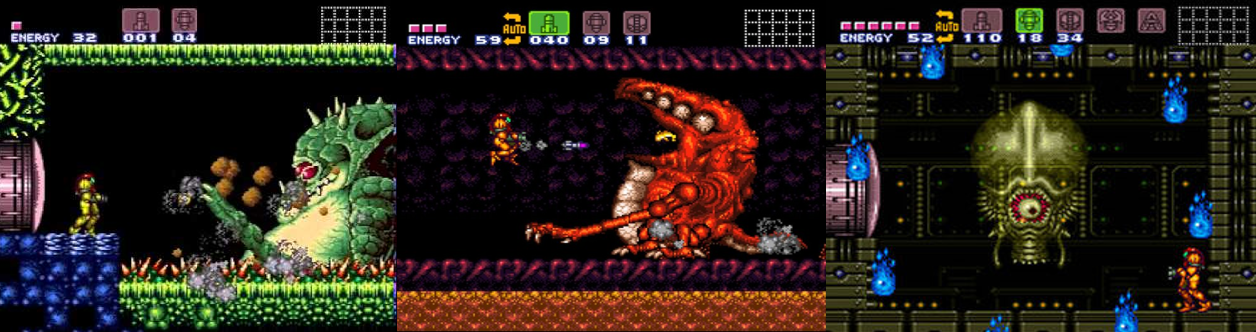
Explore and upgrade Samus’s arsenal and skills to reach new areas.

Samus is gifted with infinite ammo for her basic arm cannon; the player can hold down the fire button for a rapid shot, but this later gets swapped out for a charged attack. However, the player can further customise Samus from the pause menu; here, you can equip and unequip the various weapon and armour power-ups Samus obtains, though I preferred to keep them equipped at all times. Unlike the previous games, a small, grid-based map appears onscreen at all times which makes exploration so much easier this time around. Using the pause menu, you can view the full map and better figure out your route, though you’ll need to access map terminals to unlock each location’s map. Pressing down on the control stick or directional buttons will see Samus curl up into a Morph Ball when she acquires the relevant power-up; this allows her to squeeze through small gaps and access areas that aren’t readily apparently. It’s worth shooting, placing bombs, and jumping to find hidden areas and alternative routes, too; the game gets very big and complicated very quickly so any shortcuts or additional resources are always a welcome bonus. Planet Zebes is a veritable maze of doors that must be shot open; they’re colour-coded so you always know which weapon to switch to, but you’ll also be asked to perform a fair amount of horizontal and vertical jumping. While Samus’s later techniques help with this, her wall jumping ability is absolutely nerfed; rather than simply jumping at a wall and hitting jump again, you need to awkwardly hold back and press jump with frame-perfect timing to actually execute the move, which can be needlessly frustrating at times.

Although Samus controls well, her wall jumping and vertical abilities can be frustrating.

Similarly, Samus later acquires the Space Jump power-up; with perfect timing, this allows her to infinitely jump, cross wider gaps and reach higher areas, but the timing required is just too finnicky and random at times (it would’ve been so much easier to just keep hitting jump for a sustained effect). To make matters worse, enemies again respawn when you leave the screen; sometimes, smaller enemies will constantly spawn in certain screens, allowing you to “farm” health and ammo. You’ll also sometimes need to hop into the hands of a Chozo Statue while in your Morph Ball form to clear the path and you’ll find numerous helpful areas where you can catch your breath; save rooms, restore points to refill your health and ammo, and Chozo Statues gifting either new gear or upgrades to your existing equipment, total health, and total ammo. It’s well worth hunting these down as you’ll need your more powerful weapons to defeat the game’s bosses and more formidable enemies; both drop health and ammo when defeated but things are much easier if your maximum level is increased. Although well-equipped, Samus struggles against hazards like water, lava, acid and spike pits; suit upgrades allow her to negate some of these, and her Grapple Beam allows her to swing over hazards but, again, the timing required can be difficult to master. Super Metroid starts out fairly linear but you very quickly become restricted in where you can go, necessitating the acquisition of new power-ups; the more you obtain, the more you’ll need to remember cervices, destructible walls, and unreachable areas. You’ll be constantly backtracking, searching for new paths to the main four bosses, which may mean you’re over or under-equipped for certain encounters. Thankfully, the game is usually quite helpful and won’t leave you trapped in a room because you don’t have the High Jump Boots, but it can be a pain trying to figure out where you need to go and what you need to do.

Graphics and Sound:  
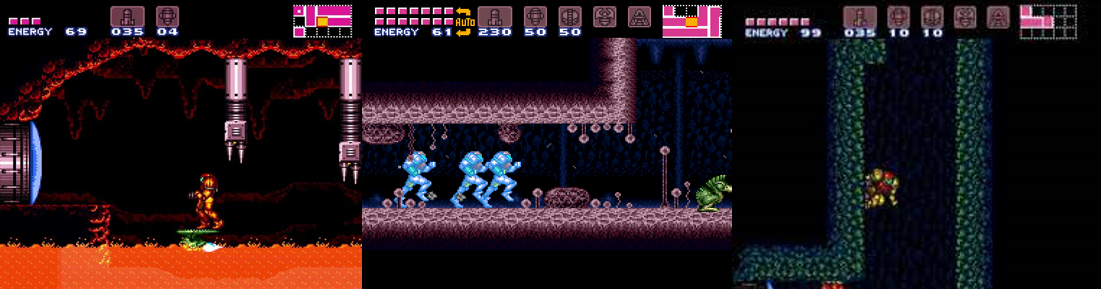
As a SEGA kid, I’ve long been envious of Super Metroid; for me, it’s one of the premier SNES titles and its visual appeal is a huge part of that. In fact, I admit that I was more excited to experience the game than I was to play it because of the difficulty involved in the constant exploration and the frustration of having to use a guide to find my way. Obviously, the game is a quantum leap ahead of its predecessors; Samus had never looked more colourful and lively before (and wouldn’t for many years aftwards), despite lacking much in the way of idle animations. She moves with a fluid grace that is both clunky when it needs to be and slick when she’s showing off her new abilities, spinning and curling and Moonwalking about as she blasts apart Space Pirates. The game’s story is told through text and simple to understand, cinematic cutscenes that utilise both the in-game graphics and a sprinkling of “Mode 7” for extra flair, with much of the ambiance and visual style influenced by the classic sci-fi action/horror Aliens (Cameron, 1986). Space colony Ceres and some levels of Zebes featured dead bodies scattered about, flickering lights at times, and rising bodies of water of varying danger, while the surface is rocked by a constant storm of acid rain not unlike the surface of LV-426.

The game is visually stunning, with a fantastic soundtrack and a strong aesthetic appeal.

While the game’s action is confined to Zebes, Super Metroid isn’t short on visual variety; this is used somewhat sparingly, and to great effect, so the rocky vegetation of Brinstar contrasts nicely with the sunken depths of Maridia and the lava-infested Norfair despite each location sharing similar layouts. Generally, Samus travels left to right from room to room but you’ll also be met by long vertical corridors and have to blast through the environment to progress. It’s not always clear which weapons or abilities you need to progress but there are some visual hints; blasting blocks or walls can reveal the symbol of certain weapons or arrows, indicating how to blow them open or to use your dash, or helpful little gremlins or dangerous digging machines can open new paths. Samus will discover a derelict ship that is plunged into darkness and lifeless until she restores the power; she can also break open glass tubes to further explore the depths of Maridia, blast and pass through certain blocks to drop into hidden areas, and even sink into sand to find new rooms. While there’s not always a lot happening onscreen, this allows each area to stand out all the more and the game to perform consistently, and each location expands and changes with your increased abilities, allowing you to make jumps you couldn’t before to navigate past hazards more effectively. The game also sounds fantastic; there’s a beautiful balance between silence, ominous ambient sounds, creepy tunes, and bolder, more blood-pumping music. Super Metroid ramps up the tension and adrenaline with its boss themes, especially when fighting Ridley and Draygon (who both sport Anguirus’ signature cry). Finally, the game is quite graphic at times; there’s the aforementioned dead bodies, Samus explodes in a similar fashion to Mega Man when killed, and Crocomire’s flesh melts from its bones upon being forced into a lava pit!

Enemies and Bosses:
Samus must blast her way through a slew of alien baddies to win the day, with many of them being variations of the standard, mantis-like Space Pirates. These insectoid aliens clamber on walls, march along the floor, and even hop overhead, firing jagged projectiles and often shielding themselves from your attacks with their claws, necessitating a weapon upgrade or a more convoluted attack pattern. Smaller enemies also pepper the game’s environments, ranging from wasp-like Zebbos, crab-like Scisers, and bat-like Skree, all of which are easy prey for you to farm some resources. Rippers can be temporarily frozen to act as platforms, Kilhunters will buzz about on their insectile wings, spiked Geemers slither about on small platforms, clunky Workrobots stamp about shrugging off your beams, and Evirs emerge from acid to fire projectiles at you. Enemies like the Beetoms and Metroids are a real headache as they can shrug off your regular shot and will latch onto you to drain your health, while Namihes and Funes spit fireballs from walls and guys like the Alcoon and Oum tend to burst out of nowhere for a surprise attack!

Samus faces some mammoth, formidable bosses, including long-standing nemesis Ridley.

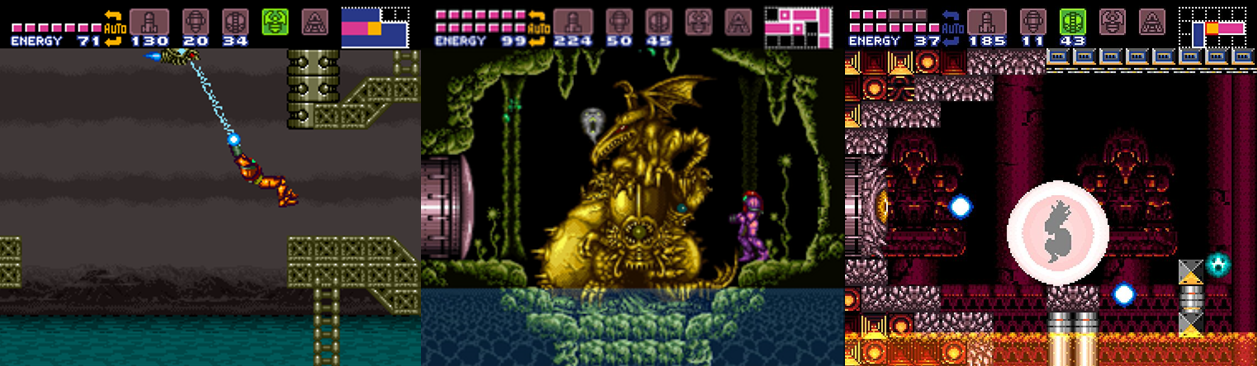
As if that wasn’t bad enough, there are eleven bosses to battle here, with a couple being very similar battles fought in different circumstances. You’ll encounter Samus’s archenemy, Ridley, early on; confined to an enclosed arena, Ridley will swoop at you, spit fireballs, and swipe with his Xenomorph Queen-like tail, but you don’t actually need to defeat him here, just survive until he flies off with the Metroid larva. Ridley, returns, far more formidable, as the penultimate boss; this time, you’re confined to a small platform with health-sapping lava underneath and Ridley hides high above, swooping in to grab and squeeze the life out of you. He also breathes fire and becomes extremely aggressive as the fight goes on, though he is vulnerable to all of your weapons, with the charged Plasma Beam and Super Missiles being the most effective, but he’s certainly no pushover even with all your upgrades. Similarly, you’ll battle two malevolent Torizo Statues, one just after acquiring the Morph Bomb and one later on. You’ll need to make use of the Morph Ball in the first encounter to dodge its projectiles; both stomp about to smash into you and swipe with their claws, but the golden one will sidestep missiles and catch and toss your own Super Missiles back at you and was, honestly, one of the toughest bosses in the game for me! Another early boss encounter is against the Spore Spawn, a gigantic, genetically-engineered plant that bobs about, launching itself at Samus and causing small spores to rain across the screen. These can be blasted for ammo and health, which you’ll need as this alien plant can only be defeated by shooting its central core, which only opens up for a brief window. Defeating it earns Samus the Super Missile power-up and sees the environment wither and decay.

The game’s bosses are monstrous and require a bit of strategy on your part to best.

The first major boss of the game is against Kraid, now much bigger and even more imposing than before (though a smaller version is again encountered beforehand). Now taking up a good chunk of the screen, with the bottom littered with spikes, Kraid lunges at you, spits rocks, and causes boulders to rain from above. Kraid’s only weak spot is his eyes and, when you’ve dished out enough damage, he raises up and you need to make use of small platforms to avoid his projectiles and fire at his head whenever he roars. In the lava-soaked depths of Norfair, you’ll battle the all-but-invincible Crocomire; immune to all of your attacks, you need to force Crocomire   into a lava pit before it skewers you on a wall of spikes! Watch for its projectiles and its skeletal remains, which will burst through said wall in a last gasp attack! Whilst exploring the wrecked ship, you’ll be attacked by ghost-like aliens and eventually face off against their master, Phantoon, a giant, squid-like alien wraith that hovers around the room dropping blue flames, though you can dispense them with your shot to grab some resources. This guy also disappears and reappears about the arena and can only be damaged by shooting at its single, ugly eye, though neither it nor the worm-like Botwoon should cause you too much trouble if you keep your beam charged and have plenty of missiles on hand.

After besting her minions, Samus must do battle with the fearsome Mother Brain!

The same can’t be said of Draygon, which acts as something of a teaser for the later Ridley fight. Draygon will swoop down and grab you, slamming you against the wall if you’re not careful, requiring a unique strategy beyond just dodging and shooting. If you let it grab you, you can shoot your Grapple Beam at an electrified wall panel; you’ll take damage, but you’ll also toast Draygon in the process, leaving her insectoid children to mourn her corpse. I wouldn’t underestimate the Silver Space Pirates, either; this duo is fought in Ridley’s lair and are only vulnerable when they flash gold, making them an exercise in frustration as they flip and slice and kick to whittle you down. Once you’ve defeated the main bosses, you’ll be able to access Tourian, a metallic landscape where Metroids wander freely. Here, you’ll encounter the titular Super Metroid, which proves invulnerable and will drain your health to almost nothing before fleeing. Eventually, you’ll battle Mother Brain once more; like before, this massive brain sits in a jar and is protected by laser walls, a constant spread of projectiles, and a lava floor. Once you shatter her protective casing, she rears up into this monstrous bipedal monstrosity that stomps about in a claustrophobic area, spitting explosive breath and blasting you with laser beams from her eyes! When you deal enough damage, she’ll decimate you with an unavoidable rainbow laser; luckily the Super Metroid comes to your aid, sacrificing itself to restore your health and gift the Hyper Beam, which cuts down Mother Brain. Once she’s defeated, the whole planet crumbles around you and you have three minutes to escape to the surface, whereupon you’ll be granted a special image of Samus depending on how well you played.

Power-Ups and Bonuses:
Samus starts with ninety-nine units of energy and her regular arm cannon but it’s not long before you’re increasing her exploration abilities with the Morph Ball and upping her arsenal with the missile and Super Missile, which both deal far greater damage than her regular shot, and increasing her maximum energy with the fourteen Energy Tanks. You can also find four Reserve Tanks to have some health restored after death, can use the X-Ray Scope to search for these, and hidden paths, in the environment, and grab the Speed Booster to run through walls and enemies alike and the Grapple Beam to latch on to overhead blocks and certain walls (if you can get to grips with the controls). In addition to finding numerous energy recharge stations, you can also fully refill your ammo at similar stations, usually located near a save room, and you’ll find loads of power-ups to increase your maximum ammo for each bomb. Samus can also upgrade her suit to allow her to freely move underwater, increase her defence, and allow her to resist certain types of lava, all of which is essentially for exploring the entirety of Zebes, Samus’s main cannon can also be upgraded to allow her to charge a more powerful attack that’s great for inflicting big damage against bosses, temporarily freezes enemies to create extra platforms, and allows her to fire three beams at once that go through walls and enemies alike. You’ll also acquire the ability to drop balls when morphed (clearing obstructions in tighter spaces and boosting you over small ledges), a screen clearing Power Bomb, and the Spring Ball that lets you jump while morphed. The High Jump boots increase your jump height, the aforementioned Space Jump allows you to clunkily continuously jump, and the Screw Attack adds an electrical crackle to your jump spin to damage enemies.

Additional Features:
Upon finishing Super Metroid, you’re given a percentage showing how many of the game’s secrets you found. You can freely load up your save file to backtrack and hunt down anything you missed if you like, but the game’s endings are based on how much time you took not how much you found. You’ll only get to see Samus in her skin-tight under garments if you beat the game in under three hours; playing between three and ten will see her remove her helmet, and playing for more than ten hours sees her preserve her modesty behind her suit and you settling for a thumbs-up. In the final escape sequence, you apparently have the option of saving the trapped Dachoras and Etecoons, though I didn’t notice them in my playthrough and it appears to add nothing to the ending but personal pride. This version of the game naturally allows you to create a save state at any time and make use of the Nintendo Switch’s rewind function, which is perfect for the game’s many aggravating sections, and you can also take advantage of a special save state version of the game that lets you skip right to the end with all of Samus’s upgrades.

The Summary:
Of all the Metroid games I’ve played, I’ve played Super Metroid the most but I never managed to finish it before this playthrough. The game is absolutely gorgeous, with a visual appeal that’s matched by its soundtrack and massive, action-packed bosses and the appeal of its main character. However, the large-scale nature of the game and the copious backtracking were always intimidating for me as I really didn’t want to have to keep referring to a guide; luckily, I was able to get through Super Metroid without too much help in this regard, but it can be frustrating when you seem to have exhausted all your options only to have missed a destructible block tucked away. While Super Metroid is impressively put together, with some fantastic detail, variety, and challenge on offer, playing the game from start to finish has made me see flaws in the game’s controls; wall jumping is absolutely atrocious and techniques like the Space Jump are needlessly finicky, ruining a lot of the platforming sections and making me wonder how anyone ever managed to succeed at the game without the aid of save states. The bosses are equally challenging, even when Samus is fully armed and powered up, making for a tough but ultimately very rewarding gameplay experience. Had these control issues been tweaked to be simple button presses, it would’ve been a perfect five out of five but Super Metroid is still one of the quintessential SNES titles and is well worth investing your time and patience.

My Rating:

Rating: 4 out of 5.

Great Stuff

Did you enjoy Super Metroid? Would you agree that it’s one of the titles that defined the SNES era of gaming? Did you struggle with the controls at all and what did you think to the large, inter-connected game world? Which of the bosses and upgrades was your favourite? What did you think to the graphical upgrade and the level of detail on offer? Which Metroid game is your favourite? Whatever your thoughts, feel free to leave a comment below or on my social media, and be sure to check out my other sci-fi content across the site.

Game Corner [Sci-Fanuary]: Metroid II: Return of Samus (Nintendo Switch)


January sees the celebration of two notable dates in science-fiction history, with January 2 christened “National Science Fiction Day” to coincide with the birth date of the world renowned sci-fi writer Isaac Asimov, and HAL 9000, the sophisticated artificial intelligence of Arthur C. Clarke’s seminal 2001: A Space Odyssey (1968), being created on 12 January.


Released: February 2023
Originally Released: November 1991
Developer: Nintendo
Original Developer: Nintendo R&D1 Intelligent Systems
Also Available For: Game Boy, Nintendo 3DS, Nintendo Wii, Nintendo Wii U

The Background:
Brain-blasting bounty hunter Samus Aran shocked the gaming world when she was revealed to be a woman in the challenging Nintendo classic, Metroid (Nintendo R&D1 Intelligent Systems, 1986). Although highly praised and crucial to the popularisation of the “Metroidvania” sub-genre, Metroid’s sequel came not on the Nintendo Entertainment System (NES) like Nintendo’s other franchise characters, but on their revolutionary (and incredibly popular) handheld system, the Game Boy. Many of Metroid’s developers returned for the sequel, which separated itself from other Game Boy titles with graphics comparable to its 8-bit counterparts and expanding upon Samus’s abilities and narrative in ways that would influence future games. Not only was Metroid II my first experience of the franchise, but it also included a unique palette for when played on the Game Boy Color, though it largely divided critics upon release. Reviews praised the quality of life improvements and expansion upon the gameplay of its predecessor, while also criticising the music and limitations of the Game Boy hardware. Yet, Metroid II endured; a fangame remake was scuppered by Nintendo prior to them remaking the game for the Nintendo 3DS in 2017, with Metroid: Samus Returns (MercurySteam, Nintendo EPD) being largely well received. The original version of the game also found a home on Nintendo’s online services, including this Nintendo Switch Online version, to help keep this cult classic alive for new gamers.

The Plot:
Following her encounter with the Metroids, bounty hunter Samus Aran is sent to the Metroid home world, SR388, to destroy the entire species.

Gameplay:
Metroid II: Return of Samus is a run-and-gun adventure game with an emphasis on exploring the various alien landscapes of SR388, upgrading Samus’s suit and abilities, and hunting down forty Metroid variants to curb the malicious species. Players once again assume the role of the intergalactic bounty hunter Samus Aran, who sports the same abilities from the first game and more, most notably the ability to shoot upwards and while crouching, simple additions that make blasting aliens and destructible blocks so much easier. You’re given three save files to play with, which can be switched to or deleted from the main menu, though there are no options to reconfigure any game settings, like the controls or difficulty. However, since it was originally a Game Boy title, you’ll only make use of two buttons during gameplay: A lets you jump (and you can hold it to jump a little higher) and B lets you shoot (and you can hold it to continually fire at foes). Samus will compress into a spherical Morph Ball if you press down on the directional pad twice, and you can switch from her infinite gun arm to her finite supply of missiles by pressing the – button. The + button pauses the game, but you again won’t find a map screen, here, meaning exploration is still a chore, despite Metroid II being a slightly more forgiving and straightforward title.

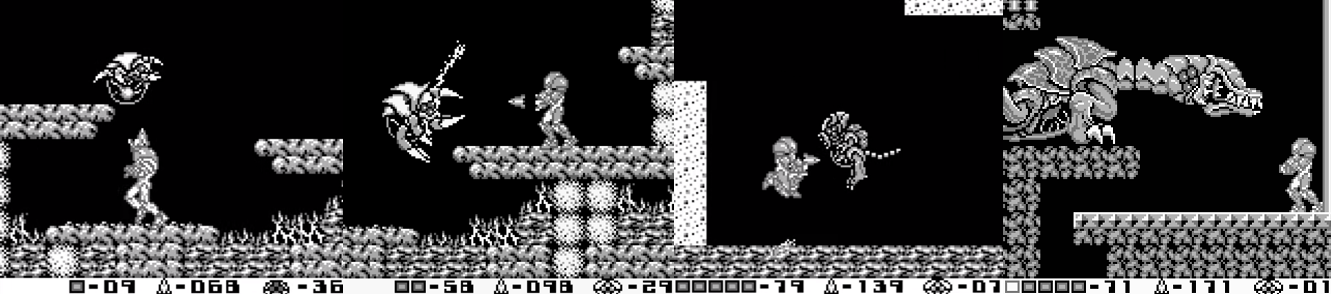
Run, shoot, and roll your way through a confusing alien world hunting Metroids.

Unlike in the last game, players can make use of save stations to save their progress and sporadic refill pods for their health and ammunition, reducing how often you’ll blast away at enemies to farm for resources. As before, enemies will respawn whenever you enter an area, though this time around to you must alter the environment, clearing lava and other hazards so you can progress further. Puzzle solving isn’t really a thing in Metroid II; the closest you get are blasting certain doors with your missiles to open them and navigating deep chasms, some of which are somewhat maze-like and have hidden holes that drop you to lower levels, though you’ll sometimes have to use Samus’s Bomb power-up to blast away boulders. This game debuts the Spider Ball, which allows Samus to slowly crawl up walls and ceilings, and you’ll be using this a lot to scale cliffs and ruins, especially as the game progresses. However, your primary objective is to hunt down the forty Metroid variants hidden around SR388; you can keep track of how many remain using the game’s limited heads-up display, but you won’t be given any hints or direction about where to find them beyond hitting dead ends until you’ve acquired new power-ups. Occasionally, Samus will dive into water or must traverse sticky goop; spikes and lava pits are commonplace, as are destructible elements like weeds and sandstone, and you’ll also have to navigate a pitch-black area later in the game that’s incredibly frustrating as there’s no way to light your path. Mostly, though, you’ll be exploring long corridors, deep shafts, and crawling up walls and through narrow tunnels, blasting enemies and hoping the path leads to an upgrade or another Metroid.

Graphics and Sound:
Releasing a couple of years after the debut of the Game Boy, Metroid II is quite a bland looking game, especially as far as the backgrounds are concerned. Backgrounds are largely completely blank, either white, black, or that weird green colour the Game Boy favoured, with very little in the way of foreground details, for the most part. Some areas are the exception to this rule, of course, with an abundance of overgrown stone ruins, rocky caves, and biomechanical areas peppered throughout the game so you know when you’ve transitioned from what could loosely be called the overworld to an area of some significance. Many areas contain lethal lava, dank water, or gloopy muck that restricts your movements but are largely indistinguishable from each other; sometimes the rocks look more like peanuts, sometimes they’re metallic, and sometimes they’re almost like bubbles, but the game becomes disappointingly and confusingly uniform very quickly. Caverns, ruins, and mechanical trappings signpost areas containing Metroids and power-ups, but it’s easy to think you’ve accidentally backtracked as SR388 isn’t exactly divided into elemental sections. Having the overworld be rocky and the main sections be distinctly water-, metal-, botanical-, or lava-themed would’ve helped to distinguish them but, as is, there’s only a handful of areas that impress when it comes to their aesthetics. While this is commonplace on the Game Boy, it’s not as if there weren’t games that were able to do a little more with the hardware, so it’s pretty disappointing here, especially as the game lacks a map.

As impressive as many of the sprites are, the backgrounds, locations, and music suffer.

On the plus side, Samus looks great, far better than she did on the NES and showcasing a surprising level of detail. While she doesn’t have any idle poses, her suit changes to reflect her upgrades and she has more poses to assume thanks to her expanded moveset. In addition to her iconic ship sat in the opening section, you’ll always know when a Metroid is nearby by the presence of a hatched Metroid egg, there are a couple of cutscenes showing the Metroids evolving into new, more powerful forms, the Chozo Statues are nice and big (with one even being destroyed), and there are usually some fun hidden paths to take towards goodies. Sadly, the music isn’t all that impressive, aiming for claustrophobic and ominous but being limited by the Game Boy hardware. However, the biggest disappointment for me was the complete lack of any story; there’s no story text, the title screen is incredibly bland, there’s no introductory cutscene, and the game just…ends, albeit with an impressive large sprite of Samus running alongside the credits that changes depending on how fast you beat the game.

Enemies and Bosses:
In addition to the indigenous Metroid population, SR388 is home to a whole host of alien lifeforms, from bug-like creatures to robotic forces and defences that I have assume were left behind by the Space Pirates. All of these will respawn after you exit an area and, while most can be defeated in one or two shots, others will be almost invulnerable until you acquire new power-ups or continually spawn and chase after you to bash you into spikes or lava. We’ve got floating slug-like enemies, laser turrets, hopping toad-like creatures, tiny bugs that drop from ceilings, weird flying proboscis-type things that drop you towards hazards, bat-like drones, and slug-like fish that slither around platforms. Speaking of which, the bone-armoured Motos resist your blaster and can only be taken out from behind or with the Screw Attack (though they often drop larger health orbs); they’re often found alongside Ramulken, who are similarly armoured but jump about the place, though most enemies can simply be blasted or outright avoided, especially if you’re close to a health point. The only boss-type enemy you’ll encounter that isn’t a Metroid variant is the armadillo-like Arachnus, which disguises itself as a Chozo Sphere and not only spits projectiles at you but completely resists your attacks when rolled up. However, it’s vulnerable to your bombs, so you can lay a bunch of those to take it out and pry the Spring Ball from its remains.

You’ll need plenty of missiles (and patience) to snuff out the various monstrous Metroids.

As in many Metroid games, the titular, jellyfish-like aliens will appear near the end of the game, latching onto you and draining your health and only being vulnerable when frozen by the Ice Beam and peppered with missiles. The forty other Metroids you battle in several mini boss encounters are evolved Metroids that take on an insectile, ant- or wasp-like form that allows them to fly. The most common of these are the “Alpha” variant, which are largely harmless and simply float about the place, meaning the “Gamma” variant is quite the sharp difficulty curve with its more monstrous appearance and lightning bolt appendages. They’re a joy compared to the “Zeta” Metroids, though, which frustratingly badger you from behind, spit fireballs, and can only be damaged when blasted in the face with missiles. Similarly, while the “Omega” Metroids are far slower, they spit electrical sparks that produce splash damage and float about the place, making them a difficult target despite their size. Each of these may also be fought in enclosed arenas, above spikes or lava, within sandstone, or in areas with small platforms or blocks to make avoiding damage even more troublesome. Once you’ve destroyed thirty-nine of them, nine more regular Metroids need to be dispatched before you face off with their monstrous, dragon-like queen. While technically a simple battle, requiring only that you use the Screw Attack to escape damage and blast the queen with missiles (you can even Morph Ball to safety to refill your health and ammo using a convenient tunnel), this is a laborious and dull fight thanks to the restricted area, the aggressiveness of the queen, and the fact that you need to hit her with 100 missiles! Apparently, there’s a way to Morph Ball into her mouth and lay a bunch of bombs in her, but I couldn’t manage that so it was a lot of tedious evading, blasting (missing), and rewinding when I took too much damage.

Power-Ups and Bonuses:
As ever, enemies will drop health orbs and missiles to refuel you but, this time around, you can also find larger, dedicated, and inexhaustible refuel stations to top these up in a pinch, and they’re not always hidden away either. Similarly, you can find Energy and Missile Tanks to expand your health bar and maximum ammo (though these are often hidden away or at the end of winding tunnels). As is often (if not always) the case, Samus mysteriously loses all the upgrades she got in the last game and needs to reacquire them from Chozo Statues hidden throughout SR388. You can upgrade her arm cannon to the Wave Beam (which increases accuracy), the Ice Beam (which temporarily freezes enemies), the Spazer Laser Beam (which fires a triple shot), and the Plasma Beam (the most powerful, which passes through objects and enemies), and will even get the chance to switch back to them at one point (with the Ice Beam being required for the final section). Samus’s jump can be extended with the High Jump Boots before allowing her to reach higher, further areas (through carefully timed taps of A) with the Space Jump, before becoming an offensive move with the iconic Screw Attack. Her Morph Ball can also be upgraded to drop bombs, bounce, and cling to walls, which, while slow, is basically a requirement in some areas.

Additional Features:
Sadly, there’s not much to Metroid II. Like I said, there are Energy and Missile Tanks to find that you could conceivably miss but that’s about it. The only reason you’d replay the game beyond enjoying wandering around a confusing handheld landscape is to try and beat the game in under three hours so you’ll be treated to seeing Samus in a bikini; otherwise, there are no bonus or extra features to speak of here. As ever, you can make liberal use of the Nintendo Switch’s rewind and save state features to make the game a lot easier, though it’s still a challenge at times.

The Summary:
I’m glad I finally played through Metroid II: Return of Samus; when I was a kid, I had the original cartridge for my Game Boy, but I remember getting stuck fairly soon into the game. Low and behold, I hit the same dead end here and quickly became reliant upon an online guide, which is not my preferred way of playing any game. Sadly, it’s basically required here as there’s no map system, which is weird as I definitely think a rudimentary map could’ve been inserted whenever you pause the game. Ultimately, this was a tough one for me; I liked how much the gameplay mechanics of the original were improved, even if only in basic ways, but I don’t think this kind of game works on the Game Boy; Metroid is all about exploration and backtracking and, while Metroid II is a bit more linear than others in the series, it still requires more than the Game Boy is capable of delivering. Yes, the sprite work looks good, but every area is too constricted and repetitive to stand out like they would on even the NES and it gets a bit boring facing the same batch of Metroids over and over again. There is a lot to like here, with some fun encounters and areas and the thrill of upgrading Samus’s suit and abilities, but I think Metroid II was trying to be a little too ambitious for the Game Boy. I’m tempted to see what the Nintendo 3DS remake is like to compare it but, sadly, it’s ridiculously expensive to get hold off so I’m left with this paradoxically technically impressive and technically limited entry in the series that felt too much like a chore to play through for mee to properly enjoy.

My Rating:

Rating: 2 out of 5.

Could Be Better

Are you a fan of Metroid II: Return of Samus? Did you own it on the Game Boy and, if so, how did you cope without a guide or the rewind features? Were you impressed with Samus’s new abilities and combat options? What did you think to the more linear mission and Metroid-hunting gameplay? If you’ve played the Nintendo 3DS remake, how does it compare to the original? Which Metroid game is your favourite? Whatever your thoughts, feel free to leave a comment below or on my social media, and be sure to check out my other Metroid reviews.

Game Corner [Sci-Fanuary]: Metroid (Nintendo Switch)


January sees the celebration of two notable dates in science-fiction history, with January 2 christened “National Science Fiction Day” to coincide with the birth date of the world renowned sci-fi writer Isaac Asimov, and HAL 9000, the sophisticated artificial intelligence of Arthur C. Clarke’s seminal 2001: A Space Odyssey (1968), being created on 12 January.


Released: 14 November 2018
Originally Released: 6 August 1986
Developer: Nintendo
Original Developer: Nintendo R&D1 Intelligent Systems
Also Available For: GameBoy Advance, GameCube, Nintendo Entertainment System (NES), Nintendo Wii, Nintendo Wii U

The Background:
It’s probably fair to say that, compared to Nintendo’s other heavy-hitters like Super Mario and The Legend of Zelda (Various, 1986 to present), the Metroid franchise (Various, 1986 to present) is maybe one of the company’s more under-rated properties. I actually have had very little experience with the series outside of the Super Smash Bros. series (Various, 1999 to 2018) and brief experiences with Metroid II: Return of Samus (Nintendo R&D1, 1991) and Super Metroid (Nintendo R&D1 Intelligent Systems, 1994), though this is mainly due to growing up as a SEGA guy. Metroid came about after Nintendo had seen success with their early titles for their industry-saving console, the NES. Producer Gunpei Yokoi and directors Satoru Okada and Masao Yamamoto collaborated on the title, which was heavily influenced by Alien (Scott, 1979). The developers sought to create an action-orientated game in which power-ups would be not only permanent, but necessary to completion, and with a strong emphasis on non-linear exploration. Metroid ended up being so successful in this regard that it, and Castlevania (Konami, 1986), spawned an entire videogame subgenre dubbed “Metroidvania”. Metroid was well-received upon release; reviews praised its challenging gameplay and it has since been recognised as one of the greatest games ever made. Metroid would spawn a number of sequels and spin-offs, and was ported to many subsequent Nintendo consoles either as an unlockable bonus or as a full-blown remake. Considering how popular and influential the series, and this first game, have become over the years, it’s no surprise that Metroid was included in the Nintendo Switch Online service soon after it launched, which also allowed me the chance to play it for the first time.

The Plot:
Bounty hunter Samus Aran journeys to the planet Zebes to retrieve the parasitic Metroid organisms from the malicious Space Pirates, who plan to replicate the Metroids by exposing them to beta rays and then use them as biological weapons in their mad plot for galactic conquest.

Gameplay:
Metroid is a 2D, sidescrolling, action/platformer with a strong emphasis on run-and-gun action, horizontal and vertical jumps, backtracking, and exploration. Players take on the role of Samus Aran, an armoured bounty hunter with a blaster for an arm, and must explore the planet Zebes, which is comprised of five relatively distinct areas all joined together in a huge game map. Samus begins the game able to shoot directly ahead or above and to jump, and you’ll quickly find that ground-based enemies are beyond your ability to destroy in the early going as Samus can’t shoot downwards or defeat enemies by jumping on them. You’ll also, literally, run face-first into a wall if you give into your gamer’s instinct and head to the right; instead, you should go left from the starting area, where you’ll find your first Chozo Statue and your first power-up, the Morph Ball, which lets you curl up into a ball by pressing down and thus slip into small tunnels and areas. From there, the sheer scope of your mission quickly becomes very daunting; not only do enemies respawn when you leave the immediate area (not the immediate screen, as you can scroll to the left and then go back to the right and your enemies will be back) but you’re missing the most crucial aspect a game like this needs: an onscreen map. I have absolutely no idea how gamers managed to play Metroid without this simple convenience, and have heard that they either drew their own maps or consulted magazines at the time just to get an idea of where the hell you’re meant to go. Since you acquire different upgrades along the way that help you access new areas, and a lot of the areas look very similar save for some different colours and flourishes, you’ll need a good memory and a lot of experimentation to figure out where you’re going and what you’re doing.

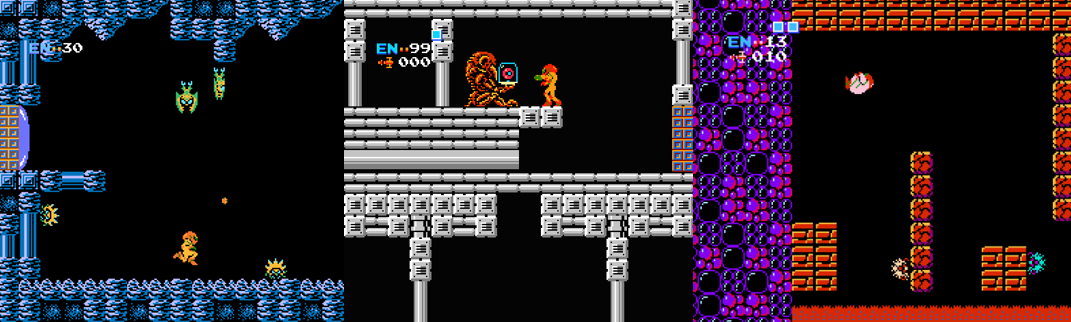
Explore a large, interconnected map finding upgrades to reach new areas.

Thankfully, you can at least hold down B or X for a rapid fire function and hold A to jump a little higher, and Samus is relatively durable; her health is measured in numerical units, and her default weapon has unlimited ammo, but you will have to deal with some difficult jumps (made all the more frustrating by some horrendous enemy placement and movements) and knockback damage that can send you dropping into lava or spikes, where your health will whittle away to nothing in no time at all. Metroid gives you just one chance to finish the game; if (well, when, really) you die, the game is over and you’re given a ludicrously long password to continue but, thankfully, the Nintendo Switch version allows for both save states and a rewind function if (again…when) you make a mistake. Health and ammo is dropped by enemies and there are numerous points where you can simply stand there, blasting at constantly respawning enemies to farm health or missiles, but take care as enemies can pounce from behind and more spawn in the moment you pick up your item. Your primary goal in Metroid is to find and defeat two bosses to create a bridge that leads to the final area, Tourian, to confront Mother Brain but, to reach these bosses, you’ll need to find new upgrades to open doors or reach new areas with a higher jump, temporary platforms, or dropping down through destructible blocks. Although areas start out pretty simple, it’s not long before you need to blast at stone blocks to create pathways and platforms (though you need to be careful as the blocks will damage you if you’re standing there when they spawn back in), hopping over tiny rocky platforms floating over lava, and dodging past tougher enemies. Luckily, there are no instant death hazards here, but you can easily get trapped in a dangerous position where enemies and hazards drain your health, or you’re left with such little health that you’ll die soon after anyway. All of this means that Metroid is a pretty touch experience, even with the quality of life features offered by the Nintendo Switch; it doesn’t take much for a simple mistake to lead to disaster, enemies can take quite a few hits before being dispatched, and it’s ridiculously easy to get turned around and completely lost. Luckily, there’s no time limit to worry about, and the game is much more enjoyable with a detailed map to help you out.

Graphics and Sound:
Given that it’s an 8-bit title, Metroid is quite the pixelated adventure; Samus, especially, stands out against all of the game’s dark backgrounds thanks to her orange armour but, as you might expect, doesn’t really have many frames of imagination. She ambles along at a decent pace, even able to shoot and run at the same time, but you’ll notice that the game suffers from severe slowdown when too many enemies or items are onscreen at the same time. Each area of Zebes is accompanied by a funky little tune, with the now-recognisable Metroid theme being the catchiest of them, but you won’t encounter any context or story-related text until the final moments of the game, meaning you’ll need the instruction manual to have any idea of what the hell’s going on.

While areas can be distinctive, there are many screens and sections that are confusingly similar.

Planet Zebes is split into five areas: Brinstar, Kraid’s Lair, Norfair, Ridley’s Lair, and Tourian, with each one connected by stone or mechanical tunnels and lifts that you can descend and ascend. Each area has a different colour scheme to help differentiate them a little (blue, green, grey, purple, etc) but they’re also very similar and feature nearly identical tunnels and screens in each area, meaning that it’s very easy to lose track of where you are. Some areas feature cloud platforms, stone columns, lava, bubble or monstrous platforms and ceilings, while others are long vertical shafts you need to make your way up. These long shafts can be safer spaces where you can restock on your supplies, but you’ll also need to make use of your Bomb to blow up blocks and descend downwards to give your Morph Ball a little boost to enter into seemingly impassable walls. While lava pits are best avoided, some are actually fake and lead to new areas; other times, you’ll need to navigate through tubes, avoiding or blowing up enemies and hoping you don’t end up being boiled alive. Little touches like moss, different types of stones or foreground elements, and minor visuals help to make some screens a little more distinct but it’s very easy to get confused as some screens are literally identical but at different points on the map and you’ll no doubt be driven made by the constant beeping when your health is low.

Enemies and Bosses:
Planet Zebes is host to all manner of alien baddies who will hop, swoop, and fly right at you without a second’s hesitation. While some of the smaller, weaker enemies can be destroyed in one shot, others take multiple shots and even the simplest of enemies can cause a major problem as they respawn constantly from all angles and it’s easy to get hit by one (and knocked into lava…) Spiked Zoomers are the easiest and most frequent enemy, though you’ll probably be farming pick-ups from Zebs quite often as well. Skree drop from the ceiling and will explode if you don’t destroy them quickly, Wavers, Rios, Multivolas, and Sidehoppers bounce around the screen erratically, Dragons spit fireballs at you in an arc from lava, and Rippers travel back and forth and make for useful temporary platforms oney you acquire the Ice Beam. In Tourian, you’ll encounter the titular Metroids, bug-like parasites that float around and home in on you to suck your energy away and which can only be destroyed with your limited supply of missiles.

After besting Ridley and Kraid, you’ll face your toughest challenge yet in Mother Brain’s defenses.

Considering the size of its map, Metroid only features three bosses; I assume you can theoretically tackle Kraid and Ridley in whatever order you like (assuming you take the right paths using a guide) but I fought Ridley first. This stubby little purple dragon hops up and down in the middle of the arena shooting projectiles at you. These also form a kind of protective shield that will block your shots, but can be destroyed with your weapons. Ridley doesn’t really need to do much else as he can absorb a huge amount of punishment before finally exploding, and the same can also be said about Kraid. Kraid is a little more formidable; he meanders back and forth across a platform surrounded by acid and constantly fires missiles and throws bladed projectiles at you, all of which you must dodge and shoot through in order to land the necessary multiple hits on the bulbous monster. There’s also a fake version of Kraid hiding in his lair, which will respawn upon defeat, and only by destroying the real Kraid can you complete the bridge and enter the game’s toughest and most unfair area by far. Mother Brain is a stationary brain inside a glass jar but is protected by an intricate and unrelenting arsenal of wall-mounted lasers, bubble-like projectiles, and barriers which you must blast through with your missiles. As if that isn’t bad enough, you’re given precarious platforms to stand on to shoot at her and must battle over a lava pit, constantly dodging and being pummelled by projectiles as you desperately try to fire your missiles at her through the narrowest of openings. Once she’s defeated, you’re then given about 999 in-game seconds to navigate up one final shaft and get to safety before the whole place explodes, making for a heart-poundingly tense and massively frustrating finale to an already challenging game.

Power-Ups and Bonuses:
Samus will find a wide variety of useful, permanent power-ups to gradually make her journey a little easier. It’s well worth taking the time to explore (or use a map…) to seek these out as you can increase her health by finding Energy Tanks (which will add another block of 99 health units to your total) and increase her maximum supply of missiles up to 255 with Missile Tanks. Since you need missiles to open doors and deal the maximum amount of damage to enemies, and will find yourself absolutely crucified in Tourian without these, these are both well worth seeking out. As mentioned, you’ll need the Morph Ball to progress past the first few screens, and soon acquire the Bomb to use in this form to destroy ground-based enemies or propel Samus into tunnels. The Long Beam will extend the range of Samus’s default weapon, which can also be upgraded to the Ice Beam (which, naturally, freezes enemies and turns them into temporary platforms but be warned as a subsequent shot will unfreeze them) and, eventually, the Wave Beam (which increases the firing range of your main attack). Samus can also find the High Jump Boots to extend her vertical jump, the Screw Attack to damage enemies with a spinning jump attack, and the Varia Suit to reduce the amount of damage she takes from enemies and hazards.

Additional Features:
As mentioned, the Nintendo Switch version allows for up to three save states and includes a rewind feature, both of which are incredibly useful for when you land in a sticky situation or want to take a break. If you fancy jumping ahead, you can also play an “SP” version of the game that bestows you with all the available equipment and upgrades and drops you right outside of the battle with Ridley. Unlike many videogames of its era, Metroid doesn’t feature a high score system but it does include multiple endings; the faster you finish the game, the more of Samus’s true form will be revealed in the ending. Additionally, after finishing the game, you’ll automatically start over in a new game with all of your power-ups (though without the additional Energy and Missile Tanks you acquired) or even garbed in a skin-tight outfit rather than armour.

The Summary:
I may not have ever properly played a Metroid game before, but I was fully aware of the franchise and its emphasis on backtracking and exploration. Consequently, I was a little intimidated to play through Metroid, especially as my limited experience with the series had left me struggling to find my way around. Although it is a real problem that Metroid doesn’t feature any kind of map (which is weird, as The Legend of Zelda (Nintendo R&D4, 1986) released earlier that same year and featured a rudimentary map system), it’s nothing you can’t solve with a quick Google search, meaning your only remaining hurdle is the challenge offered by the gameplay. While the controls are tight enough, Samus is a bit slippery and floaty at times, and her inability to fire in all directions makes things problematic, but nowhere near as annoying as the respawning, erratic enemies and tricky platforming sections. The various upgrades definitely help with this, and once you have a bit more health and a more powerful main attack and have gotten used to the repeating rooms and enemies, the game becomes a lot of fun. It’s definitely rough around the edges, though; when playing retro games on modern consoles, I always try to imagine how gamers coped back in the day and, in the case of Metroid, I can only assume they got through it with a great deal of patience and trial and error. Still, this was a decent experience and I’m glad that I finally played through it; it’s maybe a little too challenging and confusing at times for just a casual playthrough, though, so I’m interested to see if I find the later releases more appealing with their improved graphics and controls.

My Rating:

Rating: 3 out of 5.

Pretty Good

Have you ever played Metroid? If so, what did you think to it and how do you think it holds up today, both against its subsequent titles and other games from that era? Did you struggle to navigate the inter-connected game map? Which of the bosses and upgrades was your favorite? Have you ever finished the game without using modern enhancements, and what’s the best ending you’ve achieved? Which Metroid game is your favourite? Whatever your thoughts, feel free to leave a comment below or leave a reply on my social media, and be sure to check out my other Metroid reviews.

Game Corner [Asterix Anniversary]: Asterix and the Great Rescue (Mega Drive)


Asterix the Gaul (and his best friend Obelix) first debuted on 29 October 1959 as a serial in the French/Belgium magazine Pilote. Since then, the plucky Gauls have gone on to have many adventures in comic books, videogames, and feature-length productions and Asterix himself has become a popular and enduring character in his native France and beyond as his stories have been translated into over a hundred languages across the world.


Released: November 1993
Developer: Core Design
Also Available For: Game Gear and Master System

The Background:
It didn’t take very long at all for the French comic book series Asterix to make the jump from the comics and into other media; the first Asterix book was adapted into a feature-length animation in 1967 and both animated and live-action Asterix films have been pretty consistent over the years. Similarly, there have been a number of Asterix videogames; the first of these was released for the Atari 2600 in 1983 and one of my absolute favourites was Konami’s arcade game from 1992. Growing up, I had a lot of fun playing Astérix (SEGA, 1991) on the Master System, a colourful and entertaining little platformer that I’ve yet to finish ever thirty years later, and figured that the Mega Drive title would be a good investment. Asterix and the Great Rescue was developed by Core Design, the team behind the classic SEGA title Chuck Rock (Core Design, 1991), and was met with mixed reviews upon release. With today also being the birthday of the SEGA Mega Drive, I figured it was the perfect time to put this game in and see how it holds up compared to its 8-bit counterpart.

The Plot:
The year is 50 BC. Gaul is entirely occupied by the Romans. Well, not entirely… One small village of indomitable Gauls still holds out against the invaders and life is not easy for the Roman legionnaires thanks to the Gauls’ magic potion, which gives them superhuman strength. Like in many Asterix videogames, the Romans kidnap the village druid, Getafix, to stunt the village’s supply of magic potion so their bravest warriors, Asterix and Obelix, set out to rescue Getafix and teach those crazy Romans a lesson.

Gameplay:
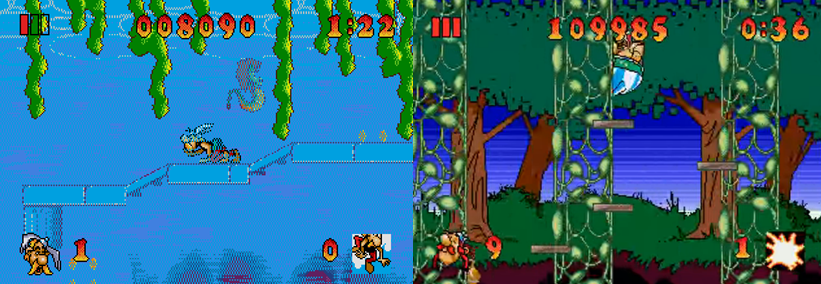
Asterix and the Great Rescue is a 2D, sidescrolling action platformer in which one player gets to pick between Asterix and Obelix before each journey across six Levels to rescue the druid Getafix from the Romans. Disappointingly, unlike in the majority of Asterix videogames, there’s very little actual difference between Asterix and Obelix; both characters move at the same plodding speed, have the same amount of health, jump at the same height, and have exactly the same special abilities. Indeed, the only discernable difference I could identify is that Obelix’s hit box is larger (due to his characteristic girth) but it’s not like Asterix’s is that much smaller. You can customise the game’s controls from the main “Options” menu but the default setup is functional as is. Players can jump with A, attack with a punch with B, and use a “Special Weapon” with C. Pressing up on the directional pad (D-pad) in conjunction with C allows you to pick from four different Special Weapons while pressing down on the D-pad allows you to crouch and crawl to avoid incoming projectiles.

Rooms can be short but also painfully frustrating at times.

Sadly, considering the characters’ and comics’ focus on madcap fighting, combat is extremely disappointing and limited here; there are no jumping attacks, your punches have a pathetically short range, and the only additional combat option available to you is that you can hold down B to perform a series of rapid punches while moving to take out groups of enemies faster. Asterix and the Great Rescue is constructed in a strangely confusing way; there are six Levels, each split into four “Huts” and each Hut has up to three “Rooms”. The wording is very confusing as you’re not necessarily inside of a hut or a room as you might think but what it actually boils down to is six levels, four worlds, and up to four zones in each world and I guess the developers thought it would be “fun” to supplant this usual videogame terminology with terms from the comic book. While six Levels might not seem a lot, the game is actually surprisingly long; the Rooms are generally short sprints asking little more from you than to travel to the right, bashing enemies, and reaching the goal (“magic elixir” for Asterix and a roast boar for Obelix) but you’ll also be tasked with finding keys, performing some tricky jumps, or navigating some confusing areas.

Your biggest obstacles are the time limit, hit boxes, and obtuse nature of the gameplay.

Your greatest enemy in each Room will be the time limit; every Room has a time limit that is anywhere from less than a minute to two minutes of game time and, if you fail to reach the goal before the time runs out, you’ll lose a life and have to restart from the beginning of the Room. There’s very little room for error in some of these Rooms and, if you mess up or take too long, then that’s just too damn bad as there are no checkpoints. Thankfully, you can acquire extra lives by earning enough points or stumbling upon a beating heart pickup. You start each game with three lives and three credits and, when you lose all of your lives, you’ll be given the option to cash in a credit and continue from the start of the last Room you played but, if you use up your credits, it’s game over. After clearing each Level, you get a password to jump to later in the game, which is helpful, but the damage you sustain throughout the game carries over to each Room, which is extremely frustrating, and you’ll find an abundance of bottomless pits as you progress, which mean instant death.

Gameplay is very inconsistent, being ridiculously easy one minute and frustratingly difficult the next.

Gameplay in Asterix and the Great Rescue is extremely inconsistent and frustrating; generally you just have to fight your way to the goal but other times you have to dodge bursts of fire, press switches to progress further, dodge falling blocks or incoming boulders, or hop around moving or temporary platforms to get through the Room. This can be extremely frustrating as some enemies are too small to hit, others take multiple hits to defeat, and it’s not always clear what you have to do in order to progress; all too often, platforms will suddenly drop underneath you, animals or bridges will collapse after carrying you across gaps, and you’ll need pixel-perfect timing to reach far away platforms. You’ll also need to hop across lava pits, make a number of blind jumps, contend with murky water that slows you down, teleport across Rooms using special statues, or use a series of bubbles, springs, and catapults to travel higher and further. Spikes, thorns, spiked balls, flames, and rotating platforms all compound matters, making avoiding damage extremely difficult even when playing on “Easy” mode, where enemies are less frequent and aggressive. Thankfully, there’s no knockback from taking damage but my experience was that my character would simply keel over and die more often than not since their hit box is so big that it’s extremely difficult to avoid being hit (especially when you get dropped literally right into the path of oncoming enemies in some Rooms).

Graphics and Sound:
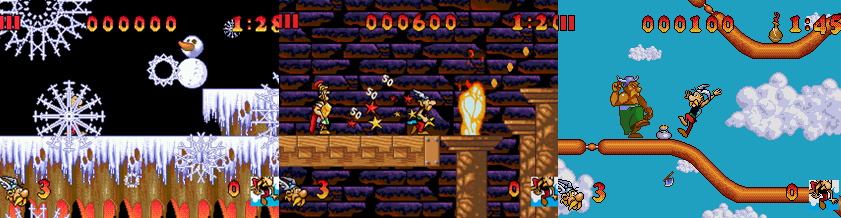
Asterix and the Great Rescue has a lot of promise but doesn’t quite manage to deliver in terms of its graphics. Sprites are colourful and faithful to the comics, for example, but not especially big or full of animation frames; there are no idle animations, for instance, and neither Asterix, Obelix, or their enemies exude the same charming humour as they do in the comics or even the Master System game. Environments can similarly be very hit and miss; the Gaulish village is beautiful to behold but little more than a tutorial to learn the basic controls. Occasionally, you’ll see familiar Asterix characters like Unhygienix in the background but he’s wildly out of proportion compared to the avatar’s sprites. Other times, the background will be quite sparse (a simple night sky) or somewhat detailed but then it’ll also look really crude (especially in the Forest and Rome levels). There are a lot of different environments to explore, however. You’ll travel from the Gauls’ village, cross the dock, enter a Roman camp, explore a dense forest and jump through the treetops and past gigantic spider’s webs, battle through dungeons in Germany, hop across clouds and birds and wander around stages made out of Frankfurters, pass through an ice Room (with some impressive snowflake effects falling over the screen) on the way to a Roman galley, and finally jump and fight through water ruins, an ornate garden, a lavish banquet hall, and the coliseum in Rome.

Levels are quite varied and can be quite bit but they’re hampered by the constant ticking clock.

All of these are locations that will be familiar to any Asterix fan but, for most videogame players, will seem very by-the-numbers for the average platformer and full of clichés such as weighted switches, temporary platforms, and rising or moving platforms. A lot of the time it can be difficult to tell where you need to go as you can sometimes pass through certain walls but not others, despite them both looking the same, and you’ll need to experiment with your Special Weapons in order to progress (if you have enough time left to figure that out, of course). I did experience a bit of slow down at times, which is quite ludicrous as there’s rarely a lot happening on screen, and some graphical hiccups here and there. The music is quite jazzy, however; it’s not especially varied but it’s decent enough, and certainly far better than the game’s sound effects. The game’s story is told through text and a recreation of the map of the invaded Gaul, all of which will be more than familiar to any Asterix reader. Though the game’s title screen leaves a lot to be desire, each Level is proceeded by a pretty nice still picture of the famous duo but you’ll have to wait for the final screen on the game for anything resembling any kind of impressive sprite art and even then it’s basically just a partially animated still.

Enemies and Bosses:
As any self-respecting Asterix fan might expect, your primary enemies in this game will be the Romans. Roman soldiers charge at you with spears, march along in groups wielding swords, toss spears at you from above, and gold-armoured Centurions will also show up to try and skewer you as you progress. These are all pulled straight from the comics and even include Roman’s hiding in tree disguises; most of them will go down in just one hit but the more rotund and golden Romans will take two to three hits. You’ll also have to content with woodland critters scurrying and flying your way, axe-throwing Germans, German maidens who explode when you get too near, mermaids and sea creatures, archers whose arrows stay on screen way too long, Romans trying to jab you from beneath with their swords, spiders and other bugs, dogs, and even hatchlings trying to take a bit out of your ass. By far the worst obstacle is the mule-kicking horses who will send you flying clear across the screen; I swear you need as much luck as you do skill to time your jumps past those assholes!

It makes sense to be fighting Romans but Cacofonix is a strange choice for a boss

Each Level culminates in a boss battle, the first of which is, oddly, against the village bard Cacofonix (I know he’s an annoyance in the comics but to make him a boss seems a bit extreme). Cacofonix stands in one spot atop his tree hut and spits musical notes at you from his lyre and can only be damaged by hopping on top of one of village chief Vitalstatistix’s shield bearers and tossing rotten fish at him. It takes a lot of hits to finally put the bard down so, again, your biggest enemy here is the time limit as it’s pretty easy to avoid his musical notes by standing in the right spots. The second boss fight sees a Roman encampment firing rocks at you; these must be hit back over and over again until the camp finally surrenders to your might. After this, a Roman soldier awaits you on a log and will instantly force you to your death unless you mash A, B, and right as fast as possible to knock him off instead but, of course, the game never tells you any of this so it is easy to simply fail time and time again.

After besting many enemies, the last two Levels culminate in battles against large, voracious animals!

The final Room of Germany has you desperately outracing a rising sea of red and taking out enemies as you make your way up to a goal which, again, is more a test of your skill and patience with the game’s controls than any sort of actual combat. On the Roman Galley, you’ll be attacked by a gigantic alligator (or is it a crocodile?); simply hop up onto the platforms to avoid the creature’s snapping jaws and then jump down to smack him in the head but watch out for his massive hit box clipping your avatar. The finale sees Julius Caesar set two vicious tigers against you in the Coliseum; these will randomly pop in and out of archways under Caesar’s view box and must be smacked whenever they appear and hopped over to avoid damage. Like all of the game’s bosses, though, this is simply a test of patience and landing hits before you get a time out and the bosses are, by far, the least challenging aspect of the game.

Power-Ups and Bonuses:
There are numerous items to pick up and collect in Asterix and the Great Rescue; you’ll find gold coins, bags of coins, and Roman helmets, all of which will add to your score and bring you one step closer to an extra life. You can also replenish your health either partially or fully by collecting pieces of roast chicken or a chalice, respectively, and you can grab a sickle for a brief period of invincibility or a bomb to enter “Mega Attitude Mode”, which increases your speed and strength so you can blast through enemies and obstacles.

Special Weapons are useful but limited and you won’t always have to to backtrack for more ammo.

The main thing to keep an eye out for, though, are the gourds that you’ll find scattered throughout each Room. These will give you ammo for your Special Weapons and will respawn when you move the screen a little bit. Your Special Weapons are essential to your progress but it’s not always abundantly clear where or when you have to use them (such as the first screen of Rome where you’re seemingly trapped but actually have to blast a wall that doesn’t appear to be destructible). The Fireball adds a ranged attack to your arsenal and can be used to destroy certain blocks, hit targets, or deactivate certain traps; the Ice Block (which is actually a cloud) creates a temporary platform to allow you to reach higher areas or cross spike or lava pits safely (if you can get the angle of the throw right…); the Disguise covers you in a series of vines and flowers so that enemies will walk right past you; and Levitation allows you to (chunkily) float about using the D-pad to avoid spikes and reach higher or further areas. 

Additional Features:
There’s not really much else on offer in Asterix and the Great Rescue beyond the single-player experience; there’s no two-player simultaneous play, meaning that the only way for two players to play is to take it in turns, and no real benefit to playing as either of the two main characters. You can tackle the game on a harder difficulty setting and try to get your name at the top of the high score table but the game is so tough anyway that I wouldn’t recommend it. There aren’t even any decent cheats for the game as the password system is simply for jumping to the game’s levels so you’ll probably be done with this game after one playthrough or session.

The Summary:
Boy, was I disappointed with Asterix and the Great Rescue. Once again, I as met with a 16-bit iteration of a videogame that pales in comparison to its bright, humourous, and fun 8-bit counterpart; you know it’s bad when even the Master System’s game gives Asterix and Obelix different abilities and playstyles and has more gameplay variety. Honestly, I can’t even say that this game looks good as, compared to other games of a similar genre that came out at the same time, Asterix and the Great Rescue looks and sounds like 1989 Mega Drive title rather than a 1993 release. Clunky, awkward controls, a rubbish combat system, confusing and frustrating gameplay, and just a complete lack of entertainment and engagement make Asterix and the Great Rescue an extremely disappointing title that saves itself from a one-star review simply because I am a big fan of the comics and characters but, honestly, I wouldn’t recommend anyone actually bother playing this letdown of a game.

My Rating:

Rating: 2 out of 5.

Could Be Better

What did you think to Asterix and the Great Rescue? How do you think it compares to other Asterix videogames and games of its genre? Did you enjoy the title and feel I’m being too harsh on it or do you agree that it was a frustrating and disappointing mess of a game? Which character, book, or movie is your favourite? How are you celebrating Asterix and Obelix’s anniversary, and the release of the Mega Drive, this year? Whatever your thoughts on Asterix, feel free to leave a comment below or on my social media.
Game Corner: Dead Space 2 (Xbox 360)

Released: 25 January 2011
Developer: Visceral Games
Also Available For: PC, PlayStation 3, Xbox One, Xbox Series S/X (Backwards Compatible)

The Plot:
Three years after his nightmarish encounter on the USG Ishimura, former engineer Isaac Clarke arrives on the Sprawl, a civilian space station built on the remains of Saturn’s moon, Titan, only to find that a new Necromorph outbreak has been unleashed.

The Background:
Inspired by survivor/horror franchises like Silent Hill (Konami/Various, 1999 to 2012) and Resident Evil (Capcom/Various, 1996 to present), Dead Space (EA Redwood Shores, 2008) was the brainchild of Glen Schofield and a small but committed team of developers determined to shake up the genre’s gameplay mechanics. Highly praised and having sold over one million copies, development of a sequel began immediately following the first game’s release. In that time, Electronic Arts’ Redwood Shores rebranded to Visceral Games, who gave the game makers a great deal of autonomy over the project after all the good will they’d built up on the first game. Pushing themselves to improve and refine Dead Space’s unique presentation, concept, and mechanics, the developers sought to expand Isaac’s movement and combat options, incorporate destructible environments to be used as weapons, and tone down the difficulty of the game’s puzzles to fit this new action-orientated approach. His personality was also greatly expanded, with him evolving from a silent character to a speaking one, and the grotesque Necromorphs were greatly expanded upon to better fit the game’s bigger and more varied environments. Like its predecessor, Dead Space 2 was very well received; critics praised its foreboding atmosphere, the deeper dive into Isaac’s fractured mind, and the focus on gory, fast-paced action shooting. There were some concerns about repetitive sections, the abundance of dialogue sections, and the downloadable content (DLC) but, overall, Dead Space 2 is regarded as one of the best entries in the franchise and a top title in the survival/horror genre.

Gameplay:
Dead Space 2 is a science-fiction survival/horror title in which players once again assume the role of engineer Isaac Clarke, a psychologically damaged individual who must cut through swarms of monstrous undead in a bid to prevent the Necromorph outbreak spreading further. If you’ve played the first Dead Space or other third-person action shooters then the control scheme will be very familiar to you: A lets you interact with the environment, open doors and crates and pick up resources and such, B and Y lets you quickly use any Med Packs or Stasis Packs stored in your inventory, and X lets you manually reload your weapon. To aim and fire your weapon, hold down the Left Trigger and press the Right Trigger; when not aiming, RT allows you to deliver a close-range melee attack. Holding down the Left Bumper sees you run without fear of a stamina meter, while the Right Bumper triggers your weapon’s alternative fire mode when aiming or sees you stomping on crates or crawling enemies outside of aiming. You can quickly switch weapons on the fly using the directional pad and bring up your inventory screen with the ‘Back’ button; here, you can use or drop items in your inventory and review your mission objectives but be careful as enemies can still attack you in this state. Finally, you can press in the right stick to briefly be shown the way with a glowing waypoint marker and trigger a zero gravity jump by pressing in the left stick.

In between chopping up Necromorphs and floating around in zero g, you’ll be hacking a lot of panels…

As before, Dead Space 2 kind of goes against usual conventions; normally, you’d expect to aim for the head or torso to take out zombies and demonic monsters but, instead, you’ll stand a much better chance if you target the limbs of your Necromorph enemies. Luckily, Isaac is well equipped to handle this; even his default Plasma Cutter is extremely effective but, just like before, he has a couple of extra abilities on hand to help. When aiming, you can press Y to unleash a “Stasis” blast; this will temporarily freeze any enemies it touches, allowing you to target their weak spots to sever their limbs, but is also necessary to freeze obstacles in your path. You’ll need to use it to slow down fan blades, crushing pistons, and similar hazards in order to progress and solve puzzles. If you press B while aiming, you’ll grab nearby objects, ammo and collectibles, and even limbs and bodies with your “Kinesis” ability. These can then be flung at enemies or other objects with RT and this ability is how you’ll be solving most puzzles as you’ll need to move power cells, explosive canisters, and even dead bodies in order to restore power, move heavy doors and obstacles, or get past biometric security doors. Kinesis is also used to move platforms, slot gears and batteries in place, and to remove panels from walls to allow you to hack them. This hacking mini game crops up quite a bit and sees you rotating a cone of light on a display scene and pressing A whenever it goes blue; press A when it’s red or take too long and you’ll receive a shock of electricity, though you don’t have to worry about any gun turret sections this time around.

Isaac’s abilities and your steady hand and button mashing are needed to solve the game’s puzzles.

As mentioned, there are once again many times when you’re forced to float around in zero gravity, usually to get from one section of the space station to another but sometimes you will be out in the void of space, battling giant Necromorph tentacles and solving puzzles with Kinesis. Zero gravity doesn’t seem to show up as much as before and isn’t as frustrating as I remember from the last game; you press the left stick in to take off or land, floating around is easy enough and you can orientate yourself at the press of a bumper, and you don’t encounter that many enemies in these sections this time, either. Instead, you’ll mostly be floating to platforms, moving large objects by attacking explosive cannisters to them, or inserting or removing power cells, perhaps dodging the odd flame burst or instant death hazard as you go. Again, you’ll also find yourself in a vacuum, often in these zero gravity sections; here, you need to keep an eye on your rapidly depleting oxygen meter, topping it up at refuelling stations as you complete puzzles and boost past hazards with LB, but it’s nowhere near as aggravating as some of the sections from the first game were. You do have to be careful when fighting Necromorphs, though; a stray shot or explosion will shatter the protective glass and see you sucked out to your death, so be sure to quickly shoot the switch to save yourself from a grisly demise. There seems to be a greater emphasis on button mashing, too; you’ll need to tap A whenever Necromorphs pounce or swarm over you or when Isaac’s hallucinations get out of control, which can be tricky as you really have to mash the button to shake them off. Occasionally, you’ll need to fire at laser traps, dodge incoming fire from gunships, and fend off hordes of Necromorphs as your allies work to restore power but easily the most memorable section of the game comes near the end when you need to hold down A when the reticule is blue to successfully pierce Isaac right through this pupil! Finally, while you’ll no longer be travelling between train stations in obvious segmented sections, the game’s story is still split into chapters and you’ll be making use of vents and elevators to progress from one area to the next, often with minimal chances to backtrack past a certain point.

Graphics and Sound:  
Dead Space 2 certainly ups the ante with its visuals. Like the first game, every environment has a decidedly “lived-in” feel to it, with much of the sci-fi aesthetic drawing upon films like Alien (Scott, 1979) and especially Event Horizon (Anderson, 1997). The Sprawl has been absolutely desecrated by the Necromorphs; blood, bodies, and debris are everywhere, turning bright and cheery elementary schools and once-bustling social areas into ominous hellscapes. Messages are scrawled on the walls in blood, power and lights are out all over the facility, dead bodies drop from above and non-playable characters (NPCs) are offed (or kill themselves) with gory malice, all while the endless dark void looms outside of every window. In zero gravity environments, debris floats around aimlessly; water becomes as bubbles and even fire billows around with impressive effect. If you breach a window, you must fight against the pull of gravity, which sucks everything in the vicinity outside, and there are all kinds of different locations found throughout the Sprawl. You’ll visit an ornate and elaborate church, a cyro lab, and the fuel processing facility, all while passing through areas done up more like something out of Doom (id Software, 1993) with their foreboding candles and flickering lights. Dead Space 2 is so much bigger than the first that it’s spread over two discs; during the second part, you’ll return to the Ishimura from the first game and revisit several key areas, now stripped back to the insulation and under repair as part of a salvage operation, which was both really cool to see and where Isaac’s mental instability really escalates.

The game explores Isaac’s fractured mind as much as it does its new and old locations.

All throughout the game, Isaac’s bombarded by nightmarish visions of Nicole and his experiences from Dead Space, which cause the environment to burst to life or enemies to suddenly attack you, only for it to be revealed to all be in Isaac’s head. As he ventures deeper into the mines and closer to the Marker, these visions only escalate, to the point where he’s forced to literally confront his ghosts head on. It’s because of this greater narrative focus on Isaac and his mental state that he now has a voice; he’s constantly talking with his hallucinations or relaying information back to one of his many allies, allowing for a deeper insight into the previously mute character but also interrupting the atmosphere with these blatant loading times. While the character models skew towards being marionettes at times, the gory deaths and the twisted, unsettling appearance of the Necromorphs more than makes up for it. Isaac’s intimidating suit is also a highlight, and still displays his health and other stats build into it to keep you immersed in the dread of your surroundings, and there were some interesting set pieces to engage with. It was fun floating around outside, realigning the solar panels; I also enjoyed fending off waves of Necromorphs on the back of a giant drilling machine, and every area has some kind of horrific visual to throw at you and keep you on edge. This tension is aided by the fact that the Necromorphs can literally spring from anywhere; they clamber over walls, up from below, drop through grates, and even burst to life from dead bodies, meaning you constantly have to be on your toes and wary of even the slightest sound as it could indicate oncoming danger.

Enemies and Bosses:
As before, the primary enemy you’ll be facing here are the Necromorphs; these disgusting, unsettling alien lifeforms have overtaken human hosts both alive and dead and attack through a variety of means. Capable of scuttling about using vents and walls alike, they primarily attack with bladed, scythe-like appendages and can pin you down if you’re not careful. Some will spit acid-like vomit at you from afar which dramatically slows you down; others are smaller, firing projectiles from a distance or crawling at you like babies to explode on contact. A flying variant will latch onto dead bodies to spawn new enemies and tries to suck your face off if it gets too close; gangly ones burst into tiny Facehugger-like variants; and the more obese ones simply explode in a shower of gets. There are Necromorphs with a huge, explosive club-like arm, ones growing out of walls who’ll rip your head off if you get too close, and really annoying, fleet-footed ones that dash about behind cargo containers to distract you so another member of the pack can catch you off-guard. In most instances, your best bet is to keep your distance and sever their limbs but be warned as Necromorphs are more than capable of scurrying along the floor with half a torso and attack in swarms this time around, turning even simple sections into a bit of a gauntlet at times.

Larger, tougher enemies often take on a boss role, with the Marker itself being your final trial.

This appears to be the game’s way of making up for the fact that there really aren’t too many boss battles, in the traditional sense. Some of the larger Necromorphs substitute for bosses, and then will reoccur as larger obstacles you need to bypass. Large, plant-like Necromorph growths spit explosive projectiles at you when you’re in space, for example, and you’ll again have to battle large, ape-like brutes who charge at you wildly and need a taste of your Static to slow them down so you can target the weak points in their armour. A recurring larger Necromorph is the tripod variant; at one point, a whole bunch of these attack you as you’re riding an elevator, requiring you to blast at their joints to fend them off. You’ll also venture into their nest, where a gigantic, Lovecraftian mess of muscle needs to be blown apart using nearby fuel cannisters as the beasts attack you in an arena of sorts. One of the most memorable boss encounters is against the gigantic, spider-like Tormentor; you’ll need to blast its joints to free yourself from its grip before frantically running from it down a narrow corridor. When you get blasted out into space, quickly target the fuel cannisters surrounding it to finish it off before it pops you like a balloon! In the final section of the game, one of Dead Space’s most annoying enemies, the Regenerator Necromorph, reappears to pursue you; although you can slow and freeze it, this thing constantly regenerates anew to be a pain in the ass and there’s no way to destroy it permanently this time, so you’re better off dismembering it, freezing it, and running away. In the finale, you incur the wrath of Director Hans Tiedemann as the massive Marker goes haywire around you; simply mash A to wrench the arrows he shoots out of your body and then fire his gun back at him to finish him off. The final boss itself is more of a metaphysical battle between Isaac and his memories of Nicole; when she warps you to a grainy hellscape, she’ll one-shot you if you get too close and send glitchy Necromorphs to swarm you. However, concentrate your fire on her and she’ll vanish, exposing the Marker’s core for you to shoot; repeat this a couple of times and the game will be won in somewhat anti-climactic fashion, especially as you appear to have infinite ammo for this final challenge.

Power-Ups and Bonuses:
Although all Isaac’s abilities from the first game return here, you’ll need to pick them up as you explore and fight through Dead Space 2’s morbid environments. You begin the game unarmed, strapped into a straightjacket, and must acquire a flashlight, your trusty Plasma Cutter, and the ability to use Kinesis and Static once again all in the opening moments of the game. From there, you’ll find ammo, credits, Med Packs, and more in crates and dropped by defeated Necromorphs. Credits, ammo, weapons, and coloured items can be sold at the various shops scattered throughout the game, often near save points. Here, you can shuffle your inventory, moving items out of your active inventory and unlock new suits and weapons to use by exchanging the schematics you find on your adventure. Each suit increases your armour, offers a discount, or reduces the cost of your abilities, but you can also upgrade these elements at the benches you’ll also come across. Here, you can spend Power Nodes on upgrading the capacity, reload speed, and damage output of your weapons, adding a special element to them (such as shots setting enemies on fire), and on increasing your health, air, and the duration of your abilities. Power Nodes can also be used to open special doors to areas filled with rare loot, and you can buy them at the shop as well if necessary. Isaac has an array of weapons available to him, each with an alternative fire mode, such as the arrow-firing javelin gun, the flamethrower, the detonator (which fires out proximity mines), the ripper (which spits out a spinning buzzsaw for gory up-close dismemberment), and the intense power of the contact beam.

Additional Features:
There are fifty Achievements up for grabs in Dead Space 2, with about sixteen being easily acquired simply by playing through the story. You’ll get Achievements for buying suits, scoring a kill with every weapon in the game, upgrading one and then all the available weapons, severing 2,500 limbs, and killing fifty Necromorphs while they’re frozen. There are some oddly specific ones, such as impaling a Necromorph to a wall, cutting up a statue, and making use of the decompression mechanic to suck enemies into space, and other more predictable ones, such as beating the game on harder difficulty settings. At the start, there are four difficulty modes available, with even the easiest setting being a bit of a challenge at times; a fifth is unlocked after completing the game, as are a couple of new suits and a “New Game+” mode that carries over your progress to a new save. There are a bunch of audio logs to be found that flesh out the story, a specific piece of treasure to nab for an Achievement, and the game can be expanded through DLC packs that add eight extra Achievements in addition to a multiplayer component to the game. Finally, if you have a save file from Dead Space on your profile, you’ll gain access to a more powerful Plasma Cutter, for free, at the first shop you go to.

The Summary:
I put off Dead Space 2 for way longer than I wanted to; I really enjoyed the first one thanks to its dark, gory, and oppressive atmosphere but life and my backlog meant it took some time to get to the sequel. However, I easily slipped back into this gritty and macabre world and was still able to appreciate the return to familiar, but changed environments from the first game. Conceptually, Dead Space 2 is definitely bigger; there are more locations available to you, ones that are more visually diverse than the first game and which continue to impress with their fantastic use of lighting and blood to make every area akin to a slaughterhouse. I wasn’t massively impressed by Isaac’s chatterbox demeanour but I do think it was necessary for the progression of his character and the story. Seeing him struggle with his mind, memories, and the influence of the Marker made for some effective jump scares and really helped to keep the atmosphere oppressive and dangerous at all times. The combat and Necromorphs continue to be a highlight; you get just enough resources to survive each encounter but it doesn’t take much to leave you relying on those survival/horror instincts as you regroup and reload what little ammo you have left. It seems as though a lot of the more frustrating elements from the first game have been removed or refined; the zero gravity and vacuum sections are far less aggravating, though the hacking mini games and abundance of vents got old pretty quickly. I was also a bit disappointed by the apparent lack of new enemy variants or big, gross boss battles but the abundance of enemies and the variety offered by most encountered meant that the difficult stayed at a fair but challenging level even on the easiest setting. In the end, Dead Space 2 offered more of the same, expanding on the first game visually and in the refinement of mechanics and combat, while delivering the same level of scares and mounting dread as you explore, solve puzzles, and slice up those screwed up zombie monsters.

My Rating:

Rating: 4 out of 5.

Great Stuff

What did you think to Dead Space 2? How do you think it compares to the first game and do you think it still holds up today? What did you think to the focus on Isaac’s mental instability and the use of jump scares? Were you also a bit disappointed by the weapon and enemy variety on offer? What did you think to the visuals of the game and the increased focus on gore? Which Dead Space game is your favourite, and would you like to see more from the franchise? What horror-theme videogames are you playing this October in anticipation of Halloween? Whatever your thoughts on Dead Space 2, drop them below or comment on my social media.
Game Corner [Brightest Day]: Green Lantern: Rise of the Manhunters (Xbox 360)


Although February 2014 was dubbed “Green Lantern Day” (because, by the American calendar, the date read as “2814”, the space sector assigned to Earth in DC Comics), the significance of this date has passed over time. Instead, I’m choosing to celebrate the debut of perhaps the most popular iteration of the character, Hal Jordan, who first appeared in October 1959.


Released: 7 June 2011
Developer: Double Helix Games
Also Available For: Nintendo DS, Nintendo 3DS, Nintendo Wii, PlayStation 3

The Background:
When Green Lantern first appeared in All-American Comics #16 in July 1940, it was as the superhero persona of of Alan Scott. However, in 1959, Julius Schwartz had writer John Broome and artist Gil Kane reinvent the character as space cop Hal Jordan, thereby creating what we now know as DC Comics’ resident intergalactic police force. After years of aborted attempts, Hal Jordan finally made his big-screen debut (alongside the Green Lantern Corps) in Green Lantern (Campbell, 2011), a critical and commercial failure that set back the formation of a DC cinematic universe a couple of years. However, one thing that came out of the movie was Green Lantern’s first (and, so far, only) solo videogame outing with this tie-in title, which was made by an amalgamated developer whose previous titles were also mostly videogame adaptations. Although featuring the likenesses and voices of many of the film’s stars and allowing players to utilise stereoscopic 3D during gameplay, Green Lantern: Rise of the Manhunters received mixed reviews; while some praised the various gameplay mechanics and the game’s presentation, others criticised the repetitive combat and lack of replayability. Since Green Lantern failed to produce a sequel, we’ve yet to see another solo videogame for the ring-slinger, which is a bit of a shame considering how much potential the character has in the near-limitless scope of the genre.

The Plot:
Before harnessing the green energy of willpower and creating the intergalactic peacekeepers known as Green Lanterns, the Guardians of the Universe employed androids called Manhunters. After being shut down for becoming too violent, the Manhunters suddenly return for revenge against their former masters, and Green Lantern’s Hal Jordan and Thaal Sinestro are just two of the emerald corpsmen dispatched to combat this threat.

Gameplay:
Green Lantern: Rise of the Manhunters is a third-person action/adventure game very much in the style of hack-and-slash brawlers like the God of War franchise (Various, 2005 to present). Players take on the role of Hal Jordan and fight their way through some pretty long and bland environments slashing about Manhunters with a variety of attacks generating by his Power Ring. If you have a friend, they can join the action at any time as Thaal Sinestro, though he’s basically just a skin and doesn’t have any unique dialogue or attacks and the camera becomes a bit restricted with two players on screen. Still, you have quite a few options available in terms of combat: X unleashes a fast attack with some sword swipes, Y delivers a strong attack that includes a fist and a hammer, B sees you grasping smaller enemies or objects with a claw, and the Right Bumper lets you blast ahead with a drill and chaining all of these together will allow you to pull off some basic combos to take out larger and multiple enemies pretty quickly.

Hal’s Power Ring affords him numerous options in combat and puzzle solving.

A allows you to jump but, unfortunately, you can’t fly unless you’re activating a Green Lantern logo to leap to a new area in a cutscene or dropped into one of the games shooting sections. You can evade, however, with the right stick and shield yourself from attacks with the Left Bumper. As you play through the story, you’ll unlock constructs to assign to the Left and Right Trigger; holding these down and pressing a button lets you pull off up to eight different Power Ring abilities that will drain your meter (though this refills over time and by collecting green orbs). Hal can blast enemies from afar with the Ring Blaster and Gatling Gun, smash them and activate pressure pads with the War Hammer, deploy and throw a Hover Mine to blow them up or destroy power cores, send them flying (and knock back projectiles) with the Baseball Bat, and swing around a couple of maces to devastate groups of enemies. Hal can also rapidly whip Manhunters, auto target and pummel them with the Rocket Punch, smash through enemy shields with the Piston Blitz, deliver targeted attacks to enemy weak points with the Missile Pack, and eventually dish out big damage with a Jet Fighter and a huge Mech Suit. The bigger and more powerful constructs will drain more of your Power Ring’s energy, but you can upgrade your Power Ring and your basic attacks by defeating enemies and smashing parts of the environment for Will Points (strangely still abbreviated to XP). The more XP you earn, the higher your level raises (up to a maximum of ten) and the more upgrades and additional constructs you’ll unlock, eventually allowing you to purchase Lantern’s Light to recharge your Power Ring with the directional pad at the risk of being left vulnerable. Finally, as you defeat enemies, you’ll build up your Ring Surge meter; once it’s full, press the Left and Right Bumper to activate a Ring Surge, which restores your health and Power Ring to full and powers up your attacks for a short time; the effectiveness of your Ring Surge can also be upgraded with XP.

QTEs, simple puzzles, and rail shooting sections add some variety.

The bulk of your gameplay revolves around combat; near endless, mindless combat against Manhunters of all shapes and sizes. The game is incredibly linear, with no need for a map or directions since it’s pretty clear where you need to go, though there are inevitably times when it’s easy to get a little turned around since environments became very samey very quickly. When you’re not smashing apart endless Manhunter drones, you’re given a handful of additional missions, such as destroying mines, leaping to Siege Towers and destroying them by smashing open their armoured cores, and destroying teleport gates to stop enemies spawning in. One mission has you taking out a bunch of lasers before they destroy the Central Power Battery, sometimes you’ll need to press A and rotate the left stick to open doors or spawn in a battery, and other times you’ll be dodging electrified walls and floors to progress. These latter elements get mixed up you play through the story, requiring you to grab a battery and get it to a power node before it explodes or smashing Hover Mines into spinning holes as the floor tries to fry you. Later in the game, yellow Fear Energy nodes and enemies drain your Ring Energy meter and limit your constructs, and Queen Aga’po helps you out on Zamaron by lowering crystal barriers, where you’ll also need to destroy Boost Crystals to stop the Zamarons being powered up. Generally, puzzles are pretty simple, requiring little more than clearing out enemies, grabbing something to plug in somewhere else, either to match symbols or to destroy an energy core, and you’ll only really get a taste of some variety in the handful of rail shooter sections. In these, you use X or Y to fire (with no limits and a rapid-fire option) and can lock onto enemies with LT to fire off energy-draining missiles or become a Jet Fighter with your Ring Surge, making for some fun shooting sections. Additionally, you’ll occasionally have to perform some quick-time events (QTEs) to finish off some of the bigger enemies and bosses, and you can lower the difficulty level after you die if the game becomes too tough.

Graphics and Sound:  
Technically speaking, Green Lantern: Rise of the Manhunters looks, sounds, and plays pretty decently; I experienced a bit of a delay when activating my Ring Surge (though this could’ve been my controller) but there wasn’t really any slowdown, which is good as things can get a bit hectic at times. Ryan Reynolds returns to voice and lend his likeness to Hal, playing him a little more straight-laced now that he’s a fully-fledged Green Lantern, and he (and the other Green Lanterns) matches his much-maligned movie appearance very well. His constructs all look big and fun and imaginative, though they are a bit restrictive; his basic attacks change appearance as you upgrade them, which is a nice touch, and the developers even made the bizarre decision to include a function where Hall becomes dizzy if you rapidly spin the control stick.

The game evokes the aesthetic of its movie counterpart, for better or worse.

Sadly, the game’s environments and music aren’t much to shout about; you visit Oa twice, at the start and end of the game, and both times it recreates the look of the movie but is little more than a bizarre alien landscape under attack from various Manhunters. Zamaron is a rocky, mushroom-strewn alien world that is more bland than interesting, though it does include canyons and crystal mines and temples and such. The only other area in the game is Biot, a massive mechanical factory and processing plant for the Manhunters that’s full of gears and pistons and consoles and such, but there’s very little to interact with in any of the game’s locations and few rewards or incentive to explore as there aren’t really any collectibles. The game’s cutscenes work well enough, with the suit and the movie’s aesthetic actually translating pretty well to the action figure presentation of this era of gaming, and I liked how the story was a sequel to the movie, though it’s weird how there was no expansion on Sinestro’s decision to switch to a Yellow Ring.

Enemies and Bosses:
The vast majority of the enemies you’ll face are Manhunters, disposable tin cans that fly or teleport in and attack in some large numbers. You’ve got regular drones, ones with shields or blasters, and annoying bastards on these hoverboards that allow them to zip around and bombard you with laser fire. Sometimes you’ll be attacked by mines and laser cannons or Manhunter ships, which can be destroyed by smashing back their projectiles, and larger Manhunter variants will rush at you and grab you in a bearhug, draining your Ring Energy and forcing you to mash A to escape. On Zamaron, you’ll battle some different enemies, mainly mind controlled Zamarons who attack with staffs and such, but you’ll also encounter Willhunters, which drain your Ring Energy, and Manhunters also exhibit this ability on Biot and later in the game.

Only Zamaron offers a reprieve from the endless Manhunter variants.

Bosses are primarily larger Manhunters, which then return as mini bosses or are strewn throughout shooting stages. The Ultra Manhunter is the best example of this; you’ll first battle it on Oa, where it stomps about firing lasers and shooting its fists at you but you can evade it, take advantage of the nearby Lantern power-up, and land some combos when it gets stuck on the ground. Ultra Manhunters reappear numerous times, often in twos and accompanied by a slew of other Manhunters; they later add a gravity bomb to their arsenal which sucks you in before exploding, but you can destroy these with your Hover Mines and you can put them down with a QTE after dealing enough damage and blast them to smithereens in the shooting sections. The Siphoner Manhunter, which bearhugs you, and the Willhunters are presented like mini bosses when you first encounter them but they quickly just become regular enemies. On Zamaron, you’ll battle Queen Aga’po after she’s corrupted by the Yellow Energy; she causes crystals to burst from the ground (which freeze you and enemies if you touch them) and sends her minions after you between attacks before attacking with her lance. After pursuing her in a shooter section and taking out another Ultra Manhunter, she sets the Zamaron Defender on you. This battle takes place on a 2.5D pane and sees you attacking its hands and the Willhunters it sends out, avoiding its swipes and the falling boulders, smashing back its projectiles and dodging its electrical barriers and shockwaves in easily the most annoying boss battle of the game so far (and you don’t even get the catharsis of finishing it yourself as Hal delivers the final blow in a cutscene).

After besting the Manhunters, you’ll face off against renegade Amon Sur.

Biot is full of Siphoners and Ultra Manhunters, Manhunters who exude Yellow Energy, and annoying reactor cores that you need to destroy with your Hover Mines. The mechanical hellhole culminates in a battle against the titanic Grandmaster, which is essentially an even bigger Ultra Manhunter and your Mech Suit comes in handy here, allowing you to go toe-to-toe with the armoured foe, who loves to blasts its fists at you and swing them around the arena to send you flying. Take it down and you get to battle the even bigger Highmaster afterwards, which is an even larger Ultra Manhunter that blasts out bigger versions of those gravity bombs and sends a massive laser beam from its hand to cut you down. The only way to damage this guy is to attack the glowing points on its knees, then run around behind it and awkwardly toss your Hover Mines into its knees so it drops to the floor, allowing you to attack the cockpit where Kilowog is being held captive. Repeat this three times, fending off the Manhunters and dodging its faster and more aggressive attacks, and you’ll progress to the final stage of the game. This sees you returning to Oa, where Amon Sur has become consumed by Yellow Energy and is leading a renewed Manhunter assault against the Guardians. You’ll need to dispatch his minions before engaging with him one-on-one, which sees Amon dashing at you with his scythe-like lance, conjuring skeletal hands, bombarding you with laser blasts, and protecting himself with an impenetrable shield. Deal enough damage and he also constructs a massive mech suit for himself, meaning the finale becomes a game of Rock ‘Em Sock ‘Em Robots as you throw slow punches at him, guard against his attacks, and stomp the ground to break his guard, completely negating all of the combat and gameplay you’ve endured and mastered and having the final boss come down to a QTE with obnoxious timing.

Power-Ups and Bonuses:
As you defeat enemies and smash pots and other parts of the environment, green, white, and blue orbs will refill your health and Ring Energy and grant you XP. Occasionally, you’ll find Lantern charge points in the environment which fully replenish your health and energy and allow you to pull off a Ring Surge, but that’s about it for in-game power-ups. New constructs are made available as the story progresses and as you level-up, which also unlocks upgrades for your attacks and Ring Meter so they become flashier, more powerful, and charge/last longer. You can assign Hal eight different constructs to use and can swap them out from the pause menu, but it’s best to keep a couple (like the War Hammer, Baseball Bat, and Hover Mine) in your arsenal since they’re useful for solving puzzles and defeating certain enemies. Other constructs, like the Jet Fighter and Mech Suit, may deal a lot of damage but they have a long charge time and drain more of your Ring Energy, though you can find and destroy coloured meteorites in each mission that will extend both of these meters.

Additional Features:
There are forty Achievements to earn in Green Lantern: Rise of the Manhunters, with eleven being awarded simply for clearing the game’s missions and story mode. You’ll also get Achievements for racking up high combos, acquiring and upgrading every construct and ability, defeating certain enemies with each construct, and fully expanding Hal’s health and energy. There are three difficulty levels for the game, with an additional Achievement awarded for beating it on the hardest setting, and two more for playing in co-op, making for some pretty simple to earn Achievements. Co-op mode is pretty good, though there’s a distinct lack of individuality to Sinestro, and you can replay any cleared mission from the main menu and even take advantage of a 3D functionality if you have one of those 3D TVs. Sadly, there really isn’t much to keep you playing; you can go back and look for things you’ve missed, but there are no collectibles, no concept art or gallery, and no skins to unlock, making for a pretty cheap and barebones experience.

The Summary:
Green Lantern: Rise of the Manhunters is a pretty decent hack-and-slash videogame; fans of the God of War franchise will be immediately familiar with the vast majority of the gameplay, but those who crave a little more depth to their games will be left wanting more from this tie-in title. The controls and combat are pretty good, but the stages are extremely restrictive and tediously drawn out, artificially extending the length of the game without really providing much visual variety. Combat quickly becomes tedious and you can easily mow through most enemies with the same button inputs or constructs without needing to mix things up and, while the rail shooting sections are fun, they’re few and far between and don’t really have a great deal of challenge to them. The enemies you battle get old very quickly, making things even more monotonous, and the few puzzles offered are ridiculously easy to solve and recycled over and over. Graphically, the game does a good job of emulating the style of the movie it’s based on and the story functions as a lacklustre follow-up to a mediocre film, but there’s very little replay value to be offered here. As a quick, cheap cash-in that rips off the gameplay of a more successful franchise, Green Lantern: Rise of the Manhunters does alright but there’s obviously better hack-and-slash titles out there and the only reason to really get this is if you see it cheap and you fancy adding some quick and easy Achievements to your gamer score. Overall, the game just lacks in imagination; Green Lantern is a character who can potentially do and conjure almost anything he desires but he feels needlessly handicapped here and the lack of skins, unlockables, or visual variety really drag this game down.

My Rating:

Rating: 2 out of 5.

Could Be Better

Have you ever played Green Lantern: Rise of the Manhunters? If so, what did you think to it? How do you feel the combat and constructs worked in the context of the game? What did you think to the plot and its status as a follow-up to the movie? Were you disappointed by the lack of variety in the enemies and locations? Which of the constructs was your favourite and were you a fan of Ryan Reynolds reprising the role? What did you think to the movie the game’s based on and would you like to see a new Green Lantern game in the future? Which Green Lantern character, villain, or story is your favourite and why? How are you celebrating this pseudo-Green Lantern day today? Whatever you think about Green Lantern: Rise of the Manhunters, and the Green Lantern comics books, feel free to leave a comment below.

Game Corner: Doom II (Xbox Series X)

Released: 26 July 2019
Originally Released: 10 October 1994
Developer: Bethesda Softworks
Original Developer: id Software
Also Available For: Android/iOS, Game Boy Advance, MS-DOS, Nintendo Switch, PC/PC-98Mac, PlayStation, PlayStation 3, PlayStation 4, SEGA Saturn, Tapwave Zodiac, Xbox 360, Xbox One

The Background:
Although the first-person shooter (FPS) genre existed before Doom (ibid, 1993), it was largely defined by this heavily ported and much celebrated title, which popularised online “Deathmatches” and improved upon mechanics established by its forefather, Wolfenstein 3D (id Software, 1992). id co-founder and lead programmer John Carmack created the game alongside designer John Romero and lead artist Adrian Carmack; after a troubled development, Doom proved immensely popular (despite its controversial violence and Satanic imagery), so much so that it was banned from workplaces and met with widespread critical acclaim. As if Doom’s many ports weren’t enough, a sequel was released just ten months later; many of Doom II’s levels were designed by Sandy Petersen, and they proved far bigger than those of the first game. Additionally, Doom II was much faster and more focused on action, with more enemies appearing onscreen at any one time, and the developers even included one of gaming’s most notorious Easter Eggs when they hid an image of Romero’s decapitated head behind the game’s final boss, the “Icon of Sin”. Like its predecessor, Doom II was an incredibly successful title upon release; critics lauded the game for refining everything that worked in the first, featuring far better map designs, even if it was essentially a glorified expansion of the original. Speaking of which, Doom II was accompanied by two expansion packs, the “Master Levels” and “No Rest for the Living”, which added additional maps and challenges to the game, and also received its fair share of ports over the years. More recently, Romero created an entirely new level for the game in a bid to raise money for Ukraine following Russia’s abhorrent invasion.

The Plot:
After a secret Union Aerospace Corporation (UAC) teleportation experiment opened a portal to Hell, a lone marine (popularly known as the “Doomguy”) was able to stave off the invading demons. His victory is short lived, however, as the forces of Hell begin invading Earth and he’s forced to venture into the bowels of the underworld to save what’s left of humanity.

Gameplay:
Like its predecessor, and as you’re no doubt aware, Doom II is a first-person shooter. Unlike other FPS games, Doom II retains the exact same control scheme, mechanics, and limitations of the first game, meaning there’s no jumping or awkward first-person platforming required, no strafing options, no quick turn, auto healing, or cover-based mechanics, and you still can’t aim the crosshair anywhere except left and right. As before, this isn’t really an issue, however, as the crosshair will change from yellow to read when you’re in range of a viable target, no matter how high or low there are, and this version of auto-aiming is great for picking enemies off from a distance or while safely on the high ground. If you want to make things harder on yourself, or clean up the heads-up display (HUD), you can turn the crosshair off from the options menu, which also allows you to activate or deactivate the auto-run function (I recommend leaving it on, especially as Doom II is much faster and more action-packed than the last game). Otherwise, everything’s exactly the same as it was in Doom: you still don’t need to worry about reload times (with the exception of the game’s one new weapon, the Super Shotgun), and you can still carry multiple weapons at once, the Right Trigger fires your current weapon, the Right and Left Bumpers or directional pad cycle through your arsenal, Y brings up a basic wireframe map (which is still incredibly confusing but better than nothing), and A allows you to open doors or activate switches. There are five difficulty settings to choose from, all of which change the aggressiveness and number of enemies in a level, and you’re able to select any level you wish right from the start but you’ll only pop those Achievements if you play through each level in turn.  Unlike the last game, Doom II isn’t divided into individual story chapters in quite the same way; there’s no longer a central hub to worry about and the game’s different arenas are separated by story text, which is actually in your benefit as you’ll now keep your current health, armour, weapons, and ammo between chapters and only lose everything if you die in a level this time around. You can once again keep track of all these in the HUD, which also indicates when you’ve collected the coloured key cards or skulls you need to open certain doors, activate certain lifts, or remove certain pillars and blockades to progress.

Hell comes to Earth, necessitating a trip into the Nether to battle the hordes of demons head on!

You still don’t have to worry about doing any swimming, but poison, lava, crushing traps, and teleporters continue to be prominent stage hazards. Thankfully, enemies can still attack and kill each other, which is extremely useful and fun, and there’s still a lot of explosive barrels around to help take out larger groups of enemies. The bulk of your time will be spent exploring Doom II’s far bigger and more complex levels; areas are much more likely to take on a maze-like quality and it’s easy to get turned around since everything looks the same and it’s often not clear what switches have activated. You’ll need to make use of rising platforms, elevators, and extremely narrow pathways (usually over poison or lava pits) to progress, and traps and areas are often activated by you walking to a certain spot, which can make things confusing when you don’t go where you’re supposed to. Another big improvement in Doom II that’ll quickly become obvious to you is just how many enemies can now swarm the screen. Picking up keys or skulls or entering certain areas often triggers the spawning of dozens of imps and demons, and many enemies are now capable of teleporting in and around the immediate area to really get under your skin. Enemies will pop out from behind hidden walls or cages, and you’ll often encounter a far greater variety in far greater numbers than was ever possible in the first game. Since a lot of Doom II takes place on an Earth overrun with the hordes of Hell, you’ll find a few maps infused with urban trappings like buildings and libraries alongside the usual gothic castles and Satanic dungeons; this adds a decent amount of visual variety to the game, but also makes navigating a bit of a chore as it’s easy to just run around in circles with no idea of where you’re supposed to go. This time around, the game asks you to take running “jumps” to cross gaps or tiny platforms and crates to reach keys, and you’ll often go out of your way to grab a coloured key only for it to open a door to a virtual dead end. You’ll need to look for switches, some of which open secret areas but only for a short time, but some doors and switches need to be shot to activate and it’s not always clear when this is the case. Teleport puzzles, areas filled with explosive barrels, traversing dark corridors, and crossing lava and poison bodies are commonplace tasks the game throws at you, and you’ll find your exits soon change from doors and switches to holes that lead deeper and deeper into Hell.

Graphics and Sound:
Graphically, Doom II isn’t really doing anything new that wasn’t seen in Doom; the game runs faster, certainly, has bigger and more complicated level layouts for sure, and is capable of rendering way more enemies at once (with former sub-bosses regularly cropping up at the worst possible times). Like its predecessor, Doom II makes great use of lighting to create a tense, horrifying atmosphere; some areas are in pitch blackness, others are partially lit by flickering lights or candles (with these light sources doubling as arrows pointing the way), but many are fully lit, showcasing the advanced technology of UAC’s outposts and facilities. The Satanic imagery and demonic influence is stronger than ever since you venture deeper into Hell, resulting in eviscerated corpses hanging from hooked chains or splattered across the walls, beating hearts on alters, pentagrams and demon skulls painted everywhere, and even rivers and waterfalls of blood, poison, and lava amongst crooked trees and an ashen Hellscape. Sadly, other areas aren’t quite as impressive; the urban environments are very bland and simple, with exteriors appearing like something out of Minecraft (Mojang Studios, 2011). Doom II is at its best when rendering interior environments, especially when the walls are pulsating with flesh and viscera but, even then, you’ll come across these weird glitchy blue and red blocks and platforms that just look ugly.

Doom II‘s levels are much bigger, there’s a reload animation, and even some Wolfenstein 3D levels!

The soundtrack, while suitably foreboding and a fantastic expansion on the original game, is also more of the same; like everything in the game, it’s been supped a little but is, essentially, the same kind of thing you experienced from Doom. Similarly, enemies and objects continue to be comprised of 2D sprites to continue that diorama-like presentation of the first game, and still howl and snort from the darkness to keep the adrenaline pumping at all times. While the game gives the illusion of having far bigger areas, especially in urban environments, many of the assets are recycled from the first game and, due to the claustrophobic and similar nature of the game’s many levels, it’s easy to get lost since everything in a UAC facility, Hellscape, or urban environment looks the same. Darkened areas, hidden passageways, and twisting pathways only add to the game’s increasing maze-like layouts, though the gothic, Satanic dungeons and sheer number and variety of enemies make the game far more action-orientated as you’re often beset by huge lumbering demons while frantically searching for the next door or key. The HUD continues to be one of the game’s most entertaining features as a pixelated representation of Doomguy reacts when hurt or picking up power-ups, though the game’s story is still told entirely through text. Considering how simple Doom’s story is, it never fails to surprise me just how much text is spewed at the player between chapters and you’re not really missing much at all if you simply skip past these interludes.

Enemies and Bosses:
Those who have played the original Doom will be more than familiar with the vast majority of Doom II’s demonic enemies as everything you encountered in the first game makes a return here, with some of the larger and more formidable demons appearing as regular enemies across Doom II’s levels. Pistol and shotgun-toting zombie marines are plentiful, as are fireball-tossing Imps, monstrous Pinkies (which can also be invisible), bulbous Cacodemons, and the ever-annoying Lost Souls, flaming skulls that fly right in your face with a hideous screech! The hulking Barons of Hell and mechanically-enhanced Spiderdemons frequently crop up as regular enemies, often guarding keys or exits but also randomly tossed into wide open and enclosed areas or behind doors when you least expect it, and you’ll even find a more formidable version of the Cacodemon, the “Pain Elemental”, which spits and spews Lost Souls at you!

Some grotesque new enemies appear but you’ll only have to content with one monstrous boss this time.

It’s a good job these tougher enemies are so prominent as Doom II is disappointingly short on actual boss battles; instead, you’ll usually have to fight past some of these bigger, tougher enemies to reach the chapter’s exit and progress to the next, but there’s only really one actual boss battle in the whole game. To make up for this, Doom II does feature some new enemies: rotund grunts packing chainguns are commonplace, as are Hell Knights (weaker versions of the Baron of Hell), and you’ll often jump out of your skin when the armour-clad, skeletal Revenants scream from afar and fire missiles right at your face! The Mancubus is equally grotesque; this hideous, semi-cybernetic blob plods about blasting its arm-mounted flamethrowers at you, and you’ll also have to contend with the Arachnotrons (smaller, faster versions of the Spiderdemon) and the tall, eviscerated Arch-viles, which can heal nearby enemies and engulf you in flames. If you manage to find the game’s secret exits, you’ll also get to battle enemies from Wolfenstein 3D but the only boss in the entire game is the Icon of Sin, a titanic biomechanical demonic goat head set into a wall of flesh and wires. The Icon of Sin constantly spawns every enemy in the game to protect itself, meaning the arena quickly becomes awash with projectiles, roars, and danger, and the only way to damage and kill it is to fight your way to a switch to activate a central column. Ride this up, making liberal use of the invulnerability power-ups to protect yourself, and desperately fire rockets at the Icon of Sin’s small brain port to try and cause splash damage to the hidden sprite of John Romero’s severed head while monsters scream, fire, and backwards words erupt all around you in this thrilling, if a bit frustrating, boss encounter.

Power-Ups and Bonuses:
You might’ve guessed by now but everything that you had access to in the last game returns here; you start off with just a crappy pistol and your bare fists, but soon you’re nabbing my weapon of choice, the shotgun, a rapid-fire chaingun, a rocket launcher and plasma cannon, and you’ll of course find the iconic BFG-9000 to wipe out enemies on one burst of green energy. The only new weapon in the game is the Super Shotgun, a double-barrelled shotgun that uses twice the ammo, has twice the kick-back, and is the only weapon with an onscreen reloaded animation. Still, for close encounters, it’s tough to find much better than this bad boy. You’ll find stimpacks and medikits to restore your health, armours to increase your resistance to attack (and bonus jars and armour to take both beyond the 100% cap), special suits to let you safely walk over lava and poison for a limited time, the odd light amplification visors to light up dark areas, and the computer area map to uncover the entire map. As before, you can also pick up temporary power-ups like the Berserk, Invulnerability, Partial Invisibility (which never seems to work as enemies always attacked me regardless), Supercharge, and the one new power-up, the Megasphere (which maxes your health and armour to 200%) to cut through the hoards of enemies you’ll encounter at the cost of severely reducing your visibility with a glaring change of colour palette.

Additional Features:
There are nineteen Achievements to earn in Doom II, with three of these popping after successfully completing each themed chapter of the game and others being awarded for killing one of every enemy, getting one hundred chainsaw kills, killing yourself and an enemy with a rocket, or discovering first one and then all the secret levels. These secret levels are accessed through some elaborate means within specific levels of the game, which have you finding a secret exit and being transported to levels from Doom’s forefather, Wolfenstein 3D, which is a fun little inclusion. You’ll also get an Achievement for finishing every level on “Nightmare” difficulty in co-operative mode, and for killing your teammate in co-op, which makes a return here and can be a fun experience even with the odd split-screen presentation. Also returning is the famed deathmatch mode, which allows you and a bunch of friends to battle for supremacy on a variety of maps and with some customisable gameplay options. This version of Doom II also includes the twenty fan-created “Master Levels” add-on, which add a number of unique and creative additional levels to the game. These are accessed from a level select menu and are played in turn, meaning your weapons, health, and armour reset to the default at the start of each one and they can be very challenging as the layouts are much more complex and required liberal use of a guide on my part.

The Summary:
I found Doom II to present something of a quandary; on the one hand, it’s undeniably bigger and better than the original in every way, with more diverse levels and an impressive number of enemies swarming the screen at any one time. On the other hand, it offers very little improvements over Doom apart from being faster, bigger, and a more action-packed. One new weapon and one new power-up is kind of a disappointment, and the shift towards urban environments swarming with demons helps to mix up the sci-fi and Hell-based aesthetic but these levels are objectively some of the worst and most annoying in the game. The new enemies are a great addition, however, upping the ante considerably and making for an even more gory and twisted experience but the lack of big, engaging boss battles is a major drawback for me. Considering how many ports and revisions Doom got, it’s surprising how safe this sequel is; the game is more like another glorified expansion pack to Doom, offering a bunch of new maps to wade through and some new enemies to encounter and very little else. Adding a couple of extra new weapons and power-ups and maybe some new gameplay mechanics might’ve helped tip this one further up the pecking order in my eyes, but it looks, plays, and feels far too much like Doom to really rate much higher than the first game. On the plus side, the sheer size and action offered by Doom II make it technically more appealing than the first game and I’d absolutely recommend that you own this one if you could only own one of the classic Doom titles, but that’s simply because of how much faster it is and the impressive number and variety of enemies on show. Basically, Doom II is Doom plus one, if that makes sense; it’s everything you know and love from the first game, with some very minor new additions to spice things up, but maybe plays things a little too safe and therefore comes across as another expansion pack for the trend-setting original rather than being able to truly stand on its own merits.

My Rating:

Rating: 4 out of 5.

Great Stuff

Did you enjoy Doom II? How would you rate it compared to the original? What did you think to the new levels offered by the game and the larger numbers of enemies? Were you also disappointed by the lack of new weapons and power-ups? Do you have fond memories of playing deathmatches on this one or did you put more time into the original Doom? What did you think to the secret Wolfenstein 3D levels and the final battle against the Icon of Sin? Whatever your thoughts on Doom II, or FPS games in general, drop a comment below.

Game Corner [Bat-Month]: Batman Begins (PlayStation 2)


In the decades since his first dramatic appearance in the pages of Detective Comics, Bruce Wayne/Batman has become a mainstream, worldwide, pop culture icon. The brainchild of writer Bob Kane, Batman was brought to life by artist Bill Finger and has been a popular staple of DC Comics and countless movies, videogames, and cartoons over the years. “Batman Day” fell on 16 September this year and I figured this was a perfect excuse to spend every Saturday celebrating comic’s grim and broody vigilante.


Released: 14 June 2005
Developer: Eurocom
Also Available For: Game Boy Advance, GameCube, and Xbox

The Background:
There was a time when it every cinema release had to be accompanied by a videogame adaptation; big-budget movies were generally always accompanied by a hastily created videogame tie-in that often failed to capture the spirit of their source material. A popular staple of DC Comics since his debut, Batman has appeared in numerous videogames, with his first pixelated adventure being an isometric adventure game released in 1986. Over the years, Batman has been in more than a few duds but achieved critical and commercial success with Rocksteady’s Arkham franchise (ibid/Various, 2009 to present). Before that, though, Batman came to numerous platforms in this tie-in to Batman Begins (Nolan, 2005), Christopher Nolan’s dark and gritty exploration of the character’s origin. This version of the game was developed by Eurocom and published by EA Games, featured many of the film’s actors reprising their roles, and had a heavy emphasis on stealth-based gameplay. In a precursor to the Arkham games, Batman could stalk and intimidate his foes to unnerve them, utilise fighting styles and finishing moves pulled directly from the movie, and had access to a wide variety of gadgets to subdue foes and solve puzzles. The game also featured a counter system to its combat, saw Batman to interrogate foes for information, and allowed Batman to blast through the Gotham streets in the tank-like Tumbler. All of these aspects would later be refined in the Arkham games and, perhaps as a result of being rushed to coincide with the release of the film, Batman Begins was met with generally average reviews; critics praised the voice work, combat, and fidelity to the source material while also criticising it for being a short, unsatisfying, and cheap cash grab designed solely to leech off the success of the source material.

The Plot:
After his beloved parents were murdered before his eyes when he was a child, wealthy philanthropist Bruce Wayne travelled the world training to turn fear against the corrupt and unjust as “The Batman”. However, his skills are put to the test when Gotham City is threatened not only by organised crime, but also a biological attack orchestrated by a prominent figure from his training days.

Gameplay:
Batman Begins is a third-person action/adventure game with a primary focus on combat but which also includes rudimentary puzzles and a janky stealth mechanic. You’re placed into the gravelly-voiced cape and cowl of the Batman as presented in the movie, dropped into a variety of often claustrophobic and restrictive environments within Gotham City, and given context-sensitive access to a handful of the Batman’s gadgets to take out a gaggle of nameless, faceless thugs, corrupt cops, and progress through levels. The game has three difficulty settings (Easy, Normal, and “Challenging”) but is pretty tough even on the easiest setting thanks to an unreliable camera and some clunky controls. The Batman has a few combat options available to him: Square allows you to punch and Triangle lets you kick and you can string these together into slow, awkward combos to attack enemies. Unfortunately, the Batman moves and fights like he’s underwater most of the time, making for some sluggish combat; R2 allows you to block (and roll away from, or more often into, attacks when used in conjunction with the left stick) and you will sometimes get a prompt to press Square to counter attacks. Although enemies can block your attacks, you can break their guard with Circle and, when their health has been sufficiently whittled down, you can press Circle for a “Final Attack” to knock them out for good. When surrounded by enemies, you can use Circle to kick them all flying to give yourself room to breathe and you can even hit jumping attacks using X and Square or Triangle.

Pummel foes to take them out as stealthy as a ninja using Batman’s limited repetoire.

Batman can perform a hop and a double jump and will hang from ledges or slink around narrow platforms when against a wall; he can take cover, crouching to avoid enemies, but it can be strangely difficult to avoid snapping to cover when you don’t need to. Tapping R1 tosses his patented Batarangs but these are used to interact with switches, cut cables, drop ladders and other handholds, and general open up new ways to stun enemies or progress through levels rather than being offensively as in later Batman videogames. You’ll also acquire a few limited weapons, like gas bombs and flashbangs, and gadgets to hack into terminals, which you can cycle through with the directional pad and activate with L1, and Batman can also use his grapple in certain situations to zip up out of sight. Pressing L3 drops Batman into a crouch that helps him to sneak up on enemies to take them down, and stealth can often be as important as direct combat as Batman gets absolutely annihilated by gunfire. As such, you’ll want to avoid search lights and make use of your limited, but somewhat useful, radar system to see where enemies are and which direction they’re facing. Often, you’ll need to interact with the environment in some way to scare armed foes into dropping their guns; this might mean dropping pipes, collapsing statues and walkways, and causing explosions but it’s absolutely necessary to take guns out of the equation. As you do this and take enemies out, the remainder will become increasingly terrified, making them easier to beat and take out with Circle. Some enemies need to be interrogated for more information; you can grab them with Square and are prompted to hit Square multiple times to get the information you want, usually a door code or a key, before finishing them off with Circle.

Blast through the streets in the Tumbler or tackle the same puzzles over and over.

Batman can make use of vents to sneak around, climb up chain link walls, and clamber across pipes and wires to reach new areas; eventually, you’ll also be able to make use of his cape to glide short distances and, in many cases, you can simply avoid or go around enemies rather than being forced to take them all out. There are a lot of doors in Batman Begins; you’ll forever be opening doors, activating switches to get into elevators, and finding ways of accessing new doors, sometimes by use of a lockpicking mini game (which never gets any harder or changes in any way) or by entering codes that you must get from enemies (you can’t access the keypad until you interrogate them, so a walkthrough and your memory are no good here). A couple of times, the tedious gameplay is broken up by racing sections where you control the Tumbler and barrel through the city streets smashing enemy vehicles off the road like in the Burnout games (Criterion Games/EA UK, 2001 to 2018). Here, you use Square to brake and reverse, hold X to accelerate, press Circle to jump (something I never actually found a use for…), change your perspective with Triangle and look behind with L1, and hold R1 to boost when the gauge is full. L2 fires the Tumbler’s weapons, but these are only used once to bring down a truck and you have to wait for them to charge up and lock on, but the worst thing about these sections are the time limits and the armour system. As you collide with oncoming traffic, walls, or obstacles, the Tumbler’s armour is depleted; there’s no way to refill it and, once it’s gone, the mission ends and you need to restart from the last checkpoint…with the armour returned to the state it was in at that time, meaning it’s very easy to struggle with the last sections of these parts if you’re in a state where one hit will cause your death!

The game can get quite tedious and aggravating through its repetitive gameplay.

Generally, there’s not a whole hell of a lot to Batman Begins but, while the idea and concept of a good game is here, the execution falls flat in a lot of places. Batman is incredibly fragile, his health being drained through combat, gunfire, and falling into the void, and it can only be replenished by using medical kits found sporadically throughout the environments. Checkpoints are plentiful, thankfully, but you must manually save each one if you want to continue from that point after quitting the game, which is just atrocious programming. Overall, Batman is very stiff and clunky; the camera tries to make combat more dynamic by sweeping into an almost 2.5D perspective and automatically targeting enemies, but it can be difficult to land hits and fighting enemies just isn’t as satisfying as it could be. The general gameplay isn’t much better, with levels dragging on and on and on (you spend so much time in Arkham Asylum!) and looking very bland and lifeless thanks to the game’s muddy visuals, and you’ll be doing the same puzzles over and over. Sure, sometimes you need to sneak around enemies entirely; other times, you need to hack into cranes or magnets to progress; one time, you have to find and use an explosive canister to collapse a water tower and hack into security cameras to highlight laser traps and boobytrapped floor tiles. Sometimes, the room is filled with smoke or toxic gas and you need to break a window to keep from suffocating; other times, you’ll interact with the environment to find hidden passageways and keys, and you can sometimes lure enemies out to separate them and sweep them from a higher vantage point but it’s all very rinse and repeat and the game suffers from a stuttering performance, frustratingly repetitive mechanics, and enemies who will riddle you with bullets if they catch so much as a glimpse at you!

Graphics and Sound:
I mentioned the game’s muddy graphics earlier and it’s true; the game is washed in a coppery, muddy filter that looks especially ugly. Batman isn’t exactly known for his bright colours and such, but this game definitely needed to think a little further outside the box than stale grey and brown aesthetics. It’s hard to really knock that, though, as the game actually does a pretty good job of emulating the visual style of Christopher Nolan’s film, but it makes already drab and boring environments all the more tedious to go through. Environments are largely taken from the movie and include Arkham Asylum (whose exterior takes more inspiration from the gothic trappings of the comics books), sewers, the snow swept mountains where Bruce trained with the League of Shadows, and even a recreation of the burning Wayne Manor. This was probably my favourite level of the game as it expanded this sequence with ninjas for you to fight, robbed you of Batman’s cape and attire, and saw you avoiding the fires to rescue Lucius Fox and Alfred Pennyworth from the blaze. When in Arkham Asylum, you’ll not only sneak past guards and chase after Doctor Jonathan Crane/The Scarecrow to rescue Rachel Dawes, but also have to get past the corrupt cops who surround the place, meaning you have to make use of pipes, gantries, and fire escapes to avoid being shot at.

Though muddy and ugly, the game does a good job of recreating the look of the movie.

When Rā’s al Ghūl attacks the city, there’s a pretty good, if all-too-brief, level where you’re gliding and clambering about underneath one of the Gotham bridges and then running along the monorail tracks to intercept his train, and I was actually impressed with the second Tumbler sequence, which sees you blasting through the streets of Gotham and out to the rural areas to get Rachel to safety. Naturally, as it’s a PlayStation 2 title, the in-game graphics are a bit sketchy at times; Batman looks pretty good, though his cape often suffers from clipping issues, but the enemies are all recycled character models that fail to make an impression. Cutscenes not rendered with the in-game graphics are comprised of a series of disjointed clips from the movie (I suspect actually more from the trailers and TV spots) to deliver a truncated version of the film’s plot. This is disappointing, and incredibly lazy, but the game is bolstered by all of the film’s cast (except Gary Oldman) returning to voice their characters. Hearing Christian Bale and Michael Caine converse over the radio as Batman and Alfred is a lot of fun, and the dialogue offers Bale some opportunities to be a little more loquacious, and their presence helps to elevate the game by the tiniest sliver. Sadly, the same can’t be said about the soundtrack, which utilises an uninspired soundalike to Hans Zimmer and James Newton Howard’s movie score, though I did enjoy the banter and enemy chatter that litters the game, especially when you’re terrifying your foes.

Enemies and Bosses:
The Batman has a disappointingly limited pool of baddies to pummel in this drab tie-in game; after the first mission, you’ll basically have encountered every enemy in the game as the only thing that really changes is their appearance. You’ve got thugs, cops, and ninjas who attack using their fists, can block your attacks, and wield weapons such as knives, crowbars, and swords, none of which really factor all that much into the combat. You can sometimes face a few enemies at once but never more than about five, really, and some will simply run away or cower in fear at your presence. The most troublesome enemies are those armed with guns as they can cut you to ribbons in seconds; you need to isolate and disarm these enemies using the Fear system, which often involves simply crouching out of sight and sneaking up behind them as much as it does electrifying floors and such. You can make use of Batman’s fibreoptic cable to see through doors and get an idea of the layout of armed foes but be careful as enemies often come through doors and have very itchy trigger fingers!

The lack of bosses and enemy variety really drags the game’s minor appeal right down.

Unlike many videogame tie-ins, Batman Begins opts not to expand on the film’s story with additional comic book villains or act as a prequel, midquel, or sequel and instead adheres strictly to a truncated version of the movie’s plot. The result is a game not only padded by ridiculously long and repetitive levels, but a serious lack of boss battles and the disappointing absence of any villains not featured in the film. While Carmine Falcone and the Scarecrow are primary targets of the Batman’s crusade, you never get to fight them; instead, you have to take out Falcone’s goons and then commandeer a giant magnet to suspend his car in mid-air over the docks and you simply chase down the Scarecrow so that Rachel cane taser him in a cutscene. The first thing you’ll encounter that even resembles a boss is the truck you eventually have to bring down with the Tumbler’s missiles and this is more a timed challenge than a one-on-one fight and you won’t even encounter bigger, tougher enemies or anything like that. Victor Zsasz/Mister Zsasz crops up a few times but, rather than being a boss, he is simply another glorified thug and you never even fight him. You do have to contend with Arkham’s crazed inmates, who have been driven into a frenzy by the Scarecrow’s fear gas, but they’re really not any different from any other enemy besides wearing straightjackets. In the later stages of the game, you’ll have to face off against Rā’s al Ghūl a couple of times; first, he sets fire to Wayne Manor and sends waves of his ninjas at you before you fight him in an unwinnable battle, then you face him again on the pretty fun speeding train section. He escapes the initial fight and then returns with a sword and is accompanied by ninjas but fighting Rā’s is no different to fighting any other foe; he’s even susceptible to your gas bombs and such, so it’s a pretty anticlimactic way to end an already unimpressive game.

Power-Ups and Bonuses:
There’s really not the much on offer here. Unlike other Batman games, the Batman’s arsenal is quite limited in Batman Begins; you can toss Batarangs and use his grapnel gun but only when the game says you can and never against enemies or in attack combos. The only way to use his gas bombs and flashbangs and other gadgets is to find and open military crates and these gadgets really don’t add all that much to the combat experience; I mostly relied on Circle to take foes down quickly. Batman can also use his Electro-Hack device to hack certain consoles, requiring you to align four rows of zeros in a short and annoying mini game, and a similar device to hack security cameras by mashing Circle to reveal laser traps and such. I guess it makes sense that Batman isn’t overloaded with gadgets as he wasn’t in the film or at this time in his crimefighting career, but it’s pretty poor to see how few of his toys and abilities you have access to.

Additional Features:
As mentioned, there are two other difficulty settings you can attempt; the game comes with six save slots so you can easily have multiple save files if you want but, after you clear the game, there’s no level select so you have to start all over from the beginning. There’s also a disappointing lack of collectibles in the game…in fact, there aren’t any at all! There are no comic books or statues or gadgets to collect to unlock stuff here; instead, you unlock stuff simply by completing the game and its individual missions and you don’t even have to play on the harder difficulty settings to unlock everything. Once you beat the game, you’ll unlock three additional Batsuits, which is quite cool, and will have unlocked character models and bios to view in the interactable “Gallery of Fear” (of course modelled after Arkham Asylum). There are also interviews, trailers, and movie footage to watch and you can replay the Tumbler sections in full or in a time attack mode if you can stand the weird armour mechanic.

The Summary:
It’s fascinating playing Batman Begins after experiencing the Arkham series; the basic, fundamental mechanics that would be so masterfully refined in the Arkham games are here but nowhere near as enjoyable and very much limited by the hardware and time crunch that no doubt dogged this game’s development. I can see how Batman Begins might have impressed at the time; with the combat and gameplay options available, this was easily the most faithful videogame rendition of Batman seen by that point, but it can’t be denied that your options are painfully limited and the game suffers from all the same pratfalls as the very worst of videogame tie-ins. A terrible camera, clunky controls, and needlessly long and bland levels are only the tip of the iceberg; there are no collectibles, no level-up system, no incentive to play through again and very little motivation to play through at all thanks to the sluggish combat and frankly appalling save system that can cost you an entire level’s worth of progress if you don’t manually save. While the game is bolstered by the voice cast and does a pretty good job of creating the aesthetic of Nolan’s film, it’s hampered by a serious lack of visual variety, too few and too frustrating Tumbler sections, and an inexcusable lack of boss encounters. The Fear system was a lot of fun, and it was interesting finding new ways to use the environment to terrify and disarm enemies, but it also led to some of the game’s more annoying sections as there’s little margin for error if you’re spotted. In the end, this game stumbled so the Arkham series could run and you’re better off skipping this in favour of Rcoksteady’s far more refined videogames which truly captured what it meant to be the Batman.

My Rating:

Rating: 2 out of 5.

Could Be Better

What did you think to the videogame tie-in to Batman Begins? Were you a fan of the Fear system and the combat and stealth options available to you or did you find the gameplay mechanics needlessly frustrating? What did you think to its recreation of the movie’s plot and aesthetics? Which of Batman’s gadgets and the game’s missions was your favourite ? Were you put off by the lack of boss battles? What did you think to the Tumbler sections? How did you celebrate Batman Day this year and what is your favourite Batman videogame? Whatever your thoughts on Batman Begins, or Batman in general, please leave a comment below and stick around for more Batman and comic book content in the future!

Game Corner: Terminator 3: The Redemption (PlayStation 2)

Released: 9 September 2004
Developer: Paradigm Entertainment
Also Available For: GameCube and Xbox

The Background:
Perhaps unsurprisingly, the Terminator franchise (Various, 1984 to 2019) has a long history with videogame adaptations; every film in the franchise has been adapted to at least one videogame over the years and the series even crossed over with RoboCop (Verhoeven, 1987) back in the day. Since producers and movie studios bent over backwards to get a third film made (and since big-budget movies usually always had a videogame tie-in at the time), it’s perhaps also not much of a surprise that Terminator 3: Rise of the Machines (Mostow, 2003) was accompanied by not one, but three videogame adaptations courtesy of Atari. Paradigm Entertainment developed Terminator 3: The Redemption at the same time as Black Ops Entertainment was working on Terminator 3: Rise of the Machines (ibid, 2003) and used photographs of the film sets to help create their game world. Even after Terminator 3 failed to impress, Atari pushed forward with The Redemption and even gave Paradigm more time to work on the game, which the developers aimed to make as fast-paced and action-packed as they could to differentiate it from its counterparts. Judging from the reviews, this appears to have paid off as critics found the game an overall improvement over its predecessor; however, while reviews praised the game’s action-packed content and graphical appeal, its difficulty and linearity were criticised, and the general consensus was that the game was far more appealing as a rental rather than a purchase.

The Plot:
In the year 2032, humanity has been pushed to the brink of extinction in a war against the malevolent artificial intelligence known as Skynet. After John Connor, the leader of the human Resistance, is killed by a T-850, the Terminator is reprogrammed and sent back in time to protect John’s younger self from an all-new Terminator, the T-X/Terminatrix

Gameplay:
Unlike its predecessor, Terminator 3: The Redemption is a third-person action shooter with a focus on combat, both gun and melee, and chasing and driving sequences. Straight away, the contrast between the two games is thus evident; whereas Terminator 3: Rise of the Machines was a middle of the road first-person shooter that was top-heavy with its content, The Redemption has a far more balanced pace to its narrative and gameplay structure, though it still falls into the same traps of repeating gameplay loops over and over. Once again, you’re placed into the role of the reprogrammed T-850 from the film the game is based on and tasked with clearing a number of missions across four chapters, though this time you’re afforded unlimited ammunition by default and there’s no division between the shooting and melee sections. The game’s controls can be configured to your liking and this aspect is nicely weaved into the story; by default, the Terminator can take command of turrets and cannons or leap to other vehicles with Triangle (oddly labelled “acquire”), activate its trademark red-hued vision to identify allies and other targets for a limited time with Circle, grab enemies or put the brakes on its current vehicle with Square, and unleash a limited number of combos with X. Different combinations of X and Square will see you pull off various grabs, punches, and slams to the T-900s that cross your path. While I rarely found myself relying on the hand-to-hand combat, it’s a quick way to take out enemies compared to just blasting them and you’ll be using X to shoot, toss, and kick Terminators off your vehicle or into your line of fire when you’re at a turret. The Terminator can fire its current weapon with R1 and reload with R2 (though I found no practical use for this), L1 fires an alternate shot (usually allowing you to dual-wield or fire a charged plasma shot or missile), and, in an inexplicably confusing addition, L2 allows you to control the quips and one-liners the Terminator’s says by functioning as a dedicated “speak” button. Finally, the Select button switches between camera angles, pressing in the right stick allows you to switch targets, and you won’t need to worry about pressing a button to accelerate when in a vehicle as you simply use the left stick to move about.

Run around blasting Skynet’s forces or give chase on a variety of vehicles in this action-heavy title.

Terminator 3: The Redemption also includes a very rudimentary upgrade system; by destroying enemies and clearing missions, you’re awarded Terabytes (TB), and you’ll receive more TB for clearing missions quickly, something you can track with the game’s heads-up display (HUD). TB allows you to upgrade the Terminator’s recharge time (though I’m not sure what that means…) and the length, damage, and charge of its thermal vision, none of which I found to be particularly useful; TB also unlocks bonuses in the game’s ‘Extras’ menu. By pausing the game, you can review the Terminator’s combos, trade TB for other upgrades, and review your mission objectives, which are provided before the start of each chapter. Within the first few missions, though, you’ll have experienced everything The Redemption has to offer: typically, you’re tasked with following a linear path, gunning down the same mechanical enemies in waves either with your weapons, combos, or turrets. Then, you’ll either jump onto the back of a jeep or a Future Killer/FK Tank and chase down some kind of target, blasting at its engines and other enemies and “acquiring” replacement vehicles when your health is running low. Sometimes, these sections see the vehicle racing towards the screen and you blasting at pursuing enemies and switching lanes with the left stick but, generally, you’re bombing along through wrecked highways and streets. Next, you’ll be prompted to jump to a circling helicopter and blasting at targets with a mini gun or rocket launcher in a kind of auto/rail shooter section, and maybe you’ll be tasked with chasing down the T-X in a ridiculously outclassed vehicle with no indication of how far away it is except for an ever-decreasing reticule and a countdown showing you how close you are to imminent failure. These latter sections are by far the worst parts of the game; the T-X rockets away in a supped-up sports car, leaving you to dodge hazards and pursing police cars, taking shortcuts through dirt roads, fling over trains, and through power plants and scrapyards in a desperate bid to catch up only to be met with failure again and again because you snagged a part of the environment or couldn’t tell where you needed to go. Failure in a mission means restarted all over again from the beginning; there are no checkpoints here and the only way to replenish the Terminator’s health is to find “charge points”, which basically goes against my ingrained gaming experience that tells me to stay away from raging blasts of electrical current.

Some missions are needlessly frustrating and include an aggravating difficulty curve.

I opened this review by saying the game’s pace is improved over its predecessor and that is technically true; some missions are shorter or longer than others but it’s nowhere near as unbalanced as in the last game, but it’s still not great to experience. Often, your objectives are somewhat vague and it’s not clear that you are racing against a time limit or have a limited window of success; you’ll be racing along, taking ramps and desperately trying to stay on higher paths on your slippery FK Tank blasting at a Skynet carrier and then suddenly be met with a mission failure screen because it got “out of range”. Similarly, when John Connor and Kate Brewster drive a plane through aircraft hangers and runways trying to get to Crystal Peak, you need to fend off the T1 tanks and proto-FK drones (and, bizarrely, T-600s) attacking their craft and it can get very chaotic very quickly if you don’t keep an eye on the plane’s health bar. There are two missions where you’re racing around a cemetery in a hearse; one sees you driving around in a circuit shooting the T-X away when it attacks and trying to ram into a Special Weapons and Tactics (S.W.A.T.) van, which you do by taking alternate paths on the circuit. The other mission sees you driving along the freeway as the T-X drops onto the wrecked hearse; you need to shoot it with X and then use the brake, power slide (also Square), and environment to shake it off until the mission just ends. There’s also a couple of missions where you’re flying along on a hijacked FK Hover, frantically dodging pipes, pistons, and fans and shooting at bombs and other targets; you won’t know not to venture down the wrong path until you make a split-second decision to take a lower path only to be met with immediate failure as your temperature gets too high. Overall, the game is far more action-packed than its predecessor, with a lot more variety crammed into its gameplay, but it relies far too much on repeating the same gameplay loops and the difficulty of some missions is absolutely unforgiving; this may explain why The Redemption lacks the traditional difficulty settings as the game is already pretty tough to get through at times.

Graphics and Sound:  
Initially, I was again surprised by how good Terminator 3: The Redemption looks; since it retells the events prior to and during the film in its own way, it again relies on CG cutscenes to relay its story and, for the most part, these look pretty good. The game rarely uses the janky, marionette-like in-game graphics for cutscenes, which is good, and the CG scenes often recreate, recontextualise, or bleed into scenes from the movie, with The Redemption being much smarter about which movie clips it uses and when (it even includes the film’s actual ending this time), though again it does use these to skip over large parts of the story in different ways. For example we see a truncated version of the Terminator’s rescue of John and Kate at the vets, their visit to the cemetery, and Skynet’s rampage through Cyber Research Systems (CRS) but we don’t get to play these moments; instead, we’re dropped in after they’ve occurred, which is fine as the focus is generally on action-oriented gameplay but it again smacks of a rushed production as the game skips over plot points that were pivotal to the movie’s story. Additionally, The Redemption suffers a bit in the music and sound department; the iconic Terminator theme is largely absent, though the game makes a big show of including George Thorogood and the Destroyers’ “Bad to the Bone”, playing not just in the scene where the Terminator takes the stripper’s clothes but also over the end credits. While Arnold Schwarzenegger, Nick Stahl, and Kristanna Loken all provide what can generously be called their likenesses (the CG cutscenes do not do them justice at all), none of them return to voice their characters, with the Terminator’s Arnold soundalike sound particularly awful.

The game looks pretty good and does a better job of recreating, and deviating, from the film than its predecessor.

Otherwise, the in-game graphics are pretty good; once again, the highlights are the Future War sections, which are probably the best seen in the series at that point. You’ll battle and race through destroyed streets, airports, and buildings, passing the remains of the Hollywood sign, wrecked skyscrapers, and war-torn streets as dark (and, at one point, red) clouds loom ominously overheard lit up by lightning flashes. This is starkly contrasted by the mechanical precision of Skynet’s bases, such as the Time Displacement Chamber, which is now a heavily fortified complex full of tunnels, reactors, and sprawling corridors. Once the Terminator is sent back through time, you’ll spend a bit of time racing through the desert highways outside San Francisco, recreate the Terminator’s chase to and away from the T-X’s crane truck through the bustling city streets, battle through the airport to get John and Kate to safety, and again make your final stand at the Crystal Peak outpost. Similar to how the last game included a flashback to the Future War in the middle of the movie’s events, The Redemption briefly derails its story by having the T-X send the Terminator to an alternate future using a particle accelerator; in this even bleaker, more nightmarish timeline, John and Kate are dead and the Terminator must make its way back to the past by commandeering a gigantic FK Titan, rolling over T-900s and blasting towers and buildings with its cannons, before bringing down an equally huge aircraft carrier amidst the tumultuous skies. Sadly, as detailed and impressive as many of the game’s environments are, I did notice a fair amount of graphical pop-up and, of course, you have to deal with the PlayStation 2’s noticeable load times.

Enemies and Bosses:
As ever, you’ll be battling against the marauding forces of Skynet for the majority of The Redemption. T-900 endoskeletons, now redesigned into something a little more familiar to the classic Terminator design, litter the post-apocalyptic wasteland of the future; not only do they fire the iconic phase plasma rifles, but they can also crawl along the floor to grab at your feet after being separated from their torsos, though they’re noticeably much easier to destroy than in the last game. FK Hovers and FK Tanks also crop up, blasting at you incessantly, though you can commandeer the latter and make liberal use of turrets for the former, which is usually essential when Skynet’s forces attack in waves. When you travel to the past, you’ll have to contend with police cars and S.W.A.T. offers chasing and shooting at you, but these are brief distractions that only pop up in a couple of missions; as in the film, the Terminator is forbidden to kill these people but, unlike in the last game, it seems The Redemption is content to throw up a notification that you’ve not taken a human life rather than end your mission if you’ve been too trigger happy. CRS’s proto-Terminator machines also become an obstacle, with drones and those awesome T1 Tanks attacking you and your allies, and you’ll also need to fend off and destroy the vehicles that the T-X sends your way using its nanotechnology.

While the game shines in big, action-packed sequences, the T-X encounters are finnicky and unfulfilling.

As in the last game, however, boss battles are so few and far between in The Redemption that they may as well not even be a thing. Typically, you’ll need to chase after and destroy or disable a large target, be it a Skynet control module, an FK Bomber, or attacking the engines of a massive FK Carrier. Tougher machines more akin to the aerial Hunter Killers (HKs) also pop up here and there, requiring you to target their engines to bring them down, and larger mechs sporting plasma cannons and flamethrowers await on the FK Carrier but these are treated more like harder enemies rather than boss battles. There is a point where you need to take on an indestructible FK Guardian to return to the past, though you’re simply stomping around on your own Guardian and firing proximity beams at the machines to accomplish this. Your most persistent foe is, of course, the T-X, who you encounter multiple times but only face in a one-on-one situation in the finale. The first encounter sees you frantically taking every shortcut possible to try and intercept the T-X before it reaches John and Kate; then you’re fending off its nano-controlled vehicles to blow out the tyres on its crane truck, before desperately trying to blast it and the crane’s controls as it pursues you, which is an extremely finnicky mission. The T-X attacks Kate when she’s in a S.W.A.T. van and repeatedly jumps to your wrecked hearse during the cemetery missions but it’s easily fended off with a few shots and trips into a wall, before it attacks using a Harrier jet as John and Kate are escaping CRS. Here, it fires plasma blasts and a barrage of missiles but it’s not too taxing to shoot these out of the sky and blast away until it’s sent crashing out of the sky. Finally, the T-X endoskeleton and the battle-damaged T-850 square off at Crystal Peak; this time, though, the T-X is completely indestructible and your goal is to destroy the jeeps, helicopters, and tank guns it commands to attack John and Kate as they open blast doors. You can shoot the door panels to slow it down but, if it gets too close to them, it’ll fry them alive and any vehicles you don’t destroy will slow down their progress so you can’t make too many mistakes. Even if you succeed, you then need to blast at the guns it takes over to slow it down so you can slowly hobble over to it and finish it off in a cutscene, which can also be difficult as your only direction is “Acquire T-X”, which could literally mean anything.

Power-Ups and Bonuses:
Terminator 3: The Redemption is one of the strangest third-person games I’ve ever played. Your weapons have unlimited ammunition, so you never need to pick up ammo or ammo crates, and the only way you can heal is to find electrical charge points, so there are no fuel cells or health kits. Defeated enemies thus don’t drop anything and only award TB, but this also means that you can’t acquire or switch weapons as you play. Instead, the Terminator is given specific weapons for each mission, generally a phase plasma rifle in the Future War and a shotgun or machine gun in the past, though you also get to use a grenade launcher and chain gun. You can “acquire” vehicles and turrets, however, which sport more entertaining weaponry; TK Tanks haver laser cannons that also unleash an energy pulse, the more powerful (but also slipperier) TK Vipers have even more explosive armaments, and you can make liberal use of the gigantic cannons and turrets on the TK Carrier, TK Titan, and TK Bomber to absolutely demolish both enemies and the environment, which is where the game is at its most fun.

Additional Features:
As mentioned, playing through the story and acquiring TB will automatically unlock bonuses in the ‘Extras’ menu; these range from a few movie clips and pieces of concept art to a slow-mode, a useless instant death option and the absolutely game-breaking “deathstare” that destroys anything you target. You can also input some button codes while viewing the credits to unlock all of the game’s missions and chapters, grant yourself invincibility, and give yourself all upgrades; there’s no indication that these codes have worked, however, until you return to the main menu or load up a game and, while invincibility is helpful in the game’s tougher sections, it’s not going to help you if you’re too slow to chase down or destroy your targets. Strangely, The Redemption also includes a co-operative mode that changes the game into a two-player rail shooter, which is probably more fun than the standard gameplay to be honest. Otherwise, there’s nothing else on offer here; you can replay any mission from the main menu to earn extra points to unlock everything, but there are no other difficulty modes, there isn’t much to unlock, and the game can get so repetitive that it’s not really worth playing through again.

The Summary:
The difference between Terminator 3: The Redemption and Terminator 3: Rise of the Machines is like night and day; it’s clear that the game’s title has a double meaning, referring not just to the reprogrammed cyborg but also Atari’s attempts to make up for their last game and the developers definitely put a lot more effort into The Redemption’s gameplay and variety. I really appreciated the fast-paced, action-packed moments of The Redemption; the Terminator feels like an unstoppable force as it mows down Skynet’s mechanical minions and commandeers vehicles to lay waste to even more, and the game is at its best in big, action-oriented shooting sections. The addition of a melee system was nicely implemented in the rare cases when things get up close and personal, but could easily have been replaced by a one button counter system; similarly, I’m not sure what the purpose of the upgrade system was since it barely affected my gameplay experience. Sadly, it’s not perfect; the chase sequences were awful at times and the game really doesn’t make it clear what you’re supposed to do in a lot of its sections, resulting in unnecessary failure, made all the worse by the lack of checkpoints. In the end, it’s clearly the superior of the two PlayStation 2 Terminator 3 games but not by much; there’s still plenty here to turn you off and, again, there are far better third-person action/shooters out there. Ironically, I feel like a combination of both games could’ve resulted in something a bit more enjoyable; combined first-person sequences with third-person moments and the best parts of each game could’ve been the key but, instead, we’re left with two lacklustre tie-ins to an awful Terminator movie. If you put a gun to my head and made me pick which I prefer, it’d be this one, but I won’t be playing it ever again so that’s not much of a compliment.

My Rating:

Rating: 3 out of 5.

Pretty Good

Have you ever played Terminator 3: The Redemption? If so, did you prefer it compared to the previous adaptation? Which of the game’s missions was your favourite? Did you enjoy the fast-paced action of the game? Were you disappointed by the lack of weapons and bosses? Did you also struggle in the chase sequences? What did you think to the change in the story part-way through? Which parts of the game frustrated you the most? What’s your favourite Terminator videogame and how are you celebrating Judgement Day this year? Whatever your thoughts on Terminator 3, and the Terminator franchise, feel free to leave a reply down below or drop a comment on my social media.

Game Corner: Terminator 3: Rise of the Machines (PlayStation 2)

Released: 11 November 2003
Developer: Black Ops Entertainment
Also Available For: Game Boy Advance, Mobile, and Xbox

The Background:
The Terminator franchise (Various, 1984 to 2019) has quite a long history with videogame adaptations; every film in the franchise has been adapted to at least one videogame over the years and the franchise even crossed over with RoboCop (Verhoeven, 1987) back in the day. Considering the rigmarole that went into getting a third film off the ground, and the fact that big-budget movies were generally always accompanied by a videogame tie-in during this time, it’s perhaps not surprising that Terminator 3: Rise of the Machines (Mostow, 2003) was accompanied by not one, but three videogame adaptations to help push the film towards its $433.4 million box office. After acquiring the licensing rights, Atari set Black Ops Entertainment to work on the PlayStation 2 and Xbox versions of the game, and worked closely with special effects maestro Stan Winston and star Arnold Schwarzenegger to design the game’s visual aesthetic and narrative aspects. Although Terminator 3: Rise of the Machines garnered generally favourable reviews, critics felt that it was a rushed, bug-ridden, and graphically inferior title that relied too heavily on its license rather than offering a challenging and entertaining gameplay experience.

The Plot:
In the post-apocalyptic future, where humanity wages war against the malicious Skynet and its robotic Terminators, Kate Brewster reprograms one of their infiltrator units to help storm the Time Displacement Chamber. Realising that a new Terminator, the T-X/Terminatrix, has been sent back to kill future leader John Connor, Kate sends the Terminator back to ensure the ultimate victory of the human race.

Gameplay:
Terminator 3: Rise of the Machines is a first-person shooter (FPS) in which players are placed into the role of the titular Terminator, the T-850 model portrayed by Arnold Schwarzenegger in the dire movie of the same name, and tasked with defending and ensuring the future of humanity across twenty-two missions, with the majority of the game’s action taking place in the post-apocalyptic wasteland of the Future War. The game’s controls are fully customisable to suit your needs, but the default settings work well enough and same pretty standard for an FPS title: the left stick moves you about, the right is used for aiming and strafing, and the R1 and R2 triggers fire your weapon’s primary and secondary functions, respectively (with most weapon’s secondary function being a melee attack that’s all-but useless until Mission 16, and even then I never used it). L1 allows you to lock onto the nearest target, which greatly aids with the game’s many firefights, while L2 lets you jump, which I also rarely had a use for as the Terminator struggles to clear anything but small debris. Triangle and Circle and left and right on the directional pad (D-pad) allow you to clunkily cycle through your weapons, Square reloads, and X lets you activate switches. You can press in the right stick to display your mission objectives (which are also available from the pause menu), the left stick to centre your view, and perform a 360o turn by double clicking the left stick. Finally, pressing Select switches to the classic red Terminator vision, which lets you see in infrared (useful when smoke clouds the screen), search for ammo, supplies, and targets, and displays your health, ammo, and the weaknesses and status of nearby allies and enemies.

Fend off Skynet’s forces with your weapons and engage with Terminators in clunky one-on-one brawls.

These are the controls you’ll be dealing with for the majority of the game and, for the most part, you’ll be stomping your way through war-torn wastelands and environments from the third film, blasting at Skynet’s forces and activating the odd switch here and there to progress further. However, Terminator 3 has a second gameplay style that’s exclusively used in boss battles; here, the game switches to a 2.5D brawler and has you awkwardly exchanging blows and throws with other Terminators. In these moments, the controls change functions: Triangle sees the Terminator kick at its foe, X throws a punch, Circle will throw them, and you can hold down Square to block. Sequential presses of Triangle and X will unleash limited combo attacks and pressing X or Circle in conjunction with D-pad inputs will allow you to perform stronger strikes or different throws, and you can also perform a dash attack by double tapping towards your opponent. Sadly, these sections aren’t very compelling and simply serve to showcase how awkward Terminator-on-Terminator fights can be, and this is also the extent of the gameplay variety. It seems at a couple of points like you might partake in some driving or chase sequences but that isn’t the case. Instead, you’ll just be wandering about turning Skynet’s forces into junk and exchanging blows with other cyborg foes and the game rarely demands too much from you. Terminator 3 tries to make navigation easier with an onscreen radar that points you in the direction of your current objective, but it doesn’t display anything else (like allies, enemies, or pick-ups); you can view a larger, more useful map from the pause screen, but you can’t move while looking at it, making it functionally useless. While mission objectives aren’t too taxing and generally amount to clearing out all enemies, locating allies, throwing switches, or destroying consoles, it can be difficult to figure out where you’re supposed to go or how you’re meant to progress as the environments are quite bland, confusing, and your objectives aren’t always readily understandable as you’re not given much direction.

Mission objectives don’t get too complex until you’re forced to spare human lives.

By this, I mean you’re occasionally asked to destroy all Skynet forces; this objective pops up when you enter a new area, so you might think you just need to clear out the machines stationed there, but the objective is actually to destroy all machines in the level, meaning you have to backtrack to hunt down any enemies that passed you by prior to getting that objective. Sometimes, you’re given a time limit to complete objectives, such as escaping areas before they explode; this can be tricky as it’s not always clear where your escape route is, and the Terminator’s jump is so janky that it’s easy to get stuck on the subway tracks and fail that particular mission a few times before you figure out how to jump up and throw the switches needed to escape. Other times, you can commandeer a laser turret to mow down waves of Terminators, Future Killer/F/K tanks and flying machines, or Skynet’s transport carriers. In some instances, you need to use heavier weaponry to blast through walls; other times, you need to re-route power to elevators or destroy consoles and tubes to disable security systems and keep Terminators from spawning, activate switches to extend bridges, destroy Skynet’s turrets and refuelling stations, or defend Resistance fighters as they escape to safety or bring down defensive systems. One mission flashes back to prior to the opening mission and has you controlling the T-850 as it mows down Resistance fighters, destroys their cannons, and infiltrates their base alongside other Terminators, though sadly its confrontation with John is relegated to a cutscene. Once you hit Mission 13, you’ll find yourself in the past and actually playing through key moments from the movie; missions become shorter and far less focused on gunfire and destruction as you need to rescue and protect John and Kate from local authorities and the T-X. When in the past, the Terminator has different weapons on hand and will fail its mission if it kills even one person, so you can’t just go in all-guns blazing any more. You’ll also need to keep an eye on John and Kate’s health bars, run around finding the parts necessary to repair a helicopter, find access cards, and battle past rampaging proto-Terminators to acquire access codes and such.

Graphics and Sound:  
I was surprised to find that, for the most part, Terminator 3 doesn’t look too bad; PlayStation 2 games, particularly licensed ones, tend to look a little janky and suffer from long load times but, while the latter is true of Terminator 3, the former isn’t and the game does a decent job of recreating the post-apocalyptic Future War of the Terminator films, locations and characters from the movie, and with its overall presentation. One feature I did like as that the game’s environments suffer damage from bullets, laser blasts, and explosions; it’s nothing ground-breaking and isn’t used all that much, but it’s cool to see blast marks and burns from combat and helps to make the world a little more immersive, though you cannot kill your allies so this kind of dispels those efforts. While you only see the Terminator in cutscenes, it resembles Arnold and has a couple of different looks depending on which time zone you’re in; when you stand idle for a bit, the Terminator will play with its gun, the game has reload animations, and the Terminator offers commentary when picking up items, eliminating targets, or completing objectives. Arnold lends his likeness and his voice to the title, which the game inexplicably tries to sell as the “first time” this has ever happened despite Arnold’s T-800 being playable in all of the Terminator 2: Judgment Day (Cameron, 1991) videogames; while it seems as though Nick Stahl also voices John, it certainly doesn’t sound like Claire Danes came back to voice Kate, and the T-X is rendered completely mute throughout the game.

Although dated, the game doesn’t look too bad, though suffers from graphical repetition.

While Terminator 3 faithfully recreates the dire wreckage of the Future War, this doesn’t necessarily lend itself to a visually enthralling gameplay experience. Everything is suitably dishevelled, destroyed, and bleak, with skyscrapers sporting gaping holes, playgrounds, petrol stations, and buildings reduced to ashen rubble, debris strewn everywhere, and ominous dark clouds broiling overhead. However, it’s very easy to get lost in such a dark and drab environment; even navigating the sewers or the Resistance bases and hovels, which are ripped right out of The Terminator (ibid, 1984) can be a bit of a chore as everything looks the same and it’s no joke when you have to backtrack to hunt down a switch or missed Terminator to destroy. Enemies also leave a lot to be desired, with the Terminators sporting weird colour schemes and appearing quite different to the classic endoskeleton, though Skynet’s headquarters and the Time Displacement Chamber help to break up the dark visuals of the main game. Once you’re in the past, you’ll visit key areas from the movie, such as the vet where Kate works, battling the T-X atop the crane truck, the Cyber Research lab, the cemetery, and Crystal Peak but these missions are so short and end so abruptly that you don’t get too much time to take in their visuals. The game does feature the iconic Terminator theme, more so than the movie it’s based on, and includes clips from the movie as cutscenes, though these rapidly skip over huge chunks of the story, potentially interesting gameplay sections, and cause the game’s last few missions to feel rushed, incomplete, and inconsequential compared to the Future War sections. Other times, CG cutscenes advance the story or recreate the movie’s ending, with elements from the film slightly altered as a result, and these hold up pretty well, certainly much better than the marionette-like in-game graphics of other cutscenes.

Enemies and Bosses:
Since you’re playing as the reprogrammed Terminator, your primary enemies in this game will be the forces of Skynet, which run rampant in the Future War and sport laser armaments. Your most common enemies will be other Terminators, the T-900s, which appear as endoskeletons sporting either a green, yellow, or red colour scheme that indicates their strength and the weapons they’re carrying. Green are the weakest, yellow are a bit tougher and wield two guns, and red are the toughest and carry Skynet Assault Cannons; however, I found all of the T-900s to be surprisingly tough to put down, even with the game’s stronger weapons, and they’re quite resistant to small-arms fire and even explosives. The F/K series is comprised of small, medium, and larger aircrafts and tanks not unlike the more traditional Hunter-Killer/HK machines seen in the first two Terminator movies; while your faster or more powerful weapons are your best bet to destroy these, you might want to make use of nearby turrets for the larger variants. Skynet also employs turrets, both on the ground and on the ceiling, spider-like rovers, and you’ll encounter the larger tanks seen in the movie while in Cyber Research labs. At one point, you’ll be mowing down Resistance forces, who are much easier to kill than their mechanical enemies and, when you initially travel to the past, you’ll also have to fend off local police and Special Weapons and Tactics (S.W.A.T.) officers. These guys wield pistols, shotguns, and machine guns and, if you shoot at them too much and kill even one, the mission is over. Similarly, if they kill either John or Kate, the mission also fails so you need to be sure only to injure them enough for them to surrender or run away and blow up their vehicles to cause them to scatter.

The game’s handful of bosses are limited to this awkward brawling gameplay.

Boss battles are disappointingly limited in Terminator 3; F/K machines are often positioned as mini bosses, of sorts, requiring you to take out Skynet’s larger aircraft, tanks, and transports using heavier machinery or a nearby turret, but you won’t be taking on a gigantic HK tank or aircraft like in other Terminator games. Hell, even the Time Displacement Chamber is protected only by Skynet’s standard forces rather than an actual defensive grid, meaning you generally have to settle for eliminating the same enemies over and over until the mission ends. When you do get to a legitimate boss battle, the game switches to its clunky and unfulfilling 2.5D combat perspective and forces you to engage in an awkward fist fight; the first time you do this, it’s against a fellow infiltrator unit that demonstrates the same limited attacks as you. It’ll block, throw kicks and punches at you, and toss you about with various slams, all while taking on battle damage as you whittle down its health bar. It’s not until about eight missions later that you get to face another boss in a similar fashion, and this is the first of four encounters with the T-X. Each one takes place in a different area and the T-X gains additional attacks in each encounter and is even reduced to its endoskeleton in the final battle at Crystal Peak. The T-X is easily the toughest foe in the game; faster and with more diverse attacks than you, it’s easy to get caught in a combo as she kicks, punches, and slams you through walls. The T-X can perform spinning kicks, slam you off the environment, fire an energy blast, stomp your face into the ground, send a shock through your system by piercing your head, and even blast you in the face with her flamethrower arm. However, as long as you throw your guard up and mash the attack buttons, landing throws when you can, you can triumph without too much effort, though you never get the pleasure of a satisfactory conclusion as all of these encounters end with the two clumsily locked in a grapple while the game loads the next cutscene or oddly placed movie clip.

Power-Ups and Bonuses:
Terminator 3 is an FPS title, so naturally there’s a fair amount to pick up and use in the game. You can carry multiple weapons at once, though there’s no option to dual-wield any of them and there’s a long and annoying delay when switching weapons. The Terminator can fight with its bare hands, but that’s not really recommended, and has access to a variety of explosive projectiles, including grenades, C4, and even its own hydrogen fuel cell that is often used to open up new paths. There are nineteen weapons on offer here, with different weapons being used in the past and the future (eight in the past and eleven in the future), and you should recognise some of them from the films. You’ve got a pump-action shotgun, a gas powered grenade launcher, and a mini gun, just like in the second film, but also a rocket launcher and .30 cal machine gun as in Terminator 3. The best and flashiest weapons are in the Future War sections, where you wield phase plasma rifles, lightning guns, electromagnetic pulse weapons, mini rocket launchers, and the Skynet Assault Cannon. Unfortunately, none of the weapons really impressed me; there’s a wide variety but none of them have any real “kick” to them. Many feel next to useless, have long reload times, or carry limited ammunition, though it is fun discovering secondary fire functions, such as charged or electrical projectiles. Naturally, you can also find ammo boxes strewn around the environment and enemies will drop weapons and ammo; fuel cells will also replenish your health and you can even find extra continues here and there, though I’m not sure of their use as the game simply forces you to restart a mission upon failure so these seem redundant to me.

Additional Features:
As you complete Terminator 3’s missions, you’ll unlock a number of items in game’s ‘Special Features’ menu; these include concept art, movie scenes, CG cutscenes, movie clips, and behind the scenes videos. None of it is all that interesting, especially if you’ve watched the behind the scenes features of the movie, but it’s nice to see your efforts rewarded at the end of every mission. While exploration generally leads you to ammo or health, there are two classic Atari arcade cabinets to find throughout the game, Missile Command (Atari, 1980) and Centipede (ibid, 1981), which you can then play at any time in the Special Features. Terminator 3 has three difficulty settings (Easy, Normal, and Hard), with the strength and accuracy of the game’s enemies increasing on higher difficulties, but it doesn’t seem as though the game’s unlockables are tied to the harder difficulty modes. Once you finish the game, you can replay any mission, though there’s not much incentive for this unless you missed one of those arcade games or want to beat it on a higher difficulty. There’s no multiplayer component here either, though you can make use of some super helpful cheat codes to grant yourself invincibility, infinite ammo, all weapons, and to unlock all missions, among other bonuses.

The Summary:
Expectations are always low for videogame adaptations of movies, and the Terminator franchise has struggled a little when it comes to being translated into a gaming experience, but Terminator 3: Rise of the Machines ended up being a strictly mediocre time. In some areas, it performs surprisingly well; having Arnold’s voice and likeness ends a level of legitimacy to the game, as does the Terminator theme and some surprisingly detailed recreations of locations and environments from the movie, but all the presentation in the world means nothing if the gameplay isn’t compelling. This is where Terminator 3 falters; it’s little more than a bog-standard FPS title with the Terminator branding slapped onto it; there are certainly better FPS titles on the PlayStation 2, and even on prior console generations, so there’s not much incentive to play Terminator 3 over one of those. The implementation of brawling sections is certainly ambitious, but the execution is clunky and unfulfilling. Similarly, the decision to focus most of the game on Future War sections rather than the events of the film results in a very rushed presentation near the end; missions in the past are ridiculously short, the use of movie clips to skip over the story smacks of laziness, and the lack of interesting machines to fight or bosses to battle really hurts the game’s replayability. In the end, if I’m being fair, it’s certainly not the worst game out there but the ingredients were there for a slightly more enjoyable time and this just ended up phoning it in way too much for me to really recommend it.

My Rating:

Rating: 2 out of 5.

Could Be Better

Have you ever played Terminator 3: Rise of the Machines? If so, did you enjoy it? Which of the game’s weapons was your favourite? Did you enjoy that most of the game was set in the Future War or were you annoyed that it didn’t more directly adapt the events of the movie? Were you disappointed by the lack of bosses and what did you think to the combat sections? Did Arnold Schwarzenegger’s likeness help sell you on this game and, if not, what is your favourite Terminator videogame? How are you celebrating Judgement Day later this month and which Terminator movie is your favourite? Whatever your thoughts on Terminator 3, and the Terminator franchise, feel free to leave a reply down below or drop a comment on my social media.