
Released: 15 September 2003
Developer: Rare
Also Available For: Mobile
The Background:
After establishing themselves as one of the biggest UK-based videogame developers, Rare built a strong working relationship with Nintendo after revitalising their Donkey Kong franchise on the Super Nintendo Entertainment System (SNES). Rare sought to capitalise on this success with “Project Dream”, a tumultuous concept that eventually evolved into Banjo-Kazooie (Rare, 1998), one of the greatest Nintendo 64 titles. Although we didn’t get a long-running franchise, a similarly successful sequel followed in 2000 and the quirky duo also appeared in this oft-forgotten mid-quel for the Game Boy Advance. When development started, Rare was still a third party developer for Nintendo and the game was initially planned to release on the Game Boy Color. Development continued even after Rare was purchased by Microsoft since Microsoft didn’t have a handheld competitor and the story was originally a bit different, revolving around Banjo curing Kazooie of a curse. It also would’ve been a sidescroller, with more levels than the final game, and there were plans to incorporate a multiplayer feature, though all of this was cut. Banjo-Kazooie: Grunty’s Revenge received mixed reviews that criticised a lack of innovation and a lacklustre experience while praising its gameplay and visuals.
The Plot:
Two months after defeating the evil Gruntilda “Grunty” Winkybunion, Banjo embarks on a time travel adventure to rescue his bird friend, Kazooie, when Grunty returns in a robotic body and tries to keep the bear and bird duo from meeting!
Gameplay and Power-Ups:
Unlike its predecessor and its sequel, Banjo-Kazooie: Grunty’s Revenge is a kind of pseudo-isometric platformer that uses an odd, almost top-down perspective to follow Banjo and Kazooie’s latest collectathon. Interestingly, the game has more in common with Banjo-Tooie (Rare, 2000) than Banjo-Kazooie, acting as a side story between the two games and an alternative sequel. Many of Banjo and Kazooie’s basic actions return from Banjo-Tooie, though flying has been removed and there are some restrictions due to the limited hardware. You begin as Banjo alone and learn the basics: B sees Banjo whack enemies with his backpack while A is used to jump and swim. You’ll tackle the game’s first world alone but soon rescue Kazooie in the second world, adding additional, familiar moves to your arsenal through Bottles’ ancestor, Bozzeyes (as long as you have enough Musical Notes). Kazooie adds a airtime to your standard jump if you press A in mid-air, allows Banjo to backflip to higher areas by holding the Left trigger and pressing A, and performs a roll if you press B when running. Tapping L sees Kazooie carry Banjo up steep hills, and holding L and pressing B sees Banjo hold Kazooie like a shotgun and fire eggs with B. You switch between the different eggs with the Right trigger and fire regular eggs, special eggs that power up generators, ice eggs that put out fires, and fire eggs that melt ice blocks. If you jump and press B, Kazooie attacks with her beak and pressing L in mid-air sees her drill into the ground to defeat enemies and knock Jinjos, Jiggies, and other objects loose when drilling into special cracked areas. When in water, you press R to dive, tapping A to swim to avoid obstacles and grab air bubbles, while Honeycombs restore your health. You can grab a single one, one that restores two, and a randomiser that you must stop to refill more health. Finally, if you find the two Extra Honeycombs hidden in each world, you can bring them to Honey B.’s hive to extend your health bar.
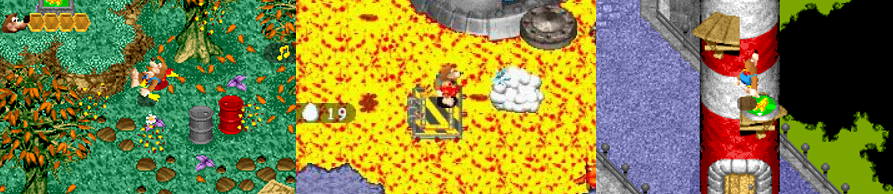
As in the Nintendo 64 games, players collect Musical Notes, though they’re used to learn new moves rather than unlock doors. There are 100 Notes in each world and your total carries over if you leave or die in the stage. Like in Banjo-Tooie, Grunty’s Revenge doesn’t use a life system. When you’re defeated, you can choose to continue, respawning at the last doorway you used, which takes a lot of the pressure off but can make trial and error aggravating. Players collect ammo from egg nests and nab Gold Feathers to become invincible for as long as your stock lasts if you press A on a Wonderwing pad, an arbitrary restriction that severely limits the ability. You can again use Shock Spring Pads to rocket higher, though landing can be tricky due to the game’s odd perspective. Every area hides ten Jiggies: some are out in the open, some are awarded after defeating bosses, and others are dislodged with the Bill Drill. You’ll clamber up ladders and vines, cross lava, ice-cold water, and poisonous mists, fire the eggs into toll booth holes to activate platforms, and race down more than a few spiral slides to collect Jiggies. You’ll also get a Jiggy if you find the five Jinjos scattered throughout each location, with the piece spawning by a large Jinjo statue that’ll also give you a tip for every Jinjo you find. Many are awarded by finding objects in the worlds, from blue shells to coins to pieces of gold to be smelted into a Jiggy or ice cream and other treats to reunite a mother with her wayward children. There are also a handful of timed challenges to test you. These see you whacking special pads to spawn Jiggies and/or Shock Jump Pads and give you a few seconds to race to the prize before they disappear. These are easily the game’s toughest challenge prior to the final boss as you barely have time to reach the pad or the Jiggy and the enemies, who respawn as soon as you scroll the screen, certainly don’t help. The game’s worlds are surprisingly large and tricky to navigate as, unlike in Banjo-Tooie, there’s no fast travel system (though some worlds have shortcuts for the duo’s temporary other forms).
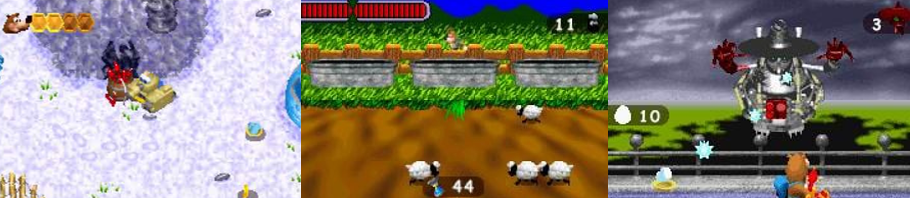
Yes, players still transform into different forms by bringing Mumbo Tokens (here awarded by beating certain bosses) to Mumbo Jumbo. There are four forms to turn into, with players able to use any form in any world (though you’ll be warped back to Mumbo’s Pad if you stray too far and must manually transform back to exit the world). You’ll become a mouse to pass through small holes and chew on wires with B, a candle that lights up a dark cave and performs a flaming somersault with B to light other candles and a TNT barrel, a cute little octopus that passes through water without harm and spits water projectiles with B, and a tank that can’t jump but braves toxic environments and fires its cannon with B. The tank enters special doors and crosses dropping panels to spawn Jiggies while the octopus is washed away through sewer pipes to blast enemies and obstacle and reach yet more Jiggies. Though these are fun, there aren’t any opportunities to explore previous worlds with new transformations and only some worlds require multiple transformations to find all their Jiggies. Each world does contain a mini game that mixes up the gameplay, but there’s only a few and they simply get reskinned. The various slides see you grabbing a set number of collectibles or racing a non-playable character (NPC) using boost pads to speed up and avoiding sticky oil slicks to get a Jiggy. There’s also a fishing mini game (which you first play snagging sheep) that can be pretty tricky; you must move left and right and cast by holding or tapping B to snag a set number. You only have a short time to do this and, later, you can’t see what you’re hooking as they’re underwater and you run the risk of being hurt by Snippets (though you can immediately retry if you fail). There are also two top-down driving challenges, one where you’re in a motorboat and one where you’re on a sled. In the first, you must snag the treasure chest and be holding it when the timer runs out; in the second, you must collect Snowies before the enemies get them. In both, you accelerate with A and fire with R though the craft can be very slippery and you’ll spin out when hit, so these can be problematic. Finally, there are shooting sections where you move back and forth and fire eggs at the Ghost Pirate or Mecha-Grunty, taking advantage of the egg nests and lamenting the lack of Honeycombs.
Presentation:
I was hesitant about Grunty’s Revenge for years simply because of the odd, top-down/isometric perspective and pre-rendered graphics…and I’m still torn after playing it. At times, the game looks great; it’s bright and cartoony and has a lot of visual charm. Other times, jumps are incredibly tricky to judge because of the slanted perspective and it’s not always clear where a wall starts and the ground ends, meaning I often ended up running against cliffs. Banjo and Kazooie look decent, if understandably limited. Banjo simply sways when idle, but all the returning moves look and sound exactly like the Nintendo 64 games. Characters still talk in gibberish, communicating via speech bubbles, and Banjo makes the same grunts and noises as he jumps and gets hurt. Grunty still talks in rhyme and taunts you, though collectibles are no longer anthropomorphic so most of the exposition is related through Bozzeyes, which can interrupt the gameplay. Grunty’s Revenge does a decent job of recreating familiar tunes from its bigger cousin, with Jamie Hughes remixing and sampling Grant Kirkhope’s memorable Nintendo 64 tunes, though these are obviously limited by the hardware and at times sound grating as a result. Enemy sprites and animations are disappointingly limited, however, and the game doesn’t do much with its time travel plot. You journey to each world from Spiral Mountain, which is closer to Banjo-Tooie’s Wooded Hollow since it houses Jiggywiggy’s Temple, though the area doesn’t look that different to what you’re used to. Sure, Grunty’s lair appears to be under construction, but the giant witch’s head is still there, and the inside is still an ominous castle. It might’ve been nice to see the landscape more dramatically changed as I legitimately forgot I was supposed to be in the past as it barely has any relevance beyond it being mentioned in dialogue. Sure, Mumbo’s younger but he still fulfils the same role and Bottles might not be born yet or too young to help, but Bozzeyes isn’t that different. Perhaps if the game had been changed a bit to have the duo flung into the distant past, or numerous time periods, the visuals could’ve been changed more.
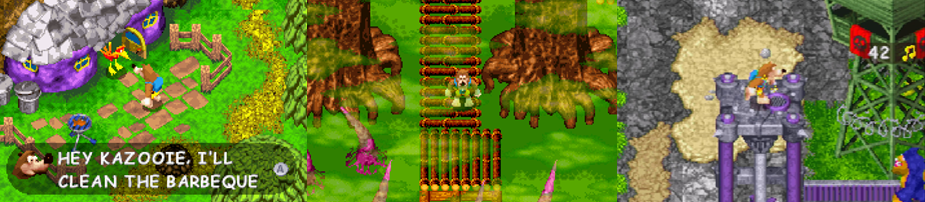
This extends to the game’s worlds, too. Cliff Farm was an interesting idea but…it’s still just a farm, which isn’t an interesting location. Sure, there are haybales to jump on, tractors to see, a big barn to venture into, and a mill to explore but you can’t expect much from such a bland setting. Things then venture into the overly familiar with Breegull Beach, which isn’t a million miles away from Treasure Trove Cove and Jolly Roger’s Lagoon, featuring a beach, a sandcastle, a quarry and cliffs. Considering it’s Kazooie’s birthplace, it definitely feels like a wasted opportunity not to do more with that, perhaps include her family or siblings or something. Bad Magic Bayou was like Bubblegloop Swamp, with its poisonous water, broken wooden bridges and platforms, and murky swamp that’ll choke you if you linger too long. You hop to tyres to reach isolated islands and climb a tree using log platforms (taking full advantage of the lack of fall damage if you slip). Spiller’s Harbor is essentially a downgraded Rusty Bucket Bay, featuring polluted water thanks to oil leaking from pipes, a lighthouse (that you never go inside), and a nearby village where you hop onto rooftops like in Jolly Roger’s Lagoon. Freezing Furnace isn’t too dissimilar from Hailfire Peaks in that it’s a wide, frozen landscape of slippery platforms, narrow walkways, and ice-cold water that saps your health (unless you’re an octopus). You must scale mountains, venture into igloos, and enter a cave to reach Grunty Industries. This is a lava-filled industrial factory full of pipes, boilers, and toxic gunk that decimates your health unless you return as a tank. When you collect enough Jiggies to enter Grunty’s lair, it’s simply two screens: a stone arena where her minions watch you battle the final gauntlet and a claustrophobic rooftop where an ominous storm rages in the background. Grunty’s Revenge definitely captures the spirit of the Nintendo 64 games but plays things a little too safe, seemingly afraid to think outside the box and barely utilising the Game Boy Advance’s power to the best of its ability with its fitting, if simplistic, 2.5D aesthetic.
Enemies and Bosses:
Anyone who’s played the Nintendo 64 Banjo games will recognise most of Grunty’s Revenge’s enemies. There two most common baddies are the various Gruntlings and the thrashing tentacles that appear everywhere, even on the overworld. Gruntlings simply lumber about, stomping after you if they spot you, and take more hits to defeat the further you progress and the more their colour scheme changes. They’re echoed in the Bogfoot and Biggyfoot enemies, who take even more hits to defeat and often patrol on narrow walkways and above you on cliffs, which can cause you to fall into hazardous water if you’re not careful. Beehives are soon protected by bee swarms that fly at you, Tee-Hees pass through walls and, like the multi-coloured Spookos, are invulnerable unless you use the Wonderwing or certain eggs, and Gruntweeds burst from the ground, camouflaged by the Game Boy Advance’s limited palette, to slam on you. Chombas leap from portraits to take a bite out of you, Boom Boxes bounce around and explode on contact, Stinglashes block the way or pop from the ground like weeds, and sentient mines often patrol the waters. Most of these enemies are merely a nuisance; they’re defeated in one or two hits and often drop Honeycombs. The drop rate lessens as you progress and they become more formidable, but their biggest threat is that they respawn once you scroll away, even if it’s just for a moment. Sometimes, you’ll battle waves of them for a Jiggy; other times, bosses spawn them in, or they swarm claustrophobic interiors. By far the worst enemies, for me anyway, are the Germuloids, who latch onto you and won’t let go until they’ve drained your health, or you’ve wiggled the directional pad enough to destroy them.
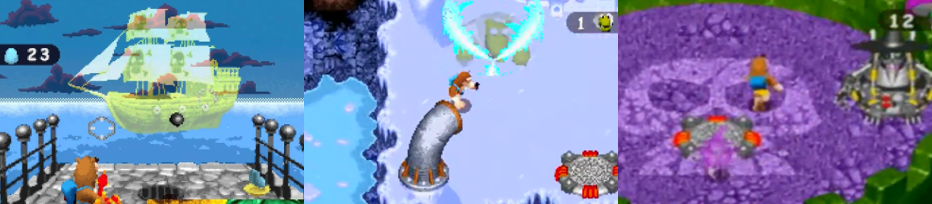
Grunty’s Revenge is extremely limited with its boss battles, recycling the same encounters with Mecha-Grunty or her chief minion, Klungo, three times each and then forcing you into a gauntlet in the endgame. The Ghost Pirate offers as a unique battle, framed as a limited third-person shooter where you must dodge his cannonballs and fire at his grinning visage when it appears, but even this is recycled for a Mecha-Grunty battle. This is a bit tougher as you must target her hands, hat, and panels on her torso, but the strategy is still the same. Similarly, though the battles against Klungo and Mecha-Grunty get progressively difficult, what works the first time will work the last. Klungo tosses vials and stalks you, only being vulnerable when his shield’s down. He’ll add in temporary invisibility, minions, and a slippery arena as you progress, with the window to attack getting smaller each time. This is echoed in the Mecha-Grunty fights as she also hides behind a shield, though she fires a projectile spread and also tries to crush you. In the endgame, you battle Mecha-Grunty in her arena, watching for her aerial bombardment, then take on Klungo again, with a quiz appearing between each fight. Best these and you’ll face a multi-phase battle against Mecha-Grunty on the castle roof, one where your room to avoid her homing projectiles and other attacks is extremely limited. To make matters worse, you can’t just hit her mech in this final fight like in the others; instead, you must strike her robot body and also attack her spirit when it appears. Additionally, you’re very unlikely to get Honeycombs during these battles and there are no checkpoints between each fight so, if you die at any point, you must not only start all over again but also complete the time switch task to enter Grunty’s lair! This was a difficulty spike I wasn’t expecting; just replenishing your health and eggs for the quiz would’ve helped. Ideally, there would be a doorway in the first arena to return to the overworld, with the entrance remaining unlocked but, as is, this was a gruelling final challenge that I couldn’t get past.
Additional Features:
There are two Extra Honeycombs in every area of Grunty’s Revenge, requiring all your abilities to uncover them to fully extend your health bar, and 600 Musical Notes and ten Jiggies in each as well. You won’t need all of them to learn every move or unlock every world, but you will need at least fifty Jiggies to reach the final boss gauntlet. However, if you want to see the best ending, you’ll need 100% of these collectibles, something that’s a tall order thanks to Breegull Beach’s timed challenge, let alone the final boss. When you finish the game, you play one last sliding game as the credits roll, collecting gold coins as you go. These are spent at an arcade machine in Breegull Beach, where you can replay the mini games at will.
The Summary:
I’ve been on the fence about Banjo-Kazooie: Grunty’s Revenge for years. There was something about the odd, quasi-isometric perspective that always put me off but, in the end, the game isn’t too expensive, and I felt the itch for more of the bear and bird duo. The game makes a good first impression, emulating the bright, cartoony visuals and quirky humour of the Nintendo 64 games and doing a decent job of recreating the characters, locations, and music from its counterparts. It is, in many ways, a 2.5D demake of Banjo-Tooie, featuring relatively large worlds and some fun mechanics with the different forms. However, these transformations are painfully underutilised and the Jiggies were, by and large, easy to collect as long as you weren’t racing against a ridiculously limited timer. There’s nothing here in terms of moves and abilities that you won’t find in the superior Nintendo 64 games…in fact, there’s less since you can’t fly or use the Wonderwing at will. While I enjoyed the visual fidelity to the other games, the worlds and environments are horrible limited and lack innovation. Each world has similar tropes (find stuff, play a mini game, fight a boss, a platforming challenge, etc), with none of the nuance and interconnectivity (or, at times, challenge) of the Nintendo 64 games. These issues are only compounded by Grunty’s Revenge recycling the same mini games and boss battles, forcing you into an unfair final gauntlet, and completely wasting its time travel plot. There was an opportunity to present something a little different and, instead, the developers played things far too safe and tried to give Game Boy Advance players a truncated version of the Nintendo 64 games rather than something that takes advantage of the system’s strengths. As a big, lifelong fan of the franchise, I was left disappointed and, though I don’t regret buying Grunty’s Revenge, I’m not surprised it’s largely been forgotten to the mists of time.
My Rating:
Could Be Better
What did you think to Banjo-Kazooie: Grunty’s Revenge? Were you impressed by how closely it emulated the Nintendo 64 games, or do you agree that it wasted its potential? What did you think to the semi-isometric perspective and the time travel plot? Which of the new worlds and transformations was your favourite? Were you also disappointed by the recycled mini games and bosses? Did you ever get the best ending, and would you like to see this game more widely available? Whatever you think about Banjo-Kazooie: Grunty’s Revenge, drop your thoughts in the comments, support me on Ko-Fi, and check out my other retrogaming content.















 Dr. K's Waiting Room
You must be logged in to post a comment.