Movie Night: Zack Snyder’s Justice League

Released: 18 March 2021
Director: Zack Snyder
Distributor: HBO Max/Warner Bros. Home Entertainment
Budget: $70 million (on top of the original $300 million production costs)
Stars: Ben Affleck, Gal Gadot, Ray Fisher, Jason Momoa, Ezra Miller, Ciarán Hinds, Amy Adams, and Henry Cavill

The Plot:
Following the death of Clark Kent/Superman (Cavill), Bruce Wayne/Batman (Affleck) scrambles to bring together a team of super-powered heroes when the disgraced New God Steppenwolf (Hinds) arrives on Earth and begins violently searching for the mysterious “Mother Boxes”.

The Background:
Oh God, where to start with this? Okay, so, after the Marvel Cinematic Universe (MCU) became this super successful juggernaut, Warner Bros. scrambled to try and catch up and craft their own cinematic universe. The first step was Man of Steel (ibid, 2013); Zack Snyder was picked to helm the project and steer the direction of the DC Extended Universe (DCEU) and, initially, the results were promising. Despite some mixed reviews, Man of Steel was a financial success but the cracks in Snyder’s vision started to form with Batman v Superman: Dawn of Justice (ibid, 2016). Despite the presence of acclaimed superstar Ben Affleck and reaping a hefty box office, the film divided many due to its pace and bleak tone and Warner Bros. started to get cold feet regarding Snyder’s vision for the DCEU. As a result, they brought in Joss Whedon to lighten the follow-up’s tone and ultimately replace Snyder after the tragic death of his daughter. Despite a similar box office gross to its predecessors, Justice League (Whedon/Snyder, 2017) released to scathing criticism and the film was disowned by even DCEU collaborators. The DCEU chugged along regardless but, very quickly, reports of Whedon’s reprehensible behaviour surfaced alongside rumours that a “Snyder Cut” was all but completed in Warner’s vaults and fans all over the world began campaigning hard for the release Snyder’s original version. While this did lead to a toxic community that I cannot condone, the movement gained serious traction when members of the cast voiced their support and Snyder finally returned to complete the film and was even afforded additional money and resources to film new scenes for his four-hour epic for the HBO Max streaming service. To the delight of Snyder’s fans, Zack Snyder’s Justice League finally released and drew a lot of attention to HBO Max. The general critical consensus, however, was mixed; though reviews praised the film as a coherent story and the culmination of Snyder’s vision, its length and excess were criticised. After the film’s release, Warner Bros. made the decision not to capitalise on its success and fans immediately campaigned to complete Snyder’s vision for the DCEU, despite his lack of interest in returning to the property, proving that some fans are just never satisfied.

The Review:
When I reviewed the original, theatrical cut of Justice League (no, I will not call it “Josstice League”), I gave it a ten out of ten. This was primarily because I am a massive DC Comics fan and, after years (literally decades) of DC’s live-action characters always existing in their own self-contained bubbles, I was just happy to see them all onscreen together and co-existing and felt that this was the most positive thing to take away from Snyder’s rushed attempt to build DC’s cinematic universe. Time, however, has changed this perspective; Justice League is by no means perfect but it was honestly never going to be. Warner Bros. scrambled about trying to play catch up to the MCU and, in focusing on cramming everyone together as quickly as possible and sucking the fun out of many of their most popular characters, they lost me a little along the way. So to say I was excited for the Snyder Cut is to lie, honestly. As much as I enjoyed Man of Steel, Snyder really dropped the ball with Batman v Superman, which was more a collection of ideas and themes than a coherent movie, and I took massive issue with his grandiose vision of the DCEU which jumped from Superman’s origin all the way to Multiversal shenanigans in, like, two films. Still, as a rule, I generally do enjoy a longer director’s cut as you get more bang for your buck and, in that regard, Snyder certainly goes above and beyond to present the closest version of his vision for Justice League as possible, even going so far as to present the film in a 4:3 aspect ratio.
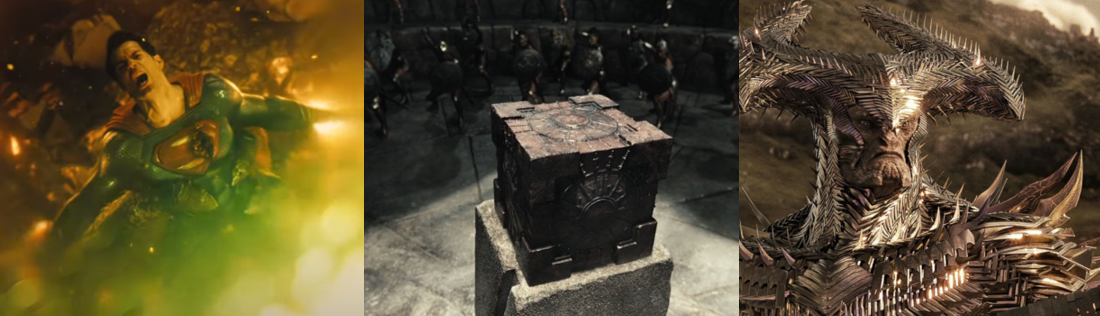
Superman’s death cry activates the Mother Boxes and calls Steppenwolf to Earth.

Zack Snyder’s Justice League begins with an egregiously slow-motion recap of Superman’s dramatic (and, in my view, unnecessary) death in battle against Doomsday. His death rattle (which seriously goes on for about six minutes), echoes all around the world, activating the Mother Boxes stored in Atlantis and Themyscira and sending a beacon out into the void of space with a simple message: Earth is vulnerable. Steppenwolf (now dramatically redesigned into a hulking creature wearing razor-sharp armour that honestly looks just as ugly as his original design but for different reasons) once again arrives to reclaim the Boxes; this time, however, his slaughter of the Amazons is much more brutal, featuring far more Parademons and presenting Steppenwolf as a formidable and imposing force. Indeed, compared to his theatrical counterpart, Steppenwolf is a much more well-rounded and interesting character; in the original cut, he was little more than a means to an end, an obscure and generic bad guy for the titular heroes to unite against in order to save the world but, here, he’s a driven, focused, and aggressive foe who is motivated not just by loyalty to his master and devotion to bringing about “the great darkness” but also desperate to regain his place among the New Gods after losing favour centuries before. Owing Darkseid (Ray Porter) a debt of fifty thousand worlds for his failures, Steppenwolf has been ostracised and forced to toil in endless conquest to regain his place at his master’s side; this desperation and motivation transforms Steppenwolf from a mere disposable hulk and into a surprisingly complex villain who seeks redemption and validation in the eyes of his master and will do anything to appease the will of Darkseid.
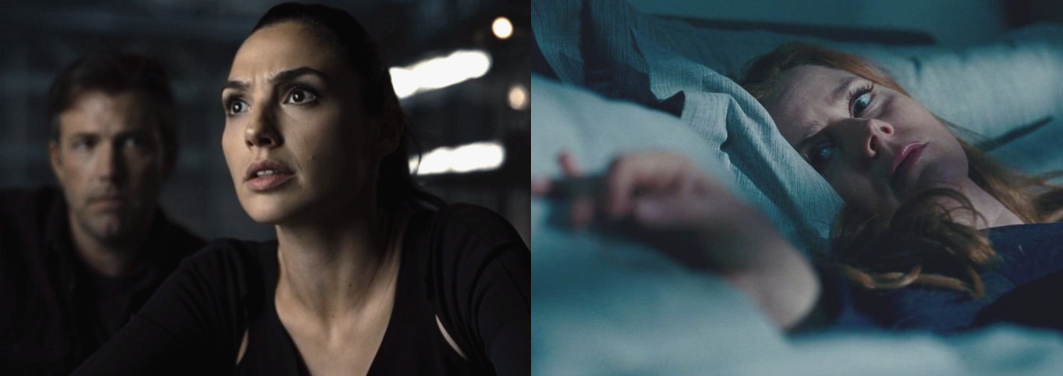
Superman’s loss affects each of the characters in different ways.

While the Man of Steel’s loss was felt in the theatrical cut, Superman’s death is a much bigger aspect of the Snyder Cut; carrying the guilt of Superman’s death on his shoulders, Bruce Wayne sets out to build an alliance of metahumans to combat this threat. While Diana Prince/Wonder Woman (Gadot) is reluctantly onboard with the plan and Barry Allen/The Flash (Miller) signs up immediately and enthusiastically, Arthur Curry/Aquaman (Momoa) basically laughs in his face and Victor Stone/Cyborg (Fisher) is busy struggling to reconcile his humanity after a horrific accident leaves him part machine. Furthermore, Superman’s loss is embodied here not just in Bruce’s guilt and desire to honour Superman’s legacy with a team of superheroes but in both Lois Lane (Adams) and Martha Kent (Diane Lane), both of whom struggle to adjust to life without Clark. Since Bruce has already been told that “Lois [is] the key” to reaching Superman, it makes sense to give Lois and Martha a little more prominence in the film, especially as her death is what causes Superman’s corruption in the dark future that looms over Snyder’s films.
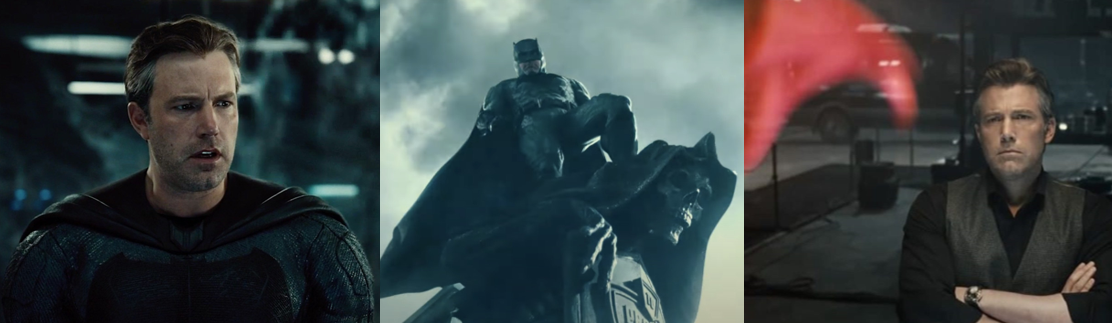
Batman is now absolutely focused on bringing together a team to honour Superman’s memory.

Bruce Wayne is, of course, extremely different compared to his characterisation in Batman v Superman. Now driven by an obsessive desire to make good on his promise to unite Earth’s heroes in Superman’s name, he works himself tirelessly to track down the metahumans from Lex Luthor’s (Jesse Eisenberg) file, much to the continued chagrin of his faithful butler and father-figure, Alfred Pennyworth (Jeremy Irons). Since he works closely with Diana to find and appeal to these metahumans, there’s even a little (microscopic, even) bit of romantic chemistry between the two and there’s now a nice little scene of Alfred making tea with Diana and showing her Batman’s new Parademon-absorbent gauntlet (which replaces the original cut’s side plot regarding Batman luring the Parademons out with “fear”). Mostly, though, Bruce remains the same character as in the theatrical cut; he’s still blinkered in his focus on bringing the team together, resurrecting Superman, and preparing the world to face escalating threats but all of his weird little attempts at humour are thankfully gone (sadly, that God-awful “I’m rich” line remains but, thankfully, we get the return of his “I’m real when it’s useful” line).
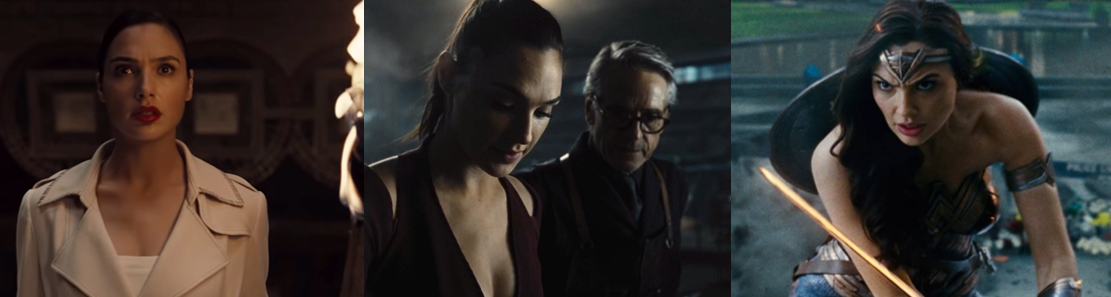
Wonder Woman now warns the team of Darkseid’s intentions for Earth.

Wonder Woman, however, is noticeably different this time around; more time is spent showing her as a willing ally of Bruce’s and she is also part of a pivotal extended scene that explores Steppenwolf’s previous campaign against the Earth. This sequence, which expands upon the prologue seen in the theatrical cut, shows the forces of man, Gods, Atlantis, Themyscira, and beyond uniting not just against Steppenwolf and his Parademons but also their exalted and imposing leader, Darkseid. Darkseid received only a passing mention in the original cut but, here, Diana’s obvious fear of the New God helps to establish early on that an even greater threat looms behind Steppenwolf’s actions. Furthermore, when out in the field with the team, Wonder Woman directs the fledging Justice League in the best way to attack Steppenwolf and his Parademons, which places greater emphasis on her capabilities as a warrior and leader.

The Snyder Cut retains Aquaman’s characterisation but explores a little more of his world.

Aquaman is largely the same as in the theatrical cut except, unsurprisingly, more haggard and bleak rather than being an obnoxious jock. Though he claims to have no interest in Bruce’s crusade or working with others and has turned his back on Atlantis, he continues to do good and help those in need in his own way to get his hands on more whiskey. Bruce’s warning, though, compels him to return to the ocean and converse with Nuidis Vulko (Willem Dafoe), his former mentor, and ultimately to arrive all too late to help Mera (Amber Heard) defend the Mother Box from Steppenwolf. A couple of odd continuity issues are raised with all this, however, that fly in the face of DC’s directors wanting to align their movies with the Snyder Cut; first there’s Mera’s accent, which jumps from British to American to whatever the hell she likes, and second is the Atlantean’s ability to communicate using dolphin squeaks rather than just talking underwater as they do in Aquaman (Wan, 2018). Regardless, this version of Justice League does a far better job of setting up Aquaman’s solo film by showing more hints towards his world and Aquaman remains the film’s breakout character for me for me thanks to Momoa’s charismatic portrayal of the character.

Though still very neurotic, Barry plays a pivotal role in the film’s events and finale.

Barry Allen also gets a bit more time to shine this time around; this includes the restoration of his encounter with Iris West (Kiersey Clemons) and just more time to explore his awkward, energetic, and socially inept character traits. Barry was very much the comic relief of the theatrical cut and those who disliked many of his annoying character traits will be disappointed to find most of them intact and given more prominence in his increased screen time but I can’t fault Snyder’s attention to detail in showcasing Barry’s superspeed: his shoes and clothes disintegrate, the street is wrecked by his footfalls, and he experiences time in extreme slow motion when utilising the Speed Force. While the Flash loses one of my favourite scenes from the original cut (the “Just save one” moment), he plays a far greater role in not just the rescue of scientists from Steppenwolf’s clutches but also the film’s finale where, faced with defeat at the hands of Steppenwolf’s forces, he summons all of his super speed to travel back in time using the Speed Force and ensure that the invasion is halted.

Cyborg’s role is greatly expanded, making him the heart of the film and fleshing out his character.

Of course, the character who benefits the most from the Snyder Cut is Cyborg; in the theatrical cut, Cyborg is a stoic, confused young man who resents his father, Doctor Silas Stone (Joe Morton), for transforming him into a machine-monster in order to save his life. While this remains at the start of Cyborg’s character arc in the Snyder Cut, Snyder restores not just Cyborg’s importance to the film as the “heart” of the Justice League but also his eventual reconciliation with his father and showcases excised scenes of his promising career as a college football player, his natural aptitude for hacking (which he used to help those in need), and the horrific accident which left him near death. While I’m personally not a fan of Cyborg being on the Justice League, it was clear that there was originally more to his inclusion and importance to the film’s plot; since he’s literally comprised on a Mother Box and Apokoliptian technology, he is afforded numerous abilities and insights into the invading New Box forces and, here, Silas actually guides and mentors him in exploring these abilities (which includes his ability to access every technological device and network and essentially makes him the most powerful man on Earth).

Superman returns, now in a black suit, and galvanises the team.

Finally, there’s Superman; as you might expect, Superman is absent for a massive amount of the film on a small account of being dead. Like Darkseid, Superman looms over the film but as a hero lost and much needed as a symbol for the world’s heroes to properly rally behind. Bruce’s plan to resurrect Superman with the Mother Box is discussed (and edited) far more competently this time around; although there’s doubt about the moral and ethical implications of the plan (mainly from Alfred this time around), Bruce and Diana don’t come to blows like in the original film but the outcome remains the same. Like before, Superman is disorientated upon returning to life and attacks the fledgling Justice League in his confusion; his confrontation with Batman is a little different (and not as good as in the original cut, in my opinion) and there’s more to his return to the Kent farm but, upon regaining his senses, he returns to action as the team’s ace in the hole for the finale. Cavill is an absolutely fantastic Superman and Justice League finally got the character to a place where he is the charming symbol of hope and strength that the world needs and, despite his new black suit, Zack Snyder’s Justice League only expands upon that (of course, Cavill’s natural charisma and the absence of a horrible CGI face play a huge part in that).

The Nitty-Gritty:
One word to describe Zack Snyder’s Justice League (apart from “long”) would certainly be “epic”; Snyder pads the film’s runtime out with not only an abundance of never-before-seen footage, alternate takes, and new content but also an overuse of slow-motion and long establishing shots. To help make the film more accessible to viewers, the film is also split into six chapters, which was probably a great way to view it on HBO Max, and the DVD version of the film is split across two discs but, either way you slice it, this is a slog to get through and I have to believe that Snyder simply milked the extra time and money he was afforded just to capitalise on all the hype surrounding his version of the film. The closest comparison I can make is with his director’s cut of Watchmen (Snyder, 2009), which was similarly epic and ambitious in its scope, presentation, use of music, and its presentation of its costumed adventurers.

Some shots effects, and inconsistencies negatively affect the Snyder Cut.

It has to be said, though, that Zack Snyder’s Justice League has quite a few faults; some of the new special effects shots understandably look worse than others (and Cyborg still looks like dog shit), it’s pretty crazy that Darkseid and his forces just forgot where Earth was for hundreds of years (especially considering how badly he wants the secret of the Anti-Life Equation), the score has been completely reworked to remove Danny Elfman’s contributions (though, thankfully, Wonder Woman’s kick-ass musical theme remains), and many of the new scenes shot exclusively for the film suffer from poor lighting, inconsistent editing, and stand out like a sore thumb to the point where I’d much rather Snyder hadn’t bothered including the likes of the Joker (Jared Leto) when it makes little sense narratively (you’re telling me that in a grim, apocalyptic future where Superman has gone bad the Joker is alive but Aquaman isn’t?) Personally, I have never been a fan of Snyder’s “Knightmare” timeline; it made no sense in Batman v Superman and, thanks to Warner Bros. having no interest in allowing Snyder to fully explore this alternate timeline in Justice League sequels, it makes even less sense to me that he chose to continue pushing this dark vision of a future ruled by Darkseid and a corrupted version of Superman in the Snyder Cut (but, at least, it’s mainly confined to the film’s final moments rather than being awkwardly wedged in the middle of the film like in Batman v Superman).
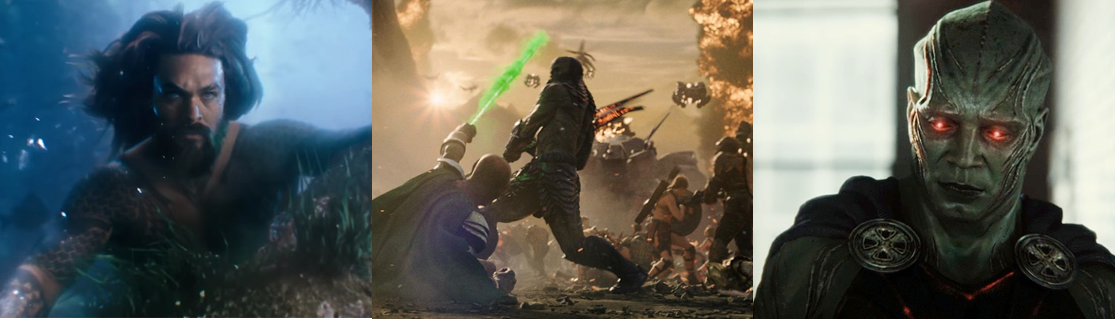
Snyder’s cut expands and recontextualises many of the film’s existing scenes and characters.

Although many scenes and sequences may be familiar to anyone who has seen the theatrical cut of the film, the Snyder Cut expands upon every single one of these and, in many cases, recontextualises them into this larger narrative. This includes a longer scene of Bruce Wayne meeting and attempting to recruit Aquaman (accompanied by a lengthy song of reverence for the Atlantean), an expanded version of Wonder Woman’s introduction (including the first of a handful of pointless f-bombs), a longer version of Steppenwolf’s attack on Themyscira and the recap of Darkseid’s defeat centuries ago, more scenes of Steppenwolf and his Parademons’ search for the Mother Boxes (including torturing Atlanteans for information and a far better sequence where he acquires the final Box), and even recontextualising the interactions between Lois and Martha with the reveal that General Calvin Swanwick (Harry Lennix) has been J’onn J’onnz/Martian Manhunter all along.
The Snyder Cut restores and dramatically changes excised characters.

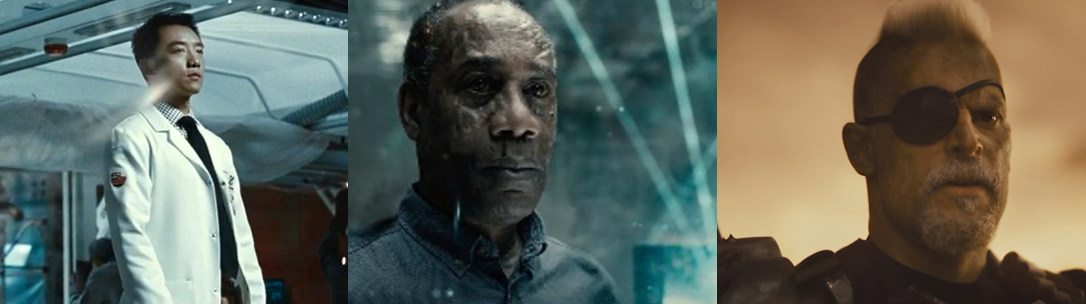
One of the main selling points of Zack Snyder’s Justice League, however, is the restoration of scenes and plot threads excised from the theatrical version. This includes characters removed from the original film, like Doctor Ryan Choi (Ryan Zheng), Vulko, Iris, DeSaad (Peter Guinness), Cybrog’s mother, Elinor Stone (Karen Bryson), and more time devoted to side characters like Silas (who now gives his life to mark the final Mother Box) and the origins of the Mother Boxes. One of the benefits of this is that we actually get to see an in-depth look into Cyborg’s expansive abilities (which includes a deep dive into the way he now perceives reality). Much of the Snyder Cut’s hype was also built around the inclusion of Darkseid but, in truth, the character is little more than a cameo; he simply takes Steppenwolf’s place in the flashback of the war between the allied forces of Earth and Apokolips and looms over the film like an ominous shadow as the ultimate threat for the united Justice League. Sadly, despite Snyder choosing to push his Knightmare future throughout the film and concluding it with a tease of Darkseid’s impending retaliation against the Justice League, it seems like we won’t be seeing Darkseid (or any of the New Gods for that matter) in the DCEU again any time soon.
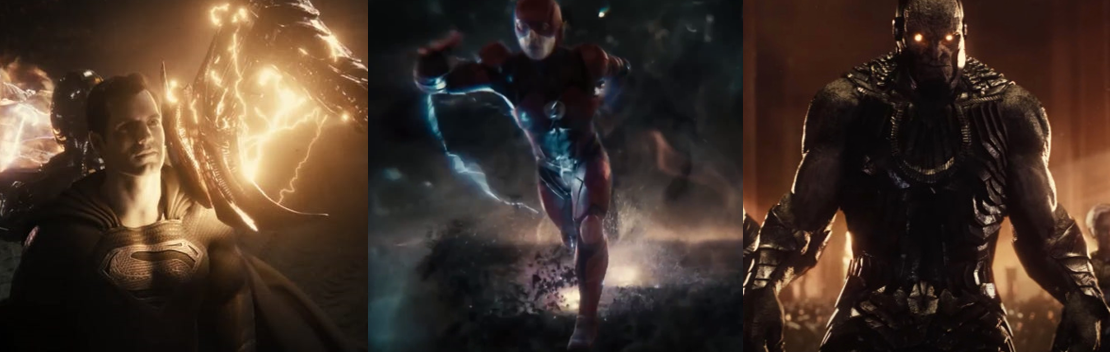
Thanks to the team, and time travel shenanigans, Darkseid is left humiliated.

Snyder’s vision of the DCEU remains extremely bleak in its presentation; for all the characters’ talk of “hope” and the better nature of men, Snyder continues to suck all the life and colour out of these vivid characters. One thing I liked about Justice League was that it did a fantastic job of bringing some life and colour to this world, allowing the costumes to pop out on screen but, here, everything retains the same muted look and sombre tones of Batman v Superman. This is best exampled in Snyder’s instance on garbing the resurrected Superman in his black suit; Superman wore this in the comics after returning to life for about three issues and it was later stated to have helped aid his recovery but, here, no real reason is given for his choice of attire and it honestly would have made more sense for the evil Knightmare Superman to have worn the suit instead. Additionally, Snyder removes the red tint and tumultuous skies from the finale of the film, which admittedly does make the climatic battle against Steppenwolf’s forces easier to see but I feel the original colouring worked a lot better as a reference to the red skies that were are of DC’s various Crises. Speaking of the finale, Zack Snyder’s Justice League slightly recontextualises the ending. Although there’s still an implication that Batman is heading into battle with the intention of dying, it’s not as explicit as in the theatrical cut; what is much more explicit, though, is the feeling of team work between the Justice League as they each play their part in breeching Steppenwolf’s defences (Flash, again, gets way more to do in using his Speed Force charge to help Cyborg interact with the Mother Boxes) before Superman dramatically shows up to again completely lay waste to Steppenwolf. I’m glad that this beatdown is maintained as it was always a glorious showcase of Superman’s return and of the team coming together against a common enemy but, here, things go slightly differently as the heroes fail to stop the unity between the Mother Boxes and prevent Darkseid’s arrival. With no other choice, the Flash enters the Speed Force and reverses time in a beautifully surreal sequence, allowing Cyborg to reject the Apokolips’ influence and Wonder Woman to decapitate Steppenwolf right before Darkseid’s eyes.

The Summary:
I went into Zack Snyder’s Justice League with low expectations. Toxic fans and a rabid, almost cult-like online community had beaten any sort of excitement and wonder out of me. I quite enjoyed the theatrical cut; it wasn’t perfect but, news flash: none of the DCEU has been perfect and few films really are. Knowing that Snyder got so screwed over by Warner Bros. stung and it definitely frustrated me that we didn’t get a concise and more accurate version of Justice League years ago so that maybe the DCEU would be in a slightly better place but it was hard for me to feel invested in the film when it was so self-indulgent and so clouded by negativity and entitlement. In this case, though, I am glad to be wrong; there are many benefits to Zack Snyder’s Justice League. For one thing, it actually feels like a coherent story (even more so than Batman v Superman) and each member of the team is given so much more time to shine and showcase their powers and personality. Thus, when the Justice League unite for the finale, it means that much more as we actually get to know them all a little better and see them grow as a team through their interactions; it’s still a rush job as so much had to be crammed into so few films but, as a big fan I am of DC Comics and these characters, it remains a real thrill to actually get to see Batman, Superman, Wonder Woman, the Flash, Aquaman, and Cyborg all in a big budget, live-action film rather than constantly existing in self-contained bubbles (which seems where the DCEU will be heading again going forward). I’m not a massive fan of Snyder’s vision for the DCEU or many of the decisions he made but it’s better than nothing and not seeing an interconnected series of DC films so, while I was initially hesitant to enjoy Zack Snyder’s Justice League, I have to say that I was pleasantly surprised in the end. Had Warner Bros. not interfered and screwed things up, we probably would’ve gotten a two-and-a-half-hour long film that would have satisfied everyone enough to justify at least one more team effort but it is what it as and at least we got to see the closest approximation of Zack Snyder’s true vision of the film in the end and that’s something to be celebrated rather than simply, selfishly, demanding more.

My Rating:

Rating: 5 out of 5.

Fantastic

What did you think to Zack Snyder’s Justice League? Do you think it lived up to all the hype or was it all style and no substance? What did you think to the additional, extended and recontextualised scenes from Justice League and how do you feel the Snyder Cut compares to the theatrical version? Which of the characters was your favourite and what did you think to their extended screen time? How did you watch the film; in sections or as one long movie? Would you like to see more from Snyder’s DCEU or are you happy with the direction Warner Bros. is taking? What did you think to the whole Knightmare timeline Snyder tried to push and were you a fan of Superman donning the black suit? Whatever you thought about Zack Snyder’s Justice League, good or bad feel free to leave a comment below (even if it is super toxic).

Movie Night: Joker

Released: 4 October 2017 (Hey, that’s my birthday!)
Director: Todd Phillips
Distributor:
Warner Bros. Pictures
Budget:
$55 to 70 million
Stars:
Joaquin Phoenix, Frances Conroy, Zazie Beetz, Brett Cullen, and Robert De Niro

The Plot:
In 1981, party clown Arthur Fleck (Phoenix) suffers from a medical disorder that causes him to laugh at inappropriate times and lives with his mother, Penny (Conroy), in Gotham City. With Gotham overwhelmed by crime and unemployment, Arthur’s dreams of being a stand-up comedian and meeting his idol, talk show host Murray Franklin (De Niro), soon give way to a nihilistic insanity that inspires a violent counter-cultural revolution against the wealthy.

The Background:
The Joker has long been a staple of DC Comics and is widely regarded as Bruce Wayne/Batman’s arch-nemesis. First appearing all the way back in 1940, the self-styled “Clown Prince of Crime” was created by Bill Finger and Bob Kane and has been responsible for a great many tragedies in the Dark Knight’s life, from the death of Jason Todd/Robin to the crippling of Barbara Gordon/Batgirl, and has gone through a number of iterations over the years, from madcap extortionist, to demented serial killer, to self-mutilating madman. The Joker has also been adapted to film on numerous occasions; Cesar Romero famously refused to shave his moustache for the role in the sixties Batman show, Jack Nicholson brought the character to life in Batman (Burton, 1989), Heath Ledger was posthumously honoured for his incredible performance as the Joker in The Dark Knight (Nolan, 2008), and Jared Leto had his time in the role significantly cut from the theatrical release of Suicide Squad (Ayer, 2016). Development of a standalone Joker movie was initially planned as a spin-off of Suicide Squad and would have featured Leto returning to the role; however, after a series of blunders caused Warner Bros. to rethink their strategy regarding the DC Extended Universe (DCEU), production shifted towards an unrelated interpretation of the character. Phoenix, who had previously turned down superhero roles, shared director Todd Phillips’ desire to produce a gritty character study that delved into the psychosis of the character, which is traditionally left ambiguous in the source material.  Afforded a far smaller budget than other DC movies and also the first DCEU film to earn an “R” rating, Joker was a phenomenal commercial success and made over $1 billion at the box office. The critical reception was generally very positive as well; many praised the film’s uncompromisingly bleak narrative and for subverting the norms of comic book movies. Although others were disturbed by the film, which controversially inspired both protesters and deplorable violence, Joker spawned an unlikely musical sequel a few years later.
The Review:
When Joker was first announced, I have to admit that I was sceptical; I wasn’t a massive fan of Leto’s performance in Suicide Squad but, if it’s one thing I desire in my comic book movies these days, it’s continuity. The idea of producing a standalone Joker film didn’t sit right with me in general, much less that it wouldn’t be a part of the DCEU. Instead, Warner Bros. made the decision to lean into the idea of the multiverse, a concept that has been used for decades in comic books to present wildly different, alternative takes on characters and which, essentially, allows everything to be canon even when it’s not. Even as a die-hard, life-long comic book fan, this concept is confusing and I was surprised when the general audience, and many comic book fans, reacted positively to the idea of two Joker’s being active in cinema at the same time. I found it difficult to consolidate these feelings, though, and still firmly believe that the DCEU would be in a much better shape now if the producers had taken the Joker and Birds of Prey (and the Fantabulous Emancipation of One Harley Quinn) (Yan, 2020) and combined the two into something that could actually fit in with the janky continuity of the mainstream DCEU. Thus, I was hesitant to even give Joker the time of day; no matter how much praise I heard or how many awards it won or how much money it made, I just found the idea of having another version of the character active that is separate from the DCEU was a bit daft, to say nothing of favouring a dive into the motivations of one of comic’s most notoriously ambiguous characters over a sequel to Man of Steel (Snyder, 2013).

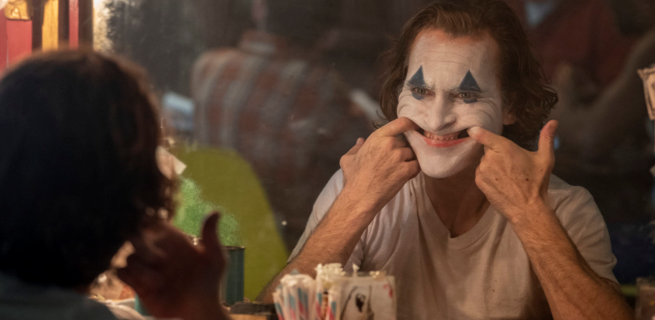
Arthur is just barely able to function in society by putting on a false face.
When we first meet Arthur Fleck, he’s a pathetic excuse for a man; reduced to dressing up in clown make-up and forcing himself to be a smiley, jolly clown for hire, he’s beaten down (literally) by both life and society. Right away, it’s pretty clear that something’s very wrong in his head and with his demeanour; his social skills are questionable, his self-confidence almost non-existent, and his ironic pathological need to laugh uncontrollably at the most inappropriate times make him an inherently damaged individual. In a city drowning in chaos and unemployment, with life at its bleakest, Arthur may be one of the lowliest and most despondent citizens of Gotham. Although he attends regular therapy sessions and is encouraged to write his thoughts and feelings in a journal, these outlets are of little help to his mental state. Awkward, insecure, full of nervous ticks and tricks, he’s kept in a fragile stability only by numerous ambiguous medications and his desire to be a stand-up comedian. Ironically, just as he tends to descend into maniacal laughter in uncomfortable and awkward situations, his comedy routines and sense of humour are openly ridiculed and his medication seems to be holding him back from unleashing all of the pent up aggression and emotion bubbling just beneath his surface.

Arthur searches for surrogate father figures to fill a void in his life.

Arthur’s reality is one of pain and suffering and oppression; when not eking out a mediocre living during the day, he’s looking after his bed-ridden and increasingly confused mother, Penny (Conroy). Arthur’s main source of escapism is in watching Live! With Murray Franklin and imaging forming a bond with its host, and his idol, Murray Franklin. Lacking a true father figure, Arthur imagines himself connecting with Murray to fill that void in his life and this sense of abandonment and desperate need for acceptance, love, and understanding only fuels his despondency and anger. However, already on the razor’s edge of sanity at the best of times, Arthur snaps after first losing his beloved job as a clown and then taking a beating on the subway from three Wayne Enterprises employees, whom he shoots in cold blood. In this version of Gotham City, Thomas Wayne (Cullen) is a Mayoral candidate and both directly and indirectly responsible for Arthur’s state of mind and living conditions, and eventual turn into an anarchistic figure. Condemning the shootings as the work of “clowns”, Thomas champions the social elite and the top one percent over fixing the problems of the destitute and unemployed and, as a result, inspires a great deal of the social unrest and crime that plagues the city. It’s a very different and disturbing take on the character, who is normally a moral and socially just individual; he reacts with anger when Arthur confronts him and seems to care very little for actually improving the lives of the city’s destitute populace.

Arthur finds a freedom in embracing his violent urges, which transforms his demeanour.

The discovery that Thomas may in fact be his biological father fractures Arthur’s already damaged psyche almost as much as Murray’s subsequent mocking of his awkward and embarrassing stand-up act and he is driven further to the edge by the discovery that he was actually adopted. No longer able to rely on his medicine to hold him at bay and finding a freedom in his murderous actions, when Arthur finally does give in to his base urges, his entire demeanour changes; in the beginning of the film, he slouches and slumps around the place like little more than a zombie. A gaunt, lowly speck of a man, it’s all he can do to get through each day much less trudge up the now iconic flight of stairs but, after killing for the first time, he finds himself liberated. No longer bogged down by his inhibitions and embracing his newfound freedom, he stands upright, moves with a grace and flamboyance and breaking into disturbing dances, and his descent into madness and violence only escalates from that moment on.

The Nitty-Gritty:
Joker goes to extreme lengths to evoke the spirit of the eighties; not only is the old school Warner Bros. Pictures logo featured at the beginning of the film, but the whole movie is full of a dirty, grimy appearance indicative of movies such as Taxi Driver (Scorsese, 1976) and The King of Comedy (ibid, 1982), both of which play as big an influence in the film’s plot and Phoenix’s portrayal as classic Joker-centric stories like Batman: The Killing Joke (Moore, et al, 1988). Additionally, Gotham City itself becomes as central as a character to the film as any of the living actors. A desolate, crime-ridden, bleak place overrun with violence, this is probably the best look at the seedy, street-level crime that plagues Gotham. I find this very appealing as, normally, Batman stories tend to focus more on organised crime, supervillains, and corrupt officials rather than the very random acts of violence that caused his creation in the first place.

As many have noted, Phoenix steals the show with his captivating performance.

Of course, the real star of the show here is Phoenix’s performance; thanks to a dramatic weight loss, he appears almost emaciated and constantly on edge, as though his very skin is crawling with repressed emotion. He runs through a gamut of emotions throughout the film, from despondency and oppression to passion and anger, to a cold disgust and an unhinged mania. Phoenix perfectly encapsulates the random, volatile chaos that is the Joker, humanising this traditionally ambiguous and unpredictable madman in an unsettling way. Pathological laughter aside, Arthur is exactly the kind of unassuming, downtrodden man you’d walk past in the street on any given day without a second’s thought; until he finds solace in killing and carnage, Arthur’s only comfort comes from living in a dream world of his own creation where he’s beloved and successful and accepted, but, when that shatters before his eyes, he replaces it with the euphoria of inciting anarchy through his actions as the Joker.

Arthur is tipped over the edge when he realises this relationship is a figment of his deranged imagination.

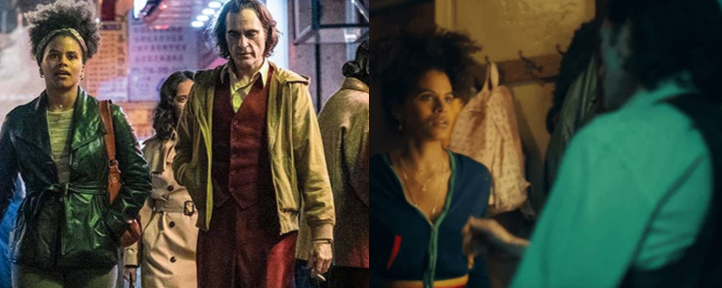
Nowhere is Arthur’s fragile and demented mindset more apparent than in his relationship with Sophie Dumond (Beetz); as you might imagine, considering he still lives with (and has a worryingly close dependency on) his increasingly frail mother, Arthur’s attempts to woo Sophie are clumsy and disturbing. He follows her (stalks, you might say) across the city but apparently seems to win her over with his sense of humour; feeling the rush of killing, he goes to her and she attends his stand-up routine, which is a hit, and supports his endeavours. After finding out the truth about his parentage, Arthur goes to Sophie for comfort…only to discover that their entire relationship was another aspect of his dream world. Frightened and disturbed by his presence, she begs him to leave and, already driven to the edge by his mother’s lies and the knowledge that his stand-up act was actually a complete screw up that his idol mocked on live television, Arthur reacts to the loss of his last tenuous grip on sanity by brutally killing his mother.

Freed from his inhibitions, the Joker inspires chaos and revels in the adulation of the oppressed.

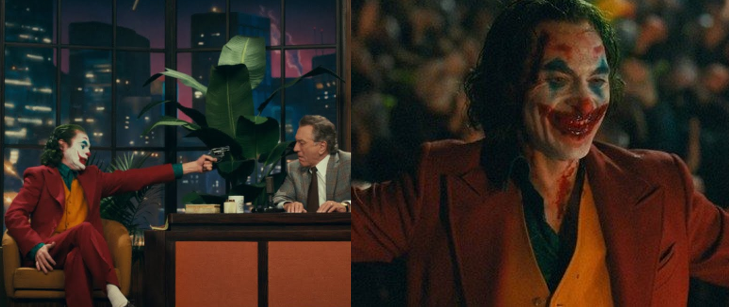
Thomas’s derogatory comments about the “clowns” of Gotham incite the downtrodden and the desperate, like Arthur, into a rampant mob who don clown masks and believe that the Joker is sticking it to the wealthy and the oppressive elite. Seeing this, and his unintentional influence on people, excites Arthur, who finds himself in a position of power for the first time in his life. Betrayed by everything and everyone he’s ever known, Arthur is apathetic when he’s invited to fulfil his life’s dream and appear on Live! With Murray Franklin and instead sees it as an opportunity to spread his unique message and brand of chaos by shooting Murray in the head on live television while a city-wide riot breaks out. Although immediately arrested for the crime, the chaos that grips the city allows Arthur, now fully embracing his role as the Joker, to escape and stand amidst the adulation of his admirers having finally found his place in the world.

The Summary:
Joker is definitely an intense psychological thriller; as an exploration of the mind of a psychopath, it’s right up there with films like American Psycho (Harron, 2000) for the surreal and disturbing way it presents Arthur’s world and perception of reality. A traditional comic book movie it is not and that is immediately clear from the grounded, dirty aesthetic and twisted nature of the narrative, which focuses on an already disturbed and fractured man’s descent into complete anarchy. Joaquin Phoenix, of course, delivers a spellbinding performance and seems completely lost in the role; his commitment to the physicality and mentality of the character is commendable and he deserves all the praise in the world for delivering one of the most nuance and unsettling interpretations of the Joker ever seen. Sadly, my initial misgivings about the film continue to hold true; the fact that the film ends with the suggestion that all of the events we witness may have been as much a figment of Arthur’s imagination as Sophie or anything else we see really doesn’t help with that, either. It’s perfectly in keeping with the Joker’s status as an unreliable narrator but it just adds to the pointlessness of the film in many ways. Sure, Phoenix is great and the film does a fantastic job of telling a self-contained Joker story without Batman but what is the point of really getting under the Joker’s skin if we’re never going to see him clash with his long-time nemesis? If Arthur isn’t the true Joker, as is also suggested, then again what’s the point as it adds nothing to the actual Joker’s story, which continues to run contrary to Joker in both comics, movies, and television. As a result, while Joker is an impressive and disturbing psychological thriller, it’s not really a very good Joker story and I can’t help but feel that it’s handicapped by being associated with DC Comics as a result. I get why it did so well and got so much praise but it just seems like a waste of time, money, and talent when it’s going to mean nothing in the big picture of the DCEU.

My Rating:

Rating: 2 out of 5.

Could Be Better

Do you agree with my assessment of Joker or do you think I’m just talking bollocks? If you’re a fan of the film, what was it about it that you enjoyed? Do you agree that it’s disappointing that we won’t see this version of the character play a role in the DCEU or do you think such concerns aren’t as important as telling a good story? What did you think to Joaquin Phoenix’s portrayal of the character and how does it hold up for you compared to other Jokers? Are you a fan of the DC movies exploring the multiverse and producing disconnected films or, like me, do you prefer them to be part of a larger shared universe? What are some of your favourite Joker-centric stories over the years? Whatever you think, good or bad, about Joker, drop a comment down below and let me know your thoughts.

Screen Time [Robin Month]: Titans (Season One)


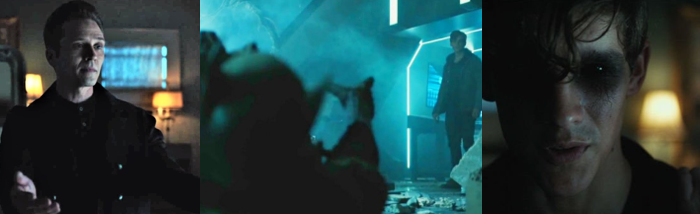
In April of 1940, about a year after the debut of arguably their most popular character, Bruce Wayne/Batman, DC Comics debuted “the sensational find of [that year]”, Dick Grayson/Robin. Since then, Batman’s pixie-boots-wearing partner has changed outfits and a number of different characters have assumed the mantle as the Dynamic Duo of Batman and Robin have become an iconic staple of DC Comics. Considering my fondness for the character and those who assumed the mantle over the years, what better way to celebrate this dynamic debut than to dedicate an entire month to celebrating the character?


Season One

Air Date: 12 October 2018 to 21 December 2018
UK Network: Netflix
Original Network: DC Universe
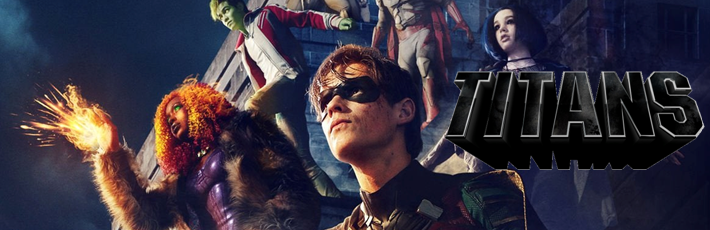
Stars: Brenton Thwaites, Teagan Croft, Anna Diop, Ryan Potter, Alan Ritchson, Minka Kelly, and Curran Walters

The Background:
In July of 1964, the sidekicks of DC Comics’ most powerful superheroes came together under the leadership of Dick Grayson/Robin to form the Teen Titans, a crimefighting group of teenagers who were designed to better appeal to younger readers. Since then, the group has undergone many changes, with runs by the likes of Marv Wolfman and George George Pérez being notably influential, and the team has seen success in a number of animated ventures. Development of a live-action adaption was first announced in 2014; the series, which would have aired on TNT, never came to fruition but the concept was resurrected to produce content for DC Universe, DC’s now-defunct video-on-demand streaming service. Separate from the ongoing “Arrowverse” continuity, Titans got off to a bit of a bad start due to the violent and adult nature of the show and was criticised for its abrupt cliffhanger ending after the true season finale was pulled to become the first episode of the second series. Regardless (and despite the vitriol I often see towards the show on my Twitter feed), Titans impressed enough to earn subsequent seasons, inspired a spin-off show, and was even acknowledged as being adjacent to the Arrowverse during the Crisis on Infinite Earths crossover event (Various, 2019 to 2020).

The Plot:
Dick Grayson/Robin (Thwaites), who is attempting to make a name for himself outside of Bruce Wayne/Batman’s (Alain Moussi/Maxime Savaria) shadow, works as a police detective by day and violent vigilante by night. When the mysterious Rachel Roth/Raven (Croft) comes to him for protection against the dangerous forces pursuing her, Dick finds himself joining forces with not only similarly confused and superpowered misfits but also his former Titans teammates to combat a threat to the entire world.

The Review:
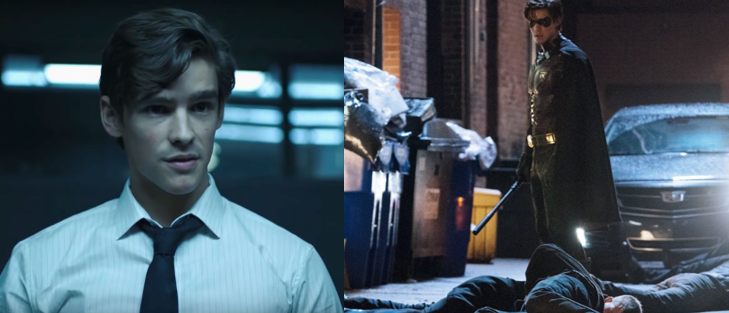
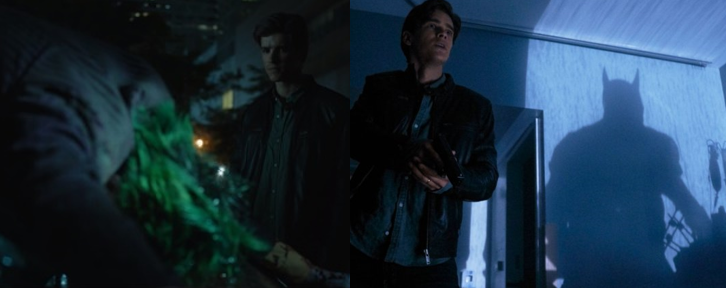
Unsurprisingly, much of Titans’ plot revolves around Dick Grayson, who now works as a police detective in Detroit; trying to make a name for himself as a solo act, he is very much against being partnered up with anyone, even within his own department, which makes him somewhat cold and rude towards his new partner, Amy Rohrbach (Lindsey Gort). Dick uses the information and resources of the Detroit police department to track down criminals and bring them to justice as Robin; while the scum he targets immediately dismiss him and are more concerned about Batman, they quickly regret it when faced with Robin’s ferocity and his presence concerns his superior (and the mayor). Dick reveals to Amy that he and his former partner disagreed on the way to go about their work; initially, Dick admired him and saw him as a hero, just like everyone else, but chose to walk away when he saw that he (Dick) was becoming too much like him. Clearly, he’s talking about Batman and this is a recurring theme throughout the show; a much darker and more violent figure, his vicious nature is augmented by his great physical skill and Batman’s training, making him a formidable and well-training combatant who is easily able to take on groups of armed men. Dick isn’t adverse to using knives, guns, and whatever means necessary (even appearing to fatally wound some thugs) to put a beating on lowlifes and seems to both revel in, and be disgusted by, his violent impulses.

Dick uses his position as a cop to track down and bring criminals to justice as Robin.

However, as meticulous and skilled as he is, he’s still vulnerable and carries the results of his actions on his body in the forms of bruises, cuts, and scars; his primary motivation, as Robin and as a police detective, is to help out troubled kids and youngsters targeted by criminals. This naturally leads to him to Rachel, who is clearly framed as the audience surrogate right from the start (her nightmares of Haley’s Circus show her (and us) Dick’s origins as a trapeze artist and the tragic death of his parents) and is our unknown, confused, window into this world of costumes and masks. Such nightmares are a regular occurrence for her that, despite her mother Melissa’s (Sherilyn Fenn) best efforts, continue to torment and frighten Rachel; Rachel, clearly influenced by some dark power, is an empath and can sense a great fear emanating from her deeply religious mother. An outcast at school, Rachel’s fears and confusion lead her to sporadic outbursts of aggression, often accompanied by a dark reflection of herself and a shadowy, ethereal aura. When a mysterious man forces Melissa to reveal that she’s not Rachel’s actual mother and then brutally murders her right in front of Rachel’s eyes, she goes on the run and, driven by her nightmares, heads to Detroit to track down Dick Grayson for help. Though she fears her dark half, which encourages both violence and the need to kill, it acts primarily to protect her from lies and deceit, which allows her to escape from some suspicious types and end up right where she needs to be: police custody. Dick’s relationship with Rachel is a pivotal aspect of Titans; at first, though driven to help her, he plans to leave her in the care of others (with a payoff to sweeten the deal) since he feels that he’s damaged after what Bruce trained him to become.

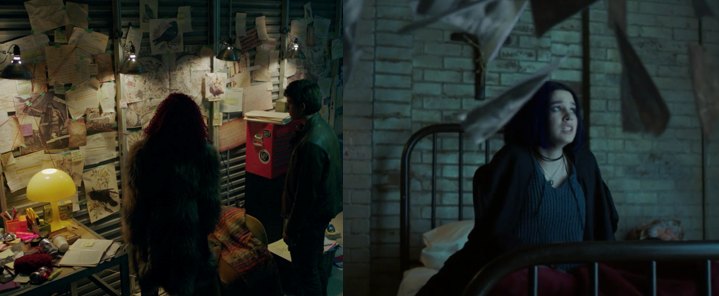
Kory uncovers evidence that links Rachel and her dark powers to a prophecy.

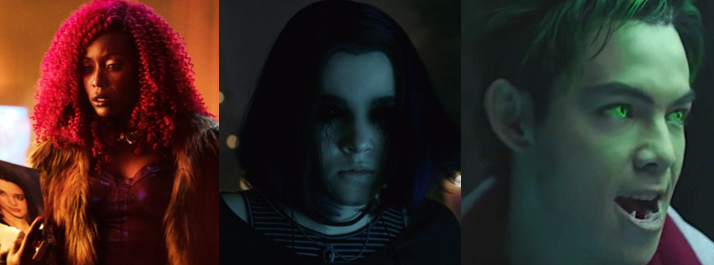
While his mindset soon changes and he becomes fiercely protective of her, she forms a bond out of necessity with Kory Anders (Diop) when her trust in Dick is shaken. A mysterious and enigmatic young woman suffering from amnesia, Kory’s relationship with Rachel is based as much on necessity as Rachel’s inability to feel anything from Kory, who is inexplicably able to read and speak foreign languages and wields an equally destructive power. Desperate to unlock her memories and find out who she really is, and believing that Rachel is the key to her true identity, Kory uncovers evidence linking Rachel to an apocalyptic prophecy concerning ravens and a vast underworld conspiracy involving the convent where Rachel was raised. However, while Sister Catherine (Meagen Fay) immediately recognises them both and reveals some scant information on Rachel’s childhood and Kory’s mission to track her down, she quickly drugs Rachel and locks her in the convent’s basement in order to hide her from “him”. Rachel’s dark half manifests and, after tormenting her with taunts, empowers her to escape from her confinement and out into the nearby forest. Scared and alone, she crosses paths with Gar Logan/Beast Boy (Potter), a green-haired boy who can transform into a disappointingly rendered CGI tiger. Obsessed with pop culture, movies, videogames, and geek culture, Gar is an awkward, quirky outcast who sees a kindred spirit in Rachel and who desires to explore the outside world and, in an effort to connect with her, brings Rachel to the manor house he shares with his fellow misfits, the Doom Patrol: Cliff Steel/Robotman (Jake Michaels and Brendan Fraser), Larry Trainor/Negative Man (Dwain Murphy and Matt Bomer), and Rita Farr/Elasti-Woman (April Bowlby). Each of them, like Gar, was involved in some kind of hideous accident that left them near death only to be saved (and horrifically changed) through the innovation and genius of the mysterious Niles Caulder/The Chief (Bruno Bichir). Rachel finally feels a sense of belonging amongst these freaks and outcasts, each of whom reflect the complex nature of her own self and dark powers: hidden behind his bandages, Larry is unable to reveal himself because of the destructive nature of his condition, Cliff is robbed of the trivial pleasures we all take for granted, and Rita is barely able to hold herself together to appear normal.

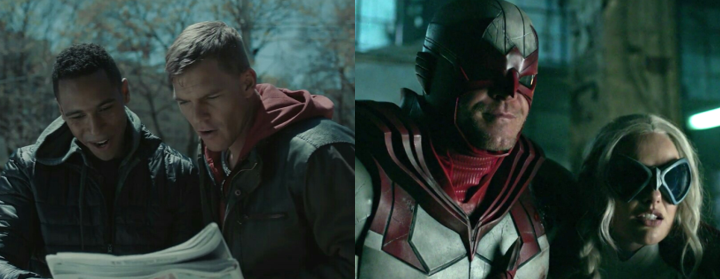
Brought together by tragedy, Hawk and Dove continue to fight crime as costumed vigilantes.

The Chief, however, is angered that Gar threatened their sanctity by leaving the house and bringing an outsider amongst them; despite a glimmer of a threatening, dubious nature, the Doom Patrol are all incredibly thankful and loyal to him for saving their lives and willingly allow the Chief to run his experiments in order to advance the betterment of human lives. The Chief promises that he can also help Rachel and her condition as well but, while she initially allows him to run some tests, she almost immediately changes her mind and grows scared. Although Gar tries to help her, the Chief tranquilises him and, angered by this, Rachel’s dark half manifests as a swirling dark liquid that attacks and paralyses him and frees her. Dick and Kory arrive just in time and Dick is able to talk Rachel down and promises to help her, reuniting them once more. Encouraged by Cliff, Gar goes with them to live a life outside of the mansion, setting the team up for their own strangely unrelated spin-off. Not that Dick is without his allies as well; initially, he plans to leave Rachel with Hank Hall/Hawk (Ritchson) and Dawn Granger/Dove (Kelly) in Washington, two of his former Titans allies who continue to operate as costumed vigilantes. As damaged as Dick is, Hank is equally traumatised by his past when, as a young boy (Tait Blum), he was sexually abused by his football coach to spare his younger half-brother Don (Jayden Marine). As teenagers, Hank and Don (Elliot Knight) became the first Hawk and Dove to specifically target sex offenders and to give Hank an outlet for his anger but Hank’s world was shattered when Don was killed in a random car accident. This same accident also took the life of Dawn’s mother, Marie (Marina Sirtis), and, in time, the two form a bond over their shared grief and need for an outlet for their unresolved issues. After she discovers Hank’s makeshift Hawk gear, Hank finally opens up about the abuse he suffered as a child and, together, they bring justice to his abuser and become the new Hawk and Dove. By the time of Titans, however, Hank is heavily reliant upon painkillers and pills, carries multiple scars, and is in near constant pain from a lifetime of crimefighting in addition to the multiple concussions he suffered during his college football days. The two plan on retiring from their violent double life once they finish breaking up a gang of gunrunners and, though he’s stubborn and pig-headed, Dawn is clearly devoted to Hank and supportive of him despite his injuries and impotence.

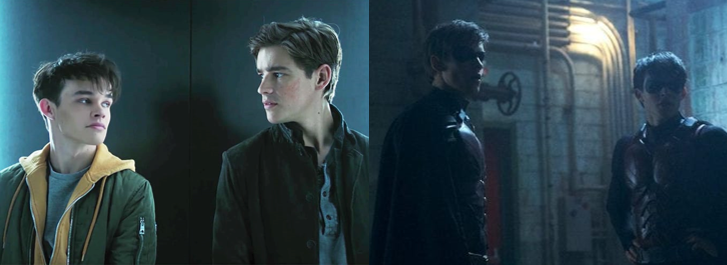
Dick is disturbed to find Bruce has replaced him with the arrogant and violent Jason Todd.

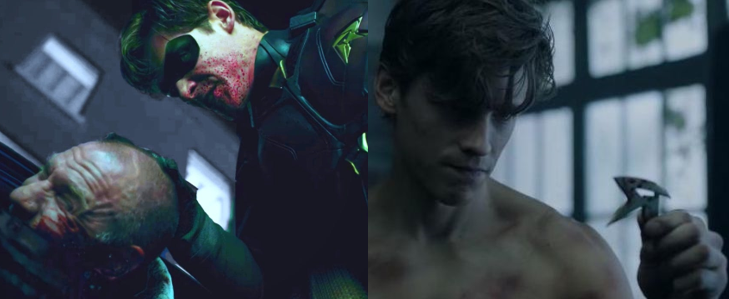
Flashbacks cast some light on their time together as Titans, where Dawn had a thing for Dick and Hank, being the arrogant meathead that he is, was rightly jealous and condescending towards Robin. Hank is unimpressed that Dick has come back into their lives and, resentful of Dick’s former relationship with Dawn, also has no faith or trust in Dick at all because of their past in the Titans. However, even Hank is horrified to see how brutal Robin has become as he throws his shurikens into a man’s eye, crushes another man’s balls, and viciously takes out the gun dealers before their shocked eyes, while Dawn sees a correlation between Dick’s relationship with Rachel and how Bruce helped him as a kid. Dick is disturbed, angry, and resentful to discover that Bruce has replaced him with Jason Todd (Walters), who acts as the new Robin, a vicious and arrogant youth who revels in being Batman’s partner, basks in the upgrades in his suit compared to Dick’s, and takes a perverse pleasure in being Robin and part of Batman’s legacy (even while acknowledging that his role is mainly to draw fire away from Batman). A largely annoying and grating character without even really needing to be, Dick is annoyed when Jason reveals that Bruce implanted tracking devices into the both of them and revoked his access to his newer technology. Dick tries to send Jason back to Gotham City and discourages him from continuing his life as Robin; despite trying to convince him that Bruce’s methods and motivations are less than benign, Jason reveals that he was sent there with evidence that his old circus family has been brutally murdered to send a message to him and that someone knows his true identity. Together, they track down the last surviving member of the circus, Clayton Williams (Lester Speight), who was like Dick’s surrogate father back in the day, who is almost immediately abducted by the perpetrator of the murders, the Phantom-like Nick Zucco (Kyle Mac), the “Melting Man” and son of gangster Tony Zucco (Richard Zeppieri), the man who killed Dick’s parents.

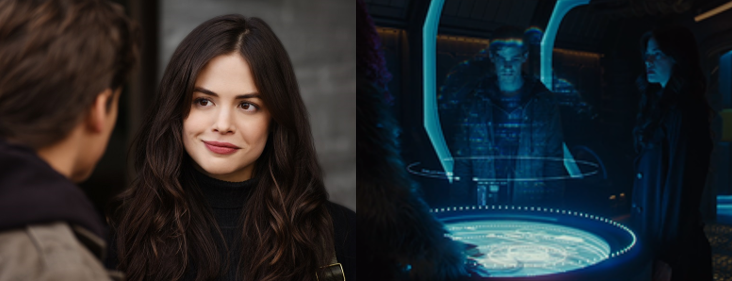
Donna advises Dick and helps uncover the truth about Kory and Rachel.

Nick is out for revenge because Dick, as Robin, intercepted Zucco during his transfer, mercilessly beat him and left him to die (watched him, no less) at the hands of the Maroni’s and their acid-firing weapons and then murdered the rest of Nick’s family. Goaded into a trap by Nick, Robin goes to save Clayton and, thanks to Jason, is able to subdue him. When the local cops show up, though, Jason brutalises them and, seeing the darkness he fears in himself mirrored in Jason, Dick is disgusted at Jason’s attitude. Initially, Jason regards Dick with awe and respect and they form a tenuous brotherly bond but, as their relationship sours due to their conflicting methods and attitudes, this is replaced a mixture of contempt and loathing for having walked away from such a sweet gig. Dick struggles with the idea of being replaced so quickly; he doesn’t want to be Robin and is trying to step away from Bruce’s shadow and influence but doesn’t want to see another kid be turned into a weapon like he was and resents the fact that Bruce has been keeping tabs on him while simultaneously keeping him out of the loop. When Dick finally decides to walk away from his Robin persona and burns his uniform, he seeks out another of his former Titans allies, Donna Troy/Wonder Girl (Conor Leslie). Having first met as teenage sidekicks, Dick and Donna formed the Titans back in the day and she’s one of the few people left who Dick feels will properly understand what he’s going through. Donna, now an investigative journalist, has long since walked away from her life as a costumed adventurer, Amazon, and Diana Prince/Wonder Woman’s sidekick, and is able to offer Dick some insight into what it means to redefine oneself outside of the shadow of one’s mentor and to help improve his social skills. Dick, however, finds it difficult to socialise and to keep his mind from wandering back to the “job”; despite being so composed, confident, and controlled when in the field or concentrating on superhero work, he’s a bit of a fish out of water in normal, everyday situations. His paranoia leads to him following Donna as she meets with a game hunter in pursuit of a story and disrupting her attempts to bring down a much bigger operation through his reckless attempt to take one more scumbag off the streets. Although Donna chastises him for his efforts, she encourages him to find a new path, one that isn’t Robin or Batman and is more productive than violent. Donna is also able to offer some insight into the strange text from Kory’s lockup that suggests that Kory’s true mission is actually to kill Rachel.

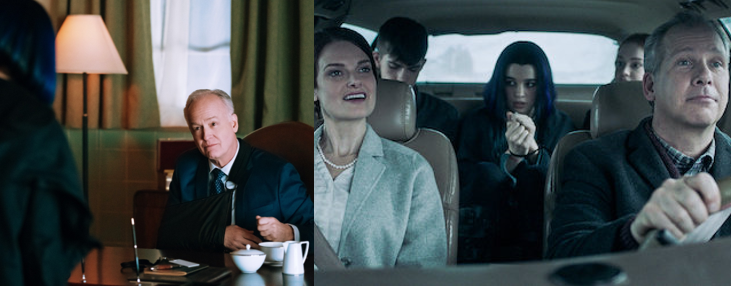
Adamson sends the disturbing Nuclear Family to track down Rachel.

The intrigue regarding the true nature of Rachel’s power and destiny is a central aspect of Titans; an empath, she’s able to feel and sense the pain of those around her, is frequently tormented by her dark half (which manifests in reflective surfaces and possess her during times of great stress), but also demonstrates the ability to heal the wounds of others. Rachel is targeted by the mysterious Organisation, which is headed by the dubious Dr. Adamson (Reed Birney); Adamson activates the “Nuclear Family” (a group of brainwashed psychopaths comprised of  Nuclear Dad (Jeff Clarke), Nuclear Mom (Melody Johnson), Nuclear Sis (Jeni Ross), and Nuclear Biff (Logan Thompson) and, later, Nuclear Stepdad (Zach Smadu)) to track Rachel down so that she can fulfil her destiny to “purify the world”. Disturbingly polite and unnervingly relentless, the Nuclear Family gain formidable abilities from a mysterious vitamin shot, dog the protagonists at every turn, and even put Dawn into a coma during a particularly ferocious attack. Thanks to Dick’s intervention, the team are able to subdue the family but they are killed when Adamson remote detonates the explosives in their heads though, in the process, the team are led to the asylum where Rachel’s real mother, Angela Azarath (Rachel Nichols), is being held captive. This leads to probably the weakest episode of the season, “Asylum” (Kalymnios, 2018), which sees the team captured when they attempt to breach the facility and rescue Angela. The main reason this makes for the weakest episode is the unnecessary drama that sees Rachel and Gar head off on their own foolhardy rescue mission simply because Rachel couldn’t wait ten minutes for Dick to scope out the asylum’s defences and layout. As a result, all of them are captured and subjected to Adamson’s torturous experiments): Dick struggles to counteract Adamson’s serum, which forces him to confront his worst fears about himself and his past; Kory is locked in a dark cell that renders her powers useless and forced to endure an invasive procedure; and Gar is routinely poked with a cattle prod to provoke his transformation.

Dick struggles against his violent impulses and often loses control of himself.

Rachel is left in the disturbing company of Adamson himself, who tries to coerce her into assisting him by forcing her to watch her newfound friends suffer their individual tortures and winds up choking to death on his own blood as a result of Rachel’s unleashed wrath. Rachel then rescues her mother and teammates with a ridiculous amount of ease but Gar is left traumatised after he mauls one of his tormentors to death and this continues to haunt him throughout the remainder of the season. A primary plot point of Titans revolves around Dick’s struggle against his violent nature; believing that Batman’s training turned him into little more than a living weapon, he reveals to Rachel that he began to fear the violence he was forced to inflict to help others and to Kory that he had to walk away from his past because he was growing dangerously close to the edge. While he hasn’t operated as Robin for at least a year by the start of the season, he vehemently opposes any machinations to turn innocent kids into weapons and, even when not in his Robin costume, Dick often struggles with his violent nature; desperate to find Rachel after she goes missing, he briefly loses control and viciously beats a hunter who spotted her in the forest in front of his child, much to Kory’s shock, and absolutely brutalises the asylum’s guards during their escape from the facility and even instructs Kory burn the entire building to the ground (presumably killing everyone left inside). His rage stems from his traumatic childhood after first witnessing the murder of his parents and then having his rage and grief turned towards costumed crimefighting by Batman. However, as violent as Dick can be, Bruce’s training also made him a competent and capable leader; when Dick, Kory, Gar, and Rachel make their new alliance official, Dick begins a training regime to teach them how to master their individual abilities and work together as a cohesive team. All of these plot threads culminate in the season’s final episode, “Dick Grayson” (Winter, 2018); by this time, Kory’s true identity as Koriand’r of the alien world Tamaran is revealed and, with it, the knowledge that Rachel is doomed to bring her demonic father, Trigon (Seamus Dever), into being so that he can devour both of their worlds.

Dick is drawn into a confrontation with Batman after his mentor goes on a killing spree.

Betrayed by Angela, who was in league with Trigon all along, Rachel is manipulated into summoning her father to save Gar’s life and, after restoring Gar, Trigon sets in motion a plot to break Rachel’s heart in order to facilitate his master plan. He does this by thrusting Dick into a dreamworld where he is happily retired and settled down with Dawn; however, his idyllic life is shattered when Jason, now confined to a wheelchair after a botched mission against Edward Nygma/The Riddler, arrives to tell him that Batman has become obsessed with killing Joker in retaliation for his torture and killing of Commissioner James Gordon. Thanks to Trigon’s influence, Dick is compelled to return to Gotham (a dreary and rainswept hellhole where crime, debauchery, and violence are rife, turning the very streets into a desolate warzone) to try and talk Bruce away from the edge. However, despite Dick’s best efforts, Batman murders the Joker in cold blood and then goes on a killing spree throughout Arkham Asylum, killing the Riddler, Harvey Dent/Two-Face, Arnold Wesker/The Ventriloquist and many of the other guards and patients. After revealing Bruce’s identity to the authorities, Dick directs a SWAT team on an all-out assault on Wayne Manor that leaves them all slaughtered at Batman’s hands (including Kory, thanks to Batman busting out Doctor Victor Fries/Mister Freeze’s cold gun). Enraged, Dick orders the entire mansion to be destroyed by C4 explosives and, amongst the rubble and the wreckage, he finds Batman pinned helplessly beneath the debris; driven to the edge, Dick succumbs to the darkness and, with one swift boot, murders his mentor and father figure and, in the process, falls under Trigon’s spell to end the season on a massive cliff-hanger made all the more intriguing by the brief tease of Kon-El/Superboy (Brooker Muir) in a post credits scene.

The Summary:
As much as I enjoy Titans (and, honestly, I really do, being a big fan of Robin and happy to see him actually get some acknowledgement and spotlight in live-action for a change), there are a couple of things that I find more than a little disappointing about it. Like many, I was a bit perturbed by Robin’s “Fuck Batman!” line and, while the violence and swearing was entertaining and brutal throughout the show, I do question if it’s really necessary in superhero adaptations that aren’t traditionally violent characters, like Frank Castle/The Punisher or Wade Wilson/Deadpool. Next is the fact that it exists in its own continuity separate from both the DC movies and television shows and this is a shame as it could easily have bridged to the Arrowverse by including Wally West/Kid Flash (Keiynan Lonsdale) or even been adjacent to the DC Extended Universe by including a cameo by Jeremy Irons as Alfred. Titans’ position as a separate, unrelated continuity was solidified in the second season, which upgraded Bruce Wayne from a mere cameo and into a fully realised (and surprisingly old) character played by Iain Glen.

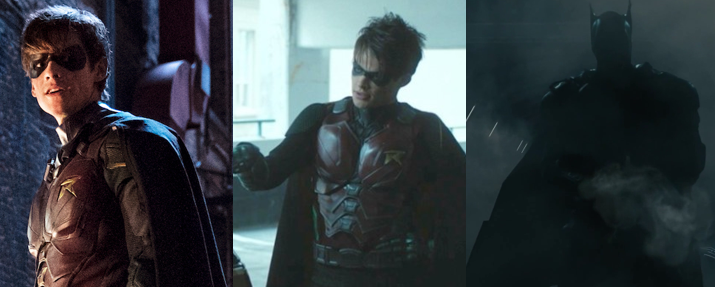
Both Robin suits are impressive and Batman cuts a monstrous figure.

However, Titans excels in both casting and costume design; Brenton Thwaites is great as Dick Grayson and made for a pretty fantastic Robin and his costume, especially, is absolutely top notch in Titans. Both Robin suits look amazing and have probably the best and most practical look of any superhero show; clearly inspired by the awesome and sadly doomed suit that appeared all-too-briefly in Batman v Superman: Dawn of Justice (Snyder, 2016) and Tim Drake’s Robin costume, their dark, gritty, armoured look enables both Robins to not only appear imposing but also move unimpeded and look like they would hold up perfectly well in a big budget film. Similarly, although he only appears very briefly in the final episode, Batman also looks particularly impressive, especially compared to his depictions in Gotham (2014 to 2019) and Batwoman (2019 to present). Referenced continuously throughout the season, Batman is built up as this elusive, near mythological figure and his brief appearance leans heavily into that; frantic editing makes him appear as a monstrous, inhuman figure and the nightmarish appearance of his suit only serves to emphasis this further.

Sadly, the special effects don’t always do justice to the characters or the practical suits.

Hawk and Dove also benefit from Titans’ high-quality costume design; though very different from my limited experience with their comic book counterparts, their heavily armoured suits look both practical and ridiculous at the same time, appearing well-worn and dangerous thanks to their sharp appendages. However, it goes a bit downhill once we get to Kory; for the most part, she’s serviceable enough despite being a far more promiscuous and forthright character than in most interpretations, but her outfits are limited to tight fitting dresses that only somewhat recall her traditional costume. Similarly, Rachel’s not quite the sour, serious and withdrawn goth she’s usually characterised as and is, generally, portrayed as more of a confused and troubled teenager garbed in a vaguely raven-like hoody. Sadly, it’s Gar that suffers the most in Titans; of all the characters, he’s the one that sticks out the most to me as he doesn’t seem to really fit with the rest of the team and ends up being more of an afterthought most of the time. While the special effects used to bring Kory’s powers work, largely due to how infrequent and grounded they are depicted, Gar’s are pretty dreadful, making his animal forms resemble little more than cartoony creatures, which is a bit disappointing considering the quality of the special effects in the likes of Swamp Thing (2019), how impressive the CGI is in shows like The Flash (2014 to present), and the effort Titans went to the faithfully recreate the other members of the Doom Patrol.

Trigon manipulates Dick into succumbing to his influence in order to devour the world.

References to the larger DC universe are prominent throughout Titans thanks to Gar, who fawns over the likes of Batman and Wonder Woman, and the fact that many characters wear Superman t-shirts. For the most part, though, Titans is concerned only with its own gritty, grounded narrative that becomes increasingly more supernatural and elaborate as the plot progresses. The show builds towards these moments over time, with both Rachel and Kory discovering the full extent of their otherworldly abilities as the season progresses, but never shying away from the more flamboyant aspects of the source material with characters like the Doom Patrol and interdimensional beings such as Trigon. Largely based on Marv Wolfman’s initial run on The New Teen Titans, Titans primarily deals with Trigon’s impending arrival through Rachel and the formation of a new version of the Titans but, for the most part, is just as much a journey of self-discovery for Dick as he struggles to define himself outside of his role as Robin. Personally, I found this the most appealing part of Titans and would have happily ditched all the other side plots and storylines to focus entirely on this one plot point but, thanks to each episode focusing on different characters and their sub-plots and building intrigue around this world and the former iteration of the Titans, I found Titans to be incredibly enjoyable and was chomping at the bit for the second season to release to see how things turned out.

My Rating:

Rating: 4 out of 5.

Great Stuff

What did you think to season one of Titans? Were you a fan of the season, and the show, or did its gritty, violent take on the traditionally plucky and colourful characters turn you off? Which character was your favourite and what did you think to the plots involving Dick’s struggle against his violent impulses and the mystery about Kory and Rachel? Did you enjoy the cameo appearance from the Doom Patrol and other references to DC heroes and properties? Did the climax of the season leave you wanting more or were you turned off by the concept? What did you think to the show’s portrayal of Robin, the inclusion of Jason Todd, and their costumes? Whatever your thoughts on Titans season one, feel free to leave a comment down below.

Back Issues: Ranking Robins

BackIssues

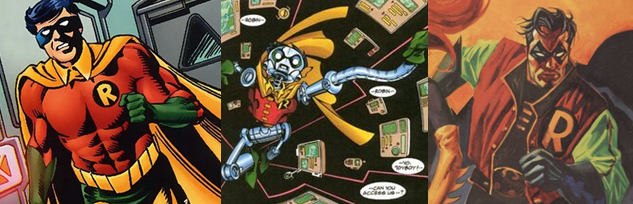
Call me crazy, but I have a real fondness for the character of Robin. It really irks me when people (especially movie directors) rag on Batman’s colourful sidekick; debuting in 1940, about a year after Batman’s momentous first appearance, Robin has been an essential staple of Batman’s world for over eighty years so to suggest that he’s somehow “unsuitable” is, in my opinion, laughable. Over the years, numerous individuals have taken up the red tunic and green tights, some with more success than others. Yet, the iconic imagery evoked by the term “Batman and Robin” cannot be denied and, when talking about Robin, one of the first questions anyone will ask is: Who was the best Robin? So, with that in mind, I figured I’d do my own ranking and shine a bit of spotlight on this under-rated and criminally under-represented (in movies, at least) character.

RobinsElseworlds
8 Elseworlds Robins

Over the years, there have been many different interpretations of Batman’s kid sidekick in DC’s Elseworlds titles and in out of continuity stories that have since been rendered non-canon. Perhaps two of the most famous are the Dick Grayson of Earth-Two, who never grew out of the role and instead continued to fight crime in a garish Robin outfit into adulthood, and the “Toy Wonder”, a little robotic Robin who assisted the mysterious Batman of the DC One Million (Morrison, et al, 1998) crossover. Yet, we’ve also seen Batman’s faithful butler, Alfred Pennyworth, take on the Robin codename in Batman: Dark Allegiances (Chaykin, et al, 1996), Bruce Wayne’s son assume the role in the Superman & Batman: Generations (Byrne, et al, 1989 to 2004) series, an ape equivalent in Batman: Dark Knight Dynasty (Barr, et al, 1997), and even a story in 1955 that had a young Bruce Wayne take on the mantle during his early days of trying to learn the skills that he would eventually hone as Batman. I’m obviously lumping all of these kinds of interpretations together as, while DC may revisit and bungle the Multiverse concept more often than they have hot dinners, none of these versions of Robin have ever managed to get a footing in true DC canon and are generally regarded as being outside of mainstream continuity.

RobinsCarrie
7 Carrie Kelley

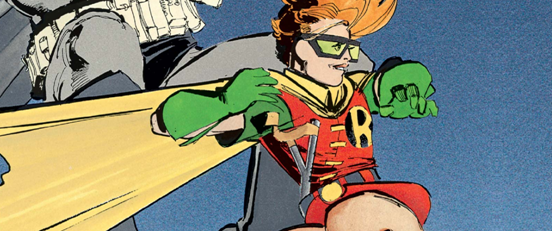
While you could make an argument that Carrie doesn’t deserve her own entry considering her introduction and most famous appearances have been in Frank Miller’s (thankfully) out of continuity Dark Knight (1986 to 2017) stories, I’d say she deserves to get her own entry on any Robin ranking simply for being the first, full-time female iteration of the character. Yet, I can’t rank Carrie much higher than this because of a few reasons: one is my obvious dislike for Miller’s Dark Knight works but, that aside, Carrie’s tenure as Robin is extremely brief. After being saved by Batman, Carrie is inspired to buy a Robin costume and fight petty thugs with a slingshot and firecrackers. Yet, despite earning Batman’s seal of approval and joining him in the resurrection of his never-ending war on crime, Carrie progressed to Catgirl and, eventually, Batwoman. She might have been a trend-setter by being the first true female Robin but it didn’t take her long to switch to a different identity and was easily one of the least prepared to assume the long-standing mantle of Batman’s partner.

RobinsWeAre
6 We Are Robin

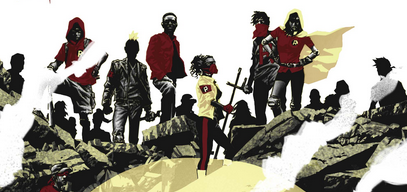
After Batman was believed to be dead at the conclusion of the “Endgame” (Snyder, et al, 2014 to 2015) storyline, a whole bunch of Gotham City’s youthful decided to take on the mantle of Robin to keep the streets safe in the Dark Knight’s absence. I actually really like the concept of teenagers of all shapes, sizes, backgrounds, and abilities taking to the streets as a vigilante force and feel this concept could have real legs in a live-action interpretation of Robin. Yet, this group is most notable for introducing Duke Thomas to the DC Universe, a character who would go on to break away from the Robin moniker and become the Signal. Unfortunately, neither Duke nor his gang of Robins can rank much higher as DC seems to have forgotten about them all in recent years; Duke eventually developed metahuman abilities and seems to have fallen out of prominence as Batman’s partner and his fellow Robins have fallen by the wayside as DC prefers to focus on the Bat Family of characters rather than this sub-team.

RobinsSteph
5 Stephanie Brown

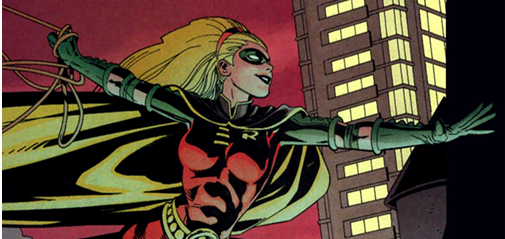
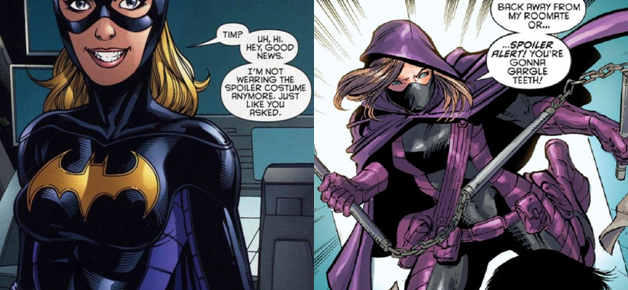
Daughter of a Z-list villain and Riddler knock-off, the Cluemaster, Stephanie Brown originally fought crime as the Spoiler to foil her father’s plots. Eventually, she became associated with the Bat Family when she started dating Tim Drake, though Batman (famous for opposing vigilantes not approved by him) openly disproved of her vigilante career. Yet, Batman turned to Steph and offered her the mantle of Robin after Tim was forced to retire from the role by his father. Lacking the experience and ability of previous Robins, Steph struggled in the role and, eventually, unwittingly initiated a gang war in an attempt to earn Batman’s respect, an action that led to her being tortured by Black Mask and eventually dying from her wounds.

RobinsStephBatgirl
Steph is fine as Spoiler but she was a great Batgirl.

It later transpired that her death was faked and Steph returned to active duty as Batgirl, for a time, a role that reflected her growth and maturity as a character…until DC made the inexplicable decision to reset continuity, force Barbara Gordon back into the Bat tights, and relegate Steph back to being Spoiler. Steph’s time as Robin may have been brief but, man, did she look good in the suit and her exuberance and enthusiasm could have made for a return to the 1960’s depiction of Robin as this hyperactive, fast-talking bundle of energy. Unfortunately, Steph became Robin during one of the darkest, grittiest, and grimmest times in DC Comics and, for the longest time, her death tainted many a Bat character.

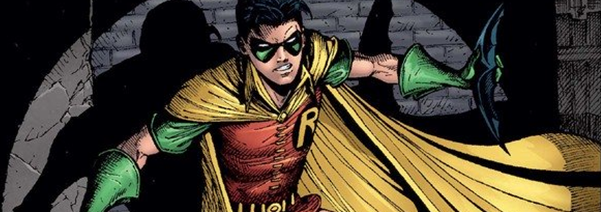
RobinsJason
4 Jason Todd

Initially portrayed as a near-identical copy of Dick Grayson, Jason Todd was eventually retconned as being a wise-talking kid from the streets who stole the tyres off the Batmobile and was a disobedient, arrogant, angry little kid who was constantly at odds with Batman during his tenure as Robin. This isn’t necessarily the case but it is the story DC likes to tell these days; flashbacks will generally always show Jason being disobedient, violent, and moody rather than being as accomplished a Robin as Dick was. Nevertheless, Jason can’t take a top three spot as he’s most famous for being beaten with a crowbar and then blown up by the Joker.

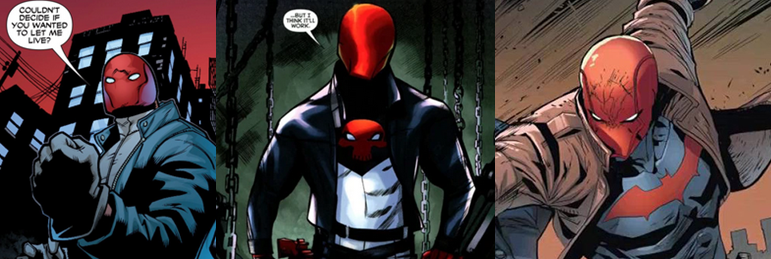
RobinsRedHood
Red Hood eventually became a full-fledged Bat buddy.

Indeed, Jason was far more popular in death, a memorial in the Batcave, and a reminder of Bruce’s greatest failure in his career as Batman, and after his return to life under the guise of the gun-toting vigilante, Red Hood. Red Hood has been everything from a sadistic antagonist to a begrudging anti-hero but is, generally, now regarded as the black sheep of the Bat Family but one who is nevertheless an essential ally of Batman’s; he even wears the Bat logo on his chest these days though, if you ask me, he should have been Hush all along.

RobinsGrayson
3 Dick Grayson

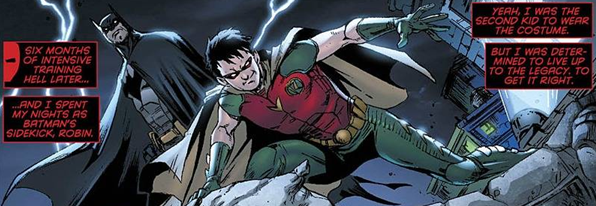
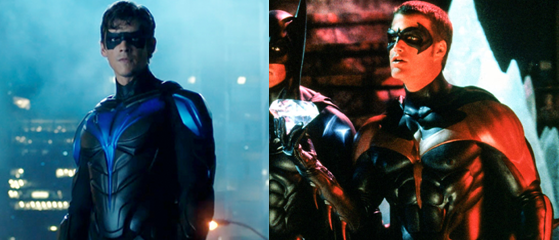
For many, Dick is the quintessential Robin; he was the first to take on the mantle, after all, and whenever you talk about Robin or see him in other media (cartoon, television shows, movies, and the like), Robin is pretty much always shown as being the alias of Dick Grayson. Yet, while Dick pioneered the role and excelled in it in every way, unlike other characters who have taken on the Robin identity, Dick successfully managed to grow out of the role and assume the identity of Nightwing. As Nightwing, Dick led the Teen Titans and defended the nearby city of Blüdhaven and, while he’s dabbled with other roles since then (including Agent 37 of Spyral and becoming Batman for an all-too-brief period), he’s far more associated with the role of Nightwing than Robin these days.

RobinsNightwing2
Nightwing forms the basis of Grayson’s growth as a character.

Even Dick himself has gone on to praise subsequent Robins for being more suitable to the role than he is and, having been Nightwing pretty consistently for over thirty years now, Dick has largely separated himself from being Batman’s “sidekick”. The fantastic Titans (2018 to present) show went in-depth into Dick Grayson’s (Brenton Thwaites) journey from Robin to Nightwing and even the diabolical Batman & Robin (Schumacher, 1997), has Dick Grayson/Robin (Chris O’Donnell) don an outfit that is visually very similar to Nightwing’s as part of his desire to establish his crimefighting career out of Batman’s (George Clooney) shadow.

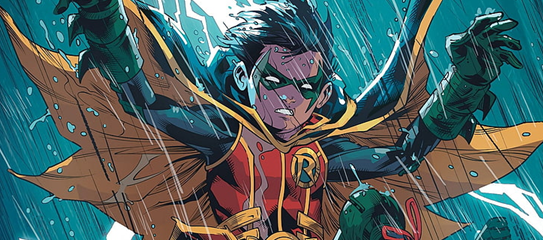
RobinsDamian
2 Damian Wayne

The illegitimate son of Bruce Wayne and Talia al Ghul, daughter of the functionally immortal Ra’s al Ghul, Damian Wayne was initially considered to be a character that existed outside of mainstream DC continuity until he was officially made a part of DC canon in Batman and Son (Morrison, et al, 2006).

RobinsDamian2
Damian was a massive jerk for quite a while.

Trained from birth by the League of Assassins, Damian was initially portrayed as a bratty, violent young boy who was arrogant, rude, disrespectful, and had no compunction about killing his opponents. He believed that, as Batman’s true son, the role of Robin was rightfully his and nearly killed Tim Drake just to prove it. Eventually, though, Damian softened and earned his place in the Bat Family; after Bruce Wayne appeared to die in the awful Batman R.I.P. (ibid, 2008), Dick Grayson briefly operated as Batman and took Damian as his Robin. While this initially created an interesting reversal of the Batman and Robin dynamic (with Dick being a more light-hearted Batman and Damian as a grim and stoic Robin), Damian has since excelled in the role, having joined the Teen Titans, returned from the dead, and forged friendships with both John Kent/Superboy and others in the Bat Family.

RobinsTim
1 Tim Drake

Damian may very well be on the path to being the most accomplished of all the Robins but he’s still relatively new to the role. His fighting proficiency and augmented knowledge and intelligence make him a formidable opponent but it seems as though Damian’s destiny is to one day break away from Batman’s shadow and either become Batman himself or forge a new identity. Therefore, while he has since gone on to assume the role of Red Robin and…Drake…Tim Drake is still the definitive Robin for me. Introduced some time after Jason’s death, when Batman was in a violent downward spiral, Tim wanted nothing more than to reunite Dick and Bruce as Batman and Robin and wound up assuming the mantle for himself. A keen detective and computer whiz, Tim brought something new to the role; for one thing, he was the first to ditch the short-shorts and pixie boots and wear a functional, respectable Robin costume and, for another, he was far more grounded and relatable than other Robins.

RobinsRedRobin
Tim had a lengthy career as Red Robin.

Although he never aspired to be anything other than Robin, Tim did briefly assume the mantle of Batman after Batman R.I.P. and has been shown, on multiple occasions, to eventually become a violent Batman in the future. However, Tim is probably most well-known for having taken up the identity of Red Robin; while I find the “Red” portion of this identity redundant and wish he had, like Dick, forged an entirely separate code-name, it showed that Tim still very much considered himself Robin first and foremost (except for that weird period when he inexplicably took the identity of “Drake”). Tim was also the first Robin to get his own ongoing comic book series and that he is, for all intents and purposes, probably the most successful of the full-time Robins at really making the identity his own as Batman’s sidekick, a solo hero, or as part of the Teen Titans and Young Justice.

RobinsBanner

What are your thoughts on Robin? Do you feel he’s too bright and cheerful for the normally grim and gritty Batman or is he an essential part of the Batman mythos? Who was your favourite Robin? Let me know your thoughts in the comments.

10 FTW: Super-Suits

10FTW

With over eighty years of continuous publication behifnd him, it’s no surprise that, over the many years and through numerous alternate realities and reality-shattering Crises, Superman has gone through more than a few wardrobe changes. Initially debuting in what amounted to a traditional strongman costume, Superman soon adopted the iconic “S” shield to uphold his values of “truth, justice, and the American way” but has, over time, mixed up his colour scheme about as often as he’s developed strange new powers. Today, I’m going to go through ten of my favourite looks for Superman; a lot of these featured solely in out-of-continuity tales or were worn by Supermen from parallel Earths but some were, however briefly, an actual part of Superman’s canon.

10 The Black Recovery Suit

Superman’s black suit first appeared right at the conclusion of the “Reign of the Superman” (Jurgens, et al, 1993) storyline, the conclusion to the infamous “Death of Superman” (ibid, 1992 to 1993) storyline. After the Man of Steel was beaten to death by Doomsday, his body was placed into a Kryptonian regeneration chamber, which restored his cells to life and, when he emerged, he was forced to wear this suit while his powers recovered. Honestly, this was just an excuse to get Superman’s mullet on the list but I also dig the simplicity of this suit (and I always love a black variant); it’s just plain black with a silver symbol. It also lacks a cape, giving Superman a far more streamlined and serious look that, considering all of Superman’s replacements bore dramatically different suits of their own, cast more doubt on the identity of this new Superman. The suit made a brief return in Countdown to Final Crisis (Dini, et al, 2007 to 2008), when it was worn by Superman-Prime, and was donned by the pre-Flashpoint (Johns, et al, 2011) when he showed up (rocking a beard!) to replace the crappy New 52-Superman (whose suit will, spoilers, not be making this list), and was also set to appear in Justice League (Snyder/Whedon, 2017) before Warner Bros. re-edited the film.

SuperSuitsSpeedingBullets
9 Speeding Bullets

Bit of a cheat here as this suit was worn a violent and brutal version of Kal-El who was raised by Thomas and Martha Kent and, thus, is actually a composite of Superman and Batman who leans far more into Batman’s characterisation than Superman’s. Still, this is a great combination of the Bat- and Super-Suits, featuring a cowl that covers Kal’s entire head and a amalgamated version of both character’s iconic emblems. If you’re a bit annoyed by me basically using a Batman suit on a Superman list, there was a more traditional Super-Suit featured in this story right at the end, when Kal is convinced to turn away from the darkness and be a symbol of hope. But, as this is a dreadful looking costume that looks way too much like the awful Injustice suit (NetherRealm Studios, 2013; 2017).

SuperSuitsLantern
8 Lantern Superman

Let’s face it: any time Superman gets a power ring, we are treated to an awesome variation of his suit. Whether it’s in an alternate reality where Superman operates as Green Lantern (and sports a lovely white cape and an amalgamated “G”/Green Lantern symbol), or the original, super-powerful, pre-Crisis on Infinite Earths (Wolfman, et al, 1985 to 1986) Superman, Kal-L being reanimated as a zombified Black Lantern in Blackest Night (Johns, et al, 2009 to 2010), or Superman-Prime joining the Sinestro Corps, there’s something about mixing Superman’s suit with the Lantern’s attire that always results in gold. Superman’s also been decked out as a dazzling beacon of triumph as a White Lantern and we’ve even seen a glimpse of what his suit could look like spewing blood from his mouth during Supergirl’s brief stint as a Red Lantern. Hands down, my favourite is the Black Lantern Superman though; there’s just something about a zombified Superman in a black suit with a tattered cape that is really striking to me, like all of his values and morals have been cast aside in favour of ripping hearts from chests.

SuperSuitsOverRed
7 Overman / Red Son

I’m lumping these two together as I honestly cannot pick between the two; both suits were worn by alternative versions of Superman who were raised and indoctrinated with anti-American principles, making for a complete reversal of Superman’s traditionally patriotic views. Overman, a Nazi version of Superman, appeared during the God-awful Final Crisis (Morrison, et al, 2008 to 2009) event, while the communist version most famously appeared in Superman: Red Son (Millar, et al, 2003). Both wear a fascist symbol in place of the traditional “S” and favoured big buckles on their belts and a darker, subdued colour scheme, with Overman’s costume fittingly being reminiscent of the Schutzstaffel  uniform.

6 The Dark Side

Continuing the theme of alternative versions of Superman raised by tyrannical dictators, Superman: The Dark Side (Moore, et al, 1998) presented a version of Superman raised by Darkseid to be a ruthless soldier in the New Gods’ war against the peaceful New Genesis. Once again sporting a corrupted version of the “S” symbol (which was almost exactly the same as the Schutzstaffel symbol, something that, ironically, even Overman was missing…), Dark Side’s Superman had a haircut you could set your watch to, and a fittingly grim and stoic personality that was more akin to Darkseid’s actual son, Orion. He was also decked out in sweet jet-black armour forged from the fire pits of Apokolips, carried a sword and had no compunction about slaughtering his enemies without mercy in the name of his dark overlord.

SuperSuitsPrime
5 Superman Prime (DC One Million)

The Superman Prime (not to be confused with his genocidal counterpart of the same name) that appears in DC One Million (Morrison, et al, 1998) has lived for so long thanks to his Kryptonian physiology that he’s seen all his friends and family die. Despondent, he left Earth in the care of his heir, travelled the universe for a few centauries, and eventually went into self-imposed exile in the centre of the sun. Unlike the previous Super-Suits, this Superman is a glowing, golden beacon of hope and serenity; his powers amplified to almost God-like levels, this Superman is decked out entirely in gold to match his new divine stature.

4 Brutaal (Earth-2)

This version of Superman is a Bizarro-like clone engineered by Darkseid to mirror his Earth-2 counterpart, Val-Zod (another contender for this list) in very way…except for being absolutely ruthless and lacking in mercy. Very much like by his Dark Side incarnation, Brutaal stands out by wearing a suit that closely resembles versions of the Eradicator or Cyborg-Superman, favouring a largely black-and-red colour scheme (that just works for alternative, evil takes on Superman) and some wicked chains to hold his cape in place.

3 Electric Superman

Probably the most controversial choice for this list, in the late-nineties, DC Comics apparently decided that Superman needed a complete shake-up (despite the fact that he’d already returned from the dead!) and had him transform into a purely energy-based lifeform. He could now travel at the speed of light, emit energy blasts, and become incorporeal but also (for some inexplicable reason) would become completely human when he transformed back into Clark Kent! As if this wasn’t mental enough, he was then split into two beings, a red variant and a blue one, each with different personalities! None of this changes the fact, though, that the suit he wore during this time was awesome! Lacking a cape and featuring a streamlined design comprised of blue (…or red) and white and a new, more radical logo. Honestly, I feel like the suit’s design and Superman’s new powers were pretty great…just maybe not suitable for Superman. This suit actually cropped up again in the early-2000s when it was worn by Strange Visitor (Sharon Vance) but I would love to see it recycled for the likes of the Eradicator, who’s always been more energy-based in his powers anyway.

2 Rebirth / Man of Steel

After subjecting us to a God-awful characterisation of Superman throughout the five years or so of the “New 52” reboot, DC Comics finally saw sense and killed off that jerk and ditched his dreadful quasi-armoured costume in favour of not only the definitive version of Superman (pre-Flashpoint, of course) but also a far more traditional version of the Super-Suit. This suit, largely reminiscent of the equally-fantastic costume worn by Henry Cavill in the DC Extended Universe movies (Various, 2013 to present) took all the dramatic changes made by the New 52 suit and merged them with Superman’s more traditional styling. This meant that Kal again ditched the red trunks and yellow belt but also dropped the overly busy and unnecessarily detailed nature of the New 52 suit. Eventually, the trunks and the red boots would make a return but, either way, for a modern take on the classic Super-Suit, they don’t get much better than this.

1 Kingdom Come

For me, the definitive alternative version of the Super-Suit is the one designed by Alex Ross in the gorgeous and seminal Kingdom Come (Waid, et al, 1996). Taking place on Earth-22, where Superman has largely separated himself from humanity, which has begun to favour more aggressive superheroes, this Superman sports not only a streak of white hair but also a sleek, traditional Super-Suit with one noticeable different: a diagonal line against a black background in place of the traditional red-and-yellow “S” shield. It’s a small change but one that speaks volumes of this Superman’s current mindset; he’s lost faith in humanity and is in mourning. This costume has endured over the years, inspiring numerous revisions of Superman’s costume (generally whenever depicting an elderly or despondent version of Kal) but, most notably, the Earth-22 Superman later paid a visit to the mainstream DC universe to team with the Justice Society, Superman adopted a very similar version of this shield after the “Our Worlds at War” (Loeb, et al, 2001) storyline, and even prominently featured in the Crisis on Infinite Earths (Various, 2019 to 2020) crossover event that saw Brandon Routh reprise his role from Superman Returns (Singer, 2006) wearing an incredibly faithful rendition of this iconic outfit for his portrayal of a similarly-beleaguered version of Superman.

SuperSuitsAlter

Which Super-Suit is your favourite? Did it make the list or was there one I missed? What do you look for in a Super-Suit? Drop a comment below and share your thoughts on what makes the quintessential Super-Suit.

Game Corner: Lego DC Super-Villains (Xbox One)

GameCorner
LegoDCVillainsLogo

Released: October 2018
Developer: Traveller’s Tales
Also Available For: PlayStation 4, Nintendo Switch, and PC

The Background:
You’ve heard of Lego, right? Those little Danish plastic blocks that you can slot together to build all kinds of shit and make you wish you were dead when you step on them? Well, some time ago (around 2014), they started producing playsets based on DC Comics characters. After the release of Lego Star Wars: The Video Game (Traveller’s Tales, 2005) laid the groundwork for what would become numerous licensed Lego videogames, Traveller’s Tales released Lego Batman: The Videogame (ibid, 2008), the first in a series of Lego-themed videogames based on DC Comics characters. Lego DC Super-Villains came hot on the heels of The Lego Batman Movie (McKay, 2017) and was a spin-off of its immediate predecessor, Lego Batman 3: Beyond Gotham (Traveller’s Tales, 2014). While the gameplay and narrative may have expanded beyond simple pantomiming in enclosed environments to fully-voiced open worlds, the core blueprint of building increasingly ridiculous Lego constructs in a DC-themed world remained unchanged.

The Plot:
When the evil Justice Syndicate arrive from Earth-3, pose as superheroes, and promptly dispose of the Justice League, the super-villains of the DC Universe must join forces with a mysterious new villain in order to expose the Syndicate as frauds and reclaim their place as the world’s number one villains.

Gameplay:
If you’ve ever played a Lego videogame before, you’ve played them all; gameplay is ridiculously simple and yet fun, with the games designed to be accessible to younger players and emphasising pick-up-and-play, co-operative gameplay, and simple, easy to master mechanics. The first thing you’ll do is design your own Lego supervillain from a range of available heads, costumes, and powers, which you’ll unlock more of as you play through the game’s story mode and find hidden Gold and Red Bricks. Once you have your Rookie, you’ll adventure with some of DC’s most notorious super-villains (including Harley Quinn, Lex Luthor, and Black Adam) across some of DC’s most recognisable locations (from Slaughter Swamp, to Metropolis, to the fire-pits of Apokolips).

LegoDCVillainsRookie2
Learn new abilities as you play through the story mode.

Gameplay couldn’t be simpler; you can attack enemies with combos, ranged weapons, energy blasts, and crowd-clearing ground pounds, or fly and flip across the skies of the game’s various open worlds, amongst many other attributes. The Rookie’s abilities can be customised as you play and his ability to absorb and learn new powers is a crucial part of the game’s amusing story mode.

LegoDCVillainsMap
There are many secrets to find in the game’s many locations.

Considering the Lego videogame formula hasn’t changed since their first Lego Star Wars videogame, there’s a lot to see and do here; every time you complete a chapter of the story mode, you unlock it for use in Free Play mode. As each environment has many hidden secrets that can only be uncovered by using characters and abilities not initially available in the story mode, this encourages a great deal of exploration and replayability if you want to find everything and earn all of the Achievements. Combat and gameplay are simple enough, and the game’s puzzles aren’t generally much to worry about; Lego DC Super-Villains’ challenge comes in the multitude of secrets hidden in the game’s multiple overworlds and individual chapters and in the vast amount of side missions on offer. You’ll be tasked with photographing goons, destroying certain objects, or collecting certain items, all to either obtain another hidden brick or unlock an extra playable character in the game’s already stacked roster.

LegoDCVillainsBuilding
You’ll need to build all manner of Lego toys to progress.

A crucial aspect of any Lego videogame is smashing everything in your path, collecting Lego studs, and building, building, building. Holding down B near a cluster of Lego pieces will see your character piece together all manner of Lego constructs, from weapons, to computer terminals, vehicles, and even the Flash’s Cosmic Treadmill, all of which will spew out yet more Lego studs, open up new areas, or allow you to progress further.

LegoDCVillainsCharacters
Everyone is represented, from the iconic to the obscure.

Collecting studs is vital to your progression; although you have a heart-based life system, you can return to the game as many times as you like after dying as long as you have enough studs. However, as they’re scattered across every inch of the Lego DC world, you’ll never be running short of these, and enemies will often drop hearts upon their defeat. Studs can also be used to purchase new characters and vehicles, both of which are essential to earning some of the game’s Achievements.

Graphics and Sound:
A key aspect of all of Lego’s multimedia ventures is just how well they recreate the feeling of playing with actual Lego toys; everything in their movies, animated shorts, and videogames has some basis in reality and is either based on, or available as, an existing Lego playset.

LegoDCVillainsLocations
You’ll visit some of DC’s most iconic locations.

To that end, all of the characters look and act exactly as a Lego toy would; they’re made of shiny, stiff plastic and it always feels as though you’ve just dropped a bucket of your Lego out on the floor and started playing with them. Iconic DC locales are lovingly crafted out of the iconic bricks to the point where you’re smashing your way through a dark and stormy Gotham City that evokes exactly the same sense of gloomy dread as anything produced by Rocksteady.

LegoDCVillainsVoices
You’ll recognise a lot of the voices in Lego DC Super-Villains.

While early Lego videogames based on movie properties utilised the soundtrack and vocal performances of their source materials, Lego DC Super-Villains favours a largely original score and goes all-in with the quality of its voice actors. You’ve got the likes of Kevin Conroy, Clancy Brown, and Michael Ironside reprising their roles from various DC cartoons and animated movies alongside John Barrowman, Zachary Levi, and Brandon Routh voicing their respective characters from DC’s live-action television shows and movies.

Enemies and Bosses:
As you journey to expose the Justice Syndicate, you’ll naturally face opposition from local law enforcement and rival goons before squaring off with members of the Justice Syndicate and the Justice League.

LegoDCVillainsBosses
You’ll eventually take on Darkseid in an epic encounter!

As a result, you’ll inevitably end up in battle against the likes of Ultraman, Mazahs, Owlman, Johnny Quick, and Superwoman but you’ll also fight against Solivar, Doomsday, and the titanic New God Darkseid. Each boss battle has a unique twist, forcing you to use different abilities to break through their defences and chip away at their health.

LegoDCVillainsBosses2
Bosses are grandiose, but simple, affairs.

In many instances, bosses will use the environment to their advantage (such as Sea-King, who attacks with a giant octopus) or send waves of goons against you. Luckily, however, you can utilise different abilities to uncover building bricks around these environments to construct weapons and other Lego that will turn the tide in your favour.

Power-Ups and Bonuses:
As you play Lego DC Super-Villains, you’ll find Gold and Red Bricks, hidden Batman-branded Minikits, and various graffiti points. Each of these, and the collecting of studs, will unlock and allow you to purchase a treasure trove of in-game modifiers which will double your stud bonus, detect secrets, enable one-hit kills, and even flash up the Batman (1966 to 1968) “Pow!” sound effects.

LegoDCVillainsGiant
Some characters drastically change form to reach new areas.

Additionally, every Lego character has their own unique weapon and playstyle; some, like Clayface, can increase or decrease in size to smash through obstacles or fit through vents; others, like Livewire, can charge electrical conduits with their electricity powers. The likes of the Joker and Scarecrow can collect special items to brew up fear gas or laughing gas, respectively, while also commanding goons found in each level to form bridges or activate switches. Similarly, there are some characters, like Tigress, who can dig up hidden treasures or use their acrobatic abilities to jump across rooftops. While it would be wrong to say that no two characters play the same, as there are many who share recognisable traits, playing as Superman is a markedly different experience to playing as Chang Tzu. Add on to that the Rookie’s ability to learn and combine these different abilities and you have a lot of different options available to you to progress through the game’s story and side quests.

Additional Features:
Once you clear the game’s substantial story mode, which will see you take command of various different DC villains across multiple locations, you unlock five bonus levels that are narrated by Lobo and located around Apokolips. These extra missions allow you to play as the various members of the Justice League as they battle their way to freedom out of Darkseid’s hellish homeworld. There’s also a fair amount of downloadable content on offer that adds characters and levels based on DC films like Shazam! (Sandberg, 2019) and Aquaman (Wan, 2018) and DC’s live-action shows, like Arrow (2012 to 2020) and The Flash (2014 to present), among others.

LegoDCVillainsSummary

The Summary:
I’ve always enjoyed the simple pleasure of the Lego videogames; they’re not exactly taxing to play through and are easy to slip right back into after years away as the fundamental basics have remained unchanged since 2005. Not only are they harmless fun to play, they’re also pretty funny; Traveller’s Tales have put a lot of work into the game’s story and dialogue and much of the game’s humour comes from genuinely funny jokes, gags, one-liners, Easter eggs, and sight-gags. Saying that, though, Lego DC Super-Villains is best played with a friend so you can easily smash your way through the story mode and side quests and uncover every hidden trinket on offer. As a solo experience, it’s serviceable enough but these are games built to be enjoyed with a friend or, more ideally, a younger sibling or a child (preferably yours…) as the challenge on offer is tailor made for a younger audience. There’s a lot to like, here, though, especially if you’re a fan of DC Comics or their animated endeavours.

My Rating:

Rating: 2 out of 5.

Could Be Better

What did you think about Lego DC Super-Villains? Are you a fan of the Lego videogames or do you find the formula to be wearing a bit thin by now? Feel free to leave a comment and give me your thoughts and feedback.

10 FTW: Batsuits

10FTW

So, disappointingly, Ben Affleck is officially, 100% out as Batman. Despite my reservations about him being cast in the role, he delivered a really impressive performance as a tortured, grizzled Bruce Wayne who was driven to extremes after two decades of fighting an unwinnable war against crime in Gotham City. However, due to a multitude of reasons, Affleck is gone and, instead, The Batman (Reeves, 2021) will star Robert Pattinson in the title role as a younger Batman in his first years of activity. As with pretty much all Batman casting, this has caused some interesting ripples throughout the fandom but these discussions were only exacerbated when Reeves teased the first look at Pattinson’s Batsuit.

While this is obviously far from the clearest view, and leaked set images are showing either a much less refined stunt suit or lacking the filter of editing and post-production, there are some interesting choices at work here, such as Wayne apparently melting down the gun that killed his parents to form the symbol of his Batsuit. In any event, this seems like an appropriate time to take a look at some Batsuits from days gone by and talk about what makes them so iconic.

Batsuits10Knightfall
10 Knightfall (Batman #500)

I am pretty certain I am in the minority here but I really dig the armoured suit that Jean-Paul valley put together during the Knightfall (Dixon, et al, 1993 to 1994) storyline. Initially, Valley just augmented the existing Batsuit with some wicked mechanical claws that could shoot out Bat-Shurikens, a grappling hook and, apparently, a laser but, for his big rematch against Bane, Valley decided to go the whole hog and produce an entirely armoured ensemble that enabled him to best Bane easily. As the Knightfall arc progressed, the suit took on a darker, far more menacing look as it changed from blue to red; Valley also became increasingly dependent upon the suit as his madness progressed, refusing to take it off and using it in increasingly violent (and fatal) ways. Eventually, however, the suit proved Valley’s undoing as he was unable to squeeze through the narrow tunnel Bruce Wayne lured him into, which finally forced him to remove the suit and begin a difficult road to redemption. What I like about this suit, though, is how futuristic and dangerous it looks; it’s got an aerodynamic flair, has all these neat gadgets and upgrades, and makes Batman look like a cold-blooded figure who takes no prisoners, which is exactly what Valley embodied. The suit rarely makes much of an appearance these days, though it did appear as a skin in Batman: Arkham Origins (WB Games Montréal, 2013) and informed Valley’s subsequent appearances as Azrael over the years.

Batsuits9ZurEnArrh
9 Zur-En-Arrh (Batman #113; Batman #678)

Sometimes, you just need a completely bat-shit-crazy (pun intended) Batsuit and they don’t get much weirder than this one (well, maybe the Rainbow Batman…). First appearing wayyy back in 1958, the Batman of Zur-En-Arrh was an alien who, inspired by Batman, fought giant robots. Then, in the midst of the dreadful Batman R.I.P. (Morrison, et al, 2008) storyline, “writer” (I hesitate to call him that as his writing is atrocious and obnoxiously dense) Grant Morrison resurrected the Zur-En-Arrh concept as a “backup personality” Bruce implanted within himself that would kick in should he ever be psychologically compromised. What I love about this costume is the gaudy, outlandish, outrageousness of it; it’s all a mish-mash of reds, purples, and yellows the likes of which we haven’t seen clash since Alan Scott! Add to this the ruthlessness and unhinged nature of Morrison’s interpretation and you have one mental Batsuit that makes pummelling thugs into submission in Batman: Arkham Knight (Rocksteady Studios, 2015) all the more satisfying.

Batsuits8Beyond
8 Batman Beyond

After wrapping up their excellent Batman: The Animated Series (Various, 1992 to 1999), Bruce Timm and Paul Dini decided to try something a little new with their animated ventures with Batman Beyond (ibid, 1999 to 2001). Batman Beyond took place quite far into the future and focused on a teenaged Batman, Terry McGinnis, who donned this futuristic Batsuit. There’s a lot to like about this Batsuit; first, there’s the trademark Dini/Timm simplicity. Second, there’s the fact that the cowl covers the entirety of Terry’s head; I’ve never really understood why Batman (and other, similarly-masked superheroes) feel the need to expose their jaw and mouth to the world so it’s great to see it obscured here. Then there’s all the futuristic modifications in the suit; it has jet boots, can glide, can turn invisible, and has all kinds of nifty gadgets to give Terry the edge in battling crime in Neo-Gotham. Since its debut, the Batman Beyond suit has cropped up more than once in comics, videogames, and other cartoons; Kate Kane, the modern Batwoman, also wears a costume that’s almost exactly identical.

Batsuits7Gaslight
7 Gotham by Gaslight

Retroactively labelled as one of the first ‘Elseworlds’ stories created by DC Comics, Gotham by Gaslight (Augustyn, et al, 1989) presents Bruce Wayne/Batman as existing in the 19th century and engrossed in the hunt for Jack the Ripper. As such, this Batsuit has a heavy steampunk-vibe to it (and I do love me some steampunk). Like other Batsuits on this list, the Gaslight suit works because of how simple and effective it is; this is a Batman that cannot rely on futuristic tech or fancy gadgets and is, instead, simply a very focused and highly trained man in a heavy, fit-for-purpose suit. The high collar, large pouches, and heavy-duty, militaristic feel given off this suit are fantastic and it’s probably one of the closest examples of what a realistic Batsuit would look like. In addition to being featured in a pretty decent animated film, this suit seems to have inspired Pattinson’s Batsuit, as well as the suit seen in the “Knightmare” scene in Batman v Superman: Dawn of Justice (Snyder, 2016).

Batsuits6Denny
6 1970’s Batsuit

As great as the fantastically camp Batman (Various, 1966 to 1968) television series was, and how scarily accurate it was as an adaptation of the happy-go-lucky Batman of the 1960s, it was to the benefit of everyone when editor Julius Schwartz, writer Dennis O’Neil, and artist Neal Adams decided to take Batman back to his roots as a serious, crimefighting detective in the seventies. During this run, Batman stories shed all the extraneous baggage of Bruce’s past; Dick Grayson went off the college, Bruce moved into a penthouse apartment for a time, the Joker became a serious threat once again, and Bruce matched wits with iconic villains like Ra’s al Ghul. Ostensibly similar in many ways to his previous attire, this Batsuit featured the iconic pill-like compartments on the belt and ditched the small ears and stocky aesthetic for longer ears and a far more muscular, refined physique. While the blue and grey colour scheme had long been a staple of Batman, it was under this run that it gained prominence as the definitive look for the more solemn crimefighting detective.

Batsuits5Armour
5 Bat-Armour

Over the years, Batman has donned many armoured suits to take down his more powerful foes but none are as iconic or as memorable as the armoured suit from The Dark Knight Returns (Miller, et al, 1986). Built specifically with the purpose of battling Superman, this suit is a hulking machine that is powered directly by Gotham’s electricity supply. Despite lacking an iconic bat symbol, this armoured suit means nothing except business; with spiked boots, massive gauntlets, and a plethora of gadgets and weapons, this armour is more than capable of subduing the Man of Steel. This suit was famously recreated in stunning detail for a similar fight scene in Batman v Superman: Dawn of Justice, as well as obviously featuring prominently in the Dark Knight Returns’ animated films (Oliva, 2012; 2013) but pretty much every armoured Batsuit can trace its origins and aesthetic inspiration back to this iconic garb.

4 Thomas Wayne (Flashpoint #1)

After a momentary bout of uncharacteristic selfishness, Barry Allen/The Flash decided to run back in time and save his mother’s life; this one act, somehow, created an alternative timeline that was the focus of Flashpoint (Johns, et al, 2011). In this timeline, it was Bruce who died in Crime Alley rather than his parents, leaving his mother, Martha, a psychotic wreck as the Joker and his father, Thomas, as a far darker, more ruthless version of Batman. What I like about this suit is how it dramatically changes the Batsuit with only a few tweaks: the cowl has smaller ears, the eye lenses are blood red, the shoulder pads end in sharp spikes, a blood-red circle replaces the iconic yellow oval, and Thomas sports a matching blood-red utility belt and two gun holsters. That’s right, this is a Batman who revisits the character’s pulp roots and wields not one…but two pistols! Just upon first sight you can tell that this is not quite the Batman you know and love; similar to the Batsuit Jason Todd wore in the Battle for the Cowl (Daniel, et al, 2009) arc, this suit delivers a twisted, darker version of Batman and was, thankfully, also included as a DLC skin in Batman: Arkham Knight.

Batsuits3TroikaBurton
3 Troika (Batman #515) / Burton

After finally reclaiming the mantle of the bat at the conclusion of the entire Knightfall saga, Bruce debuted a new Batsuit that drew heavy inspiration from Batman (Burton, 1989) in that, rather than being blue and grey, it was black and grey and comprised of heavy, sturdier Kevlar. This, for me, was a fantastic addition as, as much as I enjoyed the ‘60s show and liked the traditional blue and grey Batsuit, I much prefer an all-black or black and grey aesthetic, largely because I grew up with Burton’s Batman movies. As great as the Batman suit is, however, and as faithful as the Troika (Moench, et al, 1995) suit is to that movie, I much prefer the more armoured look Michael Keaton sported in Batman Returns (Burton, 1992). Either way, the change from blue to black was largely permanent as most Batsuits kept this colour scheme going forward and, for me, the only thing that stops this suit from being higher on the list is that it retains the yellow oval…which I’m not really a fan of.

2 Year One (Batman #404)

As lauded as The Dark Knight Returns is, I honestly feel that it is a chore to read; the art style is dodgy, the writing is dense and almost impenetrable, and, for all the work it does to present a grizzled, serious Batman, over the years I’ve come to find it doesn’t really live up to all its hype. Give me Batman: Year One (Miller, et al, 1987) any day. Presented as the first year of Bruce’s time as Batman, this Batsuit is, again, effective in its simplicity; sporting a black cowl, grey suit, and big, practical, militaristic pouches, this suit is the definitive “first time” Batsuit. Best of all, this suit ditches the yellow oval for a simple black bat chest logo, which was always and forever be my preference; I get that the embalm is double-shielded to draw enemy fire to his chest and away from his other, more vulnerable parts (…except his crotch, it seems) but I’ve never really liked the use of yellow or bright colors in Batman’s everyday attire.

Batsuits1Hush
1 Jim Lee’s Batsuit

I think that a lot of the appeal of Batman’s outfit, as featured in stories like Hush (Joeb, et al, 2002 to 2003), is simply that it is drawn by Jim Lee, who even made the gaudy, over-complicated ‘New 52’ suits look appealing. Lee’s Batsuit incorporates some of the best parts of its predecessors on this list: it’s got the shorter ears, a massive black bat on the chest, it’s got a blue/grey/black-on-grey colour scheme, and sometimes it’s got the big, practical pouches and other times it has the pellets. Lee’s suit has a little bit of everything in it and is, far and away, one of the most definitive renditions of Batman’s attire ever put to page. It doesn’t seek to reinvent the wheel like the ‘Rebirth’ outfit or over-complicated the suit with unnecessary lines and augmentations; instead it’s simply a purpose-built, form-fitting Batsuit that’s the jack-of-all-trades for Bruce’s nightly jaunts.

BatsuitsConclusion

What Batsuits do you like? Do you have any guilty pleasures? What do you think of Robert Pattinson’s Batsuit so far? Sound off below and come back again for more lists and articles.

Movie Night: Birds of Prey (and the Fantabulous Emancipation of One Harley Quinn)

BOPLogo

Released: February 2020
Director: Cathy Yan
Distributor: Warner Bros. Pictures
Budget: $82 to 100 million
Stars: Margot Robbie, Mary Elizabeth Winstead, Jurnee Smollett-Bell, Rosie Perez, Chris Messina, and Ewan McGregor

The Plot:
After separating from the Joker (Jared Leto), Harley Quinn (Robbie) incurs the wrath of the sadistic Roman Sionis/Black Mask (McGregor) and must team up with a rag-tag group of women who have also become targets of Sionis.

The Background:
Let’s not mince words: Suicide Squad (Ayer, 2016) was a bad film. It had so much potential and squandered it through sloppy editing and a questionable plot. However, two of the stand outs from that God-awful movie were Floyd Lawton/Deadshot (Will Smith) and Margot Robbie’s scene-stealing performance as Harley Quinn. Given the character’s cult-like following and increase in popularity, her return seemed all-but-inevitable but, in the odd, shifting, uncertain climate that surrounds the DC Extended Universe (DCEU) it was never a guarantee. However, Robbie, apparently, took it upon herself to put together a film that is not just a solo outing for Quinn but also provides a look at some of DC’s most iconic and bad-ass female characters. The result is a film as much about female empowerment and establishing your own legacy independent of others (especially abusive partners or male patriarchs) that takes everything that was good about Suicide Squad, sprinkles in more than a liberal borrowing from other violent, curse-filled superhero outings (like the Deadpool (Various, 2016 to present) films), and results in a pretty decent inclusion in an extended universe that seems to be increasingly losing sight of its direction.

The Review:
After being rescued by the Joker at the end of Suicide Squad, Harley Quinn has been unceremoniously dumped by the Clown Prince of Crime. Her first reaction to this is to, smartly, tell no one so she can continue to enjoy the fruits of being Joker’s main squeeze, which allows her to live a life of debauchery, drinking, and buying hyenas. However, once word gets out about the break-up, it becomes open season on Harley not in the least because Roman Sionis wastes no time in wanting to lay claim to her unique abilities. In the midst of fighting for her life, Harley runs into Cassandra Cain (Basco), a pick-pocket who picks the wrong pocket when she lifts a diamond out of the pocket of Roman’s top henchman, Victor Zsasz (Messina).

BOPBirds
To say these women mean business is an understatement…

Desperate to lay claim to the diamond in order to consolidate his stranglehold on Gotham’s criminal underworld, Sionis puts a hit out on Cassandra and, in trying to recover the diamond and buy her freedom, Harley crosses paths with disgraced and undervalued Gotham City Police Detective Renee Montoya (Perez), the vengeance-seeking, crossbow-wielding assassin Helena Bertinelli/Huntress (Winstead), and Dinah Lance/Black Canary (Smollet-Bell), a singer from Roman’s club with more than a few hidden abilities. First off, this is largely Margot’s show; she narrates the film, controls the narrative and timeline through some amusing fourth wall breaks, and is the central, strongest character in the film. Perfectly encapsulating Harley’s many and varied (and chaotic) character and personality quirks, Margot cements that she was the perfect choice to play this character and more than capable of standing on her own.

BOPTeam
The titular Birds help flesh out Harley’s character.

However, as we saw in Suicide Squad, Harley works best when bouncing and playing off of other characters, especially ones who are snarkier, more serious, or more sadistic than she is. Birds of Prey gives Harley a lot of these characters to work with and each one helps flesh her out in different ways: Cassandra helps her explore her protective, maternal side; Canary gives her a peer on equal footing as a fighter and a smart-talker; Huntress sets a standard off no-nonsense bad-assary that Harley wants to live up to; and Montoya gives her a foil, of sorts, to clash ideals with.

BOPSionis
McGregor is clearly revelling in his role as Black Mask…

And yet, amongst all these strong-willed women, is perhaps the most atrocious antagonist in the DCEU yet played with delightful glee by old Obi-Wan himself, Ewan McGregor. Black Mask seems like a simple, one-note sadist but, actually, he has a few layers to him that may not be immediately noticeable as, unlike most characters, he doesn’t really get a flashback or onscreen text to go through his backstory. Roman flip-flops alarmingly between a charismatic smooth-talker and an unhinged psychopath and Ewan is clearly having the time of his life in the role. Apparently, there’s been a lot of negativity surrounding Birds of Prey and it’s even had a slight title change (to Harley Quinn: Birds of Prey) to try and better capitalise on Harley’s popularity but I don’t really get why anyone wouldn’t like this movie. It’s fun, with some really brilliant (and vicious) action sequences, and is basically Deadpool but with some kick-ass women taking centre stage.

BOPMargot
Not really sure how anyone could miss that Harley was in this movie…

Maybe people are having issue with the film’s portrayal of strong, independent women but…it’s Birds of Prey, a superhero group founded by, and exclusively comprised of, women! People have also been criticising the title; apparently, some didn’t realise Harley Quinn was in this movie? Which is just…mind-blowing to me as she’s been central to all of the marketing I’ve seen (and there’s been a lot of marketing for this movie). Saying that, though, the title is a little misleading; it’s only really Birds of Prey by the conclusion and it may have been better to just title it The Fantabulous Emancipation of One Harley Quinn but none of that should stop you, or anyone else, checking this one out because it’s one hell of a good time.

The Summary:
Normally, I talk about some spoilers in my review (which I unhide when the film comes out on DVD) but there really isn’t much to spoil in Birds of Prey; it’s just a fun, entertaining, kick-ass little film that’s got a lot of action and humour in it and it really doesn’t deserve all the vitriol it’s been getting. Everyone looks like they’re having a blast throughout this movie and like they’re really happy to be there and the film does a pretty good job of giving everyone a chance to shine. I guess I can understand Cassandra Cain fans being a bit disappointed, though, as she is a far cry from her comic book counterpart but, overall, Birds of Prey has way more hits than misses (Cassandra is, in my view, the only real miss of the film) and I would say it is definitely worth your time and money.

My Rating:

Rating: 3 out of 5.

Pretty Good

10 FTW: Things I Hate About Movies

10FTW

So, when it comes to movies, I am surprisingly optimistic. This may be because I would never pay to see a movie if I wasn’t reasonably sure that I was going to enjoy it and because I stick to genres and franchises that I know I like, but I usually go into a film with certain expectations and, as long as those are met, I am generally satisfied. With that said, there are some things about movies that drive me mad…or, at least, annoy me. Tropes that I would like to see less or, if not phased out entirely, and I’m come up with ten of them to rant about right now.

10FTWGuardians
10 Lack of Opening Credits

I’m fairly certain I’m the only person who cares about these days, where everyone is all about cutting right to the action, and I do understand that but there’s something I find innately lazy and annoying about not even seeing the movie’s title appear onscreen at the start of a film. We have to sit through grandiose logo sequences for movie studios, some that last about three minutes and sometimes watching up to five in quick succession, but we can’t just plaster the movie’s title on the screen? I believe the earliest I was exposed to this was in RoboCop 2 (Kershner, 1990) but it’s become especially noticeably in the works of Marvel Studios. I’m not expecting entire cast credits, as these can be admittedly annoying to sit through (though you can just place them over the opening scene, as in Batman v Superman: Dawn of Justice (Snyder, 2016) or the Guardians of the Galaxy (Gunn, 2014 to 2023) films, but just throw the movie’s title up there and help me out a bit!

10FTWSpidey
9 Pointless Post-Credit Scenes

I am a sucker for post-credit scenes; Marvel Studios have popularised this to the point where it’s now expected that every movie has some kind of pre-, mid-, or post-credits scene. Unfortunately, a lot of them aren’t really worth sitting through ten minutes of credits for. Marvel have become especially lazy with this in recent years; no longer to their post-credit scenes set up further events or hints of things to come and, instead, they’re usually just throwaway gags or scenes purposely made to troll us (I’m looking at you, Spider-Man: Homecoming (Watts, 2017)!) These days, it seems like the pivotal, must-see scenes for Marvel movies now come before the credits rather than after them and the worst thing about a lot of these is that they are often used to hint at sequels that either never come or are fundamentally altered between movies; this is especially true of the DC Extended Universe but it also applies to the Dark Universe, which is seemingly dead in the water.

10FTWRaiders
8 Mismatching Title Fonts

Another thing that really bugs me is when movies use a specific title font for the posters, merchandise, and DVD covers but never actually use this font or logo in the film. Take Raiders of the Lost Ark (Spielberg, 1981), which has that awesome orange font for its logo but instead uses a simpler, less grandiose font in the film. What’s worse is that Spielberg used the Indiana Jones logo for Indiana Jones and the Temple of Doom (ibid, 1984) but reverted back to the much less exciting font for the subsequent Indy films. While Christopher Nolan’s Dark Knight trilogy (2005 to 2012) may not have had the most exciting title font ever, at least this was uniform across the film and merchandise. It seemed like Warner Brothers were employing this as the standard font for their DC movies…until Green Lantern (Campbell, 2011) ruined it by using the basic font on the posters and a far more exciting, comic-inspired font in the movie!

7 Prequel Sequels

You know what really gets my arse up? Numbers in movies are sequential; you have the first movie, then the second, then the third and so forth so, when movies use a number in their title, a 2 should mean it’s the second movie and, therefore, a continuation of the first. But, instead, movies like to slap a 2, 3, or even a 4 on there when, in actual fact, it’s a prequel! Tarzan 2 (Smith, 2005) and Insidious: Chapter 3 (Whannell, 2015) are perfect examples of this but, for a better example, take a look at the Scorpion King (2002 to 2018) franchises! The Scorpion King (Russell, 2002) is a spin-off of the Mummy (1999 to 2008) franchise, taking place before The MMovie Night: The Mummy (1999)ummy (Sommers, 1999). Its sequel, The Scorpion King 2: Rise of a Warrior, despite having a 2 in its title, is actually a prequel with the subsequent three sequels all being sequels to The Scorpion King, resulting in the following viewing order:

The Scorpion King 2: Rise of a Warrior
The Scorpion King
The Scorpion King 3: Battle for Redemption
(Reine, 2012)
The Scorpion King 4: Quest for Power (Elliot, 2015)
The Scorpion King: Book of Souls (Paul, 2018)
The Mummy
The Mummy Returns
(Sommers, 2001)
The Mummy: Tomb of the Dragon Emperor (Cohen, 2008)

6 Senseless CGI

I grew up in an age where special effects were constantly evolving, where complex camera techniques and detailed prosthetics were the order of the day. Consider the laborious effort that went into composting all of the matte paintings, models, and sets in Aliens (Cameron, 1986), a film that also employed fantastic suits, miniatures, and puppets that really made it seem as though there were hundreds of Xenomorphs out for Sigourney Weaver’s blood. Nowadays, filmmakers just CGI the hell out of it and be done with it and, while this can result in some breath-taking movies and action scenes, often it’s an egregious use of a tool that should be used to enhance films rather than overwhelm them. Let’s talk, again, about George Lucas, one of the pioneers of practical effects, who used puppets, models, and complex filming techniques to craft his original Star Wars trilogy (1977 to 1983). However, when it came time for him to produce the prequel trilogy (1999 to 2005), he used nothing but green screens, digitally adding almost every element of the films in after this actors stumbled through scenes with no frame of reference. Honestly, just because you can use CGI to create all the Clone Troopers doesn’t mean you should and, to me, it just seems unnecessarily lazy and an arrogant use of your time, budget, and resources.

5 Panic Stations

I’m probably the only person who will admit to liking the Marc Webb/Andrew Garfield Amazing Spider-Man films (2012; 2014). I loved the suit in The Amazing Spider-Man, the slightly different take on Peter Parker’s origin, and that it looked like Sony were finally going to be setting up the Sinister Six…and then The Amazing Spider-Man 2 happened. Despite making $700 million worldwide against a nearly $300 million budget, reception of the film was mixed and, rather than finish the series off with a finale, Sony finally decided to cooperate with Marvel Studios and opted to bring Spider-Man into the MCU. However, rather than integrate the MCU with the Amazing films (as had been previously suggested), Marvel Studios opted to complete recast the character, bringing in Tom Holland. Now, I like Holland as Peter/Spidey, but his introduction in Captain America: Civil War (Russo Brothers, 2016) came just two years after Garfield’s last appearance. Considering The Amazing Spider-Man rebooted the franchise only five years after Spider-Man 3 (Raimi, 2007), that is a lot of reboots and changes to Spider-Man in a very short amount of time. Halloween (Green, 2018), Hellboy (Marshall, 2019), and Terminator: Dark Fate (Miller, 2019) are also guilty of this, falling back on rebooting, retconning, or straight-up ignoring previous movies and returning “to their roots”. The DCEU has also suffered from Warner Brothers panicking to the reactions to their darker, gritty comic book movies, which caused Justice League (Snyder/Whedon, 2017) to suffer from rewrites and drastic changes.

10FTWWilhelm
4 The Wilhelm Scream

The Wilhelm Scream used to be cute, a fun little recurring gag in movies. Like the creator cameos (popularised in recent years by Stan Lee showing up in Marvel movies), this used to be a fun Easter Egg for knowing audiences. Now, though, I have come to really despise this over used sound effect. It has been done to death in the Star Wars and Indiana Jones films alone but seems to crop in every movie you see these days and I am just so sick of hearing it; it really takes me out of the experience and just makes me grimace every time it gets snuck in there.

3 Daft Movie Titles

Movie titles should be simple and striking; they should relate what’s going to happen and give the general gist of the movie. They should not be a chore to read or be indistinguishable from other film titles and, yet, we live in a world with films like The Mummy: Tomb of the Dragon Emperor, Batman v Superman: Dawn of Justice, Fantastic 4: Rise of the Silver Surfer (Story, 2005), and Rise of the Planet of the Apes (Wyatt, 2011). Here’s some alternative titles just for those movies: Tomb of the Mummy, Fantastic 4: Doomsday, Rise of the Apes. As for Batman v Superman, I don’t think it ever should have had a title at all; it literally should have just been the Batman and Superman logos on top of each other, with the film referred to as Batman/Superman. Let’s not forget such lazy titles as Solo: A Star Wars Story (Howard, 2018), The Wolverine (Mangold, 2013), and The Dark Knight Rises, all of which could have easily been called Smuggler’s Run, Wolverine: Ronin, and Knightfall. Don’t even get me started on all the movies we got with Rise of, Age of, and Dawn of in their titles not that long ago!

2 Repeating Past Mistakes

I’m looking at Spider-Man 3 for this one; by the time that movie came out, it was pretty well known that a lot of comic book fans weren’t too happy with the revelation that Jack Napier/the Joker (Jack Nicholson) was the man who gunned down Bruce Wayne’s (Michael Keaton) parents in Batman (Burton, 1989). Yet, Sam Raimi seemingly didn’t hesitate at all to do exactly the same thing when he fingered Flint Marko/Sandman (Thomas Hayden Church) as the gun man in his movie. And why? Just so there would be a “connection” between Peter Parker/Spider-Man (Tobey Maguire) and Sandman…despite the fact we already had a personal connection between Spidey and Harry Osborn/”New Goblin” (James Franco). It wasn’t the only mistake he made in that movie but it was one of the most baffling, especially considering all the controversy surrounding the Joker revelation. We saw a similar situation when Green Lantern decided that Parallax (Clancy Brown) would be much more effective as a big ol’, CGI mess of a space cloud, something that worked out just as well for Galactus in Rise of the Silver Surfer. Similarly, Justice League didn’t earn itself any favours by repeated the same “big fight against a CGI monstrosity” from both Batman v Superman and Suicide Squad (Ayer, 2016), which were its direct predecessors and the subject of a lot of online backlash.

1 Ignoring Continuity

I touched on this earlier but there’s nothing I hate more than a film series or sequels completely ignoring their established continuity. The X-Men (Various, 2000 to present) series is the worst offender of this, throwing continuity out of the window with every entry and thinking it’s cute to poke fun at it in their Deadpool (Various, 2016; 2018) spin-offs. The Terminator series (Various, 1984 to present) is also just as bad with this, mainly because the film rights keep being passed between different studios and bodies, but it seems like every new Terminator movie disregards chunks of, if not the entirety of, their previous entries, making for a disjointed franchise that’s difficult to care about, with Terminator: Dark Fate being a mish-mash of its predecessors rather than something fresh and new. I get that, sometimes, aspects of films or entire movies/sequels aren’t received too well but I would much rather the screenwriters tried to address and move on from any problems rather than simply ignoring them or waving them away. If you’re just going to ignore what’s come before, make a remake or reboot and start completely fresh; otherwise, try something a little lazy than just ignoring entire movies.

How about you? What tropes of movies and cinema do you dislike? Let me know in the comments, or if you think I’m full of shit.

Movie Night [Christmas Countdown]: Shazam!

ShazamLogo

Released: 5 April 2019
Director: David F. Sandberg
Distributor: Warner Bros. Pictures
Budget: $80 to 100 million
Stars: Asher Angel, Zachary Levi, Mark Strong, Jack Dylan Grazer, Grace Fulton, and Djimon Hounsou

Plot:
Billy Batson (Angel), an abandoned boy searching for his missing mother, is suddenly bestowed with magical superpowers, transforming him into an adult superhero (Levi) with the mindset of a teenager. When Doctor Thaddeus Sivana (Strong) attains equal power through possession of the seven Deadly Sins, Billy is suddenly faced with putting aside his personal issues and becoming a fully-fledged superhero.

The Background:
Following the success of Clark Kent/Superman and Bruce Wayne/Batman, Fawcett Publications sought to establish their own colourful superheroes, each sporting the powers of Greco-Roman Gods, before Ralph Daigh combined them into one superpowered entity to directly oppose Superman initially dubbed “Captain Thunder” and transformed by writer Bill Parker and artists C.C. Beck and Pete Costanza into Captain Marvel. Although legal issues dogged the character even after Fawcett was absorbed into DC Comics, Captain Marvel was joined by a colourful extended family and even enjoyed some success in adaptation with a live-action television show back in the seventies. Development of a big-screen adaptation can be traced back to the early-2000s, when Peter Segal was attached to direct and the first rumblings of Dwayne “The Rock” Johnsons interest in playing Teth-Adam/Black Adam came about. When production stalled, Segal left the project and Shazam! fell into Development Hell for a while as Warner Bros. tried to establish their own cinematic universe. The project came back to life in 2014, with Johnson still involved, though he was soon given a spin-off project while director David F. Sandberg casting Zachary Levi in the title role and tackling the concept asBig (Marshall, 1988) but with superpowers”. Levi underwent a physical transformation and worked closely with his child co-star, Asher Angel, to portray the World’s Mightiest Mortal. Following a favourable response to the film’s first teaser trailer, Shazam! went on to make $366 million at the box office, making it a reasonable success. Critical response was overwhelmingly positive; reviews praised the comedic aspects and performances, and colourful visuals and heartfelt messages, though some noted issues with the tone and finale. Regardless, Shazam! was a big hit amidst the mess that is the DC Extended Universe; not only was a sequel announced not long after the film’s release but the Rock finally got his long-awaited Black Adam movie, though any hopes of a showdown between the two would be quashed with Shazam!’s sequel.

The Review:
Shazam! was released at a time when the DCEU was in a very chaotic flux; it’s not much better these days, to be fair, but back in 2019 we were still in the murky depths of the whole “Release the Snydercut” movement that saw a very vocal and very toxic splinter cell of “fans” decry anything and everything that wasn’t spearheaded by Zack Snyder. Consequently, I’ve seen discussions online trying to claim Shazam! isn’t canon to the DCEU films that came before it simply because Superman (Ryan Hadley) is wearing a blue suit instead of a black one…like he couldn’t just change his bloody costume! Well, I’m sorry to tell you but, at this point, Shazam! is more canon than the bloated and over-rated Zack Snyder’s Justice League (ibid, 2021) and different superheroes in the same shared universe can have different tones to their movies; if you don’t want to look at Marvel’s movies for proof of this, maybe try comparing Man of Steel (ibid, 2013) to Wonder Woman (Jenkins, 2017) and then each of those to Suicide Squad (Ayer, 2016) and Aquaman (Wan, 2018), four films that most definitely are a part of Snyder’s flawed vision of DC’s most famous characters. For me, Shazam! represented a shift towards telling more light-hearted, comic-accurate, and action-packed stories that focused on getting to the heart of these beloved characters rather than muting and saturating them or making them unnecessarily grim; Snyder extremists may lose their nut when Batman (Ben Affleck) mercilessly slaughters people and swears like he’s Frank Castle/The Punisher, but that’s not true to Batman’s character at all so I saw Shazam! as a bit of a course correction for the DCEU towards a less ridiculously serious take on these characters.

Streetwise Billy pushes everyone away in pursuit of his missing mother.

I feel it’s important for me to point out that I haven’t read any of the New 52 comics featuring Billy/Shazam’s altered background and extended family; I’m vaguely aware that his origin and situation were changed and updated somewhat, but I’m much more familiar with his classic comics and his appearance throughout the mid-nineties as a budding kid reporter and the “Big Red Cheese” who goofed about on the Justice League International team. I was therefore amused and intrigued to find Billy portrayed not a newspaper boy living on the streets with aspirations of working in radio, but instead as a streetwise orphan with a reputation for causing trouble with both his foster families and the cops and businesses of Philadelphia. Billy is a lot more in common with young John Connor (Edward Furlong) in that he resents being placed in the care of others, prefers to rely on his own wiles to get by, and frequently scams his way into police databases to track down his birth mother, Marilyn (Caroline Palmer), who he became separated from at a carnival ten years previously. Although he’s a rebellious kid who actively rejects assistance and affection for others, there’s a real tragedy to Billy; he believes he has a “real” family and mother out there waiting for him, refuses to entertain the notion that Marylin isn’t interested in finding him, and is desperate to be reunited with her and feel that sense of belonging once more. Unfortunately for him, he’s only fourteen and therefore legal mandated to be placed into foster care; having run away from good families before and been rejected because of it, he’s placed into the care of the lovable Víctor (Cooper Andrews) and Rosa Vásquez (Marta Milans), who shelter a whole troupe of foster kids of all ages. Since he’s a self-sufficient kid who doesn’t see the point in connecting with others because he’s trying to get back to his real mother, Billy is unimpressed by the Vásquez’s friendliness and the mixture of personalities in their household.

Billy revels in the power and freedom offered by his superpowered alter ego.

As in the source material, Billy is approached by the aging wizard Shazam (Hounsou), here depicted as a desperate demigod seeking to pass his great powers on to a suitable heir before his time ends. Djimon Hounsou is a great choice for this role; his gravely voice oozes a perfect mixture of menace, authority, and despair. Burdened by the guilt of having misplaced his trust in a previous Champion and witnessing the deaths of his fellow Council of Wizards, the Wizard is determined that his next Champion be pure of heart in order to fend off the influence of the Seven Deadly Sins (Steve Blum, Darin De Paul, and Fred Tatasciore) but is forced to rely on the reluctant Billy after the Seven Deadly Sins are freed from their prison. By speaking the Wizard’s name, Billy is transformed into an adult form sporting one of the best and most comic-accurate costumes ever put to cinema; the effort sees the Wizard crumble to ash but empowers Billy with the wisdom of Solomon, the strength of Hercules, the stamina of Atlas, the power of Zeus, the courage of Achilles, and the speed of Mercury. Whenever he utters his name, Billy becomes a boy trapped in a man’s body, leading to many humorous moments such as him struggling to navigate the world now he’s a six-foot, musclebound man, him learning the alcohol usually tastes terrible, and his awkward attempts to exude authority as a superhero. Zachary Levi shines in the role, though it can’t be overlooked that Billy seems to act more immature as Shazam than he does as a kid, somewhat negating whatever influence the Wisdom of Solomon is supposed to have on him; however, I would chalk this up to the freedom and power offered by his adult form and superpowers and it results in some of the film’s best moments as he and Freddy Freeman (Grazer) test Shazam’s limits, try to think up a suitable superhero moniker, and attempt to become social media celebrities by recording his feats of power and heroism.

Freddy encourages Billy’s growth from a super celebrity into a capable superhero.

The Vasquez house shelters five kids of various ages, including avid gamer Eugene Choi (Ian Chen), the enthusiastic, the overly affectionate and chatty Darla Dudley (Faithe Herman), introverted workout aficionado Pedro Peña (Jovan Armand). While Darla steals every scene she’s in with her endless excitement and Billy can’t help but be taken by her childish positivity, it’s cripple Freddy Freeman and academic prodigy Mary Bromfield (Fulton) whom Billy spends the most time with. A superhero fanboy who’s constantly wearing Justice League t-shirts, showing off his Superman memorabilia, and rattling off Justice League statistics and abilities as Billy explores his powers. While Freddy’s nonstop chatter quickly exasperates Billy, the self-styled loner can’t help but step in when the snarky Freddy is set upon by a couple of douchebag jocks; Freddy’s a bit of an odd duck, one who sports a dark sense of humour, chatters incessantly, and struggles to maintain his boundaries. It’s lucky for Freddy that Shazam’s powers are so formidable as he doesn’t hold back in putting him through his paces; he actively encourages armed thugs to shoot him in the face, secretly sets him on fire, and delights in watching him barrel into buildings and fall from great heights in his attempts to fly. Eventually, however, a rift forms between them that only grows wider when Billy chooses to goof off as Shazam rather than show appreciation for Freddy’s assistance; even Eugene and Pedro question Shazam’s heroism as he’s more concerned with grifting and showing off. Although Shazam’s able to pull off and impressive physical feat and save a busload of civilians from certain death, Freddy chastises him for causing the accident in the first place and chews him out for not appreciating how lucky he is to have such incredible powers.

Though empowered by the Seven Deadly Sins, Dr. Sivana covets the Wizards gifts most of all.

Billy is put to the test, however, by Dr. Sivana, who we first meet as a little boy (Ethan Pugiotto) suffering emotional abuse at the hands of his strict father, business tycoon Mr. Sivana (John Glover), and his obnoxious older brother, Sid (Landon Doak). Although seemingly a more playful and less repugnant individual compared to his domineering elders, young Thaddeus is a perfect cause of nurture over nature; when he’s magically transported to the Rock of Eternity and offered the chance to become the Wizard’s Champion, he’s easily swayed by the influence of the Seven Deadly Sins, who offer him the power he needs to prove his strength to his father by claiming the Eye of Sin rather than the Wizard’s staff. Deemed unworthy because of his impure heart, young Thaddeus is rejected by the Wizard and his subsequent outburst causes a car crash that sees his father paralysed from the waist down and sets the boy on a lifelong quest to research the Wizard and his other rejected attempts to find a Champion in order to force his way back into the Rock of Eternity, confront the Wizard’s rebuff, and become the vessel for the destructive power of the Seven Deadly Sins. Largely represented as grotesque gargoyle-like creatures comprised of rock and smoke, the Seven Deadly Sins imbue Dr. Sivana with power to rival that of Shazam, which is a far cry from the mad scientist he was in the original comics but, as I understand it, is more in-line with his New 52 counterpart and allows Dr. Sivana to pose a physical challenge to the titular demigod. Composed, spiteful, and revelling in his dark powers, Dr. Sivana is the polar opposite of Shazam, who takes far longer to reconcile his immaturity with his magical adulthood and to realise the potential of his superpowers; it’s telling that Dr. Sivana can both fly and throw more effective punches in their first encounter, such is the benefit of his lifelong quest for the Wizard’s power, and he doesn’t hesitate to use every advantage at his disposal, even threatening Billy’s foster family, to add Shazam’s power to his own.

The Nitty-Gritty:
Some of you reading this may question why I’ve included Shazam! in my Christmas Countdown series considering it’s not a “typical” Christmas movie. Well, for me, the reason is very simple: the film is largely set around the festive season, Christmas songs, trees, and lights are all over the place, as is snow and a general sense of festive anticipation in the air and, while Christmas might not be at the heart of the narrative, this is enough for me to justify it being a Christmas movie. Plus, why not take the opportunity to slap on a fun or enjoyable film around Christmas even if it isn’t a focal point of the movie? A common criticism I have of early Shazam! comics is the depiction of the Rock of Eternity; it would take some decades for artists to render it in a way that felt both grandiose, fantastical, and foreboding and to not simply have cartoonish writing all over the walls to explain to kids what was happening. Thankfully, Shazam! addresses this issue, depicting the Rock of Eternity as a cavernous labyrinthine temple home to the aging Wizard and seven thrones where his peers once sat. The Seven Deadly Sins are also entombed there and, while they do have their name sand natures etched into their rocky surfaces, they’re far more monstrous and impressive than in those early comics; the Rock of Eternity is also home to various other magical doorways and artefacts that effectively lay the groundwork for future films, villains, and characters.

When his perfect memory of his mother is shattered, Billy turns to his foster family for support.

Family plays a central role in the film; as indicated, the influence of Mr. Sivana and Sid has a lasting effect on Dr. Sivana’s nature and life, with every action he takes in his quest for power, both magical and otherwise, motivated by a need to prove himself worthy and superior to his father and older brother. Billy holds his last memories of her close in his heart, remembering her as a kind-hearted and loving mother who did her best and gifted him with a compass so that he could always find his way, and he both dreams and actively rehearses what he’ll say when they’re reunited after they got lost in a bustling crowd. It’s therefore all the more heart-breaking when Billy does eventually track her down and learns not only that his memories of this event were skewed by his childish perception, but that Marylin chose to abandon him as she couldn’t cope with the pressure of being a mother. Asher Angel absolutely sells Billy’s dejection at this revelation as he realises that his whole life has been a lie, that this perfect memory and vision of a loving mother was far from the actual truth, and that his mother dropped him at the first chance she got rather than try to live up to her responsibilities. Despite his earlier reservations, this means that Billy comes to recognise the importance of his true family; while he’s spent much of the film pushing others away and only reluctantly accepting Freddy’s help in discovering the limits of his superpowers, the Vásquez’s and their foster kids have been nothing but warm, welcoming, and understanding to Billy. When he first meets them, the family is coming to terms with Mary’s impending departure for the California Institute of Technology (CalTech), a move which is encouraged but also a subject of sadness, especially for the emotional Darcy. After saving her as Shazam, Billy relates his belief that family is for those who can’t take care of themselves and encourages her to make it on her own and, similarly, early on, refuses to say grace over dinner or join hands with his foster family. However, when Dr. Sivana threatens his adopted family, Shazam agrees to hand himself over in exchange for their lives, finally seeing himself as their brother, and later turns to his adopted siblings for help by sharing his magical powers in much the same way as Victor and Rosa share their love.

Alongside his superpowered family, Shazam defeats Dr. Sivana and finds his place at last.

Although their power is primarily embodied through Dr. Sivana, the Seven Deadly Sins make a hell of an impression, delivering some disturbing PG violence that’s more than on par with the explicit brutality of previous DCEU films. Dr. Sivana barely flinches when his assistant (Lotta Losten) turns to ash before his eyes, launches Sid (Wayne Ward) out of a window, and unleashes the monstrous Seven Deadly Sins upon his father and his board members, whom they slaughter with an unexpected malice for an otherwise kid-friendly film. Although he can easily manhandle Shazam thanks to his composed nature, Dr. Sivana covets the Wizard’s magic above all and takes advantage of Freddy’s very public relationship with Shazam to hold his foster family hostage in exchange for Shazam’s powers. Their loyalty to Billy sees the kids come to his aid and reveals a glaring weakness in Dr. Sivana’s otherwise formidable powers; he becomes more vulnerable as the Seven Deadly Sins expel from his body, so Billy shares his powers, transforming his foster siblings into their own adult, superhero forms to divide the Seven Deadly Sins and weaken Dr. Sivana. While it’s convenient that Lady Shazam (Michelle Borth), Shazam Jr. (Adam Brody), and the others are all able to master their abilities faster than Billy, it leads to a fun and explosive finale as Freddy revels in finally having the superpowers he’s long idolised, Pedro Shazam (D. J. Cotrona) marvels at his physical stature and finally finds his confidence, Eugene Shazam (Ross Butler) delights in spouting videogame catchphrases to match his powers, and Darla Shazam (Meagan Good) retaining her childish exuberance. Although the Seven Deadly Sins and the Shazam Family are technically evenly matched in their strength and durability, Shazam’s able to render Dr. Sivana powerless by goading Envy into leaving his body. He then saves Dr. Sivana from certain death and forcibly extracts the Eye of Sin from his head, imprisoning the Seven Deadly Sins once more, though Dr. Sivana is approached by another potential villainous ally, the hyper-intelligent caterpillar Mister mind (David F. Sandberg) while languishing in prison. Having now found a safe, loving home and family to share his life and powers with, Billy chooses to stay with the Vasquez’s, joins them in their family traditions, and establishes himself and the other Shazams as the new keepers of the Rock of Eternity. He’s even able to bolster Freddy’s credibility at school by joining him for lunch as Shazam and alongside an awkwardly-framed Superman (seriously, it would’ve been just as good, if not better, to show Superman from behind and floating outside the window).

The Summary:
It can be difficult to craft a truly original superhero origin movie; even I’ll admit it’s usually better to fast-track or skip the origin entirely, especially for more well-known superheroes, but Shazam does a great job of establishing its world and Shazam’s powers through well-paced exposition and different means. Rather than opening with a voiceover explaining everything to us and then having that information repeated later, we see the conflict between the Wizard and the Seven Deadly Sins and how that influences Dr. Sivana and, when Billy first gets his powers, he’s completely clueless how to use them and is forced to turn to superhero nut Freddy for help. Seeing the kids become their own magical superheroes was a blast as all the adult actors equally conveyed their thrill at their newfound abilities and I really enjoyed the film’s humour, especially in the man-child personification of Shazam and his not being able to hear Dr. Sivana’s villain monologue. Seeing Billy grow from a damaged loner to truly accepting his foster family and his newfound powers was a charming development after the utter gut-punch delivered by his mother; Mark Strong was, ever, a deliciously scene-stealing villain and I absolutely loved the costume design and presentation of the film. Infused with exactly the right balance of action, comedy, and heart that’s often sorely lacking in the DCEU, Shazam! is a hugely enjoyable romp that’s got just enough Christmas spirit laced throughout it to justify an annual watch every festive season regardless of how much of a hard-on you have for Snyder’s grim and gritty perversion of DC’s characters.

My Rating:

Rating: 4 out of 5.

Great Stuff

Did you enjoy Shazam!? Are you a fan of the comic books and, if so, were you happy with the way it adapted the source material? What did you think to Billy’s characterisation, his mother’s true nature, and his acceptance of his foster family? Which of his siblings was your favourite and did you enjoy seeing them get a share Shazam’s power? What did you think to Dr. Sivana and the Seven Deadly Sins? Are there any Shazam characters, villains, or story arcs you’d like to see adapted one day? Do you prefer the grim and gritty DCEU or its more light-hearted side? Whatever your thoughts on Shazam!, feel free to drop them below or leave a comment on my social media.