
Back Issues: Doomsday Clock

Published: 22 November 2017 to 18 December 2019
Writer: Geoff Johns
Artist: Gary Frank

The Background:
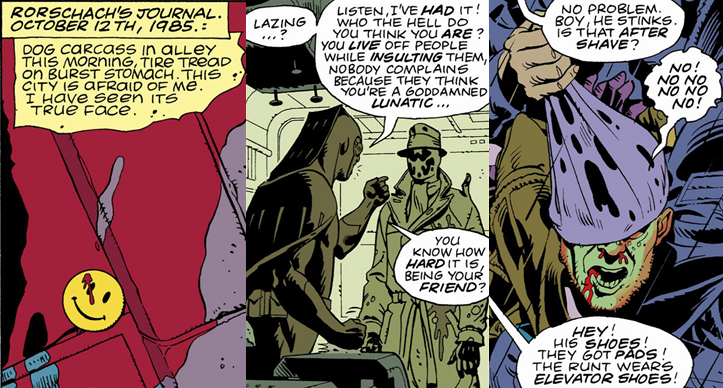
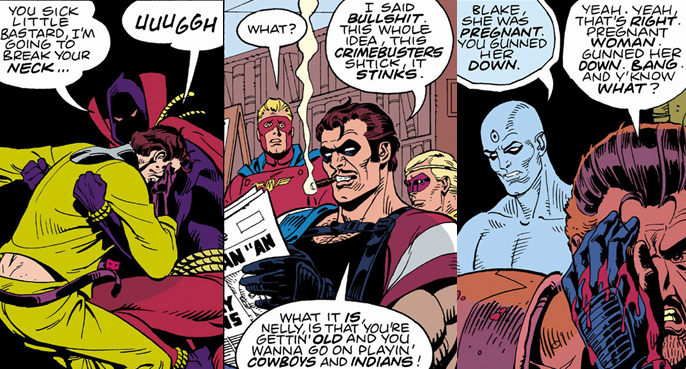
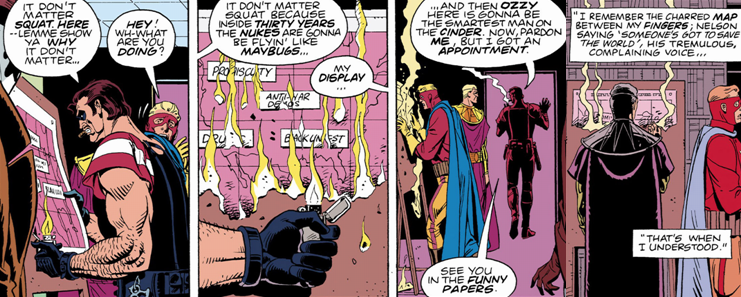
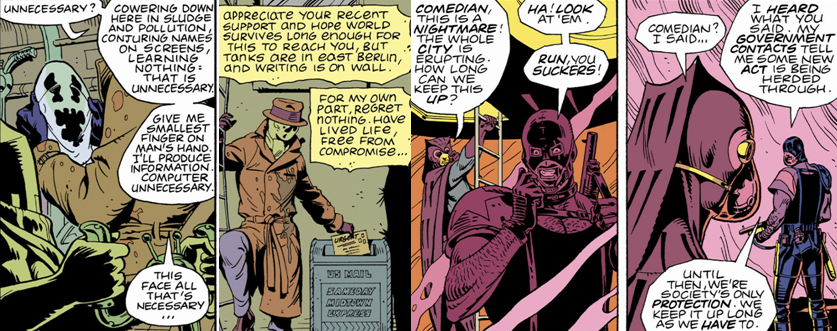
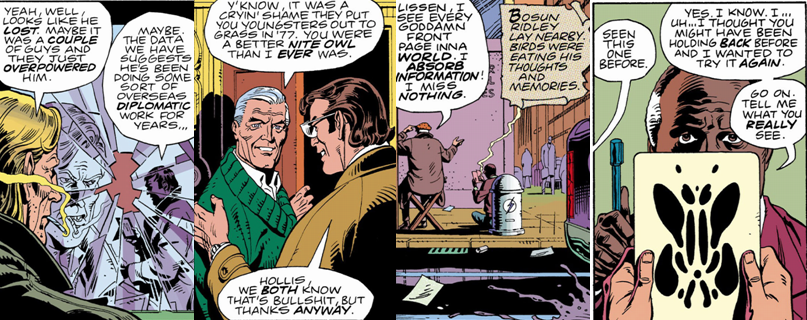
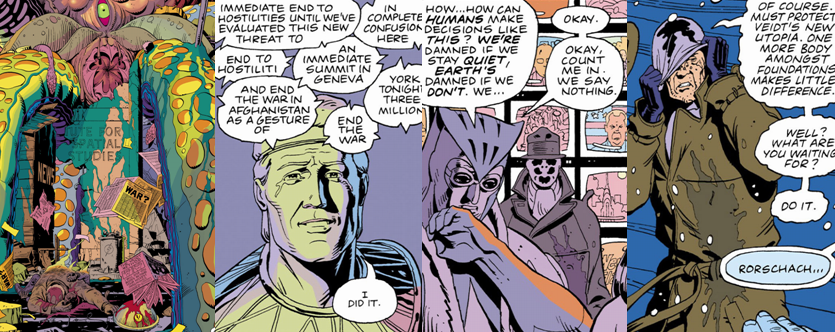
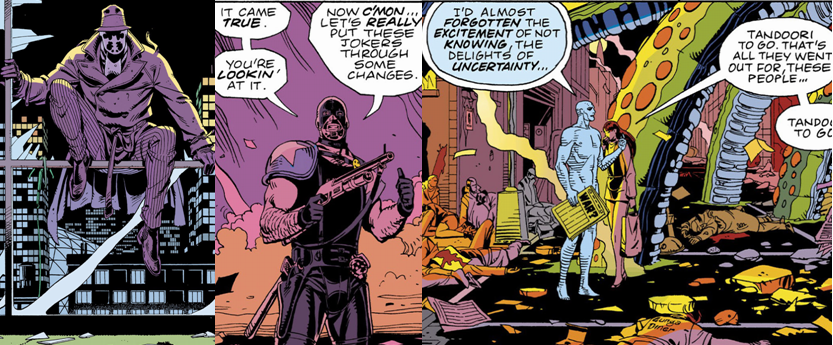
Ever since Watchmen (Moore, et al, 1986 to 1987) proved to be a critical and commercial hit, DC Comics have attempted to milk the property to capitalise on its popularity. A film adaptation had been in the works for decades and, when it was finally produced, spawned a videogame tie-in; finally, after years of trying to convince Moore and Gibbons to return to the franchise, DC drafted in a crop of the industry’s most talented creators (against Moore’s wishes, of course) to produce a prequel series. After years of subjecting readers to the largely-awful “New 52” era, DC finally decided to relaunch and reboot their continuity with another of their trademark Crises; “DC Rebirth” not only returned a lot of characters and concepts to their pre-New 52 portrayals but also concluded with Bruce Wayne/Batman discovering Edward Blake/The Comedian’s iconic, bloodstained button in the Batcave and the first hints that Doctor Jon Osterman/Doctor Manhattan was observing the DC Universe. Doomsday Clock finally saw the worlds of Watchman and the DC Universe come together and, despite a questionable release schedule and wonky canonicity (the story took years to be told and its placement in the timeline is confusing, at best), was met with critical acclaim and even led to a solo book for the series’ popular vigilante, Rorschach.

The Plot:
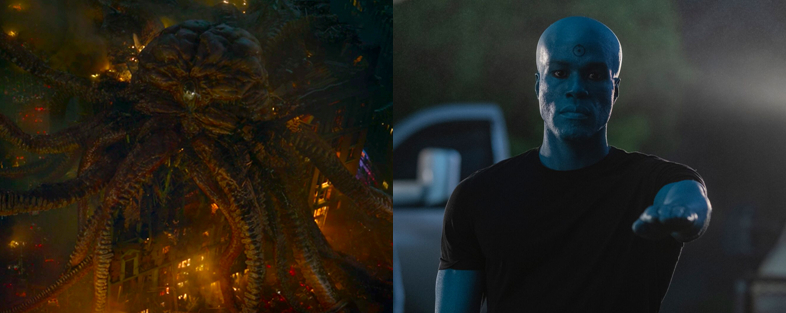
So, like Watchmen, Doomsday Clock is quite a dense text with a lot of things happening all at once and a lot of lore to dissect so I’m going to expand upon my breakdown of the story as I did with that graphic novel. The story’s plot is split between different characters and complex concepts like the multiverse, perceptions of time, and public’s opinion of superheroes in the DC Universe. One of the central concerns of Doomsday Clock is the state of Watchmen’s alternate world, now firmly established as one of the many parallel worlds in the DC multiverse. Seven years after Adrian Veidt/Ozymandias dropped his genetically-engineered squid into Times Square and killed millions of people, his dreams of world peace have been dashed after Walter Kovacs/Rorschach’s journal exposing his actions was published. As a result, the United States is once again on the brink of nuclear war with Russia and, desperate to save the world once more, Veidt allies with the new Rorschach, Reggie Long (son of Malcolm Long, Kovacs’ psychiatrist from Watchmen), and two of Dr. Manhattan’s former enemies, Erika Manson/Marionette and her husband, Marcos Maez/Mime.
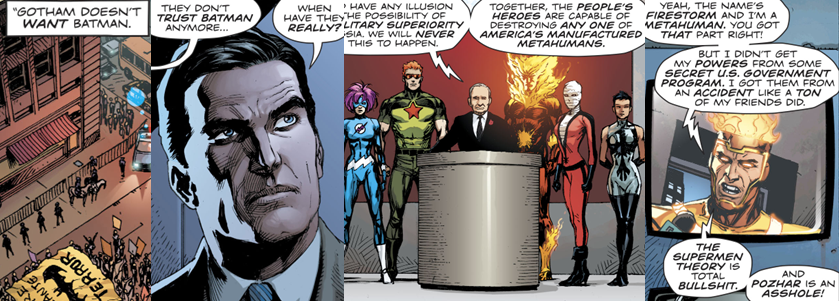
Tensions between the public, the government, and superheroes are fragile on Earth-0.

The group uses a refitted version of Daniel Dreiberg/Nite Owl’s (sadly, once again, entirely absent from the tale) Owlship to then follow Dr. Manhattan’s unique energy signature to the mainstream DC Universe just as their world is destroyed by nuclear war. However, life on Earth-0 isn’t exactly much better; riots and violent protests against Batman’s presence run rampant in Gotham City and the public’s perception of superheroes has soured thanks to the publication of the “Supermen Theory”, which uncomfortably pointed out that the vast majority of the world’s superheroes are white American men and suggested quite explicitly that the American government (clearly led by President Donald Trump) have manufactured their superheroes through a series of clandestine experiments and operations. The only superhero that the public and the world’s governments has any faith in is Clark Kent/Superman, who is still regarded as a worldwide icon and allowed to freely cross borders. The linchpin of the animosity towards superheroes is the outspoken and volatile Ronnie Raymond/Professor Martin Stein/Firestorm and, to compound matters, the Russian government (led by Vladimir Putin) forms their own team of metahumans to protect their borders, while Teth-Adam/Black Adam offers sanctuary to all metahumans, good and bad, in the sovereign nation of Kahndaq.
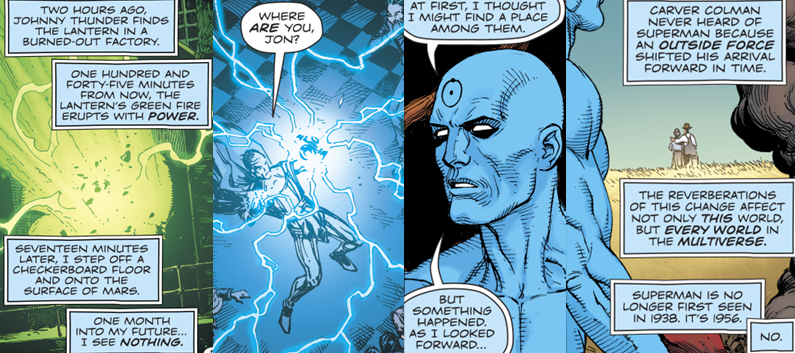
Dr. Manhattan has been manipulating and altering the DC Universe for some time.

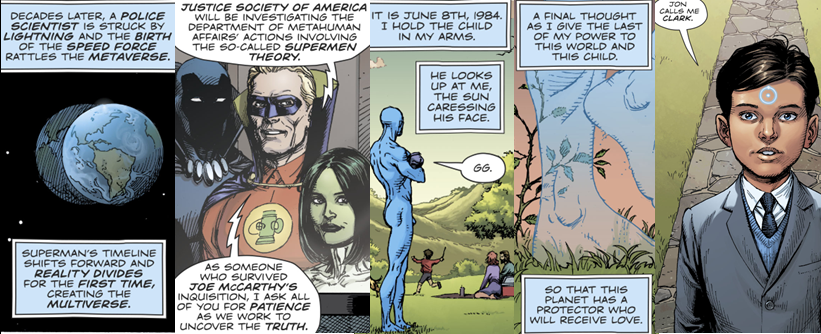
Amidst all of this is the mystery of Dr. Manhattan himself; at the end of Watchmen, Dr. Manhattan left to create some life of his own but, instead, was drawn to the DC Universe and discovers what is referred to as the “Metaverse”. The tumultuous nature of the DC Universe, which is not only populated by a wide variety of metahumans and magic but also subject to near-annual cosmic events and reality-shifting Crises, intrigues Dr. Manhattan, who begins to experiment with altering Earth-0’s history by subtly changing events in the past. This leads to the creation of multiple, widely different timelines and realities but, no matter what Dr. Manhattan does, Superman continues to emerge as the premier superhero of this world. Haunted by a vision of Superman flying at him in a rage and once again curious at his inability to see beyond this point, Dr. Manhattan observes the turbulent events unfolding around him with a morbid interest as he awaits to see if he destroys all reality or is himself destroyed by Superman.

The Review:
In the unfortunate absence of Nite Owl and Laurie Juspeczyk/Silk Spectre, and with Kovacs dead, there’s not a lot of opportunities for the iconic characters of Watchmen to interact with the mainstream DC Universe. Indeed, Doomsday Clock is less “DC Universe Meets Watchmen” and more “Some of the Watchmen characters pop over to Earth-0 alongside characters you’ve never heard of and a new Rorschach”, which is honestly a little disappointing. Like the television show, Doomsday Clock is a sequel to Watchmen but, because of its very nature as a comic book and its integration into the larger DC canon, is actually considered to be the true follow-up to the original graphic novel. Similar to the show, though, the future is depressingly bleak for Alan Moore’s characters; Veidt’s attempt at world peace was almost immediately undone and that world is quickly destroyed early into the story, making you question what the point of all that death and drama even was.
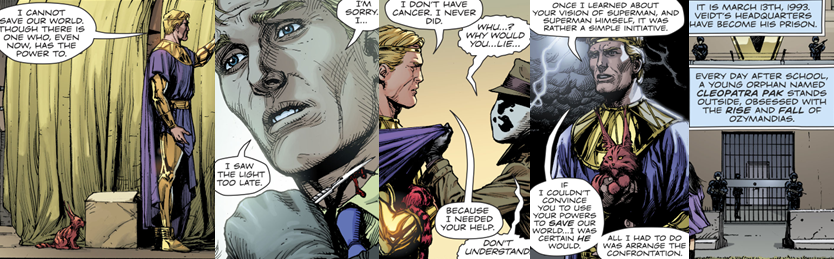
In a bid to save his world, Veidt once again lies and manipulates others to satisfy his ego.

Veidt, however, is largely undeterred by the state of his world; though he sees a macabre irony in his elaborate plan falling apart and despairs at the world’s insistence on destroying itself, he immediately concocts another desperate plot to save the world by tracking Dr. Manhattan down and convincing him to intervene. As is his way, Veidt’s scheme involves deceit, lies, subterfuge, and his unmatched intelligence; smug as ever, Veidt easily manipulates Reggie Long into assisting him by faking that he (as in Veidt) has a tumour on his brain (and feigning remorse for his actions, which led to the death of Reggie’s parents) and has him recruit Marionette and Mime to their cause specifically because he knows that Dr. Manhattan once spared Marionette’s life in a past encounter. Upon arriving on Earth-0, Veidt attempts to recruit Lex Luthor and is met only with scorn and a surprise attack by the Comedian, whom Dr. Manhattan transported to Earth-0 moments before his death. Having read Kovacs’ journal, Batman is also less than impressed with Veidt’s actions and megalomania; Veidt, however, maintains that he did what he did in an attempt to save and unite a world on the brink of destruction and attacks his new scheme with just as much blind obsession. Thanks to a cute little clone of his lynx, Bubastis, the green lantern of Alan Scott, and the presence of another temporal anomaly, Imra Ardeen/Saturn Girl, Veidt is able to forcibly summon Dr. Manhattan, who not only refuses to help but also exposes Veidt’s lies. Veidt orchestrates a massive conflict between Superman and other metahumans in order to inspire Jon to finally intervene and, though this does result in the restoration of Earth-0, the Watchmen world, and the entire multi/metaverse, he ends up imprisoned at the conclusion of the story.
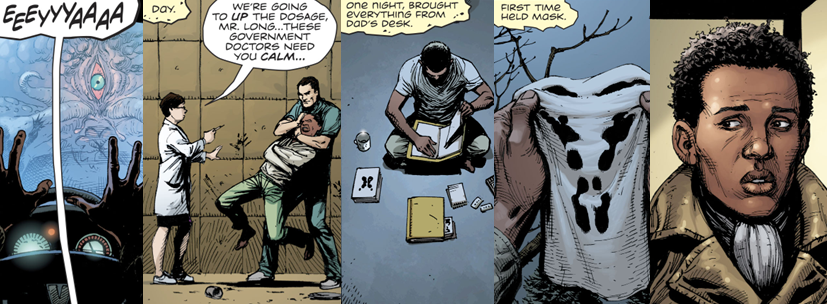
Traumatised by Veidt’s squid, Reggie comes to assume the mask and identity of Rorschach.

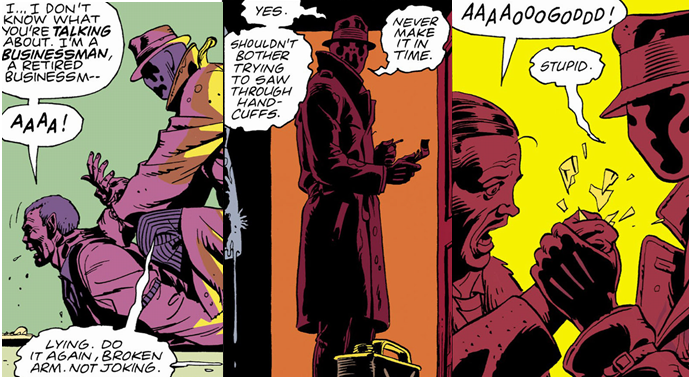
One of the things that disappointed me about the television show was the absence of Rorschach; I know we’re not supposed to like Rorschach but I don’t give a shit, he’s still the most interesting and compelling character in Watchmen. Although Kovacs is dead, his spirit and influence lives on in Doomsday Clock; not only was his tell-all journal instrumental in revealing Veidt’s deception, his crusade is taken up by Reggie Long, a confused and volatile young man traumatised by the effects of Veidt’s destructive squid. Like many exposed to the squid’s nightmarish psychic field, Reggie was driven to near insanity and spent a great deal of time confined to a mental hospital. There, he befriended former Minuteman Byron Lewis/Mothman, who becomes a friend and mentor to Reggie but ultimate contributes to Reggie assuming Rorschach’s mantle by purposely hiding the truth of Kovacs’ relationship with Reggie’s father.
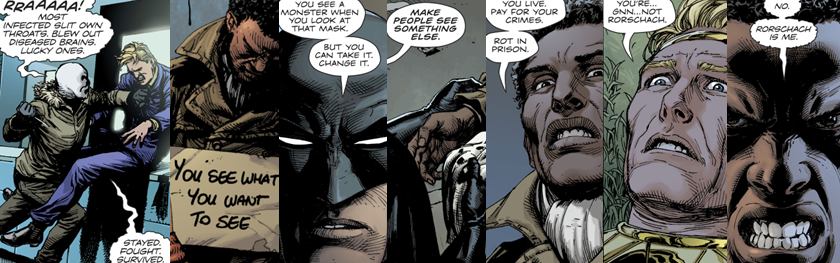
Reggie’s crusade briefly falters, sadly removing him from the story until the finale.

Believing that Rorschach and his father were friends and that Malcolm was able to reach and help Kovacs, Reggie is initially focused on killing Veidt for his actions but is convinced to aid him when Veidt claims to be dying and remorseful for his actions. Having read truncated versions of his father’s notes and Kovacs’ journal, Reggie assumes Rorschach’s costume and mannerisms and initially goes to Batman for help and finds himself imprisoned in Arkham Asylum for his trouble. Like in Watchmen, an entire issue is dedicated into delving into Reggie’s past and psychosis but he quickly gets lost in the shuffle as more and more characters and conflicts bog down the tale, even abandoning the mask and his crusade after Veidt’s lies are exposed. Ultimately, Alfred Pennyworth and Batman are able to convince Reggie to mask up and join the fight and Reggie even chooses to spare Veidt to see him brought to justice, claiming “Rorschach is me” but, while I appreciate the presence of a Rorschach, Reggie fails to be as compelling and instrumental as the real Rorschach and I think I would have preferred it if Dr. Manhattan had undone his actions or brought Kovacs forward in time as he did with the Comedian.
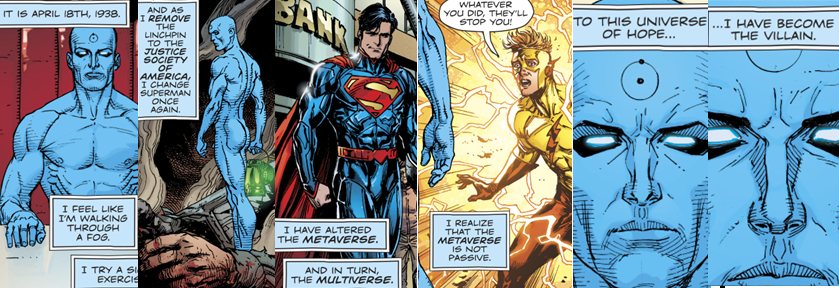
Dr. Manhattan screws with the DC timeline, creating different realities and outcomes as a result.

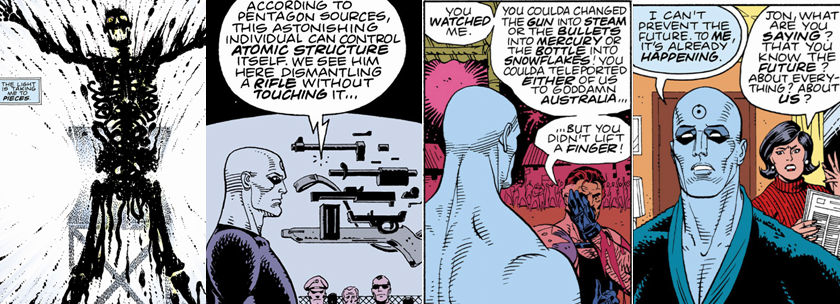
Speaking of Dr. Manhattan, he, too, gets another entire issue dedicated to him and his journey throughout the DC Universe. It’s basically exactly the same as issue four of Watchmen, with Jon spending a lot of time on Mars, ruminating about his origins and past with Janey Slater, and recapping the events of Watchmen. Although Jon appeared to have somewhat rediscovered his humanity at the end of Watchmen, to the point where he willingly went along with Veidt’s plan and even killed Rorschach to protect it, and his desire to reconnect with humanity was a big aspect of the TV show, in Doomsday Clock he’s basically exactly the same disconnected and emotionless demigod he was in the original graphic novel. He is despondent to discover that he feels just as out of place in a world of metahumans and magic as he did amongst mortals and takes to exploring and experimenting with the DC Universe’s fragile reality to keep himself from growing bored. Dr. Manhattan’s perception of time is both the same as in Watchmen (he can see the past, present, and future simultaneously but cannot see anything past his vision of Superman rushing at him) but different. I always assumed from Watchmen that Jon could only perceive time from his lifetime since he never visits the past beyond his lifetime in Watchmen but, in Doomsday Clock, he can freely walk between the past, present, and future of the entire DC canon, including a multitude of parallel worlds. Fascinated by the metaverse and the role Superman plays in this world, he purposely messes with time, killing Clark’s parents before their time and causing Alan Scott/Green Lantern to die, thus removing the Justice Society of America (JSA) from continuity, intervening in Flashpoint (Johns, et al, 2011), and basically creating the New 52 and Rebirth continuities through his actions.
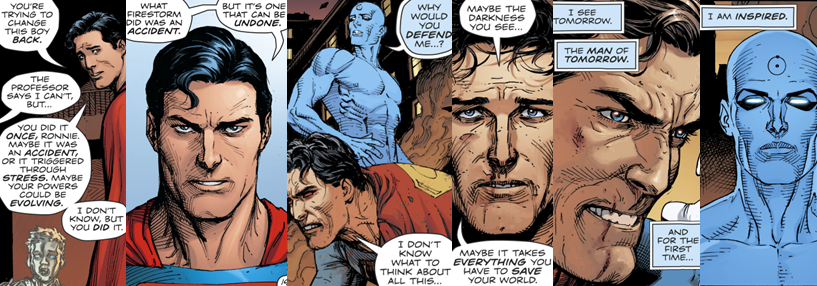
Even with the world falling into anarchy, Superman is able to inspire Dr. Manhattan to intervene.

Accordingly, Superman is a central figure in Doomsday Clock; Dr. Manhattan is curious to see whether the Man of Steel kills him for his actions or whether he (as in Jon) destroys all reality and, still vehemently refusing to even try and go against the inevitability of fate, he refuses to intervene or to help Superman when he ends up battling against a horde of metahumans. As the only superhero who maintains the trust and respect of the public and world’s governments, Superman desperately tries to keep the peace, repair relations, and to help Firestorm after he accidentally turns a bunch of people to glass. However, he ends up making things worse and escalates the tensions between the world’s governments and metahumans, leading to an all-out war. Though disgusted at Dr. Manhattan’s refusal to get involved, and his part in causing not only the events of Doomsday Clock but also the tragedies of his life, Superman is ultimately able to inspire Jon into restoring the worlds and multi/metaverse to normal through his selfless nature.
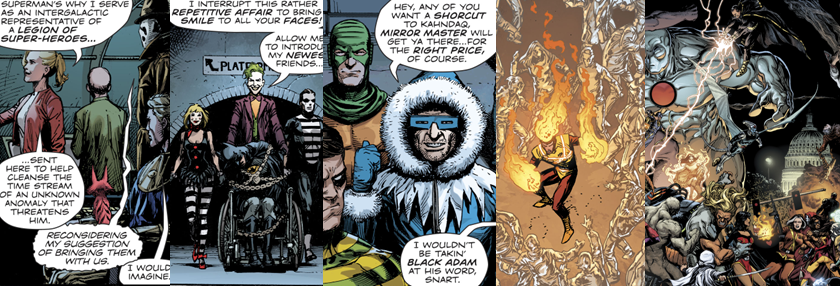
Doomsday Clock is stuffed full of characters and and cameos, more of whom derail the plot.

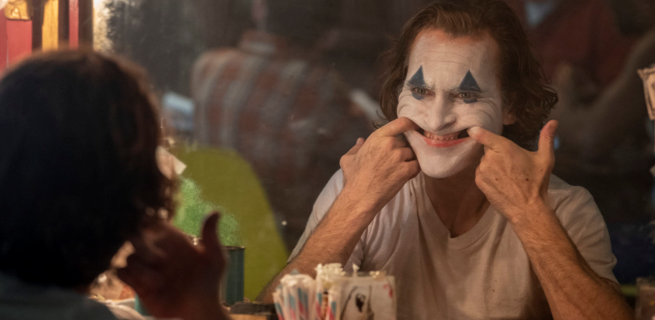
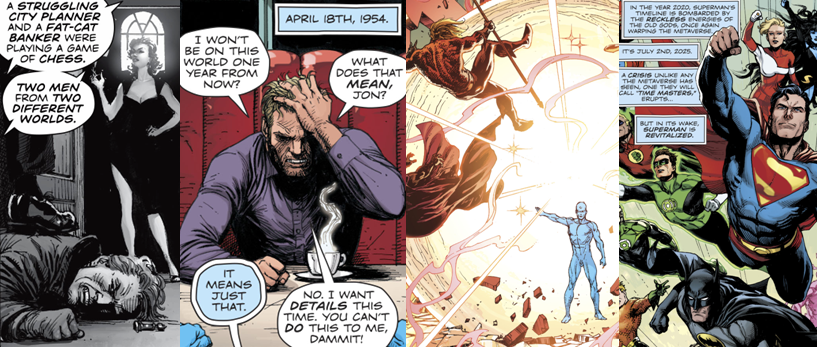
I mentioned before that Doomsday Clock is swamped with characters and it really is; a handful of the Watchmen characters obviously feature, including a brief appearance by the Comedian, who mainly features to try and kill Veidt for his attack on him at the beginning of Watchmen and to be a pain in the ass. Marionette and Mime, two completely original characters, feature extensively as Dr. Manhattan imbues their child with his powers in the finale to, presumably, become the Watchmen version of Superman. Additionally, a whole host of DC characters play a role in the story: Batman finally solves the puzzle of the mysterious bloodstained button but uncharacteristically chooses not to believe Reggie’s claims and has him locked up in Arkham, leaving him underequipped to intercede in the events of the story; Firestorm, here a volatile and immature character, escalates much of the tension regarding the perception of metahumans and the Supermen Theory when he is unable to control his powers; and, of course, the Joker makes an appearance but does little more than derail the main plot with an ultimately pointless side story.
Allegorical and metaphysical ruminations and canon fixes largely supplant big fight scenes.

Like Watchmen, Doomsday Clock contains an allegorical story-within-a-story, in this case the films of Carver Coleman, with whom Jon forms a strange kind of bond and how becomes his “anchor” in this new world. Carver’s hit film, The Adjournment, parallels the mystery that permeates Doomsday Clock and Jon’s own struggle against his true identity. Doomsday Clock also goes out of its way to closely emulate the art style and presentation of Watchmen but greatly overdoes its commitment to this by slavishly sticking to a rigid 3×3 panel structure. Like Watchmen, Doomsday Clock is also rather light on action and packs a whole bunch of symbolism, imagery, and references into each panel, mainly to Watchmen but also to the long and convoluted history of the DC Universe. The conclusion of the book sees the JSA returned to continuity, Clark’s parents and Alan Scott returned to life, and the restoration of the multi/metaverse but also leaves the story open ended for further continuations down the line exploring the restored Watchmen universe.

The Summary:
It seems that DC’s attempts at recapturing and revisiting Alan Moore’s seminal work are doomed to fail; just as I was unimpressed by the TV show, I can’t help but feel let down by Doomsday Clock, which is a quagmire of convoluted plot threads, self-indulgent allusions to Watchmen, and is a largely confusing and uninteresting mess. I feel like the book focuses too much on being sequel to Watchmen but it doesn’t really work since seven years have passed since the end of that book and we only spend about an issue and a half really reconnecting to Moore’s world before it’s destroyed. After that, it’s just another elaborate “Crisis” event as the few surviving Watchmen characters mingle about in the DC Universe and spend far too much time interacting with obscure characters like Johnny Thunder and Saturn Girl rather than the big guns like Batman and Diana Prince/Wonder Woman.
Dr. Manhattan’s God-like powers make him largely immune to conventional attack.

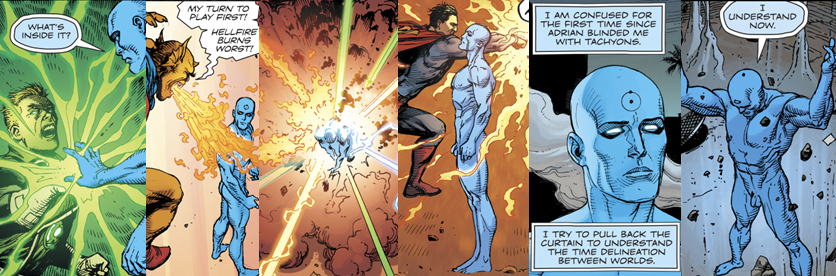
The story is framed around this epic, potentially cataclysmic battle between Superman and Dr. Manhattan, a concept that feels like a betrayal of Jon’s character as he’s largely a pacifist because of his stubborn refusal and disinterest in getting involved in the affairs of mortals. Yes, he fought crime and waged war against the Vietnamese but that was a long time ago by the present day events of Watchmen, where he was simply content to just let life play out as is preordained so, while the idea of these two titans clashing sounds good on paper, it seems like the sort of thing a child would think up while bashing action figures together. To me, Dr. Manhattan has always seemed more like Jim Corrigan/The Spectre, a being of incredible power who shapes events but only really gets involved in them when the cosmic shit is about the hit the fan, which is kind of how he ends up being in the end since we don’t really get to see him fight with Superman because the entire promise of their conflict was a big fake out. There is, however, a pretty good scene where a whole gaggle of DC’s superheroes and Green Lanterns confront Dr. Manhattan on Mars only to be easily subdued by his near-limitless powers
Sadly, there just aren’t enough interactions between the DC and Watchmen characters.

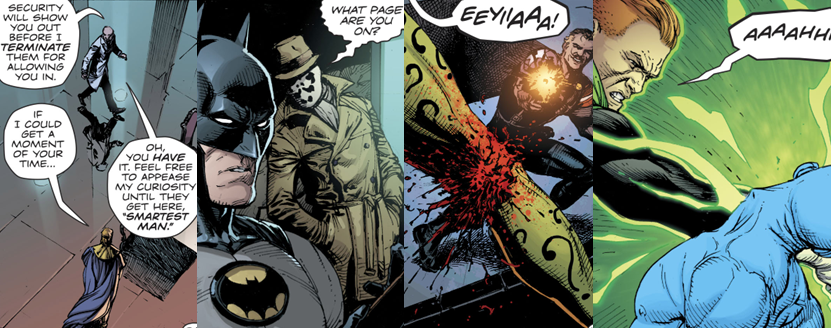
Similarly, the idea of Rorschach meeting Batman and Ozymandias meeting Lex Luthor sounds great…on paper but this isn’t the same Rorschach and, no matter how hard Reggie tries, he will never be that same character so it wouldn’t really work even if Batman didn’t just disregard him and lock him up in Arkham. Luthor is scornful towards Ozymandias and a potential team up between these two is also immediately cast aside, with Luthor mocking Veidt’s intelligence and plan as though Johns is poking fun at the very work he is so blatantly trying to homage and leech off of. The absence of Nite Owl and Silk Spectre equally hurts not just the story’s plot but also Doomsday Clock’s legitimacy as a Watchmen sequel; again, it feels less like the characters of Watchmen meeting the DC Universe and more like a handful of them dropped into the unexplainably chaotic DC Universe and struggling to make sense of it.
The attempts to recapture Watchmen‘s bleak political undertones largely fall flat.

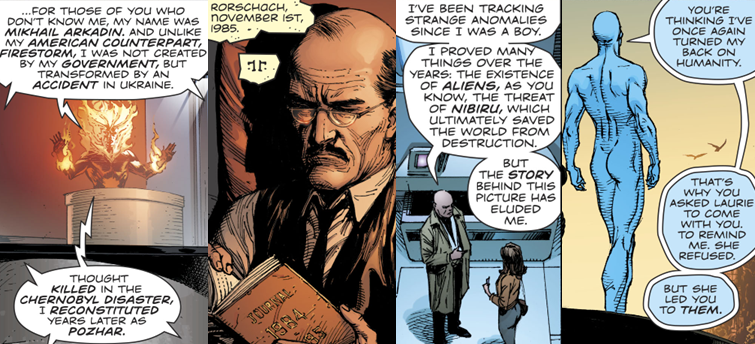
Basically, Doomsday Clock tries and fails to emulate the unique narrative and approach that Watchmen took; Watchmen’s bleak, uncompromising and, dare I say it, adult themes don’t mesh well at all with the mainstream DC Universe and I can’t help but feel like it would have been better to supplant the Watchmen characters mid-way through the events of Moore’s book so that we could see all their recognisable and flawed heroes actually butting heads with DC’s big guns in a clash of both ideals and fists. Dr. Manhattan could have been responsible for this, manipulating events from behind the scenes to cause the two worlds to emerge, and we could have seen interesting team ups and interactions between these characters (Batman and Nite Owl and Wonder Woman and Silk Spectre spring instantly to mind) but, instead, we get this weird mess of a story that’s more concerned with turning superheroes into hated figures, destroying or leeching off of DC’s Golden Age and Watchmen’s legacy, and desperately attempting to address some of the issues with the Rebirth universe.
In the end, Doomsday Clock was just another convoluted “Crisis” event.

Ultimately, I feel like I have to recommend Doomsday Clock, though, if only to see the botch job DC makes of officially canonising Watchmen into the DC Universe. As a love letter to Watchmen, it’s not so bad; the way it evokes the imagery and atmosphere of Moore’s work is pretty astounding and the artwork is quite appealing but the problem is that, while reading it, I just felt like I’d rather be reading Watchmen or any other “Crisis” event. It’s better than the TV show, I’ll give it that, if only because it actually includes a number of recognisable Watchmen characters but it similarly fails to properly recapture the magic of Moore’s story because the characters haven’t really changed and they don’t really fit in the mainstream DC Universe. This is brought up a few times but not often enough as the story has to make way for the escalating conflict between Superman and other metahumans and its confusing ending, and I can’t help but feel like Johns dropped the ball and that Doomsday Clock failed to really live up to all the hype and potential it had.

My Rating:

Rating: 2 out of 5.

Could Be Better

Did you enjoy Doomsday Clock? Did you suffer through the comic’s long publication or did you pick up the collected edition, like I did? Were you excited to see the Watchmen characters interact and be integrated into the DC Universe and were you disappointed with how the story turned out? What did you think to the new Rorschach and Dr. Manhattan’s role in the DC Universe? Were you a fan of the interactions, characterisations, and references included in the story or do you agree that it failed to live up to its potential as a concept? Would you like to see the Watchmen characters interact with the DC Universe again in the future or do you think it’s best that it stays separate from mainstream canon? Whatever your thoughts on Doomsday Clock and Watchmen in general, drop a comment below and thanks for joining me for Watchmen Wednesday.

Screen Time: Watchmen

Air Date: 20 October to 15 December 2019
UK Network: Sky Atlantic
Original Network: HBO
Stars: Regina King, Jean Smart, Jeremy Irons, Yahya Abdul-Mateen II, Tim Blake Nelson, Hong Chau, Jovan Adepo, Louis Gossett Jr, and Don Johnson

The Background:
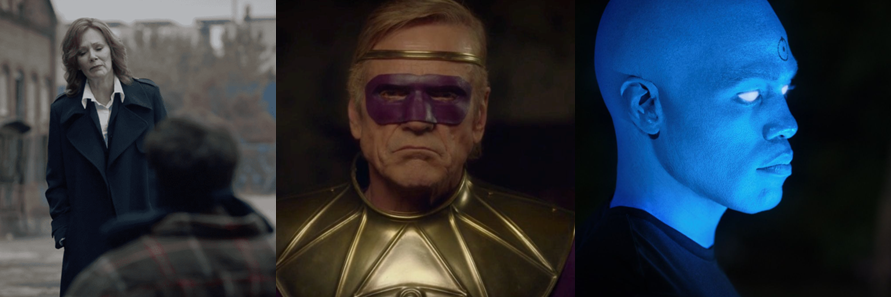
Since its release, Watchmen (Moore, et al, 1986 to 1987) has become a critical and commercial success and is largely regarded as one of the most influential and significant graphic novels ever created. Although at one point considered to be unfilmable, various writers, producers, directors, and other creative types had attempting to spearhead a live-action adaptation since the end of the eighties, all of which fell apart until Warner Brothers approached Zack Snyder to finally bring the project to life in 2005. Say what you will about Watchmen (Snyder, 2009) but it did a pretty good job of translating Moore’s dense, complex text into a cohesive live-action feature; elements were changed, for sure, but that is to be expected from the adaptation process and, for me, the changes made perfect sense and didn’t detract from Watchmen’s themes or main story. After the film’s release, DC Comics really ramped up the Watchmen spin-offs and merchandise (much to Moore’s chagrin, I’m sure) and this included tentative talks with Snyder concerning a live-action Watchmen television series. After Snyder left the project, the HBO network began developing the series with Damon Lindelof. Rather than being a sequel to the movie, however, Lindelof conceived of the series as a continuation of the Watchmen comic that would jump between the 1920s, 1980s, and then-modern-day 2019, dealing with issues of race and the fallout of Watchmen’s iconic ending. Watchmen was met with widespread critical acclaim and won numerous awards, though Lindelof stepped away from the franchise and HBO reclassified Watchmen as a “limited series” with options of additional instalments and stories under a different creative team.

The Plot:
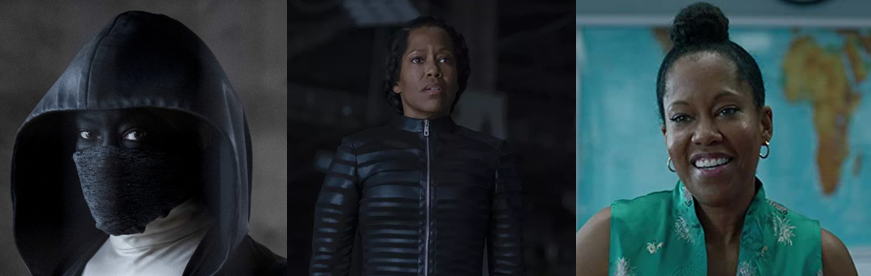
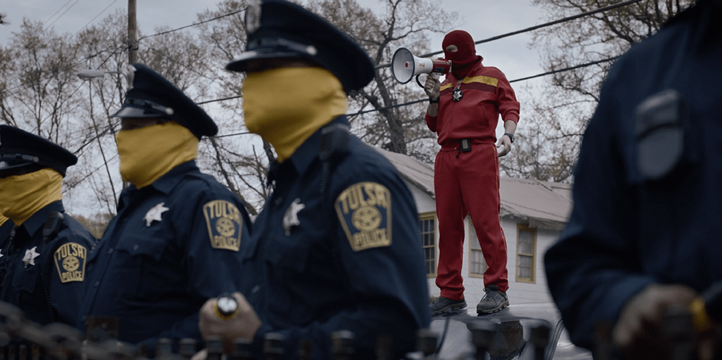
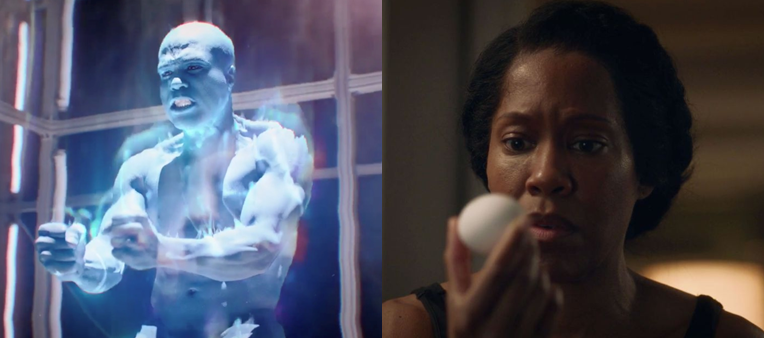
Thirty-four years after the world was united against a perceived alien threat, the Seventh Kalvary, a white supremacist group inspired by WalterKovacs/Rorschach, has risen to prominence in Tulsa, Oklahoma. Because of their actions, the Tulsa Police Department have taken to hiding their identities behind masks and code-names like the long-outlawed vigilantes of the 1960s and 1980s. After Police Chief Judd Crawford (Johnson) is murdered, Angela Abar/Sister Night (King) finds herself uncovering uncomfortable truths regarding her past, the state of the world, and a deadly plot to harness the powers of the long-exiled Jon Osterman/Doctor Manhattan (Abdul-Mateen II).

The Review:
A central premise to Watchmen is the idea of a deep-rooted conspiracy; obviously, there’s the primary Watchmen conspiracy involving the sudden appearance of a giant, alien squid in New York City shocking the world away from nuclear Armageddon but HBO’s Watchmen juxtaposes this narrative with one involving a nefarious plot by Senator Joe Keene Jr. (James Wolk) to manipulate a series of violent and discriminatory events that will ensure his seat in the White House. As in the original comic book, the cogs are forever turning in Watchmen and nothing is ever quite as it seems; the majority of those in positions of power wear masks, either literal or metaphorical, and, as always, it is the general public that suffers as a result. Central to the series’ themes of conspiracy and violence is our main character, Angela Abar; in the 2019 world of Watchmen, the police are anonymous individuals who hide their identities behind masks and code-names after a series of mass murders perpetrated in 2016 by the Seventh Kalvary that came to be known as the “White Night”. Abar was one of the few survivors of this atrocity, one who steadfastly stuck by her police chief, Judd Crawford, to rebuild the police department and adopting masked identities as per Senator Keene’s groundbreaking decision to bend the rules seemingly to protect those in law enforcement.

Angela wears a number of literal and metaphorical masks.

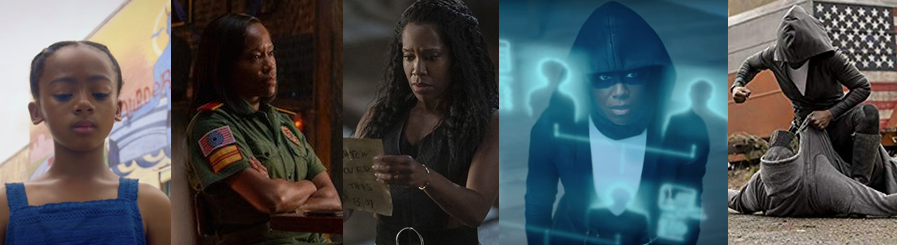
As a result, Abar lives a life of lies and deception; to the outside world, she works as a struggling, nondescript baker who has been long-retired from police work but, in reality, she is a tortured soul despite her seemingly perfect family life with her husband, Cal (Abdul-Mateen II) and her adopted children. Not only is she hiding her identity behind that of Sister Night, a masked persona that allows her to exercise her violent tendencies (especially against white supremacists and racists), but she is also largely covering up the specifics of her childhood and troublesome upbringing in Vietnam. In addition to this, her actual origins and true lineage are largely hidden from her and discovered throughout the course of the series, forcing her to confront some uncomfortable revelations about not just trusted comrades like Judd but also herself, her parents, and, most significantly, her grandfather and husband. Consequently, racism is a massively important part of Watchmen; all throughout the series, the narrative returns, in some form or another, to the atrocious events of 1921 that saw racist sentiment in Tulsa boil over to breaking point. Even now, in 2019, there is an air of racism across the board as people resent those of colour, and President Robert Redford, for “taking over” their town, putting down roots, and receiving a series of payouts (known as “Redfordations”) as recompense for their suffering. Racism in Watchmen is mostly personified by the Seventh Kalvary, basically an evolved form of the Klu Klux Klan who have adopted and twisted Rorschach’s diary, appearance, and methods to spread anti-racist and anti-authority sentiment throughout Tulsa.

Many of Tulsa’s police use their masks as an excuse for excessive violence.

For decades, Judd has worked to maintain a rocky kind of peace between the Tulsa police and the Seventh Kalvary to keep events from escalating into full-blown violence; as a result, cops are unable to utilise deadly force (or even draw their handguns) without requesting permission and their firearms being remotely activated and it is forbidden for them to reveal their true identities to the public, all to help ensure that they are protected from reprisals and to keep them from sparking all-out war through needless violence and death. However, anti-authority sentiment remains high amongst the public; many resent the police for using their masks as an excuse to indulge in excessive violence and, in a twist on the anti-mask riots seen in the comics, the public now seem to be far more receptive to the idea of actual costumed vigilantes than masked police officers. However, in 2019, costumed heroes are few and far between; with vigilantism still outlawed, law enforcement agencies track them down and arrest them at every opportunity and all the costumed heroes you knew from the original comic are either dead, retired, in jail, exiled, or have conformed to the new world. The most principal of these is, obviously, the all-powerful Dr. Manhattan, whom the public believes has exiled himself to Mars; Manhattan Booths have been placed all over the city (and, potentially, the world) to allow people to call Mars and leave messages for Dr. Manhattan but, like any self-respecting God, Dr. Manhattan never replies to these prayers and is largely believed to have abandoned mankind.

Time, and life, have not been kind to the former Silk Spectre.

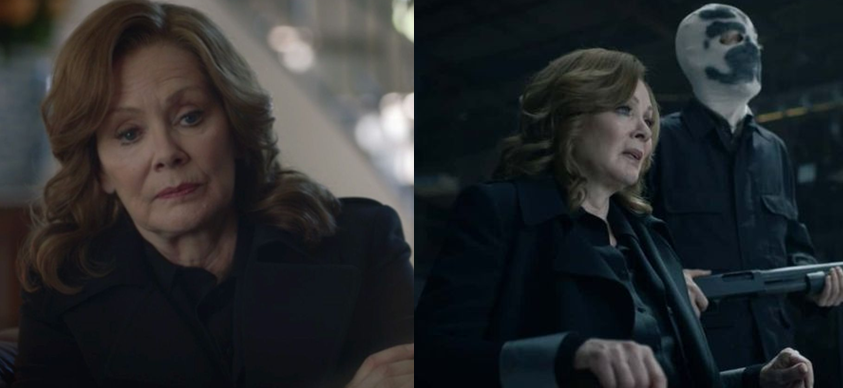
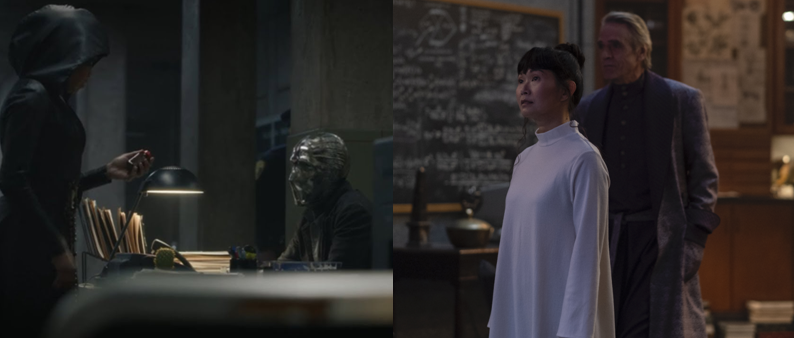
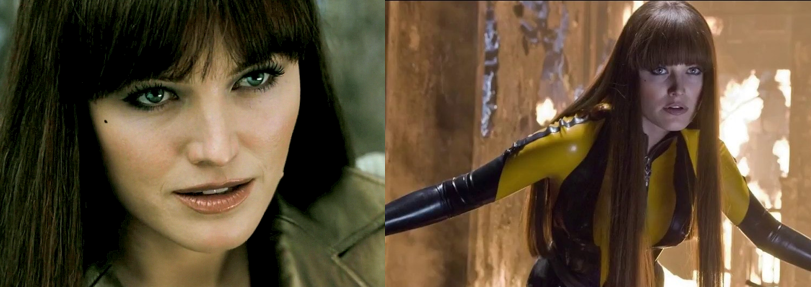
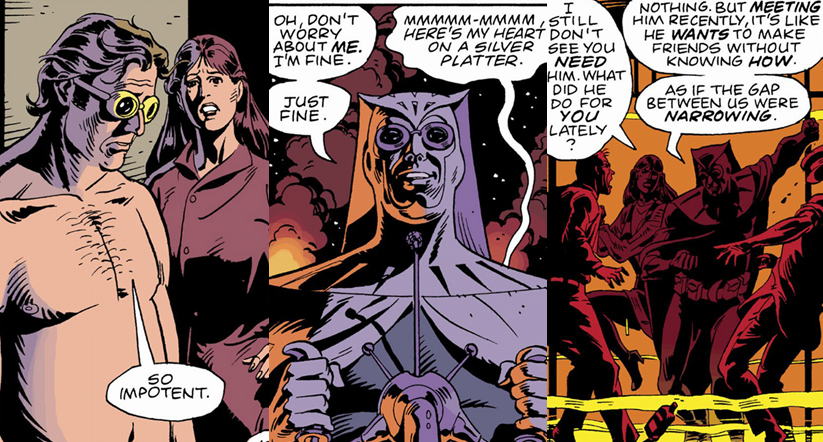
The other costumed heroes haven’t fared much better, either; Laurie Juspeczyk/Silk Spectre (Smart) is now a hard-nosed, cynical FBI agent who is apathetic, pessimistic, and callous. She has a personal dislike for masked vigilantes, regarding them as a “joke”, and meets almost every challenge or obstacle with a mocking indifference. Indeed, it says a lot about Laurie’s mindset that she has adopted the surname of her biological father, Edward Blake/The Comedian, a man whom she hated with a passion for being a cruel and sadistic rapist. Clearly changed after the events of the comic and in the time between the comic’s conclusion and present day (and her knowledge of the truth behind the squid incident, which is unsubtly referred to as “11/02”), Blake is a confrontational, no-nonsense, world-weary woman who has no time for bullshit or games and even less time to indulge those who hide behind masks (again, both literal and metaphorical).

Adopting many of Rorschach’s characteristics makes Looking Glass one of the stronger characters.

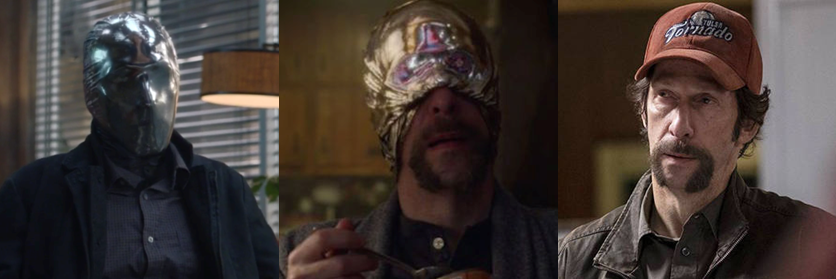
This naturally means that she ruffles a lot of feathers once she is assigned to Judd’s murder case, believing it to have been the result of vigilante action, and causes her to clash with those in the Tulsa police department, such as Wade Tillman/Looking Glass (Nelson). Looking Glass, who adopts many of Rorschach’s characteristics (his blunt, monotone voice, his stature and body language, his paranoid over-preparedness, and even a similar mask), is a highly perceptive and analytical character who is able to tell what someone is really thinking and feeling (or whether they are lying) through his highly tuned reading of body language. After suffering some of the squid’s violent psychic impact, Looking Glass constantly shields his head and face behind a reflective material to keep himself sane and free from nightmares, meaning he is much more comfortable hiding behind his masked identity. However, while he is the closest thing the series has to an actual Rorschach-like character, he is fundamental different from Rorschach in many ways and is, in a lot of ways, Rorschach’s opposite (Looking Glass, for example, lives in a house, has had various (often disastrous) relationships with women, regularly unmasks to reveal, at least, his face, and is a devoted member of the establishment rather than being anti-authority and uncompromising).

Veidt becomes disillusioned with the state of the world despite everything he did to save it.

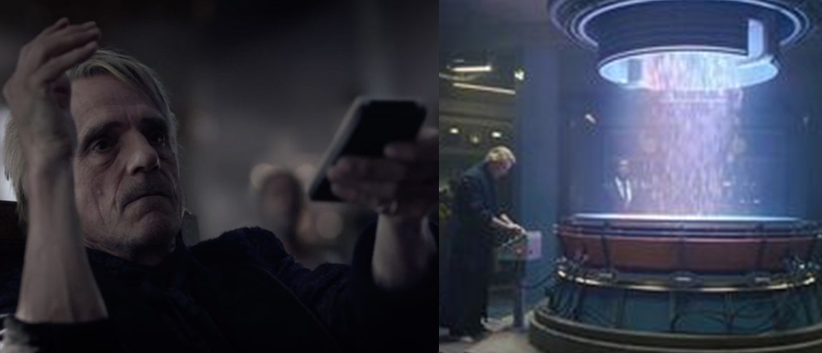
HBO’s Watchmen is a world very similar to ours but fundamentally different and flawed; far from the utopia that the squid’s presence was meant to inspire, the world has largely grown accustomed to the “new normal” and regularly endures sporadic mini squid showers as though they’re an everyday occurrence rather than a startling reminder of the alien menace that lingers overhead. Disillusioned with the state the world has fallen into despite everything he did to save it, Adrian Veidt/Ozymandias (Irons) jumps at the chance to be transported to Europa, where Dr. Manhattan has created an idyllic paradise populated by endless clones living in a stately manor. As jarring as Laurie’s character changes are, they at least have some basis in her comic book counterpart; Laurie was always a bit of a sharp-tongued, blunt instrument in the comics and age and experience have only served to make her even more tiresome but Veidt is so drastically removed from his original depiction that it is almost insulting. Much of the early episodes revolve around Veidt (then known simply as “The Master”) seemingly trapped in a prison, surrounded by endless, disturbingly polite and helpful clones and unable to escape. Eventually, the truth of his situation is revealed (Dr. Manhattan transported him there at Veidt’s enthusiastic suggestion but Veidt became bored with paradise and Manhattan was unable to retrieve him, so Veidt constructed an elaborate plot to keep him challenged and from going insane) and Veidt is able to send a message to affect his rescue.

Both Lady Triey and Senator Keene seek to steal Dr. Manhattan’s God-like powers.

However, flashbacks to earlier years before his imprisonment and subsequent focus on his current mindset show Veidt as being quite the hypocritical and egocentric character; while this was, to be fair, evident in the comic book, here Veidt actually records a message to President Redford admitting to having concocted the squid as an elaborate hoax and is visibly insulted and frustrated at Redford rebuking his attempts to form a partnership and the fact that he receives no credit for having “saved the world”. As a result of this, and having grown jaded and frustrated at the continued production of weapons and nuclear deterrents (which I find odd as obviously the world would want to arm/prepare itself for a possible alien invasion), Veidt retires to Karnak to live in solitude and is dismayed and affronted to find, upon his return, that the world not only believes him dead but has largely forgotten about him. In Veidt’s place is Lady Trieu (Chau), his unwanted biological daughter, who takes Veidt’s vision for a world united by peace and prosperity and further defiles it through a complex plan to find, kidnap, and destroy Dr. Manhattan so that she can assume his abilities and reshape the world. Senator Keene has similar aspirations, wishing to be the first “superman” in the Oval Office, but only Trieu has the resources and knowledge to actually pull off such a plan. Oddly, her aspirations to assume Manhattan’s Godhood are shocking even to Veidt, despite his attempts to destroy Manhattan in the past, forcing Veidt into an uneasy alliance with Blake, Looking Glass, and Angela to keep Trieu from becoming the new Dr. Manhattan.

The glimpses into Hooded Justice’s backstory are some of the show’s more interesting elements.

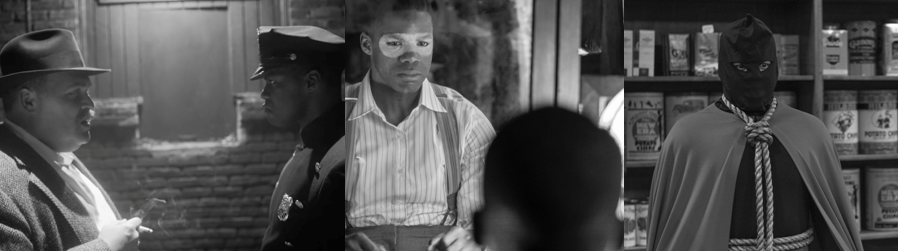
It is, essentially, the same fundamental plot of the Watchmen comic and many of the same story beats are evident throughout the series (a newsvendor even pops up every now and then to give his views on the state of society), however HBO’s Watchman sheds a lot more light on the effect Dr. Manhattan’s presence had on the Vietnam War (Vietnam becomes an official state of America and Angela hates Manhattan since his actions led to the death of her parents) and the true identity of the very first costumed hero, Will Reeves/Hooded Justice (Jovan Adepo/Louis Gossett Jr). The subject of much speculation in the comic, Hooded Justice turns out to be a young, angry black man who faces unwarranted prejudice and foul treatment in his youth while working as a police officer; after being briefly hanged by his fellow officers, he adopts a hooded guise to dish out corporal punishment and stumbles upon a plot by a group of white supremacists known as “Cyclops” to hypnotise the black community into attacking their own kind. When he is approached by Nelson Gardner/Captain Metropolis (Jake McDorman), Reeves is initially hopefully that the backing of his fellow masked adventurers will held him uncover the conspiracy ever faster but is quickly dismayed and disappointed to find that the Minutemen care more about publicity and catching “supervillains” rather than conspiracies, especially those against black people. This partnership also causes Reeves further turmoil as he enters into a passionate homosexual affair with Gardner, meaning that he is forced to hide behind a myriad of masks (he hides his true identity from the public with his hood, further masks his true identity by applying white face paint so as to be more “accepted” by his fellow Minutemen, hides his sexuality from his wife, his anger from the world, his true intentions from the police…it’s just mask after mask after mask).

Angela is a complex character but one I find more grating than compelling…

Even in his older years, Reeves is still hiding; he hides the truth of his identity (and the truth about Judd) from Angela, setting her on a difficult and violent path of self-discovery, and then also hides the specifics of his relationship with Dr. Manhattan (at various points he even claims to be the God-like superman, though this is openly debunked by many characters). Angela later gets all the answers she could hope for, and more, when she swallows an entire bottle of Reeves’ “Nostalgia” pills, which allow her to relive his memories and experiences in excruciating detail in order to discover her true heritage as Reeves’ granddaughter. Compared to her grandfather, Angela’s masks are considerably fewer but by no means less complex; she hides her true identity, obviously, and is clearly enthusiastic about putting a hurting on white supremacists but is largely open and honest with her husband (while, understandably, keeping her kids in the dark). Her and Cal have no secrets and he is completely supportive of all of her endeavours and actions, even when they are highly questionable, and cares only for her safety and wellbeing. An angry and confrontational character, the events of Watchmen certainly put Angela through the wringer as she discovers her true heritage, finds out her trusted comrade and friend Judd was secretly a member of the Seventh Kalvary, and finds herself at the center of Lady Trieu’s elaborate scheme to steal Dr. Manhattan’s abilities.

Dr. Manhattan is destroyed but, apparently, passes his abilities on to Angela.

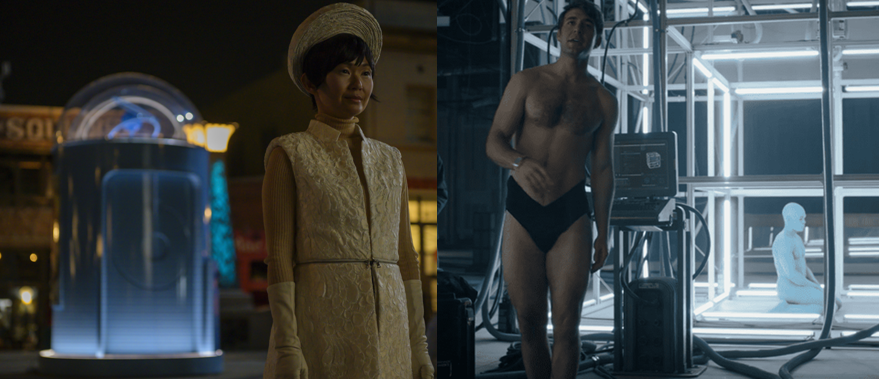
All throughout the series, characters debunk the idea that Dr. Manhattan can disguise himself as a human; at first, this seems a bit weird as Manhattan’s powers are virtually limitless and it’s odd that people would just know that he couldn’t do this but, nevertheless, the seeds are planted throughout the series that this is actually what has happened. And, of course, it turns out to be true; the footage of Dr. Manhattan on Mars is simply another lie to placate the public and Manhattan, despite wishing to “leave this world” and create life, quickly grew bored with the utopia he created on Europa and returned to Earth specifically to meet Angela. After relating to her, in his characteristically pragmatic way, his perception of time, Manhattan sought out Veidt to provide him with the means to adopt the closest thing to a human guise in order to be with Angela; Veidt’s specially-constructed implant disrupts Jon’s memories, giving him complete and total amnesia and allowing him to assume a whole new face and identity, Cal Abar, in order to live a normal life. However, after Angela uncovers the plot against him, she’s forced to literally crack Jon’s head open and remove the implant to try and save his life. Ultimately, though, despite Jon’s vast powers and abilities, he is unable to escape his fate; Lady Trieu’s specially designed technology is enough to capture, entrap, and then disintegrate Jon, effectively killing God before the eyes of our main characters, though Trieu’s goal of assuming his abilities is thwarted and the series ends with the suggestion that Jon has passed them on to Angela instead.

Watchmen looks fantastic, for the most part, but Dr. Manhattan looks like bad cosplay!

Watchmen’s visual presentation is quite impressive; clearly inspired by the aesthetic look of Snyder’s film, the series does a wonderful job of not only rendering comic-accurate costumes for the likes of Ozymandias, Hooded Justice, and Captain Metropolis but also at recreating the look and feel of the Watchmen world. I didn’t actually mind the omission of the squid in Snyder’s adaptation but it was pretty fantastic to see the monstrous, grotesque alien beast a bloodied heap in New York and there are some fun call-backs to other recognisable Watchmen elements, too, such as Dan Dreiberg/Nite Owl’s goggles and airship, Archimedes. And yet, despite how impressive much of the costumes and aesthetics of the show look, they completely dropped the ball on Dr. Manhattan; Yahya Abdul-Mateen II is a great actor and certainly has the voice for the role but he never quite exudes that same sense of God-like awe and mystery as in Snyder’s film and is generally, disappointingly, quite nerfed in terms of his powers, motivations, and portrayal. Watchmen works pretty well in terms of its structure; each episode has a quick intro sequence and a fittingly pretentious title, and the series reflects a lot of the structure and narrative flow of the comic book as certain episodes will expand upon one (or more) of the series’ many complex plots while others will focus on specific characters or world-building all while weaving them (however awkwardly) into these aforementioned plots. The series builds its mysteries relatively well; we’re immediately deposited into a world that, for all its similarities to the comic book and the real world, is completely unfamiliar to both, meaning we must re-learn and become re-accommodated with this new Watchmen-esque world where things have changed considerably from what we know but are just familiar enough that we have a vague idea of what characters are talked about and referring to. And then, into this, the series creators inject a whole load of new lore, building upon elements from the comic book, referencing the movie, and then swamping this world (and its narrative) with entirely new, original characters to uncover more of this new world, and the series’ mystery, at the same time as we do,

The Summary:
I wasn’t sure what to expect going into Watchmen; I knew it was a sequel series and that obviously meant a lot of the comic characters either wouldn’t be coming back or would be portrayed very differently but I never expected the plot to veer so far off the rails. I thought the series would revolve around a splinter group of vigilantes trying to expose Veidt’s deception but, while the squid is an integral part of the series’ plot and had a profound influence on many characters and events, it may as well have been left out as the series more concerned with telling a story revolving about the atrocities of race hate. This isn’t really a problem in and of itself, as racial tensions and bigotry were quite prominent in the comic, but it kind of overwhelms the plot of the series and doesn’t seem to mesh well with the other competing plots.

The biggest issue for me was that the show just didn’t “feel” like Watchmen that often…

I think the biggest issue I have with Watchmen is that it really doesn’t feel like Watchmen; while you can argue that the series is a lot closer, thematically, to the comic book and much truer to its source material than Snyder’s film, at least the film had characters we recognised and closely followed the events of the comic. Here, we have a whole bunch of new characters, many of whom (including Angela, our main character) just aren’t as interesting as the characters from the comics. Looking Glass is kind of like Rorschach but he’s not Rorschach and neither are the Seventh Kalvary; Sister Night is kind of an amalgamation of Nite Owl and Silk Spectre, I guess, but is her own character, one who I just found to be angry and unrelatable in a way those characters weren’t; and Lady Trieu basically is her father…but is also far less compelling and nuanced. She just comes across as a nutcase whereas Veidt was always scarily logical and sane in his motivations. And then there are the returning characters; Laurie is a thoroughly unlikeable character now (though I did enjoy her calling out everyone around her for their bullshit and for dressing up in masks and costumes), Veidt is little like the highly intelligent and manipulative character he was in the comic, and Nite Owl is conspicuous (and much missed) in his absence.

Watchmen‘s returning characters are all very much worse for wear in the HBO series.

If you’re going to do a follow-up to Watchmen, I’m not sure why you would choose to focus 90% of your story on entirely new characters; a new generation should be included and be a vital part, for sure, but fans of Watchmen were fans of the characters in the book, not a whole bunch of copycats and also-rans who don’t quite match up to the complexities and nuance of their predecessors. Dr. Manhattan is probably the worst of all the returning characters, though; for all his grand-standing and posturing in Watchmen about leaving Earth behind to create life elsewhere, he simply played God, got bored, and then decided to enter into another relationship that was doomed to fail (he even admits this outright to Angela when they first meet) even though he was so far beyond and over such trivialities by the end of Watchmen. Honestly, I’m not entirely sure why HBO’s Watchmen was so critically acclaimed and so well received; while many criticised Snyder’s Watchmen (and I can understand that given how different it is from the comic’s more subtle approach), it feels, for all its changes and alterations, much more like Watchmen than HBO’s Watchmen, which honestly could have been any old superhero drama. Having the Watchmen title, though, demands a certain level of expectation and, for me, HBO’s Watchmen comes close and is an interesting extension of the lore but fails to really live up to those expectations. It was like I kept waiting for it to kick into a higher gear, to go the extra mile, to tie everything up and really “become” Watchmen and it just never did. As an official continuation of the comic book, I find myself disappointed and apathetic to the world presented by HBO’s Watchmen, which is even more desolate and cynical than the comic (and Moore himself), as if that is even possible.

My Rating:

Rating: 1 out of 5.

Terrible

What did you think of HBO’s Watchmen? Which of the new characters was your most, or least, favourite and why? What did you think of the show’s mystery and conspiracy elements and the structure it adopted? Do you feel this was a suitable follow-up to Watchmen or, like me, were you disappointed by the show’s treatment of the comic book’s plot and returning characters? Do you think the show would have worked better if it had simply been a new adaptation of the comic book rather than a sequel? What did you think to the show’s exploration of Hooded Justice, its treatment of Dr. Manhattan, and the main plot of the show? Whatever your thoughts about HBO’s Watchmen, feel free to leave a comment below and pop back next Wednesday for one last piece of Watchmen content.

Movie Night: Watchmen: The Ultimate Cut

Released: 3 November 2009
Originally Released: 6 March 2009
Director: Zack Snyder
Distributor: Warner Bros. Pictures/Paramount Pictures
Budget: $130 to 138 million
Stars: Jackie Earle Haley, Patrick Wilson, Malin Åkerman, Billy Crudup, Matthew Goode, and Jeffrey Dean Morgan

The Plot:
In an alternative version of the 1980s, the world is constantly on the brink of nuclear war between the United States and Soviet Russia and masked vigilantes, once popular in the 1960s, have been outlawed for some time. However, when Edward Blake/The Comedian (Morgan) is found dead, Walter Kovacs/Rorschach (Haley) uncovers what appears to be a plot to kill off former masked crimefighters and, in his efforts to warn his fellow Watchmen, becomes embroiled in a diabolical plot to force the world into unity and peace.

The Background:
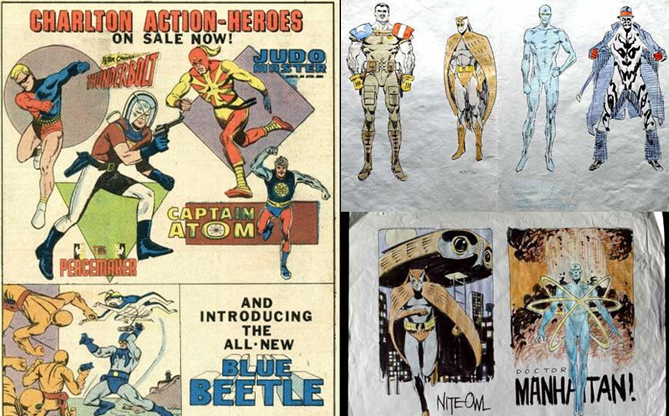
Published between September 1986 and October 1987, Watchmen (Moore, et al) was the brainchild of noted comic book writer Alan Moore and artist Dave Gibbons, who revised their initial concept of a murder mystery involving Charlton Comics characters using entirely new, unique characters. Watchmen’s sophisticated adult narrative subverted the usual expectations of comic book heroes, grounding them in something resembling reality and tackling the genre with a serious, contemplative direction. Filled with dense imagery and complex themes, Watchmen was an influential mainstream success. For the longest time, the text was largely considered to be unfilmable, though a live-action adaptation was in the works as far back as the late-eighties. In 2005, though, the project finally entered production with Zack Snyder at the helm. Featuring a number of alterations to the source material, and Moore’s characteristic disinterest, Watchmen didn’t exactly set the box office on fire, earning just over $185 million worldwide against a $130 to 138 million budget. Though the film also received mixed-to-average reviews, I actually prefer the movie to the graphic novel, if I’m being honest. An extended director’s cut and this “Ultimate Cut” of the film were also later released, restoring many excised aspects from the source material and providing, perhaps, the most complete live-action version of Watchmen we’re ever likely to get.

The Review:
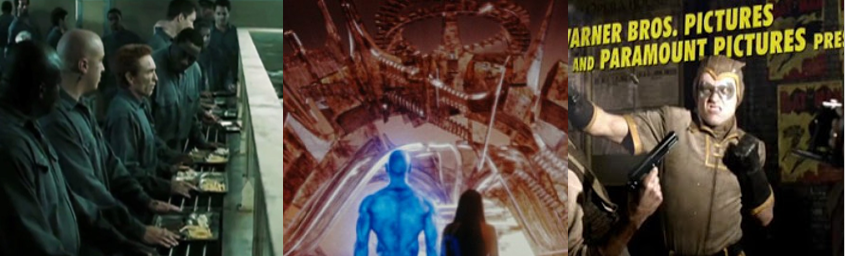
Though not the first scene of the film, Watchmen features perhaps one of the most striking and effective introductions to its fictional world in all of cinema; set to the tune of Bob Dylan’s “The Times They Are a-Changin’”, Snyder masterfully condenses some of the denser, more subtle, arguably inconsequential, complex, and intricate side plots and world-building moments of the comic book into one impressive montage which takes us through the early days of the colourful Minutemen and through to the intricacies of this decidedly alternative version of the world, where wars and monumental moments in human history were noticeably different thanks to the presence and influences of costumed heroes, all the way up to the debut of the Watchmen and the later outlawing of costumed adventurers following President Richard Nixon’s (Robert Wisden) unprecedented third term. Of course, the catalyst for the entire film’s events is the murder of Edward Blake, the Comedian. When we first meet Blake, he’s an aged shell of his former self; living alone in an apartment filled with mementos of a life-time of war and conflict, he is both taken off-guard and bitterly unsurprised when he is suddenly and violently attacked in his own home.

Rorschach is a brutal, uncompromising, and inherently flawed protagonist.

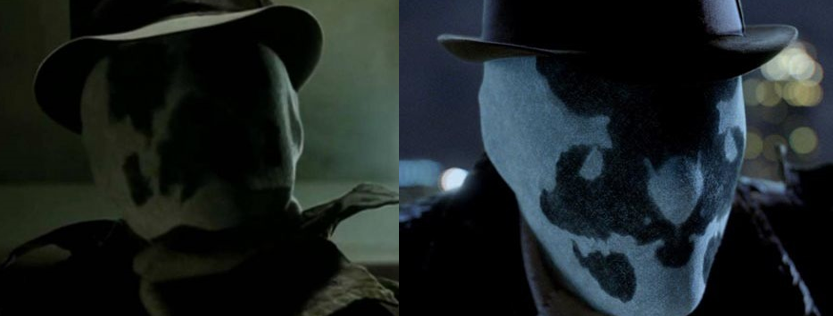
Unlike in the comic, where this was a decidedly simple and one-sided affair, this first action scene best showcases the dramatic license Snyder takes with the source material by delivering a bloody, violent, elaborately stylised beatdown in which the combatants are almost superhuman and capable of delivering (and taking) incredible punishment and smashing through objects (and even human bones) with their bare hands. “Stylistic” is a great word to describe Snyder’s Watchmen, which dials up the subdued presentation of the comic book to eleven, both paying homage to Gibbons’ artwork and updating the static panels into incredibly elaborate and visceral. As the sole remaining unlicensed costumed vigilante, Rorschach investigates out of a sense of duty and obligation; while many characters are aesthetically or motivationally altered in some way, big or small, for better and for worse, Rorschach remains extremely faithful to his depiction in the comic. His gravely, monotone voice accompanies many of his scenes, and others, and forms a loose, distorted narration of events and he is, essentially, the closest thing we have to a main character and is our main source of exposition into this vastly different world. Gritty, uncompromising, and paranoid, Rorschach is as crazy as he is dedicated to staying active, even though no one, even former allies of his, really like him all that much.

Dreiberg is a far more assertive, but no less regretful, character.

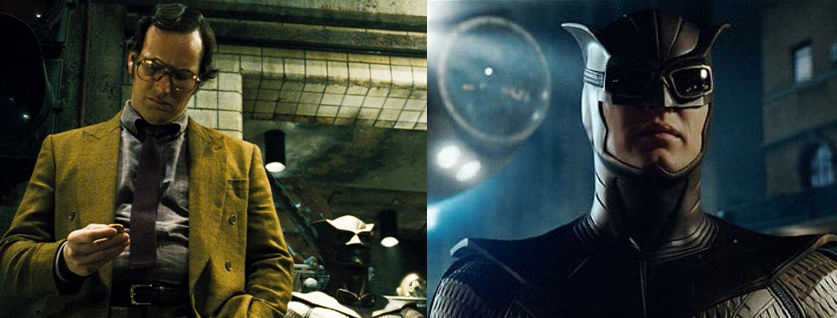
Speaking of which, the first person Rorschach goes to when he discovers the Comedian has been killed is his former partner and the closest thing he has to a friend, Daniel Dreiberg/Nite Owl II (Wilson); in the comics, Dreiberg was an awkward, unassertive, meek fellow who, for all his former glory, pretty much allowed anyone and everyone to walk over him and take advantage of him. Here, he’s still a shell of his former self and full of both regrets and doubt, but he’s far more assertive; while sympathetic to Rorschach’s condition and respectful of their former crimefighting days to give him the time of day where others wouldn’t, he’s far less patient of Rorschach’s accusations and attitude and far more willing to stand up for himself. In the end, his humility comes from his pining for Laurie Jupiter/Silk Spectre II (Åkerman) and a deep-rooted longing for the thrill of his days as a costumed adventurer.

Laurie’s aggression stems from her troubled childhood and relationships.

Rorschach remarks that Dreiberg is “hiding in plain sight” and this is a recurring theme throughout Watchmen; every character wears a mask, whether literal (like Rorschach’s beautifully realised, ever shifting covering) or metaphorical and they’re all hiding something, whether it be their true intentions or their true feelings. Laurie is one of the most complex characters in that regard; aggressive, repressed, and out-spoken, Laurie has no time for Rorschach’s accusations and hostile nature and is emotionally and mentally strained thanks to her tumultuous relationship with her mother, Sally Jupiter/Silk Spectre (Carla Gugino), and Doctor Jon Osterman/Doctor Manhattan (Crudup). Most of her issues stem from unresolved and half-remembered memories of her childhood; forced into super heroics by her mother, Laurie was obligated to live a life she didn’t necessarily want and constantly struggled with both her mother’s expectations and the reprehensible actions of Blake, who attempted to rape her mother back in the day.

Despite his God-like powers, Dr. Manhattan has grown increasingly distant from humanity.

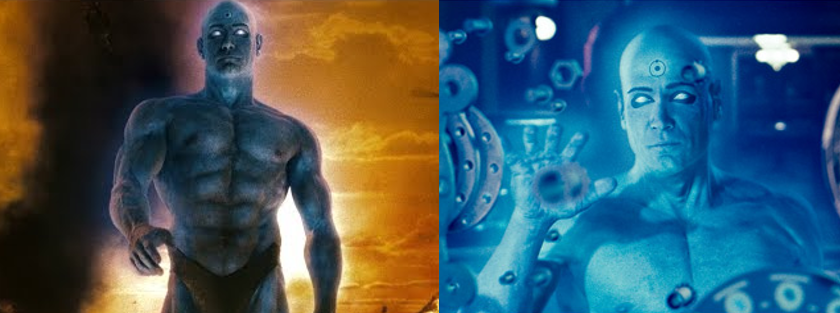
Of course, another character who is hiding in plain sight (and behind a multitude of metaphorical masks) is Adrian Veidt/Ozymandias (Goode), a man whom Rorschach both respects for his intellect and physical ability but is also somewhat disgusted by since Veidt was one of the first to not only quit his adventuring ways but also shamelessly profit from it. Goode, despite perhaps looking maybe too young for the role, portrays Veidt as a smooth, confident, and wealthy businessman and aristocrat who openly speaks of both his past and his desire to steer the world towards a greater purpose other than warfare and conflict. Veidt plays this public role perfectly, appearing to be just as much of a victim as any of the other Watchmen, and concerned only with the welfare of humanity through his business and critical work with Dr. Manhattan. Speaking of Dr. Manhattan, Osterman is primarily regarded as the sole thing keeping the United States and Russia from engaging in all-out nuclear conflict; an ethereal, God-like character, Dr. Manhattan is the only character in the film to exhibit actual, tangible superpowers and, as if to compensate for this, has been gifted with a vast and seemingly limitless array of abilities, from teleportation, to nigh-immortality, to the ability to manipulate atoms in any way he desires, and a skewed perspective of time. Dr. Manhattan’s unique ability to perceive past, present, and future simultaneously and his extensive abilities have made him more and more detached from humanity, specifically Laurie; despite him assisting Veidt in conceiving of a clean, renewable energy source to unite the world, Dr. Manhattan has little care for the intricacies of mortals and his increasing detachment is a pivotal plot point of the film. Dr. Manhattan is superbly realised in the film thanks to CGI emphasising his otherworldly magnetism; in a film where costume design and aesthetics are impressive from start to finish, Dr. Manhattan naturally stands out and not just because his wang is out half the time; he’s literally a God among men and is portrayed as such throughout.

Watchmen‘s unique visual storytelling emphasises its complex themes of humanity and identity.

Watchmen is, at its core, a murder mystery story that is as much about commenting on society, humanity, and our various failings as it is about exploring the nature of superheroes; as in the comic, every character in the film is flawed, broken even, and is detached from reality in some way. Veidt sees himself as above it all on an intellectual level; Blake believed he was above it since he chose to cynically mock the state of society; Dreiberg chooses to hide from the conflict, and his true self; Laurie is in constant denial about her past and feels suffocated by it; Rorschach has completely abandoned all pretense of his life outside of his mask; and Dr. Manhattan has become completely disinterested and disillusioned in the petty squabbles of humanity. Though Snyder expands upon this narrative with an abundance of gore, expletives, and dramatic visual excess, it still forms the central backbone of the narrative and is just as interesting to follow, if not more so thanks to Snyder’s flair for style.

The Nitty-Gritty:
I mentioned earlier that there are numerous alterations to the source material; when I first saw the movie, I applauded this as I found the comic to be quite dense and slow and not the most visually interesting tale. Though I have grown to appreciate the influence and nuance of the comic book, I still prefer the film as Snyder’s attention to detail, stylistic choices, and the epic quality of the film make it far more interesting and engaging for me. Of course, one of the major changes Snyder made was to dramatically elaborate upon the few fight scenes of the comic book; fights are now heavily choreographed, greatly stylised sequences featuring an abundance of slow motion, blood, and violence. Characters exhibit near-superhuman levels of strength and durability, which goes against the purposely grounded nature of the source material, but I can forgive this as it lends a level of spectacle and gratuity to the film that not only appeals to me and my baser instincts but also, I would argue, makes the film and the story more accessible to a wider audience.

Watchmen‘s costume design and aesthetic choices are absolutely top-notch.

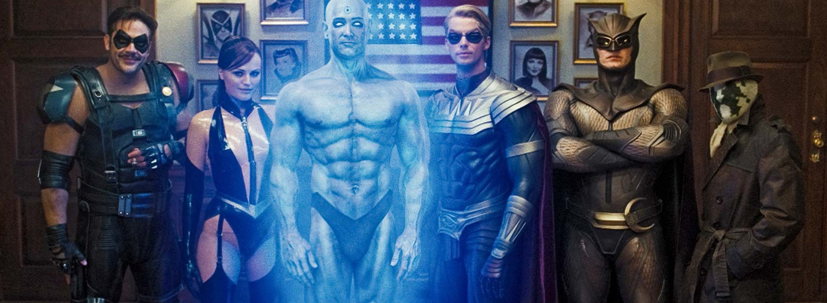
Plus, it’s not as if the base themes of Moore’s original story aren’t still present; if anything, they’re more explicit than ever thanks to Snyder’s decidedly unsubtle style of filmmaking and, yet, the film still replicates many of the slower, more subtle and nuanced character moments from the source material. Snyder’s attention to detail is absolutely flawless; every scene is crammed full of faithful recreations of the comic book and the lengths he went to replicate the costumes and aesthetics of Gibbons’ artwork is impressive. At the same time, Snyder uses the film as an opportunity to comment on and reference the many years of superhero cinema just as Moore paid homage to a bygone era of comics books; as a result, Nite Owl’s costume is a heavily armoured homage to the various Batsuits, Silk Spectre is literally poured into a super sexy leather number (as was the style of the early 2000s), and Ozymandias is purposely decked out in rubber armour reminiscent of Joel Schumacher’s Batsuits (it even has the much-maligned nipples). While I can understand people getting a bit upset about some of these changes as they seem superfluous in some ways, I honestly thought it really worked and helped emphasise the film’s extravagant aesthetic style.

Snyder’s attention to detail and fidelity is astounding, especially in the Ultimate Cut.

Continuing on the theme of attention to detail, Snyder includes, or straight-up adapts, entire sub-plots and story beats from the source material that, one could argue, others might have cut for time; as a result, we get a startlingly brutal recreation of Rorschach’s time in prison, therapy sessions, and character-defining moments as well as a great deal of time spent exploring Dr. Manhattan’s time on Mars, his origin, and his subsequent heart-to-heart with Laurie. This means that, rather than only paying lip service to what makes these characters tick or briefly touching upon it (or removing it entirely), Snyder is able to properly delve into the psychology of his versions of these characters through his distinct visual style. Even in the Ultimate Cut, which is unquestioningly the most definitive version of the film you’ll ever watch, some concessions had to be made, though; the most obvious of these is that Snyder is completely focused on the current story of the Watchmen rather than exploring the intricacies of their predecessors, the Minutemen, but, even then, this extended version goes to the trouble of including the tragic fate of Hollis Mason/Nite Owl (Stephen McHattie).

The allegorical Black Freighter story is interspersed throughout the Ultimate Cut.

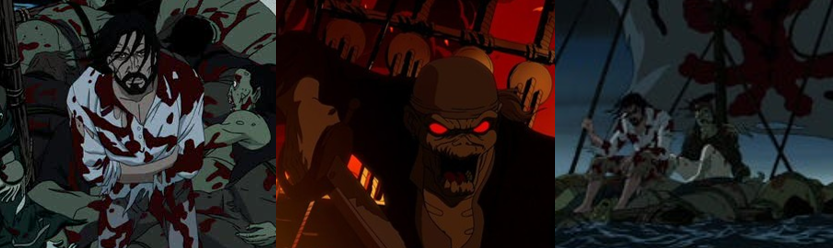
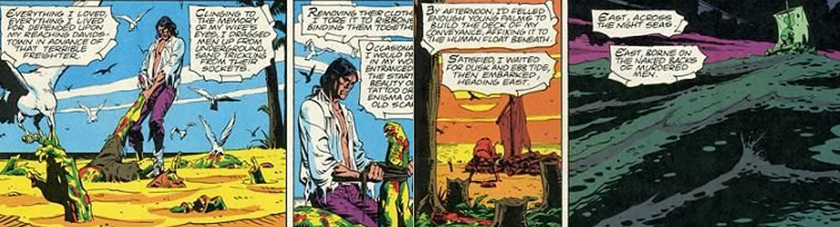
Watching the Ultimate Cut of the film also means that the main story is interlaced with an allegorical side story, Tales of the Black Freighter (DelPurgatorio, 2009), at key moments; originally excised from the main film and released as a separate feature on home media, Tales of the Black Freighter has been largely restored to serve much the same purpose as in the comic book. The side story, which is told in startling gory animated sequences, follows a shipwrecked sea captain (Gerard Butler) who is driven to madness and obsession following a disastrous encounter with the demonic Black Freighter. Desperate to get back home to his wife and children and to warn his hometown of the freighter’s threat, he ultimately becomes the very monster he is trying to fight against when he unwittingly bludgeons his family in a fit of madness. As in the original comic book, Tales of the Black Freighter acts as an allegory for Veidt’s despicable actions and the story of Watchmen in general, with its themes of obsession and performing unspeakable acts in the name of good though, while I enjoy the animated version far more than its comic book counterpart, I can see why it was omitted from the original film as these themes are, by the very nature of Watchmen’s narrative, largely explicit regardless.

I was honestly okay with the changes to the story and ending, especially as they made contextual sense.

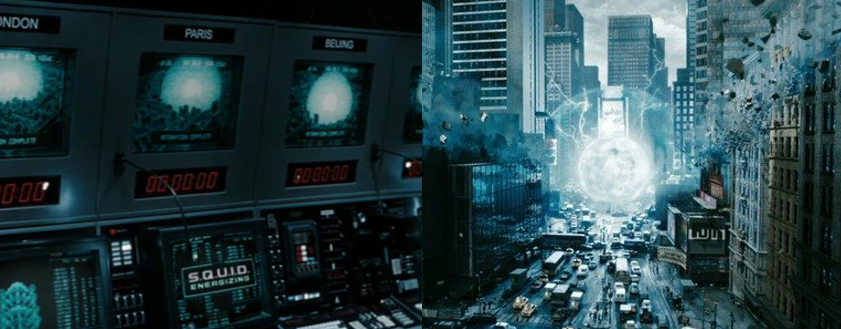
Of course, the big twist is that Veidt is actually behind everything, literally “hiding in plain sight”; though the execution of his plan to save humanity significantly differs from the source material, his motivations remain largely the same (having predicted the downfall of society, the inevitability of war, and the limitations of fossil fuels, Veidt engineers an elaborate and complex plan to fool the world into unifying against a common enemy). A big source of contention was Snyder’s decision to omit the iconic giant squid that Veidt genetically engineered to fool humanity into believing in an impending and ominous alien threat. While I really admired how the Watchmen television series (2019) managed to pull this grotesque creation off, I never really minded all that much that the squid was missing from the film. Not only is there a cheeky reference to it (Veidt’s machine is called a “Sub Quantum Unified Intrinsic field Device”) but the idea of Veidt replicating Dr. Manhattan’s powers and then attacking multiple cities across the world, rather than just New York City, and pinning it all on Jon actually makes far more sense and keeps the film from wasting time in explaining and setting up the squid. Could they have done that? Sure, and probably pretty easily, but, while it’s disappointing to not have the image of the squid’s bloodied and gruesome corpse draped throughout Times Square, I can live without it if it makes sense in the context of the narrative and, thanks to how prevalent Jon’s fragile grip on humanity is to Watchmen’s story, I would argue that it does.

The Summary:
It’s probably sacrilegious to say it but I still prefer the movie version of Watchmen over the comic book; while my appreciation for the source material has grown, especially after re-reading it recently, it was only after watching the movie that I actually became interested in the concept. Sure, it might be very different from the source material in a lot of ways but I’m okay with that because everything looks so slick and stylish and has a real cinematic grandeur to it. While Snyder’s unique cinematic style may not be for everyone, and it’s probably still seen as somewhat blasphemous that he stripped most of the subtlety and nuance from Watchmen, it really works for me and results in a bold, striking, and aesthetically pleasing superhero film that is truly unique among the genre. I feel what really makes Watchmen work is how accessible Snyder makes the source material; I can definitely say that it’s probably best to watch the film first and then explore the graphic novel and see if it’s just as appealing to you. Die-hard fans of the comic may have been annoyed and insulted by Snyder’s creative license but I wanted to see a gory, thought-provoking, and visually entertaining film and that’s exactly what Watchmen delivers. Watchmen delves into a completely different side of the superhero genre while paying homage to it through fantastic costume design, brutal action sequences, and an engaging narrative and the Ultimate Cut goes one step even further to deliver extended scenes that further expand this unique world and incorporating an allegorical tale to the main plot to provide the definitive Watchmen experience.

My Rating:

Rating: 5 out of 5.

Fantastic

So, what do you think about Watchmen? Were you a fan of the graphic novel before seeing the film or did you, like me, gain a deeper appreciation for the source material after watching the film? Which version of the film do you prefer, the theatrical, director, or ultimate cut and why? How do you feel about Snyder’s visual and filmic style and the alterations he made to the text? Which of the titular Watchmen is your favourite and why and how do you feel about their costumes and characterisations in the film? Did you enjoy the animated Black Freighter segments, or do you feel they distracted from the already bloated narrative? Would you like to see a new adaptation of Watchmen, one perhaps even closer to the source material, and, if so, who would you cast in the various roles? No matter what you think about Zack Snyder’s Watchmen, feel free to leave a comment below and check back in next Wednesday for more Watchmen content!

Movie Night: Zack Snyder’s Justice League

Released: 18 March 2021
Director: Zack Snyder
Distributor: HBO Max/Warner Bros. Home Entertainment
Budget: $70 million (on top of the original $300 million production costs)
Stars: Ben Affleck, Gal Gadot, Ray Fisher, Jason Momoa, Ezra Miller, Ciarán Hinds, Amy Adams, and Henry Cavill

The Plot:
Following the death of Clark Kent/Superman (Cavill), Bruce Wayne/Batman (Affleck) scrambles to bring together a team of super-powered heroes when the disgraced New God Steppenwolf (Hinds) arrives on Earth and begins violently searching for the mysterious “Mother Boxes”.

The Background:
Oh God, where to start with this? Okay, so, after the Marvel Cinematic Universe (MCU) became this super successful juggernaut, Warner Bros. scrambled to try and catch up and craft their own cinematic universe. The first step was Man of Steel (ibid, 2013); Zack Snyder was picked to helm the project and steer the direction of the DC Extended Universe (DCEU) and, initially, the results were promising. Despite some mixed reviews, Man of Steel was a financial success but the cracks in Snyder’s vision started to form with Batman v Superman: Dawn of Justice (ibid, 2016). Despite the presence of acclaimed superstar Ben Affleck and reaping a hefty box office, the film divided many due to its pace and bleak tone and Warner Bros. started to get cold feet regarding Snyder’s vision for the DCEU. As a result, they brought in Joss Whedon to lighten the follow-up’s tone and ultimately replace Snyder after the tragic death of his daughter. Despite a similar box office gross to its predecessors, Justice League (Whedon/Snyder, 2017) released to scathing criticism and the film was disowned by even DCEU collaborators. The DCEU chugged along regardless but, very quickly, reports of Whedon’s reprehensible behaviour surfaced alongside rumours that a “Snyder Cut” was all but completed in Warner’s vaults and fans all over the world began campaigning hard for the release Snyder’s original version. While this did lead to a toxic community that I cannot condone, the movement gained serious traction when members of the cast voiced their support and Snyder finally returned to complete the film and was even afforded additional money and resources to film new scenes for his four-hour epic for the HBO Max streaming service. To the delight of Snyder’s fans, Zack Snyder’s Justice League finally released and drew a lot of attention to HBO Max. The general critical consensus, however, was mixed; though reviews praised the film as a coherent story and the culmination of Snyder’s vision, its length and excess were criticised. After the film’s release, Warner Bros. made the decision not to capitalise on its success and fans immediately campaigned to complete Snyder’s vision for the DCEU, despite his lack of interest in returning to the property, proving that some fans are just never satisfied.

The Review:
When I reviewed the original, theatrical cut of Justice League (no, I will not call it “Josstice League”), I gave it a ten out of ten. This was primarily because I am a massive DC Comics fan and, after years (literally decades) of DC’s live-action characters always existing in their own self-contained bubbles, I was just happy to see them all onscreen together and co-existing and felt that this was the most positive thing to take away from Snyder’s rushed attempt to build DC’s cinematic universe. Time, however, has changed this perspective; Justice League is by no means perfect but it was honestly never going to be. Warner Bros. scrambled about trying to play catch up to the MCU and, in focusing on cramming everyone together as quickly as possible and sucking the fun out of many of their most popular characters, they lost me a little along the way. So to say I was excited for the Snyder Cut is to lie, honestly. As much as I enjoyed Man of Steel, Snyder really dropped the ball with Batman v Superman, which was more a collection of ideas and themes than a coherent movie, and I took massive issue with his grandiose vision of the DCEU which jumped from Superman’s origin all the way to Multiversal shenanigans in, like, two films. Still, as a rule, I generally do enjoy a longer director’s cut as you get more bang for your buck and, in that regard, Snyder certainly goes above and beyond to present the closest version of his vision for Justice League as possible, even going so far as to present the film in a 4:3 aspect ratio.

Superman’s death cry activates the Mother Boxes and calls Steppenwolf to Earth.

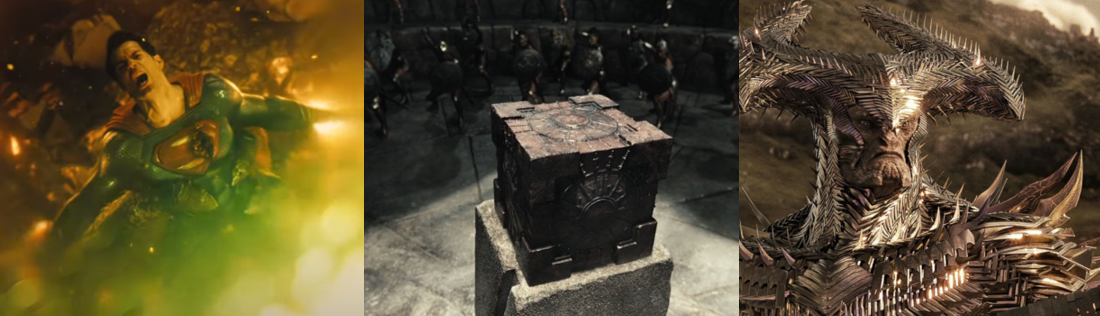
Zack Snyder’s Justice League begins with an egregiously slow-motion recap of Superman’s dramatic (and, in my view, unnecessary) death in battle against Doomsday. His death rattle (which seriously goes on for about six minutes), echoes all around the world, activating the Mother Boxes stored in Atlantis and Themyscira and sending a beacon out into the void of space with a simple message: Earth is vulnerable. Steppenwolf (now dramatically redesigned into a hulking creature wearing razor-sharp armour that honestly looks just as ugly as his original design but for different reasons) once again arrives to reclaim the Boxes; this time, however, his slaughter of the Amazons is much more brutal, featuring far more Parademons and presenting Steppenwolf as a formidable and imposing force. Indeed, compared to his theatrical counterpart, Steppenwolf is a much more well-rounded and interesting character; in the original cut, he was little more than a means to an end, an obscure and generic bad guy for the titular heroes to unite against in order to save the world but, here, he’s a driven, focused, and aggressive foe who is motivated not just by loyalty to his master and devotion to bringing about “the great darkness” but also desperate to regain his place among the New Gods after losing favour centuries before. Owing Darkseid (Ray Porter) a debt of fifty thousand worlds for his failures, Steppenwolf has been ostracised and forced to toil in endless conquest to regain his place at his master’s side; this desperation and motivation transforms Steppenwolf from a mere disposable hulk and into a surprisingly complex villain who seeks redemption and validation in the eyes of his master and will do anything to appease the will of Darkseid.

Superman’s loss affects each of the characters in different ways.

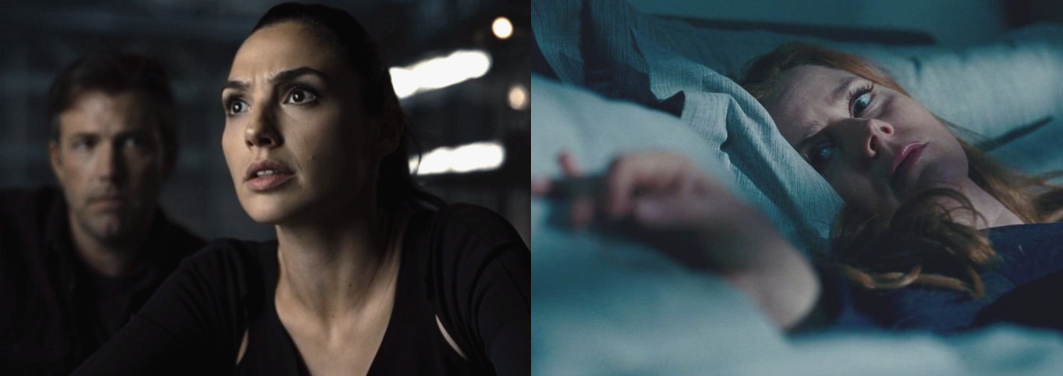
While the Man of Steel’s loss was felt in the theatrical cut, Superman’s death is a much bigger aspect of the Snyder Cut; carrying the guilt of Superman’s death on his shoulders, Bruce Wayne sets out to build an alliance of metahumans to combat this threat. While Diana Prince/Wonder Woman (Gadot) is reluctantly onboard with the plan and Barry Allen/The Flash (Miller) signs up immediately and enthusiastically, Arthur Curry/Aquaman (Momoa) basically laughs in his face and Victor Stone/Cyborg (Fisher) is busy struggling to reconcile his humanity after a horrific accident leaves him part machine. Furthermore, Superman’s loss is embodied here not just in Bruce’s guilt and desire to honour Superman’s legacy with a team of superheroes but in both Lois Lane (Adams) and Martha Kent (Diane Lane), both of whom struggle to adjust to life without Clark. Since Bruce has already been told that “Lois [is] the key” to reaching Superman, it makes sense to give Lois and Martha a little more prominence in the film, especially as her death is what causes Superman’s corruption in the dark future that looms over Snyder’s films.

Batman is now absolutely focused on bringing together a team to honour Superman’s memory.

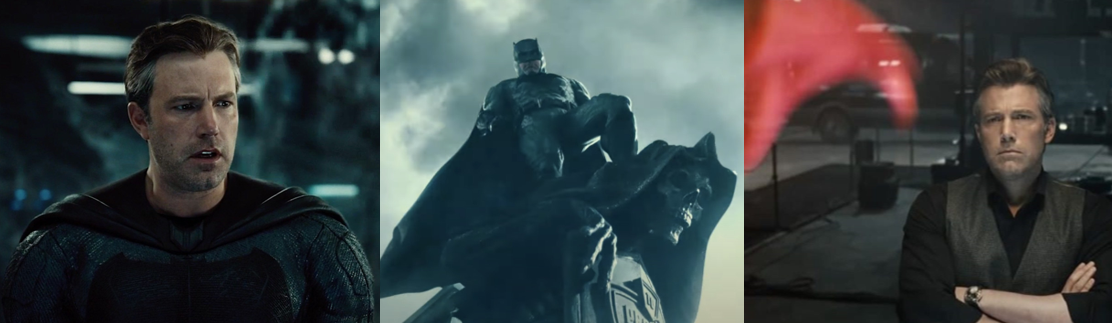
Bruce Wayne is, of course, extremely different compared to his characterisation in Batman v Superman. Now driven by an obsessive desire to make good on his promise to unite Earth’s heroes in Superman’s name, he works himself tirelessly to track down the metahumans from Lex Luthor’s (Jesse Eisenberg) file, much to the continued chagrin of his faithful butler and father-figure, Alfred Pennyworth (Jeremy Irons). Since he works closely with Diana to find and appeal to these metahumans, there’s even a little (microscopic, even) bit of romantic chemistry between the two and there’s now a nice little scene of Alfred making tea with Diana and showing her Batman’s new Parademon-absorbent gauntlet (which replaces the original cut’s side plot regarding Batman luring the Parademons out with “fear”). Mostly, though, Bruce remains the same character as in the theatrical cut; he’s still blinkered in his focus on bringing the team together, resurrecting Superman, and preparing the world to face escalating threats but all of his weird little attempts at humour are thankfully gone (sadly, that God-awful “I’m rich” line remains but, thankfully, we get the return of his “I’m real when it’s useful” line).

Wonder Woman now warns the team of Darkseid’s intentions for Earth.

Wonder Woman, however, is noticeably different this time around; more time is spent showing her as a willing ally of Bruce’s and she is also part of a pivotal extended scene that explores Steppenwolf’s previous campaign against the Earth. This sequence, which expands upon the prologue seen in the theatrical cut, shows the forces of man, Gods, Atlantis, Themyscira, and beyond uniting not just against Steppenwolf and his Parademons but also their exalted and imposing leader, Darkseid. Darkseid received only a passing mention in the original cut but, here, Diana’s obvious fear of the New God helps to establish early on that an even greater threat looms behind Steppenwolf’s actions. Furthermore, when out in the field with the team, Wonder Woman directs the fledging Justice League in the best way to attack Steppenwolf and his Parademons, which places greater emphasis on her capabilities as a warrior and leader.

The Snyder Cut retains Aquaman’s characterisation but explores a little more of his world.

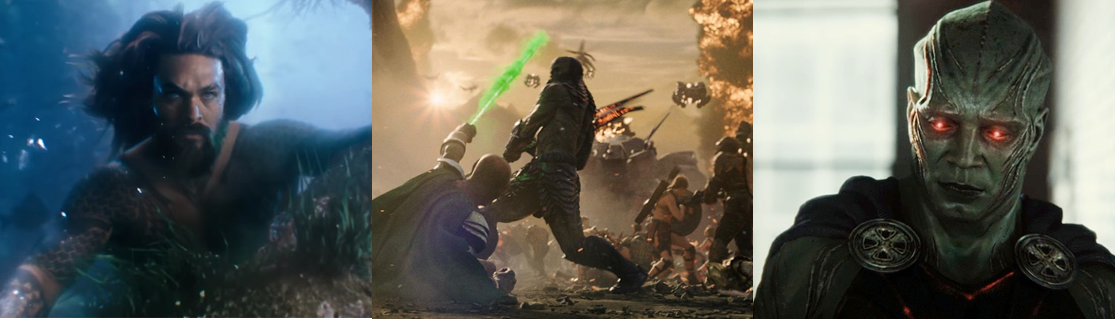
Aquaman is largely the same as in the theatrical cut except, unsurprisingly, more haggard and bleak rather than being an obnoxious jock. Though he claims to have no interest in Bruce’s crusade or working with others and has turned his back on Atlantis, he continues to do good and help those in need in his own way to get his hands on more whiskey. Bruce’s warning, though, compels him to return to the ocean and converse with Nuidis Vulko (Willem Dafoe), his former mentor, and ultimately to arrive all too late to help Mera (Amber Heard) defend the Mother Box from Steppenwolf. A couple of odd continuity issues are raised with all this, however, that fly in the face of DC’s directors wanting to align their movies with the Snyder Cut; first there’s Mera’s accent, which jumps from British to American to whatever the hell she likes, and second is the Atlantean’s ability to communicate using dolphin squeaks rather than just talking underwater as they do in Aquaman (Wan, 2018). Regardless, this version of Justice League does a far better job of setting up Aquaman’s solo film by showing more hints towards his world and Aquaman remains the film’s breakout character for me for me thanks to Momoa’s charismatic portrayal of the character.

Though still very neurotic, Barry plays a pivotal role in the film’s events and finale.

Barry Allen also gets a bit more time to shine this time around; this includes the restoration of his encounter with Iris West (Kiersey Clemons) and just more time to explore his awkward, energetic, and socially inept character traits. Barry was very much the comic relief of the theatrical cut and those who disliked many of his annoying character traits will be disappointed to find most of them intact and given more prominence in his increased screen time but I can’t fault Snyder’s attention to detail in showcasing Barry’s superspeed: his shoes and clothes disintegrate, the street is wrecked by his footfalls, and he experiences time in extreme slow motion when utilising the Speed Force. While the Flash loses one of my favourite scenes from the original cut (the “Just save one” moment), he plays a far greater role in not just the rescue of scientists from Steppenwolf’s clutches but also the film’s finale where, faced with defeat at the hands of Steppenwolf’s forces, he summons all of his super speed to travel back in time using the Speed Force and ensure that the invasion is halted.

Cyborg’s role is greatly expanded, making him the heart of the film and fleshing out his character.

Of course, the character who benefits the most from the Snyder Cut is Cyborg; in the theatrical cut, Cyborg is a stoic, confused young man who resents his father, Doctor Silas Stone (Joe Morton), for transforming him into a machine-monster in order to save his life. While this remains at the start of Cyborg’s character arc in the Snyder Cut, Snyder restores not just Cyborg’s importance to the film as the “heart” of the Justice League but also his eventual reconciliation with his father and showcases excised scenes of his promising career as a college football player, his natural aptitude for hacking (which he used to help those in need), and the horrific accident which left him near death. While I’m personally not a fan of Cyborg being on the Justice League, it was clear that there was originally more to his inclusion and importance to the film’s plot; since he’s literally comprised on a Mother Box and Apokoliptian technology, he is afforded numerous abilities and insights into the invading New Box forces and, here, Silas actually guides and mentors him in exploring these abilities (which includes his ability to access every technological device and network and essentially makes him the most powerful man on Earth).

Superman returns, now in a black suit, and galvanises the team.

Finally, there’s Superman; as you might expect, Superman is absent for a massive amount of the film on a small account of being dead. Like Darkseid, Superman looms over the film but as a hero lost and much needed as a symbol for the world’s heroes to properly rally behind. Bruce’s plan to resurrect Superman with the Mother Box is discussed (and edited) far more competently this time around; although there’s doubt about the moral and ethical implications of the plan (mainly from Alfred this time around), Bruce and Diana don’t come to blows like in the original film but the outcome remains the same. Like before, Superman is disorientated upon returning to life and attacks the fledgling Justice League in his confusion; his confrontation with Batman is a little different (and not as good as in the original cut, in my opinion) and there’s more to his return to the Kent farm but, upon regaining his senses, he returns to action as the team’s ace in the hole for the finale. Cavill is an absolutely fantastic Superman and Justice League finally got the character to a place where he is the charming symbol of hope and strength that the world needs and, despite his new black suit, Zack Snyder’s Justice League only expands upon that (of course, Cavill’s natural charisma and the absence of a horrible CGI face play a huge part in that).

The Nitty-Gritty:
One word to describe Zack Snyder’s Justice League (apart from “long”) would certainly be “epic”; Snyder pads the film’s runtime out with not only an abundance of never-before-seen footage, alternate takes, and new content but also an overuse of slow-motion and long establishing shots. To help make the film more accessible to viewers, the film is also split into six chapters, which was probably a great way to view it on HBO Max, and the DVD version of the film is split across two discs but, either way you slice it, this is a slog to get through and I have to believe that Snyder simply milked the extra time and money he was afforded just to capitalise on all the hype surrounding his version of the film. The closest comparison I can make is with his director’s cut of Watchmen (Snyder, 2009), which was similarly epic and ambitious in its scope, presentation, use of music, and its presentation of its costumed adventurers.

Some shots effects, and inconsistencies negatively affect the Snyder Cut.

It has to be said, though, that Zack Snyder’s Justice League has quite a few faults; some of the new special effects shots understandably look worse than others (and Cyborg still looks like dog shit), it’s pretty crazy that Darkseid and his forces just forgot where Earth was for hundreds of years (especially considering how badly he wants the secret of the Anti-Life Equation), the score has been completely reworked to remove Danny Elfman’s contributions (though, thankfully, Wonder Woman’s kick-ass musical theme remains), and many of the new scenes shot exclusively for the film suffer from poor lighting, inconsistent editing, and stand out like a sore thumb to the point where I’d much rather Snyder hadn’t bothered including the likes of the Joker (Jared Leto) when it makes little sense narratively (you’re telling me that in a grim, apocalyptic future where Superman has gone bad the Joker is alive but Aquaman isn’t?) Personally, I have never been a fan of Snyder’s “Knightmare” timeline; it made no sense in Batman v Superman and, thanks to Warner Bros. having no interest in allowing Snyder to fully explore this alternate timeline in Justice League sequels, it makes even less sense to me that he chose to continue pushing this dark vision of a future ruled by Darkseid and a corrupted version of Superman in the Snyder Cut (but, at least, it’s mainly confined to the film’s final moments rather than being awkwardly wedged in the middle of the film like in Batman v Superman).

Snyder’s cut expands and recontextualises many of the film’s existing scenes and characters.

Although many scenes and sequences may be familiar to anyone who has seen the theatrical cut of the film, the Snyder Cut expands upon every single one of these and, in many cases, recontextualises them into this larger narrative. This includes a longer scene of Bruce Wayne meeting and attempting to recruit Aquaman (accompanied by a lengthy song of reverence for the Atlantean), an expanded version of Wonder Woman’s introduction (including the first of a handful of pointless f-bombs), a longer version of Steppenwolf’s attack on Themyscira and the recap of Darkseid’s defeat centuries ago, more scenes of Steppenwolf and his Parademons’ search for the Mother Boxes (including torturing Atlanteans for information and a far better sequence where he acquires the final Box), and even recontextualising the interactions between Lois and Martha with the reveal that General Calvin Swanwick (Harry Lennix) has been J’onn J’onnz/Martian Manhunter all along.

The Snyder Cut restores and dramatically changes excised characters.

One of the main selling points of Zack Snyder’s Justice League, however, is the restoration of scenes and plot threads excised from the theatrical version. This includes characters removed from the original film, like Doctor Ryan Choi (Ryan Zheng), Vulko, Iris, DeSaad (Peter Guinness), Cybrog’s mother, Elinor Stone (Karen Bryson), and more time devoted to side characters like Silas (who now gives his life to mark the final Mother Box) and the origins of the Mother Boxes. One of the benefits of this is that we actually get to see an in-depth look into Cyborg’s expansive abilities (which includes a deep dive into the way he now perceives reality). Much of the Snyder Cut’s hype was also built around the inclusion of Darkseid but, in truth, the character is little more than a cameo; he simply takes Steppenwolf’s place in the flashback of the war between the allied forces of Earth and Apokolips and looms over the film like an ominous shadow as the ultimate threat for the united Justice League. Sadly, despite Snyder choosing to push his Knightmare future throughout the film and concluding it with a tease of Darkseid’s impending retaliation against the Justice League, it seems like we won’t be seeing Darkseid (or any of the New Gods for that matter) in the DCEU again any time soon.

Thanks to the team, and time travel shenanigans, Darkseid is left humiliated.

Snyder’s vision of the DCEU remains extremely bleak in its presentation; for all the characters’ talk of “hope” and the better nature of men, Snyder continues to suck all the life and colour out of these vivid characters. One thing I liked about Justice League was that it did a fantastic job of bringing some life and colour to this world, allowing the costumes to pop out on screen but, here, everything retains the same muted look and sombre tones of Batman v Superman. This is best exampled in Snyder’s instance on garbing the resurrected Superman in his black suit; Superman wore this in the comics after returning to life for about three issues and it was later stated to have helped aid his recovery but, here, no real reason is given for his choice of attire and it honestly would have made more sense for the evil Knightmare Superman to have worn the suit instead. Additionally, Snyder removes the red tint and tumultuous skies from the finale of the film, which admittedly does make the climatic battle against Steppenwolf’s forces easier to see but I feel the original colouring worked a lot better as a reference to the red skies that were are of DC’s various Crises. Speaking of the finale, Zack Snyder’s Justice League slightly recontextualises the ending. Although there’s still an implication that Batman is heading into battle with the intention of dying, it’s not as explicit as in the theatrical cut; what is much more explicit, though, is the feeling of team work between the Justice League as they each play their part in breeching Steppenwolf’s defences (Flash, again, gets way more to do in using his Speed Force charge to help Cyborg interact with the Mother Boxes) before Superman dramatically shows up to again completely lay waste to Steppenwolf. I’m glad that this beatdown is maintained as it was always a glorious showcase of Superman’s return and of the team coming together against a common enemy but, here, things go slightly differently as the heroes fail to stop the unity between the Mother Boxes and prevent Darkseid’s arrival. With no other choice, the Flash enters the Speed Force and reverses time in a beautifully surreal sequence, allowing Cyborg to reject the Apokolips’ influence and Wonder Woman to decapitate Steppenwolf right before Darkseid’s eyes.

The Summary:
I went into Zack Snyder’s Justice League with low expectations. Toxic fans and a rabid, almost cult-like online community had beaten any sort of excitement and wonder out of me. I quite enjoyed the theatrical cut; it wasn’t perfect but, news flash: none of the DCEU has been perfect and few films really are. Knowing that Snyder got so screwed over by Warner Bros. stung and it definitely frustrated me that we didn’t get a concise and more accurate version of Justice League years ago so that maybe the DCEU would be in a slightly better place but it was hard for me to feel invested in the film when it was so self-indulgent and so clouded by negativity and entitlement. In this case, though, I am glad to be wrong; there are many benefits to Zack Snyder’s Justice League. For one thing, it actually feels like a coherent story (even more so than Batman v Superman) and each member of the team is given so much more time to shine and showcase their powers and personality. Thus, when the Justice League unite for the finale, it means that much more as we actually get to know them all a little better and see them grow as a team through their interactions; it’s still a rush job as so much had to be crammed into so few films but, as a big fan I am of DC Comics and these characters, it remains a real thrill to actually get to see Batman, Superman, Wonder Woman, the Flash, Aquaman, and Cyborg all in a big budget, live-action film rather than constantly existing in self-contained bubbles (which seems where the DCEU will be heading again going forward). I’m not a massive fan of Snyder’s vision for the DCEU or many of the decisions he made but it’s better than nothing and not seeing an interconnected series of DC films so, while I was initially hesitant to enjoy Zack Snyder’s Justice League, I have to say that I was pleasantly surprised in the end. Had Warner Bros. not interfered and screwed things up, we probably would’ve gotten a two-and-a-half-hour long film that would have satisfied everyone enough to justify at least one more team effort but it is what it as and at least we got to see the closest approximation of Zack Snyder’s true vision of the film in the end and that’s something to be celebrated rather than simply, selfishly, demanding more.

My Rating:

Rating: 5 out of 5.

Fantastic

What did you think to Zack Snyder’s Justice League? Do you think it lived up to all the hype or was it all style and no substance? What did you think to the additional, extended and recontextualised scenes from Justice League and how do you feel the Snyder Cut compares to the theatrical version? Which of the characters was your favourite and what did you think to their extended screen time? How did you watch the film; in sections or as one long movie? Would you like to see more from Snyder’s DCEU or are you happy with the direction Warner Bros. is taking? What did you think to the whole Knightmare timeline Snyder tried to push and were you a fan of Superman donning the black suit? Whatever you thought about Zack Snyder’s Justice League, good or bad feel free to leave a comment below (even if it is super toxic).

Back Issues: Watchmen

The Introduction:
Usually, my Back Issues articles are a little more relaxed and sort of like informal mini-essays and musings about single issues or limited runs but Watchmen is going to need a little bit more than that, I fear. I’ve written about Watchmen before, specifically as part of my Master’s dissertation, and it’s no small feat; the maxiseries has been picked apart, scrutinised, and analysed perhaps more than any other comic book or graphic novel thanks to it inspiring “the evolution of comics into ‘graphic novels’. [Ironically,] the creators hoped literally to deconstruct the superhero genre and break its stranglehold on the American industry, but in fact tightened the grip” (Newman, 2009). Watchmen is typically the first, and finest, example of the literary worth of comic books, looming “over the [genre] like the Colossus over Rhodes” (Douthat, 2009: 50), and was not only “chosen as one of the Greatest One Hundred Novels in English from 1923 to 2005” (Shephard, 2009: 213) but also long regarded as unsuitable for other mediums.

So, because of all that, and more, this is easily the most complex edition of Back Issues I’ve had to put together so I think it’s only fair to expand upon my usual format in order to best delve into the intricacies and layers of Watchmen.

Published: September 1986 to October 1987
Writer: Alan Moore
Artist: Dave Gibbons

The Background:
Published between September 1986 and October 1987, Watchmen was the brainchild of noted comic book writer Alan Moore; Moore, who was born just down the road from me in Northampton, had achieved much success in his home country with V for Vendetta (Moore, et al, 1982 to 1989) and at DC Comics thanks to his groundbreaking work on The Saga of Swamp Thing and, after DC acquired the rights to Charlton Comics characters, devised a murder mystery scenario that would star such Silver Age characters as Vic Sage/The Question and Ted Kord/Blue Beetle. Although DC managing director Dick Giordano was receptive to Moore’s premise, he denied the use of the Charlton characters so as not to damage their reception when they were folded into the main DC Comics lore so Moore collaborated with artist Dave Gibbons to reimagine the concept with an entirely new cast of characters.

With the Charlton characters off limits, Moore and Gibbons created their own.

Lacking the usual advertisements and attractive cover designs (Reynolds, 1992: 108-109), Watchmen incorporated a sophisticated adult narrative in which Moore explored new avenues of the superhero genre; Moore sought to subvert the usual expectations of comic book heroes, grounding them in reality (for the most part), and tackling the genre with a serious, contemplative direction. Filled with dense imagery and complex themes, and despite several delays, Watchmen was a critical and commercial success; it’s still the only graphic novel to make Time magazine’s 2005 list of “All-Time 100 Greatest Novels” and DC have long pursued Moore to produce prequels, sequels, and other spin-offs of his seminal work. Despite Watchmen’s success, though, and DC going ahead with these aforementioned continuations and licensing numerous adaptations of Watchmen, even officially folding it into mainstream DC continuity in 2017, Moore has publically distanced himself from DC’s ventures and even refused to have his name associated with Zack Snyder’s live-action adaptation and the HBO limited series.

The Plot:
Rather than portray super-powered heroes, Watchmen focuses on middle-aged, mostly retired, ordinary people and, with one exception, poses the question: “What if superheroes were real?” and its influence on the genre resonated for decades thanks to its stringent focus on dark realism and increasingly complex, adult themes. Watchmen takes place in an alternative version of 1985 where, because of the presence of superheroes in the 1940s and 1960s, the United States won the Vietnam War, Richard Nixon remains as the President of the United States, and the world stands on the brink of all-out nuclear war thanks to rising tensions between the U.S. and the Soviet Union. Amidst this bleak alternate reality, Watchmen retains the murder mystery plot Moore originally conceived; the story begins with Edward Blake/The Comedian, one of the few government-sponsored vigilantes still active after vigilantism was outlawed, being hurled to his death. Walter Kovacs/Rorschach, who stubbornly refuses to retire or compromise to any authority, investigates the murder and uncovers what he believes to be a plot to kill off former “masks” but, in attempting to get to the bottom of the mystery and warn his fellow former costumed heroes, stumbles into a plot to cause near-genocide.

The vigilantes of the 1960s were eventually forced to retire from action.

Throughout its twelve issue run, Watchmen alternates between this plot, weaving in numerous side plots and supplementary materials, and exploring the origins of our main characters and the legacy they continue. As a result, the narrative constantly shifts between the present day and the Golden Age of superheroics in America, when ordinary civilians, former wrestlers, and cops took to wearing garish costumes and fighting crime as the Minutemen of the 1940s. Age, however, inevitably caught up with the Minutemen and they either died, quietly (or publically) retired, or disappeared from the spotlight as a new generation of costumed adventurers, the Crimebusters, came to prominence in the 1960s. Unlike their predecessors, however, the Crimebusters were forced to retire by the 1977 Keene Act, with only Rorschach defying this law and government-sponsored operatives like the Comedian and the God-like Jon Osterman/Doctor Manhattan remaining active. Because of the abundance of real-life costumed heroes, and the general disdain of vigilante activities, the world and society is a very different place; comic books retain pulp stories such as horror and pirate tales and there is a bleak feeling of desolation and despair in the general public despite all of the technological advances brought to the world by Dr. Manhattan’s awesome power and the ingenuity of the self-proclaimed “World’s Smartest Man” Adrian Veidt/Ozymandias thanks to Manhattan’s mere presence stunting the aspirations of mankind (to say nothing of the looming threat of nuclear war).

The Characters:
Watchmen’s characters, though inspired by numerous classic Charlton Comics superheroes, contain a deep inter- and metatextual insight into the world around us as it is and could be, subverting comic book expectations by portraying flawed heroes who are confused, struggling to define their identities, and quite capable of failing, being seriously injured, or dying, and is a story unbound from mainstream DC continuity. Moore does not have to be concerned about ostracising an iconic character like Clark Kent/Superman from the rest of humanity, for instance, meaning Doctor Manhattan is free to have a complete character arc in one standalone text. In addition, “the superheroes of Watchmen also lack any supervillains to measure themselves against. They are forced to confront more intangible moral and social concerns” (Reynolds, 1992: 115); Watchmen also forgoes the need to trawl through back issues researching each character because exposition is incorporated within each chapter and made readily available throughout. This affords Watchmen many advantages not readily available to other comic books (or their adaptations), with the most obvious being that it brings the constantly malleable comic book medium closer to the static preservation of the literary novel: “With its array of carefully crafted oddballs and interconnected plot lines, [Watchmen] reads like a superhero story filtered through Dickens […] aimed at flaws in the era’s comic books: unchallenging narratives, flat characters, simplistic morality” (Suderman, 2009). Conversely, Watchmen also carries limitations; essentially, Moore had to secure an emotional attachment with the reader without being able to rely on a character’s proven popularity as one could with Superman, for example.  

Rorschach is the closest thing Watchmen has to a main character.

For the most part, despite its large ensemble cast, Watchmen is told through the eyes and narration of Rorschach, a brutal and uncompromising vigilante who was heavily influenced by the Question, Rex Garine/Mr. A, and Bruce Wayne/Batman’s more aggressive style of vigilante justice. Indeed, Rorschach has largely been regarded as Watchmen’s most iconic and popular character but Moore rejected the idea that a character as extreme, uncompromising, and right-wing as Rorschach should be idolised: “You’re not going to have any friends because you’re going to be crazy and obsessive and dangerous and frightening” (Reynolds, quoting Moore, 2005: 117). Watchmen contains numerous other characters commenting on Rorschach’s questionable methods, mentality, and sanity; he’s given a distinctive, gravely, monotone voice (one of only two characters to have their own unique speech bubbles), is generally regarded as being rather pungent, to say the least, and doesn’t hesitate to torture or kill in order to advance his never-ending crusade. Aesthetically, Rorschach takes on the suit-and-fedora combination of a cynical noir detective (circa-1950), appearing a lot closer to his closest Charlton counterpart, the Question, than Moore’s other characters. Even their masks are similar, with both the Question and Mr. A hiding behind blank, expressionless visages and Rorschach’s entire individuality expressed through a mimetically shifting inkblot mask (a face-obscuring impediment that uniquely portrays his shifting emotions through a variety of constantly shifting patterns). However, Rorschach’s aesthetic similarity with the Question clouds the definition of Rorschach’s character considerably.

Rorschach is a borderline psychopath but…he gets results!

Certainly, his semi-psychotic personality and unnerving grasp of his duel identities make him a character unique in his own right (while the Question could be more ruthless than other heroes of the Silver Age, Rorschach’s willingness to bludgeon criminals places him more in the vein of the darker anti-hero birthed around the time of Watchmen’s publication). Additionally, Rorschach’s psychosis stems so far that he considers his masked persona to be his “true face”, while his counterparts easily slipped in and out of their duel identities. It could be argued that Rorschach’s aesthetic is a question of homage, perhaps sincere respect for a peer’s work, and a simple case of cultural influence (rather than plagiarism justified by some extreme characterisation and the bleakness of Watchmen’s context) but Rorschach also adopts filmic conventions of the hardboiled noir detective, comic book conventions of the mysterious masked vigilante, and realistic issues concerning identity and purpose, inviting (if not forcing) the reader to look at themselves and the world around them differently. Since “[Watchmen] originated […] as a way of ‘using up’ third-tier characters — Blue Beetle, Captain Atom etc — that [DC] had picked up along with the defunct Charlton company” (Newman, 2009), Moore incorporated those familiar designs into these relatively obscure characters and reinterpreted them into his fictional world in order to depict just how psychologically broken a vigilante would be in real life: “You’re probably going to be too obsessed with your vendetta to bother about things like eating or washing or tidying your room because what have they got to do with the War Against Crime?” (Reynolds, quoting Moore, 2005: 117). Rorschach believes that beating, maiming, and killing criminals will bring about change within society and, as Moore’s template for a real-world vigilante, tells us that society is tainted, corrupted, and poisoned, and that to fight against such vices one must be as uncompromising as possible in the service of justice.

Dreiberg is a shell of his former self and is reinvigorated by donning his outfit once more.

Honestly, I could focus my entire analysis of Watchmen on Rorschach alone but he’s not the only character in the series; in the past, when he was slightly less unhinged, Rorschach worked side-by-side with Daniel Dreiberg/Nite Owl, a character based heavily on Blue Beetle and who also has more than a little influence from Batman in him. Having inherited a modest amount of wealth, Dan put his resources towards continuing the legacy of Hollis Mason, the first Nite Owl and costumed adventurer, buying up numerous properties, designing useful gadgets like night vision goggles and Rorschach’s grapple hook, and even building himself his own Batcave (the “Owl’s Nest”) and a military-grade airship, Archimedes. Nite Owl exemplifies the neutered, powerlessness of Watchmen’s once-lauded costumed heroes; having developed a paunch and a largely lethargic attitude in his retirement, Dreiberg is as pragmatic and realistic as Rorschach is cynical and uncompromising. Surrounded by the dusty relics of his once colourful life, Dreiberg is a man living in a limbo between the past and the future, literally and figuratively made impotent by the changing state of society. Indeed, it’s only when he finally reassumes the role of Nite Owl that Dreiberg finally awakens from his apathy, immediately becoming a more physically and mentally competent character who is morally disgusted by the plot he and Rorschach uncover.

Laurie is happy to have left behind her costumed ways if only to spite her mother.

The only female member of the Crimebusters, Laurie Juspeczyk/Silk Spectre is an angry and repressed woman who was forced into the life of a costumed adventurer from birth by her oppressive and controlled mother, Sally Jupiter, the original Silk Spectre and former member of the original Minutemen. As a result, like many children forced to live their parents’ broken dreams, Laurie carries a lot of repressed emotions and resentment within her; she is the only one of the Crimebusters to be grateful at being forced into retirement but finds herself little more than token baggage due to her relationship with Dr. Manhattan being the last remaining thing keeping the God-like figure invested in America’s interests. Laurie’s boiling emotions and feelings of repression and resentment also stem from her utter disgust and rage at the knowledge that the Comedian once tried to rape her mother and the verbal abuse she suffered at the hands of her stepfather. Though she similarly detests Rorschach, she finds comfort in the presence of Dreiberg, who offers her a sympathetic ear and the attention and respect she so craves. Eventually, she is able to reawaken his passion not just sexually but for life in general and they come to help each other rediscover the thrill of being costumed heroes…sadly, this comes right as the world teeters on the razor’s edge of full-scale nuclear war.

A freak accident bestows Jon with God-like powers and shifts his perception of time.

This is primarily due to the sudden self-imposed exile of Dr. Manhattan to Mars; once a simple, unassuming scientist, Jon Osterman was caught in an “intrinsic field” and ripped apart atom by atom only to reassemble himself into a glowing blue figure who perceives past, present, and future simultaneously can manipulate, create, and transfigure matter in any way imaginable. Effectively a God-like figure, the mere presence of Dr. Manhattan is enough to bring the Vietnam War to an end and to keep the Russians in check as a living nuclear deterrent. However, Dr. Manhattan’s higher state of being eventually renders him emotionally closed off to humanity; able to perceive the future but unable to change it, he describes himself as a puppet who can “see the strings” and comes to regard humanity as a squabbling, self-destructive speck in the grand scheme of the universe. Laurie remains his sole link to his humanity and, when his increasingly detached mentality creates distance between them and he is bombarded with allegations of causing terminal cancer in those nearest to him, he exiles himself to Mars and seems poised to abandon humanity to their fate in order to focus on the chaotic beauty of the universe.

A reprehensible human being, the Comedian chose to be a sick parody of the joke that is life.

While the costumed adventurers of Watchmen exhibit considerable physical ability, none of them are inherently superhuman save for Dr. Manhattan; able to teleport, alter his size, and transfigure atoms, Dr. Manhattan is a literal God walking amongst mortals and his arrival spells the end not only for all-out war against the U.S. but the majority of human achievement, too. His abilities mean that environmentally-damaging fossil fuels will soon become a thing of the past and he is generally heralded as rendering usual notions of costumed heroics completely redundant. Yet, the world still spins and teeters on the edge of global meltdown; the public, initially in awe of Dr. Manhattan, eventually learn to simply co-exist alongside him and take him for granted, meaning that the entire world is sent into a mess of confusion and worry when he suddenly teleports away to Mars. The linchpin of Watchmen is the Comedian; a brutal and violent vigilante who has lived through both generations of costumed heroes, the Comedian is an absolutely reprehensible individual who takes a perverse pleasure in violence, conflict, and war. Blake’s experiences in Vietnam see him killing and torturing countless Vietnamese soldiers (and, he openly admits, children); he even shoots the mother of his unborn child point blank when she scars his face with a shattered glass bottle and delights in bringing his extreme methods to the rioters in the seventies.

As despicable as he was, Blake was clued in enough to see the world was heading for disaster.

Given that the Comedian starts the story little more than a twisted, broken corpse on the streets of New York, much of his story is told through flashbacks and the memories of other characters; an antagonistic individual with a twisted world view, Blake is, nevertheless, the only one of the Crimebusters to recognise that the world is spiralling towards all-out nuclear war and that all of their schoolboy heroics will be rendered meaningless when the world is little more than a burning cinder. Still, he catapults the plot into action when, prior to the story’s beginning, he stumbles upon a mysterious, uncharted island and a plot so gruesome and outlandish in its scope that it breaks even his spirit. While few characters mourn his death, the Comedian’s discovery is directly responsible for his murder and for Rorschach’s uncompromising investigation and is the one thing, in all the atrocities he has both witnessed and willingly taken part in, to bring the Comedian to tears of despair.

Veidt concocts an elaborate ruse to fool the world into peace through mass murder.

His discovery is the private island of Adrian Veidt; Veidt, once the flamboyantly-dressed costumed hero known as Ozymandias, was the only member of the Crimebusters perceptive enough to predict the coming of the Keene Act and to retire two years before vigilantes were outlawed. He then put his incredible intellect and self-made wealth towards building a multimedia empire; he not only publically revealed his identity and capitalised on his popularity with a line of action figures, he also strived to create renewable sources of energy and numerous consumer products, always with the aim of advancing humanity towards a greater destiny. Modelling himself after Alexander the Great and obsessed with Egyptians, their culture and society, and their fascination with death, Ozymandias came to see that it was only a matter of time before humanity destroyed itself, whether through nuclear war or environmental collapse, and thus began a ten year plan to unite the world in a way so ridiculous that it had to be taken seriously. To that end, he commissions scientists, artists, and writers to duplicate Dr. Manhattan’s teleportation powers and genetically engineer a horrific creature with which he can fool the world into uniting against a common, extraterrestrial foe.

The Themes:
Watchmen is a dense text, perhaps the most intricate and complex comic book series ever published, reading far more like a visual novel than a traditional loud and bombastic, action-packed comic book. One thing that often puts me off about Watchmen is just how intense its narrative can be; with a detailed, intricate, and deliberately unorthodox art style and panel arrangement, and bolstered by numerous supplementary materials, Watchmen is a slow, methodical tale that emphasises a deconstruction of the genre, character exploration, and contemplative themes on the nature of humanity over fight scenes. Indeed, there is very little in the way of action depicted in the comic at all and, when fights do that place, they’re generally a brief and brutal scuffle than emphasises realism over grandiose action sequences.

The morality of good and evil and the nature of the world comes into scrutiny in Watchmen.

Through its intricate exploration of the morality of good and evil and the deconstruction of superhero conventions, Watchmen poses many unique questions regarding what it means to be human (or superhuman) and how best humanity can truly be saved from both anti-social elements such as petty criminals and organised crime and world-ending threats like war and environmental collapse. Rorschach unflinchingly believes that vigilante actions serve a purpose to the safeguarding of society; together with Nite Owl, he brought down many prominent criminal figureheads, thus sparing countless lives from their influence, and, despite his questionable frame of mind and methods, refuses to compromise this belief even in the face of Armageddon. The Comedian, meanwhile, while sharing Rorschach’s penchant for brutality, views all life as one big, cruel joke and Veidt’s master plan as the ultimate joke, one which would spell an end to his lifetime of conflict, while Dr. Manhattan engages in superheroics simply because he is asked to by the government and takes little to no pleasure in it, or much of anything for that matter, eventually becoming a superman who cares little for the defending out-dated ideals like Truth, Justice, and the American Way.

Watchmen‘s bleak world is populated by numerous supporting characters.

Peppered throughout Watchmen are a number of side plots and supporting characters, all of whom offer differing perspectives on Moore’s world and the politics and costumed individuals who inhabit it. One of the most prominent is Bernard, a widowed newsvendor who offers commentary on the mounting tensions between America and Russia; selling tabloids and magazines with an affable charm, Bernard interacts with many of the other side and main characters without even realising it and represents the “man on the street” throughout Watchmen. Another prominent character is Malcolm Long, a psychiatrist who is given the unenviable task of psychoanalysing Rorschach after the vigilante is arrested; though initially excited at the prospect of working with such a prominent individual, Rorschach’s unflinching and unsettling demeanour deeply disturb Malcolm and lead to a breakdown of his marriage as he slowly becomes obsessed with Rorschach’s twisted perspective on life. Yet, despite this, both Malcolm and Bernard (and other side characters) come together to help break up a fight in the streets; ironically, though, this brief flash of the inherently good nature of humanity comes right as Veidt triggers his horrific master plan to “save” the world.

As ridiculous as the squid is, Veidt’s plan works and only Rorshach refuses to play along.

It is through Veidt that Watchmen so openly deconstructs pre-conceived notions of superheroes; rather than take to the streets and work his way up the food chain of various criminal elements like the likes of Rorschach, Veidt prefers to tackle the route of not only that problem but the problems of the world as logically and directly as possible. While Nite Owl and Rorschach muse that Ozymandias has gone insane, his motivations are meticulously thought out, premeditated, and planned to minute detail; worst of all is that, despite how extreme his plan is, it has an undeniable logic behind it and, most disturbing of all, is that it actually works! Going completely against type, Ozymandias initiates his plan thirty-five minutes before Nite Owl and Rorschach attempt to stop him, meaning he can monologue about his motivations and justify his actions as much as he likes as his grotesque squid-like creature has already devastated New York. As ridiculous as this squid appears, the seeds for its appearance are sown all throughout Watchmen, as are the hints towards Veidt’s involvement; every panel is packed with details, nuances, and foreshadowing towards not just this ending but also the nature of the comic’s various characters and sub-plots, all-but-demanding repeated reads in order to see how masterfully Moore and Gibbons build towards this gruesome conclusion. Every now and then, the narrative shifts to Veidt’s island where we see characters discuss their work on the creature and even sketch a picture of it and its violent appearance in New York does exactly what Veidt set out to achieve; in the face of such a terrifying mutual enemy, all hostilities between the U.S. and Russia immediately end and an era of worldwide unity and peace is ushered in as humanity makes every effort to fortify their defences against Veidt’s perfectly-orchestrated deception. The only character who refuses to keep Veidt’s terrible secret for the sake of world peace is Rorschach, who literally gives his life for his uncompromising moral integrity and yet still threatens to topple Veidt’s utopia after leaving his tell-all journal in the hands of his preferred tabloid, the New Frontiersman.

Watchmen contains an allegorical story-within-a-story.

Perhaps the most prominent side story in Watchmen is “Marooned”, a story within the pulp pirate comic book Tales of the Black Freighter; read by a young boy who frequents Bernard’s newsstand (and who is also called Bernard, indicating the commonalities people can have, however small and seemingly inconsequential or coincidental). “Marooned” depicts a sea captain who is left the sole survivor after his ship is destroyed and his crew killed by the titular Black Freighter, a ghost ship of sorts filled with malevolent spirits. Driven half-bad from hunger, isolation, and paranoia, the sea captain fashions a gruesome raft out of the bloated corpses of his men and the remains of his ship, and endures ravenous seagulls and even sharks in his obsessive quest to return to his family and beloved home of Davidstown. Upon arrival, though, he finds that the Black Freighter has beaten him there, its ghoulish occupants threatening his family and townsfolk, so he resolves to attack and murder them with little hesitation in order to protect his wife and children. However, in that moment, he realises that Davidstown is unmolested, that he has killed both an innocent couple and his wife, and that he is the true monster of Davidstown. Resigned to his fate, he willingly swims out to board the Black Freighter and take his place amongst his own kind. Initially somewhat jarring in its inclusion, “Marooned” directly parallels the story of Veidt’s unwavering obsession with committing unspeakable acts for the greater good and is a subtle allegory towards many of the other stories and themes seen in Watchmen, particularly those revolving around blind obsession and distorted perspectives on morality.

The Summary:
Even after all these years, Watchmen continues to be a commendable piece of fiction; by subverting and challenging the norms of both superheroes and comic books, Watchmen tells an intricately-crafted, methodical examination of the genre in a way that is gritty, mature, and entirely relatable. Forgoing bombastic comic action for introspective and unapologetically bleak deconstructions of clichés such as the faultless superhuman and the colourful costumed characters we’ve come to expect from comic books, Watchmen is extremely heavy-handed with its themes of obsession and musings on the morality between good and evil in the face of worldwide conflict. Watchmen is, honestly, a bit of a paradox in that it’s not for everyone but anyone who is a fan of comic books should really take the time to read it to see just what the medium is capable of. Largely considered unfilmable for years, Watchmen has nevertheless been adapted into a live-action feature, an award winning HBO series, and even a pretty simple videogame but, if you’re one of the many who sympathise with Moore’s abhorrence for adaptations of his work or don’t really have the time of patience to tackle this admittedly-dense text, you can always fall back on the excellently produced motion comic (Hughes, 2008 to 2009) which is easily the most faithful adaptation of Watchmen.

It’s not for everyone but you can’t deny the importance and impact of Watchmen.

Still, I would recommend giving Watchmen a read; while I initially didn’t much care for it and preferred the movie (and, truthfully, I still do), I have come to appreciate it much more over the years for its intricate detail and subtle nuance. Moore may dislike people popularising Rorschach but he’s a fascinating character and easily the most interesting and complex of the comic’s varied and multifaceted original characters and, similarly, Dr. Manhattan is a startling glimpse at what it could mean should an all-powerful superhuman like Superman grow tired and apathetic towards humanity. Watchmen’s depiction of society’s reaction towards costumed heroes continues to be relevant and influential to this day and the comic inspired a wave of introspective, mature takes on the genre and changed the industry forever by actually taking comic books, and superheroes, seriously and propelling them into mainstream attention in a way that had never been done before.

My Rating:

Rating: 4 out of 5.

Great Stuff

How do you feel about Watchmen? Did you read it when it was originally published in its twelve issue run or did you first discover it as a graphic novel? Which of Moore’s original characters do you find the most, or least, compelling and why? What do you think of Watchmen’s methodical pace and heavy-handed themes? Perhaps you feel it’s a bit too impenetrable and overhyped; if so, why? Would you like to see a version of the story told with the Charlton Comics characters as Moore originally intended? What did you think to the comic’s sudden and dramatic ending? Did you care for Watchmen’s numerous sequels, prequels, and adaptations; if so, which was your favourite and, if not, why is that and what do you think about Moore’s attitude towards adaptations of his work? Whatever your thoughts about Watchmen, feel free to leave a comment below and pop back next Wednesday for my review of Zack Snyder’s big screen adaptation.

Movie Night: Joker

Released: 4 October 2017 (Hey, that’s my birthday!)
Director: Todd Phillips
Distributor:
Warner Bros. Pictures
Budget:
$55 to 70 million
Stars:
Joaquin Phoenix, Frances Conroy, Zazie Beetz, Brett Cullen, and Robert De Niro

The Plot:
In 1981, party clown Arthur Fleck (Phoenix) suffers from a medical disorder that causes him to laugh at inappropriate times and lives with his mother, Penny (Conroy), in Gotham City. With Gotham overwhelmed by crime and unemployment, Arthur’s dreams of being a stand-up comedian and meeting his idol, talk show host Murray Franklin (De Niro), soon give way to a nihilistic insanity that inspires a violent counter-cultural revolution against the wealthy.

The Background:
The Joker has long been a staple of DC Comics and is widely regarded as Bruce Wayne/Batman’s arch-nemesis. First appearing all the way back in 1940, the self-styled “Clown Prince of Crime” was created by Bill Finger and Bob Kane and has been responsible for a great many tragedies in the Dark Knight’s life, from the death of Jason Todd/Robin to the crippling of Barbara Gordon/Batgirl, and has gone through a number of iterations over the years, from madcap extortionist, to demented serial killer, to self-mutilating madman. The Joker has also been adapted to film on numerous occasions; Cesar Romero famously refused to shave his moustache for the role in the sixties Batman show, Jack Nicholson brought the character to life in Batman (Burton, 1989), Heath Ledger was posthumously honoured for his incredible performance as the Joker in The Dark Knight (Nolan, 2008), and Jared Leto had his time in the role significantly cut from the theatrical release of Suicide Squad (Ayer, 2016). Development of a standalone Joker movie was initially planned as a spin-off of Suicide Squad and would have featured Leto returning to the role; however, after a series of blunders caused Warner Bros. to rethink their strategy regarding the DC Extended Universe (DCEU), production shifted towards an unrelated interpretation of the character. Phoenix, who had previously turned down superhero roles, shared director Todd Phillips’ desire to produce a gritty character study that delved into the psychosis of the character, which is traditionally left ambiguous in the source material.  Afforded a far smaller budget than other DC movies and also the first DCEU film to earn an “R” rating, Joker was a phenomenal commercial success and made over $1 billion at the box office. The critical reception was generally very positive as well; many praised the film’s uncompromisingly bleak narrative and for subverting the norms of comic book movies. Although others were disturbed by the film, which controversially inspired both protesters and deplorable violence, Joker spawned an unlikely musical sequel a few years later.

The Review:
When Joker was first announced, I have to admit that I was sceptical; I wasn’t a massive fan of Leto’s performance in Suicide Squad but, if it’s one thing I desire in my comic book movies these days, it’s continuity. The idea of producing a standalone Joker film didn’t sit right with me in general, much less that it wouldn’t be a part of the DCEU. Instead, Warner Bros. made the decision to lean into the idea of the multiverse, a concept that has been used for decades in comic books to present wildly different, alternative takes on characters and which, essentially, allows everything to be canon even when it’s not. Even as a die-hard, life-long comic book fan, this concept is confusing and I was surprised when the general audience, and many comic book fans, reacted positively to the idea of two Joker’s being active in cinema at the same time. I found it difficult to consolidate these feelings, though, and still firmly believe that the DCEU would be in a much better shape now if the producers had taken the Joker and Birds of Prey (and the Fantabulous Emancipation of One Harley Quinn) (Yan, 2020) and combined the two into something that could actually fit in with the janky continuity of the mainstream DCEU. Thus, I was hesitant to even give Joker the time of day; no matter how much praise I heard or how many awards it won or how much money it made, I just found the idea of having another version of the character active that is separate from the DCEU was a bit daft, to say nothing of favouring a dive into the motivations of one of comic’s most notoriously ambiguous characters over a sequel to Man of Steel (Snyder, 2013).

Arthur is just barely able to function in society by putting on a false face.

When we first meet Arthur Fleck, he’s a pathetic excuse for a man; reduced to dressing up in clown make-up and forcing himself to be a smiley, jolly clown for hire, he’s beaten down (literally) by both life and society. Right away, it’s pretty clear that something’s very wrong in his head and with his demeanour; his social skills are questionable, his self-confidence almost non-existent, and his ironic pathological need to laugh uncontrollably at the most inappropriate times make him an inherently damaged individual. In a city drowning in chaos and unemployment, with life at its bleakest, Arthur may be one of the lowliest and most despondent citizens of Gotham. Although he attends regular therapy sessions and is encouraged to write his thoughts and feelings in a journal, these outlets are of little help to his mental state. Awkward, insecure, full of nervous ticks and tricks, he’s kept in a fragile stability only by numerous ambiguous medications and his desire to be a stand-up comedian. Ironically, just as he tends to descend into maniacal laughter in uncomfortable and awkward situations, his comedy routines and sense of humour are openly ridiculed and his medication seems to be holding him back from unleashing all of the pent up aggression and emotion bubbling just beneath his surface.

Arthur searches for surrogate father figures to fill a void in his life.

Arthur’s reality is one of pain and suffering and oppression; when not eking out a mediocre living during the day, he’s looking after his bed-ridden and increasingly confused mother, Penny (Conroy). Arthur’s main source of escapism is in watching Live! With Murray Franklin and imaging forming a bond with its host, and his idol, Murray Franklin. Lacking a true father figure, Arthur imagines himself connecting with Murray to fill that void in his life and this sense of abandonment and desperate need for acceptance, love, and understanding only fuels his despondency and anger. However, already on the razor’s edge of sanity at the best of times, Arthur snaps after first losing his beloved job as a clown and then taking a beating on the subway from three Wayne Enterprises employees, whom he shoots in cold blood. In this version of Gotham City, Thomas Wayne (Cullen) is a Mayoral candidate and both directly and indirectly responsible for Arthur’s state of mind and living conditions, and eventual turn into an anarchistic figure. Condemning the shootings as the work of “clowns”, Thomas champions the social elite and the top one percent over fixing the problems of the destitute and unemployed and, as a result, inspires a great deal of the social unrest and crime that plagues the city. It’s a very different and disturbing take on the character, who is normally a moral and socially just individual; he reacts with anger when Arthur confronts him and seems to care very little for actually improving the lives of the city’s destitute populace.

Arthur finds a freedom in embracing his violent urges, which transforms his demeanour.

The discovery that Thomas may in fact be his biological father fractures Arthur’s already damaged psyche almost as much as Murray’s subsequent mocking of his awkward and embarrassing stand-up act and he is driven further to the edge by the discovery that he was actually adopted. No longer able to rely on his medicine to hold him at bay and finding a freedom in his murderous actions, when Arthur finally does give in to his base urges, his entire demeanour changes; in the beginning of the film, he slouches and slumps around the place like little more than a zombie. A gaunt, lowly speck of a man, it’s all he can do to get through each day much less trudge up the now iconic flight of stairs but, after killing for the first time, he finds himself liberated. No longer bogged down by his inhibitions and embracing his newfound freedom, he stands upright, moves with a grace and flamboyance and breaking into disturbing dances, and his descent into madness and violence only escalates from that moment on.

The Nitty-Gritty:
Joker goes to extreme lengths to evoke the spirit of the eighties; not only is the old school Warner Bros. Pictures logo featured at the beginning of the film, but the whole movie is full of a dirty, grimy appearance indicative of movies such as Taxi Driver (Scorsese, 1976) and The King of Comedy (ibid, 1982), both of which play as big an influence in the film’s plot and Phoenix’s portrayal as classic Joker-centric stories like Batman: The Killing Joke (Moore, et al, 1988). Additionally, Gotham City itself becomes as central as a character to the film as any of the living actors. A desolate, crime-ridden, bleak place overrun with violence, this is probably the best look at the seedy, street-level crime that plagues Gotham. I find this very appealing as, normally, Batman stories tend to focus more on organised crime, supervillains, and corrupt officials rather than the very random acts of violence that caused his creation in the first place.

As many have noted, Phoenix steals the show with his captivating performance.

Of course, the real star of the show here is Phoenix’s performance; thanks to a dramatic weight loss, he appears almost emaciated and constantly on edge, as though his very skin is crawling with repressed emotion. He runs through a gamut of emotions throughout the film, from despondency and oppression to passion and anger, to a cold disgust and an unhinged mania. Phoenix perfectly encapsulates the random, volatile chaos that is the Joker, humanising this traditionally ambiguous and unpredictable madman in an unsettling way. Pathological laughter aside, Arthur is exactly the kind of unassuming, downtrodden man you’d walk past in the street on any given day without a second’s thought; until he finds solace in killing and carnage, Arthur’s only comfort comes from living in a dream world of his own creation where he’s beloved and successful and accepted, but, when that shatters before his eyes, he replaces it with the euphoria of inciting anarchy through his actions as the Joker.

Arthur is tipped over the edge when he realises this relationship is a figment of his deranged imagination.

Nowhere is Arthur’s fragile and demented mindset more apparent than in his relationship with Sophie Dumond (Beetz); as you might imagine, considering he still lives with (and has a worryingly close dependency on) his increasingly frail mother, Arthur’s attempts to woo Sophie are clumsy and disturbing. He follows her (stalks, you might say) across the city but apparently seems to win her over with his sense of humour; feeling the rush of killing, he goes to her and she attends his stand-up routine, which is a hit, and supports his endeavours. After finding out the truth about his parentage, Arthur goes to Sophie for comfort…only to discover that their entire relationship was another aspect of his dream world. Frightened and disturbed by his presence, she begs him to leave and, already driven to the edge by his mother’s lies and the knowledge that his stand-up act was actually a complete screw up that his idol mocked on live television, Arthur reacts to the loss of his last tenuous grip on sanity by brutally killing his mother.

Freed from his inhibitions, the Joker inspires chaos and revels in the adulation of the oppressed.

Thomas’s derogatory comments about the “clowns” of Gotham incite the downtrodden and the desperate, like Arthur, into a rampant mob who don clown masks and believe that the Joker is sticking it to the wealthy and the oppressive elite. Seeing this, and his unintentional influence on people, excites Arthur, who finds himself in a position of power for the first time in his life. Betrayed by everything and everyone he’s ever known, Arthur is apathetic when he’s invited to fulfil his life’s dream and appear on Live! With Murray Franklin and instead sees it as an opportunity to spread his unique message and brand of chaos by shooting Murray in the head on live television while a city-wide riot breaks out. Although immediately arrested for the crime, the chaos that grips the city allows Arthur, now fully embracing his role as the Joker, to escape and stand amidst the adulation of his admirers having finally found his place in the world.

The Summary:
Joker is definitely an intense psychological thriller; as an exploration of the mind of a psychopath, it’s right up there with films like American Psycho (Harron, 2000) for the surreal and disturbing way it presents Arthur’s world and perception of reality. A traditional comic book movie it is not and that is immediately clear from the grounded, dirty aesthetic and twisted nature of the narrative, which focuses on an already disturbed and fractured man’s descent into complete anarchy. Joaquin Phoenix, of course, delivers a spellbinding performance and seems completely lost in the role; his commitment to the physicality and mentality of the character is commendable and he deserves all the praise in the world for delivering one of the most nuance and unsettling interpretations of the Joker ever seen. Sadly, my initial misgivings about the film continue to hold true; the fact that the film ends with the suggestion that all of the events we witness may have been as much a figment of Arthur’s imagination as Sophie or anything else we see really doesn’t help with that, either. It’s perfectly in keeping with the Joker’s status as an unreliable narrator but it just adds to the pointlessness of the film in many ways. Sure, Phoenix is great and the film does a fantastic job of telling a self-contained Joker story without Batman but what is the point of really getting under the Joker’s skin if we’re never going to see him clash with his long-time nemesis? If Arthur isn’t the true Joker, as is also suggested, then again what’s the point as it adds nothing to the actual Joker’s story, which continues to run contrary to Joker in both comics, movies, and television. As a result, while Joker is an impressive and disturbing psychological thriller, it’s not really a very good Joker story and I can’t help but feel that it’s handicapped by being associated with DC Comics as a result. I get why it did so well and got so much praise but it just seems like a waste of time, money, and talent when it’s going to mean nothing in the big picture of the DCEU.

My Rating:

Rating: 2 out of 5.

Could Be Better

Do you agree with my assessment of Joker or do you think I’m just talking bollocks? If you’re a fan of the film, what was it about it that you enjoyed? Do you agree that it’s disappointing that we won’t see this version of the character play a role in the DCEU or do you think such concerns aren’t as important as telling a good story? What did you think to Joaquin Phoenix’s portrayal of the character and how does it hold up for you compared to other Jokers? Are you a fan of the DC movies exploring the multiverse and producing disconnected films or, like me, do you prefer them to be part of a larger shared universe? What are some of your favourite Joker-centric stories over the years? Whatever you think, good or bad, about Joker, drop a comment down below and let me know your thoughts.

Back Issues [Superman Day]: Action Comics #1


In 2013, DC Comics declared the 12th of June as “Superman Day”, a day for fans of the Man of Steel the world over to celebrate Clark Kent/Kal-El/Superman, the superpowered virtue of “Truth, Justice, and the American Way” who is widely regarded as the first ever costumed superhero.


Story Title: “Superman”
Published: 18 April 1938 (cover-dated June 1938)
Writer: Jerry Siegel (credited as “Jerome Siegel”)
Artist: Joe Shuster

The Background:
Jerry Siegel and Joe Shuster, both sons of Jewish immigrants, first met in 1932 while attending Glenville High School; by the time they were both sixteen, the two were already accomplished comics creators and, in 1933, they thought up their first concept for a superman with the story “The Reign of the Super-Man”. This story depicted a bald mad scientist (very much a prototype for Superman’s arch nemesis, Lex Luthor) attempt to dominate others with his telepathic powers; later, the two would revisit and dramatically retool this concept into the world’s first super-powered crimefighter. Considering the massive success Superman has become as a character and a brand, it took some time for Siegel and Shuster to sell their revised concept, which took inspiration from mythological figures such as Hercules, fictional adventurers like Robin Hood and Zorro, and even circus strongmen for the character’s now-iconic costume. Yet, when DC Comics eventually purchased the character for publication, the two were paid a pittance for the now globally renowned superhero. Legal issues and disputes would follow the character for many decades before DC were able to iron out a mutually beneficial agreement with Siegel and Shuster’s heirs and allow them to be more fairly compensated for depictions of perhaps the most influential fictional character in American history.

The Review:
Action Comics #1 presents a much different version of Superman, one who might seem far removed from the virtual demigod we know and love today; back in 1938, for the Man of Steel’s iconic debut, Superman was still very much superhuman but he had yet to develop many of the powers and abilities he is now known for, much less the crazy, over-the-top powers he would later possess throughout later decades. The story begins by detailing Superman’s memorable origin…by summing it up in one simple panel. Yep, Superman’s home world (not yet identified as “Krypton”) is “destroyed by old age” in the comic’s opening panel and the future Superman’s rocket is discovered by a passing motorist in the next. Unlike traditional depictions of Superman’s origin, the alien infant within is immediately handed over to an orphanage where the attendants were “astounded at his feats of strength”. The next few panels quickly showcase the range of Clark Kent’s (his name comes out of nowhere a few panels later with no explanation) superhuman abilities: he can easily leap over a twenty-story building, lift incredible weight, run faster than an express train, and possesses impenetrable skin. Rather than explain his abilities as the result of Earth’s yellow sun or the differences in atmosphere between Earth and Krypton, the comic explains that the inhabitants of Kent’s home world had evolved a “physical structure millions of years advanced of our own” and compares them to the abilities of insects to lift incredible weights and leap vast distances.  

There are many convenient excuses to show off Superman’s awesome powers in the story.

Rather than being taught values and morals by loving, doting parents, Clark simply decides, off panel, to put his fantastic abilities to good use and crafts the persona of Superman, “champion of the oppressed [and] physical marvel]”. Superman is then introduced racing through the night with a bound and gagged woman, with no context or explanation; he can’t fly yet so he just runs at super speed to “the governor’s estate”, barging his way in and forcing his way past the governor’s butler with an uncharacteristic discourtesy. The butler is aghast when Superman easily dismantles the door to the governor’s “sleeping room” which, for some reason, is made out of solid steel! Superman explains to the governor that he has a signed confession that proves one Evelyn Curry is innocent of murder but, before the governor can properly digest this information, his butler confronts the costumed intruder with a pistol. Superman, however, easily shrugs off the bullet and disarms the man. With time fast running out, Superman convinces the governor to make the life-saving call and leaves the real culprit (the woman he was carrying in his first panel) in the custody of the governor. The next day, Kent is pleased to see that his actions, as Superman, have made the front page of the Daily Planet Star and the governor is left feeling eternally grateful that Superman is on their side…and well he should be given Superman’s blunt and direct approach to the fight against injustice.

Clark keeps up his façade as a weakling, much to Lois’s continued disgust.

Kent then meets with the unnamed chief editor of the Daily Star, who orders him the assignment of covering the mysterious Superman who has been making so many headlines. While it might seem like Kent has walked in off the street, the next panel seemed to prove that he does, in fact, work for the paper as he is informed by a co-worker of a wife-beating taking place (seems like an odd thing for a paper to be tipped off about but I didn’t live in the 1930s so maybe this was a thing…?) Superman immediately rushes over to the scene of the crime and makes the abuser pay by shoving him violently into a wall, breaking his knife on his impenetrable skin, and threatening the man so fully that he faints in his arms. Superman then quickly changes back into his civilian guise to explain the situation to a policeman, making sure to attribute the woman’s rescue to his super-powered alter ego. Later, Clark works up the courage to ask his co-worker, Lois (no last name yet), out on a date and she decides to “give him a break…for a change”. This, and the next panel, quickly summarises that Lois tends to avoid Clark and give him the run around in the office as, when he asks why she treats him so unfairly, she simply scoffs: “I’ve been scribbling “sob stories” all day long. Don’t ask me to dish out another”. When Butch Matson, a local tough or possibly a mobster, decides to impress his gang of apes by cutting in on Lois and Clark, Lois reveals the truth about why she avoids Clark: she sees him as nothing more than a “spineless, unbearable coward!

Superman easily catches up to and destroys Butch’s car in an iconic visual.

Of course, during Clark’s confrontation with Butch, the narration boxes and Clark’s thought balloons briefly gloss over the fact that Clark merely pretends to be a “weakling” to keep his secret identity…well…a secret, which is another pivotal aspect of the character that would be explored further in later Superman stories. Lois leaves in a huff and her taxi is soon forced off the road by Butch’s car; in what would quickly become a recurring tradition, Lois is kidnapped by Butch and his gang for little other reason than he took a liking to her, felt slighted by her rejection, and apparently has plans on raping her. Clark, as Superman, had been observing the whole thing from a distance and puts the wind up Butch and his cronies by first leaping over their speeding vehicle, then catching up to it, shaking them all out, and finally smashing it to pieces on a nearby rocky hill.

You’ll have to read the next issue to find out what the hell Superman is doing!

Superman teaches Butch a further lesson by leaving him stranded high up on a telephone pole before racing Lois, who is struck with fear and awe at his presence, to safety. Against Superman’s wishes for anonymity, Lois tries to tell her editor about her ordeal but he dismisses her story as ravings (which is really strange as the other day he was desperate for the scoop on Superman!) Anyway, Kent’s editor sends him to San Monte to cover an escalating conflict but, similar to when he was given the Superman assignment, Clark immediately disobeys this directive and, instead, takes a train to Washington, D.C. to investigate Senator Barrows. Clark snaps a picture of Barrows talking with a man whom the local newspaper identifies as Alex Greer, “the slickest lobbyist in Washington”. His unfounded and unexplained suspicions about the senator aroused, Superman climbs up to Barrows’ residence (the visual of him clambering up a building like Peter Parker/Spider-Man is both amusing and bizarre) and discovers the senator and Greer are in cahoots to get a seemingly innocent bill passed that will see America “embroiled with Europe” before anyone even knows what’s happened. Superman immediately confronts Greer and demands answers, taking him out onto the telephone wires high above the city and taunting the crook him with the threat of electrocution. He then leaps over to the White House to put the wind up Greer and the issue ends with a cliffhanger as Superman continues his intimidation of his victim by, apparently, unsuccessfully making the leap to a nearby skyscraper.

The Summary:
“Superman” is, honestly,  a dreadful story in terms of its pacing and narrative; very little time is spent explaining much of anything, with Superman’s alien origins completely glossed over and readers being forced to infer everything through context. We’re never told that Clark works as a reporter for the Daily Star, we just have to get that he is through inference; Superman races around with a bound woman and barges into homes without provocation and we only find out why after the fact; and God only knows why he pursues Senator Barrows rather than attempting to intervene in the San Monte conflict. But…it’s Action Comics #1, the first ever appearance of the greatest and most recognisable superhero the world has ever known, so I have to recommend that you read it if only for the purposes of witnessing history but, if I’m being brutally honest, the story isn’t really that great beyond the introduction of such an iconic character.

Whether by coincidence or design, Superman primarily saves women from abuse and persecution.

The entire story hinges on the colourful and extraordinary character of Superman himself; an enigma capable of incredible superhuman feats, Superman is visually and imaginatively appealing, I’ll admit. He has no time for decorum or adhering to the rules of the system; he simply strikes back at injustice no matter how trivial it may seem. To Superman, the life of an innocent woman is just as important as the torment of a victim of abuse and he tackles both with the same brute efficiency, utilising his fantastic strength and unmatched physical abilities to dominate the corrupt and the wicked. It’s interesting that pretty much everyone Superman saves in the story is a woman, with each of them being powerless victims of male oppressors, making Superman the paragon of virtue and honour as much as justice.

Superman’s more recognisable elements wouldn’t appear for some time…

As Superman’s first ever story, and a product of its time, a lot of forgiveness and leeway needs to be given to Action Comics #1. Many of Superman’s more recognisable and traditional elements wouldn’t be introduced for some time so, in that regard, the story is a little alienating to those who’ve only ever known him as the flying, all-powerful demigod with a colourful rogues gallery and fully developed supporting cast. Indeed, the seeds for Superman’s more critically regarded aspects are there, they’re just glossed over or barely touched upon: Superman’s status as the most powerful immigrant, for example, and his adoption of a meek alter ego in a reflection of his views on humankind are seen very briefly but the story is more focused on the wish fulfilment of a colourfully-garbed super man shrugging off bullets, smashing up vehicles, and teaching good-for-nothings a much needed lesson.

Make no mistake, Lois was a despiable character here and for many, many years.

Similarly, the story introduces the idea of tension and friction between Clark and Lois. I’ve always hated the early characterisation of Lois Lane and never understood what Clark ever saw in her or why she was deemed worthy enough to carry her own comic title; she was a snobby, condescending, annoying woman who constantly berated Clark and was obsessed (obsessed!) with marrying Superman for no other reason than she wanted him and she was a far cry from the strong-willed, independent, snarky, and yet actually likeable and supportive character she is often depicted as these days. Interestingly, Lois reacts to Superman more with fright than the fanatical wonder she was known for for many decades and isn’t shown to prefer Superman over Clark in this story but her bitchy attitude towards Clark is well and truly intact, though it’s just a hint towards the despicable character she would eventually become.

My Rating:

Rating: 2 out of 5.

Could Be Better

Have you ever read Action Comics #1; if so, what did you think of it and Superman’s debut? Were you surprised at how underdeveloped Superman’s origin and powers are in his debut issue or do you feel the focus on the action and spectacle of Superman justifies the brevity of its narrative? Do you prefer Superman as a more grounded, less elaborate superhero or do you prefer him as an all-powerful character? Which of Superman’s later, wackier powers and stories was your favourite? What is your favourite Superman story, character, or piece of media? How are you celebrating Superman Day today? Whatever you think, feel free to share your opinion and thoughts on Superman in the comments below.

Screen Time [Robin Month]: Titans (Season One)


In April of 1940, about a year after the debut of arguably their most popular character, Bruce Wayne/Batman, DC Comics debuted “the sensational find of [that year]”, Dick Grayson/Robin. Since then, Batman’s pixie-boots-wearing partner has changed outfits and a number of different characters have assumed the mantle as the Dynamic Duo of Batman and Robin have become an iconic staple of DC Comics. Considering my fondness for the character and those who assumed the mantle over the years, what better way to celebrate this dynamic debut than to dedicate an entire month to celebrating the character?


Season One

Air Date: 12 October 2018 to 21 December 2018
UK Network: Netflix
Original Network: DC Universe
Stars: Brenton Thwaites, Teagan Croft, Anna Diop, Ryan Potter, Alan Ritchson, Minka Kelly, and Curran Walters

The Background:
In July of 1964, the sidekicks of DC Comics’ most powerful superheroes came together under the leadership of Dick Grayson/Robin to form the Teen Titans, a crimefighting group of teenagers who were designed to better appeal to younger readers. Since then, the group has undergone many changes, with runs by the likes of Marv Wolfman and George George Pérez being notably influential, and the team has seen success in a number of animated ventures. Development of a live-action adaption was first announced in 2014; the series, which would have aired on TNT, never came to fruition but the concept was resurrected to produce content for DC Universe, DC’s now-defunct video-on-demand streaming service. Separate from the ongoing “Arrowverse” continuity, Titans got off to a bit of a bad start due to the violent and adult nature of the show and was criticised for its abrupt cliffhanger ending after the true season finale was pulled to become the first episode of the second series. Regardless (and despite the vitriol I often see towards the show on my Twitter feed), Titans impressed enough to earn subsequent seasons, inspired a spin-off show, and was even acknowledged as being adjacent to the Arrowverse during the Crisis on Infinite Earths crossover event (Various, 2019 to 2020).

The Plot:
Dick Grayson/Robin (Thwaites), who is attempting to make a name for himself outside of Bruce Wayne/Batman’s (Alain Moussi/Maxime Savaria) shadow, works as a police detective by day and violent vigilante by night. When the mysterious Rachel Roth/Raven (Croft) comes to him for protection against the dangerous forces pursuing her, Dick finds himself joining forces with not only similarly confused and superpowered misfits but also his former Titans teammates to combat a threat to the entire world.

The Review:
Unsurprisingly, much of Titans’ plot revolves around Dick Grayson, who now works as a police detective in Detroit; trying to make a name for himself as a solo act, he is very much against being partnered up with anyone, even within his own department, which makes him somewhat cold and rude towards his new partner, Amy Rohrbach (Lindsey Gort). Dick uses the information and resources of the Detroit police department to track down criminals and bring them to justice as Robin; while the scum he targets immediately dismiss him and are more concerned about Batman, they quickly regret it when faced with Robin’s ferocity and his presence concerns his superior (and the mayor). Dick reveals to Amy that he and his former partner disagreed on the way to go about their work; initially, Dick admired him and saw him as a hero, just like everyone else, but chose to walk away when he saw that he (Dick) was becoming too much like him. Clearly, he’s talking about Batman and this is a recurring theme throughout the show; a much darker and more violent figure, his vicious nature is augmented by his great physical skill and Batman’s training, making him a formidable and well-training combatant who is easily able to take on groups of armed men. Dick isn’t adverse to using knives, guns, and whatever means necessary (even appearing to fatally wound some thugs) to put a beating on lowlifes and seems to both revel in, and be disgusted by, his violent impulses.

Dick uses his position as a cop to track down and bring criminals to justice as Robin.

However, as meticulous and skilled as he is, he’s still vulnerable and carries the results of his actions on his body in the forms of bruises, cuts, and scars; his primary motivation, as Robin and as a police detective, is to help out troubled kids and youngsters targeted by criminals. This naturally leads to him to Rachel, who is clearly framed as the audience surrogate right from the start (her nightmares of Haley’s Circus show her (and us) Dick’s origins as a trapeze artist and the tragic death of his parents) and is our unknown, confused, window into this world of costumes and masks. Such nightmares are a regular occurrence for her that, despite her mother Melissa’s (Sherilyn Fenn) best efforts, continue to torment and frighten Rachel; Rachel, clearly influenced by some dark power, is an empath and can sense a great fear emanating from her deeply religious mother. An outcast at school, Rachel’s fears and confusion lead her to sporadic outbursts of aggression, often accompanied by a dark reflection of herself and a shadowy, ethereal aura. When a mysterious man forces Melissa to reveal that she’s not Rachel’s actual mother and then brutally murders her right in front of Rachel’s eyes, she goes on the run and, driven by her nightmares, heads to Detroit to track down Dick Grayson for help. Though she fears her dark half, which encourages both violence and the need to kill, it acts primarily to protect her from lies and deceit, which allows her to escape from some suspicious types and end up right where she needs to be: police custody. Dick’s relationship with Rachel is a pivotal aspect of Titans; at first, though driven to help her, he plans to leave her in the care of others (with a payoff to sweeten the deal) since he feels that he’s damaged after what Bruce trained him to become.

Kory uncovers evidence that links Rachel and her dark powers to a prophecy.

While his mindset soon changes and he becomes fiercely protective of her, she forms a bond out of necessity with Kory Anders (Diop) when her trust in Dick is shaken. A mysterious and enigmatic young woman suffering from amnesia, Kory’s relationship with Rachel is based as much on necessity as Rachel’s inability to feel anything from Kory, who is inexplicably able to read and speak foreign languages and wields an equally destructive power. Desperate to unlock her memories and find out who she really is, and believing that Rachel is the key to her true identity, Kory uncovers evidence linking Rachel to an apocalyptic prophecy concerning ravens and a vast underworld conspiracy involving the convent where Rachel was raised. However, while Sister Catherine (Meagen Fay) immediately recognises them both and reveals some scant information on Rachel’s childhood and Kory’s mission to track her down, she quickly drugs Rachel and locks her in the convent’s basement in order to hide her from “him”. Rachel’s dark half manifests and, after tormenting her with taunts, empowers her to escape from her confinement and out into the nearby forest. Scared and alone, she crosses paths with Gar Logan/Beast Boy (Potter), a green-haired boy who can transform into a disappointingly rendered CGI tiger. Obsessed with pop culture, movies, videogames, and geek culture, Gar is an awkward, quirky outcast who sees a kindred spirit in Rachel and who desires to explore the outside world and, in an effort to connect with her, brings Rachel to the manor house he shares with his fellow misfits, the Doom Patrol: Cliff Steel/Robotman (Jake Michaels and Brendan Fraser), Larry Trainor/Negative Man (Dwain Murphy and Matt Bomer), and Rita Farr/Elasti-Woman (April Bowlby). Each of them, like Gar, was involved in some kind of hideous accident that left them near death only to be saved (and horrifically changed) through the innovation and genius of the mysterious Niles Caulder/The Chief (Bruno Bichir). Rachel finally feels a sense of belonging amongst these freaks and outcasts, each of whom reflect the complex nature of her own self and dark powers: hidden behind his bandages, Larry is unable to reveal himself because of the destructive nature of his condition, Cliff is robbed of the trivial pleasures we all take for granted, and Rita is barely able to hold herself together to appear normal.

Brought together by tragedy, Hawk and Dove continue to fight crime as costumed vigilantes.

The Chief, however, is angered that Gar threatened their sanctity by leaving the house and bringing an outsider amongst them; despite a glimmer of a threatening, dubious nature, the Doom Patrol are all incredibly thankful and loyal to him for saving their lives and willingly allow the Chief to run his experiments in order to advance the betterment of human lives. The Chief promises that he can also help Rachel and her condition as well but, while she initially allows him to run some tests, she almost immediately changes her mind and grows scared. Although Gar tries to help her, the Chief tranquilises him and, angered by this, Rachel’s dark half manifests as a swirling dark liquid that attacks and paralyses him and frees her. Dick and Kory arrive just in time and Dick is able to talk Rachel down and promises to help her, reuniting them once more. Encouraged by Cliff, Gar goes with them to live a life outside of the mansion, setting the team up for their own strangely unrelated spin-off. Not that Dick is without his allies as well; initially, he plans to leave Rachel with Hank Hall/Hawk (Ritchson) and Dawn Granger/Dove (Kelly) in Washington, two of his former Titans allies who continue to operate as costumed vigilantes. As damaged as Dick is, Hank is equally traumatised by his past when, as a young boy (Tait Blum), he was sexually abused by his football coach to spare his younger half-brother Don (Jayden Marine). As teenagers, Hank and Don (Elliot Knight) became the first Hawk and Dove to specifically target sex offenders and to give Hank an outlet for his anger but Hank’s world was shattered when Don was killed in a random car accident. This same accident also took the life of Dawn’s mother, Marie (Marina Sirtis), and, in time, the two form a bond over their shared grief and need for an outlet for their unresolved issues. After she discovers Hank’s makeshift Hawk gear, Hank finally opens up about the abuse he suffered as a child and, together, they bring justice to his abuser and become the new Hawk and Dove. By the time of Titans, however, Hank is heavily reliant upon painkillers and pills, carries multiple scars, and is in near constant pain from a lifetime of crimefighting in addition to the multiple concussions he suffered during his college football days. The two plan on retiring from their violent double life once they finish breaking up a gang of gunrunners and, though he’s stubborn and pig-headed, Dawn is clearly devoted to Hank and supportive of him despite his injuries and impotence.

Dick is disturbed to find Bruce has replaced him with the arrogant and violent Jason Todd.

Flashbacks cast some light on their time together as Titans, where Dawn had a thing for Dick and Hank, being the arrogant meathead that he is, was rightly jealous and condescending towards Robin. Hank is unimpressed that Dick has come back into their lives and, resentful of Dick’s former relationship with Dawn, also has no faith or trust in Dick at all because of their past in the Titans. However, even Hank is horrified to see how brutal Robin has become as he throws his shurikens into a man’s eye, crushes another man’s balls, and viciously takes out the gun dealers before their shocked eyes, while Dawn sees a correlation between Dick’s relationship with Rachel and how Bruce helped him as a kid. Dick is disturbed, angry, and resentful to discover that Bruce has replaced him with Jason Todd (Walters), who acts as the new Robin, a vicious and arrogant youth who revels in being Batman’s partner, basks in the upgrades in his suit compared to Dick’s, and takes a perverse pleasure in being Robin and part of Batman’s legacy (even while acknowledging that his role is mainly to draw fire away from Batman). A largely annoying and grating character without even really needing to be, Dick is annoyed when Jason reveals that Bruce implanted tracking devices into the both of them and revoked his access to his newer technology. Dick tries to send Jason back to Gotham City and discourages him from continuing his life as Robin; despite trying to convince him that Bruce’s methods and motivations are less than benign, Jason reveals that he was sent there with evidence that his old circus family has been brutally murdered to send a message to him and that someone knows his true identity. Together, they track down the last surviving member of the circus, Clayton Williams (Lester Speight), who was like Dick’s surrogate father back in the day, who is almost immediately abducted by the perpetrator of the murders, the Phantom-like Nick Zucco (Kyle Mac), the “Melting Man” and son of gangster Tony Zucco (Richard Zeppieri), the man who killed Dick’s parents.

Donna advises Dick and helps uncover the truth about Kory and Rachel.

Nick is out for revenge because Dick, as Robin, intercepted Zucco during his transfer, mercilessly beat him and left him to die (watched him, no less) at the hands of the Maroni’s and their acid-firing weapons and then murdered the rest of Nick’s family. Goaded into a trap by Nick, Robin goes to save Clayton and, thanks to Jason, is able to subdue him. When the local cops show up, though, Jason brutalises them and, seeing the darkness he fears in himself mirrored in Jason, Dick is disgusted at Jason’s attitude. Initially, Jason regards Dick with awe and respect and they form a tenuous brotherly bond but, as their relationship sours due to their conflicting methods and attitudes, this is replaced a mixture of contempt and loathing for having walked away from such a sweet gig. Dick struggles with the idea of being replaced so quickly; he doesn’t want to be Robin and is trying to step away from Bruce’s shadow and influence but doesn’t want to see another kid be turned into a weapon like he was and resents the fact that Bruce has been keeping tabs on him while simultaneously keeping him out of the loop. When Dick finally decides to walk away from his Robin persona and burns his uniform, he seeks out another of his former Titans allies, Donna Troy/Wonder Girl (Conor Leslie). Having first met as teenage sidekicks, Dick and Donna formed the Titans back in the day and she’s one of the few people left who Dick feels will properly understand what he’s going through. Donna, now an investigative journalist, has long since walked away from her life as a costumed adventurer, Amazon, and Diana Prince/Wonder Woman’s sidekick, and is able to offer Dick some insight into what it means to redefine oneself outside of the shadow of one’s mentor and to help improve his social skills. Dick, however, finds it difficult to socialise and to keep his mind from wandering back to the “job”; despite being so composed, confident, and controlled when in the field or concentrating on superhero work, he’s a bit of a fish out of water in normal, everyday situations. His paranoia leads to him following Donna as she meets with a game hunter in pursuit of a story and disrupting her attempts to bring down a much bigger operation through his reckless attempt to take one more scumbag off the streets. Although Donna chastises him for his efforts, she encourages him to find a new path, one that isn’t Robin or Batman and is more productive than violent. Donna is also able to offer some insight into the strange text from Kory’s lockup that suggests that Kory’s true mission is actually to kill Rachel.

Adamson sends the disturbing Nuclear Family to track down Rachel.

The intrigue regarding the true nature of Rachel’s power and destiny is a central aspect of Titans; an empath, she’s able to feel and sense the pain of those around her, is frequently tormented by her dark half (which manifests in reflective surfaces and possess her during times of great stress), but also demonstrates the ability to heal the wounds of others. Rachel is targeted by the mysterious Organisation, which is headed by the dubious Dr. Adamson (Reed Birney); Adamson activates the “Nuclear Family” (a group of brainwashed psychopaths comprised of  Nuclear Dad (Jeff Clarke), Nuclear Mom (Melody Johnson), Nuclear Sis (Jeni Ross), and Nuclear Biff (Logan Thompson) and, later, Nuclear Stepdad (Zach Smadu)) to track Rachel down so that she can fulfil her destiny to “purify the world”. Disturbingly polite and unnervingly relentless, the Nuclear Family gain formidable abilities from a mysterious vitamin shot, dog the protagonists at every turn, and even put Dawn into a coma during a particularly ferocious attack. Thanks to Dick’s intervention, the team are able to subdue the family but they are killed when Adamson remote detonates the explosives in their heads though, in the process, the team are led to the asylum where Rachel’s real mother, Angela Azarath (Rachel Nichols), is being held captive. This leads to probably the weakest episode of the season, “Asylum” (Kalymnios, 2018), which sees the team captured when they attempt to breach the facility and rescue Angela. The main reason this makes for the weakest episode is the unnecessary drama that sees Rachel and Gar head off on their own foolhardy rescue mission simply because Rachel couldn’t wait ten minutes for Dick to scope out the asylum’s defences and layout. As a result, all of them are captured and subjected to Adamson’s torturous experiments): Dick struggles to counteract Adamson’s serum, which forces him to confront his worst fears about himself and his past; Kory is locked in a dark cell that renders her powers useless and forced to endure an invasive procedure; and Gar is routinely poked with a cattle prod to provoke his transformation.

Dick struggles against his violent impulses and often loses control of himself.

Rachel is left in the disturbing company of Adamson himself, who tries to coerce her into assisting him by forcing her to watch her newfound friends suffer their individual tortures and winds up choking to death on his own blood as a result of Rachel’s unleashed wrath. Rachel then rescues her mother and teammates with a ridiculous amount of ease but Gar is left traumatised after he mauls one of his tormentors to death and this continues to haunt him throughout the remainder of the season. A primary plot point of Titans revolves around Dick’s struggle against his violent nature; believing that Batman’s training turned him into little more than a living weapon, he reveals to Rachel that he began to fear the violence he was forced to inflict to help others and to Kory that he had to walk away from his past because he was growing dangerously close to the edge. While he hasn’t operated as Robin for at least a year by the start of the season, he vehemently opposes any machinations to turn innocent kids into weapons and, even when not in his Robin costume, Dick often struggles with his violent nature; desperate to find Rachel after she goes missing, he briefly loses control and viciously beats a hunter who spotted her in the forest in front of his child, much to Kory’s shock, and absolutely brutalises the asylum’s guards during their escape from the facility and even instructs Kory burn the entire building to the ground (presumably killing everyone left inside). His rage stems from his traumatic childhood after first witnessing the murder of his parents and then having his rage and grief turned towards costumed crimefighting by Batman. However, as violent as Dick can be, Bruce’s training also made him a competent and capable leader; when Dick, Kory, Gar, and Rachel make their new alliance official, Dick begins a training regime to teach them how to master their individual abilities and work together as a cohesive team. All of these plot threads culminate in the season’s final episode, “Dick Grayson” (Winter, 2018); by this time, Kory’s true identity as Koriand’r of the alien world Tamaran is revealed and, with it, the knowledge that Rachel is doomed to bring her demonic father, Trigon (Seamus Dever), into being so that he can devour both of their worlds.

Dick is drawn into a confrontation with Batman after his mentor goes on a killing spree.

Betrayed by Angela, who was in league with Trigon all along, Rachel is manipulated into summoning her father to save Gar’s life and, after restoring Gar, Trigon sets in motion a plot to break Rachel’s heart in order to facilitate his master plan. He does this by thrusting Dick into a dreamworld where he is happily retired and settled down with Dawn; however, his idyllic life is shattered when Jason, now confined to a wheelchair after a botched mission against Edward Nygma/The Riddler, arrives to tell him that Batman has become obsessed with killing Joker in retaliation for his torture and killing of Commissioner James Gordon. Thanks to Trigon’s influence, Dick is compelled to return to Gotham (a dreary and rainswept hellhole where crime, debauchery, and violence are rife, turning the very streets into a desolate warzone) to try and talk Bruce away from the edge. However, despite Dick’s best efforts, Batman murders the Joker in cold blood and then goes on a killing spree throughout Arkham Asylum, killing the Riddler, Harvey Dent/Two-Face, Arnold Wesker/The Ventriloquist and many of the other guards and patients. After revealing Bruce’s identity to the authorities, Dick directs a SWAT team on an all-out assault on Wayne Manor that leaves them all slaughtered at Batman’s hands (including Kory, thanks to Batman busting out Doctor Victor Fries/Mister Freeze’s cold gun). Enraged, Dick orders the entire mansion to be destroyed by C4 explosives and, amongst the rubble and the wreckage, he finds Batman pinned helplessly beneath the debris; driven to the edge, Dick succumbs to the darkness and, with one swift boot, murders his mentor and father figure and, in the process, falls under Trigon’s spell to end the season on a massive cliff-hanger made all the more intriguing by the brief tease of Kon-El/Superboy (Brooker Muir) in a post credits scene.

The Summary:
As much as I enjoy Titans (and, honestly, I really do, being a big fan of Robin and happy to see him actually get some acknowledgement and spotlight in live-action for a change), there are a couple of things that I find more than a little disappointing about it. Like many, I was a bit perturbed by Robin’s “Fuck Batman!” line and, while the violence and swearing was entertaining and brutal throughout the show, I do question if it’s really necessary in superhero adaptations that aren’t traditionally violent characters, like Frank Castle/The Punisher or Wade Wilson/Deadpool. Next is the fact that it exists in its own continuity separate from both the DC movies and television shows and this is a shame as it could easily have bridged to the Arrowverse by including Wally West/Kid Flash (Keiynan Lonsdale) or even been adjacent to the DC Extended Universe by including a cameo by Jeremy Irons as Alfred. Titans’ position as a separate, unrelated continuity was solidified in the second season, which upgraded Bruce Wayne from a mere cameo and into a fully realised (and surprisingly old) character played by Iain Glen.

Both Robin suits are impressive and Batman cuts a monstrous figure.

However, Titans excels in both casting and costume design; Brenton Thwaites is great as Dick Grayson and made for a pretty fantastic Robin and his costume, especially, is absolutely top notch in Titans. Both Robin suits look amazing and have probably the best and most practical look of any superhero show; clearly inspired by the awesome and sadly doomed suit that appeared all-too-briefly in Batman v Superman: Dawn of Justice (Snyder, 2016) and Tim Drake’s Robin costume, their dark, gritty, armoured look enables both Robins to not only appear imposing but also move unimpeded and look like they would hold up perfectly well in a big budget film. Similarly, although he only appears very briefly in the final episode, Batman also looks particularly impressive, especially compared to his depictions in Gotham (2014 to 2019) and Batwoman (2019 to present). Referenced continuously throughout the season, Batman is built up as this elusive, near mythological figure and his brief appearance leans heavily into that; frantic editing makes him appear as a monstrous, inhuman figure and the nightmarish appearance of his suit only serves to emphasis this further.

Sadly, the special effects don’t always do justice to the characters or the practical suits.

Hawk and Dove also benefit from Titans’ high-quality costume design; though very different from my limited experience with their comic book counterparts, their heavily armoured suits look both practical and ridiculous at the same time, appearing well-worn and dangerous thanks to their sharp appendages. However, it goes a bit downhill once we get to Kory; for the most part, she’s serviceable enough despite being a far more promiscuous and forthright character than in most interpretations, but her outfits are limited to tight fitting dresses that only somewhat recall her traditional costume. Similarly, Rachel’s not quite the sour, serious and withdrawn goth she’s usually characterised as and is, generally, portrayed as more of a confused and troubled teenager garbed in a vaguely raven-like hoody. Sadly, it’s Gar that suffers the most in Titans; of all the characters, he’s the one that sticks out the most to me as he doesn’t seem to really fit with the rest of the team and ends up being more of an afterthought most of the time. While the special effects used to bring Kory’s powers work, largely due to how infrequent and grounded they are depicted, Gar’s are pretty dreadful, making his animal forms resemble little more than cartoony creatures, which is a bit disappointing considering the quality of the special effects in the likes of Swamp Thing (2019), how impressive the CGI is in shows like The Flash (2014 to present), and the effort Titans went to the faithfully recreate the other members of the Doom Patrol.

Trigon manipulates Dick into succumbing to his influence in order to devour the world.

References to the larger DC universe are prominent throughout Titans thanks to Gar, who fawns over the likes of Batman and Wonder Woman, and the fact that many characters wear Superman t-shirts. For the most part, though, Titans is concerned only with its own gritty, grounded narrative that becomes increasingly more supernatural and elaborate as the plot progresses. The show builds towards these moments over time, with both Rachel and Kory discovering the full extent of their otherworldly abilities as the season progresses, but never shying away from the more flamboyant aspects of the source material with characters like the Doom Patrol and interdimensional beings such as Trigon. Largely based on Marv Wolfman’s initial run on The New Teen Titans, Titans primarily deals with Trigon’s impending arrival through Rachel and the formation of a new version of the Titans but, for the most part, is just as much a journey of self-discovery for Dick as he struggles to define himself outside of his role as Robin. Personally, I found this the most appealing part of Titans and would have happily ditched all the other side plots and storylines to focus entirely on this one plot point but, thanks to each episode focusing on different characters and their sub-plots and building intrigue around this world and the former iteration of the Titans, I found Titans to be incredibly enjoyable and was chomping at the bit for the second season to release to see how things turned out.

My Rating:

Rating: 4 out of 5.

Great Stuff

What did you think to season one of Titans? Were you a fan of the season, and the show, or did its gritty, violent take on the traditionally plucky and colourful characters turn you off? Which character was your favourite and what did you think to the plots involving Dick’s struggle against his violent impulses and the mystery about Kory and Rachel? Did you enjoy the cameo appearance from the Doom Patrol and other references to DC heroes and properties? Did the climax of the season leave you wanting more or were you turned off by the concept? What did you think to the show’s portrayal of Robin, the inclusion of Jason Todd, and their costumes? Whatever your thoughts on Titans season one, feel free to leave a comment down below.

Screen Time [Crossover Crisis]: Crisis on Infinite Earths


In April 1985, the first issue of the ground-breaking Crisis on Infinite Earths (Wolfman, et al, 1986) released and saw the temporary destruction of the “Multiverse”. To celebrate this momentous event, I’ve spent every Sunday this month discussing multiversal crossovers in an event I dubbed “Crossover Crisis”.


Air Date: 8 December 2019 to 14 January 2020
UK Network: Sky One and (eventually) E4
Original Network: The CW
Stars: Stephen Amell, Grant Gustin, Melissa Benoist, Ruby Rose, LaMonica Garrett, Tyler Hoechlin, David Ramsey, Carlos Valdes, Chyler Leigh, Caity Lotz, Brandon Routh, Tom Cavanagh, and Jon Cryer

The Background:
Crisis on Infinite Earths was, easily, the biggest and most influential crossover in DC Comics history back when it was first published; even now, the reality-changing events of the twelve issue series can be felt in DC and cosmic events and crossovers are an important part of the comics industry. Still, such an event seemed irrevocably tied to the comics books; even DC’s animated ventures rarely attempted to tackle an event of such magnitude so to say that I never expected Arrow (2012 to 2020), of all things, to led to, and end with, a massive crossover between not just the “Arrowverse” but also the wide spectrum of live-action DC adaptations would be an understatement, to say the least. Crisis on Infinite Earths was first hinted at in the first episode of The Flash (2014 to present) but was explicitly referenced throughout the Elseworlds (Various, 2018) crossover and revealed in the conclusion of that event. The Crisis then become the focal point of the entire Arrowverse, with almost the entirety of Arrow’s eighth season and The Flash’s sixth season specifically preparing characters for the oncoming Crisis, visiting and destroying parallel worlds, featuring Mar Novu/The Monitor (Garrett) as a frequent guest star, and setting the stage for the biggest comic book crossover in television history as the writers and showrunners crammed in cameos and references galore to pay homage to DC’s many live-action adaptations. The result was some of the best-received and highly-praised episodes in all of the Arrowverse and a significant change in the presentation of the Arrowverse going forward as worlds lived, died, and were forever changed by the event, which saw both Supergirl (2015 to present) and Black Lightning (2018 to present) merged into a new version of the Arrowverse Earth.

The Plot:
When a wave of destructive anti-matter threatens all life in the multiverse, the Monitor gathers seven heroes – Oliver Queen/Green Arrow (Amell), Barry Allen/The Flash (Gustin), Kara Danvers/Supergirl (Benoist), Sara Lance/White Canary (Lotz), Kate Kane/Batwoman (Rose), Doctor Ray Palmer/The Atom (Routh), and Clark Kent/Superman (Hoechlin) – to face the crisis. Facing overwhelming odds, the team must journey across time, space, and the expanse of the remaining multiverse to find seven “Paragons” who will decide the fate of all reality!

The Review:
Crisis on Infinite Earths hits the ground running and kicks off with a massive bang in “Part One” (Warn, 2019), which was the ninth episode of Supergirl’s fifth season and saw the devastating wave of anti-matter obliterate Argo City and threaten the very fabric of Supergirl’s world, Earth-38. In a change for these crossovers, Supergirl and her supporting cast are given a prominent role right off the bat as she is forced to watch her home and family be destroyed by the mysterious, unstoppable wave of energy. She is overjoyed to see that Superman and Lois Lane (Elizabeth Tulloch) survived the destruction but deeply affected by the death of her mother, Alura Zor-El (Erica Durance), and the loss of her home, and the fact that the entire first episode actually takes place on her Earth allows her supporting characters to actually contribute in a meaningful way towards the Crisis.

Supergirl is heartbroken when Argo City is destroyed and is tempted to rewrite reality.

Faced with the impending destruction of their world, Alex Danvers (Leigh), J’onn J’onnz/Martian Manhunter (David Harewood), and Querl Dox/Brainiac 5 (Jesse Rath) are forced to call in every debt they are owed, and even turn to the unscrupulous Lena Luthor (Katie McGrath) for help evacuating as many people as possible to Earth-1. Interestingly, it is Superman who has the crisis of conscience in this first episode and finds his resolve faltering after failing to save Argo City and out of concern for his baby son, Jonathan; despite the losses she has suffered in such a short space of time, it is Supergirl who lifts his spirits and encourages him to remain hopeful in their ability to succeed. After discovering that the Book of Destiny has been recovered, Kara, as the Paragon of Hope, makes every effort she can, despite the incredible risk, to use the Book to restore her Earth, bringing her into a moral conflict with Kate.

Oliver has spent the last season preparing for the Crisis and to make the ultimate sacrifice.

The anti-matter wave spreads throughout all of time and space, however; throughout the most recent seasons of Arrow and The Flash, Oliver and Barry have been struggling with their impending deaths since the Monitor foretold that each of them would die in the coming Crisis. This has been particularly trying for Oliver, who, like Barry, has been trying to prepare for the coming event and get his team ready to operate without him once he’s gone but has been struggling with time travel shenanigans, which saw him meet his future daughter, Mia Smoak (Katherine McNamara). Normally the more grounded and pragmatic of the Arrowverse heroes, Oliver has had extensive experience not just with multiversal events by this point but also with the anti-matter’s effects thanks to his travels with the Monitor in preparation for the Crisis.

Even in death, Oliver finds a way to continue fighting and decide the fate of all reality.

Despite his lack of superpowers and being more of a tactician, Oliver plays a vital role throughout the Crisis as we seen his disillusioned Earth-16 counterpart run through some of this greatest hits (again…), and see that he is less than impressed to find that the deal he made with the Monitor to sacrifice his life in exchange for Barry and Kara’s is no longer valid. Though Oliver is angered at the deception, the Monitor purposely arranged for this to ensure that Oliver would be at his most prepared by planning for every eventuality; as if seeing multiple worlds be destroyed in short order wasn’t proof that the stakes for Crisis on Infinite Earths was unimaginably high, Oliver’s untimely sacrifice to cover the evacuation of Earth-38 certainly is. Of course, Oliver’s story doesn’t end there as he ultimately sacrifices himself again, first by taking on the role of the Spectre and then by giving his life once more to end the Anti-Montor’s threat.

Kate is horrified to see the disillusioned wreck Bruce has become on Earth-99.

Since Oliver is now well-versed in multiversal crossovers and events, and unexpectedly killed before his time, it is Batwoman who brings the pragmatic cynicism and is the fish out of water in Crisis on Infinite Earths. “Part Two” (Belsey, 2019), which was the ninth episode of Batwoman’s (2019 to present) first season (although it was the last episode here in the United Kingdom), explores her attempts to adapt to the unusual situation she finds herself in. Failing to see how her abilities, as vast as they are, can measure up to cosmic threats, Kate is distrustful of her colourful associates and begrudgingly agrees to tag along purely on Kara’s word and in the face of a clear and present threat. The revelation of the Paragons drives Kate into an unexpected voyage of self-discovery; initially, she believes her destiny is to recruit the Bruce Wayne of Earth-99 (Kevin Conroy) and, in the process, comes across a jaded and broken version of her cousin who has descended into a murderous and disillusioned crusade. Rattled by this incarnation of Bruce, and her actions in contributing to his death (to keep him from killing Supergirl), Kate is somewhat sceptical to learn that she is the Paragon of Courage.

Tired of killing Superman, Luthor compels the Earth-96 Kal to kill his Earth-38 counterpart.

The quest for the Paragons takes Superman, Lois, and Iris West-Allen (Candice Patton) to first Earth-167, where they briefly encounter a depowered version of Clark (Tom Welling), and then to Earth-96 and an older, far more troubled incarnation of the Man of Steel (Routh). In possession of the Book of Destiny, Lex Luthor (Cryer), who was returned to life to play a vital role in the Crisis, travels throughout the multiverse killing Superman and, ultimately, forces Superman to fight his Earth-96 counterpart in a brief, exhilarating moment before Lois and Iris wake up and realise that they can just punch Lex out. Lex, however, gets the last laugh by manipulating the Book of Destiny to replace the Earth-96 Superman with himself as the Paragon of Courage

Although fully prepared to meet his destiny, Barry’s Earth-90 counterpart takes his place.

As mentioned, Barry has also been trying to prepare for his untimely end; he’s been aware that he disappears, most likely due to his death, in a red-sky Crisis and he is so angered at Oliver’s death and the Monitor’s manipulations that he is driven to using the restorative nature of the Lazarus Pits to bring Oliver back to life in a crazed state with the help of John Constantine (Matt Ryan). “Part Three” (McWhirter, 2019), which aired as episode nine of season six of The Flash (2014 to present), leads Barry to facing his fate in the worst way possible when he is forced to watch the Earth-90 Flash (John Wesley Shipp) sacrifice himself to destroy an anti-matter cannon. Although Barry is more than willing to fulfil what he believes is his destiny, his counterpart takes his place willingly and, in the process, allows Barry to live on for his friends and family while also providing a fantastic excuse to showcase some highlights from Shipp’s turn as the Flash back in the nineties.

Both Luthor and Harbinger become brief secondary threats amidst the Crisis.

Of course, the intangible threat of the destructive anti-matter wave and the ominous fate that awaits Oliver and Barry isn’t the only threat facing the Arrowverse characters; throughout their journey across the multiverse to defend the Monitor’s Quantum Towers, they must battle against fittingly Grim Reaper-like “Shadow Demons” that, despite being easily destroyed, have the advantage through sheer numbers and their threat is escalated by the fact that Oliver was practically torn apart by them offscreen. Additionally, thanks to messing around with the Book of Destiny, Luthor manages to position himself as a man of incredible metahuman powers who first attempts to kill Supergirl in an effort to usurp the Monitor’s destiny and then, reluctantly and unwillingly, to join forces with the heroes. Lyla Michaels/Harbinger (Audrey Marie Anderson) also takes on a brief antagonistic role when she ends up falling under the influence of the crossover’s primary, physical antagonist, Mobius/The Anti-Monitor (Garrett), which causes her to betray and murder the Monitor against her will and set in motion the final days of all reality.

As secretive as the Monitor is, the Anti-Monitor craves nothing but complete annihilation.

The Monitor himself is a deceptive and mysterious character; thanks to Luthor’s manipulations, we learn in “Part Four” (Winter, 2020) that it was he, in his far more mortal form, who birthed the Anti-Monitor in a desperate and misguided attempt to view the creation of the universe. Of course, while the Monitor inspires much distrust and anger from the heroes (especially Barry), the Anti-Monitor is a form of pure, unadulterated evil; similar to other crossover threats, the Anti-Monitor is an elusive and ominous being who isn’t revealed in full until the conclusion of “Part 2”. His motivations are nothing less than pure destruction, making for a decidedly one-dimensional villain but, in truth, the Anti-Monitor has always been that way; he simply exists as a singular, cosmic force of evil for the heroes to unite against.

The stakes have never been higher or dourer than in Crisis on Infinite Earths.

Fittingly, for an adaptation of the greatest and most devastating storyline in DC Comics history, the stakes couldn’t be higher in Crisis on Infinite Earths; though a prevailing concept throughout the crossover is the idea of hope conquering above all, the odds are constantly against our heroes as entire worlds are wiped from existence, killing many of the supporting characters, and leaving the handful of remaining characters trapped at the Vanishing Point with no hope of escape and alongside Luthor, of all people. In their darkest hour, Oliver, as the Spectre, comes to them with a vague shot in the dark at reversing their fortunes but, even then, the cost is high. This, again, gives the crossover another excuse to run through some of Arrow’s greatest hits so that the disparate parts of his personality can be reunited in the speed force and empower him to transport them to the anti-matter universe and the inevitable showdown with the Anti-Monitor. I won’t lie; I can’t say that I’m a massive fan of the grim, gritty, grounded vigilante ultimately being to one to save and restore the entire multiverse and being the saviour of all humanity but even I have to admit that it’s an almost peerless heroic end for the character.

At great cost, reality is saved and the Arrowverse’s Justice League officially forms.

In the end, with all seven Paragons gathered and united (however reluctantly, in Luthor’s case) and the Spectre locked in a dual with the Anti-Monitor, the heroes are able to light the spark that reignites a new version of not just Earth-1 but the entire multiverse. Though he dies in the process, Oliver is finally at peace and leaves the future to his friends and family who, in “Part Five” (Smith, 2020), find their world has radically changed as a result; for one thing, many characters and locations are now on an amalgamated world dubbed “Earth-Prime” and, for another, Luthor is a world-renowned hero, and no one has any memory of what happened except the seven Paragons. Thanks to J’onn’s psychic powers, they are able to piece together what happened but, while they are able to ultimately banish the Anti-Monitor to the microverse, they are heart-broken to discover that Oliver is not among those restored by the entire process. In celebration of Oliver’s sacrifice, the Flash, Supergirl, J’onn, Batwoman, and Black Lightning hold a memorial service for their fallen comrade and officially give birth to the Arrowverse incarnation of the Justice League that, sadly, will look decidedly different in the near future.

The Summary:
For such a large and ambitious crossover, Crisis on Infinite Earths does pretty well when it comes to its special effects; again, as we’ve seen in the other Arrowverse crossovers, some of these hold up better than others (Ray Terrill/The Ray (Russell Tovey) still looks terrible even in his brief appearance, as does Lyla’s teleporting effects and the “temporal zone”, but the destruction of the infinite worlds is disturbingly effective) but I’d say the CW did really well, especially when you consider that Marvel Studios spent billions of dollars on its big screen crossovers and it’s frankly ludicrous that they ever decided to greenlight an adaptation of Crisis on Infinite Earths. As you might expect, costume design is absolutely spot on; Nash Wells/Pariah (Cavanagh), the Monitor, and Anti-Monitor look a little goofy but I can’t fault the fidelity to the source material and the crossover delivers an absolutely fantastic adaptation of Bruce’s exoskeleton armour and the Kingdom Come (Waid, et al, 1996) Super-suit.

It probably should have been called Cameos on Infinite Earths…No? Just me?… Okay…

Of course, one of the most appealing and entertaining aspects of Crisis on Infinite Earths is the sheer abundance of cameos and references to other live-action adaptations of DC Comics; most of these are fleeting, appearing onscreen simply to be destroyed in seconds, but some are prominent aspects to the crossover’s massive narrative. Accordingly, we get much-appreciated and surprising appearances by Dick Grayson (Burt Ward) from the Batman sixties show, Alexander Knox (Robert Wuhl) from Batman (Burton, 1989), Hank Hall/Hawk (Alan Ritchson) and Jason Todd/Robin (Curran Walters) from Titans (2018 to present), Helena Kyle/The Huntress (Ashley Scott) and Barbara Gordon/Oracle (Dina Meyer) from Birds of Prey (2002 to 2003), Alec Holland/Swamp Thing (Derek Mears) from Swamp Thing (2019) and the cast of both Stargirl (2020 to present) and Doom Patrol (2019 to present). The crossover also splices in surprise appearances by Wil Wheaton, Wentworth Miller, comic creator Marv Wolfman, and even Ezra Miller alongside numerous references and allusions to comic book arcs such as the Death of Superman (Jurgens, et al, 1992 to 1993), and even setting up a potential spin-off for John Diggle (David Ramsey) after he appears to find a Green Lantern ring.

Sadly, not every character gets a large role in the massive crossover…

Interestingly, despite all these cameos (and more) and the myriad of characters from across the Arrowverse, Crisis on Infinite Earths does a surprisingly good job of balancing its pace, action, and cast; in the beginning, things are very rushed and frantic but, once everyone is gathered together, the story focuses up quite nicely. The stakes stay high and ominous throughout as we’re constantly reminded of the impending doom but there’s still time for a few amusing character moments, such as Mick Rory/Heat Wave (Dominic Purcell) realising his paternal instincts. Of course, with so many characters included and so much at stake, Crisis on Infinite Earths features a wide array of action and fight scenes; to make the best use of the many powers and characters in the crossover, these are largely ensemble pieces that truly unite the Arrowverse in a way we haven’t seen before. Even those who are largely side-lined throughout the crossover, like Diggle, for example, get something to do (he is incensed at Oliver’s death and joins Constantine, and Mia in journeying to Purgatory to retrieve Oliver’s soul) and many of the supporting characters contribute to the overarching plot even though their efforts are ultimately in vain. Some cameos, however, are all-too-brief; many of the Legends and Team Arrow get short-changed this time around, Lucifer Morningstar (Tom Ellis) was a welcome and unexpected inclusion but, sadly, the crossover chose not to bring Emmett J. Scanlan back as Jim Corrigan and, despite Ryan Choi (Osric Chau) and Black Lightning’s pivotal roles in the larger narrative, they’re not as heavily showcased as the more recognisable and established Arrowverse characters.

Such an elaborate crossover would never have been possible without time and dedication.

I said at the start that I never expected to see Crisis on Infinite Earths ever be the basis for an adaptation, much less a live-action adaptation; it barely works in the comics, to be honest, as it requires quite a lot of knowledge about DC Comics and outlandish concepts like the multiverse. Thankfully, the Arrowverse version of events focuses its adaptation by concentrating on the main Arrowverse characters, surrounding them with a myriad of cameos and references, and buildings its concept around these familiar aspects. If you’ve never watched an Arrowverse show before then of course it’ll be quite a daunting first start but, like its comic book namesake, it is clearly not intended for casual fans or newcomers. It’s interesting watching these Arrowverse crossovers back-to-back as Invasion! (Various, 2016) feels so rushed and frantic in comparison and Crisis on Infinite Earths does a much better job of balancing a far bigger and more diverse cast, which I honestly wouldn’t expect considering how daunting its concept is. Of course, this crossover would never have been possible without the long-running, episodic nature of the CW shows and that’s exactly why it works in a way that DC’s cinematic films often fail; rather than trying to cram everything into a couple of films, or tossing it all into a four-hour long epic, the Arrowverse was able to naturally build towards this crossover and deliver from start to finish and it’s honestly a shame that the films couldn’t have followed suit and that the Arrowverse is basically coming to an end now.

My Rating:

Rating: 5 out of 5.

Fantastic

What are your thoughts on Crisis on Infinite Earths? Did you ever expect to see the Arrowverse culminate in an adaptation of one of comics’ biggest crossover events? How do you feel the adaptation was handled? Which cameo was your favourite and which would you have preferred to see be featured more prominently? How did Oliver’s death affect you, if at all, and which of the CW Arrowverse shows is/was your favourite? Are you sad to see that the Arrowverse has changed following this event or do you feel it’s time for it to move on? Do you agree that building towards such an elaborate crossover is a matter of time, patience, and character development or were you not bothered by Zack Snyder’s attempts to cram it all into a couple of movies? Which of the many multiversal crossover events was your favourite, whether in comics, videogames, TV, or movies? Whatever your thoughts, go ahead and drop a comment down below and check back in again for more superhero content throughout the year.

Movie Night [Robin Month]: Batman & Robin


In April of 1940, about a year after the debut of arguably their most popular character, Bruce Wayne/Batman, DC Comics debuted “the sensational find of [that year]”, Dick Grayson/Robin. Since then, Batman’s pixie-boots-wearing partner has changed outfits and a number of different characters have assumed the mantle as the Dynamic Duo of Batman and Robin have become an iconic staple of DC Comics. Considering my fondness for the character and those who assumed the mantle over the years, what better way to celebrate this dynamic debut than to dedicate an entire month to celebrating the character?


Released: 12 June 1997
Director: Joel Schumacher
Distributor: Warner Bros. Pictures
Budget: $160 million
Stars: George Clooney, Chris O’Donnell, Arnold Schwarzenegger, Uma Thurman, Alicia Silverstone, Jeep Swenson, and Michael Gough

The Plot:
Gotham City is under siege from Doctor Victor Fries/Mister Freeze (Schwarzenegger), who is intent on freezing the city in order to save his critically-ill wife, Nora (Vendela Kirsebom). At the same time, Pamela Isley/Poison Ivy (Thurman) finds herself endowed with a poison kiss and irresistible pheromones, which she uses to turn Bruce Wayne/Batman (Clooney) and Dick Grayson/Robin (O’Donnell) against each other and distract them from her plot to turn nature against humanity.

The Background:
With the release of Batman (Burton, 1989), “Batmania” swept across the world as part of Batman’s much-needed reinvention into a far darker and grittier interpretation. When the sequel, Batman Returns (ibid, 1992), upset parents and sponsors with its macabre content, Warner Bros. turned to Joel Schumacher to lighten up their live-action Bat-franchise with the often under-rated Batman Forever (Schumacher, 1995), the success of which spurred them to immediately greenlight a sequel. When Warner Bros. again shot down Schumacher’s plans for a darker, more cerebral follow-up, the director begrudgingly acquiesced to their desire for a lighter, more kid-friendly movie by leaning into the campy styling of the classic 1960s television show and comic books. With the troublesome Val Kilmer absent from the title role due to “scheduling conflicts”, the up-and-coming and popular George Clooney was picked as his replacement specifically to portray a lighter version of the character and Arnold Schwarzenegger was convinced by a hefty $25 million salary to portray the film’s primary antagonist. Thanks to the sequel’s rushed production and deadline, shooting was a chaotic time for the cast and crew, with Schumacher repeatedly urging the actors to treat the film as little more than a live-action cartoon and toy companies being heavily involved in the look and content of the film. All of this came to be reflected in the film’s dismal box office and scathing critical reception, which derailed plans for a potential follow-up. In the years since, Clooney has never been shy about voicing his disdain for the film and the late Joel Schumacher would (perhaps unfairly, due to him being under immense pressure at the time from Warner Bros. to deliver a specific interpretation of Batman) shoulder much of the blame for the film’s failings.

The Review:
Although it’s easy to pretend that Schumacher’s films are in their own bubble, that they’re not related to Tim Burton’s early, far darker efforts, Batman & Robin is clearly a sequel to Batman Forever and still in the same (loose) continuity as the Burton films. Think of these older Batman films like the James Bond franchise; some actors change, some stay the same, but there are enough references and allusions to the previous films to keep them in the same wonky timeline. For example, because Edward Nygma/The Riddler (Jim Carrey) destroyed the Batcave and the Batmobile in Batman Forever, it makes sense for there to be new toys suits and vehicles and such. The Riddler and Harvey Dent/Two-Face’s (Tommy Lee Jones) costumes can even be seen in Arkham Asylum, further tying the films together, though there’s strangely no mention of Doctor Chase Meridian (Nicole Kidman); Bruce is, instead, dating Julie Madison (Elle Macpherson) and has been for a long time. It’s a minor inclusion in the film that really serves no narrative purpose and it would have been much simpler to not have a woman on Bruce’s arm at all, to be honest.

The only distinction between Clooney’s Batman and Bruce is the anatomically correct rubber suit.

Val Kilmer might not be everyone’s cup of tea in Hollywood but he was a far more fitting choice for the dual role of Batman and Bruce Wayne than Doctor Doug Ross. Clooney’s Batman can be seen as an evolution of Kilmer’s since, in Batman Forever, Bruce came to terms with his pain and grief but he’s at the extreme other end of the spectrum, basically having transformed into the Adam West Batman; he’s chatty, polite, makes numerous public appearances, and is a revered superhero through and through. Despite being the only Batman to truly have a “no kill” policy in place (and even that is debatable when you factor in the big chase sequence between Batman, Robin, and Mr. Freeze), Clooney is pretty much the worst Batman ever in a lot of ways; he lacks the physical stature of Kilmer and the raw intensity of Keaton. He’s also pretty short and uninspiring in the role, despite the work of his stunt man, and there’s no real distinction between his Bruce Wayne voice and his Batman one except that, as Batman, he’s a little more…I don’t know, professional, maybe? Either way, the lines between the two are marginal, at best, and the only thing he brings to the role is an impressive emulation of Adam West’s iconic portrayal of the character. You can really see this in all the little nuances and inflections he utilises as Batman but, what makes his portrayal stand out is the unique narrative he gets in his building tension with Dick and his emotional arc with his father-figure, Alfred Pennyworth (Gough).

The film explores Bruce’s partnership with Dick and relationship with Alfred.

Dialogue between Bruce and Alfred reveals that Bruce doesn’t trust Dick to not get hurt and the crux of Bruce’s arc in this film; he’s afraid to trust, afraid to love, and afraid of the concept of them being a true family and partnership. He initially balks at this since he trusts Alfred but Alfred gently advise that he “shan’t be [there] forever”. He desperately tries to talk sense into Dick, whose resentment is fuelled by Poison Ivy’s influence, and his arc is about recognising the family dynamic they all have and trusting Dick to be responsible in his own way. Similar to Kilmer’s arc in Forever, though, the resolution to this is somewhat anti-climatic as Bruce is eventually able to get Dick back on side by repeating his own words about trust and family back to him in an exchange that includes a standout line (“She wants to kill you, Dick”) that never fails to get a snort of laughter out of me. Ultimately, though, there are a lot of Clooney apologists out there who will swear blind that he is capable of putting in a good performance as the character with a better script or direction; well, I would counter argue that these beliefs are based on Clooney’s abilities today; back in 1997, he was a goofy, bland choice (even he admitted that he was miscast in the role) clearly motivated by the actor’s popularity on ER (1994 to 2009) and, while his inclusion isn’t the worst part of the film, it’s certainly a significantly disruptive cog that left the franchise dead in the water and no amount of accolades or improvements in his ability can ever shake my dislike for Clooney as an actor.

Poison Ivy’s influence exacerbates Robin’s feelings of resentment towards Batman.

Luckily, though, Stephen Amell Chris O’Donnell returned as Dick Grayson, now portraying Nightwing in everything but name and sporting a fantastic red-themed replica of his suit and all his own gadgets and such. Far from the angst-filled biker boy of the previous film, Dick has matured into a respectable young man and hero in his own right and much of his conflict with Bruce stems from the fact that he is on the cusp of breaking away from Batman’s shadow and becoming his own man. While they work well together as partners, Batman is shown to be overly critical and condescending towards Robin, admonishing him for nearly breaking a priceless vase, leaving him to tackle Mr. Freeze’s thugs, and even reprimanding him when he comes to save him from Freeze’s ridiculous rocket ship. Ultimately, the first real signs of tension between the two come after Robin is frozen by Mr. Freeze after acting on his reckless impulses. Bruce punishes him by ordering him to spend “ten hours in the simulation training” (though it’s unclear if this is a virtual reality simulation or a real-life simulator of sorts), which frustrates Dick since he believes that he’s being unfairly punished for making a simple mistake and that Bruce doesn’t trust him. In Bruce’s defence, Bruce would mostly likely take a small mistake just as seriously and train himself to do better both to improve and as a form of punishment. Still, Poison Ivy’s subsequent influence over both of them (but especially Robin) exacerbates Robin’s feelings of resentment towards Bruce into aggression; in these heated exchanges, we see that Dick feels that Bruce is holding him back and keeping him from being all he can be and being overly protective. All he wants is Bruce trust and respect and for them to work together on equal ground but his hot-headedness, intensified by Ivy’s manipulations, brings all these deep-rooted feelings to the surface and results in a series of arguments and even the two coming to blows.

Mr. Freeze is, thematically, all over the place, switching from mania to pathos on a dime.

All of this serves as additional drama amidst the unrelenting crime spree of Mr. Freeze, a character largely more concerned with making every ice-pun in the book and revelling in destruction rather than exuding the intelligence and pathos audiences came to expect from the character after the excellent “Heart of Ice” (Timm, 1992) episode of Batman: The Animated Series (1992 to 1999). Instead, Freeze is a bombastic cartoon villain for kids and Arnold is clearly having a good time in the role but it’s difficult to believe that this man was ever a Noble Prize-winner scientist or a doting, loving husband. It’s similar to Two-Face, who was so maniacal and over the top and introduced already as a crazed supervillain so we never got a chance to see or truly appreciate the true tragedy of the character. Instead, we’re left with a Saturday morning cartoon villain garbed in fantastical intricate and well-crafted suit of armour. Still, Mr. Freeze is such a weird dichotomy of extremes; he’s this cringey supervillain, forces his minions to sing in his frozen lair, is a relatively eloquent and sophisticated man at times (especially when puffing on a big fat cigar and relating his plans to steal diamonds and hold the city to ransom with his giant freezing cannon), and also a tragic figure haunted by his past and his wife’s condition. One minute he’ll be yelling and acting like a petulant child but the next he’s weeping icy tears and pining for his cryogenically frozen wife. It’s a chaotic mess of conflicting emotions and makes any sympathy we might feel completely redundant because he’s so over the top! The film even tries to pull at the same heartstrings as “Heart of Ice” but it fails miserably even as an imitation of that ground-breaking episode, which really should have been the template for Freeze’s characterisation and motivation. Again, like in Batman Forever, the film would have worked much better if everything had been played completely straight (but especially Freeze), with only Ivy as the zany, madcap villain to allow the comedic elements to come naturally out of the straight-faced camp.

Rather than being killed by toxins, Isley becomes a sultry femme fatale with a deadly kiss.

Getting on to Poison Ivy, like the Riddler in the last film she is actually afforded an origin story and first introduced as Pamela Isley, a kooky and awkward scientist obsessed with genetically crossbreeding plants with animals so that they can fight back against the “thoughtless ravages of man”. She seals her fate when she happens upon her boss, Doctor Jason Woodrue (John Glover), using a bastardised version of her research to transform the deranged serial killer Antonio Diego (Michael Reid MacKay) into a mindless super-soldier Woodrue christens as “Bane” (Swenson). The idea that Woodrue had this whole evil lair right beneath Isley’s laboratory is ridiculous and it’s insane that she never stumbled across it until Woodrue was in the middle of showcasing his formula and auctioning Bane off to a group of terrorists and other unscrupulous individuals. Still, Woodrue’s subsequent attempt to kill Isley results in the poisons and toxins genetically altering her into Poison Ivy, a pheromone-induced supervillainess with a deadly kiss who begins a crusade against Bruce Wayne since he once funded their work. Whereas Nygma was already a bit of a nutjob before being spurned by Bruce Wayne and exposed to his “Box”, this transformation instantly alters Isley into an alluring, confident, half-crazed femme fatale who is obsessed with using her newfound abilities to manipulate men into aiding her cause to allow plants to overtake the world. Ivy’s “pheromone dust” is an effective way of stoking the tension between Batman and Robin and she’s not quite as maniacal as Freeze, Two-Face, or the Riddler but she’s still a massively over-dramatic, cartoony villain who monologues at every opportunity, cackles with glee, and even throws in an elaborate cry of “Curses!” when she’s defeated. Ivy is willing to kill millions of people to allow the planet, and plants, to thrive once more; like with Nygma, Bruce is patient and sympathetic to her cause but cannot sanction any action that causes such a death toll and, although Pamela’s presence appears to have an alluring effect on him, it’s at the auction where she, as Poison Ivy, truly begins to influence both him (as Batman) and Robin with her pheromones.

Bane, a neutered shadow of his usual self, was little more than a glorified henchman.

So smitten by her allure are they that they begin a very public, very childish bidding war for her services, resulting in one of the most cringe-worthy moments in not just a Batman movie but all of cinema…yet, in a bubble that sees this as an extension of the bright, campy sixties Batman, you can see this as a fun (as in “daft”) scene. When Mr. Freeze crashes the party, Ivy is immediately in awe of his strength, conviction, and direct approach; when her pheromones have no influence on him, she becomes even more interested in him as a potential partner and, just as Robin is infatuated by her, she comes to be enamoured with Freeze. To that end, she and Bane break Freeze out of the ridiculously elaborate Arkham Asylum (literally a gothic castle on a storm-swept island!) and, when he continually shoots down her advances, she kills off his wife out of jealousy and to sway him into an alliance to freeze first Gotham, and then the world, and have her animal/plant hybrids rule what’s left alongside them. Far from the intellectual mastermind of the comics, Bane is a hulking, mindless brute who follows Ivy’s commands simply…because (she’s never shown using her pheromones on him so it’s unclear exactly why he submits to her). As in many interpretations, Venom is both his strength and weakness, making him simultaneously superhuman but also reducing him to a quivering, helpless wreck when his tubes are severed. He exists simply because Bane was popular at the time thanks to the influential Knightfall storyline (Dixon, et al, 1993 to 1994) but could easily have been any other Bat-brute; I’m thinking Waylon Jones/Killer Croc would have been a far better fit.

She’s not much more than eye candy but Alicia was servicable enough as Batgirl.

To help even the odds a bit, Batman & Robin brings a version of Batgirl into the fold; traditionally, it is Commissioner Jim Gordon’s daughter, Barbara Gordon, under the cape and cowl of Batgirl but, here, it’s Barbara Wilson (Alicia Silverstone), Alfred’s hitherto-unknown niece. A minor change, to be sure, but one that I’m actually onboard with since Gordon (Pat Hingle) is so inconsequential in this film and it helps to both make her slightly more relevant to the story and reveal hidden layers to Alfred’s character and backstory since he’s never mentioned her or his extended family before because of his stringent commitment to decorum. While the experience was quite harrowing, to say the least, for Silverstone, it can’t be denied that she doesn’t exactly impress with her acting chops and is easily the weakest link in the film, but she’s fantastic as eye-candy and plays the part of both flighty, innocent schoolgirl and bad girl racer well enough, Barbara’s intentions are also quite interesting in that she arrives at Wayne Manor to liberate Alfred from what she sees as a life of servitude; she initially doesn’t understand or appreciate the family dynamic Alfred has with Bruce and Dick and takes part in dangerous, illegal street races to win the money she needs to take him away from his life. Naturally, Dick is immediately attracted to her; she mostly deflects his advances and obvious flirting, preferring to focus first on racing for money and her love for Alfred and then her commitment to helping Batman and Robin as Batgirl. Essentially, Batgirl exists to sell more toys and to allow for a fight scene with Poison Ivy; Batman and Robin are never seen even throwing a punch Ivy’s way so this allows for a more “even” fight to occur between the two females.

Alfred’s emotional side-plot really belongs in a better Batman movie…

Finally, there is the whole sub-plot regarding Alfred’s advancing age, illness, and mortality; although we see Alfred flinching in obvious pain and discomfort during the film’s bombastic opening, it’s only after Barbara arrives that the true extent of his illness is brought to light. This sub-plot is the true heart of the film as Bruce, Dick, and Alfred himself must come to terms with Alfred’s mortality; seriously ill, he makes preparations to have his brother takeover his duties but is unable to reach him and (similar to his actions with Dick in Batman Forever) surreptitiously puts Barbara on the path to becoming Batgirl. The film’s standout moments come in the heart-warming (and heart-breaking) exchanges between Alfred and Bruce about the merits of family and trust, with the two sharing a truly emotional scene where they profess their love and admiration for each other. It’s a fantastic side plot that really belongs in a better movie and there’s a twist, and nuance, to this side story as Bruce is haunted by flashbacks of his childhood with Alfred rather than the traumatic deaths of his parents, which is a refreshing change.

The Nitty-Gritty:
Essentially, Batman & Robin is almost beat-for-beat the same movie as Batman Forever: the score is largely unchanged; there’s a suit-up scene at the start with a cringey one-liner; a big, explosive fight with the new supervillain; a cliché villain team-up, a falling out between Bruce and Dick; and a new Bat-character is introduced, learns of their identities, before joining them for a big, climatic showdown featuring new suits and vehicles. Honestly, I actually dig the film’s costume design; the Batsuit isn’t that great but I actually like that it’s lacking any yellow colouring, Robin’s Nightwing suit is picture perfect, and Batgirl’s tight outfit is great for showing off her curves. Yes, the suits have nipples and clearly resemble rubber more than armour but I kind of get what Schumacher was going for with the design and it’s honestly not as distracting as some people make out. Frankly, if you’re spending your time fixated solely on Batman and Robin’s nipples then I think you might have a bit of a problem since there’s a lot of worse stuff in the film (the zany, madcap presentation, for example, is far worse since it’s just a hyperactive kids’ movie and little more than an expensive advertisement for a new line of Batman toys).

The film’s action sequences are completely cartoony and over the top!

Each of the film’s action sequences is like some kind of chaotic acid trip! Take the opening sequence, for example: Batman and Robin intercept Mr. Freeze at the Gotham Museum, contending with “the hockey team from hell”, performing all manner of physics-defying stunts and tricks, and conveniently sporting ice skates in their boots! Mr. Freeze freezes a dinosaur statue to cover his escape in a rocket that fires from his absolutely ridiculous Freezemobile! Batman follows and is left to freeze to death in space before Robin rescues him and they surf through the night sky on doors of the rockets to pursue Freeze, who sprouts wings from his armour! Having said that, though, the Batmobile/Redbird chase against the Freezemobile and Mr. Freeze’s goons is pretty good but would be even better if they weren’t racing across the building, iron biceps of a gigantic statue!

Mr. Freeze puts Gotham on ice but Batman eventually defeats him and appeals to his better nature.

However, as bombastic and over the top as Batman Forever’s finale was, Batman & Robin’s really takes the cake with Mr. Freeze using his diamond-powered gizmo to transform Bruce’s massive new telescope into a giant freezing cannon and cover the city in ice. Batman, Robin, and Batgirl race across the frozen city streets in their fancy new toys vehicles, scale the mountainous telescope, and then battle both Bane and Mr. Freeze over control of the telescope, maddeningly using satellites to…somehow…reflect sunlight from across the globe (why was satellite control even programmed into the telescope’s controls? Mr. Freeze wouldn’t have needed it for his plan and I don’t see how moving satellites would help with observing stars and planets…) to thaw out the city and put an end to Mr. Freeze’s mad designs. In the end, though, Batman takes pity on Mr. Freeze and appeals to his better nature, securing both a cure for Alfred and arranging for Freeze to continue his research at Arkham Asylum. I find it very interesting that the filmmakers utilised Mr. Freeze, of all of Batman’s rogue’s gallery, and can’t help but think that Doctor Jonathan Crane/The Scarecrow would have made for a far better villain (why is he even called “Mr. Freeze” anyway? The guy’s got a PhD! He’s underselling himself! He should be “Dr. Freeze!”). They could have consolidated Freeze and Ivy’s storylines into one villain, since both of their goals are easily adapted to suit Scarecrow, and told a far more grounded, intricate story about fear and overcoming it but that probably wouldn’t sell anywhere near as many toys now would it? While Batman doesn’t partake in any direct instances of murder in this film, Mr. Freeze is quite dark at times, declaring at one point his intention to “pull Batman’s heart from his body and watch it freeze in [his] hands” and there’s a lot of double entendre sand innuendo involving Poison Ivy that I find amusing was deemed acceptable by all those soccer moms who complained about how dark and inappropriate Burton’s films were.

Fight scenes are often spoiled by their cartoony nature and zany sound effects.

Gotham City is more neon-drenched and outrageous than ever, filled with even more giant statues, cramped streets, ornate skyscrapers, and other impractical architecture (even Bruce Wayne’s observatory is a garish, steampunk-like construction built into a mountain!) Fight scenes, though comical, are fast and frenetic and full of unfeasible physical stunts and actions but, again, at least we’re seeing a physically capable Batman and Robin. Sadly, fights are often spoiled by their cartoony nature, which includes accompanying zany sound effects wherever possible. Gotham is populated by a garish variety of street thugs; the neon-clad gang for Batman Forever return and a variety of undesirables are present at the underground race, from Clockwork Orange (Kubrick, 1971) lookalikes to punks and biker gangs. While the public, and police, are massively dependant upon Batman and Robin, more so than ever before, and revere the two as protectors and heroes (they are called in at the first sign of trouble and even make highly publicised appearances at things like auctions and police crime scenes), these types of gangs and criminals don’t get much focus in this film. Like in Batman Forever, street criminals are no longer Batman’s focus since he’s too busy fighting supervillains as a “superhero” rather than being the scourge of criminals across the city. The implication is that criminals are afraid of Batman enough that they no longer cause violent crimes but the gang was clearly planning to rape that girl in Batman Forever and the bike race is extremely dangerous in this film so you’d think Batman would put some effort into curtailing these criminal elements but…apparently not. This is kind of why I dislike the idea of Batman as a “superhero”; his focus should always be street level and against corruption and organised crime first. Sure, supervillains exist in Gotham but I feel like they’ve overshadowed Bruce’s original mission, which was to protect others from random acts of violence like the one he witnessed as a kid; Batman & Robin is a glaring example of the extreme other end of the spectrum and I wish I could say modern Batman stories aren’t routinely obsessed with large-scale, supervillain threats to Gotham but the sad truth is that they often are. Give me a dark, gritty tale focusing on corruption, street crime, and maybe the machinations of a colourful/maniacal rogue over city/world-dominated plots any day.

It’s clearly a product of a different time but its themes of family and trust are surprisingly poignant.

Annoyingly, the Bat-Cave still opens up and activates when there’s an intruder only now it’s even worse since a Max Headroom (Matt Frewer) version of Alfred politely greets any intruders. Though only a brief inclusion, the very idea that Alfred was somehow able to “program his brain algorithms into the Batcomputer” is both ludicrous and startling in its implications. I also love that Robin renders Ivy’s poison kiss mute with rubber lips when, arguably, it’s the saliva from her kiss that is venomous rather than just skin-on-skin contact but, to be fair, the film does present it as this latter way rather than the former so I guess it’s okay…? Finally, Batman is far more accepting of Barbara as Batgirl than he was of Dick as Robin, potentially because they are heading into the cartoony finale of the film so there’s no real time to focus on his reaction to her dynamite debut, instead accepting it right away and with a couple of one-liners. If I’m Robin, I’d be a bit annoyed at this since Barbara has far less training and experience and is something of a liability for all her enthusiasm (she clearly flounders in her fight with Ivy before winning with ridiculous ease because the script says she must). Still, she takes to her new role amazingly well and is easily able to use all of her suit’s gadgets, and to hold her own in fights against Poison Ivy and Bane. She then shows the unique talent she brings to the role in her computer skills, though I find it hard to believe that Batman, of all people, wouldn’t be able to handle such a task. The scene, however, is framed in a way to show Batman accepting of the help of others and the two of them as his partners and family.

The Summary:
As a kid, I remember seeing this film at the cinema and absolutely loving it; I was firmly of the belief that the Batman movies just got better and better with each new film, adding more and more characters, villains, and recognisable elements from the comics I so enjoyed. I watched all the live-action films, the sixties movie, and was reading Batman stories from the sixties to nineties at the time and never had any trouble distinguishing between them. It was just Batman in different forms, and I was excited to see more of him, especially with Robin by his side. As an adult, it’s much harder to excuse the film since it’s a far cry from the dark, brooding Batman that is generally favoured but, when you view it as a love letter to the sixties Batman television series and bright, campy comics of that same era, you can kind of excuse a lot of its more glaring faults. It’s supposed to be a fun, mindless kids’ film; a live-action cartoon intended to sell toys and reap the rewards of its many and varied merchandise opportunities. It’s far from the guilty pleasure that Batman Forever is and it’s not the Batman I would prefer to see and I don’t like to hate on it because, for all its faults, at least it had the balls to use Robin and to tell an interesting story with both him trying to become his own man and hero and the side plot involving Bruce and Alfred.
My Rating:

Rating: 1 out of 5.

Terrible

Whew, well, that’s Batman & Robin, a divisive film, to say the least. What is your opinion on the film, its cast, and Schumacher’s unique direction for the character and franchise? Do you think George Clooney was a poor choice for Batman or do you also believe he could do the role justice with a different script? What did you think of the film’s portrayal of Mr. Freeze, interpretation of Batgirl, and Robin’s character arc? Would you have liked to see another Batman film under Schumacher’s direction? Whatever your thoughts, good, bad, or indifferent, please feel free to leave a comment below and come back next Tuesday for the last entry in Robin Month.