Back Issues [Superman Day]: Action Comics #1


In 2013, DC Comics declared the 12th of June as “Superman Day”, a day for fans of the Man of Steel the world over to celebrate Clark Kent/Kal-El/Superman, the superpowered virtue of “Truth, Justice, and the American Way” who is widely regarded as the first ever costumed superhero.


Story Title: “Superman”
Published: 18 April 1938 (cover-dated June 1938)
Writer: Jerry Siegel (credited as “Jerome Siegel”)
Artist: Joe Shuster

The Background:
Jerry Siegel and Joe Shuster, both sons of Jewish immigrants, first met in 1932 while attending Glenville High School; by the time they were both sixteen, the two were already accomplished comics creators and, in 1933, they thought up their first concept for a superman with the story “The Reign of the Super-Man”. This story depicted a bald mad scientist (very much a prototype for Superman’s arch nemesis, Lex Luthor) attempt to dominate others with his telepathic powers; later, the two would revisit and dramatically retool this concept into the world’s first super-powered crimefighter. Considering the massive success Superman has become as a character and a brand, it took some time for Siegel and Shuster to sell their revised concept, which took inspiration from mythological figures such as Hercules, fictional adventurers like Robin Hood and Zorro, and even circus strongmen for the character’s now-iconic costume. Yet, when DC Comics eventually purchased the character for publication, the two were paid a pittance for the now globally renowned superhero. Legal issues and disputes would follow the character for many decades before DC were able to iron out a mutually beneficial agreement with Siegel and Shuster’s heirs and allow them to be more fairly compensated for depictions of perhaps the most influential fictional character in American history.

The Review:
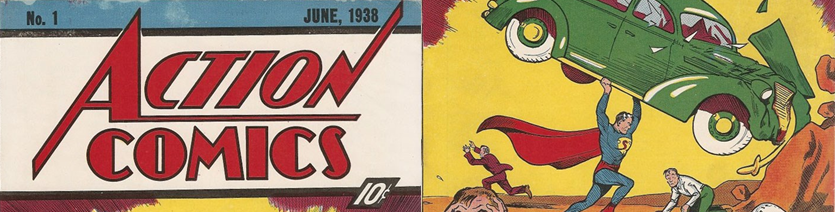
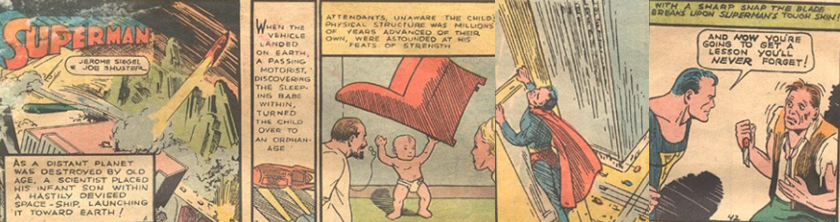
Action Comics #1 presents a much different version of Superman, one who might seem far removed from the virtual demigod we know and love today; back in 1938, for the Man of Steel’s iconic debut, Superman was still very much superhuman but he had yet to develop many of the powers and abilities he is now known for, much less the crazy, over-the-top powers he would later possess throughout later decades. The story begins by detailing Superman’s memorable origin…by summing it up in one simple panel. Yep, Superman’s home world (not yet identified as “Krypton”) is “destroyed by old age” in the comic’s opening panel and the future Superman’s rocket is discovered by a passing motorist in the next. Unlike traditional depictions of Superman’s origin, the alien infant within is immediately handed over to an orphanage where the attendants were “astounded at his feats of strength”. The next few panels quickly showcase the range of Clark Kent’s (his name comes out of nowhere a few panels later with no explanation) superhuman abilities: he can easily leap over a twenty-story building, lift incredible weight, run faster than an express train, and possesses impenetrable skin. Rather than explain his abilities as the result of Earth’s yellow sun or the differences in atmosphere between Earth and Krypton, the comic explains that the inhabitants of Kent’s home world had evolved a “physical structure millions of years advanced of our own” and compares them to the abilities of insects to lift incredible weights and leap vast distances.  

There are many convenient excuses to show off Superman’s awesome powers in the story.

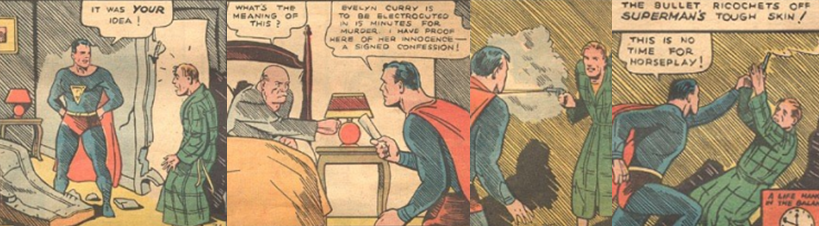
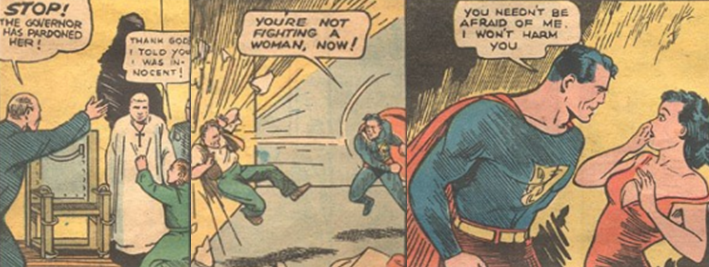
Rather than being taught values and morals by loving, doting parents, Clark simply decides, off panel, to put his fantastic abilities to good use and crafts the persona of Superman, “champion of the oppressed [and] physical marvel]”. Superman is then introduced racing through the night with a bound and gagged woman, with no context or explanation; he can’t fly yet so he just runs at super speed to “the governor’s estate”, barging his way in and forcing his way past the governor’s butler with an uncharacteristic discourtesy. The butler is aghast when Superman easily dismantles the door to the governor’s “sleeping room” which, for some reason, is made out of solid steel! Superman explains to the governor that he has a signed confession that proves one Evelyn Curry is innocent of murder but, before the governor can properly digest this information, his butler confronts the costumed intruder with a pistol. Superman, however, easily shrugs off the bullet and disarms the man. With time fast running out, Superman convinces the governor to make the life-saving call and leaves the real culprit (the woman he was carrying in his first panel) in the custody of the governor. The next day, Kent is pleased to see that his actions, as Superman, have made the front page of the Daily Planet Star and the governor is left feeling eternally grateful that Superman is on their side…and well he should be given Superman’s blunt and direct approach to the fight against injustice.

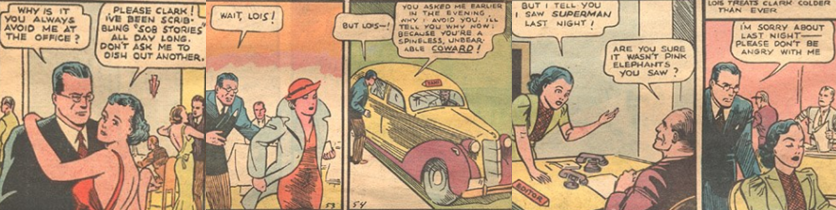
Clark keeps up his façade as a weakling, much to Lois’s continued disgust.

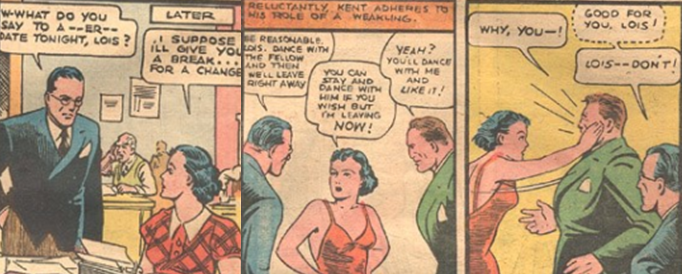
Kent then meets with the unnamed chief editor of the Daily Star, who orders him the assignment of covering the mysterious Superman who has been making so many headlines. While it might seem like Kent has walked in off the street, the next panel seemed to prove that he does, in fact, work for the paper as he is informed by a co-worker of a wife-beating taking place (seems like an odd thing for a paper to be tipped off about but I didn’t live in the 1930s so maybe this was a thing…?) Superman immediately rushes over to the scene of the crime and makes the abuser pay by shoving him violently into a wall, breaking his knife on his impenetrable skin, and threatening the man so fully that he faints in his arms. Superman then quickly changes back into his civilian guise to explain the situation to a policeman, making sure to attribute the woman’s rescue to his super-powered alter ego. Later, Clark works up the courage to ask his co-worker, Lois (no last name yet), out on a date and she decides to “give him a break…for a change”. This, and the next panel, quickly summarises that Lois tends to avoid Clark and give him the run around in the office as, when he asks why she treats him so unfairly, she simply scoffs: “I’ve been scribbling “sob stories” all day long. Don’t ask me to dish out another”. When Butch Matson, a local tough or possibly a mobster, decides to impress his gang of apes by cutting in on Lois and Clark, Lois reveals the truth about why she avoids Clark: she sees him as nothing more than a “spineless, unbearable coward!

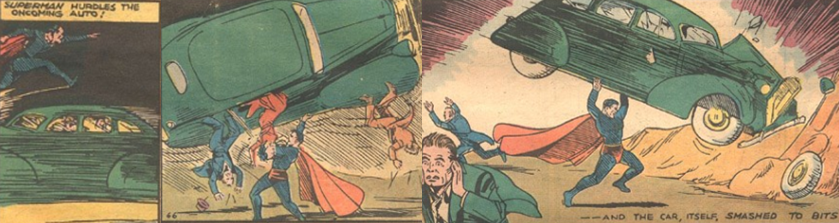
Superman easily catches up to and destroys Butch’s car in an iconic visual.

Of course, during Clark’s confrontation with Butch, the narration boxes and Clark’s thought balloons briefly gloss over the fact that Clark merely pretends to be a “weakling” to keep his secret identity…well…a secret, which is another pivotal aspect of the character that would be explored further in later Superman stories. Lois leaves in a huff and her taxi is soon forced off the road by Butch’s car; in what would quickly become a recurring tradition, Lois is kidnapped by Butch and his gang for little other reason than he took a liking to her, felt slighted by her rejection, and apparently has plans on raping her. Clark, as Superman, had been observing the whole thing from a distance and puts the wind up Butch and his cronies by first leaping over their speeding vehicle, then catching up to it, shaking them all out, and finally smashing it to pieces on a nearby rocky hill.

You’ll have to read the next issue to find out what the hell Superman is doing!

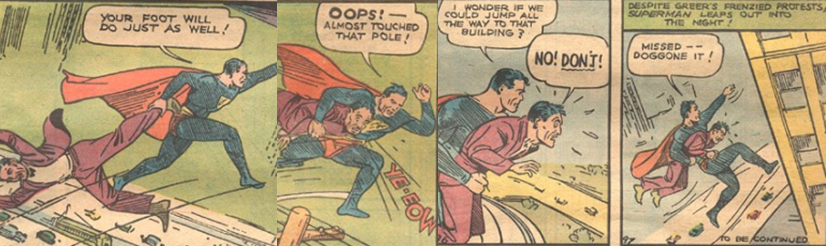
Superman teaches Butch a further lesson by leaving him stranded high up on a telephone pole before racing Lois, who is struck with fear and awe at his presence, to safety. Against Superman’s wishes for anonymity, Lois tries to tell her editor about her ordeal but he dismisses her story as ravings (which is really strange as the other day he was desperate for the scoop on Superman!) Anyway, Kent’s editor sends him to San Monte to cover an escalating conflict but, similar to when he was given the Superman assignment, Clark immediately disobeys this directive and, instead, takes a train to Washington, D.C. to investigate Senator Barrows. Clark snaps a picture of Barrows talking with a man whom the local newspaper identifies as Alex Greer, “the slickest lobbyist in Washington”. His unfounded and unexplained suspicions about the senator aroused, Superman climbs up to Barrows’ residence (the visual of him clambering up a building like Peter Parker/Spider-Man is both amusing and bizarre) and discovers the senator and Greer are in cahoots to get a seemingly innocent bill passed that will see America “embroiled with Europe” before anyone even knows what’s happened. Superman immediately confronts Greer and demands answers, taking him out onto the telephone wires high above the city and taunting the crook him with the threat of electrocution. He then leaps over to the White House to put the wind up Greer and the issue ends with a cliffhanger as Superman continues his intimidation of his victim by, apparently, unsuccessfully making the leap to a nearby skyscraper.

The Summary:
“Superman” is, honestly,  a dreadful story in terms of its pacing and narrative; very little time is spent explaining much of anything, with Superman’s alien origins completely glossed over and readers being forced to infer everything through context. We’re never told that Clark works as a reporter for the Daily Star, we just have to get that he is through inference; Superman races around with a bound woman and barges into homes without provocation and we only find out why after the fact; and God only knows why he pursues Senator Barrows rather than attempting to intervene in the San Monte conflict. But…it’s Action Comics #1, the first ever appearance of the greatest and most recognisable superhero the world has ever known, so I have to recommend that you read it if only for the purposes of witnessing history but, if I’m being brutally honest, the story isn’t really that great beyond the introduction of such an iconic character.

Whether by coincidence or design, Superman primarily saves women from abuse and persecution.

The entire story hinges on the colourful and extraordinary character of Superman himself; an enigma capable of incredible superhuman feats, Superman is visually and imaginatively appealing, I’ll admit. He has no time for decorum or adhering to the rules of the system; he simply strikes back at injustice no matter how trivial it may seem. To Superman, the life of an innocent woman is just as important as the torment of a victim of abuse and he tackles both with the same brute efficiency, utilising his fantastic strength and unmatched physical abilities to dominate the corrupt and the wicked. It’s interesting that pretty much everyone Superman saves in the story is a woman, with each of them being powerless victims of male oppressors, making Superman the paragon of virtue and honour as much as justice.

Superman’s more recognisable elements wouldn’t appear for some time…

As Superman’s first ever story, and a product of its time, a lot of forgiveness and leeway needs to be given to Action Comics #1. Many of Superman’s more recognisable and traditional elements wouldn’t be introduced for some time so, in that regard, the story is a little alienating to those who’ve only ever known him as the flying, all-powerful demigod with a colourful rogues gallery and fully developed supporting cast. Indeed, the seeds for Superman’s more critically regarded aspects are there, they’re just glossed over or barely touched upon: Superman’s status as the most powerful immigrant, for example, and his adoption of a meek alter ego in a reflection of his views on humankind are seen very briefly but the story is more focused on the wish fulfilment of a colourfully-garbed super man shrugging off bullets, smashing up vehicles, and teaching good-for-nothings a much needed lesson.

Make no mistake, Lois was a despiable character here and for many, many years.

Similarly, the story introduces the idea of tension and friction between Clark and Lois. I’ve always hated the early characterisation of Lois Lane and never understood what Clark ever saw in her or why she was deemed worthy enough to carry her own comic title; she was a snobby, condescending, annoying woman who constantly berated Clark and was obsessed (obsessed!) with marrying Superman for no other reason than she wanted him and she was a far cry from the strong-willed, independent, snarky, and yet actually likeable and supportive character she is often depicted as these days. Interestingly, Lois reacts to Superman more with fright than the fanatical wonder she was known for for many decades and isn’t shown to prefer Superman over Clark in this story but her bitchy attitude towards Clark is well and truly intact, though it’s just a hint towards the despicable character she would eventually become.

My Rating:

Rating: 2 out of 5.

Could Be Better

Have you ever read Action Comics #1; if so, what did you think of it and Superman’s debut? Were you surprised at how underdeveloped Superman’s origin and powers are in his debut issue or do you feel the focus on the action and spectacle of Superman justifies the brevity of its narrative? Do you prefer Superman as a more grounded, less elaborate superhero or do you prefer him as an all-powerful character? Which of Superman’s later, wackier powers and stories was your favourite? What is your favourite Superman story, character, or piece of media? How are you celebrating Superman Day today? Whatever you think, feel free to share your opinion and thoughts on Superman in the comments below.

Screen Time [Robin Month]: Titans (Season One)


In April of 1940, about a year after the debut of arguably their most popular character, Bruce Wayne/Batman, DC Comics debuted “the sensational find of [that year]”, Dick Grayson/Robin. Since then, Batman’s pixie-boots-wearing partner has changed outfits and a number of different characters have assumed the mantle as the Dynamic Duo of Batman and Robin have become an iconic staple of DC Comics. Considering my fondness for the character and those who assumed the mantle over the years, what better way to celebrate this dynamic debut than to dedicate an entire month to celebrating the character?


Season One

Air Date: 12 October 2018 to 21 December 2018
UK Network: Netflix
Original Network: DC Universe
Stars: Brenton Thwaites, Teagan Croft, Anna Diop, Ryan Potter, Alan Ritchson, Minka Kelly, and Curran Walters

The Background:
In July of 1964, the sidekicks of DC Comics’ most powerful superheroes came together under the leadership of Dick Grayson/Robin to form the Teen Titans, a crimefighting group of teenagers who were designed to better appeal to younger readers. Since then, the group has undergone many changes, with runs by the likes of Marv Wolfman and George George Pérez being notably influential, and the team has seen success in a number of animated ventures. Development of a live-action adaption was first announced in 2014; the series, which would have aired on TNT, never came to fruition but the concept was resurrected to produce content for DC Universe, DC’s now-defunct video-on-demand streaming service. Separate from the ongoing “Arrowverse” continuity, Titans got off to a bit of a bad start due to the violent and adult nature of the show and was criticised for its abrupt cliffhanger ending after the true season finale was pulled to become the first episode of the second series. Regardless (and despite the vitriol I often see towards the show on my Twitter feed), Titans impressed enough to earn subsequent seasons, inspired a spin-off show, and was even acknowledged as being adjacent to the Arrowverse during the Crisis on Infinite Earths crossover event (Various, 2019 to 2020).

The Plot:
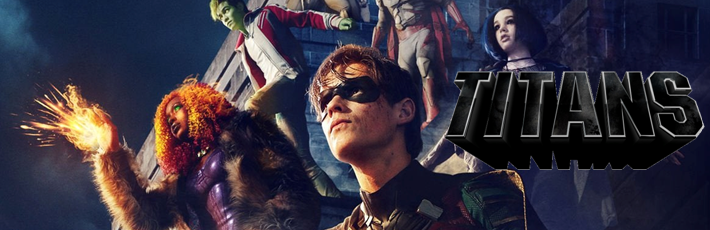
Dick Grayson/Robin (Thwaites), who is attempting to make a name for himself outside of Bruce Wayne/Batman’s (Alain Moussi/Maxime Savaria) shadow, works as a police detective by day and violent vigilante by night. When the mysterious Rachel Roth/Raven (Croft) comes to him for protection against the dangerous forces pursuing her, Dick finds himself joining forces with not only similarly confused and superpowered misfits but also his former Titans teammates to combat a threat to the entire world.

The Review:
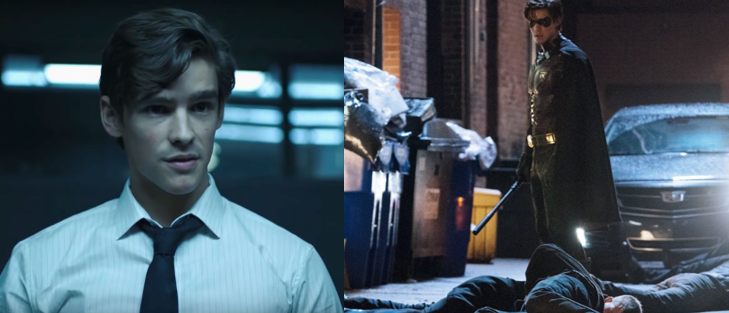
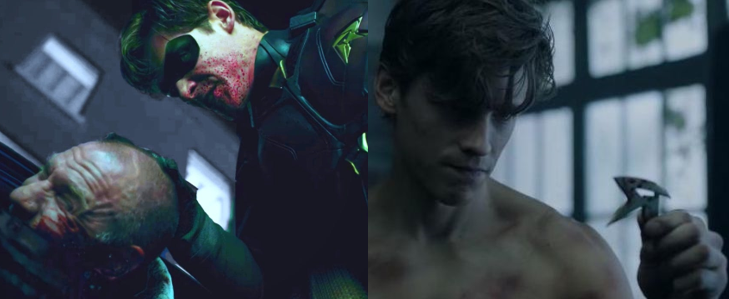
Unsurprisingly, much of Titans’ plot revolves around Dick Grayson, who now works as a police detective in Detroit; trying to make a name for himself as a solo act, he is very much against being partnered up with anyone, even within his own department, which makes him somewhat cold and rude towards his new partner, Amy Rohrbach (Lindsey Gort). Dick uses the information and resources of the Detroit police department to track down criminals and bring them to justice as Robin; while the scum he targets immediately dismiss him and are more concerned about Batman, they quickly regret it when faced with Robin’s ferocity and his presence concerns his superior (and the mayor). Dick reveals to Amy that he and his former partner disagreed on the way to go about their work; initially, Dick admired him and saw him as a hero, just like everyone else, but chose to walk away when he saw that he (Dick) was becoming too much like him. Clearly, he’s talking about Batman and this is a recurring theme throughout the show; a much darker and more violent figure, his vicious nature is augmented by his great physical skill and Batman’s training, making him a formidable and well-training combatant who is easily able to take on groups of armed men. Dick isn’t adverse to using knives, guns, and whatever means necessary (even appearing to fatally wound some thugs) to put a beating on lowlifes and seems to both revel in, and be disgusted by, his violent impulses.

Dick uses his position as a cop to track down and bring criminals to justice as Robin.

However, as meticulous and skilled as he is, he’s still vulnerable and carries the results of his actions on his body in the forms of bruises, cuts, and scars; his primary motivation, as Robin and as a police detective, is to help out troubled kids and youngsters targeted by criminals. This naturally leads to him to Rachel, who is clearly framed as the audience surrogate right from the start (her nightmares of Haley’s Circus show her (and us) Dick’s origins as a trapeze artist and the tragic death of his parents) and is our unknown, confused, window into this world of costumes and masks. Such nightmares are a regular occurrence for her that, despite her mother Melissa’s (Sherilyn Fenn) best efforts, continue to torment and frighten Rachel; Rachel, clearly influenced by some dark power, is an empath and can sense a great fear emanating from her deeply religious mother. An outcast at school, Rachel’s fears and confusion lead her to sporadic outbursts of aggression, often accompanied by a dark reflection of herself and a shadowy, ethereal aura. When a mysterious man forces Melissa to reveal that she’s not Rachel’s actual mother and then brutally murders her right in front of Rachel’s eyes, she goes on the run and, driven by her nightmares, heads to Detroit to track down Dick Grayson for help. Though she fears her dark half, which encourages both violence and the need to kill, it acts primarily to protect her from lies and deceit, which allows her to escape from some suspicious types and end up right where she needs to be: police custody. Dick’s relationship with Rachel is a pivotal aspect of Titans; at first, though driven to help her, he plans to leave her in the care of others (with a payoff to sweeten the deal) since he feels that he’s damaged after what Bruce trained him to become.

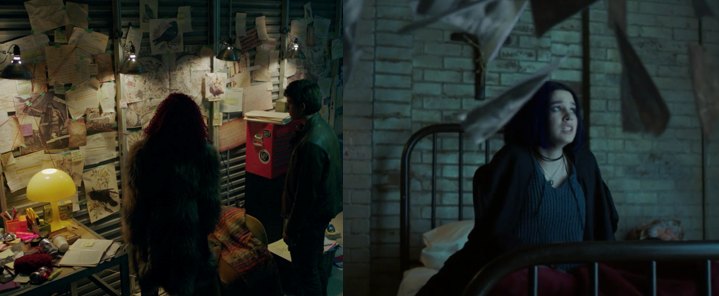
Kory uncovers evidence that links Rachel and her dark powers to a prophecy.

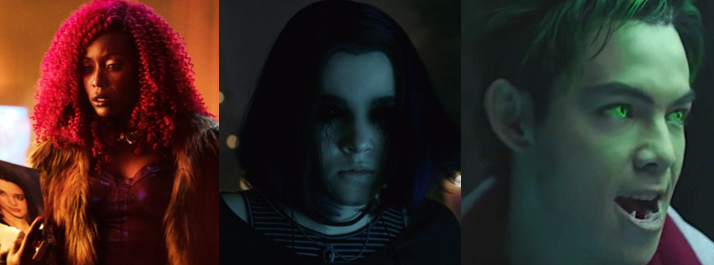
While his mindset soon changes and he becomes fiercely protective of her, she forms a bond out of necessity with Kory Anders (Diop) when her trust in Dick is shaken. A mysterious and enigmatic young woman suffering from amnesia, Kory’s relationship with Rachel is based as much on necessity as Rachel’s inability to feel anything from Kory, who is inexplicably able to read and speak foreign languages and wields an equally destructive power. Desperate to unlock her memories and find out who she really is, and believing that Rachel is the key to her true identity, Kory uncovers evidence linking Rachel to an apocalyptic prophecy concerning ravens and a vast underworld conspiracy involving the convent where Rachel was raised. However, while Sister Catherine (Meagen Fay) immediately recognises them both and reveals some scant information on Rachel’s childhood and Kory’s mission to track her down, she quickly drugs Rachel and locks her in the convent’s basement in order to hide her from “him”. Rachel’s dark half manifests and, after tormenting her with taunts, empowers her to escape from her confinement and out into the nearby forest. Scared and alone, she crosses paths with Gar Logan/Beast Boy (Potter), a green-haired boy who can transform into a disappointingly rendered CGI tiger. Obsessed with pop culture, movies, videogames, and geek culture, Gar is an awkward, quirky outcast who sees a kindred spirit in Rachel and who desires to explore the outside world and, in an effort to connect with her, brings Rachel to the manor house he shares with his fellow misfits, the Doom Patrol: Cliff Steel/Robotman (Jake Michaels and Brendan Fraser), Larry Trainor/Negative Man (Dwain Murphy and Matt Bomer), and Rita Farr/Elasti-Woman (April Bowlby). Each of them, like Gar, was involved in some kind of hideous accident that left them near death only to be saved (and horrifically changed) through the innovation and genius of the mysterious Niles Caulder/The Chief (Bruno Bichir). Rachel finally feels a sense of belonging amongst these freaks and outcasts, each of whom reflect the complex nature of her own self and dark powers: hidden behind his bandages, Larry is unable to reveal himself because of the destructive nature of his condition, Cliff is robbed of the trivial pleasures we all take for granted, and Rita is barely able to hold herself together to appear normal.

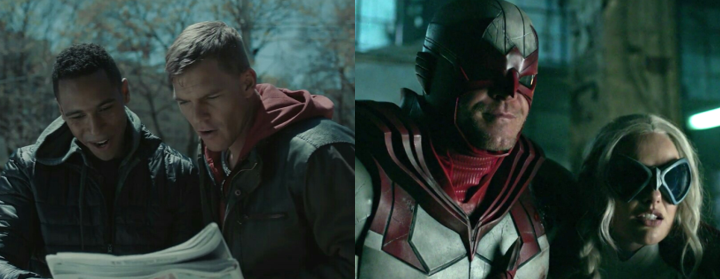
Brought together by tragedy, Hawk and Dove continue to fight crime as costumed vigilantes.

The Chief, however, is angered that Gar threatened their sanctity by leaving the house and bringing an outsider amongst them; despite a glimmer of a threatening, dubious nature, the Doom Patrol are all incredibly thankful and loyal to him for saving their lives and willingly allow the Chief to run his experiments in order to advance the betterment of human lives. The Chief promises that he can also help Rachel and her condition as well but, while she initially allows him to run some tests, she almost immediately changes her mind and grows scared. Although Gar tries to help her, the Chief tranquilises him and, angered by this, Rachel’s dark half manifests as a swirling dark liquid that attacks and paralyses him and frees her. Dick and Kory arrive just in time and Dick is able to talk Rachel down and promises to help her, reuniting them once more. Encouraged by Cliff, Gar goes with them to live a life outside of the mansion, setting the team up for their own strangely unrelated spin-off. Not that Dick is without his allies as well; initially, he plans to leave Rachel with Hank Hall/Hawk (Ritchson) and Dawn Granger/Dove (Kelly) in Washington, two of his former Titans allies who continue to operate as costumed vigilantes. As damaged as Dick is, Hank is equally traumatised by his past when, as a young boy (Tait Blum), he was sexually abused by his football coach to spare his younger half-brother Don (Jayden Marine). As teenagers, Hank and Don (Elliot Knight) became the first Hawk and Dove to specifically target sex offenders and to give Hank an outlet for his anger but Hank’s world was shattered when Don was killed in a random car accident. This same accident also took the life of Dawn’s mother, Marie (Marina Sirtis), and, in time, the two form a bond over their shared grief and need for an outlet for their unresolved issues. After she discovers Hank’s makeshift Hawk gear, Hank finally opens up about the abuse he suffered as a child and, together, they bring justice to his abuser and become the new Hawk and Dove. By the time of Titans, however, Hank is heavily reliant upon painkillers and pills, carries multiple scars, and is in near constant pain from a lifetime of crimefighting in addition to the multiple concussions he suffered during his college football days. The two plan on retiring from their violent double life once they finish breaking up a gang of gunrunners and, though he’s stubborn and pig-headed, Dawn is clearly devoted to Hank and supportive of him despite his injuries and impotence.

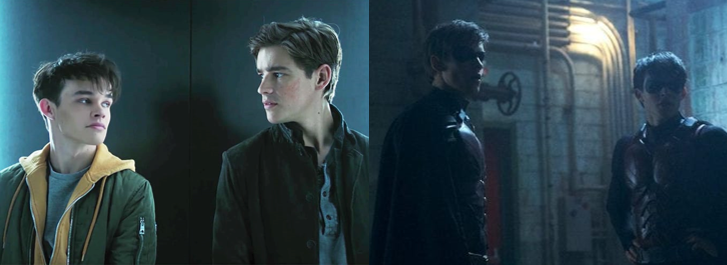
Dick is disturbed to find Bruce has replaced him with the arrogant and violent Jason Todd.

Flashbacks cast some light on their time together as Titans, where Dawn had a thing for Dick and Hank, being the arrogant meathead that he is, was rightly jealous and condescending towards Robin. Hank is unimpressed that Dick has come back into their lives and, resentful of Dick’s former relationship with Dawn, also has no faith or trust in Dick at all because of their past in the Titans. However, even Hank is horrified to see how brutal Robin has become as he throws his shurikens into a man’s eye, crushes another man’s balls, and viciously takes out the gun dealers before their shocked eyes, while Dawn sees a correlation between Dick’s relationship with Rachel and how Bruce helped him as a kid. Dick is disturbed, angry, and resentful to discover that Bruce has replaced him with Jason Todd (Walters), who acts as the new Robin, a vicious and arrogant youth who revels in being Batman’s partner, basks in the upgrades in his suit compared to Dick’s, and takes a perverse pleasure in being Robin and part of Batman’s legacy (even while acknowledging that his role is mainly to draw fire away from Batman). A largely annoying and grating character without even really needing to be, Dick is annoyed when Jason reveals that Bruce implanted tracking devices into the both of them and revoked his access to his newer technology. Dick tries to send Jason back to Gotham City and discourages him from continuing his life as Robin; despite trying to convince him that Bruce’s methods and motivations are less than benign, Jason reveals that he was sent there with evidence that his old circus family has been brutally murdered to send a message to him and that someone knows his true identity. Together, they track down the last surviving member of the circus, Clayton Williams (Lester Speight), who was like Dick’s surrogate father back in the day, who is almost immediately abducted by the perpetrator of the murders, the Phantom-like Nick Zucco (Kyle Mac), the “Melting Man” and son of gangster Tony Zucco (Richard Zeppieri), the man who killed Dick’s parents.

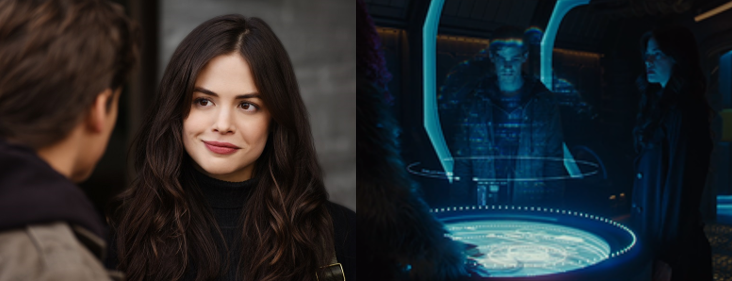
Donna advises Dick and helps uncover the truth about Kory and Rachel.

Nick is out for revenge because Dick, as Robin, intercepted Zucco during his transfer, mercilessly beat him and left him to die (watched him, no less) at the hands of the Maroni’s and their acid-firing weapons and then murdered the rest of Nick’s family. Goaded into a trap by Nick, Robin goes to save Clayton and, thanks to Jason, is able to subdue him. When the local cops show up, though, Jason brutalises them and, seeing the darkness he fears in himself mirrored in Jason, Dick is disgusted at Jason’s attitude. Initially, Jason regards Dick with awe and respect and they form a tenuous brotherly bond but, as their relationship sours due to their conflicting methods and attitudes, this is replaced a mixture of contempt and loathing for having walked away from such a sweet gig. Dick struggles with the idea of being replaced so quickly; he doesn’t want to be Robin and is trying to step away from Bruce’s shadow and influence but doesn’t want to see another kid be turned into a weapon like he was and resents the fact that Bruce has been keeping tabs on him while simultaneously keeping him out of the loop. When Dick finally decides to walk away from his Robin persona and burns his uniform, he seeks out another of his former Titans allies, Donna Troy/Wonder Girl (Conor Leslie). Having first met as teenage sidekicks, Dick and Donna formed the Titans back in the day and she’s one of the few people left who Dick feels will properly understand what he’s going through. Donna, now an investigative journalist, has long since walked away from her life as a costumed adventurer, Amazon, and Diana Prince/Wonder Woman’s sidekick, and is able to offer Dick some insight into what it means to redefine oneself outside of the shadow of one’s mentor and to help improve his social skills. Dick, however, finds it difficult to socialise and to keep his mind from wandering back to the “job”; despite being so composed, confident, and controlled when in the field or concentrating on superhero work, he’s a bit of a fish out of water in normal, everyday situations. His paranoia leads to him following Donna as she meets with a game hunter in pursuit of a story and disrupting her attempts to bring down a much bigger operation through his reckless attempt to take one more scumbag off the streets. Although Donna chastises him for his efforts, she encourages him to find a new path, one that isn’t Robin or Batman and is more productive than violent. Donna is also able to offer some insight into the strange text from Kory’s lockup that suggests that Kory’s true mission is actually to kill Rachel.

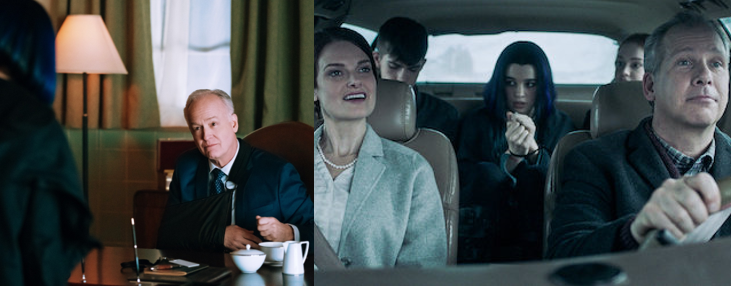
Adamson sends the disturbing Nuclear Family to track down Rachel.

The intrigue regarding the true nature of Rachel’s power and destiny is a central aspect of Titans; an empath, she’s able to feel and sense the pain of those around her, is frequently tormented by her dark half (which manifests in reflective surfaces and possess her during times of great stress), but also demonstrates the ability to heal the wounds of others. Rachel is targeted by the mysterious Organisation, which is headed by the dubious Dr. Adamson (Reed Birney); Adamson activates the “Nuclear Family” (a group of brainwashed psychopaths comprised of  Nuclear Dad (Jeff Clarke), Nuclear Mom (Melody Johnson), Nuclear Sis (Jeni Ross), and Nuclear Biff (Logan Thompson) and, later, Nuclear Stepdad (Zach Smadu)) to track Rachel down so that she can fulfil her destiny to “purify the world”. Disturbingly polite and unnervingly relentless, the Nuclear Family gain formidable abilities from a mysterious vitamin shot, dog the protagonists at every turn, and even put Dawn into a coma during a particularly ferocious attack. Thanks to Dick’s intervention, the team are able to subdue the family but they are killed when Adamson remote detonates the explosives in their heads though, in the process, the team are led to the asylum where Rachel’s real mother, Angela Azarath (Rachel Nichols), is being held captive. This leads to probably the weakest episode of the season, “Asylum” (Kalymnios, 2018), which sees the team captured when they attempt to breach the facility and rescue Angela. The main reason this makes for the weakest episode is the unnecessary drama that sees Rachel and Gar head off on their own foolhardy rescue mission simply because Rachel couldn’t wait ten minutes for Dick to scope out the asylum’s defences and layout. As a result, all of them are captured and subjected to Adamson’s torturous experiments): Dick struggles to counteract Adamson’s serum, which forces him to confront his worst fears about himself and his past; Kory is locked in a dark cell that renders her powers useless and forced to endure an invasive procedure; and Gar is routinely poked with a cattle prod to provoke his transformation.

Dick struggles against his violent impulses and often loses control of himself.

Rachel is left in the disturbing company of Adamson himself, who tries to coerce her into assisting him by forcing her to watch her newfound friends suffer their individual tortures and winds up choking to death on his own blood as a result of Rachel’s unleashed wrath. Rachel then rescues her mother and teammates with a ridiculous amount of ease but Gar is left traumatised after he mauls one of his tormentors to death and this continues to haunt him throughout the remainder of the season. A primary plot point of Titans revolves around Dick’s struggle against his violent nature; believing that Batman’s training turned him into little more than a living weapon, he reveals to Rachel that he began to fear the violence he was forced to inflict to help others and to Kory that he had to walk away from his past because he was growing dangerously close to the edge. While he hasn’t operated as Robin for at least a year by the start of the season, he vehemently opposes any machinations to turn innocent kids into weapons and, even when not in his Robin costume, Dick often struggles with his violent nature; desperate to find Rachel after she goes missing, he briefly loses control and viciously beats a hunter who spotted her in the forest in front of his child, much to Kory’s shock, and absolutely brutalises the asylum’s guards during their escape from the facility and even instructs Kory burn the entire building to the ground (presumably killing everyone left inside). His rage stems from his traumatic childhood after first witnessing the murder of his parents and then having his rage and grief turned towards costumed crimefighting by Batman. However, as violent as Dick can be, Bruce’s training also made him a competent and capable leader; when Dick, Kory, Gar, and Rachel make their new alliance official, Dick begins a training regime to teach them how to master their individual abilities and work together as a cohesive team. All of these plot threads culminate in the season’s final episode, “Dick Grayson” (Winter, 2018); by this time, Kory’s true identity as Koriand’r of the alien world Tamaran is revealed and, with it, the knowledge that Rachel is doomed to bring her demonic father, Trigon (Seamus Dever), into being so that he can devour both of their worlds.

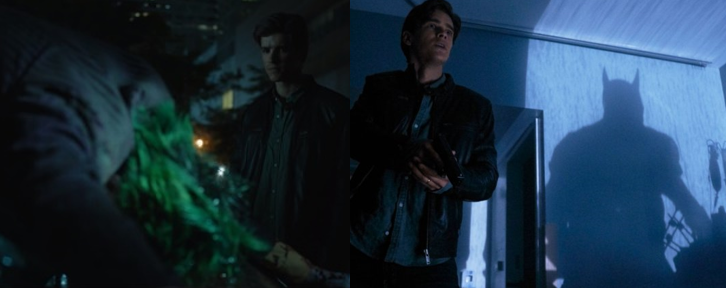
Dick is drawn into a confrontation with Batman after his mentor goes on a killing spree.

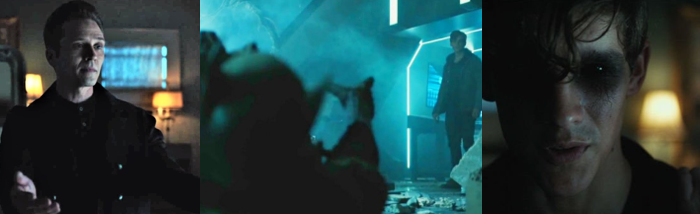
Betrayed by Angela, who was in league with Trigon all along, Rachel is manipulated into summoning her father to save Gar’s life and, after restoring Gar, Trigon sets in motion a plot to break Rachel’s heart in order to facilitate his master plan. He does this by thrusting Dick into a dreamworld where he is happily retired and settled down with Dawn; however, his idyllic life is shattered when Jason, now confined to a wheelchair after a botched mission against Edward Nygma/The Riddler, arrives to tell him that Batman has become obsessed with killing Joker in retaliation for his torture and killing of Commissioner James Gordon. Thanks to Trigon’s influence, Dick is compelled to return to Gotham (a dreary and rainswept hellhole where crime, debauchery, and violence are rife, turning the very streets into a desolate warzone) to try and talk Bruce away from the edge. However, despite Dick’s best efforts, Batman murders the Joker in cold blood and then goes on a killing spree throughout Arkham Asylum, killing the Riddler, Harvey Dent/Two-Face, Arnold Wesker/The Ventriloquist and many of the other guards and patients. After revealing Bruce’s identity to the authorities, Dick directs a SWAT team on an all-out assault on Wayne Manor that leaves them all slaughtered at Batman’s hands (including Kory, thanks to Batman busting out Doctor Victor Fries/Mister Freeze’s cold gun). Enraged, Dick orders the entire mansion to be destroyed by C4 explosives and, amongst the rubble and the wreckage, he finds Batman pinned helplessly beneath the debris; driven to the edge, Dick succumbs to the darkness and, with one swift boot, murders his mentor and father figure and, in the process, falls under Trigon’s spell to end the season on a massive cliff-hanger made all the more intriguing by the brief tease of Kon-El/Superboy (Brooker Muir) in a post credits scene.

The Summary:
As much as I enjoy Titans (and, honestly, I really do, being a big fan of Robin and happy to see him actually get some acknowledgement and spotlight in live-action for a change), there are a couple of things that I find more than a little disappointing about it. Like many, I was a bit perturbed by Robin’s “Fuck Batman!” line and, while the violence and swearing was entertaining and brutal throughout the show, I do question if it’s really necessary in superhero adaptations that aren’t traditionally violent characters, like Frank Castle/The Punisher or Wade Wilson/Deadpool. Next is the fact that it exists in its own continuity separate from both the DC movies and television shows and this is a shame as it could easily have bridged to the Arrowverse by including Wally West/Kid Flash (Keiynan Lonsdale) or even been adjacent to the DC Extended Universe by including a cameo by Jeremy Irons as Alfred. Titans’ position as a separate, unrelated continuity was solidified in the second season, which upgraded Bruce Wayne from a mere cameo and into a fully realised (and surprisingly old) character played by Iain Glen.

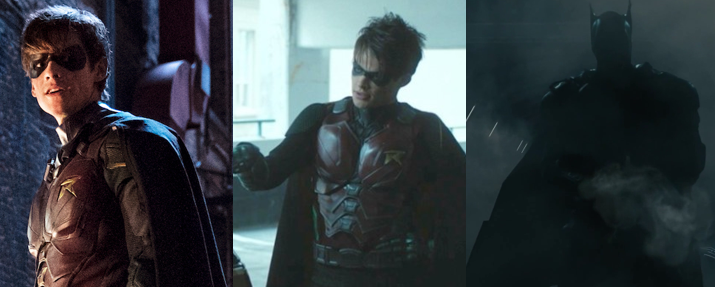
Both Robin suits are impressive and Batman cuts a monstrous figure.

However, Titans excels in both casting and costume design; Brenton Thwaites is great as Dick Grayson and made for a pretty fantastic Robin and his costume, especially, is absolutely top notch in Titans. Both Robin suits look amazing and have probably the best and most practical look of any superhero show; clearly inspired by the awesome and sadly doomed suit that appeared all-too-briefly in Batman v Superman: Dawn of Justice (Snyder, 2016) and Tim Drake’s Robin costume, their dark, gritty, armoured look enables both Robins to not only appear imposing but also move unimpeded and look like they would hold up perfectly well in a big budget film. Similarly, although he only appears very briefly in the final episode, Batman also looks particularly impressive, especially compared to his depictions in Gotham (2014 to 2019) and Batwoman (2019 to present). Referenced continuously throughout the season, Batman is built up as this elusive, near mythological figure and his brief appearance leans heavily into that; frantic editing makes him appear as a monstrous, inhuman figure and the nightmarish appearance of his suit only serves to emphasis this further.

Sadly, the special effects don’t always do justice to the characters or the practical suits.

Hawk and Dove also benefit from Titans’ high-quality costume design; though very different from my limited experience with their comic book counterparts, their heavily armoured suits look both practical and ridiculous at the same time, appearing well-worn and dangerous thanks to their sharp appendages. However, it goes a bit downhill once we get to Kory; for the most part, she’s serviceable enough despite being a far more promiscuous and forthright character than in most interpretations, but her outfits are limited to tight fitting dresses that only somewhat recall her traditional costume. Similarly, Rachel’s not quite the sour, serious and withdrawn goth she’s usually characterised as and is, generally, portrayed as more of a confused and troubled teenager garbed in a vaguely raven-like hoody. Sadly, it’s Gar that suffers the most in Titans; of all the characters, he’s the one that sticks out the most to me as he doesn’t seem to really fit with the rest of the team and ends up being more of an afterthought most of the time. While the special effects used to bring Kory’s powers work, largely due to how infrequent and grounded they are depicted, Gar’s are pretty dreadful, making his animal forms resemble little more than cartoony creatures, which is a bit disappointing considering the quality of the special effects in the likes of Swamp Thing (2019), how impressive the CGI is in shows like The Flash (2014 to present), and the effort Titans went to the faithfully recreate the other members of the Doom Patrol.

Trigon manipulates Dick into succumbing to his influence in order to devour the world.

References to the larger DC universe are prominent throughout Titans thanks to Gar, who fawns over the likes of Batman and Wonder Woman, and the fact that many characters wear Superman t-shirts. For the most part, though, Titans is concerned only with its own gritty, grounded narrative that becomes increasingly more supernatural and elaborate as the plot progresses. The show builds towards these moments over time, with both Rachel and Kory discovering the full extent of their otherworldly abilities as the season progresses, but never shying away from the more flamboyant aspects of the source material with characters like the Doom Patrol and interdimensional beings such as Trigon. Largely based on Marv Wolfman’s initial run on The New Teen Titans, Titans primarily deals with Trigon’s impending arrival through Rachel and the formation of a new version of the Titans but, for the most part, is just as much a journey of self-discovery for Dick as he struggles to define himself outside of his role as Robin. Personally, I found this the most appealing part of Titans and would have happily ditched all the other side plots and storylines to focus entirely on this one plot point but, thanks to each episode focusing on different characters and their sub-plots and building intrigue around this world and the former iteration of the Titans, I found Titans to be incredibly enjoyable and was chomping at the bit for the second season to release to see how things turned out.

My Rating:

Rating: 4 out of 5.

Great Stuff

What did you think to season one of Titans? Were you a fan of the season, and the show, or did its gritty, violent take on the traditionally plucky and colourful characters turn you off? Which character was your favourite and what did you think to the plots involving Dick’s struggle against his violent impulses and the mystery about Kory and Rachel? Did you enjoy the cameo appearance from the Doom Patrol and other references to DC heroes and properties? Did the climax of the season leave you wanting more or were you turned off by the concept? What did you think to the show’s portrayal of Robin, the inclusion of Jason Todd, and their costumes? Whatever your thoughts on Titans season one, feel free to leave a comment down below.

Screen Time [Crossover Crisis]: Crisis on Infinite Earths


In April 1985, the first issue of the ground-breaking Crisis on Infinite Earths (Wolfman, et al, 1986) released and saw the temporary destruction of the “Multiverse”. To celebrate this momentous event, I’ve spent every Sunday this month discussing multiversal crossovers in an event I dubbed “Crossover Crisis”.


Air Date: 8 December 2019 to 14 January 2020
UK Network: Sky One and (eventually) E4
Original Network: The CW
Stars: Stephen Amell, Grant Gustin, Melissa Benoist, Ruby Rose, LaMonica Garrett, Tyler Hoechlin, David Ramsey, Carlos Valdes, Chyler Leigh, Caity Lotz, Brandon Routh, Tom Cavanagh, and Jon Cryer

The Background:
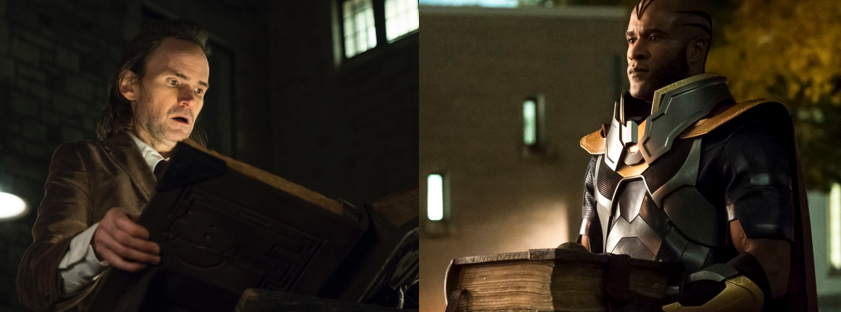
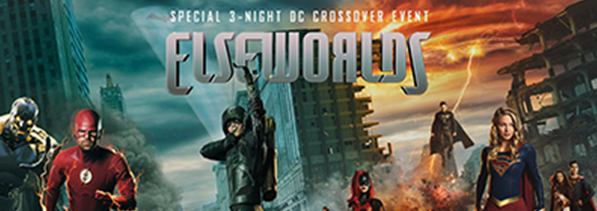
Crisis on Infinite Earths was, easily, the biggest and most influential crossover in DC Comics history back when it was first published; even now, the reality-changing events of the twelve issue series can be felt in DC and cosmic events and crossovers are an important part of the comics industry. Still, such an event seemed irrevocably tied to the comics books; even DC’s animated ventures rarely attempted to tackle an event of such magnitude so to say that I never expected Arrow (2012 to 2020), of all things, to led to, and end with, a massive crossover between not just the “Arrowverse” but also the wide spectrum of live-action DC adaptations would be an understatement, to say the least. Crisis on Infinite Earths was first hinted at in the first episode of The Flash (2014 to present) but was explicitly referenced throughout the Elseworlds (Various, 2018) crossover and revealed in the conclusion of that event. The Crisis then become the focal point of the entire Arrowverse, with almost the entirety of Arrow’s eighth season and The Flash’s sixth season specifically preparing characters for the oncoming Crisis, visiting and destroying parallel worlds, featuring Mar Novu/The Monitor (Garrett) as a frequent guest star, and setting the stage for the biggest comic book crossover in television history as the writers and showrunners crammed in cameos and references galore to pay homage to DC’s many live-action adaptations. The result was some of the best-received and highly-praised episodes in all of the Arrowverse and a significant change in the presentation of the Arrowverse going forward as worlds lived, died, and were forever changed by the event, which saw both Supergirl (2015 to present) and Black Lightning (2018 to present) merged into a new version of the Arrowverse Earth.

The Plot:
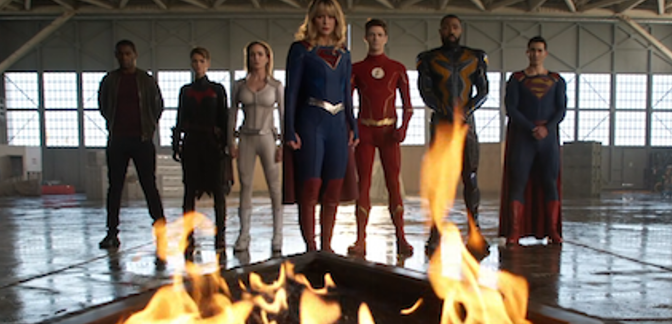
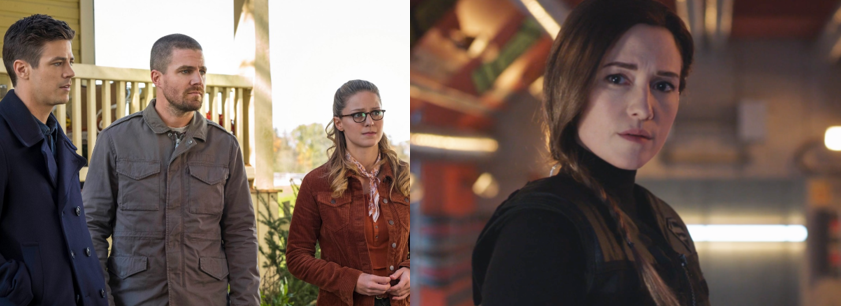
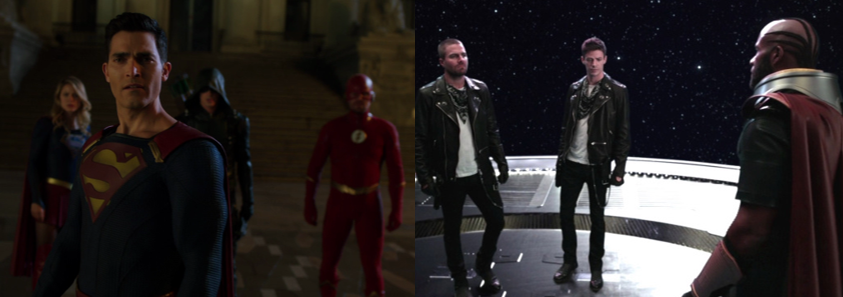
When a wave of destructive anti-matter threatens all life in the multiverse, the Monitor gathers seven heroes – Oliver Queen/Green Arrow (Amell), Barry Allen/The Flash (Gustin), Kara Danvers/Supergirl (Benoist), Sara Lance/White Canary (Lotz), Kate Kane/Batwoman (Rose), Doctor Ray Palmer/The Atom (Routh), and Clark Kent/Superman (Hoechlin) – to face the crisis. Facing overwhelming odds, the team must journey across time, space, and the expanse of the remaining multiverse to find seven “Paragons” who will decide the fate of all reality!

The Review:
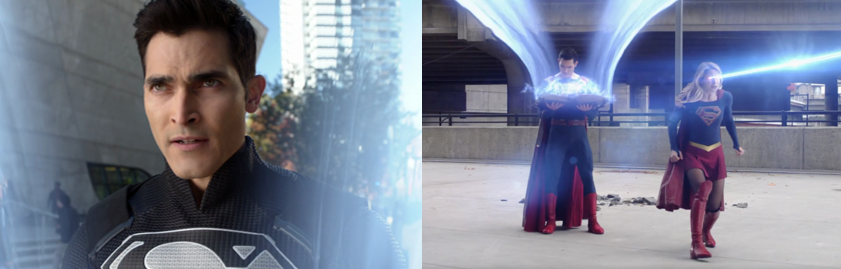
Crisis on Infinite Earths hits the ground running and kicks off with a massive bang in “Part One” (Warn, 2019), which was the ninth episode of Supergirl’s fifth season and saw the devastating wave of anti-matter obliterate Argo City and threaten the very fabric of Supergirl’s world, Earth-38. In a change for these crossovers, Supergirl and her supporting cast are given a prominent role right off the bat as she is forced to watch her home and family be destroyed by the mysterious, unstoppable wave of energy. She is overjoyed to see that Superman and Lois Lane (Elizabeth Tulloch) survived the destruction but deeply affected by the death of her mother, Alura Zor-El (Erica Durance), and the loss of her home, and the fact that the entire first episode actually takes place on her Earth allows her supporting characters to actually contribute in a meaningful way towards the Crisis.

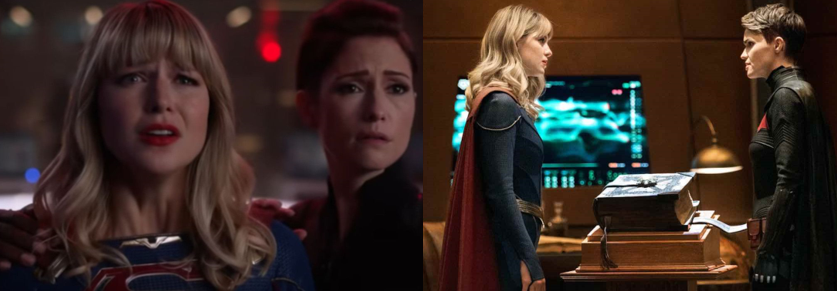
Supergirl is heartbroken when Argo City is destroyed and is tempted to rewrite reality.

Faced with the impending destruction of their world, Alex Danvers (Leigh), J’onn J’onnz/Martian Manhunter (David Harewood), and Querl Dox/Brainiac 5 (Jesse Rath) are forced to call in every debt they are owed, and even turn to the unscrupulous Lena Luthor (Katie McGrath) for help evacuating as many people as possible to Earth-1. Interestingly, it is Superman who has the crisis of conscience in this first episode and finds his resolve faltering after failing to save Argo City and out of concern for his baby son, Jonathan; despite the losses she has suffered in such a short space of time, it is Supergirl who lifts his spirits and encourages him to remain hopeful in their ability to succeed. After discovering that the Book of Destiny has been recovered, Kara, as the Paragon of Hope, makes every effort she can, despite the incredible risk, to use the Book to restore her Earth, bringing her into a moral conflict with Kate.

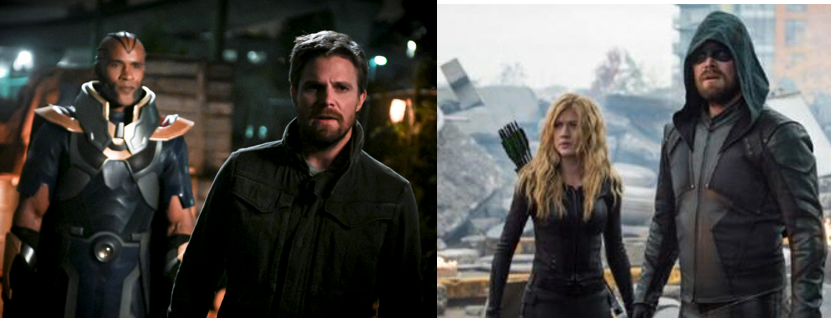
Oliver has spent the last season preparing for the Crisis and to make the ultimate sacrifice.

The anti-matter wave spreads throughout all of time and space, however; throughout the most recent seasons of Arrow and The Flash, Oliver and Barry have been struggling with their impending deaths since the Monitor foretold that each of them would die in the coming Crisis. This has been particularly trying for Oliver, who, like Barry, has been trying to prepare for the coming event and get his team ready to operate without him once he’s gone but has been struggling with time travel shenanigans, which saw him meet his future daughter, Mia Smoak (Katherine McNamara). Normally the more grounded and pragmatic of the Arrowverse heroes, Oliver has had extensive experience not just with multiversal events by this point but also with the anti-matter’s effects thanks to his travels with the Monitor in preparation for the Crisis.

Even in death, Oliver finds a way to continue fighting and decide the fate of all reality.

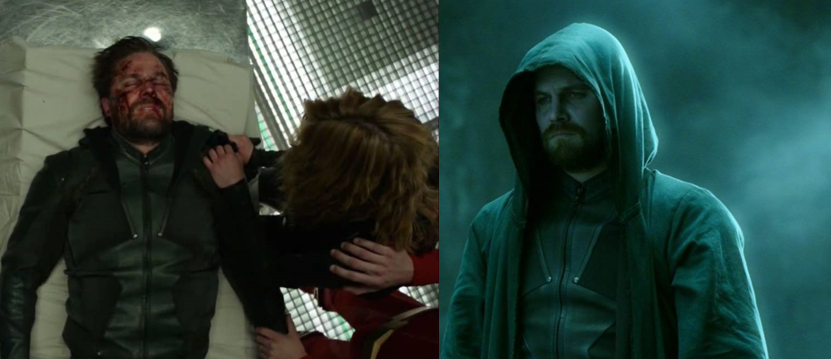
Despite his lack of superpowers and being more of a tactician, Oliver plays a vital role throughout the Crisis as we seen his disillusioned Earth-16 counterpart run through some of this greatest hits (again…), and see that he is less than impressed to find that the deal he made with the Monitor to sacrifice his life in exchange for Barry and Kara’s is no longer valid. Though Oliver is angered at the deception, the Monitor purposely arranged for this to ensure that Oliver would be at his most prepared by planning for every eventuality; as if seeing multiple worlds be destroyed in short order wasn’t proof that the stakes for Crisis on Infinite Earths was unimaginably high, Oliver’s untimely sacrifice to cover the evacuation of Earth-38 certainly is. Of course, Oliver’s story doesn’t end there as he ultimately sacrifices himself again, first by taking on the role of the Spectre and then by giving his life once more to end the Anti-Montor’s threat.

Kate is horrified to see the disillusioned wreck Bruce has become on Earth-99.

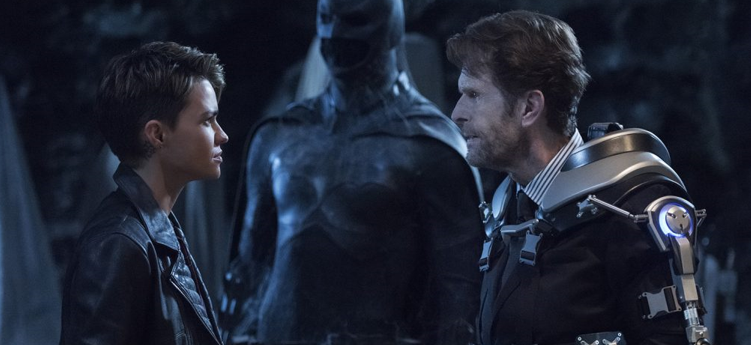
Since Oliver is now well-versed in multiversal crossovers and events, and unexpectedly killed before his time, it is Batwoman who brings the pragmatic cynicism and is the fish out of water in Crisis on Infinite Earths. “Part Two” (Belsey, 2019), which was the ninth episode of Batwoman’s (2019 to present) first season (although it was the last episode here in the United Kingdom), explores her attempts to adapt to the unusual situation she finds herself in. Failing to see how her abilities, as vast as they are, can measure up to cosmic threats, Kate is distrustful of her colourful associates and begrudgingly agrees to tag along purely on Kara’s word and in the face of a clear and present threat. The revelation of the Paragons drives Kate into an unexpected voyage of self-discovery; initially, she believes her destiny is to recruit the Bruce Wayne of Earth-99 (Kevin Conroy) and, in the process, comes across a jaded and broken version of her cousin who has descended into a murderous and disillusioned crusade. Rattled by this incarnation of Bruce, and her actions in contributing to his death (to keep him from killing Supergirl), Kate is somewhat sceptical to learn that she is the Paragon of Courage.

Tired of killing Superman, Luthor compels the Earth-96 Kal to kill his Earth-38 counterpart.

The quest for the Paragons takes Superman, Lois, and Iris West-Allen (Candice Patton) to first Earth-167, where they briefly encounter a depowered version of Clark (Tom Welling), and then to Earth-96 and an older, far more troubled incarnation of the Man of Steel (Routh). In possession of the Book of Destiny, Lex Luthor (Cryer), who was returned to life to play a vital role in the Crisis, travels throughout the multiverse killing Superman and, ultimately, forces Superman to fight his Earth-96 counterpart in a brief, exhilarating moment before Lois and Iris wake up and realise that they can just punch Lex out. Lex, however, gets the last laugh by manipulating the Book of Destiny to replace the Earth-96 Superman with himself as the Paragon of Courage

Although fully prepared to meet his destiny, Barry’s Earth-90 counterpart takes his place.

As mentioned, Barry has also been trying to prepare for his untimely end; he’s been aware that he disappears, most likely due to his death, in a red-sky Crisis and he is so angered at Oliver’s death and the Monitor’s manipulations that he is driven to using the restorative nature of the Lazarus Pits to bring Oliver back to life in a crazed state with the help of John Constantine (Matt Ryan). “Part Three” (McWhirter, 2019), which aired as episode nine of season six of The Flash (2014 to present), leads Barry to facing his fate in the worst way possible when he is forced to watch the Earth-90 Flash (John Wesley Shipp) sacrifice himself to destroy an anti-matter cannon. Although Barry is more than willing to fulfil what he believes is his destiny, his counterpart takes his place willingly and, in the process, allows Barry to live on for his friends and family while also providing a fantastic excuse to showcase some highlights from Shipp’s turn as the Flash back in the nineties.

Both Luthor and Harbinger become brief secondary threats amidst the Crisis.

Of course, the intangible threat of the destructive anti-matter wave and the ominous fate that awaits Oliver and Barry isn’t the only threat facing the Arrowverse characters; throughout their journey across the multiverse to defend the Monitor’s Quantum Towers, they must battle against fittingly Grim Reaper-like “Shadow Demons” that, despite being easily destroyed, have the advantage through sheer numbers and their threat is escalated by the fact that Oliver was practically torn apart by them offscreen. Additionally, thanks to messing around with the Book of Destiny, Luthor manages to position himself as a man of incredible metahuman powers who first attempts to kill Supergirl in an effort to usurp the Monitor’s destiny and then, reluctantly and unwillingly, to join forces with the heroes. Lyla Michaels/Harbinger (Audrey Marie Anderson) also takes on a brief antagonistic role when she ends up falling under the influence of the crossover’s primary, physical antagonist, Mobius/The Anti-Monitor (Garrett), which causes her to betray and murder the Monitor against her will and set in motion the final days of all reality.

As secretive as the Monitor is, the Anti-Monitor craves nothing but complete annihilation.

The Monitor himself is a deceptive and mysterious character; thanks to Luthor’s manipulations, we learn in “Part Four” (Winter, 2020) that it was he, in his far more mortal form, who birthed the Anti-Monitor in a desperate and misguided attempt to view the creation of the universe. Of course, while the Monitor inspires much distrust and anger from the heroes (especially Barry), the Anti-Monitor is a form of pure, unadulterated evil; similar to other crossover threats, the Anti-Monitor is an elusive and ominous being who isn’t revealed in full until the conclusion of “Part 2”. His motivations are nothing less than pure destruction, making for a decidedly one-dimensional villain but, in truth, the Anti-Monitor has always been that way; he simply exists as a singular, cosmic force of evil for the heroes to unite against.

The stakes have never been higher or dourer than in Crisis on Infinite Earths.

Fittingly, for an adaptation of the greatest and most devastating storyline in DC Comics history, the stakes couldn’t be higher in Crisis on Infinite Earths; though a prevailing concept throughout the crossover is the idea of hope conquering above all, the odds are constantly against our heroes as entire worlds are wiped from existence, killing many of the supporting characters, and leaving the handful of remaining characters trapped at the Vanishing Point with no hope of escape and alongside Luthor, of all people. In their darkest hour, Oliver, as the Spectre, comes to them with a vague shot in the dark at reversing their fortunes but, even then, the cost is high. This, again, gives the crossover another excuse to run through some of Arrow’s greatest hits so that the disparate parts of his personality can be reunited in the speed force and empower him to transport them to the anti-matter universe and the inevitable showdown with the Anti-Monitor. I won’t lie; I can’t say that I’m a massive fan of the grim, gritty, grounded vigilante ultimately being to one to save and restore the entire multiverse and being the saviour of all humanity but even I have to admit that it’s an almost peerless heroic end for the character.

At great cost, reality is saved and the Arrowverse’s Justice League officially forms.

In the end, with all seven Paragons gathered and united (however reluctantly, in Luthor’s case) and the Spectre locked in a dual with the Anti-Monitor, the heroes are able to light the spark that reignites a new version of not just Earth-1 but the entire multiverse. Though he dies in the process, Oliver is finally at peace and leaves the future to his friends and family who, in “Part Five” (Smith, 2020), find their world has radically changed as a result; for one thing, many characters and locations are now on an amalgamated world dubbed “Earth-Prime” and, for another, Luthor is a world-renowned hero, and no one has any memory of what happened except the seven Paragons. Thanks to J’onn’s psychic powers, they are able to piece together what happened but, while they are able to ultimately banish the Anti-Monitor to the microverse, they are heart-broken to discover that Oliver is not among those restored by the entire process. In celebration of Oliver’s sacrifice, the Flash, Supergirl, J’onn, Batwoman, and Black Lightning hold a memorial service for their fallen comrade and officially give birth to the Arrowverse incarnation of the Justice League that, sadly, will look decidedly different in the near future.

The Summary:
For such a large and ambitious crossover, Crisis on Infinite Earths does pretty well when it comes to its special effects; again, as we’ve seen in the other Arrowverse crossovers, some of these hold up better than others (Ray Terrill/The Ray (Russell Tovey) still looks terrible even in his brief appearance, as does Lyla’s teleporting effects and the “temporal zone”, but the destruction of the infinite worlds is disturbingly effective) but I’d say the CW did really well, especially when you consider that Marvel Studios spent billions of dollars on its big screen crossovers and it’s frankly ludicrous that they ever decided to greenlight an adaptation of Crisis on Infinite Earths. As you might expect, costume design is absolutely spot on; Nash Wells/Pariah (Cavanagh), the Monitor, and Anti-Monitor look a little goofy but I can’t fault the fidelity to the source material and the crossover delivers an absolutely fantastic adaptation of Bruce’s exoskeleton armour and the Kingdom Come (Waid, et al, 1996) Super-suit.

It probably should have been called Cameos on Infinite Earths…No? Just me?… Okay…

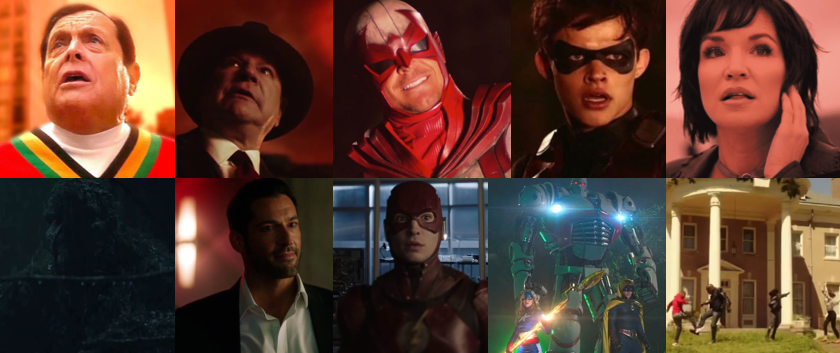
Of course, one of the most appealing and entertaining aspects of Crisis on Infinite Earths is the sheer abundance of cameos and references to other live-action adaptations of DC Comics; most of these are fleeting, appearing onscreen simply to be destroyed in seconds, but some are prominent aspects to the crossover’s massive narrative. Accordingly, we get much-appreciated and surprising appearances by Dick Grayson (Burt Ward) from the Batman sixties show, Alexander Knox (Robert Wuhl) from Batman (Burton, 1989), Hank Hall/Hawk (Alan Ritchson) and Jason Todd/Robin (Curran Walters) from Titans (2018 to present), Helena Kyle/The Huntress (Ashley Scott) and Barbara Gordon/Oracle (Dina Meyer) from Birds of Prey (2002 to 2003), Alec Holland/Swamp Thing (Derek Mears) from Swamp Thing (2019) and the cast of both Stargirl (2020 to present) and Doom Patrol (2019 to present). The crossover also splices in surprise appearances by Wil Wheaton, Wentworth Miller, comic creator Marv Wolfman, and even Ezra Miller alongside numerous references and allusions to comic book arcs such as the Death of Superman (Jurgens, et al, 1992 to 1993), and even setting up a potential spin-off for John Diggle (David Ramsey) after he appears to find a Green Lantern ring.

Sadly, not every character gets a large role in the massive crossover…

Interestingly, despite all these cameos (and more) and the myriad of characters from across the Arrowverse, Crisis on Infinite Earths does a surprisingly good job of balancing its pace, action, and cast; in the beginning, things are very rushed and frantic but, once everyone is gathered together, the story focuses up quite nicely. The stakes stay high and ominous throughout as we’re constantly reminded of the impending doom but there’s still time for a few amusing character moments, such as Mick Rory/Heat Wave (Dominic Purcell) realising his paternal instincts. Of course, with so many characters included and so much at stake, Crisis on Infinite Earths features a wide array of action and fight scenes; to make the best use of the many powers and characters in the crossover, these are largely ensemble pieces that truly unite the Arrowverse in a way we haven’t seen before. Even those who are largely side-lined throughout the crossover, like Diggle, for example, get something to do (he is incensed at Oliver’s death and joins Constantine, and Mia in journeying to Purgatory to retrieve Oliver’s soul) and many of the supporting characters contribute to the overarching plot even though their efforts are ultimately in vain. Some cameos, however, are all-too-brief; many of the Legends and Team Arrow get short-changed this time around, Lucifer Morningstar (Tom Ellis) was a welcome and unexpected inclusion but, sadly, the crossover chose not to bring Emmett J. Scanlan back as Jim Corrigan and, despite Ryan Choi (Osric Chau) and Black Lightning’s pivotal roles in the larger narrative, they’re not as heavily showcased as the more recognisable and established Arrowverse characters.

Such an elaborate crossover would never have been possible without time and dedication.

I said at the start that I never expected to see Crisis on Infinite Earths ever be the basis for an adaptation, much less a live-action adaptation; it barely works in the comics, to be honest, as it requires quite a lot of knowledge about DC Comics and outlandish concepts like the multiverse. Thankfully, the Arrowverse version of events focuses its adaptation by concentrating on the main Arrowverse characters, surrounding them with a myriad of cameos and references, and buildings its concept around these familiar aspects. If you’ve never watched an Arrowverse show before then of course it’ll be quite a daunting first start but, like its comic book namesake, it is clearly not intended for casual fans or newcomers. It’s interesting watching these Arrowverse crossovers back-to-back as Invasion! (Various, 2016) feels so rushed and frantic in comparison and Crisis on Infinite Earths does a much better job of balancing a far bigger and more diverse cast, which I honestly wouldn’t expect considering how daunting its concept is. Of course, this crossover would never have been possible without the long-running, episodic nature of the CW shows and that’s exactly why it works in a way that DC’s cinematic films often fail; rather than trying to cram everything into a couple of films, or tossing it all into a four-hour long epic, the Arrowverse was able to naturally build towards this crossover and deliver from start to finish and it’s honestly a shame that the films couldn’t have followed suit and that the Arrowverse is basically coming to an end now.

My Rating:

Rating: 5 out of 5.

Fantastic

What are your thoughts on Crisis on Infinite Earths? Did you ever expect to see the Arrowverse culminate in an adaptation of one of comics’ biggest crossover events? How do you feel the adaptation was handled? Which cameo was your favourite and which would you have preferred to see be featured more prominently? How did Oliver’s death affect you, if at all, and which of the CW Arrowverse shows is/was your favourite? Are you sad to see that the Arrowverse has changed following this event or do you feel it’s time for it to move on? Do you agree that building towards such an elaborate crossover is a matter of time, patience, and character development or were you not bothered by Zack Snyder’s attempts to cram it all into a couple of movies? Which of the many multiversal crossover events was your favourite, whether in comics, videogames, TV, or movies? Whatever your thoughts, go ahead and drop a comment down below and check back in again for more superhero content throughout the year.

Movie Night [Robin Month]: Batman & Robin


In April of 1940, about a year after the debut of arguably their most popular character, Bruce Wayne/Batman, DC Comics debuted “the sensational find of [that year]”, Dick Grayson/Robin. Since then, Batman’s pixie-boots-wearing partner has changed outfits and a number of different characters have assumed the mantle as the Dynamic Duo of Batman and Robin have become an iconic staple of DC Comics. Considering my fondness for the character and those who assumed the mantle over the years, what better way to celebrate this dynamic debut than to dedicate an entire month to celebrating the character?


Released: 12 June 1997
Director: Joel Schumacher
Distributor: Warner Bros. Pictures
Budget: $160 million
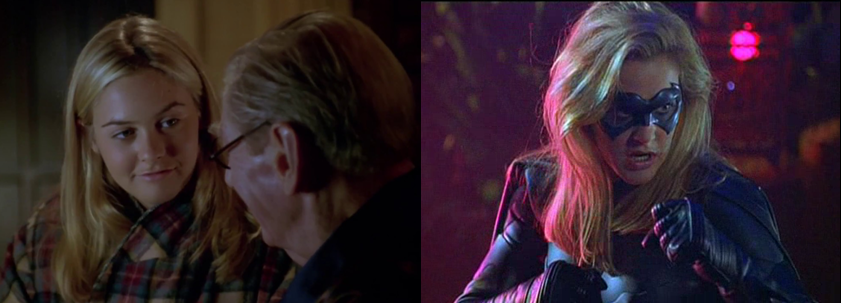
Stars: George Clooney, Chris O’Donnell, Arnold Schwarzenegger, Uma Thurman, Alicia Silverstone, Jeep Swenson, and Michael Gough

The Plot:
Gotham City is under siege from Doctor Victor Fries/Mister Freeze (Schwarzenegger), who is intent on freezing the city in order to save his critically-ill wife, Nora (Vendela Kirsebom). At the same time, Pamela Isley/Poison Ivy (Thurman) finds herself endowed with a poison kiss and irresistible pheromones, which she uses to turn Bruce Wayne/Batman (Clooney) and Dick Grayson/Robin (O’Donnell) against each other and distract them from her plot to turn nature against humanity.

The Background:
With the release of Batman (Burton, 1989), “Batmania” swept across the world as part of Batman’s much-needed reinvention into a far darker and grittier interpretation. When the sequel, Batman Returns (ibid, 1992), upset parents and sponsors with its macabre content, Warner Bros. turned to Joel Schumacher to lighten up their live-action Bat-franchise with the often under-rated Batman Forever (Schumacher, 1995), the success of which spurred them to immediately greenlight a sequel. When Warner Bros. again shot down Schumacher’s plans for a darker, more cerebral follow-up, the director begrudgingly acquiesced to their desire for a lighter, more kid-friendly movie by leaning into the campy styling of the classic 1960s television show and comic books. With the troublesome Val Kilmer absent from the title role due to “scheduling conflicts”, the up-and-coming and popular George Clooney was picked as his replacement specifically to portray a lighter version of the character and Arnold Schwarzenegger was convinced by a hefty $25 million salary to portray the film’s primary antagonist. Thanks to the sequel’s rushed production and deadline, shooting was a chaotic time for the cast and crew, with Schumacher repeatedly urging the actors to treat the film as little more than a live-action cartoon and toy companies being heavily involved in the look and content of the film. All of this came to be reflected in the film’s dismal box office and scathing critical reception, which derailed plans for a potential follow-up. In the years since, Clooney has never been shy about voicing his disdain for the film and the late Joel Schumacher would (perhaps unfairly, due to him being under immense pressure at the time from Warner Bros. to deliver a specific interpretation of Batman) shoulder much of the blame for the film’s failings.

The Review:
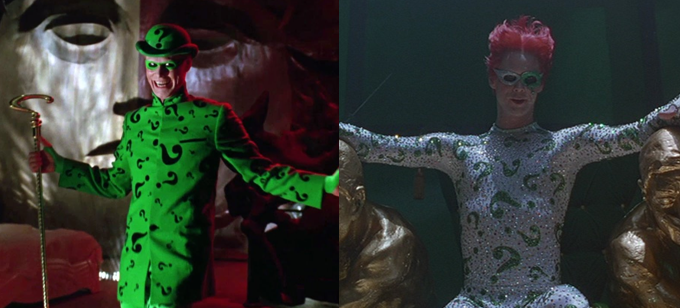
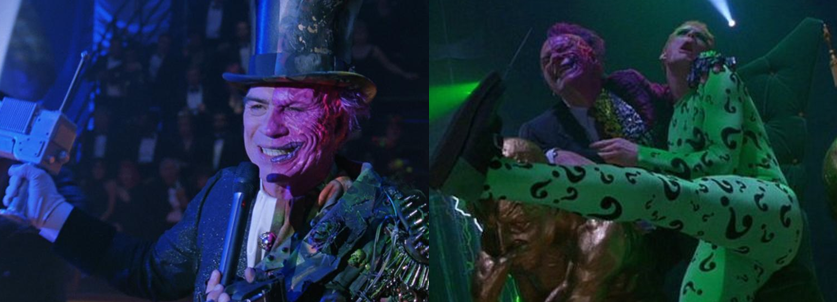
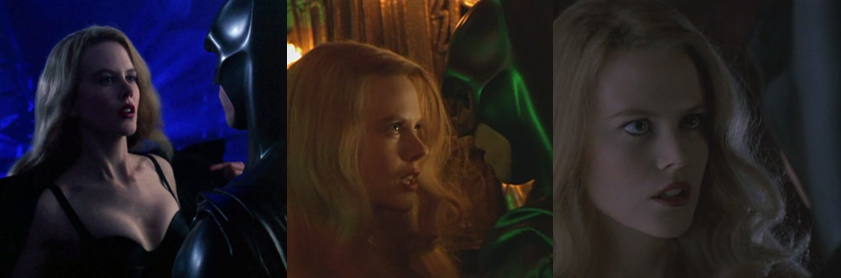
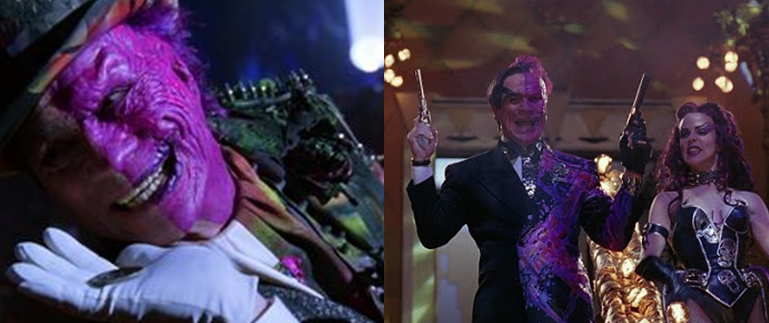
Although it’s easy to pretend that Schumacher’s films are in their own bubble, that they’re not related to Tim Burton’s early, far darker efforts, Batman & Robin is clearly a sequel to Batman Forever and still in the same (loose) continuity as the Burton films. Think of these older Batman films like the James Bond franchise; some actors change, some stay the same, but there are enough references and allusions to the previous films to keep them in the same wonky timeline. For example, because Edward Nygma/The Riddler (Jim Carrey) destroyed the Batcave and the Batmobile in Batman Forever, it makes sense for there to be new toys suits and vehicles and such. The Riddler and Harvey Dent/Two-Face’s (Tommy Lee Jones) costumes can even be seen in Arkham Asylum, further tying the films together, though there’s strangely no mention of Doctor Chase Meridian (Nicole Kidman); Bruce is, instead, dating Julie Madison (Elle Macpherson) and has been for a long time. It’s a minor inclusion in the film that really serves no narrative purpose and it would have been much simpler to not have a woman on Bruce’s arm at all, to be honest.

The only distinction between Clooney’s Batman and Bruce is the anatomically correct rubber suit.

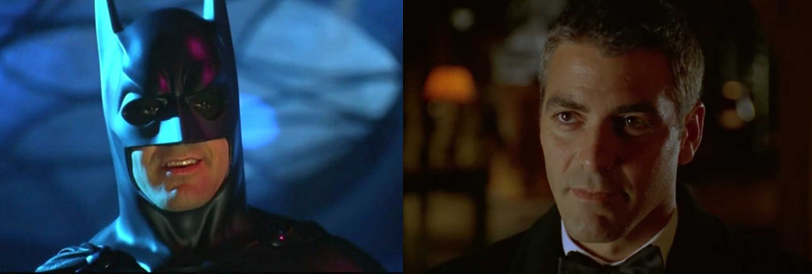
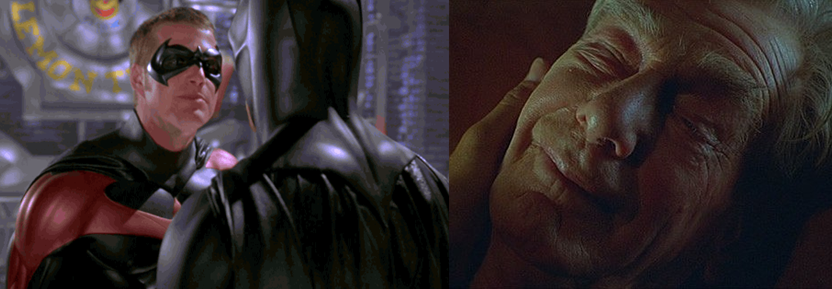
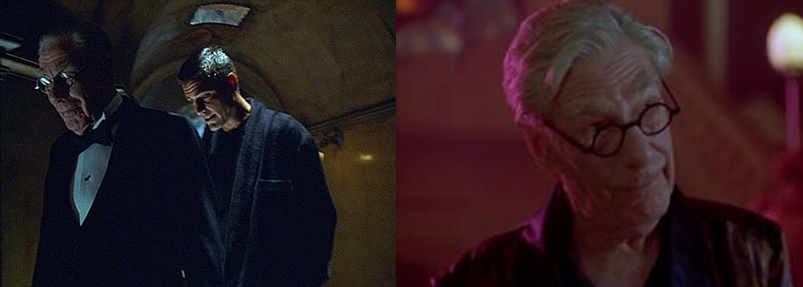
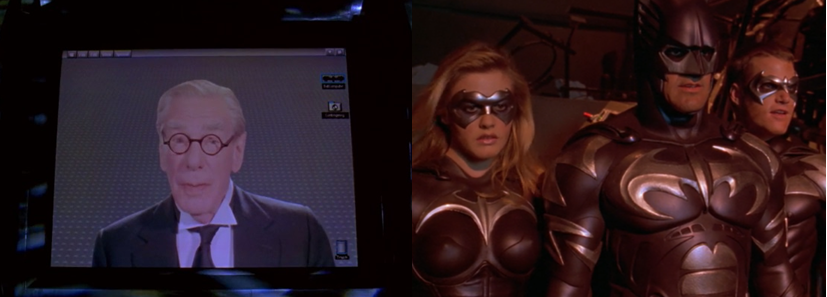
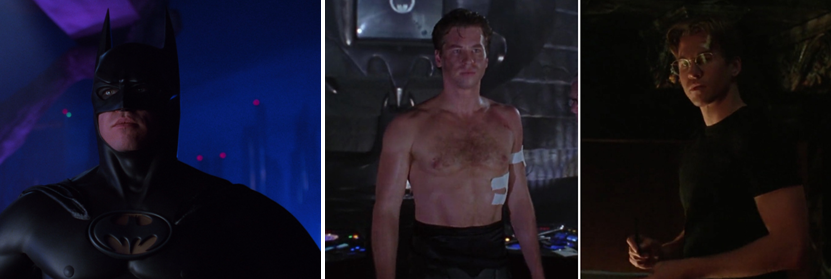
Val Kilmer might not be everyone’s cup of tea in Hollywood but he was a far more fitting choice for the dual role of Batman and Bruce Wayne than Doctor Doug Ross. Clooney’s Batman can be seen as an evolution of Kilmer’s since, in Batman Forever, Bruce came to terms with his pain and grief but he’s at the extreme other end of the spectrum, basically having transformed into the Adam West Batman; he’s chatty, polite, makes numerous public appearances, and is a revered superhero through and through. Despite being the only Batman to truly have a “no kill” policy in place (and even that is debatable when you factor in the big chase sequence between Batman, Robin, and Mr. Freeze), Clooney is pretty much the worst Batman ever in a lot of ways; he lacks the physical stature of Kilmer and the raw intensity of Keaton. He’s also pretty short and uninspiring in the role, despite the work of his stunt man, and there’s no real distinction between his Bruce Wayne voice and his Batman one except that, as Batman, he’s a little more…I don’t know, professional, maybe? Either way, the lines between the two are marginal, at best, and the only thing he brings to the role is an impressive emulation of Adam West’s iconic portrayal of the character. You can really see this in all the little nuances and inflections he utilises as Batman but, what makes his portrayal stand out is the unique narrative he gets in his building tension with Dick and his emotional arc with his father-figure, Alfred Pennyworth (Gough).

The film explores Bruce’s partnership with Dick and relationship with Alfred.

Dialogue between Bruce and Alfred reveals that Bruce doesn’t trust Dick to not get hurt and the crux of Bruce’s arc in this film; he’s afraid to trust, afraid to love, and afraid of the concept of them being a true family and partnership. He initially balks at this since he trusts Alfred but Alfred gently advise that he “shan’t be [there] forever”. He desperately tries to talk sense into Dick, whose resentment is fuelled by Poison Ivy’s influence, and his arc is about recognising the family dynamic they all have and trusting Dick to be responsible in his own way. Similar to Kilmer’s arc in Forever, though, the resolution to this is somewhat anti-climatic as Bruce is eventually able to get Dick back on side by repeating his own words about trust and family back to him in an exchange that includes a standout line (“She wants to kill you, Dick”) that never fails to get a snort of laughter out of me. Ultimately, though, there are a lot of Clooney apologists out there who will swear blind that he is capable of putting in a good performance as the character with a better script or direction; well, I would counter argue that these beliefs are based on Clooney’s abilities today; back in 1997, he was a goofy, bland choice (even he admitted that he was miscast in the role) clearly motivated by the actor’s popularity on ER (1994 to 2009) and, while his inclusion isn’t the worst part of the film, it’s certainly a significantly disruptive cog that left the franchise dead in the water and no amount of accolades or improvements in his ability can ever shake my dislike for Clooney as an actor.

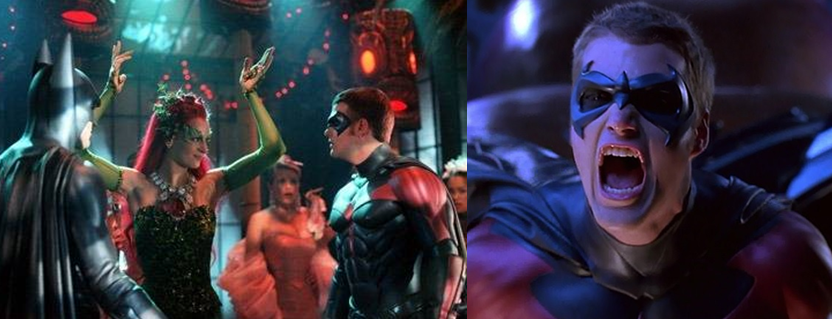
Poison Ivy’s influence exacerbates Robin’s feelings of resentment towards Batman.

Luckily, though, Stephen Amell Chris O’Donnell returned as Dick Grayson, now portraying Nightwing in everything but name and sporting a fantastic red-themed replica of his suit and all his own gadgets and such. Far from the angst-filled biker boy of the previous film, Dick has matured into a respectable young man and hero in his own right and much of his conflict with Bruce stems from the fact that he is on the cusp of breaking away from Batman’s shadow and becoming his own man. While they work well together as partners, Batman is shown to be overly critical and condescending towards Robin, admonishing him for nearly breaking a priceless vase, leaving him to tackle Mr. Freeze’s thugs, and even reprimanding him when he comes to save him from Freeze’s ridiculous rocket ship. Ultimately, the first real signs of tension between the two come after Robin is frozen by Mr. Freeze after acting on his reckless impulses. Bruce punishes him by ordering him to spend “ten hours in the simulation training” (though it’s unclear if this is a virtual reality simulation or a real-life simulator of sorts), which frustrates Dick since he believes that he’s being unfairly punished for making a simple mistake and that Bruce doesn’t trust him. In Bruce’s defence, Bruce would mostly likely take a small mistake just as seriously and train himself to do better both to improve and as a form of punishment. Still, Poison Ivy’s subsequent influence over both of them (but especially Robin) exacerbates Robin’s feelings of resentment towards Bruce into aggression; in these heated exchanges, we see that Dick feels that Bruce is holding him back and keeping him from being all he can be and being overly protective. All he wants is Bruce trust and respect and for them to work together on equal ground but his hot-headedness, intensified by Ivy’s manipulations, brings all these deep-rooted feelings to the surface and results in a series of arguments and even the two coming to blows.

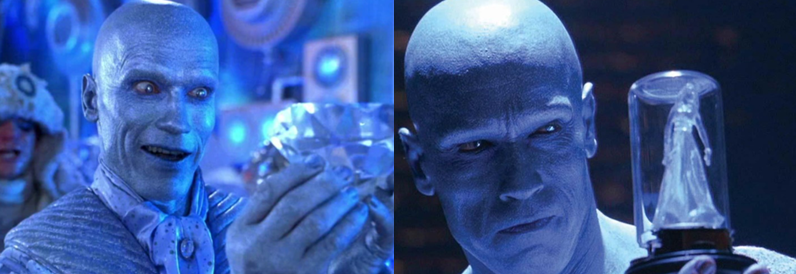
Mr. Freeze is, thematically, all over the place, switching from mania to pathos on a dime.

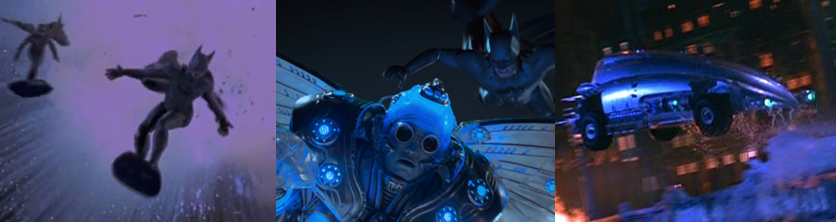
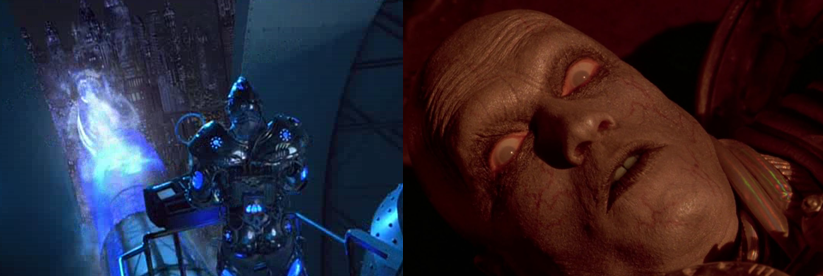
All of this serves as additional drama amidst the unrelenting crime spree of Mr. Freeze, a character largely more concerned with making every ice-pun in the book and revelling in destruction rather than exuding the intelligence and pathos audiences came to expect from the character after the excellent “Heart of Ice” (Timm, 1992) episode of Batman: The Animated Series (1992 to 1999). Instead, Freeze is a bombastic cartoon villain for kids and Arnold is clearly having a good time in the role but it’s difficult to believe that this man was ever a Noble Prize-winner scientist or a doting, loving husband. It’s similar to Two-Face, who was so maniacal and over the top and introduced already as a crazed supervillain so we never got a chance to see or truly appreciate the true tragedy of the character. Instead, we’re left with a Saturday morning cartoon villain garbed in fantastical intricate and well-crafted suit of armour. Still, Mr. Freeze is such a weird dichotomy of extremes; he’s this cringey supervillain, forces his minions to sing in his frozen lair, is a relatively eloquent and sophisticated man at times (especially when puffing on a big fat cigar and relating his plans to steal diamonds and hold the city to ransom with his giant freezing cannon), and also a tragic figure haunted by his past and his wife’s condition. One minute he’ll be yelling and acting like a petulant child but the next he’s weeping icy tears and pining for his cryogenically frozen wife. It’s a chaotic mess of conflicting emotions and makes any sympathy we might feel completely redundant because he’s so over the top! The film even tries to pull at the same heartstrings as “Heart of Ice” but it fails miserably even as an imitation of that ground-breaking episode, which really should have been the template for Freeze’s characterisation and motivation. Again, like in Batman Forever, the film would have worked much better if everything had been played completely straight (but especially Freeze), with only Ivy as the zany, madcap villain to allow the comedic elements to come naturally out of the straight-faced camp.

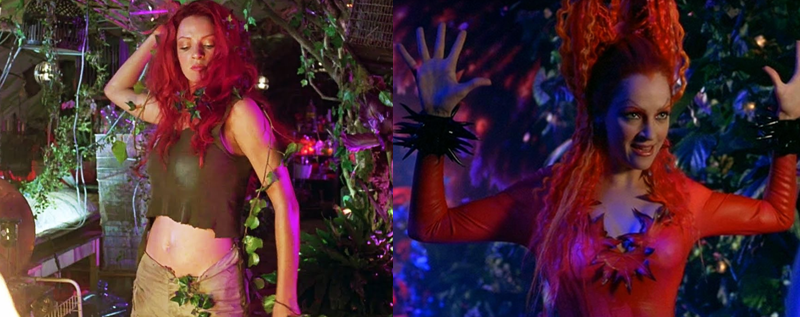
Rather than being killed by toxins, Isley becomes a sultry femme fatale with a deadly kiss.

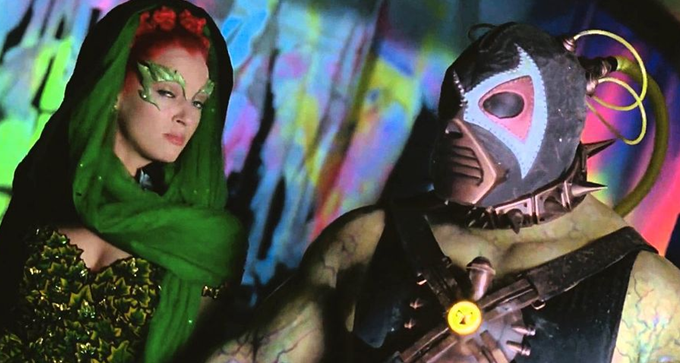
Getting on to Poison Ivy, like the Riddler in the last film she is actually afforded an origin story and first introduced as Pamela Isley, a kooky and awkward scientist obsessed with genetically crossbreeding plants with animals so that they can fight back against the “thoughtless ravages of man”. She seals her fate when she happens upon her boss, Doctor Jason Woodrue (John Glover), using a bastardised version of her research to transform the deranged serial killer Antonio Diego (Michael Reid MacKay) into a mindless super-soldier Woodrue christens as “Bane” (Swenson). The idea that Woodrue had this whole evil lair right beneath Isley’s laboratory is ridiculous and it’s insane that she never stumbled across it until Woodrue was in the middle of showcasing his formula and auctioning Bane off to a group of terrorists and other unscrupulous individuals. Still, Woodrue’s subsequent attempt to kill Isley results in the poisons and toxins genetically altering her into Poison Ivy, a pheromone-induced supervillainess with a deadly kiss who begins a crusade against Bruce Wayne since he once funded their work. Whereas Nygma was already a bit of a nutjob before being spurned by Bruce Wayne and exposed to his “Box”, this transformation instantly alters Isley into an alluring, confident, half-crazed femme fatale who is obsessed with using her newfound abilities to manipulate men into aiding her cause to allow plants to overtake the world. Ivy’s “pheromone dust” is an effective way of stoking the tension between Batman and Robin and she’s not quite as maniacal as Freeze, Two-Face, or the Riddler but she’s still a massively over-dramatic, cartoony villain who monologues at every opportunity, cackles with glee, and even throws in an elaborate cry of “Curses!” when she’s defeated. Ivy is willing to kill millions of people to allow the planet, and plants, to thrive once more; like with Nygma, Bruce is patient and sympathetic to her cause but cannot sanction any action that causes such a death toll and, although Pamela’s presence appears to have an alluring effect on him, it’s at the auction where she, as Poison Ivy, truly begins to influence both him (as Batman) and Robin with her pheromones.

Bane, a neutered shadow of his usual self, was little more than a glorified henchman.

So smitten by her allure are they that they begin a very public, very childish bidding war for her services, resulting in one of the most cringe-worthy moments in not just a Batman movie but all of cinema…yet, in a bubble that sees this as an extension of the bright, campy sixties Batman, you can see this as a fun (as in “daft”) scene. When Mr. Freeze crashes the party, Ivy is immediately in awe of his strength, conviction, and direct approach; when her pheromones have no influence on him, she becomes even more interested in him as a potential partner and, just as Robin is infatuated by her, she comes to be enamoured with Freeze. To that end, she and Bane break Freeze out of the ridiculously elaborate Arkham Asylum (literally a gothic castle on a storm-swept island!) and, when he continually shoots down her advances, she kills off his wife out of jealousy and to sway him into an alliance to freeze first Gotham, and then the world, and have her animal/plant hybrids rule what’s left alongside them. Far from the intellectual mastermind of the comics, Bane is a hulking, mindless brute who follows Ivy’s commands simply…because (she’s never shown using her pheromones on him so it’s unclear exactly why he submits to her). As in many interpretations, Venom is both his strength and weakness, making him simultaneously superhuman but also reducing him to a quivering, helpless wreck when his tubes are severed. He exists simply because Bane was popular at the time thanks to the influential Knightfall storyline (Dixon, et al, 1993 to 1994) but could easily have been any other Bat-brute; I’m thinking Waylon Jones/Killer Croc would have been a far better fit.

She’s not much more than eye candy but Alicia was servicable enough as Batgirl.

To help even the odds a bit, Batman & Robin brings a version of Batgirl into the fold; traditionally, it is Commissioner Jim Gordon’s daughter, Barbara Gordon, under the cape and cowl of Batgirl but, here, it’s Barbara Wilson (Alicia Silverstone), Alfred’s hitherto-unknown niece. A minor change, to be sure, but one that I’m actually onboard with since Gordon (Pat Hingle) is so inconsequential in this film and it helps to both make her slightly more relevant to the story and reveal hidden layers to Alfred’s character and backstory since he’s never mentioned her or his extended family before because of his stringent commitment to decorum. While the experience was quite harrowing, to say the least, for Silverstone, it can’t be denied that she doesn’t exactly impress with her acting chops and is easily the weakest link in the film, but she’s fantastic as eye-candy and plays the part of both flighty, innocent schoolgirl and bad girl racer well enough, Barbara’s intentions are also quite interesting in that she arrives at Wayne Manor to liberate Alfred from what she sees as a life of servitude; she initially doesn’t understand or appreciate the family dynamic Alfred has with Bruce and Dick and takes part in dangerous, illegal street races to win the money she needs to take him away from his life. Naturally, Dick is immediately attracted to her; she mostly deflects his advances and obvious flirting, preferring to focus first on racing for money and her love for Alfred and then her commitment to helping Batman and Robin as Batgirl. Essentially, Batgirl exists to sell more toys and to allow for a fight scene with Poison Ivy; Batman and Robin are never seen even throwing a punch Ivy’s way so this allows for a more “even” fight to occur between the two females.

Alfred’s emotional side-plot really belongs in a better Batman movie…

Finally, there is the whole sub-plot regarding Alfred’s advancing age, illness, and mortality; although we see Alfred flinching in obvious pain and discomfort during the film’s bombastic opening, it’s only after Barbara arrives that the true extent of his illness is brought to light. This sub-plot is the true heart of the film as Bruce, Dick, and Alfred himself must come to terms with Alfred’s mortality; seriously ill, he makes preparations to have his brother takeover his duties but is unable to reach him and (similar to his actions with Dick in Batman Forever) surreptitiously puts Barbara on the path to becoming Batgirl. The film’s standout moments come in the heart-warming (and heart-breaking) exchanges between Alfred and Bruce about the merits of family and trust, with the two sharing a truly emotional scene where they profess their love and admiration for each other. It’s a fantastic side plot that really belongs in a better movie and there’s a twist, and nuance, to this side story as Bruce is haunted by flashbacks of his childhood with Alfred rather than the traumatic deaths of his parents, which is a refreshing change.

The Nitty-Gritty:
Essentially, Batman & Robin is almost beat-for-beat the same movie as Batman Forever: the score is largely unchanged; there’s a suit-up scene at the start with a cringey one-liner; a big, explosive fight with the new supervillain; a cliché villain team-up, a falling out between Bruce and Dick; and a new Bat-character is introduced, learns of their identities, before joining them for a big, climatic showdown featuring new suits and vehicles. Honestly, I actually dig the film’s costume design; the Batsuit isn’t that great but I actually like that it’s lacking any yellow colouring, Robin’s Nightwing suit is picture perfect, and Batgirl’s tight outfit is great for showing off her curves. Yes, the suits have nipples and clearly resemble rubber more than armour but I kind of get what Schumacher was going for with the design and it’s honestly not as distracting as some people make out. Frankly, if you’re spending your time fixated solely on Batman and Robin’s nipples then I think you might have a bit of a problem since there’s a lot of worse stuff in the film (the zany, madcap presentation, for example, is far worse since it’s just a hyperactive kids’ movie and little more than an expensive advertisement for a new line of Batman toys).

The film’s action sequences are completely cartoony and over the top!

Each of the film’s action sequences is like some kind of chaotic acid trip! Take the opening sequence, for example: Batman and Robin intercept Mr. Freeze at the Gotham Museum, contending with “the hockey team from hell”, performing all manner of physics-defying stunts and tricks, and conveniently sporting ice skates in their boots! Mr. Freeze freezes a dinosaur statue to cover his escape in a rocket that fires from his absolutely ridiculous Freezemobile! Batman follows and is left to freeze to death in space before Robin rescues him and they surf through the night sky on doors of the rockets to pursue Freeze, who sprouts wings from his armour! Having said that, though, the Batmobile/Redbird chase against the Freezemobile and Mr. Freeze’s goons is pretty good but would be even better if they weren’t racing across the building, iron biceps of a gigantic statue!

Mr. Freeze puts Gotham on ice but Batman eventually defeats him and appeals to his better nature.

However, as bombastic and over the top as Batman Forever’s finale was, Batman & Robin’s really takes the cake with Mr. Freeze using his diamond-powered gizmo to transform Bruce’s massive new telescope into a giant freezing cannon and cover the city in ice. Batman, Robin, and Batgirl race across the frozen city streets in their fancy new toys vehicles, scale the mountainous telescope, and then battle both Bane and Mr. Freeze over control of the telescope, maddeningly using satellites to…somehow…reflect sunlight from across the globe (why was satellite control even programmed into the telescope’s controls? Mr. Freeze wouldn’t have needed it for his plan and I don’t see how moving satellites would help with observing stars and planets…) to thaw out the city and put an end to Mr. Freeze’s mad designs. In the end, though, Batman takes pity on Mr. Freeze and appeals to his better nature, securing both a cure for Alfred and arranging for Freeze to continue his research at Arkham Asylum. I find it very interesting that the filmmakers utilised Mr. Freeze, of all of Batman’s rogue’s gallery, and can’t help but think that Doctor Jonathan Crane/The Scarecrow would have made for a far better villain (why is he even called “Mr. Freeze” anyway? The guy’s got a PhD! He’s underselling himself! He should be “Dr. Freeze!”). They could have consolidated Freeze and Ivy’s storylines into one villain, since both of their goals are easily adapted to suit Scarecrow, and told a far more grounded, intricate story about fear and overcoming it but that probably wouldn’t sell anywhere near as many toys now would it? While Batman doesn’t partake in any direct instances of murder in this film, Mr. Freeze is quite dark at times, declaring at one point his intention to “pull Batman’s heart from his body and watch it freeze in [his] hands” and there’s a lot of double entendre sand innuendo involving Poison Ivy that I find amusing was deemed acceptable by all those soccer moms who complained about how dark and inappropriate Burton’s films were.

Fight scenes are often spoiled by their cartoony nature and zany sound effects.

Gotham City is more neon-drenched and outrageous than ever, filled with even more giant statues, cramped streets, ornate skyscrapers, and other impractical architecture (even Bruce Wayne’s observatory is a garish, steampunk-like construction built into a mountain!) Fight scenes, though comical, are fast and frenetic and full of unfeasible physical stunts and actions but, again, at least we’re seeing a physically capable Batman and Robin. Sadly, fights are often spoiled by their cartoony nature, which includes accompanying zany sound effects wherever possible. Gotham is populated by a garish variety of street thugs; the neon-clad gang for Batman Forever return and a variety of undesirables are present at the underground race, from Clockwork Orange (Kubrick, 1971) lookalikes to punks and biker gangs. While the public, and police, are massively dependant upon Batman and Robin, more so than ever before, and revere the two as protectors and heroes (they are called in at the first sign of trouble and even make highly publicised appearances at things like auctions and police crime scenes), these types of gangs and criminals don’t get much focus in this film. Like in Batman Forever, street criminals are no longer Batman’s focus since he’s too busy fighting supervillains as a “superhero” rather than being the scourge of criminals across the city. The implication is that criminals are afraid of Batman enough that they no longer cause violent crimes but the gang was clearly planning to rape that girl in Batman Forever and the bike race is extremely dangerous in this film so you’d think Batman would put some effort into curtailing these criminal elements but…apparently not. This is kind of why I dislike the idea of Batman as a “superhero”; his focus should always be street level and against corruption and organised crime first. Sure, supervillains exist in Gotham but I feel like they’ve overshadowed Bruce’s original mission, which was to protect others from random acts of violence like the one he witnessed as a kid; Batman & Robin is a glaring example of the extreme other end of the spectrum and I wish I could say modern Batman stories aren’t routinely obsessed with large-scale, supervillain threats to Gotham but the sad truth is that they often are. Give me a dark, gritty tale focusing on corruption, street crime, and maybe the machinations of a colourful/maniacal rogue over city/world-dominated plots any day.

It’s clearly a product of a different time but its themes of family and trust are surprisingly poignant.

Annoyingly, the Bat-Cave still opens up and activates when there’s an intruder only now it’s even worse since a Max Headroom (Matt Frewer) version of Alfred politely greets any intruders. Though only a brief inclusion, the very idea that Alfred was somehow able to “program his brain algorithms into the Batcomputer” is both ludicrous and startling in its implications. I also love that Robin renders Ivy’s poison kiss mute with rubber lips when, arguably, it’s the saliva from her kiss that is venomous rather than just skin-on-skin contact but, to be fair, the film does present it as this latter way rather than the former so I guess it’s okay…? Finally, Batman is far more accepting of Barbara as Batgirl than he was of Dick as Robin, potentially because they are heading into the cartoony finale of the film so there’s no real time to focus on his reaction to her dynamite debut, instead accepting it right away and with a couple of one-liners. If I’m Robin, I’d be a bit annoyed at this since Barbara has far less training and experience and is something of a liability for all her enthusiasm (she clearly flounders in her fight with Ivy before winning with ridiculous ease because the script says she must). Still, she takes to her new role amazingly well and is easily able to use all of her suit’s gadgets, and to hold her own in fights against Poison Ivy and Bane. She then shows the unique talent she brings to the role in her computer skills, though I find it hard to believe that Batman, of all people, wouldn’t be able to handle such a task. The scene, however, is framed in a way to show Batman accepting of the help of others and the two of them as his partners and family.

The Summary:
As a kid, I remember seeing this film at the cinema and absolutely loving it; I was firmly of the belief that the Batman movies just got better and better with each new film, adding more and more characters, villains, and recognisable elements from the comics I so enjoyed. I watched all the live-action films, the sixties movie, and was reading Batman stories from the sixties to nineties at the time and never had any trouble distinguishing between them. It was just Batman in different forms, and I was excited to see more of him, especially with Robin by his side. As an adult, it’s much harder to excuse the film since it’s a far cry from the dark, brooding Batman that is generally favoured but, when you view it as a love letter to the sixties Batman television series and bright, campy comics of that same era, you can kind of excuse a lot of its more glaring faults. It’s supposed to be a fun, mindless kids’ film; a live-action cartoon intended to sell toys and reap the rewards of its many and varied merchandise opportunities. It’s far from the guilty pleasure that Batman Forever is and it’s not the Batman I would prefer to see and I don’t like to hate on it because, for all its faults, at least it had the balls to use Robin and to tell an interesting story with both him trying to become his own man and hero and the side plot involving Bruce and Alfred.

My Rating:

Rating: 1 out of 5.

Terrible

Whew, well, that’s Batman & Robin, a divisive film, to say the least. What is your opinion on the film, its cast, and Schumacher’s unique direction for the character and franchise? Do you think George Clooney was a poor choice for Batman or do you also believe he could do the role justice with a different script? What did you think of the film’s portrayal of Mr. Freeze, interpretation of Batgirl, and Robin’s character arc? Would you have liked to see another Batman film under Schumacher’s direction? Whatever your thoughts, good, bad, or indifferent, please feel free to leave a comment below and come back next Tuesday for the last entry in Robin Month.

Screen Time [Crossover Crisis]: Elseworlds


In April 1985, the first issue of the ground-breaking Crisis on Infinite Earths (Wolfman, et al, 1986) released and saw the temporary destruction of the “Multiverse”. To celebrate this momentous event, I’m discussing multiversal crossovers all throughout April in an event I dubbed “Crossover Crisis”.


Air Date: 9 December 2018 to 11 December 2018
UK Network: Sky One
Original Network: The CW
Stars: Stephen Amell, Grant Gustin, Melissa Benoist, Jeremy Davies, Tyler Hoechlin, David Ramsey, Carlos Valdes, Chyler Leigh, and Ruby Rose

The Background:
The “Arrowverse” may have started as a grim, gritty reimagining of the life and times of Oliver Queen/Green Arrow (Amell) but it soon expanded to include all kinds of elaborate, comic book plotlines: time travel, metahumans, and parallel worlds were now all par for the course and annual crossovers with other superhero shows on the CW were a regular occurrence. After executive producer Marc Guggenheim noted that the cast and crew were pretty burned out by these massive crossover events, the CW relented that DC’s Legends of Tomorrow (2016 to present) would not have to be included in the next crossover. Elseworlds was heavily inspired by a comic book concept from the mid-to-late-nineties which, in the absence of the usual infinite parallel worlds, allowed writers and artists to tell out of continuity tales of popular DC characters. The event was also primarily constructed to finally introduce Gotham City, and Bruce Wayne/Batman, to the Arrowverse and setup a new Arrowverse show, Batwoman (2019 to present) through the introduction of Rubt Rose as Kate Kane/Batwoman. Each of Elseworldsthree episodes were received very positively and the production of the crossover not only saw a Batwoman spin-off take off not long afterwards but also brought the entire Arrowverse, and most of DC’s live-action adaptations, together for perhaps the biggest superhero crossover ever attempted the following year.

The Plot:
When psychiatrist John Deegan is gifted the Book of Destiny by a mysterious individual and begins rewriting reality to his every whim, Oliver Queen and Barry Allen/The Flash (Gustin) inexplicably switch bodies! After seeking help from Kara Danvers/Supergirl (Benoist), the three travel to Gotham City to track down Deegan, who plans to use the Book’s power to assume the powers and abilities of Clark Kent/Superman (Hoechlin).

The Review:
Elseworlds begins in earnest with, appropriately enough, “Part 1” (Tancharoen, 2018), which was the ninth episode of season five of The Flash (2014 to present). At that time, The Flash was knee-deep in the confusion and drama of Barry and Iris West-Allen’s (Candice Patton) daughter, Nora West-Allen/XS (Jessica Parker Kennedy), coming back in time to meet her father before his fated disappearance during a mysterious “Crisis” and to help Team Flash track down the big bad of the season, Orlin Dwyer/Cicada (Chris Klein). The central concept, and humour, of the crossover begins immediately after John Deegan is gifted the Book of Destiny by the mysterious Mar Novu/The Monitor (LaMonica Garrett) and Oliver Queen wakes up in the body of Barry Allen. Confused and disorientated, Oliver attempts to adapt to the confusing situation on the fly but, while he does blag his way through breakfast with Iris, he struggles to adjust to Barry’s superspeed and metahuman abilities. It’s amusing and entertaining to see Oliver struggling for a change; for all his training and preparation and adaptability, he’s totally out of his depth hanging around with Team Flash and having to be more open and honest with his feelings.

Barry is ecstatic to be in Oliver’s body and his enthusiasm rubs Ollie the wrong way.

Similarly, Barry finds himself without his superspeed and at the mercy of a beating from John Diggle/Spartan (Ramsey) and suddenly involved in Team Arrow’s campaign against Ricardo Diaz/Dragon (Kirk Acevedo). While Oliver struggles with his newfound powers and the bright, chippy nature of Barry’s team and city, Barry revels in having Oliver’s physical abilities; he only becomes motivated to get to the bottom of it all when Iris exhibits no recognition or belief in him. Normally, I’m not a massive fan of body swap storylines but seeing Barry and Oliver having to adapt to each other’s specific abilities and attitudes was an amusing twist for both; Barry has to dislocate his joints and adopt a far darker approach to his actions since Oliver’s focus and determination come from all of the anger and torment he’s been through. Conversely, Oliver must try and master (or, at least, stumble through) picking up Barry’s metahuman abilities and learn to act out of his feelings of love and positivity from his team and family. To try and get to the bottom of the body swap, which has also caused disconcerting red skies to cover the city, Oliver and Barry manage to escape and travel to Earth-38, where Kara is reconnecting with her cousin, Clark, and his partner, Lois Lane (Elizabeth Tulloch). This includes not only a fantastic little homage to Smallville (2001 to 2011) but also an amusing scene where Barry is in awe of Clark and Oliver puffs his chest out, and in which Oliver attempts to teach Barry how to actually use his abilities rather than relying on his powers and his team.

Even with Superman’s presence, it takes the entire team to defeat A.M.A.Z.O.

Annoyed at Barry’s pranks, Olivier tries to get a rise out of him but finds that he’s equally handicapped by Barry’s superspeed; in the end, the two are forced to admit that they are two very different people, with different motivations and experiences, which literally places each one in the other’s shoes. This forms the main conflict of the first episode and the crossover, leading to a lot of digs and points of contention between the two. Luckily, the two are able to focus their issues on a common enemy: the Anti-Metahuman Adaptive Zootomic Organism (A.M.A.Z.O.). Even better, Supergirl and Superman accompany them back to Earth-1 to battle the android, which can adapt to and counter their attacks and has absorbed a multitude of metahuman abilities. This means that Superman and Supergirl aren’t enough, by themselves, to defeat the android, which helps to emphasise the new teamwork dynamic of the crossover, and that actually gets to play a vital role in a crossover for the first time, a role that only increases in prominence and danger when Deegan takes over his body in “Part 3” (Warn, 2018).

Elseworlds finally brought Gotham City into the Arrowverse.

Deegan is largely absent for a great deal of Elseworlds but his ominous presence is felt through Cisco Ramon/Vibe’s (Valdes) visions and the chaotic events of the crossover. For the majority of Elseworlds, the heroes are on the backfoot, forced to adapt to new situations and constantly chasing tangential leads about the source of their body swap. “Part 2” (Bamford, 2018), which was episode nine of season seven of Arrow (2012 to 2020), leads Barry, Oliver, and Kara to Gotham City, a location often hinted at in the Arrowverse but never seen or explicitly referenced beyond cheeky allusions. A great deal of focus in the second episode is placed on the urban legend of the Batman; similar to how he felt emasculated in Clark’s presence, Oliver is annoyed and frustrated at the idea that he isn’t the “original vigilante”. Barry, however, continues to exhibit his crossover-characteristic enthusiasm for visiting Gotham and potentially meeting the Batman, whom Oliver is convinced is merely a myth used to scare criminals.

With Batman having been gone for three years, Gotham’s streets are haunted by a Batwoman.

After a run-in with some muggers (including one of my favourite characters and stuntmen, Daniel Bernhardt), the three are arrested (mainly because Oliver’s identity as the Green Arrow is public knowledge by this point) on the corner of “Burton and Nolan” but are bailed out by Kate Kane. Stoic and unimpressed with their presence, Kate is only interested in getting the three out of Gotham as quickly as possible; it’s through their interactions that we are brought up to speed with the state of Gotham, which is noticeably different compared to what we see in Batwoman. Bruce Wayne is gone, having been missing for three years, and with him the Batman; the Crows are nowhere to be seen and the Gotham City Police Department are still in full force; the Bat-Cave looks entirely different; and Kate is already Batwoman, making this episode’s placement in Batwoman’s continuity a bit difficult to judge. Supergirl mainly acts as peacemaker between Barry and Oliver throughout the crossover, painting her in a noticeably different role than in other crossovers, where she’s generally the optimistic and polite ace in the hole (one thing I continuously find odd is that Kara insists on wearing her glasses when on Earth-1, which may be out of habit more than anything). However, Kara gets a chance to shine by connecting with Kate, mainly due to Clark and Bruce being friends on her Earth, and is able to learn a little more about both Kate and Bruce and get a more definitive lead on Deegan at Arkham Asylum (which includes a number of references to famous Bat-foes and even Guggenheim himself). Despite Batwoman’s callous attitude and no-nonsense approach, she is won over by Kara and the two end the second episode having taken the first steps towards what would, unfortunately, be a friendship fated not to last thanks to behind the scenes drama and shenanigans.

Deegan wrecks havoc with the Book of Destiny as part of the Monitor’s plan to test Earth’s heroes.

While Barry and Oliver deal with their identity crisis and, alongside Supergirl, attempt to track down Deegan, Team Arrow and Team Flash join forces to try and get to the bottom of the chaotic red skies that seem to follow Barry and Oliver everywhere they go. Team Flash, especially, are more of a hindrance than a help in the first episode as they lock Barry and Oliver up and refuse to even consider the possibility that they have switched bodies; Team Arrow are, surprisingly, more open to this suggestion, meaning the three get far more co-operation from the likes of Diggle, Felicity Smoak (Emily Bett Rickards), and Curtis Holt/Mister Terrific (Echo Kellum) than they do from Ralph Dibny/Elongated Man (Hartley Sawyer). Eventually, however, the teams are able to pool their resources, which leads to them making contact with the Flash of Earth- 90 (John Wesley Shipp) and discovering the source of Deegan’s powers: another, far more powerful and manipulative individual, the Monitor, a mysterious, enigmatic figure that appears to be behind not only the Book of Destiny and Deegan’s actions but also the disconcerting tumultuous red skies. Despite appearing to be a threatening, antagonistic force, the Monitor is eventually revealed to be simply “testing” Earth’s heroes for an oncoming, far greater Crisis by putting them up against overwhelming odds in preparation for a far more powerful threat.

Deegan becomes a corrupted version of Superman whose defeat requires strategy…and sacrifice.

The ninth episode of Supergirl’s (2015 to present) fourth season sees the culmination of this storyline and the shift to another altered timeline where both Barry and Oliver, lacking their abilities, are wanted criminals and Deegan has cast himself in the role of a hero as a black-suited version of Superman. Already an unhinged character even before he acquired the Book, having performed immoral experiments on the inmates of Arkham Asylum, Deegan is driven to near insanity by the Book’s magics and revels in Superman’s unmatched power. Deegan perverts not just Superman’s image and symbol but also the Team Arrow/Team Flash dynamic by usurping their friends and resources; although he paints himself as a hero, he’s a near-tyrannical despot but is, ultimately, handicapped by his lack of control, arrogance, and turbulent emotions that make him an aggressive and unpredictable, but easily out-witted, foe. One of the downsides to the previous crossovers was how easily the big bads were defeated and Elseworlds changes that, somewhat, thanks to Superman’s incredible powers being put to evil and the reality-changing powers of the Book of Destiny requiring a little more than just an anti-climatic fist fight this time around.

The Summary:
Elseworlds, despite dealing with shifting realities and timelines, is a much less crowded and elaborate crossover than Crisis on Earth-X (Various, 2017) and, although the body swap storyline is a central focus of the crossover, action is still frantic and varied throughout Elseworlds; we get comically over the top fight scenes involving the likes of A.M.A.Z.O. and Superman but also gritty, down to Earth scuffles during the breakout in Arkham Asylum. Thanks to effects of Doctor Johnathan Crane/The Scarecrow’s fear gas, we also get brief cameos by Eobard Thawne/The Reverse-Flash (Cavanagh) and Malcolm Merlyn/The Dark Archer (John Barrowman) when Barry and Oliver believe that they are their greatest foes.

Elseworlds offers a different spin on the Arrowverse characters and relationships.

Elseworlds is also a far more amusing and entertaining crossover thanks to its central focus on the identity crisis between Oliver and Barry; this dynamically changes their understanding of each other and the nature of their teamwork and allows them to understand each other a little more intimately. The fact that they spend pretty much the entire crossover either struggling with each other’s powers, abilities, and supporting cast, or depowered entirely, means that there is no easy solution to anything this time around. They are constantly on the backfoot, having to adapt on the fly and find new ways to figure out what’s going on, which makes for a decidedly unique dynamic for each character and those around him. Once again, Supergirl gets shafted quite a bit, with only Alex Danvers (Leigh) really having a significant role outside of Supergirl and Superman; while Supergirl doesn’t really get a whole lot to do besides be the straight woman in the bickering banter between Oliver and Barry, she finally comes into her own, appropriately enough, in the final part when she is able to reach her rewritten sister and stand up to a corrupted version of her cousin.

Though a more grounded crossover, Elseworlds set the stage for an even bigger Arrowverse event!
One thing I enjoyed about Elseworlds, and the majority of the Arrowverse crossovers, is how each of the heroes has a significant role to play no matter how powerful they are; Superman and Supergirl may have incredible powers and abilities far beyond those of mortal men but they alone are not enough to turn the tide against Deegan or to stand up to the Monitor’s power. Oliver, faced with incredible situations and God-like beings far beyond his comprehension and experience, struggles to adapt and, yet, still finds ways to not only be relevant but also forever affect not only this Crisis but the coming Crisis as well by bargaining with the Monitor. In the end, Elseworlds was an enjoyable crossover that was both amusing and action-packed, gritty and elaborate, and managing to both be an interpersonal drama in a unique way while also setting up a far bigger, more insane crossover than I, for one, never expected to see.

My Rating:

Rating: 5 out of 5.

Fantastic

What did you think to Elseworlds? Did you enjoy the body swap plot and the introduction of Batwoman? Were you disappointed that Supergirl didn’t have a slightly bigger role or were you happy to see her and Superman showing different sides to their personalities? What did you think to John Deegan and the ominous presence of the Monitor? Did Elseworlds leave you excited for its far bigger crossover? What are some of your favourite Elseworlds stories from DC Comics? Whatever your thoughts, drop a comment below and check out my review of the final Arrowverse crossover and the last week of Crossover Crisis!

Movie Night [Robin Month]: Batman Forever


In April of 1940, about a year after the debut of arguably their most popular character, Bruce Wayne/Batman, DC Comics debuted “the sensational find of [that year]”, Dick Grayson/Robin. Since then, Batman’s pixie-boots-wearing partner has changed outfits and a number of different characters have assumed the mantle as the Dynamic Duo of Batman and Robin have become an iconic staple of DC Comics. Considering my fondness for the character and those who assumed the mantle over the years, what better way to celebrate this dynamic debut than to dedicate an entire month to celebrating the character?


Released: 9 June 1995
Director: Joel Schumacher
Distributor: Warner Bros. Pictures
Budget: $100 million
Stars: Val Kilmer, Tommy Lee Jones, Jim Carrey, Nicole Kidman, Chris O’Donnell, Michael Gough, and Pat Hingle

The Plot:
As Gotham City is terrorised by former district attorney turned acid-scarred supervillain Harvey Dent/Two-Face (Lee Jones) and Edward Nygma/The Riddler (Carrey), Bruce Wayne/Batman (Kilmer) struggles with his life’s mission and to discourage Dick Grayson (O’Donnell) from following the same dark path.

The Background:
Batman (Burton, 1989) was a massively successful adaptation of the DC Comics character, whose popularity had been somewhat waning and was in the midst of a dark, gritty reinvention. Although director Tim Burton was initially not interested (to say the least) in returning for a sequel, he was persuaded when Warner Bros. afforded him substantial creative control over the film’s production. However, while Batman Returns (ibid, 1992) brought in over $280 million in worldwide revenue against a $65 to 80 million budget, the film was criticised for its far darker presentation. While the film enjoyed mostly positive reviews, Warner Bros. were dissatisfied with its box office compared to the first film, parents were outraged by the film’s dark, macabre content, and McDonald’s were equally upset at being associated with such a gruesome movie. In response to this, Warner Bros. made the decision to replace Burton with a new director, eventually settling on the late Joel Schumacher, while keeping Burton on in a token producer role.

Returns‘ more ghastly aspects frightened investors, leading to a more light-hearted Bat-romp.

Although Schumacher initially wanted to produce an adaptation of Batman: Year One (Miller, et al, 1987), Warner Bros’ weren’t too keen on this idea and pushed, instead, for a more light-hearted affair that would sell toys and be more akin to the popular Batman television show of the sixties. This approach held little appeal for Michael Keaton, the star of the previous two Batman movies, and the role was recast with the notoriously-difficult, but far more physically-imposing, Val Kilmer assuming the mantle. Despite the wildly different tone of the film, Batman Forever contained a number of allusions, call-backs, and references to the previous films to set it in roughly the same continuity (save for recasting Harvey Dent from smooth-talking Billy Dee Williams to the maniacal Tommy Lee Jones). Warner Bros’ new approach appeared to be successful, with the film making over $330 million at the box office and pleasing parents and corporate sponsors, though the film garnered a somewhat divided critical reception. Much has been made of Schumacher’s aesthetic choices and direction, though the film but has earned a cult following compared to its grandiose sequel, with many calling for the release of an extended version to restore many of the excised scenes that added a darker subtext and scenes to the film.

The Review:
Right from the moment Batman Forever begins, you can tell it’s a very different film to its predecessors; gone is Danny Elfman’s iconic theme, the Gothic, enclosed sets, and the vast majority of the cast, replaced by an admittedly heroic and boisterous (if a bit over-played) score, a vast, near-incomprehensible Gotham City filled with neon, towering skyscrapers, and impractical architecture, a host of new faces, and, of course, a whole load of new toys. First, there’s the new Batsuit; though no longer as armour-plated as the Burton-era suits, this suit seems much more form-fitting and famously included nipples to give it a more anatomically-correct look. Unlike in the previous films, where Keaton was forced to be very stiff and was heavily restricted by this suit, Kilmer (and his stunt and fight double) move much more freely. He’s still not able to move his head, sure, but he’s far more agile and capable in his fight scenes, delivering easily the best live-action Batman fights at that point in time. With a new suit comes new gadgets, a new Batcave, and a new Batmobile, all of which are far more stylised and elaborate than in Burton’s movies and are introduced in a pretty cool “suiting up” scene during the opening credits. However, as much as I defend this movie, I do feel this scene is tarnished a bit by that cringey “I’ll get drive thru” line which, while amusing and I’m sure made McDonald’s happy, is a bit out of place. A simple “Don’t wait up” would have sufficed.

Kilmer was a pretty decent, physically imposing Batman and haunted Bruce Wayne.

I haven’t had much exposure to Val Kilmer in my life but, as much as I love Keaton’s intensity and the dark edge he brought to the role, Kilmer is actually pretty good as Batman. In Batman Returns, we saw that Gotham City was starting to become acclimatised to Batman but, in Forever, he’s very much in the public spotlight as a widely celebrated “superhero”. To clarify, I feel there’s a difference between a superpowered superhero like Clark Kent/Superman and a street level vigilante like Batman or Oliver Queen/Green Arrow. They are, technically, superheroes but I feel they shouldn’t be publically celebrated or acknowledged in-world like a Superman; in these Batman movies, though, Batman is pretty much the only masked crimefighter out there and, here, we see that he openly works with Commissioner Jim Gordon (Hingle) and appears in public, when necessary. Like Keaton, Kilmer assumes a deeper, gravelly “Bat Voice” for the role that is somewhere between a growl and a whisper. He tries to emulate Keaton’s intense glare but, where he fails in that regard, he succeeds in his imposing physical stature, appearing far more physically fit for the role than the slighter, shorter Keaton. Kilmer’s Batman is also much chattier than his predecessor, sporting a dry wit and a pragmatic drollness that would be amusing if not for the film’s excessive, over-the-top and cartoonish humour elsewhere. Kilmer is also pretty decent as Bruce Wayne; he doesn’t betray much emotion but he’s both awkward and charming when interacting with Doctor Chase Meridian (Kidman), arranges for full benefits for Fred Stickley (Ed Begley Jr) and his family after his apparent suicide, and is very patient with the fanatical Nygma when they first meet.

Carrey channels Gorshin’s spirit for his zany turn as the Riddler.

Speaking of Nygma, if you’re not a fan of Jim Carrey than a) What’s wrong with you? and b) This really isn’t the film for you. This was peak Carrey, with the actor riding a wave of well-received comedies, and he really gives it his all here, stealing every scene he’s in with a madcap, zany performance that is part Frank Gorshin and part classic Carrey. As Nygma, Carrey is a hyperactive and overly-enthusiastic employee who is completely obsessed with Bruce Wayne. Carrey brings a natural manic energy to the role, hogging the spotlight and stealing every scene he’s in with his rubber-faced antics and you really get that this guy is a fanatical individual who is infatuated with Bruce Wayne and desperate to showcase his mind-manipulating invention. This proves to be his downfall, however, as Bruce cannot in good conscience approve Nygma’s brain-altering invention, which crushes Nygma’s spirit and turns his heroic worship of Bruce into a sadistic mania. Nygma takes to sending Bruce threatening riddles (though Bruce is able to solve each one almost immediately, he spends the majority of the film completely stumped as to who sent them and what they really mean) but doesn’t descend into full-blown supervillain territory until seeing Two-Face in action. As the Riddler, Nygma is a completely unhinged maniac, teaming up with Two-Face to put his 3D “Box” in every house in the city to increase his intelligence and wealth. Amusingly, as Nygma transforms into a successful businessman and bachelor, he begins to borrow Bruce’s look and mannerisms but becomes increasingly unhinged as the Riddler, eventually setting himself up on a ridiculously elaborate island and freely partaking of the knowledge of all those connect to his Box.

For a guy who “couldn’t sanction” Carrey’s buffoonery, Jones sure does ham it up!
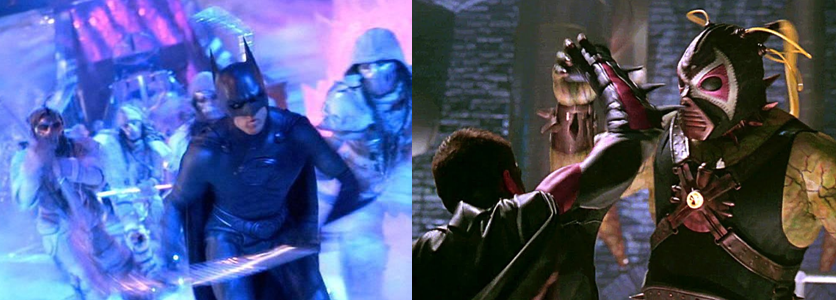
While the Riddler gets much of the film’s focus, Two-Face’s tragic origins and complex relationship with Bruce and Batman is almost completely glossed over; we’re introduced to Two-Face (annoyingly and constantly referred to as “Harvey Two-Face” for no discernable reason) after he’s already suffered his horrific scarring (here rendered in a far less disturbing manner, with a ridiculous straight line literally splitting Harvey’s face in two) and there’s only ever the briefest hint towards the character’s nuance and fall from grace. Instead, we’re left with a frenzied clown, a character far removed from the dark, tragic supervillain of the source material and more akin to the Joker, for lack of a better comparison. Ruled by his obsession with duality, his double-headed coin (which he is perfectly happy to flip over and over again until he gets the result he wants), and killing Batman (since he blames Batman for his condition), Two-Face is a ludicrous, flamboyant carton of a villain who would make Cesar Romero blush. I can only assume that it was Schumacher’s decision to make Two-Face this overexcited buffoon since Tommy Lee Jones, apparently, detested Carrey’s ostentatious antics and yet seems to be going out of his way to try and match Carrey’s far more amusing and far less grating physical humour.

Dick grows from an angry bad boy with an attitude to a selfless costumed hero.

Two-Face’s inclusion, though, allows Batman Forever to do something I will forever hold it in high regard for and that is introducing Dick Grayson/Robin. As a kid, I grew up watching the sixties Batman TV show and reading a number of different Batman comics, many of which included Robin in various forms and I remember being super excited about Robin’s inclusion here. In a fantastic example of adaptation, Robin is a combination of Dick (name/origin), Jason Todd (bad boy attitude), and Tim Drake (costume); garbed in motorcycle gear, with a piercing in his ear, he’s clearly an angst-ridden rogue who has no time for the luxury of Bruce’s lifestyle and wishes only to avenge the death of his family. Even better, the film does a great job of retelling Batman’s origin through the parallel of the deaths of Grayson’s family, which triggers Bruce’s flashbacks of his own parents’ deaths and delivers a haunting scene where, in relating the parallels between the two events to Alfred Pennyworth (Gough), Bruce slips on his wording and mutters “I killed them”, providing a glimpse into the survivor’s guilt and responsibility he feels. Bruce sympathises with Dick and takes him in; though he is angry and hungry for revenge, Dick is convinced to stay through a combination of Bruce appealing to Dick’s love for motorcycles and Alfred guilt-tripping the troubled acrobat with hospitality. Alfred plays quite the sly role this time around, offering Dick understanding and comfort but also subtly influencing his discovery of the Batcave and transformation into his own masked persona. Dick’s first instinct, though, is obviously to steal the Batmobile and take it on a joy ride; after taking his anger and pain out on some colourful street thugs, Dick directs these same emotions towards Batman when he arrives to confront him, blaming him for his family’s murder but, having vented his emotions, becomes insistent on Bruce training him to be his partner to give him the means to bring Two-Face to justice. Bruce is angered at the very idea and discourages him at every turn, not wishing Dick to go down the same path as he, much less commit murder.

Chase is the horniest psychologist you’ll ever meet. It’s fantastic!

Finally, there’s Chase Meridian; Kidman is absolutely gorgeous, of course, but man is her character one horny bitch! Chase is immediately fascinated, sexually and psychological, by Batman; she, like pretty much all of the public, isn’t deterred by Batman’s appearance and is, instead, in awe of his presence and attracted to his mystery and physique and even goes so far as to use the Bat-Signal as a “beeper” to tell him things about Two-Face that he already knows and are painfully obvious and to explicitly voice her interest in Batman in her attempt to seduce him right there on the rooftop! She is overwhelmed by the sexual magnetism and allure of Batman as the “wrong kind of man” and the mystery about what drives him to do what he does but is just a enamoured by Bruce, seeing him as something of an enigma who is haunted and hiding more than he lets on. It’s not the same as her attraction to Batman, which is very primal and sexual, but it eventually grows into the more “grown up” choice on her part and she is clearly elated to find that the two are one and the same.

The Nitty-Gritty:
Batman Forever is a loud, bombastic action film; essentially, it’s a live-action cartoon, with every set and action sequence having a garish, over-the-top presentation. The film starts off, as Two-Face says, with a bang; the sequence of Batman hanging from Two-Face’s helicopter looks pretty shit but I can appreciate the blending of practical stunts, early-CGI, miniature sets, and the age of the film, to let it go and the entire set piece of Batman’s chase after him is explosive and frantic and really helps open the film with a huge amount of energy, albeit energy that screams “live-action cartoon featuring a lauded superhero” rather than a dark, broody piece about an urban vigilante. Also, people think that Schumacher’s Batman films were all light-hearted and campy and, yes, they are but while Batman isn’t as vicious or brutal as before and is much more of a “superhero” than a brooding vigilante, he still directly and indirectly causes a lot of death and destruction, including the death of Two-Face (something he specifically ordered Dick not to pursue).

There’s maybe a little too much bombastic slapstick and cartoony elements, to be sure.

Easily the star of the show, for me, is Jim Carrey as the Riddler. While I think Batman Forever would have benefitted all the more if Nygma had been the only elaborate comedic element in a film full of straight men, I am a massive fan of Carrey and his work in the nineties and the way he hogs every scene is just fabulous to me. I just love his many garish costumes, his elaborate movements, the way he emulates Bruce Wayne, and how he switches between manic energy and a sinister glee on a dime. Ultimately, neither Riddler or Two-Face are much of a physical threat to Batman and, far from the master of puzzles and conundrums of his comic counterpart, Riddler opts to force batman into making the now-cliché “choice” between the love of Bruce’s life and his crimefighting partner. Having faced his demons throughout the film and been reminded of why he became Batman, Bruce chooses to save both, reducing Nygma to a gibbering, crazed wreck in the process and finally putting to rest the demons that have haunted him all his life. Of course, it’s naïve to pretend like Batman Forever is perfect; it’s mindless entertainment for kids, to be sure, but is maybe a little too loud, bombastic, and slapstick for parents or hardcore Batman fans. There are a few narrative inconsistencies as well, such as Bruce inexplicably deciding to retire Batman and settle down with Chase. I never quite got the logic here; Bruce seems to think Batman is no longer needed but it also seems like he’s willing to give up his crusade to be with Chase since he can’t justify being Batman anymore (despite the fact that, as Dick says, “there’s monsters out there” like Two-Face and the Riddler). Then there’s the ridiculously cartoony security guard from the start of the film, the garish new Batmobile, the way in which the Batcave opens up and comes alive every time there’s an intruder, the ludicrous moment where the Batmobile drives up a wall to safety (how the hell did it get down from there?), the sheer ineffectiveness of Gotham’s police department (seriously, the cops are completely useless and call for Batman at the first sign of any trouble), and the overly cartoony sound effects that punctuate a lot of Carrey’s scenes and the fight sequences.

Two-Face is easily the weakest and most annoying part of the film.

For me, though, the weakest part of Batman Forever is clearly Two-Face; he’s just a grating, annoying villain who goes way, way over the top at every moment. He’s also an absolute idiot; he holds the circus hostage under the belief that Batman is present or that someone there knows who Batman is, which is a bit of a reach, constantly goes against his modus operandi, and ends up being tricked to his death in the simplest way possible. The only positive to his inclusion is that it fuels Dick’s need for vengeance; Bruce lectures Dick about how killing Two-Face won’t take away his pain, how he’ll end up becoming an obsessed vigilante taking his anger and pain out on countless others if he kills Two-Face, but Dick’s only wish is to kill Two-Face for what he did and it’s only in sparing Two-Face’s life that he (Dick) comes to evolve into the same selfless hero we saw him to be when he risked his life to save the circus from Two-Face’s bomb.

It’s fantastic to see Robin done in live-action and used as a thematic parallel to Batman.

Make no mistake about it, this is a great film if you’re a fan of Robin and Stephen Amell O’Donnell perfectly encapsulates the “mad, broody youth” vibe they were going for. After Dick forces himself into Batman’s business, Bruce is livid at Dick’s recklessness and continually attempts to talk him out of pursing the same life as him. In the end, though, with Chase in need of rescue and his motivations resolved (Bruce remembered that he promised his parents that no one would ever have to suffer like he would, that he would take his revenge upon all criminals to safeguard others no matter the cost), Batman throws on his “sonar” suit and is in the middle of choosing between his Batwing and Batboat (all new toys for kids to buy/pine for) when Dick, now Robin, arrives and the two reconcile. Personally, I love this moment; the two basically acknowledge that each other were right, that each of them has their own path, and that they have converged into one destiny. Robin even admits that he can’t promise he won’t kill Harvey but Batman accepts this, and that Dick must walk his own path, and they solidify their partnership with a firm handshake…only to immediately be separated upon reaching Nygma’s island. Regardless, I’m continually entertaining by film’s smart use of Robin as a thematic parallel to Bruce. I’d love to see this concept revisited in a new Batman movie one day; skip retelling Batman’s origin again and, instead, have a darker, more jaded Batman begin to stray from his path but be brought back from the brink by adopting Dick, whose origin can be used as a direct analogy for Batman’s. Sadly, it doesn’t look like we’ll be seeing that in a film any time soon but Titans (2018 to present) has done a really good job, in my opinion, of exploring similar ground with an even better version of Dick/Robin and taking that to its logical conclusion (the debut of Nightwing).

The Summary:
Batman Forever is a hugely entertaining kids’ movie which has a lot of potential that is sadly squandered by its execution. A lot of time is spent exploring Bruce’s psyche and motivations; not as much as was originally intended but far more than we had seen in live-action up until that point. The film suggests that Bruce has become so lost, so blinded by his pain, anger, and guilt, that he’s forgotten why he became Batman in the first place (to protect the innocent) and is, instead, lashing out at criminals out of habit. Dick is expertly used as a parallel to Bruce’s life and background; his anger is raw and in need of guidance. Bruce was guided by the bat he encountered as a child but Dick simply wants to kill Two-Face and has no clear focus beyond that. Bruce knows first-hand that killing the man responsible won’t bring Dick the peace or closure he so desperately seeks and that he’ll end up exactly like him, “Running out into the night to find another face. And another. And another!” It’s not massively dwelled upon but the film suggests that Bruce can use his experience to guide Dick in such a way to focus his rage and pain in a more productive way, one that sees him walk the same path but not so tainted by darkness and heartache. This turns out to be the case as Dick refuses to kill Two-Face, turning away from becoming a mindless killer and towards being an agent of true justice, which is something Bruce also learns to do through his relationship with Dick and Chase, which finally sets him towards a more productive path. Sadly, though, the film’s themes and explorations are hampered somewhat by the madcap nature of Schumacher’s world; thanks to several subtle references, this is clearly the same world as Burton’s Batman movies but much bigger, grander, and more…operatic. Gotham City is awash in garish neon and giant, impractical statues and skyscrapers and the film has a manic energy thanks not only to Carrey’s scene-stealing antics but the infantile characterisation of Two-Face and his goons. Cartoonish sound effects permeate many of the film’s action sequences and I can’t help but think the film would have been more appealing if everyone played it entirely straight except for Carrey. Clearly, Schumacher is leaning heavily towards the sixties television show, which is fine since that is a classic in every way and a guilty pleasure, but what made that show work was that everyone played it straight, which only served to make the ridiculousness more entertaining. Here, it’s ridiculous for the sake of being ridiculous so when there are moments or genuine humour (mainly from Batman and Alfred and Carrey’s less zany moments) they get drowned out by the overabundance of cartoonyness and Tommy Lee Jones’ grating performance as Two-Face.

My Rating:

Rating: 4 out of 5.

Great Stuff

What are your thoughts on Batman Forever? Where does it rank against the other Batman movies of its era, or even now? What did you think of the cast, particularly Kilmer, Carrey, and Jones? Were you excited to see Robin brought into the franchise or do you prefer Batman to “work alone”? What did you think of Schumacher’s version of Batman, his world, and his rogues? Would you like to see an extended cut of the film or do you think it’s best left as it is? Whatever your thoughts, go ahead and drop a comment below and be sure to come back next Tuesday for my review of the much-maligned sequel!

Screen Time [Crossover Crisis]: Crisis on Earth-X


In April 1985, the first issue of the ground-breaking Crisis on Infinite Earths (Wolfman, et al, 1986) released and saw the temporary destruction of the “Multiverse”. To celebrate this momentous event, I’m discussing multiversal crossovers all throughout April in an event I dubbed “Crossover Crisis”.


Air Date: 27 November 2017 to 28 November 2017
UK Network: Sky One
Original Network: The CW
Stars: Stephen Amell, Grant Gustin, Melissa Benoist, Caity Lotz, Carlos Valdes, Dominic Purcell, Chyler Leigh, Brandon Routh, Franz Drameh, Victor Garber, and Tom Cavanagh

The Background:
After the success of Invasion! (Various, 2016), the scope and interconnectivity of the “Arrowverse” began to steadily grow; The Flash (2014 to present), in particular, began to explore more and more of the multiverse while DC’s Legends of Tomorrow (2016 to present) exclusively dealt with concepts of time travel and alternate timelines. Invasion! ended up being the first of many annual crossovers between the CW shows and, accordingly, development of the next big crossover began in 2016. This time around, the showrunners were able to better plan and prepare for the crossover; however, while this allowed for Supergirl (2015 to present) to be included in the line-up, Black Lightning (2018 to present) was notably absent from the event, which drew inspiration from the annual crossovers between the Justice Society and Justice League of America in the Silver Age of DC Comics.

The Plot:
When the long-awaited wedding between Barry Allen/The Flash (Gustin) and Iris West (Candice Patton) is interrupted by evil doppelgängers from Earth-X, a dystopian world populated by Nazi versions of the Arrowverse heroes, they must call upon Oliver Queen/Green Arrow (Amell), Kara Danvers/Supergirl (Benoist), and the time-travelling Legends in a desperate battle to save their world from becoming over-run by their totalitarian doubles.

The Review:
Crisis on Earth-X begins, appropriately enough, in “Part 1” (Teng, 2017), which was the eighth episode of the third season of Supergirl and introduces us to Earth-X, a parallel world that is under the iron grip of a Nazi regime. Oliver Queen/Dark Arrow (Amell) is the Führer and leader of the ruling cabal, the New Reichsmen, who use brute force and murderous tactics to spread fear amongst the populace and rule largely unopposed except for a band of plucky Freedom Fighters who are hopelessly outmatched. Hungry for new worlds to spread their regime to, they seize a temporal gateway and travel to Earth-1 in search of further conquests.

The large majority of the Arrowverse gathers together for Barry and Iris’s long-awaited wedding.

Most of our heroes from Earth-1 are concerned primarily with the impending marriage of Barry and Iris; the daily routine of our multiversal time travelling heroes is given a comedic background as Green Arrow, the Legends (Sara Lance/White Canary (Lotz), Mick Rory/Heat Wave (Purcell), Jefferson Jackson (Drameh) and Doctor Martin Stein (Garber)/Firestorm, Ray Palmer/The Atom (Routh), Nate Heywood/Steel (Nick Zano), Zari Tomaz (Tala Ashe), and Amaya Jiwe/Vixen (Maisie Richardson-Sellers)), and Supergirl (Benoist) put their individual issues and missions on hold to travel to present day Earth-1 for the wedding, bringing these characters together for a happier, more social event rather than an impending crisis. Amidst this, Kara is still reeling from the return of Mike Matthews/Mon-El (Chris Wood) and her sister, Alex (Leigh), is struggling with a recent breakup. The revelation that Mon-El is not only alive but also already married has shaken Kara’s usually positive outlook; like any good CW/TV lesbian, Alex decides to throw herself at the nearest bisexual character (Sara); and Oliver is motivated by Barry’s plunge into marriage to (unsuccessfully) re-propose to long-term love interest Felicity Smoak (Emily Bett Rickards). Additionally, Stein and Jackson are facing the sudden realisation that their time as Firestorm may be coming to an end thanks to a cure developed by Cisco Ramon/Vibe (Valdes) and the Earth-2 Harrison Wells (Cavanagh).

Evil Nazi doppelgängers interrupt the wedding and plot to attack Earth-1.

Although Stein is overjoyed at the prospect of returning to his family and a normal life, Jefferson is struggling with the idea of losing their partnership, friendship, and the bond that Firestorm brings the two. Characteristically, Stein misinterprets Jefferson’s feelings regarding the situation and attempts to fashion a way for Jax to continue being a super-powered Legend without him or Firestorm. With all this drama hanging in the air, tensions are a little highly strung on the morning of the wedding and it’s something of a relief (for everyone but Barry and Iris, that is) when Kara Zor-El/Overgirl (Benoist), Dark Arrow, and Tommy Merlyn/Prometheus (Colin Donnell) gate crash the ceremony with their troops. Of course, a massive fight scene breaks out (it’s super lucky and convenient that guys like Oliver and Mick brought their weapons to the church…), the main focus of which pits Overgirl against Supergirl, Oliver against Dark Arrow, and Sara and Alex against Prometheus in a bit of a mirror match, of sorts. Of course, it isn’t until the fight is concluded and Prometheus is captured that the true identities of their opponents are revealed since all the Earth-Xers are sporting bad-ass masks.

Oliver is shaken when the Earth-X Prometheus turns out to be an evil version of his dead best friend.

“Part 2” (Bamford, 2017), which took place in season six, episode eight of Arrow, delves into the consequences of this; as always when he comes face to face with Tommy Merlyn, Oliver is shaken by the appearance of his long dead best friend. Harry also offers a quick bit of exposition into the background of Earth-X, a 53rd Earth that is so horrific that it lacks the usual numerical designation; unlike in Invasion!, Oliver is now far more adjusted to the concept of the multiverse and metahumans but his emotional attachment to Tommy (which is fuelled by his own feelings of grief and guilt at his Tommy’s death) blind him to Prometheus’s uncompromisingly cruel nature. Oliver’s already dramatic and brooding life is further complicated by Felicity’s unexpected rejection of his proposal, which kind of just exists simply to add to the character’s aggro; it’s a common thing in Arrow that seemingly every time Oliver tries to grow as a character and a person, normally dependable people suddenly let him down and then he’s the one who has to learn a lesson to adjust to this before things just work out anyway, which is kind of how the Arrowverse likes to handle its dramatic moments: needless conflict amidst actual, tangible conflict.

In a crossover full of cameos, Wally and Diggle are unfortunately given the shaft.

Crisis on Earth-X also features an appearance by Jessica Parker Kennedy, who would later be revealed to be Barry and Iris’ time-travelling daughter, Nora; once again, though, in a crossover featuring a slew of cameos and characters, Wally West/Kid Flash (Keiynan Lonsdale), John Diggle/Spartan (David Ramsey), J’onn J’onnz/Martian Manhunter (David Harewood), and Mon-El are completely side-lined but the event has time for appearances by Ray Terrill/The Ray (Russell Tovey), the Earth-X Leonard Snart/Citizen Cold (Wentworth Miller), Metallo (Frederick Schmidt), Red Tornado, and even a much welcome appearance by Paul Blackthorne as SS Sturmbannführer Quentin Lance. Perhaps the best thing about Crisis on Earth-X’s large cast of characters is the return of Cavanagh as the Reverse-Flash, still the most charismatic and memorable of all the Flash’s villains. Thawne is, it turns out, the actual Thawne from Earth-1, having cheated death thanks to complex (and convenient) time travel shenanigans. While Green Arrow and Supergirl are naturally disturbed and disgusted with their evil counterparts, Barry’s fight against Thawne is far rawer and emotionally charged given their history and Thawne’s sadistic vendetta against him.

Good or evil, Oliver finds a way to be relevant and keep up with his superpowered allies.

Once again, despite neither him or his Earth-X doppelgänger sporting superpowers, Oliver manages to find a way to make himself relevant and useful in the explosive conflict; his Kryptonite arrow, however, is far less useful than one might expect but Dark Arrow ends up being skilled and competent enough to take on Heat Wave, Doctor Caitlin Snow/Killer Frost (Danielle Panabaker), Curtis Holt/Mister Terrific (Echo Kellum), Rene Ramirez/Wild Dog (Rick Gonzalez), and Dinah Drake/Black Canary (Juliana Harkavy) all at the same time. This is especially evident in “Part 3” (Helbing, 2017), which aired as the eight episode of the fourth season of The Flash), when, trapped on Earth-X alongside Barry, Sara, Alex, Stein, and Jefferson, Oliver is the only one able to break free of their power-dampening restraints thanks to his ability to freely dislocate his thumb. While this quickly becomes a moot point as they are soon rescued by the Earth-X Snart, who introduces them to the pitiful Earth-X resistance movement, Oliver is able to (briefly) successfully impersonate his doppelgänger to infiltrate a convenient, if well-guarded, facility that offers their only chance of returning home. Concurrently, their Earth-1 allies are trapped in the anti-metahuman cells at Scientific and Technological Advanced Research Laboratories (S.T.A.R. Labs) and Kara is held captive under power-dampening red sunlight. For all the power, greed, and conviction of the Earth-Xers, their motivations come down to a desperate need to save Overgirl from dying through a heart transplant with Supergirl with only Felicity and Iris left behind to help her. It’s interesting, and surprising, for a crossover between the Arrowverse’s greatest heroes that two non-powered supporting characters end up being the key to turning the tide against the Earth-Xers as they rescue Kara using little more than their grit and ingenuity and the foresight to summon the remaining Legends.

With the defeat and death of their generals, the Earth-X invasion is averted.

The finale, “Part 4” (Smith, 2017), was the eighth episode of the third season of DC’s Legends of Tomorrow; similar to the final episode of Invasion!, saving the Legends episode to last causes a sudden and noticeable flood of characters to join the already inflated cast. The timely intervention of the Atom saves Kara but, unfortunately, even Gideon (Amy Louise Pemberton) is not capable of saving Stein’s life from a fatal bullet and he dies having sacrificed himself to return everyone to Earth-1 and to keep Jefferson alive. It’s an emotional and dramatic moment for the entire team but, especially, for those two, whose relationship has developed into a fantastic father/son dynamic amidst the dysfunctional family of the Waverider and would forever change the Legends dynamic going forward. Though hurt and grieving following Stein’s death, Oliver and Sara’s pragmatic attitude galvanises the heroes into uniting against the Earth-Xers and their own version of the Waverider, the Wellenreiter, which they use to launch a devastating attack on Earth-1 unless Kara turns herself over to them. Rather than go gallivanting off through time and space, the Legends join their fellow heroes for an all-out counterattack against the Earth-Xers, resulting in a massive brawl in the streets. In the end, the day is won through a combination of teamwork and co-ordination to disable the Wellenreiter and Overgirl succumbing to her solar poisoning. Her explosive death directly leads to Oliver executing his counterpart and, thanks to Barry suitably scaring off Thawne, the crisis is averted, and Barry and Iris are finally married. Invasion! was a very rushed and lacklustre excuse to bring together the Arrowverse against a simple extra-terrestrial threat; while the spirit of each show was evoked as best as possible and each episode did its best to focus on a core group of characters amidst a bloated cast, the crossover was let down by a frantic pace and some dodgy CGI. Crisis on Earth-X, in comparison, is a far more well balanced affair and, in many ways, seems like a much easier and more simpler concept to bring together the CW shows as it doesn’t require fully CGI characters or entirely new ideas; it’s simply a fight between the heroes of the Arrowverse and their violent and sadistic doppelgängers. Of course, it’s not the first time many of these heroes (especially Green Arrow and the Flash) have fought against dark versions of themselves but it’s a pretty simple and effective narrative device; plus, not only does it allow characters to literally fight against their own dark nature, it’s fun to see the actors portraying such radically different versions of themselves. While Dark Arrow isn’t that much different from Green Arrow, Overgirl is the exact opposite of Kara’s normally optimistic and enthusiastic nature, allowing Benoist to flex her range into sadistic bitch territory.

The Summary:
There’s a definite sense in Crisis on Earth-X that the Arrowverse was really beginning to hit is stride and becoming much more ambitious with its characters, concepts, and crossovers; the shows have come a long way from the relatively grounded Arrow (2012 to 2020), almost being unrecognisable with their fragrant and frequent use of obscure and complex sci-fi concepts such as time travel, aliens, and the multiverse. Thanks to having the time to properly focus on these concepts in shows like The Flash and Legends of Tomorrow, crossovers such as these were not only able to occur in the first place but actually felt like a natural and inevitable inclusion rather than being a rushed and desperate attempt to catch up to the competition like in the movies. Of course, dodgy CGI does raise its head once again in Crisis on Earth-X, particularly in the scene where Green Arrow helps Flash and Supergirl reinforce a collapsing superstructure by firing a load of CGI arrows and lines across the girders and whenever the Ray’s powers are on show. Still, these moments are far less intrusive and noticeable than in Invasion!, which is surprising considering Crisis on Earth-X features far more super-powered individuals and a much bigger scope. Once again, the costume design is absolutely spot on; the Earth-X Schutzstaffel-inspired uniforms give the normally bright and colourful heroes a dark and menacing look that is only exacerbated when the narrative switches to Earth-X and we see just how different the totalitarian parallel world is to Earth-1 and the rest of the multiverse.

Crisis on Earth-X certainly outdid its predecessor in terms of stakes, standards, and scope.

Something I really enjoyed about this second crossover was that there was a lot more for everyone to do this time around and far more dynamic and varied character interactions, largely thanks to the fact that the pacing and focus of the crossover is much better this time around; each episode feels like a part of a larger, unified narrative that is the geared towards serving the purpose of the crossover rather than being a regular episode of its main show with the crossover plot shoe-horned in. The ramifications of the crossover had lasting effects on the Arrowverse as a whole as well; not only did it end with the long-awaited marriage of Barry and Iris, and open the doors for bigger and better multiversal events in the future, but it forever changed the dynamic of Legends of Tomorrow, and Jefferson’s character, through the sudden and dramatic death of Stein. Invasion! had the suggestion of high stakes but the plot was so concerned with focusing on the interpersonal drama rather than actually depicting the Dominators as a meaningful threat that there was never really the suggestion that the heroes could fail or lose in any way. This time around, the loss of Stein and the depiction of a dystopian alternative world where many have either died or are pure evil raised the stakes for future crossovers, allowing for a degree of unpredictability to permeate subsequent events.

My Rating:

Rating: 4 out of 5.

Great Stuff

How did you find Crisis on Earth-X? Did you prefer it to Invasion! and where would you rank it compared to the other Arrowverse crossovers? What did you think to the concept of evil, Nazi versions of the Arrowverse heroes? Were there any characters you would have liked to see have more focus in the crossover or were you, like me, far more impressed with the pacing and balance this time around? How did you feel about Stein’s death and which of the four shows is your favourite? Whatever your thoughts on Crisis on Earth-X, be sure to leave a comment below and check back in next Sunday as Crossover Crisis continues!

Back Issues [Robin Month]: Detective Comics #38


In April of 1940, about a year after the debut of arguably their most popular character, Bruce Wayne/Batman, DC Comics debuted “the sensational find of [that year]”, Dick Grayson/Robin. Since then, Batman’s pixie-boots-wearing partner has changed outfits and a number of different characters have assumed the mantle as the Dynamic Duo of Batman and Robin have become an iconic staple of DC Comics. Considering my fondness for the character and those who assumed the mantle over the years, what better way to celebrate this dynamic debut than to dedicate an entire month to celebrating the character?


Story Title: Technically untitled but presented as: “The Batman Presents The Sensational Character Find of 1940…. Robin – The Boy Wonder”
Published: April 1940
Writer: Bill Finger
Artists: Bob Kane and Jerry Robinson

The Background:
Since his debut in Detective Comics #27 in 1939, Batman had become a popular staple of DC Comics; the masked crimefighter began as a mysterious individual and, over time, acquired many of the supporting characters and gadgets that would become synonymous with the character thanks, largely, to the understated influence of writer Bill Finger, who greatly expanded upon many of the ideas of artist Bob Kane. However, to make Batman more accessible to younger readers and to give him someone to talk to rather than simply relying on monologues or thought balloons, Kane, Finger, and fellow creator Jerry Robinson came up with the concept of introducing a kid sidekick for Batman. With the character’s look inspired by illustrations of Robin Hood, the appropriately-named Robin not only significantly altered Batman’s dynamic and portrayal, casting him as a less darker and violent vigilante and more as a Sherlock Holmes-type father figure, but also dramatically increased sales and interest in the character upon his debut.

The Review:
The issue kicks off right away by introducing us to the Flying Graysons, John, Mary, and their young son Richard (or “Dick” as he prefers…feel free to make jokes in the comments), a family of trapeze artists for Haly’s Circus who regularly wow the crowd with their high-flying antics, particularly their “death-defying […] triple spin”. One night, whilst backstage, Dick overhears a couple of criminals threatening the owner of the circus, Mr. Haly, who balks at their attempts to force him to pay them protection money, though they promise him that “accidents will happen”. The next night, right as John and Mary are performing their headline act, their trapeze ropes snap in mid-air and they plummet to their deaths off panel but right before Dick’s very eyes!

The Batman finds a kindred spirit in Dick, who is only too eager to join his crimefighting cause.

After being briefly comforted by Bruce Wayne, who was in attendance that same night, Dick overhears the gangsters confess to causing the accident, which is enough to both scare Haly into paying them protection money and to convince Dick to go to the police. However, he is stopped by the timely arrival of the Batman, Gotham’s legendary vigilante, who takes Robin with him in order to spare him from reprisals since the entire town is run by mob boss Tony Zucco and ratting out Zucco’s men would surely mean death for Dick. Batman shares with Dick a truncated version of his own childhood trauma and Dick immediately volunteers to join his cause. Though Batman warns him of the dangers of his vigilante life, Dick is unafraid and, with what now appears to be very little convincing, Batman swears Dick to an undying oath to dedicate himself to the fight against crime and corruption.

Dick excels at his training and is soon out on the streets gathering information on Zucco.

Having revealed his true identity to Dick (off panel, of course), Bruce begins training the boy for his new life; thanks to his circus background, Dick excels at rope swinging and takes to his training in the likes of boxing and “jiu jitsu” with an eagerness and talent over a period of many months. Finally, Dick is ready to play a part in Bruce’s crusade and, for his first assignment, Bruce has Dick impersonate a grubby-faced newsboy in order to attract the attention of Zucco’s thugs and track them back to their lair. With the information provided to him by Dick, Batman is able to intercept and disrupt Zucco’s operation, taking out his thugs across town and smashing up the mob boss’s gambling house. Each time, he tells his prey to give Zucco one simple message (“The Batman”) and dispatches Zucco’s cohorts with both ease and a snappy wit. Batman then delivers a threatening note to Zucco, who is so wound up by Batman’s antics that he falls completely for Batman’s bait and heads to the Canin Building (along with a number of his goons) to personally put an end to the Batman’s interference. However, instead of the Batman, Zucco and his minions are targeted by Dick in his new costumed guise of Robin.

Overexuberance puts Robin in danger but it’s nothing a little murder can’t solve…

Striking fast and hard, Robin tackles one of Zucco’s men, causes another to (apparently) fall to his death by throwing a stone at his head, and handily takes out the rest using his speed, acrobatics, and the element of both surprise and misdirection. However, perhaps because of his youthful exuberance (Dick is clearly relishing the chance to beat up some thugs), Robin slips on a girder and is left dangling hundreds of feet in the air at the mercy of one of Zucco’s men. Fortunately, Dick’s circus training pays off and he is able to twist himself around to send the gunman falling to his death and Batman arrives to take out Zucco before he can get a shot at the Boy Wonder. Batman than threatens Zucco’s remaining henchman, Blade, into signing a confession (…he just happened to have this on him, presumably in his utility belt) about their involvement the deaths of the Graysons and willingly allows Zucco to send Blade falling to his death in order to capture evidence of Zucco killing a man. Batman then assures Zucco that both the confession and the picture will be enough to see him tried and sentenced to summary execution and, having orchestrated events so that Dick could avenge the deaths of his parents, returns to Wayne Manor with Dick to await their next “corker” of an adventure.

The Summary:
Okay, so, maybe Batman didn’t immediately turn into a child-friendly character all at once. Indeed, if you judge this story by most modern metrics of the character and his much-lauded “no kill rule”, you might be surprised to see Batman being so complicit and stoic about things such as mobsters being tossed off a building by a young boy. Of course, you can make the argument that Batman technically doesn’t murder anyone in this story; instead, he orchestrates events so that others do the dirty work for him but it’s quite astounding to see Dick go from a fun-loving, carefree young circus acrobat to a masked killer in just a few months.

Robin revels in the opportunity to fight at Batman’s side.

Of course, the entire point of this story is to introduce and sell us on the idea of Batman adopting (in the literal sense rather than the legal one) a young sidekick; Robin’s origin is a thematic parallel to Batman’s, having witnessed his parents’ deaths at the hands of criminals, but he’s a much different character to Bruce. He’s younger, obviously, faster and far more agile and, thanks to his circus background, takes to his new vocation with vigour and enthusiasm. Though he takes a vow to commit himself to justice, for Dick, being a crimefighter is a thrill and a privilege and, clearly, the entire point of the character is to exist as a form of wish fulfilment for all youngsters out there who wish they could swing through the city and fight thugs alongside the Caped Crusader.

My Rating:

Rating: 4 out of 5.

Great Stuff

What did you think about Robin’s sensational debut? What do you think about the idea of Batman having a kid sidekick? Do you prefer Batman to work alone or do you like the dynamic he has with his colourful partners? What are your thoughts on comics characters brazenly killing or willingly allowing children to be involved in such a violent life? Which of the Robins is your favourite, or least favourite, and why? How are you celebrating the debut of Robin this year? Whatever you think, feel free to leave a comment about Robin below and pop back next week for the next instalment of Robin Month.

Screen Time [Crossover Crisis]: Invasion!


In April 1985, the first issue of the ground-breaking Crisis on Infinite Earths (Wolfman, et al, 1986) released and saw the temporary destruction of the “Multiverse”. To celebrate this momentous event, I’m discussing multiversal crossovers all throughout April in an event I dubbed “Crossover Crisis”.


Air Date: 29 November 2016 to 1 December 2016
UK Network: Sky One
Original Network: The CW
Stars: Stephen Amell, Grant Gustin, Melissa Benoist, Caity Lotz, Carlos Valdes, Dominic Purcell, David Ramsey, Brandon Routh, Willa Holland, and Victor Garber

The Background:
In October 2012, Arrow (2012 to 2020) premiered on the CW; a successful first season saw the show not only continued for another eight years but also herald the start of the “Arrowverse”, a series of interconnected superhero shows that kicked off with The Flash (2014 to present), explored time and space in DC’s Legends of Tomorrow (2016 to present), and delved into the multiverse with the advent of Supergirl (2015 to present). Characters and concepts from each show would often cross over and, in time, the Arrowverse became a surprisingly complex continuity that, inevitably, led to a massive three-episode crossover. The event, titled Invasion!, was heavily inspired by a DC Comics event of the same name from the late-eighties, united the Arrowverse heroes against an external, extra-terrestrial threat. The three episodes were shot concurrently and gave the CW its most-watched week in six years. Invasion! was met with largely favourably reviews, with each series’ episodes ranked amongst the highest for their respective seasons. The success of Invasion! led to further, increasingly elaborate crossovers between the CW shows, all of which I’ll be covering throughout April.

The Plot:
When an aggressive extra-terrestrial race known as the Dominators (Micah Fitzgerald) arrive on Earth looking to conquer the planet, Barry Allen/The Flash (Gustin) and his team at Scientific and Technological Advanced Research Laboratories (S.T.A.R. Labs) team up with Oliver Queen/Green Arrow and his allies, Kara Danvers/Supergirl (Benoist), and the Legends, led by Sara Lance/White Canary (Lotz), to combat the threat of invasion!

The Review:
Each of the three parts of Invasion! are, quite helpfully and naturally, titled “Invasion!”. The crossover begins in media res with season three, episode eight of The Flash (Downs, 2016) before flashing back to ten hours earlier, where Team Flash are in the middle of testing out Wally West’s (Keiynan Lonsdale) recently acquired super speed. Though he shows a great deal of potential and promise, his sister, Iris (Candice Patton), urges the team not to encourage his dreams of following in Barry’s footsteps out of worry for his safety. The team is in a bit of a fractured state as Cisco/Vibe (Valdes) is having trust issues with Barry after his time travel shenanigans in the “Flashpoint” episode (Warn, 2016); Barry’s main arc in the crossover was trying to live with the ramifications of his selfish actions, which caused numerous alterations to the timeline and affected his confidence and relationships. In the midst of this, the Dominators suddenly arrive on Earth, which surprises even Barry, who by this point has already travelled to other parallel worlds. Thanks to information provided by Advanced Research Group United Support (A.R.G.U.S.) director Lyla Michaels (Audrey Marie Anderson), the team learns that the Dominators have been arriving on Earth since the 1950s, attacking and abducting humans and then disappearing seemingly at random. Lyla asks the team to stand down, believing they would be no match for the Dominators so, obviously, Barry immediately ignores that decision and goes to Oliver for help.

Invasion! balances its large cast by focusing each episode of a certain number of characters.

Against Oliver’s wishes and Felicity Smoak’s (Emily Bett Rickards) objections, his sister, Thea/Speedy (Holland), and John Diggle/Spartan (Ramsey) agree to help rendezvous with the Legends at an abandon S.T.A.R.S. warehouse. Barry then immediately jumps over to Earth-38 to recruit Supergirl and the first tentative meeting of the Arrowverse super friends takes place. Thanks to the inclusion of the Legends, Invasion! immediately becomes compounded by an influx of characters: there’s team leader Sara, Mick Rory/Heat Wave (Dominic Purcell), Doctor Martin Stein (Garber) and Jefferson Jackson/Firestorm (Franz Drameh), and Ray Palmer/The Atom (Routh), amidst all the supporting characters from both The Flash and Arrow. While this threatens to bog the narrative down a bit and can be overwhelming for newcomers, each episode smartly places much of its focus on the main cast of their main series. Accordingly, much of the Flash part of the crossover focuses on Wally’s resentment of the team’s distrust in his abilities, Cisco’s issues with Barry, and Doctor Caitlin Snow’s (Danielle Panabaker) struggles with adjusting to her newly discovered ice powers, which Stein helps her reconcile.

Despite her power and optimism, Kara is met with some scepticism for being an alien visitor.

Supergirl brings a modicum of background knowledge of the Dominators from her Earth but, by virtue of Oliver’s suggestion, Barry is named the team leader; Oliver, however, is largely distrustful of Kara upon first meeting and, as the more serious and grim of the entire group, pushes her, and the entire team, not to hold back in order to fight with peak efficiency in the coming battle. Because of her unmatched superpowers, she is made the guinea pig for the team to test their skills and teamwork out on and this (and the frosty reception she later receives in crossover) causes some notable friction between her and Oliver since she isn’t impressed at being treated like an alien. A cautious, distrustful character by nature, Oliver characteristically take some time to warm to others as it is but his relationship with Kara is particularly unique as, just as he was forced to adapt to and accept “metahumans” (DC’s name for superpowered individuals), he initially struggles to trust and accept aliens and the idea of a multiverse. Because of this, and her status as an outsider to the remainder of the cast, Supergirl’s optimism and enthusiasm is tested during Invasion! as she must work to prove herself in the eyes of her new team mates but, thankfully, her drive and abilities are enough to win over even her most ardent doubters.

Barry and Ollie must subdue their friends when they fall under the Dominators’ control.

The tension is only exacerbated when Cisco pressures Barry to reveal the implications of Flashpoint to the team, which drives a wedge between them; while Kara still trusts Barry regardless, it’s only through a tough love pep talk from Oliver that Barry snaps out of his self-doubt and realises that he can still make a positive difference despite the mistakes of the past. Ultimately, these plot points converge somewhat when the Dominators force Oliver and Barry to fight their mind-controlled friends, wherein the unique and surprisingly effective teamwork of the two is enough to free them from the control of the Dominators. The second part of the crossover, which takes part in season five, episode eight of Arrow (Bamford, 2016), is probably the weakest of the three since it doubles as an anniversary episode of Arrow; with Oliver trapped in a virtual reality dreamland, Team Arrow (Curtis Holt/Mister Terrific (Echo Kellum), Rene Ramirez/Wild Dog (Rick Gonzalez), and Rory Regan/Ragman (Joe Dinicol)) work with Cisco and Felicity to figure out how to locate and free Oliver from his prison. Fittingly, given the largely more grounded and practical nature of Arrow, Rene echoes Oliver’s scepticism and distrust of metahumans but, nevertheless, agrees to pool their resources for the greater good just like Oliver.

Oliver is trapped in, and tempted by, the Dominators’ dream world.

Normally a grim, pragmatic, and focused individual, Oliver is overwhelmed by the fantasy world the Dominators have placed him into but, because of the horrors of his past and the trauma he has lived through, is quickly able to sense and recognise that he is living in a dream world. Despite being reunited with his mother (Susanna Thompson), father (Jamey Sheridan), and deceased former love, Laurel Lance (Katie Cassidy), Oliver ultimately chooses to reject the promise of a peaceful, “normal” life in favour of returning to his never-ending fight because he is driven to atone for both his sins and those of his father through his work as Green Arrow. Sadly, as heart-breaking as the Arrow-centric episode is (and as fun as it is to get cameos from Malcolm Merlyn (John Barrowman) and Damien Darhk (Neal McDonough)), the focus on this dream world is a jarring left turn for Invasion! and seems more like a regular, standalone episode of Arrow rather than a continuation of a big crossover event. As a result, the Dominators and the larger plot basically disappear from the crossover until the very end of the episode in favour of focusing on reliving all of Arrow’s greatest moments and characters in celebration of the show’s 100th episode. While I’ve never been the biggest fan of Legends of Tomorrow, the final episode of Invasion! (Smith, 2016), which takes part in the seventh episode of Legends’ second series, at least gets the crossover back on track towards the larger Dominator plot.

Each character brings a different approach and skillset to the fight.

After regrouping with the rest of the super friends, and returning to Lyla’s intel from the first episode, the team splits into groups, with one group travelling back to 1951 in the Waverider to interrogate a Dominator and another group staying behind to work on a way to defeat the Dominators with the resources they have. Interestingly, none of the primary superheroes travel with the Legends; this allows Heat Wave, Nate Heywood/Steel (Nick Zano), and Amaya Jiwe/Vixen (Maisie Richardson-Sellers) a chance to shine in battle with the Dominators while Cisco works through his aggro with Felicity and, back in the present, Stein attempts to adjust to the sudden appearance of a daughter (Christina Brucato) in his life after the events of “Pilot: Part 2” (Winter, 2016). This time-travel jaunt, and these concurrent plot threads, converge in the revelation of the Dominators’ physiology, capabilities, and true mission: the destruction of all metahuman life because the aliens have deemed them a threat. A couple of things that are generally quite consistent about the Arrowverse are the interactions between characters (which usually strikes just the right balance between humour and drama but, quite often, steps a bit far into one side or the other as the narrative demands) and the action and fight scenes. Each character fights and approaches battles in a different way, with the Flash being very innovative, Green Arrow utilising his hard-hitting and efficient martial arts, Supergirl ploughing ahead with her peerless strength, and each of the Legends showcasing equally unique strategies in battle (Atom uses his robotic suit, Canary her weapons and martial arts, Firestorm their nuclear powers, and so on). The result is a wide variety of individual personalities and abilities who, while often clashing, work really well together; the actors have a great rapport with one another (some more than others, like Barry, Oliver, and Kara, for example), which allows for some great moments of levity and drama, and it’s a thrill to see these colourful and distinct superheroes all coming together in the face of a greater threat.

The Dominators are a formidable, if questionably rendered, force to be reckoned with.

I also really like that the conflicting dichotomies of each show is held intact; accordingly, Arrow’s Star City is ominous, dangerous, and constantly shown at night-time and characters like Oliver and Rene are stoic and distrustful, especially of metahumans since they (as in Team Arrow) are comprised, largely, of normal, non-powered individuals and somewhat resent the abilities of those with superpowers. Although none of Supergirl’s supporting cast make an appearance in this particular crossover, she brings an almost naïve and near-boundless enthusiasm and positivity despite the rough welcome she receives from some members of the cast. This is echoed in Barry and the more vibrant, colourful world of Central City, all of which are presented as a thematic parallel to Arrow throughout the Arrowverse. The controlled chaos of Legends of Tomorrow is similarly evoked; Legends has always focused more on the dysfunctional family dichotomy that the crew of the Waverider share as, while they’re all very distinct and opposing personalities, they are able to function as a time-travelling team and take their mission to police and protect time very seriously (even if they don’t necessarily act serious 100% of the time). However, one of the main things holding back Invasion!, much like many of the CW’s shows, are the special effects; for a television budget, the shows have always been ambitious and done pretty well, especially when it comes to costume design. Unfortunately, Invasion! decides to use CGI to render the Dominators rather than practical or more traditional effects, which does knock the quality of the crossover down quite a bit since they don’t hold up too well. The Dominators, for all their obscurity, make for a relatively formidable threat to bring the Arrowverse together; sporting advanced technology, mental capabilities, super strength, and a vicious, bloodthirsty nature, they are as cruel as they are fearsome, the Dominators are able to turn friends and allies against each other and place their victims into a virtual reality dream world in order to manipulate their thoughts and steal their knowledge.

The Summary:
For the first proper crossover between the Arrowverse shows, Invasion! is decent enough but a far cry from the crossover events that would follow; I think the main issue with the crossover is that it feels very rushed and clearly takes place in the middle of a number of unrelated and conflicting storylines for each character and show in the Arrowverse. As if the Arrow-centric episode wasn’t proof enough of this, the fact that Supergirl isn’t included with the crossover is and it all comes down to the simple problem of time. Later crossovers handled the placement and build-up of their crossovers a lot better, either purposely writing them to be standalone events or spending a great deal of time building up to them; Invasion!, though, is tonally all over the place, moving at a near breakneck pace and yet also being jarringly slow when it should be far more action-packed.

There’s not much to the Dominators but it’s a good enough excuse to unite the Arrowverse.

Still, it’s not bad for a first attempt; the Dominators may not be a particularly well-known threat in the DC universe but they serve their purpose here. Their design, while suffering from dodgy CGI, is ambitious, impressive, and suitably horrific and they are depicted as a significant threat. While we never really get a sense of their actual limits or power, they are certainly perceived as a force formidable enough to bring all these heroes together and even have Barry volunteer to sacrifice himself to end their threat. Their danger comes, mainly, from their intricate and advanced technology, their unique approach to warfare, and their sheer numbers, all of which hang over the crossover like an ominous cloud, making the Dominators as much an existential threat as an extra-terrestrial one. Essentially, they exist as the perfect excuse to bring together the Arrowverse super friends, so they’re mainly there just to be defeated (with an anti-climactic amount of ease, it has to be said) but at least they don’t operate on a hive mind, which is a refreshing change of pace.

Invasion! brought together the Arrowverse and cemented its version of the DC Trinity.

I’ve complained a bit about Invasion!’s conflicting focus and pace and, while that is an issue, it does allow the crossover to focus on something that is a big part of the Arrowverse: interpersonal drama. Despite the powers, abilities, and experience of each hero, these are all flawed and vulnerable characters and, if there’s one thing regular watching of the Arrowverse will teach you, it’s that our protagonists must learn new lessons about themselves, the world, and their team as much as they must battle against more tangible, often overwhelming, odds. The best thing about the crossover, beyond seeing all of these superheroes coming together for the first time, is the development of the Arrowverse Trinity (Kara, Barry, and Oliver), which would be the tentpole of further Arrowverse crossovers going forward and opened the door for so many new stories, characters, and possibilities which, as we’ll see in the coming weeks, the Arrowverse explored far deeper than I ever expected at the time.

My Rating:

Rating: 3 out of 5.

Pretty Good

How did you find Invasion!? Which character, cameo, and part was your favourite? Which of the CW Arrowverse shows was your favourite and why? What did you think to the Dominators as a threat? Are there any DC characters you’d like to see used in the Arrowverse or, perhaps, get their own show? Did you ever read the comic book Invasion! is based upon and, if so, how do you feel the crossover handled the story? Which of the Arrowverse crossovers was your favourite? Whatever your thoughts on Invasion!, and the Arrowverse in general, feel free to leave a comment below and check in again next Sunday as Crossover Crisis continues!

Back Issues: Detective Comics #27

Story Title: The Case of the Chemical Syndicate
Published: March 1939 (cover-dated May 1939)
Writer: Bill Finger
Artist: Bob Kane (with sole credit going to “Rob’t Kane”)

The Background:
Seeking to capitalise on the success of Clark Kent/Superman in their Action Comics publication, the editors of National Comics Publications wanted more superheroes under their banner. In response to this, artist Bob Kane, inspired by pulp heroes like Kit Walker/The Phantom and Lamont Cranston/The Shadow and Leonardo Da Vinci’s sketch of an ornithopter flying device, drew up a design for a new masked crimefighter, the “Bat-Man”. This design, however, was wildly different from the image of the Caped Crusader we know and love today and it was only thanks to the long-suppressed influence of artist Bill Finger that the Bat-Man gained his iconic cape, cowl, and darker, more gothic uniform. In the years since his debut, Batman has become not only one of DC Comics’ most popular characters but also a mainstream cultural icon, appearing in numerous other comics, movies, cartoons, and videogames and it all began way back in 1939 when one man chanced upon the nucleus of a blockbuster idea and decided to exploit his partner, and his character, for all they were worth.

The Review:
Batman’s first ever story is a brisk, six page adventure that begins shortly after the masked man’s debut. Unlike other superhero debuts, the Bat-Man is not afforded an origin story and his true identity isn’t revealed to the reader until the very last panel, creating a sense of mystery around the character. You’ll also notice that many of Batman’s popular and familiar elements are missing: there’s no Alfred Pennyworth, no Dick Grayson/Robin, no Batarang or Bat-Cave, Batman drives a big, red, clunky automobile rather than the Batmobile, and the story doesn’t even take place in Gotham City!

Gordon’s young friend seems to lead a boring, uneventual life.

The story begins with Police Commissioner Gordon entertaining “his young socialite friend”, Bruce Wayne; the two are enjoying a good, old fashioned bit of smoking (with Bruce puffing away on a pipe as characters were known to do in those days) and Gordon blatantly disregarding police protocol by expressing his bemusement at the mysterious “Bat-Man”. Gordon is interrupted by a report of the murder of Lambert, the “chemical king”, apparently at the hands of his own son and Gordon invites Bruce to accompany him to the scene of the murder. Yes, that’s right, the commissioner of the police invites his bored, young playboy pal to visit a murder investigation. At the scene of the crime, Gordon bluntly confronts the young Lambert about his father’s death and, after working himself into hysterics, the young man relates that he returned home early to find his father on the floor with a knife in his back and moaning about a “contract” with his dying breath. Although the young Lambert isn’t able to name any potential enemies of his father, he does name his three business partners and, quite coincidentally, Gordon gets a call that one of these, Steven Crane, received a threat against his life that very day!

The Bat-Man makes short work of Crane’s murderers and retrieves a vital clue.

Unfortunately, Crane is shot and killed in the very next panel before Gordon can even begin to mobilise a response unit but, as the killers make their escape via the rooftop, they are confronted by the Bat-Man! Garbed head to toe in black and grey, the Bat-Man sports some oddly unfitting purple gloves and showcases incredible physical strength, easily knocking out one man and sending the other “flying through space” following a “deadly headlock”. Though Gordon and his cops arrive soon after and attempt to pursue him, the Bat-Man manages to escape with the paper the murderer’s stole from Crane. Meanwhile, Lambert’s other partner, Paul Rogers, having just learned of Lambert’s death, pays a visit to their third and final partner, Alfred Stryker, only to be knocked unconscious by Stryker’s assistant, Jennings. Jennings ties Rogers up and prepares to seal him within a gas chamber in order to gas the man to death, his speech punctuated by loathsome little giggles. Luckily for Roger, the Bat-Man makes a dramatic entrance and first plugs the gas-jet with his handkerchief (…how very…low-tech of you, Batman…) and then smashes them to freedom with a wrench. Although Jennings is packing heat, the sight of the Bat-Man is enough to cause him to hesitate and be felled by a brutal tackle and a swift left hook.

*shrug* I guess that’ll save the expense of a trial…

Stryker walks in and looks to finish the job on Rogers with a knife but the Bat-Man stops him, revealing that Stryker was behind all the murders in an attempt to become the sole owner of their company, the Apex Chemical Corporation, and to get out of having to pay his former partners off. In a moment of desperation, Stryker breaks free of the Bat-Man’s grip in an attempt to escape so the Bat-Man smacks him in the jaw and sends him tumbling into an acid tank, offering only a dry comment on Stryker’s fate. The next day, Bruce Wayne appears to be unimpressed with Gordon’s telling of the story, appearing to be little more than a bored, easily distracted rich man but the final panel of the story reveals to the reader that Bruce Wayne is actually the mysterious Bat-Man which, I don’t know about you, I never saw coming!  

The Summary:
“The Case of the Chemical Syndicate” is quite a dull story, in a lot of ways; it’s definitely an inauspicious debut for one of DC’s most iconic and popular characters and could even be a bit off-putting for modern readers, who would be more used to all the familiar trappings and elements of Batman and may be perturbed by their absence. Without the Bat-Signal, the many Bat-gadgets, or the other myriad of Bat-related elements, “The Case of the Chemical Syndicate” is definitely much more of a pulp mystery than a traditional superhero story. Obviously, this is mainly because superheroes were still in their genesis during this time and to be expected given the Bat-Man’s pulp influences and it does work for the context of the story.

The Bat-Man debuted as a very simple character and lacked many of his recognisable elements.

The plot revolves first around the mystery of the business partners being offed and secondly around the enigma of the “Bat-Man”, a vigilante who puzzles the police commissioner and whose motivations and backstory are a complete mystery at this point. Even learning that Bruce Wayne is the man behind the mask doesn’t really tell us anything about the character except that Bruce is clearly hiding behind the façade of a wealthy socialite. Of course, the main takeaway from this story is the Bat-Man’s callous murder of Stryker and his nonchalant reaction to it. Nowadays, Batman is notorious for his staunch “no kill” rule and would never be written to kill a man in such a malicious way but, back in 1939, that’s just what pulp heroes did and it was widely accepted. Nobody bats an eyelid and even Gordon seems in awe of the Bat-Man’s mystery and motivations and it would take a number of subsequent stories and significant developments and additions to the Bat-Man mythos to transform the character into the Batman we know and love today.

My Rating:

Rating: 3 out of 5.

Pretty Good

Have you ever read “The Case of the Chemical Syndicate”? What did you think of the Bat-Man’s memorable debut? What are your thoughts on the Batman, or other costumed heroes, killing? Did you guess that Bruce Wayne was the man under the mask? Do you think Bob Kane’s original Bat-Man concept would have been as successful as the character eventually became? What was your first experience of Batman and how are you celebrating his debut this month? Whatever your thoughts, drop a comment below and be sure to stick around for more Batman content throughout the year.