Movie Night: Hellboy: Director’s Cut

Released: 19 October 2004
Originally Released: 2 April 2004
Director: Guillermo del Toro
Distributor: Columbia Pictures / Revolution Studios[
Budget: $60 to 66 million
Stars: Ron Perlman, Selma Blair, Doug Jones/David Hyde Pierce, Rupert Evans, Karel Roden, and John Hurt

The Plot:
Raised by the kindle Professor Trevor Bruttenholm/Broom (Hurt) to be a paranormal investigator, unruly half-man, half-demon Hellboy (Perlman) finds his dramatic life upended when immortal warlock Grigori Rasputin (Roden) conspires to bring about the apocalypse.

The Background:
After years of bringing his trademark dark, moody art style to both independent and mainstream comics, monster-loving artist and comic creator Mike Mignola got his big break in 1993 with Hellboy, a character he evolved over time into distinctively Lovecraftian comics and spin-offs. Long-time fan and celebrated auteur Guillermo del Toro campaigned for years to bring the character to the big-screen with Ron Perlman in the role, forming a close relationship with Mignola when the artist consulted on Blade II (del Toro, 2002), with production finally starting after that film’s critical and commercial success. Largely inspired by Hellboy’s debut story, del Toro tweaked both his origin and characterisation to focus on Hellboy being torn between right and wrong and add a tragic romanticism to his character. Jake Garber brought Hellboy to life with some impressive make-up and prosthetics, which required Perlman to spend at least four hours getting kitted out, while Rick Baker designed his prosthetic stone hand and the CGI was handled by Tippett Studios. David Hyde Pierce provided the voice of Abe Sapien but refused to take credit or be associated with the marketing out of respect for Doug Jones’s physical work while Spectral Motion handled the many practical effects used to bring Mignola’s distinctive art to life. Though it attracted criticism for its controversial title its $99.8 million gross made it a box office bomb, Hellboy became an instant cult classic. Reviews praised the fun action, horror-adjacent visuals, and Perlman’s engaging performance, while criticising some of the characterisations. This Director’s Cut released to home media the same year, offering a little over ten minutes of additional footage, a critically and commercially successful sequel followed four years later, but plans for further entries stalled and, much to the dismay of many, led to some comparatively inferior reboots.

The Review:
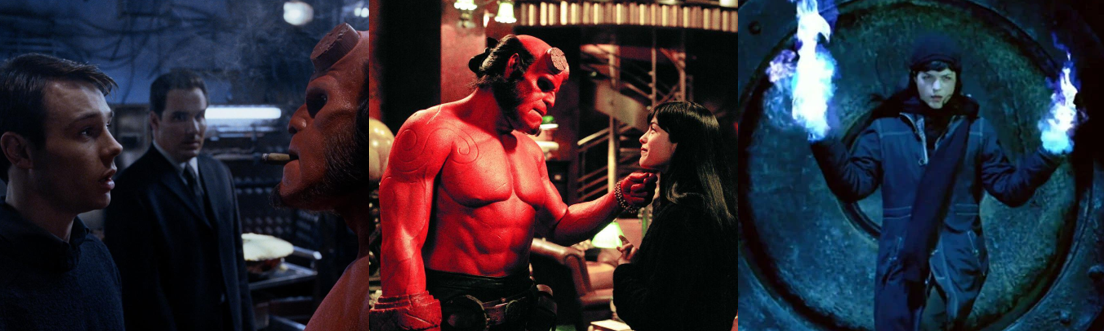
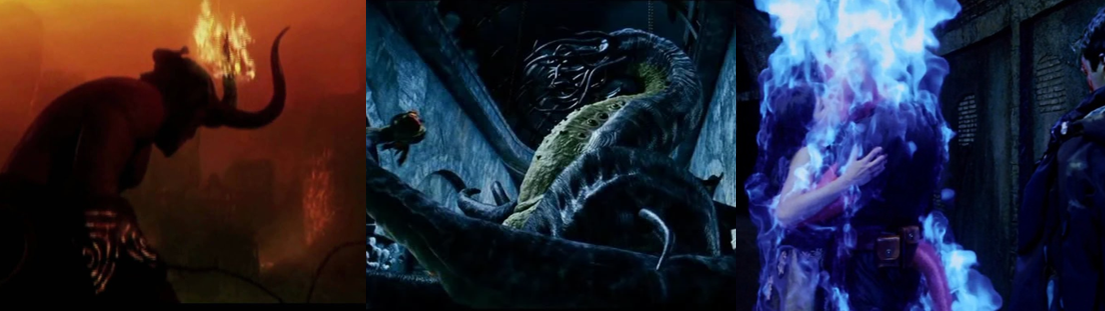
Much like Hellboy’s first story, “Seed of Destruction” (Mignola, et al, 1993), Hellboy begins near the end of the Second World War. In fact, Hellboy quite faithfully recreates and expands upon the circumstances which led to Hellboy coming to our world, with a young Professor Broom (Kevin Trainor) joining an Army regiment to intercept a Nazi ritual off the coast of Scotland. While the Army is understandably sceptical of the “parabnormal”, Professor Broom’s fears are realised when they find zealot warlock Rasputin in the midst of merging arcane magic with the Third Reich’s advanced technology alongside his lover and devout right hand, Ilsa Haupstein (Bridget Hodson), and Adolf Hitler’s top assassin, the mute, semi-undead Karl Ruprecht Kroenen (Ladislav Beran). Although Rasputin successfully opens a portal to a nightmarish realm beyond our understanding, where the Lovecraftian terror known as the Ogdru Jahad slumber, the Allies interrupt them and successfully close the portal, seemingly killing Rasputin and Kroenen in the process. However, while the portal was open long enough to bring through a tiny demon child. Though startled by the demon’s unsettling appearance, the regiment stands down when Professor Broom proves he’s just a curious and frightened little boy and he’s soon adopted by both the troop and the “unready father”, nicknamed Hellboy and spending the next sixty years secretly working to stop supernatural threats as part of the Bureau for Paranormal Research and Defense (BPRD). While Professor Broom ages in that time, Hellboy is said to be barely out of his twenties and is presented as both an urban legend and unruly child who constantly yearns to be in the public eye, shaving his horns to “fit in” and being grounded whenever he breaks out of the BRPD’s super-secret facility.

Professor Broom despairs of his reckless son, who he sees as the saviour of humankind.

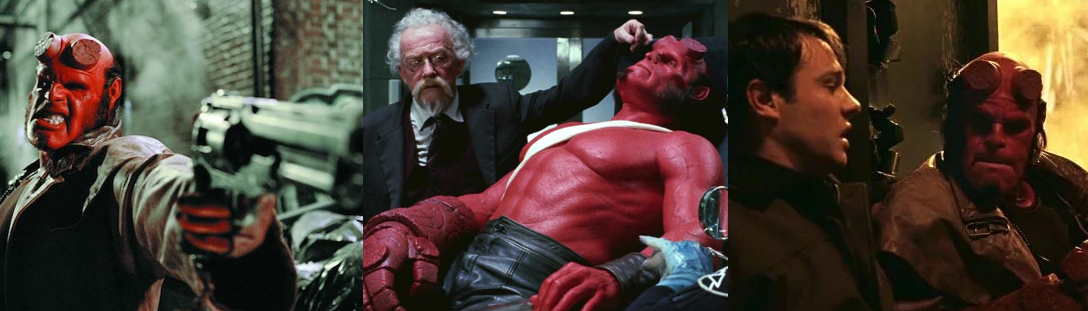
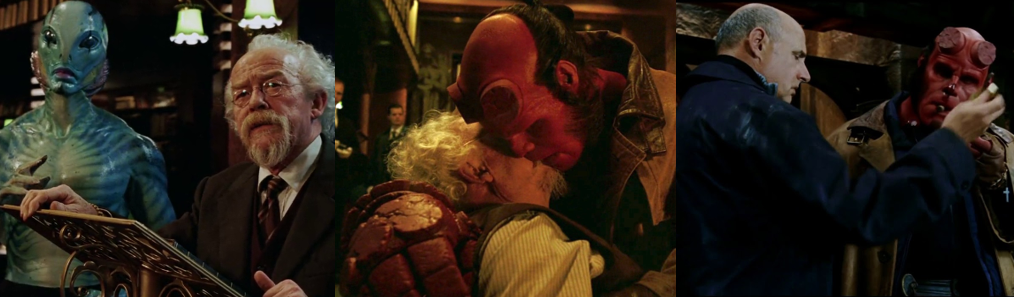
While Professor Broom is exasperated by Hellboy’s irresponsible nature, Federal Bureau of Investigation (FBI) director and BRPD liaison Thomas “Tom” Manning (Jeffrey Tambor) is tired of doing damage control whenever Hellboy makes headlines and eager to shut the “freak show” down. Realising that his time is running short and concerned that Rasputin and his followers are making a return, Professor Broom recruits FBI agent John Myers (Evans) to take over as Hellboy’s caretaker, confidant, and mentor, casting Myers as our audience surrogate and earning him much distrust and resentment from the unimpressed Hellboy. Presented as a cat-loving, physically imposing and nigh-superhuman figure, Hellboy is fireproof, extremely durable, and well versed in the mystic arts. While he’s a lousy shot with his massive handgun, the “Samaritan”, he loads it with special rounds and carries numerous trinkets, charms, and reliquaries to ward off curses and such. Yet, Hellboy is restless and stubborn, eager to be amongst the public and refusing backup, even from long-time allies like merman-like Abraham “Abe” Sapien (Jones/Pierce) and Agent Clay (John William Johnson), the closest he has to friends. Though deeply ashamed whenever he disappoints his father, Hellboy is snarky and constantly gives Myers a hard time for being a glorified nanny while also being recklessly confident that he can overcome any foe. To be fair, he’s usually right but Hellboy’s arrogance sees him constantly run afoul of the bestial Sammael (Brian Steele), leading to him being beaten up a fair bit, having eggs laid in his forearm, and the deaths of a BRPD squad, much to Manning’s disgust. Having known no other life than the BRPD, Hellboy sees it as “[his] job” to protect the innocent and regards any risk worthwhile to stop monsters and demons from threatening others. While he’s crushed when Abe and Clay are seriously wounded because of his actions, Hellboy lashes out at Manning and Myers, seeing them as threats to both his livelihood and his ego.

Myers makes for a dull surrogate and the chemistry between Hellboy and Liz is severely lacking.

As tough as Hellboy is, his emotions often get the better of him. Indeed, he often escapes from the BRPD to visit Elizabeth “Liz” Sherman (Blair), a troubled pyrokinetic and former BRPD agent who committing herself to an asylum. It’s obvious that Hellboy is madly in love with Liz, but he struggles to articulate these emotions and often makes a fool of himself, descending into a bitter jealousy when Myers gets close to Liz initially to convince her to return and then because he also develops feelings for her. Traumatised by her unpredictable pyrokinetic abilities, Liz chooses the discomfort and security of an asylum over the BRPD largely because it helps her control her abilities and because she wants to fit in, not be surrounded by monsters who remind her that she’s a freak. This draws her closer to the boyish, everyman Myers but she can’t help but be pulled towards Hellboy, who she largely sees as a sibling but clearly has an attraction to since he’s so devoted to her. Abe councils Hellboy, trying to help him move on and using his telepathic and empathic powers to give him advice, but Hellboy’s stubborn nature sees him desperately find the words to express his love for Liz. As awesome as Perlman’s performance is as Hellboy, Jones impresses as the unnerving Abe, who moves like liquid in water and uses his clairvoyance to offer valuable insight. Sadly, Selma Blair lets the trio down, appearing bored and delivering her lines with a distinct lack of emotion. While this does tie into her adopting a stoic guise to keep her powers under control, it makes for a distinct lack of chemistry between her and Hellboy that isn’t helped by some dodgy CGI flame effects.

Though they have their disagreements, Hellboy’s pained by his father’s death and forced to rely on others.

As far as I can tell, Myers has no comic book counterpart and sticks out like a sore thumb. Clay has far more charisma and already has a rapport with Hellboy and the others, so it would’ve been much more interesting to follow a day in his life for the first twenty minutes or so than be stuck with the forgettable Myers, who only exists to give Professor Broom someone to exposit to. As you’d expect, the late, great John Hurt excels as Hellboy’s strict, but fair, father figure. Commanding a wealth of paranormal knowledge and experience, Professor Broom is committed to protecting the world from supernatural threats and sees Hellboy not only as the bridge between the two worlds, but also as the saviour of humankind. This is why he’s so disappointed whenever Hellboy goes off half-cocked. Knowing that he hasn’t got much time left, Professor Broom works to ensure that Hellboy will be both cared for and helped stay on the straight and narrow. His fears about Rasputin again turn out to be true when the BRPD investigates the museum break in that kickstarts the plot, leading to Hellboy’s many run-ins with Sammael, Agent Clay’s ill-fated confrontation with Kroenen, and Professor Broom’s discovery of a message leading them to Moscow. Professor Broom is the. confronted by the mad mage and his clockwork assassin, afforded a brief glimpse of the apocalyptic future Hellboy is destined to bring about, but fearlessly defies Rasputin, ready to face his death. Naturally, Hellboy is devastated by his father’s murder, falling into a brief depression, but willingly joins the BRPD strike team, stomaching Manning’s antagonistic demeanour to get a chance to settle the score and surprisingly finding himself in the hostile director’s debt after finishing off Kroenen, the two developing a mutual respect that again dwarfs Myers’ inclusion.

Rasputin and his monstrous, nigh-immortal followers are fixated of ushering in the apocalypse.

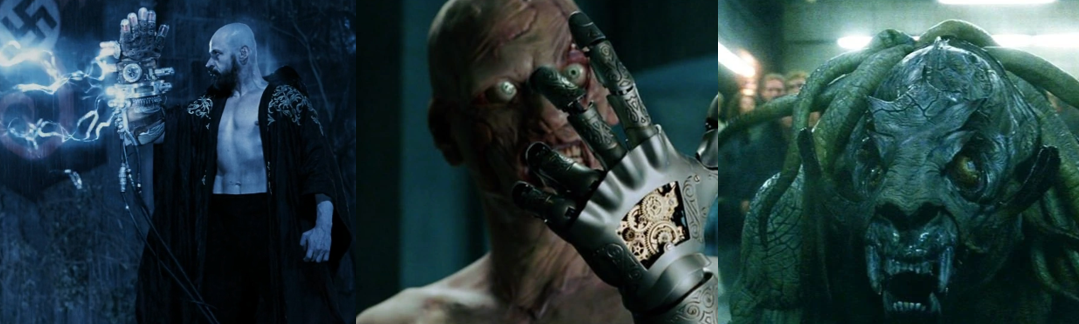
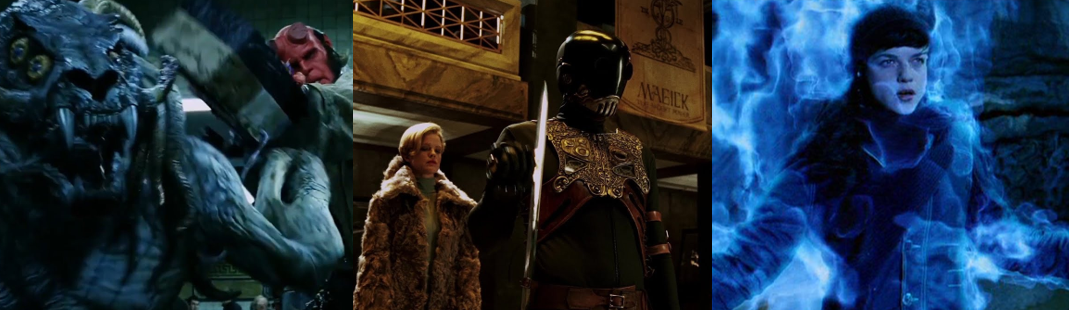
As in “Seed of Destruction”, Hellboy’s primary antagonist is the mad warlock Rasputin, a mysterious and functionally immortal wizard granted incredible dark magic by the Ogdru Jahad. Using an ancient tome and bizarre Nazi science, Rasputin almost achieves his goal of unleashing the “Seven Gods of Chaos” before he’s stopped by the Allies. Death is a mere inconvenience for Rasputin, however, thanks to his eternally youthful and equally immortal followers, who return their master to life with a blood sacrifice and willingly follow him in resurrecting Sammael, a ferocious beast whom Rasputin empowers to resurrect twofold each time it falls. Eager to capture Hellboy, knowing that his stone hand is the key to unleashing the Ogdru Jahad, Rasputin keeps Hellboy occupied and drive him towards his elaborate mausoleum in Moscow to complete his ritual. Returning from death more powerful, and with more of the Ogdru Jahad’s influence in him, Rasputin is a malicious, cold-hearted villain who nonetheless shows respect towards Professor Broom and permits him a merciful death. Though Ilsa doesn’t get much to do beyond lusting after her master and following his every whim, Kroenen makes a hell of an impression with his wind-up body, deft skill with blades, and intimidating masked visage. A heavily scarified, zombie-like figure, Kroenen easily cuts down groups of armed foes (though largely bloodlessly) and seems to delight in murdering anyone who gets in his way, easily fooling the BRPD by playing dead and killing those closest to Hellboy. Hellboy primarily tussles with Sammael and its kin throughout the film, finding the creature ruthless and as pig-headed as him thanks to its supernatural ability to rapidly heal and resurrect upon death. A slobbering, voracious beast who pounces upon its prey, Sammael tears through the BRPD, injures Abe, and constantly dogs Hellboy in some fun, action-packed fights.

The Nitty-Gritty:
My knowledge and experience of Hellboy may be lacking since I mainly know him from the films, but as far as I’m aware Hellboy sticks somewhat close to the source material while also diverging in numerous ways. For starters, Hellboy is presented as an urban legend, one Manning is keen to keep under wraps, rather than being the “World’s Greatest Paranormal Investigator”. This acts as the backbone for much of the plot and Hellboy’s arc, with him eager to get into the spotlight and relishing showing off before the public. Secondly, Hellboy changes Hellboy’s relationship with Liz, giving him a long-standing crush on the apathetic pyromaniac and presenting a largely humorous side plot of him sabotaging Myers when he gets close to Liz. Ironically, Hellboy asks Myers for help in articulating his feelings and Myers reluctantly offers him advice, despite his own feelings for Liz. Ultimately, Professor Broom’s death gives Hellboy the courage to admit his devotion to Liz, understanding that his demonic visage reminds her that she’s different and she’s looking for someone who makes her feel normal, seemingly stepping aside in favour of Myers while still vowing to always be there for her. Thirdly, Hellboy places far greater emphasis on Hellboy’s relationship with Professor Broom, who was offed pretty quickly into “Seed of Destruction.” Here, we see the dynamics of the unlikely father/son relationship, with Professor Broom despairing of Hellboy’s reckless antics and this brutish demon reduced to an ashamed child whenever his father gives him a disapproving look. It’s a great twist and makes Professor Broom’s death even more of a blow since we see how close they are, best showcased when Professor Broom refuses to learn Hellboy’s true name from Rasputin since he already knows what to call him: son.

Despite some dodgy CGI, the practical effects and prosthetics are genuinely impressive throughout.

While Hellboy’s personality may be noticeably different from the source material, painting him as an arrogant and rowdy teenager who pointedly refuses help and must learn to grow up, Ron Perlman delivers a fantastic performance. He nails every nuance of Hellboy’s characterisation, which sees him be sarcastic, enraged, and lovelorn throughout the film. despite clearly being swamped by uncomfortable make-up and prosthetics, Perlman’s emotions still shine through, and I’ve always been a fan of his gravelly delivery. Hellboy looks incredible, sporting a sledgehammer-like stone fist and prehensile tail, crashing through walls and wrestling his foes into submission. While the CGI does the practical effects a disservice, making Hellboy and Sammael unfortunately cartoonish at times, the practical effects more than make up for it. Hellboy and Sammael demolish a subway station, crash through stone walls in a hidden cavern, and tear through the busy night-time streets, with Hellboy flipping a car to protect Myers and Sammael eventually being smushed by a subway train. Kroenen equally impressed in his appearances, slinging his blades around with superhuman dexterity and cutting foes down with a supernatural efficiency. When his true, gruesome form is revealed, it’s a hideous and wholly practical sight that makes me want to know more about this bizarre half-zombie. Practical effects also take centre stage when Hellboy resurrects the desiccated corpse of Ivan Kilimatovich (Unknown), a skeletal torso who guides them through Rasputin’s boobytrapped mausoleum. While many of the hazards contained within are equally practical, such as the heavy doors and crumbling bridge, much of the danger is lost when the obvious CGI rears its head, but it’s all good fun for the most part. The Director’s Cut largely splices deleted and slightly extended scenes back into the film, giving us a scene where Ilsa gifts Rasputin artificial eyes, showing Liz has a touch of OCD and adding a bit more depth to her time with Myers, but there’s nothing all that substantial added.

Hellboy ultimately rejects his demonic heritage to save the world and finally express his love for Liz.

Journeying to Moscow to avenge Professor Broom and stop Rasputin’s maniacal scheme, Hellboy buries the hatchet with Manning after they work together (somewhat) to finish off Kroenen, impaling him on spikes and trapping him under a giant gear. While all the BPRD agents who accompany them are lost to the mausoleum’s booby-traps, Liz destroys Sammael’s nest with a burst of unbridled fury. However, this leaves her and the others weakened, easily allowing Rasputin to capture them. Even Hellboy is rendered powerless by a heavy trap that can only be unlocked by saying his true name, which he’s compelled to do when Rasputin maliciously sucks out Liz’s soul. Defeated and disheartened, Hellboy reluctantly whispers his name (“Anung Un Rama”) and undergoes a horrific transformation, his horns growing out and a flaming crown appearing on his brow. He then willingly uses his stone hand to free the Ogdru Jahad from their crystalline prison and have them begin to manifest amidst a blood moon. However, just as he’s about to unlock the final seal, Hellboy’s brought to his senses by Myers, who begs him to remember his father’s teachings, leading him to break his horns and mortally wound Rasputin with them, having chosen to be a man rather than a demon. Though the Ogdru Jahad are prevented from invading, Rasputin’s death frees a spawn of theirs, the gigantic, tentacled Behemoth, that Hellboy tackles alone after make amends with Myers. Thankfully, Hellboy brought a grenade belt, which he uses to blow the beast to bloody chunks. Heartbroken by Liz’s death, Hellboy whispers a threat to those “on the other side” to let her go or face his wrath, prompting her swift resurrection and the two to finally embrace as lovers. Myers, having earned Hellboy’s trust, delivers the film’s closing narration about nature versus nurture, echoing Professor Broom’s opening narration, though Manning is left waiting impatiently to be rescued!

The Summary:
Although I had no idea who Hellboy was when I first saw this film, I was intrigued by the premise, its ludicrous main character, and the promise of a fun, action-packed supernatural adventure. Indeed, the only reason I am a fan of Hellboy is because of this movie, which is still a favourite of mine. Sure, I have some issues with Myers (he makes for a painfully bland audience surrogate), Linda Blair’s performance (if it’s meant to be this way, it really misses the mark), and some of the dodgy CGI, but the pros far outweigh the cons. Hellboy has a great tongue-in-cheek sense of humour that makes the title character a joy to watch since he’s such a smart ass doofus, while also delivering some decent action sequences that have stood the test of time thanks to top-notch practical effects. The make-up and prosthetics are fantastic, with Hellboy, Abe, and Sammael all having a very tangible and tactile quality to them. Little touches like Abe’s blinking, his malformed hands and gills, and Sammael’s bone-wrenching healing add so much life to these characters, to say nothing of how imposing and impressive Perlman appears under all that getup. Although Hellboy’s characterisation is noticeably different from the comics, it works really well in this context, giving him a meaningful and surprisingly emotional character arc as he learns to focus on the big picture and stop messing around while also accepting help from his allies. I loved his father/son relationship with Professor Broom, his dynamic with Manning, and even appreciated his devotion to Liz, despite their lack of chemistry. Mignola’s art and Lovecraftian inspirations were brought to life wonderfully here, with the Ogdru Jahad being horrifically bizarre, vivid colours popping when necessary and heavy, ominous shadows being used effectively where possible. It’s got some flaws, for sure, but Hellboy is still an extremely enjoyable romp that doesn’t really get talked about all that much these days, which is a shame as there’s a hell of a lot to like here.

My Rating:

Rating: 4 out of 5.

Great Stuff

Did you enjoy Hellboy’s big-screen debut? What did you think to Ron Perlman’s performance, his appearance, and the changes made to Hellboy’s character? Did you also find Myers a dull audience surrogate and the chemistry lacking between Hellboy and Liz? Were you happy with the way the film adapted elements from the comic books? Which Hellboy adaptation is your favourite? Share your thoughts on the first Hellboy movie in the comment and donate to my Ko-Fi to suggest more Hellboy content for the site.

Back Issues: Hellboy #1-4

Story Title: “Seed of Destruction” (Part One to Four)
Published: March 1994 to June 1994
Writers: Mike Mignola and John Byrne
Artist: Mike Mignola

The Background:
Born in Berkeley, California, artist and comic creator Mike Mignola grew up with a fascination of monsters and a love of gothic, Victorian fiction. Mignola started his career as a comic book artist working for The Comic Reader before bringing his trademark dark, moody art style to mainstream publications DC and Marvel Comics. After years of working for hire, Mignola teamed with legendary writer and artist John Byrne for his first creator-owned comic book, Hellboy. Hellboy’s visual appearance evolved over Mignola’s career, beginning as a drawing for the 1991 Great Salt Lake Comic Convention booklet before eventually becoming the “World’s Greatest” gruff and witty paranormal investigator. Hellboy’s adventures began with these four distinctively Lovecraftian, widely successful issues and expanded into a wealth of further comics, spin-offs, and crossovers thanks to Mignola’s unique blend of folklore, horror, and pulp adventure. Hellboy has also seen not inconsiderable success beyond the comic books, featured in a handful of largely mediocre videogames, some well-regarded animated ventures, and some amazingly detailed action figures. Hellboy also made a splash on the big screen, especially in Ron Perlman’s peerless portrayal of the character in Guillermo del Toro’s cult favourite films. While Hellboy’s subsequent silver screen ventures was somewhat divisive, he remains one of the most enduring and visually iconic cult comic characters whose adventures have seen him effortlessly jump between multiple genres.

The Review:
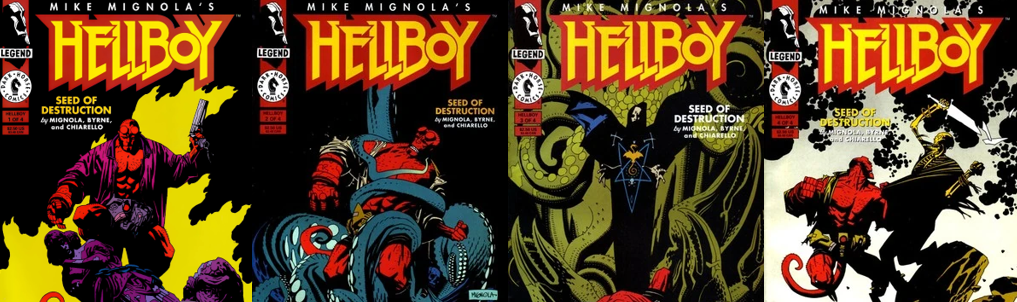
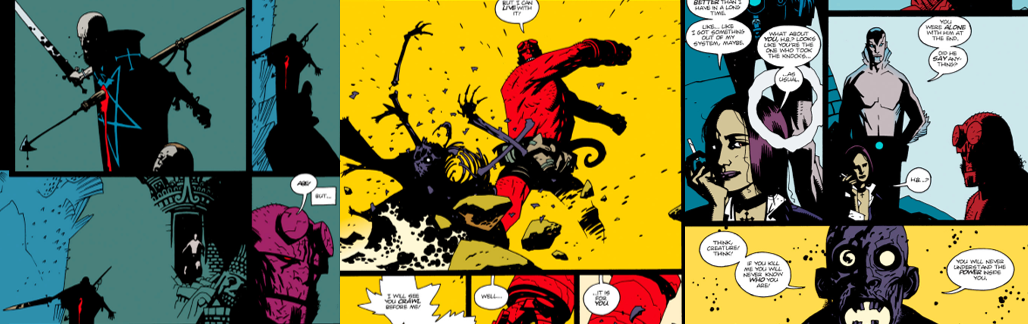
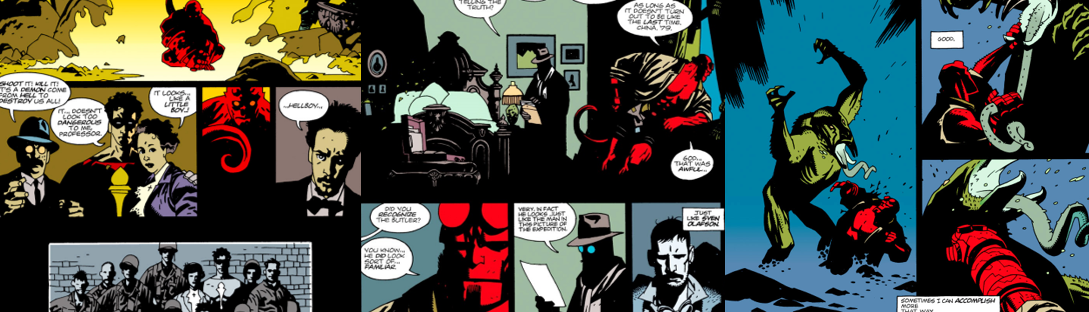
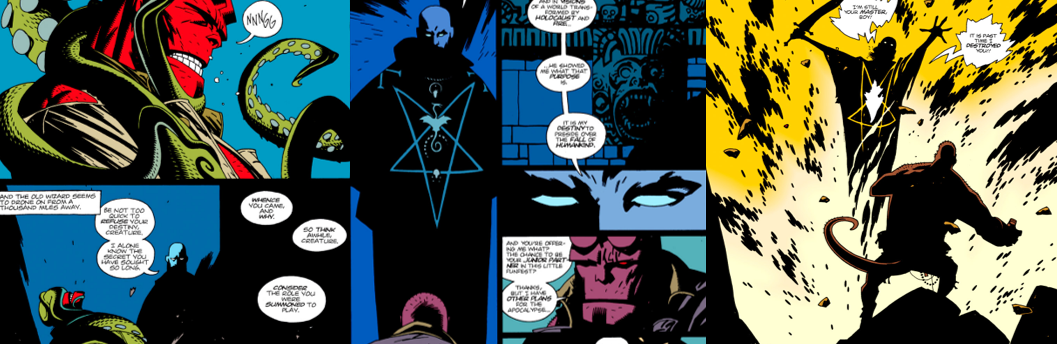
Hellboy’s story begins in 1944 at the tail end of World War Two where a special squad of Army commandos, representatives from the British Paranormal Society, and costumed adventurer Paul Gibney/The Torch of Liberty gather in a remote village in East Bromwich to tackle a lingering Nazi threat known as “Project Ragna Rok”. While First Sergeant George Whitman is sceptical, Professor Malcolm Frost, “paranormal Wiz Kid” Trevor Bruttenholm/Broom, and medium Lady Cynthia Eden-Jones believe that Adolf Hitler’s “spook squad” are experimenting with black magic to raise the dead. Thanks to Broom’s meticulous research and Cynthia’s clairvoyance, the squad learns that maniacal mage Grigori Rasputin is performing a dark ritual powered by a mystical incantation and bizarre equipment, including two hefty gauntlets worn by Rasputin. Although Klaus Werner von Krupt is unimpressed by Rasputin’s light show, Broom and the others are surprised by a sudden burst of supernatural fire and the appearance of a child-like demon. Despite Professor Frost wishing to kill the creature, Broom accidentally names it “Hellboy” and the demon is adopted by the regiment, spending the next thirty-five years being raised by Broom, whom he sees as a surrogate father. Thus, Hellboy is pained to see his mentor aged and struggling with his memory of the “Cavendish expedition”. Thanks to Hellboy’s encouragement, Broom recalls that he accompanied the renowned Cavendish explorers to the ruins of an ancient temple. There, flanked by a statue of the monstrous, cephalopod-like Sadu-Hem, Broom discovered Rasputin in deep hibernation. Barely escaping from or remembering the carnage that followed, Broom summoned Hellboy for aid, only for his adopted son to watch in horror as a plague of frogs herald the arrival of a vicious frog-like monster, which kills Broom and attacks the enraged Hellboy.

When his father is murdered, Hellboy investigates a cursed family and uncovers an apocalyptic threat.

At a disadvantage in the dark, Hellboy is disarmed and wounded by the creature’s caustic tongue, so Hellboy gives the frog-thing a taste of his mysterious, stone-like right hand and sends it crashing into a sarcophagus. When the creature tries to flee, Hellboy puts it down with a single shot from his pistol, stunned when the monster disintegrates. Concerned, Hellboy calls the Bureau of Paranormal Research and Defense (BPRD), receiving condolences from Doctor Thomas “Tom” Manning and ordered to assemble a team to investigate. Hellboy recruits pyrokinetic Elizabeth “Liz” Sherman and fish-man Doctor Abraham “Abe” Sapien to accompany him to the decrepit Cavendish Hall to question Lady Emma Cavendish about her sons. Welcoming their direct questions, Lady Cavendish relates that her family were keen explorers for nine generations and that their fortune was built by Elihu Cavendish, who cursed his bloodline seeking the temple Broom found in the mountains. While she offers them sanctuary, the trip seems to be a dead end and the group are unaware that Rasputin is manipulating Lady Cavendish from the shadows, promising to return her sons for her co-operation. While the group rests, Hellboy’s inner monologue provides some background on Liz and Abe, revealing that Liz accidentally killed her family and several others before mastering her pyrokinesis with the BRPD and Abe was discovered in an abandoned basement of Saint Trinian’s Hospital on the day President Abraham Lincoln died. After Abe and Hellboy ponder Lady Cavendish’s butler, who seems familiar to them, Abe takes to the water to scout around and is horrified when Liz mentions frogs being in her room. Rushing to her aid, Hellboy finds only a smouldering cigarette and the aforementioned butler, who turns out to be a frogman in disguise! While Hellboy fights and ultimately defeats the creature, Abe discovers only “old death” beneath the flooded mansion and Hellboy is distraught to find Lady Cavendish has been killed in the same manner as his father.

Overpowered, Hellboy’s forced to endure Rasputin’s many monologues and rabid boasts.

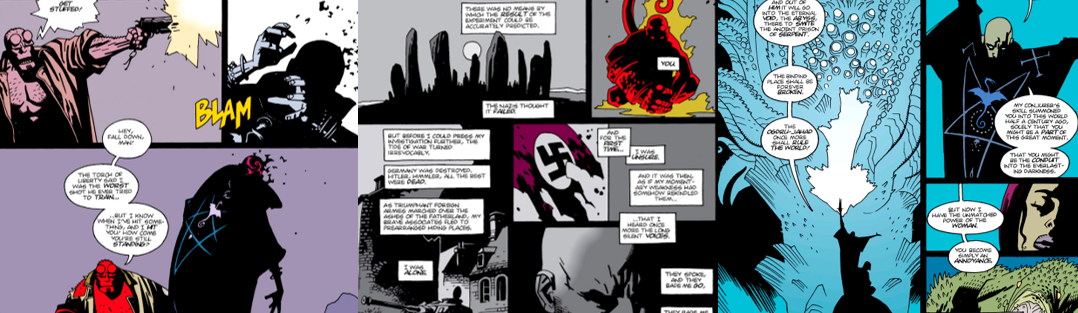
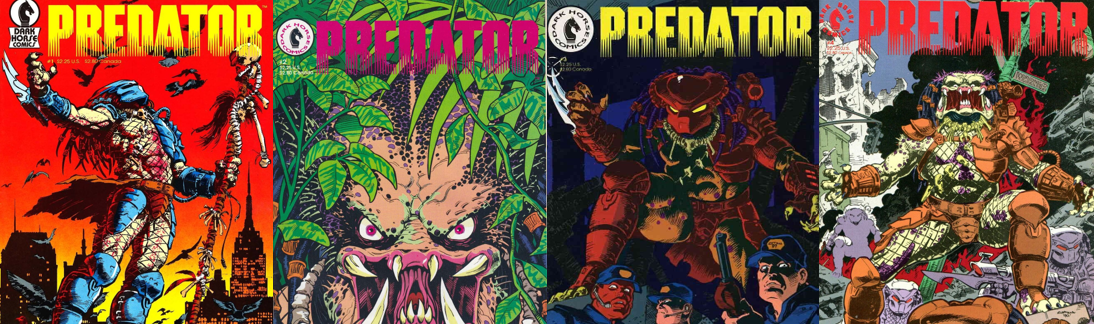
While mourning the old lady, Hellboy is approached by the enigmatic Rasputin, who takes credit for bringing him into the world and demands he kneel in his presence. When Hellboy naturally declines, he’s suddenly ensnared by a gigantic tentacle and dragged into the darkness to fulfil what Rasputin calls his “destiny”. Hellboy is deposited in a dark, cavernous pool beneath the house, which Rasputin declares is rich with the screams of those sacrificed to the “Serpent”. For eight centuries, mortal men sought to free the unknowable “Seven Beasts”, the Ogdru Jahad, who whispered to Rasputin (through his dreams) the means to release them. Though Rasputin claims to be able to command Hellboy, the demon blasts him in the head with his pistol, only to be sent reeling from an incantation by the seemingly immortal wizard. Stunned, realising the talismans he’s collected over the years have been neutralised, Hellboy opts to stall Rasputin until he can think of a solution. This leads to another long monologue about how Rasputin has constantly evaded death thanks to the Ogdru Jahad, who wish him to cause the apocalypse. Hellboy is then attacked by another, even bigger frogman, one of the Cavendish twins hideously transformed by black magic, and is hopelessly manhandled. While Abe follows the trail left by the other frogmen, the battered Hellboy learns of Rasputin’s travels to Europe, how he researched Ragna Rok and allied with the Nazis to gain the resources to enact the Ogdru Jahad’s plot. Though disheartened after Hitler’s death, Rasputin took solace in knowing he’d summoned Hellboy and was drawn to the temple where, while hibernating, he learned from the Sadu-Hem that the horrific Ogdru Jahad is actually seven creatures imprisoned beyond our understanding and longing to avenge themselves upon the Earth.

Though Hellboy triumphs with some help from his allies, he’s left shaken by Rasputin’s words…

After untold years of planning and preparing, Rasputin prepares to fulfil his master’s wishes using Liz’s raw power, much to Hellboy’s dismay, alongside the restored (and enlarged) Sadu-Hem. While using the enchanted Liz as an unwilling a conduit, Rasputin offers Hellboy the chance to join them in death and destruction, which Hellboy naturally rejects despite being near-paralysed from the frogman’s saliva. As Rasputin begins his incantations, Hellboy forces himself to retrieve a concussion grenade from his belt and stuffs it down the frogman’s throat, obliterating it. Rasputin’s dark magics see the Ogdru Jahad slowly awaken and attack their prison, but his mad plot is suddenly interrupted by Abe, who’s possessed by Elihu’s vengeful spirit and first impales the wizard on a spear before releasing Liz from his grasp, sparking an inferno. As Sadu-Hem and the Cavendish estate erupt in flames, the restored Abe rushes Liz to safety, leaving Hellboy behind as he insists on finishing the wraith-like Rasputin. Despite Rasputin boasting incredible power, Hellboy easily trounces the wizard, rejecting him and his offer to know the truth of his origins and shattering Rasputin with his mighty stone fist. From the ruins of Cavendish Hall, Abe relates his confusion about his possession, which Hellboy believes was the old man’s way of putting things right and avenging the many years of losses suffered by his family. While Liz also doesn’t remember much from her time under Rasputin’s spell, she feels an inexplicable relief at having unleashed her full power for once. Though Abe and Liz show concern for Hellboy, he keeps quiet about Rasputin’s final words and his own doubts about himself, and the story ends with the awakening of Rasputin’s old allies, Ilsa Haupstein, Karl Kroene, and Leopold Kurtz, in an abandoned Nazi laboratory…

The Summary:
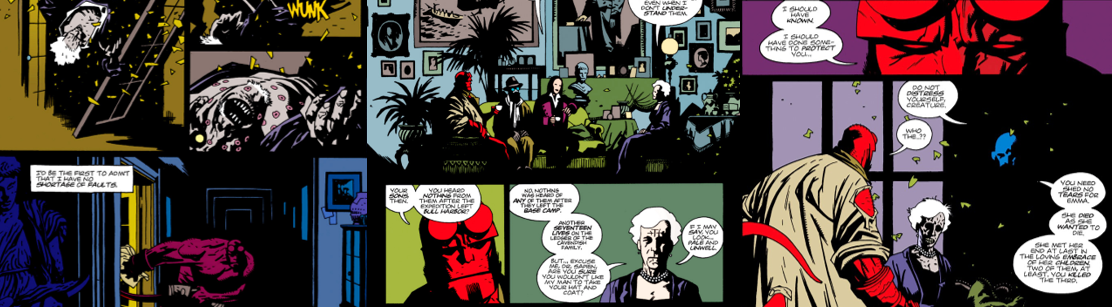
I’ll be the first to admit that my primary source of exposure to Hellboy comes from the movies and cartoons. In fact, “Seed of Destruction” is the only Hellboy story I’ve ever read as of this writing, which may or may not be blasphemy. It’s not that I don’t like the character and his world, which has a fun, gothic horror aesthetic that speaks to the Lovecraft fan in me. My hesitancy is largely because of my dislike of Mike Mignola’s art style which, again, is probably sacrilegious. I liken Mignola’s heavy use of shadows and simplistic forms to Frank Miller, who made a career out of exaggerated shadows and sketches. It’s a very eccentric and unique art style, for sure, and don’t get me wrong: it really works for Hellboy. However, it’s just not very visually appealing for me so I tend to veer away from Mignola’s works. That’s a “me” thing, obviously, as like I say the art really adds to this unique comic book world. Mignola clearly has a reverence for horror, gothic architecture, the arcane arts, steampunk-style technology, and Lovecraft, seeping every panel and page in dark, brooding inks, sparingly using bold colours and relying on silhouettes and murky darkness to create a constantly foreboding atmosphere. Mignola’s writing is also far better than a lot of Miller’s, if I’m comparing the two, with Hellboy being a somewhat snarky, eccentric character who’s respectful to Broom and treats his associates with respect but isn’t afraid to talk a bit of trash to his enemies. Hellboy’s inner monologue reveals a half-human creature fully aware of his flaws (his quick temper, rash decisions, and poor marksmanship chief among them), somewhat curious about his true origins, and with fifty-odd years of paranormal investigating under his belt.

While the unique Hellboy makes a visual impression, he’s a largely mysterious figure in his debut.

Unlike the films, where he’s portrayed as an unruly child at times, Hellboy is largely professional here, calling in situations for the BRPD to investigate and largely conducting himself well while at Cavendish Hall. While Liz admonishes his curt demeanour, Lady Cavendish welcomes the discourse and, most notably, shows no fear or panic when met by a literal demon. While it doesn’t play a big role in this story, it’s clear Hellboy and his allies are far more public figures in the comics and have been accepted by society. Interestingly, the only person who shows any fear or suspicion of Hellboy is Professor Frost; everyone else accepts, respects, and shows concern for him. While Hellboy and Liz have a purely platonic relationship here, unlike in the films, he seemingly admires her for overcoming her traumatic past and she asks if he’s okay in the finale, showing they’re more than just colleagues. Hellboy is seen to be closer to Abe, discussing their suspicions and the case, and these three have clearly worked together in the past. Interestingly, Broom is offed very early on and his relationship with Hellboy isn’t as deep as in the movies. Sure, Hellboy thinks of him as a father figure and is seen to be angered by his murder and driven to track down those responsible, but he’s noticeably more blasé about it, even in his inner monologue. Similarly, Hellboy seems to either be not bothered by his true origins or hiding it extremely well, sparing little thought of where he came from and what his true purpose is. Although Rasputin inspires him to think differently about this, the true extent of Hellboy’s origin and purpose is merely alluded to here, with him said to have a part in the end of the world but it’s not clear what that is. Hell, Rasputin doesn’t even use him in his summoning ritual, instead focusing his power through Liz, leaving me with a sense of intrigue regarding Hellboy’s true purpose in the comics.

The horror and Lovecraftian themes are an undeniable highlight in this intriguing introduction.

Indeed, we learn more about the maniacal Rasputin that we do Hellboy, which has its pros and cons. The pros come from maintaining a sense of mystery about Hellboy to be explored in subsequent issues, while the cons come from having to suffer through panels and panels of exposition and monologuing from the depraved mage as he rambles on about his past. It’s somewhat necessary as it shows just how long the Ogdru Jahad have been influencing him and longing for their release, and how many others have tried to free them through less refined rituals and means, but it does get a bit tedious after a while. I liked that the Ogdru Jahad are kept largely mysterious despite Rasputin’s many words, appearing to be interdimensional, alien, demonic, or even divine monsters trapped within a crystalline prison somewhere beyond our comprehension. They establish a foothold on Earth through the equally monstrous Sadu-Hem (a similarly Lovecraftian beast that barely factors into the plot as it just looms there, grabs Hellboy, and then bursts into flames) and Rasputin, who’s revealed to be unnaturally long-lived and partially undead. Wielding incredible arcane magic and having manipulated the Nazis into providing him the resources to summon Hellboy, Rasputin is obsessed with being the linchpin for the apocalypse, delighting in deceiving others into doing his bidding and giddy at the thought of his masters raining destruction upon the Earth (though, again, it’s unclear what role Hellboy would play in this apocalypse). I feel it might’ve been better to have Rasputin merge with Sadu-Hem rather than take Liz hostage, or as well as using her powers, to give a bit more punch to the ending. It was interesting seeing Elihu get his revenge through Abe, but it did mean Abe and Liz played diminished roles in the finale. Still, while this isn’t a perfect story, I enjoyed this introduction to Hellboy, the familiar elements I recognise from the films, and I am interested in reading more of his adventures…I’m just not sure where to go from here.

My Rating:

Rating: 3 out of 5.

Pretty Good

Were you a fan of Hellboy’s first four issues? Did you pick these up at the time or did you discover Hellboy later, as I did? Do you think I’ve committed blasphemy by criticising Mike Mignola’s art style? What did you think to Hellboy’s appearance and demeanour? Which Hellboy stories are your favourite? Whatever you think about Hellboy, feel free to leave your thoughts below, check out my other horror-related content on the site, and donate to my Ko-Fi to suggest other Hellboy stories for me to review.

Back Issues: Predator #1-4

This review has been supported by Chiara Cooper.
If you’d like to support the site, you can do so at my Ko-Fi page.

Story Title: “Concrete Jungle”
Published: June 1989 to March 1990
Writer: Mark Verheiden
Artist: Chris Warner and Ron Randall

The Background:
In 1980, Mike Richardson founded Dark Horse Comics, a comic publisher that separated itself from the heavy-hitters like DC Comics and Marvel Comics by focusing its efforts on creator-owned titles. Dark Horse Comics achieved greater mainstream success in 1988 by publishing licensed stories and adaptations of horror and science-fiction films and franchises, the most prominent of these was the merging of the Alien franchise (Various, 1977 to present) and the Predator films (Various, 1987 to present). However, concurrent to writer Chris Warner’s three-issue clash between those two, Dark Horse Comics also published this four-issue spin-off of the Predator franchise, specifically revolved around the hitherto-unknown brother of Major Alan “Dutch” Schaefer (Arnold Schwarzenegger), later retitled to “Concrete Jungle”. Perhaps bolstered by the crossover between Aliens and Predator, “Concrete Jungle” proved popular enough to spawn not only a slew of additional Predator spin-off comics and movie adaptations, but also crossovers with other comic book icons such as DC Comics’ superheroes and even lawman of the future Judge Joseph Dredd. While the Predator movies have often been met with mixed reviews, comic book adaptations continued to be published, with the alien hunters even crossing over into Marvel Comics after Disney purchased 20th Century Fox.

The Review:
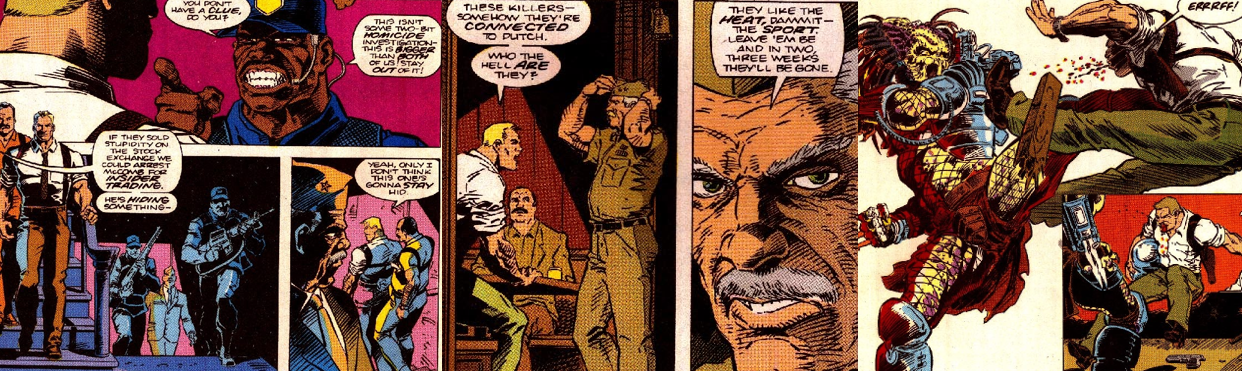
Much like Predator 2 (Hopkins, 1990) “Concrete Jungle” is set in an overpopulated and crime-ridden city during a stifling heatwave that drives its citizens to violence and even murder. In this case, we’re in New York City and following police detectives and long-term friends and partners Errol G. Rasche and John Schaefer, Dutch’s older brother who got them transferred from narcotics to homicide after tossing a cartel chief off a rooftop. While Rasche is convinced this is a conspiracy headed by their corrupt police captain, McComb, to have them offed by local gangs, Schaefer’s more concerned about the stars looking “different” than either their current situation or the escalating drug problem sweeping the city streets. This nicely segues to a tense meeting between two rival gangs, headed by Lamb and Carr; while Carr advocates for them joining forces to maximise their profits and fend off Columbian cartels, Lamb would much rather fight to the death and see who’s left to reap the rewards. Just as an all-out gunfight is about to break out, one of Lamb’s men is blasted from behind by the Predator’s plasma cannon; another is diced up when he sticks his head out the window and, assuming it’s an attack by the Columbians, both gangs open fire and blow a hole in the building wall. The fracas draws the attention of the cops but, when Rasche and Schaefer arrive, they’re barred from entering the building until Captain McComb arrives.

Stubborn Schaefer ignores all the warnings and ends up going toe-to-toe with a Predator.

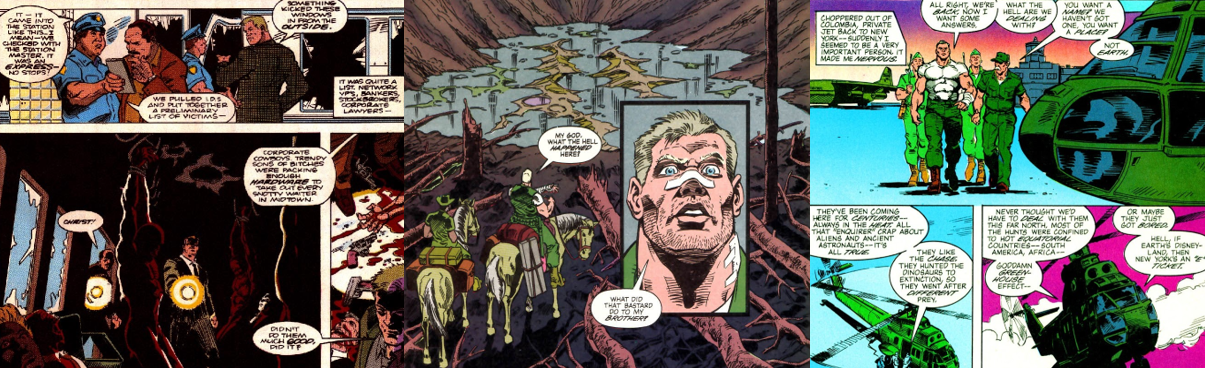
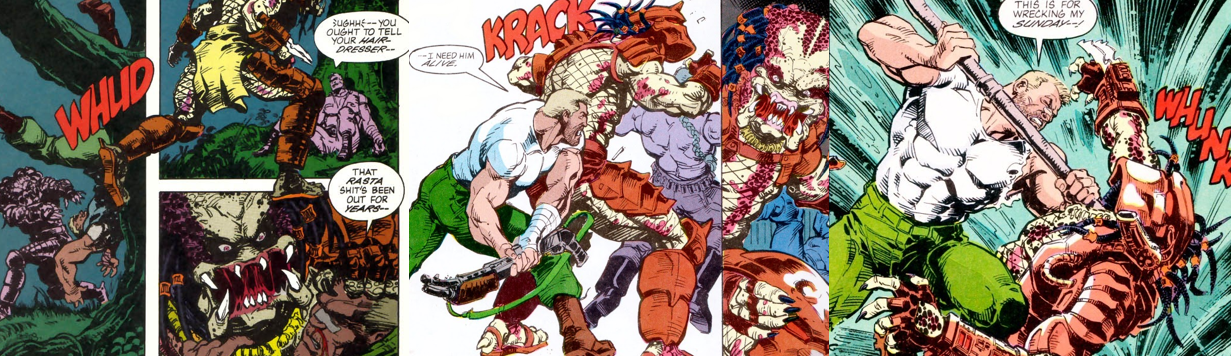
Just like the hot-headed Lieutenant Mike Harrigan (Danny Glover), Schaefer doesn’t really give a damn about McComb’s authority and he and Rasche head on in after one of the gang members is hurled from a window and crashes into a police car. Inside, they’re horrified to find the remains of the two gangs littering the floor and strung up, skinned, from the ceiling. Carr, who somehow survived the massacre, opens fire, blaming the cops for what happened, and manages to slip away right before Special Weapons and Tactics (S.W.A.T.) come crashing in, led by an incensed McComb. Pissed that Schaefer disobeyed a direct order, McComb continues the homage retread of Predator 2 by chewing the blonde-haired muscleman out for overstepping his boundaries. Later, Rasche and Schaefer investigate a wholesale slaughter in the subway, again covering the same ground as Predator 2 and seeing McComb reprimand them despite the fact that they’re literally just responding to calls rather than actively involving themselves in the investigation. This time, however, McComb’s orders are overruled by the appearance of General Homer Philips, Dutch’s former commanding officer from the first movie, who takes Rasche and Schaefer aside to warn them off out of loyalty to Dutch. While we’re never told what happened to Dutch or where he is, he clearly told General Philips enough about his big brother and the Predator for him to step in, for their own safety, assuring them that it’ll all be over in about two weeks if they don’t interfere. Realising that the gruesome murders are somehow connected to Dutch, Schaefer naturally ignores these warnings and breaks into Lamb’s apartment, now a crime scene, where he’s blindsided by the Predator. A fist fight breaks out, one naturally one-sided, that sees the Predator place a curious implant into Schaefer’s neck and him managing to steal the creature’s helmet after smashing it off with a piece of timber.

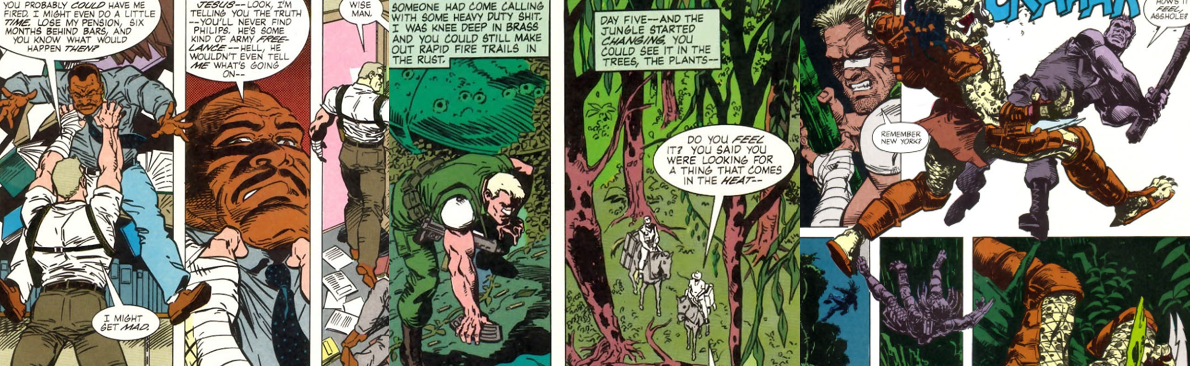
Schaefer’s search for answers takes him to South America, where he easily scores his first Predator kill.

For his efforts, he’s left with a broken nose and sent plummeting to the street below; he’s saved from death only by grabbing on to and tangling himself up in washing lines conveniently hanging between buildings. Despite being left a bloody mess, his snark remains intact, but his doctor is unconvinced by the paper thin explanations the two give for the brute’s injuries. Stubbornly refusing to take the time to rest, Schaefer limps his way over to Rasche’s home where he suggests that the Predator tagged him to keep track of him for later and insists that they try to find General Philips so they can get some real answers. Their efforts are interrupted by a furious McComb, but when he threatens to have Schaefer brought up on charges, the hulk lashes out, smashing his telephone, ramming McComb against the wall, and threatening him with further violence if he doesn’t give up General Philips. However, McComb is too low on the totem pole to help; as far as he’s concerned, General Philips doesn’t exist, there is no investigation, and all of it is far above his paygrade. With no other leads to go on, Schaefer decides to fly out to South America, Dutch’s last known location, and look for answers himself despite the danger posed to him by the Columbians he’s pissed off. He finds himself a guide in a seedy bar in Riosucio and is led to first the overgrown remains of the guerrilla camp Dutch and his team ransacked in Predator and then the massive crater left over from the Predator’s (Kevin Peter Hall) self-destruct device. At night, Schaefer reminisces about his childhood with Dutch (the two of them used to hunt in the woods, not for sport or fun but to test their mettle against nature) and arms himself with a fully automatic shotgun when his neck implant alerts him to the Predator’s presence. Although he’s able to dodge the Predator’s plasma cannon and even land a shot on the creature’s shoulder, Schaefer’s caught off-guard by the Predator’s cloak; still, he’s able to stab it in the ribs before being manhandled. Schaefer’s as quick with his wit as he is with his thinking, though, and tosses salt in the Predator’s eyes before beating it with a log, successfully knocking it over a cliff edge and causing it to be impaled on a spike-like tree branch.

In the face of a Predator invasion and military cover-ups, Schaefer seeks allies in low places.

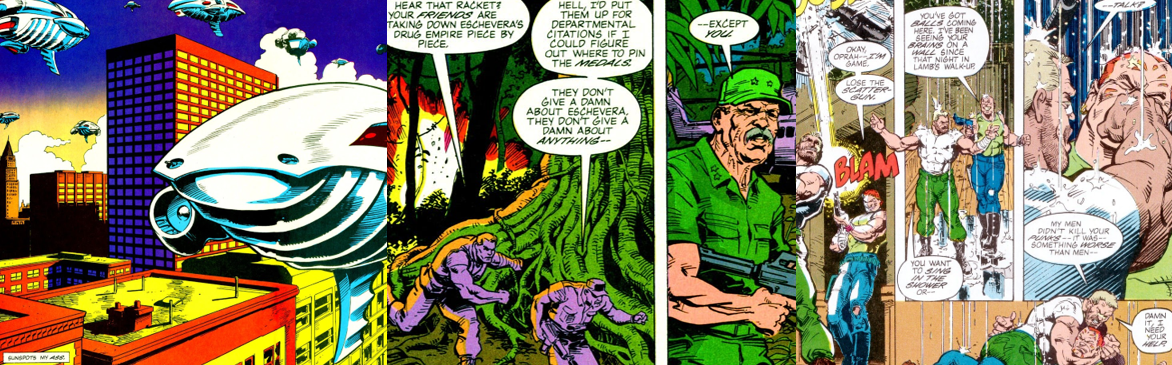
Schaefer’s less than surprised when it turns out that his guide was one of General Philips’ men, who’s distraught that Schaefer killed the creature and even suggests that Philips knew about the Predator when he sent Dutch into the jungle. As he forces Schaefer to face General Philips, chastising him for not understanding the implications of killing one of the alien hunters, they’re attacked by Columbian drug lords, who kill the guide and manage to knock Schaefer out. Although Schaefer’s able to fight his way out before he can be tortured, a whole gang of Predators strikes the drug camp, wiping out the Columbians with their plasma cannons and setting the base on fire. Thankfully, General Philips arrives to help get Schaefer out of there and back to New York, where Philips confirms that he’s known about the Predators all along and that they seem to be fixated on Schaefer and his brother. Meanwhile, Rasche messes about with the Predator’s helmet and, when he puts it on, figures out what’s been screwing with television receptions and the stars when he sees a whole fleet of cloaked Predator ships hovering throughout the city skyline! When he attempts to warn McComb, the police captain shoots him down and threatens him with jail for withholding evidence and he’s taken into custody by agents of the Inland Revenue Service acting on behalf of the Federal Bureau of Investigation (FBI). When he realises that the Feds mean to hand Schaefer over to the Predators, Rasche is able to take advantage of the accountants’ penchant for numbers to overpower them and load up at the station armoury. Showing little concern for the safety of New York, Schaefer knocks Philips out and forces his chopper to land so he can reconvene with Rasche but, realising that they’re outgunned and outmatched against the alien menace, Schaefer goes to Carr to recruit him and his gang.

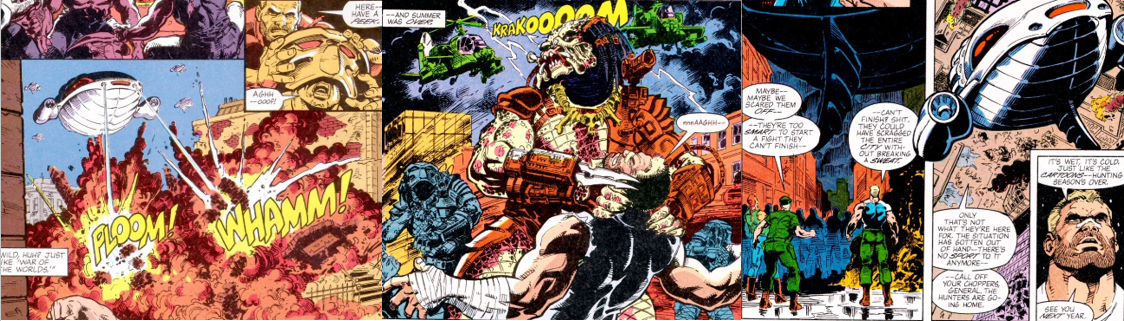
Just when all hope seems lost, the Predators just…decide to leave and the conflict is over.

Although he’s naturally suspicious of the cop, Carr is immediately attacked by a Predator; when Schaefer struggles to fend off the Predator, Rasche arrives and blows it away with a bazooka, convincing Carr to set aside their differences to combat the alien invasion. The Predator ships open fire, bombarding the city with devastating laser blasts but Schaefer and the others manage to escape to safety and get their forces together to make a final stand against the invaders. Schaefer draws first blood, using the Predator helmet to direct Carr in bringing down a Predator ship with a single rocket, somewhat undermining the threat of their advanced technology and looming ships. Their efforts catch the attention and anger of Captain McComb, who surrounds the immediate area and calls for their surrender but, just as McComb is about to gun Schaefer down in the street, a Predator ship decloaks and opens fire, resulting in McComb getting his face blasted off by a Predator’s plasma blast. Schaefer’s helmet is damaged after he goes off all gung-ho and Rasche is injured by a plasma shot before General Philips and the army turn up, only to reveal that the military is preparing to launch a massive air strike that will level the city and lay waste to both the populace and the “foreigners”. Schaefer targets fire hydrants to short out the Predator’s technology, revealing their ground forces and allowing him and his allies to take the fight to them, but the Predators quickly overpower even Schaefer. However, they burst into laughter when they see the incoming choppers amidst a dark, rainy sky. Schaefer finally pulls his neck implant out as the Predators leave, theorising that the weather has turned too cold, and the situation has escalated so far that there’s no sport to be found in New York anymore. Schaefer vows to see them again the next time it grows unseasonably hot and ignores General Philips’ scolding to get Rasche to safety, showing little consideration for the state of the city.

The Summary:
While the artwork of “Concrete Jungle” is pretty good, with Schaefer appearing as a good facsimile of Arnold Schwarzenegger and New York City mimicking the aesthetic of Predator 2, the writing and narrative leaves a lot to be desired. Although Dutch dropped a couple of situational one-liners, he wasn’t some cliché, snark-spouting machine; his older brother, however, has almost John McClane (Bruce Willis) levels of sarcasm and is never short of a wry remark no matter how desperate the situation is. This is fine for a one-dimensional action hero and helps to differentiate the elder Schaefer from his brother, but it doesn’t always land for me; it doesn’t help that he’s motivated not out of a desire to serve and protect but more to test his own limits. A proud man with little regard for authority, he sees New York as an unsalvageable cesspool and he simply rises to the challenge when the Predators arrive, sensing their presence even before he’s forcibly implanted with their relatively unexplained and ultimately pointless neck device. In many ways, Schaefer is a mixture of Dutch’s musclebound bravado and Harrigan’s weathered, roguish character; he bursts into crime scenes, shows up where he’s not wanted, and openly defies both his superior and the American military, just like Harrigan, while throwing his muscles around and being a driven man’s-man just like his younger brother. Unfortunately, these elements come together in a way that doesn’t really gel for me; “Concrete Jungle” has a really interesting premise that it just squanders in favour of recreating or referencing events from the first two Predator films.

The story contains a few too many callbacks to the films and completely upends General Philips’ character.

I really like the idea of the hunters arriving on Earth en masse; the visual of characters wearing their helmets, being horrified at the sight of the fleet, and the Predator ships opening fire upon New York City and swarming the streets is a striking one and a natural escalation from the existing movies that only comics can provide since they’re unconstrained by budgets. But all the potential of these plot points isn’t realised until the final few pages of the last issue and, instead, the bulk of the story is spent on a rehash of the main plot elements of Predator 2. Like Los Angeles, New York is a grimy city in the middle of a gang war about drugs that involves a lot of violence, and, like Harrigan, Schaefer has no time for the red tape surrounding this and wants to bring both gangs down. The Predator not only slaughters both gangs much like in the opening moments of Predator 2 but even randomly attacks subway passengers, just like in that film; McComb’s anger at Schaefer is a combination of Special Agent Peter Keyes (Gary Busey) and Deputy Chief Phil Heinemann (Robert Davi), and the general visual and narrative thrust of the first two issues is geared very much towards recreating sequences of Predator 2, robbing “Concrete Jungle” of much of its identity. The story then finds a contrived reason to ship Schaefer over to South America for literally no other reason than to reference events from the first film; it turns out that he’s right and General Philips is there, but this could’ve just as easily taken place somewhere else, and Dutch’s actions could’ve been represented by pictures and dialogue rather than literally having Schaefer stand in that crater. I enjoyed the return of General Philips, a character I would’ve loved to see make a return in a hypothetical Predator 3 back in the nineties, and it was interesting learning that he was aware of the Predator before sending Dutch in, effectively turning him into a Keyes substitute.

Some good art and action doesn’t make up for a squandered plot and diminished Predator threat.

I can’t say I actually enjoy this twist, though; the brief interaction between Dutch and Philips spoke to me as two old friends who have an immense amount of respect for each other, and nothing in Predator suggested that he (or anyone apart from Anna Gonsalves (Elpidia Carrillo)) was aware of the Predators. In fact, the prevailing understanding is that the world (or, at least, the government and military) only became aware of the Predators after that first film and I found it a bit disappointing and frustrating to find out that Philips was happy to sacrifice his best soldier and close friend to the alien hunters. Of the two protagonists, Rasche gets quite a bit of development; we see his home, learn and see a little from his family, and he’s much more concerned with the implications of their actions compared to Schaefer; it’s also through him that we learn anything about Schaefer for some time, as surface-level as it is, so I was glad that he didn’t die, especially as it seemed like he was going to. Then there’s the Predators; modelled after the ones seen in the first two movies with little deviations, they sport very little new weaponry or technology, and their threat has been significantly downplayed. Naturally, in a one-on-one fight, not even Schaefer can stand against one of them, but he is able to wound them, knock one of their helmets off, sense their presence even before he gets his neck implant, and is able to kill one much easier than either of the films’ two protagonists. Schaefer can dodge their plasma cannons pretty easily, regularly fights them off with melee weapons, and never has to worry about their wrist blades, combisticks, or other weapons as these either don’t get much play or are only used against disposable background characters. The ending was also extremely anti-climactic; with all of New York under siege and the human characters vastly overpowered, the battle/invasion/whatever just…ends because of a bit of rain and the suggestion that the Predators just wanted to goad humans into destroying each other. It’s a bit vague and very unfulfilling for an ending, with the only consolation being that it didn’t end the same way as the films (with a one-on-one fight against a Predator) but, in this case, maybe it should’ve as it seems like the Predators were just messing about and never intended to wipe out the city (and/or humanity) despite clearly being able to with their superior force (…as long as you ignore how easily Carr took down one of their ships…)

My Rating:

Rating: 2 out of 5.

Pretty Good

Have you ever read the original, four-issue Predator story? If so, what did you think to it? Do you own a copy of the original comics or did you pick up the collected edition? Were you also disappointed by repetition of events from the first two movies? What did you think to John Schaefer, especially compared to his little brother, and the revelation that General Philips knew about the Predators? Were you disappointed that the story didn’t do more with the Predator invasion plot or did you enjoy the callbacks to the first two films? Which of Dark Horse’s Predator stories or adaptations was your favourite? Whatever your thoughts on Predator, and comic book adaptations of this kind, drop a comment down below or share your thoughts on my social media.

Movie Night [Crossover Crisis]: AVPR: Aliens vs. Predator – Requiem


In April 1985, the first issue of the ground-breaking Crisis on Infinite Earths (Wolfman, et al, 1986) released and saw the temporary destruction of the “Multiverse”. To celebrate this momentous event, I’m discussing multiversal crossovers all throughout April in an event I dubbed “Crossover Crisis”.


Released: 25 December 2007
Director: The Brothers Strause
Distributor:
20th Century Fox
Budget: $40 million
Stars:
Steven Pasquale, Ian Whyte, Johnny Lewis, Reiko Aylesworth, Kristen Hager, and Tom Woodruff Jr.

The Plot:
Following the last clash between Xenomorph and Predator, a “Predalien” (Woodruff Jr.) hybrid begins a bloody rampage in a small Colorado town. While former convict Dallas Howard (Rasquale), his troublesome younger brother Ricky (Lewis), and soldier Kelly O’Brien (Aylesworth) desperately try to survive as their town is overrun with viscous alien drones, a lone Predator, “Wolf” (Whyte), is dispatched to remove all traces of the creatures from the town by any means necessary.

The Background:
Starting life in the pages of Dark Horse Comics with a three-issue short story courtesy of writer Chris Warner, the Aliens vs. Predator concept quickly expanded into multiple follow-up stories, an expansive toy line, and videogames. After a lengthy stint in Development Hell in which notable figureheads from the Alien franchise (Various, 1977 to present) openly criticised a crossover between the two horror icons, Paul W. S. Anderson won over the studio with his pitch and turned a tidy profit with AVP: Alien vs. Predator (ibid, 2004). Though the film was subjected to largely negative reviews, brothers Colin and Greg Strause were brought in to helm a follow-up, having previously unsuccessfully pitched a similar crossover and making a mark in Hollywood with their work as visual effects supervisors. Excited at the prospect on working on such a film, the two insisted that the bulk of the film’s effects were achieved practically, with CGI being used sparingly to render alien spacecraft, the more elaborate sets, and to bolster the practical effects wherever possible. Amalgamated Dynamics, Inc. created the monstrous Predalien suit, which incorporated visually recognisable aspects of both species and was brought to life using an animatronic head and practical suit. Despite the brothers’ attention to detail and clear love of both franchises, and making a respectable $130.2 million worldwide gross, Aliens vs. Predator: Requiem failed to impress critics: many have cited it as one of the worst films in either franchise and critics dismissed the film as a mindless, violent mess akin to a videogame that suffered from dull human characters and poor lighting. While some were impressed by the film, especially compared to the first one, plans for another movie was indefinitely suspended and fans would have to settle for the 2010 videogame as a quasi-third entry as both franchises have continued on separately on the silver screen.

The Review:
As a big fan of both the Alien and Predator franchises, and of their crossover comic books and videogames, I was left pretty disappointed with the first AVP film. While I believe that the premise of pitting these two iconic extraterrestrial monsters against each other has a lot of potential, and should be a license to print money, the execution of their long-awaited clash fell flat thanks to a by-the-numbers, toothless effort on behalf of all involved. Despite some decent practical effects and an interesting expansion of the Predator lore, the film just played things far too safe and couldn’t live up to either the standards of its predecessors or the expectations set by other meetings between the two. Unfortunately, AVP: R had a bit of a mountain to climb in that regard as many audiences went into it with low expectations after the last film and because it picks up immediately where AVP left off, meaning the entire film beyond the opening sequence is set on then-modern-day Earth. And in the suburbs, no less! While I’ll never agree with the decision to set the conflict between the two creatures on Earth in the mid-2000s rather than in the far future and on another world, at least AVP: R doesn’t shy away from the gore and immediately delivers something new by quickly accelerating the birth of Scar’s (Whyte) progeny and bringing to life a truly gruesome Alien/Predator hybrid, the Predalien.

Sadly, AVP: R falters with its human characters, who are far too generic to make an impression.

After slaughtering the Predator’s on their shuttle and causing it to crash-land in the forests of Gunnison, Colorado, the Predalien immediately sets about establishing a nest for itself in the sewers under the town, while the ship’s payload of Facehuggers gets to work impregnating the unsuspecting townsfolk…including a little boy, showing that AVP: R really isn’t pulling any punches compared to the last film. One of the things I criticised about the first film was the strength and quality of its cast; however, at least AVP had Colin Salmon and Lance Henricksen to add some gravitas to the proceedings. AVP: R is completely robbed of this benefit, giving us a cast of no-name television actors who struggle to offer any kind of dimension or intrigue to the largely expendable human characters. The film ties to focus itself around Ricky, a normal, everyday high schooler who works a shitty job, is the target of farcical jock-like bullies, and pines after the unreasonably attractive Jesse Salinger (Hager). I guess we’re supposed to like and connect with Ricky because he’s just a regular kid, but he’s basically just every semi-rebellious, resentful teenager you’ve ever seen. While he’s not very appealing by himself, I ironically didn’t mind the relationship between him and his older, far more interesting brother, Dallas. A former convict with a no-nonsense attitude who’s trying to turn his life around, Dallas might be burdened by desperate attempts to make him appealing (he’s a rugged ex-con, he shares his name with Tom Skerritt’s Alien character, he shares an awkward flirtation with Kelly, and he even gets the iconic “Get to the chopper!” line) but at least he demonstrates a brief glimmer of character through his practical, if blunt, solutions to the escalating horror. Kelly is shoehorned into the mandatory “tough female protagonist” role made synonymous with the Alien films by Lieutenant Ellen Ripley (Sigourney Weaver); sadly, like Lex Woods (Sanaa Lathan) before her, Kelly struggles in this role; she’s not nearly dynamic or captivating enough to be a strong female protagonist, despite her being given a layer of vulnerability and maternal appeal in her strained relationship with her young daughter, Molly (Gade). Kelly is barely seen processing the death of her husband, Tim (Sam Trammell), before she’s flirting with ex-cons and blasting shotguns and Xenomorphs and it seems she’s primarily there in a half-hearted attempt to call-back to the far ore memorable Ripley and to have someone in the group who can pilot them to safety in the finale.

Gunnison is caught not just between the Aliens and Predator but the rampage of the monstrous hybrid.

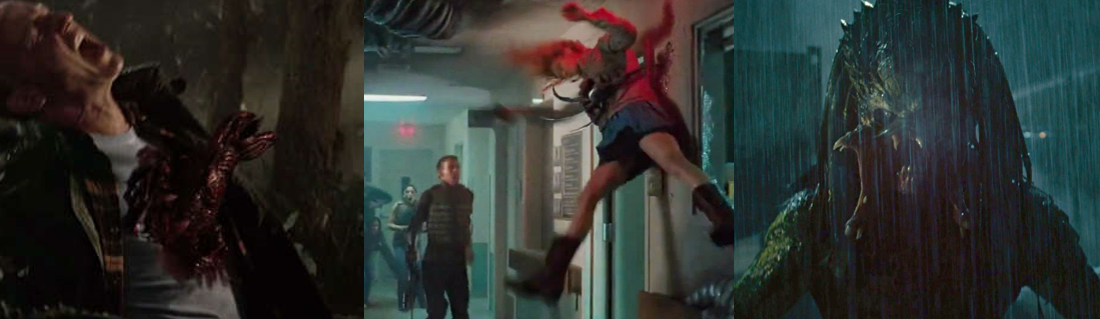
Gunnison is naturally a central focus of the film; the Xenomorphs nest and rampage through the town and its inhabitants are picked off and impregnated by them for the first half of the film, with the town’s homeless and gung-ho hunters particularly suffering in the early going. Law and order is maintained in the town by Sheriff Eddie Morales (John Ortiz), a childhood friend of Dallas’s and former problem child himself who makes efforts to help him get his life back on track but who’s soon overwhelmed by the sudden invasion of bloodthirsty biomechanical monstrosities. Completely out of his depth, Morales calls in the National Guard (who are promptly slaughtered) and desperately radios for military aid; however, he refuses to heed Dallas and Kelly’s advice that Colonel Stevens (Robert Joy) is misleading them with the promise of an air evacuation and therefore dooms himself and his posse, who are so terrified that they’re focused only on escaping rather than using rational thought. Gunnison is also home to some disreputable characters; bullies Dale Collins (David Paetkau), Mark (Matt Ward), and Nick (Michal Suchánek) give Ricky more than his fair share of grief, with Dale beating him in the street for giving him backchat and eyeing up his girl, Jesse. Despite their differences, they’re forced to band together when they’re attack by a Xenomorph in the school pool and hunted through the school corridors, with the bullies soon paying for their misguided machismo. For all the focus AVP: R puts on the mutual attraction between Ricky and Jesse, it’s absolutely brutal when she is unceremoniously cut in half by Wolf’s shuriken-like Smart Disc; her death is so spontaneous that it’s both shocking and amusing and indicates just how much more ruthless AVP: R is compared to its predecessor. However, nowhere is this more evident when the Predalien stalks through a maternity ward at the local hospital, where it uses its proboscis to lay a bunch of Chestbursters into the bellies of the pregnant women in there! While this kind of cruelty may understandable frowned upon by some, I’m actually a big fan of shock value and AVP: R certainly delivers in that regard thanks to being unapologetically gory and violent.

Wolf comes to clean up the Alien infestation and proves to be the film’s most interesting character.

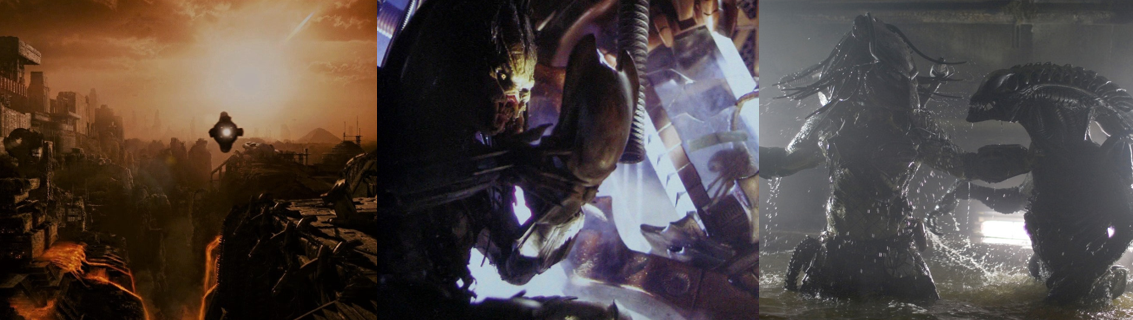
Similar to the last film, and true to the nature of the concept, the Predator takes an active role as an anti-hero throughout the film’s events, however I’d argue that Wolf is such a presence here that he’s almost portrayed as the film’s primary character. After the Predator shuttle crashes and the Facehuggers and Predalien escape into the wild, Wolf picks up the signal (giving us our first live-action glimpse of the Predator home world) and immediately sets out to contain the outbreak. An accomplished hunter and veteran, Wolf is far more capable and experienced compared to the rookies seen in the last film; carrying the acid scars on his face and missing a mandible, Wolf is portrayed as something of a “cleaner” and damage control for unwanted or unsanctioned Xenomorph infestations, but comes across more like a detective in his investigation of the crash site, which sees him arm himself with two shoulder cannons, and his meticulous destruction of all traces of either species using a corrosive blue goop. Though largely surreptitious and focused on this mission, Wolf does stray to partake in a little hunting, recreating scenes from Predator when interrupted by the Gunnison search party in the  forest (actually skinning his victims rather than just stringing them up as in the last film) and bringing undue attention to himself by causing a blackout when picking off Xenomorph’s at the town power plant. However, humans are of little interest to this Predator, meaning we’re thankfully spared any awkward and cheesy team ups between Wolf and Dallas; indeed, Wolf is largely nonplussed when the townsfolk get caught in the crossfire between him and his prey and he’s perfectly happy to blast their heads off if it means containing the outbreak. Sporting all the tried-and-true weapons and tactics associated with the alien hunter, Wolfe is given the tactical and technological edge that the humans sorely lack; he can view multiple spectrums and review recorded footage from his fallen comrades using his helmet, has all the tools and toys of his predecessors (but with two shoulder cannons), and is far more adept at dealing with Xenomorphs than any other Predator we’ve seen before.

Led by the grotesque Predalien, the Xenomorphs swarm through the sleepy, unassuming town.

As before, the Xenomorphs are portrayed as being more stereotypically and recognisably “bad” compared to Wolf, who’s firmly entrenched as a bad-ass anti-hero. Alien acid severs limbs and melts faces, and Facehuggers and scurrying to the sewers to set up a nest. The fully-grown Xenomorphs seem largely unfazed at their urban settings, easily skulking through town in the dead of night to pick off victims and being framed in a suffocating, near constant darkness that really helps to add to their terror (when you can actually see them, that is). In a nice change of pace, AVP: R doesn’t rely on the cliché of a Xenomorph Queen and instead has the creatures directed by a far more mobile and altogether more versatile and horrifying alpha, the Predalien. A hulking, drooling nightmarish mish-mash of Alien and Predator biology, the Predalien is framed very much like the original Xenomorph drone (Bolaji Badejo) and a figure of disgusting, uncomfortable sexually-charged horror rather than some disposable, squealing drone. Although I often think of the Predalien as being a masculine counterpart to the Alien Queen, it’s actually an asexual creature, able to impregnate multiple Chestbursters directly into a host using its proboscis. Not only does the Predalien sport the mandibles and dreadlocks of a Predator but it also rips the spines out of its prey much like the alien hunter; seen as an abomination by Wolf, the two have a deep-rooted instinctual hatred of one another and their inevitable conflict is so brutal that it would be a fight to the death even without the impending threat of nuclear destruction.

The Nitty-Gritty:
AVP: R tends to get a bad name primarily because of its poor lighting; when I went to see it in the cinema, I don’t remember it being that dark or difficult to make out what’s happening but it’s hard to deny that sections of the film are all-but impossible to see since they’re bathed in a pitch-black darkness. On the one hand, I don’t actually mind this; it recalls the dark atmospheric horror of the first Alien film and returns these creatures to their roots as frightening monsters rather than lessening their threat through over exposure, however I think the Brothers Strause went a little too far into the dark, perhaps in an attempt to keep the film from upsetting the censors by adding unnecessary monster horror to its gore, swearing, and violence. Fiddling with your TV settings and the lighting in your home can improve things, for sure, but it’s a shame that so much of the film, suits, and brutality is lost to this impenetrable blackness. Unlike the last film, AVP: R is unapologetically R-rated; characters swear throughout the film and blood and gore are far more prevalent, bringing the film more in line with the standards set by previous entries in the series. As alluded to, this also can be taken as a detriment as the Brothers Strause go super dark by having Chestbursters burst out of children and pregnant women, but these films have always had some uncomfortable gory scenes and I’m certainly not going to complain about this considering how toothless the first AVP film was. I also have to commend the Brothers Strause for their clear affection for the source material; this is evident right from the start, where the film’s credits are a mixture of both franchise’s fonts and the ambient sound is a mash-up of the classic motion tracker beeping and the Predator’s thermal vision, and the amalgamation of the franchises continues to be felt throughout the film in Brian Tyler’s score.

The increased focus on gore and recreating both franchise’s atmospheres is very much appreciated.

As ever, the main appeal of the film are the practical effects used to bring both species to life; again, this is why the low lighting is such a drawback as the Aliens finally include their most memorable design (the rigged skull variant from the second film) and we never really get a decent look at the Predalien thanks to the all-encompassing darkness and wash of rain throughout the movie. Still, the suits, puppets, and animatronics are as good as they’ve ever been and sometimes benefit from the darkness; Wolf sticks very closely to the classic Predator look defined in the first two films, though with a more visually interesting helmet and sporting the battle scars of his many hunts. The cloaking effect is much improved this time around, as are the CGI blasts used to represent his shoulder cannon projectiles, both of which harken back to the first two films and Wolf even uses the trajectory tracking system seen in the first Predator. Best of all, his face more resembles the classic Stan Winston design rather than the butt-ugly travesty we saw in AVP, and we get an all-too-brief glimpse of the Predator home world, a searing hot planet of ancient pyramids and structures that just cries out to be revisited in more detail some time, and the additional toys Wolf gets to play with. Wolf has the spear and the gauntlets but also has little mapping devices that double as laser traps he to cover his back and cut down any Xenomorphs, he can charge up his gauntlet to burst through solid concrete, has a slick razor-sharp whip, and he’s also easily powerful and adept enough to hold multiple Xenomorphs off at once. The Aliens not only have their signature squeal, but we also get to see them feeding on human brains; they’re also slimier and more grotesque than ever, though none more so than the Predalien. This thing is absolutely abhorrent to look at, drooling and stomping about with a real weight. In many ways, it reminds me of the Newborn (Tom Woodruff Jr./Joan La Barbara/Archie Hahn) in that it’s an even more monstrous variant of one of cinema’s classic creatures, though the Predalien enforces its will far more aggressively than the Queen, striking Xenomorphs when they try to eat or act before it and slashing at its victims with its huge claw-like hands and prehensile tail.

Sadly, the brawl is interrupted by a nuke that kills the town and puts an end to the alien threat.

Many of the human survivors are whittled down in their efforts to arm themselves thanks to Wolf using them as bait and picking them off simply for being armed; the National Guard and absolutely massacred by the Xenomorphs as well, and the remaining survivors split up after disagreeing about Colonel Steven’s evacuation plan. Colonel Stevens directs the survivors to the centre of town on the pretence of an evacuation but it’s actually to ensure that the Aliens all congregate on ground zero of his tactical nuclear strike, which obliterates the entire town and all traces of the alien infestation save for Wolf’s shoulder blaster. Before the town is destroyed, however, Dallas, Kelly, Molly, and a wounded Ricky fight their way to the roof of the town hospital (which has been partially converted into a horrific Alien nest) to get to the helicopter and escape the incoming blast in tense scenes awash in darkness and flickering lights that recall Ripley’s desperate last-minute escapes as much as Kelly’s drive through the wrecked streets calls back to Ripley’s rescue of the Colonial Marines in their armoured transports. Barely able to fend off the skulking Xenomorphs with their weapons, Dallas covers their escape by wielding Wolf’s repurposed shoulder cannon, but ultimately it comes down to a one-on-one, hand-to-hand slugfest between Wolf and the Predalien. This takes place on the rooftop of the hospital, in the dead of night, and amidst a torrential downpour with their destruction an inarguable guarantee since we know Stevens has a missile inbound. And yet, as in the last film, actually seeing the Predator go at it with the Aliens and that horrific hybrid are the highlight of the film despite the low lighting; overpowered by the Predalien and ready to fight to the death, Wolf discards his weapons and battles his rival in a test of strength that sees him rip out its inner mouth, stab it through the head, and be left impaling on its spear-like tail. Unfortunately, Wolf is incinerated along with his foe and the entire town by Stevens’ missile; although our human protagonists escape, the shockwave causes their helicopter to crash and they’re apprehended by military police shortly afterwards. In the aftermath, Colonel Stevens recovers Wolf’s damage cannon from Dallas and presents it to Ms. Yutani (Françoise Yip) of the Yutani Corporation, awkwardly implying that they were somehow able to reverse-engineer enough technology from this one weapon to eventually become a universe-spanning colonising force alongside the Weyland Industries some two-hundred years in the future.

The Summary:
I’m a firm believer that AVPR: Aliens vs. Predator – Requiem isn’t as bad as people make it out to be, but also that it still has plenty of undeniable flaws that keep it from being classified as under-rated and which also make me hesitate to rate it much higher. I’ve always enjoyed that the film veers back to the horror atmosphere that popularised each franchise; the swearing, blood, gore, and shocking violence all make quite an impact and make this film the extreme other end of the spectrum compared to the first AVP movie. I also enjoy Wolf’s character and presence throughout the film; in many ways, I almost wish that we’d followed him more as he’s far more interesting a character than any of the disposable humans, but I would be surprised if we ever saw something like that in a live-action movie. I also really enjoyed the Prealien; as much as I love the Xenomorph Queen, she’s very played out and it’s nice when the franchise uses a similar concept but in a different, uniquely grotesque way and the Predalien is such a striking character design and vicious concept that it really helps to up the ante in a more visceral way. In these regards, AVP: R is worlds better than its predecessor; the tone, presentation, and atmosphere are far more in line with what I expect from each franchise and I would choose to watch this one out of the two on any day of the week…but sadly it’s still a mess of a movie. The film’s just way too dark, there’s no denying it; some scenes are just a blank screen of darkness with the vaguest hint of movement and the sounds of gnashing, slobbering teeth, and the impressive practical effects are almost entirely lost in this death shroud. Furthermore, the characters and setting are just awful; an urban environment might be something different from the franchise but a present-day setting just doesn’t work for this concept and the lack of any strong, recognisable faces and human protagonists means it’s almost impossible to give a damn when they’re in danger or die. Overall, this was a step in the right direction in many ways but the execution again fell short of the mark; it’s a shame that we probably won’t see a proper Aliens versus Predator film set in space and in the future and that we’re left with these two largely disappointing live-action adaptations as the premise has so much potential but the studio clearly didn’t have faith to put the money and effort behind it so we’re left with these sub-par efforts that really could’ve, and should’ve, been much better.

My Rating:

Rating: 3 out of 5.

Pretty Good

Are you a fan of AVPR: Aliens vs. Predator – Requiem? How do you think it compares to the first film and other films in each franchise? Were you disappointed that it continued the modern-day setting? Did the poor lighting and shock value of the gore and horror bother you? Which of the humans was your favourite? What did you think to Wolf and his mission to erase all traces of the Aliens? Were you a fan of the Prealien or do you find it to be a little too unrealistic? Which of the Aliens vs. Predator stories or adaptations was your favourite? Would you like to see the two cross paths again in some form or another? Whatever you think about Alien vs. Predator, leave a comment down below or share your thoughts on my social media.

Movie Night [Crossover Crisis]: AVP: Alien vs. Predator: Extreme Edition


In April 1985, the first issue of the ground-breaking Crisis on Infinite Earths (Wolfman, et al, 1986) released and saw the temporary destruction of the “Multiverse”. To celebrate this momentous event, I’m discussing multiversal crossovers all throughout April in an event I dubbed “Crossover Crisis”.


Released: 7 March 2005
Originally Released: 12 August 2004
Director: Paul W. S. Anderson
Distributor:
20th Century Fox
Budget: $60 to 70 million
Stars:
Sanaa Lathan, Raoul Bova, Colin Salmon, Ewen Bremner, Ian Whyte, Tom Woodruff Jr., and Lance Henriksen

The Plot:
When sickly, wealthy industrialist Charles Weyland (Henriksen) discovers a pyramid buried in Antarctica, he coerces experienced guide Alexa “Lex” Woods (Lathan) to lead a team of scientists, mercenaries, and archaeologists to investigate. However, they soon find themselves caught in a war as three Predators (Whyte) seek to prove their worth against the ferocious Xenomorphs (Woodruff Jr.), whom they breed within the ancient structure.

The Background:
The concept of Aliens vs. Predator originated in the pages of Dark Horse Comics; founded in 1980 by Mike Richardson, Dark Horse Comics stood out from its competition by by primarily publishing creator-owned titles and achieved mainstream success with its licensed adaptations of horror and science-fiction films, such as the original meeting of these two icons in a three-issue short story, courtesy of writer Chris Warner, which was then followed by multiple follow-ups, action figures, and videogames. Although it appears that plans for a live-action adaptation can be traced back to the late-nineties, these were paused to focus on Alien Resurrection (Jeunet, 1997) and, despite director James Cameron and actor Sigourney Weaver openly criticising the idea of diluting both creatures with a crossover, with director Paul W. S. Anderson spearheading the production after pursuing the project for eight years and winning over the studio with his pitch. While the comic books were set in the future like the Alien films (Various, 1977 to present), AVP was set in the then-modern day, but Anderson strived to maintain continuity by setting the film in the wilderness of Antarctica. Anderson’s focus on continuity and paying homage to the existing franchise compelled him to bring star Lance Henriksen back to play an ancestor of the Bishop seen in previous films, though star Arnold Schwarzenegger was unable to make an appearance. Amalgamated Dynamics Incorporated (ADI), who had worked on the last two Alien films, created AVP’s special effects, which focused on practical suits as often as possible, which led to ADI re-using many of the suits and animatronics from the previous movies. Although Alien vs. Predator eventually grossed over $177 million at the box office, it was met with overwhelmingly negative reviews; while some found it to be an enjoyably dumb action/horror flick, others saw it as a boring film filled with one-dimensional characters and lacking in either franchise’s trademark gore. The box office was clearly enough to convince the studio to push forward with a sequel, however, and, prior to that film’s release, this “Extreme Edition” of AVP was released on home video and contained a few extended scenes for home audiences.

The Review:
In all honesty, AVP was off to a bad start in my book right away with its rating; while it’s possible to have violent, gory, and sweary 15-rated films, scary monsters and subject matter need to be factored into the equation, meaning AVP lacks not only the iconic soundtracks from its forefathers but also completely wastes its one f-bomb and denies us the signature “Ugly motherfucker” line. This method of playing things way too safe extends to the film’s setting, which, unlike the comic books and videogames, takes place on then-present-day Earth, a decision that works for the Predator narrative but somewhat conflicted with the Alien timeline as we know it back then. It tries to get around this by having the bulk of the plot take place in secluded Antarctica, but it just doesn’t work for me. I feel like the simplest solution would’ve been to set it in the future, perhaps between the second and third Alien film, and have it take place on a remote ice world; you replace Weyland’s mercenaries with renegade Colonial Marines, splice in a bit more of the malevolent designs of his corporation, and maybe throw in an android (Maxwell Stafford (Salmon) would be my pick) and you’d already be on a better path than shoehorning Xenomorphs onto Earth long before their existence was discovered. Instead, we get the briefest tease of a space-based film before a Weyland satellite picks up an unexplained heat flare at a whaling station way down South and then we’re meeting Weyland’s recruits for an expedition to investigate. Just when you feel you can accept the setting presented, AVP immediately throws a few idiotic decisions at you within the first five minutes; Lex is supposed to be this experienced Arctic explorer and yet she’s climbing up a mountain without any face coverings and she somehow failed to hear Stafford’s helicopter land above her. Later, she even rushes out in the dark, bitterly cold temperatures of the whaling station in little more than a body suit, surely inviting hypothermia despite the scattered fires, but these are the least of AVP’s problems.

Lex and Sebastian are stuck between an age-old conflict between two alien races.

Lex is the best at what she does; she’s climbed everything and is highly recommended, so naturally Weyland seeks her out the lead his expedition. A hardened veteran of numerous climbs, Lex believes in being prepared; she’s far from intimidated or impressed by Weyland’s wealth or Stafford’s guns and balks at the idea of heading to the site without proper training or preparation. In fact, she chooses to abandon the expedition entirely when the two ignore her warnings and is only convinced to stay when archaeologist Professor Sebastian De Rosa (Bova) and chemical engineer Doctor Graeme Miller (Bremner) point out that they spend a better chance of surviving with her there and without her and, once they reach the site, she’s quick to enforce her rules to ensure their survival no mater how much it irks Stafford. There’s a subtle romantic tension between Lex and Sebastian, but thankfully it’s not dwelled upon all that much; a down on his luck digger who’s just about ran out of money for his excavations, he jumps at the chance to be a part of Weyland’s team and his expertise is invaluable first in recognising that the pyramid contains elements of Cambodian, Egyptian, and Aztec structures and, later, in translating the hieroglyphics contained within, though his warnings go unheeded by Weyland’s gung-ho mercenaries. Against his better judgement, Sebastian is left with no choice but to go along with Lex’s plan to side (or, at least, appease) the Predators since their true targets are the Xenomorphs infesting the pyramid; her entire character is built around survival, by any means necessary, while he’s more inclined towards braving the odds to find a way out. While I never for a second believed they had any chemistry, it was still a sad moment when Lex was forced to mercy kill him rather than let him suffer the agony of a Chestburster, but I can’t help but feel like this would’ve landed better if there’d been less disposable mercenaries and more time spent on developing their characters and interactions (and a better script…and a couple of better actors to boot…) Miller is primarily part of the group to be the somewhat awkward, likeable everyman who we will feel sorry for when he inevitably falls victim to the extraterrestrial menaces within the pyramid; you know he’s destined for a bad ending the moment he whips out pictures of his kids and, while he lasts a fair amount of time, this eventually comes to pass when he’s cocooned up for a Facehugger buffet.

Stafford and Weyland just about manage to stand out against a bunch of forgettable characters.

Still, at least he shows a bit of character, however cliché, which is a bit more than can be said about most of Weyland’s team; Adele Rousseau (Agathe de La Boulaye) seems like she’s channelling a bit of Private First Class Jenette Vasquez (Jenette Goldstein) in her snarky, non-nonsense attitude but she never even gets the chance to put up a fight and is the first of the team to be imploded from within by a disappointingly bloodless Chestburster. Mark Verheiden (Tommy Flanagan) cuts an intimidating figure with his facial scar and surly demeanour and for a second it seems like him and Miller are going to be to odd couple pairing of the group but then he’s unceremoniously offed in a scene that apes the fate of Captain Dallas (Tom Skerritt). Thankfully, Colin Salmon is on hand to lend some gravitas and presence to the proceedings; Stafford comes across as an arrogant, conceited mercenary who always believes that he’s right and that his weapons and training are more valuable than expert knowledge, but he’s sadly wasted here. It’s fun seeing his icy demeanour crack as the pyramid constantly shifts and changes around him; I also liked that he ends up giving Weyland some backchat after his obsession costs so many lives and that he met a suitably gruesome end, but I can always do with more Colin Salmon in my films and he was criminally underutilised here. That just leaves Charles Bishop Weyland himself; it’s always a blast seeing Lance Henriksen and he really lends a legitimacy to this farce of a film. Although incredibly wealthy, and powerful and influential enough to do almost anything, Weyland can see the end of his life coming and knows that his legacy will only be remembered as a businessman rather than anything tangible. Having witnessed her father die from his obsession with climbing and exploration, she recognises the condition in the deathly ill Weyland and cautions him about pursuing his fixation when he’s physically incapable of taking the strain; however, just as she earns his respect through her expertise, so too does he manage to convince her that he needs to explore the strange pyramid to feel like his life was actually worth something. His need to show that he’s not out of the fight just yet comes to bite him, however, when he angrily confronts the lead Predator (known as “Scar”) and ends up skewered after forcing the alien hunter to recognise him as a threat, thereby becoming one of only two actors to be killed by a Xenomorph, Predator, and a T-800.

With his comrades easily offed, Scar is left to achieve glory in the great hunt.

More than ever, the Predator is naturally a key character in the film; a novice hunter compared to the Predators we’ve seen before, Scar and his comrades – “Chopper” and “Celtic” (both also played by Whyte) – make landfall hoping to prove their mettle by hunting the ultimate prey. The pyramid is thousands of years old and the film very blatantly shows that the Predators were instrumental in the development of the human race; worshipped as Gods and using ancient humanity as slave workers and sacrificial victims to the Xenomorphs, the Predators are recast as being the inspiration for, at the very least, the Egyptian deities of lore. Scar and his comrades might be much bigger and sport shinier armaments but, without the ritual scar that one earns from a Xenomorph kill, they’re far less experienced than their predecessors. Indeed, these rookies don’t even come equipped with their signature shoulder blasters; these weapons are hidden within the pyramid and act as the trigger to set off the automated process that sees their captive Xenomorph Queen literally thawed out and laying eggs ready for the hunt. Still, that’s not to say that they’re completely useless; they sport all the same weaponry and technology as the “City Hunter” (Kevin Peter Hall), meaning they can bend light to appear invisible, have wrist-mounted blades, an extendable lance, an alternative version of the Smart Disc that appears more like a shuriken, and their razor-sharp net. As ever, they’re also afforded the benefits of their helmets, which allows them to see in a variety of spectrums and stalk their prey, but they’re woefully ineffectual against even a single Xenomorph; only Scar proves capable enough to earn his mark and even then he’s impregnated by a Facehugger with a ridiculous amount of ease and essentially a dead Predator walking for the rest of the film.

Lex and Scar team up against a hoard of Aliens led by their enraged Queen.

With all of her comrades dead, Lex is left no choice but to force a team up with Scar, something he’s understandably disinterested in. not only is there an obvious language barrier between the two, there’s also a cultural one; the Predator clearly sees her (and all humans) as little more than cannon fodder and he’s ready to kill her before she impresses him by killing a Xenomorph. Thus, in easily one of the cheesiest scenes in the film, franchise, and all of cinema, Scar cobbles together a weapon and shield for her and the two literally run off into the pyramid to fight their way out. As is often the case in these types of movies, one of the two monsters are cast as being more recognisably “evil” and, in this case, it’s the Xenomorphs. Vicious, brutal, and animalistic in nature, the Xenomorphs are little more than a swarm of near-mindless locusts intent only on killing, feeding, and defending their Queen. Since the Predators are more recognisably humanoid, and obviously have a twisted code of honour of sorts, it makes sense for them to be the more heroic of the two, but Scar is more of an anti-hero and his partnership with Lex is one of convenience more than anything. Also, it can’t be forgotten that the film makes it very explicitly clear that the Predators bred the Xenomorphs using humans and that the film’s entire events happen because they returned to embark on their great hunt, meaning that they’re just as destructive and dangerous as the more voracious Xenomorphs. Although largely interchangeable and disposable, one Xenomorph manages to stay out from the pack after being scarred by the Predator’s net; “Grid” crops up as a recurring threat throughout the film, but is naturally supplanted by the fearsome Alien Queen once she breaks free from her shackles and goes on a rampage for the film’s bombastic finale.

The Nitty-Gritty:
I’m not really sure that this “Extreme Edition” really makes the best use of its rare second chance to improve upon the theatrical release; this version of the film adds a very brief opening sequence showing a cloaked Predator chasing down some poor fool at the whaling station in 1904 but that really doesn’t add a whole hell of a lot to the film. We know the whaling station’s been abandoned, it’s said in the script, and the fact that a fuckin’ Predator pyramid is hidden beneath it kind of heavily implies that the creatures slaughtered whoever was there a hundred-plus years ago so it basically adds nothing except the short thrill of hearing that iconic Predator gurgle within the first two minutes. There’s a little bit ore time spent with some of the characters at the start of the film, none of which really amounts to all that much; we already know Sebastian is struggling for financing and that Verheiden is an asshole, though I did like the clarification that Sebastian was planning to decline and return to his dig with Weyland’s money). The main addition beyond the useless opening is some extra gore courtesy of some CGI blood; it’s not enough to salvage the film or bring it on par with its predecessors, but it helps to add a bit of colour to the proceedings and at least pretend to be an Alien/Predator film. The issue is, however, that there are fundamental missteps with the entire film from a script and concept level; AVP betrays its gory roots in favour of trying to capture a wider audience, reducing both franchises to a mindless action/monster film full of one-dimensional and forgettable characters. Try as she might, Lex is no Lieutenant Ellen Ripley (Sigourney Weaver) and Sanaa Lathan fails to impress as a tough leading lady. Of course, it doesn’t help that characters are constantly just saying the obvious simply to spell out what’s happening and to have something to say; subtlety was never Paul W.S. Anderson’s strong suit but he abandons it entirely for endless diatribes about the nature of the pyramid and its monstrous inhabitants just in case the kids watching can’t keep track of what’s happening.

When the two monsters actually go at it, it’s a pretty impressive and brutal physical affair.

AVP is a strange contradiction; on the one hand, the film is awash with CGI and green screen, shots, with the Predators’ cloaking effects and shoulder cannon being the most egregious, but, on the other hand, it employs traditional practical effects and composite shots. The result is that, for much of the film, the two creatures are brought to life using men in suits; specifically, the Xenomorphs recall (or are perhaps ripped straight from) Alien Resurrection and the Xenomorph Queen is a bigger and more complex animatronic than the original, though I can’t say that I’m a fan of the woeful redesign of the Predator’s face, which somehow looks even worse than the 1987 original thanks to a misguided attempt to make Scar appear more sympathetic. Other missteps can be found when the Predators slaughter the drilling team on the surface; this scene plays out like a rushed and toothless rendition of its predecessors, made all the more obvious by the bodies being strewn up but not skinned. When the two monsters do finally do battle, however, the film largely delivers; the scuffles we do see are primarily suit-on-suit or suit-on-animatronic action, though some odd creative licenses were made regarding the length of the Xenomorph’s tails and the Predators are disappointingly neutered in these conflicts. Chopper is impaled through the back like a loser and, despite Celtic absolutely dominating Grid during their destructive brawl, he ends up being pounced up and having his brains blasted out. Although Scar dispatches of a Xenomorph with a deft skill and earns his mark, even he’s unable to keep himself from being impregnated, though he is able to use his self-destruct device to destroy the pyramid and contain the Xenomorph outbreak in keeping with the traditions of his people. While I’m unimpressed with the digital coat of paint given to the Predator’s technology, it’s the impotent portrayal of the Xenomorphs that really lets this film down; the incubation time of the Chestbursters has been shortened from days or hours to mere minutes and they pop out with barely a splash of blood, and the only time we really see them splattering gore is when they’re spilling the vivid neon green blood of the Predators.

Although Lex earns the clan’s respect, Scar doesn’t make it and gives birth to an even greater threat…

Eventually, of course, Lex is the only human left standing; armed with the gutted skull of a Xenomorph and a modified spear, she accompanies her newfound partner to the exit of the pyramid, with Scar destroying the entire structure but getting injured following a surprise attack by a Xenomorph. Still, the two manage to escape to the surface, burying all evidence behind them and, in a moment of respect, Scar brands Lex with the sacred mark in recognition of her Xenomorph kill (despite the fact that she got lucky, something I’m pretty sure the Predators would’ve acknowledged). However, the Xenomorph Queen somehow escaped the blast to menace them in the film’s finale; here, the Queen is a combination of a massive animatronic, puppetry, and CGI and the result isn’t actually half bad, making for a pretty impressive last few minutes as Scar and Lex desperately try to fight it off with their weaponry. With Scar having lost his shoulder cannon during the escape, the two have to improvise somewhat; Lex takes cover in a frozen bone yard and the remains of the whaling station, which only riles the Queen up more, but Scar is able to impale her through the head with his lance. Unfortunately for the young hunter, Scar is run through from behind just like Weyland’s android counterpart while helping Lex to tangle the Queen up in a water tower; it’s thus Lex who not only delivers the coup de grâce to the rampaging matriarch, sending her plunging to the frigid depths of the ocean, but who is honoured by the Predator Elder (Whyte). Just like in Predator 2 (Hopkins, 1990), a group of Predators decloak before her and grant her a gift for her bravery before departing with Scar’s body, which I have to give props to as any film that actually acknowledges the under-rated Predator 2 gets a nod from me. While Lex’s fate is unknown (there’s a snowmobile nearby so presumably she uses that to get back to civilisation), Scar is taken back aboard the Predator ship and left on a ceremonial alter in reverence to his accomplishments (such as they are)…only for a disgusting little Alien/Predator hybrid Chestburster to emerge from his chest to set up for the sequel…

The Summary:
As a fan of both franchises, and the concept of Aliens Versus Predator, I was pretty disappointed by AVP: Alien vs. Predator. Everything that made the two franchises great has been stripped away and replaced by a by-the-number monster/action flickthat has none of the nuance of the Alien series or the machismo of the Predator films. It comes to something when the comic books are gorier than the movies and I think AVP really let itself and its honestly impressive practical effects down by toning back the violence and blood and slipping in some unnecessary CGI. Although it massively contradicted the mythology we’d seen in the films up until that point; I enjoyed the flashback to the conflict between the Predators and Aliens; I’ve always liked the idea of the Xenomorphs being the ultimate prey and even the idea that the Predators were frequent visitors to Earth has sone legs, I just find it questionable depicted the Aliens being on Earth in 2004. Still, there are still quite a few elements from the Dark Horse Comics here, most notably the Predator using a strung-up Xenomorph Queen to breed their prey and depositing them across the galaxy. Aesthetically, there’s a few noteworthy elements too; I like that the film’s set in the frozen wilderness as I think it’s important to place the Predators in new environments and the dark, claustrophobic corridors of the ever-shifting pyramid recall the atmospheric, oppressive nature of the first and third Alien film. Scar is a notable highlight of the film, for sure, and I did enjoy his brutal throwdown with the Xenomorph Queen and the inclusion of Lance Henricksen, but the overall toothless nature of the film really stops it from being everything it could’ve been. There’s enough here to like if you’re just looking for a mindless monster romp but, as both franchises are capable of so much more, I can’t help but remain disappointed by the end product, especially as it would’ve been so easy to bring it more in line with the standards set by its predecessors.

My Rating:

Rating: 2 out of 5.

Could Be Better

What did you think to the live-action version of Alien vs. Predator? Were you disappointed by the lack of gore, the modern-day setting, and the toothless execution of its titular monsters? Which of the humans was your favourite and what did you think to Lex and her alliance with Scar? What did you think to the alternations made to the Predator lore and the relationship/conflict between the two species? Which of the Aliens vs. Predator stories or adaptations was your favourite? Would you like to see the two battle again in some form or another? Whatever your thoughts on Alien vs. Predator, drop a comment down below or share your thoughts on my social media.

Back Issues [Crossover Crisis]: Dark Horse Presents #34-36


In April 1985, the first issue of the ground-breaking Crisis on Infinite Earths (Wolfman, et al, 1986) released and saw the temporary destruction of the “Multiverse”. To celebrate this momentous event, I’m discussing multiversal crossovers all throughout April in an event I dubbed “Crossover Crisis”.


Writer: Randy Stradley – Artist: Phill Norwood

Story Title: “Aliens vs Predator: Aliens”
Published: November 1989

Story Title: “Aliens vs Predator: Predator”
Published: December 1989

Story Title: “Aliens vs Predator”
Published: February 1990

The Background:
Founded in 1980 by Mike Richardson, Dark Horse Comics separated itself from the heavy-hitters like DC Comics and Marvel Comics by primarily publishing creator-owned titles. In 1988, the company achieved greater mainstream success by publishing licensed stories and adaptations of horror and science-fiction films and franchises, the most prominent of these being the merging of the Alien franchise (Various, 1977 to present) and the Predator films (Various, 1987 to present). About a year before a Xenomorph skull appeared as a trophy in Predator 2 (Hopkins, 1990), the two alien species clashed in this three-issue short story that was the brainchild of writer Chris Warner. This story served as the basis for a five-issue follow-up that greatly expanded upon the premise, which soon exploded into a slew of additional publications, action figures, videogames, and (eventually) live-action movies that pitted the two creatures against each other.

The Review:
Our story begins “some time in the future” where the commercial transport vessel Lecter is making its way to the ranching outpost of Prosperity Wells on the planet Ryishi. Pilots Scott and Tom provide the entirety of the story’s narration, and are deeply engaged in a debate about the ethics and morals of mining other worlds for their resources, especially after humanity used up Earth’s in such a short space of time. Tom believes that it’s irresponsible to strip other worlds of their resources as it could stunt or even prevent the evolution of entire species, while Scott believes that it’s absolutely necessary to ensure the long-term survival of the human race.

Against the backdrop of a philosophical debate, Predators forcibly harvest Xenomorph eggs.

Their debate is briefly interrupted by what they assume is a meteor but is actually a Predator spacecraft darting through the cosmos. Scott and Tom’s discussion about the morals of harvesting unintelligent species for food and such are paralleled by the Predator’s harvesting on Xenomorph eggs aboard their ship; as Scott delivers a lecture about survival of the fittest and the strong overpowering the weak, the eggs and their Facehugger contents are scanned and processed and placed into pods to be seeded on other worlds. The eggs are all being forcibly harvested from a captive Xenomorph Queen, here an allegory for the “bitch” that is Mother Nature, who has no choice but to pump out egg after egg and watch as they are summarily processed and shot into space in a clean and efficient system.

Broken Tusk fends off a challenge by the upstart Top-Knot.

As Scott and Tom move their philosophical debate on to the merits of technology versus man’s primal nature, the story introduces us to a Predator warrior known colloquially as “Broken Tusk”. As Broken Tusk arms himself with all the standard Predator weaponry we’ve come to know and love over the years, Scott and Tom endlessly comment on the difference between passive leaders and active combatants. Broken Tusk observes a bout of ritual combat between other Predators and we catch a glimpse of just how many worlds have been seeded with Xenomorphs by the creatures in order to give them something worthwhile to hunt. When upstart Predator “Top-Knot” wins the bout, he’s not content with just choosing which hunting ground he gets to visit and challenges Broken Tusk’s position, which results in the rookie being bested by his superior.

The Predators engage in a successful hunt and gain their ritual markings.

One of the Predator’s seeding pods touches down on a marsh-like alien world; the automated, tank-like vehicle drives around the environment dropping off Xenomorph eggs in its wake before finally exploding, ensuring that many of the native creatures become impregnated by the Facehuggers. As Scott and Tom move their discussion to safari hunts and the like, Top-Knot and his hunting party make landing to begin their hunt, quickly and efficiently moving through the foliage and tracking their Xenomorph prey by following the exploded dead bodies. Soon, the Predators are attacked by the full-grown Xenomorphs; despite the Aliens’ greater numbers, the Predators have the benefit of their advanced weapons and their absolute devotion to the thrill of the hunt. They emerge victorious, having suffered only one casualty, and Top-Knot brands one of his subordinates with the Xenomorph’s acid blood for successfully executing his first kill.

The Summary:
The original, three-issue run of Aliens vs. Predator is basically just a prelude to greater things to come in the subsequent Aliens vs. Predator (Stradley, et al, 1990) comics series. Consequently, it’s quite the brief and tantalising glimpse into this shared universe of the two popular, sci-fi/horror franchises, but establishes a lot of the themes for how these franchises would crossover going forward. Rather than being set in the present day or on Earth, like the Predator films tend to be, Aliens vs. Predator takes place in the future like the Aliens films; it also heavily borrows from the aesthetics of Alien (Scott, 1977), especially in the depiction of the Lecter, which is essentially the same kind of vessel as the Nostromo. Similarly, the Predator’s spaceship and appearances are heavily inspired by what we see in the first two films, but the comic greatly expands upon their society and depiction even while utilising a philosophical debate between two humans for the entirety of its dialogue.

The story provides a glimpse into the Predator’s society and lore.

Aliens vs. Predator took the idea of the Xenomorphs being this biomechanical infestation, a swarm of vicious insect-like creatures, and really ran with it; because they lack the higher levels of intelligence seen in the Predators, they are reduced to being forcibly bred specifically for young Predators to test their mettle. The visual of the Xenomorph Queen being strung up and held captive is a powerful one, and one that subsequent comics, and movie and videogame adaptations would heavily borrow from, and is a humbling visual considering how formidable the Alien Queen was depicted in Aliens (Cameron, 1986). The implication is clear: The Predators, with their greater intelligence and superior technology and weapons, were easily able to overpower and capture a Xenomorph Queen and make a regular routine of harvesting her eggs for their own ends. They’re so efficient at it that the entire process is completely automated, with the eggs being forcibly removed, processed, and seeded without any manual intervention on the Predators’ part. Predator society is expanded upon greatly here; we see the hierarchy and feudal nature of the species, with ritual combat being the norm and the younger, less experienced hunters having to fight against their peers for recognition and the chance to hunt. Like lions and other members of the animal kingdom, it’s common for the young upstarts to challenge their betters in an attempt to claim the top position. While this doesn’t go well for Top-Knot, as he’s easily bested by Broken Tusk, he’s still dispatched to lead a hunting party, so it seems as though making the challenge isn’t necessarily a sign of disrespect. During the hunt, even the inexperienced Predators are formidable and capable warriors; while we don’t get to see much of their traditional strategies (there’s no cloaking, no need to modulate their prey’s voices, and very little use of the plasma cannon), we do get to see them working in a co-ordinated effort to eradicate their prey. Although the Aliens are fast and strong and have the numbers advantage, the Predators are keen hunters and superior warriors, meaning they are victorious with minimal effort, and the honour that comes from killing a Xenomorph is of high standing in their society (which, again, would be a crucial plot point in later stories).

A decent story, but clearly just a taste of greater things to come for this crossover.

However, it has to be said that the concept of bringing together the Aliens and Predator franchises probably sounded better on paper than it worked in execution. I have read the subsequent comic series, and it’s definitely a lot better and more in-depth, but I didn’t want to get into that without first tackling the three-issue arc that kick-started this entire sub-franchise and Aliens vs. Predator, while a novelty, is really just an appetiser for the main course. Dark Horse Comics teased readers by framed the first two stories as Aliens and Predator tales, so the actual Aliens on Predator action doesn’t kick in until right at the end, and it’s very brief when it does happen. I applaud the creative use of Scott and Tom’s philosophical debate as a parallel to the events of the story, but I found myself tuning the text boxes out and focusing more on the visuals. While the art does tell us a lot about what the Predators and even the Xenomorph Queen are thinking and feeling, I am not a massive fan of the art on show here. It’s both messy and yet simple, oddly coloured (I get that we hadn’t seen much of the Predator society or their ships but there’s a lot of odd purples and yellows and blues here), and it’s not that easy to tell the Predators apart. Obviously, this is in keeping with the aliens as depicted in the movies, which had very subtle differences, but I think for a comic you need a little more than just a barely distinguishable broken tusk or hair being styled differently. It’s also a little disappointing that we don’t get more variations of the Xenomorphs; considering they were all born from alien lifeforms, it’s a little odd that they are just carbon copies of the drones seen in Aliens, but again I can understand why this decision was made as it makes sense to focus on the familiar visual of a Predator we recognise from the movies fighting Aliens as they appear in the films. Overall, it’s a fun little novelty that’s worth checking out as long as you read it as a prelude to the longer, far more exciting and visually interesting follow-up.

My Rating:

Rating: 2 out of 5.

Could Be Better

Have you ever read the original, three-issue Aliens vs. Predator story? If so, what did you think to it? Do you own a copy of the original comics or did you pick up the collected edition as I did? Were you also disappointed by the brevity of the story and the artwork or did it get you excited to see subsequent clashes between the two aliens? Which of the two creatures, and franchises, was/is your preference? Which of the Aliens vs. Predator stories or adaptations was your favourite? Would you like to see the two battle again in some form or another? Whatever your thoughts on Aliens vs. Predator, and comic book crossovers of this kind, drop a comment down below.