Given that Warner Brothers bought Midway back when they were forced to shut up shop, it should have been seen as inevitable that a videogame would be made that mashed together characters from the Mortal Kombat series with those of the DC Universe. Of course, Mortal Kombat vs. DC Universe(Midway Games, 2008) was quite the barebones, lacklustre effort compared to the spiritual successor, Injustice: Gods Among Us (NetherRealm Studios/Warner Bros. Interactive Entertainment, 2013).
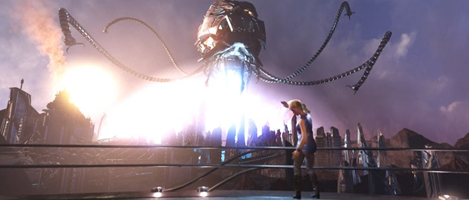
Brainiac is coming to collect the Earth!
Injustice was generally applauded not only for its graphics, gameplay, and competitive fighting mechanics but also its story mode; NetherRealm Studios have seemingly perfected the art of infusing their fighters with an in-depth and genuinely captivating single play story and Injustice 2 (ibid, 2017; 2018) continues this trend. After the Justice League travel to a parallel world to help end the reign of a dictator-like Superman and his regime of similarly-evil former heroes, the Injustice-world faces a new threat in the form of Brainiac. Though Batman attempts to rally a new generation of heroes against Brainiac, they have no choice but to free Superman from his red sun prison cell in order to combat the threat and enter into an uneasy alliance.
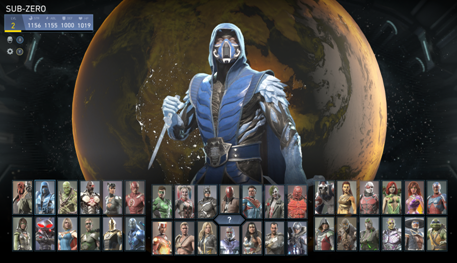
A good roster, bogged down with one-too-many Batman characters.
A fighting game is only as good as its roster; like Injustice, Injustice 2 has an unhealthy obsession with Batman characters – Batman, the Joker, Robin, Poison Ivy, Red Hood, Scarecrow, Bane, Catwoman, Harley Quinn, and Deadshot bloat out the roster. While it is a little disappointing that this appears to have caused other, unique characters such as Booster Gold or Doctor Sivana miss the cut, Injustice 2 does bring some welcome new faces to the game; Firestorm, Blue Beetle, Atrocitus, Gorilla Grodd, and Doctor Fate are just some of the new heroes and villains available to play as. The Legendary Edition also includes some fantastic downloadable characters, such as Hellboy, Black Manta, and even the Teenage Mutant Ninja Turtles!
Every character has a unique play style.
Every character boasts their own unique combos, special moves, and super moves and plays a little differently; Darkseid, for example, is slow and methodical, Supergirl is a much faster character, while characters like Green Arrow and Batman rely more on their gadgets and skills to succeed. Successfully pulling off combos, counters, and landing attacks allows players to build up their super meter and power up their special moves or execute a world-ending super move. Each character starts with three loadout slots, which can be increased to five, that allow you to gear up Aquaman, for example, to have one loadout the favours attack, one that favours health, one that favours special moves, and so on, depending on the gear you apply. You can also apply this gear to AI Loadouts and have them fight for you, which is kind of weird and I’m not sure why you would want to do that rather than play the game yourself but it is useful for the game’s Endless and Survival modes.
Injustice 2‘s stage selection levels much to be desired.
While Injustice 2 has a decent roster, it doesn’t have much in the way of stages; there are only twelve stages to pick from and they’re not really that dynamic or interesting. You can still send characters flying to other parts of the stage, which is fun, but it seems there’s a lot less opportunities to do this than in Injustice. There are also some fun stage interactions to be had, like smashing Swamp Thing over the head with a crocodile in Slaughter Swamp, but, again, it seemed that there were more and better stage interactions in Injustice. The primary selling point of Injustice 2 is the Gear System; winning matches not only earns experience points for each character and the player’s profile but also awards numerous gear. Players can then apply this gear to each character to boost their attributes, gain performance buffs (such as greater attack strength against Metahumans), alter the character’s costumes, and even unlock different special moves. Winning matches also earns the player coins and crystals, which can used to buy Mother Boxes and unlock more gear, transform or combine gear to make it stronger, or unlock Premier Skins for certain characters.
Premier Skins are available…at a price.
Premier Skins allow you to play as new characters; Cheetah, for example, has a Premier Skin that turns her into Vixen and Raiden’s Premier Skin is Black Lighting. This is great, as it effectively adds even more characters to the game’s roster; the only downside is that, to purchase Premier Skins, you need Source Crystals, which are few and far between. You’re therefore forced to grind over and over, levelling up your profile and characters, to earn a pittance of Source Crystals or spend real money. This latter appears to be what NetherRealm Studios want you to do as it is extremely difficult to earn enough Source Crystals as the Premier Skins carry a hefty price tag, and only the best Mother Boxes and rewards can be earned through spending real money, it seems, making the in-game currency all but worthless. Unlocking gear and applying it to characters is fun but, let’s be honest, you won’t be applying all of your gear to every character as some characters are better than others and some or just dead weight. The biggest downside to the Gear System is that, unlike in Injustice, it is the gear that determines what your character will look like; therefore, you can’t just select Green Lantern and choose to play as Yellow lantern, you have to unlock the correct gear and colour palette (which also require Source Crystals), which is quite disappointing and annoying.
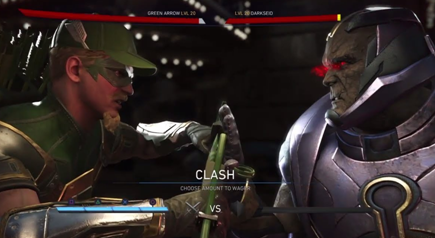
The clash mechanic as as annoying as ever.
In terms of gameplay, Injustice 2 is very similar to its predecessor with a noticeable increase in AI competency; I played the entire game on Very Easy and, on more than one occasion, noticed that the AI doesn’t take any shit. If you spam moves or favour a certain tactic, the AI calls you out on it and gives you a competitive match more often than not. The story mode is fun to play through but a breeze; I finished it in within two casual days of gameplay and only went back to it to finish off the branching paths. The clash mechanic returns from Injustice and it’s just as annoying as ever; as you take damage, you can spend your super meter initiating a clash and pressing a button in a rock/paper/scissors type of mini game, which will either deal additional damage or restore your health. It seems that the AI always busts out a clash at the worst or most annoying opportunities and it’s easily to most frustrating part of the game.
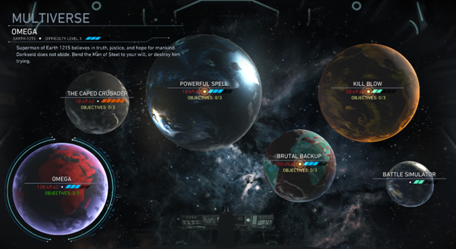
Take on the entire Multiverse…once you’re levelled up enough…
Similar to Mortal Kombat X (ibid, 2015), Injustice 2 utilises an ever-changing Multiverse mode that allows players to fight a number of opponents and obtain better rewards. These change hourly, daily, weekly, and monthly and often carry certain themes that will be familiar to DC Comics fans; you can also use the Battle Simulator to play traditional tournament modes or battle endless opponents. One thing I will praise about Injustice 2 is that every battle is different; I don’t think I ever fought the same version of a character twice as it seems every match sees random gear and colour schemes applied to the opponent. You can also join a Guild and take part in Guild Multiverses and challenges to unlock even more Mother Boxes and rewards; these are far more challenging than the regular Multiverse modes and, similarly, the best Multiverse rewards are only available when you’ve levelled a character up to level twenty or thirty, meaning that you’re going to have to play again and again and grind over and over to reap the benefits. Honestly, maybe I’m a bit jaded, but I don’t find myself particularly enthusiastic about stepping up to this challenge; Injustice 2 features a wealth of Achievements, many you can sweep through regular gameplay, but the more specific ones (such as maxing every character’s level out) just seem like too much of a chore. I really don’t like that I have earned so many in-game coins and yet I cannot use them to purchase Premier Skins or extra colour palettes; I don’t really want to spend my actual money buying them, was disappointed to see that they weren’t already unlocked in the Legendary Edition, and am not sure I can be bothered to grind over and over to unlock them.
Want the best stuff? You better have deep pockets!
In the end, Injustice 2 is good; it’s fun to play, the story mode is decent, and the graphics are very impressive but there’s not too much calling me back to it. I played Injustice pretty much to death working my way through the challenge mode but you have to put some serious effort in to challenge the best Multiverses and the motivation is severely lacking this time around just because the best gear and rewards are either really rare or too expensive. Maybe, next time around, NetherRealm Studios should limit the in-game currency to two forms (one to buy stuff, one to upgrade stuff) and move away from forcing players into spending their real-world money on additional extras, especially if they’re going to bring out a Legendary Edition after the initial versions.
I’m not really one for chasing plot holes and, honestly, I am not really one to nit-pick; usually, I can watch a film and be perfectly satisfied with it even if there are a few questions or plot conveniences being employed to tie everything together. Generally, though, after seeing a film for the first time or after multiple viewings, I’ll replay the movie in my head and, sometimes, this is where glaring plot holes will jump out at me that, once you’ve noticed them, are hard to ignore.
With that in mind, here are ten pretty massive plot holes in movies that are otherwise great (spoilers, and all that, but that seems obvious at this point):
10 Gladiator (Scott, 2000)
There’s actually a couple of plot holes that jumped out of me in Ridley Scott’s otherwise flawless Roman epic. The first is during the reunion between Maximus (Russell Crowe) and Lucilla (Connie Nielsen), in which Maximus mentions that he heard that Lucilla has a son and Lucilla says that Lucius (Spencer Treat Clark) is nearly eight. Now, we’re not told how long it’s been since Maximus and Lucilla last saw each other but, surely, Maximus must have known about Lucius before this reunion? Considering he hasn’t been home in “two years, two-hundred-and-sixty-four days, and this morning”, we can infer that he has only been at war for about three years; so, was he at home for the other five years with no word about his former flame? Seems unlikely. But, if you find that plot hole a bit too tenuous, how about the fact that Maximus is later taken out into the Germanian wilderness to be executed, fights himself free, and ends up wandering around in a half-dead daze only to somehow gallop his way back home, to Spain, on the strength of a prophetic dream? Thanks to the editing of this sequence, it seems as though he arrives shortly after the attack but this seems awfully convenient and unlikely to me.
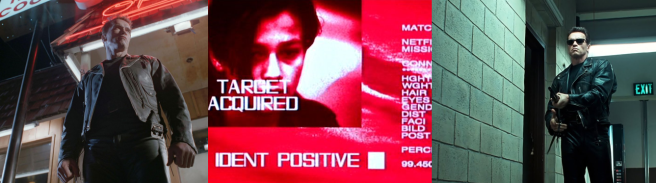
I love this plot hole. So, The Terminator(ibid, 1984) establishes that the time-displacement machine only allows living human tissue to travel through time; the T-800 Terminator (Arnold Schwarzenegger) was able to make the trip because its metallic endoskeleton was covered by uncannily realistic flesh. Yet, in James Cameron’s all-action sequel, the T-1000 (Robert Patrick) is able to make the same journey despite being composed entirely of liquid metal! The best part is that, if you’re new to the franchise and you watch them in order, you can see that this plot hole is necessary to allow Terminator 2 to be structured as though the T-800 is still the emotionless, remorseless killer from the first film and Robert is the unassuming human soldier sent back to protect the future. Seriously, watch T2 again up to the showdown between Robert and Arnold with fresh eyes and you’ll see what I mean. I guess we have to assume that the T-1000 was coated in some kind of disposable flesh cocoon to allow for this.
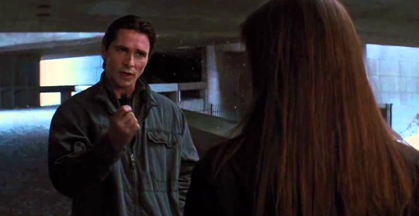
You know what this is going to be: how the hell does Bruce Wayne (Christian Bale) return to Gotham City after being dumped in that pit by Bane (Tom Hardy)? I can almost forgive the plot convenience of the “clean slate” and Bruce’s absurd recovery time from his injuries (I have to assume that Bane injured Bruce severely but didn’t snap his spine as in the Knightfall comics arc) but, with Bane having Gotham under complete lockdown and Bruce left without any means of using what limited assets he has left, how did Bruce manage to get back into the city? Not only that but the editing makes it seem as though the flight to and from the pit is mere hours and that Bruce is gone for a matter of weeks rather than months. Seriously, “because he’s Batman!” is not an explanation for this and it was a curiously sloppy inclusion on Nolan’s part. I guess we just have to assume that Bruce knows of secret ways in and out of the city, perhaps through the same tunnels that lead to the Batcave?
This is one that didn’t hit me for a few hours after seeing the film, such was the impact of Wolverine’s (Hugh Jackman) final outing but, even considering the convoluted mess that is the timeline of the X-Men (Various, 2000 to present) films, how the hell does Logan know his real name? At numerous points in the film, the name James Howlett appears onscreen and is used by Logan in reference to himself but, even if you don’t consider X-Men Origins: Wolverine (Hood, 2009) to be canon, X-Men (Singer, 2000) sure as hell is supposed to be according to Logan’s narrative and I don’t recall him regaining his memories in that film, or any other movie for that matter. It’s such a minor blink-and-miss it thing but it really took me out of the movie as I ended up thinking and asking questions about things that were distracting me from Logan’s emotionally weighty narrative. I guess we just have to assume that, at some point between The Wolverine (Mangold, 2013) and Logan, Wolverine just happened to regain the memory of his long-forgotten real name. Or, maybe, all of his memories were restored as a result of X-Men: Days of Future Past(Singer, 2014), though thee is no indication of this in either film. Also, while we’re at it, how the hell did Future Wolverine regain his adamantium claws after The Wolverine? And how the hell is Professor Xavier (Patrick Stewart) still alive? I mean, I know the after credits of X-Men: The Last Stand(Ratner, 2006) showed that he had survived but how did he get his old body back? Gah! I cannot wait for Marvel Studios to reboot this franchise with some cohesion!
6 Spider-Man 3 (Raimi, 2007)
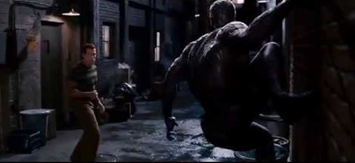
I know what you’re thinking: Spider-Man 3 is not a “great film” and maybe you’re right but it’s not actually that bad. Eddie Brock (Topher Grace) in the black suit (I’d love to call them Venom but they’re never called that in the film so…) was pretty awesome and the big climactic team-up between Peter (Tobey Maguire) and Harry (James Franco) was really exciting at the time, before cinematic superhero team-ups were the norm. With that said, though, poor attempts on Raimi’s part to properly include Venom in the film coupled with lazy editing mean that the Sandman (Thomas Haden Church) is able to just randomly ambush Eddie in mid-air, with Eddie briefly mentioning that he’s been “looking for” Sandman to propose a team-up rather than actually putting some effort into this meeting (or, you know, just writing Sandman out completely after his encounter with Symbiote Spider-Man and saving the scene of his survival for an after- or mid-credits scene).
5 Back to the Future (Zemeckis, 1985)
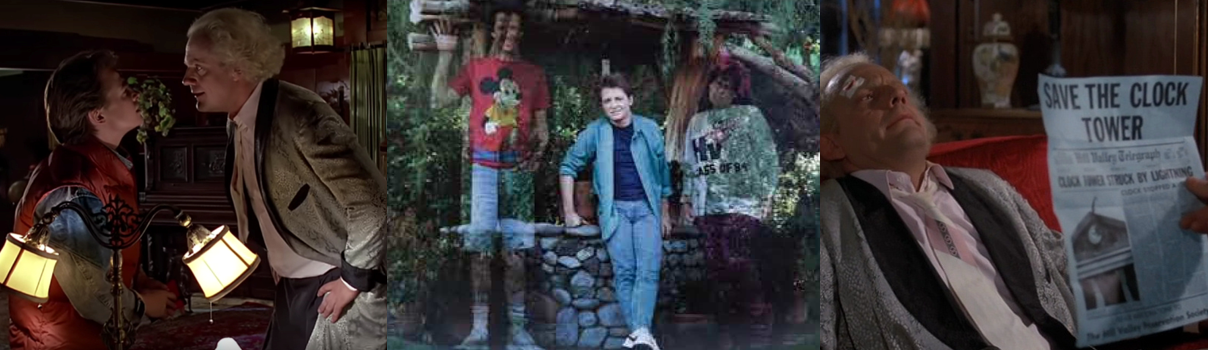
Here’s one that’s been argued to death: why don’t Marty’s (Michael J. Fox) parents recognise him as “Calvin Klein”, the mysterious boy so pivotal to them getting together as teenagers? The most common argument I’ve seen is that they do but choose not to acknowledge it, or that they simply do not remember events from nearly thirty years ago with perfect recall. Honestly, this is a pretty weak argument for me; if a handsome lad had helped me overcome my issues and get with a pretty girl back when I was in secondary school, I think I would notice if my son looked exactly like him! You can’t even say it’s because of the malleability of time travel as other characters, such as Biff (Thomas F. Wilson), can remember the past pretty well but nobody seems to put two-and-two together when it comes to Marty and “Calvin”.
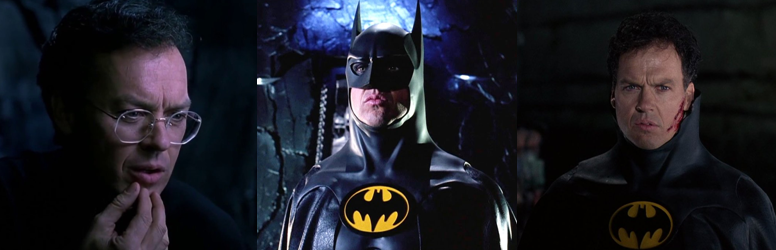
So, there’s a pretty pivotal scene in one of the most underrated movies ever in which the Penguin (Danny DeVito) reveals that his Red Triangle Circus Gang is planning to “disassemble [Batman’s (Michael Keaton)] Batmobile and turn it into an H-bomb on wheels”. They are able to do this by following a rather detailed set of blueprints on the wall of the Penguin’s office. The question is: how the hell did he get a hold of those blueprints? According to the novelisation by Craig Shaw Gardner, the blueprints were obtained at considerable cost by Max Shreck (Christopher Walken) but that seems pretty improbable given that, later in the film, Bruce is repairing the Batmobile and appears to be self-reliant rather than commissioning outside sources to provide his tech. There appears to be no in-movie explanation as to how the Penguin got the blueprints, though, so I guess it’s just “one of those things”, like how his gang just conveniently find the Batmobile later on.
3 Fight Club (Fincher, 1999)
According to Tyler Durden (Brad Pitt), the first rule of Fight Club is that you do not talk about Fight Club and the second rule of Fight Club is you do not talk about Fight Club. However, the final rule is that, if it’s your first night at Fight Club, you have to fight. Anyone else seeing a bit of a contradiction here? If members are doubly banned from talking about Fight Club then how the hell can it ever be anyone’s “first night” at the club? After a while, every one of the original members should have had their first fight so that, in conjunction with the first two rules, would make the final rule obsolete pretty quickly, surely? Perhaps Tyler knew that the members would talk about the club (Bob (Meat Loaf) did later on, after all) and the rules were more an unstated understanding that members do not talk about the club to any authority figures but, still, to have a rule that directly contradicts the others seems pretty foolish for such a smart guy.
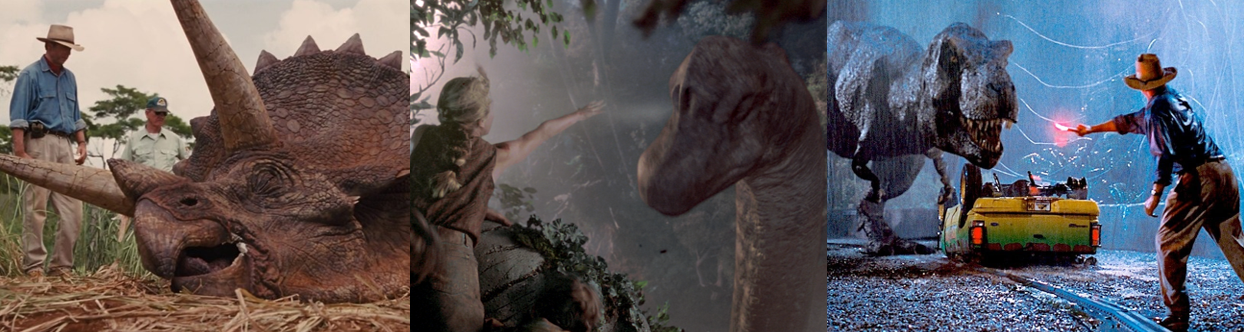
So, imagine this: you’re John Hammond (Richard Attenborough) and you have a theme park that contains the closest approximations of real-life dinosaurs in billions of years and you need the world’s foremost expert on Velociraptors, Dr. Alan Grant (Sam Neill), to come along and verify that the park is safe and the attractions are as good as they seem. Then, just as a baby ‘raptor hatches from an egg right before his eyes, your expert turns around and asks, “what species is this?” like some kind of air-headed novice! Now, sure, Grant seemed to take the discovery that dinosaurs were once again walking the Earth pretty hard, reacting with shock and awe and even having trouble breathing so maybe, maybe, he was simply still reeling from this revelation. Also, yes, while I’m sure Grant had seen the bones of a baby ‘raptor before, he’s obviously never held a live one and, finally, he probably knew (like we do now) that ‘raptors actually looked very different to how they are portrayed in Jurassic Park but still! I mean, come on, isn’t this like Ford unveiling their new motor at a Ford press conference and Jeremy Clarkson saying, “what make is this?”
1 Timecop (Richardson, 1994)
Can we stop for a moment to talk about how absolutely fantastic Timecop is? Seriously, it’s one of those films that doesn’t get talked about enough and is, perhaps, Jean-Claude Van Damme’s greatest film ever (for fellow perverts, there’s also one cracker of a sex scene in it!) I love this film and could, honestly, watch it every day but there’s just one tiny little thing that takes me right out of it. The first scene of the film is a little dick-measuring contest between George Spota (Scott Lawrence) and some government types in which George breaks the news that the good ol’ US-of-A has cracked time travel. He lays down the rules of the film (you can’t travel forward because the future hasn’t happened yet but you can travel back…raising the entirely separate question of how you get back to the present, which would be considered the future, from the past; I guess because that future has happened?) and convinces the government types that the Time Enforcement Commission must be formed to protect and police time from anyone who would seek to change history by altering the past. George even says that this has already happened and the question is…how, exactly? At that point, there was one time travel device, firmly under lock and key we can assume, so how the hell did someone manage to travel back to the past already? And, if they have done, how they hell did George even know about it when they had no means of monitoring or preventing this so, surely, the events that were altered world just be the current history (as happens later in the film)?
Later, it is revealed that there are two machines; the primary one and a prototype that Senator Aaron McComb (Ron Silver) uses to change time in his favour but this wasn’t true at the meeting at the start of the film so I have to agree with the young McComb when he asks why they don’t “just prevent time travel rather than spending stupendous amounts of money trying to police it”. Also…how come they travel to the past in that big rocket but it disappears when they get there and all they have to do is hit a return button, jump into a wormhole, and end up back in the present in the same rocket (that’s now facing the other way around)?
It’s no secret that DC Comics and Warner Bros. are a bit late to the superhero renaissance we are still experiencing thanks to the runaway success of the films put out each year by Marvel Studios. They lost a lot of ground with films like the dull Superman Returns(Singer, 2006) and Green Lantern (Campbell, 2011) – even though I personally actually enjoyed Green Lantern and thought the movie was worth salvaging in further DCEU films – and often focus too much of their attention on Batman at the expense of their massive cast of superheroes. However, amidst the many and ongoing critical debates surrounding Man of Steel(Snyder, 2013) and Batman v Superman: Dawn of Justice(ibid, 2016) and the disappointment of Suicide Squad (Ayer, 2016), they apparently scored a far more meaningful success with Wonder Woman(Jenkins, 2017) and their films have been profitable enough to keep the idea of a cinematic universe alive, even if rumours abound every day that it is on life support. Now, I never saw Wonder Woman, for reasons of my own, and I actually really enjoyed not just Man of Steel but also Batman v Superman so, for me, anticipation was high for Snyder’s third cinematic effort, Justice League. While a personal tragedy saw him leave the production process and be replaced by formal Marvel guru Joss Whedon, the film is still credited to Snyder and carries many of his themes and ideas over but does it deliver?
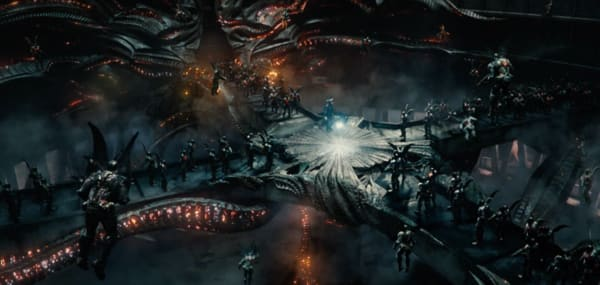
An invasion from Apokolips is all-but inevitble!
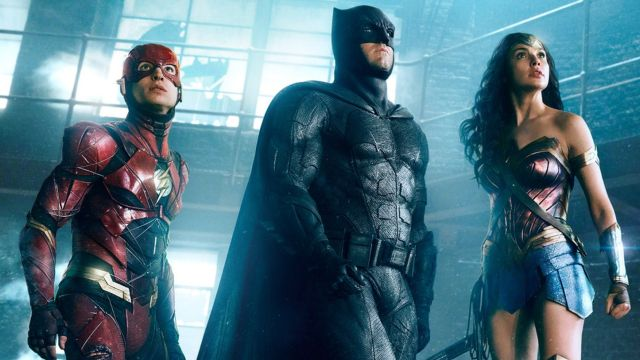
Justice League begins in a world still mourning the loss of Superman (Henry Cavill), which hasn’t resulted in world-wide chaos but has resulted in appearances of insect-like Parademons across the globe. Having witnessed a glimpse into a nightmare dystopian future where these creatures have overrun humanity, Bruce Wayne/Batman (Ben Affleck) has been investigating the creatures and their weaknesses amidst attempting to recruit a superpowered team alongside Diane Prince (Gal Gadot) to fight what he believes to be an inevitable invasion. On Themyscira, Diana’s home island of Amazons, the ancient Mother Box suddenly awakens and opens a Boom Tube, through which appears Steppenwolf (Ciarán Hinds) and an army of Parademons. Slaughtering the Amazonians, he claims their Mother Box and promptly disappears, forcing Bruce and Diana to step up their timetable. Bruce is initially unable to convince Arthur Curry/Aquaman (Jason Momoa) to join their cause due to his desire to be left alone but has far more luck in recruiting Barry Allen (Ezra Miller) who, disillusioned by the wrongful incarceration of his father (Billy Crudup) and struggling to live in a world that now seems painfully slow in comparison to his superspeed, joins up as the Flash without a second’s hesitation. Meanwhile, Diana is able to channel her own experiences with isolation and loss to convince Victor Stone (Ray Fisher) to put his recently-acquired and still developing cybernetic powers to good use in the fight against Steppenwolf.
It’s going to take everyone to fight off Steppenwolf.
Aquaman is finally convinced to join the team when he is forced to return to Atlantis to defend the second Mother Box from Steppenwolf, only to be suitably humbled. With two of the boxes in the hands of the enemy and the countdown to the destruction of the planet imminent, Batman struggles to galvanise the team in using the final Mother Box to resurrect Superman to lead the final battle for the fate of humanity. I’m going to say something now that may cause a stir; I’m a fan of both DC Comics and Marvel. Yes, it is possible; for me, just seeing comic book superheroes on screen and coming together is a thrill in and of itself. I don’t get weighed down with debates between which company is better or criticise DC for failing to follow Marvel’s gameplan; however, I do admit that they are very clearly playing catch-up. This was massively evident in Batman v Superman, where Wonder Woman was introduced with a lot of intrigue and mystery surrounding her but which also wedged in cameos from the Flash, Aquaman, and Cyborg. It felt like the movie was trying to do to much but, at the same time, those small glimpses served the purpose of a larger narrative and didn’t distract from the film at all; instead, they were weaved into Batman’s character arc of moving past his misguided vendetta against Superman and towards rejoining the world and uniting a team.
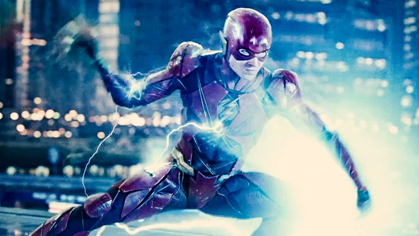
Ezra Miller brings some welcome levity to the DCEU.
While Justice League does suffer form some pacing issues in the first act, each member of the team gets an ample amount of screen time to shine and show some layers. Although I could’ve done without it as we have seen the tale of Barry’s father played out in the first season of The Flash, it nevertheless helped to establish that Barry is currently in a very lonely and confused place in his life and that his powers only make things more difficult for him. Barry primarily serves as the comic relief, once again being infused with more of the characteristics commonly associated with the Wally West version of the character, but shows significant growth when he admits to Batman that he’s never actually been in a real fight before and, upon Batman’s prompting, learns how to be a superhero by simply saving one life.
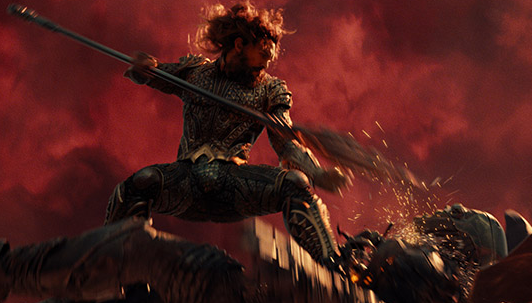
Probably the greatest interpretation of Aquaman we’ll ever see!
Before the movie came out, I hedged my bets on Jason Momoa’s Aquaman being a kick-ass, breakout character; for years, people have ridiculed Aquaman because “all he does is talk to fish” when that’s simply not the case. Now, I’m not the biggest Aquaman fan because, honestly, he can still be pretty lame for other more pressing reasons, but I am a fan of the Peter David version of the character, which had long hair, a beard, a more armoured outfit, and was a no-nonsense, stern ass-kicker. Momoa’s Aquaman may not have a harpoon for a hand but, man, is he bad-ass! He’s more like a rock star than a clean-cut prince, revelling in the heat of battle, carrying himself with a sense of narcissism, and generally approaching every situation with a nonchalant attitude. He looks fantastic and really brings the muscle to the team in Superman’s absence, but there’s also a sense of a much larger world and backstory behind him through his return to Atlantis and interactions with Mera (Amber Heard).
Obviously a character mostly created in CGI is going to be CGI!
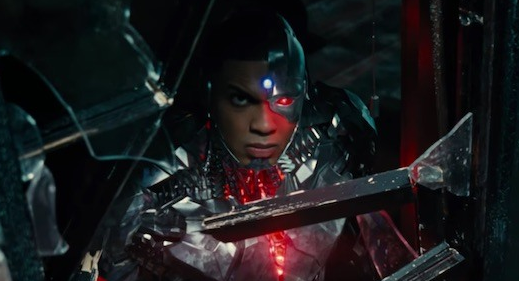
Probably the character with the most controversy surrounding him is Cyborg; personally, I’ve never liked the idea of Cyborg being on the Justice League, primarily because he’s so closely associated with the Teen Titans and I feel it’s a just a reason to have racial diversity on the team. However, for the purposes of this film, he serves a key purpose; having been created through the machinations of a Mother Box, Victor’s cybernetic parts are constantly evolving and hold the key to interacting with and stopping the Mother Boxes from uniting and destroying the world. Everywhere I look people are bad-mouthing the CGI on Cyborg and, honestly, I don’t see why; Justice League is filled to the brim with top-notch special effects, to the point where even a $300 million budget can be stretched pretty thin. Cyborg is a 90%, at least, CGI character so, obviously, he’s going to have a lot of CGI used on him. Would it have been better if they’d tried more of a Robocop (Verhoeven, 1987) route? Probably, yes. Did I think the sleeker, Teen Titans-inspired look he adopted at the end of the film would’ve looked better than the Transformers (Bay, 2007 to 2017) look? Definitely, but I never let the fact that he was largely comprised of CGI parts distract me from the film and, honestly, if you do then you’re clearly not that interested in the film to begin with.
Gal Gadot continues to impress/surprise.
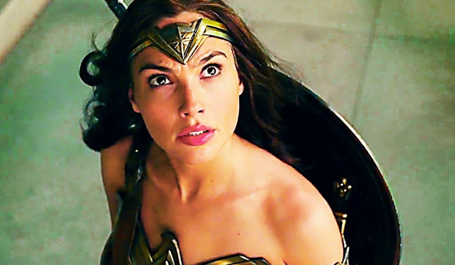
Gal Gadot continues to impress as Wonder Woman; despite my reservations about her, she is an extremely attractive young lady and her accent actually becomes less distracting the more you hear it. Diana’s arc here is directly tied in to the events of Wonder Woman as she is still apprehensive about rejoining society in the spotlight. Bruce even calls her out on it and accuses her of not being able to move past the death of Steve Trevor (Chris Pine), which only galvanises Wonder Woman’s resolve. Henry Cavill also returns after the team successful manage to resurrect Superman using the same Kryptonian birthing chamber that spawned Doomsday. Unlike the comics, he does not sport a mullet or a black costume, but his memories are briefly fragmented, leading to an awesome fight between Superman and the rest of the team. Superman is actually amazing in this film; he’s clearly overjoyed to be alive again, smiling and cracking jokes, and finally shines as an optimistic symbol of hope to rally behind. His initial period of disorientation also showcases his intense rage as he spits Batman’s “do you bleed” line back into Batman’s face as he is poised to crush Batman’s head. The only things I slightly disliked about Superman were that they didn’t make any effort to address how they explained Clark Kent’s sudden return to life and his resurrection felt like it came too soon; I expected him to return right at the very end, but it comes just before the third act, so it does raise the question of why kill him off in the first place (though I’m glad they did because at least it meant they got that aspect of Doomsday right).
Seriously, how can you not love shots like this!?
Ben Affleck returns as Batman, despite a new rumour springing up online almost every day saying that he wants out of the franchise. When he was first cast, I had my doubts that he would stick around for sequels and, honestly, the more I hear about him wanting to leave the more annoyed I am that he was ever cast in the first place. The fact that he is a fantastic Batman makes it all the more annoying; Warner Bros. seem to want to evoke Marvel Studios’ attitude towards Robert Downey Junior and build their DCEU around Affleck so I really hope that they do everything they can to convince him to see it through because he put in another brilliant performance here. Now focused on facing Steppenwolf’s impending threat, Batman has turned his mission from vengeance and death towards forming a team, saving the world, and atoning for the decisions he made that led to the death of Superman. The guilt he feels is evident and he even descends into some trademark Bat-dickery by manipulating Diana into following Superman’s example and being an inspiration for others. Additionally, the idea that he is so worn down and beaten up from twenty years of being Batman and that he now craves an honourable death continues in Justice League as, even with the team assembled, many of his plans revolve around him making a suicide run; during Superman’s resurrection, Batman even faces him head on with the intention of dying so that Superman can take his place as the more suitable leader of the team, and his joy at seeing Superman returned to life is clear on his face even if he quickly adopts a more stoic façade to save face.
The traditional bland villain does equal fleshed out heroes…
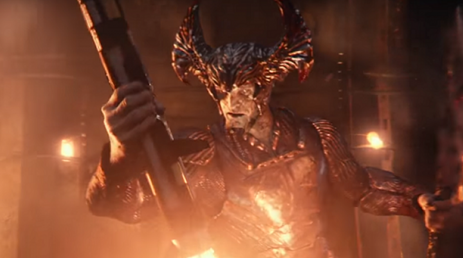
The action in Justice League is very big and very loud; explosions happen all over the place, water crashes everywhere, buildings topple, and hits land with a satisfying impact. Amidst what could be described as chaos, but actually is a far more cohesive end-of-the-world scenario than the one seen in Suicide Squad, is a fabulous score by Danny Elfman. Elfman even weaves not only his classic Batman (Burton, 1989) theme into the score but also John William’s classic Superman (Donner, 1978) theme; as much as I enjoyed the score from Snyder’s previous films, hearing the return of those classic, iconic, and irreplaceable themes brought a warm feeling of joy and nostalgia to my heart. Probably the biggest issues with the film are easily the most predictable; pacing and the villain. With the film being mandated to be two hours long, there’s a real sense that a lot of content was trimmed back and I look forward to seeing it inserted back in for an extended cut. While I did not experience any jarring leaps in continuity or pacing, it is unavoidable that a large chunk of the film’s early runtime is devoted to introducing and fleshing out not just the new characters but also existing ones; the plus side of this though is the clear influence of Joss Whedon, who not only infused a bright, vibrant colour palette but clearly worked on the film’s dialogue, resulting in a truly enjoyable rapport between the protagonists. As for Steppenwolf, he’s there for the team to unite against and defeat and his motivations are as one-note as possible; he wants to destroy the world, no more and no less. Diana relates his backstory through a pretty impressive flashback that shows that Amazons, Atlanteans, tribes of men, Old Gods, and even a Green Lantern fighting against Steppenwolf and his Parademons, which helps give a sense of the scale of his threat. His name-drop of Darkseid hints that a greater threat could be looming on the horizon but it cannot be avoided that he largely disappears for a big portion of the film. Again, though, this results in better characterisations of the protagonists and, unlike some Marvel villains, Steppenwolf actually makes up for it in the third act by not being a complete push-over and taking on the entire League all at once.
Given the after credits scene, in which freshly-escaped Lex Luthor (Jesse Eisenberg) recruits Slade Wilson/Deathstroke (Joe Manganiello) for a League of their own, I really hope that Justice League does well enough to continue the DCEU and help flesh the protagonists out even more in future films and therefore allow for better characterisations of the villains when they appear. While I may have criticised Eisenberg’s Luthor, I am still glad that he returned as it means there is a chance for the character to grow and evolve beyond Eisenberg’s madcap portrayal; if they had simply recast or abandoned the character, that hope would have been completely dashed and we would be forever deprived of the possibility of a good interpretation of Superman’s greatest nemesis. Honestly, the fact that I’ve heard so much negative criticism about this film really bugs me. Similar to Batman v Superman, I just don’t get it; sure, it isn’t perfect and it has flaws, but it’s actually a really good action romp, with some witty dialogue and some fantastic cinematography. Also, unlike the films of Marvel Studios, the thrill of seeing DC superheroes onscreen individually and as a group has not worn thin yet; it’s pretty amazing to finally see Batman, Superman, Wonder Woman, Aquaman, the Flash, and (I guess) Cyborg all together onscreen at last. I really hope Affleck sticks around and that Justice League does well enough to continue to DCEU as this felt like a massive step in the right direction towards forging the distinct big screen superhero universe that they have wanted for so long now.
My Rating:
⭐⭐⭐⭐
Rating: 4 out of 5.
Great Stuff
Recommended: For comic book fans and DC fans, definitely, for the thrill of finally seeing the Justice League on screen, and also for fans of action movies. For those expecting something other than a fun action romp? Maybe stay away and keep your mouths shut. Best moment: Any time the entire League is onscreen together is always great, especially in the finale, but also the scenes involving Batman and Commissioner Gordon (J.K. Simmons). Worst moment: Three things were annoying: Steppenwolf, as you’d expect, though again I’d rather have more screen time for the protagonists in a team-up movie; Cyborg, just because I prefer him on the Teen Titans, and all the Amazonians except for Diana were pretty disappointing actresses.
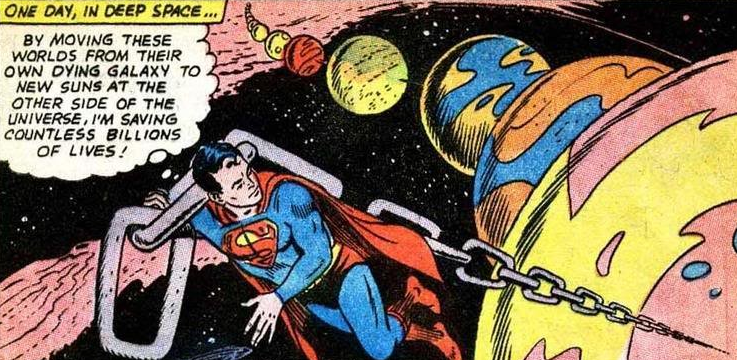
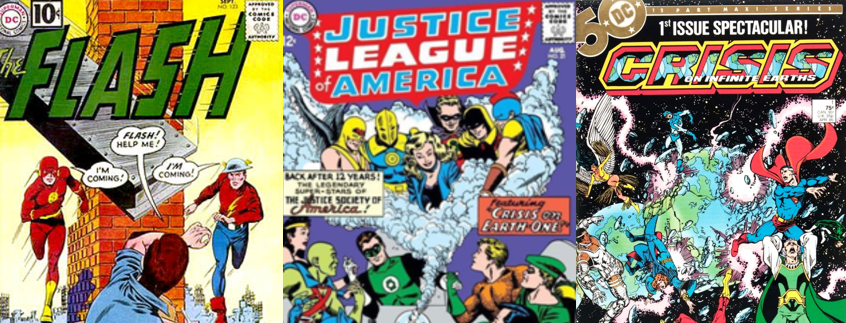
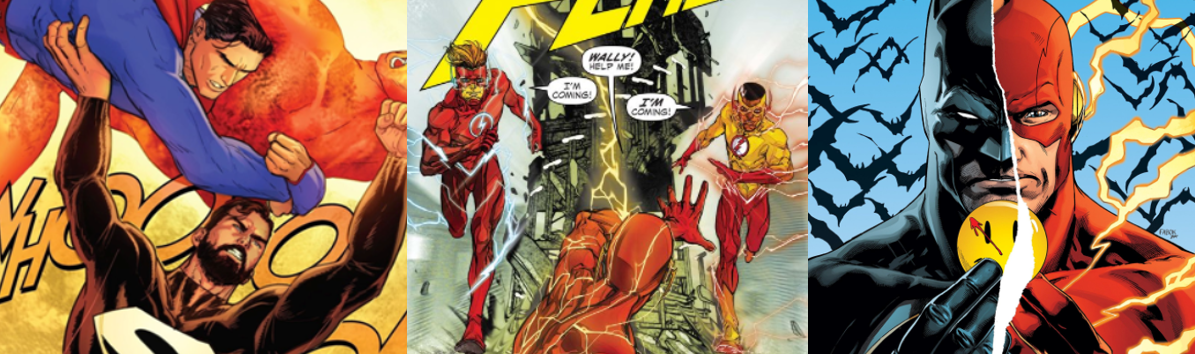
Ever since the 1938 introduction of Clark Kent/Superman, DC Comics has been known for its vast array of costumed crimefighters and interconnected, densely populated fictional narratives. For decades, continuity was played fast and loose; Superman evolved from being a moderately powerful superhuman who could leap over tall buildings into a God-like figure who could turn back time, possessed a super-human intellect, and could tow entire worlds through space with ease. Similarly, Bruce Wayne/Batman was depicted as being as youthful as ever despite having been active since 1939 and having taken part in World War Two. Some of these issues were resolved when, in the 123rd issue of The Flash, DC Comics introduced the concept of the multiverse. The issue postulated that there were an infinite number of parallel worlds co-existing in the same space and time but slightly out of synch with our own world due to being on a different vibrational frequency. The fallout from “Flash of Two Worlds” (Fox, et al) was the revelation that DC’s Golden Age superheroes, such as the Justice Society of America and older versions of Superman and Batman, existed on the parallel world known as Earth-Two while their Silver Age contemporaries (Hal Jordan, Barry Allen, and the like) in the Justice League of America existed on Earth-One.
Superman was originally more like a God than a man.
This concept allowed DC Comics to portray multiple iterations of their most popular characters as existing side-by-side, as well as numerous alternative worlds; Earth-Three, for example, was home to the Crime Syndicate, made up of villainous versions of the Justice League, while Earth-S was home to Freddy Freeman/Captain Marvel and other characters DC acquired from their purchase of Fawcett Comics. Unfortunately, decades of over-reliance of the multiverse concept meant that, by the 1980s, DC continuity was extremely difficult to keep track of and DC Comics were virtually inaccessible to new readers who had no idea what the multiverse was, much less how it worked. As a result, DC embarked on their most ambitious inter-company crossover yet. Crisis on Infinite Earths(Wolfman, et al, 1985) saw the entirety of the DC multiverse under threat from the malevolent Anti-Monitor. Seeking to rule in the desolation of nothingness, the Anti-Monitor begins destroying entire parallel worlds with an anti-matter wave, reducing their number from infinite to a mere five and causing the deaths of Barry Allen/The Flash and Kara Zor-El/Supergirl. In the end, Kal-L/Superman of Earth-Two, Alexander Luthor of Earth-Three, and Superboy of Earth-Prime end the Anti-Monitor’s threat and retreat to a “pocket dimension”, alongside the Lois Lane of Earth-Two, where they are protected from the merging of the remaining worlds.
Crises were commonplace in the Silver Age before DC tried to streamline their complex continuity.
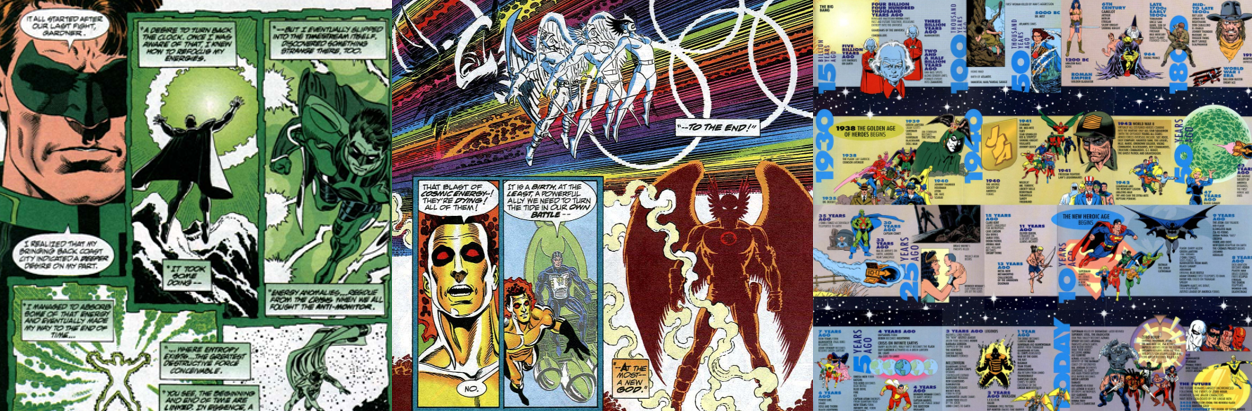
It seemed like DC had come up with the perfect way to consolidate their continuity; the concept of parallel worlds was done away with and one singular reality was established. Stories like Superman: The Man of Steel (Byrne, et al, 1986) and Batman: Year One (Miller, et al, 1987) re-established the origins of DC’s flagship characters and, over the next few years, DC established that, while the events prior to the Crisis had occurred, very few of the characters who survived remembered much beyond vagaries (Wally West, for example, was now the Flash and knew, like everyone else, that Barry had died saving the world but not the exact specifics of how and why). Additionally, DC Comics began emphasising the idea of legacy superheroes; the Justice Society of America was established as having been active during World War Two and, while some of their members were active in present day continuity, they were noticeable aged and took on more of a mentorship role. Unfortunately, DC dropped the ball with Crisis. Rather than simply end every existing comic they published and reboot with brand new issue one’s and origin stories, some characters (such as Diana Prince/Wonder Woman) were not reintroduced into the new canon until much later. Others, like the Legion of Superheroes, had their entire origins altered forever by the removal of Superboy from the new canon (something that could have easily been remedied had DC simply rebooted the Legion and had them be inspired by Superman; instead, writers hastily incorporated an alternative Superboy from a pocket dimension or substituted him with Mon-El).
Zero Hour tried to fix DC’s post-Crisis lorebut actuallydid more harm than good.
In an effort to address some of these lingering issues, and further incorporate some of the popular Pre-Crisis characters and ideas into modern continuity, DC capitalised on Green Lantern Hal Jordan’s recent descent into madness, genocide, and villainy with another massive inter-company event. Zero Hour: Crisis in Time (Jurgens, et al, 1994) saw Jordan, as Parallax, absorbing vast amounts of cosmic and chronal energy with which he planned to remake reality and undo all the wrongs that had happened since the death of Superman. Due to Parallax messing about with time, many continuity changes were forced into DC canon; Superman was explicitly described as having debuted “ten years ago”, the Legion of Superheroes were (finally) completely rebooted, Batman’s killer became anonymous and at large, and all conflicting versions of Carter Hall/Hawkman were consolidated into one singular character since DC never really bothered to reboot his origin story following the original Crisis. With the bulk of Zero Hour’s five-issue run being made up primarily of exposition from Richard Rider/Waverider or Parallax, many of the consequences of Parallax’s actions were told in DC’s individual comics. In the end, despite the insanity of time literally being ripped apart around them, the heroes were able to thwart Parallax’s efforts and allow time and reality to unfold naturally, albeit with many changes. Zero Hour resulted in many changes to popular DC characters; Guy Gardner suddenly became a shape-changing Vuldarian, many of the Justice Society were rapidly aged or killed off, Connor Hawke was introduced as the new Green Arrow, and Arthur Curry/Aquaman now sported an unkempt look and a harpoon for a hand.
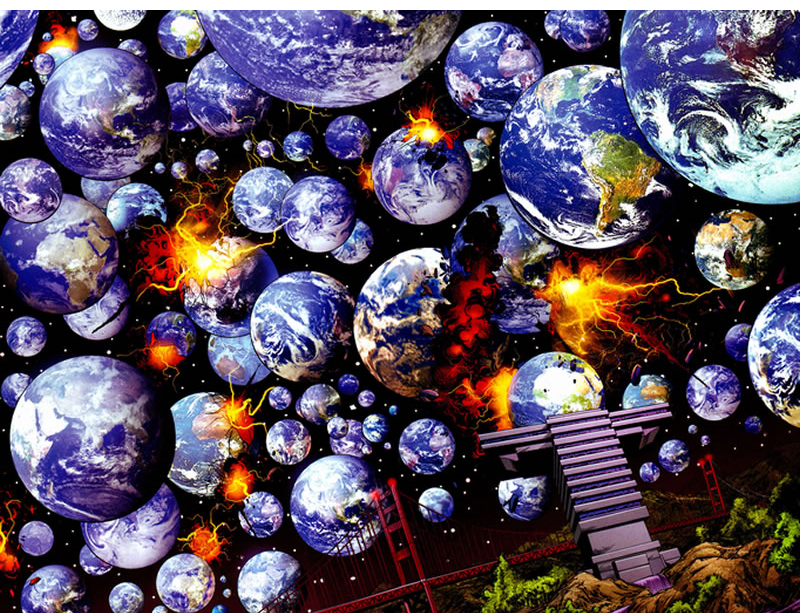
Infinite Crisis returned the multiverse to the DC universe.
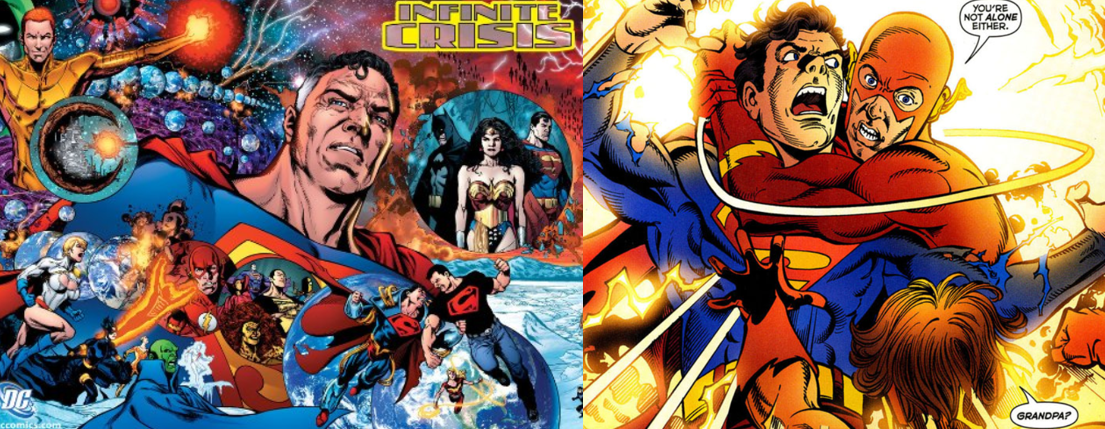
However, Zero Hour actually created more problems than it solved; Hawkman’s origins were no more clearer now than they had been before. Eventually, The Return of Hawkman (Goyer, et al, 2002) returned the character to mainstream continuity, explaining that the character was locked in a constant cycle of death and rebirth. Additionally, DC sought to address their ongoing continuity issues (and tell out of continuity stories) through the concept of Hypertime, which, much like the previous infinite Earths concept, allowed for alternative versions of events to be played out. Eventually, and with the twentieth anniversary of the original Crisis looming, DC decided to commission their biggest inter-company crossover yet. Consisting of multiple ongoing stories all building up to its central narrative, Infinite Crisis (John, et al, 2006) aimed to not only re-establish the multiverse concept and finally tie-up all of the lingering continuity issues left in the wake of Crisis on Infinite Earths and Zero Hour, but also move the company away from the dark stories that had dominated during the mid-nineties. After numerous event-scale storylines, the DC trinity (Batman, Superman, and Wonder Woman) were divided and the DC universe was in turmoil. Frustrated with how bad Earth heroes have let things get and perceiving that they have squandered their new world, Kal-L, Alexander Luthor, and Superboy-Prime break free from their pocket dimension and set about cannibalising the Anti-Monitor’s corpse to re-establish the multiverse and return peace and order to the universe. However, it turns out that seeing his world destroyed and having his youth ripped away from him, coupled with living in isolation and the machinations of Alexander Luthor, have driven Superboy-Prime mad. While Alexander straps various heroes and villains to an inter-dimensional tuning fork, Superboy-Prime goes on an accidental murder spree before Bart Allen/Kid Flash forces him into the Speed Force itself, at the cost of Wally West and his family.
Infinite Crisis smashed together parallel worlds created 52 alternate Earths.
However, Superboy-Prime escapes, sporting a modified version of the Anti-Monitor’s armour and driven completely insane. With no regard for himself or others, he goes on a rampage; although Conner Kent/Kon-El/Superboy destroys Alexander’s inter-dimensional tower, it costs him his life and, finally convinced that Alexander’s plan would mean the genocide of countless lives, Kal-L joins forces with Superman to end Superboy-Prime’s threat. Infinite Crisis ends with the multiverse restored; though instead of there being an infinite number of parallel worlds, there were now a much more easy to wield fifty-two alternate Earths. In the aftermath, DC’s titles all jumped forward one year later, while the weekly 52 series explored the fallout of the events from the main crossover. This New Earth restored Superboy to Superman’s origin, depicted multiple non-canon stories as existing on the alternative Earths, introduced a new all-powerful villain in the form of Superboy-Prime, and resulted in Batman becoming far more trusting and open with his allies and family. For me, this was a great time to be reading DC comics. Unlike previous Crisis-level events, Infinite Crisis felt like a soft reboot that would be accessible to new readers; the multiverse existed but rarely impacted mainstream DC continuity and it felt like DC had finally closed the door of the events of the original Crisis and had finally moved on.
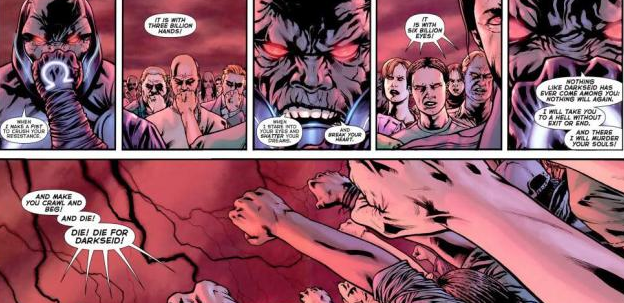
Morrison spearheaded an inter-company crossover that would change the DC universe forever. Unfortunately, DC decided to spend an entire year building up to this event with the weekly Countdown (later Countdown to Final Crisis) series, in addition to numerous tie-in and spin-off titles. As Countdown was of far less writing and artistic quality compared to 52, and due to the fact that many of its events contradicted what was happening in the associated titles, the build up towards Final Crisis (Morrison, et al, 2009) was lacklustre and confusing, to say the least. The basic premise, as far as I can understand it (Morrison’s writing is confusing and disjointed at the best of times) is that the New Gods have all died and been reincarnated on New Earth, causing a tear in space, time, and reality. Reborn, Darkseid finally solves the Anti-Life Equation and enslaves the planet; however, using a radion bullet, Batman mortally wounds Darkseid, before being erased from existence. As his essence dies, Darkseid attempts to obliterate all of reality until he is finally thwarted by Superman; Superman, and an army of his counterparts from across the multiverse then restore Earth and reality before it can be destroyed by Darkseid and Mandrakk, the Dark Monitor. Once you got past the mess of Morrison’s writing and the mess of a build-up to the main event, the fallout from Final Crisis made for very accessible stories. DC also focused on using the Green Lantern titles to expand their universe through sprawling, inter-connected stories.
Dick Grayson took over as Batman before Flashpoint gave us an angst-ridden jerk version of Superman.
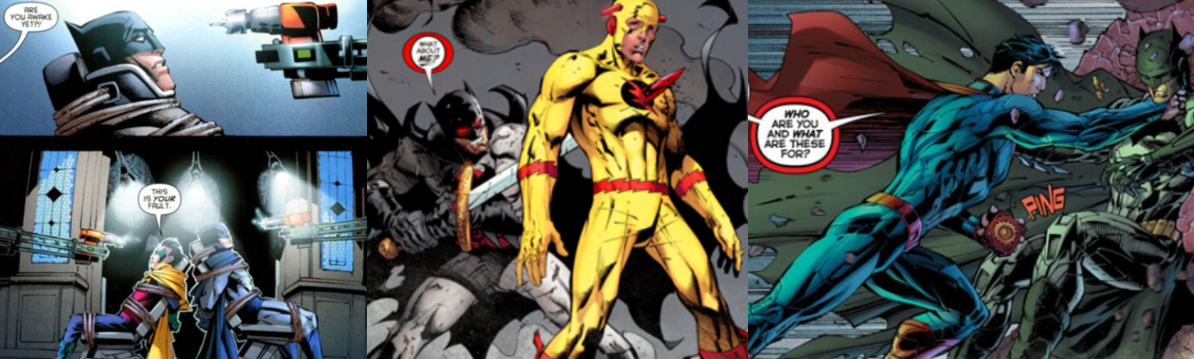
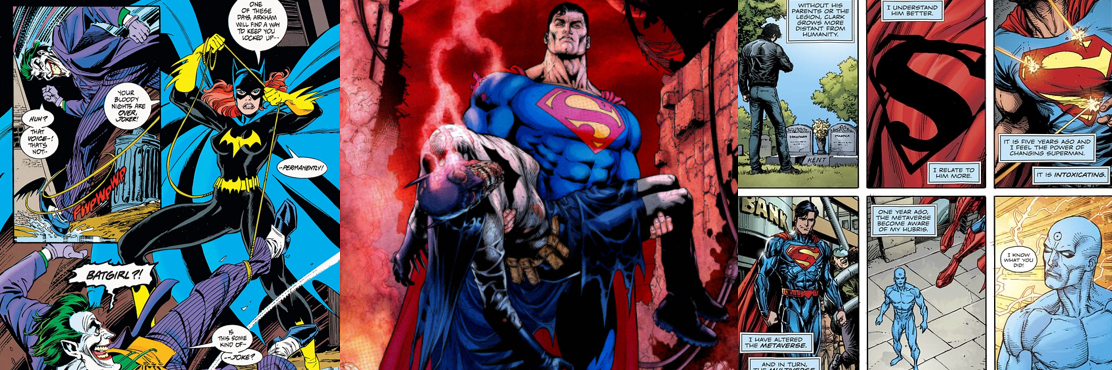
However, rather than fully capitalise on this (by, say, returning Bruce Wayne to life as an aged man, killing off Alfred, and having an elderly Wayne take his place as mentor to the new Batman and Robin), DC instead decided to undo all of their recent efforts a mere two years after the end of Final Crisis. The best thing about Final Crisis was the fallout; Batman, thought dead, actually embarked on a trip through time and space that threatened all reality until he was safely returned home by the Justice League. However, in the meantime, his duties were performed by Dick Grayson and Damian Wayne as an all-new, fresh take on the Batman and Robin duo. Additionally, both Kon-El and Bart Allen were resurrected and, for fans of the Silver Age, Barry Allen finally returned to the land of the living to become the Flash once more (though, personally, I am more of a fan of Wally West). In Flashpoint(Johns, et al, 2011), Barry Allen’s grief apparently got the better of him, causing him to go back in time and save his mother’s life. This results in a vastly altered timeline, which threatens to solidify itself as the true reality unless Barry can set things right. Teaming up with Thomas Wayne, here a violent version of Batman, and amidst an ongoing war between Atlantis and the Amazons, the Reverse-Flash reveals the key to restoring reality to Barry, allowing him to undo his actions. However, instead, we got what DC marketed as the “New 52” reality for the better part of five years. In this radically altered version of events, the DC universe has only existed for five years (meaning that Batman burned through one Robin every year-and-a-half or so), Barbara Gordon controversially recovered from the Joker’s attack and continued to fight crime as Batgirl, and many characters got entirely new origin stories (Superboy, Supergirl, and, in particular, Superman was changed so drastically that I swear he was a completely different character).
Convergence slightly alteredthe original Crisis.
Additionally, Wildstorm and Vertigo publications were officially absorbed into the DC universe, while many recent events, particularly in Batman and Green Lantern titles, continued with very little alteration, truly begging the question as to why DC even bothered to reboot their continuity so severely just as their titles had become engaging and accessible for new and long-term readers. The biggest problem with the New 52, however, was that while DC still incorporated a version of the multiverse (complete with slightly different versions of Earth-Two and Earth-Three), it took DC almost a year to properly establish their new continuity; many characters went without detailed revised origins until this time, causing a great deal of confusion as to what events and characters were still canon, and largely alienating me in the process. Eventually, though, DC decided to bring the New 52 to a close and restart everything…again…using the Convergence (King, et al, 2015) storyline to kick-start their Rebirth titles. In Convergence, Brainiac has collected numerous cities and their inhabitants from across the multiverse (even some from prior to the original Crisis) and deposited them on Telos, a sentient planet that forces them to fight each other to see which is superior. Amidst the chaos and the fighting, the sorcerer Deimos usurps Telos and declares himself ruler and protector of this imprisoned on there. Eventually, Deimos is defeated by Parallax (drawn straight out of Zero Hour), which causes a chain reaction that threatens to annihilate the entire multiverse (…again). Brainiac, seeking to atone for his misdeeds, intervenes and sends pre-Flashpoint Superman and Zero Hour-Parallax back to the original Crisis to change its outcome and save the multiverse from collapsing.
Rebirth returned pre-Flashpoint charactersand brought the Watchmen to the DC Universe.
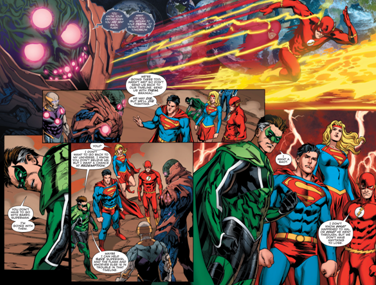
Convergence concluded with the return of the multiverse proper, with a potentially infinite number of worlds once again present in DC comics, while absorbing yet more commonly displaced titles into DC continuity; an ongoing theme throughout the resultant Rebirth-branded comics has been the introduction of characters from Watchmen(Moore, et al, 1987) into the larger DC universe for the first time. Perhaps the best thing to come out of Convergence and the resultant Rebirth titles was not only the death of the New 52-Superman but the return of the pre-Flashpoint Superman and the true Wally West. The pre-Flashpoint Superman is revealed to have been living a quiet family life with his version of Lois Lane and their young son and, despite starting as a separate character, has recently been amalgamated with and replaced the new 52-Superman entirely. Additionally, Wally now exists alongside his biracial counterpart, retconned as being his cousin, and even explains that Flashpoint was actually caused by Doctor Jon Osterman/Doctor Manhattan rather than Barry Allen. So, once again, DC Comics have been softly rebooted to attract new readers while reintroducing numerous popular concepts and characters into mainstream continuity. The return of the pre-Flashpoint Superman, a confidant married man with a superpowered child, is enough to bring me back to DC after the debacle of the New 52 yet their ongoing titles (particularly, again, Batman and Green Lantern, and even The Flash) continue the stories from the New 52 and with little consequence from the events of Convergence save for Batman and the Flash’s investigation of the Comedian’s button.
While Crises can be fun, they often cause more problems than they solve.
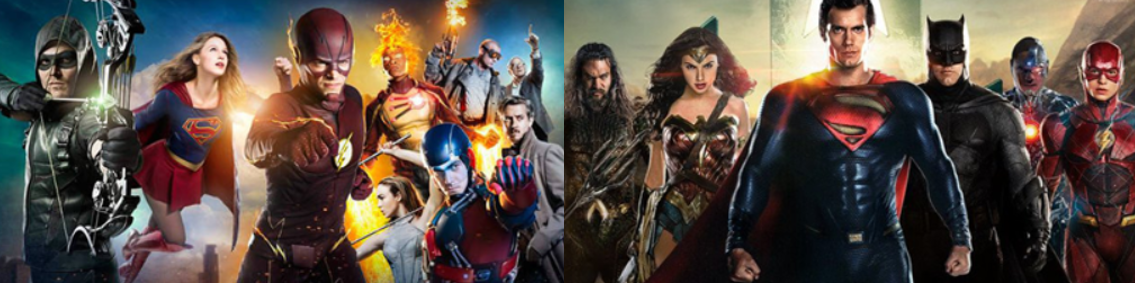
One of the things I love about DC Comics is that they’ll cook up a massive story whenever they want to make major continuity changes (as opposed to Marvel, who usually just quietly retcon stuff away, ignore it completely, or constantly update their sliding timescale to keep everything within an approximate five year timeline). While this means that everything can be canon at any one time, DC have notoriously dropped the ball with every Crisis-level event they produce. After Crisis, every title should have reset to zero and all continuity should have been rewritten and reset to accommodate the major changes they had made; to only have a few titles do this is ludicrous and created a knock-on effect that led to the disastrous Zero Hour event. It wasn’t until Infinite Crisis and Final Crisis that DC finally resolved the fallout from the original Crisis, and then they went and threw it all away with Flashpoint in an obvious attempt to bring in new readers unfamiliar with the events that had already transpired. Ironically, as a long-time comics fan, even I sometimes struggle with these massive Crisis events because they require a lot of background reading. As I mentioned, the New 52 publications alienated me completely and it’s only recently, now that DC has moved on to the Rebirth branding, that I have bothered to collect some key New 52 graphic novels. The worst part is that DC and Warner Bros. apparently would rather reference and incorporate elements from the multiverse concept in their movies and television shows. For example, the Flash seen in The Flash television show is not the Flash we see in Batman v Superman: Dawn of Justice(Snyder, 2016). This goes even further though as the Superman seen in Supergirl is not the Henry Cavill version of the character and Supergirl is not only separate the DC movies but also from The Flash, Arrow, and DC’s Legends of Tomorrow television shows (The Flash even goes to great lengths to introduce and explore the concept of the multiverse, again represented as 52 parallel worlds).
The DCEU is quite divided, to say the least.
This basically means that we will never see Stephen Amell appear as Green Arrow alongside Ben Affleck’s Batman and has resulted in two versions of the Flash, two wildly different versions of Batman’s origin between Batman v Superman and Gotham, two iterations of the Suicide Squad, and many more all existing simultaneously on television and in movies. DC and Warner Bros. then compound things even further by constantly talking about the multiverse and hinting that their movies are not all connected all with the intention of presenting themselves as doing things differently from Marvel Studios. However, the multiverse concept is incredibly complex and something only die-hard fanboys really understand. The general audience might not quite be ready for it and, besides that, it seems really stupid to want to have three different versions of Superman on screen at any one time, especially as DC have previously placed an embargo on Batman crossing over into other television properties. The multiverse has worked in comics because it has existed for so long and been explored to death; The Flash has done a great job of introducing the concept but that had three entire seasons to explore and discuss it at length. For a movie to do it would surely be far more trouble than it’s worth beyond simplifying it to a great degree, perhaps by introducing the Crime Syndicate or stating that a villain such as Darkseid has devoured parallel worlds or something.
Hopefully, however, DC has learned to better manage their Crisis-level events from now on, and also to limit them to one every ten or fifteen years or so; having massive inter-connected plots where the fate of the multiverse is at stake (and sticking guys like Batman at the centre of them!) occur every two to five years is just overkill, in my opinion, especially if DC screw the pooch as badly as the did with the New 52.
In 2013, director Zack Snyder released his gritty, modern interpretation of Clark Kent/Superman after a long hiatus and after Superman Returns(Singer, 2006) almost killed the franchise with ridiculous plotlines and nonsensical decisions. Man of Steel (Snyder, 2013) caused quite a deal of controversy for its darker, more grounded approach and the massive amounts of destruction caused by the battles between Clark Kent/Superman (Henry Cavill) and General Zod (Michael Shannon). Personally, I enjoyed the movie for making Superman awesome again and showcasing the impact of super-powered beings doing battle in highly-populated areas. Batman v Superman: Dawn of Justice follows-up on Man of Steel’s themes and narrative by introducing the first-ever live-action meeting between the two iconic superheroes. It should be noted that this post is going to be full of spoilers and talk about the film’s narrative, so if you haven’t seen the film then it’s probably best not to read on further. With the conclusion of Christopher Nolan’s Dark Knight trilogy (2004 to 2012), the role of Bruce Wayne/Batman was taken up by Ben Affleck in a casting decision that also caused a stir of controversy, mainly due to Affleck’s previous work on Daredevil (Johnson, 2003). Personally, this decision riled me the wrong way. While I actually enjoyed Daredevil (especially The Director’s Cut), I cannot say that I am much of a Ben Affleck fan; also, I felt that his casting took the role away from other actors who could have shined in that sort of role. Basically, this casting felt like the producers were trying to leech of Affleck’s star power.
The loss of Robin has affected Bruce’s attitude, just as it did in the comics.
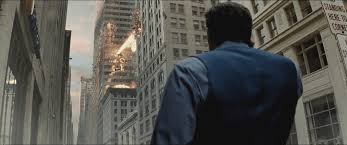
However, Affleck’s portrayal of Wayne/Batman is a true gem of a surprise; Affleck plays an older, grizzled, veteran Batman who is constantly haunted by nightmares, fatigue, and inner turmoil. In the film, Wayne has been Batman for about twenty years; Gotham has gone to hell despite his presence (Wayne Manor is dilapidated, for reasons unknown, and the Gotham Police Department is similarly run-down and seemingly abandoned) and his approach towards his vigilantism has become cruel and violent. This is not just due to his age but also to the dramatic shift in Wayne’s entire persona and attitude after the loss of his partner, Robin, at some point in the past. As a result, Batman (refreshingly commonly referred to as “The Bat” on numerous occasions) tortures and brands criminals in his night-by-night activities and, at a number of points in the film, brandishes firearms and racks up quite the body count. If people were pissed that Michael Keaton’s Batman killed people back in the day, then I wouldn’t be surprised to see Affleck’s Batman attract some debate given that he clearly guns down, blows up, and drives through quite a few goons. Personally, again, I have no problem with that because of the movie’s context. Batman is older, admittedly slower; he’s worn down by age, weariness, and his new mission in life: mainly, the destruction of Superman. It transpires that Wayne was present during the events of Man of Steel and witnessed Superman and Zod’s fight devastating Metropolis, causing the deaths of numerous Wayne employees.
Affected by the events of Man of Steel, Batman makes it his mission to end Superman.
As a result, despite the protestations of his ever-loyal butler Alfred (Jeremy Irons), Batman has decided to view Superman as a potential threat that doesn’t need stopping…he needs killing. It doesn’t help Wayne’s mindset that he is constantly haunted by nightmares of not only the deaths of his parents (as standard) but also visions of a dystopian future where Superman rules as a tyrant. These visions are given further credence not only by a surprise visit by Barry Allen/The Flash (Ezra Miller) in a scene straight out of Crisis on Infinite Earths (Wolfman, et al, 1986) where he warns Wayne of this apocalyptic future and urges him to “find us”, but also through the machinations of Lex Luthor (Jesse Eisenberg). Given the controversy caused by Man of Steel, the world is suitably divided by Superman’s presence. A big side plot in the film is the world’s views on Superman; while many view him as a hero, saviour, and messianic figure, others are also fearful of his presence and uncomfortable with his status as an all-powerful alien who answers to no one. While Batman comes to represent the extremes of the latter, Superman’s extended family – the ever-pretty Amy Adams and Lois Lane and his mother, Martha (Diane Lane) – represent the former, urging Clark to be a symbol of hope and/or remove himself from the equation entirely and leave the world to its own issues. Luthor capitalises on the divide that Superman causes and works it to his advantages; through his devious machinations, Luthor gains access to the remains of Zod’s Kryptonian ship, the body of Zod himself, and frames Superman as a destructive force through a series of terrorist actions. This is aided by the general consensus that, because Superman acts as an independent force, his actions have consequences for the rest of the world that led to a number of deaths, a fact that weighs heavily on Superman’s conscience and his belief in himself and what he’s doing.
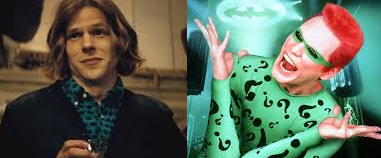
Separated at birth?
For me, the casting of Eisenberg is the exact opposite of Affleck’s: while I generally believed that he could bring something unusual to the role, he is less of a gem and more of a scenery-chewing, ham-fisted version of the character. In his defence, I was glad to see that he wasn’t the corporate, suit-wearing version; Eisenberg brings a manic, hyperactive energy to the role that masks his true, devious intentions; however, while it kind of portrays the character as a quirky, eccentric tycoon, it lends itself more to Jim Carrey’s over-the-top acting from Batman Forever (Schumacher, 1995) people continue to lament to this day. Luthor, implied to be from observing how often Superman saves Lois Lane from danger, pieces together Superman’s secret identity and kidnaps his mother and places Lois in peril in order to bend Superman to his will. He has also been fuelling Wayne’s thirst for blood by manipulating him over time, effectively setting the two against each other in order to publically discredit and shame Superman. However, Luthor’s ultimate plot involves not only the discovery of Kryptonite (which Wayne manages to intercept and use to his own advantage) but also the genetic tampering of Zod’s remains. Accessing forbidden Kryptonian technology, Luthor creates a hulking genetic monstrosity whose sole purpose is to kill Superman: he creates Doomsday.
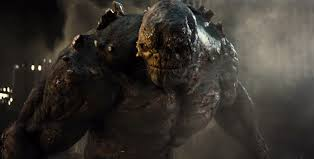
Doomsday serves as the penultimate threat of the film.
Doomsday, whom many online have criticised as being shoe-horned in to unite the central characters, also surprised me. When I first saw the footage of Doomsday from an earlier trailer, I lamenting his presence as it causes so many issues. People have been asking me over the last few years how Batman and Superman can fight and I have explained, over and over, that the two have not only fought numerous times in the comics but also that Batman has often come out on top more than once. Superman, for all his powers, is fallible and has numerous weaknesses; Doomsday, however, traditionally has no such weaknesses and, in a fight against him, the most useless ally you would want would be Batman. However, the film’s version of Doomsday is markedly different; it’s somewhat weaker, physically, and vulnerable to Kryptonite but remains as immensely powerful as ever, if not more so. Doomsday emits concussive blasts of heat energy, seems to float or straight-up fly a few times, and expels shockwaves of energy every time it evolves to repair from damage and attacks. In Superman’s favour, he learns from Man of Steel and attempts to take Doomsday into space and away from the planet; however, this plan is foiled by the governmental decision to nuke them once their out in orbit, which brings Doomsday back more powerful than ever. Joining Superman and Batman to oppose Doomsday is Diana Prince/Wonder Woman (Gal Gadot), who appears at numerous points in a sub-plot concerning her attempts to retrieve vital data of metahumans from Luthor.
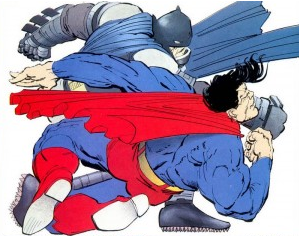
Miller’s influence on Snyder is painfully obvious.
It turns out that Luthor has kept tabs on Barry Allen/the Flash, sightings of Aquaman (Jason Momoa), and the augmentation of Victor Stone into Cyborg (Ray Fisher) and is eager to keep Luthor from eliminating these metahumans. In service of this, she runs into Wayne at numerous points, who discovers that Diana has been around for about a hundred years and is more than she seems. Diana opts to interject herself into the conclusion and assist Batman and Superman, relishing the battle against Doomsday. For the first-ever live-action portrayal of Wonder Woman, Gadot bring both beauty and strength; while her casting also attracted controversy, she was actually portrayed very well and as integral to not only this film but also the formation of the upcoming Justice League. However, the primary title of this movie involves the fight between Batman and Superman. These two clash immediately due to their ideals and approaches and because of Wayne’s vendetta against Superman, but don’t actually come to blows until the third act. For this battle, Snyder draws implicitly from The Dark Knight Returns (Miller, 1986); Batman dons a cybernetic suit exactly as in the comic, blasts Superman with Kryptonite gas as in the comic, and beats him into submission just like in the comic. I guess, in execution, the fight between the two comes across as very similar to the showdown in Freddy vs. Jason (Yu, 2003) in that the entirely film builds the tension towards the confrontation, and builds it some more, and, when the tension finally snaps, it is a very satisfying event.
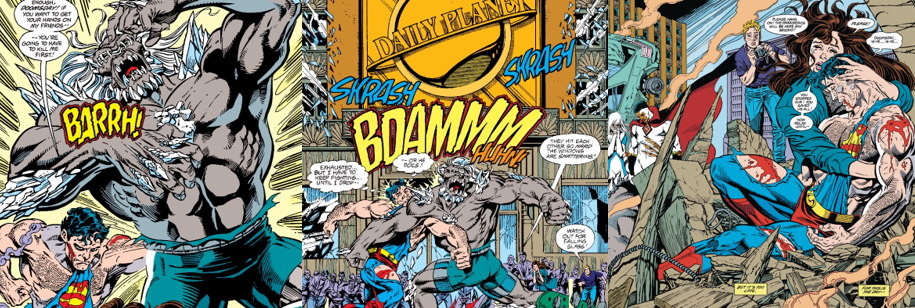
Superman famously died in battle against Doomsday in 1992.
Batman, as mentioned before, is violent and aggressive in his fighting style; his combat prowess is ripped straight from the Arkham series of videogames (Rocksteady Studios/Warner Bros. Interactive Entertainment, 2009 to 2015) and there is no question that, once Superman is suitably weakened, Batman is the superior fighter. Superman, in a change of pace, shakes off the effects of Kryptonite over time and it merely weakens him, rather than kills him. However, that’s alright because Batman is more than willing to stab a Kryptonite spear through Superman’s head! Batman bests Superman, beating him into submission, and is poised for the kill before Superman begs him to save his mother after the fact and Lois rushes in to help clear the air. It is at this moment that Batman comes to his senses and realises that Superman is a selfless man trying to do good; however, this revelation comes off quite rushed. Indeed, once the revelation that Wayne and Clark’s mothers share the same first name (a point I had never actually considered or thought of before) is brought up, Wayne does a complete turn around. Not only is he now willing to assist Superman’s causes, he also pledges to unite the other metahumans in honour of Superman’s penultimate sacrifice.
Oh, didn’t I mention that Superman dies?
Well, honestly, I was pleasantly surprised that Snyder saw this through as totally as he did. As I said on numerous occasions before the movie came out, you cannot involve Doomsday and not do The Death of Superman (Jurgens, et al, 1992) from the comics. Doomsday’s entire purpose is to kill Superman; leaving that out would be like using bane and not having him break Batman’s back. In fact, one of the major issues I had with Smallville (2001 to 2011) using a version of Doomsday was that it obviously wouldn’t be killing Clark (Tom Welling) and would be portrayed as another “villain-of-the-season”. Here, Doomsday and Superman kill each other through mutual impalement; this heroic act brings Batman entirely over to Superman’s cause. It also (through the effective use of a military/state funeral, the more emotional funeral in Smallville, and the montage of reaction shots to the news of Superman’s death) turns Superman into a matriarchal symbol of hope and heroism, effectively ending the divisive conflict he caused in life.
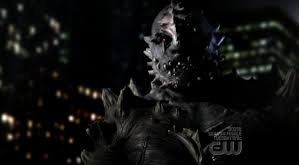
Smallville‘s Doomsday was an abomination.
Of course, a two-part Justice League movie is scheduled to begin filming soon and Superman is already confirmed as being part of the line-up. As a result, the film’s final shot is of Superman’s grave trembling slightly, signalling his inevitable return (and without the four bogus clones as in the original story, one would assume). However, the fact that Snyder actually had the balls to do The Death of Superman, in my mind, completely justifies and exonerates the inclusion of Doomsday. It wasn’t just some half-assed inclusion there to be brought down by the trinity of superheroes; it was there to unite them, the Justice League, and the world by killing Superman, so kudos for that. Visually, the film is actually quite magnificent; say what you will about Snyder as a storyteller, the man knows how to be cinematic. Batman shines the most throughout because of this, being shot in pitch black and having his action scenes be energetic and clear to see. Snyder’s visual symbolism extends to Superman as well; while the God and Christ metaphors have been done to death with Superman, here they actually have relevance in the plot so they don’t come off as cheap or superficial. The visual dichotomy of the film is wonderfully done; the contrast between Metropolis and Gotham City is apparent, the costumes all pop out and appear functional, and Batman’s weapons and gadgets are showcased to the fullest.
It really feels as though the film-makers held nothing back (except for the half-hour of cut footage rumoured to be on the home release) and that has, in the eyes of many, caused more controversy. I have heard of critics attacking the film for being “choppy” at the start, shoe-horning in the Justice League elements and Doomsday, and having nonsensical decisions woven into the dialogue, script, and plot. To them, I say, these are valid points in some cases. However, I never experienced any issues with the pacing or the editing; sure, it’s a long film, but films are these days and, when you’re enjoying a movie, that’s not a bad film. I found myself engaged with the plot; I wanted to know more about Wayne Manor, Gotham, and Batman (which is a perfect way to re-introduce this version of the character and will be expanded upon in future DC films), I followed along easily enough with Luthor’s plot and the side-plots involving the Justice League, and never felt that anything else done an injustice or there for the sake of it. The fact is that DC and Warner Bros. are very late to the shared universe party; Marvel Studios have gained the upper hand after building their individual heroes separately and now having them cross over regularly. While DC’s television efforts are popular and are beginning to cross over, their television shows will not be a part of this forthcoming DC film universe and the studio, which has largely been happy to produce mainly Batman and Superman movies after the lacklustre reception of Green Lantern(Campbell, 2011), doesn’t have the time or the release schedule to introduce the Flash, Aquaman, Wonder Woman, Cyborg or the other Justice Leaguers. Instead, what will set DC movies apart from Marvel’s from now on is their cross-connectivity and their immediate focus of having their films and character converge right off the bat, which could make for some exciting future releases.
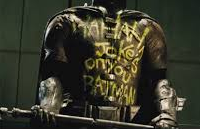
Overall, yes, this film has some flaws but nowhere near as many as I was expecting and it certainly doesn’t deserve the critical backlash it is currently facing. It re-introduces Batman, presenting a grizzled, more violent version of the character who seems just as mental as the villains he faces, and brings more humanity and empathy to Superman. The visual presentation is top-notch, more than making up for any narrative deficiencies, and the thematic portrayal of both characters is largely in keeping with their portrayals in several prominent comic books, even the vaunted Dark Knight Returns. Snyder had the balls to do new thins with this movie: he incorporates Robin (no one knows which one but, most likely it was Jason Todd, meaning Nightwing could be active in this universe), a character no one has used in film for nearly ten years (and that’s just criminal); he utilised Doomsday to its fullest extent; he addressed and upped the scale of destruction from Man of Steel; and the apocalyptic future witnessed by Wayne, which is implied to be the result of Superman’s actions (somehow), and Luthor’s manic rant at the end (I half-expected him to announce that “a Crisis is coming”) lend credence to the rumours that the Justice League will come together to battle Darkseid. Make no mistake, the DC movies are a violent one where actions have consequences and the heroes amongst us may cause more trouble than the villains but it is one soon to be united by heroes and villains alike and, for the first true attempt and making headway towards a Justice League movie, I would say that Snyder has delivered on all fronts.
My Rating:
⭐⭐⭐
Rating: 3 out of 5.
Pretty Good
Recommended: Sure, why not? The film is beautifully shot, exciting, and engaging. It’s maybe not the best-paced film and has it’s issues, but it’s Batman…versus Superman! Best moment: Easily the entire final act of the film from the titular clash between the two heroes, into Batman’s vicious rescue mission, through to the Trinity joining forces against Doomsday. Worst moment: Jesse Eisenberg’s performance as Lex Luthor totally ruins what should have been a far more cerebral, menacing characterisation.


















 Dr. K's Waiting Room
You must be logged in to post a comment.