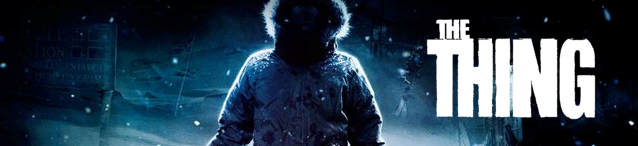
Movie Night [Sci-Fanuary]: John Carpenter’s The Thing


January celebrates two notable dates in science-fiction history: “National Science Fiction Day” on January 2 to coincide with the birth of world renowned sci-fi writer Isaac Asimov, and 12 January being when Arthur C. Clarke’s HAL 9000 was created. Accordingly, I dedicate January to celebrating sci-fi in all its forms.


Released: 25 June 1982
Director: John Carpenter
Distributor: Universal Pictures

Budget: $15 million
Box Office: $20,847,529
Rotten Tomatoes Scores: 85% / 92%

Quick Facts:
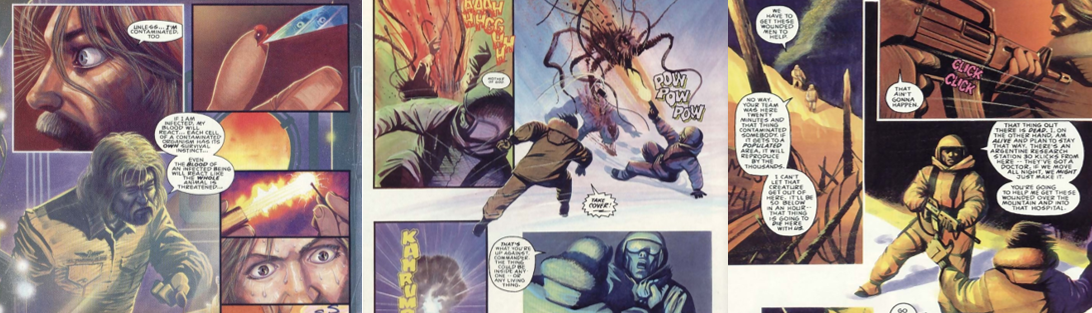
The second big screen adaptation of John W. Campbell’s iconic 1928 novella Who Goes There?, The Thing was almost helmed by horror maestro Tobe Hooper before John Carpenter got involved and pushed for a story closer to the source material. Bill Lancaster modernised the story to focus on paranoia and fear while Rob Bottin delivered the gruesome practical effects to meld numerous bizarre and horrific alien aspects into the titular “Thing”. A critical and commercial failure at the time, John Carpenter’s The Thing is now widely regarded as a sci-fi/horror classic and spawned comic books, videogames, and a divisive 2011 prequel.

The Review:
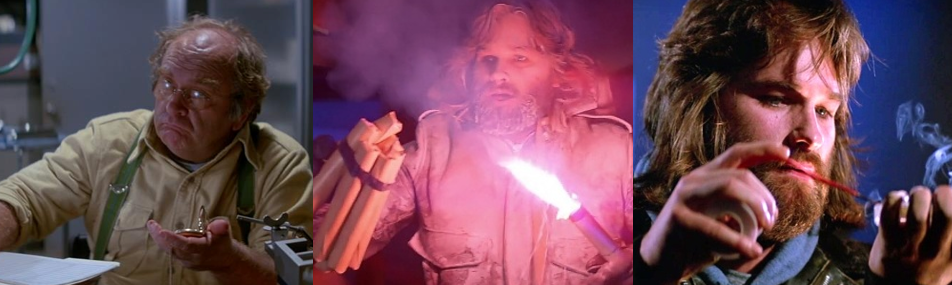
Life within the remote, frigid United States Outpost 31 is suddenly turned upside down when a couple of Norwegian researchers suddenly circle their snowed-in facility, where the isolated inhabitants wile away in the rec room or, in pilot R. J. “Mac” MacReady’s (Kurt Russell) case, swigging whiskey and being beaten at computer chess. The Norwegians are chasing a sled dog (Jed) through the snow and, when they fail to shoot it, land to try explosives. The commotion alerts Mac and his cohorts, who rush into the snow to see what’s up and unknowingly shield the dog, leading to the desperate and ranting Norwegian (Norbert Weisser) to threaten them at gunpoint after accidentally blowing up his helicopter and co-pilot. Startled, the Americans open fire, with station commander M. T. Garry (Donald Moffat) executing the Norwegian with his prized revolver. Confused by all this, Mac takes station physician Doctor Copper (Richard Dysart) to the Norwegian base, despite the inclement weather, and finds it a burned out, frozen wreck full of gruesome bodies. While Dr. Copper gathers the Norwegians’ notes to try and understand what happened, Mac discovers the frozen remains of a mysterious ice-like tomb and a charred, inhuman corpse that’s hideously malformed. They transport the remains back to base for analysis, only for microbiologist Doctor Blair (A. Wilford Brimley) to be bemused by the Thing’s malformed, misshapen biology. Still puzzled by whatever fate befell the Norwegians and the bizarre, steaming corpse sitting in their medical room, the team return to their games, pondering the day’s events and niggling each other, unaware that the sled dog has snuck into one of their rooms.

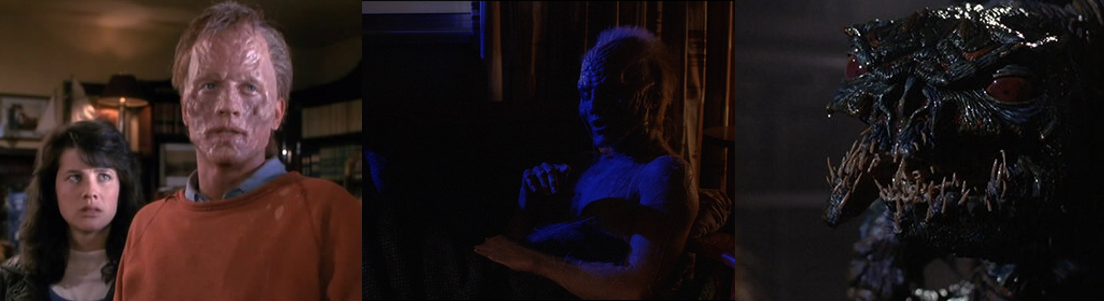
Mac and the others discover a horrifying alien parasite that assimilates anything it touches.

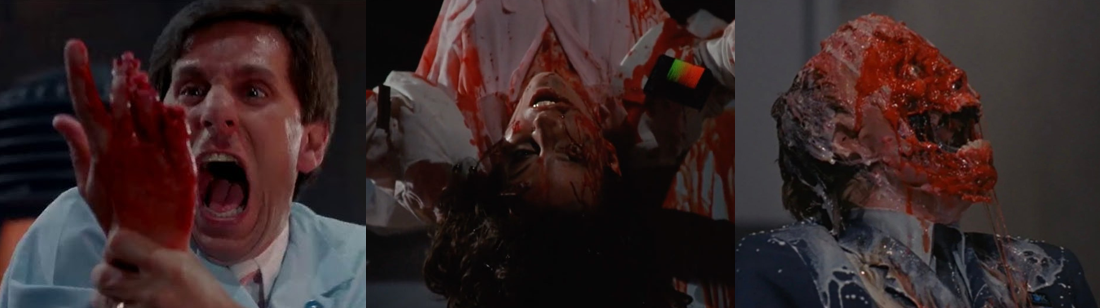
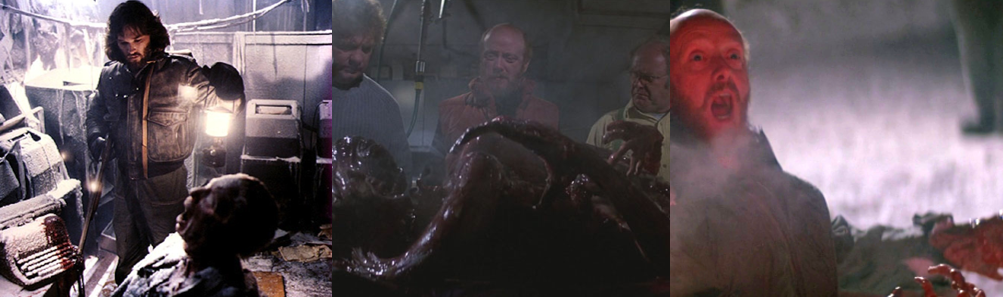
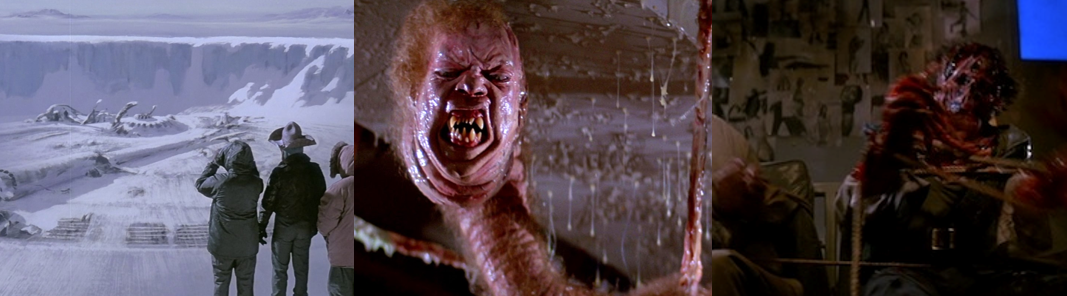
Sombre dog handler Clark (Richard Masur) later takes the adopted dog to the kennels, where it suddenly and violently erupts into a writhing, thrashing, screaming alien creature! Ensnaring the other dogs and spraying them with goop, it assaults the panicked dogs, drawing Clark and the others. Horrified, Mac and Garry blast the Dog-Thing and the other dogs, much to Clark’s dismay, and surly mechanic Childs (Keith David) incinerates the creature with a flamethrower. Dr. Blair’s subsequent autopsy reveals that the burned corpse isn’t a dog, but an “imitation” of one that was attempting to absorb and imitate the other dogs. Reviewing the Norwegians’ data, which includes video footage similar to the 1951 film, the crew discovers that the Norwegians discovered an alien space craft buried deep in the ice. They risk another helicopter ride to the site and find the craft, which is estimated to have crashed thousands of years ago and which was uncovered when the Norwegians used explosives, leading them to recover a frozen occupant who subsequently overran their base. Shaken by the implications, Dr. Blair runs some tests and determines that the parasitic organism aggressively latches onto and absorbs living cells, perfectly imitating any living creature it samples and sprouting teeth, tentacles, and other appendages from potentially thousands of other worlds. Realising that the Thing could overtake the entire world within three years if it reaches civilisation, Dr. Blair snaps and wrecks the outpost’s communications array and much of their equipment before he’s subdued and isolated. This leaves out of his depth assistant biologist Fuchs (Joel Polis) to pour over Dr. Blair’s mad ramblings for a solution and Garry shell-shocked when the Dog-Thing’s remains slither to life and absorb his friend, meteorologist George Bennings (Peter Maloney), forcing the others to set his half-transformed form alive and burn every trace of the alien from the outpost.
Paranoia and fear run rampant as the Thing assimilates those around it and feeds their distrust.

With radio operator Windows (Thomas Waites) unable to call for help and their vehicles trashed during Dr. Blair’s breakdown, the survivors prepare to weather an incoming storm, tensions flare when soiled long johns appear in cook Nauls’ (T. K. Carter) kitchen and the shredded remains of Mac’s clothing are found out in the snow. Dr. Copper suggests they use the blood bank to test who’s human and who’s the Thing, but this is scuppered when someone destroys the blood bank and they descend into arguments and finger pointing when this is discovered, accusing Garry since he’s the only one with the keys and Dr. Copper since he regularly accesses the blood. The distrust being thrown around knocks Garry’s confidence and, after a tense showdown with Windows when he frantically grabs a shotgun, Garry relinquishes his revolver and command to Mac. While Mac tries to hold the group together, being the coolest and most logical head despite his growing fear and paranoia, the others descend into anger and distrust after Fuchs is mysteriously burned alive and any chance of employing Dr. Copper’s blood test. However, but soon decide Mac is the most untrustworthy  and strand him in the blizzard. They’re even more convinced he’s the Thing when he stumbles back to base without a guideline and, enraged by their betrayal and wracked by the cold, Mac threatens to blow them all up with dynamite if they don’t listen to reason. The tense standoff sees Mac and Childs clash and Clark, also a chief suspect due to his close proximity to the dogs, ready to shank Mac at the first opportunity. During the scuffle to disarm Mac, terrified geologist Norris (Charles Hallahan) is tossed aside and seemingly dies from a heart attack, only to be shockingly revealed to be the Thing! This revelation does little to allay Mac’s suspicions and, after the ghastly Norris-Thing and its offspring are incinerated, Mac forces those he begrudgingly trusts to tie up those he doesn’t and ventures that their blood with violently react to a hit needle if they’ve been assimilated.

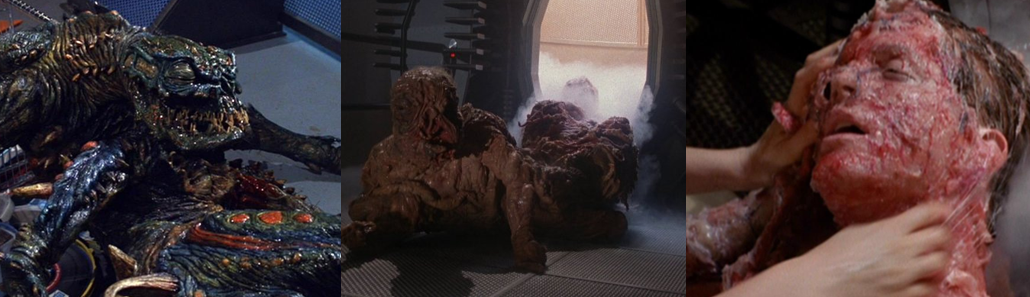
Recovered from a crashed ship, the Thing is a hideous amalgamation of various organisms.

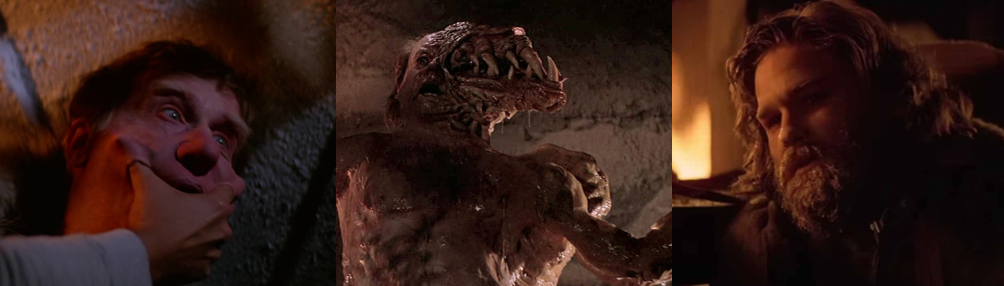
Rather than being a strange vegetable creature, the titular Thing is a parasitic organism like in the book. Although we see its flying saucer crash to Earth in the pre-title sequence, there’s no way of knowing if the Thing was the pilot or was simply held captive on the ship (though I’d venture to say the ship crash-landed after the Thing broke out). The Thing has no true form and instead hides behind imitation, perfectly replicating living creatures and even mirroring their personalities, to the point where the assimilated seem unaware that they’re the Thing until they’re threatened. Assistant mechanic Palmer (David Clennon), for example, appears completely human until Mac performs his blood test, whereupon Palmer violently explodes into bloody, gnashing jaws. Norris also appears normal, even tackling Mac alongside the others, until he appears to die and Dr. Copper performs CPR and Norris’s chest splits open and rips his arms off! The Thing’s only goal is to assimilate and procreate everything it can, picking off potential threats and fighting to survive when threatened. Although it appears inhumanly strong and durable, shrugging off shotgun blasts and easily manhandling Windows, it’s not invulnerable. Fire is especially effective, as is dynamite, with the creature being most vulnerable mid-transformation, as seen with the Bennings-Thing. Rather than being a singular organism, every cell of the Thing is alive and thinking, allowing it to disgustingly detach part of itself when the main “body” is destroyed and meaning it can infect multiple targets at once. The Thing is also seen to be very shrewd and intelligent, allowing the survivors to waste their energies on paranoia and accusations rather than formulating strategies, and having intelligence enough to cobble together a miniature flying saucer in the case of the Blair-Thing. The Thing is also incredibly patient, happy to let the humans destroy themselves and hibernate in the snow until the rescue team arrives and then assimilate them…and the rest of the world, in short order.

Although Mac destroys the Blair-Thing, there are lingering questions about who can be trusted. 

When Mac’s blood test outs Palmers and leads to him and Windows dying, a slither of trust is reignited as the cleared survivors go to test Dr. Blair. However, they find he’s built a small flying saucer and tunnelled his way out, revealing himself to also be a Thing. After the Blair-Thing destroys the outpost’s power generator, Mac realises it’s willing to outlast them in the cold to escape and that they’re unlikely to make it out alive without any heat and rescue far away. Resolving to keep the Thing from reaching civilisation, Mac and the others prepare to bring the whole outpost down by setting dynamite charges. However, paranoia rears its ugly head as Nauls and Childs go missing; the Blair-Thing also ambushes Garry in the tunnels, leaving Mac alone. The Blair-Thing then spectacularly erupts from the floor as a massive, mewling amalgamation of repulsive alien and vaguely animal parts in a fantastic combination of practical effects, stop motion techniques, and puppetry. While the monstrous Blair-Thing is quite lumbering and mainly just stands there roaring, its tentacles whipping about as it emits that disturbing hissing, it devours Mac’s detonator and seems poised to take him. Defiant until the end, the rugged, exhausted Mac tosses a stick of dynamite at the creature and destroys it, along with the entire outpost. Barely escaping the blast, Mac stumbles through the burning debris and finally collapses from fatigue, whiskey in hand. Childs emerges from the blizzard, claiming to have gotten lost while pursuing Dr. Blair, and sits with him, both too tired to argue or to fight. Realising the flames will die out soon and they’re likely to perish from the cold, the two acknowledge the futility of their situation and their mutual distrust and resolve to simple share a drink and wait to see what happens, leaving their ultimate fate up to the audience…

Final Thoughts:
John Carpenter’s The Thing is one of the quintessential remakes of all time. While the original film was an ambitious B-movie that took huge liberties with the source material, The Thing stays very close to Who Goes There? in its interpretation of the titular alien parasite and the destructive paranoia that tears the humans apart. There’s a sense that many of the characters barely tolerated each other to begin with, meaning tensions fray very quickly once they realise the Thing can perfectly imitate them down to their memories and behaviour. The film perfectly conveys this by rarely, if ever, showing who’s been assimilated and when, meaning we never really know who to trust as everyone – even rugged protagonist Mac – is a suspect. It’s thus shocking when characters turn out to be human or suddenly explode into a thrashing, shrieking mess of flesh and teeth and even destroying the Thing and performing tests doesn’t stamp out the unease felt by the survivors. Kurt Russell did a great job as reluctant leader Mac, who seems ready to pack it all in at a moment’s notice. I liked his heated rivalry with the immortal Keith David and how easily he took charge, and how physically and emotionally exhausted he was by the whole ordeal. Some aspects, like Dr. Blair’s computer simulation, are rather quaint but they get the job done and the gruesome special effects more than make up for them. The Thing is constantly sprouting new appendages and forms and surprising audiences by springing to the ceiling, becoming a scurrying spider-like head, or clamping down on its prey with its massive teeth. It’s a spectacularly ghastly creature that’s nauseating to look at as you never know what it’s going to do next as it clearly retains knowledge of other alien creatures and is a highly adaptable and versatile parasite. The ending may be one of cinema’s greatest cliff-hangers and the simple story of distrust and desperation remains as palpable as ever, making John Carpenter’s The Thing a timeless sci-fi/horror classic that’s difficult to beat.

My Rating:

Rating: 4 out of 5.

Great Stuff

Do you agree that John Carpenter’s The Thing is one of the greatest remakes of all time? How do you feel it works as an adaptation? Which character were you most surprised to find out was human (or the Thing)? Did you enjoy Kurt Russell’s performance and his rivalry with Keith David? How amazing were those gruesome special effects? How did you interpret the ending and what sci-fi films are you watching this month? Use the comments below to hap some praise on John Carpenter’s The Thing and donate to my Ko-Fi to suggest other sci-fi films you’d like to see me cover.

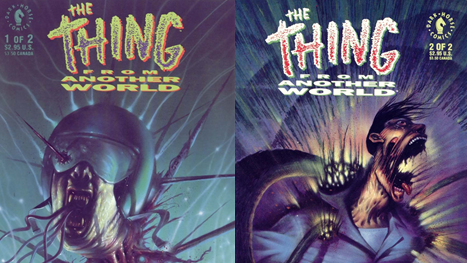
Movie Night [Sci-Fanuary]: The Thing from Another World


January celebrates two notable dates in science-fiction history: “National Science Fiction Day” on January 2 to coincide with the birth of world renowned sci-fi writer Isaac Asimov, and 12 January being when Arthur C. Clarke’s HAL 9000 was created. Accordingly, I dedicate January to celebrating sci-fi in all its forms.


Released: 27 April 1951
Director: Christian Nyby
Distributor: RKO Radio Pictures

Budget: $9 to 15 million
Box Office: $1.1 million
Rotten Tomatoes Scores: 87% / 73%

Quick Facts:
Based on celebrated, influential novella, Who Goes There? (Campbell, 1938), The Thing from Another World was loosely adapted by Charles Lederer, Howard Hawks, and Ben Hecht. The titular “Thing” (James Arness) became a plant-like humanoid thanks to extensive make-up later replaced with an asbestos suit for an ambitious fire stunt. Though very different from the novella, The Thing from Another World is considered one of the best movies of the 1950s and inspired one of the greatest remakes ever made in 1982.

The Review:
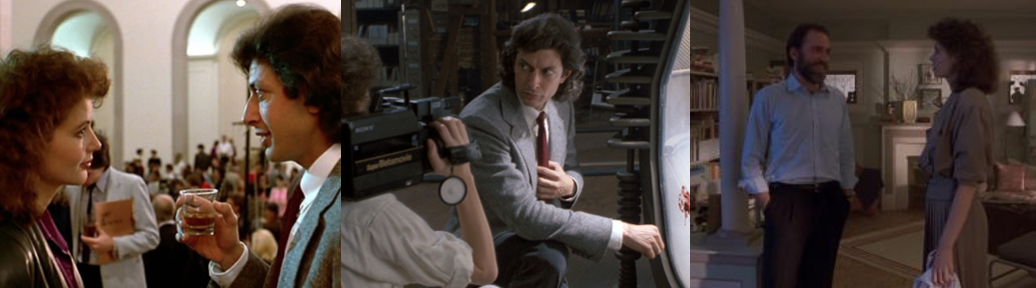
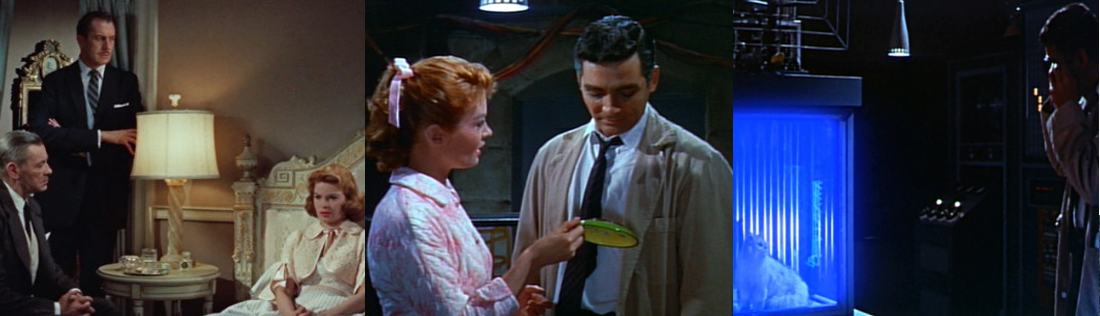
While searching for his next big story in Anchorage, Alaska, “newspaper man” Ned “Scotty” Scott (Douglas Spencer) bumps into old friend, pilot Lieutenant Eddie Dykes (James Young) of a United States Air Force re-supply crew, at an officers’ club and meets his cohorts: gruff Captain Patrick Hendry (Kenneth Tobey) and flight navigator Ken “Mac” MacPherson (Robert Nichols). When noted scientist and Nobel laureate Doctor Arthur Carrington (Robert Cornthwaite) radios in a vague call for aid at a North Pole research camp, Captain Hendry and his jovial crew are ordered to assist, flying some hands, sled dogs, and the eager Scott out to investigate Dr. Carrington’s ambiguous concerns about a mysterious aircraft. Upon arriving at the Polar Expedition Six outpost, the stern but amicable Captain Hendry bristles to reunite with the gorgeous and playful Nikki Nicholson (Margaret Sheridan), who’d previously humiliated him in a drinking game and turned down his handsy advances. Though flustered by her mischievous nature, Captain Hendry is obviously as attracted to her as she is to him and they enjoy a fun back-and-forth throughout the film that’s as entertaining as the banter between Captain Hendry, Lieutenant Dykes, Mac, and Scotty. The crew are clearly friends as much as co-workers and express their affection through light-hearted banter, teasing Captain Hendry for his drinking habits and past blunders, only for him to jokingly threaten them with guard duty and other empty threats. There’s a unique approach to dialogue and interactions here as characters talk over each other and converse very bluntly, making every scene feel ad-libbed (except for Dr. Carrington, who expresses himself with a theatrical guile) and the relationships between the characters feel far more personable and natural as a result.

A remote outpost discovers a humanoid alien that goes on a rampage once accidentally dethawed.

After meeting with the other scientists and civilians stationed at the outpost, Captain Hendry flies his crew, Dr. Carrington, and others to the crash site, only to discover a genuine flying saucer buried under the ice! Rather than wait for approval from his commanding officer, Captain Hendry orders thermite charges to be placed around the site to melt the ice, accidentally destroying the craft when the explosives react violently to the hull. Though Dr. Carrington is aghast by this, his excitement soon reignites when they discover a large humanoid “Thing” buried nearby. This time, the team dig it out and take it to the outpost, though Dr. Carrington’s frustrated by Captain Hendry’s insistence that they await further orders before defrosting or investigating their strange guest. Scotty is similarly irritated to be barred from reporting what they’ve found, seeing the discovery as the story of the century and eager to share it, as Captain Hendry is anxious to avoid another blunder. As the team hunker down against a blistering storm and take shifts watching the creature, Corporal Barnes (William Self) becomes unnerved by the Thing’s gaze and accidentally thaws it out after covering it with an electric blanket he didn’t realise was plugged in. The Thing awakens, briefly runs amok through the outpost, and flees into the storm, attacking the sled dogs and losing some of its arm before disappearing. Upon investigating the severed limb, the resident scientists conclude that the creature is a bizarre humanoid plant that feeds on blood; the hand even reanimates after absorbing some of the dog’s blood staining it. Dr. Carrington slowly becomes obsessed with the creature, believing it to be intellectually and physically superior to man and wishing to learn its secrets, only for Captain Hendry to repeatedly shoot down his insane requests and prioritise saving lives over reasoning with a mindless creature.

Captain Hendry and Dr. Carrington disagree on how best to handle the bloodthirsty Thing.

The titular “Thing” is seen sparingly, which I was surprised by. After its initial awakening, the creature vanishes and the film focuses on the research into its nature, barricading the outpost against further attacks, and searching for the creature before it can strike again. It’s still active in the background, but we only hear about it from shellshocked survivors and through dialogue. Unlike the shapeshifting, nebulous alien Thing from the book and subsequent outings, the Thing is a towering, humanoid “Martian” more like a vampire than a voracious extraterrestrial. The survivors discover a sled dog drained of its blood and hear from the traumatised Doctor Stern (Eduard Franz) that the creature attacked the outpost greenhouse, killing everyone and hanging them from the rafters to drain their blood, which would’ve been gnarly to see. Captain Hendry is surprisingly calm about the entire situation and there are no instances of paranoia or cabin fever among the survivors. The only conflict comes from the scientists who wish to defend and study the creature and the military who wish to kill it. Captain Hendry is horrified to learn from Nikki that Dr. Carrington, who’s been going without rest since the Thing was discovered, has been feeding blood samples to seeds from the creature’s arm, producing alien plants that has the airmen speculating that the Thing came to conquer the world. Thanks to the storm, communicating with Brigadier General Fogerty (David McMahon) and the outside world is spotty, at best, resulting in Captain Hendry receiving a bunch of one-way messages and orders to fortify the outpost and survive but leave the creature unharmed. Seeing the threat the Thing poses, Captain Hendry naturally disregards these orders, and Dr. Carrington’s mad objections, and has the Thing doused with kerosene and set alight when it next attacks. Despite the Thing going up in flames, it wildly lashes out and almost burns the outpost down before escaping into the snowstorm.

Despite Dr. Carrington’s objections, the Thing is destroyed and Scotty submits a dire warning to the world.

While recovering, the survivors are horrified to learn that Dr. Carrington’s musings about the creature’s intelligence are at least partially true as the Thing sabotages the outpost’s heating system, threatening to freeze them to death within hours. Surmising that the Thing will target the electricity next, Captain Hendry corrals all the survivors into the generator room and the airmen take an offhand suggestion from Nikki (“Boil it, bake it, stew it, fry it”) to heart, rigging a high voltage “fly trap” to electrocute the creature in a narrow corridor. Seemingly sensing their blood, the Thing crashes through their makeshift barricade and stalks its way towards them, noticeably avoiding the wires hidden beneath the pallets on the floor. Although Dr. Carrington attempts to sabotage the plan by shutting the generator off at a crucial moment, he’s easily disarmed and briefly subdued, but Captain Hendry’s forced to wait for the hulking Thing to position itself correctly on their trap. Dr. Carrington rushes to it, pleading for reason and to begin a dialogue, only to be roughly shoved aside and left with a broken collarbone. Despite its immense size, strength, and durability, the Thing blunders into position and is zapped by a few thousand volts in a surprisingly ambitious light show. Captain Hendry keeps the juice poured on until the Thing is reduced to a smouldering pile of ash, though Scotty faints before he can get a clear shot of the creature. The survivors round up all remains of the Thing and burn those, too, before treating their wounds and decompressing as the storm dies down. While Captain Hendry and Nikki tease taking their relationship to the next level, Scotty finally gets to call in his story, eagerly painting a dramatic picture of the pitched battle fought at the outpost and warning his listeners to “Watch the skies everywhere. Keep looking. Keep watching the skies…”

Final Thoughts:
Although I’m a big fan of John Carpenter’s 1982 remake of Who Goes There?, I’ve never read the book or watched this original adaptation, though I gather it’s a very loose one with only the basic elements of the story being represented. Most notably, the titular Thing is very different from the source material and subsequent adaptations, being more akin to Frankenstein’s Monster than a shape-changing organism. I’m not surprised by this as I doubt the technology existed to bring the creature to life in a more faithful way and it makes sense to reimagine it as a hulking, humanoid alien given where sci-fi was at the time. I liked the twist that it was essentially a walking vegetable and like a vampire, feeding on blood and growing alien plants from its seeds, potentially to overrun the world. I would’ve liked to see this emphasised more, perhaps to see the Thing’s spores spread throughout the outpost and maybe infect those within to bring in some of the paranoia from the book and definitely would’ve liked to see more death and destruction from the disappointingly absent creature. Luckily, the relationships and banter between the characters is more than enough to sustain the film in the Thing’s absence, with Captain Hendry and his men having very enjoyable and realistic interactions. I really liked that the actors kept talking over each other and the banter between the characters, which was nicely contrasted with Dr. Carrington’s objections. He was a very theatrical character but, again, felt somewhat underutilised and I would’ve liked to see him sabotaging their efforts more. Despite all this, and the film being oddly paced and lacking in urgency, The Thing from Another World was still quite enjoyable and somewhat ambitious at times. It’s a great example of a classic, 1950s sci-fi flick that is perhaps a little dated these days, far surpassed by its remake, and arguably lacking compared to some of its peers, but it still has a charm and appeal that make it an entertaining watch.

My Rating:

Rating: 2 out of 5.

Could Be Better

Did you enjoy this first adaptation of Who Goes There? If you’ve read the book, what did you think to the changes made to the story? Did you enjoy the banter and interactions between the characters? Do you agree that the Thing should’ve featured a lot more? Do you think Dr. Carrington was right to want to communicate with the Thing? How are you celebrating sci-fi this month? Whatever you thought to The Thing from Another World, comment down below and donate to my Ko-Fi to suggest other sci-fi films for me to review.

Back Issues [Sonic2sDay]: Sonic the Hedgehog’s Buddy: Tails


In anticipation of Sonic the Hedgehog 2 (SEGA Technical Institute, 1992), SEGA dubbed November 24, 1992 “Sonic 2sday”. Accordingly, this is a great excuse to celebrate Sonic’s faithful sidekick, Miles “Tails” Prower, who debuted in that title.


Writer: Michael Gallagher – Artists: Mike Gallagher and Dave Manak

Story Title: “Southern Crossover” (Part One to Three)
Published: October 1995 (cover-dated: December 1995) to December 1995 (cover-dated: February 1996)

The Background:
Thanks to an aggressive marketing campaign and being bundled with the all-powerful 16-bit Mega Drive, Sonic the Hedgehog was the blockbuster success SEGA needed to usurp Nintendo from the top of the videogame industry. Despite a tumultuous developmentSonic 2 surpassed this success, selling 400,000 copies in its first week, 6 million units during the Mega Drive’s lifespan, and increasing SEGA’s slice of the home console market by 40%Widely praised and highly regardedSonic 2 also debuted Tails, Sonic’s kid sidekick, who was created by Yasushi Yamaguchi. Resembling the mythical kitsune and devoted to his super-fast hero, Tails became a well regarded staple of the Sonic franchise, becoming one of the few of Sonic’s supporting cast to get his own divisive solo outings. He was also the second to receive a solo mini series published by Archie Comics, who produced the popular Sonic the Hedgehog comics in the United States, which were heavily based upon Sonic’s cartoon adventures. Though spinning off from Archie’s loose adaptation of Sonic the Hedgehog: Triple Trouble (Aspect, 1994), Tails’ three-issue miniseries set the groundwork for his greater role in Archie’s comics, which reimagined him as a character of great destiny.

The Review:
Tails’s one and only Archie-published miniseries begins with the young, two-tailed fox drawing by the docks. It seems Tails likes to write and draw his own comic books that paint him as a mild-mannered (and “handsome”) youngster who secretly operates as “Captain Super Fox-Man”, a superpowered “Avenger of Evil” who’s just as capable (if not more so) as his older Freedom Fighter cohorts. While filing his art, Tails thumbs past a list of supplies he acquired during a previous battle against the tyrannical Doctor Ivo Robotnik and his agent, Fiona, a “false fox” who betrayed him. His’ paperwork proves that Dr. Robotnik is building a satellite operation somewhere on Mobius and the fox cub is determined to find it by himself and prove how capable he is. Thus, Tails quickly hides the document from Princess Sally Acorn, leader of the Freedom Fighters and essentially his substitute mother. The two admire the Sea Fox, a nifty little one-man submarine built for Tails by Rotor the Walrus after Archie’s Triple Trouble adaptation. Although Sally forbids Tails from piloting the Sea Fox, he’s seemingly happy tinkering with it and playing make-believe but secretly fumes at being treated like an infant. Consequently, when Sally leaves for an important meeting, Tails takes the Sea Fox out to sea, having secretly filled the tank and embarked on solo ventures before, adamant to show that he’s not a helpless child. Elsewhere, the maniacal Dr. Robotnik oversees the final preparations on his gigantic blimp, trashing one of his SWATbots with his bare hands when the machine asks to check the ship’s inventory against the supply list stolen by Tails. Dr. Robotnik plans to fly supplies to his regional robo-underboss in the Southern Hemisphere (specifically, the nation of Downunda), as part of his grand plan for global domination, cloaking the dirigible to make it undetectable unless one is directly beneath it.

Determined to prove himself as a hero, Tails is overwhelmed  by the vengeful Octobot while at sea.

This odd flaw means Tails easily spots the blimp while searching the high seas for signs of the rotund dictator. While investigating a dark patch on the water’s surface, Tails is stunned to find his quarry is in the sky and flies up to investigate. After glimpsing the blimp’s destination, Tails is attacked by SWATbots, just barely recovering in time to trap them in a water vortex with his propeller-like twin tails. However, when Tails returns to the Sea Fox, he’s ambushed by Octobot, a mechanical octopus in charge of Dr. Robotnik’s underwater robotization factory and out for revenge after Tails humiliated him in the Triple Trouble special. After scuttling the Sea Fox, Octobot drags Tails into the dark depths, causing Tails to black out. Outraged that his blimp was so easily spotted, Dr. Robotnik chastises his forces and calls his robo-underboss, a mechanical crocodile named Crocbot, for an update. Thrilled that he’ll soon receive enough supplies to pollute the landscape, Crocbot orders his robotic winged dingoes to patrol in anticipation of the blimp, then loudly boasts of his plans to reprogram Dr. Robotnik’s SWATbots to aid him in overthrowing his master and conquering the world for himself! Luckily for Tails, he wakes up on the back of a massive blue whale named Fluke. His confusion is short-lived as a friendly manta ray named…well, Ray…fills him in on what happened. As Tails was being dragged underwater and nearly drowned, Octobot was suddenly attacked by the “Forty Fathoms Freedom Fighters” (Ray, P.B. the Jellyfish, Bottlenose the Dolphin, and Bivalve Clam). Despite Octobot fighting back by spraying ink, he was shocked by P.B., tackled by Bottlenose, and ultimately flattened by Fluke (though the Sea Fox was totalled). Grateful, Tails immediately enlists the Forty Fathoms Freedom Fighters in expediting his trip to Downunda, with Fluke and Ray only too happy to help and allow Tails to embellish the details in his comic books.

Rescued in Downunda, the injured Tails learns he’s been chosen for a higher, as-yet-unknown purpose.

Upon arriving, Tails is immediately detected by Crocbot’s security systems, who dispatches his robotic Wing Dingoes to intercept him. Although Tails puts up a good fight and even takes a few of the robots out, he takes a bite to a tail and crashes to the ground, too injured to fly and barely staying conscious. Tails is thus rescued again, this time by the Downunda Freedom Fighters led by Walt Wallabee and Barby Koala, Wombat Stu, the peace-loving hippy Guru Emu, and Duck “Bill” Platypus. While they’re busy tending to the unconscious Tails, the group is ambushed by the Alpha Wing Dingo, who swoops in and kidnaps Wombat Stu! Walt quickly orders the others to pursue their teammate while he hops away with Tails in his pouch to get the young fox help. After halting communications with Dr. Robotnik to keep his master from seeing the state of his damaged Wing Dingoes, Crocbot initially lashes out in frustration and then gleefully clamps Wombat Stu to a torture rack. Crocbot then assures Dr. Robotnik that all is ready and ends the call, watching with relish as Wombat Stu’s allies approach his base (amusingly modelled after the Sydney Opera House) just as the blimp arrives. Walt rejoins his teammates and gives an update from Tails that catches them up with the plot and they race towards Crocbot’s base to keep him from being bolstered by Dr. Robotnik’s weapons. Tails wakes up at the Downunda Freedom Fighters’ base at the bottom of a giant crater, his tail bandaged and his arm in a sling, and discovers statues of the Ancient Walkers, mystical beings from Mobius’s past who Tails learned of in the Triple Trouble special. He’s then approached by Athair, the wizened and cantankerous great-grandfather of Knuckles the Echidna, who gives the injured fox cub a lecture on ancient history.

Tails and his new friends successfully thwart Crocbot’s ambitions and vow to defy Dr. Robotnik.

Generations ago, Athair’s echidna ancestors were so busy building elaborate, highly advanced cities across Mobius that they failed to spot a comet heading for their capital city, Echidnapolis, until it was too late. Though the echidnas levitated Echidnapolis and a chunk of their land to safety, creating what was then known as the Floating Island, the comet devastated Mobius. Though Tails tries to leave, frustrated with Athair’s riddles and eager to help his newfound friends, the Ancient Walkers come to life and insist he learn more. Thus, Tails learns of how life evolved on Mobius, how dinosaurs once ruled, and how the planet was struck by the Chaos Emeralds in prehistoric times. Many worshipped or tried to harness their powers over the millennia, often being corrupted by their desires. However, it’s said that a “Chosen One” would one day unite the many Chaos Emeralds to bring about the “great harmony”, a destiny Athair believes the Ancient Walkers have bestowed upon Tails! After coming out of a trance to find his wounds healed, Athair gone, and Barby crashing in after Crocbot’s gigantic C.D. Rom Ram attacks the Downunda Freedom Fighters, Tails reluctantly shrugs off his strange experience and goes to help. Although the massive robotic ram beats on the Downunda Freedom Fighters, it’s easily destroyed by one of Walt’s “bomberangs”, frustrating Crocbot and distracting him from helping the blimp to dock. When Tails and Barby attack him, Crocbot mangles the controls and the blimp dramatically goes down in flames along with his plans to usurp Dr. Robotnik. With Barby distracted rescuing Wombat Stu, Crocbot hits Tails with his mechanical tail and leaps into his “nuclear powered Mega-Techa Tank” to escape. Determined to end Crocbot’s threat, the normally pacifistic Guru Emu borrows a bomberang and, assisted by Tails, sends Crocbot careening down a canyon to an explosive end. After tearfully turning down an offer to join the Downunda Freedom Fighters, Tails is overjoyed when the Forty Fathoms Freedom Fighters return with his repaired Sea Fox. Though he’s sad to say goodbye to his new friends, Tails heads home emboldened by the knowledge that Freedom Fighters exist all over Mobius.

The Summary:
I’ve read every single Sonic and Sonic-adjacent comic published by Archie Comics and I’m starting to think that Michael Gallagher may be my least favourite artist, especially from these early days. His work, while capturing the same cartoonish vibe as the cartoons that influenced these comics, can’t compare to the likes of Patrick “Spaz” Spaziante, who had a hand in the miniseries’ covers, which promise a tale of excitement and adventure that sadly isn’t reflected in the pages. We’re still in that weird time when Archie’s comics were more slapstick and cartoonish, meaning we get painful puns, borderline plagiarism presented as homage (particularly in Tails’ comic book fantasises), and childish villains who spend more time shouting than being a threat. It’s a gripe of mine that Archie’s Sonic comics took so long to establish their identity and move away from simplistic stuff, like the Ancient Walkers being cartoonish statues in a bland cave, and nonsense original characters who, while visually interesting, can’t compete with SEGA’s iconic creations. Indeed, the two sets of Freedom Fighters Tails encounters in Downunda leave a lot to be desired and don’t live up to their potential. I feel the writers should’ve focused on the Downunda Freedom Fighters and fleshed them out more if they were going to have such a large role. Perhaps they could’ve been forced from Downunda by Crocbot and operated out of a seaside cave, biding their time to counterattack when they spotted Tails in danger and rescued him alongside Fluke. Then we could’ve seen these new guys in action sooner and learned more about them, something greatly needed since they totally steal Tails’ spotlight!

Sadly, Tails’ solo venture is usurped by forgettable (if visually interesting) original characters.

Not yet the young genius and tech-savvy inventor we know today, Tails is frustrated at being thought of as a helpless kid and regularly defies Princess Sally by taking the Sea Fox out on adventures. Sadly, we don’t get to see the Sea Fox in action as it’s scuttled by Octobot and Tails’ hopes of downing Dr. Robotnik’s blimp solo are quickly dashed when he’s constantly overwhelmed and is either close to drowning or unable to fly because he’s outnumbered, outpowered, and outmatched. Therefore, Tails must be rescued by two sets of largely forgettable Freedom Fighters, I like the visual variety of both groups and it’s always fun when the comics anthropomorphise unique creatures like jellyfish or wallabies, but I don’t know who any of these guys are. What’s their backstory? How did they get into the Freedom Fighter game? What are their personalities beyond wanting to protect the world and hating the dictator and his robotic minions? Honestly, this would’ve been a great opportunity to team Tails up with Ray the Flying Squirrel and even Mighty the Armadillo but, as I mentioned, the story would’ve greatly benefitted from trimming down these original characters. I would’ve had Walt, Barby, Stu, and Fluke, with Atahir as their wise mentor. Make Walt the pacifist who’s forced into violence, Barby the tactician, Stu the hot-head, and Fluke the laidback muscle who carries them across the ocean. Then, use these extra panels to contrast them with the Knothole Freedom Fighters, showing how they accept Tails and don’t mollycoddle him. Indeed, perhaps they’d be compelled to help Tails based on Athair’s foreknowledge of his apparent destiny as the “Chosen One”, perhaps even leading them to revere him as a messiah figure, thus making his decision to return home more of a struggle since Tails would’ve found acceptance and the chance at a greater destiny amongst them.

Strangely, the story’s more concerned with toppling Crocbot than exploring Tails’ destiny…

Instead, Tails is hurt, the Downunda Freedom Fighters take over, and we’re left with a dull history less about things that barely seem connected to Tails. Rather than waste time recapping the echidna downfall, why not focus on the Chaos Emeralds, their influence on others, and the “Chosen One” prophecy? Tails barely seems interested in Athair’s story and doesn’t dwell upon the Ancient Walkers’ words after leaving with Barby, making me question what the point of dedicating all that time to it was beyond sowing the seeds for future plot threads. I quite liked Crocbot, however; he’s got a fun, unique design and I liked how he spoke with an Australian accent and sought to usurp Dr. Robotnik. However, he barely does anything and leaves all the heavy lifting to his Wing Dingoes and flees at the first sign of trouble. Crocbot later returned to plague our heroes again, but he doesn’t get a good showing here as he wastes time monologuing to Wombat Stu rather than torturing him and breaks down in tears when he accidentally destroys Dr. Robotnik’s blimp, making for a particularly weak villain. Honestly, I think Sonic the Hedgehog’s Buddy: Tails missed a trick by not turning to his Game Gear games for inspiration. Tails Adventure (Aspect, 1995) released around the same time this miniseries so it might’ve been unrealistic to expect an adaptation, and Tails’ Skypatrol (Japan System House/SIMS, 1995) may have released earlier in 1995 but it was exclusive to Japan at the time. Still, Archie could’ve gotten design documents and some information on both from SEGA, certainly enough to cobble together an adventure that pitted Tails against Witchcart and/or the Battle Kukku Empire to at least use more game-accurate villains in his solo adventure. Still, this was decent enough and showed that Tails was definitely ambitious for his age, but I think it says a lot that young Miles never got another solo series from Archie Comics…

My Rating:

Rating: 3 out of 5.

Pretty Good

What did you think of Tails’s first and only solo miniseries from Archie Comics? Were you disappointed that so much of the story was dominated by original characters? Which of the two sets of new Freedom Fighters was your favourite? Would you have liked to see elements from Tails’s Game Gear titles incorporated instead? What did you think of Crocbot and the idea of Tails having a greater destiny? What are some of your favourite Tails moments from the Archie Comics? How are you celebrating Tails and “Sonic 2sday” this year? Whatever your opinion on Tails, or Sonic 2 in general, drop a comment below and go check out my other Sonic content.

Movie Night: The Crow: Wicked Prayer

Released: 19 July 2005
Director: Lance Mungia
Distributor: Dimension Films
Budget: Unknown
Stars: Edward Furlong, David Boreanaz, Tara Reid, Emmanuelle Chriqui, Danny Trejo, and Dennis Hopper

The Plot:
When Jimmy Cuervo (Furlong) and his girlfriend, Lily (Chriqui), are ritualistic murdered by a Satanic biker gang led by Luc Crash/Death (Boreanaz), Jimmy is resurrected by a supernatural crow to take his revenge.

The Background:
Created by James O’Barr as a way to process losing his fiancée, The Crow began life as a 1989 comic book published by Caliber Comics and soon became an underground success. When dark comic book narratives became popular in Hollywood, the concept was a perfect fit and resulted in a critical and commercially successful adaptation sadly tainted by the accidental death of star Brandon Lee. Though an enduring cult favouriteThe Crow (Proyas, 1994) was followed by a slew of awful sequels: The Crow: City of Angels (Pope, 1996) was rushed out to capitalise on the original’s success. Resulting in a dismal box office and even worse reviews and The Crow: Salvation (Nalluri, 2000) didn’t fare much better with its lukewarm reviews. Despite this, the studio was determined to milk the franchise for all it was worth, initially collaborating with rapper DMX to work on a script revolving around a rapper being resurrected from a drive-by shooting. When this fell apart, the project was re-tooled into Wicked Prayer (with little resemblance to the comic of the same name),which was hoped to revitalise Edward Furlong’s fortunes after years of substance abuse. Director Lance Mungia, a fan of the franchise, eagerly signed on, hoping to tap into real-life tragedies like the Columbine Shootings and 9/11 with a stirring story of revenge. What we got was a film so reviled that the franchise lay dormant for nearly twenty years, a film almost universally lambasted for its laughable presentation, ridiculous effects and make-up, and intolerable performances from its lead actors.

The Review:
We’re out of the big city and stuck in the Mexican wilderness for The Crow: Wicked Prayer, where a racial and class divide exists between Native Americans and then-modern-day settlers. While this bigotry isn’t dwelled upon much, provides a springboard for a few half-hearted characterisations. As the ridiculous onscreen tags inform us, Death’s misfits (styled after the Four Horsemen of the Apocalypse) specifically seek revenge against the Native Americans after their local mine poisoned many of its workers, or robbed them of financial compensation, or some other excuse to attack minorities. When the tribe closes the mine, sparking outrage amongst its workers, for an extravagant casino, Death has his cohorts spread mayhem and death as part of a bizarre ritual to imbue Death with the powers of Satan! The racism goes both ways as Lily “Ignites the Dawn” and Jimmy are urged to stay on the “right side” of the road. Indeed, Jimmy is branded a racist and a killer by the entire town, particularly Lily’s brother, Sheriff Tanner (Dave L. Ortiz), after he killed a Native in his youth. This sees Jimmy ostracised, forced to eke out a living in a squalid trailer park with only Lily standing by him since he saved her from a rapist. However, neither her brother or her preacher father, Padre Harold (Danny Trejo), approve of Jimmy. Thus, when Tanner learns that Jimmy plans to elope with Lily, he’s less than impressed and encourages Jimmy to move on. Despite being an outcast, Jimmy’s devoted to Lily, yet he’s aware of his reputation and encourages her to keep their relationship a low profile. However, she’s far too peppy and trustworthy for that and gladly shouts her love for him, and it’s implied she probably would’ve absconded with Jimmy had Death and his cronies not spoilt their plans.

Troubled Jimmy’s life takes a turn for the worst when he returns from the grave as a lame cosplayer.

Having ridden with Death in his youth, Jimmy doesn’st have a squeaky-clean past but he’s just trying to get on. While I’m sympathetic towards Edward Furlong and everything he’s been through, I’m not sure he’s the best choice for this role as he lacks the charisma and screen presence much like his two predecessors. Jimmy’s certainly a more emotional and aggressive avatar, however, lashing out at his killers with a rage born not just from their atrocious actions, but for turning him into a “monster”. Jimmy’s caught completely off-guard when Death has his minions hang him and Lily and then slice out Lily’s eyes and cut out Jimmy’s heart, leaving Lily’s soul to wander the afterlife directionless. Jimmy returns from the nether near-instantaneously, the confusion, pain, and anger of Lily’s murder still raw, and immediately intuits from the crow that he must take revenge. Unlike his predecessors, who took to this mission with a resigned sense of duty, Jimmy’s reluctant and almost disgusted by killing, even for revenge, and constantly declares his desire to die (he even discovers his powers by trying to kill himself) but soon learns to embrace his rage with a hostility that’s noticeably different from his predecessors. However, being a shorter and far less physically capable individual, Jimmy doesn’t convey the same sense of quiet menace I associate with the character, even when draped in a cool duster jacket or inexplicably teleporting to toy with his victims. Like previous avatars, Jimmy instantly heals from all wounds and exhibits some superhuman strength and agility but, unlike them, his crow is wounded quite early on, leaving Jimmy’s powers in a state of flux. This doesn’t have much of an impact, though, as Jimmy still seemingly heals from his wounds and still performs superhuman (if poorly choreographed) feats, so I’m not sure why they bothered to have this happen when there’s no payoff since Jimmy can’t die until he’s avenged himself and Lily.

Death’s crew of forgettable try-hards are some of the most one-dimensional baddies you’ll ever meet.

Jimmy’s up against a colourful but very confused and one-dimensional bunch. The son of a preacher killed by an “Injun”, Death has a personal vendetta against God and the church, rejecting Christianity and seeking to be the vessel for Lucifer through ritualistic sacrifice. His followers – “Famine” (Tito Ortiz), “Pestilence” (Yuji Okumoto), and “War” (Marcus Chong) – all feel wronged by the mine and the town, taking their perceived hardships and using them as an excuse to be openly racist and cause havoc. Death’s constantly accompanied by Lola Byrne (Reid), a sadistic succubus who longs for the power and infamy offered by the Devil. Having stolen a book of black magic from the head of their order, the strangely theatrical El Niño (Hopper), Lola conjures spells and incantations after gaining a vaguely defined second sight from Lily’s eyes. After tracking down and shooting Moses, the man who killed his father (Richard Cumba), Death encourages his troop to engage in wanton murder, with War gunning down eyewitnesses, all to prepare for an unholy marriage and his own physical sacrifice to be possessed by the Devil. However, as one-dimensional as these “Horsemen” are, they’re all strangely conflicted at times. Death is constantly reminding them of their motivations, calling them out when they hesitate, and even Lola appears visibly uncomfortable at Death’s wholesale slaughter of innocents. Yet, they never once defy Death’s plan, with Lola only descending into penance after her lofty ambitious are ended by the Crow. While Tara Reid continues to be far better on the eyes than the ears, being the weakest link in a chain full of rusted connections, Boreanaz has a great time hamming it up as Death and even more when possessed by Lucifer. He’s a constantly enjoyable presence here, to the point where I wish he’d been cast in the lead role and the producers had piled some more money into Dennis Hopper’s pay cheque to cast him as Death instead.

The Nitty-Gritty:
While the legend of the crow was something of a fairytale in the previous films, a rare mystical occurrence that few understood or knew of, it’s presented as Native American folklore here. Lily speaks openly of the crow, a righteous figure of redemption powered by love, and those returned by the crow’s power are treated with reverence. Indeed, many refer to Jimmy or at least believe him to be an angel, and Lucifer openly makes the Crow as an extension of God’s will, repurposing the concept into a purely religious connotation. Thus, the fight between the Crow and Satan is framed as a battle of wills between Heaven and Hell rather than an emissary from the afterlife being unable to rest due to a devastating loss. It’s an interesting wrinkle in the Crow lore, one that might’ve had more legs if the film had fully committed to it, placing greater emphasis on Padre Harold’s belief in the figure beyond him simply performing a witch doctor dance to revive the bird. Tanner’s vendetta against Jimmy only ends when he realises Jimmy has become the Crow, but the fact Death and his cronies all dabble in black magic takes the spotlight away from Jimmy’s resurrection. While I appreciate the attempt to try something different, The Crow: Wicked Prayer is saddled by some truly awful performances, forgettable moments, and cheap presentation. Shots of the crow flying or glaring into the camera are recycled from previous films, as are some lines, and the special and practical effects are effectively non-existent, with the camera cutting away from any gruesome acts and then showing characters with bloody hands and holding organs or whatever.

Even the interesting changes to the lore are as half-baked as the pathetic fight scenes.

Flashbacks to Jimmy and Lily’s past are similarly limited and presented seemingly at random as a shorthand to make us care about Jimmy’s vengeance, but instead appear as subpar editing. While Emmanuelle Chriqui is certainly cute and it’s nice to spend some time with the Crow’s lover before she’s killed, she has little chemistry with Furlong, who fares far better once he’s painted up. Unfortunately, Jimmy’s Crow looks like bad cosplay, with him moping about rather than exuding the crippling anguish I’d expect from the character. He’s far better when channelling his rage, but even then he’s hampered by some poor fight scenes, with his fist fight with War being a blurry, indistinct mess made more confusing by Padre Harold, Tanner, and a bunch of armed men firing at both men. The film tries to say there are some stakes involved since Jimmy’s powers are weakened for most of its runtime, but it’s hard to believe as he shrugs off bullets and even being physically overpowered by Death, who gradually gains superhuman powers through killing and other strange rituals. Still, none of his minions present a physical challenge to Jimmy, with the terminally ill Pestilence being easily offed via electrocution and the imposing Famine simply being beaten to death with a baseball bat. Jimmy tries to channel Eric Draven’s (Brandon Lee) sombre, caring side when he heals Moses to try and atone for killing his son, but it’s a poor effort. I would’ve liked to see more time spent with Jimmy winning over Padre Harold and Tanner, especially after they save him from his crucifixion, to either better delve into the subtle themes of penance or give him some backup in storming El Niño’s brothel…church…thing. Instead, Jimmy just tells them to get out of his way and heads off alone, with Padre Harold only being convinced to believe in the Crow when Tanner vouches for him.

Even Lucifer’s infernal powers are useless against what this film laughingly sells as “true love”.

All throughout the movie, Death plots to prepare his body and soul to be possessed by the Devil. As ridiculous as that sounds, black magic is not only real in The Crow: Wicked Prayer but ridiculously easy to perform, with even a bimbo like Lola granting herself a degree of clairvoyance and understanding of El Niño’s ancient texts. Murdering Lily and Jimmy was the first step in Death’s plan; he gets his revenge against the man who killed his father, murders some innocent people, and then has a virgin (Daymond John) killed during his marriage to Lola. Surprisingly, Lola stabs Death and kills him to consummate the marriage, a betrayal Death didn’t seem to expect (it’s honestly hard to tell) but which allows Lucifer to posses his body. Now exhibiting incredible superhuman and telekinetic powers, Lucifer easily overpowers the Crow and leaves him for dead and is only stopped from finishing the job (and Padre Harold’s gun-toting mob) by a pressing need to have sex with Lola and thus make his transition official. Unfortunately for Old Scratch, Jimmy pursues them to a dilapidated graveyard and tries to stop him, though he’s no match for the Devil’s superior power and smart mouth. Thanks to Padre Harold leading the mob in a laughable dance, the crow is fully healed and restores Jimmy’s invulnerability and powers, and reminds him why returned to a vengeful unlife. Thus, the two unstoppable powers fight to a standstill until Jimmy sends Lucifer flying, impaling him on a tree branch right as the sun rises. Lola’s incensed at being denied her reward and, in desperation, prays to the Virgin Mary for forgiveness, but is left powerless to resist arrest after Tanner spares her from his father’s wrath. As for Lucifer, he makes sure his final words are suitably self-referential and mocking, leading a spiteful Jimmy to quote some Stephen Crane while slitting his throat. Despite Jimmy not retrieving Lily’s eyes during the fracas, her sight is restored when they reunite in the afterlife (though I guess defeating Lucifer before he could shag Lola undid the black magic she cast over Lily’s eyes? Who knows or even cares?)

The Summary:
And here we are, the lowest point and death knell of the Crow franchise (at least until the remake). This was my first time watching The Crow: Wicked Prayer and I have to say that it wasn’t as bad as I’d been led to believe. Sure, it’s not good and is definitely deserving of a one-star review, but at least I could see what was happening, unlike in the second film, and there was an attempt to do something a little different, veering into more supernatural territory. Unfortunately, The Crow: Wicked Prayer doesn’t commit to this, paying lip service to the Native American slant on the concept (possibly because it has no basis in reality) and skirting around the religious connotations it tries to shoe-horn into the lore. It’s always a tough sell having Satan worshipers as your bad guys and Death’s troop certainly don’t help make that concept any less ridiculous, being cookie-cutter bad guys who I instantly forgot. While David Boreanaz and a surprisingly enthusiastic performance by Dennis Hopper attempt to elevate the material and make things interesting, it’s not enough to carry the film and Edward Furlong just doesn’t have it in him to be a leading man. His involvement reeks of direct-to-video casting and, while he did a decent job with Jimmy’s more aggressive or desperate moments, he just comes across as a weak and watered down version of even his last two predecessors. There’s a good idea or two somewhere in here, but the execution was flawed from the start and The Crow: Wicked Prayer can’t even be said to entertain with some fun fights or bombastic stunts. The budget and the talent just aren’t here and it’s genuinely upsetting seeing the original comic book be diluted and warped into such a shameless cash grab as the concept is so evocative and deserves the same time, energy, and care as in the original film. I avoided The Crow: Wicked Prayer for a reason and you should, too. Just watch the original film four, even five times, and skip everything that came after it, including this debacle.

My Rating:

Rating: 1 out of 5.

Terrible

You didn’t enjoy The Crow: Wicked Prayer but by all means try to tell me you did in the comments. Try to tell me you enjoyed Edward Furlong’ performance, that you believed the chemistry between Jimmy and Lily, and that this is an under-rated gem. Tell me you thought David Boreanaz made for a solid and well-rounded villain, that the changes made to the Crow lore were justified and meaningful, and that the film successfully put a new spin on the franchise. While you’re there, tell me which of The Crow’s sequels was your favourite and how you’re celebrating Devil’s Night this year. Tell me all this, and more, in the comments and then go donate to my Ko-Fi to suggest other Crow content for me to review.

Game Corner [Asterix Anniversary]: Asterix & Obelix: Slap Them All! 2 (Xbox Series X)


Asterix the Gaul first debuted on 29 October 1959 in the French/Belgium magazine Pilote. Since then, Asterix has become a popular and enduring character as his stories have been translated into over a hundred languages across the world.


Released: 17 November 2023
Developer: Mr Nutz Studio
Also Available For: Nintendo Switch, PC, PlayStation 4, PlayStation 5, Xbox One, Xbox Series S

The Background:
Within ten years of his debut in the pages of Pilote, the first Asterix book came to the silver screen as a feature-length animation and, alongside numerous animated and live-action Asterix films, we’ve seen multiple Asterix videogames. His first outing released on the Atari 2600 in 1983, though I’m more familiar with his SEGA-based outings and impressive arcade venture. While this game never received home console port, it eventually gained a spiritual sequel in Asterix & Obelix: Slap Them All! (Mr Nutz Studio, 2021), a visually impressive title that offered action-packed arcade action. Surprisingly, this was followed by a sequel two years later, one that added a few new gameplay mechanics and environments to the existing engine. Unfortunately, while Asterix & Obelix: Slap Them All! 2 was still praised for its visuals, reviews criticised the same tedious beat-‘em-up gameplay and noted that it was barely distinguishable from the first game.

The Plot:
When the Lutetia Eagle, the precious golden emblem of the Roman legions, is stolen and an innocent man is blamed, Asterix and Obelix travel ancient Gaul to discover the true culprit.

Gameplay and Power-Ups:
Like its predecessor, Asterix & Obelix: Slap Them All! 2 is a 2D, sidescrolling arcade-style beat-‘em-up. As before, players can either go it alone as either Asterix or Obelix or team with a friend to fight Romans across over fifteen stages. Sadly, no additional characters were added and Asterix and Obelix are almost unchanged from the previous game. You still jump with A and throw a quick, basic attack with X that can easily be mashed for simple combos. Tapping or holding Y throws your special attack, either a unique charged punch or charged uppercut. Obelix has a unique axehandle smash and slams into the ground with his butt when you press Y while jumping while Asterix spins about and stuns nearby enemies. You’ll see some distinction when using B, too, which sees you pick up sandals for points or food for health or grab enemies. Asterix can only grab smaller enemies and is limited to swinging them over his head or throwing them, while Obelix can also grab larger enemies, slap their faces, and pound them into the ground. Holding the Right Trigger blocks incoming attacks, double tapping left or right sees you dash, and you can now pick up and throw barrels with B. The “Slap” mechanic from the first game is gone and special attacks no longer consume energy. Instead, a new energy meter fills as you attack, and can expend it when it’s partially or completely full.

Aside from two new mediocre combat mechanics, gameplay is the same if not less than before.

When it’s partially full, the Left Bumper engages “Fury” mode. In this state, your character is faster and stronger, and this mode last for as long as you have meter energy. When it’s full, the Right Bumper unleashes your “Ultimate” attack, which sees Asterix dash across the screen at high speed and Obelix cause menhirs to fall, taking out (or severely damaging) all enemies. When playing with a friend, you can revive them with B but, when playing alone, you switch character with the Left Trigger. If one is defeated, you can continue as the other but you’ll have to restart the stage if both are defeated as there are still no checkpoints. Therefore, I still recommend playing as one character until you’re forced to swap, smashing crates and tables to collect Sestertii for points and apples or roast boar for health. As before, there are no weapons to use and some gameplay mechanics are missing (there are no races or timed events this time). Instead, gameplay variety is limited to some branching paths, climbing ladders or cliffs, and some destructible elements, which is a bit of a shame. Sometimes, you’ll be asked to go to the left, which is unusual for a beat-‘em-up; other times, you’ll enter caves and avoid falling boulders and such. Otherwise, it’s the same tedious beat-‘em-up action as before. You can smash tables, spiked barriers, battle across logs and bridges, and smash down doors and rocks, and you’re again forced to constantly pummel large waves of enemies. There are three difficulty settings, with the number and aggression of enemies increasing on harder difficulties, but the points don’t do anything except display your “hiscore” for each stage and there are no collectibles or Easter Eggs beyond various cameos.

Presentation:  
Asterix & Obelix: Slap Them All! 2 retains the gorgeous, hand drawn style of the first game and is again five-star visual experience. Asterix and Obelix mirror their animated ventures and sport a range of animations, from bursting into the scene to celebrating at the end of a stage. They once again offer quips and observations, though they’re largely recycled from the first game; however, there is more voice acting and cutscenes to advance to admittedly weak story. Cutscenes use the in-game graphics and large portrait art, resembling a motion comic and sadly restricting certain actions like platforming and knocking over trees to create bridges to non-playable sequences. While the game’s music is still a letdown, comic book sound effects still punctuate the slapstick action and enemies showcase the same cartoonish animations. Backgrounds are filled with fun visuals, from the bustling Gaulish village and its recognisable characters to obscure cameos from the likes of Codfix. Wild boar, birds, and other animals scatter as you progress, Roman legions and weapons line the backgrounds, and you’ll see the pirates’ wrecked ship and Romans frozen in the frigid wastelands of the Norman region. Dogmatix also accompanies you on your journey, though purely as a cosmetic companion, and you’ll see the Romans’ dirty laundry drying, the streets clogged with carts, the markets of Lutetia bustling with life, and constantly avoid incoming chariots or Romans carrying large battering rams.

Though still a visual treat, the visual variety is lacking and much is recycled from the last game.

Sadly, the environments are largely indistinguishable from the first game. You begin, as always, in the Gauls’ village and spend a lot of time in the surrounding forest and woodlands, fighting through a nearby Roman camp and battling across cliffsides. A few stages are themed around the road to Lutetia, which is mostly cobblestone countryside and docks. The city itself is fun, but painfully restricted and recycles the arena stages from the last game, and I was again left disappointed by how mundane the game’s environments are when Asterix is known for his colourful, globe-trotting adventures. Sure, you’ll tear apart an inn full of reprobates, explore underground caverns, and marvel at the aurora borealis and frozen landscape when battling the Normans, but it’s disappointing that these games have less visual variety than Konami’s arcade title and don’t visit places like Egypt, Spain, or India. You do explore the ruins of the Mansions of the Gods, though this merely amounts to some Graeco-Roman architecture dotted about the environment. Gluteus Maximus returns, in a boxing ring no less, and you’ll battle Redbeard and his pirates on his wrecked ship. You also battle through the marble halls and treasure rooms of the Edifice, but I honestly struggled to tell the game’s environments apart from its predecessor’s. There are some drizzle, rain, snow, and day and night elements and I liked the skulls skewered on sticks in the Viking village, but the game plays things far too safe and appears more like downloadable content than an entirely original adventure.

Enemies and Bosses:
Sadly, this extends to the game’s repertoire of enemies as well, which are largely recycled from the first game. Sure, it appears like there’s more onscreen at once (helped by the many narrow areas) but it’s disappointing there wasn’t more variety. You encounter the same Romans as before, from disposable minions to fatter variants, slender spear tossers, and bigger, tougher ones who block your attacks. Some Romans hide in bushes and tree stumps, chucking poisonous potions to stun you; others carry battering rams or attack with swords; and they’ll even fight with other enemies when the game mixes up the enemy types. These include the usual assortments of pirates and brigands who race at you with their fists flailing, toss daggers, or wield nunchakus and axes. Larger, armoured gladiators also reappear, again armed with tridents and a speedy dash. Lions crop up in the arena and the hulking Normans naturally show up in their homeland. They’re joined by a smaller archer variant, there’s a smaller dual-bladed pirate variant, and Nubian fighters also show up, with some enemies sporting a wake-up attack that can be especially aggravating. The barbarian-like Belgians can be a real pain with their club swings and fast reflexes, horses will kick from stables, and it’s easy to be pummelled if you’re caught in a corner or trapped between large groups of enemies, which can be very frustrating.

Bosses are more disappointing than ever since most are simple gauntlets or returning enemies.

Unfortunately, Asterix & Obelix: Slap Them All! 2 still relies on throwing seemingly endless waves of enemies at you to close most stages. A recurring boss is the returning Centurian variant who charge on horseback and mule kick you before resorting to their swords. Gluteus Maximus challenges you to a rematch in a boxing ring, Redbeard battles you alongside Clovogarlix (the unscrupulous rogue who’s your main target for most of the story), and you also rematch Olaf Timandahaf. While you often battle multiple centurions, larger Romans, Normans, and hulking gladiators alongside these and other bosses, they seem much easier than before, folding like paper on “Easy” mode (though you must defeat all enemies, not just the boss, to win). You’ll encounter Prolix the Soothsayer a few times, with him first eluding you and then conjuring lightning bolts as you battle waves of enemies before he seemingly randomly falls. Similarly, the mysterious thief pops up now and then, evading you throughout the story and then collapsing after one hit and some giant Vikings attack in their village. Although this game doesn’t end with a mind-numbing gauntlet against its toughest enemies, you must still endure a coliseum bout in Lutetia and the final battle isn’t against the game’s main bad guy, Pickinghydrangus, but instead a swarm of enemies, making for an equally lacklustre finale.

Additional Features:
There are thirty-two Achievements in Asterix & Obelix: Slap Them All! 2, with a whopping eighteen awarded for clearing the entire game. You get two Achievements for performing each character’s Ultimate attack, one for entering Fury mode, one for picking up sandals, and one for clearing any stage without switching character. More Achievements are earned for performing every move for each character in a single stage, finishing one without eating food, and for collecting food with your health is full. Despite having three difficulty settings and a co-op mode, there are no Achievements tied to either of these and the game once again lacks any substantial extras. Beating the game unlocks a level select and that’s it; there’s no boss rush, no alternate costumes or skins, and no concept art. It’s as barebones as the first game, which is really disappointing considering there seems to be less in this one that in its predecessor!

The Summary:
When I saw the first trailer for Asterix & Obelix: Slap Them All! 2, I thought it looked incredibly similar to the first game. I could see the animations, enemies, and voice clips were recycled, to say nothing of the environments. Sadly, playing it reveals that this is very much the case. It’s not that it’s bad; like the last game, it’s a perfectly functional arcade-stye beat-‘em-up, but it’s just so barebones! Sure, a lot of the repetitive aspects have been toned down but mechanics like the racing sections and timed challenges have been removed and the bosses feel dumbed down, requiring little strategy beyond relentlessly attacking them and strategic use of the new Fury and Ultimate attacks. These were…okay, but hardly worth a full price game. It’s so weird as Justforkix features in the story, so why not make him a playable character or a skin for Asterix? Why not add menhirs to Obelix’s moveset, or temporary power-ups? Why not add mini games or new elements, like battling across boats on raging waters or through the skies on a magic carpet? Instead, it’s the same trees and forests and repetitive environments with little variation beyond blocking paths with oxen and carts. Asterix & Obelix: Slap Them All! 2 feels like a throwback to when the likes of Capcom would churn out game after game with little changes between them, only it’s worse because so much has been recycled. There is so much variety in the locations, characters, and enemies in the Asterix books and almost none of it is represented here, meaning the best Asterix beat-‘em-up experience is still an arcade game that’s nearly thirty years old and inaccessible beyond emulation! I was tempted to knock off a star since the game doesn’t expand on its predecessor in any meaningful way but, in the end, it’s the same fun but limited experience and that’s sadly all I can say about this otherwise visually impressive title.

My Rating:

Rating: 3 out of 5.

Pretty Good

Have you played Asterix & Obelix: Slap Them All! 2? If so, how do you think it measures up against its predecessor? Did you enjoy the new attack options? Were you disappointed to see so many elements recycled from the last game? What is your favourite Asterix videogame, story, or adaptation? Whatever your thoughts on Asterix & Obelix: Slap Them All! 2, or Asterix in general, feel free to leave a comment below and check out my other Asterix content across the site.

Game Corner: Spawn: Armageddon (PlayStation 2)

Released: 21 November 2003
Developer: Point of View
Also Available For: GameCube and Xbox

The Background:
After making his debut in the comic book industry with his work on Coyoteavid artist Todd McFarlane stood out from his peers by revitalising The Amazing Spider-Man with his signature art style. In time, McFarlane became dissatisfied with his lack of creative control at Marvel and established Image Comics alongside other Marvel creatives in 1992. Image was led by Al Simmons/Spawn, a hellborn anti-hero first dreamed up by McFarlane as a teenagerSpawn #1 was a record-setting hit and became the most successful creator-owned comic of all-time. This led to a widely panned live-action adaptation, a beloved animated series, numerous toys, and a handful of videogames. Spawn’s first videogame outing was Todd McFarlane’s Spawn: The Video Game (Ukiyotei, 1995) which set a precedent for his subsequent outings, which garnered mixed reviews across the board. Developers Point of View sought to deliver the definitive Spawn experience in 2003, though there’s sadly little information available online about the development of this game. I can tell you, however, that Spawn: Armageddon received mixed reviews that criticised the repetitive gameplay, though some have praised it as an enjoyable enough title.

The Plot:
When the demonic forces of Malebolgia invade New York City, signalling the onset of Armageddon, Lieutenant Colonel Al Simmons/Spawn turns his supernatural powers against the hordes of Heaven and Hell to defend humanity.

Gameplay and Power-Ups:
Spawn: Armageddon is a third-person action brawler that focuses on melee, gunplay, and magical attacks courtesy of Spawn’s finite “Necroplasm”. Unfortunately, rather than striking a balance between high intensity, action-packed combat and emphasising stylish combo attacks like the Devil May Cry series (Capcom/Ninja Theory, 2001 to present), Spawn: Armageddon limits the player to a handful of melee attacks, assorted regular and supernatural firearms, lacklustre demon powers, and aggravating platforming sections. Offering three difficulty levels (which alter the strength of your enemies) and favouring a mission-based structure, Spawn: Armageddon sees you cutting down demon entities with Spawn’s “Agony Axe” (formed from his sentient cape) with Circle, jumping, double jumping, and gliding short distances with his tattered cape with X, and awkwardly using his chains (fired from his crotch!) to grapple with L1. Players fire Spawn’s currently equipped firearm with Square and unleash his Hell Powers with Triangle, using the directional pad to switch between them. You can (and should) hold R1 to target enemies, though there doesn’t seem to be a way to cycle your targets and you only target the closest one, can hit an axe slam by pressing Circle in mid-air, and open doors with X. Weapons are found as you explore the restrictive, bland environments and each needs ammo. In lieu of your guns, you can attack with your crotch chains, though defeated enemies and smashed crates will yield ammo to keep you topped up.

Switch your weapons depending on who you’re facing and battle the game’s awful camera.

Enemies and crates also drop coloured “Souls” you must collect. Green Souls replenish your Necroplasm, allowing you to use Spawn’s Hell Powers; Red Souls replenish your health; and you trade Blue Souls for upgrades between missions. From here, you can increase Spawn’s maximum health and ammo and the damage output of your guns, though each upgrade costs progressively more so I’d focus on increasing your health since there are no mid-mission checkpoints. Spawn has a shotgun for close-quarters combat, dual pistols, a sub-machine gun, a mini-gun, the Brimstone Cannon, a missile launcher, and the Inferno Cannon, with the latter requiring a charge and larger weapons (such as the mini-gun) weighing you down. Spawn can toss Necroplasm fireballs, fire an energy beam, erect a shield, and use “bullet time” to pummel enemies for as long as his meter lasts. Some enemies are weaker to certain attacks than others; they’ll shrug off your Necroplasm attacks and your explosives do minimal damage, so you must whittle them down with bullets. Like many elements, this isn’t as deep or as developed as it could be. It would’ve been interesting to see demons weak to bullets and angels weak to your Hell Powers, for example. Spawn’s axe combos aren’t very useful or complex, either, and I often forgot I had it. While you’ll largely be jumping or gliding over gaps or grappling about, Spawn can also wall jump. Unfortunately, the finnicky camera and Spawn’s clunky-ass controls make these platforming tricks frustrating. Spawn cannot block and has few options to avoid damage. He can be easily stun-locked and ragdolled by projectiles, making combat aggravating. It doesn’t help that Spawn: Armageddon throws waves of enemies at you, which just serves to expose how shallow and unfulfilling the combat is.

Tedious combat is awkwardly married with clunky platforming, delivering a lacklustre experience.

Spawn is often confined by Hellfire barriers or mist dispel or destroy skeletal Guardians once all nearby enemies are dispatched. Each mission has a specific objective you can review from the pause menu, but these mainly focus on destroying all enemies, activating switches, or spawning (pun intended) the end goal. In between awkwardly jumping up walls or between moving platforms, you’ll often destroy objects like junction boxes, generators, and power nodes for Heaven’s ominous space station. This opens doors, lowers barriers, or re-routes power to new areas, though it’s often unclear where you need to go or what you need to do as there is no map system and no onscreen indication of your objectives or when you’ve met them (beyond the end goal appearing). This was especially aggravating in the newspaper factory, where I activated a bunch of switches and was left clueless how to reach a higher platform. In the end, getting Spawn on top of a printing press and forcing the double jump and glide to barely get him close enough to ledge grab was the key. I was equally frustrated when disabling auto turrets, attacking gargoyles to raise bridges in Hell, and following blood trails in the subway since some gaps were very difficult to clear thanks to Spawn’s useless glide and grapple. When inside buildings, the game becomes uncomfortably claustrophobic and difficult to navigate as every area looks the same. When outside, the camera gets stuck and blocks your view. Heavenly bolts can rain down upon you, enemies constantly teleport in, you’ll take lifts and portals to new areas. Spawn must also struggle past laser defences and flame bursts, which only adds to the frustration when navigating the floating platforms and narrow stone columns of Hell. While dropping down pits usually resets you on solid ground, it’s an instant game over when descending deeper into the volcanic malebolge and good luck figuring out the looping, maze-like hallways of the Angel Station.

Presentation:
Spawn: Armageddon makes a good first impression. The pre-rendered cinematics bring Todd McFarlane’s distinctive art to life and suggest a game that’s going to at least be visually interesting to look at. You’re only further encouraged when Keith David reprises his celebrated portrayal of the titular anti-hero, but things quickly take a turn with the in-game graphics and painfully generic rock/metal soundtrack. Obviously, you have to give the game some leeway as it is a PlayStation 2 title but…damn, do these character models and environments look ugly and generic. I want to say Spawn fares the best since he closely resembles McFarlane’s artwork but he’s very clunky and struggles to navigate the largely claustrophobic locations. Keith David tries to add some gravitas to the action, punctuation victories with low chuckles and commenting on what’s happening around him, and Spawn’s cape impresses with it unfurls, but it’s odd to me that Spawn looks so low-res when Dante looked sleek and sexy just two years earlier. I liked that demonic creatures like the Violator and Malebolgia communicated through telepathy like in the animated series, though the game is disappointingly light on recognisable characters and villains from the comics. While cutscenes utilise both pre-rendered and in-game graphics, with Spawn being aided/mocked by Mammon throughout, it seems the developers ran out of time or money as major events are often relayed through text prior. This became increasingly noticeable as the game progressed and they were often used to explain a sudden shift in location, but the execution just felt very lazy and cheap to me.

Despite some strong visuals, the game struggles to leave a lasting impression.

You start the game in the heart of the city and return there often, clumsily wall jumping and hopping across rooftops as you defend Spawn’s alley, Rat City. You can destroy fire hydrants, cars, and bins for goodies and may notice the music awkwardly skipping, looping, or cutting out. This quasi-open environment is then replaced with the restrictive newspaper factory, a warehouse-like interior full of large printing presses that are deceptively difficult to climb on. Spawn raids Jason Wynn’s elaborate office building, though the luxurious corridors and offices aren’t much to shout about. However, I liked the wider foyer with its staircases and rooms were often ransacked, splattered with blood and corpses. Things switch back to generic, muddy, and dull as you explore the docks (you might want to adjust your television’s brightness settings for this game, just saying). While things were more visually interesting in the dilapidated subway, it was equally difficult to figure out where to go as everything looks the same. Spawn fends off angels outside city hall and spends a few missions in a twisted, nightmarish bastardisation of Central Park. Though you’re confined to a set path, the gnarled trees, burning Hellfire, and freakish enemies made this an enjoyable section. After battling in a disappointingly bland opera house (save for the giant props), Spawn’s forced to retreat to Hell to subdue his angelic counterpart, Anti-Spawn/The Redeemer. Hell is a volcanic mess of flame bursts, floating rocks, and chains floating around a central tower. After striking a deal with Malebolgia, Spawn fights through the Angel Tower and into the Angel Station, easily the most visually interesting and repetitive areas. While I enjoyed the ethereal lights, marble-like stone, the strange mixture of alien and otherworldly technology, this was a confusing mess of samey corridors that I was glad to see the back of.

Enemies and Bosses:
Spawn’s most recurring enemies here are imps, scrambling little demons who attack in groups, slashing with their claws, leaping at you, or tossing fireballs from afar. Luckily, they’re very weak and easily disposed of, as are the Hell Leeches that often burrow up from the ground and vomit Necroplasm-draining spit. Flying imps can be a bit trickier as they attack from afar while slaughtered corpses rise as flailing Meat Puppets whose torsos claw their way across the floor. While raiding Wynn’s office, you battle both his armed troops and possessed variants, who are noticeably feeble, unlike the twisted Tree demons who haunt Central Park. Often, these demonic forces are bolstered by the unsightly Lamenting Demon, a thrashing monstrosity that spawns floating eyes and is best fought from a distance. The Berserkers were some of the more annoying enemies as they leap at you with blade arms, strike fast, and take a lot of punishment a d made tougher when joined by the durable Whip Demons. Perhaps the most bizarre of Malebolgia’s forces are the Claw Demons, distinctly crab-like demons that scuttle around and lunge with their large front claws. You’ll also battle the formidable forces of Heaven, who teleport about in a blaze of Heavenly light and attack with lances, rain projectiles, and wield Brimstone Cannons. Angels were easily the most tiresome foes, especially in the Angel Station, where they just kept spawning. The space station’s crew also appear here; angels in their purest form, they travel as beams of Heavenly light and share a health bar, though your Necroplasm attacks can whittle them down quite nicely.

The game doesn’t use enough of Spawn’s rogues but, when it does, they’re the best bosses.

Many enemies are recycled as mini boss encounters, like when you battle angels outside City Hall and when the Hellhole opens in Central Park and you’re forced to fend off waves of Newborn demons who pose a significant threat if you’re low on ammo and Necroplasm. You’ll twice battle the Spider Tank, an arachnid mech possessed by demons; once in the docks and then in the more restrictive military warehouse. Either way, it lurches at you firing mini guns and a powerful front cannon, though it’s vulnerable from the rear. While in the docks, you contend with a hellish bulldozer, which tries to run you down and spawns Berserkers. Its weak spot (a disturbing, tentacle-like tongue) is only briefly exposed and is difficult to hit with those nippy bastards distracting you. This battle echoes the one against the brutish Michael Konieczni/Cy-Gor. This cybernetic ape fills a narrow alleyway and forces you to avoid its shockwaves and the debris it hurls, which is difficult as your movements and resources are limited. Spawn’s archenemy, the Violator, is also fought twice but, while he assumes a “frenzied” form in Hell, both battles are functionally the same. You must stay on an upper, circular path avoiding his claw swipes (which destroy your platforms), grappling to safety, and peppering him with attacks until he keels over. You get a prelude of your later battles with the Redeemer when fighting the Reaver, an armoured avenger who wields a titanic sword that covers a wide arc and which he hurls at you, alongside a devastating beam attack. The Redeemer favours floating above you, igniting the floor (forcing you to grapple to nearby spikes), and attacking with his own massive sword. In the finale, the Redeemer transforms into the Metatron for a two-stage final boss. In the first phase, it resembles a scorpion, attacking with its stinger and pincers and shielding itself at times. In the second, it becomes humanoid and leaps across the arena, fires fast projectiles, and unleashes a massive chest cannon. In every encounter, though, the Redeemer is a slow, lethargic enemy who often leaves himself wide open to your heavier attacks.

Additional Features:
After clearing each mission, no matter how short, your progress is tallied up, awarding you unlockables like concept art. Every enemy you encounter is added to the game’s encyclopaedia, providing additional lore and tips on how to defeat them, and numerous comic books can be found in most of the game’s environments, unlocking Todd McFarlane’s beautiful artwork to view. Clearing missions also allows you to freely replay them, challenging different difficulties if you wish, though your upgrading and saving options are limited when you choose this mode. Spawn: Armageddon also has a few cheat codes, inputted from the pause menu, that’ll bestow you with unlimited ammo and Necroplasm, all guns, unlock every comic and enemy entry in the encyclopaedia, and disable the blood. While it’s annoying that there isn’t an infinite health cheat, these codes make blasting the game’s wildly inconsistent missions a breeze.

The Summary:
I was really excited to play Spawn: Armageddon. I’m a huge fan of the character, and brawlers, and had high hopes for the game from what I’d seen, expecting something like a mixture of the Devil May Cry and God of War games (Various, 2005 to present). As I mentioned, my anticipation was high after seeing the decent FMVs and hearing Keith David’s voice, but it was all downhill after a couple of missions. Spawn: Armageddon looks and plays like an ambitious PlayStation title at times; its blocky visuals and clunky controls do little to showcase the power of the PlayStation 2. While the locations are true to the comics, they’re also painfully empty, generic, and bland, bar a few excepts (such as Central Park and Angel Station). Spawn and the demons may look passable enough, but the Violator and Malebolgia look awful and the game’s disappointingly light on recognisable characters. Take away the Spawn title and it’s just another ugly, muddy, clunky action game that needlessly pads out its awkward gun combat with frustrating platforming sections. Spawn’s powers are largely useless here; his cape and glide are stunted, his chains woefully ineffective, and his movement handicapped by his ungainly nature. Missions are all over the place, forcing you to knob about hopping to platforms or trying to get the damn glide and chains to work and then having you quickly destroy a few enemies and supplanting the cutscenes with cheap-ass text. A lack of unlockables (no skins? Really?) and collectibles and some uninspired bosses only compound matters, as do the endless waves of enemies that simply drive home how repetitive and shallow the combat is. It’s such a shame as there’s the ghost of a good game here but it feels as though the developers ran out of time and/or money and simply slapped together a quick, lacklustre brawler that really doesn’t do the character justice and is barely worth the time of even a die-hard Spawn fan such as myself.

My Rating:

Rating: 2 out of 5.

Could Be Better

Did you ever play Spawn: Armageddon? Did you enjoy it or, like me, did you find it a lifeless and disappointing experience? What did you think to Spawn’s firearms and array of powers? Did you also struggle with the gliding, grappling, and camera? Which if the bosses were you most disappointed by? Would you like to see Spawn get another videogame on modern consoles? Which of his videogame outings is your favourite, if any? Whatever you think about Spawn: Armageddon, share your thoughts in the comments, support me on Ko-Fi, and take a look at my other Spawn content.

Movie Night [00-Heaven]: Casino Royale (2006)


October 5th is officially recognised as “Global James Bond Day” so I’m dedicating some time to revisiting some firsts in the long-running franchise.


Released: 16 November 2006
Director: Martin Campbell
Distributor: Sony Pictures Releasing
Budget: $102 to 150 million
Stars: Daniel Craig, Eva Green, Mads Mikkelsen, Jeffrey Wright, Giancarlo Giannini, and Judi Dench

The Plot:
Newly promoted 00 agent James Bond/007 (Craig) must set his ego aside to play poker against Le Chiffre (Mikkelsen), a terrorist banker desperate to recoup his losses, only to find his loyalties strained when he falls for no-nonsense British Treasury agent Vesper Lynd (Green).

The Background:
Although Sean Connery’s immortal and iconic performance brought the super spy franchise to life, James Bond was the brainchild of writer Ian Fleming and heavily inspired by his years as a Navy intelligence officer. Bond first appeared in the 1953 novel Casino Royale, which was initially adapted into a one-hour CBS television adaptation, a 1958 South African radio drama, a 1957 comic strip, and finally a bizarre 1967 comedy. Fleming selling the rights to all his Bond novels except Casino Royale (and, most infamously, 1961’s Thunderball) led to years of rights disputes, which wouldn’t be resolved until 1999. Writers Neal Purvis and Robert Wade initially hoped to return Bond to his roots through popular Bond actor Pierce Brosnan, feeling the franchise had gotten too fantastical. However, when negotiations broke down, director Martin Campbell returned to helm a reboot, bringing writer Paul Haggis to retool the script accordingly. Clearly inspired by The Bourne Identity (Liman, 2002), the filmmakers sought to make a grounded, gritty spy thriller and considered numerous actors to take over the role before settling on Daniel Craig, which caused some ridiculous controversy at the time and Craig later came to despise the role. Despite being a reboot, Judi Dench returned as “M” to help with the transition and the film purposely subverted many expectations of the franchise. Although some criticised the poker scenes, the opening parkour sequence was widely praised and Casino Royale’s spectacular car crash stunt broke records at the time. Grossing nearly $620 million, Casino Royale was both a massive hit and the highest-grossing Bond film for a time. Critics lauded Bond’s reinvention, Craig’s rugged performance, and the new insights into Bond’s character and background. Widely regarded as one of the best Bond movies, Casino Royale successfully reinvented the character and reinvigorated the franchise, and led to four more, largely praised outings for Craig’s Bond.

The Review:
For the first time in Bond’s mainstream film career, Casino Royale starts the character from the beginning, presenting a black and white pre-title sequence where Bond earns his promotion to 00 status by claiming his necessary first two kills. While the first is an ugly affair that leaves Bond shaken, his execution of corrupt MI6 Section Chief Dryden (Malcolm Sinclair) is a far more dispassionate act, though both set the tone for Craig’s gritty, far less refined version of the character. Bond is noticeably rougher around the edge compared to his veteran predecessors, with even M lamenting his reckless ways and outrageous ego. Bond has little regard for protocol, breaking into M’s private home and even logging into MI6 systems using her credentials, dumbfounding and frustrating M. Seen as a “blunt instrument” who needs to consider the “big picture” rather than executing small-time bombers like nimble Mollaka (Sébastien Foucan), Bond immediately risks punishment for his insolence and struggles to reconcile with M’s orders that he set aside his ego and act for the greater good. Having been raised as an orphan at the grace of someone else’s charity, Bond carries a large chip on his shoulder, giving him an air of conceited arrogance that quickly turns to blind rage when he doesn’t get his way or is outdone at poker or in a fight. Yet, paradoxically, Bond has a rugged charm; he always says, “thank you”, rises when greeting or saying farewell to people, and easily appeals to women with his piercing blue eyes, self-confidence, chiselled physique, and wry smile. Naturally, Bond’s pursuit of women is purely for a sexual thrill or to get intel on his targets, but he also only pursues married women to “keep things simple”, though he also adopts a stoic demeanour concerning their fates.

Young, gritty Bond must set aside his ego to safeguard the greater good through a poker game.

There’s certainly no questioning Bond’s commitment. He leaps into action, literally charging through walls and chasing his targets by any means necessary, though his methods are often questionable. After recovering Mollaka’s cell phone and tracing a mysterious text (“ELLIPSIS”), Bond discovers another would-be terrorist (Claudio Santamaria) targeting a prototype aircraft, working on hunches and intuition to prevent catastrophe and consequently driving Le Chiffre to desperation. Though annoyed when M fits him with a tracking implant, Bond’s sure of his chances at besting the banker at the titular casino. We get a taste of Bond’s card skills early on when he humiliates Alex Dimitrios (Simon Abkarian), winning his Aston Martin and seducing his wife (Caterina Murino), and giving an overview of the game to a sceptical Vesper while travelling to Montenegro. While poker has always been in Bond movies, it’s at the forefront here and shot like a tense game of cat and mouse as Bond tosses his chips, reveals his hand, and glares at Le Chiffre, daring him to test his luck. Admittedly, I have very little understanding of the game, but these scenes have always been a highlight for me. Bond focuses on Le Chiffre, sacrificing his winnings to learn the banker’s “tell” and frustrating Vesper with his arrogance. Bond clearly knows what he’s doing, but he lets his ego to get the better of him and ends up wiped out. When Vesper angrily refuses to stake his buy-in, Bond prepares to go against M’s strict orders to bring Le Chiffre in alive, but is stopped by Felix Leiter (Wright) of the Central Intelligence Agency (CIA). Leiter agrees to fund him in return for Le Chiffre since Felix is struggled to hold his own in the game.

Though sceptical of the plan and clearly hiding something, Vesper soon succumbs to Bond’s allure.

M’s exasperation and scepticism of Bond are echoed by Vesper, a stunning and forthright Treasury Agent who’s unconvinced by the plan to bankrupt Le Chiffre. Bond shares with her some of the analytics and mathematics involved in the game, but primarily emphasises that it’s about reading people, quickly surmising that Vesper’s an orphan with a prickly demeanour who’s struggling to get over a lost love. Unimpressed, Vesper showcases her own insight into Bond’s character, proving herself his intellectual equal and further one-upping him by providing a tailored dinner jacket so he can look like the man he’s only pretending to be. Though Vesper sees Bond’s ego as a liability, she’s instrumental in saving his life after Le Chiffre poisons him and Bond, who enjoys their rapport as much as Vesper is irritated by his arrogance, comforts her after she witnesses him brutally throttle Steven Obanno (Isaach de Bankolé). After Vesper is captured following Le Chiffre’s loss and Bond endures unimaginable torture to protect her, Vesper’s opinion of Bond cools as much as his stoic armour is stripped, leading Bond to resign and pursue a passionate romance with Vesper to save himself from a violent and cruel lifestyle. Despite the horrendous damage to his nether regions, Bond miraculously recovers and whisks Vesper to Venice after being won over by her fortitude and beauty. Unfortunately for Bond, his uncanny ability to read people is blinded by Vesper and he’s caught completely off-guard when she betrays him and takes the money, handing it to one-eyed Adolph Gettler (Richard Sammel) of the mysterious “Organisation” behind Le Chiffre. Indeed, while Bond quickly accuses René Mathis (Giannini), his otherwise indispensable Montenegro contact, of betraying him to Le Chiffre, Bond misinterprets Vesper’s cagey nature as grief or heartbreak and doesn’t realise she’s been compromised until it’s too late.

Cruel banker Le Chiffre desperately puts his poker skills to the test to recoup his losses.

A cold, calculating mathematician, Le Chiffre is a highly skilled poker player who takes funds entrusted to him by unscrupulous individuals like Obanno and “invests” it to fund wars, rebellions, and terrorism for the Organisation. Le Chiffre bets against the stock market and plans to double-down by destroying a prototype aircraft, only to lose everything thanks to Bond’s interference and, in desperation, use the high stakes poker game to recoup his losses. A grim individual who cares little for his lover (Ivana Miličević), uses an inhaler, and occasionally weeps blood from his messed-up eye, Le Chiffre is anxious to play and delights in taunting Bond with bluffs and fake tells and information from Mathis. Despite Le Chiffre’s best efforts, Bond keeps coming back and even Bond killing Obanno only increases Le Chiffre’s desperation, forcing him to kidnap Vesper and lure Bond into a trap. Le Chiffre threatens to kill Vesper and rob Bond of his manhood unless he gets the winnings, fully aware that MI6 will offer him sanctuary since they want what he knows, only to be summarily executed for his failures by the mysterious Mister White (Jesper Christensen). Mr. White’s shady Organisation is merely hinted at in Casino Royale but cast a shadow over the film as Le Chiffre is such an enigmatic and cruel-hearted character that I really feel his loss after he’s killed. From there, though, the film discusses the nature of trust as Bond order Mathis to be interrogated and then reels when Vesper betrays him. However, I think it might’ve been better to keep Le Chiffre alive for the finale and have Bond shoot him through the eye with a nail gun rather than Gettler as it would’ve been equally fitting considering the banker’s dodgy eye.

The Nitty-Gritty:
Casino Royale presents a very different Bond, one far younger and less refined than we’re used to. Said to be ex-Special Air Service (SAS) and orphan, Bond is a somewhat reckless and disobedient recruit for MI6, who barges in with a distinct lack of finesse and delights in rubbing people the wrong way. His charm is based on his rugged good looks and arrogant swagger, which have little affect on M and are largely deflected by Vesper, who both push for him to be more professional and emotionally detached regarding his work. Ironically, Bond is very emotionally detached in his relationships, preferring to use and dispose of people on a whim and even turning on his close allies when he senses they’re not to be trusted. Reboots were seeing a resurgence at this time and I remember people stupidly thinking Casino Royale was a prequel to Dr. No (Young, 1962) despite it clearly being set in the modern day and featuring a very different Bond. Judi Dench’s presence doesn’t help, to be fair, though M is quite different to before, taking a firmer and more demanding approach with Bond, whom she disciplines like an unruly child. Casino Royale also subverts many of the Bond tropes, incorporating the opening gun barrel sequence into the narrative, having him not “give a damn” about his Martini, recontextualising how he acquired his Aston Martin, and saving the “Bond… James Bond” for the final shot. Most crucially, for me, is the inclusion of easily the best Bond theme ever, “You Know My Name”, a rocking earworm from the late, great Chris Cornell that’s sampled throughout the film alongside more traditional Bond motifs as he slowly develops into something more recognisably Bond.

A gritty, realistic makeover results in some of the most brutal and thrilling action sequences of the series.

Considering how over the top Bond’s adventures had become at the time, it was both startling and refreshing to see Casino Royale ape The Bourne Identity and present a grounded, far grittier Bond and his action sequences. Craig’s Bond is a messy brawler who roughly tussles with his foes, landing hard, crippling blows and absorbing more damage than any of his predecessors. Bond is generally battered and bloody after every scrap and both traumatised by the violence and relishes it, assuming a stoic demeanour whenever he kills. As if the opening bathroom brawl wasn’t enough, Casino Royale delivers one of the most memorable sequences of the franchise a Bond relentlessly chases Mollaka through a Madagascan construction site. While Mollaka deftly parkours about, Bond barges through walls, steals vehicles, and takes any shortcuts he can to nail his man, earning M’s ire for his short-sighted, brutish approach. Vesper is left traumatised after witnessing Bond fright machete-wielding Obanno, which sees Bond tumble down stairs and choke the life about of his foe. Of course, we get some high-octane chase sequences too, like Bond’s mad dash through a Miami airport to intercept Le Chiffre’s bomber, which sees cars being blasted away by a passing aircraft, and his desperate pursuit of Vesper, which ends with his car careening over. The finale sees Bond fighting through a sinking building in Venice, gunning down Gettler’s goons and worsening the situation to throw his enemies off-balance. Indeed, while he’s not as suave as his predecessors, Bond is still impressively adaptable and uses his environment wherever possible since his ego won’t allow him to lose. Since “Q” (Ben Whishaw) wouldn’t be introduced for some time and Casino Royale takes a very realistic and back-to-basics approach, Bond doesn’t have many fancy gadgets beyond simple stuff like a defibrillator and earpieces, though he is still packing his signature Walther PPK.

Devastated by Vesper’s betrayal and death, Bond takes solace in his grim-faced demeanour,

Despite almost dying, Bond outplays Le Chiffre and wins the poker game, forcing Le Chiffre to kidnap Vesper and brutally torture Bond, only for Mr. White to execute him for the Organisation. After recovering, Bond tries for a normal life with Vesper and takes a passionate getaway to Venice. However, Bond is disturbed when M asks about the winnings and he finds the funds are being withdrawn from a nearby bank. Realising he’s been duped, Bond tails Vesper to a secret meeting where she hands the cash to Gettler. Blinded by betrayal, Bond is easily spotted and a spectacular firefight ensues that sees an abandoned Venetian building crumble and sink into the Grand Canal during the chaos. Naturally, Bond triumphs in his fight to Vesper, offing Gettler with a nail gun, only to find she’s locked herself in an elevator cage and refuses to be rescued. When she plummets into the water, a desperate Bond follows, hammering and clawing at the door to reach her, only for Vesper to drown before his eyes. Though Bond tries to resuscitate her, it’s a futile effort and he’s left visible distraught by her seemingly senseless death. In the aftermath, Bond rescinds his resignation and dispassionately dismisses Vesper’s death and importance to him, only to learn from M that Vesper was being blackmailed by the Organisation to keep her lover safe and that she made a deal to spare Bond despite knowing it would probably lead to her death. Although his heart is already hardening and his stoic demeanour is already rebuilding, Bond finds Vesper left details of Mr. White’s location and promptly visits to his opulent estate, wounding him with an unnecessarily large rifle and apprehending him…

The Summary:
While I was a huge fan of Pierce Brosnan’s Bond and disappointed to see him replaced at the time, I was beyond excited for Casino Royale and loved it back in the day. The film was a superb shot in the arm for the franchise and finally did away with the cartoonish outlandishness that had dogged much of the series, presenting a gritty, rugged Bond set very much in the present day and a realistic world. Craig’s Bond is also one of the more accurate to the source material, being somewhat cruel and cold-hearted at times and a stone-cold killer when he needs to be while still being polite and enjoying the finer things in life. I loved that Bond was so vulnerable here, emotionally and physically. His reaction to killing, the bloody aftermath of his fights, and the sheer look of confusion, anger, and despair on his face when he loses are all very raw and palpable and go a long way to show why Bond is the way he is in future movies. Casino Royale’s action sequences remain some of the best in the franchise and I really enjoyed seeing Bond barge his way through situations with little to no finesse, saving his more subtle actions for the surprisingly engaging poker sequences. I also liked Le Chiffre, who was motivated by fear and desperation and stole every scene so effectively that I was dismayed when he was killed. The romance between Bond and Vesper is also very engaging as she’s very much his equal and not someone who suffers fools gladly, yet she can’t deny her attraction and admiration for Bond, despite how pig-headed he can be. I do wish the film had committed to the do-over and replaced Judi Dench as this still seems like a strange choice for a reboot, but I did like how this M had no time for Bond’s recklessness and constantly disciplined him. Nostalgia is a beautiful thing but Casino Royale is still one of my favourite Bond movies, and my favourite of Craig’s tenure, for its messy fight sequences, thrilling action set pieces, intense cat-and-mouse poker scenes, and the engaging exploration of how Bond was moulded into MI6’s top field agent through his trauma and experiences.

My Rating:

Rating: 5 out of 5.

Fantastic

Are you a fan of Casino Royale? Were you disappointed to see Pierce Brosnan replaced at the time or were you excited for a back-to-basics approach? Did you enjoy Daniel Craig’s more brutish, rugged portrayal of the character? Were you able to follow the poker scenes and, if so, did you enjoy them? Is Le Chiffre one of your favourite Bond villains and do you agree his death should’ve been moved to the finale? What did you think to the romance and rapport between Bond and Vesper? Which of Ian Fleming’s books would you like to see adapted into a Bond movie? How are you celebrating 007 this month? Share your thoughts on Casino Royale in the comments, check out my other Bond reviews, and donate to my Ko-Fi to help support more 007 content.

Movie Night: Hollow Man: Director’s Cut

Released: 25 December 2009
Originally Released: 4 August 2000
Director: Paul Verhoeven
Distributor: Sony Pictures Releasing
Budget: $95 million
Stars: Kevin Bacon, Elisabeth Shue, Josh Brolin, Kim Dickens, and William Devane

The Plot:
When ambitious scientist Doctor Sebastian Caine (Bacon) arrogantly subjects himself to his invisibility serum, his team is horrified when he descends into madness after going drunk with power.

The Background:
By 1897, British author Herbert George Wells had established himself as a prolific author in the science-fiction genre. Possibly inspired by W. S. Gilbert, Wells’ 1897 literary classic The Invisible Man captivated readers with its cautionary tale and then impressed audiences when adapted into James Whale’s ambitious and celebrated 1933 classic. Followed by a bunch of pseudo-sequels and spin-offs, The Invisible Man developed an enduring legacy in sci-fi and horror and eventually lived again, in spirit at least, when acclaimed auteur Paul Verhoeven sought to make a more “conventionally commercial” blockbuster. Writer William Goldman disliked the script but attempted to salvage it with rewrites, only for Verhoeven to ignore his input and double-down on the special effects work. Sony Pictures Imageworks and Tippett Studio developed the intricate invisibility effects, which involved compositing scenes with and without star Kevin Bacon and dressing him in a latex body suit to create a digital double. Initially absent once his character became invisible, Bacon was brought back for reshoots to give the characters someone to interact with and the actor detailed a troublesome pre-production period. With a box office gross of $190.2 million, Hollow Man was Verhoeven’s biggest hit since 1992 but was met with largely negative reviews that criticised its formulaic characters and misogynistic undertones, though the visual effects were widely praised. Accompanied by this Director’s Cut, which added about ten minutes of slightly extended scenes, and followed by a critically panned direct-to-DVD standalone sequel in 2006, Hollow Man saw the remorseful Paul Verhoeven retreat from Hollywood, though it’s often regarded as an under-rated gem.

The Review:
Hollow Man follows a team of scientists, technicians, and other assorted specialists developing an invisibility serum. Genius narcissist Sebastian Caine is at the forefront of the project, which was entrusted to him by his old mentor, Doctor Howard Kramer (Devane), and his team includes his ex-girlfriend, Linda McKay (Shue), and his frenemy Doctor Matthew “Matt” Kensington (Brolin). The team has already cracked invisibility, producing a startling neon blue serum that undergoes some vague irradiation process and is injected directly into the blood stream. The team have tested the serum on multiple test animals, cared for by feisty veterinarian Doctor Sarah Kennedy (Dickens), though they cannot reverse the process. While Linda and Matt embark on a love affair, Sebastian works tirelessly on the problem until he suddenly intuits the solution. Giddy with excitement, eager to claim a Noble Prize and etch his name in history, Sebastian insists on testing the formula on Isabelle (Tom Woodruff Jr.). Although the gorilla’s heart rate and blood pressure spikes wildly, the team stabilises her and she becomes visible. Emboldened by their success, Sebastian attempts to rekindle his romance with Linda, only for her to coldly shut him down due to his narcissism (though it’s clear she admires him, as do the rest of the team).

Narcissistic scientist Sebastian loses what little sanity he had to invisibility madness.

However, Linda and Matt are infuriated when Sebastian lies to the Pentagon, arrogantly wishing to be the first person to turn invisible and back. Despite their protests, Linda and Matt agree to Sebastian’s proposal and lie to the others to get them onboard, each eager to be at the forefront of the experiment. Though tense and demanding, Sebastian insists on injecting himself to protect Linda from legal repercussions and endures agonising convulsions as he slowly and painfully dissolves. Though he’s extremely sensitive to lights, Sebastian and the others are elated by the successful trial, and they endure his playful invisible antics. The first red flags occur when Sarah is unnerved by his presence, believing he sexually assaulted her, and technician Janice Walton (Mary Randle) refuses to go anywhere without her infrared goggles. Thus, they’re horrified when he reacts violently to the reversion serum before fading away again (potentially because they didn’t use the defibrillator). Sebastian’s initial excitement about being invisible quickly turns to anger and resentment as he endures days of testing, with no solution in sight, angrily lashing out at Linda and Matt when they try to help him and struggling with cabin fever. On the plus side, the team forge a latex mask to give him a physical presence, but Sebastian still storms out, much to the alarm of friendly but naïve medic Carter Abbey (Greg Grunberg).

Sebastian’s warped mind is further twisted, driving him to paranoia, anger, and murder.

Returning to his apartment, Sebastian tries to talk himself out of messing with his alluring neighbour (Rhona Mitra) before stripping down and raping her. Obviously, he keeps this to himself (though he makes allusions to Carter, who obliviously encourages him), but the team is pissed at him breaking protocol and essentially place him under house lab arrest. However, while Sebastian feigns compliance, he surreptitiously fiddles with the video camera to fool technician Frank Chase (Joey Slotnick) and sneaks out again, discovering Matt and Linda’s romance and finally snapping. His ego wounded and angrily resentful at the team, Sebastian brutally murders one of Sarah’s dogs and talks down to the others, raising their suspicions further. Linda’s sympathy evaporates when Sebastian showcases the extent of his mania, considering his condition as a “gift” that they’re jealous and fearful of. When they discover that Sebastian’s messed with the cameras, Linda and Matt come clean, enraging Sarah and driving them to ask Dr. Kramer for help, even if it means the end of their careers. Unimpressed and incensed, Dr. Kramer dismisses them and prepares to report Sebastian, only for the manic scientist to drown him in his pool. Thus, like basically every invisible man, Sebastian descends into full-blown madness. Sebastian was already an arrogant, self-absorbed asshole before he turned invisible, believing himself “God” but cabin fever and unforeseen side effects of the serum escalated his violent tendencies. Sebastian relishes the power and freedom of invisibility (“It’s amazing what you can do when you don’t have to look at yourself in the mirror”) and is willing to kill anyone who tries to stop him.

The Nitty-Gritty:
Technically speaking, Hollow Man isn’t a remake of The Invisible Man and barely resembles H.G. Well’s classic text beyond surface level similarities. However, a scientist going mad partially from an invisibility serum and going on a killing spree are all reminiscent of The Invisible Man. Like Griffin, Sebastian is wholly unlikeable from the start. Sure, there are moments of humility and humanity, mainly in his interactions with Linda, but it’s clear he only wants her because he can’t have her and wants to be seen as superior to her lover. Sebastian openly mocks Sarah and her love for animals, gets very handsy with his colleagues when invisible, and routinely berates Matt simply to prove his intellectual superiority, completely missing the irony and hypocrisy of him being as unable to crack reversion. Hollow Man is a very different film for director Paul Verhoeven. It has none of his usual satirical or visual signatures, no commentary on the media or government, and everything is presented in such a clinical and by-the-number way that it could’ve been directed by anyone. It doesn’t help that most of the film takes place in a visually boring laboratory or that it feels like Verhoeven was making a cookie-cutter sci-fi/horror simply for a pay cheque, compromising his usual signature style simply to appease studio executives and producers.

The impressive special effects largely carry this otherwise tedious horror/thriller.

Hollow Man makes up for this with its impressive visual effects. The CGI when Isabelle and Sebastian turn invisible or return (briefly, in Sebastian’s case) to visibility is extremely detailed. Sure, it makes no sense how any of the test subjects can see but that’s largely inconsequential when skeletal structures, arteries, muscle, and flesh appear or disappear before your eyes. Sebastian’s experience is noticeably more traumatic since he can articulate the pain of the process but also because it’s like his flesh is dissolving. With Isabelle, it’s the reverse and the filmmakers painstakingly show her organs and body structure reforming. While they’re occasionally cartoony, the CGI still holds up and I also enjoyed the simpler techniques used when Sebastian is invisible, like moving chairs and the others reacting to his unseen presence. Sebastian cuts an unsettling figure in his latex mask, with empty voids for his eyes and mouth, making him a true “Hollow Man” devoid of a body, soul, and eventually conscience. The invisibility effects can be somewhat inconsistent, however. When Sebastian attacks Dr. Kramer, you can clearly see Sebastian’s hair, eyes, and mouth but, other times, he appears to be bald or to have no eyes or mouth depending on what suit Kevin Bacon is wearing. While this can be distracting, the sight of Sebastian cutting through water, covered in blood, or strangling Carter from an overhead pipe is as unnerving as his incredible physical strength, which is apparently augmented by his insanity. Verhoeven’s signature gory style finally appears in the finale, where blood spurts from Carter’s neck wound, Frank takes a pole through the abdomen, and Matt suffers a sickening blow to the gut.

Linda preys upon Sebastian’s ego and lusts to get the better of him and finally end his rampage.

After killing Dr. Kramer, Sebastian prepares to erase all traces of the team and the experiment. Thus, he traps the team in the lab and picks them off one by one. Though armed with their infrared goggles and tranquilizer darts, and utilising a tracking system, the team are essentially powerless against Sebastian, who easily subdues and kills them before grievously wounding Matt and spitefully locking him and Linda in a freezer. Confident of his victory, Sebastian casually applies a semi-convincing false face and rigs a makeshift bomb with some chemicals and a centrifuge. He underestimates Matt’s tenacity (some duct tape takes care of his internal bleeding) and Linda’s adaptability as she cobbles together an electromagnetic to escape the freezer. Moments away from freedom, Sebastian is surprised by Linda, who attacks with a flamethrower, melting his disguise and making him temporarily visible from the burns. Matt makes a miraculous recovery to help in the scuffle, which sees Sebastian being electrocuted and partially restores him. Desperately clambering up the elevator shaft as Sebastian’s bomb explodes, Matt and Linda barely avoid being smushed by the elevator and are attacked by the relentless Sebastian, now reduced to a skinless, raging maniac obsessed with taking them with him. However, Sebastian’s obsession with Linda gets the better of him and he pulls her in for one last kiss, “for old time’s sake”, giving her the perfect opportunity to brace herself and release the elevator’s emergency brake, sending the egomaniacal murderer plummeting to his fiery end. The film then ends rather abruptly with Linda and the injured Matt being met by emergency services, robbing us of any kind of stinger relating to Linda’s trauma following the events.

The Summary:
I’ve always been a fan of Hollow Man, though sometimes I wonder why. The film is quite long, which doesn’t help, and the visually repetitive setting only exacerbates this issue. Perhaps if the lab had been a bit more futuristic, or if different areas had different colour schemes or themes, that might’ve helped but, as is, it gets very tedious looking at the same clinical, drab locations the entire time. The characters aren’t all that great, either. Sebastian’s a narcissistic prick with a superiority complex who elicits little sympathy and who’s already unbearable before he loses himself to invisibility madness. Elizabeth Shue seems to be trying her best but also seems bored, only coming to life when Linda has to be horny, while Josh Brolin seems somewhat miscast, despite my gravitating to his more “Everyman” persona. I liked Sarah’s feistiness and how depraved Carter was, but the team were largely forgettable and boring, meaning I don’t care much when they die. Thankfully, their deaths are quite gory and/or harrowing, but Paul Verhoeven’s signature visual and thematic style is entirely absent here, making for a confusing film that was wasted on his unique talents. The special effects are what carries Hollow Man but, while they do a bulk of the heavy lifting and are impressive, they don’t really make up for the other tiresome aspects. Yet, I find myself drawn to Hollow Man and the impressive visuals of skeletons and circulatory systems fading in and out before our eyes in painstaking detail. The invisibility effects may well be the best I’ve ever seen and they do give Sebastian a horrific aura, especially as he’s so unpredictable and aggressive. Still, I can see why people dislike this film and struggle to recommend it, but Hollow Man remains a somewhat guilty pleasure for me.

My Rating:

Rating: 3 out of 5.

Pretty Good

Are you also a fan of Hollow Man? Did you enjoy its twist on the Invisible Man formula? How impressed were you by the digital effects and the depiction of invisibility? Did you find it hard to sympathise with Sebastian and the other characters? Were you disappointed that Paul Verhoeven’s signature style was entirely absent? Which incarnation of the Invisible Man is your favourite? How are you celebrating Halloween this year? Share your thoughts on Hollow Man in the comments, go read my other horror reviews, and support me on Ko-Fi to suggest other translucent horror content.

Movie Night: The Invisible Man (1933)

Released: 13 November 1933
Director: James Whale
Distributor: Universal Pictures
Budget: $328,033
Stars: Claude Rains, Gloria Stuart, William Harrigan, Henry Travers, and Una O’Connor

The Plot:
After turning invisible with a special formula, Doctor Jack Griffin (Rains) first obsesses over a cure and then goes on a crazed rampage through a Sussex village.

The Background:
By 1897, prolific British author Herbert George Wells had quickly made a name for himself as a creative visionary and futurist, with The Time Machine (1895) laying the foundation for the science-fiction genre and The Island of Doctor Moreau (1896) inviting discourse regarding morals and ethics. Potentially inspired by W. S. Gilbert’s “The Perils of Invisibility” and allegedly starting as a short story Wells later expanded, The Invisible Man became a literary classic as a startling cautionary tale regarding the dangers of science. Development of a silver screen adaptation can be traced back to 1931 where, after their unexpected success with Dracula (Browning, 1931), Universal Studios suggested The Invisible Man as a follow-up. While producer Carl Laemmle and his son opted to prioritise Frankenstein (Whale, 1931) instead, they purchased the rights during filming (though Wells demanded script approval). Though James Whales was reluctant to direct out of fear of being typecast as a horror director, he eventually signed on and the script underwent many rewrites before shooting started. While Boris Karloff was initially set to star in the title role, stage actor Claude Rains took over for his feature film debut, where he shared the screen with some simple and innovative visual effects. Everything from simple wire tricks to layering negatives over each other sold the illusion of invisibility so well that they stood as a blueprint for modern-day green screen effects. Highly praised upon release and regarded as one of the best films of its era, The Invisible Man has stood the test of time for its ambitious visuals, stirring performances, and masterful exploration of the corruption of power. Followed by a handful of quasi-sequels and spin-offs, The Invisible Man has had an enduring legacy in sci-fi and horror, resulting in everything from under-rated sci-fi dramas, to big-budget remakes and reimaginings that were both underappreciated and evocative, to infamous comic book adaptations of his classic literary icon.

The Review:
I’m somewhat familiar with H. G. Wells’ classic sci-fi story of an invisible man terrorising a small English village, and have long been a fan of the concept and its adaptations and how they often depict an ambitious scientist meddling in things beyond him and turning to madness. The original invisible man (here given the first name “Jack”) is already a rude and demanding character when he first stumbles through the snow and into Iping looking for a room. His appearance startles the locals at the Lion’s Head since he’s covered in bandages. Despite his odd appearance and gruff nature, doting and bothersome landlady Jenny Hall (O’Connor) caters to his every whim. However, the nosey old shrew can’t help but bother Griffin, fussing over his room and catching a glimpse under his bandages, and spreading gossip to her husband, Herbert (Forrester Harvey), and the snooping locals, who believe he’s an escaped criminal. In reality, Griffin is an understudy of Doctor Cranley (Travers), who was allowed to conduct experiments in his spare time. To the suspicion of his colleague, Doctor Arthur Kemp (Harrigan), Griffin worked in secret against the open and honest code of most scientists. Indeed, Griffin’s beautiful fiancée and Dr. Cranley’s daughter, Flora (Stuart), notes that Griffin had become more withdrawn before his sudden disappearance and openly laments his departure, worrying herself sick about his health. Though Dr. Kemp uses Griffin’s actions to proposition her, he’s hilariously unsuccessful and his dislike of Griffin counters Flora’s romanticised opinion of him, strongly indicating that Griffin was previously an eccentric but nonetheless caring and compassionate man.

A mysterious and rude stranger upsets the locals of a small village with his gruesome visage.

Eager for fame and glory, Griffin experimented with the obscure drug “monocaine”, which drains colour from its surroundings. By distilling the substance and regularly injecting it under his skin, Griffin successfully turned himself invisible but fled from his laboratory and home to discover the way back to visibility in seclusion. When he reaches Iping, Griffin is irritable and quick to anger, eventually launching into a tirade after Jenny reprimands him for messing up her sitting room with his bizarre equipment. Insulted and enraged, Jenny orders Herbert to evict their guest, who desperately pleads with the landlord before angrily tossing Herbert down the stairs. The barflies fetch pompous and ludicrous Constable Jaffers (E. E. Clive), only to be amazed when Griffin dramatically reveals he’s completely invisible! While they’re shocked and powerless to catch Griffin, who half-throttles Jaffers and causes havoc in town, the unmasking and the frustration at his condition briefly unhinges Griffin’s usually ordered (if unstable) mind. Griffin delights in chaos before fleeing to Dr. Kemp, who’s stunned when Griffin calmly explains his maniacal plot for a mutually beneficial partnership so that Griffin can terrorise the world with his powers. Though hesitant, Dr. Kemp’s too terrified to resist Griffin’s demands and gives him shelter, helping him retrieve his notebooks, all while Griffin giggles about the mayhem and murder he plans to indulge to showcase his intellectual superiority. While Griffin claims to be “strong” and easily outwits the police as they mobilise to flush out the invisible man causing so much death and panic, he’s still very vulnerable as he must stay naked and out of rain, soot, and snow to remain undetected.

Despite attempts to humanise him, Griffin is largely depicted as an unhinged psychopath.

Griffin’s madness comes in waves, with him switching between reasonable (if callous) and enraged. When docile, he sees Dr. Kemp as his valued and trusted partner but, when angered, Griffin gleefully murders even his reluctant ally when Dr. Kemp calls in first Dr. Cranley and Flora and then the police. Griffin’s demeanour noticeably softens around Flora, but his madness returns when he realises Dr. Kemp has betrayed him. Griffin renews his killing spree, all thoughts of returning to visibility forgotten as he tosses men over ravines, shoves over baby carriages, and casually derails a train, killing over a hundred passengers! Regardless, Flora remains devoted to her man and near sick with worry, though Dr. Cranley’s powerless to do much but promise to help try Griffin once he’s apprehended. When the sceptical Police Chief (Holmes Herbert) is strangled to death for his ignorance, the Chief Detective (Dudley Digges) takes the threat very seriously. Unfortunately for him, his office is swamped with calls from “helpful” civilians offering outlandish solutions and all plans must be spoken privately, necessitating his men walk a giant net across his office! When Griffin vows to murder Dr. Kemp in retaliation, the Chief Detective uses the terrified doctor as bait to lure Griffin into an elaborate trap. However, despite his crazed state, Griffin easily evades the traps and follows Dr. Kemp, casually explaining how he’s going to kill him and then executing the plan, sending Dr. Kemp to a spectacularly fiery death! The invisible man’s rampage continues over several montages, with many policemen and volunteers joining the search and just as many terrified civilians barricading their doors, though Griffin constantly makes fools of them.

The Nitty-Gritty:
The Invisible Man has an edge over many classic Universal Monsters movies with its orchestral score. It also impresses with its surprising and startling body count, especially as the titular antagonist is simply one man running around in the nude. Griffin’s mood swings seemingly grant him augmented strength and he thinks nothing of murdering for his own amusement. As explicitly stated by Dr. Kemp and then reiterated in the finale, The Invisible Man is another cautionary tale of the dangers of dabbling in science. Griffin meddled in things he didn’t understand and, in his arrogance, blundered into his experiment without conducting proper research, essentially dooming himself to madness, debauchery, and ultimately death. The Invisible Man is reasonably close to the source material, recreating many aspects while bolstering Dr. Kemp’s role and altering both the title character and making his unfortunate more dramatic. The book spends more time in Iping, as I recall, while these scenes merely introduce the mystery of the bandaged stranger. Naturally, the concept of a person turning invisible and consequently losing their mind to the freedom and power originates here, with Griffin first toiling for cure and then revelling in his abilities. The process makes him unhinged and gives him an inflated sense of superiority, eventually bringing him ruin. However, Griffin seems perfectly happy to be the all-powerful, untouchable invisible man…except for having to always be naked.

Simple and pioneering filmmaking techniques alike are used to bring Griffin’s rampage to life.

Of course, the most startling way The Invisible Man stands out from its peers is its groundbreaking visual effects. Obviously, everything seen here was achieved practically using unique and clever solutions and they hold up ridiculously well. While it’s clear when a dummy has been used, you can sometimes spot wires, and there’s an odd translucent effect at times, I remain impressed and amazed by the innovation on show. There are scenes where Griffin is simply a talking shirt or has half his jaw missing that blend better than some modern-day CGI and I especially when he took and lit one of Dr. Kmep’s cigarettes with a match. Of course, many of the effects are incredibly simple, being basically actors talking to thin air or pretending to be throttled, but many sequences showcasing the invisible man’s actions were setup to avoid making things too easy. Like, when he escapes through the window, it would’ve been simpler to just show the window opening but, instead, we see the net curtain opening, an ornament set aside, and then the window opens. Other effects are simply achieved through wires, which works incredibly well and the black and white, grainy filter helps hide many of the tricks used. A fun model train and car also go down in flames during Griffin’s rampage to add a sense of danger and scale things. While later iterations relied more and more on CGI, I appreciated the simplicity and hard work that went into rendering Rains invisible. His reveal is an incredibly powerful scene where he angrily tosses his fake nose, glasses, and bandages at the gawping locals and flails like a madman, a far cry from his composed and demanding demeanour and the first true indication that Griffin is gone completely off his nut.

Griffin’s reign of terror is ultimately undone, returning his senses and flesh in time for his death.

While the Chief Detective works to apprehend the invisible man, apparently employing over 100,000 men in a widespread manhunt, he’s eluded at every turn. This is largely because Griffin easily slips past traps or patiently waits to act. While Flora renders him docile, Griffin embraces mayhem and death once the cops mobilise, never once trying to contact Flora. Initially, Griffin wants Dr. Kemp help him spread true chaos. Then, he plots to master the serum so he and Dr. Kemp can take turns indulging their destructive whims (though Dr. Kemp is aghast at this). Upon being discovered, however, Griffin simply runs amok until he burns himself out. Throughout the film, however, Griffin is seen to be exhausted and famished, constantly demanding food, rest, and a fire to warm his frozen, exposed flesh. Though he delights in killing Dr. Kemp, Griffin collapses, exhausted, in a farmer’s (Robert Brower) barn. Upon discovering the sleeping invisible man, the farmer raises the alarm, prompting the Chief Detective to capitalise on the latest snowstorm and flush Griffin out with fire. In desperation, Griffin flees into the snow, where his footprints clearly show, allowing the police to gun him down. Griffin finally reunites with Flora in the hospital where, despite the best efforts of those involved, he faces a quick and probably painful death from the bullets in his lungs. Despite this, there’s no blood and Griffin is coherent enough to make amends with Flora and realise the folly of his experiments. Griffin’s sanity is restored moments before he passes and he dramatically and ambitiously becomes visible, his wounds and death apparently flushing the serum and the madness from his system and leaving Flora distraught by his bedside.

The Summary:
Even now, The Invisible Man is my favourite of all the classic Universal Monsters movies. I think that’s because, from my perspective, the concept hasn’t been as worn out as other classic horror concepts, like Count Dracula or Frankenstein, and also because I find the film more visually impressive than many of its peers. Of course, it’s not perfect: Una O’Connor’s grating, shrieking, over-the-top performance is very obnoxious at the start and many of the later, one-note constables and supporting characters are strangely comical. There’s a fanciful nature to Griffin’s rampage, with many of his actions framed as pranks, but things nicely escalate as he first causes mischief and then amasses one of the greatest body counts of his era! While the film attempts to humanise Griffin through Flora and the descriptions of monocaine, he’s still a despicable and unstable character, being rude and demanding and then giving in to enraged outbursts when his experiments are constantly interrupted. We see little of Griffin’s more logical, compassionate side, instead seeing him flip-flop between being coldly ruthless and utterly off his rocker as he plots to cause chaos alongside Dr. Kemp. It’s a stirring, magnetic performance from Claude Rains, especially as he’s barely in the film and yet his presence is constantly felt. Of course, The Invisible Man really impresses with its ambitious and ground-breaking visual effects, pioneering practical filmic techniques that were further refined over time. I personally believe these sequences hold up extremely well, especially because of the black and white film stock, and have aged the most gracefully of all the Universal Monsters films of this era. The Invisible man also set the standard for the concept many would follow but few would as masterfully execute, and told a stirring cautionary tale about the dangers of science in a way that was at least somewhat scientifically plausible. Ultimately, while The Invisible Man is more shocking and at times amusing than scary like its peers, it’s an admirable product of its time that still makes an impression today and you’re truly missing out if you’ve slept on this classic piece of cinema.

My Rating:

Rating: 3 out of 5.

Pretty Good

Were you as impressed by The Invisible Man as I was? If you read the book, what did you think to the film’s execution of the concept? Did you like the attempts to humanise Griffin or do you prefer him as an unhinged maniac? What did you think to the visual effects used to render Claude Rains invisible and do you agree that they hold up today? Were you surprised by the large death toll? Which version of The Invisible Man, or Universal Monsters movie, is your favourite? How are you celebrating Halloween this year? Make your thoughts on The Invisible Man visible in the comments, go read my other horror reviews, and support me on Ko-Fi for more translucent horror content.

Movie Night: Blade: Trinity

Released: 8 December 2004
Director: David S. Goyer
Distributor: New Line Cinema
Budget: $65 million
Stars: Wesley Snipes, Dominic Purcell, Jessica Biel, Ryan Reynolds, Parker Posey, and Triple H

The Plot:
After being exposed and vilified by a vampire ruse, half-human, half-vampire vampire hunter Blade (Snipes) reluctantly teams with the upstart “Nightstalkers” against the resurrected Count Dracula/Drake (Purcell).

The Background:
The brainchild of Marv Wolfman and Gene Colan, Eric Brooks/Blade (an obscure and culturally problematic vampire hunter) first appeared in The Tomb of Dracula decades before a radically different version essentially birthed the modern superhero genre. Following years of development and rewrites, Blade (Norrington, 1998) was a critical and commercial hit that was followed by a divisive (if profitable) sequel about three years later. Plans for a third film were made before Blade II (Del Toro, 2002) was released, with writer David S. Goyer tapped to pen the film and Oliver Hirschbiegel initially in talks to direct. When those plans fell apart, Goyer took the big job after receiving advice from previous Blade directors Stephen Norrington and Guillermo Del Toro. Ryan Reynolds signed on, with Goyer tentatively hoping for a spin-off for his wise-cracking character, though the shoot was reportedly tense when star Wesley Snipes fell out with Goyer, refusing to talk to him or even follow basic directions. Though co-star Patton Oswalt spoke negatively of the experience, Snipes later claimed these reports were over dramatised and an elaborate ruse. Although it grossed slightly more than the first film, Blade: Trinity was widely panned for being a nonsensical mess lacking the style and substance of its predecessors and for having one of the worst onscreen renditions of Dracula. Though plans for a crossover with the Underworld franchise (Various, 2003 to 2016), the character lived on in a short-lived TV show and Snipes even reprised the role in the Marvel Cinematic Universe ahead of a complete reboot.

The Review:
Things start out normal for everyone’s favourite dhampir as he knocks off vampires and operates out of a repurposed garage/warehouse much like in the first movie. Blade is oddly baffled when a victim shrugs off silver, despite claiming to have killed 1182 Familiars, and being easily fooled by fake fangs despite his heightened senses. This costs him when bystanders witness him killing a man in cold blood and Danica Talos (Parker Posey) releases the footage, painting Blade as a psychopathic murderer and exposing him to the Federal Bureau of Investigation (F.B.I.), specifically Agent Ray Cumberland (James Remar). While Blade’s mentor and father figure, Abraham Whistler (Kris Kristofferson) returns, he’s little more than a cameo who encourages Blade to rely on others and dramatically sacrifices himself holding off Cumberland’s strike team. The normally stoic dhampir is once again anguished by the loss, which further undermines his unnecessary return in Blade II. Much of Blade’s exchanges with Whistler set up his central character arc, namely his reluctance to rely on others or accept help (which is also a bit odd considering he worked with others, and even a vampire crack squad, before and Blade II painted him as a natural leader). Though Blade openly scoffs at the idea of having friends or relying on others, Drake’s threat forces him to fall in with the Nightstalkers, who Whistler secretly organised to aid him (despite them not appearing the last time Whistler died).

Devastated by Whistler’s loss, Blade reluctantly teams with a group of upstart vampire hunters.

The Nightstalkers are an eclectic bunch of young upstarts who immediately rub Blade the wrong way, with wise-cracking Hannibal King (Reynolds) particularly grating on Blade’s nerves due to his motor mouth. Despite Blade’s very aggressive and unapologetic scepticism, though, the Nightstalkers sport state of the art tech and weapons, such as Abigail “Abby” Whistler’s (Biel) ultraviolet bow and Sommerfield’s (Natasha Lyonne) “Daystar” pathogen to wipe out the vampire species (which is doubly impressive considering she’s blind). Abby and Hannibal join Blade as the titular “trinity”, leaving Blade stunned to learn that Whistler had a secret daughter. While we never learn how close she and her father were, it’s clear she’s as haunted by her past and driven by revenge like Whistler, who wanted to destroy all vampires for torturing and killing his family. While Blade reluctantly becomes a key figure in the Nightstalkers, he also becomes a mentor for Abby, teaching her to “use” her pain and anger at the death of her friends to better aid her in battle, though she impresses with her speed and deftness and her ability to fight while listening to music. Hannibal’s fast talking, smarmy attitude clashes with Blade’s reserved personality, leading to the dhampir all-but dismissing King despite him formally being Danica’s plaything. This gives him all the motivation for hating vampires and wanting to wipe them out, something Blade can definitely relate to, though he remains adamant that the Nightstalkers need an attitude adjustment and some proper, experienced leadership. Hannibal may be a shit-talker, but he’s both extremely cut and loyal, insulting sadistic brute Jarko Grimwood’s (Triple H) manhood and bravely defying Danica, but he’s terrified of being turned back into a vampire and forced to feed his loved ones.

Parker Posey drags every scene down with her atrocious line delivery and ham acting.

Blade: Trinity shows a new side to vampire society as Familiars wage a public relations war against Blade and control the local police, placing Blade in an unwinnable and desperate situation. Danica leads her brother, Asher (Callum Keith Rennie), and Jarko, in reviving Dracula in hopes of cementing their race’s dominance. In a film full of missteps and poor ideas, Parker Posey has to be one of the worst. While she seems to be having fun and is certainly chewing the scenery with her over the top performance, she’s literally painful to watch and drags the already questionable script further down with her atrocious delivery and childish tantrums. While Triple H doesn’t fare much better, he at least has an imposing presence and some funny character quirks, such as his love for a Reaper-like Pomeranian and his heated rivalry with Blade and Hannibal, matching his brawn and smart mouth against both. While the vampires are clearly well funded and have many resources, even setting up literal blood banks to sustain them when they take over, they seem far less organised and capable, with Danica so desperately unearthing Dracula to blood can transform her race into dhampirs. Danica and Jarko hate Blade and Hannibal with a passion, the former because he’s systematically wiping out their race and the latter because he’s a smart ass who routinely insults them even when suffering brutal torture. Having previously turned and tortured Hannibal and presumably had numerous run-ins with him, Danica delights in seeing him suffer but seems to have some respect for Blade and is especially envious of his ability to walk in daylight. While Drake quickly acts in his own interests, exploring the city and toying with Blade on his own terms, Danica seems okay with this (not that she can stand against Dracula’s power) since she’s convinced Drake will turn the tide for her entire race.

Despite his impressive demonic form, Drake may be one of the worst filmic Dracula’s ever seen.

Echoing the same sense of superiority as the Pure Bloods of the previous films, Drake is said to be the first vampire, a demonic entity who’s never had to evolve who was a feared Sumerian warrior before entering a long period of hibernation after becoming disgusted by the world. However, as much as I enjoy Dominic Purcell’s work, he’s a poor fit for the role. With his stocky physique and robotic delivery, he’s very much the opposite of the Dracula legend as told by Hannibal, to say nothing of the classically trained actors who usual embody the part. While Blade: Trinity repeatedly downplays the movies and popular depictions of Dracula, Drake is fast enough to avoid bullets, exhibits superhuman strength, and is an accomplished shapeshifter. Drake strangely mimics Whistler to attack the Nightstalkers and is initially depicted as a monstrous, armoured demon overcome by “The Thirst”, a look that’s honestly more menacing and unique than his bog standard “Everyman” guise. Before he takes the lame-ass name “Drake”, Dracula is disgusted by Danica and modern-day vampires, rightly seeing them as “shadows” of their former glory. However, Drake’s convinced to begrudgingly aid them to test himself against Blade, whom he sees as the future of the vampire race and a formidable opponent. Drake is mesmerised by the modern world, it’s glorification of vampires, and how decadent and soft humanity and vampires have become. Unlike Blade, who resists the bloodlust of the Thirst, Drake gives into it at every opportunity, using it to further augment his abilities and freely feeding upon his victims to fuel his strength. Said to have the purest blood of all vampires, Sommerfield theorises that Drake holds the key to eliminating all vampires with Daystar just as Danica hopes Blade’s blood will ensure vampire survival. Thus, Blade and Drake are positioned as opposites and equals, though Dracula only ever appears as such when in his impressive, sadly little seen demonic form (which, interestingly, also sports Reaper-like fangs).
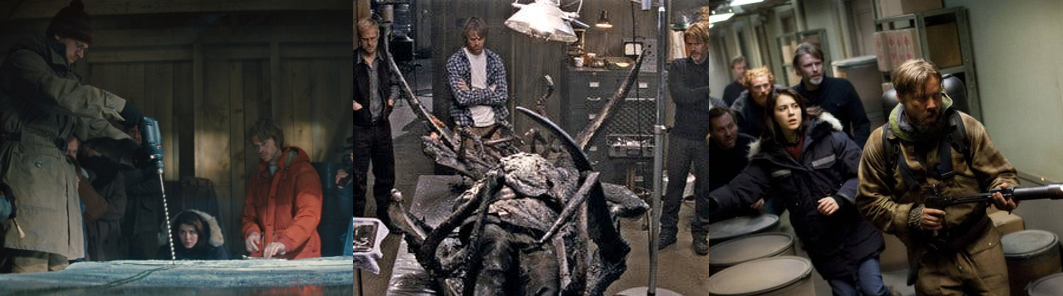
The Nitty-Gritty:
Knowing how chaotic and troubled Blade: Trinity’s production was, it’s hard not to read more into Blade’s disgust at the Nightstalkers, whom he sees as “amateurs”. Indeed, he shows more animosity towards them than he does the Blood Pack, though this may be because Whistler never told him of the “sleeper cells” he prepared to aid Blade. While the Nightstalkers are more capable than Blade gives them credit, they lack his years of experience and unique insight into fighting vampires, though they recognise this and see him as essential to the cause. It’s equally true that they’re slightly less impressive than their comic book counterparts, with Hannibal King, especially, being quite different as it was originally him, not Blade, who was a dhampir. I don’t mind this change much, mainly because I barely know Hannibal and the changes made to Blade only benefitted the character, but I can’t help but be unimpressed by Dracula, who lacks gravitas and finesse and comes across as just another formidable vampire threat for Blade. Blade: Trinity leans more into humour than its predecessors, particular through Ryan Reynolds’ obvious riffing. While I enjoy his humour and delivery, it’s constantly framed as inappropriate and awkward as no one, not even Abby, acknowledges his quips regarding Danica’s vagina fangs, pop-culture references, or Blade’s grim façade. While it’s clear Hannibal is using humour as a coping mechanism, he’s portrayed as a hyperactive little kid whom Abby keeps in check like a big-sister. Abby’s thus devastated when Drake slaughters her friends and kidnaps Somerfield’s young daughter, Zoe (Ginger “Haili” Page), channelling her grief and rage to emulate Blade’s stoic demeanour despite Zoe showing no fear even when Drake tries to intimidate her with blasphemy.
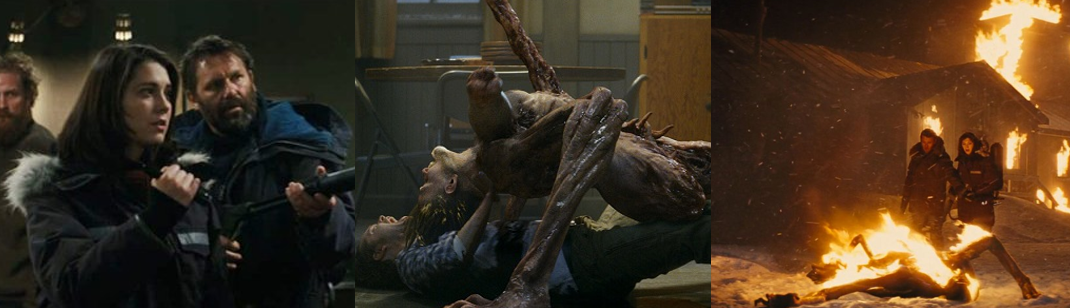
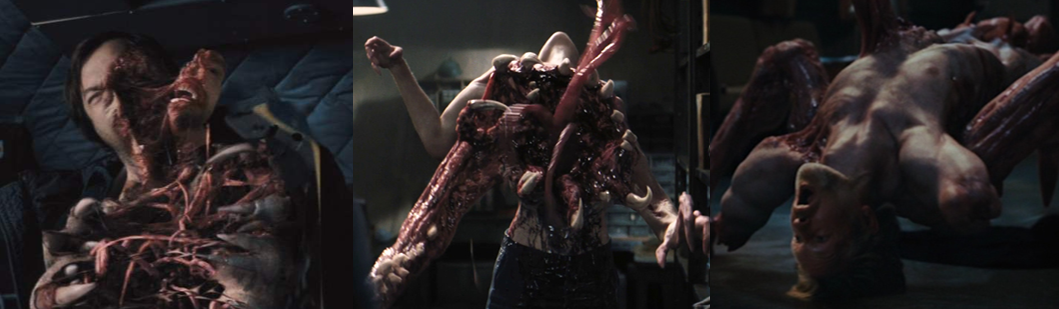
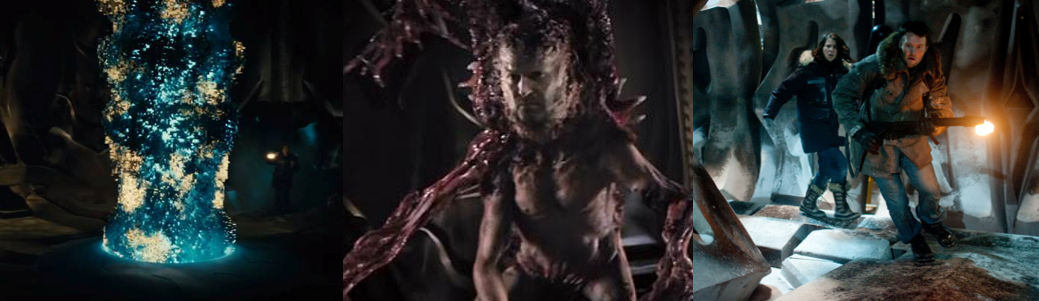
Fights are still very impressive, with Abby especially taking the spotlight with her archery skills.

Blade has some new toys here, including a fun silver-lined roped dagger and a new delivery system for his serum, alongside his usual muscle car, trademark sword, and gun. However, it’s the Nightstalkers who get all the cool gear, such as Abby sporting a silver danger in her boot, lugging around a high-tech bow that sports an ultraviolet laser and lets her shoot around corners, and a wrist-mounted dagger. While Hannibal largely relies on pistols and his smart mouth, he also busts out ultraviolent grenades and Hedges (Patton Oswalt), the Nightstalkers’ resident armourer, develops an “electronic pistol” that fires explosive silver rounds and a high-impact shotgun (similar to those used by the Blood Pack) that fires anything from stakes to heat-seeking mini rockets. While these are rarely used, and Wesley Snipes may appear more lethargic and stoic than usual, Blade continues to ooze charisma and shine in fight scenes, executing kicks and throws with a slick precision to showcase Blade’s raw power whenever the Thirst takes hold. Overall, fights are easy to follow and vampires still explode into cinders and ashes when killed. There are some fun montages of Blade, Hannibal, and Abby knocking around Familiars to get a lead on Drake and Blade frantically chases Drake through the city, leading to a tense rooftop showdown where Drake endangers a baby simply to parlay with the feared Daywalker. When Sommerfield’s research leads Blade and Abby to a vampire “blood bank”, revealing they keep braindead vagrants as a food source, they return to find Zoe and the injured Hannibal kidnapped and the other Nightstalkers dead, with Drake using the two as bait. This leads not just to the now traditional montage of Blade suiting up and preparing for battle and Abby compiling a suitable playlist, but also to Abby working through her grief by preparing her bow and practising her impressive archery skills.

Though victorious after an intense sword fight, Blade’s war is apparently far from over…

Sommerfield leaves a message asking Abby to take care of Zoe and discussing the Daystar prototype, though warns that it must be injected into Drake to work and could potentially kill Blade alongside the other vampires. Regardless, Blade and Abby take the virus (helpfully forged to be fired as an arrow) and follow Hannibal’s tracker, spreading silver dust through the facility’s air conditioning to weaken the vampires ahead of a full-frontal assault. While Blade and Abby fend off Danica’s disposable goons with their karate and toys to rescue Zoe, Hannibal struggles against the hulking Jarko while Blade gets into a swordfight with Drake, now garbed in ceremonial armour. For all the shit I’ve talked about this Dracula, this sword fight is actually really cool (despite some dodgy CGI sequences where Drake defies gravity) and nicely spliced alongside Hannibal and Jarko’s more brutal smackdown, which ends with an exhausted and overwhelmed Hannibal stuffing an explosive ultraviolet round into Jarko’s mouth and blowing him inside out. Although relishing matching swords with Blade, Drake assumes his demonic form to overpower Blade, leaving him prone for a bloody end. While Drake has the wherewithal to catch Abby’s arrow, a second shot stuns him long enough for Blade to inject the Daystar virus, which immediately reacts with Dracula’s blood to reduce all remaining vampires in the building (including Danica) to choking, rotting corpses. In his final moments, Drake commends Blade and praises him as the future of his species, using the last of his power to mimic Blade’s form to spare him future persecution. Though the wounded dhampir’s recovered by his allies, Hannibal’s final narration delivers an anticlimactic and open-ended coda that sees Blade continuing his war, suggesting that Daystar will take some time to eradicate the vampire threat.

The Summary:
While Blade: Trinity is nowhere near as bad as many would have to believe and is still a sleek, sexy, kick-ass vampire action movie, there’s no denying the drop in quality from the previous two films. While the action is as hard hitting and bloody as ever, there are some unmistakable flaws, like Blade’s stupidity regarding Familiars, the glossed over explanation of Abby’s birth, and the overreliance of Ryan Reynolds’ smart mouth humour. While I do enjoy him here, your enjoyment of Blade: Trinity may depend on if you can stomach his wise-ass jokes, which are oddly framed as awkward and childish. Personally, I much preferred Hannibal King to Abby, who showed little personality until Sommerfield’s brutal death, with the film bizarrely avoiding emphasing her heritage, how that affects Blade, and his role as a mentor to her. While the film is as stylish as its predecessors and competently presented in the same visual style, with fun, well-choreographed, and well edited fight scenes, I do question the casting of Parker Posey. She’s just awful here, hamming up every line and looking spaced out in every scene. Triple H’s physical performance was impressive, leading to a decent David vs. Goliath fight between him and Hannibal and I did like his animosity towards Hannibal, which was in stark contrast to Blade’s stoic dismissal. For me, Blade: Trinity drops the ball with its depiction of Dracula. Robbed of his aristocracy and screen presence, Drake appears as just another vampire thug unless he’s in his impressive demon form. Dominic Purcell just doesn’t have the gravitas for the role, and I would’ve much preferred he took Danica’s place, and a classically trained actor was cast as Dracula to give him a better aura of menace and refinement. Additionally, Blade: Trinity does do a disservice to the title character by having Abby, Hannibal, and the Nightstalkers eat into his screen time to set up a spinoff we never got. In the end, I think Blade: Trinity is a decent film to throw on in the background and is unfairly saddled with a negative reputation. It’s not as good as the last two and has far more flaws, but it’s decent enough, though I appreciate how many see it as disappointing end for the character.

My Rating:

Rating: 3 out of 5.

Pretty Good

Are you a fan of Blade: Trinity? How do you think it compares to the previous Blade movies? What did you think to the Nightstalkers? Did you enjoy Hannibal’s lewd sense of humour and do you agree that the film dropped the ball with Abby’s potential? Were you disappointed by Dracula’s lukewarm portrayal and did you also find Parker Posey a grating inclusion? What would you like to see from Blade in future movies? Whatever your thoughts on Blade: Trinity, share them below, check out my other Blade reviews, and donate to my Ko-Fi to suggest more Blade content.