Movie Night [Brightest Day]: Green Lantern: Extended Cut


In 2014, the 2nd of February was dubbed “Green Lantern Day” because, by the American calendar, the date read as “2814”, the space sector assigned to Earth in DC Comics. While the significance of this date has passed as the years have changed, it seems like a great excuse to celebrate DC Comics’ green-garbed intergalactic police corps but, sadly, the date clashes with another important anniversary so, this year, I’m switching it to today, the 2nd of August, instead since this would have been 2/8/14 back then as well.


Released: 14 October 2011
Originally Released: 17 June 2011
Director: Martin Campbell
Distributor: Warner Bros. Pictures
Budget: $200 million
Stars: Ryan Reynolds, Blake Lively, Mark Strong, Peter Sarsgaard, and Clancy Brown

The Plot:
When test pilot Hal Jordan (Reynolds) is bequeathed a powerful ring that can make his thoughts reality, he becomes a member of the Green Lantern Corps, a vast organisation of intergalactic lawmen. However, Hal’s will is tested when Parallax (Brown), a malevolent entity and the embodiment of fear, is awakened and threatens the safety of not just Earth but the entire universe!

The Background:
The Green Lantern character first appeared in All-American Publications’ (a precursor of DC Comics) All-American Comics #16 in July 1940. Then, the pseudonym was the alter-ego of Alan Scott but, in 1959, DC Comics editor Julius Schwartz enlisted writer John Broome and artist Gil Kane to reinvent the character as Hal Jordan and, in the process, create countless other Green Lanterns in the establishment of an intergalactic police force. Production of a live-action adaptation of the character can be traced back to 1997 and, at one point, Jack Black was set to start in what sounds like would have been an absolutely dreadful action/comedy take on the character. With the Marvel Cinematic Universe (MCU) impressing at the box office with its first phase of movies, Warner Bros. made significant strides towards a Green Lantern film with a script heavily influenced by the seminal “Secret Origin” (Johns, et al, 2008) story arc, and director Martin Campbell and star Ryan Reynolds locked in to bring to life the daunting, effects-heavy superhero sci-fi. Unfortunately, Green Lantern proved to be a critical and commercial failure; the movie made just under $220 million at the box office and reviews were scathing, scuppering Warner’s hopes for a sequel and delaying the start of their own cinematic universe. As much as I am a fan of Reynolds, I can’t say that I was too impressed with how much he has bad-mouthed this film (which really isn’t as bad as people think) in the years since its release, especially after he was well into honouring the legacy and influence of the role during production.

The Review:
When we’re first introduced to Hal in the modern day, he’s a far cry from the straight-laced, serious space cop of the comic books; perhaps thanks to having Reynolds in the role, Hal is a womanising, snarky, and arrogant test pilot who drives a muscle car, frequently shows up late to work, and generally shirks responsibility at every opportunity. The only time he takes any situation serious is when he’s sat in a cockpit, where he’s all business and undeniably the best test pilot on the Ferris payroll but his attitude leaves a lot to be desired. It’s interesting that the filmmakers chose to make these changes and portray Hal as a far more immature and flawed character; it works for his overall story arc as he has to grow into his role as a superhero and learn the usual, cliché lessons about responsibility and duty and gives Hal a snarky edge that makes for the film’s more comedic moments but it’s difficult to believe that this version of Hall will ever grow into the Corps’ most revered soldier.

Hal’s cavalier attitude makes him a great test pilot but causes friction with those around him.

Hal’s attitude stems, largely, from the trauma of experiencing the death of his father, Martin (Jon Tenney), who died during a test flight right before Hal’s eyes when Hal was just a kid. Having witnessed the most distressing and harrowing event possible, Hal has grown up entirely fearless; he never worries about his safety, takes unnecessary risks, doesn’t let anything or anyone get to him, and doesn’t believe in a no-win situation. This, naturally, doesn’t sit well with his friends, family, co-workers, or superiors, who all believe that Hal has a death wish and is being unreasonably irresponsible with his life. Despite this, he has a close relationship with his nephew, Jason (Dylan James), and there are clearly unresolved issues between him and childhood friend, co-pilot, and boss Carol Ferris (Lively).

Carol believes in and is attracted to Hal but cannot sanction his lackadaisical attitude.

Hal believes that Carol has lost her way somewhat since she has, largely, traded the cockpit for a desk, though Carol asserts that she’s simply grown up and accepted her responsibilities. She cares for Hal and is clearly still attracted to him but despairs of his lackadaisical and cavalier attitude; she just wants him to grow up a bit and to be responsible for once in his life rather than coasting along on his admittedly impressive abilities. In a refreshing change of pace, she immediately sees through his rudimentary disguise as Green Lantern (even comment on the ridiculousness of such an ineffective mask) and accepts and supports his newfound superhero life. Indeed, she urges him that the power and responsibility of the ring isn’t something that he can just walk away from and encourages him to actually try and live up to his potential for a change. Far more than just an achingly gorgeous face, Carol actually helps Hal out when Parallax comes to Earth and isn’t afraid to speak her mind, making her more than a match for his trademark snark.

Hal is subjected to harsh training and criticism from the likes of Sinestro.

However, while Hal describes himself as a “screw up” and even his friend, Thomas Kalmaku (Taika Waititi) believes him to be an asshole, he doesn’t hesitate to pull Abin Sur (Temuera Morrison) from his crashed spacecraft, does everything he can to keep him alive, and is genuinely distraught when Abin dies in his arms (he even takes the time to bury Abin’s body after he dies). Confused and overwhelmed at the alien and the strange ring now in his possession, Hal is equally blown away when the ring transports him to Oa and garbs him in the uniform of the Green Lantern Corps; however, Hal adjusts to these alien sights and concepts with an awe-struck bewilderment and struggles to come to grips with his ring’s capabilities and the focusing of his willpower. On Oa, Hal is greeted by Tomar-Re (Geoffrey Rush), who introduces him to the planet and briefs him on the basics of the Green Lantern Corps. Hal’s training is very much a crash course and, honestly, should have taken up a greater deal of the film’s focus and screen time as Hal is put through a tough and uncompromising boot camp at the hands of Kilowog (Michael Clarke Duncan). Almost immediately, before Hal even has a chance to master the basics of ring-slinging, Thaal Sinestro (Strong) interrupts to put Hal through his paces; a being of immense pride and a much-respected member of the Corps, Sinestro was Abin’s friend and former protégé and regards Hal as a disappointment to his mentor’s legacy. Sinestro’s opinion is only fuelled by the fact that Hal is (somehow…) the first ever human being to become a Green Lantern but, truthfully, his focus and mentality comes more from his overwhelming militant mindset. Sinestro believes, to his very core, in the power and authority of the Guardians and the Corps and devotes himself entirely to their cause, rallying his fellow Green Lanterns in a unified, if futile, effort to oppose Parallax and maintain the sanctity of their intergalactic police force.
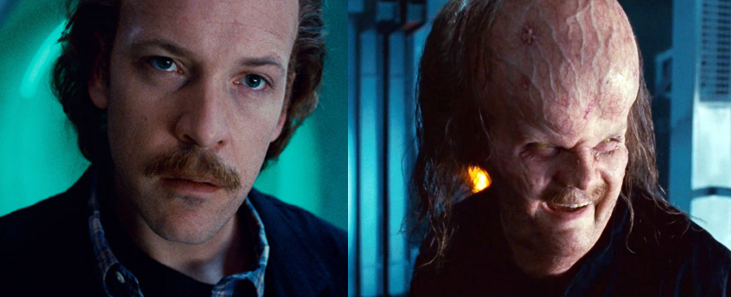
Hector, already a troubled scientist, is driven to maniacal insanity by Parallax’s influence.

As if that wasn’t bad enough, Hal also faces significant threats at home in the form of his childhood friend Doctor Hector Hammond (Sarsgaard); sadly, Hector isn’t that threatening or impressive as a villain and is more like a quirky, disassociated, unhinged child in a man’s body. Hector resents Hal’s cocky attitude, rugged good looks, and relationship with Carol, harbours unrequited feelings of his own for Carol, and is constantly trying to please his father, Robert (Tim Robbins), a United States senator who Hector feels is constantly disappointed and embarrassed by him. Hector believes his genius and ability are finally being acknowledged when he is hand-picked by Doctor Amanda Waller (Angela Bassett) to perform the autopsy on Abin’s body and is enraged when he finds out that his father arranged it; having been possessed by exposure to Parallax’s yellow fear energy, Hammond slowly develops mental abilities and degenerates into a hideous, hunchback like creature, his inner bitterness and ugliness reflected in his warped and transformed exterior. However, given the larger threat of Parallax and the fact that we briefly see how big and limitless the universe is, Hector isn’t much of a threat and is easily bested by Hal with the simplest of deceptions. Not that Parallax himself fairs much better; rather than the giant, intergalactic space bug and the embodiment of fear, Parallax is, instead, a fallen Guardian as the filmmakers merged elements of Parallax and the dark Guardian Krona (which, to be fair, I feel does work in the context of the film and simplifies the story somewhat). Sadly, because the Guardians look so damn goofy, Parallax doesn’t look all that intimidating and just appears to be a big, angry-looking, cartoony head and that’s when we can actually see him since, for the most part, he takes the form of an ethereal, destructive cloud and, if there’s anything experience has told us, it’s that clouds are never scary or intimidating.

The Nitty-Gritty:
The extended version of the film only adds about ten minutes to the film’s run time but the majority of this is used to further develop Hal’s childhood and his relationship with his friends and family. Indeed, the extended version includes an entirely new opening sequence that shows more of Hal, Carol, and Hector’s childhood and the bond between Hal and his father, and his nephew. It’s not much extra footage but it does help to flesh Hal’s character out a little bit more and to build up an understanding of why he is the way he is.
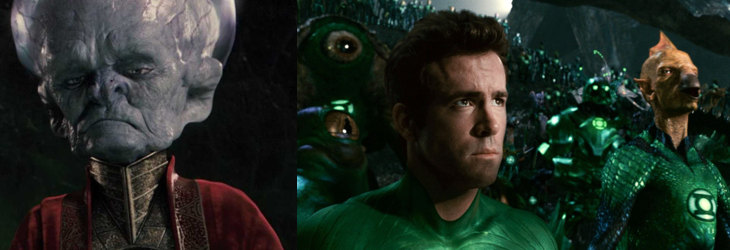
Green Lantern‘s abundance of CGI makes the film resemble a cartoon more often than not.

Of course, one of the major problems with Green Lantern is the quality of the special effects; given the concept is quite unique and necessitates a great deal of work to render not just the Green Lantern’s constructs but also the various worlds and aliens that make up the Green Lantern Corps, and the universe, a great deal of special effects are necessary for a film such as this. Unfortunately, many of the film’s CGI just doesn’t work and is flawed; Parallax and the Guardians, especially, look pretty terrible, to say nothing of Kilowog, Tomar-Re, and, yes, the Green Lantern suits themselves. Personally, I think the idea to render them full in CGI was a really good idea (…on paper) given their otherworldly make up and the fact that they’re generated from the ring and the problem isn’t so much that the suits don’t look good (though they, like a lot of the CGI, do appear disturbingly cartoony) it’s that Hal’s mask looks so damn goofy. This is a shame because Green Lantern does a pretty decent job at adapting the concept and bringing to life such an abstract and near-limitless superhero. As I mentioned, the idea of the suit works really well and Oa, especially, looks pretty good; however, while I like that it’s teeming with life and various alien races, it’s very…busy and kind of looks like a mess of conflicting colours and dodgy CGI. Such shots are contrasted by how good the film’s more practical effects are; the scene where Hal and Carol out-pace automated aircraft is an exhilarating sequence and the make-up effects used to bring Sinestro and Abin Sur to life are top-notch (hell, even Hector looks suitably horrific when he mutates into little more than a hunchbacked man-monster). It’s almost as if the filmmakers should have veered more towards practical effects, maybe even employing the use of traditional puppets and animatronics for the Guardians and Kilowog, and use the CGI sparingly rather than rendering 90% of the film in a mess of computer effects.
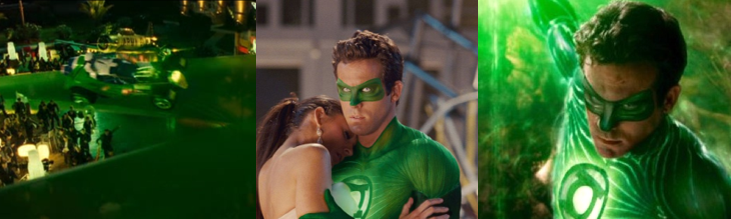
Hal eventually comes to accept the responsibility of the ring and grows into his heroic role.

A central theme of the film is Hal’s inability to live up to the expectations placed upon him and to accept responsibility. On Earth, this makes him a highly skilled but unreliable test pilot; when on Oa, it leads to him walking away from the Green Lantern Corps after what feels like maybe an hour, tops, of training. He takes Sinestro’s criticisms regarding him (and the human race) to heart and uses his condemnation as the perfect excuse to reject the destiny placed upon him by Abin Sur; however, for some reason, he is allowed to retain possession of the ring and, reluctantly, becomes a superhero back on Earth. This is directly paralleled with Hector’s own arc as he struggles to live up to his father’s expectations and gives in to the hate, fear, and power of Parallax’s influence; fuelled by his negative emotions, he forces Hal into acting with the ring’s power and, thus, into a heroic role that he, eventually, willingly assumes in order to defend the Earth from Parallax.

Despite Hal’s victory, Sinestro switches to the yellow ring for an unresolved cliffhanger.

Parallax, while an unimposing and disappointing villain compared to both his comic book counterpart and other villains of superhero films, is certainly built up to be an intimidating threat. His ability to induce fear and then suck the life out of his victims is certainly unique and his power only grows as he absorbs the lifeforce of others. While the Green Lanterns are notoriously supposed to be entirely without fear, it’s clear that the Guardians fear Parallax’s power; indeed, they are reluctant to send their corps against Parallax out of fear for their lives and they only divulge Parallax’s true origins to Sinestro after he pleads with them for the knowledge to oppose his power. While Sinestro comes to believe that the only way to defeat Parallax is with fear itself (forging a yellow ring in the process), he eventually saves Hal after his battle and defeat of the creature in the finale and, despite having witnessed that the green light of willpower is powerful enough to overcome even the embodiment of fear, decides to switch to a yellow power ring in, perhaps, one of the most tantalising mid-credits scenes in all of cinema.
The Summary:
Green Lantern is a perfectly fine and action-packed science-fiction spectacle; it’s full of humour and big special effects and has a really strong cast, with Mark Strong, especially, standing out as a perfect choice for Hal’s mentor and rival, Sinestro. I think the main problem with Green Lantern, though, is that it isn’t really sure what it wants to be; it’s not a sci-fi epic as a disappointing amount of the film is set on Earth, and the time spent on Earth is nowhere near as interesting as the potential of space and the Green Lantern Corps. When I saw Green Lantern, it was a month or so after seeing Thor (Branagh, 2011), a film that did a much better job of balancing its cosmic, otherworldly elements in a grounded and relatable way and I think that’s the problem with Green Lantern: it’s too confused about its disparate elements and I can’t help but feel a more elaborate approach in the vein of Guardians of the Galaxy (Gunn, 2014) and Serenity (Whedon, 2005) would be a far more fitting direction if we ever see the Green Lantern Corps in live-action again. Personally, though, it’s not as bad as people make it out to be and there’s plenty here that’s worth keeping around (Mark Strong, for one) and it really wouldn’t have taken much to fold this film into the existing DC Extended Universe at one point but, ultimately, it’s just a shame that we never got a sequel to improve upon the film’s high (and low) points beyond the tie-in videogame and that the film failed to properly live up to the potential of the concept.

My Rating:

Rating: 3 out of 5.

Pretty Good

What did you think to Green Lantern? Were you a fan of the movie when it first released or did you warm to it over time? What did you think to Reynolds in the title role and who would you prefer to see take up the mantle at some point? Were you a fan of the film’s overuse of CGI? What did you think to the animated suit and depiction of Parallax? Would you have liked to see where a sequel would have taken the story or do you think a full reboot is the way to go? Which Green Lantern character, villain, or story is your favourite and why? How are you celebrating this pseudo-Green Lantern day today? Whatever you think about Green Lantern, and the Green Lantern comics books, feel free to leave a comment below.

Movie Night: Total Recall

Released: 1 June 1990
Director: Paul Verhoeven
Distributor: TriStar Pictures
Budget: $50 to 60 million
Stars: Arnold Schwarzenegger, Rachel Ticotin, Sharon Stone, Michael Ironside, and Ronny Cox

The Plot:
Construction worker Douglas Quaid (Schwarzenegger) pays for memories of a trip to Mars and awakens to find himself caught up in an interplanetary conspiracy.

The Background:
Total Recall began life as We Can Remember It for You Wholesale, a short story written by renowned science-fiction writer Philip K. Dick and first published in 1966. The story told of a man, obsessed with Mars, who finds that he actually has hidden memories of being a secret agent on the Red Planet and an adaptation of the story, first drafted by Alien (Scott, 1979) writers Dan O’Bannon and Ronald Shusett, languished in development hell for many years. The adaptation passed through many drafts and the hands of the likes of Dino De Laurentis and David Cronenberg before Schwarzenegger, who had been aware of the project and lobbied for a starring role, convinced Carolco to buy the film rights and personally recruited Paul Verhoeven to direct. Total Recall was one of the most expensive films ever produced at the time of release, with much of its enormous budget needed for the copious special effects; practical filmmaking techniques such as animatronics, miniatures, and lavish, futuristic sets brought the world to life and created numerous challenges for the filmmakers. After being frustrated with the initial lacklustre trailers, Schwarzenegger made efforts to improve the film’s marketing, which resulted in Total Recall debuting at number one at the box office upon release and grossing over $260 million. Although the film’s excessive violence drew some criticism, Total Recall was, largely, a critical success and has since been regarded favourably as one of the greatest science-fiction/action movies ever made for its frantic action, enjoyable excess, and thought-provoking themes regarding reality and identity. Considering Total Recall was one of the formative movies of my childhood, and that today is Schwarzenegger’s 74th birthday, this seems like an appropriate time to revisit the film and talk about why it’s such a classic of its genre.

The Review:
I mentioned just now that Total Recall was a massively influential film on my childhood and it’s true; it was unlike anything I’d seen at the time, with its fantastic visuals and bombastic, haunting score by Jerry Goldsmith. Many years later, I jumped at the chance to revisit the film as part of my Master’s degree to talk about its status as an adaptation. In truth, very little is actually inspired by the original short story (with the film’s first thirty minutes or so being the closest to the text) but the story’s themes of reality, identity, and paranoia are clearly evoked throughout the film, which is littered with allusions and references and minor elements that both explicitly, and subtly, tie in to Quaid’s chaotic story. When we first meet Quaid, he’s a relatively mundane character and, despite being happily married to Lori (the delectable Sharon Stone at her best), Quaid feels his life has reached something of a rut; he’s stuck in a dead-end job and distracted by dreams of Mars and a mysterious brunette, Melina (Ticotin), and a desire to be more than he is. Unable to convince Lori to move or take a trip to Mars, he is inspired by advertisements for Rekall Incorporated, a futuristic travel agency that implants personalised memories of one’s dream vacation. Despite the warnings of his friend, Harry (Robert Costanzo), that Rekall’s procedures carry a high risk of lobotomy, Quaid opts to pay the company a visit and signs up to their “ego trip”, which allows him to live out the fantasy of being a secret agent on Mars.

After visiting Rekall, Quaid is relentlessly hounded by friend and foe alike!

However, during the procedure, Quaid suddenly freaks out and starts attacking the Rekall staff; ranting and raving about Mars, Rekall spokesman Bob McClane (Ray Baker) makes the decision to subdue Quaid, partially wipe his memory, and send him on his way. However, almost immediately Quaid is attacked by Harry, who accuses him of “[blabbing] about Mars”, and is shocked to find he has a penchant for killing and action. Returning home, he is even more shocked and massively confused when Lori suddenly attacks him with a ruthless aggression and he is forced to go on the run as mysterious killers, led by Richter (Ironside), hound him at every turn.

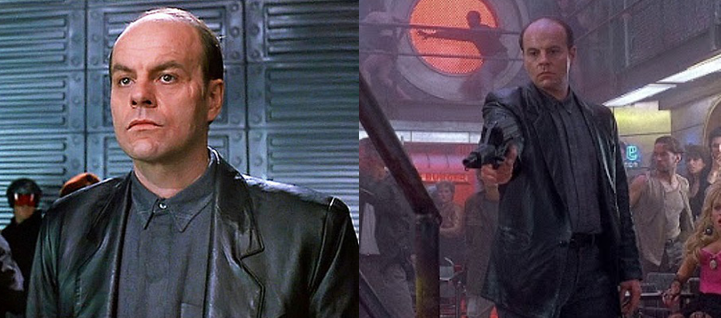
As expected, Ronny Cox makes for a fantastically unlikeable and cruel villain.

In the process, he receives mysterious messages from people who claim to have known him on Mars and even from himself under the name Carl Hauser; Hauser’s video message informs Quaid that he’s actual a double agent who used to work for the malicious Vilos Cohaagen (Cox) but switched sides to join the resistance movement after falling in love with Melina. Cohaagen is a cruel and vindictive corporate figurehead who basically controls the Martian colony since he owns the monopoly on air, charging the colonists extortionate prices for the luxury of breathing, and the flow of “turbinium”, a mysterious Martian mineral that allows him to be an extremely powerful and influential figure. Ronny Cox is a fantastic actor and always made for a chilling, supremely confident villain; his motivations, while based on greed and power, are surprisingly complex as well since he truly valued his friendship with Hauser and is visibly enraged when he is forced to order Quaid’s death. Cox commands every scene he’s in with a subtle authority and explodes into an unmatched fury at a moment’s notice but he’s also fully capable of chewing the scenery and portraying Cohaagen as a bit of a smarmy, self-righteous dictator who doesn’t hesitate to order the deaths of countless innocent people simply to send a message to those that dare defy him.

Richter is a vindictive and ruthless mercenary with a personal vendetta against Quaid.

Cohaagen’s agent in retrieving Quiad is Richter, a ruthless mercenary with a personal vendetta against Quaid who relentlessly hunts down and tries to kill him at every turn. Richter, for all his aggression and sadistic intelligence, is merely Cohaagen’s pawn, however, and angers his boss with his attempts to kill Quaid (since Cohaagen wants him alive) and escalates events at every turn with his reckless and aggressive ways. Richter treats his assignment as a merciless crusade since he’s clearly harbouring a deep-rooted hatred of Quaid not just because Lori is actually his (as in Richter’s) wife but also stemming from unresolved and vaguely hinted events prior to the film’s beginning. A persistent and increasingly enraged individual, Richter doesn’t hesitate to gun down innocents or employ every resource at his disposal to hunt Quaid down; he also proves to be a considerable physical threat for Quaid and their final confrontation is one of the most brutal and memorable fight scenes in the movie.

Fights are bloody, dirty affairs with a near-constant risk of explosive decontamination.

Not that Total Recall is short on action or fight scenes, mind you. Quaid gets hit in the bollocks a cringe-worthy amount of times throughout the film in his numerous fist fights with Lori, who fills the role of a secondary antagonist. Though far sultrier and more manipulative than Richter, she’s still perfectly happy to engage Quaid in hand-to-hand combat and, largely, manages to hold her own. When not fighting Richter or Lori, Quaid is engaged in several massive shootouts in a variety of locations; these are made especially visceral thanks to the abundance of blood squibs and escalate once Quaid reaches Mars and the threat of explosive decontamination looms in the background of every subsequent firefight.

Aggressive and independent, Melina is more than a match, and an equal, for Quaid.

Quaid is also assisted by the literal woman of his dreams, Melina, a principal figurehead of the resistance who is initially antagonistic towards Quaid since he disappeared without a word some time ago and then reveals that he’s married. Despite this, she believes that he is crucial to their success against Cohaagen and comes to his rescue when Lori manages to subdue him; this leads to a more even fight between her and Lori that is literally over Quaid’s fate (and affections). Still, while Total Recall is an extremely macho film, Melina is able to hold her own and break out of her cliché labels (she is literally described, and “made”, to be “Brunette, athletic, sleazy and demure”) to be an extremely capable and aggressive character. Once she rescues Quaid, they basically team up for the remainder of the movie, fighting side-by-side and facing the same odds as equals.

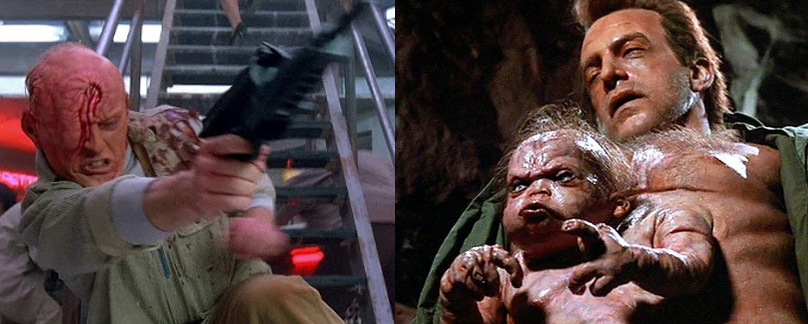
The resistance is largely comprised of mutant colonists who despite Cohaagan’s dictatorship.

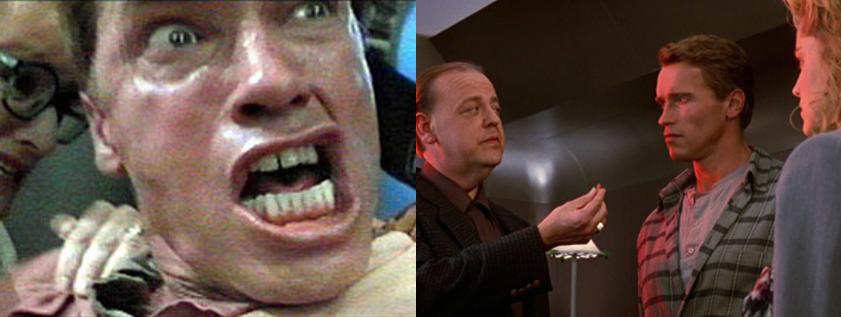
Total Recall is full of memorable and rather shifty supporting characters; each of them, even the most helpful ones, seem a little off in ways that are clearly meant to rattle both Quaid and the audience. One of the most prominent is, of course, Benny (Mel Johnson Jr), a chatty and lewd taxi driver who Quaid meets on Mars. Though he seems to be a helpful ally and proves his credentials by revealing that he’s a mutant (Cohaagen’s cheap domes caused horrific disfigurements to certain colonists), he turns out to be a traitor to the resistance, resulting in a dramatic and imposing showdown between him, Quaid, and Melina in which Benny tries to run them down in a massive Martian excavator. Other supporting characters include notable members of the resistance Tony (Dean Norris) and George (Marshall Bell); George turns out to be the conjoined brother of Kuato, the semi-psychic mutant leader of the resistance who lives on George’s stomach. Revered by the colonists and seen as a hero of the rebellion, Kuato uses his abilities to reveal to Quaid that the Martian technology he briefly glimpsed at Rekall is the key to liberating Mars. A frightening aberration, Kuato is just one of many fantastic practical animatronic effects in the film, which also includes a life-like head of Schwarzenegger for the scene where Quaid painfully removes a tracking device from his head, numerous bloodied and desecrated corpses caught between the film’s many firefights, and, of course, the film’s depiction of explosive decompression. Despite the cartoonish nature of the visual, which sees Quaid, Melina, and Cohaagen’s eyes bulge comically from their sockets, this depiction of the characters violently convulsing and suffocating to death has some basis in reality but, regardless, remains an impressive and gruesome effect thanks to the grisly animatronics.

The Nitty-Gritty:
Given that it’s set in the still-far-future of 2084, technology plays a big part in Total Recall. The world is heavily reliant upon gadgets, gizmos, and automatons of all kinds, employing robotic taxis, holograms, and space-faring technology at every turn. Security is high in this world, ensuring that weapons cannot be smuggled into the subway or across planets, and Mars has been largely colonised thanks to a series of self-sustaining domed cities. As slick and impressive as a lot of Total Recall’s futuristic tech is, though, characters still rely on traditional firearms and melee weapons for many of the action scenes (there are no laser rifles here). This allows the use of technology to stand out even more, however, leading to a fantastic scene where Quaid and Melina utilise holograms to run rings around Richter’s men and ultimately bring a breathable atmosphere to Mars using ancient alien technology.

There’s plenty of evidence to suggest that most of the film is a delusional, psychotic episode.

One of the biggest themes in the film is that of identity; Quaid is unhappy with his everyday life and the person he is and wants more out of life but is shocked to discover that his dream of action and adventure appears to be a reality and that he really has no idea of who he really is since he is missing memories of a previous life as Hauser. No one is who they say they are, with friends turning into foes on a whim and strangers turning out to be trusted allies, and these themes are first (and expertly) sold to us by McClane, who literally sells customers entirely new identities and the prospect of improving their perception of themselves. Another major theme is, of course, of reality; the film opens itself up to interpretation, featuring an ambiguous ending and inviting multiple re-watches to try and ascertain if the film’s events are real or simply a “schizoid embolism” experienced by Quaid during his trip to Rekall. There is plenty of evidence to support both theories, meaning no two viewings of the film are ever the same: McClane basically lays out the first half to the movie to Quaid at Rekall as part of his ego trip but the narrative often jumps away from Quaid’s perspective to follow Richter and/or Cohaagen, which would imply that the events we’re witnessing are actually real. However, later in the film, Quaid is visited by Doctor Edgemar (Roy Brocksmith), who relates that Quaid has suffered a paranoid episode and is stuck in a dream world of his own creation. He offers Quaid a pill that will allow him to “wake up” from his fantasy and return to reality but, at the last minute, Quaid rejects the offer as another of Cohaagen’s tricks and commits himself to opposing Cohaagen’s domination of Mars.

The film’s content, and ending, is intentionally left ambiguous and open to interpretation.

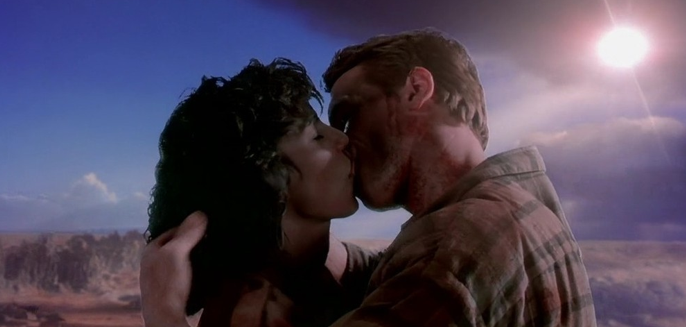
Ultimately, everything prophesised to Quaid comes to pass and the film ends with the happiest, and most unbelievable, of endings; Quaid gets the girl, kills the bad guys, and saves the entire planet, bringing a breathable atmosphere to Mars and ending the story on a white out, a popular filmmaking device used to imply a degree of ambiguity to a film’s ending. In the end, whether Total Recall is real or a dream is entirely up to your interpretation; I like to believe that it’s real, since the majority of the film is framed that way but, sometimes, it’s fun to see it all as a chaotic delusion of Quaid’s that paints him as an invincible secret agent who never needs to reload his gun (seriously, watch the film again: Quaid never reloads, he simply tosses guns away).

The Summary:
Even now, over thirty years after its release, Total Recall remains an almost timeless and undeniably classic piece of science-fiction cinema. Endlessly quotable and full of brutal fight scenes, gory shoot-outs, and some truly impressive animatronics, miniatures, and practical effects, Total Recall stands the test of time not just thanks to the meticulous attention to detail and tangibility of its special effects but its thought-provoking themes of reality and identity. Allowing for multiple interpretations and constantly throwing curveballs at the viewer, Total Recall demands several rewatches not just for the performances, action, and quotes but also to see all the subtle nuance and little details spread throughout the film that lend credibility to either perspective. Although nostalgia plays a large part in my affection for Total Recall, I’m hard pressed to deny its appeal and legacy even now, having seen the film countless times over the years. Everything about Total Recall has a slick, tangible quality to it thanks to the elaborate sets, amazingly detailed miniatures, and the abundance of gruesome practical effects that serve to punctuate every scene, making it absolutely gorgeous to look at even when Schwarzenegger is ramming a pole through some guy’s head! Even better, the film invites discussion and allows audiences to debate on whether they think it is real or a dream and, if you think the movie is a bit of a mind-bender, I would absolutely recommend reading the original short story some time since it’s one of Dick’s most interesting works.

My Rating:

Rating: 5 out of 5.

Fantastic

What are your thoughts on Total Recall? How do you interpret the film; do you believe it was real or was it all the chaotic fantasy of a lowly construction worker? What did you think to Schwarzenegger’s performance and Quaid’s rivalry with Richter? Were you impressed with the film’s special effects or do you feel they are a little outdated in today’s CGI-dominated productions? Have you ever read We Can Remember It for You Wholesale and, if so, how do you feel the film works as an adaptation and what is your favourite Philip K. Dick book or movie? Were you more a fan of the 2010 remake and would you like to see Total Recall done again, perhaps in a way that is closer to the original story? How are you celebrating Schwarzenegger’s birthday today and what is your favourite Schwarzenegger film? Whatever your thoughts, go ahead and leave a comment down below.

Movie Night: Black Widow

Released: 9 July 2021
Director: Cate Shortland
Distributor:
Walt Disney Studios Motion Pictures
Budget:
$200 million
Stars:
Scarlett Johansson, Florence Pugh, David Harbour, Olga Kurylenko, Ray Winstone, and Rachel Weisz

The Plot:
On the run after the events of Captain America: Civil War (The Russo Brothers, 2016), Natasha Romanoff/Black Widow (Johansson) reunites with her estranged sister, Yelena Belova (Pugh), and discovers a conspiracy tied to her chequered past as a Russian spy.

The Background:
Created by the legendary Stan Lee, Don Rico, and Don Heck, the Soviet super spy Natalia “Natasha” Romanova/Black Widow first appeared as a recurring villainous in Marvel Comics’ Tales of Suspense series, where she frequently clashed with Tony Stark/Iron Man. After running across Clint Barton/Hawkeye, however, she eventually shook off the brainwashing she had been subjected to and defected to the United States, becoming a hero and an Avenger in the process. Over the years, the character has become a popular staple of Marvel’s publications and a strong feminist icon who has made numerous appearances in other Marvel media and made her first live-action appearance in the Marvel Cinematic Universe (MCU) in Iron Man 2 (Favreau, 2010). Development of a standalone Black Widow movie, however, was fraught with issues; the film was initially in development back in 2004 and MCU producer Kevin Feige considered exploring the character further in 2014 as the MCU was in full swing. Despite the character being killed off in Avengers: Endgame (The Russo Brothers, 2019), and the sexist machinations of Marvel Entertainment CEO Ike Perlmutter, and repeated delays due to the COVID-19 pandemic, Black Widow finally got a solo film that sought to explore her complex past in 2021. Black Widow was released to a modest (if not disappointing) box office compared to other MCU movies, potentially because of the aforementioned pandemic; the reviews were generally positive, with many praising the film’s action and presentation, though some criticised the film’s derivative nature and how long it took for Black Widow to receive her time in the spotlight.

The Review:
Black Widow aims to address a lingering issue with the character since her introduction into he MCU, and that is her lack of a detailed backstory. Unlike other MCU heavy-weights, Black Widow’s past has only been vaguely hinted at and is shrouded in mystery. However, as much as I feel the character deserves her time in the spotlight (and honestly should have had her past with other side characters explored in some one-shots years ago), I always found this to be part of the character’s mystique. Not knowing the specifics of her time in Budapest and only vaguely hearing hints of her past (“Drakov’s daughter”, “I got red in my ledger”, “Daughter of Ivan”) made her seem like a very mysterious character who had done some terrible, almost unspeakable things and was trying to atone for them. Thankfully, Black Widow retains much of the character’s mysterious aura while still shedding some much-needed light on her past. As a girl (Ever Anderson) was raised in Ohio alongside her sister, Yelena (Violet McGraw), by her parents, Alexei Shostakov (Harbour) and Melina Vostokoff (Weisz). However, her childhood was nothing more than an elaborate deep cover infiltration by the Soviets and, after Alexei acquires the crucial data her was sent to retrieve, the girls are suddenly ripped from their happy, suburban life and forced into serving the State in the “Red Room”. There, they are sterilised and trained relentlessly to become the perfect weapons, each of them moving and operating identical to the other and, with them at his beck and call, General Dreykov (Winstone) is able to topple governments and societies alike with the merest order.

Black Widow places Nat in a vulnerable position where she’s left alone and forced to confront her past.

The film then jumps ahead to shortly after the end of Civil war; after eluding Secretary of State Thaddeus “Thunderbolt” Ross (William Hurt) and being branded a fugitive, Natasha contacts one of her few remaining allows, Rick Mason (O-T Fagbenle), to help her escape from Strategic Homeland Intervention, Enforcement, and Logistics Division (S.H.I.E.L.D.), her former allies who are now relentlessly hunting her down. having lost her surrogate family (the Avengers), Natasha defaults to her cold, KGB training and is fully prepared to live off the grid and with few ties as possible; she is in a very vulnerable and fight-or-flight position at the start of the film and there’s a very real sense that she feels angry at herself for having grown so accustomed to working with, and trusting, others. She is rattled when she discovers that Dreykov is still alive and that the Red Room is still active, especially after the horrific acts she had to do to bring them down to join S.H.I.E.L.D. and is even more uncomfortable at having to travel back to Budapest and dig up the long-dead ghosts of her past since all she’s tried to do is forget about and atone for her time in the KGB.

Natasha reunites with Yelena, who wishes to free the other Widows from Dreykov’s control.

In the years since Natasha’s defection to the United States, Yelena was subjected to something more than just the psychological conditioning that turned Natasha into a ruthless assassin. Yelena, like her fellow Black Widows, was instead also subjected to a mind-control agent of Dreykov’s design that renders them little more than mindless puppets to carry out his every whim. However, after she is accidentally exposed to a chemical antidote, Yelena regains her senses and begins a campaign to free her fellow sisters from Dreykov’s control. As they were trained in exactly the same manner, Yelena is, in many ways, an exact mirror of Natasha; they move the same, fight the same, and have the same penchant for killing but the difference is that Yelena is noticeably more blunt and bitter since, unlike her “big sister”, she has been trapped in the role of an assassin without any hope of reprieve. Free for the first time in her life, Yelena is still a somewhat excitable and naïve child to many of life’s normality’s but is a formidable foe in battle; indeed, one of the objectives of Black Widow is to sell us on the idea that Yelena is every bit as good as Natasha while also being a distinct and likeable character in her own right. It succeeds in this regard by having her be evenly matched (and even best) Natasha when they fight and through Pugh’s natural charisma and adorable line delivery, which manages to be both blunt and endearing at the same time.

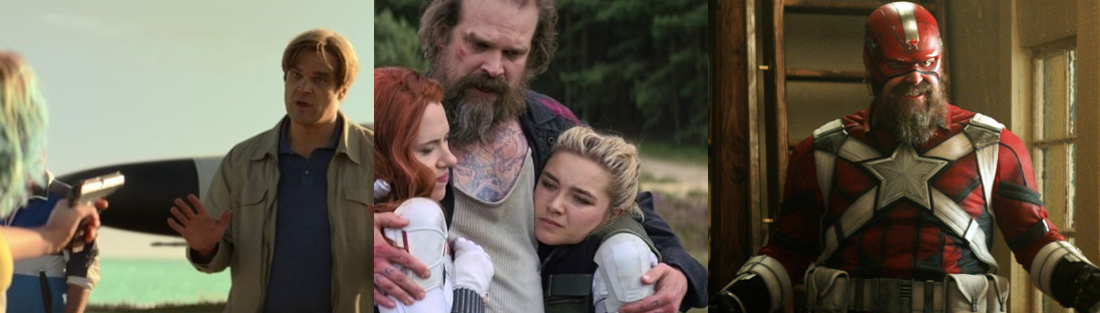
Alexei is a goofy blowhard who is desperate to relive his glory days as the Red Guardian.

Angered to learn that Dreykov is still alive after she risked everything, including sacrificing his young daughter Antonia (Ryan Kiera Armstrong), to kill him and defect to the U.S., Natasha reluctantly teams up with her “little sister” to find the Red Room (which is notorious for being impossible to trace) and bring it, and Dreykov, down once and for all. To do this, they decide to free Alexei from the prison he has been rotting in for over twenty years; having been exposed to a variation of the same super-soldier serum that birthed Captain America (Chris Evans), Alexi had a colourful career as the Red Guardian at some point but is now an out of shape blowhard who loves to drone on about his glory days (even if they don’t necessarily fit in with reality). Honestly, Alexei is one of he many highlights of the film; I have a real affinity for David Harbour and he embodies the role of his big, bear of a man perfectly, able to convey both genuine emotion and also a great deal of laughs with his bombastic nature and exaggerated (or inappropriate) stories of his time as a superhero.

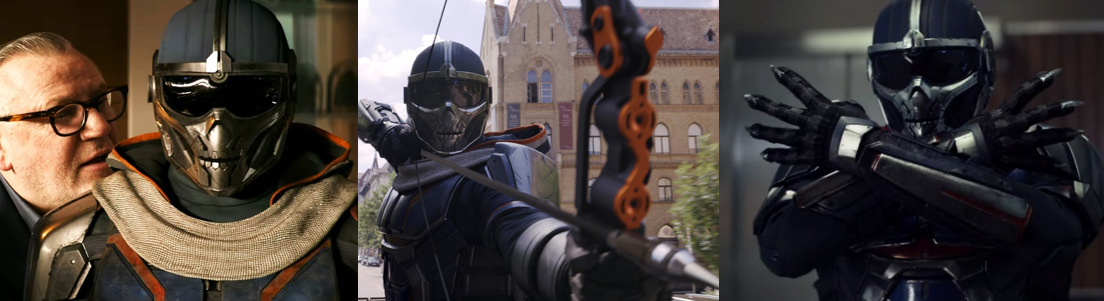
Dreykov sends his best agent, the silent mimic known as Taskmaster, to hunt Nat and Yelena.

The three of them reluctantly reunite with Melina and learn the horrifying truth behind Drewkov’s operation; through an intricate system of mind control, he is able to command his Black Widows and has kidnapped, indoctrinated, and disposed of countless young girls over the years in order to maintain his position of power. Since Yelena has the only sample of the antidote, Dreykov sends his top operative, the silent and intimidating Taskmaster, to track her and the others down and acquire it by any means necessary. Taskmaster is quite the menacing foe, despite being uncharacteristically silent; a natural mimic, he is able to copy and replicate the physical abilities of anyone he watches and also predict and counter incoming attacks thanks to his intimidating skull helmet feeding him constant data. Wielding a sword, shield, bow and arrows, and even talons reminiscent of T’Challa/Black Panther (Chadwick Boseman), Taskmaster is incredibly adaptable and able to mimic Natasha’s most famous moves on the spot as well as possessing all of the fighting aptitudes of the Avengers, making for a relentless and threatening enemy that is made all the more intimidating through the fact that he doesn’t say a word the entire time.

The Nitty-Gritty:
Going into Black Widow, I’d heard comments that the same was playing it “too safe”; that is was basically a rehash of Captain America: The Winter Soldier (Russo and Russo, 2014) and I can totally understand those observations. Personally, though, I found this to be a good thing; it’s not the first time the MCU has returned to a more grounded story after a big, cosmic event and hearkening back to one of the MCU’s most entertaining and successful films isn’t a bad thing, in my opinion. Indeed, I imagine when watching the MCU films in order, Black Widow will fit in pretty perfectly as an epilogue to Civil War. Nowhere are the similarities to The Winter Soldier more apparent than in the presence of those annoyingly large location subtitles, the film’s gritty and hard-hitting action, and the character of Taskmaster. Taskmaster’s presentation, demeanour, and even his theme are all highly reminiscent of the titular Winter Soldier (Sebastian Stan) from that film. Like the Winter Soldier, he has a tendency to ram and shoot at cars, performs a number of nifty knife tricks, and is an inexorable force who appears sparingly throughout the film but makes an impact every time he does.

Black Widow is bolstered by some gritty, hard-hitting, and over-the-top action and fight sequences.

Taskmaster’s story is noticeably different from his comic book counterpart, however, in that “he” isn’t a “he” at all; when I first saw the trailers, I (like many, I’m sure) was fully expecting Melina to be under the skull mask and, while the revelation of Taskmaster’s true identity has a great impact on Natasha, I can’t help but feel like that would have been just as meaningful a reveal and a far better use of Rachel Weisz. The remainder of the film’s action scenes are also instantly familiar to anyone who’s seen The Winter Soldier. Well framed and full of ever-escalating action, fight scenes are as brutal as they are beautiful and entertaining to see (even if Natasha, especially, walks away from multiple situations that should have killed her outright). Natasha and Yelena’s reunion is marked by a fierce bit of melee combat that instantly sells Yelena as Natasha’s equal; their daring helicopter rescue of Alexi was a thrilling sequence as Alexi causes a chaotic prison break and the three are forced to escape from an incoming avalanche; and their final assault against the Red Room is made visually interesting and distinct by the fact that the facility is floating up in the clouds. This results in an explosive and over-the-top finale very similar to when the Helicarriers rained from the sky in The Winter Soldier but, again, I’m convinced that these parallels were a conscious decision and the film certainly doesn’t suffer from them and, I feel, is distinct enough to hold its own.

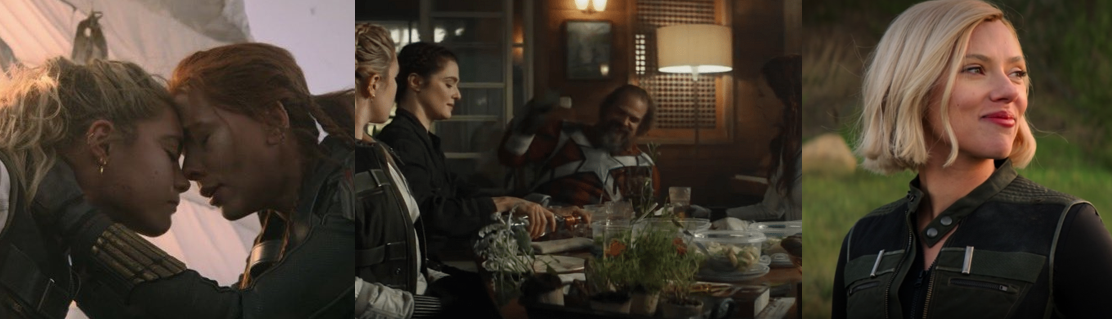
Essentially, the story is about Nat reconnecting with her family and herself.

 A central theme of the film is family. Natasha hides her heartbreak and sorrow at losing her surrogate family behind a cold bravado and resists letting Yelena, Alexi, and Melina into her heart and life as much as she can. We know that this isn’t the entire truth, though, since we’ve heard her talk fondly of her affection for the Avengers are her job as  S.H.I.E.L.D. agent and we see at the start of the film how much she cares for Yelena. Natasha insists that her childhood and this hitherto-unknown family unit was all a fake and meant nothing to her and her attitude seemingly reflected by Alexi, who was frustrated at being stuck in a “boring” undercover assignment and desperately wanted to get back into his costume to fight Captain America again. However, just as Alexi felt true feelings of love and fondness for his “daughters”, so too is Natasha unable to deny that she feels a kinship and responsibility towards not just Yelena but all of Dreykov’s Black Widows. Her urge to finish the job and kill the man who ruined her life is motivated not just by her personal need for revenge but also a deep-rooted desire to free the girls under his control and ensure that no others are ever violated in the same way. Along the way, she reconnects with her first family and comes to realise that she isn’t as alone as she once though, setting her on the path towards reuniting with her disparate Avengers comrades.

The Summary:
I’ll admit that I wasn’t exactly that thrilled at the prospect of a solo Black Widow film, especially one that came out after she had died in the MCU timeline. I definitely feel like she, and other key S.H.I.E.L.D. personnel should have featured in a one-shot or television movie or even, yeah, a feature-length film a few years ago or had her story folded in with the likes of Clint Barton/Hawkeye (Jeremy Renner) to appease the more sexist executives at Disney. Still, as the saying goes: Better late than never. Black Widow was an enjoyable romp with some impressive action and fight scenes, some fun humour and heartwarmingly poignant moments. It was great seeing Natasha in a more vulnerable position and to explore her backstory and character in more detail and the film introduces some entertaining and colourful new characters to the MCU, with Yelena and Alexei stealing the show at every opportunity. It seems as though Marvel Studios are pushing forward with a big shake-up in their films and line-up and I fully expect to see these two, at least, play a major role in the coming years.

My Rating:

Rating: 4 out of 5.

Great Stuff

Have you seen Black Widow? If so, what did you think to it? Did you like the new character sit introduced and the exploration into Natasha’s past? What did you think to Taskmaster and how the film adapted the character? Do you agree that Black Widow should have had her own solo film a lot sooner or do you think the film was in a good position as a cool down after Avengers: Endgame? Would you like to see more films focusing on this character? Whatever you thought about Black Widow, drop a comment down below.

Movie Night: Watchmen: The Ultimate Cut

Released: 3 November 2009
Originally Released: 6 March 2009
Director: Zack Snyder
Distributor: Warner Bros. Pictures/Paramount Pictures
Budget: $130 to 138 million
Stars: Jackie Earle Haley, Patrick Wilson, Malin Åkerman, Billy Crudup, Matthew Goode, and Jeffrey Dean Morgan

The Plot:
In an alternative version of the 1980s, the world is constantly on the brink of nuclear war between the United States and Soviet Russia and masked vigilantes, once popular in the 1960s, have been outlawed for some time. However, when Edward Blake/The Comedian (Morgan) is found dead, Walter Kovacs/Rorschach (Haley) uncovers what appears to be a plot to kill off former masked crimefighters and, in his efforts to warn his fellow Watchmen, becomes embroiled in a diabolical plot to force the world into unity and peace.

The Background:
Published between September 1986 and October 1987, Watchmen (Moore, et al) was the brainchild of noted comic book writer Alan Moore and artist Dave Gibbons, who revised their initial concept of a murder mystery involving Charlton Comics characters using entirely new, unique characters. Watchmen’s sophisticated adult narrative subverted the usual expectations of comic book heroes, grounding them in something resembling reality and tackling the genre with a serious, contemplative direction. Filled with dense imagery and complex themes, Watchmen was an influential mainstream success. For the longest time, the text was largely considered to be unfilmable, though a live-action adaptation was in the works as far back as the late-eighties. In 2005, though, the project finally entered production with Zack Snyder at the helm. Featuring a number of alterations to the source material, and Moore’s characteristic disinterest, Watchmen didn’t exactly set the box office on fire, earning just over $185 million worldwide against a $130 to 138 million budget. Though the film also received mixed-to-average reviews, I actually prefer the movie to the graphic novel, if I’m being honest. An extended director’s cut and this “Ultimate Cut” of the film were also later released, restoring many excised aspects from the source material and providing, perhaps, the most complete live-action version of Watchmen we’re ever likely to get.

The Review:
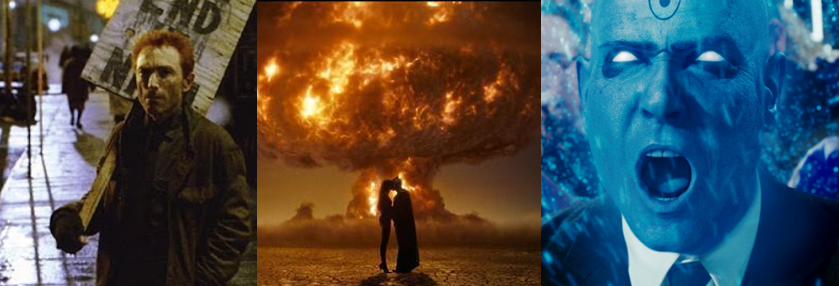
Though not the first scene of the film, Watchmen features perhaps one of the most striking and effective introductions to its fictional world in all of cinema; set to the tune of Bob Dylan’s “The Times They Are a-Changin’”, Snyder masterfully condenses some of the denser, more subtle, arguably inconsequential, complex, and intricate side plots and world-building moments of the comic book into one impressive montage which takes us through the early days of the colourful Minutemen and through to the intricacies of this decidedly alternative version of the world, where wars and monumental moments in human history were noticeably different thanks to the presence and influences of costumed heroes, all the way up to the debut of the Watchmen and the later outlawing of costumed adventurers following President Richard Nixon’s (Robert Wisden) unprecedented third term. Of course, the catalyst for the entire film’s events is the murder of Edward Blake, the Comedian. When we first meet Blake, he’s an aged shell of his former self; living alone in an apartment filled with mementos of a life-time of war and conflict, he is both taken off-guard and bitterly unsurprised when he is suddenly and violently attacked in his own home.

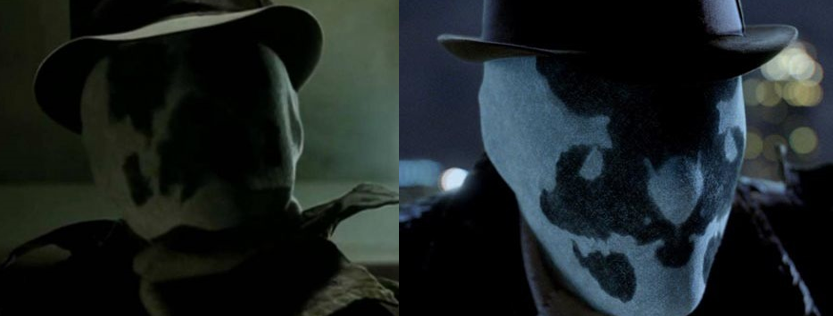
Rorschach is a brutal, uncompromising, and inherently flawed protagonist.

Unlike in the comic, where this was a decidedly simple and one-sided affair, this first action scene best showcases the dramatic license Snyder takes with the source material by delivering a bloody, violent, elaborately stylised beatdown in which the combatants are almost superhuman and capable of delivering (and taking) incredible punishment and smashing through objects (and even human bones) with their bare hands. “Stylistic” is a great word to describe Snyder’s Watchmen, which dials up the subdued presentation of the comic book to eleven, both paying homage to Gibbons’ artwork and updating the static panels into incredibly elaborate and visceral. As the sole remaining unlicensed costumed vigilante, Rorschach investigates out of a sense of duty and obligation; while many characters are aesthetically or motivationally altered in some way, big or small, for better and for worse, Rorschach remains extremely faithful to his depiction in the comic. His gravely, monotone voice accompanies many of his scenes, and others, and forms a loose, distorted narration of events and he is, essentially, the closest thing we have to a main character and is our main source of exposition into this vastly different world. Gritty, uncompromising, and paranoid, Rorschach is as crazy as he is dedicated to staying active, even though no one, even former allies of his, really like him all that much.

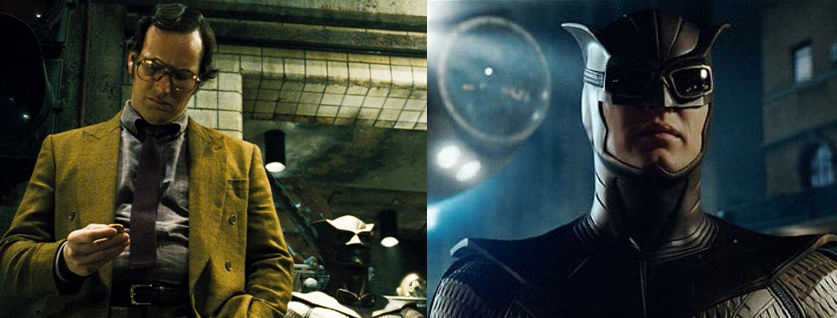
Dreiberg is a far more assertive, but no less regretful, character.

Speaking of which, the first person Rorschach goes to when he discovers the Comedian has been killed is his former partner and the closest thing he has to a friend, Daniel Dreiberg/Nite Owl II (Wilson); in the comics, Dreiberg was an awkward, unassertive, meek fellow who, for all his former glory, pretty much allowed anyone and everyone to walk over him and take advantage of him. Here, he’s still a shell of his former self and full of both regrets and doubt, but he’s far more assertive; while sympathetic to Rorschach’s condition and respectful of their former crimefighting days to give him the time of day where others wouldn’t, he’s far less patient of Rorschach’s accusations and attitude and far more willing to stand up for himself. In the end, his humility comes from his pining for Laurie Jupiter/Silk Spectre II (Åkerman) and a deep-rooted longing for the thrill of his days as a costumed adventurer.

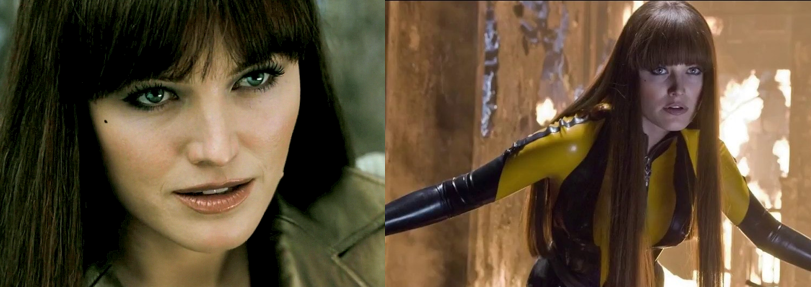
Laurie’s aggression stems from her troubled childhood and relationships.

Rorschach remarks that Dreiberg is “hiding in plain sight” and this is a recurring theme throughout Watchmen; every character wears a mask, whether literal (like Rorschach’s beautifully realised, ever shifting covering) or metaphorical and they’re all hiding something, whether it be their true intentions or their true feelings. Laurie is one of the most complex characters in that regard; aggressive, repressed, and out-spoken, Laurie has no time for Rorschach’s accusations and hostile nature and is emotionally and mentally strained thanks to her tumultuous relationship with her mother, Sally Jupiter/Silk Spectre (Carla Gugino), and Doctor Jon Osterman/Doctor Manhattan (Crudup). Most of her issues stem from unresolved and half-remembered memories of her childhood; forced into super heroics by her mother, Laurie was obligated to live a life she didn’t necessarily want and constantly struggled with both her mother’s expectations and the reprehensible actions of Blake, who attempted to rape her mother back in the day.

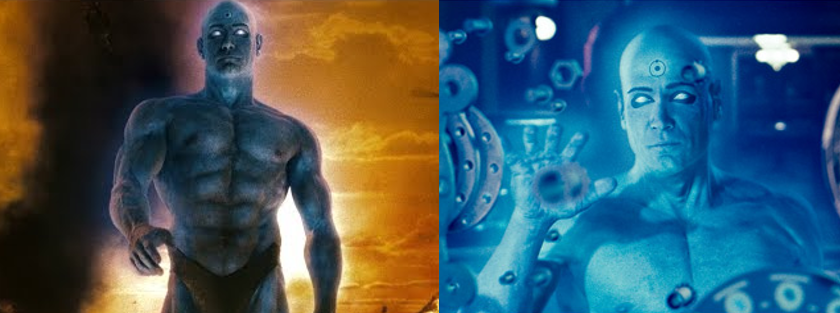
Despite his God-like powers, Dr. Manhattan has grown increasingly distant from humanity.

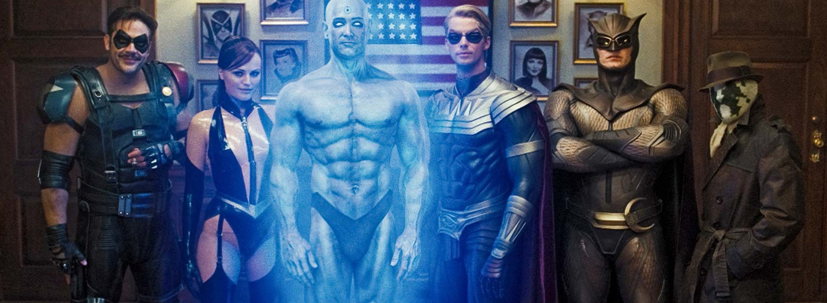
Of course, another character who is hiding in plain sight (and behind a multitude of metaphorical masks) is Adrian Veidt/Ozymandias (Goode), a man whom Rorschach both respects for his intellect and physical ability but is also somewhat disgusted by since Veidt was one of the first to not only quit his adventuring ways but also shamelessly profit from it. Goode, despite perhaps looking maybe too young for the role, portrays Veidt as a smooth, confident, and wealthy businessman and aristocrat who openly speaks of both his past and his desire to steer the world towards a greater purpose other than warfare and conflict. Veidt plays this public role perfectly, appearing to be just as much of a victim as any of the other Watchmen, and concerned only with the welfare of humanity through his business and critical work with Dr. Manhattan. Speaking of Dr. Manhattan, Osterman is primarily regarded as the sole thing keeping the United States and Russia from engaging in all-out nuclear conflict; an ethereal, God-like character, Dr. Manhattan is the only character in the film to exhibit actual, tangible superpowers and, as if to compensate for this, has been gifted with a vast and seemingly limitless array of abilities, from teleportation, to nigh-immortality, to the ability to manipulate atoms in any way he desires, and a skewed perspective of time. Dr. Manhattan’s unique ability to perceive past, present, and future simultaneously and his extensive abilities have made him more and more detached from humanity, specifically Laurie; despite him assisting Veidt in conceiving of a clean, renewable energy source to unite the world, Dr. Manhattan has little care for the intricacies of mortals and his increasing detachment is a pivotal plot point of the film. Dr. Manhattan is superbly realised in the film thanks to CGI emphasising his otherworldly magnetism; in a film where costume design and aesthetics are impressive from start to finish, Dr. Manhattan naturally stands out and not just because his wang is out half the time; he’s literally a God among men and is portrayed as such throughout.

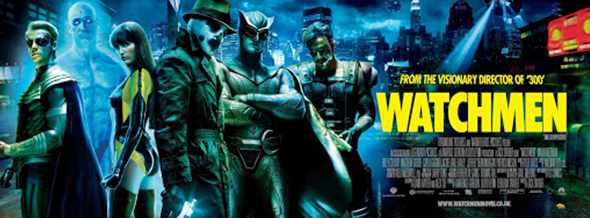
Watchmen‘s unique visual storytelling emphasises its complex themes of humanity and identity.

Watchmen is, at its core, a murder mystery story that is as much about commenting on society, humanity, and our various failings as it is about exploring the nature of superheroes; as in the comic, every character in the film is flawed, broken even, and is detached from reality in some way. Veidt sees himself as above it all on an intellectual level; Blake believed he was above it since he chose to cynically mock the state of society; Dreiberg chooses to hide from the conflict, and his true self; Laurie is in constant denial about her past and feels suffocated by it; Rorschach has completely abandoned all pretense of his life outside of his mask; and Dr. Manhattan has become completely disinterested and disillusioned in the petty squabbles of humanity. Though Snyder expands upon this narrative with an abundance of gore, expletives, and dramatic visual excess, it still forms the central backbone of the narrative and is just as interesting to follow, if not more so thanks to Snyder’s flair for style.

The Nitty-Gritty:
I mentioned earlier that there are numerous alterations to the source material; when I first saw the movie, I applauded this as I found the comic to be quite dense and slow and not the most visually interesting tale. Though I have grown to appreciate the influence and nuance of the comic book, I still prefer the film as Snyder’s attention to detail, stylistic choices, and the epic quality of the film make it far more interesting and engaging for me. Of course, one of the major changes Snyder made was to dramatically elaborate upon the few fight scenes of the comic book; fights are now heavily choreographed, greatly stylised sequences featuring an abundance of slow motion, blood, and violence. Characters exhibit near-superhuman levels of strength and durability, which goes against the purposely grounded nature of the source material, but I can forgive this as it lends a level of spectacle and gratuity to the film that not only appeals to me and my baser instincts but also, I would argue, makes the film and the story more accessible to a wider audience.

Watchmen‘s costume design and aesthetic choices are absolutely top-notch.

Plus, it’s not as if the base themes of Moore’s original story aren’t still present; if anything, they’re more explicit than ever thanks to Snyder’s decidedly unsubtle style of filmmaking and, yet, the film still replicates many of the slower, more subtle and nuanced character moments from the source material. Snyder’s attention to detail is absolutely flawless; every scene is crammed full of faithful recreations of the comic book and the lengths he went to replicate the costumes and aesthetics of Gibbons’ artwork is impressive. At the same time, Snyder uses the film as an opportunity to comment on and reference the many years of superhero cinema just as Moore paid homage to a bygone era of comics books; as a result, Nite Owl’s costume is a heavily armoured homage to the various Batsuits, Silk Spectre is literally poured into a super sexy leather number (as was the style of the early 2000s), and Ozymandias is purposely decked out in rubber armour reminiscent of Joel Schumacher’s Batsuits (it even has the much-maligned nipples). While I can understand people getting a bit upset about some of these changes as they seem superfluous in some ways, I honestly thought it really worked and helped emphasise the film’s extravagant aesthetic style.

Snyder’s attention to detail and fidelity is astounding, especially in the Ultimate Cut.

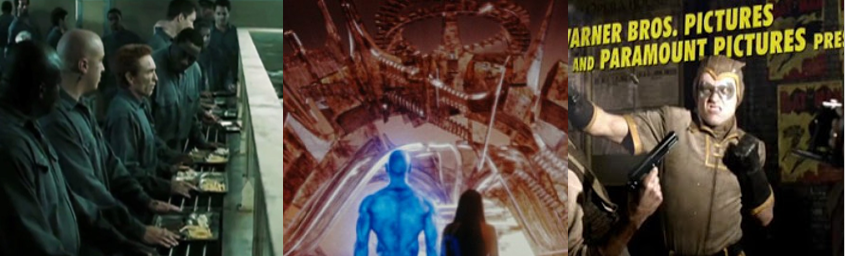
Continuing on the theme of attention to detail, Snyder includes, or straight-up adapts, entire sub-plots and story beats from the source material that, one could argue, others might have cut for time; as a result, we get a startlingly brutal recreation of Rorschach’s time in prison, therapy sessions, and character-defining moments as well as a great deal of time spent exploring Dr. Manhattan’s time on Mars, his origin, and his subsequent heart-to-heart with Laurie. This means that, rather than only paying lip service to what makes these characters tick or briefly touching upon it (or removing it entirely), Snyder is able to properly delve into the psychology of his versions of these characters through his distinct visual style. Even in the Ultimate Cut, which is unquestioningly the most definitive version of the film you’ll ever watch, some concessions had to be made, though; the most obvious of these is that Snyder is completely focused on the current story of the Watchmen rather than exploring the intricacies of their predecessors, the Minutemen, but, even then, this extended version goes to the trouble of including the tragic fate of Hollis Mason/Nite Owl (Stephen McHattie).

The allegorical Black Freighter story is interspersed throughout the Ultimate Cut.

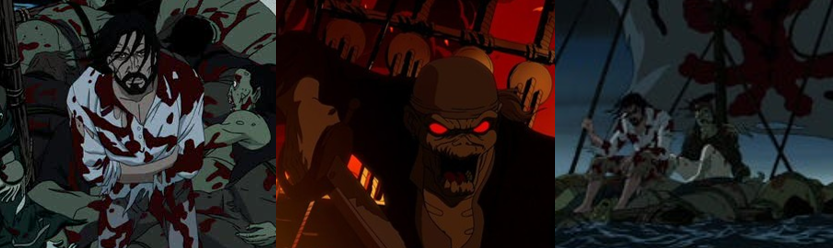
Watching the Ultimate Cut of the film also means that the main story is interlaced with an allegorical side story, Tales of the Black Freighter (DelPurgatorio, 2009), at key moments; originally excised from the main film and released as a separate feature on home media, Tales of the Black Freighter has been largely restored to serve much the same purpose as in the comic book. The side story, which is told in startling gory animated sequences, follows a shipwrecked sea captain (Gerard Butler) who is driven to madness and obsession following a disastrous encounter with the demonic Black Freighter. Desperate to get back home to his wife and children and to warn his hometown of the freighter’s threat, he ultimately becomes the very monster he is trying to fight against when he unwittingly bludgeons his family in a fit of madness. As in the original comic book, Tales of the Black Freighter acts as an allegory for Veidt’s despicable actions and the story of Watchmen in general, with its themes of obsession and performing unspeakable acts in the name of good though, while I enjoy the animated version far more than its comic book counterpart, I can see why it was omitted from the original film as these themes are, by the very nature of Watchmen’s narrative, largely explicit regardless.

I was honestly okay with the changes to the story and ending, especially as they made contextual sense.

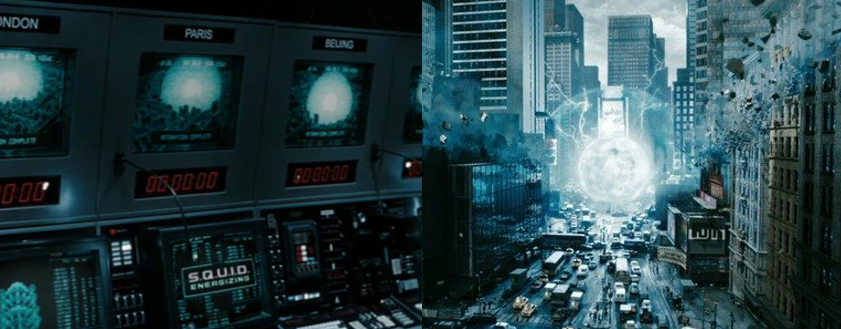
Of course, the big twist is that Veidt is actually behind everything, literally “hiding in plain sight”; though the execution of his plan to save humanity significantly differs from the source material, his motivations remain largely the same (having predicted the downfall of society, the inevitability of war, and the limitations of fossil fuels, Veidt engineers an elaborate and complex plan to fool the world into unifying against a common enemy). A big source of contention was Snyder’s decision to omit the iconic giant squid that Veidt genetically engineered to fool humanity into believing in an impending and ominous alien threat. While I really admired how the Watchmen television series (2019) managed to pull this grotesque creation off, I never really minded all that much that the squid was missing from the film. Not only is there a cheeky reference to it (Veidt’s machine is called a “Sub Quantum Unified Intrinsic field Device”) but the idea of Veidt replicating Dr. Manhattan’s powers and then attacking multiple cities across the world, rather than just New York City, and pinning it all on Jon actually makes far more sense and keeps the film from wasting time in explaining and setting up the squid. Could they have done that? Sure, and probably pretty easily, but, while it’s disappointing to not have the image of the squid’s bloodied and gruesome corpse draped throughout Times Square, I can live without it if it makes sense in the context of the narrative and, thanks to how prevalent Jon’s fragile grip on humanity is to Watchmen’s story, I would argue that it does.

The Summary:
It’s probably sacrilegious to say it but I still prefer the movie version of Watchmen over the comic book; while my appreciation for the source material has grown, especially after re-reading it recently, it was only after watching the movie that I actually became interested in the concept. Sure, it might be very different from the source material in a lot of ways but I’m okay with that because everything looks so slick and stylish and has a real cinematic grandeur to it. While Snyder’s unique cinematic style may not be for everyone, and it’s probably still seen as somewhat blasphemous that he stripped most of the subtlety and nuance from Watchmen, it really works for me and results in a bold, striking, and aesthetically pleasing superhero film that is truly unique among the genre. I feel what really makes Watchmen work is how accessible Snyder makes the source material; I can definitely say that it’s probably best to watch the film first and then explore the graphic novel and see if it’s just as appealing to you. Die-hard fans of the comic may have been annoyed and insulted by Snyder’s creative license but I wanted to see a gory, thought-provoking, and visually entertaining film and that’s exactly what Watchmen delivers. Watchmen delves into a completely different side of the superhero genre while paying homage to it through fantastic costume design, brutal action sequences, and an engaging narrative and the Ultimate Cut goes one step even further to deliver extended scenes that further expand this unique world and incorporating an allegorical tale to the main plot to provide the definitive Watchmen experience.

My Rating:

Rating: 5 out of 5.

Fantastic

So, what do you think about Watchmen? Were you a fan of the graphic novel before seeing the film or did you, like me, gain a deeper appreciation for the source material after watching the film? Which version of the film do you prefer, the theatrical, director, or ultimate cut and why? How do you feel about Snyder’s visual and filmic style and the alterations he made to the text? Which of the titular Watchmen is your favourite and why and how do you feel about their costumes and characterisations in the film? Did you enjoy the animated Black Freighter segments, or do you feel they distracted from the already bloated narrative? Would you like to see a new adaptation of Watchmen, one perhaps even closer to the source material, and, if so, who would you cast in the various roles? No matter what you think about Zack Snyder’s Watchmen, feel free to leave a comment below and check back in next Wednesday for more Watchmen content!

10FTW: Bad-Ass Movie Dads

10FTW

Being a dad in a movie is tough; often, dads are portrayed as slovenly, uncaring, even abusive individuals who care more about drinking beer, watching football, cheating on their spouses, or work than their kids. It’s a bit of a cliché at this point and also quite a bum rap, to be honest, and often seems like a case of lazy writing to have the dad be the cause of all the problems and negativity in a child’s life in a film.

10FTW: Badass Movie Dads

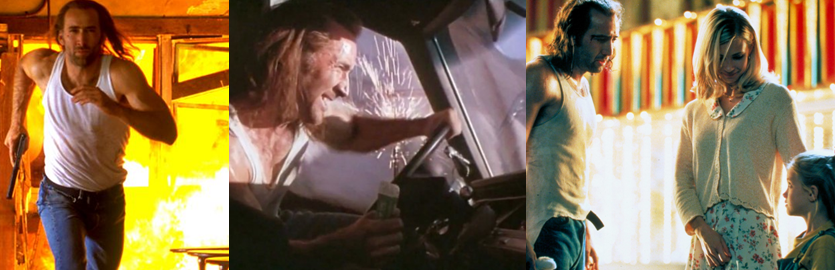
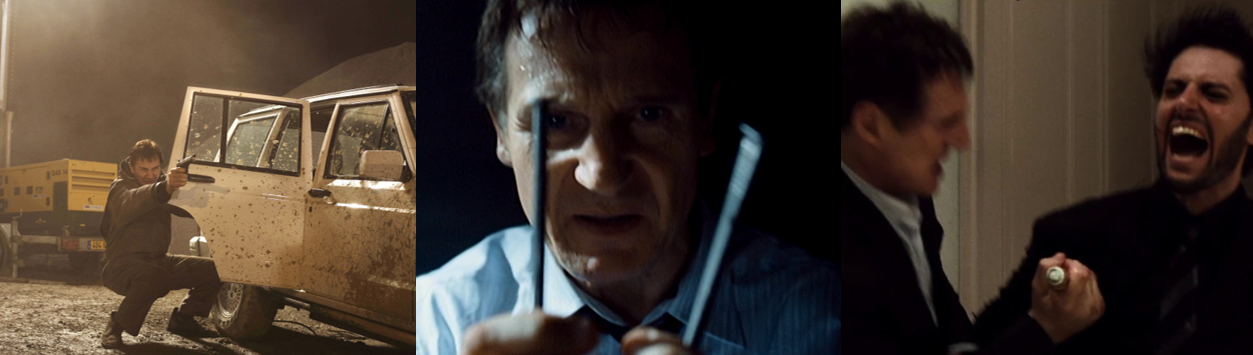
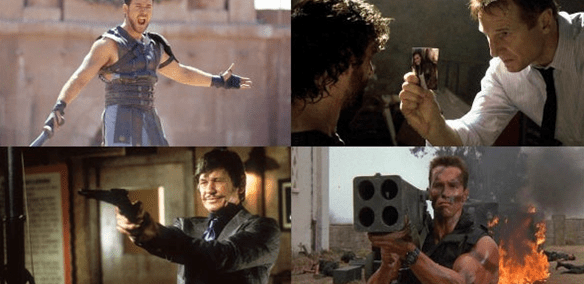
I suppose it makes sense, in a way; many movies involve a story about a child, son, or daughter standing up to adversity or challenging, even confronting, their neglectful parents to say nothing of the myriad of stories out there of fathers more concerned with work than the well-being of their child. Still, good movie dads do exist, even while being flawed characters in their own right, and so, seeing as today is Father’s Day, I’m going to run through ten that I consider to be amongst the most bad-ass of all movie dads…

10 Steven Freeling – Poltergeist (Hooper, 1982)

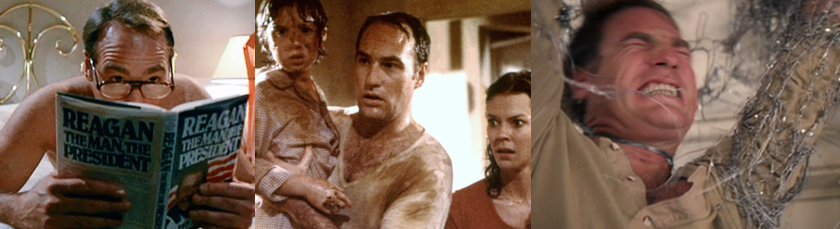
If I’m being completely honest, Poltergeist is more the story of a bad-ass mother as, throughout the film, it is Diane (JoBeth Williams) who eventually steps up after the demonic force inhabiting their house kidnaps her daughter, Carol Anne (Heather O’Rourke). Diane is the one who first feels and alerts her family to the presence in their house, she’s also far more emotionally stable despite her exhaustion and grief, and of course there’s the fact that she leaps into the “other side” to rescue Carol Anne and then has to suffer through a veritable horror show as their house is torn inside and out. Yet Steven (Craig T. Nelson) is the ever-reliable rock of the household; a bit of a goofball and perhaps (even by his own admission) too soft on his kids, he is the one who contacts a group of parapsychologists to assist them (despite his scepticism) and let’s not forget that Diane and Carol Anne never would have made it to back to the real world had Steven not been holding their literal lifeline. Despite his will weakening, Steven steps up even more in the sequel, Poltergeist II: The Other Side (Gibson, 1989), even landing what appears to be a killing blow to the malevolent Reverend Henry Kane (Julian Beck) who has been terrorising them, but, while reliability is an admirable quality, he takes the lowest spot for largely just being a supporting player (and for him and Diane sending Carol Anne away out of fear by the third film).

9 Frank – 28 Days Later (Boyle, 2002)

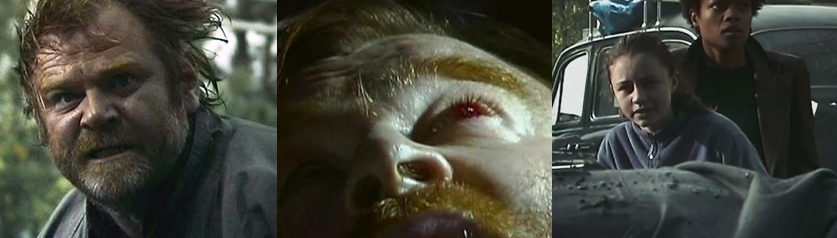
Here’s a shocking revelation for you: I’m not actually that big a fan of 28 Days Later. It starts off with such promise and with all those eerie shots of London but it’s a slow, plodding, miserable little film and the only thing I really like about it is that it made zombies faster, more aggressive, and ferocious as, for me, it otherwise wastes its potential. Still, amidst all of this we have Frank (Brendan Gleeson), a former cab driver and one of the few survivors of the infection. Initially hostile and a largely grouchy character, to say the least, Frank’s sole concern (beyond survival) is the safety of his daughter, Hannah (Megan Burns) but he soon bonds with Jim (Cillian Murphy) and Selena (Naomie Harris). Sadly, though, Frank can’t place much higher as, despite his capability as a father and a combatant, he grows complacent; in a world where the highly contagious Rage plague has turned the majority of the population into ravenous, zombie-like creatures, characters must constantly be on their guard and, for a split second, Frank lowers his. However, even while the Rage quickly overwhelms his body, his first thought is to warn Hannah back for her own safety before he is summarily put down.

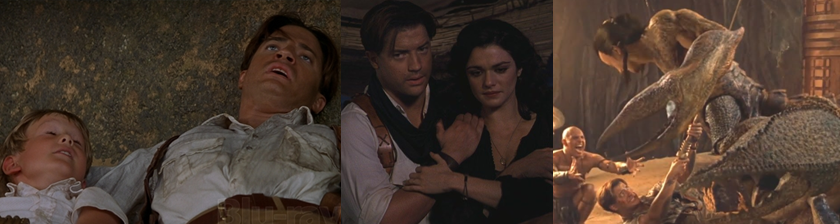
8 Rick O’Connell – The Mummy Returns (Sommers, 2001)

I miss Brendan Fraser; whatever happened to him? Arguably best known for his appearances in the Mummy trilogy (ibid/Cohen, 1999 to 2008), in which he portrayed a quick-witted and capable Indiana Jones-style adventurer, Fraser’s Rick O’Connell undergoes an interesting character arc throughout the trilogy, beginning as a disillusioned soldier and transforming from a reluctant hero motivated only by his libido to a doting father and content family man who was happy to put his adventuring days behind him. In The Mummy Returns, Rick is mortified when Imhotep’s (Arnold Vosloo) minions kidnap his smart-alecky little git of a son, Alex (Freddie Boath), and relentlessly uses every resource at his command to track Imhotep across the globe to rescue his son. Encouraging of the boy’s mischievous nature, one could argue that Alex only gets himself into a position to be kidnapped thanks to his father’s influence and their relationship has soured somewhat by the start of the third movie but that doesn’t take away from the fact that Rick travels across the world braving sea, air, and all manner of mummified atrocities to rescue his boy. When his beloved Evelyn (Rachel Weisz) is temporarily killed, we see a heartbreaking vulnerability to Rick’s usual bravado and his first action is to shield Alex from watching his mother suffer and die. Fuelled by rage and vengeance, he then takes on a now-mortal Imhotep in a fist-fight and rapidly accepts his destiny as a Medjai to deliver a killing blow to the monstrous Scorpion King (The Rock) to not only avenge his fallen wife but also as payback for putting his son in danger.

7 John McClane – Die Hard 4.0 (Wiseman, 2007)

In my experience, Die Hard 4.0 (also known by the far better title, Live Free or Die Hard) is generally not as highly regarded as its predecessors and I will always take issue with this; sure, it’s massively over the top and essentially turns the wise-cracking John McClane (Bruce Willis) into a superhero but that doesn’t make it bad. For me, it’s easily in the top three of the Die Hard films (Various, 1988 to 2013) thanks to Willis’ portrayal of McClane as weary, out of touch, and hiding a lot of his emotions behind a snarky attitude and grouchy demeanour. Now, to be fair, McClane doesn’t start the film as the greatest father; his daughter, Lucy (the always appealing Mary Elizabeth Winstead) is initially hostile towards him, refusing to call him “Dad” and preferring to take her mother’s last name. However, when she is kidnapped by Thomas Gabriel (Timothy Olyphant) as payback for McClane interfering in his “fire sale”, McClane doesn’t hesitate to throw himself into danger to rescue her, accumulating numerous injuries, enduring shots from a F-35B Lightning II, and even shooting himself in the shoulder at point-blank range to kill Gabriel. When taken by Gabriel, Lucy not only fights back at every opportunity but knows full well that her father will stop at nothing to rescue her, defiantly taking his last name and ultimately reconciling with him after seeing the lengths he would go to for her safety.

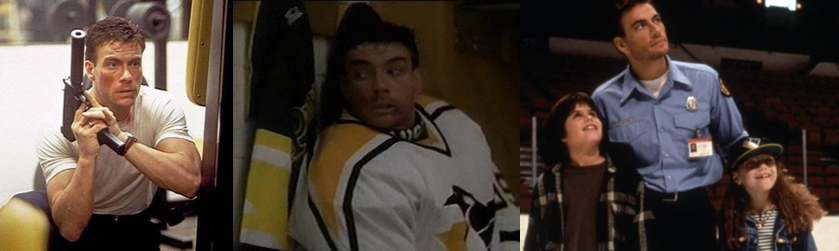
6 Darren McCord – Sudden Death (Hyams, 1995)

I feel like people don’t talk about Sudden Death enough; sure, it’s just “Die Hard on a boat” but it’s pretty decent for the most part, even with Jean-Claude Van Damme’s characteristically awkward acting and line delivery. McCord is very much like McClane, being a normal, average fire-fighter-turned-fire-inspector who has the odds against him. Though he’s much less cynical and grouchy compared to McClane, he is tormented by his failure to save a young girl from a house fire and has an extremely strained relationship with his ex wife. Similar to McClane, McCord’s relationship with his kids is a little shaky at the start of the film; Emily (Whittni Wright) views him with a heroic awe, believing him to still be a fire-fighter, while Tyler (Ross Malinger) is slightly more antagonistic and resentful. Still, he does obediently stay in his seat even as the hockey arena falls into chaos around him and Emily bravely stands up to terrorist Joshua Foss (Powers Boothe) after she is kidnapped, never faltering in her belief that her father will come to rescue her. For his part, McCord is slightly irresponsible as he leaves his young kids alone at the hockey game but more than makes up for it by taking it upon himself to disarm as many of Foss’s bombs as he can and take out the terrorists with little more than his wits, ingenuity, and some impressive kicks.

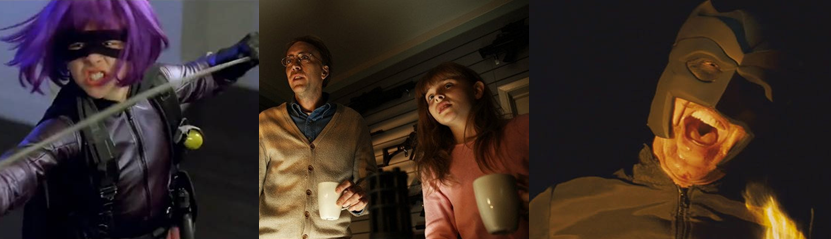
5 Damon Macready / Big Daddy – Kick-Ass (Vaughn, 2010)

Although his look and the specifics of his motivations were wildly different from his comic book counterpart, Nicolas Cage really stole the show for this awesome adaptation of the comic book of the same name (Mark Millar, John Romita Jr, et al, 2008 to 2014). Channelling the spirit of Adam West while wearing a particularly Tim Burton-esque “Bat-Suit”, Cage channelled his usual manic energy into a far more nuanced, complex performance that showed Macready to be both slightly unhinged and eerily logical. To be fair, you could argue that Macready is a pretty awful father since he pulled his daughter, Mindy (Chloë Grace Moretz) out of school and trained her to be his crimefighting partner, Hit-Girl, causing her to be more interested in elaborate knives and skewering criminals than…whatever it is pre-teen girls are into these days. However, you’d be forgetting the fact that Macready is tough but fair on Mindy, always encouraging her and pushing her to test her limits. Thanks to his training, she’s fully capable of taking out entire rooms full of armed men with ease; not only that, he also does cool stuff like purchase a whole bunch of weapons, toys, and even a jetpack. When’s the last time your dad bought you a jet pack!? Plus, there’s the fact that he continues to encourage and help his daughter even while burning to death before her eyes.

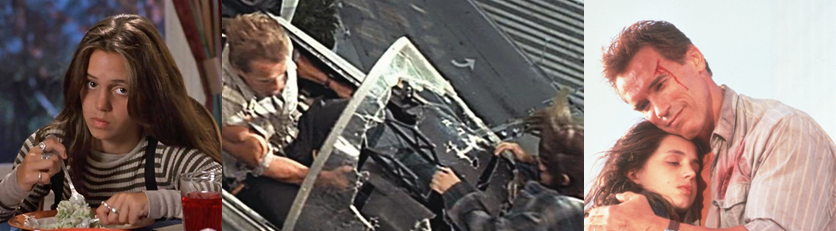
4 Harry Tasker – True Lies (Cameron, 1994)

Arnold Schwarzenegger has a bit of an iffy record when it comes to portraying dads, as we’ll see; sometimes he’s the career-obsessed type, other times he’s the overly protective type. In True Lies, he lies to his wife, Helen (Jamie Lee Curtis) and daughter, Dana (Eliza Dushku), on a daily basis to keep his true identity as a secret agent just that: a secret. As a result, and because she’s in that moody teenage phase of her life, his relationship with Dana is somewhat strained at the start of the film in that she sees him as dull and unreliable, unappreciative of the token gifts he brings her, casually stealing from his partner, Albert Gibson (Tom Arnold), and running off with her boyfriend or to her room to escape from him. However, like her mother, Dana’s entire perception of Harry is changed after she is kidnapped by terrorist Salim Abu Aziz (Art Malik) and it is her unassuming father who comes to her rescue…in a Harrier Jump Jet, no less! What makes Harry a bad-ass dad is that, when the chips are down, he drops all pretenses and shows his family exactly what he is capable of, gunning down countless terrorists and flying through city airspace just to rescue his daughter and shouldering the burden of keeping his true life from them in order to protect them. Once the secret is out, though, his relationships with both alter dramatically and they become a much more stable, contented, and united family.

3 Cameron Poe – Con Air (West, 1997)

Aaah, yes, Con Air; a ridiculously over-the-top action film, to be sure, featuring Nicolas Cage not only with an absolutely gorgeous head of hair and henched up to the nines but also sporting possibly the worst Southern draw I’ve ever heard outside of The Fast and the Furious: Tokyo Drift (Morgan, 2006). Still, as ridiculous as Cage sounds (and as ludicrous as it is that his character, a decorated Army Ranger, would be sent to prison for ten years for what amounted to a clear case of self defense, at best, and manslaughter, at worst), the film is full of equally bombastic action and performances, with John Malkovich, especially, stealing the show (and, presumably, all that scenery he chewed) as the malicious Cyrus “The Virus” Grissom. Poe stands out from the other dads on this list as he doesn’t actually meet his daughter, Casey (Landry Allbright), until the film’s conclusion; however, through his numerous correspondences with Casey, he encourages her to stay in school and listen to her mother and builds the best, loving relationship he can given his position. His entire motivation throughout the film is to get back to his daughter and, while he’s tempted to simply let things play out in order to meet that goal, his morals won’t let him stand idly by and he fights through overwhelming odds and explosions galore to not only finally meet Casey but also to teach her valuable lessons about paying for your sins and standing up against injustice.

So, I said early that Schwarzenegger has a bit of an iffy reputation as a movie dad. Well, Commando, in addition to being, perhaps, the quintessential action movie of the eighties, also showcases Arnie as one of the most devoted and bad-ass dads ever put to film. A retired Colonel, Matrix (a gloriously ridiculous name if there ever was one) is perfectly content to have put down his guns and to live peacefully amidst nature with his young daughter, Jenny (Alyssa Milano). However, when Matrix’s past (or, more specifically, the fantastically sadistic Bennett (Vernon Wells)) catches up with him and Jenny is taken as a hostage, Matrix has only around twelve hours to track Bennett down to recover his daughter. Like Poe, Matrix’s entire motivation is geared towards rescuing Jenny but, while Poe (and many of the dads on this list), must use subterfuge to meet this end, Matrix instead literally moves Heaven and Earth to find Jenny, violently dispatching of all of Bennett’s henchmen and literally walking right into a camp full of seemingly-endless, fully armed soldiers, mowing them down with such reckless abandon that he barely needs to aim or reload. Witty, determined, and possessing a razor-sharp focus, Matrix is a veritable one-man army, capable of besting anyone who stands in his way, and yet still vulnerable and human enough to be injured when dramatically appropriate and fully prepared to go to any lengths to rescue her since, as he puts it: “All that matters to [him] now is Jenny”.

I mean, honestly, could it really be any other dad? Who else but Bryan Mills (Liam Neeson) could make the top of a list like this? Like a lot of the other dads I’ve talked about, Mills is a devoted father who has left behind a violent life to focus on building a relationship with his daughter (Kim (Maggie Grace), in this instance) despite having a frosty relationship with his ex-wife, Lenore Mills-St John (Famke Janssen). Having lost his marriage, and many years of bonding with Kim, due to his work as a “preventer” for the government, Mills is a loyal, if somewhat overprotective, father who just wants to be there for Kim and to encourage her dreams of being a singer. However, when she is taken by Albanian sex traffickers, Mills puts his unique set of skills to good use; like Matrix, his entire motivation revolves around finding his daughter but Mills has even less to go on and yet, within twenty-four hours, manages to track down enough of a lead to bring him within arm’s reach of Kim’s location. Along the way, Mills dispatches anyone who opposes him with a cold, calculating efficiency; age, clearly, hasn’t dwindled his skills or resources and, for the most part, he’s still able to function at peak efficiency with very little sleep or food. Of all the dad’s on this list, Mills is the most determined and competent; every movement is premeditated, meticulously thought through, and executed with alarming proficiency and yet Mills is still humble and vulnerable enough to show real pain, fatigue, and to deliver Kim back into the arms of her mother and stepfather.

Do you agree with my list? Perhaps you have another favourite movie dad who you think should have made the cut; if so, who is it and who are some of your favourite (or least favourite) movie dads? What are you doing this year for Father’s Day? Do you have any particularly fond memories of your dad? If so, feel free to share them, and any other comments, below.

Movie Night [Sonic Month]: Sonic the Hedgehog (1999)


Sonic the Hedgehog was first introduced to gamers worldwide on 23 June 1991 and, since then, has become not only SEGA’s most enduring and popular character but also a beloved videogame icon. This year, the Blue Blur turns thirty and what better way to celebrate than by dedicating every Friday of this month to SEGA’s supersonic mascot.


Released: 1 November 1999
Originally Released: 26 January 1996 and 22 March 1996
Director: Kazuho Ikegami
Distributor: ADV Films
Budget: Unknown
Stars: Martin Burke, Lainie Frasier, Bill Wise, Edwin Neal, and Sascha Biesi

The Plot:
Doctor Ivo Robotnik (Neal) takes Princess Sara (Biesi) hostage and forces Sonic the Hedgehog (Burke) and Miles “Tails” Prower (Frasier) to journey to Robotropolis to keep Planet Freedom from being destroyed and, in the process, have them battle his ultimate creation: Hyper Metal Sonic (Gary Lipkowitz).

The Background:
After Sonic achieved worldwide success and became the hottest pop culture icon of the nineties following the release of Sonic the Hedgehog 2 (SEGA Technical Institute, 1992), Sonic was practically everywhere as SEGA capitalised on their mascot’s success with comic books, story books, toys, spin-off videogames, and, of course, animated ventures. Outside of Japan, DiC Entertainment produced two widely different Sonic cartoons that ran simultaneously and would come to inform the long-running Archie Comics series. Just as Japan and the rest of the world saw different Sonic promotional materials and lore, so too did each country have incredibly different animated ventures for SEGA’s mascot as, in 1996, Perriot studio produced a two part original video animation (OVA), “Welcome to Eggmanland” and “Sonic vs. Metal Sonic!”, that featured a traditional anime aesthetic that was closely modelled on the anime sequences from Sonic the Hedgehog CD (Sonic Team, 1993) and much closer to the source material thanks to the involvement of Sonic Team (specifically Yuji Naka and Naoto Ohshima). As audiences outside of Japan were enduring easily the worst Sonic cartoon ever created, Sonic Underground (1999), and to coincide (somewhat) with the North American release of the Dreamcast, ADV Films combined the two-part OVA into one feature length feature, subjected it to a questionable dubbing process, and released it straight to video. Still, the feature length animation holds largely favourable reviews among Sonic fans for its closer adherence to the source material despite being just as removed from it as Sonic’s American cartoons.

The Review:
Sonic the Hedgehog: The Movie is this absolutely mental anime adaptation of the videogames that has a slick, detailed aesthetic that not only evokes the artwork of the videogames but also aligns almost perfectly with the anime sequences from Sonic CD. Because of this, though this world is as strange and unique as the various iterations of Mobius, the OVA feels like an authentic tie-in to the source material rather than a distilled, heavily altered commercial product like the cartoons.

Though short-tempered and lazy, Sonic revels in action and adventure.

What really makes the Sonic OVA stand out from other animated adaptations, apart from the anime aesthetic, is its portrayal of Sonic; rather than a wise-cracking show off, OVA-Sonic is a snarky, short-tempered teenager and actually showcases the “attitude” that Sonic was advertised as having. He just wants to sunbathe in peace and quiet and yells at Tails for interrupting his relaxation and has absolutely no interest in helping Robotnik even though the safety of the entire planet is, apparently at stake. Despite his lackadaisical attitude, though, Sonic is quick to race into action when he sees Tails is in real danger and begrudgingly agrees to solve Robotnik’s problem despite never shaking the belief that something fishy is going on. Sonic is not just cocky but also extremely arrogant, surprisingly lazy, quick to anger, and uncouth, something his current incarnations often seem to forget or ignore. While still heroic, Sonic prefers to wait until the very last second, or needs considerable persuasion, to act; Sonic desires challenge and, without it, is mainly lethargic. This is best depicted in his intense and escalating battle with Metal Sonic wherein Sonic’s stupor gives way to a passionate desire to defend his pride and identity.

Tails is at his most capable here, berating Sonic’s inaction and directly influencing the plot.

Tails, also, is far more capable and competent than his other animated counterparts; a genius with machines and computers, it’s heavily implied that he retrofitted all the junk and discarded technology to build his laboratory and aircraft hanger and he’s easily able to reprogram Robotnik’s navigational device to alter Hyper Metal Sonic’s programming and repair the Tornado after it crashes. Crucially, though clearly an enthusiastic and naïve little kid, Tails is Sonic’s conscience and the voice of reason; when Sonic refuses to help, Tails berates him and helps coerce him into action and, while he does need a bit of rescuing, he’s also quite capable of doing far more than just whining or being a mere hostage or a liability.

Sara is a pain in the ass but at least she has more personality than the President.

Tails’s usually annoying characteristics are, instead, supplanted into Sara; a grating, annoying character, Sara is selfish and aggravating, throwing tantrums over the littlest things and revelling in her ability to manipulate the hearts and minds of men with her allure. Interestingly, though, the annoying aspects of her character give her a little more personality than the average damsel in distress since she doesn’t just sit there like a lemon or cringe in fear; she shouts, screams, lashes out, and whines the entire time instead which, yes, means you end up questioning why anyone would want to rescue her annoying ass but an irritating personality is a personality nonetheless, at least, which is more than can be said about her father, the President (Neal), who is a largely ineffectual and useless character.

Knuckles is a far less gullible or bumbling character than he’s now characterised as.

Unlike the majority of Sonic’s American cartoons, the OVA immediately gets extra points from me for actually including my favourite Sonic character: Knuckles the Echidna (Wise). Of course, of all the characters, Knuckles is perhaps the most fundamentally changed by the adaptation process; rather than an echidna, he’s said to be a mole (one, somehow, capable of flying) who is more interested in treasure and bounty hunting than guarding Angel Island and the Master Emerald. In fact, neither of these two elements are ever mentioned, characterising Knuckles as this wandering nomad who is, nevertheless, “Sonic’s best friend”; Knuckles, far from the gullible and foolish character he has become in recent years, is a capable, confident, and knowledgeable source of exposition and gets some fun comedic moments like when he chastises Tails for landing on Sara’s boobs or when his beloved and bad-ass cowboy hat catches fire!

Though a buffoon at times, Robotnik is still a charismatic, deceptive, and competent villain.

For those only familiar with Sonic’s American cartoons, perhaps the most striking character in the OVA is Dr. Robotnik; rather than some bumbling fool or a semi-cybernetic, tyrannical dictator, Robotnik is far closer to his videogame counterpart and, when I think of the Robotnik from Sonic’s 2D videogames, this is the one I think of. A charismatic, deceptive, and a ruthless individual, Robotnik is easily able to intimidate the President by kidnapping his daughter, manipulate Sonic and Tails into doing his bidding, and ultimately capture Sonic’s “life data” to complete Hyper Metal Sonic. There’s a lot of backstory hinted at with this world, primarily through Robotnik, who explains how Planet Freedom works and hints towards previous encounters with Sonic and Tails, and Robotnik actually has a lot of depth to his personality as he seems to genuinely be besotted with Sara while also wishing to destroy Sonic and take over the Land of the Sky. Robotnik, of course, isn’t the only antagonist in the OVA; at first, we’re led to believe that the primary antagonist is the mysterious “Metal Robotnik”, a massive demonic anime mech that is, clearly, being piloted or at least controlled by Robotnik. The deception, however, completely fools everyone despite the fact that Metal Robotnik sounds exactly like Robotnik! The mech suit gives Robotnik a vast array of combat options that briefly give him the upper hand but the destruction of Metal Robotnik isn’t even a set back for Robotnik; it’s all simply part of his master plan, which is surprisingly competent and threatening.

Sonic insists on battling Metal Sonic alone, seeing the robot as a degrading imposter.

Hyper Metal Sonic, obviously, ends up becoming the main antagonist but it doesn’t actually properly appear until after our heroes get past Metal Robotnik, enter Robotropolis, and shut down the Robot Generator; it’s glimpsed in the opening, pre-title sequence, however, and looms over the narrative like an ominous cloud so that, once it does appear, it’s in suitably dramatic and threatening fashion. Hyper Metal Sonic is a cold, calculating, silent antagonist and Sonic sees its mere existence as both an insult and a threat to his position, categorically refusing to have his friends help him and choosing to battle his robotic counterpart alone in increasingly violent confrontations.

The Nitty-Gritty:
Though there is a general, prevailing idea that Sonic the Hedgehog: The Movie is much closer to the source material than its other animated counterparts, that isn’t exactly true; the world we are presented with in the film is just as different from that seen in the games as Mobius is in the cartoons and comics, perhaps even more so since this is a strange world that resembles a shattered, post-apocalyptic version of our world more than the wacky, fantasy worlds seen in the videogames. However, the spirit of the videogames is evoked far closer thanks to the OVA’s anime aesthetic and locations closely resembling those seen in the games (Never Lake, for example, appears to be briefly seen onscreen at one point and Sonic races through traps and obstacles very similar to those from the games, including the first and most accurate onscreen portrayal of springs, spikes, and Badniks).

The world is both familiar and yet unique, borrowing from and then influencing Sonic‘s videogames.

One thing I love about this OVA is not just how well it captures the spirit of the source material but also came to influence later videogames and Sonic canon; it’s fitting that this was released outside of Japan around the time of the Dreamcast since there are many visual and aesthetic similarities between the OVA and Sonic Adventure (Sonic Team, 1998): Tails’s workshop, the airstrip that rises out of the ground, the visual of the “relics” of the Land of Darkness (clearly the remnants of New York City) sinking into the ocean are all clearly evoked in Sonic Adventure. Honestly, it’s a shame that more episodes of the OVA weren’t produced and that it hasn’t had a greater impact on larger Sonic canon; ideally, I’d love to see a 2D Sonic videogame utilise an artistic style or anime sequences such as the ones on display here for the cutscenes, if nothing else.

Animation is slick and fluid and the level of detail on offer is astounding at times.

Visually resembling Sonic CD’s impressive anime sequences, and loosely adapting its plot, unlike its American counterparts, the OVA featured a fairly simplistic story, but one given greater depth by its diagetic world. While some exposition exists regarding Planet Freedom and its two opposing “dimensions”, it is clearly not Earth, Mobius, or the Japanese videogame world either, despite some aesthetic resemblances to each. Instead, Planet Freedom is a post-apocalyptic alternate Earth where some calamity has caused the planet’s surface to break away and reduced the lower surface to ruins. As a result, the OVA’s visuals and scenery are amazingly detailed and even somewhat resemble the Zones of the source material. This, coupled with the OVA’s musical composition, evokes Sonic’s spirit in a way that its counterparts failed to do; by appropriating numerous anime tropes and conventions, the OVA’s characters act exactly as you expect and engage in frequent, intense, fast-paced action.

Amusingly, some risqué moments slipped past the OVA’s censors…

Of course, the OVA isn’t perfect; ask most people for their thoughts on it and the first thing they’ll mention is the pretty atrocious voice acting. Tails has a strange, nasally quality; Sonic’s voice is wildly inconsistent, croaking one minute and being strained the next, and Old Man Owl (Charles C. Campbell) is almost unintelligible. Knuckles, however, sounds pretty good and I love Dr. Robotnik’s boisterous, elaborate slightly German accent. Overall, I don’t really mind the voice work; it’s not like the ones in the American cartoons were always great and it actually adds to the OVA’s cheesy, goofy charm. Indeed, the OVA’s flaws come from the poor quality of some of the voice acting rather than the quality of the animation yet, interestingly, though it has the high-quality whitewash of respected Japanese anime to bolster its critical reception, Sonic the Hedgehog: The Movie remains almost as separate from its source material as any of the American animations, though ironically is able to better convey the essence of said source material better than any Sonic animation produced throughout the nineties. Furthermore, the OVA is made more entertaining by the fact that a few questionable moments made it past the censors: Sonic gives Metal Robotnik the finger, Sara is seen breastfeeding in a brief imaginary sequence and kicks the crap out of Metal Sonic when she thinks its looking up her dress, and Sonic lands on his crotch on Robotnik’s craft, which is all very wacky and amusing.

Metal ultimately comes to reflect not just Sonic’s speed and skill but his heroic heart as well.

Sonic the Hedgehog: The Movie excels in the quality of its animation; characters move with blinding super speed like in Dragonball Z (1989 to 1996) but are also slick and smoothly animated. Nowhere is the animation and art style represented better than in the depiction of Sonic’s battle against Hyper Metal Sonic and the design of Metal Sonic (and, also, Metal Robotnik). Their battles are a test of their skill, speed, and endurance as Sonic is somewhat on the backfoot given that Metal doesn’t tire or feel pain but Metal, far from a simple unemotional machine, begins to grow frustrated with Sonic’s persistence and will and evolves to mirror Sonic’s personality and body language as much as his speed. Thanks to Tails’s influence, Metal eventually chooses to sacrifice itself to save Sara and the President, refusing to be save from destruction since “There. Is. Only. One. Sonic”.

The Summary:
Sonic the Hedgehog: The Movie is, still, perhaps the greatest Sonic animation ever created even though it still takes numerous, strange liberties with the source material, reflecting neither the Japanese or American versions of Sonic’s story or the story as told in the games themselves. Instead, the OVA is its own thing entirely, implying a continuity and a larger backstory that we, sadly, never get to explore as we only got to see these two episodes edited into one feature-length animation. Nostalgia and the general obscurity and rarity of the OVA obviously all helps to add to its appeal but Sonic the Hedgehog: The Movie is still well worth your time, especially if you’re a Sonic fan or a fan of anime in general since there’s plenty on offer here for both. Between the slick animation, catchy soundtrack, and action-packed narrative, Sonic the Hedgehog: The Movie presents perhaps the most appealing and cohesive bridge between Sonic’s many competing narratives and I’d love to see the concept and aesthetic revisited in more detail at some point. However, since that’s extremely unlikely given how wildly different the Sonic franchise is these days, at least we still have this hidden gem to fall back on.

My Rating:

Rating: 5 out of 5.

Fantastic

Have you ever seen Sonic the Hedgehog: The Movie? If so, what did you think to it? Were you able to look past the dodgy voice acting or was it simply too much to handle, despite the OVA’s impressive animation? Did you like the unique world of the OVA or do you feel it was too separate from the videogames and generally accepted narrative of the time? Would you like to see a return to this style of characterisation and animation for Sonic or would you prefer something a little different; if so, what? How are you planning on celebrating Sonic’s thirtieth anniversary this year? I’d love to hear your thoughts on the OVA, and Sonic in general, so feel free to leave a comment below.

Game Corner [RoboCop Day]: RoboCop (Arcade)


To celebrate the release of the dismal RoboCop (Padilha, 2014) on home media, June 3rd was declared “RoboCop Day” in the city of Detroit. While that movie wasn’t too impressive and had nothing on the original RoboCop (Verhoeven, 1987), this does give us the perfect excuse to talk, and celebrate, all things RoboCop on a specific day each year.


GameCorner

Released: 1988
Developer: Data East
Also Available For: Amiga, Amstrad CPC, Apple II, Atari ST, Commodore 64, Game Boy, MSX, Nintendo Entertainment System (NES), PC, Tandy Color Computer 3, ZX Spectrum

The Background:
In 1987, director Paul Verhoeven brought us RoboCop, a delightfully over-the-top science-fiction action film punctuated by copious amounts of gore, strong performances by all involved, a kick-ass score that alternated between synthesised and orchestral music, a unique perspective on themes of masculinity and humanity, and a tongue-in-cheek analysis of corporations and the power of deceptive media. Produced on a budget of a mere $13 million, the film grossed over $50 million of that in the United States alone, making it the fourteenth-highest grossing movie of that year, and eventually made over $50 million worldwide. This success, obviously, led to a number of sequels and spin-offs in other media and a slew of merchandising including comic books, action figures, and videogames. Ocean Software, a British software development company famous for purchasing the rights to make videogame adaptations of numerous film and television franchises, secured the RoboCop license and sub-licensed it to Data East, a Japanese developer known for creating arcade games, for the creation of a coin-op arcade adaptation of the sci-fi hit. Generally quite well-regarded amongst stiff arcade competition, the game’s various home console ports (also released by Ocean) received similarly-favourable reviews, with the game’s title theme later being licensed for use in a number of advertisements.

The Plot:
After police officer Alex Murphy is brutally gunned down, he is rebuilt by Omni-Consumer Products (OCP) as an unstoppable cybernetic cop and charged with bringing law and order to the streets of Detroit.

Gameplay:
RoboCop is a 2D, sidescrolling action shoot-‘em-up in which players are cast in the role of Alex Murphy, now reborn as a cybernetic police officer and tasked with cleaning up the streets of Detroit and the corruption within OCP. If you’ve ever played a game with RoboCop as a playable character before, you probably won’t be too surprised to find that Robo is a sluggish, clunky character to play as. Don’t get me wrong, I love me some RoboCop but the guy doesn’t really make for the most dynamic playable character and games often struggle as a result of his inherent weight and awkwardness. As a result, RoboCop plods along at a steady, but cumbersome pace, walloping thugs in the face and blasting at them with his iconic Auto 9, all while hopping around with one of the most unwieldy jumps in videogame history. Your choices for movement and attacking are extremely limited; RoboCop can go left or right, duck (though a lot of enemies shoot at you from above or from an angle, rendering this largely ineffectual), or awkwardly jump  around the place and that’s about it. RoboCop is one of those videogame characters who also suffers a bit from the inherent need for him to have a health bar; realistically, RoboCop should be able to shrug off the small arms fire and melee attacks he has to endure in this game but, in an effort to keep kids dropping their change into the arcade cabinet, RoboCop’s health will whittle down pretty quickly thanks to an abundance of enemies, most of which run face-first into him or swarm the screen.

Replenish RoboCop’s health with baby food or scoring well at the shooting range.

To further drain your pocket of change, each of the game’s nine stages comes with a time limit; thankfully, the stages are quite short so this doesn’t really become an issue until the game’s later levels where the screen is filled with so many enemies and onscreen hazards that the frame rate slows to a crawl and you’ll find yourself dying every few steps. Luckily, when you choose to continue, the game restarts you right where you fell, though this can lead to you quickly dying again soon after restarting as you can respawn right in the middle of a crossfire or at the feet of a boss. RoboCop can also replenish his health by finding jars of baby food sporadically throughout the game; these are few and far between, however, and you’ll generally take more damage (or die) trying to collect one and replenish your health. The damage you’ve taken carries over to the next stage, as well, for added cheapness but you can also replenish it by getting a decent high score in the handful of shooting range segments that mix up the gameplay.

RoboCop mixes things up with a few stage hazards and hostage situations.

As for the gameplay, it’s as basic as you could want; you simply guide RoboCop from the left to the right, or from the bottom to the top, taking out enemies, smashing crates, and battling a number of bosses as you go. There are also a couple of occasions where you’ll be dodging hazards, using elevators, or when enemies will take a hostage, similar to that iconic scene from the movie, and you must shoot quickly to rescue the victim. Generally speaking, you’ll be taking out enemies with RoboCop’s piston-like punches but, about halfway through most stages (and, later, right from the start of some), RoboCop will pull out his Auto 9 and the game becomes decidedly more like Contra (Konami, 1987). Now, you can blast enemies from afar with infinite ammo or pick up other, limited ammunition to make short work of Detroit’s loathsome scum. Oddly, RoboCop can’t shoot through the numerous crates that block his way and it can be a little tricky to get the right angled shot but it’s a fantastic moment when RoboCop finally pulls out that gun and you can start blasting away! The game isn’t especially difficult in the early going; as long as you’re quick to hit the attack button, you can take out most enemies before they drain your health away but, as you progress, more and more enemies and hazards begin to fill the screen, pretty much guaranteeing that you’re going to go down and have to put in another coin to continue. It’s a fun, action-packed game but there is a definite challenge there because of this; these days, thanks to emulators and ROMs, this isn’t really an issue and you can just continue as often as you like but the sheer number of enemies, hazards, and bullets can get frustrating and I can imagine kids wasting a lot of their money on this one back in the day.

Graphics and Sound:
RoboCop is a very attractive game with lots of big, expressive sprites and backgrounds. Oddly, unlike other RoboCop titles, Robo doesn’t have an idle animation, which is a bit of a shame, but he does dramatically pull out and holster his Auto 9 at various points; unfortunately, though, while RoboCop is a big and well-detailed sprite, he doesn’t really have too many frames of animation going on. This is the same for most of the game’s enemies, too, who are quite generic and exist mainly to tick a box; while many are modelled after the thugs seen in the film, they’re largely indistinguishable from each other. However, the game’s environments are quite large, considering how short most of them are, and detailed, ranging from the streets of Detroit to a steel mill and construction yard to the futuristic offices of OCP itself.

A few cutscenes do a good job of retelling the film’s plot.

A few static images are used to convey the game’s story, with a bit of text for good measure; it’s not much but it does the job and, as an added bonus, there’s even a couple of in-game cutscenes to advance the game’s plot and express the game’s ending. As you play, a fantastically catchy remix of Basil Poledouris’ iconic RoboCop theme plays pretty much non-stop; it is, thankfully, mixed up with a few other remixes of the film’s memorable tunes and never outstays its welcome. Even better, the game features numerous voice clips from the film to punctuate RoboCop’s war against crime and corruption and help to immerse yourself in the game’s simple, but entertaining, action.

Enemies and Bosses:
The streets of Detroit are filled with generic thugs and criminals, most of the them modelled after the gang seen in the movie; many of these will run face-first into you, causing you damage and killing themselves at the same time, or take shots at you from a distance or from windows above you. You’ll also come up against a few more formidable enemies who toss grenades at you, wield chainsaws, drive at you on motorcycles, or buzz around in jetpacks. Some are armed with flamethrowers or the Cobra Assault Cannon and you’ll also have to contend with sentry guns and spider-like robots which fill the screen with bullets in the OCP building.

Thugs will try to smash and crush you to pieces in heavy machinery.

These thugs will pose a greater threat when they double up as end of stage bosses; you’ll battle them in an armoured van and in construction vehicles that swing a wrecking ball or pincer-like clamps to cause massive damage. Sadly, there’s no real showdown with Clarence Boddicker; you do grab one particular boss (which I assume is meant to be Clarence) and force him to take you to Dick Jones but you never get that chance to enact vengeance on Clarence in the same way as Robo does in the film.

ED-209 gets bigger, badder, and tougher each time you face it!

By far the game’s most persistent boss is the unforgettable ED-209; this massive, tank-like machine greets you at the end of the first stage where it poses the first real challenge of the game but pales in comparison to the different-coloured variants you’ll encounter as you progress further. You’ll have to battle ED-209 five times in total (with one particular boss battle pitting you against two at the same time!) but, while ED-209’s attacks and aggression increases each time, the strategy remains the same: try your best to duck, jump, or stay away from ED-209’s shots and hit box and blast at its head until it is destroyed.

The game ends with you anti-climatically rescuing the President from Dick Jones.

When you finally reach the top floor of the OCP building, you’ll have to contend with the final ED-209 and, afterwards, recreate the ending of the movie by shooting Dick Jones and rescuing “the President”. The context of the videogame changes this scene slightly, making it seem as though you’re rescuing a helpless authority figure from a corrupt businessman (or possibly even the President of the United States) and it offers very little challenge (especially compared to fighting ED-209) but its fidelity to the source material is admirable, regardless.

Power-Ups and Bonuses:
Unlike many arcade titles at the time, RoboCop is surprisingly lacking in its power-ups; they’re pretty much limited to a handful of health-restoring items and a few different types of ammo for your Auto 9. You’ll pick up a double shot and a spread shot to help you clear the screen of enemies and do additional damage to bosses; even better is the ability to pick up the Cobra Assault Cannon for maximum damage. Be wary, though, as all of this ammunition is limited (with the Cobra, especially, being severely limited), so you can’t just mindlessly blast away like you can with the regular ammo and you’ll also lose these power-ups if you die.

Additional Features:
As an arcade game, the main aim of RoboCop (beyond completing the game) is to get your initials entered into the high score table, preferably at the top. Beyond this, there isn’t much else on offer here besides a turn-based two-player mode if you fancy playing alongside a friend.

The Summary:
RoboCop is a pretty simple, action-packing coin muncher of an arcade game. RoboCop is surprisingly fragile, dropping to his knees in the blink of an eye when faced with the game’s massive bosses or swarms of enemies, hazards, and bullets and, as always, he is a clunky and awkward character to play as. Yet, thanks to some large, detailed graphics, a catchy theme, and tight controls, there’s a lot to like about RoboCop. Taking inspiration from Contra was the right way to go as RoboCop excels when it is adapted into a run-and-gun shoot-‘em-up and, while these genres have been done better in other games and the movie might have benefitted from being an auto-scrolling first-person shooter rather than a sidescroller, that doesn’t change the fact that it’s a fun way to spend an hour or so of your life.

My Rating:

Rating: 3 out of 5.

Pretty Good

Did you ever play RoboCop in an arcade? Which RoboCop videogame is your favourite? Would you like to see a new RoboCop game; if so, what genre do you think would best fit the source material? Which RoboCop movie is your favourite? How are you celebrating RoboCop Day today? Whatever you think about RoboCop, feel free to leave your thoughts in the comments below.

Movie Night: X-Men: The Last Stand

Released: May 2006
Director: Brett Ratner
Distributor: 20th Century Fox
Budget: $210 million
Stars: Hugh Jackman, Halle Berry, Famke Janssen, Ian McKellen, Kelsey Grammer, Shawn Ashmore, Ellen Page, Aaron Stanford, Patrick Stewart, Rebecca Romijn, Vinnie Jones, Anna Paquin, and James Marsden

The Plot:
The Mutant community is divided when a major pharmaceutical company announces the development of a “cure” that will permanently suppress the Mutant X-Gene. As Erik Lehnsherr/Magneto (McKellen) uses the controversy to step up his war against mankind, Jean Grey (Janssen) inexplicably returns from the dead, her powers having grown exponentially and threatening the lives of humans and Mutants alike.

The Background:
Since Stan Lee and long-time collaborator Jack Kirby created the X-Men in 1963, Mutants have featured prominently in Marvel Comics; unlike most of Marvel’s superheroes, the X-Men (and Mutants in general) are met with near-constant hostility as they stand in for oppressed minorities everywhere. The X-Men grew to greater mainstream prominence thanks to the influential animated series from the nineties, the success of which led to 20th Century Fox purchasing the film rights and producing two well-regarded X-Men films in the early 2000s. The production of X-Men: The Last Stand, however, was far more complex than its predecessors; former director Bryan Singer unexpectedly walked away from the franchise, taking X-Men 2 (Singer, 2003) screenwriters Dan Harris and Michael Dougherty with him in order to make the divisive Superman Returns (ibid, 2006). Many replacements were considered, including Joss Whedon, and the main cast’s contracts were hastily extended before Fox settled on director Matthew Vaughn, who assembled most of the remaining cast. However, family issues and the pressure of Fox’s tight film schedule led to Vaughn exiting the project and Brett Ratner replacing him at the last minute. With limited knowledge of the source material, Ratner trusted the film’s writers, who drew inspiration from the iconic “Dark Phoenix Saga” (Claremont, et al, 1980) and Whedon’s 2004 “Gifted” arc. The sudden mix-up of directors, writers, and creative minds led to X-Men: The Last Stand being far less universally praised compared to its predecessors; despite being regarded as a financial success, the film received mixed to average reviews and is often regarded as a low point for the franchise.

The Review:
Unlike the last two X-Men movies, X-Men: The Last Stand opens with two slightly less exciting scenes; the first is an early example of de-aging effects that we are seeing being incorporated, and perfected, more and more these days. To be fair, the effects actually hold up really well here; both Professor Charles Xavier (Stewart) and the future Magneto look a good twenty-or-so years younger and it’s a great little scene that shows a snapshot of their friendship and relationship that has only been hinted at before and finally fleshes out Jean Grey’s character more than we’ve had in the films so far.

Angel looks impressive but has little impact on the film’s many plots.

The other opening scene introduces us to Warren Worthington III (Cayden Boyd), the Mutant son of corporate mogul Warren Worthington II (Michael Murphy), who is desperately trying to file down the angel’s wings that are sprouting from his back. This scene does a lot to show the shame and fear and desperation many Mutant children feel when they discover that they are Mutants and these emotions play a vital role in one of the film’s central narratives. You would think that the grown-up Warren (Ben Foster) would thus play just as big a role given his prominence in the film’s opening but…no. Unlike Kurt Wagner/Nightcrawler (who is inexplicably absent and not mentioned in this film due to actor Alan Cumming disliking the make-up process), Warren (also known as “Angel” in the comics, where he was a founding member of the X-Men) barely factors into the film at all, disappearing for most of it and serving only to inspire the X-Men to continue Xavier’s dream later in the film (and save his Dad, I guess).

The exhilerating reintroduction of the X-Men is little more than a holographic simulation.

After the opening credits (which thrust Hugh Jackman and Halle Berry’s names to the forefront), though, the film kicks things up a notch by introducing us to the new X-Men team in the midst of what is clearly a Sentinel attack heavily inspired by the seminal “Days of Future Past” (Claremont, et al, 1981) storyline. Ororo Munroe/Storm (Berry) is now the team’s field leader, Logan/Wolverine (Jackman) is the reluctant tag-along, and the core X-Men are comprised of the X-Kids from the previous film: Marie D’Ancanto/Rogue (Paquin), Bobby Drake/Iceman (Ashmore), and Peter Rasputin/Colossus (Daniel Cudmore) finally receive their X-suits and are joined by Kitty Pryde/Shadowcat (Page). Sadly, however, as fantastic this scene is, it is quickly revealed to be nothing more than an elaborate Danger Room simulation. The post-apocalyptic, Sentinel-ruled future of this storyline would be realised far better nearly ten years later but this snapshot is sadly about as exciting as X-Men: The Last Stand gets for some time. Very quickly, we realise that despite the presence of a President (Josef Sommer) who is sympathetic to their cause, and a Mutant, Henry “Hank” McCoy/Beast (Grammer), installed as the Secretary of Mutant Affairs, all is not well at Xavier’s School for the Gifted. Scott Summers/Cyclops (Marsden) is a broken man after the death of his wife, Jean Grey, and no longer fit to lead the X-Men; haunted by memories of Jean and his pain, he abandons the school and returns to Alkali Lake only to discover Jean mysteriously resurrected.

Jean’s Phoenix powers are impressive and destructive…when they’re actually on show.

Despite a heartfelt reunion, their time together is violently cut short and, thanks to a bloated cast and Marsden choosing to join Singer in Superman Returns, Cyclops is disrespectfully killed off…off screen. Yep, in a movie where one of the central storylines is the famed “Dark Phoenix Saga”, the crux of which heavily involved the relationship and love between Cyclops and Jean, the writers chose to kill Cyclops off. Sadly, it would take numerous X-Men sequels and spin-offs to try and patch together Cyclops’ characterisation and prominence and, even then, his character still feels hollow and shafted compared to other X-characters. On the plus side, Jean’s character is suddenly massively fleshed out; Xavier reveals that Jean is a “Class Five” Mutant (…yeah, this film randomly introduces power classes for Mutants but doesn’t really explain them very well) and that her powers are so strong that he had to suppress them so that she wouldn’t be consumed by them. This lead to Jean developing a sadistic, purely instinctual, predatory personality known as the “Phoenix”, which is the personality we largely see throughout this film. The Phoenix drives Jean to indulge her lust for Wolverine, abandon Xavier’s school and his teachings, and even fall under the manipulative sway of Magneto but, honestly, she largely spends a good chunk of the film’s third half just standing around moodily until she is cajoled into unleashing her full power.

Wolverine has now evolved into a full-time member and leader of the X-Men.

Jean’s extensive characterisation also changes our perspective of Xavier; up until now, he’s has been seen as this benevolent, kind-hearted teacher but both Phoenix and Magneto reveal that Xavier has a dark side to his methods as well. Wolverine is visibly disgusted that Xavier would seek to control Jean but, ultimately, Xavier sacrifices his life to try and calm Jean’s emotions and keep her from letting her powers overwhelm her. The death of Xavier hits hard and, if Cyclops’ death didn’t raise the stakes, Xavier’s really does; even Wolverine is heartbroken at the loss of his mentor and it shakes the team so much that they consider closing the school for good. Speaking of Wolverine, this film sees his story arc from the last two movies reach its natural conclusion; originally a loner, he came to reject his past and hedge his bets with the X-Men and, by the end of X-Men: The Last Stand, has become a full-time member of the team, the school, and basically the co-field leader of the team alongside Storm. To get to that point, though, he has to struggle with the knowledge that he will be forced to kill Jean, whom he is in love with, in order to save her and keep her from going nuts. Storm is uncharacteristically quick to jump to this conclusion but Wolverine spends the majority of the film believing that Jean can be redeemed; it is only when the Phoenix starts disintegrating friend and foe alike that he resolves to save her by ending her threat once and for all.

Magneto holds nothing back in waging his war against humanity and their cure.

Magneto’s arc in this film is super interesting to me; in the previous films, you could empathise with his motives due to his backstory but, by X-Men: The Last Stand, Magneto has transformed into everything he hates. Gathering an army of angry young Mutants and rallying them against the so-called “cure”, Magneto becomes little more than a xenophobic, hypocritical dictator, delivering speeches clothed in black and red and with disturbingly Nazi-like mannerisms. It’s fascinating to watch him become so consumed by his prejudices that he loses sight of how far into the dark he has fallen; yet, even when he is disagreeing with Xavier’s motives to the point of escalating conflict, he still has immense respect for his former friend and is visibly shaken by his death. Ultimately, Magneto finds himself reduced to a mere human and horrified by the Phoenix’s true powers and left despondent and alone…though thankfully, conveniently, stupidly luckily the cure is, apparently, not as permanent as Worthington claims despite being harvested from a Mutant whose power is to suppress other Mutants’ powers. The side plot of the cure feels like it would have been enough of a plot for the entire film as the film seems to struggle a bit with focusing on the cure plot and the Phoenix plot, with both dipping in and out of importance as the scene requires. Rogue, frustrated at not being able to touch others without hurting them, is ultimately driven to take the cure despite the fact that she seemed far more comfortable with her powers in the second film. Other than Rogue, though, no other characters seem even remotely interested in the cure; McCoy is overwhelmed and in awe of Jimmy/Leech’s (Cameron Bright) abilities and Storm is vehemently against the idea of “curing” mutation but the real conflict about the cure is personified through the rabid, faceless masses. Even Magneto explicitly uses the existence of a cure more as a reason to declare war on humanity and it honestly feels like any kind of excuse would have been enough to set him off.

The Nitty-Gritty
X-Men (Singer, 2000) struggled a bit with balancing its screen time between its large cast and, while X-Men 2 did a decent job of fleshing out Wolverine and the X-Kids, it too struggled a bit with having so many main characters and X-Men: The Last Stand has even more characters to wedge into its limited runtime. As a result, returning characters like John Allerdyce/Pyro (Stanford) and Raven Darkhölme/Mystique (Stamos), are largely the same as in the last movie but reduced to angry henchman and angry captive-turned-turncoat, respectively.

Once again, the film is bloated with far too many characters for its runtime.

Though upgraded to a member of the X-Men, Colossus is painfully underused; he has exactly one line and exists solely to be this big, handsome, muscular guy with the cool ability to turn into metal and throw Wolverine when he demands it. Even though Kitty is given more characterisation, her sub-plot with Iceman really could have been expanded to include Colossus; like, have Kitty and Colossus be in a relationship and have Rogue be jealous of their closeness just as she is of the relationship between Iceman and Kitty in the film. But, no; instead, Colossus is just…there, some guy on the team we know nothing about who looks cool but is basically a blank canvas. Beast fares slightly better thanks, largely, to Kelsey Grammer’s charisma and dulcet tones; he’s also used far more prominently and, through him, we get a sense of Xavier’s history teaching X-Men we’ve never seen before to help flesh out this world even more. Unfortunately, the film just doesn’t know when to stop as Magneto recruits a whole bunch of new acolytes, most of whom boil down to a one-note character and a cool look or power. Cain Marko/Juggernaut (Jones) stands out the most thanks to Jones’ attempts at characterisation and his meme-inspired delivery but he’s not even a shadow of the character from the comics. James Madrox/Multiple Man (Eric Dane) exists for one fake-out scene, Callisto (Dania Ramirez) is little more than a smarmy bitch for Storm to fight, and Psylocke (Meiling Melançon), Arclight (Omahyra Mota), and Kid Omega (Ken Leung) are just there because they look cool, are recognisable characters, and Magneto needs “pawns” to sacrifice but they’re barely given names much less any kind of backstory. The film does excel at times, though; the score is exceptional, far more memorable than those from the previous films, and the majority of the film’s effects hold up pretty well.

Though a terrifying force, the Phoenix is nothing compared to what she was in the comics.

Chief amongst these scenes are those involving Magneto’s vast powers; first, he flips cars and armoured trunks around with simple flicks of his hands and a quiet confidence and then, later, he wrenches the Golden Gate Bridge from its moorings and brings it crashing down on Alcatraz Island, the site of the cure’s production. It’s an impressive scene that is topped only by the explosive and destructive unleashing of the Phoenix’s true powers; enraged, Jean begins destroying and disintegrating everything around her, causing debris, water, and fire to fly into the air and threatening the safety of everyone on the island. Of course, only Wolverine, with his superhuman healing factor, can withstand Jean’s powers long enough to end her threat and, while I disagree that Jean’s peerless power wouldn’t be able to vaporise Wolverine as easily as she does everything and everyone else, it does lead to a few cool shots where we see Wolverine’s Adamantium-coated skeleton beneath his seared flesh.

The Summary:
X-Men: The Last Stand is a loud, confusing mess of a film in many ways. It’s tonally all over the place, being bleak and serious one minute and then comedic at others. The two central plots are both big enough to have films of their own and distilling the entire Dark Phoenix story into one movie, especially one that isn’t even devoted to it, obviously means that this storyline suffers as a result. Yet, to be fair, it does kind of work in the context and world that Singer created in his previous two movies. Unfortunately, though, there’s just way too much going on at once and far too many characters crammed into the film’s runtime. Behind the scenes issues clearly affected the film’s production, necessitating the killing off of many characters and the hasty introduction of new ones who are given little to do and even less characterisation. It’s not as bad as I remember it being, to be fair, and it does annoy me that subsequent X-Men films went out of their way to erase or undo many/all of its events rather than find ways to build upon or write around them but it is, undeniably, a poor way to end what was, at the time, shaping up to be an otherwise strong trilogy of movies.

My Rating:

Rating: 2 out of 5.

Could Be Better

What are your thoughts on X-Men: The Last Stand? Where do you rank it against the other X-Men films? Which of the many, many new characters do you like the most? Were you annoyed at how the film treated Cyclops and the “Dark Phoenix Saga”? How would you have done the film differently? Whatever you think about X-Men: The Last Stand, and X-Men in general, feel free to leave a comment below.
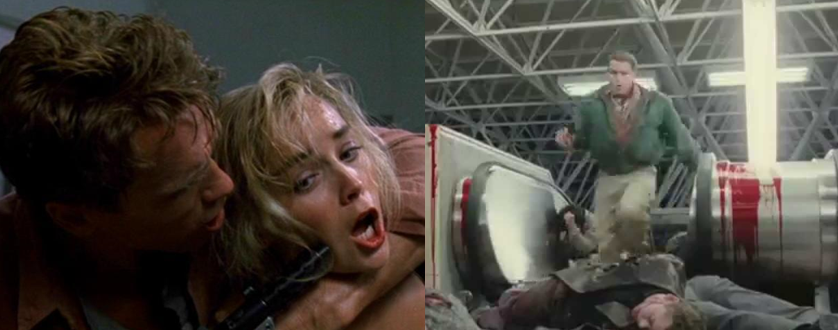
Movie Night: X-Men 2

Released: April 2003
Director: Bryan Singer
Distributor: 20th Century Fox
Budget: $110 to 125 million
Stars: Patrick Stewart, Ian McKellen, Hugh Jackman, Brian Cox, Famke Janssen, Rebecca Romijn-Stamos, Alan Cumming, James Marsden, Halle Berry, Anna Paquin, Shawn Ashmore, Aaron Stanford, Kelly Hu, and Bruce Davison

The Plot:
The war between humans and Mutants escalates after an attack on the President of the United States (Cotter Smith). Having interrogated Erik Lehnsherr/Magneto (McKellen), Colonel William Stryker (Cox) leads an assault on Professor Charles Xavier’s (Stewart) sanctuary for Mutants, scattering his X-Men and setting in motion a plot to rid the world of Mutantkind.
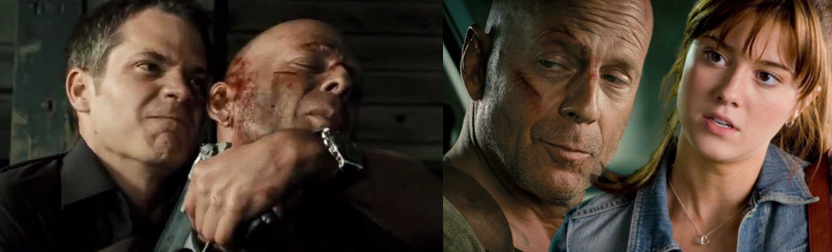
The Background:
After Stan Lee and long-time collaborator Jack Kirby created the original X-Men in 1963, Mutants have long been a staple of Marvel Comics; unlike many of Marvel’s superheroes, the X-Men (and Mutants in general) are hated and feared, standing in for oppressed creeds and minorities everywhere and giving Lee an easy way to produce numerous new superheroes with minimal effort. The X-Men later influenced a whole new generation through the much-lauded animated series from the nineties, the success of which led to 20th Century Fox purchasing the film rights and releasing the first live-action X-Men movie in 2000 with director Bryan Singer at the helm. Against the odds, X-Men proved a success, bringing in over $290 million against a $75 million budget. Production and development of a sequel began almost immediately, with Singer and producer Tom DeSanto both researching the more nuanced storylines of the X-Men comics, specifically God Loves, Man Kills (Claremont, et al, 1982), which introduced William Stryker into the X-Men lore. Singer also clearly drew inspiration from films like Star Wars: Episode V: The Empire Strikes Back (Kershner, 1980) and Star Trek II: The Wrath of Khan (Meyer, 1982) for X-Men 2’s bleaker, more sombre tone and sought to cast a bigger spotlight on the younger pupils of Xavier’s School for the Gifted. Allowances had to be made, however, when developing X-Men 2 (also known asX2” and even “X-Men: United”); after the release of X-Men, Halle Berry had won the Academy Award for Best Actress for her role in Monster’s Ball (Forster, 2001), necessitating that her character, Ororo Munroe/Storm, have more screen time. Other scenes, including the return of Sabretooth (Tyler Mane), the inclusion of the Danger Room, and an expanded role for Scott Summers/Cyclops (Marsden) were all cut due to the expanded cast and to keep the film at a reasonable length. After being released, X-Men 2 was a massive financial success, bringing in over $400 million in worldwide revenue and becoming the ninth-highest-grossing film of 2003. The critical reception was glowing as well and X-Men 2 still stands as one of the more well-regarded entries in Fox’s long-running X-Men franchise.

The Review:
As deep and impactful as the opening of X-Men was, X-Men 2 goes out of its way to top it with one of the most layered, complex, and engaging action sequences put to cinema; the film opens with Kurt Wagner/Nightcrawler (Cumming) infiltrating the White House and attacking Presidential guards. He is stopped short of potentially stabbing President McKenna but leaves behind a blade proclaiming “Mutant Freedom Now”. Immediately, the stage is set for an escalating conflict and that is the key word to describe X-Men 2: escalation. Everything that was great about the first movie is expanded upon and dialled up a notch, increasing both the stakes and the scope of Singer’s X-Men world.

X-Men 2 benefits from not having to waste its runtime on copious amounts of exposition.

As X-Men devoted so much of its time (arguably too much) to establishing the rules and lore of this grounded, quasi-science-fiction take on the X-Men, X-Men 2 doesn’t have to worry about wasting time establishing characters or expositing information. When we’re reintroduced to Doctor Jean Grey (Janssen), Cyclops, and Storm, we already have an idea of their characters as we were exposed to them, albeit briefly, in the first movie. As an added bonus, actions from the first film have consequences in the sequel: Jean’s powers are a bit out of whack after exerting herself in the conclusion of the first movie and Logan/Wolverine (Jackman) is first reintroduced having found the abandoned facility Xavier directed him to in the last film.

Logan’s paternal side is shown as he is left protecting the X-Kids.

The core X-Men are given far more to do this time around but, again, much of their screen time is taken away by other characters; however, whereas the Brotherhood were largely silent, one-dimensional antagonists in the first film, the “X-Kids” (Marie D’Ancanto/Rogue (Paquin), Bobby Drake/Iceman (Ashmore), and John Allerdyce/Pyro (Stanford)) are actually surprisingly well developed. We already know Rogue from the first film but, here, she’s far more comfortable in her own skin and with her powers; she and Drake struggle to reconcile their throbbing biological urges due to the nature of her powers but her story arc is indicative of the story of all of these X-Kids: maturity and growing into the role of an official X-Men. Both Iceman and Pyro get their own separate story arcs as well, both of which are far deeper and more developed than anything either Cyclops or Storm go through in the entire series! When Iceman, Pyro, and Rogue are forced from the X Mansion by Stryker’s team, Wolverine takes them to Iceman’s family in Boston. There, the film explicitly wallops us over the head with its themes by having Iceman “come out” as a Mutant to his family, who react in the same clichéd way as a lot of fictional (and real, I’m sure) parents do when their kids reveal themselves to be gay. Heartbroken at his family’s reaction, he leaves them behind to stick with his real family, the X-Men.

Storm may not get much but she’s got way more to do than Colossus or Cyclops!

Pyro, however, is vastly developed from a brief cameo in the first movie to an obnoxious, fire-obsessed, angry young kid; clearly resentful of Iceman’s comfortable upbringing, he is as hot-headed and temperamental as his powers dictate, aggressively lashing out at cops and growing increasingly tired of Xavier’s more passive teachings. When he meets Magneto, he is clearly in awe and, when Magneto panders to Pyro’s ego, willingly joins the Mutant extremist at the film’s conclusion rather than try to grow beyond his anger. Other Mutants are not so lucky; Peter Rasputin/Colossus (Daniel Cudmore) appears in a tantalisingly frustrating cameo and, as mentioned, Cyclops’ screen time is significantly reduced. Halle Berry may have moaned a lot about her character being side-lined but at least she often has some kind of significant role; here, she doesn’t just fly the X-Jet but she also uses her weather powers to create some bad-ass tornados (twisters? Whatever) and gets a lot of development through her interactions with Nightcrawler. Cyclops, though, bickers with Logan (again), is worried about Jean, has one fight scene, and then disappears for almost the entire movie before Marsden puts in a fantastically heartbreaking performance for the film’s conclusion. I’m not fan of Cyclops but his character deserved so much better than he gets in this, and all of these movies. When he’s missing, Logan implies that Jean doesn’t even love him…when she’s been married to him for years! Speaking of Logan, he has a far bigger, meatier role in this film and the narrative does an excellent job of tying his mysterious past into the plot of the film and the events unfolding. Add to that the fact that we get some absolutely brutal onscreen action thanks to his berserker rage and Adamantium claws and you have a film that really ramps up whenever Wolverine is onscreen.

Wolverine utlimately rejects his past and the chance to learn who he really was.

Wolverine’s past is given a bit more clarification through his interactions with Stryker, who teases Wolverine with hints and promises of revealing his entire past and origin. Ultimately, though, Wolverine rejects his past, whatever it may be, and chooses to side with the X-Men full-time. This character arc would eventually be deconstructed in subsequent sequels and spin-offs but it really works here to show that Logan has decided to put whatever his past was behind him and focus on the present. Stryker is also a fantastic addition to Singer’s world. A cold, calculating, manipulative villain who is motivated by a personal grudge against Xavier and a maniacal, xenophobic desire to control or wipe out all Mutants, his charisma and screen presence is more than up to the task of matching that of Magneto. Sadly, though, Stryker and Alkali Lake would go on to be continually used and beaten into the ground in later X-Men movies but Cox’s captivatingly snake-like performance still makes this first use of the character the best, in my opinion. Speaking of Magneto, X-Men 2 largely defines the grey area the character would come to occupy in subsequent films. Arrogant and pretentious, Magneto takes one step further into the dark in this film; though he and Mystique (Romijn-Stamos) are forced to team up with the X-Men out of mutual survival, they are both happy to mock, manipulate, and betray the team (and humankind) at a moment’s notice. In X-Men 2, Magneto develops into the ultimate opportunist and manipulator; he is the best kind of bad guy as he believes that he is right and you can sympathise and empathise with his beliefs, though his methods grow more and more questionable throughout the film, leaving him firmly in the role of villain by the film’s end.

The Nitty-Gritty:
I said that everything that worked about the first film has been expanded, improved upon, and dialled up a notch and it’s true: the effects are way better, for one thing, and the narrative is paced and constructed a lot better thanks to there not being a need for loads of exposition and world-building. It’s true, though, that Cyclops suffers greatly from the inclusion of so many new characters; even Mystique gets more to do and a bigger role, which is a real shame for the X-Men’s long-standing field commander.

Deathstrike makes for a formidable opponent for Wolverine.

X-Men 2 also has the benefit of included far more interesting and engaging action sequences; the opening, obviously, and Magneto’s escape from his ludicrous plastic prison (seriously, how was that build so fast?) spring to mind but the inclusion of Yuriko Oyama/Deathstrike (Hu) also delivers perhaps the best Wolverine-centric one-on-one fight scene so far. While Deathstrike is little more than another mute henchwoman, this fight more than makes up for her lack of personality; sporting Freddy Krueger-like Adamantium claws, Deathstrike is like a mixture of Sabretooth’s raw animal power and Mystique’s athletic grace and is more than a match for Wolverine. When they get into it, it’s an especially brutal fight that, alongside Wolverine’s enraged skewering of Stryker’s soldiers, would set the scene for further Wolverine spin-offs.

Stryker hates all Mutants and personally blames Xavier for the death of his wife.

Two of the film’s core themes are faith and family; faith is exemplified through Nightcrawler but family is portrayed in numerous different ways. Iceman’s family rejects his true nature, so he turns to his surrogate family; Wolverine also finds himself committing to this same surrogate family by the film’s end and the larger role played by the X-Kids and the pupils helps to emphasise that Xavier is a father figure as much as a mentor and teacher. The other side of this theme is portrayed through Stryker and his Mutant son, Jason (Michael Reid MacKay); convinced that mutation is a disease, Stryker was unable to accept that his son couldn’t be cured and driven half-mad when Jason used his vision-inducing powers to drive his wife to suicide. Stryker then developed a serum to control and brainwash Mutants using Jason’s cerebral fluid and had his son half-lobotomised in order to overpower Xavier; he even declares “My son is dead!”, indicating the lengths to which his madness and obsession with destroying Mutants has gone.

Nightcrawler was a great addition and a continual influence on the franchise.

One of the most influential additions to the film apart from Stryker, though, was Nightcrawler; as a new addition to the world, and the team, a surprising amount of nuance and detail is given to Nightcrawler’s characterisation and backstory. He has far more layers to his character than any of the three X-Men had in the first film and I learn more about Nightcrawler and what makes him tick in this film than I do about Cyclops in the entire series! Nightcrawler was in the circus, he’s a Mutant of devout faith, and he pities those who hate and fear him rather than hating them; despite his demonic appearance, he’s a Mutant of peace and inclusion. Compare this to what we know about Cyclops: he likes cars and motorcycles, is committed to Xavier (though we don’t know the specifics of what drives that devotion), loves Jean, dislikes Logan, and is a bit afraid of his full potential. Who is he? What’s his story? In one scene, we learn more about Nightcrawler than we do Cyclops in two movies and there’s something very wrong about that.

Jean struggles with her powers and ultimately sacrifices herself to save her friends and family.

And then there’s Jean. In X-Men, she was just kind of…there. It was explicitly stated that she was nowhere near as powerful as Xavier, yet she was also a medical doctor so she wasn’t entirely useless (though her characterisation wasn’t up to much). Here, she spends the whole film struggling with her powers, which are wildly in flux and unpredictable. Her doubts cause a few moments of danger for the team but, when her friends and family are about to be wiped out by a wall of water, she ultimately choose to sacrifice herself to save them. Why? Well…because that happened in Wrath of Kahn, obviously, and Singer wanted to lay the groundwork for the much-coveted “Phoenix” arc of the comics. Jean regularly takes on an ethereal, fiery glow as she strains her powers to their limits and the silhouette of a phoenix can be seen after she has apparently died. While this storyline was largely botched in the sequel (and then again a few years later), it’s clear what Singer was going for here but, to me, the execution falls a bit flat. Why didn’t she just stay on the jet?

The Summary:
It’s obvious why X-Men 2 is still so renowned; it’s a far superior film compared to its predecessor and is worlds above its successor. It expands upon the world and the characters of the first film so much and actually feels like a real X-Men movie from start to finish, balancing the use of Wolverine and the involvement of its other characters really well (as long as you ignore Cyclops…) For me, it’s clearly still one of the best, if not the best, X-Men movies and is definitely in the top three but a lot of my enjoyment of it is soured by how poorly its plot threads were handled in the sequel and how Fox continually went back to the well and kept bringing back Stryker, Alkali Lake, and Nightcrawler (or Nightcrawler-like characters). It isn’t enough to make me say I dislike the film, though, as it still holds up really well and is a vast improvement on the original.

My Rating:

Rating: 4 out of 5.

Great Stuff

What are your thoughts on X-Men 2? What title did it have where you are from? How do you feel it holds up these days? Does it still rank high in your list of X-Men movies or do you, perhaps, place it lower? Whatever your thoughts on X-Men 2, or X-Men in general, leave your thoughts below and be sure to check out my review of the thirdX-Men film.

Movie Night [Turtle Tuesday]: Teenage Mutant Ninja Turtles


The first issue of Kevin Eastman and Peter Laird’s Teenage Mutant Ninja Turtles (TMNT) was published in May of 1984. Since then, the TMNT have gone on to achieve worldwide mainstream success thanks not only to their original comics run but also a number of influential cartoons, videogames, and wave-upon-wave of action figures. Even now, the TMNT continue to be an influential and popular commodity, proving that some fads don’t die out…they just get stronger!


Released: 30 March 1990
Director: Steve Barron
Distributor: New Line Cinema
Budget: $13.5 million
Stars: Brian Tochi/David Forman, Corey Feldman/Leif Tilden, Josh Pais, Robbie Rist/Michelan Sisti, David McCharen/James Saito, Judith Hoag, Elias Koteas, and Kevin Clash

The Plot:
New York City is under siege by a crime wave perpetrated by masked hoodlums calling themselves the “Foot Clan”. When reporter April O’Neil (Hoag) tries to bring their organisation to light, the Foot’s leader, Oroku Saki/The Shredder (McCharen/Saito) orders her death but she is saved by four turtles, mutated into humanoid form and trained in martial arts and the way of the ninja, who live in the sewers. When the TMNT’s master, Splinter (Clash) is attacked and held captive by the Foot, they must work to set aside their differences, end the Shredder’s schemes, and finally settle an old grudge between him and their master.

The Background:
I’ve talking in great detail about this before but you must be surprised to learn just how dark and violent the TMNT originally were; created and self-published by Kevin Eastman and Peter Laird back in 1984, the TMNT were influenced by the works of Frank Miller and comic books like Daredevil, the New Mutants, Ronin (Miller, et al, 1983 to 1984), and Cerebus (Sim and Gerhard, 1977 to 2004). As such, the four mutated ninjas were rendered in striking black and white and exposited stoic, stilted dialogue (largely through text boxes) in a clear pastiche of Miller’s trademark art and writing style. The extremely popular 1987 cartoon catapulted the TMNT to mainstream superstardom, transforming them from dark, violent anti-heroes to cute, cuddly, kid-friendly “Hero” Turtles. As such, for many children (myself included), our first taste of just how violent the TMNT could be was this live-action feature film, which blended elements of both the cartoon and the comics to create what is, for me, the quintessential TMNT movie. To bring the TMNT to life, the filmmakers wisely went to Jim Henson’s Creature Shop to create highly sophisticated suits and animatronics, giving the film a truly timeless feel not just because of nostalgia but the sheer quality of the film’s practical effects. Teenage Mutant Ninja Turtles, unsurprisingly, debuted at number one at the box office and went on to earn over $200 million, meaning it was a massive success. Perhaps due to the film’s subject matter and target audience, critics were somewhat divided on their opinion of the film but it has gone on to be a cult favourite for many and, of course, spawned two sequels (one which I believe to be under-rated and the other which was hot garbage).

The Review:
The film begins by showcasing and emphasising the crimewave that is sweeping through New York City; April narrates in her broadcast the particulars of these events and we see how teenagers and youths are picking pockets and stealing stuff all over the place and delivering it to the Foot Clan. This sets up right away that the city is, in effect, under siege and the police are powerless to really stop it and hints towards possible corruption in the police department as a result of the Foot’s influence. Despite the warnings of Charles Pennington (Jay Patterson), her boss, April is determined to run with the story; she’s that typical reporter cliché we’ve seen hundreds of times in a multitude of media, always chasing the story and butting heads with those in authority, and seemingly ignorant to any threat against her person. This backfires on her when the Foot confront her, apparently looking to kill her, but she puts up a decent fight despite the odds being stacked against her, which really helps sell her as this tenacious and ballsy character.

April is a strong, ballsy ally to the TMNT who isn’t afraid to stand up to injustice.

April gains additional layers as the film progresses; though she first reacts with fear and horror at the appearances of the TMNT and Splinter, she soon becomes captivated by their origin story, sympathetic to their cause, and befriends them, showing genuine affection towards each of them and offering them a place to stay after Splinter is abducted and presumed dead. She also has a lot of friction with Casey Jones (Koteas) at first but the two eventually warm to each other as they spend more time together; though she doesn’t really factor into the film’s finale, she’s the glue that holds the characters together and drives the plot into motion. Plus, even better, she never becomes a simple damsel in distress and is, instead, both an audience surrogate and a useful ally when the TMNT are left directionless after Splinter’s kidnapping.

Raphael’s hot-headed nature causes him to clash with Leo and sees him seriously hurt.

The film does a great job keeping the TMNT hidden and obscured in the early going; they strike from the shadows and are only heard, rather than seen, until dramatically leaping into view in all their practical and animatronic glory. Each of the TMNT has a distinct look (Michelangelo (Rist/Sisti) is shorter and pudgier, and Leonardo (Tochi/Forman) is leaner and more toned, for example), colourations, and blemishes to help distinguish them beyond their different bandana colours. Each also sports a different and unique voice and accent, with Raphael (Pais) favouring more of a Brooklyn twang and Mikey having that “surfer dude” style of speech that the TMNT were known for in the cartoons. Additionally, each has their own personality and character arc in the film to help separate them and make them relevant; of them all, though, it is Raphael who gets the most recognisable story arc as he is the angry, antagonistic, hothead of the group. He expresses both ager and frustration at having lost his sai in the beginning, frequently defies Leo’s authority and leadership, and makes numerous trips to the surface in a ridiculously basic disguise. Of all the TMNT, Raph is the one who takes Splinter’s abduction the worst, reacting with a gut-wrenching cry of anguish and lashing out at both friend and foe alike. He ultimately pays the price for this when he is jumped and beaten by the Foot and spends the second act of the film semi-conscious in a bathtub. Faced with his mortality, he makes amends with his brother and the TMNT begin training anew as a complete group to take the fight to the Foot Clan.

The TMNT work best as a team, where they are a formidable force despite their bickering.

Leo’s character arc is subtle but present; he’s the field leader of the group but they are all relatively untested in live combat so there are some kinks to work out in the dynamic. Obviously, the most explicit example of this is seen in his frequent clashes with Raphael but we also see Leo struggling to hold his brothers together in Splinter’s absence and he is the only one balanced enough to successfully contact Splinter through meditation and eventually comes to lead the group in their battle against Shredder. Conversely, Donatello (Feldman/Tilden) doesn’t really get much of an opportunity to really stand out or do much in the film, showcasing none of the intelligence or technological ability he is generally known for; however, he is the only one to use bigger, more verbose words in his vocabulary, to notice when April’s apartment is becoming structurally unstable, and to help fix up the vehicle at the farmhouse so these elements aren’t entirely absent. He also attempts to address the implications of Splinter’s absence to the team and bonds with Casey during the sojourn at April’s farmhouse and gets a lot more to do than Mikey, who is the childish goof of the film and exists mainly to complete the group and act as the comic relief. He doesn’t even get highlighted during April’s narration at the farmhouse and has few stand out moments beyond being a loveable goofball and his cringe-worthy, but amusing, series of impressions. Still, the appeal of the TMNT has always been the group dynamic rather than the individuals; when Raph is injured, the team is noticeably fractured and struggles to coordinate their efforts without all four of them and, though they often clash and are very different, even volatile personalities at times, they work best when they are a team. The film really uses their amusing bickering, interpersonal conflicts, and complex interactions to sell the idea of the TMNT being four teenaged brothers; of course they don’t always get along and they are far from perfect but this serves only to highlight them as relatable and full-realised characters even when some of them get ore screen time and development than others.

Splinter is the TMNT’s wise mentor and father-figure whose absence affects them greatly.

The TMNT are guided in their growth and development by Splinter, their mentor and father-figure; each of the TMNT has a different relationship with Splinter, who is a calm and wise teacher who indulges but often despairs over their more childish ways and personality quirks. Leo treats Splinter with a reverence and respect, Mikey takes him somewhat for granted and isn’t willing to think about life without him, Don is the opposite and worries about Splinter’s mortality, and Splinter struggles to get through Raph’s anger. Splinter spends much of the film as Shredder’s captive but, while he is clearly suffering and, perhaps, close to death during this torture, he not only remains tight-lipped but is also able to impart his knowledge on to Charles’s son, Danny (Michael Turney), and make contact with the TMNT via semi-telepathic meditation. Splinter also gets his own arc in the film, having raised the TMNT using teachings he learned as an ordinary rat and, ultimately, confronting and besting the man who killed his master. April isn’t the only audience surrogate in the film though; we also get one of my favourite characters in the franchise, Casey Jones, the hockey mask wearing, sports-gear-wielding vigilante who initially clashes with Raphael before falling in with the TMNT and forming a friendship with them, especially Donatello. We don’t learn a massive amount about Casey or his motivations beyond vague hints towards an injury keeping him from going into professional sports, that he’s extremely claustrophobic, and that he appears to a homeless vagrant but Koteas brings a real likeable charisma and snark to the role and Casey ends up helping out a lot in the film’s finale by rescuing Splinter and confronting Shredder’s main henchman, Tatsu (Toshishiro Obata/Michael McConnohie).

Shredder cuts an intimidating figure but his plot to turn teens into ninja thieves is a bit suspect…

Speaking of Shredder, he’s a far more subdued and calculating individual compared to his boisterous animated incarnation. Rather than wishing to conquer the city, the world, or employ resources from another dimension, Shredder’s entire plot seems to be about building an army of ninja warriors and thieves, turning disillusioned teens into petty crooks and fostering their resentment of authority figures by allowing them to indulge their every whim. It’s not entirely clear what his larger endgame is but it’s enough to amass him a formidable criminal enterprise and to have the city in a state of…maybe not fear but definitely apprehension. Of course, it turns out that the Shredder is actually Oroku Saki, the man responsible for killing Splinter’s master. This isn’t revealed until right at the very end of the film, moments before the Shredder’s defeat at Splinter’s hands, but the TMNT’s battle against the Shredder is highly emotionally charged nevertheless thanks to the beating the Foot deliver to Raphael, Shredder being behind Splinter’s abduction, and Shredder’s assertion that their father-figure is dead. Unlike his lowly minions, Shredder is a formidable combatant, able to easily match and best the TMNT in a four-on-one battle and exuding menace and authority through this very presence.

The Nitty-Gritty:
Having grown up watching Teenage Mutant Hero Turtles as a child, I had no idea how dark and violent the original TMNT comics were; the film was in stark contrast to the TMNT media I was exposed to on a semi-regular basis and, at the time, I saw it as a darker, more serious reimagining of the concept. Still, it impressed me then and it still impresses now not just as easily the best live-action adaptation of the comic books but also how closely it sticks to the original comics. A few elements are changed here and there and the TMNT look and act a lot more like their animated counterparts, but this is all to the film’s benefit as the early comics took a while to actually make distinctions between the otherwise-interchangeable TMNT. It always bugged me how the TMNT have these weapons and martial arts skills and yet never seemed to use them; the film doesn’t show them skewering or slicing up their enemies like in the comics but it does make far better use of their weapons and skills to portray them as competent and dangerous combatants. That’s not to say that the film isn’t violent, though; it’s full of a violent and disturbing subtext that suggests a threat just as real as the gore seen in the comics. This is seen in the Foot’s merciless beatdown of Raphael and the big fight between the remaining TMNT in April’s apartment, which sees the Foot swinging axes and other edged weapons with clear deadly intent and the film’s glorious interpretation of the Shredder as a razor-clad foe who clearly means business and has much more in common with Darth Vader (David Prowse/James Earl Jones) than the bungling fool seen in the cartoon.

The film strikes just the right balance between goofy humour and violence.

One of the film’s most violent scenes comes when Tatsu, Shredder’s gruff, intense, mostly-silent underling beats one of their teenage inductees to within an inch of his life. In fact, it’s pretty clear that Tatsu does kill the boy and that a line was dubbed in to keep the victim alive but, even so, that (and the fact that the TMNT carry the clear bruises and injuries of their many battles) really sells the notion that the film isn’t some goofy cartoon and means serious business. The fact that it is able to take a concept as ridiculous as the TMNT and treat it so seriously is to be commended; the TMNT and Splinter are the most outrageous aspects of the film, with everyone who sees them reacting in shock, fear, disgust, and incredulity but, once you accept that these mutated beings exist, the film is almost the exact opposite of its animated counterpart. There’s humour, of course, largely thanks to the TMNT’s goofy antics and sense of humour but, for the most part, it’s a dark and gritty take that is a fantastic compromise between the violent comic books and the more kid-friendly cartoon. A central theme in the movie is that of family and fatherhood; Danny is an angry, angst-ridden teen who resents his father and wants to rebel against him (and authority in general). His emotional confusion is a pivotal sub-plot as he struggles to fit in with the Foot, doesn’t feel like he belongs or is appreciated at home with his Dad, and becomes conflicted after befriending Splinter.

Family and fatherhood are central themes to the movie’s plot.

Shredder acts as a surrogate father to Danny and his teenaged wannabe ninjas, offering the cheap thrills of sin and indulgence in return for their unwavering loyalty, and Splinter acts as a father to the TMNT. His absence deeply affects each of the brothers and he, too, misses them greatly during his capture and torment; this comes to a head during the group’s meditation practice where he expresses his love and pride for his “sons” and the five are reunited in the finale. The theme here is that family isn’t perfect: the TMNT continuously bicker and are somewhat dysfunctional as personalities despite how well they work together when in battle, Shredder is clearly using and manipulating the kids under his command, Danny has to accept this his father is only acting in service of his best interests, and Charles has to learn that Danny is becoming his own man now and to not treat him like a kid. Of course, the real star of the film are the incredible practical effects used to bring the TMNT and Splinter to life; the TMNT suits are incredibly well realised, full of distinct details and little nuances to distinguish each character and make them feel alive and real. Though their eye masks could be better (they look fake and glued to the their heads rather than being actual fabric coverings wrapped around their eyes), the animatronic heads are an incredible technological feat allowing the TMNT to express a range of emotions, expressions, and even eat pizza convincingly. Splinter looks the most like a practical puppet thanks to his frail frame and less humanoid proportions but he is nevertheless and impressive practical effect, looking wizened and being very expressive and dynamic in his range of motion, and I especially like how he has a wet nose.

The Summary:
Even now, some thirty years since its release, Teenage Mutant Ninja Turtles continues to impress; the practical suits and effects used in the film make it a timeless classic that is way better than it had any right to be and ensures that it holds up under close scrutiny in today’s digital age not just thanks to nostalgia but also because of just how much clear love and effort was put not just into bringing these ridiculous characters and concepts to life but also treating them with a level of respect and reverence that you rarely saw in adaptations of such concepts back then. As a compromise between the dark and violent comic books and the bright and goofy cartoon, Teenage Mutant Ninja Turtles still works surprisingly well; it’s probably the closest we’ll ever get to a straight one-to-one adaptation of the original concept since the TMNT’s wider appeal and commercialisation lie sin their accessibility and recognisable elements like their “surfer dude” attitudes, obsession with pizza, and individual colour schemes. Nowadays, it’s widely known how violent and dark the original concept was and we’ve seen those elements work their way back into the franchise’s later animated incarnations but it was this film that was the first to bridge that gap and to showcase just how much the original concept had been changed to appeal to a wider, more mainstream audience.

My Rating:

Rating: 5 out of 5.

Fantastic

What are your thoughts on Teenage Mutant Ninja Turtles? Do you think the film still holds up today or do the rubber suits and practical effects put you off? Which of the TMNT is your favourite and why? What was your first exposure to the TMNT as a kid and which of their various incarnations is your favourite? What do you think Shredder’s endgame was in the film and would you like to see another crack at the source material using modern technology to create more practical versions of the TMNT? How are you celebrating the TMNT’s debut this month? Whatever your thoughts on the TMNT, leave a comment down below.