Movie Night [Sci-Fanuary]: The Matrix Resurrections


January sees the celebration of two notable dates in science-fiction history, with January 2 christened “National Science Fiction Day” to coincide with the birth date of the world renowned sci-fi writer Isaac Asimov, and HAL 9000, the sophisticated artificial intelligence of Arthur C. Clarke’s seminal 2001: A Space Odyssey (1968), being created on 12 January. Accordingly, I have decided to spend every Sunday of January celebrating sci-fi in all its forms.


Released: 22 December 2021
Director: Lana Wachowski
Distributor: Warner Bros. Pictures
Budget: $190 million
Stars: Keanu Reeves, Jessica Henwick, Yahya Abdul-Mateen II, Carrie-Anne Moss, Jonathan Groff, and Neil Patrick Harris

The Plot:
Twenty years after the events of The Matrix Revolutions (Wachowski Brothers, 2003) Neo (Reeves) lives a seemingly ordinary life as Thomas A. Anderson in San Francisco where his therapist prescribes him blue pills. However, when Morpheus (Abdul-Mateen II) offers him a red pill, Neo finds his mind reopened to the world of the Matrix.

The Background:
Andy and Larry Wachowski (as they were known then) hit upon their greatest and most notable success when they were able to sell Warner Brothers on The Matrix, a science-fiction film that was heavily influenced by manga and anime and made an instant and lasting impression on cinema by popularising “bullet time” and “wire-fu”. Produced for a paltry $63 million, The Matrix was a massive hit that is spawned not only two sequels but a whole slew of multimedia merchandise. However, neither of the sequels garnered quite the same critical reaction as the quasi-cult hit original; while the directors were content to allow the story to be continued, and ended, in The Matrix Online (Monolith Productions, 2005 to 2009), rumours continued to persist that a fourth film was being considered, with stars Reeves and Hugo Weaving both expressing interest in revisiting the franchise. Development of a continuation finally gained traction in 2017, when writer Zack Penn was confirmed to be working on a fourth instalment of some kind; although Lily Wachowski chose not to commit to such a large scale production, she gave her blessing and her sister, Lana, officially returned to direct the fourth film alongside returning stars Reeves and Cary-Anne Moss. Framed as a direct continuation of where the third film left off, fans were left confused when the first trailer dropped and Lawrence Fishburne announced that he was the only member of the original cast not asked to return. The movie also attracted undue criticism when filming damaged buildings and street lights in San Francisco, and was delayed due to the COVID-19 pandemic, but The Matrix Resurrections finally released and accrued a disappointing $15738 million at the box office. It was also met with largely mixed reviews; critics praised the film’s sentimental value and the return of its familiar characters while also criticising it as a redundant revisitation suffering from muddled execution.

The Review:
If you’ve read my review of the original film, you’ll know that The Matrix is one of my all-time favourite films and franchises; I was obsessed with the first film when it came out and watched it religiously on sleepovers with friends. The film was ground-breaking and endlessly alluring at the time and, while some elements haven’t aged too well, it remains a firm favourite of mine. I even really enjoy the blending of philosophy and high-octane action featured in the second film and, though I was disappointed by the third, I felt like the trilogy had been wrapped up decently enough and was somewhat annoyed to find that the franchise was going to be dusted off some twenty years later (twenty years! Man, do I feel old!) as I felt like the story had been told and it seemed like a cheap cash grab to me. But…it’s the Matrix, and I do love me some Keanu Reeves, so I was obligated to check it out if only to satisfy my own morbid curiosity and having been intrigued by the vague trailers and marketing.
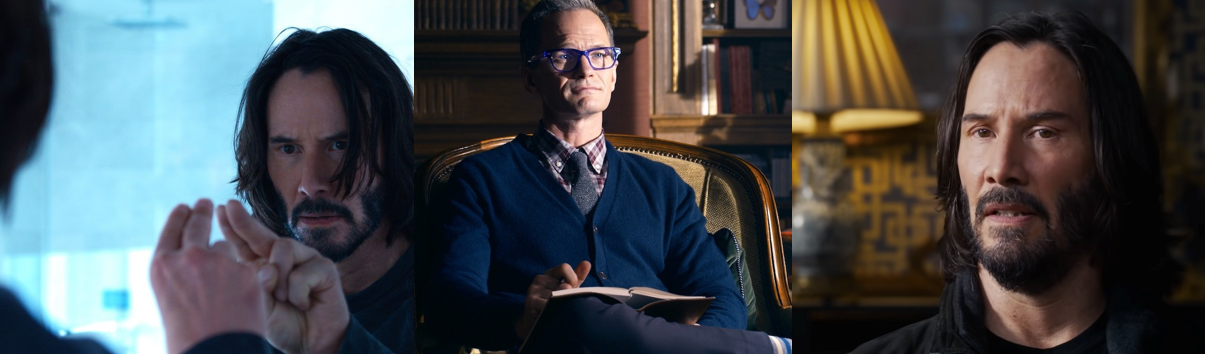
Thing are not all they seem for Anderson, whose perception is skewed by fragmented memories.

It’s a good job that I am such a fan of Keanu’s and the Matrix franchise as those elements ended up being some of the best parts of The Matrix Resurrections. Framed as a kind of re-quel, which treads over familiar ground (and even splices in footage of the original trilogy as flashbacks and dream sequences) while advanced the story twenty years after the last film. Despite apparently sacrificing his life to bring about peace between the machines and the humans of Zion, the man once known as Neo is alive and well in a new version of the Matrix, one without the green tint and grungy filter. Back in his original identity of Thomas A. Anderson, he is a successful videogame designer who found fame and fortune by creating an incredibly successful trilogy of (presumably virtual reality) videogames based on his disparate memories of the first three films. However, just as Anderson’s dreams and fragmented memories have created a virtual world for millions of players, so too have them plagued his sense of reality, and even drove him to try and leap off a rooftop in order to “fly away”. Following this apparent suicide attempt, his business partner, Smith (Groff), requests that he attend regular therapy sessions with the ominously named Analyst (Harris) and, thanks to a constant prescription of blue pills, Anderson is able to keep himself from suffering a psychotic break.
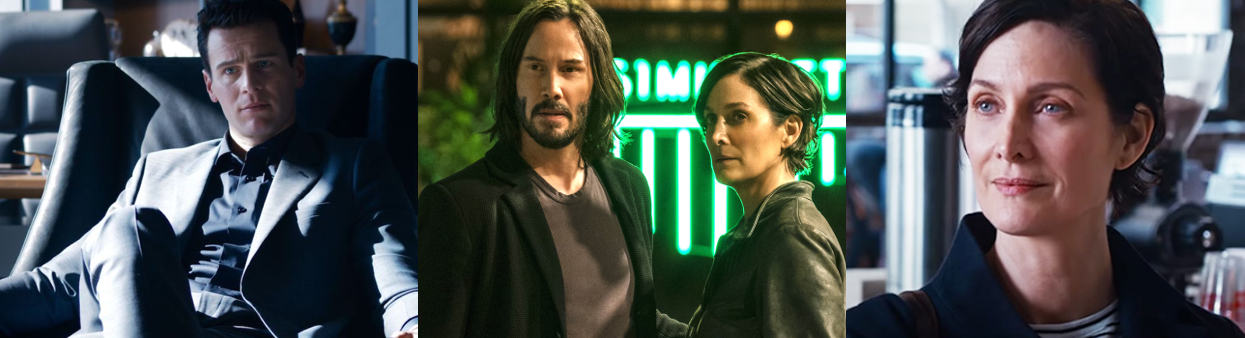
Anderson is captivated by Tiffany, whose visage stirs up memories of Trinity .

Despite being deep into the production of a new videogame, Binary, for is company, Deus Ex Machina, Anderson is disturbed by Smith’s insistence that they work on a new Matrix videogame, leading to a montage sequence wherein Smith, Anderson, and his fellow programmers and stuff wax lyrical with some metatextual, on the nose commentary about big corporations mining familiar franchises just to make more money off previous successes. Sadly, this kind of fourth-wall-breaking discussion permeates a great deal of The Matrix Resurrections, with even Anderson himself being saddened to be taking a creative step backwards rather than trying something new and innovative. His only reprieve is his infatuation with Tiffany (Moss), a beautiful woman he sees on a consistent basis in a coffee house and who reminds him of Trinity, a woman from his dreams and whom he programmed into his videogame. When not struggling to strike up a conversation with her, or debating his sanity, or working on Binary, Anderson is running a singular module of The Matrix that recreates the iconic opening of the original film, but with a few alterations to mix things up, but for the most part is fairly convinced that he’s just a videogame designer with mental issues and a skewed sense of identity.
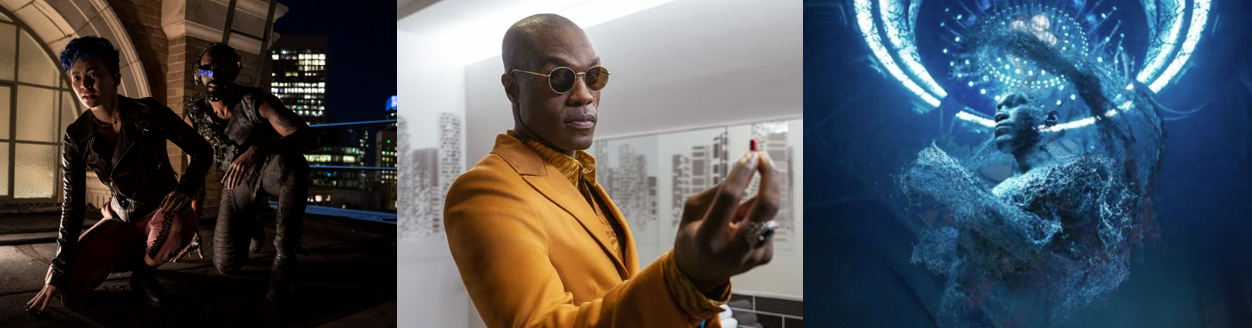
Allies old, new, and fundamentally changed work to bring Neo back to the real world.

All of that changes when he is suddenly met by a new incarnation of Morpheus, one seemingly pulled from his videogame world, who offers him a familiar choice: stay in his reality, or return to the real world. If you were wondering whether Lawrence Fishburne makes an appearance in this film, or his perhaps adopting a new avatar, you’ll be disappointed to find that Morpheus is long dead and only appears in archival footage; instead, where get this new version of Morpheus, one apparently spliced with elements of Neo’s old nemesis, Agent Smith (Hugo Weaving), to act as an agent within that loop. A far more mischievous version of the character, this new Morpheus is actually a sentient program, of sorts, who is able to communicate with and assist the heroes in the real world thanks to an advanced kind of nanotechnology, but he’s far from the wise mentor figure of his predecessor. Instead, he ‘s more like a necessary component to help convince Anderson to leave the Matrix and reclaim his identity as Neo, something he is largely reluctant to do thanks to the Analyst’s influence on his perception of the world. Still, Neo’s curiosity and familiarity with the words and images presented to him by Morpheus override his hesitation, and he’s soon joining Captain Bugs (Henwick) and the rest of her crew aboard the Mnemosyne hovercraft, sixty years after sacrificing himself to save Zion. Neo is disorientated and melancholy to find that his sacrifice didn’t appear to change much about the world, but Bugs takes him to the new Zion, Io, and reunites him with an elderly, cynical Niobe (Jada Pinkett Smith) and learns that a peace does exist between man and machine. Shortly after the end of the war, the Matrix was purged of all former anomalies and blue-tinted machines helped the remnants of humanity to build a new haven and worked with them to grow fresh fruit and vegetables, while staving off attacks from the red-tinted, squid-like Sentinels that refused to abide by the peace treaty. The original Morpheus refused to believe that Neo’s sacrifice would fail, which led to Zion’s destruction, and a contingent of people have grown up idolising and even deifying Neo and Trinity for their actions, but Niobe’s primary concern is keeping her people safe, which leads to her reluctantly locking Neo up and pushing Bugs to defy her commander’s direct order and help spring Neo so that he can lead a desperate reinsertion into the Matrix to try and rescue Trinity.

The Nitty-Gritty:
If you’re a fan of the original film but haven’t really seen it in a while, then The Matrix Resurrections really has you covered, for the most part. It opens almost exactly like the original film, and the majority of its call-backs and references are to the ground-breaking original while repurposing some of the stronger elements of the sequels in new ways. One thing that is sadly largely absent from the film, however, is the kung-fu (or “wire-fu”, to be more accurate) fight scenes that so heavily influenced action cinema right up to present day. The first half of the film is a slow, introspective reintroduction to the world of the Matrix, one both familiar and disconcertingly different, as we follow Neo and try to figure out what’s real and what isn’t. Thanks to his fragmented memories and a skewed avatar, his sense of reality is more shot than ever, but he starts to piece his identity back together once he reawakens in the real world and is put through his paces by Morpheus. However, this isn’t really the all-powerful, full capable Neo we knew and loved; instead, he’s plagued by self-doubt and has no interest in fighting any more, especially after giving everything he had seemingly for nothing. While the world is noticeably better than the one he remembers, humanity is still somewhat divided; less and less people have been freed from the Matrix thanks to Niobe’s focus on keeping those who are free safe and the system of control he fought so hard against has simply been repurposed by a contingent of malevolent machines.
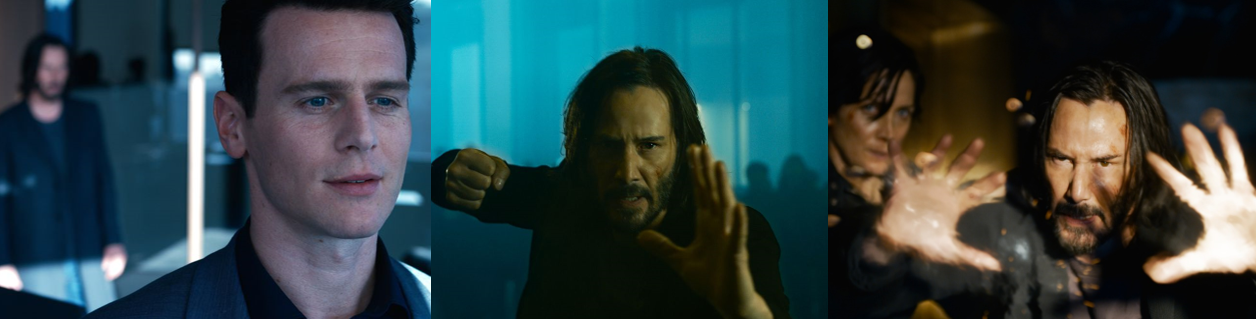
The new Smith offers little in the way of challenge for Neo, or interest to me as a viewer.

After his sacrifice, Neo’s body was taken away by the Analyst, who is revealed to basically have replaced the Architect (Helmut Bakaitis) and is behind the stability of the Matrix’s new iteration and the resurrection of Neo and Trinity. Initially looking to study them, he patched them back together using a combination of the cloning technology used to grow humans and additional mechanic parts, only to find that their incredible bond threatened the very Matrix itself. However, when kept safely apart, their very presence in the Matrix vastly improved the energy output and acceptance of those plugged in, thus largely negating the peace Neo so desperately fought for. With Neo unplugged, the machines are on the brink and a new reboot of the system, something which Smith is adamant to prevent as it would mean he would once again be absorbed into the Matrix code. However, this is not my Smith; I’m sure Jonathan Groff is a great actor, and he’s clearly doing his best to channel Hugo Weaving at points, but he’s a faint shadow of Waving/Smith’s former greatness and I actually question including him at all. Had the filmmakers brought Weaving back and had Smith, like Neo, also suffer from fragmented memories and a new life, then maybe his inclusion would have been worthwhile but, instead, Smith feels very tacked on and largely inconsequential. There’s a moment where it seems like he and Neo would join forces this time around (and that does crop up again in the finale, with very little explanation), but it quickly gives way to a bust-up between the two that is one of the few highlights of the film, recalls their subway fight from the first film, and is spoiled only by the inexplicable and completely pointless insertion of the Merovingian (Lambert Wilson) and his exiles.
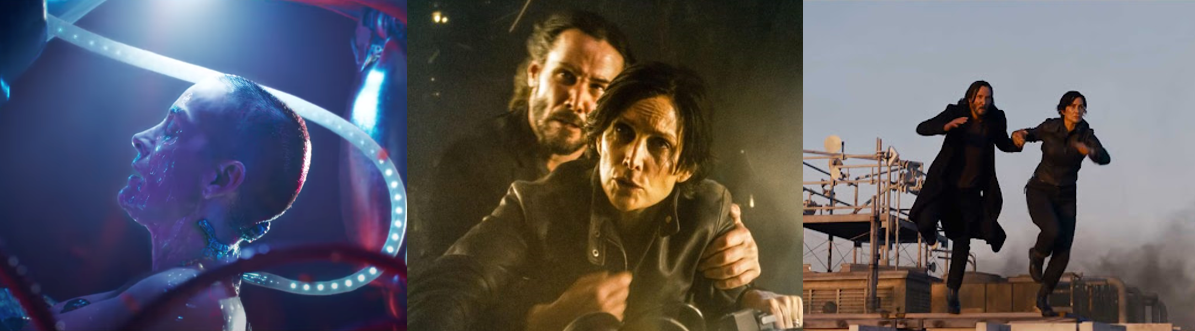
Despite some good moments, it’s an unnecessary retread of things done better in the previous films.

A great deal of the film’s emphasis is, instead, on reuniting Neo with Trinity; while their romance was severely lacking in chemistry in the original trilogy, save for a few choice moments, they seem much more comfortable at ease with each other here, arguably because of the Analyst’s efforts to bestow them with new lives and personalities. While still a troubled and largely stoic reluctant saviour, Neo has a few more moments of levity here than in the original films, where he rarely showed much emotion at all, but is still as blinded by his love for Trinity as ever as he risks the fragile peace between Io and the machines by leading a risk attempt to convince her to return to him and the real world. This involves Bugs and Morpheus infiltrating the machine city, where Trinity’s body is held, with the help of their machine allies and Neo bartering with the Analyst with everyone’s future on the line. This proves to be a risky proposition as Neo’s God-like powers are both neutered and noticeably different this time around; although he still knows kung-fu, he cannot yet fly and his more acrobatic feats come in bursts, but he can still stop bullets and even has much more emphasis on creating shields and blasting foes away. The Analyst, however, proves to be a formidable foe as he’s ability to manipulate the Matrix’s famed “bullet time” technique to slow even the One to a crawl, but in the end he’s undone thanks to a tricky plot that sees Neo get through to Trinity, Bugs swap out with her physical body, and Trinity randomly revealed to be a new incarnation of the One as she and Neo fend off the Analyst’s swarm of ‘bots and fly off with a promise (more like a threat) to rebuild the world free from the Analyst’s influence.

The Summary:
I was hesitant about The Matrix Resurrections; the trailers were questionably vague and trying a little too hard to be mysterious for my liking, something which has only led to disappointment where the Matrix is concerned in the past. They also made the film seem to be a retread of the original, but over twenty years later and with some cast members inexplicably returning or absent. I feel like I could have maybe understood the need for a new Matrix movie if we’d had an entirely new cast, with maybe only Keanu returning, or seen the One reborn within the Matrix but in Keanu’s body once again (confirming a long-held theory of mine that the One always looks like Neo) rather than finding a pretty weak excuse to bring both Neo and Trinity back. It was pretty great seeing Neo back onscreen and revisiting the Matrix lore after the third movie to see where things had progressed, but I think the film played things a little too safe; not much has really changed thanks to the contingent of machines still warring against humanity, and I would have preferred to see humans and machines living and working together without any major discord and maybe have some the rogue faction be a more prominent plot point. So much of the film is focused on reintroducing Neo and the Matrix to us, which would probably be interesting for anyone who hasn’t seen the original films, but I’d wager that the vast majority of the audience has so I kind of wanted to get things moving, or maybe spend more time seeing how the Analyst was screwing with Neo’s mind rather than retreading the same old ground again but with different actors. In the end, it was an interesting enough epilogue to one of cinema’s most influential trilogies, but I honestly dread to think where the story will go when Warner Bros. greenlight an inevitable follow-up.

My Rating:

Rating: 2 out of 5.

Could Be Better

Have you seen The Matrix Resurrections? If so, what did you think to it? Did you enjoy the direction the story took Neo and how it handled his and Trinity’s resurrections or would you have preferred to see the franchise stay dormant? Which of the new was your favourite and did you like seeing how the relationship between humanity and the machines had progressed? Were you disappointed by the lack of Lawrence Fishburne, Hugo Weaving, and proper fight scenes? Which of the other Matrix sequels or spin-offs was your favourite? How are you celebrating National Science-Fiction Day today? Whatever you think about The Matrix Resurrections, sign up to leave your thoughts below or drop a comment on my social media, and be sure to check in next Sunday for more sci-fi content!


Movie Night [Christmas Day]: The Muppet Christmas Carol

Released: 11 December 1992
Director: Brian Henson
Distributor: Buena Vista Pictures Distribution
Budget: $12 million
Stars: Michael Caine, Dave Goelz, Steve Whitmire, Jerry Nelson, Frank Oz, Jessica Fox, and Meredith Braun

The Plot:
On Christmas Eve in 19th century London, the cantankerous and cold-hearted moneylender, Ebenezer Scrooge (Caine), is visited by three spirits in a desperate attempt by his deceased former partners, Jacob and Robert Marley (Nelson and Goelz), to teach him the true spirit of Christmas and save his soul from eternal damnation.

The Background
So…spoiler alert but The Muppet Christmas Carol is my absolute favourite Christmas movie of all time. Ever since I was a kid, it’s become a Christmas tradition to watch this film on Christmas Day and it’s a custom that I have absolutely no intention of ever changing. The Muppet Christmas Carol was the first Muppets movie to be made following the death of the legendary Jim Henson and the directorial debut of his son, Brian, which adapted Charles Dickins’ classic 1843 novella A Christmas Carol into a musical featuring the classic Muppet puppets in major and supporting roles. The Muppet Christmas Carol was the fourth theatrical Muppets movie and Jim Henson’s colourful and influential puppets had been consistently popular thanks to The Muppet Show (1976 to 1981). Filming took place right here in the United Kingdom (at the famous Shepperton Studios), where an elaborate set was constructed to allow the Muppets and the human actors to appear on equal footing and renowned actor Michael Caine was cast in the iconic role of Ebenezer Scrooge and made the genius decision to play the entire thing completely serious and straight. Upon release, The Muppets Christmas Carol received mostly positive reviews and, despite not quite living up to Disney’s expectations at the box office (it made just over $27 million) thanks to stiff holiday competition, it has gone on to be regarded as one of the quintessential Christmas movies…and rightfully so since, for me, it’s easily the best Christmas movie ever made.

The Review:
The Muppet Christmas Carol is told to us through the presence of physically omniscient narrators, in this case Charles Dickens (Goelz as the Great Gonzo) and Rizzo the Rat (Whitmire); the two introduce the film and guide us through Scrooge’s journey, in most cases acting as both comedic relief and paraphrasing lines of Dickens’ literary classic. Although you could make the argument that their roles are largely superfluous since it’s pretty obvious what is going on and what characters are thinking and feeling without it being spelled out to us, they add so much charm and whimsy to the film that their inclusion is genuinely one of the highlights, from Dickens’ mischievous and adventurous spirit to Rizzo’s cynicism and goofball antics, their involvement perfectly encapsulates the film’s truly fantastic balance of humour and pathos.

Caine plays the part completely serious, resulting in one of the best onscreen portrayals of Scrooge.

Of course, any adaptation of A Christmas Carol lives and dies with its interpretation of Scrooge and Caine delivers a phenomenal performance as the grouchy old miser. Despised and vilified by the whole city, Scrooge is a cold, pessimistic, greedy and down-right vile moneylender who cares little for the frivolities of others or the condition of the less fortunate (“Scrooge”). The best part about this, as alluded to above, is that Caine plays the part completely straight; it’s like watching a dramatic play or theatrical production of the story with the conviction and gravitas Caine brings to the role. At the same time, he’s able to showcase a variety of conflicting emotions throughout Scrooge’s journey, showing that the character, for all his wickedness, is a bumbling old fool at heart and a tragic, haunted figure.

Despite hardly making ends meet, Cratchit does whatever he can to provide for his family.

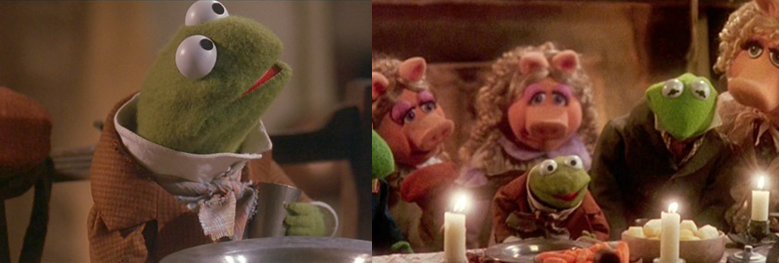
Surrounding Caine are, as you might expect, a smorgasbord of incredibly talented and charismatic Muppet characters, chief among them Kermit the Frog as Scrooge’s head bookkeeper, Bob Cratchit (Whitmire). Cratchit is a destitute and somewhat timid fellow when at work but retains both his Christmas spirit (“One More Sleep ‘Till Christmas”) and commands a great deal of respect from his co-workers for his position as Scrooge’s right-hand man (frog?), essentially acting as a go-between between the two parties. Though Scrooge is largely indifferent towards all of his employees, Cratchit is able to convince him to close the business for the entirety of Christmas Day by talking to him in a language he understands (i.e. money). During Scrooge’s journey through the past, present, and future, we learn more about Cratchit’s home life; he lives in a poor part of town in a tiny house filled with his large, loving family. The patriarch of the family, Cratchit is loved and appreciated by his children and wife, Emily (Oz as Miss Piggy), and even though they are paid a pittance by Scrooge and his children and wife vehemently despise his employer, Cratchit is still good enough of a man frog to raise a glass to his boss and to keep the spirit of Christmas alive even though they are basically slowing starving. Emily is a bombastic and out-spoken woman in both her affections and her opinion of Scrooge, making her brief appearances a constant highlight as she jumps at the chance to give Scrooge a piece of her mind only to be flabbergasted by his generous change of heart.

Tiny Tim’s unfortunate condition melts Scrooge’s ice-cold heart.

Of course, the most significant member of the Cratchit family apart from him and his wife is poor old Tiny Tim (Nelson as Robin); lame and deathly sick, Tim retains his enthusiasm and positivity, and basically embodies the spirit of Christmas as much as the actual spirits we see in the film. While Scrooge previously treated such poor children with disgust and apathy, his heart is visibly broken by Tim’s bleak condition and the knowledge that the boy is doomed to die unless their fortunes turn around is the first real step towards Scrooge’s redemption. This is, as is tradition, the entire point of the film; after dying, Scrooge’s old partner Marley and Marley visit Scrooge as gruesome, haunting visions and warn him of the impending visits of the three Christmas spirits (“Marley and Marley”). This is, honestly, one of the more haunting (no pun intended) parts of the film as Statler and Waldorf are shown weighed down by hideous chains and doomed to pay for all eternity for their sins of avarice and greed.

Scrooge’s heart-breaking memories haunt him almost as much as the actual ghosts!

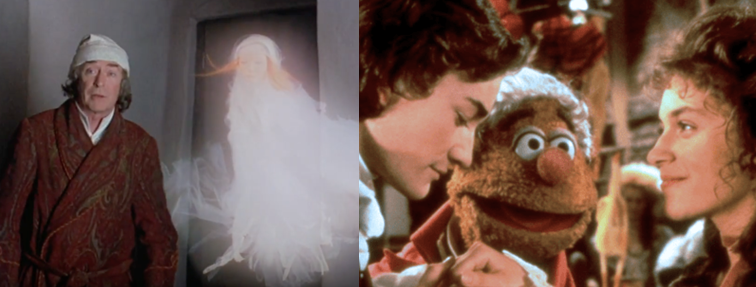
Although Scrooge is characteristically dismissive and sceptical of his friends’ warnings, he is equally horrified when the three spirits do actually appear; even the child-like appearance of the Ghost of Christmas Past (Jessica Fox) puts him on edge and he is overwhelmed by the spirit’s ability to make him literally fly into his long forgotten past. The pain of reliving his childhood and subsequent heartbreak as a young man agonises Scrooge and the events witnessed go a long way to explaining why Scrooge became the man he is; he spent all his time at study, without the influence of a loving family, and was realised to believe that one’s time should be spent being productive and profitable, which cost him both friends and the love of a woman, Belle (Braun). Scrooge’s subsequent journey towards redemption comes to be about reconciling the metaphorical ghosts of his past and learning to appreciate the present whilst living for the future rather than dwelling on heartache and cantankerous greed.

The Nitty-Gritty:
Obviously, what sets The Muppet Christmas Carol apart from other adaptations of the book are the inclusion of Muppet characters and puppets; a good, what? 97% of the cast is made up of Muppets and puppets? And all of your favourite characters get, at least, a cameo role if not play a significant part in the film (Fozzie Bear makes an amusing appearance as the younger Scrooge’s (Raymond Coulthard) employer, Fozziwig (Oz), and Sam Eagle does a delightfully amusing turn as Scrooge’s schoolmaster (ibid). the city is also populated by all kinds of amusing puppet co-stars, from singing fruit and donkeys to shivering, staring little mice, all of whom have a role to play in breaking London to life, contributing to the ensemble songs, and emphasising how hard life is for those less fortunate.

Scrooge is taught the meaning of Christmas by the affable spirit of the present.

The city really comes to life when Scrooge encounters the boisterous and magnetic Ghost of Christmas Present (Nelson/Don Austen), a full-size Muppet who resembles Father Christmas and teaches Scrooge the wondrous joy of the Christmas season; Scrooge is uncharacteristically and immediately taken by the spirit’s infectious good-nature and whimsy, laughing and even having a bit of a dance as the spirit conveys to him the true nature of the season (“It Feels Like Christmas”). This sudden rush of exhilaration for Scrooge is quickly tempered by his dismay that his nephew, Fred (Steven Mackintosh), mocks him behind his back for his cold and belligerent ways and when the spirit throws his own words back at him when he sees the condition of Tiny Tim. Still, it’s through the Ghost of Christmas Present that Scrooge realises how marvellous the season can be and he’s pretty much convinced at the appeal of Christmas and to change his ways through that interaction alone, such is the influence of the spirit’s unabashedly good nature.

The reaper-like spirit shows Scrooge a disturbing vision of his near future.

The lesson doesn’t end there for Scrooge, though, who is forced to accompany the third and final spirit, the most gruesome and terrifying of them all, the Ghost of Christmas-Yet-to-Come (Austen), on a truly disturbing journey into the near future. Here, Scrooge sees that he has died hated and alone, with the citizens callously selling off his possessions, regarding themselves as better off without him and, most devastating of all, that Tiny Tim has died and the Cratchit’s normally vivacious good nature has been noticeably subdued. Scrooge approaches the majority of this last journey with a desperate denial and it isn’t until he sees his own ominous tombstone that he truly repents for his wicked ways and vows to turn his life around, to life in the past, present, and the future, to avoid meeting such a unsympathetic and desolate end.

Everyone (well, mainly Scrooge) learns the true value of Christmas.

Accordingly, Scrooge awakens the next day and begins to make good on his word; he’s pleasant, polite, and generous, greeting others amiably, donating to charities, and leaving gifts for those closest to him (“Thankful Heart”). In the film’s finale, Scrooge resolves to pay off Cratchit’s mortgage, raise his salary, and fully commits himself to amending his damaged reputation by being the most generous and caring man the city has ever known, thus salvaging his soul, ensuring that he is remembered as a kind and loving man, and sparing Tiny Tim from death. It’s an amusing and heart-warming end to the film, especially because of the bemused and shocked expressions on everyone’s faces at Scrooge’s change of heart, and Caine, bless him, gives it his all when he is required to sing.

The Summary:
As I’ve already mentioned, The Muppet Christmas Carol is easily my favourite Christmas movie of all time; it’s a tradition for me to watch the film every Christmas day while eating Christmas lunch and opening presents, joyfully singing along and wondering if Scrooge will learn the same lessons year after year. It’s remarkable how faithful the film is to the source material, especially considering it’s a Muppets film, and the beautifully constructed sets and whimsical puppets only add to the film’s charm and appeal. Add to that the gravitas and magnetism of Michael Caine, who treats the film as seriously as anything produced by the Royal Shakespeare Company, and you have an adaptation that is truly special, full of allure, humour, and some unsettling moments as Scrooge learns his traditional lessons about letting go of the pain of his past and applying himself towards the greater good to ensure a better life for everyone, including himself.

My Rating:

Rating: 5 out of 5.

Fantastic

What do you think about The Muppet Christmas Carol? Where does it rank for you against other Christmas and/or Muppet movies? What did you think to Michael Caine’s performance, the puppets, and the sets featured in the film? Which song from the movie is your favourite? Have you read A Christmas Carol and which adaptation is your favourite? What are your plans for Christmas Day today? Whatever your thoughts, feel free to comment down and have a great Christmas!

Movie Night [Doomsday]: Armageddon


Over the years, there have been many theories about when the world will end but one of the more prevalent was the mistaken belief that doomsday would befall us on December 21st 2012 based on the Mayan calendar ending on this day. Of course, not only did this not happen but it wasn’t even based on any actual fact to begin with but, nevertheless, doomsday scenarios and depictions of the end of the world have been an enduring genre in fiction so I figured today was a good day to dedicate some time to this popular concept.


Released: 1 July 1998
Director: Michael Bay
Distributor:
Buena Vista Pictures
Budget:
$140 million
Stars:
Bruce Willis, Ben Affleck, Will Patton, Steve Buscemi, William Fichtner, Liv Tyler, and Billy Bob Thornton

The Plot:
When an asteroid the size of Texas hurtles towards Earth on a collision course set to wipe out all life on the planet in a mere eighteen days, National Aeronautics and Space Administration (NASA) Project Director Dan Truman (Thornton) has no choice but to draft the world’s best deep-core drilling team, led by Harry Stamper (Willis), and send them into space to split the rock in half before it ends life as we know it.

The Background:
By 1998, director Michael Bay had started to make a bit of a name for himself in Hollywood following a successful collaborative relationship with producer Jerry Bruckheimer. Bad Boys (ibid, 1995) had been a massive box office success and he was just coming off The Rock (ibid, 1996), the success of which landed him a two-picture deal with Disney’s Buena Vista arm. The first of these films was Armageddon, which was coincidentally one of two asteroid-based disaster movies released in 1998; Armageddon proved to be the more successful of the two, however, earning over $550 million compared to Deep Impact’s (Leder, 1998) $349.5 million box office. However, Armageddon as met with largely negative reviews; it’s famously one of legendary movie critic Roger Ebert’s most hated films of all time and audiences and critics alike found the film’s frenetic editing and more ridiculous moments as egregious as Bay’s bombastic action scenes. Even stars Ben Affleck and Billy Bob Thornton thought very little of the film and numerous scientific minds have attacked the film’s lack of scientific accuracy.

The Review:
Armageddon’s concept is, admittedly, massively over the top; not only is the Earth threatened with total destruction and mankind with complete extinction by the biggest and most improbable piece of rock ever conceived but NASA deems it easier and faster to train a bunch of oil drillers to fly into space rather than training astronauts to drill. Interestingly, much of the movie could have been the same had the script been tweaked slightly to have, maybe, one or two of the oil drillers join the space expedition as consultants and experts but, regardless, complaints of this nature miss the entire point of the film: It’s supposed to be that a group of all-American, ordinary, everyday blue collar men are called upon to do the impossible and save the world and that’s precisely what makes it such an appealing concept. The primary representative from NASA is Dan Truman, a man who always dreamed of going into space and being an astronaut but was grounded by what looks to be a debilitating knee injury. Still, he’s the unquestioning authority at NASA; when the space shuttle Atlantis explodes at the start of the film and meteorites start raining down across New York City, he immediately organises response teams to figure out the source of the problem.

Harry might be an immature father but he’s a consummate professional at drilling holes.

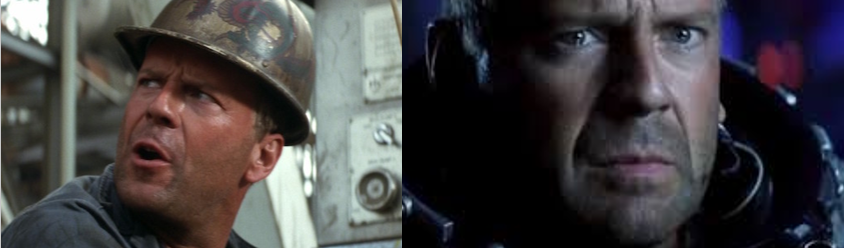
Horrified by the looming presence of “Dottie”, the incoming asteroid, like all NASA characters in movies he quickly focuses on solutions rather than problems; this means entertaining and demanding any and all possible solutions to the issue in a very short window of time. With no other contingencies in place, he calls upon the expertise of Harry Stamper, initially to train his astronauts but find sit perfectly acceptable to send Harry and his team up in their place in order to get the job done properly. The star of the film is, unquestionably, Bruce Willis; while long before he simply phoned in his performances and offered only the bare minimum of effort, Armageddon doesn’t really call for him to be much more than a semi-snarky, overprotective father who is the best at what he does and, despite being childish and immature at times, is a consummate professional when on the job. No one knows more about drilling (which he regards as a science and an art) than him, and no one is better at it than him; he tolerates no insubordination on his oil rigs. Harry takes Truman’s request and the impending danger very seriously and, unimpressed and insulted by NASA stealing his oil rig design and having “only” trained their team for eight months, he immediately demands that he has to take up his team, men he can trust to do the job properly, and maintains order even when the team overshoots their landing mark and is forced to drill through “iron ferrite”.

Somewhat reckless and impulsive, A.J. just wants Harry’s respect and trust.

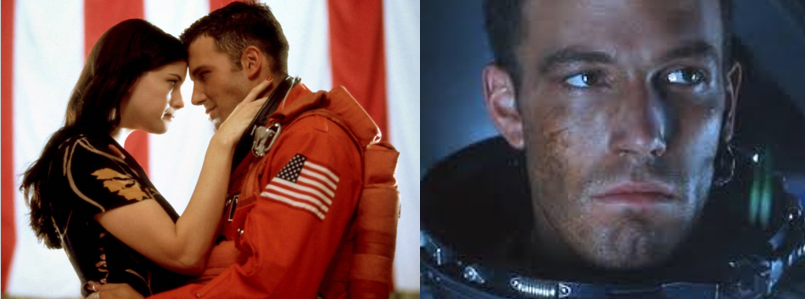
Harry’s conviction and focus are total when on a job but are somewhat distracted; he is estranged from his daughter, Grace (Tyler), and disapproving of her relationship with A.J. Frost (Affleck), the youngest member of his team and to whom Harry is basically a surrogate father. Harry is so incensed to discover their relationship that he hilariously chases A.J. across his oil rig with a shotgun but, discounting his personal feelings, doesn’t hesitate to fire A.J. when his arrogance almost causes a drilling operation to be botched and endanger his crew. Still, when called upon to pick members for the drilling teams, he reluctantly  drafts in A.J. A.J. just wants Harry’s trust and approval in his ability and instincts, which Harry is reluctant to bestow out of his overprotectiveness and belief that A.J. isn’t quite as experienced as he believe she is. Despite being surrounded by “roughnecks”, many of whom are his close friends and trusted colleagues, Harry is insulted and enraged to find that Grace has “settled” for A.J., believing that she deserves more than to be tied to a roughneck her whole life. Grace, however, vehemently stands by her choice, accepting A.J.’s proposal and stating that she is a grown woman who can make her own choices. Her issues with her father and almost immediately resolved when she learns of Dottie, however, and she is forced to watch the two men she loves the most head off on the most vital and dangerous mission ever conceived. When General Kimsey (Keith David) stubbornly follows the President of the United States’ (Stanley Anderson) orders to remote detonate the nuclear weapon on the asteroid when it’s not ready, Grace aggressively protests and demands that Truman do something since he was the one responsible for involving them in the mission.

In a sea of colourful characters, these three stand out as the most developed, interesting, and entertaining.

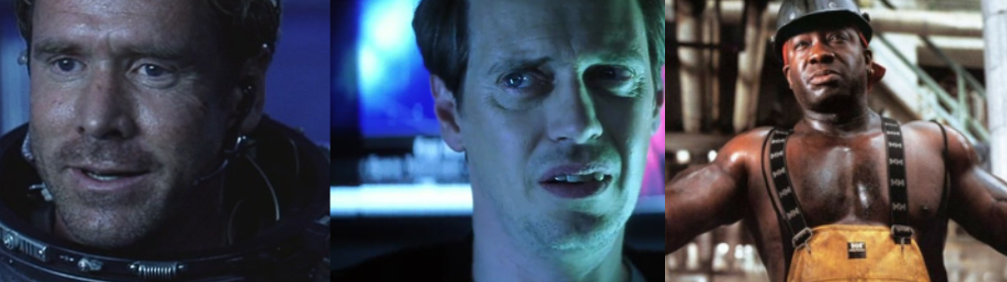
The rest of Harry’s team are a bunch of misfits, ex-cons, perverts, and muscleheads…and I absolutely love it! It’s an ensemble cast, with some given more screen time and development than others, who are just there to die. Charles “Chick” Chappel (Patton), a compulsive gambler and estranged from his wife and son, is Harry’s closest friend and conscience; he trusts Harry with his life and follows him to the ends of the Earth, and beyond. “Rockhound” (Buscemi) is a genius on the level of NASA’s very best but chooses to indulge in his love of explosives by lowering himself to oil drilling; he frequently points out that they are way out of their depth on the mission and ends up succumbing to “space dementia” and becoming something of a liability to the team. Another member of the team who stands out is, of course, “Bear” (the late, great Michael Clarke Duncan); Armageddon was one of Duncan’s first, big time roles in Hollywood and he shine snot just through his imposing physical stature but the gamut of emotions he displays, from playfulness to fear and panic, to sombre reflection by the film’s end. Certainly, he’s much more well-rounded than guys like Max Lennert (Ken Campbell), who is mainly the comic relief of the film, and Oscar Choi (Owen Wilson) and Freddie Noonan (Clark Brolly), who basically get a handful of lines between them and are killed when their shuttle crashes on Dottie to emphasise how dangerous the mission is.

Dottie takes on a life of its own and seems to have malevolent intentions for the Earth.

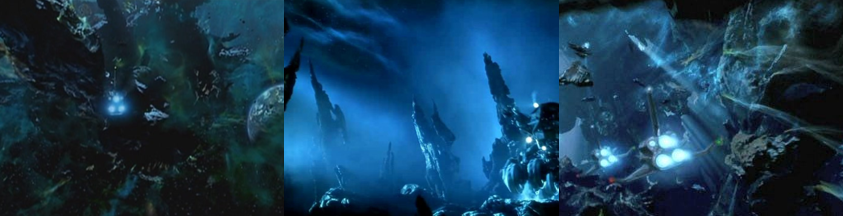
Harry and his team are joined by a handful of actual astronauts, the most prominent of which is Colonel Willie Sharp (Fichtner); Sharp is unimpressed with the drillers and personally makes it his mission to subject them to the harshest crash course in astronautics in order to properly prepare them for the rigours and dangers of space travel. Calm and composed, Sharp loses his cool somewhat when the shuttle overshoots its landing mark and grows increasingly concerned that the mission is headed to failure. When the order comes through to detonate the bomb before the hole is ready, he unlocks a gun and becomes almost a secondary antagonist; driven by the fear of the asteroid’s threat, he is prepared to kill to follow his orders to the letter but is convinced by Harry’s strength of conviction to allow the mission to proceed as planned. I say “secondary antagonist” because, if there’s one thing Michael bay was sure to do throughout Armageddon, it’s paint Dottie as almost a sentiment, malevolent force of nature; the asteroid is revealed in stages, bit by bit, almost like a slasher villain. At first, we see only wisps of dust and an ethereal cosmic aura, with the rock’s potential devastation shown to us through a comparatively harmless meteor shower. However, once the two shuttles slingshot around the Moon and approach the asteroid, it looms onscreen like an ominous, malicious entity purposely looking to destroy the Earth. When the teams land, they are beset by geysers of air, quakes, showers of rock, and constant explosions; Chick even suggests that the asteroid is purposely trying to shake them loose and keep them form “[killing] it”, as though it’s a living thing, and it even seems to roar and scream at times thanks to its tumultuous environment.

The Nitty-Gritty:
One of the most impactful aspects of Armageddon is the score; Trevor Rabin’s score is both bombastic and heroic but also haunting, ominous, and emotional. It’s perfectly used to highlight the amusing nature of the drillers’ training montage at NASA and adds just the extra exclamation point during the film’s more poignant and emotional moments. It’s a ridiculous film that plays its concept almost completely straight, which only emphasises the blue collar nature of the idea and adds to its appeal, in my opinion, and the score is a large part of that. It’s interesting to think about the fact that, technically, the plan to blow up the asteroid from the inside out was expected to go off without any real problems; after the shuttle Independence is taken out during the approach to Dottie, Freedom is thrown off by the unexpected gravitational forces from the asteroid and the Moon and lands way past the optimal landing spot. Had they landed in the intended area, it’s possible that much of the deaths and drama wouldn’t have unfolded as they did; similarly, a freak electrical accident causes the Mir space station to explode, almost as though the mission was doomed to failure from the start.

Meteors rain down across the world as Dottie draws inexorably closer by the hour.

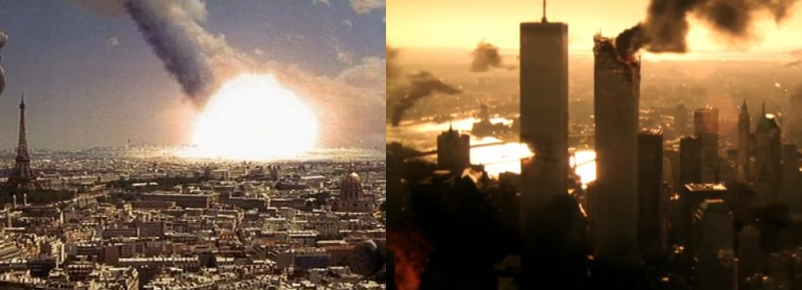
The botched approach sees the teams split into two; while Harry continue son with the mission and believes A.J. and the others are dead, A.J. and Bear work alongside the Russian cosmonaut Lev Andropov (Peter Stormare) on a bit of a side quest to reunite with their friends, which leads to some intense sequences involving the armoured Armadillo vehicle and its efforts to plough through and float over the asteroid’s dangerous surface. With drilling slowed and the mission threatened by the rock-hard iron ferrite, which chews up the drill heads and causes the rig’s transmissions to overload, time becomes a significant factor; the asteroid was projected to hit in eighteen days but the team is given only eleven hours to complete the mission and remote detonate before Dottie passes “zero barrier” since an explosion after this threshold would still result in the Earth’s destruction. The action isn’t simply confined to the asteroid either as the film continues to show that the planet (especially poor old Paris and Shanghai) continues to be bombarded by meteor strikes. This makes the general public aware of the impending “global killer” but, despite Truman’s belief that this knowledge would causes “mass religious hysteria [and] the worst parts of the Bible”, people are generally seen to be united in hope and belief in America’s desperate mission to save the world (at least until the mission appears to have failed, anyway, though the film never really dwells on the worldwide impact of the asteroid’s impending approach). Of course, people will harp on for days about how inaccurate and ridiculous the film is but, honestly, I really couldn’t care less. Armageddon goes to some lengths to cover its inaccuracies as well; the asteroid is described as having a minor atmosphere, somewhat explaining how the guys can just toss poles and equipment around, and the focus is clearly on spectacle and excess rather than scientific accuracy (it’s more exciting to see two space shuttles launch right next to each other, for example, no matter who dangerous and ludicrous that idea might be).

Harry bids a tearful farewell and sacrifices himself to save the entire planet.

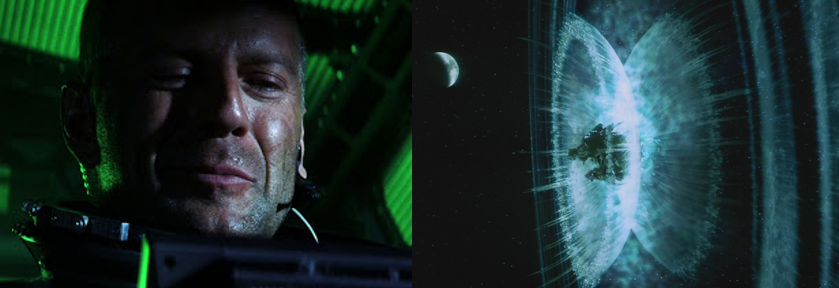
Additionally, the film’s attention to detail and attempts to recreate the inner workings of NASA are impressive; the shuttles aren’t some futuristic ships kitted out with touch screens or absurd technology, for example. They’re cramped and full of the same switches, lights, and efficient use of space that real-life shuttles are known for and, while the team wear quasi-futuristic space suits, they’re still grounded in realism and nowhere near as extravagant as in other films. For me, the real appeal of Armageddon is the central concept of a group of normal, everyday men answering the call to lend their unique expertise to a desperate mission to save all of humanity as well as the appeal of there actually being some kind of solution to a potential, fatal meteor strike on the Earth. The film’s message is one of hope and unity, that all nations and people can set aside their differences and work together for our mutual survival; this is emphasised more explicitly at the film’s emotional conclusion when, following a devastating rock storm on Dottie, the one remaining nuclear weapon is damaged and one of our blue collar heroes must stay behind to complete the mission. After reluctantly drawing straws, A.J. finds himself faced with this ultimate responsibility and, putting aside his reservations and deciding to ensure the future for his daughter, Harry dramatically takes A.J.’s place. Even now, it’s one of the most emotional and devastating scenes I’ve ever seen as A.J. collapses in hysteria and, after tearfully saying goodbye to Grace, Harry overcomes the last of Dottie’s resistance to press the button and save the Earth form destruction. You can harpoon all you want about how stupid and inaccurate the Armageddon is but very few films reduce me to tears more than this one, and this scene, thanks to the surprisingly moving performance from Willis (to say nothing of Affleck and the one-two gut punch of Sharp’s respectful “Thank you, Harry” and Bear’s gravelly, reverential farewell: “Yo Harry…you dah man”).

The Summary:
Now, I’m not really much of a fan of Michael Bay (or Ben Affleck, for that matter…) but I make an exception for Armageddon; this was another of those films that was a formative part of my teenage years and I distinctly remember renting the VHS tape and watching, transfixed, with my friends and being completely invested and using every ounce of my self-control to not burst into tears at the film’s dramatic conclusion. Yes, it’s ridiculous and over the top. Yes, it’s absolutely mental and takes numerous liberties. And, yes, it’s not the most scientifically accurate and realistic move ever made but let’s say, for sake of argument, that it had been. How fucking boring would that have been? I paid to see Bruce Willis drill a hole into an asteroid and save the world and that’s exactly what I got! Armageddon delivers top notch action, explosions, drama, and entertainment from start to finish thanks to its impressive practical effects, sets, and some great use of special effects to give life to an inanimate object. It’s an intense rollercoaster of a disaster film, one geared around hope and unity and normal people overcoming insurmountable odds to destroy the greatest threat the world has ever faced. Yet, it’s also an extremely emotional film and remains, to this day, one of my favourite disaster movies and is always guaranteed to get the man tears flowing.

My Rating:

Rating: 5 out of 5.

Fantastic

Are you a fan of Armageddon? How do you feel it compares to Deep Impact and other disaster films? Were you a fan of the concept or did you find the idea of oil drillers being shot into space too over the top? Which of the characters was your favourite and what did you think to Bruce Willis’ performance? Did you like that Michael Bay imbued Dottie with a form of malevolence or did you think that was one of the film’s more ridiculous concepts? How important is scientific accuracy and realism to you in disaster films like this? How are you celebrating the end of the world today? Whatever you think about Armageddon, disaster films, and overblown predictions of the end of the world, go ahead and drop a comment down below.

Movie Night [Christmas Countdown]: Tim Burton’s A Nightmare Before Christmas

Released: 29 October 1993
Director: Henry Selick
Distributor: Buena Vista Pictures Distribution
Budget: $26 million
Stars: Chris Sarandon/Danny Elfman, Catherine O’Hara, Glenn Shadix, Ken Page, Ed Ivory, and William Hickey

The Plot:
Jack Skellington (Sarandon, with Elfman singing), the Pumpkin King of Halloween Town, has grown weary of embodying the same macabre holiday year after year. When he stumbles upon Christmas Town, he is enamoured, reinvigorated, and compelled to replace Santa Claus (Ivory) but, when psychic ragdoll Sally’s (O’Hara) premonitions of disaster comes true and the villainous Oogie Booie (Page) kidnaps Santa for his own diabolical plot, Jack must attempt to salvage not only the spirit of Christmas but of Halloween as well!

The Background:
As a child, writer and director Tim Burton, known for his macabre and gothic sensibilities, was fascinated by the grandiose nature of holiday celebrations and, inspired by classic Christmas movies, wrote a three-page poem titled “The Nightmare Before Christmas” while working for Disney in the early eighties. Burton initially envisioned the poem being a Christmas special narrated by his childhood idol, Vincent Price, and spent nearly ten years developing storyboards, artwork, and the concept while he worked on some of his most successful feature films.

Burton’s twisted vision for Halloween took years and many painstaking hours to bring to life.

This success caught the attention of Disney chairman Jeffrey Katzenberg and led to the concept being developed into a feature-length, stop motion musical to be released under Disney’s adult label, Touchstone Pictures, to avoid scaring child audiences. Burton, however, was busy working on Batman Returns (ibid, 1992) at the time (and didn’t wish to be involved in the painstakingly slow and meticulous stop-motion process) but remained heavily influential in the production of the ambitious venture, which took over one hundred people three years and nearly 110,000 frames of animation to accomplish. All of that scrupulous hard work paid off, however, as, when the film released, it received largely positive reviews, eventually (after re-releases and re-uses) earned over $90 million in worldwide gross, and the film has had a lasting impact not just on cinema and pop culture but on the animation industry as well.

The Review:
The Nightmare Before Christmas begins on the night of another successfully terrifying Halloween; the citizens of Halloween Town are in joyous rapture at having once again scared people out of their wits (“This is Halloween”) and much of the credit for their success, as always, is attributed to the “Pumpkin King”, Jack Skellington, a literal skeleton who is basically the embodiment of the season. Although Halloween Town has a Mayor (Shadix), Jack is the true hero and authority in the town, revered as a celebrity and a genius when it comes to frights and Halloween trickery.

Jack’s melancholy demeanour is reinvigorated by the wonders of Christmas Town.

Jack, though, while he appreciates the adulation, has become despondent and depressed at the monotony of the routine of it all; while his creativity and imagination remains at their peak, he’s lost his zest and passion for it all and longs for something, anything, new to inspire him once more (“Jack’s Lament”). When he wanders off from the town and finds the magical nexus between seasons, he is literally sucked into Christmas Town and is immediately besotted; having never experienced such sights, sounds, and wonders, he finds his enthusiasm and curiosity piqued by the appeal of it all (“What’s This?”) and longs to bring the spirit of Christmas to Halloween Town.

Jack struggles to explain Christmas to the citizens of Halloween Town.

The citizens of Halloween Town, however, struggle with the concept of Christmas and Jack, to be fair, struggles to quantify the things he’s seen and meaning of the season (primarily because, at that point, he doesn’t yet realise what Christmas is all about). His attempts are met with confusion and misunderstanding and the only way he can explain it all is to put it in terms they will understand (“Town Meeting Song”). Since no one in Halloween Town shares Jack’s imagination and longing for change, the resulting towns and gifts they create are far from the fun, heart-warming gifts of Christmas Town and are, instead, horrific and terrifying Halloween monsters and creatures that attack and eat people “(Making Christmas”).

The Mayor and Dr. Finklestein are two of my favourite supporting characters in the film.

I mentioned the Mayor earlier and he really is one of the highlights of the film for me; he has two moods: loud and positive (happy face) and panicked and scared (anxious face). He’s clearly a respected and influential figure, for sure, but, when it comes to actual decision making, even he admits that he’s useless and needs Jack’s guidance and influence to get anything done. While sceptical of Jack’s fondness for Christmas, he goes along with it out of belief in Jack’s abilities and is hopelessly despondent when it appears that Jack has been killed while posing as Santa Claus. Another standout character is Doctor Finklestein (Hickey), a crippled and half-addled mad scientist whose macabre technology brings many of Jack’s designs and ideas to life; while Finklestein appears to be a doting old codger, he is met with resentment by his “daughter”, Sally, a ragdoll girl he created who desires only to escape from the confines of his dilapidated gothic abode.

Sally feels she can relate to Jack’s lament but foresees disaster for his Christmas venture.

Jack, who feels he can no longer relate to his peers in Halloween Town, is so wrapped up in his depression and subsequent obsession with Christmas that he fails to truly notice Sally, the one soul in all of Halloween Town who can relate to Jack’s torment. Like everyone in Halloween Town, Sally is besotted with Jack but, rather than merely idolising him, she pines for him with all of her heart and genuinely believes that they would be able to fill the emptiness in both of their lives (“Sally’s Song”). Sally also (somehow…) possesses some limited precognitive abilities; she foresees disaster for Jack’s Christmas venture but he’s too blinded by his fixation on the holiday to even consider failure (after all, he’s never failed at anything before so why should this be any different?)

Oogie Boogie is the bombastic antagonist with his own malicious plans for Santa and Christmas.

Of course, Jack’s state of mind and fixation on Christmas is the only thing working against him; despite specifically ordering Lock (Paul Reubens), Shock (O’Hara), and Barrel (Elfman) not to involve “that no-account Oogie Boogie” in his plot to kidnap Santa Claus (“Kidnap the Sandy Claws”), the three, of course, deceive Jack and take Santa to Oogie Boogie the moment Jack has usurped Santa’s position. Oogie, who is a colony of disgusting bugs within a burlap sack, is a malicious bogeyman who lives outside of Halloween Town and makes for a boisterous and diabolical villain who has a bit of a gambling addiction and wishes to cook up Santa and, it is implied, take over Jack’s role as the spirit of Halloween (“Oogie Boogie”).

The Nitty-Gritty:
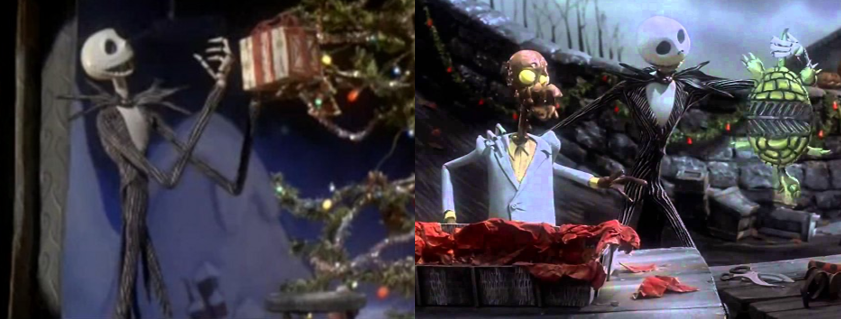
Of course, the most striking and memorable aspect of The Nightmare Before Christmas is the painstakingly detailed stop-motion animation used to bring Burton’s twisted, gothic imagination to life; every frame is full of little details, many of which no doubt took hours or even days to complete, and needlessly complex creatures such as a melting sludge man, Oogie Boogie’s bugs, and the elaborate sequences where Jack is delivering his horrific gifts as Santa. It’s impressive, to say the least, and make the film a must-watch venture even if only from a purely technological standpoint. Of course, The Nightmare Before Christmas has much more to it than the remarkable and ambitious animation work on show; it also has an extremely catchy and unforgettable number of songs, all of which perfectly convey a variety of emotions and characterisation for each of the film’s characters to help bring Burton’s world to life.

Jack’s attempt to usurp Christmas is a failure but his passion is reawakened regardless.

There are several poignant themes at work in The Nightmare Before Christmas as well: alienation, loneliness, the desire for change, and obsession being chief among them. Jack is so disillusioned with Halloween and so tantalised by Christmas that he rejects his former position as the Pumpkin King and fully believes that he will be able to take Santa’s place and claim Christmas as his own. He is astonished when the human world opens fire on him and blasts his sleigh from the sky and, in his defeat, realises that he has ruined the once pure-hearted holiday. However, he still feels his stagnated passion reignited and reclaims his position, vowing to apply himself even harder to making Halloween as memorable and terrifying as possible (“Poor Jack”).

Jack defeats his rival, saves Santa, and he and Sally finally admit their feelings to each other.

Sally’s frantic attempts to reach Jack fall on deaf ears and nothing she does to sabotage his attempts work; in her desperation  to save Jack and get things back to normal, she proactively tries to rescue Santa but ends up being kidnapped as well. Seeing Sally and Santa held at Oogie Boogie’s mercy enrages Jack and, after defeating Oogie Boogie, he finally realises that what he’s been searching for all this time has been standing right in front of him from the start (not just the spirit of Halloween but Sally, with the two of them finally admitting their feelings and appreciation for each other in the film’s heart-warming conclusion (“Finale/Reprise”)).

The Summary:
It’s extremely difficult to put into words how much I enjoy The Nightmare Before Christmas; it’s not only a technical marvel but also a pretty flawless achievement in filmmaking. “Unique” doesn’t seem like a good enough adjective to describe the film, which is both macabre and terrifying while also being heart-warming and genuinely touching. It perfectly encapsulates the feeling the Christmas isn’t something that can simply be appropriated or distilled; it’s a spirit of giving and joyous celebration that requires a certain level of belief and understanding to pull off. Jack’s mistake was thinking that he would be able to usurp Christmas as his own without really understanding it; he just wanted to experience something new for a change and could have just as easily become as equally besotted by Easter or Thanksgiving or any other holiday had he entered a different door.

Nightmare Before Christmas is a technical wonder and a fantastic Christmas film to boot.

What makes The Nightmare Before Christmas truly unique is Burton’s ingenious idea of what these holidays are; disparate fantasies embodied in a magical, fantasy world separated form ours only by the veil of imagination, the holiday seasons are depicted as being the work of largely benevolent mythical denizens of these worlds who are fully committed to delivering the spirit of each holiday. With his twisted, gothic imagery and distinctive depiction of such a dream-like fantasy world, Burton’s imagination makes for an entertaining and enthralling film that is more than suitable for Christmas or Halloween viewing and is a timeless classic through and through.

My Rating:

Rating: 5 out of 5.

Fantastic

Are you a fan of The Nightmare Before Christmas? If not…seriously, dude, what the hell’s the matter with you? If you are a fan of the film, do you watch it at Christmas or at Halloween and which do you think is more befitting? Are you a fan of stop-motion animation and Burton’s gothic sensibilities? Which character was your favourite and what did you think to Jack’s surprisingly complex characterisation? Have you got a favourite song from the movie (or one of the many remix albums) and, if so, what is it? Would you like to see a sequel produced some day or do you think it’s best left as a stand-alone, cult classic? Whatever your thoughts on The Nightmare Before Christmas, leave a comment down below and join me next Saturday for Christmas Day!

Movie Night: Spider-Man: No Way Home

Released: 17 December 2021
Director: Jon Watts
Distributor: Sony Pictures Releasing
Budget: $200 million
Stars: Tom Holland, Zendaya, Jacob Batalon, Willem Dafoe, Alfred Molina, Jamie Foxx, and Benedict Cumberbatch

The Plot:
After having his secret identity publicly outed, Peter Parker/Spider-Man (Holland) finds himself branded a murderer and requests Doctor Stephen Strange (Cumberbatch) cast a spell to make everyone forget his identity. However, when the spell is corrupted, reality is fractured and Peter is beset by foes from across the multiverse seeking to avenge themselves against Spider-Man, no matter what world he’s from!

The Background:
Following the massive success of the original Spider-Man trilogy (Raimi, 2000 to 2007) and the largely mediocre reception of the poorly-timed reboot films, Marvel Studios were finally able to achieve the impossible when they reached an agreement to include a new version of the iconic web-slinger in their interconnected Marvel Cinematic Universe (MCU). Tom Holland took on the role of a young, fresh-faced take on the character and debuted in spectacular fashion in Captain America: Civil War (Russo and Russo, 2016) before spinning off (no pun intended) into the incredibly successful Spider-Man: Homecoming (Watts, 2017). Spider-Man: Far From Home’s (ibid, 2019) impressive $1.132 million box office proved that the MCU could sustain the success it had amassed even after the cataclysmic events of Avengers: Endgame (Russo and Russo, 2019) but development of a third outing for the character was initially stalled when financial disputes threatened to see the character once again pulled from Marvel’s control. After these issues were resolved, and following a delay due to the Covid-19 pandemic, production finally got underway in late-2020 and, almost immediately, rumours began circulating regarding the possible return of actors from the previous Spider-Man franchises. These were only exacerbated when Benedict Cumberbatch was confirmed to reprise his role as Dr. Strange, a character who was already scheduled to have his own multiversal adventure, and when the long-awaited trailer was finally released following a leak, confirming that Alfred Molina would be returning as Doctor Otto Octavius/Doctor Octopus thanks to digital de-aging. Finally, after months of speculation and wild fan rumours, the film’s final trailers confirmed that this story would tackle Spider-Man’s varied cinematic multiverse and the film received an official release date. Thanks to bringing together elements from across Spider-Man’s cinematic legacy, Spider-Man: No Way Home was met by unanimous praise; critics lauded the performances and heart of the film, in addition to atmosphere and chemistry between the actors, and the film made a mammoth $1.916 billion at the box office.

The Review:
I feel it’s only fair to emphasise here that I simply cannot find the language to talk about this film without using spoilers. If the title and various warnings aren’t enough for you, then this text should be: here be spoilers, and I’m not planning on holding back as I feel the movie deserves to be discussed in detail and the only way to do that is to talk about spoilers. Also, I was initially torn when it came to this film; the build up to it saw some really toxic opinions and members of the fandom rear their ugly heads, and the marketing has been a bit all over the place. Sony showed a surprising amount of restraint with their trailers, and maybe held them off a little too long, but it definitely built up a great deal of hype and intrigue surrounding it and it felt good to be excited and curious about a movie for a change. Having said that, though…be better, people, come on. If you have a favourite Spider-Man, that’s great, but don’t rag on people for having a different opinion. Spider-Man is really lucky as he has had so many adaptations and so much representation, so many live-action portrayals, and all of them have been extremely accurate to the source material and exciting outings in their own right, so maybe just be thankful that the web-head gets so much love and is so popular rather than being ungrateful or attacking others for their opinions?

Jameson’s smear campaign spells personal trouble for Spider-Man and his friends.

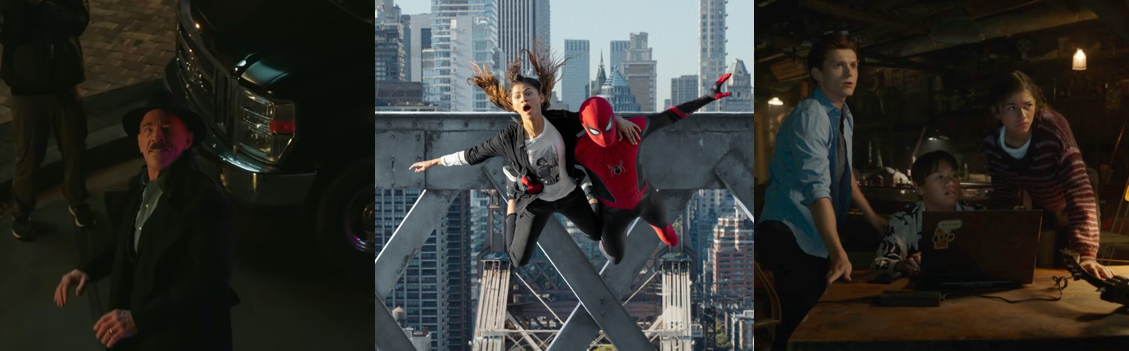
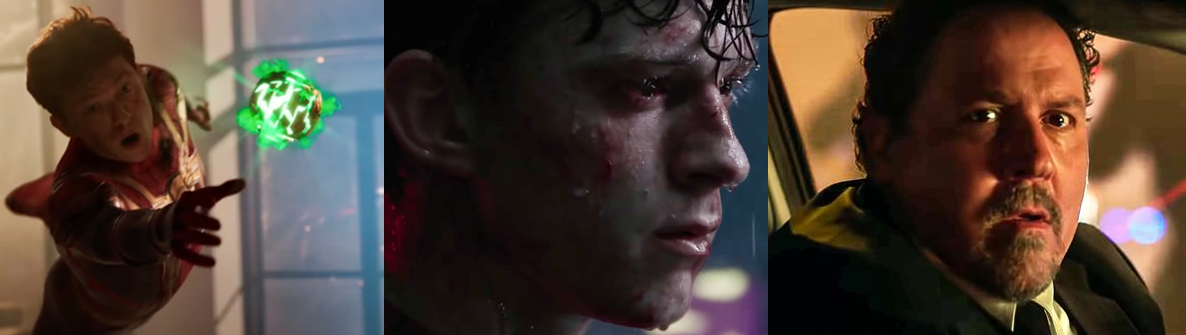
Spider-Man: No Way Home picks up immediately where Spider-Man: Far From Home left off, with blustering, loud-mouthing online personality J. Jonah Jameson (J. K. Simmons) gleefully broadcasting edited footage sent to him by Quentin Beck/Mysterio (Jake Gyllenhaal) that not only implicates Peter as a murderer but also outs his secret identity to the entire world. Naturally, this sends New York City into a bit of an uproar and, pretty much immediately, both Spider-Man and his new girlfriend Michelle Jones-Watson/M. J. (Zendaya) are swamped by a mob that is split between worshipping and condemning Spider-Man, paparazzi looking to get a sound bite, and cops seeking to question Peter’s involvement in Beck’s death. Despite his best efforts to escape the chaos, and to break the news to his beloved Aunt May (Marisa Tomei) and his begrudging friend and handler, Harold “Happy” Hogan (Jon Favreau), Peter and his friends and family are soon apprehended by the Department of Damage Control (DODC), which has now extended its scope into being a federal agency responsible for such matters. Although M. J. and May remain tight-lipped on the matter, Peter’s bungling but loyal friend Ned Leeds (Batalon) and Peter himself don’t exactly help his case, and Peter is left overwhelmed by the barrage of accusations and the public’s awareness of his true identity. Any legal ramifications concerning these matters are quickly swept under the table, however; although Happy and May recently ended their fling (much to Happy’s dismay), the Parkers are given sanctuary at Happy’s secure apartment and an especially good blind lawyer is able to ensure that the charges against Peter are dropped. However, public opinion remains divided; since the world considers Mysterio a hero, many people condemn Spider-Man (which isn’t helped by Jameson’s continuing smear campaign against Peter) and Peter is treated with both awe, fear, and adulation by his fellow pupils. Thankfully, he has M. J. and Ned there to support him through it; despite the revelation uprooting their lives and thrusting them into the spotlight as well, they remain his loyal and understanding companions, which is always sweet to see. While Peter appreciates this, and could probably have adjusted to the major changes in his life with their support, his guilt and shame are magnified when neither her, Ned, or M. J. are able to successfully get into college.

Peter turns to Dr. Strange for help, but muddles the spell and causes reality to fracture as a result.

Because of the media storm and controversy surrounding Peter, no college wants to risk being associated with any of them, and Peter is guilt-ridden at having cost his loved ones the chance of realising their dreams. Yet, even though this has happened, M. J. and Ned still take it on the chin and remain optimistic (or, at least, put on a brave face, in M. J.’s case) and neither of them blame Peter for this, but it does little to alleviate his guilt. Desperate for a solution, Peter seeks out the council of Dr. Strange (who, it is amusingly revealed, is no longer the Sorcerer Supreme thanks to being snapped away for five years; Wong (Benedict Wong) has assumed the position instead, which could potentially be explored to greater humourous effect in Strange’s upcoming movie). Although Wong cautions against it, Dr. Strange offers to cast a complicated and dangerous spell that will erase the knowledge of Peter’s secret identity from everyone in the world; however, Peter starts to panic mid-way through the spell and requests that May, M. J., Ned, and Happy be exempt from the erasure, which causes Strange to lose control of the spell and contain it within a jewel least it wreak havoc upon the world…and the multiverse. The relationship between Dr. Strange and Peter is notably different to what we saw between Peter and Tony Stark/Iron Man (Robert Downey, Jr); Strange isn’t a mentor to Peter, he’s more like a work associate, and he’s willing to help the kid out because of his efforts at restoring half the population, but he’s easily frustrated by Peter’s naivety and ignorance, especially when it comes to the world of magic, and angered that Peter risked tampering with the fabric of reality before properly exploring all of the real-world options available to him or learning to adapt to the changes in his life.

Molina makes a triumphant return as the crazed Doc Ock, who’s intrigued by the MCU.

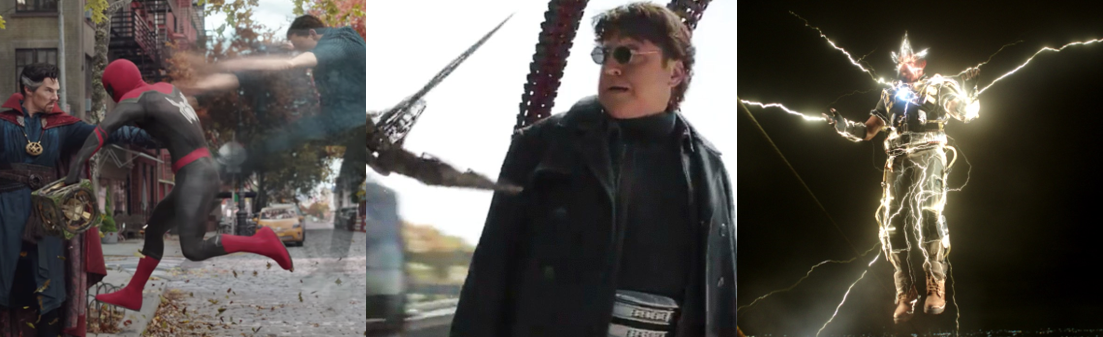
Determined to make up for this, Peter tracks down a college professor to plead M. J. and Ned’s case, only to suddenly be attacked by a face very familiar to us but completely alien to him as Dr. Octopus attacks the Queensboro Bridge in a confused rage, ranting at Peter and demanding to know what happened to his “machine”. Though confused by the villain’s sudden appearance, Spider-Man holds his own in impressive fashion thanks to the advanced technology and gadgets built into his Iron Spider costume, saving lives while fending off Doc Ock’s mechanical arms; his genius mind addled by the corrupting influence of his mechanical tentacles, Doc Ock is intrigued by the Iron Spider’s nanotechnology but startled to find a very different face behind the mask. His confusion soon turns to manic frustration when Peter is able to use the suit’s nanotech to take control of Doc Ock’s arms and render him helpless, and Octavius’s rage is only incensed further when he suddenly finds himself a prisoner in a dark catacomb beneath Dr. Strange’s Sanctum Sanctorum. Although dismissive of the idea of magic and vehemently rejecting the idea that he needs help or to be fixed, Doc Ock is intrigued to see the evidence of a multiverse surrounding him; not only has he met the MCU version of Peter and M. J., but he shares his prison with Doctor Curt Connors/The Lizard (Rhys Ifans), a monstrous creature Dr. Strange was able to subdue offscreen and who is very clearly from another reality. Ock’s curiosity is only piqued further when he and Peter catch a fleeting glimpse of another Spider-foe Octavius knows all-too-well, Doctor Norman Osbourn/The Green Goblin (Dafoe), before being imprisoned.

Peter finds a number of monstrous, and maniacal, villains have crossed over into the MCU.

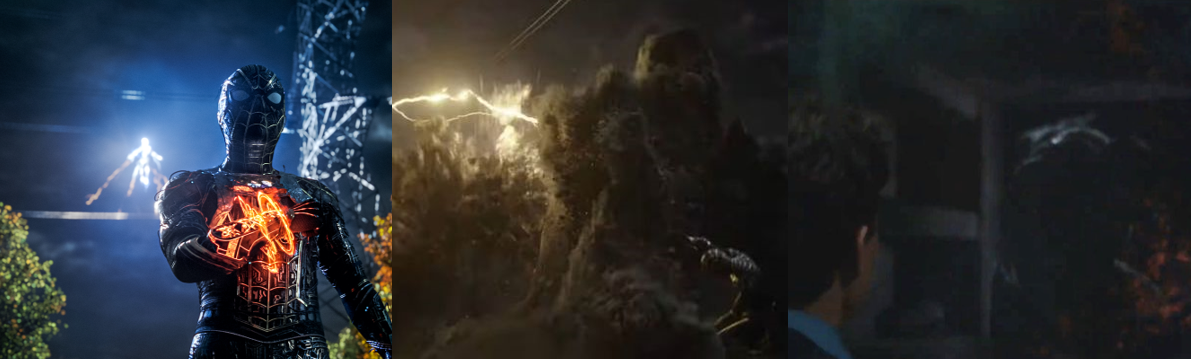
Angered at the incursions that have slipped into their world because of Peter’s ignorance, Dr. Strange demands that he and his friends “Scooby-Doo this shit!” and round up the visitors so they can be sent home; he grants Peter a magically-charged gadget that allows him to shoot a web that instantly teleports the villains to the prison, and Peter is forced to turn his suit inside-out after it gets ruined by paint thrown by a mob. Although he initially heads out to track down the Green Goblin, Peter instead finds Max Dillon/Electro (Foxx), who draws power from electricity lines to regain his physical form and alter the nature of his powers. Disorientated at having being violently ripped from his reality, Electro lashes out in anger, and Peter is only saved by the timely intervention of Flint Marko/The Sandman (Thomas Hayden Church), who helps Peter subdue and capture Electro. However, upon realising that he’s trapped on another world, the Sandman also grows antagonistic and winds up confined as a result, and Peter learns from each of them the nature of their personalities, their worlds, and their fates: Green Goblin, Doc Ock, and Electro are all fated to die in battle with Spider-Man, and returning them home would seal that fate, and that’s something Peter cannot, in good conscience, allow.

The Green Goblin quickly re-establishes himself as Peter’s greatest threat.

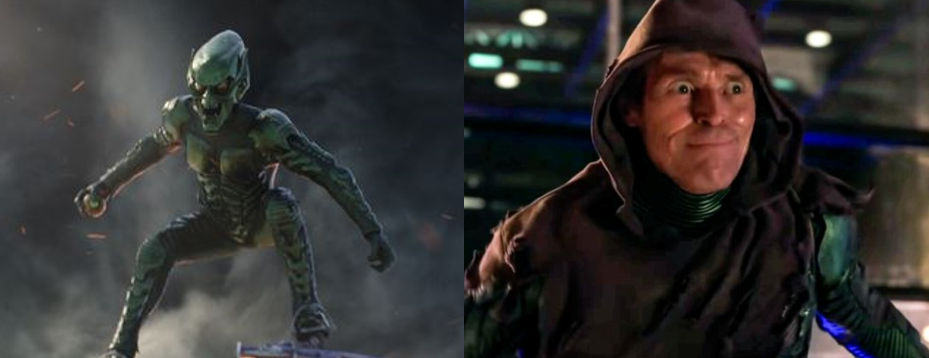
This brings him into conflict with Dr. Strange, who is determined to activate the jewel and send the visitors back home regardless since he’s weighing the fate and stability of the entire multiverse rather than the lives of a few villains. When Peter tries to take the jewel from him, a bit of a scuffle ensues in which we see Peter is able to control his body even while forced into his astral force thanks to this spider-sense, and his knowledge of geometry also allows him to figure out the mirror dimensions, web up Strange, and leave him stranded there while he works to cure the villains. While he has good intentions, and his friends and family support his efforts, and he is even able to convince the villains to trust him to help keep them alive, Peter underestimates the depths of Norman’s psychosis. Rendered a meek, bewildered scientist who is lost and in pain, Norman willingly works alongside Peter to help fix Doc Ock, returning the tentacled menace to his more good-natured self, but Norman’s dark half, the Green Goblin, soon resurfaces to throw Peter’s entire plan out the window. I got a real kick out of seeing Norman and Otto being familiar with each other, and the Lizard and Electro also having a familiarity with each other, it really helped to flesh out their respective worlds and deliver exposition regarding the characters to those who might not be familiar with them. While it’s disappointing that the Sandman was rendered entirely in his sand form for 90% of the movie, and the Lizard was basically a non-factor (there’s even a moment where he is simply confined to a van and forgotten about until the film’s big climax needs to happen), both Doc Ock and the Green Goblin play significant roles in the story. The Goblin wraps the remains of his God-awful suit in a tatter cloak and Dafoe’s demented facial expressions get to shine trough as he operates entirely unmasked throughout the film; he’s also far more vicious and deadly than ever before, cackling in Peter’s face and taunting him at every turn. While all of these returning actors slipped back into their roles perfectly (and even got a chance at redemption, in Electro’s case), Dafoe steals the show ones again as a maniacal and vicious villain who simply wants to cause Peter pain, no matter which Peter it is!

The Nitty-Gritty :
When I first heard that Tom Holland’s third solo movie was going to delve into the multiverse, I have to admit that I was disappointed and annoyed; I enjoyed Spider-Man: Into the Spider-Verse (Persichetti, Ramsey, and Rothman, 2018) but even with that film I questioned the logic of confusing matters with multidimensional shenanigans. The MCU definitely seems to be gearing towards exploring the multiverse, but I expected this to be confined to Dr. Strange’s solo films and worried that bringing in faces from the Sam Raimi and Marc Webb films would just be pandering and confusing. Not only that, but I’m of the firm belief that every role can be recast: Dafoe, Simmons, and Molina were all fantastic in their previous iterations but who’s to say that another actor wouldn’t be just as good, if not better? I expected this third Spider-Man movie would be the perfect excuse to finally bring the Sinister Six to life using the villains already established in the MCU: Adrian Toomes/The Vulture (Michael Keaton), Herman Schultz/The Shocker (Bokeem Woodbine), Mac Gargan/The Scorpion (Michael Mando), and even Mysterio (he was the master of illusions, after all) could all have returned and joined forces with two new villains (ideally an all-new Doc Ock) to collect a bounty on Spider-Man. Hell, I was more excited at the prospect of Charlie Cox returning as Matt Murdock/Daredevil or Spider-Man being forced to go on the run and teaming up with the Netflix Defenders than complicating things with multiverse hijinks, and I still maintain that it makes zero sense to have Eddie Brock/Venom (Tom Hardy) exist in a separate universe when it would have been far simpler to have him be based in San Francisco but still exist in the MCU (like how other MCU heroes and movies take place in different cities but those characters don’t have to be transported through time and space to interact).

Spider-Man butts heads with Dr. Strange regarding how to deal with the villains.

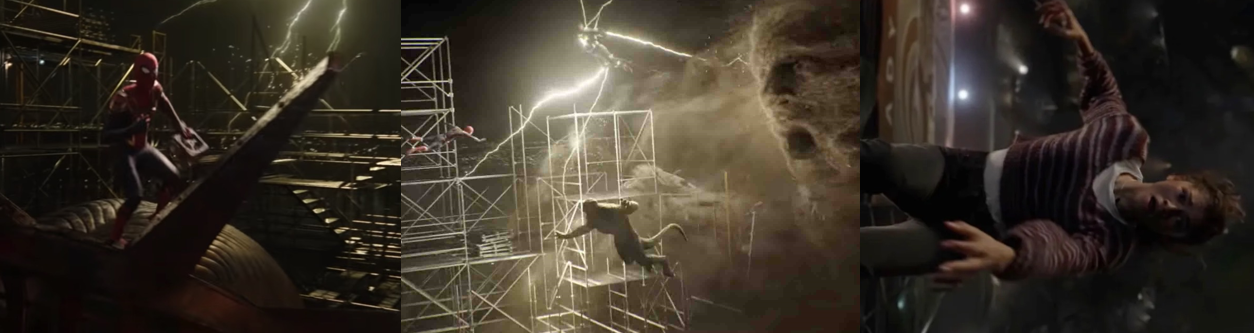
And yet….man, was it a thrill to see Alfred Molina return in the role! Bringing back these iconic actors in their most famous villain roles might be unapologetic fan service but it was fan service executed almost to perfection. I say “almost” as we were one villain short from an iteration of the Sinister Six; Eddie doesn’t show up into the mid-credits scene and he is teleported back where he came from without having any impact on the movie (though he does leave a part of himself behind…) and there was no secret sixth villain added to the roster. However, that’s not to say that the five villains we did get were disappointing…far from it! Since the MCU is different to where he came from, Electro is able to not only reconstitute his body, but also alters his powers; the addition of an Arc Reactor only pushes his powers even further, allowing him to resemble his traditional comic book appearance far closer than in his original iteration. The Sandman may be in sand form for the majority of the film, but he remains an emotionally conflicted character; at first, he helps Peter, and even tries to talk sense into some of the villains, but the idea of being kept from his home world and his daughter pushes him against the web-slinger out of pure self-preservation. This motivation is the driving force behind many of the villains, as they have either accepted their monstrous new powers or have no wish to be sent away to die. In the case of Doc Ock and the Lizard, this is due to technology or mutation clouding their judgement; when Peter repairs the inhibitor chip on Ock’s neck, he becomes much more agreeable and even helps Peter to hold off the villains in the finale, and when the Lizard ingests the cure and returns to his human form, he returns to his more docile personality.

Peter is devastated by loss and pushed to the edge by the Green Goblin.

The same is also true of the Green Goblin, however Norman’s psychosis is far more manipulative, calculating, and violent. He has no desire to return home to meet his end and absolutely brutalises Peter to keep him from trying to cure him; the Goblin quickly re-establishes himself as Peter’s most dangerous and notorious foe not only by swaying the other villains into turning on Peter, but delivering a massive beatdown on him that leaves him helpless to keep his Aunt May from harm. Although Peter manages to shield May from the Goblin’s pumpkin bomb, the glider blindsides her and leaves her with a fatal wound, and she tragically dies in his arms, leaving him heartbroken and with her final words of encouragement ringing in his ears: “With great power, there must also come great responsibility.” May’s death devastates Peter, and drives him into a quest for revenge against the Goblin; no longer merely satisfied to cure or help the villains, he wishes nothing less than the Goblin’s death at his hands, and it’s a true moment of despair for the young Avenger. No Way Home really puts Peter through the wringer, pushing his morals and optimistic outlook to breaking point, and really burdens him with the guilt of having indirectly caused his mother-figure’s death by trying to help the villains rather than allowing them to return home and potentially die as fated.

Spider-Man gets some unexpected help to fend off the combined threat of these multiversal villains.

Desperate to find Peter and give their support, M. J. and Ned mess about with one of Dr. Strange’s sling-rings and discover the presence of two more familiar faces who slipped through the dimensional barriers and are determined to help and let me tell you…I have never seen a cinema explode into rapturous applause before but my screening blew the roof off when Andrew Garfield and Tobey Maguire made their long-awaited, and long-rumoured, return to their famous roles. Both arrived due to Strange’s spell and have been trying to track down MCU-Peter, and both have arrived from later in their careers, finally giving us a coda to their stories: Webb-Peter reveals that he struggled to cope after failing to save Gwen Stacy (Emma Stone), and almost lost himself to his rage at one point, and that he has thrown himself into his duties as Spider-Man to cope. Raimi-Peter is noticeably older, but still in good shape, and, though haunted by his failures and losses, maintains that he and M. J. (Kirsten Dunst) found a way to carry on). The scenes with the three Peters are an obvious highlight and they share some fantastic line sand banter together; Webb-Peter is elated to have found “brothers” and they work together to synthesise cures for the villains based on their previous experiences and scientific acumen. They also share stories of their adventures and powers, with Webb-Peter and MCU-Peter both being astounded (and a little disturbed) by Raimi-Peter’s organic webbing, Raimi-Peter extending a much-needed pep talk to Webb-Peter, and both Webb- and Raimi-Peter being impressed by MCU-Peter’s space adventures. Seeing them work together, offering MCU-Peter support and understanding, is fantastic as Webb-Peter delivers an emotional soliloquy about his failures (and gets to make amends for it by catching M. J. in a truly emotional moment) and Raimi-Peter relates the messages passed on to him by his beloved Uncle Ben (Cliff Robertson), and MCU-Peter is even able to help them get past being solo heroes and work together using his experiences of teamwork as an Avenger.

The multiversal breach rages out of control, leading to Peter making a selfless sacrifice…

With three Spider-Man working together, the Lizard, the Sandman, and Electro are all subdued and returned to their human forms, presumably alleviating them of their madness and violent tendencies, in a mind-blowing final confrontation around the Statue of Liberty (which is being refurbished to hold Captain America’s shield aloft). Despite the best efforts of his alternative counterparts, though, MCU-Peter is driven into a rage and attacks the Green Goblin mercilessly and even prepares to deliver a fatal blow with his own glider, only for Raimi-Peter to intervene (and get stabbed in the back for his efforts). Ultimately, MCU-Peter delivers a cure, rather than a kill, to his newest foe and Norman is left an emotional and remorseful wreck, though this pales in comparison to the threat unleashed by one of his pumpkin bombs as Strange’s spell is blown free and miscellaneous, vaguely-defined villains and intruders from all across the multiverse threaten to converge on the MCU. Dr. Strange struggles to contain the spell and, determined to make amends for his previous mistake, MCU-Peter decides to make the ultimate sacrifice and has Strange cast a new spell that will make everyone, everywhere, forget all about Peter Parker. He thanks his counterparts for their help and bids an emotional farewell to M. J. and Ned, promising to find them and rekindle their friendship/relationship after the spell is cast, but hesitates upon seeing how happy and better off M. J. and Ned are without him in their lives. Ultimately, Peter chooses to leave them be and fashions a new, 100% comic accurate costume for himself using his counterparts’ suits as inspiration and finally gets his big, triumphant final swing as he begins a new life safe in the knowledge that no one knows his true identity any more…and that he’s not alone in the vast, dangerous multiverse.

The Summary:
After viewing that first trailer and seeing Doc Ock show up once again, my mind was pretty much blown when it came to this movie. It raised so many questions, many of them being concerns that Tom’s third solo outing would get overwhelmed or bogged down by multiverse shenanigans and blatant fan service. Subsequent trailers helped shed a bit more light on the film, and I began to calm down a bit and predict that these returning characters wouldn’t be as integral to the narrative as many were making out. This turned out to be true, to a degree; the villains are definitely a big part of the film, but Spider-Man: No Way Home still does a fantastic job of focusing on Peter, his relationships, his growth, and his identity crisis. Could we have seen a grittier, more grounded film that dealt with him being on the run and learning to adapt to his tumultuous new public life? For sure, yes, and I would also argue that many of these villains could have been recast and reimagined as MCU characters and it would have worked just as well, but again there is such a thrill to be had at seeing these actors return to their iconic roles and, in many cases, reinvigorate their characters with the benefit of hindsight. I loved that Peter’s focus was on others the entire time; his selflessness is a driving force of his character, and every decision he makes is to try and benefit either his friends or family or to save lives. This is motivated by his guilt, of course, as they would only be in danger because of him, and he remains a flawed character trying to make amends for his mistakes, which is the quintessential essence of Spider-Man for me. More than any other Spider-Man, MCU-Peter tries to help even the most villainous characters rather than condemn them to death, it was truly heart-breaking to see him o devastated by Aunt May’s death that he was willing to cross that line. Of course, the undisputable highlight is seeing Tom Holland share the screen with Tobey Maguire and Andrew Garfield; while it’s painfully obvious that all three actors weren’t on set or in the studio at the same time for every shot (whether due to Covid or scheduling), it’s still a blast to see them interacting, hearing those iconic themes, and seeing them in action. Once I accepted that No Way Home was going to be a multiverse adventure, my hope was that the film would go all-out to deliver on its potential…and I’m happy to say that it went above and beyond! Action-packed, emotional, and amusing throughout, Spider-Man: No Way Home may very well be in the top-tier of Spider-Man adventures and I am very excited to see where Peter’s journey takes him now that his status quo has been so dramatically changed.

My Rating:

Rating: 5 out of 5.

Fantastic

Have you seen Spider-Man: No Way Home? Were you excited at the idea of iconic Spider-Man villains making their return or do you think that the multiverse stuff should stay in the Dr. Strange movies? What did you think to the way the film handled the public’s knowledge of Spider-Man’s identity and would you have preferred to see this explored a little more in-depth? Which of the returning villains was your favourite, and how excited were you to see Tobey Maguire and Andrew Garfield return (and Charlie Cox finally be incorporated into the movies)? Were you disappointed that we came so close to the Sinister Six and that Venom didn’t have a role in the film? Where do you see the MCU-Spider-Man’s story going from here? Whatever your thoughts on Spider-Man: No Way Home, leave a comment below.

Movie Night [Christmas Countdown]: Batman Returns

Released: 16 June 1992
Director: Tim Burton
Distributor: Warner Bros. Pictures
Budget: $65 to 80 million
Stars: Michael Keaton, Danny DeVito, Michelle Pfeiffer, Christopher Walken, and Michael Gough

The Plot:
Gotham City’s Christmas is interrupted by the deformed Oswald Cobblepot/The Penguin (DeVito), who is manipulated into running for Mayor by Machiavellian businessman Max Shreck (Walken). While Bruce Wayne/Batman (Keaton) investigates the Penguin’s truth motivations, he faces a secondary threat when Shreck’s disgruntled employee, Selina Kyle (Pfeiffer), wages a vendetta against him and Batman as Catwoman.

The Background:
In the eighties, DC Comics readers saw the culmination of a long period of alteration for Batman who, for the majority of the sixties, had been transformed from a ruthless vigilante and into a colourful, camp, family friendly figure. One of the principal examples of this change was Batman (ibid, 1989), a dramatically different take on the DC Comics staple that saw noted auteur Tim Burton bring his signature gothic flair to the character, transforming both Batman from a spandex-wearing goof and into a stoic, armour-clad urban legend and “Mr. Mom” Michael Keaton into a brooding, tortured vigilante, and resulting in a surge of popularity for the character as audiences flocked to see the movie. Despite some criticism regarding the film’s tone and pacing, Batman was an incredible success, making nearly $412 million against a $35 million budget. Although Warner Bros. wished for a sequel to begin as early as 1990, Burton held back on returning to the franchise until he was ready, and, when he did return, he was successful and proven enough to be granted far more creative control over the film’s production. Originally known as Batman II, Batman Returns underwent numerous rewrites, with both Harvey Dent/Two-Face and a version of Robin originally being included and the original character of Max Shreck originally intended to be the Penguin’s brother. The majority of the filming took place on sound stages that included full-size sets of downtown Gotham City and the sewers, the many real-life penguins featured in the film were given special treatment, and Keaton received not only top billing this time around but also a significant salary increase. Upon release, Batman Returns received largely positive reviews from critics and made over $280 million at the box office. However, there was a prevailing sense that the film was too “dark”; parents, especially, were horrified at the film’s macabre content and McDonald’s weren’t too thrilled at being associated with such a controversial picture, this backlash, of course, led to Burton being replaced by Joel Schumacher and a dramatic reinvention of the franchise for the two subsequent films but, for me, Batman Returns remains one of the quintessential formative movies of my childhood and an often overlooked entry in the series.

The Review:
Right off the bat (no pun intended), Batman Returns separates itself from its predecessor in a number of ways: first, it’s set at Christmas so Gotham City is blanketed by flurries of snow and full of Christmas trappings (if not yuletide cheer); second, it’s far darker and much more brooding in its atmosphere and tone. Burton’s vision for Batman and Gotham is of a nightmarish, gothic landscape full of ominous, intimidating structures, gargoyles, and an overall sense of foreboding hanging in the air. All of this is expertly punctuated not just in Burton’s distinct aesthetic style but also Danny Elfman’s peerless Batman theme, which is now mixed with a haunting chorus of chanting and a tragic ambiance amidst its bombastic and heroic overture.

Bruce is more brooding and violent than ever despite the catharsis he achieved in the last film.

Some time has passed since the events of Batman; it’s not clear or made explicit exactly how much time but Gotham has adjusted to the presence of Batman, with Police Commissioner James Gordon (Pat Hingle) calling for the Caped Crusader’s assistance at the first sign of the Red Triangle Circus Gang. Though Batman’s relationship with the police, particularly Gordon, is much improved, he’s still a stoic and mysterious individual, talking very little and in a blunt, gravelly whisper. It seems avenging the death of his parents has done little to assuage his grief at their deaths or bring him any semblance of peace; instead, he’s more brooding than ever, literally sitting alone in the dark at Wayne Manor until being called into action by the Bat-Signal and more than willing to kill even regular thugs like the Penguin’s colourful goons.

In a city full of monsters, the twisted and manipulative Shreck fits right in.

Max Shreck is introduced as “Gotham’s own Santa Claus”, a beloved and well-respected businessman who has captured the hearts of the city between films. Shreck is, however, a devious and snake-like individual; he plots to construct a massive power plant to monopolise Gotham’s energy supply on the pretence of having a legacy to hand over to his cherished son, Chip (Andrew Bryniarski), but truly desires simple accolades such as power and control. In a world seemingly populated by freaks and monsters, Shreck fits right in as he is twisted on the inside, more than willing to threaten the Mayor (Michael Murphy) with a recall and to kill to get what he wants (he pushes his absent-minded assistant, Selina, out of a window with the intention of killing her and it’s heavily implied that he killed his wife).

Selina undergoes the most dramatic change from a meek victim to an aggressive vigilante.

Speaking of Selina, of all the characters in the film, she is the one who undergoes the most dramatic development throughout the story. She begins as a meek, helpless woman; she stutters and struggles to speak her mind to her boss, is little more than a witless hostage for one of the Penguin’s goons, and lives alone with nothing but her cat and her nagging mother’s voicemail for company. After her brush with death and subsequent…resurrection (seriously, Selina’s rebirth is one of the stranger aspects of an already-batshit (also no pun intended) film), she becomes an enraged, vindictive, aggressively confidant and capable woman. As Catwoman, she begins a short-lived campaign against Shreck but comes to violently oppose all men, especially those in positions of authority, and even women who allow such men to walk all over them.

Despite his eloquent persona, the Penguin is constantly at odds with his more animalistic nature.

Catwoman’s outward transformation into a monster pales in comparison to the Penguin’s position as an actual monster; far from an upstanding crime boss or distinguished member of high (and low) society, Burton reimagines the Penguin as a horrific circus freak who eats raw fish, spits black goop, and is completely maladjusted to humanity and society. And yet, the Penquin is an eloquent, intelligent, and ruthless villain; while Shreck believes that he is the one  manipulating Oswald, the Penguin is actually the master manipulator as he uses Shreck to glorify his ascension to the outside world in order to enact his twisted plot to kidnap and kill the first-born sons of Gotham. Like Shreck, the Penguin is fully capable of blackmail, murder, and violence but he takes this to the next level, eventually launching a desperate campaign against all of Gotham City once Batman scuppers his scheme.

Batman is noticeably more mobile and far better equipped this time around.

While Keaton’s range of motion is still restricted by his absolutely bad-ass Batsuit, Batman’s action scenes are much improved over the previous film; Batman fights with a simple, blunt efficiency, making full use of his many bat-themed toys and even busting out some new ones, like his inexplicably rigid gliding ability. Batman’s suit is far less anatomically correct this time around, resembling armour more than anything; as a kid, I disliked these changes but, now, I’ve come to regard the Returns Batsuit as one of the top live-action costumes for its impressive appearance, being both practical and frightening. Burton’s awesome Batmobile also makes a return, now sporting all kinds of new gadgets and even being featured in one of the most entertaining sequences of the film when the Penguin is bizarrely able to take control of the Batmobile, with Batman in it, and take it on a destructive joyride through the snow-strewn streets of Gotham.

Practical effects and miniatures are used to great effect throughout the film.

One of the most appealing aspects of Batman Returns is its fantastic use of practical effects, camera tricks, miniatures, and elaborate sets; Gotham feels noticeably more claustrophobic this time around but that actually adds to the ominous nature of the film and positions the city as an gloomy presence in its own right. Not every effect is a winner, of course; Batman’s glide through the bat-swept skies of Gotham hasn’t aged too well but the digital effects of the Penguin’s rocket-firing troops is still impressive, Penguin’s prosthetic make-up makes for an unsettlingly horrific villain, and Batman’s Batskiboat chase through the sewers and the destruction of the Penguin’s frozen zoo hideout are all impressively realised through the use of models and miniatures. The film also goes to some effort to tie up some loose ends and complaints about Batman; Vicky Vale (Kim Basinger) is mentioned a couple of times, with Bruce explaining that their relationship “didn’t work out” because he couldn’t give up being Batman and he and his father-figure and loyal confidant, Alfred Pennyworth (Gough), debating his much-contested decision to reveal Bruce’s identity to Vicki. As I’ve explained, I never had a problem with this scene but I’m sure it did a lot to quell the complaints.

The Nitty-Gritty:
Batman Returns contains some of my favourite moments of any Batman film, from Batman and Penguin’s intimidating first meeting outside of Shreck’s shop to the heart-breaking death of Oswald at the conclusion (I remember, as a kid, being somewhat distraught at Penguin’s emperor penguins being left without their master and wondering who would look after them with him dead). It also stands out as being one of the first big-budget superhero films of its time to not only feature multiple villains and masked characters but also to balance them extremely well. Sure, Batman still doesn’t have as much screen time as you would expect considering his name’s in the title but it’s easy to infer much of his motivation and development from Keaton’s characteristically stoic and haunted portrayal of the character and through the parallels between Batman’s dual nature and those of his villains.

Bruce continues to be more comfortable as Batman and struggles with his dark nature.

I can understand why parents and audiences were more than a little perturbed by Batman Returns when it was released as it’s not only full of dark, gothic imagery but also some puzzlingly ghoulish choices on Burton’s part. However, I watched this film as a kid both alone and with my parents and it never did me any harm; plus, I feel like Batman is a character and concept that can never be “too dark” and grisly as he works best when depicted as a dark and terrifying force in an increasingly insane world. Furthermore, Batman Returns is rife with subtle (and explicit) themes duality, humanity, and deception. All four of the main characters wear a mask of some kind, whether explicit or metaphorical (or both) and is hiding their true, darker nature. Bruce is, of course, one of the most obvious since he literally garbs himself in a heavily armoured suit and becomes an entirely different person when acting as Batman. There’s again a sense that he’s not entirely comfortable being in public or out of the suit as he is only truly able to confide in Alfred before becoming attracted to Selina and, though he openly opposes Shreck’s plans as Bruce, he’s seemingly only able to make a real impact on the city when operating as Batman.

Catwoman’s appearance degrades alongside her mental state as the film progresses.

Selina, too, hides behind a physical mask; after her rebirth, Selina becomes more and more disassociated with her former life and revels in the freedom and power of being Catwoman. Previously, she was timid and powerless but, once she has power, she exercises it without restraint or mercy; when she first encounters Batman, she attacks with a combination of sexuality and violence, seeing him as the ultimate symbol of patriarchy. He fractured state of mind only degenerates further as the film progresses and this is reflected in the explicit destruction of her alluringly skin-tight outfit; by the film’s conclusion, she’s hardly recognisable, resembling little more than a besmirched wild animal who feels she has to reject Bruce’s advances and offer of a “normal” life because of her altered nature that drives her to obsessive pursue Shreck’s death even at the potential cost of her own life.

Though a tragic villain, the Penguin is still a monstrous individual willing to slaughter all of Gotham.

The Penquin doesn’t hide being a mask in the way as his adversaries; indeed, because of his monstrous appearance, he is forced to literally hide from society first in the circus and then, for many years, in the sewers and when he does emerge into the limelight, it’s under the guise of being a misunderstood outcast. Ironically, this isn’t actually too far from the truth as the Penguin is a truly tragic figure within the film but, even as a baby, his violent tendencies are made explicit so, in many ways, he’s the opposite of Catwoman: his true nature is to be a wild animal and he masks it with the shroud of respectability. It’s an ill-fitting persona for Oswald, though, as his animalistic urges and lack of social graces make him undignified; indeed, as eloquent and charismatic as the Penguin is capable of being, he descends into a monstrous individual that salivates over the merciless death and destruction of everyone in Gotham.

Shreck’s true, twisted nature is revealed when he meets his gruesome end.

And then there’s Max Shreck; yes, I would have preferred Harvey Dent (Billy Dee Williams) to have returned and supplanted this character but Christopher Walken sure as hell does steal the show, every time he walks into a room, the scene becomes about him, with the camera seemingly naturally focusing on him even when he’s standing next to vivid characters such as the Penguin and Batman. As fantastically alluring as DeVito is at portraying this nightmarish version of the Penguin, Walken’s natural charisma and bombastic acting method makes him an undeniable highlight of the film. Like the Penguin, Max doesn’t where an actual mask but his is a mask that is far more subtle and all the more dangerous in its application; having won the hearts and minds of the city, and being a wealthy businessman in a position of great power, Shreck represents the horror of aggressively ambitious capitalism and the power of the social elite. Confidant to the point of arrogance, Shreck exudes authority and ensures that he is always the most powerful man in any given situation; he barely flinches when he first meets the Penguin, immediately attempts to bargain with Catwoman, and defiantly stands up to both her and Batman but his true, twisted nature is revealed for all to see after he meet his gruesome, explosive end in the finale.

The Summary:
When I was a kid, I always preferred Batman to Batman Returns; I think this was mainly because of the iconography of the Joker as a character and it being a little less heavy-handed with its themes and imagery. As I grew older, though, I came to really appreciate all the positives of Batman Returns; in many ways, it’s a far superior film, which a much more unique visual identity, far superior costume design, and even improving on Elfman’s already flawless score. While it’s far more of a standalone sequel than a direct continuation, Batman Returns drops us into a twisted, nightmarish version of Gotham City that seems to have been physically changed because of the city’s adoption of Batman as its protector. My appreciation for the film’s themes of duality and humanity came to a head during my studies at university when, asked to produce a presentation on a film, I spearheaded Batman Returns as my group’s project and, in the process, delved deep into the way it deals with its complex themes. Getting an A in that presentation encouraged me to further pursue writing about the things I loved from my childhood and influenced my eventual PhD and I owe most of that success to Batman Returns, a film that, while probably not too suitable for young kids and despite not being massively accurate to the source material, remains one of the darkest, most visually engaging, and thought-provoking Batman movies ever made and, to this day, is a must-watch film during the Christmas season.

My Rating:

Rating: 5 out of 5.

Fantastic

What are your thoughts on Batman Returns? How does it compare to the first film, and the other films in Batman’s long cinematic history? Did you see this as a kid; if so, did you enjoy it or were you traumatised by its dark, macabre tone? Perhaps you were one of those parents who kicked off about the film; if so, what was it that set you off and how do you feel about it now? What did you think to Burton’s twisted interpretations of the Penguin and Catwoman? Did you enjoy Christopher Walken’s performance? Were you a fan of Michael Keaton’s performance this time around? Which Batman film, and actor, is your favourite and why? Do you consider Batman Returns a Christmas movie and, if not, why not and what the hell is wrong with you? It’s set at Christmas! Whatever you think about Batman Returns, go ahead and drop a comment down below and be sure to check in next Saturday for more Christmas content!

Movie Night: Resident Evil: Welcome to Raccoon City

Released: 24 November 2021
Director: Johannes Roberts
Distributor:
Sony Pictures Releasing
Budget: $25 million
Stars:
Kaya Scodelario, Avan Jogia, Donal Logue, Robbie Amell, Hannah John-Kamen, Tom Hopper, and Neal McDonough

The Plot:
In the year 1998, the grim post-industrial town of Raccoon City has just lost its biggest employer, the Umbrella Corporation. While college student Claire Redfield (Scodelario) believes Umbrella has polluted the town’s water, her estranged brother Chris (Amell) and his team investigate a nearby mansion and find the area swarming with flesh-eating zombies! Claire is forced to team up with rookie cop Leon S. Kennedy (Jogia) to survive and unravel the mystery behind the outbreak and of her traumatic childhood.
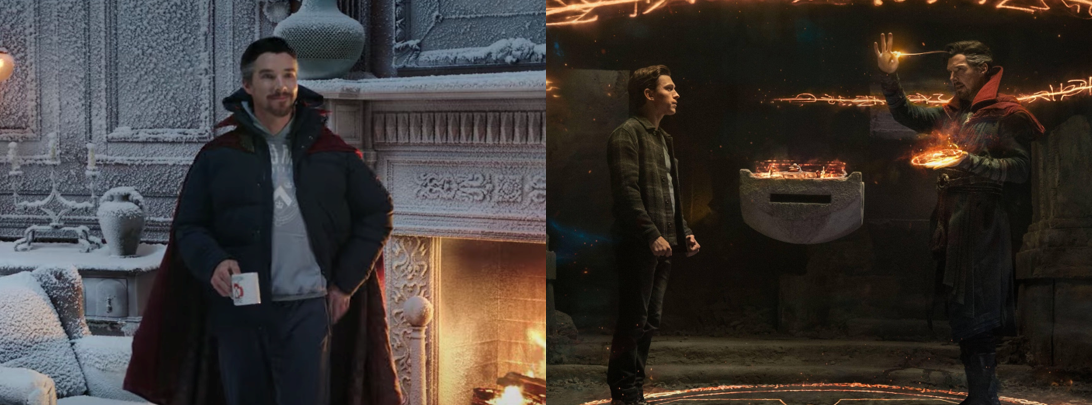
The Background:
Resident Evil (Capcom, 1996) began life as a seminal “survival-horror” title for Sony’s burgeoning PlayStation that emphasised atmospheric horror and conserving resources. Although the original title suffered a bit from the PlayStation’s blocky and clunky graphics and mechanics and dodgy, B-movie voice acting, the game was a best-seller for the PlayStation and bolstered by a number of sequels. Resident Evil 2 (ibid, 1998) improved on many of these mechanics and, alongside, Resident Evil 3: Nemesis (ibid, 1999), established much of the lore and groundwork before the fourth game forever changed up the formula for a new generation of gamers. The franchise’s success inevitably led to discussions of a live-action adaptation, which initially had legendary zombie horror maestro George A. Romero attached to direct before Constantin Film placed Paul W. S. Anderson in charge of the film series, which eventually included six live-action films. The movies, which were more of an action/horror genre, starred Anderson’s wife, Mila Jovovich and, despite earning a mostly negative reception, became the most successful and profitable live-action adaptation of a videogame series, though I can safely say that I was left disappointed by their lack of fidelity to the source material. After Anderson’s series concluded, Constantin Films began developing a much-needed reboot, and director James Wan initially expressed interest in the project before dropping out to direct Mortal Kombat (Wan, 2021) and being replaced by Johannes Roberts. Roberts aimed to return to the same dark, foreboding, and fun horror of the original videogames and the capture the traditional spirit of the source material by returning to the original locations, time period, and heavily featuring the popular videogame characters. Initial reactions, however, we less than encouraging, with many criticising the film’s B-movie feel; this was only exacerbated when Resident Evil: Welcome to Raccoon City released and criticised for its lack of substance and character development. The film was praised for its fidelity to the source material and references for long-time fans, however, and grossed $42 million worldwide; additionally, both the director and star Robbie Amell have expressed interest in returning for a sequel and tackling some of the later games in the long-running franchise.

The Review:
I feel like I need to preface this review with the revelation that, while I am a big fan of the Resident Evil videogames, I am not a fan of Paul W. S. Anderson’s live-action franchise. I spent a year of my PhD researching the history of zombie cinema, watching and studying and delving into Anderson’s movies, and I came out the other end absolutely loathing them. The only one I even remotely enjoy is Resident Evil: Apocalypse (Witt, 2004), and that’s purely because it’s the closest adaptation of my favourite games in the series (Resident Evil 2 and 3: Nemesis). I absolutely despise Alice (Jovovich), hated how Anderson ignored, cherry-picked, or diluted the source material and its iconic characters, and was actually a little insulted by how continuity was continuously thrown out of the window with the next movie purely for the same of slapping together a new plot. To me, Anderson’s films, while successful, are not Resident Evil; they do a decent job of adapting a different elements of the source material and zombie troupes but the result is this incomprehensible mish-mash of ideas that have been done much better elsewhere and with the Resident Evil title slapped on it purely to make money. And, make no mistake, they did make money and were popular enough to become their own independent franchise from the source material, but I longed for something a bit more faithful to the games I grew up with so I was excited at the prospect of a new Resident Evil adaptation that not only featured the iconic characters in starring roles but also revisited the events of the videogames…even if it was lumbered with a ridiculous title.

Chris and Claire’s fractured relationship is a central story of the film.

Resident Evil: Welcome to Raccoon City opens with Chris and Claire as young children (Daxton Grey Gujral and Lauren Bill) at the Raccoon City Orphanage; there they, and many other children, are cared for by the Umbrella Corporation and scientist Doctor William Birkin (McDonough). While this scene does go on a little longer than you might expect, it establishes a few key elements that crop up throughout the film; first and foremost, that Chris and Claire’s relationship is an important part of the story, the mystery surrounding what Birkin and Umbrella are doing with these children, and the existence of the malformed Lisa Trevor (Marina Mazepa). Lisa watches and visits Claire, scaring her but also arousing her suspicions, but Chris never sees the young Trevor and despairs of Claire’s stories. The story then jumps ahead a few years to 1998 to find Claire all grown up and journeying to the veritable ghost town of Raccoon City to reunite with her brother, who has joined the Raccoon City Police Department’s (RPD) special operations team, Special Tactics And Rescue Service (S.T.A.R.S.) and all but given up on her younger sister. Their relationship is strained, to say the least, since Claire ran away from the orphanage and left Chris alone; with no one else to turn to, he came to see Birkin as a father-figure and grew up a loyal representative of Umbrella and dedicated law enforcement officer, so he’s less than thrilled when Claire breaks into his house spouting conspiracy theories about Umbrella poisoning Raccoon City’s water supply.

Leon is oddly characterised as a bumbling fool who often makes an ass of himself.

Raccoon City has declined over the years after the Umbrella Corporation randomly pulled themselves out of the area, leave only a handful of staff and those too poor to leave behind to fend for themselves. As a result, the RPD is a bit under-staffed and has little choice but to accept the unlikeliest of recruits, such as rookie Leon. A young, fresh-faced, inexperienced cop, Leon is a recent transfer to the RPD thanks to the grace of his father, who ensured that he continued on with his law enforcement career after an embarrassing mishap where he shot his partner in the ass. Consequently, Leon is constantly berated, talked down to, and the butt (no pun intended) of other character’s jokes and frustrations…and he certainly deserves this treatment. A lackadaisical kid who’s in way over his head just manning the front desk, Leon fumbles with police protocol almost as much as with his firearm; he has no idea how to handle a shotgun, is easily disarmed by desperate conspiracy theorist Ben Bertolucci (Josh Cruddas), and is constantly just getting in people’s way and asking questions rather than actually being a pro-active and resourceful character. He’s kind of here as the film’s comic relief, though he doesn’t actually make any jokes, and his character arc is a very slow burn from being an awkward and unreliable rookie to building his confidence towards being more useful and capable, but it’s not handled too well.

The S.T.A.R.S. team are a tight-knit group, but Wesker has secretly got his own agenda.

RPD police chief Brain Irons (Logue) has little time for Leon’s antics, and is frustrated by a spate of mysterious attacks and killing across town. Reports of a chewed-up body at the old Spenser Mansion raise his ire further and, when Bravo team fails to report in from their investigation, he sends in Chris and the S.T.A.R.S. Alpha team to find out what happened. Alpha team is also made up of jock commander Albert Wesker (Hopper), trigger happy bad-ass Jill Valentine (John-Kamen), expendable nobody Richard Aiken (Chad Rook), and pilot Brad Vickers (Nathan Dales); they are an overconfident, militant bunch who have a friendly camaraderie that include splaying pranks on hapless colleagues like Leon and some sexual chemistry between Jill and Wesker. They travel to the mansion for a side story that is basically a condensed adaptation of the original Resident Evil and involves them exploring the dark, elaborate mansion with only their torches and a whole mess of submachine gun ammo on hand. Upon being dispatched, however, Wesker receives a mysterious page and is led to a PalmPilot that contains a map of the mansion, which is all part of a pre-arranged agreement with an unknown third party to led him to Birkin’s research and score him a big payday at the cost of betraying his teammates.

Though a loyal family man, Birkin’s research leads to a horrifying outbreak of zombies and monsters.

With Chris busying fending off the recently reanimated dead at the Spenser Mansion, Claire is forced to team up with Irons and Leon inside the police station for the Resident Evil 2 aspect of the film; the RPD is as beautifully true to the source material as the mansion, but it quickly becomes apparent that they can’t hold out against the increasing zombie horde. Irons leads them to the orphanage, which contains a secret passage to the mansion, and Claire is forced to face a traumatic experience from her childhood where Birkin tried to ship her off the mansion for experimentation with the mysterious T-Virus. Claire managed to escape, and has been trying to uncover the truth about Umbrella ever since; although a Licker shreds up Irons, Leon and Claire are aided by the grown-up Lisa Trevor and meet up with Chris right as he’s in the middle of being overwhelmed by zombies. Thanks to Wesker’s knowledge, the survivors are led to a secret passage in the mansion, which leads to a confrontation between Wesker and Birkin. A creepy, clinical scientist, Birkin is given layers of humanity through his devoted (and naïve) wife, Annette Birkin (Janet Porter), and innocent young daughter, Sherry (Holly De Barros); unlike his paranoid, self-absorbed, and malevolent videogame counterpart, Birkin is a loving father and equally concerned with getting his family to safety as he is preserving his research into the G-Virus. His desire to protect both leads him to pulling a gun on Wesker and getting riddled with bullets, and his desperate plea to Annette to inject him with the G-Virus so he can survive his wounds.

The Nitty-Gritty:
Resident Evil: Welcome to Raccoon City owes a lot to the Resident Evil 2 and 3 remakes in terms of its visual presentation; the cinematography is dark, gritty, rain-swept and gory just like in those games and the representations of familiar areas like the mansion and RPD are ripped right out of the high definition remakes of Capcom’s classics. The fidelity to the source material is so strong here; the orphanage and S.T.A.R.S. office is exactly like in Resident Evil 2, Chris, Leon, and Claire are all decked out in game-accurate outfits, even the Arklay mountains match up with the videogames. A surprising amount of time is spent with the trucker (Pat Thornton), who has only a brief role in Resident Evil 2 but, here, plays a pivotal role in bringing Claire to Raccoon City and expositing some background on the city, and the film is punctuated by both eighties horror tropes such as constantly onscreen reminders of what time it is (since the city is on a countdown to destruction) and onscreen text that recalls the opening of the original Resident Evil. The film’s title font is event exactly the same as the classic titles, and many of the shots and events are pulled right from the videogames; Vickers crashes his helicopter into the mansion, similar to a chopper smashing into the RPD, Chris’s first encounter with a zombie is almost exactly like in Resident Evil, and stormtrooper-like members of Umbrella Security Service even appear in a cameo role.

Some characters suffer from the writing and differ considerably from their videogame counterparts.

Unlike Paul W. S. Anderson’s films, the focus of Resident Evil: Welcome to Raccoon City is squarely on adaptations of the videogame characters, however long-term fans of the videogames may be a little disappointed with how some characters are represented. He clear standout is Claire; she’s a little more capable and has a bit of a chip on her shoulder compared to her videogame counterpart, but is a strong, bad-ass central character here and more than able to wield a shotgun, pick locks, and beat zombie dogs to death with melee weapons. Chris also fares pretty well; he’s much more the unprepared cop rather than a boulder-punching bad-ass and, while he doesn’t have as much nuance as Claire, he’s got just enough personality to not just be some meathead or stoic military brat. Unfortunately, my favourite character in the franchise, Leon, gets well and truly shafted here; never have I ever seen the character portrayed as such a bumbling klutz and it’s truly baffling that the film can be so true to the videogames in so many ways and bungle one of the most capable and popular characters so completely. It seems the writer/director decided to really overemphasise Leon’s rookie status and portray him as an incompetent fool who as no idea what’s happening, trips over his own feet, and constantly needs his ass pulling out of the fire. He does grow as the film progresses, but sadly not completely; thanks to Claire giving him a kick up the ass, he becomes more useful and even gets to deliver the coup de grâce to the film’s big-bad with a rocket launcher, but he definitely survives more due to the assistance of others and in spite of his incompetent nature.

While Birkin is surprising layered, Wesker is very different from his usual cold, calculating persona.

Another character who suffers quite a bit is Wesker; this isn’t the cold, calculating, manipulative puppet master you know from the videogames and is, instead, a bit of a cock-sure douche who Jill fawns over with doe eyes, banters with his teammates, and betrays his team for money rather than because he’s working for (or directly against) Umbrella. For much of the film, Wesker is actually surprisingly likeable; he leads his team efficiently, clearly cares for them, and even when he reveals his true intentions, he is remorseful. When he confronts Birkin, he repeatedly gives the doctor the chance to hand over the G-Virus samples peacefully and is distraught when he is forced to gun down Birkin and Annette. The implication is that his mysterious benefactors have some kind of sway over him and are forcing him to go down a dark path, or that the money is too good to turn down, and he expresses his regret and even apologises to Jill and Chris and directs them to the exit after being shot to death by Jill. Jill is also a little different to her videogame counterpart, and previous live-action portrayals; as mentioned, she’s quick to pull her gun and has eyes for Wesker, ignoring Chris’s clear attraction to her in favour of her commander, but luckily this aspect isn’t dwelled on too much (there’s no actual romance between her and Wesker, no kiss or anything, but she is clearly hurt by his betrayal as more than just a teammate). Birkin is noticeably altered as well in a way that makes him a touch more sympathetic, but not completely absolved of all evil as Claire stumbles across evidence that he has been experimenting on children as part of what he calls “God’s work” and developed the virus that is responsible for the city’s horrific events.

Zombies aren’t too commonplace in the film, but grotesque monsters are still a constant threat.

While Anderson’s previous efforts did include their fair share of zombie action, zombies were pretty much relegated to cannon fodder and annoyances to move his characters along and insert an action scene here and there. In Resident Evil: Welcome to Raccoon City, zombies are actually few and far between; thanks to Raccoon City being all-but deserted, we don’t really get any sweeping, dramatic shots of an army of the living dead. The zombies we do get are quite different to the usual depiction as well; they’re fast, as is to be expected, and much more vocal and animalistic than the traditional Resident Evil shambling hordes. They do attack in a ravenous fury, however, and relentlessly pursue fresh meat; they overwhelm Richard, chewing him up in an instant, though Chris is somehow able to fend a whole gaggle of them off with only a lighter as a light source. In the orphanage, Irons, Claire, and Leon are attacked by a Resident Evil movie staple, the Licker. As in Anderson’s films, the Licker is merely a more ferocious inconvenience; it reduces Irons to bloody ribbons but is easily subdued by Lisa Trevor, who is recast from a tortured monstrosity to a sympathetic tragedy of Birkin’s experiments. Also included are the infected crows and zombified dogs, but the depiction of the T-Virus is also a little different; according to Ben, the entire town was slowly exposed to the virus over a long period of time, and Umbrella even issued shots to its staff and the RPD officers to stave off their infection (though it’s not really clear as to why they would do this), and the focus is less on depicting the motivations behind developing the virus and more on the impact it has on the survivors.

Birkin undergoes a grotesque mutation that forces Leon to finally step up.

After Wesker and Birkin kill each other, Chris, Claire, Leon, and Jill follow Wesker’s directions to an underground train to will take them (and Sherry) to safety. However, exposure to the G-Virus causes Birkin to undergo a horrific mutation; his right arm becomes a monstrous claw-like appendage and disgusting tumour-like eyes glisten out from his skin. Driven by an animalistic urge, he hunts the survivors, attacking Chris and taunting him (an addition I can get behind as it retains McDonough’s visage and deliver), and reunited the estranged siblings as Claire comes to his aid. Wounds only exacerbate the G-Virus, however, mutating Birkin into a grotesque monstrosity that franchise fans will recognise as “G”; it attacks the train, sporting Birkin’s wailing, agonised face on its torso, and threatens to eviscerate all of the survivors. They are saved by the unlikeliest of heroes as Leon blasts the monstrous Birkin in the face with a rocket launcher (dangerously close to Claire and Chris, but they survive thanks to Plot Armour) and the survivors manage to escape Raccoon City right as it collapses in on itself and is erased from the face of the Earth. In the aftermath, Umbrella believes that they have contained the outbreak and eliminated any witnesses, unaware of the five survivors, and Wesker suddenly wakes up in a body bag in a mysterious facility. There, the mysterious Ada Wong (Lily Gao), provides him with sunglasses to ease his newfound sensitivity to light and forcibly drafted into an unknown fate. I applaud the confidence in the film’s ability to get a sequel, and I wouldn’t be surprised if it does get on in some way, shape, or form but I do think it might have been better to have this scene take place after the credits rather than mid-way through them.

The Summary:
I went into Resident Evil: Welcome to Raccoon City with pretty low expectations; I was excited by how faithful to the first two games it seemed from the trailers and images, but wasn’t impressed with the odd title and heard that it wasn’t that great. Specifically, I heard all about the assassination of Leon’s character and Wesker’s odd characterisation, and criticisms about it being little more than a dumb B-level monster movie. While I was displeased with Leon’s characterisation, and surprised at the take on Wesker, I would still say that Resident Evil: Welcome to Raccoon City is better than every single one of Paul W. S. Anderson’s previous live-action adaptations put together. It’s so true to the games (which were B-level monster movies at heart) that I’m genuinely surprised to see Anderson listed as a producer since he seemed determined to ignore everything but the most popular aspects of the source material. While the film still has a focus more on action rather than survival, the characters, locations, and atmosphere are so perfectly in-tune with the classic Resident Evil videogames that it easily compensates for any misgivings I may have about some of the characterisations. If the film does get a sequel, I’d like to see these issues addressed as part of a larger story and character arc, but I was very entertained by Resident Evil: Welcome to Raccoon City’s back-to-basics approach. For me, Resident Evil works best when it’s a gory, horrifying battle for survival against zombies and other monsters and Resident Evil: Welcome to Raccoon City definitely meets these criteria. I’d even go as far as to say that, despite some missteps with Leon and Wesker, this is the live-action Resident Evil movie fans have been waited for since Capcom first considered producing an adaptation and that there’s enough here fans of the videogames, and of gory action/horror films, to really sink their teeth into.

My Rating:

Rating: 4 out of 5.

Great Stuff

Have you seen Resident Evil: Welcome to Raccoon City? How do you think it compares to the previous live-action films and the videogames it is based on? Which character was your favourite, and what did you think to Leon and Wesker’s characterisation? Did you enjoy the B-movie trappings of the film or did you prefer Paul W. S. Anderson’s more bombastic approach? Would you like to see a sequel to the film or were you disappointed by it? Which Resident Evil videogame is your favourite? I’d love to hear your thoughts on Resident Evil: Welcome to Raccoon City, so sign up to leave a comment below or leave a comment on my social media.

Movie Night [Christmas Countdown]: Jingle All the Way

Released: 22 November 1996
Director: Brian Levant
Distributor: 20th Century Fox
Budget: $75 million
Stars: Arnold Schwarzenegger, Sinbad, Jake Lloyd, Robert Conrad, Rita Wilson, and Phil Hartman

The Plot:
Howard Langston (Schwarzenegger) is a workaholic husband and father who, after missing his son Jamie’s (Lloyd) karate class graduation, promises to make it up to him by buying him the hottest action figure of the year, Turbo-Man, for Christmas. But, having forgotten to by the toy ahead of time, he must race both across town and against a similarly motivated mailman, Myron Larabee (Sinbad), on Christmas Eve or risk once again breaking a promise to his son.

The Background:
It’s easy to forget that, amidst all the action and science-fiction movies of the mid-eighties and nineties, Arnold Schwarzenegger also dabble din a bit of comedy. Not all of these ventures were successful, mind you, but it was a decent attempt by the Austrian Oak to showcase some range to his acting ability. Arnold joined the film for a reported $20 million salary, attracted to the idea of portraying an “ordinary man” for a change, and having experienced the difficulty of last-minute Christmas shopping itself. The script, which originated from a screenplay by Randy Kornfield, drew upon the mad rush shoppers faced to purchase some of the most sought-after Christmas toys over the years, from Cabbage Patch Kids to Power Rangers and the much-coveted Buzz Lightyear. Ironically, the film was shot so quickly that there wasn’t enough time to produce much in the way or merchandising for the film, which went on to gross nearly $130 million and received mixed to average reviews at the time. Perhaps because of its bonkers nature, it has become something of a cult classic over the years and a standalone, straight-to-DVD sequel was even produced in 2014 with an entirely new cast.

The Review:
Jingle All the Way is the story of Howard Langston, a workaholic father and husband who is such a big-wig at his company (which, I believe, is a company that sells bedding and furniture) that he’s working up to the wire on Christmas Eve-Eve during he office party. Though Howard is very much consumed by his work and ensuring that his many “number one customers” are satisfied, he’s not a maliciously neglectful father; I never got the sense that he was a bad Dad or husband, he’s just a cliché mid-nineties businessman whose primarily about the business.

Howard grossly underestimates the popularity of Turbo-Man.

When Howard misses his son Jamie’s karate graduation, he desperately tries to make it up to his son but the only thing that really works is him being honest; by admitting that he screwed up, Howard is able to turn Jamie around and learn about his Christmas wish for a Turbo-Man action figure. Sadly, Howard doesn’t twig to this revelation so, when his wife Liz (Wilson) asks him if he bought the doll when she told him to “weeks ago”, he opts to lie to her to cover his ass and avoid further reprisals. Unfortunately, while Howard is a great liar and a convincing act, he greatly underestimates just how popular the Turbo-Man action figure is. Seriously, this guy is like the Power Rangers on steroids, having a super cheesy television show, comic books, and all manner of merchandise and, despite Jamie clearly being besotted to the point obsession with the character, Howard is too thoughtless to notice that Jamie has greater respect and admiration for a fictional character rather than him before it’s too late.

In place of his neglectful father, Jamie idolises Turbo-Man to the point of obsession.

If there’s a weak link in the film, I’m sorry to say that it’s Jake Lloyd; it’s painful to say it about a child actor who was once so prominent in the industry, and considering everything he went through later in life, but Lloyd is pretty insufferable in the two films I’ve seen him in (three guesses what the other one is…) and even more so here. To be fair, much of this seems to be due to the script as Jamie is quite the spoilt, condescending little brat at times. I get that he’s desperate for his Dad’s attention but, as I said, he’s taking his love of Turbo-Man to an unhealthy obsession at times; however, this just goes to show how powerful and influential television, merchandise, and advertising can be on a young boy since he has based his entire life philosophy and morals on the teachings of a Saturday morning show in place of his inattentive father.

Sinbab’s bombastic comedy is a particular highlight of the film.

Being a comedy film, much of Jingle All the Way’s success lives and dies on the content of the actual jokes and gags; for the most part, these come from the comedic chops of Sinbad, whose character, Myron, is a troubled mailman who is equally desperate to get his son a Turbo-Man after experiencing a similar let down as a kid. Myron represents a different social class compared to the fairly well-off Howard; Myron is the working class everyman, a man driven to desperate and near insanity by the thankless nature of his job and the pressure of living up to the expectations placed upon him (and all fathers) by television advertising.  Because of this, Myron tends to go off on increasingly ridiculous tangents, ranting and raving about the season and his lot in life to the point of hilarity; Sinbad pretty much steals every scene he’s in, chewing the scenery and delivering a performance that is the perfect blend of bombastic and belligerent.

Ted is Howard’s annoyingly helpful neighbour who has his sights set on Liz.

Speaking of scene-stealers, Jingle All the Way also includes a fantastic turn by Phil Hartman as Howard’s overbearing next-door neighbour Ted Maltin; if Ted has a counterpart in the world, it’s Ned Flanders (Harry Shearer) as he’s overly polite, super helpful, and can seemingly never put a foot wrong. When Howard is late or misses Jamie’s big events, Ted is there with his video camera; when Howard is too buys to put up Christmas or be at home with Liz and Jamie, Ted is right there. So beloved is Ted that all the neighbourhood mothers swoon over him, openly flirting with him and attracted to how handy and capable he is, but Ted has his sights set on Liz. Interestingly, though, as accommodating and as a nice a guy as Ted seems to be, there are some interesting cracks in his persona: he snaps at his son Johnny (E.J. De La Pena) and Jamie after burning his fingers when watching over them and delivers a very icy quip to Howard after he wrecks his house. Ultimately, though, Liz is somewhat repulsed by Ted’s advances and he receives his comeuppance when Howard upstages him in the film’s finale.

Howard repeatedly runs afoul of Officer Hummell, who constantly ends up worse for wear.

As if all that wasn’t enough, Howard constantly runs afoul of Police Officer Alexander Hummell (Conrad) in a recurring gag in the film; Hummell pulls Howard over and causes him to miss Jamie’s graduation, then gives Howard another ticket when he accidentally reverses into his police bike, and responds to the radio station’s call for help when Howard and Myron burst in in a desperate attempt to win a Turbo-Man. This results in one of the best, and most cartoonish, scenes in the film when Myron threatens the cops with a mail bomb that turns out to actually be real. Conrad delivers a very dry and sarcastic performance, which makes for some fun exchanges between him and Arnold.

The Nitty-Gritty:
Jingle All the Way is quite the madcap film, with a near relentless pace as we follow Howard on his desperate search for a Turbo-Man. At every turn, he finds nothing but empty shelves or units of Turbo-Man’s weird bear/tiger sidekick, Booster, crazed fellow shoppers, and overworked, underpaid, jaded retail staff. I’ve worked in retail at Christmas time and I can say that I fully understand the attitude of the staff Howard encounters as shoppers go absolutely ape-shit at Christmas time, literally clambering over each other to get at products, and it’s only gotten worse over the years as Black Friday sales have been extended to an entire week! Still, you can make the argument that Liz should have known that Howard couldn’t be trusted to buy the doll and should have picked it up herself, since she’s much more attuned to her child’s needs, but then we wouldn’t have the movie now, would we?
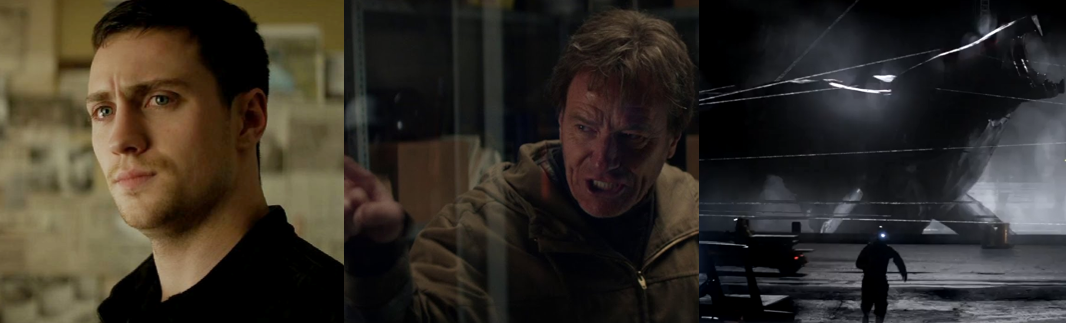
Howard ends up in some weird and uncomfortable situations in his quest.

Amidst Howard’s dire quest, he ends up in some really weird situations: there’s the uncomfortable moment where he chases a little girl through the mall to get a lottery ball and is attacked by rightfully concerned mothers, for one thing, and his encounter with the mall Santa (Jim Belushi). Santa turns out to be one of a number of Christmassy crooks who sell knock-off toys from a warehouse at a criminally inflated price and, when Howard tries to get his money back, a massive fight ensues between him and the Santa’s (including Paul Wight, better known now as the WWE’s Big Show, and Verne Troyer). This sequence is another highlight of the film thanks, largely to Belushi’s memorable performance; he’s not in the film for longer than a cameo but he makes an immediate impression once he shows up and you almost wish he could have had a large role in the film’s events.

For the finale, the film descends into full-blown cartoon buffonery.

Of course, the biggest and most ridiculous scenario Howard finds himself in is when, after being chased by Hummell, he ends up being forced into the Turbo-Man suit for the “Wintertainment Parade” when the organises mistake him for the replacement stunt man. In the process, Howard not only finally gets his hand son the Turbo-Man doll but ends up in an elaborate and overly cartoony fight with Myron, who disguises himself as Turbo-Man’s arch-nemesis Dementor to steal the toy. This leads to a Myron chasing Jamie up a fire escape and across rooftops and Howard inexplicably activating the actual, fully functional jetpack built into the suit to rescue his son and defeat Myron. It’s a massively over the top sequence that is, in many ways, at odds with the generally more grounded, if wacky, antics that have followed but it certainly makes for a memorable finale in which Howard learns to appreciate his family, Jamie gifts Myron the Turbo-Man doll, and everyone ends up in a better place than they originally started (…except for Myron, who ends up in prison…).

The Summary:
Jingle All the Way is far from the best Christmas movie and is definitely one of the weaker films in Arnold’s impressive resumé; it’s a schmaltzy, over the top cringe fest of a festive comedy with some really weird cartoonish moments, some dodgy performances, special effects (especially noticeable in the finale) and line delivery from Arnold and Lloyd, and all the clichés you’d expect from a film of its kind. And yet…there’s something about it that I find unironically entertaining. Nostalgia helps, of course, since I grew up watching this film, as does the festive nature of the movie and the feelings of yuletide joy it inspires within me but, even disregarding those obvious aspects, Jingle All the Way is a wild, but entertaining, ride with some amusing moments and exchanges that really bring it up a notch. Not only that, but the film’s excess actually contributes and plays into the overall plot concerning consumerism and Christmas mania, which remains as relevant as ever, meaning there’s plenty of different elements at work in the film to appeal to kids and adults. Plus, you know…it’s a Christmas movie starring Arnold Schwarzenegger so a certain amount of cheese is to be expected but you can certainly find worst Christmas movies out there.

My Rating:

Rating: 3 out of 5.

Pretty Good

What do you think to Jingle All the Way? Is it a Christmas tradition of yours or do you prefer another Christmas movie; if so, what is it? What did you think to the performances of the actors? Do you enjoy seeing Arnold playing against type or do you think he should stick to what he’s best known for? Have you ever had to face last-minute Christmas shoppers? What was the hot Christmas toy when you were a kid? Whatever your thoughts, leave a comment below and be sure to check in next Saturday for another Christmas movie review!

Movie Night: Logan

Released: 3 March 2017
Director: James Mangold
Distributor: 20th Century Fox
Budget: $97 to 127 million
Stars: Hugh Jackman, Patrick Stewart, Boyd Holbrook, Stephen Merchant, Dafne Keen, and Richard E. Grant

The Plot:
It’s 2029 and Mutants are all but extinct. Jaded, world-weary, and suffering from Adamantium poisoning due to his weakened healing factor, James Howlett/Logan (Jackman) has been trying to keep the increasingly-dementia-ridden Professor Charles Xavier (Stewart) out of harm’s way but his already tumultuous life is thrown one last curveball when they are forced into protecting Laura/X-23 (Keen) from a group of mercenaries seeking to retrieve her and genetically engineer Mutants as potential soldiers.

The Background:
By 2017, 20th Century Fox had more than profited from their various X-Men movies and spin-offs, which had raked in over $1,800,000,000 at the box office. Although The Wolverine (ibid, 2013) received mixed reviews upon release, a sequel was still put into development thanks, in no small part, to the film’s worldwide gross of over $300 million and Hugh Jackman’s popularity and commitment to the role. Rather than produce a direct continuation of the last film, and on keeping with the loose continuity of Fox’s X-Men franchise, this new film drew inspiration from movies like The Wrestler (Aronofsky, 2008) and Unforgiven (Eastwood, 1992) as well as storylines such as “Old Man Logan” (Millar, et al, 2008 to 2009). Purposely developed to be the conclusion to Jackman’s time in the role, the film took the surprisingly simple title of Logan and was produced as an R-rated film in order to make Jackman’s last outing the most violent yet. Afforded a much smaller budget than its predecessors, Logan went on to be an unprecedented critical and commercial success, earning over $600 million at the box office and drawing rave reviews across the board for its bleak tone, violence, and emotionally affecting end to the character’s extraordinary popularity. Though potential follow-ups were thrown into uncertainty when Disney purchased the 20th Century Fox, regaining the rights to the X-Men franchise, among others, in the process, Jackman has, so far, remained adamant that Logan would be his last go-around in the role.

The Review:
Set in the far future of 2029, Logan (who has, somehow, regained all of, if not most of, his memories and now openly refers to himself as “James Howlett” and is even (mysteriously) carrying an Adamantium bullet from X-Men Origins: Wolverine (Hood, 2009) that he plans to use to kill himself with at some point) is now a dishevelled, world-weary, broken down limo driver who is succumbing to Adamantium poisoning and his weakened healing factor, which allows him to drink himself into a stupor but also results in a prominent limp and a visible amount of pain and discomfort. Completely done with the X-Men, Mutants, and pretty much everything in life, he has no time for anything or anyone, much less the assholes trying to steal the tyres off his limo. He doesn’t want to fight anymore and just wants to be left alone but is incredibly irritable and quick to anger because of everything he’s been through and brutally skewers, slices, and dices the thieves when they push him too far; though he is hurt in the process, he’s more annoyed that they damaged his limo.

Logan and Xavier have a rocky, dysfunctional father-son relationship.

Logan has no time or patience at the best of times but least of all of those who call him “Wolverine”, proposition him, or oppose him; he dismisses Gabriela Lopez’s (Elizabeth Rodriguez) pleas for help until she promises him a big bundle of cash and is angrily dismissive of the semi-cybernetic Donald Pierce (Holbrook). He just wants to be left alone and has no interest in helping or fighting anyone so, when Laura ends up in his care, he is extremely annoyed at being dragged out of his hole and Xavier’s insistence that they help and protect her. Logan is working as a limo driver to save up the money to buy a yacht and disappear from civilisation forever with the decrepit and increasingly irascible Xavier; Xavier now suffers from bouts of dementia, which results in mood swings, a fractured perception of time and reality, an overall grouchy demeanour and spite-filled outbursts, and, worse of all, awful seizures which cause incredible pain to those in his vicinity. He has a tumultuous relationship with Logan, resembling a petulant child at times, but also trying to stress the importance of Laura’s existence and safety and is still trying to teach him to be a better man.

Xavier’s seizures make him a very real danger to those around him.

Logan, of course, is the only one able to endure Xavier’s abuse and is doing everything he can to keep Xavier safe, and others safe from him, and to administer his medication to him. He sticks by the Professor out of a begrudging love and loyalty, seeing him as a father-figure, but isn’t happy about what he’s become, the world they live in, or the life he leads. It’s very heavily hinted that the Professor killed all of the X-Men during one of his seizures, which is haunting Logan and causing him incredible grief and pain since he, presumably, witnessed it and he has to live with the knowledge of it. We see a sample of Xavier’s seizures early on and Caliban (Merchant) complains about how they’re getting worse but we don’t really see their true, devastating effects until later in the film when Xavier lapses into a violent episode as Peirce’s men are coming for him and Laura. The effect is an intense, crippling version of Xavier’s “freeze ability” first seen in X-Men 2 (Singer, 2003), rendering all within his vicinity helpless and wracked with pain. This results in one of the film’s standout moments as Logan, struggling against the effects of Xavier’s mind the way a man struggles against the tide, rams his claws into Peirce’s men with a violent ruthlessness. Even after Logan delivers Xavier’s medicine and stops the seizure, though, it has lasting effects as those who suffered from it lie in agony or struggle to regain their composure.

Pierce is full of the kind of egotism that only youth can bring.

Caliban isn’t really given a lot of  backstory or focus but Merchant does a decent job with the limited time he has; it’s nice to see new Mutants/characters involved in the franchise but, beyond acting as Logan’s conscience and trying make him realise the hopelessness and gravity of their situation, he doesn’t really have much else to do except get used and abused by Pierce, add to Logan’s grief, be ignored, and sacrifice himself in an unsuccessful attempt to kill Pierce (though he does take some of the other Reavers out with him). Pierce, though, is a charismatic, arrogant antagonist; he’s full of the kind of egotism that only youth can bring and attempts to coerce Logan into co-operating before leading a raid on his Mexican hideout. Though persistent, he’s clearly in over his head but determined to see his mission through; still, at least he’s not another guy-in-a-suit villain. In the end, he meets his need not at Logan’s hands but at the hands of a new batch of young Mutants, his commitment to the mission turning out to be his downfall, though he does last a little longer than his employer, Doctor Zander Rice (Grant).

Rice is, honestly, a waste of Grant’s talents and simply there to be the film’s “mastermind”.

Personally, I feel the inclusion of Rice is a little unnecessary; it’s a bit of a waste of Grant’s talents and stature as an actor and I almost feel like it would have worked better if he had showed up for the finale in a quick cameo rather than being peppered throughout the film simply to deliver exposition. Rice is basically a substitute for Colonel William Stryker (Brian Cox); a scientist who is experimenting on, and fascinated by, Mutants. The difference, though, is that Price unwittingly caused the extinction/suppression of Mutants through his research and is now working to genetically engineer a new generation of Mutants by splicing the genes of the older generation, such as the X-Men and, of course, Logan. Price is a slimy, manipulative individual; pragmatic and logical but also entirely convinced that his way is just and yet, at the same time, marvels at X-24’s (Jackman) efficiency and savagery. His villain is the kind of hypocritical kind who believes he was only trying to help humanity and, having accidentally effectively wiped Mutants out, is now trying to rebuild Mutants according to his design.

Laura is the breakout character, being both an innocent child and a whirling ball of savage fury.

Of course, Laura is the standout character; initially little more than a scared, unassuming little girl, she is a whirlwind of feral fury and naïve innocence. The two combined are a dangerous combination, making her unpredictable and violent at the best of times, though easily appeased by childish wants and desires (cereal with too much milk, X-Men comics, kiddy rides, snacks, funky sunglasses, fiddling with everything she sees and the like). When her life is in danger, or those around her are threatened, she reacts with a primal, savage fury, attacking and killing on instinct, and is every bit the animal that Logan has fought against all these years. As the film progresses, Laura opens up more, speaking first in angry Spanish and then in angry English; her and Logan begrudgingly bond, forming a dysfunctional family dynamic alongside Xavier, and her safety becomes his final mission and reason for living over the course of the film. Having buried his oldest friend and mentor, Logan is vulnerable and grieving and, in that moment, comes to see Laura as a true person, his daughter, rather than simply a liability or mission.

The Nitty-Gritty:
Of course, what separates Logan from its predecessors is its excessive violence, gore, and profanity (which Jackman secured by selflessly taking a pay cut); Logan is covered in scars and bruises, his claws sever limbs and skewer his prey without mercy and in extremely brutal fashion. Irritable and grouchy, Logan is quick to a fiery temper and has no time for decorum or mercy this time around and this is reflected in the way he mercilessly dismembers those who get in his way, as though losing the X-Men finally removed the last vestiges of his humanity and he’s been left with its tattered remnants.

Despite his rage, Logan is crippled by chronic pain and a lifetime of injuries and fatigue.

This is clearly the most vulnerable and distraught we’ve ever seen Logan; perhaps the closest parallel was when he was living like a hermit at the beginning of The Wolverine. Here, though, he’s lost absolutely everything and is suffering inside and out; we saw him struggling with a dodgy healing factor in The Wolverine but it’s far worse here as not only does he struggle to heal, or heal properly, but all his old wounds are resurfacing and he is slowly dying from, and being crippled by, Adamantium poisoning. He suffers from a persistent cough, is clearly in constant pain, and is now forced to wear glasses to read, watch phone screens, and to see properly. Despite this, Logan continues to fight with a savage fury when pushed; he fights through the pain, uses it even, which results in a number of visceral, brutal action scenes but also allows the film to explore Logan’s humanity in a way we haven’t seen before. Ultimately he succeeds in this but in a thematic way since Laura uses the bullet to blow X-24’s head off.

Xavier meets a gruesome end after a rare, and tragic, moment of clarity.

Xavier is a broken-down shell of his former self; frail and weak and far from his usual eloquent sense. Prone to bouts of profanity and cruel spite, Xavier is a shadow of the man he used to be and is entirely dependant upon, and resentful of, Logan and Caliban. Of course, Xavier’s condition makes it difficult to separate fact from fiction; his outbursts and vindictiveness could be due to his dementia since he perks up once Laura comes into their lives. Xavier is transformed by the conformation of a new breed of Mutants, determined to protect Laura and get her to the rest of her kind, and becomes more of a kindly old grandfather. This make sit all the more tragic when, in a moment of clarity and sanity, he is brutally murdered by X-24 and dies believing that Logan, his last remaining student and friend, killed him.

In death, Logan finally finds the peace he has long desired and ensures that his legacy will live on.

Logan is deeply affected by Xavier’s death; he is horrified at the thought that his mentor and father-figure died thinking he had turned on him and uses that anger as motivation in his fight against Pierce, Rice, and X-24 but he is hopelessly outmatched by his younger, stronger clone. All the determination, rage, and will in the world don’t really help Logan in a one-on-one fight and he is forced to use whatever means he can, including both taking Rice’s serum and sacrificing his own life, to end X-24’s threat. In the end, Logan is able to deliver Laura to her fellow new Mutants and dies to protect her; in the process, he finds the peace he has long desired in that his legacy gets to live on and he finally gave his life for something worthwhile, a chance for a new generation of Mutants to live free in the world. It’s a poignant scene, one that is a fitting farewell for Jackman and his iconic role, though a part of me would have preferred to see Liev Schreiber return as Victor Creed rather than a clone of Logan.

X-24 emobides Logan’s darker, animalistic side of Logan and exists as his dark mirror.

However, X-24 has obvious thematic reasons to exist; superficially, he represents everything Logan has fought to not be over the years, being little more than a savage animal forced to blindly and unquestioningly follow orders. Additionally, he is the younger, stronger version of Logan (with none of the age, scars, blemishes, or pain that Logan carries) meaning that, in fighting X-24, Logan is literally and figuratively fighting against himself, his past, and the most savage parts of his nature. Again, though, I do feel like Creed could have fulfilled this in exactly the same way (X-24 even resembles Creed in many ways) but I guess it’s more explicit this way and keeps the filmmakers from referencing one of the more unfavourably-received X-Men films. Still, I’m glad, and actually kind of surprised, that the filmmakers decided to not keep X-24 around in an attempt to leave the door open for Jackman’s return and the film definitely seems to be setting Laura up to be the next Wolverine.

As great as the film is, there are some questionable moments to nitpick.

There are some things that bother me about the film, however; first and foremost is, obviously, its sketchy continuity. Apparently, this film takes place in the “Good Future” seen at the end of X-Men: Days of Future Past (Singer, 2014), which is fine but a little depressing that, no matter which timeline you follow, the X-Men are doomed to suffer and die. Second, there’s the massive lull the film takes with Logan, Xavier, and Laura stop to help a family on the highway and end up getting close to them; it works, again in a thematic sense, to remind Logan of what it means to be happy and have a family but it does kind of slow the film down and it’s a pretty cheap way to up the body count, add to Logan’s grief and rage, and to sell X-24 as a relentless killer. Add to that Gabriella’s incredibly well edited phone video, which stretches plausibility not only through its professional construction but also through her ability to record all of that footage without being spotted. Finally, there’s the vague explanation of what happened to the X-Men and the other Mutants; I can appreciate the subtle ways the film hints at its story and what has happened but, considering how wildly different the world is since we last saw the X-Men and Wolverine, a little more consistency and exposition would have gone a long way, instead, we’re left with a lot of questions and unresolved plot points; it definitely feels like they were setting up for a spin-off involving and, arguably, I feel like The New Mutants (Boone, 2020) should have explored her and the other new breed of Mutants to help expand upon this premise and the success of the film but it is what it is and for an emotional last chapter for Jackman and Logan it excels in every regard.

The Summary:
While the X-Men films have always been big, action-packed features full of special effects and increasingly elaborate action scenes, Wolverine’s solo efforts have always strived to have a slightly different flavour; even X-Men Origins: Wolverine dabbled in being a war movie and trying to tell a more intimate, focused story amidst its bombastic action. However, this becomes undeniably explicit in Logan, which is, essential, as much road trip film and a Western as it is in an intense character study; heavily influenced by Sergio Leone’s “Spaghetti Westerns” (1964 to 1966) and classic Westerns like Shane (Stevens, 1953), Logan is the exploration of a tortured, jaded loner just trying to exist in a world that has long past him by but who is forced back into prominence by the hands of fate. Logan is a very different kind of comic book/superhero movie; it’s not full of bombastic action or overly-choreographed set pieces and is, instead, a much more subdued exploration of the longevity, suffering, and mortality of the man we know as Wolverine. However, when the action and fights do happen, they’re fast, brutal, and viciously intense and, perhaps, the best way to describe Logan: intense. It’s a far cry from the loud, frenetic action of other X-Men films, especially X-Men Origins: Wolverine, and is all the better for it, finally unleashing the animalistic nature of Wolverine and showing just how dangerous and violent he can be while also being, essentially, a character study, or deconstruction, of Logan and allowing him both the chance to be the ferocious character he has battled against all this time and give him the send-off he deserves.

My Rating:

Rating: 5 out of 5.

Fantastic

What did you think of Logan? How do you feel it compares to the other X-Men and Wolverine movies? What are your thoughts on the presentation of a broken down, dying Logan and the introduction of X-23? Were there any parts of the film that disappointed you? Would you have liked to see Liev Schreiber return? Do you think Hugh Jackman will ever be tempted to return to the character in some way, shape, or form or do you feel it’s best to pass the role on to someone else; if so, who, and do you want Laura to assume Wolverine’s mantle? Whatever your thoughts, please leave a comment below.

Movie Night [Godzilla Month]: Godzilla (2014)


Toho’s famous atomic beast, and easily the most recognisable kaiju in the entire world, Gojira first emerged from the waters of outside of Japan to wreck the city of Tokyo on November 3rd, 1954. To celebrate “Godzilla Day” this month, I’ve been dedicating very Saturday in November to looking back at the undisputed King of the Monsters’ many reboots.


Released: 16 May 2014
Director: Gareth Edwards
Distributor: Warner Bros. Pictures
Budget: $160 million
Stars: Aaron Taylor-Johnson, Ken Watanabe, Elizabeth Olsen, Sally Hawkins, and Bryan Cranston

The Plot:
After discovering evidence a gigantic prehistoric creature known as “Godzilla” (T. J. Storm), Monarch monitors the creature and other Massive Unidentified Terrestrial Organisms (MUTO). Believing that the government covered up his wife’s death following a nuclear meltdown, Joe Brody (Cranston) becomes obsessed with discovering the truth and his sceptical son, Ford (Taylor-Johnson), soon finds his father’s fears all-too-real when two MUTOs go on the rampage, with Godzilla being humanity’s only hope.

The Background:
Although Godzilla (Emmerich, 1998) made $379 million at the box office, the film was considered to be a box office failure thanks to poor critical reviews and an overly enthusiastic merchandising campaign. Having distancing themselves from the film, Toho opted to bring the franchise back to life ahead of schedule in order to put the “God” back in “Godzilla”, and eventually put the series on a planned hiatus after the release of what remains the biggest Godzilla film yet, Godzilla: Final Wars (Kitamura, 2004). After canning plans for two more films following the disastrous 1998 production, TriStar Pictures allowed their rights to the franchise to expire in 2003 and Western audiences would have to be content with dubbed and subtitled versions of the Japanese Godzilla movies for some sixteen years. In 2009, rumours began circulating that Legendary Pictures were negotiating with Toho to reboot the legendary kaiju franchise, and Toho confirmed that they were excited to bring Godzilla back to America, and Legendary’s chairman and CEO, Thomas Lull, was determined to do that character justice this time around. The studio turned to Gareth Edwards to direct the film based on his low-budget giant monster movie Monsters (Edwards, 2014), and Edwards made sure to work closely with the film’s script to ensure that Godzilla would be represented as a ferocious force of nature while still pitting him against formidable foes and tackling contemporary issues regarding nature’s wrath. Tull was determined to ensure that Godzilla was redesigned in a way that made him both recognisable and contemporary, and turned to Andy Serkis’ Imaginarium and the Moving Picture Company to bring the creature to life; drawing from all previous interpretations of the monster, Godzilla’s new design aimed to be one of the biggest and most fearsome ever, while still being believable and somewhat mythological in its appearance and biology. Godzilla’s $529 million box office meant that it was a huge success for all involved, and the film was met with largely positive reviews. While some criticised the characterisations and Godzilla’s lack of screen time, Japanese critics praised the film for honouring the spirit of the franchise. Godzilla was so successful that it not only saw Toho produce a new reboot of their own but also kicked off an all-new, interconnected series of films dealing with rebooted versions of classic monsters like Godzilla and King Kong, eventually leading to a modern-day clash between the two as part of Legendary’s “MonsterVerse”.

The Review:
Man, I was so hyped for this new version of Godzilla back when it first came out; Cloverfield (Reeves, 2008) and Pacific Rim (del Toro, 2013) had done a lot to repair the damage of the 1998 Godzilla and anticipation was high, at least for me, to see that modern technology could really do with the Big-G. as a massive fan of the character and the franchise, who’s pretty much seen every single film starring the character (and many of his fellow kaiju), it just felt like the time was right to see Godzilla up on the big screen, literally bigger than ever, and for the character to make a big impact in a medium that was pretty much dominated by superhero films. The approach that the filmmakers took was a bold one, and definitely one geared more towards newcomers of the franchise, that I am aware divided many at the time but I still think the results were worth some of the drawbacks of the film, even if it maybe fell a little short of my lofty expectations.

Joe’s world is shattered when one of Monarch’s giant monsters attacks his power plant.

After a brief tease regarding Godzilla’s origins and its many sightings over the years, the film jumps to the Philippines in 1999, where Doctor Ishirō Serizawa (Watanabe) and Doctor Vivienne Graham (Hawkins) of Monarch are brought in to investigate a collapsed mine and discover the ancient, fossilised remains of a Godzilla-like creature and two giant spores. While one is intact, the other has broken open, unleashing an unknown entity upon the world which has made its way over to a nuclear power plant in Janjira. Here, we meet perhaps the most underutilised character in the film, Joe Brody, the lead engineer at the power plant who is deeply concerned by the tremors that have been spreading towards the facility from the Philippines. Now, I’ve never watched Breaking Bad (2008 to 2013) and have no desire to, but I am a fan of Cranston’s and he definitely brings a certain expectation and respectability to the film, so to see his character suddenly killed off so early in the runtime was a bit of a mistake (and incredibly misleading, since the film’s marketing and trailers naturally focused on him as much as Godzilla). At the start of the film, Joe is desperate to impress upon his Japanese superiors his concerns regarding the tremors, to the point that he unintentionally misses out on seeing the effort his young son, Ford (CJ Adams), has gone to celebrate his birthday, but is nevertheless depicted as a doting father and husband rather than a neglectful workaholic.

Ford is distraught to find his father’s obsessions prove accurate when a MUTO goes on a rampage.

Joe’s concerns come to fruition when the seismic activity causes a breach in the reactor; tragically, Joe’s wife, Sandra (Juliette Binoche), is killed when Joe is forced to seal the blast doors to prevent a complete nuclear meltdown. Devastated by her loss, Joe spends the next fifteen years trying to uncover the truth behind the event, which saw the plant collapse and the entire area be designated a quarantine zone. This drives a wedge between him and Ford, who grows up to become Aaron Taylor-Johnson and a Lieutenant in the United States Navy as an explosive’s technician. Having just returned home to his wife, Elle (Olsen), and son, Sam (Carson Bolde), Ford definitely gains the most characterisation, personality, and humanity from his short scenes with his family, which depict him as a very attentive husband and father. However, his happy reunion is spoiled when Joe is arrested for trespassing into the quarantine zone, and Ford begrudgingly heads out to Japan to bail him out, and is frustrated to find that his father is still obsessed with the past and driven to a maniacal paranoid as a result. Joe’s findings show that recent readings from the site match those from that fateful day and, determined to return to their old family home and retrieve his notes, he convinces Ford to accompany him into the hot zone and to face his own fears around his mother’s death. After sneaking into Janjira, which has become an overgrown, semi-post-apocalyptic wasteland in the intervening years, Joe is both elated and enraged to find that his suspicions are true and that there is not radioactive contamination to worry about. However, after being discovered and detained by Monarch, the two are introduced to Dr. Serizawa and Admiral William Stenz (David Strathairn), and stunned to find that the power plant has become a nesting ground for a massive creature, codenamed “MUTO”, which has been feeing on the reactor’s nuclear energy and sending out intermittent electromagnetic pulses that only Joe and his research are able to identify as being a signal to another creature.

Dr. Serizawa is adamant that Godzilla is necessary to keeping nature, and the world, in balance.

Sadly, Ford and Joe arrive too late to do much more than watch as the MUTO hatches, blanketing the area in darkness and wrecking the site, destroying the facility and causing Joe to suffer mortal injuries. Framed as a chaotic, frantic attack, the MUTO is seeped in darkness, smoke, and debris but emerges as a gigantic, winged creature of sorts sporting an angular body which causes electronic disruptions in its search for additional nuclear material to feed on. Sympathetic to Ford’s loss, Dr. Serizawa and Dr. Graham bring him up to speed with the true nature of Monarch, which is to track, catalogue, and discover gigantic, prehistoric alpha predators such as Godzilla. The movie opens somewhat similarly to its 1998 counterpart, with some of Godzilla’s origin being relayed over the title sequence but, this time around, the focus is more on texts regarding evolution, the depiction and discovery of ancient fossils and ruins of giant creatures, and Monarch’s attempts to track down and destroy Godzilla. Told using edited text and in a found-footage style, this sequence recalls the 1954 original and sees Monarch luring the creature (seen only in fleeting glimpses as it swims through the ocean) out to Bikini Atoll so they can attack it with a nuclear bomb, a strategy that it later turns out only fuels and strengthens the creature and its gigantic brethren. So, again, we have a slightly different version of Godzilla’s origin; no longer is the creature directly tied to the tragedies of Japan’s past during the Second World War; instead, far more emphasis is placed on it being just one of a number of giant monsters that once walked the Earth and did battle with each other. The film frames Godzilla as a somewhat benevolent, if massively feared and misunderstood, protector; again, similar to Godzilla, Mothra and King Ghidorah: Giant Monsters All-Out Attack (Kaneko, 2001), these kaiju are presented as being forces of nature birthed by the planet and a necessary part of protecting the world from reprisals. Much of this is later fleshed out in far more detail in Kong: Skull Island (Vogt-Roberts, 2017) and Godzilla: King of the Monsters (Dougherty, 2019), which explicitly paint Godzilla and Kong as being protective forces against threats both terrestrial (like the Skullcrawlers from within the Hollow Earth) and extraterrestrial (specifically King Ghidorah), but the groundwork for this concept is laid out here, especially through Dr. Serizawa’s many speeches regarding Godzilla being a necessary force to defend the Earth from malevolent forces.

The Nitty-Gritty:
Following Joe’s death and the hatching of the MUTO, the military begin a campaign to track down the creature and turn to Ford for help in filling them in with Joe’s research. Although he laments disregarding his father’s ravings, Ford is able to relate that Joe speculated that whatever destroyed the power plant was calling out to another creature, which Dr. Serizawa initially speculate is the legendary Godzilla. Much like the original film, and many of the Godzilla reboots, a great deal of the movie’s runtime is focused on tracking, understanding, and expositing information about the giant creatures which inhabit this fictionalised version of our world. Unlike his 1954 counterpart, Dr. Serizawa sports neither a bad-ass eyepatch or the lack of faith in the government and military; he views Godzilla with reverence and awe as the embodiment of nature and as something to be respected, rather than feared or destroyed. He knows full well how destructive humanity can be to each other, and sees Godzilla as a chance to show people just how insignificant they are compared to what nature is capable of producing, and, after all traditional attempts to stop the MUTOs and Godzilla fail, he stresses that the creatures should be allowed to fight as they would in the old days.

Family is a central theme of the film, as is Godzilla’s benevolence towards humanity.

A central theme of Godzilla is of family; Joe was devastated at being unable to protect his wife, and ended up pushing Ford away with his fanatical obsession with Janjira, and Ford not only desperately tries to get home to his wife and son but also finds himself further separated from them to help a lost boy reunite with his parents. The familial themes even extend to the MUTOs, as the Janjira MUTO turns out to be signalling not Godzilla, but a far larger mate in order to propagate their species, something Godzilla is compelled to prevent. While this may very well be one of the most benevolent depictions of Godzilla I’ve ever seen (it never directly attacks humans and seems to go out of its way to avoid their vehicles and buildings wherever possible, most notably when it stops bid-swim and dives to avoid destroying the Navy’s ships and refrains from demolishing the Golden Gate Bridge despite the military attacking it), it’s still an absolutely gigantic, lumbering beast from beyond time that is regularly engaging in violent conflict with equally huge monsters, so there’s a far amount of collateral damage caused as a result. when Godzilla first emerges in Honolulu, much to Dr. Serizawa’s exhilaration and awe, it unintentionally causes a tsunami to flood through the streets, devastating much of the area and killing countless innocent people. Similarly, much of San Francisco is destroyed in the finale but, again, Godzilla exhibits little to no interest in actually harming humans or destroying cities, meaning that this destruction is pretty much all directly attributed to the MUTOs. Consequently, Godzilla is not some malevolent destroyer or wrathful creature out to teach humanity a lesson and is, instead, extremely territorial and protective of the Earth and its inhabitants in a way that goes far beyond other depictions I’m familiar with.

As impressive as the CGI is, the film suffers from being too dark and cutting away from the big monster fights.

Godzilla was, at the time, indisputably the most impressive and detailed depiction of the famous kaiju ever put to screen that wasn’t a man in a suit. Sadly, however, the film plays things a little too safe too often by relying on thick, suffocating night scenes when depicting its kaiju and showing Godzilla in far too many brief, tantalising shots. I’m all for a slow and dramatic build-up to the creature’s reveal, and Godzilla certainly excels in that regard, but the film frustratingly cuts away from the creature’s first two battles against the MUTOs just as things are about to get interesting, which is extremely disappointing. The result is that the film frames the creatures more as unstoppable acts of nature, or destructive events, and lingers more on the consequences of these creatures existing rather than them brawling amidst city skyscrapers. I can understand this, and even applaud the decision as it’s a great way to reintroduce Godzilla to modern, Western audiences who may be unfamiliar with the character, but for long-term fans such as myself it was just infuriating to have a battle teased and then stolen away from us not once, but twice. We’re also constantly denied a clear shot of the creatures, even in the finale, as they’re normally always swamped in the darkness of night and surrounded by smoke, debris, and buildings, making the action extremely difficult to make out at times, which is also disappointing since Godzilla had never looked bigger or more ferocious than it did here. Going with an original monster design for Godzilla’s enemy was a bold choice; however, the MUTOs recall many of Godzilla’s previous foes, such as Rodan, Orga, Megalon, Gigan, and Battra, while still being suitably savage sand intimidating in their own right. The female, especially, is a formidable threat for its sheer size alone and the fact that Godzilla has to battle two threats in the movie is impressive considering most Godzilla movies have only one monstrous foe to oppose it.   

Stenz reluctantly agrees to let nature take its course and to “let them fight”.

I can also understand the criticisms of dropping Joe so anticlimactically and shifting the film’s focus onto Ford, who continually signs up to the military’s many campaigns against the creatures in order to get back home to, and protect, his family. I like Aaron Taylor-Johnson and had no real problems with his character; he’s a bit bland at times, sure, but he’s a soldier so that’s almost to be expected, and he’s made much more relatable through his desperate attempts to contact and return to Elle. He comes out of the film looking far better than Elle, whose main characterisation is that she’s a devoted and terrifying wife and mother and also a nurse, so she’s frantically trying to save lives when being scared out of her mind for her husband. Dr. Serizawa is the closest link between Godzilla and his original World War Two origins; possessing an heirloom from his father, a pocket watch that stopped on the day the bomb fell on Hiroshima, Dr. Serizawa objects to the use of nuclear weapons to draw away and destroy the creatures but Stenz remains steadfast that it is their only viable option to save lives from the creature’s continued attacks. Crucially, Stenz is not personified as some fanatical, irrational warmonger; he doesn’t make the decision to employ nuclear weapons lightly and is simply trying to safeguard lives by eradicating the source of the threat. When his bold attempt to draw the MUTOs away from civilisation using an old analogue warhead on a train result in the entire regiment being killed except for Ford, Stenz has no choice but to trust in Dr. Serizawa’s faith in Godzilla’s nature and to “let them fight”.

Godzilla destroys the MUTOs with its atomic breath and is heralded a hero by a grateful humanity.

The male MUTO retrieves a nuclear warhead and brings it to its mate in San Francisco’s Chinatown, where the two establish a nest, leaving the military no other choice but to mount a high altitude – low opening (HALO) jump into the city to disarm the bomb before it empowers the creatures further and kills millions. Of course, Ford is the point man on this incursion (which formed a significant part of the trailers and remains one of the most memorable and impressive sequences of the film not to feature a kaiju) due to his familiarity with the bomb, which allows him to be right up close to the action when Godzilla arrives for a final showdown with the MUTOs. Although difficult to see because of the poor lighting, this is where the film finally delivers some solid monster-on-monster action as Godzilla, though generally framed from a ground-level perspective as we follow Ford and his team’s efforts to destroy the nest and send the warhead safely out to sea. This, naturally, enrages the MUTOs much like ‘Zilla was enraged in 1998, but while they’re briefly able to overwhelm Big-G with the numbers advantage, they’re summarily executed in glorious fashion when Godzilla unleashes its iconic atomic breath! In the aftermath, after Ford finally reunites with his family, Godzilla recovers from exhaustion and is heroically dubbed the “King of the Monsters” and returns to the ocean victorious, leaving behind a world forever changed and indebted to its actions.

The Summary:
I had such high hopes for Godzilla and, for the most part, it delivered above and beyond what I was expecting. The film is a perfect love-letter to the very best parts of some of Toho’s long-running franchise and features easily the most impressive interpretation of Godzilla I’ve ever seen on film. Huge, ferocious, and intimidating, this Godzilla isn’t to be trifled with and blows his 1998 predecessor completely out of the water. I wish I could say more about how impressive the creature’s CGI is but, unfortunately, there are very few opportunities to really see it. The film is just way too dark and way too eager to cut away from the action, which can be frustrating when viewing this film in a bubble. However, Godzilla did wonders for reinvigorating the Big-G and introducing Toho’s famous kaiju to entirely new audience; framed as a gritty, poignant disaster movie that examines the consequences of such creatures existing in our world, the film excels in legitimising the creature as a force of nature that is here to protect us, and the world, from malevolent threats. As a reintroduction to the character, it worked really well, leaving me anxious and eager to see more of it in sequels and subsequent films, and I was super gratified to see more and more of Godzilla and its world expand into more familiar territory alongside the MonsterVerse. This first film may not be for everyone, and I can fully understand why long-term fans might have been disappointed, but it’s a strong effort in my opinion and easily washes away the bad taste left in the mouth by Roland Emmerich’s previous efforts.

My Rating:

Rating: 4 out of 5.

Great Stuff

Were you impressed with Godzilla? How did you feel is measured up against the original and the 1998 production? What did you like Godzilla’s look and depiction in the film; do you prefer Godzilla as a destructor or a protector character? Were disappointed that Joe was killed off so early and what did you think to Ford as a character? What did you think to the MUTO creatures and the cinematography of the film? Were you frustrated that it kept cutting away from the action or did you enjoy the slow build towards the dramatic finale? What is your favourite Godzilla movie and why? How did you celebrate Godzilla Day this year? Whatever your thoughts on Godzilla, or the franchise in general, sign up to leave a comment below and check out my other Godzilla content!