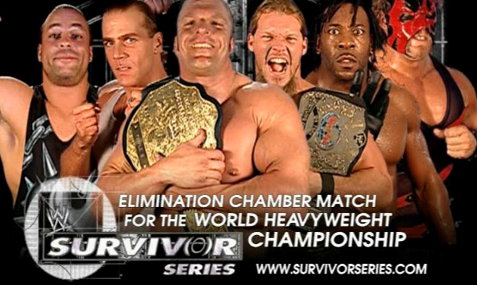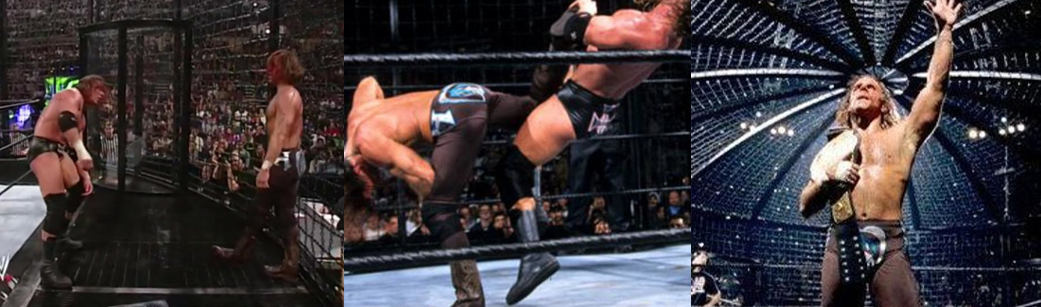
Wrestling Recap: Elimination Chamber Match (Survivor Series ’02)

The Date: 17 November 2002
The Venue: Madison Square Garden; New York, New York
The Commentary: Jim “J.R.” Ross and Jerry “The King” Lawler
The Referee: Earl Hebner
The Stakes: Six-man Elimination Chamber match for Triple H’s World Heavyweight Championship

The Build-Up:
Over its many decades as the dominating force in sports entertainment, World Wrestling Entertainment (WWE) has created some of the industry’s most successful competitors, changed the face of pay-per-view entertainment, and delivered some game-changing match types. In 1987, the then-World Wrestling Federation (WWF) struck it big with WrestleMania, a pay-per-view showcase that was so successful that WWF Chairman Vince McMahon strong-armed many cable companies into showing their follow-up event, Survivor Series, over the National Wrestling Alliance’s (NWA) Starrcade pay-per-view. Although the show was famous for featuring a series of ten-man elimination tag team matches, this format was shaken up in 2002 with the introduction of the “Elimination Chamber”. This was a merciless steel structure that forced four men to wait in “bulletproof pods” as two others fought in the ring, with each participant joining the match at random at regular intervals and wrestlers being eliminated by pin fall or submission until only one is left standing. At this time, the WWE’s hefty roster was split into two distinct brands, Raw and SmackDown!, and the Elimination Chamber was first introduced by Raw General Manager Eric Bischoff as a means to out-do his blue branded rival. The chamber would prove the perfect staging ground to force World Heavyweight Champion Triple H (who was in the midst of a “Reign of Terror alongside his Evolution allies, “The Nature Boy” Ric Flair, Randy Orton, and Batista) against his five top challengers, men he had spent the previous year humiliating and destroying both in the ring and in backstage segments. While Chris Jericho, Kane, Booker T, and Rob Van Dam all had legitimate beef with Triple H, the real story heading into the match was the return of Triple H’s former D-Generation X teammate, the “Heartbreak Kid” Shawn Michaels. HBK had been famously sidelined with a career-ending back injury in 1998 and Triple H had flourished as a main event heel in the interim. Although HBK functioned as an on-air personality, he made an unexpected in-ring return in June 2002 and was set to reunite with Triple H before his friend viciously attacked him, leading to a brutal street fight at the 2002 SummerSlam that briefly took HBK off television before he dramatically returned to Raw to be the final entrant in the first of what would become an annual event match for the WWE.

The Match:
I was massively invested in wrestling by 2002. While I was mainly watching SmackDown! due to the limitations of my Sky package, I still followed Raw and caught the odd pay-per-view so I was fully aware of Triple H’s dominating run with the World Heavyweight Championship. Honestly, 2002 was one of my favourite times in wrestling just for the stars and music involved: Jericho was played to the ring by Saliva, Kane was sporting perhaps my favourite look of his and had a banging theme song, and Triple H made regular use of Motörhead both as a singles star and as part of Evolution. Things went a little extreme during this time and Triple H started absorbing other belts along the way, which was a bit of a mistake (and clearly upper management agreed as they restored the Intercontinental Championship soon enough) but it was a good way to showcase new faces in the main event scene. Some of these guys, like Rob Van Dam and Booker T, were overdue their time in the sun while others, like Chris Jericho and Kane, could easily be slotted into the title picture without any issue. Of course, the big story of the year was HBK’s incredible comeback. HBK hadn’t been an active wrestler when I started watching but his reputation preceded him and I was completely caught up in the drama and hatred that quickly brewed between him and his former best friend since it was our best shot at seeing Triple H relieved of his championship belt. I remember also feeling a lot of anticipation about the first-ever Elimination Chamber match. I’d never seen a War Games match at the time so the closest analogy I (and most people had) was the Hell in a Cell match, but I was excited about it as it was a nice twist on the traditional Survivor Series match. Triple H and Rob Van Dam kicked off the match (literally in RVD’s case) and immediately rekindled their rivalry from earlier in the year, with RVD working Triple H over with his “educated feet” and martial arts agility.

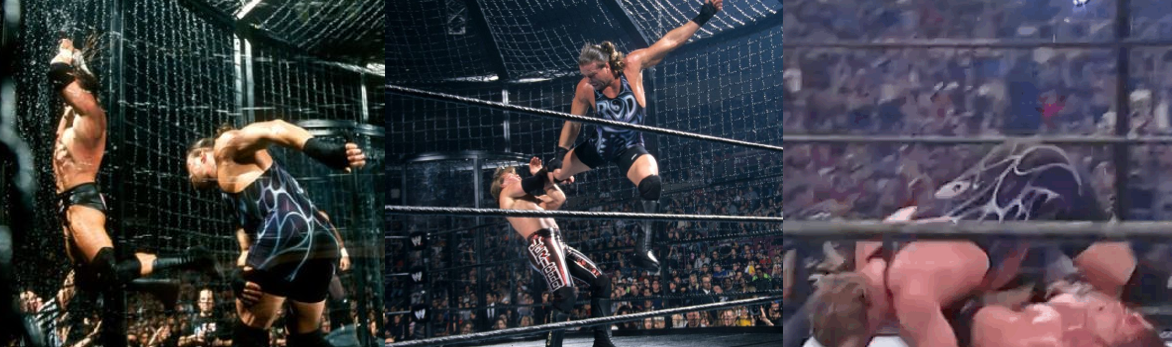
RVD impressed throughout the match but almost killed Triple H with a botched splash off the top!

RVD continued to press his advantage by back dropping Triple H out of a Pedigree attempt, over the ropes, to the raised steel floor at ringside. RVD followed up by repeatedly launching “The Game” into the chained walls of the chamber, busting him open in the process, and even hitting his backflip/monkey flip combo out on the steel and his trademark Rolling Thunder over the ropes and to the outside! Triple H was unexpectedly saved from a potential Five-Star Frog Splash off a chamber pod when Jericho grabbed at RVD’s leg but the Game ended up crotched on the top rope and taking a rolling senton to the face anyway. Triple H continued to take a beating against the chain-link walls and in the ring, but was given a brief reprieve when Jericho entered the match and got into it with RVD. Things don’t go too well for the self-proclaimed “King of the World”, however, as he got nailed with RVD’s spinning kick for a two count and then took his jumping side kick out the corner, and RVD even managed to pivot in mid-air to briefly cling to the cage and then take Jericho out with a dive off the wall! Despite the blood loss and the beating he took, Triple H walloped RVD with a clothesline; this was enough for Jericho to plant him with a back suplex and try his awesome cocky pin. Although RVD valiantly fought back, Triple H’s Harley Race-style knee strike shut him down and he and Jericho put aside their differences to pummel RVD . RVD dodged a corner splash, however, only to get absolutely planted by a DDT from Triple H. Luckily, the odds evened up as Booker T entered the fray. He rode his recent wave of momentum to go after both Jericho and Triple H and even had time to celebrate with a Spinaroonie before he and RVD went at it. Although RVD still had plenty of gas left in the tank, a couple of big side kicks from Booker T led to a near fall. Not to be outdone, RVD got a two count off a spinning heel kick before Triple H interjected himself into their fight, only to eat a Scissors Kick for his troubles. Although Jericho attacked Booker T before he could make a cover, things got seriously bad for Triple H when his throat was legitimately crushed after RVD miscalculated a Five-Star Frog Splash off a pod. RVD was then anti-climatically eliminated from the match after a Missile Dropkick from Booker T.

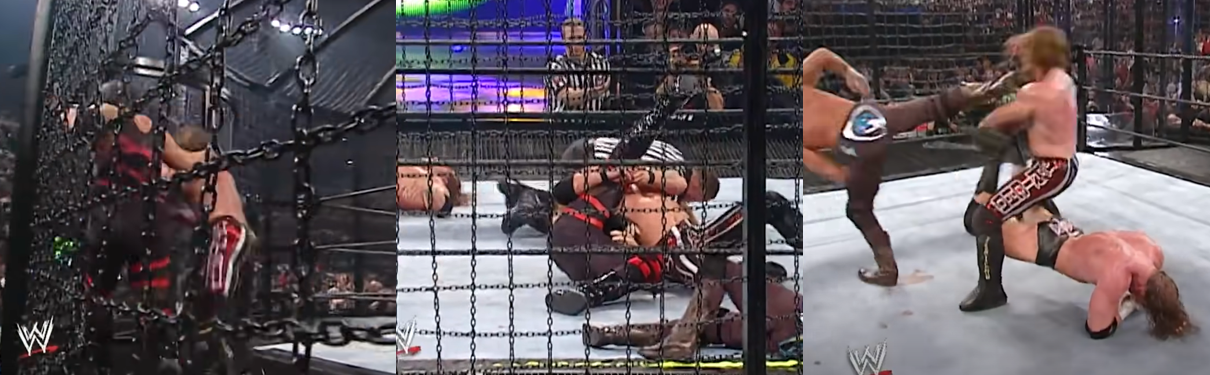
Kane’s rampage came to a dramatic end and HBK eliminated Jericho to go on-on-one with Triple H.

Jericho and Booker T frantically went at it as Triple H recuperated, with Booker T dodging the Lionsault and planting Jericho with his snap spinebuster for a two count. Kane was then released from his pod and started hitting everyone in sight. He easily manhandled Jericho, ramming him into the chained walls and then threw him through the pod plexiglass! Kane beat on Triple H for a little before focusing on Booker T, nailing a Chokeslam that allowed the bloodied Jericho to eliminate Booker with a Lionsault. Kane continued to pulverise Jericho on the outside before dumping him back in the ring with a military press. He easily fended off Triple H’s desperate attempts to get back into things and scored a near fall off a suplex before tossing Triple H off the top rope. Jericho countered a Chokeslam with a kick to the balls and finally knocked Kane down with a Missile Dropkick, meaning all three men were down when HBK (and his atrocious brown tights) was finally unleashed. Shawn Michaels went after Jericho and Kane like a house on fire but his momentum stalled after Kane nailed him with a Chokeslam. Kane then hit another on Triple H and caught Jericho in mid-air for a third Chokeslam. However, when Kane tried to hit the Tombstone Piledriver on Triple H, he got blasted with Sweet Chin Music from HBK, drilled with a Pedigree, and finally pinned and eliminated off a Lionsault. Jericho followed up by ramming HBK into the cage wall, drawing blood in the process and leaving him a helpless husk for him and Triple H to beat on in a heinous assault. Triple H dumped his former friend to the outside so he could grind his face against the chains and bounce him off the plexiglass. He and Jericho then took turns pummeling HBK’s bloodstained face, dumping him on the steel floor, and repeatedly smashing him off the chain-link wall. HBK mounted a brief comeback with a flying forearm and a nip-up, but Jericho put a stop to that with yet another Lionsault. However, Shawn refused to be pinned and caught Jericho off-guard with a moonsault for a near fall. Triple H then saved Jericho when HBK had him in his own Walls of Jericho submission hold and started brawling with Y2J after he tried to eliminate his hated rival. Although Jericho almost made the Game tap with the Walls of Jericho, Y2J got nailed with Sweet Chin Music and summarily eliminated by Shawn Michaels, meaning that the match came down to the two former friends going at it once again.

HBK and Triple H’s bloody brawl ends with Shawn toppling the Game and becoming World Champion!

The two bloodied, exhausted one-time allies traded punches, an exchange that ended with Triple H scoring a two count off a massive Arn Anderson-like spinebuster. HBK then found himself tossed outside again and catapulted right through the plexiglass of a pod when he dared to try and hit Triple H with a Pedigree on the steel, though is only resulted in another near fall as Shawn refused to die. Frustrated, desperate to inflict more punishment, Triple H urged HBK to his feet and the two got into a heated slugfest that ended with Shawn getting smashed with Triple H’s knee facebuster. HBK got a measure of revenge on the outside, however, when he reversed a Pedigree attempt into a catapult of his own that saw Triple H’s battered face bounce off the chain-link wall one more time. Shawn Michaels followed with his signature Diving Elbow from the top of a pod but chose to tune up the band rather than go for the pin. Triple H caught Shawn’s foot, however, and drilled him with a Pedigree but the champion was too hurt to immediately capitalise and HBK got the shoulder up at two. Triple H then tried for another Pedigree but Shawn countered with a back drop and then nailed Sweet Chin Music out of nowhere and scored the victory to an absolutely thunderous applause. He then celebrated his big comeback and title victory with tears in his eyes and under a shower of confetti. Considering no one knew what to expect from this first-ever Elimination Chamber match, this was a really good and well-paced contest. The competitors made really good use of the space to showcase how dangerous the structure is and give a taste of the athletic and innovative manoeuvres the chamber’s walls and pods could offer. While it somewhat undermined the narrative of the plexiglass being “bulletproof” to have it smashed in this first match, it worked wonderfully to showcase Kane’s brutality and Shawn’s never-say-die attitude. It’s amazing that Triple H was able to continue the match considering he could’ve been killed from RVDs freak botch, but it didn’t interrupt the flow of the match as these guys all knew how to buy him time to recover. RVD and Jericho stole the match in the early going. RVD’s athleticism and conditioning really impressed me and I was surprised to see Jericho score the most eliminations, and off the Lionsault no less! Kane got a good showing with his power game but I think more could’ve been done to help him stand out as a force of nature, but the one to watch was clearly Booker T. The guy was so popular at this point and I think the crowd would’ve been just as happy to see him or RVD get the win as much as HBK. However, you can’t take away from Shawn’s incredible comeback story. We never thought we’d see him back in the ring, much less a World Champion again, and this was a really emotional, cathartic moment for him and those who just wanted to see Triple H dethroned as champion.

The Aftermath:
Although Booker T, Kane, and Chris Jericho largely faded out of the main event scene in the immediate aftermath to this match, Shawn Michaels and Triple H were far from done with their rivalry, and poor old Rob Van Dam got caught up in the middle of it. RVD was defeated by Triple H to earn the Game a shot at the World Heavyweight Championship in a “Three Stages of Hell” match at Armageddon the following month, where Triple H regaining the belt after enduring a street fight, a steel cage, and a ladder match. While Triple H was busying stinking up the main event scene in horrendous matches with “Big Poppa Pump” Scott Steiner, Kane, Jericho, Shawn Michaels, RVD, and Booker T all competed in the Royal Rumble match and all came up short. Although Booker T earned himself a shot at Triple H’s World Heavyweight Championship at WrestleMania XIX, he was resoundingly defeated despite everything pointing to a big babyface victory! Kane and RVD formed a tag team in the interim and eventually ended up at odds with each other after the Big Red Machine’s dramatic unmasking. Jericho and HBK got into an emotionally-charged feud that only got worse after Y2J’s temper tantrum at WrestleMania XIX, and Triple H went on to have lacklustre matches against Goldberg throughout 2003. HBK and Triple H rekindled their rivalry near the end of 2003. HBK appeared to defeat Triple H for the belt on an episode of Raw that was ruled a draw and the two again went to a no contest in a Last Man Standing match at the 2004 Royal Rumble. This led to HBK interjecting himself into the WrestleMania XX main event. Though he was ultimately unsuccessful, his tumultuous relationship with Triple H would continue on and off over the next few years before the two finally got back on the same page and reformed D-Generation X in 2006.

My Rating:

Rating: 4 out of 5.

Great Stuff

What did you think to the first-ever Elimination Chamber match? Who was your pick to win at the time? What did you think the the level of violence on show in the match? Were you impressed that Triple H was able to continue after his injury? What did you think to Shawn Michaels’ big comeback and championship win here? Which Elimination Chamber match or event is your favourite? Whatever your thoughts on the Elimination Chamber, feel free to leave them below or drop a c and be sure to check out my other wrestling reviews!

Screen Time [Gazpacho Soup Day]: Red Dwarf (Series Three)


In the episode “Me2” (Bye, 1988) of the classic British science-fiction comedy show Red Dwarf (1988 to 2020), it is revealed the Arnold Rimmer’s (Chris Barrie) last words were “Gazpacho soup!” and that he made a point to celebrate November 25th as “Gazpacho Soup Day” after a particularly traumatising visit to the Captain’s Table.


Series Three

Air Date: 14 November 1989 to 19 December 1989
Director: Ed Bye
Original Network: BBC2
Stars: Chris Barrie, Craig Charles, Danny John-Jules, Robert Llewellyn, and Hattie Hayridge

The Background:
In the mid-1980s, Rob Grant and Doug Naylor created Dave Hollins: Space Cadet, a BBC Radio 4 sci-fi comedy show influenced by classics of the genre like Dark Star (John Carpenter, 1974) and The Hitchhiker’s Guide to the Galaxy (Adams, 1978; Bell, 1981). Dave Hollins was also the prototype for Red Dwarf, a concept the duo struggled to sell despite emphasising character and comedy over genre. After casting impressionist Chris Barrie and Liverpudlian “punk poet” Craig Charles in the lead roles of Second Technician Arnold J. Rimmer and Third Technician Dave Lister, respectively, the cast was rounded out by singer and dancer Danny John-Jules and sardonic stand-up comedian Norman Lovett. Red Dwarf was eventually aired in early-1988 and, while viewing figures dropped during the first six-episode series, audience feedback was so strong that the BBC greenlit a second series. Granted a bigger budget, Grant and Naylor expanded the premise and, thanks to Red Dwarf now having an established audience, series two was more favourably received. The show was now a cult hit and afforded an even bigger budget for the third series, which saw a complete redesign of the sets and the introduction of a new model, and service mechanoid Kryten joining the crew (albeit now played by Robert Llewellyn). Widely regarded as one of the best sets of episodes throughout the show’s entire run, Grant and Naylor enhanced series three seasons with additional digital effects some ten years later, to some criticism. Since then, Red Dwarf continued to be consistently popular even after Grant and Naylor parted ways, returning from a lengthy absence with a series of specials and revivals that arguably struggled to match the quality of this season.

The Plot:
The mining ship Red Dwarf drifts through deep space three million years into the future, crewed by the last human being alive, Dave Lister, Arnold Rimmer, a hologram of his deceased superior officer, a humanoid cat (John-Jules), service mechanoid Kryten, and the ship’s neurotic computer, Holly (Hayridge). Their journey sees them visit a version of Earth where times runs backwards, dabble in time travel, swap bodies with each other, and the imminent arrival of Kryten’s ultra-modern replacement.

The Review:
Series three is really when Red Dwarf hit its stride, in many ways; at least, it is for me. Gone is the slow, strangely ominous opening sequence, replaced with a rockin’ cover of the main theme that plays over clips from the series to give a sense of the zany action viewers can expect. The first episode, “Backwards”, also starts with an amusing parody of the traditional Star Wars (Various, 1977 to present) opening scroll that flies past in the blink of an eye. Eagle-eyed viewers or those who slow down the footage will learn about how Lister returned his twins to the female-dominated parallel universe where they were conceived, how the ship’s computer, Holly, assumed the guise of his counterpart from that same reality after falling in love with her, and how service mechanoid Kryten suffered a horrific accident that saw him rebuilt by Lister to now join the crew. Additionally, Lister and Rimmer have now moved to the far more luxurious officer’s quarters, gaining bigger bunks, an en suite shower, and a far more comfortable and eye-catching space for them to socialize and bicker. Enough time has passed between Kryten’s offscreen repairs for the overly polite and submission mechanoid to have fully ingratiated into ship life, with him anxiously taking his pilot’s exam in the first episode as a way of introducing the show’s newest and most iconic ship-to-surface vehicle, the appropriately named Starbug. Even the ship’s corridors and layout have undergone a dramatic change, switching from the dull grey paintjob to a more ominous and dramatic hallways. Rather than recycle the sets from the first two series, series three introduces new areas, such as a dark room (where Kryten rocks out while developing photos), a club where the crew celebrate what’s believed to be Kryten’s final night before he’s forcibly replaced, and the science lab. The vending machines have a new design, we visit a claustrophobic cargo bay, and more episodes take place off-ship, with Rimmer and Lister literally being marooned on a frigid world at one point and the crew indulging in a bit of fun, if limited, time travel.

Lister and Rimmer’s relationship deepens, with the two sharing as much as they clash.

Lister and Rimmer’s contentious relationship remains a focal point of the series but has evolved to the point where Rimmer simply despairs of his slovenly roommate and Lister openly criticizes Rimmer’s boneheaded decisions. When Rimmer and Kryten prove a smash hit on the backwards version of Earth, Lister lists the many reasons why staying on such a bizarre world make little sense and openly challenges Rimmer’s tenuous authority when his fear is removed by the gruesome polymorph. The two are force to co-exist and we see a deeper representation of their dynamic in “Marooned”. Stuck with only each other for company, Lister must practically beg Rimmer to keep his mind off his seemingly inevitable slow death from either extreme cold or hunger and we explicitly see why Rimmer was chosen to keep Lister company after the ship’s crew were wiped out. Rimmer represents a smug, authoritarian antagonist Lister can focus his despair and loneliness onto and Rimmer fulfils this role admirably, chastising Lister’s short-focused greediness and trying to impress upon him the need to ration himself and make personal sacrifices to stay warm. Of course, Rimmer’s awe at Lister burning his beloved guitar soon turns to rage when he realises the devious slob has actually desecrated Rimmer’s prized camphorwood chest. Their relationship is further tested in “Bodyswap” when Rimmer sees a chance to experience the thrill of being alive once more. After failing to convince Lister to swap minds and bodies, Rimmer forces him to undergo the transfer and immediately indulges his every vice. Trapped in a hologrammatic body and powerless to prevent Rimmer from gorging himself, Lister is horrified when Rimmer hijacks his body and almost dies fleeing from reprisals in Starbug. Finally, the two clash in their attempts to alter the timeline using mutated developing fluid; discovering a limited means to travel to the past, they each vie to create the strangely popular “Tension Sheet” before the other. This gives a glimpse into Lister’s past as an ambitious but untalented musician and into an alternative life where he’s a successful rock star with a giant mansion and an obnoxious attitude. While Rimmer’s motivations for resetting the status quo are purely selfish for he wishes to have that life for himself, it also comes from a deep-seated desire to not be left alone on Red Dwarf, a fate worse than being trapped with people he barely tolerates let alone likes.

Kryten fits right in with the misfit crew and adds an extreme layer of dry comedic value.

While still a flamboyant, self-serving, egotistical narcissist, the Cat is far more well-rounded here. An accomplished pilot in his own right, he’s often partnered with Lister as a far more amicable, if not less self-absorbed, alternative to Rimmer. The Cat and Lister regularly engage in game night, playing various tabletop and physical games to occupy themselves, and the Cat seems genuinely hurt when the despondent Lister refuses to play and lashes out in frustration at being stuck in deep space as the last man alive. While the Cat is seemingly nonplussed when Rimmer and Kryten disappear in “Backwards”, he’s so distraught at Lister’s own disappearance in “Marooned” that he doesn’t “buff his shoes for three days” and reacts with elation upon spotting the crashed Starbug. Additionally, when a sugar-high Rimmer takes Lister’s body hostage and goes for a joyride, the Cat immediately volunteers to pursue him in Blue Midget (though mainly to avoid giving Lister possession of his body) and joins the crew in celebrating Kryten’s life in “The Last Day”. Kryten adds a lot to the ship dynamic, being a logical and deadpan presence amidst such bombastic characters. Though his inclusion makes Holly superfluous since he has a physical presence and isn’t suffering from computer senility, Kryten makes a great impression by performing parlour tricks for the Backworld inhabitants with Rimmer, overseeing the mind swap procedure, and in his surprisingly emotional reaction to the crew risking their lives when Hudzen-10 (Gordon Kennedy) arrives to replace him. Indeed, while Kryten is happy to accept his replacement and inevitable shutdown, Lister rallies against it, openly criticising Kryten’s belief that he’ll be rewarded for a lifetime of servitude in “Silicon Heaven”. Surprisingly, it’s Rimmer who’s the voice of reason here; though also sad, in his own way, he chastises Lister for mocking Kryten’s beliefs, however illogical and unfair they seem. Of course, Kryten really steals the show in “Polymorph”, where we see his various groinal attachments at work, witness him desperately and suggestively remove Lister’s shrinking underpants, and get a taste of his occasional semi-rebellious attitude when the titular monster removes his guilt and he’s suddenly insulting his friends and happy to sacrifice them to the polymorph to save his own hide.

It’s not an exaggeration to say every episode of the series is an absolutely classic.

Indeed, in a series full of standout episodes, “Polymorph” is one of the best. In keeping with series tradition, the titular creature (which is totally not a Xenomorph) isn’t an alien, but a genetically engineered lifeform (GELF) bred to remove its victim’s emotions. Beginning as a comical slug-like creature, the polymorph changes shape to lure in its prey and grows larger and more monstrous the more it feeds. It even feeds on artificial emotions, removing Rimmer’s anger and Kryten’s guilt, turning the former into a peace-loving hippy and the latter into an outspoken rogue. The Cat, normally the most stylish and confident of the crew, is reduced to a whiskey swilling vagrant happy to throw away his life when the creature removes his vanity and Lister becomes an angry, trigger happy brute eager to tackle the creature even if it means “sacrificing his life in some stupid, pointless way”. With only Holly on hand as the voice of reason, the dramatically compromised crew only succeed through pure luck and, even then, the ending suggests that a second polymorph is lurking in the background. “Backwards” is also a favourite of mine; though Lister’s initially amazed to finally be back home, he soon realises that he cannot exist in a world where time runs in reverse. Kryten and Rimmer, however, find a niche as the “Sensational Reverse Brothers” and are prepared to stay before a “barroom tidy” sees them fired as pub entertainers. Finally, “Timeslides” is a fun episode that starts off exploring Lister’s loneliness and anger and evolves into a game of one-upmanship not unlike “Stasis Leak” (Bye, 1988) where Lister and Rimmer desperately travel to different snapshots of their pasts to try and invent a simple but profitable stress reliever and change their fates. When Lister convinces his past self (Emile Charles) to patent the Tension Sheet, he, Cat, and Kryten disappear from the timeline, leaving Rimmer alone with Holly. Refusing to accept this, Rimmer first tries to convince the now wealthy and successful Lister to rejoin the crew and then travels to an earlier point in time to beat him to the punch. While his younger self (Simon Gaffney) fails to follow his instructions, Rimmer inadvertently restores the timeline…and himself to life. However, his elation is short-lived as he accidentally blows himself up, completely restoring the status quo.

The Summary:
As with the previous two series, I generally watch the Remastered version of Red Dwarf’s third season (1998), which replaces all model shots with CGI models and a new opening sequence. Series three includes some additional changes, most notably in “Polymorph” where new CGI first-person shots of the slug-like polymorph’s travels were added alongside a text epilogue to the episode that states the polymorph died in Lister’s underpants drawer, and a bizarre redubbing of Rimmer’s mother (Kalli Greenwood). It’s also worth nothing that the DVD release of the series allows you to watch “Backwards” in reverse, meaning all the Backworld dialogue is now understandable and reveals that the pub manager’s (Arthur Smith) tirade at Rimmer and Kryten is simply the actor mocking the efforts of people to understand his dialogue! Rimmer debuts perhaps his most iconic look here and has become a foil for the entire crew, rather than just Lister. He despairs of Kryten’s constant subservient demeanour but doesn’t hesitate to take advantage of it when it suits him, is more than happy to gorge himself in Lister’s slovenly body, and bemoans Holly’s incompetence when she’s unable to tell the difference between specks of grit and black holes. Lister occasionally shows a surprising emotional maturity this season, desperate to convince Rimmer and Kryten to leave Backworld, revealing much of his chirpy disposition is covering a depressing pain at being the last man alive, and raging at the idea that Kryten could be so easily replaced. Both Lister and Rimmer reveal more about their pasts, such as their sexual experiences and childhoods, adding additional dimensions to their characters even as they try to compromise the other into burning their beloved possessions or change their fates. It’s great seeing their roles literally reversed in “Bodyswap”, where Lister’s powerless to keep Rimmer from ruining his body with cigars and food and Rimmer becomes addicted to the rush of being alive, a euphoria that no doubt informs his short-lived celebration at the conclusion of “Time Slides”.    

The series expands on the characters’ personalities through humour and pathos.

Jokes in series three are absolutely top notch; all the characters feel far more familiar and the actors much more comfortable with each other so their rapport is even more natural. Even Kryten fits in like a glove, with Robert Llewellyn easily taking up the mantle from David Ross and making the character his own. Kryten’s interactions with Lister and Rimmer in episodes like “Polymorph” and “Body Swap” showcase how hilarious this group can be, with Kryten forced to obey every command “no matter how insane” and performing menial tasks by plugging appliances into his groin. I also enjoyed Lister repurposing medical supplies for his meal and scuffling with Adolf Hitler and Nuremberg, and that series three gives the actors a chance to explore different sides to their characters. “Polymorph” is the most obvious example as they all undergo extreme personality changes and are rendered even more inept as a result. “Timeslides” also shows us a version of Lister without his shady moral compass, and his naïve but charismatic younger self, while Rimmer develops a carefree and increasingly insane attitude when he hijacks Lister’s body. Kryten is also faced with his far more efficient, imposing replacement in “The Last Day”, a surprisingly emotional episode in which Lister first refuses to accept and then is determined to celebrate Kryten’s impending shutdown. The drunk crew share some emotional scenes that soon lead to accusations about Lister’s parentage and, though desperately hungover, resolve to defend Kryten from the maniacal Hudzen-10 even though they’re physically outmatched. Similarly, the crew are faced with their pending destruction when Lister accidentally activates the ship’s self-destruct sequence in “Body Swap”, a desperate situation masterfully subverted when it’s revealed Holly disposed of the bomb and never told the crew since they didn’t ask! Additionally, Lister faces his own impending demise in “Marooned” where he’s forced not only to rely on Rimmer for emotional support but also to choke down dog food and Pot Noodles. This is an equally torturous situation for Rimmer not just because he faces the very real possibility of watching the closest thing he has to a friend die before his eyes, but also because Lister burns Rimmer’s prized possessions to stay alive. Interestingly, Rimmer seems to connect with the younger Lister, though his enthusiasm for the “Om” song could easily be interpreted as sarcasm. Still, his impassioned plea to the time-altered Lister seems genuine, though born from his fears of loneliness.

Series three was peak Red Dwarf and established a new standard for the show.

As much as I enjoyed series two, series three of Red Dwarf is where the show really started to land with me. Every episode is a gold mine of comedic situations and memorable moments. While many of these are in “Polymorph” (still one of the best episodes of the entire show), each episode shines as the writers explore the boundaries of the show’s unique sci-fi setting. Kryten was a welcome presence, adding additional comedy by playing the logical but still awkward straight man to his more volatile crewmates. It was fun seeing the crew bumble about on Backworld, riding and driving backwards without really realising it and performing simple tasks to the amazement of their audience, with the reverse brawl being an obvious highlight. I enjoyed exploring Rimmer and Lister’s relationship in “Marooned”, how they genuinely seemed to connect and yet Lister couldn’t help but sabotage Rimmer’s beloved family heirloom to safeguard his guitar. “Polymorph” explored extreme opposites of their personalities, showing that this ragtag crew may be dysfunctional but support each other well despite being very different personalities. “Body Swap” explored these personalities in a fun new way, with Lister left disapproving of Rimmer’s outrageous antics and getting a taste of how helpless Rimmer often feels as a hologram. While there are some logic gaps in “Timeslides”, the time travel shenanigans were fun and I enjoyed exploring a world where Lister never got marooned in deep space yet was still a slob, despite his great wealth. “The Last Day” is a great character showcase for Kryten, showing how much the crew care for him (Lister especially) to the point where they willingly defend him even though Hudzen-10 deems them all “viable targets” for termination. The resolution to this is as ingenious as it is hilarious: the menacing mechanoid is forced into a “metaphysical dichotomy” when Kryten lies about the existence of Silicon Heaven, cementing his place in the crew. Series three is easily the best of the classic era of Red Dwarf and a must-watch for anyone looking to get into the show. It’s sci-fi sit-com at its finest and showcases some of the best and most amusing moments for the crew and remains as appealing today as it was all those years ago.

My Rating:

Rating: 5 out of 5.

Fantastic

Is series three of Red Dwarf your favourite of the show’s run? What did you think to Kryten becoming a full-time member of the crew? Did you enjoy the exploration of Lister and Rimmer’s relationship and their constant one-upmanship? What did you think to the depiction of time travel and solidarity the crew showed towards Kryten? Which episode was your favourite and how are you celebrated Gazpacho Soup Day today? Feel free to share your thoughts and memories of Red Dwarf down in the comments and be sure to check out my other Red Dwarf content on the site.

Back Issues [Sonic2sDay]: The Nameless Zone


After the release of Sonic the Hedgehog (Sonic Team, 1991), Sonic was established as the hottest videogame icon. In anticipation for the sequel, SEGA dubbed November 24, 1992 as “Sonic 2sday”. Accordingly, this seems like a great excuse to celebrate Sonic’s faithful sidekick, Miles “Tails” Prower, who debuted in that title.


Story Title: “The Nameless Zone” (Parts 1 and 2)
Published: 25 December 1993 to 8 January 1994
Writer: Nigel Kitching
Artist: Dave Windett

The Background:
Sonic the Hedgehog was a huge success for SEGA. Thanks to an aggressive marketing campaign and being included with the all-powerful 16-bit Mega Drive, Sonic sold over 15 million copies upon release. After a tumultuous development, Sonic the Hedgehog 2 (SEGA Technical Institute, 1992) surpassed its predecessor by a country mile! 400,000 copies were sold in its first week alone, 6 million units during the Mega Drive’s lifespan, and the game increased SEGA’s control of the home console market by 40%. Widely praised and highly regarded, Sonic 2 also debuted a kid sidekick for Sonic. The result of an internal contest, Miles “Tails” Prower was created by Yasushi Yamaguchi, modelled after the mythical kitsune, and greatly admired his super-fast hero. Well regarded as a popular staple in the Sonic franchise, Tails has the distinction of being one of the few of Sonic’s supporting cast to star in his own divisive solo outings and he was also the first to get his own solo stories in Sonic’s comic book adventures. The first of these was this two-part adventure that featured in Sonic the Comic (StC), a fortnightly comic book published in the United Kingdom that pulled much of its lore from the now defunct Mobius and Doctor Ovi Kintobor storyline. Tails’ adventures in StC cast him as an unlikely hero in a fantasy setting where he struggled to live up to the reputation he’d made for himself, and his adventures continued to feature in StC even as it transitioned to a fan-made digital format.

The Review:
Remember that flashback Tails had in Sonic Adventure (Sonic Team, 1998)? You know, the one where he sees Sonic running past and chases after him, all excited and happy? Well, “The Nameless Zone” begins with a similar scene of Tails chasing after Sonic only it’s very different. In case you forgot or didn’t know, StC-Sonic was a bit of a dick; he truly did have an attitude and he constantly berated his friends, especially Tails. Frequently referring to the young fox as “pixel brain” and chastising him, it’s a wonder Tails bothered to put up with it for so long. Sonic’s no different here; he’s in such a hurry that the last thing he needs is Tails shadowing him and slowing him down. Thus, the super-fast hedgehog speeds off, ordering Tails to stay out of his way, and leaving the young fox cub dejected. He’s so upset at not being able to prove himself to his hero that he’s completely blindsided when a mystical portal opens behind him and a mysterious voice beckons him from beyond, using his real name and calling for his aid. Tails immediately recognises the portal, and the voice, and his heart sinks ever further. Unable to escape his fate, he begrudgingly enters the portal and returns to the titular “Nameless Zone”, a fantasy realm adjacent to Mobius where Tails grew up. Tails is shocked to be greeted by the Enchanter Kings, the two rulers of the sword-and-sorcery world who have reached out to him on the mistaken belief that he’s become a great hero in his absence. They believe this because Tails foolishly wrote letters to his family in which he took credit for Sonic’s heroic acts, spinning a yarn in which Sonic is his sidekick and he, not the Blue Blur, is the true hero of Mobius. Realising that his exaggerated claims have landed him in hot water, Tails tries to explain the situation only for the Enchanter Kings to brush it off as false modesty.

Believed to be a legendary hero, Tails is forced to defend his estranged home from a demonic creature.

They present Tails with an enchanted set of nifty battle armour that’s magically designed to be near weightless when worn. Despite his protests, Tails is fitted with the armour and the Enchanter Kings prepare him to put his legendary heroism to the test to defend their kingdom. The test? Well, it’s none other than a monstrous, demonic creature known as Trogg who has crossed the dimensional bridge to the Nameless Zone from his realm, the “Land Beyond”, and demanded to face their champion in mortal combat. Trogg desires nothing less than to invade the Nameless Zone with his berserker army and is unimpressed with the “shrimp” heralded as their champion. His protests falling on deaf ears, Tails has no choice but to take up his sword and meet Trogg on the bridge. When Trogg demands that Tails take his “best shot”, Tails bravely swings his sword in a clumsy effort and gets a kick to the chest (although it looks like it hits him in the balls!) for his efforts. Seeing his ultimate victory within reach, Trogg goes for the killing blow; however, it turns out Tails’ swing weakened the rope holding up the bridge. The rope snaps, collapsing the structure, and the two take a plummet. Trogg instinctively grabs the flailing rope and assumes that Tails has perished, only to be stunned when Tails flies to safety. Trogg is then forced to surrender to avoid a plunge into the abyss, much to the elation of the fox people. Luckily, Tails is spared any further awkwardness as the portal back to Mobius begins to fade so he quickly hops back through, his armour magically detaching since it cannot exist outside of the Nameless Zone. Back on Mobius, Sonic praises Tails for staying out of his way but, when questioned, Tails chooses not to reveal what he’s been up to, a plot point that would be revisited in Tails’ subsequent adventures in his home realm.

The Summary:
This was a short and relatively inoffensive side story for Sonic’s oft-bullied sidekick. There’s not much to it and we get only the barest glimpse into Tails’ backstory, which is as far removed from the source material as Sonic’s was in these comics. There was a belief back then that Tails originated from a distant Zone and came to the Emerald Hill Zone after being bullied for his twin tails, mistakenly believing the Zone contained actual emeralds and seeking to make his fortune. While later issues would show some of this, including Tails being bullied, learning he can fly, and his first meeting with Sonic where the hot-headed hero rescued him from drowning in a bog, we get none of it here and very little detail into Tails’ family life or even the nature of the Nameless Zone. It’s a fantasy realm populated exclusively by foxes and under constant threat from the goblins and monsters that lurk in the Land Beyond, with Trogg as the neighbouring realm’s horrific figurehead. While interdimensional and inti-Zone travel had been established in Sonic the Comic by this point, it was always conveyed through traditional means, such as using Starposts or Big Rings. Here, Tails is called from a magical portal, one with a finite lifespan. Indeed, it’s said at the end of the story that Tails risks being trapped there forever if he doesn’t leave right away, making me wonder how he even left in the first place. The story makes it seem like the Enchanter Kings conjure the portal, so perhaps they did this for him back in the day, or maybe the portals just open randomly (or predictably), allowing for brief travel. It’s also not clear if the Nameless Zone is even on Mobius as it appears to be an alternative dimension, not unlike the comic’s depiction of the Special Stages, though one more aesthetically similar to Sonic the Comic’s Golden Axe (Various, 1989 to 2008) adaptations.

Tails’ wish to be seen as a hero is granted, much to his embarrassment.

Indeed, it’s clear that this is a realm of fantasy and magic. The Enchanter Kings charm Tails’ armour and the backgrounds are all very Tolkien-esque in their depictions, to say nothing of the griffin-like Trogg. Of course, the primary humour in this story is the Enchanter King’s belief that Tails is a legendary hero. Thanks to his frequent letters home in which he takes credit not just for Sonic’s heroics but also details how he defeated Doctor Ivo Robotnik, Tails is lauded throughout the Nameless Zone as a near-mythical champion and therefore the only person their monarchs can turn to when Trogg comes calling. Tails’ awkwardness at this hero worship is hilariously British; he repeatedly tries to politely explain the situation, only to be labelled as modest and pushed into battle. It’s a fun juxtaposition as he starts the story desperate to prove himself to his hero and is suddenly thrust into a life-or-death battle he’s not prepared for and met with the kind of adulation normally reserved for Sonic. He’s extremely embarrassed by this, but more because he’s made a rod for his own back with his tall tales and is now forced to face a monstrous opponent who could easily cut him down. Still, despite the situation, Tails doesn’t back down from the fight. He could’ve easily fled or flown away at any time but he chooses to walk onto the bridge, sword in hand, and meet Trogg and give it his all to live up to his reputation and defend his estranged people. Luckily for him, Trogg is overconfident and insolent; he constantly mocks Tails and toys with him, hesitating just long enough to be undone by a frayed rope. Tails’ natural ability to fly ensures his victory and sees Trogg surrender, and he luckily scarpers before people start asking too many questions. The art was colourful and fun, but the story’s too brief to really rate much higher; it’s definitely a weird little side story for Tails and leaves a lot of questions unanswered. However, this would be the first of many returns to the Nameless Zone for the young fox and the start of him living this secret life as a celebrated hero to rival Sonic, a plot thread only a few choice people become aware of.

My Rating:

Rating: 2 out of 5.

Could Be Better

What did you think to Tails’ first solo story in Sonic the Comic? Were you surprised to find he came from a fantasy realm? What did you think to the twist that he’s secretly a hero in his homeland? Would you have liked to see more of his past explored her? What did you think to Trogg and his overconfidence? Which of Tails’ solo stories is your favourite? How are you celebrating Tails and “Sonic 2sday” this year? Whatever your opinion on Tails, or Sonic 2 in general, drop a comment below and go check out my other Sonic content.

Screen Time [Doctor Who Day]: The Day of the Doctor


On this day, the 23rd of November, in 1963, the longest-running and most successful science-fiction television series ever, Doctor Who, first aired on BBC One in the United Kingdom. Since then, the rogue Time Lord has gone through numerous incarnations and is widely celebrated as one of the most iconic and recognisable mainstream cultural icons in the world.


50th Anniversary Special:
The Day of the Doctor

Air Date: 23 November 2013
UK Network: BBC One
Stars: Matt Smith, David Tennant, John Hurt, Jenna Coleman, Jemma Redgrave, Ingrid Oliver, and Billie Piper

The Background:
In 1963, the BBC’s Head of Drama, Sydney Newman, commissioned a show that would appeal to be children and adults alike to fill a gap in the BBC’s schedule, one eventually outlined by writer Cecil Webber. The result was Doctor Who, a long-running science-fiction franchise in which a time travelling alien delighted audiences with historical hijinks, battles against terrifying cybernetic aliens, and emotionally charged morality tales. Save for a hiatus in the 1990s, Doctor Who has been a BBC staple for decades, with various actors stepping into the role thanks to the character’s unique ability to “regenerate” when dying. While debates rage about who is the best Doctor, two names often top the rankings: Tom Baker and David Tennent. After five years as the popular Tenth Doctor, Tennent finally passed the torch to Matt Smith, who won over audiences with his youthful exuberance. However, in the style of his predecessors, Tennent returned to the role for this 50th anniversary, reuniting with co-star Billie Piper (though in a dramatically different role). Tennent and Smith joined legendary actor John Hurt, who readily agreed to join the show and had been previously teased as a forgotten incarnation of the Doctor earlier that year. Accompanied by a short cinema release and two short tie-in episodes, The Day of the Doctor was simultaneously broadcasted in 94 countries to avoid plot leaks and met with critical acclaim. Reviews loved the chemistry between the three Doctors and its celebration of the show’s rich history, though the Zygon sub-plot and the handling of the War Doctor was criticised.

The Plot:
A Zygon plot to destroy London sees the Eleventh (Smith) and Tenth (Tennant) Doctors crossing paths with their former renegade incarnation (Hurt). Together, they reconcile their past by revisiting the last days of the Time War between the Time Lords and the Daleks.

The Review:
The Day of the Doctor takes place during a pretty tumultuous time in the Eleventh Doctor’s life. Most of Matt Smith’s run focused on the Doctor’s ultimate end, a seemingly unavoidable fate that would one day see him buried within his own embiggened TARDIS on the barren wasteland known as Trenzalore. Despite being fully aware of the finality of this inevitability, the Eleventh Doctor continues to be his usual energetic self, a quality I really came to enjoy about Matt Smith’s portrayal and one that juxtaposed his youthful appearance and childlike enthusiasm with a haunted, sombre, aged demeanour at times, both aspects of his personality that are exhibited in this 50th anniversary special. Indeed, the Eleventh Doctor is excited to be heading to the National Gallery with one of his most beautiful and charismatic companions, Clara Oswald (Coleman). He is summoned there by the Unified Intelligence Taskforce (UNIT) and meeting with Kate Lethbridge-Stewart (Redgrave), daughter of the Doctor’s old military correspondent Brigadier Alistair Lethbridge-Stewart (Nicholas Courtney, represented through archival pictures). The Eleventh Doctor relishes his impromptu helicopter ride over London and showing off his status amongst the UNIT personnel to Clara (who, despite having wandered through all of the Doctor’s lives, had no knowledge of his past ties to UNIT). Kate shows the Doctor a mysterious painting he knows all-too-well, a graphical depiction of the last day of the Time War; specifically, the fall of Arcadia and the day the Doctor, in a previous, hitherto unknown incarnation, personally ended the conflict. Since Doctor Who returned in 2005, the mystery of the Time War and the impact it had on the Doctor had been hanging over the show, and his demeanour, like a dark cloud. Burdened by guilt and scarred by the atrocities of war, many of which he perpetrated, the Doctor has effectively been running from his past for years now, but The Day of the Doctor forces him to confront in ways he never imagined.

A middling Zygon invasion proves the catalyst for a cathartic multi-Doctor adventure.

The main plot of the special revolves around, of all things, the Zygons. These monstrous shapeshifters try to conquer the Earth by subduing and replacing key figures in human history. One of their earliest efforts occurs back in 1562, when a Zygon attempted to replace Queen Elizabeth I (Joanna Page). Luckily, Queen Elizabeth was swept up in a whirlwind romance with the Tenth Doctor at the time, though even his cobbled together technology, intuition, and previous experience with the Zygons proves largely incapable of detected the Zygon threat. Time and again, both he and his successor fail to spot who’s a Zygon and who isn’t, leading to the Tenth Doctor putting his foot in it when he accuses the real Queen Elizabeth of being a bad fake. Luckily for him, he’s a dishy time traveller and she’s more amused by his incompetence than annoyed by his accusations. She also proves more capable than he is, fooling the other Zygons with her own impersonation skills (though, to be fair, he was distracted by his other incarnations). In the Eleventh Doctor’s time, the Zygons impersonate Kate and UNIT staff like Petronella Osgood (Oliver) to access the “Black Archive”, a super-secret vault deep within the TARDIS-proofed Tower of London that provides the Zygons with the means to take over London. Of all the threats to bring three incarnations of the Doctor together, the Zygons are disappointingly weak. They’re clunky, awkward creatures and this B-plot merely serves to unite the bickering Doctors and provide them the inspiration for saving their people. The Zygons have been using Time Lord technology to freeze themselves in paintings and covertly invade other worlds, technology that the Doctors use to briefly revisit the Time War and to travel back to the present day to force the humans and Zygons into an amicable truce rather than mutual destruction. They’re not a very compelling enemy (the Sontarans would’ve been much better), though they are defeated in an interesting way (the Doctors force both groups to temporarily forget which species they are). Naturally, the Daleks do appear, but merely as a cameo and purely in sequences depicting the chaotic Time War, where their power was at their mightiest and their thirst of victory was matched by the Time Lords.

The forgotten War Doctor sees how his decisions will shape the men he will become.

The Day of the Doctor firmly explains that, during the Time War, the Doctor took on a new face and forsook his name and title. Dubbed “The War Doctor”, this new incarnation fought a ruthless battle against his mortal foe for untold generations. The very nature of the Time War meant it existed in perpetuity, with victories, loss, deaths, and resurrections all happening at once. Finally, after an age of nonstop violence, the War Doctor decided he had had enough. Now aged to an old, battle-weary warrior, he took it upon himself to end the bloody conflict the only way he knew how. Thus, he broke into Gallifrey’s weapons facility and stole a doomsday weapon so destructive even their military General (Ken Bones) was afraid of it. A strangely archaic cube of cogs, the “Moment” can wipe out entire universes and is powered by a sentient artificial intelligence. Taking the form of a figure it knows is (or will be) important to the Doctor, the “Bad Wolf” (Piper), it questions the War Doctor’s motivation and, in a bid to show him what wiping out every single man, woman, child, and Dalek, will do to him, conjures a time vortex to show him his future selves. Honestly, I was never a fan of the War Doctor concept; I would’ve much preferred Paul McGann or Christopher Eccleston returned to portray this role rather than retroactively bump up the Doctor’s incarnations. However, you can’t go wrong with John Hurt and he portrays this forgotten, reviled incarnation with gusto. Despite being beaten down by war and technically being younger than his counterparts, the War Doctor is a cantankerous, grandfatherly figure who initially admonishes his successors’ buffoonery. He’s stunned that they don’t seem to take anything seriously or treat their equipment with respect and, much like the First Doctor (William Hartnell) in the first multi-Doctor special, is portrayed as the more authoritarian and sensible of the three despite being at least 400 years younger than them.

The Tenth and Eleventh Doctors are forced to confront, and embrace, their violent past.

The Tenth and Eleventh Doctor are horrified to see their renegade incarnation, treating him as a dangerous, almost bogeyman-like figure from their past that they’ve buried deep at the back of their minds. Prompted by the Moment, the War Doctor asks pertinent questions to understand how committing genocide will affect him and learns that the Tenth Doctor was haunted by the decision and the Eleventh has tried to move on and forget about it. The Tenth is outraged at such a suggestion, stunned to find his future self has gotten over the worst decision they ever made, but it’s clear that the Tenth Doctor is still tormented by his past and simply trying to find a productive way forward. While they take an instant dislike to each other (the Tenth Doctor hates his successor’s new TARDIS interior, as is tradition), the Tenth and the Eleventh Doctor have a lot in common. Both favour spectacles, suits, and being more flamboyant with their sonic screwdrivers, eschewing the War Doctor’s more practical and scientific approach for a dramatic flair. The Eleventh Doctor is largely critical of his predecessor’s more theatrical approach, especially his way with women, while the Tenth Doctor criticises his successor’s dress sense (particularly the fez). The two bicker here and there but mostly engage in a game of one-upmanship, comparing their sonic screwdrivers and competing to see who can solve problems faster, with both being trumped by the War Doctor’s more measured approach. Hardened by their past experiences and desperate to keep Kate from making the same mistakes, the two intervene to reach a more amicable solution and the War Doctor sees that his decision, while horrendous, will save countless lives since his future incarnations try to atone for their past. Their adventure together sees the Tenth and Eleventh Doctor embrace their forgotten counterpart and, in a bid to help the War Doctor face his decision, they willingly join him in activating the machine, only for Clara’s distraught reaction to show them they can come up with a better solution.

The Doctors’ desperate plan sees Gallifrey saved and their pain eased as a result.

Inspired by their solution to have their sonic screwdrivers calculate a formula to vaporise a door (a plan amusingly foiled when Clara reveals their cell was never locked!), the Doctors use their TARDISes to collude with all twelve thirteen of their other incarnations to utilise the Zygon picture-hopping technique and shift Gallifrey to, essentially, a pocket dimension, destroying the Daleks in the process. While the General initially resists since it would mean the Time Lords are trapped in another dimension, he relents since it means the survival of their race and the Thirteen Doctors co-ordinate their TARDISes to execute the plan, sparing Gallifrey and undoing the Doctor’s darkest moment. Unfortunately, due to the unstable timelines, none of the three will remember this and the War Doctor resigns himself to having to live thinking he committed genocide, knowing he’s earned his title once more and that he’ll be succeeded by such fine men and welcoming his regeneration into the Ninth Doctor (Christopher Eccleston). The Tenth Doctor also urges the Eleventh Doctor to find a solution to their impending demise at Trenzalore, reasoning that their actions in this adventure prove they can always find some way out. Left to ruminate over the depiction of Gallifrey’s last stand, the Eleventh Doctor is visited by a strangely familiar curator (Tom Baker), who hints both that he’s a future incarnation and that the Doctor’s next journey will see him trying to recover his lost people. Of course, The Day of the Doctor was also accompanied by two short tie-ins. While “The Last Day” (Stone, 2013) isn’t that great and weirdly depicts a first-person account of the Daleks’ invasion of Arcadia, “The Night of the Doctor” (Hayes, 2013) saw the long-awaited return of perhaps the most underappreciated Doctor, the Eighth (Paul McGann), and showed how he regenerated into the War Doctor. After failing to save a doomed pilot since the Time Lords are as reviled as the Daleks, the Eighth Doctor is offered a chance to regenerate into a warrior by Ohila (Clare Higgins) of the Sisterhood of Karn, forsaking his name and passive ways in favour of a new form more fitting for a violent war.

The Summary:
As you’d expect from a 50th anniversary special, The Day of the Doctor contains a fair few Easter Eggs and references for long-time series fans. The opening, for example, is basically a shot-for-shot remake of the first-ever episode, An Unearthly Child (Hussein, 1963); Clara teaches at Coal Hill School; the Tenth Doctor echoes the Second Doctor (Patrick Troughton) with his “I don’t like it line”, and the General echoes the Brigadier when multiple Doctors show up. The Black Vault is full of gadgets and callbacks to previous adventures, including photos of previous companions and incidents, and much of the special refers back to the Tenth Doctor’s era. Perhaps the most exciting inclusion was the brief appearance of Peter Capaldi as the upcoming Twelfth Doctor, which was a fun tease that hadn’t been done before. All the Doctors (at that point in time, anyway) cameo in the finale thanks to archival footage and some rather disconcerting digital stand-ins, but it’s Tom Baker’s heartwarming reappearance as a possible future incarnation that steals the show at the end. Honestly, I’m surprised by the restraint, really. There could’ve been loads more lore and cameos and references stuffed in here but, instead, The Day of the Doctor wisely focuses on exploring this unknown chapter of the Doctor’s life and tying into what viewers saw with the Tenth and were currently experiencing with the Eleventh. The special is thus a story of grief, mourning, and dealing with difficult decisions. The Tenth and the Eleventh Doctor are haunted by their actions and the War Doctor is hesitant to activate the Moment but comes to see that the deaths of billions will safeguard innumerable other lives. The relief he feels when his counterparts suggest a wild, outrageous third option is palpable and all three get a sense of catharsis from undoing this one heinous act that scarred them for so many years.

A forgotten era of the Doctor’s life is explored and his character examined in new ways.

While I’m no fan of Billy Piper and never liked her portrayal of Rose Tyler, it was nice to see her here as the Moment, an advisory, sentient AI only the War Doctor can see and hear. Through her, he meets his successors and sees that, while his actions will be traumatic for him, he’ll eventually grow beyond it and also put his lives to good use saving others as recompense. I’m not sure where the Tenth Doctor is being pulled from in his time stream but he’s a little more haggard and broken than what we usually see. He’s still cracking wise and masking his pain behind a bombastic façade, but it’s clear he’s being written to still be very raw over his actions in the Time War. In comparison, the Eleventh Doctor is just as haunted but has found more productive ways to cope. He attacks life with a youthful exuberance and delights in every adventure, determined to help whenever he can so that his dreadful actions can have some positive meaning in the universe. This makes Clara’s intervention when the three prepare to activate the Moment all the more poignant, since she never pictured “her” Doctor’s face as being responsible for so many deaths. Her presence has a positive impact on the War Doctor, too. It’s clear he hasn’t had a companion for some time and is struggling with the blood on his hands and the path that lies before him, but I enjoyed how he was this gruff old man who whipped his younger/older selves into shape. Again, I still would’ve preferred seeing the Eighth or Ninth incarnation fulfil this role just to make things less messy but the mystery surrounding the War Doctor is intriguing and I like how his counterparts are equal parts ashamed, afraid, and disgusted by him. Yet, in spending time with him and finally confronting this dark and oppressed part of their lives, they come to accept that the War Doctor was and still is a part of them and acknowledge him as a necessary evil in their long lives.

Cameos, references, and a heartfelt celebration of the series make for an enjoyable special.

The War Doctor, in turn, comes to feel vindicated and accepted for the first time in ages. Having forsaken his name and pacifist values and committed himself to war for so long, the pride he feels in being known as the Doctor once more shines through and allows him to regenerate with dignity rather than in infamy. While the Zygon subplot isn’t all that interesting and largely detracts from these more interesting narrative beats, I did like how it brought the three together. I just wonder if, maybe, looping in some kind of Dalek plot wouldn’t have been better. Like, maybe Davros (Julian Bleach) or an Emperor Dalek could’ve used the magic picture technology to escape the Time War and threaten to unravel it, spilling it into the universe once more. Sure, we wouldn’t have had the doppelgänger plot or the creative resolution to the Zygon invasion, but it might’ve been more visually and thematically interesting for the three Doctors to team up against their mortal enemy in a more explicit way for the 50th anniversary special. Still, the main selling point here is the exploration of the Time War and the War Doctor’s part in it and delving into how badly his violent actions affected him over the years. This was a constant and recurring thread in the revival series (and even cropped up in later years, especially after Gallifrey was wiped out once again!) and formed a central part of the Doctor’s character from 2005. The Day of the Doctor aims to bring him some catharsis, sewing the seeds in the Tenth Doctor to move past his actions ahead of regenerating into the Eleventh and, in this regard, it succeeds admirably. Throw in some fun cameos, entertaining interactions between the three incarnations, and a solid, emotional narrative core and you have an extremely enjoyable celebration of the long-running franchise.

My Rating:

Rating: 4 out of 5.

Great Stuff

What did you think to The Day of the Doctor? Are you a fan of multi-Doctor adventures or do you find that they’re confusing and lacklustre affairs? Is the Tenth Doctor one of your favourites? What did you think to his interactions with his counterparts? Were you disappointed that a new, unknown incarnation was created, or did you enjoy seeing John Hurt take on the role? Would you like to see more multi-Doctor adventures featuring the modern cast? How are you celebrating Doctor Who Day today? Let me know your thoughts on Doctor Who and its 50th anniversary special down in the comments and go check out my other Doctor Who reviews.

Wrestling Recap [Undervember]: Undertaker vs. Orton (WrestleMania 21)


After debuting as part of the “Million Dollar Man” Ted DiBiase’s Million Dollar Team at the 1990 Survivor Series, the Undertaker became a force of nature within World Wrestling Entertainment (WWE). To celebrate the Deadman’s illustrious career, I’m looking back at his WrestleMania matches against the future members of the super-stable Evolution.


The Date: 3 April 2005
The Venue: Staples Center; Los Angeles, California
The Commentary: Michael Cole and Tazz
The Referee: Earl Hebner
The Stakes: Legend vs. Legend Killer, singles match with the Undertaker’s WrestleMania winning streak on the line

The Build-Up:
Over his long and legendary career, the Undertaker became force of nature within the World Wrestling Federation (WWF), amassing an impressive list of rivalries with some of wrestling’s most talented, and notorious, names in his near-mythical wrestling career. If that wasn’t enough, the Undertaker boasted the greatest winning streak in wrestling history by racking up 21 WrestleMania wins between 1991 and 2013. By WrestleMania 21, Evolution had broken up following their heavy Batista turning against his egomaniacal leader, a move that worked out far better for Batista than his former Evolution stablemate Randy Orton, who floundered in his first run as World Heavyweight Champion. Legal issues also saw the WWF rebranded to WWE and the company attempted to balance its bloated roster with a brand split that restricted certain competitors and championships to either Raw or SmackDown! On Raw, Evolution reigned supreme; Triple H had enlisted Randy Orton, Batista, and the “Nature Boy” Ric Flair in defending his World Heavyweight Championship. However, after Orton had made a name for himself as a “Legend Killer” and dared to get ideas above his station by doing what Triple H couldn’t and dethroning Chris Benoit for the World Heavyweight Championship at the 2004 SummerSlam, Orton was unceremoniously kicked out of the group and spent the rest of the year struggling to get over as a babyface in matches against his former teammates. In early 2005, Orton was inspired by the legendary “Superstar” Billy Graham to attack his on-screen girlfriend, Stacy Keibler, reverting to his devious Legend Killer persona and attacking the likes of Jake “The Snake” Roberts to goad the Deadman into accepting an interpromotional match. Unfazed by the Undertaker’s mind games, Orton became the first true challenger of the Deadman’s unprecedented WrestleMania winning streak by directly referencing the Streak and his intentions to break it. Orton went into WrestleMania 21 with a great deal of confidence and momentum thanks to hitting his finishing move, the RKO, on the Deadman and even colluding with his father, “Cowboy” Bob Orton, to get one up on the Phenom.

The Match:
Unlike many people, I’m one of the few that actually enjoyed the Undertaker’s turn as the motorcycle-riding, leather trenchcoat-wearing “American Bad Ass”. It helps that this persona debuted at the peak of when I was really getting into wrestling and was my first real exposure to the character outside of the videogames, but I do feel this run was under-rated as it gave the Undertaker a chance to adapt to the times and show more of his personality. However, as a big fan of the ongoing Undertaker/Kane storyline, I was super excited after Kane helped WWE Chairman Vince McMahon defeat and bury the Undertaker alive at the 2003 Survivor Series. Anyone who knows anything about the Undertaker knew that this was leading to a return to his classic Deadman character and it was surprising how enjoyable it was seeing him torment Kane with spooky shenanigans before reverting to a version of his undead persona at WrestleMania XX. Drafted to SmackDown! during the first brand split, the Undertaker was touted as a special attraction and his supernatural powers were often framed as “mind games” to intimidate opponents. Thus, the best way for someone to prove their mettle against the Undertaker was to not show fear or intimidation, and Orton certainly excelled with that. Growing from a forgettable jobber to an arrogant asshole, Orton had made a name for himself taking out legends and running with Evolution, and arguably his feud with the Undertaker finally got his career back on track after his disastrous run as a fan favourite World Champion. After making a chilling impression with one of his trademark entrances (that included not just torch-baring druids but also the Undertaker gliding to the ring through a spooky mist), the match kicked off with Orton staying out of the Deadman’s reach and using his speed to avoid a few shots. Orton even snuck in a slap to the face for good measure to play a few mind games of his own!

Randy Orton’s arrogance and youth were nothing in the face of the Undertaker’s tenacity.

Although a lock-up attempt didn’t go well for the young upstart, Orton did use his speed and agility to land a dropkick off an Irish whip to score a one fall and even a back body drop. However, Orton went through the sequence once too often and paid the price courtesy of a big punch from the Undertaker. The Undertaker tried to slow the pace by methodically beating Orton in the corner. A charge to his young opponent saw the Deadman caught in a roll up for a two count, but the Undertaker dumped Orton to the outside when the youngster went for his signature RKO. Dictating the pace of the match, the Undertaker landed his patented leg drop across the ring apron and then successfully (if awkwardly) hit his “Old School” rope walk strike to the delight of the fans. However, the corner again proved to be the Deadman’s undoing as he ended up crotched on the top rope and smacked off the barricade off a dropkick to the outside after Orton dodged a big boot. The cocky Legend Killer delivered a few strikes on the outside and then promptly returned the action to the ring and scored another two count off an explosive clothesline. The Undertaker answered back with a running DDT and a sidewalk slam for a couple of his own near falls. A few running splashes in the corner wore Orton down but the Legend Killer shrugged off the Snake Eyes and sent the Undertaker crashing to the mat with a back elbow for a two count. Orton then continued the pressure with some vicious strikes to the Undertaker’s head and chest, but his bravado finally turned to fear when the Undertaker did his trademark zombie sit up. This led the former World Champion to trade strikes with the Deadman before being clumsily being clobbered with an elbow/clothesline attempt from the Undertaker.

Despite some close near falls, the Undertaker dispatched his upstart challenger without much issue.

The Undertaker then slapped on the Dragon Sleeper to further punish the upstart, but Orton stayed conscious and even hit a desperation DDT for a close two count before locking in one of his most infamous moves, the goddamn rear-naked choke. Indeed, one of the many complaints I have about Orton is that his in-ring repertoire is so limited, and he needlessly drags out matches with rest holds. To be fair the Undertaker did look a little gassed so maybe they both needed the breather, but the crowd was not happy to see things grind to a halt once Orton applied the sleeper. Luckily, the rest holds didn’t last long as the Undertaker hit a back suplex counter and kicked Orton in the face, and the Legend Killer sucked the crowd back in after hitting a big powerslam for another near fall. Orton’s arrogance almost cost him as he posed during the ten punches in the corner and risked being planted with a massive Last Ride. The youth slipped out of it and even crashed into the referee so that Bob Orton could clock the Undertaker with his signature cast! Luckily, the referee was a little too groggy and the Undertaker was a little too persistent and the Deadman kicked out, sat up, and promptly booted the Cowboy off the ring apron in retaliation. The crowd came unglued when the Undertaker hoisted Orton up for a Chokeslam but damn near hit the roof when Orton countered it into an RKO outta nowhere! If there was ever a perfect time to end the Streak, that was arguably it but, unbelievably, the Undertaker kicked out. Frustrated, Orton made the rookie mistake of attempting to hit the Deadman with his own finisher, the Tombstone Piledriver. Naturally, the Undertaker reversed this, hit a Tombstone of his own, and pinned Orton to extend the Streak to 13-0. As much as I think, in hindsight, that Orton probably should’ve won this match to cement him as the true Legend Killer, it’s hard to say that this match really deserved such a moment. It was a bit middling and their styles didn’t really mesh well as the Undertaker is all about a slow, methodical, power-based game and Orton is…well, a bit dull and safe. I think it would’ve been smarter to have the match focus on Orton outsmarting the Deadman (which was there, but not could’ve just been played up more) and trying to hit the RKO at every turn while the Undertaker got more and more frustrated before decimating Orton with a Tombstone, but it was an okay match, despite its flaws.

The Aftermath:
Apparently, Randy Orton refused to be the man to break the Undertaker’s legendary streak, a decision that I do think was a mistake as Orton really could’ve made a name for himself with that accolade and maybe the Undertaker would’ve felt less pressure to push himself to the limit in his later years. However, since Randy Orton came within a gnat’s wing of breaking the Undertaker’s winning streak, this was far from the last match between these two. Although a brief hiatus and an injury kept both men out of the ring for a few months, they rekindled their rivalry after Orton was officially drafted to SmackDown! later that year. The two faced off in a WrestleMania rematch at the 2005 SummerSlam and, this time, Bob Orton’s interference and the RKO took out the Deadman. The father/son duo not only defeated the Undertaker a few months later at No Mercy, they also locked him in a casket, set it on fire, and chopped at it with axes! The Undertaker made a dramatic return at the conclusion of the 2005 Survivor Series and his feud with Orton culminated in a brutal Hell in a Cell match at Armageddon, which saw the Deadman emerge victorious. By the time WrestleMania 22 rolled around, the two had parted ways. The Undertaker moved into a feud with Mark Henry, Randy Orton took part in a triple threat match for the World Hevayweight Championship, and the two never had another program together as they simply faced off in a series of tag team matches between 2007 and 2009.

My Rating:

Rating: 2 out of 5.

Could Be Better

What did you think to the Legend vs. Legend Killer match between the Undertaker and Randy Orton at WrestleMania 22? How would you rate it against the Undertaker’s other WrestleMania matches? Did you think Orton was going to win after his father interfered or after hitting that RKO? Do you think the Streak should have ended here, or at all? How are you celebrating the Undertaker’s debut this year, what are some of your favourite matches and moments from his long and distinguished career, and what dream match would you have liked to see him involved in? Whatever your thoughts, drop a comment below and be sure to check out my other wrestling content across the site.

Screen Time [JLA Day]: Justice League: Secret Origins


To celebrate the release of Justice League (Snyder/Whedon, 2017), DC Comics named November 18 “Justice League Day”. Setting aside all the drama surrounding that movie, this provides a perfect excuse to spotlight DC’s premier superhero team, which set the standard for super teams in comics by bringing together DC’s most powerful heroes.


“Secret Origins”

Air Date: 17 November 2001
Director: Dan Riba and Butch Lukic
Original Network: Cartoon Network
Stars: George Newbern, Kevin Conroy, Susan Eisenberg, Phil LaMarr, Michael Rosenbaum, Maria Canals-Barrera, Carl Lumbly, and Kevin Michael Richardson

The Background:
In 1992, hot off the success of Tim Burton’s gothic Batman movies, Bruce Timm and Paul Dini produced one of the most lauded cartoons of an entire generation with Batman: The Animated Series (1992 to 1995). The award-winning animated series was soon accompanied by one of the greatest adaptations of Clark Kent/Superman’s adventures, and it wasn’t long after that The New Batman Adventures (1997 to 1999) and Superman: The Animated Series (1996 to 2000) were crossing over. Superman also introduced a number of additional superheroes into the celebrated DC Animated Universe (DCAU), colourful faces familiar to comics readers who would be pushed to the forefront when Dini and Timm collaborated on the illustrious Justice League animated series (2001 to 2004). The late, great Kevin Conroy (for many the definitive Bruce Wayne/Batman) returned to voice the Dark Knight, though George Newbern replaced Tim Daly as the Man of Steel, and the show came to define the values and appeal of the titular team. Starting with a bang with a three-episode arc that was later collected as a feature-length presentation, Justice League expanded its lore and roster evermore in its sister-series and has been widely praised for its mature themes, relatable characters, and for setting a new standard for animated adaptations, to the point that DC’s later animated ventures are often directly compared to the DCAU.

The Plot:
When the alien invaders who decimated Mars attack the Earth, the planet’s greatest superheroes are called together for the first time by Martian survivor J’onn J’onnz (Lumbly) to combat the threat.

The Review:
The DCAU started as a very grounded affair. Batman: The Animated Series largely stuck to street-level or city-wide disturbances, focusing on Batman villains who were crazed, yes, but largely human. There were obviously exceptions, but things rarely got too fantastical. That changed when Superman: The Animated Series was confirmed to take place in the same continuity; suddenly, Batman existed alongside aliens, magic, and other supernatural threats far beyond his mortal limits. Yet, even then, Superman: The Animated Series focused more on the titular Man of Steel and his exploits; when costumed heroes did appear, it was more of a spotlight or a cameo, a glimpse into an even bigger world. I say all this as “Secret Origins” wisely starts off from Batman’s perspective, with him investigating a series security breaches in WayneTech’s global deep space monitoring network and finding the culprits are guilty of more than simple corporate espionage. Confronting the facility staff as they attach an alien device to a satellite dish, Batman is stunned to find the employees not only speaking an alien language but exhibiting superhuman strength and an unnerving ability to reconstitute broken limbs. Stubborn as ever, Batman refuses Superman’s help when he stops by, only to end up aiding the Man of Steel when he’s half-crippled by what appears to be a psychic attack. Though Batman scoffs at the idea of calling for Superman’s help with his signal watch, he pockets the device and continues his investigation over the next six months, undeterred despite his enemy being far outside of his weight class. However, when checking out a Metropolis warehouse, Batman discovers more scientists, this time encased in disgusting, egg-like pods, held in stasis so the alien invaders can better assume their identities. When he’s attacked by an alien guard dog, Batman’s forced to signal Superman for help but even the Man of Steel is seemingly powerless when a series of meteors crash to Earth and birth gigantic, tripod-like alien walkers that decimate the world’s major cities.

When invaders attack, Earth’s heroes are forced to work together (and with J’onn) to fight back.

Despite throwing his best punches, Superman barely slows the destructive walkers, but another psychic barrage clues him in on the key to fending off the invaders. Closely followed by Batman, who’s no match even in his kitted-out Batplane, the World’s Finest find a strange alien humanoid held in captivity in an alien base. Freeing the visitor, they learn that he is J’onn J’onnz, the last survivor of Mars, and that he was attempting to communicate to Superman on a mental level. Though naturally distrustful, even after J’onn assumes a more human guise, Batman listens intently as J’onn relates how the once-peaceful Martian civilization was decimated by the relentless, gloop-like invaders. They destroyed all trace of J’onn’s people, committing mass genocide and even stealing their shape-shifting powers, and were only stopped when J’onn himself led a final, desperate attack on their underground stronghold and paralysed them with a nerve gas. Though he sealed the invaders away and kept watch for 500 years, J’onn was in a hibernation cycle when two astronauts accidentally opened the tomb, reawakening the invaders and turning their aggression towards Earth. Desperate to ensure that another civilisation doesn’t suffer as his did, J’onn escaped and tried to warn the Earth, only to be captured and studied. Luckily, he retained enough of his power to call out not just to Superman, but to Wally West/The Flash (Rosenbaum), John Stewart/Green Lantern (LaMarr), and Shayera Hol/Hawkgirl (Canals-Barrera), who all join the fight and take down a contingent of the alien walkers. Their efforts are further aided by Princess Diana of Themyscira/Wonder Woman (Eisenberg), a “rookie” hero (as John puts it) who abandons her island paradise to aid mankind. Though new to the hero game, Wonder Woman makes an immediate impression, deflecting incoming fire with her wrist guards and showcasing superhuman strength and flight, aiding Hawkgirl and taking down the walkers as forcefully as Superman. Still, distrust is rife amongst the fledgling Justice League; not only are they wary of J’onn but Diana’s expertise is called into question, and the group initially struggles to gel. John immediately takes charge, barking orders and dividing the group into teams to gain intel on the walkers, only to be lumbered with the childish Flash and left chastising Wally for his reckless nature. Such recklessness is echoed in both Hawkgirl and Wonder Woman, whose first instinct is to fight and cause them to blindly charge into ambushes and traps as a result. Superman is constantly trying to help everyone and therefore lets his guard down. Apparently somewhat complacent since he’s largely invulnerable, Superman’s easily subdued by the invaders’ powerful tech.

The fledgling Justice League ultimately triumph over the invaders and become a cohesive unit.

Although they’re unsure about J’onn, he proves to be dependable and is extremely capable in a fight. Boasting psychic powers, he can also fly, turn invisible and intangible, and exhibits superhuman strength on par with his peers. He also holds the key to shutting down one of the invaders’ drilling facility, working alongside Wonder Woman and Batman to steal the ion crystal, only for Batman to be left behind and seemingly gunned down. As the only member of the team without superpowers, Batman is at a physical disadvantage, but he does his best. He has his toys, of course, but his greatest asset is his mind. He colludes with J’onn to fake his death, an act that galvanises the team to work harder in rescuing Superman and Hawkgirl, and which deceives the invaders and their overseer, the Imperium (Richardson), a Lovecraftian, tentacled nightmare that delights in torturing J’onn before his newfound allies. The Imperium realises all-too late that Batman has survived as the Dark Knight sabotages the ion crystal, reversing its polarity and dispelling the polluting cloud that’s blanketed the Earth since the invaders arrived. It’s also Batman who deduces that the invaders are vulnerable to sunlight, a weakness the team quickly takes advantage of by ripping holes in the alien craft, killing the creatures without a second’s hesitation. Though they have no name, the alien invaders are a formidable force; they use shape-shifting abilities stolen from the Martians to impersonate public figures and even the heroes, laying the groundwork for their forces to arrive. They also wield laser blasters and are fully malleable, pulling themselves back together or reforming after taking damage. Most notably, they attack humanity using tripod-like walkers ripped right out of The War of the Worlds (Wells, 1898) just as the Imperium’s arrival is ripped from Independence Day (Emmerich, 1996). Their numbers and advanced alien tech make them more than a match for each of the team individually, even overpowered members like Superman and J’onn, but, once the disparate heroes start working together, the invaders are summarily driven off and Earth gains a powerful group of protectors.

The Summary:
“Secret Origins” has quite a mountain to climb. Sure, while DCAU viewers would’ve been well acquainted with Batman and Superman and have some knowledge of the Flash and the Green Lantern Corps, Wally, John, Shayera, and Diana are essentially brand-new characters in this sprawling continuity. Rather than spending time delving into the background of each of these new heroes, “Secret Origins” spends more time focusing on introducing J’onn and Wonder Woman, assuming the audiences will remember lore about the Flash and the Green Lantern Corps from Superman: The Animated Series and simply dropping Hawkgirl in our laps. I think this was a good approach; I liked that the first part was essentially another Batman/Superman team-up as it showcased neither man could fight off the invaders alone and that the two together wouldn’t be enough, either. This greatly aided in establishing the invaders as a true threat; they easily manhandled Batman, forcing him to ask Superman for aid, and Superman was distracted by J’onn’s attempts to communicate and unprepared to face a physical challenge. J’onn is depicted as a suitably tragic figure, one who’s seen his whole world die at the hands of these invaders and who is determined to prevent it happening again. J’onn even apologises for humanity’s violent nature and defends the very people who treated him so poorly when he arrived. He finds a kindred spirit in Superman and a surrogate family in the Justice League, who eventually accept him as one of them through his courageous actions. This arc is echoed in Wonder Woman, who renounces her place in paradise out of curiosity to explore “Man’s World” and a sense of duty to defend the planet from its aggressors. However, as she’s new to the superhero lark, she’s initially treated with contempt by the strait-laced John Stewart. A gruff military man who focuses solely on the job, John has no time for the Flash’s games and is dismissive of Diana for being a “rookie”. The others are much more accepting and even John is turned around after seeing the fantastic abilities Wonder Woman brings to the table.

Heroes old and new must learn to fight together to defend the Earth.

The dynamic between the fledgling Justice League is at the forefront of “Secret Origins”. J’onn calls them together to defend the planet but none of them have any experience working together. Sure, Batman and Superman have teamed up, but they didn’t exactly like it or make a habit of it. Indeed, the only one with a sense of teamwork is John and even he’s bad at it, ordering the heroes around like he’s king shit and simply expecting them to fall in line or work together without laying the groundwork first. Egos and personalities clash throughout, with Batman being his usual pig-headed self, Hawkgirl charging into conflict, and the Flash toying with his foes, seemingly oblivious to the stakes. Even Superman struggles with the team dynamic, feeling obligated to help everyone and being blindsided as a result, and consequently sees the value in bringing the team together as a permanent fixture. Superman’s focus is on solving all the world’s problems, so much so that he doesn’t even suspect he’s being manipulated by the invaders to weaken Earth’s defences. The invaders are relentless and extremely aggressive, laying waste to cities with little resistance, but are both formidable and extremely vulnerable. Even Batman takes them out with enough effort and their machines are brought down by the heroes, but their sheer numbers and tenacity mean they can easily subdue even the Justice League. It isn’t until they underestimate Batman and their weakness is exposed that they show any signs of fear, with the Imperium desperately fleeing once its exposed to sunlight, only for Wonder Woman and Hawkgirl to violently bring down its escape craft and send the rest of its kind scurrying back to the depths of space. Again, it’s a very War of the Worlds-like ending and perhaps a little too contrived and nonsensical for the invaders to have such a glaring weakness, but it’s used to emphasise the team coming together as a unified force, so I’ll allow it. Ultimately this was a great introduction to the DCAU Justice League. “Secret Origins” established their different and conflicting personalities and how their various powers and abilities will work going forward, emphasising that they all have a part to play, and showed that there are some threats that require a whole group of special heroes to oppose it.

My Rating:

Rating: 4 out of 5.

Great Stuff

What did you think to “Secret Origins”? Did you enjoy seeing these heroes come together? What did you think to threat they faced? Would you have liked to get a little more insight into the Flash and Hawkgirl? Are you a fan of J’onn J’onnz? What are some of your favourite Justice League episodes? Feel free to use the comment section below to share your opinions and be sure to check out my other Justice League content across the site.

Wrestling Recap [Undervember]: Undertaker vs. Flair (WrestleMania X8)


After debuting as part of the “Million Dollar Man” Ted DiBiase’s Million Dollar Team at the 1990 Survivor Series, the Undertaker became a force of nature within World Wrestling Entertainment (WWE). To celebrate the Deadman’s illustrious career, I’m looking back at his WrestleMania matches against the future members of the super-stable Evolution.


The Date: 17 March 2002
The Venue: SkyDome; Toronto, Ontario, Canada
The Commentary: Jim “J.R.” Ross and Jerry “The King” Lawler
The Referee: Charles Robinson
The Stakes: No disqualification singles match

The Build-Up:
Following his debut, the Undertaker went on to become a true phenom within the World Wrestling Federation (WWF). He faced off against a who’s-who of wrestling’s biggest names and amassing the greatest winning streak in wrestling history with 21 WrestleMania wins between 1991 and 2013. By WrestleMania X8, an event as infamous for its “Icon vs. Icon” match as it was its main event, legal issues would saw the World Wrestling Federation (WWF) rebrand to the WWE. The company was also on the cusp of creating their own competition with a brand split after buying out rival companies World Championship Wrestling (WCW) and Extreme Championship Wrestling (ECW). The first steps towards this happened when, the night after the infamous “Invasion” storyline ended, legendary WCW and wrestling icon “Nature Boy” Ric Flair returned to the WWF and revealed he was now co-owner of the company! This caused friction between Flair and WWF Chairman Vince McMahon but McMahon finally ousted Flair from his authority when the Nature Boy’s issues with the Undertaker saw him strike a fan. Flair and the Undertaker butted heads because the former didn’t approve of the latter’s recent heinous actions. The Undertaker would regularly attack other wrestlers if he felt disrespected and delighted in tormenting Flair by attacking his friends and family to force him into agreeing to a match at the Showcase of the Immortals.

The Match:
I’ve mentioned before that I’ve never really been the biggest fan of Ric Flair since he’s a little before my time and I find his matches a little too samey and repetitive, but even I remember being astounded when the Nature Boy returned to the WWF after an eleven-year absence. It’s a shame, though, that guys like Flair, Eric Bischoff, Rey Mysterio, Goldberg, Scott Steiner, and the New World Order (nWo) didn’t appear in the WWE until well after the WCW Invasion angle was over as we really were robbed of some potential dream matches as a result of them choosing to sit out their big money contracts. Still, it was fun seeing him tangle with McMahon and later get a career resurgence as part of Evolution, even if he was well past his prime even in 2002. Yet, I would wager that even prime Ric Flair would’ve had an uphill battle against the Undertaker. At this time, the former Deadman was rediscovering his mean streak as “Big Evil”, a more callous and vindictive extension of his sadly underappreciated “American Bad Ass” persona that saw him cut his hair and eventually ditch the motorcycle and Limp Bizkit theme song. The Undertaker would also go around kicking the crap out of other wrestlers for disrespecting him and, while this didn’t exactly land (people wanted to cheer the Undertaker no matter how badly he beat up beloved icons like J.R. or plucky newcomers like Maven), it again gave the Undertaker a chance to show off more personality and mix things up a bit with some fresh new faces. He even captured the Hardcore Championship from Rob Van Dam during this run! Considering how personal the Undertaker made this feud, Flair didn’t waste any time with frivolities. As soon as the bell rang, he went after Big Evil, striking with some ungainly punches and spilling the action to the outside and tackling over the announce tables in a flurry of aggression!

The Undertaker absolutely dominated Flair, beating him to a bloody pulp with ease.

Staggered and surprised by the assault, the Undertaker eventually turned the tables by catching Flair off an uncharacteristic mid-air dive and ramming him spine-first into the ring post. However, neither this or a smack off the steel ring steps slowed Flair’s assault. It wasn’t until Big Evil hefted Flair into the corner and unloaded with some strikes that the Nature Boy found himself physically overwhelmed, to the point where he initially couldn’t even perform his signature cartwheel bump when tossed into the far corner. A second toss was more successful and “Booger Red” pursued Flair back to the outside to deliver more punishment by busting the living legend open. The assault continued in the ring but, when Flair dropped with his trademark face flop, the sight of his blood was apparently enough to motivate a brief comeback with some knife-edge chops, which the Undertaker immediately shut down with a running clothesline in the corner. Battered and helpless, Flair was sent crashing to the canvas with an uncharacteristic superplex, but Big Evil maliciously pulled Flair off the mat as the referee’s hand was coming down for the three count. Slowly, methodically, the Undertaker continued to target Flair’s blood-splattered head, landing his patented apron leg drop and again interrupting his own pin attempt to keep beating on his foe and knocking him down and again and again to the mild interest of the restless crowd. After dodging a leg drop, Flair tried to mount another comeback with some more chops and looked to be getting himself back in the game after jerking Big Evil off the top rope when he went for his “Old School” ropewalk strike. However, Flair was immediately shut down with a big sidewalk slam for another two count, though this time, Flair kicked out of his own accord.

Even Anderson’s Spinebuster couldn’t keep Big Evil from dispatching Flair and scoring his tenth win.

Digging deep into his repertoire of dirty tricks, Flair crotched the Undertaker on the top rope and knock him to the outside again. This time, Flair grabbed a lead pipe from the Undertaker’s bike and bashed Big Evil right between the eyes, busting him open as well. Flair continued to bludgeon his foe but the Undertaker quickly regained control by running Flair into the ring apron and barricade, only for the Nature Boy to strike back with shots from a safety sign retrieved from the aisleway. Flair, his confidence growing, sneaked a couple of “Woo!”s and struts in and lived up to his reputation as the “Dirtiest Player in the Game” by kicking the Undertaker in the balls when Big Evil went for a Chokeslam. Flair then tied the Undertaker up in his signature Figure Four Leglock, finally waking up the crowd, but the Undertaker simply powered out and countered with a falling Chokeslam for a near fall. Frustrated by Flair’s defiance, the Undertaker took his aggression out on referee Charles Robinson but got drilled when Arn Anderson, the enforcer of Flair’s legendary Four Horsemen stable, rushed the ring and planted him with his signature Spinebuster! However, thanks to the referee being incapacitated, Big Evil kicked out (though this sequence well and truly got the crowd invested in the match). The Undertaker attacked Double-A and trapped him in the Dragon Sleeper (for my money, a far better submission move than his later Hell’s Gate) but Flair saved his friend by walloping Big Evil with a steel chair. Although the Undertaker easily shrugged it off, he struggled to hoist Flair up for the Last Ride so he settled for a Tombstone Piledriver to mercifully bring this to an end and bring his WrestleMania streak to 10-0. Sadly, this wasn’t the best match for either men; apparently, Flair was unsure if he should even be in the ring at the time and credits the Undertaker with renewing his confidence, but this was a chore to sit through. It was just the Undertaker beating up a defenceless old man for about half an hour; Flair barely got in any offense and, when he did, it was all chops and weapon attacks. The best part of this match is Arn Anderson’s surprise run-in. Watching this as a kid, at a time when the Undertaker’s winning streak wasn’t as big a deal as it would later become, I was certain that would be the finish but it wasn’t to be and that was probably for the best as this would’ve been a pretty lame match to go out on.

The Aftermath:
This match wouldn’t completely spell the end of the feud between the Undertaker and Ric Flair. Flair acted as the special guest referee for Big Evil’s number one contendership match against “Stone Cold” Steve Austin at Backlash the following month. The Undertaker won the match and would go on to capture the Undisputed Championship from Triple H, while Flair transitioned into a mini feud with Austin since he missed that the Texas Rattlesnake’s foot was on the ropes during the decisive pinfall. Otherwise, the Undertaker and Ric Flair stood at opposite sides of the ring later in 2002 for a tag team match but their time facing against each other came to an end after that as Flair’s career wound down and the brand split kept the two apart. However, the Deadman would make a point to honour the Nature Boy during Ric Flair’s emotional retirement segment in 2008 and Flair returned the favour by appearing at the Undertaker’s retirement celebration in 2020.

My Rating:

Rating: 2 out of 5.

Could Be Better

What did you think to the Undertaker and Ric Flair’s no disqualification bout from WrestleMania X8? How would you rate it against the Undertaker’s other WrestleMania matches? Did you also find the match a bit dull and lifeless? Were you a fan of the Big Evil gimmick or did you think it was unsuitable for the Undertaker? Did you think the match was over after Arn Anderson hit that Spinebuster? How are you celebrating the Undertaker’s debut this year, what are some of your favourite matches and moments from his long and distinguished career? What dream match would you have liked to see him involved in? Whatever your thoughts, drop a comment below and go check out my reviews of other Undertaker matches across the site!
Movie Night: Venom: The Last Dance

Released: 25 October 2024
Director: Kelly Marcel
Distributor:
Sony Pictures Releasing
Budget: $120 million
Stars:
Tom Hardy, Chiwetel Ejiofor, Juno Temple, Clark Backo, and Stephen Graham

The Plot:
Now a fugitive wanted for murder, Eddie Brock/Venom (Hardy) go on the run while being hounded by the vindictive General Rex Strickland (Ejiofor) while evading a monstrous being sent to hunt them by the ancient symbiote god, Knull (Andy Serkis).

The Background:
Fist appearing as simply a black costume acquired by Peter Parker/Spider-Man on an alien world, Venom would later take on a whole new lease of life when he bonded with the unhinged Eddie Brock to antagonise Spider-Man. Since then, Spidey’s dark doppelgänger has become a popular anti-hero and one of Spider-Man’s most recognisable foes. Venom’s popularity led to them appearing in videogames and cartoons prior to being shoe-horned into Spider-Man 3 (Raimi, 2008), though the idea of doing a live-action Venom film had circulated since 1997. This finally came to pass when Tom Hardy took on the role in a commercially successful solo film that, despite mixed reviews, led to an equally successful sequel in 2021 that was received a bit more favourably. With Hardy having signed on for three films from the start, a third was never in doubt, with Hardy and Venom: Let There Be Carnage director Andy Serkis both expressing interest in crossing over with Sony’s other Marvel films and the Marvel Cinematic Universe (MCU). Tom Holland was even open to appearing in a cameo but, in the end, writer Kelly Marcel took over as director and favouring the introduction of Knull, who she hoped would return as a prominent supervillain in later films. Although Serkis was unable to return to direct, he took on the Knull role and Hardy returned for a cool $20 million payday. The casting of Chiwetel Ejiofor and Rhys Ifans confused some and the trailers led to speculation about Venom’s place in the MCU, a sneaky tactic from Sony that no doubt contributed to the film’s box office of over $430 million. Reviews remained mixed, however, with many praising Hardy’s performance and the dynamic between Eddie and the symbiote while criticising the moronic plot and squandering his talents. Despite this, and the narrative presented in the film, Hardy remained open to the possibility of returning in some capacity later down the road.

The Review:
If you told me that we’d get an entire trilogy of Venom movies that didn’t involve Spider-Man, the guy who Venom owes their entire existence to, I’d say you were crazy. But then I’d remember that this is Sony we’re talking about, and this is exactly the kind of nonsense they’d sign off on these days. Yeah, spoilers: no version of Spider-Man appears in Venom: The Last Dance, despite the movie making the ridiculous decision to revisit one of the most pointless post-credits scenes in all of superhero cinema by showing Eddie at a bar in Mexico in the Marvel Cinematic Universe. He’s then unceremoniously transported back to his world not by a magical portal created by Doctor Stephen Strange, but seemingly by a similar portal generated by Knull, the long-imprisoned creator of the symbiotes who sits entombed in a dark prison in a far away galaxy. Once back in his world, Eddie is ravaged by a combination of a drunken headache, a hangover, and a migraine caused by the teleportation that renders him a confused, fatigued, and ultimately bizarre character for the duration of the film. As much as I love Tom Hardy, his portrayal of Eddie has always irked me. Once again, he adopts a weird accent, and he plays Eddie with this weird, twitchy, socially inept awkwardness that makes many scenes (particularly in this movie) difficult to watch. Despite once being a ballsy, confident reporter who took on mega-corporations without fear, Eddie is a paranoid, largely clueless, and often bumbling figure who constantly bickers with his dark passenger. The banter between Eddie and the symbiote is one of the highlights, as ever, and is put to greater effect here through the second act’s “road trip” format as the two randomly decide the best way to avoid the authorities is to head to New York City. However, the symbiote is a growling, gruff character who’s difficult to understand and continues to be childish and unreasonable at times. Impulsive and reckless where Eddie is measured and reserved, the symbiote still desires to bite off heads as a “lethal protector” while Eddie prefer to lay low, meaning their ideals continue to clash in a way that irks me as a Venom fan since the whole point is that they’re supposed to be united in their cause.

Hounded and branded a murderer, Eddie and the symbiote go on the run and reflect on their lives.

Still, it makes for some amusing moments, such as the symbiote impulsively knocked people out (much to Eddie’s dismay) to steal their clothes and his immediate addiction to gambling when they make a pit stop in Las Vegas. Eddie’s easily at his lowest point here. Thanks to the events of the last movie, he’s been branded a murderer and forced to go on the run, separating him from his lost love, Anne Weying (Michelle Williams), who’s sadly absent in this film. After being spotted on CCTV cameras, Eddie attracts the attention of General Rex Strickland, who mobilises his forces to capture Eddie on sight. At first, this is seemingly to arrest him for the murder of Detective Patrick Mulligan (Graham) and others, but in actual fact Strickland oversees both the decommissioning of Area 51 and the symbiote research centre, Area 55, located beneath it. Thus, his mission is more to obtain symbiote samples, if not entire symbiotes, for the “Imperium”, a shadowy government organisation that’s running vague experiments on the symbiotes. Once Strickland learns there’s more to Eddie than he expected, he puts together a crack squad to capture the symbiote and kill Eddie but doesn’t reckon with the two’s abilities and is driven into a vengeful rage when his men are killed in the act. Eddie’s stunned and bewildered to learn that the two of them now carry a “codex” after the symbiote resurrecting Eddie in the climax of Venom. This one-of-a-kind McGuffin is the key to releasing Knull from his prison, and therefore means the two are also hounded by the monstrous Xenophage. This insectile beast can instantly detect the codex whenever Venom fully transforms, meaning much of the film focuses on Eddie as it’s too dangerous for him to fully let Venom out. Unless they happen upon kindly shopkeeper Mrs. Chen (Peggy Lu) in Las Vegas. Then it’s perfectly fine for Venom to overtake Eddie and engaging in a dance sequence with Mrs. Chen to the tunes of ABBA. Except it’s not as, predictably, the Xenophage shows up, wrecks the hotel, and Eddie is both captured and consequently separated from the symbiote. Thus, we’re denied a lot of true Venom action, leaving the symbiote little more than a floating, frothing head, unless the film decides it needs to suspend what little logic it has for an action scene.

Teddy is fascinated by the symbiotes and determined to study them, no matter the risk.

Eddie and the symbiote are taken to Area 55, an underground laboratory where the United States military and a band of scientists – led by Doctor Teddy Payne (Temple) and Sadie Christmas (Backo) – research the symbiotes that landed in the first movie. Unlike the experiments performed by the Life Foundation, these seem to be largely unobtrusive and benign; Teddy is in awe of the alien lifeforms and wishes only to understand and communicate with them. Even Strickland doesn’t want to destroy them, only Venom (and that’s for personal reasons), and this strange turn of event sis only further compounded by the revelation that the symbiotes aren’t actually evil. Instead, they were fleeing from Knull’s wrath and came to Earth looking for safe haven. Quite how we’re supposed to believe this when every symbiote we’ve seen up to this point, including Venom, has been sadistic and violent and wished to either eat humans or drain their bodies completely is beyond me. such concerns are further compounded by the bizarre backstory given to Teddy. As a girl (Brooke Carter), Teddy and her brother (Fflyn Edwards) were inexplicably struck by lightning, which killed him but somehow left her with only a lame arm. since then, she’s dedicated herself to living her brother’s dream of investigating life beyond our world and is fascinated by the symbiotes. It’s thanks to Teddy that Mulligan’s life is saved as she bonds him with a symbiote and learns of Knull’s threat; yet, despite being explicitly told that the only way to stop Knull is for either Eddie or Venom to die, she vehemently opposes Strickland’s offensive against Venom since it would deprive her research. While Teddy is shoe-horned in and a poor substitute for Anne, she at least has some agency and a character arc. Sadie is just kind of there; her “thing” is she likes Christmas and is named Christmas and that’s about it. Then, in the final act, she suddenly gains prominence when a symbiote latches onto her and creates Lasher, who aids Venom in their battle with the Xenophages, while Mulligan and his symbiote are unceremoniously consumed before they can help. This bugged me as I would’ve preferred to see Eddie, Anne, and Mulligan (and maybe Teddy and Strickland) fight together with symbiote partners, but it’s doubly odd as the first movie established that a true symbiosis is very rare and yet Sadie shows no signs of being consumed by her symbiote.

Strickland’s bias almost leads to ruin when the Xenophage’s attack on Knull’s orders.

In place of Venom’s more familiar supporting cast, Eddie stumbles upon hippie Martin Moon (Rhys Ifans) and his family – equally hippie wife Nova (Alanna Ubach), his enthusiastic but scared son Lef (Dash McCloud), and his apathetic daughter Echo (Hala Finley) – who are on a road trip to Area 51 to realise Martin’s lifelong dream of seeing an alien. Though Eddie’s reluctantly to tag along with the Moons, the symbiote insists and, while enduring their cringey singing and crackpot quirks, the two dwell on how they’ve been denied a normal life. Again, I feel like it would’ve made much more sense for Anne and Doctor Dan Lewis (Reid Scott) to have maybe seen or sensed Venom’s danger on the news and come out to help him, especially as the Moons keep sneaking back into the plot simply to put some innocents in peril. What’s really weird is that Reid Scott does feature in a cameo as the shadowy head of Imperium, a man who authorises Strickland’s employment of “The Six”, which you’d think would be a troop of symbiote-infused soldiers but is simply just another strike team. Like Martin, Strickland is shameless stunt cast with an actor known for their previous Marvel work simply to trick people into thinking Venom: The Last Dance is somehow tied to the MCU’s Multiverse Saga. While it technically is, the casting amounts to a bait and switch and nothing more, though Chiwetel Ejiofor was enjoyably charismatic in the role. In contrast, Knull is a complete waste of time. Aside from dumping a bunch of clunky exposition in our laps at the start, he does nothing but send Xenophages after Venom. Why he can’t conjure a portal to release him from his prison is beyond me, and we never see him and Venom interact, meaning it’s up to the scary and surprisingly gory Xenophages to carry the main threat. This would be fine (and admittedly spares us the same nonsensical symbiote-on-symbiote action of the last two films), but the Xenophages are functionally invincible. They immediately heal from all wounds and devour their foes and are extremely aggressive, but immediately lose interest once they can’t see the codex, making them dangerous but also paradoxically dumb.

The Nitty-Gritty:
Venom: The Last Dance feels tonally confused. Like its predecessors, it lacks the gore and violence I’d expect from a Venom movie and tries to make up for it with a few s-bombs and even an unexpected “motherfucker!” from Martin. It also delivers some startling gore in depicting the Xenophages’ preferred method of attack, which is to eat their victims whole and spewy their bloody remains from vents on their back! Venom bites the heads off a few bad guys but is again a far cry from the “lethal protector” they wish to be, and I know from the comics. In this instance, it makes sense since Eddie’s on the run, but he makes some baffling decisions in trying to evade Strickland. He wanders around in plain view, constantly being spotted by CCTV, has a good old time in Las Vegas, and his end goal is to go to New York and blackmail a former editor into helping him. The middle part tries to be a road trip movie, but it doesn’t really work; the Moons quickly outstay their welcome and it’s ridiculously convenient that they’re heading towards where all the action’s about to take place. This is why I think Anne and Dan would’ve made just as much sense, if not more. It’s also odd that Eddie mentions he and the symbiote have only been bonded for a year. I find it difficult to believe that these three films take place over a single year and, if that is the case, that’s even more disappointing. The film also squanders any potential from the ending of the last movie; we never see Venom interact with Tom Holland’s Spider-Man and his jaunt into the MCU is nonsensical, at best. I’ve always hated the idea that these films take place in a separate universe when it would’ve been so easy for Sony and Disney to collaborate on a more cohesive spin-off series. They don’t even take place in the same universe as other Sony-Marvel films, or previous Spider-Man continuities, meaning any hope of a Venom/Spider-Man interaction is tossed out the window in favour of him easily evading the Xenophage and never even seeing Knull.

Venom moments are few and far between thanks to annoying side characters clogging up the runtime.

It’s a shame as the film does look really good. The symbiotes held captive at Area 55 look a little dodgy but, when they bond to a host, they look fantastic. Venom, especially, looks amazing whenever they full transform. I love how slick and oozing the symbiote skin is, how they have this impossible, exaggerated teeth, and the way their bodies are all distinct and unearthly. Mulligan’s symbiote, for example, is like water and radiates an awesome presence that rightfully captivates Teddy’s imagination and Strickland’s distrust. Lasher also stands out in the finale, simply because they adopt a Christmas tree colour pattern and are so prominent in fending off the Xenophages. Venom’s abilities are displayed quite well; Eddie makes a crack about the symbiote’s inability to fly so it attaches them to an aircraft to jet him along at supersonic speeds, which was fun. It also jumps to other animals, such as a fish, frog and, most prominently, a horse. However, this sequence is simply a retread of the motorcycle chase from the first movie, which also gets a callback in the finale. Because of this, and Venom simply taunting, manhandling, and beheading some Mexican lowlifes, Venom: The Last Dance doesn’t really gives us anything new in terms of Venom’s portrayal. The symbiote does show fear at the mere mention of Knull; it’s not really clear why but it does establish that Knull is this awesome threat. Sadly, while Knull cuts an intimidating figure with his emo hair, massive sword, and swirling prison of darkness, he’s essentially a non-factor. The Xenophages are the main threat, which again is at odds with the trailer, which suggested that the symbiote’s people were invading Earth. This plot point seems to have been dropped, along with any notion of Strickland employing symbiote soldiers, to tell a far more basic story. There are some decent moments between Eddie and the symbiote where they reaffirm their bond and their desire to live in peace, but they spend so much time at odds or goofing off or being forcibly separated that it falls a bit flat for me.

The symbiote makes the ultimate sacrifice to save its adopted world, though Knull survives the conflict…

Thanks to Eddie defending himself and the initial Xenophage, Strickland pursues Venom relentlessly, ultimately taking them by surprise after a Xenophage attack, separating Eddie from the symbiote, and bringing them to Area 55. Having learned from Mulligan’s symbiote about Knull’s threat and the codex, Strickland is happy to execute Eddie for the greater good, only for the Xenophage to track the two to the bae after the symbiote rebonds with Eddie to save him from a gunshot wound. In the battle, Mulligan is killed and the symbiotes are released, bonding with Sadie and other nearby scientists to assist Venom. This was odd as everyone knows how dangerous the codex is so I would’ve assumed at least some of his brethren would see the value in killing Venom over sacrificing themselves to save them. Regardless, more and more Xenophages arrive, slaughtering the symbiotes and their hosts, wrecking Area 51, and putting the Moons in mortal danger. Luckily, Venom and the symbiotes are on hand to save them, with Lasher chastising Strickland’s reckless use of a rocket launcher and finally convincing them that they’re all on the same side. However, no matter how many bullets and blade can stop the Xenophages, which simply stitch themselves back together, devour Sadie’s symbiote, and mortally wound Strickland. Pinned down with no way to win, Eddie and the symbiote realise that the only way to stop the Xenophages is to sacrifice themselves. Thus, Venom leads the Xenophages to the gigantic acid tanks Strickland was using to decommission Area 51, absorbing the Xenophages into their body and forcibly dragged them into position. Despite being prepared to die alongside his friend, Eddie is aghast when the symbiote spits him out and shields him from the acid shower and the resultant explosion that destroys the entire base. Thanks to having obtained a symbiote, Teddy rushes herself and Sadie to safety as Agony and can only watch as Strickland, the Xenophages, and the Venom symbiote are destroyed. In the aftermath, Eddie finally makes it to New York, now a free man, and gazes upon the Statue of Liberty while remembering the symbiote, unaware that Knull is still waiting in the dark void and determined to enact some kind of vague revenge. Oh, and a piece of Venom also survived. Not to mention the piece he left in the MCU, meaning there are ways for Venom to return and completely squander what’s sold as an emotional ending.

The Summary:
Honestly, I didn’t expect Venom The Last Dance to involve Spider-Man. Even if it had, I probably wouldn’t have been happy or impressed that it took three movies to see what should’ve been done in the first film. For me, the Venom movies should’ve been a two-part affair: one involving Spider-Man and the other involving Cletus Kasady/Carnage. Bringing in a more modern antagonist like Knull was a good idea on paper, but the movie doesn’t commit to it. Like, why not have Knull come to Earth leading a symbiote/monster army and have Venom team up with Anne, Mulligan, and other symbiotes to fight them off? The Xenophages were horrific alien creatures, sure, but they’re simply ravenous beasts. We never see Venom tangle with their master and that’s a huge missed opportunity, as is the chance to up the stakes with a world-ending threat. Instead, we have a much more reserved film, one that tries to explore the relationship between Eddie and the symbiote but instead meanders along, squandering any potential it might’ve had. The Imperium plot point goes nowhere, Area 55 is a cauldron of contradictions, and I didn’t really care about Teddy or her confusing characterisation. It’s disappointing that this series ends on such a flat note; it does nothing to earn its sombre conclusion, and I just feel robbed of what I really wanted to see from these characters. I like Tom Hardy, but his portrayal of Eddie is so weird and all over the place, the actual Venom action is disappointingly light, and it just feels like everyone’s going through the motions because they’re contractually obligated to. Add to that the fact that the film’s another example of Sony blatantly lying to audiences with its trailers and trying to trick people into thinking it’s something it’s not and you have an uninspiring end to a franchise that somehow worked when it never should’ve. I can only hope that we get a proper, accurate, and definitive version of Venom sometime in the future… though I’m also happy to let the character lie dormant for about ten years after these efforts.

My Rating:

Rating: 2 out of 5.

Could Be Better

Have you seen Venom: The Last Dance? If so, what did you think to it? Were you disappointed that Venom couldn’t fully transform or did you enjoy the new spin on their relationship? What did you think to new characters like Teddy and Strickland replacing Anne and Dan? Were you also annoyed that there wasn’t a showdown between Venom and Knull? Which of the other symbiotes was your favourite? What are some of your favourite Venom and/or Knull stories from the comics? Leave your thoughts on Venom: The Last Dance down below and go check out my other Venom content.

Back Issues [F4iday]: Fantastic Four #48-50


In November 1961, Marvel Comics readers witnessed four intrepid explorers be forever changed by mysterious cosmic rays. Marvel’s “First Family” of superheroes were the first of many colourful superheroes for Marvel Comics and are more than deserving of some attention today.


Writer: Stan Lee – Artist: Jack Kirby

Story Title: “The Coming of Galactus!”
Published:
9 December 1965 (cover-dated March 1966)

Story Title: “If This Be Doomsday!”
Published: 11 January1966 (cover-dated April 1966)

Story Title: “The Startling Saga of the Silver Surfer!”
Published:
10 February 1966 (cover dated May 1966)

The Background:
In 1961, Stan Lee and Jack Kirby introduced readers of Marvel Comics to the dysfunctional Fantastic Four in a direct response to DC Comics’ Justice League of America. While the team’s creation has been contested by both, Lee and Kirby popularised the “Marvel Method” of writer/artist collaboration and brought comic fans real and relatable characters who introduced pivotal Marvel staples in the following years. Perhaps none are more crucial than the cosmic devourer of worlds himself Galactus. Created by Lee and Kirby and debuting in this trilogy of issues, the entity once known as Galan had Biblical connotations and was specifically designed to challenge pre-conceived notions of “good” and “evil”. Many subsequent stories have characterised Galactus as a force of nature, if not the universe, as inevitable and necessary as life and death. A complex being who spreads genocidal destruction to satiate his never-ending hunger, Galactus is typically served by equally mighty “heralds”, most notably Norrin Radd/The Silver Surfer, and either at the forefront or lurking in the background of Marvel’s cosmic crossover events. Galactus has brought to life in Marvel’s various animated ventures, often appears in Marvel videogames, and was notoriously represented as an indistinct swirling cloud in Fantastic Four: Rise of the Silver Surfer (Story, 2007) before finally being brought to life in live-action in the Marvel Cinematic Universe in 2025.

The Review:
The Fantastic Four’s greatest threat begins with them still struggling against Marvel’s newest batch of bizarre costumed superhumans, the Inhumans. Specifically, Maximus Boltagon/Maximums the Magnificent (or, more accurately, Maximus the Mad) has set off the dreaded “Atmo Gun”. While this has no effect on his Inhuman brethren, it’s caused deadly planet-wide vibrations that threaten all human life. While even the hyper-intelligent Doctor Reed Richards/Mister Fantastic cannot fathom the cause of such an event, Blackagar Boltagon/Black Bolt, leader and monarch of the Inhumans, immediately confronts his insane brother, a creature so vile and spiteful that he’d happily destroy every human just so the Inhumans could walk the Earth uncontested. For his mad schemes, Maximus earns a swift backhand from the dangerously mute Black Bolt and is both astonished to find the Fantastic Four still alive and dismayed when his brother easily disables the Atmo Gun’s effects. Regardless of the pleas of the beautiful, red-headed Inhuman Medusalith Amaquelin/Medusa, who’s pledged her life, heart, and loyalty to Black Bolt, Maximus refuses to accept any similarities between the two races. Stubborn to the end, he throws off the Inhumans restraining him and lunges for the Atmo Gun once, more, maliciously reversing its effects before anyone can stop him. The result is the entire Inhuman sanctuary, Attilan, being encased within an impenetrable “Negative Zone”. Thinking fast, the Fantastic Four race to safety and escape before they are also trapped inside, leaving Johnny Storm/The Human Torch heartbroken at being separated from Crystal Amaquelin, Medusa’s pretty little sister who Johnny immediately fell for and who unwittingly brought the two groups together in the first place. Johnny reacts with anger, desperate to burn his way back into Attilan and pleading with Reed to find some way to be reunited with Crystal. However, Johnny’s left to despondently realise that there’s no hope and, sympathetic to his plight, Ben Grimm/The Thing secretly vows that none of them will ever give up hope that the two can see other someday.

Johnny’s anguish at being separated from crystal is supplanted by Galactus’ dreaded arrival.

With the Inhuman saga wrapped up for now, the story then switches to the vast depths of the cosmos where we’re introduced to the enigmatic Silver Surfer for the first time. Deftly dodging a meteor shower as he rides through the void, the Silver Surfer catches the watchful eyes of the Skrulls, who react with panic at detecting his presence, knowing that where the Silver Surfer rides, mighty Galactus is sure to follow. Using their incredible technology, the Skrulls “[black] out” their solar system, apparently causing the dreaded Silver Surfer to pass by. Thus, the Silver Surfer rockets to our solar system, spotting a lush and fertile planet that will satisfy his master’s needs. Meanwhile, while returning from Attilan, the Fantastic Four are stunned to see a second Sun appear in the sky and then flames seemingly engulf the atmosphere. When the Human Torch investigates, the predictably fickle and understandably panicked New Yorkers blame him for the phenomenon and attack. Thankfully, Reed, Ben, and Susan Storm/The Invisible Girl arrive on a suitably Kirby-esque sky cycle and the Thing quickly quells the enraged mob, and Reed ushers them back to his lab to investigate further. A time jump apparently occurs between panels as Reed is suddenly sporting some five o’clock shadow and working himself into a stress, snapping at Sue for interrupting him and, predictably, upsetting her since he’s too busy trying to figure out what’s going on to pay attention to his wife. More concerned for her husband’s wellbeing than the mysterious rocks that’ve now appeared in the sky and determined to not be shut out, Sue forces her way into his lab and is stunned to find Uatu the Watcher has been causing the strange events using his “Matter Mobilizer”. Though normally unable or unwilling to interfere in human history, Uatu has tried to shield the Earth from the Silver Surfer, knowing that catastrophe that will come if he arrives. Unfortunately, the Watcher was unsuccessful; the Silver Surfer arrives, easily evades the Human Torch, and signals for Galactus.

Even the Fantastic Four are powerless to oppose Galactus, who seeks to devour the Earth.

Although the Thing gives the gleaming alien a good clobberin’, the Silver Surfer simply uses the attack as a good excuse to depart and prepare for his master’s arrival, which comes moments later courtesy of an oddly surreal, photorealistic depiction of the being’s incredible technology. A gigantic ship then lands and from it steps forth not the purple/blue, armour clad devourer you may recognise by a massive titan decked out in green and red with a big, stupid “G” on his chest. This colour issue is corrected in the next issue (and can be explained by the Watcher’s statement that “[Galactus] is what he wishes to be!”), in which the giant ignores the Fantastic Four as though they were less than gnats and argues morals with the defiant Watcher. Galactus immediately reveals himself to be a creature of surprising depth by expressing his displeasure at having to harm living creatures, though he’s no less determined to destroy the Earth to sustain his vast energy and quell his never-ending hunger. Displeased by the Thing’s insolent tone, Galactus refuses to find a suitable dead world and, when the enraged Thing dares to strike him, gasses the stony superhero like an insect. Despite the Watcher’s warnings, the Human Torch tries his luck, only to be blasted by Galactus’ eye beams and have his flame doused by soot and ash. Humbled, the Fantastic Four regroup within the Baxter Building, bickering with each other as they lick their wounds, completely unaware that the unconscious Silver Surfer has collapsed into blind sculptor Alcia Marsters’ apartment. Ben’s caring, concerned love immediately tends to the stranger and reveals himself to be a melancholy creature, one baffled by Earth customs and seemingly resigned to sweeping such lives away in service of his demanding master. Galactus sets to work achieving this by constructing an elaborate machine – the “Elemental Converter” – around the Baxter Building, one that will siphon Earth’s very elements into his being as a source of sustenance. The Fantastic Four are horrified when the Watcher shows the destructive impact this weapon will have, reducing the Earth first to a lifeless husk and the shattering the remains before Galactus searches for another world to repeat the process.

It’s only when the Silver Surfer is convinced to help that the battle turns in Earth’s favour.

Alicia is similarly horrified to learn this from the impassive Silver Surfer. She lashes out at him with an emotional outburst, emphasising the strength of the human heart and questioning his aloof servitude. For a moment, the Silver Surfer falters, admiring her courage and feeling the first stirrings of an emotion, one he soon identifies as pity as he sees the panicked masses react to Galactus. The titan is enraged, however, when the Thing delays his plan by trashing a vital part of the Elemental Converter. Angered and insulted when Mr. Fantastic dares to strike him, Galactus summons the Punisher (no, not that one), a strange, frog-like android, to deal with the impudent mortals while he repairs the damage. Though Johnny is eager to help his family in the fight, he’s held back by the Watcher, who has a plan to stop Galactus that requires Johnny’s abilities. Trusting the stoic overseer, Johnny is teleported across space and time to Galactus’ massive, mechanical space station at “the center of infinity”. While the pig-headed Thing tests his mettle against the Punisher’s raw power, Sue keeps the creature at bay with her forcefield long enough for Galactus to tire of the conflict and withdraw his pet. Meanwhile, the Silver Surfer is aghast at the suggestion that he use his great Power Cosmic to defy his master; yet he cannot deny that Alicia’s belief in his quiet nobility has some merit. Thus, having found a world worthy of his protection, the Silver Surfer pleads with Galactus to spare the human race. However, mighty Galactus is unimpressed by his newfound compassion, forcing the Silver Surfer to turn his powers against his master. Amazed by his herald’s betrayal, Galactus is trapped within a vortex and encased within a cocoon, for the Silver Surfer wishes only that they leave the Earth rather than to harm his master. Unfortunately, Galactus is not so easily caged and quickly breaks free, enraged and easily deflecting his herald’s attacks, bombarding him with flaming meteors and offering to spare him harm if he but reaffirm his allegiance.

Galactus begrudgingly leaves to avoid his destruction. but not without punishing his herald.

Powerless to aid their new ally, the Fantastic Four place their faith in the Watcher, a faith rewarded when the Human Torch arrives back on the Earthly plane, briefly overwhelmed by the cosmic wonders he’s seen, and hands Reed a mysterious device he acquired from Galactus’ space station. The Watcher immediately advises caution lest Reed foolishly annihilate the entire solar system trying to explore the machine, which Galactus identifies as the “Ultimate Nullifier”. The Silver Surfer fights valiantly, despite his blasts having no effect on Galactus, who effortlessly conjures giant icicles and threatening to turn his wrath against the humans. Tired of the conflict, Galactus prepares to destroy his once loyal herald, only to react with shock when Reed threatens him with the Ultimate Nullifier. Astonished to see a mere human wielding a weapon so powerful that it could destroy the entire universe, Galactus demands that Reed relinquish the weapon and then chastises the Watcher, stunned that he would “[give] a match to a child who lives in a tinderbox!” However, the Watcher simply affirms that humanity has the right to defend themselves and emphasises their great courage. Weary of the battle and in need of sustenance, Galactus agrees to spare the Earth in return for the weapon. Reed hands it over peacefully as the Watcher swears Galactus to stay true to his word, however the world devourer makes sure to punish his herald before departing. With a blast of his eye beams, Galactus removes the Silver Surfer’s ability to roam the galaxies and banishes him to the planet he defended so bravely. And, with that, Galactus disappears in a brilliant flash of light, leaving the Fantastic Four relieved and amazed. In the aftermath, Ben is distraught by how captivated Alicia seems by the eloquent Silver Surfer and falls into a depression. The Silver Surfer departs to explore his new world, Reed continues to anger Sue by focusing on his work, and Johnny heads off to college, meeting the annoying Wyatt Wingfoot for the first time and still pining for Crystal.

The Summary:
The “Galactus Trilogy” is unquestionably one of the most important story arcs not just for the Fantastic Four, but for Marvel Comics in general. It wraps up the initial Inhumans arc, trapping them in Attilan for a spell and adding some significant character growth for Johnny, who spends his days pining over his lost love. While I question how he can be so attached to Crystal despite barely knowing her, it’s a humbling experience for the outspoken Human Torch, who reacts with equal parts and anger and despair, and this informs his defiance of Galactus. Indeed, he shows an unprecedented emotional maturity when he willing goes along with the Watcher’s plan to steal the Ultimate Nullifier, despite being transported to a part of the universe so unknowable and strange that it briefly warps his mind. His characterisation is more akin to the Thing’s at times, since Ben is so often decrying his monstrous appearance and feeling like an outcast. This isn’t a factor until the final parts of the story, where he feels incomparable to the articulate and mysterious Silver Surfer. His reaction, however, comes from his own insecurities and the commonplace reaction to his appearance rather than being reflective of Alicia’s true feelings. Though she finds the Silver Surfer alluring and wishes to foster his emotions and humanity, Alicia breaks a common cycle in comics from this time by not instantly falling in love with the mysterious stranger and is instead more focused on encouraging him to turn on his master and spare the planet. Relationships are a focal part of this arc, as is often the case with the Fantastic Four. As ever, Sue is constantly, selfishly slighted by Reed pouring more of his time into his research than her, a characterisation I normally can’t stand but I enjoyed the wrinkle that Sue is concerned for his welfare rather than simply being upset at being ignored. Though Reed works tirelessly to understand what’s happening, he’s as astonished and powerless as the others against Galactus’ threat. While Ben and Johnny are happy to attack without thinking, Reed holds back and tries to think up a more viable plan, only to end up relying on the Watcher to provide a solution to their unbeatable foe.

The mysterious, enigmatic Silver Surfer is convinced to defy his all-powerful master.

Before I talk about Galactus, let’s discuss the Silver Surfer a bit. An impassive and stoic individual, we learn nothing of the Silver Surfer’s origins here. Indeed, he doesn’t even speak until partway through the second part, though his mere presence is enough to terrify even the mighty Skrull empire. The Silver Surfer’s powers are vast and unquantifiable; slicing through the skies and the cosmos on his signature board, his very appearance summons a being beyond human understanding and, once Galactus arrives, the Silver Surfer simply lets nature take its course. Unlike their previous exploits, the Silver Surfer makes an emotional connection with Alicia. Though confused by human customs such as eating and emotions, Alicia’s mere presence stirs feelings in him long forgotten and, having heard her pleas and seen the panic in the streets, the Silver Surfer comes to admire the human heart and spirit. Thus, he does the unthinkable and turns his powers against his master. These powers are, of course, vaguely defined; he has no need for air or sustenance and simply converts matter into energy to sustain himself, but it’s enough to stun and even briefly imprison his titanic master. Despite Galactus regarding humans, and even the Fantastic Four, as mere annoyances and little more than insects, he’s aghast when his herald turns on him. Indeed, Galactus goes to great lengths to avoid injuring or killing the Silver Surfer during his attack, showing that he does care for and value his herald, but even Galactus’ patience has its limits. Thus, though Galactus admires his herald’s passion, he spitefully banishes him to Earth to teach him a lesson, proving that Galactus triumphs even in defeat. Of course, the star of the show here is Galactus himself, a being so powerful and terrifying that the Skrulls choose to hide themselves rather than risk his attention and the Watcher, a cosmic being sworn never to interfere in human lives, breaks his sacred vows to defend the Earth. Bizarre colourations and stupefying “G” emblem aside, Galactus is an awe-inspiring being, a creature said to be capable of altering his appearance at will and who travels the space ways in a spherical craft around the size of our Moon.

Galactus is a terrifying, complex cosmic being who defies general conventions.

Galactus is an imposing presence, one so vast that he barely acknowledges the presence of humans, even ones as awesome as the Fantastic Four. He sees them as peons, meaningless lives beneath his stature, and refuses to listen to their pleas, much less those of the Watcher. While he and the Watcher don’t come to blows, Uatu does provide the Fantastic Four with the means to deter Galactus, showing that even a being as mighty as he fears utter annihilation. In fact, Galactus shows a lot of depth, far more than you might expect from a cosmic, world-devouring being. He doesn’t relish or enjoy snuffling out billions of lives and has no interest in conflict, shrugging or swatting away attacks or unleashing his cybernetic lapdog on the Fantastic Four when they interfere with his Elemental Converter. Though the Punisher probably could’ve broken through Sue’s forcefield (her strength was already weakening during its attack), Galactus calls it off. Similarly, he tires of the debate and conflict at the end and simply acquiesces. However, he does this on the condition that Reed hand over the Ultimate Nullifier, a small weapon powerful enough to lay waste to the entire universe. Faced with the very real possibility of his destruction and weary from hunger and moral debates, Galactus leaves, promising never to return. While the public naturally debate whether the whole thing was some elaborate hoax, Galactus fundamentally changes the nature of the Marvel Universe, not least because he remains a viable threat but also because the Silver Surfer ends up trapped on Earth. Thus, Marvel’s characters and readers were introduced to two of the most powerful and important beings in this colourful universe. The story is essentially a humbling experience for the Fantastic Four, who are powerless to intervene without the Watcher’s aid, and a debate on the morality of the fickle and dangerous human race. The conflict between the heroes and Galactus is enjoyably one-sided and devolves into a Mexican standoff, with Reed having to bluff his way to a temporary victory, and Galactus is presented as a strangely compelling, morally dubious force of nature, making him a fresh (if ungainly designed) take on the standard depiction of a villain.

My Rating:

Rating: 3 out of 5.

Pretty Good

What did you think to the first appearance of Galactus and the Silver Surfer? Were you impressed by his stature and complex characterisation? What did you think to the Silver Surfer’s change of heart and the battle between him and Galactus? Were you surprised at how powerless the Fantastic Four were against Galactus? Can you name some of your favourite Galactus stories and moments? Whatever you think about Galactus or the Fantastic Four, go ahead and leave a comment below and check out my other Fantastic Four content.

Wrestling Recap [Undervember]: Undertaker vs. Triple H (WrestleMania X-Seven)


After debuting as part of the “Million Dollar Man” Ted DiBiase’s Million Dollar Team at the 1990 Survivor Series, the Undertaker became a force of nature within World Wrestling Entertainment (WWE). To celebrate the Deadman’s illustrious career, I’m looking back at his WrestleMania matches against the future members of the super-stable Evolution.


The Date: 1 April 2001
The Venue: Reliant Astrodome; Houston, Texas
The Commentary: Jim “J.R.” Ross and Paul Heyman
The Referee: Mike Chioda
The Stakes: Singles grudge match

The Build-Up:
After his 1990 Survivor Series debut, the Undertaker amassed an impressive list of rivalries with some of wrestling’s most talented, and notorious, names in his near-mythical wrestling career. If that wasn’t enough, the Undertaker amassed the greatest winning streak in wrestling history with 21 WrestleMania wins between 1991 and 2013. By WrestleMania X-Seven, one of the most celebrated WrestleMania events of all time, the Undertaker was in the middle of one of his biggest reinventions as the leather-clad motorcyclist “American Bad Ass”. He became embroiled in the battle against Triple H and the McMahon-Helmsley Regime, who had run roughshod over the WWF using their political power. After Triple H finished up is most recent feud with “Stone Cold” Steve Austin, “The Game” touted his superiority and dominance and raised the ire of the Undertaker, whom Triple H had never faced in a pay-per-view singles match before. Immediately, tensions escalated to the point where they were interfering in each other’s matches, using proxies (such as the Undertaker’s brother, Kane, and the Big Show) to attack each other, and Triple H even had the Undertaker arrested after he tried to force his way into his limousine. In retaliation, the Undertaker had Kane hold Triple H’s wife, Stephanie McMahon-Helmsley, hostage to force WWF Commissioner William Regal into sanctioning this one-on-one match on the grandest stage of them all!

The Match:
Although many have criticised the Undertaker’s American Bad Ass (or “BikerTaker”) phase, I always enjoyed it. Of course, it helped that I started watching wrestling around the time of the 1999 Royal Rumble, so this was the only version of the Undertaker I knew outside of the videogames, and that I was into heavy metal music and the whole leather aesthetic that was popular at the time. Regardless, I always felt like it was a fantastic reinvention of the character. It allowed the Undertaker to stay relevant in the far more grounded landscape of 2000’s WWF, gave him the chance to showcase more personality and vulnerability, and saw him destroying foes with an absolutely devastating lifting powerbomb known as the Last Ride. At the time, there was no greater, more hated heel than Triple H (well… maybe WWF Chairman Vince McMahon…). He’d not only dominated the main event as the WWF Champion but also been revealed as the mastermind behind Steve Austin’s run-in with a car, though he had definitely been taken down a notch by both Austin and the Rock earlier in the year. The best thing about these two WWF stalwarts was that it made perfect sense to have them face off, even if it was pretty clear that they were playing second fiddle to the more dramatic story revolving around Austin, Rock, and the WWF Championship. The match was bolstered somewhat, however, as Triple H was played to the ring by the legendary Motörhead in a rousing mini rock concert that ensured the Game got his fair share of cheers despite his heinous actions throughout the year. Not to be outdone, the hometown hero, the Undertaker, blasted to the ring on his bike to Limp Bizkit’s “Rollin’”, which, while a good song, still pales in comparison to his original Kid Rock theme. They brawled around at ringside, with Triple H collapsing through a makeshift announcer’s table before being rolled into the ring and J.R. pointing out (maybe for the first time?) that the Undertaker had never lost a WrestleMania match and had amassed an 8-0 winning streak at the show of shows.

The Undertaker dominated the early and took things to the outside after attacking the referee.

Triple H’s attempt to trade punches with the Undertaker in the ring might have gone badly, but the Game scored a knockdown with his Harley Race-style jumping knee…only for the Undertaker to shrug it off, manhandle Triple H into the corner, and toss him overhead with a back body drop. The Undertaker continued to press his advantage, beating Triple H silly from corner to corner and planting him with a powerslam. Even when he missed an elbow drop, the American Bad Ass came right back with his signature flying clothesline but found himself launched from the top rope when Triple H countered the former Deadman’s “Old School” rope walk strike. Triple H capitalised with a neckbreaker for the first near fall of the match before working over the Undertaker’s forehead (which he had split open with a sledgehammer in the build up to this match) on the ring apron. Frustrated after another slick neckbreaker resulted in a two count, Triple H went for multiple covers and the Undertaker kept kicking out, so the Game started arguing with referee Mike Chioda and then hit his trademark knee smash to shut down the Undertaker’s attempt to fight his way back into the match. Exasperated and sadistic, Triple H harassed the timekeeper and retrieved his trusty sledgehammer, but Chioda snatched it away before he could do any damage with it, only to get sandwiched in the corner when the Undertaker catapulted Triple H out of a Pedigree attempt. This meant that the referee was a little too slow in making the count when ‘Taker covered Triple H off a Chokeslam, so the Undertaker also attacked Chioda and took him out of the match for a ridiculously long time, effectively turning this into a no holds barred brawl for a bit. The Undertaker thus launched Triple H to the outside and tossed him over the barricade and into the crowd for a slugfest through the audience without fear of a count out or a disqualification.

Despite some fun spots, this otherwise standard brawl that was overshadowed by later matches.

The two battled up to a production area full of monitors and machinery. Here, the Undertaker beat the hell out of Triple H and the Game repeatedly bashed Undertaker’s head and legs with a steel chair. However, the Undertaker dramatically Chokeslammed Triple H over the railing to the concrete below and followed up with a diving elbow drop, an effect sadly ruined by an unfortunate camera angle that clearly showed the crashmat the two guys landed on (still a hell of a bump, though). The Undertaker fended off the doctors and beat Triple H through the raucous Houston crowd before tossing him unceremoniously back into the ring. With Triple H battered and helpless at his feet, the Undertaker grabbed the sledgehammer and prepared to get himself a little payback but got kicked right in the dick instead! Still, the Undertaker avoided taking a shot from the hammer by booting Triple H in the face and the two just exchanged haymakers instead. To try and one-up his opponent, Triple H tried to hit the Tombstone Piledriver, but the Undertaker impressively pivoted out and reversed it into a Tombstone of his own, but Mike Chioda was still out like a light, so it was all for nought. Although Triple H countered the Last Ride with a sledgehammer shot to the Undertaker’s head, it still wasn’t enough to keep the American Bad Ass down for the three count. Incensed, Triple H furiously attacked the Undertaker’s bleeding forehead. He was so desperate to bust ‘Taker open further that he clambered up the ropes for the ol’ ten punches and left himself in prime position for an absolutely devastating Last Ride right out of the corner! The Undertaker dropped to the mat, the referee made the count, and the match ended with another victory for the legendary icon, bringing his winning streak to 9-0. This was an okay match, but nothing really special apart from the brief detour out of the ring and even that was sullied by one of the longest ref bumps I’ve ever seen. Most of the match was a slugfest, which is always a little disappointing as both men are capable of so much more, but it definitely had a big-match feel and spectacle to it. I think it might’ve helped to have the sledgehammer come into play a little more and to have Triple H properly target a body part rather than just getting dominated and begging off, but the biased crowd was super into the whole thing and it was fun enough, though it’s obviously overshadowed by their later WrestleMania bouts.

The Aftermath:
So no, this wasn’t the last time that the Undertaker and Triple H battled at the Showcase of the Immortals. This match also didn’t put an end to the rivalry between the two men. The main event of WrestleMania X-Seven saw Steve Austin shock the world by joining forces with Vince McMahon and, the next night on Raw, Triple H shockingly formed the “Two-Man Power Trip” with his hated rival. Triple H captured the Intercontinental Championship and the heinous heel tandem delighted in tormented Matt and Jeff, the Hardy Boyz, and their companion, Lita. Since the Two-Man Power Trip boasted about being the most dominating duo in the WWF, the Undertaker and Kane quickly stepped up to oppose them. However, although the Brothers of Destruction captured the WWF Tag Team Championships, Kane got his arm broken by the Two-Man Power Trip, which was a deciding factor in the brothers losing the belts to Austin and Triple H at Backlash the month after WrestleMania X-Seven. Unfortunately, Austin and Triple H’s run with all the gold and all the power was cut short when Triple H tore his quadricep muscle in a tag team match, a horrific injury that side-lined him for most of 2001. When Triple H returned, it was to triumphant cheers; for the first time in years, Triple H was lauded as a hero while the Undertaker was in the midst of a heel run beating the respect out of people. It wouldn’t be long before the two clashed again as the Undertaker defeated Triple H for the Undisputed Championship at the 2002 King of the Ring, though their in-ring encounters did noticeably lessen for a few years after this thanks to the first brand extension.

My Rating:

Rating: 3 out of 5.

Pretty Good

What did you think to the Undertaker and Triple H’s first WrestleMania match? How would you rate it against their other WrestleMania matches? Were you a fan of the American Bad Ass gimmick or did you think it was unsuitable for the Undertaker? What did you think to the Chokeslam off the equipment area and did the referee bump also confuse you? How are you celebrating the Undertaker’s debut this year, what are some of your favourite matches and moments from his long and distinguished career, and what dream match would you have liked to see him involved in? Whatever your thoughts, drop a comment below and be sure to check out my reviews of other Undertaker matches across the site!