Movie Night [Dinosaur Day]: Jurassic World


Sixty-five million years ago, dinosaurs ruled the Earth. These massive beasts existed for about 180 million years before a cataclysmic event left them mere fossils. Fittingly, “Dinosaur Day” gives dino fans an ample opportunity to pay homage to these near-mythical titans.


Released: 12 June 2015
Director: Colin Trevorrow
Distributor: Universal Pictures
Budget: $150 to 215 million
Stars: Chris Pratt, Bryce Dallas Howard, Ty Simpkins, Nick Robinson, Vincent D’Onofrio, and Irrfan Khan

The Plot:
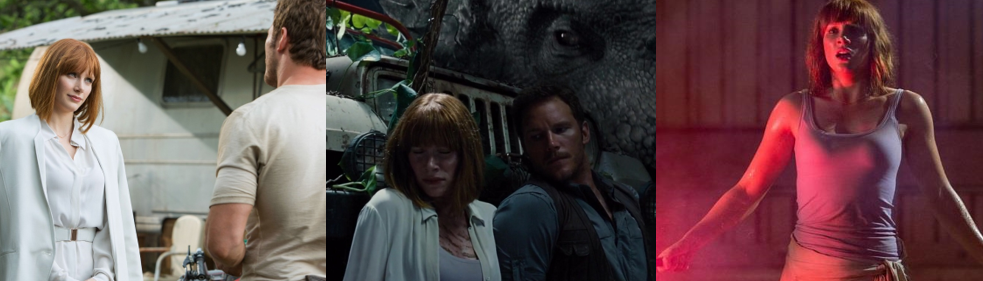
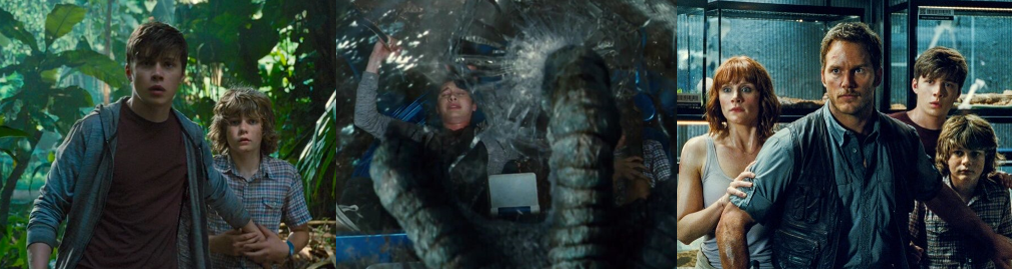
Brothers Zach and Gray Mitchell (Robinson and Simpkins) visit Jurassic World, an island theme park populated by dinosaurs. However, their workaholic aunt, Claire Dearing (Howard), is soon relying on unruly Velociraptor trainer Owen Grady (Pratt) when a genetically engineered dinosaur runs amok.

The Background:
Legendary director Steven Spielberg and special effects wizards Stan Winston, Phil Tippett, and Dennis Muren turned Michael Crichton’s bestselling Jurassic Park (ibid, 1990) into a pioneering blockbuster back in 1993. Although Jurassic Park made over $1.030 billion and received widespread positive reviews, Crichton and Spielberg were reluctant to work on a sequel. The Lost World: Jurassic Park (Spielberg, 1997) may have broken box office records but it garnered mixed reviews and, feeling he failed to match expectations, Spielberg passed on Jurassic Park III (Johnson, 2001), the lowest-grossing and least popular of the franchise. Development of a fourth movie can be traced back to 2001 and initial ideas involved dinosaurs migrating to the mainland and, bizarrely, genetically engineered human-dinosaur mercenaries. This evolved into a character who would train dinosaurs and, eventually, Owen Grady. Following numerous failed proposals, the writers turned to both Spielberg and Crichton’s The Lost World novel for further inspiration and references to the two sequels were downplayed. Colin Trevorrow was hired to direct, Stan Winston’s Legacy Effects studio was brought in to develop the animatronic dinosaurs, and Industrial Light & Magic handled the CGI. With a worldwide box office of $1.671 billionJurassic World was a major hit and successfully revitalised the franchise, leading to two more sequels over the next seven years. The mould was further broken with the film’s largely positive critical reception. Reviews praised the exciting plot, the magnetic performances, and the natural evolution of the original concept. Spielberg and Jurassic Park star Sam Neill also praised the film, though it did draw some criticism for its unnecessary violence against women and its narrative similarity to Deep Blue Sea (Harlin, 1999).

The Review:
It’s been some years since John Hammond (Richard Attenborough) first dreamed up the idea of Jurassic Park. By employing the services of arrogant geneticist Doctor Henry Wu (BD Wong), Hammond created an awe-inspiring theme park populated by rides, gift shops, and, obviously, genetically recreated dinosaurs. Of course, Jurassic Park proved to be a disaster; the Isla Nubar theme park was left to rot and the remaining dinosaurs were abandoned to die from “lysine deficiency”. Although Jurassic World plays it fast and loose with references to the previous sequels, it begins with Hammond’s dream of a dinosaur theme park finally made a reality. Having been bequeathed ownership of InGen and all its assets, including the park and Hammond’s ideals, billionaire tycoon Simon Masrani (Khan) successfully brought Jurassic Park to life with Jurassic World, an expansive and fully-functional corporate sponsored theme park literally built on the bones of the original. Children of all ages flock to Isla Nubar to see the prehistoric creatures roaming the forests and wilds of the island, petting and riding baby Triceratops and other herbivores like they were lambs, watching daily performances from the titanic Mosasaurus, and freely exploring herds of dinosaurs while learning from Jimmy Fallon (of all people) in the park’s advanced gyrospheres. An eccentric businessman who prefers flying helicopters and wowing visitors with bigger, better dinosaurs, Masrani is notably hands-off regarding the park’s day-to-day functionality. He isn’t overly concerned with the bottom line since he’d rather everyone, humans and dinosaurs alike, enjoy the spectacle, and therefore mindlessly orders bigger, “cooler” attractions from Dr. Wu. Accordingly, it’s up to workaholic Claire to oversee Jurassic World and make sure everything’s running smoothly from her control room. Aided by underappreciated Lowery Cruthers (Jake Johnson) and his unrequited crush, Vivian (Lauren Lapkus), Claire treats her job very seriously but also very callously. She isn’t concerned with the welfare of the dinosaurs or whether the guests are enjoying themselves. All she cares about is increasing profits, gaining additional sponsorship, and keeping everything running like clockwork.

Tight-ass Claire is forced to rely on others and realise what really matters when she loses control.

This means that, while she seems happy to see her nephews, Claire has no time to spare spending time with them and barely remembers their ages or what they look like when they ditch her overwhelmed assistant, Zara (Katie McGrath), in search of better, more exciting adventures. Claire’s noticeably uncomfortable in almost every social situation: she focuses on the numbers and practical matters, disregarding emotions and animal intelligence. Since Masrani ordered Dr. Wu to cook up a fantastic new attraction, Claire’s primary goal is securing sponsorship deals for the Indominus rex, a patchwork hybrid of numerous dinosaurs that Masrani hopes with “give […] parents nightmares” and reinvigorate ticket sales. Though impressed by the monster, Masrani requests that Claire ask their resident ex-Navy Velociraptor handler, Owen, to inspect the Indominus paddock and give his expert opinion. It’s through interactions with Owen that we see just how maladjusted Claire is: she brought an itinerary to their one disastrous date and is obsessed with being in control of every situation. She’s therefore as ignorant to the true threat the Indominus poses as she is to the feelings of others and the welfare of the park’s dinosaurs, which she constantly refers to as “assets” and “it” since they’re just numbers on a spreadsheet. When the Indominus escapes, Claire disregards Owen’s warnings and confidently deploys the Asset Containment Unit (ACU), only to be stunned when they’re systematically slaughtered. When Owen advises an evacuation of the park, Claire’s more concerned with their reputation than anyone’s safety and it takes a frantic call from her sister, Karen Mitchell (Judy Greer), and the suffering of the injured guests for Claire to finally realise the gravity of the situation. Her and Owen couldn’t be more different: where he’s sensitive and seasoned, she’s largely naïve and incompetent, especially regarding tracking and understanding dinosaurs. Owen frequently chastises her tight-assed demeanour and encourages her to just let loose, which eventually sees her defiantly shed her corporate outfit. She even saves Owen from a Dimorphodon attack and puts herself at risk to lure out the Tyrannosaurus rex in the finale…and all while wearing high-heels! Claire also prioritises Zach and Gray’s safety by the third act and is actively appalled by InGen’s head of security, Vic Hoskins (D’Onofrio), and his obsession with weaponizing Owens ‘raptors.

Zach and Gray must brave the park’s dinosaurs and draw strength from each other.

Much of Jurassic World focuses on Zach and Gray, two brothers with very different personalities. While Gray is younger and far more energetic, boasting an encyclopaedic knowledge of dinosaurs, Zach is sullen and moody and more concerned with staring at attractive girls. The two have been shipped to Jurassic World to see the awesome attractions and be with their aunt, only to be abandoned by Claire and left with a glorified babysitter, which only furthers their individual responses to their parents’ ongoing issues. While Gray is distraught at the idea of his parents getting a divorce, Zach hides behind an angsty bravado and is initially aggravated by his little brother’s exuberance, preferring to stare at his phone rather than dinosaurs. His mood lifts upon seeing the Mosasaurus and he encourages Gray to veer off when exploring in the gyrospheres, ignoring warnings to return to safety and stumbling upon the overgrown remains of the original park. Together, they get an old Jurassic Park jeep running and are stalked by the Indominus, eventually reuniting with Claire, who then makes them her top priority, and being immediately amazed by the charismatic Owen, who fends off the Pteranodon and Dimorphodon assault. While Zach doesn’t make a great first impression, being every moody teen you’ve ever seen, he soon shows a softer side and actively reassures and protects his little brother, recognising the danger and the trauma Gray’s feeling at both their personal and current situation. To be fair, Gray is irritating at times, constantly running around and babbling facts, but he embodies the excitement and wonder that Jurassic World elicits in its target audience. Unlike the kids from the first movie, who find a way to be useful by the film’s climax, Zach and Gray are mainly here to be put in peril and kept safe, but they go a long way to humanising Claire and showing the amusing dichotomy of Jurassic World. It’s amazing, yes, but there are some who are no longer impressed by genetically recreated dinosaurs and who demand “more teeth”.

Charismatic Owen impresses with his bad-ass attitude and ‘raptor buddies.

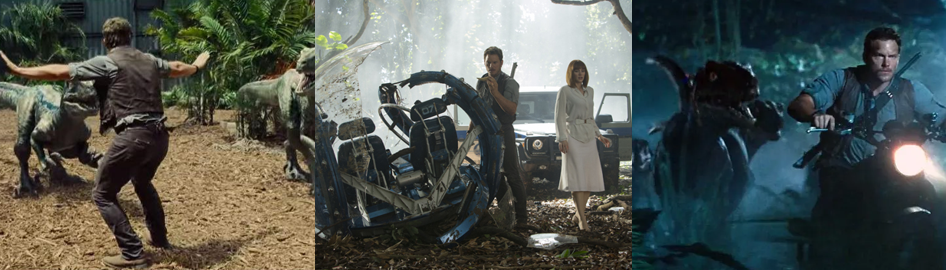
Luckily for Claire, Zach, and Gray, Owen is on hand to immediately recognise the potential and current dangers posed by the dinosaurs and to take charge of every situation. An ex-Navy veteran, Owen works with Barry Sembène (Omar Sy) to tame a pack of Velociraptors (of whom “Blue” is the favourite and most intelligent) to follow simple directions and commands. Unlike Claire, Owen fully understands and respects an animal’s intellect and needs, allowing him to subdue the ‘raptors as their “Alpha”. His skill impresses Hoskins, who believes this proves the creatures could be deployed as living weapons, despite Owen very emphatically stating that his relationship with the ‘raptors is tenuous. Though attracted to Claire and eager for her to stop being so uptight, Owen constantly clashes with her since she believes she has full control over every situation, meaning she doesn’t understand how dangerous and intelligent the Indominus is. Owen’s often at a disadvantage since Claire stubbornly refuses to divulge the exact genetic makeup of the Indominus, leading to many deaths (much to his anger) andhim temporarily losing favour with his ‘raptors since the Indominus turns out to have ‘raptor DNA. Owen also vehemently objects to Hoskins’ desire to employ the ‘rapors and a scaled down Indominus as military assets, only agreeing to his insane plan to have the ‘raptors hunt down the Indominus because they have no other choice. Hoskins sees Owen’s relationship with the ‘raptors and mistakenly, arrogantly, believes the creatures are tamed to be on “the same side” as him. Thus, he vastly underestimates the aggressive creatures and it costs him dearly, whereas Owen’s bond with Blue allows him to reaffirm his status as the ‘raptors’ Alpha by the finale. Unlike Claire, who thinks only about the park’s profits and reputation, Owen is in the business of saving lives. His demands to pull the ACU out are ignored, leading to their wholesale slaughter, and he actively braves danger to rescue Zach and Gray while also trying to keep his ‘raptors alive. The only exception to this rule is the Indominus, a creature Owen sees as an abomination that needs to be taken down as quickly as possible. He’s visibly distraught when the Indominus kills for sport and horrified by the reckless mad science used to create it, which practically guaranteed that it would endanger others.

The Nitty-Gritty:
It was amazing to see a fully functioning Jurassic Park onscreen, which added something new to the Jurassic formula. While Jurassic World touches upon many of the same themes as its predecessors (the moral debate of genetically recreating dinosaurs, discussions and depictions of nature vs. science, and dinosaurs going on a rampage), this had never been tackled in a fully populated theme park before. I loved how everyone accepted Jurassic World and flocked to see its attractions like it’s Disney World. While Owen and Masrani agree that dinosaurs are attractive enough, Claire and the Board disagree and constantly push for newer assets to draw in more visitors, even if it means building their own dinosaur. It’s an interesting position to take since Jurassic World is seen to be thriving; everyone there is having a great time and there’s no sense that they need anything more. This truly is John Hammond’s dream come to life, with dinosaurs performing shows and rides that take visitors into the dinosaur’s territory, though fully protected by seemingly impenetrable gyrospheres. Of course, just wowing the crowd isn’t enough, not for Claire and her bottom line and certainly not for Hoskins. I’ve always hated the idea of weaponizing dinosaurs; it seems like such a stupid thing to do, one guaranteed to backfire, and Owen echoes these sentiments. It’s outrageous to someone as seasoned as Hoskins would think dropping Velociraptors behind enemy lines would end well for anyone and it’s very satisfying seeing him get his comeuppance. It’s sad that so many lives are lost due to people disregarding Owen’s warnings, but it’s a harsh lesson about the reality of dealing with highly intelligent and aggressive predators. The Indominus goes on a slaughter, devouring humans and massacring an Apatosaurus herd simply to prove its dominance, and only Owen recognised its threat (sight unseen, I might add) since Masrani and Claire only cared about scaring and profiting from visitors, respectively. Jurassic World also reiterates the pseudo-science of its dinosaurs by bringing back Dr. Wu, an arrogant and selfish scientist who explicitly states that his dinosaurs have always been genetic monsters rather than 1:1 recreations. Dr. Wu also impassively reacts to the Indomonis’ rampage and various abilities since he was simply following Massani’s foolish demand for more awesome theme park attractions.

In a land where dinosaurs are theme park attractions, the Indominus rex reigns supreme.

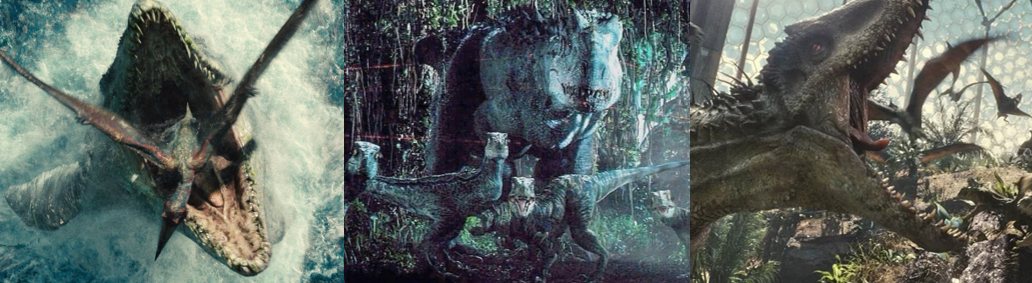
While Jurassic World stays close to the look and depiction of dinosaurs from the previous films, eschewing feathers and other scientific considerations, it does showcase a few new dinosaurs. The baby Triceratops were cute (though somewhat horrific as they’re resigned to a life of being manhandled by children) and I liked the Pteranodon and Dimorphodon attack. This is precipitated by the Indominus breaching their glass aviary and Masrani fatally crashing his helicopter into the structure, leading the flock of the ravenous, bat-like dinosaurs to cause mass panic. It was also cool to finally see an aquatic dinosaur; the Mosasaurus is initially introduced much like an orca whale, performing tricks and taking a subtle jab at Jaws (Spielberg, 1975) by devouring a Great White Shark. Naturally, the Velociraptors continue to be depicted as the most intelligent dinosaurs, though now somewhat tamed thanks to Owen. Mischievous and aggressive pack hunters, the ‘raptors obey Owen out of mutual respect but even he can’t turn his back on them and must be constantly on guard to admonish and reward them, as required. Hoskins sees unlimited potential in the creatures and relishes deploying them to hunt the Indominus, fitting them with night vision headsets and seeing them run alongside Owen’s motorcycle. Of course, the ‘raptors become a very real and horrifying threat when they’re swayed by the Indominus, leading Owen to put his knowledge to safeguarding others until he reasserts himself as the Alpha. Unsurprisingly, the Indominus rex is the star of the show here. Purposely portrayed as an exaggerated and ridiculous monster of a creature, the Indominus is like what you’d get if you asked a child to design their own dinosaur. It’s massive and aggressive like the T. rex, can camouflage and even mask its heat signature, and is as intelligent and swift as a ‘raptor, clawing out its tracking device, setting traps, and hunting for sport. It boasts massive, talon-like hands to grab and squeeze prey, easily devours humans whole, can breach the gyrosphere’s hull, and is largely immune to gunfire and even heavy explosives thanks to its super-tough hide.

After a big, brutal dino battle, the Indominus is bested and Claire learns to let loose a little.

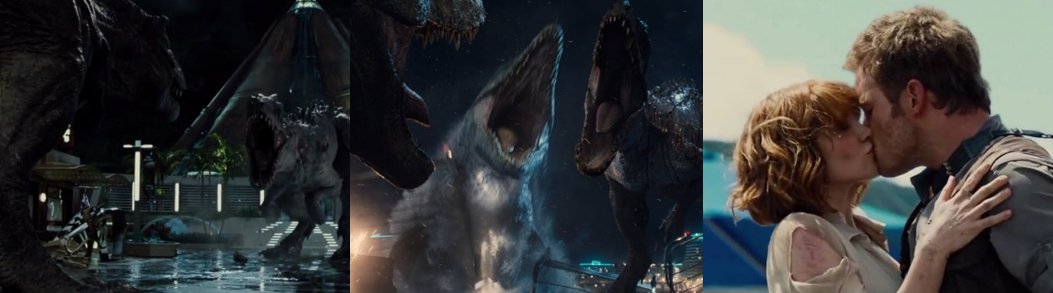
Although Jurassic World is in complete disarray due to many of the dinosaurs being loose, the primary concern of everyone (including Hoskins) is the Indominus rex, whose rampage easily made Jurassic World the goriest of the films at the time. People are swallowed, bit in two, trampled, and crushed by its sheer, savage power, to say nothing of the dinosaurs it mauls simply for fun and Zara’s unnecessarily horrific death. After getting Zach and Gray to safety, Owen reluctantly leads the ‘raptors against the Indominus but is forced to flee when they switch their allegiance. Although Hoskins is killed by “Delta”, Dr. Wu safely escapes reprisals (and the island) with his research intact so that he can continue working on refining the Indominus rex concept. With the park’s visitors either safely evacuated or awaiting rescue, Owen and the others find their path to the docks blocked by the raging Indominus. Luckily, Owen restores his bond with Blue and the remaining ‘raptors leap to their defence; however, Gray calculates that the dinosaurs won’t stand a chance against the monstrous abomination. Thus, Claire steps up and has Lowrey release the aged T. rex (the same one from Jurassic Park, judging by its scars) and lures it to the Indominus for a quasi-Kaiju finale! Unlike the disappointing fight between the T. rex and the Spinosaurus, this is a brutal and violent clash that sees the two chomp on each other’s necks, slash great gashes in each other’s hides, and crash through the park’s buildings. It’s a fantastic visual metaphor for nature literally tearing down corporate greed and the two don’t hold back, being evenly matched at times in terms of power and ferocity. That is until Blue enters the fray and leaps to the T. rex’s aid, clambering onto the Indominus and causing it to stagger towards the edge of the Mosasaurus tank. Wounded and exhausted and with its two rivals closing in, the Indominus prepares to continue the fight (and, honestly, probably would’ve won) when it is suddenly set upon by the Mosasaurus, which drags it underwater and ends its threat. In the aftermath, the T. rex and Blue part as mutual allies and they (alongside the other dinosaurs) reclaim Isla Nubar. Though shaken by their experiences, Zach and Gray’s bond is strengthened and they’re tearfully reunited with their parents. Claire realises the error of her ways and apologises to her sister, before seemingly being ready to rekindle her relationship with Owen, who reluctantly allowed Blue to return to the wild where she belongs.

The Summary:
I was sceptical when Jurassic World was first announced. While I can understand the idea of doing at least one Jurassic Park sequel, The Lost World and Jurassic Park III failed to capture the magic of the original movie and I figured it was better to leave it lie. However, Jurassic World was just the shot in the arm the franchise needed. As a legacy sequel and part re-quel, the film does a great job of hitting upon the familiar story beats of the franchise while delivering something fresh and new: namely, a fully operational dinosaur theme park. This alone was an inspired idea and I loved the parallels to Disney World, the juxtaposition of wanting to maximise profits while also aweing visitors, and the idea that the world has accepted that dinosaurs are a thing now. Jurassic World certainly impresses with its many visual effects, which still hold up today and are largely on par with Jurassic Park’s. It’s helped that animatronics and practical effects are also employed wherever possible, but the scale of the chaos is beautifully brought to life here and more than makes up for the previous two sequels. While Claire and the kids could be annoying at times, that was the point: Claire’s character arc was learning that she can’t control nature and atoning for being such a workaholic and neglecting the things that matter, and the entire experience was designed to bring Zach and Gray closer together. Chris Pratt is such a magnetic presence here; Owen oozes cool, being both sensitive and bad-ass and stealing the limelight as the pro-active voice of reason. I really enjoyed his relationship with the Velociraptors and how they were recast as good girls (or, at least, anti-heroes), giving us familiar ‘raptor action but with a twist since they’re largely on “our side”. The Indominus rex was a ludicrous monster in all the right ways; its bevy of abilities and sheer ferocity make it the stuff of nightmares and I loved how this one abomination was enough to threaten the entire island. The last-minute return of the T. rex for an awesome dinosaur fight was spectacular as well and set a new standard for the franchise. I liked this film more than I expected when I first saw it and it’s stood the test of time since then, easily being the second-best film in the franchise after the first, the best of the sequels, and the best of the second trilogy.

My Rating:

Rating: 4 out of 5.

Great Stuff

Were you impressed with Jurassic World? Were you also sceptical of revisiting the franchise at the time? What did you think to Owen’s characterisation, his relationship with Claire, and his taming of Velociraptors? Were you glad to see a fully functioning dinosaur theme park at last? What did you think to the Indominus rex and its many abilities? Which of Jurassic Park’s sequels is your favourite and how are you celebrating Dinosaur Day this year? Whatever your thoughts on Jurassic World, and dinosaurs in general, leave them below and go check out my other dinosaur content on the site.

Mini Game Corner [Turtle Tuesday]: TMNT: Turtles in Time Re-Shelled (PlayStation 3)


The first issue of Kevin Eastman and Peter Laird’s Teenage Mutant Ninja Turtles (TMNT) was published in May 1984. Since then, the TMNT achieved worldwide success thanks not only to their original comics run but also influential cartoons, videogames, and wave-upon-wave of action figures.


Released: 10 September 2009
Developer: Ubisoft Singapore
Also Available For: Xbox 360

A Brief Background:
Back in the late-eighties and early-nineties, the Teenage Mutant Ninja Turtles (or Teenage Mutant Hero Turtles for us Brits) took kids by storm long before Mighty Morphin’ Power Rangers (1993 to 1996) and Pokémon (1997 to present) dominated playgrounds. Kids were as transfixed by the Teenage Mutant Ninja Turtles (1987 to 1996) cartoon (a toned down version of the far darker Mirage Comics) as they were by all the toys and videogames. While Konami’s original TMNT arcade game set the standard for some of the franchise’s most influential gaming ventures, the equally beloved sequel, Turtles in Time (Konami, 1991), wowed gamers both in the arcades and at home. So beloved was Turtles in Time that license holders Ubisoft decided to atone for the mediocre reception of their TMNT (Munroe, 2007) tie-in game (Ubisoft Montreal, 2007) with a digital-only, cel-shaded Turtles in Time remaster for home consoles. Sadly, despite impressing with its new coat of paint, Re-Shelled was met with mixed reviews. Critics praised the online functionality and multiplayer but were left disappointed by the difficulty and lack of replay value, and the game was sadly delisted when Ubisoft lost the TMNT license in 2011, never to be seen again.

The Review:
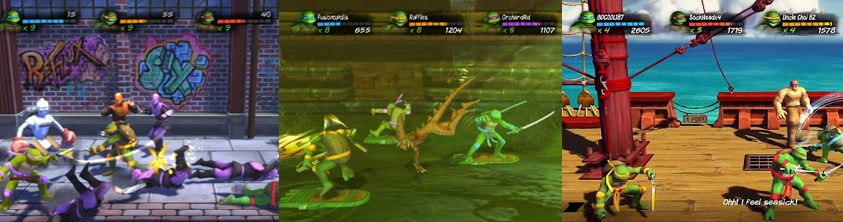
I’ve reviewed the original arcade release of Turtles in Time before, including its Super Nintendo port and the heavily altered version that came to the Mega Drive, so this review will be a bit shorter and focus on what’s similar and different rather than being massively in-depth as, fundamentally, Re-Shelled is the same game as Turtles in Time but with a new coat of paint. Turtles in Time Re-Shelled is a 2.5D arcade-style beat-‘em-up, just like the original, in which up to four players battle across nine stages, from the streets of New York City to the prehistoric past and the far future, bashing seven kinds of shit out of waves of robotic and rainbow-coloured Foot Soldiers and taking on some of their most recognisable enemies in a bid to recover the Statue of Liberty from their archenemies, Krang and Oroku Saki/The Shredder. After selecting your difficulty level and altering some of the usual in-game settings, you pick your character. Each Turtle has different attributes, though perhaps not in the way you’d expect (Raphael is strangely the fastest while Donatello is the toughest, for example), and different weapons that change their special moves and their reach in combat. While Re-Shelled now allows you to attack in eight directions rather than the original’s two, the TMNT’s abilities aren’t that varied. You attack with Square, pulling off simple combos with subsequent button presses, jump with X (executing a jump attack when in the air), press X while running for a dash attack, and pull off an energy-draining special attack with Triangle. This ranges from a lacklustre spin kick for Raph, a wide sword swipe for Leonardo, and a screen-crossing pole vault for Don, with Raph and Michelangelo really drawing the short straw in this aspect. Health is replenished by pizzas scattered throughout each level and you can temporarily enter an invincible spin mode when you grab some pizza power to clear out any enemies, though I never played this game with a friend so I can’t say if there are any team attacks.

The classic TMNT arcade game got a cel-shaded glow up that retains much of the original mechanics.

As before, you can also grab and slam Foot Soldiers or hurl them at the screen, which is always fun, and hit barricades, traffic cones, explosive items, and fire hydrants to help with crowd control. Some onscreen hazards like wrecking balls can also damage enemies, but you must watch out for loose planks, spiked mines, crushing gates, and freezing panels as they’ll all hurt you and momentarily slow you. The TMNT’s recovery time is a bit of a joke; if you get knocked down, it takes a while to get back up, which caused me to get pummelled when fighting Leatherhead. You’re given nine lives on “Easy” mode and the game autosaves as you play, allowing you to continue where you left off or jump to any completed stage in “Quick Play” mode. If you’re feeling extremely sadistic, you can take on the “Survival” mode, which challenges you to finish the entire game with just one life, something I wouldn’t recommend. The TMNT battle an assortment of colourful Foot Soldiers, including blue variants with swords and axes, green ones who fire arrows, and yellow ones who carry bombs. They swarm the screen, occasionally jumping from the background and comically struggling with their hoverboards, but are easy cannon fodder. The Technodrome’s robotic forces are a bit more annoying, teleporting in and stunning you with energy blasts, as are the various hulking Rock Soldiers who stomp around with massive cannons or girders. You’ll visit all the same locations from the original game, with a familiar enough remixed soundtrack and the enjoyable voices of the 2003 to 2009 voice cast keeping you entertained, though cutscenes are limited to simple motion comic-like sequences with a sprinkling of text and voice acting.

The new visuals work, for the most part, but the game is distinctly barebones at times.

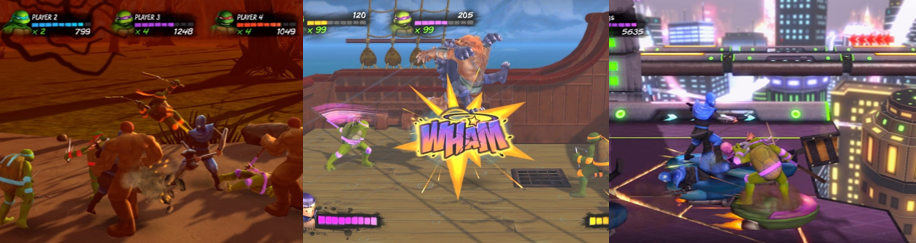
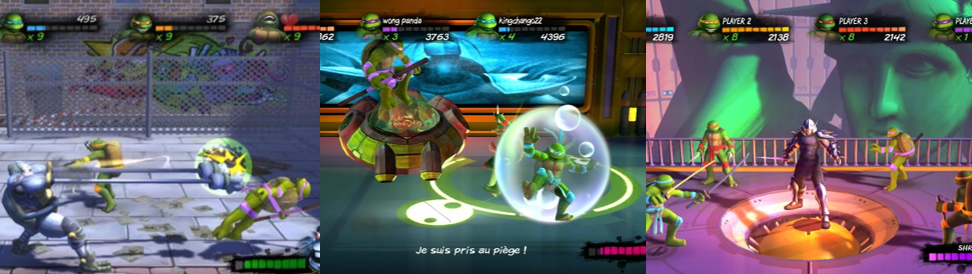
Graphically, the game looks pretty decent. It uses a cel-shaded art style somewhat akin to a mixture of the classic cartoon, the aforementioned 2003 revival, and the original comics, but a lot of the colour and vibrancy is lost in some levels. When things are brighter and more open, like in Alleycat Blues or Bury My Shell at Wounded Knee, the game pops quite admirably. While the TMNT have only limited idle poses, they celebrate with vigour when clearing a stage and show a lot of personality when hurt by stage hazards, and I really liked the comic book-style sound effects that appeared with every attack. Stages have a decent amount of detail and depth, including graffiti, Krang’s giant robot body, a bubbling lava pit within a dark cave, a neon-drenched futuristic city, and a speeding Old West train carrying crates and circus supplies. It’s basically everything from the original game, but with a 2.5D twist. Very little has been added to each environment and there’s been no attempt to add new elements like additional power-ups or even bosses from the Super Nintendo version. At times, the gameplay feels very sluggish and unresponsive. The TMNT are both slippery and very heavy, awkwardly performing dive attacks and lumbering around and then breaking into a sprint, which can mess up your attacks. As before, it’s not all mindless button mashing; two stages are autoscrollers where you race around on surf- and hoverboards. This can be fun as long as you avoid the hazards and don’t try to jump attack the hovering Foot Soldiers, respectively (just use your regular attacks, it’s oddly much more accurate). Additionally, this is a bit of a barebones package as, while you can earn Trophies and tackle harder difficulties, there are no new skins, characters, or features to unlock, which actually puts it a step behind the Super Nintendo version.

Bosses are largely unchanged and simple, until you reach the formidable Shredder.

For me, the highlight of the game are the titular foursome and the bosses they encounter at the end of each stage. These are the same as in the arcade version, unfortunately (so you won’t see Slash in Prehistoric Turtlesaurus, for example), and can be beaten fairly easily on “Easy” if you stay on the move and land quick combos. Doctor Baxter Stockman battles you in his fly form in Big Apple, 3.A.M. flying overhead and firing an uzi or his weird goo gun. Again, it’s better to just use your ground combos than to try and land jumping attacks, especially when he’s on the ground. Metalhead comes crashing in at the end of Alleycat Blues, sporting extendable arms and a rocket kick, but he’s quite slow and clunky so you can easily overwhelm him. Sewer Surfin’ sadly retains the gauntlet against the Xenomorph-like Pizza Monsters rather than the more impressive Rat King; simply jump-kick them when they pop from the water and you’ll soon be warped to the past by the Shredder. Cement Man is where the boss difficulty ramped up a bit for me; he turns to goo and slimes about the place, which can quickly whittle down your health. Similarly, the duo of Tokka and Rahzar can be troublesome, especially alone, as they can charge, swipe, and grind at you with a spinning shell attack. As mentioned, Leatherhead was a bit of a pain for me; not only does he toss and stab with daggers but he spams this scuttle move that can stun lock you if you don’t jump over him fast enough. In comparison, the fights against Krang are much easier. His robot body is easily attacked in Neon Night Riders, despite his rocket kick and double-hand slap, and his regular form is simple enough to combo to death in Star Base, though his teleport is annoying and I did struggle to avoid being smashed into a pancake by his slam. You’ll face the Shredder in the finale; armed with a sword and some mystical energy, he can seemingly regenerate his health, kick and swipe at you, levitate and fire projectiles, and unleashes an energy burst if you get too close. He’s by far the toughest boss, tanking damage like a brick wall, but you can get into a good routine of jumping in, landing a quick combo, and jumping away without too much trouble.

The Summary:
I was genuinely upset when I finally said goodbye to my PlayStation 3 as it had my copy of Turtles in Time Re-Shelled installed on it. When the game first released, it was the only affordable way to experience the arcade classic and I had a lot of fun playing it then, and for this review. I’m a big fan of the TMNT and arcade beat-‘em-ups so there’s a lot to like in Re-Shelled in that regard as it plays just like an arcade beat-‘em-up, warts and all, and nicely updates the original to then-modern times in a way that I think works pretty well. Sadly, it is a bit of a barebones experience and there’s barely anything new added to the game beyond its cel-shaded glow up. It’s lacking additional features, unlockables, and gameplay modes, and I was disappointed not to see elements from the Super Nintendo version incorporated to further expand on the original game. While it’s perfectly fine to play, the gameplay is clunky and chaotic at times, especially the controls. It’s hard to judge where your attacks will land and how fast you’ll move, meaning I couldn’t decide if it was better to use the directional pad or the analogue stick, and it’s easy to get caught by attacks and hazards because of how haphazard the controls can be. Ultimately, this was a great alternative for players at the time; Turtles in Time wasn’t readily available to play so this was a decent compromise. Since then, Turtles in Time has been re-released and I’d definitely recommend picking up the Cowabunga Collection (Digital Eclipse, 202) for the definitive Turtles in Time experience (although, honestly, I would’ve liked to see this included in that collection as well, just for the sake of game preservation).

My Rating:

Rating: 3 out of 5.

Pretty Good

Did you ever play Teenage Mutant Ninja Turtles: Turtles in Time Re-Shelled? How do you think it compares to other TMNT videogames and the original versions? What did you think to the new graphics and voices? Which of the characters was your go-to and which of the game’s bosses was your favourite? Would you like to see this game re-released? Which of the four Turtles is your favourite (and why is it Raphael?) Whatever your thoughts, I’d love to see your memories of Turtles in Time down in the comments!

Back Issues [HulkaMAYnia]: Tales to Astonish #61-66


Since his explosive debut in May 1962, Stan Lee and Jack Kirby’s gamma-irradiated Jade Giant has been one of their most recognisable and successful characters thanks, in large part, to the Incredible Hulk television show (1977 to 1982) catapulting the Hulk into a mainstream, pop culture icon. So what better way to celebrate all things Hulk than by dedicating a day in May to the Green Goliath?


Writer: Stan Lee – Artist: Steve Ditko

Story Title: “Captured At Last!”
Published: 4 August 1964 (cover-dated: November 1964) 

Story Title: “Enter… the Chameleon!”
Published: 1 September 1964 (cover-dated: December 1964) 

Story Title: “A Titan Rides the Train!”
Published: 1 October 1964 (cover-dated: January 1965) 

Story Title: “The Horde of Humanoids!”
Published: 3 November 1964 (cover-dated: February 1965) 

Story Title: “On the Rampage Against the Reds!”
Published: 3 December 1964 (cover-dated: March 1965) 

Story Title: “The Power of Doctor Banner!”
Published: 5 January 1965 (cover-dated: April 1965) 

The Background:
The brainchild of legendary Marvel duo Stan Lee and Jack Kirby, Doctor Robert Bruce Banner’s monstrous alter ego, the Incredible Hulk, was inspired by a story of a hysterical mother summoning superhuman strength to rescue her child and classic screen monsters Frankenstein’s Monster and Doctor Jekyll and Mister Hyde. Initially depicted as a stone-grey figure, the Hulk soon became a mainstay of Marvel Comics thanks to developments to his lore and the popularity of the live-action television series. Stan Lee also contributed to the creation of some of the Hulk’s iconic enemies, with Samuel Sterns/The Leader perhaps being his most notable adversary. Co-created by Steve Ditko, the Leader first appeared in the pages of Marvel’s science-fiction anthology series Tales to Astonish and was as smart as the Hulk was strong, matching the Jade Giant’s brawn with his genius intellect. Allied with Intelligencia, a group consisting of the greatest criminal minds on Earth, the Leader has long dogged the Hulk, either seeking to destroy him, harness his power, or manipulate him. Despite being a prominent foe in Marvel videogames and the Hulk’s animated ventures, it would take nearly twenty years for the Leader to finally appear in live-action when Marvel Studios finally paid off introducing Sterns (Tim Blake Nelson) in 2008.

The Review:
The saga of the Leader’s first appearance is a sprawling, multi-layered one that technically begins in Tales to Astonish #61, where Banner is desperately trying to destroy a robot he built to withstand atomic explosions, one usurped by a dirty Commie spy. I mainly mention this issue for two reasons: the first is that it was the first appearance of Banner and the Hulk’s long-time enemy and rival, Major Glen Talbot. Talbot shares General Thaddeus “Thunderbolt” Ross’s suspicions about Banner and has come directly from the Pentagon to investigate the scientist, immediately making him a kindred spirit to Ross. The General even approves of Talbot putting the moves on his daughter, Betty, if only to “take her mind off that milksop Banner”. The second reason I bring up issue #61 is because, while fighting the robot and defending the military base, the strangely loquacious and heroic Hulk throws himself in the path of a missile and is knocked unconscious, allowing Talbot to string him up in heavy iron chains and cart him back to base. And this is where we find the hulk in issue #62, helpless and restrained before a gloating General Ross and desperate to break free before his dual identity is discovered. This issue also reveals that the spy who stole Banner’s mech suit was sent by the mysterious Leader, a helmeted scientist working around the clock on perfecting his latest humanoid creation. To discover the fate of his spy, the Leader contacts Dmitri Smerdyakov/The Chameleon, who gladly takes on the relatively simple job and flies out there, unaware that he’s sitting next to the Hulk’s young ally, Rock Jones, who’s heading in the same direction to help his friend. Despite Rick’s best efforts to reach the Hulk before everyone learns his identity, he’s caught by Talbot and booted off the base. The Chameleon, meanwhile, easily slips into the facility and uses what’s assumed to be his photographic memory to construct an elaborate mask and return to the base in the guise of General Ross!

The Chameleon’s antics cast further suspicion over Banner’s loyalties.

The Chameleon approaches the captive Hulk and offers to set him free if he obeys his orders, but the Hulk obviously refuses to aid his hated enemy. When the Chameleon ushers away the guards to talk more privately, the change occurs behind his back, allowing Banner to easily escape to safety with Rick’s help. Although Rick feels guilty about deserting Banner to partner with Captain Steve Rogers/Captain America, Banner allays his guilt, saying he fears he cannot control the Hulk’s anger and would hate to hurt the boy, or anyone else. Banner then returns to General Ross and Talbot, receiving a chewing out for his disappearing act and brushing off Talbot’s threats about exposing him as a Red Agent. On his way back to his lab, Banner is blindsided by the Chameleon, who knocks him out and assumes his identity. The Chameleon discovers Banner’s Gamma Bomb project but is immediately rumbled by Betty, who intuits that he’s an imposter. Desperate to save his love, Banner transforms into the Hulk but is forced to flee when the Chameleon threatens to set off his Gamma Bomb since even the Hulk realises the danger of such a weapon. The Chameleon then lays out Talbot and escapes with Betty, only to be literally derailed by the Hulk. With the military forces closing in, the Hulk has no choice but to throw himself upon the Gamma Bomb, shielding innocents from the blast and reverting back to Banner from the effort. Although the Chameleon escapes, Banner is cleared of any formal charges thanks to Betty’s testimony, but General Ross, Talbot, and even Betty suspect that Banner is hiding something and he remains under close observation. Unbeknownst to all, the Leader is lurking in the background, left with no choice but to personally intervene since the Hulk’s strength has bested his two agents. Luckily for him, his mighty Humanoid is ready to go but, as he basks in its perfection, the Leader’s thoughts wander to his origins, which strangely mirror those of the Hulk.

The Leader’s unbeatable Humanoid proves more than a match for the Incredible Hulk!

Less than a year ago, the man we now know was Samuel Sterns was merely an ordinary labourer. However, like Banner, he was caught in a Gamma explosion and exposed to “one of the strongest forces known to man”. While recuperating, the uneducated labourer uncharacteristically consumed knowledge and books. One day, while studying like a man possessed, he collapsed in a feverish fit and awoke to find himself permanently transformed into a green-skinned, giant-headed despot. Dubbing himself “The Leader”, he forsook his previous life and immediately put together a spy network to slowly seize power from the world’s governments. However, he is now putting all his faith in his all-powerful Humanoid to succeed where they failed. Thanks to a specially designed (and rather fetching) headpiece, the Humanoid obeys the Leader’s mental commands without hesitation, exhibiting incredible strength and versatility as it easily bends an iron bar and pilots a helicopter. Back at the missile base, General Ross orders Talbot to oversee the transport of Banner’s latest weapon, unaware that the disguised Chameleon is still lurking amongst them or that the Humanoid is following overhead before the pink-hued android is descending upon them. The stress of the attack and Talbot’s constant bullying causes Banner to change into the Hulk, who immediately pounces upon the Humanoid. Interestingly, this is the Leader’s first time seeing or even learning of the Hulk and he’s intrigued to find another Gamma-born creation, and to test the limits of the Hulk’s brutish strength against his boosted intellect. Thus, he commands the Humanoid to battle the Hulk, altering its density so it can withstand the Jade Giant’s mighty blows and easily flinging him into the air! Realising their fierce battle could endanger others, the Hulk forces the two to topple to the tracks. He then rushes back to keep Banner’s weapon from going off and unwittingly ends up caged once again when Talbot decides Banner is a saboteur.

Although Rick frees Banner, Talbot remains aggressively suspicious of him.

Despite Banner’s protests, Talbot and General Ross believe they have all the evidence they need to put Banner on trial for treason, a prospect Talbot gleefully embraces since he hopes to woo Betty in Banner’s absence. Thus, Banner is spirited to Washington, D.C. and put in a bind since he can’t prove his innocence without revealed that he’s secretly the Hulk. Luckily for him, Rick shows up and uses his “top-priority Avengers I.D.” to plead on his friend’s behalf to the decidedly Richard Nixon-esque President. Rick’s plan works and the President releases Banner, much to Talbot’s chagrin, to continue working on his new atomic device on a deserted isle. Convinced that Banner’s up to something, Talbot refuses to let him out of his sight and even threatens to shoot him unless he describes, in detail, everything he’s doing. Banner both laments that they can’t find some common ground and gets pushed to breaking point when Talbot insists that he’s working with the Hulk in some manner. Even worse, Banner’s out of his special pills and forced to flee so Talbot doesn’t see him change into the Hulk. Luckily for Talbot, the cement-lined bunker holds the Hulk at bay and the Chameleon leaked the location of the isle to the Leader, who commands a horde of his Humanoids to dogpile the Hulk, desperate to capture him for study. The Humanoid army aggravates the Hulk since they refuse to fall and his strongest blows have no effect; even flinging a boulder at them simply sees it deflected back at him! With the military closing in and the Hulk’s strength fading, the Humanoids press their attack, wearing the Green Goliath down with their relentless assault. Luckily for him, the trigger happy (grenade happy?) troops cause the Hulk and his assailants to fall into the sea, where a startled Banner avoids drowning only to be captured by a passing Soviet submarine! When Talbot hears this, he naturally assumes it proves his suspicions, while the Leader decides to try and kidnap Banner, convinced that he may hold the key to bringing the Hulk on side.

With Banner branded a defector, the enraged Hulk trashes the Soviet facility to escape.

Banner is brought to an unspecified European country and presented to the commander of a Soviet weapons research centre, who refuses to feed him unless he joins the other braindead, starved scientists forced to create new and more destructive weapons. Caged in a tiny stone cell, Banner realises his only hope is to trigger his transformation and, soon enough, the rampaging Hulk is let loose once more. Despite the Russki’s powerful vaporiser weapon, the Hulk easily tears through the facility, wrecking it with his powerful leaps and thunderous claps. While the soldiers flee, a rebellious slave tends to the Hulk’s wounds, praising and feeding him while the Green Goliath snubs him. Determined to strike back, the commandant arms himself with a “proton gun”, only for the Hulk’s new ally to take the shot, glad to die a free man. Though the Hulk was annoyed by the scientist, the death of someone who was actually friendly towards him drives the Hulk into a berserker rage. Thus, he tears the facility apart in search of the commandant, only to overexert himself and collapse into unconsciousness as Banner. Back in the good ol’ US-of-A, Talbot volunteers to go behind the Iron Curtain to reclaim Banner and make him pay for his defection. Naturally, he and General Ross are quick to slander Banner and, overwhelmed by her grief, even Betty struggles to believe Banner’s innocence. Frustrated by Banner’s disappearance, the Leader contacts the Chameleon once more and learns that his targets are somewhere in Russia. The Leader contacts his unsuspecting Soviet ally to verify this and then decides to simply observe, confident that Banner and the Hulk will escape and return to the US, rather than waste his efforts heading out to Russia. The Leader’s assumptions appear correct as the issue ends with Banner coming to, remembering everything that’s happened to him in recent issues, and going on another rampage as the Hulk before storming off across Europe madder than ever.

The Summary:
This is an interesting time in the Hulk’s history. While Banner transforms due to stress or anger, the Hulk isn’t a completely mindless brute. Not unlike his first appearance, the Hulk is capable of intelligent and coherent thought and speech. He’s blunt and childish at times, but a far cry from his more savage “Hulk smash!!” years. The Hulk showcases complex thought and awareness, especially when fighting his foes, and has the wherewithal to understand where he is, who’s around him, and potential threats. Thus, the Hulk is surprisingly explicitly heroic in these issues; he engages with enemies to keep them from harming others, throws himself upon Gamma-infused weapons, and derails a train to keep people from behind harmed lest Banner’s weapon go off. I generally associate the Hulk from this period as a misunderstood creature who wanted to be left alone and only fought because he was provoked; he had no interest in anything or anyone unless they were nice or antagonistic towards him. Thus, it’s interesting to see him launch himself at missiles to spare even the soldiers who attack him on sight. The Hulk’s also surprisingly weak here; even the narration boxes talk about how he’s just “flesh and bone” and can be killed just like a regular man. He gets injured by the vaporiser ray in issue #66, though shrugs off the significance of this, but is more prone to overexerting himself and reverting to Banner. As lucid as the Hulk is, he still hates his alter ego. To the Hulk, Banner is another enemy, one he cannot see or touch, and he’s constantly striving to stay in his green-hued form rather than turn back into “puny Banner”. The same is true for Banner, who takes tranquiliser pills to help control his transformations and fears the Hulk losing control and hurting someone, especially his loved ones like Betty and Rick.

Fear and paranoia are at an all-time high thanks to tensions between the US and Soviet Union.

A focal point of these issues is Cold War paranoia. General Ross and suave newcomer Major Talbot are deeply suspicious of Banner because he keeps disappearing and acting all cagy. In Ross’s case, his suspicions are rooted in an intense dislike of Banner and disapproval of his relationship with his daughter. He cannot see what she sees in such a “milksop” and constantly badgers her, raving about Banner’s guilt every chance he can get, to strong-arm her into sharing his perspective. Talbot’s dislike of Banner is equally biased since he also has eyes for Betty, which Ross naturally approves of since Talbot’s a man’s man. Talbot loves his country first and foremost, however, and is determined to defend her from any threat, foreign or domestic. He keeps a close eye on Banner and immediately puts together any evidence he can find, however slim, to brand him a traitor. While Rick manages to get Banner cleared, Talbot remains aggressively suspicious and relishes the chance to get his claws into Betty once they receive irrefutable proof that Banner has “defected” to the Reds. The paranoia and fear surrounding the Soviets is the perfect backdrop for the deceptive Chameleon to enter the fray. By assuming various guises, including Ross and Banner, the Chameleon stirs the pot and raises tensions on the missile base. Although Betty’s word is enough to take the heat off Banner, the Chameleon’s constantly lurking amongst the crowd, hearing everything and stumbling upon useful titbits to feed back to the Leader, thereby showing that Ross and Talbot are right to be suspicious. However, their suspicions are misplaced and this costs them dearly, especially when the Hulk goes on a rampage! Surprising no one, the Soviets are depicted as wicked and cruel, starving their workforce and forcing kidnapped scientists to work themselves to death for their cause. However, the US military isn’t exactly squeaky-clean either. Both militaries treat Banner like shit and throw their weight around like stubborn, prideful bulls and it’s as satisfying to see the Hulk rip apart General Ross’s base as it is his decimation of the Soviet’s weapons factory.

The Leader’s mutated brain and all-powerful Humanoid position him as a perfect foil to the Hulk.

And then there’s the main man himself, the Leader. An enigmatic and mysterious individual, we learn about his humble origins but never learn his true name (indeed, he disregards it as meaningless once he takes on his new moniker), yet the Leader is positioned as a thematic double of the Hulk. Like Banner, Sterns was caught in a Gamma blast and somehow survived and, like Banner, he was forever transformed by that mysterious radiation. However, the Leader cannot revert back to human form like Banner; his affliction is permanent and makes him an inhuman figure. The Leader was also gifted with superhuman intelligence, the Gamma radiation increasing his mental capacity to that of a super genius and giving him intellect high enough to create his own intricate spy network. The Leader presumably has agents all across the globe; he definitely has ties to the Reds, who mistakenly believe he is working for them, and agents on US soil. His most prominent point man in this story is the Chameleon, who perfectly aligns with the Leader’s more covert methods. Locked away in a hidden laboratory, the Leader prefers to stay under the radar and have his patsies do the dirty work while he perfects his Humanoid. The Humanoids are mindless automatons directly controlled by the Leader, with no thought or personality of their own. They can become intangible, hyper flexible, and super dense, making them nigh-unstoppable even against the Hulk’s mighty blows. Despite how powerful his Humanoids are, the Leader becomes obsessed with first capturing and studying the Hulk and then trying to woo him to his cause, believing the match of superhuman brain and brawn would make them unstoppable. Thus, while the two never meet in these issues, the Leader’s perfectly positioned as an anonymous puppet master, one whose intellect is depicted as being as much of a threat to the Hulk as his Humanoids. It’s a great introduction to one of the Hulk’s most persistent villains. The Leader may have aspirations for world domination but, here, he’s very low-key and happy to bide his time and even avoid getting involved, confident that an opportunity to strike will present itself and all will go according to his elaborate plan.

Rating: 4 out of 5.

Great Stuff

Did you enjoy the Leader’s debut? Did you read it when it was first published and, if so, how did you think the Leader compared to other Hulk villains? What did you think to the idea that the Leader was gifted superhuman intellect rather than strength? How did you feel about Major Talbot and the suspicions regarding Banner? What are some of your favourite fights or moments between the Hulk and the Leader? Who is your favourite Hulk villain? Whatever you thoughts on the Leader (and the Hulk), feel free to share them below and be sure to check out my other Hulk content!

Movie Night: Thunderbolts* / The New Avengers

Released: 2 May 2025
Director: Jake Schreier
Distributor: Walt Disney Studios Motion Pictures
Budget: $180 million
Stars: Florence Pugh, Lewis Pullman, Sebastian Stan, David Harbour, Wyatt Russell, and Julia Louis-Dreyfus

The Plot:
When Contessa Valentina Allegra de Fontaine (Louis-Dreyfus) seeks to erase the evidence of her malicious experiments, she unwittingly assembles a rag-tag team of losers and mercenaries, led by Yelena Belova (Push), to stand against her and her secret superpowered agent…

The Background:
Back in the nineties, Marvel Comics were not just in a financial state but the “Onslaught Saga” led to some of their most popular characters being presumed dead for a while. In their place, Peter David created an all-new superhero team, the Thunderbolts, who debuted in 1997 as typically excessive heroes who were secretly the villainous Masters of Evil in disguise. The idea of bringing this concept to the blockbuster Marvel Cinematic Universe (MCU) can be traced back to the production of Guardians of the Galaxy (Gunn, 2014) when director James Gunn expressed interest in a big-screen adaptation. Although the idea was shelved when Warner Bros. produced a similar concept, it regained steam when MCU projects teased Valentina assembling a team of anti-heroes and soon evolved into a starring vehicle for Florence Pugh. Once officially announced, a tumultuous development began as rumours and script rewrites did the rounds, drastically altering key plot points and surprisingly offing one of the main cast for shock value. Writer Eric Pearson was keen to introduce Robert “Bob” Reynolds, arguably Marvel’s most notable Clark Kent/Kal-El/Superman proxy, to tackle mental health issues like depression and addiction, with Lewis Pullman cast after scheduling conflicts forced Steven Yeun to back out. Much speculation surrounded the mysterious asterisk in the film’s title, which quickly saw Marvel re-branding the film to The New Avengers shortly after its release, as was always intended. While this bold decision divided some fans, Thunderbolts* was met with widespread critical acclaim and made over $382 million at the box office. Reviews praised the misfit action, Pugh’s elevation to a lead role, its exploration of depression, and the mixture of action and comedy, though many were dissatisfied with the unceremonious showing for Olga Kurylenko’s Antonia Dreykov/Taskmaster.

The Review:
Although the marketing for Thunderbolts* had me believe that Junior Congressman and ex-Winter Soldier James Buchanan “Bucky” Barnes (Stan) was the central character in this film, I was surprised and delighted to find that former Black Widow Yelena Belova takes the lead. In many ways, Thunderbolts* is as much a sequel to Black Widow (Shortland, 2021) as it is a continuation of The Falcon and the Winter Soldier (Skogland, 2021), reuniting Yelena with her eccentric and overbearing super soldier surrogate father, Alexei Shostakov/The Red Guardian (Harbour), delving a little more into Yelena’s backstory courtesy of some traumatic visits to a nightmare dimension known as the “void”, while also significantly building upon the character of disgraced military veteran and former Captain America turned hot-headed mercenary, John Walker/U.S. Agent (Russell). Still grieving the loss of her surrogate sister, Natasha Romanoff/Black Widow (Scarlett Johansson), Yelena begins the film in a place of apathy. Yelena now works as a black ops agent for Valentina, the director of the Central Intelligence Agency (CIA) who’s currently under heavy investigation regarding all her shady experiments and dealings. However, despite throwing herself into her work and being an accomplished assassin, Yelena is unfulfilled and bored with the day-to-day mediocrity of her assignments. Feeling directionless and empty, she attempts to find some direction by talking through her feelings with Alexei, a disgraced and overweight former Soviet hero who’s left living in squalor and running a limo driving service. Despite his significant fall from grace and his boisterous personality, Alexei emphasises that the greatest calling he ever had was being an adored hero and encourages Yelena to step out of her comfort zone and take on a more public, heroic role like her late sister. Though hesitant, Yelena decides to give it a shot, if only to change her daily routine, and Valentina agrees to reassign her if she completes one last job. Namely, the infiltration of a secret underground O.X.E. facility that’s in danger of being robbed (and thus exposing Valentina’s dirty secrets) by Ava Starr/Ghost (Hannah John-Kamen), a tortured soul who can become intangible for short bursts.

Although Taskmaster’s screen time gets cut short, Pugh steals the show with her layered performance.

However, when Yelena accesses the facility, she’s blindsided by Walker, who’s been contracted to kill her. Walker’s then attacked by master fighter Taskmaster, who’s been hired to kill him, and a four-way melee kicks off as they try to take each other out. Though Yelena immediately sees they’ve all been double-crossed, it takes the sudden, dramatic, and down-right insulting execution of Taskmaster for the fighting to stop. Well, that and the strange appearance of the anxious, confused, and seemingly harmless Bob after he was accidentally released from stasis. Though the pig-headed Walker is reluctant to believe Valentina would turn on him, he’s forced to begrudgingly work with the others to escape the facility, which first threatens to incinerate them and then trap them forever. Despite none of them having the powers or equipment to scale the impossibly large shaft, Bob suggests they clamber up back-to-back and, despite Walker’s selfish arrogance, the group fumbles their way to the surface. Unfortunately, Valentina’s long-suffering assistant, Mel (Geraldine Viswanathan), alerts her boss to their actions – and Bob’s presence – meaning the group are met by a heavily armed response team. Thanks to masquerading as Valentina’s goon squad, the group slip past the barricade, but the grateful and kind-hearted Bob decides to risk his life by covering their escape, resulting in him being peppered by bullets. Instead of dying, he emerges unscathed, blasts into the sky, and crashes to the ground with a massive explosion, inadvertently giving his newfound acquaintances the chance to escape and placing him in Valentina’s excited hands. Thanks to having chauffeured Valentina and Mel, Alexei races to retrieve them and excitedly encourages them to stick together as a team, accidentally nicknamed “Thunderbolts” after a passing mention of Yelena’s school sports team, though the group are less than enthusiastic about working together and are visibly disgusted at having had to rely on each other for so long.

Emotionally damaged Bob turns out to be perhaps the greatest threat the world has ever known…

While all this is going on, Bucky seeks to uncover concrete evidence to expose and impeach Valentina, working his charm on Mel to get the inside track and racing to rescue the group when Alexei’s limo is attacked. Despite Alexei’s joy at meeting a Soviet hero and fellow super soldier, Bucky takes no chances and binds the group, seeking to have them testify against Valentina, but is forced to cut them loose and join forces with them when Mel corroborates their wild claims about Bob. As indicated by paperwork found in the facility, the seemingly unassuming Bob is actually a neurotic and emotionally unstable drug addict and survivor of horrific childhood abuse who, in a desperate attempt to feel powerful and significant, signed up to one of Valentina’s secret drug trials. While all the other subjects died, Bob became a full-blown indestructible superman, capable of flight and exhibiting awesome psychic powers, though his dark side also received a superhuman boost. With a touch, or at his command, Bob sends targets to the void, a dark dimension where they relive their most painful memories. However, Valentina brainwashes Bob with platitudes and strokes his fragile ego, promising to make him the world’s mightiest superhero in the absence of the Avengers and having him become the Sentry. While Bob is reluctant to turn on his newfound friends, he embraces the chance to be more than an insignificant nobody, but quickly becomes drunk on his power, rejecting Valentina’s orders and seeking to take the world for himself. While Mel puts the Sentry down with a kill switch, this merely suppresses Bob’s neurotic (but nonetheless harmless) personality and unleashes his dark side, the Void, who impassively terrorises New York City to plunge humanity into a glorious nothingness. Despite being powerless against the Sentry and going their separate ways, the chaos inspires the reluctant Thunderbolts to save civilians and rally against the Void, with Yelena desperate to appeal to Bob’s humanity by willingly returning to the void and facing his dark past.

While Valentina is a deplorable puppet master, the misfit team is their own worst enemy.

Although Valentina is gleefully presented as a despicable and thoroughly unlikeable villain, I do think she suffered from not featuring more prominently in previous Marvel movies as a dark counterpart to Nick Fury (Samuel L. Jackson). Luckily, the titular Thunderbolts are all largely dislikeable or morally dubious characters and their bickering and in-fighting means they’re their own worst enemies. Indeed, it’s only the fact that they have a common enemy that the group sets aside their egos and dislike of each other to even work together, though Bucky and Alexei go a long way to galvanising the team. Still, “dysfunctional” is putting it mildly when it comes to these guys, especially considering how abrasive and unlikeable Walker is. His temper and arrogance paint him as a typical jock, but he undergoes a surprising redemption arc throughout as he tries to atone for his past and turn his life around. Though sadly not featured as prominently as she should be, Ghost seems to carry some guilt about murdering Taskmaster and, despite frequently clashing with Walker, sticks with the group simply because she’s lived so much of her life alone. As Alexei observes, Yelena feels the same emptiness lifted thanks to the team’s presence. Despite them constantly butting heads, she takes a leadership role and is constantly the voice of reason amongst them, pushing them to focus on their true enemy and to do some good for a change. Naturally, Alexei enjoys the chance to be a hero once more and Harbour’s enthusiastic and bombastic energy really cements Thunderbolts* as one of the best MCU movies of the modern era. Finally, there’s Bucky, a guy who seems uncomfortable in his political role and who immediately reverts to type the first chance he gets. Without a doubt, though, this is Bob’s show as, through him, the MCU tackles the serious and soul-crushing weight of abuse and depression and forces it to the forefront as he discovers, masters, and then loses himself to his incredible powers.

The Nitty-Gritty:
Unfortunately, despite the film’s marketing, Taskmaster really got the shaft here, she appeared onscreen for one fight, gets one line, and then is suddenly executed with little to no fanfare. Yelena basically shrugs it off since she’s so impassive and Taskmaster is barely brought up afterwards, which is a shame as her new suit was cool and I would’ve liked to see her character get a shot at redemption. They could’ve at least had her live until the team escaped the facility, perhaps have Bob accidentally obliterate her in his first unexpected show of power. Similarly, I’m not sure what the benefit of having Bucky be a congressman was if it was going to be dropped immediately. Nothing he did tied into that role and he could’ve worked Mel and helped his fellow congressman (Wendell Pierce) without having a political role. While it was also a shame we never got to see how the others fared in the void, it did provide some additional tragedy to Yelena (who was forced to see her fellow Black Widow recruits tortured and killed during her training) and touched upon the shame that fuels Walker and explains his brash personality. The void truly shines when exploring Bob’s traumatic past, however, as Yelena witnesses Bob’s father emotionally and physically abuse him, his drug addict mother shun him, and briefly witnesses his own struggles with addiction. When in his default personality, Bob talks about how he sometimes has highs and then suffers crushing lows that drove him towards drink and meth but also, seemingly to the point where he didn’t care if he lived or died. This led him to Valentina’s “Sentry Project”, which remarkably made him everything she hoped for, but also empowered his dark thoughts and made him extremely emotionally unstable. Seeing Bob wallow in his childhood bedroom (the quietest, nicest room in the void as long as you don’t mind seeing and hearing your parents fight and belittle you) was heart wrenching and Pullman really ran the gamut of emotions in his portrayal of Bob.

Amidst the action and banter, there’s a chilling and emotional exploration of depression.

This culminates in a spectacular (if brief) display of power from the Sentry in the former Avengers Tower. Garbed in a golden outfit and showcasing superhuman speed and strength, the Sentry easily overpowers his friends, with even the super soldiers barely making Bob flinch and him overwhelming them all while appearing bored. His transformation into the Void is equally impressive, with Pullman being enveloped in darkness. He speaks in a hushed, impassive tone, with only his silvery eyes glittering from the darkness, and sends targets to the void with a wave of his hand in a chilling visual. While much of Thunderbolts* revolves around the rag-tag team trying to co-exist without killing each other, the group finds a common language in combat. Despite them all pretty much just punching and shooting, each brings something a little different, such as Walker wielding his shield, Bucky utilising his mechanical arm, and Ghost phasing in and out of reality. Although Walker scoffs at Yelena taking charge of the group and a combination of bad luck and miscommunication means their plans often fail or quickly fall apart, the group fights well together. Crucially, when the Void envelops the city, these largely selfish anti-heroes don’t hesitate to jump in and save who they can, leading the crowd to safety and earning their appreciation, much to Alexei’s delight and the others’ surprise. Action-packed moments like Bucky’s Terminator 2: Judgment Day (Cameron,1991) style motorcycle intervention, the team storming Valentia’s tower, and their ill-fated showdown with the Sentry are juxtaposed with some fun humour and banter and some poignant moments, particularly between the grieving and emotional Yelena and Alexei. Angry at her “father” for not staying in touch more and still struggling after Natasha’s death, Yelena breaks down in Alexei’s arms at how lonely she is and he does his best to comfort he, just as Yelena finds a kindred spirit in Bob, whom she senses is both lonely and damaged and in need to help and reassurance.

These unlikely heroes step up to meet the challenge when the Void engulfs the city in darkness.

This, as much as her inherent heroic nature, is what drives Yelena to stop running from the Void and willingly return to his dark dimension. There, she ignores her own traumatic past and desperately searches for Bob, eager to appeal to his reason, and discovers the sheer depth of his emotional trauma. Having resigned himself to the void and feeling as powerless to fight it as he was to stand up to his parents, Bob is reluctant to stand against his dark side and, though bolstered by Yelena’s genuine concern, is touched when the rest of the team brave their nightmares to reunite with them. At Yelena’s suggestion, Bob brings them to the worst “room” in the void, the place where he was transformed into a superhuman, and the team discovers that the effect on his psyche was near instantaneous. They also encounter the Void, a spiteful and all-powerful force that belittles Bob, tortures his friends, and maliciously mocks Bob’s insecurities. When Bob lashes out in anger, attacking the Void and mercilessly beating him, Yelena sees that this threatens to erase his compassionate side altogether and, despite the environment itself trying to stop her, she rushes not to stop or kill Bob, but to embrace him. The others do the same, embracing their damaged comrade and affirming their belief in him and their showcase of affection is enough to quiet the Void, returning everyone lost to the darkness and leaving Bob seemingly with no memory of what happened (and, sadly, no longer wearing his awesome Sentry suit). In the aftermath, the group seeks retribution upon Valentina, only to be blindsided when she leads them into a press conference and introduces them as the New Avengers. Though Valentina’s dismayed when the group begrudgingly accept the moniker (and when Yelena asserts dominance over her), she accepts the compromise as it means she can remain in a position of power. Unfortunately, the credits and post-credit scenes immediately deride the unlikely new Avengers, with headlines and news stories questioning them and even Sam Wilson/Captain America (Anthony Mackie) said to be suing them over the name! Still, the team relishes the chance to prove their credentials when they receive word of a strange, extradimensional craft entering Earth’s atmosphere…

The Summary:
I purposely avoiding using any spoiler warnings for this film, and including both titles, since Marvel Studios let the cat out of the bag just a few days after its release. While I was surprised to see the team be revealed as the New Avengers, it was a pretty fun way to end the movie, though I do wonder how prominent the team will be in the sixth phase of the MCU considering how packed the slate is. Regardless, Thunderbolts* was a surprisingly good time. I say “surprisingly” as the team has very little to do with their comic book counterparts and I wasn’t expecting all that much of it, especially after we had two similarly themed DC movies, but it turned out to be very entertaining and surprisingly touching. As a deconstruction of mental illness, Thunderbolts* (more specifically Lewis Pullman) knocks it out of the park, with Bob perfectly encapsulating the insecurities, incredible highs, and soul-destroying lows of depression. While he’s apathetic as the Sentry, Bob is chillingly impassive as the Void and so powerful that he completely neuters his more reasonable side. I also loved how Yelena came to the forefront here as a leader and her own search for meaning, and the evolution of her relationship with Alexei. While it was a damn shame Taskmaster got shafted, I would’ve liked to see Valentina used more leading up to the film, and I was hoping for more Bucky, I really enjoyed the dysfunctional team dynamic and how even an asshole like U.S. Agent could turn his life around with the right motivation. Thunderbolts* was a definitely step in the right direction for the MCU and I’m excited to see how its events will impact future MCU movies, especially regarding the Sentry, and I would absolutely say it’s a must-see for fans of this sprawling cinematic universe.

My Rating:

Rating: 4 out of 5.

Great Stuff

What did you think to Thunderbolts* and the surprise reveal of the film’s true nature? Were you disappointed that a more comic accurate team wasn’t used? What did you think of the unceremonious execution of Taskmaster? Were you impressed by the Sentry and the film’s discussion of mental health? What do you hope is next for the team in the MCU? Tell me your rating of Thunderbolts* in the comments, support me on Ko-Fi, and go check out my other Marvel content.

Back Issues [X-Men Day]: The X-Men #4


To commemorate the culmination of their long-running and successful X-Men movies, 20th Century Fox declared May 13th as “X-Men Day” to celebrate Marvel’s iconic collection of ostracised superhumans.


Story Title: “The Brotherhood of Evil Mutants!”
Published: 3 January 1964 (cover-dated: March 1964)
Writer: Stan Lee
Artist: Jack Kirby

The Background:
By 1963, Marvel Comics were hitting their stride thanks to characters like the Fantastic Four, Tony Stark/Iron Man, and, of course, Peter Parker/Spider-Man. To further capitalise on this momentum, Stan Lee dreamed up the idea of “Mutants” to quickly explain away an influx of new costumed superbeings. Working with long-time collaborator Jack Kirby, Lee expanded this concept into the X-Men, misfit teenagers who were hated and feared for their powers, to tackle social issues like racism. Although The X-Men was cancelled with issue sixty-six and wouldn’t return to prominence until a 1975 revival, the X-Men are now an established cornerstone of Marvel Comics and have influenced generations with a much-lauded animated series and massively successful live-action movies. It was in the pages of The X-Men that readers met some of Marvel’s most memorable heroes and villains, most notably the evil counterparts to the superhero team, the Brotherhood of Evil Mutants. Created by Stan Lee and Jack Kirby, this oddball team of dark counterparts and ne’er-do-wells have dogged the Mutant team for decades, often serving as the henchman for the team’s most persistent villain, Erik Magnus Lehnsherr/Magneto, and changing their roster almost as often as the X-Men. Despite their corny name, the Brotherhood led to the introduction of such iconic characters as Raven Darkhölme/Mystique and future Avengers Pietro and Wanda Maximoff. Outside of the comics, thee Brotherhood has prominently featured in numerous Marvel and X-Men videogames, usually as underlings and boss battles, were a regular fixture of the X-Men’s various animated adaptations, and served as largely underutilised henchmen in their live-action appearances to give the Mutant heroes someone to punch.

The Review:
As was the style at the time, “The Brotherhood of Evil Mutants!” begins with Professor Charles Xavier/Professor X putting his Mutant students, the X-Men, through their paces in the Danger Room, a training area specifically designed to hone their unique superhuman abilities and improve their teamwork out in the field. In this instance, the other X-Men – leader Scott “Slim” Summers/Cyclops, Warren Worthington III/Angel, Bobby Drake/Iceman, and Jean Grey/Marvel Girl – are watching with anticipation as their friend and colleague, Henry “Hank” McCoy/The Beast, puts his uncanny agility to the test, dodging missiles, maces, and falling discs. His hopes of beating his best time are dashed, however, when a seemingly innocuous rope turns out to be nothing but paper, dunking him in water and teaching him a valuable lesson to think twice before acting, no matter his confidence. Next, young upstart Iceman takes up the challenge, eager to show off his ice slide ability and immediately paying for his grandstanding when metal weights and a red-hot cauldron threaten to melt his snowy form. Thinking fast, Iceman pole vaults to safety on a makeshift ice pole and even sends the Beast’s heavy weight back at him with an ice slide, only to be humbled by a blast of steam that melts his ice. To make matters worse, Angel then hangs Iceman from an overhead pole by his pants. This proves a suitable test of Marvel Girl’s telekinetic abilities as she easily lowers Bobby to the floor and impresses further by…taking the lid off a box…before Professor X and the other X-Men surprise her with a birthday cake.

While the X-Men practice, Magneto and the Brotherhood plot to wage war against humanity!

While the X-Men enjoy their sweet treat, another group of Mutants struggles to co-exist over their own table of food, primarily because of the uncouth manners of the diminutive Mortimer Toynbee/Toad. Pietro Maximoff/Quicksilver admonishes Toad’s obnoxious table manners, though he’s cooled from taking physical action by his alluring sister, Wanda/The Scarlet Witch. Jason Wyngarde/Mastermind isn’t so easily subdued, however, and uses his power to cast hypnotic illusions to turn Toad into the pig he eats like, disgusting the Scarlet Witch almost as much as Toad’s repulsive eating habits. The Scarlet Witch’s “spunk” amuses the leering Mastermind, who has aspirations to make her his bride, but he’s kept from driving Wanda mad with his powers by the timely, super-fast intervention of her brother. Their bickering begrudgingly cools when Toad mentions their mysterious leader, a man whose mere mention is powerful enough for them to cease their petty squabbles. The story shifts focus to the office of a large shipping line where Magneto, Master of Magnetism and hated enemy of both the X-Men and humanity, commandeers an ex-convoy freighter using his awesome control of all things metal and magnetic. He guides the ship to an uncharted island and meets with the group, to whom he is obviously their leader, and immediately reprimands Mastermind when Toad tells of his antagonistic ways. When Quicksilver defies Magneto and threatens to leave with his sister, he’s convinced to stay since they owe him a debt after he rescued them from the witch-hunters of their home village. Though Quicksilver isn’t sold on Magneto’s plans to conquer Homo sapiens, neither he or Wanda have love for humankind and agree to follow along for now.

When Magneto refuses to give up his crusade, the X-Men intervene and battle his Brotherhood.

As fate would have it, Angel happens to spot the freighter while out on patrol. Though he assumes it’s simply an unmanned ship, Professor X senses something unnerving about Angel’s tale. His worries prove to be accurate when the ship attacks the small nation of Santo Marco, which Charles immediately assumes to be the work of “The Evil Mutants”. After summoning the X-Men to his office, Professor X confronts Magneto on a “mental plane” (quite how Magneto can do this is beyond me) where each tries, and fails, to sway the other to their cause. However, when it becomes clear that Magneto will never give up his desire to destroy humankind, Professor X prepares his students to face their old enemy once more. As if Magneto’s freighter wasn’t bad enough, Mastermind uses his powers to force the people’s surrender by conjuring images of an invading army, a tactic Toad relishes but which causes the Scarlet Witch some concern. In time, Magneto establishes a real army, enforcing martial law throughout Santo Marco and punishing any dissension swiftly and harshly. Sensing the arrival of the X-Men, Magneto places his forces on high alert, though they’re easily toppled by the uncanny youngsters. Although Toad strikes a blow against the Beast, he’s forced to flee when Hank tosses rocks at him, causing Mastermind to step in and send the Beast plummeting by making him believe the castle walls have turned to glass. Elsewhere, despite the guard’s firepower and Quicksilver’s incredible speed, Angel knocks out the speedy Maximoff and suffers the wrath of his sister, who casts a “hex” that buries Angel under the ceiling and leaves him their prisoner.

Despite Quicksilver’s begrudging aid, the X-Men are devastated when Professor X is critically injured.

Cyclops takes the direct approach, confronting Magneto with his optic blasts and unintentionally causing a massive electrical feedback to blast through the castle when Quicksilver sends his aim awry. Luckily, Cyclops blasts the generator from the castle and frees Angel, but the effort causes him to black out, so Iceman revives him with some snow to the face. After a brief misunderstanding from the unnerved Marvel Girl, the X-Men regroup just in time to face a wall of boiling oil! Professor X then comes rolling through the flames, dispelling Mastermind’s illusion and confronting Magneto, unaware that he’s rigged two bombs – one a nuclear bomb, if you can believe it! – to destroy the castle, the nation, and his enemies. This act gives Quicksilver pause due to the massive and unnecessary waste of life it’ll cause. When the Beast refuses to heed Professor X’s warnings and dives head-first for the first door, Professor X ushes to shield him from the blast, somehow being left unconscious and dazed but otherwise in one piece (I guess he used his mental powers to shield himself?) With the X-Men in hot pursuit, Magneto activates the nuke and makes his getaway, but Quicksilver has a last second change of heart and deactivates the bomb, sparing the innocent lives but fleeing alongside his comrades. Although Cyclops is eager to pursue, he’s held back when the other X-Men discover that Professor X has been critically injured by the blast. Somehow, the explosion “deadened” his mental powers, robbing him of his “greatest weapon” and leaving him despondent, though Cyclops is no less determined to make him proud the next time Magneto and his cohorts strike.

The Summary:
Well, this was a bit of a mixed bag for me. While the artwork and general storytelling has improved since I reviewed the first appearance of the X-Men, things are still very uneven and rushed at times. “The Brotherhood of Evil Mutants!” fails to make the best use of its pages by wasting so much time in the early going establishing the X-Men’s powers and personalities, something that could easily be cut down or reworked to be showcased in their battles against their evil counterparts. On the plus side, Professor X didn’t come across as such a dick this time, though he’s still a strict taskmaster. However, Marvel Girl was basically useless and did nothing in the fight against the Brotherhood. As for the other X-Men, I guess it’s the Beast who takes some of the spotlight here. He’s taught a lesson in the first few pages that, strangely, he doesn’t learn from, resulting in Professor X’s condition by the finale, which seems like the opposite of what you’d want from a character arc. Angel is a grandstanding, lewd douchebag who eventually gets humbled when he’s captured by the Scarlet Witch, at least. However, there are no consequences to Iceman’s childish antics except him getting caught off-guard here and there and Cyclops simply bursts in all eyes blazing with little effectiveness.

Despite the appeal of the new villains, the story features surprisingly little Mutant-on-Mutant action.

The so-called “Evil Mutants” are a bunch of backstabbing, squabbling egos who can barely get on the same page, openly detesting each other and only stomaching the alliance because of their hatred for humanity and fear of Magneto. Toad is the snivelling, loyal underling who’ll do anything to impress his master; Mastermind is the arrogant blowhard whose powers of illusion make him feel superior to his allies; and Quicksilver and the Scarlet Witch are semi-reluctant followers who join Magneto’s cause to repay a debt but are primarily loyal to each other rather than fully subscribing to his plot of mass genocide. On paper, the idea of pitting the X-Men against a group of morally corrupt evildoers is a good one but the execution feels lacking. The Brotherhood fight amongst themselves more than the X-Men, and I would’ve liked to see more time devoted to them matching their powers against each other. We caught glimpses of this, but we never got to see Marvel Girl pit her telekinesis against the Scarlet Witch’s Hex power, or Cyclops battle Mastermind, or even Professor X confront Magneto. As for the Master of Magnetism, he comes off as a fairly formidable threat, especially with the extra muscle behind him, yet chooses to limit his campaign to one tiny nation no one really cares about. His desire to eradicate anyone inferior to him, Mutants or otherwise, sees him belittle his allies, despite how reliant on them he is for his evil scheme, but again I think I would’ve liked more time spent portraying him as a dark mirror of Professor X rather than just a posturing despot. Ultimately, this was a decent enough read, with some fun Mutant-on-Mutant action at the end, but with a lot of flaws and holes that made it largely forgettable save for the tinges of grey to the Maximoffs, the strange and I guess impactful ending, and for being the first appearance of the Brotherhood.

My Rating:

Rating: 2 out of 5.

Could Be Better

What did you think to the debut of the Brotherhood of Evil Mutants? Do you also find their name ridiculous and redundant? Which of the group was the most appealing to you and why? Do you agree that the story needed to do more with the concept or were you happy with the conflict depicted? What did you think to the sliver of compassion shown in the Maximoffs and which version of the Brotherhood is your favourite? Which stories involving the Brotherhood are your favourites and how are to celebrating X-Men Day today? Whatever your thoughts on the X-Men and the Brotherhood, drop them in the comments and go check out my other X-Men related content across the site.

Movie Night [Dragon Ball Day]: Dragonball Z: Super Android 13!

DragonBallDay

When the Great Demon King Piccolo was released, he declared May 9th as “Piccolo Day”…and promptly celebrated by announcing his ownership over the planet. May 9th has seen been coined “Goku Day” but, to make things simpler, I’m using this as a good excuse to celebrate all things Dragon Ball.


Released: 11 July 1992
Director: Kazuhito Kikuchi
Distributor: Toei Company
Budget: ¥25.5 billion
Stars: Sean Schemmel, Christopher R. Sabat, Eric Vale, Chuck Huber, Chris Rager, and Josh Martin

The Plot:
Son Goku (Schemmel) and his friends are torn from a peaceful day when androids wreak havoc in the name of the Red Ribbon Army. Overwhelmed by their vast power, the Saiyans and their allies face a greater threat when Android #13 (Huber) absorbs his comrades and becomes a nigh-unstoppable superpowered being!

The Background:
Inspired by Journey to the West (Cheng’en, 1592), Akira Toriyama’s Dragon Ball first appeared in the pages of Weekly Shōnen Jump back in 1984 and centred around Goku, a boy with a monkey’s tail and exceptional martial arts skills who got into all kinds of scrapes searching for the seven magical Dragon Balls. While Dragonball Z added a more science-fiction spin to the lore, it often referenced Goku’s early days, with perhaps one of the most notably recurring elements being the Red Ribbon Army. With Goku having achieved incredible power during his outer space adventures, he returned to Earth to face an Android threat as his old enemies sought revenge, birthing one of Dragonball Z’s most celebrated story arcs. These “Sagas” heavily inspired the feature-length spin-off films, which were mostly produced without Toriyama’s direct involvement and therefore played fast and loose with established canon. For Super Android 13!, a truncated version of the “Android Saga”, Toriyama was brought onboard to design the titular Android and the film was met with mixed to positive reviews that particularly highlighted the high-octane fight sequences. Though the film isn’t canon to the mainstream Dragon Ball narrative, Super Android 13, like many of the movie characters, went on to reappear in subsequent Dragonball Z videogames.

The Review:
Taking place in a strange, impossible gap between the end of the “Android Saga” and the start of the “Cell Saga”, Super Android 13! opens with a gory retelling of the last days of Doctor Gero/Android #20 (Martin), the mad scientist behind the creation of the Androids. Slaughtered by his teenage creations, who decimated the world in a possible future timeline, Dr. Gero’s mad ambition to kill Goku lived on in his supercomputer, which continued to analyse the fighting data and capabilities of Earth’s defenders and create newer, stronger Androids. Two of these, the diminutive Android #15 (ibid) and the hulking Android #14 (Rager), are unleashed and immediately make their way to West City and cut a path through buildings, traffic, and civilians alike in their search for their primary target: Goku. In many ways, Goku welcomes this attack since he begins the film bored out of his mind and perplexed by his overbearing wife, Chi-Chi (Cynthia Cranz), and her obsession with shopping. Summer school starts tomorrow and Chi-Chi is determined for her young son, Son Gohan (Stephanie Nadolny), to look his best and force her husband out of his tired old gi. While Goku and Gohan are dragged between shops and forced to carry Chi-Chi’s many shopping bags, Oolong (Brad Jackson), Master Roshi (Mike McFarland), Krillin (Sonny Strait), and Future Trunks (Vale) patiently wait in line for a beauty pageant. Judging by Future Trunks’ appearance, he hasn’t trained in the Hyperbolic Time Chamber, yet his very presence suggests whereabouts this movie is supposed to take place within the wider canon, even if it clearly doesn’t fit due to the timeline. Regardless, poor Trunks is left embarrassed and humiliated by his companion’s perverted excitement at seeing the pretty girls and the fact that they arrived a whole day too early! The two groups reunite soon after and, while eating lunch, become aware of the city being under attack.

The three Super Saiyans are in for the fight of their lives when three new Androids attack.

Though Gohan, Krillin, and Trunks get Chi-Chi and the other civilians to safety, Goku is stunned when Androids #14 and #15 attack, pummelling him with their augmented strength and speed and gaining the upper hand since, as artificial lifeforms, Goku cannot sense their ki. Additionally, these Androids also absorb any ki blasts sent their way, drawing power from them and answering with explosive, often homing shots of their own. Overwhelmed, Goku is only saved from an early death by Trunks’ intervention and the young time traveller wisely suggests they lure their assailants away from the city so they can fight without endangering others or causing more destruction. Goku agrees and moves the fight to a faraway ice field and, naturally, Gohan eagerly follows. Though Krillin advises against it, believing they are outclassed, and Chi-Chi forbids it, Gohan leaves anyway and Krillin’s forced to follow, though the two are primarily onlookers. However, while also serving as comic relief at times, delivering exposition, and emphasising Goku’s incredible strength of will, the two also throw themselves in harm’s way to buy their allies time to recuperate. They’re bolstered by the eventual appearance of Piccolo (Sabat), Gohan’s surly mentor and surrogate father-figure, who interjects himself in the fight. Oddly, neither Goku or Trunks think to transform into their more powerful Super Saiyan forms until they’re saved by Vegeta (ibid), the proud Saiyan prince who begrudgingly aids them so he can have the pleasure of killing Goku himself. Headstrong and arrogant, Vegeta throws himself into the fight, turning Super Saiyan to match blows with and eventually destroy Android #15. Similarly, Trunks cuts Android #14 down to size but the fight leaves all three Saiyans severely beaten and unable to sustain their Super Saiyan forms. Thus, they’re left at a severe disadvantage when Android #13 enters the fray and proves to be enough more formidable, especially after echoing his successor, Cell (Dameon Clarke), and absorbing the component parts of his “brothers” to become the titular Super Android #13.

The Nitty-Gritty:
The three Androids exhibit some interesting quirks. Android #15 is small but deceptively strong and fast, displaying a sneering arrogance, and regularly swigging from a flask. Android #15 is a hulking brute who distracts the heroes with his powerful presence so Android #15 can catch them off-guard. Android #13 has an odd Southern accent; sporting a relaxed, unimpressive attire, he transforms into a grotesque demon that’s like a bastardisation of the Super Saiyan. As Super Android #13, he’s completely immune to all physical assault and he easily pounds the Saiyans into the ice, blasts them across the snow, and holds his own against even three Super Saiyans. Unlike in the show, none of the characters carry restorative Senzu Beans so they take a hell of a beating. Just defeating Super Android #13’s counterparts takes every ounce of energy the Saiyans have, leaving them exhausted and battered. It’s thus amusing to see Piccolo fly at Super Android #13 with such gusto.I admire his passion and bravery but it’s clear he has no chance against the brute, who can take a shot from Super Saiyan Vegeta without flinching. This determination is what’s primarily on offer in Super Android 13! Goku takes shot after shot and keeps getting up, Krillin is left a broken heap but still cheers on his friends, and Vegeta stubbornly refuses to back down even when he knows he has no chance of winning. Sadly, they reach this critical point far too quickly; once the Androids attack, the heroes are almost immediately left battered and fatigued, meaning the film rushes along at a brisk pace that defies realism.

The film’s a prolonged fight scene that puts our heroes at a severe, unrealistic disadvantage.

Therefore, Super Android 13! is essentially one long fight scene. Once the shopping drama is over and the punches start throwing, the exhilarating action doesn’t let up. The Androids carve a path of destruction through West City and their battle in the ice field shatters the landscape that, sadly, doesn’t make for a particularly visually interesting setting. The Androids mostly rely on punches and slams, though there’s a cool moment where Android #14 slices a cop car in two with a fingertip blast and a particularly nasty ki sphere from Android #13 that’s given a lot of hype but is easily blasted away by Vegeta. Other cool moments include Super Android #13 slamming Vegeta’s spine down on his knee, Android #14 briefly wielding Trunks’s sword, and Goku’s powerful rage causing a vortex to split the battlefield ice floats. While the sight of the three Super Saiyans is admittedly impressive, they don’t fight Super Android #13 as a powered-up unit, meaning much of the film is the titular robot beating the snot out of Goku in his base form. Realising he’s physically outclassed by this new machine, Goku desperately calls upon every living creature on the planet to lend him some of their energy and form his usual solution to the movie-based villains: the Spirit Bomb. Despite Super Android #13 having all the time in the world to intercept Goku before he can finalise the attack, the villain gets distracted with monologuing and pitiful attacks from Goku’s allies, and arrogantly believes Goku’s too weak to complete the sphere. However, Goku powers up to Super Saiyan once more and, in an unexpected twist, absorbs the Spirit Bomb into his body, essentially becoming a second Sun. He then draws Super Android #13 in and delivers a single punch that’s enough to atomise him by the sheer energy of the attack. In the aftermath, Goku jokes about how he had no idea if his body could even handle the energy, indicating that he took a calculated risk, Gohan and Krillin rest up in the hospital, and Piccolo and Vegeta are left floating on a chunk of ice, both too stubborn to even acknowledge each other’s presence.

The Summary:
Dragonball Z: Super Android #13 was the first Dragonball Z feature I ever saw. Back in the days of BitTorrent and Napster, I would download the features to watch them, burning them to VCDs to trade with friends, and this one captured my imagination as a kid who was just getting into the franchise mid-way through the “Android Saga”. Unfortunately, I have to say, it’s not that good. The Dragon Ball features are always brisk, truncated affairs that mainly focus on action but it’s especially evident here. It’s odd seeing these powerful characters so easily manhandled and left so injured so quickly. I feel like the film would’ve benefitted from Goku, Trunks, and Vegeta having competitive fights against Android #14 and #15 but coming out on top much faster thanks to their raw power and previous experience fighting Androids. Android #13 then could’ve appeared even more powerful by handling all three Super Saiyans at once before transforming and becoming invulnerable, thus driving Goku to desperately conjure a Spirit Bomb after seeing their combined might fail. I therefore wonder if Gohan, Krillin, and Piccolo were necessary to the film. They chipped away at the runtime and added little beyond some obvious commentary, dialogue that could’ve easily been given to the Saiyans or their adversaries. To make matters worse, Super Android #13 isn’t a very inspired or memorable villain. Both his looks are painfully generic, his attacks are nothing special, and he wouldn’t stand out at all if it weren’t for that weird Southern accent. As soon as the film starts to get interesting, it’s over and things come to an abrupt end, making me question the stakes, especially as the Androids are only driven to kill Goku. I give it an extra star simply for the nostalgia factor but there are far better Dragonball Z features out there. Ultimately, I can’t help but feel like Super Android 13! fails to live up to its potential, delivering a weak, unremarkable reinterpretation of the “Android” and “Cell” sagas.

My Rating:

Rating: 3 out of 5.

Pretty Good

What did you think of Dragonball Z: Super Android 13!? Where does it rank for you against the other Dragonball Z feature films? What did you think to Android #13 and where would you rate him as an antagonist? Would you have liked to see the three Super Saiyans battle Super Android #13 or did you like that they were so easily decimated? Which member of the Red Ribbon Army was your favourite? What Dragon Ball character (hero, villain, or otherwise), saga, or movie is your favourite and why? How are you celebrating Piccolo/Goku Day this year? Whatever your thoughts on Dragon Ball, please leave a comment below and go check out my other Dragon Ball reviews.

Back Issues: The Sentry #1-5 / The Sentry vs. The Void #1

Writer: Paul Jenkins Artist: Jae Lee

Story Title: “Act 1: The Suit”
Published: 19 July 2000 (cover-dated: September 2000)

Story Title: “Act 2: The Unicorn”
Published: 16 August 2000 (cover-dated: October 2000)

Story Title: “Act 3: The Photograph”
Published: 20 September 2000 (cover-dated: November 2000)

Story Title: “Act 4: The Conspiracy”
Published: 18 October 2000 (cover-dated: December 2000)

Story Title: “Act 5: The Betrayal”
Published: 15 November 2000 (cover-dated: January 2001)

Story Title: “The Truth”
Published: 31 January 2001 (cover-dated: February 2001)

The Background:
Debuting in 1938, Clark Kent/Kal-El/Superman wasn’t just an immediate hit with readers, he was also the first-ever costumed superhero, inspiring every single colourful crimefighter that came after him. Oddly, despite co-creating and bringing to life some of the industry’s most recognisable and beloved characters, Marvel Comics legend Stan Lee struggled to emulate the success of the Man of Steel. Over the years, many Marvel characters have been positioned as the company’s parallel to Superman, with none really making much of an impact. Robert “Bob” Reynolds/The Sentry, however, is perhaps the closest Marvel came to this endeavour. First conceived of by Paul Jenkins and Rick Veitch back in the late-1990s, the Sentry was pitched as an over-the-hill superhero struggling with addiction and was cleverly positioned as a “forgotten” hero from Marvel history. Easily one of Marvel’s most overpowered heroes, the Sentry was also a figurehead for mental illness thanks to his drug addiction and psychotic split personality, though this often led to him being seen an aggravating and inconsistent character. Despite some bad-ass moments and turning the tide in many conflicts due to his awesome power and unpredictable nature, Marvel’s insistence of reverting to the status quo meant the character has had more downs than ups over the years, to the point of fading from the spotlight. Indeed, as of this writing the Sentry has only ever appeared in supporting roles in Marvel videogames, with no animated appearances to his name, though the character did make the jump to the Marvel Cinematic Universe, courtesy of Lewis Pullman, in 2025.

The Review:
We first meet Bob Reynolds when he’s awoken by a lightning storm that triggers memories of an aggressive alien menace known as “The Void”. After reassuring his wife, Lindy Lee-Reynolds, Bob retrieves a bottle of liquid and is haunted by scattered memories that emulate the art style of the legendary Jack Kirby. Through them, we learn that a young, naïve Bob stumbled upon the mysterious “Professor’s” secret serum and drank it, fashioning a golden costume and blue cape and fighting both crime and supervillains as “The Sentry”. As Bob struggles to reconcile these memories, torn between them being fanciful delusions made from a comic book and real-life recollections of his battles against the Void alongside the Avengers, he remembers dispelling the Void with “the power of a million exploding suns” and the shadowy villain’s vow to return one day. Plagued by self-doubt, Bob’s memories shift to a decidedly darker, more Frank Miller-esque style as the Professor runs down his strengths and weaknesses. The serum supercharged his molecules, causing each atom to be slightly out of shift with time, granting him a “hyperstate of consciousness” and rendering him functionally immortal thanks to the power of the Sun. His only weakness was that his powers were tied to the serum, though the Sentry ignored the Professor’s warnings of him becoming addicted to the drug in favour of saving the galaxy from the Void. Desperate to regain a more coherent sense of himself and to be “vigilant” once more, Bob swigs from the serum and is immediately wracked by pain and spasms. Visions of the Void see Bob branded a common junkie and lectured about the emptiness of life so, when Lindy discovers him delirious and with an empty botte nearby, she naturally assumes he’s fallen off the wagon. Refusing to see her lover destroy himself before her eyes, Lindy walks out, leaving Bob to fool himself into thinking he’s slipping back into his costume and answering “the Sentry Signal” when, in reality, he’s simply put on a jacket with a crude cape pegged to the back! Still, he can fly, at the very least, so he heads to New York City (vaguely remembering when the Void reduced Manhattan to a smouldering crater) and is confronted by Doctor Reed Richards/Mister Fantastic. Though Bob speaks to Mr. Fantastic as an old friend, Reed has no idea who he is, though the word “unicorn” triggers something in the curious adventurer.

Triggered by cloudy memories, Bob tries to reconnect with a world that’s forgotten his heroics.

While Bob remembers Lindy accepting his superhero life right before their wedding, Mr. Fantastic talks the incident over with his family, perturbed by the sudden appearance of a golden unicorn that Bob gifted to Reed, who was his best friend. Disturbed and curious, Reed discovers a VHS tape in the unicorn that contains a warning from himself about the Void, but the tape explodes before the Fantastic Four learn anything tangible. Meanwhile, Bob (who “becomes” the Sentry the more he recalls his fragmented past, with his rudimentary costume even being revitalised) visits Doctor Robert Bruce Banner/The Hulk. Unlike the others, the Hulk remembers “Golden Man” as his “best amigo”, though Bob is disturbed to find the Green Goliath hasn’t evolved past his savage, childlike demeanour. Bob shares his concerns regarding a conspiracy surrounding him and convinces the Hulk to stand by him when the Void returns. Bob then meets Peter Parker/Spider-Man, who doesn’t remember Bob, sees only a blank piece of paper when Bob shows him a photograph he once took of the Sentry, and brands Bob a “fruitcake”. However, as he goes to leave, Bob begs Spidey to investigate further. As the world is thrown into turmoil, Peter’s memory is jogged after he confirms that multiple publications have been excised from public record. Additionally, Doctor Stephen Strange confirms the Void’s threat to Reed and, though he refuses to elaborate, he does magically conjure a memory of the Fantastic Four and Dr. Strange erasing everyone’s memories of the Sentry and Reed forcing Dr. Strange to keep that information hidden. Bob has a psychic parlay with Professor Charles Xavier/Professor X, causing Professor X’s memories resurface, and the X-Men to be put on alert. Similarly, Anthony “Tony” Stark/Iron Man remembers the Sentry, leading Bob to fly into a tirade about how he inspired all the world’s superheroes and was simply forgotten. Bob remembers that the Avengers staged an intervention regarding his overreliance on the serum and the lingering threat of the Void, with all begrudgingly agreeing that the Sentry, despite his many good deeds, should disappear. Since Tony stood up for him, Bob begs him to get the others onboard before flying to a desolate area of the city, his impressive super suit finally reformed. He returns to his long-forgotten fortress, the Watchtower, while his scarred and disabled former sidekick, Billy Turner/Scout, awakens from a disturbing nightmare.

Despite fragmented memories of betrayal, the Sentry rallies to oppose the Void’s return.

Inside the Watchtower, the Sentry reunites with its Centrally Located Organic Computer/C.L.O.C. to investigate a subliminal message being transmitted around the world by a small, bug-like transmitter that’s powered by the same serum that gives the Sentry his incredible abilities. Thanks to a “self-modifying loop virus”, C.L.O.C. cannot directly aid the Sentry without being destroyed, so the Sentry disables the crude device himself. This leads to a brief and near imperceptible shift in the fabric of reality and, suddenly, kids discover their Sentry memorabilia, Billy finds his old costume, and people are filled first with relief at remembering their hero…and then horror as they also remember the Void. They also remember the Sentry dying in battle (at least, as far as the public were concerned), marking the end of a “Golden Age” of heroes. This event also sees the Sentry remembering Reed condemn him as a traitor and a criminal, claiming that Bob accepted bribes from the criminal underworld to fund his addictions and then mislead the public into thinking he was a hero while also profiting from his violent impulses. Angered at this betrayal and slander, the Sentry reconciles with a remorseful Lindy, only for her to be attacked and threatened by the Void. Gleefully, the Void spitefully monologues about his scheme to bathe the world in darkness and devour every living soul in the universe, saving his hated foe until last just to make him suffer. With that, the Void tosses Lindy aside and conjures an alarming and devastating hurricane out at sea that threatens the mainland. The Sentry makes a quick public address to announce his return, protest his innocence, and warn that the storm signals the return of the Void. After calling for a mass evacuation, the Sentry pleads with his superpowered cohorts to stand by his side once more against the threat on Liberty Island. Though he’s uncharacteristically afraid, the Hulk is the first to arrive out of gratitude for all the support the Sentry once showed him. Spider-Man, the X-Men, the Avengers, and all the city’s costumed protectors then arrive soon after, alongside Billy Turner. When Mr. Fantastic arrives, the Sentry berates him for his betrayal, though Reed’s still got some gaps in his memory and is adamant that he’d never betray his best friend like that.

A remorseful Bob is forced to sacrifice his reputation to keep the Sentry, and the Void, forgotten.

Faced with the Void’s pending arrival and the potential end of the world, the Sentry steels himself, with friends and foes at his back, for the assault. The Void attacks with “infinitendrils” that sap even the Sentry’s abilities and confidence. The trinkets the Sentry gifted to his allies barely keep them from succumbing to the Void’s influence and unnamed heroes and untold civilians die as the Void’s attack decimates the city. During the chaos. Dr. Strange prompts Reed to remember when the Void attacked Manhattan in the past, causing catastrophic damage and leaving a pile of slaughtered bodies in his wake, only for Susan Storm/The Invisible Woman to discover the Void and the Sentry were one and the same! In the face of the Void’s destructive power, which left a million people dead, and faced with a man they’d known and respected and could clearly see was suffering a psychotic episode that manifested in a separate personality, Reed and Bob came up with a plan. After Bob shared his concerns about himself and admitted to his addiction, the two constructed the hypnotic transmitters to ensure that no one, not even Bob, would remember the Sentry, thus keeping the Void at bay.  Thus, at Bob’s insistence, the Sentry’s death was faked, his funeral staged, and his reputation tarnished to ensure that the people who loved and admired him so much would submit to the hypnosis. In the present, the physical and existential battle between the Sentry and the Void rages, breaking even the Hulk’s super-tough body, until Reed intervenes. Although the Void whispers poison in Bob’s ear, fuelling his confusion and anger, Reed triggers Bob’s memories, much to the Void’s anger. Desperate to live and to wreak havoc, the Void threatens to take full control of Bob’s body, so the Sentry rushes back to C.LO.C. alongside his allies. After a moment’s hesitation, the Sentry orders C.L.O.C to reactivate the transmitter and Bob gets a brief moment to reconcile with his best friend before their memories are wiped. In the aftermath, the devastation is blamed on a “temporal anomaly” and Bob returns to his mundane life with Lindy. However, when they stop for a bite and are served by Billy, a flash of a memory suggests the Sentry may not be completely forgotten…

The Summary:
This was my first time reading the Sentry’s debut story arc and I was quite excited to get into it. I don’t know much about the Sentry, but I remember his debut being quite a big deal and have seen it being talked about, and seen him pop up in a few crossover events and such, so I was eager to get into this and see if it lived up to the hype. Unfortunately, I really don’t think it did and I was left a bit disappointed. For starters, it bugged me that the story wasn’t contained in a five or six-issue arc. Instead, we have five issues laying the foundation for the Sentry and the Void, a couple of team-up stories that take between #5 and The Sentry vs. The Void #1, and that standalone resolution to the arc. This was a story clearly written for trade collections, which is fine on paper as that’s my preferred way to read comics, but it’s pretty damn arrogant of Marvel Comics to assume that people are going to be this heavily invested in their brand-new superhero right off the bat. Luckily, the central concept has a lot of legs to it, and I did enjoy the story as a very different, more cerebral superhero tale. It’s always engaging and interesting when comic books are more than just big superhero fights or cosmic events, and the Sentry’s debut definitely delves more into the psychological thriller genre as Bob, Reed, and the reader try to piece together the truth about this strange and apparently forgotten character. The mystery of the Void was equally well done and I liked that he was perceived as a world (well, universe) ending threat and the sense of desperation behind him. The idea that someone or something was so dangerous to all life that even the Avengers and the Fantastic Four blurred their morals to erase the minds of everyone in the world is very powerful and still holds up now, even knowing the truth about the two.

The Sentry is a bit of a Gary Stu and changes long-running aspects of Marvel continuity.

I liked that Bob is presented as an out of shape everyman. He’s a nobody whose wife barely seems to tolerate him and who’s haunted by nightmares and faded memories that could just as easily be comic books he read as a kid. When something (it’s not clear what) triggers the revival of the Void, Bob’s ordinary life is turned upside down and his body undergoes a slow and dramatic change upon drinking the mysterious serum that makes him an all-powerful demigod. I’m not sure how this transforms his costume or why a simple potion can give him such incredible power, but Bob’s memories, personality, and sense of self worth return the more he indulges in the serum and the more he meets with his old allies. Even his physical appearance changes, returning him to the superman physique he enjoyed in his prime, and his trip down memory lane changes many preconceptions of existing Marvel heroes. The Sentry is said to be the “first” costumed superhero, the one who inspired all the others, and his deeds were almost incalculable. He tamed the Hulk, was best friends with Reed Richards, scored Peter Parker his first Pulitzer Prize, and saved the world countless times. Indeed, this debut story goes out of its way to really hammer home that the Sentry was the bastion of all that’s good in the world, that no one could compare to him, and that he was the example others lived by. He had an elaborate headquarters in the heart of New York City, a kid sidekick, and all kinds of gadgets, making him very much a child’s perfect amalgamation of what makes a good superhero. It’s a bit grating, to be honest, primarily because we don’t really get to see any of the Sentry’s past deeds. We simply hear people talk about them and how great he is, with little evidence to back it up since even Bob barely remembers fact from fiction. Equally, we never get to see any of the Sentry’s incredible and much-touted powers beyond a few brief glimpses. Sure, he can fly and take a hit, but I’m not sure what “the power of a million exploding suns” means or how it scales with, say, the Hulk or Thor Odinson.

A unique and engaging story, but one that didn’t live up to its full potential for me.

I really enjoyed the panels that reflected other artists and key eras in comic book history. They went a long way to keeping up the ruse that the Sentry was a long-forgotten hero from Marvel’s glory days, dusted off and reinserted into mainstream continuity. In fact, I’d go as far as to say that we should’ve gotten more of these. They could’ve helped flesh out Bob’s backstory and past exploits, his relationship with Billy, and maybe retroactively insert him into key moments in Marvel history. Instead, they’re just fun panels that don’t live up to their potential, which is a shame. While you could argue that the mystery surrounding the Void, how stubbornly cagy Dr. Strange was and how fragmented records were, hinted towards the final reveal as much as Bob’s obvious unstable mental state, I think it landed really well. There’s a degree of responsibility on the reader’s part to understand that things aren’t quite what they seem. When the heroes assemble to help repel the Void in the finale, they’re not necessarily standing with the Sentry against the oncoming storm. Instead, they’re observing him violently lashing out as the Void reasserts control. While I would’ve liked more panels devoted to the destruction, it’s painted as the greatest threat the world has ever seen and one that the heroes are unable to stop through conventional means. It’s only by appealing to the man they once knew that the heroes manage to contain the Void once more, convincing Bob to make the ultimate sacrifice one more time since his powers and mentality are too unstable to be trusted. It’s a very unusual and dramatic end to a superhero story and paints the Sentry as a very fragile and complex character, one who would continue to suffer from his mental health issues and addictions in subsequent appearances. Unfortunately, I do feel the execution was a bit lacking and the story didn’t quite live up to its full potential. This seems par for the course with the Sentry, who doesn’t seem all that relevant these days, which is also a shame as I really think there’s something here and that it’s a very unique way to introduce a new superhero and supervillain.

My Rating:

Rating: 3 out of 5.

Pretty Good

What did you think to the Sentry’s debut story, and the character in general? Were you surprised and excited by the unusual depiction of the character? Did you guess that the Sentry and the Void were the same person or was it a surprise for you? What did you think to the Sentry being retroactively inserted into Marvel continuity? Do you agree that the story fell a little flat in the end or were you intrigued to see more? What are some of your favourite moments involving the Sentry? Which of Marvel’s Superman knock-offs is your favourite? Whatever your thoughts on the Sentry, leave a comment below, support me on Ko-Fi, and check out my other Marvel content on the site.

Screen Time [May the Sith]: Obi-Wan Kenobi


While May 4th is known the world over as Star Wars Day, many also choose to extend the celebrations of the course of three days, with one of them being the “Evil Star Wars Day” of May 6th (as in “Sith”).


Air Date: 27 May 2022 to 22 June 2022
Network: Disney+
Director: Deborah Chow
Stars: Ewan McGregor, Vivien Lyra Blair, Moses Ingram, Rupert Friend, Jimmy Smits, and Hayden Christensen/James Earl Jones

The Background:
In 1977, George Lucas introduced audiences to his pulp sci-fi “space opera” with Star Wars (or Episode IV: A New Hope), which became a near-immediate phenomenon not just at the time, bit for generations. Star Wars achieved this not just through toys, videogames, comics, and novels, but Lucas returning the franchise to the big screen with a prequel trilogy. Though largely seen as inferior to the Original Trilogy thanks to an overreliance on CGI and some questionable performances and dialogue, the Prequel Trilogy was financially successful and has since earned a generation of apologists, with Ewan McGregor’s portrayal of Obi-Wan Kenobi attracting much praise. Accordingly, after Disney acquired the franchise and began producing a new trilogy and spin-off films, talk of an Obi-Wan venture circulated after McGregor expressed interest in reprising the role. Though initially planned as a feature film, the project was re-tooled into a six-episode miniseries after the financial failure of Solo: A Star Wars Story (Howard, 2018) and the critical acclaim of the Disney+-exclusive series, The Mandalorian (2019 to 2023). Eager to explore a more downtrodden version of the titular character, McGregor was ecstatic to be working with Hayden Christensen once more. Christensen leapt at the chance to don the iconic helmet once more and the two were digitally de-aged for a flashback sequence. Pitched as a story about Obi-Wan confronting his past, Obi-Wan Kenobi also explored Princess Leia’s childhood and straddled a fine line between telling its own story and staying true to established canon. Premiering as the most-watched Disney+ original series (at the time) and also one of the most pirated shows, Obi-Wan Kenobi received critical acclaim that praised McGregor’s performance and the emotional reunion between Obi-Wan and Darth Vader. While the action and old-school atmosphere were also praised, some plot elements were ridiculed and the show was criticised for relying too heavily on nostalgia. Still, despite some horrendous racist reactions, the award-winning show was accompanied by a tie-in comic series and McGregor was optimistic about reprising the role again in the near future.

The Plot:
Ten years after the destruction of the Jedi and the rise of the Galactic Empire, former Jedi Master Obi-Wan Kenobi (McGregor) hides on Tatooine. When called to rescue Princess Leia Organa (Blair), Obi-Wan is drawn into a confrontation with his former Padawan, Anakin Skywalker, now the ruthless Sith Lord: Darth Vader (Christensen/Jones).

The Review:
Obi-Wan Kenobi is a six-part miniseries set some ten years after Revenge of the Sith. Accordingly, the malevolent Galactic Empire dominates the galaxy, enforcing martial law across numerous worlds, stationing their nameless, faceless Stormtroopers to harass and intimidate the populace, and ravaging the natural resources of every world they control. Life is tough for many ordinary civilians as they’re either persecuted, deprived of basic needs such as food and credits, or brainwashed into believing that the Empire is a benevolent organisation bringing order to the galaxy. Thus, we see a few different ends of the spectrum in Obi-Wan Kenobi, with friendly, ordinary civilians like Freck (Zach Braff) praising the influence of the Empire, downtrodden, forgotten Clone Troopers (Temuera Morrison) left begging in the streets, senators like Bail Organa (Smits) trying to politically influence opinion away from the Empire, and Imperial offers like Tala Durith (Indira Varma) being disgusted by the Empire’s tyrannical ways. To make matters worse, Emperor Sheev Palpatine’s (Ian McDiarmid) oppression of the Jedi Order saw not only Jedi and their Younglings mercilessly slaughtered by Clone Troopers as part of “Order 66”, but the continued hunting and eradication of any surviving Jedi or Force-sensitive individuals by Darth Vader and his determined, ruthless Inquisitors. While Darth Vader and his cohorts, who were once Jedi before turning to the Dark Side, successfully identify their prey, either by intimidating, threatening, or out-right killing the locals, their true quarry, the elusive and titular Obi-Wan Kenobi, has eluded them for ten years. Like many Jedi, Obi-Wan has accomplished this not only by hiding away on a backwater planet (in this case, Tatooine) but by suppressing his Force abilities. When confronted by desperate Jedi survivor Nari (Benny Safdie) in “Part I”, Obi-Wan strongly advises him to follow his example, literally burying his former life in the desert and refraining from helping others with the Force, advice that Nari doesn’t heed and results in his public execution.

Haunted by his past, a reluctant Obi-Wan ventures out to protect Leia and confront his greatest failure.

Traumatised by the horrific events that saw his former Padawan, Anakin Skywalker, be seduced by the Dark Side and slaughter his fellow Jedi, Obi-Wan has hidden away on Tatooine, taking the “clever” alias “Ben” and eking out a menial living, with only Owen and Beru Lars (Joel Edgerton and Bonnie Piesse) aware of his true identity. Although Obi-Wan regularly attempts to commune with the spirit of his old master, Qui-Gon Jinn (Liam Neeson), he receives no answer, largely because he’s lost his connection to the Force after a decade of suppressing his abilities and after seeing first-hand the downfall of the Jedi Order. Haunted (literally and figuratively) by the screams and suffering of his former Padawan, Obi-Wan is a shell of his former self who uses his promise to watch over Anakin’s son, young Luke Skywalker (Grant Feely), as an excuse to stay hidden, despite Owen warning him to stay away lest he fail the boy as he failed his father. However, when Reva Sevander (Ingram), an ambitious Inquisitor known as the Third Sister obsessed with gaining Darth Vader’s favour, hires bounty hunters to kidnap young Princess Leia, Obi-Wan is forced back into the fight at the desperate request of Bail, Leia’s adopted father and Obi-Wan’s old Republic ally. While he’s hesitant to answer the call, feeling old and useless and afraid of drawing undue attention, Obi-Wan ultimately agrees since Leia, as Luke’s sister, is just as important to any future hope of opposing the Empire. Thus, Obi-Wan leaves Tatooine with only his wiles and some rusty Jedi tricks to guide him. Obi-Wan finds himself in a galaxy that’s largely lost its way, full of disreputables like fake Jedi Haja Estree (Kumail Nanjiani), bounty hunters like Vect Nokru (Flea), and meek civilians afraid of Darth Vader’s wrath. While Obi-Wan carries his lightsaber, he mostly favours a blaster and avoids using the Force lest he compromise his position. However, he is ultimately forced to take up both to safeguard Leia and defend the innocent, finding that the spark of hope is still alive, if faded, in the unruly galaxy.

Headstrong Leia defiantly resists torture and restores Obi-Wan’s hope for the future.

Because of Obi-Wan’s reluctance to use the Force, the stubborn, adventurous, headstrong Leia is initially very wary of him. Already something of a spoiled and reckless child, Leia finds politics boring and desires to find her own path, but is incredibly defiant and brave even when faced with the likes of the Third Sister. Leia never stops to fight back, resisting her captors at any opportunity, and is incredibly insightful. She has a unique way of reading people, even after only just meeting them, and isn’t afraid to speak her mind. Having lived a sheltered life on Alderaan, Leia is naïve to the dangers of the galaxy and walks head-first into situations thinking the best of everyone, confident that she can charm or talk her way out of most situations. Her surprisingly intuitive demeanour impresses Obi-Wan, as she’s wise beyond her years in many ways, but he’s also quick to shield her from growing up too fast and being exposed to violence before she’s ready to put her feisty spirit to good use as a natural leader. Leia and Obi-Wan’s relationship is a true highlight of Obi-Wan Kenobi; I loved her inquisitive nature and how she criticised him at times. It’s also heartbreaking to see Obi-Wan’s reaction to her, as she reminds him of Padmé Amidala (Natalie Portman) in mind, body, and spirit, bringing further pain to the wizened Jedi Master since he was unable to keep Padmé from Anakin’s destructive downfall. Adorable and enthusiastic, Leia relishes the chance to be on an adventure, though recognises that she’s in over her head and caused trouble by disobeying her parents. She eventually bonds with Obi-Wan, querying his sullen demeanour and learning of the tragedies he’s witnessed, and also connects with Tala, who inspires her rebellious attitude. Leia’s stubbornness sees her defy even the Third Sister’s cruel interrogation; resisting the Inquisitor’s attempts to probe her mind with the Force, Leia refuses to sell out her allies even when faced with torture. Similarly, Leia comes to care for Obi-Wan so deeply that she begs Tala to help him when he chooses to face Darth Vader to cover her escape, and eventually sets herself on the path to forging her own identity as a diplomat and a fighter thanks to Tala’s sacrifice and Obi-Wan’s influence, especially as he passes on knowledge of her true parents.

Obi-Wan’s traumatic past with Anakin sees him reluctant to trust his new allies.

While Obi-Wan is faced with danger at every turn, he gains some notable allies in his quest. Naturally distrustful following his traumatic past, Obi-Wan initially tries to keep a low profile and sway suspicion with flimsy cover stories. However, after the Third Sister puts a bounty on his head, Obi-Wan’s forced out of the shadows and to slowly reconnect with the Force and his lightsaber, which means making new allies to escaping Darth Vader and the Inquisitors. His first port of call is Haja, a con man who fakes being a Jedi for credits but who’s inspired by meeting a real Jedi to aid Obi-Wan, eventually watching out for Leia as the Jedi Master confronts Darth Vader. Despite seemingly leading him on a wild goose chase, Haja also puts Obi-Wan in contact with Tala, a disillusioned Imperial officer trying to atone for the blood on her hands by secretly smuggling Jedi and other Imperial targets to safety through an underground resistance network known as “The Path”. Tala’s Imperial authority guides Obi-Wan through the Fortress Inquisitorius to rescue Leia, where he discovers, to his horror, the preserved corpses of slain Jedi in the temple. It’s through Tala that Obi-Wan meets Kawlan Roken (O’Shea Jackson Jr.) and reaffirms his status as a defender of the innocent since Obi-Wan willingly surrenders to cover their escape, though Tala is unfortunately killed during the Imperial assault in “Part V”. Obi-Wan’s reluctance to trust others stems not just from his need to stay hidden, but also from being burned by Anakin’s betrayal. The wonders of modern de-aging technology provide a flashback to Obi-Wan’s younger days, when he duelled with the upstart Anakin and tried to emphasise the need to temper his aggression and desire to prove himself in favour of defending others. Thanks to competent writing and direction, Hayden Christensen gets a chance to shine as the conflicted Anakin, who’s torn between showing his superiority and obeying his master. Despite Anakin’s exuberance in the duel, the two are painted as close brothers, making the pain of Anakin’s turn only sting more. This feeds into Obi-Wan’s guilt and the fear he feels whenever Darth Vader is present since Obi-Wan doesn’t want to see the monster his former protégé has become, much less be forced to kill him.

Reva’s ambition to punish Darth Vader is mirrored in Vader’s obsession with destroying Obi-Wan.

While all Jedi are relentlessly hunted by the Inquisitors, Obi-Wan is specifically targeted by the Third Sister against the orders of the Grand Inquisitor (Friend) and her rival, the Fifth Brother (Sung Kang). While the Grand Inquisitor enjoys a good monologue, intimidating locals into giving up any Jedi amongst them, the Third Sister prefers a more direct approach, publicly executing and maiming people to force the Jedi out. Constantly reprimanded for her reckless ways, the Third Sister’s ambition to impress Darth Vader by delivering his former master sees her seemingly kill the Grand Inquisitor and take his place, gaining Darth Vader’s favour and leading the operation to hunt Obi-Wan down. Reva’s ambition is seeped in hatred of both the Jedi and her dark master since, as a Youngling (Ayaamii Sledge), she witnessed Anakin’s massacre and has pledged to destroy him. Obi-Wan initially sways her into allying with him, providing her with the distraction to attempt an execution, only for Darth Vader to grievously wound her thanks to the surviving Grand Inquisitor. Desperate, the Third Sister heads to Tatooine to slaughter Luke and his family but ultimately spares the boy when she realises she’s in danger of becoming the same monster as Anakin. Strong in the Force and wielding red lightsabers, the Inquisitors inspire fear through their mere presence. This is, surprisingly, echoed in the Stormtroopers, who are far more competent and menacing than usual, especially due to their sheer numbers and Obi-Wan’s rusty Jedi skills. These skills are tested when Obi-Wan inevitably crosses paths with Darth Vader, with the Dark Lord slaughtering and torturing innocents to bait his old master and humbling Obi-Wan during their first, brutal encounter. Here, Darth Vader toys with his prey, dragging Obi-Wan through fire to inflict a measure of the same pain he caused him. In their second encounter, Obi-Wan is far more confident and capable, though Darth Vader’s fury, raw power, and tempered skill still overwhelmed him. After being buried beneath a cave-in, Obi-Wan fully regains his connection to the Force and bombards Darth Vader with debris, damaging his mask and breathing apparatus and leading to a dramatic confrontation between the two. Here, Obi-Wan is distraught to see his scarred former pupil is beyond salvation and, after Vader takes credit for killing Anakin, Obi-Wan leaves him to his suffering, now fully convinced that Anakin Skywalker is dead and that only Darth Vader remains.

The Summary:
As a big fan of Ewan McGregor’s performance s Obi-Wan Kenobi, I’m ashamed at how long it took me to get to his long-awaited self-title series. McGregor shines as the haunted, wary former Jedi Master, easily slipping right back into the role and further echoing Alec Guinness’s original portrayal of the character as an older, wiser, and far less physically capable character. In Obi-Wan Kenobi, Obi-Wan is tormented by guilt and PTSD, haunted by nightmares of Anakin’s downfall and weighed down by his failure to save his apprentice, which he believes cost the lives of countless innocents and Jedi. When Bail calls, Obi-Wan insists that he’s not the right man for the job and, to be fair, he’s not completely wrong. Constantly called out for his age and initially struggling so much to call upon the Force that it exhausts and even pains him, Obi-Wan is a far cry from the confident, commanding General he once was. However, this old dog still has a few tricks up his sleeve. He’s handy with a blaster and some of his Jedi training still remains in a fist fight, allowing him to survive most scuffles, even if he lacks the finesse he once had. He’s somewhat overconfident when he first faces Darth Vader, though it’s more that he’s forced into a lightsaber duel to protect Leia and other innocents. His form is sloppy and weak, as criticised by Darth Vader, and Obi-Wan surely would’ve died if not for Tala’s timely intervention. Though he’s still a step behind his twisted opponent in his second encounter, Obi-Wan is much more formidable and regains much of his former strength through both their duel and the closure given to him by Darth Vader’s assertion that Anakin is dead. This, as much as rediscovering his compassion for others and seeing the flame of hope still flickering in the galaxy, brings Obi-Wan enough inner peace to finally strengthen his connection to the Force. This allows him to commune with his long-dead master, Qui-Gon, effectively laying the foundation for Obi-Wan’s later adventure with the Rebellion.

Obi-Wan Kenobi gives returning actors a chance to revisit their characters and relationships.

As great as Obi-Wan was here, Obi-Wan Kenobi goes a long way to making up for some of the Prequel Trilogy’s many shortcomings. Jimmy Smits gives a magnetic performance as the concerned and desperate Bail, who has a lovely relationship with Leia where he encourages her mischievous ways as well as a brotherly bond with Obi-Wan that sees him turn to the burned-out Jedi in his time of need. We get more of an idea of how devastating Order 66 was, not just through Obi-Wan’s nightmares but Reva’s descriptions and flashbacks, which depict Anakin as a monster who turned on his own people and mercilessly slaughtered children. This memory is as traumatic for Reva as it is Obi-Wan, fuelling her hatred of the Jedi for allowing it to happen and of the Dark Lord for committing the act. Obi-Wan Kenobi brings Hayden Christensen back not just as a digitally de-aged Anakin but as Darth Vader, bolstered by an AI-rendition of the late, great James Earl Jones’s booming voice. Depicted as a scarred, maimed tyrant, Darth Vader relentlessly pursues Obi-Wan even against other, more pressing concerns. He fuels the Third Sister’s lust for power by promoting her under pain of death if she fails and doesn’t hesitate to strike her down when she tries to assassinate him. When confronting Obi-Wan, Darth Vader is disgusted by the state of his master and easily overpowers him, relishing the chance to inflict pain upon the one he blames for his condition. Although I don’t mind Hayden, he was always a weak-link in the Prequel Trilogy; however, Obi-Wan Kenobi proves this was largely because of the awful direction and script he was saddled with. Here, Anakin is a twisted and embittered man consumed by anger and vengeance. Seeing his helmet damaged, his voice box malfunctioning, and the pure animosity in his eyes as he denounces both Obi-Wan and his former life is a truly stirring (if familiar) moment that goes a long way to make up for George Lucas’s clunky dialogue.

Obi-Wan’s dramatic journey sees him rekindle his connection to the Force and the wider galaxy.

Though Obi-Wan relies more on his blaster and his wits, Obi-Wan Kenobi features some decent chases, action scenes, and space battles. The show primarily goes out of its way to depict Stormtroopers as a true threat, which I really enjoyed, and to hammer home how desperate the situation is for the few remaining Jedi and those who would oppose the Empire. The lightsaber action is as thrilling as we saw in the Prequel Trilogy, now given an extra edge through the Inquisitors’ lust to eliminate all Jedi and Darth Vader’s desire to make his former master suffer. Not only that, but I really enjoyed Leia’s portrayal here. She echoes both her mother and her older self in her stubborn, outspoken nature and I enjoyed the dichotomy of her as a naïve but rebellious child who wanted an adventure but was strong enough to resist torture. Her relationship with Obi-Wan was equally adorable and emotional as Leia only causes Obi-Wan further pain because of his failures. These see him become obsessed with watching over Luke, whom Owen aggressively shields to keep him from taking even a single step down the same path his father took. Obi-Wan’s reluctance to leave the boy and embark on some damn, fool adventure turns out to be just what the downtrodden former Jedi needed since Leia shows him that there’s hope for the future. This is only further emboldened through Obi-Wan’s interactions with Tala and Roken, rebellious spirits who place themselves in mortal danger to save who they can and are principal figureheads in the fledgling Rebellion. Forced to literally confront his past, his demons, and his greatest failure, Obi-Wan rediscovers himself and accepts that Anakin is truly lost, ending the miniseries in a stronger position to prepare for the future since he’s no longer haunted by the past. Overall, I really enjoyed Obi-Wan Kenobi. It’s a bit wonky in some ways since I never suspected that Obi-Wan left his exile on Tatooine much less had an encounter with Leia or a rematch with Darth Vader, but the miniseries is clearly positioned as a love letter to the Prequel Trilogy and, in that respect, it succeeds. With fantastic performances from the new and returning cast, there’s a lot to like here and it does a great job of further bridging the gap between the two trilogies and sowing the seeds for future appearances of the likes of the Skywalkers, the Inquisitors, and the Dark Lord himself.

My Rating:

Rating: 4 out of 5.

Great Stuff

Did you enjoy Obi-Wan Kenobi? Were you excited to see Ewan McGregor and Hayden Christensen return to their iconic roles? What did you think to Obi-Wan’s character arc and his depiction as a traumatised former Jedi? Did you enjoy the brutal rematch between him and Darth Vader or did it irk you to see them interact prior to the Original Trilogy? What did you think to Leia, her gusto and bravado, and the allies they made in their journey? Are you a fan of the Inquisitors? Would you like to see other character-specific Star Wars spin-offs? I’d love to see your thoughts on Obi-Wan Kenobi in the comments below, so drop them there, support me on Ko-Fi, and go check out my other Star Wars content.

Game Corner [Revenge of the 5th]: Star Wars: Shadows of the Empire (Nintendo 64)


Although May 4th is known the world over as Star Wars Day, many also choose to celebrate the popular, generation-spanning science-fiction saga on May 5th as a play on the word “Sith”. This can extend Star Wars Day into three day celebration of the influential science-fiction series and, as a result, is another great excuse for Star Wars fans to celebrate the beloved franchise in a variety of ways.


Released: 2 December 1996
Developer: LucasArts
Also Available For: PC

The Background:
Now known as a nigh-unstoppable multimedia juggernaut that encompasses movies, toys, cartoons, books, videogames, and comics, the original Star Wars trilogy was initially continued in the “Legends” novels. Accordingly, Lucasfilm’s publishing director, Lucy Autrey Wilson, tapped Bantam editor Lou Aronica and author Steve Perry to develop a Star Wars crossover multimedia event in 1994. The project wouldn’t include a movie but would involve all the media and marketing of a film release, all to coincide with the upcoming release of the 1997 Special Editions of the Original Trilogy. Shadows of the Empire took place between Star Wars: Episode V: The Empire Strikes Back (Kershner, 1980) and Star Wars: Episode VI: Return of the Jedi (Marquand, 1983) and was comprised of Perry’s novel, a comic book, an extensive toy line, and this divisive videogame. The game focused on Han Solo-proxy Dash Rendar and was built on a modified version of the Star Wars: Dark Forces (LucasArts, 1995) engine. The decision to focus on Nintendo 64 development led to some issues in properly coding for the system, Nintendo legend Shigeru Miyamoto weighed in on the camera and Dash’s characterisation, and all the animations had to be redone manually after Industrial Light & Magic’s motion capture work proved unusable. As mentioned, Shadows of the Empire garnered mixed reviews that noted a strong start let down by subsequent levels. The dodgy camera, clunky controls, and tedious gameplay were also criticised, though it developed a cult following over the years and the PC version was said to iron out some of the kinks. Unfortunately, Shadows of the Empire was de-canonised after Disney purchased the franchise, though Lucasfilm president Kathleen Kennedy once stated that characters like Dash Rendar have come up during discussions about Star Wars projects.

The Plot:
Hired to protect troubled Jedi Luke Skywalker and assist in rescuing Han Solo, rogue mercenary Dash Rendar finds himself embroiled in pitched battles with not only the Galactic Empire, but a criminal organisation looking to usurp the Dark Lord of the Sith, Darth Vader.

Gameplay and Power-Ups:
Star Wars: Shadows of the Empire is primarily an action/platformer videogame that released early into the Nintendo 64’s lifecycle and takes place between The Empire Strikes Back and Return of the Jedi. After picking and naming one of four save files (with no need for a memory pak) and selecting their level of difficulty, players assume the role of mercenary for hire and Han Solo-proxy Dash Rendar and journey across ten levels to defend the Rebel Alliance from the evil Galactic Empire, safeguard young Jedi Luke Skywalker, and oppose the mischievous ambitions of the Black Sun criminal empire. Once you’ve chosen a difficulty level, you can’t change it so you’ll need to start a new save file if, say, “Medium” is too difficult for you. You can enter the “Options” menu to customise the heads-up display (HUD), which displays your current health and weapon energy or ammo, as well as toggle the option to switch to following your heat-seeking missiles and customise the game’s controls. Shadows of the Empire maps different buttons to different functions depending on the level you’re playing; while six levels see you control Dash on foot, two take place in space, one sees you controlling a Snowspeeder, and another has you racing around on a swoop bike. When on foot, you can change your viewpoint with the Left trigger, directional pad (D-pad), or C-right, switching between a standard third-person view, a first-person perspective, a top-down view, and a dynamic “movie” angle that hampers the already cumbersome controls. The Right trigger opens doors and activates consoles and you can hold it to strafe which, when used alongside the Z trigger, gives you better aiming accuracy. You jump with A and, when you have a jetpack, can burn rocket fuel by holding this button. B fires your weapon, with Dash’s standard blaster automatically recharging but growing weaker the more you use it. You switch weapons with C-up, crouch to take cover or avoid incoming hazards with C-down, and hold C-right to activate the “Leebo Scanner” (if you collect enough “Challenge Points”), which essentially functions as a map.

Press switches, uncontrollably fly across gaps, and wrestle with Dash’s jetpack to clear levels.

While Dash’s default blaster and jetpack automatically refill if given time, you must blast crates and search around the environment for additional ammo. You get a useful heat-seeking shot that are good for taking out groups of enemies at mid-range, a flamethrower for close encounters, a quick-fire pulse cannon that’s annoyingly erratic, a stun shot to freeze enemies, and a powerful disruptor blast that’ll damage you if you’re not careful! Health packs of different sizes can be found if you open nooks and crannies, search around, or blow open crates. You’ll also find the odd extra life and invincibility if you look hard enough, and you’ll earn additional extra lives for every Challenge Point you find. Much of your time in Shadows of the Empire is spent running around narrow corridors, samey environments, or the odd slightly more open areas. Every time you control Dash on foot, you’re charged with exploring, gunning down enemies, and activating a butt-load of switches. These open doors, release Wampas to attack enemies (and you!), allow you to take elevators to other floors, and lower barriers so you can progress. Dash is ridiculously awkward to control, lumbering about as though you were using tank controls, and easily slipping off ledges. His jump is unnecessarily floaty and carries his momentum forward, meaning it’s easy to miss platforms and overshoot your jumps and be sent plummeting to your doom. This is especially aggravating in the Ord Mantell Junkyard, where players must jump between trains and duck under hazards, switching tracks and hoping they don’t overshoot their landing. It’s equally tough controlling Dash with his jetpack, not just because he flies around as if covered in grease, but you must constantly land to recharge your thrusters and the game doesn’t make it clear which way you need to go, meaning it’s easy to get turned around. Although the jetpack doesn’t run out underwater, you’ll drown if you stay submerged for too long. Dash also takes fall damage, must use floating and/or spinning platforms to progress, and must avoid hazards like icequakes, wall and ceiling turrets, spinning blades, and rotating cogs.

While vehicle sections are a nice change of pace, they’re too short or aggravating to be that enjoyable.

Things aren’t much easier when you’re playing the game’s handful of vehicle sections. You start off recreating the battle of Hoth in a Snowspeeder, using L or R to decrease your speed, A to speed up, B to fire upon Imperial Probe Droids and All-Terrain Scout Transports (AT-STs), and snagging All-Terrain Armoured Transports (AT-ATs) with your tow cable with Z. Though you can switch perspectives with C-right and the D-pad, it’s best to stay in third-person mode here as the Snowspeeder is surprisingly heavy and unresponsive. It’s hard to make tight turns and easy to accidentally plough into enemies or catch yourself on an AT-AT’s legs as you circle them to bring them down. Dash escapes Hoth in the Millennium Falcon Outrider, getting caught in an asteroid field just like in The Empire Strikes Back. This level is more like a bonus round where you blast waves of Twin-Ion Engine (TIE) Fighters and TIE Bombers with A or B, take out asteroids for Challenge Points, and waiting for your stock of missiles to recharge so you can blow up groups of TIEs with C-down, C-left, R, or Z. Using C-right or L to switch to the cockpit view can be advantageous here, though you can’t replenish the Outrider’s shields so don’t dawdle too long. In the final stage, you repeat this section in the first half and then race away from the exploding Skyhook, using A to accelerate and tilt your craft to avoid obstacles and R to decelerate. Finally, when on Tatooine, Dash must race against and take out a swoop bike gang looking to assassinate Luke, a task easier said than done since the swoop bike is a nightmare to control! You blast off at break-neck speed at the mere touch of A or C-left, crashing into anything and everything in your way and awkwardly reversing with B when you inevitably get caught on environment. You can switch viewpoints with C-right or the D-pad and must use L or R (or Z) to ram into the other bikers to keep them away from Luke. Even if you take them out in Mos Eisley, it’s easy to crash and burn in Beggar’s Cannon thanks to the high-speed action and narrow passages.

Dash’s simple objectives are compounded by clunky controls and frustrating gameplay.

Each level has a specific mission, related by Luke or Dash’s robot partner, Leebo, though gameplay mainly amounts to blasting enemies and activating switches. In the first and final stages, Rogue Squadron fight beside you and you must be careful not to hit them, or the shield generator on Hoth, or you’ll be penalised. An onscreen radar helps guide you in the flying and chase sections but, by default, you have no such help when on foot so it’s best to follow the bodies you leave behind if you get lost. Dash must take lifts and cross bridges, watching his step to reach new areas and activate switches, often while being forced to complete platforming challenges that look easy but are made far too frustrating thanks to his janky jump. As if this wasn’t bad enough in the Ord Mantell Junkyard, you also have to blast targets to lower barriers and hop onto carriage roofs to progress, and you’ll often be flying blind in Gall Spaceport thanks to the awful fog effects. This level is where ethe gameplay loop really starts to become tiresome and claustrophobic, maze-like locations like the Imperial Freighter Suprosa and Xizor’s Palace don’t make this any easier. You’ll find Stormtroopers and tough-as-nail robots lurking around every corner, shootouts in narrow corridors, switches that open alternating doors, forked paths, spinning turbines, and a labyrinth of cargo bays. This even carries through to the dank sewers of the Imperial City, where spiral chasms lead to murky sewage water that hides Dianogas and yet more switches! You must navigate this ugly-ass brick and filth maze to acquire an access key and force field deactivator, shooting targets in spinning tunnel to progress and dodging spinning spokes in narrow pipe to reach the end. Bottomless pits dog you throughout Hoth and the Gall Spaceport, but also return in Xizor’s Palace as a cheap way to up the difficulty of the end game. While you get infinite lives on “Easy” mode, “Medium” or higher limit your lives to make the game even tougher, though it’s a challenge and a half even on “Easy due to the clunky controls, Dash’s overly enthusiastic jump, and his struggles to aim upwards!

Presentation:
As Shadows of the Empire was an early Nintendo 64 title, your mileage may very regarding the presentation. There’s no question that the PC version had better, crisper graphics, especially for the game’s cutscenes, however I do like the artwork used for these cutscenes in the Nintendo 64 version. They’re incredible basic, barely having any animation and relying entirely on text to convey the story, but they’re beautifully rendered and capture the likenesses of familiar characters like Luke and Han really well. As the main character, Dash gets more time to shine here than in the comic book, showcasing an arrogant bravado and his commitment to aiding the Rebellion (for the right price). The game is divided into “parts”, which each part using the traditional Star Wars scroll to give an overview of the story, and is bolstered by samples of John Williams’ many Star Wars compositions. The “Imperial March” is mixed into the boss theme, for example, and “The Asteroid Field!” blares during the Outrider segments, but original compositions such as “Xizor’s Palace” also impressed despite some getting repetitive. While Shadows of the Empire does use some limited sound bites (Dash grunts and Stormtroopers yell basic demands), Dash is an awful polygonal model with little character beyond occasionally firing his blaster like a six-shooter. Many of the enemies don’t fare much better, being a mess of childish polygons from even mid-view and proving why the game relies so heavily on obscuring fog. This is at its worst in the Gall Spaceport and when navigating the murky sewer waters, where visibility is near zero, though the game doesn’t exactly make up for it in the Outrider sections, opting to use a plain black void or a distinctly blurry asteroid skybox. Yet, the game performs fairly well (save for some instances where you get a peak outside of the game map), with enemy bodies remaining visible, the HUD changing colour as you take damage, and some fun Easter Eggs.

Despite being visually faithful to the films, the game’s visuals struggle, even on the PC.

These are mainly seen in familiar locations. Echo Base, for example, sports the shield generator, sees the Millennium Falcon flee for the asteroid belt, and even includes the captive Wampas from a deleted scene. You’ll spot Imperial shuttles waiting in shuttle bays, Star Destroyers loom in the background in space (though they pose no threat), Mos Eisley spaceport and market rushes past in impressive detail, and Imperial locations like the Suprosa and their multiple outposts recreate the aesthetic of the various Star Destroyers and the Death Stars with an impressive fidelity. There are some fun moments, like exploring inside the Outrider (which echoes the interior of the Falcon) and being sent away by Leebo, and opportunities to find goodies if you explore a little bit. You’ll also see the same walkways, lifts, doors, control panels, and switches as in the movies, and visit locations previously only spoken about, like Ord Mantell. Sadly, Ord Mantell is one of the weaker levels; it’s a mess of brown and junk, with rivers of sludgy water and numerous walkways to avoid. Star Fox 64 / Lylat Wars (Nintendo EAD, 1997) did a similar level far better and the same is true when comparing the space sections. The Outrider is too limited and clunky to be all that manoeuvrable and is nothing compared to the slick controls of the Arwing, with Star Fox 64 even doing Shadows’ finale far better and it didn’t release that long after this game! Unfortunately, while Shadows of the Empire goes to great lengths to recreate and build upon the visuals of the movies, everything is painfully generic at times. If you’ve seen one claustrophobic, toxic sewer full of crud, you’ve seen them all…and you can barely see this one because of the fog! I liked the sense of scale in Xizor’s Palace, however, which was very grandiose and gothic, and that the game’s performance wasn’t affected by slowdown even when large polygonal models were onscreen.

Enemies and Bosses:
There isn’t much enemy variety in Shadows of the Empire, which plays things very safe for the most part. Every enemy has a % life meter that gets tougher to whittle down the bigger they are and the more you progress, and they fall into four camps: ground troops, automatons, robots, and ships. Ground troops include Stormtroopers (and their Snowtrooper variants), Imperial Commandos, and Train Guards. The Storm- and Snowtroopers blast at you haphazardly, plummeting to their deaths with a familiar scream if you shoot them just right and occasionally manning turrets to dish out greater damage. Imperial Commandos are more heavily armoured and more likely to take cover, while Train Guards are far less formidable and simply stab you with their lances. Automatons include Imperial Probe Droids, Seeker Droids, and Interrogator Droids. These float about, often rising from chasms, and blast at you, with some being harder to hit and tougher to destroy than others. You’ll also get blasted by turrets and IG Drones, which are always on hand to chip away at your health. While the Empire employs Sentry Droids (essentially killer versions of R2-D2), IG-88 and Xizor love to dog your progress with some tough-ass humanoid robots. Not only can these fire very rapidly but they can tank your basic blaster, meaning you may have to expend your better ammo to down them, ammo best saved for the game’s bosses. As for craft, you’ll blast at AT-STs in your Snowspeeder and bring down AT-ATs with your tow cable and shoot countless TIE Fighters and TIE Bombers from the void in the Outrider. These attack in groups, firing lasers or bombs, but are mere cannon fodder compared to Xizor’s more nimble Space Vipers. These are far harder to track and hit and charge up bombs that lock onto you, easily reducing the Outrider to scrap metal thanks to their seemingly endless numbers.

Some recognisable crafts and characters appear as troublesome boss encounters.

Every level but the vehicle stages ends in a boss battle (and, even then, you could classify the AT-ATs as bosses) that Dash must face on foot and with the heat-seeking function of his seeker shot disabled. The first boss you fight is an AT-ST that’s entered Echo Base. It stomps about firing its forward guns and absorbing your shots unless you target its “head”. You can use the crates and upper walkways to take the high ground and grab some resources, but your best bet is to run underneath it, aim upwards, and unload. Another AT-ST awaits in the Gall Spaceport, though this time there are no upper walkways to flee to, no resources nearby, and the jetpack is barely an advantage as it’s so slippery to control. If you manage to make it past the aggravating train section in Ord Mantell, you’ll battle the mechanical bounty hunter IG-88 in a literal scrapheap. IG-88 leaps about the place, rapidly firing his pulse cannon and being difficult to track since he disappears behind and blends into the environment. Your best bet is to stay on the move, corner him, and unload with seekers but you must watch your step or else you’ll fall into a furnace! At the end of the Gall Spaceport, you enter into a two-phase battle with Boba Fett, who flies about using his own jetpack, firing from his blaster and sending out a seeking missile. You can try chasing him, but you risk running out of jetpack thrust and taking fall damage so it’s better to take cover and wait for him to stay still. After enough hits, Boba Fett hops into Slave 1 and rotates in the centre of the arena firing his main cannons. Like with the AT-ST, you can just camp underneath him and fire upwards for an easy win. The Suprosa’s super computer is guarded by a Loader Droid that seems intimidating due to its size and the big shuttle bay devoid of resources, however it’s a bit of a joke. It’s very slow, meaning you can easily run circles around it and avoid its extendable arms, and unload with your seekers.

If you’re not playing on at least “Medium”, all your battles are seemingly pointless.

Upon reaching the end of the sewers, Dash is attacked by a giant Dianoga. This titanic, octopus-like creature is fought in the murky sewer water, so it’s very difficult to see and target its tentacles. Thankfully, its only attack is to bash you with its spiked appendages, which you can destroy with a few shots, and its main eye is an easy target. However, because you’re forced to manoeuvre with the clunky jetpack and mainly underwater, your greatest hazards will be the controls and reaching the surface to take a breath. After battling through Xizor’s Palace, you’ll face off against his mighty Gladiator Droid in a three-phase battle that can be a troublesome encounter. While the first phase is ridiculously easy (simply run around the cumbersome droid, avoiding its eye lasers and missile barrage and blasting it to 0% health), the second phase ups the ante. Here, the droid’s torso separates, and you’re dropped into a maze full of a handful of resources and dead ends. The Gladiator Droid hovers overhead firing eye lasers, missiles, and a rapid-fire pulse cannon but, again, you can avoid most of its barrage by staying beneath it and unloading with any seekers you have. In phase three, the boss’s head tries to finish you off and you must stay away from it (utilising your jetpack when allowed since it starts to malfunction) and fire any remaining disrupter blasts you have to finish it. This is the last on-foot section so don’t be shy and just go for it! Finally, Dash takes to the Outrider to join the assault upon Prince Xizor’s Skyhook. In this final stage, you must ignore the Star Vipers and TIE Fighters and destroy the Skyhook’s turrets, flying in and blasting them before they can shred you. Take them all out and you must carefully get the Outrider into the Skyhook itself, dodging obstacles to land shots on the main core. Make a few passes and hit it enough times and the Skyhook will burst into flames, forcing you to retreat before you’re caught in the explosion.

Additional Features:
There are four difficulty levels on offer in Shadows of the Empire, with each one offering a different stock of lives (from infinite to three) and changing the challenge offered by the enemies. It’s recommended that you play on at least “Medium”, however, as that’s the only way to see the true ending and learn that Dash survived the finale. Every level contains an assortment of “Challenge Points” to either find or earn. These are either out in the open, hidden behind certain doors, down certain paths, or in hidden cervices, or earned by defeating AT-ATS or destroying special red asteroids. Collecting them all on each difficulty level unlocks some fun additional extras, such as the Leebo Scanner, invincibility, and the ability to pilot an X-Wing or TIE Fighter in the final battle. If you’d rather take the quick and easy path, however, you can give your save file a specific name and activate some useful cheats, such as skipping any sections that aren’t on-foot missions, viewing the credits, accessing every level, and an extremely useful debug mode that grants a host of cheeky abilities. You can also use these same cheats to play as enemy characters, from Stormtroopers to Wampas and even an AT-ST! Finally, your completion time is recorded for each level, so speedrunners or those seeking an extra challenge can try to beat their best times if they like.

The Summary:
When I was a kid, everyone who had a Nintendo 64 had Star Wars: Shadows of the Empire. It was one of the most common games in our libraries and this is the third time I’ve owned it, though not the first I’ve beaten it. I was also a huge fan of the book, the Shadows of the Empire concept, and the comic book. Does that mean the videogame is any good, though? Well…no. Shadows of the Empire is an incredibly basic and clunky experience, even for an early-days Nintendo 64 title. Everything it does was done better in other games, even ones that released not long after it, with Star Fox 64 being the far better alternative. As much as I like Dash Rendar, he’s a painfully redundant and awkward character, floating through the air and slipping to his death with the slightest twitch of the control stick. It seems the developers didn’t know how best to use the Nintendo 64 control pad and insisted on mapping useless functions to every button but neglected to inject anything interesting into the gameplay beyond dodgy platforming and switch pressing. The vehicle sections were okay, but more akin to bonus stages, and I enjoyed some of the bosses, though the difficulty spike is all over the place. Tightening the focus onto gunplay, simple puzzle solving, and some shoot-‘em-up sections would’ve definitely made this a more enjoyable experience as the platforming and exploration is arduous and aggravating. There are some fun Easter Eggs and additional features here, and the story is a decent accompaniment to the books and comic, but Shadows of the Empire is only going to appeal to die-hard Star Wars fans…and even then it comes with a lot of caveats. You’re better off playing Star Fox 64 or one of Factor 5’s excellent Star Wars shoot-‘em-ups if you need a 64-bit Star Wars fix.

My Rating:

Rating: 2 out of 5.

Could Be Better

Was Star Wars: Shadows of the Empire in your Nintendo 64 library back in the day? If so, did you enjoy it? Which of the different gameplay modes was your favourite? What did you think to Dash Rendar and his clunky-ass controls? Which of the boss battles was your favourite? Did you ever see the true ending and collect all the Challenge Points? Which Star Wars videogame is your favourite? How are you celebrating Star Wars this May? Whatever your thought and memories of Shadows of the Empire, feel free to leave a comment below, support me on Ko-Fi, and check out my other Star Wars content across the site.

Back Issues [May the Fourth]: Star Wars: Shadows of the Empire


May 4th is known the world over as Star Wars Day thanks to being one of the most fitting and amusing puns ever devised (“May the Fourth be with you” in place of the traditional “May the Force be with you”). The first and most popular of what can easily become a three day celebration of the influential science-fiction series, the day stands as the perfect excuse for Star Wars fans to celebrate the beloved franchise!


Published: 1 May 1996 to 2 October 1996
Writer: John Wagner
Artist: Kilian Plunkett

The Background:
Nowadays, Star Wars is a nigh-unstoppable multimedia juggernaut the includes not just live-action movies, but cartoons, toys, videogames, books, and comics. Following the completion of his Original Trilogy, George Lucas licensed the property to continue in a series of novels, later dubbed “Legends”. Later, in 1994, Lucasfilm’s publishing director Lucy Autrey Wilson met with Bantam editor Lou Aronica  and author Steve Perry to discuss a Star Wars crossover multimedia event that would feature the all media and marketing of a film release without producing a movie, all to tie-in with the impending release of the 1997 Special Editions of the Original Trilogy. Shadows of the Empire would take place between Star Wars: Episode V: The Empire Strikes Back (Kershner, 1980) and Star Wars: Episode VI: Return of the Jedi (Marquand, 1983) and was comprised of Perry’s novel, a divisive videogame, an extensive toy line, and this six-issue comic published by Dark Horse Comics. Excerpts from the comic featured in Nintendo Power magazine and two separate mini-comics accompanied the Micro Machines and Ertl toys. Reviews largely praised the comic, though it was noted to be just one part of a larger whole. Still, Perry returned to write a follow-up two years later and characters and elements featured, to different degrees, in Legends media and Star Wars videogames. Unfortunately, Shadows of the Empire was another casualty of Disney’s acquisition of the franchise as they de-canonised Legends media, though Lucasfilm president Kathleen Kennedy was stated that characters like Dash Rendar have come up when discussing additional Star Wars projects.

The Review:
Like the movies, Shadows of the Empire begins with the traditional open text crawl that brings readers up to speed with the story so far. Set between The Empire Strikes Back and Return of the Jedi, the story begins with the Rebel Alliance still reeling after being forced from their Hoth base, young Jedi-in-training Luke Skywalker struggling with the knowledge that the evil Dark Lord of the Sith, Darth Vader, is his father, and Princess Leia Organa and the mighty Chewbacca grieving the loss of charismatic scoundrel Han Solo, who was frozen in carbonite and spirited away by bounty hunter Boba Fett. Whilst the Rebel fleet is traversing the vast void of space, they’re detected by the malevolent Galactic Empire) and, eager to get back into action, Luke moves to aid Wedge Antilles and Rogue Squadron against the threat. However, he is convinced by Leia and his service droids, C-3PO/Threepio and R2-D2/Artoo, to rest and become properly acclimatised to his new robotic hand. Wedge and his team engage the Strike Cruiser and its Twin Ion Engine (TIE) Fighters, outmanoeuvring the clunky craft and blasting the cruiser to smithereens. However, the victory makes General Crix Madine wary and leads to him altering the fleet’s course, delaying their arrival on the desert planet of Tatooine, a necessary precaution that Leia believes will buy Luke more time to heal, both physically and psychologically. Though she’s unaware of the revelations Luke learned, she can sense something’s amiss but gives Luke his space to work through whatever’s bothering him. Meanwhile, across the galaxy, Darth Vader is chastised by his master, Emperor Shev Palpatine,  aboard his flagship, the Executor, for failing to turn Luke to the Dark Side. When Palpatine questions Vader’s motives, the Dark Lord affirms his allegiance to his master and vows to track down the wayward Jedi, though Palpatine brings the conversation to a close to attend to more pressing matters: namely, the construction of the Death Star II. Thus, Palpatine orders Vader to meet with Prince Xizor on Coruscant to arrange his services in delivering essential materials to the construction.

While Xizor conspires to gain favour with the Emperor, Fett tries to deliver his quarry.

Xizor’s ties to the Black Sun criminal organisation and distrustful nature make Vader wary, concerns Palpatine shoots down as foolhardy. Upon ending the communication, it’s revealed that Xizor is already in attendance with the Emperor. A regal, lizard-like figure, Xizor questions whether Vader’s emotions are clouded by his feelings for Luke but Palpatine assures Xizor of his minion’s loyalty and his commitment to the Death Star II’s construction. Following the meeting, Xizor orders his beautiful android aide, Guri, to arrange a separate meeting with crime lord Jabba the Hutt and contact bounty hunters to intercept Luke and gain further favour with the Emperor. Elsewhere, Boba Fett arrives at Tatooine with his quarry, the aforementioned frozen Solo, gloating that the once cocksure smuggler is now little more than a work of art to be displayed. After disposing of a homing beacon placed on his ship while he was on Cloud City, Fett detects and destroys a probe sent by his bounty hunter rival, the malicious robot IG-88. Although Fett’s ship, Slave-1, is badly damaged by IG-88’s sneak attack, the Mandalorian blows his rival out of the stars and limps his way to nearby Gall, reasoning that it’s too dangerous to land on Tatooine. Word of Fett’s detour reaches an enraged Darth Vader, who orders his unscrupulous agent, Wrenga Jixton/Jix, to integrate himself into Jabba’s cut-throat swoop bike gang and await Luke’s inevitable arrival on the desert world and capture him alive, on pain of death. Although we don’t see the meeting between Vader and Xizor, Xizor relates to Guri how he did everything that was expected of him short of kissing the Dark Lord’s boots to keep him placated and form a business relationship with the Empire. Xizor’s goal is the exact opposite of Vader’s; he wishes to kill Luke and make it seem like the Empire, if not Vader himself, is responsible to diminish the Emperor’s faith in his apprentice in favour of the crime lord.

As if Dash’s unreliability wasn’t bad enough. the Rebels are threatened by a bounty on Luke’s head.

Meanwhile, Lando Calrissian (co-piloting the Millennium Falcon alongside Chewbacca and still atoning for betraying Han) arrives at Gall alongside Rogue Squadron, where Luke is finally back at the controls of his X-Wing, having been tipped off about Fett’s detour. Since Gall is home to an Imperial enclave, Lando has enlisted the aide of mercenary Dash Rendar, who flies alongside them in his Falcon-esque Outrider and is very much a stand-in for Han, both visually and in terms of his cavalier attitude. While Leia is wary of trusting such a man, Lando vouches for him, mentioning Dash aided their escape from Hoth. While Luke, Wedge, and Rogue Squadron engage the Star Destroyer and its TIE Fighters, Dash leads the Falcon to the spaceport where Slave-1 is docked, only to abandon them since he was only paid to be a guide. As if that wasn’t bad enough, one of Rogue Squadron goes haywire and opens fire on Luke amidst a tough dogfight, though Luke’s connection with the Force allows him to disable his comrade. On the planet’s surface, Fett meets with fellow bounty hunters Bossk’wassak’Cradossk and Zuckuss, who bid for a share of Fett’s bounty, a request that leads to a good, old fashioned bar fight. This is merely a distraction, however, so that 4-Lom and his minions can break into Slave-1. When Fett’s alerted to this, he dispatches the bounty hunter and takes off while Rogue Squadron make a tactical retreat and the Falcon engages with the TIE Fighters defending the Gall spaceport. Unfortunately, the Falcon is damaged and forced to land, meaning Fett slips through their fingers once more. Reconvening on the planet, the Rebels learn that a technician was bribed to tamper with Rogue Six’s X-Wing, which Leia theorises is the work of Black Sun. Although Lando and Chewie advise against tangling with the criminal organisation, Leia insists they send someone in to prove that Xizor is out to assassinate Luke and arranges for Luke to hide with Artoo at Obi-Wan Kenobi’s old shack on Tatooine. His travel plans coincide with Jix’s successful infiltration of the swoop bike gang, which he accomplishes by challenging their leader, “Big Gizz” Gizman, to a race and impressing the backwoods biker with his cutthroat attitude and dirty tactics.

Though Luke’s helped by Dash, Fett must rely on his wiles to outsmart his bounty hunter rivals.

The gang is called to Jabba’s palace and begrudgingly accepts the new recruit after Big Gizz vouches for him. Jabba then orders the bikers to head to Kenobi’s shack and kill Luke and, though Jix questions this since he knows Vader wants Luke alive, Big Gizz isn’t fussed and leads his riders off to a big payday, unaware that Dash is listening in on their boastful ranting at the bar. At the shack, the bikers attack Luke just after he completes his new lightsaber. Though not expecting to test his new weapon so soon and so violently, Luke cuts down one of the bikers and steals his ride, leading to a merry chase through Beggar’s Canyon. Jix is forced to fake an error with his bike to keep Big Gizz from shooting Luke, breaking his leg and then bashing Gizman’s brains in following their crash. Though Luke impresses with his riding and lightsaber skills, the bikers are driven off when Dash unexpectedly arrives to help. The two then find a message from Koth Melan, head of the Bothan spy network, that speaks of the Empire’s secret project. With Leia on Rodia infiltrating Black Sun, Luke meets with Koth on Bothawui alongside Dash, who tags along to “earn [his] pay”. At the Imperial Palace on Coruscant, Vader objects to Palpatine’s plan to deliver the Death Star II’s computer to Bothawui via a lone, unguarded freighter; an objection summarily dismissed by his dark master and overheard by Xizor. Against Guri’s objections, Xizor orders that the freighter’s movements be provided to the Bothans to ensure that Black Sun benefits no matter which side wins the war. Meanwhile, Boba Fett is suddenly ambushed by his fellow bounty hunters while in an asteroid field thanks to 4-Lom repairing itself and signalling help. Though literally disarmed by a laser shot, 4-Lom disables Slave-1’s weapons before being executed, leaving Fett at the mercy of Bossk’s boarding party. Though Fett tries to weasel his way out by taking Zuckuss and the others hostage, Bossk demonstrates his ruthlessness by opening fire on Slave-1, confident that Solo’s carbonite block would survive the ship’s destruction. Thus, Fett surrenders but easily gives his one inexperienced guard the slip and rearms himself, offing the others and forcing Zuckuss to lull Bossk in. Fett then dumps the bodies on Bossk’s ship and sets off an explosion before blasting to hyperspace.

The alluring Xizor conspires to humiliate Vader and manipulate the Emperor.

While Jix and the other bikers are reprimanded by Jabba for their failure, Xizor discusses Luke’s threat with the Emperor, where it’s revealed that the plot to leak the Death Star II’s plans to the Rebels was conjured by Xizor in order to lead them into a trap. Unaware of this deception, Luke meets with the surviving Bothans, who are working to crack the Imperial’s code and discover their secret, only for their stronghold to be attacked by lizard-like bounty hunters under the command of Skahtul. Despite having great respect for the Jedi, Skahtul captures Luke and reveals that there are two bounties out on him, one that wants him dead and one alive, and they’re waiting to get the best deal before deciding what to do with him. Palpatine orders Vader retrieve Luke, reasoning his presence will only further convince the Rebels of the validity of the Bothan’s data, however Luke uses the Force to coerce his guard into releasing him. Luke quickly retrieves his lightsaber and uses it to cut down the bounty hunters when he’s discovered, only to be saved by Lando’s timely intervention thanks to a tipoff from Dash. While they escape in the Falcon, Leia assumes the identity of deceased bounty hunter Boussh and Chewie is dressed up as Snoova, courtesy of Guri, and meets with Xizor on Coruscant, where Leia finds herself strangely attracted to the enigmatic crime lord. While conversing over tea, Leia is enamoured by Xizor’s allure and ends up kissing him, only regaining her composure when Chewie intervenes. Once back in Xizor’s chamber, Leia keeps her distance and distracts herself with tea while Chewie manhandles his guards in an escape attempt, breaking Xizor’s spell by kneeing him in the crotch. Angered that his pheromones and sexual lusts have been thwarted, Xizor has Guri confine Leia to her room. While Fett makes his way back to Tatooine, Vader interrogates Luke’s captors. He’s impressed by Luke’s advancing skills with the Force and angered to learn that Black Sun wants Luke dead, realising that Xizor wishes to embarrass him by killing his son. Back on the Executor, Jix tells Vader that Xizor has implicated Vader in the death warrant, so Vader heads to Coruscant to bring his evidence to Palpatine.

Though Dash is lost, Leia is rescued, Vader obliterates Xizor, and Fett claims his reward.

Speaking of Coruscant, Lando, Luke, and Dash gingerly navigate the Falcon past the Imperial blockade surrounding the city planet and land on its surface, where they navigate the putrid sewers to reach Xizor’s palace. Although Chewie slips and alerts the guards, the group easily guns their way through. Xizor sends Guri to get Leia, leading to her being knocked out when the princess escapes, but seems largely nonplussed by the attack since it’s all part of his grand plan. Reuniting with Leia, Luke leads them to the rooftops, only to run head-first into an unwinnable blaster fight with Xizor and his men. Thus, Luke pulls out a thermal detonator and threatens to blow them all up unless they’re given safe passage. Though Xizor calls his bluff, Lando reveals the bomb has a five minute delay and dumps it in the garbage chute, forcing Xizor to flee. Everyone escapes just before the palace explodes and Xizor flees to his skyhook space station, ordering his ships to attack the Falcon. Luckily, Dash offers some firepower from the Outrider. All our stories converge as Rogue Squadron and the Rebel fleet engage with Xizor and the Empire as Vader converges on the skyhook, leading to a momentary alliance between the Rebels and the Empire in an impressive space battle. Enraged, Xizor threatens to tell on Vader to the Emperor but Vader risks his master’s reprimand and obliterates both Xizor’s fleet and his skyhook. Unfortunately, while the Falcon makes it through the skyhook’s debris, Dash isn’t so lucky and is unceremoniously killed off panel during the escape. In the aftermath, Jix is spared execution at Jabba’s hands when Fett finally arrives with Han, only to be ambushed by the bounty hunters. Jix slips away in the fracas and Fett fools his rivals with 4-Lom and Zuckuss, allowing him to deliver Jabba his prize and claim his reward. Finally, Vader arrives at Endor, where the Death Star II is in orbit, still determined to sway Luke to the Dark Side and overthrow Palpatine.

The Summary:
I’ve wanted to read Shadows of the Empire for a long time, ever since I played the Nintendo 64 game (which it seemed everyone owned back in the day). It’s not easy to come by, with the Dark Horse omnibus being out of print and Marvel Comics sneaking their reprint into one of their Essential collections. To this day, I really enjoy the concept and am annoyed that we haven’t seen something, either a live-action or animated venture, that officially fills the gap between The Empire Strikes Back and Return of the Jedi. It’s important to note, however, that each piece of merchandise in the Shadows of the Empire experience tells a different part of the story. The videogame focused on Dash Rendar and his adventures, the novel is similar to the comic and touches on some of the same story beats but mostly focuses on Luke and Leia, and the comic places greater emphasis on Boba Fett. You really need to experience all three to get the complete story, which is a bit of a shame, and it does impact the narrative here. For example, Lando mentions that Dash was on Hoth, something we play through in the videogame but gets no further context here. Dash, especially, comes out of nowhere and dips in and out of the narrative with little characterisation beyond being a Han Solo knock-off. It’s a shame as he has an awesome ship, a cool look, and a mercenary attitude that’s very appealing. I liked the idea of Leia hiring him to be Luke’s bodyguard, but it barely factors into the plot here. I’d also wager Luke could’ve handled the swoop bikers without Dash and infiltrated Coruscant without his smuggling contacts (especially as they have Lando on side). Dash is also abruptly killed right at the end of the story, off panel no less, and Luke barely even acknowledges it. If you’ve played the game, you’ll know that Dash faked his death, but he’s just snuffed out here after barely getting a chance to do much and disappearing in the background of some panels. This really bothers me as I liked Dash in the book and the game and he was set up as one of the principal supporting characters of the Shadows of the Empire experiment so it’s kind of insulting to see him done away with so callously.

New characters aren’t as fleshed out as in the book but Fett gets a lot of the spotlight here.

That leaves us with our other new character, Prince Xizor. Xizor also gets way more backstory in the novel, which is the be expected; it delves into his background, his pheromones and abilities, and his true motivations for manipulating the Emperor and Vader. Most of that is still here but it’s very shallow and one-dimensional; he has a unique look and alluring presence but seems to be playing both sides simply for the fun of it. He tries to sow the seeds of doubt into Palpatine regarding Vader and seeks to humiliate the Dark Lord by killing Luke and framing him for it, thereby denying the Emperor a new apprentice, all with the vague idea that he and Black Sun will profit in the end. It’s a wonky plan, one immediately undone the moment Vader interrogates Xizor’s underlings, and Xizor’s vast criminal network and resources, as impressive as they are (in the book, anyway) are nothing compared to Vader’s raw power. Thus, we’re left following an unusually loquacious Boba Fett as he desperately tries to deliver Han Solo to Jabba the Hutt and is constantly attracting the wrath and jealousy of his fellow bounty hunters. Fett’s monologuing reveals his hatred of Solo and his keen guile; he’s seen to be resourceful and adaptable, surrendering, setting traps, and fooling his opponents to get out of scrapes and come out on top. It’s ancillary media like Shadows of the Empire that really fleshed Boba Fett out, I feel, and added to his surge of popularity at the time. In the films, he’s visually interesting but otherwise unimpressive, portrayed as a klutz and a cry-baby. But here, he’s regarding as “the best” of his kind and shown to be a wily and capable bounty hunter. Luke, Leia, Lando, Threepio, and Artoo are more like supporting characters here. There’s some rumination on Leia’s part regarding Luke’s demeanour but he doesn’t dwell much on Vader’s revelation and we don’t get much insight into how he’s feeling. You’ll need to read the book for that, which also covers the construction of his new lightsaber in far more detail. The comic briefly touches upon Xizor’s effect on Leia but it’s a brief sequence, though one that does show how fiery she can be in a fight, and the droids may as well be absent since they don’t do much of anything save for a comedic sequence at the end where they fly the Millennium Falcon.

The comic fills an essential gap in the lore, but suffers from being one piece of a larger story.

Visually, Shadows of the Empire is very appealing. I’ve found the art in the Dark Horse Star Wars comics to be a bit hit and miss but Kilian Plunkett captures the likenesses of the actors well. He really shines in his depictions of space battles and armoured characters like Boba Fett and Darth Vader, who are intricately detailed and get all the dynamic “hero shots”. The writing is…okay, except for Vader. I don’t feel John Wagner really captured the essence and awe of Vader, especially in his conversations with the Emperor. Palpatine fared much better in this regard, taunting and questioning his apprentice throughout, as did Fett, though I could’ve done with his soliloquys being rendered as thought bubbles. Shadows of the Empire is an essential story to Star Wars canon; it shows the lengths the Rebels went to try and retrieve Han, how Luke recovered from his duel with Vader, and fills in a few blanks in the narrative between The Empire Strikes Back and Return of the Jedi. This is why it irks me so much that it’s been disregarded as canon and hasn’t been replaced with something else or re-adapted into a new, similar story. I feel there’s a lot of potential to explore this period and that Shadows of the Empire should be re-canonised to fill that void, especially as this adventure with Xizor and Dash has a lot of intrigue behind it. It explores Vader’s conflicting feelings regarding Luke, his desire to reunite with his son and overthrow the Empire, and gives him a rival for the Emperor’s affections in Xizor. I like the cat and mouse game between Vader and Xizor, though it’s not as prominent in the comic, and Xizor manipulating different parties to target Luke. It’s nice to spend more time with Boba Fett and explore his motivations and abilities, and it’s fun touching upon little things like Luke making a new lightsaber and the Emperor’s leaking of the Death Star II plans. Unfortunately, the comic is very disjointed and suffers from the story being spread across different media. It’s decent enough but it’s merely an appetiser, or a small piece of a larger puzzle, meaning you need to read the book and/or play the videogame to get the whole story.

My Rating:

Rating: 3 out of 5.

Pretty Good

Did you enjoy Star Wars: Shadows of the Empire? Which of its media productions was your favourite? Were you a fan of Dash Rendar and Prince Xizor? What do you think to Darth Vader’s portrayal and his rivalry with Xizor? Were you happy to see Boba Fett get more time in the spotlight? Which Star Wars comic was your favourite? How are you celebrating Star Wars Day today? Whatever your thoughts and memories of Shadows of the Empire, feel free to leave a comment below and be sure to check out my other Star Wars content across the site.