Game Corner: Klonoa 2: Lunatea’s Veil (Xbox Series X)

Released: 7 July 2022
Originally Released: 22 March 2001
Developer: Monkey Craft
Original Developer: Namco
Also Available For: PlayStation 2 (Original Release); Nintendo Switch, Nintendo Switch 2, PC, PlayStation 4, PlayStation 5, Xbox One, Xbox Series S (Phantasy Reverie Series)

The Background:
After Sonic the Hedgehog (Sonic Team, 1991) put anthropomorphic mascots on the map with its incredible success, bizarre characters like Sparkster, Earthworm Jim, and even a sentient period paved the way for later 3D platforming icons. When it came time for Namco Bandai to toss their hat into the market, videogame director Hideo Yoshizawa originally envisioned a ceramic fighting robot named Amenti before Yoshihiko Arai pitched the strange, rabbit-like Klonoa to appeal to kids and adults. Klonoa: Door to Phantomile (Namco, 1997) impressed critics with its simple controls and cute visuals, and development of a sequel began soon after. Initially planned for the PlayStation, Klonoa 2 transitioned to the more powerful PlayStation 2 in order to expand the 3D space and give players more control and freedom. Klonoa’s design was tweaked to make him easier to animate and more mature, which was reflected in the more emotionally nuanced story. Like its predecessor, Klonoa 2 was met with universal praise for its addictive gameplay, impressive visuals, and near-perfect controls. However, Klonoa 2 was also criticised for its short length and, despite largely positive reviews, its sales were lacking and a planned Wii remake was allegedly cancelled. After decades of being stuck as an expensive PlayStation 2 exclusive, Klonoa 2 was finally re-released and remastered in this well received, modern overhaul for new generations.

The Plot:
When Klonoa is fished from the waters of Lunatea by Lolo, a priestess-in-training, and her friend, Popka, he joins them to stop sky pirates from spreading hopelessness.

Gameplay and Power-Ups:
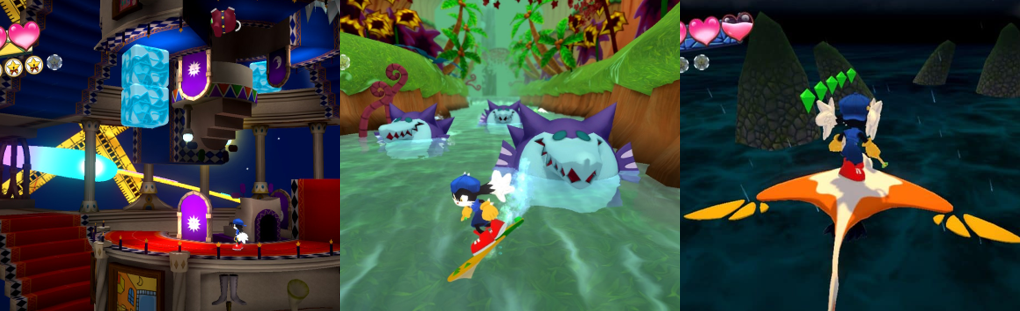
Surprisingly, given most 2D and 2.5D franchises made the jump to 3D back in the day, Klonoa 2: Lunatea’s Veil is a 2.5D action platformer that looks and plays exactly like its predecessor. I was fully expecting that Klonoa would’ve transitioned to something more akin to the Spyro videogames (Various, 1998 to 2018) as even Earthworm Jim got a clunky, third-person 3D adventure back in the day. Instead, Klonoa 2 sticks to its roots so closely that it barely changes anything from the first game, though some of this may be because this version of the game is based upon the game engine of the short-lived Wii revival. This means that players once again travel through various colourful stages (known as “Visions”), though they’re much larger and each area has anywhere from two to seemingly five levels. Klonoa 2 still allows a second player to jump in and give Klonoa a boost with Y and the controls remain unchanged from before. By default, you’ll jump with A or Y, holding the button to flutter Klonoa’s ears to help cross gaps, and pressing B or X to fire “Wind Bullets” from his magical ring. You again use these to grab nearby enemies and throw them at other baddies, to the background or foreground to activate switches or smash Nagapoko Eggs for goodies, or to activate switches. When an enemy is in your grasp, pressing the jump button twice launches them beneath you to destroy whatever’s under you and boost you higher, and I was happy to see that there are far less sections where you must desperately string double jumps together to hit switches in a certain order. Enemies usually always respawn to give you plenty of “ammo”, though no new features have been added to Klonoa’s arsenal beyond you now pressing the Left or Right Bumper to pull off a taunt or a useless twirl. You can disable the onscreen timer and tutorials from the game’s settings and (to start with) pick between “Easy” (which grants infinite lives and more health) and “Normal” (which limits your lives and reduces your maximum health) difficulties. While bottomless pits and flaming hazards still spell instant death for Klonoa, you can partially or fully restore his health with Small or Large Hearts, hit Memory Clocks to activate checkpoints, collect one of the many 1 Up Coins for extra lives, or earn even more for every 100 Dream Stone collected.

While Klonoa 2 adds some new gimmicks, the original’s core gameplay remains unchanged.

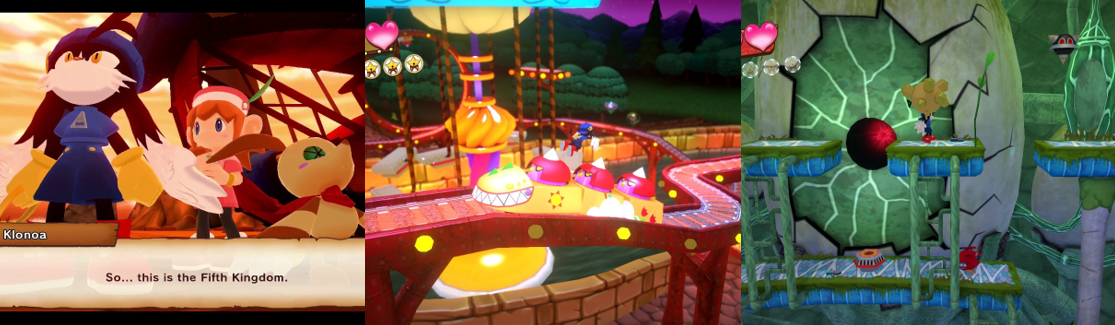
Mirror Spirits still appear to temporarily double the value of Dream Stones, Klonoa will often need keys to open doors in Visions (usually backtracking to use them and then activate something to progress further), and he can now collect six stars in each Vision rather than rescuing Phantomiles. Though they function the same (held within bubbles in Visions), these earn you “Mommett Dolls” to deliver to the Mommett House to unlock extra game modes. Though you’re more likely to hit switches to open paths, timed switches still appear, as do disappearing platforms, which get smaller and more precarious as the game progresses. Gondolas and moving platforms also appear, as do springs to rocket you high into the air, and you’ll also hit switches to spawn (or despawn) blocks. You’re more likely to be working out how to toss Boomies at just the right time so they explode to activate these switches from afar, or nabbing Likuries to absorb enemies and change their colour to then break matching coloured crystals. These can be surprisingly taxing puzzles as you must work out how to clamber to higher ground before the Likurie returns to you, requiring you to snag coloured bulbs to get higher (or carry you across endless pits). You’ll also be tossing enemies to gigantic Ow-Gows so they’re distracted from eating you, grabbing Erbils to rocket higher and smash through crates above you, tapping A while holding a Kiton to fly around for a short time, or blasting away using a Jetimo. Klonoa also gains a gnarly hoverboard that he uses to surf over water, sand, and surfaces alike. These effectively replace the water slide sections from the first game and appear quite often, either from a 2.5D or 3D perspective, and see you hopping gaps, making tight, precise movements to stay on narrow or crumbling paths, and using your double jump to reach higher ground. Twice you’ll cut through the sky on either a bird or a plane, tossing enemies to break obstacles in your way. You must often press B to ring magical bells to progress the story, and you’ll be constantly backtracking to Baguji’s Island from the larger world map to get more information and unlock new areas.

I would’ve liked to see the new mechanics expanded further to move the series forward.

While Klonoa 2’s worlds are noticeably bigger than before, the basic gameplay loop remains unchanged, and a lot of the same gimmicks return. You’ll be clearing gaps, using swinging, moving, and stationary platforms, activating lifts, and battling against conveyer belts in your quest. Klonoa 2’s “big” new gimmick are the many cannons dotted all over, which blast you across stages, up higher, or to and from the foreground. Often, you must toss enemies or Boomies to the background and then quickly rocket over to use them to blow up rocks to snag keys; othertimes, they simply lead to alternate paths and goodies. However, there are some new mechanics at work here, mainly in Mira-Mira’s “Maze of Memories” which includes twisted geometry, a maze of doors, and a feature when you rotate the screen to make the floor the ceiling. When in the endgame, you’ll revisit previous areas, now made more dangerous, and must stick close to Goddess statues to avoid choking to death on poisonous gas, toss Boomies into three engines and flee to safety before they explode, and get carried across a disturbing void. While it seems daunting dodging Spikers, flame bursts, and hopping to platforms or other handholds, you can just cling to whatever’s carrying you and take a hit without being knocked off, which makes it much easier. La-Lakoosha features a pendulum you must toss enemies at the destroy pillars to progress, the Mobile Tank Biskarsh chases you with a laser through the war-ravaged streets of Volk City, giant enemies also chase you in Mira-Mira, and players must grab Flolo to light up dark areas when traversing the nightmarish Dark Sea of Tears. Often, big springs blast you high up and you must direct Klonoa to land on other springs or platforms to progress, enemies sometimes chase you towards or away from the camera to add a little spice, spike pits threaten to end your run, and the funfair-like Joliant has you dodging rollercoasters, tossing enemies at a Nagapoko Egg shooting range, and smacking a pirate ship so it swings you to higher ground.

Presentation:
As mentioned, I was surprised to find Klonoa 2 barely deviates from the last game, recycling many of the same enemies and hazards and retaining the rigid 2.5D presentation. It does open out a little bit, though, offering more third-person sections through its hoverboard gimmick but, for the most part, everything looks, feels, and sounds as good as it did before. While much of the game’s colourful aesthetic still recalls NiGHTS into Dreams (Sonic Team, 1996), Klonoa 2 features a fantasy land being invaded by nightmares and doubts rather than taking place in a dream world. Though nothing’s changed about his abilities, Klonoa has had a bit of a visual downgrade, now wearing a hoodie rather than his cool buckle outfit and strangely having taunts mapped to the shoulder buttons. He’s still a fun character, though, and seems a touch more mature this time around, and still speaks in  gibberish and sound bites. Dialogue is thus related through speech bubbles and there are a few more happening here as Klonoa chases down the mischievous Tat, offers council to Lolo, and gets the lowdown on besmirched sky pirate Leorina from Baguji. Klonoa and his enemies still have large hit boxes that can make platforming tricky, but this time I noticed some odd distortion in the music at times, as though the hardware were struggling to keep the game running. Lunatea is a pretty varied world whose map opens up as you progress the story and has you backtracking to Baguji and even in some Visions to move things along. While Klonoa 2 only recalls the bizarre visuals of the first game at the end, each area has a lot to see in the backgrounds and many of them are mismatched and remixed for the endgame, where the King of Sorrow throws the land into chaos and makes previously simplistic areas more taxing with tougher enemies, trickier puzzles, and so many pits.

Things are as colourful and bizarre as the first game, though the tone is a touch darker at times.

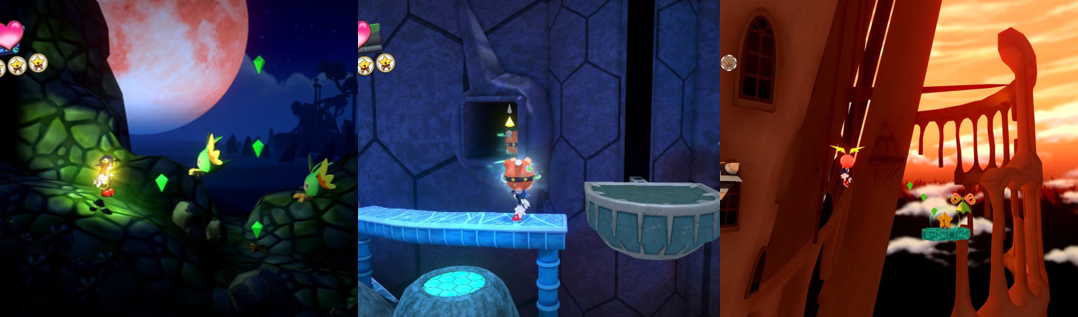
Players begin in the Sea of Tears, a stormy, rainswept port where lightning flashes and waves crash against the rocks in the background. This area leads you through an ethereal coral cave and features a large priestess statue near the end. This brings you to La-Lakoosha, a town situated near a large waterfall where wind currents carry you between platforms, and Klonoa explores a mushroom cave and travels a spiral path to the Claire Moa Temple. While Joliant impresses with its carnival lights, sounds, rides, and fireworks, it’s also home to a funky haunted house that includes a haunted library, scary trees, a graveyard, and a spook working a giant cauldron. You’ll also board through a jungle-themed water slide stage and then drop into the rancid sewers beneath Volk City, which is on fire and under heavy bombardment that sees buildings crumble and flaming debris litter the streets. After avoiding insta kill sewage and molten metal in the city’s distinctly steampunk underground factory, you must activate and explore the ancient Ishras Ark. The vessel sits near towering mountains whose windmills and gears must be activated and their frigid peaks boarding past (and into) a gigantic dragon’s skeleton and down past a snowy village. All these areas are remixed by the King of Sorrow, often having you work backwards through previous areas or go from the left to the right, encountering more Ow-Gows and puzzles involving Boomies and Likuries. These more nightmarish, topsy-turvy levels can be daunting with their desolate, patchwork backgrounds and ominous music, and things only get more troublesome with how many pits, temporary platforms, and changes have been made. Previously stationary platforms will now swing, more insta-kill fire appears, tranquil caves will be full of toxic gas, and the very sea will have dried up, revealing only sand, floating islands, and an exposed coral palace whose statues try to crush you. Things get very surreal when you battle the corrupted Leorina and the maniacal King of Sorrow, with cosmic voids and swirling vortexes replacing the previously whimsical and cartoonish backgrounds, and the game again ends on an emotional note as Lolo learns to overcome her doubts thanks to Klonoa’s support.

Enemies and Bosses:
As far as I could see, almost every enemy encountered in the first game returns in Klonoa 2, completely unchanged in every way. Klonoa must grab and toss these constantly respawning enemies to defeat others or activate switches, or to reach higher ground, with all but the large ones and those wearing helmets dying in one hit. The various coloured Moos are still your most persistent enemy, with Red Moos patrolling back and forth, bird-like Green Moves hovering overhead, and Black, Gold, and Silver Moos hiding behind shields and/or carrying spears. Moos also jump on snowboards to chase you, Zippoes still run full tilt at you, some enemies toss spiked balls from the background and floating Spikers are a constant headache before you, and Slazzas still toss boomerangs (though appear far less frequently). Glibz return, still armed with twin cannons, Spindles must still be defeated by double jumping over them, and Boomies have a much expanded role as you toss them at switches or into engines. There are some new enemies here too, such as hornets that attack with their stingers, shark-like Digons who dive from the background, and Ow-Gows, who must be fed to keep them from munching on Klonoa. Just as Leorina acts as a dark opposite of Klonoa, wielding a makeshift magical ring, so too does her companion, Tat, act as a counterpart to Popka. You’ll chase Tat through Joliant’s fun park, tagging her either on foot or while boarding along, and even fight her in two mini boss battles. The first sees her (in a spooky disguise) rolling cannonballs along the floor in Joliant’s haunted house, where you must propeller fly up to pop the balloons. In the second, giant mechanical Tat’s pop from pipes in Volk City’s underground factory, again rolling cannonballs. This time, you must grab Moos and toss them at her constructs as they spiral around, kind of like a game of Whac-A-Mole. There are also six bosses to fight, each with two phases and two health bars, though this time the game at least mixes things up and sometimes has you boarding along instead of just running on a circular or stationary platform.

Bosses now have two phases each and are much bigger and require a little more strategy.

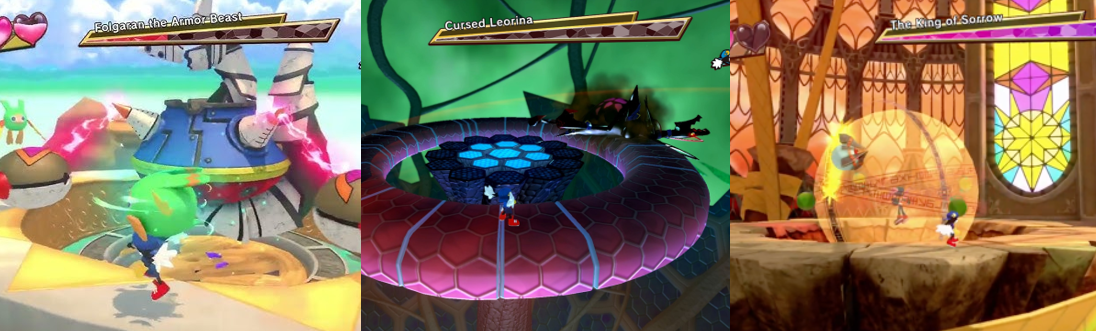
The “Armored Beast” Folgaran spins in the centre of a circular path, exposing its weak spot (its butt) as it rotates but spinning faster and extending its claw-like arms as the fight progresses. While this is extremely easy, Leptio can be trickier as you must throw Moos at him while avoiding his duplicates, hit him as he rolls around the ring, and knock over his drill-like enclosure, dodging his flailing robotic limbs. As he rolls in this mech, you must time a throw from across the stage to put him down. The Mobile Tank Biskarsh can also be difficult as you must grab a Green Moo and spring high up, dropping your projectile into the vent on the tank’s roof and avoiding its leap. It then jumps further and faster and drives at you from the background, meaning it can be difficult timing your shots. Polonte is fought as you snowboard down a mountain. You must jump over spike balls and ice formations, passing through gates to speed up and ram him. In the second phase, these are far harder to avoid and you must snag and toss snowboarding Moos (best done while jumping). When you finally face off with Leorina, she transforms into an insectile beast and stomps around a stage, only being vulnerable when you Erbils-jump into her underbelly. When she hides beneath the platform and you must blast away her orb and smash an enemy into the ground to damage her, finally finishing her off with another Erbils-jump as she charges her big attack. Finally, there’s the King of Sorrow, a much easier final fight than Nahatomb’s. First, you board through a swirling vortex, passing between spiked trails and tossing Nemo Moos at him. Though he’s a difficult target and bops you with his staff up close, he’s pretty easy to beat in this phase. In the second, he hides behind an energy shield, blasting flames and trying to hit you with the mechanical tips of his tentacles. You must snag these and toss them at the orbs on his shield a few times, easily ending his threat after a couple of rotations.

Additional Features:
This version of Klonoa 2 has ten Achievements up for grabs, with players earning one each time they defeat a boss and gaining an additional one if they get every Achievement in both games. You get another Achievement for finding all the Mommett Dolls, which also unlocks a couple of additional Visions to play. If you find all 150 Dream Stones in every Vision, you’ll also unlock a Picture Viewer at the Mommett House, where you can battle the bosses again (though you can also do this by revisiting the boss Visions). Completing the game on either difficulty unlocks “Hard” mode and the movie viewer, and this version also offers an awful pixel filter if you feel like making the game look like an early PlayStation title.

The Summary:
I was slightly hesitant about Klonoa 2: Lunatea’s Veil as I was sure that it would’ve evolved the original game’s fun, if simplistic, 2.5D gameplay into something more akin to a 3D collectathon. Instead, the game is almost indistinguishable from the first, with no additional power-ups or abilities for its funky (but adorable) title character beyond a snowboard. This isn’t a bad thing as the game’s still fun to look at and play, it’s just surprising that the developers didn’t expand upon or change the formula for the jump to the PlayStation 2. I was glad to see that the janky double and triple jump sections were largely gone and I did enjoy the hoverboard sections, though the game still didn’t do as much as it could with its main throwing gimmick. I liked the expanded role given to Boomies and how the Likurie puzzles make you rethink your actions, though the reliance on cannons took a lot of control away from me and constantly returning to Baguji got annoying. Still, I liked that the Visions were much bigger, the bosses had more phases and strategy to them, and that the game was as colourful and quirky as before. I can’t say there’s anything in Klonoa 2 to make it any better or worse than the original as the differences are extremely minor. I ultimately had just as much fun with it as I did the first game, so it’s only fair to give it the same score, but it might’ve scored higher had those nightmarish remixes been giving more prominence and if the developers had expanded Klonoa’s abilities a bit more.

My Rating:

Rating: 3 out of 5.

Pretty Good

Did you enjoy Klonoa 2: Lunatea’s Veil? What did you think to the changes made for the Phantasy Reverie Series version? Were you surprised to see the game virtually unchanged from the first entry? What did you think to the boarding sections and new puzzles? Do you agree that Klonoa’s design isn’t as strong this time around? Did you find the bosses too easy, despite their additional phases? Which Klonoa game is your favourite and do you think the franchise needs a new entry? Tell me your thoughts on Klonoa in the comments and go support me on Ko-Fi for more reviews like this.

Game Corner: Klonoa: Door to Phantomile (Xbox Series X)

Released: 7 July 2022
Originally Released: 11 December 1997
Developer: Monkey Craft
Original Developer: Namco
Also Available For: PlayStation (Original Release); Nintendo Switch, Nintendo Switch 2, PC, PlayStation 4, PlayStation 5, Xbox One, Xbox Series S (Phantasy Reverie Series)

The Background:
The massive success of Sonic the Hedgehog (Sonic Team, 1991) helped make anthropomorphic mascots hugely popular in the videogame industry, resulting in memorable characters like a gun-toting jackrabbit, an acrobatic bat, a superpowered earthworm, an intergalactic adventurer, a sword singing possum with a rocket pack, and a bear-and-bird duo. Interestingly, however, director Hideo Yoshizawa originally envisioned Klonoa as a ceramic fighting robot named Amenti before Yoshihiko Arai designed the strange, rabbit-like creature who would lead the game. Yoshizawa sought to make Klonoa an action game that was appealing to kids and adults, while lead designer Tsuyoshi Kobayashi refined the fast-paced gameplay to be limited to two buttons. First revealed at the 1997 E3 trade fair as Namco’s first bid to create a marketable 3D mascot, Klonoa was widely praised for its simple controls, colourful environments, and cutesy visuals, though some criticised its short length and lack of innovation. Although Klonoa spawned a few sequels, the original game’s price skyrocketed and the series lay dormant for nearly fifteen years before Bandai Namco teamed with Monkey Craft for an unexpected remaster of the first two games. Based upon the oft-forgotten Wii revival, this remaster of Klonoa: Door to Phantomile was largely celebrated for its colourful overhaul and for breathing new life into the franchise.

The Plot:
After his dream about an airship crashing comes true, Klonoa and his friend, Huepow, journeys to keep the dark spirit Ghadius from turning Phantomile into a world of nightmares.

Gameplay and Power-Ups:
Klonoa: Door to Phantomile is a 2.5D action platformer in which players control the cute little rabbit-thing Klonoa and explore six worlds (known as “Visions”), each with two levels apiece. While the game is geared towards solo play, a second player can jump in to have Huepow launch Klonoa into the air with Y, though you can disable this at any time. The game offers two control types and the ability to customise the controls, but they’re so simple I don’t see why you’d need to do this or need anything other than the default settings. These see Klonoa jumping with A or Y, fluttering his wings for some extra airtime if you hold the button, and shooting “Wind Bullets” from his magical ring with B or X. These latch onto nearby enemies so you can throw them, either at other enemies or to the background or foreground to activate switches, take out enemies, or smash Nagapoko Eggs for extra goodies. When holding an enemy, you can press the jump button twice for a double jump (which also destroys crates or enemies beneath you) and you must chain grabs and double jumps together in the game’s later Visions to reach higher areas. This can be extremely tricky as Klonoa and his enemies have large hit boxes, enemies constantly respawn so you never run out of “ammo”, and the timing required to execute these double and triple jumps can be aggravating. The game’s options offer numerous settings for you to play with, including disabling the onscreen timer and tutorials, and you can initially pick from two difficulty settings, with “Easy” offering infinite lives and more health while “Normal” limits your lives and reduces your maximum health. Klonoa’s quite durable unless he falls down a pit or into lava but can partially or fully restore his health with Small or Large Hearts, respectively. Memory Clocks act as checkpoints, Klonoa Coins grant extra lives, and you’ll also score extra tries for every 100 Dream Stones you collect.

Klonoa grabs enemies, flutter jumps, and hops about some colourful, drema-like worlds.

You can briefly double the value of Dream Stones if you spot a Mirror Spirit, toss enemies at Mysterious Seals to create new paths, and activate switches with your throws to open doors or new areas. Some of these are timed, while others must be hit in the correct order, which gets very irritating in Vision 6-2 thanks to the jump/grab requirements. Occasionally, Klonoa must obtain keys to open doors and these may be guarded by enemies, gifted by non-playable characters (NPCs), or hidden in crates and Nagapoko Eggs. Technically, your main goal (beyond reaching the exit) is rescuing the six Phantomiles hidden in each stage. These are held in bubbles that you must pop with your Wind Bullets or thrown enemies and they can be tricky to find as areas sport multiple paths, often leading to more Dream Stones and goodies alongside a Phantomile. You don’t need to rescue all the Phantomiles to progress, however, and can replay any Vision to find those you’ve lost. Each Vision also hides picture pieces to find, though this simply counts towards 100% completion rather than any tangible reward, and Klonoa can eventually ride Kara the fish, though only in cutscenes, so you’ll have to settle for sliding down water and sand slides and blasting across areas on water sprouts. While there are no additional power-ups, pick-ups, or upgrades to Klonoa’s repertoire, they’re not really needed as his basic abilities serve him well throughout. It might’ve been nice to have a 2.5D autoscrolling chase section where you ride Kara, however, or to perhaps extend or alter the nature of Klonoa’s Wind Bullets. Klonoa can use fans, wind currents, and springs to reach higher areas, though. These often test your flutter and double jump skills, which are further tested in brief sections where you ride moving platforms past enemies or flame bursts. Vision 3-1 also has you ride a log on a vine track as it speeds away from the camera, dodging spiked hazards and collecting Dream Stones.

What starts as a simple platformer soon becomes a surprisingly tricky gameplay experience.

For the most part, Klonoa: Door to Phantomile is a simple, whimsical adventure that asks little of you. You can backtrack to previous screens to explore alternative paths and most collectibles are out in the open. You’re faced with simple platforming challenges such as hopping over gaps, riding platforms over pits or electrified floors, dodging projectiles, and leaping to tilting, moving, or temporary platforms (which reappear very quickly). Klonoa’s main gimmick is throwing enemies, but this rarely tests your puzzle solving skills as it’s hard to miss the big targets in the background or right in front of you. The difficulty does slowly ramp up, however, with areas becoming larger, sporting more alternative paths, and even being looping mazes. You must activate gondolas to progress in Vision 3-1, watch your step in Vision 4-2’s slippery ice cavern, avoid burning alive in Vision 5-1’s steampunk factory, and tackle a door maze in Vision 6-1’s ethereal castle. Here, you must track down and smash coloured crystals to clear doorways, though it can be tricky remembering which way to go. Similarly, Vision 5-1 has you exploring multiple paths to track down coloured orbs, avoiding flames and molten steel, and dealing with the “Eclipse” effect in Vision 5-2. This sees day turn to night and enemies become incapable of being grabbed, though extra platforms do appear to help you progress. Sadly, this mechanic only appears in this stage; it would’ve been cool to implement it throughout or have it featured in the unlockable “Hard” mode. You’ll briefly ride mine carts in Vision 1-2, simply jumping to grab Dream Stones as it falls apart, clamber up a cliff face in Vision 2-1, and activate gears and moving platforms in the mechanical tree factory explored in Vision 3-2. Platforming also gets progressively difficult by the end, with pits in abundance and small, often disappearing platforms being commonplace, sometimes with enemies chase you across them.

Presentation:
I’d long been curious about Klonoa: Door to Phantomile. I’ve always been a fan of 3D and 2.5D platformers and this looked like a cute, whimsical adventure sadly locked behind an expensive price tag. Thankfully, the game didn’t disappoint in terms of its visuals and Klonoa is a joy to behold. The game incorporates a cutsey, anime-like aesthetic to its polygonal characters, who pop with a cel-shaded, cartoony flavour as a result. Klonoa is like an anime character come to life, sporting oversized shoes, a Pac-Man logo on his beret, fun flappy ears, and big, expressive eyes that give him a lot of character. While he (and all the characters) speak in gibberish sound bite, his dialogue is fully readable in speech bubbles and he lets out some fun little sounds as you play, even twirling his magical ring when left idle. While Klonoa and his enemies have big hit boxes, it’s not usually a problem if you get the timing of your jumps down and he battles some bizarre enemies and encounters some surreal NPCs along the way. Each Vision houses different natives, such as tree spirits and talking fish, who will help or must be freed from their corruption. The story (and overall aesthetic design) reminded me a lot of NiGHTS into Dreams (Sonic Team, 1996), with Klonoa exploring a dream-like fantasy land at risk from the distinctly Khonsu-like Ghadius, though Klonoa plays a hell of a lot better than that game and is far easier on the eyes. The game also sports a jaunty soundtrack, with fun little tunes accompanying each area, and features quite an intricate story. I was stunned when Klonoa’s beloved grandpa was killed protecting the necklace from Ghadius’s jester-like henchman, Joka, and the ending (which sees Klonoa tearfully depart the dream world after learning his memories of Huepow were fabricated) was much more shocking than I expected from what seemed to be a simple, colourful platformer.

A colourful, whimsical adventure with a lot of heart and visual appeal.

Each of Klonoa’s Visions is presented via a storybook-like world map, allowing you to freely select them between sessions or when reloading your save file. Klonoa’s seaside town of Breezegale sees you literally venturing from his house past giant windmills and cute, medieval-style houses, crossing bridges and heading up a spiral path before exploring Breezegale’s mine, where precious jewels glitter in the backgrounds and mine carts are scattered about. Vision 2-1 sees you traversing a dying forest full of abandoned tree houses, hollowed out tree trunks, and giant mushrooms. The second part places you in the fantastical Jugpot palace, made from a giant seashell, and features backwards-flowing waterfalls, marble platforms, and dank caves. Vision 3-1’s forest is thriving, with twisted vines all over and thick logs acting as your main path into a clockwork-like mechanical tree that you must activate to get its gears moving. Vision 4-1 sees you exploring the ruined Wind Kingdom, hopping to dropping stone platforms, passing a spooky graveyard, and slipping about in the ice cavern, where you smash rocks to progress. The visuals really pick up in the distinctly steampunk Temple of the Sun, where you traverse giant pipes and ride a platform across a track, collecting coloured orbs to venture within. The interior is made hazardous by the Eclipse gimmick, constant flame bursts, and you having to hit multiple switches to progress. Cress is mostly comprised of its beautiful, crystalline castle that’s full of mosaics, electrified floors, tricky platforming, and statues that need melting. It opens out into a gigantic, ornate cathedral with multiple doors, the void of the night sky in the background, and gives way to a swirling, nightmare void where players must battle the surprise final boss, Nahatomb. There’s a fair amount happening in each area, with each Vision showcasing different aspects of their environments. It’s quite fun taking a track or path one way and seeing the alternative paths stretch behind you, enticing you to try a different path and see what rewards and obstacles it yields.

Enemies and Bosses:
Klonoa must pick up and toss various strange enemies in his adventure, nearly all off which constantly respawn so you always have something to toss off (wait…). The most common enemy you’ll encounter are the spherical Moos and their variants: Red Moos simply walk back and forth and are easy cannon fodder, Green Moves flap their wings to fly and resemble birds, and Black, Gold, and Silver Moos hide behind shields. These can also have lances and charge you, or ride pogo sticks, forcing you to get behind them to snag and throw them. You’ll also encounter Monkey Moos, who swing from vines to knock you down pits, and helmeted Moos who must have their head gear knocked off before they can be nabbed. Knight-like Algores swing chain-whips with maces for a long-range attack, Pink Boins bounce up and down erratically, and cat (or maybe rabbit?)-like Mew-Mews do the same but release spiked balls as they land, and explosive, mouse-like Boomies must be tossed to destroy objects (while avoiding their blast radius). The will-o’-the-wisp-like Burnies are protected by a ring of flames that you must hop between to grab them and spider-like Dabbys spit spiked projectiles from their butts. Fish-like Fifis leap from water or up waterfalls to interrupt your platforming, but the indestructible Spikers are the worst for this, with you having to gingerly dash under or jump over them. Glibz hide behind their shells, giving you a small window to grab them before they unload with their twin cannons; spooky Plowms relentlessly chase you and appear out of thin air; and Slazzas toss boomerang-like projectiles. Smorks fly from the background of Vision 5-2 and can be difficult to grab thanks to the perspective, Zippoes charge at you, and Tetons will fly you higher if you grab onto them. Gigantic variants of many of these enemies also crop up, with them being stunned and inflated with your Wind Bullets to give your jumps a boost and only being destroyed when you toss enemies at them.

Big, bizarre bosses test your throwing skills and, by the end, your patience.

Each Vision ends with a boss battle fought on a circular path. Rongo Lango is the easiest, challenge as it jumps about producing shockwaves and slashing with its tail. Simply run under it, snag a Moo, and attack from behind to move on. I found the corrupted King Seadoph and his fish cohort, Pamela, trickier as the path is littered with spike balls and Pamela leaps from the water, occasionally raining bubbles that can be tricky to avoid. You must snag King Seadoph as he rides a ball and toss him at Pamela when she attacks, which can be tough with so much to deal with. Gelg Bolm was easier, but a touch tedious as you use springs to get above it and launch an enemy into its exposed core with the double jump, avoiding its giant seeds and slam attack. Baladium puts you on a swinging platform, which makes it difficult to snag enemies to throw at the coloured sections of its body. You must also avoid the explosive spheres, pillars, missiles, and Zagards Baladium spawns. When you finally confront Joka, he deflects your Moo projectiles with his twirling fists and becomes a thrashing, squid-like beast when the Eclipse hits until you turn floor blocks yellow, which can drag out the fight. Fighting Ghadius is all about speed and timing as you must avoid the teleporters (which reset the arena and see you dodging shockwaves) to toss Death Moos at him. These rain down, ricochet about, and are hidden inside a triangular energy field you must dodge and dispel by attacking a corner. By far the toughest and most tedious fight is the surprise final boss, Nahatomb. Nahatomb creates three rainbow shockwaves and ejects armoured Moos, which must be tossed to Phantomile’s leaders, who then blast Nahatomb with cannons. This isn’t too bad in the first phase (if you avoid his long, sticky tongue), but is compounded in the third by the leaders rotating beneath you and Nahatomb temporarily destroying your crystalline platforms. The second stage sees Nahatomb’s disembodied form firing eye lasers as you’re on a slanting platform, which you must avoid to toss Moos at flaming crystals in the background.

Additional Features:
There are fourteen Achievements to earn in this remastered version of Klonoa, with one gifted each time you defeat a boss and six more for finding and rescuing every Phantomile hidden in each Vision. This also unlocks the “Extra Vision” stage, which sees you scaling Balue’s tower and taking on the game’s most difficult platforming challenges, though there’s no new boss to face. You’ll also get an extra Achievement if you get every Achievement in this game and its sequel, and finishing Klonoa on either difficulty unlocks “Hard” mode, a time attack mode, and the movie viewer. This version of the game also gives you the option to turn on a pixel filter so it resembles the PlayStation original, but I wouldn’t recommend it as it’s very hard on the eyes compared to the slick, colourful glow up. While there are no Achievements or extras for finishing the game on the harder difficulties, you can unlock extra costumes, a character viewer, the option to play the game backwards, and a music test if you clear the Extra Vision.

The Summary:
I was really excited when Klonoa: Door to Phantomile was finally remastered for modern consoles. Both it and its sequel had been on my wish list for a while, but I couldn’t justify the cost, so it was a no-brainer for an avid platformer fan like me to pick the Phantasy Reverie Series up and finally give them a whirl. This version of Klonoa is absolutely stunning, with colourful visuals, eye-popping environments, and a main character so cute you’ll be close to tears. Klonoa is such a unique character, exuding an anime-excess while being adorable, and his world (while visually and thematically similar to NiGHTS into Dreams) is incredibly imaginative. The game felt very “Japanese”, if that makes any sense, with some bizarre enemies and concepts that had been tweaked just enough to appeal to Western gamers. The gameplay is simple but enjoyable, with the basic jumping, grabbing, and platforming being very satisfying. Things get much trickier as platforms become smaller, pits become deeper and wider, and your double jump prowess is tested, which can be frustrating. However, it’s fun searching across these deceptively large areas looking for collectibles and locals to rescue, though it’s a shame there weren’t any bonus stages or extra content to mix up the gameplay. The game is also disappointingly short, easily beaten in a few hours, but I didn’t mind that as it was a lot of fun to look at and a nice, cosy experience despite some aggravating sections and confusing boss battles. Ultimately, there’s a lot to like here, with a few unlockables to aim for and extra paths to explore. Fans of Klonoa should enjoy the stunning visual makeover and fans of 2.5D platformers should appreciate the visuals, tight controls, and memorable characters.

My Rating:

Rating: 4 out of 5.

Great Stuff

Are you a fan of Klonoa: Door to Phantomile? If you’ve played the original version, what did you think to the Phantasy Reverie Series glow up and enhancements? Did you also struggle with the double and triple jump sections? Which of the game’s large, bizarre bosses was your favourite? Did you ever rescue all the lost locals? Which Klonoa game is your favourite and would you like to see the franchise make a comeback Whatever your thoughts on Klonoa, please leave them below and drop a donation on Ko-Fi to see more reviews like this.

Back Issues: Shinobi

Writer: Alan McKenzie – Artist: Jon Haward

Story Title: “The Dark Circle”
Published: April / May 1993

Story Title: “The Fear Pavilion” (Part 1 to 6)
Published: 29 May 1993 to 7 August 1993

Story Title: “The Art of War” (Part 1 to 6)
Published: 5 February 1994 to 16 April 1994

Story Title: “Way of the Warrior”
Published: 23 April 1994

Story Title: “Power of the Elements” (Part 1 to 7)
Published: 4 March 1995 to 27 May 1995

The Background:
For a while there, back in the eighties and nineties, ninjas were a big deal in movies, comic books, cartoons, and videogames. Mysterious and deadly assassins often dogged comicdom’s most popular superheroes and these agile, well-armed martial artists also inspired some of the most difficult videogames of the era. In 1987, SEGA entered this arena with Shinobi, a challenging critical and commercial success that was later refined for its home console release. Director Noriyoshi Ohba pulled out all the stops for the sequel, The Revenge of Shinobi (SEGA, 1989), to showcase the capabilities of SEGA’s all-powerful Mega Drive. A notorious release praised for its visuals and gameplay variety and heralded as a Mega Drive classic, The Revenge of Shinobi spearheaded a brief period of relevancy for SEGA’s long-forgotten sub-series, with additional sequels and spin-offs released for their 8- and 16-bit consoles. These videogames also served as the basis for a series of comic strip adaptations exclusive to the United Kingdom. The first Shinobi strip appeared in the 1993 Sonic the Hedgehog Yearbook, the precursor to Sonic the Comic (StC), a fortnightly publication first debuting that same year and which I diligently collected as a kid until its unfortunate end in 2002. Joe Musashi featured in three multi-part adventures in the main comic over the course of three years, as well as a one-off appearance in the short-lived Sonic the Poster Mag, and his first six-part adventure was even collected in a trade paperback courtesy of Ravette Books. I have to admit, though, that I often skipped the Shinobi stories when I read StC as a kid so this will be my first time sitting down and giving them some attention for many years.

The Review:
When we first meet Joe Musashi, the titular Shinobi, in the 1993 Sonic the Hedgehog Yearbook, he’s in Tokyo, Japan and hot on the trail of his lover, Naoko, who’s been abducted by Neo Zeed, the same malevolent ninja clan that murdered Musashi’s teacher (or “sensei”) in what is essentially the same setup as in The Revenge of Shinobi. Musashi easily identifies a Neo Zeed hideout and blasts his way in with a touch of plastic explosive, only to be met by rats and dust. Taking a moment to explore using the mystic art of haregai (billed as a “sixth sense” employed by highly trained ninja), Musashi moves to an elaborate foyer, the omniscient narrator downplaying rumours that Neo Zeed have begun dabbling in dark magic, only to be surprised by a gas bomb. A black-clad ninja assaults Musashi through the smoke, blinding his haregai and striking from behind. Even when the smoke clears and the assailant (somewhat analogous to the Shadow Dancer boss encountered in The Revenge of Shinobi) reveals himself, Musashi’s senses are dulled and Shinobi struggles to stay conscious from the vicious assault. Rallying his celebrated ninjitsu skill, Musashi wields his Oborozuki blade and matches the ninja blow for blown, eventually emerging the superior and opting to spare his opponent’s life since Musashi has pledged to take a higher path. Despite his investigation leading to a dead end, Musashi disappears into the night still determined to find his kidnapped lover. This is where we find him in his first multi-part story in StC, sneaking into a towering pagoda controlled by Neo Zeed that’s somewhat similar to the beginning of The Revenge of Shinobi. After easily subduing the clan’s attack dogs, Musashi clambers up the pagoda wall using a grappling hook and clawed appendages on his gauntlets, sneaking behind two unsuspecting guards and non-lethally taking them out. Musashi sneaks through the building, passing the clan’s deadly training areas, and catching another group of ninjas as they drink saké. Demanding to be taken to Naoko, Shinobi is inevitably drawn into battle with the group, easily deflecting their shuriken and whacking them with the hilt of his sword.

Musashi infiltrates Neo Zeed’s pavilion, only to walk into a trap and run a dangerous gauntlet.

Despite their superior numbers and deadly weapons, Musashi triumphs but is frustrated when the final foe reveals Naoko isn’t in the pavilion and that he has been lured into a trap. Despite being warned of formidable martial artists awaiting him in the pavilion, Musashi descends downwards undeterred and meets an elderly warrior who presents himself as an ally and impresses Shinobi with his deft skill. Reagrdless of the threat, and the elder’s surprising speed, Musashi eventually ties the holy man up in his own robes, leaving him cursing on the floor. Next, Musashi comes across an elaborate stage and a Neo Zeed assassin painted like the Monkey King, a kabuki character renowned in Chinese opera for his kung-fu prowess. Attacking with a viciousness befitting of his clan and throwing Musashi off with his “monkey-style kung-fu”, the Monkey King proves a formidable threat…until Musashi rams the hilt of his sword into the foe’s gut, leaving him a winded and blubbering mess. On the next level of the titular fear pavilion, Musashi meets a muscular warrior who stomps about with stilts strapped to his legs. As if the additional power and reach offered by these appendages wasn’t enough, the fighter also mocks Musashi’s size and skill, breaking a few of Shinobi’s ribs, though Musashi cuts the warrior down to size and limps on. In the next room, Musashi is stunned to find Naoko waiting for him in an unguarded room, cautious despite his haregai not detecting any threat. His wariness turns out to be true as “Naoko” reveals herself to be “Water”, one of the legendary “Four Elements” who control Neo Zeed. Unprepared to face one of Neo Zeed’s daunting commanders and realising that he’s not only outmatched but that Naoko isn’t in the pavilion, Shinobi tosses a smoke bomb and flees from the hazardous pagoda, vowing to confront his enemy on equal ground later.

While his Sun Tzu needs some work, Musashi finally rescues his lover from Neo Zeed.

Sometime later, having recovered from his injuries, a disguised Musashi observes Neo Zeed’s corporate headquarters in downtown Tokyo. Seeing that the skyscraper is nigh-impenetrable and well-guarded, Musashi realises he needs to find another way inside and recalls not only the teachings of Sun Tzu but his training on Mount Hotaka five years previously. Back then, while Musashi’s skills impressed his sensei, he was chastised for his naivety regarding dishonourable methods, such as striking armed enemies from behind, since his foes will not adhere to the rules of Bushido. Musashi learned this the hard way as Neo Zeed poisoned the old man like cowards and kidnapped an innocent girl, so Musashi busts out a hang glider to cross to the skyscraper’s rooftop, reasoning that Neo Zeed wouldn’t anticipate such an attack. Again taking inspiration from Sun Tzu, Shinobi climbs down the building on a rope, slips inside via a conveniently open window, and accesses a computer terminal to better “know [his] enemy”. Musashi proves a master hacker, easily guessing Neo Zeed’s password and searching for Naoko. All too late, Musashi remembers how he honed his haregi through blindfold combat and equally learned that even this superhuman sense can be tricked, causing him to realise his actions have put the building on high alert. Although Shinobi easily subdues a heavily-armed guard, Neo Zeed’s ninjas pursue him down an elevator shaft and, facing a deadly plummet, seemingly breaks his no-killing rule before barely escaping through a ventilation shaft. Remembering his sensei’s teachings, which emphasised that winning is all that matters in a life-or-death confrontation, Musashi knocks out an amusingly inept ninja and assumes his identity only to walk into another trap! Musashi avoids flames, spikes, shuriken, and scythe-like blades but falls victim to a blast of knockout gas and is brought before the Void, Neo Zeed’s “supreme ninja”, who apparently has authority over even the Four Elements since he orders the hulking “Earth” around like a mere underling.

After humiliating the Void, Musashi makes chumps of the Yakuza and angers the Four Elements.

After finally reuniting with Naoko, Musashi springs up, fooling the Void’s minions with prana (death-like trance), and once again escapes rather than fight overwhelming odds. While Water is eager to pursue, the Void forces her to focus on the bigger picture; thus, Musashi and Naoko glide to safety and finally lovingly embrace. After returning Naoko home, Musashi pursues the Void to the Hakima industrial estate and, though he easily dispatches the supreme ninja’s underlings, Shinobi is overwhelmed by the grand master’s mystical power. Utilising the ancient “iron hand technique”, the Void not only physically overpowers Musashi, he also shatters his Oborozuki and leaves Shinobi desperate to come up with a counterattack that won’t violate his code against killing. Thus, Musashi utilises his prana again, focusing it through his body and into his hands to match the Void’s iron fist technique. While the supreme ninja mocks Shinobi’s efforts, their clash leaves the Void’s hand shattered and the Neo Zeed commander humbled. Spared by his foe, the Void has no choice but to slink away with Musashi’s warnings ringing in his ears. About a year later, the Four Elements, now directionless ronin, end up working for the Yakuza (the Japanese mafia) in downtown Tokyo, peddling drugs and gambling, and leading Musashi to track them to Yakuza boss Mitsugi’s casino. Frustrated at Mitsugi’s refusal to employ their unique talents and his ignorance about Musashi, the Four Elements gatecrash the boss’s poker night and demand satisfaction, which the heavily tattooed crime lord agrees to out of curiosity about Musashi. Thus, despite his clever disguise and dodging a barrage of shuriken, Musashi is easily subdued by “Air” and brought before Mitsugi. However, Musashi once again fools his foes with his prana, wounding Mitsugi with a kunai and the death of one of his minions (again, so much for that “no-kill” rule!) Seemingly wishing to see the Yakuza humbled, Water orders her cohorts not to interfere as Shinobi easily escapes their grasp with his patented somersault. Naturally, Mitsugi is displeased by Air’s deception since she knew that Shinobi wasn’t to be trifled with, but she emphasises that it was the only way to demonstrate Musashi’s threat and get approval to hunt Shinobi down.

After a hard fought battle, Musashi defeats the Four Elements but continues his vendetta against Neo Zeed.

Fleeing across the city’s rooftops, the disguised Musashi is jumped by the “Roofworlders”, vagrants who dwell above to avoid the “jackals” on the streets. Their leader, Kotomi-Sensei, recognises Musashi’s garb and, regretful of the attack, invites Shinobi to stay with them. While touring their makeshift shanty town, Musashi learns that Kotomi-Sensei rescued his fellow homeless and taught them to defend themselves. Though Shinobi doesn’t want to endanger the Roofworlders’ sanctuary by bringing the Yakuza to their doorstep, Kotomi-Sensei insists that, together, they can repel the attackers. While the Yakuza scoff at Air’s superstitions, her intuitions turn out to be correct as Shinobi and his new allies blindside her and her goons. Despite having some backup, Musashi is still sent reeling by the mystical power of Earth, which shakes the ground, though he quickly counters by knocking Air unconscious and sending Earth tumbling to the ground below after blinding him with a magnesium pellet. Simultaneously, “Fire” and Water rush Kotomi-Sensei, believing the old man is no threat, only for Wind to fly into a rage when this underestimation sees Fire reeling in agony from a nerve strike. Disturbed, the Four Elements order a tactical retreat, and Shinobi is kept from pursuing when Kotomi-Sensei is wounded by gunfire. Luckily, not only is this merely a flesh wound but the old man knows a mystical technique to heal his injuries. After regrouping, Musashi and the Roofworlders prepare for the inevitable counterattack, striking from the shadows to subdue the Four Elements’ Yakuza cronies. Though Fire tries to roast Kotomi-Sensei, the old man shields himself with a mystical barrier and the other Roofworlders battle the other warriors while Air once again fights with Musashi. Thanks to her agility and flight, Air soon has Musashi hanging on for dear life but, when he makes a desperate leap, she’s sent crashing into a wall. Though Kotomi-Sensei generates a sword of pure chi to battle Fire, he’s hit with the “poison hand technique” and left facing a swift death, which rallies his comrades to overpower Earth and dispel Fire and Water. Luckily, Musashi applies some chi of his own to save Kotomi-Sensei, though he politely refuses to stay with the Roofworlders since his war against Neo Zeed is far from over.

The Summary:
Yeah… there’s a reason I often skipped the Shinobi stories when reading Sonic the Comic. It was honestly rare for any of the backup stories based on SEGA’s other properties to be any good and some, like the Decap Attack (Vik Tokai, 1991) strips, far outstayed their welcome, and I have to say that Shinobi falls into this category as well. On the plus side, the art and writing is very consistent, with the same duo working on all of Joe Musashi’s appearances, and the stories have a far more mature edge compared to StC’s norm. While Musashi naturally has a code against killing and thus isn’t slicing his opponents up with his sword, there’s a touch of blood across these stories, many references to death, a fair bit of violence (Musashi gets his ass kicked a lot and even suffers broken ribs), and there is that one panel where a Yakuza gets gunned down! The writing does fall apart under close scrutiny, however, with Musashi being an avid reader of Sun Tzu and yet constantly being tricked and falling into obvious traps. He often finds innovative ways to counterattack physically superior foes and isn’t averse to fighting dishonourably, but it’s odd seeing his vow against killing be repeated so often and to then watch him send a ninja plummeting down an elevator shaft without even a moment’s reflection. I did like the flashbacks to his training, where Musashi was a capable and formidable warrior in all aspects of combat and yet still somewhat naïve, reluctant to break the Bushido code and needing to learn that the rules must be bent in real-world conflicts. He still sees himself as walking a higher path compared to his enemies, sparing their lives whenever he can and always attacking with the hilt of his sword or opting to knock out his enemies. However, even Shinobi still has much to learn as Kotomi-Sensei exhibits mystical abilities that dwarf even his unreliable haregai and his overused prana.

Musashi is a talented and formidable ninja, but also flawed at times and with much to learn.

Indeed, even Musashi scoffs at mysticism throughout these stories, which is a bit odd considering he utilises magic in the Shinobi games and later draws strength from the prana to match the Void’s iron hand technique and utilises chi to counteract the poison fist technique. Portrayed as a cunning and talented swordsman, Musashi is also a master of disguise, dressing up as an old man to case out Neo Zeed’s headquarters and Mitsugi’s casino and even stealing a ninja’s uniform at one point. Sure, he’s regularly discovered, or his deception is anticipated, but I appreciated the effort, at least. Musashi also has a fair few tricks up his sleeve; he doesn’t have his surfboard or canine companion, but he does use a hang glider, smoke bombs, and flash grenades. Although the stories focus more on their own narrative, one heavily inspired by The Revenge of Shinobi, a few elements from the videogame appear. Musashi deflects shuriken like in the opening, slashes his sword as he does during combat, and performs his rolling somersault, though very few of the enemies he faces or the locations he visits are from the games. This is a bit of a shame as it would’ve been nice to see the bosses used in place of the Four Elements and the masked Ninja Master instead the Void. Musashi’s primary goal is rescuing Naoko and bringing down Neo Zeed, just like in the videogame, though he encounters no knock-off characters, supercomputers, or robots here. He’s pretty much exclusively fighting ninjas, as in the original Shinobi, and is generally depicted as being superior to every foe thanks to his Bushido skills. Musashi fights with grace and intelligence, rarely blundering in head-first and never letting his emotions overwhelm him. Occasionally, his resolve does falter, such as when Water masquerades as Naoko or Kotomi-Sensei is endangered, but even then Shinobi gathers his strength and senses to fight back or retreats to regroup and return all the stronger.

There’s no or force Mushashi can’t overcome if he just tries a little harder or gets creative.

While Neo Zeed’s ninjas are no match for Shinobi, Musashi faces an uphill battle since he takes on the ninja clan alone. In “The Dark Circle”, Musashi’s haregai is rendered mute against his assailant’s speed and smoke and, unlike Shinobi, Neo Zeed are happy to kill, with the Monkey Kong proving an especially aggressive and dangerous foe due to his wild fighting stile. The stilt fighter also causes Musashi trouble, as does the old man waiting in “The Fear Pavilion”, though Musashi’s quest always drives him to overcome pain, superior numbers, and even more powerful opponents. While Neo Zeed rigorously trains its members and their locations are filled with traps and martial arts masters, Musashi’s rarely on the backfoot and, even when he is, it’s always revealed to be a ruse by his prana. While the Void is portrayed as a significant threat and certainly has an imposing presence, bossing about the Four Elements and displaying mystical power, he’s left broken and humbled by Musashi simply fighting better. The Four Elements are equally spoken of in hushed tones and Musashi even flees when ambushed by Water, but they’re painfully one note and their threat diminishes over time. Air and Water are given more dialogue and chances to match skills with Shinobi, who tires of their antics, meaning the surprisingly lethal Fire and the hulking Earth toil in the background. Mitsugi is by far the worst villain, happily lording over his criminal empire in ignorance and eager to learn more about Musashi despite literally having the Shinobi tattooed on his chest! It’s telling that Mitsugi vanishes halfway through “The Power of the Elements”; maybe he was to return in a future Shinobi story, as hinted at in the final text box, or maybe he was just a weak ass crime lord who took space away from the visually more engaging Four Elements. While Shinobi had a decent run in StC and there are some enjoyable elements to these strips, I can’t say I missed his presence after the stories ended, despite the loose ends left hanging at the end. There are far better backup stories based on SEGA properties in StC, but at least SEGA bothered to license the character and try and keep him relevant, which is more than can be said of how he’s been treated since the nineties!

My Rating:

Rating: 3 out of 5.

Pretty Good

Did you enjoy Shinobi’s appearances in Sonic the Comic? Which of his stories was your favourite and why? What did you think to the way they adapted elements of The Revenge of Shinobi and would you have liked to see something closer to the videogames? Were you surprised by how mature and violent the strips were? What did you think to the characterisation of Shinobi and his enemies? Would you have liked to see more Shinobi stories in StC? What were some of your favourite non-Sonic stories in Sonic the Comic? Let me know what you think in the comments, support me on Ko-Fi, and go check out my other Shinobi reviews.

Game Corner: Shinobi III: Return of the Ninja Master (Nintendo Switch)

Released: 14 March 2018
Originally Released: 23 July 1993
Developer: SEGA
Also Available For: Mega Drive, Nintendo 3DS, Nintendo Wii, PC, PlayStation 2, PlayStation 3, PlayStation 4, PlayStation 5, PlayStation Portable (PSP), Xbox 360, Xbox One, Xbox Series S/X

The Background:
Ninjas were a big deal back in the day, whether they were mutated turtles, rainbow-coloured fighters, or mysterious assassins. Ninjas and videogames went hand in hand, resulting in titles so challenging that they defined a generation of players. Eager to have a piece of that pie, SEGA saw notable success with Shinobi (SEGA, 1987), a difficult but enjoyable arcade title later refined for home consoles. Director Noriyoshi Ohba aimed to make the sequel a technical showcase for the then-new Mega Drive hardware, one purpose-built for home consoles and which became notorious for including unlicensed appearances by pop culture icons. A widely praised release, The Revenge of Shinobi (SEGA, 1989) is now regarded as a classic of its generation and inspired not just a semi-recurring comic strip in the United Kingdom, but also a third game. Originally scheduled for release in 1992, Shinobi III: Return of the Ninja Master was vastly overhauled when the developers were dissatisfied with the original version, leading to a lot of content being cut and replaced with new mechanics. Though largely seen as being much easier than its predecessor, Shinobi III impressed with its refined gameplay mechanics and visual presentation, with many seeing it as the best of the classic Shinobi titles. This positive reception (and the lack of copyright issues compared to its predecessor) no doubt contributed to Shinobi III having a lucrative lifespan beyond the Mega Drive as the game was included in numerous SEGA collections, converted to 3D, and added to the Nintendo Switch’s online service in 2018, which eased the pain of how expensive an original copy can be.

The Plot:
When Neo Zeed returns under the command of the mysterious Shadow Master, the legendary Shinobi, Joe Musashi, fights to end their sinister bio- and cybernetic research.

Gameplay and Power-Ups:
Shinobi III: Return of the Ninja Master is the last of the Shinobi titles released for the Mega Drive and, like its predecessor, is an action/platformer with a strong emphasis on projectile-based combat. Like in the last game, players take Joe Musashi through multiple levels (or “Rounds”), each with at least three stages, though this time there are only seven Rounds. As before, there are four difficulty settings to choose from, with the harder settings dramatically reducing your total life count, and players can continue their game a handful of times if they exhaust all their lives. Unlike in The Revenge of Shinobi, however, Shinobi III’s control scheme is locked to a preset that maps your jump to A, tosses shuriken with B, and activates your “ninjitsu” magic with Y. You can still set how many shuriken you start with, however, and you can still pull off a somersault by pressing A at the height of your jump. Press B when somersaulting to unleash a shuriken spread to take out multiple enemies or press down on the directional pad to pull off a flying kick. As before, Musashi can assume a “defensive pose” to deflect incoming projectiles, but this is now done manually by holding B and you can even do it while crouching and crouch-walking. Shinobi can also dash by quickly tapping left and right, dramatically speeding up the action, wall jump by…jumping off walls…and cross gaps and hazards or navigate stages while clinging to ceilings, pipes, and such by holding B. Various goodies are found by smashing crates, ranging from health-restoring hearts, rare extra lives and ninjitsu replenishments, to additional shuriken and the ever-annoying time bomb. Musashi is far faster and more versatile this time around, moving at a swifter pace and boasting a few additional tricks to make combat and gameplay smoother. It’s still tricky pulling off his somersault and the wall jump can be finicky, but I found Shinobi III far more forgiving than its predecessor and focusing more on action than platforming.

Musashi is faster and more deadly than ever, to say nothing of a master rider and surfer!

Players can once again collect “Power-Ups” to boost Shinobi’s attacks, adding his deadly sword to his melee attack and block and transforming his shuriken into flaming projectiles. Players also gain points for every enemy defeated and item collected, and the end of Round score tally also adds points depending on if you used your ninjutsu magic or your remaining health. By pausing the game, players select which ninjitsu technique to use with Y, with each functioning exactly like The Revenge of Shinobi: Jutsu of Ikazuchi temporarily protects Shinobi with an electrical shield, Jutsu of Kariu summons flaming pillars to damage all enemies, Jutsu of Fushin enhances your jumping speed and height, and Jutsu of Mijin has Shinobi self-destruct (costing him a life) to destroy enemies. Only one of these can be used per life but you gain additional uses by finding items, though I found less use for them this time around as Shinobi is largely grounded and the game encourages you to wall jump and spider-walk to clear gaps. Musashi gains two additional abilities, the first being a horse and the second some bitchin’ surfin’ skills! Round 2 sees you racing across a marsh-like field on horseback, jumping obstacles and taking out enemies with your shuriken or ninjutsu. Round 4 has you surging across the water, jumping off ramps to collect items and avoid mines while defeating waves of enemies, with both instances functioning like autoscrolling shooter. Round 6 also sees you in freefall down a canyon, forcing you to hop to falling boulders to keep from dropping to your doom, while many stages force you to clamber to higher levels by finding surfaces to cling to (which isn’t always obvious).

Though more forgiving, some new gimmicks and refined mechanics add to the challenge.

Shinobi III is much more challenging, overall, than its predecessor, throwing far more enemies and hazards at you but with the caveat that most stages keep you quite grounded and I found extra lives a touch more plentiful. Bottomless pits are commonplace, of course, and many times platforms will either be temporary or will require time bombs to destroy so you can progress, but insta-kill hazards are limited to crushing spikes rather than lava pits. Sometimes, you must time your wall jumps and spider-walk to avoid electrified walls and ceilings; others, you cling to or run across conveyers to progress. There are instances where you ride platforms either across a zig-zag-like track or directly upwards, with Round 2 featuring a vertical autoscroller that’ll see you crushed or left behind if you don’t pay attention. Round 3 dumps you in a disgusting, bio-organic nest where the sticky ground slows your movement and Round 4 sees you hopping to sinking barrels around an oil rig, leaping to firmer ground before you drown. Round 5 mimics a similar stage from The Revenge of Shinobi in that you can somersault over chain-link fences but, this time, you must also avoid hidden mines that eventually explode under your feet! Toxic goop, electrical sparks, and support beams hanging under Neo Zeed’s fancy blimp all make traversal an issue in their own way. Round 7 takes you inside the blimp, where drones attack as you ride a precarious moving platform, while the final area of this stage features platforming and skill-based challenges so troublesome that no enemies are required! As if tricky jumps weren’t bad enough, Round 6 puts you in a mist-filled pagoda where spikes jut from the ground and another damn door maze awaits! This was much simpler to figure out compared to the one in The Revenge of Shinobi (I simply guessed the route by taking the high ground), though made more challenging since enemies respawn each time you looped around!

Presentation:
Although Shinobi III is visually very similar to its predecessor, there have been a few improvements between the games. Musashi still doesn’t have an idle pose, but his sprite is much bigger, more detailed, and versatile thanks to his expanded move set. He now grabs the hilt of his sword when powered-up, cuts a mean pose when surfing, and blood splatters whenever he or his enemies take damage! While many sound effects are unchanged from The Revenge of Shinobi and enemies still explode in spectacular fashion, the soundtrack is overall inferior to the last game. Obviously, I have more nostalgia for The Revenge of Shinobi so I’m naturally biased towards that game, but Shinobi III really disappointed in its tracks, and in the less visually interesting enemies (especially compared to the beta version). However, larger enemies (such as samurai and various mechs) do appear more often, almost as mini bosses, and you’ll face far greater numbers and waves of enemies, with no visible slowdown or performance issues. I liked that the bombs now had a visual timer, the additional weather effects (such as rain, wind, and parts of the environment reacting to these elements), and the greater depth added to the backgrounds. Stages are far more detailed, lively, and have many more instances of parallax scrolling, making for a technically more impressive title. This is best felt in the expanded introduction (featuring a larger, more impressive, animated interpretation of Musashi), the new map screen, and the detailed artwork that pops up after you clear a Round. The game also features more story text at the start and end, and even end credits this time around (though there’s only one ending in Shinobi III).

The visuals and gameplay are vastly improved over the last game, resulting in a more impressive title.

Things start with a visual bang in Round 1’s dense forest, with grass and leaves rustling in the wind, which leads into a dank, dark cave filled with waterfalls and rippling water. I loved the marsh lands and docks that rush past in Round 2 and 4, respectively, which see clouds, kites, and tanks in the distance. The cyberpunk-like city of Round 2, the industrial factory/oil rig of Round 4, and the cybernetic research area seen in Round 5 were all worlds above the visuals offered in the last game, with foreground elements (mostly trees, pipes, and other machinery) bringing each area alive and never being too intimidating in how cluttered they were. While Round 6 was mostly relegated to a grey canyon, I loved the sense of speed as you fall to certain doom, though the night sky and full Moon are done far better in Round 7, where thick clouds rush past. Rounds 3 and 5 impressed me the most, however. Round 3 takes place in an ominous, high-tech bio-weapon facility where Neo Zeed’s bizarre abominations and brain-like experiments slumber or burst free from captivity. This leads to a revolting sewer where Neo Zeed dispose of their toxic waste and experiments, meaning the surfaces are teeming with sticky, biological sludges and malformed monsters lurk. Round 5 takes the military base from the last game and sets it against a raging inferno and explosive oil drums, then sees you slashing through another high-tech factory, this one with molten metal bubbling in the background and ominous, vaguely familiar mechanical dinosaurs waiting to be activated. The final battle occurs in a bizarre, cyberspace-like environment that really messes with your mind, while additional lighting effects and environmental details add a level of polish to the Shinobi formula that keeps it both traditional and bizarre and better showcases the Mega Drive’s power.

Enemies and Bosses:
Neo Zeed’s forces are once again primarily comprised of ninjas and soldiers, though these are noticeably cybernetically enhanced. Ninjas drop from trees, somersault over you, toss shuriken, and fly about on bat-like wings, as before, and come in different colours to indicate when you’re getting closer to the big bad. Larger samurai guard the tunnels in Round 1, slashing an energy wave and cutting with their large katana, though these are defeated as easily as the regular ninjas. The soldiers still fire machine guns, but now use mortals rather than grenades and there are no Marines bolstering their ranks, though red-clad female assassins still pop up. Ninjas now ride futuristic hoverbikes, pilot mechs, and are joined by odd, blowpipe-firing figures and floating kabuki-style warriors who emit flame bursts. Crawling brains and sludge monsters attack in the depths of Neo Zeed’s laboratory, soldiers wield laser rifles, shields, and boomerang-like projectiles, and mutated bugs, laser turrets, and persistent drones also await your presence. Steam bursts from vents, enemies crawl on ceilings like spiders, and more mini bosses appear during your playthrough. These include the return of the agile and Shadow Dancer (who now rains spears while jumping around), a gauntlet against an army of mutated brains as toxic goop bubbles nearby, large mechs that dash and attack with rapid-fire pulse cannons, and Karura, a lance-carrying bird man who attacks as you plummet in Round 6 and becomes invulnerable when seen as a whirring blur of feathers. You’ll also take on another supercomputer, though this one zaps you with an electrical field and fires explosive shells into the arena. Round 4 ends with a two-phase battle against an intimidating mech boss that begins as little more than a giant cannon in the water and soon takes to the air and requires you to blast away its cannon and shield before attacking its main body.

Some bizarre and gigantic bosses set the stage for the game’s formidable final challenge.

The first boss you face is another giant samurai, one mutated to sport four arms (two holding katana and two wielding a spear). Though you can’t hop to the high ground and this guy can dash, it’s easy enough to jump over him, use your somersault attack, or roast him with Jutsu of Kariu. Shinobi III takes a turn into the bizarre and macabre in Round 3, which sees Musashi targeted by a gigantic, malformed blob of mewling flesh while navigating the sewers and then facing off with the ghastly abomination. It lumbers in from the right or emerges from the disgusting ground, tossing chunks of flesh or swiping with its deformed hand, and noticeably degrades as you deal damage to its drooping eyes. While Shinobi III opts not to tow the line between parody and copyright infringement with its enemies and bosses, the developers couldn’t help but include an appearance from Mechagodzilla in Round 5. This gigantic, impressively detailed sprite emerges from the darkness and plods about in the background, breathing fire and raining debris. After destroying its head, it’ll unleash a barrage of projectiles from its chest, making this a tricky encounter even though touching it doesn’t hurt you. Round 6 ends with a rematch against Neo Zeed’s big boss, a squat, masked, demonic figure who whips his hair. This time, the fight occurs in a dark room full of doors that the masked fiend emerges from, tricking you with a duplicate. Though the fight is noticeably easier, it can be tough picking the right one and he becomes more aggressive, flinging a spread of darts after enough hits. This time, the final battle is against the Shadow Master, which is a two-phase affair fought in a psychedelic environment. The Shadow Master is super-fast and aggressive, leaping about, tossing kunai, teleporting, rushing at you with a sword, and delivering an explosive hit. After enough damage, he powers up and tosses energy projectiles, a flurry of blasts, and a charged shot from his arm.

Additional Features:
While Shinobi III is quite a challenge even on “Easy”, you can make things even more difficult by selecting harder difficulties, thus limiting your lives and continues. While you can accumulate points, there’s still no high score table to put your name on, though the “Options” menu has been expanded to include sound effects and voices. As in The Revenge of Shinobi, you can grant yourself unlimited shuriken with a simple trick but, even better, Shinobi III features an invincibility cheat activated by playing certain songs in the right order. Not that you really need that when playing this version of the game as the Nintendo Switch offers rewind and save state features to cut the challenge off at the knees. Finally, if you’re playing the version included in the SEGA Mega Drive Ultimate Collection (Backbone Entertainment, 2009), you get an Achievement for finishing the first stage without a continue and, in the SEGA Mega Drive Classics collection (SEGA/D3T, 2018), you get an Achievement if you beat any level without tossing a shuriken.

The Summary:
I never grew up playing Shinobi III: Return of the Ninja Master, so I don’t have the same level of nostalgia for it as for The Revenge of Shinobi. However, this did everything I’d expect from a sequel: it took what worked in the last game and expanded upon it. The visuals are greatly improved, with Joe Musashi being much faster and tighter to control. His additional moves and abilities were a welcome inclusion, mitigating my difficulties at mastering his somersault and adding an extra layer to the platforming and jumping challenges. I appreciated the added emphasis on fast-paced, hack-and-slash combat and the autoscrolling sections, which nicely broke up the gameplay and served as fun distractions. While the soundtrack was disappointing and I wasn’t blown away by the enemies, the bosses were a big step up from the last game. There are more of them, for starters, and the developers shied away from ripping off pop culture characters for some gruesome, intimidating, and fun affairs that better test your skills as a player. I did find the ninjitsu a bit wasted here, however, and it was a shame Musashi didn’t gain new magic or power-ups to use, but the visual variety offered by the stage design more than made up for it. I appreciated that the game veered more towards the surreal and science-fiction to try and mix things up, and that you were rewarded for playing well in stages. There are few cheap deaths and hazards here, and the game does get very challenging when you’re presented with small platforms, temporary ground, and tricky jumps. I can see this being aggravating on original hardware, but this version of the game makes it a breeze even without the invincibility code. Ultimately, while I would probably still choose to play The Revenge of Shinobi due to my nostalgia for that title, Shinobi III was a worthy follow-up that vastly improved almost every aspect of its sequel, making it equally good in my eyes.

My Rating:

Rating: 4 out of 5.

Great Stuff

What did you think to Shinobi III: Return of the Ninja Master? How do you think it compares to The Revenge of Shinobi and what did you think to Musashi’s new abilities? Were you also disappointed by the soundtrack and the lack of new ninjutsu magic? What did you think to the new bosses and how bizarre some of them were? Did you enjoy the autoscrolling sections and manage to beat the game on original hardware? Which Shinobi game is your favourite? Let me know your thoughts and memories of Shinobi III: Return of the Ninja Master in the comments, support me on Ko-Fi, and check out my other Shinobi reviews.

Mini Game Corner: Shadow Dancer: The Secret of Shinobi (Xbox Series X)

Released: 29 May 2018
Originally Released: 1 December 1990
Developer: SEGA
Also Available For: Mega Drive, Nintendo Wii, PC, PlayStation 2, PlayStation 4, PlayStation 5, PlayStation Portable (PSP), Xbox One, Xbox Series S

A Brief Background:
Back in the day, for a while there, ninjas were the latest craze, appearing as mutated turtles, rainbow-coloured fighters, or mysterious assassins, especially in videogames, where the challenge of ninja-based titles defined a generation of gamers. SEGA’s bid to get involved in the fad resulted in notable success with Shinobi (SEGA, 1987), a taxing but praised arcade title that was improved for home consoles. While its Mega Drive sequel, The Revenge of Shinobi (SEGA, 1989), was met with widespread praise, Shinobi’s first sequel was actually an arcade release just like the original game. Boasting improved graphics and teaming Joe Musashi with a canine companion, Shadow Dancer (ibid) released the same year as The Revenge of Shinobi and was largely praised, despite some aggravating mechanics. While a port was released for the Master System in some territories, the Mega Drive version was noticeably different, adding additional gameplay gimmicks while also being far more faithful to the arcade title than Shinobi’s previous home conversions. Well received at the time and standing the test of time as another classic title for the 16-bit powerhouse, Shadow Dancer was often included in subsequent collections, including the SEGA Mega Drive Classics collection that added a few quality of life mechanics to the game.

The Review:
I was all ready to do one of my regular lengthy reviews about Joe Musashi/Shinobi’s quest for revenge against the Union Lizard ninjas, only to find that Shadow Dancer adheres a little too closely to its arcade roots and therefore is too short to warrant a longer review. Like in the original arcade title, players run, jump, and toss shuriken though five levels (referred to as “Rounds”, with three stages each (the third being a boss battle). Players won’t need to worry about their health here as Musashi once again keels over and dies if he takes a single hit, though he can bounce and bump off enemies and some hazards so it’s only attacks that kill him. Like in The Revenge of Shinobi, players can set the game’s difficulty level, changing the title screen and increasing the number of enemies while decreasing the player’s continues, and will rescue hostages in each stage. Male hostages add to the player’s score, with a final tally adding additional points once a Round is cleared, while female hostages upgrade Musashi’s attacks and see him fling flaming projectiles and throw flaming kicks rather than using his sword for close-quarters combat. Players can add an additional challenge by disabling the shuriken (a death sentence if I ever saw one) and can pick from four different control types. I chose Type B, which mapped the jump to the A button, shuriken to the X button (with no rapid-fire option available), and Shinobi’s patented ninjutsu magic to the B button. Like in the original Shinobi, players are assigned different ninjutsu for each stage and only get one use per stage, earning a point bonus if they finish without using their magic. Musashi can conjure flaming pillars, whirling tornados, and a meteor storm to destroy all enemies, which is handy when you’re swarmed by ninjas. You’re also playing against a three-minute timer (though I always had plenty of time) and can occasionally collect extra lives by finding Union Lizard tokens.

Cut down repetitive ninjas alongside Shinobi’s near-useless canine companion in this challenging quest.

Though he lacks his somersault and shuriken spread and more versatile ninjutsu magic from The Revenge of Shinobi, Musashi can still duck, avoid projectiles using crates and boxes, and hop to higher ground or over fences by holding up and pressing the jump button. This is useful for evading enemies, finding hostages, and getting around some hazards and obstacles, though some enemies can follow you. The game’s big gimmick is the large white canine who fights alongside you. By holding the attack button, players charge a meter and, when released, Yamato pounces upon nearby enemies, distracting them so Shinobi can attack. If players don’t time the button press correctly, Yamato takes a hit and temporarily reverts to a useless puppy, though this mechanic was nowhere near as useful as it could’ve been. I found Yamato often wouldn’t attack and just yapped away uselessly. It would’ve been nice to see him have a more versatile move set, like giving you a jump boost, activating levers, collecting power-ups, or acting as a health bar of sorts so Shinobi can survive one measly hit! As ever, you must avoid bottomless pits and raging waters, though there are some interesting gimmicks that make Shadow Dancer stand out. Round 1-2 features a fun earthquake that splits the screen, for example, Round 3-2 takes place entirely on a rising elevator, Round 4-2 sees the environment and enemies obscured by sporadic shadows in a neat effect, and Round 5-1 is a multi-room gauntlet against swarms of the game’s toughest enemies. Shadow Dancer is incredibly unforgiving at times thanks to its one-hit-kill mechanic, with enemies circling and bouncing you around or knocking you down pits. However, you can hold the Left Trigger to rewind the game, hold “Home” to create or load a save state, and use the Right Trigger to fast forward the action. As in the original arcade Shinobi, a Bonus Round breaks up the action between Rounds. In this section, you frantically toss shuriken at ninjas as Shinobi dives from a skyscraper, earning additional points to claim a few more extra lives depending on how many you kill off.

Some cheap, weird-ass bosses block your path in this bizarre adventure.

Musashi battles a handful of enemies in his quest for revenge. Mercenaries fire laser pistols, taking cover to avoid your shuriken, while their larger commanders shield themselves and toss their shields at your head or shins. Four different coloured ninja grunts regularly throw punches, stab with knives, or carry spears. The claw-handed Iron Claws leap in and roll about, frog-like Geckos crawl around the environment, and an attack helicopter takes shots as you scale the Statue of Liberty. Colourful, nimble ninja also teleport in, wielding dual katana and somersaulting about, slashing at you and attacking in large groups, deflecting your shots and being tougher to kill depending on their colour (with black being the worst!) Each Round ends in a battle against the big bad Sauros’s “Aides” (though, ironically, the titular Shadow Master isn’t amongst them) not unlike those of the original Shinobi. Each appears in a flash of lightning, has a health bar, is fought in an enclosed arena, and players must fight without Yamato or Musashi’s powered-up attacks. Stomper is a giant, distinctly beetle-like samurai who, like Shinobi’s Ken-Oh, spits fireballs that are tricky to dodge. This is compounded by his massive hit box, the debris he rains down, and how tricky it can be to hit his helmet. Mirage is a nimble dominatrix who leaps off screen and tosses large buzzsaws, which she also uses to shield her vulnerable head. At the end of Round 3, Sauros brings a brick wall to life. This screaming monster randomly spawns across the background and attacks by extending and dropping its hands towards you, which are pretty difficult to avoid. Round 5 sees you battle Blade, a spinning, pentagram-like Catherine Wheel that circles your falling platform and tries to roast you, though you can easily spam your shuriken when it stays still. After battling past Sauros’s gauntlet, you face the main man reptile himself in a pretty anti-climactic confrontation. Sauros simply sits on his throne and spawns black ninjas to distract you, eventually detaching his helmet to rain fireballs into the throne room. This is your chance to attack the glowing orb that is his weak spot but be sure to position yourself between the flames!

A visually impressive but lacklustre and unfairly difficult arcade port.

Shadow Dancer looks pretty good, being about on par with The Revenge of Shinobi and featuring large, well detailed sprites. While Musashi doesn’t show much personality, Yamato helps add some visual variety, which the sprites need as there is only a handful of enemies and they’re constantly recycled. Things get off to a decent start with an impressive bit of sprite animation and story text. Each Round is introduced with a big, but partially obscured map and sees Shinobi leap into action, and players are initially dropped into a desolate, seemingly post-apocalyptic city. The background is in flames, the buildings are wrecked, ninja burst from the windows, fire spews from the sewers, and debris falls from the sky! Round 2 sees you first traversing a partially destroyed bridge and then battling across disused railroad tracks, hopping to a rail cart and over fences, while Round 4 takes place in a desolate cavern that tests your platforming skills. Although Round 5 is a largely unimpressive warehouse, Round 3 sees you scaling the Statue of Liberty, hopping up girders and supports, and taking a lift to the torch, with Lady Liberty and New York City in the background. The music is pretty upbeat and fitting for the action, though there’s nothing as memorable as in The Revenge of Shinobi, and players are treated to a bit of partially animated sprite art and ending text upon completion. This version of the game offers filters to recreate the good old 16-bit days, screen borders, a mirror mode for an additional challenge, and two special challenges. If you complete the first two stages without using your magic, you’ll get an Achievement and if you can beat a stage with Yamato in his puppy form, you’ll either earn another Achievement if that’s the first Challenge you completed or be one step towards another Achievement.

The Summary:  
Wow, I was so disappointed by Shadow Dancer: The Secret of Shinobi. I think I must’ve gotten the game confused with the far superior third game in the series as, while the game looks about on par with The Revenge of Shinobi, this is more like a visually improved version of the original, notoriously challenging arcade Shinobi. Joe Musashi lacks all of his improved moves and versatility from Revenge in favour of a cute canine who’s criminally underutilised. I barely used Yamato he was so useless, and it says a lot when your 16-bit, arcade-perfect videogame lacks mechanics that were included in the 8-bit port of Shinobi! Shadow Dancer would offer a decent challenge if not for the archaic and unfair one-hit-kills, which strangely carry over from the arcade version despite them being eliminated in other home console Shinobi games. While the game looks great and it can be fun searching for hostages, it’s pretty barebones, with only five Rounds and extremely limited ninjutsu magic, meaning you’re more likely to rely on your shuriken. Enemies were also painfully recycled, lacking any of the character and personality of those from The Revenge of Shinobi, and the plot is strangely bonkers, focusing on a lizard man with a ninja army? I’m not sure what the titular “secret” of Shinobi was supposed to be or why the game is called Shadow Dancer when that enemy doesn’t even appear, or why SEGA didn’t feel fit to enhance the arcade title to be more in line with the improvements made in The Revenge of Shinobi. If you’re going to play Shadow Dancer, this version is probably the best way since you can exploit the rewind and save state features, but this was a disappointingly hollow experience that didn’t do justice to what the Mega Drive – or the franchise – was capable of.

My Rating:

Rating: 2 out of 5.

Pretty Good

Did you enjoy Shadow Dancer: The Secret of Shinobi? How do you think it compares to the arcade version and other 16-bit Shinobi titles? Were you also disappointed that it included one-hit kills and greatly limited your options? What did you think to Yamato and how useful did you find him? Which of the bosses was your favourite and what do you think the “secret” of Shinobi was? Which Shinobi game is your favourite? Let me know what you think about Shadow Dancer: The Secret of Shinobi in the comments, send me some coppers on Ko-Fi, and go read my other Shinobi reviews.

Game Corner: The Revenge of Shinobi (Mega Drive)

Released: 2 December 1989
Developer: SEGA
Also Available For: Android, Mega/SEGA-CD, Mega-Tech, Nintendo Switch, Nintendo Wii, PC, PlayStation 2, PlayStation 3, PlayStation 4, PlayStation 5, PlayStation Portable (PSP), Xbox 360, Xbox One, Xbox Series S/X

The Background:
Back in the 1980s, ninjas were a big deal. Mysterious, agile, swift-footed martial artists tossed shuriken and took movies, comic books, cartoons, and videogames by storm. We had everything from silent assassins working for the US government, mutated turtles, a slew of rainbow-coloured warriors, and games so iconic and so challenging that they defined a generation of players. SEGA saw considerable critical and commercial success with Shinobi (SEGA, 1987), a tough but rewarding arcade title later refined for its home console conversion. For the sequel, director Noriyoshi Ohba wished to showcase the then-new Mega Drive hardware through a more story-driven title, one better suited to the home console market. Thus, Shinobi gained a life bar and was purposely given a steep difficulty curve to encourage player experimentation. To balance things out, Shinobi was given a finite magic system to help in trickier situations, as well as a handy double jump for improved platforming. Of course, the game became notorious for including unlicensed appearances by major pop culture icons, leading to numerous revisions and graphical tweaks to avoid a lawsuit! One of the defining Mega Drive experiences of my childhood, The Revenge of Shinobi has stood the test of time as a classic of its generation, impressing with its visuals and gameplay variety as much as it frustrated with its mechanics and difficulty curve, and even directly inspired a semi-recurring comic strip here in the United Kingdom. The Revenge of Shinobi has had a tumultuous life post-Mega Drive, occasionally omitted from retrogame collections in favour of its sequel, though a remaster did briefly appear on digital stores (alongside some Trophies and quality-of-life features) in 2012.

The Plot:
When the criminal organisation Neo Zeed murders Joe Musashi’s master and kidnaps his bride-to-be, Musashi once again dons his Shinobi garb and sets out to rescue her.

Gameplay and Power-Ups:
The Revenge of Shinobi is a sequel to the arcade, ninja-themed run-and-gun (more of a “walk-and-gun”, I suppose) Shinobi and, like its predecessor, is an action platformer that sees players guide Joe Musashi, the titular “Shinobi”, across eight stages (billed as “Rounds”), each with three parts (referred to as “Scenes” in the manual and comprised of two action stages and a battle against the game’s “Power Villains”). The Revenge of Shinobi incorporates a “continue” feature, limiting players to three continues per game, and allows players to choose from four difficulty settings (with the hardest settings limiting how many lives they have) and four control schemes. Personally, I prefer “Type 2”, which maps Musashi’s attack to the A button, jump to the B button, and “ninjitsu” magic to the C button. You can also customise how many shuriken Shinobi starts with, and I’d recommend setting it to the maximum amount as you’ll be chucking a lot of throwing stars in this challenging title. Musashi’s primary attack is to throw ninja stars, which he can do while walking, crouching, or jumping. When enemies get close, Musashi strikes with his Oborozuki blade or a kick, with most enemies literally exploding after just one hit. Musashi has a decent, if clunky jump that players can use to hop over simple obstacles (walls, crates, and junk cars) or onto moving platforms, but he can also perform a somersault to reach higher ground or flip over chain-link fences. Unfortunately, this somersault is extremely finnicky to perform as, rather than simply tapping B twice, players must awkwardly press B at the height of their jump, meaning the somersault is effectively useless in restrictive locations like hallways and interiors. This also means you can’t hop halfway across a gap and then activate the somersault; if you try this, you’ll plummet to your death. It’s worth pulling this move off, though, as you can press A when somersaulting to fire a spread of shuriken, though this quickly depletes your stock. Luckily, players can break wooden crates for more shuriken, health, and even extra lives. However, you must watch out for sneaky (often unfair) timed bombs that can whittle down your health or send you down a bottomless spit thanks to the game’s aggravating knockback.

Power up Musashi’s attacks or utilise his devastating ninja magic to clear out enemies.

Musashi can also collect “Power Packs” to increase the speed and power of his attacks, gaining his sword and changing his shuriken to flaming projectiles. When walking or crouch-walking while powered up, Shinobi holds his kunai before him to reflect projectiles, which is a handy feature. Defeating enemies and clearing stages also adds to your high score, with Musashi’s life bar increasing by two when players reach 100,000 points and earning extra lives whenever they clear a Round or reach first 50,000 and then 100,000 subsequent points. Pausing the game lets you select one of four ninjitsu techniques to use with the C button, with each having different pros and cons. Ikazuchi, the “Art of Thunder”, surrounds Shinobi with an electrical shield to protect him from damage and even seems to hurt enemies, though it fades after too many hits. Kariu, the “Art of the Fire Dragon”, summons great plumes of dragon-like fire to damage all enemies. Fushin, the “Art of Floating”, increases the speed, height, and length of your jumps and somersaults, allowing you to easily cross gaps. Though it lasts until the Scene ends and can be used alongside other ninjitsu, it can be unwieldy. Finally, Mijin, the “Art of Pulverising”, sees Shinobi self-destruct, costing a life but dealing big damage to enemies and bosses. You can use each ninjitsu twice per life and can earn additional uses by finding rare ninjitsu items in crates; if you perform the somersault attack, you may also find hidden items scattered through the environments. Unlike in the original game, there are no quasi-first-person sections in The Revenge of Shinobi and no hostages to rescue. You simply move from right to left, taking out any enemies and crossing deadly gaps, until you reach the exit or defeat a boss. However, you must occasionally step on switches to open doors or clear a path, crouch-walk through hidden passageways, Fushin-leap across gaps, and ride moving platforms or chains to bypass instant-death hazards.

A challenging title made all the more tricky thanks to some clunky controls.

The Revenge of Shinobi starts out quite fair, demanding little from players than to avoid projectiles and hazards, but quickly becomes a challenging title. Players must avoid being skewered by bamboo spikes, crushed by sliding crates, and scorched by bursts of fire. Molten steel, raging waters, and bottomless pits will cost you a life and you must also take care to not be sucked out of Round 3’s air locks. Fushin comes in handy when tackling Round 2’s waterfall, where you hop to dropping logs and high platforms, and your jumping prowess is tested when you hop to and from Round 5’s bridge avoiding speeding red cars. When in Round 3’s military airfield, players must somersault over the chain-link fence to avoid or take out the armed guards stationed there, while Round 5 sees you hopping to moving laser turrets to scale Neo Zeed’s skyscraper headquarters. When navigating the pier Scene in Round 7, you must hop to rubber dinghies, then avoid the massive turrets stationed in a similar Scene in Round 8. Some stages, like Round 2: Scene 2 and Round 6: Scene 1, see you using the rooftops to avoid enemies and pits, while Round 6: Scene 2 sees you ducking and jumping over hazards while plodding across a speeding train. While you’ll encounter enemies popping from hidden doors as early as Round 2: Scene 2, Round 8: Scene 2 presents a frustrating door maze, where you must choose the correct path, battling every enemy faced in previous stages, and thanking the gaming gods that The Revenge of Shinobi doesn’t have a timer and that online guides are a thing! Still, the game’s difficulty can be daunting at times. Musashi and his enemies have quite large hit boxes and Shinobi is a bit clunky to control, especially when jumping. You can’t scroll the screen up or down, making it easy to be blindsided by enemies; though, on the plus side, enemies don’t respawn. Those damn bombs also become a massive headache as you progress, to say nothing of enemies that deflect your shuriken or disguise themselves as nuns!

Presentation:
Although The Revenge of Shinobi was an early title for the SEGA Mega Drive, it’s still very impressive from a visual standpoint. Joe Musashi may not have any idle poses, but he strikes a dramatic pose with each ninjutsu, collapses in defeat when killed, and assumes a more aggressive stance when powered up. While the basic ninja enemies aren’t much to shout about, the samurai are far more detailed and I liked the agility of the Pink Dragon enemies, who fall to their knees after taking a few hits rather than exploding like Shinobi’s other enemies. These explosions are ridiculously fun and I liked how some enemies wield swords or other weapons that deflect your projectiles, forcing you to alternate between high and low attacks. While some stages can be a bit bland or cluttered at times and the game lacks the colourful, visual “pop” of the Mega Drive’s most popular titles, there’s a lot of detail in every area. Round 1: Scene 1 transitions from dusk to night, for example, waters rage in Round 7 and 8 (with the latter also including rain effects and a lighthouse in the background), and there’s some minor examples of parallax scrolling at work. The game’s introductory scene features a large, partially animated sprite of Sonny Chiba Musashi deflecting some shuriken and a still image of him holding his murdered sensei as the game’s plot appears in text. Between each Round, you’re treated to a world map that shows your progression and the game’s sound effects should be readily familiar to anyone who’s played the Streets of Rage trilogy (SEGA/Ancient, 1991 to 1994) since those games copied them, and some graphical elements, wholesale from The Revenge of Shinobi. The game is also a licensee’s nightmare, depending on which version you play, as Musashi encounters enemies clearly inspired by John Rambo (Sylvester Stallone) and bosses either inspired by or blatantly ripping off Doctor Robert Bruce Banner/The Hulk, the T-800 Terminator (Arnold Schwarzenegger), Peter Parker/Spider-Man, Bruce Wayne/Batman, and Godzilla! It’s surreal encountering these enemies, even if you’re playing a version that recolours or alters their sprites, as they’re decidedly at odds with he game’s more grounded aesthetic.

There’s some decent visual variety and crazy moments, but it can be cluttered at times.

To be fair, though, The Revenge of Shinobi may start out rather mundane and traditional, with Musashi exploring a bamboo forest and guarded pagoda before hopping to the nighttime rooftops, he’s soon storming a well-armed military airfield, awkwardly navigating the claustrophobic interior of a steampunk-like airship, and somersaulting through the neon-drenched skyline of Chinatown. Equally, while his enemies start out as simple ninjas appearing in puffs of smoke or from hidden doorways, he’s soon taking on assassins disguised as nuns and dodging laser blasts from automated turrets. While the game’s soundtrack is practically burned into my memory, particularly the intro music and opening Scene, it is disappointing that The Revenge of Shinobi repeats a few of its tracks, especially considering the variety packed into each Round. This can also be a double-edged sword, to be fair: the train Scene, for example, starts off in a really bland tunnel and then jumps to the extreme with a cluttered and confusing background (though I liked seeing passengers mingling in the carriages). I enjoyed the chaos of the steel mill, however, and the busy bridge (despite how difficult it can be to avoid enemies and cars and not plummet to your death), and especially liked the detail in splashing waters in the pier Scenes. These effects were far more effective than in the waterfall Scene, where it can be difficult spotting enemies and even Musashi’s sprite due to the clashing colours. While the game strangely lacks an end credits sequence, there are two endings depending on how quickly you defeat the final boss and whether or not you rescue Naoko. I also liked that the Power Villains changed colours to visually indicate that you were dealing damage (though sound effects also helped with this), and how they dramatically exploded upon defeat, with some even breaking apart for added effect. While the game performs pretty well, never taxing the Mega Drive’s hardware too much, there can be some instances of slowdown and sprite flicker when a lot of big, moving sprites are present.

Enemies and Bosses:
There are only a handful of enemies in The Revenge of Shinobi, but the game eventually mixes and matches their combinations and offers palette swapped variants who are a bit tougher and more aggressive in their attacks. One of the most common enemies you’ll face are Neo Zeed’s ninjas (or Omote), who appear in a puff of smoke or from behind hidden doors or even flying about on bat-like wings! These guys can jump, somersault over you, and toss shuriken of their own, but explode in one hit. They’re bolstered by samurai (or Kabuto), who deflect your shuriken with their katana and have a long reach, and attack dogs that pounce at you. Neo Zeed’s reach extends to the American military, meaning you’ll often face off with soldiers armed with rifles, tossing grenades, or stationed behind machine guns. These guys can also lie on the ground and come in pairs to fill the screen with machine gun fire and are often accompanied by “Gunners”, the Rambo-esque brutes that carry flamethrowers. Kasumi (who win top price in the Elektra Natchios lookalike competition) fool you by disguising themselves as nuns and then leaping with a flying kick and sai in hand. The game’s Bruce Lee-like martial artists also utilise flying kicks, while the White Phoenix enemies have incredible reach with their spinning, bladed nunchaku. I really liked the Pink Dragon enemies, robed dancers who elegantly spin around, deflecting your shuriken, and take multiple hits to defeat before crumbling to their knees rather than exploding (a detail not mirrored by the Kasumi). These enemies eventually start mingling and you’ll encounter them all in Round 8: Scene 2, which can be especially aggravating as their projectiles and sprites take up screen space and box you in. It’s also worth remembering that the Gunner’s flames and the many bombs you encounter linger onscreen for a few seconds, so you must either take your time or execute a somersault to avoid damage. Hazards like jet flames, pits, molten steel, turrets, and lasers are also present, though you can use some of these to help upwards in some Scenes.

Some totally legal cameos pop up alongside the colourful and bizarre bosses.

Each Round ends with a battle against a “Power Villains”. The first, the Blue Lobster, is a large samurai who shields himself and has fantastic reach with his Masamune-like blade. However, by utilising the arena walls, you can avoid his attack and execute the somersault spread to whittle him down. Next, Shinobi encounters the super agile Shadow Dancer in a kaleidoscopic nightclub. This guy is essentially a supped-up Omote but he’s quite challenging as he can only be damaged when on the ground, fires a shuriken spread, and turns pitch-black near death to make him even harder to spot! Round 3 pits you against a heavily-armoured super computer, protected by ceiling lasers, that can only by damaged by targeting its exposed brain. At the end of Round 4, you battle the “Master Attacker” in the junkyard. This hulking brute tosses cars and debris, has a shoulder charge, and turns out to be a kamikaze robot, but you can again use the high ground and somersault attack (or Kariu) to damage him. Next, you’ll clamber over a massive, missile-carrying vehicle, attacking the red orbs when they pop up and avoiding shots, the blue spark that travels across the ground, and falling to your death. Round 6 sees you ambushed by Spider-Man and Batman (or a spider-like ninja and a menacing vampire) in a two-stage battle. Spidey crawls along the ceiling firing webs and descending on a web line (that also makes him invulnerable), while Batman swoops at you and is surrounded by bats (though these, like Spidey’s webs, can be destroyed). As if that wasn’t bonkers enough, either Godzilla or a fire-breathing Brontosaurus await in Round 7’s final Scene. Either way, you must again use the high ground to attack the beast’s head, watching for its atomic breath and large tail, and hopping from one side to the other to avoid damage. Finally, Shinobi battles “The Boss” for Naoko’s life. This squat, kabuki-like crime lord is mostly stationary but protected by a mane of impenetrable hair that he whips and flings at you. You must stay close, firing at his exposed belly, and utilise Ikazuchi (since all other magic seems ineffective) to outlast his attacks and finish the fight quickly, otherwise Naoko will be crushed!

Additional Features:
As mentioned, there are multiple difficulty settings in The Revenge of Shinobi. So, if you somehow find the game too easy on “Easy”, you can give yourself a harder challenge by limiting how many lives you have. There’s no real benefit to this other than bragging rights, though, as the ending you receive relies solely only how first you defeat The Boss and if you can keep Naoko from being killed. If the game proves too challenging, you can set the shuriken count to 0 in the game’s “Settings” menu and wait a few seconds for the number to change into an infinity symbol, granting you unlimited projectiles. Hidden extra lives can also be farmed in some Scenes, though there’s oddly no high score table to aim for (you must record your score in the manual like some kind of caveman!) If you’re lucky enough to still own the seventh-generation remaster, there are twelve Achievements/Trophies to obtain, with one being awarded for using all ninjutsu attacks, one for beating the game without a continue, and others for oddball tasks like deflecting ten attacks or falling down a waterfall. Other modern re-releases are oddly missing Achievement support but do come with save states and, often, rewind features, which make this challenging title far easier and much more enjoyable to playthrough.

The Summary:
Like many kids back in the day, I’m sure, The Revenge of Shinobi was an essential title in my Mega Drive library. This was probably the most challenging game I owned back then, yet I kept it and often revisited it time and again despite often running into a brick wall around Round 7. Years later, I picked up the remaster for the PlayStation 3 and finally finished the game for the first time, and I’m still a bit regretful that I ended up selling that console and losing that version of the game. Thanks to re-releases, The Revenge of Shinobi is more accessible than ever but there’s something magically nostalgic about revisiting it on original hardware. The game holds up pretty well, especially the soundtrack and some of the sprite work. It can be clunky at times (Joe Musashi is very slow and his jump, particularly his aggravating somersault, are difficult to master) and the environments lack a lot of the detail and variety you’d expect from later Mega Drive titles, but I appreciate that the developers tried to make each Scene stand out in their own way. I still get a thrill hearing that Round 1: Scene 1 beat kick in and laugh every time those blatantly ripped off enemies crop up, and I love how Musashi can hop behind chain-link fences and bolster his attacks with ninjutsu magic. The Power Villains are all large and suitably impressive, testing your jumping skill and forcing you to think about when and how best to use your ninjutsu, while the stage variety always keeps you on your toes. I may not enjoy the bridge, train, or many of the platforming mechanics and that damn door maze might’ve driven me mad, but I’m glad that the game tried to be a bit ambitious and mix things up. It’s a shame that the developers didn’t rejig the first-person-esque sequences for the first game or the hostage rescue mechanics into mini games or gimmicks for some Rounds, and that the screen area is unnecessarily restricted at times, but this is still a classic mega Drive title. It was undoubtably surpassed by its sequels, but there’s a special kind of magic to the Revenge of Shinobi that still gives me the feels to this day and I’m always glad to boot it up again, though I admit this blatant nostalgia is the reason it gets an extra fourth star as the awkward controls, slow pace, and difficulty curve do bog it down.

My Rating:

Rating: 4 out of 5.

Great Stuff

Was The Revenge of Shinobi a staple of your Mega Drive library back in the day? How do you think it compares to the first game, and its sequels? Which of Musashi’s ninjutsu attacks was your favourite and did you also struggle with his somersault attack? What did you think to the stage variety and the soundtrack? Which version of the game did you own and what did you think to the crazy bosses? Did you ever defeat The Boss and rescue Naoko? Which of the re-releases is your favourite and would you like to see a Shinobi collection released for modern consoles? Share your memories and opinions on The Revenge of Shinobi down in the comments, go support me on Ko-Fi, and check out my other Shinobi reviews.

Mini Game Corner: Shinobi (Arcade)

Released: 16 November 1987
Developer: SEGA AM1
Also Available For: Amiga, Amstrad CPC, Atari ST, Commodore 64, IBM PC, Master System, MSX, Nintendo Entertainment System (NES), Nintendo Wii, PC Engine, PlayStation 3, Xbox 360, Xbox One, Xbox Series S/X, ZX Spectrum

A Brief Background:
For quite a while, between the seventies and mid-nineties, ninjas were all the rage. Sneaky, costumed martial artists wielded katana and tossed shuriken and appeared in numerous cartoons, comic books, movies and videogames. Games were treated to everything from ninja turtles, rainbow-coloured warriors, and games so challenging that they defined a generation. Since ninjas were so prevalent in the gaming industry, it wasn’t that surprising that SEGA built an arcade game around a skilled ninja warrior. Although vastly surpassed by its Mega Drive sequel, the original Shinobi was a commercial success whose demanding gameplay proved extremely popular. When Shinobi came to the Master System, it received a noticeable downgrade in graphics yet some welcome quality of life features, such as a health bar and the elimination of one-hit deaths, which led to it being equally lauded. Shinobi kicked off a successful side franchise for SEGA, one sadly left to the wayside for many years, and saw numerous ports to other consoles, though many were since delisted.

The Review:
Joe Musashi’s debut as the shuriken-throwing Shinobi is a 2D, sidescrolling affair that’s essentially a ninja themed run-and gun. Players can either go it alone or play alongside a friend to fight their way through five stages (known as “Missions”), with three to four rounds per Mission (with the final round being a boss battle). While you’re playing against a three-minute time limit on the arcade version, I never experienced any time outs and you’re given plenty of time to play as each round is quite short. The Master System version lacks the timer but is noticeably harder, even though Musashi can take multiple hits before dying, since the controls are much clunkier and players have no continues. On the arcade version, your game lasts as long as you have pocket change, though there are no checkpoints mid-round. However, the game throws you a bone by not requiring you to rescue hostages each time you lose a life. Yes, Musashi’s goal is to rescue a handful of hostages in each area, with the captives generally guarded by street thugs, ninjas, Mongolian swordsmen, and bazooka-wielding goons. Rescuing hostages awards points, with players earning extra lives with enough points and landing their initials on the high score table at the end of the game, and upgrades Musashi’s attacks. Rescuing them is mandatory on the arcade version, with the exit only accessible once they’re rescued, but is optional on the Master System version, where they also refill your health. By default, Musashi tosses shuriken with one button, though he’s limited to tossing them in the direction he’s facing or while crouching rather than in any direction or off a somersault. When enemies get close, Musashi kicks or punches them (providing he doesn’t take a hit and die), but this is upgraded to a sword slash (and a nunchaku and a ball and chain on the Master System version). Shinobi’s shuriken are swapped out for a missile-firing pistol (very discreet!) and even grenades on the Master System.

Hop about, employ magic, and toss shuriken to rescue hostages and take down the baddies.

Shinobi’s big gimmick is Musashi’s ability to leap onto walls and into the background by holding up and pressing the jump button. These inputs also allow him to drop back down as well, and players must switch back and forth between the foreground and background to rescue hostages, take out or avoid enemies, and progress across stages. It can be clunky at times, and difficult to see where you’re supposed to jump, and some enemies are obnoxiously placed to sap your lives and pocket money. Musashi can duck or jump over crates to avoid incoming fire or progress further, and utilise “ninjitsu” magic at the press of a button. Unlike in later games, this magic is severely limited and changes depending on which Mission and version you’re playing. I saw Musashi duplicate himself and dart around the screen with flying kicks, summon a lightning storm, and conjure tornados, though I couldn’t figure out how to do the magic on the Master System version. After clearing a Mission, players are awarded point bonuses to add to their high score and must take on a first-person bonus round (accessibly by rescuing hostages on the Master System). Here, you frantically toss shuriken at ninjas as they hop from the background, with the round ending in failure if they reach you. While most of Shinobi is geared towards simple run-and-gun action, you’re often tasking with hopping to pillars, wading in water, clambering up and down pipes, or clearing gaps to progress. This can be a tricky prospect as Musashi is incredibly sluggish, has a large hit box, and jumps like he has lead in his shoes, meaning you’re far more likely to plummet down a pit than reach your intended destination. Unlike in later games, though, there are no additional hazards or gimmicks to worry about here, though the sheer number of enemies and projectiles means Shinobi is an incredibly challenging title regardless.

The game’s hit and miss in terms of visuals, but definitely at its strongest on the arcade.

Despite being a SEGA kid, and owning a Master System, I never played Shinobi growing up. I played The Cyber Shinobi (SEGA, 1991) and The Revenge of Shinobi (ibid, 1989), but never this one. Consequently, I can’t help but be disappointed with how the game looks. Sure, there are some fun voice samples and grunts, the distinctly Oriental music was certainly fitting, and the title screen showcasing Musashi’s animated head was somewhat impressive, but the game is very basic compared to its sequels. On the arcade, Musashi and his enemies are large, colourful sprites with limited animations and annoyingly big hit boxes. Musashi is garbed in black and has his face exposed here, and lacks some of his later abilities, but still strikes a dramatic pose when using magic, which fills the screen with fun, varied effects. Each Mission begins with a briefing document showing the boss and your place on a crude map, and the locations are somewhat varied. You’ll battle on the city streets, against a background of Marylin Monroe posters and simplistic skyscrapers, across the docks and inside a large ship, hop across a rocky mountainside, most likely get a headache from the dense and mangled bamboo forest, and finally battle inside a pagoda full of ninjas. I did like the water effects when you’re outside the docks, with enemies casting a shadow so you can anticipate their appearance, and the large structures at the end of most stages, such as caves and Oriental buildings. Bosses are fought in enclosed arenas that are given some visual flair, taking place on a balcony looking out on treetops or against a dragon mural, and the large sprite art and sprite manipulation in the bonus stages was certainly impressive. While your only reward for beating the game is some text regarding the ending and your place on the high score table, that’s more than Master System players get, as the game abruptly ends on home consoles! The Master System version is also far uglier, with loads of sprite flickering, clunkier controls, and a truly awful visual downgrade from the arcade that’s only echoed in other inferior ports.

While some bosses are fun, others are ridiculously cheap thanks to the one-hit-kill mechanic.

Musashi is attacked by knife- and gun-wielding street punks, bazooka-firing troopers, and a slew of colourful ninjas. Some resemble Peter Parker/Spider-Man and pop from water, fly from the thick bamboo forest, or appear in a puff of smoke to flip about with katana. Kabuki-masked enemies toss bones, Mongolian warriors swing or throw their blades, weird little hunchbacks leap about, and bo-swinging monks hop between the foreground and background. Most are defeated in one hit, but their projectiles fire high and low, enemies are often perched right where you need to jump, and some deflect your shuriken. Ken-Oh, a hulking ninja garbed in black armour, is the first boss you face. He launches fires fireballs that can be extremely difficult to avoid as they fill the screen and easily sap your lives as you frantically try to jump and toss your shuriken at his helmet. The Black Turtle attack helicopter was much easier, despite its gatling gun and the ninjas it spawns. You can deal a lot of damage with your ninjutsu magic, and the helicopter even displays battle damage and goes down in an impressive explosion. The Mandara was a crippling step up in difficulty, however, being a two-stage boss battle that features an insta-kill wall of electricity and starts with an advancing troop of boddhisatvas that must be destroyed before they reach you. You must then avoid the Mandara Master’s bouncing projectiles and hit the jewel on its forehead to win. The Lobster, a massive, armoured samurai, was the easiest boss, providing you get your timing down. All this guy does is slowly advance and swing his sword, but he’ll stun-lock you if you’re not careful. To defeat him, you must time your jumps to hit his head, forcing him back and easily besting him if you’re quick enough. Finally, Musashi faces Nakahara, the “Masked Ninja”, in a four-phase challenge. First, the Masked Ninja jumps at you, leaping off the walls, and you must time your shots to land when his shield is briefly gone. Then, he turns into a tornado and flings blades at you, before hopping about while shadowed by duplicates, and finally rushing in to land melee attacks, all of which can be tough to avoid and it’s even hard to know if you’re done damage!

The Summary:
Despite my love and nostalgia for The Revenge of Shinobi, and my appreciation for the Master System, I’ve never been that enthused by the original Shinobi. I could tell just from screenshots and a bit of gameplay that it was a clunky and demanding experience, and my opinion has only been cemented after this playthrough. I played through both the arcade and the Master System version and, while there are subtle differences and some tweaks for the home console version, both were unforgiving at times and a chore to get through. Joe Musashi is ridiculously difficult to control, awkwardly leaping to and from the background and being far too big a target for this mission. Enemies are relentless, constantly spawning and tossing projectiles and causing cheap deaths thanks to the outrageous one-hit-kill system. This is mitigated on the Master System, but the game’s still an uphill battle thanks to the awful visuals and problematic controls. Musashi isn’t as spry as I’d like and drops like a stone when trying to clear gaps, and isn’t acrobatic enough to avoid the simplistic bosses’ attacks. His ninjutsu magic, while impressive, is incredibly limited and almost useless against bosses, and you’re barely given a chance to learn enemy patterns or level layouts before you’re pumping in more coins and replaying the same sections over and over. I liked the variety and aesthetic of the game, and the first-person bonus rounds, and that you have to rescue hostages, though these were better implemented in the home console ports. It’s amazing to me that Shinobi was as popular as it was at the time as I find it very difficult to believe anyone got very far in this unforgiving piece of jank, which punishes you at almost every turn, even when playing on the Master System (where some cheat codes ease the pain). I’m honestly glad I started with its superior 16-bit sequel, which outclasses this offering in every way.

My Rating:

Rating: 2 out of 5.

Could Be Better

Did you ever play Shinobi in the arcade, or own it on home console? Were you impressed with the game and its unique jumping mechanic? Did you also struggle with the one-hit kills and Musashi’s large hit box? Which of the bosses was the most troublesome for you and did you ever clear all the bonus rounds? Did you prefer the changes made for the home console release? Would you like to see a new Shinobi collection? Whatever your memories and experiences of Shinobi, share them in the comments, support me on Ko-Fi, and check out my other Shinobi reviews.

Game Corner: Ninja Gaiden (Nintendo Switch)

Released: 12 December 2018
Originally Released: 9 December 1988
Developer: Tecmo
Also Available For: Mobile, Nintendo 3DS (Virtual Console), Nintendo Entertainment System (NES), Nintendo Wii (Virtual Console), Nintendo Wii U (Virtual Console), PC Engine, Super Nintendo Entertainment System (SNES; remake), Xbox (Unlocked in Ninja Gaiden (Team Ninja, 2004))

The Background:
Whether they were silent assassins working for the US government, mutated turtles, or rainbow-coloured warriors fighting for and against our world, ninjas were a staple of the 1980s, especially in videogames. While often depicted as agile foes, ninjas also made up some of gaming’s most memorable characters and, in 1988, a very particular ninja effectively defined the difficulty of 8-bit games for a generation of players. Developed alongside a beat-‘em-up arcade title of the same name, Ninja Giaden was specifically created to capitalise on the ninja craze of the eighties and marked developer Masato Kato’s first full-time project as a video game designer. Inspired by some of Nintendo’s most popular titles, director Hideo Yoshizawa sought to create both an iconic protagonist and truly challenge players to give them their money’s worth. The game stood out by emphasising story as much as action through impressive, anime-style cutscenes and was re-titled for its North American release. Ninja Gaiden’s difficulty was a major talking point upon release and this reputation grew into legend over the years, with many reviews and online personalities ranking it as one of the most challenging retrogames of all time. Regardless (or, perhaps, because of this), Ninja Gaiden is also noted as one of the best of its era, despite some drawbacks in its design, and it even inspired some well-regarded sequels back in the day, to say nothing of challenging a new generation of gamers through 3D reboots decades later.

The Plot:
When ninja Ryu Hayabusa’s father is seemingly killed in a duel by an unknown assailant, he sets out on a quest for revenge that soon pits him against a demonic entity known as Jaquio.

Gameplay and Power-Ups:
Ninja Gaiden, one of the most notorious and quintessential titles for the classic NES, is a 2D, sidescrolling action adventure in which players assume the role of Ryu Hayabusa, a black clad, katana-wielding ninja who battles his way through six levels (referred to as “Acts”), each with as many as four different screens (or “Areas”), to avenge the supposed death of his father. There are no difficulty options here; instead, you must endure one of the games that defined the term “NES Hard” with only unlimited continues and your own perseverance. Well, that’s not quite true. Ryu Hayabusa is extremely fast, agile, and capable, quickly slashing and defeating most enemies with one hit with a press of B or X and nimbly hopping across gaps, to platforms, and to ladders with A. Each enemy you defeat awards points (though there’s no high score table and these don’t seem to grant you extra lives) or a special jar to restore some health. These are must-have items as you’ll be bombarded by respawning enemies (seriously, they often spawn the second you kill one!) and destructible projectiles. You must also be mindful of the timer, which pushes you to keep moving and risk plummeting your death across the game’s many chasms. Oh, and be wary of the extreme knockback Ryu suffers when hit, which often sends him careening to his death. If you lose all your lives and have to continue, you must start from the first Area of the last Act you played, though the game throws you a bone in Act IV by not forcing you to battle past the penultimate boss more than once.

Slash, wall jump, and toss projectiles at an endless swarm of enemies in this tough platformer!

While Ryu is quick and agile, he can be cumbersome in mid-air and is prone to falling through platforms that are otherwise solid, so you must time your jumps properly, which is easier said than done with the sheer amount of chaos on screen! Ninja Gaiden’s big gimmick is Ryu’s wall-spring jump ability, which allows players to hop between walls and vertical sections by tapping A. This is super fun and utilised perfectly, with Ryu clinging to the wall until you press A and easily hopping to higher ground. However, Ryu’s strangely unable to climb over edges, forcing you to jump to a nearby platform and then jump back to progress, and also cannot drop down a pit even if he climbed up it. These sections never outlive their welcome, however, and, if anything, I would’ve liked to see more of them as opposed to the tricky jumps across bottomless pits! Ryu can also utilise special items, usually by pressing up and B, though these are tied to a “Spiritual Strength” ammo count and are usually best saved for bosses or more hectic sections. Ryu can toss shuriken for a ranged attack and utilise boomerang shuriken, blast a fire wheel in a spread attack, and turn his jump into a bladed somersault with the “jump and slash technique”, which instantly kills all bosses! Each of these costs a different amount of Spiritual Strength, so you must smash lanterns and defeat birds to increase your ammo. I’d also recommend holding down and B when you have the jump-slash since it must be saved for the final boss and costs the most Spiritual Power to use. Players may also find the odd extra life, protect themselves with a rare flaming shield, and even freeze all onscreen enemies with a sand timer, though it’s best to time this just right as you don’t want to take damage from the frozen enemies! Any power-ups are lost between Acts, forcing you to get yourself up to strength for each boss, though every projectile can be destroyed if you time your attack just right and many enemies can be tricked into falling to their deaths or despawning if you can manipulate the screen correctly.

Ninja Gaiden does not let up for an instant and constantly screws you over at every turn.

Ninja Gaiden fully deserves its reputation. I played on the Nintendo Switch, so I had the advantage of save states and rewinds, and even then I could see how challenging this game would be back in the day. Things start off quite tame, to be fair, and you’re introduced to Ryu’s wall-spring jump and the platforming challenges in a way that eases you into the gameplay loop. However, it’s not long before birds are swooping in, ninjas are leaping from offscreen, and enemies and projectiles are filling the screen, screwing up your jumps, knocking you down pits, or whittling down your health bar as you hop and climb about. There isn’t much to the game, technically speaking, with no environmental hazards to worry about save for some dragon-themed turrets and the many pits that fill the stages. there is no lava, for example, no toxic funk, and Act III doesn’t include slippery platforms or icicles. Platforms don’t even move or crumble beneath your feet; they’re just spaced further apart, get gradually smaller or have enemies perched on them, and the game tasks you to clamber up ladders or hop up vertical shafts to progress. Some Areas do have you moving from the right side of the screen to the left, to be fair; each Act has different destructible gimmicks to drop items and power-ups; and you occasionally climb long-ass ladders, avoiding birds as you go. There are no bonus stages to break up the action, however, though the game places a surprising emphasis on story, more so than most games of its era. Ninja Gaiden’s difficulty is in its platforming challenges and the sheer influx of enemies, who constantly fly at you and spawn in no matter how many times you defeat them. They linger right where you need to drop, guard small platforms over pits, and rain down in large numbers, mocking your attacks as you struggle to be quick enough to clear some breathing space. There’s always something else up ahead and you’re constantly being tested, with the game requiring split second decisions and punishing you severely if you hesitate or don’t take risks. The special items certainly help in these situations, but it’s a calculated risk as you don’t want to be left on empty when the boss appears!

Presentation:
I was honestly blown away by Ninja Gaiden. While the game’s a little too zoomed out at times, making the sprites a bit too small and reducing their detail, this greatly benefits the gameplay as you can always see the entire screen and get a better idea of what’s coming at you. Every sprite and projectile stands out against the different, colourful backgrounds and I never lost track of Ryu, even when the game noticeably struggled to keep up with the action. Sprite flickering and screen tearing is common in the later stages of Ninja Gaiden, where the enemy numbers increase, you’re more likely to be tossing projectiles, and the bosses get bigger and more ambitious. Still, I can forgive this as it’s a product of its era and adds to the charm and my progress was never impeded by these issues, just the damn knockback, Ryu’s stiff mid-air movement, and the cacophony of hazards onscreen! While enemies are somewhat basic and Ryu doesn’t have an idle animation, he exudes a lot of personality in his swift movements and fun wall jump and is fleshed out beyond most other 8-bit protagonists thanks to the many anime-style cutscenes that relate the game’s story. These were incredibly impressive, boasting large, partially animated sprite art and a lot of dialogue, even if there were some translation errors. Ryu’s battle sees him accosted by the Central Intelligence Agency (CIA), fall for the beautiful and mysterious Irene Law, learn of an ancient curse on some statues, and get mixed up with demonic forces! Cutscenes occasionally interrupt the gameplay, providing a dramatic view of the ominous Temple of Darkness and seeing Ryu challenged by Bloody Malth, to say nothing of detailing Ryu’s quest for revenge and some unexpected revelations regarding his father! This is all set up from the opening cutscene, which includes some parallax scrolling and sets the standard of the anime aesthetic for the game, though I admit that I wasn’t blown away by the game’s soundtrack, which was fitting for the action but not exactly memorable.

The game’s anime-style cutscenes and impressive visuals were a surprising highlight.

Players battle across some varied, if uninspired, environments throughout Ninja Gaiden, including the city streets (with alleyways, buildings in the foreground, basic skyscrapers in the background, and neon signs to jump to), battle the first boss in a seedy bar, and hop to girders against the rocky walls of a spawling factory. This leads to an outside location where you must hop to stone platforms and pillars against a mountain range, a flowing river with wooden platforms dotted across its surface, and the aforementioned snowy mountaintop where Ryu must climb vines as makeshift ladders. Act IV sees Ryu parachut into an Amazon rainforest, where the background is a mess of tangled greenery and the swamp-like water spells instant death if you slip from the log platforms. This ends with you scaling another mountain and magically infiltrating the Temple of Darkness, a suitably gothic castle full of tracks, mine carts, and featuring a long stone bridge, with dark brick work contrasting the orange foreground. When you venture into the Temple of Darkness, you’re faced with an excruciating grey backdrop, one dotted with demonic statues and imagery, that’s rivalled by Act V’s purple brick background and stone-grey platforms. Thankfully, this eventually gives way to a looming mountainside, and you’re tasked with hopping across some of the game’s trickiest jumps and heading up the mountain, which stretches high into the sky and ends with a castle rooftop set against a cloudy night sky. What really impressed me about this final Area was that it returns as the first Area of Act VI, with you now going to the left for Ryu’s toughest challenge yet! As you venture deeper into the gothic structure, you’re faced with columns, tall walls, and demonic imagery. With more surfaces to cling to, you may find your jumps or progress impeded as Ryu accidentally clings to walls you weren’t aiming for, which is just another headache to contend with as enemies fill the screen and tax the 8-bit hardware to its limit.

Enemies and Bosses:
There are a handful of enemies that stand between Ryu Hayabusa and his vengeance, with most of them being recycled again and again and only becoming more troublesome due to their sheer number and annoying placement. At first, you’re slaughtering street punks who rush you with baseball bats, toss knives, or fist-fight you while wearing boxing gloves. Dogs scramble across the floor at high speed, bats and various birds fill the airspace and screw up your jumps, and even tigers take a shot at you once you land in the rainforest! You’ll come across soldiers who charge at you, fire bursts from machine guns, and wield bazookas, sword-wielding baddies, martial artists who fly at you with a propeller kick, and even brutes swinging maces! Green-clad ninjas rain from the sky and slice at you with katana, Halloween-themed killers toss machetes and axes in sporadic arcs that seem to always hit you thanks to the game’s janky hit boxes, and dragon-themed cannons spit fireballs. Ninjas fly overhead on jetpacks, tossing a spread of shuriken that are all-but-impossible to avoid, gaunt corpses slink about, and Grim Reaper-like banshees chuck wooden swords (or possibly crosses). By far the worst of the regular enemies, in my opinion, are the scythe-tossing minions whose blades fly like boomerangs and are incredibly difficult to avoid or destroy, especially when other enemies leap from offscreen or they respawn half a second after being destroyed! As you play, you’ll inevitably spot the “Enemy” health bar in the heads-up display. This is reserved for encounters with the game’s bosses, the “Malice Four”, and shows you’re doing damage to your tougher foes even if your health is dropping dangerously low.

While some bosses are easily exploited, you’ll need specific special weapons for the final challenges.

The first of the four is the hulking Barbarian, who slowly stalks you in a dive bar and swings a cutlass-like sword up close. You must use your speed and wall-spring jump to outmanoeuvre him, which is easier said than done due to his hit box. The masked Bomberhead awaits in Act II and carries a chain blade that he twirls around and flings your way. This can be tricky to avoid as its direction is seemingly random, but your projectiles serve you well here and you can toss everything since you lose it all anyway. Act III’s Basaquer is much more daunting since he’s far more mobile and harder to hit. He somersaults overhead and kicks up a slew of destructible stones upon impact, but the flame wheel makes short work of him. Act IV forces you to battle two foes at once, each with their own health bar, in an enclosed space, with sprites flickering and the hardware limping along. The large, dog-like Kelbeross hop around and ruin your health bar, but you can position yourself under the pillars to stay safe and whittle them away at your leisure. Bloody Malth certainly cuts an intimidating figure with his ceremonial armour and lightning, but his shield is purely for show so just toss your projectiles until he’s done and don’t fall off the roof! The difficulty really spikes at the end of Act VI, where you face three bosses back-to-back, starting with Ryu’s brainwashed father, attacking an orb rather than his sprite to undo his brainwashing. Then, the demonic wraith Guardia de Mieux/Jaquio attacks, floating above and spitting two fireballs that are virtually impossible to avoid! Honestly, without the insta-kill jump-slash, I have no idea how you’re supposed to beat this guy so be sure to have that item when you reach him or you’ll have to play through Act VI again! Finally, a Xenomorph-like demon represents your final challenge. This is a far easier battle, however, as all you must do is avoid or destroy the fireballs he rains down and attack his dome-like head and spiked tail to reveal his glowing heart, which must be destroyed to gain victory.

Additional Features:
There’s nothing else on offer in Ninja Gaiden, unfortunately. Not even a high score table or additional difficulty modes, which is very rare for a game of this era. There are no cheat codes for the NES version, either, so the only additional features of note are the save state and rewind features offered by the Nintendo Switch. These are a godsend for this game and dramatically reduce the difficulty, replacing it with frustration as you constantly rewind back to undo mistakes, though it’ll be no help at all if you reach Jaquio with anything but the jump-slash!

The Summary:
I’d heard all about Ninja Gaiden and was well aware of its reputation as one of the hardest games of the 8-bit era of gaming. It was a daunting prospect, one I doubt I would’ve tackled without the Nintendo Switch’s modern-day features, but I’m glad that I did. The game is very visually impressive, making the most of the NES hardware and being particularly ambitious with its anime-style cutscenes and story-based narrative. While his sprite is very basic, Ryu Hayabusa exudes a lot of personality and has a remarkable range of movement. There are a lot of special attacks on offer to help keep the game interesting and fun, though it’s incredibly satisfying to slash enemies into an explosion of fireworks with your katana. The wall-spring mechanic was inspired, adding an extra layer of verticality and fun to the otherwise simplistic platforming, with my only note being that I would’ve liked to see more of it! The enemies wore out their welcome very quickly, unfortunately, both visually and with the slew of enemies and projectiles reaching obnoxious levels simply to frustrate players and encourage further rentals. I much preferred the big, more fearsome bosses, though even they are handicapped by a lack of attacks and animation frames. While environments aren’t anything too innovative, I liked how the game emphasised high walls and pillars at times, even if many were purely there to mess up your jumps. The challenge offered by the platforming is truly taxing and I’m sure it tested many NES kids back in the day. The rewind and save states help with this, but you still need a lot of skill, luck, and trial and error to deal with everything happening on the screen. I had a lot of fun with Ninja Gaiden, even in its more frustrating moments, and I was impressed by a lot of it, even when the hardware struggles at times. However, I would’ve liked to see a bit more from the game, be it a bonus round, difficulty options, or more emphasis on the jumping and climbing.

My Rating:

Rating: 3 out of 5.

Pretty Good

Was Ninja Gaiden a beloved addition to your NES library? How did you fare with the game’s challenge and did you ever beat it on original hardware? What did you think to Ryu’s wall-spring jump and special attacks? Did you struggle in the penultimate battle against Jaquio? Which game in the franchise is your favourite and would you like to see the original series re-released on modern consoles? Let me know your memories and thoughts on Ninja Gaiden in the comments, support me on Ko-Fi, and check out my other retrogame reviews on the site.

Back Issues: Sparkster

Story Title: “Last of the Rocket Knights!”
Published: 9 June 1995 to 18 August 1995
Writer: Nigel Kitching
Artist: Keith Page

The Background:
The incredible success of Sonic the Hedgehog (Sonic Team, 1991) saw anthropomorphic mascot platformers take the 1990s by storm, birthing everything from a sentient period, a gun-toting jackrabbit, a superpowered earthworm, and an intergalactic adventurer. Therefore, Nobuya Nakazato’s rocket pack-wearing possum fit right in at the time and delivered one of the best action platformers on the Mega Drive. Rocket Knight Adventures (Konami, 1993) was popular enough to get not one, but to sequels. While one was exclusive to the Super Nintendo, Sparkster: Rocket Knight Adventures 2 (ibid, 1994) was a well-received (if expensive and obscure) Mega Drive sequel that served as the inspiration for Sparkster’s one and only comic book appearance. This was a six-part story published in issue 53 to 58 of Sonic the Comic, a fortnightly publication I diligently collected as a kid which regularly included back-up stories adapting other SEGA-based franchises. Although writer Nigel Kitching was said to have worked on a follow-up story, it was scrapped when it turned out the publishers had lost the license, bringing Sparkster’s life outside the videogames to an end as he didn’t get an animated spin-off like some of this peers.

The Review:
“Last of the Rocket Knights” begins with Sparkster in a spot of bother. Where he was once the celebrated hero of the planet Elhorn who led their famous Rocket Knights to countless victories, those days are long in the past and Sparkster is now a wanted man possum. Forced to skulk around Zebulos City incognito, Sparkster returns to find himself wrongly persecuted thanks to the efforts of the malicious lizard king, King Gedol. As Sparkster ponders this state of affairs, he’s accosted by Paerie, King Gedol’s commander, who favours action over explanations. His lackadaisical subordinate, Grum, takes his orders a little too seriously and blasts Sparkster with a flame burst from his titanic mech armour, earning Grum a chastising since King Gedol is eager to acquire Sparkster’s mystical armour. Luckily for him, and the titular Rocket Knight, Sparkster avoids being barbecued thanks to his rocket pack and quickly bests Paerie’s troops, including blowing Grum and his towering armour to kingdom come by exploiting an old flaw in the mech’s design. Injured and defeated, Paerie nevertheless delights in informing Sparkster that he’s the last of the Rocket Knights and that King Gedol has conquered all of Elhorn in the hero’s absence. Consequently, the once tranquil realm has become a dark world where despair and mistrust run rampant. Having captured Castle Zebulan, King Gedol rules with an iron fist, punishing insurrection by death and entrancing their monarch, Princess Shelly. However, when Sparkster heads to the princess’s bedchambers, his very presence snaps her from the spell that King Gedol cast over the entire kingdom to seize control. Thanks to his enchanted armour, Sparkster is immune to the incantation and just being close to him is enough to dispel it.

Sparkster fights to free the people of his kingdom, and Princess Shelly, from King Gedol’s dark magic.

Unfortunately, this proves a temporary cure as King Gedol’s spell takes hold over Princess Shelly when Sparkster moves to brood by the window, causing her to alert the lizard guards. Although Sparkster easily holds them off, their monstrous ruler, King Gedol, appears in Princess Shelly’s room and expresses his dark desire to marry her, a whim that the enchanted princess is happy to oblige. Stunned and overwhelmed by King Gedol’s guards, Sparkster is powerless to keep the monster monarch from gloating of his plot to make his rule legitimate through the marriage and his lust for the Rocket Knight’s enchanted armour. After ordering Sparkster to be hauled to the castle dungeon, King Gedol makes preparations for the wedding, including garbing Princess Shelly in an elaborate gown and introducing her to his mother, Stubb, who’s overly critical of Princess Shelly’s skinny disposition and more interested in devouring the possum princess! They’re interrupted by news of Sparkster’s escape, having once again surprised and overwhelmed his captors with his rocket pack. Rather than flee, Sparkster fights through the castle to rescue Princess Shelly, discovering that the palace guards of Zebulos have also been brought under King Gedol’s sway. Luckily, he frees them from their enchantment with his armour and gains a couple of allies for his venture. Keeping them close by to ensure King Gedol’s spell doesn’t take hold again, Sparkster is distraught to spot the elaborate wedding procession passing by outside, with the deluded crowd cheering in support. When his allies feel the spell returning, Sparkster locks them up to keep them safe and blasts off alone, fighting past King Gedol’s guards. However, he’s overwhelmed by the pure, dark magic of a gigantic green crystal, the source of King Gedol’s enchantment over the people of Elhorn and a gemstone of such awesome evil power that it brings Sparkster to his knees, despite his magical armour.

Sparkster easily bests his demons and rescues the princess, freeing Zebulous from King Gedol’s rule.

While Sparkster struggles to compose himself, King Gedol is driven to a frenzy when Stubb stubbornly refuses to hand over her wedding ring, disapproving of his son’s choice in women and forcing King Gedol to swipe a replacement from the archbishop. As Sparkster shakily gets to his feet, the gemstone unleashes warped reflections of him, manifesting his darker impulses into physical form and forcing him to literally and figuratively battle himself. The twisted, leering reflections taunt him, effortlessly avoiding his sword swipes and rocket charges, but are easily dispelled once the heroic Rocket Knight realises that they’re simply figments of his imagination. Thus, Sparkster shatters the gemstone, dispelling his evil doubles and freeing the people of Elhorn from King Gedol’s dark spell. Consequently, just as the archbishop is about to conclude the wedding ceremony, the attendees object to the union in droves, scuppering the monster’s plot. When Princess Shelly and the attendees physically rally against him, King Gedol takes his mother’s advice and retreats up the cathedral wall with Princess Shelly as collateral. He’s so determined to escape that he leaves his mother behind and, in her desperation, Stubb attempts to claim that she’s merely a frail, manipulated old lizard. Emboldened by the rebelling masses, Sparkster finally reaches the cathedral, where King Gedol threatens to harm the princess unless his demands for a rocket pack and safe passage are met. However, Princess Shelly isn’t a helpless maiden and defiantly elbows King Gedol in his bad eye, only to tumble over the edge. Rather than let King Gedol save her, Princess Shelly chooses to drop to her death. Luckily, Sparkster swoops in to save her and, when King Gedol flies in a rage, the lizard king seemingly plummets to his death. Unable to save him and low on fuel, Sparkster chooses to get Princess Shelly to safety rather than investigate and stands ready to aid the princess, and his people, in rebuilding following the mad tyrant’s takeover.

The Summary:
Like a lot of the additional stories from Sonic the Comic, “Last of the Rocket Knights” is a very different story to Sonic’s more action-packed adventures. Leaning heavily into its fantasy setting and being more of a dramatic piece, the story essential acts as a follow-up to Sparkster: Rocket Knight Adventures 2 and is focused more on the titular hero’s desperate attempts to free his people from enslavement. Keith Page does an excellent job in recreating the anime-style aesthetic of the Rocket Knight videogames, particularly their cover and manual art, adding a great deal of depth and detail to his backgrounds even if the action mostly takes place in the same locations (either the city or inside the castles). While Sparkster appears as a quirky, cutesy character sprite, he’s a determined and experienced veteran soldier here, easily dispatching multiple armed guards and taking out towering mech armours by fighting smarter, rather than harder. This is emphasised multiple times in the story, with Sparkster quickly targeting the source of the reflections hounding him (which has the knock-on effect of keeping the populace from attacking him) and luring King Gedol into defeating himself by taunting him at the end. It’s not clear how long Sparkster has been gone but it’s seemingly long enough for King Gedol’s forces to have wiped out the Rocket Knights (by implication) and to have forgotten how to fight them. Time and again, Sparkster easily evades his foes and outsmarts them by using his rocket pack and, time and again, they fail to take into account his unique abilities, which paint King Gedol’s forces as largely incompetent. Sparkster’s abilities extend to his armour, which is described as magical and having once belonged to the first Rocket Knight. King Gedol covets it for its vaguely defined power and simply being in its presence is enough to weaking the monster’s spell, with the armour being the only thing keeping Sparkster from being overwhelmed by the gemstone’s dark magic. I would’ve liked to see this element given more time or perhaps been explored in a follow-up, as it’s not entirely clear how acquiring the armour will benefit King Gedol, who’s obviously too big to fit into it.

A very different, dramatic fantasy story that’s enjoyable enough, despite some flaws.

Despite its darker narrative and comparatively stoic protagonist, “Last of the Rocket Knights” has some goofy moments that perfectly fit with Sonic the Comic’s distinctly British sense of humour. While King Gedol is introduced as a menacing figure with an intimidating presence in his regal outfit and monstrous visage, he’s quickly shown to be a hot-headed, blundering mummy’s boy who legitimately pines over Princess Shelly and wishes to legitimise his rule. King Gedol is humiliated by his mother, who objects to his bride and delays the wedding, and King Gedol seems to have little true power, despite his vast army, since he only conquered Elhorn because of an evil gemstone. Once that’s destroyed and the people turn against him, King Gedol is sent running and he chooses to make demands rather than fight, showcasing no physical or magical powers to justify his lofty position. Although Princess Shelly spends the entire story under King Gedol’s spell, she’s clearly distraught by the state of her kingdom and refuses to be a mere pawn once she regains her senses. She fights back and is even willing to die rather than be King Gedol’s captive or unwilling bride, showing she’s got a fair bit of moxie. The story is bolstered by some decent action that recreates Sparkster’s abilities from the comics and he’s rarely shown to be on the back foot, even though everyone in Elhorn is against him. It does waste time having Sparkster free some Zebulan guards only to almost immediately lock them up, the two merely being there to give Sparkster someone to talk to, which is a shame as it would’ve been nice to use those panels to showcase some more action. There was a lot of potential to show Sparkster fighting a city full of enemies and painting him as an underdog figure but, instead, he flies straight to the source of the problem and solves it with only a slight delay when he’s apprehended by King Gedol’s guards. I definitely think the story would’ve benefitted from a follow-up or two as we saw other spin-off stories benefit in this way, but this one-off story was enjoyable enough and stands out a little more thanks to being a self-contained tale.

My Rating:

Rating: 3 out of 5.

Pretty Good

Did you enjoy Sparkster’s one and only appearance in Sonic the Comic? What did you think to the way it adapted the story and characters of the videogames? Were you disappointed that there wasn’t a greater focus on action? What did you think to the characterisation of Sparkster and King Gedol? Would you have liked to see follow-up stories, or other adaptations of the Rocket Knight videogames? What were some of your favourite non-Sonic stories in Sonic the Comic? Share your thoughts down in the comments, support me on Ko-Fi for more StC content, and go check out my other Rocket Knight reviews.

Movie Night: Superman

Released: 11 July 2025
Director: James Gunn
Distributor: Warner Bros. Pictures
Budget: $225 million
Stars: David Corenswet, Rachel Brosnahan, Nicholas Hoult, Edi Gathegi, Nathan Fillion, and Gabriela de Faría

The Plot:
When xenophobic madman Lex Luthor (Hoult) orchestrates a smear campaign against and conspires to murder Clark Kent/Superman (Corenswet), the Man of Steel must prove to the world that he is its protector.

The Background:
When Superman was brought to the big-screen with Superman (Donner, 1978), it resulted in a critical and commercial (if chaotic) success. Although this was echoed with Superman II (Lester, 1980), things quickly took a nose dive, despite Christopher Reeve’s iconic performance. After a nearly twenty year hiatus from cinema screens, Bryan Singer tried to to recapture the magic of Richard Donner’s original film with Superman Returns (Singer, 2006), a critical failure that derailed sequel plans and led to Zack Snyder reinventing the character with Man of Steel (Snyder, 2013). Although a box office hit, Man of Steel divided critics and, while Henry Cavill’s portrayal was widely praised, the subsequent DC Extended Universe (DCEU) struggled to find its footing and, despite long-running plans for a Man of Steel sequel and Cavill (eventually) reprising his role, Warner Bros. opted for a complete reboot of the DCEU with James Gunn at the helm. Initially titled Superman: Legacy, the film was the first live-action chapter in Gunn’s DC Universe (DCU) and was inspired by many of Superman’s most beloved stories. This was reflected in the new Super-Suit; designed by Judianna Makovsky, it combined elements from many different comic book sources. With Cavill out, David Corenswet won the role specifically because he embodied Gunn’s vision of a younger, more optimistic interpretation of the character and it was Corenswet who insisted the costume had the iconic red trunks. After missing out on previous DC roles, Nicholas Hoult was cast as Lex Luthor, shaving his head and studying the work of Grant Morrison and Frank Quitely for the role. Gunn chose to skip the origin story and focus on a Superman in a world where costumed heroes are well established and was compelled to include Krypto the Superdog after connecting with his own adopted pup. Despite childish backlash from misguided die-hard Snyder fans, Superman was met with overwhelmingly positive reviews that praised a return to form for the inspirational hero, the action-packed fun, and the heartfelt narrative. Though some criticised the overreliance on CGI and cluttered runtime, Superman made over $560 million at the box office and paved the way for future DCU projects,

The Review:
In a fantastic change of pace for DC’s live-action efforts, Superman takes place in a world where superhuman individuals (or “metahumans”) are not only commonplace but accepted. In James Gunn’s DCU, metahumans have been public knowledge for about 300 years and Superman has been active for at least three by the time the movie starts, dropping us in a world where Guy Gardner/Green Lantern (Fillion), Kendra Saunders/Hawkgirl (Isabela Merced), and Michael Holt/Mister Terrific (Gathegi), the corporate sponsored “Justice Gang”, respond to alien, interdimensional, and metahuman threats alongside the world’s most powerful metahuman, Superman. In another change of pace, Superman distills the origin to a simple line of text and dialogue, giving us a Clark who’s already established as a reporter at the Daily Planet (one known for his exclusive interviews with Superman) and already in a relationship with feisty reporter Lois Lane. This also means that the world is well accustomed to Superman and other metahumans, with the Man of Steel celebrated as a symbol of hope and benevolent protector, though Superman is undergoing some scrutiny at the start of the film (and throughout) for taking it upon himself to intervene in a conflict between warring nations Boravia and Jarhanpur. While Boravian president Vasil Ghurkos (Zlatko Burić) launches a public tirade against Superman, the United States government refuses to act against the Man of Steel without proof of malicious intent, with General Rick Flag Sr. (Frank Grillo) being especially supportive of Superman, though even normal citizens question Superman’s unilateral actions when the “Hammer of Boravia” attacks. When grilled by Lois, Clark vehemently defends himself, claiming he did what was right and intervened to save lives. Thus, Superman sees the good in everyone and who has a very black and white view of the world; he knows what’s right and doesn’t hesitate to use his powers to help those in need.

Superman finds his relationships tested by his determination to put his powers to good use.

This desire stems from a damaged message from his long-dead Kryptonian parents, Jor-El (Bradley Cooper) and Lara Lor-Van (Angela Sarafyan) in which they express their love and hopes for him to serve humanity as a protector. Superman takes great comfort in these words, finding solace in the knowledge that he has a higher purpose even if his people are long dead. Additionally, Clark was raised with the standard virtues of right and wrong associated with the character thanks to his adopted parents, Jonathan and Martha Kent (Pruitt Taylor Vince and Neva Howell), who nurtured his kindly nature and contributed greatly to his characterisation as a loveable goof. Despite his amazing powers, Superman struggles as much as any normal man, constantly swooping in to save those in danger and checking to make sure those around him are okay and always pushing to end conflicts with as little violence and death as possible. He’s therefore irritated when the Justice Gang mortally wound a rampaging kaiju and aghast at the idea that he should just stand back and let people die when he could intervene. While Clark and Lois have a very passionate relationship behind closed doors and keep up the pretence of being bickering co-workers, their views on this matter drive a wedge between them early on. While Clark wears his emotions on his sleeve and expects Lois to cut him some slack, Lois is more hesitant about long-term relationships and isn’t afraid to ask the big questions, even of Superman. Though she considers breaking up with him because of her doubts, Lois not only stands by Superman, she comforts him when Lex Luthor launches a smear campaign against him, and teams with Mr. Terrific to rescue him after he willingly surrenders to the authorities. This comes after Luthor raids his Fortress of Solitude and broadcasts the entirety of his parents’ message, which surprisingly reveals that Kal-El was sent to rule a backwoods people, severely shaking Superman’s outlook on himself and his mission to safeguard his adopted world.

While Lois has a lot to do, even teaming with Mr. Terrific, the rambunctious Krypto steals the show!

Superman may well give Lois more to do than any previous Superman-centric movie as she gives the Justice gang (particularly the conceited Guy Gardner) a grilling for abandoning their friend, braves Luthor’s unstable “pocket dimension” to locate her lover, and even pilots Mr. Terrific’s T-Craft to ferry him around when he’s injured. While Lois doesn’t hold back when questioning Superman, her deep-rooted desire for the truth sees her digging deeper into Luthor’s malicious vendetta against Superman. She’s aided by peppy photographer Jimmy Olson (Skyler Gisondo), who uses his unexpected way with the ladies to convince Luthor’s current squeeze, Eve Teschmacher (Sara Sampaio), to give them the clues to both locate Superman and reveal that Luthor financed Ghurkos in return for half of Boravia. Lois is depicted as more than Superman’s equal, braving any danger for a scoop and meticulously presenting her evidence to crabby Daily Planet editor Perry White (Wendell Pierce), who supports her efforts to expose Luthor as a liar and a traitor. While his people are long gone, Superman’s aided by a handful of robotic helpers at his crystalline Fortress of Solitude and begrudgingly cares for the energetic and disobedient Krypto, the Kryptonian dog of his unruly cousin, Kara Zor-El/Supergirl (Milly Alcock). While this isn’t Krypto’s first venture outside of the comic books, he steals the show here with his unruly and feisty behaviour, causing chaos due to his super speed and strength much to Superman’s exasperation as he’s struggled to train the pup. An all-CGI creation (though you’d never know it), Krypto’s an adorable superpup who pounds around in a cape, goes for the face when threatened, and nips at Superman’s heels at every opportunity. Though he reluctantly tolerates the dog, Superman is enraged when Luthor pupnaps Krypto, further damaging his reputation by storming into Lex’s office, and endures horrendous torture at the hands of the reluctant Rex Mason/Metamorpho (Anthony Carrigan) when he surrenders to rescue the dog.

While the Justice Gang’s methods clash with Superman’s, it’s nice to see established metahumans.

Although the Justice Gang are clearly the tools of corporate mogul Maxwell “Max” Lord (Sean Gunn), garbed in uncomfortable matching outfits and showing up to avert any crisis and get some much-needed publicity, they are extremely competent superheroes in their own right. While we don’t get any meaningful backstory on any of them, especially the alluring and deliciously battle hungry Hawkgirl, beyond some snarky comments from Guy about how he was chosen to be a Green Lantern, the team is well established and close enough to Superman to know his true identity. Although Mr. Terrific takes centre stage, I enjoyed the abrasive and egotistical Guy Gardner the most and was very pleased to finally see a Green Lantern on the big screen again. Guy is rude, belligerent, and full of himself, believing himself the leader of the Justice Gang and stepping up to anyone who questions his motives, authority, or even the group’s name. Guy is the most vocal of the group in turning on Superman, immediately condemning him as an alien threat, while Hawkgirl is more dismissive and Mr. Terrific is more concerned with the facts. Shown to be a somewhat stoic but unrivalled genius, Mr. Terrific utilises various tech, most notably his T-Spheres, to analyse a threat and determine the best, most efficient course of action, lethal or otherwise. While Superman bemoans their recklessness, the Justice Gang disregard his complaints as they don’t hold themselves accountable for property damage or loss of life, painting them as very rough around the edges. Mr. Terrific is both impressed and horrified to learn the Luthor has harnessed a black hole to create dimensional portals all over the world and kit out a hazardous pocket dimension as his own prison, where the egomaniac throws any dissenters and forces monkeys to slander Superman online. Metamorpho is kept under heel there to save his baby son and forced to transmute his body into Kryptonite to torture Superman. While he initially demands that Superman not try to talk or reason with him, Metamorpho has a change of heart after witnessing how cruel Luthor is and restores Superman to full health, assisting him in fending off Luthor’s goons and even joining the Justice Gang to curb the invasion of Jarhanpur.

Vindictive Luthor schemes to discredit and destroy Superman with his self-made enforcers.

After years of enduring subpar or wildly eccentric cinematic interpretations of Lex Luthor, Superman finally gives us easily the greatest and most despicable version of the balding madman ever seen on the big screen. Nicholas Hoult excels in the role, effortlessly commanding every scene and bringing a cold, clinical focus to Lex that’s matched only by his ruthlessness and descent into abject tyranny. Already resentful of metahumans, Lex is driven to a self-confessed envious rage by Superman, whom he sees as an alien interloper who is stunting human growth and stealing the spotlight from hard-working, natural geniuses like himself. Committed to first discrediting Superman and then destroying him, Luthor concocts a convoluted scheme to turn the public against the Man of Steel to gain authority to apprehend and destroy him, all while funding the Boravia/Jarhanpur conflict to profit from the war. Constantly in command of every situation, Luthor easily infiltrates the Fortress of Solitude and steals Superman’s personal data, employing his homegrown metahumans – the cybernetic Angela Spica/Engineer (de Faría) and the mysterious Ultraman – to distract Superman while directing a team of all-too-willing underlings to commit horrendous atrocities. Sacrificing her humanity for Luthor’s dream, able to turn her body into any weapon she can imagine, the Engineer attacks with nanotech, easily hacking the Fortress of Solitude and almost suffocating him. Equally, Superman meets a physical match in the ruthless Ultraman, who mirrors his abilities and is directly controlled by Luthor, who’s meticulously studied Superman to counteract and predict his every move. Beneath his silky-smooth facade, however, Luthor is a raving lunatic who condemns anyone who questions him to his pocket dimension, happily tortures and executes those who get in his way or is even remotely tied to Superman, and who relishes the chance to prove his intellectual superiority over the Man of Steel.

The Nitty-Gritty:
It’s clear that James Gunn is influenced by many different sources for this film. Obviously, the classic Richard Donner films are the most prominent, with composers John Murphy and David Fleming sampling the iconic John Williams theme and giving it a glam-rock edge and the opening and closing titles mirroring Donner’s films. The design of the Fortress of Solitude is also ripped directly from Donner, though Gunn populates it with distinctly “Silver Age” Kryptonian automatons who tend to Superman’s needs. The entire film pops with colour and exciting action, just like a comic book, and Superman is purposely given a corny edge to make him a loveable throwback to a simpler time. Superman also takes place in a world where metahumans, Gods, and monsters have become an accepted part of everyday life. Therefore, while civilians still flee for their lives when the Hammer of Boravia and a fire-breathing kaiju attack, it’s treated as another day in Metropolis, with even Superman and Lois barely acknowledging an interdimensional imp threatening the city during their reconciliation. Superman goes one step further with this, introducing pocket dimensions, establishing the Hall of Justice as the Justice Gang’s headquarters, and hinting at a larger universe beyond our world through a Green Lantern and certain dialogue. Everything feels very “lived in”, like we’ve jumped into the third film in a franchise, without being overwhelming or difficult to follow as the focus is on the characters, their interactions and relationships, and their different dynamics. The world is in awe of Superman but turns on him immediately once Luthor broadcasts his message, with even his allies questioning his true purpose, and this twist is used to push Clark away from being beholden to his lost and unknown people and back towards his true heritage: namely, his Earth parents and their lessons.

Even when Luthor turns people against him, Superman strives to do the right thing.

Although I wasn’t sold on the costume at first, seeing it as a mishmash of different elements from various Super Suits over the years, it looks fantastic on screen. It’s so gratifying to see the trunks and the cape symbol make a return and Corenswet fills the suit out beautifully, appearing as visually iconic as Christopher Reeve did all those years ago. Superman isn’t some invincible demigod here, either. Like in the John Byrne stories I grew up with, Superman is extremely powerful but still physical vulnerable, suffering a brutal defeat by the Hammer of Boravia and enduring incredible agony to return to full strength using a concentrated dose of solar radiation. Superman visibly struggles with his bigger, more impressive feats, increasing the stakes as it’s not always certain that he’ll succeed. Superman also makes a point to rescue civilians wherever possible, something the Justice Gang see as secondary, and even tries reasoning with the Engineer and Ultraman as he always sees the good in people. Superman’s greatest weakness here, however, isn’t just the Kryptonite Metamorpho synthesises to poison him but his own insecurities. Superman believed he was embarking on a sacred mission and is overwhelmed by doubt upon hearing his parents’ full message, but continues to fight anyway, determined to prove that he’s there to help regardless of what people say. The Kents, especially Jonathan, greatly contribute to this, encouraging him to forge his own path based on what he knows is right. To that end, Superman surrenders and allows himself to be imprisoned and tortured, all with the goal of rescuing Krypto and ending Luthor’s schemes, even if it causes him great pain, trusting that his actions will prove that he’s not a threat. Luckily for him, Lois helps turn public opinion back in his favour as Eve’s clandestine selfies reveals Luthor’s plot, though the people of Jarhanpur still believe in Superman since he helped liberate their people from tyranny.

Superman rallies to redefine his mission, battle his crazed clone, and disrupt Luthor’s mad scheme.

Thanks to Lois, Mr. Terrific activates one of Luthor’s interdimensional portals and, after convincing Metamorpho to aid him, Superman escapes from the pocket dimension, recuperating at the Kent farm, reconciling with Lois, and determined to stop Luthor. In his mad ambition to publicly discredit and destroy Superman, Luthor overloads one of his portals and causes a rip in space and time to tear through Metropolis, literally splitting the city in two. Though a mandatory evacuation spares many lives, the entire planet is threatened by this tear, which can only be stopped using Luthor’s access codes. After narrowly escaping being suffocated by the Engineer’s nanites, Superman is horrified to learn that Ultraman is a mindless, brutal clone of his grown by Luthor with the sole purpose of destroying and replacing him. This revelation comes quite late in the film and is easily telegraphed as we never see Ultraman’s face and he’s there when Luthor access the Fortress of Solitude, and I don’t feel it landed all that well. It might’ve been better if Ultraman had been revealed to be a degenerating clone like Bizarro, but I feel the image of Superman battling his mirror image wasn’t as strong as the visual variety offered by the Engineer. It’s moot either way as Ultraman gets tossed into a black hole, leaving Superman free to confront Luthor and engage in a slanging match, one ended when Lois’s story breaks and Krypto manhandles Luthor. His reputation in tatters and his plans undone by Mr. Terrific’s genius, Luthor ends the film disgraced and incarcerated and Metropolis is sewn back together when the rip is shut down. Having declared their love for each other, Superman and Lois rekindle their relationship, the Justice Gang gets a new member in Metamorpho, and the world’s faith in Superman is seemingly restored. Although Superman despairs when his rowdy cousin returns from a bender out in space, he now finds comfort in viewing his memories of his childhood with his Earth parents.

The Summary:
I’ll be the first to admit that I was annoyed that we got another Superman/DC reboot after years of false starts and troubled efforts to get a live-action DC universe off the ground. I was hoping for a course correction with Henry Cavill and slightly sceptical of the new suit, but the colourful atmosphere and light-hearted action of the trailer gave me hope…and James Gunn certainly follows through on that promise. Superman is easily the best big screen adaptation of the Man of Steel perhaps ever, taking inspiration from many different interpretations and comic books and stitching together possibly the most accurate live-action distillation of the character and his chief nemesis. David Corenswet was fantastic in the title role, thankfully spending more time in the suit and just being a good man doing good things, while also not being infallible or so invulnerable that he’s not relatable. Nicholas Hoult was equally captivating as, in my opinion, the best Lex Luthor we’ve ever seen. He brought a malicious spite and smug energy to the role that blew his cinematic predecessors away, appearing as a true threat with an immense hatred for Superman. While I admit some of the supporting characters weren’t as developed as they could be, I’m intimately familiar with all of them so I’ll accept that in favour of a rich, fully realised world where superheroes are the norm. It is a bit odd that Supergirl never told Superman what Kryptonians were really like and somewhat reduces the emotional impact of Superman’s robots being trashed when they’re fully repaired by the end, but the engaging action and thought-provoking character interactions made up for it. I liked that Superman was questioned but not to the point where he was hated and feared, and the painfully relevant metacommentary on the state of politics and social media, and how people rallied behind Superman regardless of his bad press as they could see he was a good person. This was the Superman we should’ve gotten a decade ago, an inspirational hero who can spearhead a colourful and comic accurate live-action universe that finally does justice to these beloved characters while still offering a few fun twists along the way.

My Rating:

Rating: 4 out of 5.

Great Stuff

Did you enjoy Superman? What did you think to David Corenswet’s performance and his suit? Did you enjoy seeing him portrayed as fallible and vulnerable? Were you glad to see metahumans are the accepted norm in his new world? What did you think to Lex Luthor and would you agree this is the best cinematic portrayal of the villain? Were you a fan of Krypto and did you guess Ultraman’s true identity ahead of time? Feel free to share your thoughts on this new version of Superman, even if you’re a hardcore Snyder fan, in the comments, check out my other Superman content, and donate to my Ko-Fi to support more reviews like this.