10 FTW: Movies with Ambiguous Endings

You’ve paid your money and you’ve sat down in the cinema or in front of your television; you’ve got some snacks and a drink and you’re ready to suspend your disbelief for anywhere between ninety minutes to three hours with a good, old fashioned movie. The plot is intriguing, the characters relatable, the antagonist layered, and the film’s construction has sucked you right in. Then, out of the blue, the film ends in an ambiguous way, leaving questions swimming around in your head.

For me, a great movie with an ambiguous ending that either turns the entire events that preceded it upside down or allows me to interpret what has happened makes for an extremely enjoyable experience, not least because it means that you can re-watch the movie and interpret the ending and the plot in different ways each time. Some might disagree, obviously, but I’m not them so here are ten of the best moves with interpretative endings and some of my thoughts about them:
Blade Runner
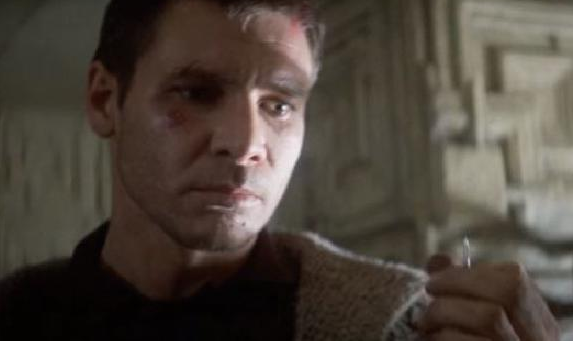
10 Blade Runner (Scott, 1982)

Kicking things off with one of the forefathers of the ambiguous ending, we’re really opening a can of worms with this one considering just how many different versions and endings exist for Blade Runner. Controversially, though, I’m not that big a fan of Blade Runner; as a film, it’s very slow and plodding, with long sections where seemingly nothing happens. This is married to some gorgeous sets and a realistic, lived-in feel to the future world we are presented with. Consequently, my Blade Runner experience begins and ends with Ridley Scott’s 2007 Final Cut version of the film, in which Rick Deckard (Harrison Ford) finds an origami unicorn on the floor of his apartment, strongly hinting (as Deckard had previously dreamt of a unicorn) that Deckard is a Replicant. Apparently, this is the philosophy that Scott subscribes to though I disagree as there isn’t really any real evidence in The Final Cut to support this beyond the ambiguity of the final scene. Supporting this further, the question about Deckard’s humanity was left unanswered in Blade Runner 2049 (Villeneuve, 2017), despite other versions of Blade Runner hinting more strongly that Deckard was actually a Replicant all along.
Shutter Island
9 Shutter Island (Scorsese, 2010)

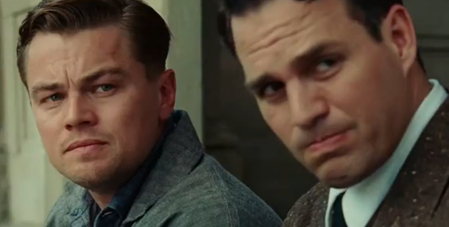
Throughout Shutter Island, Edward “Teddy” Daniels (Leonardo DiCaprio) is forced to confront some personal demons as he uncovers the mysterious disappearance of a patient of the asylum housed on the titular island. As events begin to unravel, we learn that Teddy is, in fact, a patient of the asylum and he was allowed to play out an elaborate fantasy in an attempt to force him to confront the truth that he murdered his wife. Despite scepticism from Dr. John Cawley (Ben Kingsley), this unconventional method appears to have finally worked as Teddy finally admits his guilt. However, later on, he appears to have regressed to his fantasy world once more, leaving the hospital no choice but to have him lobotomised. As the orderlies come to take him away, he questions whether it is worse to live as a monster or die as a good man, casting doubt as to whether he has truly regressed or simply wishes to end his sane life on a high note; personally, I prefer the latter interpretation, as that line seems a deliberate inclusion to make us think that Teddy is merely feigning his regression to “die” as a hero.
The Thing
8 John Carpenter’s The Thing (Carpenter, 1982)

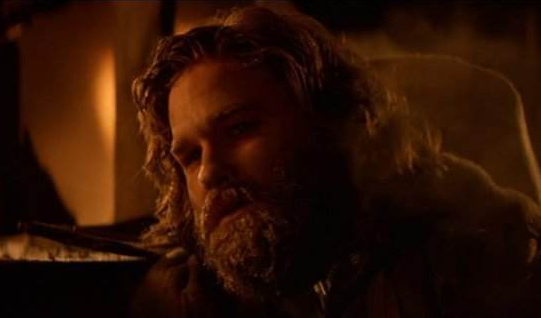
This is the second time that The Thing has made one of my top ten lists, and with good reason; not only is it a masterpiece of practical effect wizardry, it’s also an excellent tale of isolation and paranoia. After uncovering an alien spacecraft and unwittingly unthawing a gruesome, shape-changing parasitic lifeform, the residents of an Antarctic research outpost succumb to paranoia and fear as the titular Thing assimilates them one by one. In the end, with the Thing seemingly destroyed and the outpost up in flames, our hero – R.J. MacReady (Kurt Russell) – sits alone and exhausted by a dwindling fire when he is confronted by Childs (Keith David), his hot-headed rival who had mysteriously vanished right as the chaos started to really ramp up. Also exhausted, Childs sits with MacReady and they share the remnants of a bottle of scotch, both too tired to act on their suspicions that the other might be the Thing and succumbing to the knowledge that, once the fires burn out, it won’t matter soon anyway. Doubts about who is really human are raised when one observes that, unlike MacReady, Child’s breath does not show in the freezing weather but, in this case, I feel that both are actually human and the ending has a more morbid message: both men, whether human or alien, are paying the price for human nature and that, given the volatile relationship between the two characters, it’s likely they would find any excuse to try to kill each other but are simply too fatigued to continue their hostilities.
The Descent
7 The Descent (Marshall, 2005)

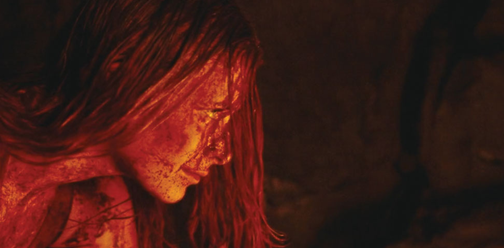
The Descent was a welcome surprise when I first saw it; despite some questionable acting from the lead females, the film quickly descends (hah!) into an atmospheric, claustrophobic nightmare when six cave-diving friends find themselves trapped in an unchartered cavern and being attacked by cannibalistic mutated humans. With fear and paranoia setting in, and beset by the vicious crawlers at every turn, the party is eventually whittled down to central protagonist Sarah Carter (Shauna Macdonald) who, after being knocked unconscious, awakens to find herself before an exit and frantically scrambles free, screaming with maniacal glee as she makes it to her car and speeds away. Overcome by the gruesome events that have taken her friends from her, she pulls over and breaks down in tears, only to find the screaming corpse of her headstrong friend Juno Kaplan (Natalie Mendoza) in the passenger seat. For American audiences, this jump-scare is where the film ends but, for us Brits, the scare causes Sarah to awaken to find herself still trapped in the cave with no exit in sight and her fire slowly burning away. With no escape, and the sounds of the ferocious crawlers echoing all around her, she finds solace in a hallucination of her dead daughter as the film fades to black. If you ignore The Descent: Part 2 (Harris, 2009), which reveals that Sarah did actually escape the cave in the end (and is inexplicably convinced to return to that nightmare), this ending is a massive downer and really reflective of the differences in American and British audiences; we Brits love us a good bleak ending laced with ambiguity, as the final haunting shot raises the possibility that all of the events that occurred were a hallucination of Sarah’s to justify her slaughtering all of her friends.
6 Event Horizon (Anderson, 1997)

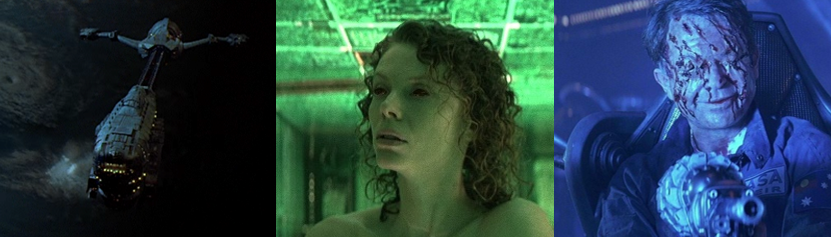
Here’s a film that doesn’t get enough love, Event Horizon is a truly horrific science-fiction horror revolving around a spaceship that, having crossed through time and space, has returned as a semi-sentient haunted vessel that desires only to kill its inhabitants in increasingly gruesome ways and return to the hell dimension that it passed through. Event Horizon actually has two ambiguous endings: the first comes when Captain Miller (Laurence Fishburne) sacrifices himself to split the Event Horizon in two, allowing the remainder of his crew to be spared while he and the demonically possessed Dr. William Weir (Sam Neill in a commendably menacing role) be transported back to “Hell”. When I first watched Event Horizon, I assumed, based on Weir’s agonised “Noooo!” and the editing of this scene, that Miller had died in the ensuing explosion but, upon repeated viewing, you can clearly see the aft section of the craft disappear into a black hole, meaning that Weir was merely expressing his frustration at only taking one victim to “Hell” instead of the entire crew, making Miller’s sacrifice even more tragic as he now has to suffer unimaginable horrors. However, it doesn’t end there as the forward section of the ship is later recovered and Miller’s crew freed from stasis; upon awakening, and suffering from shock, Lieutenant Starck (Joely Richardson) looks upon her rescuer and sees only Weir’s scarred face grinning back at her. Descending into a screaming fit, and comforted by Cooper (Richard T. Jones), it appears as though Starck is simply severely traumatised by the horrific events she has barely survived but, as the film fades to black, the doors of the Event Horizon close by themselves, suggesting that the demonic force haunting the ship is still present.
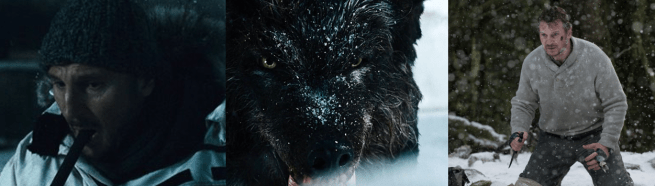
Boy, was this film a surprise. Given the odd marketing campaign, you would be forgiven for going into The Grey believing it was simply about Liam Neeson fighting wolves but it is so much more than that. Haunted by the death of his wife, John Ottway (Neeson) is struggling with suicidal tendencies when the plane he is flying on crashes in the middle of the frozen Alasakan wilderness. With limited resources, tensions running high, and a pack of ravenous wolves stalking them at every turn, Ottway is forced to rely on his survival instincts and knowledge of wolves to lead the survivors in a seemingly hopeless search for safety. Inexplicably surviving what appears to be an unsurvivable plane crash potentially gave Ottway a concussion, however, as it is eventually revealed, once all of the other survivors have tragically perished due to injuries, the elements, or the increasingly emboldened wolves, that he has been heading directly towards the wolves’ den the entire time. Left alone and forced to confront the Alpha Male, Neeson straps broken bottles and other make-shift weaponry to his fists and prepares to fight to the death as the film abruptly cuts to black. A brief after credits scenes offers little in the way of closure, affording only a glimpse of what appears to be Ottway resting atop a slowly dying wolf, leaving the character’s ultimate fate entirely up to the interpretation of the viewer. I honestly understand the negative backlash this caused as the marketing made a big deal out of the showdown between Neeson and the Alpha, man against nature, and all that but, honestly, when I first saw it and Ottway was reciting his father’s beloved poem, burying the wallets of his fallen comrades, and preparing to fight to the death with a voracious wolf…man tears, every time. I always like to think that there was only ever going to be one outcome: Ottway put up a great fight but was ultimately killed by either the Alpha or one of the other wolves. Yet the short scene after the credits presents the slim possibility that Ottway survived the battle, if with serious injuries, allowing those who prefer a more positive ending to believe that he came out victorious and is merely exhausted from the conflict.
Can we stop for a second and recognise that Total Recall is still one of the greatest science-fiction movies ever created? Honestly, this movie has aged incredibly well; it’s use of practical effects, model shots, the rising action and over-the-top fight scenes, all married with two truly memorable villains and Arnold Schwarzenegger’s undeniable charisma make for one of the best action/sci-fi experience ever conceived. That it also presents an extremely and surprisingly complex and deep narrative only adds to its stature, in my mind. Douglas Quaid (Schwarzenegger) is obsessed with Mars, dreaming of it every night and is so desperate to visit the red planet that he pays a visit to Rekall Inc. to purchase a memory implant of having vacationed for two weeks as an undercover secret agent. Immediately however, there are complications; Quaid goes psychotic during the procedure and is suddenly attacked by friends and foes alike for no discernible reason. Eventually driven to Mars, he learns that he was once Hauser, a former employee of the villainous Vilo Cohaagen (the wonderful Ronny Cox) who volunteered to have his memory wiped so that Cohaagen and his sadistic enforcer, Richter (fantastically portrayed by Michael Ironside), could wipe out the rebellion opposing his authority on Mars.
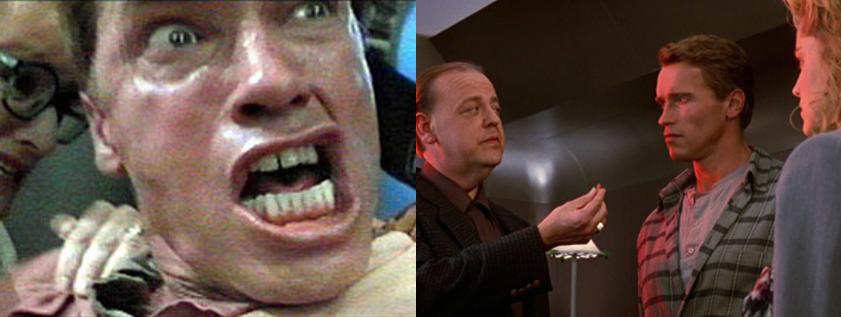
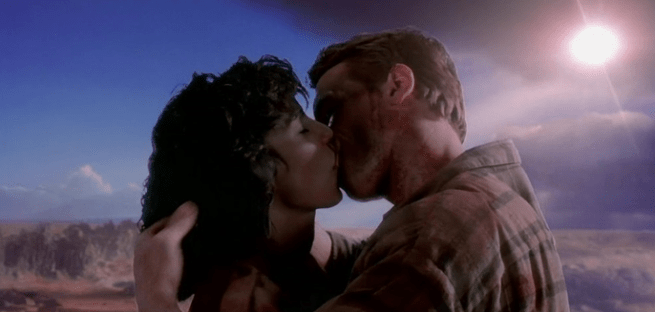
Rejecting his former life, Quaid opts instead to activate an alien device that provides Mars with a breathable atmosphere, freeing the populace from Cohaagen’s air tax and ending the film with a conspicuous white light as Quaid shares a kiss with his dream woman, Melina (Rachel Ticotin). I say conspicuous because, traditionally, films end on a fade to black and this is only one of many indications that the events we have witnessed are not entirely what they seem. At Rekall Inc., Quaid tailors the memory he will receive to the finest detail, describing Melina as his love interest, viewing pictures of places he later visits on Mars, and being told that the vacation will involve him overcoming an interplanetary conspiracy. Later, Dr. Edgemar (Roy Brocksmith) attempts to convince Quaid that everything he is witnessing is a free-form delusion that he has allowed himself to be trapped in and that, unless he chooses to wake up, he will end up lobotomised. Quaid rejects this when he notices that Edgemar is clearly sweating with fear and discomfort and, in doing so, commits himself to seeing his path towards being the saviour of Mars. Total Recall presents both possibilities simultaneously; the over-the-top action and increasingly coincidental set pieces lend a credibility to Edgemar’s claim that Quaid is trapped in a dream world but scenes where Quaid is entirely absent, such as during conversations between Cohaagen and Richter, suggest that the plot against Quiad is very real. In the end, the white out could simply be a sign of a new beginning for Mars or the brain cells in Quaid’s head dying from psychosis; sometimes I will watch the film and believe that Quaid is a former mercenary turned rebel leader and, others, I choose to believe that he has simply allowed himself to be lost to an extremely realistic dream.
The Wrestler
3 The Wrestler (Aronofsky, 2008)

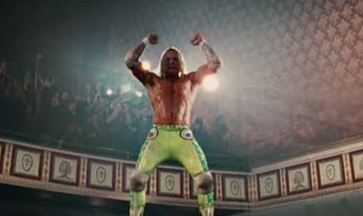
After years in obscurity, Mickey Rourke began a bit of a comeback in the mid-to-late-2000s and perhaps no other role really showed how much he had matured and was ready to be taken seriously as an actor than that of Robin Ramzinski (AKA Randy “The Ram” Robinson). Ram, his best years as an athlete behind him, has fallen on hard times and really been through the wringer; he is estranged from his daughter (the delectable Evan Rachel Wood), in constant pain, works a menial job where he is the source of constant ridicule, and is forced to take bookings in venues barely a quarter of the size he was headlining in his prime. After he suffers a heart attack and is advised that he must never wrestle again, Ram takes the advice to heart and begins reconciling with his daughter and trying to make a future with his only confidante, an ageing stripper named Cassidy (Marisa Tomei). In the end, though, after a drink and drug filled bender causes his daughter to sever all ties with him, Ram returns to the one place he has only ever felt loved and valuable, the ring, knowing full well that it could be not only his last match but the last decision he ever makes. During a rematch against his greatest opponent, the Ayatollah (Ernest Miller), Ram begins to suffer chest pains and is in considerable visible pain. Despite the Ayatollah’s concerns and pleas to end the match quickly, Ram fights through the pain and disorientation to mount the top rope and leap into the air as the film cuts to black. Did Ram make the splash, win the match, and walk away victorious or did he crash in a dying heap on his fallen adversary? Honestly, considering the poor hand Ram has been dealt in his twilight years, I actually prefer the idea of him going out in a blaze of glory than living through another heart attack and having only a resentful daughter and a guilt-filled stripper to wake up to.
American Psycho
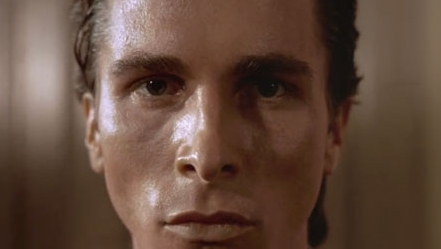
2 American Psycho (Harron, 2000)

Adapted from the book of the same name by Brett Easton Ellis, American Psycho is an incredibly enjoyable dark comedy revolving around Wall Street yuppie Patrick Bateman (Christian Bale) who, by day, enjoys the frivolities of greed, sex, and consumerism but, by night, stalks the streets for victims to kill. Fully acknowledging that his urge to kill is a deep-rooted psychological disorder over which he is slowly losing control, Bateman takes out his frustrations at being mistaken for other co-workers, his fiancée’s infidelity, and his peers having better positions, clientèle, and even business cards by murdering co-workers, vagrants, and prostitutes. Eventually, his urges become too much to contain and he embarks on a killing spree throughout the city night, shooting innocent bystanders left and right before finally calling his lawyer (Stephen Bogaert) and, through maniacal tears, listing his numerous transgressions in a frantic confession. However, the next morning, his lawyer fails to recognise Bateman, believing him to be a man named Davis and that the call was an elaborate prank, reasoning that Bateman is far too spineless to engage in such activity.

Bateman calmly states that he not only committed the crimes he confessed to but enjoyed them, only for his lawyer to brush him off. Returning to his seat, Bateman reasons that, despite his confession, he has learned nothing about himself or the world and that the hollow emptiness he feels inside has only grow larger as a result of his actions. However, it is left up to the audience to decide whether the increasingly elaborate events we have witnessed actually took place or if they were simply the deluded fantasies of a bored, morbid, and repressed individual (further exemplified by his secretary, Jean (Chloë Sevigny), finding Bateman’s journal filled with doodles depicting murder and rape). Prior to visiting his lawyer, Bateman attempts to clean up the apartment of one of his victims, only to find it in pristine condition and being sold by a realtor, who reacts to Bateman’s presence with a clear discomfort, if not fear, suggesting that the gruesome murder actually took place. For me, as a big fan of the film and the book (which provides few answers and raises more questions, if anything), I like to think that some of the murders took place but maybe not all of them; given that Bateman and his co-workers are completely interchangeable and the dark satire at work in the film, I think it’s entirely possible that Bateman is so incredibly repressed and striving for attention and to stand out that he has killed vagrants and prostitutes but, in doing so, has simply allowed his dark fantasies to conjure increasingly elaborate murders and scenarios to distract him from the fact that he is nothing more than a faceless corporate snob amidst a sea of faceless corporate snobs.
Inception
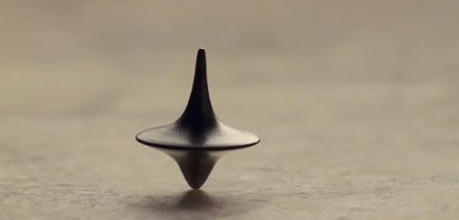
1 Inception (Nolan, 2010)

Perhaps one of cinema’s most unique and original ideas since The Matrix (The Wachowski Brothers, 1999), Inception presents a world in which thieves like Dom Cobb (Leonardo DiCaprio) can enter a person’s dreams and subconscious to extract information. Unable to return to his children due to his wife, Mal (Marion Cotillard), having framed him for her suicide, Dom is tasked with putting together a team and planting an idea in the head of the heir to a business empire in exchange for his criminal record being expunged. Inception takes full advantage of modern effects and technology to realise the infinite possibilities of the dream world, allowing reality to bend and warp in unique ways. As Dom and his crew are forced to dream within a dream, the film plays with perceptions of time as much as reality as Dom risks losing himself to the elaborate dream world he has created. Eventually, Dom confronts his demons and completes his mission, passing through customs without a hitch. All throughout the movie Dom has been haunted by not only his wife’s suicide but also the fact that he left in such a hurry that he was denied one final look at his children’s faces. Returning home, as Hans Zimmer’s powerful score builds to what appears to be a victorious crescendo, Dom, frantic to prove that his dreams have actually come true, conducts one final test, setting off a spinning top that will topple over if he is in the real world and spin indefinitely in the dream world. However, he never stays to see their result, as, finally, he sees his children and they not only turn to face him but run, overjoyed, into his arms. As he carries them out of frame and the score fades down, the shot lingers on Dom’s spinning top as it spins and spins and spins…faltering only slightly as the film cuts to black.

If The Grey brought out the man tears when I first watched it, Inception opened an absolute floodgate! I never thought that I would care so much about whether Leonardo DiCaprio got a happy ending but Nolan really sucked me into this world and had me so emotionally invested in all of his characters, especially DiCaprio’s Dom. The composition of this final shot, with the score and the sense of catharsis, never fails to be overwhelming; I was so happy to see him finally see his children’s faces and was on the edge of my seat waiting to see the top topple over and truly saddened that it didn’t because, in that first viewing, my knee-jerk reaction was that Dom had gotten lost in the deepest layers of his dream and had chosen fantasy over reality. However, the ambiguity of the ending allows one to view this film similar to Total Recall. You can watch it one time and believe that Dom emerges victorious or choose the depressing ending if you wish. Evidence can be found for both: it is said that one must had a totem unique to them but Dom carries and uses his dead wife’s spinning top as his totem.

It equally seems unlikely that Dom’s client would have the connections necessary to wipe his criminal record clean, and Dom is repeatedly told that he has to “wake up” and “face reality”, as though he has been trapped in a dream ever since he and Mal first experimented with deep dreaming. However, I felt so strongly for Dom and wanted so badly for him to see his kids and return home that it is hard to not believe that everything worked out for him…if not for that damn spinning top, endlessly spinning away, casting doubt over everything except for the fact that, in that moment, Dom does not care whether he is dreaming or awake; whatever the case, he has accepted this as reality without even a cursory look back.


Game Corner: WWE 2K18 (Xbox One)

GameCorner
WWE2K18Logo

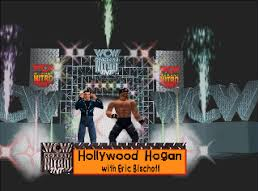
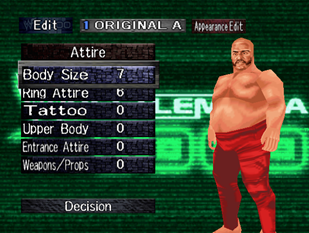
As may already be evident, I have a long-standing preference for the WCW and WWF videogames released by AKI/THQ back in my youth; however, another WWF videogame series I have been particularly fond of and spent many hours and days of my childhood playing has been the WWF SmackDown! series released by THQ and Yuke’s on Sony’s PlayStation in 2000. Eventually, this series evolved into the WWE SmackDown! Vs. Raw franchise, which was released on multiple consoles between 2004 and 2010. I believe I came into this series with WWE SmackDown! vs. Raw 2008 Featuring ECW (Yuke’s/Amaze Entertainment/THQ, 2007) and bowed out with WWE SmackDown! vs. Raw 2011 (Yuke’s/THQ, 2010) as, by this point, it was pretty clear to me that I was simply purchasing the same videogame every year with additional wrestlers, some new match types, and minor improvements to the graphics and gameplay. As a result, I decided to buy a new title every two years or so and, after enjoying WWE ’13 (ibid, 2012) and deciding that WWE 2K15 (Yuke’s/Visual Concepts/2K Sports, 2014) was far too stripped back on features to justify the price tag, I settled on getting WWE 2K14 (ibid, 2013) and biding my time.

WWE’s videogames eventually aped the yearly formula of the FIFA series.

As a result, I have not bought or played a new videogame in 2K Sports’ WWE 2K series for about four years now, and with good reason; as the series made the jump to the Xbox One and PlayStation 4, reviews and feedback ranged from resoundingly negative to mediocre displeasure as 2K Sports apparently removed many expected gameplay mechanics and features in what was nothing less than a blatant attempt to sell features seen in previous PlayStation 3-era titles as being “new”. Despite the additions of never-before-seen superstars such as Sting, AJ Styles, and Samoa Joe, I decided to wait it out until the release of WWE 2K18 (ibid, 2017) to give the series a chance to iron out these kinks and to create an ironic sense of symmetry given that the last title I played was WWE 2K14. As such, it took me a little while to become accustomed to WWE 2K18’s control scheme; previously, these titles allowed you the option of controlling your wrestler with the directional-pad (or “D-pad”) and taunting with the analogue stick, which is my preferred control scheme given how it mirrors that of the AKI/THQ titles.

WWE2K18Submission
WWE 2K18 loves these little wheels of death!

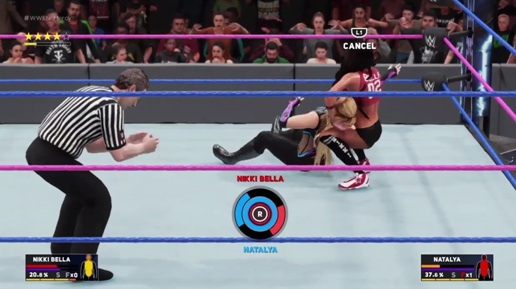
However, WWE 2K18 does not allow you to change the control scheme, meaning that I was forced to control my wrestler with the left analogue stick and taunt using the D-pad which, for an old school player like myself who dislikes change, took some getting used to. One of the other main reasons I prefer D-pad control is that I find it easier to direct and aim my opponent during running attacks or Irish whips; I find the analogue stick makes such aiming harder as the stick is more sensitive. WWE 2K18 also features some new mini games which replace the ones I had grown accustomed to in WWE 2K14; when being pinned, for example, you now have to press X on a little wheel rather than stopping a little bar that bounces back and forth. This is actually a lot trickier than it sounds as it seems the videogame is set up to make kicking out of pins harder than before to, I guess, allow for more “realistic” matches. Additionally, there is no longer the “Breaking Point” submission system; instead, there’s either a tricky mini game involving the analogue stick or you must mash one of the four action buttons when they appear onscreen. I went with the button mashing option but have found that winning a match by submission is not as easy as it used to be, potentially because you can no longer select a match to be either quicker, normal, or epic; this, and the improved attribute system, means that you are forced to work for your submission victory.

WWE2K18Triple
Suffer enough damage and you’ll roll from the ring to take a break.

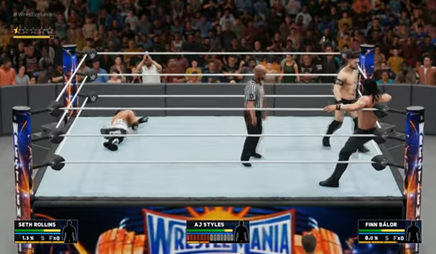
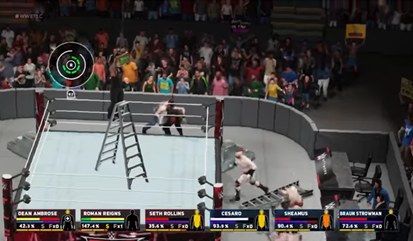
Other gameplay changes can be seen in multi-man match; now, when you or another player receives enough damage, they automatically roll out of the ring and you must mash buttons to fill up a bar and re-enter the match. It sounds good on paper and, again, appears to be tooled towards making matches more “realistic” but I found it more annoying than anything else as you could end up stuck on the outside and lose the match. This mechanic carries over into ladder/TLC matches as well, making them considerably more frustrating than usual as you incur far more damage much faster in these matches so you’ll spend a lot of time mashing buttons to get back into the matches. Also, in ladder/TLC matches, you no longer pull down the belt of briefcase using the right analogue stick; instead, you have to play a little mini game where you must fill up segments of a circle by rotating a ball into a small hole using the right analogue stick. It’s fun but quite distracting; I found myself concentrating more on the mini game than the match and, if you get interrupted with only a couple (or, even worse, one) segments left to fill, you are almost guaranteed to lose the match as the next wrestler to play the mini game will probably complete the circle while you’re busy mashing buttons to get back into the match.

WWE2K18TLC
Multi-man TLC matches are still the worst.

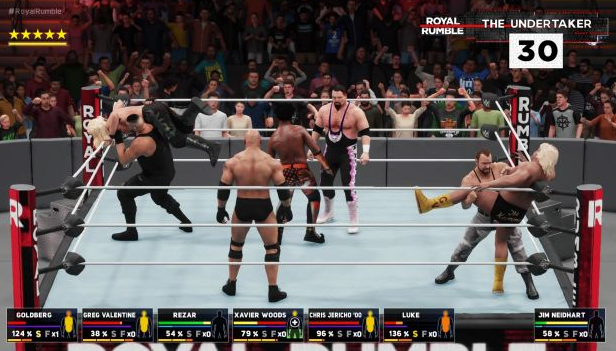
The Royal Rumble match is also noticeably different and, technically, more difficult; rather than hitting buttons in a quick-time event as in WWE 2K14, you now have to mash a button when trying to eliminate an opponent. Honestly, I’ve played a couple of these matches and never once eliminated anyone using the button-mashing mini game no matter what their health and stamina. I found the best way to eliminate wrestlers was the tried-and-true Royal Rumble finisher, clotheslining them out of the ring or countering a run attack, or by exploiting a glitch where, if you whip the opponent onto the apron and quickly punch them repeatedly, they simply fall from the ring.

WWE2K18Rumble
I struggled to legitimately eliminate anyone in the Royal Rumble…

As I always found ladder, TLC, and Royal Rumble matches tedious any way, these gameplay changes don’t bother me that much; you are not forced to play these matches and, on the whole, I would just avoid them. Some good changes have been made to tables matches, though; every time you hit your opponent with or into a table, it fills up a break meter and, once it’s full, you can smash the opponent through it using some new and expanded options. 2K Sports have also introduced a carry system, similar to the one from WWE SmackDown! vs. Raw 2007 (Yuke’s/THQ, 2006), which allows you to smash your opponent off the ropes, turnbuckles, apron, and other objects. They’ve also brought back in-crowd fighting, to a degree, allowing you to smash your opponent through (or hit them over) the barricade at ringside or toss them from the stage area to fight in little areas near the crowd.

WWE2K18Universe
Universe mode is back, bigger and better than ever.

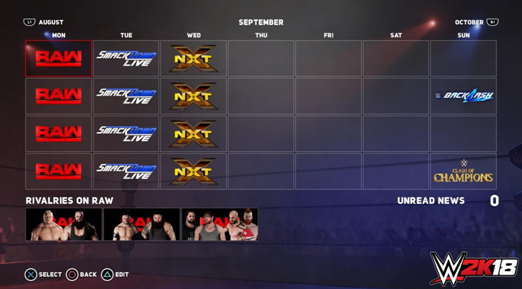
Although create-a-story and create-a-finisher are no longer options, WWE 2K18 is still full to the brim with creation options. I honestly spent maybe five days or so setting everything up the way I wanted it and creating wrestlers, entrances, victories, shows, and teams in the expanded Universe mode. As before, Universe mode allows you to create a show, place wrestlers and championships on the show, and then create monthly pay-per-view events for that show. I like to recreate the product as closely as possible so I created a Raw, SmackDown! Live, and NXT brand (with 205 Live and Main Event as minor shows) and, for all the Legends and duplicate wrestlers, a WCW Monday Nitro brand (with some crossover between them all). You can create more than one Universe at a time but I prefer to have it all in one place rather than jumping backwards and forwards all the time; I then moved every pay-per-view event to their correct calendar month and also created some additional pay-per-vews for my NXT and Nitro brands; this is extremely in-depth, allowing you to choose from a whole bunch of preset or created arenas (with scene transitions, an array of screen filters, a bunch of different referees, and more).

WWE2K18Materials
There are loads of colour and customisation options.

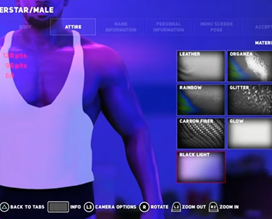
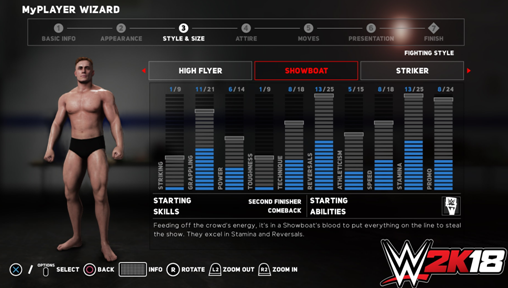
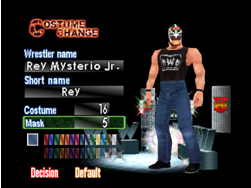
You can still create your own championship belts as well, if that’s your thing; given how many old school belts are in the videogame, I don’t tend to do much with this, though. Instead, my focus was on the massively deep create-a-wrestler mode; created wrestlers look more realistic than ever before and you can choose from a whole bunch of options, from wrinkles to scars, facial and body hair, eye colour, veins, muscle definition, and even how much body oil your created wrestler has! There are also a whole load of attire options, including blank attires that you can customise as you desire and also pre-set attires worn by the featured roster; you can change not only the colour of these attires but also the material type, which allows shirts and jeans and the like to be leather, take on a metallic hue, or even glow in the dark! Finally, there are far more options for names for your created wrestler this year and the in-game commentary team will refer to your created wrestler by these throughout their matches.

WWE2K18Store
Apparently you can put a price on greatness.

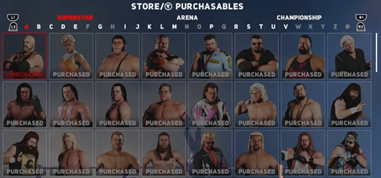
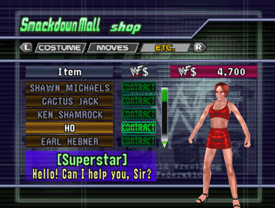
Although there are many WWE and superstar-related images available to you in this mode, there are noticeably less options for body tattoos this years, unfortunately. This is where the Community Creations option will come into play; you are able to upload images to the 2K Sports website and transfer them into the videogame, meaning you can search in the WWE 2K18 for a whole bunch of professionally-designed images, logos, and tattoos to apply to your created wrestler. You can also download created wrestlers created by others to account for those wrestlers omitted from this years roster, though you are limited to twenty downloads a day and cannot download created wrestlers that feature aspects from wrestlers you’ve yet to unlock or purchase. Speaking of which, WWE 2K18 features an in-ring store mode, as is the norm for this series now. As you play matches, you are awarded virtual currency based on how many stars your match scored; the more stars you get through move variety, countering, and such, the more currency you earn. You can then spend this in the store to unlock Legends, and additional arenas and championships and, make no mistake, this is the only way to unlock this extra content. Previously, in WWE 2K14 at least, you could unlock new wrestlers by playing the 30 Years of WrestleMania mode but, here, you can only do this by purchasing them.

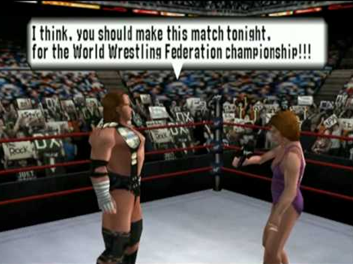
You can do this by playing any match in any mode and, also, through the MyPlayer mode, which is the career mode of the videogame. You have to create a wrestler, using far more limited tools and options, and work your way through training and wrestling on NXT before being called up to the main roster. You can make some limited decisions to decide whether you are a Company Man (a heel) or a Fan Favourite (a face). In my playthrough, I was initially called up to Raw and forced to lose a bunch of matches, so I jumped to SmackDown! Live, where I won the United States Championship, Money in the Bank ladder match, and Royal Rumble match and am currently feuding with Triple H and the Authority on the path towards the WWE Championship. Along the way, you can partake in side quests to earn rewards (new moves, attire, and currency), make a signature t-shirt to earn some extra cash, and perform in-ring promos and run-ins.

WWE2K18MyPlayer
You’ll need to pay to get the most out of MyPlayer mode.

Overall, this mode is quite enjoyable but, honestly, it’s a poor substitute for a Road to WrestleMania-type of mode. There are a lot of load times and some noticeable frame drops; you are also forced to walk/run from the garage to the producer and back every single week, which begs the question why they bothered putting in the free-roaming backstage area at all rather than just have a set-up similar to the PlayStation 3-era titles where you had a locker room with a phone and just did everything through text. There are some inconsistencies; I was regularly teaming with Sami Zayn then, randomly and with no explanation, my partner suddenly became Fandango. I was also once asked by Tius O’Neil to attack Primo Colón one week but, when I couldn’t find him, ended up attacking Kassius Ohno. There are also a lot of times when you do more promos than matches, when the match objectives aren’t completely clear (the Money in the Bank match springs to mind), and when your matches end due to interference more often than not but, these issues aside, it’s a pretty decent mode, though I found it more enjoyable and profitable to play Universe mode more than anything.

It’s interesting that the load times for the MyPlayer mode are so atrocious as, normally, they’re not that bad; matches in Universe mode load much faster than in WWE 2K14. I learned from some of my mistakes in WWE 2K14 and don’t have nearly as many custom arenas or created wrestlers, which may help with this, and also towards limiting crashes. WWE 2K14 would crash all the time, usually after a match but sometimes before one, and it was very frustrating. I have had a few crashes in WWE 2K18 but, as the matches and the videogame loads up a lot faster, it’s not as annoying. One bug that is annoying is, when downloading a created wrestler, attached logos and images will sometimes not download, meaning you’re left having to either find them separately or with an incomplete created wrestler/attire.

I haven’t played WWE 2K18 online yet, mainly because I don’t have Xbox Gold or whatever you need to do that but also because online players are trolling, move-spamming sons of bitches; also, the learning curve for timing reversals and having competitive but enjoyable matches that I actually won was quite steep. Sometimes, you’ll have a match and be in complete control and all the opponent has to do is a couple of moves and you can’t recover, then you get hit with one finisher and its over. A good feature, though, is that miss-matched opponents (like Braun Strowman against Kalisto) often trigger a squash match, where you gain full momentum and a finisher after your first hit and win the match in seconds for a decent payday.

WWE2K18STINGS
All the Sting you could ever want!

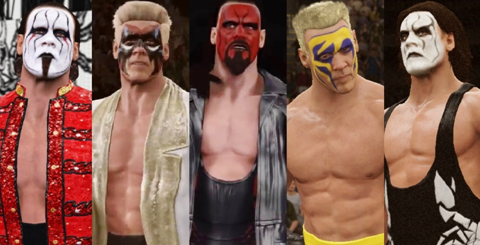
The roster in WWE 2K18 is as deep as you could want; there are some noticeable omissions from NXT but, otherwise, everyone you could want and more is in the videogame alongside some decent and surprising Legends. Hulk Hogan and Yokozuna are gone but Vader and the Big Boss Man are back; there are some crazy instances of numerous duplicates, such as five (five!) versions of Sting and separating Finn Balor and his Demon King attire (though the Demon King does still act as an alternative attire to regular Balor) but, mostly, there’s some good inclusions this year. The soundtrack, apparently “curated” by the Rock, is mostly miss rather than hit, with the only decent track being a radio edit version of Disturbed’s Down With the Sickness, though a similarly-edited version of Limp Bizkit’s Rollin’ is used as the entrance theme for Undertaker ’00 despite this particular version of Undertaker’s biker gimmick actually being more associated with You’re Gonna Pay. The in-game commentary is all-new, at least for me anyway, including the three-man team of Michael Cole, Corey Graves, and Byron Saxton; mostly, it is far better than what I experienced in WWE 2K14 but there still times when they refer to women as “guys”, talk inanely about things not even relevant to the match in progress, or ask each other questions that are never answered.

WWE2K18Balor
Graphically, WWE 2K18 is very impressive.

Overall, WWE 2K18 is a challenging and enjoyable affair; Universe mode is bigger and more expansive than ever, with shorter load times and significantly less crashes and glitches (so far), and the star rating system does make it feel as though each match is important and worth something. MyPlayer suffers a bit (though admittedly this may also be because I don’t want to waste my virtual currency upgrading the MyPlayer character unless I absolutely have to as I want to unlock the Legends) but is, otherwise, fun enough for what it is. I would have also liked to have seen, at least, Showcase matches similar to previous titles or themed around a wrestler (this year’s pre-order bonus, Kurt Angle, for example, or Shawn Michaels, or even the cover star, Seth Rollins) to assist with the unlocking of extra content. Creation options are deep and versatile; you can waste hours and even days crafting the perfect created wrestler (I know I did!) or downloading extra attires and wrestlers to fill out the already impressive roster. I am glad that I waited for 2K Sports to add in many of the features they previously omitted and refine their current-generation gameplay engine as it seems to have paid off; matches are far more realistic and challenging than in WWE 2K14, where I could win with a minimum of effort, which is good once you’re used to the control scheme and what is expected of you, if admittedly somewhat detrimental to those who just want to pick it up and play a quick match without any obligation to simulating a real-life WWE match. Based on my experience with this title, I will probably wait until WWE 2K20 for my next entry into the series as I would never recommend anyone buys these titles on a yearly basis but, if like me, you’ve been away from the series for a while, I would definitely recommend picking this one up.

My Rating:

Rating: 4 out of 5.

Great Stuff

Talking Movies: Justice League

Talking Movies
JusticeLeagueLogo

It’s no secret that DC Comics and Warner Bros. are a bit late to the superhero renaissance we are still experiencing thanks to the runaway success of the films put out each year by Marvel Studios. They lost a lot of ground with films like the dull Superman Returns (Singer, 2006) and Green Lantern (Campbell, 2011) – even though I personally actually enjoyed Green Lantern and thought the movie was worth salvaging in further DCEU films – and often focus too much of their attention on Batman at the expense of their massive cast of superheroes. However, amidst the many and ongoing critical debates surrounding Man of Steel (Snyder, 2013) and Batman v Superman: Dawn of Justice (ibid, 2016) and the disappointment of Suicide Squad (Ayer, 2016), they apparently scored a far more meaningful success with Wonder Woman (Jenkins, 2017) and their films have been profitable enough to keep the idea of a cinematic universe alive, even if rumours abound every day that it is on life support. Now, I never saw Wonder Woman, for reasons of my own, and I actually really enjoyed not just Man of Steel but also Batman v Superman so, for me, anticipation was high for Snyder’s third cinematic effort, Justice League. While a personal tragedy saw him leave the production process and be replaced by formal Marvel guru Joss Whedon, the film is still credited to Snyder and carries many of his themes and ideas over but does it deliver?

JusticeLeagueInvasion
An invasion from Apokolips is all-but inevitble!

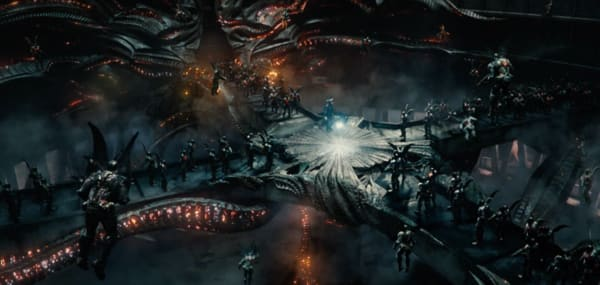
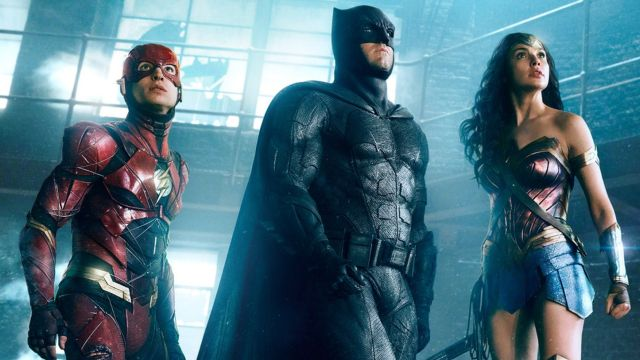
Justice League begins in a world still mourning the loss of Superman (Henry Cavill), which hasn’t resulted in world-wide chaos but has resulted in appearances of insect-like Parademons across the globe. Having witnessed a glimpse into a nightmare dystopian future where these creatures have overrun humanity, Bruce Wayne/Batman (Ben Affleck) has been investigating the creatures and their weaknesses amidst attempting to recruit a superpowered team alongside Diane Prince (Gal Gadot) to fight what he believes to be an inevitable invasion. On Themyscira, Diana’s home island of Amazons, the ancient Mother Box suddenly awakens and opens a Boom Tube, through which appears Steppenwolf (Ciarán Hinds) and an army of Parademons. Slaughtering the Amazonians, he claims their Mother Box and promptly disappears, forcing Bruce and Diana to step up their timetable. Bruce is initially unable to convince Arthur Curry/Aquaman (Jason Momoa) to join their cause due to his desire to be left alone but has far more luck in recruiting Barry Allen (Ezra Miller) who, disillusioned by the wrongful incarceration of his father (Billy Crudup) and struggling to live in a world that now seems painfully slow in comparison to his superspeed, joins up as the Flash without a second’s hesitation. Meanwhile, Diana is able to channel her own experiences with isolation and loss to convince Victor Stone (Ray Fisher) to put his recently-acquired and still developing cybernetic powers to good use in the fight against Steppenwolf.

JusticeLeagueTeam.png
It’s going to take everyone to fight off Steppenwolf.

Aquaman is finally convinced to join the team when he is forced to return to Atlantis to defend the second Mother Box from Steppenwolf, only to be suitably humbled. With two of the boxes in the hands of the enemy and the countdown to the destruction of the planet imminent, Batman struggles to galvanise the team in using the final Mother Box to resurrect Superman to lead the final battle for the fate of humanity. I’m going to say something now that may cause a stir; I’m a fan of both DC Comics and Marvel. Yes, it is possible; for me, just seeing comic book superheroes on screen and coming together is a thrill in and of itself. I don’t get weighed down with debates between which company is better or criticise DC for failing to follow Marvel’s gameplan; however, I do admit that they are very clearly playing catch-up. This was massively evident in Batman v Superman, where Wonder Woman was introduced with a lot of intrigue and mystery surrounding her but which also wedged in cameos from the Flash, Aquaman, and Cyborg. It felt like the movie was trying to do to much but, at the same time, those small glimpses served the purpose of a larger narrative and didn’t distract from the film at all; instead, they were weaved into Batman’s character arc of moving past his misguided vendetta against Superman and towards rejoining the world and uniting a team.

JusticeLeagueFlash
Ezra Miller brings some welcome levity to the DCEU.

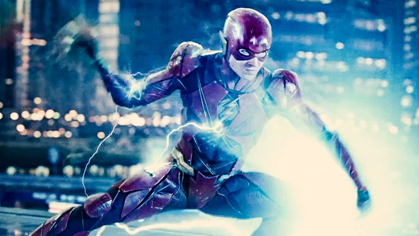
While Justice League does suffer form some pacing issues in the first act, each member of the team gets an ample amount of screen time to shine and show some layers. Although I could’ve done without it as we have seen the tale of Barry’s father played out in the first season of The Flash, it nevertheless helped to establish that Barry is currently in a very lonely and confused place in his life and that his powers only make things more difficult for him. Barry primarily serves as the comic relief, once again being infused with more of the characteristics commonly associated with the Wally West version of the character, but shows significant growth when he admits to Batman that he’s never actually been in a real fight before and, upon Batman’s prompting, learns how to be a superhero by simply saving one life.

JusticeLeagueAquaman
Probably the greatest interpretation of Aquaman we’ll ever see!

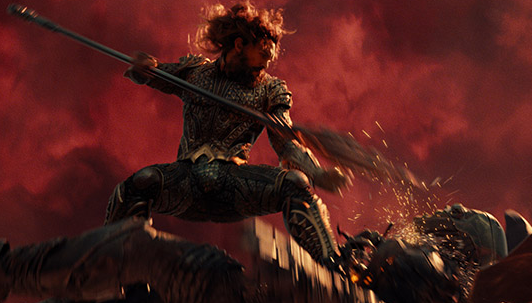
Before the movie came out, I hedged my bets on Jason Momoa’s Aquaman being a kick-ass, breakout character; for years, people have ridiculed Aquaman because “all he does is talk to fish” when that’s simply not the case. Now, I’m not the biggest Aquaman fan because, honestly, he can still be pretty lame for other more pressing reasons, but I am a fan of the Peter David version of the character, which had long hair, a beard, a more armoured outfit, and was a no-nonsense, stern ass-kicker. Momoa’s Aquaman may not have a harpoon for a hand but, man, is he bad-ass! He’s more like a rock star than a clean-cut prince, revelling in the heat of battle, carrying himself with a sense of narcissism, and generally approaching every situation with a nonchalant attitude. He looks fantastic and really brings the muscle to the team in Superman’s absence, but there’s also a sense of a much larger world and backstory behind him through his return to Atlantis and interactions with Mera (Amber Heard).

JusticeLeagueCyborg
Obviously a character mostly created in CGI is going to be CGI!

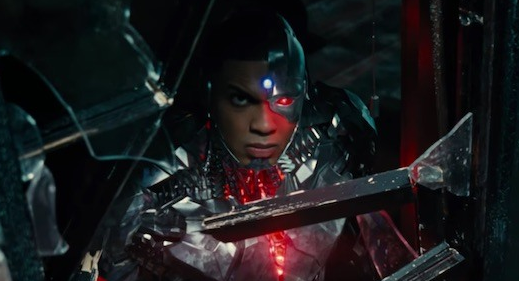
Probably the character with the most controversy surrounding him is Cyborg; personally, I’ve never liked the idea of Cyborg being on the Justice League, primarily because he’s so closely associated with the Teen Titans and I feel it’s a just a reason to have racial diversity on the team. However, for the purposes of this film, he serves a key purpose; having been created through the machinations of a Mother Box, Victor’s cybernetic parts are constantly evolving and hold the key to interacting with and stopping the Mother Boxes from uniting and destroying the world. Everywhere I look people are bad-mouthing the CGI on Cyborg and, honestly, I don’t see why; Justice League is filled to the brim with top-notch special effects, to the point where even a $300 million budget can be stretched pretty thin. Cyborg is a 90%, at least, CGI character so, obviously, he’s going to have a lot of CGI used on him. Would it have been better if they’d tried more of a Robocop (Verhoeven, 1987) route? Probably, yes. Did I think the sleeker, Teen Titans-inspired look he adopted at the end of the film would’ve looked better than the Transformers (Bay, 2007 to 2017) look? Definitely, but I never let the fact that he was largely comprised of CGI parts distract me from the film and, honestly, if you do then you’re clearly not that interested in the film to begin with.

JusticeLeagueWondy
Gal Gadot continues to impress/surprise.

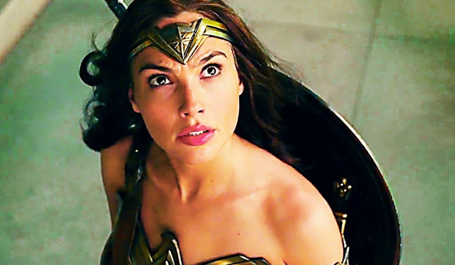
Gal Gadot continues to impress as Wonder Woman; despite my reservations about her, she is an extremely attractive young lady and her accent actually becomes less distracting the more you hear it. Diana’s arc here is directly tied in to the events of Wonder Woman as she is still apprehensive about rejoining society in the spotlight. Bruce even calls her out on it and accuses her of not being able to move past the death of Steve Trevor (Chris Pine), which only galvanises Wonder Woman’s resolve. Henry Cavill also returns after the team successful manage to resurrect Superman using the same Kryptonian birthing chamber that spawned Doomsday. Unlike the comics, he does not sport a mullet or a black costume, but his memories are briefly fragmented, leading to an awesome fight between Superman and the rest of the team. Superman is actually amazing in this film; he’s clearly overjoyed to be alive again, smiling and cracking jokes, and finally shines as an optimistic symbol of hope to rally behind. His initial period of disorientation also showcases his intense rage as he spits Batman’s “do you bleed” line back into Batman’s face as he is poised to crush Batman’s head. The only things I slightly disliked about Superman were that they didn’t make any effort to address how they explained Clark Kent’s sudden return to life and his resurrection felt like it came too soon; I expected him to return right at the very end, but it comes just before the third act, so it does raise the question of why kill him off in the first place (though I’m glad they did because at least it meant they got that aspect of Doomsday right).

JusticeLeagueBatman
Seriously, how can you not love shots like this!?

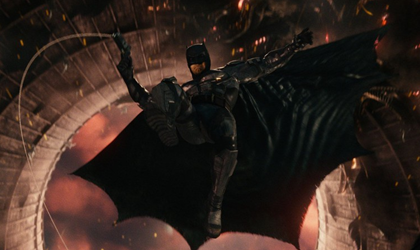
Ben Affleck returns as Batman, despite a new rumour springing up online almost every day saying that he wants out of the franchise. When he was first cast, I had my doubts that he would stick around for sequels and, honestly, the more I hear about him wanting to leave the more annoyed I am that he was ever cast in the first place. The fact that he is a fantastic Batman makes it all the more annoying; Warner Bros. seem to want to evoke Marvel Studios’ attitude towards Robert Downey Junior and build their DCEU around Affleck so I really hope that they do everything they can to convince him to see it through because he put in another brilliant performance here. Now focused on facing Steppenwolf’s impending threat, Batman has turned his mission from vengeance and death towards forming a team, saving the world, and atoning for the decisions he made that led to the death of Superman. The guilt he feels is evident and he even descends into some trademark Bat-dickery by manipulating Diana into following Superman’s example and being an inspiration for others. Additionally, the idea that he is so worn down and beaten up from twenty years of being Batman and that he now craves an honourable death continues in Justice League as, even with the team assembled, many of his plans revolve around him making a suicide run; during Superman’s resurrection, Batman even faces him head on with the intention of dying so that Superman can take his place as the more suitable leader of the team, and his joy at seeing Superman returned to life is clear on his face even if he quickly adopts a more stoic façade to save face.

JusticeLeagueSteppenwolf
The traditional bland villain does equal fleshed out heroes…

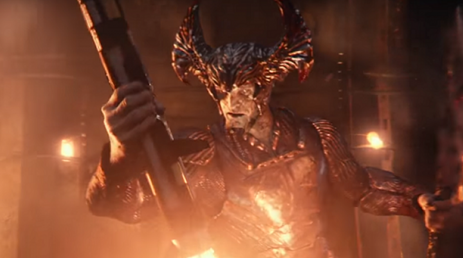
The action in Justice League is very big and very loud; explosions happen all over the place, water crashes everywhere, buildings topple, and hits land with a satisfying impact. Amidst what could be described as chaos, but actually is a far more cohesive end-of-the-world scenario than the one seen in Suicide Squad, is a fabulous score by Danny Elfman. Elfman even weaves not only his classic Batman (Burton, 1989) theme into the score but also John William’s classic Superman (Donner, 1978) theme; as much as I enjoyed the score from Snyder’s previous films, hearing the return of those classic, iconic, and irreplaceable themes brought a warm feeling of joy and nostalgia to my heart. Probably the biggest issues with the film are easily the most predictable; pacing and the villain. With the film being mandated to be two hours long, there’s a real sense that a lot of content was trimmed back and I look forward to seeing it inserted back in for an extended cut. While I did not experience any jarring leaps in continuity or pacing, it is unavoidable that a large chunk of the film’s early runtime is devoted to introducing and fleshing out not just the new characters but also existing ones; the plus side of this though is the clear influence of Joss Whedon, who not only infused a bright, vibrant colour palette but clearly worked on the film’s dialogue, resulting in a truly enjoyable rapport between the protagonists. As for Steppenwolf, he’s there for the team to unite against and defeat and his motivations are as one-note as possible; he wants to destroy the world, no more and no less. Diana relates his backstory through a pretty impressive flashback that shows that Amazons, Atlanteans, tribes of men, Old Gods, and even a Green Lantern fighting against Steppenwolf and his Parademons, which helps give a sense of the scale of his threat. His name-drop of Darkseid hints that a greater threat could be looming on the horizon but it cannot be avoided that he largely disappears for a big portion of the film. Again, though, this results in better characterisations of the protagonists and, unlike some Marvel villains, Steppenwolf actually makes up for it in the third act by not being a complete push-over and taking on the entire League all at once.

Given the after credits scene, in which freshly-escaped Lex Luthor (Jesse Eisenberg) recruits Slade Wilson/Deathstroke (Joe Manganiello) for a League of their own, I really hope that Justice League does well enough to continue the DCEU and help flesh the protagonists out even more in future films and therefore allow for better characterisations of the villains when they appear. While I may have criticised Eisenberg’s Luthor, I am still glad that he returned as it means there is a chance for the character to grow and evolve beyond Eisenberg’s madcap portrayal; if they had simply recast or abandoned the character, that hope would have been completely dashed and we would be forever deprived of the possibility of a good interpretation of Superman’s greatest nemesis. Honestly, the fact that I’ve heard so much negative criticism about this film really bugs me. Similar to Batman v Superman, I just don’t get it; sure, it isn’t perfect and it has flaws, but it’s actually a really good action romp, with some witty dialogue and some fantastic cinematography. Also, unlike the films of Marvel Studios, the thrill of seeing DC superheroes onscreen individually and as a group has not worn thin yet; it’s pretty amazing to finally see Batman, Superman, Wonder Woman, Aquaman, the Flash, and (I guess) Cyborg all together onscreen at last. I really hope Affleck sticks around and that Justice League does well enough to continue to DCEU as this felt like a massive step in the right direction towards forging the distinct big screen superhero universe that they have wanted for so long now.

My Rating:

Rating: 4 out of 5.

Great Stuff


Recommended: For comic book fans and DC fans, definitely, for the thrill of finally seeing the Justice League on screen, and also for fans of action movies. For those expecting something other than a fun action romp? Maybe stay away and keep your mouths shut.
Best moment: Any time the entire League is onscreen together is always great, especially in the finale, but also the scenes involving Batman and Commissioner Gordon (J.K. Simmons).
Worst moment: Three things were annoying: Steppenwolf, as you’d expect, though again I’d rather have more screen time for the protagonists in a team-up movie; Cyborg, just because I prefer him on the Teen Titans, and all the Amazonians except for Diana were pretty disappointing actresses.

Talking Movies: Jigsaw

Talking Movies
JigsawLogo

It’s been seven years since the last Saw movie, Saw 3D: The Final Chapter (Greutert, 2010), spent the majority of its running time haphazardly tying up all the loose ends of one of the most gruesome and convoluted horror franchises of all time. Back then, Saw 3D wasn’t actually supposed to be the last film in the franchise but, as the quality of the films began to wane in its last years, Lionsgate decided to put the franchise on ice until a suitable way to resurrect the series could be figured out. With Jigsaw (Spierig Brothers, 2017), Lionsgate appears to hoping to reclaim the season of Halloween with one of the most successful horror franchises ever but has there simply been too much time between movies?

JigsawCops
Two more incompetent cops struggling to stop Jigsaw.

Jigsaw opens with a notorious criminal, Edgar Munsen (Josiah Black) in the midst of one what appears to be one of John “Jigsaw” Kramer’s (Tobin Bell) diabolic games of life and death; chased across rooftops, he is eventually shot by police (led by Detective’s Halloran (Callum Keith Rennie) and Keith Hunt (Clé Bennett), in an attempt to stop him from triggering a detonation. Instead, he triggers another game across town, where five victims are chained by the next in a room where the opposite wall is lined with buzzsaws. The familiar rasping tones of Jigsaw inform them that they must make a sacrifice of blood to escape the room and, in a surprising twist, one of the victims, Anna (Laura Vandervoortt), figures out that just a small cut will release them from their bonds. Although she is able to encourage three of her fellows to follow her example, one is not so lucky and is presumably skewered by the blades. Encouraged by Jigsaw to confess their sins, the victims bicker and argue about their past transgressions in the next room, which forcibly hangs them by their necks until Carly (Brittany Allen) chooses one of three syringes to either cure the poison on her blood or eat her alive through the injection of acid. The now-stereotypical hot-head of the group, Ryan (Paul Braunstein), eventually stabs her with all three needles in a desperate attempt to be freed and, as you’d expect, she is melted to death by the acid.

JigsawBuckethead
It’s not a good night unless you wake up with an explosive bucket on your head….

Meanwhile, Halloran and Hunt meet with their resident forensic experts, Eleanor Bonneville (the delectable Hannah Emily Anderson) and Logan Nelson Matt Passmore), who examine the bodies of the victims of the game that is in progress and find unbelievable evidence to suggest that John Kramer is actually still alive and running this new game. Whether its paranoia over the last spate of killings perpetrated by Jigsaw and his apprentices or the desperate need to wrap the investigation up quickly, Halloran almost immediately begins to suspect both Eleanor and Logan of being involved in the game. These suspicions seem to be somewhat founded as Eleanor reveals to Logan that she is not only an avid follower of cult-like online discussions surrounding Jigsaw but also has a whole studio filled with some of Jigsaw’s most infamous traps and mechanisms, including one that was never actually used in a publicly-known game. With tensions running high and the victims trapped in increasingly ghastly situations, the race is soon on to find where the game is being played, rescue the victims, and figure out whether Kramer has actually returned from the dead.

JigsawForensics
Seriously, I am in love with this woman…

Before going into the film, I figured that Jigsaw would be a soft reboot of sorts; I was sure that it would take place about ten years later, with John Kramer dead but his legacy living on, possibly though his cult-like followers as indicated at the end of Saw 3D. Surprisingly, Jigsaw is very closely tied to the mythology and legacy of the previous films; although the film doesn’t delve too deeply into the exact specifics of the events that came before it, newcomers to the series would probably be best served by watched, at last the first, third, and seventh films before this movie.

JigsawBurying
Jigsaw’s traps are fairly lacklustre for the series.

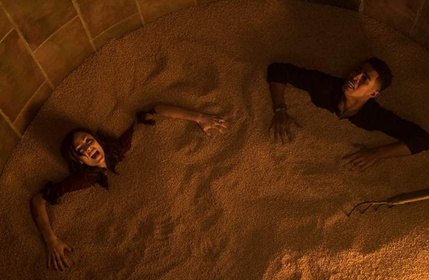
One of Saw’s biggest selling points is its use of “torture porn” traps that force victims to endure unimaginable pain in order to survive Jigsaw’s games. Unlike some of the later Saw traps, Jigsaw’s traps are some of the more grounded. The most technically unbelievable ones are at the beginning of the game, with the five victims chained up to a massively complex series of winches and gears; later, Ryan finds his leg caught in a constantly-tightening wire trap while Anna and Mitch (Mandela Van Peebles) are being buried by grain and farmyard tools rain down on them. The traps are interesting and cringe-worthy in their own way but hardly the most horrific or disgusting from the series; Anna is, for a change, surprisingly smart, level-headed, and logical about most of the traps and encourages the others to follow Jigsaw’s rules, allowing the majority of the victims to survive the first three trials. The second of Saw’s selling points is the now-cliché twist ending; Saw (Wan, 2004) had one of the most iconic and unexpected twist endings of all time and, honestly, none of the films that have followed have really come close to topping or even matching that twist. Jigsaw is no exception; there are three twists here, all of which have been done in previous Saw movies (Jigsaw’s game had already been played to completion in Saw II (Bousman, 2005), Mark Hoffman (Costas Mandylor) faked being a victim only to reveal himself as Jigsaw’s apprentice in Saw IV (ibid, 2007), and he, and Amanda Young (Shawnee Smith), both posed as Jigsaw in Saw III (ibid, 2006), Saw V (Hackl, 2008), Saw VI (Greutert, 2009), and Saw 3D).

JigsawShotgun
The final twist wasn’t too difficult to see coming.

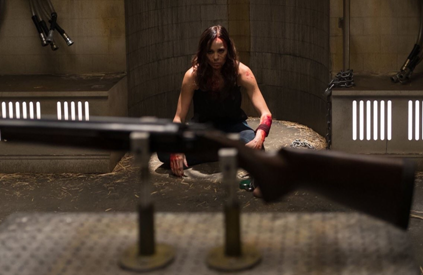
The revelation that John Kramer is not actually alive shouldn’t really be that much of a surprise as, unless he comes back as a zombie (which would be super out of place given the generally grounded nature of the franchise), but it’s always great to see Tobin Bell onscreen. Honestly, though, I felt like Jigsaw could have done without him being in it; given that Logan used audio samples to imitate Kramer’s voice, I think it would’ve sufficed to simply have Bell return as the voice of Jigsaw (or whoever is imitating Jigsaw) rather than be shoe-horned in in increasingly difficult to piece together flashbacks. In this case, given that we’ve already seen in great detail how Amanda and Hoffman aided Kramer in the past, it’s a bit jarring to suddenly wedge a new apprentice into the mix. For a guy dying of cancer, John sure fit a lot of tutelage and elaborate planning and trap-making into his last few years.

JigsawLasers
The lasers really took me out of it, to be honest.

In the end, despite an interesting premise, the thrill of seeing a new Saw movie, another great performance by Tobin Bell, and my newest crush, Hannah Emily Anderson, Jigsaw fell a bit flat for me. I felt it was too safe, feeling very much in the vein of Saw VI rather than taking some risks or returning to the simple premise of the first movie. As a way of kicking off a new series of Saw movies, this is pretty disappointing; I would much rather have spent more time with the victims than running around with the detectives/forensics guys dumping exposition about the previous movies. Also, it seemed like it would have made more sense for Eleanor to be the true inheritor of John’s legacy, the idea that Logan’s victims would all die in the same way of those in Jigsaw’s original game was a bit far-fetched (even for this franchise) and, overall, while I enjoyed it, it didn’t surpass my favourite film in the franchise (Saw II) and ended up feeling more like an entry that would be more at home between Saw V and Saw VI than a true return to form for the franchise.

My Rating:

Rating: 2 out of 5.

Could Be Better


Recommended: For Saw fans who have been clamouring for a new film, yes. Newcomers might want to brush up on their Saw experience first, general audiences? Probably not; watch the first film instead.
Best moment: Normally, I’d say the traps/kills but they were honestly a bit lacklustre here. I guess it’d have to be the part where Ryan’s must pull a lever to sever his leg below the knee to free Anna and Mitch from being buried alive.
Worst moment: Mitch’s death, hands down. Considering Eleanor hyped up the trap he was caught in so much it ended up falling very flat; and it was powered by a motorcycle? Seemed a bit over the top, even by Saw’s standards.

Talking Movies: A Nightmare on Elm Street (1984)

Talking Movies
NightmareLogo

Prepare to feel old because it’s been over thirty years since Wes Craven’s seminal horror masterpiece, A Nightmare on Elm Street, first came to cinema screens in 1984. Considering that today is Halloween and star and horror icon Robert Englund recently declared that he is now too old to don the fedora and razor-fingered glove of the demonic Freddy Krueger, I figured it was good a time as any to revisit and review what is still, for me, one of the most terrifying horror movies of all time.

NightmareCast
Fans of Johnny Depp may be disturbed at his fate in this film!

A Nightmare on Elm Street takes place on the titular street in a town called Springwood and revolves around four friends, Nancy Thompson (Heather Langenkamp), Tina Gray (Amanda Wyss), Rod Lane (Nick Corri), and Glen Lantz (Johnny Depp in his first feature-film role), who find their dreams haunted by a malevolent ghoul. After Tina is gruesomely murdered in her sleep, Rod becomes the prime suspect and Nancy’s father, police lieutenant Don Thompson (veteran actor John Saxon), stops at noting to place Rod behind bars. However, Nancy comes to believe that the true killer is the ghastly figure that continues to haunt her dreams, Freddy Krueger, and begins to dig deeper into his existence.

NightmareDreams
Maybe you’ll think twice before taking a nap!

After Rod is hung in his jail cell and Nancy describes who she believes is the real killer, her alcoholic mother, Marge Thompson (Ronee Blakley) takes her to a sleep clinic, believing that her daughter is suffering from shock and sleep deprivation. At the clinic, Nancy convulses wildly from an unseen nightmare and, upon awakening, sports four claw marks on her wrist and is suddenly in possession of the dirty, battered fedora worn by Freddy. Armed with this object, the name of her attacker, and driven to the brink of exhaustion from her nightmares, Nancy confronts her mother and learns that Freddy was a malicious and sadistic child murder (and, it is heavily implied, child molester) who was hunted down and burned alive by the parents of those he killed (including Nancy’s mother and father) after the justice system failed to lock him away.

NightmareGlen
Freddy is not exactly renowned for his subtlety.

Lack of sleep means Freddy haunts her waking life as much as her dreams and, despite her protests, Glen fails to heed her warnings and is summarily killed in horrific fashion. After realising that, if she can grab Freddy in her nightmare and be woken up, she can bring her attacker into the real world and bring him to justice, Nancy prepares herself for a final showdown by setting up booby-traps around her house and, after encountering Freddy and despite initially believing that she had actually gone crazy from sleep deprivation, the plan works.

NightmareFinale
Fuelled by fear, Freddy’s power is negated when Nancy denies his existence.

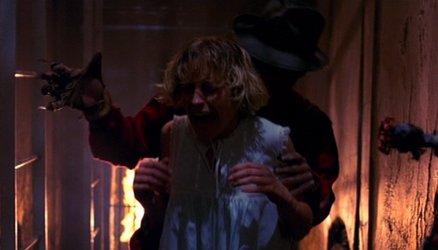
After running Nancy’s gauntlet, Freddy is set on fire and apparently kills Nancy’s mother. When her father rushes in too late to be of any use, Nancy comes to a startling realisation: that everything she is experiencing is just a dream. Freddy rises and prepares to strike her, only for Nancy to deny his existence and renounce her fear of him; her conviction rings true and Freddy is reduced to nothingness. Nancy steps out into an overly bright morning, her vitality restored along with her now-sober mother and her friends. However, as she leaves with her friends, the car suddenly drives off of its own accord and her mother is violently dragged through the window of their front door by Freddy’s clawed hand, leaving the ending ambiguous.

NightmareClaws
Seriously, the sound of those claws still ends a shiver up my spine!

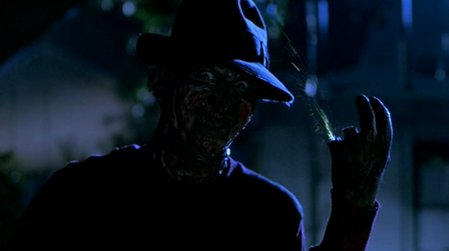
A Nightmare on Elm Street’s premise may sound simple but it actually significantly impacted the slasher genre of horror films in many ways. Prior to Nightmare, slasher movies typically revolved around a mute masked killer wielding a knife or similar blade, stalking teenagers and with a mysterious backstory. Director Wes Craven changes this with the introduction of perhaps the greatest horror character ever conceived. Krueger returned as a demonic revenant, an unstoppable spirit who haunted the dreams of his victims to enact his revenge, garbed in a disturbing red-and-green jumper, his face burned beyond recognition, and primarily attacking with a custom-made glove that sports four razor-sharp knives.

NightmareHumour
No two ways about it, Freddy is fucked up!

What set Freddy apart from other slasher villains was his immense power and his sinister wit; within the dank, hellish nightmares, Freddy is all-powerful, capable of appearing and disappearing at will, shaping the dream world to his whims, and affecting the real world when enacting his kills all while sniggering or taunting his victims. While later sequels placed more emphasis on Freddy as a dark comedic figure, in the first Nightmare, his humour is menacing and disturbing, used solely to inspire fear and dread into his victims.

NightmareGirls
These three are to blame for everything!

Over the years, many have speculated on the themes and meanings behind the film, with Freddy being seen as an allegory for Nancy’s inability to cope with both her mother’s alcoholism and the break up between her parents. The ending, in particular, has sparked numerous debates as many have speculated as to whether the entire film was a dream all along or just the last twenty minutes or so. Considering that this ending is alluded to in the next two sequels, and that Nancy specifically says that Freddy killed her friends in A Nightmare on Elm Street 3: The Dream Warriors (Russell, 1987), I always saw it as being a somewhat clumsily executed attempt to show that Freddy has not been vanquished to give the audience one last scare, that the events of the movie did indeed take place, and that Nancy’s actions only weakened Freddy. Indeed, Freddy is so weakened from this encounter that he has to resort to human possession in A Nightmare on Elm Street 2: Freddy’s Revenge (Sholder, 1985) though, perhaps, that is a review for another day.

NightmareWalls
Take note, Samuel Bayer, sometimes the old ways are the best ways.

As a child, I was never one for horror movies; I was particularly vulnerable, with an overactive imagination, and horror films were a bit too much for me. Nevertheless, A Nightmare on Elm Street and its first two sequels made its way into my life and truly terrified me. Jason Voorhees, Michael Myers, and Pinhead were scary, sure, but there are easy ways to avoid encountering these slasher icons; simply don’t go to Crystal Lake and be a dick, don’t live in Haddonfield, and don’t open the Lament Configuration and you’re good. But with Freddy, it’s enough to know his name or fear his reputation to give him the strength he needs to invade your nightmares, where you’re most vulnerable. Although the protagonists of Nightmare were ignorant to Freddy’s existence, the “one, two, Freddy’s coming for you” nursery rhyme maintains the Krueger legend enough for Freddy to get a foothold in his victims’ subconscious and enact his grisly revenge.

NightmareTina
Honestly, this film ruined my childhood and my dreams for decades!

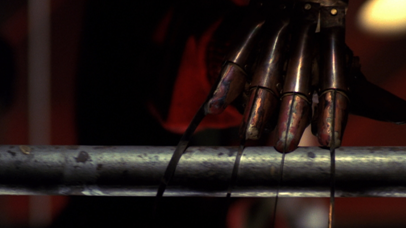
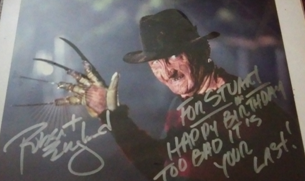
Even now, I have a hard time watching A Nightmare on Elm Street. Everything from the premise, the sound of Freddy’s perverted sniggering or his claws scraping on metal, to the appearance of the character (constantly hidden in shadows makes Freddy’s gruesome visage all the more terrifying) and the haunting, literally nightmarish soundtrack sends shivers down my spine. Even now, decades later, fully aware of the production behind the film and having view the watered down sequels, Nightmare exhibits a raw, unmatched horror and it was my great pleasure to meet Robert Englund in Milton Keynes just before my twentieth birthday, shake his hand, and tell him that he had been scaring the crap out of me for the last ten years.

NightmareEnglund
A cathartic moment that failed to make Freddy any less scary.

My Rating:

Rating: 5 out of 5.

Fantastic

Recommended: Absolutely, especially for horror fans, those looking to get into horror, or those who are jaded by today’s lacklustre horror efforts.
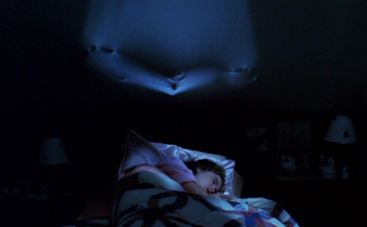
Best moment: Freddy’s first kill is a dramatic and truly terrifying affair, with Tina being dragged up the walls and across the ceiling of her bedroom while Freddy slashes and cuts her to ribbons.
Worst moment: The vague ending, from the moment the burning Freddy smothers Nancy’s mother to the credit roll, is perhaps too abstract a conclusion for this already abstract horror film.

Talking Movies: Thor: Ragnarok

Talking Movies
ThorRagnarok

Not content with redefining the superhero genre of movies, the latest effort from Marvel Studios has also redefined the word “psychedelic”. Apparently, the last solo effort to feature everyone’s favourite, muscle-bound God of Thunder (Chris Hemsworth), Thor: The Dark World (Taylor, 2013), did not meet the expectations of many fans and critics out there; it’s easily among the top three less-than-stellar offerings from the Marvel Cinematic Universe (though, personally, I enjoyed it quite a lot). So, in an effort to rectify this, continue the expansion of their cinematic universe, and finally allow the Hulk (Mark Ruffalo) some time to shine, director Taika Waititi has stepped in to infuse the hammer-wielding hero with some of the same outlandish humour seen in the Guardians of the Galaxy (Gunn, 2014; 2017) film series but does it work? Thor: Ragnarok begins with the titular hero bound in chains in the hellish Muspelheim as a prison of the devil-like Surtur (Clancy Brown); through a humorous voice-over, we quickly learn the Thor’s search for the legendary Infinity Stones has turned up nothing and he has stumbled upon evidence to prove that Ragnarök, the twilight of the Gods, is looming on the horizon. As Ragnarök is prophesied to be caused by Surtur placing his crown into the Eternal Flame, Thor defeats the demon and claims his crown. Upon returning to Asgard, he quickly sees through the tricky of his brother, Loki (Tom Hiddleston), easily deducing that the God of Mischief has been posing as their father, Odin (Anthony Hopkins).

ThorHela
Sadly, Hela’s potential never stretches beyond this display of power.

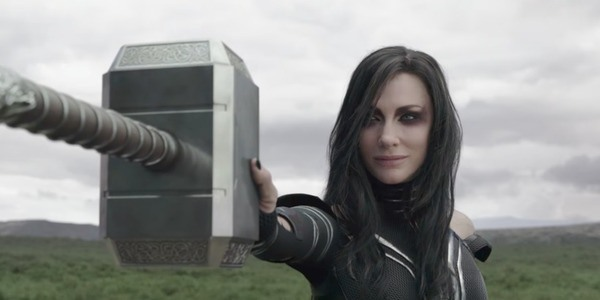
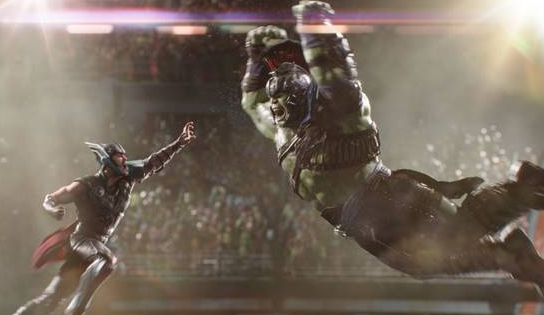
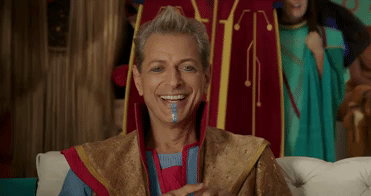
Less than impressed, Thor forces Loki to take him to Odin’s location; however, they are immediately intercepted by Doctor Stephen Strange (Benedict Cumberbatch) who, somewhat needlessly, ushers them along to Norway, where Odin has found himself. On the verge of death, Odin tells his sons that his passing will release his first-born child, Hela (Cate Blanchett), the Goddess of Death, who desires to end all Asgardian life and bring destruction to the Nine Realms. Upon vanishing into a puff of golden sparks, this immediately comes to pass and, when Thor attempts to stop Hela, she easily catches and destroys his magical hammer, Mjolnir. Fearful of his half-sister’s great power, Loki commands the Bifröst to transport them back to Asgard; however, Hela follows and casts her younger siblings into the void of space. Upon her arrival in Asgard, she kills Volstagg (Ray Stevenson) and Fandral (Zachary Levi) within the blink of an eye and recruits Scurge (Karl Urban) as her executioner. Deposited upon the planet Sakaar, Thor is captured – his power subdued by an obedience disk – by Valkyrie (Tessa Thompson) and becomes a prisoner of the enigmatic Grandmaster (Jeff Goldblum). Loki is also there, having landed weeks earlier due to a time-dilation effect and, being in favour with the Grandmaster, is content to remain, leaving Thor to challenge the Grandmaster’s champion in the arena to win his freedom. Just when all hope seems lost, Thor is confronted by the champion, who turns out to be the Incredible Hulk. Revelling in his fame and glory, the now-sentient Hulk battles Thor mercilessly. However, Thor summons the powers of lightning to turn the tide and is summarily subdued by the Grandmaster.

ThorHulk
The battle between Thor and Hulk is easily the best part of the film.

In Hulk’s bed chambers, Thor converses with his fellow Avenger, who is less than enthusiastic about helping Thor as he was hated and feared on Earth, even by his team mates. Thor persists, even managing to convince Valkyrie to help him escape and save Asgard but, after activating the Quinjet that brought Hulk to Sakaar, Thor loses his primary means of transportation when the Hulk destroys the ship during his manic reversion back into Bruce Banner. Banner, in a state of shock as he has been trapped within the Hulk for two years, fears for the loss of his identity should he transform again, yet still teams up with Thor, Valkyrie, and Loki to steal the Grandmaster’s luxury spaceship, return to Asgard, and prevent Hela from bringing ruin to the Nine Realms.

In case it isn’t clear from the trailers or television spots, Thor: Ragnarok is an action comedy with a heavy emphasis on the comedy. Thor, whose humour was always present and based in a dry wit, quips one-liners and glib remarks throughout the film, even in the face of annihilation at the hands of Hela. However, the humour works very well; the chemistry between Hemsworth and Hiddleston is as potent as ever and both react, and act, perfectly with the Hulk. Speaking of the Hulk, the Green Goliath finally gets a chance to show a personality; having been transformed for so long has made the Hulk capable of intelligent, if child-like, speech and able to comprehend what is happening around him. There is a clear difference between the Hulk, who is always angry and craving a fight, and Banner; Banner’s previous tenuous control over the Hulk is apparently now lost and he faces a very real fear of being consumed by the Hulk (although this is never developed beyond a short exchange with Thor).

After a strong but, undoubtedly disappointing, showing from Malekith (Christopher Eccleston), there was quite a lot of anticipation surrounding Hela. Like Ultron (James Spader), Hela has a powerful presence and a snappy wit, with clear and concise motivations: she seeks to rule the Nine Realms through anarchy and death rather than the peace and prosperity her father once sought. However, although she is easily Thor’s most powerful foe, she still succumbs to the same issues that plague many of Marvel’s villains: procrastination. The film, honestly, spends too much time on Sakaar and not enough time with Hela who, upon reaching Asgard, kills a bunch of people, stands around gloating, and is then unable to enact her plan simply because Heimdall (Idris Elba) stole the sword that activates the Bifröst. This is quite the problem as she literally storms into Asgard, leaves some bodies in her wake, awakens an undead army and her steed, Fenris Wolf, and then stands around doing nothing until Thor and his team (the “Revengers”) finally return to take her on.

ThorGrandmaster
The brilliance of Jeff Goldblum continues to astound.

Logically you would think that it would be the Grandmaster who acts as the secondary antagonist; however, you would be largely mistaken. Although Goldblum, who was clearly given free reign to ad-lib and bring as much of his awesome quirks to the character, steals every scene he is in, he isn’t even an obstacle in Thor’s path beyond making him fight the Hulk. Indeed, Thor stages an uprising (lead by Korg (Taika Waititi, whose soft-spoken take on the character was a surprise, to say the least) simply to distract the Grandmaster’s pitiful forces long enough for him to steal his ship and escape. The film appears to be treating Ragnarök as its primary threat; however, the humour laced throughout is so prominent that this apocalyptic event isn’t really treated with the weight or gravitas that you might expect, meaning that Thor’s realisation that he must revive Surtur to cause Ragnarök as the only means of defeating Hela is given barely any significance (Korg even cracks jokes during what should be the sombre and gut-wrenching destruction of Asgard).

Valkyrie is a welcome addition to the franchise; having faced Hela centuries ago and watched all of her fellow female warriors perish, she has become a bitter recluse, resigned to being an alcoholic bounty hunter. Thor gives her a chance at redemption and she takes it gladly, taking up arms once more to help rescue the Asgardians from extinction. However, her inclusion comes at a price; in a throwaway line, Thor reveals that he and Jane Foster (Natalie Portman) have broken up, and (perhaps more criminally) Lady Sif (Jaimie Alexander) is noticeably and inexplicable absent, with no mention of her in any way, and the Warriors Three (Thor’s brothers-in-arms) are unceremoniously killed off presumably to appease Idris Elba with a more significant role for Heimdall, who basically becomes Thor’s right-hand man by the film’s end.

Yet, Thor: Ragnarok is a stunning film to watch; Sakaar is a dystopian cyber-punk dreamland, filled with the decrepit, lived-in quality of the cities and peoples seen in the Guardians of the Galaxy movies. It is clear that the film is meant firmly entrench Thor in the wild, wacky cosmic side of the Marvel Cinematic Universe and the eighties-inspired soundtrack and visuals really help to hammer that point home (no pun intended). In addition, the humour is truly entertaining and the action is intense and thrilling; the battle between Hulk and Thor is fantastic to watch and the sheer scope of the movie is quite impressive given that it mainly jumps back and forth between Sakaar and Asgard. Additionally, as he is devoid of Mjolnir, Thor showcases his command of lightning to great effect in this film; he truly becomes the God of Thunder, summoning lighting bolts, surrounding himself with a shield of lightning, and powering himself up to the point where is is all-but untouchable. In the end, though, I actually expected more. I was expecting a threat such as the Goddess of Death to be treated with a bit more severity; her campaign never really gets a chance to begin before she is stopped in her tracks and the true impact of her actions or threat is never really felt meaning that, in the end, she is as ineffectual a villain as Malekith was because neither got to showcase their incredible potential due to the many other plot threads at work in the film.

ThorStrange
Sadly, this cameo didn’t really add a lot to the film.

Hulk, despite given much more characterisation than ever before, actually quickly fades into the background by the third act and the interesting idea that Banner and the Hulk are finally two separate entities within the same body is never truly explored. Most notably, Thor: Ragnarok goes out of its way to quickly tie up the loose ends from Thor: The Dark World with a very simple and disappointing payoff; when The Dark World ended with Loki impersonating Odin on the throne of Asgard, it posed so many questions and raised expectations of an epic battle to reclaim the throne. Instead, Thor simply reveals the deception and finds Odin maybe ten minutes later. It would have been faster if not for the unnecessary cameo by Doctor Strange; literally, Strange’s inclusion offers nothing of value (Loki could have taken Thor straight to Norway and skipped the entire New York sequence completely) except, I guess, to establish (or re-establish) that Strange acts as the mystic guardian of Earth but we already knew this from Doctor Strange (Derrickson, 2016). I’m all for cameos and inclusions of other Marvel characters but they’ve got to add something to the film and I really don’t think it did in this instance. I think those who disliked Thor: The Dark World will see this film as a redemption as it is, undoubtedly, a better movie and probably the strongest of the Thor films as Hemsworth and Hiddleston truly embody their characters and the interactions between them and their fellow cast of characters was great to see. However, I can’t help but think a film about the literally death of Gods should have some more gravitas to it and be more epic in its scope and execution; instead, this is an action comedy primarily focused on integrating Thor into the cosmic aspect of the Marvel Cinematic Universe and infusing the Hulk with some actual characterisation and, in these aspects, it succeeds spectacularly.

My Rating:

Rating: 3 out of 5.

Pretty Good

Recommended: Yes, though I’d have to voice a a bit of disappointment at the execution of the film’s primary plot.
Best moment: Hands down, the battle between Hulk and Thor in the arena, which delivered in every way possible.
Worst moment: Hela’s lacklustre effort as the primary villain and the execution of Ragnarök left a lot to be desired, effectively nullifying the significance of the final act of the film.

Game Corner: Johto is Still the Best Region in Pokémon

GameCorner
JohtoTitle

Make no mistake about it, when Pokémon Blue Version and Pokémon Red Version (Game Freak/Nintendo, 1996) were released in 1996, they didn’t just change the videogame industry; they redefined it completely. While other videogame franchises were extremely popular, Pokémon was an unparalleled phenomenon. Literally, when I was a kid, there was nothing like Pokémon; everyone was into it, everyone played it, everyone wanted more of it. I remember wanting to buy Pokémon Blue so badly that I actually bought it brand new for £5 more than the Red Version just so I could play the edition I wanted. Once we had completed the videogames and traded as much as we could, we extended our experience with the various glitches in the videogames by using the infamous Fly glitch to catch Missingno or .M, obtain a whole bunch of Master Balls, Rare Candies, and vitamins, and also to catch the elusive Mew. I remember playing my version of Pokémon Blue for well over 150 hours fighting the Elite Four over and over again and raise my team to Level 100 and to fully evolve every Pokémon. As we were playing the videogames, everyone was also deeply into the anime, religiously watching and following every episode, and even swapping and comparing their trading cards (though I never actually saw anybody battling with them).

Buy them all, buy them twice, buy all the merchandise!

With Pokémon such a huge hit among my generation, and my circle of friends, excitement reached fever pitch with the release of Pokémon the First Movie: Mewtwo Strikes Back (Yuyama, 1998) and when, during the anime, marketing, the film’s fun little short, Pikachu’s Vacation, and the movie itself, we all got our first glimpses of brand new Pokémon. At the time, these Pokémon were referred to as Pikablu and Buru/Snuffle; though they, and Togepi, would later turn out to be rather inconsequential Pokémon in the eventual sequels, they caused a wave of controversy and speculation in the playground. People would catch Missingno’s and rename them “Pikablu” just to trade them into other people’s videogame’s and glitch them out and wild theories ran rampant about how these Pokémon could be caught in Blue, Red, and Yellow Version: Special Pikachu Edition (Game Freak/Nintendo, 1998).

Anticipation was high for Gold and Silver.

Anticipation was so hot for the eventual release of Pokémon Gold Version and Pokémon Silver Version (ibid, 1999) that we rushed to download GameBoy emulators and Japanese ROMs of the videogames just to play them. We even saved them onto floppy disks (remember them!?) and brought them into school to play; it didn’t matter that we couldn’t read the Japanese text and had no idea what was going on, we just wanted the new Pokémon videogames that badly! You have to remember that, back then, the Internet was still really new; where I grew up and went to school, I had the most basic of dial-up connections and was never allowed online for more than a few minutes at a time, meaning that our entire stream of information about Gold and Silver was based on speculation, videogame magazines, and the anime. So when we saw more of these new Pokémon appear in Pokémon the Movie 2000: The Power of One (Yuyama, 1998) and in the anime, anticipation was at an all-time high! In the end, I got a copy of Pokémon Silver from my best friend, who gave me a French copy of the videogame that was, as a European cartridge, in English and fully compatible with UK consoles and, let me tell you, the hype was entirely worthwhile.

Graphical improvements and a striking new rival added to the games’ appeal.

The improvements in the new videogames were immediate; being on the GameBoy Color, the bold, cartoonish graphics were no longer hindered by the GameBoy’s always-primitive colour palette. In addition, the music and sound effects, already one of the most recognisable and enjoyable aspects of Pokémon, had improved dramatically. Having picked Squirtle in Pokémon Blue, I decided to shake things up and choose the fire-type Pokémon, Cyndaquil, for my new adventure in the Johto region (as a general rule, I stay away from grass-types as I feel they have far too many weaknesses and are ineffective as offensive Pokémon). Unlike Blue and Red, your rival is not a fellow Pokémon trainer but, instead, a young boy accused of stealing one of Professor Elm’s starter Pokémon. After your first encounter with him, you’re given the option of naming him for the police, and run into him at various points throughout the videogame. Unlike the rival from Blue and Red, though, this aspect is not as prominent as it originally was; instead, the narrative emphasis is split across numerous objectives: in addition to bringing your rival to justice, you must also catch all the Pokémon and complete the Pokédex, stop the return of Team Rocket, defeat all of the Gym Leaders and the Elite Four to become the Pokémon Champion, capture the roaming legendary beasts Entei, Raikou, and Suicune, investigate the Ruins of Alph, and capture the legendary Ho-oh and Lugia.

Gold and Silver introduced a lot of new elements.

Gameplay-wise, Gold and Silver remained relatively unchanged; alongside super-rare shiny Pokémon, two new Pokémon types were introduced, Steel and Dark, and the Special stat was split into Special Defence and Special Attack (these last three effectively gave players a better chance of combating the previously over-powered Mewtwo). One of the greatest additions to the series ever was a little bar underneath the HP meter that filled up after each battle, allowing you to visually see how many Experience Points your Pokémon had and how close they were to levelling-up; in addition, players were given a Pokégear, which acted as a map, telephone (allowing you to have rematches with trainers you’d previously beaten), and a radio (used for gameplay tips, to awaken sleeping Pokémon, and to pick up transmissions from the Ruins of Alph).

The Pokémon world was expanded through breeding and two regions for the price of one!

Other new features included a day and night system (which would not return until 2006), letting your mother save money for you (which would result in her buying you cool toys for your room), the ability to have your Pokémon hold items (including Berries) that could improve their speed, offensive or defensive capabilities, heal or cure status ailments, or to help them evolve, brand new PokéBalls that were more effective at catching specific Pokémon types, and perhaps the most significant gameplay feature: egg hatching. Up to two Pokémon could be left at a Day Care Center which, if the Pokémon are compatible (or if one is a Ditto), will result in the player receiving an Egg. After walking around with the Egg for varying amounts of time, the Egg would hatch, producing either a brand new Pokémon or a Pokémon that knows a move it normally wouln’t. Egg breeding, for some dedicated players, became as instrumental as EV training to crafting the best Pokémon possible; personally, I just used it to fill up the Pokédex with the brand-new Baby Pokémon like Pichu. What really made Johto stand out from Kanto, though, was the sheer size and variety the region allowed; not only could you walk, cycle, surf, and fly around the region, you could also travel up and down waterfalls and through whirlpools to reach new areas and legendary Pokémon. Best of all, and unlike any other region ever, defeating the Johto Elite Four awarded players with the S. S. Ticket which allows them to board the S. S. Aqua and travel back to Kanto! This basically means that you get to revisit every area from Pokémon Blue and Red (excluding the Cerulean Cave) and rebattle not only all of the Kanto Gym Leaders (some of whom are new, including the previous videogame’s rival, and with new Pokémon) but also the Kanto Elite Four!

In addition to some returning faces, your gender was no longer limited to a boy.

Make no mistake about it, this is still the greatest post-game feature in any Pokémon videogame. I don’t give a damn about the Battle Frontier or any of that noise and, while hunting down legendary Pokémon is fun and rewarding, nothing beats going back to the previous videogame’s region and, effectively, doubling the length of the videogame. The Pokémon in Kanto are a higher level than before, offering a greater challenge to your now-stronger team, and you can even acquire a Pass to take a train back and forth between the two regions. As no Pokémon videogame since has been as big as Gold and Silver, this, coupled with Pokémon being at the peak of its popularity among my generation at the time, means that Johto is, and will forever be, the greatest region ever seen in all of the franchise. Not only can you battle with a friend using the Link Cable and then battle that friend again whenever you wish by visiting Viridian City, not only can you travel back to Kanto and rebattle all the old Gym Leaders and Elite Four, but, once you have completed this, you gain access to Mt. Silver where, after traversing a difficult mountain cave filled with high-level Pokémon and utilising a whole bunch of HMs, you reach the top of the mountain and are challenged by Red, the player character from Blue and Red in what remains one of the toughest Pokémon battles ever! Finally, there was Pokémon Crystal Version (Game Freak/Nintendo, 2000), a third version of the videogame that, like Pokémon Yellow, expanded and improved upon the Gold and Silver experience. For the first time ever, players could now choose to play as a girl, Pokémon sprites had limited frames of animation to bring them to life, the first of the Battle Towers was included, and the videogame featured a brand-new side-plot involving Suicune and the Unown. Given that it contained the best of both versions, and more, Crystal was probably the preferred title to pick up at the time though, for me, its release coincided with a noticeable drop in popularity for the franchise that would not be rekindled for some time.

Updated for a whole new generation, and brought to life in Pokémon Adventures.

In 2009, Game Freak and Nintendo released upgraded and enhanced versions of Gold and Silver for the Nintendo DS; Pokémon HeartGold Version and SoulSilver Version brought Johto up to date with the graphical improvements made to the series since the release of Pokémon Diamond Version, Pearl Version, and Platinum Version (ibid, 2006; 2008) while also reintroducing gameplay mechanics not seen since Pokémon Yellow. While Pokémon titles between Pokémon Crystal and HeartGold and SoulSilver were fun, they paled in comparison to the experience offered by Gold and Silver; because of that, having these videogames updated and enhanced on the Nintendo DS was like downing a glass of sweet-tasting nostalgia and finally allowed me to re-capture that same level of excitement that can only be experienced through the eyes of a child. With 251 Pokémon to capture, Gold and Silver’s Pokédex was nowhere near as impossible to complete as today’s 800-plus. Though the mystery surrounding Celebi never came close to that of Mew, and there was never quite the same amount of rampant rumours or glitches in Gold and Silver as in the previous videogames, Johto’s scope, coupled with the numerous new features that only enhanced the gameplay of Blue and Red, made Gold and Silver far superior to their predecessors in every way. While characters like Red and Blue have been semi-recurring throughout the franchise, Gold/Ethan, Silver, and Kris/Lyra have been cruelly overlooked and under-featured in everything but the long-running Pokémon Adventures manga.

Lightning in a bottle.

Many of the innovative gameplay mechanics introduced in Gold, Silver, and Crystal carried over into later Pokémon titles; shiny Pokémon and egg breeding (and hatching) became recurring themes, hold items gained more prominence, interactivity between the player and non-player characters was increased through various Key Items, Battle Towers were expanded and made increasingly challenging, Pokéballs increased in their variety, and roaming Pokémon became commonplace. However, with each new iteration and expansion, Pokémon always seemed to be striving to recapture the magic of the Johto era. Admittedly, and obviously, a lot of this is due to nostalgia but, for me, Pokémon would never be as popular or as exciting as when Gold and Silver were released and, to this day, I would always choose to revisit Johto above any other Pokémon region, new or old.

Game Corner: THQ/AKI Wrestling Retrospective

GameCorner
THQAKITitle

With WWE 2K18 (Yuke’s/Visual Concepts/2K Sports, 2017) due to be released in a couple of weeks, I thought I’d take the time to revisit some classic wrestling titles on everyone’s favourite polygonal home console, the Nintendo 64. Inevitably, with every new WWE videogame released, debates reignite, resurface, and rage on about why (oh, why, just…why?) can we not get a new videogame in the style of WWF No Mercy (Asmik Ace Entertainment/AKI Corporation/THQ, 2000)? Granted, these debates usually occur on extremely adolescent and unruly forums, such as those on GameFAQs, but there is, nevertheless, a good reason for this. Well, actually, there’s two: nostalgia and the fact that AKI and THQ produced some simplistic and yet incredibly deep and addictive wrestling videogames back in the day. The partnership between Asmik Ace Entertainment and the AKI Corporation began way back in 1996, with Virtual Pro-Wrestling on Sony’s PlayStation, which was later published in North America by THQ as WCW vs. The World in 1997. Following this, AKI and THQ’s wrestling titles would be exclusive to the Nintendo 64 for the foreseeable future and the first instance of this collaboration came with the Japan-exclusive Nintendo 64 title Virtual Pro 64.

THQAKIVirtualPro
Virtual Pro-Wrestling was the precursor to greatness.

I’m not going to delve too deep into the Virtual Pro series as I never played these videogames; instead, with my young mind only grasping the simplest concepts of the pro wrestling world, my first exposure to the series came with the release of WCW vs. nWo: World Tour (Asmik Ace Entertainment/AKI Corporation/THQ, 1997). When I was a kid, this was the wrestling videogame everyone had and everyone played, to the point where I vividly remember finally getting a copy and playing it all through the night during a sleepover with some friends of mine and driving them to near boredom as I worked to unlock and complete everything as they had done weeks and months before. WCW vs. nWo: World Tour’s roster is split into various factions including the titular WCW and nWo but also some fictional wrestling promotions featuring renamed Japanese wrestlers to dance around tricky copyright issues. Each wrestler has four different attires, allowing you to play as Sting in his surfer persona and Hollywood Hogan in the good old fashioned red and yellow. An interesting twist of irony here is that, these days, people will lose their shit about 2K including five separate versions of Sting, yet players of World Tour should be more than used to this given that you can play as Sting and the imposter Sting recruited by the nWo back in the day.

THQAKIStings
TWO Stings!? Blasphemy!!

World Tour introduced many of the gameplay mechanics that would become staples of this videogame series over the coming years; up to four players can play at once in a variety of matches, though only a single player can take on the league challenge to win championship belts and unlock hidden wrestlers. The core gameplay is built around a simple and yet intricately challenging grapple, strike, and reversal system: players perform a light grapple by tapping the A button and a strong grapple by holding the same button. Pressing a direction on the D-pad in conjunction with either the A or B button will see their wrestler perform one of ten different grappling moves, while light or strong presses of the B button alone (or A and B together) will strike the opponent with a kick or a punch. Players can block incoming strikes with the R trigger and counter grapples with the L trigger. Players can also perform submission holds on a downed opponent, dash at their opponents to land running attacks or dodge around them, drag their prone opponent’s body around the ring, climb the corner turnbuckles, exit the ring and grab weapons from the crowd, or taunt by wiggling the analogue stick. Taunting, and successfully countering and landing moves, raises your wrestler’s Spirit meter; once it is full and flashes “SPECIAL!”, players can perform a strong grapple and wiggle the analogue stick to perform their wrestler’s finishing move and attempt a pin fall.

THQAKIPowerbomb
Nearly every wrestler has a Powerbomb as a Special move.

And good luck with that; World Tour has a steep difficulty curve, even on the easier settings, that can make some matches last nearly ten minutes at a time as you trade counters and moves with your opponent, constantly egged on by the rising and falling cheers and jeers of the crowd and the thumping bass of the in-game music. However, playing through each challenge and winning championships allows you to fight against, and unlock, a number of hidden characters to add to the already-substantial rosters (even Muhammad Ali shows up…as “Joe Bruiser”, whose entire moveset consists of punches!) Sporting a distinct cel-shaded appearance, WCW vs. nWo: World Tour is easily the simplest and least technically-impressive of the AKI/THQ wrestling videogames; there is no create-a-wrestler function (though you can alter the colours of the wrestlers’ attires) and very little options outside of the single and multi-player aspects. However, AKI/THQ took a significant step in the right direction with the subsequent release of WCW/nWo Revenge in 1998.

THQAKIValet
Some wrestlers came out with valets or managers.

Revenge took every aspect of its predecessor and improved upon it vastly; wrestlers now have individual entrances (sometimes including a valet or holding a weapon, though their individual theme music is unfortunately absent), there are more animations and variety for reversals, a cartoon referee appears onscreen to visualise pin falls and submission holds, an instant replay triggers whenever a wrestler hits their Special move or a signature attack, and arenas are modelled after those seen regularly on television and pay-per-view events. Players can now also steal their opponent’s taunt by rotating the analogue stick in a clockwise direction and a combo system, of sorts, allows certain wrestlers to string together strong striking attacks at the cost of some of their grapple moves. Wrestlers also enter the ring wearing their championship belt and sport more true-to-life finishers and signature manoeuvres thanks to the addition of multiple new animations and moves.

THQAKIEdit
Customisation has always been an option.

However, there were some drawbacks; losing the cel-shaded appearance, characters now appear far more polygonal than before. The difficulty curve remained relatively consistent, meaning that even a dominating performance from a player and the successful delivery of a Special move would not guarantee victory in the majority of matches. Instead, players had to earn their victory, wearing their opponent down with counters, strikes, and grapples in order to win a championship belt and, again, unlock hidden wrestlers. Create-a-wrestler was still absent but the editing options for existing wrestlers was greatly expanded, allowing players to play about with existing attires in interesting and fun ways. WCW/nWo Revenge was the last of AKI and THQ’s titles with the WCW license; from here on out, they would take their revolutionary videogame engine and ideas and apply them to the WWF brands. WWF WrestleMania 2000 (Asmik Ace Entertainment/AKI Corporation/THQ, 1999) was the first of these endeavours and, as before, AKI and THQ took everything that worked in their previous videogames and expanded and improved upon them further still.

THQAKIWrestlemaniaIntro
Just another chair shot for poor old Mick…

The improvements can be seen immediately; just as Revenge opened with a introduction sequence showcasing its roster and gameplay elements, WrestleMania 2000 begins by showcasing the best of the best of the WWF’s acclaimed Attitude Era. Following this, players are taken to a comprehensive menu screen where they can elect to play a single or multi-man match with the title’s exhaustive roster; while the roster is still arranged in groups, they are no longer organised into factions and the roster is comprised entirely of those seen on a weekly basis back in 1999. Whereas AKI’s WCW titles featured a rather simplistic series of one-on-one matches in the pursuit of individual championships, WrestleMania 2000 includes a lengthy career mode called the Road to WrestleMania. Players select a wrestler and a tag team partner and play a series of matches through one year, facing lower-card wrestlers, taking part in tag team matches, and winning championships in the pursuit of the WrestleMania main event.

THQAKIWrestlemaniaCutscenes
After facing Foley’s personas numerous times, you’ll welcome this fight!

Winning multiple championships may mean that the player has multiple matches on one card and the better your progress, the more hidden wrestlers you will unlock; only a 100% success rate will reap the best rewards, which is a pretty tall order considering the mode’s difficulty spikes and drops depending on your success rate and the opponent you are facing. There will even be a few cutscenes in this mode where hidden wrestlers (usually one of the three faces of Foley) will challenge you to defend you championship.

THQAKICreate
WrestleMania 2000 introduced a proper create-a-wrestler mode.

Perhaps the most significant addition was the comprehensive create-a-wrestler mode, which also allowed players to freely customise their name, music, video, and appearance. Using the create-a-wrestler mode, however, players could piece together close approximations of wrestlers not included in the videogame, such as Kurt Angle or Tazz, in addition to those who hadn’t appeared in a WWF ring at the time, such as Diamond Dallas Page and Goldberg, or entirely original characters. Players could choose from an exhaustive list of moves, many of which are carried over from the previous titles, to pretty much create anyone they could envision.

THQAKIWrestlemaniaHBK
Only a 100% win streak will reap the best rewards.

In addition, players could create a custom championship belt to defend or entire pay-per-view events; wrestlers all have their own individual entrance themes and tag teams even came to the ring with their team name displayed. The only real downsides were the increased polygonal look of the videogame and the sharp difficulty spike in Road to WrestleMania mode, which could result in players struggling to put away the Godfather but dominating Chris Jericho within two minutes. Finally, the pièce de résistance, the crown jewel in the AKI/THQ partnership, WWF No Mercy. It’s strange to me that the follow-up to WrestleMania 2000 would take its name from a strictly B-level pay-per-view event but there was nothing B-level about this videogame. WWF No Mercy was the culmination of nearly six years of development, refining, and improvement, featuring the biggest and deepest roster yet, the most striking graphics available, the most intricate story mode of all of AKI’s wrestling titles, and the deepest create-a-wrestler you could ask for. There’s a good reason this videogame has been heralded as one of, if not the, best wrestling videogames ever made; more than nostalgia, it’s depth and replayability.

THQAKINoMercyChampionship
No Mercy believed in gender equality, if nothing else.

After the suitably over-the-top opening sequence, players could enter the Championship mode to compete in a series of matches and win a championship belt. Unlike WrestleMania 2000, players competed for each belt individually (or alongside a friend if they chose to go for the Tag Team Championships) and this mode featured multiple branching paths and cutscenes based on a variety of WWF storylines; for example, players could play through the entire WWF Championship storyline and fight against Triple H in exactly the same manner as Mankind did, even transforming into Cactus Jack for their street fight at Royal Rumble, or they may lose a match and branch off into a storyline mirroring Chris Jericho’s issues with Triple H from 2000. Once the player won a belt, they could play the mode again in order to defend it. With its multiple paths, no longer forcing players to win 100% of their matches, and far more manageable difficulty curve, No Mercy’s Championship mode was light years ahead of anything seen in AKI’s previous videogames and it’s a lot of fun to play differently each time to 100% each path.

THQAKINoMercyShop
Purchase new content in the SmackDown Mall.

New additions to the gameplay in this title included not only a graphical overhaul that makes wrestlers far lass polygonal but also the inclusion of running grapples, both from the front and behind, the return of blood (though early editions of the videogame would randomly wipe themselves due to some glitch involving the blood), guest referee and ladder matches, a breakable announce table at ringside, multiple backstage areas to fight in, a new version of the cage match to better display the in-ring action, the Survival mode (where players faced an endless Royal Rumble against every single wrestler in the title and in which you could unlock hidden wrestlers), and the SmackDown Mall. In the Mall, you could use the money you earn in Championship and Survival mode to unlock loads of extra content, from new moves and gear to use in create-a-wrestler to hidden characters and weapons.

THQAKINoMercyCAWs
You could create almost anyone in No Mercy.

Speaking of create-a-wrestler, this mode returned better than ever; the moves and attire options made available were more than extensive, allowing you to not only create WCW, ECW, and Japanese wresters not included but also modern day wrestlers to keep the videogame as up-to-date as you desire. The inclusion of wrestler faces (both as avatars and to use on your created wrestler) and certain attires also allowed you to create omitted wrestlers like Gangrel and the Mean Street Posse. Each attire slot could now be assigned entirely unique attributes, meaning you could use one slot to create four separate wrestlers and all that they are forced to share is a moveset. The developers even utilised this to put TAKA Michinoku and Funaki in the same slot, something 2K are seemingly reluctant to do in this day and age (despite proving they are capable of doing so in the past). There were, however, some drawbacks; wrestlers no longer had their entire entrances and tag teams no longer entered as a duo, multi-man matches suffered from slowdown that was not present in previous titles, there were no good mask options to create luchadors like Rey Mysterio, the Big Show was entirely absent from the videogame and (hilariously) replaced in Championship mode with Steven Richards (as opposed to, say, Chris Benoit or even the Big Bossman), and, as mentioned, early copies of the videogame featured a game-breaking glitch that would cause the data to be randomly lost.

THQAKINoMercySurvival
Still the best multi-player wrestling videogame, for my money.

This was a major downside to the videogame at the time, as many players had corrupted copies, and even reissued copies of the videogame would often be prone to this glitch. Unfortunately, WWF No Mercy was the last videogame produced by AKI and THQ; despite apparently planning a third title, WWF Backlash, THQ and AKI parted ways, meaning the WWF videogames would follow the model set by the equally-enjoyable WWF SmackDown! (Yuke’s/THQ, 2000) up until the modern era. Since then, the standard set by AKI has not even attempted to be emulated much less imitated by THQ in their subsequent titles. Moving away from the simple, but in-depth grappling system developed on the Nintendo 64, WWE videogames now seek to closely emulate the televised product through simulated gameplay rather than arcade-style action. Although, graphically, AKI’s titles have not aged terribly well, nothing can take away that rush of nostalgia when starting up a new session on WWF No Mercy; instantly, I am transported back to a simpler time when me and as many as three other friends would spend all day and night playing match after match and pushing the cartridge to its very limits. No WWE videogame since has received that kind of constant love and attention from me, as online gaming and the realities of everyday life intervene with the simple pleasure of gathering around a television and throwing Spears at each other endlessly with the very best polygons money can buy.

10 FTW: Surprisingly Good Horror Remakes

We’ve heard it all a thousand times by now: “when will Hollywood stop with the remakes!?”, “Why can’t Hollywood come up with new ideas!?”, “Remakes suxxorz1!!” Honestly, while some films should never be re-made and some remakes do baffle the mind, remakes aren’t the plague of cinema that a lot of people like to think they are. In fact, some are pretty damn good.

If you’re one of those bleeding heart Twitter people, though, who just like to decry remakes in general, maybe you should take a moment to consider this small list of horror remakes that are not only surprisingly good but, in some cases, actually surpass their originals:

Halloween
10 Halloween (Zombie, 2007)

We’re kicking things off with quite the controversial choice here. I’ll argue until the end of time that John Carpenter’s Halloween (Carpenter, 1978) is the forefather of all modern horror, particularly the slasher genre. It’s a subtle, atmospheric piece with a fantastic, mysterious antagonist and the truly frightening prospect that random unspeakable acts of horror can happen in a suburban environment. Rob Zombie’s take, however, is a loud, frenetic, uncomfortably gruesome take on the property. Michael Myers (Daeg Faerch/Tyler Mane) is an incredibly disturbed young boy from a violent and abusive family who becomes a remorseless, emotionless, unstoppable tank of a killing machine. Zombie delves right into his own take on Michael’s backstory, presenting in grotesque detail the exact events that turn Michael into a nigh-supernatural killer.

In many ways, the initial focus of the film acts as a kind of prequel to the events of Carpenter’s original, as the remainder of the film’s runtime is devoted to recreating Michael’s killing spree in Haddonfield, with the primary difference being that nearly the entirety of the film is told from Michael’s perspective. Sure, Malcolm McDowell, great as he is, cannot hope to compete with the fantastic Donald Pleasence but the film is bolstered by the incredibly cute Scout Taylor-Compton (who is arguably more attractive and relatable to modern audiences than Jamie Lee Curtis) and even appearances by Brad Dourif and Danielle Harris (and what an appearance hers is!) While it’s unlikely to be as iconic or influential as Carpenter’s benchmark film, for those who find the original and its sequels dated and slow, Rob Zombie’s remake is a much-needed kick up the ass that, for better or worse, dragged Halloween kicking and screaming out of obscurity.

Poltergeist
9 Poltergeist (Kenan, 2015)

I know, right? How could Hollywood ever even entertain the idea of remaking Tobe Hooper/Steven Spielberg’s 1982 horror classic? Well, they did, and don’t be mistaken; it’s not actually that bad. While it lacks probably my favourite scene from the original, where corpses rise from the Freeman’s unfinished swimming pool, the remake is just as terrifying and engaging as the original, with the added bonus of having a modern-day make-over that is far more accessible than the now-dated original. Don’t get me wrong, the original is still a classic, but Sam Rockwell and Kennedi Clements put in some great performances, easily on par with those of Craig T. Nelson and the late JoBeth Williams. Did Poltergeist necessarily need a remake? Probably not, and the fact that numerous haunted house stories since the original have all pulled from or mirrored Hooper’s seminal horror classic probably didn’t help to differentiate Kenan’s new take on the property, but I feel it’s a largely misrepresented film that is nowhere near as bad as some people think.

It
8 It (Muschietti, 2017)

Although I spoke about this film quite recently, it is deserving enough to make this list. Watching Tommy Lee Wallace’s 1990 miniseries, great as it is and as amazing as Tim Curry’s performance in that is, you can’t help but think that Stephen King’s novel deserved to be told without the restraints of a television miniseries. Focusing exclusively on the child side of King’s story, and bringing the events forward to the 1980s rather than the 1950s, Muschietti adheres closely to King’s text while still putting his own spin on events. Bill Skarsgård’s take on Pennywise is suitably unsettingly and otherworldly; what he lacks in Curry’s charisma he more than makes up for by being genuinely creepy and a fearsome menace. Muschietti also focuses on the friendship and troubles of his child protagonists incredibly well, anchoring them to the film’s central narrative and allowing King’s themes of childhood and loss of innocence to play out beautifully. With a lengthy runtime and concluding on a fantastic tease for a second chapter, this new version of It, while not without its issues (primarily regarding screen time for the many characters), did not disappoint in realising the gruesome potential that the miniseries could only hint at.

7 Dawn of the Dead (Snyder, 2004)

Released at the peak of Hollywood’s new-found fondness for zombie films in the early-to-mid-2000s, largely spearheaded by 28 Days Later (Boyle, 2002) and the God-awful Resident Evil (Anderson, 2002) and its decent-enough sequel, Resident Evil: Apocalypse (ibid, 2004), Zack Snyder’s remake of George A. Romero’s massively-influential 1978 film of the same name takes the general themes and premise of its source material and ramps them up with some incredible action, grotesque gore effects, and a much-needed modern day gloss. While zombie purists may lament the inclusion of the fast-moving, animalistic undead introduced in 28 Days Later, Snyder’s rapid editing and penchant for style over substance make the creatures more vicious and scary than in Romero’s original film. With some great supporting performances by the likes of Ving Rhames and Michael Kelly (and even a brief cameo by Ken Foree, repeating his iconic line from the original film), Snyder’s Dawn of the Dead is a non-stop masterpiece of zombie cinema that never slows down to the snail’s pace that Romero’s introspective original prefers to adopt.

Texas Chainsaw Massacre
6 The Texas Chainsaw Massacre (Nispel, 2003)

One of the primary reasons I was inspired to make this list, The Texas Chain Saw Massacre (Hooper, 1974) was a film that desperately needed this remake! Seriously, the original might have been shocking and gruesome at the time but, since then, it has not aged well; it’s a slow, dull piece of cinema that drags on way too long, with questionable acting and a lifeless soundtrack. The only redeeming quality comes from the maniacal Sawyer family, and even they are a hooting, loud bunch of camp. Produced by Michael Bay’s Platinum Dunes, which would go on to be responsible for a variety of horror remakes, The Texas Chainsaw Massacre is much better than it had any right to be. With an uncomfortable gradient, shocking soundtrack, and even some decent performances by Jessica Biel and Eric Balfour, Nispel’s remake downplays the cannibalistic nature of the franchise in favour of grotesque torture-porn levels of horror.
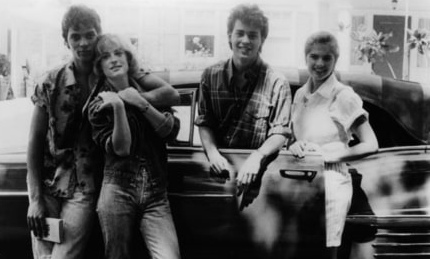
While the film reintroduces Leatherface (Andrew Bryniarski), one of horror’s most iconic figures, and even suggests a tragic backstory for the character, Nispel’s Chainsaw brought us one of the most despicable and significant horror icons in years in the form of Sherriff Hoyt (masterfully embodied by the great R. Lee Ermey). Hoyt, a tobacco-chewing, foul-mouthed sadist, drives the plot of this remake, raises its quality to another level, and his popularity was arguably responsible for the equally-enjoyable prequel, The Texas Chain saw Massacre: The Beginning (Liebesman, 2006). On a side note, though, am I the only one shocked that, including remakes and reimaginings, the Chainsaw franchise is made up of eight separate movies? Crazy!

The Blob
5 The Blob (Russell, 1988)

Now we’re getting somewhere! Irvin Yeaworth’s original 1958 film, starring Steve McQueen, was a campy piece of B-movie mush that has come to resemble a comedy more than a science-fiction piece. Channelling the likes of David Cronenberg and John Carpenter, Chuck Russell’s reimagining, however, takes the story of the bulbous alien lifeform to far more grotesque levels. Incorporating some incredibly disgusting practical effects, the population of a small town is literally dissolved by the titular amoeba. Although some of the composite shots are obviously dated by today’s standards, an entirely CGI rendition of the Blob would probably have aged incredibly poorly by now. Instead, The Blob retains a level of camp in its premise but, with its gruesome effects and no-nonsense attitude, is a great example of how effective and impactful practical effects can be.

Friday the 13th
4 Friday the 13th (Nispel, 2009)

We’re back with Marcus Nispel and Platinum Dunes for this masterfully well-crafted remake of not only the original 1980 classic but, also, the first three sequels. Similar to Halloween, for those who find the original movies to be dated and cut-and-pasted, by-the-numbers slasher films with very little to differentiate them from each other until Friday the 13th Part V: A New Beginning (Steinmann, 1985) then this is the film for you! In fact, I often encourage newcomers to watch this film and then jump straight to Jason Lives! Friday the 13th Part VI (McLoughlin, 1986); not because the continuity would tie together but, by doing that, you watch one kick-ass film with loads of gratuitous mid-2000s sex (which is far more graphic, enjoyable, and realistic than sex scenes from the 1980s) and horror imagery that sums up the first four entries of the franchise incredibly well and then you can delve into the enjoyable nonsense of zombie Jason Voorhees.

Beginning with the brutal decapitation of Mrs. Voorhees (Nana Visitor) and detailing how Jason (Caleb Guss/Derek Mears) witnessed her murder and grew up alone in the wooded forests of Camp Crystal Lake, as well as detailing Jason’s transformation from the lesser-known burlap sack look to the now-iconic hockey mask, Friday the 13th is filled with some incredibly gruesome kills as Jason uses bear traps, snares, and other tricks to entrap and kill hapless teenagers all over the shop. Add to that some strong performances by Danielle Panabaker, Aaron Yoo, and Jared Padalecki and you have an intense, non-stop horror film that, like Jason, comes at you a mile a minute. Honestly, the only bad thing I have to say about this film is that, despite making $92.7 million on a budget of $19 million, we never saw a sequel; even Rob Zombie’s Halloween got a shitty sequel!

The Thing
3 John Carpenter’s The Thing (Carpenter, 1982) and The Thing (Heijningen Jr, 2011)

Here’s some more controversy for you: I actually liked Matthijs van Heijningen Jr’s version of The Thing. It starred Mary Elizabeth Winstead, who I absolutely adore, and, while marketed as a remake, was actually, ingeniously, a prequel to John Carpenter’s 1982 horror/sci-fi classic. Based exclusively on a brief scene from Carpenter’s film, van Heijningen Jr’s The Thing details how a Norwegian research team unearth an extraterrestrial craft and unwittingly awaken a shape-changing, parasitic alien lifeform and concludes with the survivors attempting to hunt down and eliminate the creature’s final form, which leads directly into the beginning of Carpenter’s The Thing.

Drawing loosely from both Christian Nyby’s 1952 B-movie classic The Thing From Another World! and the story that inspired it, Who Goes There? (Campbell, 1938), John Carpenter’s The Thing is one of the quintessential examples of the effectiveness of practical special effects to the horror genre. Kurt Russell and Keith David lead the charge when their small Antarctic outpost is slowly assimilated by the titular alien creature, leaving the survivors to descend into distrust and anarchy as they struggle to fight off the ever-growing menace both outside and within their number. Carpenter’s film features some truly incredibly moments of practical effects wizardry, from a torso sprouting razor sharp teeth, to a severed head growing spider-like appendages and a dog literally splitting in two as tentacles blast out from its head; yet, while its similarly-impressive practical effects were tampered with in post-production, I never felt like Heijningen Jr’s The Thing was sub-par to Carpenter’s film. Instead, it works amazing well as a companion piece, allowing one to binge-watch both movies side-by-side and be suitably entertained.

2 Evil Dead (Alvarez, 2013)

Similar to The Texas Chain Saw Massacre, Sam Raimi’s landmark 1981 horror film The Evil Dead was in desperate need of a remake. Sure, the stop-motion, puppetry, and practical effects were great considering the limited time and budget Raimi had available to him but, over time, neither they nor the acting have aged incredibly well. In fact, for me, Evil Dead II: Dead by Dawn (Raimi, 1987), which retells the events of the original in its opening moments, already surpassed Raimi’s original film by leaps and bounds: Ash (epitomised by Bruce Campbell) is a far more capable, well-rounded character, the effects are much better, and the film adopts a quirky style of black comedy that was sorely missing in the original. Fast forward to 2013 and, rather than attempt to emulate Raimi’s black comedy style, Fede Alvarez approaches his remake with an intense seriousness.

The horror is brutal and horrendous to look at; there’s no laughing deer heads here. Instead, characters saw their arms off, are attacked by nail guns, get beaten by crowbars, and are forced to tear their arms off at the elbow in gruesome fashion. The plot is largely the same, with a group of largely likeable characters accidentally awakening an ancient evil, but the stakes are much higher; here, the evil seeks to take on a physical form and bring about the apocalypse whereas in Raimi’s original film it simply wanted to claim the souls of those trapped in the cabin. While it lacks a character as iconic as Ash, Evil Dead makes up for it with some truly difficult to watch moments that are both sickening and perversely entertaining; even Raimi’s controversial tree rape scene is included and utilised in a far more effective and plot-relevant way and that alone is reason enough to place this film over the original, in my view.

The Fly
1 The Fly (Cronenberg, 1986)

This is it, the quintessential argument that not all remakes are bad and that they can, in some cases, vastly surpass their originals. While Kurt Neumann’s 1958 film of the same name may be closer to the original story and is still a pretty decent piece of 1950s science-fiction, despite its now campy tone, Cronenberg took the idea of a man teleporting himself with a fly and took it to whole new levels. Before, the man bore the head and arm of the fly as a result of the accident and slowly deteriorated into madness; here, though, thanks largely to an absolutely stellar performance by the always-amazing Jeff Goldblum, Cronenberg details the physical and mental degradation of his main character, Seth Brundle, in painstakingly brutal detail. Brundle, a brilliant scientist, initially embraces his newfound physical attributes before realising that he has been stricken by an infection on a cellular level not unlike AIDS or cancer. Soon, his body deteriorates at an alarming rate, with top-notch special effects being employed to make Goldblum practically unrecognisable through heavy make-up and full-body prosthetics.

As he alienates those around him, Brundle’s mind also begins to depreciate; initially desperate to reverse the effects, he soon comes to believe that he was never a man to begin with and prepares a gruesome legacy for himself whereby he will merge his crippled body with that of his lover (a strong, heartwrenching performance by Geena Davis) and his unborn child. In the process, he not only dissolves his rival’s hand and foot with corrosive fly vomit but literally bursts out of the remains of his decrepit human skin to emerge as a grotesque fly-like creature, before finally, tragically, forcing his lover to end his torment. The Fly transcends boundaries; it is a horrific tale of science gone wrong, a body horror with terrifying consequences but, at its heart, it is also an extremely tragic love story. Cronenberg did what many fail to do with their remakes; he took the original concept and not only put his own spin on it but also transformed it into something entirely separate from the source material and yet vastly superior to it in many ways.

Arguably, remakes like A Nightmare on Elm Street (Bayer, 2010) (which attempted to put a unique spin on the franchise and ended up becoming a carbon-copy retelling of Wes Craven’s seminal 1984 original), Total Recall (Wiseman, 2012), RoboCop (Padilha, 2014) could really learn a thing or two from The Fly, and many of the remakes on this list. If you’re going to remake a movie, don’t just retread the same material as before; go back to the source, back to the text, and either produce a more faithful adaptation or extrapolate the core themes and general premise and produce a great movie, rather than a simple, insulting cash-grab.

Talking Movies: It: Chapter One

Talking Movies
It

Twenty-seven years after the much-lauded (but equally criticised) miniseries by Tommy Lee Wallace and some thirty years after the publication of Stephen King’s original novel, director Andy Mushietti brings one of King’s most terrifying works (and my personal favourite book ever) to the big screen with the novel’s gruesome imagery and themes largely intact. Unlike the novel, It takes place at the back-end of the 1980s and revolves around the coming together of seven outsiders to face an unspeakable, shape-changing nightmare in their quaint little town. Bill Denbrough (Jaeden Lieberher), who suffers from an uncontrollable stutter, is absolutely devastated after his little brother, Georgie (Jackson Robert Scott), goes missing one rainy afternoon.

While Bill, blinded by grief and guilt, is determined prove that Georgie is still alive, Georgie has actually fallen prey to Pennywise the Dancing Clown (Bill Skarsgård), a sewer-dwelling maniacal shape-changing creature that feeds on children. With school out for the summer, Pennywise begins to haunt and terrorise several of the neighbourhood children, who are already struggling to avoid being targeted by local bully Henry Bowers (Nicholas Hamilton) and their own adolescent issues. While Bill regularly visits the Barrens and investigates the sewer outflow pipes alongside his friends Richie (Finn Wolfhard), Eddie (Jack Dylan Grazer), and Stan (Wyatt Oleff), they run into local new kid Ben (Jeremy Ray Taylor) and, while patching up the wounds he suffered at Bowers’ hands, join up with Beverly (Sophia Lillis). As the group bond as friends, they each recount their encounters with Pennywise, share stories of the history of their home town, and work to figure out how they can avoid ending up on missing posters

After a particularly apocalyptic rock fight against Bowers and his friends, they befriend Mike (Chosen Jacobs), the only black kid in town, and figure out that Pennywise appears to live beneath a dilapidated house. Journeying inside, they are attacked by Pennywise and realise that, together, they are able to wound and stand up to the creature. The remainder of the film deals with them overcoming their own individual fears and coming together as a group to not only solve the mystery surrounding Bill’s brother but also destroy an evil that has apparently existed for hundreds of years. Although primarily revolving around a horrific situation, the core themes of It are friendship and coming to terms with adolescence and the loss of innocence. Fittingly, the depiction of the child protagonists is staggeringly on point; the Losers Club (as they dub themselves) all seem to be close friends and their dialogue and interactions appear real and well-developed. However, due to the sheer amount of characters present in the narrative, some of them get less development time than others; Richie never encounters Pennywise by himself (which seems an odd omission given that the other six characters all get attacked by Pennywise separately before coming together), and Mike is largely absent and a lot of his characteristics are transplanted onto Ben (who also isn’t as prominent as he is in the book or miniseries). Despite this, the characters are all very likeable and layered characters, each dealing with their own problems and struggling to deal with the trials they face as children.

The real star of the show here is Bill Skarsgård. While Tim Curry put in a truly iconic performance in the original miniseries, playing the part of Pennywise with a manic glee that remains iconic to this day, Skarsgård opts for a far more intimidating, creepy take on the character. Pennywise taunts his prey, lulling them in with Its comedic appearance and mocking them as It seeks to bring their fear to breaking out and feast upon their flesh. While Pennywise is noticeably absent for sections of the film’s middle, the entire plot and motivations of the children revolve confronting It; this also serves to give Skarsgård’s appearances that much more impact and he really embodies the dark comedic menace of the creature. Right off the bat, It sets itself up to be much more “inspired by” King’s book than directly based upon it. As an adaptation, it retains many key scenes, themes, and characters from the book but places them within entirely new settings. Unlike The Dark Tower (Arcel, 2017), It has the runtime to properly flesh out the child protagonists and bring King’s story to the screen in a far more faithful way. It’s fair to say, though, that, much like the original miniseries, It is quite a departure from the book. The violence and general themes are present but a lot of the specifics are altered; Pennywise takes different forms than in the book and attacks the children in very different ways, and the idea that they can overcome It by not being afraid of It is far more pronounced here than it is in the book.
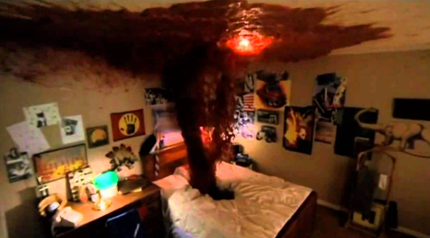
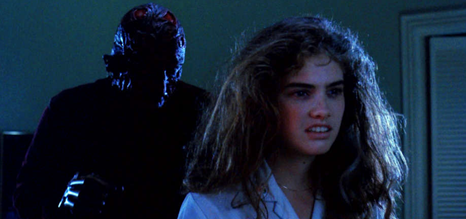
Perhaps the biggest departure is the fact that It revolves entirely on the narrative of the children; the book and miniseries detail how the children encounter It in the 1950s and then again as adults in the 1990s. All throughout the film’s marketing, no mention was made of inserting the adult narrative into the film or producing another movie to tell that story but it turns out this was a masterful strategy as, right before the end credits play, the film retitles itself as It: Chapter One, which should hopefully mean that a second chapter will follow to complete the story. This means that It is purely focused on developing and portraying the characters as children, establishing the world they inhabit and the rules of that world, as well as dipping its toe into the more metaphysical aspects of Pennywise. Is It the beginning of a new age of successful, profitable horror movies? The critical and commercial success seems to think so, though I was slightly disappointed to find that the film is more about the in-your-face, loud scares and less on haunting, spine-tingling scares, as I had hoped and suspected from the trailers (most disappointing of all was that the creepy soundtrack heard in the trailers was absent from the film). However, It doesn’t rely on random jump scares as much as you might think; the tension builds appropriately well and the payoff is suitably cathartic – Pennywise’s possession of the kids’ slide projector and attacks them in a large, monstrous form exemplifies this wonderfully. As an adaptation of one of King’s works, It fares a lot better than The Dark Tower and many other adaptations. Many liberties are taken with the source material but they all retain the essence of the text in a way that fits and feels natural, while still leaving plenty of unused material for the sequel. Some characters could’ve been given more screen time and a bit more spotlight but, overall, the film works extremely well as a coming of age story featuring a truly creepy and horrific villain.

My Rating:

Rating: 5 out of 5.

Fantastic

Recommended: Definitely, if only to finally see a really well done adaptation of a Stephen King story.
Best moment: Probably the first real showdown between the Losers and Pennywise in the house on Neibolt Street.
Worst moment: Despite the decent runtime and the well-developed characters, the lack of screen time for Mike and Ben was a bit of a miss-step for me.