
Game Corner: Call of Duty: Modern Warfare Trilogy (Xbox 360)

CODMWTLogo

Released: 2016
Originally Released: 2007; 2009; 2011
Developer: Infinity Ward/Sledgehammer Games
Also Available For: Nintendo Wii, PC, PlayStation 3, PlayStation 4, Xbox One

The Background:
This may shock and surprise and annoy a lot of people but…I do not care for the Call of Duty franchise (Various, 2003 to present). Activision’s long-running first-person shooter (FPS) series has seen many releases, spin-offs, and other related media over the years and has, collectively, sold over 250 million copies. Yet…it’s not really for me. As a general rule, I’m not much of a fan of FPS games and my love for them died out around about the same time as the release of Perfect Dark (Rare, 2000). This is simply a personal bias for me; I sometimes struggle with the maze-like nature of FPS games, the restrictive view (I can never seem to see anything and don’t like being attacked from behind), and how many FPS games make the controls needlessly complicated and convoluted. However, when I bought my Xbox 360, it came with a few Call of Duty titles, most prominently the Modern Warfare Trilogy. Therefore, January is going to be “CoD Month” and I’ll be spending the next few Wednesdays going through the Call of Duty games I played to see if my bias against the series was justified and to obtain a bunch of sweet, sweet, Achievements.

The Plot:
In a change for Call of Duty’s traditional World War Two settings, the Modern Warfare trilogy takes place between 2011 and 2016 and is initially centred around a civil war in Russia which eventually (through a series of complex betrayals and double-turns) escalates into a full-on world war between the United States and Russia.

Gameplay:
The Modern Warfare titles are first-person shooters that primarily place players in the role of either British Special Air Service (S.A.S.) Captain (originally Segerent) John “Soap” MacTavish and Captain John Price. While these two are the primary characters of the trilogy, you’ll also take on other roles (such as Sergeant Gary “Roach” Sanderson and Private First Class Joseph Allen in Modern Warfare 2 and Staff Sergeant Derek “Frost” Westbrook and ex-Spetsnaz operative Yuri in Modern Warfare 3). No matter who you’re playing as, the controls and heads-up display (HUD) are exactly the same and very little changes between each title in terms of your abilities and controls.
CODMWTStance
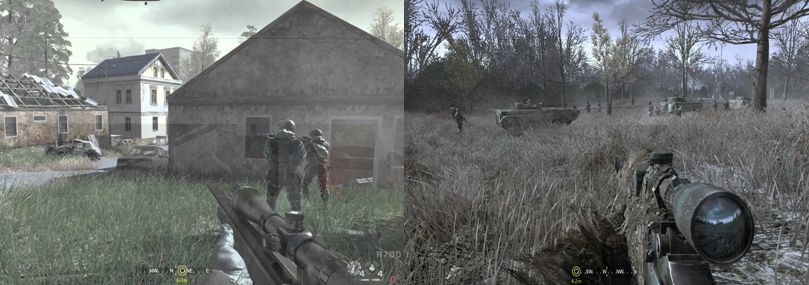
The stance you adopt affects your visibility and aiming.

By pressing B, players can assume one of three stances: standing, crouching, and “prone” (where they lie down on the floor), each of which affects your speed, aim, and level of stealth. Standing up makes you an open target, for example, but going prone can render you almost completely undetectable. You can jump with the A button but there’s very little call for this; you don’t have to do that much jumping and this is mainly used in specific areas to vault over low walls and other areas of cover. Holding in the left analogue stick will see you break into a run (you can’t do this indefinitely, though, and there’s no stamina meter to let you know how long you have between sprints so you’ll just have to guess) while pressing in the right analogue stick allows you to melee attack enemies. You can also reload with X, toss grenades or flashbangs with either the Left and Right Buttons, respectively, switch between your weapons with the Y button (you can only hold two at a time but you can hold X to pick up new weapons as-and-when you come across them), and aim and shoot your primary weapon with the Left and Right Triggers. Shooting comes in two forms: down the sights and from the hip and, by tapping the Left Trigger, you’ll automatically snap on to the nearest enemy in a form of auto-aiming.
CODMWTReload
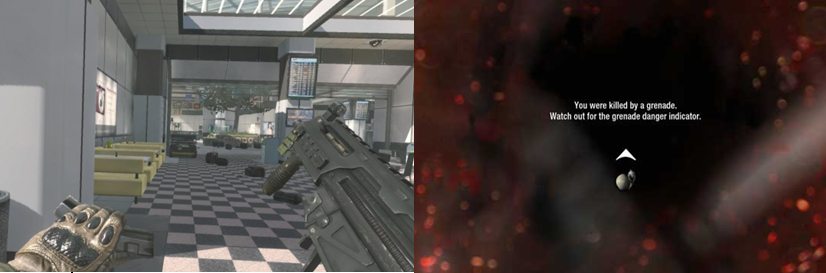
Be sure to watch out for incoming grenades when reloading.

Generally speaking, the game encourages you to switch weapons rather than reloading as this is faster but, in my experience, this results in you having two weapons that are low on ammo and need reloading rather than just one and considering how long and complex the reloading animations can be (I swear there’s one rifle that takes a good twenty seconds to reload) so either tactic has its pros and cons. One thing that is helpful is the ability to grab and throw enemy grenades back at them; you’ll need to be quick, though, as grenades have a horrible and annoying tendency to simply explode and kill you in one hit if you’re not fast enough. As in a lot of FPS games, you can recover your health by avoiding damage for a few seconds; while you can do this by taking cover, you need to be careful as the Modern Warfare games utilise a bullet penetration system where certain bullets and munitions are capable of penetrating certain surfaces (dry wall, concrete, etc) plus vehicles have a habit of catching fire and exploding when you’re too close to them. Luckily, each game is peppered with checkpoints so you can return to the fight quite quickly after being randomly shot in the middle of whatever you were doing.
CODMWTVehicles
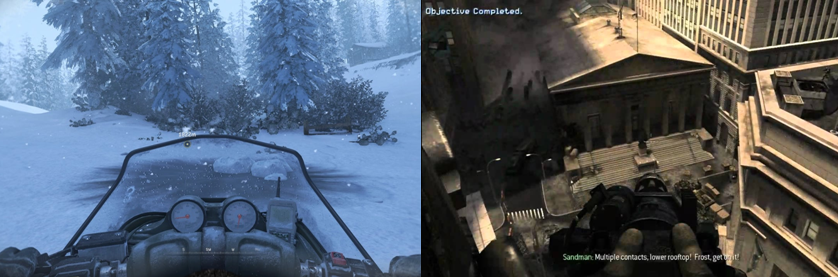
It’s not all ground-based shooting; you’ll also get into some nifty military vehicles.

A mini map sits in the HUD to help show enemy placements and works in conjunction with a small compass that directs you towards your next objective; this system is refined and far more intuitive and user-friendly in the second and third games but you’ll never really have to worry about getting lost despite how grey and brown and uniform a lot of the game’s locations are as each title is very linear in its layout and objectives. Gameplay is further broken up throughout the trilogy by allowing you to pilot and drive a variety of military vehicles; you’ll be driving trucks, tanks, boats, snow-skis, and helicopters. When high in the sky, you’ll switch between different thermal visions and have access to machine guns, bombs, and other explosive rounds to provide air support but, in a lot of cases, these are mainly prolonged gameplay sections that abruptly end in a disorientating in-game cutscene for your character. And make no mistake, the Modern Warfare games love to pull this trick on you. If you’re running through a warzone, you can guarantee that you’ll be falling through a crumbling floor or floored by a sense-jarring explosion, and if you’re driving or flying you’re most likely going to get derailed by a sudden explosion.

CODMWTMissions
You’ll also be asked to take part in some questionable missions.

Gameplay is further broken up by tasking you with some specific missions: in Call of Duty 4: Modern Warfare, for example, you’ll have to man a Barrett M82 sniper rifle and take into account wind resistance (indicated by a fluttering flag) and the “Coriolis effect” in order to get a good shot on your target. In Modern Warfare 2, you can choose to take part in a highly controversial mission that sees you going undercover and taking part in a mass shooting at a Russian airport and Modern Warfare 3 sees you manning both a mortar cannon and a small remote control tank to clear out opposing forces. Each game also features stealth missions, generally when working with Captain Price, that see you having to sneak past guards to take them out silently with your melee attacks or sniper rifles. Sometimes, you’ll also be planting explosives or sabotaging controls panels and such and, though tense and annoying at times, these can be some of the best sections in the game as you’re not inundated with enemies you can hardly see. You’ll also have to take part in a handful of quick-time events (QTEs), generally at the conclusion of each game that sees you grievously hurt or otherwise incapacitated and forced to struggle through the sluggish controls and skewed vision to take a shot at an enemy or rapidly tap a button at the right time to win.

Graphics and Sound:
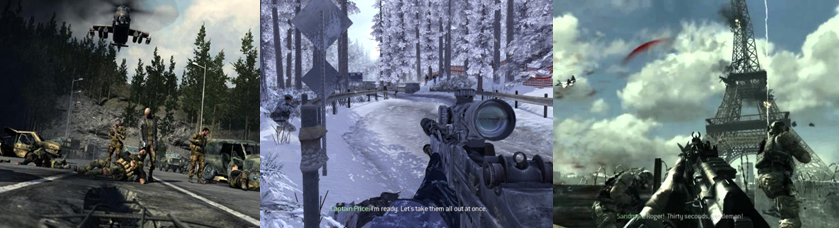
Generally speaking, the three Modern Warfare titles still all hold up pretty well despite the fact that a lot of their loading times are hidden behind doors and gates you cannot open or pass without someone else breaking them open for you. Locations are varied and take place across the globe, placing you in desolate, uninspiring environments such as the desert but also crumbling cities under a massive assault, on the steps of the White House while it’s under siege, and in the frozen Siberian wastes. You’ll also navigate through claustrophobic submarines, the streets and underground of London, and even a diamond mine. The trilogy does a great job of recreating iconic landmarks, making seeing the White House in flames or the Eiffel Tower collapsing quite a powerful spectacle, but a lot of their environments are still very bland and generic. Luckily for me, the trilogy is very linear but it can still be difficult to spot enemies when they seem to blend into their surroundings and I found myself firing on my own team mates more often than I’d like to admit as a result.
CODMWTGraphics
Weapons and locations are all rendered with a high attention to detail.

The game’s various weapons and vehicles are all extremely realistic and detailed as well, almost to a fault because, as mentioned, reloading some weapons can take a significant amount of time which, while realistic, can be annoying when you’re under heavy fire. Unlike some FPS games, the character models don’t suffer either and actually look quite decent rather than appearing as little more than action figures; it helps that the majority of the game’s story is told using the in-game engine and voiceovers rather than using full-on CGI cutscenes so there’s a lot less of the weird juxtaposition between in-game graphics and pre-rendered graphics. Each game is punctuated by fittingly rousing military music but, for the most part, I found the trilogy’s soundtracks quite underwhelming and mostly supplanted by the in-game sounds of the dead, dying, and maimed. The trilogy features some strong vocal performances (helped by actors such as Troy Baker, Keith David, Lance Henriksen, William Fichtner, Idris Elba, and Timothy Olyphant) but it’s difficult for me to really praise it all that much as it’s absolutely swamped with military slang and expressions that, again, I’m sure are extremely realistic and accurate but end up grating after a while.

Enemies and Bosses:
Primarily, you’ll be blowing holes through innumerable Russian soldiers and various terrorist forces who, while amounting to little more than cannon fodder to your superior weaponry and skills, can still kill you in an instant thanks to their commendable artificial intelligence. Enemies will dash behind cover, shoot over walls, move to flank you, and won’t hesitate to one-shot you with a melee attack of their own or a well-thrown grenade. When entering new areas, it’s best to take cover and scope out the area, picking enemies off from a distance as you’ll also come up against snipers and enemies who are packing rocket launchers. These, like a lot of the enemies you’ll encounter, like to take positions high above you and, while they mostly go down after one or two shots, have a nasty tendency to take pot shots at you while downed, recover and riddle you with bullets from behind, or even explode in your face if you’re not careful.
CODMWTBosses
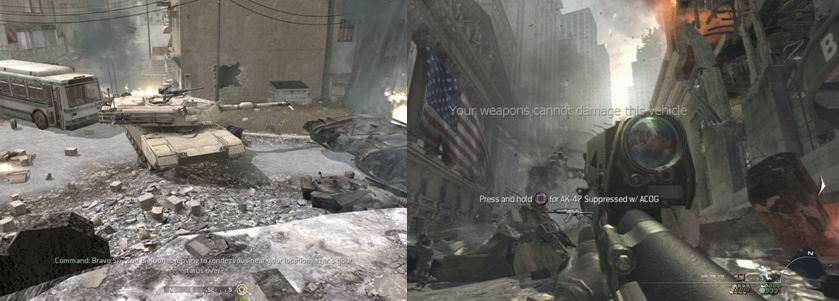
Tanks and helicopters will test your abilities.

You won’t really come up against boss battles in the traditional sense but you will have to contend with more formidable enemy weaponry, such as tanks and Mi-24 Hind helicopters. Usually, you’re equipped with a rocket launcher or similar weapon to take these down but, other times, you’ll engage them in a similar vehicle of your own and be tasked with clearing the area for your ground-based team mates.
CODMWTFinalBosses
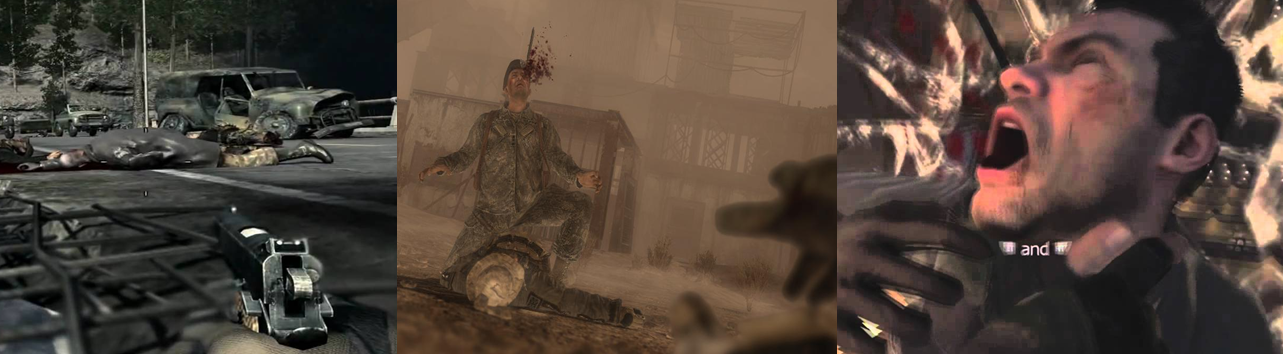
Each game ends in a glorified quick-time event.

At the end of each game, you’ll end up in a confrontation with the game’s principal antagonist; in Call of Duty 4, it’s Victor Zakhaev, in Modern Warfare 2, it’s renegade turncoat Lieutenant General Shepherd, and in Modern Warfare 3 it’s Vladimir Makarov. No matter how good your skills are at moving, evading, and shooting, these final battles amount to little more than an interactive cutscene as your character is incapacitated and you simply limp towards a gun to make the kill shot or hit the right buttons at the right time to put them down once and for all.

Power-Ups and Bonuses:
Given that the Modern Warfare trilogy is going more for realism over anything else, there’s not really much on offer here besides a bevy of weaponry and military-grade hardware to aid in your mission (such as night vision goggles). You’ll get access to a variety of handguns, shotguns, rifles, heavy weapons like rocket launchers and the like and even riot shields but you can only ever carry two weapons at any one time.
CODMWTResources
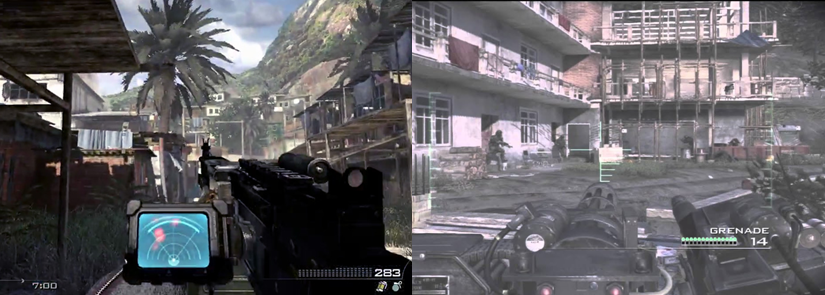
You have plenty of modern toys and weapons at your disposal.

While ammo is quite plentiful, it might be wise to switch to another weapon when one becomes available (personally, I quite like a good sniper rifle as it helps to thin out enemies from a safe distance) and some of them are more useful than others; the M200 Intervention rifle comes equipped with a heartbeat sensor, for example, which looks and functions exactly like the motion sensor from Aliens (Cameron, 1987) and is very helpful for detecting nearby enemies, while the FGM-148 Javelin is perfect for taking out tanks and choppers (if a little unwieldy due to its size) and you can even duel wield some weapons.

Additional Features:
Each game comes with a bunch of Achievements for you to earn; many of these are story based, which is helpful, but others will require you to beat the game on higher difficulty settings or perform certain tasks in certain missions. Some even carry over from game to game, such as the “Purple Heart” Achievement, stealthily offing enemies, finding all the Intel hidden through the missions, or killing multiple enemies with one bullet or explosion, while others are slightly more specific to each game. Either way, they’re a great excuse to replay prior missions and increase your Gamer Score but a lot of them are also tied to the trilogy’s multiplayer element. As with any FPS title worth its salt, the Call of Duty series is well-renowned for its multiplayer component. Unfortunately, my Xbox Gold isn’t active right now so I couldn’t really get the most out of this initially but, luckily, Modern Warfare 2 and 3 feature a “Spec Ops” multiplier mode that allows for split-screen, couch co-op and a variety of solo options that see you surviving against waves of increasingly-difficult enemies or performing certain missions across a variety of the game’s maps. As you play these modes, you earn in-game currency to buy better weapons and upgrades, earn points to upgrade your ranking, and also unlock new maps, modes, and missions.

CODMWTBanner

The Summary:
I went into the Call of Duty: Modern Warfare Trilogy with low expectations; I simply wanted to blast through and earn as many Achievements as I could and then put the game away forever and, largely, I succeeded in that goal. While I found some elements of each game enjoyable (the stealth and vehicle-based missions, for examples), I mostly found myself complete underwhelmed with each game’s mechanics, plot, and presentation. Don’t get me wrong; I see the appeal, especially for those who enjoy FPS games (and, specifically, military FPS titles) but, for me, none of the titles are really that innovative or do much to stand out from the many similar FPS titles out there. The games get bigger and more involved as they progress, adding more vehicles and more open locations, but add very little beyond a few bells and whistles. In the end, I find myself wondering why the series is held in such regard when it looks and plays almost exactly like any other FPS title but at least the Achievements were easy enough to get.

My Rating:

Rating: 2 out of 5.

Could Be Better

What did you think of the Call of Duty: Modern Warfare trilogy? Which of the three is your favourite and where do they stand in your ranking of the Call of Duty titles? Do you think I have committed the ultimate sacrilege by besmirching the good name of the Call of Duty franchise or do you agree that the series is somewhat over-rated and stagnated? Whatever you think, feel free to leave a comment below and check back in next Wednesday for another Call of Duty review.

Movie Night: The Matrix

MatrixLogo

Released: March 1999
Director: The Wachowski Brothers
Distributor: Warner Brothers
Budget: $63 million
Stars: Keanu Reeves, Laurence Fishburne, Carrie-Anne Moss, Hugo Weaving, and Joe Pantoliano

The Plot:
Thomas A. Anderson (Reeves) is a nobody; by day, he sits in a cubicle and works a monotonous job as a software developer but, in his spare time, he has crafted a reputation under his hacker alias “Neo”. When he is targeted by Agent Smith (Weaving), Neo is brought to the enigmatic Morpheus (Fishburne) and offered both a startling truth and a destiny he could never have suspected.

The Background:
After managing to sell their script for Assassins (Donner, 1995) and the success of Bound (The Wachowski Brothers, 1996), Andy and Larry Wachowski (as they were known then) were able to sell Warner Brothers on another of their scripts: The Matrix. Featuring an impressive mixture of martial arts, philosophy, and science-fiction not often seen in major Hollywood releases and heavily influenced by manga and anime, particularly Ghost in the Shell (Oshii, 1995), The Matrix made an instant and lasting impression not just on the science-fiction and action genres but on cinema as a whole. The film both popularised the concept of “bullet time” and wire-assisted kung fu (or “wire-fu”) in movies and cemented Keanu Reeves as an action star. Suddenly, parodies were everywhere and movie heroes were all sporting long dark coats, shades, and flipping all over the place and it was all largely thanks to The Matrix. When I was a kid, The Matrix was a big, big deal. My friends and I watched the film constantly, eating up the action sequences and the cool aesthetic and soundtrack. Produced on a paltry budget of $63 million, The Matrix was a massive commercial and critical hit, making over nearly $500 million worldwide. So great was The Matrix’s success that is spawned not only two sequels but a whole slew of multimedia merchandise, including comic books and videogames. While the sequels may not have garnered quite the same critical reaction as the quasi-cult hit original, The Matrix’s important at the time (and today) cannot be understated and the later release of a fourth film proved that The Matrix still has an enduring legacy in cinema. Considering today is “National Science Fiction Day”, this seems the perfect opportunity to look back at this classic piece of cyberpunk cinema.

The Review:
The Matrix has a pretty simple concept, one that has been done before and since in cinema, but complicates it with musings on fate, destiny, and the sense of identity and reality. At its core, the plot is incredibly simple, though: the world as we know it is merely a computer-generated construct, a form of virtual reality in which we have been enslaved by a race of machines in a post-apocalyptic world. Amidst this, though, we have themes regarding providence, choice, and some of the most impression action and fight sequences put to cinema.

MatrixNeo
Apathetic to his everyday life, Anderson has far more prominence as “Neo”.

Our window into The Matrix is Thomas A. Anderson (or “Neo”, as he is known throughout the hacking community), a bored program developer who has lived most of his life with a feeling that there’s something not quite right with the world. Thanks to his illicit activities, he is acutely aware of the legendary Morpheus, a charismatic and prophet-like figure in Neo’s circles, and “the Matrix”, an undefined concept that is enough to rouse Neo’s curiosity. Keanu Reeves makes for a perfect audience surrogate; you instantly buy into the idea of him as an isolated, distracted hacker who is unfulfilled in his mundane life and eager for change but not quite confident enough to really buck the system more than showing up late for work or being generally apathetic. Once he meets Trinity (Moss), though, and is set on the path towards Morpheus and answers concerning the Matrix, Neo’s outlook begins to change; he was too afraid of plummeting to his death when trying to escape Smith and his cohorts but, once captured, is defiant enough to give them the finger and, after being reminded of the poor choices he’s made in life that have kept him stagnant, resolves to follow Trinity and her teammates towards an uncertain future.

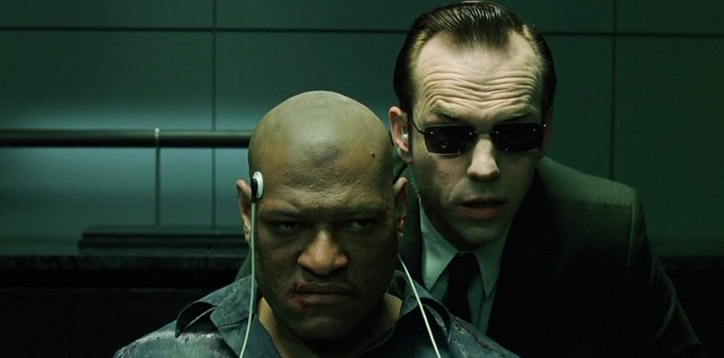
MatrixSmith
Agent Smith is a chilling, complex villain.

Opposing Neo is the aforementioned Agent Smith; in this movie, he’s just one of a number of men in black who target our heroes and are meant to be indistinguishable from each other. As the de facto leader, and the most charismatic of the three, Smith’s personality is revealed over time and in layers; he goes from a monotonous, fittingly robotic agent of the system to being wracked with personal animosity for Neo and being overcome by his own pride and hubris. Weaving is excellent in the role, exuding both menace and charm with the subtlest of movements and the merest of words and seeing him break out of his shell and reveal just how layered Smith is beneath his cold exterior is both captivating and terrifying at the same time. We also have Cypher (Pantoliano), the more outspoken and neurotic of the crew who takes an instant dislike to Neo thanks to his largely jaded attitude. Cypher is, if his name and Pantoliano’s scenery-chewing acting didn’t make it clear, the ultimate betrayer of the crew as he has grown disillusioned with Morpheus’s teachings and the reality of the real world and therefore deceives his crewmates, killing three of them and leaving Morpheus in the hands of Smith and the other agents. Cypher’s motivations are entirely believable, however, as the real world isn’t all it’s cracked up to be but it’s still extremely cathartic to see that smug smile blown off his face after his heel turn.

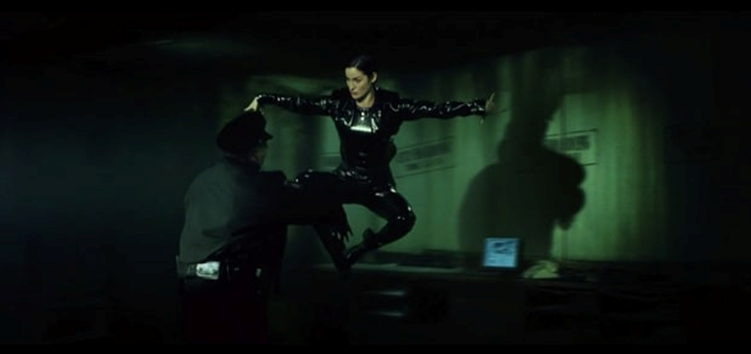
MatrixTrinity
Trinity is a capable, if underwhelming, character.

Luckily, Neo is not alone in his journey; Trinity is his main link to Morpheus’s world and serves as his eventual love interest. Yet, while Carrie-Anne Moss is acceptable in the role and more than capable at holding her own in her fight scenes, I never really bought into the attraction between the two characters. People like to rag on Keanu for being “wooden” but I’ve always enjoyed his work and found him very charismatic and that’s no different in The Matrix, where’s he’s able to showcase a variety of emotions and character quirks. Trinity, however, is a very guarded and reserved character through and through; some of this is due in part to the way those awakened to the truth of the Matrix tend to be more emotionless and reserved, especially inside the Matrix, but it’s also because of her reluctance to admit her feelings to Neo out of the fear that he isn’t who she thinks he is and the fear that he is what she thinks, as it means a dramatic change for the world if true.

MatrixMorpheus
Morpheus is easily my favourite character (…after Neo, of course).

Morpheus, however, fully believes in Neo from start to finish and never once does his belief falter. Morpheus is the enigmatic captain of the Nebuchadnezzar and is regarded as a legendary figure not only by Neo but his crew as well. Years ago, the Oracle (Gloria Foster) prophesised the return of “the One”, a man born inside the Matrix who would be able to manipulate it in superhuman ways and spell the end of humanity’s subjugation, and Morpheus has dedicated his entire life to finding the One. For whatever reason (it’s not really explained how or why), Morpheus believes that Neo is the One and actively seeks him out, shows him the truth, and pushes him to break beyond what he has been conditioned to know. Never once does Morpheus’s conviction falter and Fishburne makes for a very fitting mentor and father figure; he anchors the film, offering exposition, and is the heart and soul of The Matrix. Subsequent sequels may have ruined (or spoiled) Morpheus’s mystique somewhat but it’s captivating in The Matrix as he seems so infallible and believable that you can’t help but be sucked in by his words. The rest of Morpheus’s crew is largely one-note and expendable; Switch (Belinda McClory) and Apoch (Julian Arahanga) are pretty forgettable and have maybe three lines between them and Mouse (Matt Doran) is the young, naïve crew member whose death is meant to be heartbreaking because of his youth but ends up falling a little flat as his characterisation amounts to “enthusiastic/annoying kid”. Tank (Marcus Chong) and Dozer (Anthony Ray Parker) stand out a little more thanks to Tank acting as the team’s operator (when inside the Matrix, he directs them, uploads additional training material and resources, and provides them with a way to dial out) and their status as brothers born naturally in the real world.

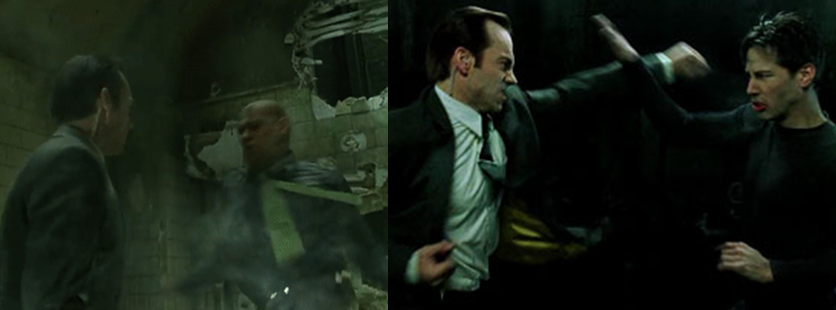
MatrixFights
The fights are varied and grow in intensity.

Of course, as good as the majority of the cast and characters are, the film’s main draw is its extensive action and fight scenes. Thanks to a combination of computer-generated imagery (CGI), wire work, and an extensive training regime, the film’s fights are high intensity and a spectacle to see; the film begins with Trinity performing that iconic leaping kick in slow motion as the camera pans around her, includes a playfully enjoyable sparring session between Neo and Morpheus, emphasises the aggression and nigh-unstoppable nature of the agents when Morpheus is effortlessly pummelled by Smith, and ends with a long, multi-layered fistfight between Neo and Smith. Unlike the majority of action films, The Matrix presented a world where characters don’t need to appear athletically competent to perform superhuman feats as knowledge and techniques are literally downloaded into their minds, instantly turning them into a master of the arts when plugged into the Matrix. Unfortunately, the special effects falter a bit in the real world; the sets and interiors are great, with the film favouring the “lived in” look of similar movies like Event Horizon (Anderson, 1997) and made popular by the Aliens movies (Various, 1979 to 2017), but the CGI elements haven’t aged too well. The squid-like Sentinels, especially, look particularly cartoony these days and most of the sequences involving them and the Nebuchadnezzar don’t quite hold up to the more practical effects of the film. Similarly, some fight scenes, particularly those using bullet time or other camera tricks, can result in the actors taking on a rubbery appearance but, when they’re inside the Matrix, I feel this effect actually works better and serves to highlight the falseness of that reality.

The Nitty-Gritty:
The Matrix still holds up very well to this day thanks to its enduring themes and the intensity of its otherwise over-the-top fight sequences. There are, of course, a few plot holes and questions raised by the film’s concept that are either not answered in subsequent sequels or poorly addressed. First and foremost for me is the question of how, exactly, child birth happens when humans are simply grown in endless fields. The idea of the fields themselves seems to suggest that the machines are cloning humans, but this isn’t really addressed; neither is how the awakened humans built their ship and other equipment, where their food and clothes come from, or how they don’t simply freeze to death under the scorched skies that blanket the real world.

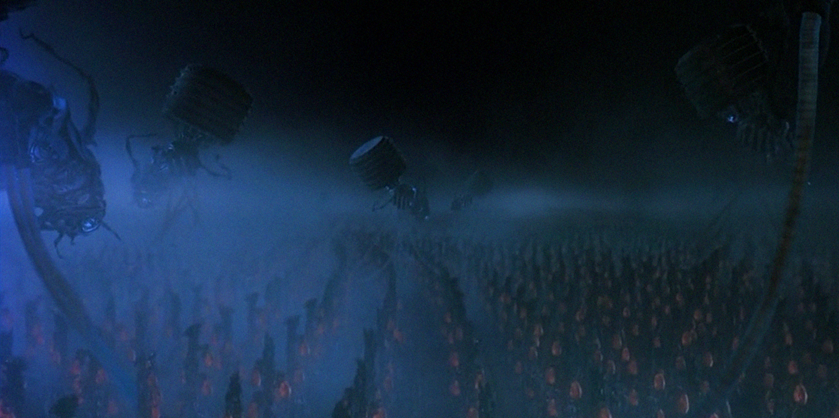
MatrixBatteries
The machines grow and harvest humans to use them as a power source.

Most of these questions are left intentionally unanswered in this film; we’re told (briefly) about Zion, the last human city, and given snippets of information regarding their war against the machines but nothing concrete. This adds to the mystery of what exactly happened to turn the world into a post apocalyptic hellhole ruled by machines and is completely believable; if all of humanity were blasted to smithereens, why would we have any specific information some one hundred years later? Truthfully, the real world is of little consequence in The Matrix; it’s there and a stark contrast to the artificial world of the Matrix but is never portrayed as being preferable. Instead, the idea is that the truth and the concept of being free from the machines’ control is preferable to being a slave, a literal biological battery, to the will of the machines. As a result, any human awakened to the truth is immediately drafted into the resistance effort but Morpheus is explicitly honest about their chances:

MORPHEUS:
They are the gatekeepers. They are guarding all the doors, they are holding all the keys, which means that, sooner or later, someone is going to have to fight them.

The agents embody this philosophy; practically nameless and faceless, the agents are able to possess (more like overwrite) any person currently plugged into the Matrix, effectively allowing them to endlessly respawn even in the rare instances that they are defeated or incapacitated. Yet, Morpheus also states that everyone who has ever tried to fight an agent has died, which isn’t that surprising considering that, as computer programs, they are faster, stronger, and far more durable than a mere human.

MatrixTheOne
As the One, Neo effortlessly stops bullets and parries Smith’s attacks with one arm.

In a reflection of Morpheus’s conviction, though, he doesn’t hesitate to take on Smith in hand-to-hand combat to allow Neo to escape; Morpheus, previously portrayed as calm, collected, and a severely disciplined fighter, is absolutely dominated in this fight. His near infallibility is then tested to the limit when the agents subject him to a concoction of drugs, torture, and questioning to try and obtain access codes to the Zion mainframe. Morpheus resists, however, and retains enough of his strength (both physical and mental) to break his bonds once Neo and Trinity affect their action-packed rescue plan and, throughout the entire movie, maintains a quiet confidence that, in time, Neo will see the truth about himself. It is therefore heartbreaking when Neo is executed by Smith, leaving Morpheus so distraught that he doesn’t even care about living any more. In the wake of Neo’s death, Trinity finds the resolve to finally admit her feelings for him and, with a kiss, restores Neo to life. As cliché as this sounds, it’s actually one of the most affecting scenes in the film; previously, the Oracle said that Neo was “waiting for something”, specifically suggesting that “something” was his next life, and Neo’s resurrection sees him assume the confident, God-like status of the One at last. His wounds healed, the speed and power of Smith is as nothing; Neo easily blocks and parries Smith’s attacks with one arm, looking hilariously and awesomely bored by the conflict, and easily dispatches the agent by blasting him to pieces. Now able to view the complex code of the Matrix itself, Neo ends the film fully able to manipulate and alert the environment as he blasts off to the sky to the sounds of Rage Against the Machine (a fitting band if there ever was one).

MatrixFlaws
The film is not without a few logistical concerns regarding its world.

This ending is as exhilarating and cathartic as you could hope for; all throughout the film, Neo has struggled with the destiny Morpheus has laid out for him and seeing him grow in confidence and ability leads to some of the film’s more impressive action and fight sequences. The gunfight between him and Trinity and a bunch of guards is worth the price of admission alone but seeing Neo effortlessly take out Smith, especially after the gruelling physical battle they went through previously, never fails to get my blood pumping. That’s not to say that the film isn’t without a few flaws, though. Chief among them, for me, is the “bug” that Smith implants into Neo; it makes sense, as he wants Neo to lead him to Morpheus, and it’s a nightmarish sequence, but it’s rendered immediately mute when Trinity pulls it out of Neo in the very next scene. Ironically, if Smith had simply just waited outside Neo’s apartment building he would have been led right to Morpheus but…no, apparently the bug is more efficient. Additionally, the scene where Neo is awakened is a bit confusing; he swallows a pill to help the crew find him in the real world, randomly gets smothered by liquid glass with no explanation, and when he does wake up the Nebuchadnezzar isn’t even there to retrieve him until he is literally flushed away. Finally, while I like that the film addresses that Neo’s eyes and muscles would have suffered atrophy, I would argue that the plugged in humans would be next to useless in the real world, especially upon being unplugged.

The Summary:
The Matrix’s philosophical musings are far less as explicit as in its sequels; here, exposition is delivered in snippets that are easy to digest and understand. There’s no double talk or complicated words here; we’re simply told as much information as these characters know and even Morpheus explicitly says that he (and even the Oracle) doesn’t have all the answers for Neo’s (or our) questions. Clearly, the film is left with many questions still to be answered but, unfortunately, it didn’t really turn out that the Wachowski’s were capable of delivering interesting answers to those questions. As a result, as much as I enjoy the sequels, neither are on the same level as the original, which is still one of the most compelling and original movies ever made that never fails to deliver despite a few flaws. The Matrix still holds up really well even after all this time; sure, some of the effects aren’t as impressive as they once were and a lot of the tricks popularised in this film have been done bigger and better since then, but it’s still a great piece of cyberpunk cinema. The sequels may have somewhat tarnished the legacy of the first film, and retroactively raise more questions than answers, but the concept and action on display in The Matrix is just as exhilarating as ever. The film is also full of some strong performances; Keanu Reeves proved with this film that he was a competent leading man in Hollywood, Laurence Fishburne set himself up for similar mentor roles in the future, and the film all but launched Carrie-Anne Moss’s career and put Hugo Weaving on the map. It’s not a flawless film, or even a perfect one, but it’s still highly enjoyable from start to finish; effectively a live-action anime, The Matrix is a perfect example of a strong, original concept bringing new life into tried and tested ideas we’ve seen executed in previous films and media. Ahead of its time in many ways, The Matrix set the scene for the slew of action and superhero movies that followed and built upon many of the techniques on display here and its legacy still holds up to this day.

My Rating:

Rating: 5 out of 5.

Fantastic

What did you think of The Matrix when it first came out? Did you enjoy the sequels or do you feel they spoilt the concept of the first movie? Which of the film’s characters or many spin-offs was your favourite? Are you excited for the upcoming fourth movie or do you feel it’s maybe best to let the franchise lie? How are you celebrating National Science-Fiction Day? Whatever you think about The Matrix, or sci-fi in general, drop a comment below.

Game Corner: Rocket Knight (Xbox 360)

RocketKnightLogo

Released: May 2010
Developer: Climax Studios
Also Available For: PC, PlayStation 3, Xbox One

The Background:
Mate, how absolutely brilliant was Rocket Knight Adventures (Konami, 1993) back in the day? Back when cute, anthropomorphic mascots were all the rage, Sparkster (the titular “Rocket Knight”) really stood out thanks to some absolutely gorgeous graphics, kick-ass music, and fast-paced, rocket-based combat. I used to play that game so much as a kid but never actually managed to finish it (maybe one day); the game did well enough to receive two sequels, one for the Mega Drive and one for the Super Nintendo, but Konami’s long-forgotten and short-lived little franchise went dormant for far too long after these releases. Then, out of nowhere, a revival of the franchise was thankfully put into production thanks to producer Tomm Hulett. A 2,5D, digital-only title, I first played Rocket Knight on the PlayStation 3 but I didn’t hesitate to snap it up once it went on sale on Xbox One so I could get into it again. It’s not an especially long or difficult game but, as one of my favourite franchises that has been sadly lost to the mists of time, I could never not jump at the opportunity to charge up Sparkster’s signature rocket pack once more.

The Plot:
Fifteen years after bringing peace to the Kingdom of Zephyrus, Sparkster has been living a quiet life as a family possum. His peaceful life is shattered when the Wolf Army suddenly invades the Kingdom; heeding the call to adventure, Sparkster dons his trademark armour and rocket pack and returns to the fight to defend his home once more.

Gameplay:
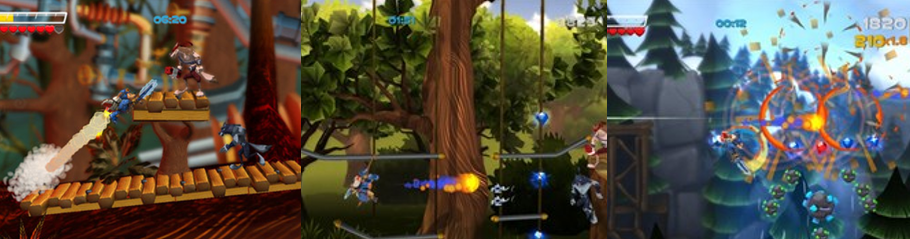
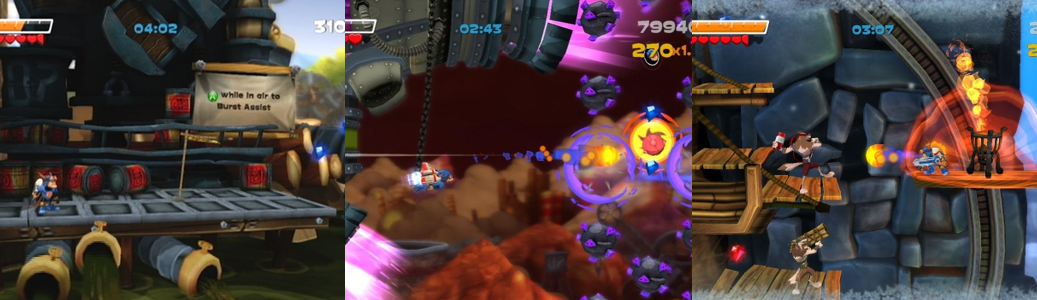
Rocket Knight is a 2.5D action/platformer in which players take control of Sparkster, a “rocket knight” who seeks to defend his land from invasion. All of Sparkster’s moves and abilities from his debut game return here, meaning he is armed with a large sword for some basic close-quarters action and which is also capable of blasting enemies from a distance as well. Sparkster’s unique selling point was his rocket pack; by holding the B button and pointing Sparkster in a direction, players can blast ahead, mowing down enemies and ricocheting off walls to reach higher areas. Sparkster can also drill through certain breakable elements by tapping B again and briefly hover with a tap of the A button to aid with tricky platforming sections. However, Sparkster’s rocket pack isn’t finite in most stages; you’ll have to keep an eye on the energy bar in the top-left of the screen as you won’t be able to blast away if it’s empty. Luckily, this bar refills quite quickly, meaning you never have to wait too long to burst into action and Sparkster can also blow his energy reserves on a cartwheel-like attack that is super handy for bouncing dynamite back at enemies. Sparkster can also clamber across vines and bars with his tail; sliding down these will allow you to jump higher and further and you can also attack enemies by whirling around in a rocket-powered swing. Stages are generally a simply case of moving Sparkster from point A to point B, with a smattering of enemies and platforming segments to contend with, but every so often you’ll be thrust into a sidescrolling auto-flying stage where you can fly indefinitely.

Blast through enemies with Sparkster’s trademark rocket pack and sword.

In these stages, enemies, obstacles, and mines will try to slow your progress but you can blast at them with Sparkster’s energy shot. You can also hold X to charge up your shot and unleash a screen-clearing beam of energy that is perfect to taking out tricky enemies. Eventually, stages introduce more complex elements, such as when Sparkster finds his rocket pack affected by extreme cold. Your rocket fuel won’t regenerate in these stages unless you pick up a fuel icon or find a burning torch to defrost Sparkster. Other stages have you dodging and ducking fireballs, blasting from airship to airship while massive cannons try to knock you from the sky, hitting switches to open doors or lower energy fields, jumping from precarious moving platforms or navigating short, simple mazes to progress further, or outrunning a massive explosion. Rocket Knight is not an especially long or complex game but it’s simple, easy to play fun that challenges you by increasing the difficulty of its enemies and stage hazards over time. Fortunately, checkpoints are plentiful throughout the game’s stages; Sparkster can replenish his health by collecting hearts, which are sporadically found throughout each stage, and earn extra lives by collecting 1-ups and earning enough points. Points are accumulated by collecting blue and red gems, finding power-ups, and building a combo by defeating enemies in quick succession. Each time you clear a stage, you’ll earn additional points for how fast you completed a stage, encouraging speedrunning and a degree of exploration as you hunt down hidden gems.

Graphics and Sound:
Rocket Knight is not an especially ground-breaking game in terms of its graphics but it has a simple, adorable charm; favouring a 2.5D aesthetic over the gorgeous sprite art of its original games, the game resembles a cel-shaded cartoon more than anything. Characters pop out from the background and are lively enough (though Sparkster could be a little more animated when left idle), appearing big and chunky and almost anime-like in their appearance.

Colourful cel-shaded graphics and pantomime-like cutscenes add to the charm.

The game’s simple plot is told through pantomime-like cutscenes, as in the original game, with a brief synopsis greeting the player as each stage loads. These cutscenes are amusing and quaint, getting the point of the game’s uncomplicated narrative across easily enough and are thankfully not bogged down by copious amounts of voice acting (they are also entirely skippable if you prefer to just jump right into the action). The game’s music is just as good; Rocket Knight wisely opens with a remix of the memorable and catchy “Stage 1” music from the first game (still one of the greatest videogame tracks of all time, in my opinion) and takes its cue from there, punctuating each stage with plucky tunes that could maybe have a bit more oomph behind them but are nevertheless enjoyable.

Enemies and Bosses:
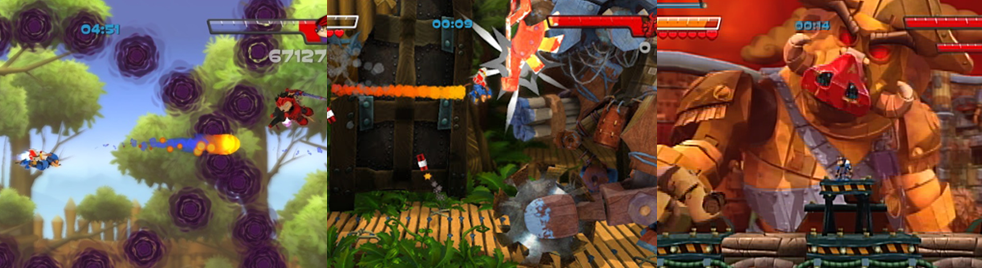
For the first portion of the game, Sparkster will have to contend with the Wolf Army; these are generally little more than cannon fodder, running head-first into your sword and attacks and easily dispatched of. Soon, they start tossing dynamite at your head (though these are easily knocked back with a swipe of your sword) or clinging from walls and ceilings to toss throwing stars at you. They’ll also pop out of the background or try to overwhelm you with sheer numbers, attack with bazookas, or drop bombs on you but are, for the most part, pretty easy to deal with. However, after taking out Ulfgar the Merciless, the King and leader of the Wolf Army, Sparkster is betrayed by former-enemy-turned-ally General Sweinhart and must contend with a renewed invasion from Sweinhart’s Pig Empire. These swines are far more dangerous enemies, taking multiple hits to defeat and blasting at Sparkster with energy pistols, hiding behind shields, erecting electrical force fields, and piloting intimidating mechs to try and squash Sparkster flat. Since Rocket Knight is only a short game (it’ll probably take about an hour to finish on the “Normal” difficulty), you only have to contend with three bosses and two sub-bosses. The sub-boss battles are a one-on-one duel against Axel Gear, Sparkster’s hated rival; Axel has many of Sparkster’s abilities, including his energy beam and rocket pack-based attacks, but also circles the screen leaving damaging clouds in his wake and tosses grenades Sparkster’s way at any opportunity. These are some of the most fun bouts in the game, though, as it’s thrilling to go against Sparkster’s dark opposite; however, they can be frustrating when playing on “Hard” mode.

Sparkster’s rival, Axel Gear, and general Sweinhart’s gigantic minions offer a significant challenge.

The first true boss you’ll encounter is a giant mechanical forest shredder that tries to stamp, swipe, skewer, and explode you at every opportunity. The boss’s weak spot is the big, red metal “mask” on its head and you can choose to either rocket yourself into this or try to reflect the dynamite it tosses your way back at it but you’ll have to dodge its rockets and giant, scenery-destroying buzz saws as the fight progresses. Ulfgar the Merciless is a slightly less straight-forward opponent; impervious to your attacks, you must instead bait Ulfgar into charging head-first into blocks, knock dynamite back at him, or destroy the platforms he is standing on to damage him all while dodging his charging and melee attacks and the debris he causes to come crashing down from the ceiling. The final boss is a battle against General Sweinhart himself and is also, fittingly, the toughest and most frustrating battle of the game. Sweinhart hides inside a titanic mech shaped in his image for most of the battle, randomly trying to squash you (or cause bottomless spits to emerge) or fry you alive with his laser eyes. When comes close, you must quickly attack on his metal nostrils; take too long and he’ll spawn an enemy or three into the arena, which causes more headaches. Land three hits and the mech goes down, spitting Sweinhart out. Here’s where it gets really tricky; you have to dodge Sweinhart’s laser and bombs all while trying not to touch the electrified parts of his downed mech and using Sparkster’s rocket pack to knock Sweinhart from the sky in such a way that he gets fried instead. If you’re quick about this, you can significantly knock a lot of Sweinhart’s health off but it’s so fiddly and tricky to dodge his attacks and get him to land in the right place that you’ll have to contend with his giant mech at least two times in a standard battle. To make things worse, the game is really stingy with health in this battle; when fighting the other bosses, a couple of health power-ups are available in the arena but, here, it seems completely random when one will drop from the mech’s nostrils, making this far more frustrating than it needs to be at times.

Power-Ups and Bonuses:
In keeping with the first game, there’s not much on offer to help boost Sparkster’s performance throughout Rocket Knight; gems will add to your score to help you towards earning extra lives, 1-ups are occasionally found in stages, and certain stages will see you get an instant refill of your rocket fuel but that’s about it. There’s no invincibility or speed up, no shields or damage increasers, and no upgrades to get or worry about; it’s just you, your sword, your rocket pack, and your wits.

Additional Features:
As you might expect, Rocket Knight comes with a handful of Achievements for you to earn; sadly, there’s not very many and they’re not especially varied in their content. However, while clearing every stage and beating the game on “Normal” might be easy enough to get, others, like beating every stage below the par time or finishing the game on “Hard” mode, can be a mite trickier. You can select “Hard” mode at any time; however, staying in “Hard” mode is easier said than done. The only way to stop the game from automatically dropping the difficulty back to “Normal” is to land a special attack on each of the game’s bosses (such as damaging the forest shredder with dynamite or causing Axel to fly into his own bombs). Once you manage it, though, you unlock two additional skins: one that lets you play as Axel Gear (which is awesome) and the other is Gold Sparkster, which is also an even more challenging gameplay mode. You can input the famous Konami code on the title screen to unlock these at your leisure but I don’t think that allows you to earn the Achievements associated with them.

The Summary:
Rocket Knight is an extremely enjoyable, if all-too-brief, return to form for one of Konami’s more forgotten franchises. Fast paced and simple to play, there’s not much here to really test your skills or have you pulling your hair out as even the game’s trickier moments are fun to play through thanks to the appealing aesthetics of the game’s graphics and soundtrack. The controls are tight and responsive, stages are short bursts of action and enjoyment, and the gameplay is simple yet easy to get to grips with. It would have been nice to see the three original games included as unlockables or bonus content but maybe one day Konami will remember Sparkster and give all four of his titles a bit of a spruce up for a new generation.

My Rating:

Rating: 3 out of 5.

Pretty Good

What did you think of Rocket Knight? Were you happy to see Sparkster randomly return from obscurity or did you have issues with the game’s length and presentation? Did you ever play Rocket Knight Adventures on the Mega Drive or either of its sequels? If so, what did you think of them and would you like to see more games in the franchise? Either way, whatever your thoughts on Rocket Knight, leave a comment below.

Mini Game Corner: Devil May Cry 4 (Xbox 360)

DMC4Logo

Released: January 2008
Developer: Capcom
Also Available For: Mobile, PC, PlayStation 3, PlayStation 4 (Remaster), Xbox One (Remaster)

A Brief Background:
Long before the God of War franchise (Various, 2005 to present) cornered the market when it came to hack and slash videogames, Capcom released a trilogy of titles that saw you cutting demons and angels alike into pieces with a giant sword and blasting them apart with pistols. After the success of Resident Evil 2 (Capcom, 1998), famed Resident Evil (ibid, 1996) director Hideki Kamiya began development on a new Resident Evil title for the PlayStation 2. However, when the game’s development began to veer further and further away from Resident Evil’s survival-horror aesthetics, Kamiya embraced this new direction and created an entirely new franchise with Devil May Cry (Capcom Production Studio 4, 2001). I’d been aware of the series for some time and, being a fan of hack and slash videogames, was eager to experience the games once I bought a PlayStation 3. I remember enjoying the title but ultimately being turned off by the repetitive nature of the game’s missions and boss battles, which are basically identically for both of the game’s playable characters. When I bought my Xbox 360 earlier this year, it coincidentally came with a copy of Devil May Cry 4 so, eager to snag a few additional Achievements, I attempted to rush through it again and see if it was still as enjoyable as before.

First Impressions:
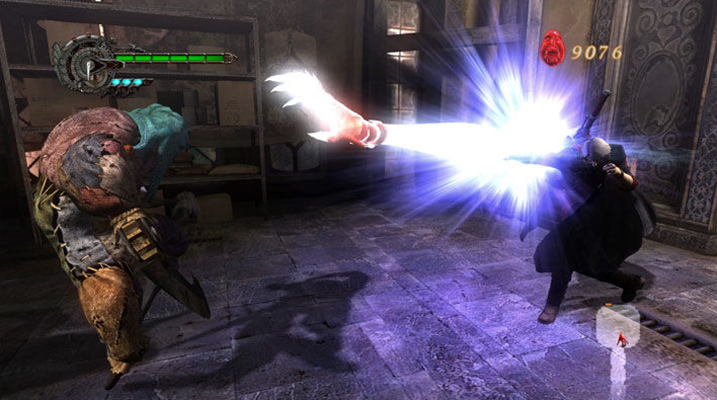
Unlike previous games in the Devil May Cry series, Devil May Cry 4 begins with you not assuming the role of iconic series protagonist Dante but that of newcomer Nero. Functionally, Nero looks, acts, and even controls very similar to Dante (kind of making you question why Capcom bothered to make a new character in the first place…); Nero can attack enemies with his impossibly-large sword, the Red Queen, or stun them with his revolver, the Blue Rose. The more you mash the attack buttons, the higher a combo you’ll begin to build up; the better your combo, the better your grade. Additionally, if you successfully manage to complete missions and puzzles without using healing or recovery items, in a decent time, and with a consistently high style grade, you’ll receive better mission grades and therefore better rewards.

DMC4Gameplay
Nero’s demonic arm separates him from Dante.

What separates Nero from Dante is his Devil Bringer; a demonic arm that stretches out and allows him to cover large distances and grab, grapple, slam, and throw enemies and objects at his enemies. Eventually, he also gains access to the Devil Trigger, a state that allows him to charge his sword to unleash more powerful, flaming attacks, or explode into a demonic state for a short time to unleash stronger attacks. As you destroy enemies and certain parts of your environment, you’ll collect a bevy of Red Orbs; destroying enemies, bosses, and clearing missions also earns you Proud Souls, both of which can be used in the game’s Power Up menu. Here, you can trade Red Orbs for healing and recovery items to help you in the game’s more difficult missions or spend Proud Souls upgrading Nero’s abilities, unlocking new combos, faster moving speeds (a definite must), more powerful charged shots, and other similar power-ups. Unfortunately, every time you buy a recovery item, that item’s price shoots up, meaning you can’t just stockpile healing items as you’ll run out of Red Orbs pretty fast; occasionally, though, you can find these items hidden in the game’s missions. Devil May Cry 4’s story is told through in-game and pre-rendered cutscenes; these are pretty decent and full of frenetic, over-the-top action and dialogue and the story is pretty out there, with both Nero and Dante appearing to be infallible and superhuman in cutscenes which, unfortunately, doesn’t translate to their gameplay.

DMC4Bosses
Bosses are big and impressive but often more frustrating than fun..

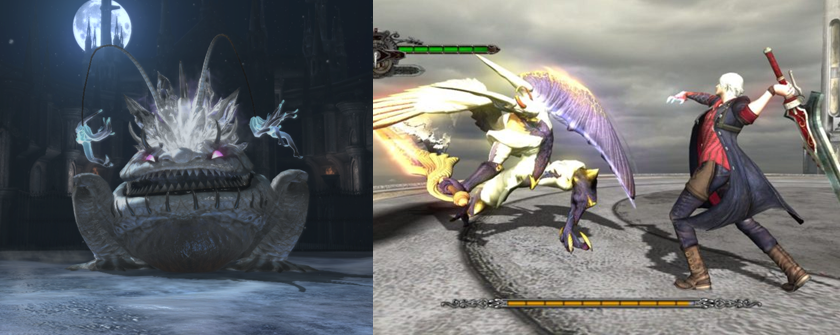
The in-game action is fast and frantic but if you don’t properly lock-on and focus on your enemies, or dodge and switch up your attack style accordingly, you can be pummelled into oblivion pretty easily, which can be frustrating. Fortunately, the game’s bosses are large and complex; they’re actually quite fun, despite some of them being frustrating and cumbersome. Bael and Dagon stand out as one of the game’s tougher bosses, for me; this horrific cross between a toad and an anglerfish hides in the snowy shadows, bursting out and swallowing you up to deal massive damage, and its tendency to enter an aggressive final stage is a theme you’ll find from all of the game’s bosses. You’ll hack away, draining their stupidly long health bar and desperately trying to avoid damage, and then they just freak out and throw everything they have at you, making already annoying and difficult battles like the one against Angelo Credo extremely aggravating.

My Progression:
I was quite enjoying Devil May Cry 4 for the most part; I chose to play on “Devil Hunter” mode (which is basically the game’s Hard mode) and the game’s difficulty increases steadily as you play. Initially, enemies aren’t much of an issue; there can be a lot of them and they take quite a beating before actually going down but, generally, they weren’t much of an issue. Then I noticed that they were respawning and that I was encountering far tougher enemies, such as the cloaked Mephisto, the ice-plated Frosts, and the always infuriating Angelos. As if that wasn’t bad enough, the game’s map leaves a lot to be desired; it’s functional and shows you where areas of interest, doors, and your last exit are and can be expanded similar to the maps in Resident Evil but, quite often, I would clear a room, solve a puzzle, or defeat a boss and then be left clueless as to where I was supposed to be going and what I was supposed to be doing. Just having an area light up on the map and a directional arrow appear would have been super helpful, or even a brief objective in the pause screen.

DMC4Mission10
Mission 10 culminates in a battle against Dante but I’m not sure I’ll reach this fight.

Anyway, I was fully expecting to clear the game with only a few annoying roadblocks; however, once I limped through a particularly trying boss battle against Angelo Agnus (a hovering, insect like monstrosity that spawns fireballs, flies into a razor-sharp whirlwind, and drains your health to replenish its own), I found myself faced with an exasperating trek back through the suitably gothic and nightmarish environment. Here I was faced with Faust, a more powerful form of the Mephisto enemies, and way too many armoured Angelo enemies; considering I was trying to be mindful of saving my recovery items for the game’s increasingly challenging boss battles and the game’s restrictive checkpoint and save system, I found myself basically rage quitting (though it was more like annoyed quitting) after a few failed attempts. I am so very close to the end of Nero’s story, though, and I know I have done it before so I am tempted to try and push through but, the moment the game becomes more annoying than fun, I know it’s time to take a bit of a break.

BiteSizeGamesContinue

Mission 10. Mission 10 out of 11 missions. Once I clear the eleventh mission, the game begins over from Dante’s perspective but getting there is proving more frustrating than enjoyable; plus, I still remember enough of the game’s massive, Lovecraftian final boss to know that things don’t get any easier. I haven’t checked if it’s possible but it might be better to notch the game’s difficulty down, or simply use a recovery item and hope that I earn enough Red Orbs to buy new ones for later use.

What did you think about Devil May Cry 4? Where do you rate it in the hierarchy of the Devil May Cry series? What do you think of newcomer Nero and the direction the game took? Whatever you think about Devil May Cry 4, or Devil May Cry in general, feel free to leave a comment.

Game Corner: Streets of Rage 4 (Xbox One)

GameCorner
SOR4Logo

Released: April 2020
Developer: Dotemu/Lizardcube/Guard Crush Games
Also Available For: Nintendo Switch, PC, PlayStation 4

The Background:
Back in the good old days of the mid-nineties, one of the most prominent genres in arcades was the sidescrolling beat-‘em-up. Simple, mind-numbing arcade action, these titles demanded little more from players than to hold right and mash buttons to take down waves of generic enemies and eat away at your hard-earned pocket money. Beat-‘em-ups were also quite prominent on home consoles; however, while these were mostly ports of arcade titles such as Final Fight (Capcom, 1989) or licensed titles such as Alien vs Predator (Jorudan, 1993) and Teenage Mutant Ninja Turtles IV: Turtles in Time (Konami, 1992), SEGA developed their own exclusive series of beat-‘em-up titles for their consoles and it was called Bare Knuckle Streets of Rage (SEGA, 1991 to 1994). The Streets of Rage trilogy was, functionally, a rip-off of the Final Fight series; players controlled a group of ex-cops and street wise vigilantes who patrolled the mean streets and defeated the many various henchmen of the Syndicate and its figurehead, Mr. X. The brainchild of Noriyoshi Ohba and Yuzo Koshiro, the Streets of Rage trilogy has subsequently been ported and re-released to other consoles through compilations and digital only services but has been largely absent from SEGA’s library for the better part of twenty-five years! The game’s characters didn’t even appear in SEGA’s crossover racing titles, for God’s sake! Streets of Rage 4 changed that, however. Developed by the same team who resurrected Wonder Boy from the depths of obscurity, the game boasts nearly a thousand different frames of animation for each of its characters, all of whom have been redesigned to resemble a comic book come to life. The return of Streets of Rage was a highly anticipated event for me, largely thanks to my love for the series, genre, and SEGA properties in general; for too long, SEGA have allowed their original properties to stagnate in obscurity and I can only hope that the overly positive reception of Streets of Rage 4 prompts them to dust off some of their other franchises and bring them back into prominence.

The Plot:
Ten years after defeating Mr. X and his criminal Syndicate in Streets of Rage 3 (SEGA, 1994), Wood Oak City falls under the control Mr. X’s children, the Y Twins, who use hypnotic sound waves to brainwash its citizens and only one team of ex-cop vigilantes are tough enough to stop their nefarious plans!

Gameplay:
Streets of Rage 4 is a sidescrolling beat-‘em-up that controls almost exactly as its predecessors; when taking on the game’s story campaign, you have four characters to select and unlock more as you progress through the story and earn Lifetime Points. Initially, your choices are limited to series staples Axel Stone and Blaze Fielding and newcomers Cherry Hunter and Floyd Iraia, Essentially, each character controls the same: X executes a fast attack that becomes a mini combo the more you mash it, Y unleashes a special attack at the cost of some health (though you can replenish your health by attacking enemies after unleashing this attack), A jumps (and you can jump attack), and you can attack enemies who try to flank you from behind by tapping the shoulder buttons. Get close to an enemy and you’ll grab them, which allows you to deal a grapple attack for massive damage or toss them at enemies as a ranged attack, which is always super satisfying. You can also pick up weapons, health, and other items with B and press Y and B together to unleash a screen-clearing special move if you have enough Stars.

SOR4Stats
Different characters have different stats and special moves that affect gameplay.

However, your character choice does affect gameplay quite a bit; Axel, for example, is an all-rounder but Blaze is much faster in her attacks and Floyd is the slower, more powerful of the four main characters. One thing you’ll immediately notice, and probably by annoyed by, is the lack of a dash function for a lot of the characters; the ability to dash is reserved for the likes of Cherry and the returning Adam Hunter, but every character can perform a rushing attack by tapping forwards twice and then hitting X. As you attack enemies, you’ll begin a combo chain; the longer you can maintain your combo without being hit, the higher your score will be. Thanks to the ability to attack enemies from behind, maintaining a good combo has never been easier (though I still find myself relying on the old jump attack approach) and raking up a high score is imperative to earning all of the game’s Achievements, receiving the higher ranks, and unlocking additional characters as your points are accumulated over time specifically to this end.

SOR4Combo
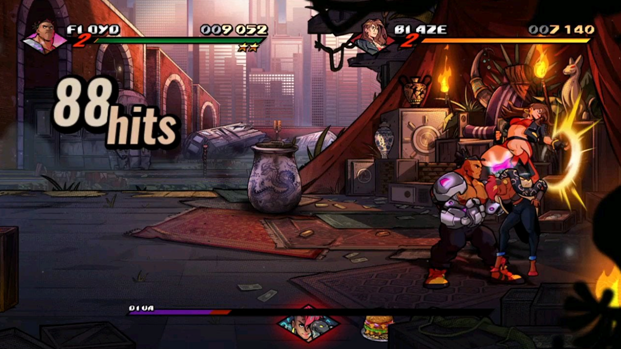
Keep attacking enemies to rack up an awesome combo and earn more points.

Streets of Rage 4 has multiple difficulty settings to choose from; if you pick “Easy”, you’ll start with more lives and enemies will be much less aggressive but, when you select harder difficulties, you’ll have less lives and have to contend with tougher enemies. As you make your way through the game’s missions, you can break open various crates or destroy objects in the environment to uncover food and cash; food replenishes your health and cash adds to your score. When you reach 10,000 points, you’ll earn an extra life but, if you lose all of your lives, you can retry the stage with some Assists, which grant you additional lives and Stars, to help you clear difficult stages.

Graphics and Sound:
Streets of Rage 4 is rendered with a fantastic comic book-like aesthetic; characters are large and full of life, sporting lots of little animations that add to their charm and personality. The game contains twelve stages, each one either lovingly recreated from the original games or heavily inspired by the first three games and other common beat-‘em-up tropes (yes, there is an elevator stage here; two, in fact!) You’ll begin on the mean streets of Wood Oak City and progress through a prison, the sewers, a pier, a biker bar, a dojo, and even battle on the roof of a train and in an airplane all before you reach Y Island, the game’s final stage, which naturally contains an elaborate castle.

SOR4Details
Stages are filled with character, cameos, and variety.

Stages are full of little details, elements, cameos, and intractable elements; you can break open doors, smash apart parts of the environment, and toss enemies into damaging hazards in almost every single one of the game’s stages and each stage is generally broken up into distinct areas to help keep things interesting. The Skytrain stage is the exception to this as you spend the entirety of the stage on top of the titular train, battling waves of enemies and jumping over obstacles as they speed at you.

SOR4Graphics
The game’s story is told through comic book-like cutscenes.

The game’s story is told through simple, partially animated comic book panels; there’s no voice acting to worry about here and all of the game’s cutscenes can be skipped but they are brief and appealing enough to sit through when you do feel like taking in the game’s simple, but effective, story. The game’s soundtrack, composed by Olivier Deriviere and other notable composers is suitably fitting, featuring a mixture of rock and techno, among others, to give each stage a rhythm and a theme. Even better, the game features the option to switch to a retro soundtrack that features music and sound effects from the first two Streets of Rage games, which is perfect when playing as the unlockable 16-bit style characters.

Enemies and Bosses:
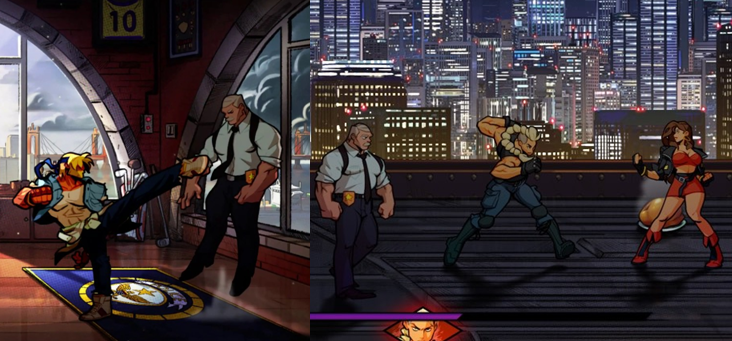
As a mindless beat-‘em-up, Streets of Rage 4 features a number of enemies that get progressively harder as you advance through the game’s stages; enemies are recycled throughout the game, taking on different colour palettes and slightly tweaked attacks as you can, but are generally assorted enough to keep things interesting. You start off taking out generic, denim-clad street thugs like Galsia (who sometimes charge at you with knives and stabbing weapons) and Y. Signal (who sometimes charge at you with a slide tackle) but soon encounter Donovan (a skinhead who has an annoying tendency to uppercut you out of the air), Raven (a Muay Thai martial artists who leaps at you with knees and kicks), and the lackadaisical Francis (who always has his hands in his pockets but flies at you with whirlwind-like kicks) and their many rainbow-coloured variants. You’ll also take on charging biker girls, emo chicks who lob grenades, toxic sludge, and other items at you, and more rotund enemies like Big Ben who breathe fire or belly flop on to you. Some of the game’s more annoying enemies include Goro (not, not that Goro), a martial artist who can reduce your health to nothing by parrying your attacks and bashing you across the screen, suit-wearing bodyguard types who shoot at you with pistols, the whip-wielding girls, and the Goddamn cops! Cops can actually assist you in stages as they’ll attack your enemies, which is helpful, but they have a tendency to grab you so others can hit you and one particular variant loves to rush you and hit you with a taser which is extremely aggravating. You’ll also fight with riot cops who must have their energy shields broken before you can actually damage them, which can be tricky as you can’t rack up a combo of attacks at they can easily swat you away with their batons.

SOR4Bosses
These boss variants can affect a wide area with their attacks.

The game’s bosses are just as varied and interesting and each one has multiple attacks, phases, and issues to watch out for; like some enemies, bosses often have several invincibility frames and nigh-unavoidable rushing attacks and combos so it’s best to keep your distance, bring a weapon if you can, and make good, strategic use of any health items. The first boss you’ll encounter, Diva, isn’t too difficult as long as you get away when she’s charging her primary attack as it has a lot of range. Later on, you’ll have to fight two similarly-themed variants of Diva at the same time, which can be extremely annoying and difficult as, unlike other enemies and bosses, they don’t appear to be susceptible to their partner’s attacks. In this battle, I found it best to eliminate the flame-wielding Riha first as her attacks do more immediate damage.

SOR4Commish
The Commissioner doesn’t get any easier when he shows up as a support boss later on!

Stage two really ramps up the difficulty though as not only does it introduce those damnable taser-wielding cops, it also has you battling the Police Commissioner himself. The Commissioner dashes across the screen and charges up a brutal combo and grab attack that can deal heavy damage and he’s just as annoying when he is brought in as support for another of the game’s bosses, Estel, in the Skytrain stage. You’ll battle Estel twice throughout the course of the game and she’s no pushover either as she attacks with bicycle-like kicks, calls in air support, and tosses grenades at you; the key is to attack and then jump away to avoid her attacks and throw her grenades right back at her and try to avoid the Commissioner in the Skytrain fight as the stage will be complete as soon as Estel goes down.

SOR4Bosses2
Shiva and Max also make welcome returns.

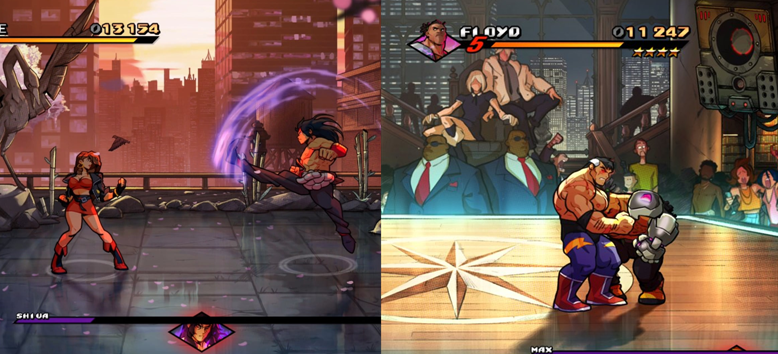
You’ll also battle Shiva, a boss from the original games, who likes to teleport around the stage and conjure shadow versions of himself, a particularly annoying martial artist at the biker bar, and even a brainwashed version of series protagonist Max Thunder. This latter battle can be particularly gruelling thanks to Max’s invincibility frames, dangerous wrestling moves, and the fact that he doesn’t really get stunned by your attacks. DJ K-Washi can also be a trying boss battle as you must not only avoid his many and varied projectiles and goons but also break through his protective shield before you can whittle down his health bar.

SOR4YTwins
After besting the Y Twins individually, and together, you’ll have to contend with their giant mech!

The game’s primary antagonists, the Y Twins, are fought multiple times; you’ll face Mr. Y in the Airplane stage (where he attacks with an Uzi (similar to his father), a bazooka, and grenades) and Ms. Y (who attacks with a rapier-like sword) on Y Island. Of the two individual fights, Mr. Y is easily the more troublesome thanks to his ranged attacks but, once you defeat Ms. Y, you’ll then have to face both bosses at the same time. Once you whittle one of them down to about half of their health bar, they’ll leap into a massive spider-like mech and try to crush you while their sibling continues to press the attack. In this final battle, I find it easier to take out Mr. Y first as his bullets are much harder to avoid; take him down to half health and then attack the mech as and when you can but be sure to also attack the remaining Y twin as, if you deplete the health of the sibling in the mech to nothing, the remaining twin will jump in the mech so it’s much easier to take the remaining sibling out of the equation so you can concentrate on disposing of the mech.

Power-Ups and Bonuses:
The only real power-up you can find in Streets of Rage 4 is the odd Star hidden throughout the game’s stages; otherwise, you’ll mostly be picking up cash for points, health, or a number of weapons throughout the course of the game. These weapons are finite, meaning they will break or disappear after a few hits, but are great for wiping out groups of enemies or throwing as a ranged attack. These weapons range from things such as knives and baseball bats to sledgehammers, swords, and even a razor-sharp boomerang. Often, enemies will be wielding these weapons and can pick them up to use them against you, as well, but you can catch weapons that are thrown at you with a well-timed press of the B button and using an enemy’s weapons against them is imperative to surviving against some of the game’s tougher enemies. Additionally, there are various intractable parts of the environment that you can use to your advantage; you can attack a massive wrecking ball to take out enemies, cause barrels to explode, and toss enemies down pits or cause them to walk into toxic fumes or exposed electrical wires. As helpful as all of these elements are, however, these environmental hazards can also damage you as well so it’s best to keep your distance.

Additional Features:
Streets of Rage 4 features a number of Achievements for you to earn; you’ll get these for clearing the Story mode as each of the available characters, completing modes on different difficulty settings, and for performing certain actions (such as killing three enemies with one explosive barrel or causing a chandelier to kill an enemy). When you first play Streets of Rage 4, your gameplay options are surprisingly limited; you can only choose to play Story or Battle mode and must unlock the Stage Select and Boss Rush mode by clearing the Arcade mode once. I actually like this; so often these days, games come with everything either automatically available or hidden behind downloadable content so it’s nice to actually unlock modes and characters through good, old-fashioned gameplay. Earn enough points across each of the game’s modes and you’ll unlock 16-bit versions of the game’s characters who look and play exactly as they did in the original videogames (sadly, Roo is not playable this time around, though). There are also a lot of options available to you in Streets of Rage 4, ranging from the usual (difficulty selection, brightness and volume customisation and the like) and the unique as you can customise how health-restoring food appears onscreen and switch to the retro soundtrack if you wish. If you explore your environments well enough (or, more specifically, attack arcade machines with a taser), you’ll also find some hidden levels ripped straight from the original Streets of Rage trilogy that pit you against a classic boss character from the first three games and net you some bonus points. If you bought the physical version of the game, as I did, you also get a nifty little artbook and a keyring, which is a nice touch, and Streets of Rage 4 can also be played with friends; the game allows couch co-op for up to four players but online play is limited to just two. However, you need to keep a safe distance when playing with a friend in co-op as you can damage each other in true old school beat-‘em-up fashion, necessitating the need to pick to an area or section of the screen and stick to it.

SOR4Banner

The Summary:
Streets of Rage 4 is a fantastic love letter to everything that was so great about sidescrolling beat-‘em-ups. The genre has sadly fallen out of favour in recent years and I really don’t know why; it’s simple, fast-paced, arcade-style fun that is easy to pick up and play and waste a few fun-filled hours on. Arguably, Streets of Rage has never looked or played better; the game’s cartoony aesthetic, multiple nods and cameos and call-backs to the original games, and myriad of features make the game extremely accessible and fun to play. Some of the enemies and bosses can be annoying and cheap at times but, once you play through the game a few times, it’s easy to see their patterns and avoid their attacks. Hopefully, the release of Streets of Rage 4 will inspire SEGA to outsource some of their other franchises so we can see the same love, care, and attention afforded to this once long-dead series applied to other dormant SEGA franchises.

My Rating:

Rating: 5 out of 5.

Fantastic

What are your thoughts on Streets of Rage 4? Do you feel it lives up to the legacy of its predecessors and old school, arcade-style, sidescrolling beat-‘em-ups? Which Streets of Rage game or character is your favourite? What SEGA property would you like to see get brought back in glorious HD on modern consoles? Whatever you think about Streets of Rage 4, or the series in general, drop a comment below.

Talking Movies: Bloodshot

Talking Movies

Released: 13 March 2020
Director: David S. F. Wilson
Distributor: Sony Pictures
Budget: $45 million
Stars: Vin Diesel, Eiza González, Sam Heughan, Alex Hernandez, Lamorne Morris, and Guy Pearce

The Plot:
United States Marine Ray Garrison (Diesel) is shot and killed whilst saving hostages in Monbasa and right after watching his wife murdered before his eyes. Resurrected by nanite technology developed by Rising Spirit Tech’s (R.S.T.) Dr. Emil Harting (Pearce) and finds himself an amnesiac superhuman soldier, instantly recovering from injury, and with a burning desire for revenge.

The Background:
Unless you’ve been living under a rock for the last ten years, you may have noticed that superhero films and movies based on comic books have become pretty big business; Marvel Studios were pretty much dominating the marketed with a steady stream of releases each year while properties based on DC Comics continue to be produced and be tentpole releases. Perhaps coming in slightly late to the game, in 2015 Columbia Pictures secured the rights to produce films based on the characters featured in Valiant Comics. Founded in 1989 by former editor-in-chief of Marvel Comics Jim Shooter, Steven Massarsky, and a group of investors after a failed attempt to purchase Marvel Comics, Valiant produces such titles as Magnus, Robot Fighter, Harbinger, Turok: Dinosaur Hunter, Shadow Man, and Bloodshot. I, however, primarily know them for the Super Mario Bros. comic books they published in 1990 and for the videogames based on their characters. Nevertheless, Columbia strove to get a piece of the superhero market and forged ahead with Bloodshot, the first in a planned series of interconnected movies in an attempt to launch their own superhero cinematic universe. In a year where going to the cinema has quickly become either a thing of the past or an extremely questionable practice, 2020 didn’t exactly have the strongest year of cinema releases; it was shaping up to be pretty good but pretty much all of the year’s most-anticipated releases either got pushed back and back, delayed, or went straight to on demand services. Because of this, Bloodshot became one of the last films to be released during the lockdown, though this didn’t really amount to much in terms of profit as the film made just over $37 million worldwide and was largely met with little more than average reviews.

The Review:
Bloodshot is a pretty simple, mindless action film; if you’ve seen any action film from the eighties or nineties, you’ve seen pretty much everything Bloodshot has to offer; the core concept of an unstoppable, superhuman solider isn’t exactly new and Garrison’s ability to immediately regenerate from any injury or the inclusion of nano-technology has all been seen before. That, and the relative obscurity of the title character, may understandably give you pause for thought before tackling Bloodshot but, for me, just because it revisits and recycles a lot of familiar ideas doesn’t make the film redundant.

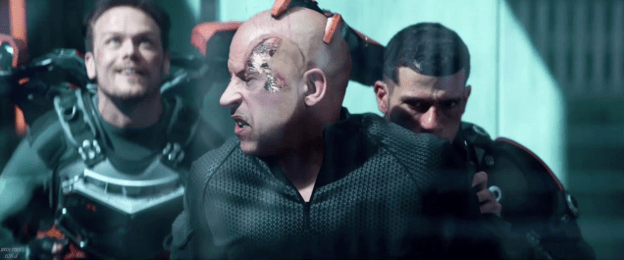
Vin Diesel is playing to his strengths and there’s nothing wrong with that.

For one thing, Vin Diesel remains a surprisingly charismatic and likeable protagonist; his soft, gravelly voice conveys a lot of nuance and emotion (ranging from confusion to anger to heartbreak and a witty charm) and there’s just something about him, beyond him being immediately believable as a super soldier, that I find very likeable. He’s not flexing any muscles we haven’t seen from him before but he’s also not exactly phoning it in, either, delivering a serviceably entertaining performance as an amnesiac soldier suddenly gifted with superhuman powers who wants only one thing: revenge. (Well…three things, I guess: his wife/old life back, revenge, and the truth).

Guy Pearce puts in another decent performance as a menacing puppet master.

Opposing him is the peerless Guy Pearce; sure, Harting is just another “guy in a suit” puppet master/master manipulator kind of antagonist but I’ve always said that for these big, mindless action films with a bit of a brute as the main protagonist, you need an exceptional or accomplished actor in the role of the antagonist to give them film credibility and depth. Much of Harting’s dialogue, especially in the film’s early stages, is exposition but Pearce delivers it so convincingly and with such conviction that I never found it to be contrite or boring. When the “big reveal” (I believe the trailers gave the film’s twist away but Pearce is such a natural bad guy that you can easily see his turn coming a mile away) happens, Pearce instantly flips from a caring, compassionate mentor-like figure to a cold, ruthless sadist who is willing to sacrifice anything and anyone to protect his investment, take care of any loose ends, and create an army of unstoppable super soldiers under his direct command.

Dalton and Tibbs are constant thorns in Garrison’s side.

Of course, Harting isn’t nearly enough of a physical threat for Garrison to go up against; luckily, R.S.T. has used Harting’s technology to augment a couple of other soldiers for the good doctor to toss in Garrison’s path. Jimmy Dalton (Heughan) is Garrison’s primary rival; he takes an immediate dislike to Garrison and delights in utilising his cybernetic legs and, later, a pretty impressive prosthetic rig to vent his feelings out on Garrison’s largely indestructible form. Dalton is partnered with Marcus Tibbs (Hernandez) who uses a series of cameras and ocular implants to help track and pinpoint Garrison once he goes rogue and, together, they are just about able to equal something of a challenge for Garrison (though it does make you wonder why Harting didn’t inject his nanites into Dalton and Tibbs as well to give them more of an edge).

Gina is just a fantasy to motivate Garrison while KT is the resident bad-ass female who’s sick of Harting’s manipulation.

Of course, Bloodshot isn’t all action and testosterone; the crux of Garrison’s quest for revenge hinges on him wanting to avenge the brutal murder of his wife, Gina (Talulah Riley). Simply reliving this traumatic memory is enough to send Garrison out in a relentless quest to track down the man responsible again and again and is a pure enough motivation to allow Harting to reprogram Garrison to assassinate a series of targets, Garrison’s memory of Gina is skewed and unreliable, to say the least, as it turns out she’s not even dead and they’ve been separated for five years. As a result, there’s not much for Gina or Riley to do except be the object of Garrison’s affection and primary motivation, leaving her as little more than an attractive object rather than a well-rounded person. Luckily, KT (González) is on hand to fill some of that role. Unable to breath naturally, she has been affixed with a cybernetic respirator that makes her immune to toxins; she’s also an extremely bad-ass fighter, making short work of much larger, masculine opponents and sympathising with Garrison’s plight. Mainly due to Garrison being fixated on avenging a wife he believes to be dead and him struggling to come to terms with the truth, any romantic or sexual tension between KT and Garrison is, thankfully, downplayed and they are portrayed as much more than colleagues, equals, and partners rather than succumbing to clichés. Still, the film seems to be leaving the door open for this, and an expansion on KT’s backstory and personality, in a future film as there isn’t much time spent on fleshing her out as being more than an exception fighter who’s tired of being manipulated.

The Nitty-Gritty:
Bloodshot also balances it’s slower, more contemplative moments and its high-octane action with a strange, quirky sense of humour. There’s a really weird moment in the beginning where Martin Axe (Toby Kebbell) suddenly brings into a whole dance routine (though this is later explained away as a flourish imbedded into Garrison’s memory by Harting’s coder) and Garrison is later saved from Harting’s continued manipulation by Wilfred Wigans (Morris), an eccentric rival coder who provides the bulk of the film’s comic relief through his fast-paced witticisms and peculiarities.

Bloodshot sold itself on this shot but similar effects are neutered by the film’s rating.

Still, let’s be honest with ourselves here: if you’re watching Bloodshot, you’re watching it to see Vin Diesel smash random dudes in the face and tank shots to his person. Bloodshot’s unique premise is that Garrison is loaded up with nanites that automatically repair damage and injuries to his body; we’ve seen similar effects before with the likes of Logan/Wolverine (Hugh Jackman) and the T-1000 (Robert Patrick) but Bloodshot takes it up a notch by being a little more graphic in its depiction (or, at least, as graphic as it can be with its 12 rating). As a result, you’ll get to see Garrison take a shotgun blast to his face and see his skin, bones, sinew, and blood all reform pretty much instantaneously, bullet holes close up, and him hammering opponents with his increased strength.

It’s worth sticking around for Bloodshot‘s fun and exciting action and fight scenes.

Still, as impressive as Diesel’s fight and action scenes are, they do wear thin pretty quickly thanks to the aforementioned rating. I feel Bloodshot would have benefitted greatly from being a 15 so we could see some really gory and gruesome effects and more brutal action sequences but it does pretty well with what it has. There’s plenty of scenes of Vin beating people to death, a pretty good chase sequence where he out-runs his pursuers with relative ease, and a unique final battle pitting him against Dalton and Tibbs on a collapsing external elevator.

The Summary:
Bloodshot may be big, loud, and somewhat derivative but it’s far from a complete clusterfuck or an unenjoyable experience. The film’s facing is good, its narrative is playing mostly straight and the action is tight and easy to follow. Vin Diesel and Guy Pearce excel in their roles (primarily because they’re playing to their strengths but what’s so wrong with that?) and the film’s premise is pretty good; Garrison isn’t completely unstoppable or invulnerable, meaning the film is just as much about him overcoming his limitations as it is him breaking free of Harting’s programming and manipulation, and he’s still in a position where he is in danger even with his nanites. Could more have been done with this? Yes, possibly, but I feel the film does a decent enough job of establishing this work and these characters and I would be interested to see where Garrison goes from here and a deeper exploration of this universe. Whether we’ll actually get that or not, however, remains to be seen.

My Rating:

Rating: 3 out of 5.

Pretty Good

Did you go and see Bloodshot earlier this year? If so, what did you think of it? Have you ever read the Bloodshot comic books? If so, do you feel the film did the character justice or was it lacking as an adaptation? Would you like to see more of this character and this world or do you feel this one deserves its mediocre reception and is best left forgotten? What is your favourite Vin Diesel movie/role? Whatever you think about Bloodshot, drop a comment below.

Game Corner: Gears of War: Judgment (Xbox 360)

GameCorner
GearsJudgeLogo

Released: March 2013
Developer: People Can Fly/Epic Games Poland
Also Available For: Xbox One (Backwards Compatible)

The Background:
Gears of War (Epic Games/Various, 2006 to 2019) is a third-person, over-the-shoulder science-fiction military shooter exclusive to PC and the Xbox series of consoles. Originally conceived as more of a traditional first-person shooter in enclosed arenas, the series has seen numerous sequels, spin-offs, comic books, and action figures since the release of the first game and the franchise is easily one of the most successful on the Xbox. My exposure to the series is somewhat limited; though aware of it for some time, I didn’t actually play a game in the series until I was gifted Gears of War: Ultimate Edition (Epic Games, 2015) and I found it to be extremely enjoyably thanks to it’s over-the-top, overly macho characters and plot, all clearly heavily inspired by films such as Aliens (Cameron, 1987) and Starship Troopers (Verhoeven, 1997). Since then, the franchise has been on the fringes of my mind but somewhat intimidating and impenetrable due to the myriad of sequels. Gears of War: Judgment, however, was a prequel to the first game and, as a result, worked as a not only tentative baby step into this wild and frantic bug shooter.

The Plot:
Some time before the events of Gears of War, Lieutenant Damon Baird’s Kilo Squad, all soldiers battling the marauding Locust Horde on behalf of the Coalition of Ordered Governments (COG), are placed on trial for disobeying orders, with the majority of the game’s story taking place in the form of flashbacks as each COG tells their part of the story that led to them facing a summary execution.

Gameplay:
Gears of War: Judgment is a third-person sci-fi/military shooter; the camera is firmly placed over the shoulder of your character and there is a heavy emphasis on gore, fast-paced shooting and taking cover from incoming damage, as well as some (very) light puzzle solving. Through the course of the game’s story, you’ll play as each of Baird’s Kilo Squad: Augustus Cole, Sofia Hendrick, Garron Paduk, and Baird himself. Each has different personalities (though they’re all mostly infused with the same ultra-macho mindset and physicality as series protagonist Marcus Fenix) but all play exactly the same as each other (in the main story campaign, at least).

GearsJudgeControls
Gear up for a bug hunt!

If you’ve played the first Gears of War, you should be immediately familiar with Judgment’s presentation and controls. You can aim and toss a variety of grenades with the Left Trigger and bumper, blow holes in the monstrous Grubs with the Right Trigger and reload with X. When reloading, you’ll see a little white mark on a bar on your heads-up display (HUD); press the Right Button at the right time, and you’ll reload almost instantaneously. If you miss the window, though, your gun will jam and leave you vulnerable to attack.

GearsJudgeExecute
Don’t hesitate to execute your fallen foes!

When enemies are downed, you can choose to finish them off or use them as a shield to stave off incoming fire. Additionally, you can also melee attack enemies with B; if you have the Lancer, you can press and hold B to activate the gun’s chainsaw attachment and slice your enemies in two in fantastically gruesome fashion. Similarly, the Retro Lancer comes equipped with a bayonet-like blade that allows you to charge at Grubs and skewer them by holding B. You can also run, while ducking, by holding A; while this greatly improves your movement speed, it is a bit unwieldy and you’ll find yourself running head-first into walls and other obstacles when using this function.

GearsJudgeCover
Take cover to avoid gunfire and pick off your foes.

Just pressing A allows you to perform a somersault (a manoeuvre that you would think is basically impossible given the heavy armour the COG wear) to dive ahead or away from danger. Pressing A near walls and other fortifications will see you immediately snap to cover; this will keep you safe from gunfire and allow you to shoot out from cover or jump from cover to cover to advance further. As with a lot of shooters, a number of generous checkpoints are scattered throughout each mission and you will automatically regenerate health if you escape from danger for a few seconds. If you’re injured too gravely, you’ll fall to the floor and be forced to crawl away from danger, mashing A to call for help. You can similarly revive your fallen comrades by pressing X when they’re nearby, which is strongly recommended as your fellow COG are instrumental not only to reviving you, but also culling the influx of Grubs and other monstrous aliens.

GearsJudgeAmmo
Ammo and new weapons are plentiful and often within easy reach.

As you explore the various war-torn environments that make up the Gears world, you’ll find a number of weapons, ammo, ammo crates, and other collectables to aid your mission. Again, like most shooters these days, you can only hold two guns at once; sometimes, you can grab a bigger, vastly more powerful weapon that won’t see you automatically drop your current weapon, which is helpful but these larger weapons are often extremely unwieldy and have very limited ammo. You can also carry a number of grenades; these are great not just for blowing Grubs into bloody chunks but also for closing emergence holes and stopping new enemies from entering the area. Each chapter of the story is divided into a series of small missions that generally involve getting from point A to point B, navigating through dishevelled urban environments, or defending either a robot or an area from waves of enemies. As you progress, killing enemies, reviving your team mates, and staying healthy, you’ll acquire Stars to level-up your gamer profile, earning Ribbons, Achievements, and a variety of unlockables for the game’s multiplayer mode.

GearsJudgeDefend
Quite often, you’ll be tasked with fortifying and defending an area against waves of Grubs.

At the beginning of each mission, you’ll find a massive glowing red Gears logo on a wall; pressing X on these will give you the option of tackling the mission with a number of handicaps to earn more Stars. These handicaps vary from reaching your objective under a strict time limit, fighting with either no ammo or certain weapons, having your vision obscured, more enemies being present, or your health no longer regenerating, among others, and are a nice way to add a little more challenge to each mission. Gameplay doesn’t really amount to much more than taking cover, blasting at aliens, and ploughing ahead (unless, of course, you choose one of the aforementioned optional handicaps). However, you earn more Achievements and in-game rewards if you manage to kill enemies with certain weapons, get headshots, blow shit up, or interact with your environment by completing the game’s few, very simple puzzles. These literally boil down to pressing X on a highlighted area of the environment to turn a valve or set a charge and, maybe, pressing A as well. When defending an area, you’ll be tasked with setting up automated turrets or laying explosive trip wires and you’ll also have to defend your robot from being attacked but there are no vehicles or other gameplay styles to break up the action: it’s simply an unapologetic, super macho bug hunt from start to finish.

Graphics and Sound:
Gears of War: Judgment doesn’t exactly move the needle when it comes to its graphics or environments; once again, we have many war-torn, urban environments that are mostly grey or brown, with scattered fire, entrails, and damage all over them. It seems that shooters can’t quite get out of the slump of falling back on these generic colour schemes and locations; every area, whether inside or outside, is deceptively enclosed to localise your firefight to that one area until the danger has passed. This might be in the streets, on a military campus, or on the rooftops over the half-destroyed city but, in either case, you’ll find the same barricades and fortifications to take cover behind.

GearsJudgeSofia
Surprisingly, the game’s only female isn’t a hyper-sexualised character.

Luckily, Judgment makes up for this by continuing the over-the-top character designs made famous in the first game; every character is bulging with muscles and testosterone the likes of which made famous by movies like Predator (McTiernan, 1987) and clad in a massive segmented suit of armour that looks completely ridiculous and impractical but it all adds to the elaborate character of the game, and the series in general. This time, the COG are joined by a female soldier, Cadet Hendrick, who, while still hyper-sexualised, is actually surprisingly well-covered for a female character in such a blatantly overly masculine videogame. I mean, she’s the only female in the game (and she of course has a questionable sexual history) and she doesn’t really factor into the plot too much beyond being young and naïve but it’s something, if nothing else.

GearsJudgeGraphics
There’s little graphical downgrade between the in-game and cutscene graphics.

The majority of the game’s story is told through cutscenes, of course, wherein the characters all growl and snarl at each other with an amusing level of camaraderie; the cutscenes still hold up really well, being nearly indistinguishable from the in-game graphics, and the in-game dialogue between the soldiers helps to direct your attention and further flesh out the characters. Mostly, though, the game is swamped in either silence, the sounds of gunfire and growling beasts and men alike, or sporadic bursts of suitably military-inspired tunes.

Enemies and Bosses:
The COG have a tall order ahead of them as they clash with the seemingly inexhaustible Locust Horde, an army of monstrous aliens of all shapes and sizes who attack using the environment to their advantage and using intelligent swarming and flanking tactics. Locusts fire from behind cover, dash behind pillars and barricades, and clamber out of emergence holes hungry for human flesh but they’re also bolstered by larger, more durable enemies and smaller, bug-like enemies that explode in your face.

GearsJudgeEnemies
Even regular enemies can absorb quite a bit of damage before finally going down.

You’ll have to contend with snipers, Grubs who fire mortars at you incessantly, floating squid-like aliens affixed with machine guns, zombie-like humans, blade-wielding Grubs, massive armour-plated hulks who wield maces and giant protective shields, and even gaunt Kantus enemies who will replenish the Locust’s health and ranks and explode in a suffocating toxic cloud upon defeat. Even the regular, run-of-the-mill Wretches can be quite tough to put down as enemies can absorb a lot of bullets and even then many of them will crawl around on the floor, leaving themselves wide open to a bloody evisceration, but the bigger, tougher enemies will require you to manoeuvre around them to their exposed behinds or simply toss a grenade at them to blast them to pieces.

GearsJudgeEnemies2
The game’s bigger, more monstrous enemies act as sub-bosses, of a sort.

Technically speaking, Judgment only features one true boss battle, which forms the basis for the game’s final mission. However, as you progress through the campaign, you’ll battle some larger, far tougher enemies who basically function as mini bosses. These include the crab-like Corpsers (which burrow out of the ground and shield themselves with their claws), Ragers (which are regular Grubs that suddenly transform into rampaging, bloodthirsty monsters rather than dying), the Bloodmounts (massive monsters the Locust Horde ride into battle), and the giant, spider/octopus-like Reavers that fly around the air shooting missiles at you and then come crashing to the ground to try and stamp you to death.

GearsJudgeKarn
You’ll face General Karn at the game’s finale.

The only actual boss battle takes place in the game’s final mission and sees you battle against the Locust Horde’s General, Karn, who attacks from atop a gargantuan semi-cybernetic spider called the Shibboleth. This battle takes place in a large open area with plenty of massive blocks to take cover behind and ammo to grab and can be made harder to selecting the option handicap, which sees a swarm of Elite Grubs help defend their General. The hardest thing about this boss battle is that Karn doesn’t have a health bar so the only way to you that you’re damaging him is when the HUD says he’s been wounded and you can only damage him when your aiming reticule is red. Otherwise, Karn is a large and lumbering target; as long as you take cover and stay out of the way of his charge attack and missiles (and revive your team mates as needed), he isn’t too tough to put down.

Power-Ups and Bonuses:
Despite the game’s over-the-top premise and presentation, there are no power-ups to be found in Gears of War: Judgment. You won’t get any steroids to make you faster, no invincibility power-ups, and there’s no beer to chug to send you into a blood rage. Instead, you have to make do with the game’s wide and impressive array of weaponry; the standard weapon is, as always, the Lancer, which is great for ranged and close quarters combat and, of course, has a fuckin’ chainsaw attached to it, making it the best go-to weapon of the game once again.

GearsJudgeWeapons
Snipe from afar or simply blow the Grubs into bloody chunks!

You’ll also get a few pistols, which can be useful in a pinch, some shotgun variants (which are fantastic for blowing chunks into Grubs when they get in your face), and a couple of different sniper rifle-type weapons. Some Grubs carry heavier weaponry, such as the Boomshot (which is, essentially a shotgun-like grenade launcher), giant Buster Sword-like blades, and one particular weapon that burrows under the ground towards its target and explodes in impact. You’ll also get to use some of the COG’s heavier weaponry; automated turrets, mortars, shielded heavy rifles, and massive hand-held weaponry like the Mulcher and the One-Shot, which are so big and heavy that you fire from a crouched position. They also massively slow you down and have limited ammo, forcing you to pick between mobility and power. You can also set up explosive traps, fire a bouncing grenade, roast Grubs alive with the Scorcher (or “flamethrower”), and defend yourself using a Boomshield.

Additional Features:
Gears of War: Judgment has a fair few Achievements tied to it; most of these are tied to story progression and levelling-up your in-game profile but you’ll also earn them by unlocking certain Ribbons and playing the game’s multiplayer component.

GearsJudgeMultiplayer
There are many options available in Judgment‘s multiplayer.

Judgment’s multiplayer comes in numerous forms; you can play the main story campaign in co-op, take part in local and offline deathmatches and the like, and even compete in similar matches against computer-controller ‘bots. Alongside the standard multiplayer matches you might expect, you can also play “OverRun” and “Free-For-All”, with OverRun seeing you play as the COG and/or the Locust Horde in pursuit of gaining ground and raking up kills. You can also purchase some downloadable content that adds further multiplayer maps and modes to the game, if you like that sort of thing. As you play the campaign, you’ll find the game keeps track of various statistics (enemies killed, times downed, number of executions performed, etc) and compares them to those of your friends, which is a neat feature. You’ll also find a number of COG Tags scattered throughout each mission; whenever you spot a dark, blood-red Gears logo, a COG Tag will be nearby and you’ll need to find all of them to get 100% of the game’s Achievements. Additionally, once you complete the main campaign, you’ll unlock a bonus story, “Aftermath”, which appears to take place after Gears of War 3 (Epic Games, 2011), which sees Kilo Squad reunited and attempting to prepare for a bigger Locust assault.

GearsJudgeBanner

The Summary:
I feel like I came into Gears of War when the series was already deeply entrenched in its lore and nearly impenetrable as a result. While I enjoy the characters and presentation and the gameplay, the idea of playing every single one of the titles is a little daunting to me as there is a lot of content to digest but, after playing first Gears of War: Ultimate Edition and now Gears of War: Judgment, I have to admit that I am tempted to try out more from the Gears franchise. Crucial to this is that fact that, while the game can be challenging, it’s nowhere near as frustrating or aggravating as a lot of similar shooters. Thanks to the game’s optional handicaps, Judgment is only ever as difficult as you choose it to be, meaning you can play as casually or as hardcore as you like. The characters and premise are also massively over-the-top and really appeal to the nineties kid in me, recalling the ultra-macho sci-fi/horror franchises that shaped my childhood and being unapologetically mindless and masculine in its execution. I didn’t see much in Judgment to really make it stand out from the first game or that was especially innovative but there was enough here to appeal to a casual fan of the series such as myself and to inspire me to revisit the title at a later point to try and tidy up a few more of those Achievements.

My Rating:

Rating: 3 out of 5.

Pretty Good

What did you think of Gears of War: Judgment? Where do you rank it amongst the other Gears of War titles? Which Gears of War videogame or character is your favourite? Whatever you think about Gears of War, drop a comment below.

Game Corner: Ghostbusters: Sanctum of Slime (Xbox 360)

GameCorner
GhostbustersSanctumLogo

Released: March 2011
Developer: Behaviour Santiago
Also Available For: PC, PlayStation 3, Xbox One

The Background:
Ever since the release of Ghostbusters (Reitman, 1984), the concept of four somewhat-bumbling New York parapsychologists running around zapping and trapping troublesome spirits has seen some significant success as a franchise. We’ve had the under-rated sequel, a reboot that was met with middling to less-than-favourable reviews, a couple of cartoons, a whole slew of action figures and comic books, and, of course, videogames. A few years after the release of Ghostbusters: The Video Game (Terminal Reality/Red Fly Studio, 2009) was released, Atari made the…interesting decision to follow-up with a straight-to-digital twin-stick shooter rather than continue the adventures of the titular Ghostbusters after the decent reception of that aforementioned, semi-official continuation of the film franchise.

The Plot:
Some time after the events of Ghostbusters II (Reitman, 1989), the Ghostbusters have been run ragged by an influx of supernatural occurrences through the city. Hiring in four new team members, the Ghostbusters send their rookies out to investigate a disturbance and, soon, the greenhorns stumble upon a plot to summon an ancient evil once more.

Gameplay:
Ghostbusters: Sanctum of Slime is a one to four player, top down twin stick shooter reminiscent of the awesome old arcade game Smash TV (Williams, 1990); no matter which of the new Ghostbusters you choose to play as, or whether you’re playing alone or with friends, you’ll bust various ghosts and other supernatural entities in a constant team of four. The controls of Sanctum of Slime couldn’t be simpler; you control your Ghostbuster with the left analogue stick, fire your Proton Pack with the right, and switch to your different Proton Streams with the Left and/or Right Trigger. When a team mate is downed by an attack, you can revive them by rapidly tapping A and they will do the same to you, with surprising speed and efficiency. Your computer-controlled allies are extremely capable and helpful, to be honest; they’ll constantly blasts ghosts with Proton Streams, resuscitate you and the others as a priority, and are generally much more comfortable at navigating the game’s limited areas than you will be. Technically, there’s nothing necessarily wrong with the game’s controls or settings, there’s just not a lot to it; your character controls quite well, being just slippery enough to move at a decent speed but a dash function would have been appreciated.

GhostbustersSanctumHealth
Watch your health bar as it can drain surprisingly (and frustratingly) quickly.

You and each of your team mates come equipped with a life bar, unlimited lives, and unlimited continues; should you fall in battle and your fellow ‘Busters also be defeated before they can revive you, you can simply continue from the last autosave checkpoint. Unfortunately, these are often placed before gauntlets and boss battles, which can end up with you having to slog through some of the game’s more difficult and frustrating battles again and again as it seems your health can get drained in anywhere from three to one hits with little consistency. There are four playable characters in Sanctum of Slime but there is absolutely no difference between each of the new Ghostbusters other than cosmetic; why the developers felt the need to bring in four completely new characters is beyond me as their word balloon dialogue could easily have been taken up by the original foursome and it doesn’t really add that much to the plot or the lore to bring in four new faces. Even more disappointing is the fact that you can’t even unlock the original Ghostbusters as skins (or anything else for that matter) to play as.

GhostbustersSanctumCharacters
You may as well select “Random” as all the characters play exactly the same.

As you explore the game’s familiar surroundings (we’re back at the Sedgewick Hotel again, a haunted graveyard, and other locations that were rendered far more impressively in Ghostbusters: The Video Game), you can destroy various aspects of the environment with your Proton Stream. Doing so adds to your score and you can gain additional points by reviving your team mates, destroying ghosts, capturing the bosses, and grabbing various power-ups. The score is merely for bragging rights, however, as the team’s performance is ranked (well…not exactly “ranked”…more tallied, I guess) at the end of each mission but you don’t get anything special for getting the highest score. There are no difficulty settings for Sanctum of Slime; the game gets progressively challenging as you venture along, throwing more and bigger ghosts at you and filling the screen with red, blue, and yellow spirits that force you to quickly switch between your three different Proton Streams extremely quickly. This isn’t so bad and things progress quite well until you reach the fittingly-named “Gates of Hell” mission, which sees you having to endure seemingly-endless waves of the game’s most difficult enemies, desperately trying to avoid damage and revive your team mates before you get wrecked and have to restart all over again. As if this wasn’t frustrating and annoying enough, my game crashed on me a few times during one of the more difficult of these gauntlets, which only added to the aggravation in this mission.

Graphics and Sound:
Ghostbusters: Sanctum of Slime is pretty basic in terms of its presentation; each area is rendered quite well but there’s not much definition in the character models. This is to be expected considering the perspective the game employs and, clearly, the developers put more effort into rendering the game’s numerous colourful and unique spooks and spirits. Honestly, you’re not going to get the same level of graphical quality as in Ghostbusters: The Video Game or most double-to-triple-A titles and nowhere is this more evident in the fact that there are only a handful of environments to explore. You’ll revisit the same locations in the game’s later missions and maybe they’ve been altered a bit and you battle more difficult ghosts but while the game lacks much in the way of level or graphical variety, for a budget digital-only game, Sanctum of Slime does a decent enough job; you simply move from location to location, busting ghosts and trying to stay on your feet and the game’s pacing is fast and frantic enough where you won’t be stopping to examine the intricacies of the little details.

GhostbustersSanctumCutscenes
The original Ghostbusters only appear in the game’s comic book-like cutscenes.

The game’s plot is told using comic book-like cutscenes that use word balloons and the very basics of animation to tell its story; this isn’t necessarily a problem, and you can skip through them (which is always welcome, though you need to watch them all to earn an Achievement), but their visual style clashes somewhat with the more semi-realistic aesthetic of the in-game graphics. Similarly, you’ll hear a bunch of familiar Ghostbusters tunes and sounds in Sanctum of Slime, all of which are ripped or heavily inspired from the first movie to, which adds to the game’s authenticity.

Enemies and Bosses:
As you blast your way through the game’s twelve missions, you’ll come up against all kinds of ghosts, spirits, and supernatural entities. You’ve got the bog-standard flaming skulls, bellhops and chefs who throw luggage and knives at you, respectively, and a whole slew of different slime-born creatures ranging from spiders, to giant hands, to huge, mud-like monstrosities. These basically act as mini bosses, of a sort, as they can decimate you and your team mates in no time at all; as if that wasn’t bad enough, they’re often accompanied by flying gargoyles that spit fireballs at you and a slew of other smaller, more generic spooks. When locked into an area, you’ll generally be tasked with clearing the immediate vicinity out of any ghosts present or enduring a frustrating gauntlet that can wipe you and your team mates out in seconds if you’re not careful.

GhostbustersSanctumBosses
Bosses are bigger and tougher and some are more than familiar…

You’ll also come up against some bigger bosses; like most of the other enemies, these have a health bar that must be whittled down with your Proton Streams but, unlike the other enemies, bosses have a far bigger bar and have numerous phases and methods of attack. Whether by coincidence or design, a few of the bosses are extremely reminiscent of those seen in Ghostbusters: The Video Game; you’ll once again find yourself in the kitchen of the Sedgewick battling a demonic chef and tackling demonic spider in a nest of webs, for example (though, to be fair, this latter boss at least looks significantly different).

GhostbustersSanctumFinalBoss
Ah, yes, the tried and true demonic final boss…

There are some more original bosses to contend with, though, such as a monstrous, dragon-like possessed subway train and a massive stone gargoyle. However, Sanctum of Slime commits one of the cardinal sins of videogames but having you battle through all the bosses you previously bested before reaching the game’s final boss (which, as in Ghostbusters: The Video Game, involves battling a possessed avatar and the game’s principal antagonist, Dumazu the Destroyer). Ultimately, none of the bosses pose that much of a problem; you simply keep your distance, keep pouring on the heat, chipping away at their health until they are weak enough for you to toss a trap, and then all that’s left is for you to win a quick-time event and the boss is trapped forever. The final boss itself is large and intimidating and can swipe, incinerate, and crush you and your team mates with ease but, for the most part, its pretty simply to stay out of danger and cycle through your Proton Streams to whittle its health down to nothing.

Power-Ups and Bonuses:
Every time you destroy an enemy, you’ll earn points; after clearing some areas of ghosts, you can pick various power-ups to increase your score (such as a cash bonus or cash multiplier) but what you really want are the full health and invincibility power-ups, which are few and far between and often dropped by blasting Slimer when he floats into the area. When you start the game, you’re equipped only with the basic Proton Pack and a trap, which you can only use in boss battles. Once you reach the second mission, you’ll receive your first Proton Pack upgrade (the Fermion Shock) and, upon reaching the sewers (because Ghostbusters videogames love a good sewer level), you’ll get the third and final upgrade, the Plasma Inductor.

GhostbustersSanctumRace
Racing missions help break up the monotony a little.

Essentially, these are just different coloured beams or bolts for you to shoot out; the Proton Stream fires in an inexhaustible beam and is most effective against red-coloured ghosts, the Fermion Shock fires out in waves and damages yellows ghosts, and the Plasma Inductor fires blue bolts that rebound off walls and are best used against blue-coloured ghosts. You can’t upgrade any of these or spend your points/cash on anything to increase your performance, meaning you’ve pretty much seen everything the game has on offer by the fourth mission. To break up the monotony of the constant ghostbusting, a fifth rookie comes and picks your team up in the ECTO-4WD, a jeep-like vehicle that you have absolutely no control over; you simply sit in the back and blast at ghosts as the vehicle races at break-neck speed through a questionably-rendered New York City.

Additional Features:
Ghostbusters: Sanctum of Slime comes with a handful of Achievements for you to earn; honestly, the amount of offer is quite disappointing and the developers simply opted for having you earn them by doing mundane tasks such as beating the first level, the entire game, reviving team mates twenty times, or making it through online with three other players. Yes, the game supports both couch and online co-op and is probably a lot more fun with a few more friends to play alongside. Considering one of my gripes with Ghostbusters: The Video Game was that it foolishly didn’t include a co-op mode for the main campaign so it’s good to see that corrected here but, unfortunately, the game isn’t anywhere near as much fun. Scattered throughout each mission (with the exception of the racing missions and certain boss battles) are a number of collectables; unlike in Ghostbusters: The Video Game, these are all little Stay Puft Marshmallow Men and all you get for collecting them all is an Achievement. They don’t unlock any concept art or skins and the only way to expand upon the main game is to purchase the downloadable content, which consists of a bunch of items for your Xbox avatar and a Challenge Pack that offers you the chance to play completely alone or with a limited number of lives through the game’s more challenging missions.

GhostbustersSanctumBanner

The Summary:
Ghostbusters: Sanctum of Slime is simple, frantic fun; it’s a cheap, digital-only title so you can’t really expect too much from it but, having said that, I have played similar games that have a lot more going for them. Dead Nation (Housemarque/Climax Studios, 2010), for example, is strikingly similar in its execution and presentation but has far more depth to it; in comparison, Sanctum of Slime seems like it was rushed out by Atari simply to maintain the Ghostbusters licence. While there is a lot of arcade style fun to have with Sanctum of Slime, there are a lot of missed opportunities; just adding skins for the original characters or their animated counterparts would have been nice (or, you know, using those familiar characters in the first place) but there also could have been an actual upgrade system or some reason for you to get all those points and collectables. Instead, you’re left with a short, relatively inoffensive little game that is good for a few hours of mindless action but you’re unlikely to come back to it again unless you can find a few other people to play alongside.

My Rating:

Rating: 1 out of 5.

Terrible

What did you think of Ghostbusters: Sanctum of Slime? Which of the original Ghostbusters and the lame new ones introduced in this game is your favourite? Which Ghostbusters videogame do you have fond, or bad, memories of? Do you think it’s time for a new co-op Ghostbusters videogame? Whatever you think about this game, or Ghostbusters in general, drop a comment below.

Game Corner: Alien Trilogy (PlayStation)

GameCorner
AlienTrilogyLogo

Released: February 1996
Developer: Probe Entertainment
Also Available For: PC and SEGA Saturn

The Background:
Over the years, there has been a slew of media and merchandise produced based on the Alien movies (Various, 1979 to present); we’ve had action figures, comic books, crossovers with the Predator films (ibid, 1987 to present) and various other comic book characters, and, of course, videogames. Typically, videogames based on the Alien series prior to Alien Trilogy focused on the more action-orientated Aliens (Cameron, 1986) and were fast-paced, sidescrolling run and gun videogames. This changed with the arcade title Alien3: The Gun (SEGA, 1993) and Alien vs. Predator (Rebellion Developments, 1994) for the ill-fated Atari Jaguar. Both titles still largely borrow more from Aliens than any of the other Alien movies but transitioned the franchise into a first-person shooter for the first time. With the under-rated Alien: Resurrection (Jeunet, 1997) due to be released late the following year and Final Doom (TeamTNT, 1996) having been released that same year, it’s safe to say that traditional first-person shooters (FPS) were still relatively popular and just starting to be just as much fun on home consoles as they were on PC and that the Alien franchise was still very much alive in the public mind, no doubt contributing to the development and release of this title.

The Plot:
After their colony on LV-426 is over-run with the volatile biomechanical creatures known as Xenomorphs, the malevolent Weyland-Yutani corporation enlists a group of Colonial Marines to head into the colony under the pretext of suppressing the Xenomorph infestation (though their true goal is to capture a live sample for use in their bio-weapons division).

Gameplay:
Alien Trilogy is a first-person shooter in which players are cast in the familiar role of iconic Alien series protagonist Lieutenant Ellen Ripley and dropped head-first into what is, basically, a Doom (id Software, 1993) clone. If you’ve ever played the original Doom or any of its sequels or knock-offs prior to the franchise making the jump to 3D, you’ll know exactly what Alien Trilogy is all about: navigating dark, dismal, maze-like environments, picking up a variety of weapons, and blasting at never-ending swarms of enemies until you reach a pre-determined exit.

AlienTrilogyGameplay
Explore some familiar locations in Alien trilogy.

Despite its title, Alien Trilogy doesn’t have you running through each of the Alien films in concurrent order; instead, the plot is like a condensed and abridged amalgamation of all three movies stuffed primarily into the setting of Aliens. Ripley closely resembles her appearance from Alien3 (Fincher, 1992), for example, but now she appears to be a Marine and all the weapons she has available are ripped straight from Aliens. After clearing the first few stages (all of which are based on environments from Aliens), she explores a nearby prison colony that is exactly like Fury 161 and, in the game’s finale, ends up investigating the crash alien spacecraft responsible for LV-426’s problems first seen in Alien (Scott, 1979). So Alien Trilogy is not framed in the same vein as, say, another trilogy title developed by Probe in that same year but more like Mortal Kombat Trilogy (Avalanche Software/Midway Games/Point of View, Inc, 1996) in that it mashes together all of the most recognisable elements from the three Alien movies and merges them with a traditional, Doom-style FPS title. Once you clear a stage, you’ll receive three percentage grades that track the number of Xenomorphs you destroyed, secrets you found, and how much of the mission directive you met. If your mission completion percentage is too low, you may find yourself repeating the stage to get a higher grade and progress further and, after every other stage or so, you’ll be placed in an area completely devoid of enemies and given a short time to stock up on health, ammo, and other items.

AlienTrilogyMap
The map is useful, if vague and awkward.

Unlike Doom, however, rather than simply making your way from point A to point B and collecting coloured keys to progress further, each stage of Alien Trilogy has a mission directive tied to it that must be met in order for players to activate the exit or successfully clear the stage. These directives range from eliminating all enemies within an area, collecting identification tags, destroying Xenomorph eggs, eliminating infected colonists or rogue androids, and activating lights, lifts, or other mechanisms to access new areas of the colony. Ripley is quite well equipped for the task at hand; she starts each stage with a default handgun but soon acquires all of weapons made famous by Aliens; ammo and health items are scarce, though, and severely limited compared to the number of respawning enemies you’ll face on the game’s higher difficulty levels, so it’s unwise to go in all guns blazing like you would in Doom. Ripley is equipped with the iconic Aliens motion tracker, which will emit a beep whenever enemies are close by; it’s helpful but a bit erratic and vague and doesn’t seem to pick up when enemies are hiding behind doors. Ripley can also acquire a few items to aid her efforts; night vision goggles and a shoulder-mounted light are perfect for illuminating the game’s near-pitch-black environments but run out quite quickly. By pausing the game, you can view a map of the area, which unfolds as you explore or becomes immediately accessible and far more detailed if you manage to find the Auto Mapper device. This is a must-have item as it allows you to zoom in on your current labyrinthine location and see where doors are (marked in green) and terminals and secret areas (both marked in blue).

AlienTrilogyNavigate
Navigation can be tricky when a lot of areas look the same.

Without this item, you’ll be left wandering around in circles almost swamped in darkness and you’ll have a tough time getting through the game’s stages yet, while the map is helpful, it’s still very vague and it’s annoying that you have to keep pausing the game to view it; it would have been super helpful if the developers had mapped it to the Select button and allowed you to toggle between the motion sensor and a mini map. Speaking of controls, Alien Trilogy is quite antiquated in its control scheme. You’ll find no support for your analogue controller here, meaning you’re left navigating using the directional-pad (D-pad) and using the shoulder buttons to strafe. Your primary fire button is X, with Square launching a smart bomb or a grenade depending on what weapon you’re carrying, Triangle cycling to the next weapon in your inventory, and Circle used to open doors or activate switches. It can get a bit clunky navigating with the D-pad and having to stand directly in front of terminals and doors to activate them but, thankfully, it doesn’t take long to adapt to the controller set-up and there’s no jump function so you never need to worry about awkwardly jumping from platforms. Unfortunately, the developers doubled down on making every environment a maze; while stages are rendered quite well considering the shoddy graphics we had to put up with at the time and everything looks quite faithful to the source material, it’s easy to get lost as every corridor looks the same, areas are nearly pitch black with darkness, and it’s not always clear how you reach new areas as the map is very vague. A lot of your time will be spent activating lifts to reach upper and lower levels of the stages but sometimes these lifts are timed; similarly, you might finally find a battery to power up a door but it’s not always clear where that door is, leaving you to run around in circles and get slaughtered by your enemies.

Graphics and Sound:
Alien Trilogy doesn’t hold up too badly compared to some of its later titles; obviously, it’s a very pixelated experience but, despite the developers rendering a lot of the game’s assets using 2D sprites, the pre-rendered environments contain a surprising amount of detail and fidelity to the movies upon which they are based.

AlienTrilogyGraphics
Many of the iconic Alien locations are recreated in Alien Trilogy.

The game’s first ten missions take place inside of LV-426, meaning you’ll be traversing a lot of dark, broken down corridors and cargo bays similar to the ones seen in Aliens; after that, you endure ten missions set in a prison area that is ripped straight from Alien3 (it includes the med bay area, the canteen, and even the smelting plant, all rendered in copper-tinted, polygonal glory). The game’s final ten missions all take place in the derelict Engineer spacecraft from Alien (referred to here as the “Boneship”, which even includes the egg depository and iconic image of the dead pilot (though it’s significantly smaller than shown in Alien). Each of these stages have hidden walls, doors, and areas to find and, eventually, become infested with the Xenomorph’s influence, degenerating into hives and nightmarish environments the further you progress. While the environments all look pretty good (when you can actually see them, that is), the game’s other assets don’t fare much better; barrels, crates, and other destructible objects are large, clunky polygons and enemies resemble little more than flat, heavily-pixelated 2D textures. Ripley’s various weapons don’t look too bad when they’re onscreen, though the developers didn’t really do much to make them any different from the stilted animations seen in Doom apart from giving them an Aliens aesthetic, but enemies only really look halfway decent when they’re obscured in shadow or coming at you from a distance. As soon as the Xenomorphs get right up close to you or a Facehugger obscures your vision, you’re faced with little more than a frightfully pixelated mess.

AlienTrilogyCutscenes
Some basic 3D cutscenes break up the action.

Surprisingly, Alien Trilogy also includes a handful of short 3D cutscenes with some passable voice acting; these are mainly used for the game’s opening and ending and the transition between stages and they’re obviously limited but, considering the rest of the game’s plot is told through onscreen text, they’re an inoffensive inclusion. Even better, when you die you’ll be treated to a gruesome little animated sequence of Ripley being skewered or gunned down by her enemies, which is a nice touch. Unfortunately, Alien Trilogy suffers a bit in the music and sound department; none of the usual Alien tracks are featured and most levels skip foreboding, atmospheric tunes or Doom-like hard rock for some odd melodies. While Ripley’s weapons make sounds that resemble those heard in Aliens, the Xenomorph’s lack the memorable squeal made famous in Cameron’s sequel and settle for animalistic grunts and hisses, though it’s quite creepy hearing cocooned or infected colonists whispering “Kill me…” as you pass them by.

Enemies and Bosses:
Primarily, as you explore the different environments on offer in Alien Trilogy, you’ll be contending with Xenomorphs more often than not. The standard drones are plentiful, especially around LV-426, and hobble over to you, hissing and snarling, to swipe at you with their claws. When bested, the Xenomorph enemies collapse into a bile of bloody pieces but be careful not to walk over their remains as their acidic blood will drain your health (though, thankfully/disappointingly, the Xenomorphs are unable to spit their acid at you in this game).

AlienTrilogyXenos
There are a few different Xenomorphs to contend with.

You’ll also come up against Facehuggers and Chestbursters; these annoying little critters skitter and jump all over the place, leaping out of eggs, destroyed crates or vents and, in the Facehugger’s case, obscuring your vision and slowly whittling your health down. As you progress further, you’ll also have to deal with Dog Aliens based on the Xenomorph from Alien3, which are smaller and faster Xenomorph variants, Xenomorphs that crawl along the ceiling, and larger, more powerful and far tougher variants in different colourations to add to the game’s difficulty.

AlienTrilogyEnemies
Infected colonists, androids, and Company stooges make up the game’s other enemies.

As if that wasn’t bad enough, you also have to contend with infected colonists; when the word “infected” appears in Alien media, I generally take this to mean someone is impregnated with a Chestburster but, in Alien Trilogy, this means they’re apparently driven by an insatiable need to shoot you to ribbons. Similarly, androids and containment crew working on behalf of Weyland-Yutani (we saw them at the end of Alien3) crop up, all of which are more than happy to blast at you with pulse rifles and shotguns.

AlienTrilogyQueen
Three Alien Queens act as the games only bosses

As for bosses, Alien Trilogy has three and they’re all exactly the same. After clearing ten missions, you’ll wind up in an Alien nest in the LV-426 colony, the prison, and the Boneship, respectively. These nests are littered with Xenomorph eggs, ammo, weapons, and health packs and guarded by an enormous Alien Queen, who begins each battle attached to that iconic egg sack. After wrenching herself free, she’ll plod along the arena swiping and biting and clawing at you, so you’ll need to back away, keep your distance, and just unload on her while clearing away nearby Facehuggers. Honestly, the hardest part about these boss battles is having enough ammo to put the Queen down; as long as you can keep your grenades, pulse rifle, or smart gun stocked up, you should be fine as long as you keep your distance.

Power-Ups and Bonuses:
Be sure to shoot any crates, lockers, and other parts of the environment if you can spare the ammo as you’ll likely uncover some helpful items such as health packs, ammo, or even a new weapon or some night vision goggles. You can also pick up armour to boost your durability, Hypos to increase your maximum health, and Boosts to increase your speed and damage output. Ripley has access to a decent arsenal of weapons in Alien Trilogy; she starts the game with a simple handgun but you’ll soon be wielding a shotgun, flamethrower, and the iconic pulse rifle and smart gun. The pulse rifle is doubly effective as it comes with its trademark grenade launcher, which is perfect for one-shotting most enemies and opening hidden doorways (though you’ll also find seismic charges that do the same job, they are far slower to throw).

Additional Features:
Alien Trilogy has three difficulty settings, each of which affects the amount of enemies, health, and ammo you’ll find in the game’s stages. When you die, you’re given a (stupidly long) password to enter and continue your progress if you need to stop playing and, best of all, there are some nifty cheat codes available which grant you invincibility, all weapons (with infinite ammo, as standard), and the ability to warp to any stage in the game. Otherwise, that’s about it; there’s no multiplayer or co-op component (unless you’re playing on PC…) or even a high score system in place so you’re literally just replaying to try your skill on a higher difficulty setting.

The Summary:
Alien Trilogy is a decent enough Doom clone; it doesn’t really do anything new with the formula popularised by Doom except slap an Alien aesthetic over it but it does an admirable job of recreating the weapons, enemies, and locations from the first three Alien movies. Unfortunately, the game is just way too dark at various points; I get that this adds to the game’s tension and atmosphere but it’s more annoying than fun to be scrabbling around in near pitch darkness trying to find your way as you don’t have the full map available to you. I could almost (almost) forgive the underwhelming music, sound effects, and terribly rendered graphics if not for the game’s insistence on making every environment a near-impossible maze. The game really could have been called Alien: Labyrinth for all the twisting, turning, nigh-identical areas it throws at you and it’s a hell of a chore trying to track down paths to even find the batteries you need to open doors or activate lifts, much less actually find those passageways.

My Rating:

Rating: 1 out of 5.

Terrible

What did you think about Alien Trilogy? Where does it rate as an FPS title or as an Alien game? Do you agree that the game is let down by its mazes and more confusing elements or did you find it more of an enjoyable challenge? Which videogame or piece of media based on the Alien franchise is your favourite? Whatever you think about Alien, and FPS games in general, feel free to leave a comment below.

Game Corner: Aliens vs. Predator (2010; Xbox 360)

GameCorner
AVP360Logo

Released: February 2010
Developer: Rebellion Developments
Also Available For: PC and PlayStation 3

The Background:
I’ve mentioned this before but Aliens vs. Predator has been a thing for a long, long time now. These two iconic science-fiction/horror franchises first came to blows in a series of excellent comic books published by Dark Horse comics between 1989 and 1990 and, since then, we’ve seen countless additional comic books, action figures, two divisive movies, and a whole host of videogames based around the concept. In the same year that the exceptional arcade beat-‘em-up was released, Rebellion developments crafted a first-person shooter (FPS) for the short-lived Atari Jaguar (remember that?) that allowed players to take on the role of a Colonial Marine, a Xenomorph, and a Predator in what was, essentially, a reskin of popular FPS games like Wolfenstein 3D (id Software, 1992) and Doom (ibid, 1993). A few years after AVPR: Aliens vs. Predator – Requiem (The Brothers Strause, 2007) effectively killed the concept of seeing the Predators hunting the Xenomorphs onscreen (though I actually quite enjoyed that movie; it was worlds better than the first AVP movie), Rebellion Developments rebooted the concept for then-modern consoles and produced another FPS title that, despite bringing two of cinemas most iconic franchise together for a new generation, failed to really impress players or critics alike. Despite this, and my general disdain for FPS games (I just don’t like the restrictive view or being shot in the back), these are two of my favourite franchises and the game is dirt cheap so I decided to pick it up and see it was really as mediocre as everyone said it was.

The Plot:
The malevolent Weyland-Yutani corporation finds their colonies, laboratories, and spaceships under attack when their experiments with Xenomorphs inevitably break out and the alien Predators become enraged at the corporation desecrating their sacred hunting grounds. Roping in an expendable team of Colonial Marines to secure their sites, the corporation scrambles to ensure that their new cross-breed specimen survives to be sold as a military weapon.

Gameplay:
Like its Atari namesake, Aliens vs. Predator is a first-person shooter than gives players the option of playing as a Colonial Marine (known as the “Rookie”), a Xenomorph (codenamed “Specimen 6” or simply “Six”, and a Predator (referred to as “Dark”). Each story sees you exploring similar environments and the game’s over-lapping story from different perspectives, with slightly different control schemes, gameplay mechanics, and objectives to fulfil as part of your mission.

Block and slash with wrist-mounted blades or make short work of his prey with the Predator’s plasma cannon.

As much as I love Aliens (Cameron, 1986), I have a soft spot for Predator (McTiernan, 1987) so, naturally, upon booting up Aliens vs. Predator, I completed my first playthrough as the Predator character. In an effort to better evoke the spirit of that first movie, you’re dropped into the middle of an alien jungle to learn the many complex controls associated with the Predator, who has access to the majority of his iconic abilities right off the bat. The Predator engages in combat primarily through the use of his wrist-mounted blades; the right bumper slashes with a weak blow, the left with a stronger attack necessary for breaking through an enemy’s guard, and holding them both down allows you to defend yourself from melee attacks. Pressing the right trigger sends out an energy blast from the Predator’s trademark shoulder cannon and holding the trigger down lets you lock on to a target. You can also press the Y button to activate the Predator’s signature cloak, though both of these abilities drain Dark’s energy meter and this can only be replenished by charging up at various electronic panels scattered across the game’s limited environments. Also, it might just be me but I found the cloak almost completely useless; if you activate it and walk in front of a human enemy, they will still spot you and open fire upon you and they’ll still be able to see and track you even if you leap behind cover. Add to that the fact that the Xenomorphs can detect you whether you’re cloaked or not and Dark’s invisibility is all but ineffective in execution and it’s far easier to simply sneak around behind cover than depend upon this mechanic. Dark can also cycle through various vision modes (the usual thermal vision allows you to see human and android enemies but renders Xenomorphs as nearly invisible and the reverse is true for the green-tinted Xenomorph vision) with a press of the B button and you can even lure his prey into an ambush by pressing X and mimicking cries for help. This is the perfect way to sneak up behind your prey and execute a “Trophy Kill” that sees the Predator wrench a man’s head from his shoulders or skewer them with his wrist blades.

Even with all the Predator’s advantages, first-person doesn’t seem to be a suitable gameplay perspective.

You can also execute these gloriously gory kills by stunning enemies through melee combat and can expand the Dark’s arsenal as you progress through the story and acquire other weaponry popularised by the criminally under-rated Predator 2 (Hopkins, 1992). As you explore your environments, you’ll be given objectives and hints through your heads-up display (HUD) and can hold down the left trigger to entire a “Focus Mode” that allows you to see points of interest, your exit, and other secrets and items scattered around the environment. The Predator can also jump with the A button and, when in Focus Mode, will leap to higher vantage points automatically to allow you to take the high ground and pick off your targets. Dark has a health bar in the bottom right of his HUD; he can take a decent amount of damage but falls surprisingly quickly under sustained gunfire or Xenomorph clawing. You can restore your health by holding the Y button as long as you have a Health Shard on hand; you can hold three of these at any one time and will find them scattered sporadically across the game’s locations. Luckily, there are numerous checkpoints so, if (well…when) you die, you can simply load up your last checkpoint. You can also manually save the game at any time but this doesn’t create a checkpoint; also, quite often I found that I would reload a checkpoint only to be dumped in the middle of a full-on gunfight, which was a bit annoying, to say the least. Similarly, for me, the FPS perspective is clunky and awkward for the Predator; since you’ll soon run out of energy for your plasma cannon, you’ll be relying on close-combat melee attacks or Dark’s other, less interesting weapons. It’s also slightly awkward and annoying to have to constantly cycle through the Predator’s various vision modes when dealing with combinations of enemies so you rarely get the chance to properly appreciate the game’s surprisingly detailed environments. Personally, I feel like the Predator would have controlled and been realised better if his gameplay had been rendered from the third-person as in Predator: Concrete Jungle (Eurocom, 2005) though, to be fair, I found that game even more daunting in the vast array of controls and mechanics it used to bring to life all of the Predator’s various abilities and weaponry.

The Marine controls much like a typical FPS, but with poorer lighting and a handful of rudimentary puzzles thrown in.

After finishing the Predator’s story, I next took on the role of a Colonial Marine (known as “Rookie”). The Marine’s gameplay is very similar to a standard FPS videogame, which makes the game far less clunky and awkward when compared to playing as the Predator from a first-person perspective; the HUD is simplified, incorporating the Aliens motion tracker to give you a vague idea of where enemies are and pointing you in the right direction, and the Marine also regenerates a small portion of his health as long as you don’t lose an entire block. You can still pick up health, though, this time in the form of Stim Packs, which operate in exactly the same was as the Predator’s Health Shards, but are afforded far more limited options when it comes to your ability to see and navigate through the game’s many dark and dismal corridors. Pressing B will activate Rookie’s torch (or “flashlight” for you Americans) to bring some light to darkened areas and you even have an unlimited supply of flares that you can toss into the darkness for a brief period of light, which is a nice touch. Rookie’s story is one of survival and meeting many varied objectives; the Xenomorph infestation has left Weyland-Yutani’s many facilities in quite a state so you’ll be repairing power points, activating doors, and setting up automated gun turrets to progress further, fortifying the barricades the few remaining Marines have set up, and mowing down swarms of Xenomorphs. Because of this, the Marine’s gameplay feels far more tense and reminds me of playing Doom 3 (id Software, 2004) thanks to the sparse use of lighting, dark, dank, and dreary futuristic environments, and claustrophobic, mounting horror that fills every area. The Marine is your typical silent FPS protagonist and spends most of his time taking orders from fellow Marine Tequila and being directed by Company android turned good Katya. Generally, this means hacking into terminals and then surviving while hoards of Xenomorphs or Combat Androids (or both) fill the immediate area, which can be a tall order in some situations. Other times, you’ll simply be running from certain death and, while Rookie can jump, he isn’t required to do any tricky platforming, which I am very thankful for, but he also can’t duck and there’s no real snap-to-cover system in place so, in the face of a hail of bullets, you’re limited to taking a more old school approach and simply, awkwardly, hiding behind bits of the environment. You can take advantage of the environment to help clear out enemies, though, as you’ll find explosive pipes and barrels conveniently scattered across narrow hallways and bridges that will help to thin out swarms of Xenomorphs or put down those Goddamn Combat Androids.

It can be disorientating playing as a Xenomorph since Six’s clunky gameplay makes stealth tricky.

Honestly, I dreaded playing as the Xenomorph, Six, simply because I could tell that it was going to be the most troublesome and least fun campaign. Six is the fastest and most agile character, able to clamber over walls, ceilings, and pretty much all of the game’s environments just by moving the left analogue stick. While it’s pretty simple to run up walls and use the Xenomorph’s a panther-like leap to traverse the game’s areas, it’s maybe too easy; you’ll slide up walls when you don’t mean too, slip around like you’re constantly on ice, and it’s more than a little disorientating when you’re scuttling upside down on ceilings. Six attacks entirely with melee attacks; while other Xenomorph enemies spit acid, Six isn’t able to do that so must rely on her claws and her spear-like, whipping tail. By holding down the left trigger, you can engage Six’s own Focus Mode to target specific enemies and leap at them at attack; you can also block, like the Predator, and break an enemy’s block with her stronger tail attack. Sneak up on enemies, or damage them enough, and you’ll be prompted to press X to grab them and perform a gruesome instant kill. Six, apparently, performs best when shrouded in darkness so, during her tutorial, you’ll be asked to smash out ceiling and wall lights to keep her shrouded in darkness. In practise, though, I found few opportunities to really do this and, similar to the Predator’s cloaking mechanism, enemies seem to spot you no matter how deep in the shadows you are. Sometimes you can slowly sneak up behind them, other times they’ll turn around with the slightest press of the analogue stick; one time, though, I snuck up on a Marine and skewered her through the chest as she stood next to her team mate…who just stood there, completely oblivious, and let me do the same to him. Scattered throughout Six’s environments are a series of vents that she can dart through to avoid gunfire; unlike the other characters, Six’s health automatically regenerates after a few seconds and she has no other way of refilling her health bar so it’s crucial that you hit and run if you take too much damage. Similar to the Predator, Six can hiss to attract enemies closer to her and you’ll also find some civilians scattered throughout each mission, helpfully highlighted in green. Sometimes, these civilians will run and cower in a corner but others they’ll shoot themselves or blow themselves up so you’ll have to be quick about pouncing on them to harvest them with the X button. If the FPS view is unbefitting of the Predator, it’s really awkward for a Xenomorph; it’s very difficult to know where you are or how to orientate yourself. It’s like the game wants to be like the Predator sequences from the Batman: Arkham series (Various, 2009 to 2015) but it falls way off the mark as it’s difficult to target and isolate Marines in narrow areas. I can’t help but think the Xenomorph campaign would’ve been better as a kind of top down strategy style of game similar to Aliens Versus Predator: Extinction (Zono, 2003) where you play as an Alien Queen and direct drones and other Xenomorphs from the hive to spread her progeny throughout the game’s environments.

Graphics and Sound:
Honestly, for an Xbox 360 game and considering the age of this title, Aliens vs. Predator doesn’t look half bad; graphically, the game struggles to render human models in a realistic way, once again making them appear as little more than plastic action figures, but the various Xenomorphs and Predators all look really good and are very true to their source material.

AVP360Fidelity
The game’s visual fidelity to the aesthetics of the movies is top notch!

Visual fidelity is key to Aliens vs. Predator’s presentation; the jungle is clearly modelled after the one seen in Predator, for example, and the various Weyland-Yutani corridors all evoke the same lived-in aesthetic as seen in Aliens but there were a few surprising call-backs to Alien (Scott, 1979) in the game’s visuals as well; even Alien3 (Fincher, 1992) feels evoked through copper-tinted, wind- and water-swept areas such as the mines and the refinery. While I expected the game to recycle a lot of the alien and mixed dynasty architecture of the AVP movies (which it did, particularly in rendering the ancient Predator hunting grounds and pyramids, with liberal use of hieroglyphics depicting the two species’ long history), I wasn’t expecting the game to so faithfully evoke the spirit and feeling of any movie beyond Aliens so that was a nice surprise for me. Unfortunately, you’ll be visiting the same five different environments across each of the three campaigns. Sure, you’ll have access to different areas, different objectives, and different options available to you but, essentially, Aliens vs. Predator simply recycles the same levels three times, which is a bit of a disappointment.

AVP360Sound
Sounds are all ripped straight from the movies and even Lance Henriksen is back!

Where Aliens vs. Predator excels, though, is in its sound design; the music and sound effects are all ripped directly from the two Predator movies and Aliens, providing a stamp of authenticity that works really well with the game’s slavishly faithful environments. The pulse rifle sounds exactly as it did in Aliens, the Predator’s various growls and ticks mirror those from the movies exactly, and the Xenomorphs even sequel in pain exactly as they did in Aliens. Aliens vs. Predator even brought back the immortal Lance Henriksen as another iteration of the Bishop Weyland dynasty, lending his likeness and voice to the character and rightfully cropping up more than once through each campaign to add a level of malevolence and quality to the product. The game does feature a number of cutscenes but, honestly, they’re few and far between, especially in the Marine’s campaign. The story is quite minimal, to be honest, and mostly related through onscreen text and in-game dialogue as you progress through each campaign rather than being long, in-depth cinematics that cut away from the game’s many and varied gameplay mechanics. Bare-bones as it is, though, the story is serviceable enough and does a far better job of meshing these two franchises together than either of the movies, which made the inexplicably stupid decision to set their narratives on then-present-day Earth rather than the furthest reaches of future space.

Enemies and Bosses:
Typically, the most common enemy you’ll be coming up against as you play through Aliens vs. Predator are the Xenomorphs themselves; these come in a few different shapes and sizes, from the annoying little Facehuggers, which leap out from slimy Xenomorph eggs, to the regular drones and their larger variants that like to block your attacks, to acid-spitting crawlers, all of which can further damage you with their acidic blood so don’t go running over their corpses! When playing as Six, you won’t have to worry about fighting other Xenomorphs; instead, your primary prey are a smattering of Marines who wander around the game’s environments and blast at you with shotguns, pulse rifles, and flamethrowers as soon as they spot you. Combat Androids pop up later in the campaign and are just as bad but the strategy to taking them out remains the same; stay away, strike quickly, and hopefully split them up the middle with your tail.

Xenomorphs and Combat Androids will come at you from all sides!

The Xenomorphs are slippery, agile little devils and will clamber all over the environment to avoid your attacks, sneak in through tunnels, and strike from the darkness with an aggressive fury; quite often, you’ll be faced with endless swarms of the creatures and forced to either run for your life or solve a rudimentary puzzle to escape from them. When playing as Dark and Six, you’ll also have to contend with gun-toting Marines who are far less sporadic than the Xenomorph enemies, moving in specific patterns, taking cover, and blasting to you with their heavy weaponry the moment they catch a glimpse of you. However, while their firepower can easily overwhelm you, they go down pretty easily once you get a good lock on with the Predator’s weapons and you can thin out their numbers by allowing nearby Xenomorphs to run roughshod over them, which is a nice touch. Rookie has a tougher time taking on Xenomorphs, which are much harder to get a good lock on thanks to the Marine lacking the same vision options as the Predator, and, while they don’t have to fight other Marines, they will have to contend with the Combat Androids that patrol Weyland-Yutani’s facilities. When I encountered these as the Predator, they weren’t any different to battling the Marines (except they exploded upon destruction) but the Marine will find himself shot and beaten to death in seconds by these artificial enemies if you don’t attack from a distance with the scope rifle and make liberal use of cover. The androids can only be damaged by shooting their limbs (blow off their heads and they’re still 90% combat efficient) and often suddenly jerk to life and blast at you with a shotgun from the ground; later, they also make use of the Predator’s cloaking technology, practically forcing you to use the scope rifle’s x-ray feature to get a bead on them.

The Praetorian is not as intimidating as it looks whether you face it as the Predator or the Marine.

Bosses, though, are few and far between in Aliens vs. Predator, which is a bit of a shame considering the vast numbers of different Predator and Xenomorph variants there are and even the presence of those mech-like Loaders from Aliens. Each campaign sees you tangling with different boss battles, though, so at least you won’t have to battle the same bosses over and over again. Dark’s first boss battle is within the walls of an ancient and decrepit coliseum of sorts; here, you’ll face off against a Praetorian Xenomorph variant which looks like a smaller version of the Alien Queen. Though the largest and most intimidating Xenomorph you’ve encountered by that point in the Predator’s campaign, the Praetorian is a joke; you simply strafe around, blasting at it with your plasma cannon or chucking spears at it and it goes down fairly easily. Rookie also gets to take on a Praetorian; the first time, it’s a one-on-one battle in a small, enclosed area as regular drones swarm nearby and, the second time, you take on two after mowing down wave upon wave of Xenomorphs. Luckily, the Marine’s weaponry (particularly the pulse rifle’s grenade launcher and smart gun) are more than up to the task of cutting these monstrous bastards down to size.

The hardest thing about these bosses is the environmental hazards and waves of enemies.

Disappointingly, Rookie only encounters a Predator once or twice during his campaign but you do get to battle one in the combat arena as a boss. This generally involves you running around the arena collecting health and ammo and watching out for the Predator’s laser sight; once you spot it, dodge out of the way and trace the laser back to its source and unload your pulse rifle. The Predator eventually (or sporadically) drops to ground level to try and skewer you but just keep your distance and unload with the shotgun or grenade launcher and he goes down pretty easily. The Predator’s campaign ends with him facing off against the Predalien, a monstrous abomination that is a cross-breed between a Xenomorph and a Predator, which takes place on a series of small platforms floating on instant-death lava! Luckily, in this restrictive arena, your energy bar (not your health, mind) regenerates indefinitely so you can simply keep your distance (especially from the Predalien’s devastating pound attack) and blast away to your heart’s content. Don’t even bother trying to jump from platform to platform; simply stay back and shoot him, landing a few melee attacks when it’s safe to do so, and he’ll be done in no time. As the Marine, quite early into his campaign, you’ll have to destroy an Alien Queen; luckily, this is far easier than the fight in Aliens as the Queen is helpless and chained up. You’re simply required to sweep the nearby eggs with a flamethrower, start up the massive furnace, fend off some drones, and then blast at some explosives conveniently located right near the Queen’s head to put an end to her egg-laying ways.

While Six eventually fights an Elite Predator, the Marine’s final challenge is another Bishop android…

Rookie’s final boss isn’t another Queen, a Predator, or even the Predalien; instead, you go toe-to-toe with Karl Bishop Weyland who, as you might have guessed, is actually an android. I found this to be one of the toughest boss fights in the game as Bishop shrugs off bullets, you quickly run out of grenades, and he just runs right at you, spouting megalomaniacal nonsense and blasting at you with his devastatingly dangerous shotgun. Once you finally manage to put him down, you’re then suddenly tasked with shooting him in the head after a cutscene so don’t put your controller down after defeating him or you might find yourself getting shot. Six gets off slightly easier compared to her counterparts in that the only bosses she has to worry about are some Predators. When you reach the now-familiar combat arena, you’ll have to take on two Predators at once; the key here is to target one with your Focus Mode and stalk them incessantly. Once they reach ground level, leap in and strike and then back away and strafe around them, whittling their health down (hard to judge as they have no health bar), and don’t try to go toe-to-toe with them or to grab them and, if they block your attacks, back away immediately as you’ll be made mincemeat of in seconds. As soon as the two Predators are defeated, an Elite Predator enters the arena and the battle begins again. This time, the boss does have a health bar, which makes tracking your process much easier. However, while the Elite is technically tougher, the fight and your strategy are exactly the same; the only real difference is that, once you’ve weakened the Elite down, you’ll harvest it to give birth to the Predalien from the Predator’s campaign.

Power-Ups and Bonuses:
As you explore the game’s different locations, you’ll find a number of collectables to flesh out the game’s lore and contribute towards obtaining all of the game’s Achievements; Audio Diaries, Trophy Belts, and Royal Jelly Containers can be found (or destroyed in the jelly’s case) dotted throughout each of the three campaigns but, unfortunately, this is the extent to which additional bonuses and points of interest go for Aliens vs. Predator beyond admiring the fidelity the game pays to the various movies that comprise each franchise. Of the three available characters, the Predator has the most exotic weaponry; you start off with the wrist blades and the plasma cannon but soon acquire proximity mines (that, honestly, I never actually used during my playthrough), the razor-tipped smart disc (which you must awkwardly direct using your laser targeting), and the Predator’s iconic spear (or “Combi Stick”, which deals massive damage when thrown but is incredibly inaccurate and takes some time to return to your hand).

While the Predator and Marine wields a bevvy of weapons, the Xenomorph has far less combat and gameplay options.

The Marine isn’t exactly lacking in weaponry, though; the Rookie has access to a handgun (which, thankfully, has unlimited ammunition) and all the iconic weaponry from Aliens (the pulse rifle, the smart gun, even the flamethrower and shotgun). Pressing the right trigger allows you to perform a melee attack with each of these weapons and they all feature a secondary firing mode as well; the handgun has a rapid fire mode, the pulse rifle shoots out grenades, and the shotgun can fire from both barrels, for example. The Marine also gets access to a scope rifle that is, essentially, a sniper rifle, which comes with a handy x-ray scope that us extremely useful for picking off enemies (and Combat Androids) from a distance but quite tricky to wield in execution as your enemies generally move faster than your eye can track. Compared to the other two, Six gets the short end of the stick when it comes to power-ups and bonuses in that she has no such options available to her. Once you learn everything she can do, that’s all you get; you don’t get taught how to spit acid or do anything new, despite Six metamorphosing into a Praetorian throughout the story, leaving her as the most limited of the three available characters.

Additional Features:
As you might expect, Aliens vs. Predator features a wide variety of Achievements that you can earn as you play through the game’s different modes; the majority of these are tied to unmissable story events or the game’s multiplayer but others will require you to kill a number of enemies with certain weapons or find all of the Audio Diaries, Trophy Belts, or destroy all of those Royal Jelly Containers. The game also features a “Survival” mode where you must hold out against wave upon wave of Xenomorphs for as long as you can using a number of restrictive maps based on the game’s different environments. Unfortunately, you can only play as the Marine in this mode and, honestly, it’s not really all that challenging as your entire health will regenerate in time and there are loads of respawning health packs, ammo, and weapons strewn around the maps. The waves do increase in challenge and aggression as you progress, though, but you don’t really earn anything for playing beyond using the mode to easily grab a few Achievements so there’s not a lot of incentive to revisit the mode. As you might expect from an FPS, Aliens vs. Predator also includes a multiplayer component; unfortunately, I wasn’t able to experience this as there is no couch multiplayer option and I haven’t renewed my Xbox Gold for some time now (if anyone wants to get me a subscription or, better yet, Xbox Ultimate, feel free to drop me a message). The game also apparently did well enough to justify the release of some downloadable content (DLC); however, as this is entirely comprised of additional multiplayer maps and options, I won’t be investing any money into this. How cool would it have been to have an additional single-player DLC that cast you as the Predalien or was themed around the movies? Like recreating the events of Predator or Aliens using the game’s maps, which are already heavily inspired by those movies, or to crawl around in a cobbled together recreation of Fury 161 from Alien3 as a Xenomorph, or even play as the likes of Hicks (Michael Biehn) or Ripley (Sigourney Weaver) in a short mission-based campaign?

AVP360Banner

The Summary:
With three different campaigns to play through and a variety of different gameplay styles on offer, you’d think that Aliens vs. Predator had a lot of replay value and incentive to keep you playing. Unfortunately, despite is aesthetic and aural fidelity to its rich source material, the game ends up being just another lacklustre FPS title with little to really tempt you back once you clear the three single-player stories beyond tackling a harder difficulty level. I suppose it’s possible that the game’s multiplayer is worth revisiting the game but I wouldn’t know about that and, even if it as, I generally judge a videogame by the merits of its single-player campaign and options since that’s where I spend the majority of my time. While Aliens vs. Predator is nowhere near as bad as I was led to believe going into it, it’s also quite mediocre in a lot of ways. Enemies and environments are strikingly faithful to the movies but incredibly linear; while this works to evoke the claustrophobic and atmospheric moments of the films, it doesn’t do much for the game’s replayability and there are definitely better FPS, and AVP, games out there.

My Rating:

Rating: 2 out of 5.

Could Be Better

What did you think of Aliens vs. Predator? Which of the three campaigns was your favourite, or least favourite? Did you also enjoy the level of fidelity in the game’s presentation or were you too put off by the game’s short length and simplistic story mode? Was the multiplayer any better? Which Aliens, Predator, and/or AVP videogame or piece of ancillary merchandise is your favourite? Whatever your thoughts on these franchises, please feel free to leave a comment.