Asterix the Gaul (and his best friend Obelix) first debuted on 29 October 1959 as a serial in the French/Belgium magazine Pilote. Since then, the plucky Gauls have had many adventures in comic books, videogames, and feature-length productions. This year, I’m spending a few days celebrating this popular and enduring character.

Released: 21 November 2019
Developer: OSome Studio
Metacritic Scores: 59 / 5.1
Also Available For: PC, Nintendo Switch, PlayStation 4, PlayStation 5, Xbox One, Xbox Series S
Quick Facts:
Although his popular books translated to a videogame career spanning over thirty titles, Asterix’s PlayStation 2 debut, Astérix & Obélix XXL, a somewhat divisive 3D beat-‘em-up that was revamped in 2020. Despite that game being as lambasted as the 2005 sequel, the franchise continued with a third, equally questionable entry.
Gameplay and Power-Ups:
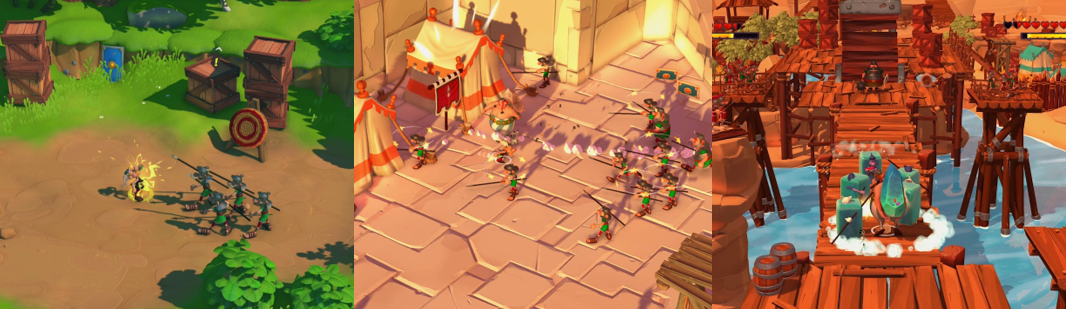
Unlike its predecessors, Asterix & Obelix XXL 3: The Crystal Menhir is a top down, somewhat isometric brawler rather than a third person beat-‘em-up. As ever, players control Asterix and/or Obelix (aided by Dogmatix) and visit some familiar locations across the ancient world, this time to rescue the mystic Avina Gandir and empower her magic Snæfellhelgajökull (the titular Crystal Menhir). The game allows for drop-in/drop-out two-player co-op and lacks a traditional life system, though the generous respawns and checkpoints are waved whenever you’re fighting through heavily fortified Roman camps. Players attack Romans with X, executing simple combos with successive presses, interact with the environment or talk to non-playable characters (NPCs) with A, and perform a “forward jump” with B. This replaces a traditional jump and sees the two half-heartedly roll/charge ahead to cross gaps, with Asterix travelling further than his rotund pal, and also acts as a dodge. This is a finicky system that unnecessarily grounds the two Gauls, forcing you to find alternative paths and ways to reach higher paths rather than just jumping like a normal person. You can switch characters with the Left Trigger and there are differences between the two beyond Obelix just being bigger and heavier. Asterix is small enough to squeeze through gaps, for example, and occasionally grabs torches to burn down ivy and such. Asterix also swigs magic potion with the Right Trigger (if you have some) to temporarily become faster and stronger (but not invincible). Obelix, meanwhile, can sic Dogmatic on enemies with RT and perform various environmental and elemental attacks with the Crystal Menhir.
You do this by acquiring the Crystal Menhir and empowering it with shards, allowing you to open a menu with Y and hit either A, B, X, or Y to select a menhir power. Obelix can smash the menhir onto the ground or weak walls to uncover secrets, shortcuts, and goodies; or set Romans, torches, and branches alight; or freeze enemies into ice cubes; or reflect projectiles, attract enemies and collectible helmets, or move metal blocks and platforms. These abilities are primarily for puzzle solving, burning down ivy to reach levers, for example, or moving metal platforms so Asterix can reach higher ground. The game’s final chapters feature the most complex of these puzzles, with players needing to magnetically produce temporary platforms for Asterix to dash to while dodging hazards, meaning it’s probably better to play with a friend for these sections as it can be tricky switching back and forth when playing alone. Players also build an energy bar by pummelling enemies, allowing them to hold the Left Bumper and hit A, B, X, or Y to land a “special hit”. Sadly, there’s nothing to differentiate these between the characters except their aesthetics (Asterix uppercuts with his fist but Obelix uses the Crystal Menhir) so both will be uppercutting, spinning like a cyclone, charging ahead, or twirling Romans overhead before tossing them at enemies. As before, you must defeat Romans and smash a whole mess of crates to collect helmets. These are spent at various pop-up shops to increase your maximum health, energy, magic potion quota, and to acquire new combos and permanent buffs (though I found there was even less variety than usual). Players replenish health by beating up wild boar or finding roast boar or fruit baskets dotted about, boost their energy with lightning bolts, and can eventually fast travel to other countries using the map from the “View” button menu, which tracks your progress and unlockables.
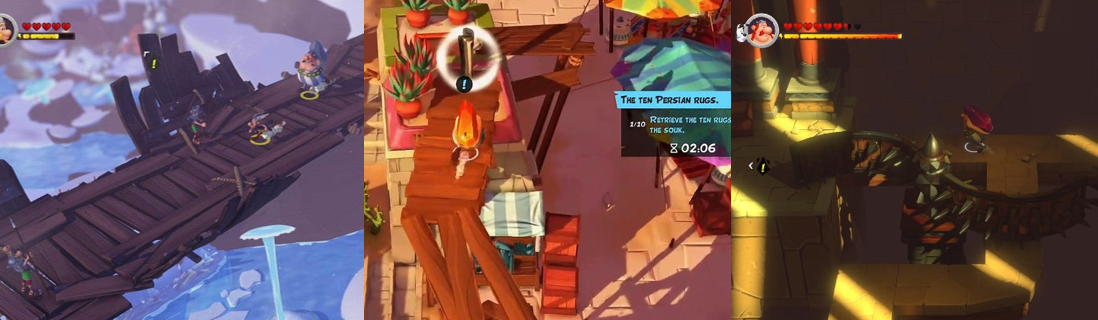
The Crystal Menhir has only superficial similarities to its predecessors, to the point where I question why it has the XXL title. Players explore a semi-open world, interacting with NPCs for primary and secondary missions (usually time trials or fighting challenges), and are often forced to fight waves of Romans to progress. This is nowhere near as aggravating as the previous games as you don’t fight nearly as many enemies, though combat doesn’t feel as versatile as the previous games. Players follow a largely linear path, travelling around each region until an NPC asks for help, which inevitably sees players storming a fortified Roman camp and receiving a score grade and plot-specific item upon completion. These can be difficult challenges as there are no checkpoints and few health power-ups. Romans can call for back-up and endlessly spawn from various tents, which must be destroyed. Usually, all nearby enemies must be bested to activate levers to lower gates, though players must smash through barricades, take higher and lower paths (avoiding falling into pits or water as both are fatal), use (or avoid) explosive barrels, and occasionally battle against a time limit. You must also protect Forfendrik and Razzledazzleus while they hide in vases, slide down frozen mountains in Thule, hop to waterspout platforms, and drain water from moats to help unsuspecting Roman NPCs in Rome. Icicle spikes, thorny vines, spikes floors and walls, and arrows are commonplace hazards, as are door mazes that have you going in circles looking for the right switch to lower a gate. When in Crete, you must sneak past the Romans stationed on the beach (easier said than done; I just froze them to cheese it in the end!) and then use your newly acquired magnetic shard to escape a labyrinth, dodging spinning barriers (which are often spiked) and flipping spiked panels. While the puzzles are simple and often repeated, I was left checking a guide here and there as it’s not always obvious what you must do, and many would be much easier if playing with a friend.
Presentation:
It’s kind of hilarious to me that The Crystal Menhir got a physical release at it’s a much smaller and far simpler game than its predecessors and is presented very much as a digital-only title with its angled, overhead perspective and simplistic cutscenes. Rather than utilising pre-rendered cutscenes, animatic sequences, or even the in-game models, The Crystal Menhir opts for portrait art and text bubbles when characters are talking, adding to the low-budget feel. The voices seem to be the same as the last game, with Asterix still sounding Welsh for some reason, and characters assume idle poses when left alone; Dogmatix even frantically runs about yapping. The plot isn’t anything that hasn’t been done in hundreds of Asterix videogames but is given some spice with the Crystal Menhir, which Julius Caesar sends his lieutenant, returning villain Marcus Ginantonicus, to acquire, only for Marcus to go mad with power after stealing it and seek to usurp Caesar. Players explore the iconic Gaulish village and surrounding forest, chatting with familiar characters like wise druid Getafix, though most NPCs appear to be brand-new. The new visual style really suits the game; the camera is no longer an issue as it’s locked in place and environments are much more colourful and detailed due to the new perspective. Sadly, the music isn’t much to shout about, and I did encounter some odd glitches. The game crashed during the final boss, for one thing, and there were often times when characters froze, doors prematurely closed, or I became separated from my partner, forcing a reload. There are some fun Easter Eggs and visual touches, though, like Romans running around with their asses on fire or turning into ice cubes, Romans drying their laundry in camp, chickens and birds wandering about, and the landscape being littered with ruins from the Roman conquest.
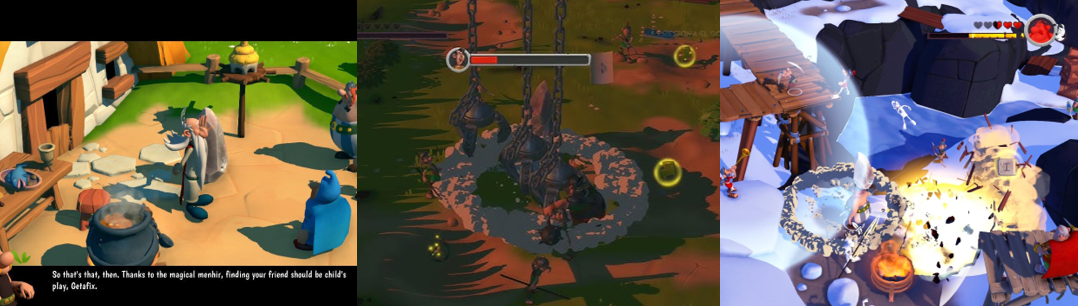
Players begin in the Gaulish village and wander through the forest to the nearby Roman camps Petibonum and Aquarium. Both will be very familiar to Asterix fans and set the standard for the Roman camp challenges to come, featuring towering log walls, barricades, guard towers, camps, and barracks for the soldiers. Though phalanxes are absent this time, Romans patrol in groups and instantly attack upon sight, being blasted out of their sandals or sent crashing into the dirt from your attacks. You must destroy tents to stop reinforcements spawning and can use binoculars to check for upcoming hazards and must create or move platforms to get about. Soon after, you head to the beach to meet travelling Phoenician merchant Ekonomikrisis, who agrees to ferry you about (in cutscenes) after you help him. This takes you to Thule, a frosty, snowy island full of caves, icicles, waterspouts that blast you about, and slippery ice slides. You must dodge snowballs, avoid the frigid wind when crossing bridges to avoid plummeting to your death, and watch for explosive barrels when storming the Reykjavum camp. The vaguely Egyptian-themed Tyre bookends its missions with Roman camps, with players having to fight through Esohandsum to enter the city and sack Adenufofum to release a giant chain and set sail. When in Tyre, you pass through a narrow, bustling market square, meet the local resistance, take the high ground when opposing the Roman construction site, and help the locals when they’re attacked. Crete largely restricts you to a sprawling, boobytrapped labyrinth where you use magnetic platforms and blocks to reach the elevator. Naturally, your journey ends in Rome, where you bash Romans in Caesar’s prized gardens and courtyard, drain water and burn ivy to reach new areas, and battle past ostentatious statues and other tributes to the nation’s egotistical dictator.
Enemies and Bosses:
Sadly, and somewhat ironically, The Crystal Menhir is the most disappointing of the XXL games I’ve played in terms of its enemy selection. While I decried the barrage of videogame-themed enemies in Astérix & Obélix XXL 2 (Étranges Libellules/OSome Studio, 2005/2018), The Crystal Menhir course corrects too far in the opposite direction and offers only a handful of somewhat boring enemies to wade through. You’ll face bog standard Legionnaires who attack in groups and wield pilums, get hit from afar by annoying archer Legionnaires and spear-throwers, and must target trumpeters to avoid reinforcements being spawned. Soon, these simple enemies are joined by shield-bearers, who must have their shields knocked away with an uppercut, and golden-clad, rotund Centurions who attack with swords. Finally, you battle tougher Legionnaires who carry shields and powerful maces, but that’s it. There are no Romans hiding in tree trunks, no flying enemies, no massive catapults or bizarre videogame homages, no gladiators, no Normans…just this handful of enemies. To make matters worse, there aren’t any true boss battles, either. Marcus Ginantonicus sets a few waves of enemies upon you, but that’s it until the finale, where Marcus steals the Crystal Menhir and attacks the Gauls’ village using a war machine. In this fight, you must ignore the endlessly spawning enemies and snag the Crystal Menhir from the machine’s claw with Obelix. You must then keep the menhir safe and attack the machine’s many claws when they come crashing down, which can be tricky due to the sheer number of enemies swarming the arena (though respawning health and power-ups are also present).
Additional Features:
There are thirty-one Achievements in Asterix & Obelix XXL 3: The Crystal Menhir, with players earning one every time they clear a chapter, another for beating each of the game’s difficulty modes (which are stackable), and another for purchasing one and then all upgrades. You’ll get Achievements for holding 5000 and then 10,000 Roman helmets, defeating 500 and 1500 enemies, and for landing a 200-hit combo. Burn, freeze, stun, throw, and uppercut a bunch of Romans for some more, have an archer hit a target for another, and get a gold medal on every Roman camp challenge for another. As you explore, you’ll find Roman dice and Golden Laurels scattered and hidden about. Finding them all earns you more Achievements, though there are no unlockables beyond being able to freely replay any area with all your upgrades and putting down real-world cash for some skins.
Final Thoughts:
Considering Asterix & Obelix XXL 3: The Crystal Menhir is, technically, a far less polished and complete game than its predecessors, you might be wondering with it’s getting a higher rating than the first two games. After all, there are no real bosses, the combat is quite simple and shallow, the cutscenes are disappointingly cheap, and you’re locked on a linear path rather than engaging in a sprawling, action-packed adventure. While it’s true I’m disappointed by the lack of enemy variety and boss battles, The Crystal Menhir was a very enjoyable game to look at and play. Many of the finicky, tedious aspects of the last two games are gone, replaced with some, arcade-style beat-‘em-up action and some challenging puzzles tied to the titular magic rock. I liked that Asterix and Obelix felt more distinct compared to the last two games (even if this was still lacking) and that I wasn’t forced to fight over a thousand enemies at once just to progress. It was bizarre not having a traditional jump, but I quite enjoyed trying to work out how to reach higher areas, even if it did get annoying. The environments weren’t doing anything new for an Asterix game, but I liked the NPCs and their optional missions and found the elemental abilities of the Crystal Menhir interesting (if underutilised). While the game can get quite challenging thanks to the Roman camps not having checkpoints and it’s annoying that you can’t swim, and some of the mechanics and technical aspects are dodgy at times, I largely enjoyed my time with this one. If you pick it up as a digital title in a sale, like I did, I’d say Asterix & Obelix XXL 3: The Crystal Menhir is well worth your time. While it’s flawed, I found it far less annoying than the last two games, so this is the one I’d be more likely to return to on higher difficulties.
My Rating:
Pretty Good
Did you also find Asterix & Obelix XXL 3: The Crystal Menhir an improvement over the last two games or were you unimpressed by the new perspective? Did you like the Crystal Menhir and the new puzzle mechanics? Were you disappointed by the poor enemy variety and lack of bosses? Did you find all the dice and Golden Laurels? Which XXL game is your favourite and how are you celebrating Asterix this October? Share your thoughts on Asterix and his games below and support me on Ko-Fi to fund more Asterix content.


