Asterix the Gaul (and his best friend Obelix) first debuted on 29 October 1959 as a serial in the French/Belgium magazine Pilote. Since then, the plucky Gauls have had many adventures in comic books, videogames, and feature-length productions. This year, I’m spending a few days celebrating this popular and enduring character.


Released: 29 November 2018
Originally Released: 30 September 2005
Developer: OSome Studio
Original Developer: Étranges Libellules
Metacritic Scores: 5.5 / 7.8
Also Available For: Nintendo DS, PC, PlayStation 2, PlayStation Portable/PSP (Original Version); Nintendo Switch, PC, PlayStation 4, PlayStation 5, Xbox One, Xbox Series S (Remaster)
Quick Facts:
Having sold over 400 million books worldwide, Asterix his PlayStation 2 debut with Astérix & Obélix XXL, a somewhat divisive 3D beat-‘em-up that was revamped in 2020. Despite that game being equally lambasted, the 2005 sequel, which parodied many popular videogame franchises, also earned a remaster, though it remained a flawed and tiresome experience.
Gameplay and Power-Ups:
In a bid to finally to conquer Gaul, Julius Caesar builds the Las Vegum theme park to house the fearless warriors. When their druid Getafix apparently aids Caesar in kidnapping other druids, Asterix, Obelix, and Dogmatix travel to Las Vegum in Rome on a rescue mission, bashing videogame-themed Roman soldiers across six themed areas. Like its predecessor, Astérix & Obélix XXL 2 is a single-player 3D brawler that sees you attacking with a quick combo with X, jumping with A (pressing it again in mid-air for a double jump), grabbing stunned Romans with Y, and performing a dash attack to break shields with B. The Left Bumper sees Dogmatix bite enemies to disarm and stun them while the Right Bumper switches characters. You’re often prompted to switch mid combo to perform stronger attacks, earning yourself more collectibles or power-ups, and you can twirl Romans after grabbing them, swing them like a whip, and toss them at other enemies or targets. You can restore health by grabbing roast boar from boats, defeated enemies, or the many destructible crates, and temporarily extend it by collecting shields. Players must again smash a bunch of crates to collect Roman helmets, which unlock additional combos and techniques. These are much tricker to pull off than before, generally requiring you to reach or unlock new levels of “Fury Mode”. This builds as you dish out damage as sees your fists (and, later, enemies) burst into flames to deal additional damage. Lives still don’t exist, but the game is full of checkpoints and autosave points, though any defeated enemies and smashed crates and collectibles respawn if you drop down a pit or have your health drained.
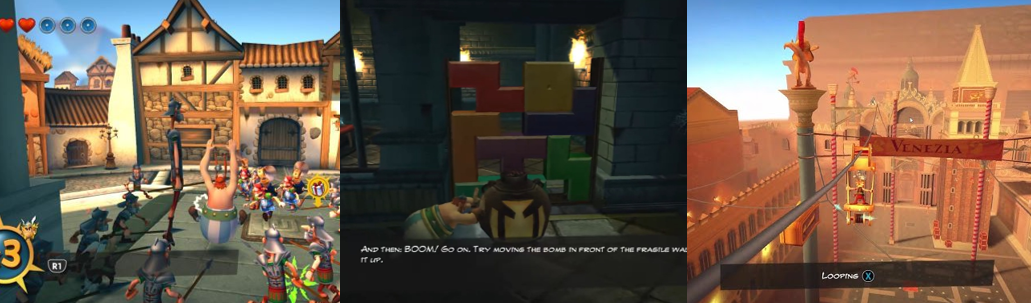
Like before, most of your time is spent bashing near endless waves of enemies, which is even more tedious as the combos aren’t as intuitive (simply grabbing and swinging Romans is usually enough to clear the hoards). Occasionally, magic potion spawns to temporarily empower Asterix, through Obelix gets no such power-up. Instead, he mainly bashes down metal doors or pulls Asterix along on wooden platforms. Obelix can jump into special cannons to blast across areas and utilise turrets to shoot enemies from the sky, but he’s generally much slower than Asterix and his basic combos aren’t any different. Asterix can no longer carry torches (you just hit torches to light them), which is a relief, and can slip through gaps too narrow for his rotund friend. Asterix also gets many automated zip-like-esque sections where you must press (or hold) X to swing his platform over or under obstacles. This would be fun, but you must fight to maintain Asterix’s balance to avoid being knocked off and starting over, which is a pain. Springs still blast you higher and you can perform your mid-air ground pound from high up to smash to lower areas. You’ll also roll giant, somewhat fragile bombs to blast through tetromino walls or push large blocks to reach new areas. Although the sliding sections are gone, you’re still often asked to defeat a certain number of enemies to lower barriers blocking doors or to access levers. While these enemy waves can number in the hundreds, they don’t occur as often as before but they’re no less tedious and some areas have you constantly defeating enemies in different rooms each time you pass through just to progress.
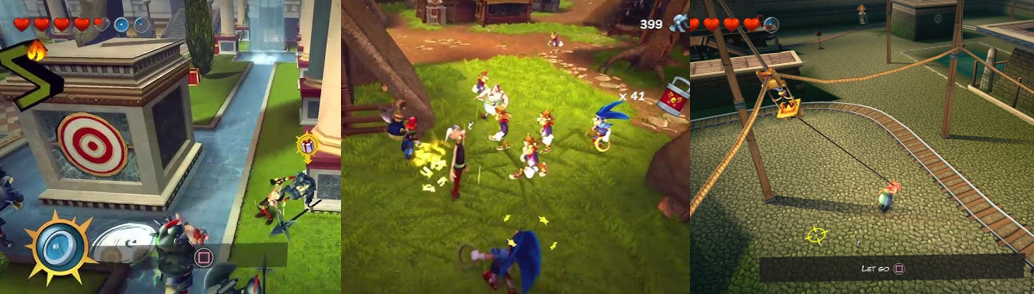
Astérix & Obélix XXL 2 ditches the chapter-based narrative for a more open-world feel, with players utilising a stone map to fast travel across Las Vegum. You must often hit levers or pressure pads to lower bridges or access new areas, hopping to floating barges, or dodging rolling barrels as you go. If you’re not bashing enemies, you’re searching for torches to light or flinging Romans at targets. Sometimes you hop into large, familiar pipes and tackle annoying platforming sections on rotating and moving platforms. Other times, you zip around as Asterix to hit a lever and extend a bridge so Obelix can destroy a door to access a pressure pad section. Dogmatix often scurries ahead and barks at points of interest, such as destructible areas or switches that activate springs, and you must pay a helmet toll to enter each section of Las Vegum. Roman Phalanxes now crowd narrow corridors blocking your objectives (though the magic potion makes short work of them), topple obelisks, and spawn stone links between platforms to smash onto broken tiles. You must hit switches to raise columns and transport bombs higher or lower, take stairs and elevators to reach levers, and defeat a wave of Romans in the coliseum before the area floods. This area also sees you gunning down waves of airborne Romans trying to raise torches for their grounded allies to light and includes a wooden reconstruction of the Gaulish village, which is partially destructible. While on Pirate Island, you must drain the water to toss enemies at targets and access the cannon, then refill the water and blast about 250 Romans from the sky, all to push a bomb to a wall and reach a pressure pad puzzle. It’s all very repetitive, with the same gimmicks and puzzles being thrown at you just with different bells and whistles and different combinations of enemies, though the game seems much shorter and easier than its predecessor.
Presentation:
Astérix & Obélix XXL 2 continues the strangely gritty aesthetic of the first game, awkwardly mashing the comic book’s colourful, cartoonish visuals with more realistic elements, but removes the ability to switch to the original graphics and oddly lumbers Asterix with a Welsh accent. Asterix and Obelix have some limited idle poses and make quips during the action, but most cutscenes focus on them interacting with the different druids, abusing Roman spy Sam Sheiffer, or show Caesar interacting with his Getafix lookalike, Larry Craft. When the cutscenes kick in, the game zooms out and applies a border, presenting the story with noticeably downgraded graphics rather than remastering the cutscenes to be in widescreen. Astérix & Obélix XXL 2 leans far heavier into the videogame genre this time around, including references to Space Invaders (Taito, 1978), Donkey Kong (Nintendo R&D1, 1981), Tetris (Mirrorsoft, 1988), and Pikmin (Nintendo EAD, 2001). You’ll see images of Rayman carved into blocks, Super Mario (Various, 1985 to present) pipes appear alongside distinctly Mortal Kombat-esque (Midway, 1992) banners, the bombs are modelled after Bomberman, and I spotted a homage to Lemmings (DMA Design, 1991). This trend extends to the enemies, too, with Larry Craft being an obvious allusion to a certain tomb raider, some Romans carrying shields shaped like Pac-Man, other dressed like Sonic the Hedgehog and running about swinging Golden Rings, martial artists dressing like and throwing fireballs and uppercuts like Ryu, and the most annoying aping Super Mario and shoving you back with water jets. These were kind of fun but quickly lost their allure and I found myself questioning why and even how the ancient Romans can ape these videogame icons. Asterix comics are often filled with fun puns and allusions like this, but I found it oddly distracting, as though it called attention to it being a videogame rather than delivering a more traditional Asterix experience.
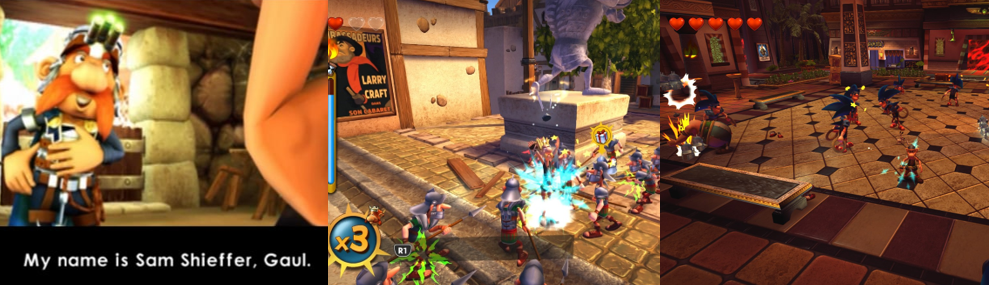
Astérix & Obélix XXL 2 is set entirely within Las Vegum, a city-sized amusement park with six areas modelled after Caesar’s conquered lands. Amusingly, Asterix and Obelix travel to Rome during a cutscene transition rather than embarking on an adventure like in the last game. You begin in a recreation of Lutetia, traversing narrow streets and wider areas and fighting around and springing up a recreation of the Eiffel Tower. You pass through a subway between areas and by numerous homes and shops, none of which can be entered. This transitions nicely into Little Venetia, a recreation of Venice full of water and stone paths and also housing a homage to Mortal Kombat fittingly called “Fatalium”. Things got a touch more interesting once I visited LuckScore, an Egyptian themed area that sees you exploring a colourful interior searching for lights to shine on a central door, though things were disappointingly lowkey in World Championship Wrestling (WCW). This is essentially just the coliseum surrounded by traditional Roman architecture. The Fatalium theming would’ve been far more appropriate here, especially as you battle Larry Craft in a volcano-like lair and would’ve added a bit more visual spice to the repetitive sports field aesthetic and simple stone arenas. Pirate Island made up for this, featuring a lighthouse, a large cave, a mine cart section (though without any mine cats), and switch to a 2.5D perspective to dodge barrels like in Donkey Kong. This theme was somewhat lacking, though, especially as Redbeard and his crew are strangely missing. The action culminates in SeizeUs Palace, a casino-themed finale featuring a giant roulette table with multiple paths, opulent gardens, and towering structures leading to gimmicked challenges themed around the game’s repetitive tropes (pulleys, switches, enemy waves, etc).
Enemies and Bosses:
The Roman army is out in full force in Las Vegum, dropping from above, spawning out of nowhere, and attacking in nigh-endless waves. Generally, their attacks are easily telegraphed by onscreen indicators, though even the bog-standard Legionnaires can take quite a beating. These skinny little runts run around and poke at you with spears and generally act as cannon fodder to the larger “Optio” variants, whose shields must be shattered. These brutes mostly carry maces and axes, though their Centurion variants have large broadswords, the Egyptian variants wield large sickles, and the Pac-Man Roman carries a Pac-Man shield that can bite you. Although the pirate enemies are essentially the same as the regular Legionnaires except for carrying a cutlass, Romans also hover overheard using helicopter-like blades and drop time bombs and ghostly Romans will continually respawn unless you ground pound them when they’re down. The Rayman variants are similar, though they fire their disembodied fists like the Centurions toss blades. The Super Mario-esque Romans are strapped to a contraption resembling the Flash Liquidizer Ultra Dousing Device (F.L.U.D.D.) that fires a water stream. While this doesn’t do damage, it does annoyingly push you back and semi-stun locks you, which is extremely aggravating when platforming or fighting waves of enemies. The Ryu lookalikes are equally annoying as they launch Hadokens from afar and catch you with a Shoryuken combo if you’re slow on your button presses. The Sonic cosplayers are the fastest enemies but they’re more annoying than a threat while the phalanxes are now thankfully limited to narrow corridors, easily telegraphing their spear attacks and being demolished by the magic potion.
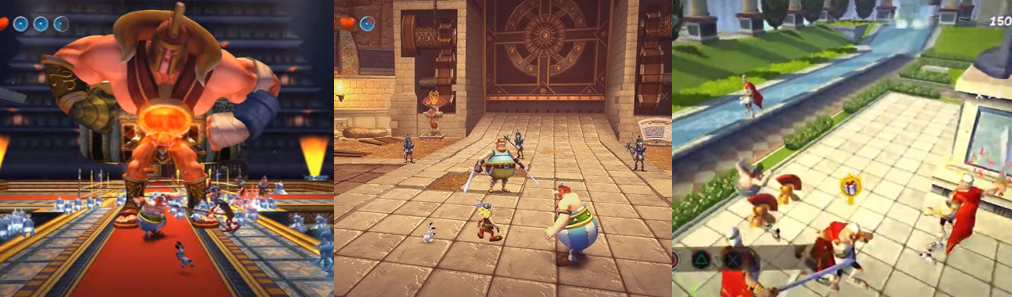
You must regularly clear areas of all enemies to progress, either by simply bashing them or defeating a set number or tossing some at targets. Enemy types are mixed up as you progress to make things trickier and they’ll also respawn if you die or return to previous areas. While the Machines of War from the last game are thankfully gone, I found myself wishing they’d return at least once as Astérix & Obélix XXL 2 substitutes one tedious, repetitive boss for another. All Las Vegum’s areas are guarded by the hulking Dethmach, a titanic, armoured gladiator fought over a bottomless pit and who is completely invulnerable to regular tracks. After completing a short platforming or traversal challenge to reach his area, you must run around on precarious block platforms, largely ignoring any enemies and dodging spikes and other hazards to lure Dethmach into stepping on or striking glowing floor tiles. Dethmach stomps about, leaps across the arena, swipes and hits the ground, charges like a bull, and tosses fireballs, which all defeat nearby enemies or knock you over the edge to restart the fight. Once he hits each glowing panel or you smack a lever at the right time, a weight drops on his head and stuns him. You must hit X as Asterix to yank the device on his back and then smack the iris that opens on his chest as Obelix. Do this three times and he’s defeated, but each fight gets a bit trickier thanks to spiked obstacles, gates blocking your path, and other hazards. These fights are less aggravating that the Machines of War, but it’s still disappointing that the bosses don’t have more variety. You do battle Larry Craft during the story, with him attacking with two blades and getting stuck on the ground and being accompanied by hundreds of disposable Romans, but he’s essentially just a tougher Roman. You face Julius Caesar in the anti-climactic finale, with him calling in 88 clones for a “Burly Man Brawl” reference and attacking with a sword, but these are as easy to defeat as the regular Legionnaire and the Dethmach that follows him was the easiest of them all for me.
Additional Features:
There are thirty Achievements to earn in Astérix & Obélix XXL 2. Three are earned from entering three of Las Vegum’s areas, three more are earned from rescuing the druids, and four more are earned simply from progressing through to a certain area and finishing the game. You’ll get another Achievement for earning a x6 combo multiplier, one for buying one and then all upgrades, another for buying all the figurines, and another for defeating 2500 Romans. Despite all the crazy videogame references, there’s only one Achievement tied to this (simply enter a Mario-like pipe and hit a lever after a short platforming section), which is a shame. There are three difficulty levels, though they don’t impact the Achievements, and you can switch Asterix and Obelix to their classic attire but are stuck with the remastered graphics this time. Various challenges can once again be tackled in each area, tasking you with defeating as many Romans as possible in a time limit for bonus rewards (and Achievements). Each area also hides envelopes and diamond helmets to collect and finding them all nets you additional Achievements. You can freely return to any area at any time and after beating the game to seek out anything you’ve missed, though I can’t say I’m particularly inspired to do this.
The Summary:
I was bitterly disappointed by the first Astérix & Obélix XXL, which was a tedious, repetitive, and frustrating experience that really did the brand a disservice. While many of its annoying elements were thankfully gone, Astérix & Obélix XXL 2 is still the same clunky, mediocre combat that forces you to pummel endless hoards of the same enemies, though these sections seem to be paced out better. The platforming is reduced to bouncing around on springs and navigating narrow corridors, for the most part, or simply hopping to platforms, which is less annoying but not exactly exciting. Zipping and swinging around on Asterix’s platforms was more frustrating than fun, Obelix remains severely underpowered, and the puzzles are almost insultingly easy. There’s slightly less to do this time around as Asterix cannot carry torches and the cannon sections were quite simplistic and dragged on. While I enjoyed seeing all the references to popular videogame franchises and characters, it was a bit overkill and sadly wasn’t translated to the game’s bosses. We don’t fight a Dethmach dressed up as Donkey Kong, for example, or get into a race against a Sonic-themed Roman or encounter any interesting bosses as the same strategies work against each of the brutes every time. The videogame homages also don’t extend to the environment, which stay nicely on brand but don’t deliver much in terms of visuals. Like in the last game, it feels like the developers are holding back from using the Asterix brand to its full potential. It’s undeniable that there have been a few improvements over the last game, but the last game are thankfully gone, I found myself wishing they’d return at least once as Astérix & Obélix XXL 2 I still a tedious and aggravating experience that can’t hope to life up to the mindless simplicity of the arcade-style titles or old-school action/platfomers.
My Rating:
Could Be Better
Do you agree that Astérix & Obélix XXL 2 is slightly better than the last game? Did you like the tweaks made to the gameplay or did you find it as tedious as the last one? Which of the videogame homages was your favourite? Were you also disappointed that the bosses were still lacking? Did you ever complete all the combat challenges and find all the collectibles? Which XXL game is your favourite and how are you celebrating Asterix this month? Leave a comment about Asterix below, support me on Ko-Fi, and check out my other Asterix content.


