
Released: 21 November 1931
Director: James Whale
Distributor: Universal Pictures
Budget: $262,007
Stars: Colin Clive, Boris Karloff/?, Mae Clarke, Dwight Frye, and Edward Van Sloan
The Plot:
Obsessed with playing God, eccentric scientist Henry Frankenstein (Clive) cobbles together a monstrous being (Karloff/?) whose child-like nature sees it embark on a rampage.
The Background:
“I busied myself to think of a story […] One which would speak to the mysterious fears of our nature, and awaken thrilling horror…” And so it was that Mary Shelley, while effectively snowed in in Geneva, thought up the concept for Frankenstein; or, The Modern Prometheus at just eighteen years old. First published anonymously in 1818, what began as a ghost story that attracted much controversy due to Shelley’s gender and its blasphemous content, evolved into a celebrated piece of literary fiction whose scientific, gothic, and religious themes have been discussed endlessly for over two hundred years. Frankenstein was first adapted into a short silent film in 1910 but saw considerable success on the British stage, courtesy of Peggy Webling, despite numerous changes to the source material. Following their surprising success with Dracula (Browning, 1931), Universal Studios gave producer Carl Laemmle Jr. the go-ahead to produce more horror movies, with them acquiring the rights to the Frankenstein stage play. Though Laemmle Jr. initially planned to play the Monster, Dracula star Bela Lugosi was approached for the role but (in)famously turned it down as the initial script had stripped the creature of all nuance and humanity. Instead, the Monster was famously embodied by Boris Karloff, who endured long, painful hours in make-up to bring the creature to (un)life with a look that was noticeably removed from the book. Though subjected to rigorous censorship demands, Frankenstein was a remarkable box office hit at the time thanks, in part, to clever marketing. Despite its many differences from the book, Frankenstein was widely praised for Karloff’s captivating performance and as one of the best films of its year. The film stood the test of time as a horror classic, popularising this interpretation of the Monster for generations and leading to numerous sequels and reinterpretations of the text.
The Review:
Surprisingly, I do have some experience with Shelley’s Frankenstein, having studied it at secondary school and during my undergraduate years, if only briefly. Although I’ve read and written about the text before, it has been a while since I revisited the book and most of my experiences come from the movies, as with all the Universal Monsters characters. Still, I remember enough to know that Frankenstein is a very loose adaptation, missing many details and supplanting them with others, though some of the missing material was utilised in the sequel, Bride of Frankenstein (Whale, 1935), so literary purists may have a better time watching both back-to-back. The first and most obvious change is that Frankenstein is named “Henry” here, with his title given to his cantankerous father, Baron Frankenstein (Frederick Kerr) and his original first name given to his friend, Victor Moritz (John Boles), who’s essentially an adaptation of the book’s Henry Clerval. Frankenstein also has a simple-minded, hunchbacked assistant in the movie (named Fritz (Frye) rather than the more mainstream “Igor”) rather than working alone, the Monster is deathly afraid of fire and never speaks, and many events are shuffled around. This is largely because, like Dracula, Frankenstein is based more on the stage play than the text, but it does mean the movie hits differently and explores alternate, if tangentially similar, themes regarding science, playing God, and the nature of man. The very fact that Frankenstein deals with such issues, no doubt shocking to a God-fearing world, potentially explains why the film opens with star Edward Van Sloan warning audiences to turn away if they’re shocked by such content. Indeed, the horror of Frankenstein, at the time, was just as much about a man playing God as it was the titular (or not so titular) Monster, since the idea that anyone but God can create life would’ve been deeply blasphemous and the fear of the unknown (in this case, science) would’ve made the subject matter particularly upsetting, I’m sure.
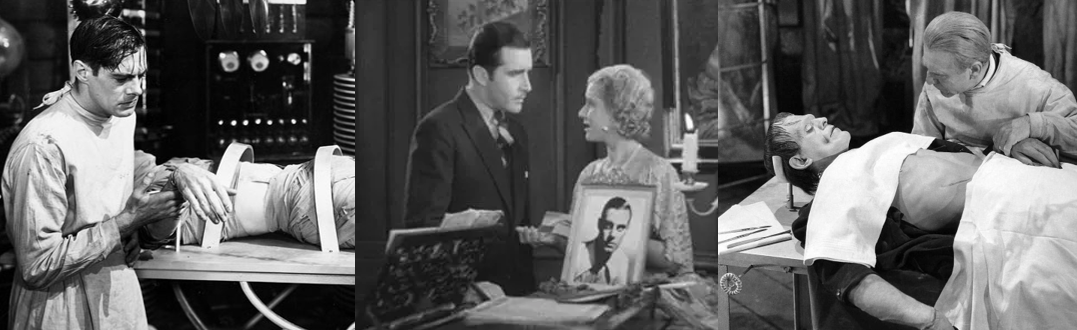
Anyway, in Frankenstein, Henry comes from a wealthy family with a great deal of influence on a small village in the Bavarian Alps. While the curmudgeonly Baron Frankenstein despairs of his son’s bizarre experiments and decision to isolate himself in an ominous stone tower laboratory with Fritz, Henry’s correspondence to his fiancée, Elizabeth Lavenza (Clarke), tells of his need for privacy and solitude. This is primarily because he and Fritz are sneaking out at night and digging up bodies, selecting organs and body parts for a patchwork man Henry aims to bring to life through the awesome power of electricity. While they scavenge everything they need for the body, Henry’s frustrated that the recently deceased can’t provide a viable brain, so he has Fritz steal a preserved brain from his old mentor, Doctor Waldman (Van Sloan), not realising that it’s a “criminal brain” seemingly hardwired for evil (that’s also further damaged by the clumsy Fritz). Concerned for her love’s welfare, Elizabeth politely shrugs off Victor’s advances and convinces him to ask Dr. Waldman for advice, with the three braving a horrific thunderstorm to visit Henry. Though frustrated by their interference, Henry invites them to witness his crowning achievement when Victor (fully aware of his intentions) accuses him of being mad. While Henry denies this claim, it’s obvious that he is a little bonkers, as seen in his exuberant and iconic cry of “It’s alive!!”, his claims to “be God”, and his initial denial regarding his creation once it comes to life. Ecstatic to have brought the creature to life, Henry insists that the childlike being needs time to adjust rather than rejecting it on first sight as in the novel. This is despite the protests of Dr. Waldman, who correctly warns that the “Monster” is an abomination to God and a threat to all due to its capacity for evil and its unpredictable nature.
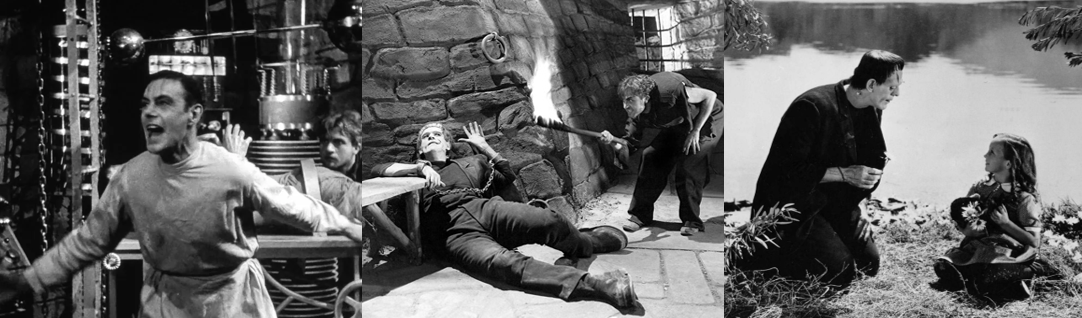
Despite his efforts to teach the Monster, Frankenstein is forced to agree when the creature flies into a rage at the sight of fire and acts like a wild animal while chained in the basement, murdering Fritz, attacking Dr. Waldman, and almost throttling Henry before Dr. Waldman subdues it with what’s supposed to be a lethal injection. During Henry’s recuperation, his madness lifts and he returns to a normal life, finally marrying Elizabeth (to the joy of his father and the village). Ever the curious scientist, Dr. Waldman leads the vivisection on the Monster, becoming its second victim when it reanimates and strangles him to death. Though initially oblivious to the threat, Henry (and the entire village) are alerted of a wicked murderer after learning that local girl Maria (Marilyn Harris) has been drowned, Dr. Waldman killed, and after Elizabeth is attacked. Much of this is similar to the book, such as the Monster stumbling across a little girl, murdering a child, and going on a bit of a killing spree, but it’s framed as the actions of a confused and misunderstood creature rather than acts of wickedness. While the film goes to great lengths to assert that Frankenstein’s experiments are immoral and inhuman, the tone is awkwardly balanced between Henry’s madness, the darker sequences, and some strange comedic moments. These largely involve the blustering Baron Frankenstein, who’s convinced his son’s having an affair, demands that he forget his experiments, and constantly rambles about his grandmother’s wine. The Baron has no patience for Burgomaster Herr Vogel (Lionel Belmore) or the expectant masses…until Henry snaps out of his obsession and returns to the real world, and then the Baron’s all smiles and jokes. Elizabeth is the quintessential supporting fiancée, deeply devoted to Henry despite him isolating himself and Victor being right there, and far more suitable. Victor is basically a blank slate, shouting accusations at Frankenstein and offering little else, and honestly his role could’ve easily been merged into Dr. Waldman’s to speed things up.
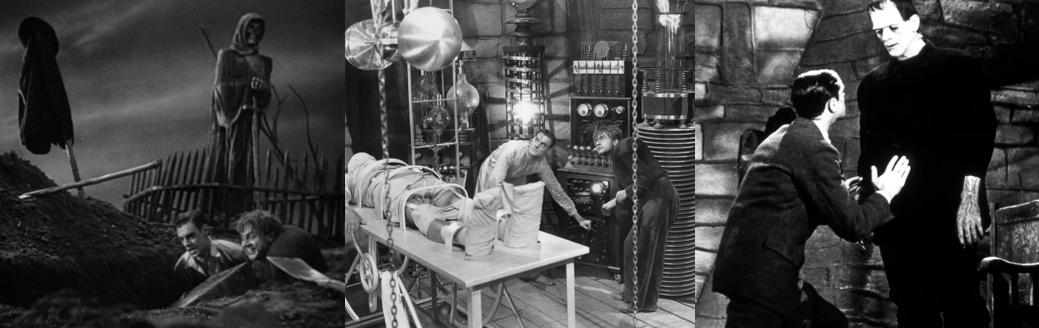
As ever, “Frankenstein” is both the Monster and the creator as Henry brings the wretch to life and is the subject of the film but does so through abhorrent acts like grave robbing and stealing. The Monster is seemingly a mishmash of different parts and pieces, with no true personality of its own, but it does retain rudimentary memories. These initially encourage Frankenstein as the Monster’s capable of stumbling about and obeying basic instructions, but his enthusiasm quickly dies when he sees how savage the Monster becomes when confronted by fire. The Monster’s rage is only fuelled when Fritz beats it and Henry gives up on it, reluctantly agreeing to kill the creature only to find Fritz strung up. Depicted as simple-minded but incredibly strong, the Monster easily overpowers two or three men at once and gleefully throttles Dr. Waldman, perhaps out of sheer muscle memory from its “criminal brain” or perhaps because it recognises the threat those around him pose to its existence. Indeed, when the Monster stumbles upon Maria, it sits and plays, laughing and seemingly content. However, it misunderstands the girl’s game of tossing flowers into the river and chucks her in for a laugh, drowning her despite her landing in the shallow end and unintentionally whipping the villagers into a lynch mob. It’s not clear why the Monster pays a visit to Elizabeth, especially as it seemed to be wandering at random, but she’s horrified by its grotesque appearance, and it attacks her when she tries to flee. Luckily for her, it leaves her alive, which only motivates Frankenstein to join the mob. Although the Monster looks nothing like Shelley’s descriptions, its design is certainly iconic and striking. A tall, lurching, shambling wretch with its eyes largely rolled back, two bolts in its neck, and misshapen skin, the Monster is an unnatural man-thing that mocks the beauty of natural life. Yet, interestingly, Henry isn’t immediately disgusted by it and the Monster is shown only to be confused and scared, lashing out accordingly and in need of guidance rather than persecution.
The Nitty-Gritty:
Frankenstein was certainly ambitious for the time. Boris Karloff’s make-up looks both impressive and extremely uncomfortable, with the actor perfectly stomping about and making stiff, jerky movements to show the creature is unnatural and undead. Although the film lacks a score to emphasis dramatic moments, there’s some great use of sound during the thunderstorm, which delivers the film’s most impressive moment. Sure, it’s weird that Henry’s visitors aren’t drenched when they enter the laboratory and his whole setup takes a lot of liberties with the source material, but Frankenstein’s laboratory is the quintessential “mad scientist” setup and a wonderful way to show the awesome and seemingly unknowable power of nature (in this case, lightning). Baron Frankenstein’s residence also impressed in its opulence, and I liked that Frankenstein incorporated many different locations, though some sets were a bit too obvious (which is to be expected). The film utilised a decent miniature to depict the windmill and its destruction and I was impressed by how often flaming torches appeared onscreen, and how fast and loose everyone played with getting up close to them! While the Monster’s jerky movements made his “fight scenes” a joke, I did like seeing these normal guys and scientists struggling to subdue the savage Monster, who easily overpowered them and left a decent body count in its wake. It’s a shame that we don’t get to see the Monster learning to speak or being more than a near-mindless creature, but the intention seems to be to emphasise that Henry came so close to playing God but screwed it up because man isn’t meant to meddle in such things. It’s always amused me as it surely would’ve been easier for Frankenstein to reanimate a fresh body than to stitch together a grotesque behemoth, and he arguably pays the price for that approach since the Monster is as much a victim of its disparate pieces as it is the situation it finds itself in.
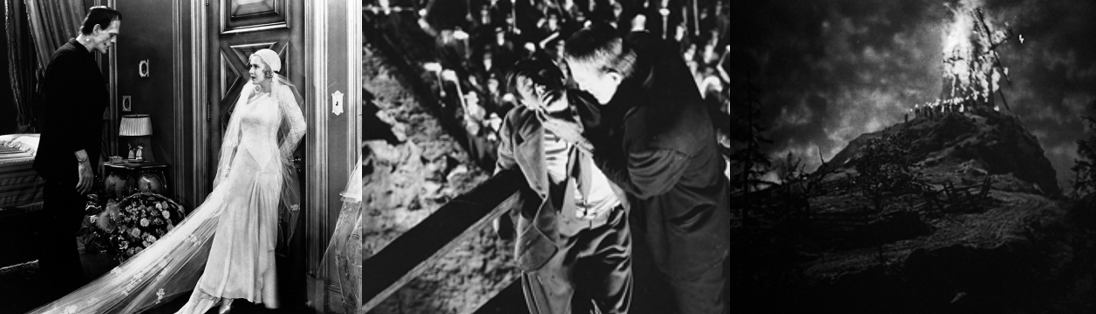
Upon discovering Maria’s dirty, drowned body, her shellshocked father (Michael Mark) carries her through the village and to the Burgomaster to warn of a murderer and immediately incites a lynch mob. The seething masses are only further incited when Dr. Waldman is found dead and Elizabeth is attacked, for the village holds the Frankensteins in high regard and is outraged at such an act. Frankenstein joins the search, which is split between different areas of the village and the surrounding grounds, with Henry venturing into the jagged mountains alongside rabid dogs and villagers wielding flaming torches. Unaware that his Monster is to blame for the deaths (since Henry believes the creature perished from Dr. Waldman’s serum), Henry is stunned when the Monster attacks him in the wastelands. The scuffle is brief and one-sided, with Frankenstein easily bested and hauled to a nearby dilapidated windmill with the mob in hot pursuit. Desperate to escape to the high ground, the Monster tangles with Frankenstein when he wakes, with Henry proving no match for his creation and being tossed from top floor. Luckily for him, the slow-moving windmill blades break his fall, leaving Frankenstein a gravely injured (but inconceivably alive) wreck on the ground. While some villagers carry Henry home, the others set the windmill on fire, sending the trapped Monster into a frenzy and seemingly causing its destruction when it’s consumed by the fire. In the aftermath, Frankenstein recovers at home alongside Elizabeth and his father celebrates with another shot of the family wine, toasting his family house and blissfully unaware that the rampage was caused by another “son of the house of Frankenstein”. It’s obviously a very different ending from the book, with the entire sub-plot and bookend of Captain Robert Walton dropped, Elizabeth and Henry surviving the events, and the omission of the Monster’s bride and vengeance upon Frankenstein’s family. Still, the Monster does seemingly perish in a fire like in the book and I don’t expect filmmakers from 1931 to try and bring the Arctic to life.
The Summary:
Since the stage play that Frankenstein is more directly adapted from has essentially been lost to the mists of time, it can be difficult to reconcile how loose an adaptation the film is from the source material. The film omits and changes many elements from the book, distilling the key events and themes to a feature-film length and losing much of the complex charm and horror of Shelley’s book. Yet, these elements are still present and, even in this modern day, there’s still a chilling message about man’s arrogance in using science to play God. While Henry Frankenstein insists that he’s the model of sanity, he is out in the dead of night digging up corpses, isolating himself from friends and family, and practically frothing at the mouth when his Monster comes to life. Though he lacks much of the nuance of the source material, Frankenstein is depicted as an egotistical and obsessed scientist who claws back some sympathy after initially appearing somewhat unlikeable, ultimately paying for his arrogance not with his life, but with a traumatic experience. Frankenstein’s lasting legacy is, without a doubt, the design and portrayal of the Monster. Boris Karloff gives a remarkable physical performance, lumbering about, throwing clubbing blows, and growling at his prey as the Monster struggles to adapt to its newfound unlife. The visual of the Monster, with its cuboid head, large suit, and metal bolts, is enduring and iconic and is so burned into the cultural consciousness that I’d wager most people don’t realise that the Monster looks nothing like that in the book. Frankenstein also impresses in its ambition, featuring many different locations and sets, some superb set design, and a surprisingly high body count (including a child, no less!) The film distils the book’s warnings about meddling in the unknown into a far more simplistic message about reaping what you sow, but it’s still a decent watch, despite some unavoidable flaws, that no doubt galvanised this version of Frankenstein’s Monster into the cultural zeitgeist.
My Rating:
Could Be Better
Are you a fan of Frankenstein’s big-screen debut? What did you think to the changes to the source material and which parts did you miss the most? Did you also find Baron Frankenstein a bizarre character? What did you think to Boris Karloff’s performance and the dramatic redesign of the Monster? Where do you stand on who should or shouldn’t be called “Frankenstein”? Which adaptation of Frankenstein, or Universal Monsters movie, is your favourite? How are you celebrating Halloween this year? Share your opinions on Frankenstein in the comments, check out my other horror reviews, and donate to my Ko-Fi if you want to see more Frankenstein content.

 Dr. K's Waiting Room
I recently watched The Walking Dead with Boris Karloff that almost felt like a better version of Frankenstein I haven’t read the book though.
LikeLike
I read the book as a kid and have a lovely hardback version that keeps staring at me from the shelf…
LikeLiked by 1 person