
Sonic the Hedgehog was first introduced to gamers worldwide on June 23 1991 and, since then, has become not only SEGA’s most enduring and popular character but also a beloved videogame icon and, in keeping with tradition, I have been dedicating the entire month to celebrating SEGA’s supersonic mascot.


Released: 20 December 2001
Developer: Dimps / Sonic Team
Also Available For: Android, Nintendo Wii U (Virtual Console, Japan only), J2ME, and N-Gage
The Background:
After a long development process and strategic planning to create a mascot iconic enough to rival Super Mario, SEGA’s initial success with Sonic the Hedgehog expanded into mainstream popularity with Sonic the Hedgehog 2 (SEGA Technical Institute, 1992). Sonic was on a serious roll at this time; the spectacular Sonic 3 & Knuckles (ibid, 1994) was too big for one cartridge, became one of the best classic Sonic games, and was naturally followed by…numerous disappointing spin-offs before making the jump to 3D in 1999. As well received as Sonic Adventure (Sonic Team, 1999) and Sonic Adventure 2 (Sonic Team USA, 2001) were, however, SEGA was in dire straights; numerous delays, blunders, and over spending saw them lose their foothold in the home console market, bringing the “Console War” of the nineties to an anti-climatic end. Now focusing on software development, the unthinkable happened when SEGA produced ports of the Sonic Adventure games for Nintendo’s often-underappreciated GameCube console and, to commemorate the tenth anniversary of the franchise, SEGA turned to Dimps to create a 2D throwback to the classic games that also incorporated the art style and some mechanics from the 3D games. The result was Sonic Advance, which became a best-selling Game Boy Advance title and was met with largely positive reviews. Critics lauded the presentation and tight gameplay mechanics, though elements like the Special Stages and an overreliance on nostalgia were criticised. Still, Sonic Advance was regarded as one of the best Nintendo games and helped solidify SEGA ’s new relationship with Nintendo; it was followed not just by two sequels, but numerous handheld spin-offs and spiritual successors that further refined the gameplay and mechanics for Sonic’s portable adventures.
The Plot:
Doctor Eggman has returned, with his sights once again set on enslaving woodland creatures into metallic Badniks, gathering the legendary Chaos Emeralds, and constructing an elaborate space base! Luckily, Sonic the Hedgehog and his friends – Miles “Tails” Prower, Knuckles the Echidna, and Amy Rose – are on hand to oppose his evil schemes once more.
Gameplay:
When Sonic Advance released, the Sonic franchise was firmly in the midst of its 3D era. 2D, sidescrolling action-based platformers were out for the Blue Blur and elaborate, action-packed 3D rollercoasters with varying gameplay were in, so Sonic Advance was a bit of a throwback to Sonic’s classic 2D roots, and in many ways the long awaited fourth entry in the classic series. In addition to the plot being as basic as the classics, the control scheme is immediately familiar to anyone who’s played Sonic 3 & Knuckles: A lets you jump, pressing it again initiates a jump attack or move, you use up and down to scroll the screen and duck under obstacles, and press down and A to charge up a Spin Dash for a speed boost. You can pick from four characters – with Amy Rose making her playable debut in a sidescrolling game – and journey through seven levels (known as “Zones”), with two final Zones awaiting after clearing certain objectives, with each Zone split into two parts (known as “Acts”) and featuring a boss battle in each Act 2. Players must collect Golden Rings to stay alive, with the glittering Rings scattering when you’re hit so you can collect them again, and race against a ten-minute time limit, which can thankfully be disabled in the “Options” menu. This menu also allows you to pick between “Easy” or “Normal” mode (with the differences I believe boiling down to how many lives you start with and the amount of hits bosses take), configure the control scheme, and select different language options, though there is no story text to worry about here as everything’s taking its cue more from the 2D games than the 3D ones when it comes to storytelling.

So far, so familiar. However, gameplay changes depending on which character you pick, with Tails effectively being the easy mode thanks to his propeller-like twin tails and Amy being the hard mode since she doesn’t curl into a ball. Each character has different abilities to traverse Zones and take out enemies; you can perform Sonic’s Insta-Shield by pressing A twice, pressing B sees him perform a sliding ground somersault, and you can perform a back jump by pressing B and then A (though I found little use for this). Sonic can also pull off a limited and frankly useless mid-air dash by pressing right and A twice and is somewhat limited in his options since he can’t fly or climb, so his gameplay is more about speed and ploughing head-first through obstacles. Tails can, of course, fly for a short time by pressing A twice, and his tails will often inflict damage on whatever’s underneath him. When in water, Tails can doggy paddle indefinitely by tapping A and pressing B on solid ground sees him whip his twin tails in a melee attack. Knuckles has a shorter jump height but makes up for it by being able to glide with a double tap of A and cling to and climb most walls. He can also swim by tapping A and perform a standing three-punch combo with A, though I didn’t have much use for this as the regular spinning and rolling methods work fine. Amy, however, is all about mele attacks; she can’t curl into a ball or Spin Dash, making her much more vulnerable, but she is armed with her signature Piko-Piko Hammer. You can smash enemies with B, use down and B to spring into the air with a hammer-assisted jump, and hold down and B when jumping to spin with the hammer, all of which is quite slow and clunky and makes battling bosses quite a chore for Amy. Amy can also take a giant leap by pressing down and A and can slide ahead by pressing right and B, but she sure does present a significant challenge even for seasoned players since she lacks all the basic Sonic abilities. Sonic and Amy can also hop on rails to do a bit of grinding and each character can grab overhead poles to shimmy along, bounce to higher areas using springs, run through loops, smash boulders or ice to occasionally reveal item capsules or springs, and must grab air bubbles to keep from drowning when underwater.
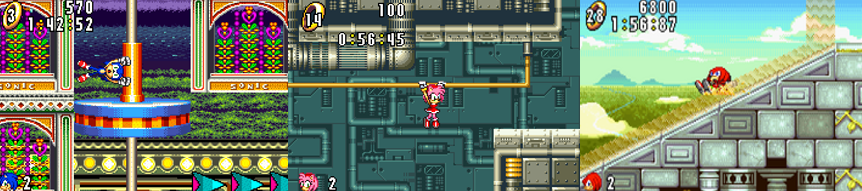
In terms of gameplay and stage design, Sonic Advance keeps things quite safe: Zones start off pretty simple, utilising recycled gimmicks and certain aesthetic themes from the classic games, but things become very cheap, frustrating, and difficult as the game progresses. You’ll be hopping to moving and temporary platforms, avoiding spikes, and trying to stick to the higher, faster path in most Acts but you’ll also be forced into the sluggish water, have to ride zip-wires, be blown into the air by fans, and pinball all over the place on bumpers. At first, enemies and hazards aren’t too difficult to avoid; the Game Boy Advance screen does limit your view a lot of the time, meaning it’s easy to jump or spring head-first into a projectile or unseen Badnik, but later Zones like Angel Island Zone and Egg Rocket Zone can easily see you jump, fall, or be blasted into a bottomless pit for a cheap death. Boost pads are used sparingly, thankfully, but are present, as are tunnels, air cannons, spinning spiked platforms, conveyer belts, bouncy platforms (and clouds), and lava pits. Ice Mountain Zone sees you riding iceberg floats, Angel Island Zone incorporates rolling boulders and sand gimmicks from Sandopolis Zone, and Egg Rocket Zone splits apart as you traverse higher, taking you further into the atmosphere, and briefly utilises the Death Egg Zone’s gravity mechanic. Claws will carry you across gaps, you’ll need to run on spheres to reach higher platforms, you’ll be jumping to swinging chained hooks, riding jets and streams of water, and dodging crushing hazards and warping across Zones. A lot of it is immediately familiar to long-time Sonic gamers, with just enough of a twist to make it more unique, but much of the game relies on slower, strategic platforming, blind jumps, or cheap deaths and enemy placements. Luckily, you can still hit lampposts to create a checkpoint if you die; collecting 100 Rings grants you an extra life, and there are 1-Up capsules hidden about the place. However, I actually found myself playing on zero lives at one point, which rarely, if ever, happens to me when playing 2D Sonic games and speaks to how challenging the later Zones can be largely due to placing Badniks, spikes, and bottomless pits just out of view to mess up your run.
Graphics and Sound:
There’s a reason I used the Sonic Advance sprites and backgrounds back when I used to make sprite comics; they are absolutely gorgeous and really capture the feel of the Sonic Adventure games and artwork. Sonic and his friends are full of life and personality, more than ever before; not only to they perform idle poses when left alone, urging you to get moving, but that also jig about with enthusiasm whenever you leave them standing. Although the introduction cutscene is extremely basic and focuses on the characters rather than delivering any kind of ground-breaking story, the in-game sprites more than make up for this; each character has lots of frames of animation, always pops against the background no matter how busy it gets, and performs a little victory pose when clearing Acts and bosses. Sadly, the music doesn’t fair as well; outside of some fun, if underutilised, remixes from the classic games, I found myself largely forgetting the themes for each Zone and the Game Boy Advance’s sound chip seems poorly suited to bringing the kind of energy I expect from a Sonic title. The stage select screen is also very basic and, while the ending makes up for this by featuring some fun sprite art and big victory poses, it’s simply a rehash of Sonic 2’s ending and doesn’t really offer anything new.
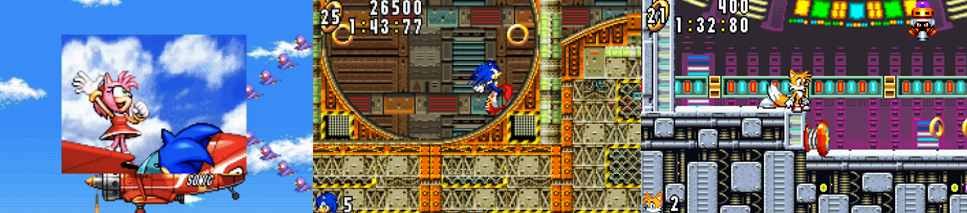
The same can also be said of the Zones; while it’s great to start off in a beach location for a change, Neo Green Hill Zone owes a lot to Green Hill Zone and Emerald Coast. Casino Paradise Zone is simply Casino Night Zone, though lacking a few of its gimmicks; Ice Mountain is basically Ice Cap Zone, Angel Island is an ancient ruins retread of Sky Sanctuary, and Egg Rocket Zone is a mish-mash of Launch Base Zone, Wing Fortress Zone, Flying Battery Zone, and Death Egg Zone. This continues in Cosmic Angel Zone and X-Zone, which are basically Death Egg Zone all over again, and even the final area, Moon Zone, is a reskin of Doomsday Zone. However, for the most part, the recycled gimmicks and aesthetics are presented just differently enough to make them unique: Neo Green Hill Zone has sandy beaches, wooden piers, and a thick overgrowth; Secret Base Zone is an industrial hell-hole full of lava, girders, and swamped by searchlights; you can see fireworks in the background of Casino Paradise, which incorporates balloons to reach higher areas; snow falls in Ice Mountain Zone, where snow and ice cover the trees and rails and ground, there’s a hell of a view of what I assume is the Mystic Ruins in Angel Island Zone, and I enjoyed seeing the big rocket boosters and the separating sections of Egg Rocket Zone. Unfortunately, many areas are also quite loud and cluttered; Secret Base Zone is a mess of conflicting oranges and browns, for example, and Cosmic Angel Zone is a nauseating kaleidoscope of purple and grey that is distracting to look at. For the most part, the game runs really well; it can be slow at times, but mostly you’ll be blasted along at breakneck speed, outrunning the camera and most likely smashing into an obstacle or to your death. Had the game been a little more zoomed out, featured some catchier tunes, and rethought its colour palette and layout, it might’ve improved my experience. As is, though, these elements make the later Zones a chore to play and the homages to the classics more annoying than endearing.
Enemies and Bosses:
Dr. Eggman’s Badniks are all heavily inspired by the mechanical enemies seen in the classic Sonic games and Sonic Adventure; we’ve got the Crabmeat-like GamiGami, the Rhinobot-like Rhinotank, the Coconuts-like Kiki, the Jaws-like Drisame that burst out of walls at the worst possible moments, and the Burrobot-like Mogu that are also placed in the most annoying areas, like right when you need to jump or dash through. Lizard- and frog-like Badniks Hanabii and KeroKero roll or hop about spitting projectiles, Stingers do their best Buzzer and Buzz Bomber impression by blasting projectiles at you right as you’re making a tricky jump, bat-like Slots swoop in from offscreen, and the jellyfish-like Kuraa add to their annoyance by briefly erecting an electrifying shield. As is tradition for a Sonic title, smashing Badniks releases a cute little woodland critter and nets you some points, and they’re often placed at the apex of jumps, right in your path, or near spikes. Speaking of which, spikes can be on the floor, walls, and ceilings, sometimes shoot up from the ground to ruin your day, and are occasionally on spinning platforms. You’ll also need to avoid being roasted by fireballs in Secret Base Zone, watch for crushing cubes in Casino Paradise Zone, hop to small rising stone platforms (often while avoiding spikes) in Angel Island Zone, and trust your fate to the will of the gaming gods when making blind jumps over the constant death pit in Egg Rocket Zone.
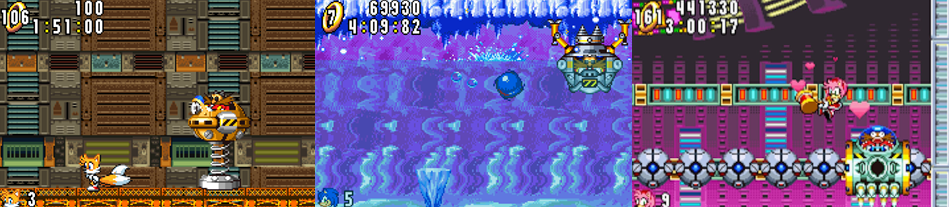
Naturally, every Zone culminates in a boss battle; you’ll face off against Dr. Eggman eight times in a regular playthrough, and a final time after finding all seven Chaos Emeralds, with each encounter seeing him man a new contraption and featuring two phases to the battle. The Egg Hammer Tank awaits in Neo Gren Hill Zone; a strange combination of the Egg Wrecker and Egg Mobile from Sonic 1 and 2, this fight sees Dr. Eggman driving from left to right and right to left trying to smash you with a massive hammer, and erratically bouncing about when near defeat. Dr. Eggman mans the Egg Press machine in Secret Base Zone for a boss not a million miles away from the first phase of the final boss of Sonic the Hedgehog: Triple Trouble (Aspect, 1994); Dr. Eggman hops around trying to squash you, then does a big jump off screen that you need to anticipate to finish him off. Casino Paradise Zone features one of the easiest boss battles; Dr. Eggman emerges from one of several pipes, while his spiked Egg Ball tries to hurt you. Simply duck down in the middle and ram him when he appears; not even the two speeding up near the end present much challenge here. Ice Mountain Zone’s Egg Spider ramps up the difficulty, however, as the fight takes place underwater and Dr. Eggman is completely out of reach. You need to use the icicle hazards he drops to reach him, and take a breath of air, but this can be tricky as they fall randomly, in greater numbers near the end, and your movements are super sluggish underwater. Dr. Eggman isn’t fought in Angel Island Zone or Egg Rocket Zone, but returns in the Egg Snake in Cosmic Angel Zone, a boss that’s considerably difficult for Amy. Dr. Eggman’s pod is protected by spikes so you and to wait for him to flip over to hit him, all while dodging his projectiles and his craft as it slides back and forth, which is particularly hard to do with Amy since she can’t Spin Attack.
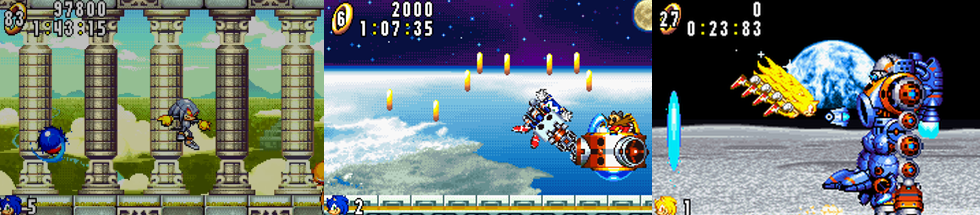
In Angel Island Zone, you’ll battle Mecha Knuckles; at first, this fight is very similar to the one against regular Knuckles from Sonic 3 & Knuckles and sees Mecha Knuckles glide about, throw punches, and try to Spin Dash into you. A few hits destroys its outer shell and reveals its true metallic self, which now spits missiles at you! When you reach the X-Zone, you’ll first endure a fun gauntlet against two classic boss battles, the Egg Wrecker and the Egg Mobile, not unlike in Sky Sanctuary Zone and with nothing changed about your attack strategy. Sadly, this is followed by an underwhelming battle against Dr. Eggman’s Egg X, a spinning cannon-like mech that spits bouncy explosive balls, tries to ram you, and grabs and shakes you with a mechanical pincer. While this appendage can be tricky to avoid and jump over, it’s ridiculously easy to bash Dr. Eggman as he flies past or stops to fire a projectile, making for a really disappointing final boss to the main portion of the game. Naturally, after collecting all seven Chaos Emeralds with any character, you’ll unlock the true final boss, the Super Egg Robot, a humanoid mech fought by Super Sonic on the surface of the Moon. Unfortunately, as I’ll detail later, I’ve never experienced this boss battle but I can tell you that your time is limited as Super Sonic’s Rings constantly deplete, meaning you’ll need to grab more to stay alive and in the fight, and that you must use the Super Sonic Boost with the B button to dodge or destroy incoming lunar rocks spewed up by Dr. Eggman. The Super Egg Robot also blasts you with a sweeping eye laser, causes energy pillars to erupt from the ground, and spews out orbs that will either incapacitate you for a few seconds or yield Rings when destroyed. The Super Egg Robot can also block your attacks with its drill-like arms, is constantly flying away from you, and can only be damaged by hitting its head. Although the music and presentation seem quite epic, it does seem a relatively simple encounter, and defeating Dr. Eggman awards you with the true ending…which honestly isn’t really all that different to the regular ending, just with more of that impressive sprite art and animation.
Power-Ups and Bonuses:
All the classic Sonic power-ups are on offer in Sonic Advance, this time in capsules like in Sonic Adventure. You can snag five, ten, or a random number of Rings, grab a temporary speed-up or invincibility, and occasionally gift yourself an extra life. You can also find a shield (or “Barrier”) that will protect you from damage for one hit, though it looks really unsightly here, or grab the Magnet Barrier for the same benefit with the added bonus of attracting any nearby Rings. That’s it, though; there are no other elemental shields, no new power-ups to find, and very little reason to explore your environment. As mentioned, each character boasts a mele attack, which is a fun alternative, but you can just as easily use the classic Spin Attack to defeat Badniks so there’s not much us for these attacks…unless you’re playing as Amy, who is entirely reliant upon them.
Additional Features:
As in the classic 2D Sonic titles, you can enter Special Stages to try and collect one of the seven Chaos Emeralds, however the way you get to these Special Stages is a bit different to what we’ve seen before. You need to find a Special Spring hidden in each Act, something Sonic and Amy will struggle to do, which grants you one try at easily one of the worst designed Special Stages in the franchise. You’re on a snowboard and constantly falling down a ringed shaft full of Rings, obstacles, and bombs. You can speed up your descent with A or perform a trick with B, which increases your Ring count, and can boost along paths of Rings, though it’s extremely difficult to actually collect Rings due to the odd angle. The perspective is all out of whack, meaning you often pass over or right by Rings, and in all my years of owning and playing this game, I’ve never completed a single Special Stage; hell, I’m lucky to even find a Special Spring, let along snag a Chaos Emerald! Collecting all seven unlocks the Moon Zone and the final battle against the Super Egg Robot, though this is the only way you get to play as Super Sonic. Beyond that, there’s a sound test in the “Options” menu, a Vs. mode that allows players to battle against each other or compete in races to collect the most Rings or find hidden Chao, even if you only have one cartridge between you, and a Time Attack mode for those who want to impress with their best clear times. If you enter a button code on the character select screen, you can play as Sonic with a computer-controlled Tails following him like in Sonic 2, and you can even visit the Tiny Chao Garden. In here. you can raise and pet a Chao, feeding it fruit or giving it toys to play with using Rings you collect in the main game and in the mini games within the garden that see you matching cards or playing rock/paper/scissors. You can also transfer this Chao to and from the GameCube Sonic Adventure games, which you’ll probably want to do as the Tiny Chao Garden’s features are far more limited than its bigger brothers.

The Summary:
I have a lot of nostalgia for Sonic Advance. It was still a novelty to see Sonic games released for Nintendo consoles at the time and I liked that it was a throwback to the classic 2D games, capturing the spirit of what made them so enjoyable, recontextualising a lot of the gameplay and gimmicks in new locations, and giving it that Yuji Uekawa aesthetic I enjoyed so much at the time (and even now). Technically, the game is solid enough; the physics work, Act layouts aren’t too dissimilar from the classics, and it offers a decent level of challenge, with some unfair moments peppered in the late-game Zones. I really liked that you could pick from four playable characters right from the start, and that Amy was included, and that their different abilities correlated with how difficult the game can be. I enjoyed most of the new Zones, despite how much they borrowed from the previous games, and really liked how this game bridged the gap between Sonic 3 & Knuckles and Sonic Adventure by incorporating elements from both. Unfortunately, it’s not perfect; and when it’s bad, Sonic Advance is quite a chore. First of all, it’s quite slow and is restricted by the Game Boy Advance’s screen size; Act layouts can be aggravating at times, with enemies and hazards placed just offscreen for maximum frustration, and I really didn’t like the way you access and play Special Stages. It’s rare that I fail to collect the Chaos Emeralds in a Sonic game and I’m still frustrated that I can’t do it over twenty years later. The bosses were quite fun, if a little easy, but the X-Zone boss was pathetic and the soundtrack was pretty forgettable. I liked the addition of the Tiny Chao Garden, though more could’ve been done with this, and it’s safe to say that Sonic Advance just plays things a bit too safe, something its sequels would address and improve upon with new mechanics and unique features. Still, there’s a lot to like in Sonic Advance; it really was the closest thing we had to a Sonic 4 at the time, and it was surprising to me that later 2.5D throwbacks didn’t take more inspiration from it and its sequels, but it’s hard to deny that it’s a sub-par experience compared to its successors and even Sonic 3 & Knuckles.
My Rating:
Pretty Good
Did you own Sonic Advance back in the day? If so, did you enjoy it and how do think it’s aged, especially compared to its sequels? Which character was your favourite and did you like their expanded move sets? What did you think to the Zones on offer and the recycling of previous gimmicks? Do you think the game played it too safe or do you consider this the true Sonic 4? Did you ever collect the Chaos Emeralds and, if so, how and what did you think to the Special Stages? Which of Sonic’s Game Boy Advance titles is your favourite and how are you celebrating Sonic’s anniversary this year? Whatever your thoughts on Sonic Advance, leave a comment below or on my social media and go check out my other Sonic content!


I liked this game at the time, but I don’t tend to revisit it now. It’s not a bad game, I just find its sequels to be less frustrating to play.
LikeLike
The sequels, especially the second one, are much more fun.
LikeLike