Back Issues [JLA Day]: The Brave and the Bold #28


To celebrate the release of Justice League (Snyder/Whedon, 2017), DC Comics named November 18 “Justice League Day”. Sadly, this clashes with another pop culture holiday but, setting aside all the drama surrounding that movie, this still provides a perfect excuse to dedication some time to talking about DC’s premier superhero team, which set the standard for super teams in comics by bringing together DC’s most powerful heroes.


Story Title: “Starro the Conqueror!”
Published: 29 December 1959 (cover-dated March 1960)
Writer: Gardner Fox
Artist: Mike Sekowsky

The Background:
All Star Comics (1940/1941), brought together eight superheroes from a number of different publishers for the first time as the Justice Society of America (JSA). This not only heralded the birth of the first ever superhero team in comics but also allowed readers to see their favourite characters interacting all for the same price as reading any one comic. The JSA’s roster expanded and changed over the years but the team underwent their most significant change when, in the late 1950s, then-editor Julius Schwartz asked writer Gardner Fox to reintroduce and rebrand the team as the Justice League of America (JLA) to capitalise on the popularity of the American Football League and Major League Baseball’s National League. Though the team debuted in The Brave and the Bold #28, a title famous for featuring team-ups between various fictional and superheroic characters, the team’s actual origin wasn’t revealed until the ninth issue of their self-titled series, which became one of DC Comic’s best-selling titles. As with the JSA and other super teams, the JLA’s roster has changed over the years and many splinter groups and spin-offs have been introduced but perhaps there is no more iconic line-up than the JLA’s original roster that was comprised of DC’s heavy-hitters: Clark Kent/Superman, Bruce Wayne/Batman, Diana Prince/Wonder Woman, Hal Jordan/Green Lantern, Arthur Curry/Aquaman, Barry Allan/The Flash, and J’onn J’onzz (referred to here as “John Jones”)/Martian Manhunter.

The Review:
“Starro the Conqueror!” begins with the odd choice to not detail the first time these superheroes joined forces and, instead, starts off with the seven heroes already having agreed to come together in times of crisis (they each have a signalling device to summon the others). I kind of like this on the one hand as it suggests that DC’s top superheroes already set aside their differences for the greater good without any real fuss and it helps speed things up but, on the other hand, it feels a bit out of place to not detail the first meeting of these heroes. Anyway, the first member of the team to become aware of an impending threat is Aquaman who, thanks to information provided to him by a puffer fish, is learns of the arrival of the gigantic extraterrestrial starfish known as Starro.

Aquaman’s summons is answered by some of DC’s greatest superheroes.

This monstrous being has travelled across the depths of space to Earth with one goal in mind: conquest. To that end, Starro…somehow…transforms three of Earth’s starfish into replicas of itself and spreads them across the world to begin its mad scheme. Aquaman’s summons are immediately picked up and answered by Wonder Woman (who is in the middle of an awkward conversation with her beau, Steve Trevor, regarding marriage), Green Lantern (who, as Hal Jordan, was in the middle of a test flight), the Flash (who quickly disperses of a potentially life-threatening tornado), and the Martian Manhunter (who was simply about to start his vacation…). Each of these introductory panels immediately gives the reader and idea of what each character is capable of: Aquaman can breath underwater and talk to fish, Wonder Woman has an invisible jet, Green Lantern’s ring allows him to perform virtually any task, the Flash is super fast, and the Martian Manhunter can shape-shift. Aquaman’s signal also reaches Superman and Batman but the two are unable to respond right away since Superman is busy taking care of a potentially dangerous meteor shower and Batman is in the middle of stopping a crime spree. You might think that Superman would have spotted Starro’s arrival from space but he was dealing with a great deal of meteors (it’s also entirely possible that Starro caused the meteor shower specifically to distract Superman) and I guess it’s in character for Batman to prioritise Gotham City’s safety over a JLA summons (though a JLA-level peril is surely more threatening for Gotham than a crime spree…)
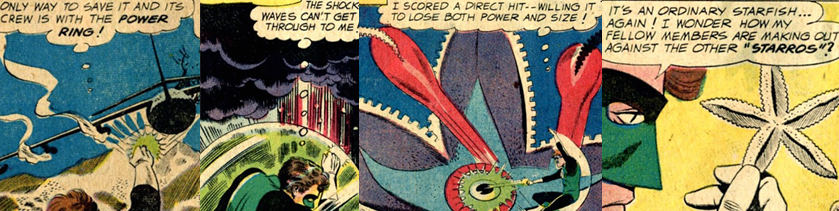
Green Lantern is able to defeat the Starro duplicate with relative ease.

Regardless, the five heroes meet at the “modernistically outfitted cavern” that serves as the JLA’s headquarters. Having been informed of Starro’s threat and where it intends to strike, the Flash, as the JLA’s chairman, orders the team to split up and it is at this point that the story diverges from the team-based format and instead switches to cover each individual mission. The first sees Green Lantern battling one of Starro’s deputies in the skies above Rocky Mountain National Park; Hal arrives in time to see the gigantic creature but is too late to stop it from attacking a passing air force jet-bomber and relieving it of its payload: nothing less than an atom bomb! Green Lantern is able to save the aircraft when it goes into a deadly freefall but is unable to keep the Starro duplicate from detonating the atom bomb! Thankfully, Hal’s energy shield protects him from the blast and he watches in horror as the creature absorbs the energy released from the bomb. Hal pursues and is nearly blasted from the sky by a scorching beam fired from the creature’s tentacle. However, Green Lantern is easily able to avoid the creature’s thrashing limbs and attacks and reduce it down to a regular starfish by scoring a direct hit on its massive eye.
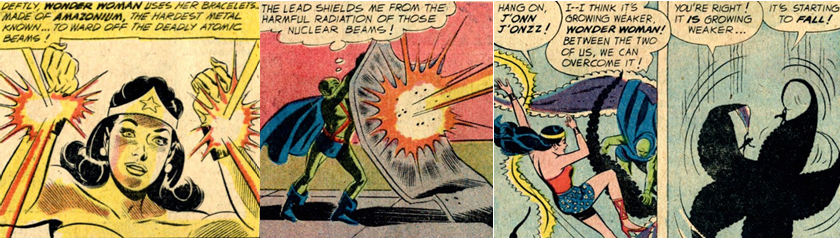
Starro’s duplicate falls before the might of Wonder Woman and the Martian Manhunter.

Next, the story switches to “Science City” where Wonder Woman and Martian Manhunter (why Diana has to team up with another hero is beyond me…) find another of Starro’s deputies abducting the “Hall of Science”, where the greatest scientific minds of the United States are gathered. The creature intends to bring the scientists into the upper atmosphere so it can absorb their brainpower and knowledge; Wonder Woman attempts to use her magical lasso to prise the creature’s tentacles from the building but ends up being yanked off of her invisible jet and onto the Hall of Science thanks to the giant starfish’s incredible strength. Meanwhile, J’onn uses his super-breath to bombard the creature with fragments of the meteors Superman is destroying and uses the same technique to cause a torrential rainfall when flames from the building threaten his life. Starro’s deputy then attempts to destroy them both by firing bolts of nuclear energy their way but Wonder Woman is, of course, able to deflect them with her magical bracelets and J’onn shields himself using the building’s conveniently lead-lined roof. Diana then whips her lasso around her jet and uses the momentum to forcibly drag the building out of the sky. The effort of battling both heroes at once soon takes its toll on the creature, which plummets from the sky and begins to revert back into a regular starfish.
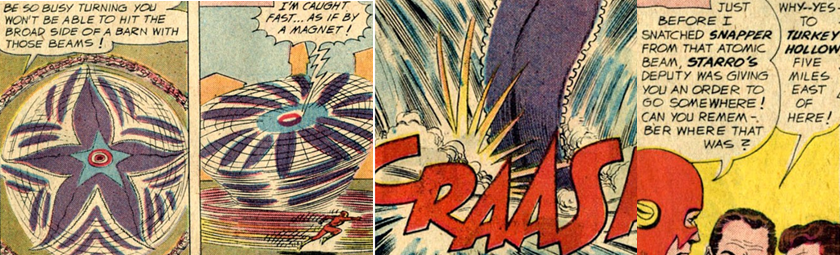
The Flash makes short work of the final Starro duplicate.

When then join the Flash as he confronts another of Starro’s deputies at Happy Harbour; this part of the story is easily the worst simply because it introduces one of the most annoying and aggravating characters ever conceived: the JLA’s “mascot”, Snapper Carr. Snapper is a hip, super cool teenager with the annoying habit of constantly snapping his fingers all the God-damn time who is shocking to find his family, and the entire town, enthralled by Starro’s trance. For whatever reason (possibly due to being high, judging by the way he speaks!), Snapper is immune to Starro’s influence so he needs to be saved from certain death by the Flash. Despite Starro’s best efforts to vaporise the Scarlet Speedster, the Flash (literally) runs rings around the creature and ultimately defeats it when it tries to hide in the sea. In the process, the townsfolk are freed from their trance and Snapper’s family are able to tell Flash where they were ordered by the creature to head to: Turkey Hollow.
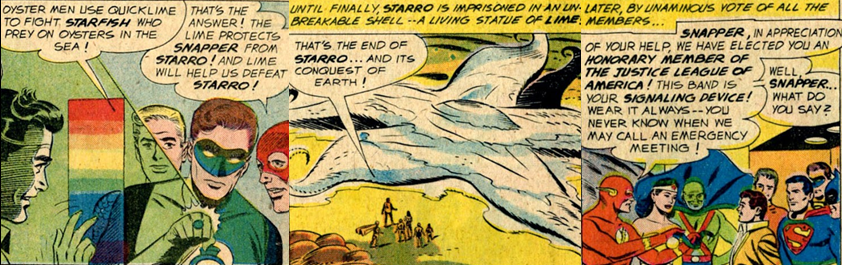
The JLA defeat Starro with ridiculous ease and make Snapper an honorary member!

The final part of the story sees the team reunite to take on the real Starro at Turkey Hollow; despite the defeat of its deputies, Starro remains confident since it was still able to absorb the power of that atomic bomb, the knowledge of Earth’s scientists, and…whatever it is the townsfolk of Happy Harbour contributed to its mind (local Earth knowledge, I guess?) Starro plans to use all that it has learned to force humanity into destroying the world with nuclear weapons and then use the influx of nuclear energy would then allow it to conquer other worlds across the universe. When the JLA arrive, Starro immediately puts its abilities to good use by reading Hal’s mind and turning itself yellow to render itself immune to his power ring but the Flash notices that Starro’s awesome energy ray has absolutely no effect on Snapper (who he, of course, brought along for the ride!) Flash orders Wonder Woman and the Martian Manhunter to distract Starro while Hal uses his power ring as a spectroscope to discover that Snapper is covered in lime from when he was mowing the lawn earlier. Apparently, lime is deadly to starfish so Hal dumps a whole bunch of it onto Starro to weaken it. Martian Manhunter then uses his super-breath to blow a load of calcium oxide (which is, apparently, also lime) onto the creature and thus imprison it within an unbreakable shell of lime. With Starro’s threat ended, Superman and Batman return just in time to see the Flash making Snapper an honorary member of the JLA and…boy, do they look thrilled to be there!

The Summary:
I don’t mind telling you that I am a bit disappointed by “Starro the Conqueror!”; the story started pretty strong but fell off a cliff pretty quickly at the end, becoming little more than a science class rather than a big old fight between Earth’s greatest heroes and an alien menace. I suppose it speaks to the intelligence of the JLA (specifically Barry) to come up with a way to outwit, rather than outfight, the creature and the sudden introduction of lime as the might Starro’s one weakness is arguably no less lame than fire being J’onn’s weakness and yellow being Hal’s and there is a lot of action prior to the finale but still…the entire point of the comic is to see these heroes joining forces and we don’t really get that.
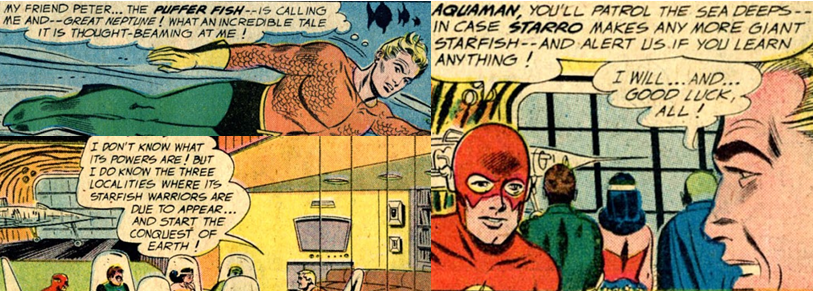
Aquaman is unfairly side-lined and does nothing except alert the JLA to Starro’s presence.

You might be wondering where the hell Aquaman was during this story; despite appearing to be a pivotal member of the team in the early panels, Arthur is little more than an early warning system to alert the team to Starro’s threat. Hell, when Barry is divvying out the JLA’s individual missions, Aquaman doesn’t even get to fight one of the creatures as he’s sent back to the ocean to watch out for any more of the duplicates and, when he does return to the story for the finale, he does absolutely nothing. It’s pretty sad considering the JLA were light on power with Superman out of the equation and when you consider that Arthur might have actually been really useful at Happy Harbour so could have easily teamed up with the Flash for that mission…but then we might never have gotten Snapper-fuckin’-Carr now, would we!?
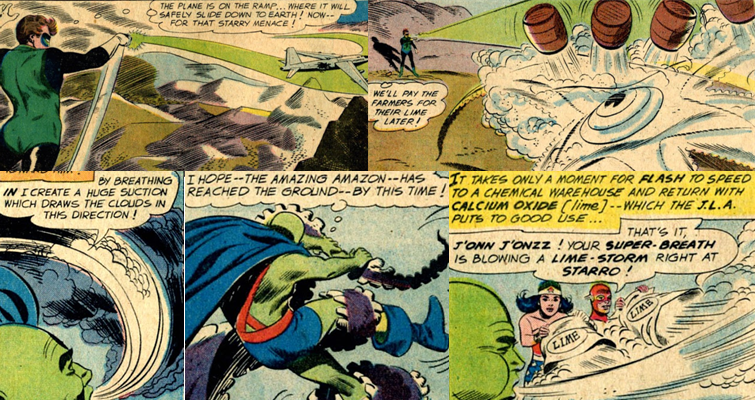
Hal and J’onn are severely underutilised, with their powers reduced to the bare minimum.

Honestly, Snapper could have been dropped entirely from the story; he’s only there so the teenager readers can act like they’re fighting alongside their favourite heroes, after all, and it’s legitimately sad that he’s more important to the story than Aquaman! Seriously, drop Snapper, have Aquaman and the Flash go to Happy Harbour, and have Arthur get covered in lime while battling the creature in the water and reveal the key to Starro’s defeat. Seems like a pretty simple solution to me. Similarly, it’s pretty disappointing that Superman and Batman don’t play any part in the story at all. I can understand why as Superman’s power alone would probably be able to end Starro’s threat but it’s a bit of a let down that they don’t even join the team for the big climactic battle. Instead, we’re left with the likes of the Martian Manhunter, who is probably just as powerful as Superman if not more so and yet is reduced to simply puffing away with his super-breath. Similarly, Hal’s potential and power is also significantly reduced; his ring allows him to do virtually anything but, in the end, all he really uses it for is to fly about, rescue a falling plane, and zap at Starro with energy blasts.
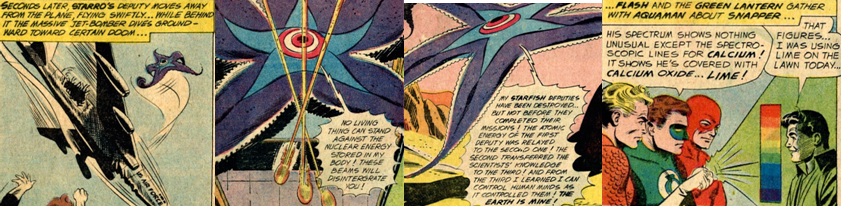
Starro seems like a threatening villain but end sup being a massive disappointment.

Still, at least Wonder Woman gets a lot to do; she basically does all the work in her team-up with J’onn which, again, makes me question why she has to have a partner and no one else does. The implication may be that it’s because she’s a woman but she’s easily the most dependable and capable superheroine I’ve seen all year; she doesn’t even get bound or anything, which is refreshing. The Flash also gets far more chances to show off his abilities and competence; beyond his super speed allowing him to easily best one of Starro’s duplicates, Barry is portrayed as a decisive team leader and his intelligence is what ultimately wins the day over brute strength. Overall, Starro is just another in a long line of potentially dangerous foes that really don’t amount to a whole hell of a lot. It openly admits that its plot to conquer Earth is the first time it’s ever tried anything like that, exposing its naivety and inexperience in world conquest and battle. Its scheme seems pretty good to start with as it creates duplicates of itself and absorbs power and knowledge but it fails to really do anything with this beyond making itself yellow; it could have spewed flames at J’onn, bound Wonder Woman’s wrists, subjected Aquaman to intense heat, or slowed the Flash down with quicksand but it never does any of that. For all the power and knowledge it has, Starro ends up just being a giant alien punching bag that, arguably, the Flash alone could have defeated and, because of that, it’s simply a piss-poor excuse to see all these heroes band together and even then they spend the majority of the story working separately!

My Rating:

Rating: 2 out of 5.

Could Be Better

What did you think to the JLA’s debut appearance? Were you happy to see five out of the seven joining forces for the first time or would you have liked to see all seven of them getting in on the action? What did you think of Starro as the principal villain and the introduction of Snapper Carr? Which era or incarnation of the JLA is your favourite and what are some of your favourite JLA stories? Who would you like to see in the JLA some day? How are you celebrating Justice League Day this year? Whatever your thoughts on the JLA, feel free to leave a comment below.


The Summoning

“You’re cordially invited to LaVey House…”

The reclusive Howard LaVey has presented writers Frederick Brandis, Aster Callahan, Rhiannon Hughes, and Mikhail Orlov with the opportunity of a lifetime: a chance to spend a week at his ominous estate and collaborate on a horror anthology.

Each of them hopes to get something out of it, ranging from riches to recognition, but egos flare and co-existing becomes a struggle as each writer battles against their own demons and self-doubts.

Soon enough, LaVey House turns out to be much more than they bargained for, and the chance of a lifetime quickly becomes a living nightmare as ancient spirits awaken and torment them at every turn.

Four writers, four stories, but the true horror lies buried within the dark hallways and forgotten secrets of LaVey House just waiting to live again!

The Summoning is an intense horror collaboration from the minds of Dr. Stuart Knott, H. Everend, and Jessica Huntley and featuring contributions from Alice Stone, Shantel Brunton, Tom Schnipke, and Daria Lavrenteva.

Group interview by Shantel Brunton
Madilynn Dale’s Review on The Chapter Goddess
My review
Brittany’s Book and BeeReview
Feature with Alyanna Poe

Movie Night: X-Men Origins: Wolverine

Released: April 2009
Director: Gavin Hood
Distributor: 20th Century Fox
Budget: $150 million
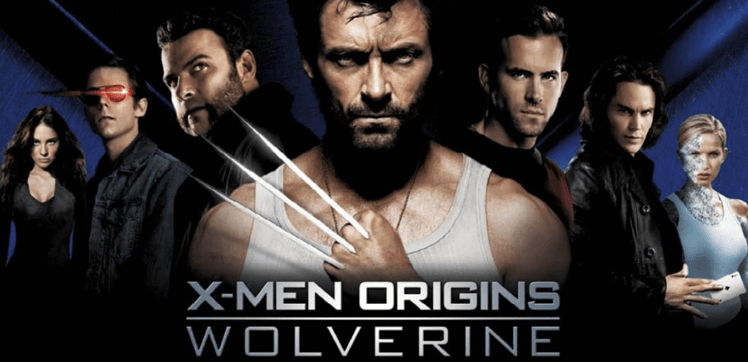
Stars: Hugh Jackman, Liev Schreiber, Danny Huston, Lynn Collins, Taylor Kitsch, Daniel Henney, Will.i.am, and Ryan Reynolds

The Plot:
Mutant brothers James Howlett (Jackman) and Victor Creed (Schreiber) are drafted to Major William Stryker’s (Huston) Team X. However, when his murderous sibling goes wild, Logan volunteers for a radical procedure to make him indestructible.

The Background:
20th Century Fox had vastly profited from their acquisition of the X-Men movie rights from Marvel Comics. Under their banner, the first three X-Men movies (Various, 2000 to 2006) had made over $600 million and, soon after X-Men: The Last Stand (Ratner, 2006) brought the trilogy to an end, development began on a series of spin-offs focusing on solo X-Men. Chief among these was, of course, the character of Wolverine; the role had catapulted the relatively-unknown Australian actor Hugh Jackman to superstardom and was the natural choice for a spin-off given how popular the character and his rich recently-uncovered backstory was. Collaborating on the script in order to craft a more interpersonal story, Jackman and director Gavin Hood aimed to explore the duelling nature of Wolverine’s animalistic character. Popular X-Men characters like Wade Wilson/Deadpool (Reynolds) and Demy LeBeau/Gambit (Kitsch) were incorporated into the script, which sought to explore the complex relationship between Logan, Victor, and Stryker based on both their characterisations in the comics and the world Bryan Singer had establish in his first two X-Men movies. Sadly, much like X-Men: The Last Stand, X-Men: Origins Wolverine received mixed to average reviews upon release; despite earning more than double its budget at the box office, X-Men Origins is largely regarded unfavourably by the majority of fans and critics alike. Personally, I always enjoyed the film, which was far more in the vein of X-Men 2 (Singer, 2003) than the third film; I liked that it introduced new and interesting Mutants and feel that it gets a bad reputation despite being an unashamedly enjoyable popcorn action film.

The Review:
When X-Men Origins: Wolverine was released, the details of Wolverine’s early years had already been published in Marvel Comics some eight years prior; still, the revelation that James Howlett (Troye Sivan) had began life as a sickly boy in the 1800s was still relatively fresh for many readers who were more used to seeing Logan hooked into machinery and brainwashed into being a merciless killer as Weapon X. Unfortunately, as interesting as it would be to delve into Howlett’s early years and the details of his friendship with the young Victor Creed (Michael-James Olsen), X-Men Origins has no time for that as, within the first five minutes or so, young James has seen his father murdered, unsheathed his bone claws for the first time, killed his father’s murderer only to discover that his victim was actually his real father, and gone on the run with his similarly-powered half-brother. Sadly, this manic pacing is a theme for X-Men Origins; it’s all quick cuts and revelation after revelation in 1845 and then, as the film’s opening credits roll, we see James and Victor (now Jackman and Schreiber, respectively) taking part in every major war over the next hundred years or so. The montage, easily one of the more impressive parts of the film and which arguably should have made up the bulk of the movie’s runtime, does a great job of showing how James grows increasingly jaded with their mercenary lifestyle and how Victor grows equally bloodthirsty over time.

Logan eventually becomes disillusioned with Team X’s increasingly violent methods.

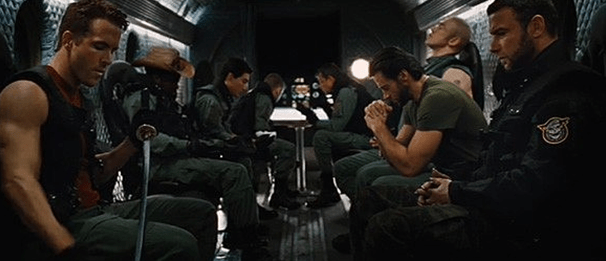
Eventually, the two are put before a firing squad after Victor kills his commanding officer. Obviously, this doesn’t actually kill the two so they are immediately recruited by Stryker, who drafts them into Team X, a group of highly skilled Mutants under his command. James and Victor go on what is implied to be many missions but, thanks to the film’s breakneck pace actually seems more like one mission, alongside such notable Mutants as Wade Wilson, Fred Dux (Kevin Durand), John Wraith (will.i.am), Agent Zero (Henney), and Chris Bradley (Dominic Monaghan). Unfortunately, Victor’s bloodlust can no longer be controlled and, when Stryker orders the team to slaughter innocent sin order to get his hands on a mysterious mineral, James walks away from the team.

Jackman is unquestionably the star of this film, shining at every turn.

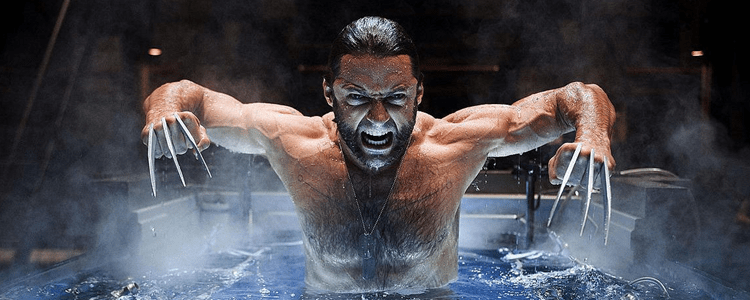
Taking the name Logan (why this name is never explained), James spends the next six years making a modest living as a lumberjack in Canada alongside his lover, Kayla Silverfox (Collins). However, after Stryker shows up to warn Logan that their old team mates are being slaughtered, Kayla is killed by Victor and, overcome with grief and rage, Logan willingly volunteers to have Adamantium surgically grated to his skeleton to give him the tools to enact his revenge against his half-brother. Once again, the star of the show here is Hugh Jackman; now at his most toned and muscular and fully at ease with the role of Wolverine, Jackman’s charisma and animal magnetism help X-Men Origins to stay engaging even in its most head-scratching moments. Jackman does a fantastic job of conveying the myriad of emotions Logan goes through, from his more tender, vulnerable moments to his raw, animalistic brutality. Unfortunately, much is made throughout the film (and in the first three X-Men movies) of Wolverine’s animal side; Stryker (Brian Cox) hinted that, in his past, Wolverine wasn’t a very nice person and X-Men Origins also hints that he did some terrible things during the many wars he fought in…but we never see this. Sure, he’s a tortured character because of his traumatic memories of war and is a formidable beast when enraged but, for the most part, he’s the same honourable, good-natured person we’ve seen in the original trilogy. It would have been far more engaging and interesting to really delve into Wolverine’s time as a cold-blooded killer who slowly grows to become disillusioned with that life compared to Victor, who relishes in killing and giving in to his animal nature.

Schreiber is clearly relishing this role and is more than a match for Jackman.

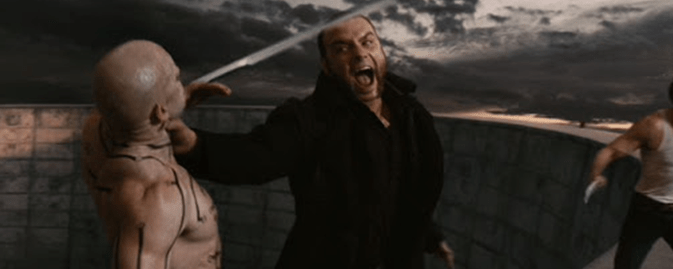
Speaking of Victor, Schreiber was an inspired choice to bring the character to life. Like many comics, X-Men Origins hints very strongly that Victor and Sabretooth (Tyler Mane) are the same character but never fully lands on one side of the fence or the other; certainly, Schreiber’s loquacious nature and cold, calculated charisma separate him from mane’s more bestial portrayal but, in any case, Victor is a fantastic parallel to Logan. Sadistic and heartless, he kills for the fun of it and simply wishes to prove that he’s better than his half-brother, which he does at every turn. It’s surprising, then, when it is revealed that Victor wouldn’t be able to survive the Adamantium bonding process; perhaps this was a lie on Stryker’s part, though, as Victor is consistently shown to be Logan’s better at every turn save for that line and one brief scuffle between them before the finale.

As good as an actor as Huston is, Stryker’s motives and logic are all over the place in X-Men Origins.

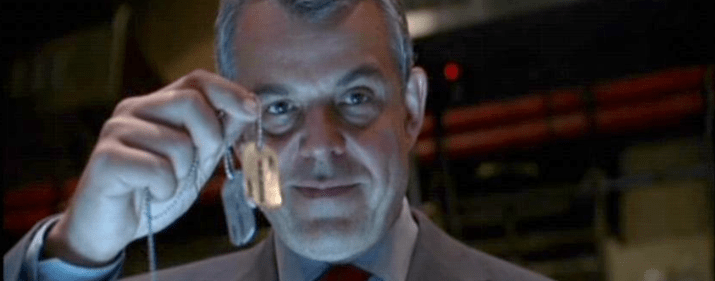
After making an impact in X-Men 2 and considering the importance his character has on Wolverine’s early years, it’s only nature that Stryker plays a big role in this film as the puppet master. Yet, while Huston is a great actor and brings a certain scenery-chewing relish to the role, he’s physically nothing like Brian Cox so it’s a bit weird to me that they chose to cast him. Add to that the fact that Stryker’s plan is needlessly convoluted and bone-headed (he tricks Logan into joining Team X, allows him to leave, has one of his agents (spoiler: it’s Kayla) shack up with him, then fakes her death, pretends like Victor isn’t under his control when we know he clearly is, is somehow able to convince Logan to become indestructible and then, when Logan escapes the Weapon X facility, Stryker’s first order (to a guy whose only power is “expert marksmanship”) is to kill their now invincible creation!) and you have a villain who is charismatic enough to fulfil his role as the master manipulator but flawed in his onscreen execution.

Gambit’s role is brief but surprisingly enjoyable and important to the plot.

Such flaws are evident throughout X-Men Origins, I’m afraid to say; the film’s wonky pacing and questionable plot see characters either being tricked or used with ridiculous ease (you’d think Wolverine, of all people, would be able to tell that Kayla’s death was faked, surely) or simply stumble upon the information they need or into the location where the information they need is. The scene where Logan interrogates Dux (now transformed in the Blob) is a great example; it’s a fun scene, one of my favourites, but Dux isn’t able to tell Logan everything he knows so, of course, he sends him to New Orleans to track down another Mutant, Gambit, who knows Stryker’s exact location. Honestly, Gambit has a far bigger and more prominent role in the film than I originally believed; slightly bigger than a cameo but not quite a co-star, he exists to guide Wolverine to what ends up being a pretty obvious location for his final showdown but, while Kitsch is pretty enjoyable in the role, it’s hard to look past his elaborate superhuman acrobatics. I guess you can make the argument that his Mutant ability to super-charge kinetic energy allows him to perform superhuman leaps and bounds but that doesn’t really help explain how Zero goes flying all over the place all the time. Yet…I find myself enjoying these action and fight sequences. They’re loud and over the top but what’s wrong with that? The scene where Wolverine tries to out-race Zero’s helicopter on a motorcycle is pretty awesome, as is his dramatic takedown of said helicopter (which sees him clinging onto it as it crash lands) and the obvious trailer shot of Logan dramatically walking away from the explosion, as cliché as it is, hits all the right spots for me as an action movie fan. Wolverine’s fight scenes are equally enjoyable; similar to Logan’s fight scenes from X-Men 2, Logan fights with a vicious, brutal intensity where the animal side of him everyone likes to talk about so much really comes to the forefront.

The Nitty-Gritty:
As much as I enjoy X-Men Origins, however, it’s tough to look past the film’s narrative flaws. As a prequel to X-Men (Singer, 2000), though, the film does line up fairly well (far better than the quadrilogy of “prequels” that were to follow), it’s just a shame that the filmmakers were in such a rush to cram everything into this one movie. This could easily have been restructured to show Logan’s early childhood and time during the war and then his time with Team X, leading to a falling out and with Victor over their methods. The second film could have then shown Wolverine transformed into Weapon X as we saw in the otherwise-disappointing X-Men: Apocalypse (Singer, 2016), with that film and that procedure being responsible for his memory loss, than then the third and final movie could have just been The Wolverine (Mangold, 2013) or even Logan (ibid, 2017). Instead, we rush through all of Wolverine’s greatest hits at a breakneck pace all to get to a point that somewhat awkwardly leads into the start of the first X-Men.

Logan’s ultimate fate is a bit rushed and messy but still somewhat affecting in its bleak execution.

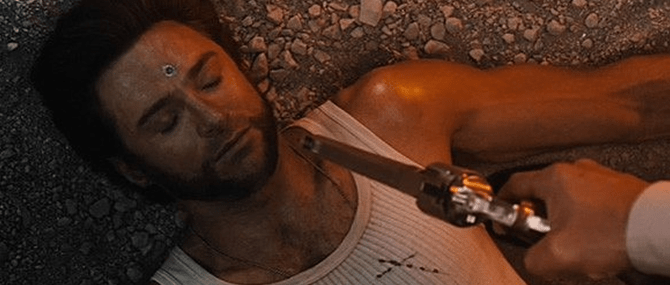
Despite that, however, I still find the scene where Stryker blasts Wolverine in the head with a few Adamantium bullets quite heartbreaking. It’s a messy way to go about his memory loss considering having his healing factor be responsible is a far more cerebral and interesting explanation but it’s still tragic to see him awaken surrounded by death and destruction with no idea who he is or where he is. The implication of this ending, and the final act of the film, is that Logan spent the next fifteen-or-so years relying solely on his instincts, which is kind of ironic considering there was probably some evidence left behind on Three Mile Island to explain his origins. Sadly, however, the X-Men films never filled in the gap between this one and X-Men (at least, not fully, as the films go out of their way to ignore or retcon this entire film) so we never really know what he got up to or what happened to Victor (unless he really did devolve into a mindless, semi-mute brute).

Reynolds was perfectly cast but dealt a bad hand here. Luckily, it wouldn’t be his last time in the role.

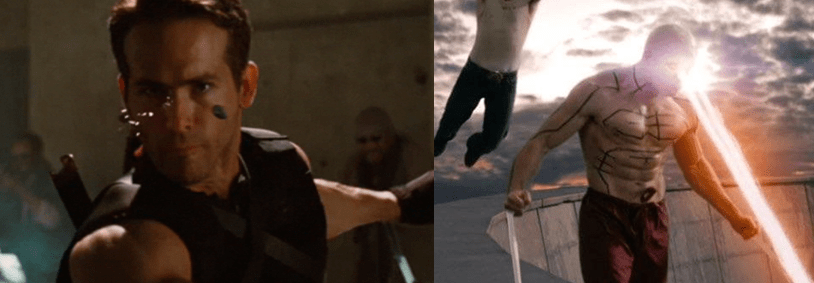
Of course, you can’t talk about X-Men Origins without addressing the elephant in the room: Deadpool. Reynolds was perfectly cast as Wade Wilson back in the day and it’s clear from the post-credit sequence that Fox were planning a spin-off for the character all along but, yes, it is disappointing to see the character chopped up and butchered into a weird amalgamation of recognisable Mutant powers as Weapon XI (Scott Adkins) rather than the fast-talking, unkillable “Merc With a Mouth” we all know and love. It’s weird watching this film back now as they could just as easily have had a more traditional Deadpool be Logan and Victor’s final opponent; lose the Adamantium blades and the optic blasts and just have him be a super-healing, super-skilled soldier who is loyal to Stryker. Or, better yet, simply imply that wade was killed and have Victor, now a feral animal, be the film’s final “boss” and then do a post-credits scene that shows Wade alive and well and working as a mercenary. Luckily for Reynolds, and for us all, Deadpool would eventually get his spin-off and it was absolutely brilliant but, thanks to the convoluted mess that the X-Men franchise has become, those films sit in a weird bubble of continuity where everything and nothing is canon at the same time.

X-Men Origins uses its cameos to fill some gaps in the franchise’s once-stable timeline.

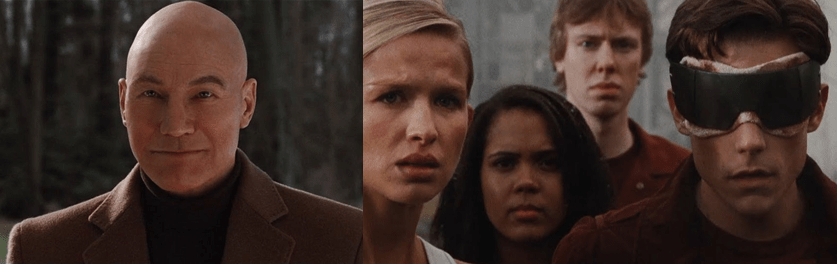
Speaking of canon, this film obviously concludes with what was, to me (at the time, anyway), a pretty shocking cameo by Professor Charles Xavier (Patrick Stewart), who arrives on Three Mile Island to rescue Stryker’s Mutant prisoners. Sure, the de-aging affects aren’t as good as in X-Men: The Last Stand but this was a very welcome cameo for me and helped to fill a gap in what was, at the time, a straight forward timeline. While I also applaud the way the film attempts to place a little bit more spotlight on Scott Summers/Cyclops (Tim Pocock) and even goes out of its way to show that he never sees or hears Wolverine so as not to create a continuity error, once again the character is somewhat shafted by his ham-fisted inclusion; I liked that Stryker sent Victor specifically to hunt Cyclops down, as though his powers were fundamental to Weapon XI, but the fact that Cyclops is already wearing ruby-tinted sunglasses to keep his powers in check is a little odd as I always assumed this was a solution provided by Xavier. Still, it’s fun to him and a few other recognisable Mutants in little cameos and that the film allows for other popular or B-list X-characters to be included without Wolverine sucking all of the spotlight away from the traditional X-Men thanks to Jackman’s screen presence, charisma, and popularity.

The Summary:
I don’t know what it is about X-Men Origins: Wolverine but…I still really like it. yes, the plot is nonsensical and all over the place, rushing through some story beats that could be a movie all by themselves and lingering on others that are far less interesting and yes it does do a disservice to Deadpool and raise a lot of questions that subsequent X-Men movies and spin-offs largely ignore. But it’s just so much fun! Maybe it’s because I grew up with loud, bombastic action movies but I find this film immensely enjoyable in a lot of ways. It’s fun when it needs to be, bad-ass when necessary, and even touching at times. It’s over the top and mindless action, yes, but what’s wrong with that? Honestly, it irks me that the franchise went out of its way to ignore or retcon this film as it cost us Schreiber returning to the series and caused continuity to be thrown out of the window. Maybe Wolverine deserved better than a big, dumb action movie but sometimes big, dumb fun is just big, dumb, and fun and that’s okay.

My Rating:

Rating: 3 out of 5.

Pretty Good

What did you think about X-Men Origins: Wolverine? Do you think it deserves the reputation it gets or do you, like me, find it to be an enjoyable entry in the franchise? How did you feel about the way the film treated Deadpool and the relationship between Logan and Victor? How would you like to see Wolverine re-introduced to the Marvel Cinematic Universe? How are you celebrating the month of Wolverine’s debut? Whatever your thoughts about Wolverine and the X-Men, feel free to leave a comment below.

Movie Night [Godzilla Month]: The Return of Godzilla / Godzilla 1985


Toho’s famous atomic beast, and easily the most recognisable kaiju in the entire world, Gojira first emerged from the waters of outside of Japan to wreck the city of Tokyo on November 3rd, 1954. To celebrate “Godzilla Day” this month, I’m dedicating very Saturday in November to looking back at the undisputed King of the Monsters’ many reboots.


Released: 15 December 1984
Director: Koji Hashimoto
Distributor: Toho
Budget: $6.25 million
Stars: Ken Tanaka, Shin Takuma, Yasuko Sawaguchi, Yosuke Natsuki, Keiju Kobayashi, and Kenpachiro Satsuma

The Plot:
Decades after Tokyo was devastated by a gigantic, radioactive dinosaur, reporter Goro Maki (Tanaka) finds evidence of another incarnation of Godzilla (Satsuma). Although Prime Minister Seiki Mitamura (Kobayashi) tries to keep the beast under wraps, the government is forced to turn to their advanced cadmium-firing Super X weapon in a desperate attempt to halt Godzilla when it rampages through Tokyo once more.

The Background:
When Gojira (more popularly known worldwide as Godzilla) made his big-screen debut in Godzilla (Honda, 1954), he represented very real lingering fears regarding the threat and consequences of nuclear war. Since then, the character has appeared in numerous films and been depicted as both a saviour and destroyer of Japan, a protector and an unrelenting force of nature that has become an iconic figure in pop culture over his many decades of cinema. In 1975, Honda helmed the fifteenth film in the original line of Godzilla movies, Terror of Mechagodzilla, which proved to be such a box office failure that Toho put the franchise on a premature hiatus. Over the next ten years or so, Toho attempted many times to reinvigorate the franchise, but all attempts were shelved until series creator Tomoyuki Tanaka took charge or revitalising the series and adding a contemporary shine to it following incidents such as the accident at Three Mile Island. Initially, American director Steve Miner seemed set to direct his own Godzilla movie, though the project was hampered by his insistence on utilising costly stop-motion animation and 3D effects, and when this production fell apart, Tanaka hired director Koji Hashimoto to helm a direct sequel to the original 1954 film that disregarded the character’s more heroic, anthropomorphic characterizations. Teruyoshi Nakano returned to direct the film’s special effects scenes, which saw the creation of the biggest and most detailed and expressive suits and miniatures seen in the franchise so far; the special effects were further bolstered by a sixteen-foot-tall animatronic Godzilla dubbed “Cybot” that was used for the creature’s close-ups and cost ¥52,146 to construct. The Return of Godzilla was a modest success, bringing in ¥1.7 billion at the Japanese box office, and has been noted to be one of the Big-G’s finest cinematic outings. The film also kicked off the second stretch of Godzilla films, the Heisei Era, the era that introduced me to the franchise, and received a slightly edited and altered American dub titled Godzilla 1985 (Kizer and Hashimoto, 1985). Godzilla 1985 saw the return of Raymond Burr, who made some bizarre demands upon signing on, and saw the inclusion of more comedic elements to the script. Godzilla 1985’s $4.12 million box office made it a modest success; this it received lackluster reviews, it was notable for being the last of the Toho films to receive a major North American release for some fifteen years.

The Review:
Just as in my review of the original Godzilla, I feel it’s worth highlighting that I’m reviewing the uncut and uncensored version of The Return of Godzilla, as opposed to Godzilla 1985 with Raymond Burr. However, unlike with that original version, my copy of The Return of Godzilla is dubbed into English, so any purists out there will just have to excuse me for taking advantage of this option. Like a lot of the later films in Godzilla’s Millennium Era, The Return of Godzilla also positions itself as much as a direct sequel to the original as it does as a more contemporary retelling of that film’s events, meaning that Japan has suffered through an attack from a Godzilla before, in 1954, and a number of the film’s characters either directly reference, or were directly affected by, those events (crucially, the monster is also positioned as being the same kaiju seen in that film, rather than a different one). Consequently, I would classify The Return of Godzilla as more of a “requel” than either a straight-up sequel or remake, which is honestly one of my preferred tropes in cinema since it allows filmmakers to pay reverence to a classic and yet still build upon and represent the themes of a previous movie in a new way.

Despite having proof of Godzilla’s return, Maki’s story is blocked to avoid a panic.

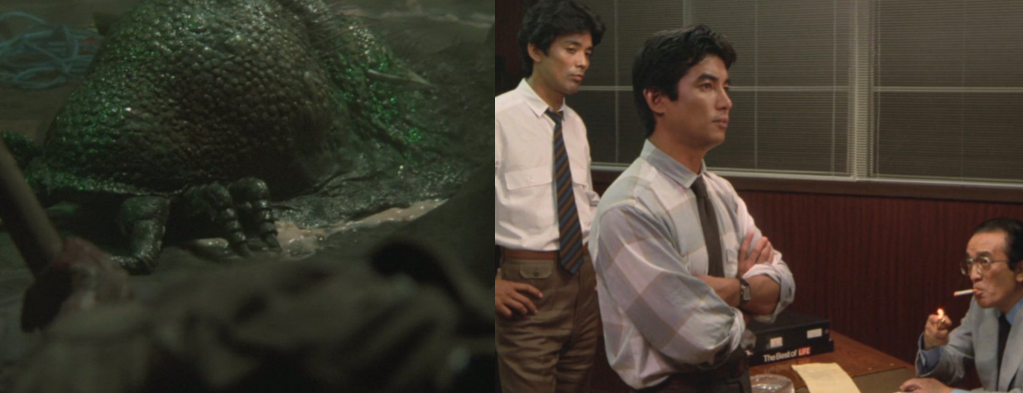
The Return of Godzilla opens very much in the same way as the original, with a Japanese fishing vessel, the Yahata-Maru encountering a gigantic, radioactive, prehistoric beast while adrift at sea. In this instance, we see that Godzilla is awoken following the suddenly eruption of a volcano on Daikoku Island and, rather than incinerating the ship with its atomic blast, Godzilla left the vessel largely intact but devoid of all life, save for the badly wounded Hiroshi Okumura (Takuma). Okumuru (and the ship’s strangely decomposed crew) are discovered by reporter Goro Maki, who is attacked by a giant sea louse but saved by the shell-shocked Okumura; terrified out of his mind by the events, Okumura is only able to deliver a brief and vague description of Godzilla and its attack but it’s more than enough for Maki to bring the story to his editor. While recuperating in hospital, Okumura is visited by Professor Makoto Hayashida (Natsuki) and basically confirms that the creature was Godzilla are being presented with pictorial evidence of the original monster’s attack on Tokyo. Hayashida believes Okumura’s story and speculates that the sea louse grew so large because it fed off Godzilla’s radioactivity, like a parasite, and that the creature was disturbed by the aforementioned volcanic eruption. Cabinet Prime Minister Seiki Mitamura (Kobayashi) is naturally concerned by the news and orders that Godzilla’s return be kept quiet until they can investigate further; this, as well as Maki’s claims to have witnessed the aftermath of a giant monster’s attack and the Japanese government’s efforts keep the creature’s presence under wraps (something that you’d think would be impossible given the nature of its original rampage but don’t worry too much about that), mean that Maki’s story is blocked from being run by his editor, Godo (Kei Satō), to avoid raising a panic.

Maki tries to reveal the truth about Godzilla, whose search for sustenance causes political tensions.

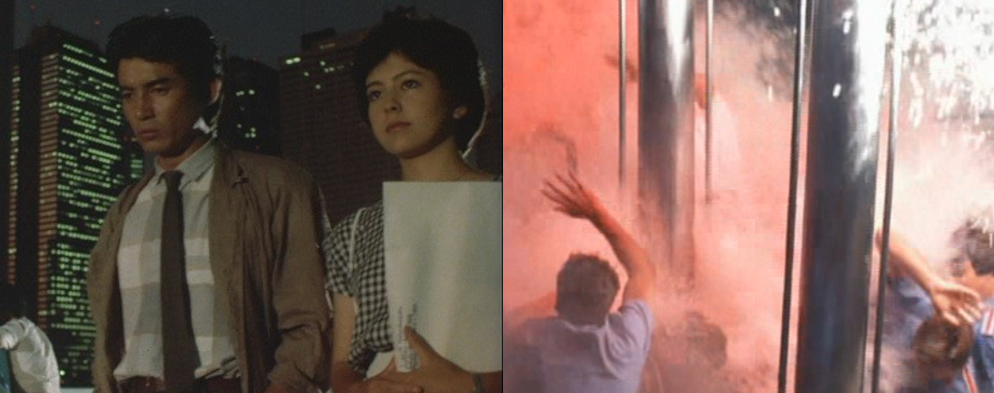
Maki is sent to talk to Hayashida, who reveals that his parents were lost during Godzilla’s 1954 attack and that, rather than trying to kill the creature, he has spent his time trying to properly research the creature for a potential weakness. During the interview, Maki crosses paths with Okumura’s sister, Naoko (Sawaguchi), and earns her favour by revealing that her brother is alive since he doesn’t agree that the media blackout has kept her in the dark. Naturally, she rushes to the hospital for a tearful reunion, barging past the laughably incompetent government detail stationed to keep him from having visitors, and reuniting Maki with Okumura in the process. After Godzilla destroys a Soviet submarine out in the Pacific, tensions between the Soviets and the United States escalate to the brink of all-out nuclear war and Mitamura is forced to reveal that Godzilla was behind the attacks in order to prevent a third World War, officially revealing Godzilla’s presence to the world during a press conference. Okumura publicly declares his desire to see Godzilla dead, and both he and Naoko are aggravated at Maki turning their reunion into a media circus, and see him as symptomatic of the press’s sensationalist reaction to Godzilla’s return. While the media has a field day reporting on the kaiju’s return and speculating on whether or not it will attack Japan, a hastily-constructed Godzilla countermeasure committee discuss their options to defend themselves should Godzilla attack and resolve to employ their top secret super weapon, the “Super X”, to combat and destroy the creature.

To combat Godzilla, the JASDF deploy their futuristic Super X craft armed with cadmium rounds!

Designed in secret to defend the capital, the Super X is comprised of a highly durable, heat-resistant titanium alloy and fires cadmium rounds specially-created to pierce Godzilla’s skin, this flying fortress is prepared for battle alongside the entirety of the Japan Air Self-Defense Force (JASDF). However, Godzilla makes landfall at the Shizuoka Prefecture nuclear power plant without any resistance whatsoever since his approach was masked by fog, of all things! Luckily, its feeding time is interrupted by a flock of birds, which draw it back out to sea, which Hayashida attributes to a migratory radar not unlike the homing abilities of birds. This odd and convenient inclusion means that Godzilla is now highly susceptible to magnetic forces, but raises the question of why it even came ashore to feed if it was due to migrate; the film seems to suggest that the birds somehow activated this sense within it, which is a bit of a stretch for me but then again this is a film about a gigantic, radioactive dinosaur so… Anyway, this development leads to them contacting renowned geologist Professor Minami (Hiroshi Koizumi) and, together, they develop a plan to use this knowledge to lure Godzilla to Mount Mihara on Ōshima Island and trigger a controlled volcanic eruption that will imprison the creature. While Hayashida is determined to safely subdue Godzilla without killing it, the remainder of the world’s superpowers are determined to use their nuclear arsenal to destroy the creature, something Mitamura vehemently denies; while Hayashida views the monster with a certain awe and respect, Mitamura has no desire to have nuclear weapons of any atomic yield dropped on Japan even if Godzilla attacks because of how destructive they are and a severe lack of evidence that they’ll even harm the kaiju.

The Nitty-Gritty:
I mentioned in my review of the original film that pretty much every single Godzilla movie follows either a reporter or a member of the military, and the same is true of The Return of Godzilla. In fact, we follow three different staples of humanity that would become the “Holy Trinity” of the Heisei Era, especially: the press, the army/JASDF, and the increasingly ineffectual and perplexed Japanese government. I can see why so many Godzilla movies follow this format; it’s important to see the government being overwhelmed and inadequate against Godzilla, whom they view with a mixture of awe and dread, to emphasise not only how their procrastination and fear costs valuable time and lives in preparing for Godzilla’s attack but also that the creature has no respect for their authority or societal law. Framing the narrative largely through Maki/the press is generally always a quick and easy way for the characters to learn about Godzilla, and thus position themselves as the audience surrogate; it’s somewhat redundant over fifteen movies into the series, but this was the first Godzilla film in about ten years so it’s not too surprising that they’d want to properly introduce the monster to new audiences. Finally, following the JASDF allows for some of the more explosive and exciting action sequences of the film and the now-traditional trouncing of all of then-modern society’s most powerful weapons by this unstoppable force of nature. As ever, the human characters prove to be the weakest element of the film (well, them and the large amounts of time where Godzilla is entirely absent form the film): there’s a bit of a romantic sub-plot between Maki and Naoko, but this appears to be based on little more than him being attracted to her and her…I dunno, letting her emotions get the better of her, I guess? They really don’t have all that much chemistry and she doesn’t really do much except worry about her brother and patch up Maki when he gets hurt. Hayashida is certainly nowhere near as interesting as Doctor Daisuke Serizawa (Akihiko Hirata), and while Okumura gets to have a measure of revenge against Godzilla by triggering the explosions that trap it in Mount Mihara, he really doesn’t have all that much else to do (it might’ve been better to have him piloting the Super X to allow him to go toe-to-toe, figuratively speaking, with Godzilla).

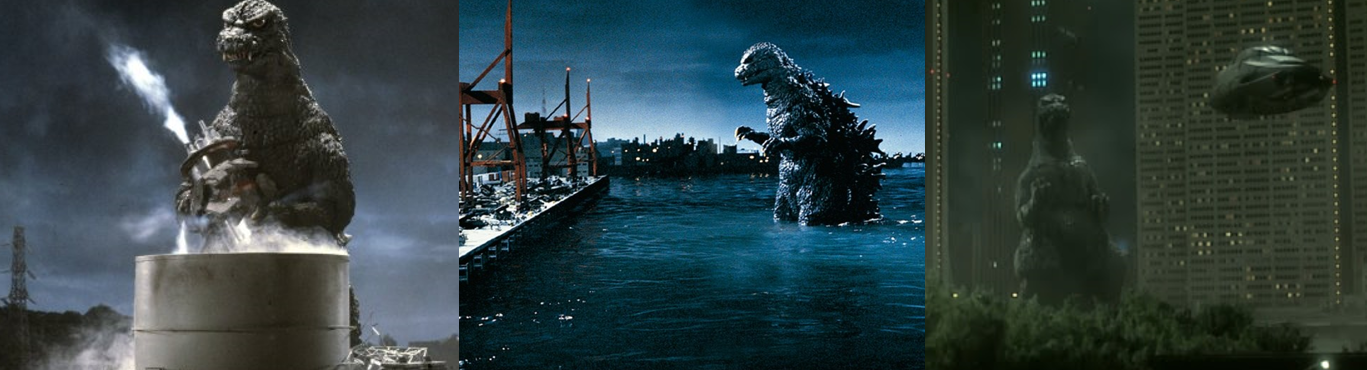
Godzilla rampages through the city, shrugging off all attacks, until confronted by the Super X.

As in the original movie, a great deal of The Return of Godzilla’s early going is spent building tension regarding the titular kaiju; Godzilla is only briefly glimpsed during the first thirty-odd minutes of the film, seen as a gigantic shape lumbering from the ground or passing through the murky depths of the ocean, and its attack on the Soviet submarine is framed pretty much entirely from within the vessel to heighten the sense of terror surrounding the creature’s destructive intentions. When the creature does finally appear, it’s revealed from a very unique perspective of a showed and terrified security guard who is suddenly confronted with Godzilla’s massive feet; from there, this composite shot pans upwards to the creature’s face and Godzilla’s new, bulkier design is revealed for all to see. Perhaps taking its cue from the Showa Era films that proceeded it, The Return of Godzilla also features the brief appearance of a secondary giant monster of sorts, in the form of a large and unpleasant sea louse. While Godzilla itself remains an impressive and fun combination of suit work and animatronics, the sea louse leaves a lot to be desired; similar to Mothra’s maggot form, you can practically see the wires that propel it through the air as it lunges for Maki, and watching him struggle with the bit lump of rubber and plastic aboard the ship is particularly ridiculous in all the wrong ways. Rather than having Godzilla battle another kaiju, The Return of Godzilla sees the return of its conflict against the futuristic might of he JASDF, which is of little consequence against such an unconquerable force of nature as Godzilla. That is, of course, until the Super X enters the fray and basically turns the film into Godzilla vs. Thunderbirds (1965 to 1966); a highly advanced flying fortress, the Super X hovers around the city and distracts Godzilla with flare bombs so the pilots can fire cadmium shells into Godzilla’s mouth. This is surprisingly effective as Godzilla’s atomic breath is entirely useless against the craft and the monster is apparently now also easily distracted by pretty lights and the cadmium rounds successfully render the beats inert after a few shots, though the visual of a bulky, cumbersome little space craft battling the Big-G isn’t necessarily the most visually striking opponent for the titular monster.

There’s been a clear upgrade in the quality of the effects and overall presentation.

Naturally, though, Godzilla looks worlds better than he did in the original movie; the suitmation evolved quite extensively throughout the Showa Era and Godzilla slowly become a lot cuter as he was anthropomorphised and transformed into a heroic, almost comical, protector figure to appeal to kids. The suits did seem to drop in quality, however, appearing for more floppy and goofy compared to the intimidating original and, while a lot of close-ups of Godzilla’s feet don’t do much to sell the illusion of a giant monster rampaging across the land, the far more expressive and detailed face helps to make give Godzilla a decent amount of personality (although its unblinking eyes do look quite goofy). A far larger and bulkier creature than we saw before, Godzilla is a lumbering, aggressive force of nature; it trounces the power plant, toppling buildings and crushing carefully-constructed miniatures and causing countless deaths in its desire to feed off the nuclear reactor stored there, leaving a disaster area in its wake. After much political procrastination on how to best defend and prepare for Godzilla’s inevitable attack, the G-Man finally comes ashore to attack Tokyo and the JASDF; shots of Godzilla wading through Tokyo Bay as explosions fire off all around its head and of it rampaging through the city smashing apart models and toy tanks really help to make up for the hour-long build up to the creature’s first big action scene, and the scenes of destruction are far more detailed and impressive than those seen in the original. Godzilla smashes through the streets, swatting skyscrapers out of the way, crushing a train (much like in the original), and lays waste to the JASDF using its atomic breath (now represented as a bright blue/white beam of radioactive energy rather than a stream of smoke). Mass evacuations are ordered to try and minimise casualties, though this does little to limit Godzilla’s destructive and devastating rampage. Many of these scenes of devastation are brought to life not just through practical, in-camera effects of a man in a suit tearing through a highly detailed recreation of Tokyo or splashing about in  large water tank, but also through some ambitious (if, obviously, somewhat dated) composite shots that take full advantage of Godzilla’s impressive animatronic head. After decimating the JASDF and shrugging off even their high-powered laser cannons, Godzilla is finally subdued by the Super X, whose cadmium shells are fired into its mouth and successfully slow its heart rate, apparently similar to quelling an out of control nuclear reactor and, while Tokyo is left in ruins, the creature is rendered unconscious.

Revitalised by an EMP, Godzilla is summarily lured to a volcano and trapped by its own instincts.

However, angered at Godzilla destroying one of their submarines, and what they perceive as Mitamura’s weakness, the Soviets launch a nuclear missile into the heart of Tokyo in an effort to destroy the creature. Although the U.S. intercept it with a missile of their own, they unintentionally cause Godzilla to be revived from the resulting nuclear storm and, to make matters worse, the electromagnetic pulse of the explosion temporarily disables the Super X. This not only revives Godzilla but, in a trope that would be revisited time and time again after this film, also greatly empowers it; as the Super X is all out of cadmium shells, even its advanced missiles and laser weapons have no effect against the vengeful Godzilla, who causes even more destruction as it lumbers after the flying fortress, threatening Maki and Naoko (who are still trapped in the city and helped to safety by a very strange drunkard (Tetsuya Takeda)) in the process and leaving the city in shambles. Although the Super X is faster and more nimble, Godzilla is only further enraged by its attacks and final destroys the craft, and its plots, for good by dropping a skyscraper on it! Victorious, Godzilla threatens to continue its rampage through the city as an unstoppable force of nature until Hayashida finally gets his homing signal up and working; unable to resist the call of the homing signal, Godzilla heads out to see and over to Mount Mihara, where it stupidly topples into the volcano like a good little puppy and is subsequently trapped when Okumura triggers the detonators and a controlled eruption, which encases Godzilla is molten rock. Once again, we’re left with a rather anti-climatic ending for the world’s most famous kaiju, however it’s interesting to note that, where Godzilla was originally defeated by a scientific device that was even more deadly than the creature itself, this time it is conquered by turning its very nature against it. As a force of reckoning, a warning regarding the dangers of nuclear power, Godzilla is an overwhelming force but, here, its also just as explicitly a slave to its instincts and the call of nature as any other creature. This ultimately proves to be its downfall and allows Godzilla to be subdued not by the highly advanced Super X, but by manipulating its instincts against it, indicating that only nature can defeat nature.

The Summary:
The Return of Godzilla is certainly visually impressive; the effects have come a long way from the original movie, and Godzilla and the miniatures it crashes through and stamps under its feet had arguably never looked better before this film. Brilliantly brought to life through a heavily detailed suit and animatronic head, Godzilla has a real weight and viciousness to it; it swipes skyscrapers like they were nothing, tramples through streets and buildings like they were nothing, and shrugs off everything from explosive missile rounds and high-powered laser cannons. It’s a shame, then, that the creature is absent for so much of the movie; this was, and would continue to be, a recurring issue in many Godzilla films and I get that it’s a new introduction to the character and a great way to build a sense of tension, awe, and dread up to its first big reveal, but the film really drags while you’re waiting for the Big-G to finally show up and cause some mayhem. The Super X would be just one of many futuristic craft constructed to fend of Godzilla, with later models and vessels being far more versatile and interesting; here, it’s just a clunky bit of kit that meanders around the city firing off its weapons before being crushed by Godzilla. The idea of turning Godzilla’s nature against it to manipulate it to its anti-climactic end is an interesting one, but results in a bit of an uneven representation for the titular kaiju: Godzilla is both paradoxically an invincible and inexhaustible force of nature but also a living creature that can be easily distracted and lured away by manipulating its instincts. Thematically, I quite enjoy this, and a running them throughout the subsequent Heisi Era would revolve around pitting Godzilla against creatures born from its cells or even more impressive feats of technology (and sometimes both!), but it feels  bit clunky here and actually weakens Godzilla in many ways. Overall, it’s a much bigger and more impressive version of the original film, with some great practical effects and scenes of monstrous destruction, but drags a little too much and seems to be lacking both the fun of the later Showa Era films and the dark, gritty message of the 1954 original.

My Rating:

Rating: 3 out of 5.

Pretty Good

Did you enjoy The Return of Godzilla? How did you feel it holds up today, especially compared to the original and other films of the Heisei Era? Did you like Godzilla’s depiction and the animatronic head used to bring it to life? Were you also disappointed by Godzilla’s lack of screen time and the Super X? Did you enjoy the bigger, more detailed miniatures and scenes of destruction? What did you think to the film’s message and the way in which Godzilla was overcome? What is your favourite Godzilla movie and why? How did you celebrate Godzilla Day this year? Whatever your thoughts on The Return of Godzilla, feel free to sign up to leave a comment below and check out my other Godzilla content!

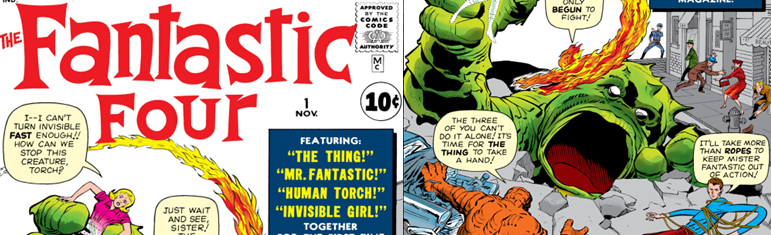
Back Issues [F4iday]: The Fantastic Four #1


In November 1961, Marvel Comics readers witnessed four intrepid explorers be forever changed by mysterious cosmic rays. Marvel’s “First Family” of superheroes were the first of many colourful superheroes for Marvel Comics and are more than deserving of some attention today.


Story Title: The Fantastic Four!
Published: November 1961
Writer: Stan Lee
Artist: Jack Kirby

The Background:
The story of the creation of the Fantastic Four is a little…contested, to say the least. The popular notion is that Marvel Comics big cheese, Martin Goodman, wanted then-editor Stan Lee to create a team of superheroes in response to DC Comics’ Justice League of America. Creatively unsatisfied with the comics industry, Lee sought to use the opportunity to create stories and characters that were appealing to him and drafted a quick synopsis of his idea for a dysfunctional family of superheroes for the legendary Jack Kirby to provide the artwork for, thus creating the “Marvel Method” of writer/artist collaboration. Kirby, however, disputed this story and claimed to have come up with the idea, which was extremely similar to a similar concept he had developed for DC, the Challengers of the Unknown. Regardless, the two are credited as co-creators of Marvel’s First Family, a team that, even today, is unique in that it is comprised of a family dynamic that, for all their intelligence and abilities, is just as likely to come to blows with each other as with their enemies. This dynamic allowed the team (comprised of Doctor Reed Richards/Mister Fantastic, Susan Storm/The Invisible Girl, and her brother Johnny, the Human Torch (not to be confused with he android of the same name from the 1940s/1950s), and Ben Grimm/The Thing) to juxtapose their wacky adventures with a very real and relatable humanity. The team also stood out from other superheroes of that era since they didn’t hide their identities behind masks or from the public, were revered with a celebrity status, and didn’t even acquire their iconic outfits until the third issue of their series, which went on to introduce characters and concepts that would forever alter Marvel Comics in the decades that followed.

The Review:
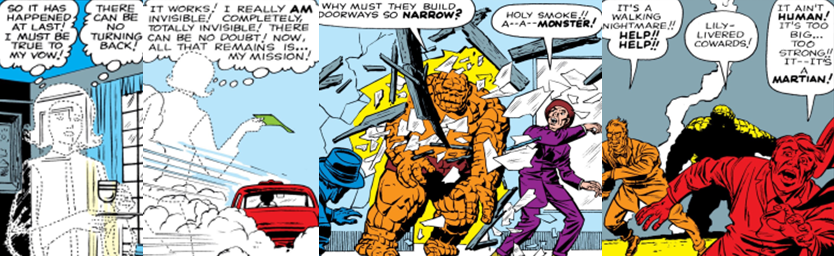
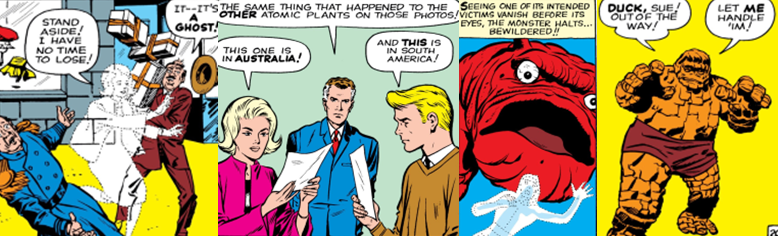
“The Fantastic Four!” beings in medias res with a dramatic flare shot into the skies of Central City (courtesy of a mysterious, shadowy figure, the leader of the Fantastic Four) call out for the titular team. Upon seeing the signal, Susan Storm responds immediately by turning herself invisible and preparing to introduce the world to the Invisible Girl, shocking pedestrians and a taxi driver with her transparent nature.

Sue and Ben cause some disruption in answering Reed’s summons…

Elewhere in the city, a large, bulky man in a trenchcoat is attempting, unsuccessfully, to shop for clothing that will fit his broad dimensions. When the store attendant reacts to the signal for the Fantastic Four, the man discards his restrictive clothing, revealing himself to be a monstrous, rock-like man-monster! His appearance causing panic and fear, the creature escapes from police gunfire by ripping a manhole out of the street and fleeing through the sewers beneath the city, being mistaken for a Martian in the process. Finally, a young man named Johnny is busy getting his beloved car fixed up when, upon seeing the signal, he suddenly bursts into flames and blasts off into the sky in response! The presence of an unknown object flying through the city results in the Mayor alerting the National Guard and fighter jets being called into action. Despite the flaming Johnny’s pleas for the planes to pull back, he inadvertently reduces the jets to slag with his intense heat and is left at the mercy of a nuclear missile!

Despite Ben’s objections, the team easily get to their rocket and blast off into space.

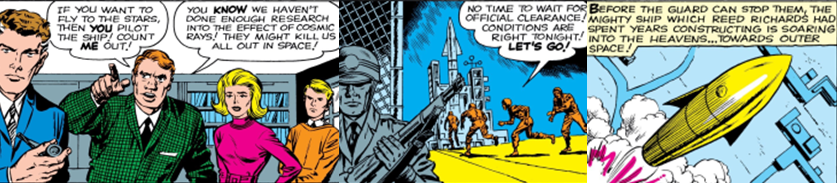
Luckily, a fourth individual steps in to dispose of the missile before it can explode and kill Johnny (…and the entire city); he then rescues Johnny who, exhausted from the physical exertion, has lost his flame and in free fall. This fourth individual is able to accomplish all of this by use of super stretchy, elastic limbs and is, of course, Reed, the very same man who summoned these fantastic individuals in the first place. With the team united, the comic then flashes back to tell us who these people are and how they can do the extraordinary things we see. It seems their leader, Reed, was once a scientist working for the government and researching “cosmic rays” and planned to fly a ship into space to further his studies. His friend and colleague, Ben, initially refuses to pilot the ship since he believes that Reed hasn’t properly prepared for the potentially fatal effects of the cosmic rays but Sue (Reed’s fiancée) convinces him (more like manipulates him) into joining the expedition after believing him to be a coward who would allow “the Commies” to beat them to the task. Although it’s made somewhat obvious that Reed is the brains behind the research and Ben is the pilot, it’s not entirely clear why they bring Sue and her brother along; Sue simply insists on coming since she’s betrothed to Reed and Johnny, similarly, insists on going simply because his sister is. The race to beat the Commies is apparently so close that the group cannot wait any longer, or for official clearance; they simply race to the launch site, sneak past the one guard, and are able to take off completely under their own power.

The cosmic rays cause the team to undergo startling physical changes.

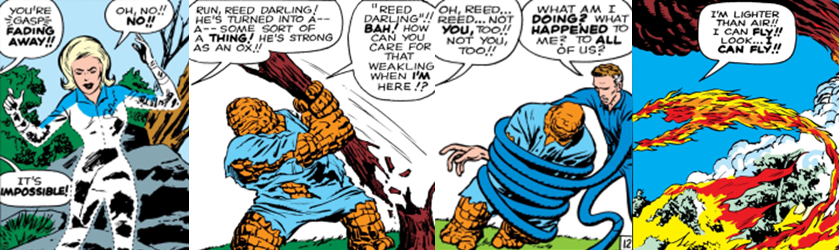
Though the ship performs perfectly, Ben’s worst fears are quickly realised when the ship is bombarded by cosmic rays that easily penetrate the ship’s shielding. Initially, there is no physical pain as the rays are “simply” comically charged radioactive rays of light but, all too soon, the four begin to feel the full transformative effects of the radiation. Despite being debilitated by the pain and physical mutations they are undergoing, the team’s ship is able to return safely to Earth thanks to its automatic pilot. Upon emerging from the ship, the team are shaken…but alive, with Sue lamenting the loss of Reed’s years of research and Ben still bitter at Reed not taking the proper precautions and endangering them all. While Ben’s fears become reality as Sue suddenly, briefly fades from sight, they are realised all too horribly when he transforms into a super strong, rock skinned…thing! Furious with Reed’s attitude, the Thing rips up a tree and tries to make him pay for his actions but Reed shocks everyone by abruptly displaying his powers of elasticity, which easily allows him to avoid Ben’s wild swings and ties him up in a mess of rubbery limbs. Panicked at the events unfolding before his eyes, Johnny unexpectedly bursts into flame but, unlike the others, he is elated to find this not only doesn’t harm him but gives him the ability to fly through the air.

The Fantastic Four are quickly separated after arriving on the mythical Monster Isle.

Taking stock of their predicament, Reed begins to make a speech about how the four must use their newfound powers fort he benefit of mankind but Ben, despite his grouchy demeanour, cuts him off and voices that conclusion as though it is the most natural recourse for powers such as theirs. The four then put their hands in, giving themselves their colorful code-names and dubbing themselves the Fantastic Four. The story returns to present day in the next part, “The Fantastic Four Meet the Mole Man!” where Reed reveals that he called the team together because of a series of gigantic holes that have swallowed up atomic plants across the world. At that very moment, Reed’s fancy radar machine picks up another cave-in happening right at that moment over in French Africa. The cause of the destruction is revealed to be a gigantic subterranean beast not too dissimilar to the Creature from the Black Lagoon, which might seem incredible but it’s nothing compared to the fact that Reed pin-points the source of the events to a land known as “Monster Isle” that, despite Ben’s claims of the island being a myth, they immediately fly to as though it’s a well-known tourist destination! Monster Isle, as you might be able to guess, is home to a wide variety of enormous monsters that, despite the powers and versatility of the Fantastic Four, cause the team to become separated.

The Moleman explains his unremarkable origin.

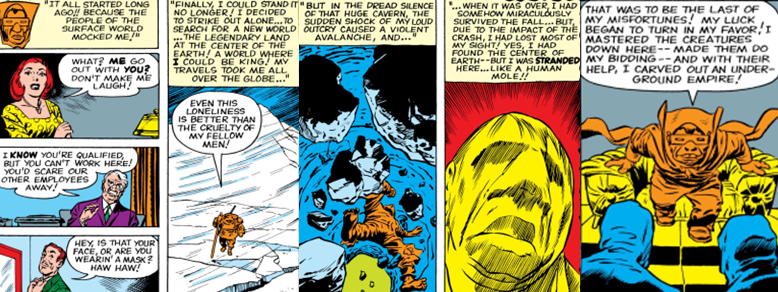
The third part of the story, “The Moleman’s Secret!” sees Ben and Sue, still trapped on the surface, come face to face with an huge rock-like creature; being a man of rock himself, the Thing steps in to defeat the creature with ridiculous ease thanks to his superhuman strength. Johnny and Reed, however, find themselves captives of the Moleman (or “Mole Man”, the story freely alternates between the two names/spellings), the master of Monster Isle, in his enigmatic abode beneath the island’s surface. Like any good supervillain worthy of his salt, the Moleman regales his captives with his origin story: it seems he was once a very odd looking hunchback of a man who was routinely mocked and turned away by society despite his qualifications because of his grotesque appearance. Bitter and dejected, he head out into the icy wilderness in search of solitude and found himself on the mythical Monster Isle; however, whilst exploring a cavern, he was…somehow…blinded by a terrible fall towards the center of the Earth but, despite this handicap, he…somehow…was able to not only tame the wild beasts that roamed the island but also build a magnificent empire for himself deep underground.

Ben and Sue arrive to rescue their team mates but are met by the Moleman’s massive creature!

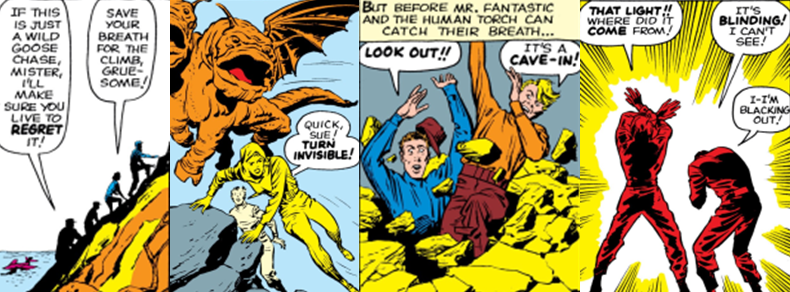
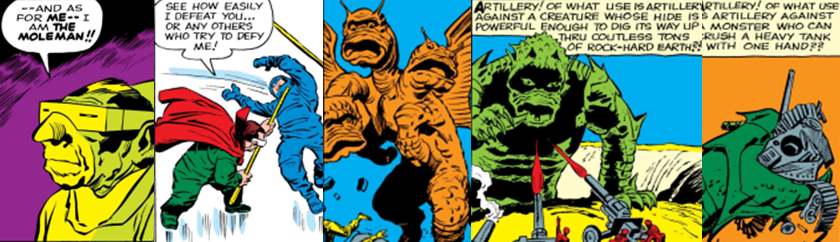
Thanks to the strange “adhesive suits” the Moleman has forced Reed and Johnny into, the villain, clearly driven to insanity, easily beasts them in combat and reveals his mad plot to destroy every atomic plant in the world and then rise up alongside his monsters to destroy the surface world! Though Ben and Sue arrive (and Johnny and Reed are able to get out of their suits by simply burning through them or…taking them off, raising the question as to what the bloody point of them was in the first place), they are too late to keep the Moleman from summoning the most deadly of his creatures, the same one that we saw attacking the power plant in French Africa earlier in the story. Interestingly, despite the elaborate cover art, the Fantastic Four don’t even try to fight this gargantuan creature; instead, Johnny simply distracts it so that Reed can capture the Moleman and the team simply escape through the caverns beneath the island. Even a horde of underground gargoyles aren’t able to impede their progress as Johnny simply causes a rockslide to keep them at bay and the Fantastic Four escape the island safely…but without the Moleman! Yes, in the confusion, Reed decided to leave the villain behind since they had effectively sealed off his empire and, as they escape, the entire island explodes, apparently trapping the Moleman and his beasts underground forever. And…that’s kind of it as the issue ends in a pretty anti-climatic fashion.

The Summary:
Wow…so, once again, another debut issue just kind of falls of a cliff right at the end. It pains me to say it as I have a real soft spot for the Fantastic Four but, outside of the team’s origin story and diverse powers, The Fantastic Four #1 is a pretty terrible comic. I thought it was quite unique to introduce the team individually and already possessing their powers and to flash back to their origin as it’s not often you see that in comics but the comic wastes so much time showing what the team can do that it rushes through other equally important things, such as what motivated them to go into space in the first place and, of course, the ending. These introductory sequences provide the absolute bare minimum of exposition into the character of each team member: Sue is first seen having tea with a “society friend” and is both polite towards others and support of her fiancée…perhaps blindly so. Ben has legitimate concerns regarding the trip ones that Reed fails to heed and Sue dismisses; the way she manipulates Ben into joining the expedition seems really out of character and, even worse, when Ben turns out to be right Reed doesn’t even offer an apology! Instead, he takes offense to Ben’s “insults and complaining”, as though Ben were simply mocking Reed and moaning about a long car journey! The poor bastard almost died and now he’s a rock monster but all Reed cares about is that Ben has been a grouch the entire time! Johnny is basically a shell of his former self; sure, we see he likes cars and enjoys the power and freedom of being the Human Torch but that’s pretty much all we know about him.

Sue may as well be invisible the entire time since she really contributes nothing to the team.

The story kind of makes up for this by having him be one of the two most useful members of the team (the other being the Thing, whose strength gets them out of a bind numerous times), which puts him in a little higher standing than Reed or Sue. Reed basically spends most of his time rescuing the others, which is fine, or making decisions for the team’s actions; I’m not entirely sure, or convinced, of what makes him qualified to be their leader since the last time he lead them anywhere he almost got them killed! Sadly, there’s no sense of grief or guilt on Reed’s part or of the genius intellect that would come to define his character; he’s simply the older, pipe smoking man so he’s the leader by default. Still, the so-called Mr. Fantastic still gets more to do than the Invisible Girl; although she is spared the condescending, sexist attitudes that were prevalent towards women in comics at that time (for this issue, at least), Sue is still basically useless. She uses her invisibility to get through some crowded streets simply to test them out and that’s pretty much it as they (and she) really don’t factor into the finale at all. I’m sure that the intention was to have her be the “heart” of the team but…she really isn’t. She’s supportive of Reed, yes, but if hadn’t have been then maybe they would have been spared their fate and, beyond that, she’s just kind of…there to say stuff now and then. The only plus side is that she doesn’t get captured and need to be rescued but, honestly, I think I would have preferred that!

The Moleman’s threat is severely diminished by his ridiculously flawed plan for world conquest.

The biggest let down, really, is that the cover promises a big battle between the team with the giant creature in the middle of the city but this never happens! The creature hardly appears and, when it does, they don’t even fight it; they just…get away as easily as you could like. What is the point of having a team of superpowered individuals if you’re not even going to show them using their abilities in battle? Sure, they do showcase a lot of the diverse nature of their abilities when on the surface of Monster Isle but we don’t really get to see them working together as a team, which is one of the Fantastic Four’s biggest unique aspects. Similarly, the Moleman is a pretty poor villain; his motivations are paper thin and the ease with which he and his monstrous creatures are defeated is pretty pathetic, with Reed not even bothering to keep the villain captive when they escape. He could have easily had his monsters rampage across the globe using those emergence holes but, instead, he chose to target atomic power plants rather than military bases or major cities because, as we all know, when you plan to conquer the world with a bunch of horrific monsters, it’s the power plants that are the greatest cause for concern!

My Rating:

Rating: 1 out of 5.

Terrible

Were you a fan of The Fantastic Four #1? Do you feel I have committed the ultimate sacrilege by being unimpressed with the team’s debut story or do you agree that the Fantastic Four greatly benefitted from the input of other writers and artists over the years? Which of the four team members is your favourite and why? What did you think to the Moleman and who is your favourite Fantastic Four villain? Who would you like to see form a new version of the Fantastic Four and what are some of your favourite stories involving the team? How are you celebrating the debut of Marvel’s First Family this month? Whatever you think about the Fantastic Four, go ahead and leave a comment down below and let me know your opinions.

Movie Night: Eternals

Released: 5 November 2021
Director: Chloé Zhao
Distributor:
Walt Disney Studios Motion Pictures
Budget: $200 million
Stars:
Gemma Chan, Richard Madden, Kumail Nanjiani, Lia McHugh, Brian Tyree Henry, Lauren Ridloff, Barry Keoghan, Don Lee, Angelina Jolie, Salma Hayek, Bill Skarsgård, and Kit Harington.

The Plot:
Over 7,000 years ago, the God-like Celestials charged their superpowered, immortal creations, the Eternals, with defending the fledgling planet Earth from their evil counterparts, the Deviants. After destroying the Deviants, the Eternals lived among humanity and went their separate ways; however, when the Deviants re-emerge following the return of half the world’s population, reunite to protect humanity from this monstrous threat.

The Background:
Jeez, okay…this is a tough one for me. So, after the legendary Jack Kirby left Marvel Comics in 1970, he created a race of cosmic, God-like beings called the New Gods and intended to tell a finite story with his creations before the comic book was cancelled. When he then returned to Marvel, he developed a startling similar concept initially titled “The Celestials” before being legally advised to change the title. Although The Eternals was cancelled, Kirby’s plotlines were later resolved in other Marvel publications and the characters and their mythology played a pivotal role in the wider Marvel universe. Although I am mildly aware of the Celestials and Thanos’ status as a Deviant, however, I can’t say that I have ever encountered the Eternals in all my years of reading comics so I was intrigued when the team was announced as being part of the fourth phase of the Marvel Cinematic Universe (MCU), which director Chloé Zhao aimed to further expand the scope of the MCU. Featuring a diverse cast of characters and story spanning several centuries, MCU maestro Kevin Feige was eager to delve further into the MCU’s cosmic history and introduce a new ensemble of characters to their ever-growing series of interconnected films. Although Eternals was delayed due to the COVID-19 pandemic, the visual effects team continued to work remotely and the film was finally released to largely mixed reviews. After being review-bombed by bigots, critics praised the visuals of the film while also questioning the pace and characterisation; others questioned Marvel’s attempts to branch out from their usual formula while praising the deconstruction of the superhero genre, though Eternals’ worldwide gross of over $171 million would point to it being a relative financial success.

The Review:
So, as I mentioned, I had no expectations for Eternals; I know absolutely nothing about the characters and have never encountered this group in all my years of reading comics, but I often find that this actually helps with my perception of a movie (I wasn’t really familiar with the Guardians of the Galaxy and I loved those films). Still, it seems like we’re only really getting this movie because Inhumans (Various, 2017) failed to impress as there was a time when Marvel where really pushing the Inhumans to the forefront of their comics. In fact, I believe the Inhumans are tangentially related to the Eternals in the comics, but it definitely seems like Marvel Studios are abandoning tackling the Inhumans and have turned to the Eternals in their stead. Introducing the Eternals means expanding the cosmic scale of the MCU beyond even the scope of the Thor movies (Various, 2011 to present) as these characters, and their creators, came into existence before even the Infinity Stones were created, meaning that they’re not just akin to Gods but also responsible for inspiring humanity’s evolution, innovation, and mythology.

The film doesn’t spend much time dwelling on the romantic drama between these characters.

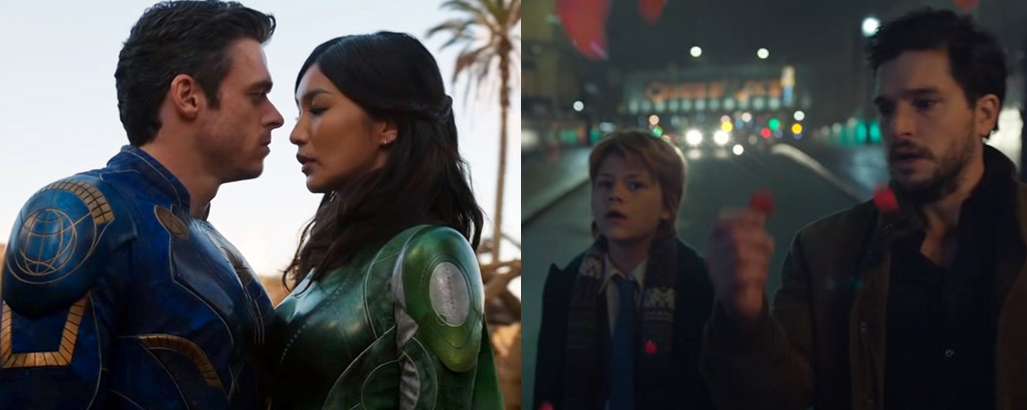
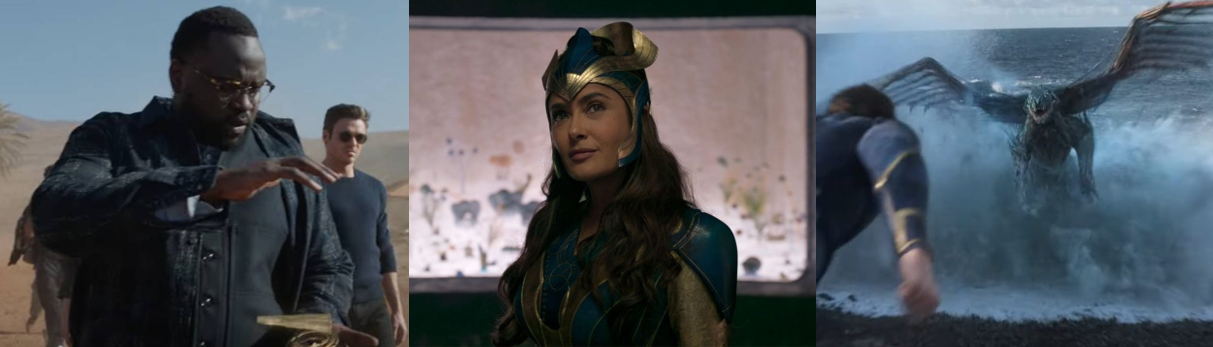
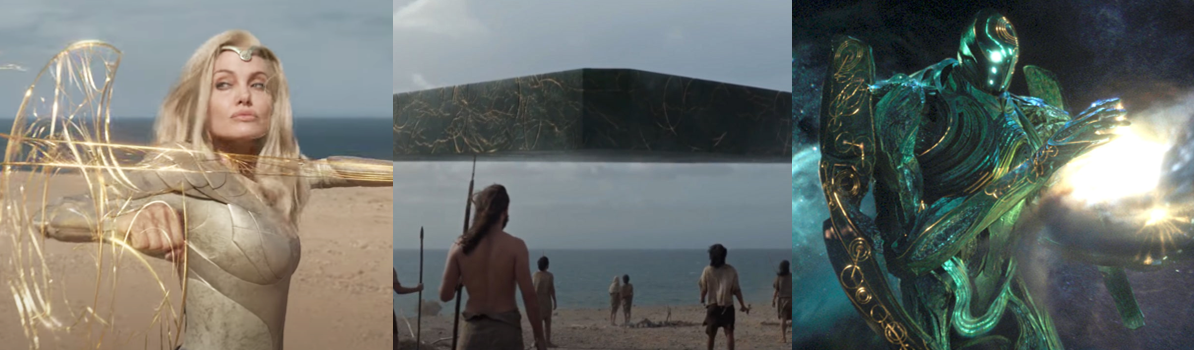
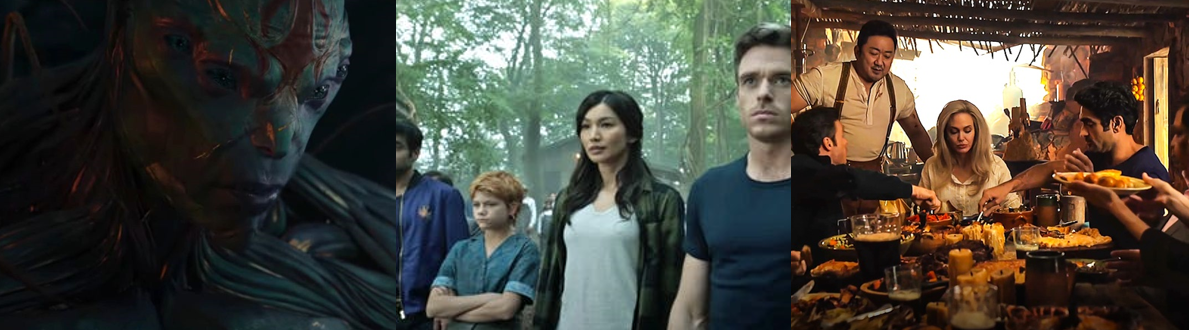
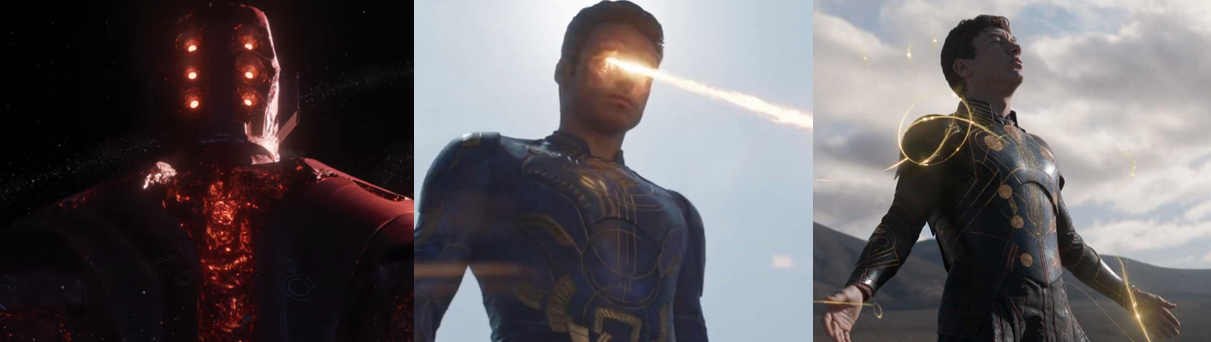
Even more than the Guardians of the Galaxy films (Gunn, 2014 to present), Eternals is an ensemble film and, more so than any other MCU movie so far, the film’s characters are a tight-knit group of superhuman character. Before Eternals, the MCU’s teams have been a mishmash of egos and personalities who struggled to get along, but the Eternals are more like a family of God-like beings who are initially heartbroken when they go their separate ways. Sersi (Chan) is the closest thing we have to a main character; an empathetic Eternal who’s able to transmutate matter upon physical contact and who has a strong connection with humanity. For centuries, Sersei was engaged in a romantic relationship with Ikarus (Madden), the most powerful of the Eternals; while all of the Eternals exhibit superhuman strength and durability, Ikarus can fly and fire lasers from his eyes and yet, despite his great power, he isn’t chosen to lead the team: the honour falls to the conflicted Sersei. Left heartbroken after their relationship ended with little explanation, Sersei has been living as museum curator and dating Dane Whitman (Harrington), who actually barely appears in the film; I expected Dane to be the audience surrogate but he only really bookends the film and we simply learn what’s happening alongside the Eternals as they reunite. This means that their isn’t really a love triangle between Sersei, Dane, and Ikarus, though a mild one does exist thanks to the presence of Sprite (McHugh), an Eternal cursed to remain a child and who can conjure illusions at will, who carries a torch for Ikarus.

The Eternals have gone their separate ways and lived amongst us in secret for centuries.

When the Deviants suddenly appear, Sersei, Dane, and Sprite are saved by Ikarus and, since the Eternals were charged with destroying these monstrous beings, they quickly realise that they need to reunite with their comrades. Naturally, they seek out their spiritual leader Ajak (Hayek), who not only has the ability to heal their injuries but can also commune with their creator, the titanic Celestial Arishem (David Kaye), and communicates His will to the team. However, they discover Ajak dead, slaughtered by the Deviants, and this responsibility passes to Sersei and, in the process, she learns a terrible truth about the Eternals’ origins and the true nature of their mission on Earth. This only spurs her to reunite with her follow Eternals, which leads them to India, where they find Kingo (Nanjiani) revelling in fame as a popular Bollywood star. Easily one of the most entertaining characters in the film, Kingo can fire bolts of cosmic energy from his fingers and brings along his valet, Karun (Harish Patel), to document the trip and, in the process, provide not only an audience surrogate but another highlight of the film. As powerful as Ikarus is, he is matched perhaps only by Gilgamesh (Lee) and Thena (Jolie), who retired to Australia hundreds of years ago after the battle-hungry Thena began to suffer from the “Mahd Wy’ry”, a condition that causes her to remember her past conflicts and drives her into a mindless aggression against her fellow Eternals. While Thena is able to conjure weapons from thin air and lives for battle, Gilgamesh turns his cosmic powers into his hands to boost his physical strength ever further. This comes in handy when the group braves Druig’s (Keoghan) sanctuary and defend it from Deviants; able to manipulate the minds of others at will, Druig was the first of the group to question their mission and Arishem’s decree that they not interfere in human conflicts unless Deviants are involved, and chose to separate himself not just from his fellow Eternals, but the wider world itself in order to protect generations of people. While Druig is initially sceptical, he’s soon convinced to rejoin his comrades by the scale of the threat they face and after being reunited with Makkari (Ridloff), an Eternal with superhuman speed and who can only communicate through sign language.

Easily Marvel’s most diverse movie yet, though the main antagonists were largely forgettable.

At this point, you’ve probably noticed that Eternals is packed full of diversity and representation; each character looks and sounds different and Marvel are definitely widening the scope of their fictional world with this team. Nowhere is this more prevalent than in the depiction of Phastos (Henry) as not only being openly gay, but in a same-sex relationship and raising a young boy, giving us the MCU’s first male-on-male kiss. Like Druig, Phastos is initially reluctant to reunite with his fellow Eternals; a master builder, he lost faith in humanity after his technological innovations eventually led to the creation of nuclear weapons and further conflict. However, his love for his family and desire to protect them spur him forward and the group is finally reunited…only to find that the Deviants have changed significantly over the years. Amongst their number stands an alpha, Kro (Skarsgård), who starts off as the largest and most intimidating of his monstrous brethren and eventually evolves into a sentient, humanoid form after absorbing the powers and lifeforce of a few of the Eternals. This gives him the ability to speak, heal his wounds, wield similar cosmic energy as the Eternals, and alter his fellow Deviants into far more grotesque and versatile forms. This means the Deviants can fly, attack with razor-sharp claws, and chomp down on their prey; they’re also incredibly durable and aggressive, but actually don’t appear all that much in the film. Kro, especially, doesn’t reach his humanoid form for some time and then vanishes for a huge hunk of the movie, only reappearing very briefly in the finale, as the Deviant threat is soon usurped by another, far more personal and dangerous menace.

The Nitty-Gritty:
It actually kind of sickens me to see so many bigots and haters dump on this film just because it features a lot of diversity; sure, there’s quite a lot packed in here all at once but we live in a world where diversity is the norm. just look around your office, or school, or local supermarket; everyone looks and sounds different, so why shouldn’t that be the case in superhero movies? Eternals was, in many ways, a great way to highlight diversity in the MCU for the first time and, since I’m unfamiliar with these characters, I really don’t care if this means their gender, skin colour, or sexual orientation has changed. Take Kingo, a recognisably Indian and very spiritual Eternal; he’s easily a stand-out character in the film thanks to his egotistical attitude and him revelling in his celebrity status, and Karun helps to add a real heart to the film since he is in awe of the Eternals. Then there’s Makkari, the MCU’s first deaf character, who exhibits a fantastic sense of enthusiasm and personality through her sign language, and the fact that all of the characters have distinct and interesting accents to help them standout from the rest of the MCU. Eternals is also a visually impressive movie; it’s clear that the MCU is definitely going for more visually distinct and experimental films in Phase Four and Eternals is probably the most beautiful MCU movie to date. The film constantly jumps to different eras and moments in human history, and different locations across the globe, as well as bombarding the viewer with some surreal cosmic imagery and some incredible costume design for the titular group.

While the film is incredibly visually appealing, its hampered by a bloated cast and some redundancies.

The Eternals’ powers and technology are equally intriguing; there’s a real Stargate (Emmerich, 1994) vibe to the presentation of their ship and influence upon humanity, and their cosmic powers are augmented by distinct, gold-laced CGI that’s comprised of suitably Kirby-esque swirls and patterns. Their costumes, though sadly absent for a great deal of the film, are equally impressive; unlike any other costumes in the MCU, the Eternals are garbed in a form-fitting, regal attire that is sleek, sexy, and colourful while still appearing comfortable and practical. Everything looks great until Kro takes on his human form; then the CGI takes a noticeable hit and he appears extremely out of place and cheap-looking, which is a shame as the Deviants didn’t look too bad for the most part (even though they were just big, generic monster-things). Thankfully, the film excels in the depiction of the Celestials and when fleshing out the cosmic history of the MCU; we’ve seen hints to this before, and even some brief scenes of Celestials here and there, but Eternals goes all-in with depicting these God-like beings in full and basically positioning them as being responsible for life on Earth and countless other worlds and integral elements of the wider cosmic balance. It has to be said, though, that the film does suffer from being a bit bloated; there are ten main characters, each of whom only exhibit the one power, and while the cast is very charismatic and does a pretty good job of standing out and making the most of their screen time, it definitely feels like six or maybe eight characters would have been more manageable. Like, Makkari was fine but probably could have been removed completely, and Gilgamesh could probably have been cut as well, and Ajak’s personality traits probably could have been merged into Thena to give her a bit more to do beyond just going crazy here and there.

Kro’s effects are a bit of a letdown and there’s a lot of exposition to sit through here.

Similarly, there are some other areas where Eternals also fails to hit its mark; although there is a great deal of action and the trademark MCU snark in the film, there’s noticeably far les than in other MCU movies. That’s not necessarily a bad thing; not every movie, even if it’s a superhero movie, needs to be full-on mindless action all the time, but there isn’t really anything on show here to separate this from other MCU movies where we’ve seen similar powers and abilities done far better. Eternals is, however, a much more deliberate and meditative entry in the MCU; the debates between the Eternals regarding whether to weigh the lives of one world against countless others in the vast cosmos is intriguing, and the Eternals are quite a complex group of characters; created to do Arishem’s bidding, they follow Arishem’s word without question and regard Him with the reverence we reserve for our Gods. Over time, some of them question Arishem’s design for them and the world, while others remain steadfastly loyal to the will of Arishem to a fault, which infuses the film’s narrative with a fascinating religious undercurrent. However, Eternals falls into a trap that plagues many movies that need to explain a lot of lore; it’s the first MCU film to feature opening text explaining the background of the Eternals, but then Sersei relates some of it to Dane, and the others bring Kaurn up to speed, and then there’s a long piece of exposition between Arishem and Sersei that she then tells the others about. For me, that’s a lot of redundant exposition; I feel it might have been better to veer more towards a more visual and implied narrative and then spread the exposition out a bit, but I also suspect that the opening text was added in just to make sure audiences understand what’s going on.

The Eternals are rocked to learn the truth behind their origins and mission.

I suppose it’s not too surprising that the Deviants and Kro fail to make much of an impression as antagonists in the film as their threat is completely overshadowed by Ikarus. Initially a devout follower of Arishem, Ajak grows to truly care for the Earth and sees the vast potential of humanity after they reversed the effects of the Snap, which leads her to planning to oppose Arishem’s true design for the Eternals. It turns out that they’re not there to protect the world, but are actually there to help foster the planet’s population to feed a young Celestial, Tiamut, who’s growing in the centre of the Earth and will destroy the world upon awakening. Ikarus is so devoted to Arishem that he allows Ajak to be killed by deviants and then actively fights against his friends and family, and even his beloved Sersei, to bring their mission to an end so that their memories can be erased and they can be sent to another world, as has happened over and over throughout the ages. It has to be said, though, that there are some flaws in this twist; it turns out that the Eternals are basically akin to robots, creations of the Celestials that are programmed “not to evolve” (even though they clearly do, emotionally at least), so why wouldn’t the Celestials just recall them after the Deviants are wiped out and only dispatch them when the creatures return? It also seems extremely unlikely that the Eternals wouldn’t have rebelled against their master’s grand plans in the past, so a bit strange that Arishem wouldn’t do a more thorough job of wiping their memories. The emergence of the Deviants is also more of a coincidence than anything else, and Tiamut’s awakening has only been hastened by the Snap, and Kro’s potential as a character and an antagonist is completely stunted by Ikarus’ mid-way heel turn and I almost feel like it might’ve been better to have him and Sprite teaming up from the start and have the Deviants the Eternals face be mere illusions. Regardless, Sersei and the others are determined to save the world and spare Tiamut’s life so that thousands of lives can be created by His powers; initially, they plan to do this by creating the “Uni-Mind” and vastly augmenting Druig’s power to put Tiamut to sleep. However, Ikarus’ fanatical devotion to awakening the Celestial leads Sersei with no choice but to turn the emerging Celestial to marble, freezing it in place, and Ikarus is so remorseful for his actions that he willingly commits suicide by flying into the centre of the sun. In the aftermath, Druig, Thena, and Makkari head out into the galaxy to find the other Eternals and inform them of the truth, while Arishem dramatically arrives to abduct Sersi, Phastos, and Kingo and judge whether humanity is worthy of saving and Dane is so rattled by the experience that he prepares to take up the cursed sword of his ancestors…

The Summary:
As I said, I went into Eternals with little no expectations; I saw the trailers and imagined that it would be a visually stunning and atmospheric entry in the MCU, and it definitely is that. Marvel are clearly taking some chances in Phase Four and experimenting with more diversity, variety, and unexpected directions going forward; it’s fascinating to see them go all-in with some of Marvel and Jack Kirby’s more surreal cosmic aspects and really opens the franchise up to an endless number of possibilities. This is juxtaposed by the same grounded, realistic approach to the subject matter that we saw in the likes of Thor (Branagh, 2011) that helps to introduce these wild concepts by framing them against real-world events, technology, and mythology to show how this fictional world has been influenced by these demigods. When the action does kick in, it’s pretty impressive and I like how each of the Eternals looks, sounds, and feels distinct and exhibits unique powers that make them formidable in their own right but almost unstoppable when their united against their monstrous enemies. However, Eternals is far more interested in world-building, moral discussions, and character analysis in a bid to present something of a deconstruction of the typical superhero movie. This may or may not land for you; for me, it did for the most part, but I felt the exposition could have been paced out better and the film would have benefitted from a little less hand-holding and veering more towards abstract visuals, but there’s no denying that it did an exceptional job of bringing a fresh group of sexy and powerful characters into the MCU which I imagine will have a significant impact on the franchise going forward.

My Rating:

Rating: 3 out of 5.

Pretty Good

Have you seen Eternals? If so, what did you think to it and where would you rank it against the other films in the MCU? Which of the characters was your favourite? What did you think to the diversity and variety on offer in the film? Do you like seeing the cosmic scope of the MCU or do you prefer their more grounded and relatable stories? Are you familiar with the Eternals and, if so, how do you think the film worked as an adaptation? Whatever you thought about Eternals, sign up to leave a reply down below or drop a comment on my social media.

Movie Night: Halloween Kills

Released: 15 October 2021
Director: David Gordon Green
Distributor: Universal Pictures
Budget: $20 million
Stars: Jamie Lee Curtis, Judy Greer, Andi Matichak, Anthony Michael Hall, and James Jude Courtney/Nick Castle

The Plot:
Minutes after Laurie Strode (Curtis), her daughter Karen (Greer), and granddaughter Allyson (Matichak) left masked killer Michael Myers/The Shape (Courtney/Castle) caged and burning in Laurie’s basement, Laurie is rushed to the hospital with life-threatening injuries, believing she finally killed her lifelong tormentor. However, when Michael frees himself and continues his relentless killing spree, Tommy Doyle (Hall), a former victim of Michael’s, rallies all of Haddonfield to rise up against the unstoppable monster.

The Background:
In 2018, director David Gordon Green’s direct sequel to John Carpenter’s seminal horror classic was released to largely positive reviews and amassed a startling $255.6 million box office against a $10 to 15 million budget. Initially, Green and co-writer Danny McBride pitched the idea of filming two movies back-to-back and, after their “requel” proved to be a success, the two briefly revisited this concept for the follow-up. However, while Halloween Kills is the first of two sequels, this plan was abandoned to focus on one film at a time. In addition to the returning Jamie Lee Curtis and Nick Castle, the film sees the return of many characters from Carpenter’s original and filmmakers even initially approached Paul Rudd to reprise a new version of his role as Tommy Doyle but (wisely, in my opinion, given how convoluted Halloween’s timeline is now) cast Anthony Michael Hall since Rudd’s schedule wouldn’t allow him to sign on. After the COVID-19 pandemic saw the film’s release to be delayed by a year, Halloween Kills eventually received somewhat mixed and confused reviews that nonetheless praised the kills and atmosphere, and fell a bit short of matching its predecessor’s success with its $131.6 million box office.

The Review:
Honestly, I wasn’t the biggest fan of Halloween (…the 2018 one, not the 2007 one…or the 1978 one…); if I had to sum it up in one word, it would be: redundant. The film really didn’t provide anything we haven’t seen before in any of the many Halloween sequels and reboots and I maintain that, for all its flaws, Halloween H20: 20 Years Later (Miner, 1998), did a much better job of tying up Laurie’s lingering issues with Michael Myers. Halloween decided to scrub away everything after John Carpenter’s original, which is fine, but went so far out of its way to dump on the other films and the established lore that it was honestly distracting. It also injected a bunch of new lore and characters that just felt a bit shoe-horned in and spent a great deal of time focusing on the nature and motivation of Michael Myers without actually addressing it; I get not liking the old revelation that Michael and Laurie are siblings and wanting to erase it from continuity, but what’s the point of doing that and doing away with that established motivation if all you’re going to do is dance around what motivates him? I don’t particularly want to know, and think it’s much scarier for him to be this random force of nature, but the film kept pretending like it had more to say about this and it just didn’t.

Michael goes on a new killing spree, inciting a full-blown mob determined to stop him.

Sadly, much of the same issues plague Halloween Kills (terrible title, by the way), which definitely suffers from scrambling to find ways to continue what should have been a definitive end for the infamous killer and then filling it runtime with busy work because the filmmakers are determined to make a third entry in their new trilogy. If you’ve seen the trailer, it’s pretty clear that Michael survives the fire at Laurie’s booby-trapped home; firefighters arrive on the scene to fight the blaze but end up getting absolutely decimated by Michael, who hid from the flames behind a convenient shutter in Laurie’s basement rather than thanks to any kind of supernatural powers. Sporting a burnt and wrecked mask and suit, as well as still carrying the damage he received in the previous film (including his missing fingers), Michael certainly cuts a fearsome, monstrous figure this time around and definitely isn’t messing around as he attacks his prey with an aggressive fury that is a far cry from his usual, more methodical strategies. Michael’s return sparks fear and outrage throughout Haddonfield, particularly in Tommy Doyle, Lonnie Elam (Robert Longstreet), Lindsey Wallace (Kyle Richards), and Marion Chambers (Nancy Stephens), all returning characters (and, in some cases, cast members) from John Carpenter’s original film who were left traumatised by Michael’s original killing spree. Tommy’s determination to pay reverence to Michael’s victims and Laurie’s survival turns to a desire to hunt Michael down and end his threat once and for all, and he becomes the rally force behind getting all of Haddonfield up in arms and on the lookout for Michael. Tommy’s transformation from a terrified little kid into this wannabe bad-ass is a little jarring, to say the least; the film’s marketing heavily pushed Laurie as being the one to bring Haddonfield together but it’s actually Tommy, who grabs a baseball bat and repeatedly offers advice and insight into Michael’s abilities, motivations, and methods, which just didn’t work for me as I had a hard time buying him as any kind of expert on the iconic killer just because he happened to be scared shitless by Michael as a little kid.

Returning cast and characters join the mob, who only cause more chaos and bloodshed.

Marion and Lindsey may as well have not even been in the time for how little they do; they seem to primarily be there so that the filmmakers can make a big deal about bringing these actors and characters back, and to spout overly enthusiastic diatribe about how “Evil dies tonight!” and to appear as hopelessly outmatched as the rest of Haddonfield. Lonny plays a slightly larger role as it turns out that he’s the father of Cameron Elam (Dylan Arnold), who you may remember was Allyson’s scummy boyfriend in the last film. Cameron and Allyson come back together to join Tommy’s increasingly aggressive and mindless mob, united in their grief over Michael murdering their friends and family, much to the chagrin of Karen, who is perfectly happy for the authorities to handle the matter and under the belief that Michael will eventually make his way to Haddonfield Memorial Hospital to finish off her mother. Haddonfield, however, has been driven to the brink by the continued spectre and threat of Michael Myers and are whipped into an absolute frenzy by Tommy, who openly defies the local police department and determines that mob rules are the best and only way to put Michael down once and for all. The result is an unwieldy, paranoid gaggle of terrified, angry townsfolk grabbing whatever weapons they can and desperately hunting Michael down. Their exuberance leads to them targeting another escaped mental patient (Ross Bacon), whom they mistakenly (and stupidly) believe to be Michael (despite the fact that he wears completely different clothes, is obviously shorter and squatter, and runs around unmasked, which are all decidedly non-Michael Myers traits but, apparently, an “expert” like Tommy doesn’t consider these facts) and results in his death. The sudden narrative switch towards mob mentality makes Halloween Kills easily one of the most political in the entire series; the message of the film is the dangers of fear and anger on an increasingly large group of people as the mob tramples over each other and is literally frothing at the mouth to get their hands on Michael no matter what, which ultimately only results in further chaos and bloodshed.

Laurie and Frank find themselves bed-ridden in hospital and powerless to act against Michael.

You might be wondering where Laurie is during all of this, and why I’ve barely mentioned her. Well, despite receiving to billing, Jamie Lee Curtis is pretty much benched throughout this entire film as, just like in the God-awful Halloween II (Rosenthal, 1981), she is bed-ridden with serious injuries and confined to a hospital for the entire movie. At first, she’s overwhelmed at the knowledge that Michael is finally dead but she quickly insists on getting back into the fight, despite her injuries, when she learns of his survival, however her injuries are exacerbated by the unruly mob and she just heads back to bed and taps out of the rest of the film to ponder Michael’s mindset and the nature of his evil rather than actually doing anything. Surprisingly, Deputy Frank Hawkins (Will Patton) is revealed to have survived his clearly fatal wounds from the last film and, like Laurie, is equally determined to kill Michael once and for all since (as flashbacks show) he is the one who kept Michael from being outright executed back in 1978 but, despite him being extremely motivated to make up for this mistake, he also spends the entire movie recovering in a hospital bed and I question why the filmmakers even bothered to have him survive since he doesn’t factor into the plot at all beyond ruminating on Michael’s evil. Similarly, Karen really doesn’t have anything to do beyond beg Allyson not to join the mob and plead with hospital staff to prepare for Michael’s arrival, though both she and Allyson do finally factor into the final showdown with Michael but, by then, I had honestly checked out.

The Nitty-Gritty:
One aspect where Halloween Kills does really well is in the music, sound design, and presentation; there’s a dark, gritty brutality to the film that really ties into the escalating terror and paranoia of the local mob and the various remixes of the classic Halloween theme do a great job to help punctuate the tension and the kills. There’s a decent attempt to build some tension and a sense of dread here, especially as Michael is now a very publicly acknowledged figure rather than being just a local bogyman for people to deny or laugh off. There’s a definite sense that the people of Haddonfield have had enough of his shit and are determined to put him down once and for all, but they’re a disorganised and rowdy bunch who are much better at shouting and getting all worked up than they are at actually chasing the killer down or holding their own against him. I definitely enjoyed all the throwbacks and the returning characters and actors, and the film even opens with and includes a couple of flashbacks to Halloween night, 1978, to absolutely, emphatically, unequivocally erase Halloween II from continuity and replace it with what basically amounts to a far more-populated remake of that film.

All subtlety has been tossed aside as Michael is at his most brutal and vicious here.

Easily the best part of Halloween Kills are the kills; Michael is at his most brutal here, ramming broken light tubes into people’s throats, smashing in skulls with axes, gouging eyes out with his bare hands, stabbing people in the brain through the eye, and causing his attackers to look like complete idiots at every turn as he’s easily able to shrug off their attacks and even cause them to kill themselves in almost comical fashion. All sense of subtlety and quiet menace have been completely lost here as Michael brutalises his victims in gruesome and gratuitous fashion; sure, he stalks most of them and there are some creepy moments where you’re never sure where he is (or you do know where he is but character’s are hiding in fear and waiting for him to move on), but Michael generally attacks with a sudden and ruthless spite that sees many of his victims suffering terribly as they bleed out from spurting wounds and are forced to watch Michael bludgeon their loved ones and be placed in ghastly positions for others to find. As impressive and gory as the kills are, however, they definitely seem to have been ramped up to make up for the film’s middling plot; it’s not that Halloween Kills is poorly paced or necessarily too slow, but its plot definitely seemed to run out of steam  pretty quickly, so I was left watching random characters doing weird stuff while the mob grew more and more unruly until Michael finally got around to murdering these oddballs just to add to the film’s kill count.

Halloween Kills returns to the question of the nature of Michael’s evil and motivations.

A great deal of Halloween Kills returns to the question of Michael’s nature, but these new movies seem to be struggling to fill the void left by eliminating his familial link to Laurie. Originally, Michael was just this murderous force of nature; compelled by some dark urge to be this remorseless, near superhuman killer who embarked on a seemingly random killing spree. It was disturbingly simple and chilling in its premise as you were never really sure if he was a man or something more, but sequels and remakes subsequently convoluted Michael’s backstory and motivations by adding the familial link to Laurie and all this shit about runes and a cult or whatever. Halloween altered that by finally doing away with the idea of Laurie and Michael being siblings and replaced it with this desperate desire to learn what motivates Michael and to try and figure out, or get him to say, what’s going through his dark mind. Halloween Kills mostly continues this; Michael has become this local legend and a figure of fear in Haddonfield, a force whose presence weighs heavily on the town and forces them to take up arms against him since he is, after all just a man. And, yet, he’s not; bullets don’t stop him and he exhibits a superhuman strength and durability to makes him more than a man, and Laurie speculates that the fear of Michael is what makes him such a terrifying figure. Halloween Kills does a pretty good job at infusing Michael with this kind of intangible, unhinged, completely random murderous intent while still dancing around the idea that there has to be more to him without actually saying what that is, but I can’t help but feel like it fails to properly stick the landing with any of its themes and messages and is fully aware of this, hence all the senseless gore and violence.

The Summary:
I had pretty low expectations going into Halloween Kills; I was still sour about the last movie, which nonsensically ignored all previous continuity again to tell a redundant story of Laurie having a showdown with the iconic killer many decades later, which he’d already seen done much better (in my opinion) in Halloween H20. Halloween Kills also feels incredibly redundant because it’s just full of bloody violence and busy work to allow the filmmakers to make a trilogy of new films. It doesn’t take long for the films’ disparate narratives to completely lose steam: we’ve got Tommy and his friend son a bit of a side quest that’s not very interesting, Laurie and Frank laid up in hospital as a mob grows around them, and Michael out and about offing random weirdos in increasingly gruesome fashion and none of these elements are really that engaging so I found myself just kind of tuning out about halfway through. The film is, essentially, another go-around at a Halloween II and, while it’s nowhere near as bad as that film is, it probably is just as redundant; Halloween really seems to struggle when it comes to sequels and I can’t help but think that the franchise would have been better off if we’d never seen a follow-up to the original until some time later (be it ten, twenty, or forty years) as every sequel, remake, or reboot has struggled to find ways to continue the story as you kinda have to add a little more to Michael and his lore to do that and every time that happens it dilutes the random terror of Michael Myers. Here, Michael is clearly the best part of the movie and even he acts very out of character for me; never has Michael been so brutal and vindictive in his kills and it definitely feels like this was done because the other storylines just weren’t interesting enough to carry the story. Benching Laurie and Frank, who have the most motivation to go after Michael, and shoe-horning in this political statement about mob mentality was a bit of a mistake for me; I like the idea of Haddonfield rising up against Michael but they really didn’t do anything with this concept beyond the obvious message that angry mobs only make a terrible situation worse. Overall, I can’t say that the film did much to defy my expectations and instead ended up being a mean-spirited, redundant entry in the franchise (and the new trilogy) that exists simply to set the stage for what I hope will be the final entry in the series for a good long while.

My Rating:

Rating: 2 out of 5.

Could Be Better

Have you seen Halloween Kills? If so, what did you think to it and where would you rank it against the last film and the other entries in the franchise? Did you enjoy Michael’s newfound brutality and the grisly nature of the kills or did you find the violence a little too gratuitous? What did you think to the return of Tommy, Lonny, and other characters and actors form the original Halloween? Were you a fan of the mob-based aspects of the story and the ruminations on Michael’s nature? What did you think to Laurie taking a back seat in this entry and would you like to see the franchise come to an end in the next movie? Feel free to sign up and leave your thoughts down below and drop a reply on my social media to let me know what you thought about Halloween Kills.  

Back Issues: The Incredible Hulk #181

Story Title: “And Now…The Wolverine!”
Published: November 1974
Writer: Len Wein
Artist: Herb Trimpe

The Background:
In 1974, Roy Thomas, then editor-in-chief at Marvel Comics, called upon writer Len Wein to introduce readers to the first Canadian superhero; a short, feisty character named “Wolverine” who would be as scrappy and fearsome as his namesake. Though it was the legendary John Romita Sr who sketched up the original design for Wolverine and thought up his now-iconic retractable claws, it was artist Herb Trimbe who finalised the character’s design. In what would become a staple for the character for many years, Wolverine’s past and true identity was initially kept a mystery; however, despite claims for years that Wolverine was to be a mutated wolverine cub, Wein insisted that this was never the plan and that Wolverine was always intended to be a Mutant. Of course, nowadays, James Howlett (better known as “Logan”) has been established as one of Marvel’s most popular characters but back in 1974, Wolverine was simply meant to be another in a long line of one-off characters to spice up an existing title. The character actually made his first, brief appearance at the conclusion of The Incredible Hulk #180 in a one panel cameo after being ordered by the Canadian military to put a stop to a raging battle that is taking place in the forests of Quebec, Canada between Doctor Bruce Banner/The Hulk and Paul Cartier/The Wendigo.

The Review:
“And Now…The Wolverine!” hits the ground running right from the first panel and doesn’t waste any time with copious flashbacks to the previous issue; we get a lovely one sentence recap of the Hulk’s origin at the top of the first page (which was the style at the time), a few dialogue boxes to give us context as to the place and what’s happening, and then jump right into the action…and rightfully so considering that the battle between the Hulk and the Wendigo was so fierce and destructive in the last issue that the Canadian military had to call in the mysterious “Weapon X” (which, of course, turned out to be “The World’s First and Greatest Canadian Super-Hero!”, Wolverine).

Wolverine attacks both the Hulk and the Wendigo without fear or hesitation.

A small, muscular figure in a skin tight yellow outfit, Wolverine makes an instant first impression not just for his striking appearance (not very many superheroes wore yellow back then and his cat-like mask and gleaming metal claws make him instantly unique) but also for leaping head-first into battle with two of Marvel’s most physically daunting creations. Despite being dwarfed by his opponents, Wolverine strikes without fear or intimidation, using his incredible speed and agility to compensate for the two’s superior strength. As mentioned above, Wolverine’s exact origin is largely a mystery but he does boast that his retractable claws are made of “diamond-hard Adamantium”. So dangerous are Wolverine’s claws and so vicious is his attack that he wounds the Wendigo and begins to not just hold is own but actually dominate their battle. Hulk, confused by Wolverine’s appearance and temperament, decides that if Wolverine (or “Little Man” as he calls him) is attacking the Wendigo, whom the Hulk sees as an enemy, then he (Wolverine) must be his (Hulk’s) friend so he jumps in to join the fight against the Wendigo, galvanised at the idea of fighting side-by-side with an ally. Wolverine takes advantage of the distraction and unnecessary assistance and, between the two of them, they are able to fell the Wendigo.

The Hulk is enraged when the Wolverine seemingly turns against him.

Wolverine delivers what appears to be a killing blow to the beast (which is quickly revealed to have only subdued the creature since the Wendigo is functionally immortal) but the Hulk’s momentary victory and elation turns to his trademark fury when Wolverine immediately lashes at him now that the Wendigo has been defeated. Enraged at the betrayal, the Hulk attacks mindlessly, earning Wolverine’s respect and frustration since the Green Goliath refuses to fall and only gets stronger and more enraged as the battle continues. While the fight is going on, Georges Baptiste and Marie Carter (who was the one who originally lured the Hulk to Quebec) take advantage of the situation to bring the Wendigo’s unconscious form to safety. It turns out that the Wendigo curse has overtaken Marie’s brother, Paul, and that she intends to use “the black arts” to transfer it from him and into the Hulk, much to Georges’ horror. To facilitate this, she evokes the “Spell of Subjugation” to render both Wolverine and the Hulk unconscious. However, Georges’ objections to Marie’s intentions are exacerbated when the two watch in stunned awe as the Hulk, now calmed, reverts back into the unconscious form of Bruce Banner. Georges leaves in protest at the idea of cursing an already cursed man to a fate even worse than that he already suffers with but Marie is determined to see her plan through out of the desperate need to see her brother returned to normal.

The Hulk delivers a decisive blow to the Wolverine, ending their fight as the clear victor.

After binding Wolverine with chains, she attempts to drag Banner’s unconscious form to the Wendigo and, in the process, triggers his transformation back into the Hulk. Hulk, equally furious at having been betrayed by Marie (or “Animal-Girl”), is stayed from turning his rage on her only by the sight of Wolverine’s prone and helpless body. Wolverine, however, suddenly and dramatically breaks free from his bindings and their battle begins anew. Marie uses the distraction to slip away but utters a heart-wrenching scream when she comes face-to-face with the Wendigo; this diverts the attention of the two combatants for a split second, which is more than enough for the Hulk to deliver a sudden, powerful blow to Wolverine’s head that finally puts him down for good. Marie’s horror at the Wendigo’s appearance turns to elation and then dismay when she realises that Georges has taken the curse upon himself, thus returning her brother to normal, out of his love for her. With the last of his humanity slipping away, Georges, now the Wendigo, retreats into the forest, leaving Marie a wreck of emotion. The Hulk, despite his rage and simple nature, comes across her and, in a moment of compassion, comforts her, the two of them briefly bound together in their tumultuous emotion.

The Summary:
“And Now…The Wolverine!” is a heavily action-packed story; the entire issue is just a long fight between the Hulk, the Wendigo, and the Wolverine and it’s pretty great, to be honest. I’ve read a few Hulk stories from the seventies and it seems like most of them revolved around the idea of the Green Goliath fleeing from human persecution, befriending or being manipulated by someone, and then lashing out in a rage at that person betraying him and a lot of that is packed into this story since the Hulk believes both “Little Man” and “Animal-Girl” have betrayed his trust. It’s a simple formula made all the more unique with the debut of the Wolverine; we learn next to nothing about this character but he makes an immediate impact because of his actions rather than his words. It’s easy to say now, with the benefit of hindsight and Wolverine’s immense popularity, but Wolverine really does may a dynamic first impression; he jumps right into a battle with the Hulk, probably the most indomitable of Marvel’s heroes, and the nigh-immortal Wendigo without hesitation and is more than capable of holding his own against the two, instantly making him a force to be reckoned with. Of course, Wolverine isn’t quite the character we know him as today; he never says “Bub” and his speech is a bit more eloquent than it would later be written, for one thing, but we do learn that he is a Mutant and that he was specially trained and crafted by the Canadian government and military to be their most savage warrior. Furthermore, while it’s not revealed that his skeleton is also coated in Adamantium and there is no mention of his heightened sense or healing factor, Wolverine is keen enough to partially sense the Hulk’s final blow to save himself from being killed.

The Hulk is much more child-like and quick to anger when he feels he’s been betrayed!

This was a common theme back in Wolverine’s earliest appearances; dialogue, thought balloons, and narration boxes often emphasised that Wolverine was in danger of serious injury or even death, which can be a little jarring since we’ve seen him completely regenerate from being reduced to a skeleton. Oh, also, if you’ve always wanted to know what Wolverine is “the best at”, the answer is right here in this story as he says: “Moving is the best thing I do!” I’ve mentioned a couple of times hits year how the Hulk was originally a far more articulate and intelligent creature rather than a mindless beast; by the seventies, it seems, the Hulk’s intelligence and vocabulary had degraded somewhat. Hulk is far more irritable at this time, with the temperament of a child; he wishes only to be left alone and is disgusted by “Puny humans” but also revels in combat, loudly proclaiming “Hulk is the strongest one there is!” at every opportunity. At the same time, though, he only fights when he is provoked or enraged and is desperately seeking a friend, usually a monster such as he, to connect with. As I alluded to, this basically never happens and every potential friend he encounters either turns against him, turns out to be a villain, or dies, leaving him in a constant state between rage and anguish. Unfortunately, there’s literally nothing for his human alter ego to do in this issue but, since the fight is the centrepiece of the story, I can’t imagine what Banner would have really been able to bring to the narrative and I like that the writers had Hulk ultimately defeat Wolverine in combat rather than the fight abruptly ending because he turned back into Banner.

The side plot exists to give us a break in the action but the main appeal is the fighting!

As for the Wendigo…well, I’ve never been a massive fan of that character. He’s a bit basic and doesn’t have much going for him besides the tragic nature of the curse; generally, he’s more animalistic and feral than even the Hulk, which is an obvious juxtaposition for the Hulk’s unadulterated rage (and, in this case, Wolverine’s primal savagery) and again it’s another of those ways of showing how truly cursed the Hulk is as at least the Wendigo curse can be passed on to another. If there’s anything that lets this issue down, though, it’s the side plot of Marie and Georges; it’s not as annoying as some side plots in other stories I’ve read but I doubt anyone is reading this issue to see Marie and Peter reunited! We’re here for Hulk vs. Wolverine and that is always going to be the more entertaining aspect of the story.

My Rating:

Rating: 4 out of 5.

Great Stuff

What are your thoughts on “And Now…The Wolverine!” and Wolverine’s impressive debut? Did you read the previous issue and, if so, were you intrigued to find out who this “Weapon X” was? What did you think to Wolverine’s depiction and characterisation here? Were you impressed that he held up so well against the Hulk and the Wendigo or was he just another one in a number of one-off characters? Do you like the Wendigo and the curse associated with the character? Which era/incarnation of the Hulk is your favourite? How are you celebrating Wolverine’s debut this month? Whatever you think about this issue, or Wolverine in general, leave a comment below and be sure to check in next Sunday for more Wolverine content!

Movie Night: The Simpsons Movie

Released: 27 July 2007
Director: David Silverman
Distributor: 20th Century Fox
Budget: $75 million
Stars: Dan Castellaneta, Julie Kavner, Nancy Cartwright, Yeardley Smith, Harry Shearer, and Albert Brooks

The Plot:
When Homer Simpson (Castellaneta) pollutes the lake in Springfield, Russ Cargill (Brooks), head of the Environmental Protection Agency (E.P.A.) imprisons the town under a giant dome. Although the Simpson family narrowly escape, they ultimately abandon Homer due to his selfishness and he is left to find a way to redeem his folly to help save the town and reunite with his family.

The Background:
Soon after the first episode of The Simpsons (1988 to present) aired, their iconic yellow visages were seemingly everywhere as “Bartmania” swept the nation. Creator Matt Groening and the other showrunners first considered a feature-length adaptation early into the show’s run, but these plans were scuppered by the show’s popularity and ratings. Work began in earnest on the venture in 2003, when The Simpsons was entering its fifteenth season, with the creators bringing in some of their most successful writers to work on the script, which went through over one hundred revisions and eventually included cameos from almost every character in the show’s long history. Following a unique marketing campaign, The Simpsons Movie finally released to mixed to favourable reviews. While the show has had an impressive run and been incredible popular, many felt that felt that movie (despite being a massive box office success and earning almost $540 million) failed to live up to the expectations set by the show’s peak and its years in development.

The Review:
The Simpsons Movie opens in true fourth-wall breaking fashion with the family (and, seemingly, the rest of Springfield) attending a screening of an Itchy & Scratchy movie, during which Homer openly criticises the stupidity of audiences everywhere for their willingness to “[pay] to see something [they] get on TV for free”. In many ways, this sets the tone for the story that is to follow since The Simpsons Movie is, basically, like an extended episode of the series rather than a true, one-of-a-kind cinematic experience like, say, Beavis and Butt-Head Do America (Judge, 1996) or South Park: Bigger, Longer & Uncut (Parker, 1999)m which took the concepts of their respective animated shows and expanded upon them using their new medium rather than simply repeating a lot of the same tropes and traditions from the show.

Despite Grandpa’s prophetic ramblings, the Simpson family have more immediate concerns.

The story begins proper when the Simpsons (and, again, apparently the rest of the town), attend church and Grandpa Abe Simpson (Castellaneta) has a sudden and prophetic turn that greatly disturbs Marge (Kavner). The rest of the family, however, is happy to ignore Grandpa’s warnings of a “twisted tale, a thousand eyes, trapped forever, [and] eeepa!” to concentrate on more pressing concerns such as Homer’s many chores and Lisa’s (Smith) attempts to warn the town about the benefits of recycling and repairing their damaged environment (especially after the heavily polluted lake resulted in the untimely deaths of Green Day). While Marge is unable to drop the subject and spends the first half of the film trying to figure out what Grandpa’s words could mean, Homer dares Bart (Cartwright) to skateboard through the town naked (resulting in an amusing sequence where the film does everything possible to hide Bart’s junk and then just shows us it). When Homer refuses to take responsibility for Bart’s indecency, Bart begins to grow frustrated with his Dad’s shabby parenting and gravitates towards the support and caring nature of their long-time neighbour, Ned Flanders (Shearer).

Russ Cargill is determined to isolate and destroy Springfield to contain their pollution.

Indeed, Homer only exacerbates Bart’s ill feelings towards him by adopting, and showing more care and concern for, a pig. Homer’s selfish and reckless ways are a pivotal catalyst in many of the film’s events as they not only drive Bart further away from him (and, at one  point, literally to drink) but also earn him the ire of his entire family (especially the environmentally-conscious Lisa) and the town when he disobeys Mayor “Diamond” Joe Quimby’s (Castellaneta) mandate that all pollution of Springfield Lake must immediately stop by dumping Spider-Pig’s faeces into the lake and incurring the wrath of the E.P.A. Their representative is, of course, Russ Cargill (who sounds so much like Hank Scorpio (Brooks) that it may as well have been the same character), a somewhat-unhinged government official who is absolutely determined to first isolate and then wipe out Springfield. Cunning and power-mad, Cargill easily manipulates the incompetent President Arnold Schwarzenegger (Shearer), imprisons Springfield within an inescapable dome, and then plots to destroy the entire town to avoid his actions being exposed to the world. His mission borders on obsession and it’s implied that he’s simply gone mad with power but his fixation on Springfield (which eventually leads to him being willing to shoot Homer in the face) isn’t really explained all that much beyond him simply wanting to prove that he’s the best at what he does.

For me, the movie slows down and falls off the rails a bit once the family are driven away to Alaska.

Honestly, for me, the best parts of the film are those that take place in Springfield; once the Simpsons are driven out of the dome and end up in Alaska, the film really loses its way and slows down a bit. Understandably, Homer’s actions cause a lot of friction and resentment in his family and his unwillingness to save their town from destruction provides Marge with yet another perfect excuse to leave Homer. It’s not the first time Homer and Marge have split up, broken up, or fallen out or the first time that the family have been driven from town by an angry mob and, honestly, these were tired tropes even then and the only real difference here is that they’re in Alaska so there’s a lot of snow about.

The Nitty-Gritty:
One major positive of The Simpsons Movie is the vast and immediately noticeable improvement in the animation quality; even little things like adding shadows to the characters makes them pop out more and appear more cinematic and there are far more elaborate and dynamic shots of the town and its citizens. Everything looks and feels much bigger and like more time, effort, and money has gone into making every scene as good as it possibly can be; it’s just a shame, then, that more of the film doesn’t actually take place in Springfield so we can really see the benefits of this. Indeed, while we get to see much of the town, a lot of key areas and locations are only briefly glimpsed and, similarly, some of the show’s more entertaining supporting characters are reduced to mere cameos or cut entirely.

Homer’s buffoonery and stupidity are unusually neglectful and selfish in the movie.

On the plus side, this does service the main focus of the plot, which is on the Simpson family; one thing that does separate The Simpsons Movie from most episodes of the show is its emphasis on drama and conflict within the family. This drives Marge not only to take the kids and leave Homer but also puts Homer on the path to self-discovery in the Alaskan wilderness; however, considering Homer’s actions are uncharacteristically selfish and his stupidity and self-serving ways and dialled up way past eleven this time around, it’s difficult to really root for him. This is troublesome for me as Homer is one of my favourite characters of the show; his bumbling ways are usually amusing and endearing but, here they’re just callous and foolhardy simply because the plot has to happen and the lessons he learns from the Medicine Woman (Tress MacNeille) are really ones he’s already learnt in the series and should already know.

Sight gags and physical comedy are a big part of The Simpsons Movie‘s humour.

Of course, being that it’s The Simpsons, The Simpsons Movie also features a bevvy of jokes and humour; some of these are simple gags, such as Homer literally being stuck between a rock and a hard place, Drederick Tatum (Hank Azaria) attempting to punch his way out of the dome, Homer’s middle finger salute to the angry mob, and the aforementioned mob heading away from the Simpsons’ house in their mission to lynch the family. Other humorous moments I enjoyed included Cletus Spuckler (ibid) proving that Quimby’s idiot-proof barrier works, Homer urging Spider-Pig to drive away from the polluted lake and being fooled by his reflection in the dome, Marge stopping amidst the burning of their house to do the dishes, and Lisa punching out Bart when he taunts her.

While a lot of the jokes are great, not all of them land and I could’ve lived without the gorge scene.

Similarly, there’s some very funny lines in the film, such as when Cargill’s men admonish Bart for scratching the chains of his manacles, the gag at the service station when Bart randomly scribbles over the family’s wanted posted and a group who look just like his doodles walks in, the entire sequence at the government spy centre, Cargill’s mental rant about tough guys and soft guys, and Marge’s sudden and unexpected cry of “Somebody throw the Goddamn bomb!” Unfortunately, not every gag and reference works that well; there’s a particularly outdated reference to Titanic (Cameron, 1997) at the Green Day concert, probably one too many anti-gay jokes and gags, and I really could have done without another visit to Springfield Gorge (though it was funny to see the crashed ambulance was still there). Likewise, while the Spider-Pig song was amusing the first few times, it (like the pig itself) quickly becomes grating and annoying.

Sadly, the film had little lasting impact on the series, which rigidly stuck to the status quo.

I think one thing that also disappoints about the film is that it could have been a really good opportunity to spice up the show after nearly twenty seasons (at the time) but introducing some actual changes and fallout from the movie. Instead, no real, lasting repercussions are ever really felt following the film’s conclusion; Colin (MacNeille) disappears despite how interesting it might have been to develop Lisa’s character with a boyfriend, Spider-Pig is reduced to mere cameos and a largely insignificant role despite how important he is to the film, and even Doctor Nick Riviera (Azaria), who appears to die, turns up alive and well in subsequent episodes. I get it, obviously; you don’t want to risk alienating long-term viewers with sudden unexplained changes but, surely long-time fans of the series saw the film and would understand any changes made to the show’s formula.

The Summary:
The Simpsons Movie was a long time in the making…maybe too long, judging by the quality of the story and the resulting film. It’s not an especially bad premise, to be fair, and results in some funny moments and gags but I can think of several episodes of the show that are funnier or could have been expanded, or combined, into an even more entertaining feature-length film. As a reflection on the film and their love/hate dynamic, it works; the film’s more dramatic elements are interesting and it’s clear that the filmmakers were trying to emphasis a few undeveloped aspects of the family, such as Bart’s relationship with Homer and Homer’s destructive ways, but, since the movie had no lasting repercussions on the show and their characterisations, it almost feels like a waste of time and potential. In the end, The Simpsons Movie is less of a celebration of everything that works about The Simpsons and more a blatant attempt to recapture some of the show’s earlier magic and failing just short of the mark. Rather than try and be a truly unique cinematic experience, the filmmakers played things way too safe and took what would have been a semi-interesting premise for an episode and blew it up to feature length rather than trying to craft something more unique and memorable and, while it’s amusing and entertaining enough, it ultimately fails to live up to its potential as a truly unforgettable experience.

My Rating:

Rating: 2 out of 5.

Could Be Better

Did you enjoy The Simpsons Movie? Do you think it was worth the long wait or were you, like me, somewhat disappointed with the end result, especially compared to feature-length versions of other animated shows? What did you think to Homer’s characterisation in the film, Bart’s sub-plot with Flanders, and Lisa’s sub-plot with Colin? Did you like Russ Cargill and the plot about the dome, and Homer’s voyage of self-discovery in Alaska? What were some of your favourite moments from the movie? Which member of the Simpson family, or the cast of the show, is your favourite? What are some of your favourite episodes and moments from the series? Perhaps you prefer a different animated series; if so, what is it? How are you celebrating Scotchtoberfest this month? Whatever your thoughts on The Simpsons Movie, or The Simpsons in general, drop a comment down below.
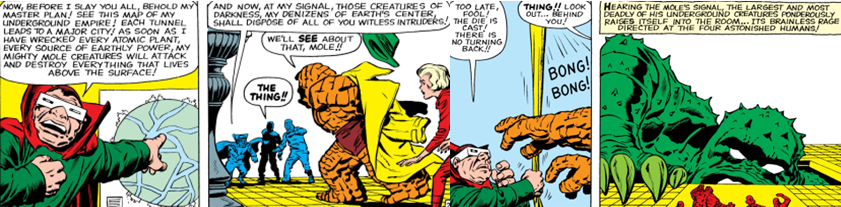
Movie Night: V for Vendetta

Released: 17 March 2006
Director: James McTeigue
Distributor:
Warner Bros. Pictures
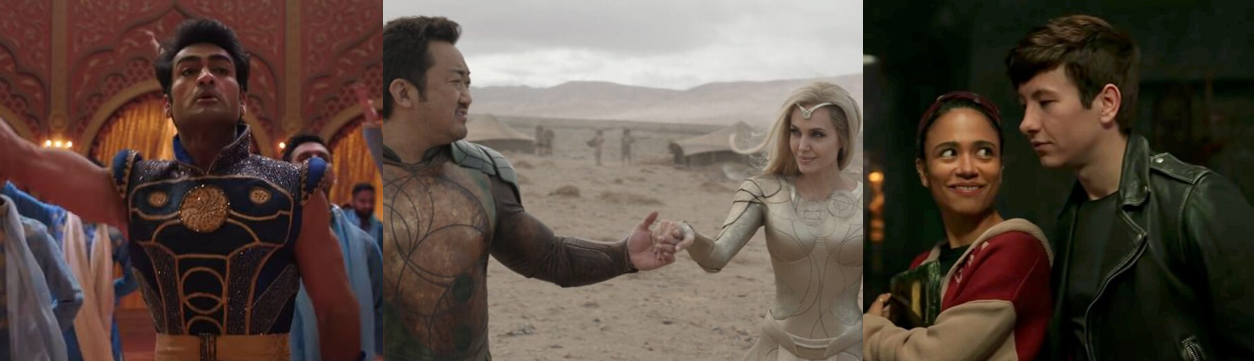
Budget:
$50 to 54 million
Stars:
Hugo Weaving, Natalie Portman, Stephen Rea, Tim Pigott-Smith, Roger Allam, Stephen Fry, and John Hurt

The Plot:
In a world where the United Kingdom is subject to a neo-fascist totalitarian regime headed by High Chancellor Adam Sutler (Hurt), the unassuming Evey Hammond (Portman) find sherself caught up in masked anarchist and freedom fighter V’s (Weaving) attempts to ignite a revolution through elaborate terrorist acts themed after the legendary Guy Fawkes.

The Background:
V for Vendetta began life as a black-and-white serial written by the legendary Alan Moore and illustrated by David Lloyd and published in the short-lived UK anthology Warrior between 1982 and 1985 before being picked up, colourised, and completed, by DC Comics in 1989. Influenced by a variety of literary works, V for Vendetta was a bleak, uncompromising tale of a morally ambiguous anarchist rallying against a totalitarian government and is generally regarded as one of the more subversive and influential comic books ever made. The production of a live-action adaptation can be traced back to 1988, when producer Joel Silver acquired the rights, but didn’t begin to gain traction until the late-nineties when Andy and Larry Wachowski (as they were known then) became involved in the production. Actor James Purefoy famously walked out of the title role after six weeks of filming and Moore, of course, hated the script and the idea of an adaptation, but V For Vendetta was a decent box office success with a gross of over $130 million. Critically, the film was also quite well received and became an influential cult hit.

The Review:
V for Vendetta immediately begins by emphasising the overall thrust of V’s crusade: that, while a man might be forgotten, killed, or mere flesh and blood, an idea can live forever to inspire others into acting. It’s this belief that permeates throughout the film alongside the oppressive governmental regime that dominates this alternative version of the United Kingdom. When we are first introduced to V, it’s on the eve of the beginning of his masterplan for revolution; garbing himself in a black outfit, cape, and eerily emotionless Guy Fawkes mask, he stumbles upon Evey being assaulted by Fingermen, the secret police of this world, and immediately beats them into submission while spouting eloquent quotations. V’s mystery is immediately apparent not only because his entire face and figure is obscured but also through the verbosity of his vocabulary; approaching his crusade like a dramatic role, he exudes a theatrical flair and polite, curious personality that immediately captivates Evey’s attention despite her better nature.

V is an enigmatic, anti-authoritative persona is a mixture of eloquence and violence.

V’s more melodramatic and articulate moments are offset by a disturbing unpredictability and ambiguity that makes him appear more than a little insane through his explosive methods, revolutionary opinions, and anti-authoritative stance. V destroys the Old Bailey using explosives, theatrical fireworks, and the sounds of Pyotr Ilyich Tchaikovsky’s ‘1812 Overture’. From there, V’s methods and agenda only escalate as he storms the office of the British Television Network (BTN) and forces them to broadcast a message of insurrection and revolution to take place in one year’s time, on the fifth of November, to take a stand against the oppressive government. V’s message affects the film’s characters in a variety of ways; Evey is awe-struck, families and viewers are puzzled and curious, and he is quickly branded a terrorist by the tyrannical government.

After rising to power, Norsefire continued to spread fear and oppression by controlling the media.

The Nordic supremacist and neo-fascist totalitarian regime that rules the UK, the Norsefire Party, spreads its God-fearing message primarily through the media in the form of Lewis Prothero (Allam); an extremely aggressive and spiteful individual, Prothero has an immense level of power and influence on the country as he spreads lies and messages of fear and hate to keep the populace under the rule of, and dependent upon, Chancellor Adam Sutler. Norsefire’s rise to power came after a series of orchestrated events that saw the country besieged by plague and death and, in their fear, they turned to Sutler and his promises of order, only to find that minorities, faiths, and sexualities were not only oppressed but cruelly ostracised, hunted, experimented upon, and killed by Sutler’s party.

Creedy is Sutler’s main force in removing insurgents and seeks to usurp Sutler’s authority.

Years later, the United Kingdom has become a bastion of law and order because of this fear; whereas former political powers like the United States are now little more than a “leper farm”, “England prevails” thanks to Sutler blacklisting music and arts, controlling the media, and having Creedy (Pigott-Smith) remove those who dare to oppose him. Creedy, a spiteful and cruel man, was the one who suggested Norsefire launch a viral attack on their own country to consolidate their power and takes his job very seriously; when insurgents rise up, he personally leads his men in breaking into their houses, beating them mercilessly, wrapping their heads in a black sack, and taking them away to be tortured and killed. His relationship with Sutler deteriorates over the course of the film when Sutler places the blame on V’s actions and elusiveness solely on Creedy’s inability to track him down and end him and V is able to manipulate Creedy’s aspirations to usurp Sutler’s position while still making him pay for his past crimes.

While Finch is horrified by the truths he uncovers, Deitrich is inspired to mock the government.

Equally perplexed by V’s crusade is Chief Inspector Finch (Rea), an Irish-born policeman who is horrified by V’s actions and broadcast but, in the course of trying to find him before Creedy can make him disappear, is horrified to uncover evidence that the Norsefire Party were responsible for a devastating plague and numerous deaths. His faith in the system already faltering at the beginning of the film, it is shaken to its core when he learns of V’s backstory and the horrifying experiments he and many others were subjected to, which turn him into something of a reluctant ally. V’s message strikes a chord with many others across the country, including Gordon Deitrich (Fry), a charismatic and entertaining talk show host who has been forced to live a lie his entire life since he is secretly gay and homosexuals are effectively outlawed. This leads to an amusing sequence in which he openly mocks Sutler on live television which, in turn, emphasises the tyrannical cruelty of the government when he is quickly bagged up and killed by Creedy. Other random members of the public are similarly inspired by V’s message and pay the price for it and, in turn, inspire others to take a more proactive stand against their oppressors.

Evey has been beaten down by her losses but is awestruck by the strength of V’s conviction.

V’s primary ally, however, is Evey; acting as the audience surrogate, we are introduced to V’s world (the “Shadow Gallery”) and learn about the specifics of his agenda through her; initially a timid and inconsequential character, she is captivated by V’s mystery, the strength of his conviction, and magnetic presence. Having suffered through many losses and tragedies, Evey is initially a product of the oppressive world in which she lives; she doesn’t like the rules, regulations, and actions of the government but feels powerless to do anything about it and prefers to stay out of politics. While she comes to bond with V even after his more questionable and violent actions, and feels an immense deal of pity and sympathy for him, she nonetheless attempts to escape and finds herself subjected to round the clock torture and isolation.

The Nitty-Gritty:
Conspiracy, revenge, and oppression are the name of the game in V for Vendetta; Norsefire went to extreme lengths to secure the vote and confidence of the public and covered everything up, from deleting military records and killing those who would expose or oppose them. The St. Mary’s virus devastated Ireland, and much of the UK, resulting in numerous deaths and was purposely released into the water supply by Norsefire to consolidate their power. Ever since, they’ve enforced strict curfews, rounded up homosexuals, people of colour, and all those with conflicting religious beliefs and lorded their superiority over those who were once their political betters. Hurt, who famously portrayed a contrary role in Nineteen Eighty-Four (Radford, 1984), demands nothing less than complete obedience, compliance, and results from his underlings; represented as a an aggressive, demanding voice shouting through a television screen for most of the film, his position and authority is never in question and he takes V’s actions and open defiance as a personal insult to him and everything he’s built.

Delia is the only one to regret her part in V’s suffering and welcomes her end at his hands.

Those within the Norsefire Party are deplorable and reprehensible individuals. Prothero was formally the commander of the detention camp that was responsible for producing the St. Mary’s virus and the suffering V and his fellow prisoners underwent; Bishop Lilliman (John Standing) is little more than a disgusting paedophile; and Creedy is a sadistic thug. The only real exceptions are Finch, who begrudgingly complies with the will of his superiors even before his faith is shaken, and Doctor Delia Surridge (Sinéad Cusack), the woman responsible for the experiments that led to the creation of V and the St. Mary’s virus and vaccine. Back during her time at the detention centre, she was a morally appalling woman who grew to hate the lethargic and miserable state of those she was experimenting on but, upon seeing her work go up in flames and coming eye-to-eye with a horrifically burned inmate, came to regret her actions. Changing her name and living in constant fear of reprisal, she accepts her fate at V’s hands willingly and is the only one of his tormentors to repent for her part in his suffering and to whom he shows a modicum of mercy.

V’s true face and identity remain a mystery as he is 100% committed to his vendetta and ideals.

V’s mission, for all his theatricality and grandstanding about brining down the government, boils down to simple revenge; referring to his actions as “justice”, he is driven by the desire to hunt down and punish those responsible for his suffering and the horrific scars he clear still carries from the fire. We never see V without his mask or without his face being obscured by shadow or some other disguise and his true identity is never fully revealed; clearly, he was some kind of genetic aberration to have been locked up and experimented on but there’s also more to him than simply being gay or a different creed or colour since he is able to endure unimaginable pain, exhibits near-superhuman levels of strength and durability, and is skilfully adapt with knives and in hand-to-hand combat.

V subjects Evey to round the clock torture to free her from the fear that has been holding her back.

The mystery of V’s true nature and origin is left intentionally vague, as it is in the comic book, in favour of the idea of V being more important than his physical form. In an effort to teach Evey the same lessons he learned, he subjects her to round the clock torture and forces her to live a very similar life of isolation and desperation as he was subjected to so that she can both better understand his motives, see the world for what it really is, and be freed of the fear and lethargy that has held her back her whole life. While Portman’s English accent is a bit dodgy at times, she more than makes up for it during this horrific sequence where she has her beautiful curly locks shaved, is hosed down and interrogated over and over again, and left in a cold, dank, desolate cell with only a rat and the writings of a fellow prisoner for comfort. Enraged at V’s treatment, she nevertheless discovers a strength and resolve she never knew existed and honours her promise to return to him for his revolution; however, while he pulls the lever that will usher in V’s new age, she doesn’t assume his identity like in the comic book but remains a changed and resolute character nevertheless. V’s treatment of Evey adds to his questionable moral nature; he’s fully willing to maim and kill those who wronged him, or who get in his way, to say nothing of forcing Evey to endure constant torture and, yet, he is disgusted not just at his actions but at those who made him the man he is today.

Despite having fallen in love with Evey, V is committed to his idea of a world free from oppression.

Having turned his back on his humanity and committed himself to a bulletproof idea, his conviction is strong enough to allow him to endure multiple gunshots and to give his life for his cause, knowing full well that he won’t live to see the dawn of his new age and grateful for the end of his suffering. Through Evey, though, he finds a kindred spirit and she even offers him something else to live for, something more akin to a normal life for the two of them, but he adamantly refuses, despite his love for her, since he is so dedicated to his crusade. Arguably insane and blinded by his obsession, V’s message of revolution is the kick up the arse the British public need to shake them out of their apathy; this dystopian version of the UK is ruled by fear and hatred of other races, creeds, and sexualities even before the rise of Norsefire, who are little more than a Nazi regime. Until V came along, normal, everyday civilians merely went along with the ruling body, accepting it as the way things were and beaten down by submission and subjugation but, in the end, it is the normal, every British public who assume V’s guise and march through the streets of London, stand up to the government’s military might, and witness the dramatic destruction of the Houses of Parliament. In that moment, they all become V and witness the symbolic destruction of the ruling authority just as V’s actions remove the tyrants in power and give power, and truth, back to the people to do with as they wish. It’s a startlingly effective message to stand up to totalitarian rule, whether foreign or domestic, and the lengths to which governments will go to to control their people; in the end, it takes subversive, even terrorist acts to force people into action, though the film goes to great lengths to justify V’s actions and to only have those who are morally questionable label him as a terrorist.

The Summary:
When I first saw V for Vendetta, I hadn’t read the original comic book; based on how much I enjoyed the film, I was inspired to read the source material and, while there are a great deal of thematic and notable differences between the two, V for Vendetta is still a really solid adaptation and an effective film in its own right. Much of this is, largely, due to the incredible enigmatic performance of Hugo Weaving in the title role; despite his face being completely obscured by an unnerving visage, he exudes a multitude of emotions, from conviction to sympathy to self-righteous anger, and his eloquent delivery and dulcet tones bring as much characterisation as his dramatic body language and gestures. It’s a captivating performance, one sadly rarely replicated in comic book movies where actors constantly remove their masks, and is surpassed only by the political and emotional heart of the film. V for Vendetta’s world is one that seems to grow more and more relatable each day as cameras, surveillance, and control dominate our everyday lives more and more each day; governments become unreliable, their methods questionable, and the idea that apathy rules our society is powerfully relatable in an age were media controls us with carefully constructed messages and versions of the truth. The message is clear; V even says it himself in the film: “People shouldn’t be afraid of their government. Governments should be afraid of their people” and, while the comic’s more subtle and intricate means of depicting its messages are replaced by for more explicit Nazi iconography and action-packed moments, the film does a commendable job of bringing Moore’s work to life and it remains one of the more thought provoking comic book movies.

My Rating:

Rating: 4 out of 5.

Great Stuff

Are you a fan of V for Vendetta? How do you feel it compares to the source material? What did you think to Hugo Weaving and Natalie Portman’s performances and the themes and message of the film? What do you think V’s true origins were? How comfortable are you with the power of the media and the increased surveillance we are met with these days? Which of Alan Moore’s works is your favourite? How are you celebrating Bonfire Night tonight? Whatever your thoughts on V for Vendetta, or the works of Alan Moore, go ahead and leave a comment down below.