

Released: 1 November 2011
Developer: Sonic Team
Also Available For: PlayStation 3, PC, Xbox One, and Xbox Series S/S
The Background:
It’s been said time and again, but Sonic had a tumultuous transition to 3D. While Sonic Adventure (Sonic Team, 1998) is generally regarded as a classic, it had a few issues that took SEGA some time to iron out in Sonic’s subsequent 3D titles. Despite some bizarre claims to the contrary, Sonic the Hedgehog (ibid, 2006) was a diabolical low point for the franchise. Sonic Team were desperate to make up for this with Sonic Unleashed (ibid, 2008), a critical and commercial success that saw the 3D games utilise a brand-new game engine to propel Sonic at breakneck speeds. This was further refined in Sonic Colours (ibid, 2010), another successful entry that but the franchise in a good position for its 20th anniversary. Sonic Generations was specifically developed as a love letter for long-time fans, with Sonic Team focusing exclusively on high-definition consoles and the unique 3D features of the Nintendo 3DS. The developers sought to recreate only the most popular and iconic stages from Sonic’s past and to make the game accessible to players of all ages, bolstering the release with a limited edition version and a touch of downloadable content (DLC). regarded as one of the best of Sonic’s 3D efforts, Sonic Generations was widely praised, despite its short length, for its colourful visuals and fast-paced gameplay; though the 3DS version was largely seen as inferior to the main console releases. regardless, Sonic Generations was a strong seller for SEGA thanks to being backwards compatible with new hardware and even got a whole new lease of life in 2024 with an equally celebrated . Shadow the Hedgehog-themed remaster.
The Background:
It was 2011 and SEGA were eager to celebrate the 20th anniversary of their iconic videogame mascot; after years of disconnect and complex additions to what had begun as a simple, one-button videogame, it’s fair to say that there was some…confusion regarding Sonic’s past, canon, and timeline. SEGA initially opted for a soft reboot, of sorts, with Sonic Adventure (Sonic Team, 1998), which clearly depicted Sonic and his cast of characters redesigned into a slightly older, more anime-inspired aesthetics in a world similar to ours, inhabited by both humans and anthropomorphic characters, and with a tenuous connection to the previous videogames. However, very quickly, this fell apart a bit as Sonic videogames became both incredibly dense and complex or laughably simple, especially in their narratives. After years of fans wanting a return to the traditional, 2D gameplay of the past, Sonic Team opted for a title that would combine not only the tried-and-true 2D gameplay of the past with the fast-paced 3D gameplay of what was, at the time, the present but also bring together two different generations of Sonic for the first time.
The Plot:
While celebrating Sonic’s birthday, Sonic and his friends are scattered through time by Doctor Eggman’s ferocious, mysterious beast, the Time Eater. Teaming up with a past version of himself, Sonic races through from his past to rescue his friends, retrieve the Chaos Emeralds, and put a stop to the Time Eater’s rampage.
Gameplay and Power-Ups:
Sonic Generations takes the fast-paced, “Boost”-centric formula of Sonic Unleashed and Sonic Colours and further refines it, offering both 3D and 2.5D, high-speed action stages as players race through some of the most iconic stages (or “Zones”) in Sonic’s history. While Sonic remains the only playable character, there are now two of him: the “Classic” Sonic (who plays exclusively in 2.5D) and the “Modern” Sonic (who plays in 3D and 2.5D). There are nine Zones to playthrough in Sonic Generations, each with two levels (or “Acts”): Act One is exclusive to Classic Sonic and Act Two is tackled by Modern Sonic. Although you’ll pot a timer in the to-left of the screen, there are no time outs here’ instead, you get a letter grade a points for finishing Acts as fast as possible. You’ll want to stick to the higher paths, where available, and utilise rails, pulleys, and other shortcuts to cut down your time, but you’re basically guaranteed an “S” rank if you finish an Act without losing a life. Unsurprisingly, Golden Rings are your life source, protecting you from most attacks and granting an extra life for every increment of 100 you collect. Golden Rings also fuel Modern Sonic’s “Boost” gauge (which is also filled by performing tricks off ramps and bashing Badniks), allowing him to blast ahead at high-speeds and plough through any enemies and destructible objects in his way. While both Sonics have unique gameplay mechanics, they share some common controls: you jump with A or X, pressing it again in mid-air to attack nearby enemies or hit targets with Sonic’s Homing Attack. While this is exclusive to Modern Sonic, you can unlock the ability (or “Skill”) for Classic Sonic, too, and it becomes mandatory in the 3DS version. B sees you crouching to fit through small gaps, Y activates any Skills you have equipped, and the Right Trigger either blasts Modern Sonic off or quickly performs Classic Sonic’s Spin Dash. When Boosting, you can hold the Left and Right Triggers to drift and use the Left and Right Bumpers to quick step. As Modern Sonic, you can press B in mid-air to perform a stomp, wall jump off specific surfaces, and dash along a line of Rings by pressing Y.
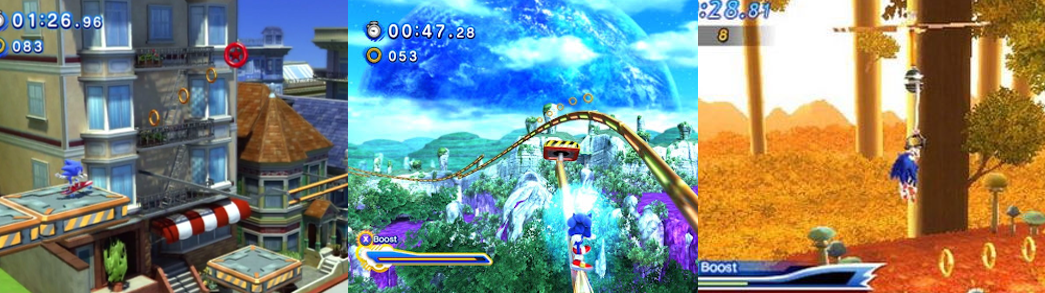
These controls are largely mirrored on the Nintendo 3DS, with players jumping and using the Homing Attack with A or B and Boosting with Y, though there’s no quick Spin Dash for Classic Sonic. Classic Sonic’s taught the Homing Attack early on, though he doesn’t really need it and ends up playing as a slower, clunkier version of his counterpart. While it might seem like Modern Sonic has more tricks at his disposal, each Sonic can be assigned Skills, unlocked by collecting Red Star Rings, completing additional Challenges, and spending points in the Skill Shop. Each Skill has a point value, and you can assign as many as you like to each Sonic until you hit the point cap of 100. A bunch of these are shared between both Sonics, giving each the ability to begin an Act with ten Rings, granting an additional extra life, giving them more movement options when underwater, and eliminating the recovery time after taking a hit. Classic Sonic can equip one of the elemental shields from Sonic the Hedgehog 3(SEGA Technical Institute, 1994), gaining a bounce, flame burst, and double jump and being able to breathe underwater, resist flames, and attract Rings, respectively. He can also equip the “Twin Spin Attack” (or “Insta-Shield”) from Sonic 3, start with a temporary invincibility, extend the Spin Dash, turn enemies into Rings, and even hop on a skateboard. Some of these abilities are available in Zones as well, such as the speed up and invincibility and skateboard, though you’re more likely to smash Ring monitors. Modern Sonic can also be assigned Skills to allow him to blast off at the start of an Act, perform faster Homing Attacks and wall jumps, and increase the length of his Boost gauge. When playing Planet Wisp or Tropical Resort, you’ll utilise the returning Wisps, with Classic Sonic using the Pink Wisp and Red Wisp to race across walls and ceilings and turn gears or burst through the sky and Modern Sonic rocketing up Dr. Eggman’s factory and smashing through barriers or ricocheting about with the Cyan Laser. Acts also contain the usual gimmicks and hazards, such as springs, spikes, flame bursts, ramps, and rails. You can jump through boost rings to blast through the air, fly off ramps to perform tricks and fill your Boost gauge, repeatedly hit bouncy springs to get higher, and even run on those awful Marble Garden Zone platforms to reach higher areas in Sky Sanctuary. When underwater, you’ll need air bubbles to keep from drowning; when leaping to platforms, you must watch for bottomless pits; and you’ll often press switches to activate or move platforms and blocks.

Interestingly, the Nintendo 3DS’s bottom screen is only used to track your progress in an Act, display the boss’s health bar, and to navigate the sparse hub world. Sonic Generations takes place in a simple hub world called “White Space”, a disappointingly barren void where stages from Sonic’s past have been dumped by the Time Eater. These are arranged in three areas corresponding to an era of Sonic’s history and guarded by a Boss Battle. To progress through the game’s brief and simple story, you must complete each Act to partially restore colour and life to the White Space, then acquire a Chaos Emerald from a Rival and Boss Battle. By and large, the game’s Acts aren’t particularly challenging, though there are some unfair bottomless pits and each Sonic seems to have lead in their sneakers, which can make precision platforming slippery and frustratingly difficult. The difficulty comes in the lengthy and haphazard variety of gameplay mechanics seen in the later, modern levels; unsurprisingly, Crisis City stands out as one of the game’s more frustrating stages thanks to the fire traps, lava pits, bottomless pits, and that Goddamn flaming tornado! The Nintendo 3DS version sees you flying through Mushroom Hill using propeller plants, bouncing around Casino Night, and racing from a destructive orca in Emerald Coast, though the additional Challenges are missing from the Xbox 360 version. Here, after clearing each area, you’ll unlock five additional Challenges for each Sonic; you’re required to clear at least one of these for each Zone to gain a Boss Key, battle the boss, and progress to the next area. These Challenges are considerably varied and can be anything from racing against a ghostly doppelgänger to finding Chao, to completing a stage with only one Ring. Sometimes, you’ll also race against, or team up with, one of Sonic’s friends; you’ll use Mile “Tails” Prower to hover over obstacles and gaps, knock musical notes back to Vector the Crocodile, and clear walls of flame with Blaze the Cat, for example. While you may call upon Sonic’s friends with Y in these Challenges, you’ll never control any character other than the two Sonics, which is quite disappointing. These Challenges can be frustrating but clearing them is the only way to completely restore each area and also unlock additional Skills, artwork, music, and character profiles in the Collection Room.
Presentation:
Graphically, Sonic Generations is still one of the brightest, most vibrant Sonic 3D titles ever made. Classic Sonic, especially, looks and animates really well and every stage is packed full of life, colour, and little details that will be recognisable to any Sonic fan. Both Sonics have idle poses and celebrate or lament their letter grade after each Act, though, strangely, Classic Sonic is completely mute. This means that Modern Sonic gets all he puns and one-liners and voice clips, while Classic Sonic simply pantomimes his feelings and relies on Classic Tails to talk for him. Sonic’s friends appear as non-playable characters (NPCs) in White Space, offering encouragement and hints after being restored to guide you towards Red Star Rings. White Space is very annoying for such a simple hub world, with the game forcing you to take boost pads, loops, and springs to reach Challenges (though you can cycle through Acts, at least). I’m glad the game isn’t bogged down by a huge open world, but White Space feels very cheap and half-assed at times, despite some fun Easter Eggs. Sonic Generations takes the original 2D and 3D environments and gives them an eye-catching visual makeover, though the screen’s a bit too zoomed in at times for Classic Sonic and it’s easy to just blast off into the void as Modern Sonic. Perhaps the pinnacle of Sonic Generations’ graphical achievement, though, is in the fantastically updated battle against Perfect Chaos, who has been turned from a choppy, flappy-mouthed monstrosity into a genuinely terrifying, bio-organic creature. However, when playing the Xbox 360, I did notice some blurriness to the images, some frame rate issues, and the game crashed on me three or four times, which was odd. It’s obviously graphically superior to the 3DS version, which offers the same headache as all 3DS titles and is extremely basic at times. You cans ee this in Mushroom Hill, which looks strangely bland, the cutscenes (which are simple 3D models with dialogue boxes), and the reduced Zone count.

Each of the game’s Zones are beautifully rendered and expanded upon with gameplay gimmicks from other games and even little extra things, like a celebration taking place in Rooftop Run and getting to visit Hidden Palace in Sky Sanctuary. While there are some obvious choices (Green Hill and Chemical Plant have since been overused to death), there are some odd inclusions, like Speed Highway from Sonic Adventure (I would have picked maybe Ice Cap or Red Mountain), and some disappointments, like Seaside Hill from Sonic Heroes (Sonic Team USA, 2003). I’m honestly surprised that Sonic Team didn’t include Casino Park instead, though I would’ve liked to see them mix it up with Egg Fleet or Frog Forest. There’s some real depth to the environments, with Chemical Plant’s factory exploding in the background, the Death Egg rising in Sky Sanctuary, and desolation as far as the eye can see in Crisis City. Things can be a bit cluttered at times and it’s not always clear which winding path you can take and which is part of the background, but I loved how faithfully Sonic Generations recreated each area and the little twists they toss in. Classic Sonic’s Seaside Hill is largely underwater, for example; the infamous truck wrecks the environment and rockets after you across walls in City Escape; and Dr. Eggman airship hounding you in Rooftop Run. The Nintendo 3DS version oddly adapts Zones from Sonic’s main console games rather than his handheld ventures, with the exception of Water Palace (and, I guess, Tropical resort), which was an odd choice and results in some janky, bland stages that are actually inferior to their Nintendo DS predecessors since the action’s limited to one screen. The Xbox 360 version features some really well done CG cutscenes; it’s just a shame that the game’s story is so criminally short that we don’t see more of these. When you free Sonic’s friends, they’ll make a comment while Sonic just stands there like a tool rather than properly interact with them. As for sound, Sonic Generations has you covered! Every area features a unique, remixed version of its original track and each Act has a different version to differentiate the two. On the Xbox 360, you can also unlock additional music tracks, including some great remixes by the likes of Cash Cash and Crush 40, and play these on any Stage, allowing for a lot of variety in the music you hear as you play.
Enemies and Bosses:
Given that it features stages from three eras of Sonic’s history, Sonic Generations also includes many recognisable Badniks and enemies from each time period being represented. You’ll smash apart the likes of Moto Bugs, Buzz Bombers, Crabmeats, Spinys, and Egg Robos from the classic games, with Egg Robos sporting missile barrages and giant Badniks even chasing you at certain points. Moving into the modern era, you’ll bop Eggpawns, Cop Speeders, robots from the Guardian Unit of Nations (G.U.N.), and flaming Iblis creatures. While most slow and easy to attack, they can still surprise you with bolts of energy or other attacks, such as the construction Egg Pawns on Planet Wisp tossing their pickaxes. Enemies are largely there to be bothersome, with the cannons surrounding Rooftop Run’s clock tower being particularly aggravating and the Egg Pawns in the barrel store being notably cheeky. Enemies also act as “bridges” between platforms, rails, and other areas, allowing you to Homing Attack or bop them to reach higher paths, cross lava, or avoid spike pits. The Nintendo 3DS version features a handful of unique enemies due to its different Zone selections, such as those mushroom-tossing moles, axe-wielding Egg Pawns, and even a massive Egg pawn that wrecks the ruins of Water Palace. Spikes are annoyingly commonplace, often waiting right where you land, as are crushing hazards, moving blocks, flame bursts, and missiles from the walls and ceilings. You’re chased by a gigantic truck in City Escape, one that now sports giant buzzsaws, have debris flung at you by a flaming tornado in Crisis City (which also whisks away the environment and the end goal for Classic Sonic!), and must watch for crumbling platforms when bouncy from clouds in Sky Sanctuary. Spiked obstacles also appear on rails, mines litter the ground, and you must quick step left and right to avoid being blasted by Dr. Eggman’s drones and airship. While warning signs alert you to bottomless pits, it’s very easy to plummet down them when moving so fast, or to clip through the environment, and Sonic can be quite slippery, which doesn’t help when trying to make trickier jumps.

Six classic bosses return and are remixed in each version of Sonic Generations. On the Xbox 360, Classic Sonic first fights the Death Egg Robot on a narrow platform, dodging its extending, drill-like arms and running under it when it jumps to ram its butt. The fight the switches to a recreation of the Death Egg Zone and the mech exclusively attacks from the background, forcing you to lure it to attack bombs with its arms so you can run up and ram its head. The fight with Perfect Chaos is now a whole stage as you dodge its tentacles and jump on crumbling platforms to reach it, hitting springs and pulleys and blasting across the water on boost pads to race up its body. Perfect Chaos spawns twisters, fires energy beams, and unleashes its massive mouth laser, before erupting water geysers. This forces you to precariously hop to platforms, battling the awkward camera to land the final blow. The Egg Dragoon sees you blasting through a circular tunnel avoiding its freeze bolts and missiles and hopping to rails to ram the cockpit. When on a 2.5D plane, you must hang back and jump over shots then quickly wall jump up its arms, avoiding a downward shot, before diving after the falling mech, avoiding its drill arms to target its body. On the Nintendo 3DS, you battle one of my favourite bosses, the Big Arms, now avoiding its arm slams and palm slaps, then, oddly, battle the Biolizard. This is an annoying fight as you must awkwardly run from its gaping mouth or thrashing tail, grinding up to its core, avoiding high and low shots and bouncing off orbs to smack its core. Finally, you battle the Egg Emperor in an autorunner, desperately avoiding its energy waves, dodging its charge, and taking out the cannons to smack his big, stupid face.
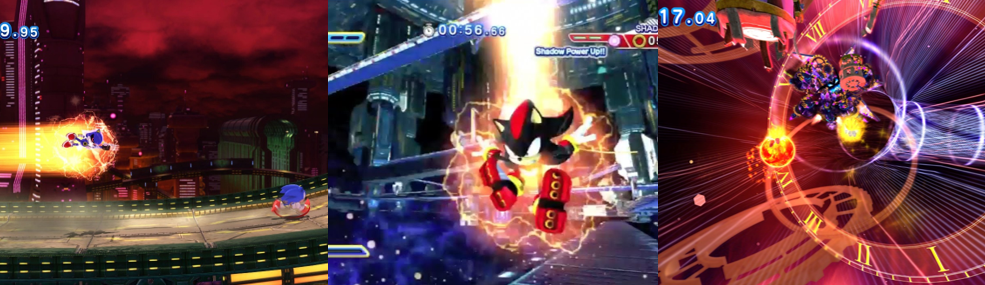
You’ll also compete against some of Sonic’s rivals in both versions, with the Xbox 360 fights yielding Chaos Emeralds. You’ll once again race across Stardust Speedway against Metal Sonic, hopping over its torpedo dash and avoiding its lasers and the debris it tosses at you to give it a smack. You’ll across the walkways of the Space Colony ARK against Shadow the Hedgehog, chasing down purple energy orbs to power-up and blast meteorites at him in a battle that’s ridiculously easy if you can speed after him fast enough. Finally, you return to Crisis City to battle Silver the Hedgehog, avoiding his telekinetic waves and targeting the debris he flings at you to wallop him, before scrambling over a huge wave of junk and racing towards the camera to finish him off. This rival fights are significantly downplayed on the Nintendo 3DS as you don’t fight Silver and both are reduced to races, with you hopping over obstacles and slowing Metal Sonic or Shadow with some lucky shots and desperately trying to avoid Shadow’s boost and Chaos Spear. Unfortunately, Sonic Generations and its bosses arefurther let down by the final battle with the Time Eater. Despite an impressive, ominous score, the unique design of both the creature and the bizarre vortex you battle it in. Despite the joy of seeing Classic and Modern Sonic turn Super Sonic to battle two versions of Dr. Eggman, this fight is a confusing mess. You hold down RT to charge head-first through a time/space distortion, dodging pieces of the Zones and the Time Eater’s arms and lasers, to ram its core. You can press Y to switch to the outside of the vortex and press X to fire the other Sonic to destroy incoming projectiles, all while Sonic’s friends constantly shout “advice”. You can barely see Golden Rings until they’ve flown past you, you have no idea if you’re holding or mashing buttons, and defeating this monstrosity is much easier on the Nintendo 3DS. You battle it on a 2.5D plane, with no attacks at your disposal and simply dodging its lasers and arm swipe until its core is exposed, then race towards it on a 3D plane. This can be tricky as it’s not easy to dodge its hand claps and it’s easy to run out of Rings, but at least you’re not bombarded by repetitive voice clips, and you can land hits a lot easier.
Additional Features:
There are forty-nine Achievements to earn in Sonic Generations, with one popping every time you clear both Acts in each area and defeat a rival and boss. Every Act as at least one Achievement tied to it (normally something involving going a specific route and collecting a specific Red Star Ring before completing the stage), you’ll get Achievements for performing tricks, acquiring Skills, and unlocking all collectibles. Every Act has five Red Star Rings to find, with each one unlocking artwork, music, and other extras; you’ll also get an Achievement if you find them all. As you complete Acts, Challenges, and collect Red Star Rings, you’ll unlock additional music tracks, cutscenes, artwork, and little character trophies that can all be viewed in a little gallery/museum at the far left of White Space. If you explore the Green Hill hub, you’ll find a SEGA Mega Drive and, for 7777 points, you can purchase a Mega Drive controller to play a port of the original Sonic the Hedgehog(Sonic Team, 1991)! You can also challenge the rivals and bosses on “Hard” mode (though there’s no Achievement for this), upload your fastest times to an online leaderboard, and play a pinball table themed on Casino Night Zone if you snagged the DLC. On the Xbox 360, you acquire the seven Chaos Emeralds by playing the main story, unlocking Super Sonic for the finale and as a 100-point Skill for both Sonics, but play Special Stages on the Nintendo 3DS. These are modelled after Sonic Heroes’ pipes, with you collecting orbs to power-up your boost and avoiding spiked mines in super easy challenges. You can also download additional missions using the handheld’s “StreetPass” feature, play an online versus mode (that appears to be a head-to-head race), customise a profile card, and play a time attack mode, though the Nintendo 3DS lacks the Skills and Red Star Rings of its counterpart.

The Summary:
When I first played Sonic Generations on the PlayStation 3, I remember it being a fantastic experience; it was fun, fast paced, and chock full of nostalgia and little bits of fan service. Aside from the final boss, I had a blast breezing through everything the game had to offer and lamented the lack of follow-up downloadable content from Sonic Team, hence my excitement for the later remaster. I was therefore super exited to revisit Sonic Generations on the Xbox 360 and snag the Nintendo 3DS version, only to be put off by how zoomed in the camera was for the 2.5D sections. Nevertheless, I ploughed ahead, happy to be revisiting this slice of nostalgia and, very quickly, found myself quite frustrated by a lot of little things. The sheer uselessness of the regular jump both Sonics have, their tendency to spontaneously slip off platforms, the frustrating nature of a lot of the Challenges and, of course, the massive letdown of the final boss. All these years later and I’m still disappointed that the story wasn’t a bit more grandiose given that this was a celebration of Sonic’s 20th anniversary. White Space feels so empty and lifeless, the lack of other playable characters and extra stages was disappointing, and the barebones nature of the title makes it feels cheap and rushed at times. The Nintendo 3DS version is even more barebones, lacking so many features, characters, and even having a reduced Zone count, with the only consolation being simplistic Special Stags. Not adapting Zones from Sonic’s handheld past was a huge mistake, the Zones we do get are largely empty, and both Sonics play too similar for the game to compete with Sonic’s Nintendo DS library. Yet, by and large, Sonic Generations is still an enjoyable experience. I fear this playthrough may have been soured by me rushed through it as quickly as possible rather than taking my time and losing myself to the nostalgia. If you can do that, there’s a lot to like here from a visual and aural perspective, as well as the game being a fun, if all too brief, break-neck action romp through some of Sonic’s most iconic areas.
Nintendo 3DS Rating:
Xbox 360 Rating:
Could Be Better
Pretty Good
What did you think of Sonic Generations? Do you think it still holds up or, like me, do think that it was lacking in content and features? What did you think to the Zones featured in the game and the remixed boss battles? Were you disappointed by the lack of other playable characters? Which Challenge was the hardest for you and why was it Vector’s? What was your favourite Classic and/or Modern Sonic videogame? Share your thoughts in the comments, support me on Ko-Fi, and go check out my other Sonic content.

 Dr. K's Waiting Room
9 thoughts on “Game Corner: Sonic Generations (Nintendo 3DS / Xbox 360)”