Movie Night: Halloween (2018)

HalloweenLogo

Released: October 2018
Director: David Gordon Green
Distributor: Universal Pictures
Budget: Approximately $10 to $15 million
Stars: Jamie Lee Curtis, Judy Greer, Andi Matichak, Will Patton, Haluk Bilginer, and James Jude Courtney

Plot:
Forty years after surviving an attack by serial killer Michael Myers (Courtney), Laurie Strode (Curtis) has become a recluse, alienating her entire family as she prepares for Michael’s inevitable return. When Michael escapes from captivity, Laurie is forced to confront both her past and her worst fears.

Background:
In 1978, legendary director John Carpenter brought us Halloween for the first time and, with it, effectively gave birth to what became known as the slasher genre of horror movies. Make no mistake, without Halloween we may never have seen the popular portrayal of masked, silent killers stalking suburban teenagers, and the film created and popularised many other troupes of the genre for years to come. Given Halloween’s success, it is perhaps of no surprise that a sequel soon followed. Halloween II (Rosenthal, 1981) continued the story, picking up immediately where the first film left off and introducing the idea that Michael Myers and Laurie Strode were brother and sister. Following this, a whole slew of sequels soon followed, with each one adding new dimensions to Michael’s backstory and diluting his mysterious nature. It soon reached the point where Michael’s backstory was so convoluted and confusing that the only things worth watching about the films were the kills and the Donald Pleasence’s scene-stealing performance. Rob Zombie’s 2007 remake was met with mixed results, though I quite enjoyed how violent and insane this film was. Despite earning a sequel (which was inarguably much, much worse), Zombie’s turn with the franchise effectively left it dead in the water. Now, forty years after the original movie, Carpenter, Curtis, and many of their collaborators have returned to the franchise with a direct sequel to the 1978 original that ignores every other entry in the series. Of course, this isn’t the first time this has happened; before Zombie’s remake, Halloween H20: 20 Years Later (Miner, 1998) ignored every entry after Halloween II and even returned Curtis to her famous role for a final showdown with her brother. As a result, this new sequel feels largely unnecessary, but does it return the franchise back to its genre-defining roots and throw further dirt onto the grave of Michael Myers?

The Review:
As mentioned, Halloween takes place forty years after the end of Halloween (the 1978 one…not the 2007 one…) and slightly alters the ending of Carpenter’s original; Myers was apprehended shortly after his killing spree and has been incarcerated under the care of Dr. Ranbir Sartain (Bilginer). In all that time, Michael has not uttered a single word despite Sartain’s attempts to reach him. Two British podcasters arrive to try to learn more about Michael’s motives but are unsuccessful; they are equally unable to convince Laurie Strode to visit Michael before he is transferred. Traumatised by her experiences decades earlier, Laurie has become a recluse who has shut herself off from the world and her family in preparation for Michael’s return; however, while her relationship with her daughter, Karen (Greer) is strained, she is much closer to the granddaughter, Allyson (Matichak). When news breaks that Michael’s transport bus has crashed and Michael has escaped, Laurie is forced to try and convince her family to return to her fortified house for safety so she, aided by Officer Frank Hawkins (Patten), can hunt Michael down and end him once and for all.
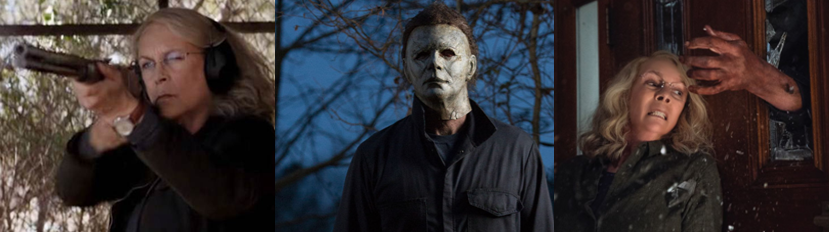
Despite their advanced age, both Michael and Laurie are more capable than ever.

Halloween is a masterful return to form for a franchise that has, to say the least, lost its way through numerous sequels, knock-offs, and convoluted additions to the narrative. Rather than worry about any of that, the film ignores everything after Halloween II, including the Carpenter-crafted idea that Laurie and Michael are related, and returns Michael to a mysterious serial killer. Michael’s face, though clearly scarred from his many battles in 1978, is kept hidden either behind his trademark mask or though clever editing so we never truly see his face and the emphasis on character’s desperately trying to get him to speak and explain his motives keeps Michael as a mysterious, unstoppable force of nature rather than a puppet or spelling out his motivations. Halloween closely apes Carpenter’s original, returning to many of the same themes and even recreating shots from new perspectives to bring perhaps the best and most effective sequel in the franchise, and marries this with some truly violent kills. While nowhere near the level of Zombie’s splatter-gore, this Halloween portrays Michael as being more powerful than ever, capable of twisting heads around backwards and stamping heads into mush. The kills are sudden and violent, with many taking place off screen and most of them being completely random (even more random than the kills in the original movie), which only adds to their horrific nature. This is Laurie’s movie, first and foremost, and she is portrayed as being very damaged from her experiences but also incredibly well prepared. Her house is rigged with flood lights, booby traps, and guns and other weapons to arm herself with against Michael but, at the same time, she’s clearly very vulnerable and afraid. In H20, Laurie was ruled by her fear and desperate to hide away, only becoming a proactive individual once Michael returned and she was forced to face him. Here, though, Laurie has been preparing her entire life to face Michael again and kill him, for better or worse.
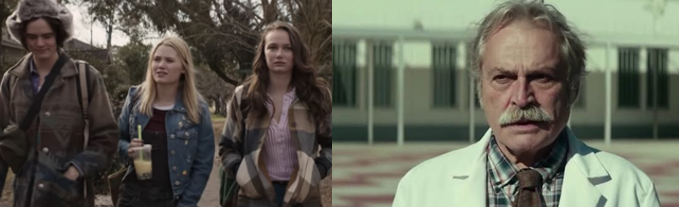
While the kids did okay I couldn’t buy into the random knock-off of Dr. Loomis.

Curtis is joined by a decent supporting cast, who are all written pretty well and naturally and appear believable. More time could perhaps have been devoted to Karen’s equally-traumatic upbringing, as this is only really touched upon, and many of Allyson’s friends are nothing more than disposable filler, but they’re fine for the most part. Sartain, however, is a poor substitute for Loomis (Laurie even outs him as “the new Loomis” at one point, which was a bit too on the nose for my tastes); even Malcolm McDowell’s Loomis wasn’t as obtrusive to the plot as this guy, who gets a whole sideplot that really never goes anywhere. And that’s quite a problem at a few points, really. There are characters who have little impact on the plot, plot threads that are underdeveloped and just dropped or don’t go anywhere, and plot holes that go against what the film has already established (for example, Laurie’s house is all decked out and fortified but she doesn’t flood the inside with lights and instead prefers to sneak around in pitch blackness). It also doesn’t help that we have seen much of this film already from other entries in the franchise, particularly Halloween, Halloween II, and Halloween H20. While it may do a lot of things well, it doesn’t change the fact that this entry is perhaps the least necessary of all the sequels.

The Nitty-Gritty:
It’s Halloween, so there really isn’t too much to spoil; Michael escapes, goes on a killing spree, and evil is vanquished in the end (…or is it?!) The biggest change here is that Michael and Laurie are no longer brother and sister, which is apparently being heralded as a good thing but I kind of disagree. John Carpenter created this as part of his forced involvement in Halloween II and, while he has since lamented this addition and regretted it, it has been a pivotal plot point of the franchise ever since and disregarding it, and outright mocking it as Allyson does at one point, leaves a sour taste in my mouth. Without this motivation, Michael returns to being an emotionless, remorseless killer with no objective other than to kill. However, the 1978 Halloween seemed to suggest that he had a particular fondness for killing babysitters and teenagers, especially girls, but here he just…kills everyone and anyone he comes across. Which is fine but, as I say, seems way more random than originally depicted; I always liked the idea that Michael’s attacks seemed random but were premeditated and methodical in some way, but that no longer seems the case.
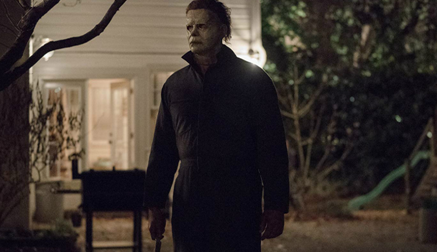
HalloweenShape.png
This certainly was the Shape of a decent Halloween film…

The big twist of this movie is that Dr. Sartain actually turns out to be a complete nutjob; he suddenly stabs Hawkins to death in an attempt to “feel” what Michael feels when he kills and even briefly wears Michael’s mask. It was at this point that I was really worried as, for a moment, it seemed as though Sartain was going to take over as the villain of the film. Instead, he is summarily executed by Michael only a short time later; it seemed like they were in cahoots and that Sartain had been aiding Michael but, no…he just went nuts and then got killed and that as it. It was such an out-of-nowhere twist and was dropped so quickly that it really makes you question what the purpose was at all. Sartain should have died in the bus crash as he really wasn’t integral to the plot at all; between both Laurie and Hawkins we had enough of a Loomis type of character without Sartain clogging up screen time. Perhaps if he had died in the crash instead, more time could have been spent on developing Karen’s character, which was sorely lacking; she doesn’t want anything to do with her mother because of a hard upbringing, but it was hardly abusive or traumatic.

The Summary:
Halloween is an entertaining return to form for the series; Michael returns to his murderous ways as an unstoppable force of nature and the franchise appears to be back on track, rather than being bogged down in trying to add new kinks to the narrative. It’s easily the best Halloween sequel we’ve had in a long time but, for me, seems so unnecessary that I can’t, in all honesty, rate it too high. It retreads familiar ground and, while it seems new and fresh since it’s been so long since we saw this from the franchise, it’s still the same ground we have seen before, and better in many ways, so maybe it would be better recommended for those more unfamiliar with the franchise. For me, this movie was already told with Halloween H20, which is one of the stronger entries in the franchise in my view. It really allowed Laurie to gain some closure and put an end to Michael’s threat but, instead, we have to tread the same ground again only this time it’s far more ambiguous. Laurie manages to trap Michael in her basement and sets it, and her whole house, on fire, which appears to have forever killed Michael but, of course, Michael mysteriously vanishes and his body is not seen so the assumption is that he could still return for more kills (though, I still prefer the visual of Laurie lopping his head off with an axe; it was the definitive end we needed).


My Rating:

Rating: 2 out of 5.

Could Be Better

Game Corner: South Park: The Fractured But Whole (Xbox One)

GameCorner
SouthParkFracturedLogo

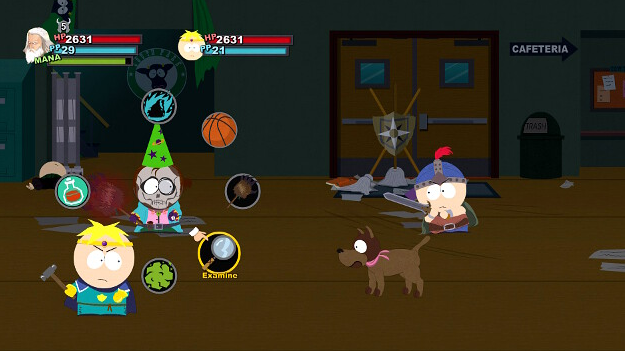
Surprising no-one, I’m sure, but I have been a big, big fan of South Park (Stone and Parker, 1997 to present) since it first started airing on television. Over the years, the show has gone from strength to strength and, even though the last couple of seasons haven’t been as good as others (the show’s fascination on giving Randy such a large role at the expense of the kids is a little annoying), I still make an effort to tune in when new episodes air and appreciate how Matt Stone and Trey Parker have tried to do new things with their controversial series to spice things up a bit. South Park has, however, had a tumultuous history when it comes to videogame adaptations. Back in the day, for some unknown reason, the show was first adapted into a first-person shooter; South Park (Iguana Entertainment/Acclaim Entertainment, 1998) allowed players to control Stan, Kyle, Kenny, or Cartman as they traversed a number of landscapes practically swamped in fog as they battled against a slew of enemies inspired by the first series of the show. It was…okay…but hardly evocative of what the series was known for. Following this, South Park dabbled with a videogame genres, including a quiz/party game in South Park: Chef’s Luv Shack (Acclaim Studios Austin/Acclaim Entertainment, 1999) and a pretty entertaining kart racer with South Park Rally (Tantalus Interactive/Acclaim Entertainment, 1999), before striking gold with the fantasy/RPG genre in South Park: The Stick of Truth (Obsidian Entertainment/Ubisoft, 2014).

SouthParkFracturedStick
Stick of Truth was a great title let down only by its length.

Stick of Truth benefitted from three very simply ideas: simple but surprisingly deep controls and turn-based gameplay mechanics, a close collaborating with Stone and Parker on the content of the title, and presenting itself as a continuation and extension of the show. If there was one thing going against Stick of Truth, it was that it was too short; I was perfectly happy with how easy the videogame was, as it meant playing through as a breeze and extremely fun, but it definitely felt like it ended a few hours too short. Luckily, Stick of Truth was received well enough to justify a sequel; it took a while but we finally saw this in the form of South Park: The Fractured But Whole (Ubisoft San Francisco/Ubisoft, 2017), which was directly tied into season twenty-one of the show. Picking up pretty much the very next day from the ending of Stick of Truth, Fractured But Whole sees the boys ditch the fantasy game they were playing in favour of creating their own superhero franchise; your avatar, the New Kid, is then drafted into Coon and Friends and charged with proving himself (or herself…) once again.

SouthParkFracturedScrambles
When Scrambles goes missing, Coon and Friends assemble!

The Coon and Friends have a simple objective: find the lost cat, Scrambles, and be the most successful superhero franchise in town. Opposing them are the Freedom Pals, who want exactly the same thing but refuse to follow Cartman’s lead, and various other enemies such as the Sixth Graders, the malevolent Crab People, homeless bums, ninjas, and waitresses from Raisens. However, due to the New Kid’s very real superpowers and mysterious origins, the kids soon become embroiled in a plot by Mitch Conner to take over the town using cat pee and end up travelling through time in order to set things right.

SouthParkFracturedMap.PNG
There’s plenty to do in South Park.

Technically speaking, Fractured But Whole isn’t much different from Stick of Truth; all of South Park is once again available to explore, with some new additions like SoDoSoPa, the Shi Tpa Town, and Mephisto’s laboratory, and some exclusions, such as the South Park Mall and Canada. The town is full of non-playable characters, including all of the recognisable and familiar faces from the show, and you are encouraged to interact with them all to gain access to side quests or take a selfie to post on Coonstagram, increase your followers, and therefore improve the reputation and reach of Coon and Friends.

SouthParkFracturedCombat
Combat now involves navigating a grid.

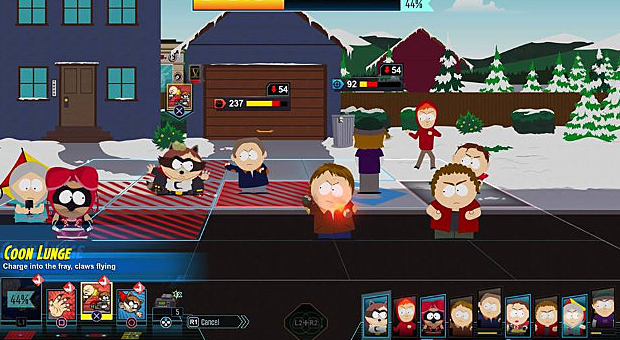
The turn-based mechanics of Stick of Truth return but with a twist; the awkward move wheel and restrictive battlefield are gone, replaced with a simple horizontal interface and a grid that players can freely move about. The party has also increased from two to four (or even five or six, in some cases), allowing for more varied combat, and attacks can be targeted against groups of enemies across the grid to deal additional or knockback damage. It’s a great overhaul that allows for a real sense of strategy and thought to be put into early battles; once you have levelled up enough and mastered the game, however, battling becomes less about strategy and more about using the most powerful attacks to sweep the opponent as quickly as possible. The gameplay remains as simple as before but, as with Stick of Truth, the mechanics cane be surprisingly deep. Players can pre-emptively fart on or strike enemies for a turn or combat advantage, inflict bleeding, burning, vomiting, freezing, or confusion upon opponents, and are encouraged to use a variety of different abilities to win battles. Some enemies, for example, are immune to status afflictions; some bosses cannot be attacked directly and must have enemies hit into them to damage them; and some battles involve the player being pursued by an invincible opponent.

You can mix and match from a variety of superhero classes.

As before, players can choose from a number of classes, now based on popular superhero tropes; the New Kid can be a Brawler or a Speedster, or maybe you’d prefer to be a Cyborg or a Psychic. Each brings different abilities to the combat and results in a funny little training simulation in which Cartman amends and expands upon your simple and crude backstory. Eventually, as you progress, you can dual and even multi-class, gaining access to every available class and all the moves associated with each. You can only assign three moves and one super move, however, so choosing what suits your play style is key. Battling earns you experience points, a handful of cash, items, Artefacts and DNA Strands. As you do no equip weapons like in Stick of Truth, these last two can be equipped to the New Kid to increase or decrease certain attributes (Strength, Health, etc) or affect your abilities, and those of your party, in combat. Eventually it comes down to equipping the most powerful of these but your experience may vary; I always favour boosting attack power and health over speed, but there’s plenty of choice here.

SouthParkFracturedYaoi.PNG
Gotta find those Yaoi pictures.

You can also buy and/or pick up various items and junk all around the town to be used in the game’s deep crafting system; this is where you will craft health, revives, power-ups, mission-specific items, and even Artefacts. It’s fun to explore and pick up everything you see and the cost of crafting these items decreases the more you play and the more you invest. You can search every square inch for yaoi pictures of Tweek and Craig, which replace the Chinpokomon collectables from Stick of Truth, unlock buddy assist moves to clear lava (red Lego bricks) and reach new areas, and learn new fart techniques to assist you in opening new areas, advancing the plot, or for use in combat,

SouthParkFracturedRace
You can change your profile at any time, that’s fine.

The player is given complete freedom to design their avatar from the ground up; the New Kid, silent as always, is completely customisable, from the type of hair or headwear you want to the superhero outfit and gloves. You are also tasked with filling out the character’s profile; this involves talking with Mr. Mackey at various points to determine your gender, race, phobias, and sexual orientation; while these don’t necessarily massive impact how the game is played and can be altered at any time, choosing to have a black avatar is set to be the game’s Hard mode, which is fitting for South Park’s controversial sense of humour. Fractured But Whole is a big, involved title, easily answering my desire for a long gameplay experience through the main story campaign. While the plot is arguably not as strong near the end (the finale just kind of…happens…and the game ends), the story is an enjoyable and fun experience. Just wandering around town, looting through people’s houses and playing the toilet mini game is a blast and, like before, it really is like playing an episode of the show.

SouthParkFracturedDLC.PNG
There’s some decent DLC available.

This time around, we also got some quite substantial downloadable content; not only can you unlock addition costumes and gear from Ubisoft’s Club, you can also pay to download a combat simulator and two additional story-based campaigns. One sees you uncovering a mystery at Lake Tardicaca, the other sees you battling vamp kids at Casa Bonita. Both are lengthy and involved, bringing new character classes and abilities to the entire game, and well worth the purchase. Also, if you’re lucky enough to buy the game with the code inside of it, you can download a digital copy of Stick of Truth when you purchase the title, making this a no-brainer for any South Park fan.

SouthParkFracturedCivilWar.PNG
Once again, a solid experience overall.

In the end, Fractured But Whole is everything Stick of Truth was and more. Some things are missing or not as prominent but the additions far outweigh the exclusions; the environments, characters, and writing are all classic South Park, making for an extremely fun experience, especially if, like me, you prefer your RPGs to be a brisk stroll rather than a jungle expedition. This is the way videogame adaptations or tie-ins should be produced, being as close to the source material as possible while still being accessible to all players, making for a win/win experience all around.

My Rating:

Rating: 5 out of 5.

Fantastic

Movie Night: Venom

VenomLogo

Released: October 2018
Director: Ruben Fleischer
Distributor: Sony Pictures Releasing
Budget: $100 million
Stars: Tom Hardy, Michelle Williams, and Riz Ahmed

The Plot:
Disgraced reporter Eddie Brock (Hardy) is bonded with a psychotic symbiotic alien lifeform and becomes a superhuman anti-hero forced to choose between protecting the innocent and enacting revenge.

The Background:
A Venom spin-off had been in the works since Spider-Man 3 (Raimi, 2007), if you can believe that. Sony, once a studio capable of making good decisions and responsible for kicking off the modern superhero crazy with Sami Raimi’s first two Spider-Man movies (2002; 2004), have been determined to produce a Venom movie, even after the character was unceremoniously killed off in Spider-Man 3, and when the Amazing Spider-Man (Webb, 2012; 2014) series was ended prematurely, and now, when the rights to Spider-Man are shared with Marvel Studios. This means that, while Sony can produce spin-offs of Spider-Man characters like Venom, it doesn’t look like they can actually include Tom Holland’s version of the web-head. This has created some confusion, even amongst the two studios, with some at Sony stating that Venom exists adjacent to the Marvel Cinematic Universe and others proclaiming that it is a standalone story, and still others claiming that it’s both! Seemingly inspired by the success of R-rated, violent superheroes like Wade Wilson/Deadpool and Logan/Wolverine, Sony fast-tracked Venom and brought the production back to life, even managing to snag Tom Hardy in the process. Unfortunately, it seems that, at the last minute, someone at Sony lost their balls and, rather than a violent R-rated affair, Venom is more a watered down, studio-friendly version of the character in order to sell more tickets.

The Review:
Venom takes inspiration from three prominent arcs of the character’s self-titled series: Lethal Protector (Michelinie, 1993), Separation Anxiety (Mackie, 1994-1995), and Planet of the Symbiotes (Michelinie, 1995), whilst also taking some inspiration from the character’s origins and portrayal in the Ultimate Spider-Man (Bendis, 2000). This means that Venom is quite a talkative, violent character who isn’t necessarily interested in saving lives but is also driven to punishing only those who do wrong by others, which should result in an interesting and layered character and, instead, produces a fun, if kind of dumb, action movies that could have been really violent but was hampered by studio interference.

VenomDuality
Hardy really captures the duality of Eddie and the symbiote.

Therefore, Venom is an interesting beast; the film lives and dies by the strength and versatility of its star and Tom Hardy is brilliant as a likeable, downtrodden underdog who is trying to do what’s right but is tempted by the power offered by the symbiote to strike back at those who have wronged him. Hardy pulls double duty in this film, playing both Eddie Brock and voicing the alien symbiote, and is portrayed as a loser who screws up his life and blames others for it.

VenomDrake
Here’s an eccentric in a suit. He’s a bad guy.

Unfortunately, the same praise can’t really be said for some of Hardy’s co-stars. Carlton Drake (Ahmed) is every wacky evil corporate villain you’ve seen on film before and, while I didn’t exactly hate him or dislike his performance, I am personally just tired of seeing guys in suits being evil for no real reason. Rounding things out are Anne Weying (Williams), Eddie’s former fiancée who is serviceable enough but sure drops Eddie’s ass pretty quickly after he screws up an important interview. One person who did stand out for me was Dr. Dora Skirth (Jenny Slate), who was super cute and spunky and had a nice little character arc going on. I almost wish that Eddie had started the film with nothing and developed a romance with her rather than trying to find ways to repair his relationship with Anne as Dora had a lot more potential in her.

VenomBond
The symbiote offers Brock the power…but at a price.

Effects wise…well, Venom by its very nature requires substantial special effects and CGI to create the brain-eating anti-hero and it definitely seems like the studio put all of the money into making Venom look as good as possible and, honestly, Venom does look fantastic when he’s on screen. The problem is he’s just not on screen enough; a lot of the runtime is focused more on Eddie as a character and slowly developing his rapport with the symbiote and discovering what it can do, which is great as we really didn’t get to spend enough time with Brock (Topher Grace) in Spider-Man 3 but, as a massive fan of the character, I just wanted to see more Venom in my Venom movie. Other effects, though, are a bit hit and miss; in its non-bonded form, the symbiote is little more than writhing, liquid-like goo that honestly looked a bit dodgy. The effects used in Spider-Man 3 actually looked better and made the symbiote appear more vicious and dangerous; similarly, I wasn’t a fan of how the symbiote formed tentacles and appendages from seemingly nowhere with no ill effect on people’s clothes or skin. In the comics, the symbiote’s mimic clothing and cling and tug at skin like sticky webbing (an effect also nailed in Spider-Man 3) but none of that happens here; it’s seemingly just generated without any noticeable issues. Instead, Venom focuses on the duality between Brock and Venom, with the symbiote constantly talking and expressing itself to Eddie and threatening to devour his organs or takeover his body completely. This is a smart move, as it means we get a much more accurate version of Venom than anything seen before, but the symbiote’s motivations and behaviour is questionable at times, almost as much as those of Drake, and no amount of character work or amazing effects can change that some of those aspects are jarring and glaring flaws.

The Nitty-Gritty:
The Life Foundation obtains the symbiotes and hopes to use them to save humanity from extinction (which is kind of daft but okay, I guess); Eddie stumbles upon their plot and becomes bonded with the symbiote, which helpfully doesn’t kill him in the same way that others were killed from exposure. In an odd addition, the symbiote refers to itself as “Venom” right from the start, which is normally a name the two create to describe their union, and it is driven by hunger for living flesh and the desire to destroy humanity. However, it has a complete change of heart after being bonded to Eddie and decides to protect humankind instead because it randomly decides that it likes life on Earth. Drake, meanwhile, also bonds with another symbiote to become Riot, who wants to bring the rest of their kind to Earth to take the whole show over.

VenomLethalProtector
When he’s actually on screen, Venom looks fantastic!

A lot of fans will probably be annoyed at the decision to include Riot, who is a forgettable footnote in Venom’s character history compared to someone like Carnage, and is simply a return to the tired old formula of a villain who is exactly like the hero but eeeeevil! Riot even looks almost exactly like Venom in the right (or wrong, I guess) lighting, though he is separated by a distinct colour scheme and the ability to form different weapons. Carnage would have been a better choice by far but the neutered rating means that Sony would never have done the character justice. Cletus Kasady (Woody Harrelson) appears in a mid-credits scene, promising to unleash “carnage” when he escapes from prison, which is great as it might mean that the studio finds their balls and does a really violent sequel but it’s weird because the scene is so random and out of nowhere and so obviously put in for fan service. I would have preferred to see Brock chasing Kasady for an interview throughout the movie as his big break and stumble upon the Life Foundation’s plot that way, maybe have Cletus be a captive of theirs. But, still, if they get a sequel and if they go full on with the violence, I look forward to seeing Carnage unleashed in full the next go around.

The Summary:
Venom is loud and fun and full of potential but doesn’t exactly do anything new or even that exciting. Tom Hardy is great and Venom looks amazing, but the rest of the film kind of crumbles around them and the inclusion of Spider-Man would not have helped to stop that from happening, I love Venom and I wanted this movie to be great but, in the end, it only turned out to be just okay. Here’s hoping for an extended, bloodier cut on DVD and a more violent sequel if it makes enough green.

My Rating:

Rating: 3 out of 5.

Pretty Good