Game Corner [Asterix Anniversary]: Asterix & Obelix: Slap Them All! 2 (Xbox Series X)


Asterix the Gaul first debuted on 29 October 1959 in the French/Belgium magazine Pilote. Since then, Asterix has become a popular and enduring character as his stories have been translated into over a hundred languages across the world.


Released: 17 November 2023
Developer: Mr Nutz Studio
Also Available For: Nintendo Switch, PC, PlayStation 4, PlayStation 5, Xbox One, Xbox Series S

The Background:
Within ten years of his debut in the pages of Pilote, the first Asterix book came to the silver screen as a feature-length animation and, alongside numerous animated and live-action Asterix films, we’ve seen multiple Asterix videogames. His first outing released on the Atari 2600 in 1983, though I’m more familiar with his SEGA-based outings and impressive arcade venture. While this game never received home console port, it eventually gained a spiritual sequel in Asterix & Obelix: Slap Them All! (Mr Nutz Studio, 2021), a visually impressive title that offered action-packed arcade action. Surprisingly, this was followed by a sequel two years later, one that added a few new gameplay mechanics and environments to the existing engine. Unfortunately, while Asterix & Obelix: Slap Them All! 2 was still praised for its visuals, reviews criticised the same tedious beat-‘em-up gameplay and noted that it was barely distinguishable from the first game.

The Plot:
When the Lutetia Eagle, the precious golden emblem of the Roman legions, is stolen and an innocent man is blamed, Asterix and Obelix travel ancient Gaul to discover the true culprit.

Gameplay and Power-Ups:
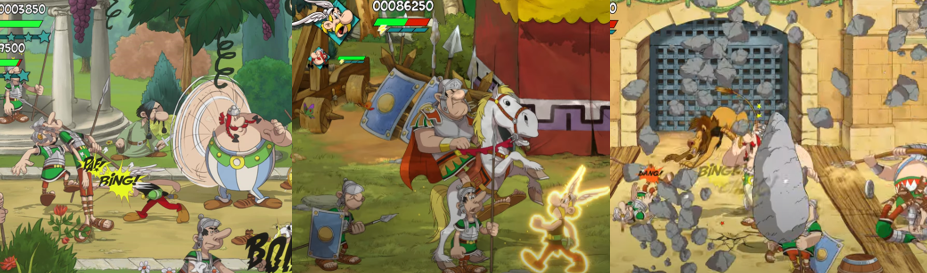
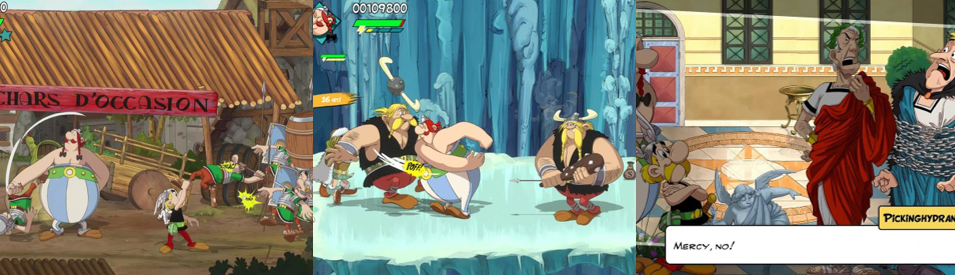
Like its predecessor, Asterix & Obelix: Slap Them All! 2 is a 2D, sidescrolling arcade-style beat-‘em-up. As before, players can either go it alone as either Asterix or Obelix or team with a friend to fight Romans across over fifteen stages. Sadly, no additional characters were added and Asterix and Obelix are almost unchanged from the previous game. You still jump with A and throw a quick, basic attack with X that can easily be mashed for simple combos. Tapping or holding Y throws your special attack, either a unique charged punch or charged uppercut. Obelix has a unique axehandle smash and slams into the ground with his butt when you press Y while jumping while Asterix spins about and stuns nearby enemies. You’ll see some distinction when using B, too, which sees you pick up sandals for points or food for health or grab enemies. Asterix can only grab smaller enemies and is limited to swinging them over his head or throwing them, while Obelix can also grab larger enemies, slap their faces, and pound them into the ground. Holding the Right Trigger blocks incoming attacks, double tapping left or right sees you dash, and you can now pick up and throw barrels with B. The “Slap” mechanic from the first game is gone and special attacks no longer consume energy. Instead, a new energy meter fills as you attack, and can expend it when it’s partially or completely full.

Aside from two new mediocre combat mechanics, gameplay is the same if not less than before.

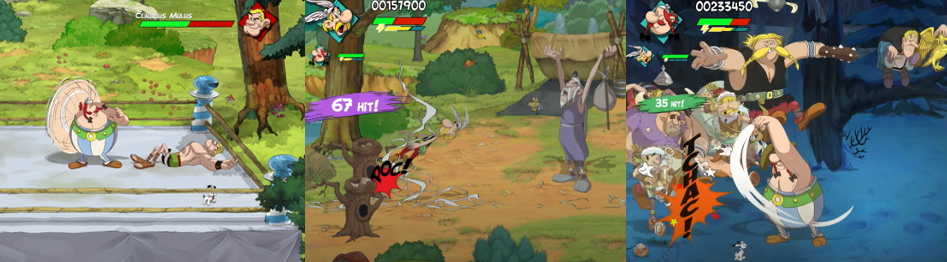
When it’s partially full, the Left Bumper engages “Fury” mode. In this state, your character is faster and stronger, and this mode last for as long as you have meter energy. When it’s full, the Right Bumper unleashes your “Ultimate” attack, which sees Asterix dash across the screen at high speed and Obelix cause menhirs to fall, taking out (or severely damaging) all enemies. When playing with a friend, you can revive them with B but, when playing alone, you switch character with the Left Trigger. If one is defeated, you can continue as the other but you’ll have to restart the stage if both are defeated as there are still no checkpoints. Therefore, I still recommend playing as one character until you’re forced to swap, smashing crates and tables to collect Sestertii for points and apples or roast boar for health. As before, there are no weapons to use and some gameplay mechanics are missing (there are no races or timed events this time). Instead, gameplay variety is limited to some branching paths, climbing ladders or cliffs, and some destructible elements, which is a bit of a shame. Sometimes, you’ll be asked to go to the left, which is unusual for a beat-‘em-up; other times, you’ll enter caves and avoid falling boulders and such. Otherwise, it’s the same tedious beat-‘em-up action as before. You can smash tables, spiked barriers, battle across logs and bridges, and smash down doors and rocks, and you’re again forced to constantly pummel large waves of enemies. There are three difficulty settings, with the number and aggression of enemies increasing on harder difficulties, but the points don’t do anything except display your “hiscore” for each stage and there are no collectibles or Easter Eggs beyond various cameos.

Presentation:  
Asterix & Obelix: Slap Them All! 2 retains the gorgeous, hand drawn style of the first game and is again five-star visual experience. Asterix and Obelix mirror their animated ventures and sport a range of animations, from bursting into the scene to celebrating at the end of a stage. They once again offer quips and observations, though they’re largely recycled from the first game; however, there is more voice acting and cutscenes to advance to admittedly weak story. Cutscenes use the in-game graphics and large portrait art, resembling a motion comic and sadly restricting certain actions like platforming and knocking over trees to create bridges to non-playable sequences. While the game’s music is still a letdown, comic book sound effects still punctuate the slapstick action and enemies showcase the same cartoonish animations. Backgrounds are filled with fun visuals, from the bustling Gaulish village and its recognisable characters to obscure cameos from the likes of Codfix. Wild boar, birds, and other animals scatter as you progress, Roman legions and weapons line the backgrounds, and you’ll see the pirates’ wrecked ship and Romans frozen in the frigid wastelands of the Norman region. Dogmatix also accompanies you on your journey, though purely as a cosmetic companion, and you’ll see the Romans’ dirty laundry drying, the streets clogged with carts, the markets of Lutetia bustling with life, and constantly avoid incoming chariots or Romans carrying large battering rams.

Though still a visual treat, the visual variety is lacking and much is recycled from the last game.

Sadly, the environments are largely indistinguishable from the first game. You begin, as always, in the Gauls’ village and spend a lot of time in the surrounding forest and woodlands, fighting through a nearby Roman camp and battling across cliffsides. A few stages are themed around the road to Lutetia, which is mostly cobblestone countryside and docks. The city itself is fun, but painfully restricted and recycles the arena stages from the last game, and I was again left disappointed by how mundane the game’s environments are when Asterix is known for his colourful, globe-trotting adventures. Sure, you’ll tear apart an inn full of reprobates, explore underground caverns, and marvel at the aurora borealis and frozen landscape when battling the Normans, but it’s disappointing that these games have less visual variety than Konami’s arcade title and don’t visit places like Egypt, Spain, or India. You do explore the ruins of the Mansions of the Gods, though this merely amounts to some Graeco-Roman architecture dotted about the environment. Gluteus Maximus returns, in a boxing ring no less, and you’ll battle Redbeard and his pirates on his wrecked ship. You also battle through the marble halls and treasure rooms of the Edifice, but I honestly struggled to tell the game’s environments apart from its predecessor’s. There are some drizzle, rain, snow, and day and night elements and I liked the skulls skewered on sticks in the Viking village, but the game plays things far too safe and appears more like downloadable content than an entirely original adventure.

Enemies and Bosses:
Sadly, this extends to the game’s repertoire of enemies as well, which are largely recycled from the first game. Sure, it appears like there’s more onscreen at once (helped by the many narrow areas) but it’s disappointing there wasn’t more variety. You encounter the same Romans as before, from disposable minions to fatter variants, slender spear tossers, and bigger, tougher ones who block your attacks. Some Romans hide in bushes and tree stumps, chucking poisonous potions to stun you; others carry battering rams or attack with swords; and they’ll even fight with other enemies when the game mixes up the enemy types. These include the usual assortments of pirates and brigands who race at you with their fists flailing, toss daggers, or wield nunchakus and axes. Larger, armoured gladiators also reappear, again armed with tridents and a speedy dash. Lions crop up in the arena and the hulking Normans naturally show up in their homeland. They’re joined by a smaller archer variant, there’s a smaller dual-bladed pirate variant, and Nubian fighters also show up, with some enemies sporting a wake-up attack that can be especially aggravating. The barbarian-like Belgians can be a real pain with their club swings and fast reflexes, horses will kick from stables, and it’s easy to be pummelled if you’re caught in a corner or trapped between large groups of enemies, which can be very frustrating.

Bosses are more disappointing than ever since most are simple gauntlets or returning enemies.

Unfortunately, Asterix & Obelix: Slap Them All! 2 still relies on throwing seemingly endless waves of enemies at you to close most stages. A recurring boss is the returning Centurian variant who charge on horseback and mule kick you before resorting to their swords. Gluteus Maximus challenges you to a rematch in a boxing ring, Redbeard battles you alongside Clovogarlix (the unscrupulous rogue who’s your main target for most of the story), and you also rematch Olaf Timandahaf. While you often battle multiple centurions, larger Romans, Normans, and hulking gladiators alongside these and other bosses, they seem much easier than before, folding like paper on “Easy” mode (though you must defeat all enemies, not just the boss, to win). You’ll encounter Prolix the Soothsayer a few times, with him first eluding you and then conjuring lightning bolts as you battle waves of enemies before he seemingly randomly falls. Similarly, the mysterious thief pops up now and then, evading you throughout the story and then collapsing after one hit and some giant Vikings attack in their village. Although this game doesn’t end with a mind-numbing gauntlet against its toughest enemies, you must still endure a coliseum bout in Lutetia and the final battle isn’t against the game’s main bad guy, Pickinghydrangus, but instead a swarm of enemies, making for an equally lacklustre finale.

Additional Features:
There are thirty-two Achievements in Asterix & Obelix: Slap Them All! 2, with a whopping eighteen awarded for clearing the entire game. You get two Achievements for performing each character’s Ultimate attack, one for entering Fury mode, one for picking up sandals, and one for clearing any stage without switching character. More Achievements are earned for performing every move for each character in a single stage, finishing one without eating food, and for collecting food with your health is full. Despite having three difficulty settings and a co-op mode, there are no Achievements tied to either of these and the game once again lacks any substantial extras. Beating the game unlocks a level select and that’s it; there’s no boss rush, no alternate costumes or skins, and no concept art. It’s as barebones as the first game, which is really disappointing considering there seems to be less in this one that in its predecessor!

The Summary:
When I saw the first trailer for Asterix & Obelix: Slap Them All! 2, I thought it looked incredibly similar to the first game. I could see the animations, enemies, and voice clips were recycled, to say nothing of the environments. Sadly, playing it reveals that this is very much the case. It’s not that it’s bad; like the last game, it’s a perfectly functional arcade-stye beat-‘em-up, but it’s just so barebones! Sure, a lot of the repetitive aspects have been toned down but mechanics like the racing sections and timed challenges have been removed and the bosses feel dumbed down, requiring little strategy beyond relentlessly attacking them and strategic use of the new Fury and Ultimate attacks. These were…okay, but hardly worth a full price game. It’s so weird as Justforkix features in the story, so why not make him a playable character or a skin for Asterix? Why not add menhirs to Obelix’s moveset, or temporary power-ups? Why not add mini games or new elements, like battling across boats on raging waters or through the skies on a magic carpet? Instead, it’s the same trees and forests and repetitive environments with little variation beyond blocking paths with oxen and carts. Asterix & Obelix: Slap Them All! 2 feels like a throwback to when the likes of Capcom would churn out game after game with little changes between them, only it’s worse because so much has been recycled. There is so much variety in the locations, characters, and enemies in the Asterix books and almost none of it is represented here, meaning the best Asterix beat-‘em-up experience is still an arcade game that’s nearly thirty years old and inaccessible beyond emulation! I was tempted to knock off a star since the game doesn’t expand on its predecessor in any meaningful way but, in the end, it’s the same fun but limited experience and that’s sadly all I can say about this otherwise visually impressive title.

My Rating:

Rating: 3 out of 5.

Pretty Good

Have you played Asterix & Obelix: Slap Them All! 2? If so, how do you think it measures up against its predecessor? Did you enjoy the new attack options? Were you disappointed to see so many elements recycled from the last game? What is your favourite Asterix videogame, story, or adaptation? Whatever your thoughts on Asterix & Obelix: Slap Them All! 2, or Asterix in general, feel free to leave a comment below and check out my other Asterix content across the site.
Game Corner: Doom (2016; Xbox Series X)

Released: 4 August 2020 
Originally Released: 13 May 2016
Developer: id Software 
Also Available For: Nintendo Switch, PlayStation 4, PlayStation 5, Stadia, Xbox, Xbox One, Xbox Series S

The Background:
First-person shooters (FPS) existed before Doom (ibid, 1993), but that celebrated title popularised the genre with its online “Deathmatches” and multiple ports. Although sparking much controversy, Doom was incredibly successful and this translated into a bigger, equally successful Doom II (ibid, 1994). It then took ten years for id Software to release Doom 3 (ibid, 2004), a more story-focused title that was celebrated for its claustrophobic atmosphere and gory combat. Following this, id Software tried to launch a new FPS series with Rage (2011) and outsource a fourth Doom as they had with their Wolfenstein franchise (Various, 1981 to 2019), a difficult proposition that Bethesda Softworks revised after purchasing id Software. Originally set on Earth as a spin on Doom II, Doom 4 struggled to build momentum and was eventually retooled into a series reboot. Now simply titled Doom, the game sought to emphasise fast-paced combat rather than story, taking inspiration from the bloody action/horror movies of the 1980s and rewarding bloodthirsty players. Lauded as one of the best games of 2016, Doom received top scores from critics, who praised the gory visuals, heavy metal soundtrack, and action-orientated gameplay. Doom was further bolstered by three packs of downloadable content (DLC) that added extra content to the uncharacteristically divisive multiplayer mode, all of which was later bundled alongside the first three games in one handy collection. Having successfully revitalised the franchise, Doom was followed by an even bigger, widely praised sequel in 2020 and a fantasy-orientated prequel in 2025.

The Plot:
In the far future, crippled Union Aerospace Corporation (UAC) researcher Olivia Pierce opens a portal to Hell to enslave humanity, prompting UAC cyborg scientist Doctor Samuel Hayden to awaken the legendary Doom Slayer to combat the invading demons.

Gameplay and Power-Ups:
Unsurprisingly, Doom is a first-person shooter in which you assume the role of the legendary Doom Slayer, a mute, violent warrior greatly feared by the demons of Hell. Before beginning Doom, you may wish to tweak the game’s settings. Alongside the standard difficulty modes, you can change the heads-up display, crosshair, compass and objective display, and even the position of your weapons. Naturally, the game’s controls are equally adjustable, but the default settings are perfectly fine. You jump with A (eventually upgrading to a double jump), crouch with B, and switch to the chainsaw or Big Fucking Gun/BFG with X and Y, respectively, once you acquire them. Pressing the left stick activates photo mode to share your bloody accomplishments, while pressing the right stick interacts with consoles, switches, map stations, etc. The Right Bumper switches your weapon; holding it opens the weapon wheel and you can toggle whether you want to automatically switch to new weapons. The Right Trigger fires (no need to worry about reloading here and there’s even aim assist), the Left Bumper uses items (typically a grenade), and the Left Trigger activates your weapon’s currently equipped modification to deal additional damage. You need Medikits of different sizes and special stations to replenish health and armour pick-ups to reduce the damage you take.

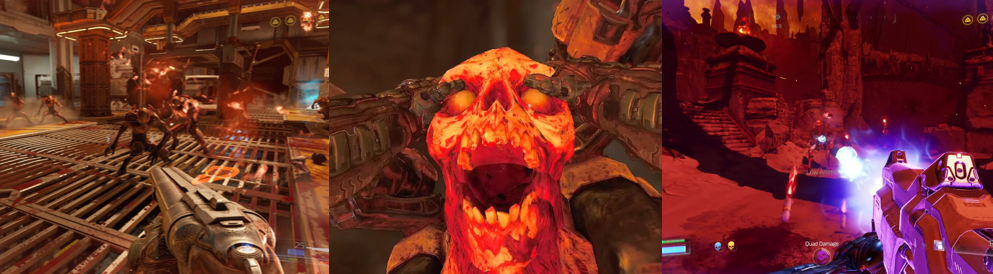
Blast, tear, and slaughter your way through hordes of demons.

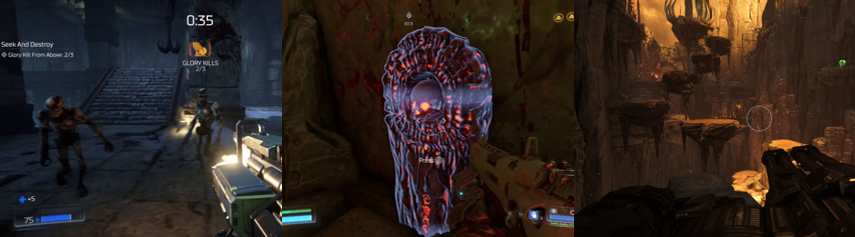
Health and ammo are further replenished by slaughtering demons with the chainsaw (though fuel is limited) and performing “Glory Kills”. Shooting enemies eventually stuns them, which is your prompt to press the right stick and tear them to shreds with your bare hands. Similarly, you occasionally find more traditional power-ups (Berserk, Haste, Invincibility, Quad Damage, etc) to temporarily empower you. The Doom Slayer begins with a simple pistol that boasts unlimited ammo and a charged shot modifier. You soon grab a shotgun (which can be modified with either a charged or explosive shot), the heavy assault rifle (which can be modified into a sniper rifle or to fire cluster missiles), a plasma cannon (which can emit a stun or heat blast), and my personal favourite, the Super Shotgun (which fires two shots at once). You’ll also grab a massive chaingun (which can become a sentry turret), the Gauss Cannon (a heavy-duty laser cannon that I struggled to aim), and the ever-reliable rocket launcher (which can fire homing missiles). You can toss frag grenades, siphon grenades (which replenish your health at the cost of your target’s), and distract enemies with a hologram. Enemies also attack each other, especially in Hell, and you can shoot explosive barrels to thin out their numbers. Of course, the most powerful weapon is the BFG, acquired quite late in the game, which obliterates all nearby enemies. Weapon modifications are purchased from field drones and applied using Upgrade Points earned from completing various Mission Challenges (such as finding secrets or killing certain enemies in certain ways). To master a weapon, you must perform specific kills on certain enemies (such as 50 headshots with the sniper function). Furthermore, you occasionally find dead UAC soldiers who yield Praetor Tokens that upgrade your suit to increase your resistance to environmental damage, better spot secrets, and reduce weapon charge time, amongst other buffs.

Conquer Rune Trails, activate switches, and complete tricky platforming sections.

You also find UAC crates containing Argent Cells that increase your maximum health, armour, and ammo. Various datapads contain lore about each area, weapon, and monster, and you download map data to locate secrets, such as Doom Slayer figurines. Eventually, the game introduces hidden Rune Trails that warp you to Hell and challenge you to defeat enemies or destroy barrels or other timed tasks. Completing these earns your demonic Runes; you can eventually equip and upgrade up to three of these, which offer buffs like increasing your pick-up rate, performing faster Glory Kills, and negating ammo cost when you’re at full armour. These are worth seeking out and, like each mission, can be replayed from the main menu (which also carries over your upgrades and weapons). You’ll often venture onto the rocky wastelands of Mars, but you thankfully won’t have to worry about zero gravity sections or maintaining your oxygen supply. To counteract this, you must frequently destroy demon nests to spawn increasingly difficult demons fought under lockdown. As in the classic games, you search for coloured keys and skulls and activate switches, though thankfully I never had trouble navigating even the more confusing areas. Mostly, you must simply kill everything in your way, but you’re often forced to perform some awkward platforming (without fall damage, but at risk of bottomless pits) and clambering ledges to higher areas. You must avoid being cut to ribbons by the BFG’s laser grid system, a puzzle that took me way too long to figure out (get to safety and shoot the power nodes on the energy ring…and don’t fall!) Otherwise, you’ll activate portals, overload power cores, lay demonic souls to rest, and destroy specific targets to progress. Occasionally, you use the right stick to muscle open doors or grates and be forced to battle increasingly difficult waves of seemingly never-ending demons without a checkpoint, which can get tiresome.

Presentation:
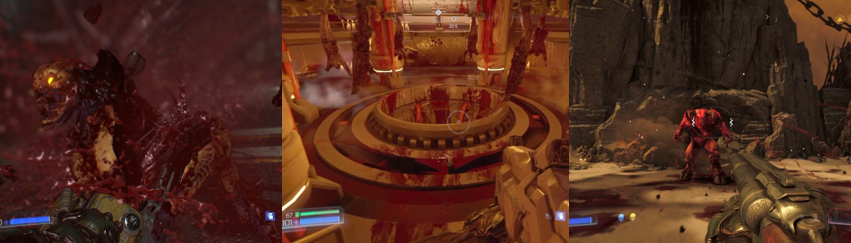
Doom wisely drops the obsession with flashlights and nigh-impenetrable darkness that dogged the third game. Every area is nicely lit and makes effective use of shadows, steam, flickering lights, and darkness to create a foreboding atmosphere. Even when you enter slick, clean, futuristic facilities, it’s not long before you see dismembered corpses, blood tails, or gripping gore plastered everywhere. These, alongside pentagrams, altars with still-beating hearts on, skewered bodies, screaming skeletons, and a bloodbath of carnage, make Doom a gore-fest for the eyes. The Doom Slayer is entirely mute and never seen in full; windows are conveniently smashed and you barely catch a glimpse of his visage, which is great as I’d much rather have a silent killer than a generic Jarhead. He’s aided by the cybernetic Dr. Hayden, who gives directions and exposition over the comms, though the Doom Slayer rarely listens to his advice. Demonic whispering and screaming add to the creep factor, while rocking music kicks in whenever demons appear. Unfortunately, while Doom runs incredibly smoothly, with short load times and highly detailed, gory environments, textures sometimes take a second to render properly, which surprised me for such a top-tier title. Still, the over-the-top gore makes up for it. Even the Doom Slayer’s death scenes see his entrails or limbs blowing off, and you’ll see demons get blown to bloody chunks with each shot, which makes the combat very satisfying.

Gore is everywhere but the game’s gothic, cosmic horror excels in the underworld.

The game’s story is as simple as the original games, but also amusingly convoluted thanks to Dr. Hayden’s constant exposition, Dr. Pierce’s manic desire to unleash Hell, and even the moments where you learn the lore of Hell. These are easily ignored in favour of the action, however, and I enjoyed the attention to detail in each area. The developers clearly drew inspiration from sci-fi/horror classics when putting the UAC facilities together, and their Mars outpost features all kinds of laboratories, offices, a monorail system, and more. Sometimes, you’ll rip limbs and even torsos off bodies to access high-level areas; you’ll activate turbines, overload the reactor core in the frigid cooling room, encounter Nests in storage facilities, and traverse large vertical shafts, hopping to gantries and walkways as you desperately try to curb the demonic infestation. While many UAC areas are still brightly lit, others are in utter disarray. Darkness and jump scares (like steam vents, pop-up holograms, and flickering consoles) make it more terrifying when enemies suddenly appear from behind walls or portals. Things take a turn towards the industrial as you venture to the less refined areas of the Mars base, encountering pistons, chasms, and more rundown areas. You’ll often be transported to Hell, like Doom 3. Hell is a desolate, warped environment made up of rocky structures, floating boulders, chains, medieval dungeons, and depraved scenes of torture and agony. With a tumult in the flaming clouds and demons lurking around every corner, Hell is where Doom really shines, especially with its gigantic skeletal remains, looming stone statues, and ominous demonic structures imbedded with depictions of Hell’s finest, like the Icon of Sin. Acid pits, tricky platforming, and torture chambers are the order of the day, with demons fighting and constantly swarming each area to keep you on your toes.

Enemies and Bosses:
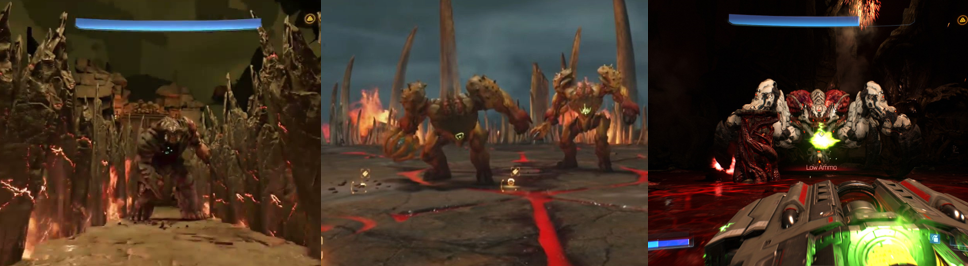
As near as I can tell, all the classic Doom enemies are back and looking better than ever. Common enemies include the zombie-like Possessed, who shamble about and swipe at you, and their more demonic counterparts, the Unwilling, who are functionally the same cannon fodder. The Possessed can be soldiers and security forces wielding bio-organic hand cannons, the security variants hide behind energy shields, some are missing arms, and others have explosives strapped to them that you can use to take out multiple enemies. Imps scurry up walls and ceilings, tossing fireballs while their armoured cousins, the Hell Razer, fires concentrated energy beams. The ever-annoying Lost Souls fly at you in a shrieking kamikaze attack and are as frustrating as the bulbous Cacodemons, which float about spitting energy blasts and biting you and, for some reason, I found far more difficult to deal with in this game. You’ll also encounter the equally frustrating Summoner, a regal and effeminate demon that teleports about, fires energy waves, and must be prioritised to keep it from spawning more demons. The screaming, skeletal Revenants are also back, still packing missile launchers on their back and now leaping and flying about using a jet pack. Pinkies (and their invisible counterparts, the Spectres) are also back and equally aggravating, charging at you from behind and taking a lot of shots to be put down. These enemies are bolstered by some bigger, tougher demons who are initially introduced as mini bosses, of sorts, but quickly become regular enemies. The most common are the Hell Knights, large, brutish demons who leap in with a slam and run at you like a rhino.

Gigantic demons and near-endless swarms represent a significant difficulty spike.

Hell Knights are often joined by a Mancubus or two and their cybernetic variants; these rotund ghouls pack arm cannons that spew flames, push you back with an energy wave, or fire toxic blasts. And then there’s the Baron of Hell, a massive, horned, goat-legged monster who tosses green energy balls and stomps about. These larger enemies will have you switching to the BFG or employing a fully fuelled chainsaw, or madly spitting rockets, and make each encounter a fight for survival. It’s a good thing you’re constantly tearing through these hordes as Doom only has three boss battles. These all occur in Hell and feature big, stubborn health bars. The Cyberdemon is initially fought in the Lazarus Labs and then finished off in Hell. This gigantic demon pelts you with rockets, charges a big laser cannon, and throws energy waves that must be ducked or jumped over. It also traps you in stone walls and, like all bosses, can be stunned with the BFG and will drop resources to aid you. The Hell Guards guard the Crucible and are invulnerable within their shields, attack with a staff, erratically spin and throw fireballs, or swing a massive hammer for a gruelling two-stage fight. The damnable Spider Mastermind slashes with its metallic claws, fires a chain gun, sweeps the area with laser, erects pillars, electrifies the floor, and psychokinetically tosses boulders. Its skull-like face is its weak point, and you’ll want to stun it with the BFG and blast it up close with the Super Shotgun, keeping your distance otherwise and hoping you get lucky with its frequent and damaging attacks.

Additional Features:
Doom yields fifty-four Achievements, with six awarded simply for playing the main campaign. You can easily snag a few more by performing 200 Glory Kills, killing fifty enemies with a chainsaw, 100 more with explosive barrels, and by upgrading any of the Praetor suit categories. You’ll get additional Achievements for finding and upgrading all Runes, completing all Mission Challenges, and mastering first one and then all weapons. You can play on harder difficulties and take on the game’s more casual ‘Arcade’ mode, earning medals and Achievements for your performance, and even create and publish your own levels using the ‘SnapMap’ option (though you need an Xbox Live subscription to do this). Similarly, there is no couch co-op or multiplayer here; you need to get online to play the various deathmatches. This version includes all the DLC, allowing you to play as demons (including the new Harvester variant) and use different weapons in this mode. I couldn’t play it so I can’t speak to it, but I imagine the multiplayer offers the standard free-for-all, king of the hill, and team-based slaughter popularised by the original Doom. Finally, every stage contains a hidden room modelled after the classic Doom, old-school graphics and all, which are fun Easter Eggs even if there are no Achievements tied to these beyond finding every secret in the game.

The Summary:
After being disappointed by Doom 3, I was hesitant to get into Doom, despite hearing nothing but praise for it and its sequel. However, I was wrong to hesitate as this is a phenomenal first-person shooter that perfectly marries old-school sensibilities (an action-orientated focus) with modern gameplay mechanics. I was so relieved to find I could see what was going on, that I wasn’t wandering a pitch-black maze, and that the focus on searching for keys and alternate paths was put to the side. The focus on gory action was very satisfying; it’s fun ripping demons apart with your bare hands, shredding them with a chainsaw, and blowing them to bloody chunks with the Super Shotgun. However, it’s true that I did find the mindless combat tiresome at times. When you’re forced to fight waves of increasingly difficult demons with no checkpoints between them, it can become aggravating. However, the satisfaction of getting better skilled at dispatching these enemies and using nearby power-ups or the benefits of the chainsaw and BFG can’t be understated. I loved the gore-infested environments; it truly seemed like these idiot scientists had unleashed the furies of Hell and had their entrails painting across the walls for their efforts. The demons were monstrous and many, sporting little quirks like fleeing from you or fighting each other, and I enjoyed that you were constantly earning upgrades or motivated to master your weapon’s abilities. While the Doom title might seem derivative, it’s incredibly fitting as Doom really felt like a modern reimagining of the original games. Retaining that arcade-style accessibility with the constant euphoria of bloody combat made me happy to push on past the more troublesome sections and made this a bloody good time that I’d be happy to revisit to mop up the remaining Achievements.

My Rating:

Rating: 5 out of 5.

Fantastic

Were you a fan of Doom? Did you enjoy its modern reimagining of the original game’s simplicity? Which weapon was your favourite, and did you ever master them all? What did you think to the outrageous gore and the Glory Kills? Did you also struggle against the demon hoards and the Spider Mastermind? Did you ever play the multiplayer and, if so, how does it hold up? Whatever your thoughts on Doom, or FPS games in general, drop a comment below and go check out my other Doom reviews.

Game Corner: Klonoa 2: Lunatea’s Veil (Xbox Series X)

Released: 7 July 2022
Originally Released: 22 March 2001
Developer: Monkey Craft
Original Developer: Namco
Also Available For: PlayStation 2 (Original Release); Nintendo Switch, Nintendo Switch 2, PC, PlayStation 4, PlayStation 5, Xbox One, Xbox Series S (Phantasy Reverie Series)

The Background:
After Sonic the Hedgehog (Sonic Team, 1991) put anthropomorphic mascots on the map with its incredible success, bizarre characters like Sparkster, Earthworm Jim, and even a sentient period paved the way for later 3D platforming icons. When it came time for Namco Bandai to toss their hat into the market, videogame director Hideo Yoshizawa originally envisioned a ceramic fighting robot named Amenti before Yoshihiko Arai pitched the strange, rabbit-like Klonoa to appeal to kids and adults. Klonoa: Door to Phantomile (Namco, 1997) impressed critics with its simple controls and cute visuals, and development of a sequel began soon after. Initially planned for the PlayStation, Klonoa 2 transitioned to the more powerful PlayStation 2 in order to expand the 3D space and give players more control and freedom. Klonoa’s design was tweaked to make him easier to animate and more mature, which was reflected in the more emotionally nuanced story. Like its predecessor, Klonoa 2 was met with universal praise for its addictive gameplay, impressive visuals, and near-perfect controls. However, Klonoa 2 was also criticised for its short length and, despite largely positive reviews, its sales were lacking and a planned Wii remake was allegedly cancelled. After decades of being stuck as an expensive PlayStation 2 exclusive, Klonoa 2 was finally re-released and remastered in this well received, modern overhaul for new generations.

The Plot:
When Klonoa is fished from the waters of Lunatea by Lolo, a priestess-in-training, and her friend, Popka, he joins them to stop sky pirates from spreading hopelessness.

Gameplay and Power-Ups:
Surprisingly, given most 2D and 2.5D franchises made the jump to 3D back in the day, Klonoa 2: Lunatea’s Veil is a 2.5D action platformer that looks and plays exactly like its predecessor. I was fully expecting that Klonoa would’ve transitioned to something more akin to the Spyro videogames (Various, 1998 to 2018) as even Earthworm Jim got a clunky, third-person 3D adventure back in the day. Instead, Klonoa 2 sticks to its roots so closely that it barely changes anything from the first game, though some of this may be because this version of the game is based upon the game engine of the short-lived Wii revival. This means that players once again travel through various colourful stages (known as “Visions”), though they’re much larger and each area has anywhere from two to seemingly five levels. Klonoa 2 still allows a second player to jump in and give Klonoa a boost with Y and the controls remain unchanged from before. By default, you’ll jump with A or Y, holding the button to flutter Klonoa’s ears to help cross gaps, and pressing B or X to fire “Wind Bullets” from his magical ring. You again use these to grab nearby enemies and throw them at other baddies, to the background or foreground to activate switches or smash Nagapoko Eggs for goodies, or to activate switches. When an enemy is in your grasp, pressing the jump button twice launches them beneath you to destroy whatever’s under you and boost you higher, and I was happy to see that there are far less sections where you must desperately string double jumps together to hit switches in a certain order. Enemies usually always respawn to give you plenty of “ammo”, though no new features have been added to Klonoa’s arsenal beyond you now pressing the Left or Right Bumper to pull off a taunt or a useless twirl. You can disable the onscreen timer and tutorials from the game’s settings and (to start with) pick between “Easy” (which grants infinite lives and more health) and “Normal” (which limits your lives and reduces your maximum health) difficulties. While bottomless pits and flaming hazards still spell instant death for Klonoa, you can partially or fully restore his health with Small or Large Hearts, hit Memory Clocks to activate checkpoints, collect one of the many 1 Up Coins for extra lives, or earn even more for every 100 Dream Stone collected.

While Klonoa 2 adds some new gimmicks, the original’s core gameplay remains unchanged.

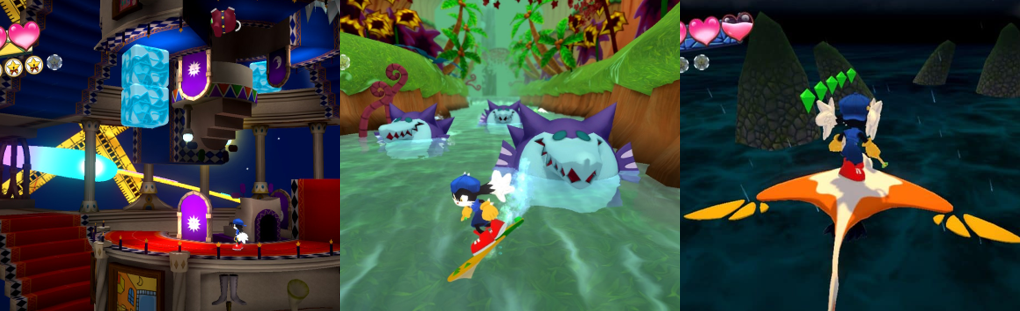
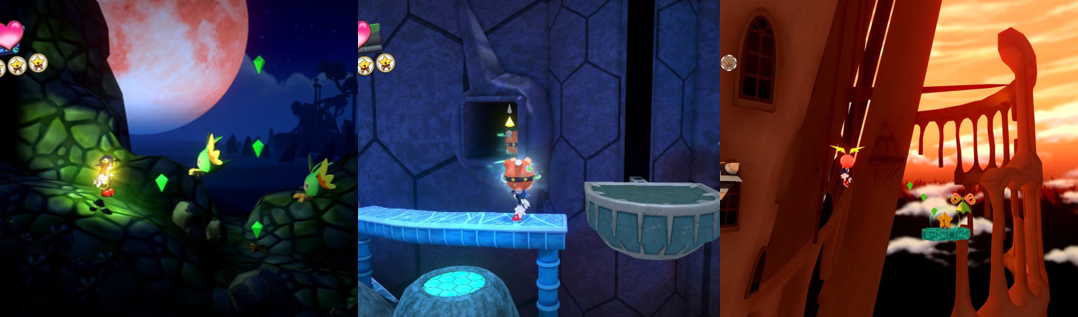
Mirror Spirits still appear to temporarily double the value of Dream Stones, Klonoa will often need keys to open doors in Visions (usually backtracking to use them and then activate something to progress further), and he can now collect six stars in each Vision rather than rescuing Phantomiles. Though they function the same (held within bubbles in Visions), these earn you “Mommett Dolls” to deliver to the Mommett House to unlock extra game modes. Though you’re more likely to hit switches to open paths, timed switches still appear, as do disappearing platforms, which get smaller and more precarious as the game progresses. Gondolas and moving platforms also appear, as do springs to rocket you high into the air, and you’ll also hit switches to spawn (or despawn) blocks. You’re more likely to be working out how to toss Boomies at just the right time so they explode to activate these switches from afar, or nabbing Likuries to absorb enemies and change their colour to then break matching coloured crystals. These can be surprisingly taxing puzzles as you must work out how to clamber to higher ground before the Likurie returns to you, requiring you to snag coloured bulbs to get higher (or carry you across endless pits). You’ll also be tossing enemies to gigantic Ow-Gows so they’re distracted from eating you, grabbing Erbils to rocket higher and smash through crates above you, tapping A while holding a Kiton to fly around for a short time, or blasting away using a Jetimo. Klonoa also gains a gnarly hoverboard that he uses to surf over water, sand, and surfaces alike. These effectively replace the water slide sections from the first game and appear quite often, either from a 2.5D or 3D perspective, and see you hopping gaps, making tight, precise movements to stay on narrow or crumbling paths, and using your double jump to reach higher ground. Twice you’ll cut through the sky on either a bird or a plane, tossing enemies to break obstacles in your way. You must often press B to ring magical bells to progress the story, and you’ll be constantly backtracking to Baguji’s Island from the larger world map to get more information and unlock new areas.

I would’ve liked to see the new mechanics expanded further to move the series forward.

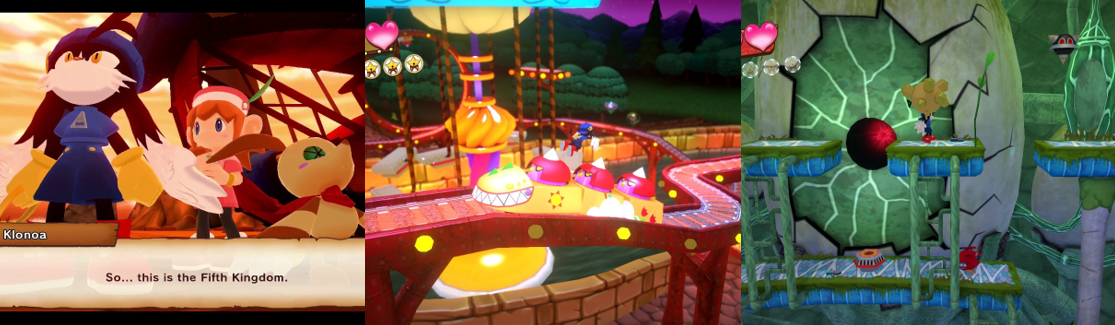
While Klonoa 2’s worlds are noticeably bigger than before, the basic gameplay loop remains unchanged, and a lot of the same gimmicks return. You’ll be clearing gaps, using swinging, moving, and stationary platforms, activating lifts, and battling against conveyer belts in your quest. Klonoa 2’s “big” new gimmick are the many cannons dotted all over, which blast you across stages, up higher, or to and from the foreground. Often, you must toss enemies or Boomies to the background and then quickly rocket over to use them to blow up rocks to snag keys; othertimes, they simply lead to alternate paths and goodies. However, there are some new mechanics at work here, mainly in Mira-Mira’s “Maze of Memories” which includes twisted geometry, a maze of doors, and a feature when you rotate the screen to make the floor the ceiling. When in the endgame, you’ll revisit previous areas, now made more dangerous, and must stick close to Goddess statues to avoid choking to death on poisonous gas, toss Boomies into three engines and flee to safety before they explode, and get carried across a disturbing void. While it seems daunting dodging Spikers, flame bursts, and hopping to platforms or other handholds, you can just cling to whatever’s carrying you and take a hit without being knocked off, which makes it much easier. La-Lakoosha features a pendulum you must toss enemies at the destroy pillars to progress, the Mobile Tank Biskarsh chases you with a laser through the war-ravaged streets of Volk City, giant enemies also chase you in Mira-Mira, and players must grab Flolo to light up dark areas when traversing the nightmarish Dark Sea of Tears. Often, big springs blast you high up and you must direct Klonoa to land on other springs or platforms to progress, enemies sometimes chase you towards or away from the camera to add a little spice, spike pits threaten to end your run, and the funfair-like Joliant has you dodging rollercoasters, tossing enemies at a Nagapoko Egg shooting range, and smacking a pirate ship so it swings you to higher ground.

Presentation:
As mentioned, I was surprised to find Klonoa 2 barely deviates from the last game, recycling many of the same enemies and hazards and retaining the rigid 2.5D presentation. It does open out a little bit, though, offering more third-person sections through its hoverboard gimmick but, for the most part, everything looks, feels, and sounds as good as it did before. While much of the game’s colourful aesthetic still recalls NiGHTS into Dreams (Sonic Team, 1996), Klonoa 2 features a fantasy land being invaded by nightmares and doubts rather than taking place in a dream world. Though nothing’s changed about his abilities, Klonoa has had a bit of a visual downgrade, now wearing a hoodie rather than his cool buckle outfit and strangely having taunts mapped to the shoulder buttons. He’s still a fun character, though, and seems a touch more mature this time around, and still speaks in  gibberish and sound bites. Dialogue is thus related through speech bubbles and there are a few more happening here as Klonoa chases down the mischievous Tat, offers council to Lolo, and gets the lowdown on besmirched sky pirate Leorina from Baguji. Klonoa and his enemies still have large hit boxes that can make platforming tricky, but this time I noticed some odd distortion in the music at times, as though the hardware were struggling to keep the game running. Lunatea is a pretty varied world whose map opens up as you progress the story and has you backtracking to Baguji and even in some Visions to move things along. While Klonoa 2 only recalls the bizarre visuals of the first game at the end, each area has a lot to see in the backgrounds and many of them are mismatched and remixed for the endgame, where the King of Sorrow throws the land into chaos and makes previously simplistic areas more taxing with tougher enemies, trickier puzzles, and so many pits.

Things are as colourful and bizarre as the first game, though the tone is a touch darker at times.

Players begin in the Sea of Tears, a stormy, rainswept port where lightning flashes and waves crash against the rocks in the background. This area leads you through an ethereal coral cave and features a large priestess statue near the end. This brings you to La-Lakoosha, a town situated near a large waterfall where wind currents carry you between platforms, and Klonoa explores a mushroom cave and travels a spiral path to the Claire Moa Temple. While Joliant impresses with its carnival lights, sounds, rides, and fireworks, it’s also home to a funky haunted house that includes a haunted library, scary trees, a graveyard, and a spook working a giant cauldron. You’ll also board through a jungle-themed water slide stage and then drop into the rancid sewers beneath Volk City, which is on fire and under heavy bombardment that sees buildings crumble and flaming debris litter the streets. After avoiding insta kill sewage and molten metal in the city’s distinctly steampunk underground factory, you must activate and explore the ancient Ishras Ark. The vessel sits near towering mountains whose windmills and gears must be activated and their frigid peaks boarding past (and into) a gigantic dragon’s skeleton and down past a snowy village. All these areas are remixed by the King of Sorrow, often having you work backwards through previous areas or go from the left to the right, encountering more Ow-Gows and puzzles involving Boomies and Likuries. These more nightmarish, topsy-turvy levels can be daunting with their desolate, patchwork backgrounds and ominous music, and things only get more troublesome with how many pits, temporary platforms, and changes have been made. Previously stationary platforms will now swing, more insta-kill fire appears, tranquil caves will be full of toxic gas, and the very sea will have dried up, revealing only sand, floating islands, and an exposed coral palace whose statues try to crush you. Things get very surreal when you battle the corrupted Leorina and the maniacal King of Sorrow, with cosmic voids and swirling vortexes replacing the previously whimsical and cartoonish backgrounds, and the game again ends on an emotional note as Lolo learns to overcome her doubts thanks to Klonoa’s support.

Enemies and Bosses:
As far as I could see, almost every enemy encountered in the first game returns in Klonoa 2, completely unchanged in every way. Klonoa must grab and toss these constantly respawning enemies to defeat others or activate switches, or to reach higher ground, with all but the large ones and those wearing helmets dying in one hit. The various coloured Moos are still your most persistent enemy, with Red Moos patrolling back and forth, bird-like Green Moves hovering overhead, and Black, Gold, and Silver Moos hiding behind shields and/or carrying spears. Moos also jump on snowboards to chase you, Zippoes still run full tilt at you, some enemies toss spiked balls from the background and floating Spikers are a constant headache before you, and Slazzas still toss boomerangs (though appear far less frequently). Glibz return, still armed with twin cannons, Spindles must still be defeated by double jumping over them, and Boomies have a much expanded role as you toss them at switches or into engines. There are some new enemies here too, such as hornets that attack with their stingers, shark-like Digons who dive from the background, and Ow-Gows, who must be fed to keep them from munching on Klonoa. Just as Leorina acts as a dark opposite of Klonoa, wielding a makeshift magical ring, so too does her companion, Tat, act as a counterpart to Popka. You’ll chase Tat through Joliant’s fun park, tagging her either on foot or while boarding along, and even fight her in two mini boss battles. The first sees her (in a spooky disguise) rolling cannonballs along the floor in Joliant’s haunted house, where you must propeller fly up to pop the balloons. In the second, giant mechanical Tat’s pop from pipes in Volk City’s underground factory, again rolling cannonballs. This time, you must grab Moos and toss them at her constructs as they spiral around, kind of like a game of Whac-A-Mole. There are also six bosses to fight, each with two phases and two health bars, though this time the game at least mixes things up and sometimes has you boarding along instead of just running on a circular or stationary platform.

Bosses now have two phases each and are much bigger and require a little more strategy.

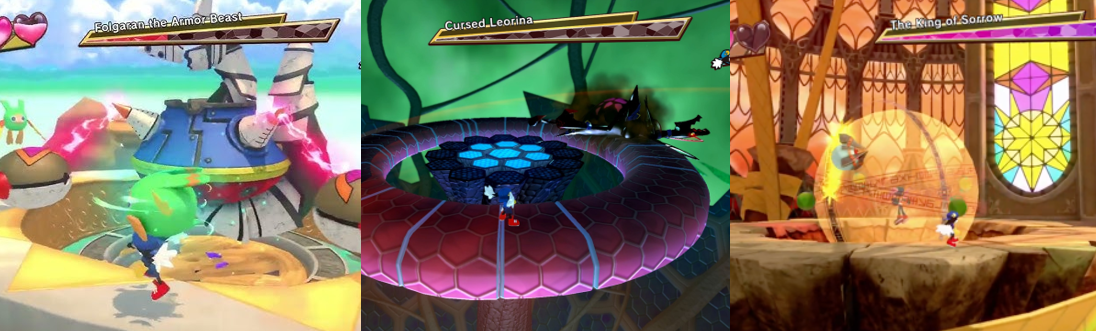
The “Armored Beast” Folgaran spins in the centre of a circular path, exposing its weak spot (its butt) as it rotates but spinning faster and extending its claw-like arms as the fight progresses. While this is extremely easy, Leptio can be trickier as you must throw Moos at him while avoiding his duplicates, hit him as he rolls around the ring, and knock over his drill-like enclosure, dodging his flailing robotic limbs. As he rolls in this mech, you must time a throw from across the stage to put him down. The Mobile Tank Biskarsh can also be difficult as you must grab a Green Moo and spring high up, dropping your projectile into the vent on the tank’s roof and avoiding its leap. It then jumps further and faster and drives at you from the background, meaning it can be difficult timing your shots. Polonte is fought as you snowboard down a mountain. You must jump over spike balls and ice formations, passing through gates to speed up and ram him. In the second phase, these are far harder to avoid and you must snag and toss snowboarding Moos (best done while jumping). When you finally face off with Leorina, she transforms into an insectile beast and stomps around a stage, only being vulnerable when you Erbils-jump into her underbelly. When she hides beneath the platform and you must blast away her orb and smash an enemy into the ground to damage her, finally finishing her off with another Erbils-jump as she charges her big attack. Finally, there’s the King of Sorrow, a much easier final fight than Nahatomb’s. First, you board through a swirling vortex, passing between spiked trails and tossing Nemo Moos at him. Though he’s a difficult target and bops you with his staff up close, he’s pretty easy to beat in this phase. In the second, he hides behind an energy shield, blasting flames and trying to hit you with the mechanical tips of his tentacles. You must snag these and toss them at the orbs on his shield a few times, easily ending his threat after a couple of rotations.

Additional Features:
This version of Klonoa 2 has ten Achievements up for grabs, with players earning one each time they defeat a boss and gaining an additional one if they get every Achievement in both games. You get another Achievement for finding all the Mommett Dolls, which also unlocks a couple of additional Visions to play. If you find all 150 Dream Stones in every Vision, you’ll also unlock a Picture Viewer at the Mommett House, where you can battle the bosses again (though you can also do this by revisiting the boss Visions). Completing the game on either difficulty unlocks “Hard” mode and the movie viewer, and this version also offers an awful pixel filter if you feel like making the game look like an early PlayStation title.

The Summary:
I was slightly hesitant about Klonoa 2: Lunatea’s Veil as I was sure that it would’ve evolved the original game’s fun, if simplistic, 2.5D gameplay into something more akin to a 3D collectathon. Instead, the game is almost indistinguishable from the first, with no additional power-ups or abilities for its funky (but adorable) title character beyond a snowboard. This isn’t a bad thing as the game’s still fun to look at and play, it’s just surprising that the developers didn’t expand upon or change the formula for the jump to the PlayStation 2. I was glad to see that the janky double and triple jump sections were largely gone and I did enjoy the hoverboard sections, though the game still didn’t do as much as it could with its main throwing gimmick. I liked the expanded role given to Boomies and how the Likurie puzzles make you rethink your actions, though the reliance on cannons took a lot of control away from me and constantly returning to Baguji got annoying. Still, I liked that the Visions were much bigger, the bosses had more phases and strategy to them, and that the game was as colourful and quirky as before. I can’t say there’s anything in Klonoa 2 to make it any better or worse than the original as the differences are extremely minor. I ultimately had just as much fun with it as I did the first game, so it’s only fair to give it the same score, but it might’ve scored higher had those nightmarish remixes been giving more prominence and if the developers had expanded Klonoa’s abilities a bit more.

My Rating:

Rating: 3 out of 5.

Pretty Good

Did you enjoy Klonoa 2: Lunatea’s Veil? What did you think to the changes made for the Phantasy Reverie Series version? Were you surprised to see the game virtually unchanged from the first entry? What did you think to the boarding sections and new puzzles? Do you agree that Klonoa’s design isn’t as strong this time around? Did you find the bosses too easy, despite their additional phases? Which Klonoa game is your favourite and do you think the franchise needs a new entry? Tell me your thoughts on Klonoa in the comments and go support me on Ko-Fi for more reviews like this.

Game Corner: Klonoa: Door to Phantomile (Xbox Series X)

Released: 7 July 2022
Originally Released: 11 December 1997
Developer: Monkey Craft
Original Developer: Namco
Also Available For: PlayStation (Original Release); Nintendo Switch, Nintendo Switch 2, PC, PlayStation 4, PlayStation 5, Xbox One, Xbox Series S (Phantasy Reverie Series)

The Background:
The massive success of Sonic the Hedgehog (Sonic Team, 1991) helped make anthropomorphic mascots hugely popular in the videogame industry, resulting in memorable characters like a gun-toting jackrabbit, an acrobatic bat, a superpowered earthworm, an intergalactic adventurer, a sword singing possum with a rocket pack, and a bear-and-bird duo. Interestingly, however, director Hideo Yoshizawa originally envisioned Klonoa as a ceramic fighting robot named Amenti before Yoshihiko Arai designed the strange, rabbit-like creature who would lead the game. Yoshizawa sought to make Klonoa an action game that was appealing to kids and adults, while lead designer Tsuyoshi Kobayashi refined the fast-paced gameplay to be limited to two buttons. First revealed at the 1997 E3 trade fair as Namco’s first bid to create a marketable 3D mascot, Klonoa was widely praised for its simple controls, colourful environments, and cutesy visuals, though some criticised its short length and lack of innovation. Although Klonoa spawned a few sequels, the original game’s price skyrocketed and the series lay dormant for nearly fifteen years before Bandai Namco teamed with Monkey Craft for an unexpected remaster of the first two games. Based upon the oft-forgotten Wii revival, this remaster of Klonoa: Door to Phantomile was largely celebrated for its colourful overhaul and for breathing new life into the franchise.

The Plot:
After his dream about an airship crashing comes true, Klonoa and his friend, Huepow, journeys to keep the dark spirit Ghadius from turning Phantomile into a world of nightmares.

Gameplay and Power-Ups:
Klonoa: Door to Phantomile is a 2.5D action platformer in which players control the cute little rabbit-thing Klonoa and explore six worlds (known as “Visions”), each with two levels apiece. While the game is geared towards solo play, a second player can jump in to have Huepow launch Klonoa into the air with Y, though you can disable this at any time. The game offers two control types and the ability to customise the controls, but they’re so simple I don’t see why you’d need to do this or need anything other than the default settings. These see Klonoa jumping with A or Y, fluttering his wings for some extra airtime if you hold the button, and shooting “Wind Bullets” from his magical ring with B or X. These latch onto nearby enemies so you can throw them, either at other enemies or to the background or foreground to activate switches, take out enemies, or smash Nagapoko Eggs for extra goodies. When holding an enemy, you can press the jump button twice for a double jump (which also destroys crates or enemies beneath you) and you must chain grabs and double jumps together in the game’s later Visions to reach higher areas. This can be extremely tricky as Klonoa and his enemies have large hit boxes, enemies constantly respawn so you never run out of “ammo”, and the timing required to execute these double and triple jumps can be aggravating. The game’s options offer numerous settings for you to play with, including disabling the onscreen timer and tutorials, and you can initially pick from two difficulty settings, with “Easy” offering infinite lives and more health while “Normal” limits your lives and reduces your maximum health. Klonoa’s quite durable unless he falls down a pit or into lava but can partially or fully restore his health with Small or Large Hearts, respectively. Memory Clocks act as checkpoints, Klonoa Coins grant extra lives, and you’ll also score extra tries for every 100 Dream Stones you collect.

Klonoa grabs enemies, flutter jumps, and hops about some colourful, drema-like worlds.

You can briefly double the value of Dream Stones if you spot a Mirror Spirit, toss enemies at Mysterious Seals to create new paths, and activate switches with your throws to open doors or new areas. Some of these are timed, while others must be hit in the correct order, which gets very irritating in Vision 6-2 thanks to the jump/grab requirements. Occasionally, Klonoa must obtain keys to open doors and these may be guarded by enemies, gifted by non-playable characters (NPCs), or hidden in crates and Nagapoko Eggs. Technically, your main goal (beyond reaching the exit) is rescuing the six Phantomiles hidden in each stage. These are held in bubbles that you must pop with your Wind Bullets or thrown enemies and they can be tricky to find as areas sport multiple paths, often leading to more Dream Stones and goodies alongside a Phantomile. You don’t need to rescue all the Phantomiles to progress, however, and can replay any Vision to find those you’ve lost. Each Vision also hides picture pieces to find, though this simply counts towards 100% completion rather than any tangible reward, and Klonoa can eventually ride Kara the fish, though only in cutscenes, so you’ll have to settle for sliding down water and sand slides and blasting across areas on water sprouts. While there are no additional power-ups, pick-ups, or upgrades to Klonoa’s repertoire, they’re not really needed as his basic abilities serve him well throughout. It might’ve been nice to have a 2.5D autoscrolling chase section where you ride Kara, however, or to perhaps extend or alter the nature of Klonoa’s Wind Bullets. Klonoa can use fans, wind currents, and springs to reach higher areas, though. These often test your flutter and double jump skills, which are further tested in brief sections where you ride moving platforms past enemies or flame bursts. Vision 3-1 also has you ride a log on a vine track as it speeds away from the camera, dodging spiked hazards and collecting Dream Stones.

What starts as a simple platformer soon becomes a surprisingly tricky gameplay experience.

For the most part, Klonoa: Door to Phantomile is a simple, whimsical adventure that asks little of you. You can backtrack to previous screens to explore alternative paths and most collectibles are out in the open. You’re faced with simple platforming challenges such as hopping over gaps, riding platforms over pits or electrified floors, dodging projectiles, and leaping to tilting, moving, or temporary platforms (which reappear very quickly). Klonoa’s main gimmick is throwing enemies, but this rarely tests your puzzle solving skills as it’s hard to miss the big targets in the background or right in front of you. The difficulty does slowly ramp up, however, with areas becoming larger, sporting more alternative paths, and even being looping mazes. You must activate gondolas to progress in Vision 3-1, watch your step in Vision 4-2’s slippery ice cavern, avoid burning alive in Vision 5-1’s steampunk factory, and tackle a door maze in Vision 6-1’s ethereal castle. Here, you must track down and smash coloured crystals to clear doorways, though it can be tricky remembering which way to go. Similarly, Vision 5-1 has you exploring multiple paths to track down coloured orbs, avoiding flames and molten steel, and dealing with the “Eclipse” effect in Vision 5-2. This sees day turn to night and enemies become incapable of being grabbed, though extra platforms do appear to help you progress. Sadly, this mechanic only appears in this stage; it would’ve been cool to implement it throughout or have it featured in the unlockable “Hard” mode. You’ll briefly ride mine carts in Vision 1-2, simply jumping to grab Dream Stones as it falls apart, clamber up a cliff face in Vision 2-1, and activate gears and moving platforms in the mechanical tree factory explored in Vision 3-2. Platforming also gets progressively difficult by the end, with pits in abundance and small, often disappearing platforms being commonplace, sometimes with enemies chase you across them.

Presentation:
I’d long been curious about Klonoa: Door to Phantomile. I’ve always been a fan of 3D and 2.5D platformers and this looked like a cute, whimsical adventure sadly locked behind an expensive price tag. Thankfully, the game didn’t disappoint in terms of its visuals and Klonoa is a joy to behold. The game incorporates a cutsey, anime-like aesthetic to its polygonal characters, who pop with a cel-shaded, cartoony flavour as a result. Klonoa is like an anime character come to life, sporting oversized shoes, a Pac-Man logo on his beret, fun flappy ears, and big, expressive eyes that give him a lot of character. While he (and all the characters) speak in gibberish sound bite, his dialogue is fully readable in speech bubbles and he lets out some fun little sounds as you play, even twirling his magical ring when left idle. While Klonoa and his enemies have big hit boxes, it’s not usually a problem if you get the timing of your jumps down and he battles some bizarre enemies and encounters some surreal NPCs along the way. Each Vision houses different natives, such as tree spirits and talking fish, who will help or must be freed from their corruption. The story (and overall aesthetic design) reminded me a lot of NiGHTS into Dreams (Sonic Team, 1996), with Klonoa exploring a dream-like fantasy land at risk from the distinctly Khonsu-like Ghadius, though Klonoa plays a hell of a lot better than that game and is far easier on the eyes. The game also sports a jaunty soundtrack, with fun little tunes accompanying each area, and features quite an intricate story. I was stunned when Klonoa’s beloved grandpa was killed protecting the necklace from Ghadius’s jester-like henchman, Joka, and the ending (which sees Klonoa tearfully depart the dream world after learning his memories of Huepow were fabricated) was much more shocking than I expected from what seemed to be a simple, colourful platformer.

A colourful, whimsical adventure with a lot of heart and visual appeal.

Each of Klonoa’s Visions is presented via a storybook-like world map, allowing you to freely select them between sessions or when reloading your save file. Klonoa’s seaside town of Breezegale sees you literally venturing from his house past giant windmills and cute, medieval-style houses, crossing bridges and heading up a spiral path before exploring Breezegale’s mine, where precious jewels glitter in the backgrounds and mine carts are scattered about. Vision 2-1 sees you traversing a dying forest full of abandoned tree houses, hollowed out tree trunks, and giant mushrooms. The second part places you in the fantastical Jugpot palace, made from a giant seashell, and features backwards-flowing waterfalls, marble platforms, and dank caves. Vision 3-1’s forest is thriving, with twisted vines all over and thick logs acting as your main path into a clockwork-like mechanical tree that you must activate to get its gears moving. Vision 4-1 sees you exploring the ruined Wind Kingdom, hopping to dropping stone platforms, passing a spooky graveyard, and slipping about in the ice cavern, where you smash rocks to progress. The visuals really pick up in the distinctly steampunk Temple of the Sun, where you traverse giant pipes and ride a platform across a track, collecting coloured orbs to venture within. The interior is made hazardous by the Eclipse gimmick, constant flame bursts, and you having to hit multiple switches to progress. Cress is mostly comprised of its beautiful, crystalline castle that’s full of mosaics, electrified floors, tricky platforming, and statues that need melting. It opens out into a gigantic, ornate cathedral with multiple doors, the void of the night sky in the background, and gives way to a swirling, nightmare void where players must battle the surprise final boss, Nahatomb. There’s a fair amount happening in each area, with each Vision showcasing different aspects of their environments. It’s quite fun taking a track or path one way and seeing the alternative paths stretch behind you, enticing you to try a different path and see what rewards and obstacles it yields.

Enemies and Bosses:
Klonoa must pick up and toss various strange enemies in his adventure, nearly all off which constantly respawn so you always have something to toss off (wait…). The most common enemy you’ll encounter are the spherical Moos and their variants: Red Moos simply walk back and forth and are easy cannon fodder, Green Moves flap their wings to fly and resemble birds, and Black, Gold, and Silver Moos hide behind shields. These can also have lances and charge you, or ride pogo sticks, forcing you to get behind them to snag and throw them. You’ll also encounter Monkey Moos, who swing from vines to knock you down pits, and helmeted Moos who must have their head gear knocked off before they can be nabbed. Knight-like Algores swing chain-whips with maces for a long-range attack, Pink Boins bounce up and down erratically, and cat (or maybe rabbit?)-like Mew-Mews do the same but release spiked balls as they land, and explosive, mouse-like Boomies must be tossed to destroy objects (while avoiding their blast radius). The will-o’-the-wisp-like Burnies are protected by a ring of flames that you must hop between to grab them and spider-like Dabbys spit spiked projectiles from their butts. Fish-like Fifis leap from water or up waterfalls to interrupt your platforming, but the indestructible Spikers are the worst for this, with you having to gingerly dash under or jump over them. Glibz hide behind their shells, giving you a small window to grab them before they unload with their twin cannons; spooky Plowms relentlessly chase you and appear out of thin air; and Slazzas toss boomerang-like projectiles. Smorks fly from the background of Vision 5-2 and can be difficult to grab thanks to the perspective, Zippoes charge at you, and Tetons will fly you higher if you grab onto them. Gigantic variants of many of these enemies also crop up, with them being stunned and inflated with your Wind Bullets to give your jumps a boost and only being destroyed when you toss enemies at them.

Big, bizarre bosses test your throwing skills and, by the end, your patience.

Each Vision ends with a boss battle fought on a circular path. Rongo Lango is the easiest, challenge as it jumps about producing shockwaves and slashing with its tail. Simply run under it, snag a Moo, and attack from behind to move on. I found the corrupted King Seadoph and his fish cohort, Pamela, trickier as the path is littered with spike balls and Pamela leaps from the water, occasionally raining bubbles that can be tricky to avoid. You must snag King Seadoph as he rides a ball and toss him at Pamela when she attacks, which can be tough with so much to deal with. Gelg Bolm was easier, but a touch tedious as you use springs to get above it and launch an enemy into its exposed core with the double jump, avoiding its giant seeds and slam attack. Baladium puts you on a swinging platform, which makes it difficult to snag enemies to throw at the coloured sections of its body. You must also avoid the explosive spheres, pillars, missiles, and Zagards Baladium spawns. When you finally confront Joka, he deflects your Moo projectiles with his twirling fists and becomes a thrashing, squid-like beast when the Eclipse hits until you turn floor blocks yellow, which can drag out the fight. Fighting Ghadius is all about speed and timing as you must avoid the teleporters (which reset the arena and see you dodging shockwaves) to toss Death Moos at him. These rain down, ricochet about, and are hidden inside a triangular energy field you must dodge and dispel by attacking a corner. By far the toughest and most tedious fight is the surprise final boss, Nahatomb. Nahatomb creates three rainbow shockwaves and ejects armoured Moos, which must be tossed to Phantomile’s leaders, who then blast Nahatomb with cannons. This isn’t too bad in the first phase (if you avoid his long, sticky tongue), but is compounded in the third by the leaders rotating beneath you and Nahatomb temporarily destroying your crystalline platforms. The second stage sees Nahatomb’s disembodied form firing eye lasers as you’re on a slanting platform, which you must avoid to toss Moos at flaming crystals in the background.

Additional Features:
There are fourteen Achievements to earn in this remastered version of Klonoa, with one gifted each time you defeat a boss and six more for finding and rescuing every Phantomile hidden in each Vision. This also unlocks the “Extra Vision” stage, which sees you scaling Balue’s tower and taking on the game’s most difficult platforming challenges, though there’s no new boss to face. You’ll also get an extra Achievement if you get every Achievement in this game and its sequel, and finishing Klonoa on either difficulty unlocks “Hard” mode, a time attack mode, and the movie viewer. This version of the game also gives you the option to turn on a pixel filter so it resembles the PlayStation original, but I wouldn’t recommend it as it’s very hard on the eyes compared to the slick, colourful glow up. While there are no Achievements or extras for finishing the game on the harder difficulties, you can unlock extra costumes, a character viewer, the option to play the game backwards, and a music test if you clear the Extra Vision.

The Summary:
I was really excited when Klonoa: Door to Phantomile was finally remastered for modern consoles. Both it and its sequel had been on my wish list for a while, but I couldn’t justify the cost, so it was a no-brainer for an avid platformer fan like me to pick the Phantasy Reverie Series up and finally give them a whirl. This version of Klonoa is absolutely stunning, with colourful visuals, eye-popping environments, and a main character so cute you’ll be close to tears. Klonoa is such a unique character, exuding an anime-excess while being adorable, and his world (while visually and thematically similar to NiGHTS into Dreams) is incredibly imaginative. The game felt very “Japanese”, if that makes any sense, with some bizarre enemies and concepts that had been tweaked just enough to appeal to Western gamers. The gameplay is simple but enjoyable, with the basic jumping, grabbing, and platforming being very satisfying. Things get much trickier as platforms become smaller, pits become deeper and wider, and your double jump prowess is tested, which can be frustrating. However, it’s fun searching across these deceptively large areas looking for collectibles and locals to rescue, though it’s a shame there weren’t any bonus stages or extra content to mix up the gameplay. The game is also disappointingly short, easily beaten in a few hours, but I didn’t mind that as it was a lot of fun to look at and a nice, cosy experience despite some aggravating sections and confusing boss battles. Ultimately, there’s a lot to like here, with a few unlockables to aim for and extra paths to explore. Fans of Klonoa should enjoy the stunning visual makeover and fans of 2.5D platformers should appreciate the visuals, tight controls, and memorable characters.

My Rating:

Rating: 4 out of 5.

Great Stuff

Are you a fan of Klonoa: Door to Phantomile? If you’ve played the original version, what did you think to the Phantasy Reverie Series glow up and enhancements? Did you also struggle with the double and triple jump sections? Which of the game’s large, bizarre bosses was your favourite? Did you ever rescue all the lost locals? Which Klonoa game is your favourite and would you like to see the franchise make a comeback Whatever your thoughts on Klonoa, please leave them below and drop a donation on Ko-Fi to see more reviews like this.

Mini Game Corner: Shadow Dancer: The Secret of Shinobi (Xbox Series X)

Released: 29 May 2018
Originally Released: 1 December 1990
Developer: SEGA
Also Available For: Mega Drive, Nintendo Wii, PC, PlayStation 2, PlayStation 4, PlayStation 5, PlayStation Portable (PSP), Xbox One, Xbox Series S

A Brief Background:
Back in the day, for a while there, ninjas were the latest craze, appearing as mutated turtles, rainbow-coloured fighters, or mysterious assassins, especially in videogames, where the challenge of ninja-based titles defined a generation of gamers. SEGA’s bid to get involved in the fad resulted in notable success with Shinobi (SEGA, 1987), a taxing but praised arcade title that was improved for home consoles. While its Mega Drive sequel, The Revenge of Shinobi (SEGA, 1989), was met with widespread praise, Shinobi’s first sequel was actually an arcade release just like the original game. Boasting improved graphics and teaming Joe Musashi with a canine companion, Shadow Dancer (ibid) released the same year as The Revenge of Shinobi and was largely praised, despite some aggravating mechanics. While a port was released for the Master System in some territories, the Mega Drive version was noticeably different, adding additional gameplay gimmicks while also being far more faithful to the arcade title than Shinobi’s previous home conversions. Well received at the time and standing the test of time as another classic title for the 16-bit powerhouse, Shadow Dancer was often included in subsequent collections, including the SEGA Mega Drive Classics collection that added a few quality of life mechanics to the game.

The Review:
I was all ready to do one of my regular lengthy reviews about Joe Musashi/Shinobi’s quest for revenge against the Union Lizard ninjas, only to find that Shadow Dancer adheres a little too closely to its arcade roots and therefore is too short to warrant a longer review. Like in the original arcade title, players run, jump, and toss shuriken though five levels (referred to as “Rounds”, with three stages each (the third being a boss battle). Players won’t need to worry about their health here as Musashi once again keels over and dies if he takes a single hit, though he can bounce and bump off enemies and some hazards so it’s only attacks that kill him. Like in The Revenge of Shinobi, players can set the game’s difficulty level, changing the title screen and increasing the number of enemies while decreasing the player’s continues, and will rescue hostages in each stage. Male hostages add to the player’s score, with a final tally adding additional points once a Round is cleared, while female hostages upgrade Musashi’s attacks and see him fling flaming projectiles and throw flaming kicks rather than using his sword for close-quarters combat. Players can add an additional challenge by disabling the shuriken (a death sentence if I ever saw one) and can pick from four different control types. I chose Type B, which mapped the jump to the A button, shuriken to the X button (with no rapid-fire option available), and Shinobi’s patented ninjutsu magic to the B button. Like in the original Shinobi, players are assigned different ninjutsu for each stage and only get one use per stage, earning a point bonus if they finish without using their magic. Musashi can conjure flaming pillars, whirling tornados, and a meteor storm to destroy all enemies, which is handy when you’re swarmed by ninjas. You’re also playing against a three-minute timer (though I always had plenty of time) and can occasionally collect extra lives by finding Union Lizard tokens.

Cut down repetitive ninjas alongside Shinobi’s near-useless canine companion in this challenging quest.

Though he lacks his somersault and shuriken spread and more versatile ninjutsu magic from The Revenge of Shinobi, Musashi can still duck, avoid projectiles using crates and boxes, and hop to higher ground or over fences by holding up and pressing the jump button. This is useful for evading enemies, finding hostages, and getting around some hazards and obstacles, though some enemies can follow you. The game’s big gimmick is the large white canine who fights alongside you. By holding the attack button, players charge a meter and, when released, Yamato pounces upon nearby enemies, distracting them so Shinobi can attack. If players don’t time the button press correctly, Yamato takes a hit and temporarily reverts to a useless puppy, though this mechanic was nowhere near as useful as it could’ve been. I found Yamato often wouldn’t attack and just yapped away uselessly. It would’ve been nice to see him have a more versatile move set, like giving you a jump boost, activating levers, collecting power-ups, or acting as a health bar of sorts so Shinobi can survive one measly hit! As ever, you must avoid bottomless pits and raging waters, though there are some interesting gimmicks that make Shadow Dancer stand out. Round 1-2 features a fun earthquake that splits the screen, for example, Round 3-2 takes place entirely on a rising elevator, Round 4-2 sees the environment and enemies obscured by sporadic shadows in a neat effect, and Round 5-1 is a multi-room gauntlet against swarms of the game’s toughest enemies. Shadow Dancer is incredibly unforgiving at times thanks to its one-hit-kill mechanic, with enemies circling and bouncing you around or knocking you down pits. However, you can hold the Left Trigger to rewind the game, hold “Home” to create or load a save state, and use the Right Trigger to fast forward the action. As in the original arcade Shinobi, a Bonus Round breaks up the action between Rounds. In this section, you frantically toss shuriken at ninjas as Shinobi dives from a skyscraper, earning additional points to claim a few more extra lives depending on how many you kill off.

Some cheap, weird-ass bosses block your path in this bizarre adventure.

Musashi battles a handful of enemies in his quest for revenge. Mercenaries fire laser pistols, taking cover to avoid your shuriken, while their larger commanders shield themselves and toss their shields at your head or shins. Four different coloured ninja grunts regularly throw punches, stab with knives, or carry spears. The claw-handed Iron Claws leap in and roll about, frog-like Geckos crawl around the environment, and an attack helicopter takes shots as you scale the Statue of Liberty. Colourful, nimble ninja also teleport in, wielding dual katana and somersaulting about, slashing at you and attacking in large groups, deflecting your shots and being tougher to kill depending on their colour (with black being the worst!) Each Round ends in a battle against the big bad Sauros’s “Aides” (though, ironically, the titular Shadow Master isn’t amongst them) not unlike those of the original Shinobi. Each appears in a flash of lightning, has a health bar, is fought in an enclosed arena, and players must fight without Yamato or Musashi’s powered-up attacks. Stomper is a giant, distinctly beetle-like samurai who, like Shinobi’s Ken-Oh, spits fireballs that are tricky to dodge. This is compounded by his massive hit box, the debris he rains down, and how tricky it can be to hit his helmet. Mirage is a nimble dominatrix who leaps off screen and tosses large buzzsaws, which she also uses to shield her vulnerable head. At the end of Round 3, Sauros brings a brick wall to life. This screaming monster randomly spawns across the background and attacks by extending and dropping its hands towards you, which are pretty difficult to avoid. Round 5 sees you battle Blade, a spinning, pentagram-like Catherine Wheel that circles your falling platform and tries to roast you, though you can easily spam your shuriken when it stays still. After battling past Sauros’s gauntlet, you face the main man reptile himself in a pretty anti-climactic confrontation. Sauros simply sits on his throne and spawns black ninjas to distract you, eventually detaching his helmet to rain fireballs into the throne room. This is your chance to attack the glowing orb that is his weak spot but be sure to position yourself between the flames!

A visually impressive but lacklustre and unfairly difficult arcade port.

Shadow Dancer looks pretty good, being about on par with The Revenge of Shinobi and featuring large, well detailed sprites. While Musashi doesn’t show much personality, Yamato helps add some visual variety, which the sprites need as there is only a handful of enemies and they’re constantly recycled. Things get off to a decent start with an impressive bit of sprite animation and story text. Each Round is introduced with a big, but partially obscured map and sees Shinobi leap into action, and players are initially dropped into a desolate, seemingly post-apocalyptic city. The background is in flames, the buildings are wrecked, ninja burst from the windows, fire spews from the sewers, and debris falls from the sky! Round 2 sees you first traversing a partially destroyed bridge and then battling across disused railroad tracks, hopping to a rail cart and over fences, while Round 4 takes place in a desolate cavern that tests your platforming skills. Although Round 5 is a largely unimpressive warehouse, Round 3 sees you scaling the Statue of Liberty, hopping up girders and supports, and taking a lift to the torch, with Lady Liberty and New York City in the background. The music is pretty upbeat and fitting for the action, though there’s nothing as memorable as in The Revenge of Shinobi, and players are treated to a bit of partially animated sprite art and ending text upon completion. This version of the game offers filters to recreate the good old 16-bit days, screen borders, a mirror mode for an additional challenge, and two special challenges. If you complete the first two stages without using your magic, you’ll get an Achievement and if you can beat a stage with Yamato in his puppy form, you’ll either earn another Achievement if that’s the first Challenge you completed or be one step towards another Achievement.

The Summary:  
Wow, I was so disappointed by Shadow Dancer: The Secret of Shinobi. I think I must’ve gotten the game confused with the far superior third game in the series as, while the game looks about on par with The Revenge of Shinobi, this is more like a visually improved version of the original, notoriously challenging arcade Shinobi. Joe Musashi lacks all of his improved moves and versatility from Revenge in favour of a cute canine who’s criminally underutilised. I barely used Yamato he was so useless, and it says a lot when your 16-bit, arcade-perfect videogame lacks mechanics that were included in the 8-bit port of Shinobi! Shadow Dancer would offer a decent challenge if not for the archaic and unfair one-hit-kills, which strangely carry over from the arcade version despite them being eliminated in other home console Shinobi games. While the game looks great and it can be fun searching for hostages, it’s pretty barebones, with only five Rounds and extremely limited ninjutsu magic, meaning you’re more likely to rely on your shuriken. Enemies were also painfully recycled, lacking any of the character and personality of those from The Revenge of Shinobi, and the plot is strangely bonkers, focusing on a lizard man with a ninja army? I’m not sure what the titular “secret” of Shinobi was supposed to be or why the game is called Shadow Dancer when that enemy doesn’t even appear, or why SEGA didn’t feel fit to enhance the arcade title to be more in line with the improvements made in The Revenge of Shinobi. If you’re going to play Shadow Dancer, this version is probably the best way since you can exploit the rewind and save state features, but this was a disappointingly hollow experience that didn’t do justice to what the Mega Drive – or the franchise – was capable of.

My Rating:

Rating: 2 out of 5.

Pretty Good

Did you enjoy Shadow Dancer: The Secret of Shinobi? How do you think it compares to the arcade version and other 16-bit Shinobi titles? Were you also disappointed that it included one-hit kills and greatly limited your options? What did you think to Yamato and how useful did you find him? Which of the bosses was your favourite and what do you think the “secret” of Shinobi was? Which Shinobi game is your favourite? Let me know what you think about Shadow Dancer: The Secret of Shinobi in the comments, send me some coppers on Ko-Fi, and go read my other Shinobi reviews.

Game Corner [Sonic Month]: Sonic Frontiers (Xbox Series X)


Sonic the Hedgehog was first introduced to gamers worldwide on 23 June 1991 and, since then, has become not only SEGA’s most enduring and popular character but also a beloved videogame icon and, in keeping with tradition, I have been dedicating an entire month’s worth of content to SEGA’s supersonic mascot.


Released: 8 November 2022
Developer: Sonic Team
Also Available For: Nintendo Switch, PC, PlayStation 4, PlayStation 5, Xbox One, Xbox Series S

The Background:
Although I hate to say it, Sonic has had a tumultuous time in his 3D ventures. One of the lowest points was, undeniably, Sonic the Hedgehog (Sonic Team, 2006) and Sonic Forces (ibid, 2017) was a close second, but Sonic Unleashed (ibid, 2008) and Sonic Colors (ibid, 2010) were largely celebrated as high-speed adventures. Following Sonic Forces, Sonic Team (specifically Takashi Iizuka) began exploring new approaches for the series in anticipation of its 30th anniversary. Looking to expand on feedback from previous 3D games, the developers sought to reinvigorate the gameplay with an open world environment. They aimed to infuse the 3D world with a mysterious tone, repeatedly testing the limits of Sonic’s speed to make exploration fun for players. The game put a lot of focus on combat and told a slightly darker story than normal and was bolstered by pre-order bonuses and post-launch downloadable content (DLC), Sonic Frontiers sold 3.5 million by May 2023 and was met with largely favourable reviews. Reviews praised the controls, visuals, and soundtrack but criticised the combat, repetitive battles, and various technical glitches.

The Plot:
When Doctor Eggman seeks the ancient secrets of Starfall Islands and traps Sonic’s friends in Cyber Space, Sonic searches for the legendary Chaos Emeralds and battles the robotic Titans to save them.

Gameplay and Power-Ups:
Sonic Frontiers is both a massive departure for the franchise and, in many ways, the natural evolution of gameplay mechanics and course corrections first introduced to the series in Sonic Adventure (Sonic Team, 1998). While Sonic Adventure introduced a greater focus on narrative and exploration within limited (but, at the time, impressive) sandbox environments, and subsequent games have included role-playing game (RPG) mechanics to level-up Sonic’s abilities, Sonic has never tackled a fully open-world before. and there may be a good reason for that as Sonic Frontiers is somewhat unbalanced in how it juggles open-world exploration with high-speed action platforming stages and mini games. After selecting the difficulty and tinkering with the game’s extensive options (which allow you to tweak Sonic’s speed and cornering and other options), players explore five islands, collecting Golden Rings to avoid being defeated by enemy attacks and hazards and staying out of large bodies of water to avoid drowning. Hints and tips and handy tutorials are commonplace and, while these can be toggled off, I found them useful as Sonic has more abilities than ever. By default, Sonic jumps with A (performing a double jump when you press it again), attacks enemies or flies at springs or destructible objects with X, crouches with B, and creates a “Cyloop” while running if you hold Y (once you’ve purchased this Skill). You hold the Right Trigger to boost for as long as your stamina wheel lasts, with Sonic gaining a max speed boost and a brief infinite wheel when at maximum Rings, and use the Left and Right Bumpers to quick step and dodge attacks. Although there are no item monitors to collect (meaning no shields or speed ups or invincibility), the life system is gone, meaning you simply respawn from your last checkpoint or autosave when defeated. Defeating enemies and breaking crates yields “Skill Pieces”, which unlock various new skills to expand Sonic’s combat repertoire and abilities.

Sonic’s speed and agility are showcased through a bevvy of impressive and exciting skills and attacks.

The first and one of the most useful is the aforementioned Cyloop. By holding Y, you create a ring of light that, when connected in a circle, spawns Rings (sometimes even Ten Rings), Skill Pieces, and other pickups. This essentially means you can continuously spawn Golden Rings when in the open-world to stay alive, and the Cyloop can even be upgraded to damage or stun enemies. Sonic’s stomp also returns, allowing him to damage enemies and break objects by pressing B in mid-air, as does the Drop Dash and the Spin Dash, performed by holding B in mid-air and while holding the Left Trigger, respectively. Pressing in the left stick lets you Light Speed Dash across trails of Rings while pressing in the right stick locks on to enemies, which is super handy when unleashing Sonic’s new and colourful attacks. By stringing together combos, you fill a meter that sees Sonic duplicate himself with “Phantom Rush” to deal additional damage, you can hold LT when attacking to fire a barrage of sonic booms or hold the Right Tigger and press Y to perform a homing shot, and batter enemies with super-fast kicks and flips. You can wiggle the left stick off certain ramps and springs to perform air tricks and earn additional Skill Points, unlock an auto combo option to make battles even easier, and earn three new special moves after rescuing Amy Rose, Knuckles the Echidna, and Miles “Tails” Prower. You hold LB and RB to parry incoming attacks (sometimes the only way to make enemies vulnerable), press A when hit to instantly perform a recovery smash attack, and further increase Sonic’s abilities by rescuing local Koco and finding Power and Defence Seeds (again, by defeating enemies, smashing crates, or performing Cyloops). Chat to one of the many Elder or Hermit Kocos scattered around each island to trade these in to increase Sonic’s maximum speed or Ring capacity (or swap them round). One of these guys is supposed to up your attack power and defence, but I never saw the option onscreen, and those stats just went up as I played, so I’m not really sure what’s happening there. You must also find “Memory Tokens” for Sonic’s friends and bring them to one of his allies to continue the story, learn more about Starfall Islands, or take on a minigame to earn a Chaos Emerald.

Rails, parkour sections, various mini games, and side missions pad out the game and test your skills.

As you explore islands, you’ll hit springs, ramps, boost pads, or special rings to be rocketed towards collectibles (Seeds, Skill Pieces, etc). Rails will also appear, often spawning after you perform tasks, allowing you to quickly grind across large areas or tackle platforming challenges up high. Sonic can jump from wall to wall with A and must hop between rails, hit springs, avoid spikes, time swings on poles, and run along or up walls to reach collectibles or his objective. Objectives are helpfully signposted on the onscreen compass, but you can also utilise the map screen to set custom waypoints or discover areas of interest. However, the map must be uncovered by completing various tasks, such as hopping or sidestepping to light platforms, sky dive through glowing rings, hitting spheres into rings (or catching them before they fall), using Cyloop to assemble tetrominos, lighting up or extinguishing fires, hitting certain switches, or racing to a pre-set position against a time limit. These are fun, if monotonous distractions that only reveal a small portion of each map, so it takes a while to uncover the entire area. Some of these can only be tackled at night, while others are simply races to collect orbs and yield a letter grade. Exploring, using Cyloop, and defeating the various gigantic robotic Guardians also awards “Portal Gears” and/or “Vault Keys”. You’ll need Portal Gears to activate certain ruins and enter Cyber Space, with at least seven of these stages being present on every island. Each one acts as a short obstacle course and will award you Vault Keys for finishing the stage, finishing in a certain time and with a set number of Rings, and for finding the five Red Star Rings in each stage. Once you have enough Vault Keys, you can unlock a Chaos Emerald, though some Chaos Emeralds are only acquired by beating minigames. These see you herding Koco towards one of Sonic’s friends while avoiding bombs, using Cyloop to do some weeding, or playing a hacking minigame that’s simply a top-down shooter that sees you switching between white and black ammo with the bumpers. You must also move giant mirrors to redirect light beams (or rotate tombstones in an aggravating section) and, at one point, must activate towers scattered across Rhea Island to progress the story.

The Cyber Space stages left a lot to be desired but the Super Sonic parts were thrilling.

When in the open-world, Sonic Frontiers is reasonably impressive and you’re constantly rewarded with collectibles, interactable elements, or fun challenges to test you speed and combat skills. However, the game can be directionless at times and you’ll often be frantically looking for Memory Tokens or struggling to find ruins to access Cyber Space stages. these see players running in either 3D, 2.5D, or a mixture of both through stages inspired by Sonic’s previous adventures. However, these stages are incredibly short and basically amount to high-speed obstacle courses, with players using boost pads, ramps, springs, and loops to blast ahead at breakneck speeds. You may recognise the layouts since they not only reuse assets from Sonic’s more recent 3D adventures but are directly inspired by his 3D games. Once you spot these similarities, the stages can be quite fun but it’s disappointing that the game recycles the same areas over and over. You’ll be racing across multiple paths in Green Hill and Chemical Plant, hopping to cloud platforms and teleporters in Sky Sanctuary, and smashing tanks and attack choppers in Eternal Highway. Blocks, bridges, and platforms rise, fall, or crumble under your feet, spikes jut from every surface, water threatens to drown you, and gliders, rockets, and pulleys fling you across the stages (usually to a grind rail or some mid-air rings). Bottomless pits are plentiful, as are balloons, springs, and Badniks that can be chained together to reach higher platforms. It pays to go slow and explore a bit the first time through to find those Red Star Rings, as you only need to collect them once, and to experiment with different paths to find the fastest route. Once you find all seven Chaos Emeralds, Super Sonic engages in a boss battle against the island’s resident Titan. This sees you fighting against the Ring counter as much as the boss as you lose your Super form when you run out of Rings, meaning it’s best to spam Cyloop before the fight and increase your Ring capacity as some boss fights don’t have Rings to collect.  

Presentation:
Sonic Frontiers is definitely ambitious, especially for a Sonic title, but I wonder if the developers bit off a little more than they could chew in trying to emulate the likes of The Legend of Zelda: Breath of the Wild (Nintendo EPD, 2017). I say this because of the game’s open worlds are disappointingly bland, despite each island trying to stand out with a different theme (Kronos Island is mostly forests and the coastline, for example, while Areas Island is darker, featuring a volcano and lava). The game includes a day and night cycle, impressive rain effects, and lots of different areas to explore on each island. There’s always something to do and find wherever you go, such as Dr. Eggman’s abandoned tech and bases, the ruins of the long-forgotten Ancient civilisation, pyramids, great stone bridges and archways, and canyons and rivers. Unfortunately, you’ll see the same ramps, rings, springs, and boost pads all around. You’ll be blasted into the sky to precariously hop between floating platforms or string together rails and spring jumps, run up walls (both static and moving), and battle robots that pop from the ground or wander between the ruins, all while a lacklustre and morose soundtrack plays. Indeed, with the exception of the main song, “I’m Here”, and some of the more rocking Titan boss themes, Sonic Frontiers really drops the ball with its soundtrack. You can play classic themes on the in-game jukebox, but these won’t play in the Cyber Space stages, which don’t even have the courtesy to feature remixed tracks from the stages they’re ripping off!

While the game’s visually impressive (if repetitive), it’s the darker, bleaker narrative that gripped me.

Sonic is a touch more mature here. He’s still a wisecracking, thrill-seeking hero, but he sounds older and takes his mission very seriously. He has many deep and meaningful discussions with Sage, Dr. Eggman’s newest AI and surrogate daughter, and Tails, with much of the dialogue directly referencing previous games. Talking with Knuckles even includes a brief flashback to their first encounter and the story delves into the Ancients, an alien tribe of water-based creatures who brought the Chaos Emeralds to Earth and directly reference Sonic Adventure. Sonic has a lot of life to him here, racing off at high speeds, performing a flurry of attacks, and having some idle poses, which is all fun. Unfortunately, I found the Cyber Space stage really disappointing. They’re just too short and there are too many of them, and they’re too damn hard to find at times, meaning I often tackled them out of order. When you finally get into one, you’re initially amazed at the depth and distortion effects applied to the backgrounds, which sees islands, loops, and even the Death Egg looming in the distance, but you quickly see everything every aesthetic variant has to offer. Sure, it’s fun playing recreations of Chemical Plant, City Escape, and Rooftop Run, but it’s ridiculously lazy to recycle four themes over and over. SEGA have the assets to these environments from previous 2D Sonic games so it’s asinine to not reuse them here, along with remixes of the original tracks, especially as Sonic explicitly talks about how the Cyber Space environments are conjured from his memories. Badniks don’t even release woodland critters, and these stages are clearly secondary to the wide open-world environments, intended to be as much of a distraction and break from the narrative as the minigames and platforming challenges scattered about the islands. The Guardians, Titans, and various disposable robots are at least visually unique, with each requiring different Skills to defeat one even stealing your Chaos Emeralds, though their design is so alien that they clash as awkwardly with Sonic’s more cartoony and whimsical aesthetic as the Black Arms did years ago.

Enemies and Bosses:
When tackling the Cyber Space stages, a bunch of classic Badniks will pop up to smack you about or act as makeshift bridges to higher ground. These include everything you’d expect from the classic Zones recreated here, such as Buzz Bombers, Crabmeats, and Eggrobos. Spinners, tanks and attack choppers from the Guardian Units of Nations (G.U.N.) appear alongside rocket-firing Eggrobo variants, Choppers, and Moto Bugs, with all of them easily destroyed with a simple Homing Attack. Each of the game’s islands is patrolled by various robotic enemies created by the Ancient. Despite the long-dead civilisation being benevolent, these robots attack Sonic since he’s been fooled into aiding their destroyer, the entity known only as “The End”. The most commonly encountered are the Soldiers, who often attack in large groups but are extremely weak. They have variants who’ll encase themselves in an impenetrable shield, however, requiring the Cyloop to stun them. Cyclones often float around each island, protecting themselves with an electrical barrier but unwittingly helping you to traverse mid-air sections. Wheel-like Bangers race after you on Kronos Island, exploding when defeated, alongside Bubbles (spherical enemies that protect themselves with destructible orbs, not unlike the Metropolis Zone boss), while Ouranos Island boasts the Balloon robot, who will drown you unless you stomp through its body. Occasionally, a Capture will steal your Chaos Emeralds, forcing you to chase them down, grind along their jet trail, and stomp them to retrieve them. Eagles swoop down on Chaos Island and must be parried before you grab their handrails and crash them into the environment, Hoppers appear on Ares Island and must also be stomped on to avoid being endlessly launched into the sky, and various, pillar-like Defensive Weapons must be chopped down to size before their Badnik-like protectors attack. By far the worst of the regular enemies, for me, was the Wolf. These robotic canines attack in a pack and rapidly circle you, quickly striking and giving you little room to parry. You must parry each of them to stun them and deal damage but will instantly lose if the circle shrinks small enough and I could never get the timing right, even though you can just hold LB and RB indefinitely.

The unique and inventive Guardians are the perfect way to test your mettle (and your patience).

Each island is also home to four Guardians, who attack when you get close and respawn during a “Starfall” event. On Kronos Island, you must avoid Asura’s huge arms and shockwaves and race up its limbs to attack the three spikes on its “head”, each one protected by lasers and energy balls. Ninja, Chaos Island’s Shinobi, and Ouranos Island’s Kunoichi and Master Ninja are faster, more agile foes who test your dodge and parry abilities. The Tower, Chaos Island’s Excavator, and its Red Pillar and Silver Hammer variants have you frantically dodging projectiles and racing up its “body” to chip away at its segments, then chasing it down as it flees. Squid emulated Sonic Unleashed’s bosses with a chase across an endless racetrack generated by the robot’s “tails”, dodging projectiles and ramming its “head” when you get close. On Ares Island, Sumo has you ricochet off boxing ring-like ropes to force it into the electrified walls. Shark lurks under the sand and takes you on a joyride before it flails about for a short time and, while Strider may be immense and boast devastating laser beams, it’s completely immobile and generates grindable rings for you to attack it. The Tank was one of the more aggravating Guardians as it whips up a sandstorm, spins around using jet thrusters, and fires a barrage of projectiles and a flamethrower, making stunning it with your Homing Attack as difficult as damaging its thick armour. Chaos Island sees you avoiding bombardments from Fortress, grinding after it while avoiding projectiles to attack its main core, and using Cyloop to attack Spider’s legs before skydiving onto its head. Like Tank, Ouranos Island’s Caterpillar draws you in with a vacuum and, like Strider, you must grind over rings. This time, you avoid red orbs and collect blue ones to spawn yellow orbs that you can Homing Attack to stun it. Then, you must frantically chase after it to attack the weak spot on its back, making this as annoying as fighting Tank. Ghost was even worse, though, as it constantly sucks the Rings from you and floats between statues, forcing you to make tricky jumps just to use Cyloop to cause it damage. Tougher, far more aggressive variants of the Master Ninja, Spider, and Tank are also fought in the free “Another Story” DLC.

As epic as the Super Sonic fights are, the final boss opts for a completely different gameplay mechanic.

Four gigantic Titans, each possessing a Chaos Emerald, pose the greatest threat in Sonic Frontiers, one so great the Sonic requires the seven Chaos Emeralds and his Super Sonic form to stand a chance against them. Giganto is the first, easily shrugging off your attacks and flinging you away until you return and climb it to retrieve the seventh Chaos Emerald. You must parry Giganto’s wild swing to avoid losing time and Rings and get a clear opening to attack its face, frantically tapping X in a quick-time event (QTE) to deflect its giant laser and avoid being eaten. Wyvern is equally untouchable at first, with Sonic fleeing its missile barrage before scaling a massive tower to hop onto its body and then racing across a light trail and avoiding hazards (like when fighting Squid) to power-up. This boss fight is essentially a chase through the skies of Ares Island, with Super Sonic parrying  its missiles and claw swipes, avoiding debris and energy rings, and completing QTEs to fend of missile barrages, dodging its charge, and forcing its ordinance down its throat. By far the most troubling Titan for me was the Knight, primarily due to the lack of Rings and the ground spikes it bursts up to send you flying. The Knight is incredibly fast, striking with a gigantic sword that’s difficult to parry and flinging a buzzsaw-like shield that you must commandeer with a QTE and parry to ricochet into it. Add to that the missiles, lasers, lack of Rings, and how finicky it is targeting the Knight, and this was the worst of the bosses for me. Supreme is far easier, despite packing a massive energy cannon and its annoying sentries that push you back with lasers. Attack them to close the gap and the Supreme fires homing shots, flies with energy wings, and unleashes its massive energy cannon, requiring you to win a QTE. You’ll only take on the true final boss, The End, when playing on harder difficulties; on “Easy”, you simply win a QTE and defeat it in a cutscene. On harder modes, the boss is fought in a top-down shooter format like the hacking minigames, essentially ending the game with a bullet hell shooter that’s hardly a culmination of all the skills you’ve mastered.

Additional Features:
There are forty Achievements up for grabs in Sonic Frontiers, with five awarded each time you defeat a Titan and take out The End, one for defeating a Guardian for the first time, and one for talking to the Elder and Hermit Koco. You’ll get another for upgrading all of Sonic’s Skills (which is super easy to do just through regular play), one for destroying 100 objects, one for scoring your first S-rank in a Cyber Space stage, and one for completing various tutorials. You’ll get Achievements for activating certain Skills during regular gameplay, experiencing a Starfall event, collecting 200 Koco, repairing all Portals, and uncovering the entire map. They’re very do-able Achievements, with none of them tied to the game’s different difficulty settings, meaning the only reason to play on harder difficulties is to battle the true final boss. As you explore the game’s islands, you’ll find musical notes to unlock new tracks for the jukebox, as well as Purple Coins. These are traded at fishing holes found on each map, where Big the Cat lets you hook fish, crabs, treasure chests, and various items from the Sonic franchise. You’ll get an Achievement if you land every item at a single fishing hole and earn tickets to trade for Koco, Seeds, and other goodies. This is a fun little distraction that’s easy to play (just press A when the rings line up), though it’s a bit barebones and the game doesn’t do much with it or the grilling mini game found within. Similarly, Starfall events were more annoying than anything. These see a meteor shower cover the land and activate an aggravating slot machine every time you pick up star pieces, which grants Purple Coins and other rewards.

Sonic’s friends help him conquer Trial Towers and gain a power boost to put the story to rest.

Finishing the game on at least “Easy” mode unlocks “New Game+”, which carries over all your unlocked Skills and Sonic’s stats but not his items, as well as “Arcade Mode”, “Battle Rush”, and “Cyber Space Challenge”. Arcade Mode allows you to replay any Cyber Space stage to aim for a better time and score, Battle Rush sees you take on waves of enemies against a time attack, and Cyber Space Challenge is a regular time attack. You can also return to your original saved game to mop up any missing Achievements and finishing exploring each island, or hop into a Ring Portal to tackle the “Another Story” mode. This sees you take control of Amy, Knuckles, and Tails, exploring Ouranos Island for Chaos Emeralds and tackling tougher Guardians. Amy, Tails, and Knuckles share many of Sonic’s Skills alongside ones unique to them. Amy attacks with her tarot cards (which also allow her to hover) and Piko-Piko Hammer, Knuckles glides, climbs walls, and unleashes devastating punch combos, and Tails flings wrenches and flies for a short time, utilising air boosts to reach new areas, and even spawn his mech walker to freely fly as long his stamina wheel lasts. Each time you reach a Chaos Emerald, you switch back to Sonic to climb Trial Towers (a feat in itself!) to tackle enemy waves and rematches against Guardians. The Cyber Space stages are also much tougher in this mode, featuring five Silver Rings, five number circles, and three Animal Friends to rescue in place of the usual five Red Star Rings and pitting you in races against Tails or precarious drops into the void. Finally, there’s some fun free and optional DLC to use, with Sonic dressing up in Monster Hunter (Capcom, 2024 to 2025) armour, him and his friends and Koco dressing up for Sonic’s birthday and Christmas, and even the island’s getting a (frankly distracting) celebratory facelift.

The Summary:
There’s a lot to admire about Sonic Frontiers. Sonic Team really pushed the boat out in presenting a series of large, open-world environments to explore and showcase Sonic’s speed and parkour skills. Technically, this may be the most ambitious Sonic game yet, presenting sprawling lands alive with real-time enemies and bosses and with loads of tricks and things to discover. It’s a shame, then, that I found the execution so lacking. The islands are large, but often barren and not very visually interesting. The loops and springs and boost pads and such get old pretty quickly and it’s not long before you’ve seen everything Sonic Frontiers has to offer. I found the maps confusing at times, leaving me wandering with little direction as I searched for Portals or forcing me to go back and forth chatting to NPCs. Sonic’s combat abilities were very flashy and fun, but I did find it difficult to remember how to do certain moves and which gauges to keep track of, to say nothing of my confusion regarding raising Sonic’s stats. The Cyber Space stages were also a huge letdown, being mere snippets of action that were over as soon as they got interesting. I’m really disappointed that new assets weren’t used to recreate the areas that inspired these stages, and that the same environments kept being reused. It made these stages feel like an afterthought and as much padding as collecting Vault Keys and Memory Tokens. I enjoyed the Easter Eggs peppered throughout the surprisingly grim and dark story and the Titan bosses were very impressive and epic. I liked playing as Super Sonic and that Sonic’s abilities were tested here, and by the Guardians. However, these also became annoying after a time (and there’s not much incentive to fight them once you’ve accessed every Portal) and it would’ve been nice to play as Sonic’s friends in the main game, perhaps in some Cyber Space stages, mini games, or side missions. Sonic Frontiers is a lot of fun, but I also found it a chore to play through and that the pacing was all over the place. I dare say it might’ve been better if the developers had stuck to the open-world and RPG themes and downplayed the Cyber Space stages, then maybe the side gimmicks could’ve had more time to cook, but it’s probably still worth your time if you’re a fan of the franchise.

My Rating:

Rating: 3 out of 5.

Pretty Good

Did you enjoy Sonic Frontiers? What did you think to the open-world gimmick and did you also find it a bit lacking? Were you also disappointed by how short and mundane the Cyber Space stages were? What did you think to Sage, her emotional connection to Dr. Eggman, and the lore of the Ancients? Which of the Guardians and Titans was your most or least favourite to fight? Did you ever collect everything scattered throughout the game and find all those Koco? Leave your thoughts on Sonic Frontiers down below, send me some love on Ko-Fi, and be sure to check out my other Sonic content!

Game Corner: Jurassic Park 2: The Chaos Continues (Xbox Series X)

Released: 22 November 2023
Originally Released: November 1994 (SNES), February 1995 (Game Boy)
Developer: Carbon Engine
Original Developers Ocean Software
Also Available For: Game Boy, Nintendo Switch, PlayStation 4, PlayStation 5, Super Nintendo Entertainment System (SNES), Xbox One, Xbox Series S

The Plot:
When BioSyn (or a power outage) cause trouble on Isla Nubar, the island site of Jurassic Park, palaeontologist Doctor Alan Grant either goes it alone or teams up with tactical sergeant Michael Wolfskin to subdue the genetically engineered dinosaurs and escape alive.

The Background:
Michael Crichton’s bestselling 1993 cautionary tale about a chaotic dinosaur theme became a blockbuster critical and commercial hit that spearheaded many now-standard CGI techniques. Alongside an aggressive merchandising campaign, Jurassic Park (Spielberg, 1993) was accompanied by toys, comics, and multiple videogame adaptations released on different consoles. While BlueSky Software developed the Mega Drive adaptations, Ocean Software handled Nintendo’s efforts after securing the license for an undisclosed six-figure sum. Their three releases received widespread praise and, while readers and audiences had to wait two years for Crichton and Spielberg to produce a sequel, gamers got a far faster turnaround when Ocean produced a standalone sequel just one year later. The Game Boy and SNES titles had slightly different stories and mechanics, and both received mixed reviews. While the SNES obviously had better graphics and sound, the simplicity of the Game Boy version was praised, especially compared to the high difficulty and awkward controls of the SNES version. Both games were basically lost media for decades until they were included in a modern re-release to celebrate the movie’s 30th anniversary, alongside modern quality of life features, to largely thankful and positive reviews.

Gameplay and Power-Ups:
Jurassic Park 2: The Chaos Continues is a sidescrolling shoot-‘em-up that acts as a non-canon continuation of the original movie and its videogame adaptations. While the SNES version is more obviously framed as a return to Isla Nubar thanks to the presence of Biosyn, both can be seen as re-dos of the movie and its videogames since they don’t stray too far from the gameplay mechanics previously seen. While only the SNES version offers different difficulty modes, both see you jumping with A (defying gravity with a higher jump the longer you press the button in the Game Boy version) and shooting with X. Y and B also shoot in the Game Boy version and both versions allow you to rapid fire by holding the button, though this will charge your cattle prod in the SNES version and deplete most of your ammo here, too, save for your weakest lethal weapon and cattle prod. In the Game Boy version, you can switch to grenades by pressing the ‘View’ button; you can’t move and throw them but you have an unlimited supply. You switch weapons with the Left and Right Bumpers in the SNES version, LB cycles through lethal ammo types (such as a machine gun and shotgun spread) while RB cycles through non-lethal options, like tranquilizer darts. All enemies disappear regardless of which ammo you use but there’s a counter that ticks down when you kill any dinosaur that’s not a Velociraptor or what could loosely be described as a boss. Kill too many dinosaurs and your game ends, so be sure to cycle back and forth between lethal and non-lethal options. This crutch isn’t present in the Game Boy version; it’s an all-out platform shooter as Dr. Grant blasts dinosaurs with his unlimited shotgun! Both games also allow you to crouch and shoot, shoot while jumping, and shoot upwards and diagonally, though you must collect ammo in the SNES version by pressing down on the ammo item. This is also how you’ll collect the rare first-aid kits lying about Isla Nublar. These, and the odd 1-up, are automatically collected in the Game Boy version, which also incorporates a scoring system, though only the SNES version allows for a two-player co-op mode.

Blast your way past dinosaurs, grabbing vines, racing a timer, and collecting key cards to progress.

While the Game Boy version uses a lives system, you only get one shot to beat the SNES version. If you’re killed, you restart the mission from the beginning, with no checkpoints or continues or passwords to help. Although the Game Boy version follows a linear narrative, tasking players with guiding Dr. Grant through four stages (called “Zones”) with two levels and a boss battle each, the SNES version lets you freely pick a mission. Each mission has two screens of action and ends in an “Emergency” mission, where you must run around the maze-like environment disarming bombs, tracking down a spy, powering up a generator, and similar tasks against a very tight time limit. The labyrinthine nature of the levels doesn’t help with this. You’ll climb up ladders and jump between them, desperately pressing up and down (when you can even see the arrows!) to enter doors or change screens, with no idea of where you’re going or where you’ve been. These timed missions were some of the worst parts of the SNES version as the enemies respawn when you switch screens and the human enemies can be particularly aggravating, meaning it’s very easy to get lost and then be pummelled to death by grenades. While some of the Game Boy version’s Zones have multiple paths, reached by either hopping up branches or platforms or taking moving platforms, the levels are understandably much smaller and far more linear. Sometimes, you’ll venture underwater, tapping A to swim and attacking prehistoric fish with your harpoon; others, you’ll jump between conveyor belts or over spiked pits. Thankfully, these and other pits aren’t typically insta-death hazards in either version, though your character takes fall damage in 16-bit and must deal with a rather large hit box in monochrome. While you use overhead vines and poles to cross gaps in the SNES version, you can’t move and shoot when up there. Conversely, the Game Boy version requires you to search for a set number of JP Magnetic Cards. The exit will only open when you find them all, as indicated on the heads-up display, so you may need to backtrack to find them. Most of them are just out in the open; others fall from the sky. Zone 3-2 has you searching for 54 cards, but they’re helpfully collected in groups so it’s not as intimidating as it first seems.

Don’t be fooled by the decent visuals: both games are tough and aggravating in different ways.

Stage hazards are also a concern in both versions. Flame bursts, loose electrical wires, steam vents, miniature exploding volcanoes, and falling boulders can sap your health if you’re not careful. Platforming is more of a priority in the Game Boy version and much simpler thanks to the chunky sprites and Dr. Grant’s floaty jump. On the SNES, it’s easy to fall through the environment, miss ladders, and drop into lava thanks to the annoying enemy hoards. You must navigate a volcanic maze to place a bomb then out-run the explosion, locate a wounded ally, shoot switches, and defend Gallimimus in the SNES version. When faced with a time limit, you’re better off eschewing non-lethal ammo and avoiding enemies wherever possible, especially if you’re not consulting a guide to navigate the looping mazes. The Game Boy version offers two bonus areas where you’re pursued by a Tyrannosaurs rex. It’s instant death if the T. rex touches you, so you must waddle away from her, hopping to platforms and structures and collecting the JP Magnetic Cards for an extra life. You’ll also be back on the rapids in the Game Boy version, where the water instantly kills you if you fall while jumping to wooden bridges but is no concern when you’re on a raft and blasting prehistoric fish. While you do race away from a T. rex at one point in the SNES version and the game also culminates in a vehicle section, this latter mechanic only appears if you’re playing on “Medium” or higher. This means that you’re stuck in a continuous loop of run-and-gun action and frantic races against the clock, desperately hoping the poisonous gas doesn’t sap your remaining health or you don’t miss any power supplies. At one point, you’re destroying giant fans to avoid being skewered; in another mission, you’re scaling a cliffside to repair an antenna. Other times, the ground crumbles beneath your feet, mines explode when you least expect it, or you must destroy boulders to progress, all while frantically hoping you haven’t doubled-back on yourself!

Presentation:
It’ll be no secret that the SNES version wins in this regard. However, the Game Boy version is pretty impressive considering the hardware, especially compared to the previous Jurassic Park game on the system. It begins with a nice pixel-art recreation of the big gates, the first Zone features Dr. Grant’s vehicle in the background, and there’s some decent sprite art introducing each Zone. Dr. Grant is a big, surprisingly animated sprite. While this means he has a large hit box, I enjoyed seeing him pump his shotgun with every shot and look around warily when left idle. Sadly, only the bosses match Dr. Grant’s quality in the Game Boy version, with regular enemies appearing disappointingly gaunt and basic. While the Game Boy version’s backgrounds and environments are obviously much more basic, they do a decent job of recreating the visuals from the film. I recognised the electrical fences, towers, and dinosaur paddocks and it was at least easy to see where I was and what I was doing. The SNES version nicely trumps the Mega Drive’s two sidescrolling run-and-gun efforts, featuring dense jungles, a touch of parallax scrolling in the valley, and more appealing sprite work. While the art direction does make Dr. Grant completely unrecognisable and I’m not sure what the purpose of mapping a dramatic pose to the Y button was, he has a lot of fun animations, particularly when climbing ladders or crossing vines. The dinosaurs also fare a lot better, making it even more of a shame that there isn’t a large variety of them and we simply get palette swaps of ‘raptors for the most part. While neither game uses the iconic Jurassic Park score, the Game Boy version includes some awesome arcade-style music and the SNES incorporates the dinosaur’s roars and noises from the movie. The bigger ones, like the T. rex and Triceratops, are also beautifully detailed (if off colour). The Game Boy version does okay when bringing to life larger dinosaurs for its boss battles, but its T. rex is incredibly ugly and its ‘raptors are strangely stretched.

While the SNES’s visuals are impressive, the Game Boy does pretty well despite its limitations.

While larger dinosaurs simply blink out of existence or explode in the SNES version, they feature defeated poses in the Game Boy version, which is a fun touch, alongside a health bar so you can actually tell that you’re hitting them, which is a real issue on the SNES. Unfortunately, both games suffer when it comes to their environments. Sticking very close to the same ideas as the previous 8- and 16-bit games, both versions see you exploring the jungle (with various parts of the park, such as the gigantic electric fences, in the background), caves, a valley, and various InGen facilities. These are painfully generic in both games but even more so in the Game Boy version, where the hardware can’t do much beyond render some giant trees. There are some unique aspects to this game, such as algae-infested waters and the aforementioned rapids, but even this latter inclusion is similar to what we saw in the previous games (including hungry Brachiosaurs). While the SNES obviously benefits from greater processing power, sporting none of the admittedly rare sprite flickering seen in its handheld counterpart, it does force you to venture through the same jungle environment again and again. The interior locations are also recycled far too often, becoming indistinguishable from each other no matter how many pipes and vats and generators the developers sneak in. I like the incubators and Jurassic Park signage seen in the backgrounds, and that we get to revisit the Gallimimus valley. However, this is a strictly on-foot section and lacks the fast-paced action of the same area in Jurassic Park: Rampage Edition (BlueSky Software, 1994). I’m not sure why every Jurassic Park game has to feature a volcano, but this might be the worse one yet. The lava seems very disconnected, and it lacks the detail of the misty jungle. The cliffsides were okay, especially when they sported snow and you could see into the horizon, but they were very samey, just like the interiors, with little indication of where you need to go. The SNES version is bolstered by an animated introduction that also features voice acting, though this detail is strangely missing from the ending.

Enemies and Bosses:
As I mentioned above, neither version of Jurassic Park 2 impresses with its dinosaur selection. Dilophosaurus returns as a common enemy, standing stationary and spitting in all directions, while giant wasps, Pterodactylus, Dimorphodon, and Pteranodon fill the skies across each game. The Pteranodons are particularly aggravating on the SNES, endlessly spawning around the cliffsides, while their larger mothers simply flap around near their nests posing little threat. While you can take out the Gallimimus on the SNES, you’re meant to avoid them and off BioSyn’s soldiers to save the creatures. While Compsognathus are a constant headache on the SNES, you’ll find weird-looking Archaeopteryx, Hypsilophodon, and Parasaurolophus on the Game Boy, with the former jumping at you for extra annoyance. The underwater sections see you blasting prehistoric fish, trilobites, and anemone while baby Triceratops occasionally appear on land. On the SNES, you’re primarily faced with Velociraptors and Oviraptors, which leap at you and often attack in groups. Coming in different colours and proving quite durable, the ‘raptors fiercely defend their nest, but I found it best to jump over them and keep the fire button held down. The SNES version features exclusive human enemies to contend with. Not only will workers toss wrenches at you, scientists whip out pistols, and suited BioSyn executives dog your progress, their soldiers will be a greater threat than the dinosaurs most times. While the basic grunts just run about or stand in place, others can shoot in all directions or toss grenades, which are a bitch to avoid! Their bazooka soldiers are easily dispatched by crouching and shooting, a tactic that will serve you well against their flamethrower units. However, these bastards have a long reach and can roast you when you’re on ladders or hanging from pipes, meaning it’s always a pain in the ass when humans show up.

Sadly, the SNES version favours human boss battles over dinosaur threats.

While BioSyn’s armoured troops only pack a pistol, they can move, fire in all directions, and crouch and shoot, which can be annoying. You’ll also have to battle a larger enemy commander twice; this muscle-bound boss packs a flamethrower/machine gun combo and tanks even your best shots. Your best bet is to lure him in, blast him with your strongest shots, and back away, chasing him when he retreats. BioSyn’s attack chopper carpet bombs the Gallimimus valley, eventually swinging a dinosaur cage at you and peppering the screen with bullets and bombs. If you’re playing on “Medium” or higher, you’ll attack BioSyn’s bomber from an Ingen helicopter, firing in different directions with the face buttons and targeting the plane’s mini gun and launchers. True to its name, the bomber drops bombs but also fires homing shots, two projectiles that are extremely hard to avoid since your chopper is such a large, unwieldy target. The SNES version mainly throws bigger or more aggressive regular dinosaurs at you as pseudo-bosses, such as the Triceratops that guards the final explosive and must be lured in to charge and fend off, preferably with your shotgun. The T. rex chases you at one point, with you only able to force her back with your shots and jump to safety at the end. If you play on at least “Medium”, you’ll battle the T. rex in a fight to the death. Though big and slow and limited to a simple bite, it takes a shit load of your strongest shots to put her down. She chases you to a precipice, which will sap your health if you drop, and you’re also battling a tight timer. You must switch to your strongest shot and target her head, either by jumping or shooting diagonally, forcing her back to create space and jumping away to avoid being eaten. Since the T. rex doesn’t register damage, you’ll only know you’ve won when she explodes (naturally), which took me a fair few tries.

The Game Boy version’s bosses may be simple, but they’re big and at least they’re there!

The Game Boy version features far more traditional boss battles, with you battling a larger dinosaur at the end of each Zone. The first boss you face is a mummy Triceratops that stomps back and forth across the screen. You must dive into one of the nearby holes, duck down, and toss grenades at her. When the platform in the hole rises, you must dash to the other one to continue the assault, easily avoiding damage for the most part if you keep your head down. The Pteranodon is a bit more of a threat. This giant, bat-like dinosaur swoops down from either side of the top of the screen, dropping a boulder that’s a pain to avoid unless you race to the opposite side of the screen. Her smaller minions will attack after, though they’re easily taken out as you’ve been blasting them since Zone 1-1. The Game Boy version does offer one unique boss battle, one that takes place underwater and sees you attacked by a “Cephalosaure”. This giant, spike-headed squid darts in like an arrow from each corner of the screen, proving a large target that can be difficult to avoid because of the awkward swimming controls. Smaller, snail-like enemies will swim down after each pass but this is quite easy to hit, especially if you stay away from the centre of the screen. Oddly, the Velociraptor is fought between Zone 4-1 and 4-2, charging, hopping, or prancing in from either side of the screen. You can use the small block platforms to jump over them and they’ll try and bite you up close, but they’re not too difficult to avoid. On two occasions, you’ll be pursued by the T. rex, which cannot be killed and will instantly kill you if you so much as graze her. You must run from her, hopping between wooden scaffolding and taking out Compys, but you get to face her one-on-one in a painfully bland final battle. The T. rex stomps back and forth, occasionally charging, and takes a bite out of you up close. Dimorphodon come in to distract you, but this is actually your opening to pummel away at the T. rex’s head until she collapses in defeat.

Additional Features:
While the Game Boy version is the only one with a score system and final score, there is no high score table and the SNES version is the only one with a two-player mode and different difficulty options. Both games end with lacklustre congratulatory text, but you’ll only battle the T. rex and BioSyn’s bomber by playing the SNES version of at least “Medium”. The Jurassic Park: Classic Game Collection includes fun extras like each game’s soundtrack, different filters and borders, and the life-saving rewind and save state feature that greatly eases the pain of the SNES version’s difficulty. This version of the collection also has fourteen Achievements for you to earn, with two earned for these games, specifically. You’ll get an Achievement for beating the SNES version on any difficulty, and another for being it on “Hard”, so I advise just playing on “Hard” to snag them both. You got one Achievement on the Game Boy version for defeating the Velociraptors and another for clearing the game, which is a touch disappointing as there’s no incentive to shoot every enemy or play with a friend.

The Summary:
I was optimistic about Jurassic Park 2: The Chaos Continues, especially the SNES version, as it was developed after five other videogame adaptations of the movie so surely the developers would’ve learned a few things about what works and what doesn’t. Technically, that is true as the game focuses much more on run-and-gun action, allowing you to blast dinosaurs and humans to your heart’s content while also encouraging you to merely stun most dinosaurs to maintain some semblance of preservation for the resurrected creatures. Visually, the game may be the best looking of the 16-bit Jurassic Park titles, but for some of the lacklustre backgrounds and the lack of originality in the locations. The gameplay loop does get frustrating very quickly, however. Even before mentioning the aggravating timed sections, including looping doors and paths without a map or any clear indication of where you need to go was a baffling and frustrating decision. Combined with the timed sections and you only getting one chance to beat the mission, this makes for a shameless handicap to force kids obsessed with the blockbuster movie to rent the game again and again. While the Game Boy version is more basic, smaller, and very less visually impressive, the music is fantastic and the simpler shoot-’em-up gameplay was far more appealing. I quite enjoyed searching for the JP Magnetic Cards and blasting the butt-ugly dinosaurs, though the hit boxes and mediocre levels did let it down, especially as the sprite work on the boss was pretty impressive. While there is a lot to like in each game, and some technical improvements that make them better than their predecessors, I think Jurassic Park 2 still misses the mark no matter which version you play. Neither offer anything new, especially compared to their predecessors or other similar games, and again just make me wish we’d had one ultimate 16-bit Jurassic Park release that had combined all the best elements from each game instead of leaving us with average tie-in games where we have to cherry pick the best parts.

Game Boy Rating:

Rating: 2 out of 5.

Could Be Better

SNES Rating:

Rating: 3 out of 5.

Pretty Good

What did you think to the Nintendo-exclusive Jurassic Park sequels? How do you think they compare to each other, and the previous Jurassic Park titles? Which of the two was your favourite and were you glad that they were ported to modern consoles? Were you also annoyed by the SNES version’s maze-like environments and the large hit boxes in the Game Boy version? What did you think to the Game Boy version’s bosses and the timed missions of the SNES version? Which Jurassic-inspired videogame is your favourite? How are you celebrating Dinosaur Day this year? Whatever your thoughts on these Jurassic Park videogame sequels, or dinosaurs in general, leave them below, support me on Ko-Fi, and check out my other dinosaur content!

Game Corner: Jurassic Park / Jurassic Park: Rampage Edition (Xbox Series X)

Released: 22 November 2023
Originally Released: 10 August 1993 (Jurassic Park), 28 September 1994 (Rampage Edition)
Developer: Carbon Engine
Original Developers BlueSky Software
Also Available For: Mega Drive, Nintendo Switch, PlayStation 4, PlayStation 5, Xbox One, Xbox Series S

The Plot:
After sabotage releases the genetically engineered dinosaurs of the Jurassic Park theme park, palaeontologist Doctor Alan Grant and an opportunistic Velociraptor battle to escape the island.

The Background:
In 1993, Michael Crichton’s bestselling cautionary tale about a dinosaur theme park turned into a hazardous environment was adapted into a critical and commercial blockbuster that spearheaded many CGI techniques we still see in Hollywood. Bolstered by an aggressive merchandising campaign, Jurassic Park (Spielberg, 1993) was accompanied by numerous toys, comics, and multiple videogame adaptations released on different consoles. While Ocean Software developed games for Nintendo’s consoles, SEGA partnered with BlueSky Software for their Mega Drive adaptation, consulting palaeontologist Robert Bakker and museums to bring the dinosaurs to life. The developers used Silicon Graphics computers, stop-motion techniques, and materials used to make the film to create the sprites and environments, as well as pulling elements from Crichton’s novel for additional levels. Jurassic Park sold 250,000 copies in its first week and impressed with its visuals and gameplay. Bolstered by this success, and the strength of the film’s merchandising, SEGA commissioned a revamped version for the following year, one that received mixed reviews for, while it improved many elements, it was also seen as a bit of a rehash. Both games were essentially lost media for decades until they (and five others) were finally re-released on modern consoles to celebrate the movie’s 30th anniversary, alongside modern quality of life features, to largely thankful and positive reviews.

Gameplay and Power-Ups:
Unlike the games of the same name released for Nintendo’s hardware, the two Jurassic Park adaptations released for the Mega Drive are sidescrolling platformers almost akin to a run-and-gun. Although the Rampage Edition is technically a very different game, to me it’s more of a do-over than a sequel so I’m lumping these two together as many of the features and gameplay are the same in both. Both titles see players picking between three difficulty settings (“Easy”, “Normal”, and “Hard”) and selecting a playable character. Yes, while Nintendo’s games stuck you with Dr. Grant and his surprising arsenal of weapons, SEGA let you play as the unexpectedly athletic palaeologist or a Velociraptor. Both characters explore the same locations, though the ‘raptor has less stages in Jurassic Park and must also contend with park security trying to stop her in both games. The controls for both are the same between versions: Dr. Grant fires his current weapon with A (able to fire upwards and diagonally in both), jumps with B, and switches weapons with X. Unlike in Nintendo’s games, Dr. Grant’s weapons all consume ammunition in Jurassic Park, even his taser shot (which increases in power the longer you hold X). In the Rampage Edition, Dr. Grant has an infinite supply of weak tranquilizer darts, though these permanently put down every regular enemy. Dr. Grant can also sprint to clear gaps, clamber up ledges, climb ladders, ropes, vines, and chains, and monkey his way across overheard wires and handholds (when you can spot them). The ‘raptor is geared more towards melee and fast-paced running and controls a little differently between versions. In both, she bites with X, kicks with her taloned foot with A, leaps high with B, and dashes ahead if you hold up on the directional pad. Pressing down an X in Jurassic Park lets her eat Procompsognathus to regain health (a necessary mechanic as she’ll constantly lose health as you play), down and A launches a flying kick, and up and B sees her leap even higher! In the Rampage Edition, you still eat Compys but this doesn’t seem to restore health, holding X sees the ‘raptor continuously bite, a tail swipe had been added to her melee attack, and she performs a ludicrous spin jump by double pressing B.

Run, jump (and gun) as the strangely athletic Dr. Grant or consume everything in sight as the ‘raptor.

Both games see you start with three lives and incorporate a password system and rudimentary island map before stages to show you where you are on Isla Nubar. While you thankfully don’t need dinosaur eggs in either game, Jurassic Park closely mirrors the Nintendo titles and the movie in its locations and players collect eggs, test tubes, and other items for points in the Rampage Edition. Dr. Grant acquires similar weapons to the Nintendo titles in both games: in Jurassic Park, you mainly fire different coloured tranquilizer darts, but you can also grab gas grenades, flashbangs, concussion grenades, and rockets. It’s worth noting, however, that none of these weapons, even the rockets, kill the dinosaurs; instead, they’re rendered unconscious for a short time. This isn’t the case in the Rampage Edition, where Dr. Grant cuts down dinosaurs with a shotgun, submachine gun, grenades, a flamethrower, and a rocket launcher! Dr. Grant can also ride certain dinosaurs, such as the stampeding Gallimimus to rush through the savannah and the hulking Triceratops, normally a docile creature unless provoked, to crash through walls. The ‘raptor kicks these walls down and also opens doors, just like Dr. Grant, though she gains a special power-up in the Rampage Edition. Consume three lysine crates and the ‘raptor enters a brief “Raptor Rage”, becoming invincible and killing enemies with a touch. Like some of the Nintendo titles, Dr. Grant also uses a motorboat, a mechanic far more enjoyable in the Rampage Edition. In Jurassic Park, you collect fuel cannisters to keep the boat moving (though there’s no gauge showing your fuel level) and must either speed up or slow down to avoid being killed when going over the waterfalls. In the Rampage Edition, there’s no need for fuel and no fear of falling to your death. Similarly, the hypersensitive fall damage handicap has been removed from Dr. Grant in this game and your health is restored with each new stage.

Dr. Grant must fight dinos and gravity to survive, while the ‘raptor can go on an unstoppable tear.

While Jurassic Park is a fairly standard platformer, requiring little more of Dr. Grant than to hop to platforms, subdue dinosaurs, and avoid falling to his death or getting skewered on spikes, things get very troublesome very quickly. You’ll be moving crates to reach higher areas, climbing electrified cables, crawling through vents, and dodging falling boulders. By far the hardest thing about this game is the fall damage, which chips away at Dr. Grant’s health from small drops and even slides, and that Dr. Grant instantly dies if he falls into even shallow water. This is rectified in the Rampage Edition, though you must still avoid electrified water (hopping to crates to avoid being fried) and quickly clamber up ladders to avoid drowning when the cargo ship floods. When in Jurassic Park’s pumping station, players must press up to activate switches and open or close passages and turn valves to shut off steam, while the ‘raptor pounces between tunnels to avoid drowning. Dr. Grant must also attack swimming Brachiosaurus’ to cross gaps in Jurassic Park and watch for crumbling and temporary ground in both games, as well as contend with aggressive Pteranodon’s carrying him to their nest in the Rampage Edition. Stages like this and the Raptor Rapids are technically easier for the Velociraptor but are deceptively difficult in different ways. It’s frustratingly easy to get lost in both stages, which are a maze of foliage and rushing water, respectively. While the checkpoint signs point you in the right direction, it’s not always clear which way you need to go, especially as Dr. Grant doesn’t act as your end goal like in Jurassic Park. Similarly, the Velociraptor has less stages in Jurassic Park and traverses environments a little differently. When in the visitor’s centre, for example, the ‘raptor doesn’t need to enter the ceiling vents until later in the stage. The Rampage Edition allows players to pick which stage they wish to challenge and allows Dr. Grant to fly about on zip wires, while both characters hop to weighted and moving platforms in this version and engage in far faster, more arcade-style gameplay.

Presentation:
Both games have very similar presentation and a few things in common. Like the Nintendo games, neither uses the classic Jurassic Park theme and each stage is accompanied by generic-ass music, with the Rampage Edition leaning more towards rock and Jurassic Park featuring more recognisable dinosaur sounds. Both feature more detailed title screens, with the Rampage Edition adding more animation and background effects, and the Jurassic Park font is used for the menus and pause text. No other characters from the movie appear in either game, not even Lex and Tim Murphy, and both games utilise a combination of text and still or partially animated sprite art to advance the story between stages and relate the ending. Dr. Grant is a relatively detailed and lively sprite in both; he has an idle animation where he looks around anxiously and whips out his gun and he hops and climbs about with more vigour than Sam Neill showed in the film. Like in Nintendo’s games, all that’s left of him is his hat when he’s eaten and you see his skeleton when he’s zapped, which is a nice touch. The Velociraptor is a larger sprite, meaning she’s a much bigger target, and is suitably unwieldy despite how fast she is and the strange amount of platforming she does. She snaps and grooms herself and echoes her rivals in the way she eats her prey. I did like spotting enemy ‘raptor eating carcasses, Compys popping from eggs, and the odd blood splatter throughout the Jurassic Park facilities. Jurassic Park closely replicates locations from the films and follows a similar stage pattern to the Nintendo games, taking players through the park, a river, a volcanic region, and ending up at the visitor’s centre. Unfortunately, Jurassic Park’s graphics are really unsightly a lot of the time and the game performs poorly when there’s a lot onscreen, leading to annoying slowdown and garish visuals as the oddly prerendered backgrounds glare at you.

While Jurassic Park has more recognisable locations, the Rampage Edition looks and plays better.

The Rampage Edition corrects this, featuring far more detailed and lively backgrounds. Sure, we see a volcano erupting in Jurassic Park and some rudimentary smoke effects, but the Rampage Edition has far more depth and detail to its backgrounds. The sprites, which have been slightly redesigned, also stand out a lot better thanks to a black outline, though this effect also made them appear more amateurish to me. Stages are much longer in the Rampage Edition and often feature a maze-like structure, especially for the Velociraptor, and destructible elements, such as walls, pipes, and floors. You don’t get to revisit the visitor’s centre or any of the bunkers in the Rampage Edition, but there is a long stage dedicated to the cargo ship, which features a rudimentary rain and lightning effect on deck and far better water effects than in Jurassic Park. While I preferred the waterfalls and rapids in Jurassic Park, the Rampage Edition impressed with its Aztec-inspired ruins, which see players hopping up blocks and sliding down pyramids, and dense aviary, with its Pteranodon nest and obscuring foliage. While the volcano and odd colour palette applied to Jurassic Park’s rapids were off-putting, the visitor’s centre made up for it. Like in the film, it’s partially under construction and you must head up into the vents to bypass dinosaurs, pass through the incubator room, and end up in the main foyer, with giant banners and dinosaur skeletons on display. Similar bones appear in other stages, such as Triceratops skeletons and even human remains, which was a surprise, and there was an interesting curve effect applied to the pumping station stage. While Jurassic Park features a large Tyrannosaurus rex sprite, it recycles the same animations over and over and, though the T. rex is only seen once in the Rampage Edition, this game performs far better than its predecessor. There’s no slowdown, no sprite flicker, and more enemies and obstacles onscreen at any one time. While this can be chaotic and hazardous for the Velociraptor and cause some of Dr. Grant’s stages to feel endless, the performance upgrade, better visuals, and more action-orientated focus makes it an easier title to pick up and play.

Enemies and Bosses:
Like their Nintendo cousins, these SEGA titles include only a handful of dinosaurs but the majority of them are ripped directly from the movie. This means you’ll be fending off tiny, voracious Compys (gobbling them as the ‘raptor to keep her health up in Jurassic Park), blasting spitting Dilophosaurus’, and tangling with aggressive Velociraptors, who pounce, clamber up ledges, and often attack in packs (in Jurassic Park’s canyon stage, I even saw one “play dead”!) Triceratops also appear, though they’re docile unless provoked; Dr. Grant can even climb over and ride them. These beasts can trample the ‘raptor and whittle her health down in streams but can be killed just like anything else she encounters. While human opposition is unique to the ‘raptor in Jurassic Park (and they wield similar weapons as Dr. Grant, including a taser and grenades), both characters contend with them in the Rampage Edition. Poachers, mercenaries, and park staff dog your progress, tossing grenades, blasting along in their own motorboats, camping out up high, and easily overwhelming even the ravenous Velociraptor when she’s caught between numerous enemies and projectiles. Pteranodons also appear in both games, swooping from the skies and annoyingly carrying Dr. Grant away in the Rampage Edition, and Triceratops will wander about at times, but that’s about it for enemies, unfortunately. There are, of course, other hazards to worry about. The explosive boxes and crates from the 8-bit Nintendo games return to mess up your day and you must be quick to avoid sliding into spikes, drowning in water, or being immolated by boiling lava. While the Velociraptor must worry about bottomless pits, Dr. Grant must be careful not to drop from almost any height as he’ll take damage or die, something made more aggravating by platforms having unreliable hit detection and the graphics not making it clear which platforms are solid or not.

Sadly, both games continue the trend of having only a couple of mediocre bosses.

Like the Nintendo games, both titles are sadly light on bosses. There are technically only four boss battles between the two games, and one of those is pushing it. When playing Jurassic Park as Dr. Grant, the T. rex will crash through or appear as a hazard in a couple of stages. When she does, she’ll bite a chunk off your health or eat you whole if you get too close, so you must carefully navigate around her or stun her with your more powerful shots to slip past, which can be tricky when the environment gets in the way. Sadly, that’s it for the T. rex in the first game as she doesn’t appear in the final stage or as a big boss battle. Instead, Dr. Grant is faced with two invincible Velociraptor at the finale. Instead of wasting your time and ammo trying to kill them, target the pins holding up the dinosaur skeletons to make them collapse on the two dinosaurs, like at the end of the movie. Similarly, the Velociraptor only has one boss in Jurassic Park (though one aggravating guard in the visitor’s centre ceiling vent was a close second) as she faces Dr. Grant in the same area. Players must avoid Dr. Grant’s smoke grenades and taser and attack the boulder on the right, which again causes the dinosaur bones to collapse, scaring Dr. Grant off and allowing the ‘raptor to escape to the mainland. In the Rampage Edition, Dr. Grant doesn’t encounter the T. rex until the final stage; this time, you’re in a motorboat, racing through a flooded cavern. The T. rex chases from the mid-background, snapping her jaws and trying to eat you, so fend her off with your shotgun or other weapons until the stage abruptly ends and Dr. Grant escapes. The Velociraptor battles a lazy red hued palette swap in the cargo hold of the docked ship. This ‘raptor has all the same abilities as you but primarily attacks with its spin jump. While it’s difficult to gauge if you’re doing any damage, just stay back and strike whenever you see an opening, eventually putting the red ‘raptor down and again allowing your ravenous dinosaur to escape to civilisation.

Additional Features:
Though you collect items for points in the Rampage Edition, there is no high score table and nothing to gain from finding all the items in each stage. Both games allow you to alter the difficulty for an added or lesser challenge and toggle the music (and sound effects in the Rampage Edition) but, sadly, there are no two-player options here. This is disappointing as it would’ve been cool to at least feature a one-on-one duel mode to pit Dr. Grant against the Velociraptor. You also don’t get anything for beating the games on their hardest difficulty and there are still no options to play as other characters, something that could’ve at least been addressed in the Rampage Edition since it improved so many other aspects. As you’d expect, the Jurassic Park: Classic Game Collection includes each game’s soundtrack, various borders and filters, and the life-saving rewind and save state features that make both games a breeze. It also includes fourteen total Achievements, with two earned for each of these games. Sadly, the criteria are the same for both: simply beat each game twice, once as Dr. Grant and once as the Velociraptor, and you’ve done it.

The Summary:
I was hesitant about playing these two games. I picked up Jurassic Park: Rampage Edition for my Mega Drive library some time ago but never sat down with it beyond a quick mess about in the aviary, a confusing and cluttered stage that told me I’d need to put more time and effort into the game. Thankfully, playing them is far less intimidating with the quality-of-life features included in the Jurassic Park: Classic Game Collection, easily allowing me to rewind past mistakes and power through tricky sections. Still, the difficulty curve is readily apparent in both games. These are obviously games designed to cash-in on the movie’s popularity and encourage repeated rentals. Unlike the Nintendo games, however, these two are much more user friendly and adopt a far simpler gameplay style. This is further refined in the Rampage Edition, which is a full-on run-and-gun at times and focuses almost entirely on fast-paced, action-orientated, arcade action. I much preferred this pace and found the Rampage Edition the better experience overall, but I think a mash-up of the two would be the perfect compromise as Jurassic Park features far more recognisable locations from the movie. Adding the Velociraptor as a playable character was a fun and interesting way for SEGA’s games to stand out, but I did find her to be clunky and awkward at times. It’s weird how much focus is placed on platforming as the ‘raptor, even in the Rampage Edition, where you’re also blasting through as an untouchable predator. I’m glad I didn’t have to search all around for eggs, but a little more depth would’ve been nice; many stages just seem to randomly end and the lack of boss battles was very disappointing. Still, I liked a lot of the visuals (even if Jurassic Park’s were painfully garish and unsightly at times) and the light puzzle elements. Ultimately, I’d say the Rampage Edition is the better of the two but, really, we needed one game that combined all the best elements of both (and the Nintendo titles) to create the definitive old-school Jurassic Park adaptation.

Jurassic Park Rating:

Rating: 2 out of 5.

Could Be Better

Rampage Edition Rating:

Rating: 3 out of 5.

Pretty Good

What did you think to the Jurassic Park videogames released on the Mega Drive? How do you think they compare to each other, and Nintendo’s releases? Which of the two was your favourite and were you glad that they were ported to modern consoles? Did you enjoy playing as the Velociraptor? Were you a fan of the Rampage Edition’s faster pace? What is your favourite Jurassic-inspired videogame? How are you celebrating Dinosaur Day this year? Whatever your thoughts on SEGA’s Jurassic Park videogames, and dinosaurs in general, leave them below, support me on Ko-Fi, and check out my other dinosaur content!

Game Corner: Jurassic Park (Xbox Series X)

Released: 22 November 2023
Originally Released: June 1993 (NES), August 1993 (Game Boy), October 1993 (SNES)
Developer: Carbon Engine
Original Developers: Ocean Software (Game Boy / NES); Ocean of America (SNES)
Also Available For: Game Boy, Nintendo Entertainment System (NES), Nintendo Switch, PlayStation 4, PlayStation 5, Super Nintendo Entertainment System (SNES), Xbox One, Xbox Series S

The Plot:
When an act of sabotage releases the genetically engineered dinosaurs of theme park Jurassic Park, palaeontologist Doctor Alan Grant must fight to curb the outbreak and escape the island.

The Background:
In 1993, director Steven Spielberg took Michael Crichton’s bestselling cautionary tale about a dinosaur theme park thrown into chaos and gave us Jurassic Park, a critical and commercial blockbuster that pioneered many of the CGI techniques we still see in Hollywood. Bolstered by an aggressive merchandising campaign, Jurassic Park inspired a wave of toys, comics, and numerous videogames, with multiple adaptations releasing alongside the film. Although games were also published for SEGA’s consoles, having made a name for themselves with their arcade tie-ins to other film releases, Ocean Software made the Jurassic Park games for Nintendo’s consoles after securing the license for an undisclosed six-figure sum. The developers were provided with numerous resources from Universal Pictures to recreate the visuals and likenesses of the film, utilising the Super Nintendo’s “Super FX” chip and ambitious texture mapping techniques to create first-person sequences on the 16-bit console. All three versions received widespread praise for their graphics, with the SNES version impressing with its large scope, though its first-person sections were criticised and the Game Boy’s more simplistic nature was noted. After decades of being essentially lost media, these three games (and four others) finally came to modern gamers in celebration of the movie’s 30th anniversary, courtesy of Limited Run Games, alongside modern quality of life features, to largely thankful and positive reviews.

Gameplay and Power-Ups:
These three Jurassic Park adaptations have a lot in common. They’re all top-down adventures set on Isla Nublar during the events of the film; they all have you control Dr. Grant; and they all centre around a mad search for numerous Velociraptor eggs. The only thing that really separates them, on paper, is the hardware they’re on, hence why I’m lumping all three into one review. Unlike in the movie, where Dr. Grant can only run and use his dinosaur expertise to outthink the reborn creatures, players are armed in these games. Dr. Grant carries a firearm that fires an electrical taser shot to stun smaller dinosaurs in the Game Boy and NES titles but is largely ineffective against bigger dinosaurs. In the SNES version, this weapon pushes back and eventually subdues the Dilophosaurus but it’s far too weak against the hyper-aggressive Velociraptors. However, you must also use it to power-up gears to create bridges and open the park’s electrified fences. Dr. Grant can also jump but he’s hardly an athlete. He can barely hop over Compsognathus’, brambles, and electrified flooring but you won’t be jumping to platforms or anything. The controls change between games, but all three see you switching your shot with the Xbox’s ‘View’ button. Dr. Grant can pick up more formidable, but limited, ammunition strewn around the park, including a bola shot, near useless smoke grenades, a shotgun, and a grenade launcher. In the SNES version, you can carry two of these shots at once alongside your taser shot, and the ammo respawns when you enter the park’s  buildings. Search hard enough and you’ll also find health kits and extra lives and, exclusive to the NES version, a temporary invincibility. Be cautious when collecting items in the Game Boy and NES versions, however, as many of them are boobytrapped to blow up in your face. Players get points for every dinosaur they dispatch and earn extra lives with enough points, and you’re also given a handful of continues should you lose all your lives, though each game must be beaten in one sitting.

Remember when Dr. Grant collected eggs and shot grenades at dinosaurs? It’s all recreated here!

Dr. Grant’s goal is to search the island for numerous ‘raptor eggs. These are essential in the Game Boy and NES versions, to the point where you can’t access buildings or progress until you’ve found all in each area. Collecting them all in these versions spawns a key card, though it’s not always clear which door you need to take so you’ll need to experiment a bit, which is tricky as the enemies respawn in these versions. Enemies don’t respawn in the SNES version, but the map is far bigger and you’ll be backtracking more. The only consolation is that you don’t need the eggs to access buildings, but you will be hunting high and low for identification cards to access computer terminals and locked doors. These terminals appear in each version but they’re far more detailed and prominent on the SNES, where you need the correct access to reboot the park’s security systems, unlock specific gates, radio the boat and the mainland, and access the ‘raptor pen and infested nest. Each game tasks you with destroying this nest using a nerve gas bomb; there are three bombs and three nests in the Game Boy and NES version and one aggravating labyrinth and one bomb on the SNES, found on the lowest level of the docked ship. When playing on the Game Boy and NES, players also control a life raft, dodging Dilophosaurus spit and swimming Brachiosaurus, while SNES players must dodge stampeding Gallimimus and dash into alcoves to avoid being trampled by a gigantic Triceratops. The Game Boy and NES versions also task you with rescuing Lex and Tim Murphy from a herd of Triceratops and a voracious Tyrannosaurus rex, with the Lizard King popping up on the main map on the SNES and the kids reduced to mere cameos as just two of many annoying pop-ups that completely obscure the screen. If you lose a life, you thankfully respawn right where you fell with all your ammo and inventory intact, which is useful, though the lack of passwords makes me wonder how anyone beat the SNES version without save states.

Each version has mildly unique sections, but the FPS parts are the worst of them all.

While the Game Boy and NES versions are essentially mission-based games that task you with collecting eggs and key cards and surviving each location, they also include some maze-like elements. The buildings and caves loop and turn you about, throwing miniature volcanoes and electrical pylons in your way and timing your escape from the ‘raptor nests before your bomb takes you out. Though the SNES version encourages you to exit the nest as quickly as possible, you appear to have unlimited time to escape, which is good as the nest is easily the most confusing area in the game. And that’s saying a lot considering all the interior locations are frustrating mazes that, surprisingly, switch the game to a first-person shooter (FPS). Clearly designed to showcase the SNES’s Mode 7 feature, these sections are slow, tedious slogs around repetitive locations with no clear indication where you need to go. You’ll be hunting for batteries to power your night vision goggles, grabbing ID cards to open doors and access terminals, powering up a generator and fiddling with the park’s systems, and taking elevators to sub-levels to explore further. Eventually, you’ll activate the park’s motion sensors, finally giving that obnoxious circular sprite on the heads-up display a purpose, and gain additional security clearance. This means you go back and forth between utility sheds, the visitor’s centre, the ship, and the ‘raptor pen desperately trying to remember where you couldn’t access the first time around. One mission sees you either wiping out the Velociraptors or blocking their entry with a wooden box, while another tasks you with destroying all the dinosaurs that’ve infested the ship. You must clear each mission in the SNES version to proceed; even if you have the right ID card, the game blocks you if you haven’t finished a mission. Of course, there’s no way to track your progress; the computer terminals help to a degree, but it’s limited to listing your ID card inventory and security clearance level.

Presentation:
Obviously, we’re working on a sliding scale between these three games. The SNES version is going to look the best, the NES version is passable, and the Game Boy version is…let’s say “quaint”. The NES version doesn’t make the best first impression; you can argue that the large T. rex sprite art is ambitious, but it just looks ugly. Ironically, it fares better on the Game Boy, where my expectations are much lower, though only the SNES version includes a detailed title screen of the film’s logo. In the Game Boy and NES versions, Mr. D.N.A. gives you an overview of your objectives. This is absent in the SNES version, but large, annoying text boxes regularly pop up to give you hints and the game’s bookended by Mode 7 effects applied to the island. The Game Boy and NES versions have extremely jaunty and fun chip tune soundtracks that remind me of Ocean’s arcade efforts. The SNES version opts for more subdued, ambient tunes, the ominous sounds of dinosaurs, and a handful of sound bites, though none of the games use the film’s iconic soundtrack or dinosaur roars. The SNES also performs far better; unlike its inferior cousins, I saw no instances of screen tearing, sprite flickering, or slowdown. These issues were rife on the NES version and also cropped up on the Game Boy version when too much was happening at once, though all three have a problem with the sprites having large hit boxes.

Each game faithfully recreates the movie, but the SNES version is the obvious standout.

Isla Nubar is represented on a reduced scale in all three games but is still surprisingly recognisable in the Game Boy and NES versions. You’ll start outside the iconic park gates in all three and explore the lush grasslands and forests surrounding the visitor’s centre, venture into the ‘raptor pen, and explore the nearby caves. Unlike its cousins, the SNES version portrays Isla Nubar as one big world map, with forests, streams, buildings, and recognisable locations all on one big, interconnected map rather being separated by missions as in the other two games. On the NES, the landscape changes colour and layout with each mission, introducing different buildings, forests you can pass through, containment fences, and rugged, hazardous mountain peaks. On the SNES, you venture up a cliffside many times as you revisit the docked ship again and again, will drown if you fall in the water, and must power up gears to progress. The helipad is your goal in all three games, though it’s only a separate region on the SNES and this version is the only game to accurately recreate the visuals of the film. Without a doubt, the overworld graphics are the best part of this version, featuring lush vegetation and detailed and colourful sprites, though the Game Boy version does boast surprisingly detailed sprite art recreating events from the movie. The SNES banks heavily on its FPS sections which, in my opinion, was a mistake as the game slows to a crawl and the visuals look pixelated, ugly, and repetitive. While the game recreates recognisable interiors from the film, every corridor looks the same. Some are ugly and grey, some are bronze and have nautical trappings, some are a light blue, and others are pitch-black, but everything looks the same so it’s easy to get lost. The sub-levels of the ‘raptor pen were the best parts, though, as you can see foliage through the windows, but these sections were a chore to play through. I really wish the developers had limited themselves to two or three FPS sections and used a traditional sidescrolling platformer perspective, like the Mega Drive titles, for the others, just for some variety.

Enemies and Bosses:
Jurassic Park is as disappointingly light on dinosaurs, though most of the creatures showcased in the movie make an appearance in all three games and you can even view an encyclopaedia of the creatures on the Game Boy. As you collect eggs, you’ll be relentlessly attacked by tiny Compsognathus. These aren’t much of a threat, but they do get annoying, so it was satisfying turning them into puffs of smoke with the cattle prod in the SNES version. Meganeura, prehistoric dragonflies, also appear in the SNES version alongside the easily spooked Gallimimus, who stampede and whittle your health to nothing if you’re not careful. Pachycephalosaurus also appear exclusively in the SNES version, attacking with an annoying headbutt if you get too close, though you’ll only see the gigantic, swimming Brachiosaurus, wandering Dimetrodon, and leaping Ichthyosaurus in the Game Boy and NES versions. One of the most common enemies you’ll face across all three games is the Dilophosaurus, rancid creatures who spit from afar and lurk in the game’s butt-ugly FPS sections (where they, like the ‘raptors, explode when shot, no matter what ammo you use). Equally, you’ll battle more than a few Velociraptors in all three games. Incredibly aggressive and often striking in twos, these creatures burst from trees and bushes and stalk the corridors of the SNES’s FPS sections. While enemies respawn seemingly endlessly in the Game Boy and NES versions, they’ll be down for the count on the SNES, especially in the FPS sections, except for the Velociraptors. You must also be wary of brambles, rushing streams, electrical bolts, falling boulders, and erupting volcanos. Those annoying explosive boxes will be your biggest enemy in the Game Boy and NES versions, though, and really got to be a pain in the ass after the first few caught me off-guard.

The Game Boy and NES versions may have dull bosses, but at least they have boss battles.

Oddly, considering the Super Nintendo’s greater processing power and the impressive nature of its sprite work, bosses only appear in the Game Boy and NES versions and, even then, they’re not that impressive. You must rescue Tim from the stampeding Triceratops in both versions, weaving between the gigantic beasts and trying to avoid their huge hit boxes in sections that I have no idea how anyone beat back in the day. You must endure this section twice in both versions, with Tim’s lagging speed often costing you and the creatures appearing in specific, much more manageable sections on the SNES. When the T. rex appears here, your only option is to run or momentarily stun her with tranquilizer darts, though you’re more likely to be left squirming in her jaws if you try and fight her. In the NES version, you battle the T. rex directly twice. The first time, you must rescue Lex from her, and the second time you must rescue Lex and Tim, with both being rooted to the spot by fear and easily chomped by the Lizard King if you don’t catch her attention. The T. rex is impervious to damage unless her head is lowered, but you must be quick as she’ll stomp over and eat you (or one of the kids) whole otherwise, and her hit box is predicably large, so you’ll have a hard to avoiding being hit. In the Game Boy version, this fight is turned into a desperate dash to the left-side of the screen, though thankfully there’s no risk of being trampled and her bite is easy to avoid. You must push the T. rex back with some shots and then usher Lex towards the exit, desperately trying to not get caught on the boulders scattered across the path. There is no final battle against the T. rex in the Game Boy version, making the finale disappointingly anti-climactic compared to the NES version, and no bosses at all in the SNES version. The closest you get are the many encounters with the Velociraptors, who pounce from the bushes and prowl around the corridors of the game’s interiors, which is a shame as I would’ve loved to see a proper rendition of the T. rex fight.

Additional Features:
The NES version is the only one of the three to offer a two-player option (presumably with players taking it in turns between lives), though all three offer a high score table for you to try and get your name on. Each game ends in the most lacklustre way possible, with simple text congratulating you, though you get to wander around the credits in the lesser versions. The Jurassic Park: Classic Game Collection offers a few fun extras, such as each game’s soundtrack, various filters and borders, and a rewind and save state feature that makes each game, but especially the SNES game, much easier. Each game also comes with a map, which is super helpful until you play the SNES version, where the developers didn’t include maps for the FPS sections! The collection naturally has some Achievements for you to earn; fourteen in total, with two earned for each game included. While you obviously get an Achievement for beating each game, an additional Achievement is assigned to each and tied to different objectives. You get an Achievement for starting the generator in the Game Boy version, saving Lex from the T. Rex in the NES version, and finding all eighteen ‘raptor eggs in the SNES version.

The Summary:
I’ve long admired the SNES version of Jurassic Park. I believe I played a port of it on the Amiga as a kid and I’ve always been captivated by the overworld graphics. Truly, the game is gorgeous to behold, and the 16-bit recreation of the film’s visuals is incredibly impressive. The foliage, the buildings, and the dinosaur sprites, especially, are all visually appealing, let down only by the lack of John Williams’ iconic score. Well, that and the awful FPS sequences. Believe me, I get the appeal of showcasing the Super Nintendo’s processing power, but these sections are slow, ugly, and a chore to play. It might not’ve been so bad if you didn’t have to keep backtracking to these areas again and again, each time getting more confused about where you’ve been and where you’re going. The Game Boy and NES titles are much simpler in this regard, being simple mission-based games rather than an odd mixture of action and adventure like their SNES counterpart. Yet, while the NES version tries, the Game Boy struggles to replicate its cousins. Sprite flickering and screen tearing are real problems in both, but this genre didn’t translate well to the Game Boy. Perhaps switching to a sidescroller would’ve been better, though I did like the subtle differences in the T. rex boss fight and the sprite art between missions. The tedious collecting wore out its welcome very quickly in both versions and is only marginally better on the SNES, where you still need to find them all but have a bigger map to explore. The SNES version is let down by those annoying pop-up boxes, a lack of boss battles, and no password feature, meaning the sprawling adventure must be beaten in one sitting. This is a laborious task even with the Classic Game Collection’s save state feature, so I have no idea how players managed it back in the day. In the end, I’d say the only one worth playing is the SNES version based on the overworld’s eye-catching visuals but, realistically, the NES version is probably the easiest for repeat playthroughs. What we really needed was one version that incorporated the best of all three games but, as is, there’s some fun and frustration to be had regardless son which game you play.

Game Boy Rating:

Rating: 1 out of 5.

Terrible

NES Rating:

Rating: 2 out of 5.

Could Be Better

SNES Rating:

Rating: 3 out of 5.

Pretty Good

What did you think to the Jurassic Park videogames released for Nintendo’s consoles? How do you think they compare to SEGA’s releases, and to each other? Which of the three was your favourite to play and were you pleased to see them made available for modern consoles? What did you think to the FPS sections and the tedious egg hunting? Did you ever beat the SNES version back in the day and, if so, how? Which Jurassic-adjacent videogame is your favourite? How are you celebrating Dinosaur Day this year? Whatever your thoughts on Nintendo’s Jurassic Park videogames, and dinosaurs in general, leave them below, support me on Ko-Fi, and check out my other dinosaur content!

Game Corner: RoboCop: Rogue City (Xbox Series X)

Released: 02 November 2023
Developer: Teyon
Also Available For: PC, PlayStation 4, PlayStation 5, Xbox One, Xbox Series S

The Background:
Although RoboCop’s (Verhoeven, 1987) surprising success saw it followed by big screen sequels, a cartoon, and a live-action television show, these were largely met with mixed to negative reviews. While the R-rated franchise all-but flopped as a kids’ cartoon, RoboCop did fairly well in arcades back in the day. Unfortunately, the videogame adaptation of RoboCop 3 (Dekker, 1993) performed about as well as its source material. RoboCop fared better when battling another iconic cyborg, something only further evidenced when an attempt to reinvigorate the cyborg cop on then-modern consoles flopped hard back in 2003. The near universal negative reception for Titus Interactive Studio’s RoboCop meant players had to wait twenty years for another first-person shooter (FPS) adaptation of the franchise, one courtesy of Teyon, the developers behind Terminator: Resistance (2019), the first halfway decent Terminator videogame in ten years (at the time). For RoboCop: Rogue City, Teyon worked closely with Metro-Goldwyn-Mayer and publisher Nacon to ensure the game was faithful to the original film and captured the dark satire of the franchise, even bringing back Peter Weller to reprise his iconic role. In contrast to fast-paced FPS titles, director Piotr Latocha lobbied to recreate Weller’s robotic, methodical movements and emphasise RoboCop’s “Prime Directives” as much as action-packed shooting. Reaching 435,000 players in its first two weeks, RoboCop: Rogue City received mostly positive reviews that praised the fidelity to the movies and layered gameplay mechanics, while criticising the pacing and noticeable glitches.

The Plot:
Transformed into a cybernetic police officer after being murdered on the job, Alex Murphy/RoboCop finds his efforts to police the increasingly lawless streets of Detroit compounded by a plot by megacorporation Omni Consumer Products (OCP) to mass produce cyborg cops.

Gameplay and Power-Ups:
RoboCop: Rogue City is an FPS title in which players assume the role of the titular cyborg police officer and play through a mission-based narrative that includes gunfights, a smidgen of detective work, and a dash of role-playing elements. There are four difficulty settings to pick from the outset and a fifth unlocked once you clear the game, with enemies being tougher and dishing out more damage on the higher difficulties. Players can also pick between two control schemes, but I stuck with the default settings that saw me aiming with the Left Trigger, shooting with the Right Trigger, and punching thugs in the face with the Right Bumper. X reloads your weapon and is used to interact with the environment, with players holding X to open doors and OCP supply crates and pressing it to talk to non-playable characters (NPCs) or pick up ammo, various incriminating evidence, and supplies like OCP Recovery Charges. You hold B to restore your health with these, storing three at the start and eventually carrying up to five once you’ve upgraded RoboCop’s skill tree. Similarly, you can interact with fuse boxes to restore RoboCop’s health. Also, once you’ve unlocked the correct upgrade, you can dash at enemies with A and engage a temporary shield to reduce incoming damage with B. X also grabs and throws objects at enemies; everything from computer monitors to chairs, tables, motorbikes, and sledgehammers can be grabbed and tossed, which is a lot of fun. Naturally, you can grab and toss scumbags as well! RoboCop is armed with his signature Auto 9 (which has infinite ammo), can pick up one additional weapon, and you switch between the two with Y. You can press in the left stick to change RoboCop’s clunky walk to an ungainly trot and the right stick to activate a night vision filter, though I found this wasn’t utilised much and an infrared mode would’ve been far better. The directional pad changes the firing mode of your weapon with up, activates a disabling shockwave (with the right upgrade) with down, and brings up either your “Skills” or inventory menu with left and right, respectively.

Blow away street scrum with RoboCop’s array of weapons and upgrade his Skills for more options.

A great deal of RoboCop: Rogue City focuses on shooting, with players blasting punks in the face (or crotch) and splattering their brains across the walls or dismembering their limbs. RoboCop can grab a handful of largely generic additional weapons to help with this, liberating them from enemies or grabbing them from nearby caches. You can grab another pistol and a high-impact .50 Cal that would make Dirty Harry smirk, two combat shotguns that are awesome for close-quarters combat, a couple of submachine guns and assault rifles that can fire a bit wildly, and heavy-duty machine guns lifted from turrets. RoboCop also gets a sniper rifle, the Cobra Assault Cannon from the first film, a rocket launcher, and a grenade launcher, with these latter four being some of the most powerful weapons. That power comes with a trade-off, though, such as low ammunition and long reload times. RoboCop always has his trusty Auto 9, however, which can eventually be upgraded with computer chips. These come in different configurations and can even be spliced together to create newer, more powerful chips. When applied to the Auto 9 motherboard, they increase the gun’s ammo capacity, reload speed, damage, spread, and armour piercing ability to make the Auto 9 even more formidable. RoboCop’s dash ability allows him to charge into enemies and his shockwave can be upgraded to cause damage rather than just stun. You can also shoot explosive barrels, mines, gas cannisters, motorbikes, and vehicles to take out large groups of enemies with explosions and many of these can be thrown for the same effect (though be careful as you’ll also take damage from the explosion, especially if your barrel is shot when you’re carrying it!) Sometimes, you can shoot parts of the environment to get an edge in gun fights, such as dropping scrap metal onto enemies, and RoboCop will occasionally be backed up by fellow police officers. Anne Lewis, rookie Ulysses Washington, and even an Enforcement Droid-209 (ED-209) will provide cover fire in certain missions. When fighting alongside the ED-209 or the Special Weapons and Tactics (SWAT) team, you’ll engage in an “Efficiency Test” and be challenged to get more kills that your rivals to gain more XP in your post-mission evaluation.

Rescue hostage, scan clues, and choose responses wisely to earn XP and improve your reputation.

Many times in your adventure, you’ll be asked to “breach” doors or walls, causing RoboCop to burst through and take out any enemies on the other side in a slow-motion sequence. These sections often involve hostages, who’ll be executed if you’re not quick enough, which will cost you in your post-mission evaluation. Despite being bulletproof and an unstoppable cyborg cop, RoboCop isn’t invincible and his health drops as he sustains gunfire or is hit by grenades and rockets. Thankfully, there are many checkpoints in RoboCop: Rogue City and, as you gun down punks, collect evidence (documents, drugs, stolen items, and such), and enforce the law throughout Detroit, you’ll earn experience points (XP). When you get enough XP (or find OCP Skill Disks), you’ll gain a “Skill Point” to upgrade RoboCop’s eight skills. This not only unlocks the dash, shockwave, and shield abilities but also allows RoboCop to enter a “bullet time” mode by holding the Left Bumper, hack enemy turrets, decrease the damage he receives, automatically reload upon connecting with a punch, ricochet shots off specific panels, and automatically regenerate health over time. RoboCop must also solve crimes and you must thus upgrade his “Scanning” and “Deduction” skills to help with this. By holding LT, RoboCop scans the environment for clues and these upgrades make this easier and faster. They also increase the XP you gain and mark important locations and items on your map, a generally useful overview of the immediate area that’s largely superfluous since there’s a helpful onscreen compass on the heads-up display (HUD) and an objective list in the pause screen. Upgrading RoboCop’s “Engineering” skill allows him to open locked safes and better scan the environment to complete optional objectives. However, this isn’t a requirement and you can often find alternative means, such as picking up a manual, to accomplish the same task. Players are also given dialogue options when talking with certain NPCs and picking different answers changes RoboCop’s relationships with these characters, altering the ending depending on his political stance, his leniency towards informants, his conduct towards Washington, and the answers he gives psychologist Doctor Olivia Blanche. Upgrading your “Psychology” skill helps with these moments, allowing you to earn more XP, though there’s little benefit to picking the “right” answer beyond seeing different reactions.

RoboCop’s primary objectives are accompanied by secondary and menial tasks.

It’s actually comical how many menial tasks the cops stationed at Metro West give RoboCop to do. When Lewis is shot, RoboCop’s asked to gather signatures for a get-well card; when the line of civilians coming in to complain gets unwieldy, RoboCop is asked to help with their problems; and, when a fellow cop is found dead, RoboCop helps Officer Cecil place a memorial photo on the wall. RoboCop can choose to aid or scupper Washington’s career, assist or derail reporter Samantha Ortiz, has regular briefings with the cantankerous Sergeant Warren Reed, and will be clearing out lockers, testing weapons at the shooting range, and fixing power outages throughout the station. When on the streets, RoboCop has a primary objective tied to that mission (investigating an arcade that sells drugs on the side, checking out a familiar steel mill, confronting OCP executive Max Becker regarding his cyborgs, and more) alongside numerous secondary objectives. You can issue tickets to cars illegally parked and to graffiti artists (who’ll spraypaint colourful anti-RoboCop graffiti in retaliation), and help solve a murder tied to a seemingly faulty MagnaVolt car security system. RoboCop visits apartment buildings to deliver bad news and goes to see Lewis when she’s in her coma, works with Washington to locate a missing cat, investigates a potentially shady garage, begrudgingly assists Nuke addict “Pickles” in a video store, defuses in a hostage situation at the courthouse that’s eerily reminiscent of the first movie, and delves into a malicious “Afterlife” facility to uncover OCP’s latest crazy scheme. All throughout the game, RoboCop experiences glitches courtesy of main bad Wendell Antonowsky, who screws up RoboCop’s programming with a chip. This sees the environment change around you; enemies appear and disappear and you’ll flashback to Murphy’s death and his family home as RoboCop struggles to get his shit together. All these disparate plot threads come together in the game’s final missions, where Detroit descends into all-out chaos and you must revisit every location and NPC you’ve encountered previously to help save them from fires or from the gangs running rampant in the streets.

Presentation:
Without a doubt, RoboCop: Rogue City is the best looking RoboCop game we’ve ever had (so far, anyway). It shouldn’t be surprising given Teyon’s attention to detail in Terminator: Resistance, but the game recreates the visuals and atmosphere of the first two movies with an impressive fidelity. The game is bookended by Media Break segments hosted by Casey Wong (who also appears on various radios found throughout the game) that recapture the dark satire of the first film and the likenesses of Peter Weller, Nancy Allen, Robert DoQui, and Dan O’Herlihy bring returning characters to life. The game reminds me of Ghostbusters: The Video Game (Terminal Reality, 2009) in that it primarily evokes the first movie while acting as a follow-up to RoboCop 2 (Kershner, 1990) and a prelude to RoboCop 3. Thus, Metro West is ripped straight from the first movie (including the check-in desk, locker room, RoboCop’s maintenance area, the shooting range, and the garage) and the cops all wear the same uniforms featured in that movie. RoboCop is also modelled after his chrome silver look rather than his glistening steel blue and the game revisits key locations from the first movie, including the steel mill where Murphy was executed and the OCP headquarters, which includes the cylindrical lifts and an exact recreation of the board room. References to RoboCop 2 are included, however: players collect Nuke for XP, a standee of RoboCop 2 appears during Becker’s presentation, and the Urban Enforcement Droids (UEDs) are modelled after one of OCP’s failed RoboCop 2 experiments. This all gives the game a great deal of legitimacy as an official continuation of the original movies, something only bolstered by Weller reprising his role and little touches, such as RoboCop occasionally twirling his gun and incorporating Basil Poledouris’ iconic RoboCop theme throughout the action. While it’s great to have Weller back, though, I was a little disappointed by how…robotic…his performance was, even more than usual, as though he phoned it in a bit during the recordings.

Despite some visual hiccups, the game recreates many recognisable elements in impressive detail.

When out on a mission, RoboCop finds himself on the mean streets of Detroit, a restricted sandbox-like environment with a few locations you can enter and elements you can interact with. You’ll revisit the same area multiple times, but it does change as you progress, shown in day, at night, and in the midst of a full-scale riot that sees the streets filled with punks, fires raging, and chaos everywhere. You’ll pop into a few buildings to talk to NPCs, solve crimes, or gather evidence, occasionally engaging in a violent shoot out, though most of this takes place either away from the city centre or in specific buildings, such as a hidden drug lab in the arcade. RoboCop ventures into the Channel 9 building when the “Torch Heads” hijack their broadcast, investigates the steel mill where he died (recreating the area where Murphy was gunned down and the pool where he confronted Clarence Boddicker), glitches out in an abandoned shopping mall (causing mannequins to disturbingly shift about), and assists prison guards during a chaotic riot at the city prison. When the action kicks in, you’ll find much of the environment is destructible. Glass shatters, monitors explode, and walls break apart from bullets and explosions. You can use the environment for cover (though high-calibre weapons will quickly destroy these) and blood, bodies, and evidence are scattered everywhere. Unfortunately, there are some negatives to the presentation: RoboCop has no reflection or physical model, textures tend to warp or struggle to load, and there are obvious parts where the game drags out elevator rides or dialogue exchanges to load the next part. Paradoxically, RoboCop: Rogue City impresses in the endgame when every enemy you’ve encountered (including an ED-209) roams the anarchic city streets causing chaos with no visible slowdown or performance issues.

Enemies and Bosses:
There are two main gangs in RoboCop: Rogue City: The Torch Heads and the “Street Vultures”. You’ll encounter both in different missions and gun down many of their disposable members, all of whom scream in agony when you blast off their limbs and yet never hesitate to engage RoboCop when he appears. They wield various weapons, from pistols to machine guns, which you can acquire after putting them down, and often attack in large groups in restrictive corridors. Enemies will take cover and run about, certain variants will call for backup, and many toss grenades. Luckily, you can shoot these as they’re being prepped or are in mid-air to take out large groups, but you must aim for the legs when rushed by goons in body armour and carrying sledgehammers. The Street Vultures tend to ride around on motorcycles, crashing into you and shooting at you, though you can explode their rides to thin out their numbers. The goons get a new coat of paint during the prison riot, arming themselves with shotguns and more powerful weapons, and they’ll often take hostages or assume sniping positions on rooftops. You must also watch for suicidal punks who rush you with lit gas cannisters and, as you progress, you’ll clash with Antonowsky’s more formidable mercenaries. These guys are more heavily armoured, shielding themselves from headshots and carrying stronger assault rifles, sniper rifles, and even the Cobra Assault Cannon. Bolstered by tougher commanders, these mercs can be tough to deal with in large groups as they’ll shrug off your punch and even explosions, though all the enemies you encounter are surprisingly resilient when shot. RoboCop also tangles with Becker’s UEDs, relentless cyborgs cobbled together from stolen bodies that constantly shoot out you, pour from doors, and even try to skewer you with a charge! If you blow off their heads, they’ll become confused and attack their allies, which is helpful. It’s also advisable to upgrade RoboCop’s “Engineering” skill to hack enemy turrets as they’ll catch you in a crossfire and cut you down.

After destroying a bunch of ED-209s, players ultimately (and surprisingly) re-enact the finale of RoboCop 2.

You’ll often fend off waves of enemies, sometimes combinations of them, forcing you to think more strategically, take cover, and utilise RoboCop’s abilities to survive. Becker tests his UEDs against RoboCop, forcing you to battle waves of the inferior cyborgs in an enclosed space. You’ll also take on a legion of them when they go rogue during Becker’s EXPO presentation, with their forces bolstered by an ED-209! Later, heavily armed mercenaries and UEDs block your path to apprehending Antonowsky, and every enemy you’ve faced takes to the streets for a riot in the endgame. However, there are a handful of more traditional boss battles, with you battling ED-209 on multiple occasions. Each fight takes place in different locations but the strategy remains the same: stay on the move, grab nearby weapons and explosives to use against the machine, and take advantage of any like OCP Recovery Charges you find. ED-209 is slow and a big target but incredible powerful; it fires a machine gun arm and rockets, which you can anticipate by the laser sight, and is only vulnerable by targeting the “mouth” on its “head”. When battling ED-209 at the EXPO and on the streets, you can make short work of them with the rocket launcher and, especially, the Cobra Assault Cannon. While Antonowsky is disappointingly taken care of in a cutscene, the game ends with a surprising recreation of RoboCop 2’s finale as RoboCop battles the “Old Man”, who died earlier in the game but has his brain/consciousness implanted into RoboCop 2! RoboCop 2 is a multi-stage boss with no checkpoints between phases and is a massive difficulty spike. The only way to damage it is by targeting the Nuke cover on its chest; there are very few OCP Recovery Charges and additional weapons to aid you and the cyborg is heavily armed. It fires its machine gun attachment (smacking you clear across the room with a punch from it), fires rockets that drop the fight to lower floors, charges at you, grabs you and shoves a taser attachment in your face, and represents the game’s toughest challenge, not least because it can only be damaged in the final phase when the Old Man’s face pops out from its head.

Additional Features:
Players can snag twenty-seven Achievements in RoboCop: Rogue City, earning nine simply by completing the game as they pop when you finish each mission (and the entire game). You also get Achievements for shooting an enemy in the groin, hacking a turret, adding a chip to the Auto 9, and fully upgrading one (but not all) of RoboCop’s Skills. You must search around a bit for a couple of Achievements, which are tied to hidden rooms or require you to find a manual (or upgrade RoboCop’s “Engineering” skill) to access hidden areas. You get another Achievement for receiving an A grade, one for blowing up a moving motorbike, and another for solving a murder. Despite the game having multiple difficulty settings, there are no Achievements for clearing the game on the harder settings, so just play on “Easy” and enjoy the ride. The hardest Achievements, for me, are scoring 250 points on the shooting range (I barely hit the 200 mark) and clearing out Becker’s UEDs in under ten minutes, a mission you should be able to retry at your leisure if you can find the right save file. Clearing the game unlocks “New Game Plus”, where all your upgrades and such carry over, and “There Will be Trouble” mode that makes enemies tougher. Another playthrough is advised if you want to see the different ways the game can turn out in the end, such as who gets voted as mayor, what happens to Washington, and RoboCop’s quest for basic human rights. Otherwise, there are the nine Skills to upgrade (which probably will require multiple playthroughs) and numerous optional objectives to complete, though the only reward for this is XP to boost those same Skills.

The Summary:
Without a doubt, RoboCop: Rogue City is the best RoboCop game I’ve ever played. The first-person shooter genre is a perfect fit for RoboCop, a traditionally clunky character who doesn’t fit into the traditional action/platformer genre. Despite some struggles with loading textures and everyone resembling lifeless puppets at times, the game looks and performs really well, something only bolstered by its visual fidelity to the movies, especially the first one. I was glad to see RoboCop 2 referenced during the game as well, though I do feel the balance between the two could’ve been better, and even the teaser for RoboCop 3 as the game leads right into the start of that movie. While I would’ve liked to see better variety in RoboCop’s weapons and the ability to use his data spike as an attack, the Auto 9 was satisfying to use. Heads pop off, blood splatters everywhere, and the shooting action is fun and engaging as the environment and bosses take battle damage and you cause carnage in the pursuit of justice. Speaking of which, I enjoyed patrolling the streets and enforcing the law; though it was a bit weird seeing RoboCop’s peers as him to help with menial tasks, it tied into the overarching idea that he’s accepted as a human and fellow officer by his peers. While Wendell Antonowsky was a bit of a weak main villain and the RoboCop 2 fight came out of nowhere, I enjoyed the further exploration of RoboCop’s humanity and the different missions, both big and small, presented to the player. It’s a bit shallow at times, lacking a lot of replay value and bonus content, but RoboCop: Rogue City is a very enjoyable celebration of the first film, and the franchise overall, that finally allows players to experience what it means to be the cyborg law enforcer.

My Rating:

Rating: 4 out of 5.

Great Stuff

Did you enjoy RoboCop: Rogue City? Were you disappointed by the lack of boss battles or did you enjoy tackling the many ED-209s? What did you think to the different tasks RoboCop was asked to help with? Did you every fully upgrade RoboCop’s Skills? What did you think to the visual fidelity to the first movie? Which RoboCop movie and/or videogame is your favourite? Drop your thoughts the comments and go check out my other RoboCop reviews across the site!