
Easily Marvel Comic’s most recognisable and popular superhero, unsuspecting teenage nerd Peter Parker was first bitten by a radioactive spider and learned the true meaning of power and responsibility in Amazing Fantasy #15, which was first published in August 1962. Since then, the Amazing Spider-Man has featured in numerous cartoons, live-action movies, videogames, action figures, and countless comic book titles and, in celebration of his debut and his very own day of celebration, I’m dedicating every Tuesday of August to talk about everyone’s favourite web-head!

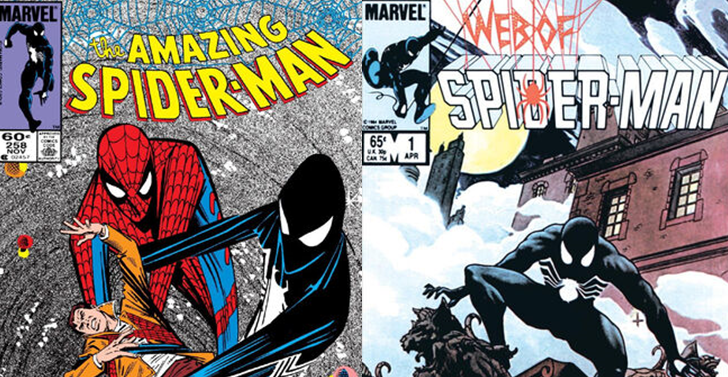
Story Title: “The Sinister Secret of Spider-Man’s New Costume!”
Published: 31 July 1984 (cover-dated November 1984)
Writer: Tom DeFalco
Artist: Ron Frenz
Story Title: “’Til Death Do Us Part!”
Published: April 1985
Writer: Louise Simonson
Artist: Greg LaRocque
The Background:
Considering Spider-Man’s debut almost didn’t happen, it’s pretty ironic that Stan Lee and Steve Ditko’s angst-ridden teenage superhero went on to become the flagship character of Marvel Comics. Over the years, Spider-Man has been at the forefront of some of Marvel’s most celebrated, and notorious, stories and the troubled wall-crawler is often depicted battling his own personal woes as often (if not more so) as his colourful rogues gallery. In 1982, an illustration from reader Randy Schueller that depicted Spider-Man in a smooth, black outfit with a large red spider motif across his chest caught the eye of Marvel Comics’ editor-in-chief Jim Shooter. After Marvel purchased the concept for a mere $200, writer Tom DeFalco and artist Ron Frenz conceived the costume being a living organism; Spidey’s new black suit debuted without explanation in The Amazing Spider-Man #252 before Marvel Super Heroes Secret Wars #8 revealed that the web-slinger acquired the suit during the “Secret Wars” event. Over the next year or so, Spidey revelled in the costume’s unique and helpful ability to form both clothing and organic webbing until these two issues revealed the costume’s true nature as a symbiote. Of course, this directly led to the debut one of Spidey’s most iconic enemies (and one of Marvel’s most popular anti-heroes), Eddie Brock/Venom, but Spidey’s issues with the black suit have been adapted into cartoons, movies, and videogames and it remains one of his most iconic alternative outfits.
The Review:
“The Sinister Secret of Spider-Man’s New Costume!” begins with Peter Parker, still reeling from defeat at the hands of crime boss Silvio Manfredi/Silvermane and the man-beast Thomas Fireheart/Puma, facing the shock of his life when he returns to his apartment and his former flame and close friend Mary Jane Watson/M. J. reveals that she knows he’s secretly Spider-Man! Peter’s naturally gobsmacked by this but M. J. doesn’t give him a chance to explain…or, as she puts it, to “lie to [her]”. Indeed, Peter’s shock is so total that he’s too distracted to hear that M. J. originally left New York City a while back because of this knowledge; not only did it hurt her that he didn’t trust an “airhead” like her with his greatest secret, but she couldn’t stand the thought of him constantly risking his life. Whatever chance Peter might’ve had of explaining things or perhaps retaining his secret identity then goes completely out of the window when Felicia Hardy/The Black Cat leaps in through his window looking for a fun night swinging through the city. M. J.’s heartache is only exacerbated by the Black Cat’s appearance, and she leaves in floods of tears, and Peter’s so distraught that he takes his anger out on the Black Cat, chastising her for bursting in unannounced. Naturally, the Black Cat’s none too pleased to be yelled at so she goes to leave, but they’re both startled when a strand of webbing instinctively and involuntarily shoots from Peter’s jacket to keep her from leaving. While the Black Cat takes this to mean that Peter truly loves her since he “didn’t even try to stop [M. J.]” when she left, Peter’s too surprised by the alien costume’s mysterious nature to deny her embrace. Later, after unsuccessfully trying to call M. J., the overwhelmed Peter succumbs to exhaustion. However, while he sleeps, the alien costume slinks across his apartment, attaches itself to him, and takes his slumbering body out on a joyride across the rooftops of the city.
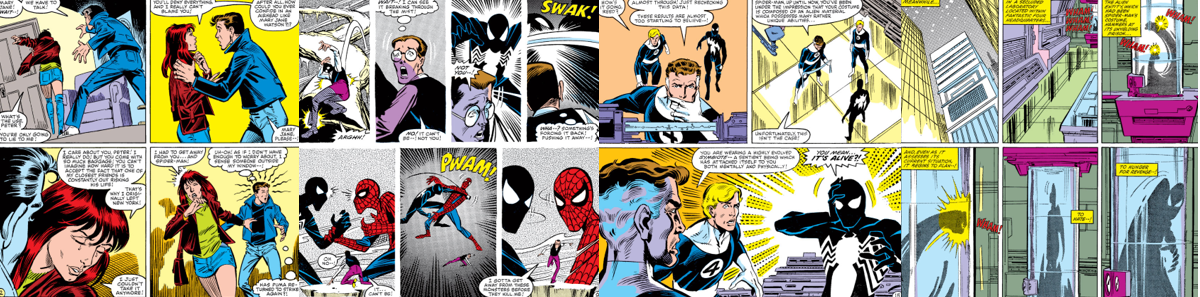
As he sleeps, Peter endures a horrific nightmare in which he finds himself (in his classic bookworm appearance) hounded by the ominous alien costume. Just as it closes in on him, his classic red and blue duds step in to battle the alien, with the screaming Peter literally caught in the middle! Peter awakens to find he’s missed an entire day and unnerved by his alien attire. To try and get some answers, he swings over to the Baxter Building to take up Doctor Reed Richards/Mister Fantastic on a previous offer to examine the suit. Following a series of intensive experiments on the gamut of the costume’s capabilities (producing organic webbing, assuming different appearances, and flowing on and off him at his mental command), Reed drops the bombshell that the costume isn’t just some amazing piece of advanced alien technology, but actually a living being that’s physically and mentally attached itself to the web-slinger! Spider-Man’s astonishment turns to horror when he tries to remove the suit at Reed’s suggestion, only to find it painfully attempting to permanently graft itself to him! With Spider-Man at risk of being crushed to death, Reed grabs his handy-dandy sonic cannon and blasts the alien, forcing it off of Spider-Man long enough for him to safely contain it. However, this does leave Spider-Man in just his underwear so, to preserve his secret identity and allow him to return home, Johnny Storm/The Human Torch provides him with a spare Fantastic Four uniform and a paper bag to cover his head, leading to him facing public humiliation when he steps in to help the police with a robbery. However, Peter’s pride and his shock at the revelation that his alien suit was a symbiote all along are pushed aside when a remorseful M. J. shows up to talk, though he’s unaware that the enraged symbiote lusts for revenge inside its cell…
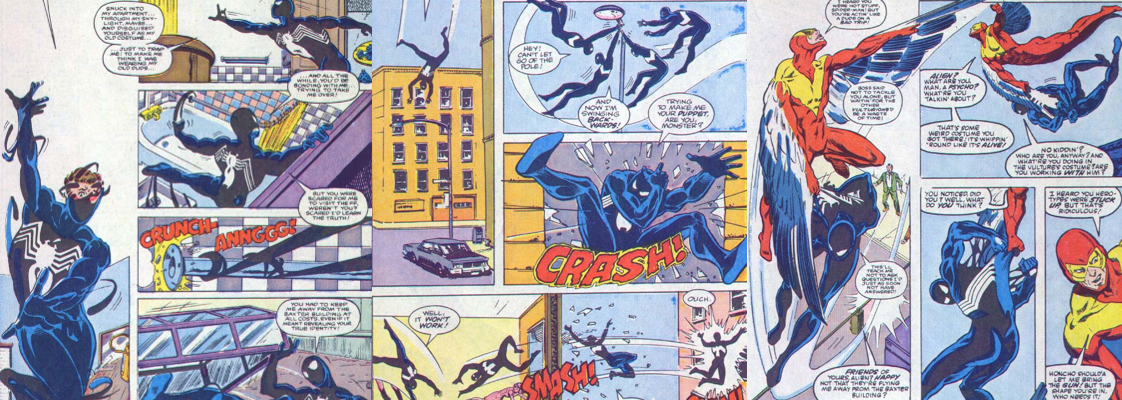
Peter returned to his traditional red and blue costume following this and incurred the anger and disappointment of his beloved Aunt May when he dropped out of his graduate studies in the time between The Amazing Spider-Man #258 and Web of Spider-Man #1. It was also during this time period that the symbiote managed to escape from its confinement and make its way back to Peter’s apartment, which is why “’Til Death Do Us Part!” begins with the alien costume lurking in Peter’s wardrobe. Peter’s so distracted by his recent breakup with the Black Cat and recapping how Reed revealed the costume’s true nature as a “symbiot” and helped rid him of it that he doesn’t even notice the parasitic alien attaching itself to his costume until it’s too late! Horrified, Spider-Man desperately flees his apartment and tries to get back to the Baxter Building, but the symbiote fights him the entire way; it sends out tendrils to ground him, throws off his webbing, detaches itself from walls, and forces him to do its bidding like a puppet. Refusing to obey his commands and sending him into a panic, the symbiote negates Peter’s spider sense and does everything it can to keep him grounded, and Spidey’s so caught up trying to fight off the alien and keep his cool that he doesn’t notice the Vulturions circling overhead. Comprised of hoodlums Gripes, Pigeon, Sugar Face, and Honcho, the Vulturions are a gang of low-level punks given a chance at stepping up their game when they repurpose Adrian Toomes/The Vulture’s technology and suits to their own ends. Their leader, Honcho, warned them about taking on Spider-Man alone and drawing undue attention to themselves, but Gripes can’t help but snag the writhing, babbling web-head when he spots him struggling with the symbiote during a scouting mission.
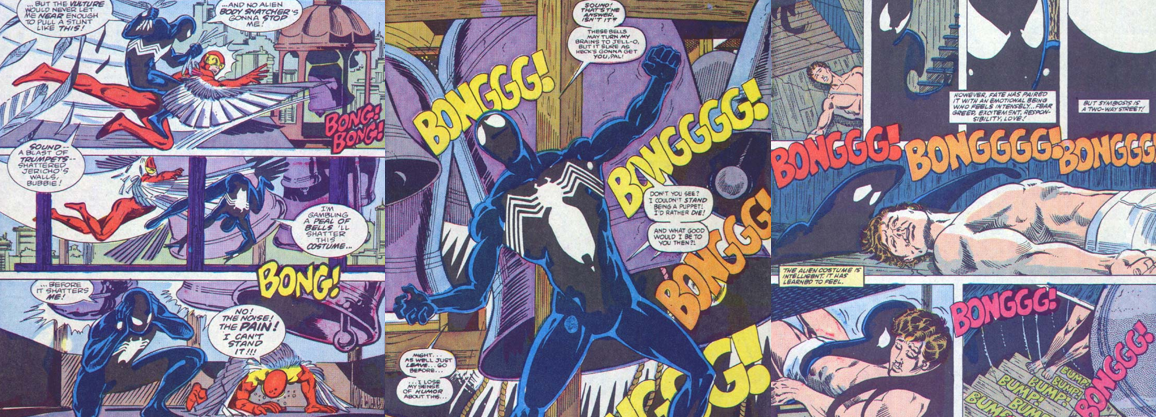
Spider-Man barely even acknowledges the presence of the Vulturions; even when he’s caught in Gripes’ talons, he rages and struggles against the symbiote. Gripes’ confusion at Spider-Man’s bizarre behaviour turns to horror when the symbiote’s tendrils lash out and attack him, and Spidey’s forced to use his own strength to fight off Gripes, Sugar Face, and Pigeon, sending the three plummeting into the sea and commandeering Honcho as a more reliable means of traversal. Realising that he might not make it to the Baxter Building in time to use Reed’s sonic blaster, Spider-Man redirects Honcho to a nearby bell tower. The loud ringing is already sending the symbiote into a frenzy but it’s in absolute agony when Spidey crashes into the tower and forces it to endure the ringing up close. The noise is apparently so loud that it threatens to kill Spider-Man as well; with his strength fading, Peter can’t help but think of his loved ones and all the people he’s leaving behind as he feels his life ebb away. The noise is so great that the symbiote is forced from Peter’s unconscious body; however, as the “emotionless being” slinks away, it can’t help but feel an obligation towards its former host. Chalked up to emotions inherited from its time joined with Peter, the symbiote pulls Peter to safety. It tentatively, lovingly, touches his face with a tendril one last time before promptly evaporating into dust, apparently destroyed from the cacophony of the bells and the exertion of saving Peter’s life.
The Summary:
If you’re a fan of Venom and Peter’s time in the black costume, these two stories are essential reading to understanding the complex relationship between Spider-Man and the symbiote. Unlike in other media (at least as far as I can remember), the symbiote didn’t actually negatively affect Peter’s mood or mannerisms; he didn’t go all emo or become aggressive, and I don’t think it really enhanced his strength or natural abilities beyond acting as infinite webbing and responding to his mental commands. Consequently, I believe that The Amazing Spider-Man #258 is the first time that the symbiote shows any signs of aggression or independent thought. Of course, it can be argued that the symbiote is simply reacting due to the massive revelations and pressure that bombard Peter in this story. Just the idea that M. J. knows his secret identity would be shocking enough, but quickly follow that with the Black Cat’s arrival and a bit of a love spat between the two and it’s no wonder that Peter’s emotions are all over the place. M. J.’s revelation would, of course, lead to her opening up to Peter about her own traumatic past and helped to not only flesh her out as something more than a gorgeous party animal but also galvanise their relationship, but here it’s a real curveball since Peter’s secret identity was such a sacred element to the character and not too many people were aware of it. Thus, finding out that M. J. had always known of his dual identity really helped her to stand out against Peter’s other love interests, even the likes of the Black Cat.

As ever with Spider-Man stories, we get some drama and interludes to break up the action; the first story is broken up with interludes that show the Puma, in his public identity as a successful businessman, brooding over in New Mexico, hungry for his next encounter with Spider-Man, and Roderick Kingsley/Hobgoblin being recruited into Richard Fisk/The Rose’s campaign against Spider-Man, as well as hints towards M. J. having secrets of her own. The second story is largely concerned with establishing the Vulturions, painting them as thugs who mug old ladies in public and who have a contentious relationship with their boss because of this, and Peter’s recent falling out with Aunt May over his studies. Naturally, there are also some fun cameos from Mr. Fantastic and the Human Torch since Spidey needs the Fantastic Four’s help in figuring out what’s happening with his suit. I liked that Reed already strongly suspected that the suit was a living organism but still conducted a series of tests to be both absolutely sure and to satisfy his scientific curiosity. It’s lucky that Spider-Man has such a healthy relationship with the Fantastic Four as they’re the only ones with the technology and capability to study and contain the symbiote, but it’s doubly lucky for us as The Amazing Spider-Man #258 fetaures the debut of the Bombastic Bag-Man! Stuck in Fantastic Four suit with a paper bag over his head and a “Kick Me!” sign taped to his back, Spidey is humiliated before the press and public as part of a prank by the Human Torch, which makes for one of the best aspects of these two issues. It’s a rare moment of levity, especially considering not just all the personal strife Peter goes through here but also the startling revelation that his once seemingly amazing alien costume is actual a living, breathing organism that’s attempting to permanently bond with the web-slinger!
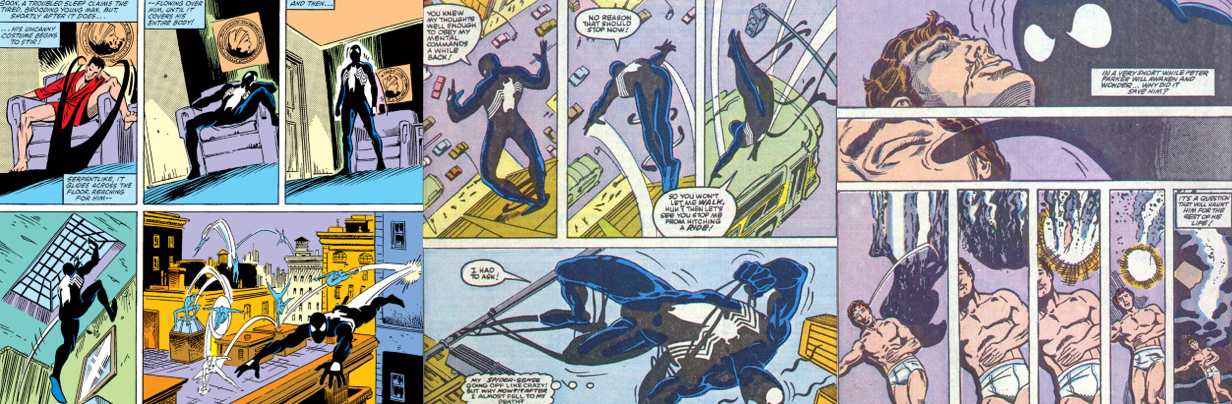
This aspect is treated as a horrifying prospect as the symbiote is described as a “parasite” and Reed’s first advice to Spider-Man is to rid himself of it before the bonding process becomes permanent. It’s only natural, then, that the symbiote reacts to defend itself, refusing to budge from Spider-Man’s body and even causing him physical harm. There’s actually no suggestion or evidence to suggest that the symbiote has malicious intentions; Spider-Man reacts out of sheer panic and horror and Reed doesn’t hesitate to contain the creature and it’s only then that it becomes malevolent since it doesn’t appreciate being spurned. When it returns in Web of Spider-Man #1, notice how it doesn’t do anything aggressive except try to bond with him again; it only lashes out and takes control of Peter when he reacts in horror and tries to force it off, and there’s even a suggestion that it takes control of his sleeping body not to cause him harm but because it delights in his superhuman abilities. Still, Peter’s first instinct is to get rid of it and he’s so determined to do this that he even states he’d be willing to die than be a slave, again without any real evidence that the symbiosis would be anything malicious. To that end, he uses the ringing of the bell tower to drive the creature from his body and presumably destroy it but is rendered unconscious by the effort and completely misses the tragic truth of the symbiote. While the dialogue boxes hint that it’s an amoral creature, the symbiote sacrifices itself to get Peter to safety not just because of the emotions it learned of while bonded to him, but out of what is very clearly shown to be true love for Peter and his welfare. This aspect is expanded upon when the symbiote later returns with a vengeance as Venom, but it’s portrayed really well here and actually paints Peter (and Reed) in a bit of a bad light since his knee-jerk assumption was that the symbiote meant him harm but there’s nothing to say that’s the case. Because of this, these two issues are a really great launching pad for those wishing to get into reading some Venom stories; they contain some of the most iconic symbiote imagery (such as Peter’s nightmare and the bell tower sequence) and go a long way to giving the symbiote some characterisation long before it talks.
My Rating:
Great Stuff
Have you ever read these two iconic Spider-Man stories? If so, what did you think to them and where would you rank the black costume era amongst Spider-Man’s many other stories and moments? What did you think to the black costume at the time and were you surprised to find that it was alive? Do you think Peter reacted poorly to this knowledge and that he should’ve tried to understand the symbiote’s true intentions? What did you think to the revelation that Mary Jane knew of Peter’s dual identity? How are you celebrating Spider-Man this month? Whatever your thoughts on Spider-Man and the symbiote, share them below and be sure to check out my other Spider-Man Month content!








 Dr. K's Waiting Room
You must be logged in to post a comment.