Movie Night: The Invisible Man (1933)

Released: 13 November 1933
Director: James Whale
Distributor: Universal Pictures
Budget: $328,033
Stars: Claude Rains, Gloria Stuart, William Harrigan, Henry Travers, and Una O’Connor

The Plot:
After turning invisible with a special formula, Doctor Jack Griffin (Rains) first obsesses over a cure and then goes on a crazed rampage through a Sussex village.

The Background:
By 1897, prolific British author Herbert George Wells had quickly made a name for himself as a creative visionary and futurist, with The Time Machine (1895) laying the foundation for the science-fiction genre and The Island of Doctor Moreau (1896) inviting discourse regarding morals and ethics. Potentially inspired by W. S. Gilbert’s “The Perils of Invisibility” and allegedly starting as a short story Wells later expanded, The Invisible Man became a literary classic as a startling cautionary tale regarding the dangers of science. Development of a silver screen adaptation can be traced back to 1931 where, after their unexpected success with Dracula (Browning, 1931), Universal Studios suggested The Invisible Man as a follow-up. While producer Carl Laemmle and his son opted to prioritise Frankenstein (Whale, 1931) instead, they purchased the rights during filming (though Wells demanded script approval). Though James Whales was reluctant to direct out of fear of being typecast as a horror director, he eventually signed on and the script underwent many rewrites before shooting started. While Boris Karloff was initially set to star in the title role, stage actor Claude Rains took over for his feature film debut, where he shared the screen with some simple and innovative visual effects. Everything from simple wire tricks to layering negatives over each other sold the illusion of invisibility so well that they stood as a blueprint for modern-day green screen effects. Highly praised upon release and regarded as one of the best films of its era, The Invisible Man has stood the test of time for its ambitious visuals, stirring performances, and masterful exploration of the corruption of power. Followed by a handful of quasi-sequels and spin-offs, The Invisible Man has had an enduring legacy in sci-fi and horror, resulting in everything from under-rated sci-fi dramas, to big-budget remakes and reimaginings that were both underappreciated and evocative, to infamous comic book adaptations of his classic literary icon.

The Review:
I’m somewhat familiar with H. G. Wells’ classic sci-fi story of an invisible man terrorising a small English village, and have long been a fan of the concept and its adaptations and how they often depict an ambitious scientist meddling in things beyond him and turning to madness. The original invisible man (here given the first name “Jack”) is already a rude and demanding character when he first stumbles through the snow and into Iping looking for a room. His appearance startles the locals at the Lion’s Head since he’s covered in bandages. Despite his odd appearance and gruff nature, doting and bothersome landlady Jenny Hall (O’Connor) caters to his every whim. However, the nosey old shrew can’t help but bother Griffin, fussing over his room and catching a glimpse under his bandages, and spreading gossip to her husband, Herbert (Forrester Harvey), and the snooping locals, who believe he’s an escaped criminal. In reality, Griffin is an understudy of Doctor Cranley (Travers), who was allowed to conduct experiments in his spare time. To the suspicion of his colleague, Doctor Arthur Kemp (Harrigan), Griffin worked in secret against the open and honest code of most scientists. Indeed, Griffin’s beautiful fiancée and Dr. Cranley’s daughter, Flora (Stuart), notes that Griffin had become more withdrawn before his sudden disappearance and openly laments his departure, worrying herself sick about his health. Though Dr. Kemp uses Griffin’s actions to proposition her, he’s hilariously unsuccessful and his dislike of Griffin counters Flora’s romanticised opinion of him, strongly indicating that Griffin was previously an eccentric but nonetheless caring and compassionate man.
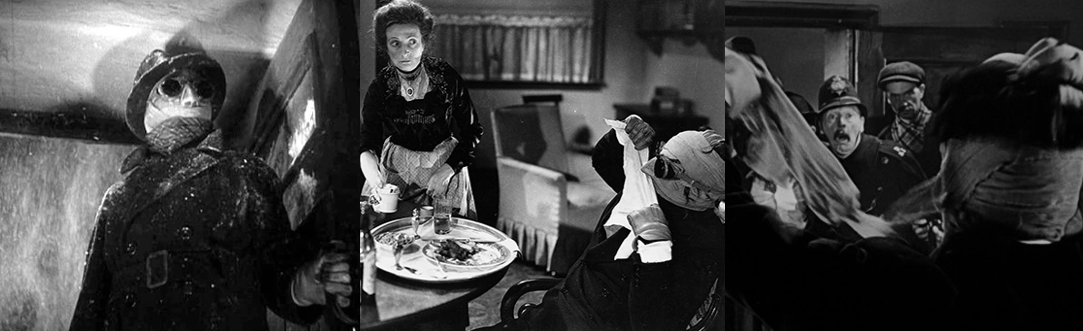
A mysterious and rude stranger upsets the locals of a small village with his gruesome visage.

Eager for fame and glory, Griffin experimented with the obscure drug “monocaine”, which drains colour from its surroundings. By distilling the substance and regularly injecting it under his skin, Griffin successfully turned himself invisible but fled from his laboratory and home to discover the way back to visibility in seclusion. When he reaches Iping, Griffin is irritable and quick to anger, eventually launching into a tirade after Jenny reprimands him for messing up her sitting room with his bizarre equipment. Insulted and enraged, Jenny orders Herbert to evict their guest, who desperately pleads with the landlord before angrily tossing Herbert down the stairs. The barflies fetch pompous and ludicrous Constable Jaffers (E. E. Clive), only to be amazed when Griffin dramatically reveals he’s completely invisible! While they’re shocked and powerless to catch Griffin, who half-throttles Jaffers and causes havoc in town, the unmasking and the frustration at his condition briefly unhinges Griffin’s usually ordered (if unstable) mind. Griffin delights in chaos before fleeing to Dr. Kemp, who’s stunned when Griffin calmly explains his maniacal plot for a mutually beneficial partnership so that Griffin can terrorise the world with his powers. Though hesitant, Dr. Kemp’s too terrified to resist Griffin’s demands and gives him shelter, helping him retrieve his notebooks, all while Griffin giggles about the mayhem and murder he plans to indulge to showcase his intellectual superiority. While Griffin claims to be “strong” and easily outwits the police as they mobilise to flush out the invisible man causing so much death and panic, he’s still very vulnerable as he must stay naked and out of rain, soot, and snow to remain undetected.
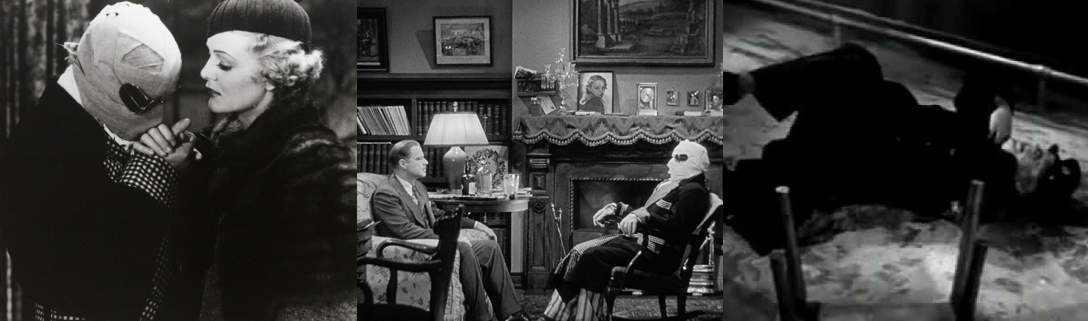
Despite attempts to humanise him, Griffin is largely depicted as an unhinged psychopath.

Griffin’s madness comes in waves, with him switching between reasonable (if callous) and enraged. When docile, he sees Dr. Kemp as his valued and trusted partner but, when angered, Griffin gleefully murders even his reluctant ally when Dr. Kemp calls in first Dr. Cranley and Flora and then the police. Griffin’s demeanour noticeably softens around Flora, but his madness returns when he realises Dr. Kemp has betrayed him. Griffin renews his killing spree, all thoughts of returning to visibility forgotten as he tosses men over ravines, shoves over baby carriages, and casually derails a train, killing over a hundred passengers! Regardless, Flora remains devoted to her man and near sick with worry, though Dr. Cranley’s powerless to do much but promise to help try Griffin once he’s apprehended. When the sceptical Police Chief (Holmes Herbert) is strangled to death for his ignorance, the Chief Detective (Dudley Digges) takes the threat very seriously. Unfortunately for him, his office is swamped with calls from “helpful” civilians offering outlandish solutions and all plans must be spoken privately, necessitating his men walk a giant net across his office! When Griffin vows to murder Dr. Kemp in retaliation, the Chief Detective uses the terrified doctor as bait to lure Griffin into an elaborate trap. However, despite his crazed state, Griffin easily evades the traps and follows Dr. Kemp, casually explaining how he’s going to kill him and then executing the plan, sending Dr. Kemp to a spectacularly fiery death! The invisible man’s rampage continues over several montages, with many policemen and volunteers joining the search and just as many terrified civilians barricading their doors, though Griffin constantly makes fools of them.

The Nitty-Gritty:
The Invisible Man has an edge over many classic Universal Monsters movies with its orchestral score. It also impresses with its surprising and startling body count, especially as the titular antagonist is simply one man running around in the nude. Griffin’s mood swings seemingly grant him augmented strength and he thinks nothing of murdering for his own amusement. As explicitly stated by Dr. Kemp and then reiterated in the finale, The Invisible Man is another cautionary tale of the dangers of dabbling in science. Griffin meddled in things he didn’t understand and, in his arrogance, blundered into his experiment without conducting proper research, essentially dooming himself to madness, debauchery, and ultimately death. The Invisible Man is reasonably close to the source material, recreating many aspects while bolstering Dr. Kemp’s role and altering both the title character and making his unfortunate more dramatic. The book spends more time in Iping, as I recall, while these scenes merely introduce the mystery of the bandaged stranger. Naturally, the concept of a person turning invisible and consequently losing their mind to the freedom and power originates here, with Griffin first toiling for cure and then revelling in his abilities. The process makes him unhinged and gives him an inflated sense of superiority, eventually bringing him ruin. However, Griffin seems perfectly happy to be the all-powerful, untouchable invisible man…except for having to always be naked.
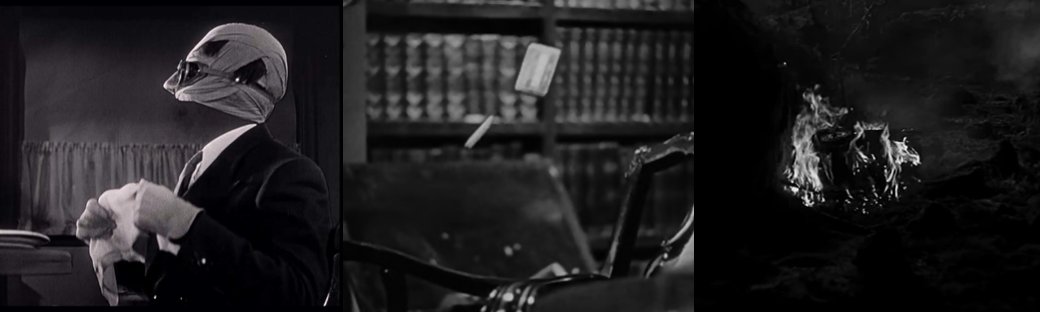
Simple and pioneering filmmaking techniques alike are used to bring Griffin’s rampage to life.

Of course, the most startling way The Invisible Man stands out from its peers is its groundbreaking visual effects. Obviously, everything seen here was achieved practically using unique and clever solutions and they hold up ridiculously well. While it’s clear when a dummy has been used, you can sometimes spot wires, and there’s an odd translucent effect at times, I remain impressed and amazed by the innovation on show. There are scenes where Griffin is simply a talking shirt or has half his jaw missing that blend better than some modern-day CGI and I especially when he took and lit one of Dr. Kmep’s cigarettes with a match. Of course, many of the effects are incredibly simple, being basically actors talking to thin air or pretending to be throttled, but many sequences showcasing the invisible man’s actions were setup to avoid making things too easy. Like, when he escapes through the window, it would’ve been simpler to just show the window opening but, instead, we see the net curtain opening, an ornament set aside, and then the window opens. Other effects are simply achieved through wires, which works incredibly well and the black and white, grainy filter helps hide many of the tricks used. A fun model train and car also go down in flames during Griffin’s rampage to add a sense of danger and scale things. While later iterations relied more and more on CGI, I appreciated the simplicity and hard work that went into rendering Rains invisible. His reveal is an incredibly powerful scene where he angrily tosses his fake nose, glasses, and bandages at the gawping locals and flails like a madman, a far cry from his composed and demanding demeanour and the first true indication that Griffin is gone completely off his nut.
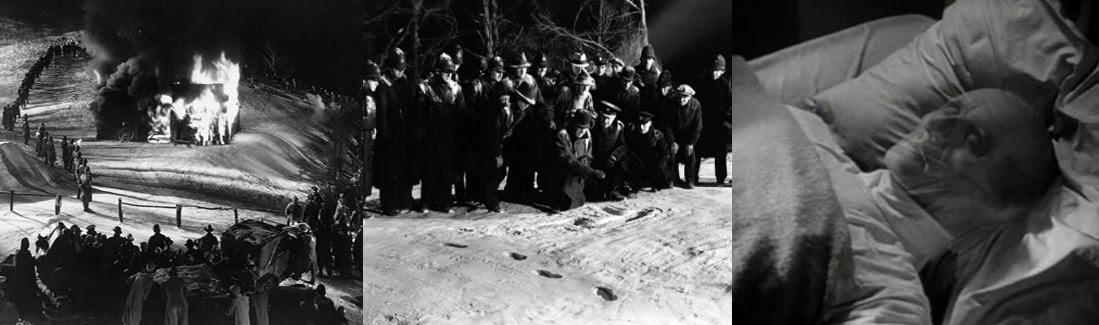
Griffin’s reign of terror is ultimately undone, returning his senses and flesh in time for his death.

While the Chief Detective works to apprehend the invisible man, apparently employing over 100,000 men in a widespread manhunt, he’s eluded at every turn. This is largely because Griffin easily slips past traps or patiently waits to act. While Flora renders him docile, Griffin embraces mayhem and death once the cops mobilise, never once trying to contact Flora. Initially, Griffin wants Dr. Kemp help him spread true chaos. Then, he plots to master the serum so he and Dr. Kemp can take turns indulging their destructive whims (though Dr. Kemp is aghast at this). Upon being discovered, however, Griffin simply runs amok until he burns himself out. Throughout the film, however, Griffin is seen to be exhausted and famished, constantly demanding food, rest, and a fire to warm his frozen, exposed flesh. Though he delights in killing Dr. Kemp, Griffin collapses, exhausted, in a farmer’s (Robert Brower) barn. Upon discovering the sleeping invisible man, the farmer raises the alarm, prompting the Chief Detective to capitalise on the latest snowstorm and flush Griffin out with fire. In desperation, Griffin flees into the snow, where his footprints clearly show, allowing the police to gun him down. Griffin finally reunites with Flora in the hospital where, despite the best efforts of those involved, he faces a quick and probably painful death from the bullets in his lungs. Despite this, there’s no blood and Griffin is coherent enough to make amends with Flora and realise the folly of his experiments. Griffin’s sanity is restored moments before he passes and he dramatically and ambitiously becomes visible, his wounds and death apparently flushing the serum and the madness from his system and leaving Flora distraught by his bedside.
The Summary:
Even now, The Invisible Man is my favourite of all the classic Universal Monsters movies. I think that’s because, from my perspective, the concept hasn’t been as worn out as other classic horror concepts, like Count Dracula or Frankenstein, and also because I find the film more visually impressive than many of its peers. Of course, it’s not perfect: Una O’Connor’s grating, shrieking, over-the-top performance is very obnoxious at the start and many of the later, one-note constables and supporting characters are strangely comical. There’s a fanciful nature to Griffin’s rampage, with many of his actions framed as pranks, but things nicely escalate as he first causes mischief and then amasses one of the greatest body counts of his era! While the film attempts to humanise Griffin through Flora and the descriptions of monocaine, he’s still a despicable and unstable character, being rude and demanding and then giving in to enraged outbursts when his experiments are constantly interrupted. We see little of Griffin’s more logical, compassionate side, instead seeing him flip-flop between being coldly ruthless and utterly off his rocker as he plots to cause chaos alongside Dr. Kemp. It’s a stirring, magnetic performance from Claude Rains, especially as he’s barely in the film and yet his presence is constantly felt. Of course, The Invisible Man really impresses with its ambitious and ground-breaking visual effects, pioneering practical filmic techniques that were further refined over time. I personally believe these sequences hold up extremely well, especially because of the black and white film stock, and have aged the most gracefully of all the Universal Monsters films of this era. The Invisible man also set the standard for the concept many would follow but few would as masterfully execute, and told a stirring cautionary tale about the dangers of science in a way that was at least somewhat scientifically plausible. Ultimately, while The Invisible Man is more shocking and at times amusing than scary like its peers, it’s an admirable product of its time that still makes an impression today and you’re truly missing out if you’ve slept on this classic piece of cinema.

My Rating:

Rating: 3 out of 5.

Pretty Good

Were you as impressed by The Invisible Man as I was? If you read the book, what did you think to the film’s execution of the concept? Did you like the attempts to humanise Griffin or do you prefer him as an unhinged maniac? What did you think to the visual effects used to render Claude Rains invisible and do you agree that they hold up today? Were you surprised by the large death toll? Which version of The Invisible Man, or Universal Monsters movie, is your favourite? How are you celebrating Halloween this year? Make your thoughts on The Invisible Man visible in the comments, go read my other horror reviews, and support me on Ko-Fi for more translucent horror content.

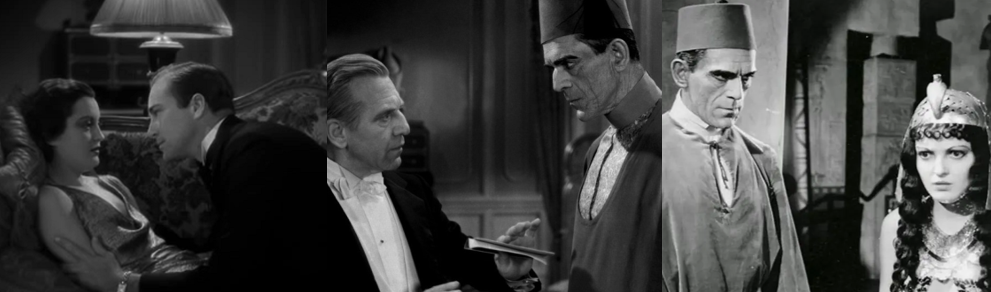
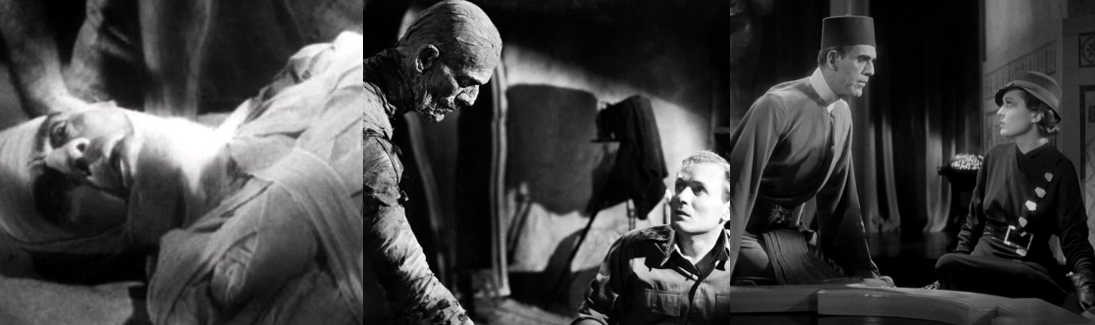
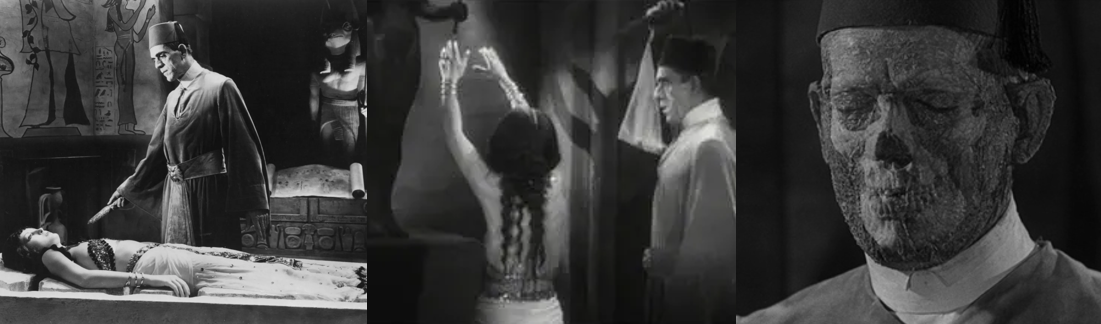
Movie Night: The Mummy (1932)

Released: 22 December 1932
Director: Karl Freund
Distributor: Universal Pictures
Budget: $196,000
Stars: Boris Karloff, Zita Johann, David Manners, Edward Van Sloan, and Noble Johnson

The Plot:
Mummified for attempting to resurrect his dead lover, Egyptian high priest Imhotep (Karloff) reanimates when his tomb is disturbed and sets about wooing Helen Grosvenor (Johann) under the guise of an Egyptian historian.

The Background:
In 1922, British archaeologist Howard Carter and his, benefactor Lord Carnarvon, discovered the tomb of ancient Egyptian pharaoh Tutankhamun, uncovering a cache of riches and an elaborate sarcophagus that wowed and inspired generations. Producer Carl Laemmle Jr. was also inspired by this event, and the so-called “Curse of the Pharaohs” and commissioned story editor Richard Schayer to find a novel for a Mummy-centric horror movie to mirror Universal Studios’ previous success at adapting Dracula (Stoker, 1897) and Frankenstein; or, The Modern Prometheus (Shelley, 1818). Schayer and writer Nina Wilcox Putnam discovered Alessandro Cagliostro’s Cagliostro, a nine-page treatment with some similarities to Arthur Conan Doyle’s The Ring of Toth, which was then retooled by screenwriter John L. Balderston into The Mummy. Taking inspiration from ancient, real-world figures, Balderston’s script became cinematographer Karl Freund’s first gig as a director in America and saw Boris Karloff flex his acting muscles in the title role. Still, Karloff endured a lengthy and uncomfortable make-up process as Jack Pierce transformed him into a desiccated corpse, slathering his face with cotton, collodion, and spirit gum and wrapping him in linen bandages treated with acid and burnt in an oven! While the film’s historical accuracy was debated, The Mummy was a modest box office success met with mixed reviews that has since been regarded as a classic horror for its unique blending of romanticism and horror. The film inspired a few loose sequels and spin-offs before being expertly reconfigured into a highly regarded blockbuster adventure in 1999 (which also spawned sequels and some questionable spin-offs). Although that goodwill was undone by an ill-fated remake in 2017, the visual of an undead creature wrapped in bandages has been an enduring horror figure regardless.

The Review:
The Mummy begins in 1921, where archaeologist Sir Joseph Whemple (Arthur Byron) uncovers Imhotep’s sarcophagus alongside his assistant Ralph Norton (Bramwell Fletcher). While the two are excited to examine the find, Whemble’s friend and colleague, Doctor Muller (Van Sloan), warns that the sarcophagus carries a terrible curse, which Whemble scoffs at, but Dr Muller insists is a warning of the wrath of the ancient Egyptian Gods. While the two wax philosophical, Norton opens the tomb and discovers Imhotep’s surprisingly well preserved remains, the priest having been mummified alive (rather than having his “viscera” removed) for some terrible affront, alongside the “Scroll of Thoth.” Despite Dr. Muller’s warnings, the curious Norton reads from the scroll, unintentionally awakening Imhotep, who lurches to life, swipes the scroll, and leaves Norton so out of his mind that he eventually dies laughing in a straitjacket. The film then jumps ahead some ten years to find Whemple’s son, Frank (Manners), following in his now deceased father’s footsteps, digging for ruins in Egypt alongside Professor Pearson (Leonard Mudie) but having nothing to show for it but a lot of wasted money and a few trinkets. Frustrated and disheartened, the two prepare to leave when they’re visited by the enigmatic and mysterious “Ardath Bay”, Imhotop’s dishevelled but largely human pseudonym, who points them to the long-lost tomb of Princess Ankh-es-en-Amon (Johann). Although they’re initially sceptical, the two are overjoyed when their enthusiastic (but surely underpaid and overworked) dig team uncover the tomb, though Frank is mildly scorned that their discovery is claimed by the Cairo Museum as per the terms of their contract. In contrast, Professor Pearson is overjoyed, welcoming their mysterious benefactor to the museum and holding Ardath Bay in high regard despite his odd demeanour and superstition about being touched and digging up his people’s dead.

Imhotep has little trouble using incantations to fool and manipulate the unsuspecting characters.

Whemple returns to Cairo to bask in the find and Frank is soon enamoured by the beautiful half-Egyptian Helen, a patient of Dr. Muller’s, who suddenly becomes entranced when Imhotep mutters an incantation over a cauldron to show him the reincarnation of his lost love, Ankh-es-en-Amon. Mumbling a language she couldn’t possibly know, Helen is compelled to answer Imhotep’s call, only to be stopped by a locked door and promptly faint, with little to no recollection of what happened. Transfixed by the girl, Frank promptly flirts with her with his stories of how they discovered and unwrapped Ankh-es-en-Amon’s tomb, only for Helen to react with distaste for his sacrilege and somewhat mock him for being smitten by a rotting corpse. While this is somehow enough to earn him a snog, the two are horrified to learn that a museum guard was murdered and that the Scroll of Toth (which Whemple somehow recognises despite him never seeing it) was discovered with the body. While Frank and Muller suggest burning the cursed object, they’re interrupted by Ardath Bay, who’s immediately captivated by Helen and her striking resemblance to his long-dead lover, entrancing the confused girl with the faded memories of her past life. Suspicious of Ardath Bay, Frank and the others confront and quiz him, compelling him to reveal his true identity and to demand the scroll or die (a strange demand considering he had the scroll) and showcasing his ability to hypnotise anyone with Egyptian blood as he brainwashes their Nubian servant (Johnson). Although Whemple resolves to burn the scroll, Imhotep watches from his cauldron and commands the Nubian to intercept him, murdering the old man but ultimately fooling no one with some burned newspaper. Unable to resist Imhotep, Helen returns to the museum and, while spellbound, learns of her past like in ancient Egypt.

Condemned for sacrilege, Imhotep is determined to be reunited with his long-dead love.

Back in the day, Imhotep was besotted by Ankh-es-en-Amon but heartbroken when she died of some illness. Defying the Gods and her father, “Pharoh” Amenophis (James Crane), Imhotep stole the Scroll of Thoth but was buried alive with it when his scheme to resurrect her was discovered. Though Helen’s conflicted, she begs Frank to confine her to her room, terrified of what might happen, leading Imhotep to further manipulate his underlings to reunite his love’s soul with her reincarnated body. Luckily, Boris Karloff provides an enigmatic performance as the titular mummy as this was a chore to sit through. While Imhotep gives Karloff the chance to showcase his range, he’s hardly a terrifying force, even when a decomposing figure, and comes across more like a bored narcoleptic who watches events from his cauldron and threatens people with his scarab ring. The film is more of a bizarre love story, with Imhotep professing a timeless love that he’s carried throughout a restless death and which has seemingly allowed Ankh-es-en-Amon to resurrect throughout the ages. Though Frank can’t compete with Imhotep’s lovelorn declarations, he’s at least alive and doesn’t look like a dried-out sultana so Imhotep plots to kill him, thus removing his rival and any doubt in Helen’s heart. Helen seems into both men, even though she barely knows Frank and Imhotep essentially hypnotises her to make her docile and thus vulnerable for him to kill and perform some mumbo-jumbo to return Ankh-es-en-Amon’s soul to her restored body. While Imhotep seemingly murders those in his way, he seems quite careless as he lost the Scroll of Toth and was forced to demand it. Equally, he’s held at bay (Ardath Bay, you might say…) by a protective amulet and prefers to let the Nubian do all his busy work since he must sit around mumbling incantations, spying on people, or creeping them out with his odd appearance and behaviour.

The Nitty-Gritty:
While I don’t believe for a second that the production filmed in Egypt, I was impressed by the sets and interiors, which are filled with Egyptian artifacts to sell the illusion. Many may not be historically accurate, and the flashback to 1800 BC isn’t very convincing, but there was a clear attempt to make things look a little more elaborate than most Universal Monsters movies. I also appreciated the surprising violence, with a convincing spear impalement and Imhotep describing how the slaves and soldiers present for his burial were executed, and that the film incorporated music (though sporadically) to punctuate dramatic moments. I wish I could say more about Karloff’s make-up but it’s not really that impressive as Imhotep mostly looks drawn and wrinkly. When he’s a desiccated corpse, things are more impressive, but I think a gaunt dummy would’ve been more effective than slathering Karloff in make-up and prosthetics that barely appear for that long. Rather than shambling about as a withered corpse wrapped in tattered bandages, Imhotep waltzes about in a fedora as Ardath Bay, conjuring spells and directing his minions, making him more of a warlock than a mummy. His horror comes from his supernatural abilities, which are limited to hypnotism (and further limited to only affecting those with Egyptian blood). He showcases no superhuman strength or wizardry, instead being a letch who relentlessly pursues, mesmerises, and manipulates others, meaning The Mummy is more about the fear of being controlled than the fear of some ancient creature.

In the end, the ineffectual Imhotep is undone by the Gods in anti-climactic fashion.

Confined to her room and watched like a hawk, Helen’s condition worsens the more she’s kept from Imhotep and the more he tries to reach her with his curses. Luckily, Frank is stupid enough to remove his amulet and take a nap, barely saving himself from Imhotep’s killing curse but nonetheless powerless to keep the Mummy from bewitching Helen. When Helen reaches the museum, her personality has been replaced by Ankh-es-en-Amon, though Imhotep still plans to murder Helen with the most unconvincing dagger I’ve ever seen and then reading from the Scroll of Toth to return Ankh-es-en-Amon’s soul to Helen’s body, allowing them to rekindle their love as undead mummies. Surprisingly, Ankh-es-en-Amon resists this, wishing to inhabit Helen’s young and supple body, and Helen’s personality also struggles against the Mummy, though neither can resist Imhotep’s hypnotic power. After being revived, Frank and Muller rush to Helen’s aid, only to be held back by Imhotep’s spooky scarab ring. This distraction is enough for Ankh-es-en-Amon to beg the Goddess Isis for aid. Incredibly, this works and the statue of Isis lurches to life, pointing an ankh at Imhotep that dispels his power over the Nubian and burns the Scroll of Toth. This also causes Imhotep to (somewhat) rapidly rot and turn to a mere skeleton, clattering to the floor. If you thought this was an abrupt end, the film then doubles down by suddenly cutting to black and the end credits after Frank calls to Helen to return to her body. Admittedly, it’s potentially left ambiguous whether this worked as it could’ve just as easily been Ankh-es-en-Amon who woke up, but I was so bored and annoyed by the film that I really didn’t care and was glad that it was finally over!

The Summary:
My God, this was a chore to watch. I’ve seen The Mummy before and didn’t remember it being this bad, but it really is one of the most boring Universal Monsters movies I’ve seen. I’ve never been the biggest fan of the concept, despite my love for Egyptian superstition and history, but The Mummy really impressed with its sets, attention to detail (historical accuracy be damned), and overall presentation. Sure, we never get a proper look at Cairo or any exteriors, but the interiors and artifacts and such really sold the illusion for me. It’s a shame it’s filled with a bunch of stupid-ass characters who are little more than walking clichés. Zita Johann captures the camera with her beauty, effortlessly showcasing Helen’s confusion and allure, though I would’ve liked to see more of Ankh-es-en-Amon’s personality and how it differed from Helen’s. Frank was just kind of there and I honestly got some of the male leads mixed up as I struggled to sit through this one, though it was amusing seeing them all rendered ineffectual and the day being saved by both a woman and a Goddess. Boris Karloff stole the show with his acting and range, rather than being buried under heavy make-up, but I found the titular Mummy to be a weak and ineffectual character. He wasn’t scary (unless you’re afraid of being hypnotised), he didn’t really do anything (any kills that could be attributed to him were offscreen), and he was defeated with ridiculous ease. Even if you view The Mummy as a bizarre love story rather than a horror, it falls apart under close scrutiny thanks to a questionable script, bone-headed characters, and the concept running out of steam early on. It’s such a shame as there could’ve been something really special here but there aren’t even any impressive make-up effects or chilling moments to salvage this one and it’s easily the most forgettable of the Universal Monsters movies, in my opinion, and far surpassed by the 1999 remake.

My Rating:

Rating: 1 out of 5.

Terrible

Do you think I was too harsh on The Mummy? Perhaps you’re a fan of this one; if so, why? Were you disappointed that Imhotep wasn’t more monstrous or did you enjoy seeing Boris Karloff’s range? What did you think to the presentation of the film and the depiction of ancient Egypt? Were you entranced by the love story angle or did you also find the film a slog to sit through? Which version of the Mummy is your favourite and how are you celebrating Halloween this year? Share your thoughts on The Mummy in the comments, check out my other horror reviews, and donate to my Ko-Fi if you want to see more Mummy reviews.

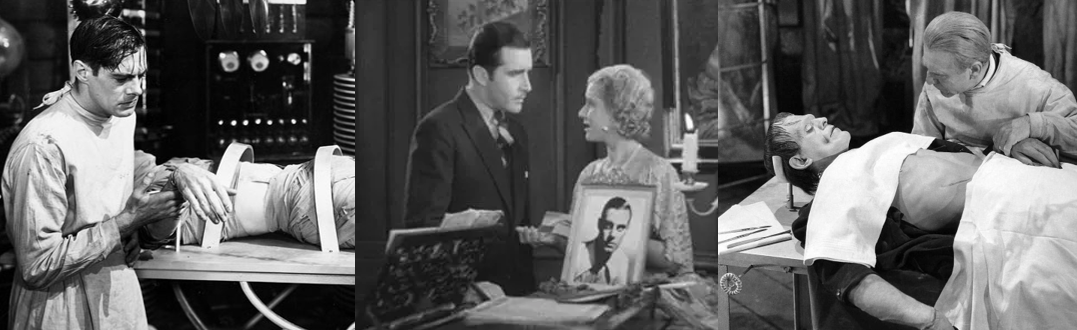
Movie Night: Frankenstein (1931)

Released: 21 November 1931
Director: James Whale
Distributor: Universal Pictures
Budget: $262,007
Stars: Colin Clive, Boris Karloff/?, Mae Clarke, Dwight Frye, and Edward Van Sloan

The Plot:
Obsessed with playing God, eccentric scientist Henry Frankenstein (Clive) cobbles together a monstrous being (Karloff/?) whose child-like nature sees it embark on a rampage.

The Background:
“I busied myself to think of a story […] One which would speak to the mysterious fears of our nature, and awaken thrilling horror…” And so it was that Mary Shelley, while effectively snowed in in Geneva, thought up the concept for Frankenstein; or, The Modern Prometheus at just eighteen years old. First published anonymously in 1818, what began as a ghost story that attracted much controversy due to Shelley’s gender and its blasphemous content, evolved into a celebrated piece of literary fiction whose scientific, gothic, and religious themes have been discussed endlessly for over two hundred years. Frankenstein was first adapted into a short silent film in 1910 but saw considerable success on the British stage, courtesy of Peggy Webling, despite numerous changes to the source material. Following their surprising success with Dracula (Browning, 1931), Universal Studios gave producer Carl Laemmle Jr. the go-ahead to produce more horror movies, with them acquiring the rights to the Frankenstein stage play. Though Laemmle Jr. initially planned to play the Monster, Dracula star Bela Lugosi was approached for the role but (in)famously turned it down as the initial script had stripped the creature of all nuance and humanity. Instead, the Monster was famously embodied by Boris Karloff, who endured long, painful hours in make-up to bring the creature to (un)life with a look that was noticeably removed from the book. Though subjected to rigorous censorship demands, Frankenstein was a remarkable box office hit at the time thanks, in part, to clever marketing. Despite its many differences from the book, Frankenstein was widely praised for Karloff’s captivating performance and as one of the best films of its year. The film stood the test of time as a horror classic, popularising this interpretation of the Monster for generations and leading to numerous sequels and reinterpretations of the text.

The Review:
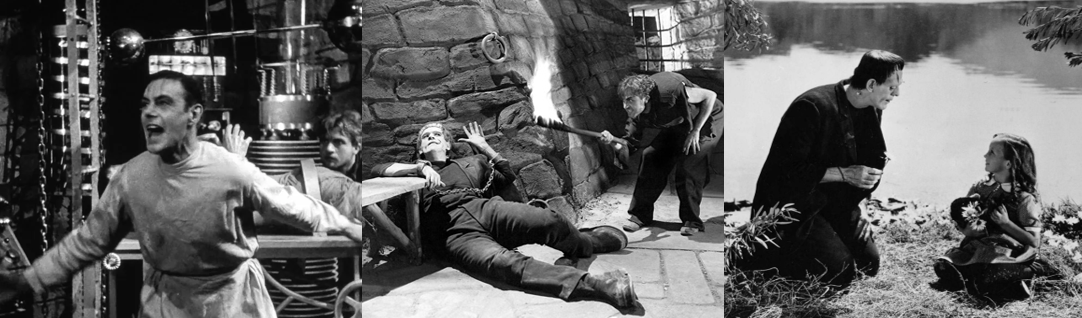
Surprisingly, I do have some experience with Shelley’s Frankenstein, having studied it at secondary school and during my undergraduate years, if only briefly. Although I’ve read and written about the text before, it has been a while since I revisited the book and most of my experiences come from the movies, as with all the Universal Monsters characters. Still, I remember enough to know that Frankenstein is a very loose adaptation, missing many details and supplanting them with others, though some of the missing material was utilised in the sequel, Bride of Frankenstein (Whale, 1935), so literary purists may have a better time watching both back-to-back. The first and most obvious change is that Frankenstein is named “Henry” here, with his title given to his cantankerous father, Baron Frankenstein (Frederick Kerr) and his original first name given to his friend, Victor Moritz (John Boles), who’s essentially an adaptation of the book’s Henry Clerval. Frankenstein also has a simple-minded, hunchbacked assistant in the movie (named Fritz (Frye) rather than the more mainstream “Igor”) rather than working alone, the Monster is deathly afraid of fire and never speaks, and many events are shuffled around. This is largely because, like Dracula, Frankenstein is based more on the stage play than the text, but it does mean the movie hits differently and explores alternate, if tangentially similar, themes regarding science, playing God, and the nature of man. The very fact that Frankenstein deals with such issues, no doubt shocking to a God-fearing world, potentially explains why the film opens with star Edward Van Sloan warning audiences to turn away if they’re shocked by such content. Indeed, the horror of Frankenstein, at the time, was just as much about a man playing God as it was the titular (or not so titular) Monster, since the idea that anyone but God can create life would’ve been deeply blasphemous and the fear of the unknown (in this case, science) would’ve made the subject matter particularly upsetting, I’m sure.

Despite warnings from his friends and loves ones, Frankenstein creates monstrous life with science.

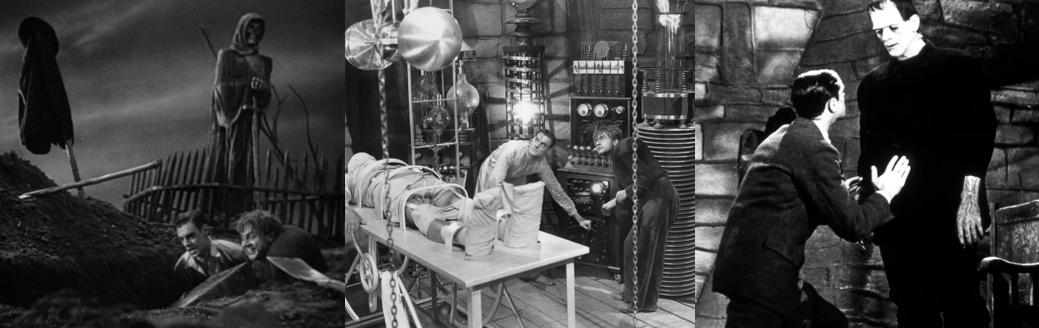
Anyway, in Frankenstein, Henry comes from a wealthy family with a great deal of influence on a small village in the Bavarian Alps. While the curmudgeonly Baron Frankenstein despairs of his son’s bizarre experiments and decision to isolate himself in an ominous stone tower laboratory with Fritz, Henry’s correspondence to his fiancée, Elizabeth Lavenza (Clarke), tells of his need for privacy and solitude. This is primarily because he and Fritz are sneaking out at night and digging up bodies, selecting organs and body parts for a patchwork man Henry aims to bring to life through the awesome power of electricity. While they scavenge everything they need for the body, Henry’s frustrated that the recently deceased can’t provide a viable brain, so he has Fritz steal a preserved brain from his old mentor, Doctor Waldman (Van Sloan), not realising that it’s a “criminal brain” seemingly hardwired for evil (that’s also further damaged by the clumsy Fritz). Concerned for her love’s welfare, Elizabeth politely shrugs off Victor’s advances and convinces him to ask Dr. Waldman for advice, with the three braving a horrific thunderstorm to visit Henry. Though frustrated by their interference, Henry invites them to witness his crowning achievement when Victor (fully aware of his intentions) accuses him of being mad. While Henry denies this claim, it’s obvious that he is a little bonkers, as seen in his exuberant and iconic cry of “It’s alive!!”, his claims to “be God”, and his initial denial regarding his creation once it comes to life. Ecstatic to have brought the creature to life, Henry insists that the childlike being needs time to adjust rather than rejecting it on first sight as in the novel. This is despite the protests of Dr. Waldman, who correctly warns that the “Monster” is an abomination to God and a threat to all due to its capacity for evil and its unpredictable nature.

Thanks to its unnatural origin, Frankenstein’s Monster is confused and quick to wild emotions.

Despite his efforts to teach the Monster, Frankenstein is forced to agree when the creature flies into a rage at the sight of fire and acts like a wild animal while chained in the basement, murdering Fritz, attacking Dr. Waldman, and almost throttling Henry before Dr. Waldman subdues it with what’s supposed to be a lethal injection. During Henry’s recuperation, his madness lifts and he returns to a normal life, finally marrying Elizabeth (to the joy of his father and the village). Ever the curious scientist, Dr. Waldman leads the vivisection on the Monster, becoming its second victim when it reanimates and strangles him to death. Though initially oblivious to the threat, Henry (and the entire village) are alerted of a wicked murderer after learning that local girl Maria (Marilyn Harris) has been drowned, Dr. Waldman killed, and after Elizabeth is attacked. Much of this is similar to the book, such as the Monster stumbling across a little girl, murdering a child, and going on a bit of a killing spree, but it’s framed as the actions of a confused and misunderstood creature rather than acts of wickedness. While the film goes to great lengths to assert that Frankenstein’s experiments are immoral and inhuman, the tone is awkwardly balanced between Henry’s madness, the darker sequences, and some strange comedic moments. These largely involve the blustering Baron Frankenstein, who’s convinced his son’s having an affair, demands that he forget his experiments, and constantly rambles about his grandmother’s wine. The Baron has no patience for Burgomaster Herr Vogel (Lionel Belmore) or the expectant masses…until Henry snaps out of his obsession and returns to the real world, and then the Baron’s all smiles and jokes. Elizabeth is the quintessential supporting fiancée, deeply devoted to Henry despite him isolating himself and Victor being right there, and far more suitable. Victor is basically a blank slate, shouting accusations at Frankenstein and offering little else, and honestly his role could’ve easily been merged into Dr. Waldman’s to speed things up.

Madness and science birth a confused and potentially dangerous abomination.

As ever, “Frankenstein” is both the Monster and the creator as Henry brings the wretch to life and is the subject of the film but does so through abhorrent acts like grave robbing and stealing. The Monster is seemingly a mishmash of different parts and pieces, with no true personality of its own, but it does retain rudimentary memories. These initially encourage Frankenstein as the Monster’s capable of stumbling about and obeying basic instructions, but his enthusiasm quickly dies when he sees how savage the Monster becomes when confronted by fire. The Monster’s rage is only fuelled when Fritz beats it and Henry gives up on it, reluctantly agreeing to kill the creature only to find Fritz strung up. Depicted as simple-minded but incredibly strong, the Monster easily overpowers two or three men at once and gleefully throttles Dr. Waldman, perhaps out of sheer muscle memory from its “criminal brain” or perhaps because it recognises the threat those around him pose to its existence. Indeed, when the Monster stumbles upon Maria, it sits and plays, laughing and seemingly content. However, it misunderstands the girl’s game of tossing flowers into the river and chucks her in for a laugh, drowning her despite her landing in the shallow end and unintentionally whipping the villagers into a lynch mob. It’s not clear why the Monster pays a visit to Elizabeth, especially as it seemed to be wandering at random, but she’s horrified by its grotesque appearance, and it attacks her when she tries to flee. Luckily for her, it leaves her alive, which only motivates Frankenstein to join the mob. Although the Monster looks nothing like Shelley’s descriptions, its design is certainly iconic and striking. A tall, lurching, shambling wretch with its eyes largely rolled back, two bolts in its neck, and misshapen skin, the Monster is an unnatural man-thing that mocks the beauty of natural life. Yet, interestingly, Henry isn’t immediately disgusted by it and the Monster is shown only to be confused and scared, lashing out accordingly and in need of guidance rather than persecution.

The Nitty-Gritty:
Frankenstein was certainly ambitious for the time. Boris Karloff’s make-up looks both impressive and extremely uncomfortable, with the actor perfectly stomping about and making stiff, jerky movements to show the creature is unnatural and undead. Although the film lacks a score to emphasis dramatic moments, there’s some great use of sound during the thunderstorm, which delivers the film’s most impressive moment. Sure, it’s weird that Henry’s visitors aren’t drenched when they enter the laboratory and his whole setup takes a lot of liberties with the source material, but Frankenstein’s laboratory is the quintessential “mad scientist” setup and a wonderful way to show the awesome and seemingly unknowable power of nature (in this case, lightning). Baron Frankenstein’s residence also impressed in its opulence, and I liked that Frankenstein incorporated many different locations, though some sets were a bit too obvious (which is to be expected). The film utilised a decent miniature to depict the windmill and its destruction and I was impressed by how often flaming torches appeared onscreen, and how fast and loose everyone played with getting up close to them! While the Monster’s jerky movements made his “fight scenes” a joke, I did like seeing these normal guys and scientists struggling to subdue the savage Monster, who easily overpowered them and left a decent body count in its wake. It’s a shame that we don’t get to see the Monster learning to speak or being more than a near-mindless creature, but the intention seems to be to emphasise that Henry came so close to playing God but screwed it up because man isn’t meant to meddle in such things. It’s always amused me as it surely would’ve been easier for Frankenstein to reanimate a fresh body than to stitch together a grotesque behemoth, and he arguably pays the price for that approach since the Monster is as much a victim of its disparate pieces as it is the situation it finds itself in.

A dramatic showdown between man and creation ends this startling loose adaptation.

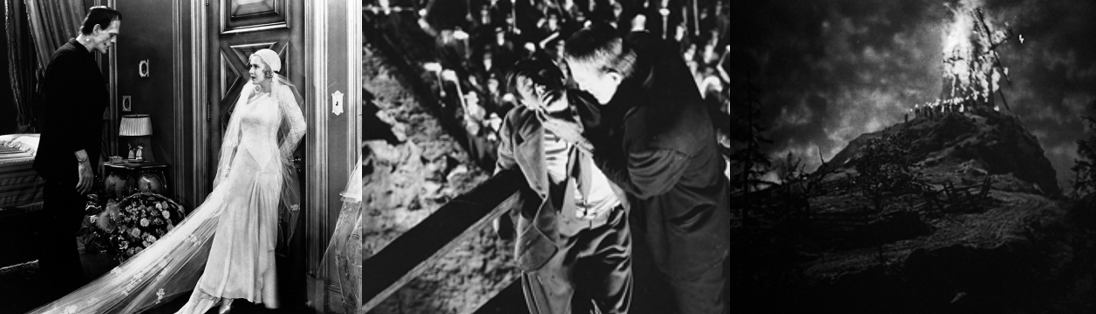
Upon discovering Maria’s dirty, drowned body, her shellshocked father (Michael Mark) carries her through the village and to the Burgomaster to warn of a murderer and immediately incites a lynch mob. The seething masses are only further incited when Dr. Waldman is found dead and Elizabeth is attacked, for the village holds the Frankensteins in high regard and is outraged at such an act. Frankenstein joins the search, which is split between different areas of the village and the surrounding grounds, with Henry venturing into the jagged mountains alongside rabid dogs and villagers wielding flaming torches. Unaware that his Monster is to blame for the deaths (since Henry believes the creature perished from Dr. Waldman’s serum), Henry is stunned when the Monster attacks him in the wastelands. The scuffle is brief and one-sided, with Frankenstein easily bested and hauled to a nearby dilapidated windmill with the mob in hot pursuit. Desperate to escape to the high ground, the Monster tangles with Frankenstein when he wakes, with Henry proving no match for his creation and being tossed from top floor. Luckily for him, the slow-moving windmill blades break his fall, leaving Frankenstein a gravely injured (but inconceivably alive) wreck on the ground. While some villagers carry Henry home, the others set the windmill on fire, sending the trapped Monster into a frenzy and seemingly causing its destruction when it’s consumed by the fire. In the aftermath, Frankenstein recovers at home alongside Elizabeth and his father celebrates with another shot of the family wine, toasting his family house and blissfully unaware that the rampage was caused by another “son of the house of Frankenstein”. It’s obviously a very different ending from the book, with the entire sub-plot and bookend of Captain Robert Walton dropped, Elizabeth and Henry surviving the events, and the omission of the Monster’s bride and vengeance upon Frankenstein’s family. Still, the Monster does seemingly perish in a fire like in the book and I don’t expect filmmakers from 1931 to try and bring the Arctic to life.

The Summary:
Since the stage play that Frankenstein is more directly adapted from has essentially been lost to the mists of time, it can be difficult to reconcile how loose an adaptation the film is from the source material. The film omits and changes many elements from the book, distilling the key events and themes to a feature-film length and losing much of the complex charm and horror of Shelley’s book. Yet, these elements are still present and, even in this modern day, there’s still a chilling message about man’s arrogance in using science to play God. While Henry Frankenstein insists that he’s the model of sanity, he is out in the dead of night digging up corpses, isolating himself from friends and family, and practically frothing at the mouth when his Monster comes to life. Though he lacks much of the nuance of the source material, Frankenstein is depicted as an egotistical and obsessed scientist who claws back some sympathy after initially appearing somewhat unlikeable, ultimately paying for his arrogance not with his life, but with a traumatic experience. Frankenstein’s lasting legacy is, without a doubt, the design and portrayal of the Monster. Boris Karloff gives a remarkable physical performance, lumbering about, throwing clubbing blows, and growling at his prey as the Monster struggles to adapt to its newfound unlife. The visual of the Monster, with its cuboid head, large suit, and metal bolts, is enduring and iconic and is so burned into the cultural consciousness that I’d wager most people don’t realise that the Monster looks nothing like that in the book. Frankenstein also impresses in its ambition, featuring many different locations and sets, some superb set design, and a surprisingly high body count (including a child, no less!) The film distils the book’s warnings about meddling in the unknown into a far more simplistic message about reaping what you sow, but it’s still a decent watch, despite some unavoidable flaws, that no doubt galvanised this version of Frankenstein’s Monster into the cultural zeitgeist.

My Rating:

Rating: 2 out of 5.

Could Be Better

Are you a fan of Frankenstein’s big-screen debut? What did you think to the changes to the source material and which parts did you miss the most? Did you also find Baron Frankenstein a bizarre character? What did you think to Boris Karloff’s performance and the dramatic redesign of the Monster? Where do you stand on who should or shouldn’t be called “Frankenstein”? Which adaptation of Frankenstein, or Universal Monsters movie, is your favourite? How are you celebrating Halloween this year? Share your opinions on Frankenstein in the comments, check out my other horror reviews, and donate to my Ko-Fi if you want to see more Frankenstein content.

Movie Night: Dracula (1931)

Released: 14 February 1931
Director: Tod Browning
Distributor: Universal Pictures
Budget: $341,191
Stars: Bela Lugosi, Helen Chandler, David Manners, Dwight Frye, and Edward Van Sloan

The Plot:
When R.M. Renfield (Frye) travels to Transylvania to oversee the purchase of a London abbey to the enigmatic Count Dracula (Lugosi), he unwittingly facilitates the malicious vampire lord’s trip to London, where he terrorises beautiful maiden Mina Harker (Chandler).

The Background:
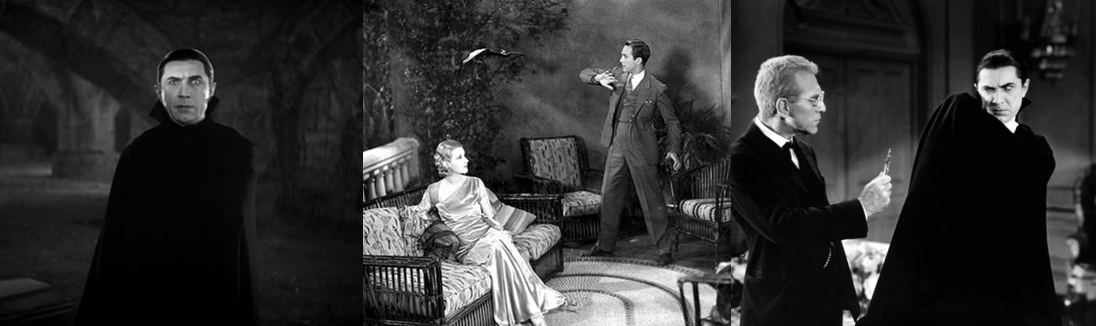
In 1897, the literary world was introduced to Count Dracula, Lord of Vampires, courtesy of Irish author Bram Stoker. Inspired by Irish folklore and long-standing vampire myths, Dracula undeniably popularised many characteristics of vampires that are still used to this day. Dracula also inspired many critical and academic discussions regarding its narrative and subtext, becoming a literary classic, and was said to be a big hit at the time, despite its controversial content. About thirty years later, Dracula was adapted for the stage, with former World War I infantryman Bela Lugosi first assuming the role that would make (and haunt) his career. Though the production was a hit, Lugosi wasn’t the first choice for the role when Universal Pictures began producing a feature film adaptation and only got the part after accepting a significantly lower salary. Although Browning’s film was the first official film adaptation of Stoker’s novel, Nosferatu: A Symphony of Horror (Murnau, 1922) owed its existence to Dracula, to the point that Stoker’s widow sued the filmmakers and ordered all copies to be destroyed. After acquiring the rights to the property, Universal Pictures funded what was said to be a disorganised shoot, with Lugosi alienating some cast members and Dracula stage veteran Edward Van Sloan expressing displeasure with the film. Despite some apprehension surrounding the film, Dracula was bolstered by reports of audience members fainting and it was well received by critics. Of course, nowadays, Dracula is regarded as a classic of the silver screen, with Lugosi’s portrayal being the quintessential standard of all subsequent screen Draculas. Its success not only led to additional big-screen outings for the count and a slew of horror releases from Universal Pictures, but also defined the titular character for generations.

The Review:
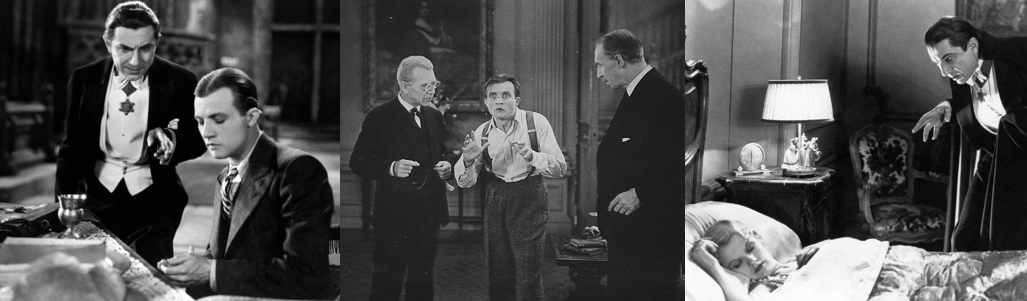
I think it’s important to preface this review by saying that I’ve never gotten around to reading Stoker’s Dracula. My experience with the Lord of Vampires is all based on movies and other media rather than books, so I can’t speak to Dracula’s status as an adaptation. If I had to guess, it seems it’s more an adaptation of the original stage production than the epistolary text, but I’m sure a lot of the most prominent elements of the book are represented here. Dracula is initially the story of Renfield, a painfully polite and well-to-do Englishman who travels to a morbidly superstitious town in Transylvania to oversee the sale of Carfax Abbey. Respectful and courteous to the locals, Renfield insists on meeting a midnight carriage, as arranged by his client, Count Dracula, only to be warned off by villagers. In a lengthy, awkward opening scene with many obvious insert shots, the locals react with horror at Renfield’s plan to meet Count Dracula and insist he carry a crucifix to ward off the vampires they believe live in the ominous, gothic castle. Undeterred by superstition and enthusiastic about closing the deal, Renfield maintains his composure even when Dracula’s carriage driver vanishes, his luggage is left behind, and the enigmatic count appears to pass through an enormous spider’s web. Renfield enjoys Dracula’s hospitality, complimenting his home despite it being quite dilapidated and eagerly partaking of his food and wine, only to be duped by the charismatic vampire, who easily hypnotises him with his alluring glare and then samples his blood to turn Renfield from a chirpy and pleasant solicitor into a grinning, cackling nutjob with a taste for insects and an unwavering devotion to his “master”. With Renfield’s help, Dracula not only legally secures Carfax Abbey, but also loads crates of his home soil onto the Vesta, ensuring he can maintain his full strength on the journey to London and while hobnobbing about the city as an eccentric aristocrat.

Vampire lord Dracula corrupts Renfield and heads to London to target an innocent young lady.

Once Dracula enslaves Renfield, the film juggles between the alluring count and Doctor John Seward (Herbert Bunston) and his inner circle. A renowned physician, Dr. Seward operates the sanatorium that sits alongside Carfax Abbey and where Renfield is committed after being discovered as the crazed sole survivor of the Vesta. Dr. Seward lives with his beautiful daughter, Mina, who’s engaged to his protégé, Jonathan Harker (Manners) and best friends with Lucy Weston (Frances Dade). The four are rarely seen apart, enjoying the opera together when they’re first introduced to Count Dracula, who shuns Harker and takes a shine to Lucy. Captivated by the count’s charisma, Lucy jokes to Mina of her attraction to him but quickly becomes his next victim when he enters her room and feast on her blood. Despite Dr. Seward’s best efforts, Lucy dies and Mina is left devastated, haunted by terrifying nightmares of wolves and bats. As Renfield keeps mysteriously leaving his cell, perplexing bumbling attendant Martin (Charles K. Gerrard), and ranting about all kinds of nonsense, Dr. Seward has his colleague, polymath Professor Abraham Van Helsing (Van Sloan), analyse the madman’s blood. Van Helsing concludes that Renfield has been bitten by a vampire and constantly exposits folklore about Nosferatu, who assume various animal forms, drink blood, and cast no reflection. While Harker is sceptical, Mina takes them to heart and they’re seemingly proven true when Renfield reacts violently to wolfsbane, a vampire repellent. During a tense meeting with Dracula, Van Helsing reveals that the count has no reflection and deduces that he’s their vampire, though Dr. Seward and the others are only convinced to do something other than just stand around discussing the threat after Dracula easily coaxes Mina into the garden for another suck session, eventually leading Van Helsing to give her wolfsbane for her protection.

Despite his allure and incredible powers, Dracula is surprisingly vulnerable if you know his weaknesses.

Of course, the main draw of Dracula is the titular count, played masterfully by the magnetic Bela Lugosi. A charming, gracious man with a silver tongue, Dracula oozes charisma but is as unnerving as he is appealing thanks to his raspy accent and peculiar behaviour. Dracula relishes the sound of wolves, the sight and taste of blood, and particularly enjoys getting close to his quarry, captivating with his steely gaze and wooing with his words. Van Helsing instantly distrusts Dracula and they have some tense face-offs, with the professor’s willpower resisting the count’s hypnotism and his knowledge of vampires giving the protagonists the edge. Since Dracula is vulnerable to sunlight and needs Transylvanian soil to maintain his strength, he rests in a coffin of dirt during the day but easily enters Dr. Seward’s residence by becoming the fakest bat you’ve ever seen. Dracula showcases superhuman strength but his greatest assets are his charming personality and alluring gaze, though his brides (Cornelia Thaw, Dorothy Tree, and Geraldine Dvorak) flinch at his command and he clearly instils fear in the locals. This fear isn’t felt by Dr. Seward and the others since they see him as a polite, if eccentric, foreign count, and isn’t felt by Van Helsing, who’s clearly wise to the vampire’s tricks. Unfortunately, many of these are kept offscreen, merely told by Harker and Renfield, because of the limitations of the time. I was also a bit unclear about what Dracula’s endgame was. He buys Carfax Abbey and targets Dr. Seward and his wards, but I’m not sure why? I guess to spread his wings beyond his stuffy old castle but it’s not clear why he targets Mina beyond enjoying torturing Harker and turning something innocent into an abomination, as he did Renfield, who spends the film conflicted and wrestling with his loyalties and his wish to die without blood on his hands. Lugosi plays the role so well that it’s easy to forget these criticisms, but it was frustrating seeing everyone just standing around or him just glaring at people or randomly being inserted into shots to show him lurking on the grounds.

The Nitty-Gritty:
I usually cut black and white films a lot of slack. It was a different time with many limitations compared to today, where almost anything is possible in cinema. Therefore, I can forgive the obvious sets and painted backgrounds, and the slight imperfections in the camera movements and film quality. This extends to the few special effects, such as cutting to Renfield’s reaction rather than showing Dracula pass through the web, having Harker describe the wolf running across their grounds, and Renfield’s mad rant about the “thousands … millions!” of rats promised to him by his master. Dracula’s bat form is silly, for sure, but the effort put into Lugosi’s costume and lighting his eyes is impressive, even if his close-ups often feel awkward and out of place. Dracula gets ambitious by using a passable model ship for the Vesta’s trip (though some water effects over Lugosi would’ve helped sell the sequence) but strangely relies on voice overs to describe the massacre Dracula leaves on the ship. I did like how theatrical the whole production was, which isn’t surprising considering the time period and Lugosi’s experience portraying the role on stage, with the actors (especially Dwight Frye) largely overacting and chewing the scenery. I do feel Dracula suffers from a lack of music, though, as the film basically has no soundtrack and some scenes would’ve greatly benefitted from some ominous tunes. Dracula, especially, needed a haunting theme accompanying him and some ambient music would’ve really helped to liven up the film’s many dull exposition scenes.

Dracula’s brief and confusing rampage is easily ended when Van Helsing stakes him in his sleep…

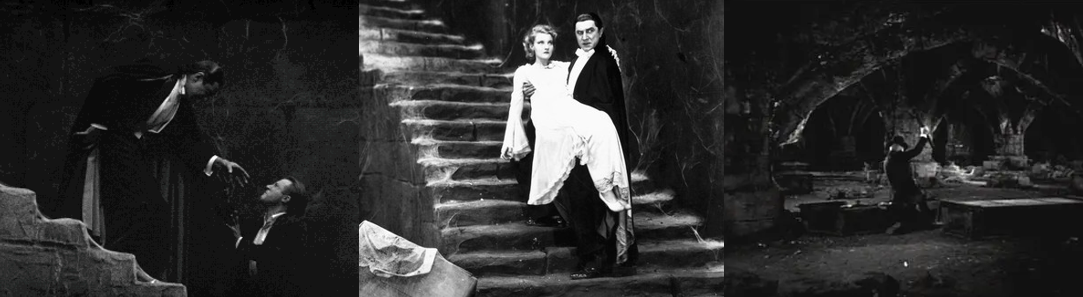
Despite Van Helsing’s best efforts, Mina falls under Dracula’s spell, confessing to Harker that she’s becoming a creature of the night and breaking off their engagement. While Van Helsing is unflinching against Dracula’s threats, Mina’s maid (Joan Standing) is easily coerced into removing the wolfsbane from the entranced girl and spiriting her away. Luckily for her, Harker and Van Helsing spot Renfield fleeing to Carfax Abbey (although, honestly, where else would Dracula be?) and they pursue the crazed lunatic. This leads to a tragic end for Renfield as Dracula is incensed that his witless minion has betrayed his location (though…again…that should be the first place anyone would look!) and, despite Renfield begging to be tortured or punished, the sad fool is nonchalantly tossed down a flight of stairs to his death. While you might expect a tense showdown between Dracula and Harker, or perhaps a battle of wits between the count and Van Helsing, with the two perhaps buying time to expose Dracula to the rising sun and turn him to ash, the finale is far more disappointing. Dracula flees into Carfax Abbey with Mina in his arms and Harker and Van Helsing muddle about in search of him, knowing full well that he must rest in his coffin to avoid the rising sun. Van Helsing also knows that the only way to kill a vampire is with a wooden stake through the heart, so he improvises such an implement from the dilapidated abbey and the two stumble upon a coffin. While Mina isn’t inside, Dracula is, already fast sleep despite mere minutes passing, allowing Van Helsing to easily stake him to death with no resistance or the count’s death even being shown onscreen. Harker then finds Mina, who conveniently returns to normal, and the film abruptly and anticlimactically ends with the firm belief that Count Dracula has been destroyed forever.

The Summary:
Dracula’s never really been a favourite of mine. Out of all the classic gothic horror novels and all the Universal Monsters films, I can think of at least three others I’d rather watch or read than this one. Dracula lives and dies by the allure of its main star, the enigmatic Bela Lugosi, who brings an unmistakable gravitas to the role (and the screen) every time he appears. The man embodied the role so perfectly that it set the standard not just for future portrayals of Dracula, but most vampire characters (especially their leaders). Charming, sophisticated, and with a glare that can chill to the bone, Lugosi’s Dracula commands the screen and effortlessly woos all around him. Except, of course, for Van Helsing, played with stoic confidence by Edward Van Sloan as the natural foil to the malicious count. Honestly, I wish we’d gotten more interactions between these two in a battle of wits and wills as Van Helsing employed his vast knowledge to reveal Dracula’s true nature. Instead, we get a lot of sitting and standing around as characters describe stuff I would’ve loved to see, reiterate the plot or discuss vampire lore, or wonder what’s to do in their quirky, oh-so-British way. Dracula is visually impressive at times, especially the Castle Dracula set, though obviously its effects and techniques are painfully dated these days. The film touches upon the fear of the unknown, of being preyed upon by a conniving and manipulative, lustful predator, and Dracula’s tortured immortality but never fully commits. Similarly, the film’s ending seems to be very different and far less grandiose than the book’s, which definitely hurts it as it just…ends, leaving you unfulfilled. Ultimately, no one (least of all me) is denying the cultural significance of Dracula, but I absolutely feel it’s lacking in ways other Universal Monsters movies aren’t. Watch it to witness history but don’t expect much to hold your attention, especially if Lugosi isn’t on the screen.

My Rating:

Rating: 2 out of 5.

Could Be Better

Are you a fan of the 1931 big-screen adaptation of Dracula? If you’ve read the book, what did you think to the changes it made and the elements it brought to life? Do you agree that the film drags in the middle or were you as captivated by the narrative as Mina was by Dracula? What did you think to Bela Lugosi’s performance and would you agree that he’s the standard all Draculas should be compared to? Which adaptation of Dracula, or Universal Monsters movie, is your favourite? How are you celebrating Halloween this year? Let me know your thoughts on Dracula down in the comments, go read my other horror reviews, and donate to my Ko-Fi if you want to see more Dracula content.