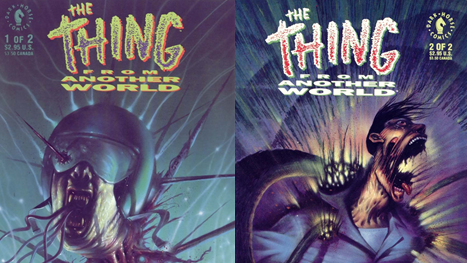
Back Issues [Sci-Fanuary]: The Thing from Another World #1-2


January celebrates two notable dates in science-fiction history: “National Science Fiction Day” on January 2 to coincide with the birth of world renowned sci-fi writer Isaac Asimov, and 12 January being when Arthur C. Clarke’s HAL 9000 was created. Accordingly, I dedicate January to celebrating sci-fi in all its forms.

Story Title: “The Thing (from Another World)”
Published: 1991 to 1992

Writer: Chuck Pfarrer
Artist: John B. Higgins

Quick Facts:
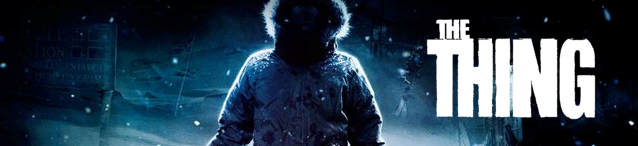
Published by Dark Horse Comics, known for creator-owned stories and licensed adaptations of horror and science-fiction films, The Thing from Another World continued where John Carpenter’s sci-fi classic left off but utilised the title of the celebrated 1951 adaptation of John W. Campbell’s influential 1938 novella to avoid legal issues with Marvel Comics.

The Review:
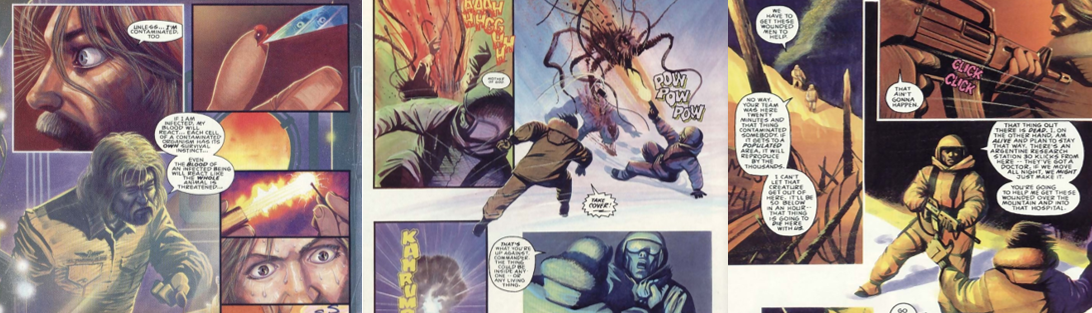
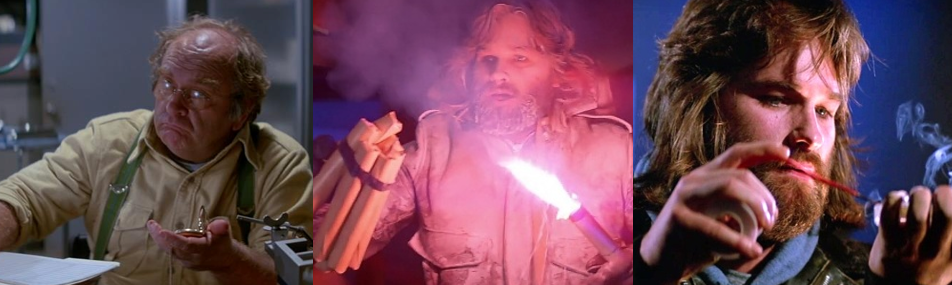
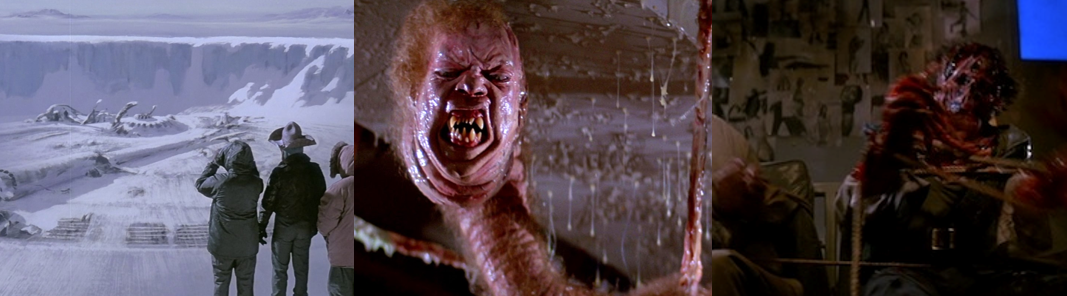
The Thing from Another World is set twenty-four hours after the team at United States Antarctic Research Outpost #31 discovered an aggressive, parasitic alien organism (the titular “Thing”) that drove them to paranoia and violence through its ability to gruesomely mimic living creatures. The comic immediately answers the question about whether or not the final survivors from Outpost #13 lived or died by showing that Childs carried the unconscious R.J. “Mac” MacReady through a bitter snowstorm and out onto the ice fields and left him to be rescued by the Misaki Maru, a passing whaling vessel. The confused and disoriented Mac is horrified to learn that Childs returned to Outpost #13 to look for more survivors, leading to him being sedated to keep him calm. When he awakens again, Mac quickly cuts himself free and dresses, pondering why Childs would save him if he (as in Childs) was infected by the Thing. Suddenly paranoid that he may be the one that’s infected, Mac quickly replicates the blood test depicted in John Carpenter’s The Thing (1982) and is relieved when he gets the all-clear, lending some credibility to the notion that the infected don’t know they’re a Thing until they’re threatened. Easily snaking around the ship, Mac (being a fully qualified pilot) commandeers their helicopter and quickly picks up Childs’ trail, which heads East rather than North towards Outpost #13. Although Mac’s forced to ditch the helicopter when he runs out of fuel, he successfully makes it back to the remains of Outpost #13, where he quickly gets to work burning the brutalised remains of his former friends.

The paranoid Mac is so determined to eradicate the Thing that he seems willing to die to do it!

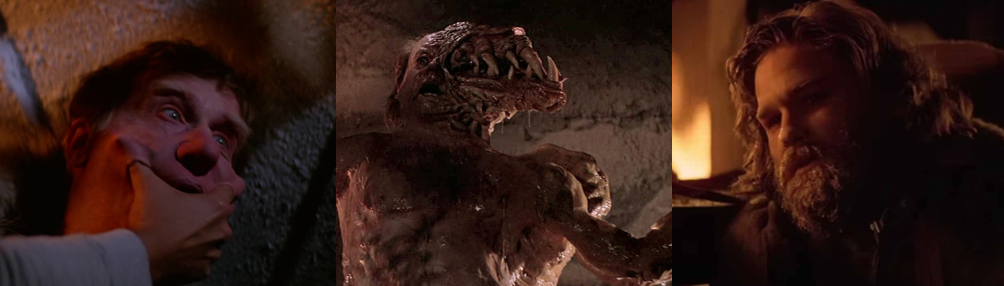
Mac discovers the mangled, monstrous hibernating form of another mishmash of lifeforms and promptly blows it to pieces. However, he’s stopped from destroying the separate chunks by United States Sea, Air, and Land troops (SEALs). The SEALs were dispatched to investigate Outpost #13 but appear to have no idea of what really happened there and believe Mac murdered everyone and destroyed the base. Despite being cuffed, Mac leashes out when one of the SEALs, Pybus, curiously touches a piece of the Thing, leading to him taking a rifle butt to the head and the oblivious Lieutenant Commander Les Erskine to order that the mutilated remains be left for the bio-team. Just as the SEALs are boarding their evacuation helicopter, Pybus sprouts tentacles and mutates, firing on his stunned teammates, gunning most of them down and destroying the helicopter. Freed from his cuffs, Mac blasts the Pybus-Thing with a pistol, only for its corpse to birth a bizarre, tentacled alien that finally makes a believer out of Erskine before Mac blows it up with a grenade. After tending to their wounded, Mac and Erskine explore their options, only to find they’re out of fuel and with no hope of rescue. Erskine’s aghast when Mac reveals his plan to eradicate all traces of the Thing, including the both of them, to ensure there’s no chance of even a small part of it reaching civilisation. Erskine offers an alternative solution by holding Mac at gunpoint and ordering him to help get the wounded soldiers to a nearby research station, though they continue to clash regarding their chances and one man dies from his wounds (or the severe cold) on the way. Erskine is livid when he discovers Mac intentionally led them in the wrong direction, leading to another brief scuffle in which Erskine suspects Mac wants them to freeze to death because he’s the Thing!

Mac and Childs must set aside their differences to stop the Thing from reaching civilisation.

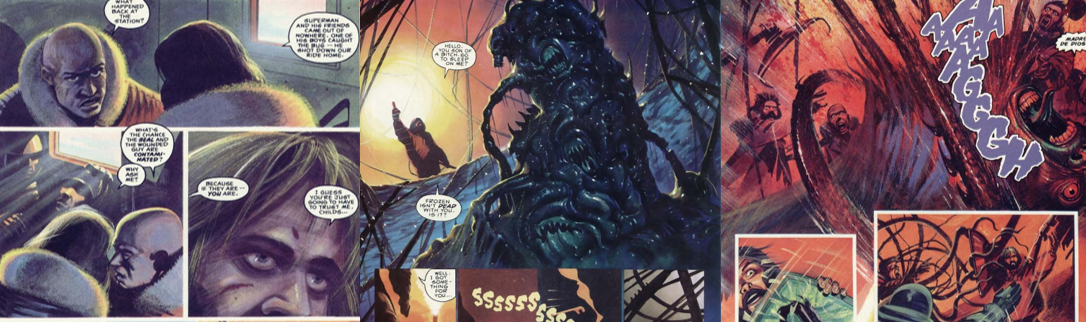
Their scuffle is interrupted by Childs and some Argentinians from the base, though the paranoid Mac immediately attacks Childs. After Mac is subdued, Childs confirms that he left Mac to be rescued and went back to destroy the others, though Mac remains suspicious. Mac’s horror only increases when they reach Campo Del Sur and see how many people could get infected, though Childs assures him that the Argentinians are conducting routine blood tests to stay safe. While Mac’s still hostile even after he and Childs are tested negative, he’s startled when Erskine’s unconscious trooper bursts into a bloody mass of tentacles and teeth! Though injured, the Thing quickly escapes, forcing the others to pursue and discover the gruesome remains of its latest victim. Despite Mac’s protests, Childs insists on proceeding further before the Thing can freeze and ends up almost devoured by the gigantic, cephalopod-like Thing before it’s destroyed with a grenade. Erskine urges them to return to Campo Del Sur so he can radio for assistance, leaving Mac to share his concerns about the commander to Childs. While Childs has his doubts since Erskine was so “gung-ho” about destroying the Thing, Mac’s fears are soon proven when they find three men dead in the trashed radio room. Realising that the Erskine-Thing radioed for a submarine, Mac and Childs race to intercept it, riddling the Erskine-Thing with bullets and causing it to wildly mutate. The Thing slaughters its way onto the submarine and goes on a rampage, with the sub performing an emergency dive and eventually crashing after the Thing wrecks the controls. With the submarine quickly flooding and the Thing heading for the escape capsule, Mac quickly catches the survivors up to speed and forms a hunting party and finds it in the torpedo bay. Despite Mac being ready to die to end the Thing’s threat, he objects when Childs goes to blow the hatch and end the nightmare once and for all. Childs thus destroys the submarine and all onboard except Mac, who’s inexplicably blasted from the wreckage and emerges on the frigid surface, passing out on an ice float despite his determination to stay alive…

Final Thoughts: 
John Carpenter’s The Thing ends with perhaps one of the greatest cliff-hangers in all of cinema and fans have debated for years about whether Mac or Childs have been infected or not. One of the reasons it’s such an intriguing debate is that it’s presented as a stalemate between the two. Both are equally suspicious of each other and likely to be either human or the Thing, but both are too exhausted and paranoid to do much about it but “wait and see” what happens. The Thing from Another World isn’t the only piece of ancillary media to provide a definitive answer to this long-debated cliff-hanger, but it’s equally questionable about whether these answers work or not and may come down to personal preference. On the one hand, it’s cool to continue Mac’s nightmare and to see him hunt down and destroy the Thing, and to see how he and Childs react to each other when reunited. On the other hand, it feels like a disservice to the film to provide a definitive answer and it’s possible this story could’ve been just as effective if it followed a researcher or soldier investigating Outpost #13 and perhaps working from the remains of Blair’s notes. The fact that subsequent issues double-down and continue Mac’s story only compounds the issue, though I liked that Mac was even more proactive than ever and used his traumatic experiences and first-hand knowledge of the Thing to his advantage against the shape-shifting alien. I was also intrigued by the twist that he was ready to die to ensure the alien is destroyed. However, it’s bizarre that he so vehemently objects when Childs sacrifices himself and the others on the submarine at the end, especially as Mac was ready to sacrifice Erskine in the mountains. At the same time, Mac was hesitant to murder Erskine so maybe this is just a poorly executed expansion of the fear and paranoia that have so tightly gripped Mac’s heart.

If nothing else, the comic perfectly captures the paranoia and horror of John Carpenter’s movie.

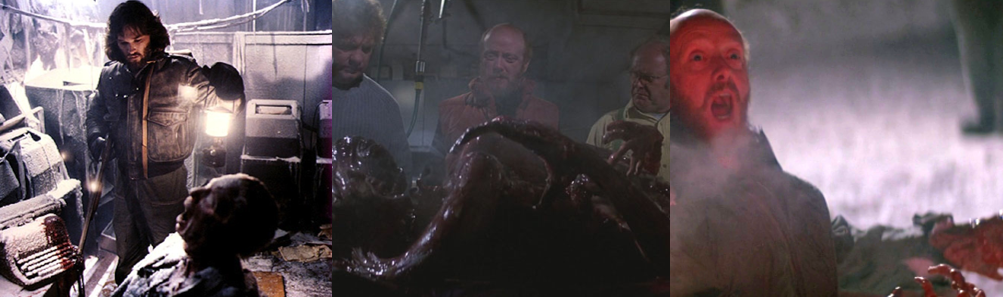
Overall, I’d have to say the artwork was very impressive, perfectly capturing the dark, desolate atmosphere of Antarctica and bringing the gore to life with intricate brushwork. It was a little difficult to make out what was going on at times, especially when the Thing reveals itself, but this may have been intentional to replicate the “less is more” approach of the movie and emphasise how chaotic it is when the infected suddenly sprout tentacles and gnashing teeth. Indeed, the art is at its best when depicting the Thing and its victims, recreating the memorable special effects of the movie and playing upon the reader’s familiarity with the film to depict the remains of Outpost #13 and the mangled corpses of its inhabitants. Mac blows up a hibernating mass of flesh and teeth that closely resembles the Thing’s final form in the film, the defibrillator scene is evoked when Erskine’s soldier suddenly explodes with tentacles and dangerous alien appendages, and we get a better idea of how capable the infected are as we see them using rifles and having the wherewithal to signal for help. The Thing from Another World also introduces a couple of additional forms for the Thing, ones possibly too outrageous and ambitious to be brought to life by John Carpenter’s paltry budget. These include a bug-like Thing, a larger one out in the snow, and the strange, bipedal mess of meat that Erskine devolves into to tear through the submarine. The only real downside is that the Things are dispatched quite easily each time, with a single grenade being enough to destroy or at least subdue them long enough for their pieces to be incinerated. The Thing still slaughters a bunch of people, to be fair, but they’re largely nameless, faceless SEALs whose deaths mean little compared to those of Outpost #13. Ultimately, this was a decent enough epilogue to The Thing, but I think it would’ve been better, overall, to avoid answering what happened to Mac and/or Childs and instead follow wholly original characters as they encounter the Thing.

My Rating:

Rating: 3 out of 5.

Pretty Good

Have you ever read The Thing from Another World? Were you happy to see the film’s cliff-hanger answered here or would you have preferred the story to focus on original characters? What did you think of the art work and the call-backs to John Carpenter’s movie? Did you guess that Erskine was infected? Can you explain why Mac suddenly abandoned his suicidal crusade at the end? How are you celebrating the sci-fi genre this month? Whatever your thoughts on The Thing from Another World, drop a comment down below and send me some love on Ko-Fi if you want me to review more Thing comic books.

Movie Night [Sci-Fanuary]: John Carpenter’s The Thing


January celebrates two notable dates in science-fiction history: “National Science Fiction Day” on January 2 to coincide with the birth of world renowned sci-fi writer Isaac Asimov, and 12 January being when Arthur C. Clarke’s HAL 9000 was created. Accordingly, I dedicate January to celebrating sci-fi in all its forms.


Released: 25 June 1982
Director: John Carpenter
Distributor: Universal Pictures

Budget: $15 million
Box Office: $20,847,529
Rotten Tomatoes Scores: 85% / 92%

Quick Facts:
The second big screen adaptation of John W. Campbell’s iconic 1928 novella Who Goes There?, The Thing was almost helmed by horror maestro Tobe Hooper before John Carpenter got involved and pushed for a story closer to the source material. Bill Lancaster modernised the story to focus on paranoia and fear while Rob Bottin delivered the gruesome practical effects to meld numerous bizarre and horrific alien aspects into the titular “Thing”. A critical and commercial failure at the time, John Carpenter’s The Thing is now widely regarded as a sci-fi/horror classic and spawned comic books, videogames, and a divisive 2011 prequel.

The Review:
Life within the remote, frigid United States Outpost 31 is suddenly turned upside down when a couple of Norwegian researchers suddenly circle their snowed-in facility, where the isolated inhabitants wile away in the rec room or, in pilot R. J. “Mac” MacReady’s (Kurt Russell) case, swigging whiskey and being beaten at computer chess. The Norwegians are chasing a sled dog (Jed) through the snow and, when they fail to shoot it, land to try explosives. The commotion alerts Mac and his cohorts, who rush into the snow to see what’s up and unknowingly shield the dog, leading to the desperate and ranting Norwegian (Norbert Weisser) to threaten them at gunpoint after accidentally blowing up his helicopter and co-pilot. Startled, the Americans open fire, with station commander M. T. Garry (Donald Moffat) executing the Norwegian with his prized revolver. Confused by all this, Mac takes station physician Doctor Copper (Richard Dysart) to the Norwegian base, despite the inclement weather, and finds it a burned out, frozen wreck full of gruesome bodies. While Dr. Copper gathers the Norwegians’ notes to try and understand what happened, Mac discovers the frozen remains of a mysterious ice-like tomb and a charred, inhuman corpse that’s hideously malformed. They transport the remains back to base for analysis, only for microbiologist Doctor Blair (A. Wilford Brimley) to be bemused by the Thing’s malformed, misshapen biology. Still puzzled by whatever fate befell the Norwegians and the bizarre, steaming corpse sitting in their medical room, the team return to their games, pondering the day’s events and niggling each other, unaware that the sled dog has snuck into one of their rooms.

Mac and the others discover a horrifying alien parasite that assimilates anything it touches.

Sombre dog handler Clark (Richard Masur) later takes the adopted dog to the kennels, where it suddenly and violently erupts into a writhing, thrashing, screaming alien creature! Ensnaring the other dogs and spraying them with goop, it assaults the panicked dogs, drawing Clark and the others. Horrified, Mac and Garry blast the Dog-Thing and the other dogs, much to Clark’s dismay, and surly mechanic Childs (Keith David) incinerates the creature with a flamethrower. Dr. Blair’s subsequent autopsy reveals that the burned corpse isn’t a dog, but an “imitation” of one that was attempting to absorb and imitate the other dogs. Reviewing the Norwegians’ data, which includes video footage similar to the 1951 film, the crew discovers that the Norwegians discovered an alien space craft buried deep in the ice. They risk another helicopter ride to the site and find the craft, which is estimated to have crashed thousands of years ago and which was uncovered when the Norwegians used explosives, leading them to recover a frozen occupant who subsequently overran their base. Shaken by the implications, Dr. Blair runs some tests and determines that the parasitic organism aggressively latches onto and absorbs living cells, perfectly imitating any living creature it samples and sprouting teeth, tentacles, and other appendages from potentially thousands of other worlds. Realising that the Thing could overtake the entire world within three years if it reaches civilisation, Dr. Blair snaps and wrecks the outpost’s communications array and much of their equipment before he’s subdued and isolated. This leaves out of his depth assistant biologist Fuchs (Joel Polis) to pour over Dr. Blair’s mad ramblings for a solution and Garry shell-shocked when the Dog-Thing’s remains slither to life and absorb his friend, meteorologist George Bennings (Peter Maloney), forcing the others to set his half-transformed form alive and burn every trace of the alien from the outpost.

Paranoia and fear run rampant as the Thing assimilates those around it and feeds their distrust.

With radio operator Windows (Thomas Waites) unable to call for help and their vehicles trashed during Dr. Blair’s breakdown, the survivors prepare to weather an incoming storm, tensions flare when soiled long johns appear in cook Nauls’ (T. K. Carter) kitchen and the shredded remains of Mac’s clothing are found out in the snow. Dr. Copper suggests they use the blood bank to test who’s human and who’s the Thing, but this is scuppered when someone destroys the blood bank and they descend into arguments and finger pointing when this is discovered, accusing Garry since he’s the only one with the keys and Dr. Copper since he regularly accesses the blood. The distrust being thrown around knocks Garry’s confidence and, after a tense showdown with Windows when he frantically grabs a shotgun, Garry relinquishes his revolver and command to Mac. While Mac tries to hold the group together, being the coolest and most logical head despite his growing fear and paranoia, the others descend into anger and distrust after Fuchs is mysteriously burned alive and any chance of employing Dr. Copper’s blood test. However, but soon decide Mac is the most untrustworthy  and strand him in the blizzard. They’re even more convinced he’s the Thing when he stumbles back to base without a guideline and, enraged by their betrayal and wracked by the cold, Mac threatens to blow them all up with dynamite if they don’t listen to reason. The tense standoff sees Mac and Childs clash and Clark, also a chief suspect due to his close proximity to the dogs, ready to shank Mac at the first opportunity. During the scuffle to disarm Mac, terrified geologist Norris (Charles Hallahan) is tossed aside and seemingly dies from a heart attack, only to be shockingly revealed to be the Thing! This revelation does little to allay Mac’s suspicions and, after the ghastly Norris-Thing and its offspring are incinerated, Mac forces those he begrudgingly trusts to tie up those he doesn’t and ventures that their blood with violently react to a hit needle if they’ve been assimilated.

Recovered from a crashed ship, the Thing is a hideous amalgamation of various organisms.

Rather than being a strange vegetable creature, the titular Thing is a parasitic organism like in the book. Although we see its flying saucer crash to Earth in the pre-title sequence, there’s no way of knowing if the Thing was the pilot or was simply held captive on the ship (though I’d venture to say the ship crash-landed after the Thing broke out). The Thing has no true form and instead hides behind imitation, perfectly replicating living creatures and even mirroring their personalities, to the point where the assimilated seem unaware that they’re the Thing until they’re threatened. Assistant mechanic Palmer (David Clennon), for example, appears completely human until Mac performs his blood test, whereupon Palmer violently explodes into bloody, gnashing jaws. Norris also appears normal, even tackling Mac alongside the others, until he appears to die and Dr. Copper performs CPR and Norris’s chest splits open and rips his arms off! The Thing’s only goal is to assimilate and procreate everything it can, picking off potential threats and fighting to survive when threatened. Although it appears inhumanly strong and durable, shrugging off shotgun blasts and easily manhandling Windows, it’s not invulnerable. Fire is especially effective, as is dynamite, with the creature being most vulnerable mid-transformation, as seen with the Bennings-Thing. Rather than being a singular organism, every cell of the Thing is alive and thinking, allowing it to disgustingly detach part of itself when the main “body” is destroyed and meaning it can infect multiple targets at once. The Thing is also seen to be very shrewd and intelligent, allowing the survivors to waste their energies on paranoia and accusations rather than formulating strategies, and having intelligence enough to cobble together a miniature flying saucer in the case of the Blair-Thing. The Thing is also incredibly patient, happy to let the humans destroy themselves and hibernate in the snow until the rescue team arrives and then assimilate them…and the rest of the world, in short order.

Although Mac destroys the Blair-Thing, there are lingering questions about who can be trusted. 

When Mac’s blood test outs Palmers and leads to him and Windows dying, a slither of trust is reignited as the cleared survivors go to test Dr. Blair. However, they find he’s built a small flying saucer and tunnelled his way out, revealing himself to also be a Thing. After the Blair-Thing destroys the outpost’s power generator, Mac realises it’s willing to outlast them in the cold to escape and that they’re unlikely to make it out alive without any heat and rescue far away. Resolving to keep the Thing from reaching civilisation, Mac and the others prepare to bring the whole outpost down by setting dynamite charges. However, paranoia rears its ugly head as Nauls and Childs go missing; the Blair-Thing also ambushes Garry in the tunnels, leaving Mac alone. The Blair-Thing then spectacularly erupts from the floor as a massive, mewling amalgamation of repulsive alien and vaguely animal parts in a fantastic combination of practical effects, stop motion techniques, and puppetry. While the monstrous Blair-Thing is quite lumbering and mainly just stands there roaring, its tentacles whipping about as it emits that disturbing hissing, it devours Mac’s detonator and seems poised to take him. Defiant until the end, the rugged, exhausted Mac tosses a stick of dynamite at the creature and destroys it, along with the entire outpost. Barely escaping the blast, Mac stumbles through the burning debris and finally collapses from fatigue, whiskey in hand. Childs emerges from the blizzard, claiming to have gotten lost while pursuing Dr. Blair, and sits with him, both too tired to argue or to fight. Realising the flames will die out soon and they’re likely to perish from the cold, the two acknowledge the futility of their situation and their mutual distrust and resolve to simple share a drink and wait to see what happens, leaving their ultimate fate up to the audience…

Final Thoughts:
John Carpenter’s The Thing is one of the quintessential remakes of all time. While the original film was an ambitious B-movie that took huge liberties with the source material, The Thing stays very close to Who Goes There? in its interpretation of the titular alien parasite and the destructive paranoia that tears the humans apart. There’s a sense that many of the characters barely tolerated each other to begin with, meaning tensions fray very quickly once they realise the Thing can perfectly imitate them down to their memories and behaviour. The film perfectly conveys this by rarely, if ever, showing who’s been assimilated and when, meaning we never really know who to trust as everyone – even rugged protagonist Mac – is a suspect. It’s thus shocking when characters turn out to be human or suddenly explode into a thrashing, shrieking mess of flesh and teeth and even destroying the Thing and performing tests doesn’t stamp out the unease felt by the survivors. Kurt Russell did a great job as reluctant leader Mac, who seems ready to pack it all in at a moment’s notice. I liked his heated rivalry with the immortal Keith David and how easily he took charge, and how physically and emotionally exhausted he was by the whole ordeal. Some aspects, like Dr. Blair’s computer simulation, are rather quaint but they get the job done and the gruesome special effects more than make up for them. The Thing is constantly sprouting new appendages and forms and surprising audiences by springing to the ceiling, becoming a scurrying spider-like head, or clamping down on its prey with its massive teeth. It’s a spectacularly ghastly creature that’s nauseating to look at as you never know what it’s going to do next as it clearly retains knowledge of other alien creatures and is a highly adaptable and versatile parasite. The ending may be one of cinema’s greatest cliff-hangers and the simple story of distrust and desperation remains as palpable as ever, making John Carpenter’s The Thing a timeless sci-fi/horror classic that’s difficult to beat.

My Rating:

Rating: 4 out of 5.

Great Stuff

Do you agree that John Carpenter’s The Thing is one of the greatest remakes of all time? How do you feel it works as an adaptation? Which character were you most surprised to find out was human (or the Thing)? Did you enjoy Kurt Russell’s performance and his rivalry with Keith David? How amazing were those gruesome special effects? How did you interpret the ending and what sci-fi films are you watching this month? Use the comments below to hap some praise on John Carpenter’s The Thing and donate to my Ko-Fi to suggest other sci-fi films you’d like to see me cover.

Movie Night [Sci-Fanuary]: The Thing from Another World


January celebrates two notable dates in science-fiction history: “National Science Fiction Day” on January 2 to coincide with the birth of world renowned sci-fi writer Isaac Asimov, and 12 January being when Arthur C. Clarke’s HAL 9000 was created. Accordingly, I dedicate January to celebrating sci-fi in all its forms.


Released: 27 April 1951
Director: Christian Nyby
Distributor: RKO Radio Pictures

Budget: $9 to 15 million
Box Office: $1.1 million
Rotten Tomatoes Scores: 87% / 73%

Quick Facts:
Based on celebrated, influential novella, Who Goes There? (Campbell, 1938), The Thing from Another World was loosely adapted by Charles Lederer, Howard Hawks, and Ben Hecht. The titular “Thing” (James Arness) became a plant-like humanoid thanks to extensive make-up later replaced with an asbestos suit for an ambitious fire stunt. Though very different from the novella, The Thing from Another World is considered one of the best movies of the 1950s and inspired one of the greatest remakes ever made in 1982.

The Review:
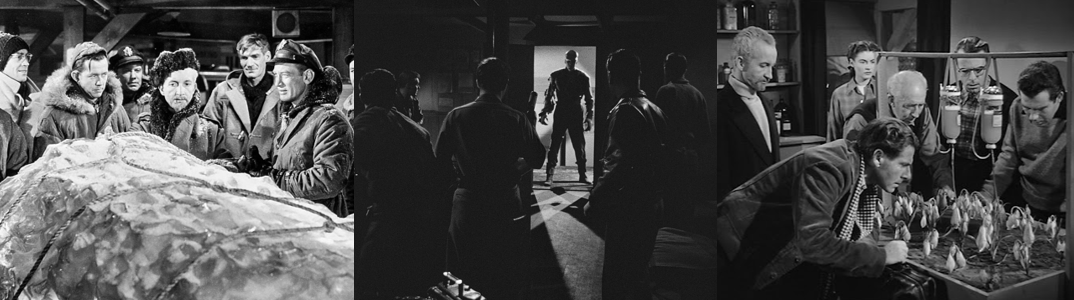
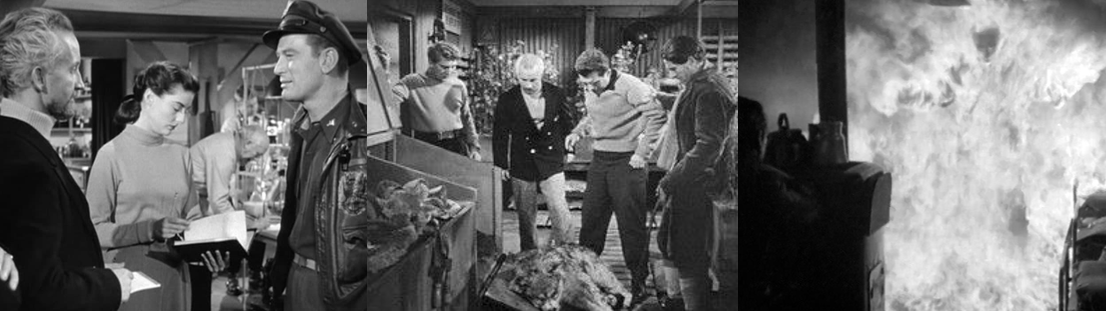
While searching for his next big story in Anchorage, Alaska, “newspaper man” Ned “Scotty” Scott (Douglas Spencer) bumps into old friend, pilot Lieutenant Eddie Dykes (James Young) of a United States Air Force re-supply crew, at an officers’ club and meets his cohorts: gruff Captain Patrick Hendry (Kenneth Tobey) and flight navigator Ken “Mac” MacPherson (Robert Nichols). When noted scientist and Nobel laureate Doctor Arthur Carrington (Robert Cornthwaite) radios in a vague call for aid at a North Pole research camp, Captain Hendry and his jovial crew are ordered to assist, flying some hands, sled dogs, and the eager Scott out to investigate Dr. Carrington’s ambiguous concerns about a mysterious aircraft. Upon arriving at the Polar Expedition Six outpost, the stern but amicable Captain Hendry bristles to reunite with the gorgeous and playful Nikki Nicholson (Margaret Sheridan), who’d previously humiliated him in a drinking game and turned down his handsy advances. Though flustered by her mischievous nature, Captain Hendry is obviously as attracted to her as she is to him and they enjoy a fun back-and-forth throughout the film that’s as entertaining as the banter between Captain Hendry, Lieutenant Dykes, Mac, and Scotty. The crew are clearly friends as much as co-workers and express their affection through light-hearted banter, teasing Captain Hendry for his drinking habits and past blunders, only for him to jokingly threaten them with guard duty and other empty threats. There’s a unique approach to dialogue and interactions here as characters talk over each other and converse very bluntly, making every scene feel ad-libbed (except for Dr. Carrington, who expresses himself with a theatrical guile) and the relationships between the characters feel far more personable and natural as a result.

A remote outpost discovers a humanoid alien that goes on a rampage once accidentally dethawed.

After meeting with the other scientists and civilians stationed at the outpost, Captain Hendry flies his crew, Dr. Carrington, and others to the crash site, only to discover a genuine flying saucer buried under the ice! Rather than wait for approval from his commanding officer, Captain Hendry orders thermite charges to be placed around the site to melt the ice, accidentally destroying the craft when the explosives react violently to the hull. Though Dr. Carrington is aghast by this, his excitement soon reignites when they discover a large humanoid “Thing” buried nearby. This time, the team dig it out and take it to the outpost, though Dr. Carrington’s frustrated by Captain Hendry’s insistence that they await further orders before defrosting or investigating their strange guest. Scotty is similarly irritated to be barred from reporting what they’ve found, seeing the discovery as the story of the century and eager to share it, as Captain Hendry is anxious to avoid another blunder. As the team hunker down against a blistering storm and take shifts watching the creature, Corporal Barnes (William Self) becomes unnerved by the Thing’s gaze and accidentally thaws it out after covering it with an electric blanket he didn’t realise was plugged in. The Thing awakens, briefly runs amok through the outpost, and flees into the storm, attacking the sled dogs and losing some of its arm before disappearing. Upon investigating the severed limb, the resident scientists conclude that the creature is a bizarre humanoid plant that feeds on blood; the hand even reanimates after absorbing some of the dog’s blood staining it. Dr. Carrington slowly becomes obsessed with the creature, believing it to be intellectually and physically superior to man and wishing to learn its secrets, only for Captain Hendry to repeatedly shoot down his insane requests and prioritise saving lives over reasoning with a mindless creature.

Captain Hendry and Dr. Carrington disagree on how best to handle the bloodthirsty Thing.

The titular “Thing” is seen sparingly, which I was surprised by. After its initial awakening, the creature vanishes and the film focuses on the research into its nature, barricading the outpost against further attacks, and searching for the creature before it can strike again. It’s still active in the background, but we only hear about it from shellshocked survivors and through dialogue. Unlike the shapeshifting, nebulous alien Thing from the book and subsequent outings, the Thing is a towering, humanoid “Martian” more like a vampire than a voracious extraterrestrial. The survivors discover a sled dog drained of its blood and hear from the traumatised Doctor Stern (Eduard Franz) that the creature attacked the outpost greenhouse, killing everyone and hanging them from the rafters to drain their blood, which would’ve been gnarly to see. Captain Hendry is surprisingly calm about the entire situation and there are no instances of paranoia or cabin fever among the survivors. The only conflict comes from the scientists who wish to defend and study the creature and the military who wish to kill it. Captain Hendry is horrified to learn from Nikki that Dr. Carrington, who’s been going without rest since the Thing was discovered, has been feeding blood samples to seeds from the creature’s arm, producing alien plants that has the airmen speculating that the Thing came to conquer the world. Thanks to the storm, communicating with Brigadier General Fogerty (David McMahon) and the outside world is spotty, at best, resulting in Captain Hendry receiving a bunch of one-way messages and orders to fortify the outpost and survive but leave the creature unharmed. Seeing the threat the Thing poses, Captain Hendry naturally disregards these orders, and Dr. Carrington’s mad objections, and has the Thing doused with kerosene and set alight when it next attacks. Despite the Thing going up in flames, it wildly lashes out and almost burns the outpost down before escaping into the snowstorm.

Despite Dr. Carrington’s objections, the Thing is destroyed and Scotty submits a dire warning to the world.

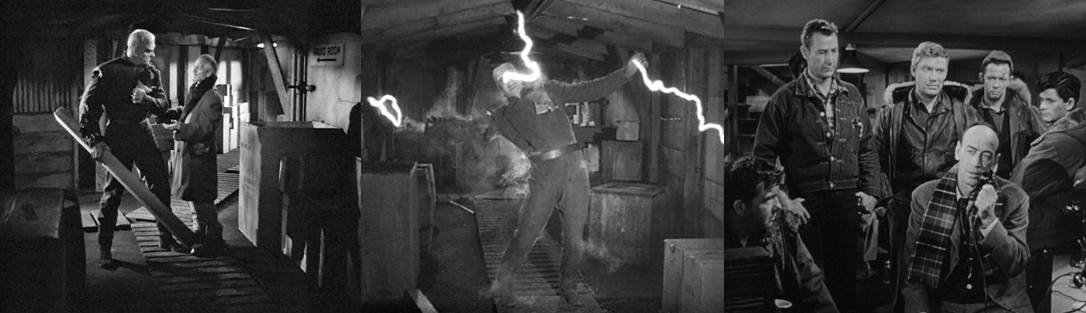
While recovering, the survivors are horrified to learn that Dr. Carrington’s musings about the creature’s intelligence are at least partially true as the Thing sabotages the outpost’s heating system, threatening to freeze them to death within hours. Surmising that the Thing will target the electricity next, Captain Hendry corrals all the survivors into the generator room and the airmen take an offhand suggestion from Nikki (“Boil it, bake it, stew it, fry it”) to heart, rigging a high voltage “fly trap” to electrocute the creature in a narrow corridor. Seemingly sensing their blood, the Thing crashes through their makeshift barricade and stalks its way towards them, noticeably avoiding the wires hidden beneath the pallets on the floor. Although Dr. Carrington attempts to sabotage the plan by shutting the generator off at a crucial moment, he’s easily disarmed and briefly subdued, but Captain Hendry’s forced to wait for the hulking Thing to position itself correctly on their trap. Dr. Carrington rushes to it, pleading for reason and to begin a dialogue, only to be roughly shoved aside and left with a broken collarbone. Despite its immense size, strength, and durability, the Thing blunders into position and is zapped by a few thousand volts in a surprisingly ambitious light show. Captain Hendry keeps the juice poured on until the Thing is reduced to a smouldering pile of ash, though Scotty faints before he can get a clear shot of the creature. The survivors round up all remains of the Thing and burn those, too, before treating their wounds and decompressing as the storm dies down. While Captain Hendry and Nikki tease taking their relationship to the next level, Scotty finally gets to call in his story, eagerly painting a dramatic picture of the pitched battle fought at the outpost and warning his listeners to “Watch the skies everywhere. Keep looking. Keep watching the skies…”

Final Thoughts:
Although I’m a big fan of John Carpenter’s 1982 remake of Who Goes There?, I’ve never read the book or watched this original adaptation, though I gather it’s a very loose one with only the basic elements of the story being represented. Most notably, the titular Thing is very different from the source material and subsequent adaptations, being more akin to Frankenstein’s Monster than a shape-changing organism. I’m not surprised by this as I doubt the technology existed to bring the creature to life in a more faithful way and it makes sense to reimagine it as a hulking, humanoid alien given where sci-fi was at the time. I liked the twist that it was essentially a walking vegetable and like a vampire, feeding on blood and growing alien plants from its seeds, potentially to overrun the world. I would’ve liked to see this emphasised more, perhaps to see the Thing’s spores spread throughout the outpost and maybe infect those within to bring in some of the paranoia from the book and definitely would’ve liked to see more death and destruction from the disappointingly absent creature. Luckily, the relationships and banter between the characters is more than enough to sustain the film in the Thing’s absence, with Captain Hendry and his men having very enjoyable and realistic interactions. I really liked that the actors kept talking over each other and the banter between the characters, which was nicely contrasted with Dr. Carrington’s objections. He was a very theatrical character but, again, felt somewhat underutilised and I would’ve liked to see him sabotaging their efforts more. Despite all this, and the film being oddly paced and lacking in urgency, The Thing from Another World was still quite enjoyable and somewhat ambitious at times. It’s a great example of a classic, 1950s sci-fi flick that is perhaps a little dated these days, far surpassed by its remake, and arguably lacking compared to some of its peers, but it still has a charm and appeal that make it an entertaining watch.

My Rating:

Rating: 2 out of 5.

Could Be Better

Did you enjoy this first adaptation of Who Goes There? If you’ve read the book, what did you think to the changes made to the story? Did you enjoy the banter and interactions between the characters? Do you agree that the Thing should’ve featured a lot more? Do you think Dr. Carrington was right to want to communicate with the Thing? How are you celebrating sci-fi this month? Whatever you thought to The Thing from Another World, comment down below and donate to my Ko-Fi to suggest other sci-fi films for me to review.

10 FTW: Movies with Ambiguous Endings

You’ve paid your money and you’ve sat down in the cinema or in front of your television; you’ve got some snacks and a drink and you’re ready to suspend your disbelief for anywhere between ninety minutes to three hours with a good, old fashioned movie. The plot is intriguing, the characters relatable, the antagonist layered, and the film’s construction has sucked you right in. Then, out of the blue, the film ends in an ambiguous way, leaving questions swimming around in your head.

For me, a great movie with an ambiguous ending that either turns the entire events that preceded it upside down or allows me to interpret what has happened makes for an extremely enjoyable experience, not least because it means that you can re-watch the movie and interpret the ending and the plot in different ways each time. Some might disagree, obviously, but I’m not them so here are ten of the best moves with interpretative endings and some of my thoughts about them:

Blade Runner
10 Blade Runner (Scott, 1982)

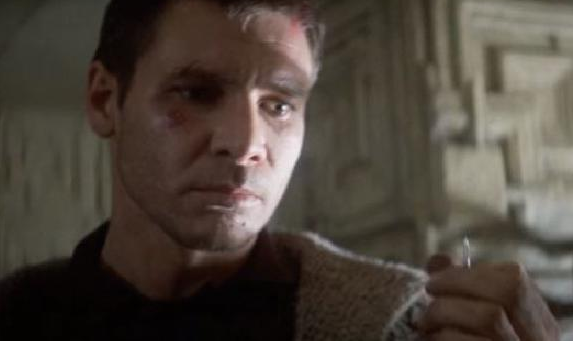
Kicking things off with one of the forefathers of the ambiguous ending, we’re really opening a can of worms with this one considering just how many different versions and endings exist for Blade Runner. Controversially, though, I’m not that big a fan of Blade Runner; as a film, it’s very slow and plodding, with long sections where seemingly nothing happens. This is married to some gorgeous sets and a realistic, lived-in feel to the future world we are presented with. Consequently, my Blade Runner experience begins and ends with Ridley Scott’s 2007 Final Cut version of the film, in which Rick Deckard (Harrison Ford) finds an origami unicorn on the floor of his apartment, strongly hinting (as Deckard had previously dreamt of a unicorn) that Deckard is a Replicant. Apparently, this is the philosophy that Scott subscribes to though I disagree as there isn’t really any real evidence in The Final Cut to support this beyond the ambiguity of the final scene. Supporting this further, the question about Deckard’s humanity was left unanswered in Blade Runner 2049 (Villeneuve, 2017), despite other versions of Blade Runner hinting more strongly that Deckard was actually a Replicant all along.

Shutter Island
9 Shutter Island (Scorsese, 2010)

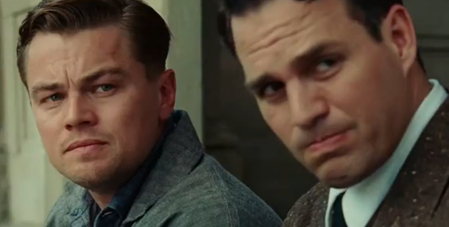
Throughout Shutter Island, Edward “Teddy” Daniels (Leonardo DiCaprio) is forced to confront some personal demons as he uncovers the mysterious disappearance of a patient of the asylum housed on the titular island. As events begin to unravel, we learn that Teddy is, in fact, a patient of the asylum and he was allowed to play out an elaborate fantasy in an attempt to force him to confront the truth that he murdered his wife. Despite scepticism from Dr. John Cawley (Ben Kingsley), this unconventional method appears to have finally worked as Teddy finally admits his guilt. However, later on, he appears to have regressed to his fantasy world once more, leaving the hospital no choice but to have him lobotomised. As the orderlies come to take him away, he questions whether it is worse to live as a monster or die as a good man, casting doubt as to whether he has truly regressed or simply wishes to end his sane life on a high note; personally, I prefer the latter interpretation, as that line seems a deliberate inclusion to make us think that Teddy is merely feigning his regression to “die” as a hero.

The Thing
8 John Carpenter’s The Thing (Carpenter, 1982)

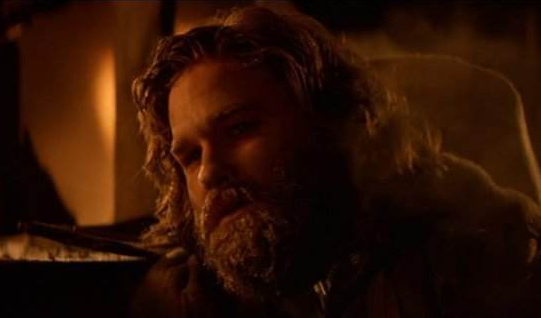
This is the second time that The Thing has made one of my top ten lists, and with good reason; not only is it a masterpiece of practical effect wizardry, it’s also an excellent tale of isolation and paranoia. After uncovering an alien spacecraft and unwittingly unthawing a gruesome, shape-changing parasitic lifeform, the residents of an Antarctic research outpost succumb to paranoia and fear as the titular Thing assimilates them one by one. In the end, with the Thing seemingly destroyed and the outpost up in flames, our hero – R.J. MacReady (Kurt Russell) – sits alone and exhausted by a dwindling fire when he is confronted by Childs (Keith David), his hot-headed rival who had mysteriously vanished right as the chaos started to really ramp up. Also exhausted, Childs sits with MacReady and they share the remnants of a bottle of scotch, both too tired to act on their suspicions that the other might be the Thing and succumbing to the knowledge that, once the fires burn out, it won’t matter soon anyway. Doubts about who is really human are raised when one observes that, unlike MacReady, Child’s breath does not show in the freezing weather but, in this case, I feel that both are actually human and the ending has a more morbid message: both men, whether human or alien, are paying the price for human nature and that, given the volatile relationship between the two characters, it’s likely they would find any excuse to try to kill each other but are simply too fatigued to continue their hostilities.

The Descent
7 The Descent (Marshall, 2005)

The Descent was a welcome surprise when I first saw it; despite some questionable acting from the lead females, the film quickly descends (hah!) into an atmospheric, claustrophobic nightmare when six cave-diving friends find themselves trapped in an unchartered cavern and being attacked by cannibalistic mutated humans. With fear and paranoia setting in, and beset by the vicious crawlers at every turn, the party is eventually whittled down to central protagonist Sarah Carter (Shauna Macdonald) who, after being knocked unconscious, awakens to find herself before an exit and frantically scrambles free, screaming with maniacal glee as she makes it to her car and speeds away. Overcome by the gruesome events that have taken her friends from her, she pulls over and breaks down in tears, only to find the screaming corpse of her headstrong friend Juno Kaplan (Natalie Mendoza) in the passenger seat. For American audiences, this jump-scare is where the film ends but, for us Brits, the scare causes Sarah to awaken to find herself still trapped in the cave with no exit in sight and her fire slowly burning away. With no escape, and the sounds of the ferocious crawlers echoing all around her, she finds solace in a hallucination of her dead daughter as the film fades to black. If you ignore The Descent: Part 2 (Harris, 2009), which reveals that Sarah did actually escape the cave in the end (and is inexplicably convinced to return to that nightmare), this ending is a massive downer and really reflective of the differences in American and British audiences; we Brits love us a good bleak ending laced with ambiguity, as the final haunting shot raises the possibility that all of the events that occurred were a hallucination of Sarah’s to justify her slaughtering all of her friends.

6 Event Horizon (Anderson, 1997)

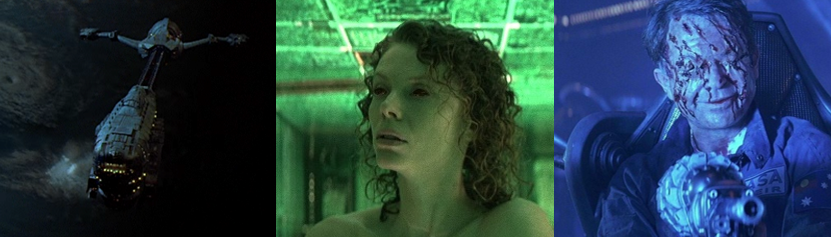
Here’s a film that doesn’t get enough love, Event Horizon is a truly horrific science-fiction horror revolving around a spaceship that, having crossed through time and space, has returned as a semi-sentient haunted vessel that desires only to kill its inhabitants in increasingly gruesome ways and return to the hell dimension that it passed through. Event Horizon actually has two ambiguous endings: the first comes when Captain Miller (Laurence Fishburne) sacrifices himself to split the Event Horizon in two, allowing the remainder of his crew to be spared while he and the demonically possessed Dr. William Weir (Sam Neill in a commendably menacing role) be transported back to “Hell”. When I first watched Event Horizon, I assumed, based on Weir’s agonised “Noooo!” and the editing of this scene, that Miller had died in the ensuing explosion but, upon repeated viewing, you can clearly see the aft section of the craft disappear into a black hole, meaning that Weir was merely expressing his frustration at only taking one victim to “Hell” instead of the entire crew, making Miller’s sacrifice even more tragic as he now has to suffer unimaginable horrors. However, it doesn’t end there as the forward section of the ship is later recovered and Miller’s crew freed from stasis; upon awakening, and suffering from shock, Lieutenant Starck (Joely Richardson) looks upon her rescuer and sees only Weir’s scarred face grinning back at her. Descending into a screaming fit, and comforted by Cooper (Richard T. Jones), it appears as though Starck is simply severely traumatised by the horrific events she has barely survived but, as the film fades to black, the doors of the Event Horizon close by themselves, suggesting that the demonic force haunting the ship is still present.

Boy, was this film a surprise. Given the odd marketing campaign, you would be forgiven for going into The Grey believing it was simply about Liam Neeson fighting wolves but it is so much more than that. Haunted by the death of his wife, John Ottway (Neeson) is struggling with suicidal tendencies when the plane he is flying on crashes in the middle of the frozen Alasakan wilderness. With limited resources, tensions running high, and a pack of ravenous wolves stalking them at every turn, Ottway is forced to rely on his survival instincts and knowledge of wolves to lead the survivors in a seemingly hopeless search for safety. Inexplicably surviving what appears to be an unsurvivable plane crash potentially gave Ottway a concussion, however, as it is eventually revealed, once all of the other survivors have tragically perished due to injuries, the elements, or the increasingly emboldened wolves, that he has been heading directly towards the wolves’ den the entire time. Left alone and forced to confront the Alpha Male, Neeson straps broken bottles and other make-shift weaponry to his fists and prepares to fight to the death as the film abruptly cuts to black. A brief after credits scenes offers little in the way of closure, affording only a glimpse of what appears to be Ottway resting atop a slowly dying wolf, leaving the character’s ultimate fate entirely up to the interpretation of the viewer. I honestly understand the negative backlash this caused as the marketing made a big deal out of the showdown between Neeson and the Alpha, man against nature, and all that but, honestly, when I first saw it and Ottway was reciting his father’s beloved poem, burying the wallets of his fallen comrades, and preparing to fight to the death with a voracious wolf…man tears, every time. I always like to think that there was only ever going to be one outcome: Ottway put up a great fight but was ultimately killed by either the Alpha or one of the other wolves. Yet the short scene after the credits presents the slim possibility that Ottway survived the battle, if with serious injuries, allowing those who prefer a more positive ending to believe that he came out victorious and is merely exhausted from the conflict.

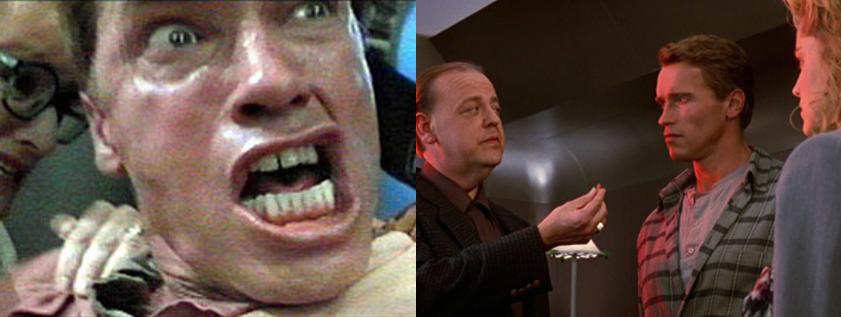
Can we stop for a second and recognise that Total Recall is still one of the greatest science-fiction movies ever created? Honestly, this movie has aged incredibly well; it’s use of practical effects, model shots, the rising action and over-the-top fight scenes, all married with two truly memorable villains and Arnold Schwarzenegger’s undeniable charisma make for one of the best action/sci-fi experience ever conceived. That it also presents an extremely and surprisingly complex and deep narrative only adds to its stature, in my mind. Douglas Quaid (Schwarzenegger) is obsessed with Mars, dreaming of it every night and is so desperate to visit the red planet that he pays a visit to Rekall Inc. to purchase a memory implant of having vacationed for two weeks as an undercover secret agent. Immediately however, there are complications; Quaid goes psychotic during the procedure and is suddenly attacked by friends and foes alike for no discernible reason. Eventually driven to Mars, he learns that he was once Hauser, a former employee of the villainous Vilo Cohaagen (the wonderful Ronny Cox) who volunteered to have his memory wiped so that Cohaagen and his sadistic enforcer, Richter (fantastically portrayed by Michael Ironside), could wipe out the rebellion opposing his authority on Mars.

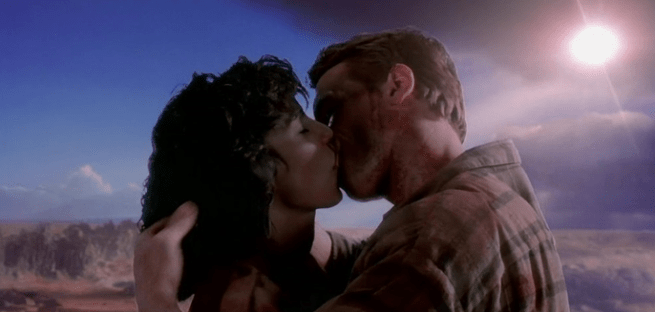
Rejecting his former life, Quaid opts instead to activate an alien device that provides Mars with a breathable atmosphere, freeing the populace from Cohaagen’s air tax and ending the film with a conspicuous white light as Quaid shares a kiss with his dream woman, Melina (Rachel Ticotin). I say conspicuous because, traditionally, films end on a fade to black and this is only one of many indications that the events we have witnessed are not entirely what they seem. At Rekall Inc., Quaid tailors the memory he will receive to the finest detail, describing Melina as his love interest, viewing pictures of places he later visits on Mars, and being told that the vacation will involve him overcoming an interplanetary conspiracy. Later, Dr. Edgemar (Roy Brocksmith) attempts to convince Quaid that everything he is witnessing is a free-form delusion that he has allowed himself to be trapped in and that, unless he chooses to wake up, he will end up lobotomised. Quaid rejects this when he notices that Edgemar is clearly sweating with fear and discomfort and, in doing so, commits himself to seeing his path towards being the saviour of Mars. Total Recall presents both possibilities simultaneously; the over-the-top action and increasingly coincidental set pieces lend a credibility to Edgemar’s claim that Quaid is trapped in a dream world but scenes where Quaid is entirely absent, such as during conversations between Cohaagen and Richter, suggest that the plot against Quiad is very real. In the end, the white out could simply be a sign of a new beginning for Mars or the brain cells in Quaid’s head dying from psychosis; sometimes I will watch the film and believe that Quaid is a former mercenary turned rebel leader and, others, I choose to believe that he has simply allowed himself to be lost to an extremely realistic dream.

The Wrestler
3 The Wrestler (Aronofsky, 2008)

After years in obscurity, Mickey Rourke began a bit of a comeback in the mid-to-late-2000s and perhaps no other role really showed how much he had matured and was ready to be taken seriously as an actor than that of Robin Ramzinski (AKA Randy “The Ram” Robinson). Ram, his best years as an athlete behind him, has fallen on hard times and really been through the wringer; he is estranged from his daughter (the delectable Evan Rachel Wood), in constant pain, works a menial job where he is the source of constant ridicule, and is forced to take bookings in venues barely a quarter of the size he was headlining in his prime. After he suffers a heart attack and is advised that he must never wrestle again, Ram takes the advice to heart and begins reconciling with his daughter and trying to make a future with his only confidante, an ageing stripper named Cassidy (Marisa Tomei). In the end, though, after a drink and drug filled bender causes his daughter to sever all ties with him, Ram returns to the one place he has only ever felt loved and valuable, the ring, knowing full well that it could be not only his last match but the last decision he ever makes. During a rematch against his greatest opponent, the Ayatollah (Ernest Miller), Ram begins to suffer chest pains and is in considerable visible pain. Despite the Ayatollah’s concerns and pleas to end the match quickly, Ram fights through the pain and disorientation to mount the top rope and leap into the air as the film cuts to black. Did Ram make the splash, win the match, and walk away victorious or did he crash in a dying heap on his fallen adversary? Honestly, considering the poor hand Ram has been dealt in his twilight years, I actually prefer the idea of him going out in a blaze of glory than living through another heart attack and having only a resentful daughter and a guilt-filled stripper to wake up to.

American Psycho
2 American Psycho (Harron, 2000)

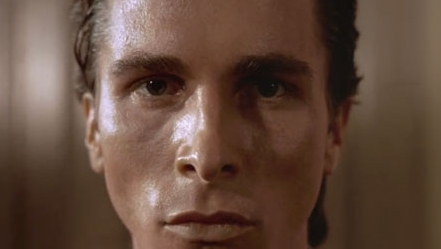
Adapted from the book of the same name by Brett Easton Ellis, American Psycho is an incredibly enjoyable dark comedy revolving around Wall Street yuppie Patrick Bateman (Christian Bale) who, by day, enjoys the frivolities of greed, sex, and consumerism but, by night, stalks the streets for victims to kill. Fully acknowledging that his urge to kill is a deep-rooted psychological disorder over which he is slowly losing control, Bateman takes out his frustrations at being mistaken for other co-workers, his fiancée’s infidelity, and his peers having better positions, clientèle, and even business cards by murdering co-workers, vagrants, and prostitutes. Eventually, his urges become too much to contain and he embarks on a killing spree throughout the city night, shooting innocent bystanders left and right before finally calling his lawyer (Stephen Bogaert) and, through maniacal tears, listing his numerous transgressions in a frantic confession. However, the next morning, his lawyer fails to recognise Bateman, believing him to be a man named Davis and that the call was an elaborate prank, reasoning that Bateman is far too spineless to engage in such activity.

Bateman calmly states that he not only committed the crimes he confessed to but enjoyed them, only for his lawyer to brush him off. Returning to his seat, Bateman reasons that, despite his confession, he has learned nothing about himself or the world and that the hollow emptiness he feels inside has only grow larger as a result of his actions. However, it is left up to the audience to decide whether the increasingly elaborate events we have witnessed actually took place or if they were simply the deluded fantasies of a bored, morbid, and repressed individual (further exemplified by his secretary, Jean (Chloë Sevigny), finding Bateman’s journal filled with doodles depicting murder and rape). Prior to visiting his lawyer, Bateman attempts to clean up the apartment of one of his victims, only to find it in pristine condition and being sold by a realtor, who reacts to Bateman’s presence with a clear discomfort, if not fear, suggesting that the gruesome murder actually took place. For me, as a big fan of the film and the book (which provides few answers and raises more questions, if anything), I like to think that some of the murders took place but maybe not all of them; given that Bateman and his co-workers are completely interchangeable and the dark satire at work in the film, I think it’s entirely possible that Bateman is so incredibly repressed and striving for attention and to stand out that he has killed vagrants and prostitutes but, in doing so, has simply allowed his dark fantasies to conjure increasingly elaborate murders and scenarios to distract him from the fact that he is nothing more than a faceless corporate snob amidst a sea of faceless corporate snobs.

Inception
1 Inception (Nolan, 2010)

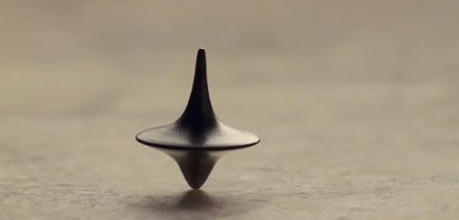
Perhaps one of cinema’s most unique and original ideas since The Matrix (The Wachowski Brothers, 1999), Inception presents a world in which thieves like Dom Cobb (Leonardo DiCaprio) can enter a person’s dreams and subconscious to extract information. Unable to return to his children due to his wife, Mal (Marion Cotillard), having framed him for her suicide, Dom is tasked with putting together a team and planting an idea in the head of the heir to a business empire in exchange for his criminal record being expunged. Inception takes full advantage of modern effects and technology to realise the infinite possibilities of the dream world, allowing reality to bend and warp in unique ways. As Dom and his crew are forced to dream within a dream, the film plays with perceptions of time as much as reality as Dom risks losing himself to the elaborate dream world he has created. Eventually, Dom confronts his demons and completes his mission, passing through customs without a hitch. All throughout the movie Dom has been haunted by not only his wife’s suicide but also the fact that he left in such a hurry that he was denied one final look at his children’s faces. Returning home, as Hans Zimmer’s powerful score builds to what appears to be a victorious crescendo, Dom, frantic to prove that his dreams have actually come true, conducts one final test, setting off a spinning top that will topple over if he is in the real world and spin indefinitely in the dream world. However, he never stays to see their result, as, finally, he sees his children and they not only turn to face him but run, overjoyed, into his arms. As he carries them out of frame and the score fades down, the shot lingers on Dom’s spinning top as it spins and spins and spins…faltering only slightly as the film cuts to black.

If The Grey brought out the man tears when I first watched it, Inception opened an absolute floodgate! I never thought that I would care so much about whether Leonardo DiCaprio got a happy ending but Nolan really sucked me into this world and had me so emotionally invested in all of his characters, especially DiCaprio’s Dom. The composition of this final shot, with the score and the sense of catharsis, never fails to be overwhelming; I was so happy to see him finally see his children’s faces and was on the edge of my seat waiting to see the top topple over and truly saddened that it didn’t because, in that first viewing, my knee-jerk reaction was that Dom had gotten lost in the deepest layers of his dream and had chosen fantasy over reality. However, the ambiguity of the ending allows one to view this film similar to Total Recall. You can watch it one time and believe that Dom emerges victorious or choose the depressing ending if you wish. Evidence can be found for both: it is said that one must had a totem unique to them but Dom carries and uses his dead wife’s spinning top as his totem.

It equally seems unlikely that Dom’s client would have the connections necessary to wipe his criminal record clean, and Dom is repeatedly told that he has to “wake up” and “face reality”, as though he has been trapped in a dream ever since he and Mal first experimented with deep dreaming. However, I felt so strongly for Dom and wanted so badly for him to see his kids and return home that it is hard to not believe that everything worked out for him…if not for that damn spinning top, endlessly spinning away, casting doubt over everything except for the fact that, in that moment, Dom does not care whether he is dreaming or awake; whatever the case, he has accepted this as reality without even a cursory look back.

10 FTW: Surprisingly Good Horror Remakes

We’ve heard it all a thousand times by now: “when will Hollywood stop with the remakes!?”, “Why can’t Hollywood come up with new ideas!?”, “Remakes suxxorz1!!” Honestly, while some films should never be re-made and some remakes do baffle the mind, remakes aren’t the plague of cinema that a lot of people like to think they are. In fact, some are pretty damn good.

If you’re one of those bleeding heart Twitter people, though, who just like to decry remakes in general, maybe you should take a moment to consider this small list of horror remakes that are not only surprisingly good but, in some cases, actually surpass their originals:

Halloween
10 Halloween (Zombie, 2007)

We’re kicking things off with quite the controversial choice here. I’ll argue until the end of time that John Carpenter’s Halloween (Carpenter, 1978) is the forefather of all modern horror, particularly the slasher genre. It’s a subtle, atmospheric piece with a fantastic, mysterious antagonist and the truly frightening prospect that random unspeakable acts of horror can happen in a suburban environment. Rob Zombie’s take, however, is a loud, frenetic, uncomfortably gruesome take on the property. Michael Myers (Daeg Faerch/Tyler Mane) is an incredibly disturbed young boy from a violent and abusive family who becomes a remorseless, emotionless, unstoppable tank of a killing machine. Zombie delves right into his own take on Michael’s backstory, presenting in grotesque detail the exact events that turn Michael into a nigh-supernatural killer.

In many ways, the initial focus of the film acts as a kind of prequel to the events of Carpenter’s original, as the remainder of the film’s runtime is devoted to recreating Michael’s killing spree in Haddonfield, with the primary difference being that nearly the entirety of the film is told from Michael’s perspective. Sure, Malcolm McDowell, great as he is, cannot hope to compete with the fantastic Donald Pleasence but the film is bolstered by the incredibly cute Scout Taylor-Compton (who is arguably more attractive and relatable to modern audiences than Jamie Lee Curtis) and even appearances by Brad Dourif and Danielle Harris (and what an appearance hers is!) While it’s unlikely to be as iconic or influential as Carpenter’s benchmark film, for those who find the original and its sequels dated and slow, Rob Zombie’s remake is a much-needed kick up the ass that, for better or worse, dragged Halloween kicking and screaming out of obscurity.

Poltergeist
9 Poltergeist (Kenan, 2015)

I know, right? How could Hollywood ever even entertain the idea of remaking Tobe Hooper/Steven Spielberg’s 1982 horror classic? Well, they did, and don’t be mistaken; it’s not actually that bad. While it lacks probably my favourite scene from the original, where corpses rise from the Freeman’s unfinished swimming pool, the remake is just as terrifying and engaging as the original, with the added bonus of having a modern-day make-over that is far more accessible than the now-dated original. Don’t get me wrong, the original is still a classic, but Sam Rockwell and Kennedi Clements put in some great performances, easily on par with those of Craig T. Nelson and the late JoBeth Williams. Did Poltergeist necessarily need a remake? Probably not, and the fact that numerous haunted house stories since the original have all pulled from or mirrored Hooper’s seminal horror classic probably didn’t help to differentiate Kenan’s new take on the property, but I feel it’s a largely misrepresented film that is nowhere near as bad as some people think.

It
8 It (Muschietti, 2017)

Although I spoke about this film quite recently, it is deserving enough to make this list. Watching Tommy Lee Wallace’s 1990 miniseries, great as it is and as amazing as Tim Curry’s performance in that is, you can’t help but think that Stephen King’s novel deserved to be told without the restraints of a television miniseries. Focusing exclusively on the child side of King’s story, and bringing the events forward to the 1980s rather than the 1950s, Muschietti adheres closely to King’s text while still putting his own spin on events. Bill Skarsgård’s take on Pennywise is suitably unsettingly and otherworldly; what he lacks in Curry’s charisma he more than makes up for by being genuinely creepy and a fearsome menace. Muschietti also focuses on the friendship and troubles of his child protagonists incredibly well, anchoring them to the film’s central narrative and allowing King’s themes of childhood and loss of innocence to play out beautifully. With a lengthy runtime and concluding on a fantastic tease for a second chapter, this new version of It, while not without its issues (primarily regarding screen time for the many characters), did not disappoint in realising the gruesome potential that the miniseries could only hint at.

7 Dawn of the Dead (Snyder, 2004)

Released at the peak of Hollywood’s new-found fondness for zombie films in the early-to-mid-2000s, largely spearheaded by 28 Days Later (Boyle, 2002) and the God-awful Resident Evil (Anderson, 2002) and its decent-enough sequel, Resident Evil: Apocalypse (ibid, 2004), Zack Snyder’s remake of George A. Romero’s massively-influential 1978 film of the same name takes the general themes and premise of its source material and ramps them up with some incredible action, grotesque gore effects, and a much-needed modern day gloss. While zombie purists may lament the inclusion of the fast-moving, animalistic undead introduced in 28 Days Later, Snyder’s rapid editing and penchant for style over substance make the creatures more vicious and scary than in Romero’s original film. With some great supporting performances by the likes of Ving Rhames and Michael Kelly (and even a brief cameo by Ken Foree, repeating his iconic line from the original film), Snyder’s Dawn of the Dead is a non-stop masterpiece of zombie cinema that never slows down to the snail’s pace that Romero’s introspective original prefers to adopt.

Texas Chainsaw Massacre
6 The Texas Chainsaw Massacre (Nispel, 2003)

One of the primary reasons I was inspired to make this list, The Texas Chain Saw Massacre (Hooper, 1974) was a film that desperately needed this remake! Seriously, the original might have been shocking and gruesome at the time but, since then, it has not aged well; it’s a slow, dull piece of cinema that drags on way too long, with questionable acting and a lifeless soundtrack. The only redeeming quality comes from the maniacal Sawyer family, and even they are a hooting, loud bunch of camp. Produced by Michael Bay’s Platinum Dunes, which would go on to be responsible for a variety of horror remakes, The Texas Chainsaw Massacre is much better than it had any right to be. With an uncomfortable gradient, shocking soundtrack, and even some decent performances by Jessica Biel and Eric Balfour, Nispel’s remake downplays the cannibalistic nature of the franchise in favour of grotesque torture-porn levels of horror.

While the film reintroduces Leatherface (Andrew Bryniarski), one of horror’s most iconic figures, and even suggests a tragic backstory for the character, Nispel’s Chainsaw brought us one of the most despicable and significant horror icons in years in the form of Sherriff Hoyt (masterfully embodied by the great R. Lee Ermey). Hoyt, a tobacco-chewing, foul-mouthed sadist, drives the plot of this remake, raises its quality to another level, and his popularity was arguably responsible for the equally-enjoyable prequel, The Texas Chain saw Massacre: The Beginning (Liebesman, 2006). On a side note, though, am I the only one shocked that, including remakes and reimaginings, the Chainsaw franchise is made up of eight separate movies? Crazy!

The Blob
5 The Blob (Russell, 1988)

Now we’re getting somewhere! Irvin Yeaworth’s original 1958 film, starring Steve McQueen, was a campy piece of B-movie mush that has come to resemble a comedy more than a science-fiction piece. Channelling the likes of David Cronenberg and John Carpenter, Chuck Russell’s reimagining, however, takes the story of the bulbous alien lifeform to far more grotesque levels. Incorporating some incredibly disgusting practical effects, the population of a small town is literally dissolved by the titular amoeba. Although some of the composite shots are obviously dated by today’s standards, an entirely CGI rendition of the Blob would probably have aged incredibly poorly by now. Instead, The Blob retains a level of camp in its premise but, with its gruesome effects and no-nonsense attitude, is a great example of how effective and impactful practical effects can be.

Friday the 13th
4 Friday the 13th (Nispel, 2009)

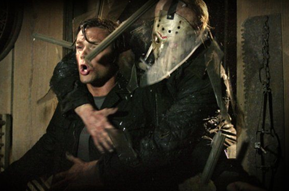
We’re back with Marcus Nispel and Platinum Dunes for this masterfully well-crafted remake of not only the original 1980 classic but, also, the first three sequels. Similar to Halloween, for those who find the original movies to be dated and cut-and-pasted, by-the-numbers slasher films with very little to differentiate them from each other until Friday the 13th Part V: A New Beginning (Steinmann, 1985) then this is the film for you! In fact, I often encourage newcomers to the franchise to watch this film and then jump straight to Jason Lives! Friday the 13th Part VI (McLoughlin, 1986); not because the continuity would tie together but, by doing that, you watch one kick-ass film with loads of gratuitous mid-2000s sex (which is far more graphic, enjoyable, and realistic than sex scenes from the 1980s) and horror imagery that sums up the first four entries of the franchise incredibly well and then you can delve into the enjoyable nonsense of zombie Jason Voorhees.

Beginning with the brutal decapitation of Mrs. Voorhees (Nana Visitor) and detailing how Jason (Caleb Guss/Derek Mears) witnessed her murder and grew up alone in the wooded forests of Camp Crystal Lake, as well as detailing Jason’s transformation from the lesser-known burlap sack look to the now-iconic hockey mask, Friday the 13th is filled with some incredibly gruesome kills as Jason uses bear traps, snares, and other tricks to entrap and kill hapless teenagers all over the shop. Add to that some strong performances by Danielle Panabaker, Aaron Yoo, and Jared Padalecki and you have an intense, non-stop horror film that, like Jason, comes at you a mile a minute. Honestly, the only bad thing I have to say about this film is that, despite making $92.7 million on a budget of $19 million, we never saw a sequel; even Rob Zombie’s Halloween got a shitty sequel!

The Thing
3 John Carpenter’s The Thing (Carpenter, 1982) and The Thing (Heijningen Jr, 2011)

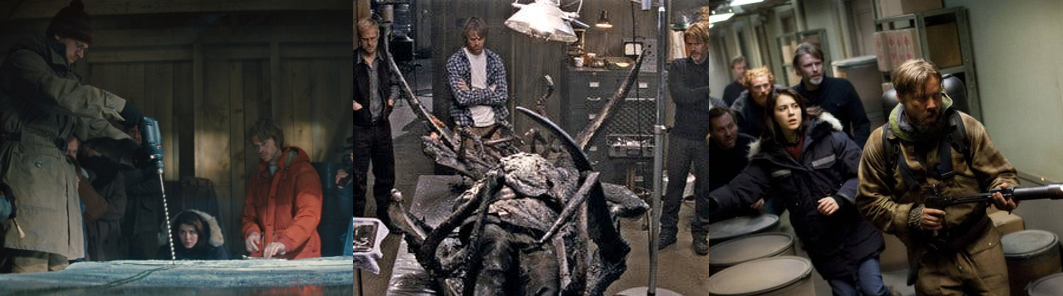
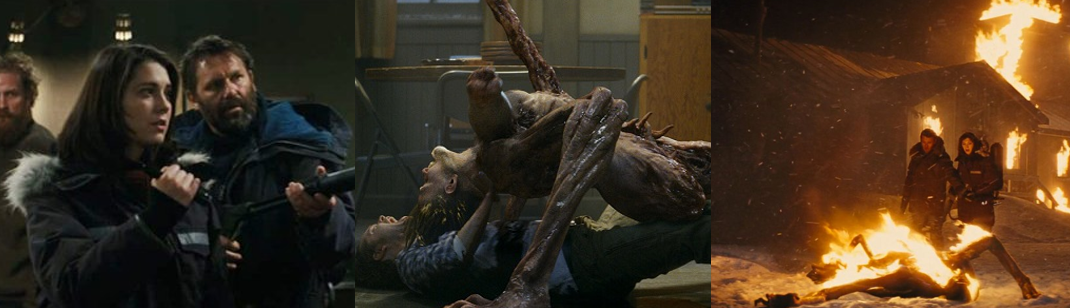
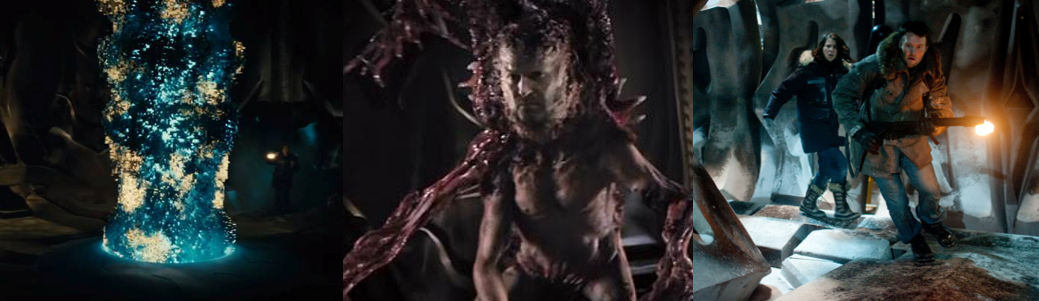
Here’s some more controversy for you: I actually liked Matthijs van Heijningen Jr’s version of The Thing. It starred Mary Elizabeth Winstead, who I absolutely adore, and, while marketed as a remake, was actually, ingeniously, a prequel to John Carpenter’s 1982 horror/sci-fi classic. Based exclusively on a brief scene from Carpenter’s film, van Heijningen Jr’s The Thing details how a Norwegian research team unearth an extraterrestrial craft and unwittingly awaken a shape-changing, parasitic alien lifeform and concludes with the survivors attempting to hunt down and eliminate the creature’s final form, which leads directly into the beginning of Carpenter’s The Thing.

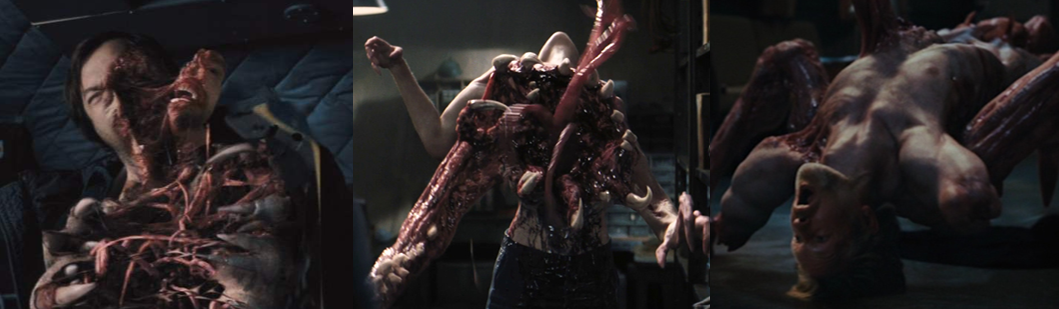
Drawing loosely from both Christian Nyby’s 1952 B-movie classic The Thing From Another World! and the story that inspired it, Who Goes There? (Campbell, 1938), John Carpenter’s The Thing is one of the quintessential examples of the effectiveness of practical special effects to the horror genre. Kurt Russell and Keith David lead the charge when their small Antarctic outpost is slowly assimilated by the titular alien creature, leaving the survivors to descend into distrust and anarchy as they struggle to fight off the ever-growing menace both outside and within their number. Carpenter’s film features some truly incredibly moments of practical effects wizardry, from a torso sprouting razor sharp teeth, to a severed head growing spider-like appendages and a dog literally splitting in two as tentacles blast out from its head; yet, while its similarly-impressive practical effects were tampered with in post-production, I never felt like Heijningen Jr’s The Thing was sub-par to Carpenter’s film. Instead, it works amazing well as a companion piece, allowing one to binge-watch both movies side-by-side and be suitably entertained.

2 Evil Dead (Alvarez, 2013)

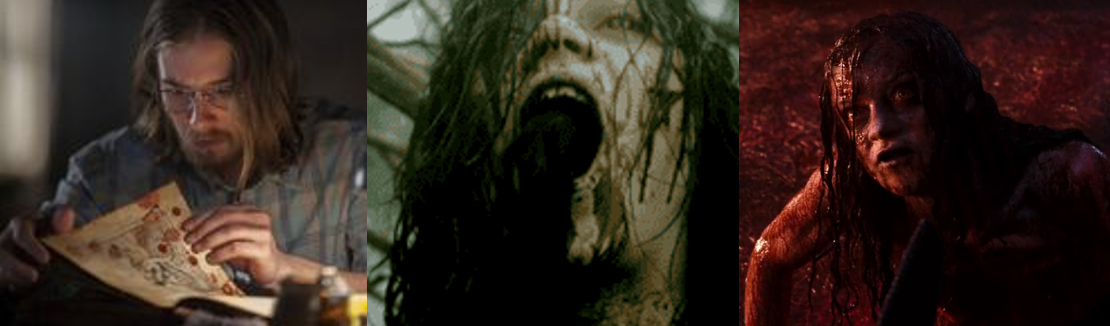
Similar to The Texas Chain Saw Massacre, Sam Raimi’s landmark 1981 horror film The Evil Dead was in desperate need of a remake. Sure, the stop-motion, puppetry, and practical effects were great considering the limited time and budget Raimi had available to him but, over time, neither they nor the acting have aged incredibly well. In fact, for me, Evil Dead II: Dead by Dawn (Raimi, 1987), which retells the events of the original in its opening moments, already surpassed Raimi’s original film by leaps and bounds: Ash (epitomised by Bruce Campbell) is a far more capable, well-rounded character, the effects are much better, and the film adopts a quirky style of black comedy that was sorely missing in the original. Fast forward to 2013 and, rather than attempt to emulate Raimi’s black comedy style, Fede Alvarez approaches his remake with an intense seriousness.

The horror is brutal and horrendous to look at; there’s no laughing deer heads here. Instead, characters saw their arms off, are attacked by nail guns, get beaten by crowbars, and are forced to tear their arms off at the elbow in gruesome fashion. The plot is largely the same, with a group of largely likeable characters accidentally awakening an ancient evil, but the stakes are much higher; here, the evil seeks to take on a physical form and bring about the apocalypse whereas in Raimi’s original film it simply wanted to claim the souls of those trapped in the cabin. While it lacks a character as iconic as Ash, Evil Dead makes up for it with some truly difficult to watch moments that are both sickening and perversely entertaining; even Raimi’s controversial tree rape scene is included and utilised in a far more effective and plot-relevant way and that alone is reason enough to place this film over the original, in my view.

The Fly
1 The Fly (Cronenberg, 1986)

This is it, the quintessential argument that not all remakes are bad and that they can, in some cases, vastly surpass their originals. While Kurt Neumann’s 1958 film of the same name may be closer to the original story and is still a pretty decent piece of 1950s science-fiction, despite its now campy tone, Cronenberg took the idea of a man teleporting himself with a fly and took it to whole new levels. Before, the man bore the head and arm of the fly as a result of the accident and slowly deteriorated into madness; here, though, thanks largely to an absolutely stellar performance by the always-amazing Jeff Goldblum, Cronenberg details the physical and mental degradation of his main character, Seth Brundle, in painstakingly brutal detail. Brundle, a brilliant scientist, initially embraces his newfound physical attributes before realising that he has been stricken by an infection on a cellular level not unlike AIDS or cancer. Soon, his body deteriorates at an alarming rate, with top-notch special effects being employed to make Goldblum practically unrecognisable through heavy make-up and full-body prosthetics.

As he alienates those around him, Brundle’s mind also begins to depreciate; initially desperate to reverse the effects, he soon comes to believe that he was never a man to begin with and prepares a gruesome legacy for himself whereby he will merge his crippled body with that of his lover (a strong, heartwrenching performance by Geena Davis) and his unborn child. In the process, he not only dissolves his rival’s hand and foot with corrosive fly vomit but literally bursts out of the remains of his decrepit human skin to emerge as a grotesque fly-like creature, before finally, tragically, forcing his lover to end his torment. The Fly transcends boundaries; it is a horrific tale of science gone wrong, a body horror with terrifying consequences but, at its heart, it is also an extremely tragic love story. Cronenberg did what many fail to do with their remakes; he took the original concept and not only put his own spin on it but also transformed it into something entirely separate from the source material and yet vastly superior to it in many ways.

Arguably, remakes like A Nightmare on Elm Street (Bayer, 2010) (which attempted to put a unique spin on the franchise and ended up becoming a carbon-copy retelling of Wes Craven’s seminal 1984 original), Total Recall (Wiseman, 2012), RoboCop (Padilha, 2014) could really learn a thing or two from The Fly, and many of the remakes on this list. If you’re going to remake a movie, don’t just retread the same material as before; go back to the source, back to the text, and either produce a more faithful adaptation or extrapolate the core themes and general premise and produce a great movie, rather than a simple, insulting cash-grab.