
To celebrate the release of Justice League (Snyder/Whedon, 2017), DC Comics named November 18 “Justice League Day”. Setting aside all the drama surrounding that movie, this provides a perfect excuse to spotlight DC’s top superhero team, which set the standard for super teams.

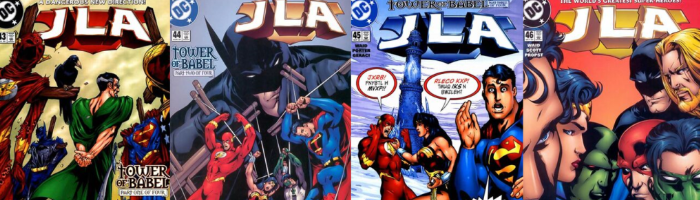
Story Title: “Tower of Babel, Part 1: Survival of the Fittest”
Published: July 2000
Story Title: “Tower of Babel, Part 2: Seven Little Indians”
Published: August 2000
Story Title: “Tower of Babel, Part 3: Protected by the Cold”
Published: September 2000
Story Title: “Tower of Babel, Part 4: Harsh Words”
Published: October 2000
The Background:
In the 1940s, All Star Comics brought together eight superheroes from different publishers for the first time, birthing not just the Justice Society of America (JSA) but also the first ever superhero team in comics, allowing readers to see their favourite characters interacting for the same price in a single issue. The JSA’s ever-changing roster underwent their most significant change at the late-1950s, when then-editor Julius Schwartz had writer Gardner Fox with reintroduce and rebrand the team as the Justice League of America (JLA) to capitalise on the popularity of the American Football League and Major League Baseball’s National League. Clark Kent/Superman, Bruce Wayne/Batman, Diana Prince/Wonder Woman, Hal Jordan/Green Lantern, Arthur Curry/Aquaman, Barry Allan/The Flash, and J’onn J’onzz (or “John Jones”)/Martian Manhunter debuted as the JLA in The Brave and the Bold #28. Their origin story became a best-seller and the initial line-up of DC’s heavy-hitters is arguably the most iconic, which is exactly why they were at the forefront of the team’s revamp in the 1990s. Spearheaded by Grant Morrison, the new JLA title also became a best-seller and greatly inspired their celebrated animated adventures. This new team battled the likes of White Martians and the adaptable supervillain Prometheus, whose unexpected victory over the JLA laid the foundation for this widely regarded story. Marking the beginning of Mark Waid’s memorable run on the book, “Tower of Babel” had long-term repercussions, was critically acclaimed, and was even loosely adapted into a pretty decent animated feature.
The Review:
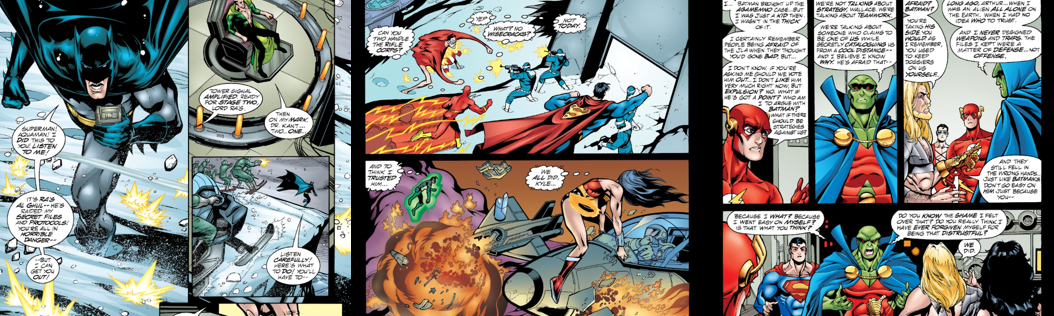
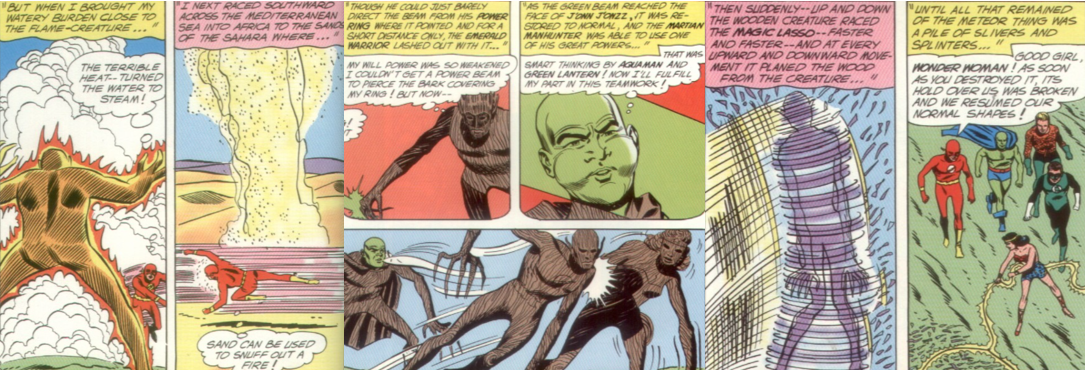
Although I grew up reading odd issues and random annuals from the 1970s and 1980s, this is the Justice League I mostly closely associate with. Superman (fresh off his brief stint as an energy being), Batman, Wonder Woman, Wally West/The Flash, Kyle Rayner/Green Lantern, Aquaman (in his best, most intimidating look), and even Patrick O’Brian/Plastic Man being included for some visual variety and laughs made for an impressive and powerful incarnation of the team. “Tower of Babel” pits this team against Rā’s al Ghūl, the “Demon’s Head” who fronts the League of Assassins and believes humanity is a danger. His anger at an aide accidentally dooming the Javan tiger to extinction only precipitates his latest plan to wipe out humankind, which begins with him playing spiteful mind games with his respected adversary, the Batman (whom he reverentially refers to as “The Detective”), by exhuming his parents. Rā’s then dispatches his daughter, Talia, to strike the Martian Manhunter with an explosive shell of strange nanites. Nearby, the Flash and Wonder Woman desperately fight a mysterious and aggressive forest fire, only to be amazed and horrified when the source turns of to be J’onn, his body engulfed in perpetual flames that the Flash extinguishes with his fantastic speed. Aquaman and Plastic Man are then attacked within the United Nations, Aquaman being gassed by a substance that makes him deathly afraid of water and Plastic Man frozen and shattered into a dozen pieces!
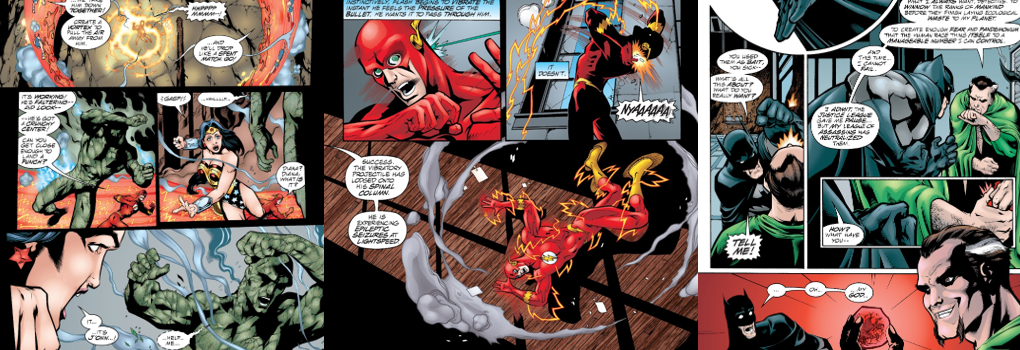
The injured or affected JLA members are brought to their Watchtower space satellite by their teammates. Superman analyses the nanites infecting the Martian Manhunter and discovers they’ve forced his body to combust in air. Crippled by fear toxin, Aquaman’s condition deteriorates as he rapidly dehydrates and, though the Flash pieces Plastic Man back together, they’re unable to restore him. Realising that the JLA is being targeted, Superman coordinates with John Henry Irons/Steel and Barbara Gordon/Oracle to keep their reserve members are safe but Batman abruptly refuses to help. After switching to Clark Kent to use his sources at the Daily Planet for a possible lead, Superman and the staff are astonished to find that all text has become incomprehensible! Superman races to curb the ensuring madness, learning from Oracle that the aphasia’s caused by ultrasound waves, which he successfully disrupts by retrofitting some Brainiac tech. Finally, Wally and Diana find Kyle woke up suddenly blind, which understandably causes the artist great distress. Although Aquaman figures out that the League of Assassins are tracking their signal devices, his warnings come too late and Diana is trapped within a never-ending battle simulation courtesy of a virtual reality chip. The Flash is also shot with a “vibrational projectile” that induces epileptic seizures at lightspeed and Kyle, directionless and berserk without his eyes, is easily subdued by a begrudging Talia. The world is plunged into chaos as the stock exchange collapses, gang wars break out, planes narrowly avoid collision, military services grind to a halt, and hospitals are rendered useless. The Batman angrily confronts Rā’s in his modern-day Tower of Babel, where Rā’s relishes the chaos and threatens offers to resurrect the Waynes using his rejuvenating Lazarus Pits.
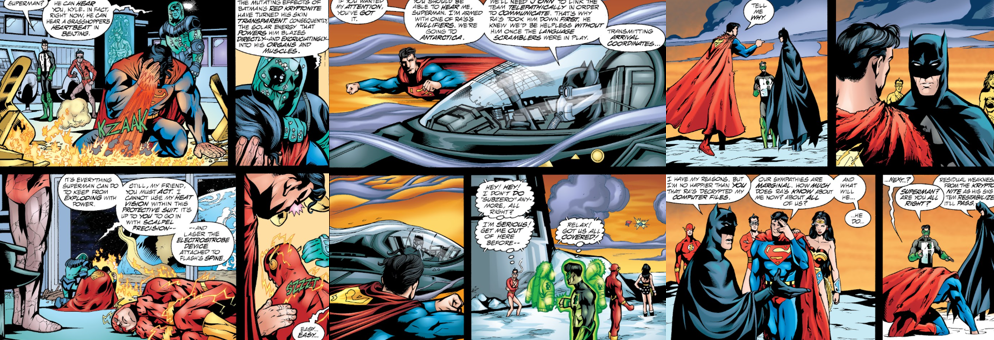
Despite clearly being tempted and overwhelmed by the proposition of being reunited with his parents, the Batman attacks in a rage but is horrified when Rā’s brandishes synthetic red kryptonite. Subdued by Rā’s’s troops, Batman fails to warn Superman who is caught completely off-guard when he arrives to help Wally, Diana, and Kyle with Martian Manhunter (wearing a special Atlantean water suit). Although Batman escapes Rā’s and Talia seems displeased at being her father’s lapdog, Superman’s crippled with agony when the rock turns his skin transparent and overloads him with solar energy. Alarmed that Rā’s has stolen his secret contingency files and turned them on his allies, Batman desperately tries to contact Aquaman with a solution, only for Rā’s to further disrupt communications. Luckily, Batman fools his pursuers with a fake death and Plastic Man finally pulls himself back together to teleport the JLA back to the Watchtower. There, Arthur is sustained by a telepathic illusion courtesy of J’onn, Plastic Man removes the chip lodged in Diana’s brain, and Superman focuses long enough to destroy the device tormenting the Flash. Finally, Diana and J’onn work with Kyle to deduce that his ring was slipped on him during sleep and that his blindness was caused by a post-hypnotic suggestion; by focusing, Kyle’s sight returns. The shellshocked JLA discuss Batman’s actions, their faith in their teammate shattered, with Superman feeling especially betrayed. Despite knowing the JLA distrust him, the Batman gathers them in Antarctica to infiltrate Rā’s’s tower, demanding the team work together to end the worldwide disruption. The battle is incredibly brief as Superman simply explodes in a burst of power, bringing the tower down and demanding an explanation from his comrade, only to be stonewalled by Batman’s stubborn nature.
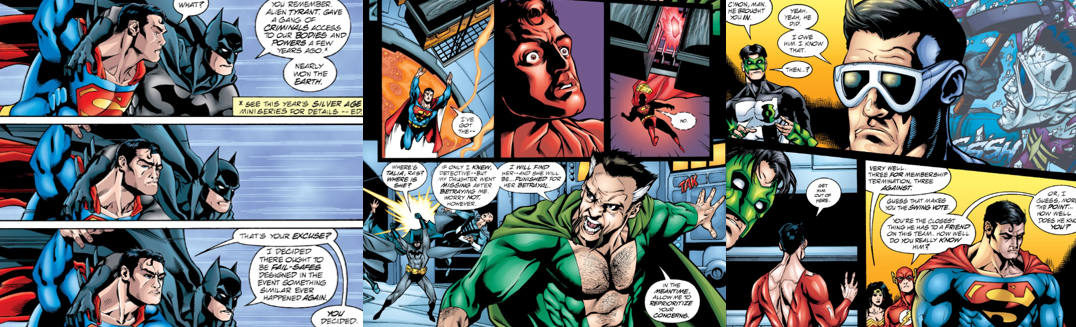
Despite the tower’s destruction, a disgruntled Talia informs the JLA that Rā’s is still a threat, leading Batman to split the fractured team up to handle each crisis. While Green Lantern, Plastic Man, the Flash, and Wonder Woman stop a chemical attack in Rhapastan, Batman explains to Superman that he created fail-safes after the alien tyrant Agameno swapped their consciousnesses with a gang of criminals. Finding little comfort in that explanation, Superman echoes Plastic Man’s uncharacteristically stoic and enraged demeanour by leading Batman through Rā’s’s stronghold. Though Rā’s prepares to retreat in frustration and Superman’s held off by the red Kryptonite, he covers his escape by dropping the Waynes’ coffins! Luckily, the restored Aquaman and Martian Manhunter pull both Superman and Batman’s parents from danger, leaving Batman free to pursue his adversary. While Rā’s escapes, his assistant, Doctor Kant, isn’t so lucky and takes the brunt of Batman and Aquaman’s retaliation, while Wonder Woman convinces Rā’s’s agent out of unleashing his chemical agent. With the danger over and the JLA back to full strength, the team debate what to do about Batman. While the Dark Knight awaits their decision, Superman questions whether they should have safeguards against their powers being manipulated. Aquaman believes the team should be based on trust, the Flash reluctantly thinks Batman has a point, and J’onn somewhat echoes this sentiment. When Arthur challenges J’onn’s loyalty to the Batman, pointing out that he once had similar dossiers, a fight almost breaks out between them, though J’onn ultimately votes in favour of Batman. While Kyle’s also not happy about what happened, he recognises that their powers are potentially dangerous and also votes to keep Batman on the team. However, while Wonder Woman agrees in principle, she refuses to fight alongside someone she can’t trust and Plastic Man coldly agrees. Although the deciding vote comes down to Superman, Batman makes the decision for them and quits the team without a word while they’re debating.
The Summary:
Like I said, this was a great time to be a JLA fan. The artwork was always really good in these comics and the team gelled really well together visually and with their contrasting personalities. It’s a very nineties period for the JLA, of course, with guys like Aquaman and newcomer Kyle Rayner offering very different interpretations of classic characters. I’ve always loved this version of Aquaman, though, with the harpoon hand and dishevelled appearance. Kyle is and will always by my favourite Green Lantern and I enjoyed the dichotomy he brought to the team as he obviously felt a little out of his depth and often deferred to his superiors as a result. These are characteristics reminiscent of Wally’s early days as the Flash, which led them to eventually form a tight friendship, but much of Kyle’s characterisation at this time was proving (or at least realising) that he’s worthy to hang with the big boys. Plastic Man was something of a wild card, for sure, especially due to his goofy nature and bizarre abilities. “Tower of Babel” showed that there was more to him than just being a wise-ass, though, as he’s so traumatised by being frozen and shattered (and by the Batman’s actions) that he drops the jokes and dismissively votes against Batman. Indeed, this story shakes the foundations of the JLA as, up until this point, they’ve all fought together on the understanding that they can trust each other. I’m pretty certain they all know each other’s strengths, weaknesses, and secret identities, for example, and feel they’re more than just colleagues. Thus, when they discover that Rā’s al Ghūl’s plot is due to Batman’s secret contingency plans, the team rightfully feels betrayed and angry, with Superman noticeably upset since he knows Batman the best and has worked with him the longest.
Thus, the main enemy in “Tower of Babel” is essentially Batman, while technically also being the group’s insecurities, and more accurately being the devious Rā’s, who disrupts them to facilitate his latest scheme. The JLA is caught completely off-guard when Talia and her troops ambush them, wielding weapons designed specifically to neutralise their powers or otherwise subdue them. While I believe Batman’s plan was always to non-fatally pacify his teammates if they go rogue or were manipulated, some of his contingencies are very questionable. J’onn, for example, bursts into flame when exposed to air, something that would be both physically and emotionally traumatic for him considering his fear and weakness to fire. Aquaman is almost killed by dehydration when fear toxin variant made him deathly afraid of water, forcing J’onn to put him at ease with a telepathic vision so he could be safely placed in water. The Flash had it pretty bad, too, forced to endure what felt like days of torturous seizures in less than half an hour, while Superman’s powers raged thanks to red kryptonite. Similarly, it seems Wonder Woman would’ve eventually been so lost in her endless combat that she would’ve perished and Kyle was extremely distressed when he was duped into making himself blind. Seems to me that Batman could’ve just as easily used virtual reality environments for all his allies for a similar end, so it’s likely Rā’s al Ghūl perverted his countermeasures. Either way, the JLA are outraged at both the experience and the betrayal, believing Batman misled them and cannot be trusted. Even if he was right, since the JLA are mind controlled every other week and have extremely dangerous powers, the characters are angry at the deception. I doubt their reaction would’ve been much better had they known about Batman’s fail-safes, but it certainly would’ve lessened the sting since they put a lot of trust in him as their strategist and smartest mind.
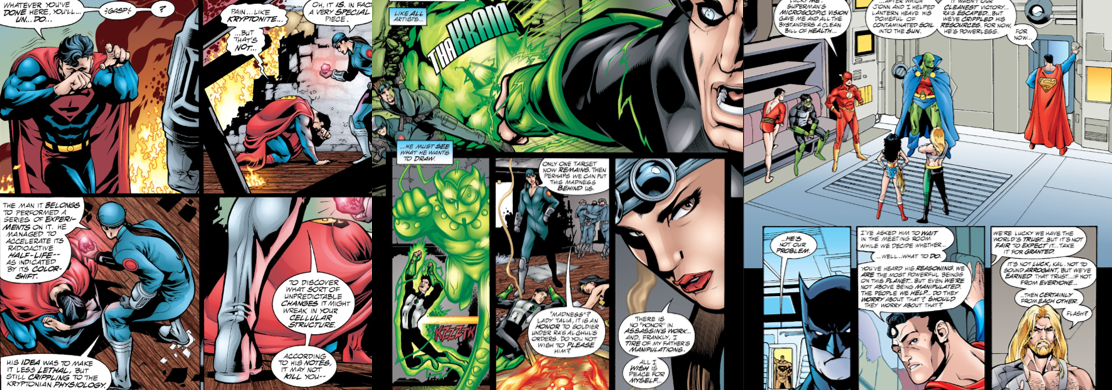
This ethical quandary hangs over “Tower of Babel”, creating tension and animosity within the group for the finale, where they can barely function as a cohesive unit and are extremely reluctant to listen to Batman. Though he’s horrified by what Rā’s al Ghūl has done, Batman offers no apology and little explanation. He believes he was right to create contingencies and won’t be swayed from the belief, kick-starting a long-tunning theme of Batman being a stubborn, paranoid, and somewhat unethical character whose efforts to prepare for every scenario alienated his nearest and dearest. Interestingly, “Tower of Babel” doesn’t suggest what Batman’s back-up plan was if he went rogue (though it’s implied to be the remaining JLA) and barely gives him a chance to counteract Rā’s al Ghūl’s actions since the Demon’s Head keeps messing with their communications. I would’ve liked to see more of the world being plunged into chaos but I think “Tower of Babel” wisely focuses on the JLA and how they’re affected by Batman’s actions. The entire point is to fracture DC’s greatest superhero team, which literally happens by the end when the Batman walks away without hearing a verdict, but has knock-on ramifications as tensions are high amongst the others. I enjoyed seeing the team struggle to decide Batman’s future since they were personally disgusted and angered by the betrayal but recognised the need for fail-safes, and also how black-and-white the decision was for Aquaman and Wonder Woman, who felt the betrayal outweighed the risk. “Tower of Babel” easily ranks as one of the top JLA stories for a reason and it’s a great deconstruction of the team and exploration of their powers, weaknesses, and the fragile ethics that hold them together. It had far-reaching consequences for all involved and is well worth a read, especially for fans of this era of DC Comics.
My Rating:
Pretty Good
What did you think of “Tower of Babel”? Do you consider it a classic JLA story or do you think it’s over-rated? Which of Batman’s contingencies do you think was the worst to suffer through? Did you enjoy this incarnation of the JLA or do you prefer a different line-up? Do you think Batman was right to have contingency plans or do you agree that he crossed a line? How are you celebrating Justice League Day this year? Whatever your thoughts on the JLA, feel free to share them below, check out my other Justice League reviews, and go donate to my Ko-Fi to suggest other JLA stories for me to cover.




































 Dr. K's Waiting Room
You must be logged in to post a comment.