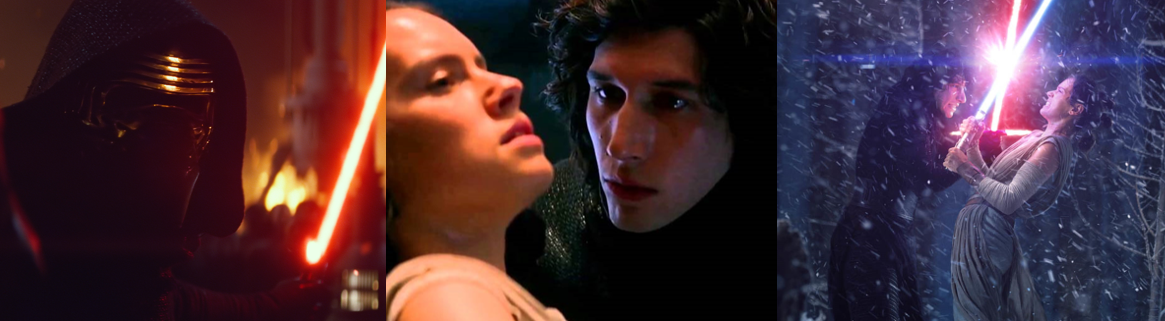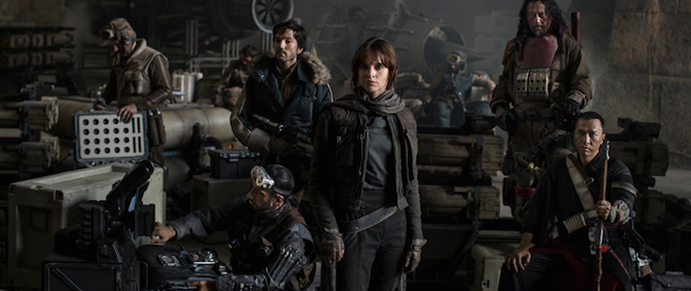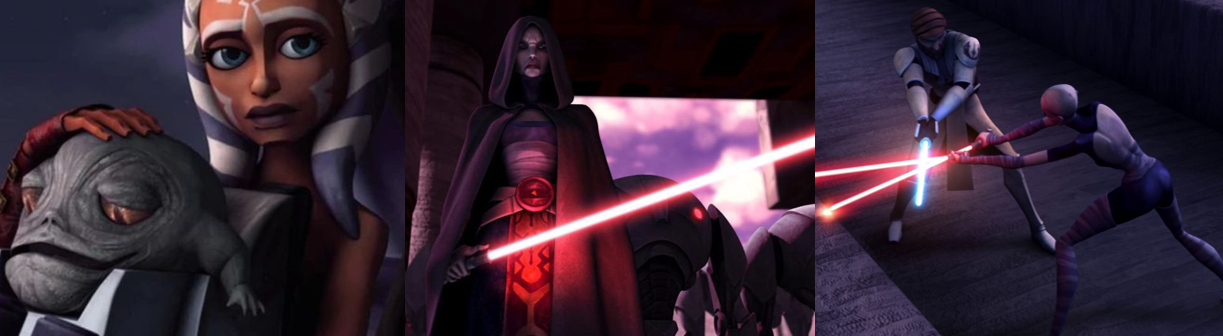
Screen Time [May the Sith]: Obi-Wan Kenobi


While May 4th is known the world over as Star Wars Day, many also choose to extend the celebrations of the course of three days, with one of them being the “Evil Star Wars Day” of May 6th (as in “Sith”).


Air Date: 27 May 2022 to 22 June 2022
Network: Disney+
Director: Deborah Chow
Stars: Ewan McGregor, Vivien Lyra Blair, Moses Ingram, Rupert Friend, Jimmy Smits, and Hayden Christensen/James Earl Jones

The Background:
In 1977, George Lucas introduced audiences to his pulp sci-fi “space opera” with Star Wars (or Episode IV: A New Hope), which became a near-immediate phenomenon not just at the time, bit for generations. Star Wars achieved this not just through toys, videogames, comics, and novels, but Lucas returning the franchise to the big screen with a prequel trilogy. Though largely seen as inferior to the Original Trilogy thanks to an overreliance on CGI and some questionable performances and dialogue, the Prequel Trilogy was financially successful and has since earned a generation of apologists, with Ewan McGregor’s portrayal of Obi-Wan Kenobi attracting much praise. Accordingly, after Disney acquired the franchise and began producing a new trilogy and spin-off films, talk of an Obi-Wan venture circulated after McGregor expressed interest in reprising the role. Though initially planned as a feature film, the project was re-tooled into a six-episode miniseries after the financial failure of Solo: A Star Wars Story (Howard, 2018) and the critical acclaim of the Disney+-exclusive series, The Mandalorian (2019 to 2023). Eager to explore a more downtrodden version of the titular character, McGregor was ecstatic to be working with Hayden Christensen once more. Christensen leapt at the chance to don the iconic helmet once more and the two were digitally de-aged for a flashback sequence. Pitched as a story about Obi-Wan confronting his past, Obi-Wan Kenobi also explored Princess Leia’s childhood and straddled a fine line between telling its own story and staying true to established canon. Premiering as the most-watched Disney+ original series (at the time) and also one of the most pirated shows, Obi-Wan Kenobi received critical acclaim that praised McGregor’s performance and the emotional reunion between Obi-Wan and Darth Vader. While the action and old-school atmosphere were also praised, some plot elements were ridiculed and the show was criticised for relying too heavily on nostalgia. Still, despite some horrendous racist reactions, the award-winning show was accompanied by a tie-in comic series and McGregor was optimistic about reprising the role again in the near future.

The Plot:
Ten years after the destruction of the Jedi and the rise of the Galactic Empire, former Jedi Master Obi-Wan Kenobi (McGregor) hides on Tatooine. When called to rescue Princess Leia Organa (Blair), Obi-Wan is drawn into a confrontation with his former Padawan, Anakin Skywalker, now the ruthless Sith Lord: Darth Vader (Christensen/Jones).

The Review:
Obi-Wan Kenobi is a six-part miniseries set some ten years after Revenge of the Sith. Accordingly, the malevolent Galactic Empire dominates the galaxy, enforcing martial law across numerous worlds, stationing their nameless, faceless Stormtroopers to harass and intimidate the populace, and ravaging the natural resources of every world they control. Life is tough for many ordinary civilians as they’re either persecuted, deprived of basic needs such as food and credits, or brainwashed into believing that the Empire is a benevolent organisation bringing order to the galaxy. Thus, we see a few different ends of the spectrum in Obi-Wan Kenobi, with friendly, ordinary civilians like Freck (Zach Braff) praising the influence of the Empire, downtrodden, forgotten Clone Troopers (Temuera Morrison) left begging in the streets, senators like Bail Organa (Smits) trying to politically influence opinion away from the Empire, and Imperial offers like Tala Durith (Indira Varma) being disgusted by the Empire’s tyrannical ways. To make matters worse, Emperor Sheev Palpatine’s (Ian McDiarmid) oppression of the Jedi Order saw not only Jedi and their Younglings mercilessly slaughtered by Clone Troopers as part of “Order 66”, but the continued hunting and eradication of any surviving Jedi or Force-sensitive individuals by Darth Vader and his determined, ruthless Inquisitors. While Darth Vader and his cohorts, who were once Jedi before turning to the Dark Side, successfully identify their prey, either by intimidating, threatening, or out-right killing the locals, their true quarry, the elusive and titular Obi-Wan Kenobi, has eluded them for ten years. Like many Jedi, Obi-Wan has accomplished this not only by hiding away on a backwater planet (in this case, Tatooine) but by suppressing his Force abilities. When confronted by desperate Jedi survivor Nari (Benny Safdie) in “Part I”, Obi-Wan strongly advises him to follow his example, literally burying his former life in the desert and refraining from helping others with the Force, advice that Nari doesn’t heed and results in his public execution.
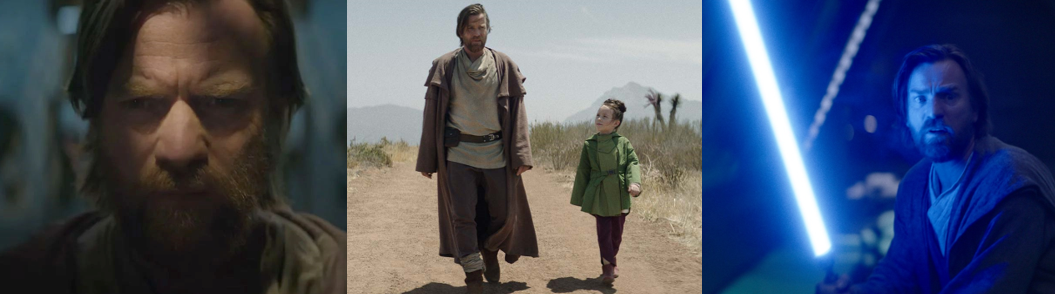
Haunted by his past, a reluctant Obi-Wan ventures out to protect Leia and confront his greatest failure.

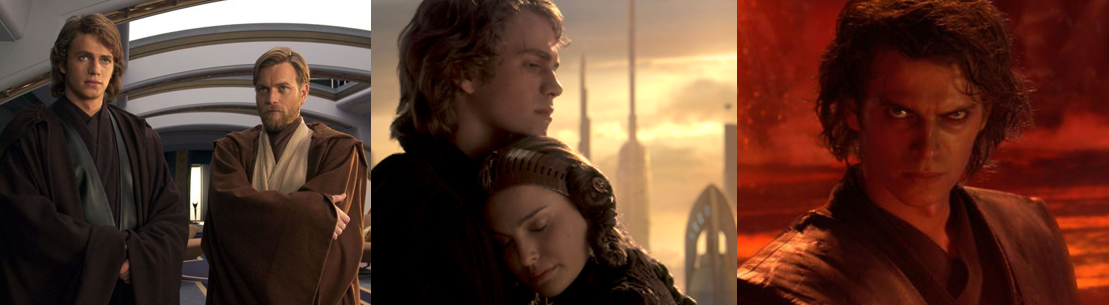
Traumatised by the horrific events that saw his former Padawan, Anakin Skywalker, be seduced by the Dark Side and slaughter his fellow Jedi, Obi-Wan has hidden away on Tatooine, taking the “clever” alias “Ben” and eking out a menial living, with only Owen and Beru Lars (Joel Edgerton and Bonnie Piesse) aware of his true identity. Although Obi-Wan regularly attempts to commune with the spirit of his old master, Qui-Gon Jinn (Liam Neeson), he receives no answer, largely because he’s lost his connection to the Force after a decade of suppressing his abilities and after seeing first-hand the downfall of the Jedi Order. Haunted (literally and figuratively) by the screams and suffering of his former Padawan, Obi-Wan is a shell of his former self who uses his promise to watch over Anakin’s son, young Luke Skywalker (Grant Feely), as an excuse to stay hidden, despite Owen warning him to stay away lest he fail the boy as he failed his father. However, when Reva Sevander (Ingram), an ambitious Inquisitor known as the Third Sister obsessed with gaining Darth Vader’s favour, hires bounty hunters to kidnap young Princess Leia, Obi-Wan is forced back into the fight at the desperate request of Bail, Leia’s adopted father and Obi-Wan’s old Republic ally. While he’s hesitant to answer the call, feeling old and useless and afraid of drawing undue attention, Obi-Wan ultimately agrees since Leia, as Luke’s sister, is just as important to any future hope of opposing the Empire. Thus, Obi-Wan leaves Tatooine with only his wiles and some rusty Jedi tricks to guide him. Obi-Wan finds himself in a galaxy that’s largely lost its way, full of disreputables like fake Jedi Haja Estree (Kumail Nanjiani), bounty hunters like Vect Nokru (Flea), and meek civilians afraid of Darth Vader’s wrath. While Obi-Wan carries his lightsaber, he mostly favours a blaster and avoids using the Force lest he compromise his position. However, he is ultimately forced to take up both to safeguard Leia and defend the innocent, finding that the spark of hope is still alive, if faded, in the unruly galaxy.
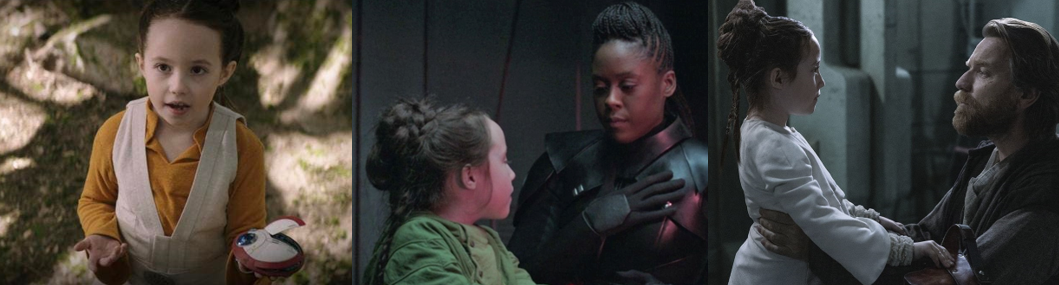
Headstrong Leia defiantly resists torture and restores Obi-Wan’s hope for the future.

Because of Obi-Wan’s reluctance to use the Force, the stubborn, adventurous, headstrong Leia is initially very wary of him. Already something of a spoiled and reckless child, Leia finds politics boring and desires to find her own path, but is incredibly defiant and brave even when faced with the likes of the Third Sister. Leia never stops to fight back, resisting her captors at any opportunity, and is incredibly insightful. She has a unique way of reading people, even after only just meeting them, and isn’t afraid to speak her mind. Having lived a sheltered life on Alderaan, Leia is naïve to the dangers of the galaxy and walks head-first into situations thinking the best of everyone, confident that she can charm or talk her way out of most situations. Her surprisingly intuitive demeanour impresses Obi-Wan, as she’s wise beyond her years in many ways, but he’s also quick to shield her from growing up too fast and being exposed to violence before she’s ready to put her feisty spirit to good use as a natural leader. Leia and Obi-Wan’s relationship is a true highlight of Obi-Wan Kenobi; I loved her inquisitive nature and how she criticised him at times. It’s also heartbreaking to see Obi-Wan’s reaction to her, as she reminds him of Padmé Amidala (Natalie Portman) in mind, body, and spirit, bringing further pain to the wizened Jedi Master since he was unable to keep Padmé from Anakin’s destructive downfall. Adorable and enthusiastic, Leia relishes the chance to be on an adventure, though recognises that she’s in over her head and caused trouble by disobeying her parents. She eventually bonds with Obi-Wan, querying his sullen demeanour and learning of the tragedies he’s witnessed, and also connects with Tala, who inspires her rebellious attitude. Leia’s stubbornness sees her defy even the Third Sister’s cruel interrogation; resisting the Inquisitor’s attempts to probe her mind with the Force, Leia refuses to sell out her allies even when faced with torture. Similarly, Leia comes to care for Obi-Wan so deeply that she begs Tala to help him when he chooses to face Darth Vader to cover her escape, and eventually sets herself on the path to forging her own identity as a diplomat and a fighter thanks to Tala’s sacrifice and Obi-Wan’s influence, especially as he passes on knowledge of her true parents.
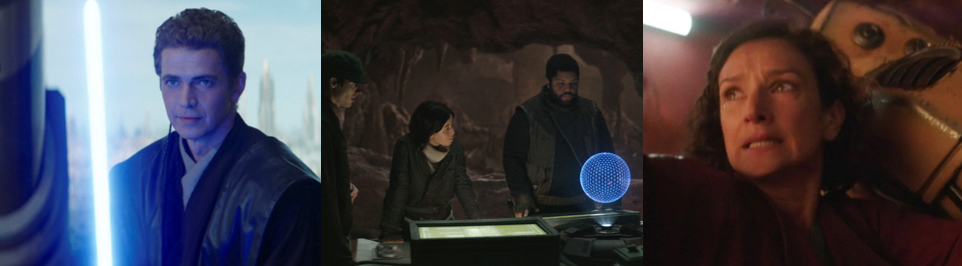
Obi-Wan’s traumatic past with Anakin sees him reluctant to trust his new allies.

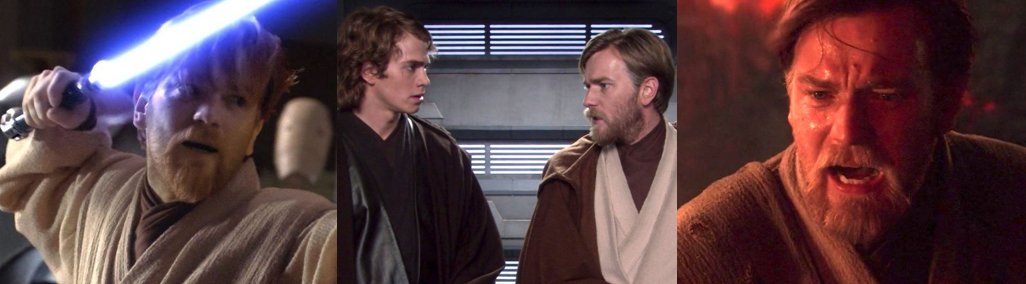
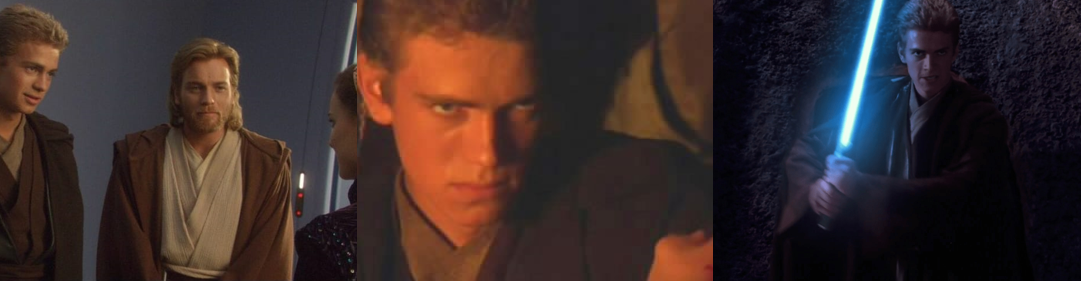
While Obi-Wan is faced with danger at every turn, he gains some notable allies in his quest. Naturally distrustful following his traumatic past, Obi-Wan initially tries to keep a low profile and sway suspicion with flimsy cover stories. However, after the Third Sister puts a bounty on his head, Obi-Wan’s forced out of the shadows and to slowly reconnect with the Force and his lightsaber, which means making new allies to escaping Darth Vader and the Inquisitors. His first port of call is Haja, a con man who fakes being a Jedi for credits but who’s inspired by meeting a real Jedi to aid Obi-Wan, eventually watching out for Leia as the Jedi Master confronts Darth Vader. Despite seemingly leading him on a wild goose chase, Haja also puts Obi-Wan in contact with Tala, a disillusioned Imperial officer trying to atone for the blood on her hands by secretly smuggling Jedi and other Imperial targets to safety through an underground resistance network known as “The Path”. Tala’s Imperial authority guides Obi-Wan through the Fortress Inquisitorius to rescue Leia, where he discovers, to his horror, the preserved corpses of slain Jedi in the temple. It’s through Tala that Obi-Wan meets Kawlan Roken (O’Shea Jackson Jr.) and reaffirms his status as a defender of the innocent since Obi-Wan willingly surrenders to cover their escape, though Tala is unfortunately killed during the Imperial assault in “Part V”. Obi-Wan’s reluctance to trust others stems not just from his need to stay hidden, but also from being burned by Anakin’s betrayal. The wonders of modern de-aging technology provide a flashback to Obi-Wan’s younger days, when he duelled with the upstart Anakin and tried to emphasise the need to temper his aggression and desire to prove himself in favour of defending others. Thanks to competent writing and direction, Hayden Christensen gets a chance to shine as the conflicted Anakin, who’s torn between showing his superiority and obeying his master. Despite Anakin’s exuberance in the duel, the two are painted as close brothers, making the pain of Anakin’s turn only sting more. This feeds into Obi-Wan’s guilt and the fear he feels whenever Darth Vader is present since Obi-Wan doesn’t want to see the monster his former protégé has become, much less be forced to kill him.
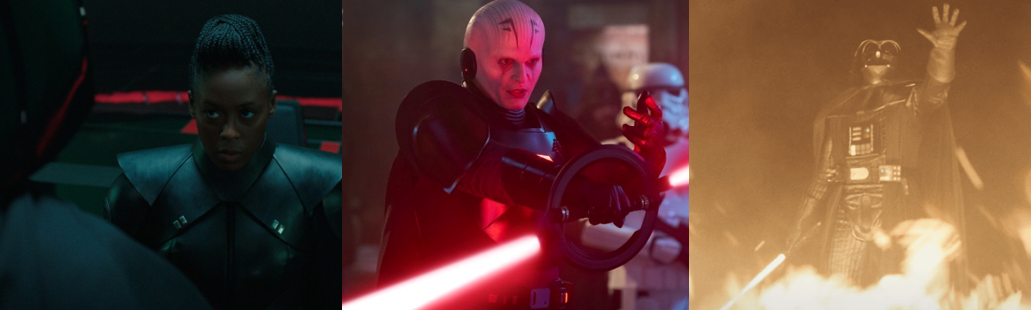
Reva’s ambition to punish Darth Vader is mirrored in Vader’s obsession with destroying Obi-Wan.

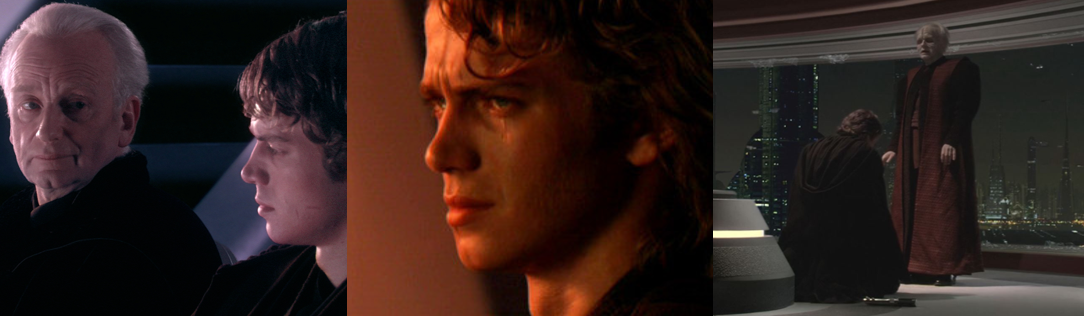
While all Jedi are relentlessly hunted by the Inquisitors, Obi-Wan is specifically targeted by the Third Sister against the orders of the Grand Inquisitor (Friend) and her rival, the Fifth Brother (Sung Kang). While the Grand Inquisitor enjoys a good monologue, intimidating locals into giving up any Jedi amongst them, the Third Sister prefers a more direct approach, publicly executing and maiming people to force the Jedi out. Constantly reprimanded for her reckless ways, the Third Sister’s ambition to impress Darth Vader by delivering his former master sees her seemingly kill the Grand Inquisitor and take his place, gaining Darth Vader’s favour and leading the operation to hunt Obi-Wan down. Reva’s ambition is seeped in hatred of both the Jedi and her dark master since, as a Youngling (Ayaamii Sledge), she witnessed Anakin’s massacre and has pledged to destroy him. Obi-Wan initially sways her into allying with him, providing her with the distraction to attempt an execution, only for Darth Vader to grievously wound her thanks to the surviving Grand Inquisitor. Desperate, the Third Sister heads to Tatooine to slaughter Luke and his family but ultimately spares the boy when she realises she’s in danger of becoming the same monster as Anakin. Strong in the Force and wielding red lightsabers, the Inquisitors inspire fear through their mere presence. This is, surprisingly, echoed in the Stormtroopers, who are far more competent and menacing than usual, especially due to their sheer numbers and Obi-Wan’s rusty Jedi skills. These skills are tested when Obi-Wan inevitably crosses paths with Darth Vader, with the Dark Lord slaughtering and torturing innocents to bait his old master and humbling Obi-Wan during their first, brutal encounter. Here, Darth Vader toys with his prey, dragging Obi-Wan through fire to inflict a measure of the same pain he caused him. In their second encounter, Obi-Wan is far more confident and capable, though Darth Vader’s fury, raw power, and tempered skill still overwhelmed him. After being buried beneath a cave-in, Obi-Wan fully regains his connection to the Force and bombards Darth Vader with debris, damaging his mask and breathing apparatus and leading to a dramatic confrontation between the two. Here, Obi-Wan is distraught to see his scarred former pupil is beyond salvation and, after Vader takes credit for killing Anakin, Obi-Wan leaves him to his suffering, now fully convinced that Anakin Skywalker is dead and that only Darth Vader remains.

The Summary:
As a big fan of Ewan McGregor’s performance s Obi-Wan Kenobi, I’m ashamed at how long it took me to get to his long-awaited self-title series. McGregor shines as the haunted, wary former Jedi Master, easily slipping right back into the role and further echoing Alec Guinness’s original portrayal of the character as an older, wiser, and far less physically capable character. In Obi-Wan Kenobi, Obi-Wan is tormented by guilt and PTSD, haunted by nightmares of Anakin’s downfall and weighed down by his failure to save his apprentice, which he believes cost the lives of countless innocents and Jedi. When Bail calls, Obi-Wan insists that he’s not the right man for the job and, to be fair, he’s not completely wrong. Constantly called out for his age and initially struggling so much to call upon the Force that it exhausts and even pains him, Obi-Wan is a far cry from the confident, commanding General he once was. However, this old dog still has a few tricks up his sleeve. He’s handy with a blaster and some of his Jedi training still remains in a fist fight, allowing him to survive most scuffles, even if he lacks the finesse he once had. He’s somewhat overconfident when he first faces Darth Vader, though it’s more that he’s forced into a lightsaber duel to protect Leia and other innocents. His form is sloppy and weak, as criticised by Darth Vader, and Obi-Wan surely would’ve died if not for Tala’s timely intervention. Though he’s still a step behind his twisted opponent in his second encounter, Obi-Wan is much more formidable and regains much of his former strength through both their duel and the closure given to him by Darth Vader’s assertion that Anakin is dead. This, as much as rediscovering his compassion for others and seeing the flame of hope still flickering in the galaxy, brings Obi-Wan enough inner peace to finally strengthen his connection to the Force. This allows him to commune with his long-dead master, Qui-Gon, effectively laying the foundation for Obi-Wan’s later adventure with the Rebellion.
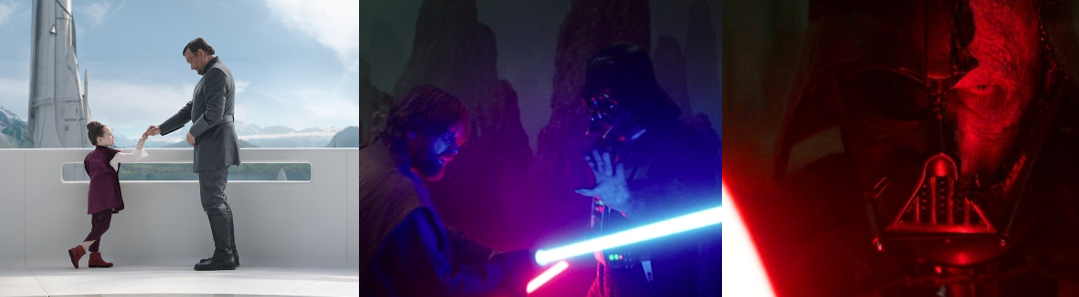
Obi-Wan Kenobi gives returning actors a chance to revisit their characters and relationships.

As great as Obi-Wan was here, Obi-Wan Kenobi goes a long way to making up for some of the Prequel Trilogy’s many shortcomings. Jimmy Smits gives a magnetic performance as the concerned and desperate Bail, who has a lovely relationship with Leia where he encourages her mischievous ways as well as a brotherly bond with Obi-Wan that sees him turn to the burned-out Jedi in his time of need. We get more of an idea of how devastating Order 66 was, not just through Obi-Wan’s nightmares but Reva’s descriptions and flashbacks, which depict Anakin as a monster who turned on his own people and mercilessly slaughtered children. This memory is as traumatic for Reva as it is Obi-Wan, fuelling her hatred of the Jedi for allowing it to happen and of the Dark Lord for committing the act. Obi-Wan Kenobi brings Hayden Christensen back not just as a digitally de-aged Anakin but as Darth Vader, bolstered by an AI-rendition of the late, great James Earl Jones’s booming voice. Depicted as a scarred, maimed tyrant, Darth Vader relentlessly pursues Obi-Wan even against other, more pressing concerns. He fuels the Third Sister’s lust for power by promoting her under pain of death if she fails and doesn’t hesitate to strike her down when she tries to assassinate him. When confronting Obi-Wan, Darth Vader is disgusted by the state of his master and easily overpowers him, relishing the chance to inflict pain upon the one he blames for his condition. Although I don’t mind Hayden, he was always a weak-link in the Prequel Trilogy; however, Obi-Wan Kenobi proves this was largely because of the awful direction and script he was saddled with. Here, Anakin is a twisted and embittered man consumed by anger and vengeance. Seeing his helmet damaged, his voice box malfunctioning, and the pure animosity in his eyes as he denounces both Obi-Wan and his former life is a truly stirring (if familiar) moment that goes a long way to make up for George Lucas’s clunky dialogue.
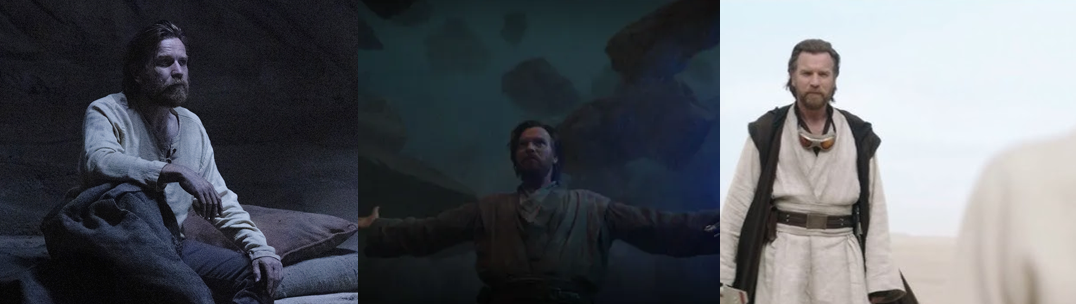
Obi-Wan’s dramatic journey sees him rekindle his connection to the Force and the wider galaxy.

Though Obi-Wan relies more on his blaster and his wits, Obi-Wan Kenobi features some decent chases, action scenes, and space battles. The show primarily goes out of its way to depict Stormtroopers as a true threat, which I really enjoyed, and to hammer home how desperate the situation is for the few remaining Jedi and those who would oppose the Empire. The lightsaber action is as thrilling as we saw in the Prequel Trilogy, now given an extra edge through the Inquisitors’ lust to eliminate all Jedi and Darth Vader’s desire to make his former master suffer. Not only that, but I really enjoyed Leia’s portrayal here. She echoes both her mother and her older self in her stubborn, outspoken nature and I enjoyed the dichotomy of her as a naïve but rebellious child who wanted an adventure but was strong enough to resist torture. Her relationship with Obi-Wan was equally adorable and emotional as Leia only causes Obi-Wan further pain because of his failures. These see him become obsessed with watching over Luke, whom Owen aggressively shields to keep him from taking even a single step down the same path his father took. Obi-Wan’s reluctance to leave the boy and embark on some damn, fool adventure turns out to be just what the downtrodden former Jedi needed since Leia shows him that there’s hope for the future. This is only further emboldened through Obi-Wan’s interactions with Tala and Roken, rebellious spirits who place themselves in mortal danger to save who they can and are principal figureheads in the fledgling Rebellion. Forced to literally confront his past, his demons, and his greatest failure, Obi-Wan rediscovers himself and accepts that Anakin is truly lost, ending the miniseries in a stronger position to prepare for the future since he’s no longer haunted by the past. Overall, I really enjoyed Obi-Wan Kenobi. It’s a bit wonky in some ways since I never suspected that Obi-Wan left his exile on Tatooine much less had an encounter with Leia or a rematch with Darth Vader, but the miniseries is clearly positioned as a love letter to the Prequel Trilogy and, in that respect, it succeeds. With fantastic performances from the new and returning cast, there’s a lot to like here and it does a great job of further bridging the gap between the two trilogies and sowing the seeds for future appearances of the likes of the Skywalkers, the Inquisitors, and the Dark Lord himself.

My Rating:

Rating: 4 out of 5.

Great Stuff

Did you enjoy Obi-Wan Kenobi? Were you excited to see Ewan McGregor and Hayden Christensen return to their iconic roles? What did you think to Obi-Wan’s character arc and his depiction as a traumatised former Jedi? Did you enjoy the brutal rematch between him and Darth Vader or did it irk you to see them interact prior to the Original Trilogy? What did you think to Leia, her gusto and bravado, and the allies they made in their journey? Are you a fan of the Inquisitors? Would you like to see other character-specific Star Wars spin-offs? I’d love to see your thoughts on Obi-Wan Kenobi in the comments below, so drop them there, support me on Ko-Fi, and go check out my other Star Wars content.

Game Corner [Revenge of the 5th]: Star Wars: Shadows of the Empire (Nintendo 64)


Although May 4th is known the world over as Star Wars Day, many also choose to celebrate the popular, generation-spanning science-fiction saga on May 5th as a play on the word “Sith”. This can extend Star Wars Day into three day celebration of the influential science-fiction series and, as a result, is another great excuse for Star Wars fans to celebrate the beloved franchise in a variety of ways.


Released: 2 December 1996
Developer: LucasArts
Also Available For: PC

The Background:
Now known as a nigh-unstoppable multimedia juggernaut that encompasses movies, toys, cartoons, books, videogames, and comics, the original Star Wars trilogy was initially continued in the “Legends” novels. Accordingly, Lucasfilm’s publishing director, Lucy Autrey Wilson, tapped Bantam editor Lou Aronica and author Steve Perry to develop a Star Wars crossover multimedia event in 1994. The project wouldn’t include a movie but would involve all the media and marketing of a film release, all to coincide with the upcoming release of the 1997 Special Editions of the Original Trilogy. Shadows of the Empire took place between Star Wars: Episode V: The Empire Strikes Back (Kershner, 1980) and Star Wars: Episode VI: Return of the Jedi (Marquand, 1983) and was comprised of Perry’s novel, a comic book, an extensive toy line, and this divisive videogame. The game focused on Han Solo-proxy Dash Rendar and was built on a modified version of the Star Wars: Dark Forces (LucasArts, 1995) engine. The decision to focus on Nintendo 64 development led to some issues in properly coding for the system, Nintendo legend Shigeru Miyamoto weighed in on the camera and Dash’s characterisation, and all the animations had to be redone manually after Industrial Light & Magic’s motion capture work proved unusable. As mentioned, Shadows of the Empire garnered mixed reviews that noted a strong start let down by subsequent levels. The dodgy camera, clunky controls, and tedious gameplay were also criticised, though it developed a cult following over the years and the PC version was said to iron out some of the kinks. Unfortunately, Shadows of the Empire was de-canonised after Disney purchased the franchise, though Lucasfilm president Kathleen Kennedy once stated that characters like Dash Rendar have come up during discussions about Star Wars projects.

The Plot:
Hired to protect troubled Jedi Luke Skywalker and assist in rescuing Han Solo, rogue mercenary Dash Rendar finds himself embroiled in pitched battles with not only the Galactic Empire, but a criminal organisation looking to usurp the Dark Lord of the Sith, Darth Vader.

Gameplay and Power-Ups:
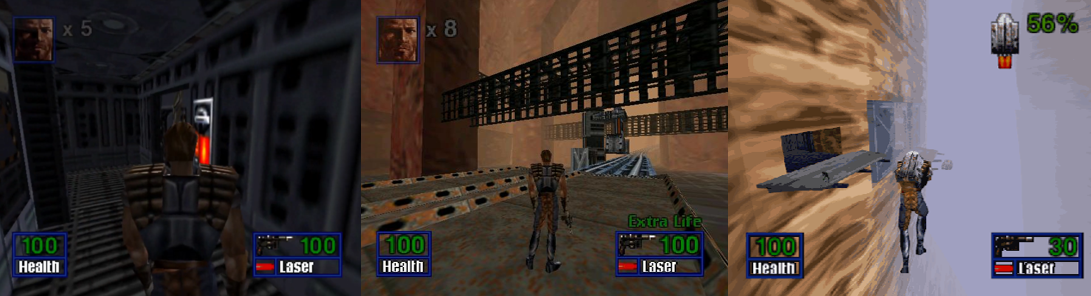
Star Wars: Shadows of the Empire is primarily an action/platformer videogame that released early into the Nintendo 64’s lifecycle and takes place between The Empire Strikes Back and Return of the Jedi. After picking and naming one of four save files (with no need for a memory pak) and selecting their level of difficulty, players assume the role of mercenary for hire and Han Solo-proxy Dash Rendar and journey across ten levels to defend the Rebel Alliance from the evil Galactic Empire, safeguard young Jedi Luke Skywalker, and oppose the mischievous ambitions of the Black Sun criminal empire. Once you’ve chosen a difficulty level, you can’t change it so you’ll need to start a new save file if, say, “Medium” is too difficult for you. You can enter the “Options” menu to customise the heads-up display (HUD), which displays your current health and weapon energy or ammo, as well as toggle the option to switch to following your heat-seeking missiles and customise the game’s controls. Shadows of the Empire maps different buttons to different functions depending on the level you’re playing; while six levels see you control Dash on foot, two take place in space, one sees you controlling a Snowspeeder, and another has you racing around on a swoop bike. When on foot, you can change your viewpoint with the Left trigger, directional pad (D-pad), or C-right, switching between a standard third-person view, a first-person perspective, a top-down view, and a dynamic “movie” angle that hampers the already cumbersome controls. The Right trigger opens doors and activates consoles and you can hold it to strafe which, when used alongside the Z trigger, gives you better aiming accuracy. You jump with A and, when you have a jetpack, can burn rocket fuel by holding this button. B fires your weapon, with Dash’s standard blaster automatically recharging but growing weaker the more you use it. You switch weapons with C-up, crouch to take cover or avoid incoming hazards with C-down, and hold C-right to activate the “Leebo Scanner” (if you collect enough “Challenge Points”), which essentially functions as a map.

Press switches, uncontrollably fly across gaps, and wrestle with Dash’s jetpack to clear levels.

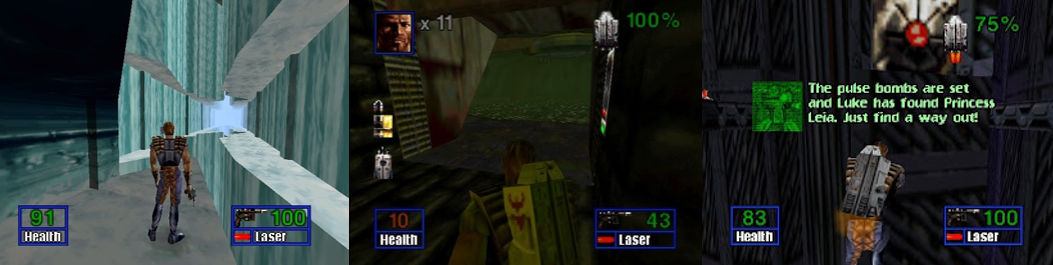
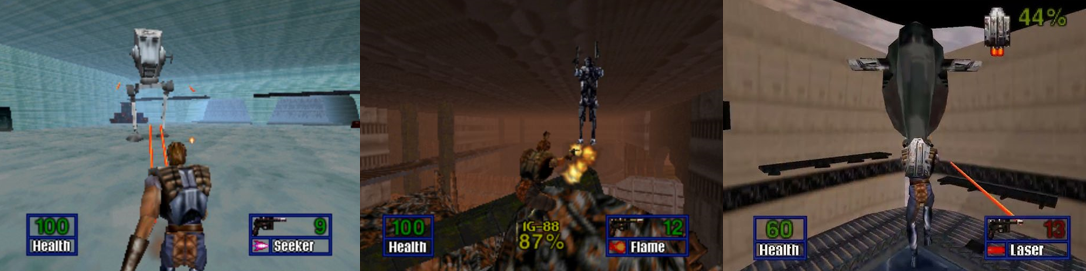
While Dash’s default blaster and jetpack automatically refill if given time, you must blast crates and search around the environment for additional ammo. You get a useful heat-seeking shot that are good for taking out groups of enemies at mid-range, a flamethrower for close encounters, a quick-fire pulse cannon that’s annoyingly erratic, a stun shot to freeze enemies, and a powerful disruptor blast that’ll damage you if you’re not careful! Health packs of different sizes can be found if you open nooks and crannies, search around, or blow open crates. You’ll also find the odd extra life and invincibility if you look hard enough, and you’ll earn additional extra lives for every Challenge Point you find. Much of your time in Shadows of the Empire is spent running around narrow corridors, samey environments, or the odd slightly more open areas. Every time you control Dash on foot, you’re charged with exploring, gunning down enemies, and activating a butt-load of switches. These open doors, release Wampas to attack enemies (and you!), allow you to take elevators to other floors, and lower barriers so you can progress. Dash is ridiculously awkward to control, lumbering about as though you were using tank controls, and easily slipping off ledges. His jump is unnecessarily floaty and carries his momentum forward, meaning it’s easy to miss platforms and overshoot your jumps and be sent plummeting to your doom. This is especially aggravating in the Ord Mantell Junkyard, where players must jump between trains and duck under hazards, switching tracks and hoping they don’t overshoot their landing. It’s equally tough controlling Dash with his jetpack, not just because he flies around as if covered in grease, but you must constantly land to recharge your thrusters and the game doesn’t make it clear which way you need to go, meaning it’s easy to get turned around. Although the jetpack doesn’t run out underwater, you’ll drown if you stay submerged for too long. Dash also takes fall damage, must use floating and/or spinning platforms to progress, and must avoid hazards like icequakes, wall and ceiling turrets, spinning blades, and rotating cogs.

While vehicle sections are a nice change of pace, they’re too short or aggravating to be that enjoyable.

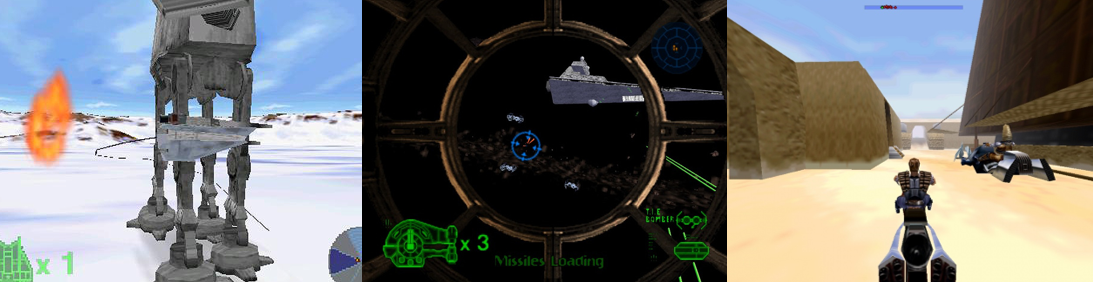
Things aren’t much easier when you’re playing the game’s handful of vehicle sections. You start off recreating the battle of Hoth in a Snowspeeder, using L or R to decrease your speed, A to speed up, B to fire upon Imperial Probe Droids and All-Terrain Scout Transports (AT-STs), and snagging All-Terrain Armoured Transports (AT-ATs) with your tow cable with Z. Though you can switch perspectives with C-right and the D-pad, it’s best to stay in third-person mode here as the Snowspeeder is surprisingly heavy and unresponsive. It’s hard to make tight turns and easy to accidentally plough into enemies or catch yourself on an AT-AT’s legs as you circle them to bring them down. Dash escapes Hoth in the Millennium Falcon Outrider, getting caught in an asteroid field just like in The Empire Strikes Back. This level is more like a bonus round where you blast waves of Twin-Ion Engine (TIE) Fighters and TIE Bombers with A or B, take out asteroids for Challenge Points, and waiting for your stock of missiles to recharge so you can blow up groups of TIEs with C-down, C-left, R, or Z. Using C-right or L to switch to the cockpit view can be advantageous here, though you can’t replenish the Outrider’s shields so don’t dawdle too long. In the final stage, you repeat this section in the first half and then race away from the exploding Skyhook, using A to accelerate and tilt your craft to avoid obstacles and R to decelerate. Finally, when on Tatooine, Dash must race against and take out a swoop bike gang looking to assassinate Luke, a task easier said than done since the swoop bike is a nightmare to control! You blast off at break-neck speed at the mere touch of A or C-left, crashing into anything and everything in your way and awkwardly reversing with B when you inevitably get caught on environment. You can switch viewpoints with C-right or the D-pad and must use L or R (or Z) to ram into the other bikers to keep them away from Luke. Even if you take them out in Mos Eisley, it’s easy to crash and burn in Beggar’s Cannon thanks to the high-speed action and narrow passages.
Dash’s simple objectives are compounded by clunky controls and frustrating gameplay.

Each level has a specific mission, related by Luke or Dash’s robot partner, Leebo, though gameplay mainly amounts to blasting enemies and activating switches. In the first and final stages, Rogue Squadron fight beside you and you must be careful not to hit them, or the shield generator on Hoth, or you’ll be penalised. An onscreen radar helps guide you in the flying and chase sections but, by default, you have no such help when on foot so it’s best to follow the bodies you leave behind if you get lost. Dash must take lifts and cross bridges, watching his step to reach new areas and activate switches, often while being forced to complete platforming challenges that look easy but are made far too frustrating thanks to his janky jump. As if this wasn’t bad enough in the Ord Mantell Junkyard, you also have to blast targets to lower barriers and hop onto carriage roofs to progress, and you’ll often be flying blind in Gall Spaceport thanks to the awful fog effects. This level is where ethe gameplay loop really starts to become tiresome and claustrophobic, maze-like locations like the Imperial Freighter Suprosa and Xizor’s Palace don’t make this any easier. You’ll find Stormtroopers and tough-as-nail robots lurking around every corner, shootouts in narrow corridors, switches that open alternating doors, forked paths, spinning turbines, and a labyrinth of cargo bays. This even carries through to the dank sewers of the Imperial City, where spiral chasms lead to murky sewage water that hides Dianogas and yet more switches! You must navigate this ugly-ass brick and filth maze to acquire an access key and force field deactivator, shooting targets in spinning tunnel to progress and dodging spinning spokes in narrow pipe to reach the end. Bottomless pits dog you throughout Hoth and the Gall Spaceport, but also return in Xizor’s Palace as a cheap way to up the difficulty of the end game. While you get infinite lives on “Easy” mode, “Medium” or higher limit your lives to make the game even tougher, though it’s a challenge and a half even on “Easy due to the clunky controls, Dash’s overly enthusiastic jump, and his struggles to aim upwards!

Presentation:
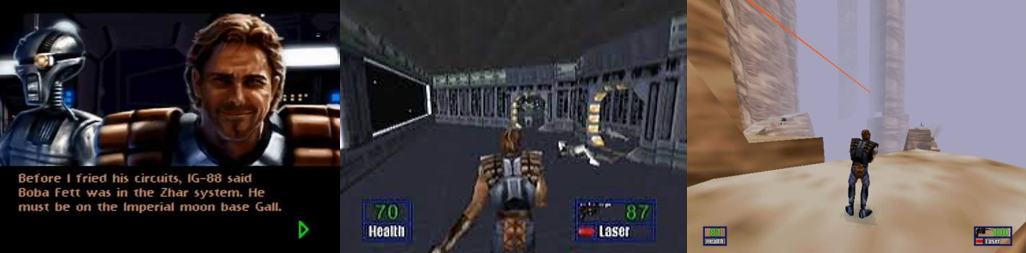
As Shadows of the Empire was an early Nintendo 64 title, your mileage may very regarding the presentation. There’s no question that the PC version had better, crisper graphics, especially for the game’s cutscenes, however I do like the artwork used for these cutscenes in the Nintendo 64 version. They’re incredible basic, barely having any animation and relying entirely on text to convey the story, but they’re beautifully rendered and capture the likenesses of familiar characters like Luke and Han really well. As the main character, Dash gets more time to shine here than in the comic book, showcasing an arrogant bravado and his commitment to aiding the Rebellion (for the right price). The game is divided into “parts”, which each part using the traditional Star Wars scroll to give an overview of the story, and is bolstered by samples of John Williams’ many Star Wars compositions. The “Imperial March” is mixed into the boss theme, for example, and “The Asteroid Field!” blares during the Outrider segments, but original compositions such as “Xizor’s Palace” also impressed despite some getting repetitive. While Shadows of the Empire does use some limited sound bites (Dash grunts and Stormtroopers yell basic demands), Dash is an awful polygonal model with little character beyond occasionally firing his blaster like a six-shooter. Many of the enemies don’t fare much better, being a mess of childish polygons from even mid-view and proving why the game relies so heavily on obscuring fog. This is at its worst in the Gall Spaceport and when navigating the murky sewer waters, where visibility is near zero, though the game doesn’t exactly make up for it in the Outrider sections, opting to use a plain black void or a distinctly blurry asteroid skybox. Yet, the game performs fairly well (save for some instances where you get a peak outside of the game map), with enemy bodies remaining visible, the HUD changing colour as you take damage, and some fun Easter Eggs.

Despite being visually faithful to the films, the game’s visuals struggle, even on the PC.

These are mainly seen in familiar locations. Echo Base, for example, sports the shield generator, sees the Millennium Falcon flee for the asteroid belt, and even includes the captive Wampas from a deleted scene. You’ll spot Imperial shuttles waiting in shuttle bays, Star Destroyers loom in the background in space (though they pose no threat), Mos Eisley spaceport and market rushes past in impressive detail, and Imperial locations like the Suprosa and their multiple outposts recreate the aesthetic of the various Star Destroyers and the Death Stars with an impressive fidelity. There are some fun moments, like exploring inside the Outrider (which echoes the interior of the Falcon) and being sent away by Leebo, and opportunities to find goodies if you explore a little bit. You’ll also see the same walkways, lifts, doors, control panels, and switches as in the movies, and visit locations previously only spoken about, like Ord Mantell. Sadly, Ord Mantell is one of the weaker levels; it’s a mess of brown and junk, with rivers of sludgy water and numerous walkways to avoid. Star Fox 64 / Lylat Wars (Nintendo EAD, 1997) did a similar level far better and the same is true when comparing the space sections. The Outrider is too limited and clunky to be all that manoeuvrable and is nothing compared to the slick controls of the Arwing, with Star Fox 64 even doing Shadows’ finale far better and it didn’t release that long after this game! Unfortunately, while Shadows of the Empire goes to great lengths to recreate and build upon the visuals of the movies, everything is painfully generic at times. If you’ve seen one claustrophobic, toxic sewer full of crud, you’ve seen them all…and you can barely see this one because of the fog! I liked the sense of scale in Xizor’s Palace, however, which was very grandiose and gothic, and that the game’s performance wasn’t affected by slowdown even when large polygonal models were onscreen.

Enemies and Bosses:
There isn’t much enemy variety in Shadows of the Empire, which plays things very safe for the most part. Every enemy has a % life meter that gets tougher to whittle down the bigger they are and the more you progress, and they fall into four camps: ground troops, automatons, robots, and ships. Ground troops include Stormtroopers (and their Snowtrooper variants), Imperial Commandos, and Train Guards. The Storm- and Snowtroopers blast at you haphazardly, plummeting to their deaths with a familiar scream if you shoot them just right and occasionally manning turrets to dish out greater damage. Imperial Commandos are more heavily armoured and more likely to take cover, while Train Guards are far less formidable and simply stab you with their lances. Automatons include Imperial Probe Droids, Seeker Droids, and Interrogator Droids. These float about, often rising from chasms, and blast at you, with some being harder to hit and tougher to destroy than others. You’ll also get blasted by turrets and IG Drones, which are always on hand to chip away at your health. While the Empire employs Sentry Droids (essentially killer versions of R2-D2), IG-88 and Xizor love to dog your progress with some tough-ass humanoid robots. Not only can these fire very rapidly but they can tank your basic blaster, meaning you may have to expend your better ammo to down them, ammo best saved for the game’s bosses. As for craft, you’ll blast at AT-STs in your Snowspeeder and bring down AT-ATs with your tow cable and shoot countless TIE Fighters and TIE Bombers from the void in the Outrider. These attack in groups, firing lasers or bombs, but are mere cannon fodder compared to Xizor’s more nimble Space Vipers. These are far harder to track and hit and charge up bombs that lock onto you, easily reducing the Outrider to scrap metal thanks to their seemingly endless numbers.

Some recognisable crafts and characters appear as troublesome boss encounters.

Every level but the vehicle stages ends in a boss battle (and, even then, you could classify the AT-ATs as bosses) that Dash must face on foot and with the heat-seeking function of his seeker shot disabled. The first boss you fight is an AT-ST that’s entered Echo Base. It stomps about firing its forward guns and absorbing your shots unless you target its “head”. You can use the crates and upper walkways to take the high ground and grab some resources, but your best bet is to run underneath it, aim upwards, and unload. Another AT-ST awaits in the Gall Spaceport, though this time there are no upper walkways to flee to, no resources nearby, and the jetpack is barely an advantage as it’s so slippery to control. If you manage to make it past the aggravating train section in Ord Mantell, you’ll battle the mechanical bounty hunter IG-88 in a literal scrapheap. IG-88 leaps about the place, rapidly firing his pulse cannon and being difficult to track since he disappears behind and blends into the environment. Your best bet is to stay on the move, corner him, and unload with seekers but you must watch your step or else you’ll fall into a furnace! At the end of the Gall Spaceport, you enter into a two-phase battle with Boba Fett, who flies about using his own jetpack, firing from his blaster and sending out a seeking missile. You can try chasing him, but you risk running out of jetpack thrust and taking fall damage so it’s better to take cover and wait for him to stay still. After enough hits, Boba Fett hops into Slave 1 and rotates in the centre of the arena firing his main cannons. Like with the AT-ST, you can just camp underneath him and fire upwards for an easy win. The Suprosa’s super computer is guarded by a Loader Droid that seems intimidating due to its size and the big shuttle bay devoid of resources, however it’s a bit of a joke. It’s very slow, meaning you can easily run circles around it and avoid its extendable arms, and unload with your seekers.

If you’re not playing on at least “Medium”, all your battles are seemingly pointless.

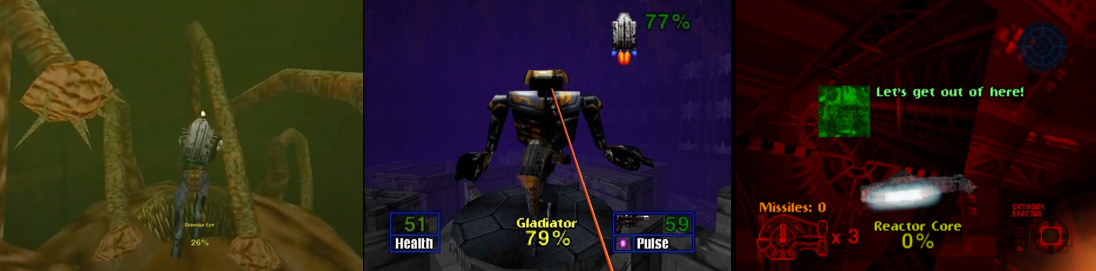
Upon reaching the end of the sewers, Dash is attacked by a giant Dianoga. This titanic, octopus-like creature is fought in the murky sewer water, so it’s very difficult to see and target its tentacles. Thankfully, its only attack is to bash you with its spiked appendages, which you can destroy with a few shots, and its main eye is an easy target. However, because you’re forced to manoeuvre with the clunky jetpack and mainly underwater, your greatest hazards will be the controls and reaching the surface to take a breath. After battling through Xizor’s Palace, you’ll face off against his mighty Gladiator Droid in a three-phase battle that can be a troublesome encounter. While the first phase is ridiculously easy (simply run around the cumbersome droid, avoiding its eye lasers and missile barrage and blasting it to 0% health), the second phase ups the ante. Here, the droid’s torso separates, and you’re dropped into a maze full of a handful of resources and dead ends. The Gladiator Droid hovers overhead firing eye lasers, missiles, and a rapid-fire pulse cannon but, again, you can avoid most of its barrage by staying beneath it and unloading with any seekers you have. In phase three, the boss’s head tries to finish you off and you must stay away from it (utilising your jetpack when allowed since it starts to malfunction) and fire any remaining disrupter blasts you have to finish it. This is the last on-foot section so don’t be shy and just go for it! Finally, Dash takes to the Outrider to join the assault upon Prince Xizor’s Skyhook. In this final stage, you must ignore the Star Vipers and TIE Fighters and destroy the Skyhook’s turrets, flying in and blasting them before they can shred you. Take them all out and you must carefully get the Outrider into the Skyhook itself, dodging obstacles to land shots on the main core. Make a few passes and hit it enough times and the Skyhook will burst into flames, forcing you to retreat before you’re caught in the explosion.
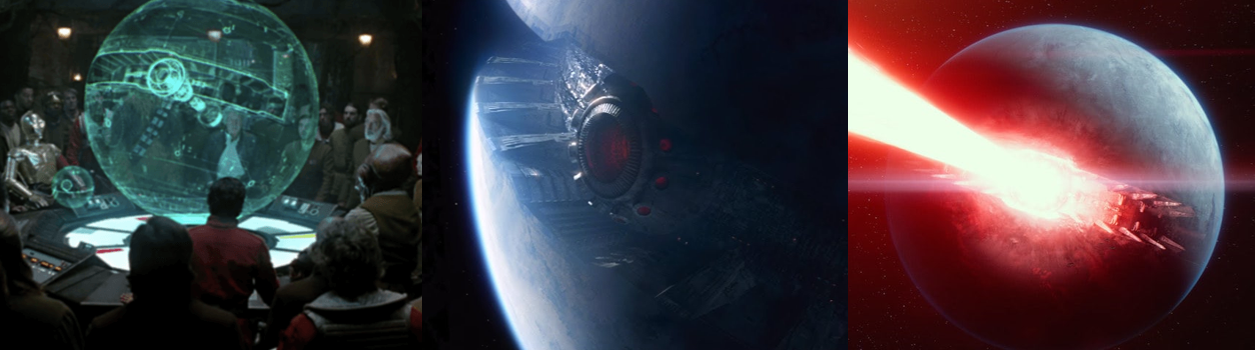
Additional Features:
There are four difficulty levels on offer in Shadows of the Empire, with each one offering a different stock of lives (from infinite to three) and changing the challenge offered by the enemies. It’s recommended that you play on at least “Medium”, however, as that’s the only way to see the true ending and learn that Dash survived the finale. Every level contains an assortment of “Challenge Points” to either find or earn. These are either out in the open, hidden behind certain doors, down certain paths, or in hidden cervices, or earned by defeating AT-ATS or destroying special red asteroids. Collecting them all on each difficulty level unlocks some fun additional extras, such as the Leebo Scanner, invincibility, and the ability to pilot an X-Wing or TIE Fighter in the final battle. If you’d rather take the quick and easy path, however, you can give your save file a specific name and activate some useful cheats, such as skipping any sections that aren’t on-foot missions, viewing the credits, accessing every level, and an extremely useful debug mode that grants a host of cheeky abilities. You can also use these same cheats to play as enemy characters, from Stormtroopers to Wampas and even an AT-ST! Finally, your completion time is recorded for each level, so speedrunners or those seeking an extra challenge can try to beat their best times if they like.

The Summary:
When I was a kid, everyone who had a Nintendo 64 had Star Wars: Shadows of the Empire. It was one of the most common games in our libraries and this is the third time I’ve owned it, though not the first I’ve beaten it. I was also a huge fan of the book, the Shadows of the Empire concept, and the comic book. Does that mean the videogame is any good, though? Well…no. Shadows of the Empire is an incredibly basic and clunky experience, even for an early-days Nintendo 64 title. Everything it does was done better in other games, even ones that released not long after it, with Star Fox 64 being the far better alternative. As much as I like Dash Rendar, he’s a painfully redundant and awkward character, floating through the air and slipping to his death with the slightest twitch of the control stick. It seems the developers didn’t know how best to use the Nintendo 64 control pad and insisted on mapping useless functions to every button but neglected to inject anything interesting into the gameplay beyond dodgy platforming and switch pressing. The vehicle sections were okay, but more akin to bonus stages, and I enjoyed some of the bosses, though the difficulty spike is all over the place. Tightening the focus onto gunplay, simple puzzle solving, and some shoot-‘em-up sections would’ve definitely made this a more enjoyable experience as the platforming and exploration is arduous and aggravating. There are some fun Easter Eggs and additional features here, and the story is a decent accompaniment to the books and comic, but Shadows of the Empire is only going to appeal to die-hard Star Wars fans…and even then it comes with a lot of caveats. You’re better off playing Star Fox 64 or one of Factor 5’s excellent Star Wars shoot-‘em-ups if you need a 64-bit Star Wars fix.

My Rating:

Rating: 2 out of 5.

Could Be Better

Was Star Wars: Shadows of the Empire in your Nintendo 64 library back in the day? If so, did you enjoy it? Which of the different gameplay modes was your favourite? What did you think to Dash Rendar and his clunky-ass controls? Which of the boss battles was your favourite? Did you ever see the true ending and collect all the Challenge Points? Which Star Wars videogame is your favourite? How are you celebrating Star Wars this May? Whatever your thought and memories of Shadows of the Empire, feel free to leave a comment below, support me on Ko-Fi, and check out my other Star Wars content across the site.

Back Issues [May the Fourth]: Star Wars: Shadows of the Empire


May 4th is known the world over as Star Wars Day thanks to being one of the most fitting and amusing puns ever devised (“May the Fourth be with you” in place of the traditional “May the Force be with you”). The first and most popular of what can easily become a three day celebration of the influential science-fiction series, the day stands as the perfect excuse for Star Wars fans to celebrate the beloved franchise!


Published: 1 May 1996 to 2 October 1996
Writer: John Wagner
Artist: Kilian Plunkett

The Background:
Nowadays, Star Wars is a nigh-unstoppable multimedia juggernaut the includes not just live-action movies, but cartoons, toys, videogames, books, and comics. Following the completion of his Original Trilogy, George Lucas licensed the property to continue in a series of novels, later dubbed “Legends”. Later, in 1994, Lucasfilm’s publishing director Lucy Autrey Wilson met with Bantam editor Lou Aronica  and author Steve Perry to discuss a Star Wars crossover multimedia event that would feature the all media and marketing of a film release without producing a movie, all to tie-in with the impending release of the 1997 Special Editions of the Original Trilogy. Shadows of the Empire would take place between Star Wars: Episode V: The Empire Strikes Back (Kershner, 1980) and Star Wars: Episode VI: Return of the Jedi (Marquand, 1983) and was comprised of Perry’s novel, a divisive videogame, an extensive toy line, and this six-issue comic published by Dark Horse Comics. Excerpts from the comic featured in Nintendo Power magazine and two separate mini-comics accompanied the Micro Machines and Ertl toys. Reviews largely praised the comic, though it was noted to be just one part of a larger whole. Still, Perry returned to write a follow-up two years later and characters and elements featured, to different degrees, in Legends media and Star Wars videogames. Unfortunately, Shadows of the Empire was another casualty of Disney’s acquisition of the franchise as they de-canonised Legends media, though Lucasfilm president Kathleen Kennedy was stated that characters like Dash Rendar have come up when discussing additional Star Wars projects.

The Review:
Like the movies, Shadows of the Empire begins with the traditional open text crawl that brings readers up to speed with the story so far. Set between The Empire Strikes Back and Return of the Jedi, the story begins with the Rebel Alliance still reeling after being forced from their Hoth base, young Jedi-in-training Luke Skywalker struggling with the knowledge that the evil Dark Lord of the Sith, Darth Vader, is his father, and Princess Leia Organa and the mighty Chewbacca grieving the loss of charismatic scoundrel Han Solo, who was frozen in carbonite and spirited away by bounty hunter Boba Fett. Whilst the Rebel fleet is traversing the vast void of space, they’re detected by the malevolent Galactic Empire) and, eager to get back into action, Luke moves to aid Wedge Antilles and Rogue Squadron against the threat. However, he is convinced by Leia and his service droids, C-3PO/Threepio and R2-D2/Artoo, to rest and become properly acclimatised to his new robotic hand. Wedge and his team engage the Strike Cruiser and its Twin Ion Engine (TIE) Fighters, outmanoeuvring the clunky craft and blasting the cruiser to smithereens. However, the victory makes General Crix Madine wary and leads to him altering the fleet’s course, delaying their arrival on the desert planet of Tatooine, a necessary precaution that Leia believes will buy Luke more time to heal, both physically and psychologically. Though she’s unaware of the revelations Luke learned, she can sense something’s amiss but gives Luke his space to work through whatever’s bothering him. Meanwhile, across the galaxy, Darth Vader is chastised by his master, Emperor Shev Palpatine,  aboard his flagship, the Executor, for failing to turn Luke to the Dark Side. When Palpatine questions Vader’s motives, the Dark Lord affirms his allegiance to his master and vows to track down the wayward Jedi, though Palpatine brings the conversation to a close to attend to more pressing matters: namely, the construction of the Death Star II. Thus, Palpatine orders Vader to meet with Prince Xizor on Coruscant to arrange his services in delivering essential materials to the construction.

While Xizor conspires to gain favour with the Emperor, Fett tries to deliver his quarry.

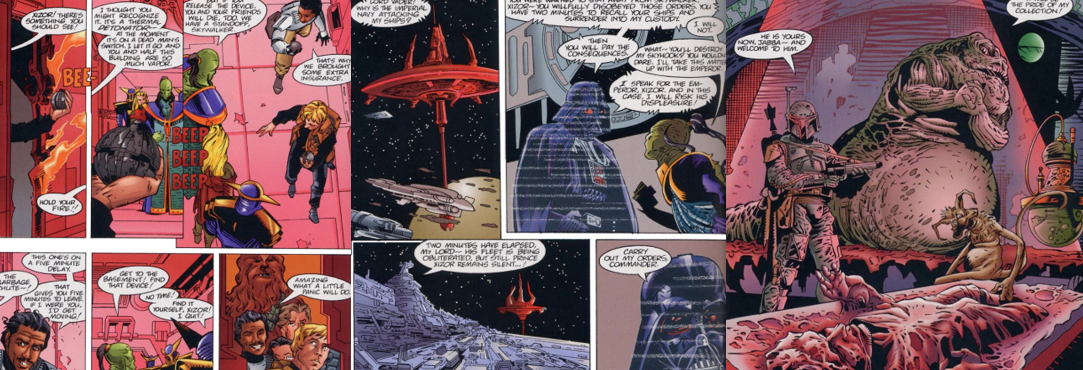
Xizor’s ties to the Black Sun criminal organisation and distrustful nature make Vader wary, concerns Palpatine shoots down as foolhardy. Upon ending the communication, it’s revealed that Xizor is already in attendance with the Emperor. A regal, lizard-like figure, Xizor questions whether Vader’s emotions are clouded by his feelings for Luke but Palpatine assures Xizor of his minion’s loyalty and his commitment to the Death Star II’s construction. Following the meeting, Xizor orders his beautiful android aide, Guri, to arrange a separate meeting with crime lord Jabba the Hutt and contact bounty hunters to intercept Luke and gain further favour with the Emperor. Elsewhere, Boba Fett arrives at Tatooine with his quarry, the aforementioned frozen Solo, gloating that the once cocksure smuggler is now little more than a work of art to be displayed. After disposing of a homing beacon placed on his ship while he was on Cloud City, Fett detects and destroys a probe sent by his bounty hunter rival, the malicious robot IG-88. Although Fett’s ship, Slave-1, is badly damaged by IG-88’s sneak attack, the Mandalorian blows his rival out of the stars and limps his way to nearby Gall, reasoning that it’s too dangerous to land on Tatooine. Word of Fett’s detour reaches an enraged Darth Vader, who orders his unscrupulous agent, Wrenga Jixton/Jix, to integrate himself into Jabba’s cut-throat swoop bike gang and await Luke’s inevitable arrival on the desert world and capture him alive, on pain of death. Although we don’t see the meeting between Vader and Xizor, Xizor relates to Guri how he did everything that was expected of him short of kissing the Dark Lord’s boots to keep him placated and form a business relationship with the Empire. Xizor’s goal is the exact opposite of Vader’s; he wishes to kill Luke and make it seem like the Empire, if not Vader himself, is responsible to diminish the Emperor’s faith in his apprentice in favour of the crime lord.

As if Dash’s unreliability wasn’t bad enough. the Rebels are threatened by a bounty on Luke’s head.

Meanwhile, Lando Calrissian (co-piloting the Millennium Falcon alongside Chewbacca and still atoning for betraying Han) arrives at Gall alongside Rogue Squadron, where Luke is finally back at the controls of his X-Wing, having been tipped off about Fett’s detour. Since Gall is home to an Imperial enclave, Lando has enlisted the aide of mercenary Dash Rendar, who flies alongside them in his Falcon-esque Outrider and is very much a stand-in for Han, both visually and in terms of his cavalier attitude. While Leia is wary of trusting such a man, Lando vouches for him, mentioning Dash aided their escape from Hoth. While Luke, Wedge, and Rogue Squadron engage the Star Destroyer and its TIE Fighters, Dash leads the Falcon to the spaceport where Slave-1 is docked, only to abandon them since he was only paid to be a guide. As if that wasn’t bad enough, one of Rogue Squadron goes haywire and opens fire on Luke amidst a tough dogfight, though Luke’s connection with the Force allows him to disable his comrade. On the planet’s surface, Fett meets with fellow bounty hunters Bossk’wassak’Cradossk and Zuckuss, who bid for a share of Fett’s bounty, a request that leads to a good, old fashioned bar fight. This is merely a distraction, however, so that 4-Lom and his minions can break into Slave-1. When Fett’s alerted to this, he dispatches the bounty hunter and takes off while Rogue Squadron make a tactical retreat and the Falcon engages with the TIE Fighters defending the Gall spaceport. Unfortunately, the Falcon is damaged and forced to land, meaning Fett slips through their fingers once more. Reconvening on the planet, the Rebels learn that a technician was bribed to tamper with Rogue Six’s X-Wing, which Leia theorises is the work of Black Sun. Although Lando and Chewie advise against tangling with the criminal organisation, Leia insists they send someone in to prove that Xizor is out to assassinate Luke and arranges for Luke to hide with Artoo at Obi-Wan Kenobi’s old shack on Tatooine. His travel plans coincide with Jix’s successful infiltration of the swoop bike gang, which he accomplishes by challenging their leader, “Big Gizz” Gizman, to a race and impressing the backwoods biker with his cutthroat attitude and dirty tactics.

Though Luke’s helped by Dash, Fett must rely on his wiles to outsmart his bounty hunter rivals.

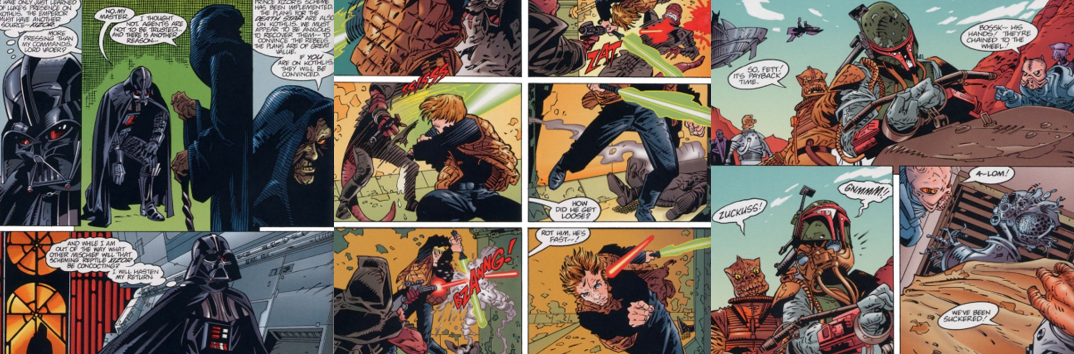
The gang is called to Jabba’s palace and begrudgingly accepts the new recruit after Big Gizz vouches for him. Jabba then orders the bikers to head to Kenobi’s shack and kill Luke and, though Jix questions this since he knows Vader wants Luke alive, Big Gizz isn’t fussed and leads his riders off to a big payday, unaware that Dash is listening in on their boastful ranting at the bar. At the shack, the bikers attack Luke just after he completes his new lightsaber. Though not expecting to test his new weapon so soon and so violently, Luke cuts down one of the bikers and steals his ride, leading to a merry chase through Beggar’s Canyon. Jix is forced to fake an error with his bike to keep Big Gizz from shooting Luke, breaking his leg and then bashing Gizman’s brains in following their crash. Though Luke impresses with his riding and lightsaber skills, the bikers are driven off when Dash unexpectedly arrives to help. The two then find a message from Koth Melan, head of the Bothan spy network, that speaks of the Empire’s secret project. With Leia on Rodia infiltrating Black Sun, Luke meets with Koth on Bothawui alongside Dash, who tags along to “earn [his] pay”. At the Imperial Palace on Coruscant, Vader objects to Palpatine’s plan to deliver the Death Star II’s computer to Bothawui via a lone, unguarded freighter; an objection summarily dismissed by his dark master and overheard by Xizor. Against Guri’s objections, Xizor orders that the freighter’s movements be provided to the Bothans to ensure that Black Sun benefits no matter which side wins the war. Meanwhile, Boba Fett is suddenly ambushed by his fellow bounty hunters while in an asteroid field thanks to 4-Lom repairing itself and signalling help. Though literally disarmed by a laser shot, 4-Lom disables Slave-1’s weapons before being executed, leaving Fett at the mercy of Bossk’s boarding party. Though Fett tries to weasel his way out by taking Zuckuss and the others hostage, Bossk demonstrates his ruthlessness by opening fire on Slave-1, confident that Solo’s carbonite block would survive the ship’s destruction. Thus, Fett surrenders but easily gives his one inexperienced guard the slip and rearms himself, offing the others and forcing Zuckuss to lull Bossk in. Fett then dumps the bodies on Bossk’s ship and sets off an explosion before blasting to hyperspace.

The alluring Xizor conspires to humiliate Vader and manipulate the Emperor.

While Jix and the other bikers are reprimanded by Jabba for their failure, Xizor discusses Luke’s threat with the Emperor, where it’s revealed that the plot to leak the Death Star II’s plans to the Rebels was conjured by Xizor in order to lead them into a trap. Unaware of this deception, Luke meets with the surviving Bothans, who are working to crack the Imperial’s code and discover their secret, only for their stronghold to be attacked by lizard-like bounty hunters under the command of Skahtul. Despite having great respect for the Jedi, Skahtul captures Luke and reveals that there are two bounties out on him, one that wants him dead and one alive, and they’re waiting to get the best deal before deciding what to do with him. Palpatine orders Vader retrieve Luke, reasoning his presence will only further convince the Rebels of the validity of the Bothan’s data, however Luke uses the Force to coerce his guard into releasing him. Luke quickly retrieves his lightsaber and uses it to cut down the bounty hunters when he’s discovered, only to be saved by Lando’s timely intervention thanks to a tipoff from Dash. While they escape in the Falcon, Leia assumes the identity of deceased bounty hunter Boussh and Chewie is dressed up as Snoova, courtesy of Guri, and meets with Xizor on Coruscant, where Leia finds herself strangely attracted to the enigmatic crime lord. While conversing over tea, Leia is enamoured by Xizor’s allure and ends up kissing him, only regaining her composure when Chewie intervenes. Once back in Xizor’s chamber, Leia keeps her distance and distracts herself with tea while Chewie manhandles his guards in an escape attempt, breaking Xizor’s spell by kneeing him in the crotch. Angered that his pheromones and sexual lusts have been thwarted, Xizor has Guri confine Leia to her room. While Fett makes his way back to Tatooine, Vader interrogates Luke’s captors. He’s impressed by Luke’s advancing skills with the Force and angered to learn that Black Sun wants Luke dead, realising that Xizor wishes to embarrass him by killing his son. Back on the Executor, Jix tells Vader that Xizor has implicated Vader in the death warrant, so Vader heads to Coruscant to bring his evidence to Palpatine.

Though Dash is lost, Leia is rescued, Vader obliterates Xizor, and Fett claims his reward.

Speaking of Coruscant, Lando, Luke, and Dash gingerly navigate the Falcon past the Imperial blockade surrounding the city planet and land on its surface, where they navigate the putrid sewers to reach Xizor’s palace. Although Chewie slips and alerts the guards, the group easily guns their way through. Xizor sends Guri to get Leia, leading to her being knocked out when the princess escapes, but seems largely nonplussed by the attack since it’s all part of his grand plan. Reuniting with Leia, Luke leads them to the rooftops, only to run head-first into an unwinnable blaster fight with Xizor and his men. Thus, Luke pulls out a thermal detonator and threatens to blow them all up unless they’re given safe passage. Though Xizor calls his bluff, Lando reveals the bomb has a five minute delay and dumps it in the garbage chute, forcing Xizor to flee. Everyone escapes just before the palace explodes and Xizor flees to his skyhook space station, ordering his ships to attack the Falcon. Luckily, Dash offers some firepower from the Outrider. All our stories converge as Rogue Squadron and the Rebel fleet engage with Xizor and the Empire as Vader converges on the skyhook, leading to a momentary alliance between the Rebels and the Empire in an impressive space battle. Enraged, Xizor threatens to tell on Vader to the Emperor but Vader risks his master’s reprimand and obliterates both Xizor’s fleet and his skyhook. Unfortunately, while the Falcon makes it through the skyhook’s debris, Dash isn’t so lucky and is unceremoniously killed off panel during the escape. In the aftermath, Jix is spared execution at Jabba’s hands when Fett finally arrives with Han, only to be ambushed by the bounty hunters. Jix slips away in the fracas and Fett fools his rivals with 4-Lom and Zuckuss, allowing him to deliver Jabba his prize and claim his reward. Finally, Vader arrives at Endor, where the Death Star II is in orbit, still determined to sway Luke to the Dark Side and overthrow Palpatine.

The Summary:
I’ve wanted to read Shadows of the Empire for a long time, ever since I played the Nintendo 64 game (which it seemed everyone owned back in the day). It’s not easy to come by, with the Dark Horse omnibus being out of print and Marvel Comics sneaking their reprint into one of their Essential collections. To this day, I really enjoy the concept and am annoyed that we haven’t seen something, either a live-action or animated venture, that officially fills the gap between The Empire Strikes Back and Return of the Jedi. It’s important to note, however, that each piece of merchandise in the Shadows of the Empire experience tells a different part of the story. The videogame focused on Dash Rendar and his adventures, the novel is similar to the comic and touches on some of the same story beats but mostly focuses on Luke and Leia, and the comic places greater emphasis on Boba Fett. You really need to experience all three to get the complete story, which is a bit of a shame, and it does impact the narrative here. For example, Lando mentions that Dash was on Hoth, something we play through in the videogame but gets no further context here. Dash, especially, comes out of nowhere and dips in and out of the narrative with little characterisation beyond being a Han Solo knock-off. It’s a shame as he has an awesome ship, a cool look, and a mercenary attitude that’s very appealing. I liked the idea of Leia hiring him to be Luke’s bodyguard, but it barely factors into the plot here. I’d also wager Luke could’ve handled the swoop bikers without Dash and infiltrated Coruscant without his smuggling contacts (especially as they have Lando on side). Dash is also abruptly killed right at the end of the story, off panel no less, and Luke barely even acknowledges it. If you’ve played the game, you’ll know that Dash faked his death, but he’s just snuffed out here after barely getting a chance to do much and disappearing in the background of some panels. This really bothers me as I liked Dash in the book and the game and he was set up as one of the principal supporting characters of the Shadows of the Empire experiment so it’s kind of insulting to see him done away with so callously.

New characters aren’t as fleshed out as in the book but Fett gets a lot of the spotlight here.

That leaves us with our other new character, Prince Xizor. Xizor also gets way more backstory in the novel, which is the be expected; it delves into his background, his pheromones and abilities, and his true motivations for manipulating the Emperor and Vader. Most of that is still here but it’s very shallow and one-dimensional; he has a unique look and alluring presence but seems to be playing both sides simply for the fun of it. He tries to sow the seeds of doubt into Palpatine regarding Vader and seeks to humiliate the Dark Lord by killing Luke and framing him for it, thereby denying the Emperor a new apprentice, all with the vague idea that he and Black Sun will profit in the end. It’s a wonky plan, one immediately undone the moment Vader interrogates Xizor’s underlings, and Xizor’s vast criminal network and resources, as impressive as they are (in the book, anyway) are nothing compared to Vader’s raw power. Thus, we’re left following an unusually loquacious Boba Fett as he desperately tries to deliver Han Solo to Jabba the Hutt and is constantly attracting the wrath and jealousy of his fellow bounty hunters. Fett’s monologuing reveals his hatred of Solo and his keen guile; he’s seen to be resourceful and adaptable, surrendering, setting traps, and fooling his opponents to get out of scrapes and come out on top. It’s ancillary media like Shadows of the Empire that really fleshed Boba Fett out, I feel, and added to his surge of popularity at the time. In the films, he’s visually interesting but otherwise unimpressive, portrayed as a klutz and a cry-baby. But here, he’s regarding as “the best” of his kind and shown to be a wily and capable bounty hunter. Luke, Leia, Lando, Threepio, and Artoo are more like supporting characters here. There’s some rumination on Leia’s part regarding Luke’s demeanour but he doesn’t dwell much on Vader’s revelation and we don’t get much insight into how he’s feeling. You’ll need to read the book for that, which also covers the construction of his new lightsaber in far more detail. The comic briefly touches upon Xizor’s effect on Leia but it’s a brief sequence, though one that does show how fiery she can be in a fight, and the droids may as well be absent since they don’t do much of anything save for a comedic sequence at the end where they fly the Millennium Falcon.

The comic fills an essential gap in the lore, but suffers from being one piece of a larger story.

Visually, Shadows of the Empire is very appealing. I’ve found the art in the Dark Horse Star Wars comics to be a bit hit and miss but Kilian Plunkett captures the likenesses of the actors well. He really shines in his depictions of space battles and armoured characters like Boba Fett and Darth Vader, who are intricately detailed and get all the dynamic “hero shots”. The writing is…okay, except for Vader. I don’t feel John Wagner really captured the essence and awe of Vader, especially in his conversations with the Emperor. Palpatine fared much better in this regard, taunting and questioning his apprentice throughout, as did Fett, though I could’ve done with his soliloquys being rendered as thought bubbles. Shadows of the Empire is an essential story to Star Wars canon; it shows the lengths the Rebels went to try and retrieve Han, how Luke recovered from his duel with Vader, and fills in a few blanks in the narrative between The Empire Strikes Back and Return of the Jedi. This is why it irks me so much that it’s been disregarded as canon and hasn’t been replaced with something else or re-adapted into a new, similar story. I feel there’s a lot of potential to explore this period and that Shadows of the Empire should be re-canonised to fill that void, especially as this adventure with Xizor and Dash has a lot of intrigue behind it. It explores Vader’s conflicting feelings regarding Luke, his desire to reunite with his son and overthrow the Empire, and gives him a rival for the Emperor’s affections in Xizor. I like the cat and mouse game between Vader and Xizor, though it’s not as prominent in the comic, and Xizor manipulating different parties to target Luke. It’s nice to spend more time with Boba Fett and explore his motivations and abilities, and it’s fun touching upon little things like Luke making a new lightsaber and the Emperor’s leaking of the Death Star II plans. Unfortunately, the comic is very disjointed and suffers from the story being spread across different media. It’s decent enough but it’s merely an appetiser, or a small piece of a larger puzzle, meaning you need to read the book and/or play the videogame to get the whole story.

My Rating:

Rating: 3 out of 5.

Pretty Good

Did you enjoy Star Wars: Shadows of the Empire? Which of its media productions was your favourite? Were you a fan of Dash Rendar and Prince Xizor? What do you think to Darth Vader’s portrayal and his rivalry with Xizor? Were you happy to see Boba Fett get more time in the spotlight? Which Star Wars comic was your favourite? How are you celebrating Star Wars Day today? Whatever your thoughts and memories of Shadows of the Empire, feel free to leave a comment below and be sure to check out my other Star Wars content across the site.

Mini Game Corner [May the Fourth]: Star Wars Episode I: Jedi Power Battles (PlayStation)


May 4th is known the world over as Star Wars Day thanks to being one of the most fitting and amusing puns ever devised (“May the Fourth be with you” in place of the traditional “May the Force be with you”). The first and most popular of what can easily become a three day celebration of the influential science-fiction series, the day stands as the perfect excuse for Star Wars fans to celebrate the beloved franchise in various ways.


Released: 4 April 2000
Developer: LucasArts
Also Available For: Dreamcast and Game Boy Advance

A Brief Background:
Almost immediately following its 1977 debut, George Lucas’ science-fiction “space opera” became a massive multimedia juggernaut that expanded to include sequels, prequels, spin-offs, novels, videogames, comic books, and more. After wrapping up his Original Trilogy, Lucas was hesitant to return to the franchise, but the success of the “Expanded Universe” books led to a revived interest in Star Wars and Lucas not only produced “Special Edition” versions of the Original Trilogy in 1997 but also the divisive first chapter in his Prequel Trilogy, Star Wars: Episode I: The Phantom Menace (Lucas, 1999). Despite many lacklustre to average reviews, the film made over $1 billion at the box office and was accompanied by a huge marketing campaign. All these new toys, books, and comics were joined by ten different videogame adaptations released across numerous platforms, though this is the one I most remember playing as my friends and I used to muck about with it back in the day. The developers of Jedi Power Battles used paper cut outs to design the layout and features of the game’s environments and strived to give each character their own unique appearance, abilities, and lightsaber colours. Although numerous fixes and improvements were made to the subsequent Dreamcast version, this version of the game was received rather poorly; reviews criticised the game’s high level of difficulty and awful controls, though the co-op mechanics and arcade-style gameplay was highlighted as a positive.

First Impressions:
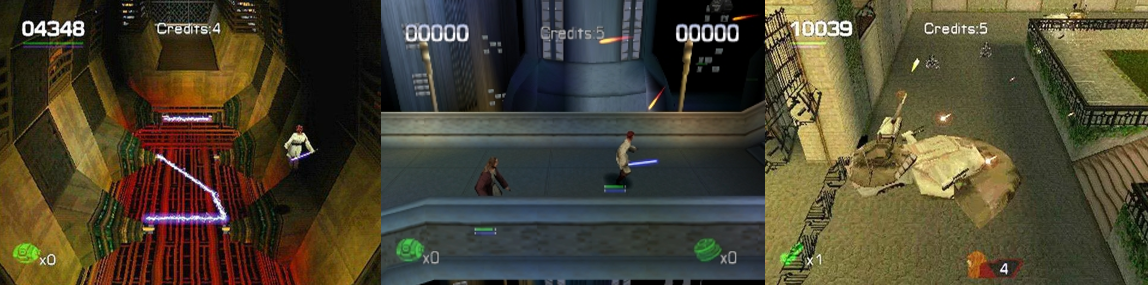
Star Wars: Episode I: Jedi Power Battles is a 2.5D, arcade-style hack-and-slash adventure game that includes a little light puzzle solving, some aggravating platforming sections, and a touch of role-playing functionality. Up to two players can play at any one time, which can be useful for taking on the droid army of the Trade Federation but can cause some serious gameplay issues; for one thing, players share the Credit pool, so your game can end pretty quickly if you get defeated too many times. You also have to be mindful not to stray too far behind; if you linger or get left behind when your friend gets too far ahead, you’ll lose a life, and the game will end that much faster. Players can pick from five Jedi characters – Obi-Wan Kenobi, Qui-Gon Jinn, Mace Windu, Adi Gallia and Plo Koon – who all share the same basic control scheme. There are five control schemes to pick from, but the default sees you using Square, Triangle, and X to swing your lightsaber horizontally, heavily, or vertically, respectively, and Circle being used to jump and double jump. There aren’t any jumping attacks here, but you can string together combos using Triangle, X, and Circle and you can also run by holding R2. If you hold L1, you’ll block incoming attacks; tapping it will deflect laser bolts, which is a great way to defeat faraway enemies but keep an eye on your block meter as this depletes (and automatically fills) over time. You can lock on to the nearest enemy with R1, which also sees you circle that enemy and perform a dodge roll but be sure to disengage the lock on if you’re near an edge or hazard as you’re likely to get hurt or lose a life.

Team up with a friend to double the frustration and difficulty of this clunky hack-and-slash game.

Holding L2 allows you to use each character’s four unique Force powers; this also depletes a meter, and you’ll need to grab power-ups to replenish it, and these powers allow you to perform short, defensive, long-range, and special attacks by holding L2 and pressing Triangle, Circle, X, or Square. To start with, Obi-Wan has a saber dash and tosses a thermal detonator, Qui-Gon unleashes a shockwave to send enemies flying and tosses a pulse grenade, Mace Windu protects himself with a saber shield and also tosses a thermal detonator, Adi Gallia can mesmerise foes and protect herself with an energy shield, and Plo Koon has a saber cyclone attack and stim pack. As you defeat enemies, you’ll gain “Jedi Points”; defeating enemies with style, different combos, or with a variety of attacks rewards more Jedi Points while attacking protocol droids or local Naboo wildlife costs you points. These points are tallied up at the end of each level and can be traded in to extend your health or Force meter and also award new combo attacks and Force abilities, though the game doesn’t list these anywhere, so you’ll just have to remember or make a note of them. Finally, you can also find some helpful power-ups dotted around; beyond the usual health and Force-restoring items, you can grab an extra Credit, hit checkpoints for when you inevitably die, add a special item (like the thermal detonator) to your inventory, extend or power-up your lightsaber, and either refill all your meters or halve them for an added challenge. There are two difficulty modes to pick from, “Easy” and “Jedi” mode; I tried “Easy” and the game still presents quite a challenge. While regular battle droids go down pretty easily, their coloured variants are surprisingly tough and they can send you flying with melee attacks up close or absolutely wreck you with laser bolts from afar if you’re not careful!

Hazards, tough enemies, and annoying platforming sections drag down this ugly-looking title.

The presentation on offer here is pretty good by 2000 PlayStation standards; we get the traditional Star Wars opening and story scroll, pixelated screenshots from the movie, and a full score that is ripped right from John Williams’ orchestral suite. After being treated to a CG opening sequence that strangely places the five main characters in a black void, you’ll behold some of the ugliest polygonal representations of these characters ever created; I don’t begrudge Jedi Power Battles too much for this as this is genuinely what a lot of games looked like back then and, to be fair, the character models don’t look too bad once you’re playing the game and the camera isn’t zoomed in on their blocky faces. They don’t have any idle animations, but their combat moves are pretty swift and satisfying; it’s a shame, then, that the controls are so awkward. Despite allowing analogue control, the game feels very clunky; if you’re not locked on to a target, you’ll swing wildly (and slowly) at thin air and, when you are locked on, you’re trapped in one-on-one combat with the target and vulnerable to other enemies. Where the game really falls apart, though, is in the platforming; in the first stage (a pretty decent recreation of the Trade Federation’s battleship), you’ll need to jump across gaps in bridges, avoid electrified floors and hazards, and hop across pistons. In the second stage, the jungles of Naboo, you need to jump up giant mushroom-like platforms and across large branches and treetops, which is especially difficult to do because of the immovable camera. It can be very difficult to judge where you are and how far away things are from you; while characters do grab ledges to give you some leeway, it’s all too easy to just slip off to your death, be shot out of the air, or miss-time a jump and have to start all over. Gameplay is mixed up a little in the second stage, where you must run away from the Trade Federation’s droid carriers amidst a stampede of dinosaur-like creatures towards the camera in a shameless rip-off of Crash Bandicoot (Naughty Dog, 1996). The game’s environments, while detailed and very true to the movie, are very ugly at times; again, this is just how games were back then but it’s a bit of sensory overload at times as textures warp around you and the game world struggles to stay in one piece.

My Progression:
As I mentioned, I’ve played Jedi Power Battles before in my youth; it was a long time ago but I knew I wanted the game in my PlayStation library once I started seriously collecting for the console, so I was excited to get into it and sure that I’d be able to finish the game one way or another. I picked Qui-Gon Jinn on “Easy” mode and got to work and, to start with, things weren’t too bad; when you’re running through corridors slicing up droids, the game is quite fun. But then you see the gaps, experience the awful jumping mechanics, and see how the game’s graphics are used against you; there’s one point where it looks like you need to jump between these electrical currents, but you actually need to jump along the side of the screen and will die if you drop down, which isn’t clear at all. Later, your path is blocked by some Droidekas, but they’re actually not that difficult to defeat, and you need to battle through some control rooms full of destructible elements to get to the hanger. After avoiding dropping to my death, I battled two bosses; the first was a large droid with two long, spiked arms and a platform for a head and the second was a droid ship that flew around firing lasers at me on a small gantry as droids distracted me. The first was definitely a challenge; the droid is quite large, and it can be hard to outrun or jump over its charge and spindly arms, but the hardest part of the second boss was dispatching the battle droids before they could ruin my chance to parry the bolts back at the ship.

Sadly, the game proved too frustrating for me to experience its later levels and battles.

Things fell apart in the second level, though; after being trampled to death in the opening stampede, I managed to get to safety and was charged with “protecting” Jar Jar Binks, who you’ll spot flailing about in the backgrounds. Before you can do that, though, you have to wade through a small army of battle droids (or, as I did later, simply race past them as it’s faster!) and take to higher ground. This was extremely frustrating as it was really hard to jump to the mushroom platforms; if you fall from too high up even in this section, you’ll die, to say nothing of being pummelled, blasted, or falling as you traverse the higher path. This sets you back quite a bit but there is an extra life you can snag before the mushroom tree, effectively giving you infinite continues; once you pass it, you enter a cave and must battle a giant worm creature. This thing appears to only be vulnerable on its underside, but it spits out these homing projectiles that can stun lock you, slams into the ground, and spins around with a tail attack. Deal enough damage and it retreats to the side and spits out small termite-like creatures, but this was where I had to call it a day as the worm just decimated my health bar in seconds and I didn’t want to have to play through the frustrating jungle section to try it again. It’s a bit of a shame as well because I know that later levels of the game represent other aspects of the movie, such as infiltrating the Naboo capital, utilising vehicles, and battling Darth Maul. There are also additional characters you can unlock after completing the game, such as the aforementioned Darth Maul and even Queen Padmé Amidala (who plays differently since she doesn’t have any Jedi abilities). Unfortunately, there are no passwords or cheat codes to help with progression in this game, doubling frustration and disappointment; once all your Credits are exhausted, you have to replay the last stage from the beginning, which is very tedious with the stunted camera and janky controls, all of which meant that I was barely able to limp through the first mission let alone even consider trying to conquer the Naboo jungles again!

I waited for years to play Star Wars: Episode I: Jedi Power Battles again; I had fond memories of it from my youth and was really excited to get into it, but it seems that my memories were tainted by time. Although the game has a bombastic score and aspects of the lightsaber combat are exciting, it looks atrocious, even by PlayStation’s standards, and the controls are sluggish and awkward. This probably wouldn’t have been so bad if it had been a mindless hack-and-slash with simple push/pull puzzles and a bit of jumping, but placing such a great emphasis on platforming when your depth perception and game engine are already frustrating is just asking for trouble. The game offers quite the challenge, even on “Easy” mode and even more so in two-player; just targeting and attacking an enemy without being blasted by another or slipping to your death is hard enough, to say nothing of the needless limitation on continues and messed up controls. It’s a shame as I was really looking forward to slicing my way through a fun melee title, but I don’t think I’ll be coming back to Jedi Power Battles any time soon. But perhaps you’ve beaten it without any issues. Perhaps I’m missing something, like playing as a different character or not sucking so hard? Maybe you know of a better Episode I­-branded videogame? Whatever the case, there’s a comments section below and my social media is always open to hear your thoughts, good or bad, so feel free to share them and go check out my other Star Wars content!

Movie Night [May the Sith]: Star Wars: Episode VII: The Force Awakens


While May 4th is known the world over as Star Wars Day, many also choose to extend the celebrations of the course of three days, with one of them being the “Evil Star Wars Day” of May 6th (as in “Sith”). This year, I’ve been using the three Star Wars Days as the perfect excuse to go plug a few holes in my Star Wars reviews.


Released: 18 December 2015
Director: J. J. Abrams
Distributor: Walt Disney Studios Home Entertainment
Budget: $259 to 306 million
Stars: Daisy Ridley, John Boyega, Adam Driver, Oscar Isaac, Domhnall Gleeson, Carrie Fisher, and Harrison Ford

The Plot:
Thirty years after the Galactic Empire was defeated, the “First Order” constructs a devastating, planet-sized superweapon to decimate the New Republic. The galaxy’s only hope is Rey (Ridley), reformed First Order Stormtrooper Finn (Boyega), and crack Resistance pilot Poe Dameron (Isaac), who search for a long-lost map to reclusive and disgraced Jedi Master Luke Skywalker (Mark Hamill) while being hounded by the First Order’s malevolent and brutal enforcer, Kylo Ren (Driver).

The Background:
It’s safe to say that the Star Wars Prequel Trilogy struggled to live up to the lofty expectations set by George Lucas’ original three Star Wars films; although relatively profitable ventures, the films were divisive, to say the least, and lead to one of the most beloved spin-offs in the franchise, Lucas was so burned by the experiences and backlash that he refused to make any further films. In 2012, Lucas sold his lucrative franchise to Disney for $4 billion and they immediately set about developing a series of spin-off feature films to further flesh out the Star Wars saga, spearheaded by a long-awaited seventh entry in the space opera saga. Although he consulted with Lucasfilm’s new president, Kathleen Kennedy, on story ideas for their new trilogy, he was hurt when they discarded his input and proceeded without him, bringing in J. J. Abrams to direct, contribute to the script, and help lay plans for the trilogy. In addition to bringing back as many names from the Original Trilogy as possible, Abrams brought in fresh, young, up-and-coming faces to be part of his new film, which relied just as much on practical effects as it did CGI to evoke the spirit of the films that started it all. Naturally, anticipation was high after even the most basic of teaser trailers, and the film’s $2.068 billion worldwide box office made it the highest-grossing film of 2015. The film was also met with overwhelmingly positive reviews; critics praised the film as a return to form for the franchise, the balance between nostalgia and new content, and even heralded it as the best Star Wars film since the Original Trilogy. Others, including Lucas, found it somewhat derivative, but Disney ploughed onwards with their Star Wars plans, for better or worse, regardless, producing two additional sequels as well as new videogames and spin-off movies to turn a profit from their acquisition.

The Review:
I’d like to make one thing perfectly clear right off the bat: I’m a big Star Wars fan. Growing up, the franchise was something of an elusive enigma for me; my friends were huge fans, we all played the games and enjoyed the Expanded Universe novels, but actually watching the Original Trilogy was pretty difficult in the mid-nineties. Even when then the remastered versions were released, it wasn’t exactly cheap to buy or rent them, so expectations were pretty high for the Prequel Trilogy. Sadly, they largely killed off a lot of the excitement I had for the franchise; they screwed up or outright erased the Expanded Universe novels, replaced fun space adventure and action with wooden performances and dull subplots, and generally failed to meet the standards of the Original Trilogy. I was therefore glad when it seemed like we wouldn’t get any more Star Wars films, and extremely pessimistic when Disney announced the production of a new Sequel Trilogy. I found the first teaser trailer incredibly underwhelming as it showcased basically nothing except another desert planet and the return of fan favourites Han Solo (Ford) and Chewbacca (Peter Mayhew/Joonas /Ian Whyte), and I was more than a little annoyed that the new films wouldn’t be drawing inspiration from what I still consider to be the “real” Sequel Trilogy, Timothy Zane’s Thrawn books (1991 to 1993). However, the secrecy surrounding the film had me intrigued and I was excited at the prospect of seeing how the Star Wars universe had changed thirty years after the Rebellion defeated the evil Galactic Empire. Sadly, The Force Awakens gets off to a bad start right from the opening crawl: Luke’s disappeared and, without him, there’s apparently nobody to oppose the uprising of the First Order. Consequently, Princess Leia Organa (Fisher), now a General in the New Republic’s Resistance movement comprised of new allies and former Rebels, sends her best pilot, Poe, to meet her old ally, the hitherto-unknown Lor San Tekka (Max von Sydow in a completely throwaway role), to get information on Luke’s whereabouts to help turn the tide.

While the Jedi may have become myth, Poe is determined to oppose the First Order with the Resistance.

So, immediately, there’s a sense that everything that’s old is new again; I honestly thought this film would be a chance to see the roles reversed a bit and have the remnants of the Empire be reduced to a rag-tag group of ships and terrorists trying to strike back against the overwhelming benevolence of the New Republic but, instead, the Empire is essentially back in the First Order, which is somehow so powerful that it threatens the entire New Republic! Not only that, but Luke is gone, despite Mark Hamill being so prominent in all the promotional materials for the film, and his absence is another in a long list of misguided decisions by the filmmakers in this film and its sequels. One thing I found particularly aggravating was just how quickly everyone forgot important concepts like the Jedi and influential people like Luke Skywalker. Just like at the beginning of Star Wars: Episode IV: A New Hope (Lucas, 1977), the Jedi are all but extinct and they, and even Luke, have passed into myth because, apparently, thirty years is enough time for people to forget anything. However, I think a lot of people miss that it’s only been two years since Ben Solo sacked the Jedi Temple and drove Luke into exile. While I can understand someone like Rey, who lives a remote and isolated life, thinking Luke was only a myth, this seems to be the prevailing thought amongst many of the side characters and there’s a definite sense that Luke’s been missing for far longer than he actually has. One decision I do agree with, however, is the introduction of fresh, new blood to the franchise and I have absolutely no issue with having new protagonists take centre stage as it brings us such brilliant characters as Poe Dameron, a hot-shot Resistance pilot who is both completely loyal to the ideals of the New Republic but also somewhat reckless out in the field. Still, he’s not an idiot; when Kylo Ren slaughters Lor San Tekka and his villagers on Jakku, Poe is smart enough to leave the map he received from Lor with his trusty droid companion, BB-8 (Bill Hader and Ben Schwartz), but feisty enough to backtalk Kylo Ren (he even takes a shot at him in a failed attempt to save Lor’s life) even when he’s painfully left at the dark tyrant’s mercy. Poe’s reputation as the best fighter pilot in the Resistance proceeds him, and even Kylo Ren is impressed by Poe’s resilience; this, alongside his skills as a pilot and his defiance, is a defining trait of Poe’s but even he’s only able to escape from the First Order’s clutches thanks to morally conflicted Stormtrooper FN-2187. Excited at the prospect of a daring, action-packed escape (and at piloting a TIE Fighter), Poe jumps at the chance and quickly forms a bond with the desperate FN-2187, whom Poe nicknames “Finn”. Although Poe seemingly perishes in their escape attempt, he randomly turns out to be alive later in the film, leading to an emotional reunion on Takodana with his newfound friend, BB-8, and the coming together of our three new protagonists to assault Starkiller Base.

Though she’s lived a sheltered life, Rey is a gifted pilot, mechanic, and a potential Jedi!

With Poe presumed dead, BB-8 is stumbled upon by scavenger Rey who, at this point, has no idea of her true heritage and believes that she was simply abandoned when she was a child (Cailey Fleming). Rey lives a hard life on the arid sands of Jakku, one that sees her foraging derelicts for meagre portions of food and living a life of solitude in the remains of an All-Terrain Armoured Transport (AT-AT). However, although she longs to journey to the stars, very much like Luke in A New Hope, she’s compelled to stay in the hopes that her parents will return for her. Self-reliant and strong-willed, Rey is something of a savage; she’s naturally paranoid and suspicious of others since she’s clearly spent her whole life fighting for what little food and possessions she has but does have an affinity for droids, which eventually causes her to fall in with Finn when he comes looking for BB-8 to honour Poe’s final wish. This finally gives Rey the opportunity to leave Jakku and she does so in style by piloting the dilapidated Millennium Falcon, which just so happens to not only be on Jakku but also the only ship available to them. Even more conveniently, Rey is not just the jack-of-all-trades but, seemingly, the master of them all; she’s able to speak multiple languages (including “droid speak” and Wookie), can repair, fix, and build machinery, is a naturally gifted pilot, and is also strong in the Force! It’s therefore not surprising that many have labelled her a “Mary Sue” since Rey just seems to magically be able to do everything because the script demands it and is quickly befriended by faces old and new alike. However, I don’t really have that much of a problem with Rey; sure, Daisy Ridley is the weakest of the main three actors for me and I personally found Jyn Erso (Felicity Jones) a far more compelling female lead in Disney’s new Star Wars films, but I enjoyed her wide-eyed hero worship of characters like Luke and Han, her feisty independent spirit, and her overall presentation as a lonely young woman trying to find her place in the galaxy and realising that she has far more potential than she ever realised.

While Finn isn’t the Jedi he seems to be, his moral compass is admirable and BB-8 adds to the charm.

BB-8 is more than just the newest cutesy mascot for the franchise, it’s a whole character in its own right; since R2-D2 (Jimmy Vee/Kenny Baker) is in standby mode for the majority of the film, and C-3PO (Anthony Daniels) is mainly just a glorified cameo who keeps banging on about his red arm (that’s never explained onscreen and disappears by the next film), BB-8 takes centre stage as the main robotic character of The Force Awakens. Despite only communicating in electronic bleeps, it’s absolutely exuding personality; you can tell that it greatly cares for Poe as a friend and is saddened when it thinks he’s died), and is both suspicious and amusingly supportive of Finn when they join forces with Rey. As fantastic as it is to see BB-8 realised as a largely practical effect (I still have no idea how they were able to pull off its rolling movement so seamlessly), it’s a bit odd that many characters understand its “droid speak”, which seems to be a lazy convenience by the writers. This is paralleled by perhaps the most intriguing of the three new protagonists, Finn. Those who have watched Star Wars’ many spin-off media may be familiar with Clone Troopers and Stromtroopers having individual identities and (probably) consciences, but this was the first time we’d seen a Stormtrooper be anything other than a nameless, faceless minion for the heroes to gun down in cold blood. Inducted into the First Order at an early age and forced into war, Finn is no mere pre-programmed clone or mindless soldier; he’s a frightened young man in over his head who is horrified at the merciless slaughter of innocents and the First Order’s oppressive ways. Finn is desperate to escape their wrath but frees Poe not just because he needs a pilot but because it’s the “right thing to do”. This edict guides Finn throughout the remainder of the film; moved by Poe’s apparent demise and trust, Finn takes up not only his newfound friend’s jacket but also his mission to return BB-8 and the map it contains to the Resistance. However, conscious that he will be unfairly judged if he openly admits that he’s a former First Order Stormtrooper, Finn desperately feigns being with the Resistance i to quickly earn Rey and BB-8’s trust, something he’s clearly unhappy about but his absolute terror of the First Order overrides his doubts. He’s seen first-hand what they’re capable of, and what they’re building, and is focused only on getting as far away from them as he can by any means necessary, but is morally unable to simply leave his newfound friends to wage a suicide war against Starkiller Base without his expertise.

Kylo Ren is a tortured, surprisingly complex, and explosive youth lashing out at everything he sees.

Another notable aspect of the film is new villain Kylo Ren; played with a magnificent imposing menace by the fantastic Adam Driver, Kylo Ren may look like a cheap knock off of Darth Vader (David Prowse/James Earl Jones) but that’s actually kind of the point and he’s much more than that. Considering that, beneath the imposing mask, he’s actually Ben Solo, Force-sensitive son of Leia and Han and grandson of Anakin Skywalker (Hayden Christensen), it makes sense that he’d model himself after the infamous Sith Lord and the fact that he keeps the shattered remains of Vader’s helmet just goes to show just how twisted his perception of reality is. Kylo Ren makes an immediate impact not just with his emotionless helmet and deep, semi-cybernetic baritone that oozes menace, but also by exhibiting a command over the Dark Side that we haven’t really seen before as he freezes a blaster bolt in mid-air. Kylo Ren showcases a knack for forcibly drawing information from his victims using the Dark Side of the Force, penetrating their mind and feelings in order to both torture and manipulate them and learn what he needs, but he’s also an extremely explosive and unpredictable individual. Originally a Jedi prodigy, he was a student of Luke’s but found himself seemingly betrayed by his master, destroying the Jedi training grounds, and killing all but a few similarly inclined Jedi and recruiting them into his poorly defined “Knights of Ren”. Thanks to the influence of Supreme Leader Snoke (Andy Serkis), Ben is turned against his friends and family and assumes the role of “Kylo Ren” but remains a tortured and conflicted young man who lets his anger and insecurities get the best of him. Overwhelmed by these dark feelings, Kylo Ren regularly lashes out in volatile anger when he’s bested and is seemingly driven by an innate desire to destroy all remnants of his past, no matter how badly it pains him to do so.

Sadly, the film squanders many of the First Order’s more promising elements.

The First Order is largely comprised of obedient Stormtroopers and extremist military commanders, just like the Empire, but there are a few standouts amongst their ranks: first and foremost is General Hux (Gleeson), the young and cruel-hearted commander of the First Order’s military forces. A proud and stubborn man, Hux believes whole-heartedly in the training standards of his Stormtroopers and the might of his military (he’s particularly proud of his ludicrous planet-destroying Starkiller Base) and delivers rousing speeches of hatred and vitriol in a pretty explicit allusion of Adolf Hitler’s public addresses. General Hux and Kylo Ren have a tumultuous relationship, to say the least, in which they both vie for the attention, and approval, of Supreme Leader Snoke; this means they continually butt heads over the best methods to advance the First Order’s cause and have a professional rivalry that borders on antagonistic since they have little respect or liking for each other. However, all in all, The Force Awakens really squanders some of its new characters; Captain Phasma (Gwendoline Christie) looks visually impressive and intimidating with her striking reflective Stormtrooper armour and blunt commanding voice, but she does literally nothing except exist on the periphery and be easily coerced into helping the heroes infiltrate Starkiller Base. It’s not even more explicit whether she perishes in the planet’s destruction or not, and I have no idea why the filmmakers didn’t have it be her who confronts Finn on Takodana rather than a random Stormtrooper. Perhaps the most glaring and almost insulting inclusion in the film is the First Order’s malformed and malevolent figurehead, Supreme Leader Snoke; seeming to be a mutilated giant thanks to only appearing as an ominous hologram, this poorly-veiled stand-in for the far more enigmatic and memorable Emperor Palpatine (Ian McDiarmid) irked me no end when I first saw the film and continues to vex me now not just for how poorly his story was cut off at the knees in the subsequent sequels but because he really wasn’t necessary to the films at all. For me, including another wizened, decrepit, malicious Sith Lord just took away from the agency and independence of Kylo Ren’s character. Once again, it was a case of the same old thing as a promising Jedi recruit fell under the sway of a dark influencer and pledged his fealty to this supposedly all-powerful Dark Sider and I just feel like characters like General Hux and Kylo Ren would’ve been stronger without this puppet master looming over them and allowed them, and Captain Phasma, to take the spotlight as the three main figureheads of the First Order.

The film’s new characters are joined by all the familiar faces, now older but larger in their same roles.

After escaping Jakku, Rey and Finn conveniently run across old favourites Han Solo and Chewbacca; having lost the Millennium Falcon some years prior and returned to his smuggling ways, Han walked away from the Republic after Ben’s turn to the Dark Side, with Chewie in tow due to his unending loyalty. Where he was once a sceptical, self-serving smuggler, Han is now a jaded veteran who has seen more than his fair share of conflict and knows the extent of the Force only too well. Both he and Chewie take an instant like to Rey over their mutual appreciation of the Falcon’s capabilities and their piloting and mechanical skills, but Han is initially more concerned with retaking his ship than joining the battle against the First Order. He’s swayed to aid them, however, after seeing the partial map BB-8 possesses; he grimly relates a version of Luke’s self-imposed exile, omitting key information like his relationship to Kylo Ren (which is just dropped in our laps with little fuss of fanfare by Snoke), and leads them to Maz Kanata (Lupita Nyong’o). This centuries-old sage very much fills the role of a Yoda (Frank Oz) archetype: she’s perceptive and wise, well versed in the nature of the Force, and even inexplicably has Anakin’s lightsaber, which Luke lost during his time in Cloud City. Han’s time on Takodana also reunites him with Leia after the Resistance fend off the First Orde’s attack; while Han is just as cynical as ever thanks to having lost his only son to the Dark Side, Leia remains the strong-willed beacon of hope that she always was. She commands respect from her Resistance fighters, who follow her lead without question and with unfaltering loyalty, and she also quickly forms an affectionate relationship with Rey. Her reunion with Han is one of both regret and joy; Han expresses remorse for all the wasted years he spent away from her, and (just as Luke did with Vader) she still maintains the hope that there’s good in Ben. Han promises to try and reach him, which ultimately proves to be his downfall; in an emotional confrontation, Han pleads with Ben to give up his crusade and ends up run through by Kylo Ren’s lightsaber in the troubled youth’s frantic desire to cut off all emotional attachments to his past. However, in his last moments, Han shows nothing but affection for his misguided son and, though it costs him his life, his sacrifice wouldn’t be in vain and would pay an integral part in Ben’s eventual (if questionable) redemption.

The Nitty-Gritty:
Despite my dislike for many of the decisions made in this film and the sequels, I do have to praise the script; character dialogue is especially entertaining, with the rapport between Poe and Finn being a notable highlight. It’s not just lines like Poe’s “who talks first?” line and Finn’s “I am with the Resistance” exchange with Rey that stand out either; BB-8’s hesitation at trusting Finn and then giving him a “thumbs up” is not only a sweet moment that influences the droid with more personality than I ever could’ve imagined but also extremely amusing, and little touches like Stormtroopers slowly backing away when Kylo Ren is losing his shit and cameos by the likes of Daniel Craig really help to elevate the script and even the most insignificant characters far beyond the stilted delivery churned out in the Prequel trilogy. Indeed, the performances are commendable across the board; the wit and banter exhibited is natural and amusing, Kylo Ren’s menace is threatening and imposing, General Hux is suitably over the top, and even Harrison Ford seems to be enjoying himself. Not only that but the film is peppered with little moments that help to I remember coming out of the film the first time I saw it and being won over by the character interactions alone; The Force Awakens was a breath of fresh air after the often wooden and awkward line delivery of the Prequel Trilogy, though don’t let this fool you into thinking that the actual plot is anything other than a shameless rehash of the best and most memorable aspects of the Original Trilogy.

The film does a fantastic job of recreating the look and feel of the Original Trilogy.

Another massive positive of The Force Awakens is its visual presentation. The abundance of practical effects is greatly appreciated; the First Order Stormtroopers actually wear suits, there’s physical ships, sets, and locations for characters to get into and interact with, and even BB-8 is a wholly practical effect. While there’s obviously a great deal of green screen and CGI involved in the film, it’s nowhere near as noticeably as in the Prequel Trilogy, which makes everything much more enjoyable to watch as it feels like things are actually happening rather than being created. Even now, despite my many issues with the film and its sequels, I can’t fault the special effects; it’s pretty bloody cool to see Rey scavenging a crashed Star Destroyer and to see it buried deep in the sand, the Millennium Falcon’s exhilarating escape from Jakku is as thrilling as any of the other space battles in the film, and there’s clearly been a great deal of love and care put into recreated the “lived-in”, practical feel of the Original Trilogy to juxtapose the limited resources of the Resistance and backwater worlds like Jakku with the technological might of the First Order. When CGI is used, it’s presented far less like some PlayStation 3-era videogame and in a way that allows ships and creatures to seamlessly appear part of their environment thanks, largely, to existing alongside traditional practical make-up effects and animatronics. This makes everything feel much more “real” and believable as characters are actually, physically in a space and at the controls of their crafts, which makes the many space skirmishes and action sequences all the more exciting. Perhaps the only real downside is the baffling inclusion of the monstrous Rathtars aboard Han’s new smuggling vessel, an inclusion simply made to get Han and the others out of a bind that didn’t need to exist as calling Han’s issues with the gangs looking to collect on him really doesn’t go anywhere, but seeing all the classic Star Wars ships in action once again was an undeniable thrill made all the more commendable by them having imperfections and being presented faithfully to their original depictions abut augmented, rather than overwhelmed, by CGI.

Of all the derivative aspects from the Original Trilogy, Starkiller Base is the most glaring inclusion.

However, I remain aggravated by the many allusions to the Original Trilogy that are peppered throughout the film; I enjoy nostalgia as much as the next person but The Force Awakens pulls so much from the first three films that it’s easy to see why so many found it derivative. Rey is a lonely girl living on a desert planet who dreams of the stars (just like Luke), there’s a mystery around Luke and the Jedi that’s almost exactly like Luke experiences at the start of his journey, and the First Order is just the Empire in new clothing as they pilot the same ships and are a malevolent and overwhelming force for the heroes to fight against. It doesn’t end there, though: Han’s confrontation with Kylo Ren is very reminiscent of Luke’s iconic run-in with Darth Vader in Cloud City, Poe hides a vital piece of information in a droid just like Leia did, Kylo Ren is introduced in a manner very similar to Darth Vader and even interrogates Rey much like Vader did to Leia, Maz’s castle very much evokes the same feeling of danger and debauchery as the Mos Eisley Cantina, and even the disgusting Unkar Plutt (Simon Pegg) isn’t a million miles away from Jabba the Hutt (Declan Mulholland/Scott Schumann). But perhaps the most glaring of all is Starkiller Base itself, a planet-sized weapon capable of destroying the New Republic’s core worlds in one shot, apparently regardless of where those planets are located in the galaxy. As ominous and dangerous a threat as the Death Stars were, those were merely the size of moons; Starkiller Base dwarfs them in comparison (because bigger is always better, right?) and is five times as dangerous with its ludicrously power and impractical main cannon. It makes you wonder how the First Order are able to aim their weapon; like, what if their targets are further away, or on the other side of the planet? And how in the absolute hell did the First Order find the time and resources to build such a preposterous weapon? It took the Empire thirty years to build the Death Star and, in less time, the First Order were apparently able to partially hollow out a planet, install all their machinery, and develop the technology to harness the power of a star all to destroy five worlds. Starkiller Base is not only far more impractical and far more immobile than the Death Stars, its power is also much more finite as surely it will eventually suck that star dry? And, to make matters worse, the First Order learned nothing from their predecessors and failed to account for glaring weaknesses in their doomsday weapon that allow a rag-tag fleet of Resistance fighters and ground troops to destroy it from the inside out (a victory that you would think would spell the end of the First Order but, somehow, they’re apparent stronger than ever in the sequel despite surely the vast majority of their forces being stationed on that world?)

For me, the film really wastes a lot of the potential to do something new with the franchise.

However, The Force Awakens’ problems go beyond just banking on nostalgia; I can understand that, but what I can’t understand (and still can’t understand) is just how off the mark so much of its narrative is. As great as the new characters are the as heart-warming as the call-backs and attention to detail is, the execution is just so bafflingly off in so many ways that just caused a ripple effect that messed up the subsequent sequels as well. This includes annoyances like Kylo Ren’s unmasking not being saved for his confrontation with Han rather than being wasted on Rey’s interrogation, not getting a sense of how the galaxy has changed since the New Republic was formed, not seeing Luke training new Jedi, Han and Leia being separated, Rey’s origins being left vague simply as a sequel hook, and not getting to see anything of the last thirty years of these character’s lives. Hindsight is a beautiful thing, and it’s easy to say what they “should have” done, but I was restructuring this movie in my head within minutes after leaving the cinema. I would’ve had Leia and Han be together as supporting characters and highlighted their new struggles as politicians rather than freedom fighters so we could see them as new characters, rather than the same ones but older. I would have had Rey and Ben be cousins or siblings and Luke’s finest students and have Ben’s turn to the Dark Side be a gradual thing that peaked in the second movie. Or I would have removed Snoke completely and restructured the First Order so that Hux commands the military, Kylo Ren leads his acolytes as the “muscle” (maintaining their professional rivalry), and given more screen time to Captain Phasma as the front-line commander of the troops. I definitely would have had the First Order be a small, but aggressive, terrorist force that attacked key targets (and named them something a bit less obnoxious), and maybe had Kylo Ren seek out Luke’s scattered Jedi to kill or recruit them. I would have definitely made more of Finn being Force-sensitive and carry it through, possibly even at the cost of Rey’s Force ability, and absolutely would have changed the depiction of Starkiller Base! The focus of the film should have been on intercepting a vital component or power source for an unrevealed First Order weapon; we should see only the interior and glimpses of their hidden base and recruitment centre until the finale and Starkiller Base should have been saved for the third film as the ultimate threat. The Resistance could have then destroyed a factory or facility the First Order had overtaken, not built, on a moon for a similar finale. I’m okay with Han dying but I do think it should’ve been saved for the next film so we could get more screen time with Ben and Rey and just a better sense of why we should care that this random new character turned bad beyond him being Han Solo’s kid.

Han’s sacrifice pushes Rey to find her true self, and allows the Resistance to pinpoint Luke’s location.

To be fair, though, Han’s death causes anguish not just for Leia and Chewie, but also for Rey, who had very quickly come to see him as not just an icon but a father figure of sorts. This only exacerbates her hatred and vendetta against Kylo Ren, who intimidated her, tortured her, threatened her newfound friends, and embodies all of the wanton destruction and evil of the First Order. Thanks to Han’s sacrifice, the shield generator around Starkiller Base is lowered, allow Poe to strike the thermal oscillator and set off a chain reaction that tears the planet apart; despite this, and being injured, Kylo Ren purses Finn and Rey into the nearby woods and a final confrontation goes down. Unfortunately for Finn, he’s not the potential Jedi the film leads us to believe he is and he suffers a seemingly devastating injury at Kylo’s hands; Kylo is then stunned when his attempts to reclaim his grandfather’s lightsaber are met with failure and the blade instead finds itself into Rey’s hands. Incredibly, despite having absolutely no training with the weapon and the unpredictable nature of her Force powers, Rey is able to more than hold her own against Kylo Ren, who is fascinated by her and the potential she has and attempts to sway her towards the Dark Sides. However, Rey is so incensed at Kylo’s actions that she angrily rebukes his offer and attacks with everything she has; Kylo’s fighting style is far more refined and deliberate and much different to other Force users we’ve seen so far. His lightsaber is styled after a traditional medieval sword and literally splitting with energy, but his movements are heavy-handed and fuelled by strength and rage, something he only exacerbates by repeatedly beating his chest and worsening the pain from his injury to increase his pain and anger. Ultimately, their duel is interrupted by the destruction of Starkiller Base but, while Kylo lives to fight another day, he’s left with an absolutely brutal scar across his face and the Resistance is finally able to complete the map and pinpoint Luke’s location. The ending then becomes this really rushed finale as Artoo is reactivated and Rey takes Hans place aboard the Millennium Falcon to confront Luke on the remote world of Ahch-Toh, where the film ends with an awkward stare down between the two. Personally, considering that Luke really wasn’t in the film at all, I think it would’ve been better to end the movie with the Resistance completing the map and save Rey’s trip to Ahch-To for the sequel as it really fell flat for me, despite how cool it was to see Luke as a wizened hermit.

The Summary:
I find myself conflicted over Star Wars: Episode VII: The Force Awakens. On the one hand, it’s a brilliant love letter to the Original Trilogy, dusting off all the familiar ships and characters and tropes that made George Lucas’ films so iconic. The use of practical effects is incredibly appealing, and the use of physical sets, props, and locations really helps to capture the same feeling evoked in those first films, before Lucas went all crazy with the CGI. The new characters are great as well; they all exude a great deal of chemistry and charisma and have a great rapport with each other. The friendship between Finn and Poe, and Finn and Rey, was far better and more believable than any relationship seen in the Prequel Trilogy and Kylo Ren made for a surprisingly complex villain who did in one movie what three films struggled to do with Anakin Skywalker. Equally, I have few faults with the dialogue and characterisations; even one-dimensional villains and periphery characters show some personality either through some snappy line delivery or a striking visual look, and BB-8 was a fantastic little droid to add to the Star Wars ensemble who managed to stand out as unique amongst its peers. However, on the other hand, there’s the sheer banality of the whole thing; at its core, it’s just A New Hope again, with elements of the other two films tossed in and weaved into the narrative simply to cash-in on nostalgia and familiarity.  There’s no real sense of progression here; yes, we have fresh new faces, but the galaxy seems to be exactly the same as we last left it except that the characters we grew up idolising have gotten older, wearier, and largely walked away from their responsibilities. We’re told a few things about what happened in the interim, but I know that I, personally, would much rather have seen it or at least seen some indication of it rather than just falling back on a safe status quo but with a new coat of paint. I think that sums up my feelings on The Force Awakens quite well: it’s too safe. There’s no real attempt to try anything new, just rehashing what we’ve seen before and underdelivering on potential new storylines as a result, and it’s especially disappointing given how experimental and different Disney’s Star Wars projects would eventually become after their Sequel Trilogy failed to live up to expectations. It’s probably still the best of the Sequel Trilogy for me, but that’s really not saying much, and The Force Awakens continues to just be a huge missed opportunity to try something new that spiralled into a nosedive with the next two sequels.

My Rating:

Rating: 3 out of 5.

Pretty Good

Are you a fan of Star Wars: Episode VII: The Force Awakens? Did you find it to be a decent start to the Sequel Trilogy and how would you rank it against other films in the Star Wars saga? Which of the three new protagonists was your favourite? Did you enjoy seeing a Stormtrooper have a crisis of conscience? What did you think to Rey and did you find her a little too perfect as a character? Were you a fan of Kylo Ren? What are your thoughts on the use of nostalgia and did you like the narrative presented in the film? Were you shocked by Han’s death and annoyed that Luke was basically a glorified cameo? I’d love to see your thoughts on The Force Awakens in the replies below or on my social media, so feel free to share your opinions, good or bad, and thanks for joining me for three more days of Star Wars!

Movie Night [Revenge of the 5th]: Rogue One: A Star Wars Story


Although May 4th is known the world over as Star Wars Day, many also choose to celebrate the popular, generation-spanning science-fiction saga on May 5th as a play on the word “Sith”. This can extend Star Wars Day into three day celebration of the influential science-fiction series and, as a result, is another great excuse for Star Wars fans to celebrate the beloved franchise in a variety of ways.


Released: 10 December 2016
Director: Gareth Edwards
Distributor: Walt Disney Studios Motion Pictures
Budget: $200 to 265 million
Stars: Felicity Jones, Diego Luna, Ben Mendelsohn, Donnie Yen, Mads Mikkelsen, Alan Tudyk, Riz Ahmed, Jiang Wen, and Forest Whitaker

The Plot:
When construction of the Galactic Empire’s planet-killing superweapon stalls, Director Orson Krennic (Mendelsohn) coerces scientist Galen Erso (Mikkelsen) to complete the space station. Years later, Galen’s daughter, Jyn (Jones), is reluctantly recruited by the Rebel Alliance to retrieve a holographic message from her father that may hold the key to destroying the “Death Star” ahead of schedule.

The Background:
In 1977, George Lucas brought the world Star Wars for the very first time with the release of Episode IV: A New Hope. Essentially a “space opera” in the style of pulp science-fiction serials like Flash Gordon (Stephani, 1936), Star Wars went through many drafts before becoming the influential sci-fi masterpiece we know and love today. Almost immediately, Star Wars became a phenomenon that inspired not just one generation but, thanks to multiple sequels and lucrative merchandising, numerous generations for years to come. In 2012, Lucas sold his lucrative franchise to Disney for a cool $4 billion who immediately began developing not just a whole new trilogy of movies but also a series of spin-off feature films to further flesh out the Star Wars saga. Envisioned a more of a grounded war film compared to the grandiose space adventure of the other Star Wars movies, Rogue One had an interesting development as numerous reshoots fundamentally altered several presumed aspects of the story. Upon release, the film went on to gross over $1 billion at the box office and became the second-highest-grossing film of the year; yet, despite receiving generally positive reviews, I often see a lot of people talking down about this film. For my money, it’s better than the entire Sequel Trilogy combined and probably my second-favourite Star Wars movie after Episode V: The Empire Strikes Back (Kershner, 1980).

The Review:
Rogue One was quite the experimental project at the time; foregoing many of the recognisable elements and tropes of the Star Wars saga (including the traditional opening crawl), the film filled the gap between Episode III: Revenge of the Sith (Lucas, 2005) and A New Hope by telling the events that led to the Rebel Alliance acquiring the Death Star plans that kicked the entire saga in motion. The linchpin of this is Galan Erso, an Imperial scientist who, disillusioned with his work being used to subjugate and destroy others, walks away from the Empire in order to raise his daughter, Jyn, and live out his days as a simple farmer. However, when Orson Krennic arrives and murders Galan’s wife (Valene Kane) in front of him, Galan is forced to return to work in order to keep Jyn safe from Imperial reprisals. He spends the next fifteen years paying the role of dutiful, down-trodden subordinate to bring the Death Star to completion all while secretly including a well-hidden weakness into the space station and conspiring to deliver this information to the Rebel Alliance.

Jyn is inspired by Saw to take an active role in the fight against the Empire.

Galan isn’t in the film much but he’s an interestingly complex character thanks, largely, to the range and ability of Mads Mikkelsen, who commands the screen every time he appears on camera. Though the Rebel Alliance believes Galan to be a traitor and orders his assassination under the pretence of extraction, Jyn remains steadfast in her belief in her father’s morals, even more so when she views the holographic recording he made professing his true intentions and subterfuge. Jyn herself is a serviceable enough character; given when Rogue One was released, one cannot help but compare her to fellow Star Wars protagonist Rey (Daisy Ridley) and, arguably, Jyn is the stronger and more interesting character as she has a bit of a chip on her shoulder, she isn’t immediately the best at everything she does, and she is largely more interested in her own survival rather than getting swept up in the rebellion against the Empire. Her outlook changes after reuniting with her surrogate father, Saw Gerrera (Whitaker), and viewing her father’s message; after seeing the lengths her father went to to deceive the Empire and keep her safe, she does an almost immediate about-turn and is all for fighting for hope, however small, rather than emotional, misdirected rebellion. A competent and independent female character, Jones is believable enough at portraying an “Everywoman” character but is, perhaps, a little lacking in her delivery of certain lines and feeling like a truly organic piece of this universe. Compare her to Cassian Andor (Luna), for example; little more than a war-weary assassin of sorts, Andor is a bitter and pragmatic individual who may not like having to get his hands dirty for the Rebellion but is willing to do so since he is 100% committed to their cause.

As great as Krennic is, I think it would’ve been better to just cast Mendelsohn as Tarkin instead.

There are many layers to Andor’s character as he executes a friend and fellow Rebel (Daniel Mays) without hesitation rather than risk them getting caught and is more than willing to do the same to Galan until Jyn’s passionate plea causes him to question himself. Eager to atone for the blood he has shed in the name of the Rebellion, Cassian willing volunteers himself for what amounts to little more than a suicide mission against the Imperial garrison where the Death Star plans are being held and switches his allegiance just as fully to Jyn’s rogue team of Rebels. The Rebels are directly opposed by Orson Krennic, played with delicious relish by Ben Mendelsohn, who makes an immediate impact with his beautiful, clean white Imperial garb and Mendelsohn’s superb ability to steal every scene his in, chewing scenery at every opportunity to portray Krennic as a sadistic, ambitious, and self-serving scumbag. Krennic’s pride and joy is the Death Star, which was the product of his own design and direction, and he is driven to near desperation to ensure that the space station remains under his control and that credit is given to him and him alone for its unmatched power. This brings Krennic into direct opposition with Grand Moff Tarkin (Guy Henry/Peter Cushing), who openly talks down to Krennic and then immediately takes full credit for the Death Star after witnessing a mere fraction of its power. The digital effects used to bring Cushing back to life through Tarkin are impressive, if unavoidably noticeable; I can’t help but think it might have been better to either feature the character sparingly, in shadow or as a distorted hologram, or simply cast Mendelsohn in the role. The effect works but some scenes are better than others and it gets more than a little disturbing and perturbing when the character continues to crop back up again and again.

The Rogue One crew make the most of their few opportunities to shine.

While Krennic is sent into a desperate frenzy to tie up all the loose ends that might keep him from receiving his full recognition, his efforts are continually disrupted by the remainder of Jyn’s little band of misfits: while meeting with Saw in the remains of a Jedi Temple on Jedha, Jyn and Cassian successfully rescue Bodhi Rook (Ahmed), the pilot who carried Galan’s message, and hook up with the blind quasi-Jedi Chirrut Îmw (Yen) and his friend and bodyguard, of sorts, Baze Malbus (Wen). These three characters have more personality and are more likeable than the majority of the emotionally-stunted cast of the Prequel Trilogy; Bodhi is a quirky, almost neurotic pilot who acts largely as the film’s comic relief (something its bleak tone really needs at times), Chirrut is a shadow of the Jedi’s former power but no less bad-ass for it, and Baze is a hulking and devoted protector who wields a kick-ass chaingun-like laser rifle. As great as these characters are at stealing little moments and injecting personality into their roles to make the most of their screen time, they (and almost every other character) are completely overshadowed by K-2SO (Tudyk), a reprogrammed Imperial enforcer droid who acts as Cassian’s co-pilot and partner. K-2SO is a snarky, blunt, hilarious character who isn’t shy about sharing his feelings with others; I imagine that K-2SO is probably what R2-D2 (Kenny Baker/Jimmy Vee/Ben Burtt) would sound like if he could talk, just this rude, smart-mouthed droid who begrudgingly helps his allies out but always seems like he’s been put out by it. It’s truly a film-stealing inclusion and something I didn’t expect heading into Rogue One given that droids in the Star Wars saga were generally quite polite or (dare I say it…?) robotic until K-2SO.

The Nitty-Gritty:
I mentioned earlier that Rogue One’s tone is bleak and don’t misunderstand me: It is a bleak film but that’s not a bad thing. In fact, it’s a good thing; it recalls the same against-the-odds atmosphere of The Empire Strikes Back and is in stark contrast to the usual adventurous and peppy feel of the saga. It’s a testament that I find the film’s bleak ending to be so affecting considering that there really wasn’t any need to kill off all of he film’s protagonists; just because we don’t see them in other Star Wars films doesn’t mean they couldn’t have survived and, arguably, given that Cassian eventually got his own Disney+ spin-off prequel series, they probably should have so that further media could have been produced to continue their story behind (and between) the scenes of the main Star Wars saga.

The Rogue One crew lead a desperate, suicidal assault to retrieve the Death Star plans.

Still, it hammers home the overwhelming odds that the Rebellion faces against the Empire and their new Death Star and really helps to further flesh out just how stacked the deck is against the Empire in the other films. When Jyn and the others break away from the Rebellion to find the plans, they know that it’s most likely going to be a suicide mission but are nevertheless committed to seeing it through even in the face of incredible odds. It seems, for a brief moment, that they may actually have a fighting chance as not only does the Rebel Alliance arrive for some much-needed backup but they have the advantage of surprise and even manage to successfully broadcast the plans to the Rebels despite Krennic’s best efforts. Still, it’s all for naught; having assumed command of the Death Star while Krennic was out chasing his tail, Tarkin doesn’t hesitate to use a small fraction of its power to decimate the Imperial garrison as the first official demonstration of the Death Star, thereby erasing Krennic’s legacy and replacing it with his own. In that white-hot flash of fire and destruction, however, the spark of hope survives thanks to the sacrifices of Jyn, Cassian, and their friends as the Death Star plans are successfully intercepted by Princess Leia Organa (Ingvild Deila/Carrie Fisher), effectively ending the film right where A New Hope begins.

Darth Vader steals the show in his brief, but brutal, appearance at the finale.

Of course, things aren’t as simple as all that; not only do the Rebels have to contend with the Imperial ground troops, walkers, and TIE Fighters, countless Rebel soldiers are cut down by the vicious swings of Darth Vader’s (Spencer Wilding/Daniel Naprous/James Earl Jones) lightsaber. Despite Jones’s voice obviously sounding noticeably aged and gravelly, Vader’s inclusion is one of the film’s biggest highlights; not only does he come across as a subtly intimidating presence when Krennic meets with him on Mustafa, the end scene where he cuts down Rebels without any mercy, quarter, or compromise is, perhaps, the most ferocious and brutal we have ever seen the character onscreen. It’s as though his uncharacteristically subdued portrayal in A New Hope was hiding this caged animal just waiting to be unleashed and it really helps add to the tension and desperation of the film’s final scenes.

The Summary:
Despite the praise Rogue One received upon release, I feel as though the film is unfairly overlooked and forgotten about in favour of near-endless debates about the Prequel and Sequel Trilogies. People generally talk about Vader’s dramatic and merciless slaughter and the digital recreations of classic Star Wars actors while failing to acknowledge all of the other strengths the film has. With is bleak and gritty tone and aesthetic, Rogue One really helps to sell you on the desperation and futility of the Rebel Alliance’s efforts against the all-powerful Empire. They are outnumbered and outgunned at every turn, fighting and scratching and clawing for any advantage and this often means performing less-than-noble tasks in service of gaining just a slither of ground against the Empire. Uncompromising and original in its execution, tone, and direction, Rogue One deserves to be talked about with the same level of reverence as The Empire Strikes Back for helping to flesh out a previously-unknown story in the Star Wars saga and adamantly hammering home its message of the harsh realities of war.

My Rating:

Rating: 5 out of 5.

Fantastic

What are your thoughts on Rogue One? Did you enjoy it for its more bleak direction or did it, perhaps, fail to live up to your expectations for a Star Wars film? Do you think that some or all of the film’s characters should have lived or do you agree that it makes a far lasting impression to see them all die to facilitate the Star Wars saga? What did you think of Darth Vader’s inclusion and the digital resurrection of classic Star Wars actors? How are you celebrating May the Fourth this year? Whatever your thoughts, feel free to leave a comment below and go read my other Star Wars reviews!

Movie Night [May the Fourth]: Star Wars: The Clone Wars


May 4th is known the world over as Star Wars Day thanks to it acting as perhaps one of the most fitting and amusing puns ever devised (“May the Fourth be with you” in place of the traditional “May the Force be with you”). The first and most popular of what can easily become a three day celebration of the influential science-fiction series, the day stands as the perfect excuse for Star Wars fans to celebrate the beloved franchise in a variety of ways.


Released: 15 August 2008
Director: Dave Filoni
Distributor: Warner Bros. Pictures
Budget: $8.5 million
Stars: Matt Lanter, Ashley Eckstein, James Arnold Taylor, Tom Kane, Dee Bradley Baker, Nika Futterman, David Acord, and Christopher Lee

The Plot:
Count Dooku (Lee) orchestrates a plan to turn notorious crime lord Jabba the Hutt (Kevin Michael Richardson) against the Galactic Republic by framing the Jedi for the kidnapping of his son, Rotta the Huttlet (Acord). While Jedi Master Obi-Wan Kenobi (Taylor) battles the Separatist army, Jedi Knight Anakin Skywalker (Lanter) is lumbered with an overly enthusiastic apprentice, Ahsoka Tano (Eckstein), in his attempts to deliver Rotta back to his father and expose Dooku’s plot.

The Background:
In 1977, George Lucas introduced the world to his “space opera” Star Wars saga and, almost immediately, birthed a phenomenon that inspired not just one generation but, thanks to multiple sequels and lucrative merchandising, numerous generations for years to come. Before selling his lucrative franchise to Disney in 2012, Lucas licensed the property out to multiple different multimedia ventures, including videogames, a slew of original novels, and a computer-generated animated series that looked to bridge the gap between his two trilogies. Impressed by completed footage of some early episodes, Lucas began developing a big-screen feature film to act as an introduction to what would become one of the most beloved and influential spin-offs of the mainstream Star Wars saga. Inspired by anime, Lucas urged his animators at Lucasfilm and Lucasfilm Animation to create a stylistic look rather than a realistic one, one that would be produced using similar techniques to a traditional live-action film. Although Star Wars: The Clone Wars made an impressive $68.3 million at the box office and led to the aforementioned animated series, the feature was met with largely negative reviews; reviews criticised the wooden animation, dull characterisations, and the line delivery, and the film is generally regarded as one of the worst Star Wars productions ever made.

The Review:
I feel it’s only fair to preface this review by saying that I never really watched The Clone Wars (2008 to 2020; 2021) when it aired; I’ve seen a few episodes, mainly from the first season, and caught it every now and then but I just wasn’t really watching many cartoons in that time. I had seen this movie, though, and don’t remember being massively impressed by it, which may have been part of the reason why I didn’t venture into the show until I heard Darth Maul (Sam Witwer) had shown up, but a major reason why I didn’t really want to watch The Clone Wars was purely because of my immediate dislike for the character of Ahsoka Tano, but I’ll get into that a little later into the review. The Clone Wars begins in a time of considerable galactic turmoil, as told to us through a homage to military recruitment videos: the battle between the Separatists and the Republic wages, with Count Dooku/Darth Tyranus leading the droid army (Matthew Wood) and seizing control of major hyperspace lanes to cut Chancellor Palpatine (Ian Abercrombie) off from the majority of his clone army (Baker). As a result, the Jedi Order has been forced to take a far more active role in the combat, which means that peace and order across the galaxy has suffered as a consequence, and directly results in the main plot of this film coming to pass as Jabba beseeches the Jedi order to rescue his kidnapped son from a rival band of pilots.

Jabba’s so desperate that he asks the Jedi for help, who can only spare two guys knee-deep in conflict.

Although both Palpatine and Jedi Master Mace Windu (Samuel L. Jackson) are cautious of getting involved with a crime lord like Jabba, Palpatine reasons that rescuing young Rotta would greatly aid the war effort as Jabba controls the space lanes around Tatooine. With the Jedi routed by General Grievous (Matthew Wood), Windu is only able to spare Jedi Master Obi-Wan Kenobi and his Jedi Knight partner, Anakin Skywalker, to aid in the rescue. The two are currently knee-deep in battle on the planet Christophsis; their relationship is very much (and very fittingly) somewhere in the middle of Obi-Wan’s strained mentorship from Star Wars: Episode II: Attack of the Clones (Lucas, 2002) and his more peer-based camaraderie from Star Wars: Episode III: Revenge of the Sith (ibid, 2005). Anakin is clearly not the brash, pouty youth from Attack of the Clones and has been hardened by battle (something his nifty new eye scar is a helpful indication of), but is still growing into his role as a leader of the Republic forces. Obi-Wan is thus still a much-needed counterbalance to Anakin’s more impetuous nature; the two share a brotherly relationship based on mutual trust and confidence in each other’s abilities and strengths, but Anakin remains the more hot-headed and unpredictable of the two, though they do share some battlefield banter that helps to show that they’re completely at ease with each other in the midst of even overwhelming odds. Fatigued and having suffered heavy losses and in desperate need of reinforcements and supplies, both Jedi are stunned when, rather than receiving much-needed resources, they are greeted by Ahsoka Tano, a Youngling Jedi dispatched to deliver Jedi Master Yoda’s (Kane) message regarding the situation on Tatooine.

Anakin is unimpressed to find himself lumbered with the reckless Ahsoka as his new apprentice.

For Anakin, Ahsoka’s presence is more than a shock, it’s a downright insult as he feels like the Jedi are ignorant to the struggles they’ve faced on Christophsis and has little time for fledgling Jedi. Already indifferent towards Obi-Wan’s insistence that he take up a Padawan to help train the next generation of Jedi and learn something about himself in the process, Anakin is overly dismissive of Ahsoka after being forced by Yoda to supervise her training and their relationship is noticeably frosty due to his belief that an unprepared and undisciplined Youngling would only slow him down. His abrasive attitude is only exacerbated by her snarky nature, wide-eyed optimism, and overly friendly personality; she openly greets everyone with a plucky vigour and riles Anakin up no end by tagging him with the grating nickname “SkyGuy” (to which he counters by calling her “Snips”). Eager to offer her assistance and to gain the battle experience necessary to her training, Ahsoka jumps at the chance to break through the droid army’s energy shield; even though Anakin agrees with her suggestion in theory, he’s aggravated that she continuously speaks above her position and by her refusal to respect his seniority. Although her overenthusiasm means that she’s yet to learn her place in the pecking order, Ahsoka continuously comes up with viable suggestions that even Anakin is forced to agree with, but her inexperience and immaturity continually cause friction between the two and trouble for the plot; she’s handy with a lightsaber, that’s for sure, but blunders into obvious traps due to her recklessness and her abilities with the Force lack in the finesse that comes from time and practice.

Although Rotta is rescued, the Jedi are opposed by Dooku’s mysterious disciple, Asajj Ventress.

Still, Anakin comes to offer his begrudging respect and sees a lot of himself in Ahsoka; he agrees to take her on as his apprentice and she accompanies him to the Teth system to rescue Rotta while Obi-Wan travels to Tatooine to negotiate a treaty with Jabba. Jabba is understandably anxious to see his son returned to him; he’s angered when the heads of the bounty hunters he hired are returned to him and gives the Jedi only one Tatooine day to succeed, after which he fully intends to employ the services of Count Dooku and the Separatists. Rotta’s rescue is very much a trial by fire for Ahsoka thanks to the fortress where he’s being held being heavily fortified and defended by the droid army; still, the Jedi are able to secure the fortress and find the infantile Huttling, but Count Dooku is able to use the footage to frame the Jedi as having kidnapped the child. Indeed, it transpires that Rotta’s kidnapping was part of a grand scheme by Chancellor Palpatine, who secretly leads the Separatist forces as the malevolent Darth Sidious; Dooku acts as Sidious’s commanding officer and as the public face of the army, and here further distorts the nonsensical “Rule of Two” by having an apprentice of his own, Asajj Ventress (Futterman). A mysterious and vindictive Dark Jedi, Ventress doesn’t really get much characterisation or backstory; all we really learn about her is that she’s motivated by revenge against the Jedi, commands a great deal of respect within the droid army, and wields a double-bladed lightsaber, so again we’re left with a villainous character who looks, sounds, and fights extremely well but about whom we’re forced to do extensive reading or research to find out anything about. Still, Ventress’s appearance does result in a thrilling lightsaber duel that pits her against Obi-Wan; he exhibits a familiarity with her (I believe they fought in the original Star Wars: Clone Wars (Tartakovsky, 2003 to 2005) micro-series) and their battle is easily one of the few non-clone/droid conflict highlights of the film thanks to Taylor’s enigmatic performance as Obi-Wan and the slick presentation of the fight.    

The Nitty-Gritty:
Star Wars: The Clone Wars definitely stands out from other animated movies of the time with its visual presentation; character models are a bit stiff and rigid, not unlike the marionettes seen in Gerry Anderson’s productions, and yet surprisingly fluid when in action. The presentation kind of resembles a more grown-up version of the LEGO videogames and feature films, resulting in visuals that maybe aren’t as technically impressive or as detailed as other animated films but are surprisingly fitting for the Star Wars universe. It’s not a stretch to see these characters as exaggerated versions of their film counterparts, and the aesthetics and filmmaking techniques all perfectly evoke the atmosphere and presentation of the Prequel Trilogy. Even though some of the main cast don’t reprise their roles, their replacements are more than capable of bringing these characters to life and, in some cases, actually do a better job (Matt Lanter is able to bring far more depth and emotional complexity to Anakin thanks to the additional screen time and context given by the film and series). However, considering it’s an animated feature, there aren’t many unique or visually interesting locations on offer; we get the usual trappings like the Jedi Temple of Coruscant and the bridge of various Republic star cruisers, but Christophsis is a largely barren and war-torn cityscape and even Teth, where Ventress ambushes the Jedi, isn’t exactly mind blowing. Of course, for me the greatest is crime is the return to the desolate wasteland of Tatooine; sand planets and settings have never been all that visually interesting to me and I remain continuously disappointed by Star Wars’ insistence of returning to this location or trope again and again, but it’s especially egregious here, where the animatiors had the freedom to dream up new characters and locations and instead the filmmakers defaulted back to tried, tested, and tired trappings like Jabba and Tatooine.

War is at the forefront of The Clone Wars, more so than other Star Wars features.

The Clone Wars definitely feels like a natural expansion of Attack of the Clones in the depiction of conflict, its presentation, and the ominous nature of Darth Sidious’s looming threat. Being that The Clone Wars is set at the height of the titular conflict, war and battle are a central focus of the film; the battle on Christophsis is indicative of that, and stylistically very similar to the final assault on Geonosis from Attack of the Clones. Here, the full force of the droid army is seen in foreboding detail as their various different mechanical attack droids lay down a veritable wall of suppressing fire against the Republic’s forces but, as is often the case, the Jedi remain the x-factor necessary to turn the tide and cause a retreat. Naturally, the clone troopers play a big role in the film and are given a surprising amount of personality and distinctiveness considering that all have the same face and voice; their co-ordination and dedication to their cause makes them a near-inexhaustible force, but they are wisely made distinct and more relatable through slight colouring and hair variations and Obi-Wan and Anakin’s familiarity with Captain Rex (Baker) and Commander Cody (ibid). Interestingly, despite being portrayed as an overwhelming, inexhaustible, and constant threat and being responsible for many clone trooper deaths, the droids are also paradoxically played for comedic effect; during the campaign on Teth, the droid commanders bicker and suffer numerous pratfalls that I guess are there to ease the tension from the conflict but result in them just coming across as an inconsistent menace. It’s not all ground- and space-based combat, either; Obi-Wan outsmarts the Christophsis general, Whorm Loathsom (Corey Burton), by feigning surrender and Anakin and Ahsoka sneak their way past the army’s forces to destroy their energy shield, indicating that the conflicts are solved by strategy and intelligence as much as brute force and reinforcements.

Ahosoka eventually became a fan favourite, but she’s a pain in the ass to me.

So, I mentioned at the top that I wasn’t a fan of Ahsoka and that is largely because of her characterisation in this feature. Ahsoka is an annoying, smart mouthed little know-it-all who grates on my patience almost as much as she does Anakin’s. She’s inexperienced and overeager, constantly rushing head-first into conflicts without thought of the consequences, and what’s worse is how often her approach or observations get results! It was her idea that allowed the energy barrier to be lowered on Christophsis, she logically pushes Anakin to prioritise Rotta’s life over aiding Rex and the clones, she even saves Anakin’s life more than once with her reckless methods, and her passion to be an active combatant and gain the experience necessary to earn respect actually pays off as both Anakin and Captain Rex are impressed by her efforts. Her insubordination and overconfidence are trying; it’s more annoying than endearing that she constantly has to comment on everything, from Anakin’s techniques, to the teachings of the Jedi, to battle plans and her surroundings, and it’s pretty clear that she was written to be as aggravating as possible so that her potential and thematic parallels to Anakin could be all the more explicit. Anakin is on the cusp of becoming a Jedi Master but has yet to properly learn what it means to be a humble and considerate member of the Jedi order; his faith in his abilities has only increased as he has won and commanded more and more battles, and Yoda purposely lumbered him with an apprentice in an effort to teach him the greater aim of a Jedi beyond combat. Indeed, Ahsoka mirrors many of Anakin’s worst personality traits and is much like he was as a child and in Attack of the Clones, but without the anger that would later spell the end of the Jedi Order. Thus, Ahsoka shows Anakin how much he’s grown and gives him a taste of his own medicine; however, while I’m sure that Ahsoka became much more likeable and interesting over the course of many episodes and years, I have little interest in seeing that growth since I just don’t really enjoy her character in principal or in context and think the idea of Anakin having a hitherto-unheard of Padawan just raises more unnecessary questions (chief among them being where was she in Revenge of the Sith?)

The timely intervention of Padmé sees Jabba agree to a treaty, though darkness still looms…

After rescuing Rotta, and stabilising his fever, Anakin and Ahsoka are attacked and shot down over Tatooine by Dooku’s forces to curry favour with the bulbous warlord; Anakin battles Dooku on the sands of Tatooine with a decoy, but is forced to rush off when he sees Ahsoko is in danger. However, he goes right to Jabba’s Palace, forcing Ahsoko to prove her mettle against the robotic MagnaGuards; although he’s elated to be reunited with Rotta, Jabba orders the two Jedi to be executed. Thankfully, though, Anakin’s secret wife, Senator Padmé Amidala (Catherine Taber) makes a late-film arrival and discovers that Jabba’s uncle, Ziro (Corey Burton), conspired with Dooku to have Rotta kidnapped as part of an elaborate plan to seize control of Jabba’s territory for himself. Having learned of the truth, Jabba agrees to grant the Republic use of his trade routes and ends his hostilities with the Jedi, however this victory is tainted somewhat by the continued threat posed by the Sith lurking in the background. While the galaxy is divided by conflict and the Jedi are distracted by war and growing unrest across the many systems, Sidious is easily able to manipulate events in his favour; kidnaping Rotta, attempting to frame the Jedi, and causing disruptions and hostilities across the galaxy all contribute to his endgame, which is larger than any one battle or single loss. Consequently, even when the Jedi score a victory in battle or succeed in winning Jabba’s favour, Sidious remains undeterred in the larger goals of his machinations against the Jedi Order.

The Summary:
I don’t absolutely hate Star Wars: The Clone Wars; I wouldn’t go as far as to say that it’s the worst Star Wars film to ever be produced, but it’s not exactly the best either. I think, for me, a big issue with the feature is that it’s set during the Prequel Trilogy, which is not an era of Star Wars that I look back upon fondly. I know that, for a lot of people, the subsequent animated series really helped to redeem the Prequels by vastly expanding upon the lore, conflict, and characters portrayed so questionably in the films, but I don’t subscribe to this logic. None of the character growth from the series is reflected in Revenge of the Sith; it’s easy to assume that, between Attack of the Clones and Revenge of the Sith, Anakin was hardened by battle and grew into a more competent Jedi, and there’s certainly no indication that he learned any valuable lessons from an unnecessary Padawan. I get the idea of Ahsoko Tano as a fresh face for the spin-off and a thematic parallel to Anakin to help him grow, but I can’t get over just how weird it is to see Anakin taking on an apprentice when there was no mention or indication of this in the films. The animation is pretty good, though; I get why it’s not everyone’s cup of tea but I think it’s very fitting for the Star Wars universe, especially in recreating the presentation and essence of the Prequel Trilogy, and the scenes of conflict are all very well done. I think it helps that the whole film is computer-generated, which makes everything look a lot better than slapping actors on green and blue screens with a reckless excess like in Lucas’s films, and the characterisations really go a long way to fleshing Anakin and Obi-Wan out. The greater overall threat of the Sith plot sadly takes a bit of a back seat due to the odd decision to focus on rescuing a Huttling, but it’s a decent enough animated adventure to set the stage for the popular spin-off and probably worth a watch if you’ve never seen The Clone Wars before, though it definitely isn’t as exciting or engaging as the live-action films by any means.

My Rating:

Rating: 2 out of 5.

Could Be Better

How do you feel about Star Wars: The Clone Wars? Did you enjoy the film or are you in agreement with the general consensus that it’s a poor effort for Star Wars? Are you a fan of Ahosko and, if so, what was it about her that won you over and how long did it take you to become a fan? What did you think to the rescue plot and the depiction of conflict in the film? How are you celebrating May the Fourth this year? What’s the worst piece of Star Wars media you’ve ever seen? Whatever your thoughts, feel free to leave them below or drop a comment on my social media, and check out my other Star Wars content!

Movie Night [May the Sith]: Star Wars: Episode III: Revenge of the Sith


While May 4th is known the world over as Star Wars Day, many also choose to extend the celebrations of the course of three days, with one of them being the “Evil Star Wars Day” of May 6th (as in “Sith”). This year, I’ve been using the three Star Wars Days as the perfect excuse to go back over the Prequel Trilogy.


Released: 19 May 2005
Director: George Lucas
Distributor: Walt Disney Studios Home Entertainment
Original Distributor: 20th Century Fox
Budget: $113 million
Stars: Ewan McGregor, Hayden Christensen, Natalie Portman, Ian McDiarmid, Samuel L. Jackson, Matthew Wood, and Frank Oz

The Plot:
Three years after Star Wars: Episode II: Attack of the Clones (ibid, 2002), the Jedi lead the clone army of the Galactic Republic against the Separatists. Following the death of Separatist leader Count Dooku (Christopher Lee), Jedi Master Obi-Wan Kenobi (McGregor) is sent to eliminate the semi-cybernetic General Grievous (Wood) to put an end to the conflict. Meanwhile, though struggling with premonitions of his wife Padmé Amidala (Portman) dying in childbirth, Anakin Skywalker (Christensen) is tasked with spying on Supreme Chancellor Palpatine (McDiarmid), who is secretly preparing a diabolical plot to destroy the Jedi!

The Background:
It’s safe to say that, by 2005, the Prequel Trilogy had struggled to live up to the lofty expectations set by George Lucas’ original three Star Wars films; Star Wars: Episode I: The Phantom Menace (ibid, 1999) was a financial success, Attack of the Clones didn’t fare quite so well at the box office and both films were subjected to scathing criticism. Despite having jotted down the outline of Anakin’s fall to the Dark Side decades prior, Lucas struggled to properly formulate Revenge of the Sith’s script, which went through a number of changes even in post-production. As in Attack of the Clones, Revenge of the Sith featured copious digital shots and effects; still, stars Hayden Christensen and Ewan McGregor bulked up and underwent extensive and rigorous training with stunt coordinator Nick Gillard for their climatic lightsaber duel. Despite a copy of the film leaking online, Revenge of the Sith fared marginally better than its predecessor at the box office with a $86.4 million gross. Critically, however, the film fared much better than the previous two films; generally considered to be the best of the Prequel Trilogy, critics praised the film’s bleak tone and more action-packed moments though the dialogue and acting still came under scrutiny.

The Review:
As much as I enjoy Star Wars, I’ve always been more of a casual fan; since the Original Trilogy never seemed to be on television when I was a kid, my exposure was a bit limited compared to others who had VHS copies of the films. The Prequel Trilogy, and the release of the Special Editions, changed that and really helped to get me properly into Star Wars, but even then I was more about the videogames and Expanded Universe books. As a result, the first Star Wars film I saw at the cinema was actually Star Wars: Episode III: Revenge of the Sith; I’m not sure why I didn’t see the first two episodes at the cinema but it may simply have been because I was too young to drive or get to our nearest cinema. In any case, despite how disappointing aspects of the Prequel Trilogy had been, my anticipation was high for Revenge of the Sith since it promised to finally show the emergence of the Galactic Empire, the downfall of the Jedi Order, and Anakin’s transformation into Darth Vader.

Obi-Wan is devastated when the war turns his trusted ally and protégé into dangerous enemies.

Obi-Wan is now not only a member of the Jedi Council but also a battle-hardened General; his relationship with Anakin has progressed from teacher/student to equals and they work together to combat the Separatists. While Obi-Wan still despairs of Anakin’s more flamboyant and reckless piloting and battle strategies, the two are a far more polished team than in Attack of the Clones (thanks, presumably, to having been through many adventures in the Clone Wars) and even share a little playful banter with each other. This means that their rematch with Count Dooku goes far better this time as they work as a team, however cracks still exist and are formed in their relationship due to Obi-Wan’s distrust of Palpatine since the Chancellor has refused to give up his “emergency powers” and Anakin steadfastly defends the Chancellor, whom he views as a trusted ally and father-figure. Still, Obi-Wan has come to trust in his apprentice’s skills and abilities, as well as relying on the clone troopers under his command, specifically Commander Cody (Temuera Morrison). In both instances, he is ultimately betrayed but, even after seeing how far Anakin has fallen, he desperately pleads with the angry young Jedi to renounce the Dark Side to avoid battling Anakin, whom Obi-Wan views as a brother.

Despite appearing a stronger character, Anakin’s fears and resentment turn him to the Dark Side.

Anakin, of course, takes on a far larger role this time; now sporting longer hair, a nasty scar from battle, and having grown into a fully-fledged Jedi Knight, war has largely tempered his immaturity from the last film and made him a far more capable Jedi. However, he still remains conflicted; now haunted by visions of Padmé dying in childbirth and continuing to harbour a resentment towards Obi-Wan and the Jedi Council, to say nothing of how easily persuaded he is to execute Dooku, Anakin’s perception of the Jedi and the galaxy begins to quickly unravel as he desperately tries to keep those he cares about alive after failing to save his mother, Shmi (Pernilla August) in the last film. This desire is the decisive catalyst Palpatine needs to finally reveal his true nature to Anakin and coerce him into turning to the Dark Side; while this turn is very abrupt in the moment, a great deal of the film (and the entire Prequel Trilogy) is devoted to showing just how conflicted Anakin is, which honestly does help to somewhat justify this. In the end, he pledges himself to the Sith Lord in a frantic desire to keep Padmé alive and is clearly tormented at the hideous acts he commits to attain the power he needs to facilitate this.

Padmé is absolutely heartbroken to learn of Anakin’s turn to the Dark Side.

Padmé has undergone quite the change from when we first met her in The Phantom Menace; having secretly married Anakin, she is carrying his children and growing increasingly concerned about the deceptive nature of their lives and love. Despite being pregnant, Padmé still remains an active member of the Galactic Senate but, distrustful of Palpatine’s intentions, colludes with notable names in the Senate and the Jedi to try and force the Chancellor to give up his powers, only to be left devastated when the oppressive Galactic Empire is voted into power “with thunderous applause”. Sensing that a far greater conflict is on the horizon, Padmé is equally terrified of the fact that both she and Anakin stand to lose everything if their marriage became public. So obsessed is Anakin with ensuring Padmé’s safety that she turns to Obi-Wan for comfort and support, which only enrages the newly-christened Darth Vader at the film’s finale. Consequently, despite being absolutely devoted to him, Padmé is so heartbroken at his turn to the Dark Side and everything Anakin has done that she literally cannot find the will to continue living.

Returning characters may not have much to do but be helpless and die but Mace finally gets to shine.

From being a questionable addition in the first film to the creature responsible for Palpatine’s rise to power, Jar Jar Binks (Ahemd Best) is reduced to a mere cameo in this film, further making me question why he was even created in the first place. R2-D2 (Kenny Baker) and C-3PO (Anthony Daniels) return in supporting roles for Anakin and Padmé, respectively, but don’t really factor too much into the plot since Lucas’ focus is obviously more on depicting Anakin’s tumultuous final journey towards the Dark Side. Many of the Jedi we saw in minor supporting roles in the last two films return here primarily to die, though Mace Windu (Samuel L. Jackson) finally gets some major screen time and a plays a pivotal role in the third act; suspicious of Anakin due to his relationship to Palpatine, Mace is ironically on the verge of trusting Anakin after he reveals Palpatine’s true identity as Darth Sidious and Mace even gets to have a decent lightsaber battle…only to be mutilated and blasted to his death in a scene that is played as dramatic but, thanks to Lucas’ awkward writing, comes across as a bit rushed and corny. However, despite many of the other Jedi not really being given names or prominence in the films, it’s still pretty tragic to see them being gunned down by their own troops or cut to pieces by Palpatine or Darth Vader, and to see strong and confident characters like Yoda (Oz) and Bail Organa (Jimmy Smits) desperately fleeing from Palpatine and his clone troopers.

Dooku may die early but Palpatine has enough minions and gusto to more than make up for this.

Count Dooku briefly returns for a rematch with Anakin and Obi-Wan but is quickly beheaded by Anakin in service of pushing him further to the Dark Side. Thus the film introduces another new antagonist in General Grievous, a largely cybernetic creature who seems to be the extreme far end of Darth Vader; half crippled by a debilitating cough and obvious pain, Grievous is both visually striking and a formidable foe thanks to wielding four lightsabers. However, I still can’t help but think that it would have made so much more narrative sense to have Darth Maul (Ray Park) survive The Phantom Menace, torment Obi-Wan in Dooku’s stead in Attack of the Clones, and finally be killed in Revenge of the Sith. Obviously, Palpatine also gets a lot more to do here; his wooing of Anakin is more prevalent and he finally drops his façade, literally transforming into a twisted, cackling, demonic figure as he ruthlessly cuts down Jedi and embraces his new role as the Emperor. Similar to Yoda, I’m not entirely convinced we really needed to see Palpatine swinging a lightsaber but it makes for a pretty intense conflict to see the extreme good (Yoda) clashing with the extreme evil (Palpatine) and failing due to underestimating the sheer overwhelming power Palpatine now wields. If nothing else, Revenge of the Sith is enjoyable for McDiarmid’s scenery-chewing, meme-worthy performance; while he may go a little too far into pantomime with his cackling demeanour, it’s a joy to watch and actually makes a lot of sense since he’s finally through hiding and delighting in showcasing his true power.

The Nitty-Gritty:
One of the best things about The Phantom Menace  was George Williams’ incredible score; and this returns with a vengeance in Revenge of the Sith; not only is the “Imperial March” far more explicitly featured this time around, “Duel of the Fates” is evoked during Anakin and Obi-Wan’s climatic duel on Mustafar. Sadly, though, Lucas’ cringe-worthy dialogue still drags parts of the film down; however, for every scene where Anakin and Padmé bang on about love, there’s a chillingly ominous soliloquy from Palpatine to help get things back on track. Of course, CGI is still in high abundance but much better and less distracting than in Attack of the Clones, especially when showcasing massive space and ground battles; while green screen scenes involving live-action actors and some of the later creatures still look a little dodgy, it’s pretty impressive to see Grievous’ ship tilt and break apart in orbit before dramatically crashing to Coruscant.

CGI is still in abundance but used to far better dramatic effect this time around.

Despite there being a full-scale war going on, there’s actually not too much large-scale conflict in the film since it opens towards the end of the Clone Wars. Things start off with a bang to depict a massive space battle in the atmosphere of Coruscant and through to Anakin and Obi-Wan’s campaign onto Grievous’ ship, which is a fantastically realised sequence that really helps shows the scale and stakes of the conflict. It was great to finally see Kashyyyk but it also feels like this battle could’ve happened anywhere and was put in simply to shoe-horn a glorified cameo from Chewbacca (Peter Mayhew) into the film. In addition to seeing the founding members of the future Rebellion coming together in defiance of Palpatine’s new Empire, we also get see a wide variety of interesting locations (some of which are free from Lucas’ trademark green screens) but we don’t really dwell on them too much since they’re just there to show the scale of the conflict. Consequently, Mustafar makes an immediate impression; Obi-Wan and Anakin battle on a planet that’s basically an active volcano and, since it basically resembles hell, this provides the perfect chaotic background for the final duel of the film.

Palpatine preys on Anakin’s fears and turns to the Dark Side with promises of power.

Obviously, the story of Anakin’s turn to the Dark Side and the fall of the Jedi is a pivotal aspect of the film; terrified of losing Padmé, Anakin refuses to turn to even Obi-Wan for help or to listen to reason, and falls under Palpatine’s lure since the Chancellor knows exactly the right words to say to stoke Anakin’s ego and fears. Anakin is outraged not only when Mace Windu appoints him a seat on the Jedi Council but denies him the rank of Jedi Master but also when Obi-Wan surreptitiously asks Anakin to spy on Palpatine. Still, when Palpatine reveals himself to Anakin, the young Jedi’s first instinct is to arrest (or kill) the Chancellor and he even shares this revelation with Mace Windu is but ultimately driven to turn against the Jedi in order to attain the power he needs to ensure Padmé’s survival. Christened Darth Vader, Anakin immediately assassinates not just the Separatist heads and disables their droid army, he also goes on a killing spree on Coruscant, slaughtering  every man, woman, and child in the Jedi Temple. Though this clearly brings him no pleasure, he is left with no choice but to do as Palpatine commands and desperately tries to justify his actions as bringing order to the galaxy.

Anakin’s duel with Obi-Wan leaves him a wretched, tragic figure and more machine than man.

Of course, the main highlight of the film is the long-awaited battle between Obi-Wan and Anakin; thanks to seeing Obi-Wan match and overcome the multi-armed General Grievous earlier in the film, Anakin’s sheer power and skill are all the more impressive since he wields just the one lightsaber and pushes Obi-Wan to the edge throughout the battle. Unlike similar battles in the other Star Wars films, this dramatic and aggressive conflict is juxtaposed not by a space battle but by Yoda’s equally intense fight against Palpatine; however, this doesn’t detract from the emotion and intensity of this climatic conflict. Beginning on stable ground and crossing raging lava and explosive outbursts of the chaotic planet, Anakin and Obi-Wan are almost entirely evenly matched; while Anakin attacks with unbridled rage, finally giving in to all of his hatred and resentment towards his mentor, Obi-Wan matches him blow for blow despite being torn at having been forced into the conflict. Ultimately, Anakin’s arrogance in his powers is his downfall and, despite Darth Maul proving in The Phantom Menace that having the high ground doesn’t ensure victory, he is left a crippled, smouldering husk of a man with a few swings of Obi-Wan’s lightsaber. Heartbroken, but unable to deliver the killing blow, Obi-Wan leaves his former apprentice to die and, surely, Anakin would have died had it not been for his intense hatred and the timely intervention of Palpatine. As Padmé breathes her last, the Darth Vader we all know and love lumbers to life with an ungainly step and the booming baritone of James Earl Jones and Anakin is left devastated at having lost everything and with no choice but to remain at Palpatine’s side as the Empire consolidates its grip and few remaining Jedi go into hiding to await a new hope.

The Summary:
It’s pretty clear to me that George Lucas put everything he had into Star Wars: Episode III: Revenge of the Sith (even if his dialogue still desperately needs work); by its very nature, the film is the bleakest and grimmest of perhaps the entire saga and, while many elements remain unsatisfying (Anakin’s turn is quite abrupt and his Sith name seems to just be plucked out of thin air), it’s easily the strongest of the Prequel Trilogy. Seeing Palpatine finally step out of the shadows and shroud himself in the dark cloak of the Emperor, literally transforming into his more familiar, gnarled form is as haunting as his cackling, aggressive skills with a lightsaber. Seeing Anakin turn on his friends and go on a killing spree remains an emotional and uncomfortable watch since he is clearly tormented at having to kill children and there’s a definite sense that he has been left with no choice but to fully commit to his dark path, which ironically brings him only further pain. Seeing Yoda distraught by failure and Obi-Wan’s despair at having not only witnessed Anakin’s actions but also being forced to battle him to the death goes a long way to adding to the burden of guilt he’s clearly carrying some twenty years later and the entire Order 66 sequence makes for some of the most moving scenes in the entire franchise. Ultimately, it’s a shame that the entire Prequel Trilogy couldn’t have been this good but, as awkward as Lucas’ jump was, he definitely stuck the landing here to deliver a thoroughly satisfying and tragic finale.

My Rating:

Rating: 4 out of 5.

Great Stuff

What are your thoughts on Star Wars: Episode III: Revenge of the Sith? Did you find it to be a satisfying conclusion to the Prequel Trilogy and how would you rank it against other films in the Star Wars saga? What did you think to the execution of Anakin’s final turn to the Dark Side; did you think it was too rushed and do you feel his actions could ever truly be redeemed? What did you think to Palpatine’s true nature being revealed and the slaughtering of the Jedi? Do you think Obi-Wan should have done a more thorough job in finishing Anakin off? Do you think Lucas made the right decision in killing Padmé’ or were you expecting her to survive to be with, at least, her daughter? Whatever you think, drop a comment below and let me know and thanks for joining me in revisiting the Prequel Trilogy over the last three days.

Movie Night [Revenge of the 5th]: Star Wars: Episode II: Attack of the Clones


Although May 4th is known the world over as Star Wars Day, many also choose to celebrate the popular, generation-spanning science-fiction saga on May 5th as a play on the word “Sith”. This can extend Star Wars Day into three day celebration of the influential science-fiction series and, as a result, I am using each of these days to look back at the Prequel Trilogy!


Released: 22 September 2019
Director: George Lucas
Distributor: Walt Disney Studios Home Entertainment
Original Distributor: 20th Century Fox
Budget: $115 million
Stars: Ewan McGregor, Hayden Christensen, Natalie Portman, Christopher Lee, Ian McDiarmid, Temuera Morrison, and Frank Oz

The Plot:
Ten years after the events of Star Wars: Episode I: The Phantom Menace (ibid, 1999), the galaxy is on the brink of civil war as Jedi Master Obi-Wan Kenobi (McGregor) and his volatile apprentice, Anakin Skywalker (Christensen), investigate an assassination attempt on Senator Padmé Amidala (Portman) and uncover a mysterious conspiracy involving the creation of a clone army to service the Galactic Republic.

The Background:
Although The Phantom Menace made over $1 billion at the box office, the film was generally poorly received and, as a result, George Lucas was hesitant to begin work on the next chapter in his epic space opera saga and specifically wrote the script for Episode II to focus more on action rather than political intrigue. Unlike the previous Star Wars films, Attack of the Clones relied heavily on digital effects and CGI creations and went all-in with its use of fascist allegories in its depiction of corruption within the Galactic Republic. Despite Lucas’s insistence on swamping the film with digital effects, Attack of the Clones’ budget was exactly the same as its predecessor; however, the film made considerably less than The Phantom Menace, clocking in at just under $655 million. While I have come to regard the film as an under-rated entry in the saga, reviews have been less than favourable and criticised the script and line delivery (rightfully so, I’d say) and many weaker CGI and narrative moments, and it is is generally regarded as being one of the worst Star Wars films.

The Review:
I mentioned in my review of The Phantom Menace that it, and the Special Edition release of the Original Trilogy around the same sort of time, rekindled interest in Star Wars but I can’t really say the same for Attack of the Clones. The negative feedback from Episode I kinda killed any momentum and interest I and a lot of people had in the films, especially as they erased the popular Expanded Universe books, comics, and videogames from continuity and replaced them with material that was so far, far less interesting. Indeed, as far as I can remember, people were mainly interested in Attack of the Clones because of the trailer showing Yoda (Oz) in action, the nostalgia that follows Star Wars everywhere, and the vague hope that things couldn’t get any worse.

Now more seasoned Jedi, Obi-Wan is troubled by Anakin’s recklessness and the conspiracy he uncovers.

Young, fresh-faced, and headstrong in the first film, Obi-Wan Kenobi has grown into a far wiser and more seasoned Jedi Master between films. Though he often despairs of Anakin’s recklessness, impatience, and bouts of insubordination, Obi-Wan and his Padawan have grown closer and their bond is analogous to an older brother with an impudent younger sibling. Much of Obi-Wan’s interactions with Anakin consist of reminding the youngster of his place, warning against the dangers of politicians and the shadiness of bureaucracy, and emphasising that Anakin needs to slow down, calm down, and focus his thoughts and feelings. Rather than dwell on the specifics of their partnership and see how their tumultuous relationship develops in the field, the two are split apart from the majority of the film as Obi-Wan investigates the bounty hunter Jango Fett (Morrison) and discovers not only that he’s formed the basis for a secret clone army, but also that former Jedi Count Dooku (Lee), using the Sith alias Darth Tyrannus, has brought together various villainous factions into a Separatist army.

Anakin has grown powerful but arrogant, impatient, and quick to fits of rage.

Far from the annoying, wide-eyed boy from the first film, age and experience have caused Anakin to become as arrogant as he is powerful; impatient and overconfident, Anakin is torn between feeling a genuine affection for his master (whom he respects and sees as a father) and his jealousy of Obi-Wan’s stature as a revered Jedi Master. Frustrated at constantly having to endure Obi-Wan’s lectures and teachings, Anakin finds his ego and prowess fuelled by Supreme Chancellor Palpatine (McDiarmid), who has taken a shine to the prophesised “Chosen One”. Eager to prove himself when he’s finally given a solo assignment, Anakin is equally excited and anxious to be reunited with Padmé; his schoolboy crush turning into complicated feeling of lust and desire, Anakin goes out of his way to try and impress and prove himself to her only to constantly stumble because his feelings clash with his strict Jedi teachings. Haunted by nightmares of his mother, Shmi (Pernilla August), Anakin soon sets out to find her on Tatooine and his tumultuous emotions are sparked into a furious rage when he finds her tortured to death by Tuskan Raiders; lamenting having given in to his bloodlust and tormented by his forbidden feelings for Padmé, Anakin is largely characterised as a powerful but petulant youth who isn’t in full control of his emotions, much less his vast Jedi powers.

Despite rebuking his advances, Padmé is torn between her love for Anakin and her duties as a senator.

Having moved away from her royal position on Naboo, Padmé is now a senator in the Republic and actively trying to steer the galaxy away from conflict by working within the Galactic Senate. Padmé is annoyed at being forced away from Coruscant by the threat to her life and treats Anakin with a mixture of contempt and empathy, which only further confuses the young Padawan. Despite rebuking his awkward attempts to flirt with her, Padmé is actually harbouring her own feelings for the young Jedi as she is extremely mindful of her diplomatic duties and Anakin’s loyalty to the strict Jedi Order. As much as I defend this film, I can’t say that I’m a fan of the idea that Jedi can’t fall in love as there never seemed to be an inclination of this “rule” in the Original Trilogy; however, this does add some layers to Padmé’s character as, for all her logic and reason, she still encourages Anakin to disobey Obi-Wan and head to Tatooine, comforts him after he slaughters the Tuskan Raiders responsible for Shmi’s death, and, against her better judgement, she confesses her true feelings to him regardless of the consequences of this admission.

Classic characters get an odd CGI face-lift and we’re introduced to some familiar faces.

Of course, it wouldn’t be a Star Wars movie without old favourites like R2-D2 (Kenny Baker) and C-3PO (Anthony Daniels); this time around, C-3PO gets a little more to do as he’s picked up by Anakin and Padmé while on Tatooine and tags along largely to provide awkward comic relief and be replaced by an obvious and uncannily awful CGI model. This was also the first film to render Yoda as a CGI character, primarily to make his big fight scene more diverse and energetic, but I’ll get into the CGI Yoda a little later. R2-D2’s role and capabilities are also greatly expanded to afford him a host of abilities that really would’ve been useful long before this movie (like, seriously, why not just have Artoo roll onto or take control of a floating platform instead of being able to fly with little booster jets?) Still, there are some positives: Jar Jar Binks (Ahmed Best) is practically non-existent, boring political debates have been replaced with a far more intriguing mystery regarding the clone army on Kamino; and we even get to meet Owen Lars (Joel Edgerton), Beru Whitesun (Bonnie Piesse), and other characters who would form the backbone of the future Rebellion, such as Bail Organa (Jimmy Smits).

Palpatine manipulates minions such as Jango and Dooku to sow discord across the galaxy.

Palpatine continues to manipulate events both within the Senate as the Supreme Chancellor and behind the scenes in his guise as the Sith Lord Darth Sidious and, as discord has increased across the galaxy, Palpatine’s plan has grown far greater in scope and complexity. Thanks to orchestrating events to position the Separatists as a serious threat to order and stability, Palpatine is easily able to get himself appointed “emergency powers” and appears as a conquering hero when he immediately reveals his vast army to defend democracy while surreptitiously ensuring a stranglehold on the galaxy for himself. Since he’s still very much a puppet master (and Darth Maul (Ray Park) was stupidly offed in the last film), it falls to Dooku and Jango to shoulder the burden as the film’s primary antagonists. I never really understood why Lucas bothered to have Jango in the film; since we never see under Boba Fett’s (Jeremy Bulloch) helmet in the Original Trilogy, I feel like it would’ve been much simpler to just have Morrison portray Boba here to give the fan favourite character a bit more screen time and personality, but I guess it does tie into Lucas’ themes of the sins of the father and all that since young Boba (Daniel Logan) is raised to be a merciless bounty hunter like his father and sees his dad beheaded in front of him. While I think it would’ve been far better to have had Darth Maul survive The Phantom Menace and get more screen time in the sequels, you can’t go wrong with Christopher Lee and Dooku makes for an enigmatic and compelling villain; a former Jedi turned to the Dark Side by Darth Sidious, Dooku is a manipulative, loquacious snake who becomes a ruthless and bloodthirsty warrior when forced into combat.

The Nitty-Gritty:
One of the main things I disliked about The Phantom Menace (and which undoubtably brings down the entire Prequel Trilogy) is George Lucas’ terrible dialogue; nowhere are the flaws in Lucas’ script more evident than in Attack of the Clones, where Anakin’s attempts at expressing his love for Padmé come across as stilted and wooden and not in a way that you’d expect from an awkward, love-sick youth. Jake Lloyd might not be around to grate on my last nerve, but Daniel Logan isn’t much better, and once again Lucas seems to be happy to settle for inelegant, unnatural line deliveries and sub-par performances. Ewan McGregor, Temuera Morrison, and Christopher Lee are the obvious standouts in the film and even they seem to be struggling to make Lucas’ clunky dialogue acceptable.

I think I’ve seen less CGI in entirely animated movies…

Of course, it probably doesn’t help that the film is absolutely swamped with CGI; almost every single shot bar those on Tatooine seems to have been filmed on a massive green screen, which makes many of the scenes seem surreal as the live-action actors jut out from a cartoony, computer-generated environment and interacting with largely CGI characters doesn’t appear to have excited the cast all that much. Don’t get me wrong, I am not against CGI, especially in Star Wars and sci-fi films, but it’s clear that Lucas went way, way overboard here and the film hasn’t aged too well as a result. The sequence on Geonosis where Anakin, Padmé, Theepio, and Artoo get into all sorts of hijinks amidst an abundance of stupidly big and cartoonish CGI hazards stands out as one of the worst moments of the film, and the excess of terrible-looking CGI monsters in the coliseum are a far cry from the impressiveness of the Rancor or the Wampa. The overreliance on CGI may make for grander battles and a much bigger scope than was possible back in the seventies or eighties, and CGI’ing all the clones may have been faster and is technically impressive, but was it all really necessary? Imagine how well practical effects such as animatronics, miniatures, and puppets could have benefitted from Lucas’ technological innovations if he had just exercised a little restraint rather than dropping his actors into a massive green screen and clumsily splicing in dodgy-looking CGI creatures.

Palpatine strokes Anakin’s ego and he struggles with his commitment to the Jedi code.

A core aspect of the film revolves around Palpatine’s scheme to assume control of the galaxy through complex manipulations; not only is he manipulating the Jedi Council without being suspected (beyond his position as a politician being a source of distrust for Obi-Wan and the other Jedi), but he’s also been busying corrupting Jedi, erasing their records to cover his tracks, building his own private army, and orchestrating events to lay the foundation of the Galactic Empire and the construction of the Death Star. Palpatine delights in stroking Anakin’s ego and encouraging his ambitions; playing on the Padawan’s resentment towards Obi-Wan, his immaturity, and his desperate need to be all-powerful, Palpatine woos Anakin with promises of him one day achieving his full potential as the most powerful Jedi of all. Frustrated with being “held back” and eager to rush to that end, Anakin’s arrogance is matched only by his fear and anger. Despite Christensen being hampered by Lucas’ script, he does a commendable job of juggling Anakin’s many complex emotions; he’s meant to be this stroppy, volatile braggart and it’s genuinely interesting (if not down-right heart-breaking) to see him both hate and love Obi-Wan and both revel in and be disgusted by his slaughter of the Tuskan Raiders.

The lightsaber battles continue to be a highlight, with even Yoda getting in on the action!

One of the best parts of The Phantom Menace were the fight scenes and battles which, unlike other parts of the film, generally benefit from the advantages of CGI. Obi-Wan and Anakin’s pursuit of Zam Wesell (Leeanna Walsman) through the skies of Coruscant is very exhilarating, as is the chase between Obi-Wan and Jango through an asteroid field, though the first deployment of the clone army isn’t as impressive despite the scope of the battle being beyond anything achievable thirty years prior. Still, for me, this sequence and the introduction of the clones is all a little rushed; when the Clone Wars were first mentioned, I never imagined that they would actually (technically) be the good guys and I can’t help but feel like they should’ve been a much bigger part of all three films (perhaps set up in the first one, in full force here, and concluded in the third). Still, just as the lightsaber battles were one of the best parts of the last film, so too are they an endlessly entertaining aspect of this one; although the Jedi are small in numbers (for…some reason…) we get to see them in full force when Mace Windu (Samuel L. Jackson) leads them in rescuing Obi-Wan, Padmé, and Anakin and, while some of them are killed off with a ridiculous amount of ease and the monsters they fight look terrible, the scene with them coming in, laser swords flashing, in the coliseum is pretty entertaining. Obi-Wan’s battle against Jango on the storm-swept landing bay is an intense fight scene as well and great for showcasing what Fett’s armour is actually capable of but, of course, the highlight of the film comes in the finale where Obi-Wan and Anakin confront Count Dooku. Here, Anakin’s recklessness cost him not only their advantage but also an arm and Dooku is easily able to best the two Jedi thanks to them being unable to get on the same page and fight as a unit. Thus, it falls to Yoda to battle his former Padawan in one of the most thrilling, if ludicrous, sequences in all of Star Wars. While I can understand the mindset that Yoda really shouldn’t even need to use a lightsaber since his command of the Force is that powerful, it can’t be denied that seeing him whip out a laser sword and hop all over the play like a crazy little monkey is incredibly entertaining and just serves to emphasise how desperate events have become where even Yoda is taking an active role in the rising conflict.

The Summary:
A lot of people hate on Star Wars: Episode II: Attack of the Clones and, honestly, it’s easy to see why: there’s too much green screen and too much CGI; the script, dialogue, and line delivery is down-right awful at times; the “love story” (and I use the term very loosely) is contrived, forced, and painfully awkward; and Anakin is overbearingly immature and petulant throughout. Yet, for whatever reason, I actually find myself enjoying it far more overall than The Phantom Menace and it’s probably my second favourite of the Prequel Trilogy. While handicapped by Lucas’s terrible writing, Ewan McGregor really shines in this film and looks to be having a blast; bringing in Christopher Lee was an inspired decision to add the same kind of gravitas that Alec Guinness and Peter Cushing brought to the first fourth film, and the escalation of the galactic turmoil is really interesting to see. I find it fascinating that Palpatine was able to so masterfully fool everyone into allowing him to simply usurping control of the galaxy by first sowing discord and then manoeuvring himself into a position where he was the natural choice to lead a war effort. While Jedi like Obi-Wan, Mace Windu, and Yoda suspect a greater, more dangerous threat, they are all completely blinded to Palpatine’s true and obvious motivations because he has them running around with limited resources fighting the likes of Jango and Dooku. While I never imagined the Clone Wars to be depicted in the way they are here, having them basically be the proto-Empire was a bitter irony as the people basically ended up causing their own oppression. Obviously, though, Attack of the Clones isn’t a perfect film by any means but I think it has more positives than negatives and is deserving of a little more credibility than it often gets.

My Rating:

Rating: 3 out of 5.

Pretty Good

Are you a fan of Star Wars: Episode II: Attack of the Clones? Where does it rank against the rest of the Prequel Trilogy, and the other films in the Star Wars saga, for you? Do you agree that it is under-rated or do you think the script and green screen effects irrevocably ruin the experience? What did you think to the conspiracy sub-plot and the introduction of Count Dooku? Were you a fan of Jango Fett and do you agree that Lucas could have just used Boba instead? What did you think to the romance between Anakin and Padmé and Anakin’s chaotic emotions? How are you celebrating Revenge of the 5th today? Whatever you think, comment below and let me know, and be sure to check out my review of the final part of the Prequel Trilogy.

Movie Night [May the Fourth]: Star Wars: Episode I: The Phantom Menace


May 4th is known the world over as Star Wars Day thanks to it acting as perhaps one of the most fitting and amusing puns ever devised (“May the Fourth be with you” in place of the traditional “May the Force be with you”). The first and most popular of what can easily become a three day celebration of the influential science-fiction series, the day stands as the perfect excuse for Star Wars fans to celebrate the beloved franchise in a variety of ways and, this year, I’ll be celebrating with a three day review of the Prequel Trilogy!


Released: 19 May 1999
Director: George Lucas
Distributor: Walt Disney Studios Home Entertainment
Original Distributor: 20th Century Fox
Budget: $115 million
Stars: Liam Neeson, Ewan McGregor, Natalie Portman, Jake Lloyd, Ahmed Best, Ray Park, and Ian McDiarmid

The Plot:
Thirty-two years before the Original Trilogy, during the era of the Galactic Republic, Jedi Master Qui-Gon Jinn (Neeson) and his apprentice Obi-Wan Kenobi (McGregor) are assigned to protect Queen Padmé Amidala (Portman) during an interplanetary trade dispute. In the process, they meet Anakin Skywalker (Lloyd), a slave boy with an unusually strong connection to the Force, and find themselves under attack by the mysterious return of the Sith.

The Background:
Since its debut in 1977, George Lucas’ science-fiction “space opera” has become a near-unstoppable multimedia juggernaut that includes numerous sequels, prequels, spin-offs, novels, videogames, comic books, and more. Following the conclusion of the Original Trilogy, Lucas had little desire to return to the franchise; however, the success of the “Expanded Universe” series of books saw a revitalised interest in Star Wars and Lucas began developing the backstories he created for the saga and its characters back in 1977. Simultaneously, he produced “Special Edition” versions of the Original Trilogy in 1997 to be refamiliarise and prepare audiences for his new films and to refine the digital effects that would become so prevalent in the prequels. Infusing The Phantom Menace with themes regarding destiny and faith, Lucas also deliberately sought not only to appeal to a younger demographic but to bog the narrative down in political debate while, paradoxically, also containing some of the best action scenes in the entire saga at the time. Although many took issue with the film’s racial undertones and the script, The Phantom Menace was proof that Star Wars, as a brand, is destined to always be successful as, despite a myriad of lacklustre to average reviews (and even criticism from star Ewan McGregor), the film made over $1 billion at the box office. bolstered by an aggressive marketing campaign and tie-in media.

The Review:
It’s easy to forget now but The Phantom Menace was a big deal back in the day. When I was a kid, I was aware of Star Wars but I hadn’t really ever seen it as the films never seemed to be on television so when the Special Edition versions of the Original Trilogy came to VHS, it was quite an exciting time for me to finally experience Star Wars and the long-awaited first entry in the saga had a great deal of hype in the playground. Merchandise (mostly all marketed simply as Star Wars: Episode I) was all over the place and I remember anticipation being at a fever pitch for it. And then the film starts and, once the opening crawl appears on screen, things get a bit weird almost right away; talk of taxation, trade routes, and politics leave a bit of a bad taste in the mouth but there’s no denying that finally seeing the “Episode I” title crawl past had a real impact at the time.

Headstrong Obi-Wan is still learning at the start of the film and is pushed to become a mentor.

The Phantom Menace introduces us to young, fresh-faced Obi-Wan Kenobi; at this point in time, Obi-Wan is a Jedi Padawan and still learning the ways of the Force during a period when the Jedi Order is at the height of their powers. Far from the wise mentor of the Original Trilogy, he is somewhat headstrong and defers to the council of his master, Qui-Gon Jinn, who is an advocate for the “Living Force” (i.e: being aware and in tune with the moment rather than being distracted by the past and future). Though a capable warrior, Obi-Wan is still young enough that he lets emotions such as anger and pride influence his decisions, and is somewhat dismissive of his master’s predication for befriending “pathetic lifeforms” such as Jar Jar Binks (Best) and young Anakin Skywalker, seeing them as mere distractions compared to more immediate threats. Qui-Gon’s teachings push Ob-Wan towards being more mindful of the potential and capabilities of other individuals and their society, and many of the events of this film serve to shape the man he would eventually become.

Qui-Gon is the wise mentor figure whose teachings and death shape Obi-Wan’s character.

Qui-Gon is every bit the wise and benevolent Jedi Master; a sage voice of wisdom, his views on the Force put him at odds with the Jedi Council and he’s very much a rogue and trend-setter in his own way. He believes so strongly in Anakin’s Force potential and destiny as the “Chosen One” that he basically threatens to separate himself from the Jedi Order to train the boy, and even Obi-Wan finds his master’s stubbornness exasperating at times. A capable negotiator, Qui-Gon is a master at influencing others (through both his words and the influence of the Force) into assisting him by speaking in clear, logical tones. When faced with the avaricious Watto (Andy Secombe), Qui-Gon is forced to rely on the will of the Force and Anakin’s unparalleled podracing skills rather than his manipulative abilities and is still able to tip the odds in his favour by taking advantage of Watto’s greed. Though an older man, Qui-Gon is more than capable in a fight; it’s clear that his intense battle with Darth Maul (Park) takes a toll on his body but he is able to employ meditation techniques to restore his energy. As much as I enjoy a bit of Liam Neeson, and Qui-Gon’s character, I do think it was a mistake to have him in the film; I think it takes away from Anakin and Obi-Wan’s overall story a bit and it would’ve been far better to focus on Obi-Wan, though there’s a clear indication that many of the subsequent events happen because Qui-Gon set an impossible example for Obi-Wan to follow.

Enthusiastic Anakin falls for Padmé, a forthright queen trying to keep her people free from oppression.

Since he lacks a father and idolises the Jedi, Anakin becomes immediately attached to and besotted with Qui-Gon; despite having grown up a slave on the desert planet of Tatooine, Anakin is an enthusiastic, energetic little child who is a capable pilot and masterful mechanic. He is absolutely devoted to his mother, Shmi (Pernilla August), and willing to help others with no thought of reward; he is immediately enamoured by Padmé and, though it breaks his heart to leave his home and his mother after Qui-Gon arranges for his freedom, he is nevertheless excited to be out in the galaxy and on the path to becoming a Jedi. Sadly, though, I don’t really agree with showing Anakin as an annoying, wide-eyed little kid and think the movie would’ve been better served with him as a cocky, Han Solo-esque teen, especially as Jake Lloyd is so cringe-worthy in this film with his talk of “angels” and endless chattering. As for Padmé, she is a stoic and logical monarch who spends the majority of the film defying Nute Gunray (Silas Carson) and Rune Haako (Jerome St. John Blake) of the Trade Federation and masquerading as her own handmaiden. Despite the fact that Lucas somehow manages to absolutely waste Natalie Portman and draws a stilted, wooden performance from her (and many of the actors), Padmé is a strong and forthright character who cares only for the safety and well-being of her people and has little time for the impotent bureaucracy of the Galactic Senate. However, despite Padmé being adamantly anti-war, isn’t afraid to take up arms to take up arms, but is adamantly against endangering her people with all-out war.

As contrived as many of the cameos and inclusions are, Jar Jar was quite the insult to long-time fans.

As you might expect from a Star Wars movie, there a number of other supporting characters to help bolster the film and add to Lucas’ unique sci-fi world. Many of these are political figures who drone on endlessly about bureaucracy but we also get to see the Jedi Order at the height of the powers, with figures such as Yoda (Frank Oz) and Mace Windu (Samuel L. Jackson) basically lording up their position as peacekeepers and advisors to the Senate. They are, however, far too comfortable in their unchallenged position, which leaves them constantly blinded to the darker conspiracies (hence the title, the phantom menace) at work behind the Trade Federation. The film also features the first meeting of R2-D2 (Kenny Baker) and C-3PO (Anthony Daniels); for some reason I’ll never understand, Lucas made the odd decision to have Anakin be the one who built Threepio despite the fact that he could have easily just been Padmé’s protocol droid or something, though he’s barely in the film so I guess it doesn’t really matter. Of far more consequence is Jar Jar Binks, a contentious character to say the least, Jar Jar is no Chewbacca (Peter Mayhew) that’s for sure and I think would have greatly benefited from being either cut or completely rewritten especially considering how his role was significantly downplayed in subsequent films.

The Trade Federation and criminally wasted Darth Maul are pawns for the mysterious Darth Sidious.

Since the Galactic Empire has yet to be created, The Phantom Menace’s main antagonistic force is the Trade Federation, who command an army or quirky droids who are little more than terrible comic relief and cannon fodder to be smashed into pieces without fear of an unreasonable body count. The Trade Federation are, however, merely a distraction for a greater, far more subtle threat orchestrated by the mysterious Darth Sidious, who is clearly Senator Sheev Palpatine (McDiarmid) in a thinly veiled disguise that fools the characters in the film but never the audience. Like the film’s political sub-plot, though, this is clearly intentional; the idea is that all the endless debating of the Senate has overwhelmed, confused, and distracted even the Jedi from Palpatine’s true nature (however, I feel there could have been a more interesting way to convey this). Since he’s operating as the puppet master, Sidious sends his apprentice, Darth Maul, to take out Obi-Wan and Qui-Gon; a visually striking character, Maul makes an immediate impression with his horns, body paint, double-bladed lightsaber, and Ray Park’s impressive martial arts skills. Oddly, Lucas has Peter Serafinowicz provide Maul’s voice but the character might as well be a mute since he barely utters a word; even worse, Lucas made the bone-headed decision to introduce a ridiculous “rule of two” for the Sith and to kill Maul off, a decision that caused the sequels to suffer as they had to keep bringing in new Sith to replace him and the extended canon had to bend over backwards to bring him back despite there being no possible way for him to survive being slice in half!

The Nitty-Gritty:
Of course, you can’t talk about The Phantom Menace without mentioning the great midi-chlorian debate; when I first saw the film, I didn’t think much to this but, considering how quickly Lucas backpedalled on dwelling on midi-chlorians in the sequels, you can tell that it was something that irked a lot of people. Originally, the Force was depicted as a mystical energy that anyone could potentially utilise with proper training but, all of a sudden, Jedi became a bit like Saiyans and were the only ones who could properly utilise the Force because of some bullshit microscopic life-forms. Lucas’ subsequent attempts to parallel the symbiotic relationship between the Jedi and the midi-chlorians with the Gungans and the Naboo ultimately falls flat because it was a completely unnecessary addition. similar to how I didn’t need to know that Jedi didn’t simply return as Force Ghosts after death because of their connection to the Force before Qui-Gon pioneered the technique, I didn’t need any deeper explanation into the Force other than the one given in the first film. Still, on the plus side, George Williams is at his absolute best with the score here; the iconic “Imperial March” punctuates and serves as an ominous foreshadowing of Anakin’s ultimate fate and “Duel of the Fates” may very well be my favourite track from any Star Wars film.

Amidst themes of destiny and social class, we have unnecessary exposition like midi-chlorians…

Although it would get noticeably worse in the sequel, the direction leaves a lot to be desired here; as good as Neeson and McGregor and some of the other actors are, far too many of the performances are uninspiring, and the film greatly suffers without a roguish Han Solo figure and the appeal of the Original Trilogy’s characters and script. Although Lucas undoubtedly decided to cater to children with an abundance of cringe-worthy slapstick and toilet humour, The Phantom Menace still contains many poignant themes regarding destiny, corruption, and social class in this time of building discord. At the start, the Gungans despise the Naboo, who they believe think themselves superior to them, but the two different societies ultimately join forces against a common foe that disregards racial tension. Similarly, Padmé’ is shocked to see slavery still exists in the Outer Rim, where the Senate as little influence; however, while Tatooine is a crime-ridden cesspit, it is also home to perhaps the most selfless person in the galaxy in Anakin, who brings with him a great deal of fear and loneliness after leaving his mother behind (which I’m sure won’t factor into the wider saga at all…) to fulfil his destiny as the “Chosen One”. This aspect (and Shmi’s miraculous conception) are also a point of contention for me; just as the midi-chlorians could’ve simply been a measure of someone’s Force potential, they could have simply emphasised that Anakin’s potential means he could be very powerful (or potentially dangerous) without painting him as this destined saviour of the Jedi Order.

In a film full of CGI, the podrace sequence stands out as one of the most exhilarating.

Although Lucas swamps The Phantom Menace was an abundance of computer-generated characters and effects, the film still contains a fair amount of practical effects and, especially, locations compared to its sequels. Still, the sheer excess of CGI means that this film “feels” very different from the Original Trilogy, which is something that only becomes more noticeable in the second film. Regardless, The Phantom Menace features a couple of stand-out action sequences; the first is, obviously, the visually impressive and thrilling podrace sequence. Exhilarating and fast-paced, the podrace is pivotal not just to the plot but also in showing just how adaptable and capable Anakin is and is one of the best parts of the film (and the entire Prequel Trilogy) despite the annoying racing announcers. In what appears to be an effort to evoke the third sixth movie, the film also concludes with both a big space battle and a big ground-based battle that pits a fledgling or technologically stunted force against a far greater and advanced threat. Sadly, though, not only do these two battles distract from the far superior lightsaber fight between Obi-Wan, Qui-Gon and Darth Maul, they’re also largely robbed of a lot of their impact because of Jar Jar’s buffoonery, Anakin’s grating yelps and squeals, and how weak the droid army are.

The thrilling lightsaber fights are some of the biggest highlights of the film.

Undoubtedly, the film’s biggest saving grace are the intense and extraordinary lightsaber battles that set the standard for the Prequels and subsequent Star Wars films. As good as the lightsaber battles were in the Original Trilogy, they were of a much more subdued intensity; here, the laser sword action is slick, hard-hitting, and full of impressive flips, jumps, and stunts. Ray Park’s skills are phenomenal here and he conveys so much of Darth Maul’s hatred and character through his body language and the merciless way he attacks his Jedi foes. At the time, we had never seen Jedi fight in this way before and the climax is absolutely electrifying as a result; when Maul brutally murders Qui-Gon, you can literally feel the anger and need for revenge seeping out of Obi-Wan’s wild eyes and aggressive counterattack, which not only sees him triumph despite Maul having the high ground and sets the stage for bigger and even more elaborate lightsaber battles to come but also dictates Obi-Wan’s character development through his promise to his dying master to train Anakin in the ways of the Force.

The Summary:
Honestly, I’m not really one to dump on Star Wars: Episode I: The Phantom Menace. By and large, the Prequel Trilogy is a lot of misses with some memorable hits sprinkled throughout but, to be fair, there are quite a few elements of the Original Trilogy (and all of Star Wars for that matter) that are far from perfect. There are a lot of things that work in The Phantom Menace (the score, for one, the action and lightsaber battles for another); there are some talented actors here (though they’re often hampered by Lucas’ script and direction) and, while the CGI is in high abundance, it works pretty well (though I do miss the charm of the Original Trilogy’s puppets and animatronics and such). Ultimately, what spoils the film for me is Jake Lloyd’s performance and some of the odd decisions, such as C-3PO’s origin, focusing on bureaucracy and politics, and creating a prequel to Star Wars that feels incredibly disconnected from the Original Trilogy. Hindsight makes it easy to see where the film went wrong and Lucas was pretty quick to pivot away from what fans didn’t like, but I think the main thing that might have helped some of the weaker points of the entire Prequel Trilogy (and especially this film) is having someone else take a pass at the script. The Original Trilogy managed to appeal to audiences of all ages but, for whatever reason, Lucas dumbed things way down but juxtaposed this with dull political intrigue and, while the action and brighter parts of the film stand out all the more because of these negative elements, they’re not enough to completely overshadow them and result in an overall disappointing experience.

My Rating:

Rating: 2 out of 5.

Could Be Better

What do you think about Star Wars: Episode I: The Phantom Menace? Where do you rank it in the Prequel Trilogy and against the other films in the Star Wars saga? What did you think to the decision to show Anakin as a young child? Did you think the film wasted Darth Maul and would you have preferred to see him live to the next film? Were you a fan of Qui-Gon or do you think it would’ve been better to focus on Anakin and Obi-Wan? What are your thoughts on Jar Jar and the midi-chlorians? How are you celebrating Star Wars Day today? Whatever your thoughts, good or bad, feel free to leave a comment below and be sure to check out my review of the far-superior sequel!