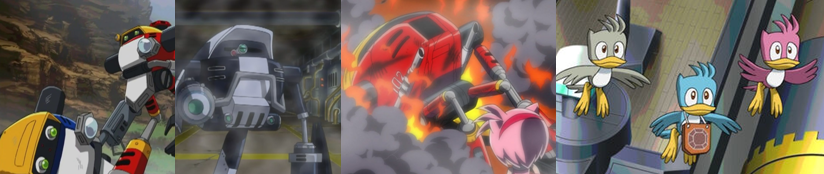
Screen Time & Knuckles: Sonic Underground & Knuckles


With the release of Sonic the Hedgehog 3 (SEGA Technical Institute, 1994), gamers were introduced to Knuckles the Echidna. This mischievous, dreadlocked antagonist was created by Takashi Yuda and his debut was made all the more impressive by virtue of the fact that Sonic 3 was too big to fit on one cartridge. This meant that Knuckles was the first of Sonic’s supporting characters to co-star in a main series videogame when Sonic & Knuckles (ibid) was released on this very day in 1994.


Episode Title: “Friend or Foe?”
Air Date: 28 February 1999

Episode Title: “Flying Fortress”
Air Date: 31 March 1999

Episode Title: “No Hedgehog is an Island”
Air Date: 7 April 1999

Episode Title: “New Echidna in Town”
Air Date: 13 April 1999

Directors: Marc Boreal, François Hemmen, and Daniel Sarriet
US Network:
BKN Kids II – UK Network: Channel 4

Stars: Jaleel White, Brian Drummond, Garry Chalk, Maurice LaMarche, and Peter Wilds

The Background:
After Sonic the Hedgehog blasted onto the videogame scene with Sonic the Hedgehog (Sonic Team, 1991), SEGA’s aggressive marketing campaign paid off dividends. Sonic’s popularity exploded after the release of Sonic the Hedgehog 2 (SEGA Technical Institute, 1992) and, suddenly, Sonic was everywhere, including two concurrent cartoons courtesy of DIC. While Adventure of Sonic the Hedgehog (1993; 1996) is generally criticised for its slapstick comedy, its darker counterpart, Sonic the Hedgehog (widely known as “SatAM”) is regarded as one of the defining cartoons of the nineties for its darker tone and mature themes. Although the cartoon inspired the original Archie Sonic comics, fans were left confused and disappointed when SatAM ended on an unresolved cliff-hanger. When the time came for SEGA to promote their up-coming Dreamcast, a new Sonic cartoon was commissioned, one that oddly took many visual inspirations from SatAM but told an entirely original story, one that owned more to Alvin and the Chipmunks (1983 to 1990) than its fan-favourite predecessor. Although Jaleel White returned to voice Sonic and his new siblings and writer Ben Hurst had some influence on the show, Sonic Underground became notorious for its musical interludes and struggled to find an audience thanks to the episodes being aired out of order. While the concept had even less to do with the source material than its predecessor (Sonic’s sidekick, Miles “Tails” Prower is nowhere to be found) and is widely regarded as one of the worst Sonic adaptations, Sonic Underground featured the debut of Knuckles the Echidna in Western animation and there was a sadly cancelled attempt to publish an epilogue to the much-maligned cartoon in 2013.

The Plot:
Whilst searching Planet Mobius for their mother, siblings, rebels, and rock stars Sonic, Manic, and Sonia (all voiced by White) cross paths with the distrustful and hot-headed Knuckles (Drummond). However, when the dastardly Doctor Robotnik (Chalk) manipulates Knuckles into providing him with a legendary Chaos Emerald, these four conflicting personalities must set aside their differences to oppose the doctor’s latest evil scheme.

The Review:
I watched all of Sonic’s cartoons when I was a kid. I distinctly remember watching Adventures of Sonic the Hedgehog every weekend, usually recording episodes for prosperity, and enjoying Sonic’s slapstick antics so much that I was shocked and confused when the entire tone and cast of the show suddenly changed. Sonic was no longer ridiculing Dr. Robotnik (Long John Baldry) and his minions and was instead the point man in an outnumbered resistance movement against a far darker, semi-cybernetic dictator much like in Sonic the Comic (1993 to 2002). I adapted to the new format and found myself enjoying Sonic’s dark escapades, only to be left further confused when SatAM ended on a massive cliff-hanger that teased a larger role for Dr. Robotnik’s long-suffering nephew, Snively (Charlie Adler) and a mysterious, red-eyed figure who I hoped would be Metal Sonic or even Knuckles! Sadly, we never got to see this ending resolved, even in the comics, and I was forced to adapt once again to an all-new Sonic cartoon, one that looked very similar to SatAM but was widely different and made the bold and frankly bizarre choice to lumber Sonic with two siblings. Why Tails and Amy Rose weren’t used in these roles I’ll never know but I was still a Sonic fan so I tried to give it a go, but to be fair I was about fourteen in 1999 so I was starting to veer away from cartoons like this.

After some initial antagonism, Knuckles and Sonic team up to safeguard the Chaos Emerald.

Although “Flying Fortress”, “No Hedgehog is an Island”, and “New Echidna in Town” make up a three-episode story arc revolving around Knuckles and the Chaos Emerald, they were broadcast out of order and the character actually made his first appearance in the standalone story “Friend or Foe?” Following the surprisingly catchy opening theme song (one of the few highlights of the cartoon), the episode finds Sonic, Sonia, and Manic travelling to the “dreaded” Floating Island in search of their long-lost mother, Queen Aleena Hedgehog (Gail Webster, and running afoul of boobytraps laid across the island by its mysterious echidna guardian. As ever, Dr. Robotnik is lumbered with two bungling minions: sleazy-but-cunning wolf Sleet (LaMarche) and the block-headed Dingo (Wilds), who transforms into different forms at the touch of Sleet’s remote controller. The two are ordered to the Floating Island to poison Knuckles’ mind against the hedgehogs, distracting him so they can steal the Chaos Emerald and send the island (and their enemies) plummeting to the ground. Thanks to a hilariously bad holographic fake, Knuckles is easily tricked and takes off to confront the three hedgehogs right as they learn from one of the island’s “sacred pools” that their mother was (and possibly still is) there. Despite Sonia’s best attempts to keep the peace, a sluggish and awkward scuffle breaks out between Knuckles and Sonic, which ends with the Sonia and Manic exploring the island’s underground caverns (in a close approximation of the Hidden Palace Zone) and learning of Knuckles’ deception. Although Sonic talks sense into Knuckles, they’re too late to stop Sleet and Dingo from stealing the Chaos Emerald and endangering the island. Luckily, Dingo is distracted by his lust for Sonia and the baddies are forced to flee without the emerald while the three fend off a contingent of SWATbots. In the aftermath, the siblings make amends with Knuckles, who reveals that he knows Queen Aleena and that she left a message indicating that he would become a pivotal ally in their crusade.

The siblings recruit Knuckles to help defeat the flying fortress, only for Sleet and Dingo to steal its Chaos Emerald.

A few episodes later, the siblings are relaxing at the beach when they’re attacked by Dr. Robotnik’s spherical “Fortress of Altitude” (almost a downgraded version of the Death Egg or the Egg Carrier), a flying fortress capable of bombarding his foes and shrugging off the laser blasts from their magic weapons thanks not only to being comprised of “Mobibindum” but also being powered by a Chaos Emerald, which atomises everything it touches. After fending off Dr. Robotnik’s SWATbots and evading the flying fortress, the siblings seek out Knuckles’ help. Initially reluctant to leave the Floating Island, Knuckles is convinced by their awful song (“No One is and Island”), though his resolve falters when the astral spirt of his great-grandfather, Athair (LaMarche), warns that this will result in a greater calamity. After easily fooling Dr. Robotnik with a decoy, Knuckles and the others slip aboard the flying fortress, avoid the ship’s defences, and burrow their way to the Chaos Emerald thanks to Knuckles’ super strength. However, after being callously dismissed by Dr. Robotnik, Sleet and Dingo claim the Chaos Emerald for themselves to both stand on their own and to try and prove their worth to their master. This causes the fortress to fall from the sky and into the sea below. Crippled by hydrophobia and unable to swim, Sonic relies on his family and friend to help get him to safety, but Sleet is stunned when usually thick-headed Dingo swipes the gem for himself! However, Dingo accidentally drops the Chaos Emerald, shattering it and unleashing a wave of unbridled Chaos Energy across the land that causes storms, earthquakes, and threatens the entire planet.
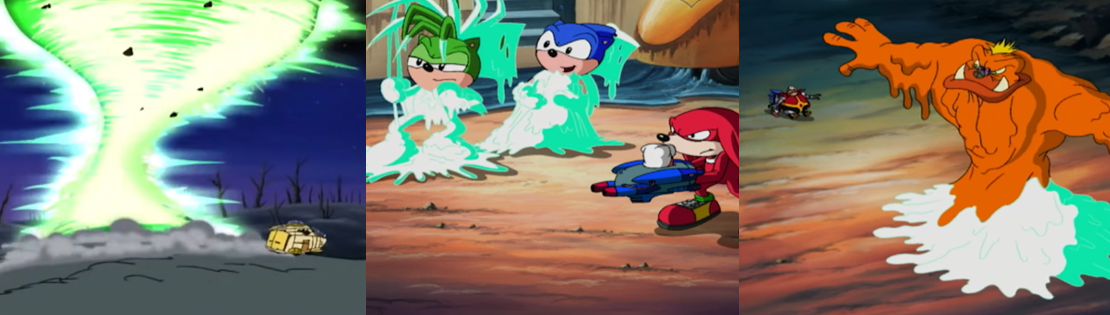
The heroes forge unlikely alliances to save the planet from being torn apart by Chaos Energy.

After his despair is lifted by another of the band’s terrible songs (“Learn to Overcome”), Knuckles leads them to his great-grandfather, who gifts them a special canister to house the shattered pieces and reveals that the only way to save the world is to ally with Dr. Robotnik. Naturally, Sonic and his siblings are aghast at this, but Knuckles is reluctant to defy his elder, especially with the fate of the world at stake. With the planet literally shaking apart from the rising Chaos Energy, the siblings race to find Knuckles and find another way to solve their problem, only to find that he’s been coerced into capturing them on Dr. Robotnik’s orders in exchange for the tyrant’s help in saving the world. Regretfully, Knuckles betrays his friends, only to be immediately double-crossed when Dr. Robotnik reneges on his promise not to roboticize the hedgehogs. Angered by this, a remorseful Knuckles fights back and frees his friends from their sticky bonds and joins them in searching for the Chaos Emerald, but they’re too late to keep Sleet from finding it and containing it in Dingo. This results in Dingo absorbing a full dose of Chaos Energy and transforming into a mindless, clay-like beast that threatens friend and foe alike. In what could arguably be described as a very loose adaptation of Sonic Adventure (Sonic Team, 1998), Dingo goes on a rampage that not only causes a series of volcanic eruptions but also destroys Manic’s magic drum set before heading to nearby Robotropolis, forcing Sonic to manipulate Dr. Robotnik’s ego to help subdue the beast. Toppled by the band’s music (“The Mobius Stomp”) and Dr. Robotnik’s special glue, Dingo spits out the Chaos Emerald, reverting to normal and saving the world and earning him his master’s ire. Knuckles then delivers the reassembled Chaos Emerald to Athair. Although the old echidna charges him with safeguarding the gem on the Floating Island, but the band promises that Knuckles will always have a place with them whether near or far.
The Summary:
Although the show has little in common with SatAM, Sonic Underground’s Sonic remains the same boastful, reckless speedster. In place of Princess Sally Acorn (Kath Soucie), Sonia acts as the voice of reason and intelligence in the trio, chastising Sonic’s irresponsible nature and emphasising diplomacy over impulsiveness wherever possible. Manic is characterised as a laid-back surfer dude who’s not as reckless as Sonic but still isn’t as attentive as Sonia. However, while Sonia might be the smartest of the bunch, she’s from an entirely different world to both. Sonic was raised to be a Freedom Fighter by his beloved Uncle Chuck (LaMarche) and has been fighting Dr. Robotnik for as long as he can remember, Manic is a streetwise thief, and Sonia comes from a life of privilege and luxury. All three were united by a common enemy when Dr. Robotnik roboticized the only family they ever knew and wield magic medallions that transform into music instruments that act as weapons, but Sonic Underground continuously emphasised their strength as a unit more than any previous Sonic cartoon. While Sonic possesses incredible speed, he’s impulsive and also crippled by hydrophobia. Sonia might have some fancy martial arts moves but she’s often too easily trusting of wealthy folk, who are often in Dr. Robotnik’s pocket. And Manic generally gets himself into trouble since he can’t help but half-inch when the temptation arises.
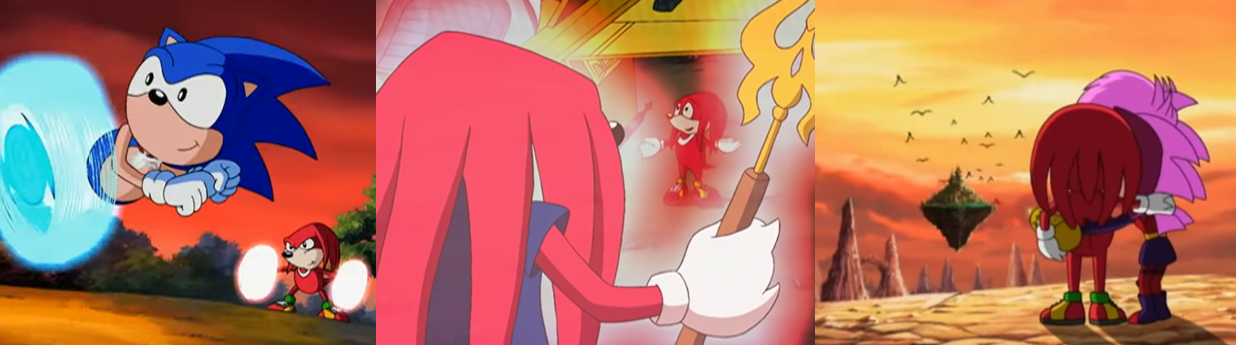
Though tough and wily, Knuckles is easily duped and fiercely loyal to this duties as the island’s guardian.

Of the three Sonic cartoons that aired in the nineties, Sonic Underground is somehow the most bizarre. Its tone is all over the place, lacking the ominous menace of SatAM but also veering more towards comedy like Adventures. Despite still being lighting fast and capable of bending physics, Sonic is surprisingly weak here. Perhaps because of the need desire emphasise themes of teamwork and friendship, Sonic is not only hampered by recklessness but shows fear when confronted by large groups of SWATbots, sluggishly fumbles through his initial fight with Knuckles, and succumbs to an uncharacteristic panic when left floundering in the ocean. Although the Floating Island is common knowledge in Sonic Underground and easily accessible, it’s far more accurate compared to the small mass seen in SatAM. It’s large, with a variety of different environments and wildlife on its soil, and Knuckles is later seen using a radar and communications system, and anti-aircraft cannons to fend off intruders. Knuckles’ reputation proceeds him to the point where even Sleet is aware of how tough he is and his skill at laying traps, and he makes an immediate impression by capturing the two dolts and roasting them over a spit for the local wildlife! However, as fleet-footed and super strong as he is, and despite showcasing a distrustful and snarky attitude, Knuckles is easily duped by Slate and Dingo and, like every character here, suffers from atrociously bad animation, appearing pudgy and disproportionate every time he moves. Knuckles’ go-to move is to spin his arms like a buzzsaw to rapidly burrow through surfaces. Just doing this is enough to knock Sonic on his ass and impress Manic, and Knuckles proves durable enough to withstand Sonic’s patented “Triple Spin Attack” and wily enough to use his knowledge of the island against his foe. Knuckles takes his role of guarding the Floating Island very seriously, to the point where he’s isolated himself from the rest of the world, but he’s equal loyal to his newfound friends and defies his instincts, and the will of his great-grandfather to aid them even though he’s extremely uncomfortable with leaving his island unguarded.
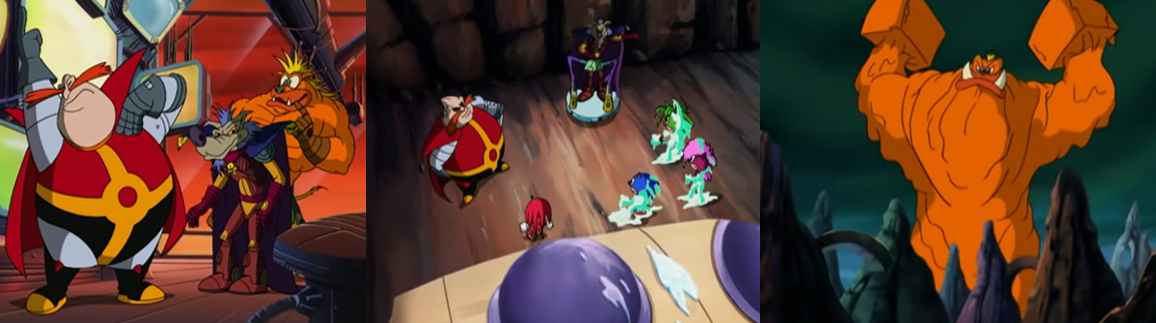
As if Dr. Robotnik wasn’t bad enough, the siblings must content with Knuckles and a rampaging Dingo.

There are some benefits to this for Knuckles; namely, that he spends more time socialising with his friends and bonding with Sonia, with whom he develops a mutual attraction. However, there are major drawbacks, too. Most notably, Knuckles is naïve and easily fooled; not only does he fall for Sleet and Dingo’s lies about the hedgehogs, he trusts his great-grandfather’s word so blindly that he willingly allies with Dr. Robotnik despite knowing full well of the semi-cybernetic dictator’s malicious nature. While he looks just like SatAM’s Dr. Robotnik (save for sporting two robotic arms) and even resides in a similar citadel in the heart of Robotropolis, this Dr. Robotnik lacks the gravelly, mechanical voice, employs wildly different SWATbots, and often spares the aristocracy the indignation of roboticization in return for hefty bribes. Although Dr. Robotnik appears to be at his most dangerous when he launches his Fortress of Altitude, the airship is as disproportionate and inconsistent as everything else on the show. The Mobibindum apparently makes it super heavy and tough, yet both Sonic and Knuckles smash through its structure without issue and a simple drop in the ocean is enough to trash the fortress and leave it literally blowing up in the dictator’s face. Even when Mobius is being torn apart around him, Dr. Robotnik finds a way to turn things in his favour. He’s willing to see the world destroyed if it means being rid of Sonic and strong-arms Knuckles into doing his bidding so that he can have the final victory of his hated enemies. Honestly, there are only a few episodes of Sonic Underground that are worth watching and these four are a handful of them. The animation and voice acting is atrocious (it’s insane that Jaleel White voices all three siblings), with Knuckles sadly getting the worst of both, but it was nice to finally see him in a Western Sonic cartoon. It’s not enough to salvage the series but it certainly makes these episodes more enjoyable. If only it had been an actual continuation of SatAM, it could’ve been even better.

My Rating:

Rating: 2 out of 5.

Could Be Better

Were you a fan of Sonic Underground? What did you think of the four Knuckles-centric episodes? Were you disappointed that we never got a continuation of SatAM? Which of Sonic’s siblings was your favourite and what did you think to the use of rock music in the show? Are you celebrating Knuckles’ big day today? Whatever you think about Sonic Underground, and especially Knuckles, leave a comment down below or let me know by commenting on my social media.


Interplay: Sonic Adventure

Interplay

One of the great things about adaptations, and adaptation studies, is that they both:

“[continue] to expand and become more inclusive […] it is increasingly difficult to determine a cohesive theory that accounts for the division between adaptation and other intertextual modes: allusions, plagiarisms, remakes, sequels, homages, mash-ups, appropriations, and the list goes on” (Dicecco, 2015: 161)

This quote sums up perfectly what makes adaptation studies so interesting; adaptations can be anything and are restricted only by the scope of your imagination and your commitment to researching the links between media.

While researching the theories of Nico Dicecco (and his contemporaries) during my PhD, I chose to focus on the adaptation of videogames into movies, television shows, cartoons, and comic books. This was primarily because it’s a lot easier to talk about media that is adapted into film and there hadn’t really been any serious research into videogame adaptations at that time. I’ve previously talked about how my studies into the Sonic the Hedgehog (Sonic Team/Various, 1991 to present) franchise revealed that Sonic the Hedgehog Spinball (Polygames/SEGA Technical Institute, 1993) heavily influenced multiple Sonic adaptations over the years but there has been another Sonic videogame that has made multiple jumps to other media.

SonicAdventureLogo

Today, I’m once again returning to one of my favourite Sonic videogames, Sonic Adventure (Sonic Team, 1998), Sonic’s first real foray into 3D gameplay and a title that focused on multiple characters and gameplay mechanics, a far deeper narrative than the franchise had experienced in a videogame before, and functioned as both a consolidation of Sonic’s competing iterations and a “soft reboot” for the franchise, due its use of  “slight changes to be made without having to completely scrap the franchise and start over” (Bancroft, 2015).

SonicAdventureVariety
I can’t praise this game’s variety enough!

Coming after a long absence from a main series Sonic title (and at a time when SEGA were almost haemorrhaging money thanks to failures like the Mega-CD and SEGA 32X), Sonic Adventure became “the best-selling Dreamcast game of all time, with almost two and a half million copies sold”. (Pétronille and Audureau, 2012: 70). It reinvigorated the Sonic franchise in a way that I think has been forgotten over time; while the game may have had its flaws, it successfully revitalised Sonic and led to a string of successful sequels and follow-ups. While these weren’t enough to curb SEGA’s financial woes, the success and impact of Sonic Adventure led to a shift in Sonic’s gameplay, narrative, and aesthetic direction; rather than racing along a 2D plane, players now ran along at break-neck speeds in fully 3D environments that were designed more like rollercoasters. Sonic was now “Taller, slimmer and somehow spikier”, his friendliness replaced with “an anime-style cool” (Jones, et al, 2011: 31), and his narrative was far darker and more mature than his bright, psychedelic 2D titles. Perhaps the most significant impact of Sonic Adventure came through Sonic Team eventually stripping away all other playstyles to focus purely on Sonic’s speed, an aspect that largely led to the development of the Boost-orientated gameplay of modern Sonic titles.

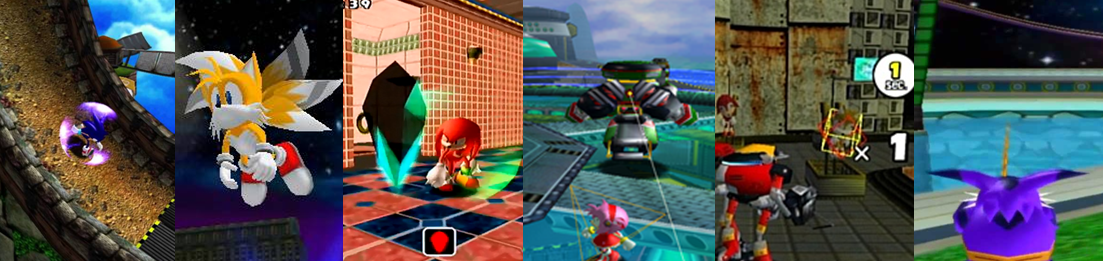
InterplaySAOVAAdv
Surely this can’t be a coincidence?

One thing to note before I delve into the main focus of this article is how the adaptation process appears to have worked both ways with Sonic Adventure. Many elements from Sonic the Hedgehog: The Movie (Ikegami, 1996) are recognisable in Sonic Adventure, such as Tails’ workshop on South Island, the appearance of cities and structures that mirror those of our world, and a lot of Doctor Robotnik’s (Edwin Neal) personality and technology. For me, the Sonic OVA is clearly a precursor to Sonic Adventure’s attempt to leave behind Mobius and show him as an adventure-seeking teenager in a world not too dissimilar to our own (though I still pray for the day when his characterisation matches the snarky attitude of his OVA counterpart). Sonic Adventure didn’t just impact Sonic’s videogames, however; by 1999, Archie’s Sonic the Hedgehog comic books had developed into a continuation of the fan favourite Sonic the Hedgehog (1993 to 1995, more commonly referred to as “SatAM”) cartoon, infusing characters and events from the videogames into its narrative. With this in mind (and, possibly, in keeping with SEGA’s desire to create a homogeneous version of Sonic), it was inevitable that Sonic Adventure would feature in these comics before long.

InterplaySARoboEggman
Robo-Robotnik soon replaced his organic counterpart as “the Eggman”.

Sonic Adventures’ influence began slowly but, in keeping with the increasingly-convoluted narrative of the comics at the time, was complex to the nth degree. First, the Archie team crafted an elaborate story to explain why Sonic now looked like his Sonic Adventure counterpart: ‘Retro Activity’ (Bollers, et al, 1999) not only showed how Sonic transformed from his pudgy, classic look to this edgier aesthetic by racing against a destructive energy beam so fast that he cycled through his various Super forms, but it told this story backwards! If you thought that was bad, though, the lengths they went to to explain Robotnik’s transformation into his Sonic Adventure counterpart, Doctor Eggman, were even worse! So, in ‘Endgame, Part 4: For Whom the Bell Tolls’ (ibid, 1998), Sonic finally destroyed Robotnik forever in a fight to the death involving his latest doomsday weapon, the Ultimate Annihilator. However, it is dramatically revealed in ‘I Am the Eggman!’ (ibid, 1999) that Robotnik has returned…in the form of his fully-robotic, alternate-universe counterpart, Robo-Robotnik. Though seemingly destroyed in that story, the issue ends with Robo-Robotnik downloading his consciousness into a body that is identical to his Sonic Adventure design; “Eggman” (for a long time “The Eggman”) would quickly become a derogatory nickname used to describe Robotnik until the madness was smoothed over by massive continuity changes much later down the line. The Sonic Adventure tie-in officially began with ‘The Discovery: A Sonic Adventure Tie-In’ (ibid), in which Sonic and the Knothole Freedom Fighters first learn about the “hidden city of the ancients”. Robotnik also learns of an ancient beast known as “Perfect Chaos” hidden within not the Master Emerald (…as that was where Mammoth Mogul was imprisoned) but the “Black Emerald”. Unearthing the Black Emerald in the Mysterious Cat Country, Robotnik discovers that it is severely depowered and promptly leads and assault on Floating Island to smash the Master Emerald in order to repower the Black Emerald.

InterplaySAAdventureBegins
Two issues in and I’ve already lost the plot!

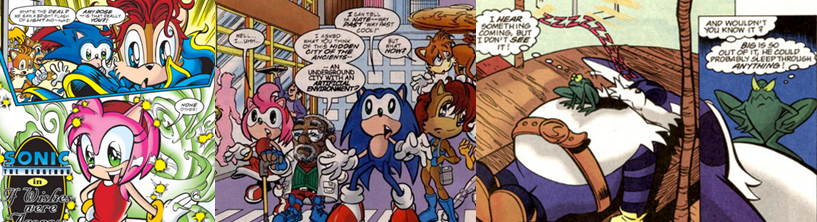
After being denied the chance to accompany the Freedom Fighters, Amy Rose uses the magical “Ring of Acorns” wish herself into a more mature body in the follow-up story, ‘If Wishes Were Acorns’ (ibid), one that (you guessed it) is identical to her Sonic Adventure appearance. The Freedom Fighters then travel to the hidden city, which is located beneath an island (that is an almost exact replica of the OVA’s South Island) and accessed via a Mystic Ruins mine cart. A back-up story, ‘Swallowing Trouble’ (Penders, et al, 1999), introduces Archie’s readers to Big the Cat; his peaceful existence is disrupted when Froggy (who articulates through thought bubbles) swallows a piece of Chaos, grows a tail, and is promptly kidnapped by E-102γ (also known simply as “Gamma”). In the next issue, ‘City of Dreams’ (Bollers, et al, 1999) shows Sonic and friends exploring the hidden city, which is Station Square from the videogame and populated entirely by humans (who are different from “Overlanders”, the mostly-extinct human-like species that once waged war on Mobius), and sustained by an “artificial environment” (…that includes a sky, apparently).

InterplaySAVsChaos0
Things pick up with this Sonic’s battle against Chaos 0.

While they end the story making good progress in establishing diplomatic relations with the humans, the two back-up stories show Robotnik sending his E-series robots out to find more Master Emerald fragments to empower Chaos and Amy rescuing an injured bird from ZERO. Interestingly, while Archie bent over backwards to explain the characters new look, they simply have Amy’s Piko-Piko Hammer appear out of thin air with no explanation; even she is shocked to see it! Things finally pick up in the next issue’s ‘Night of Chaos!’ (ibid), which recreates (with amazing fidelity) the first encounter and battle between Sonic and Chaos 0. The back-up stories introduce Tikal to the story, as she relates to Knuckles her history (meeting and befriending Chaos and the destruction of her tribe when her father, Pachamac, tried to forcibly take the seven Chaos Emeralds from its shrine), how Robotnik finalised Chaos’ 0 form by infusing it with Froggy, and recreates the beginning of Gamma’s story by showing it pass a training drill and release Amy and her bird friend (here clearly identified as a Flicky) after overcoming its programming and gaining a modicum of sentience.

InterplaySAArchiePC
Archie recreated Perfect Chaos’ birth in stunning detail.

Archie followed this up with a 48-page ‘Super Sonic Special’ that rapidly told Sonic Adventure’s familiar story beats: Sonic, Miles “Tails” Prower, and Knuckles battle Chaos 2 and 4 after Robotnik feeds it shards of the Master Emerald; Big, Sonic, Tails, and Knuckles end up on the Egg Carrier; there’s a tussle with Gamma (where Amy spares it from destruction) and they fight Chaos 6, destroying the Egg Carrier in the process. The adaptation continues in the next regular issue; in here, Knuckles discovers “the Eggman” unconscious in the Mystic Ruins and Chaos, still alive, blasts through the land as a tornado, absorbing the six Super Emeralds, and transforms into Perfect Chaos, flooding Station Square (and attaching itself to the Power Siphon that control’s the city’s environment) exactly as it does in the opening and Super Sonic story of Sonic Adventure. Perfect Chaos destroys the Egg Carrier then, after learning a bit more from Tikal, Sonic uses the Emerald’s to transform into Super Sonic and engage Perfect Chaos. It’s around about at this point that the story stops creating its own dialogue and starts lifting lines directly from Sonic Adventure but, considering the quality of Archie’s writing back then, I would necessarily say that this is a bad thing. The story finally comes to a conclusion in issue 84’s ‘Perfect Chaos’ (Penders, et al, 1999), in which Super Sonic struggles to subdue Perfect Chaos while Knuckles overcomes his fear of water and uses his immense strength to restart the city’s power generator (tapping into his latent Emerald powers for the first time, which would later significantly change his appearance and powers). This, coupled with Super Sonic’s attack, is enough to revert Perfect Chaos back to Chaos 0. At peace once more, Chaos and Tikal return “to the Zone [where they] belong” and the threat is finally ended (…once again glossing over the untold death and destruction in Station Square).

InterplaySAArchieLore
Archie lore was dense enough before they wedged in Sonic Adventure.

Archie’s Sonic Adventure adaptation is one of the few times they actually crafted a long-running narrative out of a videogame story; normally, they just produced one-shots or sort stories that briefly (and very loosely and awkwardly) spliced the game’s story into their own convoluted narrative. The incorporation of Sonic Adventure’s narrative was especially difficult given that several key elements had to be changed due to them clashing with Archie’s lore; Chaos’ origin and imprisonment, for one, and the weird way they introduced Station Square for another, to say nothing of how the entire Echidna backstory struggled to fit in with the messed up narrative crafted by the notorious Ken Penders. Nevertheless, this was, perhaps, the closest Archie Comics got to a straight-up, beat-by-beat adaptation of a videogame; they made it easier on themselves in the future by generally just adapting the opening portions of a game and leaving a dialogue box that said something like “Play the game to find out the rest” and then vaguely referring to the game’s events in subsequent stories. Here, though, we got lines from the game, locations, notable boss battles, and hit almost every story beat from the game no matter how at odds it was with the world Archie had created for their version of Sonic.

InterplaySASTCFearChange
Chaos cripples with its fear aura and alters Sonic’s look.

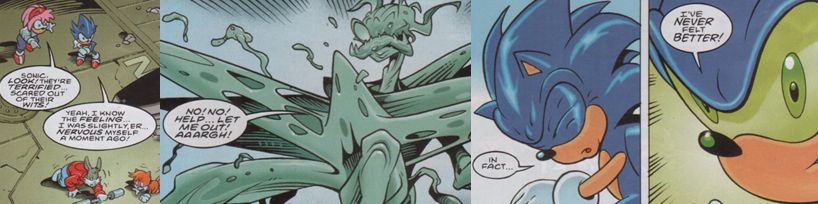
Over here in the United Kingdom, Fleetway’s Sonic the Comic (1993 to 2002, referred to as “StC”) was a little late to the party with their Sonic Adventure adaptation; like Archie, Fleetway had established their own, separate lore for Sonic and his friends, one that “felt” closer to the videogames but was still distinctly separate from it. Previously, their adaptations of Sonic videogames had tended to be multi-part stories that took the game’s characters and the vague outline of its plot and applied them to their unique narrative and Sonic Adventure was no different. The arc began in issue 175’s ‘The Coming of Chaos!’ (Kitching , et al, 2000), in which Sonic and his friends race out to confront StC’s version of Chaos 0 in Metropolis City Zone. This battle, which is a truncated version of the first boss fight with Chaos 0, showcases that StC’s Chaos exudes an aura that cripples its foes with feelings of utter dread. Headstrong and arrogant as always, Sonic attacks Chaos head-on regardless and manages to fend it off but is left with glowing green eyes and jagged spikes. In the following issue, it is revealed that Robotnik’s assistant, Grimer, unleashed Chaos in the hopes of destroying Sonic and his friends and shaking Robotnik out of the slump he had found himself in after multiple defeats. However, Robotnik reveals that Chaos is truly uncontrollable and that, by setting it free, Grimer has “doomed the entire planet”.

InterplaySASTCJohnny
Defeating Chaos extracts a heavy price.

Meanwhile, Sonic’s tech buddy Porker Lewis arrives; he’s (somehow) discovered that it’s made up of Chaos energy and has whipped up a device to defeat it but Sonic, already weakened from his earlier tussle with the creature, is unable to fight through its fear-inducing aura to complete the process. Luckily, Johnny Lightfoot steps in to lend a hand but, while he succeeds and Chaos is seemingly defeated, he dies in the process! Yep, a kids comic actually killed off a beloved, long-time character and not just any kids comic, a Sonic comic! Up until this point, death had largely been a stranger to StC’s stories; characters were used as batteries for Robotnik’s Badniks or turned to stone, or trapped for all eternity (…for a while), but they had never died before! StC hammered home that Johnny was actually, really, 100% dead in the following issue, where the guilt and shame of having recklessly led his friends into danger causes Sonic to quit the entire thing. However, Chaos reappears the Floating Island’s Emerald Chamber, now able to talk and state its intentions: it claims ownership of the Chaos Emeralds and desires to absorb their power. Knuckles is left with no choice but the jettison the Emeralds in the following story, ‘Splash-Down!’ (ibid), which causes the Floating Island to crash and sink into the sea. There’s an interesting wrinkle here where Knuckles, despondent at his actions, resigns himself to facing the same fate as his ancestral home and has to be coerced by Amy (and a good knock on the head) to avoid killing himself.

InterplaySASTCTikal
Tikal raised new questions about StC-Knuckles…

Also in this story, rather than going through a whole complicated mess involving robotic counterparts and body swapping, Robotnik simply…puts on a jacket so he resembles his Sonic Adventure design. I find this doubly amusing and ironic considering the lengths StC went to to show Robotnik transforming from his classic design to his Adventures of Sonic the Hedgehog (1993) look. Oh, and Sonic just…comes back at the end of the story, ready to jump into the fray once more. In the next issue’s story, ‘Out of Time!’ (Kitching, et al, 2000), Porker continues to obsess over Sonic’s green eyes and the Chaos energy he apparently absorbed from battling Chaos. This turns out to be a pretty big deal as Sonic is the only one who can see Tikal when she suddenly appears and promptly zaps him 8,000 years into the past. This (and the subsequent issue) is also where StC loops Sonic Adventure’s lore into their own narrative regarding Knuckles’ past; we learn not only that Knuckles existed in the distant past (a plot thread that wouldn’t be resolved until StC was continued online) but also that the extra-dimensional Drakon Empire (who had previously attempted to invade Mobius) were involved in Chaos’ origin. After defeating a Drakon Prosecutor, revealing the heavily-armoured warriors to be mutated fish in armoured shells, Sonic chats with Tikal’s father, “Pochacamac”, who reveals that the Echidnas stole the seven Chaos Emeralds (and the Master Emerald) from the Drakon Empire after they invaded the Echidna’s sacred Emerald Mines and infused the gems with their patented Chaos energy.

InterplaySASTCChaosOrigin
StC gave Chaos a completely new origin.

During a battle with Drakon Prosecutors in which a stray energy blasts hits the Emeralds and causes their powers to surge out of control, the Drakon Sonic had previously defeated is released from its prison and fuses with the Emeralds to transform into Chaos. Sonic attempts to get revenge for Johnny in the following issue but is transported back to the future in order to weaken Chaos enough for past Knuckles to do…something to imprison Chaos. Sonic returns to the present just as Chaos arrives at Robotnik’s mountaintop fortress, where Robotnik gathered the Chaos Emeralds in order to lure it in…though he does this merely to have a front row seat to the end of not only Sonic and his friends, but the entire world. All hope seems lost in ‘Perfect Chaos!’ (ibid) when Chaos absorbs the power of the Chaos Emeralds and transforms into Perfect Chaos (which actually more closely resembles Chaos 6) until a severely weakened and dying Super Sonic arrives. How, I gave Archie flack for how complicated some of their stories were so I guess it’s only fair to deviate here to explain this a bit. In StC, Sonic absorbed a huge amount of Chaos energy a long time ago; this lay dormant in him for years and, whenever under extreme stress or driven to severe rage, he would transform into Super Sonic. StC Super Sonic was an uncontrollable, rage-filled, super-powered demon with maniacal eyes who could shoot energy blasts, fly at incredible speeds, and was all-but-invulnerable. However, Sonic’s friends eventually found a way to separate Super Sonic from him and imprisoned the demon within a time dilation of sorts. Super Sonic did eventually escape but the effort drained his power so much that he eventually lost his memory and became a confused, but harmless, individual.

InterplaySASTCFinale
Chaos, and Super Sonic, are both defeated, ending both the story and StC.

Sonic’s fears regarding his demonic counterpart are realised in the finale of the Sonic Adventure arc, ‘Point of no Return!’ (ibid), in which Super successfully drains Perfect Chaos of all its energy and regresses it back to a harmless Drakon fish. The Chaos energy returns Super’s memories and powers and he attacks everyone, intending to kill them all, and begins to drain the life energy out of Sonic. However, Super’s friend, Ebony, uses her magical powers to fuse Super and Sonic back into one being again. Grimer quits Robotnik’s employ, disgusted at his lackadaisical attitude to what looked to be the end of the world, and the story ends with Sonic and his friends triumphant. Sadly, the Sonic Adventure arc would be the last time StC ran original Sonic stories in their comics; for a while, the comics had consistently largely of reprints of old stories, even though the writers could have done what Archie did and used the extra pages to tell back-up tales to expand the story rather than rushing through everything in the main Sonic strips.

InterplaySASTCRushed
StC didn’t really give these guys anything to do in this arc…

Compared to the Archie adaptation, StC’s interpretation of Sonic Adventure is not only rushed but has some pretty weak connections to its source material. The characters never visit any of the locations from the game, Chaos is significantly different (though, in some ways, better; its “fear aura” was a nice inclusion with a lot of potential), Big is reduced to a throwaway, one panel cameo, Gamma doesn’t appear at all, and neither Tails or Amy have anything near the significance of the roles they played in the game. While Knuckles plays a vital part, he’s far more hands-off than in Archie (and the videogame), and Robotnik barely features at all (though this does make sense considering where the character was, mentally, at the time). If Fleetway had been able to use every page of their issues to tell this story, it probably would have landed much better; while I don’t doubt that they still would have sought to slot Sonic Adventure’s canon into their own as best as they could, at least e could have seen a five page back-up story featuring Knuckles, or Big, or anyone. Instead, it’s a very poor effort; StC did a pretty good job of telling stories heavily influenced by the videogames in the past but, by the point, the comic was on its last legs so I guess we were lucky to get anything.

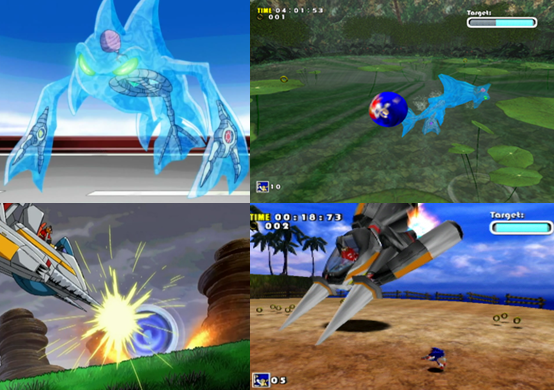
InterplaySASXChaos0
Sonic X weaved the game’s story into its lore and mixed it up a bit.

Chaos would go on to sporadically appear in Archie Comics as it continued on, even when the license switched over to IDW Publishing, but it also notably appeared in Sonic X (2003 to 2006) when the anime did its own six-part adaptation of Sonic Adventure. Before I get into that, though, I just want to briefly mention Sonic Underground (1999), the oft-lambasted follow-up to SatAM that, for all its faults, at least featured Knuckles (Brian Drummond). There’s a couple of points in the series where characters refer to “Chaos” as being the destructor of Mobius and, in ‘New Echidna in Town’ (Boreal, et al, 1999) Chaos Energy transforms Dingo (Peter Wilds) into a mindless beast, Chaos Dingo, who takes on a malleable form. While this link to Sonic Adventure is tenuous at best (made all the more so by Sonic Underground’s dramatic departure from all Sonic lore), it’s still an interesting connection to make. Despite looking fantastic due to its anime aesthetic, Sonic X was a bit of a disappointment when it first started for a variety of reasons: Sonic (Jason Griffith) is largely lethargic, preferring to spend his days taking naps or smelling flowers, and all of his iconic friends are pushed to the side to make way for Chris Thorndyke (Michael Sinterniklaas) and a host of other human characters forced into the show when Sonic and the others are transported from their world to Earth. However, for me at least, things started to pick up near the end of the first season and with the episode ‘Pure Chaos’ (Kamegaki, 2004), which kick-started the Sonic Adventure saga with Froggy swallowing a Chaos Emerald, Dr. Eggman (Mike Pollock) launching the Egg Carrier, and Sonic and Knuckles (Dan Green) battling Chaos 1 and 2. Straight away, Sonic X is ahead of the curve simply by including Big in a role more suited to his videogame story and, like Archie, the series sticks quite close to the source material.

InterplaySASXBosses
Sonic X featured almost all of Sonic Adventure‘s bosses.

The adaptation continued in the following episode, ‘A Chaotic Day’ (Kamegaki, 2004), which focuses a bit more on Knuckles’ side of the story, detailing how Chaos broke out of the Master Emerald and his search for its shards, which also brings him into contact with Tikal (Rebecca Honig). Sonic and Tails (Amy Palant) then battle both Chaos 4 at Eggman (in the Egg Hornet) at the Mystic Ruins (in what is a pretty faithful adaptation of the same boss battles from Sonic Adventure) before pursing Eggman to his Egg Carrier. They crash, as in the game, and Amy (Lisa Ortiz) and Cheese the Rabbit (Rebecca Honig) are attacked by ZERO, who kidnaps Amy and the birdie, Lily (Sayaka Aoki). Amy and Gamma’s (Andrew Rannells) stories are the primary focus for the next episode, ‘A Robot Rebels’ (Kamegaki, 2004), in which Gamma kidnaps Froggy right after Chris helps Big to rescue him and he subsequently frees Amy after suffering a bit of a short circuit at the sight of Lily just like in the videogame. Similarly, Amy convinces Sonic to spare Gamma and Knuckles recovers the last piece of the Master Emerald in the following episode, and, though Eggman successfully uses Froggy’s tail and Chaos Emerald to transform Chaos into Chaos 6, Sonic and Knuckles (randomly sporting his Shovel Claws) defeat it. The episode ends with the finale of Tails’ story, in which Eggman launches a missile at Station Square and he must gather his courage and self-sufficiency in order to disarm it (though he doesn’t battle the Egg Walker).

InterplaySASXGamma
Gamma’s tear-jerking story is told from start to finish.

‘Revenge of the Robot’ (ibid) primarily wraps up Sonic and Gamma’s stories from the game: Gamma travels through the locations of Sonic Adventure deactivating its robotic brethren and freeing the Flicky’s trapped within (which is considerably easier than in the videogame) and eventually destroys  itself and its older “brother”, E-101β “Kai” (Andrew Rannells) to reunite with its Flicky family. While Sonic does go on to defeat Eggman and his Egg Viper, Chaos obtains all seven Chaos Emeralds, transforms into Perfect Chaos, and floods Station Square in the final episode of the saga, ‘Flood Fight’ (Kamegaki, 2004). Up until this point, Chris’s involvement (and the involvement of his extended family and friends) was largely painless and unobtrusive. The changes this, however, as the destruction brought upon Station Square has a significant impact on the lives of Sonic’s new human friends and, wouldn’t you know it, it is Chris who supplies with the last Chaos Emerald he needs to transform into Super Sonic. Unlike in the videogame and the Archie Comics adaptation, Super Sonic defeats Perfect Chaos with hardly any issue at all in Sonic X; while Perfect Chaos had never looked bigger or badder, resembling more a water-based version of Biollante, and packs some serious firepower, it is defeated and reverted back in Chaos 0 with very little effort. To be fair, though, Sonic X’s Super Sonic was always far more powerful than his other incarnations, being more of a God-mode than a power-up. Still, Chaos is defeated and returns to the Master Emerald with Tikal, at peace once more. Station Square is left in ruins and, while the anime also glosses over the death and destruction the flood must have caused, subsequent episodes dealt with (or, at least, referenced) the restoration process.

InterplaySASXFaithful
Sonic X told the entire game’s story, giving everyone their due.

Like the other adaptations of Sonic Adventure discussed here, Sonic X incorporates the game’s narrative into its own unique lore but, in a twist, includes characters like Cream and Rouge the Bat (Kathleen Delaney) who debuted after Sonic Adventure. However, even these videogame characters have smaller roles than Chris and his cohorts; given that Chris was obsessed with following Sonic everywhere and putting himself in danger, this isn’t too surprising but, honestly, their inclusion and involvement is no more or less, better or worse, than those of the Archie and StC extended cast. However, Sonic X’s Sonic Adventure saga is easily the closest, most faithful adaptation of the source material of these three; Archie Comics came close bit their impenetrable lore meant that too many compromises had to be made. Both comic adaptations focused more on Chaos than other bosses and events, but Sonic X includes almost everything from the videogame, giving plenty of time to each of the game’s six characters and adapting their stories with a high degree of fidelity. It even streamlined and improved the story in many ways, such as having characters team up against Chaos’s various forms and improving the appearance of Perfect Chaos.

InterplaySASAStory
Sonic Adventure told a complex, interweaving Sonic story for the first time.

Sonic Adventure has been a rich source of adaptation, second only to Sonic Spinball. Aside from the more direct adaptations I’ve talked about here, stages, bosses, and narrative themes from the game cropped up in many subsequent Sonic titles. Unlike Sonic Spinball, I feel like this is probably because of the game’s story; this was the first time Sonic and his friends and enemies had a real voice in the videogames and the first time Sonic Team tried to tell a deep, overarching story. Add to that the influence that Sonic Adventure’s gameplay and aesthetic choices had on Sonic’s canon and future release and it’s not hard to see why. The only thing that hampered each of these adaptations was their attempts to shoe-horn the videogame narrative into their existing lore, rather than using the general story and themes of the game and threading it through in a more natural way. While Archie Comics and StC had good reasons for this, Sonic X had every opportunity right from the beginning of its run to properly prepare and lay the groundwork for its eventual videogame adaptations and, instead, it was happy to waste time focusing on Chris, his idiotic behaviour, and having Sonic be this bland, lethargic goody-too-shoes rather than a snarky, hyperactive adventurer.

Which of these three Sonic Adventure adaptations was your favourite? How did you find Archie’s writing at the time? Do you remember Sonic the Comic? What were your thoughts on Sonic X and Chris? Drop a line below and stick around for more articles in the future.