Screen Time [Gazpacho Soup Day]: Red Dwarf (Series Three)


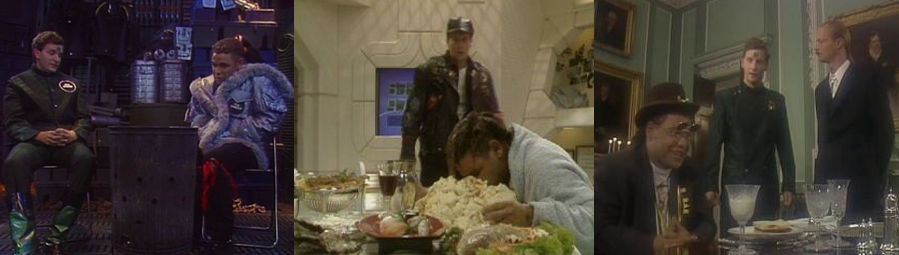
In the episode “Me2” (Bye, 1988) of the classic British science-fiction comedy show Red Dwarf (1988 to 2020), it is revealed the Arnold Rimmer’s (Chris Barrie) last words were “Gazpacho soup!” and that he made a point to celebrate November 25th as “Gazpacho Soup Day” after a particularly traumatising visit to the Captain’s Table.


Series Three

Air Date: 14 November 1989 to 19 December 1989
Director: Ed Bye
Original Network: BBC2
Stars: Chris Barrie, Craig Charles, Danny John-Jules, Robert Llewellyn, and Hattie Hayridge

The Background:
In the mid-1980s, Rob Grant and Doug Naylor created Dave Hollins: Space Cadet, a BBC Radio 4 sci-fi comedy show influenced by classics of the genre like Dark Star (John Carpenter, 1974) and The Hitchhiker’s Guide to the Galaxy (Adams, 1978; Bell, 1981). Dave Hollins was also the prototype for Red Dwarf, a concept the duo struggled to sell despite emphasising character and comedy over genre. After casting impressionist Chris Barrie and Liverpudlian “punk poet” Craig Charles in the lead roles of Second Technician Arnold J. Rimmer and Third Technician Dave Lister, respectively, the cast was rounded out by singer and dancer Danny John-Jules and sardonic stand-up comedian Norman Lovett. Red Dwarf was eventually aired in early-1988 and, while viewing figures dropped during the first six-episode series, audience feedback was so strong that the BBC greenlit a second series. Granted a bigger budget, Grant and Naylor expanded the premise and, thanks to Red Dwarf now having an established audience, series two was more favourably received. The show was now a cult hit and afforded an even bigger budget for the third series, which saw a complete redesign of the sets and the introduction of a new model, and service mechanoid Kryten joining the crew (albeit now played by Robert Llewellyn). Widely regarded as one of the best sets of episodes throughout the show’s entire run, Grant and Naylor enhanced series three seasons with additional digital effects some ten years later, to some criticism. Since then, Red Dwarf continued to be consistently popular even after Grant and Naylor parted ways, returning from a lengthy absence with a series of specials and revivals that arguably struggled to match the quality of this season.

The Plot:
The mining ship Red Dwarf drifts through deep space three million years into the future, crewed by the last human being alive, Dave Lister, Arnold Rimmer, a hologram of his deceased superior officer, a humanoid cat (John-Jules), service mechanoid Kryten, and the ship’s neurotic computer, Holly (Hayridge). Their journey sees them visit a version of Earth where times runs backwards, dabble in time travel, swap bodies with each other, and the imminent arrival of Kryten’s ultra-modern replacement.

The Review:
Series three is really when Red Dwarf hit its stride, in many ways; at least, it is for me. Gone is the slow, strangely ominous opening sequence, replaced with a rockin’ cover of the main theme that plays over clips from the series to give a sense of the zany action viewers can expect. The first episode, “Backwards”, also starts with an amusing parody of the traditional Star Wars (Various, 1977 to present) opening scroll that flies past in the blink of an eye. Eagle-eyed viewers or those who slow down the footage will learn about how Lister returned his twins to the female-dominated parallel universe where they were conceived, how the ship’s computer, Holly, assumed the guise of his counterpart from that same reality after falling in love with her, and how service mechanoid Kryten suffered a horrific accident that saw him rebuilt by Lister to now join the crew. Additionally, Lister and Rimmer have now moved to the far more luxurious officer’s quarters, gaining bigger bunks, an en suite shower, and a far more comfortable and eye-catching space for them to socialize and bicker. Enough time has passed between Kryten’s offscreen repairs for the overly polite and submission mechanoid to have fully ingratiated into ship life, with him anxiously taking his pilot’s exam in the first episode as a way of introducing the show’s newest and most iconic ship-to-surface vehicle, the appropriately named Starbug. Even the ship’s corridors and layout have undergone a dramatic change, switching from the dull grey paintjob to a more ominous and dramatic hallways. Rather than recycle the sets from the first two series, series three introduces new areas, such as a dark room (where Kryten rocks out while developing photos), a club where the crew celebrate what’s believed to be Kryten’s final night before he’s forcibly replaced, and the science lab. The vending machines have a new design, we visit a claustrophobic cargo bay, and more episodes take place off-ship, with Rimmer and Lister literally being marooned on a frigid world at one point and the crew indulging in a bit of fun, if limited, time travel.

Lister and Rimmer’s relationship deepens, with the two sharing as much as they clash.

Lister and Rimmer’s contentious relationship remains a focal point of the series but has evolved to the point where Rimmer simply despairs of his slovenly roommate and Lister openly criticizes Rimmer’s boneheaded decisions. When Rimmer and Kryten prove a smash hit on the backwards version of Earth, Lister lists the many reasons why staying on such a bizarre world make little sense and openly challenges Rimmer’s tenuous authority when his fear is removed by the gruesome polymorph. The two are force to co-exist and we see a deeper representation of their dynamic in “Marooned”. Stuck with only each other for company, Lister must practically beg Rimmer to keep his mind off his seemingly inevitable slow death from either extreme cold or hunger and we explicitly see why Rimmer was chosen to keep Lister company after the ship’s crew were wiped out. Rimmer represents a smug, authoritarian antagonist Lister can focus his despair and loneliness onto and Rimmer fulfils this role admirably, chastising Lister’s short-focused greediness and trying to impress upon him the need to ration himself and make personal sacrifices to stay warm. Of course, Rimmer’s awe at Lister burning his beloved guitar soon turns to rage when he realises the devious slob has actually desecrated Rimmer’s prized camphorwood chest. Their relationship is further tested in “Bodyswap” when Rimmer sees a chance to experience the thrill of being alive once more. After failing to convince Lister to swap minds and bodies, Rimmer forces him to undergo the transfer and immediately indulges his every vice. Trapped in a hologrammatic body and powerless to prevent Rimmer from gorging himself, Lister is horrified when Rimmer hijacks his body and almost dies fleeing from reprisals in Starbug. Finally, the two clash in their attempts to alter the timeline using mutated developing fluid; discovering a limited means to travel to the past, they each vie to create the strangely popular “Tension Sheet” before the other. This gives a glimpse into Lister’s past as an ambitious but untalented musician and into an alternative life where he’s a successful rock star with a giant mansion and an obnoxious attitude. While Rimmer’s motivations for resetting the status quo are purely selfish for he wishes to have that life for himself, it also comes from a deep-seated desire to not be left alone on Red Dwarf, a fate worse than being trapped with people he barely tolerates let alone likes.

Kryten fits right in with the misfit crew and adds an extreme layer of dry comedic value.

While still a flamboyant, self-serving, egotistical narcissist, the Cat is far more well-rounded here. An accomplished pilot in his own right, he’s often partnered with Lister as a far more amicable, if not less self-absorbed, alternative to Rimmer. The Cat and Lister regularly engage in game night, playing various tabletop and physical games to occupy themselves, and the Cat seems genuinely hurt when the despondent Lister refuses to play and lashes out in frustration at being stuck in deep space as the last man alive. While the Cat is seemingly nonplussed when Rimmer and Kryten disappear in “Backwards”, he’s so distraught at Lister’s own disappearance in “Marooned” that he doesn’t “buff his shoes for three days” and reacts with elation upon spotting the crashed Starbug. Additionally, when a sugar-high Rimmer takes Lister’s body hostage and goes for a joyride, the Cat immediately volunteers to pursue him in Blue Midget (though mainly to avoid giving Lister possession of his body) and joins the crew in celebrating Kryten’s life in “The Last Day”. Kryten adds a lot to the ship dynamic, being a logical and deadpan presence amidst such bombastic characters. Though his inclusion makes Holly superfluous since he has a physical presence and isn’t suffering from computer senility, Kryten makes a great impression by performing parlour tricks for the Backworld inhabitants with Rimmer, overseeing the mind swap procedure, and in his surprisingly emotional reaction to the crew risking their lives when Hudzen-10 (Gordon Kennedy) arrives to replace him. Indeed, while Kryten is happy to accept his replacement and inevitable shutdown, Lister rallies against it, openly criticising Kryten’s belief that he’ll be rewarded for a lifetime of servitude in “Silicon Heaven”. Surprisingly, it’s Rimmer who’s the voice of reason here; though also sad, in his own way, he chastises Lister for mocking Kryten’s beliefs, however illogical and unfair they seem. Of course, Kryten really steals the show in “Polymorph”, where we see his various groinal attachments at work, witness him desperately and suggestively remove Lister’s shrinking underpants, and get a taste of his occasional semi-rebellious attitude when the titular monster removes his guilt and he’s suddenly insulting his friends and happy to sacrifice them to the polymorph to save his own hide.

It’s not an exaggeration to say every episode of the series is an absolutely classic.

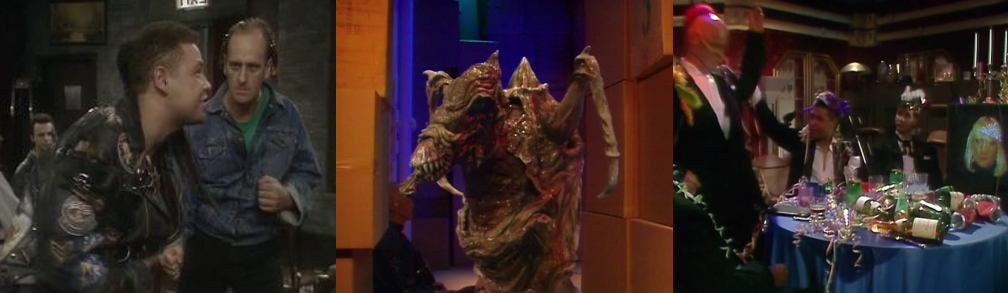
Indeed, in a series full of standout episodes, “Polymorph” is one of the best. In keeping with series tradition, the titular creature (which is totally not a Xenomorph) isn’t an alien, but a genetically engineered lifeform (GELF) bred to remove its victim’s emotions. Beginning as a comical slug-like creature, the polymorph changes shape to lure in its prey and grows larger and more monstrous the more it feeds. It even feeds on artificial emotions, removing Rimmer’s anger and Kryten’s guilt, turning the former into a peace-loving hippy and the latter into an outspoken rogue. The Cat, normally the most stylish and confident of the crew, is reduced to a whiskey swilling vagrant happy to throw away his life when the creature removes his vanity and Lister becomes an angry, trigger happy brute eager to tackle the creature even if it means “sacrificing his life in some stupid, pointless way”. With only Holly on hand as the voice of reason, the dramatically compromised crew only succeed through pure luck and, even then, the ending suggests that a second polymorph is lurking in the background. “Backwards” is also a favourite of mine; though Lister’s initially amazed to finally be back home, he soon realises that he cannot exist in a world where time runs in reverse. Kryten and Rimmer, however, find a niche as the “Sensational Reverse Brothers” and are prepared to stay before a “barroom tidy” sees them fired as pub entertainers. Finally, “Timeslides” is a fun episode that starts off exploring Lister’s loneliness and anger and evolves into a game of one-upmanship not unlike “Stasis Leak” (Bye, 1988) where Lister and Rimmer desperately travel to different snapshots of their pasts to try and invent a simple but profitable stress reliever and change their fates. When Lister convinces his past self (Emile Charles) to patent the Tension Sheet, he, Cat, and Kryten disappear from the timeline, leaving Rimmer alone with Holly. Refusing to accept this, Rimmer first tries to convince the now wealthy and successful Lister to rejoin the crew and then travels to an earlier point in time to beat him to the punch. While his younger self (Simon Gaffney) fails to follow his instructions, Rimmer inadvertently restores the timeline…and himself to life. However, his elation is short-lived as he accidentally blows himself up, completely restoring the status quo.

The Summary:
As with the previous two series, I generally watch the Remastered version of Red Dwarf’s third season (1998), which replaces all model shots with CGI models and a new opening sequence. Series three includes some additional changes, most notably in “Polymorph” where new CGI first-person shots of the slug-like polymorph’s travels were added alongside a text epilogue to the episode that states the polymorph died in Lister’s underpants drawer, and a bizarre redubbing of Rimmer’s mother (Kalli Greenwood). It’s also worth nothing that the DVD release of the series allows you to watch “Backwards” in reverse, meaning all the Backworld dialogue is now understandable and reveals that the pub manager’s (Arthur Smith) tirade at Rimmer and Kryten is simply the actor mocking the efforts of people to understand his dialogue! Rimmer debuts perhaps his most iconic look here and has become a foil for the entire crew, rather than just Lister. He despairs of Kryten’s constant subservient demeanour but doesn’t hesitate to take advantage of it when it suits him, is more than happy to gorge himself in Lister’s slovenly body, and bemoans Holly’s incompetence when she’s unable to tell the difference between specks of grit and black holes. Lister occasionally shows a surprising emotional maturity this season, desperate to convince Rimmer and Kryten to leave Backworld, revealing much of his chirpy disposition is covering a depressing pain at being the last man alive, and raging at the idea that Kryten could be so easily replaced. Both Lister and Rimmer reveal more about their pasts, such as their sexual experiences and childhoods, adding additional dimensions to their characters even as they try to compromise the other into burning their beloved possessions or change their fates. It’s great seeing their roles literally reversed in “Bodyswap”, where Lister’s powerless to keep Rimmer from ruining his body with cigars and food and Rimmer becomes addicted to the rush of being alive, a euphoria that no doubt informs his short-lived celebration at the conclusion of “Time Slides”.    
The series expands on the characters’ personalities through humour and pathos.

Jokes in series three are absolutely top notch; all the characters feel far more familiar and the actors much more comfortable with each other so their rapport is even more natural. Even Kryten fits in like a glove, with Robert Llewellyn easily taking up the mantle from David Ross and making the character his own. Kryten’s interactions with Lister and Rimmer in episodes like “Polymorph” and “Body Swap” showcase how hilarious this group can be, with Kryten forced to obey every command “no matter how insane” and performing menial tasks by plugging appliances into his groin. I also enjoyed Lister repurposing medical supplies for his meal and scuffling with Adolf Hitler and Nuremberg, and that series three gives the actors a chance to explore different sides to their characters. “Polymorph” is the most obvious example as they all undergo extreme personality changes and are rendered even more inept as a result. “Timeslides” also shows us a version of Lister without his shady moral compass, and his naïve but charismatic younger self, while Rimmer develops a carefree and increasingly insane attitude when he hijacks Lister’s body. Kryten is also faced with his far more efficient, imposing replacement in “The Last Day”, a surprisingly emotional episode in which Lister first refuses to accept and then is determined to celebrate Kryten’s impending shutdown. The drunk crew share some emotional scenes that soon lead to accusations about Lister’s parentage and, though desperately hungover, resolve to defend Kryten from the maniacal Hudzen-10 even though they’re physically outmatched. Similarly, the crew are faced with their pending destruction when Lister accidentally activates the ship’s self-destruct sequence in “Body Swap”, a desperate situation masterfully subverted when it’s revealed Holly disposed of the bomb and never told the crew since they didn’t ask! Additionally, Lister faces his own impending demise in “Marooned” where he’s forced not only to rely on Rimmer for emotional support but also to choke down dog food and Pot Noodles. This is an equally torturous situation for Rimmer not just because he faces the very real possibility of watching the closest thing he has to a friend die before his eyes, but also because Lister burns Rimmer’s prized possessions to stay alive. Interestingly, Rimmer seems to connect with the younger Lister, though his enthusiasm for the “Om” song could easily be interpreted as sarcasm. Still, his impassioned plea to the time-altered Lister seems genuine, though born from his fears of loneliness.

Series three was peak Red Dwarf and established a new standard for the show.

As much as I enjoyed series two, series three of Red Dwarf is where the show really started to land with me. Every episode is a gold mine of comedic situations and memorable moments. While many of these are in “Polymorph” (still one of the best episodes of the entire show), each episode shines as the writers explore the boundaries of the show’s unique sci-fi setting. Kryten was a welcome presence, adding additional comedy by playing the logical but still awkward straight man to his more volatile crewmates. It was fun seeing the crew bumble about on Backworld, riding and driving backwards without really realising it and performing simple tasks to the amazement of their audience, with the reverse brawl being an obvious highlight. I enjoyed exploring Rimmer and Lister’s relationship in “Marooned”, how they genuinely seemed to connect and yet Lister couldn’t help but sabotage Rimmer’s beloved family heirloom to safeguard his guitar. “Polymorph” explored extreme opposites of their personalities, showing that this ragtag crew may be dysfunctional but support each other well despite being very different personalities. “Body Swap” explored these personalities in a fun new way, with Lister left disapproving of Rimmer’s outrageous antics and getting a taste of how helpless Rimmer often feels as a hologram. While there are some logic gaps in “Timeslides”, the time travel shenanigans were fun and I enjoyed exploring a world where Lister never got marooned in deep space yet was still a slob, despite his great wealth. “The Last Day” is a great character showcase for Kryten, showing how much the crew care for him (Lister especially) to the point where they willingly defend him even though Hudzen-10 deems them all “viable targets” for termination. The resolution to this is as ingenious as it is hilarious: the menacing mechanoid is forced into a “metaphysical dichotomy” when Kryten lies about the existence of Silicon Heaven, cementing his place in the crew. Series three is easily the best of the classic era of Red Dwarf and a must-watch for anyone looking to get into the show. It’s sci-fi sit-com at its finest and showcases some of the best and most amusing moments for the crew and remains as appealing today as it was all those years ago.

My Rating:

Rating: 5 out of 5.

Fantastic

Is series three of Red Dwarf your favourite of the show’s run? What did you think to Kryten becoming a full-time member of the crew? Did you enjoy the exploration of Lister and Rimmer’s relationship and their constant one-upmanship? What did you think to the depiction of time travel and solidarity the crew showed towards Kryten? Which episode was your favourite and how are you celebrated Gazpacho Soup Day today? Feel free to share your thoughts and memories of Red Dwarf down in the comments and be sure to check out my other Red Dwarf content on the site.

Screen Time [Doctor Who Day]: The Day of the Doctor


On this day, the 23rd of November, in 1963, the longest-running and most successful science-fiction television series ever, Doctor Who, first aired on BBC One in the United Kingdom. Since then, the rogue Time Lord has gone through numerous incarnations and is widely celebrated as one of the most iconic and recognisable mainstream cultural icons in the world.


50th Anniversary Special:
The Day of the Doctor

Air Date: 23 November 2013
UK Network: BBC One
Stars: Matt Smith, David Tennant, John Hurt, Jenna Coleman, Jemma Redgrave, Ingrid Oliver, and Billie Piper

The Background:
In 1963, the BBC’s Head of Drama, Sydney Newman, commissioned a show that would appeal to be children and adults alike to fill a gap in the BBC’s schedule, one eventually outlined by writer Cecil Webber. The result was Doctor Who, a long-running science-fiction franchise in which a time travelling alien delighted audiences with historical hijinks, battles against terrifying cybernetic aliens, and emotionally charged morality tales. Save for a hiatus in the 1990s, Doctor Who has been a BBC staple for decades, with various actors stepping into the role thanks to the character’s unique ability to “regenerate” when dying. While debates rage about who is the best Doctor, two names often top the rankings: Tom Baker and David Tennent. After five years as the popular Tenth Doctor, Tennent finally passed the torch to Matt Smith, who won over audiences with his youthful exuberance. However, in the style of his predecessors, Tennent returned to the role for this 50th anniversary, reuniting with co-star Billie Piper (though in a dramatically different role). Tennent and Smith joined legendary actor John Hurt, who readily agreed to join the show and had been previously teased as a forgotten incarnation of the Doctor earlier that year. Accompanied by a short cinema release and two short tie-in episodes, The Day of the Doctor was simultaneously broadcasted in 94 countries to avoid plot leaks and met with critical acclaim. Reviews loved the chemistry between the three Doctors and its celebration of the show’s rich history, though the Zygon sub-plot and the handling of the War Doctor was criticised.

The Plot:
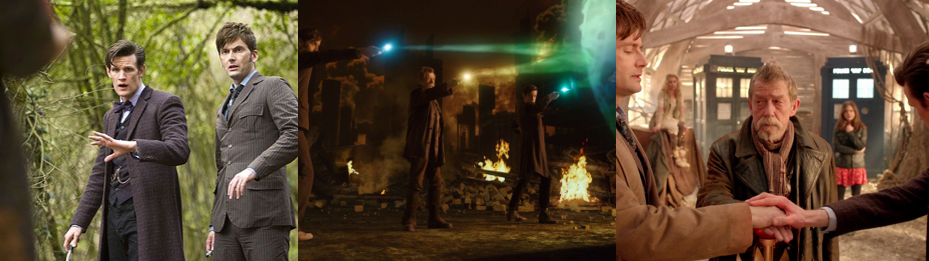
A Zygon plot to destroy London sees the Eleventh (Smith) and Tenth (Tennant) Doctors crossing paths with their former renegade incarnation (Hurt). Together, they reconcile their past by revisiting the last days of the Time War between the Time Lords and the Daleks.

The Review:
The Day of the Doctor takes place during a pretty tumultuous time in the Eleventh Doctor’s life. Most of Matt Smith’s run focused on the Doctor’s ultimate end, a seemingly unavoidable fate that would one day see him buried within his own embiggened TARDIS on the barren wasteland known as Trenzalore. Despite being fully aware of the finality of this inevitability, the Eleventh Doctor continues to be his usual energetic self, a quality I really came to enjoy about Matt Smith’s portrayal and one that juxtaposed his youthful appearance and childlike enthusiasm with a haunted, sombre, aged demeanour at times, both aspects of his personality that are exhibited in this 50th anniversary special. Indeed, the Eleventh Doctor is excited to be heading to the National Gallery with one of his most beautiful and charismatic companions, Clara Oswald (Coleman). He is summoned there by the Unified Intelligence Taskforce (UNIT) and meeting with Kate Lethbridge-Stewart (Redgrave), daughter of the Doctor’s old military correspondent Brigadier Alistair Lethbridge-Stewart (Nicholas Courtney, represented through archival pictures). The Eleventh Doctor relishes his impromptu helicopter ride over London and showing off his status amongst the UNIT personnel to Clara (who, despite having wandered through all of the Doctor’s lives, had no knowledge of his past ties to UNIT). Kate shows the Doctor a mysterious painting he knows all-too-well, a graphical depiction of the last day of the Time War; specifically, the fall of Arcadia and the day the Doctor, in a previous, hitherto unknown incarnation, personally ended the conflict. Since Doctor Who returned in 2005, the mystery of the Time War and the impact it had on the Doctor had been hanging over the show, and his demeanour, like a dark cloud. Burdened by guilt and scarred by the atrocities of war, many of which he perpetrated, the Doctor has effectively been running from his past for years now, but The Day of the Doctor forces him to confront in ways he never imagined.

A middling Zygon invasion proves the catalyst for a cathartic multi-Doctor adventure.

The main plot of the special revolves around, of all things, the Zygons. These monstrous shapeshifters try to conquer the Earth by subduing and replacing key figures in human history. One of their earliest efforts occurs back in 1562, when a Zygon attempted to replace Queen Elizabeth I (Joanna Page). Luckily, Queen Elizabeth was swept up in a whirlwind romance with the Tenth Doctor at the time, though even his cobbled together technology, intuition, and previous experience with the Zygons proves largely incapable of detected the Zygon threat. Time and again, both he and his successor fail to spot who’s a Zygon and who isn’t, leading to the Tenth Doctor putting his foot in it when he accuses the real Queen Elizabeth of being a bad fake. Luckily for him, he’s a dishy time traveller and she’s more amused by his incompetence than annoyed by his accusations. She also proves more capable than he is, fooling the other Zygons with her own impersonation skills (though, to be fair, he was distracted by his other incarnations). In the Eleventh Doctor’s time, the Zygons impersonate Kate and UNIT staff like Petronella Osgood (Oliver) to access the “Black Archive”, a super-secret vault deep within the TARDIS-proofed Tower of London that provides the Zygons with the means to take over London. Of all the threats to bring three incarnations of the Doctor together, the Zygons are disappointingly weak. They’re clunky, awkward creatures and this B-plot merely serves to unite the bickering Doctors and provide them the inspiration for saving their people. The Zygons have been using Time Lord technology to freeze themselves in paintings and covertly invade other worlds, technology that the Doctors use to briefly revisit the Time War and to travel back to the present day to force the humans and Zygons into an amicable truce rather than mutual destruction. They’re not a very compelling enemy (the Sontarans would’ve been much better), though they are defeated in an interesting way (the Doctors force both groups to temporarily forget which species they are). Naturally, the Daleks do appear, but merely as a cameo and purely in sequences depicting the chaotic Time War, where their power was at their mightiest and their thirst of victory was matched by the Time Lords.

The forgotten War Doctor sees how his decisions will shape the men he will become.

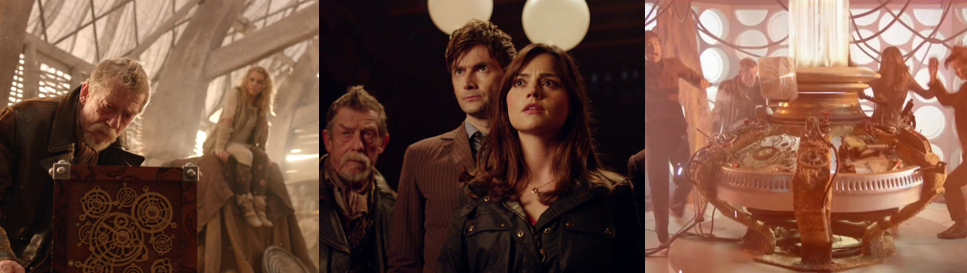
The Day of the Doctor firmly explains that, during the Time War, the Doctor took on a new face and forsook his name and title. Dubbed “The War Doctor”, this new incarnation fought a ruthless battle against his mortal foe for untold generations. The very nature of the Time War meant it existed in perpetuity, with victories, loss, deaths, and resurrections all happening at once. Finally, after an age of nonstop violence, the War Doctor decided he had had enough. Now aged to an old, battle-weary warrior, he took it upon himself to end the bloody conflict the only way he knew how. Thus, he broke into Gallifrey’s weapons facility and stole a doomsday weapon so destructive even their military General (Ken Bones) was afraid of it. A strangely archaic cube of cogs, the “Moment” can wipe out entire universes and is powered by a sentient artificial intelligence. Taking the form of a figure it knows is (or will be) important to the Doctor, the “Bad Wolf” (Piper), it questions the War Doctor’s motivation and, in a bid to show him what wiping out every single man, woman, child, and Dalek, will do to him, conjures a time vortex to show him his future selves. Honestly, I was never a fan of the War Doctor concept; I would’ve much preferred Paul McGann or Christopher Eccleston returned to portray this role rather than retroactively bump up the Doctor’s incarnations. However, you can’t go wrong with John Hurt and he portrays this forgotten, reviled incarnation with gusto. Despite being beaten down by war and technically being younger than his counterparts, the War Doctor is a cantankerous, grandfatherly figure who initially admonishes his successors’ buffoonery. He’s stunned that they don’t seem to take anything seriously or treat their equipment with respect and, much like the First Doctor (William Hartnell) in the first multi-Doctor special, is portrayed as the more authoritarian and sensible of the three despite being at least 400 years younger than them.

The Tenth and Eleventh Doctors are forced to confront, and embrace, their violent past.

The Tenth and Eleventh Doctor are horrified to see their renegade incarnation, treating him as a dangerous, almost bogeyman-like figure from their past that they’ve buried deep at the back of their minds. Prompted by the Moment, the War Doctor asks pertinent questions to understand how committing genocide will affect him and learns that the Tenth Doctor was haunted by the decision and the Eleventh has tried to move on and forget about it. The Tenth is outraged at such a suggestion, stunned to find his future self has gotten over the worst decision they ever made, but it’s clear that the Tenth Doctor is still tormented by his past and simply trying to find a productive way forward. While they take an instant dislike to each other (the Tenth Doctor hates his successor’s new TARDIS interior, as is tradition), the Tenth and the Eleventh Doctor have a lot in common. Both favour spectacles, suits, and being more flamboyant with their sonic screwdrivers, eschewing the War Doctor’s more practical and scientific approach for a dramatic flair. The Eleventh Doctor is largely critical of his predecessor’s more theatrical approach, especially his way with women, while the Tenth Doctor criticises his successor’s dress sense (particularly the fez). The two bicker here and there but mostly engage in a game of one-upmanship, comparing their sonic screwdrivers and competing to see who can solve problems faster, with both being trumped by the War Doctor’s more measured approach. Hardened by their past experiences and desperate to keep Kate from making the same mistakes, the two intervene to reach a more amicable solution and the War Doctor sees that his decision, while horrendous, will save countless lives since his future incarnations try to atone for their past. Their adventure together sees the Tenth and Eleventh Doctor embrace their forgotten counterpart and, in a bid to help the War Doctor face his decision, they willingly join him in activating the machine, only for Clara’s distraught reaction to show them they can come up with a better solution.

The Doctors’ desperate plan sees Gallifrey saved and their pain eased as a result.

Inspired by their solution to have their sonic screwdrivers calculate a formula to vaporise a door (a plan amusingly foiled when Clara reveals their cell was never locked!), the Doctors use their TARDISes to collude with all twelve thirteen of their other incarnations to utilise the Zygon picture-hopping technique and shift Gallifrey to, essentially, a pocket dimension, destroying the Daleks in the process. While the General initially resists since it would mean the Time Lords are trapped in another dimension, he relents since it means the survival of their race and the Thirteen Doctors co-ordinate their TARDISes to execute the plan, sparing Gallifrey and undoing the Doctor’s darkest moment. Unfortunately, due to the unstable timelines, none of the three will remember this and the War Doctor resigns himself to having to live thinking he committed genocide, knowing he’s earned his title once more and that he’ll be succeeded by such fine men and welcoming his regeneration into the Ninth Doctor (Christopher Eccleston). The Tenth Doctor also urges the Eleventh Doctor to find a solution to their impending demise at Trenzalore, reasoning that their actions in this adventure prove they can always find some way out. Left to ruminate over the depiction of Gallifrey’s last stand, the Eleventh Doctor is visited by a strangely familiar curator (Tom Baker), who hints both that he’s a future incarnation and that the Doctor’s next journey will see him trying to recover his lost people. Of course, The Day of the Doctor was also accompanied by two short tie-ins. While “The Last Day” (Stone, 2013) isn’t that great and weirdly depicts a first-person account of the Daleks’ invasion of Arcadia, “The Night of the Doctor” (Hayes, 2013) saw the long-awaited return of perhaps the most underappreciated Doctor, the Eighth (Paul McGann), and showed how he regenerated into the War Doctor. After failing to save a doomed pilot since the Time Lords are as reviled as the Daleks, the Eighth Doctor is offered a chance to regenerate into a warrior by Ohila (Clare Higgins) of the Sisterhood of Karn, forsaking his name and passive ways in favour of a new form more fitting for a violent war.

The Summary:
As you’d expect from a 50th anniversary special, The Day of the Doctor contains a fair few Easter Eggs and references for long-time series fans. The opening, for example, is basically a shot-for-shot remake of the first-ever episode, An Unearthly Child (Hussein, 1963); Clara teaches at Coal Hill School; the Tenth Doctor echoes the Second Doctor (Patrick Troughton) with his “I don’t like it line”, and the General echoes the Brigadier when multiple Doctors show up. The Black Vault is full of gadgets and callbacks to previous adventures, including photos of previous companions and incidents, and much of the special refers back to the Tenth Doctor’s era. Perhaps the most exciting inclusion was the brief appearance of Peter Capaldi as the upcoming Twelfth Doctor, which was a fun tease that hadn’t been done before. All the Doctors (at that point in time, anyway) cameo in the finale thanks to archival footage and some rather disconcerting digital stand-ins, but it’s Tom Baker’s heartwarming reappearance as a possible future incarnation that steals the show at the end. Honestly, I’m surprised by the restraint, really. There could’ve been loads more lore and cameos and references stuffed in here but, instead, The Day of the Doctor wisely focuses on exploring this unknown chapter of the Doctor’s life and tying into what viewers saw with the Tenth and were currently experiencing with the Eleventh. The special is thus a story of grief, mourning, and dealing with difficult decisions. The Tenth and the Eleventh Doctor are haunted by their actions and the War Doctor is hesitant to activate the Moment but comes to see that the deaths of billions will safeguard innumerable other lives. The relief he feels when his counterparts suggest a wild, outrageous third option is palpable and all three get a sense of catharsis from undoing this one heinous act that scarred them for so many years.

A forgotten era of the Doctor’s life is explored and his character examined in new ways.

While I’m no fan of Billy Piper and never liked her portrayal of Rose Tyler, it was nice to see her here as the Moment, an advisory, sentient AI only the War Doctor can see and hear. Through her, he meets his successors and sees that, while his actions will be traumatic for him, he’ll eventually grow beyond it and also put his lives to good use saving others as recompense. I’m not sure where the Tenth Doctor is being pulled from in his time stream but he’s a little more haggard and broken than what we usually see. He’s still cracking wise and masking his pain behind a bombastic façade, but it’s clear he’s being written to still be very raw over his actions in the Time War. In comparison, the Eleventh Doctor is just as haunted but has found more productive ways to cope. He attacks life with a youthful exuberance and delights in every adventure, determined to help whenever he can so that his dreadful actions can have some positive meaning in the universe. This makes Clara’s intervention when the three prepare to activate the Moment all the more poignant, since she never pictured “her” Doctor’s face as being responsible for so many deaths. Her presence has a positive impact on the War Doctor, too. It’s clear he hasn’t had a companion for some time and is struggling with the blood on his hands and the path that lies before him, but I enjoyed how he was this gruff old man who whipped his younger/older selves into shape. Again, I still would’ve preferred seeing the Eighth or Ninth incarnation fulfil this role just to make things less messy but the mystery surrounding the War Doctor is intriguing and I like how his counterparts are equal parts ashamed, afraid, and disgusted by him. Yet, in spending time with him and finally confronting this dark and oppressed part of their lives, they come to accept that the War Doctor was and still is a part of them and acknowledge him as a necessary evil in their long lives.

Cameos, references, and a heartfelt celebration of the series make for an enjoyable special.

The War Doctor, in turn, comes to feel vindicated and accepted for the first time in ages. Having forsaken his name and pacifist values and committed himself to war for so long, the pride he feels in being known as the Doctor once more shines through and allows him to regenerate with dignity rather than in infamy. While the Zygon subplot isn’t all that interesting and largely detracts from these more interesting narrative beats, I did like how it brought the three together. I just wonder if, maybe, looping in some kind of Dalek plot wouldn’t have been better. Like, maybe Davros (Julian Bleach) or an Emperor Dalek could’ve used the magic picture technology to escape the Time War and threaten to unravel it, spilling it into the universe once more. Sure, we wouldn’t have had the doppelgänger plot or the creative resolution to the Zygon invasion, but it might’ve been more visually and thematically interesting for the three Doctors to team up against their mortal enemy in a more explicit way for the 50th anniversary special. Still, the main selling point here is the exploration of the Time War and the War Doctor’s part in it and delving into how badly his violent actions affected him over the years. This was a constant and recurring thread in the revival series (and even cropped up in later years, especially after Gallifrey was wiped out once again!) and formed a central part of the Doctor’s character from 2005. The Day of the Doctor aims to bring him some catharsis, sewing the seeds in the Tenth Doctor to move past his actions ahead of regenerating into the Eleventh and, in this regard, it succeeds admirably. Throw in some fun cameos, entertaining interactions between the three incarnations, and a solid, emotional narrative core and you have an extremely enjoyable celebration of the long-running franchise.

My Rating:

Rating: 4 out of 5.

Great Stuff

What did you think to The Day of the Doctor? Are you a fan of multi-Doctor adventures or do you find that they’re confusing and lacklustre affairs? Is the Tenth Doctor one of your favourites? What did you think to his interactions with his counterparts? Were you disappointed that a new, unknown incarnation was created, or did you enjoy seeing John Hurt take on the role? Would you like to see more multi-Doctor adventures featuring the modern cast? How are you celebrating Doctor Who Day today? Let me know your thoughts on Doctor Who and its 50th anniversary special down in the comments and go check out my other Doctor Who reviews.

Screen Time: Batman: “Joker’s Favor” (S1: E22)

Series 1, Episode 22: “Joker’s Favor”

Air Date: 11 September 1992
Director: Boyd Kirkland
Original Network: Fox Kids
Stars: Mark Hamill, Arleen Sorkin, Ed Begley Jr., and Kevin Conroy 

The Background:
Gotham’s caped crusader is no stranger to adaptation. Around three years after his debut appearance, Bruce Wayne/Batman was brought to life in an oft-forgotten fifteen-chapter cinema serial and made his first appearance in animation in The Batman/Superman Hour (1968 to 1969), courtesy of Filmation. After the critical and commercial success of Tim Burton’s Batman movies, Batman (1989) and Batman Returns (1992), Batman shed the remnants of the camp trappings that had been associated with him since the sixties and was popularised as a dark, brooding vigilante once more. Perhaps no piece of ancillary media was more influential in this, however, than Bruce Timm and Paul Dini’s Batman: The Animated Series (1992 to 1999), which placed the Dark Knight into a distinctly art deco world and pushed the boundaries of what cartoons could get away with. Eventually expanding into an extremely popular animated DC universe, Batman: The Animated Series not only came to influence subsequent Batman media but also introduced new characters to the Bat-world, with none more prominent than Doctor Harleen Quinzel/Harley Quinn. Created by Dini and Timm for this very episode, Harley was initially planned to simply be a one-off character but Dini decided to make her a recurring antagonist, an abused henchwoman whom the Joker (Mark Hamill) could play off. Initially portrayed by the late Arleen Sorkin, Harley quickly became a popular breakout character and was officially woven into the mainstream DC Comics in 1999. She has seen significant growth since then, transitioning from the Joker’s mistreated plaything to a strong, independent – if maniacal – anti-hero and even joining the Bat-Family in later years. Harley Quinn has become so popular that she made the transition to live-action with a pitch-perfect performance by Margot Robbie and a tone deaf outing from Lady Gaga, got her own hilarious animated series, and has consistently cropped up in videogames and animated ventures, to the point where she’s now considered to be as important to DC Comics as heavy-hitters like Batman and the Justice League

The Plot:
Mild-mannered accountant Charlie Collins (Begley Jr.) insults the Joker (Hamill), who spares his life in return for aiding him and right-hand woman, Harley Quinn (Sorkin), in their latest plot.

The Review:
This is my first time reviewing an episode of Batman: The Animated Series on my website beyond the feature-length productions, and it’ll come as no surprise how much I love this series. I didn’t watch every single episode as a kid (though I have since) but I really enjoyed the entire DC Animated Universe. It was fun seeing these characters and their stories adapted and tweaked and presented in an engaging and serious way, no more so than Batman, whose mainstream popularity was arguably bolstered by Bruce Timm and Paul Dini’s animated series. The show makes an impact right from the start with its stark, gritty opening sequence that’s completely devoid of any titles or text. It screams “Batman” and really sets the tone for what’s to come. That and the stellar voice cast; it’s impressive how many character, veteran, and big-name actors featured on the show, with Mark Hamill’s turn as the Joker widely regarded as one of the best interpretations of the character, to say nothing of Kevin Conroy’s enduring and timeless take on the Batman himself. All this is to say that Batman: The Animated Series rarely missed; it changed superhero cartoons and adaptations for the better and its impact on the source material is just as significant, with Harley Quinn being just one piece of that puzzle. With the obligatory gushing out of the way, let’s get to the episode, which opens to find Charlie Collins stuck in Gotham City traffic on perhaps the worst day of his life: he’s been turned down for a raise, his kid needs braces, the ball game has been delayed, and his wife Bonnie is making meatloaf! Charlie hits his breaking point when a fellow driver rudely cuts him off; sick of being treated like a punching bag, he barges into the car and hurls insults at the driver, only to find the Joker behind the wheel!

After insulting the Joker, hapless Charlie Collins is coerced into aiding his latest devious scheme.

Despite Charlie’s best efforts to drive along amiably and lose the Joker, his car eventually breaks down, allowing the Clown Prince of Crime to confront him in the woods. Amusingly, the Joker is offended by Charlie’s rude behaviour and chastises him for being so impolite, though his teacherly demeanour quickly turns to a sinister anger, reducing Charlie to begging for mercy. Intrigued by Charlie’s desperation to save his hide, the Joker gleefully agrees to spare him on the proviso that Charlie promises to do him a favour at some point, with even the Joker unsure as to what that favour may be. Charlie readily agrees, relieved to be in one piece, and the episode jumps ahead two years and to the office of police commissioner James “Jim” Gordon (Bob Hastings), who’s due to be honoured for his work, something he finds to be a waste of time. The Batman (Conroy) echoes the sentiments of Detective Harvy Bullock (Robert Costanzo) and many others by stating that Jim deserves credit for keeping Gotham safe around the clock, and Jim begrudgingly agrees to attend the function. Unbeknownst to him, the Joker has also set his sights on gatecrashing the event; as he relates to his enthusiastic cheerleader, Harley Quinn, the Joker insists demands the chance to honour Gordon and picks Charlie’s driving license out of his little black book to call in that favour. Despite changing his name to Don Wallace and moving himself and his family to Ohio, Charlie is terrified when the Joker calls him, having kept tabs on him the entire time, and demands that he return to Gotham in return for keeping his family safe. With no other choice, Charlie makes the flight and is picked up by Harley before he can alert the police. The Joker expertly feigns pleasure at seeing his “old pal” once again and promises to send him home once he’s fulfilled his obligation, asking simply that Charlie opens a door for Harley when she delivers a massive celebration cake to Gordon’s gala under the clever guise of Crazy Clown Catering.

The Joker underestimates Charlie’s resolve and ends up falling for his bluff.

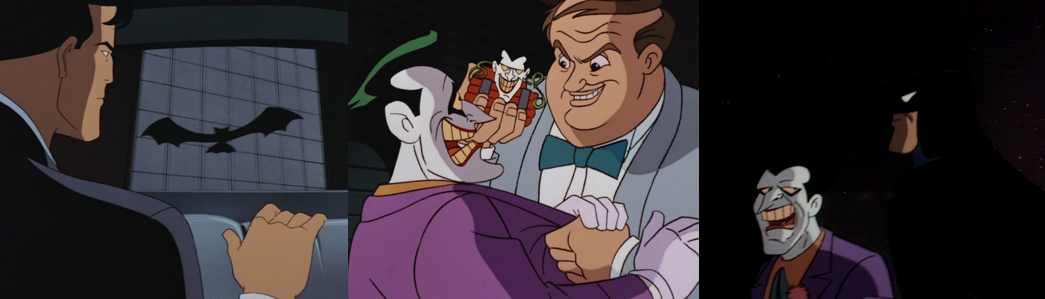
Entering the gala, Charlie desperately tries to alert the authorities – and the Batman – to the Joker’s plot by swinging around a convenient bat-shaped model, catching the attention of Bruce Wayne as he’s leaving to search for the Joker. As Gordon delivers his speech, Charlie opens the doors to the function room and Harley wheels in his cake (much to Bullock’s lustful delight), but finds himself glued to the door by a particularly strong adhesive. Harley delivers a rhyming threat and promptly gases the attendees, paralysing them and leaving them powerless to avoid the bundle of dynamite the Joker delivers as a gift to the long-serving commissioner. Charlie is incensed that the Joker welched on his word, but the Batman makes a timely arrival to toss the dynamite out of the building, destroying the Joker’s getaway van. After freeing Charlie and learning of his plight, the Batman easily subdues Harley and the Joker’s goons, but the Joker covers his escape with a series of boobytraps and an explosion. However, while he’s racing away outside, the Joker is confronted by an angered Charlie, who’s ready to blow them both up with one of the Joker’s own bombs, apparently having lost his mind. Terrified, the Joker screams for the Batman’s intervention and willingly hands over all the documentation he has on Charlie and his family, completely falling for the disgruntled civilian’s bluff. Charlie gratefully leaves, happy to taste his wife’s meatloaf, now that the Joker is in Batman’s custody and his family is safe.

The Summary:
This was a fun little side story in the grand tapestry that was Batman: The Animated Series. As ever, the episode is dark and gritty, sporting a neo-noir styling and expertly using shadows and atmosphere to give its simplistic character designs a surprising amount of nuance and paint the Batman as a terrifying, ethereal figure. The Batman himself features only briefly in this episode, primarily appearing in the last five minutes or so to foil the Joker’s plot, but makes an impression when he’s onscreen thanks to Conroy’s distinctive Bat-voice and the effortless way he deals with the Joker’s minions and traps. Indeed, the wider Batman cast takes a backseat in “Joker’s Favor” so the episode can focus more on the Joker and his recent “hobby”, poor, unlucky Charlie Collins, a balding, middle-aged, underappreciated husband and father who’s frequently horrified and dumbstruck by the duality of the Joker’s insanity and menace. Charlie is an incredibly amusing and sympathetic figure; despite his loving wife and child, he’s beset by bad luck almost to the point of parody and completely helpless to avoid the Joker’s reach. Even changing his name and uprooting his family doesn’t help, and his desire to keep them safe is what drives him to both agree to paying the Joker back and going along with his latest madcap scheme. Even the Joker sees Charlie as worthless and impotent, never once believing he would have the guts to raise the alarm or fight back, which allows Charlie to scupper the Joker’s plan with his makeshift Bat-Signal and even bring the Clown Prince of Crime to the verge of tears by threatening his life. This final showdown between them is especially potent given the Joker’s familiarity with how important “one bad day” can be. He pushed Charlie to the edge, terrorising, manipulating, and threatening him, and can see that the man is ready to have his revenge even if it means his own death. However, in an ironic twist, Charlie actually picked up a few of the Joker’s habits, mainly toying with his victims, and pulled a cruel prank on his tormentor, tricking him into giving up the hold he had over the accountant to save his own hide.

Harley shines as the Joker’s colourful cheerleader who follows his every word without question.

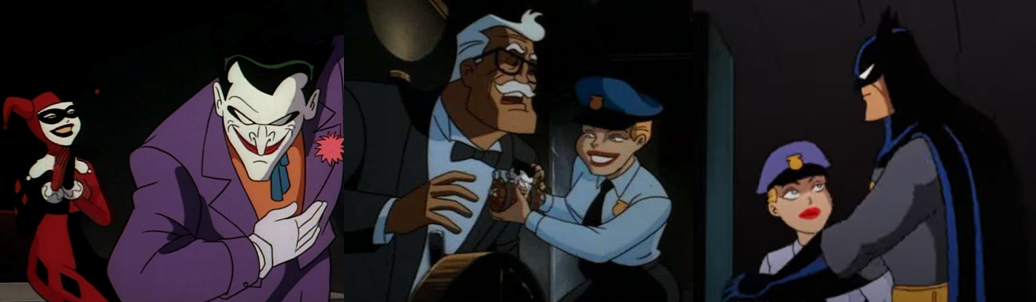
Of course, “Joker’s Favor” is best known for including the first appearance of Harley Quinn. Harley actually briefly appears early in the episode, walking through the police department in her civilian disguise, though this isn’t expanded upon in the episode and is more of an Easter Egg for eagle-eyed viewers. Harley is depicted as a joyful, enthusiastic, devoted follower of the Joker. I described her as his cheerleader earlier and that’s incredibly apt as she claps, celebrates, and encourages every idea, action, and word her “Mistah J” says, no matter how bonkers his scheme may be. Although she only appears in her trademark harlequin outfit once in this episode, Harley is seen to be a master of disguise. She dresses as a chauffeur to pick up Charlie and masquerades as a police officer when infiltrating Gordon’s gala, raising no suspicion either time despite her loud and overly cheerful demeanour. Unfortunately, we don’t get to see Harley in action here; she doesn’t bust out any gymnastics or her signature giant mallet. She does try to distract the Batman with her woe-is-me façade and surprise him with a knife attack, but is handcuffed with little effort from the Dark Knight. Similarly, we know nothing of her backstory, and she primarily exists as a more colourful henchwoman for the Joker, one he both openly confides in for his need for an appreciative audience and demeans with menial tasks like cutting his hair. Still, Harley excels in this role; you can tell that there’s more to her than the dumb, brutish thugs the Joker employs, and she steals every scene with her joyful and bombastic personality. Overall, this was an enjoyable episode for its main plot, but fans of Harley would be better served watching “Mad Love” (Lukic, 1993) or reading the original comic book of the same name (Dini, Timm, et al, 1993) for a more in-depth exploration of Harley Quinn, her relationship with the Joker, and her tragic origin story.

My Rating:

Rating: 3 out of 5.

Pretty Good

What did you think to “Joker’s Favor”? Did you enjoy the Joker’s tormenting of hapless Charlie Collins or did the lack of Batman action put you off? What did you think to Harley Quinn at the time, or how do you feel about this being her first appearance? Did she make much of an impression on you at the time and are you a fan of how widespread her popularity has become? What are some of your favourite Harley Quinn stories and moments, or episodes of Batman and the DCAU? There’s a comments section down below, feel free to use it to share your opinions, and be sure to check out my other Batman content across the site.

Screen Time & Knuckles: Sonic Underground & Knuckles


With the release of Sonic the Hedgehog 3 (SEGA Technical Institute, 1994), gamers were introduced to Knuckles the Echidna. This mischievous, dreadlocked antagonist was created by Takashi Yuda and his debut was made all the more impressive by virtue of the fact that Sonic 3 was too big to fit on one cartridge. This meant that Knuckles was the first of Sonic’s supporting characters to co-star in a main series videogame when Sonic & Knuckles (ibid) was released on this very day in 1994.


Episode Title: “Friend or Foe?”
Air Date: 28 February 1999

Episode Title: “Flying Fortress”
Air Date: 31 March 1999

Episode Title: “No Hedgehog is an Island”
Air Date: 7 April 1999

Episode Title: “New Echidna in Town”
Air Date: 13 April 1999

Directors: Marc Boreal, François Hemmen, and Daniel Sarriet
US Network:
BKN Kids II – UK Network: Channel 4

Stars: Jaleel White, Brian Drummond, Garry Chalk, Maurice LaMarche, and Peter Wilds

The Background:
After Sonic the Hedgehog blasted onto the videogame scene with Sonic the Hedgehog (Sonic Team, 1991), SEGA’s aggressive marketing campaign paid off dividends. Sonic’s popularity exploded after the release of Sonic the Hedgehog 2 (SEGA Technical Institute, 1992) and, suddenly, Sonic was everywhere, including two concurrent cartoons courtesy of DIC. While Adventure of Sonic the Hedgehog (1993; 1996) is generally criticised for its slapstick comedy, its darker counterpart, Sonic the Hedgehog (widely known as “SatAM”) is regarded as one of the defining cartoons of the nineties for its darker tone and mature themes. Although the cartoon inspired the original Archie Sonic comics, fans were left confused and disappointed when SatAM ended on an unresolved cliff-hanger. When the time came for SEGA to promote their up-coming Dreamcast, a new Sonic cartoon was commissioned, one that oddly took many visual inspirations from SatAM but told an entirely original story, one that owned more to Alvin and the Chipmunks (1983 to 1990) than its fan-favourite predecessor. Although Jaleel White returned to voice Sonic and his new siblings and writer Ben Hurst had some influence on the show, Sonic Underground became notorious for its musical interludes and struggled to find an audience thanks to the episodes being aired out of order. While the concept had even less to do with the source material than its predecessor (Sonic’s sidekick, Miles “Tails” Prower is nowhere to be found) and is widely regarded as one of the worst Sonic adaptations, Sonic Underground featured the debut of Knuckles the Echidna in Western animation and there was a sadly cancelled attempt to publish an epilogue to the much-maligned cartoon in 2013.

The Plot:
Whilst searching Planet Mobius for their mother, siblings, rebels, and rock stars Sonic, Manic, and Sonia (all voiced by White) cross paths with the distrustful and hot-headed Knuckles (Drummond). However, when the dastardly Doctor Robotnik (Chalk) manipulates Knuckles into providing him with a legendary Chaos Emerald, these four conflicting personalities must set aside their differences to oppose the doctor’s latest evil scheme.

The Review:
I watched all of Sonic’s cartoons when I was a kid. I distinctly remember watching Adventures of Sonic the Hedgehog every weekend, usually recording episodes for prosperity, and enjoying Sonic’s slapstick antics so much that I was shocked and confused when the entire tone and cast of the show suddenly changed. Sonic was no longer ridiculing Dr. Robotnik (Long John Baldry) and his minions and was instead the point man in an outnumbered resistance movement against a far darker, semi-cybernetic dictator much like in Sonic the Comic (1993 to 2002). I adapted to the new format and found myself enjoying Sonic’s dark escapades, only to be left further confused when SatAM ended on a massive cliff-hanger that teased a larger role for Dr. Robotnik’s long-suffering nephew, Snively (Charlie Adler) and a mysterious, red-eyed figure who I hoped would be Metal Sonic or even Knuckles! Sadly, we never got to see this ending resolved, even in the comics, and I was forced to adapt once again to an all-new Sonic cartoon, one that looked very similar to SatAM but was widely different and made the bold and frankly bizarre choice to lumber Sonic with two siblings. Why Tails and Amy Rose weren’t used in these roles I’ll never know but I was still a Sonic fan so I tried to give it a go, but to be fair I was about fourteen in 1999 so I was starting to veer away from cartoons like this.

After some initial antagonism, Knuckles and Sonic team up to safeguard the Chaos Emerald.

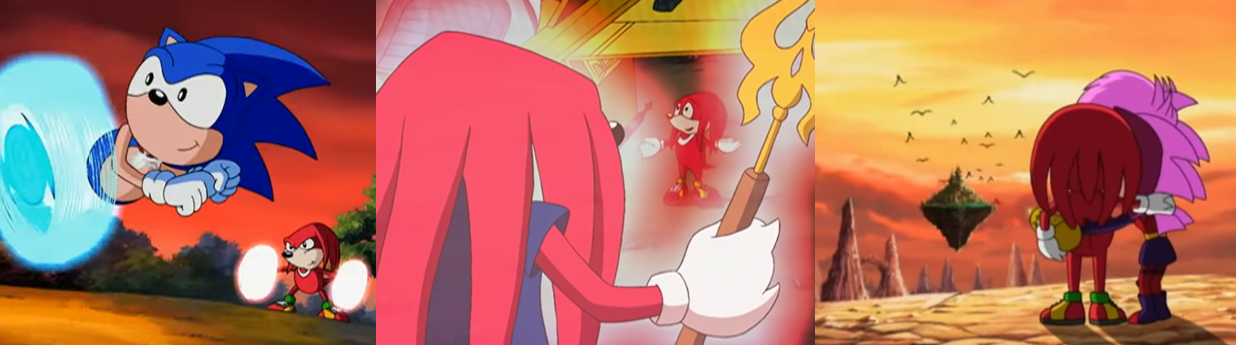
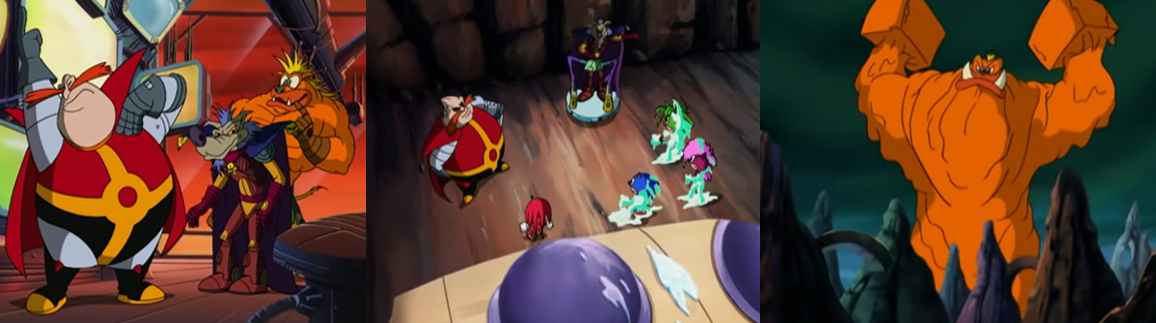
Although “Flying Fortress”, “No Hedgehog is an Island”, and “New Echidna in Town” make up a three-episode story arc revolving around Knuckles and the Chaos Emerald, they were broadcast out of order and the character actually made his first appearance in the standalone story “Friend or Foe?” Following the surprisingly catchy opening theme song (one of the few highlights of the cartoon), the episode finds Sonic, Sonia, and Manic travelling to the “dreaded” Floating Island in search of their long-lost mother, Queen Aleena Hedgehog (Gail Webster, and running afoul of boobytraps laid across the island by its mysterious echidna guardian. As ever, Dr. Robotnik is lumbered with two bungling minions: sleazy-but-cunning wolf Sleet (LaMarche) and the block-headed Dingo (Wilds), who transforms into different forms at the touch of Sleet’s remote controller. The two are ordered to the Floating Island to poison Knuckles’ mind against the hedgehogs, distracting him so they can steal the Chaos Emerald and send the island (and their enemies) plummeting to the ground. Thanks to a hilariously bad holographic fake, Knuckles is easily tricked and takes off to confront the three hedgehogs right as they learn from one of the island’s “sacred pools” that their mother was (and possibly still is) there. Despite Sonia’s best attempts to keep the peace, a sluggish and awkward scuffle breaks out between Knuckles and Sonic, which ends with the Sonia and Manic exploring the island’s underground caverns (in a close approximation of the Hidden Palace Zone) and learning of Knuckles’ deception. Although Sonic talks sense into Knuckles, they’re too late to stop Sleet and Dingo from stealing the Chaos Emerald and endangering the island. Luckily, Dingo is distracted by his lust for Sonia and the baddies are forced to flee without the emerald while the three fend off a contingent of SWATbots. In the aftermath, the siblings make amends with Knuckles, who reveals that he knows Queen Aleena and that she left a message indicating that he would become a pivotal ally in their crusade.

The siblings recruit Knuckles to help defeat the flying fortress, only for Sleet and Dingo to steal its Chaos Emerald.

A few episodes later, the siblings are relaxing at the beach when they’re attacked by Dr. Robotnik’s spherical “Fortress of Altitude” (almost a downgraded version of the Death Egg or the Egg Carrier), a flying fortress capable of bombarding his foes and shrugging off the laser blasts from their magic weapons thanks not only to being comprised of “Mobibindum” but also being powered by a Chaos Emerald, which atomises everything it touches. After fending off Dr. Robotnik’s SWATbots and evading the flying fortress, the siblings seek out Knuckles’ help. Initially reluctant to leave the Floating Island, Knuckles is convinced by their awful song (“No One is and Island”), though his resolve falters when the astral spirt of his great-grandfather, Athair (LaMarche), warns that this will result in a greater calamity. After easily fooling Dr. Robotnik with a decoy, Knuckles and the others slip aboard the flying fortress, avoid the ship’s defences, and burrow their way to the Chaos Emerald thanks to Knuckles’ super strength. However, after being callously dismissed by Dr. Robotnik, Sleet and Dingo claim the Chaos Emerald for themselves to both stand on their own and to try and prove their worth to their master. This causes the fortress to fall from the sky and into the sea below. Crippled by hydrophobia and unable to swim, Sonic relies on his family and friend to help get him to safety, but Sleet is stunned when usually thick-headed Dingo swipes the gem for himself! However, Dingo accidentally drops the Chaos Emerald, shattering it and unleashing a wave of unbridled Chaos Energy across the land that causes storms, earthquakes, and threatens the entire planet.

The heroes forge unlikely alliances to save the planet from being torn apart by Chaos Energy.

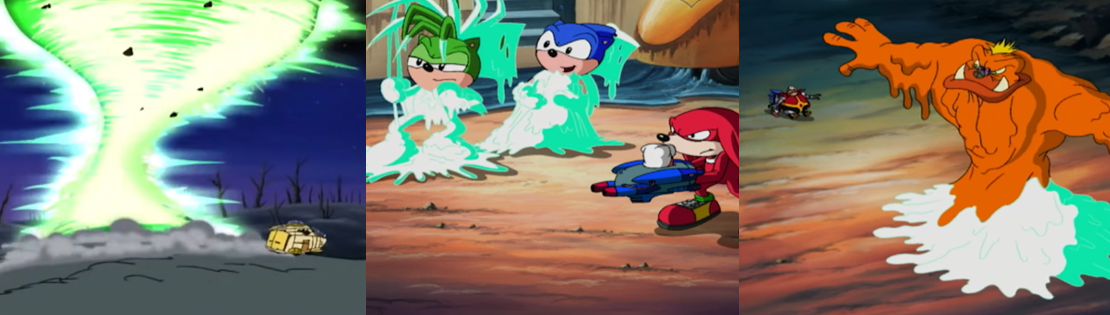
After his despair is lifted by another of the band’s terrible songs (“Learn to Overcome”), Knuckles leads them to his great-grandfather, who gifts them a special canister to house the shattered pieces and reveals that the only way to save the world is to ally with Dr. Robotnik. Naturally, Sonic and his siblings are aghast at this, but Knuckles is reluctant to defy his elder, especially with the fate of the world at stake. With the planet literally shaking apart from the rising Chaos Energy, the siblings race to find Knuckles and find another way to solve their problem, only to find that he’s been coerced into capturing them on Dr. Robotnik’s orders in exchange for the tyrant’s help in saving the world. Regretfully, Knuckles betrays his friends, only to be immediately double-crossed when Dr. Robotnik reneges on his promise not to roboticize the hedgehogs. Angered by this, a remorseful Knuckles fights back and frees his friends from their sticky bonds and joins them in searching for the Chaos Emerald, but they’re too late to keep Sleet from finding it and containing it in Dingo. This results in Dingo absorbing a full dose of Chaos Energy and transforming into a mindless, clay-like beast that threatens friend and foe alike. In what could arguably be described as a very loose adaptation of Sonic Adventure (Sonic Team, 1998), Dingo goes on a rampage that not only causes a series of volcanic eruptions but also destroys Manic’s magic drum set before heading to nearby Robotropolis, forcing Sonic to manipulate Dr. Robotnik’s ego to help subdue the beast. Toppled by the band’s music (“The Mobius Stomp”) and Dr. Robotnik’s special glue, Dingo spits out the Chaos Emerald, reverting to normal and saving the world and earning him his master’s ire. Knuckles then delivers the reassembled Chaos Emerald to Athair. Although the old echidna charges him with safeguarding the gem on the Floating Island, but the band promises that Knuckles will always have a place with them whether near or far.

The Summary:
Although the show has little in common with SatAM, Sonic Underground’s Sonic remains the same boastful, reckless speedster. In place of Princess Sally Acorn (Kath Soucie), Sonia acts as the voice of reason and intelligence in the trio, chastising Sonic’s irresponsible nature and emphasising diplomacy over impulsiveness wherever possible. Manic is characterised as a laid-back surfer dude who’s not as reckless as Sonic but still isn’t as attentive as Sonia. However, while Sonia might be the smartest of the bunch, she’s from an entirely different world to both. Sonic was raised to be a Freedom Fighter by his beloved Uncle Chuck (LaMarche) and has been fighting Dr. Robotnik for as long as he can remember, Manic is a streetwise thief, and Sonia comes from a life of privilege and luxury. All three were united by a common enemy when Dr. Robotnik roboticized the only family they ever knew and wield magic medallions that transform into music instruments that act as weapons, but Sonic Underground continuously emphasised their strength as a unit more than any previous Sonic cartoon. While Sonic possesses incredible speed, he’s impulsive and also crippled by hydrophobia. Sonia might have some fancy martial arts moves but she’s often too easily trusting of wealthy folk, who are often in Dr. Robotnik’s pocket. And Manic generally gets himself into trouble since he can’t help but half-inch when the temptation arises.

Though tough and wily, Knuckles is easily duped and fiercely loyal to this duties as the island’s guardian.

Of the three Sonic cartoons that aired in the nineties, Sonic Underground is somehow the most bizarre. Its tone is all over the place, lacking the ominous menace of SatAM but also veering more towards comedy like Adventures. Despite still being lighting fast and capable of bending physics, Sonic is surprisingly weak here. Perhaps because of the need desire emphasise themes of teamwork and friendship, Sonic is not only hampered by recklessness but shows fear when confronted by large groups of SWATbots, sluggishly fumbles through his initial fight with Knuckles, and succumbs to an uncharacteristic panic when left floundering in the ocean. Although the Floating Island is common knowledge in Sonic Underground and easily accessible, it’s far more accurate compared to the small mass seen in SatAM. It’s large, with a variety of different environments and wildlife on its soil, and Knuckles is later seen using a radar and communications system, and anti-aircraft cannons to fend off intruders. Knuckles’ reputation proceeds him to the point where even Sleet is aware of how tough he is and his skill at laying traps, and he makes an immediate impression by capturing the two dolts and roasting them over a spit for the local wildlife! However, as fleet-footed and super strong as he is, and despite showcasing a distrustful and snarky attitude, Knuckles is easily duped by Slate and Dingo and, like every character here, suffers from atrociously bad animation, appearing pudgy and disproportionate every time he moves. Knuckles’ go-to move is to spin his arms like a buzzsaw to rapidly burrow through surfaces. Just doing this is enough to knock Sonic on his ass and impress Manic, and Knuckles proves durable enough to withstand Sonic’s patented “Triple Spin Attack” and wily enough to use his knowledge of the island against his foe. Knuckles takes his role of guarding the Floating Island very seriously, to the point where he’s isolated himself from the rest of the world, but he’s equal loyal to his newfound friends and defies his instincts, and the will of his great-grandfather to aid them even though he’s extremely uncomfortable with leaving his island unguarded.

As if Dr. Robotnik wasn’t bad enough, the siblings must content with Knuckles and a rampaging Dingo.

There are some benefits to this for Knuckles; namely, that he spends more time socialising with his friends and bonding with Sonia, with whom he develops a mutual attraction. However, there are major drawbacks, too. Most notably, Knuckles is naïve and easily fooled; not only does he fall for Sleet and Dingo’s lies about the hedgehogs, he trusts his great-grandfather’s word so blindly that he willingly allies with Dr. Robotnik despite knowing full well of the semi-cybernetic dictator’s malicious nature. While he looks just like SatAM’s Dr. Robotnik (save for sporting two robotic arms) and even resides in a similar citadel in the heart of Robotropolis, this Dr. Robotnik lacks the gravelly, mechanical voice, employs wildly different SWATbots, and often spares the aristocracy the indignation of roboticization in return for hefty bribes. Although Dr. Robotnik appears to be at his most dangerous when he launches his Fortress of Altitude, the airship is as disproportionate and inconsistent as everything else on the show. The Mobibindum apparently makes it super heavy and tough, yet both Sonic and Knuckles smash through its structure without issue and a simple drop in the ocean is enough to trash the fortress and leave it literally blowing up in the dictator’s face. Even when Mobius is being torn apart around him, Dr. Robotnik finds a way to turn things in his favour. He’s willing to see the world destroyed if it means being rid of Sonic and strong-arms Knuckles into doing his bidding so that he can have the final victory of his hated enemies. Honestly, there are only a few episodes of Sonic Underground that are worth watching and these four are a handful of them. The animation and voice acting is atrocious (it’s insane that Jaleel White voices all three siblings), with Knuckles sadly getting the worst of both, but it was nice to finally see him in a Western Sonic cartoon. It’s not enough to salvage the series but it certainly makes these episodes more enjoyable. If only it had been an actual continuation of SatAM, it could’ve been even better.

My Rating:

Rating: 2 out of 5.

Could Be Better

Were you a fan of Sonic Underground? What did you think of the four Knuckles-centric episodes? Were you disappointed that we never got a continuation of SatAM? Which of Sonic’s siblings was your favourite and what did you think to the use of rock music in the show? Are you celebrating Knuckles’ big day today? Whatever you think about Sonic Underground, and especially Knuckles, leave a comment down below or let me know by commenting on my social media.

Screen Time [Sonic CDay]: Sonic the Hedgehog: “Blast to the Past” (S2: E17/18)


Developed alongside the blockbuster Sonic the Hedgehog 2 (SEGA Technical Institute, 1992), Sonic the Hedgehog CD (Sonic Team, 1993) released on this day back in 1993. Expanding upon the Blue Blur’s debut title, Sonic CD introduced Metal Sonic (one of Sonic’s most popular and enduring rivals) and Amy Rose, and is considered by many to be one of the best of the classic Sonic titles.


Season Two, Episode 17 and 18:
“Blast to the Past”

Air Date: 1 October 1994 and 8 October 1994
Director: Ron Myrick
US Network: ABC
UK Network: Channel 4
Stars: Jaleel White, Kath Soucie, Jim Cummings, Tahj Mowry, Lindsay Ridgeway, Tim Curry, and William Windom

The Background:
Sonic the Hedgehog took the videogame industry by storm thanks to SEGA’s aggressive marketing campaign. Sonic the Hedgehog (Sonic Team, 1991) was a huge success and Sonic’s popularity exploded after the release of Sonic the Hedgehog 2. Suddenly, Sonic was everywhere: not only was he included in the Macy’s Day Parade but he also made the jump to television with two concurrent cartoons. After seeing the success that DiC Entertainment had producing cartoons that were effectively little more than half-hour advertisements for Nintendo’s videogames, SEGA of America partnered with DiC to develop an animated series for their super-sonic mascot. To help sell their pitch to ABC, DiC signed Jaleel White for the title role but ABC believed their original slapstick pitch was unsuitable for a Saturday morning slot. Undeterred, producer Robby London simply developed an entirely separate Sonic cartoon for the prime Saturday morning slot, giving audiences two very different Sonic cartoons, each with their own tone and animation style. While Adventures of Sonic the Hedgehog (1993; 1996) emphasised over-the-top, memeworthy, slapstick humour, Sonic the Hedgehog (or “SatAM”) was a far darker take on the franchise. Though both cartoons awkwardly collided when Archie Comics published Sonic comic books, the majority of Adventures’ influence was eventually stripped away in favour of those from SatAM and Adventures is generally regarded less favourably than its darker counterpart. For many, SatAM was a defining aspect of their childhood and impressed with its more mature themes. Although it exhibited only questionable fidelity to the source material, SatAM did, occasionally, include elements from the videogames, with this two-part story being one of the most notable examples.

The Plot:
In a bid to stop Doctor Robotnik (Cummings) from conquering the Planet Mobius, Sonic the Hedgehog (White) and Princess Sally Acorn (Soucie) use the legendary Time Stones to travel back in time, only for an error to land them right in the middle of the dictator’s life-changing coup d’état.

The Review:
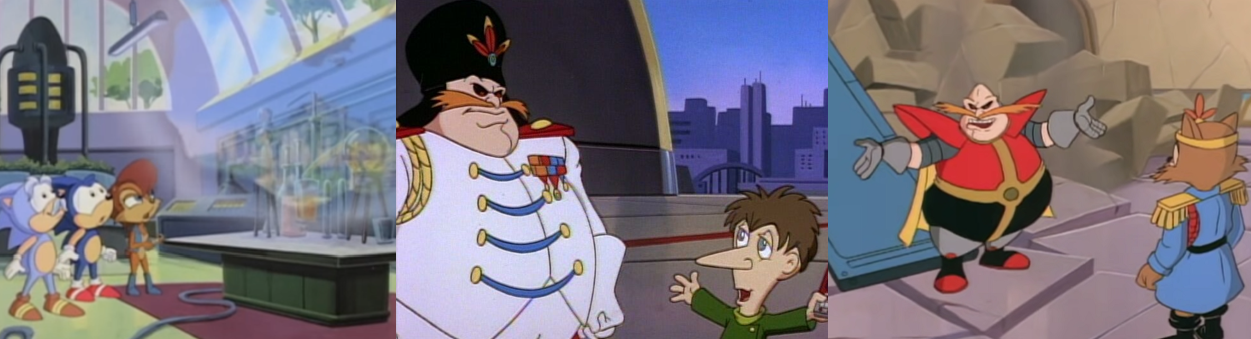
When I was a kid, I used to watch Adventures of Sonic the Hedgehog religiously. Every Sunday morning (as I recall; it might’ve been Saturday…), I would sit and watch it, usually record it, and delight in seeing Sonic’s slapstick antics. Then, one morning, something was different. The entire tone and cast of the show had changed; suddenly, Sonic wasn’t dressing up in ridiculous costumes and acting like a super-fast version of Bugs Bunny (Mel Blanc/Various) and Dr. Robotnik (Long John Baldry) wasn’t a comical, bumbling buffoon. Instead, Sonic was the point man in an outnumbered resistance movement against a far darker, semi-cybernetic dictator. Miles “Tails” Prower (Christopher Stephen Welch; Bradley Pierce) was completely absent in the first episode I watched, “Sonic Boom” (Sebast, 1993), and the bright, zany world of Adventures was replaced with a grim, polluted hellhole. It was a jarring change for me, but I loved Sonic so I quickly adapted. It helped that SatAM opened with an absolutely jamming theme song and that a lot of its presentation was very close to what was happening in Sonic the Comic (1993 to 2002) at the time, and that the visual style of the show and Sonic’s battle against this far more malevolent Dr. Robotnik were so compelling.

Desperate to defeat Dr. Robotnik, Sonic and Sally seek out the legendary Time Stones.

Although SatAM’s second season would later include concurrent narratives, and there was always an ongoing theme of the Knothole Freedom Fighters desperately opposing Dr. Robotnik’s regime, “Blast from the Past” is the only two-part story arc in the series. The first part opens, as many episodes do, with Sonic, Sally, and some unnamed Freedom Fighters on a covert mission in the polluted hellscape known as Robotropolis. Although a brash and reckless egomaniac, Sonic is instrumental to the Freedom Fighters; he’s classified as “Hedgehog: Priority One” by Dr. Robotmik’s SWATbots (Frank Welker), which immediately deviate from their regular patrols to chase him. While this creates enough of a distraction for their unnamed allies to sabotage Robotropolis’s main power grid, their friends are captured and taken to Dr. Robotnik’s citadel, and summarily roboticized. Although the jovial dragon Dulcy (Cree Summer) tries to alleviate the guilt Sonic and Sally feel for this loss by pointing out that all the planning and moxie in the world can’t oppose Dr. Robotnik’s resources or malice, Sonic can’t help but wish they’d fought back harder when Dr. Robotnik first took over, even though they were only five years old back then. Dulcy suggests that they use the legendary Time Stones to travel back in time and fulfil this wish. Sceptical, an exasperated Sally initially shoots down the plan as she believes the Time Stones and their equally mythological home, the Floating Island, are nothing more than a fantasy, to say nothing of the moral and scientific dangers of violating the time stream. However, Sally reluctantly agrees when the clumsy Dulcy reveals that she once crashed into the Floating Island, but she remains sceptical until Dulcy braves a tumultuous storm and crashes the three on the fabled island. Rather than being home to Knuckles the Echidna and the Master Emerald, the Floating Island is represented as a much smaller land mass that houses an ornate palace guarded by two stone gargoyles. Sonic outraces the guardians and causes them to vanish by running himself and Sally off the island. After being rescued by Dulcy, the two enter the palace and navigate a confusing M. C. Escher-esque labyrinth before being confront by the owl-like Keeper of the Time Stones (Curry). Despite Sonic’s blockheadedness, Sally solves the Keeper’s riddle (the answer is “time”) and the Keeper explains how to use the Time Stones’ power.

Unfortunately, Sonic and Sally are too late to stop Dr. Robotnik enacting a destructive coup d’état.

However, despite Sonic’s best attempts to focus only on the palace fountain in Mobotropolis circa 3224, his mind wanders to chili dogs, throwing off their arrival. The two are overwhelmed to find their home lush and verdant and alive, but even more stunned when their younger selves (Mowry and Ridgeway, respectively) wander by. It turns out that Sonic never really grew out of his childish, arrogant ways as his younger self delights in gobbling down chilli dogs and boasting of his super speed, much to the chagrin of the younger princess. Sonic and Sally go straight to Sonic’s beloved uncle, genius inventor, and loveable father-figure Sir Charles “Chuck” Hedgehog (Windom) and reveal the impending threat to the city. Back in this time, Sally’s father, King Maximillian Acorn (Curry), ruled a thriving, technologically robust city thanks to support from his Grand Vizier, Julian. Julian helped Mobotropolis win the “Great War” with his machinery, earning him a promotion to Minister of Science, though he secretly conspires with his long-suffering nephew, Snively (Charlie Adler), to take over Mobotropolis using not only the decommissioned war machines but Uncle Chuck’s Roboticizer machine. As shocked as Sonic and Sally are to discover that Uncle Chuck invented the nightmarish device, Uncle Chuck is horrified to learn this his invention (which was created to help old people “live longer”) is to be perverted into a tool for evil. Although they initially stay avoid their younger selves, they inevitably meet; introducing themselves as “Alicia” and “Juice” and presented as distant cousins, the Sallys despair of their childish antics and Sonic is stunned to find that his younger self is actually faster than him! However, their fun is interrupted by the realisation that they’ve arrived on the eve of Julian’s destructive coup d’état. Uncle Chuck has Sally’s nanny, Rosie (April Winchell), take the kids to safety in Knothole then introduces Sally to her father. Understandably emotional given that her father has been trapped in the “Void” for most of her life, their heartfelt reunion convinces King Acorn to trust Uncle Chuck’s warnings about Julian. Unfortunately, they’re too late to intercede; Julian reprograms the city’s robotic defences to recognise his commands and sends them to capture the inhabitants, including the young Sonic and his friends, before storming into the king’s throne room. Now garbed in his iconic red outfit, Julian rechristens himself Doctor Robotnik, and Mobotropolis “Robotropolis”, much to the anger and horror of Sonic and his friends.

Although they humiliate Snively, Sonic and Sally are faced with a race against time to salvage the timeline.

After a brief recap, part two picks up with Uncle Chuck disabling the SWATbots and causing a distraction so that Sonic can speed Sally to safety. However, they’re quickly imprisoned alongside their younger counterparts and forced to watch from their cell as Dr. Robotnik’s massive mechanical blimp, the Destroyer, spreads a polluting cloud over Mobotropolis that instantly kills all plant life, transforms the once idyllic landscape into a mechanical hell, just like before. Thanks to the schematics of Dr. Robotnik’s citadel on her pocket computer, Nicole (Soucie), Sally directs Sonic in burrowing them to safety, though Dr. Robotnik arrogantly dismisses the potential threat since he’s already imprisoned 80% of the population. Unfortunately, Sonic and Sally are too late to save their younger selves; since their very existence is threatened by this, the two buy themselves some time by having Nicole cause a brief power outage in the Roboticizer. To amuse himself in the meantime, Dr. Robotnik takes great pleasure in banishing King Acorn to the Void, an extradimensional portal where he once banished his rival, the sorcerer Ixis Naugus (Michael Bell). Luckily, the power outage allows Sally to download the machine’s schematics for future reference, but things are exacerbated when they spot the Destroyer heading for the Great Forest and threatening Knothole and, once again, their futures. Faced with a ticking clock, the two blast away to intercept the Destroyer, earning Snively’s ire by stripping him of his hair with a sonic boom and briefly stopping to rescue Dulcy’s mother, Sabina, from Dr. Robotnik’s forces.

Although they fail to save Mobius, Sonic and Sally’s jaunt isn’t a total loss and renews their fighting spirit.

Using a Power Ring for a speed boost and his anti-gravity sneakers, Sonic rockets himself and Sally up to the Destroyer, where even Sonic’s breezy demeanour is strained by Dr. Robotnik’s inexhaustible forces. Luckily, Sabina fends them off and brings the Destroyer crashing to the ground, so Sonic and Sally race back to Robotropolis to save their younger selves. Sadly, Sonic fails to prevent his defiant uncle’s roboticization, meaning his younger self has to endure the horror of watching the only family he has be transformed into a mindless robotic slave, though Sonic assures the grieving boy that Uncle Chuck will be restored in time. Sonic and Sally get the kids to safety and, in the process, Sonic earns Dr. Robotnik’s boundless fury by not only mocking and defying him, but also roboticizing his left arm. After teaching the younger Sonic a thing or two about trashing robots, the kids are brought to Rosie and spirited to the safety of Knothole. Before she goes, Sally makes Rosie promise to never leave the village to avoid her becoming another of Dr. Robotnik’s minions in the near future. With Dr. Robontik’s full force closing in, Sonic and Sally use the Time Stones to return to the future, infuriating the newly-crowned dictator. Although Sonic believes the entire escapade was a waste of time since they never changed the past like they intended, Sally is bolstered by the odds now that they have the Roboticizer plans, and Sonic is left nursing a migraine when he tries to understand how Rosie is still in Knothole…despite being right there when Sally told her not to leave.

The Summary:
I’ll be the first to admit that reviewing “Blast to the Past” as an adaptation of Sonic CD is a bit of a monumental stretch. To be honest, the tangential link was enough of an excuse for me to talk about SatAM, one of a handful of cartoons that defined my childhood. While, on the surface, there doesn’t appear to be much of a relation between the two, they actually have a fair amount in common: obviously, the Time Stones appear (though in a vastly different format) and Sonic travels through time (again, in a very different way to Sonic CD), but there’s also shared themes of pollution and time paradoxes at work in the episodes. Sonic and Sally travel to the past, where Mobius and Mobotropolis especially were free from pollution and war, in an attempt to stop Dr. Robotnik before he can rise to power. When they fail in this endeavour, the once lush and thriving landscape becomes a dark, grimy, mechanical hellhole (a “Bad Future”, if you will) and we clearly see the consequences of their time travel onscreen just like in Sonic CD’s gameplay. Again, that might seem like a stretch, but you have to remember how few inspirations SatAM took from the source material. While I was disappointed that we never got Knuckles, the Chaos Emeralds, Metal or Super Sonic in the series (especially the first two in these episodes), it was still fun to see gameplay elements adapted to fit the context of this dark and mature series.

While things get very bleak very quickly, the time travel plot showcases our hero’s vulnerable sides.

“Blast from the Past” is easily one of the strongest arcs of SatAM. For the first time, we get to see what life was like before Dr. Robotnik took over. We’re so used to seeing Knothole and the Great Forest being the one bastion of nature in an otherwise ransacked, almost post-apocalyptic world that it’s extremely poignant to see Sonic and Sally react in awe when they walk the streets of the thriving Mobotropolis once more. The episodes give both characters a chance to show some vulnerability; this wasn’t uncommon in SatAM given how bleak their situation was, but it’s heart-warming (and breaking) to see Sonic reunited with his unroboticized uncle and Sally finally reunited with her beloved and long-lost father. It was also quite fun seeing Sonic and Sally interact with their younger selves; their personalities haven’t changed much over the years, with Sonic being impulsive and Sally being more restrained, but the younger Sonic makes an impression by outpacing his elder (and even referring to Sonic as “old”) and breaking down in tears when his cherished uncle is roboticized before his eyes. Although characterised as a brash, headstrong, and snarky speedster, Sonic showcased some surprising emotional depth in SatAM and “Blast to the Past” emphasises that beautifully. We see his anger at Dr. Robotnik’s heinous actions, his desperation to save the future, and the guilt he feels at having potentially screwed up their best chance of saving the world before it goes to hell. Although functionally unstoppable and capable of physics-bending feats, Sonic isn’t beyond fatigue or weakness. Mainly, this is realised in his inability to sit still, focus, or think of or work to a plan, which is why he and Sally work so well together as she does the thinking and he does the fighting (though she’s perfectly capable of holding her own in a pinch, too).

Dr. Robotnik is at his most malicious in SatAM and this two-parter showcases his rise to power.

As ever with SatAM, the star of the show is the reprehensible Dr. Robotnik. Never before or since has the rotund dictator been portrayed as such a malevolent and spiteful force (well, maybe in Sonic the Comic and obviously in the Archie comics…). SatAM-Robotnik was a serious threat, even when he was doing more comical stuff or being humiliated by his foes. Thanks to his incredible resources and relentless craving for power and conquest, Dr. Robotnik delights in subjecting his captives to the Roboticizer and turning them into his mindless, obedient slaves. Abusive towards his long-suffering nephew, Dr. Robotnik cares only about himself and his insane lust for power. Despite his prominent position of trust and authority alongside King Acorn, Dr. Robotnik has grander designs for himself and easily takes what he wants by force, without any real resistance. This oppressive, suffocating malevolence makes battling Dr. Robotnik an uphill, almost unwinnable battle even when Sonic has the speed and power advantage, and even time on his side as in this two-parter. Ultimately, Sonic and Sally’s efforts to prevent Dr. Robotnik’s coup d’état are met with failure but they are bolstered enough to continue fighting after remembering what they’re fighting for. While Rosie ironically didn’t actually show up in future episodes, “Blast to the Past” led to the creation of the De-Roboticizer and the Freedom Fighters’ attempts to restore Dr. Robotnik’s victims to normal. So, yeah, while it may have almost nothing to do with Sonic CD and vastly reimagines the Floating Island, “Blast to the Past” is still an enjoyable and significant two-part arc. SatAM remains one of the most influential Sonic canons and is still heralded as one of the best cartoons of the nineties. While it wasn’t exactly true to the source material and has, in my view, since been surpassed, I can’t deny my love for the series, especially darker and more introspective episodes like these two, so I’m always happy to return to the series and relive my youth.

My Rating:

Rating: 4 out of 5.

Great Stuff

Did you enjoy “Blast to the Past”? Were you disappointed by how few elements from Sonic CD were present in the story or were you just happy to see videogame elements incorporated into SatAM? Did you enjoy SatAM as a kid? What did you think to the depiction of Dr. Robotnik’s rise to power? Which of SatAM’s original characters was your favourite and what did you think to Sonic’s characterisation in the show? How are you celebrating Sonic CD’s anniversary this year? Whatever your thoughts on Sonic CD, or SatAM in general, feel free to leave a comment below or on my social media.

Screen Time: Terminator Salvation: The Machinima Series

Air Date: 18 May 2009 to 24 June 2009
Directors: Tor Helmstein and Ian Kirby
Network: Machinima
Stars: Moon Bloodgood, Cam Clarke, and Jim Meskimen

The Background:
Although The Terminator (Cameron, 1984) was an unexpected financial success, Terminator 2: Judgment Day (ibid, 1991) was a blockbuster release that is widely regarded as one of the greatest movie sequels ever made, something no-one was saying about its ill-advised follow-up, Terminator 3: Rise of the Machines (Mostow 2003). Somehow, though, Terminator 3 did surprisingly well at the box office and eventually led to the sadly critical and financial disappointment that nevertheless remains one of my favourites in the franchise, Terminator Salvation (McG, 2009). Terminator Salvation was accompanied by a videogame tie-in that garnered mixed reviews but also provided the tools to produce a prequel miniseries using the game’s in-game assets and engine. Terminator Salvation: The Machinima Series was comprised of six episodes running around fifteen minutes each and was aired on Machinimia, a now-defunct web-based video platform known for their adaptations of videogame properties. The series was met with mixed reviews; some praised the expansion of the film and game world through the new format, while others criticised the lacklustre presentation of the miniseries. Ultimately, it wasn’t enough to keep the Terminator franchise from entering into legal issues and Terminator Salvation: The Machinima Series is now an often forgotten footnote in the long and complicated history of the science-fiction franchise.

The Plot:
Set in 2016, years after Judgment Day, Blair Williams (Bloodgood) fights the war against the machines in downtown Los Angeles by tracking down computer hacker Laz Howard (Clarke) to persuade him to join the Resistance.

The Review:
Terminator Salvation: The Machinima Series uses the in-game graphics and assets from the Terminator Salvation videogame, meaning the environments (while a little bland and stale) are serviceable, for the most part, and reflective of the bleak, war-torn world seen in the movie. However, while the machines look pretty impressive, the character models are disturbingly devoid of human emotion in the face. They move okay when in action, it’s just when they stand around or shots linger on facial expressions that they fail to hold up against other CGI movies. The graphics engine used to render the effects also makes them appear a bit like emotionless puppets than anything else (Laz is the most obvious offender in this regard), but at least Moon Bloodgood returned to provide her voice even if her model doesn’t properly capture her natural appearance. Accordingly, the miniseries is blatantly geared towards selling the videogame; action sequences pitting the Resistance against the Spiders not only reflect the in-game action, but they actually are the in-game actions! Blair and other characters sneak from cover to cover, fire blindly from behind dilapidated walls, target the Spiders’ power cell on their back, and take the high ground to get better shots. The miniseries also incorporates the rail-shooting sections form the game, with Blair and Laz fighting back pursuing Moto-Terminators on a half-wrecked train while shooting rocket launchers and blasting at airborne Terminators while racing along in a truck, and it appears that all the locations are ripped wholesale from the videogame, including background elements like burning aeroplanes, wrecked buildings, and destroyed highways. While the voice acting is pretty good, for the most part, and tells a story of trust, desperation, and fraying humanity against the backdrop of widespread nuclear devastation and never-ending conflict, the lip synch is dreadful because the character models weren’t built for this level of emotion.

Blair braves the war-torn landscape to track down a hacker who’s been disrupting machinery.

Blair narrates each episode and takes centre stage; her dreams are haunted not just by memories of life before Judgment Day, but also a time when she hesitated to fire upon a HK while flying a Resistance fighter jet and caused the death of her wingman. After years of fighting alone (or alongside veritable strangers) with no clear perception of who or what she was fighting for beyond basic survival, she’s come to see that the only way to win the war against the machines is for humanity to unite with that singular purpose. While this means she spends a lot of her time pinned down and taking cover from relentless fire from the T-7-T “Spider” machines like in the Terminator Salvation videogame, she at least has allies to watch her back and provide cover fire, though the sheer amount of death and destruction that surrounds her at every turn has left Blair feeling somewhat jaded. Blair runs down the devastation caused by Judgment Day that’s left the few survivors desperately fighting tooth and nail against not just a ruthless and inexhaustible enemy but the fear of all-out extinction. Before she learned to work alongside others, Blair (who claims to be numb to fear) was the perfect choice for dangerous, even suicidal, solo missions like searching through the ruins of Los Angeles for a “ghost” that’s been disrupting the Resistance’s communication lines. During this mission, she had her first face-to-face encounter with a chaingun-wielding T600! Although her grenades proved ineffectual, Blair successfully evades the machine and destroys a troop of Spiders, only to find that the “ghost” is disillusioned Laz Howard, a hacker capable not only of disrupting their communications but also reprogramming the machines (to a limited degree). Determined to keep him from interfering with their operation, and seeing his potential, Blair protects him from the machine counterattack so that he can be brought to her superiors. Following a train crash, Blair and Laz are pursued by the Terminator (accompanied by a remixed version of the T-1000 theme) and, without his equipment, Laz first cowers behind cover as Blair briefly disables the machine then getts into a philosophical debate with her.

Blair and Laz clash over their ideologies and the differences between machines and humans.

Blair despises Laz’s actions and the lives he’s cost with his interference, while Laz argues that he’s just trying to survive and never meant for his algorithm to harm others, and also that he’s more in touch with humanity than Blair since he’s not blindly following orders or threatening others with guns. Their argument attracts a Spider and Blair debates leaving him to the machines since her mission was to eliminate the “ghost”, but she realises the value he could have and ultimately intervenes and resolves to protect him for as long as he can keep up with her in the ruins of the old world. While suffering from dehydration, Laz deliriously reveals that he disagrees with the Resistance’s aggressive methods against the machines since they never stop to learn how they work or how to exploit them, and that he resents the Resistance since he believes they’re as much to blame for the state of the world as the machines. Blair’s stunned when they reach the Resistance outpost and finds her comrades slaughtered by the machines as Skynet is actively trying to eliminate Laz to stop his disruptive algorithm. Blair cancels her evacuation request and mans a nearby turret when they’re attacked by Aerostats and T-600s and, though Laz disables and destroys them with his code so they can retreat, their escape is cut short by an airborne Hunter-Killer (HK). Forced to work together, Blair blasts the Aerostats using a mounted artillery gun as Laz speeds across a ruined highway, eventually forcing the HK to collide with solid concrete . Blair’s patience is tested by Laz’s anti-Resistance stance and his constant criticism; she bluntly tells him that he’s screwed either way since both sides want him dead. She convinces him to give the broad specs of his algorithm, which temporarily scrambles Skynet’s link to the machines (and, as an unfortunate by-product, disrupts Resistance communications) using radio frequencies. A T-600 records their conversation from afar and gets the jump on them, causing them to plummet into a sewer for a brief detour (and an awesome shot of the Terminator’s red eyes glaring at them, unnoticed, from the darkness), only for the T-600 to resume its attack once they emerge from the sewer drain.

Both Blair and Laz witness the machine’s wrath, which alters their perception of the war.

Rather than ripping Blair’s heart out or her head off, the Terminator is content to drag her by the neck as it pursues its primary target. This means Blair’s free to blast the machine point-blank in the head with her shotgun so they can beat a hasty retreat. However, Resistance command (Meskimen) refuses to evacuate Blair as long as the “ghost” is with her. Despite her vehemently advocating his right to life and protection, they insist that she get to the evacuation point alone, heavily implying that he be left behind or killed for “collaborating” with the machines. Despite this, Blair’s determined to bring him to them so he can share his knowledge, though she scolds him for taking her knife and continues to be aggravated by his cynical demeanour and refusal to trust her or the Resistance. When they’re pinned down by Spiders, Blair teaches Laz how to destroy them the old-fashioned way so he can be a little more useful in combat and he enjoys the triumph that comes from reducing the machines to scrap metal. Since Laz insists on having his own gear to broadcast his signal, Blair begrudgingly leads him to some suitable equipment under cover of darkness, which inevitably attracts the attention of more Aerostats and HKs. Once at the evacuation point, Blair lies about Laz’s identity so she can get him to safety but is separated from him when they’re attacked by machines. Overwhelmed, Laz is left alone, terrified, jumping at every shadow, and forced to hide from the machines; thanks to Blair’s teachings, Laz destroys a Spider and is taken in by some survivalists. Moved by their plight and Blair’s selfless attempt to protect him, Laz uses their radio equipment to broadcast his signal and shut down an attacking T-600, thereby making him a heroic figure amongst them. Blair tries to explain things to her commanding officer, and the potential benefits of Laz’s algorithm, but he refuses to risk lives extracting the hacker. Blair is aghast by her commander’s lack of humanity (she even echoes Laz’s sentiments about how “mechanical” the Resistance are) and disobeys his direct orders, leaving in a helicopter as the Resistance fighters deal with a machine incursion.

Laz sacrifices himself to give the Resistance a fighting chance against the machines with his algorithm.

With HKs and other machines inbound, Blair orders her co-pilot to return to base and takes out another HK with a rocket launcher so she can search for Laz. She broadcasts Laz’s name and description to try and track him down and is pointed in the right direction, where she finds the remnants and survivors of the T-600 attack he helped to stop. Since the machines are continuing to hunt him down, Laz went out on his own to keep others safe. Luckily, Blair easily finds him right as another gaggle of killer robots closes in, though he’s traumatised by all the death that’s occurred because of his actions. Once again facing a swarm machines, Blair and Laz get some unexpected backup from the Resistance, which brings the miniseries full circle back to where it began, with them being pinned down by enemy fire. When a T-600 bursts through a wall and looms over Blair, Laz heroically throws himself in front of her and is summarily cut down by its gunfire. As he dies, he reveals that he left the key to activate his algorithm engraved on Blair’s beloved knife. Shaken by Laz’s death, Blair takes her emotions out on the half-crippled T-600 and the miniseries ends with Blair being promised that the disruptive signal will find its way to John Connor (who she hasn’t actually met yet at this point), and the revelation that Laz left behind a series of audio files. One is played to close out the episode that describes his first-hand experiences of Judgment Day and the abject terror he felt that drove him to dig in deep and stay in hiding. Galvanised by the experience, Blair resolves to continue on with the fight not just for herself, but for the countless other survivors out in the field and returns to her rightful place in the cockpit of a Resistance fighter jet to engage with Skynet’s forces once again.

The Summary:  
I honestly didn’t really know what to expect from Terminator Salvation: The Machinima Series; I was vaguely aware of it as a CGI feature but had never really looked too deeply into it until now. It’s an interesting experiment, to be sure; it’s not often that a videogame’s in-game graphics and models are used in this way. Normally, tie-in material like this is a more traditionally-animated CGI affair and Terminator Salvation: The Machinima Series definitely does suffer somewhat by not utilising prerendered graphics on its presentation. While the locations reflect the bleak, desolate, war-torn ruins of the world seen in Terminator Salvation and are clearly ripped wholesale from the tie-in videogame, they’re not exactly diverse or visually interesting as characters stay in the same repetitive locations throughout the miniseries, with only the inky darkness of night and some dilapidated interiors mixing things up. It’s fun seeing characters perform actions from the videogame like sliding into cover, firing blindly at enemies, and using heavy weapons while speeding along in vehicles but it basically amounts to a lengthy advertisement for the game, more than anything. In that respect, I find it odd that Terminator Salvation: The Machinima Series wasn’t included as a bonus feature in the videogame since it basically acts as a prelude to that game and as a showcase of the in-game action offered by it, including sneaking around the Spiders, desperately fending off relentless T-600s, and blasting at aerial machines with projectiles zipping all over the place.

A decent expansion of the movie, but let down by the cheap presentation.

Where Terminator Salvation: The Machinima Series does impress, though, is in the story and the quality of the voice acting; Moon Bloodgood is ironically better than in the movie, adding some real depth to her sadly one-note character by exploring how the war has affected her humanity and her relationships towards others. Her narration paints a picture of a world on the razor’s edge of all-out insanity. Fear and tension run rampant throughout the Resistance, which has grown increasingly cold and battle-hardened by the ever-escalating conflict, to the point where Laz point-bank refuses to help them and criticises them for being no better than the machines. At first, Blair opposes this perspective and sees Laz as little more than a lowly “collaborator” who might have some value to the Resistance, but he comes to see Laz’s opinions aren’t entirely invalid when her superior would rather let Laz die than risk extracting him, not matter how important he might be. Laz represents the everyday folk struggling to survive in the ruins of society, an embittered people who just don’t have the strength to fight back and resent the Resistance for bringing more destruction to an already ravaged world. He’s just trying to use the skills he has to survive and wants no part of the conflict, but comes to see that humanity’s only chance at surviving is to work together, which ultimately leads to him sacrificing his life to save Blair and handing over the key to his machine-disrupting algorithm. Interestingly, however, this signal isn’t the same one seen in Terminator Salvation, which was a trick created by Skynet to lure the Resistance into a trap, which muddies the waters a little in terms of continuity, though the miniseries did a decent job of adding a little more context to this world. Ultimately, it was an interesting extended cutscene and advertisement for the Terminator Salvation videogame. I think it might’ve had more potential as a proper CGI feature but I’m surprised we didn’t see more projects like this back in the day, or even now, as it seems like an easy way to produce some tie-in material. Sadly, Terminator Salvation: The Machinima Series comes across as “cheap” all too often, making it a largely forgettable experience that, as I said, probably would’ve been better as a shorter, simpler bonus feature included on the game disc.

My Rating:

Rating: 2 out of 5.

Could Be Better

Have you ever seen Terminator Salvation: The Machinima Series? If so, what did you think to it and did it help sell you on the tie-in videogame? What did you think to the story and the expansion of Blair’s character? Did the miniseries get a bit repetitive for you considering its short runtime? What do you think to the recycling of the videogame’s assets and would you like to see a proper CGI Terminator feature? Were you a fan of Terminator Salvation? How are you celebrating Judgment Day today? No matter what you think about Terminator Salvation, and the Terminator franchise, feel free to leave a reply down below or drop a comment on my social media and check out my other Terminator reviews.

Screen Time [Christmas Countdown]: How the Grinch Stole Christmas! 

Air Date: 18 December 1966
Director: Chuck Jones and Ben Washam
Original Network: CBS
Budget: $315,000
Stars: Boris Karloff, June Foray, Dallas McKennon, Thurl Ravenscroft, and the MGM Studio Chorus 

The Background: 
In 1955, children’s author and poet Theodor Seuss Geisel (known by his pen name as “Dr. Seuss”) wrote and illustrated a 33-line poem titled “The Hoobub and the Grinch”, which was the catalyst for a more expansive piece of work focusing on the mean-spirited Grinch. Inspired by himself, his wife’s ongoing medical problems, and the rampant commercialisation of Christmas, the story was completed within weeks and reportedly received critical acclaim, with the titular character becoming an instant and surprisingly complex Christmas icon. After collaborating on animated ventures during the Second World War, Dr. Seuss and legendary cartoon director Chuck Jones reunited (despite Dr. Seuss’s initial apprehension) to adapt the story into a television special. Jones insisted on complete creative control and expanded on the original story to flesh out characters like Cindy Lou Who (Foray) and Max (McKennon) and inserting musical numbers to pad the runtime. Though released amidst a slew of other animated Christmas specials, How the Grinch Stole Christmas! impressed when first broadcast; over the years, it has become a universally loved Christmas classic, with the cartoon noted as a timeless, heart-warming festive tale. It was so successful that it inspired follow-up cartoons years later, two financially successful cinematic remakes (one a Jim Carrey showcase and the other an all-CGI throwback) and even a bizarre slasher film in 2022, to say nothing of a slew of other Dr. Seuss adaptations over the years. 

The Plot:
The monstrous Grinch (Karloff) hates Christmas with a passion. When the joyful holiday cheer of Whoville (The MGM Studio Chorus) becomes too much for him, the Grinch disguises himself as Santa Claus and sets out to ruin Christmas by stealing the town’s presents! 

The Review: 
The cartoon is set in Who-ville, on Christmas Eve, where the joyful and excited Whos are happily preparing for the big day by decorating the biggest Christmas tree they can find and displaying it proudly in the centre of their village (“Opening”). They’re also hard at work decorating their houses, and the entire village, with tinsel, wreaths, garlands, baubles, and Christmas joy galore (“Trim Up the Tree”) which, in conjunction with the heavy snowfall, quickly turns Who-ville into the most festive place around…maybe ever! However, while all of Who-ville likes Christmas a lot, the sour Grinch, who lives atop the desolate and foreboding Mount Crumpit, does not. Although the narrator (Karloff) informs us that “no one quite knows the reason” why the Grinch hates Christmas so vehemently, it’s speculated to be because his heart is “two sizes too small” and his hatred extends to the entirety of Who-ville. He glares from his cave, joined only by his faithful dog, Max, the only living creature the Grinch shows any remote affection for. The Grinch tells Max that he’s desperate to keep the Whos from making a racket with their Christmas joy and presents, even their sumptuous banquets, where they gorge themselves on a seemingly endless supply of food, and their insistence of gathering in the village to sing and ring bells (“Welcome Christmas”). After fifty-three years of Who nonsense, the Grinch has reached his limit; the Grinch is inspired by a snow-caked Max to assume the guise of jolly ol’ Saint Nic and storms into his cave (dragging Max along) to whip up a suitable outfit (“You’re a Mean One, Mr. Grinch”). Once complete, the Grinch forces Max to act as his reindeer, loads up a “ramshackle sleigh” with some black sacks, and sneaks into Who-ville in the dead of night while all the Whos are tucked up in bed, oblivious, easily clambering into their houses via the chimneys and stealing every present under each tree with glee!  

After stealing Christmas, the miserly Grinch has a change of heart regarding the festive season.

Emboldened by his wickedness, the Grinch does this for every house, wrecking their trees, pinching their Christmas stars, rolling up their gifts in rugs, and even stealing candy canes from sleeping Who children and clearing out their “ice boxes” (“You’re a Mean One, Mr. Grinch (Reprise)”). However, just as he’s stuffing a Christmas tree up a chimney, he’s discovered by sweet, innocent, Cindy Lou Who; to pacify the child, the Grinch quickly thinks up a lie, convincing Cindy Lou that he’s going to fix a fault with the tree’s lights. After placating her with milk and a cookie, the Grinch leaves the house barren and ransacked, with barely a microscopic crumb left behind. Once he’s cleared out all of Who-ville and piled his sleigh high with his stolen wares, including the village tree, he heads back up Mt. Crumpit, with poor Max desperately pulling the overloaded sleigh through the snow while being mercilessly whipped. Once at the top, the Grinch prepares to dump everything over the side (“A Quarter of Dawn”), gleefully anticipating the despair of the Whos once they realise Christmas isn’t coming this year. However, when the Grinch pauses to bask in their anguish, he’s surprised to find the Whos’ spirits remain as high as ever! They gather in the village, joining hands and ringing in the season with their bells and song (“Welcome Christmas (Reprise)”), their hearts as warm and large and full of Christmas cheer even without the presents and decorations. Considering the Grinch believes that Christmas is purely about the gifts and excess, he’s confused by this but, as he puzzles out the quandary, he realises that “Christmas” is about more than just things bought from shops. This revelation drives him to save his plunder from their plummet, empowered by the sudden increase in his heart size and the true spirit of Christmas. Now cheerful and joyous, the Grinch and Max ride into Who-ville and return everything they stole, restoring Christmas to the village and even joining them for Christmas dinner, carving the roast beast and allowing the spirit of the season to fill him from head to toe (“Finale”). 

The Summary:
It might surprise you to know that I’m not really a fan of Dr. Seuss. I didn’t grow up reading his bizarre stories, nor was How the Grinch Stole Christmas! part of my annual Christmas tradition. In fact, I don’t think I’ve ever seen it broadcast on television here in the United Kingdom, so my experience with the good doctor and his colourful characters is limited solely to their later live-action and CGI adaptations. All this is to say that it wasn’t until Christmas 2023 that I randomly decided to finally give this a quick watch and share my thoughts on it since it’s such a well-known and beloved holiday tale and children’s story. Unsurprisingly, given who directed it, How the Grinch Stole Christmas! is suitably Chuck Jones-ian in its animation style; there’s a raw fluidity to the cartoon, meaning you can tell that countless hours of work went into animating every frame, and the characters and their environments are ripped straight from Dr. Seuss’ famous work, literally bringing the static images to life in all their sketchy glory. As you’re probably aware, it’s also a musical, with its songs (particularly Ravenscroft’s rendition of “You’re a Mean One, Mr. Grinch”) becoming as synonymous with the festive season as the titular miserly creature and being revised and covered not just for future adaptations of the story, but to coincide with the season. The story is a whimsical and timeless ditty, full of enjoyable little rhymes and colourful, memorable, oddball characters; the Whos are strange, furry humanoids who embody Christmas cheer and happiness and their town, though small and buried in snow, is a place of light and love where the Whos live peacefully and with lots of food and comfy houses to keep them snug and warm. 

A whimsical fantasy tale with a timeless, heart-warming message.

Naturally, this is juxtaposed by the Grinch; a green-furred, sour-faced gremlin, the Grinch despises the Whos, and Christmas, and has glared at their village with anger, enraged by their noise and excess, every December for the last fifty-five years! Although no definitive reason is given for his dislike for Christmas, it basically comes down to him lacking in Christmas cheer, misunderstanding the meaning of Christmas, and feeling conflicting waves of jealous, disgust, and personal insult since he’s not part of any of the Whos’ celebrations. Believing that the Whos will sing a different tune if all their Christmas possessions are stolen, the Grinch slinks around like a snake, swiping everything he can get his hands on (even lightbulbs and ice cubes!), and easily fooling curious Cindy Lou with his forked tongue. However, the sight and sounds of the Whos retaining their Christmas spirit even without possessions is enough to change the Grinch’s demeanour completely; this is a fundamental lesson of many Christmas tales and it’s shown in beautifully simplistic detail here. The Grinch never considered that Christmas was as much a state of mind as it was about food, decorations, and extravagance, and the love and warmth of this revelation lightens his mood and turns him around on the season completely. It’s simple and much of the depth is buried beneath the whimsical songs and cartoonish fantasy, but it resonates nonetheless and is an important lesson for kids to learn (basically, be grateful for what you have and don’t just think about presents!) While I’m not always Dr. Seuss’ biggest fan, I enjoy the visual and thematic appeal of the Grinch and his heartwarming story, and this fun little animated short is a great addition to your Christmas viewing every December, 

My Rating:

Rating: 3 out of 5.

Pretty Good

Is How the Grinch Stole Christmas! an annual tradition for your Christmas? Have you read the original story and, if so, what do you think to its different adaptations? Are you a fan of the Grinch character and the colourful, bizarre Whos? Why do you think the Grinch hated Christmas so much? Are you a bit of a Grinch around this time of year? What Christmas movies and specials are you watching this year? Whatever your thoughts on How the Grinch Stole Christmas!, leave them in the comments or on my social media and go check out my other Christmas content across the site. 

Screen Time [Gazpacho Soup Day]: Red Dwarf (Series Two)


In the episode “Me2” (Bye, 1988) of the classic British science-fiction comedy show Red Dwarf (1988 to 2020), it is revealed the Arnold Rimmer’s (Chris Barrie) last words were “Gazpacho soup!” and that he made a point to celebrate November 25th as “Gazpacho Soup Day” after a particularly traumatising visit to the Captain’s Table.


Series Two

Air Date: 6 September 1988 to 11 October 1988
Director: Ed Bye
Original Network: BBC2
Stars: Chris Barrie, Craig Charles, Danny John-Jules, Norman Lovett, David Ross, and Charles Augins

The Background:
Back in the mid-1980s, creative duo Rob Grant and Doug Naylor created Dave Hollins: Space Cadet, a sci-fi comedy show for BBC Radio 4 influenced by sci-fi classics like Dark Star (John Carpenter, 1974) and The Hitchhiker’s Guide to the Galaxy (Adams, 1978; Bell, 1981) and which laid the foundation for what would become Red Dwarf. Their concept of a comedy set in space was initially a hard sell due to its sci-fi trappings, despite the duo emphasising character and comedy over genre. With impressionist Chris Barrie and Liverpudlian “punk poet” Craig Charles cast as bickering duo Second Technician Arnold J. Rimmer and Third Technician Dave Lister, respectively, and joined by tardy singer and dancer Danny John-Jules and sardonic stand-up comedian Norman Lovett, Red Dwarf eventually came to TV screens in early-1988. Despite viewing figures dropping throughout the six-episode first series, five million viewers tuned in for the pilot episode and audience feedback was so strong that the BBC greenlit a second series, which was really where the show hit its stride. Afforded greater influence, and a bigger budget, Grant and Naylor took the chance to expand the show’s setting, even moving out of their comfort zone to introduce a mechanical character who would later join the main cast. Having established their audience, the second series was received far more favourably and was on its way to becoming a cult hit. Some ten years later, Grant and Naylor enhanced the first three seasons with additional digital effects, replacing model shots with CGI and even revising lines and jokes, which resulted in these Remastered episodes being largely criticised. Nevertheless, Red Dwarf proved consistently popular even after the duo parted ways; after a lengthy absence, Red Dwarf returned with a three-episode special in a questionable revival that arguably struggled to match the quality of its earliest seasons.

The Plot:
Deep space mining ship Red Dwarf drifts aimless in space three million years into the future, crewed only by Dave Lister, the last human being alive, Arnold Rimmer, a hologram of his deceased superior officer, a humanoid cat (John-Jules), and the ship’s neurotic computer, Holly (Lovett). Their long journey back to Earth is side-tracked by a distress call from confused android Kryten (Ross), an addictive virtual reality game, a leak in the fabric of space and time, and a journey to a parallel dimension where women are the dominant gender.

The Review:
Red Dwarf was a popular show in my house when I was a kid. I was too young to remember the first series, however, and our VHS collection of the show started here, with series two, presumably because my dad either didn’t have the means to record the first series when it first aired or never thought to do so. Re-runs of the first series wouldn’t come around until much later, so I grew up watching the second to fifth series with considerable regularity. When I finally did watch the first series, I wasn’t very impressed; there was something lifeless and stilted about the presentation and the jokes that was decidedly at odds with the presentation of later seasons, but even the second series, which aired later in the same year as the first (something I still find astounding; I would’ve expected it to come the following year), has improved dramatically in every way save for that oddly ominous, lengthy, and out of place introductory sequence that would thankfully be ditched for something more upbeat in the third series. Still, you can see how far the series has come just from Holly’s brief recap of the plot that accompanies each episode’s title sequence; not only is Holly rendered in a more aesthetically pleasing way, but his jokes land a lot better, with his quip about having to life at the bleakness of existence and his collection of singing potatoes being just two examples.

Lister finds some new distractions to help vary his long days in deep space.

When we catch up with the Red Dwarf crew, things aren’t too far off from where we left them in the last series; although it seemed Lister and Rimmer came to an understanding and were prepared to show each other mutual respect, that’s not quite the case as Lister openly mocks Rimmer’s desperate attempts to learn Esperanto, proudly piles up his mail (despite it all being junk mail and useless mail order items) and winds Rimmer up about his $£8,500 debt to the “Outland Revenue”, and openly reads his diary (even narrating select sections to the Cat). Yet, their relationship is notably less antagonistic now; Lister bakes a spanner-shaped cake for Rimmer’s death day and not only seems genuinely happy to celebrate the occasion but also tries to help Rimmer’s intoxication with a triple fried egg sandwich with chilli sauce and chutney. Similarly, Rimmer, despite the fact that he can’t stand Lister, is dismayed that he would throw away their relationship in favour of three weeks of happiness with Kristine Kochanski (C. P. Grogan). Lister’s still the same cheerful slob; excited at making contact with another ship, he makes the effort shine his boots, toss on his cleanest t-shirt (“with only two curry stains on it”), and hammer his wretched socks to make himself somewhat presentable despite emphasising that they’re “not on the pull!” and Lister’s staunch refusal to refer to Rimmer as “Ace” leads to Rimmer encouraging him to wear his day-glow orange moonboots, which stink so badly that even the uptight hologram is reduced to tears by their rancid odour. What little emotion Lister showed at being the last man alive is mostly disregarded as he’s settled into his new, bizarre life, however he still craves happiness with Kochanski, to the point where he’s willing to die alongside her after discovering a stasis leak to the past, and is so distraught to find she’s already married that he launches into a great broken-hearted soliloquy about how women always leave him for “total smegheads”, nice guys they can rely on and who aren’t complete slobs. “Stasis Leak” (Bye, 1989) also sees Lister so elated to be reunited with Olaf Petersen (Mark Williams) that he embarrasses him in front of two ladies, and expressing excitement at seeing his long-dead friends again and a brief flash of regret at having taken them for granted. This episode also ends with the revelation that Lister will one day travel to the past and marry Kochanski, a plot point never revisited in future episodes (which is probably for the best as, while this Future-Lister is an arrogant jerk).

The series explores themes of slavery, friendship, and gender equality with a comedic, sci-fi flair.

Much of Lister’s characterisation shifts towards advocating for equality, both for machines and women, whom Rimmer treats with equal measures of indifference, disrespect, and misogynistic apathy. The series introduces the concept of humanoid androids (or “mechanoids”) whose only function is to serve their human masters like butlers; Lister finds Kryten’s life of servitude particularly grating, seeing it as a form of slavery, and actively encourages him to think of himself, work towards his dreams of having a garden somewhere, and exposes him to the works of James Dean and Marlon Brando to try and break his programming and make him more independent. Rimmer is far less respectful and mindful, referred to Kryten as “it” and giving him a ridiculously long list of tasks, including painting a grandiose portrait of him. Lister also vouches for the Skutters (now referred to as Pinky and Perky and depicted as being obsessed with John Wayne and playing cowboys and Indians), reasoning that they only do what they’re told to do and cannot be expected to understand complex instructions or be pro-active, though he does later quip that he “wouldn’t trust them to open a can of beans” when Rimmer suggests they can perform a caesarean. When Holly endangers the crew in “Queeg” (Bye, 1989), drawing the ire of Rimmer and even the Cat, a new authoritarian artificial intelligence, Queeg 5000 (Augins), replaces Holly (accusing him of having an IQ of six, relying on the Junior Encyclopaedia of Space, and sending them in circles for over a year), reducing him to a nightwatchman and enforces far stricter rules. While Rimmer is initially impressed by Queeg’s regime, Lister is dismayed and hurt on Holly’s behalf; while Rimmer demonstrates a lack of empathy towards machines, Lister shares a half-baked story about a pair of shoes with artificial intelligence (or “souls”) and feels bad for Holly being replaced like he was expendable. Similarly, Lister attacks Rimmer’s reliance on cheap tricks, lines, and even hypnosis to deceive women, emphasising that they’re people who deserve respect rather than trickery or contempt. Lister is excited to explore a parallel universe, where females dominate, but Rimmer is disgusted and insulted by Arlene Rimmer’s (Suzanne Bertish), perverse magazines that depict “hugely deformed” male models draped themselves over sports cars and her attempts to hypnotise him and use the same tactics he was previously so proud of to try and seduce him. Since holograms can touch each other, he comes to fear Arlene’s aggressively sexual advances and refuses to acknowledge that she’s simply treating him with the same disrespect and fetishisation he showed women. Arlene even goes so far as to challenge Rimmer, accusing him of being a “boring masculinist”, which runs parallel to Deb Lister’s (Angela Bruce) descriptions of how males fought for equality in this universe.

The series delves deeper into Rimmer’s background and neuroses to flesh out his grating quirks.

Like Lister, Rimmer has largely become accustomed to his newfound life (or, in his case, death). Lister still accuses him of using his condition as an excuse to fail in “Better Than Life” (Bye, 1989), where Rimmer becomes despondent by his reliance on the Skutters since they’re so stupid that they cause more harm than good; he later gets his revenge, and demonstrates his adaptability (or, more accurately, cunning) by simply waiting for a Skutter to return to its duties so he can win a game of draughts by default. This series really expands on Rimmer’s fascination with aliens; mockery from Lister relates that Rimmer equates any strange happenings, however minor, to extraterresital lifeforms. His first guess when the crew wake up to find they’ve lost four days overnight in “Thanks for the Memory” (ibid) is aliens and he attempts to piece together evidence that they were abducted and had their memories erased in an elaborate attempt to communicate. We also learn much about Rimmer’s childhood, which goes a long way to explaining his neurotic and antagonistic character; he’s shaken when he receives a letter informing him of his father’s (John Abineri) death, something he was obviously aware of given they’ve been lost in space for three million years but which still rattles him. However, his turmoil comes not from sadness, as Lister assumes, but out of complex mixture of hatred and respect for his father, an abusive and judgemental patriarch who was so fixated on his sons getting into the Space Corps that he’d withhold food if they couldn’t answer astronavigation questions (resulting in Rimmer almost dying from malnutrition) and stretch them on a traction machine. Still, Rimmer desperately wanted his father’s approval and attempts to find some solace in Better Than Life; although initially ecstatic to get the autograph of his “all-time favourite fascist dictator”, Napoléon Bonaparte (Reece Clarke) (using his “bad hand”, no less), promoting himself Admiral, and even signing a copy of his memoirs, he’s denied hearing his father’s approval thanks to the Cat’s selfishness and the game’s more malevolent side soon comes through. Rimmer revels in rekindling his fling with Yvonne McGruder (Judy Hawkins) but is soon a desperate a despondent husband and father to seven unruly children; Rimmer’s brain cannot handle nice things happening to him, reducing him to an unkempt alcoholic in the blink of an eye and leaving the crew awaiting a slow and painful death by killer ants, earning him only further contempt from his ship mates because of his diseased mind.

The Cat’s attempts to indulge his selfish sexual desires are constantly thwarted throughout the series.

The Cat also noticeably grows as a character; while he’s still obsessed with food, fashion, and sex and largely self-absorbed, he often accompanies Lister on his jaunts around the ship and jumps at the chance to indulge himself in Better Than Life. He delights in ordering a tank of live goldish, seasoning them and singing a fun song as he toys with them, dreams up a wardrobe so big that it crosses an international time zone, and insists that he’s a pro at golf despite his strategy being to avoid hitting his “egg” in favour of hurling his club across the green. The Cat’s imagination also extends to a catchy dance number, “Tongue Tied”, that he views on the dream recorder. Although the Cat lacks the empathy to cheer Rimmer up after he’s shaken by his mother’s note, and actively scuppers Rimmer’s fantasy, he debuts his “wise old cat saying” gag to share his unique cat wisdom, and also disagrees with Kryten’s servant status (though more because he finds the idea of following orders ludicrous), and later admonishes Lister for screwing with Rimmer’s memory with a love affair with Lisa Yates (Sabra Williams). The Cat also showcases more of his love for fashion; he’s aghast at having to hide his colourful clothes in “Stasis Leak”, is distraught when Queeg forces him to work for food and ruins his hands, and even creates a garish customised gold spacesuit and needs to be literally dragged away form his own reflection! The Cat’s constant horniness comes up throughout the series; in “Better Than Life”, he dates both a mermaid, Miranda (Debbie King), whose top half is a fish in an amusing sight gag, and Marilyn Monroe (Debbie Ash), whose attentions eventually annoy him. The Cat is so excited to rescue the Nova 5’s crew that he spends a whole day getting ready and doesn’t seem bothered when they turn out to be dressed up skeletons. When he’s actually around women in “Stasis Leak”, however, he’s driven into such a frenzy that his usual cool is lost and he’s denied the chance to act on his libido. Rimmer later hypocritically scolds the Cat for only thinking about sex rather than a long-term commitment, though the Cat asserts that he’s willing to settle down with the seven or eight perfect girls. The Cat is ultimately disappointed and disgusted to find that his counterpart in the parallel universe isn’t a female cat, but a scruffy and overly enthusiastic dog (Matthew Devitt). Appalled by the Dog’s appearance and stench, the Cat actively avoids his counterpart, who eagerly tries to engage with the Cat and impress him with his dance moves.

Not only is he more versatile, Holly pulls an elaborate prank to teach the crew a lesson in appreciation.

Holly is just as clueless as ever; still half-assing his duties at keeping Red Dwarf on track, he spends his time “totally [revolutionising] music” by decimalising it and inventing new notes, though this results in a completely impractical redesigning of traditional musical instruments that even Lister isn’t impressed by. Still, Holly is more interested in sharing this bizarre idea than in relating distress signals, would rather have the crew guess what his announcements are about even though they have no way of knowing what’s happened, and is even slow to warn of a meteor strike, resulting in them chastising his uselessness. Holly’s absent-mindedness makes him slow to tell Lister that Red Dwarf ran out of cow’s milk “yonks ago” and has been supplemented it with dog’s milk, but he’s still switched on enough to suggest hunting down the black box in “Thanks for the Memory” and to leave a pre-recorded message on the device warning the crew from watching it. Despite Holly’s animosity towards the postal service, he has been playing postal chess with Gordon (Gordon Salkilld), an eleventh-generation computer with an IQ of 8000 who proves to be as quirky and off his rocker as Holly, and even ends up joining the crew in their adventures either using a clunky mobile television unit or on Lister’s wristwatch. The crew’s despair at Holly’s unreliability means they’re understandably sceptical of his dimension-crossing “Holly Hop Drive”; although it doesn’t work as Holly intended, it does shunt them into the “fifth dimension”. Since this isn’t the first time Holly has “flamingo’d up”, it’s surprising when he’s able to explain how parallel dimensions work, especially as he wasn’t able to explain what a stasis leak was. Like the others, Holly also has a female counterpart, Hilly (Hattie Hayridge), who’s equally scatter-brained; unlike his doomed love affair with a Sinclair ZX-81, this relationship goes well for Holly, with Holly not even need a wig to impress Hilly. Series two spotlights Holly tremendously in “Queeg”; the crew loses their patience when Holly endangers them, with Rimmer in particular exasperated when damage to the hologram simulation suite causes him to glitch out (allowing Chris Barrie to showcase his impressions as he imitates Lister, the Cat, and Holly). Holly is initially resentful of them for not sticking up for him but is won over when Lister’s easily convinced of his capability even after witnessing him consult his book. Reinvigorated by the crew’s faith, Holly challenges Queeg for control; despite suggesting any other game, Holly’s forced to take his rival on in a game of chess and is resoundingly defeated, much to the despair of the crew. However, Holly delights in revealing that the totalitarian Queeg was an elaborate hoax to teach the crew to appreciate him, flaws and all.

The series is bolstered by an expanded supporting cast, including standout future stars like Kryten.

Series two is also bolstered by some guest stars; some, like Petersen, Kochanski, and Captain Hollister (Mac McDonald) return from the last series thanks to the stasis leak and a flashback to prior to the accident that wiped out the crew. Things are kept interesting by the likes of the “Groovy Channel 27” presenter (Tina Jenkins) and a number of celebrity look-a-likes and other roles showcased in “Better Than Life”, the first time the show was filmed on location, but Kryten is easily the most memorable guest star. Kryten is an overly polite and affable mechanoid whose sole function is to serve; in fact, Rob Grant and Doug Naylor’s later novelisations revealed that Kryten’s overbearing cleanliness made him directly responsible for the Nova 5’s crash and the death of its crew (something alluded to in series seven). When he’s not serving humans without question, he enjoys watching Androids (an amusing parody of Australian soap opera Neighbours (1985 to 2022)) and dreams of a life tending to a garden. Kryten is a little different to how he’s portrayed in later episodes; slightly more effeminate and dressed up in a glossy penguin suit, he fusses over every little thing and admonishes his dead crew for their dishevelled appearances and unsociable eating habits (with the exception of the “absolutely perfect” Ms. Tracey). Because of his programming, and centuries of isolation, Kryten carries his duties out to the fullest extent and doesn’t seem to realise that the three are dead; when the Dwarfers force him to face the truth, though, it’s heavily implied that he was simply living in a state of intense denial. While it seems like Lister’s efforts to break his programming have gone to waste, Kryten eventually rebels in spectacular fashion, painting Rimmer sitting on a toilet and bombarding him with insults before heading out for a jaunt on Lister’s space bike. Lister finds a kindred spirit in his female counterpart, Deb, with them enjoying drinking contests and delighting in the two Rimmer’s awkwardness. They actually find common ground and hold a normal conversation, which is more than can be said of the Rimmers, who struggle to make small talk when Arlene’s not treating him like a sex object and being uncomfortably rapey in her advances, branding him “frigid” when he doesn’t put out and raising concerns over Rimmer’s treatment of women. Despite this, Lister isn’t impressed by Deb’s drinking and love for curries, criticising aspects of her that define his own character while simultaneously chastising Rimmer for not realising that Arlene reflects his despicable attitude towards women, and ending up being used and impregnated by his female counterpart to again raise some questions about our main character’s attitudes towards and treatment of women.

The Summary:  
Even though it aired later in the same year as the first series, Red Dwarf’s second season definitely has a far more interesting and engaging visual presentation. It’s possible the creators were afforded a bigger budget as we’re no longer subjected to the same drab, boring ocean grey (or is it military grey…?) corridors of the titular ship; Red Dwarf’s corridors are darker, moodier, and sport arcade machines and grates to make them far more interesting to look at. We get to see more of the ship; although the general appearance of Lister and Rimmer’s quarters is basically the same, the overall presentation seems far livelier this time around. Similarly, the drive room has been completely redesigned; rather than being a largely lifeless and empty grey room with a simple bank of monitors, it’s now a bustling, colourful hub of activity with a distinctly 1960s sci-fi flair. Series two debuts the observation dome (where Lister shares his memories of Lisa Yates and his father’s death), the hologram simulation suite (where footage of previous episodes represents Rimmer’s dreams and memories (alongside him singing Frank Sinatra’s “Someone to Watch Over Me” sans trousers), and the introduction of other ships, such as the Nova 5 and the show’s first additional spacecraft, Blue Midget, an insect-like shuttle that allows the crew to venture off-ship; it’s not as iconic as its successor, Starbug, but it adds some visual variety and it’s fun seeing the cockpit all decked out like a trucker’s cab. Some of these additional effects are better than others; the transitions to Better Than Life and the visual effect of the multiple monitors in the hologram simulation suite is poorly implemented but some clever camera techniques allow the crew to celebrate Rimmer’s death on a small habitable moon (though Rimmer’s holographic projection cage wouldn’t appear again, and rightfully so as it doesn’t even make sense in this series as he was able to travel to the Nova 5 without issue). The Remastered version of the show adds some additional effects, such as all-CGI ships replacing the traditional models, a glitch effect being spliced onto Rimmer in “Queeg”, and removing the admittedly odd looking mermaid shot.

Despite some odd plot choices, series two is full of hilarious moments and surprisingly tight on continuity.

The writing was much tighter and more enjoyable overall this time around; the characters were given much more depth and more to do and interact with, which really helped the comedy. Some standouts include the revelation that Lister attended Art college but dropped out after ninety-seven minutes because of the unreasonable timetable, Kryten’s reaction to the unmistakable reality of his crew’s fate (resulting in one of the best reactions in the entire series, “My God! I was only away two minutes!”), and Rimmer flipping out over his Outland Revenue debt despite being three-million years into deep space and the human race being extinct. Other favourites of mine include a news report about a missing page from the Bible proving it to be fictious, the revelation that Rimmer’s only had sex once and his subsequent reaction to remembering this admission, the description of Rimmer’s psychedelic, hallucinogenic trip on “Freaky Fungus” that saw him attack two senior officers after mistaking them for armed giraffes, and Rimmer’s story about being betrayed by his childhood friend Porky Roebuck while in the Space Scouts. Surprisingly, considering how lax Red Dwarf became with its continuity, there are many references and ties to the first series: we get to see the dream recorder this time, Rimmer’s outfit is exactly the same and he wears his dress suit and medals again, and “Parallel Universe” finally answers how they got two babies without a woman onboard, though the idea of Lister taking a pill or having an abortion never comes up after he inexplicably falls pregnant. Similarly, “Stasis Leak” offers the first of many questionable plot threads; the visual effect allows the crew to travel to the past (but conveniently not bring anything back through, despite the crew being unaffected by the return trip), and ludicrously suggests that a space ship five miles long only has two stasis booths. Furthermore, Lister and Rimmer end up competing to try and rescue Kochanski and Rimmer’s past self, respectively (Rimmer’s even oddly excited at the idea of two versions of him being on the ship despite how badly it went in series one), rather than simply hijacking a Blue Midget and escaping (or staying on Ganymede) before the accident occurs; they even could’ve loaded others onto the ship as well, but this wouldn’t be the last time the show ignored a solution like this.

By expanding the visuals, cast, and personalities, series two was a big step up from its predecessor.

Still, series two is packed with great episodes; “Better Than Life” is probably the best episode of the series and was clearly a favourite of the show’s creators as it formed the basis for their second Red Dwarf novelisation, albeit in a far more sinister context. In the show, the “total-immersion videogame” Better Than Life is a relatively harmless virtual reality simulation that grants the players anything they desire, only for Rimmer’s deep-rooted neuroses and self-deprecation to ruin the experience; in the books, it traps the crew in their own personal haven, wasting their bodies away and causing them a great deal of pain and heartache. I also enjoy “Kryten”, though I wonder if it might’ve been better placed as a later episode in the series given how the character was promoted to the main cast going forward; I love Rimmer’s macho bravado somewhat akin to his later alter ego, “Ace” Rimmer, a façade that falters when Kryten flusters him with fluent Esperanto, and Kryten’s redecorating of their quarters, which sees him throw out a cup of mould that Lister was specifically breeding just to annoy Rimmer. “Thanks for the Memory” explores Lister and Rimmer’s changing relationship; Lister not only offers Rimmer practical advice, he’s genuinely motivated to help Rimmer experience true love when he implants Lisa Yates into his memory. This not only improves Rimmer’s mood and self-confidence but also amusingly creates a strange period of his life where he went on an eight-week bender living Lister’s life, remembers being an orphan despite his parents being alive, and had his appendix removed twice. Although Lister stresses that Rimmer’s love and appreciation for Lisa were stronger and more real than his own, Rimmer demands to literally erase and bury his humiliation. I also really enjoy “Queeg”, especially as a wake-up call for the crew and as an exploration of their dysfunctional friendship, and “Parallel Universe” was ahead of its time in many ways with its frank deconstruction of the male/female dynamic. Overall, Red Dwarf’s second series is a vast improvement over the first; the writing, jokes, and visuals and character dynamics make every episode a riot. From Holly’s praise for the benefits of dog’s milk and “blind spot” for sevens, the fantastically bleak elevator safety video (complete with cyanide pills), to Rimmer attacking the captain, the multiple character variants showcased by the confusion of time travel, to the idea that men routinely give birth in an alternative dimension, series two is better in almost every way compared to its predecessor. The ship is far livelier, the crew have more to do and toys to play with, and series two absolutely set the standard for subsequent seasons…until Doug Naylor randomly went back to the dullness of the first series for the eighth series.

My Rating:

Rating: 4 out of 5.

Great Stuff

What did you think series two of Red Dwarf? Do you agree that it’s an improvement over the first series? Which of the jokes was your favourite? What did you think to the changes in the relationship dynamic between Lister and Rimmer, the exploration of Holly’s character, and the Cat’s development? Were you a fan of Kryten and Queeg? Which episode of series two was your favourite? Why do you think the crew didn’t just stay in the past? Would you like to see more seasons and specials, maybe one that finally closes the book on the Red Dwarf story, or do you think it’s best to leave it be for now? How are you celebrating Gazpacho Soup Day today? No matter what you think, feel free to leave a comment about Red Dwarf down in the comments and on my social media.

Screen Time [Doctor Who Day]: Genesis of the Daleks


On this day, the 23rd of November, in 1963, the longest-running and most successful science-fiction television series ever, Doctor Who, first aired on BBC One in the United Kingdom. Since then, the rogue Time Lord has gone through numerous incarnations, travelled throughout the entirety of the past, present, and the future, and is widely celebrated as one of the most iconic and recognisable mainstream cultural icons in the world.


Season Twelve, Serial Four: “Genesis of the Daleks”

Air Date: 8 March 1975 to 12 April 1975
UK Network: BBC One
Stars: Tom Baker, Elisabeth Sladen, Ian Marter, Michael Wisher, Peter Miles, James Garbutt, and Roy Skelton

The Background:
In 1963, Sydney Newman, the Head of Drama at the BBC, commissioned a show that would appeal to children and adults alike to fill a gap in the BBC’s schedule. Following writer Cecil Webber’s initial outline and its debut episode, a collaborative effort saw Doctor Who terrify audiences with the introduction of the Time Lord’s long-running and iconic antagonists, the Daleks. Created by Terry Nation and designed by Raymond Cusick, the Daleks went through numerous designs and were specifically created to evoke fears regarding the dangers of war and nuclear fallout, and immediately became as synonymous to the series as the Doctor as younger viewers cowered in fear behind their sofas. By 1975, the Doctor’s various incarnations had battled the genocidal pepper pots on eleven separate occasions and the show was hitting its stride thanks to the mainstream popularity of the iconic Fourth Doctor, Tom Baker. Genesis of the Daleks was Nation’s return to the series after a brief hiatus; although script editor Robert Holmes preferred to develop new monsters for the show, Nation was encouraged to explore the tyrannical race’s origin, having worked on a Dalek comic book serial in the interim. Crucially, Nation introduced the character of Davros (Wisher), creator and mastermind of the Dalek race, whom he infused with fascist ideologies to tie into producer Philip Hinchcliffe’s desire for a more atmospheric and mature production than its more juvenile predecessors. Although Genesis of the Daleks caused some controversy for its violence and darker moments, the serial has been widely lauded as one of the finest of its era, and in the entire run of the show; Davros, especially, went on to become one of the Doctor’s most iconic and persistent antagonists, and the serial galvanised the Daleks as his most fearsome foes.

The Plot:
Foreseeing a time when the malevolent Daleks (Skelton) destroy the entire universe, the Time Lords task the Doctor (Baker) to travel to the planet Skaro at the time of the Daleks’ creation. There, he and his companions find themselves in the midst of a war between the Thals and the Kaleds, led by maniacal scientist Davros, the progenitor of the Daleks and whom the Doctor must overcome.

The Review:
Genesis of the Daleks may very well be the quintessential Dalek story, and the most iconic of all the classic Doctor Who serials, not least because it stars perhaps the most famous incarnation of the Doctor, the Fourth Doctor, masterfully portrayed with maniacal glee by Tom Baker. Baker’s madcap performance, infectious grin and enthusiasm, and bonkers outfit is one of the most memorable versions of the Doctor and, for many – including myself – still the first person you think of when thinking of Doctor Who. When I was a kid, Doctor Who wasn’t on television, so my primary exposure was through the various novelisations, a handful of videogames and other adaptations, and the few brief snippets featured in documentaries and such. Strangely, my first true Doctor was the Third Doctor (Jon Pertwee), though I can’t remember exactly how or why; still, I had the novelisation and cassette version of Genesis of the Daleks and the old Dalek Attack videogame (Alternative Software, 1992) on the Amiga drew heavily from this and other Dalek serials to cement the genocidal pepper pots, and this wacky version of the Doctor, as unforgettable elements of the sci-fi series. Genesis of the Daleks takes place after the Doctor was exiled to Earth; ever the renegade, his Time Lord superiors eventually grew tired of his rebellious ways and stranded him on Earth in the 20th century in the guise of the Third Doctor, stripping him of the secrets of his craft, Time and Relative Dimension in Space (TARDIS), but this ban was lifted after the events of The Three Doctors (Mayne, 1972 to 1973), so the Doctor is understandably annoyed when he’s abducted by a Time Lord (John Franklyn-Robbins) following his adventures in The Sontaran Experiment (Bennett, 1975). The Doctor’s annoyance turns to intrigue, however, when the Time Lord tasks him with destroying (or otherwise pacifying) his most persistent enemy, the Daleks, before they can threaten all of time and space, a mission that the Doctor willingly undertakes not just to cripple his most lethal enemy but also to get the officious overlords off his back once and for all. 

The Doctor is determined to discover, and prevent, the creation of the Daleks.

Although the Doctor accepts the mission, he’s still aggravated to find that the Time Lords have taken the liberty of transporting him and his companions, Sarah Jane Smith (Sladen) and Doctor Harry Sullivan (Marter), to the Dalek home world, Skaro, a war-torn planet ravaged by conflict between the Kaleds and the Thals that has made it largely inhospitable, thus subjecting himself and his friends to considerable danger from the ongoing conflict and the lingering radiation in the air. All too soon, the Doctor and Harry are separated from Sarah Jane and imprisoned by the warmongering Kaleds, who take shelter from the toxic atmosphere in technologically advanced domes created by their horrifically crippled, but no less genius, lead scientist, Davros. Time quickly becomes the Doctor’s enemy as Davros not only prepares a coup d’état to overthrow the Kaled government and roll out his plans to irrevocably change Skaro by forcing his species to mutate into ghastly, mutant creatures that are dependent on his heavily-armed Mark III travel machine but also seizes the Doctor’s Time Ring, his only means of returning to the TARDIS once his mission is complete. The Doctor is horrified to see that the Mark III is, in fact, a prototype Dalek and to learn that Davros’s plan is already well underway, meaning he’s forced to charm the Kaled elite into opposing Davros to buy him some time. Having encountered the Daleks on numerous occasions before, the Doctor is well aware of the threat they pose but finds himself in a unique position where the Daleks have yet to become a nigh-unstoppable army, are largely confined to a laboratory, and where Davros has yet to technically commit the crime he’s being judged for. Although the Doctor threatens Davros with death, commandeering his life support functions to coerce him into destroying the Daleks, this can be interpreted as an empty threat since the Doctor’s morality is such a strong aspect of his character. This is further emphasised when the Doctor prepares to destroy the fledgling Daleks and hesitates, considering the ramifications of his actions not just because the Daleks are “innocent” but also because generations of people will be united to oppose them in the future, meaning that the Daleks, for all their evil, can inspire progress and co-operation simply through their malevolent existence. 

Unlike unremarkable Harry, Sarah inspires a revolution and encourages the Doctor to destroy the Daleks.

The Doctor and Harry are separated from Sarah for the majority of the serial; while the two are held captive in the Kaled dome, Sarah is captured by the Thals alongside Sevrin (Stephen Yardley), a “Muto” (though, aside from being dishevelled and dirty, I’m not sure what Sevrin’s mutation is supposed to be) unique among his kind as he expresses kindness and sympathy towards even the “Norms” who have long ostracised his people. Sarah, Sevrin, and the other prisoners are put to work loaded deadly munitions onto the Thal’s rocket, their trump card against the Kaleds, and find that their captors are just as ruthless and harsh as the Kaleds. Ever the proactive optimist, Sarah inspires the prisoners to make a break for it while they still have the strength, a campaign that leaves several of them dead and her and Sevrin back in Thal custody. It’s also Sarah, rather than Harry, who argues in favour of destroying the Daleks when the Doctor suffers a crisis of conscience; she pragmatically argues for genocide since that’s not only their mission but also the only way to truly stop the Daleks from spreading death and destruction across the galaxy. This exchange, perhaps one of the most memorable and character defining moments of the entire series, goes almost entirely without comment from Harry, who’s more concerned with making a decision quickly before they’re discovered. Indeed, although he acquits himself well by saving the Doctor from a landmine and holding various Kaleds hostage, and echoes the Doctor’s snarky attitude towards his captors, Harry really doesn’t do much of anything except be someone for the Doctor to talk to (which he doesn’t really need considering he’s of vital interest to the Kaleds) and spout the occasional witty remark.

Despite Davros’s commanding presence, the Doctor finds allies in each of Skaro’s warring races.

The Doctor finds other allies amongst the three warring races of Skaro; in the Kaled dome, he finds his first sympathiser in Senior Researcher Ronson (Garbutt), a man of science who is so intrigued by the existence of extraterrestrials that he saves the Doctor from certain death. Ronson is just one of many Kaleds who question Davros’s increasingly insane orders; Gharman (Dennis Chinnery) and Kavell (Tom Georgeson) are two key components of the revolution against Davros after becoming disillusioned by his orders to strip the eventual Kaled mutates of all conscience and morality. Although Kavell is reluctant to assist in opposing Davros after the mad scientist has Ronson killed as a patsy for the devastating Thal attack, he joins Gharman in leading a (mostly) bloodless revolution. Interestingly, Gharman is surprisingly reasonable; rather than seeking to assassinate Davros, he’s willing to work alongside him to rebuild their race but with an eye on morality, rather than merciless slaughter. Sadly, Gharman is all-too-trusting; when Davros’s right-hand man, Security Commander Nyder (Miles), feigns sympathy to his cause, Gharman and his other supporters first face a painful lobotomy and then are out-right executed by Davros, who takes a pitiless approach to betrayal. This is just one of many ironic and hypocritical stances for Davros since it was he who secretly colluded with the Thals to provide them with the chemical formula necessary to destroy the Kaled dome, thus obliterating much of his opposition in the Kaled council and bringing his race to the desperation of near extinction. Davros’s actions also lead to him being celebrated as a hero to the Thals since their missile strike effectively ends the thousand-year war of attrition; victory sees the Thals promise to be far more benevolent but blinds them to Davros’s obvious betrayal, leading to many of them being slaughtered by the Daleks. Still, thanks to the Doctor’s warnings, Thal soldier Bettan (Harriet Philpin) organises a small resistance comprised of both Thals and Mutos who covertly enter the Kaled bunker and seal it off in the serial’s conclusion, suggesting the promise of unification between the two races.

The Dalek threat looms over the serial, with them asserting themselves by the finale.

Although still in the prototype phase of their existence, the Daleks remain very much a threat throughout this serial; the entire plot revolves around preventing them from not only rising to power but also threatening all of time and space in the future, something the Time Lords – and the Doctor – believe is inevitable given the Daleks’ lust for power and conquest. Thus, their threat looms over Genesis of the Daleks like a black shadow; when Davros demonstrates his Mark III travel machine, the Kaleds are intrigued and have no idea of danger the machine poses, with even Ronson thinking the Doctor is mad for his horrified reactions and the likes of Gharman recognising the machines as their ultimate fate due to radiation exposure. Davros regards the Daleks as his greatest creation; he’s convinced that the Kaleds need to forcibly evolve – mutate – to achieve total victory over their enemies, shedding the confines of a conventional emotional and physical form to become pragmatic, aggressive conquerors. His experiments have already resulted in some of the first Daleks, which are horrific creatures that attack the Doctor when he tries to blow them up, yet Davros is fully prepared to sacrifice what little humanity remains in the Kaleds in favour of these abominations if it means achieving total victory. Davros refuses to cease his plot (and couldn’t even if he wanted to as his workshops are now fully automated) or to consider that his mutates are evil, fully believing that Dalek supremacy will bring about universal peace, but reveals the extent of his megalomania by admitting that he is thrilled by the virtual God-like power afforded to him by the Daleks. Naturally, this hubris becomes his downfall; while he scoffed at the notion of programming concepts of “pity” and “mercy” into the Daleks, he ends up pleading for his life when they become independent enough to turn against him and begin their own path of conquest.

Megalomaniacal schemer Davros proves an intellectual challenge for the Doctor.

Before Genesis of the Daleks, the Dalek hierarchy was denoted by the colouration of the warmongering aliens; generally, the black, red, or gold variants were seen to be “in charge” but all Daleks operated in a unified thirst for knowledge, power, and conquest. Genesis of the Daleks shows that they were the brainchild of one man, a crazy Victor Frankenstein-like invalid whose physical handicaps seem to have only augmented his vaulted intellect into insanity. Davros is largely seen to be a cold, composed, pragmatic scientist; he offers solutions and platitudes to the Kaled elite to pacify them and lull them into a false sense of security, but openly lords his intellectual superiority over any who dare question him. Confined to a Dalek-like wheelchair, Davros is brains rather than brawn, relying on the sadistic Nyder and those loyal to his cause, dependencies he hopes to replace with the Daleks, whose firepower and capabilities are beyond those of any man. Davros is perfectly characterised as a highly intelligence, focused, manipulative megalomanic; he swears fealty and allegiance to Councillor Mogran (Ivor Roberts) while plotting his death, presents himself as the ultimate Kaled patriot while betraying their secrets to the Thals, and concocts elaborate deceptions that confuse and frustrate even Nyder in order to get all his enemies together in one place and eliminate them. Davros is intrigued by the Doctor, not least because he matches his intellect but also because of his knowledge of the future; while Davros has remained unchallenged on Skaro, meaning all his observations and scientific proclamations are taken as gospel, the Doctor offers proof of life beyond Skaro and things outside of Davros’s expertise. Determined to ensure that the Daleks run unopposed throughout the galaxy for centuries, Davros subjects the Doctor to torture, forcing him to detail his previous encounters with the Daleks so that Davros can prepare them for any potential weaknesses and failures, adding an additional objective to the Doctor’s mission as he scrambles to destroy the recording and keep the Daleks from benefitting from his future knowledge.  

The Summary:
Genesis of the Daleks really leans into the parallels between the Kaleds (and the Daleks) and the Nazis; as if their xenophobic hatred towards the Thals and the Mutos wasn’t enough, with the likes of the surprisingly complex General Ravon (Guy Siner) taking perverse pleasure in torturing and executing both races, the Kaled’s uniforms, salutes, and discriminatory brutality make these comparisons openly explicit. Davros himself is clearly modelled after Adolf Hitler, being both a charming and affluent leader who has saved as many lives as he has taken, but also a malicious and cruel despot who seeks to conquer and destroy – even sacrificing his own people, if necessary – all to prove his intellectual superiority. This has led to a thousand-year war of attrition where both sides started with high-tech weaponry and are now reduced to trench warfare, archaic weapons, and conserving resources. Skaro’s nigh-inhospitable environment and the inevitability of genetic mutation leads Davros to construct a heavily-armed travel machine that stands as the pinnacle of his species’ “evolution”, a creature that will stamp out weakness and imperfection wherever it goes, yet his obsession with this goal blinds him to the fact that the Daleks lack the morality to recognise allies or see him as their leader since he’s physically inferior. One thing I enjoyed about Genesis of the Daleks was the complexities of the characters; there’s dissension within Kaled society, with the scientific community butting heads with the military and governmental arms, and even Ravon and Nyder have a rivalry, with them only stomaching each other’s methods because Davros wills it and Davros’s word is law. The Doctor delights in stirring the pot in his favour; he bamboozles his Kaled captors with gobbledegook, sows the seeds of doubt and conflict, and even pleads with Davros to give up his mad schemes and put his intellect towards good deeds, though this latter gamble doesn’t pay off as well as the others and even his charismatic scheming almost leads to Harry and Sarah being killed in the Thal’s missile strike.

Despite the atrocities of war perpetuated by the Daleks, the Doctor hesitates to commit genocide.

The Doctor is placed in a unique position in Genesis of the Daleks; his mission is to stop or otherwise interfere with the creation of the Daleks, with the implication being that he’s been authorised to commit genocide, but he hesitates to go through with this when he considers the morality of his actions and the good that comes from the Daleks (specifically the alliances between different races and planets to oppose them). Ultimately, this decision is taken out of his hands when a Dalek causes the explosion, but the Doctor still placed the explosives in the laboratory, making him partially responsible, but the serial takes pains to further absolve the Doctor of having too much blood on his hands by stating that he’s merely delayed their rise to power but approximately a thousand years. The Daleks are presented in a unique light here as well, initially being not just subservient to Davros but outright controlled by him, either directly or through his orders. For the most part, they obey without question, gunning down targets with a flash of strobe lighting and idling along with a quiet (if awkward) menace. Many Kaleds are in awe of the machines and forget about the wretched abominations controlling them; these squealing, inhuman beasts are the result of Davros’s experiments (many of his earliest, more unstable creations stalk the sewers, with a particularly laughable Styrofoam clam attacking Harry at one point) and represent, in his eyes, the pinnacle of Kaled evolution. Genetically designed to more remorseless and adaptable, Davros designs the Daleks too well; after all his bluster advertising the ruthlessness and ambition of his creations, it’s amusing how surprised Davros is when they inevitably turn on him. While he had once scoffed at the suggestion of placating the Daleks, he ends up begging – screaming – for mercy when they gun down his loyalists and turn their weapons on him, with his (seemingly) last act being to reach for the button that would destroy his automated production lines. This is, however, the greatest example of hypocrisy on Davros’s part and he paid the ultimate price for his reach exceeding his grasp, but we’d later discover that he would survive this assassination attempt and it can be argued that his influence changed the Daleks for the worst. His later appearances show that the Daleks being reliant upon Davros or descended into civil war rather than being a dominating, unified force like before, simply because the Doctor’s presence and interactions with Davros saw him take efforts to ensure his survival.

In addition to adding to the Daleks’ mystique, the serial put an instantly-iconic face behind their creation.

As always with classic Doctor Who, the biggest problem with Genesis of the Daleks is the budget; exteriors are simple redressed quarry pits and countrysides adorned with fog and limited explosions, and the interiors are rather drab and grey, though this actually works here since the Kaleds and the Thals put all their resources into military and scientific might rather than aesthetics. The sewers and cave systems are as laughable as the puppet effects, but I’m okay with that as they has a whimsical, tangible charm that’s often lost in today’s CGI-heavy productions. The Daleks themselves steal the show, as ever; there’s only a handful of them but the exude a great sense of menace, primarily due to the Doctor’s reaction to and warnings about them, and in their efficiency at causing the serial’s actors to writhe around in exaggerated pain when blasted by their death rays. Genesis of the Daleks dives deeper into their origins than ever before, showing that the Daleks never really had a chance to be anything but amoral monsters as they were specifically engineered to be that way, but also demonstrating that they were once analogous to humans. Many Kaleds, while loyal and indebted to Davros, vehemently oppose stripping themselves of all morality and humanity, and there’s a definite suggestion that both the Kaleds and the Thals simply want the war to end. Both are unscrupulous, xenophobic, and destructive races but a thousand-year war will probably do that to you; with neither side willing to concede, the only option for peace is to eradicate the other, and once each side believes they’ve achieved this victory they’re more than willing to try and rebuild a more functional and less destructive society. There’s a reason Genesis of the Daleks is so beloved and, while it has some flaws, it remains a timeless Doctor Who story. The Doctor shines through it all, bringing energy, a contemplative curiosity, and a desperate plea for reason and his interactions with Davros were as much a highlight of the serial as seeing the Daleks slowly usurp their creator and the over-the-top performances of characters like Nyder. Putting a more human face behind the Daleks, one that could converse and show emotion and offer an intellectual challenge to the Doctor, was a great idea and the serial remains one of my favourites simply for its depiction of the Daleks, who cast a shadow over every episode as a looming threat before vowing to realise their potential as the supreme beings in the universe.

My Rating:

Rating: 4 out of 5.

Great Stuff

Is Genesis of the Daleks your favourite classic Dalek serial? Was the Fourth Doctor your favourite incarnation? What did you think to this exploration of the Dalek’s origins, and do you like the concept of Davros? Do you think the Doctor was right to question committing genocide or do you think the ends would’ve justified the means? Were you disappointed that Harry didn’t have more to do? How are you celebrating Doctor Who Day today? Let me know your thoughts on Doctor Who and this classic Dalek story in the comments or leave a reply on my social media.

Screen Time: Ms. Marvel

Air Date: 8 June 2022 to 13 July 2022
Network: Disney+
Stars: Iman Vellani, Zenobia Shroff, Matt Lintz, Nimra Bucha, Aramis Knight, and Mohan Kapur

The Background:
In 1939, Fawcett Comics introduced readers to the magically-empowered boy-turned-superman Billy Batson/Captain Marvel; however, a 1953 lawsuit forced them to cease publication of their Captain Marvel comics and allowed Marvel Comics to trademark the name for themselves. While Stan Lee and Gene Colan’s Mar-Vell ended up being more famous for his death from cancer, his mantle was continued by a number of successors, most notably Carol Danvers. However, before she took name Captain Marvel, Carol went by Ms. Marvel, an identity later adopted by young Kamala Khan, an Inhuman Muslim girl who idolised Carol. Created by Sana Amanat, Stephen Wacker, G. Willow Wilson, Adrian Alphona, and Jamie McKelvie, Kamala’s adopting the Ms. Marvel mantle and subsequent solo series marked the first time a Muslim character headlined a Marvel publication and she drew significant praise from the Muslim community and for representing a marginalised youth demographic. After Captain Marvel (Boden and Fleck, 2019) proved a critical and commercial hit, star Brie Larson expressed interest in including Kamala in the MCU, something Marvel Studios were keen to do considering the character’s diversity and mainstream popularity. Development of a six-episode series for streaming service Disney+ began in 2019, with the writers keen to stay true to the source material (despite some alterations to Kamala’s powers) and tell both a coming-of-age story for the fledgling heroine and explore aspects of the Muslim faith and traditions through Kamala’s whimsical perspective. Newcomer Iman Vellani won the title role and her outfits and costumes, which are infused with cultural trappings, were designed by Arjun Bhasin; the showrunners also took great pains to ensure cultural authenticity throughout the entire process. Despite complications from the COVID-19 pandemic, Ms. Marvel released in weekly instalments on Disney+ and the first three episodes received a cinematic release in Pakistan. Although suffering from short-sighted hatemongering, the show was met with overwhelmingly positive feedback; reviews praised the blend of quirky humour with its authentic representation of Pakistani-American culture, Vellani’s performance, and the depiction of her new powers, and Ms. Marvel was heralded as a turning point for the MCU and mainstream representation of the Muslim faith. Although there has been no mention of a second season as of this writing, Kamala and her family featured prominently in the The Marvels (DaCosta, 2023), ensuring that the character has a future in the MCU in one form or another.

The Plot:
Sixteen-year-old Kamala Khan (Vellani) idolises Captain Carol Danvers/Captain Marvel (Brie Larson) but her strict Muslim mother, Muneeba Khan (Zenobia Shroff), disapproves of her constant daydreaming. Already struggling to fit in at school and juggling the minefield of a teenage social life, Kamala’s world is changed forever when she acquires cosmic powers from a family heirloom and discovers a mystical background to her family lineage.

The Review:
So, first of all I think it’s only fair to say that I know practically nothing about Ms. Marvel; if she’s appeared in some of the crossover events I’vr read, it was usually in a minor, supporting role and just about all I know about her is that she’s a Muslim girl with stretchy powers and has become quite popular in recent years. I say this only to establish that I went into Ms. Marvel without any kind of expectations, thus I didn’t really care that they altered her powers and, as I understand it, her origin into an amalgamation of her comic book counterpart, perennial sidekick Rick Jones and the Nega-Bands, and even a splash of the various Green Lanterns from DC Comics. I think it was probably a good idea; it ties into the mystical slant to the MCU’s cosmic side, separates her from Doctor Reed Richards/Mister Fantastic, and makes her powers a little more visually diverse. Kamala is probably the most relatable and grounded MCU protagonist yet; a young high schooler who’s just trying to find her way in the world, she’s an avid fan of the Avengers, specifically Captain Marvel, and makes fun animated videos about them and the battle against Thanos (Josh Brolin). Thanks to Scott Lang/Ant-Man’s (Paul Rudd) podcast interviews, she and the rest of the world have a pretty good idea of what happened in this battle but, despite the effort she puts into her videos, she only has two subscribers, barely any views, and a lot of her comments are just spam…which I can totally relate to! Kamala represents the MCU’s core audience in many ways; youngsters who have grown up with these films and characters and want to emulate them, decorate their rooms in superhero paraphernalia, and eagerly attend conventions so they can dress up as their heroes and be around likeminded, hardcore fans. Kamala is so excited about AvengerCon that she and best friend Bruno Carrelli (Lintz) cobble together an impressive costume for the event and she’s amazed in the finale when her father, Yusuf (Nimra Bucha Kapur), tells her that her name can be translated to mean “marvel”, which only makes her idolisation of Danvers even stronger.

Kamala idolises Captain Marvel and is absolutely adorable but has a strained relationship with her mother.

If there’s a word to describe Kamala, it’s “adorable”! She’s a little shy and introverted and other kids and even teachers are dismissive and rude to her, but she’s not exactly harassed like in a lot of high schools. Her powers do give her a newfound confidence that sees her become more assertive and engaging but she remains a bit clumsy and accident prone and is constantly reprimanded by her mother, Muneeba, and her try-hard principal (Jordan Firstman) about her constant doodling and daydreaming. Like all teens, she’s at a crossroads in life and is always being told that she needs to think about her future; her belief that girls should be able to make their own choices, to go out into the world and discover themselves, is met with stern disapproval by her mother since she firmly believes that Muslim women need to get married, put down roots, and start a family rather than drift away into fantasy, something Kamala can’t help but do as she has such an overactive imagination. Her relationship with Muneeba throughout is thus strained throughout; while she accepts Bruno and her older brother, Aamir (Saagar Shaikh) can seemingly do no wrong, Muneeba has high expectations of Kamala and isn’t impressed that she wants to “go to a party…at night” while dressed in a tight costume. To Yusuf’s chagrin, Muneeba initially openly admits that she doesn’t trust Kamala and she is constantly frustrated by her stubbornness. Kamala does truly love her parents, and wants to make them proud, but she also wants to pursue her dreams; this results in her causing them pain and shame when she lashes out at Muneeba’s insistence that Yusuf accompany her to AvengerCon and when she’s forced to disrupt Aamir’s wedding to safeguard her family and friends later in the series.

Muneeba’s strict nature stems from her relationship with Sana but she comes to accept and encourage Kamala.

Muneeba is quite the contradiction a lot of the time; she’ll defend Kamala and be warm and loving towards her one minute, and then chip away at her self confidence and desires the next. Because of this, Kamala has a much closer relationship with her elderly grandmother, Sana (Samina Ahmad), who is a dreamer just like her. Aamir and Kamala were raised on stories of how young Sana (Zion Usman) was forced from her home during a period of social unrest known as “The Partition”, which saw India divided up following years of British oppression. Separated from her mother, Aisha (Mehwish Hayat), and her father, Hasan (Fawad Khan), Sana was led back to her father by a mysterious trail of stars, but Muneeba was driven to leave her homeland after Sana’s tall tales brought her nothing but persecution and shame. Muneeba hasn’t had the easiest life, to be fair; she shares with Kamala how difficult it was after the Partition and how she found solace in the United States through the local mosque, their community, and, most importantly, her family. Indeed, there’s no question that she doesn’t love and care for Kamala; both her and Yusuf just want the young girl to be safe and to not be ogled over and Muneeba is clearly distraught when Kamala disappears in Karachi while investigation Sana’s past. Having long denied that magic that is a part of their heritage, the show eventually brings Muneeba closer to her daughter and her mother; when Kamala’s powers are revealed to her, she accepts her and even provides her with an upgraded costume, with Yusuf christening her “Ms. Marvel” in the finale and the two encouraging her to use her powers for good while still whittling over her wellbeing because parents gotta parent.

After initially struggling with her powers, Kamala masters them as she embraces her past and true self.

Kamala’s powers are activated by a mysterious bangle sent to her by Sana; this bangle is one of at least two and was discovered back in the 1940s on the dead body of an unidentified blue humanoid by a group of interdimensional travellers known as the Clandestine. When Kamala wears it, she’s bathed in a strange cosmic energy and beset by visions of her grandmother’s escape from India, which eventually lead her to the Clandestines and discovering that she shares their bloodline as a Djinn, a mythological race of people from the Noor dimension who have been interpreted as both angels and demons in folklore. Alongside Bruno, Kamala tries to get to grips with her powers, which don’t come with super strength, speed, or dexterity but do allow her to form hard light constructs that, after many pratfalls, she’s able to run and jump on, form shields with, cover herself in a protect crystalline armour of sorts, and occasionally “embiggen” herself to give her stretchy limbs like her comic book counterpart. Visually, these powers manifest quite well but the CGI is a bit wonky and cartoony at times; it could be argued that this ties into her artistic side but that’s a bit of a stretch (no pun intended). Unsurprisingly, considering the young cast, Kamala’s unstable powers flare up as a metaphor for puberty at one point; she flees to the toilets when her nose glows (like with a spot) and her other best friend, Nakia Bahadir (Yasmeen Fletcher), offers her a period pad when she misreads the situation. Despite having no formal training, Kamala generally holds her own in a tight spot; when attacked by Kareem/Red Dagger (Aramis Knight), she’s at a disadvantage due to his superior acrobatic and fighting skill but still defends herself, at least on instinct. When the Djinn try to force her to co-operate with their plot and gate-crash Aamir’s wedding, Kamala fends them off mostly through instinct and panic and is only able to focus her powers when Bruno is injured in the fracas. Indeed, Kamala’s powers quickly exacerbate her struggles to find her place in the world; often misunderstood at home and an outsider at both school and the mosque, she doesn’t always feel like she belongs and this means her powers are often dangerous to those around her, which only makes her question herself further. It’s only after literally reliving Sana’s past and reconciling with her mother, and accepting her newfound heritage, that Kamala is able to master her powers for the finale and win the support and appreciation of her community.

Damage Control, particularly Deever, are now fully framed as a prejudiced and antagonistic force.

However, because of her public demonstrations of power, Kamala attracts some undue attention. She’s immediately identified as a potential threat by the Department of Damage Control (DODC), which is now firmly an antagonistic government agency in the MCU that uses Stark Tech to track down and isolate or imprison potentially dangerous superpowered people. Here, they’re primarily represented by agents P. Cleary (Arian Moayed) and Sadie Deever (Alysia Reiner); however, it’s Deever who takes the most explicitly antagonistic role as she immediately targets the local Muslim community, disrespecting their culture and traditions at every turn, and then uses armed forces to barricade and openly attack Kamala and her friends at school. When Cleary realises the bad press this will bring them thanks to Kamala having her former friend turned avid supporter Zoe Zimmer (Laurel Marsden) livestream the incident, he orders Deever to withdraw but she refuses to listen and even advocates for lethal force simply because the confused and unstable Kamran (Rish Shah) refuses to get down on the ground when ordered. There’s definitely a sense that Deever fully believes she’s doing the right thing and protecting lives from dangerous individuals but she also makes many subtle prejudice comments that edge her closer to the black and out of the grey. Damage Control have no qualms about subduing their targets, interrogating and threatening vulnerable high schoolers, and locking prisoners in supermax prisons, which is literally the opposite of what the organisation was founded for and their trigger-happy agents are clearly positioned as an allegory for the racial prejudice and gung-ho nature of America’s police department throughout history, but particularly in recent years.

Najma’s obsession has driven her to violence and leads her to sacrifice herself to atone for her actions.

Kamala also attracts the attention of the Clandestines, Djinn who were trapped on our world decades ago and have been trying to return to the Noor dimension ever since. Their leader, Najma (Bucha), reveals to Kamala that they’ve existed on Earth for hundreds of years, maintaining their youth and vigour thanks to the Noor, an extradimensional energy from their dimension and which is channelled by the bangle. Initially, Najma adopts a warm and friendly demeanour as she asks for Kamala’s help in returning them home and Kamala believes helping them would make up for the mistakes she’s made since receiving her powers, but Najma quickly becomes far more sinister as she leads the Clandestine in forcibly acquiring the bangle. Kamala is stunned by this, even after Bruno’s initial research suggests that helping the Djinn could result in an explosive catastrophe and is even more shocked when an impromptu trip to the 1940s reveals just how malicious Najma can be. When Aisha fell in love with Hasan and chose a life amongst humanity, she hid the bangle from her fellow Djinn to keep them from destroying the world by breaching the Veil of Noor and thus consuming the Earth with the Noor dimension’s destructive energy. For her defiance, Aisha was fatally stabbed by Najma and the Clandestines have been searching for the bangle ever since; when they recognise its power in Kamala, Najma sends her son, Kamran, to befriend her so they can acquire it, but they’re so obsessed with returning home that they quickly turn to violence to achieve their goals. When Kamala returns from the past, she unwittingly breaches the Veil, resulting in a rift between dimensions that vaporises on contact and grows increasingly destructive. Although Kamala isn’t able to talk Aisha out of approaching the rift, she is able to convince her to close it; her sacrifice saves the world and sees Kamran endowed with powers comparable to Kamala’s for the finale, which sees him struggling with both them and his emotions.

The Summary:  
Honestly, I have very little knowledge of Muslim religion or the history of India and Pakistan; it’s not something that’s ever really come up in my life and, while I’m aware that it’s a very rich and spiritual faith, my exposure to it is understandably limited since that’s not my culture. However, it’s naturally a central aspect of Ms Marvel and is presented in a very engaging and digestible way. It helps that Kamala is struggling to find her place in the world; she’s just as uncomfortable and awkward at school as she is at mosque (where women are literally separated from the men by a partition), around her “aunties”, and when being dressed up for Aamir’s wedding. Born and raised in New Jersey, she’s very much a modern American girl; she likes superheroes and YouTube and isn’t exactly an expert in her culture and heritage like her elders. Consequently, it makes sense for people to relate some of the tradition and folklore of her people to her, so it never comes across as blatant exposition. When in Karachi, Kamala is awestruck by the colours, the bustling crowds, and how different it is from the graffitied streets of her neighbourhood, where her culture is primarily kept alive in homes, the mosque, or annual Eid Al-Adha celebrations. A lot of the Muslim faith and culture is reflected through Nakia’s small side story; she chooses to wear a hijab as part of her identity but also actively advocates for more equality for her gender by running for the Mosque Board, a pursuit she accomplishes with Kamala’s encouragement. One thing I particularly liked was that, despite how strict Muneeba is, she fully accepts Bruno; she regularly texts him about Kamala’s life, much to her embarrassment and, since he doesn’t have a family, he’s kind of been adopted by Kamala’s, to the point where he’s invited to join them for Eid and helps sort out their tech issues.

Kamala certainly isn’t short on allies and potential boyfriends as she uncovers the truth about her heritage.

This culture is also represented by Sheikh Abdullah (Laith Nakli), a relatively down to earth religious figurehead who cares for everyone in their community despite holding on to the tradition of separating the genders to preserve their modesty. Still, he unknowingly offers Kamala some useful advice when she struggles with how to use her powers and greets the constantly disrespectful Deever with ridicule when she shows up at his mosque looking for Kamran, stalling her and allowing Kamala, Bruno, and Kamran to slip out garbed in the sheikh’s flimsy disguises, and also imploring Kamran not to hurt others just because they hurt him. The partnership between Bruno and Kamran is one of desperation; Bruno clearly has a crush on his long-time friend Kamala and is slighted when she takes an instant like to the fit and mysterious new kid, Kamran, who drives a fancy car and is into the same music and movies as she. It doesn’t help that Kamran constantly calls him “Brian”, which is a genuine mistake on his part, but Bruno remains loyal to Kamala even though he feels hurt. Ultimately, this quasi-love triangle resolves itself since Bruno eventually accepts an unprecedented opportunity to put his near-genius technological skill to good use at to the California Institute of Technology (Caltech) and Kamran is forced to flee the country after his very public display of power in the finale. While in Karachi, Kamala also connects with Kareem, an adept vigilante who is the latest in a long line of scarfed vigilantes dedicated to defending the world from threats like the Clandestines. A mysterious organisation operating out of an elaborate temple hidden behind a restaurant, the Red Daggers are far better equipped and adept than Kamala and help her to further home her powers through training as well as filling in some gaps about the Djinn, and opening her eyes to their true threat. As adorkable as Kamala and Bruno’s friendship is, her banter with Kareem is just as entertaining and the two have real chemistry; in fact, Kamala has great chemistry with all her supporting cast, winning over Zoe with her heroic nature and even quickly patching up a falling out with Nakia after failing to tell her about her powers.

Kamala’s coming-of-age story is wonderfully told and allows her personality to shine through her cosmic powers.

At its heart, Ms. Marvel is a coming-of-age story. Kamala is an wide-eyed, enthusiastic dreamer who isn’t quite ready to take her first steps into adulthood but is on the cusp of facing some big changes in her life as she inevitably gets older. When low or bored, Kamala daydreams Captain Marvel and the Avengers as construction paper cartoons, which distracts her from reality; these animation techniques are also frequently employed to bring her imagination, elaborate plans, and even her text messages to life, which really gives the show a distinct visual style. When she gets her powers, Kamala’s first instinct is to help people and emulate her heroes, something she struggles with due to her inexperience and her youth and the damage she causes impacts her self-confidence almost as much as Muneeba constantly trying to keep her head out of the clouds. This, as much as the budget, is why her constructs are rarely more elaborate than shields and platforms but, when Muneeba accepts her and helps complete her superhero outfit, she’s able to do so much more with her powers, from “embiggening” her entire body to containing Kareem’s raging powers with a cocoon of her own. Kareem reacts to his powers with fear and panic and, having lost his mother and finding himself hounded by Damage Control, lashes out despite Kamala and her friends trying to protect him. His anger and instability make him extremely dangerous and everything Kamala feared she was after just a few mistakes but also provide Ms. Marvel with the perfect opportunity to put her newfound confidence to the test and defend Kareem from himself and others. This earns her the respect and protection of her grateful community, who shield her and allow her to escape just as she does for Kareem, whom she talks down and arranges safe passage to Karachi so he can come to terms with his powers and potentially use them for good, as she has learned to. The result of this is that the once unsure and awkward girl who stood unconvinced in her cosplay outfit now stands tall and proud in a comic-accurate outfit and ready to truly live up to the standards of her heroes by defending her community.

Ultimately, Kamala embraces her powers and identity and is set for a much bigger adventure!

I really enjoyed Ms. Marvel. I was honestly worried that I wouldn’t really connect with it since I’m not exactly the target audiences but it’s a really fun and charming coming-of-age story with an absolutely adorable main character. I loved Kamala’s awkward enthusiasm and her attempts to strive for her own independence while still being respectful to her elders and really connected with her strife; what teenager hasn’t felt their parents are holding them back, after all? I appreciated that she wasn’t a pouty, moody teen and that she always strived to make amends with those she’d hurt and that she was driven to do the right thing after being inspired by Captain Marvel. The Djinn aspects were an interesting adaptation of Indian folklore; while Najma is the only Clandestine who really matters, she’s quite a compelling antagonist since she just wants to return home and is willing to kill and even sacrifice our entire world to achieve that. There’s still a fair amount of mystery surrounding them and the bangle; although we learn a bit about the Noor and the Djinn, it’s not revealed why the bangle was in a Ten Rings temple, what the creature was that was holding it, and the series ends on a massive cliff-hanger as Kamala spontaneously trades places with Captain Marvel to set up their feature-length team up. Not only that but Bruno’s investigation into Kamala’s powers reveals that she’s different from her family and potentially her fellow Djinn because her DNA contains a “mutation”, effectively making her the MCU’s first acknowledged mainstream Mutant, clearly laying the foundations for bigger things in the character’s future. Most importantly, though, none of this overshadows Ms. Marvel’s main plot; it’s a visually unique series that flies by despite most episodes being nearly an hour long and I really enjoyed all the quirky and colourful characters, their lovable interactions with Kamala, and the acknowledgement of the hardships her people have gone through in the past. What it lacks in action it more than makes up for with entertaining dialogue and character beats and establishing a new corner of the MCU, one both grounded and cosmic in its scope and which further broadens the diversity of this ever-growing superhero universe in compelling and interesting ways.

My Rating:

Rating: 4 out of 5.

Great Stuff

Did you enjoy Ms. Marvel? What did you think to Kamala; did you find her adorable or did you think she was annoying? Did you enjoy her interactions with her family and friends and her doubts about her powers and place in the world? Were you annoyed that they altered her powers and origins and what did you think to the Djinn and their plot to return home? Did you like Kamala’s final costume, the revelation that she’s a Mutant, and Damage Control being cast as villains? Do you think the series did a good job of representing Indian culture and folklore or did that alienate you? What are some of your favourite Ms. Marvel stories and moments and are you excited to see her in future MCU projects? Feel free to leave your thoughts about Ms. Marvel in the comments and be sure to check out my other Captain Marvel content!