Game Corner [Sci-Fanuary]: Mega Man 3 (Xbox Series X)


January celebrates two notable dates in science-fiction history, “National Science Fiction Day” on January 2 and Arthur C. Clarke’s HAL 9000’s birthday on January 12. Accordingly, I’m dedicating January to celebrating sci-fi in an event I call “Sci-Fanuary”.


Released: 24 August 2015
Originally Released: 28 December 1990
Developer: Digital Eclipse
Original Developer: Capcom
Also Available For: GameCube, Mobile, Nintendo 3DS, Nintendo Entertainment System (NES), Nintendo Switch, Nintendo Wii, Nintendo Wii U, PlayStation, PlayStation 2, PlayStation 4, PlayStation 5, PlayStation Portable, Tiger Electronics, Xbox, Xbox One, Xbox Series S 

The Background:
Capcom was eager to move beyond simply producing arcade titles in 1987, and thus made a dramatic debut on the revived home console market with Mega Man (or “Rockman” in the East), an Astro Boy (Tezuka, 1952 to 1968) inspired run-and-gun notorious for its difficulty. Despite widespread praise and being seen as an NES classic, Mega Man wasn’t successful enough to warrant an immediate sequel and it was only by enduring a great deal of stress that the developers improved upon the original with Mega Man 2 (Capcom, 1988). The sequel was a big hit that many regard as one of the best in the series, but it would again take two years for a third game to emerge. In that time, lead supervisor Akira Kitamura quit Capcom and artist Keiji Inafune noted that Mega Man 3’s development was chaotic as a result. Despite Mega Man’s arsenal, versitality, and lore being expanded upon in the third game, Inafune felt the final product was unpolished and full of begrudging compromises that saw many elements being excised. Yet, Mega Man 3 has continued to be met with praise; reviews noted the continued improvement of the graphics and gameplay and lauded the action and franchise appeal it helped establish. Though criticised for its excessive difficulty, Mega Man 3 sold over one million copies worldwide. Like its predecessors, it was completely remade for the SEGA Mega Drive and ported to several consoles, including this Legacy Collection release that came with quality of life features and additional bonuses to celebrate the long-running franchise.

The Plot:
Shortly after his latest defeat at the hands of Mega Man, Doctor Albert Wily apparently has a change of heart and works with Doctor Thomas Light to build a peace-keeping robot named “Gamma”. However, when eight new Robot Masters go berserk and steal Gamma’s power crystals, Mega Man must team up with his new robotic canine partner, Rush, to retrieve them.

Gameplay and Power-Ups:
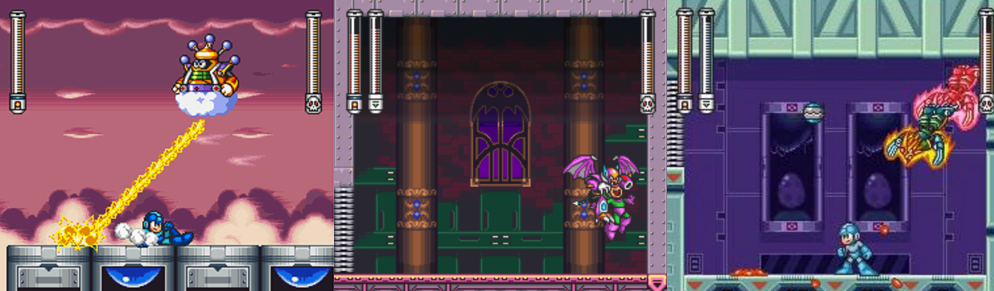
Mega Man 3 does little to break the mould of its predecessors. Like the first two games, it’s a 2D, sidescrolling run-and-gun action platformer that tasks you (as Mega Man) with traversing eight levels and defeating a batch of new (and old) Robot Masters. Although you can still pick the order you challenge each stage (something made much easier with the helpful cheat sheet included with this Legacy Collection, which tells you each Robot Master’s weakness), there’s no difficulty settings like in Mega Man 2. Still, you can choose to play either the US or Japanese versions, enable a turbo mode, and customise the button layout. Not that you really need to given how simple the controls remain. A lets you jump, X fires your currently equipped weapon, Y offers an autofire option, and you pause the game to select another weapon with the Xbox’s Menu button. Mega Man 3 introduces a slide action, performed with down and A, to let you slip through narrow gaps and tunnels and beneath jumping enemies and certain projectiles, though it’s not implemented all that much. Each of the eight new Robot Masters gifts a new Special Weapon upon defeat, and Doctor Thomas Light upgrades Rush with new functions as you progress. Like in Mega Man 2, you can’t replay previous stages but there are some optional paths at times, hidden power-ups such as extra lives, Energy Tanks (great for restoring your health in a pinch), and boosts for your health and weapon energy. Mega Man 3 also offers a password system that lets you continue your progress at any time, or gain additional bonuses, though this is largely superfluous thanks to the Legacy Collection’s save state and rewind features.

Mega Man’s arsenal is bigger than ever, yet also paradoxically familiar.

While Mega Man’s trusty Mega Buster will serve you well for the most part, your battles against the eight Robot Masters will be made much simpler by equipping one of the new Special Weapons. Each has an energy meter that depletes as you use them so you’ll need to grab Weapon Energy capsules to keep this topped up, often requiring you to “farm” enemies that conveniently respawn when you move offscreen. Although they’re new weapons, some are again similar to the ones seen before (Shadow Blade, for example, is functionally identical to the Metal Blade as you can fire it upwards, downwards, and diagonally), though only the Hard Knuckle has a use outside of boss battles as it destroys certain blocks. The Magnet Missile travels horizontally unless there’s a target above, then it homes in vertically; the aforementioned Hard Knuckle is slow but deals damage on impact; the Gemini Laser fires a laser that ricochets about, and the Top Spin adds a whirlwind spin to your jump but is finnicky to control. I already mentioned the directional Shadow Blade, the Spark Shot stuns enemies, the Needle Cannon rapidly fires needle projectiles, and the Search Snake sends three small snakes across floors, walls, and ceilings. I had little use for most of these, honestly. I used the Magnet Missile the most, followed by the Shadow Blade (which is great for dispatching enemies on ladders), but had little use for the Snake Search or Spark Shot outside of boss battles so I never worried about these running  out of energy. Mega Man 3 also introduces Mega Man’s robotic canine, Rush, who effectively replaces the Items from previous games. Rush Coil springs you high into the air, Rish Jet flies across gaps for as long as your energy meter lasts, and Rush Marine does the same but when underwater. These latter two turn the action into something of a sidescrolling shooter, which helps break up the gameplay a bit, though you need to snag the energy refills as you go or you’re liable to drop to an untimely end.

The game is bigger and more detailed, and yet doesn’t seem to be innovating much.

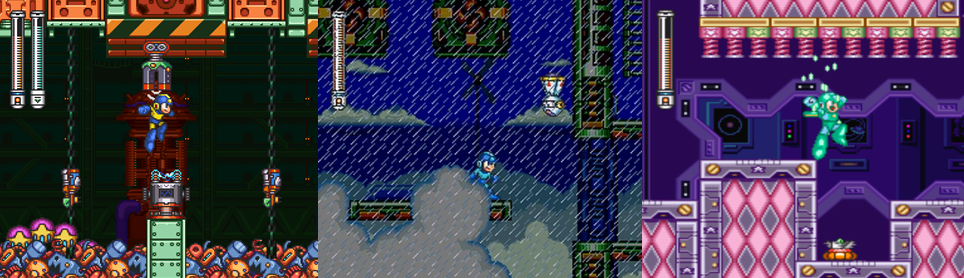
Mega Man 3 is much bigger than its predecessors, and therefore much tougher as a result. Ladders, tricky platforming, insta-kill hazards like spikes and bottomless pits, and disappearing/reappearing blocks are commonplace, often over huge gaps. Turrets also crop up a lot, as do tunnels for you to slide through (sometimes with the risk of a drill hazard), and some stages feature a lightbulb enemy that blankets the environment in darkness until they’re destroyed. Some stages have more unique elements built into them; Magnet Man’s stage, for example, incorporates a magnetic gimmick where turbines attract you, causing no damage but putting your jumps at risk. Spark Man’s stage includes a moving electrical hazard that forces you to time your jumps to avoid damage (or a drop down a pit) and rising blocks over a bottomless pit with insta-kill ceiling spikes above, and Snake Man’s stage includes giant snake head turrets that spit massive fireballs and make the ground uneven until they’re destroyed. Gemini Man’s stage features underwater sections where your jump is much higher and your progress is blocked by destructible Pole eggs that spawn in Pole enemies when destroyed. Often, you’re tasked with making tricky jumps to small or moving platforms, usually while enemies or projectiles rain down. Sometimes these platforms are temporary, sometimes they’re moving, and sometimes you’ll need to make your own using Rush’s abilities. Four of the stages are remixed into harder challenges once you’ve defeated the eight Robot Masters, adding small cogs to Spark Man’s stage, upping Rush Coil’s use in Needle Man’s stage, increasing the spikes and Pole eggs in Gemini Man’s stage, and adding more spiked shafts to Shadow Man’s stage.

Presentation:
Mega Man 3 offers same 8-bit stylings of its predecessors, adding only a new sliding animation to Mega Man’s repertoire and little else. Sure, his sprite changes colour when a Special Weapon is equipped but the presentation is starting to feel quite samey at this point. Although bigger sprite art is used when Mega Man acquires a new Special Weapon, and in-game graphics are used for the few story cutscenes near the endgame, the title screen is a dramatic step back, being simply the game logo on a plain black background. While many large enemy sprites appear in the game, and the game is much bigger than the last two, Mega Man 3 still suffers from slowdown, sprite flicker, and screen tearing when too much is happening onscreen. The music is still a highlight, with jaunty tunes accompanying each stage and the iconic Mega Man theme kicking in, but again it’s all very familiar at this point and feels like an extension of Mega Man 2 rather than necessarily improving upon it. There’s possibly even less story here than before, at lest until the endgame. Occasionally, you’ll be challenged by Proto Man, who announces his arrival with a whistling tune and opens new areas upon defeat, but there’s no story text about this until you’re ready to track down Dr. Wily. Indeed, if it wasn’t for Doc Robot’s presence in the four remixed sages, you’d be forgiven for not even realising that Dr. Wily was supposed to have repented his evil ways. Instead, he shows up in his UFO and flees to another impressive castle, forcing you to brave six additional stages to track him down. There are a few additional flourishes to this, to be fair: Mega Man 2’s Robot Masters dramatically fuse with Doc Robot before each bout, Dr. Wily’s revealed to be a puppet at one point, and there’s a lingering mystery about Proto Man by the end.

Sprites and stages are more detailed than ever, but I would’ve liked to see more from the story.

Mega Man 3’s stages are a touch more detailed than before, but again aren’t really offering much new. Exposed wires, pale pastels, and ugly electronics are rife in Magnet Man’s stage, Hard Man’s stage takes place atop and within a rocky mountaintop, Top Man’s stage features a particularly garish blue and green pastel aesthetic that’s barely tolerable with the grass effects in the foreground, and Shadow Man’s stage appears to take place in a sewer, but one filled with red water. Spark Man’s stage is full of gears and conveyors in the background, and Snake Man’s stage has a green scale effect to every surface that makes it seem like a gigantic extension of the titular Robot Master but ends up in the clouds. Gemini Man’s stage is perhaps the most visually striking with its ice crystals, flashing blocks, and underwater coral reefs, and Needle Man’s stage is set in a futuristic city and features girders, drills, and skyscrapers. Dr. Wily’s fortress is your typical mechanical hellhole where you must breach his outer defences before tackling the tight corridors and sewer system within. While most stages have a horizontal progression, it’s not uncommon to find yourself dropping down shafts (often while dodging insta-kill spikes) or platforming across gaps. While the visual identity of the franchise is as strong as ever and the big enemy sprites are impressive, things again feel very safe and very familiar. I applaud Mega Man 3 for avoiding using cliché elemental tropes to differentiate stages, but it would perhaps have helped this title to stand out a little bit more, or maybe if there was more focus placed on the story and the mystery of Proto Man.

Enemies and Bosses:
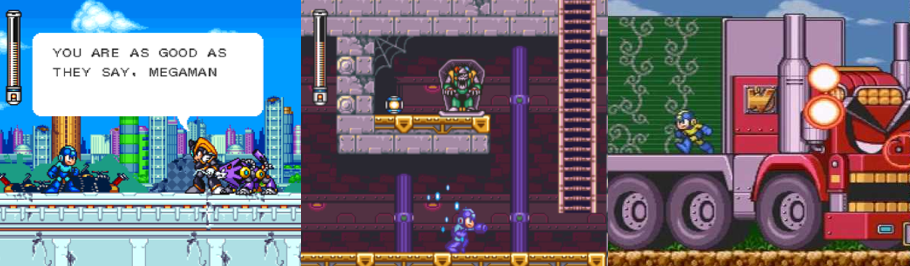
A gaggle of new robotic foes stands between you and victory in Mega Man 3 but don’t worry, Metall is still here and now they can fly with little propellors and a giant version even acts as a sub-boss. Sniper Joe is not only missing (thankfuller!) but poorly replaced by Hammer Joe, an armoured foe who tosses a ball and chain and can only be damaged when their eyes glow, but are otherwise immobile and easy to attack. For the most part, enemies are stranger and weaker than ever: Poles can surprise you, parachuting Parasyu and annoying Elec’n’s appear at the worst times, and Peterchy’s wander about and drop down from above, but they all die in one hit. Things get a little tougher when Have “Su” Bees drop a swarm of Chibees onto you or the porcupine-like Hari Harry’s come rolling along, or the large, frog-like Bikky springs at you, but by far the most amusing and strangely dangerous for me were the pole-vaulting Bubukans. Large enemies are far more commonplace here with the likes of the Giant Springers, Gyoraibos, Penpen Makers, and the cat-like Tamas appearing often. Like the Giant Metall and Big Snakeys, Tamas act as sub-bosses; though they’re less of a hazard than the likes of Bikky as they’re completely stationary, their projectiles are large and difficult to avoid. Robotic apes, walking bombs, floating orbs, and the spinning top-firing Matasaburo round out the enemies, who appear in multiple stages, and even the Pickelman returns from Mega Man, now driving a cute little digger!

Eight new Robot Masters exist to challenge you and fall by their weaknesses again…

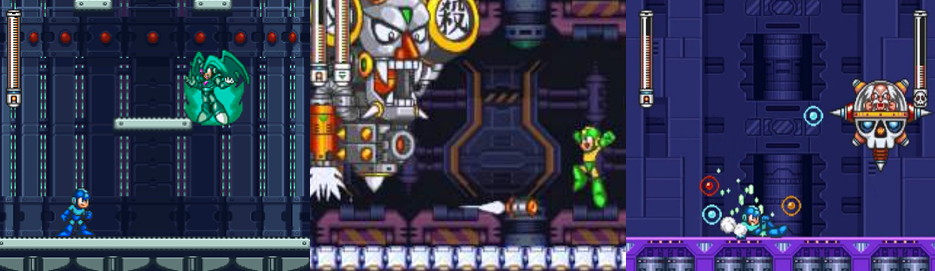
Yet again, you’ll face a Robot Master at the end of every stage and, as ever, the order you challenge them dictates how difficult the battle is since each one is weak to a different Special Weapon. All eight are battled again in Dr. Wily’s fortress, as is tradition, in bland arenas and when you’re at full power, making the rematches much easier. I tackled Magnet Man first, who’s weak to the Spark Shock, Shadow Blade, and even his own Magnet Missile but the Mega Buster will do him in just fine despite his magnetic shield and projectiles. His Magnet Missile makes short work of Hard Man, who blasts you with his Hard Knuckle and stuns you with a screen shaking slam. His Hard Knuckle is the key to besting Top Man, though the weapon is slow and Top Man is invulnerable when spinning; he also fires spinning tops that can be tricky to avoid thanks to Mega Mans large hat box. The Top Spin lets you whittle down Shadow Man, though I found it strangely difficult to use. Shadow Man jumps about tossing his Shadow Blade shuriken and sliding into you, so be sure to attack from the air. The Shadow Blade is great at hitting Spark Man when he leaps high into the air to fire electrical shots in all directions or charge up his big shot. I took on Snake Man next, who’s primarily weak to the Needle Cannon but can be bested with the Mega Buster. It’s a tough fight in this instance though as Snake Man jumps about and fires his little Search Snakes, which are difficult to avoid in the uneven area. The one time I used his Special Weapon was against Gemini Man, a super-fast Robot Master who duplicates himself and fires his ricocheting laser about the room. This Gemini Laser makes Swiss cheese out of Needle Man, despite his rapid-fire projectile and extendable head. As mentioned, you’ll battle all eight of these guys again in Dr. Wily’s fortress, with each dropping some health afterwards (but no energy), but you’ll also battle three Maga Man duplicates. Top Spin is the key here, and targeting the right one (he’ll teleporting the same was as you do).

Old foes return alongside mysterious rivals and Dr. Wily’s biggest creation yet!

After you defeat all eight, you’ll play through four remixed stages and battle the eight Robot Masters from Mega Man 2, two per remixed stage, with each one inhabiting Doc Robot. They sport all their familiar attacks and are vulnerable to your new Special Weapons (use Spark Shot against Air Man, for example, Shadow Blade against Bubble Man, and Top Spin against Heat Man). Occasionally, you’ll battle Proto Man, who doesn’t have a health bar and simply runs and jumps about shooting at you; he’s particularly weak to the Magnet Missile and begrudgingly aids you as the game progresses. Dr. Wily’s fortress is also home to two additional bosses, the Kamegoro Maker (simply destroy the frog-like Kamegoro it spawns) and the Yellow Devil MK-II (which is actually easier than its predecessor as its blocks are easier to void, though you do need to watch for its projectiles and deal with the Hard Knuckle’s slow fire rate). Best all of these threats and you’ll finally battle Dr. Wily once more, this time in two two-phase battles. The first is against one of his trademark machines; simply blast the lower antenna with the Spark Shot and avoid his large spinning projectiles, then watch for his pin-like legs and time your Hard Knuckle shots to hit his cockpit when it lowers. When he’s defeated, Dr. Wily will pilot the gigantic robot Gamma, which fires three projectiles from its big, stupid head in the first phase and adds an energy shot and a big fist attack in the second. Just clobber him with Hard Knuckle shots then finish him off with a Top Spin to win.

Additional Features:
There are twenty-four Achievements in the Mega Man Legacy Collection, with one specifically awarded for beating this game. Alongside different display options (such as borders and filters), the Legacy Collection offers a character database, production art, and a series of tough, time-based challenges for additional Achievements. The more challenges you complete, the more you’ll unlock, including additional remixes of Mega Man 3’s stages and even gauntlets that pity you against multiple Mega Man titles and bosses against stricter time limits. Otherwise, there’s not much else to return to in Mega Man 3 thanks to the continued lack of a high score table or avenues for exploration.

The Summary:
Mega Man 2 improved upon the first title a lot, being bigger and better while still retaining the same charm and appeal despite the increased difficulty. This is true of Mega Man 3; it’s a good two times the size of the first game and is definitely bigger than the second, but I have to say I expected a bit more by the third title. Whether that be more creativity in the weapons, more focus on the narrative, or more interesting gameplay mechanics; just give me something to make me feel its unique experience. As is, I felt Mega Man 3 didn’t quite live up to its potential; it’s still a great game, but no better or worse, overall, than its predecessor. I would’ve liked to see more focus on the Rush mechanic, perhaps even making him a secondary character or offering entire sections or bonus rounds where you play as (or on) him. I would’ve liked to see more of the narrative address Proto Man’s appearances, perhaps even make him playable in the boss rematches or show up for the final battle. The slide was cool but it’s poorly implemented, with few chances to take full advantage of its potential. Mega Man’s Special Weapons also feel increasingly useless as gameplay mechanics thanks to the continued linear direction, and I just think things should have progressed a bit further by the third title. Mega Man 3 definitely expands and adds to the formula, the point where I’d say you could skip the previous two and start here, but it doesn’t truly innovate as much as it like a feels like a stop-gap before the next game, especially in terms of its narrative.

My Rating:

Rating: 3 out of 5.

Pretty Good

Are you a fan of Mega Man 3? What did you think to Rush and the new slide mechanic? Do you agree that the formula was becoming a bit stale by this point? What order did you tackle the game’s stages and which Robot Master gave you the most trouble? Would you have liked to see and learn more about Proto Man? ? How are you celebrating the science-fiction genre this month? Whatever your thoughts and memories of Mega Man 3, please leave them below and be sure to check out my other Mega Man reviews across the site!

Game Corner [Sci-Fanuary]: Mega Man 2 (Xbox Series X)


January celebrates two notable dates in science-fiction history, “National Science Fiction Day” on January 2 and Arthur C. Clarke’s HAL 9000’s birthday on January 12. Accordingly, I’m dedicating January to celebrating sci-fi with an event I call “Sci-Fanuary”.


Released: 24 August 2015
Originally Released: 24 December 1988
Developer: Digital Eclipse
Original Developer: Capcom
Also Available For: GameCube, Mobile, Nintendo 3DS, Nintendo Entertainment System (NES), Nintendo Switch, Nintendo Wii, Nintendo Wii U, PlayStation, PlayStation 2, PlayStation 4, PlayStation 5, PlayStation Portable, Tiger Electronics, Xbox, Xbox One, Xbox Series S 

The Background:
In 1987, Capcom sought to move away from producing arcade titles and make their debut on the revived home console market with Mega Man (known as “Rockman” in Japan), a run-and-gun title inspired by Astro Boy (Tezuka, 1952 to 1968) that became notorious for its difficulty. Although widely praised and now regarded as an NES classic, Mega Man wasn’t successful enough to justify an immediate sequel. The developers were only permitted to work on a follow-up alongside other projects, creating a great deal of stress for all involved. Still, the small team was determined to improve upon the graphics, gameplay, and music of the original. Scrapped ideas from Mega Man made their way into the sequel, which also introduced support items to aid the player and address the difficulty of the first game. Contrary to Mega Man’s low sales, Mega Man 2 was a huge success, selling over 1.5 million copies and being met with unanimous praise. Reviews lauded the improvements to the controls and difficulty curve and the refined graphics and mechanics, and the game is renowned as one of the best in the series. In the years since its release, Mega Man 2 was ported several times, including a remake for the SEGA Mega Drive, before being released alongside the first five titles with this Legacy Collection release, which included quality of life features and additional bonuses to celebrate the long-running series.

The Plot:
After being defeated by Mega Man, the maniacal Doctor Albert Wily creates his own Robot Masters and constructs a new fortress to strike back at his foe, compelling Rock to once again confront the mad scientist.  

Gameplay and Power-Ups:
Like its predecessor, Mega Man 2 is a 2D, sidescrolling run-and-gun action platformer that places you back in control of fighting robot Mega Man, now tasked with blasting through eight levels and defeating a Robot Master in each. As before, the player can pick the order they tackle each stage and boss, meaning Mega Man 2’s difficulty is placed in your hands (luckily, the Legacy Collection includes a helpful cheat sheet) as Robot Masters are vulnerable and resistant to different weapons. Unlike the previous game, the difficulty can be further increased if players select the “Difficult” mode on the title screen, though there is now a password system to save your progress (something negated by the Legacy Collection’s manual save feature). Once again, the Legacy Collection edition offers the US and Japanese versions and options to speed up the gameplay and configure the button layout to your liking, The default setup, though, is perfectly acceptable and exactly the same as before: you jump with A, fire your currently equipped weapon with X and use an autofire function with Y, and bring up the pause menu to select different “Special Weapons” with the Right Bumper. Each Robot Master you defeat grants you a new Special Weapon, and Doctor Thomas Light gifts three additional ones as you progress. Since you can’t replay previously completed stages this time, there’s no need to worry about backtracking for missed items, but certain weapons (such as the Crash Bomber and the Items) will open paths to goodies such as extra lives and the new Energy Tank power-up. You can store up to four of these and they’re great for restoring your health in a tight pinch, though you can still abuse the Legacy Collection’s rewind feature with the Left Bumper. While Mega Man gains some new Special Weapons, his default abilities are unchanged. He still can’t duck or slide, but levels are still created to take advantage of his platforming and shooting skills so this is more of a nit-pick.

Mega Man takes on eight new stages, eight new Robot Masters, with eight new abilities!

As before, Mega Man is equipped with his Mega Buster, but this can be swapped out for a Special Weapon after defeating each of the eight Robot Masters. Each Special Weapon has an ammo meter that depletes with use and you’ll need to collect Weapon Energy capsules to partially or fully refill this, meaning you may need to “farm” the enemies that conveniently respawn right before each boss room. While some Special Weapons are similar to those of the last game (the Crash Bomber isn’t too dissimilar to the Hyper Bomb, for example, and the Quick Boomerang is very much like the Rolling Cutter), they are some of the most iconic in the franchise. Metal Man’s Metal Blade is super useful as you can fire it upwards, downwards, and diagonally, which is great for taking out aerial enemies or when climbing ladders. Wood Man’s Leaf Shield surrounds you in a shield of leaves that blast ahead as soon as you move, Bubble Man’s Bubble Lead drops a heavy bubble that rolls along the floor, and the Air Shooter acquired from Air Man sends mini tornados hurtling upwards. The aforementioned Crash Bomber has a bit of a delay, but its explosion is great for destroying certain blocks and dealing big damage. The Quick Boomerang is a great rapid-fire projectile, and Flash Man’s Time Stopper is essential for getting past the insta-kill lasers in Quick Man’s stage, though you’re left completely defenceless once it’s activated. Of them all, I found Heat Man’s Atomic Fire the most useless; in fact, I don’t recall using it once! The Magnet Beam from the first game is expanded into three additional “Items” gifted by Dr. Light after defeating certain Robot Masters. Used correctly, they’re invaluable for crossing bottomless pits, beds of spikes and rushing water, and scaling tall shafts and Dr. Wily’s tower. Item-1 creates a vertical platform and you can place up to three at once to create temporary bridges, Item-2 carries you horizontally across large expanses on a rocket-powered platform, and Item-3 bounces along until it hits a wall, then it crawls upwards to give you an extra boost.

The game’s difficulty is upped a notch by more insta-death hazards and tricky platforming gimmicks.

If Mega Man was challenging, Mega Man 2 is tough! I probably made things harder for myself by playing on “Difficult”, but this was a hell of a challenge. The score system is gone and you get a few extra lives from enemies or within levels, and I’m sure the password system helped back in the day, but I’m not sure how anyone beat this game without the quick save and rewind features of the Legacy Collection. Bottomless pits, respawning enemies, insta-kill hazards, and projectiles are commonplace obstacles, with Mega Man 2 boasting more sprites than its predecessor. Falling, temporary, or hazard-strewn platforms dog your progress as much as vertical shafts forcing you to scale ladders or make blind jumps, often requiring split-second reflexes to avoid spikes or lasers. Conveyer belts push you along or work against you, slippery blocks send you careening towards hazards, disappearing blocks over bottomless pits will have you on the edge of your seat, and enemies surprise you from the foreground and offscreen. In Bubble Man’s stage and the third Dr. Wily stage, you’ll take a dip in water; this slows your forward momentum but increases your jump height, forcing you to rethink even simple jumps. The fourth Dr. Wily stage includes annoying false floors that are indistinguishable from the rest of the terrain and can drop you down a screen, while Crash Man’s stage features a lot of ladder climbing and alternate routes that can lead to goodies or enemies. Thankfully, the rewind and manual save feature can assist you, but it definitely pays to play the stages in an efficient order so you can make short work of each Robot Master.

Presentation:
At first glance, Mega Man 2 is more of the same 8-bit goodness offered by the original. Mega Man’s sprite is exactly the same, with no new animations or expressions beyond changing colour when a Special Weapon is equipped and some new sprites to represent those abilities. However, the game impresses from the start with its text-based story and dramatic pan up a large skyscraper to find Mega Man brooding on the rooftop alongside a far more impressive title screen. The game still struggles a bit when too much is happening on screen; sprite flickering, slowdown, and screen tearing are commonplace issues but, overall, the stability seems much improved and the very fact the game has eight stages, eleven new abilities, two difficulty settings, and a password feature shows it’s built upon its predecessor. One area where Mega Man 2 really impresses is its music; every stage is accompanied by a jaunty or rocking tune, with Crash Man’s being a particular highlight. There’s a little more story here as well; Dr. Light communicates to you every now and then to bestow a special Item and there are more cutscenes of Dr. Wily escaping in his UFO. There are also a few more graphical touches in some stages: Flash Man’s stage is a touch maze-like at times, offering higher and lower paths to take, and Quick Man’s has a lot of vertical drops where you’ll be biting your bottom lip to avoid the deadly lasers. Bubble Man’s stage has an (admittedly ugly) waterfall in the background of the opening section, and there are even moments where the entire screen goes black save for the character and enemy sprites.

Though still simplistic and handicapped, the visual and graphical variety is much improved.

In fact, while the eight stages aren’t exactly trendsetting for this era of gaming, the levels on offer in Mega Man 2 have far more visual variety than in the first game and better suit their associated Robot Master. Metal Man’s stage is a mess of gears and industrial aesthetics that’s full of drills and weighted spiked obstacles. Wood Man’s stage impresses for the time with its surprisingly detailed forest, which extends underground and to the treetops, as does Bubble Man’s stage (waterfall notwithstanding), which eventually drops you into the sea where you must rethink every jump to avoid death. Air Man’s stage takes place up in the clouds, and even behind them at times, with Mega Man hopping to small, hazardous, and floating platforms to progress, while Crash Man’s stage is a construction site that’s a mess of yellow pipes, ladders, and these little rolling platforms you ride to reach ladders. Heat Man’s stage is either in a sewer or some kind of lava-filled underground cavern, it’s hard to tell the difference, but I enjoyed the rushing liquid and the disappearing block platforms (especially as Item-2 allows you to completely bypass them). Flash Man’s stage has a blue sheen to it and slippery floors, while Quick Man’s stage is more mechanical and almost a prelude to the challenge offered by Dr. Wily’s castle. Yes, after besting the eight Robot Masters, you’ll travel to Dr. Wily’s newest fortress: six additional stages containing recycled and reimagined gimmicks and hazards from the previous levels. These exist alongside new aesthetics, such as the rocky/fortified exterior and lengthy outer wall, the industrial interior with its giant fans, dripping water, and teleport pads, and the final showdown in Dr. Wily’s control room, sadly relegated to the pre-credits cutscene in favour of a bland final battle against the rushing backdrop of space.

Enemies and Bosses:
A whole host of new robotic enemies awaits you in Mega Man 2, though there are a couple of familiar faces here: Neo Metall hides behind its hard hat and fires projectiles like its predecessor but is bold enough to rush you, too. A renewed Sniper Joe also returns, still hiding behind a shield but now staying completely still. However, they make up for this by controlling giant mech walkers that almost act like mini bosses unless you have the Air Shooter or Leaf Shield. Similarly, you’ll encounter gigantic robotic Lantern Fish in Bubble Man’s stage. These perpetually spit out shrimp-like Shrink’s and can only be destroyed by shooting the lure on its head. Another gigantic quasi-mini boss are the Hot Dogs encountered in Wood Man’s stage; while they don’t move, they breathe plumes of fire that are difficult to avoid in the cramped tunnels. Most other enemies can be destroyed in one or two shots and are largely more manageable compared to the first game, though the constant respawning can be a headage. Bubble Bats, crab-like Claws, Tellys, and Springers are all commonplace and good for farming ammo or health, while Crabbots, Robo-Rabbits, and Pierobots can cause some headaches due to their small size, versatile firing range, and suddenness of their appearance, respectively. Enemies like Croaker, Pipi, and Blocky should be taken out quickly to avoid them spewing up smaller enemies or spreading themselves as projectiles. Air Tikkis and Lightning Lords act as platforms in Air Man’s stage, where Fan Fiends blow you back, and Crazy Cannons shoot at you through the environment. I was very impressed by the visual variety and character in Mega Man 2’s enemies, with guys like the speedy Atomic Chicken, Hothead, and Mecha Monkey being fun standouts for their large sprites and toughness.

Tackling the Robot Masters in the right order is still the best option.

As before, every level ends in a battle against one of the eight Robot Masters in a specially prepared arena and is accompanied by an ominous boss theme and a helpful health bar. The Robot Masters will be significantly easier to battle if you have the Special Weapon they’re weak to on hand; without these, even the easiest Robot Master is a challenge, so I tackled Metal Man first. Fought on a conveyer belt floor that switches your direction, Metal Man tosses gear-like projectiles as he hops about the arena; he’s weak to the Quick Boomerang and his own weapon, but easily falls to the Mega Buster with enough patience. Armed with his Metal Blade, I then fought Wood Man (though Atomic Fire works well, too), who is invulnerable when his Leaf Shield is up. You need to carefully jump to avoid both this and the falling leaves to attack when he’s vulnerable, making for a tricky boss if you’re low on health. The Metal Blade also makes short work of Bubble Man, who’s fought underwater. While your jumping is restricted and he swims about dropping Bubble Leads, it’s easy to pick him off with the versatile Metal Blade or Leaf Shield. The Leaf Shield also makes short work of Air Man, though it can be hard to land a direct hit thanks to his mini tornados. Similarly, Heat Man is decimated by the Bubble Lead but only when you land a hit. When he’s enflamed or teleporting or you’re stuck in his flame pillars, the battle can go south pretty quickly. Crash Man may be erratic and dangerous with his timed mines, but the Air Shooter takes care of him pretty quickly. Flash Man is also quite easy, especially with the Metal Blade or Crash Bomber that obliterate him before he can even think of freezing you in place with Time Stopper. But Quick Man…he was a tough one the first time. It’s very helpful to farm ammo for the Time Stopper as a fully charged shot will drain half his health, then it’s just a case of timing your Crash Bomber shots, which can be tough as he hops about and fires a lot of projectiles.

Dr. Wily’s greatest creations, and his true alien form (?), await in his fortress.

When tackling Dr. Wily’s fortified fortress, you’ll rematch all eight Robot Masters before taking on the mad scientist. This time, they’re fought in bland arenas and drop large Health Capsules upon defeat, plus you have all the Special Weapons so they’re much simpler in the rematches. Before you can get to them, you must best four additional boss battles. First up is the Mecha Dragon, which chases you across an empty void, forcing you to hop to small blocks to avoid being one-shotted, then breathes fire plumes and fireballs at you. Fortunately, the Quick Boomerang cuts this beast down, but it’s still easy to fall to your death from knockback. Next, you battle Picopico-kun, which is essentially the walls and floor of a small arena coming to life to attack you, but they’re easily bested with the Bubble Lead. Guts Man returns as the mammoth Guts Tank, a large sprite that tests the game engine’s performance and spits both projectiles and Neo Metalls, as well as attacking with its large fists. By hopping onto its base and making liberal use of the Quick Boomerang, you can bring this foe down without too much trouble, however. The Boobeam Trap is a little tricker, though, especially if you haven’t got full Crash Bomber ammo. You need to destroy the walls protecting the five turrets, so you need all your Crash Bomber ammo for this; you also need to dodge the flurry of projectiles each first, too (though you can rapidly pause to glitch through them). Once you’ve cleared these challenges, you’ll face a two-phase battle against Dr. Wily’s newest machine. In the first phase, he fires projectiles in a low arc; hop over them and target the cockpit with the Crash Bomber or Atomic Fire and he’ll be exposed, adding a more sporadic bouncing shot to his arsenal. After enough hits, Dr. Wily retreats and transforms into an alien that saps your health on contact. The alien flies about firing easy-to-dodge projectiles and is vulnerable only to the Bubble Lead. With patience and well-timed attacks, Dr. Wily’s simulation (and plans for world domination) will be ended and he’ll be left begging for mercy once more.

Additional Features:
The Mega Man Legacy Collection offers twenty-four Achievements, with one being awarded when you complete Mega Man 2. Alongside numerous display options (such as applying borders and filters), the Legacy Collection offers a character database, production art, and sound test for the game. You can also take on tough, time-based challenges for additional Achievements in the game’s “Challenge Mode”, which tasks you beating remixed stages from Mega Man 2, tackling the Robot Masters once more, and taking on challenges set by the developers to prove your mastery of the game. Completing challenges unlocks yet more of these tests, with Mega Man 2’s stages and bosses being remixed into others alongside gauntlets. Otherwise, you may wish to return to Mega Man 2 to tackle the “Difficult” mode, where enemies have altered attack patterns, Mega Man’s attacks deal less damage, and the Robot Masters have more health.

The Summary:
There’s a good reason why Mega Man 2 is considered one of the best of the classic Mega Man games. It takes everything that worked in the previous game and expands upon it, adding new abilities to Mega Man’s arsenal (if not his base moves), more visual variety, and an absolutely kick-ass soundtrack. The difficulty may be cranked up a little, but the game does compensate for this: the password system, for one, and a slightly more linear progression system where the player doesn’t have to worry about backtracking. Unfortunately, you can still hit a wall if you don’t challenge the stages and Robot Masters with the right Special Weapons. My first time through, I couldn’t get past Quick Man and ended up starting over and saving him for last, for example. Insta-death hazards are far more aggravating this time around; those laser beams offer no quarter, forcing you to drain your Time Stopper ammo to survive and then farm mech-riding Sniper Joes to replenish it enough to battle Cut Man. Though the Legacy Collection mitigates a lot of these issues, I do wonder how gamers survived Mega Man 2’s challenge back in the day. While the stages are much richer and more detailed and I appreciate the added emphasis on story and the new enemy sprites, I think Mega Man 2 played things a little too “safe”. Sure, it’s technically bigger and runs a lot better and the visuals are tweaked and improved, but it feels like Mega Man was a proof of concept for this game, and this is simply Mega Man 1.5, adding minor improvements here and there. There are no additional playable characters, for example, and the stages didn’t feel longer or much more than expansions on what came before. I think I’d rather play Mega Man 2 than the original, for sure, though. It feels much more refined and laid the foundation for the games that followed and has earned its reputation. But, by repeating a lot of the same beats of the first game, I feel it doesn’t deserve to be rated any higher than its predecessor, despite being a noticeable improvement.

My Rating:

Rating: 4 out of 5.

Great Stuff

Did you enjoy the improvements made to Mega Man 2 back in the day? Do you also consider it to be one of the best of the classics or do you prefer a different entry? What order did you tackle the game’s stages and which Robot Master gave you the most trouble? What did you think to the game’s difficulty and the new Special Weapons? Were you surprised when you fought an alien in the finale? How are you celebrating the science-fiction genre this month? Whatever your thoughts and memories of Mega Man 2, please leave them below and be sure to check out my other Mega Man reviews across the site!

Game Corner [Sci-Fanuary]: Mega Man (Xbox Series X)


January celebrates two notable dates in science-fiction history, “National Science Fiction Day” on January 2 and Arthur C. Clarke’s HAL 9000’s birthday on January 12. Accordingly, I’m dedicating January to celebrating sci-fi with an event I call “Sci-Fanuary”.


Released: 24 August 2015
Originally Released: 17 December 1987
Developer: Digital Eclipse
Original Developer: Capcom
Also Available For: GameCube, Mobile, Nintendo 3DS, Nintendo Entertainment System (NES), Nintendo Switch, Nintendo Wii, Nintendo Wii U, PlayStation, PlayStation 2, PlayStation 4, PlayStation 5, Xbox, Xbox One, Xbox Series S

The Background:
Prior to 1987, Capcom was primarily known for their arcade titles and Mega Man (or “Rockman” as it was known in Japan) was specifically conceived to be their first venture into the home console market, which was seeing a resurgence thanks to Nintendo’s efforts. Inspired by Astro Boy (Tezuka, 1952 to 1968), artist Keiji Inafune designed Mega Man’s iconic, chibi­-style look that was absolutely butchered when Mega Man released in the United States. Mega Man was developed by a team of only six people and incorporated a “rock, paper, scissors” methodology to its bosses, which would be vulnerable to specific weapons. Despite its reputation as one of the hardest videogames of its era, Mega Man received critical acclaim. It’s widely regarded as one of the all-time NES classics, largely because of the challenge involved, and spawned a popular and sprawling series of videogames, comic books, and cartoons over the following decades. Over the years, Mega Man has been re-released several times: it was completely remade for the SEGA Mega Drive in 1994, rebuilt into a 2.5D PlayStation Portable-exclusive title in 2006, and finally came to modern consoles alongside its first five sequels with this Legacy Collection release, which included quality of life features and additional bonuses to celebrate the long-running series. 

The Plot:
In the year 20XX, the kindly Doctor Thomas Light’s robots are turned into malevolent “Robot Masters” by Dr. Light’s rival, Doctor Albert Wily. In response to this threat, Dr. Light’s assistant, Rock, volunteers to become the fighting robot Mega Man, defeat the Robot Masters, and confront Dr. Wily in his dangerous robot factory. 

Gameplay and Power-Ups:
Mega Man is a 2D, sidescrolling run-and-gun action platformer in which players assume the role of the chibi­ fighting robot Mega Man (despite what the atrocious American box art would have you believe) and blast your way through six levels to track down and defeat the six Robot Masters. You can freely select the order you want to play these levels, but you’ll have a much easier time if you consult an online guide (or the handy cheat sheet that comes with this Legacy Collection version of the game) and tackle the stages in a specific order as Robot Masters are extremely vulnerable to certain weapons so it makes the game a lot easier if you plan out which order you’re going to tackle its levels. The Legacy Collection release lets you pick between the Mega Man and Rockman versions, speed up the gameplay, and freely configure the button layout, but the basic setup is perfectly fine for gameplay. By default, A jumps, X fires your currently equipped weapon, Y enables an autofire function that’s more like a rapid-fire mode, and B does nothing. The Right Bumper brings up the in-game pause menu where you can select different “Special Weapons” to equip to Mega Man’s Mega Buster arm cannon, the Left Bumper allows you to rewind the game if you make a mistake, and you can manually save at any time from the main pause menu. Mega Man is a little limited in his abilities here; you can run, shoot, and jump and shoot and that’s about it. There’s no slide, dash, or wall jumping here, just the basics, but that’s enough to get through most levels if you’re skilled and patient enough. 

Blast and platform through stages using versatile Special Weapons.

However, Mega Man’s abilities increase as you clear stages and defeat the Robot Master. Each victory adds the Robot Master’s signature ability to your Special Weapon list, providing additional means to traverse stages, defeat enemies, and easily dispatch subsequent Robot Masters. Unlike the Mega Buster, the Special Weapons have finite ammo; each has a bar that depletes upon use and you’ll need to pick up blue Weapon Energy capsules to partially or fully refill the meter. Since each Special Weapon has its own ammo, you’ll need to switch between them to fill each up, though smaller Weapon Energy capsules are often dropped by enemies easily defeated with the Mega Buster. Enemies also drop Life Energy cells to refill your health, and you’ll find larger variants of both and the odd extra life hidden in each level, usually near a death trap. Still, six Robot Masters means six Special Weapons: Cut Man’s Rolling Cutter sees you toss out a pair of boomerang-like scissor blades, Elec Man’s Thunder Beam fires electrical bolts above and ahead and is great for clearing large blocks out of your way, and Ice Man’s Ice Slasher fires arrow-shape ice projectiles that can freeze enemies and flame bursts to create temporary platforms. Fire Man’s Fire Storm blasts out a fireball and temporarily protects you with a flaming shield, Bomb Man’s Hyper Bomb sees you throw a large bomb that’s slow and takes a while to explode but deals heavy damage, and Guts Man’s Super Arm allows you to pick up and throw certain blocks. There’s also an additional power-up hidden in Elec Man’s stage; once you have the Thunder Beam or Super Arm, you can clear away the blocks to snag this item, which creates temporary energy platforms. Luckily, you can replay any level at any time to challenge the bosses again or acquire this item if you missed it the first time, and you’ll absolutely need it to clear Dr. Wily’s stages. 

The game is notorious for its punishing difficulty and testing your platforming skills.

Mega Man is not a game to be taken lightly; every stage is full of bottomless pits, tricky jumps, annoying enemies with erratic attack patterns that respawn the moment you edge off the screen, and other hazards designed to sap your health or whittle away your lives. Every enemy you defeat awards you points, though these appear to be completely useless. If you exhaust all your lives, you can choose to continue as often as you like or return to the stage select screen with all your progress saved, which is helpful, though I’m sure it was exhausting back in the day having to replay the tougher stages right from the start. The Legacy Collection’s rewind feature circumvents that but Mega Man is still tough. You’ll be climbing up and down ladders, hopping to blocks that vanish almost immediately, dropping down shafts and avoiding instant death spikes, and taking out flying enemies to buy yourself enough time to make a jump before the next one pops up. Wall and ceiling turrets, slippery ice in Ice Man’s stage, flame bursts in Fire Man’s stage, electrical currents in Elec Man’s stage, flying platforms that also shoot projectiles, and riding broken tracks on platforms that drop under you in Guts Man’s stage can all be difficult challenges to overcome. Pretty much all these gimmicks are then recycled in Dr. Wily’s gauntlet at the end of the game. Here, you’ll have to plough through four additional stages, each with an abundance of instant death pits and hazards and rematches against the Robot Masters (and battles against other bosses) in even more restricted arenas, which all put your skills to the test. Truthfully, I was always intimidated by Mega Man because of its notorious difficulty, but it wasn’t as bad as I thought, though I wholeheartedly put this down to me making liberal use of the rewind feature. 

Presentation:
Obviously, you’re going to need to temper your expectations for Mega Man; it’s an 8-bit title that originally released on the NES, a console not exactly known for its processing power. Still, everything is bright and colourful here; backgrounds aren’t always the most detailed and Mega Man is a pretty simplistic character sprite, but simple often works best in these types of games. Mega Man has a great deal of personality with his exaggerated head and arm cannon, blinking when left idle, wearing a look of agony when hit, and dramatically exploding into a shower of pixelated circles when killed. Every time you equip a Special Weapon, Mega Man’s sprite changes colour so you know what you have equipped (red for Fire Storm, yellow for Thunder Beam, etc) and he hops around with just the right level of control and dexterity, only really being unwieldy when skidding about in Ice Man’s stage. His hit box is quite large, though, as are those of his enemies, so there’s very little margin for error when battling enemies up close. Additionally, the game struggles a bit when there are a lot of sprites on screen. Screen tearing, sprite flickering, and collectibles quickly disappearing are commonplace and the action will slow down if too many sprites appear at once even with the Legacy Collection’s performance boosters.  

Mega Man sports a colourful, if garish, anime-inspired aesthetic.

While each level is aesthetically very similar, primarily being composed of a series of mechanical platforms and surfaces, they do have unique elements and colour palettes to separate them. Elec Man’s stage focused more on vertical progression, for example, with different ladder-based routes offering different enemies and hazards to bypass, while Guts Man’s stage takes place in a mine, with mine tracks and a rocky aesthetic punctuating this. Ice Man’s stage is fittingly covered in slippery snow and ice and even features water-based sections where your movement speed is dramatically hampered, and Bomb Man’s stage features large gold spherical buildings in the background. Dr. Wily’s stages are probably the most impressive, with lots of blinking lights and mechanical trappings emphasising the danger of his lair, while boss battles take place in enclosed arenas fitting for their inhabitants. Mega Man’s story is only related in the ending, which shows Mega Man returning home to Dr. Light and shedding his armour, though it includes some of the catchiest bit-tunes of its era, so it’s nice that the Legacy Collection includes the complete soundtrack on the disc. 

Enemies and Bosses:
A whole host of robotic minions will dog your progress in Mega Man, many of which spit projectiles either right at you, in a spread, or in an explosive burst, and some of which even shield against your attacks or can only be destroyed with specific Special Weapons. Enemies like the Bunby Helis, Kamadomas, Mambus, penguin-like Pepes, and Bullet Bill-like Killer Bombs will fly, float, and rocket across the screen to screw up your jumps, turrets sit on walls and ceilings, and the Adhering Suzies make traversing narrow corridors a massive pain as they wander back and forth and up and down. Mega Man so debuts some of the franchise’s most recognisable enemies, the Metall, a little robot who hides under a construction helmet and peeks out to spit projectiles at you, and Sniper Joe, a pistol-firing marksbot who hides behind a shield and requires the use of the Hyper Bomb to defeat. The Hammer Bros.-like Pickelman also carries a shield but tosses an endless supply of pickaxes at you, often hopping between platforms to up their annoyance factor, while spherical Watchers slowly float up and down, shooting projectiles and knocking you from ladders on Elec Man’s stage. Ice Man’s stage is also home to the wacky Crazy Razy, a robot who can detach its head from its body! Many stages also include a sort of mini boss, the Big Eye, a large robot that jumps about trying to crush you. Multiple versions of this enemy are found in Dr. Wily’s stage and they can take a lot of hits to defeat for very little reward, so it’s easier to simply run underneath them when they do a big hop and avoid them entirely. 

Each Robot Master has a specific weakness and yields a powerful Special Weapon.

Each stage culminates in a battle against one of the six Robot Master’s. Before battling them, you usually have to bypass a Big Eye and a corridor full of enemies, hazards, and a few power-ups before you’re locked into an arena, the awesome boss them kicks in, and the bosses health meter appears onscreen. The difficulty of the Robot Masters is entirely based on what Special Weapons you have on hand. f you don’t have the weapon they’re weak to, they can be quite tough but, with the right weapon equipped, they become a joke. With this in mind, the first Robot Master I fought was Cut Man, who runs and jumps about tossing his boomerang-like scissor blades at you. You can easily avoid this and defeat him with the standard Mega Buster, and then use the Rolling Cutter to decimate Elec Man, whose three-way Thunder Beam is as nothing to this weapon. Similarly, while Ice Man fires three freezing arrow-like projectiles, the Thunder Beam will do him in in no time. His Ice Slasher makes quick work of Fire Man (though he’s still quite tricky thanks to his erratic movements and flaming shield), and the Fire Storm is the best way to take out Bomb Man, who jumps across the arena tossing large bombs. Bomb Man’s Hyper Bomb is the key to taking out Guts Man, who’s probably the most difficult of the six Robot Masters. He causes the screen to shake when he stomps, leaving you stunned, and tosses massive boulders at you, and the Hyper Bomb takes so long to go off that it’s easy to miss your target. All six Robot Masters are fought again in Dr. Wily’s stage, in new arenas with less room to manoeuvre, though you can simply use the same tactics to defeat them. 

Dr. Wily stacks his greatest creations against you in the tough-as-nails finale.

Alongside facing off with the six Robot Masters in Dr. Wily’s stage, you’ll also battle three other boss robots before confronting the mad scientist himself. The first of these is the now iconic Yellow Devil, a massive blob-like monstrosity that can dismantle itself to appear on either side of the arena. These blocks can be difficult to avoid, even with the rewind feature, and you only get a split second to attack its one, small weak spot (the eye, which also fires shots at you) before it dismantles itself again. Thankfully, there’s a brilliant exploit where you equip the Thunder Beam, fire it at the Yellow Devil’s eye, and rapidly pause and unpause the game as the shot hits its target, which will obliterate this boss in record time. Next, you must face an exact duplicate of Mega Man, who copies whatever weapon you have equipped and has all the same abilities as you. I found the best method was to equip the Fire Storm, hop over his attacks, and blast away, whittling down the doppelgänger’s health with the weapon’s shield ability. Finally, you’ll battle a series of CWU-01P robots underwater; these appear from one of three parts of the arena, rotate in a clockwise pattern, and are shielded by a bubble. You’ll need to jump over them and blast at their central cores to destroy them, though they get faster and faster the more you destroy. Once you’ve triumphed, you’ll face off with Dr. Wily, who attaches his flying saucer to a gigantic machine that slowly lumbers side to side firing projectiles in an arc that can be as hard to avoid as the machine’s hit box. Equip Fire Storm again and attack the giant gun arm on the front to expose Dr. Wily and begin the second phase, where the machine fires balls of energy in a spiral pattern. The weak spot is now on the top of the craft, so equip the Thunder Beam and blast away, doing your best to not get boxed into a corner, and you’ll soon have Dr. Wily begging for mercy. 

Additional Features:
There are twenty-four Achievements available in Mega Man Legacy Collection, with one awarded specifically for beating this game. In addition to different display options (including borders and filters), the Legacy Collection allows you to view a character database and production art and take on a series of tough, time-based challenges for additional Achievements. “Challenge Mode” gives you six minutes and thirty seconds to conquer remixed stages from this game, five minutes and thirty seconds to defeat the Yellow Devil, and battle all six Robot Masters in a boss rush without the use of Special Weapons. The more challenges you complete, the more you’ll unlock, including additional remixes of Mega Man’s stages and even gauntlets where you play through multiple Mega Man titles and against the game’s bosses against stricter time limits. Otherwise, there’s not much else to return to in the base game. There’s no high score table so it’s a bit pointless to try and outdo your higher score, though it’s a fun enough game to play through again so you can always come back for that (and for the nostalgia factor). 

The Summary:
I’ve always had a soft spot for the Mega Man series, despite never really playing any of the games. Until I got the Legacy Collection games, I’d only finished one Mega Man title and I’d always wanted to play more but was put off by the difficulty factor. Thankfully, the Legacy Collection includes a rewind and save state feature, making Mega Man much more accessible to someone like me, who grew up playing SEGA’s consoles and largely avoided some of Nintendo’s more infamously difficult titles. I’m happy to say that I really enjoyed Mega Man; I can see how it would be frustrating and tricky to play through without modern quality of life features, though the infinite continues and various hidden checkpoints throughout the stages is a benefit. While the levels are mainly defined by a few gimmicks and their steadily increasing difficulty, I liked the freedom of choice on offer. You can make the game much harder or easier depending on which order to take on the Robot Masters and nothing ever felt spitefully unfair, with hazards and enemies being a question of trial and error more than aggravation. Mega Man is a visually appealing character and I enjoyed utilising his Special Weapons, especially to cut through the Robot Masters, who also exhibit a lot of personality in their little introductory cutscenes. Dr. Wily’s final barrage of stages and bosses is a definite uphill battle but exploits and memorisation definitely swing things in your favour, and I was really enjoying the jaunty tunes that peppered the game’s stages. There’s some additional challenge and replay value added in the Legacy Collection version with the time trials and boss gauntlets, which will test seasoned players, so I’d absolutely recommend picking up this collection to experience the most accessible version of this original game. 

My Rating:

Rating: 3 out of 5.

Pretty Good

Was Mega Man a staple of your NES library back in the day or did you first play it on a different console? Which order did you tackle the game’s stages in and did you also have to replay Elec Man’s stage for the Magnet Beam as I did? Which of the Robot Masters and Mega Man’s Special Weapons was your favourite? What did you think to the difficulty of the game and the quality of life features included in this version? Which Mega Man game is your favourite and would you like to see more titles released in the franchise? How are you celebrating all things science-fiction this month? Whatever your thoughts and memories of Mega Man, feel free to leave them below and be sure to check out my other Mega Man reviews across the site!

Game Corner [Sci-Fanuary]: Star Fox 64 / Lylat Wars (Nintendo Switch)


January celebrates two notable dates in science-fiction history, “National Science Fiction Day” on January 2 and Arthur C. Clarke’s HAL 9000’s birthday on January 12. Accordingly, I’m dedicating January to celebrating sci-fi in an event I call “Sci-Fanuary”.


Released: 25 October 2021
Originally Released: 27 April 1997
Developer: Nintendo EAD
Also Available For: iQue Player, Nintendo 64, Nintendo Wii, Nintendo Wii U (Original); Nintendo 3DS (Remake)

The Background:
In their effort to break into the 16-bit market, Nintendo forged a close relationship with Argonaut Software, leading to the ground-breaking creation of the “Super FX” chip and the Super Nintendo Entertainment System’s (SNES) ability to process 3D graphics. Nintendo and Argonaut drew inspiration from the original Star Wars trilogy (Various, 1977 to 1983) to showcase the chip with arcade shooter Star Fox (1993). However, despite becoming the fastest-selling videogame in North America and garnering rave reviews, a sequel was unceremoniously cancelled so Nintendo could focus on the more powerful Nintendo 64. Although gamers had to wait over twenty years for Star Fox 2 to be released, lead producer and series creator Shigeru Miyamoto spearheaded a Nintendo 64 entry that began as a port of the original game as the developers struggled to adapt to the Nintendo 64’s hardware. After six months of testing, Nintendo higher-ups were apparently unenthusiastic, though it took only a ten second demonstration at Shoshinkai 1995 for the project to be approved. Artist Takaya Imamura was heavily involved in many aspects of the game, from the art direction to gameplay mechanics, while Miyamoto sought to both build upon the existing mechanics and recycle some of the work that had gone into the cancelled Star Fox 2, specifically the multiplayer mode and branching paths. The developers created new craft for the Star Fox team to utilise (though on-foot sections were scrapped due to time constraints), and the game was the first in the Nintendo 64 library to use the Rumble Pak peripheral. Retitled to Lylat Wars in Europe, Star Fox 64 released to critical acclaim. The multiplayer and gameplay were highly praised, and it even initially outsold Super Mario 64 (Nintendo EAD, 1996). Despite this, it would be another five years before there was another game in the franchise, though it did receive an equally successful 3DS remake in 2011 alongside numerous ports, and it’s highly regarded as one of the best in the series.

The Plot:
Five years after being exiled for biological warfare, the mad scientist Andross attacks the Lylat system, causing General Pepper to hire the Star Fox team – Fox McCloud, Falco Lombardi, Slippy Toad, and Peppy Hare – to defend the worlds within.

Gameplay and Power-Ups:
Star Fox 64 is an arcade-style, space-based shooter that largely takes place on-rails and with you back in control of an Arwing space craft. In many respects, the game is a remake of the original Star Fox, taking few elements from the cancelled Star Fox 2. You’re back controlling Fox alone with three AI-controlled wingmen helping you out, and there are no real-time strategy elements to think about (though the path you take and the missions you tackle will change depending on how you play). If you’re new to the game, you can get to grips with the controls in the “Training” mode, or jump right into the main story and take on seven stages (or “Missions”) to confront Andross’s forces. Players begin with two lives and a basic shield meter, which depletes as you take damage and can be refilled with silver rings, extended with gold rings, and replenished by passing through checkpoints. You blast enemy ships with A, holding the button to charge a homing shot that targets the nearest enemy, or destroy all onscreen enemies with one of your limited supply of Nova bombs with B. Y boosts you ahead, which is great for rushing past hazards, chasing down enemies, or outrunning ships on your tail. X brakes, which is also great for avoiding hazards and having pursuing craft fly past you, though this and the boost are tied to a small, replenishing meter to keep you from abusing their functionality. ZL and R allow you to bank, aiding in strafing and quickly sweeping enemy swarms. Double tapping either performs a “barrel roll” to evade and deflect incoming fire, and the left and right sicks execute a U-turn (though I struggled with this nine times out of ten).

Fox has more versatility, vehicles, and options than ever in this fun arcade shooter.

The right stick also switches to a cockpit view, if that’s your preference, though I was very impressed with how the game handled from the standard third-person viewpoint, especially compared to the last two games. The onscreen aiming reticule helps, for sure, as do the tighter, far more responsive controls that makes flying a breeze. Things get a little trickier when you enter “All-Range Mode”, where you’re confined to a set arena, generally to battle a boss or attack a central target. I found it a bit difficult to get my bearings in these situations, generally crashing into objects and being forced back into the fight by an invisible border, which my wingmen were quick to comment on. Yor wingmen offer advice encouragement, criticism, and require your help constantly. Generally, they’re pretty useful and will attack targets, but you can’t command them and they (Slippy, usually) are always getting into trouble or flying into your laser fire. It pays to keep them healthy, however; if they take too much damage and leave, you’ll lose out on Slippy’s analysis of bosses and the accompanying health meter, Peppy’s gameplay advice, and Falco’s alternative paths. Depending on which route you take, you’ll also be aided by Bill Grey or Katt Monroe, and ROB 64 will occasionally provide helpful pick-ups, as indicated by an onscreen notification to flick the right stick, or provide cover fire in the Great Fox. Players also take to the ground in the Landmaster tank and the sea in the Blue Marine, which have all the same capabilities as the Arwing except the Landmaster can’t fly (it can briefly hover, though I could never remember which shoulder buttons to press to do this) and the Blue Marine fires homing torpedoes. While there’s only one underwater mission, Landmaster missions are a nice change of pace but aiming can be a little trickier, something made even more troublesome by your Arwing-based wingmen still needing your help despite having the high ground. If you take too many hits, your ship will sustain heavy damage to its wings, which can be repaired with the Spare Wing pick-up. Your lasers can also be powered-up, and you’ll gain 1-Ups either by finding them or finishing a mission with a high kill count.

Missions, objectives, and the game’s difficulty all change based on how you play.

Your performance is graded at the end of every mission; your remaining wingmen and your health is tallied against your kill count, which increases your chances for a 1-Up. It’s advisable to avoid being too trigger happy as you’ll rob yourself of your backup while they go in for repairs, and General Pepper is billed for property damage at the game’s end. Generally, missions simply involve flying through a set course, defeating enemies, dodging hazards, and taking out a boss. However, even linear missions can hide secret paths; downing a set number of enemies, flying through certain alcoves, defeating rival team Star Wolf, and shooting switches can lead to alternate paths both in the mission and on the main map. The path you take dictates the game’s difficulty (with the top path being the hardest), though you can opt to change your path if you wish. Some missions task you with completing an objective in a time limit; others have you destroying shield generators, rushing through narrow corridors, or blasting through asteroid belts. When on Solar, your shield constantly drains from the intense heat; on Titania, you’ll bomb across the sand avoiding collapsing ruins in search of Slippy. Katina sees you defending a pyramid base from a swarm of enemy fighters alongside Bill, and Macbeth has you chase after a train, blasting boulders and defensive towers. Warp gates appear sporadically, allowing you to skip ahead, and you’ll face battleships, space stations, and swarming forces as you approach Venom, Andross’s home base. Walls, girders, fire plumes, space debris, and turrets will test your reaction times, and you’ll occasionally have to pick different paths and make tight turns as you race towards (and away from) Andross.

Presentation:
I’ve always said one of the main things holding back Star Fox was the awful polygonal graphics. They might’ve been impressive at the time, but I never liked them and they really ruined my experience in a lot of ways. Thankfully, that’s not an issue here with the superior power of the Nintendo 64. The entire game is brought to life through polygons (with the exception of some background elements and such, I’m sure), with the correct textures and rendering making for a smooth and far more pleasant experience. The game’s story and character interaction are all fully voiced (a rarity even at the end of the Nintendo 64’s lifecycle let alone the start), and the cast all have distinctive personalities: Peppy is wise and seasoned, Slippy a pain in the ass, and Falco a stubborn jerk. Although most cutscenes relegate the crew to amusing flapping heads, each mission gets an intro and outro, generally showing the team checking in or setting the stage for the current conflict. The game’s sound effects and music are also top-notch, with stirring military themes, adventurous tunes, and ominous overtures adding to the increased stakes as stages get progressively difficult. Some interesting touches are included here and there, such as planets looming into view when you’re blasting through space, enemy tanks toppling columns, and the very architecture itself coming to life around you. As you’d expect from the Nintendo 64, there’s some pop-up and fog effects here, but it’s generally masked or incorporated into a level’s structure, or the action ramps up to compensate.

The technology has finally caught up with the concept to present a charming action romp.

There’s quite a bit of variety to the mission locations in Star Fox 64; you view your current path and its branches from a rotatable space map, encouraging experimentation to visit new worlds, with their objectives tweaked depending on your path. Things start off familiarly enough with the distinctly Earth-like Corneria, with its river-filled mountains and futuristic main city. Weather effects and seasons taint the remaining planets in the Lylat system: Fortuna is the icy home to one of Andross’s outer bases, Solar is quite literally a raging star, Titania is a desert world filled with ruins and beset by a raging sandstorm, and Aquas takes place in the ocean depths. When partaking in space missions, you’ll blast towards stars, constellations, and planets taking on vaguely Star Wars-like battleships, debris, asteroids, lumbering craft, and surprise attacks from swarming, Space Invaders-esque (Taito, 1978) ships. Even confined areas like Bolse can have a lot going on with their intricate mechanical textures, endless enemy swarms, and unique objectives. Sure, it’s all a bit quaint these days, with blocky polygons and out-dated graphics, but Star Fox 64 has aged far better than the first game. The on-rails action keeps you moving, lasers and explosions and interesting obstacles are as constant as cries for help and warning notifications, and there’s always something to see, collect, shoot at, or avoid as you blast along. Although I found the stage aggravating and full of hazards, Macbeth was a great example of this as enemy ships fly overhead, the train trundles along firing concussive blasts and dropping boulders, and you’re constantly swerving to avoid obstacles and target everything in sight.

Enemies and Bosses:
If there’s a downside to Star Fox 64, it’s mostly the enemies. Indistinct polygonal crafts of various sizes pop up, fly in, or swarm around each area, blasting at you or charging into you or chasing Slippy and forcing you to rescue her for the hundredth time. They’re easily shot down with your primary weapon but it’s recommended you charge a shot to take out multiple foes at once (and net yourself a power-up and a hit combo in the process). Turrets, mines (both land, sea, and space), towers, and bigger swarms become more frequent as you progress. Snake-like Moras weave throughout the Meteo asteroid field, whole swarms fill the screen with grid-like laser patterns, bee-like fighters dance about firing coloured rings, and winged craft rise from Solar’s burning depths. Some of the more interesting enemies are land-based, such as the Garudas (construction robots who topple buildings and toss girders at you) and the giant, crab-like walkers of Titania. Anime-like Shogun Troopers attack the Corerian fleet in Sector Y, disc-like defence station platforms and large battle cruisers act as both hazards and targets in Area 6, and you’ll be hard-pressed to destroy each section of the seemingly unstoppable train on Macbeth, especially while blasting tanks, towers, and through gates. As versatile as Andross’s forces are, often splitting apart and flying at you as horizontal and vertical hazards, his home world of Venom is rife with buzzing swarms, tight turns, explosive booby traps, and walls that sprout hazards at the command of the stone golem, Golemech.

The game’s not short on gigantic bosses to challenge your skills.

Each mission culminates in a boss battle, though some missions have more than one depending on how well you play or will add additional phases and challenges (such as a time limit) to bosses. It’s recommended that you keep Slippy alive as that’s the only way you’ll properly gauge your progress against the boss as she brings up their health bar, though pieces of them will break off as you attack. Many are also accompanied by or spawn smaller enemy craft or fire destructible projectiles, which are worth targeting if your shield or bombs are low. Finally, the general strategy against these bosses is to simply avoid their attacks and target their weak spot (often a glowing yellow target), though you will have to adapt to All-Range Mode and partake in some tricky dogfights in some missions. On Corneria, you’ll battle either an Attack Carrier or Granga’s Mech, with the latter being the harder option. The Attack Carrier’s weak spots are small but it’s dead simple to avoid its shots and blast its wings off, while Graga stomps about firing homing missiles and making his mech a hard target to track. When facing the Meteo Crusher, fire when the central metal plate rotates to expose the weak spot but watch for the big Death Star-like laser it fires and its second phase where it flips around to shoot from the front. The giant clam Bacoon awaits on Aquas, the heavily armoured Sarumarine on Zoness, and the crab-like Vulcain on Solar, with this latter swiping its pincers, crating lava tidal waves, spewing fie plumes, and spitting flaming boulders. There’s even a fun Independence Day (Emmerich, 1996) homage when you team up with Bill to attack a gigantic, saucer-like alien mothership on Katina. As mentioned, Macbeth really aggravated me the first time through as the Forever Train was a difficult battle. A winged mech detaches from it and rains spears onto the track, but it’ll also crash into you if you don’t take it out fast enough at the end. However, if you target eight switches dotted alongside the main train track, you can one-shot the boss with a cutscene!

After besting Star Wolf and all his forces, you’ll take on the monstrous ape-thing Andross!

After taking out the security facility on Boise, you’ll infiltrate Andross’s pyramid-like base and chase down Golemech, blasting away his sandstone hide to attack his mechanical innards. You’ll battle the Spyborg in Sector X, which launches its fists at you and fires projectiles from its head. Take too long battling it and it’ll swipe Slippy to Titania, forcing you to rescue her from Goras, which has Slippy hostage in one pincer and fires lasers with the other. Target the limbs first, then switch to the chest and heart to bring it down. To finish Sector Y, you’ll chase down and destroy some super-fast Shogun Troopers and the larger, chrome-plated Shogun who eventually (and conveniently) settles atop an attack carrier and makes itself an easy target. The Gorgon super laser in Area 6 proved quite a challenge; you need to destroy its extendable tentacles and attack craft, then the three energy spheres inside it, all to finally expose its inner core multiple times over to succeed, By far your most persistent foes will be rival team Star Wolf, who you’ll face numerous times. Sometimes you can ignore them in favour of other objectives, but if you engage then you’re in for a tough dog fight. Star Wolf and his team love to come at you from behind and chase down your wingmen, and their ships have the same capabilities as yours, making them formidable foes. I found the battle against them on Venom particularly frustrating due to the enclosed space, them sporting shields to negate your charge shot and bombs, and Andrew Oikonny being a douche and not getting off my ass! No matter which path you take, you’ll end up facing Andross alone with Fox, though this giant disembodied ape head only shows his true form (a giant brain!) on the hardest path. Andross attacks by swiping his hands, firing an electrical blast from his fingertip, and sucking you in to eat you. Target his eyes to briefly stun him, destroy each hand in turn, and drop a bomb in his mouth and you’ll soon encounter his second form, a mechanical devil head that chomps at you. Destroying this is enough for the easy and medium paths, but the final form sees you desperately flying around blasting first Andross’s eyes and then the grey matter on the back of his brain as he teleports about, then desperately following Fox’s father as he leads you to safety.

Additional Features:
As mentioned, there are three paths to choose in Star Fox 64, though you really need to be paying attention in missions to figure out how to tackle the different levels and challenges. Rescuing Falco or ignoring Star Wolf or prioritising kills will put you on different paths and, while you can change to a lower path, you can’t change up to a higher one. You’ll get slightly different endings for each, with Andross only being properly destroyed on the hardest path, though this encourages replaying the game as much as the high score table. As if that wasn’t enough, if you accumulate enough kills and keep your allies alive, you’ll be awarded a medal. Get a medal on every mission to unlock the harder “Expert” mode and really challenge yourself. There’s also a Versus mode where you compete against friends for points, either working towards a set number of kills or against a time limit, which also allows you to play outside of a vehicle. Beyond that, you can mess about with the title screen, search for warp points, unlock artwork by beating Expert mode, and use the Nintendo Switch Online functionality to create save states.

The Summary:
I’ve played Star Fox 64 before; I never had it on the Nintendo 64, but I downloaded it for the Nintendo Wii and I was even tempted to get the 3DS version. What put me off was my dislike of the original Star Fox, a clunky and ugly game that hasn’t aged well at all. This isn’t true of Star Fox 64, which retains the same charm and appeal as it had all those years ago. The technology has finally caught up with the concept here, providing slick, tight, action-orientated space battles that really bring the idea to life. I loved the presentation of the story, the way the vehicles controlled (Landmaster aiming notwithstanding), and the challenge on offer. It’s a bit cheap to not make it more explicit what you have to do to pick each path but the signs are there, guides exist, and it’s fun replaying and experimenting, especially as missions are altered each time. This means some missions that are quite easy can become much more difficult, your approach to Venom and reaching Andross changes, and you get slightly different endings for your troubles. Yes, constantly rescuing Slippy and the others is annoying but the on-rails action is really fun. There’s also a lot happening and everything runs really smoothly. All-Range Mode was a bit tricky for me, and some missions and boss battles (particularly against the powered-up Star Wolf) had me tearing my hair out at times, but this stress was mitigated by the Switch’s save state feature. I would’ve liked to see a free play mode, the ability to play as the other characters, a co-op mode, and a boss rush implemented but that’s all stuff I’d expect to see in a sequel or remake. As is, Star Fox 64 is the first entry in the franchise I really enjoyed playing. It wasn’t a chore to control or look at, the soundtrack is excellent, blowing up enemies was satisfying, the bosses were huge and engaging, and the game finally brought the characters and the action to life in a way I could enjoy.

My Rating:

Rating: 4 out of 5.

Great Stuff

Are you a fan of Star Fox 64? Do you consider it the best of the classic Star Fox titles? Which vehicle and boss was your favourite? Did you ever best every mission and complete every path? What did you think to All-Range Mode and the branching path system? Do you have any memories of playing this with friends back in the day? Which Star Fox game is your favourite? Whatever your thoughts on Star Fox 64, please share them below and check out my other sci-fi content across the site! 

Screen Time [Sci-Fanuary]: M.O.D.O.K.


January sees the celebration of two notable dates in science-fiction history, with January 2 christened “National Science Fiction Day” to coincide with the birth date of the world renowned sci-fi writer Isaac Asimov, and HAL 9000, the sophisticated artificial intelligence of Arthur C. Clarke’s seminal 2001: A Space Odyssey (1968), being created on 12 January. Accordingly, I am dedicating all of January to celebrating sci-fi in all its forms.


Air Date: 21 May 2021
Directors: Eric Towner and Alex Kamer
Network: Hulu / Disney+
Stars: Patton Oswalt, Aimee Garcia, Ben Schwartz, Melissa Fumero, Wendi McLendon-Covey, Jon Daly, and Beck Bennett

The Background:
Created by Stan Lee and Jack Kirby, George Tarleton, the “Mental Organism Designed Only for Killing”/MODOK first appeared in the pages of Tales of Suspense back in 1967. The deranged, cybernetic would-be conqueror has been a thorn in the side of numerous Avengers and a mainstay of Marvel videogames, though he’s had a tumultuous life on the big and small screen. While I best know the character from his appearances in the 1990’s Iron Man cartoon, most mainstream audiences probably best know him from his infamous appearance in Ant-Man and the Wasp: Quantumania (Reed, 2023). Before that debacle, MODOK received his own adult animated series on Hulu, the first in what was planned to be a bunch of adult animated series before his fellow “Offenders” were summarily cancelled. A stop-motion production in the style of the similarly-themed Robot Chicken (2005 to present), M.O.D.O.K. was well-received upon first airing. Though some found it incomparable to its peers, most reviews praised the vulgar tragicomedy for its workplace humour and entertaining performances. Unfortunately, neither the generally positive reactions or a Golden Trailer Award nomination were enough to produce a second season and M.O.D.O.K. was cancelled after only one season.

The Plot:
After failing to conquer the world, MODOK (Oswalt) loses control of Advanced Idea Mechanics (A.I.M.) when it goes bankrupt and schemes to regain his position while dealing with a failing marriage and a mid-life crisis.

The Review:
M.O.D.O.K. is an adult stop-motion animated series in the same visual style of Robot Chicken, a show I haven’t watched all that much but have enjoyed its zany take on pop culture. However, I used to watch The Adam and Joe Show (1996 to 1999) as a kid and that regularly included segments featuring stuffed toys and action figures, so it’s a style I’ve always enjoyed. M.O.D.O.K. skews more towards the action figure aesthetic; this is especially evident in scenes where MODOK and A.I.M. attack Avengers Tower and battle Anthony “Tony” Stark/Iron Man (Jon Hamm), who’s styled after the Toy Biz “Marvel Super Heroes” action figure. Considering how painstaking stop-motion animation is, I’m surprised by how long each episode is, with each clocking in at around twenty-five minutes; though it’s my understanding that the animation studio, Stoopid Buddy Stoodios, used elaborate puppets during filming. The result is a very surreal animation style that perfectly matches the bizarre nature of the show, which is much cruder and ruder than the average Marvel production. M.O.D.O.K. features blood, violence, a touch of body horror (both in MODOK’s unsightly appearance and in a Fly-like (Various, 1957; 1958 to 1989) genetic monstrosity), and some swears, thus firmly setting it as a more adult-orientated show. Additionally, and most prominently, M.O.D.O.K. tackles adult themes such as divorce, mid-life crises, and navigating an increasing unstable workplace undergoing corporate mandated overhauls to be more politically correct and accommodating. As enjoyable as it is to see characters have half their faces melted off, blood and guts burst on the screen, and MODOK’s long-suffering (but endlessly enthusiastic) henchman Garfield “Gary” Garoldson (Sam Richardson) get his arm blown off just for standing in the wrong place at the wrong time, it’s the domestic drama where M.O.D.O.K. really shines. There’s an unexpected pathos laced throughout the show as MODOK desperately attempts to win back his frustrated wife, Jodie Ramirez-Tarleton (Garcia), and the approval of his kids, aspiring supervillain Mental Entity Living to Induce Seriously Sinister Anarchy/Melissa (Fumero) and endlessly jovial Lanky Organism Undeniably Irresistible and Syphilitic/Lou (Schwartz).

The once-fearsome MODOK is reduced to squalor by his failing company and family life.

MODOK’s family is acutely aware of his evil deeds; it’s hard for them not to be since the only thing he talks about at home is himself, how superior he is, and spinning disastrous failures into overblown wins just because he stole Iron Man’s boot. MODOK’s obsession with destroying the Avengers and conquering the world stems from his childhood, where he was relentlessly bullied for his big head and supervillain-level genius. However, his loving mother (Unknown) encouraged his ambition and he continuously experimented on himself with science and cybernetics in a bid to take over he world and “improve” it with his own twisted version of a utopia. Unfortunately, MODOK’s preoccupation with this goal has caused him to neglect his family: he barely acknowledges Jodie’s success as a self-help guru or her upcoming book launch, Melissa resents him for embarrassing her and not acknowledging her opinions, and Lou, though seemingly cheerful, is hiding his own insecurities behind a happy-go-lucky façade and an amateur interest in stage magic. When MODOK’s reckless spending pushes A.I.M. to the brink of bankruptcy, MODOK’s forced to sell to young, socially aware Austin Van der Sleet (Bennett), owner of tech company GRUMBL, who, despite his assurances, makes so many changes to A.I.M.’s corporate structure that MODOK is eventually reduced to a mere mailman. His frustrations see his marriage crumble; realising they no longer have anything in common, Jodie demands a divorce and kicks MODOK out, forcing him to live in squalor with the family’s underappreciated robot slave, the Super-Adaptoid (Daly). When MODOK’s begging and pleading for a second chance fail, he and Gary break into the Strategic Homeland Intervention, Enforcement and Logistics Division’s (S.H.I.E.L.D.) headquarters and steal a time machine, desperate to undo a past mistake and take Jodie to a Third Eye Blind concert to rekindle their love. However, the attempts fails when she’s angered at him using the jaunt to also try and assassinate Austin and he inadvertently creates the show’s overarching villain when his ineptitude angers his past self and displaces him from time after he shatters the time machine’s Chrono Crystal.

MODOK’s long-suffering wife and daughter come to resent his selfish attitude.

Jodie’s frustration with MODOK is well founded; he’s an egotistical, selfish, obnoxious braggart who causes chaos wherever he goes. At work, MODOK is largely idolised by A.I.M.’s mostly nameless and faceless beekeepers; MODOK shows he cares for them when he begs Austin to keep them employed, but also treats them as disposable pawns when enacting his plans. Jodie feels a degree of the same disregard, constantly feeling second fiddle to MODOK’s greater aspirations, and forces a separation so she can get her life in order. When she starts dating Simon Williams/Wonder Man (Nathan Fillion), Jodie sees her stock and fame skyrocket due to the sordid publicity surrounding Wonder Man and she shamelessly embraces it. She manipulates both Wonder Man and MODOK to promote her book, coldly using the limelight-loving superhero for her own ends, and even injects Lou with a serum to give him a peanut allergy to give him a personality flaw, showing why she’d fall for a supervillain in the first place. It’s clear Jodie and MODOK still have feelings for each other (when trapped in the past, they grow old and rekindle their feelings, only to be erased from time) but they struggle to reconcile even for the sake of their kids. Melissa, though a female copy of MODOK, is actually very popular and has aspirations of being a supervillain but is continuously let down by him ignoring her input. She expertly teaches him how to psychologically manipulate others during a work conference, only for him to default to a grandiose plan for hero worship by opening a portal to the Broodworld. She works hard to give him a makeover, but he ruins his new look by brawling with Wonder Man. It’s doubly frustrating for Melissa considering she’s the most pragmatic of the family. Indeed, when faced with discovering which of them are murderous robot doubles created by Arcade (Alan Tudyk), Melissa doesn’t hesitate to slaughter their doppelgängers either on a whim or by closely watching their body language and behaviour.    

MODOK’s struggles to regain A.I.M and be taken seriously are compounded by his family life.

Lou is the black sheep of the family. Whereas MODOK and Melissa and even Jodie can be cruel, cold-hearted, and manipulative in their own ways, Lou is kind and jovial, without a care in the world. Not confined to a floating machine like his sister and father, Lou’s free to express his boundless energy, seemingly finding the good in every situation, no matter how dire. The only concern he seems to have is about his upcoming Bar-Mitzvah, and even then he just wants to perform magic for his audience; a desire so great that it drives him to chase after his props when MODOK callously transports them to Asgard. There, he earns the awe and loyalty of the goblin-like Kodolds, setting him against his father but ultimately aiding him in escaping death when he learns the MODOK is just trying to protect him from possible humiliation. While his family love him, Lou’s mostly perplexing to them; he finds a kindred spirit in outcast, sullen goth Carmilla Rappaccini (Zara Mizrahi) and gains a brother when he befriends his robot duplicate, but an overriding concern of MODOK and Jodie’s is that Lou is hiding his pain behind his magic. MODOK’s attempts to be a good father, win back Jodie, and regain control of A.I.M. see him turning to lower-tier supervillains for assistance when big shots like Samuel Sterns/The Leader (Bill Hader) and Doctor Nathanial Essex/Mister Sinister (Kevin Michael Richardson) turn him away. Begrudgingly relying on the Super-Adaptoid for company and transport, MODOK forms a crew consisting of David Angar/Angar the Screamer (Bill Hader), Antonio Rodriguez/Armadillo (Dustin Ybarra), Bruno Horgan/The Melter (Eddie Pepitone), Marion Pouncy/Poundcakes (Whoopi Goldberg), and Alvin Healy/Tenpin (Chris Parnell) to steal Captain Steve Rogers/Captain America’s shield and curry favour. Naturally, this goes hideously awry when the D-listers get distracted by their own personal dramas and incompetence, and when they abandon MODOK after learning he was manipulating them. However, MODOK comes to sympathise with the downtrodden villains and they agree to storm Avengers Tower, only to fall asleep on the trip and the Melter to die from excitement.

MODOK’s abrasive nature creates his own villains and even angers a past version of himself.

MODOK’s abrasive personality and disregard for his underlings means he has many enemies beyond the likes of Iron Man, even within his own company. Most notably, he’s constantly challenged at work by Monica Rappaccini (McLendon-Covey), an A.I.M. scientist whose genius matches, or many even surpasses, that of MODOK. Initially excited to be hired as another disposable beekeeper since she idolised MODOK, Monica slowly came to resent him when he not only undermined her inventions but also took credit for her killing an unnamed Avenger. Monica’s frustrations with MODOK’s leadership lead to her betraying him and siding with Austin, fooling the cybernetic villain with her jelly-like doubles and taking his place as A.I.M.’s “Scientist Supreme”. Despite her lofty position, Monica becomes paranoid when MODOK seemingly embraces his new position as a mailman, but ends up partnering with him when he sells a controlling share of A.I.M. to Iron Man and sets up A-I-M-2 with Gary once it’s revealed that Austin’s masters, a sentient, alien corporation known as the Hexus, plans to brainwash the world with their new GROME device. The exact opposite of MODOK, Austin is an overly friendly and accommodating boss who insists his employees take regular breaks, vacations, and relaxation time. Claiming to idolise MODOK, Austin repeatedly tolerates his abusive behaviour until he’s caught stealing from the company, but eventually turns on his alien masters when they order him to dispose of his beloved dog, though being on the same side doesn’t stop him from being run down by Gary. The show’s ultimate villain is MODOK himself, literally and figuratively. A younger version of him becomes displaced from time and, angered at MODOK’s failures, conspires with the likes of Arcade to kill his family and set MODOK towards world domination. Calling himself “The Anomaly”, this younger MODOK shows his older self that his plans are destined to fail unless his family dies. While MODOK cannot bring himself to sacrifice the ones he loves and is determined to have it all, the Anomaly is not so morally inclined and murders his wife and children, creating a dystopian future where MODOK rules all. However, when he exhausts the energy of the Chrono Crystal and the life of his younger counterpart, the sullen dictator vows to find a way to bring his family back and retain his supreme position, ending the show on an unresolved cliff-hanger.

The Summary:
Though not set in the Marvel Cinematic Universe (MCU), M.O.D.O.K. is clearly influenced by it in many ways. Avengers Tower, for example is basically a carbon copy of the MCU’s version and Iron Man is a snarky asshole like in the films. Other characters, like MODOK’s crew and the assorted villain cameos, are styled more after their comic book counterparts. Even S.H.I.E.L.D.’s uniform is modelled after the comics and A.I.M.’s employees are all rendered anonymous by their comic accurate beekeeper outfits. MODOK, though, is ironically more akin to his later MCU counterpart than the source material. Rather than being a frothing, maniacal supervillain, he’s an insecure, angry, petty cyborg lashing out at the world around him. MODOK is seen as a lesser-tier villain, even more so than in the 1990’s Iron Man cartoon where he was a glorified henchman; he’s not allowed in the supervillain club and ends up slumming it with D-list villains. When MODOK approaches Iron Man with an offer to buy A.I.M., the armoured Avenger initially believes he’s there for a fight and downplays MODOK’s threat, despite the rotund villain sporting various dangerous weaponry such as buzzsaws, claw arms, and his iconic brain blasts. Thus, just as his kids seek his approval and the likes of Gary and the Super-Adaptoid long to be recognised for their significance, so too does MODOK strive to be acknowledged as a (or the) superior being. His plots and ambitions are lofty and often exceed his grasp, causing him to steal technology from others or claim ownership of victories that weren’t his own. Constantly, desperately seeking approval and acceptance, he initially plans to save a party of investors from the Brood then quickly takes credit for the party-loving Ciegrimites who arrive instead. He manipulates an army of Asgardians into attacking the Kobolds since his systems have been damaged and ends up bleeding out when his younger counterpart fatally wounds him, only to be begrudgingly saved by Melissa.

Episodes are full of lewd comedy, bloody violence, and a surprising pathos.

Many episodes have great moments in them, either spontaneous scenes of violence, workplace gags where MODOK is taken to human resources, or emotionally charged explorations of MODOK’s fragmented family life. “The M.O.D.O.K. That Time Forgot!” was a pivotal episode not just for exploring MODOK and Jodie’s past but also for introducing the younger MODOK, who isn’t held back by the domestic drama that befuddles his elder’s life. The plot twist of the Ciegrimites being so party hard that they literally dance people to death was fun, but I really enjoyed watching Melissa teach her dad how to emotionally manipulate people into seeking validation from him, and Monica’s desperate attempts to get out of using her corporate-mandated vacation time in “If Bureaucracy Be… Thy Death!”, which also showed how low MODOK will stoop to be seen as a great villain. “This Man… This Makeover!” showed a darker side to Jodie, who becomes consumed by the fame being associated with Wonder Man brings her and her book, to the point where she disregards Wonder Man’s very real feelings for her and manipulates MODOK into embracing his base instincts just to make headlines. “O, Were Blood Thicker Than Robot Juice!” promises a reconciliation for the family, only to reveal that Jodie, Melissa, and Lou have been replaced by Arcade’s robots. Arcade then forces them to fight to the death against multiple robotic duplicates, a fight easily won by the real family not because they know each other so well, but because Melissa eagerly resorts to violence. I loved the satirical take on corporate greed that comes to the forefront in “What Menace Doth the Mailman Deliver!”, where the Hexus’ plot to control and conquer the world is seen as a heinous by-product of their dislike of Austin’s puppy. This episode also commentated on society’s dependence and love for smart technology like Alexa by having the GROME brutally murder people when activated. The show ends with a surprisingly emotional gut punch in the aptly named “Days of Future M.O.D.O.K.s”, where MODOK’s forced to see that the only way he’ll conquer the world is if his family dies before his eyes. He’s complicit in this and is brought no joy at being the undisputed master and ruler of the world, but is sure to torture the Anomaly to death to both see glimpses of his family and make him pay for making him endure such a loss.

A bizarre and entertaining show bolstered by its toy-like animation and characters.

Thus, MODOK’s characterisation may irk fans of the character. He’s a very co-dependent, egotistical narcissist, one who takes his family for granted and demands adulation without really earning it. The juxtaposition of this gruesome supervillain cackling away with his minions and bludgeoning his enemies retreating to suburban mundanity is amusing. MODOK’s efforts to destroy his enemies and retake his company are seen as equal to his attempts to win the favour of his kids and deal with his messy divorce, casting him as a desperate and clingy villain whose knee-jerk reaction is to blast his way out of every situation. Eventually, he embraces his wife’s teachings and tries to turn his life around, then braves Arcade’s death trap to save them when they’re replaced by robot doubles, ultimately refusing to kill them but, paradoxically, also not trying to save them when they’re targeted by the Anomaly. I loved the biting wit and satire at work in the show, and the explosive violence. Seeing the dolls get torn to shreds, guts and gore splattering everywhere, was really fun and the occasional swears really hammered home that this was a different sort of Marvel project. The animation was commendable, with the dolls and puppets showcasing a lot of personality, none more so than MODOK, expertly brought to life by Patton Oswalt as an insecure, unpredictable villain burdened by time and family life and desperate to make his mark on history. It’s a shame the show was cancelled without a proper resolution as the door was left wide open for more episodes. There were many plot threads left dangling that promised greater things in another season and plenty of places for the characters to go, especially as M.O.D.O.K. wasn’t afraid to explore surreal, colourful, and obscure aspects of the Marvel Universe. I really enjoyed the marriage of suburban drama with violent, over-the-top comic book action; seeing MODOK struggle to adapt to corporate policy and appease his children was as enjoyable as his fight for world domination. He might not be a completely faithful rendition of the character, but he’s endlessly more interesting here due to how complex and layered he is, with the show emphasising that he can be a serious threat if given sufficient motivation.

My Rating:

Rating: 4 out of 5.

Great Stuff

Did you enjoy M.O.D.O.K.? What did you think to his characterisation as a struggling family man and villain? Did you enjoy the animation style and the various cameos spliced throughout the show? What did you think to Austin, Hexus, and the satirical commentary on corporate synergy? Which of MODOK’s family was your most or least favourite, and did you enjoy the family drama? Would you have liked to see another series, or at least a resolution to the ending? What are some of your favourite MODOK stories? Share your thoughts on M.O.D.O.K. in the comments and then go check out my other sci-fi content on the site!

Mini Game Corner [Sci-Fanuary]: Star Fox 2 (Nintendo Switch)


January celebrates two notable dates in science-fiction history, “National Science Fiction Day” on January 2 and Arthur C. Clarke’s HAL 9000’s birthday on January 12. Accordingly, I’m dedicating January to celebrating sci-fi in all its forms in an event I call “Sci-Fanuary”.


Released: 12 December 2019
Originally Released: 9 September 2017
Developer: Nintendo EAD / Argonaut Software
Also Available For: Super Nintendo Entertainment System (SNES) Classic Edition

A Brief Background:
While working to enter the 16-bit market, Nintendo had a close relationship with Argonaut Software that saw the creation of the ground-breaking “Super FX” chip, which allowed the SNES to process 3D graphics. To best showcase the chip, the two companies took inspiration from the original Star Wars trilogy (Various, 1977 to 1983) and created Star Fox (1993), an arcade-style space shooter that became the fastest-selling videogame in North America. Despite this, and rave reviews, its sequel was unceremoniously cancelled so Nintendo could focus on the more powerful Nintendo 64. Prior to this, Star Fox 2 was reportedly 95% complete. Powered by the Super FX 2, the game boasted improved visuals and a degree of free-roaming gameplay, alongside additional playable characters and even a mech walker form for the Arwing craft. For decades, Star Fox 2 remained an elusive piece of lost media playable only through buggy, illegally leaked ROMS and emulators. However, thanks to Nintendo archiving the title, Star Fox 2 finally saw the light of day when it was included in the line-up of the SNES Classic, resulting in positive reviews that praised the ambitious gameplay and expanded mechanics while criticising its short length.

The Review:
Those reviews were right about one thing: Star Fox 2 certainly is a short game, perhaps even shorter than the first. Because of this, it didn’t seem worthwhile doing one of my usual long, in-depth reviews, though I did play enough of the game to share some thoughts. Fundamentally, Star Fox 2 is very much the same game as its predecessor, but with aspects changed or expanded and mechanics tweaked into something resembling a strange hybrid of an arcade shooter and a real-time strategy (RTS) game. This time around, you can pick which member of the Star Fox team to play as, with two new, never seen again characters tossed into the mix. Not only does each character have their own unique craft, but they have different stats, too, with some being faster, stronger, or taking less time to charge their weapons. You also pick two characters, a lead pilot and a wingman, and can switch between them by pressing – on the main map screen. I believe this allows you to send one character one way and the other in a different direction, and allows two player simultaneous co-op, but the craft simply followed each other in my playthrough. Star Fox 2 also offers four control schemes, with the default settings seeing A brake, B firing your primary blaster, X unleashing a limited supply of special weapons (a smart bomb, a shield, or replenishing your regular shields), and Y letting you boost towards targets. Holding B charges a more powerful shot, but this doesn’t home in on your target so I usually missed unless the target was stationary or flying right at me. Double tapping L or R lets you “barrel roll” out of harm’s way and, when on a planet’s surface, – will transform your Arwing into its mech walker mode.

The expanded dogfight gameplay is joined by odd RTS mechanics and a mech walker mode.

In this state, the controls change slightly. Now, A jumps and L and R are used to awkwardly spin around and your shots do seem to home in on targets. In this mode, you’ll mainly clomp about blasting enemies and stepping on switches to unlock doors, but it’s also the recommended state for destroy the heavily armed energy cores that lie in the centre of Andross’s bases. Another new aspect here is the aforementioned RTS mechanics. When on the map or engaging with Andross’s forces, cruisers, or bases, Corneria is under constant threat of attack. Missiles fire at the planet and Andross rocks up in his Star Destroyer-esque cruiser to fire a devastating shot, so you’ll need to intercept these and even quit out of stages to defend the planet. If Corneria’s damage percentage reaches 100%, it’s game over, which was honestly an aggravating mechanic as it interrupted the gameplay flow. By default, your forced into a first-person cockpit view; you can change this with + but the third-person view isn’t much better. There’s a lot of clutter on the screen, from arrows pointing you towards targets, the mini map, and the heads-up display, none of which can be turned off. You’re not on rails this time so it can be disorientating and difficult to fly about and focus on your target, especially if you don’t invert the controls. You no longer replenish your shield’s defences with rings; instead, you grab energy tanks and medals for a power-up. If you’re destroyed, you can choose to quit or switch to your wingman to carry on, effectively meaning you get two lives per game. There are also three difficulty settings available (though only “Normal” and “Hard” are selectable at the start), with enemy aggression and numbers increasing on harder difficulties.

Take out Star Wolf and Andross’s forces to confront the main man himself.

There’s a degree of chance at work in Star Fox 2. Andross randomly picks which worlds to establish his bases on and places his battle cruisers in different locations each game, eliminating the branching paths of the first game but ensuring no two playthroughs are ever the same. A simple gameplay loop quickly becomes apparent, however. You either intercept missiles to defend Corneria or engage with one of Andross’s cruisers, battling past the defences and flying inside its narrow corridors to destroy the core. This will give Corneria a reprieve, but you’ll only get to confront Andross directly after destroying his planetary bases. To do this, you’ll fly to a planet, open his base with the walker, and then fly or stomp through the same narrow corridors, blasting turrets and insectile craft to destroy the power core. Once you’ve cleared all Andross’s forces, you’ll warp to his main base for the final confrontation. In between this gameplay loop, additional challenges will arise: Andross’s mega powerful laser cannon, for one, or his projectile spitting Mirage Dragon for another. Yet, the bulk of the game’s challenge comes from rival space team Star Wolf. Its members lurk around the planets and asteroid belt and challenge you to a dog fight, a prospect that’s pretty daunting given how fast they are, their capabilities (which match yours), and how hard it is to track targets. Star Wolf himself challenges you right before you head to Andross’s base and these battles are even tougher on “Hard” mode. Andross’s base includes every hazard you’ve overcome so far (narrow hallways, tight corners, turrets, flame walls, and doors) and houses a disturbing Andross cube at its core. Destroying this is child’s play and no different to the other central cores, but you’re ejected into a psychedelic final battle battle against Andorss afterwards. Like before, he encases his cuboid core behind a projectile-spewing mask. You must fire at his eyes to drop his defences and then attack the cube as it spits out rectangular Andross projectiles, a prospect that’s far from challenging compared to the dogfights against Team Star Wolf. Once you’re victorious, you’ll get a rundown of the game’s enemies over the credits, a final score tally, and can challenge the next difficulty level if you like.

The Summary:
Star Fox 2 is a very strange game. Its very nature means you spend more time flying in the void of space or dodging asteroids as you desperately try to destroy missiles or enemy craft, which doesn’t make for the most inspired presentation. Similarly, the battle cruisers and Andross’s base are a mess of grey corridors and bland textures, and things are only slightly better when you’re clomping about on a planet’s surface. The planets themselves are far more restrictive this time, confining you to a small play area where your only objective is to activate switches. The music doesn’t fair much better, being nowhere near as memorable, though the game boast far more cutscenes are more detailed sprite art. The character variety is appreciated, as is the ability to avoid Slippy’s constant cries for help, but the screen is constantly bombarded by text from your wingman or arrows or other mess that clogs up the view. The RTS mechanics were an interesting inclusion; it kind of works to mix up the formula but adds unnecessary pressure to the admittedly shallow gameplay loop. If Corneria was spared danger when you were in a space battle, at least on “Easy” mode, that might’ve helped but, as presented, you’re encouraged to quit mid-mission to defend the planet, which interrupts the action. The polygonal models are as ugly as ever; they seem slightly improved, but they’re still a mess to look at and it makes it difficult to focus at times since the hardware seems to be struggling to bring the game to life. Ultimately, Star Fox 2 is just way too short. It lacks the epic boss battles of its predecessor and the final “choose your own adventure” mechanics and plays very much like an advanced tech demo for a Star Fox RTS spin-off rather than a capable sequel. It doesn’t expand upon what came before (and actually limits you more than you’d expect) and is more a curiosity than anything. It’s a shame as there was definite room for improvement over the original, but it seems the developers got ahead of themselves a bit by being too ambitious for their own good.
My Rating:

Rating: 2 out of 5.

Could Be Better

Have you played Star Fox 2? What did you think to the RTS mechanics? Which character was your go-to? Were you disappointed by the lack of big boss battles? Did you ever go to great lengths to emulate this game back in the day? Which Star Fox game is your favourite? Whatever your thoughts on Star Fox 2, please share them below orand check out my other sci-fi content across the site! 

Back Issues [Sci-Fanuary]: Tales of Suspense #93/94


January celebrates two notable dates in science-fiction history, “National Science Fiction Day” on January 2 and Arthur C. Clarke’s HAL 9000’s birthday on January 12. Accordingly, I’m dedicating January to celebrating sci-fi in an event I call “Sci-Fanuary”.


Writer: Stan Lee – Artist: Jack Kirby 

Story Title: “Into the Jaws of… A.I.M.!”
Published: 1 June 1967 (cover-dated: September 1967) 

Story Title: “If This Be… Modok!”
Published: 29 June 1967 (cover-dated: October 1967) 

The Background:
In addition to their colourful superhero efforts, Marvel Comics was once known for publishing various anthology comics. One of these was Tales of Suspense, a science-fiction anthology series that later hosted the first appearance of Anthony “Tony” Stark/Iron Man. In time, Marvel’s peerless superheroes came to be featured in two-in-one stories and it was in Tales of Suspense that readers were first introduced to George Tarleton, a technician for noted supervillain organisation Advanced Idea Mechanics (A.I.M.) who was transformed by “mutagenics” into a grotesque, deranged cybernetic head dubbed MODOK (or, “Mental Organism Designed Only for Killing”). I’m most familiar with MODOK from the Iron Man animated series (1994 to 1996), where he was voiced by the legendary Jim Cummings and served as a secondary antagonist and lackey to the show’s big bad, the Mandarin (Ed Gilbert/Robert Ito). Though most mainstream audiences are probably more familiar with MODOK’s questionable appearance and portrayal in the Marvel Cinematic Universe, he had better luck in his Robot Chicken-esque (2005 to present) animated series. Generally popping up as a boss character in Marvel videogames, MODOK has been a pretty significant villain in the comic books, tangling with various Avengers, directing A.I.M. towards world conquest, aggressively pursuing the Cosmic Cube, and eventually upgrading himself to a far superior form.

The Review:
The entire crux of this two-part story centres around Captain Steve Rogers/Captain America’s efforts to rescue Nick Fury, the gruff and tumble top agent of the Supreme Headquarters, International Espionage and Law-Enforcement Division (S.H.I.E.L.D.) spy organisation. To accomplish this task, Cap was forced to place the one woman he loves, the mysterious Sharon Carter/Agent-13, in mortal peril and, as this story opens, he’s hell-bent on avenging himself against, A.I.M., the group responsible for it all. Outfitted with a suitably Kirby-esque breathing apparatus, Cap follow his radar to a set of underwater coordinates provided to him by Fury, eventually locating A.I.M.’s massive submarine base deep beneath the ocean. Unfortunately for the star-spangled hero, the “eyes of MODOK are everywhere” and A.I.M.’s bee-suit-wearing operatives easily spot him, blasting him with knockout gas and bringing him aboard, where he’s held to a table by “sheer magnetic force” and told stories of MODOK’s dreams of world conquest. Though Cap’s mind is working a mile a minute to think of some way to escape, he’s relieved when Agent-13 is revealed to be alive. Although she makes a big show of chastising him for stupidly risking his life to rescue her, Agent-13 secretly releases his magnetic trappings with her convenient “anti-polar coveralls” when she leans in for a kiss. Though A.I.M.’s soldiers try to blast Cap, he easily and effortlessly dispatches them, much to Agent-13’s amazement, and rushes to retrieve his iconic shield.

Cap and Agent-13 infiltrate A.I.M.’s submarine base to learn the truth about MODOK.

A.I.M.’s scientists are conducting a series of test on the indestructible weapon, marvelling at its unique properties and preparing to present their findings to their mysterious master, MODOK. Naturally, Cap and Agent-13 get to them first, beating up the scientists and reducing their lab to flaming wreckage. Cap then follows Agent-13’s lead in taking cover to avoid A.I.M.’s shock troopers and agrees to stick around and help her complete her mission. Namely, discovering who or what MODOK is to better determine and combat his threat. MODOK’s authority is so absolute that A.I.M.’s troopers dare not speak against him or the strange circumstances that transformed their greatest weapon into their oppressive master, especially as his disembodied voice orders their death for failing him so completely. Watching from the shadows, the two heroes eagerly await MODOK’s big reveal but are suddenly attacked by a shock trooper. Cap bravely takes the shot, ending up paralysed as a result. His sacrifice is largely in vain since Agent-13 refuses to flee and is easily captured and brought before MODOK’s large viewscreen, where she’s dropped through the floor in dramatic fashion. Although an A.I.M. soldier is prepared to finish Cap off, one of his peers stays his hand since only MODOK can issue such an order. Angered, the soldier speaks of rebelling against their master and, though his fellows are sceptical of their chances against MODOK’s supreme power, they’re convinced to go along with an elaborate scheme to have Captain America defeat their oppressor to save his ally.

MODOK’s awesome power terrifies even A.I.M. and sees him fatally betrayed.

Thus, Cap is also teleported to another location to confront MODOK. Though freed from his paralysis, Cap is immediately felled by MODOK’s “brain beam” and approached by the man himself, a massive cybernetic head with tiny arms and legs that floats about! Once a “human guinea pig” for A.I.M.’s experiments, he has come to rule the organisation with his vast power thanks to his comically enlarged brain. Agent-13 is on hand to further MODOK’s narrative, urging Cap not to attack since MODOK’s “uncontrollable brain” is far too powerful. Yet, MODOK swiftly moves to strike, giving the Avenger no choice but to defend himself. Despite Cap’s superhuman deftness, MODOK easily manipulates his shield to toss him about and then sends him crashing to the floor. MODOK’s mind beams are incredibly versatile, allowing him to psychokinetically direct debris at Cap and causing the floor to erupt in flames. As the two battle, A.I.M. prepare to rally; while one squad escapes, another mobilises to attack MODOK while he’s distracted. MODOK’s power is so great he can freeze Cap’s shield as it flies through the air with “the speed of thought”, yet he fails to detect the betrayal of his own people, who open fire with a fusillade of shells that shatter MODOK’s cybernetic chair. A.I.M. then turn their weapons on Cap, who easily takes them out with an assist from Agent-13 before commandeering the escaping craft and apprehending the remaining scientists. As for MODOK, he’s left broken and dying. Refusing to go out in such a disgraceful way, MODOK uses the last of his power to overload the submarine base and cause a massive explosion, which Cap and Agent-13 assume means the end for A.I.M.’s grotesque commander.

The Summary:
This was an interesting two-part tale for me. My experience with Captain America’s adventures is quite limited and usually more focused on his team-based exploits, so it was a nice change of pace to see him in action. He’s working with S.H.I.E.L.D. here, which isn’t too uncommon these days; but back then, S.H.I.E.L.D. was more of a clandestine spy organisation than a global military power. Still, they have plenty of technology and resources on hand, enough to not only plant Agent-13 as a double agent in A.I.M. but also to get Cap to the group’s hidden submarine base. Although Cap and Agent-13 don’t know each other’s true identities at this point, it’s clear the two are smitten by each other. Cap goes solo to rescue her and constantly moves to protect her throughout these issues, and Agent-13 is in awe of his physical abilities and moral compass. Unfortunately, Cap does come off as a bit condescending here, referring to Afent-13 as “little girl” and “lady” a few too many times and Agent-13 mostly chips in here and there rather than being portrayed as Cap’s equal. Still, she’s not some blonde bimbo and she’s clearly a capable spy; her anti-polar outfit and A.I.M.’s respect for her reputation as a S.H.I.E.L.D. agent speak to that. She’s also as stubborn and dedicated to her duty as he is; she refuses to flee when they have the chance since she has a mission to accomplish, and then equally refuses to abandon Cap to die. Still, it’s Cap who gets all the big action scenes, throwing punches, his shield, and cannonballing about the place like a man possessed while Agent-13 just fires her pistol. AI.M.’s nameless, faceless soldiers and scientists were very entertaining here. Though they appear ridiculous in their haz-mat suits, they’re well organised and have the numbers advantage. It’s nothing compared to Cap, but they give it a good go, retreating when necessary and even unloading enough firepower to seemingly kill MODOK.

The feared MODOK is a force to be reckoned with despite his ridiculous appearance.

At first, they’re depicted as the typical minions of an oppressive master; terrified into servitude since failure is punishable by death, they’re subservient to MODOK’s incredible power and forced to obey his every command. However, many of them speak out against MODOK, questioning why a creation of theirs is giving them orders. Though talk of insurrection is forbidden, they’re encouraged to turn on their grotesque creation and manipulate Cap to fight on their behalf, showcasing a deceitful nature that’s unlike most common minions. As for MODOK himself, he’s a bizarre and ludicrous figure with his useless little limbs and enlarged cranium, but he showcases a wide array of powers that have Cap on the ropes before A.I.M. turns against him. We don’t learn the specifics about who he is or what A.I.M. did to him, but we learn he was their greatest experiment and built to be their deadliest weapon, but he took control of the organisation when they succeeded a little too well in their efforts. Now an all-seeing, overpowered commander who violently punishes any transgression, MODOK exhibits cybernetically endowed “brain beams” that can stun, hurl, and blast his foes with ease. Essentially immune to conventional attack, MODOK’s only weakness is underestimating his downtrodden minions, who leave him to die as little more than a useless cripple. Yet, despite his explosive end and his absurd appearance, MODOK is seen as a very real threat. A.I.M. fears him and Cap struggles to fight him, making him a strangely menacing figure with a laughable visage. These stories were a fun exploration of A.I.M.’s goals and inner workings and I enjoyed seeing MODOK as the outrageous face of their organisation. There was a lot of action, and it built upon the relationship and mutual respect between Cap and Agent-13. MODOK definitely stole the show, but I would’ve liked to see him showcased a little more. Perhaps a three-part story would’ve worked better in this regard, with the first part building up to the reveal, the second showcasing his powers and origins, and the third detailing A.I.M.’s betrayal and MODOK’s vulnerabilities. Still, it was a fun read with some striking art and MODOK remains one of Marvel’s strangest villains yet and it was fun to see his first appearance.

My Rating:

Rating: 3 out of 5.

Pretty Good

What did you think to MODOK’s dramatic first appearance? Were you put off by his bizarre appearance or did you find his powers impressive? What did you think to the relationship between Cap and Agent-13? Did you enjoy seeing A.I.M. turn against MODOK and stage a revolution? Would you like to see Marvel bring back the Tales of Suspense anthology? What are some of your favourite MODOK stories and moments? Tell me your thoughts on MODOK down below and go check out my other sci-fi content.

Game Corner [Sci-Fanuary]: Star Fox (Nintendo Switch)


January celebrates two notable dates in science-fiction history, “National Science Fiction Day” on January 2 and Arthur C. Clarke’s HAL 9000’s birthday on January 12. Accordingly, I’m dedicating all of January to celebrating sci-fi in an event I call “Sci-Fanuary”.


Released: 6 September 2019
Originally Released: 21 February 1993
Developer: Nintendo EAD / Argonaut Software
Also Available For: Super Nintendo Entertainment System (SNES) and the SNES Classic Edition 

The Background:
In the early days of their successful foray into 16-bit gaming, Nintendo worked closely with Argonaut Software. This collaboration gave birth to the “Super FX” chip, a ground-breaking component that allowed the SNES to process 3D graphics and unique visuals. To best showcase the Super FX chip, the two developed the basic concept of Star Fox. Inspired by the original Star Wars trilogy (Various, 1977 to 1983), the game would be an arcade-style space shooter and its main characters were designed by Shigeru Miyamoto, Katsuya Eguchi, and Takaya Imamura, who were influenced by Japanese folklore. Argonaut’s developers were kept separated from Nintendo’s main office due to being outsourced developers. However, Miyamoto frequently checked on the game and helped tweak aspects of its design, though Star Fox was mainly seen as an experiment to see if a 3D game could sell. Still, Nintendo went to a lot of effort to market the game, allegedly sinking $15 million into advertising and even signing off on competitive showcases where players compete for merchandise and cash prizes. The result was a critical and commercial hit; Star Fox topped Japanese sales charts and became the fastest-selling videogame in North America, eventually selling over four million copies by 1998. Reviews gushed about the arcade-style gameplay and pioneering 3D graphics, and the game is fondly remembered as a 16-bit classic despite some notable flaws. While Star Fox may have been a hit and inspired a Nintendo Power comic strip, it didn’t see a port or re-release for nearly twenty-five years and the sequel was famously cancelled. Even the critical acclaim of Star Fox 64/Lylat Wars (Nintendo EAD, 1997) and the franchise’s prominent inclusion in the Super Smash Bros. series (Various, 1999 to 2018) couldn’t stop the series from suffering a decline over the years due to some odd decisions on Nintendo’s part.  

The Plot:
Fox McCloud and his fellow anthropomorphic mercenaries (known as “Star Fox”) are called in by General Pepper of the planet Corneria to pilot the experimental “Arwing” craft against the invading forces of the mad scientist Andross. 

Gameplay and Power-Ups:
Star Fox is a pseudo-3D rail shooter in which players assume the role of Fox McCloud and engage with the armies of Andross, which have invaded the Lylat System and can only be stopped by the firepower of your Arwing and with the assistance of your teammates. The game offers four control styles and you can test these out both in the control selection screen and in the game’s “Training” mode. Personally, I went with control style B as it maps the Arwing’s blaster to the B button but pick whatever you prefer! This setup sees you tapping B to fire; sadly, there’s no rapid fire option and you can’t hold the button to continuously fire or charge up a bigger attack). A fires one of your limited supply of Nova Bombs, using Y to brake and X to boost ahead for as long as your meter lasts, and holding the L or R triggers to fly sideways. You can also tap these, in conjunction with the control stick or directional pad, to “do a barrel roll” and avoid incoming fire. This is a necessity in the game’s later stages and against certain bosses, where incoming fire comes in a barrage and walls and hazards pop out of nowhere. You can also press – to switch between a third-person view and a first-person view from Fox’s cockpit. This latter option is automatically assumed in some of the space-based stages, but I found it too disorientating so I preferred to stick with the default out-of-cockpit camera position. 

Blast across numerous Stages and three different Courses, helping your wingmen as you go.

Although Fox isn’t alone in his campaign against Andross, you’re not allowed to play as anyone but the titular Star Fox, which is a bit of a shame and means the game does not different stats for the different characters, such as stronger defence for Falco Lombardi and a faster speed for Slippy Toad. However, your teammates provide encouragement and backup as you fly through the game’s stages. Often, each will inevitably require your help when they pick up a bogey, requiring you to rescue them in exchange for their gratitude (or admonishment in Falco’s case) and assistance with some firepower. On the flip side, it’s very easy to accidentally tag them with your blasts so check your fire as your final percentage grade will be affected by how healthy your team’s shields are. Also, if you lose a wingman at any point, they’ll be gone for the rest of the game, severely hampering your ability to get 100% completion. Additionally, Star Fox doesn’t use a traditional difficulty system; you pick from three paths (or “Courses”) containing seven Stages each. Some are shared across each path but with minor differences, such as containing different visual effects and bosses, and some lead to hidden areas, but the difficulty of the game depends on which Course you choose, with the top Course being the easiest and the bottom Course being the hardest. “Hard”, however, is somewhat relative. You may be attacked by more enemies, have to deal with more hazards, and encounter different bosses, but you’ll still find extra Nova Bombs, the odd extra life, and various sparkling circles to replenish your shield or alter your blaster fire. 

Things get more hectic and cluttered as you progress, but variety is at a minimum.

Fox’s Arwing is pretty tough and manoeuvrable, but it can only take so much damage. Fortunately, you can use silver and/or gold silver rings to replenish some or all of your shield. There’s also a power-up that temporarily renders you an invincible wireframe model, and upgrades that increase the strength and rate of your firepower. These are worth picking up, but are often placed near closing doors, pistons, columns, buildings, and other hazards, meaning you need to calculate the risk of acquiring them. The Arwing can also be a bit clunky at times; it’s got quite a large hit box and slips about when you roll, meaning it’s easy to crash into things and lose parts of the ship, and you’re not always given enough time to react to incoming hazards. Additionally, there are no other game modes available here and no other mechanics to challenge you. You simply fly along a set path, blast enemies, and defeat a boss, rinse, and repeat. Sometimes you’ll need to boost or avoid pistons, doors, and other crushing hazards; sometimes you’ll automatically fly through a tunnel or navigate tight hallways; and sometimes you’ll have to blast meteors, semi-sentiment columns, and destroy buildings. Ultimately, though, you’re simply flying along and destroying enemies until you reach the find of the stage. 

Presentation:
If there’s one thing Star Fox has going for it, it’s the music and sound design. Hajime Hirasawa brings the energy with some memorable, militaristic, and foreboding tunes that do a fantastic job of engaging you as you blast through Stages. Fox and his allies chatter in an amusing gibberish, but the game does feature English sound bites here and there, which is always impressive on 16-bit hardware. Yet, one of the reasons I’ve never really played Star Fox (beyond being a SEGA kid growing up) was because of the polygonal graphics employed to bring the ships and much of the environments to life. Even as a kid, I remember being unimpressed with these supposedly “ground-breaking” effects and they really haven’t aged very well today. Ships and buildings appear blocky, angular, and amateurish, featuring next to no textures or details, and really clashing against the more traditional sprite work on offer. The game tries to impress with its cinematic opening and shameless borrowings from the original Star Wars trilogy, but the models just don’t hold up and I can’t help but wonder if it would’ve been better to limit the polygonal effects to the bosses. As it is, I found it incredibly difficult to see what was happening when I was playing. As beautiful and varied as many of the environments are, the clash of styles makes it difficult to spot and target enemies (and the lack of an aiming reticule in third-person mode doesn’t help). Many of the hazards (from enemies to incoming missiles and even towers and cuboid blocks) tend to pop in out of nowhere because the SNES hardware is struggling to render the 3D graphics. 

The game’s polygonal graphics and atrocious pop-in effects age and ruin the gameplay.

It’s a shame as the sprite work is really good. The team pop up in animated dialogue boxes to offer hints, encouragement, and admonishment as you play, enemies will sometimes fly at the screen after their crafts are defeated, and the Mode 7 techniques for scaling and rushing across water and grass gives the game an epic scope and makes it fun to swoop around blasting at those awful polygonal ships. Environments are quite varied; you’ll fly through gates and past blocky skyscrapers on Planet Corneria, dodge pixelated asteroids and polygonal missiles in the various asteroid fields, desperately avoid rotating beams and space debris against a backdrop of stars and flaming nebula, and even blast through ice-, lava-, and storm-themed worlds full of mountains, flaming hazards, and rumbling storm clouds. Many times, you’ll automatically enter battleships, facilities, or the core of Andross’s homeward, Venom, where you’ll navigate tight corridors, blast doors, avoid pistons, and destroy power cores to succeed, often with the environment crumbling and exploding around you. However, I did notice a few graphical hiccups here and there. The pop-in is outrageous, one environment didn’t load properly, and the game’s bosses are a mess of crude polygons that can be difficult to battle since their weak points aren’t always immediately clear due to the awful 3D models. 

Enemies and Bosses:
As if Andross having an entire army at his disposal wasn’t bad enough, you’ll also have to watch out for various onscreen hazards. Asteroids, buildings, and cubes will dog your progress, as will spinning obstacles, rectangular plates, collapsing columns, and various debris all rotating or positioned to chip away at your shield. Andross’s forces are an eclectic bunch piloting various ships, from simple cannon fodder, tanks, and blaster turrets to larger walkers, spider-like robots, and co-ordinated attack craft that appear in formations. You’ll shoot down butterfly-like spacecraft, small frog-like ground troops, spheres that wait behind asteroids, blast missiles fired from enemy crafts or the surface of planets, mash L or R to shake off blob-like amoebas that stick to you, slowing your ship and draining your shield in Sector Y, and even encounter strange, mechanical animals such as a manta ray and a bird, the latter of which will warp you to the bizarre “Out of This Dimension” stage where you’ll encounter hostile paper plates! Larger ships can be found in some space Stages. These Star Destroyer-like craft can only be subdued by blasting the hexagonal panels on their sides or disabling their turrets, and you’ll then venture inside to take them out for good and even tackle one head-on in the form of the Great Commander boss. The path you choose at the start of the game determines which bosses you’ll face. Each (with one exception) has a helpful health bar and sports at least one glowing weak spot, and some are shared across the different paths but with altered strategies. Still, your best bet for almost all of them is to conserve your Nova Bombs to make short work of them since your teammates will conveniently abandon you before each battle.  

Each Course has its own bosses, but some are repeated, more aggressive, or plain bonkers.

At the end of Corneria, you’ll battle the Attack Carrier twice and the Destructor once. The Attack Carrier flies overheard to start, so keep low to the ground, opening hatches to unleash enemy fighters or missiles. On Course 2, the enemy fighters also fire missiles instead of lasers, but your strategy remains the same: destroy the hatches to then target the main body, avoiding plasma blasts as you go. The Destructor, fought in Course 3, is far more formidable. It’s a tank-like machine whose top pods split off to reveal bolt-firing turrets that will regenerate until the pods are destroyed. The more of the Destructor you destroy, the more aggressive it becomes, ramming you and firing more missiles from its underside. Finishing the Asteroid Belt will see you battle that Rock Crusher on the top two paths and the Blade Barrier on the lower path. While the Rock Crusher is relatively simple (destroy the hexagonal panels when they open up, avoiding its lasers and body parts as you attack), the Blade Barrier is not only invulnerable to your blasters but they actually bounce off it and can hurt you! It spins around, firing missiles and a web-like tractor beam that you’ll need to shake off with L and R, and can only be damaged after its fins are blown off and even then you have to watch for it smashing into you. Things really deviate on the third Stage; on the easiest Course, you’ll encounter the Atomic Base, which also appears in Sector Z on the lower Course. This is a rotating power core that’s protected by an impenetrable outer casing. You need to destroy the electric power nodes as they rotate around the core to expose its innards, but this is easier said than done due to the odd angle and some dodgy hit detection. 

Once you learn his limitations, final boss Andross offers less challenge than same prior bosses.

The Dancing Insector and Metal Smasher can cause issues, the former due to you being forced to target its legs and its surprisingly powerful flame burst when reduced to a saucer, and the latter since it sucks you in to crush you between its two halves. In comparison, I barely even registered Professor Hanger, a robotic drone that attacks from an overhead path and is easily destroyed, despite summoning fish-like enemies to pop up from the sea below. Star Fox also offers a taste of the surreal: you’ll encounter a giant slot machine that can only be bested by scoring a lucky seven, the unimpressive Spinning Core that spits iron balls at you, and a two-headed dragon/bird hybrid that hops about laying giant explosive eggs and forcing you to blast its head and butt! Yet, the Plasma Hydra is one of the toughest bosses, spinning and flailing tentacles, with its weak spot being at the end of these and it flying at you in a kamikaze run when near death. The Phantron was also a troublesome boss due to its incredible speed and duplication ability forcing you to hit the right double in order to deal damage, but later reappearing and transforming into a larger form with large, triangular “arms” for you to blast at.  No matter which path you choose, you’ll end up battling Andross, an unsightly polygonal head with no health bar and whose only attack is to spit a salvo of tiles at you and try to devour you. You need to destroy each of his eyes to reveal his true form, an erratic cube that must be attacked to win the game but, while Andross can become a malicious devil-like face that also fires plasma balls, he’s a joke once you learn to barrel roll through his attacks and target his weak points. 

Additional Features:
With no multiplayer, no other playable characters, and no native save features, Star Fox is a little light on replay value. Your main reason for replaying the game will be to try a different Course and discover the two secret areas, one of which includes the ridiculous slot machine boss and some unsettling clock faces and the other is a bizarre black hole filled with space debris. Otherwise, your main aim is to hit 100% for every Stage and Course, which requires you and your teammates to survive with as much health as possible. However, the appeal of this is somewhat diminished as there’s no high score system and this data isn’t recorded anywhere. Otherwise, this version of the game has all the quality of life features you’d expect, including save states and rewinds to help you get past the trickier sections, but these are also somewhat weakened by the lack of any unlockable features, like a stage select or boss rush. 

The Summary:
I’ve been hesitant about playing Star Fox for years. Not only was I basically unable to as I never had a SNES, been its Nintendo 64 follow-up largely passed me by despite sitting in the virtual library of my Nintendo Wii. It’s a little odd in some ways as I quite like the concept, which is essentially Star Wars with anthropomorphs. The game is packed full of fun, engaging, action-packed dogfights and big bosses with a fair degree of variety to them, and the environments. However, the biggest selling point of Star Fox are its visuals, which I’m sure impressed many at the time, but which have always appeared dated and cumbersome to me. In practise, the game struggles with its polygonal models, running at a slow pace and offering little gameplay variety. The visual clash between traditional sprites and 3D polygons also makes the game very messy at times. The music, characters, and the world are appealing, but not enough to make me consider this an under-appreciated 16-bit gem. Ultimately, while it’s good for a quick playthrough, Star Fox quickly becomes repetitive even with the multiple paths and the visuals just didn’t impress me enough to want to pick it up once I’d seen everything it had (which basically happens in one playthrough). A SNES classic, maybe, but one that hasn’t stood the test of time for me and was surpassed by its sequels. 

My Rating:

Rating: 2 out of 5.

Could Be Better

Have I ruined your childhood with my opinions on Star Fox? Were you impressed with the game at the time, and how do you think it holds up today? Which Course was your favourite to playthrough? Were you disappointed that you couldn’t play as the other characters, and did it annoy you having to save them all the time? What did you think to the bosses and the polygonal models? Which game in the Star Fox franchise is your favourite and would you like to see a new one? Whatever your thoughts on Star Fox, feel free to leave them below and check out my other sci-fi content across the site! 

Game Corner [Sci-Fanuary]: Metroid Prime Remastered (Nintendo Switch)


January sees the celebration of two notable dates in science-fiction history, with January 2 christened “National Science Fiction Day” to coincide with the birth date of the world renowned sci-fi writer Isaac Asimov, and HAL 9000, the sophisticated artificial intelligence of Arthur C. Clarke’s seminal 2001: A Space Odyssey (1968), being created on 12 January.


Released: 8 February 2023
Originally Released: 18 November 2002
Developer: Retro Studios, Iron Galaxy Studios, et al
Original Developer: Retro Studios
Also Available For: GameCube, Nintendo Wii, Nintendo Wii U

The Background:
In August 1986, Nintendo introduced gamers to Samus Aran, the kick-ass bounty hunter protagonist of their Metroid series (Various, 1986 to present). Praised for its challenging gameplay and eventually lauded as one of the greatest games ever, Metroid helped popularise the “Metroidvania” sub-genre. Following the largely divisive Game Boy-exclusive sequel, Metroid made a universally acclaimed comeback on Nintendo’s ground-breaking 16-bit console and then strangely disappeared for over ten years save for being represented in the Super Smash Bros. franchise (Various, 1999 to present) despite rumours of a Nintendo 64 title. In 2000, legendary videogame producer Shigeru Miyamoto visited Retro Studios and, impressed by their first-person shooter engine, tasked them with creating a new Metroid title for the GameCube, which Retro Studios developer John Whitmore believed was due to Miyamoto not caring if the game succeeded or not. Still, the developers threw themselves into the task, working up to 100 hours a week to transition the Metroid formula to a 3D shooter as Miyamoto desired. The developers aimed to make exploration fun, putting more emphasis on challenging boss battles so as not to deter players from wanting to explore, though time constraints saw certain series staples cut from the title. Upon release, Metroid Prime became one of the best-selling GameCube games and was universally praised for its detailed environments, engaging atmosphere, and complex level design. It was followed by two equally successful sequels, making a highly regarded trilogy that breathed new life into the long-dormant franchise, but was stuck on obsolete hardware for over twenty years before this highly praised and successful remastered version was released for the Nintendo Switch in 2023.

The Plot:
After intercepting a distress call, bounty hunter Samus Aran is attacked by Meta Ridley and crash-lands on Tallon IV, whose Chozo inhabitants have been eradicated by an infestation of Phazon, a substance that Ridley’s Space Pirates seek to control to breed more powerful and aggressive Metroids.

Gameplay:
Metroid Prime Remastered is a first-person shooter in which players take on a far more intimate role as the famous bounty hunter, Samus Aran, and explore the various futuristic hallways, Phazon mines, frigid cliffs, and lava-hot caves of Tallon IV. Essentially a 3D, first-person remake of Super Metroid, including many of the same mechanics and elements of that classic 2D adventure, Metroid Prime Remastered emphasises exploration and backtracking as much as varied, frantic gun combat and will have you jumping, rolling, and scanning high and low for new upgrades and ways to progress.The game offers a variety of settings to fine-tune and tailor your experience, from removing Samus’s helmet display, to customising the heads-up display, to choosing different control styles to recreate the original Wii experience, if that’s your jam. Like Super Metroid, Samus begins the game with her full arsenal and abilities, but these are lost after Meta Ridley’s attack, and you’ll have to reacquire them (and more) on your journey. However, you still have your trusty arm cannon, which lets you lock onto enemies with ZR and blast them with A or ZR (charging up a shot for additional damage). Samus can also jump with B or the L trigger, eventually learning a double jump technique, or squeeze through tight gaps by turning into a ball with Y, switching the camera to a third-person perspective in the process. While in your Morph Ball form, you can also hop, drop bombs, and eventually attach yourself to magnetised rails with the Spider Ball upgrade.

Samus’s various beams and visors are crucial to battling and navigating through Tallon IV.

Samus can also upgrade her arm cannon to fire various additional blasts, missiles, and streams of elemental energy; these are required to open certain doors, destroy certain objects, and defeat certain enemies, all of which are usually colour-coded so you know which weapon to switch to using the X button in conjunction with the directional pad (D-pad). Samus can fire regular missiles and, eventually, unleash a barrage of Super Missiles in addition to a flamethrower, freezing stream, and a burst of electrical energy, all of which require missile ammo to utilise. Thankfully, defeated enemies and destroyed crates will drop orbs to replenish your health and ammo for these weapons, both of which can also be upgraded to increase your maximum health and ammo capacity. Samus also has a high-tech visor that allows her to scan her enemies and the environment, adding them to her Log Book (essentially unlocking character models and other goodies in the ‘Extras’ menu) to help you combat enemies or traverse the environment. Later, Samus acquires upgrades to her visor that allow her to see in infrared and utilise an x-ray vision, exposing hidden platforms and heat signatures to find new paths. You can switch between these with the D-pad, a system I found rather cumbersome as there was a noticeable delay when switching visions and I often accidentally changed my vision when I was trying to change my weapon, temporarily disorientating and blinding me. Samus’s abilities only increase as you explore, adding a grapple beam to her arsenal that allows you to swing across gaps with ZL when prompted, drop more powerful bombs to open new passageways, and freely move when underwater or survive the intense heat put out by the Magmoor Caverns and Phazon Mines.

You’ll need the Morph Ball and the intricate 3D map to properly explore your enviroment.

Samus’s helmet also comes equipped with a radar to highlight nearby threats and a 3D mini map, which you can expand by finding various Map Stations in each area. This allows you to view and rotate the complete 3D map from the + pause screen, where you can also read up on your weapons, abilities, and review your in-game progress. The map can also be a bit cumbersome to navigate; there’s no onscreen compass pointing you to your next objective, no way to set waypoints, and no fast travel system, so you’ll need to constantly pause and review the map to find your way to where you need to go. Tallon IV has many lifts to its various locations, some of which need activating with your visor and others which require upgrades to access, all of which are easily identifiable on the map even if finding the exact route can be difficult. Unfortunately, despite being a modern version of the game, Metroid Prime Remastered still utilises an archaic manual save system; you’ll only be able to save at specific Save Sections, which will also restore your health, so you’ll have to proceed with caution lest you die and have to reload from a save point some ways back. Finally, missile charging stations will fully replenish your missile ammunition and you’ll get regular updates on planetary disturbances that point you towards where you’re supposed to go next. Naturally, as a Metroid title, Metroid Prime Remastered involves a great deal of backtracking; you’ll revisit the same areas many times over, with new sections opening up the more you upgrade Samus’s abilities and new, tougher enemies popping up in previous sections. This means you’ll quickly become accustomed to Tallon IV’s various areas, but also means slogging through the same pitch-black, underwater, or aggravating maze-like sections multiple times thanks to a lack of a fast travel system.

Exploration, platforming, and puzzle solving are as important as the gun combat.

Initially, Metroid Prime Remastered has two difficulty settings (“Casual” and “Normal”) with a third “Hard” mode unlocked after your first playthrough on either setting, but the game gets progressively difficult as you play. In addition to the tougher enemies spawning in across the planet, you’ll contend with a variety of hazards, from acid pits, flame bursts, auto turrets, and radioactive Phazon. The more abilities you possess, the more options become available to you to solve puzzles and open new areas; this can mean charging up Morph Ball spinners, destroying coloured lights or defeating all enemies in an area to unlock doors, hacking laser cannons or blowing up obstructions with your more powerful bombs, hopping and dropping to magnetic rails, activating switches and lifts, and taking claustrophobic tunnels in your Morph Ball form. In these 2.5D sections, you’ll need to drop bombs to destroy obstructions or hop to higher platforms, use the boost ability to awkwardly gain enough momentum to fling yourself higher, or dodge pistons and temporary surfaces. Samus will also explore murky underwater areas, hop to a variety of platforms (some of which must be created by blasting stalactites or large, rock-like enemies), melting ice, and charging up electrical nodes to power up doors. Although you’re free to explore at your leisure, your way will inevitably be barred if you don’t have the right equipment, which can be frustrating; it’s doubly difficult remembering these areas when you do have the right equipment, especially as areas can change between visits, seeping them in darkness, flooding them, or spawning in tougher enemies. Compounding matters is the fact that enemies respawn each time you leave and enter an area or save, the need to switch between your visor and weapons quickly to take out groups of enemies, and annoying puzzles that have you blasting runic symbols, activating Morph Ball ports, and rotating magnetic paths to progress.

Graphics and Sound:
Graphically, Metroid Prime Remastered is very impressive; I’ve never played the Metroid Prime games before and am always a bit wary of first-person shooters, but the game looks amazing, including some striking atmospheric effects to add to the immersion. Samus’s visor mists up, rain splatters against it, her reflection appears when lightning flashes, and you’ll hear here grunt in pain whenever she takes damage. Although many of the environments can become stale, especially those set in futuristic labs or comprised of metallic hallways and rooms, Tallon IV is a very diverse alien world, including rainswept ruins, dark caverns, frigid cliffs, and volcanic caves. Each area is connected to each other by a series of lifts, meaning you’ll have to pass through the Chozo Ruins to reach the Magmoor Caverns to access the Phendrana Drifts and explore a submerged ship to reach the fungus-infested Phazon Mines. Environmental hazards are rife in each area, as are the relics of the Chozo civilisation, with statues and runes left behind to guide you as much as the literal ghosts of the past appear to test you. As you upgrade your abilities, you’ll be able to access new areas of each environment, traversing tunnels, platforms, and Space Pirate facilities built into each. Here, you’ll find computer stations and biological experiments housed in glass chambers that will break free to attack you.

The game looks incredible, with some diverse environments and impressive graphical touches.

Although you rarely see Samus in full form, she appears sporadically as you play and in cutscenes; here, she’s entirely mute, dictating her intentions through her body language and leaving the bulk of the game’s story to be told through the optional narration and various texts you scan and log throughout the game. It’s a bit of a shame as Samus looks great; she’s sleek, powerful, and sexy and her suit noticeably changes as you acquire upgrades, but you will see her adopting various poses as you switch weapons or stay stationary. Enemies also exude a lot of menace and personality, particularly Meta Ridley and the squealing, annoying Metroids that fly at your face and drain your energy. Still, the very nature of the first-person perspective means the graphical emphasis is on the environments, which all do a fantastic job of recreating and updating similar elemental and runic areas from Super Metroid. You’ll be hopping across crumbling, frozen buildings, decaying walkways, and traversing pitch-black, luminous caverns with your thermal vision, to say nothing of exploring the dank depths and accessing new (or secret) paths by utilising your abilities in unique ways. Metroid Prime Remastered also features an immersive soundtrack; not only are some classic Metroid tracks included and updated to keep the adrenaline up when enemies and bosses appear, but the game also makes great use of silence and ambient sounds to build tenson or establish a sense of calm following a frantic gunfight.

Enemies and Bosses:
Tallon IV is home to several insectile enemies that will chip away at your energy or exist primarily to annoy you or be farmed for health and ammo; wasp-like bugs, swarms of insects, plant-like enemies, and literal balls of plasma are commonplace, with even some of the smaller enemies being impervious to your standard cannon and requiring upgrades to finally take them out. Some, like the Reaper Vines, are virtually indestructible and simply disappear for a bit before whipping back out at you; others, like the Stone Toads, exited solely to aggravate you as you struggle to build enough momentum to reach higher levels. Some enemies, like the Baby Sheegoths, Jelzaps, and Plated Beetles are heavily armoured and can only be damaged from behind or when they expose their weak spots; others, like the various burrowing insects and the dragon-like Magmoor, burst up from the ground, ice, or lava to attack you. As you progress, you’ll encounter several different Space Pirates (known as “Troopers”); these slash at you up close or fire at you from a distance and come in different colours, rendering them weak to your different cannons but also allowing them to appear invisible, cling to ceilings and walls, and afford them greater mobility in the air and underwater thanks to their jetpacks. By far the worst and most annoying regular enemies are the Chozo Ghosts (which do become easier once you gain additional visors, but the reduced visibility meant I often just ran past them) and the various Metroids. These jelly-like bastards attach themselves to you to drain your energy, can multiply when damaged, and even take on coloured forms to force you to switch weapons and appear in more aggressive octopus-like variants. They can also absorb a great deal of damage, meaning it’s often easier just to try and avoid them and rush to the exit.

The game’s monstrous bosses require a bit of strategy to bring them down.

Samus will have to overcome some monstrous alien enemies to rid Tallon IV of the Space Pirates’ influence, only one of which I recognise from the previous games, that being recurring antagonist Ridley. The game begins with Samus exploring the Space Pirate frigate Orpheon and encountering the Parasite Queen, a massive insectile creature shielded behind a rotating energy barrier. The Parasite Queen swipes its scythe-like claws and spits acid at you and forces you to stay on the move and fire between the gaps in the barrier, and then you’re given seven minutes to flee before the Orpheon explodes. After navigating the intense heat and acid pits of the Magmoor Caverns, Samus is confronted by Flaahgra, a horrific amalgamation of snake, bug, and plant that pollutes the water supply and spews acid at you. To damage Flaahgra, you need to blast up to four nearby dishes with your Charge Beam to stun it, giving you just enough time to roll up the narrow tunnel and drop a bomb at its base and set it ablaze until it finally dies. You’ll also get to put your thermal vision (and your patience) to the test against Thardus, a rock monster that guards the Spider Ball upgrade; the only way to damage Thardus is to locate the glowing weak spots with your thermal vision and unload with Super Missiles, a task compounded by its shockwave attack, the rocks it throws at you, it rolling into a nigh-impenetrable ball, and the weak spots constantly moving and disappearing. The Ice Ruins of Phendrana Drifts are home not just to the annoying Chozo Ghosts but also the gigantic Adult Sheegoth, both of which become semi-regular enemies but the latter of which proves particularly problematic since your regular beam attacks will simply be absorbed by the ice crystals on its back and turned into electrical shockwaves. Luckily Super Missiles and your flammable Plasma Beam can turn the tide, and you can simply ignore the later ones that appear.

Unlike the Elite Troopers, Meta Ridley represents the game’s toughest challenge yet.

As Samus explores the laboratories and facilities hidden on Tallon IV, she will also be attacked by larger, more aggressive Space Pirates. The Phazon Elite is a Space Pirate empowered by Phazon and, like the Elite and Omega Pirates, wields a massive energy cannon on its shoulder. All three of these can absorb your Charge Beams and unleash a shockwave attack, but sporadically prove vulnerable to your Super Missiles; the Omega Pirate variant also sports a cloaking ability, plasma cannons, and limited regenerative capabilities, but all three are surprisingly easy to take down thanks to you being able to target their cannons with your thermal vision. In comparison, their leader, Meta Ridley, is quite the foe; after collecting twelve Chozo Artifacts, you’ll engage in an intense battle with Ridley that sees him flying overheard and far out of range, raining fireballs and breathing fire at you and charging at you to deal massive damage. You can take cover behind the stone columns, but Meta Ridley’s ranged and melee attacks will destroy these, and the only way to damage him is to fire Super Missiles right before he unleashes his flame breath. A huge hurdle here is your ammo; if you run out of missiles, your primary charge beams will only chip away at Meta Ridley’s health bar, so it definitely pays to upgrade your energy and maximum ammo.

Metroid Prime is an aggressive, tricky final boss who will have you constantly on edge.

This is also true of the game’s final boss, the titular Metroid Prime. Before you can even reach this spider-like grotesque, you’ll have to endure an aggravating obstacle course through lava and caustic Phazon, dodging Metroids and hopping to platforms and magnetic rails with only one save station right at the start of the endurance round. Metroid Prime is fought in two phases; in the first, it is protected by a hard outer shell that sporadically cycles between different colours, meaning you’ll have to quickly switch your weapons to deal damage. Again, your charged beams won’t do much so you’ll be relying on your Super Missiles and more powerful attacks like the Wavebuster and Flamethrower but, luckily, Metroid Prime’s projectiles can be destroyed to replenish these (and, occasionally, your health). Metroid Prime is a hell of a challenge, drawing you in with a tractor beam, raining explosive plasma, firing a sustained, powerful laser, spitting toxic balls, and scuttling at you, meaning your only way to avoid damage is to use the clunky dodge move and Morph Ball. After battling it down several layers to the planet’s core, it’s outer shell will shatter for the second phase, exposing Metroid Prime’s luminous, Lovecraftian, octopus-like true form. In this state, it charges up a shockwave attack that can be tricky to jump over and spawns various Metroids to distract you. It also cycles through different stages of invisibility depending on which visor you have, meaning you need to frantically change your vision mode to find it, though it’ll remain completely immune to your attacks until it starts leaking Phazon. You can temporarily use these pools to enter “Hyper Mode”, allowing you to finally deal some damage, but you’ll need to repeat this process a few times to finally end it, which can be an aggravating task thanks to the Metroids, the great range of attacks, and the clunkiness of switching between your vision modes.

Power-Ups and Bonuses:
As mentioned, Samus can replenish her health and ammo by destroying enemies and finding Save and Mission Stations; her maximum health and ammo can also be enhanced with various hidden upgrades so it pays to explore, cycle through your vision modes, and blast open columns and rocks to see what you can find. Samus starts out with a regular arm cannon that’s serviceable enough but soon gains the Wave, Ice, and (eventually) the Plasma Cannon; these fire bursts of electrical, ice, and fire energy that are crucial for solving later puzzles, opening doors, and defeating enemies but I found it annoying switching between them using a button combination. Similarly, Samus’s visor can be tricky to cycle between, though it does allow you to navigate pitch-black areas and locate hidden platforms and such. Samus’s Morph Ball also gets upgraded to allow her to drop bombs, boost along, and drop limited Power Bombs for greater damage; her grapple beam lets her swing across gaps; and her various suit upgrades allow her to withstand intense heat (though not lava) and no longer be damaged by Phazon deposits, changing her appearance and giving her greater range of movement. As you explore, it pays to scan everything in sight to expand upon the game’s lore and learn secrets, and you’ll even uncover optional upgrades like the Wavebuster and Flamethrower this way. Sadly, there’s no way to pilot or utilises Samus’s ship, but it does fully replenish your health and ammo so it’s worth returning to when you get the chance.

Additional Features:
Tallon IV is a sprawling, interconnected landscape with many secrets to find; many of these increase your maximum health and ammo or award you with upgrades to your arsenal, while others hide Chozo Artifacts. There are twelve to find and you’ll need to locate them all to reach the final section of the game, which is a bit annoying as it unnecessarily pads the game out and basically forces you to use a guide since the hints given are quite obtuse. Finally, you’re encouraged to scan everything in sight; the more you scan, the more lore you unlock, and the more extras are accessible from the main menu, including music tracks, concept art, and character models for both the original and Remastered version of the game. Beating the game on any difficulty setting unlocks “Hard” mode; it’s recommended that you make a copy of your save file ahead of venturing into the final area, though, as trying to start a new game on “Hard” mode will erase your existing save file. Finally, you’re awarded with a different ending, and a different view of Samus in her suit, depending on how fast you beat the game and how close to 100% completion you are when you defeat Metroid Prime.

The Summary:
I was very anxious heading into Metroid Prime Remastered; I always am when tackling an FPS as I don’t like being shot in the back, and especially when taking on a Metroidvania title, but I’d heard nothing but good things about the game (and the entire trilogy) so it was exciting to play this enhanced version on the Nintendo Switch. Technically speaking, Metroid Prime Remastered delivered; the game is beautiful, the locations detailed and varied, ever-changing and interactive, and I had fun blasting enemies, exploring, and upgrading Samus’s suit and abilities. The bosses, especially, were a highlight, being big and monstrous and asking more of you than simply blasting away, and it was amazing seeing how well the developers took the gameplay and mechanics of Super Metroid and translated it into a 3D first-person shooter. Unfortunately, I quickly grew annoyed with the backtracking; the locations might be amazing, but it gets aggravating having to revisit them time and again and being forced to rely on a guide. A fast travel system allowing you to teleport between Save Stations would’ve been greatly appreciated here as it was very frustrating playing long sections of the game or ploughing through lava to reach a save point. I was also annoyed by the vision and weapon selection system, which proved unintuitive and clunky at times, making the colour-coded combat a chore in the endgame sections. It was equally irritating having to scan everything around you to unlock extras, a gameplay mechanic that cropped up all-too-often around this era, and first-person platforming will always be the bane of my life. Still, there’s a lot to enjoy here; I managed a good 70% of the game before I required a guide and had a lot of fun blasting enemies and exploring, but there’s definite room for improvement here; thankfully, I enjoyed enough of Metroid Prime Remastered to be motivated to try out the sequels and see how the gameplay was refined, if at all.

My Rating:

Rating: 3 out of 5.

Pretty Good

What did you think to the remaster of Metroid Prime? Did you enjoy the technical enhancements on offer? Were you impressed by the franchise’s transition to 3D or were you also annoyed by some of the mechanics on offer here? Which of the bosses and upgrades was your favourite? Did you ever hit 100% completion on the game? Which of the Metroid Prime games is your favourite? Whatever your thoughts, feel free to leave a comment below or on my social media, and be sure to check out my other Metroid content across the site.

Movie Night [Sci-Fanuary]: Dredd


January sees the celebration of two notable dates in science-fiction history, with January 2 christened “National Science Fiction Day” to coincide with the birth date of the world renowned sci-fi writer Isaac Asimov, and HAL 9000, the sophisticated artificial intelligence of Arthur C. Clarke’s seminal 2001: A Space Odyssey (1968), being created on 12 January. This year, however, I’ve been spending every Thursday of January celebrating sci-fi’s toughest lawman, Judge Joseph Dredd!


Released: 7 September 2012
Director: Pete Travis
Distributor:
Entertainment Film Distributors
Budget: $30 to 45 million
Stars:
Karl Urban, Olivia Thirlby, Lena Headey, Wood Harris, and Domhnall Gleeson

The Plot:
In 2080, where most of the United States is a nuclear wasteland, humanity is packed into violent Mega-Cities where the only force for order are the Judges, who act as judge, jury, and executioner. Mega-City One’s top enforcer, the surly Judge Joseph Dredd (Urban) and his apprentice partner, psychic Judge Cassandra Anderson (Thirlby), are forced to bring order to a 200-storey high-rise block of apartments overtaken by resident drug lord, Madeline “Ma-Ma” Madrigal (Headey).

The Background:
Created by John Wagner, Carlos Ezquerra, and Pat Mills, grim-faced lawman of the future Judge Joseph Dredd first appeared in the pages of British science-fiction comic book 2000 AD in March 1977. The character and his unique brand of extreme political satire were met with near-instant popularity, meaning a live-action adaptation was all-but inevitable. Unfortunately, Judge Dredd (Cannon, 1995) failed to match the appeal of a similarly-themed action/sci-fi classic, RoboCop (Verhoeven, 1987), and ended up being such a critical and commercial failure that its leading man and Dredd’s co-creator were left dissatisfied with the results. It took the better part of ten years for the concept to be revisited for the silver screen in the form of a reboot that would take advantage of the growing popularity of 3D cinema. After writer Alex Garland’s initial draft proved a little too ambitious, he excised the Dark Judges and chose to focus on a typical, violent day in the life of the titular Judge. Karl Urban stepped into the role and underwent rigorous preparation to emphasise the rugged physicality of the character, which was more grounded in realism and this was reflected in Dredd’s redesigned outfit, which promoted practicality and durability above all else, and agreed wholeheartedly in keeping his face covered by the iconic helmet. The filmmakers aimed to take full advantage of the 3D effect when rendering the disorientating hallucinogenic effects of the “Slo-Mo” drug to craft some unique and violent action sequences. Unfortunately, Dredd’s $41.5 million gross meant that the film was a flop and any plans for a sequel were seemingly dashed. Critically, Dredd fared quite well; reviews praised Urban’s faithful portrayal of the character, his supporting cast, and the film’s impressive visual effects and it found an audience on home video, leading to petitions for a sequel. A comic book continuation and animated spin-off were produced and Urban was reported to be in talks to reprise his role for a TV series based around the character but, as of this writing, this has yet to materialise.

The Review:
I was just a kid when I watched Judge Dredd; granted, I’d read my fair share of the comics and was primarily a fan of any stories involving the Dark Judges and also a big RoboCop fan, so I remember being easily pleased by the film’s bombastic action and blunt one-liners. It’s fair to say, though, for as visually interesting as the film is, it somewhat misses the mark when it comes to being an accurate portrayal of the character. It’s not just the toothless violence and zany comedy, it’s the fundamental idea of trying to humanise the tough-as-nails embodiment of a fascist regime. I understand why this route was taken, and it’s not as if the comics haven’t endeavoured to show Judge Dredd isn’t completely unreasonable or devoid of compassion, but all the pieces for a decent adaptation of the character were in place but ultimately lost due to conflicts over the film’s tone. When I heard a new Judge Dredd movie was coming, I was cautiously optimistic; I’m a big fan of Karl Urban, he always does really well in every role he’s given so it was exciting for him to be the lead of a big action franchise, but I’ll admit that, somehow, Dredd passed me by. Perhaps it only got a limited release here in the UK, or was pulled from cinemas because of stiff competition, but I didn’t see it until I bought the DVD and I remember being sour about that as it turned out to be a surprisingly enjoyable sci-fi/action romp that is well deserving of its status as an under-appreciated cult classic.

Stern Judge Dredd maintains his authority even when conducting a training assessment.

Dredd immediately takes centre stage here; don’t get me wrong, I love James Earl Jones as much as the next person, but there’s something decidedly gritty and Frank Miller-esque about having Dredd’s gravelly tone set the stage through voice over. Dredd makes pains to paint the Judge not as a crusader for justice, but as a beat cop who’s daily life is filled with violence and hardship; just seeing him tape his hands and shrug on his uniform is glimpse enough of the man behind the helmet, which obscures all but his constant scowl and presents him as a representative of the last bastion of law and order rather than some superhero. Dredd’s clearly been on the job a long time; he’s made a name for himself, is a senior street Judge, and is perfectly capable of handling situations by himself even when he’s outgunned or outmanned, and is portrayed as a very pragmatic and adaptable street cop. Little surprises him, he makes a point to priorities medical assistance for the wounded and clean up crews for the dead, and even choosing to stun rather than execute a couple of terrified kids when they try to kill him on Ma-Ma’s orders. As he takes his job very seriously, Judge Dredd has extremely high expectations of all Judges and that goes double for rookies like Judge Anderson. Although Dredd disapproves of Anderson being given one last shot to make the grade, he obeys orders and keeps a close eye on her assessment throughout the film, sternly letting her know how low her chances are and of his expectations of her. Highly adaptable and showing no fear, Dredd is at his most dangerous when backed into a corner but remains steadfastly committed to the job; even when Ma-Ma locks down Peach Trees and sets the entire complex against them, Dredd continues Anderson’s assessment and maintains a commanding authority throughout, even when confronted by corrupt Judges. There’s a drive in Dredd that’s beyond simple duty, however; even when back-up is imminent, Dredd opts to attack Ma-Ma head on rather than wait it out, and he continues to fight even after being gravely injured by a bullet to the abdomen.

Psychic rookie Anderson endures a trial by fire that sees her adopt some of Dredd’s harsher attitudes.

Given my fondness for the Dark Judges, I was happy to see Psi-Division’s Judge Anderson included in Dredd. Unlike her first appearance in the comics, Anderson is a rookie, an orphan who gained psychic abilities due to radiation fallout, who has failed to pass the bar required of Judges but whom the Chief Judge (Rakie Ayola) is keen to give a trial by fire since she’s by far the most powerful psychic they’ve ever encountered. At the start of the film, Anderson acts very much as an audience surrogate and a means of exposition; as part of her training, Dredd demands that she gives an assessment on their situation as it changes and offers up suggestions of how to proceed, and largely she acquits herself well. She’s clearly done her homework, which is more than evident in her just barely failing to pass the bar, but she’s untested in the field and that initially causes her to panic and hesitate where Dredd remains grim-faced and stoic. Unlike Dredd, who is simply trying to keep a lid on the powder keg of violence in the city, Anderson truly believes she can make a difference; she grew up as desperate and destitute as the inhabitants of Peach Trees and wants to help inspire the few good people who live in such squalor, an ambition even the stern Dredd sees as admirable. Indeed, initially Anderson is haunted at her first execution, Japhet (Scott Sparrow), and the guilt she feels at depriving his wife, Cathy (Nicole Bailey) and baby, but Anderson’s empathy, which would normally be seen as a positive and humanising characteristic, is toughened by her experiences as she learns to adopt Dredd’s hasher methods. While Dredd is somewhat dismissive of mutants like Anderson, her abilities come in handy more than once; it’s thanks to them that she’s able to read Kay’s (Harris) mind and link him to Ma-Ma, something which later comes to harden her character when he tries to taunt her with disturbing and violent sexual thoughts and she turns the tables on him with a confrontation in his mind that reveals the extent of Ma-Ma’s operation.

Callous and psychotic, drug kingpin Ma-Ma craves only power and violence.

Rather than weave in some of Judge Dredd’s more recognisable villains, Dredd keeps things noticeably low-key and introduces a brand-new antagonist, former prostitute turned psychopathic drug kingpin Ma-Ma, who has taken root within the Peach Trees Mega Block. Hooked on Slo-Mo and scarred from a lifetime of abuse and torment, Ma-Ma is numb to all pain and emotion; she impassively orders the skinning and public execution of three rogue dealers, approving the use of Slo-Mo to draw out their agony, and who seized control of the entire tower through sheer violence and the scarcity of Judge presence at Peach Trees. So great is Ma-Ma’s power and influence that she’s not only able to coerce her genius and neurotic hacker (Gleeson) into locking down Peach Trees to contain the Judges she also orders that they be hunted down on pain of death and her influence extends into the justice system, seeing her pit Dredd against four of his corrupt peers. Beyond compassion, with a penchant for violence, Ma-Ma has inspired an almost cult-like following; while she’s no fighter, she has a legion of gun-toting followers who are fiercely loyal (even though she regularly punishes failure with death), though even she is enraged when Dredd callously tosses her right-hand man, Caleb (Warrick Grier), to his death. She’s so determined to stamp out the Judges that she thinks nothing of the innocent inhabitants caught in the crossfire and exhibits a lack of humanity that’s almost on par with Dredd’s, except even he prioritises life over death unless absolutely necessary. Although we don’t delve deeply into either Ma-Ma or Dredd’s personality, it’s explicitly conveyed that Ma-Ma has fought her whole life and is driven only by power. Effectively dead inside, it’s as though she’s sleepwalking through life, driven to experience some semblance of feeling before her inevitable death, something that makes her incredibly dangerous, not just because she has all the guns and all the power but also because she has no fear of death.

The Nitty-Gritty:
A major aspect of Dredd is just how desolate life is within Mega-City One; over 17000 crimes are reported within the city, and the Judges are only capable or responding to about 6% of them, meaning the city has basically lost itself to anarchy. In this harsh environment, only the strong survive, and Dredd is depicted as just that: a survivor. Unlike in the previous film, he’s not seen without his helmet save for a fleeting, obscured shot right at the beginning, which by itself more accurately reflects the character than the entirety of the last movie, but Dredd makes pains to shy away from delving too deeply into Dredd’s motivation or backstory. When probed by Anderson, we learn that he’s full of rage and control and something else, something explicitly unidentified but seen to be a code of honour that prioritises life and the law. Dredd does showcase a dry, sardonic sense of humour; gallows’ humour, if you will, offering perps the choice between a lifetime of imprisonment without parole or death, commenting on Anderson’s skills and lack of helmet, and daring Kay to save him some paperwork by just confessing to his crimes. Rather than try an humanise Dredd, something that’s completely unnecessary as he exists as the extreme personification of the fragile justice system, the movie wisely focuses on Anderson as a more morally guided and unsure Judge; she shows the empathy and exhibits the humanity, but ironically her character arc is learning to let go of such emotions and take on Dredd’s more pragmatic and hard-nosed approach towards criminals so that she too can survive on the streets.

Although trapped in a high-rise tower, Dredd still has plenty of toys at his disposal.

As ever, Mega-City One is a bleak, overpopulated, violent hell-hole; the Cursed Earth is only fleetingly seen and mentioned as the focus of Dredd is on the city itself, now no longer inspired by Blade Runner (Scott, 1982) or even that evocative of the source material and instead being a rundown mish-mash of existing US cities. In fact, the general rundown presentation of the city more recalls District 9 (Blomkamp, 2009), characterising the city as a much more grounded and realistic location which is actually in keeping with Dredd’s earliest appearances, before the term “Mega-City One” was coined. Amidst the ruins of the “old world” exist Mega Blocks, towering skyscrapers full to the brim with people from all walks of life, the streets are clogged with traffic and rioting, and hundreds of crimes break out every second of the day. Our time spent on the streets of Mega-City One is fleeting as, after responding to a homicide report at the Peach Trees Mega Block, Judge Dredd and Anderson are trapped in the futuristic tower block, cut off from backup, and left to deal not only with Ma-Ma’s crazy followers but the desperate inhabitants of Peach Trees who both refuse to shelter the Judges or out-right attack them to curry Ma-Ma’s favour. While restricting Dredd to such an unremarkable and claustrophobic environment may seem limited, it actually works quite well; the point of Dredd is not to be some world- or city-saving escapade, but to depict a typical, violent day in the life of the famous lawman, which is definitely succeeds at. Plus, Peach Trees is surprisingly diverse; it’s like a city within a city, containing living quarters in various states of disrepair, malls, drug dens, and its corridors and apartments acting as alleyways and crack houses, respectively. It’s in this desolate, rust-red tower block that the Blade Runner influence comes into play yet there’s still some impressive technology in Dredd’s gritty and grounded war-torn future; the Judges constantly monitor the city using advanced drones, impossibly huge skyscrapers pepper the city, and, while it can’t fly and has a more functional design, Dredd’s Lawmaster still allows him to easily chase down perps, fire upon them, and subdue lingering crowds. Dredd is again armed with the Lawgiver, which is still be tied to his genetic code so it’ll explode in the wrong hands and once again fires a variety of ammo, including hotshot rounds that burn a perp’s face from the inside out, high explosive rounds to blast through walls and blow off heads (!), and incendiary fire to immolate Ma-Ma’s followers along with half a floor of Peach Trees!

As good as the Judges look, the slow-motion and gritty violence and an undeniable highlight of the film.

Although Dredd’s Judges don an extremely different uniform compared to the comics, I think it works really well; their helmets, especially, are as faithful as you could want, as are their badges, but the entire uniform is now more like practical riot gear rather than form-fitting spandex. Instead of heavy and cumbersome gold eagles and plates, they have reinforced armour that evokes the classic Judge imagery while still being believable. Of course, the big selling point of Dredd, like many films at the time, was its 3D effects. Dredd actually employs these effects into the plot and in an interesting way; whenever characters take a hit of Ma-Ma’s Slo-Mo drug, they’re inundated with a hallucinogenic high that sees them perceive time in slow motion. If its decidedly gloomy visuals and far grimmer interpretation of Judge Dredd didn’t immediately clue you in that Dredd was taking the character in a different direction, the film’s mature content soon will! There’s no “Drokk!” curses here (character’s drop the f-bomb at every turn) and no sugar-coating the bloodshed as perps are torn to shreds, often in agonising slow motion that really shows the bullets ripping through flesh and faces in gruesome detail. Easily the biggest and most explosive set piece in the film sees Ma-Ma’s gang unload on Dredd with three rotary cannons that tear through solid concrete and human flesh like they were tissue paper. Much of Dredd’s action scene involve him callously blasting at foes using his whittling ammunition; using cover and confusion from smoke and fire, Dredd guns down multiple armed foes with a deft grace thanks to Karl Urban carrying himself with a militaristic legitimacy. A bruiser of a fighter, Dredd absolutely brutalises even his fellow Judges in a fist fight, though for all his well-deserved reputation, he’s still a man and fully capable of being injured and enduring some harsh physical punishment as he insists on fighting through Ma-Ma’s forces.

Despite their injuries, the Judges topple Ma-Ma and emerge alive and ready for duty.

Ultimately, Anderson’s concerns that Kay will become a liability come to fruition when he desperately takes her hostage to try and appease Ma-Man and use her as leverage against Judge Dredd. Undeterred, Dredd issues a warning throughout the tower block, uttering the iconic “I am the law” line and putting all of Peach Trees on notice. Disgusted at his fellow Judge’s corruption, Dredd confronts them in Ma-Ma’s Slo-Mo factory in a tense game of cat and mouse where they debate the state of the city before engaging in a tense firefight that leaves Dredd with a bullet in his abdomen, but nonetheless victorious thanks to the timely intervention of Anderson, who fought her way out of Ma-Mas clutches after Kay’s overconfidence cost him a hand to her Lawgiver. After patching himself up and reloading, Dredd acknowledges the change in Anderson’s demeanour; despite already having failed since she lost her sidearm, she justifies letting the tormented hacker go free and joins Dredd in picking off Ma-Ma’s personal guard and breaching her quarters. There, they find she has rigged herself with a dead man’s switch; if she dies, a series of bombs will destroy the entire Mega Block. Undeterred, Dredd simply delivers a mortal wound and gives her a taste of her own medicine, dosing her up on Slo-Mo and sending her plummeting to her spectacular and oddly beautiful death, betting (rightfully so) that her device’s range won’t reach from the ground floor. Finally put out of her impassive misery, Ma-Ma rides the euphoria of her death before crashing to the ground in hauntingly glorious slow-motion. With the lockdown lifted, the Judges finally exit the building and Anderson, assuming she’s failed her evaluation, hands Dredd her badge. However, Dredd reveals to the Chief Judge that Anderson passed with flying colours and, despite his injuries, Dredd returns to his duties as Mega-City One’s top lawman with no fuss or fanfare.

The Summary:
Unlike with Sylvester Stallone’s outing as the iconic lawman of the future, there’s no hesitation in crowing about my fondness for Dredd; it’s a decidedly more low-key offering for the hard-as-nails Judges but it benefits from it. It’s not some bombastic, clustered mess of visuals and jokes and opposing tones; it’s a dirty, grim and gritty affair that perfectly shows how every day, every battle, in Dredd’s life is a mini war all unto itself. Karl Urban is absolutely inspired in the role; an imposing bruiser, he convey so much emotion with the subtlest movements and twitches of his constantly-scowling mouth and delivers an understated, but nuance, performance with his gravelly tones. Olivia Thirlby and Lena Headey equally hold their own, with Thirlby’s turn as psychic Anderson and acting as the film’s more empathetic voice, one that’s forced to concede that Dredd’s view is the only one that can allow a Judge to survive, really helps the film standout from its predecessor. I’m no fan of excessive slow motion but it’s used sparingly and to great effect here, as is the use of CGI, but where Dredd really shines is in its costume design and grainy aesthetic. While it definitely shies away from Dredd’s more outlandish escapades, Dredd perfectly captures the grim, bleak spirit of the source material and it is, quite frankly, absolutely criminal that we never got to see a sequel as this is easily not only the best of the Judge Dredd movies but also a highly enjoyable action romp with the perfect balance of action, humour, gore, and political intrigue to finally do the character justice.

My Rating:

Rating: 4 out of 5.

Great Stuff

Did you enjoy Dredd? How do you think it compares to the previous live-action adaptation? What did you like to Karl Urban’s performance and this interpretation of Dredd? Did you like that the film told a more low-key story or would you have liked to see something a little grander in scope? Were you impressed by the film’s visual style, costume design, and use of slow motion? Would you have liked to see a sequel to Dredd or do you think it’s time for a new version of the character? Whatever you think, go ahead and leave a comment down below or on my social media and be sure to check out my other Judge Dredd content.