Back Issues: Sparkster

Story Title: “Last of the Rocket Knights!”
Published: 9 June 1995 to 18 August 1995
Writer: Nigel Kitching
Artist: Keith Page

The Background:
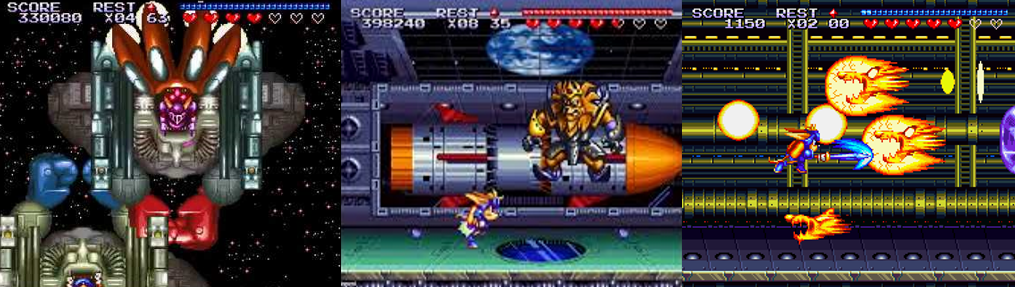
The incredible success of Sonic the Hedgehog (Sonic Team, 1991) saw anthropomorphic mascot platformers take the 1990s by storm, birthing everything from a sentient period, a gun-toting jackrabbit, a superpowered earthworm, and an intergalactic adventurer. Therefore, Nobuya Nakazato’s rocket pack-wearing possum fit right in at the time and delivered one of the best action platformers on the Mega Drive. Rocket Knight Adventures (Konami, 1993) was popular enough to get not one, but to sequels. While one was exclusive to the Super Nintendo, Sparkster: Rocket Knight Adventures 2 (ibid, 1994) was a well-received (if expensive and obscure) Mega Drive sequel that served as the inspiration for Sparkster’s one and only comic book appearance. This was a six-part story published in issue 53 to 58 of Sonic the Comic, a fortnightly publication I diligently collected as a kid which regularly included back-up stories adapting other SEGA-based franchises. Although writer Nigel Kitching was said to have worked on a follow-up story, it was scrapped when it turned out the publishers had lost the license, bringing Sparkster’s life outside the videogames to an end as he didn’t get an animated spin-off like some of this peers.

The Review:
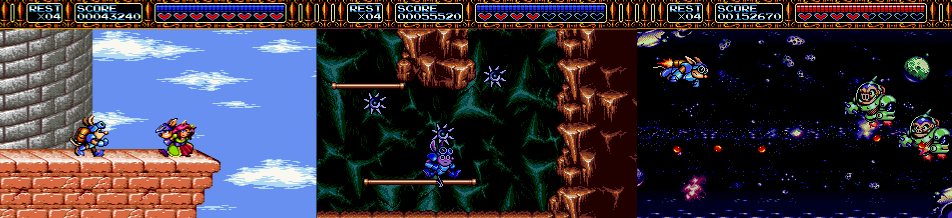
“Last of the Rocket Knights” begins with Sparkster in a spot of bother. Where he was once the celebrated hero of the planet Elhorn who led their famous Rocket Knights to countless victories, those days are long in the past and Sparkster is now a wanted man possum. Forced to skulk around Zebulos City incognito, Sparkster returns to find himself wrongly persecuted thanks to the efforts of the malicious lizard king, King Gedol. As Sparkster ponders this state of affairs, he’s accosted by Paerie, King Gedol’s commander, who favours action over explanations. His lackadaisical subordinate, Grum, takes his orders a little too seriously and blasts Sparkster with a flame burst from his titanic mech armour, earning Grum a chastising since King Gedol is eager to acquire Sparkster’s mystical armour. Luckily for him, and the titular Rocket Knight, Sparkster avoids being barbecued thanks to his rocket pack and quickly bests Paerie’s troops, including blowing Grum and his towering armour to kingdom come by exploiting an old flaw in the mech’s design. Injured and defeated, Paerie nevertheless delights in informing Sparkster that he’s the last of the Rocket Knights and that King Gedol has conquered all of Elhorn in the hero’s absence. Consequently, the once tranquil realm has become a dark world where despair and mistrust run rampant. Having captured Castle Zebulan, King Gedol rules with an iron fist, punishing insurrection by death and entrancing their monarch, Princess Shelly. However, when Sparkster heads to the princess’s bedchambers, his very presence snaps her from the spell that King Gedol cast over the entire kingdom to seize control. Thanks to his enchanted armour, Sparkster is immune to the incantation and just being close to him is enough to dispel it.
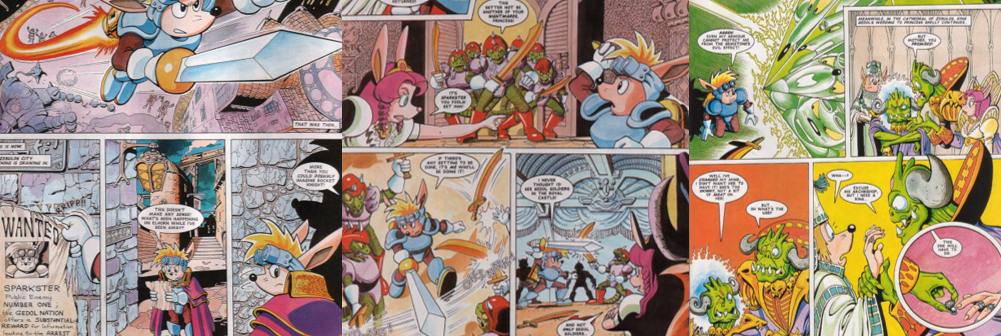
Sparkster fights to free the people of his kingdom, and Princess Shelly, from King Gedol’s dark magic.

Unfortunately, this proves a temporary cure as King Gedol’s spell takes hold over Princess Shelly when Sparkster moves to brood by the window, causing her to alert the lizard guards. Although Sparkster easily holds them off, their monstrous ruler, King Gedol, appears in Princess Shelly’s room and expresses his dark desire to marry her, a whim that the enchanted princess is happy to oblige. Stunned and overwhelmed by King Gedol’s guards, Sparkster is powerless to keep the monster monarch from gloating of his plot to make his rule legitimate through the marriage and his lust for the Rocket Knight’s enchanted armour. After ordering Sparkster to be hauled to the castle dungeon, King Gedol makes preparations for the wedding, including garbing Princess Shelly in an elaborate gown and introducing her to his mother, Stubb, who’s overly critical of Princess Shelly’s skinny disposition and more interested in devouring the possum princess! They’re interrupted by news of Sparkster’s escape, having once again surprised and overwhelmed his captors with his rocket pack. Rather than flee, Sparkster fights through the castle to rescue Princess Shelly, discovering that the palace guards of Zebulos have also been brought under King Gedol’s sway. Luckily, he frees them from their enchantment with his armour and gains a couple of allies for his venture. Keeping them close by to ensure King Gedol’s spell doesn’t take hold again, Sparkster is distraught to spot the elaborate wedding procession passing by outside, with the deluded crowd cheering in support. When his allies feel the spell returning, Sparkster locks them up to keep them safe and blasts off alone, fighting past King Gedol’s guards. However, he’s overwhelmed by the pure, dark magic of a gigantic green crystal, the source of King Gedol’s enchantment over the people of Elhorn and a gemstone of such awesome evil power that it brings Sparkster to his knees, despite his magical armour.
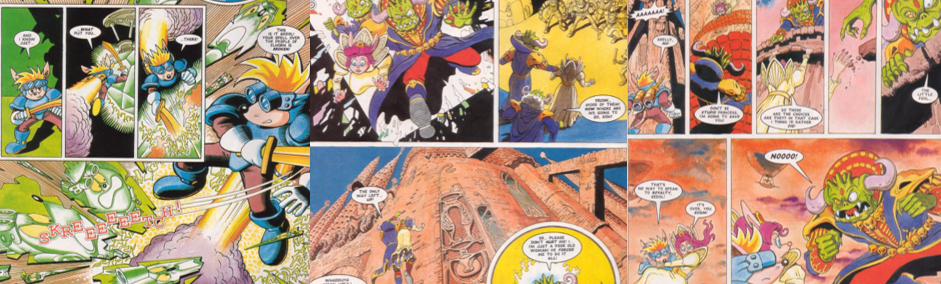
Sparkster easily bests his demons and rescues the princess, freeing Zebulous from King Gedol’s rule.

While Sparkster struggles to compose himself, King Gedol is driven to a frenzy when Stubb stubbornly refuses to hand over her wedding ring, disapproving of his son’s choice in women and forcing King Gedol to swipe a replacement from the archbishop. As Sparkster shakily gets to his feet, the gemstone unleashes warped reflections of him, manifesting his darker impulses into physical form and forcing him to literally and figuratively battle himself. The twisted, leering reflections taunt him, effortlessly avoiding his sword swipes and rocket charges, but are easily dispelled once the heroic Rocket Knight realises that they’re simply figments of his imagination. Thus, Sparkster shatters the gemstone, dispelling his evil doubles and freeing the people of Elhorn from King Gedol’s dark spell. Consequently, just as the archbishop is about to conclude the wedding ceremony, the attendees object to the union in droves, scuppering the monster’s plot. When Princess Shelly and the attendees physically rally against him, King Gedol takes his mother’s advice and retreats up the cathedral wall with Princess Shelly as collateral. He’s so determined to escape that he leaves his mother behind and, in her desperation, Stubb attempts to claim that she’s merely a frail, manipulated old lizard. Emboldened by the rebelling masses, Sparkster finally reaches the cathedral, where King Gedol threatens to harm the princess unless his demands for a rocket pack and safe passage are met. However, Princess Shelly isn’t a helpless maiden and defiantly elbows King Gedol in his bad eye, only to tumble over the edge. Rather than let King Gedol save her, Princess Shelly chooses to drop to her death. Luckily, Sparkster swoops in to save her and, when King Gedol flies in a rage, the lizard king seemingly plummets to his death. Unable to save him and low on fuel, Sparkster chooses to get Princess Shelly to safety rather than investigate and stands ready to aid the princess, and his people, in rebuilding following the mad tyrant’s takeover.

The Summary:
Like a lot of the additional stories from Sonic the Comic, “Last of the Rocket Knights” is a very different story to Sonic’s more action-packed adventures. Leaning heavily into its fantasy setting and being more of a dramatic piece, the story essential acts as a follow-up to Sparkster: Rocket Knight Adventures 2 and is focused more on the titular hero’s desperate attempts to free his people from enslavement. Keith Page does an excellent job in recreating the anime-style aesthetic of the Rocket Knight videogames, particularly their cover and manual art, adding a great deal of depth and detail to his backgrounds even if the action mostly takes place in the same locations (either the city or inside the castles). While Sparkster appears as a quirky, cutesy character sprite, he’s a determined and experienced veteran soldier here, easily dispatching multiple armed guards and taking out towering mech armours by fighting smarter, rather than harder. This is emphasised multiple times in the story, with Sparkster quickly targeting the source of the reflections hounding him (which has the knock-on effect of keeping the populace from attacking him) and luring King Gedol into defeating himself by taunting him at the end. It’s not clear how long Sparkster has been gone but it’s seemingly long enough for King Gedol’s forces to have wiped out the Rocket Knights (by implication) and to have forgotten how to fight them. Time and again, Sparkster easily evades his foes and outsmarts them by using his rocket pack and, time and again, they fail to take into account his unique abilities, which paint King Gedol’s forces as largely incompetent. Sparkster’s abilities extend to his armour, which is described as magical and having once belonged to the first Rocket Knight. King Gedol covets it for its vaguely defined power and simply being in its presence is enough to weaking the monster’s spell, with the armour being the only thing keeping Sparkster from being overwhelmed by the gemstone’s dark magic. I would’ve liked to see this element given more time or perhaps been explored in a follow-up, as it’s not entirely clear how acquiring the armour will benefit King Gedol, who’s obviously too big to fit into it.
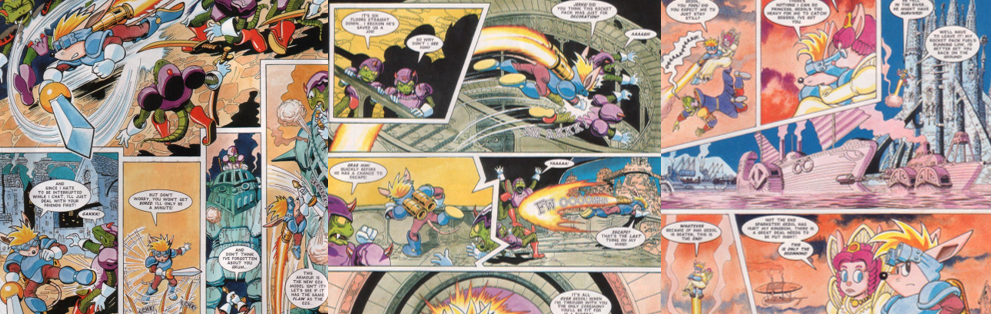
A very different, dramatic fantasy story that’s enjoyable enough, despite some flaws.

Despite its darker narrative and comparatively stoic protagonist, “Last of the Rocket Knights” has some goofy moments that perfectly fit with Sonic the Comic’s distinctly British sense of humour. While King Gedol is introduced as a menacing figure with an intimidating presence in his regal outfit and monstrous visage, he’s quickly shown to be a hot-headed, blundering mummy’s boy who legitimately pines over Princess Shelly and wishes to legitimise his rule. King Gedol is humiliated by his mother, who objects to his bride and delays the wedding, and King Gedol seems to have little true power, despite his vast army, since he only conquered Elhorn because of an evil gemstone. Once that’s destroyed and the people turn against him, King Gedol is sent running and he chooses to make demands rather than fight, showcasing no physical or magical powers to justify his lofty position. Although Princess Shelly spends the entire story under King Gedol’s spell, she’s clearly distraught by the state of her kingdom and refuses to be a mere pawn once she regains her senses. She fights back and is even willing to die rather than be King Gedol’s captive or unwilling bride, showing she’s got a fair bit of moxie. The story is bolstered by some decent action that recreates Sparkster’s abilities from the comics and he’s rarely shown to be on the back foot, even though everyone in Elhorn is against him. It does waste time having Sparkster free some Zebulan guards only to almost immediately lock them up, the two merely being there to give Sparkster someone to talk to, which is a shame as it would’ve been nice to use those panels to showcase some more action. There was a lot of potential to show Sparkster fighting a city full of enemies and painting him as an underdog figure but, instead, he flies straight to the source of the problem and solves it with only a slight delay when he’s apprehended by King Gedol’s guards. I definitely think the story would’ve benefitted from a follow-up or two as we saw other spin-off stories benefit in this way, but this one-off story was enjoyable enough and stands out a little more thanks to being a self-contained tale.

My Rating:

Rating: 3 out of 5.

Pretty Good

Did you enjoy Sparkster’s one and only appearance in Sonic the Comic? What did you think to the way it adapted the story and characters of the videogames? Were you disappointed that there wasn’t a greater focus on action? What did you think to the characterisation of Sparkster and King Gedol? Would you have liked to see follow-up stories, or other adaptations of the Rocket Knight videogames? What were some of your favourite non-Sonic stories in Sonic the Comic? Share your thoughts down in the comments, support me on Ko-Fi for more StC content, and go check out my other Rocket Knight reviews.


Game Corner: Sparkster: Rocket Knight Adventures 2 (Nintendo Switch)

Released: 11 June 2024
Originally Released: 23 September 1994
Developer: Konami
Also Available For: Mega Drive, PC, PlayStation 4, PlayStation 5

The Background:
The success of Sonic the Hedgehog (Sonic Team, 1991) saw anthropomorphic mascot platformers become a popular trope throughout the nineties, with a superpowered earthworm, an intergalactic adventurer, and a gun-toting jackrabbit making a rocket pack-wearing possum seem normal! The brainchild of Nobuya Nakazato, the man behind many Contra titles (Konami, 1987 to present), Rocket Knight Adventures (Konami, 1993) was one of the most popular and celebrated Mega Drive titles. Despite a port for the Super Nintendo being allegedly cancelled, Rocket Knight Adventures was followed by two sequels the very next year: one exclusive to the Super Nintendo and the other this notoriously expensive Mega Drive-exclusive title. Although not as well-regarded as its predecessor and seen as inferior to its Super Nintendo counterpart, Sparkster: Rocket Knight Adventures 2 was praised for its colourful gameplay and tweaked rocket pack mechanics. Sparkster: Rocket Knight Adventures 2 inspired a six-part story in Sonic the Comic (1993 to 2002) but the franchise was dead in the water until Climax Studios attempted a revival in 2010, to mixed reviews. However, the game, the other 16-bit Rocket Knight titles, finally received a modern re-release with this Re-Sparked! collection, a widely praised release that came with some fun bonus materials and quality of life features.

The Plot:
When King Gedol’s lizard forces invade the kingdom of Zephyrus and rogue Rocket Knight Axel Gear kidnaps Princess Cherry, Sparkster searches for seven magical swords to oppose the Gedol Empire and best his rival.

Gameplay and Power-Ups:
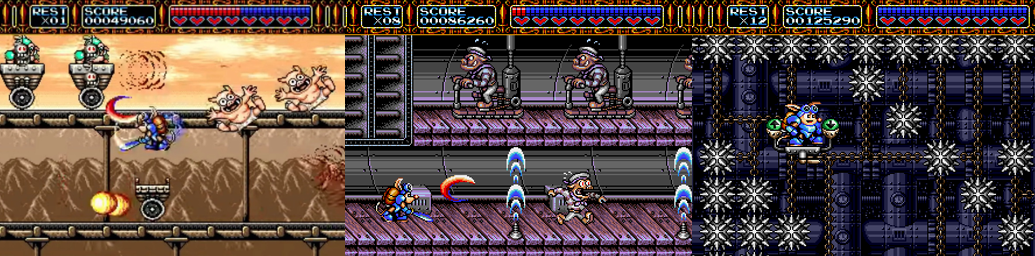
Just like the other 16-bit Rocket Knight games, Sparkster: Rocket Knight Adventures 2 is a 2D, sidescrolling action platformer. However, unlike the original game and its similarly titled Super Nintendo cousin, there are no run-and-gun elements to Rocket Knight Adventures 2 as Sparkster’s sword has been robbed of its sword beam. This significantly impacts the primary gameplay as you now rely on Sparkster’s bog-standard sword swings, which can fall a little short at times. You attack with Y and jump with B, executing a jump sword swing and clinging to poles using Sparkster’s paws and tail when you jump to them. Unlike in the other games, Sparkster’s rocket pack charges automatically and has different levels of effectiveness depending on how full the meter is. As long as the meter’s at least partially full, you can press A to rocket dash in the direction you’re facing, diagonally to take out turrets, and upwards to get higher. If you press A without a direction, Sparkster spins on the spot to attack enemies and, when the rocket pack is fully charged, Sparkster spirals in a “Screw Attack” (no relation), travels further, and bashes through destructible blocks and walls. While waiting for the meter to charge does take a lot of agency away from the player, it charges pretty quickly and you have far more control over Sparkster off a upwards boost, which greatly aids with reaching platforms. Sparkster can still ricochet off walls to get higher, though this is still underutilised, in my opinion, with Rocket Knight Adventures 2 focusing more on traditional platforming. Players still collect gems for points, though this time there are two types: regular blue ones and red ones that kick-start a slot machine for additional gems, health (now apples and chunks of meat), extra lives, or a rocket pack that instantly sends you flying in a Screw Attack. Naturally, these can all be found in the game’s stages, too, and you receive a score tally after clearing each stage for bonus points.

Sparkster’s sword is nerfed but his rocket pack and mech game are stronger than ever!

Sparkster can also grab the new power-up icon that gifts him a flaming sword to increase your attack power, though you’ll lose this when hit or advance to the next stage and I can’t say I noticed a significant difference, especially as many enemies die in one hit. Rocket Knight Adventures 2 has seven stages and four difficulty settings, with players only seeing the true ending by beating the game’s harder difficulties. Sadly, the shoot-‘em-up stages from the other two games are gone, replaced by three sections where you control Sparkster’s giant mech, the SparkRobo. Two of these are Rock ’Em Sock ’Em Robot battles with Axel Gear that are similar to that one boss from the first game, and the other is a sidescrolling autorunner where you blast enemies from the sky using the SparkRobo’s rocket punch (Y, which can also be charged) and jump over bombs tossed by enemies on the ground (also with Y). Sparkster doesn’t ride any minecarts or miniature mechs here and only has to deal with one autoscrolling section, where players dispatch enemies, destroy or jump to crates, and hop between train carriages to avoid a nasty spill. Spikes, flame plumes and lava, and insta-death traps are still present, however, with quicksand swallowing you, moving platforms ridden past spikes, and even a sand twister tossing you about atop a pyramid in Stage 2. This stage has a higher and lower path, which you may wish to switch between for different rewards and dangers, while Stage 5 features many switches to open doors, doors guarded by projectile-firing gargoyles, and conveyer belts. Stage 2’s pyramid gimmick differs from the Super Nintendo version, featuring a race from rolling balls and false doors that loop you back to the outside until you find the correct path. You’ll also cross lava on moving platforms and by clinging to overhead pipes, which gain destructible spiked hazards and even Gedol henchmen by Stage 5. Stage 3 sees Paeli, leader of Gedol’s lizard ninjas, bombard Sparkster and the blocks of the stage from his airship. This destroys the ground and forces you to take high-speed tubes up to the top of the ship to destroy barriers and drop the ship from the sky.

Presentation:
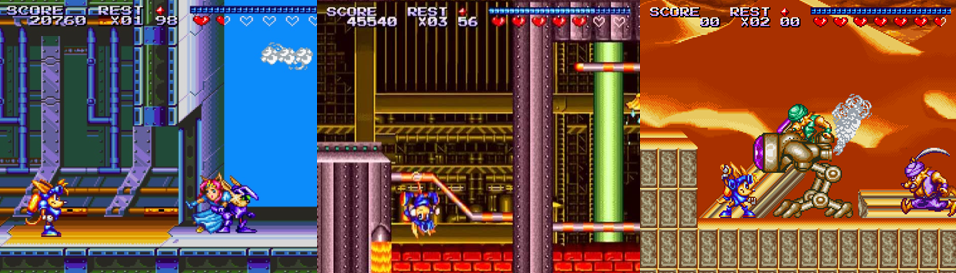
Sparkster: Rocket Knight Adventures 2 is a bit of a mixed bag, visually, something immediately evident from the lacklustre title screen (simply the game title against a moving sky background). This does pan down into the opening cinematic and mech battle against Axel Gear, however, a fight you can skip if you wish, which causes you to miss a collectible and displays an absolutely garish secondary title screen. Unlike in the Super Nintendo game, stage intros are back but they’re far less visually interesting than in the first game, and every sprite has been redesigned to give it a more anime flair. Although I miss the cute, squat Sparkster of Rocket Knight Adventures, he looks pretty good here and is far more animated. He bops about as if itching to get going, his rocket pack is almost constantly aflame, and he stands heroically when left idle. Sparkster also squeals when hit, reacts when piloting the SparkRobo, has more animation frames, and displays more personality than on the Super Nintendo thanks to Rocket Knight Adventures 2 including more pantomime-like, sprite-based cutscenes. These are similar to those of the first game, seeing Sparkster leap into action when Axel Gear kidnaps Princess Cherry and advance between stages, with elements from previous stages (such as Stage 1’s train) appearing in others. Unfortunately, like the Super Nintendo title, Rocket Knight Adventures 2 cannot live up to or surpass the original’s soundtrack. Things are jaunty enough, for sure, but nothing stuck in my head like the main from the first game. Interestingly, Rocket Knight Adventures 2 does replicate the slowdown from the first game, with the frame rate noticeably dipping when Gedol’s forces drive vehicles or too many sprites and explosion effects appear at once.

The visual overhaul is great for Sparkster but not so much for the enemies and environments.

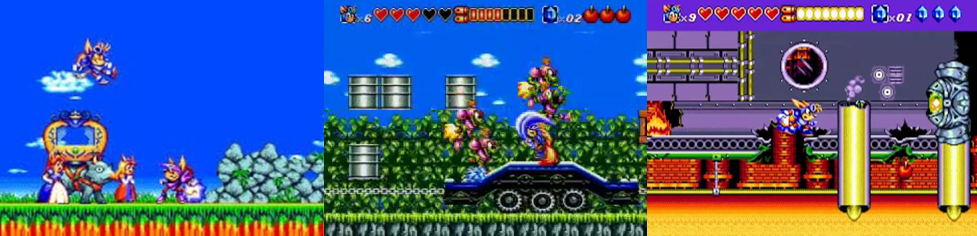
Perhaps most unforgivably, Rocket Knight Adventures 2 appears far blander than the first game and its Super Nintendo counterpart. Stage 1’s forest section is disappointingly subpar compared to the first game, with the ground being a far more basic block of sprites and the background having little to distract you, even when the overgrown ruins creep into play. The train section adds some spice and variety, for sure, but it paled in comparison to the Super Nintendo title. Similarly, while both games include a desert, they’re rendered very differently. Stage 2 has a neat shifting sand and heat shimmer effect in the background, but its pyramid is blockier and more akin to ruins, making it far less visually engaging than SEGA’s competition. Stage 3 took place atop the pyramid’s ruins and in an airship, which was, again, a far cry from the steampunk-style battle craft from the first game, even with its fake doppelgängers of Princess Cherry and larger, blade-like propellers. Stage 4 was like a poor imitation of a similar city stage from Rocket Knight Adventures; sure, the SparkRobo looks cool (if a tad goofy), but the city lacks the detail and appeal of the first game. Things pick up in Stage 5, which takes place outside and inside King Gedol’s heavily fortified castle-cum-weapons factory. The background is a bit busy at times, but I liked all the moving parts, alternate routes, and the danger brought on by the turrets. While the mech battles against Axel Gear are in bland, dark caverns, you battle him in a traditional swordfight against a grandiose background and confront King Gedol in his opulent throne room. If you find all seven “Keys to the Seal” swords, you’re also treated to a great sprite-based cutscene of Sparkster becoming “Gold Sparkster”, a form he retains for the end credits and loses when he returns the combined magical sword in the game’s ending.

Enemies and Bosses:
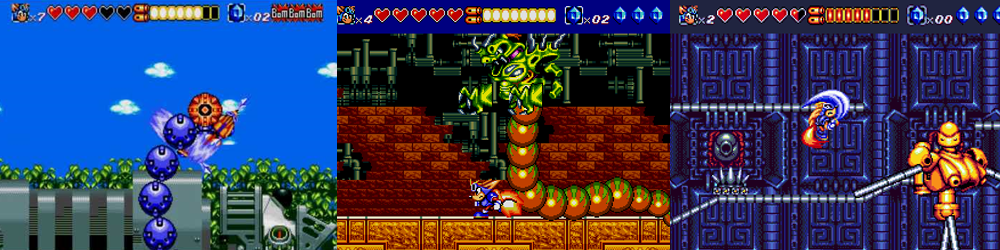
Instead of fighting pigs or wolves, Sparkster tackles the lizard forces of the Gedol Empire, whose infantry leaves a lot to be desired. Sure, armoured lizard-men spontaneously appear from boulders or even gems, but it takes a long time before they attack with swords. In Stage 1, for example, they might get the drop on you, but they just charge at you while unarmed; they don’t even lose their armour when defeated, making them far less satisfying to kill. By Stage 5, they’re hiding in large, snake-themed turrets and you’ll battle more formidable forces, such as gun-toting lizards (who oddly explode when defeated) and sword-wielding snakes whose body parts can hit you. Gedol’s forces drive steampunk-style vehicles in Stage 1, flailing their buzzsaw-like arms and forcing you to strike and rocket to safety, and pilot chicken-like mech walkers and float on balloons in Stage 4. Their forces are bolstered by some robotic enemies, such as annoying spiked balls that home in on you in Stage 3 and the returning robotic owls who can screw up your jumps. Interestingly, not only are bosses far weaker when playing on the easier difficulties, but you’ll miss some additional screens and mini bosses if you play on “Easy”. Stage 1 sees you battle a disturbing living plant that can only be damaged by rocketing into its face, which it protects with its extendable arms. You’ll also get an assist from some possum helpers when facing an ugly-ass lizard, with the two of you bouncing about an enclosed arena and the boss tossing bombs or rolling into you. A sentient plume of lava awaits in Stage 2, one that spews a flamethrower and controls the lava and forces you to the rail above to rocket into is face. Finally, there’s a large, robotic lizard face that hounds you throughout Stage 5, dropping spiked enemies, summoning lightning walls and lizard minions, and screwing up your traction with a conveyor belt.

Large bosses can cause a headache with their wide-reaching attacks and limiting your attack window.

The first true boss is a variation of the Raccoon Robot enemy from the first game, this time integrated into a train. You must rocket away from its wide-reaching ball arm and avoid its projectiles, quickly striking the weak spot on the front of the train and dashing to safety as the arm flails wildly, which is quite taxing as the arm covers almost the entire screen and the projectiles can catch you off guard. Stage 2 ends with a gigantic, armoured snake whose only weak spot is its torso. You must dodge its claw arm, which it’ll fire out to reel you in and vigorously shake you, then chase it to the background. While hiding back there, it bursts its long, extendable tail, bursting from the ground and swishes it about, though you’ll also have to watch when it leaps across the tomb. King Gedol’s second-in-command, Paeli, is fought on the roof of his airship and seems to be a sorcerer or genie or something. He fires a flaming shot that both hurts and shrinks you, transforms into a genie-like form, then bursts into harmless miniatures that rain down as bombs and apples. One of these miniatures sparkles, so that’s your target; hit him and Paeli runs around in a panic like Captain Fleagle for you to deal real damage to him. Near the end of Stage 5, tall, spindly robots stomp about, spinning their long, stick-like arms, tossing bombs, and firing lasers. They’re easy enough to take down, even with the rails, conveyers, and enemies nearby, but you’ll then fall into a small arena and battle two of them. One fires pellets, lasers, and spins its arms but, upon defeat, is replaced by its green brethren, who leaps to the ceiling dropping bombs and drops to the floor to be finished off.

Match your skills against Axel Gear then power-up to Gold Sparkster to depose King Gedol.

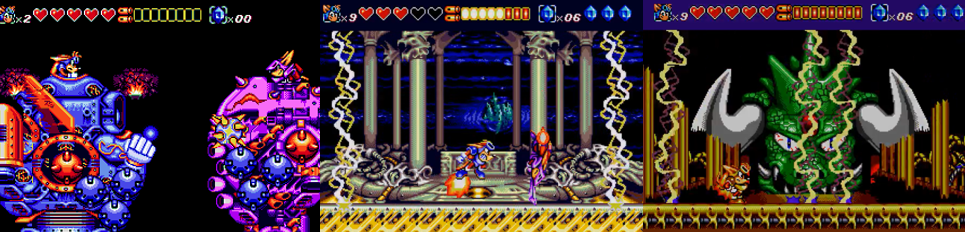
As in the other Rocket Knight titles, your most persistent foe is the rival Rocket Knight Axel Gear, who you fight in a mech battle at the start. Though this is optional, you’ll miss a Key to the Seal sword and learning the SparkRobo’s controls for later on. You must avoid Axel’s punches and hold A to block when he throws a shot or a projectile. Though you don’t get a projectile attack, you can throw uppercuts with B or Y or hold one of these to charge a straight punch. While this battle is much easier than the top-down mech fight from the Super Nintendo game, it’s no less tedious. Axel constantly guards and backs away and there’s a noticeable delay between button presses that can catch you out. While you don’t necessarily have to win this first mech fight, you will have to in Stage 4. However, to get to this rematch you must race through the streets and avoid Axel’s missiles, hitting them back at him to cause him to flee to his mech. Best his mech (with patience and persistence) and you battle Axel in a sword fight. Axel summons lightning walls that you can ricochet off otherwise they’ll hurt you and Axel again sports the same attacks as you, rocketing about, spinning as a flaming dervish, and swinging his sword. He does tend to hover about doing nothing, leaving himself open, and drops the final Key to the Seal upon defeat. With all seven, Gold Sparkster gets a permanent rocket charge and is much faster, which is very useful in the final fight with King Gedol. This is a two-stage affair, with the lizard king blinding you with a flash and charging lightning bolts from above or spawning a meteor shower. You can only attack him during this charge animation and, after enough hits, he transforms into a gigantic form that takes up the entire background! In this phase, King Gedol fires eye lasers that travel across the floor, walls, and ceilings, ricochet about, or randomly fire in all directions. You must dodge these and rocket into the gemstone that appears on his forehead to finally put him down for good.

Additional Features:
Sparkster: Rocket Knight Adventures 2 has four difficulty settings that fundamentally change the nature of the game, altering the length and challenge of the stages and changing the ending depending on how hard a challenge you set for yourself. You can further adjust the game’s difficulty from the main “Options” menu, changing how many lives and continues you play with. The game also includes a password feature, allowing you to skip to later stages and easily acquire all seven Keys to the Seal. These magical blades are hidden in each stage, sometimes in plain sight and sometimes requiring a bit of exploration to find. You’ll need all seven to play as Gold Sparkster and get the best ending, encouraging a replay or two (though be sure to take out Axel’s mech at the start for the first sword!) This Re-Sparked version also comes with the American and Japanese versions of the game, boasts an awesome anime opening, allows you to apply filters and borders, and negates even the hardest difficulty with a rewind and save state feature. The collection also comes with a boss rush, advertisements and concept art, the box art and manual, and the entire soundtrack for all three games. Those playing the PlayStation 4/5 version can also earn nine Trophies, one for clearing the first five stages, one for beating the game on any difficulty, one for unlocking Gold Sparkster, one for achieving the true ending, and one for beating the boss rush.

The Summary:
I’ve played Sparkster: Rocket Knight Adventures 2 before thanks to the magic of emulation, but never got past the first stage because, as a big fan of the original and an avid Mega Drive collector, I always wanted to own a physical copy of the game. It took a while, but the Re-Sparked collection finally made that a reality, only to present me with a game that’s visually inferior to its predecessor and Super Nintendo cousin in many ways. While Sparkster looks great and there are some interesting effects in some stages, the environments just seem far blander and far less engaging compared to the other 16-bit titles. Honestly, the game made a bad impression from the start and never really recovered; the rocket gameplay is much improved, but the main enemies lack animation frames and personality. The locations lack the steampunk trappings of the other titles and are far more generic which, coupled with the bizarre downplaying of the rocket pack and ricochet gimmick and removing Sparkster’s sword beam, means Rocket Knight Adventures 2 is just another colourful platformer. It’s fun enough, for sure, and some stages have interesting gimmicks, such as zipping through the airship and piloting the SparkRobo, but where are the flying sections? Where’s the quirky humour? Where’s the memorable music? The bosses were decent enough and I liked that you face more of them on harder difficulties. The one-on-one with Axel Gear is probably the best version of that fight, it’s just a shame you have to sit through another tedious mech battle to get to it. Rocket Knight Adventures 2 is also far too linear at times and felt the easiest of the three 16-bit titles, with King Gedol being the simplest of the final bosses and the hardest part being tracking down those hidden swords. In the end, I enjoyed Sparkster: Rocket Knight Adventures 2 but nowhere near as much as I wanted to. It fails to live up to its predecessor, lacks the visual punch of the Super Nintendo title, and was a disappointing experience after years of pining for it.

My Rating:

Rating: 3 out of 5.

Pretty Good

Do you think I’m being too harsh on Sparkster: Rocket Knight Adventures 2? How did you think it compared to the first game and the Super Nintendo sequel? What did you think to the new rocket pack mechanics and the lack of sword beam? Were you disappointed to see the flying sections removed? Did you ever find all the Keys to the Seal and unlock Gold Sparkster? Would you like to see a new entry in the Rocket Knight series? Tell me what you thought to Sparkster: Rocket Knight Adventures 2 in the comments, support me on Ko-Fi, and go read my other Rocket Knight reviews.

Game Corner: Sparkster (Nintendo Switch)

Released: 11 June 2024
Originally Released: 15 September 1994
Developer: Konami
Also Available For: PC, PlayStation 4, PlayStation 5, Super Nintendo Entertainment System (SNES)

The Background:
Sonic the Hedgehog’s (Sonic Team, 1991) incredible success paved the way for a slew anthropomorphic mascot platformers back in the 1990s. We had everything from a heroic frog, a gun-toting jackrabbit, an intergalactic adventurer, a fragile bobcat, and a superpowered earthworm, so why not a possum with a rocket pack? Created by Nobuya Nakazato, who spearheaded many Contra titles (Konami, 1987 to present), Rocket Knight Adventures (Konami, 1993) became one of the most popular and lauded titles for the Mega Drive. Although a SNES port was allegedly cancelled, Rocket Knight Adventures was followed by two sequels the very next year: one a notoriously expensive Mega Drive-exclusive title and this similarly-titled but unrelated SNES-exclusive game. Although largely praised for its visuals and gameplay, Sparkster was criticised for not further expanding upon the first game’s formula and 1994 was, essentially, the end of Sparkster’s brief time in the spotlight. Although Sparkster did get a six-part story in Sonic the Comic (1993 to 2002), he didn’t get a cartoon like his more popular peers and was forgotten until Climax Studios attempted a revival in 2010, to mixed reviews. Sparkster, and its other 16-bit titles, finally got a modern re-release with this Re-Sparked! collection, a well-received release that included bonus materials and quality of life features.

The Plot:
When the kingdom of Eginasem is attacked by Generalissimo Lioness’s Wolf Army and Princess Flora is kidnapped by rogue Rocket Knight Axel Gear, Sparkster fights to save the land.

Gameplay and Power-Ups:
Like its predecessor, Sparkster is a 2D, sidescrolling action platformer with run-and-gun action in which players take control of Sparkster and his rocket pack and battle through a fantasy land infused with a dollop of steampunk madness. As before, players choose between three different difficulties, though you’ll only experience the full game and the true ending by playing on at least “Hard”. To aid with this, Sparkster incorporates a password system, one still relevant as the rewind and save state features won’t help you when you get to a nigh-impossible boss battle in the late game. Sparkster’s entire repertoire of moves and abilities returns alongside a couple of additional abilities. You jump with B and attack with Sparkster’s sword and sword beam with Y. As before, holding this button charges Sparkster’s rocket pack, allowing him to blast off in the direction he’s facing, straight up, or diagonally. If you don’t press a direction, he simply spins on the spot and, when aimed at walls, he’ll ricochet to higher areas. While there’s no need to swim this time around, Sparkster still clings to vines, branches, and poles with his tail and you’ll be hopping, sliding, and jumping to these purchases a lot more this time around. Pressing L or R sees Sparkster perform a flaming kick, of sorts, for an additional attack and mid-air boost, something you’ll be using a lot to reach higher platforms as Sparkster’s otherwise uncontrollable after blasting off. Although there are still no power-ups to collect, you can grab gems to increase your score (and your life count once you get 100 gems), the odd 1-up, and fruit (apples and bananas) to refill your health. There are far more gems this time around as well, possibly to offset the steep difficulty curve, but there are no horizontal sections where you blast along using Sparkster’s rocket pack.

Rocket along for more action-packed adventure and a handful of new gimmicks.

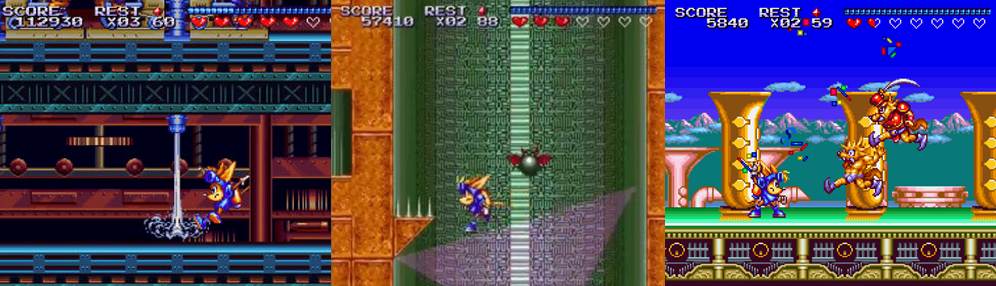
However, the spirit of these sections is evoked when Sparkster hops on a chicken-like mech and races through the jungles in Stage 3. In this long section, you press Y to fire a ring shot from the mech’s mouth while also attacking with Sparkster’s sword beam to dispatch enemies coming from behind. You must also duck under spikes and other hazards, get launched to other mechs, and take out waves of enemies as you race along. Later, in Stage 7, the game adopts a top-down view and you control Sparkster as be flies through space in pursuit of Generalissimo Lioness’s massive ship. In this section, you can still fire Sparkster’s sword beam but can also hold B to fire a spread of pellets to take out turrets and enemies. This is actually a bit awkward thanks to the button placements and it’s easy to miss incoming projectiles as a result, though the section is a burst of exhilarating fun until you get to the near-impassable wall that is a top-down Rock ’Em Sock ’Em Robot mech-battle against Axel Gear. In Stage 4, you use tubes to blast around the interior of an attack submarine and must avoid water jets that blast you into ceiling spikes. Stage 5 sees you venture into a pyramid, one that constantly shifts as you pass door-like tiles. You must shift and rotate the environment to find goodies and progress, which can be very aggravating and confusing as it’s not immediately clear which configuration you need to move on. Later in this same stage, you ride a translucent, rotating triangle platform up a shaft, avoiding spikes as you go, while high-speed tubes masquerading as musical instruments blast you along or send you back a fair bit in Stage 6. This stage also sees you bouncing to drums, riding air currents, and using teleports not unlike those in Rocket Knight Adventures.

New, even cheaper hazards will test your reflexes, patience, and rocket skills.

Sparkster is extremely similar to Rocket Knight Adventures, so much so that, at times, it feels like a SNES reimagining of the first game. You begin in a very familiar medieval forest setting, blast to a steampunk-like ship, and encounter many of the same hazards at times. Similarly, the game’s difficulty curve is slow but steep and things start off easy enough, even with the seemingly endless waves of enemies spawning in, but you’ll soon see boulders transform into enemies, clamber between bars and poles to avoid molten metal, and battle against conveyer belt platforms that push you towards instant-death gears. Giant crushing hazards are also present alongside an odd paint mechanic in Stage 2 that briefly turns you red, sheer drops in Stage 3 where it’s almost impossible to avoid being damaged by robotic owls, and bursts of steam courtesy of wolves running on treadmills in Stage 4, which also includes an all-too-brief pogo mechanic. Stage 4 also sees you frantically outracing a wall of rushing water not unlike the flame wall from Rocket Knight Adventures, except this one pushes you into wall spikes or drowns you in seconds if it overtakes you. Stage 6 also has you quickly hopping between cymbals trying to avoid being crushed when they clap together and falling into the tubas, which warp you back to the start of the obstacle course. Stage 7 is, essentially, a pretty standard top-down space shooter that has you weaving between laser blasts and destroying turrets, while Stage 8 has you traversing a long corridor on a space station and ducking under gigantic missiles that instantly kill you on contact. You’ll also ride a flame burst up a long shaft battling an oddly shaped wolf mech and encounter ceiling turrets that bounce lasers off bug-shaped robots. While instant death hazards and bottomless pits aren’t as prominent in Sparkster and there are far less tricky sections where you’re outracing crushing or dangerous hazards, the gigantic bosses and some cheap moments are sure to wipe out your stock of lives.

Presentation:
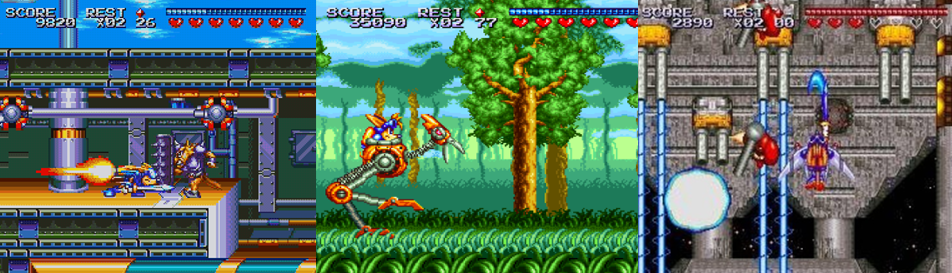
Although Sparkster overhauls the graphics and presentation of Rocket Knight Adventures, redesigning Sparkster into a more serious, anime-inspired protagonist, it continues the same cartoonish charm of the first game. Leaner and sporting a grim frown, Sparkster constantly has one paw on the hilt of his sword, glares at you when left idle, and squeals when hit or killed. Sparkster outdoes its predecessor with a more elaborate title screen and opening cutscene, which employs in-game sprites to show Axel Gear kidnapping another princess. This scene, Sparkster’s cannon blast to space, and Axel’s later escape from Sparkster’s wrath all closely resemble cutscenes seen in Rocket Knight Adventures, lending more credibility to my claim that this game is part-sequel, part-remake. Unfortunately, there are far less cutscenes like this in Sparkster, no stage intros, and the music is a far cry from the first game. While it’s jaunty enough, there are no tunes to rival the main theme of Rocket Knight Adventures and, while the game performs far better, with none of the slowdown from the first game, this is greatly aided by Rocket Knight Adventures: Re-Sparked’s “Boost” toggle from the ZL menu. Still, there are a lot of impressive visual effects included here; day turns to dusk turns to night, the Stage 7 missiles have a quasi-3D look, Sparkster’s rocket pack seems to charge faster, and there’s a unique (if odd) feature in Stage 2 where all sprites are rendered as silhouettes behind giant white screens. I also really enjoyed the sense of speed as you race along on your chicken-walker in Stage 3. The environment blurs past and there’s a lot of action here and, thankfully, no bottomless pits or unfair, split-second tests of your reflexes.

Anime paintjob aside, Sparkster rehashes much of the first game in its visuals and mechanics.

Sparkster seems to lean into the steampunk/fantasy aesthetic far more than Rocket Knight Adventures. You start in an open field, hopping to branches and trees, before blasting to Axel’s ship in what’s basically a combination of two stages from the first game. Clouds fly past the ship, which features flashing lights, destructible elements, and wolves popping from holes in the floor. Stage 2 is a cluttered factory that’s a mess of chains, lights, steam, and tubes and can be tricky to navigate as a result. Similarly, Stage 5’s desert exterior can be confusing as many columns and stone blocks obscure you. There’s a neat heat shimmer effect to this stage and I did like venturing into the pyramid; as perplexing as it was, it was far more memorable than the attack sub. You do end up outside this submarine, going to the left side of the screen and taking down biplanes, but it’s a bit dull compared to Stage 6’s bizarre musical-themed world. While this sticks out like a sore thumb against the other steampunk and medieval settings, it’s certainly whimsical and unique, even if it’d be more suitably in Zool: Ninja of the Nth Dimension (Gremlin Graphics, 1992). Stage 7 may just be a space shooter but there’s a lot of detail on the Generalissimo’s gigantic mothership (too much, at times, as turrets, enemies, and projectiles are hard to spot). Generalissimo Lioness’s space station has an impressive curve effect to its long-ass missile corridor, multiple missiles sitting stationary, and claustrophobic missile shafts to ricochet around in. It’s all very visually similar to Rocket Knight Adventures but just different enough to be unique. Still, I would’ve liked a greater visual distinction between the Wolf Army and the Devotindos Empire as the wolves’ armour even flies off like the pig infantry’s and the game ends with a big sprite art of Sparkster flying at the screen, just like before. While this art and the background accompanying the credits is more detailed, it’s still all a little too similar to be truly original.

Enemies and Bosses:
Just as you decimated an army of wacky pigs in Rocket Knight Adventures, so too will you cut through various wolves in your quest to liberate Eginasem. These wolves are functionally identical to the Devotindos Empire’s infantry, charging you with swords and powering defences to keep you at bay. While they don’t wield bazookas, they pop from the foreground, transform from boulders, bounce you back with shields, and wear different outfits depending on which stage you’re on. Various wolf mechs also appear, such as the one fought when you ride a flame pillar in Stage 7, and wolves riding chicken walkers in Stage 5. Stage 5 also sees a wolf pilot the Elephant Robot in a fight that’s functionally identical to the Raccoon Robot mini boss from Rocket Knight Adventures. You must avoid its extending arms and buzzsaw hands (which play the keys at your feet), dodge the explosive maracas, and rocket into the orb on its forehead. Robotic enemies also appear, such as the aforementioned owls (returning from the first game) and various robotic drones shot down in Stage 3 and 7. Robotic shrimp-type-things bounce about on Stage 6, robotic worms pop from walls in Stage 4, and the massive, wacky robot monkey, Ukkey-Ukikky that acts as the mini boss of Stage 1. Ukkey-Ukikky leaps and dives at you, chasing you and trying to stomp you, and becoming more aggressive when you steal its bananas, though it’s not too difficult to rocket-charge into its big, stupid head. You battle a tripod robot not unlike an octopus in the pyramid, one which flies about after a few hits by spinning hits legs like helicopter blades. Stage 2’s mini boss is fought on a rising elevator whose core looms overhead as a glaringly obvious target, one protected by two turrets. You must also defeat a gigantic flying mech in Stage 7, one that punches, fires a spread shot, and explodes in a shower of apples upon defeat.

Gigantic and troublesome mechs box you in and stand between you and victory.

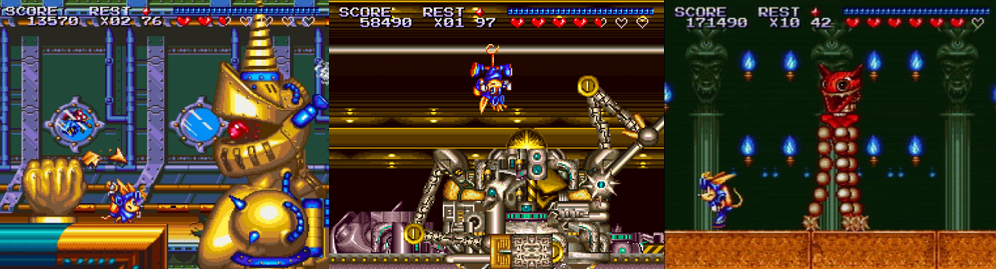
Colonel Wolfheim confronts you midway through Stage 3, piloting a praying mantis-like mech and relentlessly tossing bombs and flailing its long arms. Unlike the fight against Captain Fleagle, you simply attack Colonel Wolfheim’s mech directly rather than reflecting his bombs. Colonel Wolfheim returns atop the attack sub, now commanding a giant cannon protected by smaller turrets. After you deal enough damage, the cannon detaches and is revealed to be a mech, which fires a massive flame burst and swings its spiked arms around wildly. Your best bet is to get behind Colonel Wolfheim’s mech and rocket-burst into it. The first boss is Temper-Drilln, a gigantic suit of golden armour that bursts through the airship’s hull, spawns wolves to distract you, and fires an eye laser. You must hop to its fists as they punch through the floor and time your rocket charge into its eyes to bring it down, a difficult task given the limited room to manoeuvre. Stage 2 culminates in a battle against a massive trash compactor. You can cling to the pole overheard to attack the exposed core and dodge some of its attacks, which consist of debris and buzzsaw-like arms. If you drop down, be wary as the ground is a conveyor belt that causes you to take damage from the boss. Stage 3 ends in an autoscroller battle against the Crazy Caterpillar, a robotic insect that wriggles along an overhead vine and drops parts of its body to bounce and explode into you after taking damage. It also tosses regular bombs and bounces in front of you firing flame bursts that can be hard to avoid given your larger hit box thanks to your chicken-mech. At the end of the desert, you battle a robotic worm around a bunch of ruins, forcing you to platform about to chase it down. It also burrows underground, breathes fire, and splits apart when you hit the glowing red sections of its body. Midway through Stage 8, you attack the core of the Generalissmo’s space station, rocketing into four rotating crystals and destroying the rings that protect it, which speed up as you deal damage.  

The only consolation to Axel Gear being so damn difficult is the final bosses are much easier…

Like in Rocket Knight Adventures, Sparkster constantly pursues Axel Gear, a rival and corrupt Rocket Knight who kidnaps the local princess and evades Sparkster at every turn. You finally battle him at the end of Stage 6 before a giant organ. Like in the first game, Axel Gear has the same abilities as you, ricocheting about, flinging sword beams, spinning into you, and diving with a flaming kick. Thanks to the verticality of the arena, it can be difficult hitting Axel Gear, but it’s nothing compared to the top-down mech battle at the end of Stage 7! Here, you press Y to fire a weak-ass projectile, tap L and R to punch with each robotic fist, and hold the triggers to block. You can hold Y to charge a dash but, in my experience, it did nothing, and I wouldn’t guard for long as Axel destroys your arms. While you can land a few solid shots, Axel constantly has his guard up, rushes you, and obliterates you with an unblockable barrage. I genuinely have no idea how you’re supposed to beat this fight as I was forced to use a password to skip to Stage 8. This is, obviously, Generalissimo Lioness, who breathes fire across the ground, conjures a boomerang-like energy wave, and fires two electrical beams using his sceptre. It’s best to stay in the middle of these, duck under the energy waves, and perfectly time a jumping vertical rocket boost to avoid the Generalissimo’s attacks, attacking whenever you can until his biological visage reveals his cybernetic interior. The final boss, accessed only on “Hard” mode or higher, is the Missile Core, a large, stationary target that fills the screen with flaming projectiles resembling wolf heads, drops spiked mines, and fires a gigantic laser across the screen. You should dash to the far left to avoid the mines and safely destroy the projectiles then rocket-charge into the core, landing a quick sword beam strike before dashing to safety, though the projectiles increase as the fight progresses.

Additional Features:
Rocket Knight Adventures: Re-Sparked includes both the American and Japanese versions of Sparkster alongside the impressive anime opening, different filters and borders, the aforementioned “Boost” toggle, and the incredibly helpful rewind and save state features. The collection also includes a boss rush for the game, various advertisements and concept art, the box art and manual, and the entire soundtrack alongside various Trophies for the PlayStation 4/5 version. These require you to clear every stage (meaning you must play on at least “Hard” mode), finish the game on “Normal” mode, and clear the boss rush. There is also a hidden “Crazy Hard” mode in Sparkster that’s accessed with a push button cheat code and passwords to jump you to any stage on any difficulty, which is basically required as I have no idea how the hell you beat that Axel Gear mech fight!

The Summary:
As a huge, lifelong fan of Rocket Knight Adventures, I’ve always wanted to give Sparkster a go but, being a SEGA kid, I never got the opportunity, which is another reason I’m grateful for Rocket Knight Adventures: Re-Sparked. Although the visuals have been overhauled and are more anime inspired, losing the chubby, chibi-style look of the first game, everything is as colourful and sharp as ever. Sparkster is now grim and serious, constantly ready to fight and ploughing through enemies with a burst of gusto, and has more gems to collect that ever. Interestingly, Sparkster places more emphasis on traditional platforming than its rocket pack gimmick, even omitting the horizontal shooter sections from the first game, which was a bit of a mistake, in my opinion. The chicken-walker chase and top-down space shooter sections had the same energy, but it was disappointing to not do more with the rocket pack. I liked that there were less chase sections and insta-death hazards and there were some interesting new gimmicks, like the shifting pyramid, though it also felt a little too safe. Many sections, cutscenes, and even bosses felt very similar to Rocket Knight Adventures, almost as though the developers wanted to atone for not porting the first game to the SNES. I didn’t mind this, but it felt more like a rehash at times and was especially disappointing as none of the game’s tunes match those of Rocket Knight Adventures. I did enjoy the massive bosses and how they continued to be creative and visually appealing, but that mech battle against Axel Gear can go and burn in hell! Honestly, I was tempted to knock another star off simply for that, and the requirement that you must play on at least “Hard” mode to finish the game. Thankfully, the rewind and save state features eased the pain of these sections but I was annoyed that I needed a password to skip that boss, especially as the subsequent bosses were much easier. In the end, Sparkster is a worthy follow-up that has a lot of visual appeal. It performs really well and challenges even the most seasoned platformer player, but its difficulty curve and more repetitive sections bring it down a notch compared to the first, especially as the develops didn’t take full use of the SNES to expand on the story and in-game cutscenes.

My Rating:

Rating: 4 out of 5.

Great Stuff

Did you own Sparkster back in the day? How do you think it compares to Rocket Knight Adventures? What did you think to the anime paint job given to the sprites? Did you ever legitimately beat Axel Gear’s mech and, if so, how? Which of the new gimmicks was your favourite? Would you like to see a new entry in the Rocket Knight series? Whatever you think about Sparkster, share your thoughts below, consider supporting me on Ko-Fi, and check out my other Rocket Knight reviews.

Game Corner: Rocket Knight Adventures (Nintendo Switch)

Released: 11 June 2024
Originally Released: 6 August 1993
Developer: Konami
Also Available For: Mega Drive, PC, PlayStation 4, PlayStation 5

The Background:
Thanks, largely, to the phenomenal success of Sonic the Hedgehog (Sonic Team, 1991), anthropomorphic mascot platformers were all the rage back in the 1990s to the point where, in a landscape featuring a gun-toting jackrabbit, an acrobatic bat, a superpowered earthworm, and an intergalactic adventurer, a sword singing possum with a rocket pack doesn’t seem all that strange! Designed by Nobuya Nakazato, the man behind many of the notoriously challenging Contra videogames (Konami, 1987 to present), Rocket Knight Adventures was lauded as one of the best titles available for SEGA’s all-powerful Mega Drive. Though a popular and well-regarded title, Rocket Knight Adventures was essentially Sparkster’s peak; a Super Nintendo port was allegedly cancelled and its sequels were both region-locked and ridiculously expensive for decades. While Sparkster received a six-part story in Sonic the Comic (1993 to 2002), he didn’t get an animated spin-off like some of his peers and remained in obscurity until Climax Studios attempted a revival in 2010. Mixed reviews notwithstanding, the game captured a lot of Rocket Knight Adventures’ spirit and long-time fans of the franchise finally got a modern re-release of the original three games with this Re-Sparked! collection, a warmly received release that included a handful of bonus materials to celebrate the unfairly forgotten series.

The Plot:
When the Kingdom of Zephyrus is invaded by Emperor Devilgus Devotindos’s pig army, heroic Rocket Knight Sparkster fights to rescue Princess Sherry from the clutches of his rival, Axel Gear, and stop their forces.

Gameplay and Power-Ups:
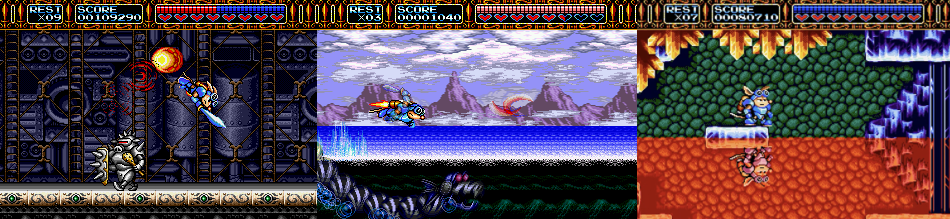
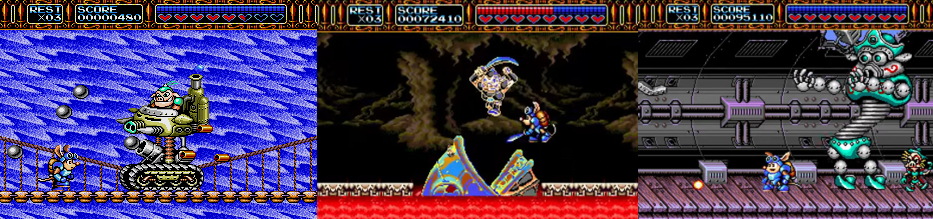
Rocket Knight Adventures is a 2D, sidescrolling action platformer with elements of run-and-gun action and some sidescrolling shoot-‘em-up sections. Players take control of Sparkster, the titular Rocket Knight, a possum clad head to toe in armour, armed with a sword, and carrying a surprisingly versatile rocket pack on his back. You swing Sparkster’s sword with A or Y, sending out an energy spiral to attack enemies from a set distance, and press B to jump, with Sparkster snagging poles and branches with his tail. By holding A or Y, you charge Sparkster’s rocket pack; once the meter is full and flashing, you can release and Sparkster will fly off in the direction you press. You must often use this manoeuvre to richochet off walls to progress higher in stages, sometimes over lava, and to blast between vines over large, spiked balls. If you don’t press a direction, Sparkster performs a grounded spin attack to deal damage and reflect certain projectiles and Sparkster is often invulnerable when performing his rocket attacks. The rocket pack can take some time to charge so it’s worth planning ahead if you’re looking to quickly blast away and you must often blast off while jumping for additional height, either to reach doors, platforms, or high up goodies. Sparkster has a large health bar (represented by hearts) but it’s whittled down quite quickly. Apples and bananas will partially or fully fill it and you can snag a handful of generous 1-ups along the way. You also earn extra lives if you collect enough points, receiving a bonus at the end of each stage. Before you start, you can also adjust the game’s difficulty, which changes how many lives and continues you have, though trust me when I say the game’s hard enough even on “Easy” mode.

Rocket through colourful stages and take on tricky platforming as the sword-wielding Sparkster.

Occasionally, Sparkster collects a power pack or is dropped into an area where he flies indefinitely. These sections turn the game into a high-speed, action-packed autoscrolling shoot-‘em-up and have you weaving Sparkster between missile and other projectiles while picking off airborne enemies. Sparkster can also swim, automatically treading water and moving through the drink depending on your button presses, attacking with his sword and blasting from the water with his jet pack. However, his movement becomes noticeably sluggish and his hit box alters, making it tricky to navigate the tight, hazard-ladened depths. Each stage tests Sparkster’s platforming and rocket pack skills in different ways, from simple ricochet tricks to jumping to vines and branches, to racing from hazards (such as walls of fire, spiked knights, and crushing floors) that spell instant doom to the Rocket Knight. Platforming is largely satisfactory here and the usual tropes of swinging platforms and precarious handholds appear, but you’ll also be riding mine carts, leaping across bottomless pits and ducking under spiked ceilings. Stage 2 has you pass behind waterfalls using special platforms to progress, Stage 3 sees you using the reflective surface of rising and falling lava to hop to platforms, while Stage 4 has you clambering on the underbelly of Axel’s ship trying not to plummet to your doom. When on the roof, and during the final confrontation with Axel, you battle a strong wind that’ll suck you to an instant death, while Stage 5 has you race through claustrophobic tunnels avoiding knights that kill you on contact. The challenge is palpable but increases as you progress, easing you into the game’s surprising difficulty and introducing new gimmicks that test how you control Sparkster. Unfortunately, there are no power-ups to aid you (no shields or invincibility or anything like that) and you’re limited by your lives and continues, though thankfully this version includes rewind and save state features that finally allowed me to beat the game after more than thirty years!

Various gimmicks and dangerous hazards make the late game a considerable challenge.

It’s not long before hazards become troublesome for Sparkster. Each stage is split into multiple, interconnected areas, with the first stage culminating in you traversing Castle Zephyrus, which is full of burning pits and sees you being chased by a wall of fire. This will instantly kill you if you don’t keep moving, made harder by the stone walls you must hop over and the flame bursts you must duck to avoid, though this is all practice for a similar section in Stage 5, where you must run, ricochet, and jump away from Axel as he pursues in an insta-death mech suit! While it’s simple enough to hop to tree branches in Stage 1, Stage 2 introduces spiked balls to avoid while jumping, while spiked ceilings and surfaces dog both your high-speed jaunts on mine carts and your efforts to control a propeller platform in Stage 5. Stage 4 sees you taking out bazooka-wielding pig soldiers in tight corridors, your progress barred by temporary energy barriers, while Stage 5 introduces the rising floor gimmick that ended my runs as a kid. With enough speed and timing, you can outrun this hazard but it’s very tight, even when abusing the rewind feature. This stage also includes teleporter doors that represent your goal in each section, though they’re functionally no different from the regular doors you enter prior to this stage. Stage 7 introduces a springing ground, almost a quasi-anti-gravity feature, to boost your jumps, though it’s limited to snagging some out of the way goodies and battling a boss. The autoscrolling sections start off simple, with you mowing down aerial enemies and attacking a giant, robotic snake, but your manoeuvrability is tested in Stage 5, where you weave between gigantic missiles and cross-crossing gunfire and engage in glorified dog fights with mech walkers. Things are much simpler when you’re blasting through an asteroid field in Stage 6, though you must still be mindful of the small projectiles that can get lost against the stars. Stage 5 also culminates in you taking control of your own giant mech, though your options are simply limited to stomping back and forth and swinging its buzzsaw arms with A or Y; there’s no block or charge attack or anything.

Presentation:
Rocket Knight Adventures is and always has been a joy to play, purely from a visual standpoint. Released at the peak of the Mega Drive’s popularity, when mascot platformers were extremely popular, the game oozes colourful, cartoonish appeal. Presented with a steampunk-style fantasy land, players explore environments teeming with personality. You see the castle being attacked in the background of the first stage, panicked civilians and chickens run and flutter, and enemies are sent into a panic when hit, running around with their briefs on show! Though he can be a little clunky and his hit box is quite large, Sparkster is a wonderfully realised character. Blasting past the Konami logo at the start and standing proud against the title screen and in the brief prelude, he radiates heroism. Not only does Sparkster bop up and down by default, but he also judges the player when idle and calls to them to get a move on. He also squeals in pain when killed, reacts with panic when falling, and regularly advances towards his objective and enemies in the handful of cutscenes between stages. As if these stunningly lively and detailed visuals weren’t enough, Rocket Knight Adventures is bolstered by an infectious soundtrack, one of my favourites of the era. However, it’s true that the game peaks with Stage 1’s iconic and instantly memorable overture, which is rightly evoked for the end stage score tally. Still, the boss themes are really good and add to the tension when facing these troublesome foes. One negative about Rocket Knight Adventures, however, is the slowdown which occurs when there’s too many sprites on the screen. Thanks to the large scale of some enemies and the many explosions and effects peppering certain moments, the game can struggle along for a few seconds. It’s never impacted my progress, but it is noticeable. Furthermore, the title screen, despite showcasing large sprite art for Sparkster and the game logo, is surprisingly bland, especially compared to the detailed environments.

A visually impressive treat with one of gaming’s best and most memorable soundtracks.

Things start out safe enough with Stage 1’s flat fields, which act as a testing ground for players to test Sparkster’s moves, but even this area is full of detail, from the aforementioned castle in the background to the besieged homes and ransacked environment. As you blast through the skies, mountains and water rush past, with a lovely splash effect appearing as you skim the water’s surface. Sparkster loves to charge head-first into enemy strongholds, the first of which includes busts, skewed portraits, and windows where the first stage’s boss looms. While Stage 2 starts comparatively bland, you’re soon climbing vines and avoiding spikes amidst a large waterfall and racing around on high-speed mine carts. Stage 3 begins in a quartz cavern with a reflective effect applied to the lava, extends to an underwater cavern, and ends with you battling a gigantic robotic fish in a volcano. Stage 4 takes place on Axel’s ship and really leans into the steampunk aesthetic, having you navigate inside and outside the ship, clambering to poles, jumping to platforms, and passing energy barriers powered by pigs on treadmills! Stage 5 takes the steampunk aesthetic to the next level as you blast through the skies of a heavily polluted, heavily guarded pig city. There’s a real depth to the polluted backgrounds that’s married with the mechanical facility to crash into, a robot factory full of narrow corridors and insta-kill hazards. Stage 6 and 7 add a science-fiction twist to the steampunk fantasy and see Sparkster blasting through an asteroid field and infiltrating Emperor Devotindos’s “Pig Star” space station. Though you’re limited to a few rooms and boss battles here, you can see the stars and asteroids in the background and end up falling back to Earth in an escape pod, burning up on re-entry and showered by debris from the exploding space station! The large sprite art returns for the end credits, which feature Sparkster heroically flying towards the camera, and the pantomime-like cutscenes add to the game’s visual charm, with Princess Sherry, King Zephyrus, and Axel gear all exuding the same personality seen in Sparkster’s cartoonish animations.

Enemies and Bosses:
The Devotindos Empire is primary made up of armour-clad pigs, disposable ground forces who stand no chance against Sparkster’s sword and rocket pack. Though they leap from the background, drop down on balloons, and wield swords of their own, the pig infantry is easily dispatched in a single hit. Occasionally, you battle large groups of them, but you can simply rocket through them, making them more of a nuisance than anything. The sailor variants are a bit more formidable thanks to their bazookas and you being confined to tight corridors, as are the jet ski riders, who fire a spread shot while you’re floundering in the water. Pigs also race around in steampunk-style cars and chicken walkers, which can be trickier to put down as they’re much bigger and take more hits to defeat. At least they can be defeated, though, which is more than can be said of the later spiked armour variants. You’ll simply bounce off these guys and be killed if you touch them, so you must run from them and lure them into a molten metal trap to end their threat. Emperor Devotindos bolsters his forces with other robot minions, such as robo-owls who can spoil your jumps and robotic duplicates of himself, which spring to life at the worst possible moments, take a few hits to put down, and offer a significant obstacle thanks to their large hit boxes and pursuing you across the environment.

The piggy pests pilot some perilous mechanical marvels that’ll test your reflexes.

The pig infantry also controls numerous large, steampunk-style craft to act as mini- and end bosses. The first is a lumbering tank that fires slow moving cannonballs and tries to roast you with its flamethrower. Your best bet is to rocket behind it to quickly pummel it, but you’re then forced to avoid and frantically slash it as it pinballs around in the rapids in an exploding frenzy. A large mech greets you at the start of Stage 2, taking up the background and sporting extendable arms with buzzsaw-like hands. You must battle the finnicky swimming controls to avoid being hit, attacking the glowing red sphere on the front of the mech to put it down. Stage 3 sees you battle a gigantic crab mech, attacking its extendable pincers and avoiding its ring shots once they’re destroyed, floating precariously close to the craft to hit its cockpit. This stage ends with you fighting a giant robot fish in a battle not unlike the Lava Reef Zone boss. You must jump to floating platforms, which get faster and faster, avoiding the lava and the shower of pellets the fish spits. When the pilot appears, be sure to smack him a few times and grab the bananas if you’re low on health. A more powerful pig walker attacks in Stage 5, one that fires dual lasers and is protected by an energy barrier you must whittle down before the craft can be destroyed. Finally, Captain Fleagle constantly hounds you in Stage 4. First, he hides behind an energy barrier and tosses bombs which you must reflect back at him (the timing can be tricky and the bombs have a large blast radius, so watch out!) You must avoid Captain Fleagle’s shots on the roof and send him running once more. After knocking sentient bombs onto a flying mechanical pig head on the underside of the ship, Captain Fleagle calls in his large mechanical doppelgänger. Mirroring Captain Fleagle’s movements, this mech causes debris to  by shaking its hips and fires large blasts from its torso, giving you a small window to attack it. Once it’s destroyed, the battered Captain Fleagle runs and jumps around in a panic as the battleship explodes, finally finished for good after a few whacks with your sword.

Giant, steampunk-style robots and mechs often act as gruelling end of stage bosses.

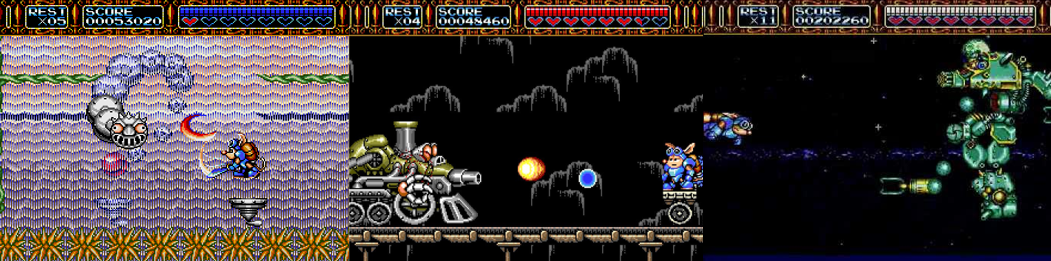
Gigantic mechanical enemies also appear as mini- and end bosses, such as the Snake Mecha that lunges at you in the first flying section and the Big Spider at the end of Stage 1. This thing crashes its head through the castle walls and ceilings, giving you a chance to land some attacks, but you must avoid standing in the wrong place and being smacked by its spiked tail. Stage 2 features a weird collection of spheres, not unlike a mechanical caterpillar, that dives in and out of a waterfall. You must do the same and blast between vines to avoid its wide arc and pummel the weak spot on the end of its tail, which is pretty tricky given the hazardous environment. Stage 2 ends with you battling a menacing steampunk train that charges towards you firing slow shots and then transitions to an upper path, swinging and extending its claw arms, before finally firing bouncing shots from its wrecked behind, its weak spot changing each time. A satellite-like robot challenges you in Stage 6’s asteroid field, blocking your shots with a shield and firing a dual spread shot, and you must take on the strangely sized pig mothership, too. Since this hurts you if you touch it and fires relentlessly, you must target the many turrets to deal damage, switching position as it teleports in and out, taking out its minions, and dispatching its giant mouth cannon before you get fried! As the fight progresses, the cockpit detaches, leaving you to destroy the main body of the ship. However, the cockpit transforms into a mech that fires pellets, a ricocheting laser, and flailing its arms. You must strike the ball it bounces between its hands to deal damage, then fly around as it bounces around the screen in a frenzy, which makes for a troublesome boss due to its large hit box and the lack of health pickups.

Axel Gear and the persistent Emperor Devotindos won’t go down without a fight!

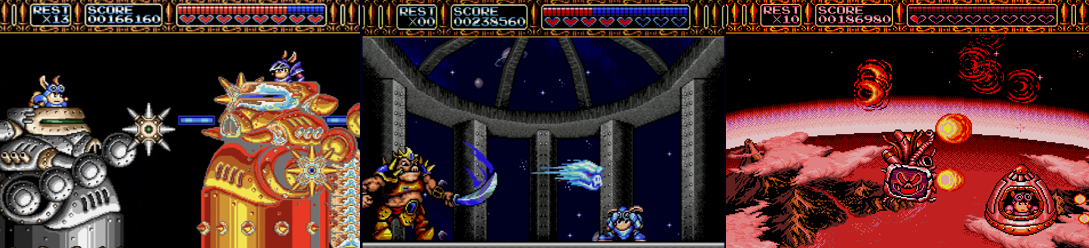
Your most persistent enemy is rival, corrupt Rocket Knight Axel Gear, who kidnaps Princess Sherry and constantly ducks you. When you finally go toe-to-toe with Axel in Stage 5, it’s in a Rock ’Em Sock ’Em Robots mech battle. After racing to your mech, you must avoid his hits and tap A or Y to swing your buzzsaw-like, extendable arms and damage his craft. It’s a bit clunky and difficult to avoid damage but, eventually, Axel’s mech is destroyed. Axel then appears at the end of the asteroid section of Stage 6, now sporting a gigantic laser cannon and firing smaller homing missiles. You must loop behind him to attack and take out his smaller shots, watching for his circular movements as he prepares each shot. Axel than challenges you to a more traditional sword fight mid-way through Stage 7’s gruelling boss gauntlet. Here, Axel sports the same abilities as you, swinging his sword, unleashing a rocket spin, and ricocheting about. Note that your sword beams cancel each other out and he’ll eventually cause explosive decompression! You must cling to the poles, attacking Axel with your sword beam and avoiding his missiles and circle motions, finally flying with your rocket charge when he’s charging his own. Emperor Devotindos is the game’s final boss and certainly doesn’t go down easily! Your first battle isn’t too bad, with you simply dashing from across the screen and charging into the pig monarch, dodging his progressively faster projectiles. After enough hits, he reconstitutes himself into a maniacal cyborg and you must avoid his extendable legs and rocket into him diagonally. Emperor Devotindos downloads his consciousness into the Pig Star’s main core, causing it to float, teleport, and bounce around firing various laser spreads that you must avoid while charging at the small red weak spot. As you escape the exploding Pig Star, Emperor Devotindos (now little more than a television screen) pursues you, thrashing tentacle-like limbs, firing ring projectiles, and barging into you. You cannot attack here and must simply survive until atmospheric re-entry finishes the bovine bastard off, a daunting prospect as Emperor Devotindos is hard to avoid and deals a lot of damage.

Additional Features:
There are four difficulty settings to challenge in Rocket Knight Adventures, with each one altering how many lives and continues you play with and slightly altering the end text. If you beat the game on anything other than the hardest difficulty, you’ll be challenged to try a harder difficulty once the credits have rolled. Interestingly, you can input a code from the pause screen to record your progress as the game’s demo mode, though the level select code apparently only works in the Japanese version of the game. Luckily, Rocket Knight Adventures: Re-Sparked lets you pick between the American and Japanese versions of the game and offers a host of additional features, too. There’s the slick, sexy, anime style opening that makes me wish we’d gotten a cartoon back in the day, various filter and border effects, and the always helpful rewind and save state features. You can also play a boss rush mode and view various advertisements and concept art for the game, peruse the box art and manuals, and freely listen to the game’s kick-ass soundtrack. The PlayStation 4/5 version also comes with numerous Trophies for you to earn, with nine specifically earned from playing this game (best done on the hardest mode to stack them) and clearing its boss rush.

The Summary:
I’ve been in love with Rocket Knight Adventures since I was a kid. I was captivated by its bright, cartoonish visuals and fun, action-packed gameplay from the start and regularly find myself humming that memorable Stage 1 theme in my day-to-day life. One of the biggest gripes of my life-long gaming career is that I was never able to beat this game back in the day; that damn crushing floor always ended my playthroughs. However, this version of the game changed all that. It’s telling that I needed the rewind and save state features to finally beat this game and shows just how challenging Rocket Knight Adventures is. It lulls you into a false sense of security by easing you into the challenge, slowly adding more and more obstacles and insta-death hazards and leaning more on split second reaction times as you progress through its detailed and varied stages. Yet, while the difficulty curve is off-putting at times and the game occasionally seems needlessly unfair and cheap (infinite continues would’ve helped mitigate this), I still find it a hugely enjoyable experience. Sparkster is a fantastic character and often unfairly forgotten in the pantheon of mascot platformers and I loved his sword- and rocket-based gameplay. The ricochet mechanics were a neat feature; however, if anything, they were underutilised and the game relies on traditional platforming tropes and mechanics than its unique selling point, which is a bit odd. I loved all the big enemies and bosses, the switch to sidescrolling shooter sections, and the sheer variety on offer. No two stages are the same and the game’s constantly throwing new gimmicks at you, from mine carts to flying platforms to mech battles and races through mazes. There are few games as visually appealing on the Mega Drive than Rocket Knight Adventures, which has such franchise and merchandise appeal that I’m honestly surprised we didn’t get more games and tie-ins, such as toys and comics and cartoons. Still, that doesn’t diminish how enjoyable Rocket Knight Adventures is. To this day, it’s one of the best platformers on the system and this Re-Sparked version just makes it more accessible and entertaining than ever before.

My Rating:

Rating: 5 out of 5.

Fantastic

Was Rocket Knight Adventures in your Mega Drive library back in the day? What did you think of the rocket-based mechanics and the colourful visuals? Which of the game’s bosses was your favourite? Did you manage to clear the game without modern quality of life features? Which of Sparkster’s sequels was your favourite and would you like to see him brought back from obscurity? Either way, whatever your thoughts on Rocket Knight Adventures, leave a comment below, consider supporting me on Ko-Fi, and check out my other Rocket Knight reviews.
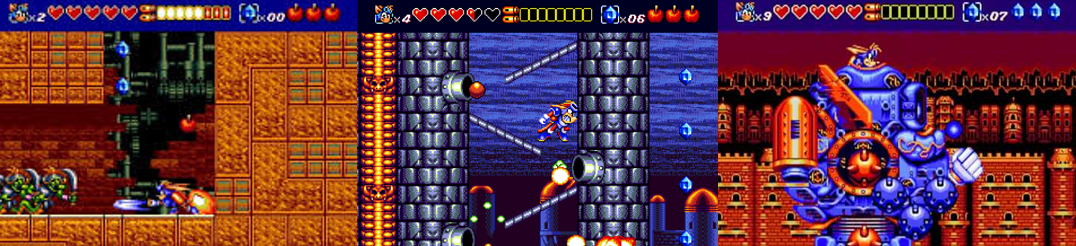
Game Corner: Rocket Knight (Xbox 360)

RocketKnightLogo

Released: May 2010
Developer: Climax Studios
Also Available For: PC, PlayStation 3, Xbox One

The Background:
Mate, how absolutely brilliant was Rocket Knight Adventures (Konami, 1993) back in the day? Back when cute, anthropomorphic mascots were all the rage, Sparkster (the titular “Rocket Knight”) really stood out thanks to some absolutely gorgeous graphics, kick-ass music, and fast-paced, rocket-based combat. I used to play that game so much as a kid but never actually managed to finish it (maybe one day); the game did well enough to receive two sequels, one for the Mega Drive and one for the Super Nintendo, but Konami’s long-forgotten and short-lived little franchise went dormant for far too long after these releases. Then, out of nowhere, a revival of the franchise was thankfully put into production thanks to producer Tomm Hulett. A 2,5D, digital-only title, I first played Rocket Knight on the PlayStation 3 but I didn’t hesitate to snap it up once it went on sale on Xbox One so I could get into it again. It’s not an especially long or difficult game but, as one of my favourite franchises that has been sadly lost to the mists of time, I could never not jump at the opportunity to charge up Sparkster’s signature rocket pack once more.

The Plot:
Fifteen years after bringing peace to the Kingdom of Zephyrus, Sparkster has been living a quiet life as a family possum. His peaceful life is shattered when the Wolf Army suddenly invades the Kingdom; heeding the call to adventure, Sparkster dons his trademark armour and rocket pack and returns to the fight to defend his home once more.

Gameplay:
Rocket Knight is a 2.5D action/platformer in which players take control of Sparkster, a “rocket knight” who seeks to defend his land from invasion. All of Sparkster’s moves and abilities from his debut game return here, meaning he is armed with a large sword for some basic close-quarters action and which is also capable of blasting enemies from a distance as well. Sparkster’s unique selling point was his rocket pack; by holding the B button and pointing Sparkster in a direction, players can blast ahead, mowing down enemies and ricocheting off walls to reach higher areas. Sparkster can also drill through certain breakable elements by tapping B again and briefly hover with a tap of the A button to aid with tricky platforming sections. However, Sparkster’s rocket pack isn’t finite in most stages; you’ll have to keep an eye on the energy bar in the top-left of the screen as you won’t be able to blast away if it’s empty. Luckily, this bar refills quite quickly, meaning you never have to wait too long to burst into action and Sparkster can also blow his energy reserves on a cartwheel-like attack that is super handy for bouncing dynamite back at enemies. Sparkster can also clamber across vines and bars with his tail; sliding down these will allow you to jump higher and further and you can also attack enemies by whirling around in a rocket-powered swing. Stages are generally a simply case of moving Sparkster from point A to point B, with a smattering of enemies and platforming segments to contend with, but every so often you’ll be thrust into a sidescrolling auto-flying stage where you can fly indefinitely.

Blast through enemies with Sparkster’s trademark rocket pack and sword.

In these stages, enemies, obstacles, and mines will try to slow your progress but you can blast at them with Sparkster’s energy shot. You can also hold X to charge up your shot and unleash a screen-clearing beam of energy that is perfect to taking out tricky enemies. Eventually, stages introduce more complex elements, such as when Sparkster finds his rocket pack affected by extreme cold. Your rocket fuel won’t regenerate in these stages unless you pick up a fuel icon or find a burning torch to defrost Sparkster. Other stages have you dodging and ducking fireballs, blasting from airship to airship while massive cannons try to knock you from the sky, hitting switches to open doors or lower energy fields, jumping from precarious moving platforms or navigating short, simple mazes to progress further, or outrunning a massive explosion. Rocket Knight is not an especially long or complex game but it’s simple, easy to play fun that challenges you by increasing the difficulty of its enemies and stage hazards over time. Fortunately, checkpoints are plentiful throughout the game’s stages; Sparkster can replenish his health by collecting hearts, which are sporadically found throughout each stage, and earn extra lives by collecting 1-ups and earning enough points. Points are accumulated by collecting blue and red gems, finding power-ups, and building a combo by defeating enemies in quick succession. Each time you clear a stage, you’ll earn additional points for how fast you completed a stage, encouraging speedrunning and a degree of exploration as you hunt down hidden gems.

Graphics and Sound:
Rocket Knight is not an especially ground-breaking game in terms of its graphics but it has a simple, adorable charm; favouring a 2.5D aesthetic over the gorgeous sprite art of its original games, the game resembles a cel-shaded cartoon more than anything. Characters pop out from the background and are lively enough (though Sparkster could be a little more animated when left idle), appearing big and chunky and almost anime-like in their appearance.

Colourful cel-shaded graphics and pantomime-like cutscenes add to the charm.

The game’s simple plot is told through pantomime-like cutscenes, as in the original game, with a brief synopsis greeting the player as each stage loads. These cutscenes are amusing and quaint, getting the point of the game’s uncomplicated narrative across easily enough and are thankfully not bogged down by copious amounts of voice acting (they are also entirely skippable if you prefer to just jump right into the action). The game’s music is just as good; Rocket Knight wisely opens with a remix of the memorable and catchy “Stage 1” music from the first game (still one of the greatest videogame tracks of all time, in my opinion) and takes its cue from there, punctuating each stage with plucky tunes that could maybe have a bit more oomph behind them but are nevertheless enjoyable.

Enemies and Bosses:
For the first portion of the game, Sparkster will have to contend with the Wolf Army; these are generally little more than cannon fodder, running head-first into your sword and attacks and easily dispatched of. Soon, they start tossing dynamite at your head (though these are easily knocked back with a swipe of your sword) or clinging from walls and ceilings to toss throwing stars at you. They’ll also pop out of the background or try to overwhelm you with sheer numbers, attack with bazookas, or drop bombs on you but are, for the most part, pretty easy to deal with. However, after taking out Ulfgar the Merciless, the King and leader of the Wolf Army, Sparkster is betrayed by former-enemy-turned-ally General Sweinhart and must contend with a renewed invasion from Sweinhart’s Pig Empire. These swines are far more dangerous enemies, taking multiple hits to defeat and blasting at Sparkster with energy pistols, hiding behind shields, erecting electrical force fields, and piloting intimidating mechs to try and squash Sparkster flat. Since Rocket Knight is only a short game (it’ll probably take about an hour to finish on the “Normal” difficulty), you only have to contend with three bosses and two sub-bosses. The sub-boss battles are a one-on-one duel against Axel Gear, Sparkster’s hated rival; Axel has many of Sparkster’s abilities, including his energy beam and rocket pack-based attacks, but also circles the screen leaving damaging clouds in his wake and tosses grenades Sparkster’s way at any opportunity. These are some of the most fun bouts in the game, though, as it’s thrilling to go against Sparkster’s dark opposite; however, they can be frustrating when playing on “Hard” mode.

Sparkster’s rival, Axel Gear, and general Sweinhart’s gigantic minions offer a significant challenge.

The first true boss you’ll encounter is a giant mechanical forest shredder that tries to stamp, swipe, skewer, and explode you at every opportunity. The boss’s weak spot is the big, red metal “mask” on its head and you can choose to either rocket yourself into this or try to reflect the dynamite it tosses your way back at it but you’ll have to dodge its rockets and giant, scenery-destroying buzz saws as the fight progresses. Ulfgar the Merciless is a slightly less straight-forward opponent; impervious to your attacks, you must instead bait Ulfgar into charging head-first into blocks, knock dynamite back at him, or destroy the platforms he is standing on to damage him all while dodging his charging and melee attacks and the debris he causes to come crashing down from the ceiling. The final boss is a battle against General Sweinhart himself and is also, fittingly, the toughest and most frustrating battle of the game. Sweinhart hides inside a titanic mech shaped in his image for most of the battle, randomly trying to squash you (or cause bottomless spits to emerge) or fry you alive with his laser eyes. When comes close, you must quickly attack on his metal nostrils; take too long and he’ll spawn an enemy or three into the arena, which causes more headaches. Land three hits and the mech goes down, spitting Sweinhart out. Here’s where it gets really tricky; you have to dodge Sweinhart’s laser and bombs all while trying not to touch the electrified parts of his downed mech and using Sparkster’s rocket pack to knock Sweinhart from the sky in such a way that he gets fried instead. If you’re quick about this, you can significantly knock a lot of Sweinhart’s health off but it’s so fiddly and tricky to dodge his attacks and get him to land in the right place that you’ll have to contend with his giant mech at least two times in a standard battle. To make things worse, the game is really stingy with health in this battle; when fighting the other bosses, a couple of health power-ups are available in the arena but, here, it seems completely random when one will drop from the mech’s nostrils, making this far more frustrating than it needs to be at times.

Power-Ups and Bonuses:
In keeping with the first game, there’s not much on offer to help boost Sparkster’s performance throughout Rocket Knight; gems will add to your score to help you towards earning extra lives, 1-ups are occasionally found in stages, and certain stages will see you get an instant refill of your rocket fuel but that’s about it. There’s no invincibility or speed up, no shields or damage increasers, and no upgrades to get or worry about; it’s just you, your sword, your rocket pack, and your wits.

Additional Features:
As you might expect, Rocket Knight comes with a handful of Achievements for you to earn; sadly, there’s not very many and they’re not especially varied in their content. However, while clearing every stage and beating the game on “Normal” might be easy enough to get, others, like beating every stage below the par time or finishing the game on “Hard” mode, can be a mite trickier. You can select “Hard” mode at any time; however, staying in “Hard” mode is easier said than done. The only way to stop the game from automatically dropping the difficulty back to “Normal” is to land a special attack on each of the game’s bosses (such as damaging the forest shredder with dynamite or causing Axel to fly into his own bombs). Once you manage it, though, you unlock two additional skins: one that lets you play as Axel Gear (which is awesome) and the other is Gold Sparkster, which is also an even more challenging gameplay mode. You can input the famous Konami code on the title screen to unlock these at your leisure but I don’t think that allows you to earn the Achievements associated with them.

The Summary:
Rocket Knight is an extremely enjoyable, if all-too-brief, return to form for one of Konami’s more forgotten franchises. Fast paced and simple to play, there’s not much here to really test your skills or have you pulling your hair out as even the game’s trickier moments are fun to play through thanks to the appealing aesthetics of the game’s graphics and soundtrack. The controls are tight and responsive, stages are short bursts of action and enjoyment, and the gameplay is simple yet easy to get to grips with. It would have been nice to see the three original games included as unlockables or bonus content but maybe one day Konami will remember Sparkster and give all four of his titles a bit of a spruce up for a new generation.

My Rating:

Rating: 3 out of 5.

Pretty Good

What did you think of Rocket Knight? Were you happy to see Sparkster randomly return from obscurity or did you have issues with the game’s length and presentation? Did you ever play Rocket Knight Adventures on the Mega Drive or either of its sequels? If so, what did you think of them and would you like to see more games in the franchise? Either way, whatever your thoughts on Rocket Knight, leave a comment below.