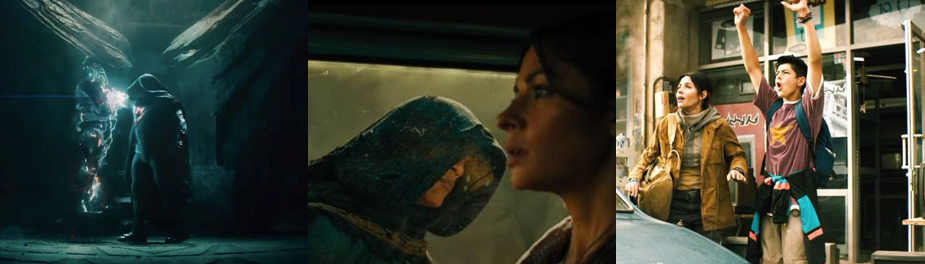
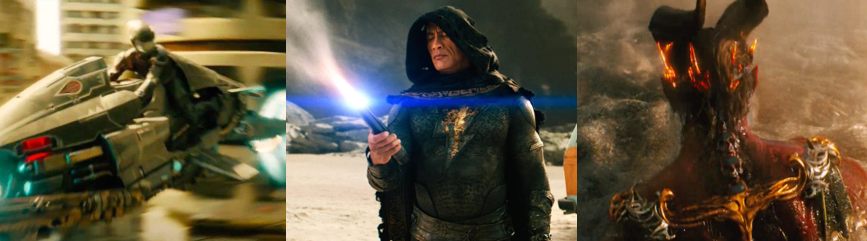
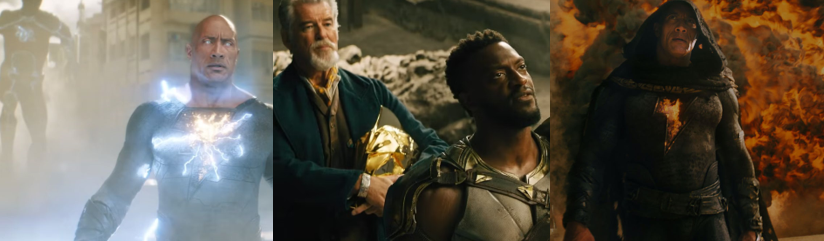
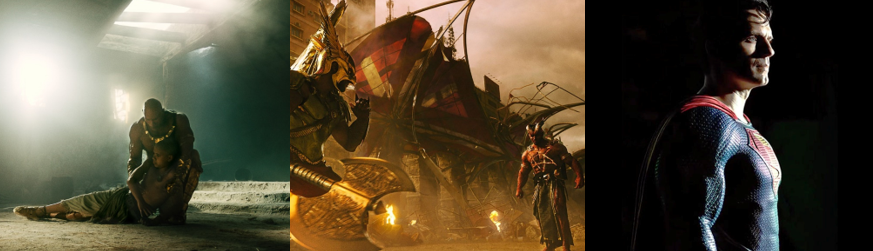
Movie Night: Black Adam

Released: 21 October 2022
Director: Jaume Collet-Serra
Distributor:
Warner Bros. Pictures
Budget: $195 to 200 million
Stars:
Dwayne Johnson, Marwan Kenzari, Sarah Shahi, Bodhi Sabongui, Aldis Hodge, Noah Centineo, Quintessa Swindell, and Pierce Brosnan

The Plot:
After nearly five thousand years of imprisonment, Teth-Adam (Johnson), an ancient magical champion said to have liberated Kahndaq, is unleashed into modern times. His brutal form of justice attracts the attention of the Justice Society of America (JSA), who try to stop his rampage and bring him into custody whilee investigating a centuries-old evil force whose power matches that of Teth-Adam.

The Background:
Following the incredible success of Clark Kent/Superman and Bruce Wayne/Batman, Fawcett Publications looked to get in on the superhero craze. While the initial plan was for a team of heroes, Ralph Daigh combined them into one superpowered entity to directly oppose Superman. Originally dubbed “Captain Thunder”, trademark issues led to artist Pete Costanza suggesting the name “Captain Marvelous”, soon shortened to Captain Marvel, and the character proved a big success. Captain Marvel soon became a franchise all unto himself after sharing his powers with a colourful extended family and, about six years after his debut, he and his Marvel Family met their dark opposite in the form of Black Adam, a corrupted version of the Big Red Cheese. Although Black Adam only appeared once in Fawcett’s original run, he saw a new lease of life after the publisher was absorbed into DC Comics, becoming a complex anti-hero often as reprehensible as the villains he opposed. Ranked as one of comics most interesting anti-heroes, Black Adam has featured in animated ventures but this live-action adaptation has spent nearly twenty years in Development Hell. Dwayne “The Rock” Johnson has been attached to the role since the project first stumbled to life in 2006 and, given Johnson’s prominence in Hollywood, the decision was made early on to keep Black Adam separated from Shazam! (Sandberg, 2019) in order to best capitalise on his star power before an inevitable confrontation with Billy Batson/Shazam (Asher Angel/Zachary Levi). Initial plans to feature Black Adam in The Suicide Squad (Gunn, 2021) were scrapped in favour of pitting him against the JSA. Johnson was keen to play up the character’s no-nonsense nature and went all-in with marketing Black Adam as a game-changer in the DC Extended Universe. After numerous delays due to the COVID-19 pandemic, Black Adam finally released to mixed reviews; the film did pretty well with a $393.5 million box office but, while many praised The Rock’s performance and the implications Black Adam has on the future of the DC Extended Universe (DCEU), others took issue with the film’s conflated plot and pacing, though all involved (and especially Johnson) were adamant that Black Adam represented a new phase of the DCEU.

The Review:
What a strange, long, and winding road this film has been on; it’s been in production for so long that I was starting to wonder if it would ever come out, especially after the character failed to appear in Shazam! I kinda get why he didn’t; it’s possible that the Rock’s star power would’ve dwarfed that movie’s heart-warming, handholding introduction to this side of the DCEU and people always complain that superhero films rely on the dark doppelgänger trope too much, which I get, but I think the contrast between Black Adam and Captain Marvel helps to elevate the latter into a more wholesome hero. Black Adam also would’ve been a great fit for either of the Suicide Squad films, especially the God-awful first one, but I do understand the idea of capitalising on the Rock’s star power to give him his own feature film, even if I don’t fully agree with it or his insistence on hyping up a clash between him and Superman (Henry Cavill) rather than him and Shazam, which would be my first choice, but maybe all three could meet up in a future movie, that would be a happy compromise. I am pretty familiar with Black Adam, though; I’ve read a bunch of his stories, especially during his time on the JSA, and really dig his no-nonsense attitude and the complex relationship he has with Captain Marvel, which is aways one clash of ideals away from degenerating into all-out war. I also really hope that the Rock is committed enough to the role that he sticks around for a bit; obviously, Dwayne Johnson is a massive Hollywood star and is in high demand so I do wonder about his longevity in the DCEU, especially considering how quickly Ben Affleck burned out (and I was worried that he would when he was cast), but he’s pursued the role for a good ten years and really threw himself into the marketing so I’m hoping he gets to reappear a few more times, though I do somewhat disagree with the idea of rebuilding the DCEU entirely around a character like Black Adam instead of, say, Superman. Black Adam gets off to a shaky start, with a ten-to-fifteen-minute opening and narration that rushes through the titular anti-hero’s origins in ancient Kahndaq and sets up the McGuffin that much of the film’s plot revolves around. Centuries ago, a tyrant named Ahk-Ton (Kenzari) enslaved Kahndaq and forced its people to dig for a rare and incredibly powerful mineral known as “Eternium”, the only material powerful enough to force the Crown of Sabbac, an item powerful by six demonic entities from what can only be described as Hell.

Awakened in modern times, Teth-Adam’s violent ways earn him the adulation of the oppressed Kahndaq.

Kahndaq’s spirit was well and truly broken but one boy, Hurut (Jalon Christian), dared to try and inspire an uprising. For this, he was sentenced to public execution but, at the last second, was spirited away to the Rock of Eternity and infused with the stamina of Shu, the speed of Horus, the strength of Amon, the wisdom of Zehuti, the power of Aten, and the courage of Mehen by the Council of Wizards. The legend becomes sketchy after the defeat of Ahk-Ton, but Kahndaq has revered their Champion ever since, with great statues erected celebrating their saviour; in modern day Kahndaq, their symbolism has all but faded thanks to the oppression of Intergang, a mercenary military force that has imposed martial law throughout the city and is seeking to strip it of all its natural resources. With Kahndaq virtually a police state, young Amon Tomaz (Sabongui) echoes the rebellious spirit of Hurut in his desire to fight back against their oppressors, but his mother, Adrianna (Shahi), is more concerned with keeping him safe from reprisals and tracking down the legendary and forgotten Crown of Sabbac to keep it out of Intergang’s hands. Here efforts lead her, her bumbling technician brother Karim (Mo Amer), and Ishmael Gregor (Kenzari) to a mountain where they successfully recover the crown but, after being accosted by Intergang’s forces, Adrianna speaks the magical word of Shazam to awaken the Champion from his long slumber. Thus, Teth-Adam arrives, garbed in a form-fitting black suit and sporting both the Wizard’s (Djimon Hounsou) lightning symbol and a hooded cape and immediately dispatches the Intergang thugs without mercy or quarter. His superhuman speed, strength, and command over lightning make him virtually indestructible to all man-made weapons; his skin is only pierced by Eternium, and his powers even allow him to cauterise and recover from wounds in moments. Bulletproof and capable of reducing a man to a chargrilled skeleton or a pile of ashes with a single bolt of lightning, Teth-Adam lays wastes to the armed thugs but, in the chaos, notably makes the effort to save Adrianna from being crushed by a falling boulder. A stoic, grim-faced man, Teth-Adam tears through Intergang with ease, mocking their “weak magic”, catching bullets, and swatting aside missiles like they were nothing. When he’s injured by an Eternium blast, Adrianna and Karim take him back to their flat to recuperate; there, he quickly learns English (how is never explained but I’ll assume it was through the wisdom of Zehuti) and is accosted by Amon, who very much fills a similar role to Frederick “Freddy” Freeman (Jack Dylan Grazer) in Shazam; he’s an absolute superhero nut, with posters and comics and action figures of all of DC’s heroes plastered around his bedroom, and enthusiastically runs down the gamut of Teth-Adam’s powers and tries to teach him to embrace his role as a superhero, somewhat similar to young John Connor’s (Eddie Furlong) relationship with the Terminator (Arnold Schwarzenegger). However, Teth-Adam has about as much interest in being a hero as he does using doors or being polite; he simply floats and flies around, barging through walls, spouting his dogma regarding lethal force to Amon, and rejecting claims that he’s Kahndaq’s fabled Champion. Despite this, he does have something of a moral code; when Intergang arrive looking for the crown and put Amon in danger, Teth-Adam continues his merciless slaughter, amusingly struggling to deliver the-ass one-liner Amon taught him as he kills people too quickly for such traditions and attracting the attention of Amanda Waller (Viola Davis).

Black Adam’s rampage brings him into conflict with the morally-righteous Justice Society.

Oddly, Waller’s first port of call isn’t the Suicide Squad or the Justice League, but Carter Hall/Hawkman (Hodge) of the JSA; it seems Waller has been reconfigured into a character more akin to Nick Fury (Samuel L. Jackson), someone who recruits and directs a variety of metahumans, which I find is an ill-fitting role for her and I would’ve preferred to see her interaction with Hawkman tweaked or removed entirely and saved her appearance for when they bring the depowered Teth-Adam into custody later in the film. Regardless, Hawkman recruits his old friend and team mate Hector Hall/Doctor Fate (Brosnan) and two rookie metahumans, Albert “Al” Rothstein/Atom Smasher (Centineo) and Maxine Hunkel/Cyclone (Swindell), to intercept and subdue Teth-Adam in Kahndaq. I really like the inclusion of the JSA here; it’s fitting, given that Black Adam spent some time with the team in the comics, and helps to open up the DC Universe to new heroes and stories, while also not overshadowing Teth-Adam with more recognisable heroes. Unfortunately, we don’t learn a great deal about them; Atom Smasher and Cyclone are relatively one-dimensional, despite a budding attraction, Al’s need to consume food to maintain his size-changing abilities and desire to live up to his uncle’s (Henry Winkler) legacy and a brief mention of Cyclone’s traumatic background. Similarly, there’s a history and a strong bond between Hawkman and the mysterious Dr. Fate that is only briefly touched upon; we learn nothing about their origins, the nature of their powers, or even their limits. Dr. Fate is able to see visions of the future through his magical, alien helmet and conjures doubles of himself, mystical barriers, and crystalline weapons and Hawkman clearly has some form of superhuman durability since he can go toe-to-toe with Teth-Adam, as well as sporting his trademark wings and mace, but Black Adam doesn’t waste any time digging into the depths of the JSA’s background. Instead, they’re there as a peacekeeping force, one who strive to set an example to the world and their peers by upholding justice and sparing lives, rather than taking them. This not only contrasts with Teth-Adam’s more totalitarian methods and leads to many a conflict, both physical and philosophical, with the team (especially the proud and hot-headed Hawkman) but also raises the ire of Adrianna and Kahndaq. After decades of oppression and being left to fend for themselves, she and her fellow countrymen reject the JSA’s involvement and holier-than-thou attitude, especially as Hawkman’s temper and Atom Smasher’s inexperience leads to more damage to their country. Indeed, Kahndaq openly cheers for Teth-Adam, revering him as their Champion and approving of his more direct, lethal measures, a feeling Adrianna also shares despite her wishes to spare Amon from inflicting violence upon others. Teth-Adam is doing what needs to be done and actually fighting back against the likes of Intergang, whereas the JSA and the wider world simply ignored Kahndaq’s problems, thus casting the JSA in an interestingly villainous role as they go to great lengths to try and end Teth-Adam’s rampage before his rage gets out of control.

Despite their technology, and being possessed by a demonic force, Intergang is little threat to Teth-Adam.

Their justification comes from having access to ancient texts that detail that Teth-Adam isn’t as righteous as Kahndaq believes; it turns out that, while Hurut was celebrated as Kahndaq’s Champion (Uli Latukefu), Teth-Adam and his wife, Shiruta (Odelya Halevi), paid the price with their lives. When Hurut shared his powers with his father to spare his life, he left himself vulnerable and was killed by Ahk-Ton’s assassins, driving Teth-Adam into a murderous rage so severe that the Wizard was forced to imprison him to contain his power and anger. Now unleashed into the world, the JSA bsaelieves that it’s only a matter of time before history repeats itself and, when Hawkman’s attempts to instil qualities of mercy into Teth-Adam fail (despite almost all of DC’s superheroes having a notable body count), the JSA attempt to force him into submission or to speak his magic word so he can be delivered into Waller’s custody. Ultimately, it’s Teth-Adam’s rage that sees him willing return to his mortal form (Benjamin Patterson) and be taken into custody after he accidentally injures Amon with his powers. With Teth-Adam left in suspended animation and unable to speak his magic word, the JSA believe they’ve accomplished their mission but a greater threat emerges from their conflict with Intergang. While Intergang aren’t really much to shout about, being simply a military force to intimidates Kahndaq’s citizenship, they do inexplicably wield Eternium weapons and hoverbikes, though none of this really matter sin the face of Teth-Adam’s awesome power. They’re the very definition of nameless, faceless, disposable goons for Teth-Adam to tear through; I quickly lost count of how many he turns to ash and bones and the film makes his toying with their lives into a bit of a gag. Intergang also disappear for the film’s final act, their threat and control over Kahndaq forgotten in favour of the power of the Crown of Sabbac, a power that Ishmael craves so badly that he not only aligned with Intergang, but betrayed Adrianna, shot Karim (though, thankfully, he doesn’t kill him as Karim is one of the film’s comedic highlights), and purposely put Amon in danger all to claim the crown for himself and to make Teth-Adam so bad that he would kill him. Sadly, for all the gravitas Pierce Brosnan brings to the film and the awesome, charismatic presence of The Rock, Ishmael ends up being a pretty weak villain; I literally forgot he was even in it for big chunks of the movie, and you can see his heel turn coming a mile away. His transformation into a literal devil for the finale isn’t exactly inspiring either, and his final confrontation with Teth-Adam is very similar to the ending of Shazam!, though the primary focus of Black Adam is on exploring Teth-Adam’s morality and methods and this is a very interesting and entertaining aspect of the film so I can ignore the lame villain, though I do think the film would’ve benefitted from someone like Arnold Vosloo in the role instead.

The Nitty-Gritty:
It’s these themes of morality that form the heart of Black Adam; having witnessed the enslavement and subjugation of his people, the death of his beloved wife and child, and the hypocrisy of the Wizard and the Gods, Teth-Adam has been left a cold, emotionless, rage-filled force of nature. This is a very different role for The Rock, one that downplays his usual affable nature in favour of a more stoic demeanour, one that showcases a different side of his charisma. He still has a presence and a biting wit, but it’s one seeped in rage and tragedy; initially, Teth-Adam was a mere powerless slave, one who tried to keep his son from speaking of rebellion, but he was driven into a fury after losing everything and has no qualms about lashing out at those who seek to harm or oppress others. His no-nonsense morality most notably conflicts with Hawkman, who believes heroes shouldn’t kill and tries to emphasise the benefits of sparing lives as it allows one to learn information about their enemy or objective. Teth-Adam is much more direct; even when he begrudgingly teams up with the JSA to rescue Amon, he just flies off and storms Ahk-Ton’s ruins, completely ignoring Hawkman’s plan of attack, an approach that works perfectly well for him as he’s functionally invulnerable. There are some interesting dichotomies at work in Black Adam; Hawkman coms across as a bit of a hypocrite because, while he’s all about saving lives, he does put people in danger with his insistence on beating Teth-Adam into submission and there’s a grey question mark hovering over the JSA’s moral high ground since they only came to Kahndaq’s aid once a superhuman presence emerged there. Similarly, Teth-Adam never harms or kills innocent people; he might claim to have no interest or care for the lives of mortals, but he repeatedly goes out of his way to help Adrianna and Amon and only kills Intergang’s mercenaries, something that the people of Kahndaq naturally cheer for as they just want to be free of their oppressors.

The film looks amazing and is full of fun action scenes, despite some dodgy CGI shots.

Visually, Black Adam is quite the spectacle; the whole movie is shot beautifully, and the costume design is absolutely on-point. The Rock looks like a walking mountain of ashen black in his comic-accurate costume and even the always-ridiculous Hawkman ends up being realised very well onscreen, though I could’ve done without the nanotechnology that allows his helmet to magically form over his head and his wings to fold away. Dr. Fate looks magnificent, if a little rubbery at times since he’s a mostly CGI creation, but the effects fall apart a little when bringing the gigantic Atom Smasher and the wind-bending Cyclone to life; I applaud the filmmakers for choosing such effects-heavy characters but I do think the film might’ve benefitted from picking less visually demanding characters since Atom Smasher doesn’t really get a lot of play (and is portrayed as a bit of a buffoon) and Cyclone just dances around in slow motion whipping up projectiles and dirt. There’s a surprising amount of slow motion here, almost Zack Snyder levels of the effect, as Black Adam goes out of its way to emphasise Teth-Adam’s incredible superhuman speed; for the most part, it works, though some parts that are clearly supposed to be dramatic can come off as a little hokey thanks to The Rock’s grimacing or screaming face lunging at the camera in su-u-per sl-lo-ow mo-tion. Mostly, though, the effects are pretty good; the sequence where the JSA’s futuristic place takes off is a bit over the top and the final form of Sabbac is disappointingly underwhelming, but Teth-Adam’s many fight scenes against Intergang and the JSA work really well. Similar to some surprisingly violent scenes in Shazam!, there’s a level of violence in Black Adam that nicely skirts the limits of what’s acceptable for a 12A film; while there’s no gore or blood splattering everywhere, Teth-Adam rams grenades in people’s mouths, causes aircraft to collide in mid-air, and indiscriminately blasts at his enemies with his lightning and comically sends them flying into the sea or across the screen. Charbroiled skeletons, ashes, and even severed limbs are all over the film as Teth-Adam tears through his opponents without remorse, culminating in a pretty gruesome end for Sabbac when Teth-Adam rips him in two, spilling not blood but molten lava.

While Teth-Adam ultimately chooses to defend the world, the question of his morality is left up in the air…

All throughout the movie, Dr. Fate is haunted by a vision of the future in which the world is reduced to a burning cinder, presumably because of Teth-Adam’s rage, and his good friend Hawkman is killed in conflict. When Teth-Adam finally surrenders and his threat is naturalised, Dr. Fate is disturbed to find his vision remains unchanged; this is because they were too slow to realise that Ishmael’s plan all along was to die at Teth-Adam’s hands so he could meet the six demons of Sabbac in Hell and become their demonic champion. Imbued with their demonic power, Ishmael returns to life as Sabbac, a literal horned demon with a pentagram carved into his chest and with designs of claiming his birth right as Kahndaq’s true ruler (since he’s the last living descendant of Ahk-Ton). Thanks to the demons’ powers, Sabbac sports all the same abilities as Teth-Adam but wielding fire instead of lightning; Ishmael’s humanity is completely consumed by this underwhelming CGI form, which has little motivation other than death and destruction. Although they’re able to battle Teth-Adam and even Sabbac on equal ground thanks to their superhuman powers, the JSA are no match for either of them; in a bid to change the future and save his friend’s life, Dr. Fate willingly meets Sabbac head on and sacrifices himself to free Teth-Adam from his confinement and convince him to live up to Hurut’s example by becoming the world’s saviour. What follows is a pretty intense brawl between Sabbac and Teth-Adam; since both are capable of hurting the other, and yet are also equally matched, there’s a degree of uncertainty about the battle but, thanks to Dr. Fate’s words, Teth-Adam learns to co-operate with the JSA, setting aside his differences with Hawkman long enough for the latter to use Dr. Fate’s helmet to distract Sabbac and allow Teth-Adam to deliver not only his one-liner but a killing blow to the raging demon. In the aftermath, a begrudging respect between Teth-Adam and the JSA is acknowledged, though Hawkman warns him not to step out of line, and Teth-Adam adamantly rejects Kahndaq’s throne and vows to instead be the country’s protector. A mid-credits scene then sees Amanda Waller also warning Teth-Adam, now rechristened as “Black Adam”, against stepping out of Kahndaq; she even calls in a favour and sends Superman to have a chat with him, returning not only Henry Cavill to the DC Universe but also John Williams’ iconic theme, and setting the stage for a showdown between the two that would never happen.

The Summary:
Truthfully, I was unsure about Black Adam; I still maintain that it’s a little self-indulgent to give him his own solo movie simply because of The Rock’s star power and he’s a strange character to rebuild the mess that is the DCEU around since there’s only so much you can do with him. However, I am a big fan of the character, and The Rock, and was excited by the trailers and the hype surrounding the film, and to see the JSA and Pierce Brosnan in a superhero film. Despite a troublesome start, which rushes through what seems like a whole movie’s worth of story, Black Adam soon found its groove and settled into an enjoyable action romp designed to showcase a meaner side of The Rock, who is clearly enjoying himself in revelling in Teth-Adam’s power. I enjoyed the complexity of Teth-Adam’s character; he’s burdened by loss and rage and not only feels like he has no place in the world but also that he’s unworthy of his powers since his first instinct is the hurt and kill others. The entire film is geared around showing him that he can just as easily b the saviour of humanity, but there’s still a question about his motivations by the finale; he seems content to remain in Kahndaq as its defender, but there’s literally nothing stopping him going out and enforcing his will in the wider world. The JSA came off really well; while we don’t learn much about them and I think I would’ve preferred Atom Smasher and Cyclone to be a little more experienced, they added some visual variety to the fight sequences and nicely opened up the DCEU to new superpowered characters, as well as helping to set an example for the violent anti-hero. While the villains weren’t much of a threat, or very interesting even when turned into a literal demon, but I can overlook that (and some of the wonkier CGI) because of The Rock’s undeniable charisma. The jury’s out on what’s next for Black Adam and how his presence will really affect the hierarchy of the DC Universe, but this was an entertaining spectacle that I enjoyed far more than I expected to.

My Rating:

Rating: 3 out of 5.

Pretty Good

Did you enjoy Black Adam? Do you think the character deserved his own solo movie, one that skipped over his relationship with Shazam? What did you think to The Rock’s portrayal of the character, his violent tendencies, and the realisation of his powers and costume? Were you also disappointed by the villains? What did you think to the JSA? Would you have liked to learn more about them, and which member of the team was your favourite? What did you think to Henry Cavill’s long-awaited return to the DCEU and where do you think Black Adam will go next? Whatever your opinions on Black Adam, feel free to share your thoughts down below or leave a comment on my social media.
Movie Night: Halloween Ends

Released: 14 October 2022
Director: David Gordon Green
Distributor: Universal Pictures
Budget: $20 to 30 million
Stars: Jamie Lee Curtis, Andi Matichak, Rohan Campbell, and James Jude Courtney/Nick Castle

The Plot:
Four years after Michael Myers/The Shape’s (Courtney/Castle) last killing spree, Laurie Strode (Curtis) is trying to move on with her granddaughter, Allyson Nelson (Matichak). However, when local pariah Corey Cunningham (Campbell) starts down his own dark path of violence, Laurie is forced to confront her bogeyman one last time.

The Background:
In 2018, director David Gordon Green helmed a direct sequel to John Carpenter’s seminal horror classic to largely positive reviews and an impressive $255.6 million box office. Initially, Green and his co-writer, Danny McBride, pitched filming two movies back-to-back but, after their “requel” proved to be a success, they chose to focus on one film at a time. Although Jamie Lee Curtis and Nick Castle returned for the sequel, Halloween Kills (Green, 2021) received mixed reviews and fell a bit short of its predecessor’s success with its $131.6 million box office, but performed well enough to justify a third and final entry in Green’s new trilogy. Although his stars were set to return, Halloween Ends was understandably delayed due to the COVID-19 pandemic, an element that Green stated would be addressed in the film’s story. Both legacy star Jamie Lee Curtis and franchise producer Malek Akkad hyped the film as being a more self-contained film, one they hoped would enrage audiences with its content, as well as confirming that Halloween Ends would be the final entry in Blumhouse’s trilogy due to rights issues. Ultimately, Halloween Ends released to largely negative reviews; critics were unimpressed by the monotonous presentation of the violence and themes, its status as a definitive finale, and its unexpected focus on someone other than Michael. Some praised it as the best of this new trilogy, however, and praised Jamie Lee Curtis’s performance, though, as of this writing, the film has made only $64.4 million at the box office and the general consensus was that it was a lacklustre finale for the franchise.

The Review:
I think I’ve made my feeling about this new string of Halloween “requels” pretty clear but, just as a reminder…I wasn’t massively impressed by Halloween; we’ve seen the whole “decades later Laurie comes back to face Michael” thing and I really hated how it just swept away everything but the original film and went out of its way to criticise what the sequels did without really offering anything new. As the film ended, I was begging to see Michael go up in flames and be definitively killed off because at least it’d be something new but, of course, that was never going to happen. Halloween Kills somehow managed to be even worse; the film spent its entire runtime musing on Michael’s motives without coming at any real conclusion, making all of that discussion pointless, and having idiotic characters running around trying to end him and just acting like crazy fools who all ended up being slaughtered. It was filler and nothing more and smacked of a creative team who weren’t properly thinking out their three-film plan, which just made me question why it was even made in the first place. Again, if he’d actually been killed and someone else had took up his mantle then maybe I could’ve gotten behind it but it gave us probably the best chance to legitimately kill Michael (what better visual than the town he’s haunted rising up to stamp him out?) and just went “oop, no, he’s somehow supernatural, or maybe he’s not, we don’t know…he wants to go home! Even though he was at home earlier…look over there!” and then just snapped to the credits like it was clever. So, yeah, my excitement for Halloween Ends wasn’t exactly tipping the scale heading in; it’s hard to deny the allure of these movies and Michael’s iconography, but it’s also very difficult for me to care about these films as they so rarely do anything new because, when the formula is changed, the general audience flip out.

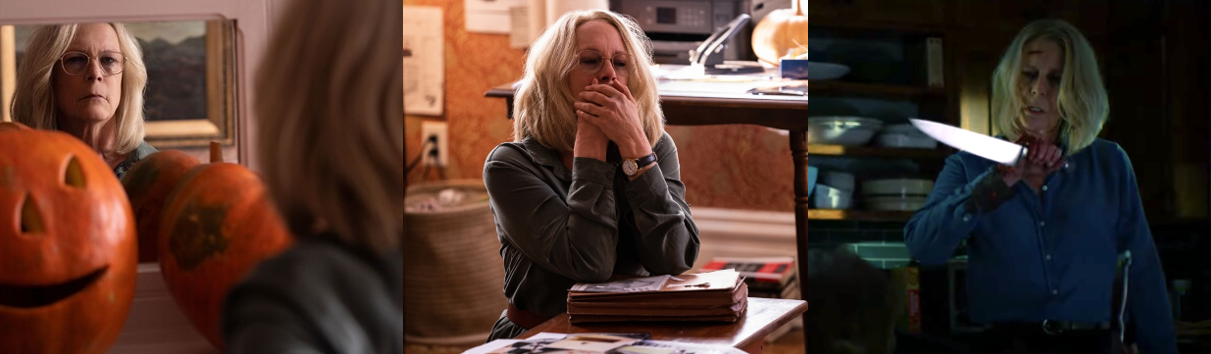
Although she appears to be in a far healthier state, Laurie’s fighting spirit is as strong as ever.

Unfortunately, Halloween Ends doesn’t exactly break the mould when it comes to improving my perception of these new films. In the four years that have passed since the last film, Michael has mysteriously vanished again, the Myers house has been demolished (quite how or why that was able to happen when the last film made it explicitly clear that his entire goal was to reclaim his former home. I guess he didn’t like the décor?), and Laura and Allyson live together in a fancy new house that the former was somehow able to purchase despite the fact that she doesn’t appear to have a job. Instead, Laurie is working on her memoirs, which provides a convenient and entirely pointless excuse to give a recap of the original film and the last two, with footage and such being spliced in to catch us up with the plot, something no Halloween film has ever needed to do before. Framed as a survivor of an extremely traumatic series of events, Laurie has abandoned her paranoia and now throws herself into helping others cope with similar trauma and providing a safe and happy home for Allyson, who’s lost her parents and friends thanks to Michael’s rampage. Laurie even decorates the house for Halloween and considers rekindling her romance with the criminally underutilised Deputy Frank Hawkins (Will Patton), a character who, quite frankly, could easily have been removed from this film (or actually been left as dead as he clearly was in Halloween) and the plot wouldn’t have been affected at all. personally. I would’ve liked to see him take on a Doctor Samuel Loomis-style (Donald Pleasance) role as an aging, somewhat unhinged Myers expert whose warnings are ignore but, instead, he gets a couple of scenes where he flirts with Laurie and talks to her about food and flowers and that’s it. No longer intent on preparing for an encounter with a nigh-supernatural force of evil, Laurie seems to be happy and excitable; she encourages Allyson to put herself out there more, shares drinks with the equally-underutilised Lindsey Wallace (Kyle Richards) and seems to be in a far healthier place than in the last two films.

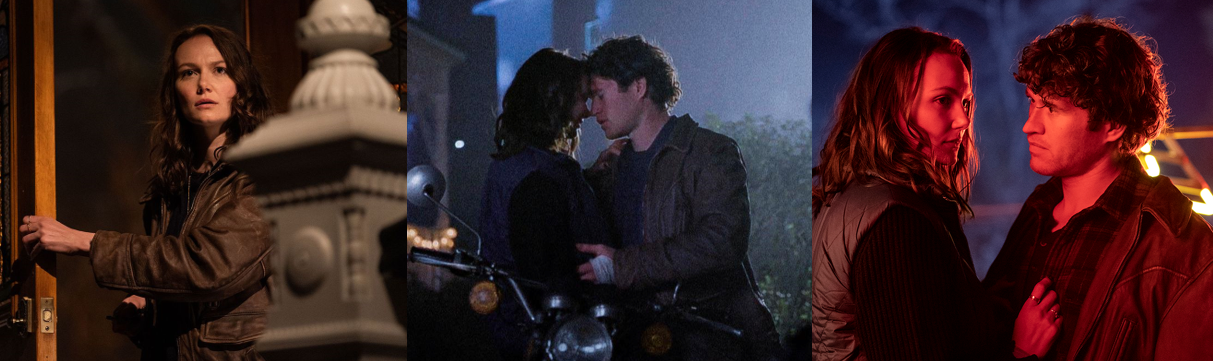
Corey brings out the worst of the traumatised Allyson and fuels her desire for a new life.

It takes time, but this is eventually, awkwardly, revealed to be a bit of a lie. Haddonfield has been left irrevocably scarred by Michael’s actions; the town openly blames Laurie for “provoking” him, an accusation that makes absolutely no senses, especially as it was the idiotic Tommy Doyle (Anthony Michael Hall) who riled up the mob in the last film and lead to all those deaths while Laurie was given the shaft and confined to a hospital. At first, it seems both Laurie and Allyson are coping quite well despite all of this, but it’s not all sunshine and rainbows; Allyson is now working as a nurse, where she’s treated very poorly by her lecherous boss, Doctor Mathis (Michael O’Leary), and she’s constantly harassed by her obsessive ex-boyfriend, Officer Doug Mulaney (Jesse C. Boyd). Although Laurie is the only family she has left, put herself at risk to defend her, and actively advised against joining the mob in the last film, Allyson secretly resents her grandmother and longs to escape the confines of Haddonfield, where treasured memories of her family and friends are mired by unwanted accusations and looks from the public. When Laurie brings an injured Corey to the hospital for treatment in a thinly-veiled attempt to set them up, Allyson is surprisingly and ridiculously instantly attracted to him; it’s not clear exactly why (he’s not that cute, after all), but it’s implied that she feels a kinship in him as the town also turned on him, and that she wants to “fix” him in some way. Corey allows Allyson the chance to indulge herself and to act a little naughty; this only exacerbates when Laurie realises something’s terribly wrong with Corey and tries to warn her granddaughter off, which sees all of her pent-up resentment bubble to the surface and her even encouraging Corey to give in to his dark side, despite her also appearing to have no knowledge of what he’s been up to even though he openly admits to killing people, regularly breaks down before her about the conflict inside him, and is clearly a deranged psychopath.

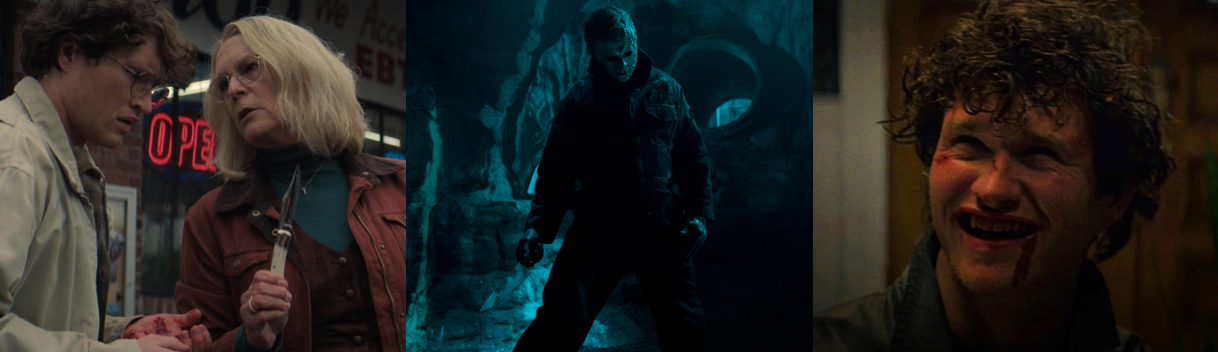
Chance encounters with Laurie and Michael turn Corey from a pariah into an unhinged psychopath.

If you go into Halloween Ends based on the trailers and posters alone, you’d be fooled into thinking this is the climactic showdown between Laurie and Michael. Nothing could be further from the truth, however, as the main focus for the vast majority of the film is Corey’s downward spiral into madness and murder. The film begins with Corey as a simply twenty-one-year-old babysitter with aspirations of going off to college; however, when he accidentally kills the bratty little kid he’s babysitting in what is clearly a freak accident, the town turns against him and he’s forever labelled as a baby-killing pervert. Although he tries to pull his life together and earn a modest living as a mechanic, he’s constantly berated by his overbearing mother, Joan (Joanne Baron) and targeted by a local gang of bullies who go out of their way to antagonise him. It’s because of Terry (Michael Barbieri) and his shit-kicking friends that Corey ends up injured and meeting Allyson, that he gets his first taste of vengeance when Laurie encourages him to flatten Terry’s tyre, and when he has a fateful encounter with Michael Myers. Far from the invincible, inexhaustible supernatural force he was painted as in the last two films, Michael is now decrepit and pitiful, surviving in a storm drain on the outskirts of town and burdened by the injuries he’s suffered in recent years. When he gets his hands on Corey, a strange moment passes between them; either a transfer of power or evil or a recognition that the same darkness that dwells within Michael lies dormant in Corey, and the Shape inexplicably lets him go as a result (despite the fact that he unceremoniously murdered Doctor Ranbir Sartain (Haluk Bilginer) when he tried to take over Michael’s legacy). Shaken by this near-death experience, Corey descends down a dark path; accidentally manslaughter leads to accidental murder, then premeditated murder, until he’s donning his own Halloween mask and adding more numbers to his body count. Corey even leads Michael to Doug and Dr. Mathis in order to see the Shape in action with his own eyes, which only pushes him further over the edge, to the point where he effortlessly overpowers the once almighty Shape of Evil and steals his mask to reignite the terror Michael started decades ago.

The Nitty-Gritty:
Although every Halloween movie has a thematic undercurrent concerning the power of literal and metaphorical masks, Halloween Ends attempts to explore this a little more explicitly, but ultimately fails in its execution. Laurie is hiding behind a mask of good-natured enthusiasm; far from the paranoid and unhinged drunk she was before, she seems to be much healthier and attempting to let go of her hate and fear, however this mask slips pretty quickly once she gets a look at Corey’s eyes and seems the same darkness dwelling within him as she saw in Michael. Allyson has a similar mask, ignoring the maltreatment she receives at work and from her ex simply to try and get on with her life, but she quickly casts this aside and turns on her grandmother with such vitriol that it appears like she’s encouraging Corey’s killing spree. Corey attempts to hide away, burying his head in the sand and avoiding conflict, but is constantly goaded into fight or flight situations by bullies and accusing townsfolk. When he dons a Halloween mask of his own and goes dancing with Allyson, he finds a freedom and a joy that have been lost for some time, but it doesn’t take much to snap him back into a guilt-ridden, morose state, one that makes him easy prey for the likes of Terry and the infectious evil of Michael Myers. Michael, obviously, famously hides behind a mask, one now aged and heavily damaged, but which still has such an allure and power to it that Corey claims it as his own to foster his bloodlust.

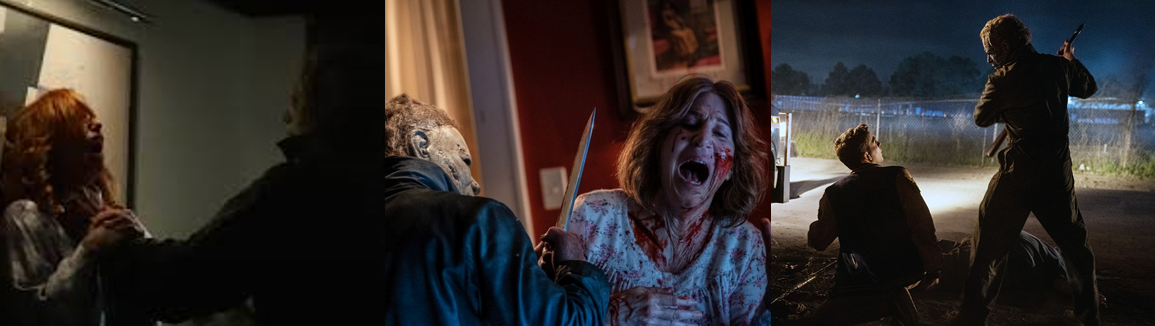
Sadly, only a couple of the film’s kills live up to the legacy of the franchise.

As much I disliked the previous Halloween films, they were mildly salvaged by three factors: Michael, the conflict between Michael and Laurie (and the greater town of Haddonfield), and the kills. As Michael is largely absent until the last act of Halloween Ends, and the film completely wastes the potential of Haddonfield descending into anarchy and increasing violence as a result of Michael’s “curse”, we’re left to rely on the kills. Sadly, these aren’t all that impressive as it’s left up to Corey to shoulder this burden and, as a largely reluctant killer, he lacks the supernatural skill and power of the iconic Michael Myers. I will say, though, that a couple stood out; Corey’s accidentally murder of obnoxious Jeremy Allen (Jaxon Goldberg) in the opening sequences was as shocking as it was amusing, and it was pretty gruesome seeing him take a blowtorch to Terry’s mouth. Probably the best kill is when Corey, now donning the Shape’s visage, mercilessly beats shock DJ Willy the Kid (Keraun Harris) until his jaw is hanging from his face and then cuts his tongue off and leaves it spinning on the record player. For the most part, Corey opts for simple murder tools such as a switchblade and bottle opener, resulting in some unfortunately tame and lacklustre kills; when he lures his bullies to the scrapyard where he works, he switches to using a truck to chase after them and borrows Michael’s head-stomp kill to finish of the unfortunate Margo (Joey Harris). Michael’s kill count is pathetically low in this film and relies entirely on nostalgia for John Carpenter’s original as he stabs and kills Allyson’s work frenemy, Deb (Michele Dawson), in exactly the same way as he killed Bob Simms (John Michael Graham) in the first film. Call-backs such as this are scattered throughout Halloween Ends; not only does the film ape the opening credits of the original, it uses the same font as Halloween III: Season of the Witch (Wallace, 1982) – fitting considering this mess of a film is on par with that ill-fated entry – and there’s even a short sequence shot from Corey’s perspective to mimic the iconic opening of Carpenter’s original. Sadly, though, it takes far too long for the blood and bodies to start piling up; Halloween has always traditionally been a more psychological franchise but the psychology on offer here is weak and flawed. The film attempts to paint Corey as a victim of society and nurture, rather than the pure natural evil embodied by Michael, but we learn paradoxically too much about him and at the same time not enough, meaning he lacks the mysterious menace of Michael and just comes across as a pouty kid lashing out at people who, for the most part, deserve to be punished, rather than killing innocent and otherwise likeable characters.

Unfortunately, Halloween Ends doesn’t live up to its premise and makes a mockery of Michael’s menace.

Upon first meeting, Allyson is instantly smitten by Corey and is inexplicably horny for him throughout the film; Corey initially tries to warn her off, since associating with him is bad news for her, but he can’t resist how good she makes them feel and they’re soon head over heels with very little motivation beyond being young, damaged, and wanting to escape. When Laurie recognises Corey’s turn to the dark side, she tries to warn both of them off but is labelled as a paranoid hypocrite, forcing her to take matters into her own hands. Somehow realising that Corey is walking the same dark path as Michael, she lures him to her house by staging a suicide attempt and shoots him down, apparently prepared to kill him before he can harm Allyson, or anyone else, and thus keep Michael’s curse from growing stronger. However, Corey’s mania is so complete that he willingly kills himself rather than live without Allyson, making the entire runtime up until that point a waste of time as he’s unceremoniously offed and then his thunder is stolen by Michael, who finally gets his shit together after spending the whole movie cowering in hiding and attacks Laurie. Although vulnerable after Allyson caught her holding a knife over her lover’s dead body, it turns out that Laurie isn’t as meek and content as she first seemed, and she engages in a brutal knife fight with Michael in her kitchen. Age, injury, and this film’s efforts to piss all over Michael’s legacy have left him a shell of his former self, however, and it’s not long before he’s pinned helpless to a table and has his throat slit by Laurie. Allyson arrives in time to help finish the Shape off and the two drive his dead body to the scrapyard with a police escort so all of Haddonfield can finally witness their bogyman by unquestionably killed off in pretty gruesome fashion; Laurie shoves his mutilated and lifeless body into an industrial shredder, which crushes him into bloody chunk and finally ends Haddonfield’s long, dark night. Unfortunately, the film really doesn’t deserve this definitive finale; the climactic and emotional finale of Halloween H20: 20 Years Later (Miner, 1998) remains unbeaten, in my eyes, as the most cathartic and dramatic end to Michael and Laurie’s story. I also feel like the finale might’ve benefitted from taking place at the scrapyard, with Michael being forced into the shredder by Laurie and Allyson, but I do give it props for actually killing the Shape off, even if 90% of the movie was focused on an entirely different and far less interesting plot and killer.

The Summary:
Just like with Halloween Kills, I went into Halloween Ends with low expectations; I admit that a lot of this was based on my dislike for Green’s Halloween movies, especially Halloween Kills, but even setting that aside it’s pretty despicable how this movie treats one of cinema’s most iconic slashers. Michael’s absence is to the film’s detriment; at one point, it seemed like him and Corey were going to go on a killing spree together, but that evaporated almost immediately, and it’s depressing seeing this jumped-up loser wrestle the Shape to the ground and steal his mask like it’s nothing, especially after the last two films tried to sell Michael as this unstoppable supernatural force. In another film, Corey’s story might’ve been interesting, and I have longed to see someone else take up Michael’s ways, but it just doesn’t stick the landing here; maybe if Corey had used Michael’s mask all along and Haddonfield had been led to believe the Shape was back, it might’ve worked better but, as is, he’s a very underwhelming character. Jamie Lee Curtis tries her best to get this movie on track, but Laurie’s character turn is so sharp from the last two that she feels like a completely different person, one who I have a hard time believing could go toe-to-toe with Michael. Michael himself makes an impact for the finale, but the ending feels like it was slapped on to an unrelated psychological slasher film and then the script was hastily rewritten to be a Halloween sequel. Ultimately, this entry was as unnecessary as the last one; I didn’t care for Halloween but it would’ve made poetic sense to end things ambiguously and then try another reboot, but these last two films have just dragged the story on for no reason except to cash-in on the franchise name and I was left underwhelmed by this apparent definitive end to the story.

My Rating:

Rating: 1 out of 5.

Terrible

What did you think to Halloween Ends? Where would you rank it against the last film and the other entries in the franchise? What did you think to the shift towards Corey and his descent into madness? Did you buy his relationship with Allyson or did it fall flat for you? What did you think to Laurie’s portrayal and the side-lining of her vendetta against Michael until the ending? Were you also annoyed by Michael’s absence and how easily he was dispatched? Which of the kills was your favourite and where would you like to see the franchise go in the future? Feel free to sign up and leave your thoughts down below and drop a reply on my social media to let me know what you thought about Halloween Ends.  

Movie Night: Trick ‘r Treat

Released: 6 October 2009
Director: Michael Dougherty
Distributor:
Warner Bros. Pictures
Budget: $12 million
Stars:
Anna Paquin, Dylan Baker, Brian Cox, Samm Todd, Britt McKillip, and Quinn Lord

The Plot:
It’s Halloween night in Warren Valley, Ohio and all sorts of ghouls and demons have come out to join the residents for their fun and games; a high school principal moonlights as a vicious serial killer, a cruel prank awakens the restless souls of a bus crash, a young virgin finds her search for that special someone taking a gruesome turn, and a mischievous little demon terrorises an irritable old man to teach him the true meaning of Halloween.

The Background:
Trick ‘r Treat began life in 1996 when Michael Dougherty created an animated short, Season’s Greetings, that featured burlap-sack-wearing Sam being stalked on Halloween night. A self-confessed Halloween fanatic, the idea stayed with Dougherty and was expanded into a horror anthology that he aimed to be both timeless and rewarding to viewers who paid attention to the little details in the film. Having previously written big-budget superhero films, Dougherty relished the opportunity to craft a more down-to-earth story and interact with horror fans at conventions and screenings since they were always so passionate to see new, interesting horror productions. Trick ‘r Treat was screened at a number of horror film festivals before being released on home media without a widespread cinematic release; nonetheless, the film received largely positive reviews and became an instant cult classic, though a sequel has languished in Development Hell regardless.

The Review:
Like the other films I’ve been reviewing on the road to Halloween, Trick r Treat is an anthology film; while it differs from the others by having all of its different narrative threads intertwine and overlap, I’ll still be talking about each story individually before moving on to the overall film, which again means that my review is structured a little differently from my usual ones. The film uses its opening sequence to establish both the setting for the film and how important the age-old traditions of Halloween are to Trick ‘r Treat’s narrative; it’s a cold, dark Halloween night in Warren Valley but, while the kids might be enjoying dressing up and going door to door for sweets and chocolate, Emma (Leslie Bibb) is less than thrilled at being dragged out into the night by her husband, Henry (Tahmoh Penikett). While Henry enjoys the fun and traditions of season, Emma finds it aggravating and frustrating; although Henry cautions her that it’s bad luck to blow out the jack-o’-lantern before midnight, she dismisses such superstitions, puts out the flame, and begins tearing down the decorations in their yard, unaware that she’s being watched by an unseen figure who brutally attacks her beneath a sheet and leaves her mutilated corpse out on display.

Wilkins taints his sweets to add bodies to his garden and craft a gruesome jack-o’-lantern.

The story then segues to earlier in the night, when the town was alive with Halloween cheer and celebrations; the only thing Charlie (Brett Kelly) is interested in, however, is smashing his neighbour’s pumpkins and stealing sweets from the porch of local high school principal Steven Wilkins (Baker). Though he chastises Charlie for ruining his health with chocolate, Wilkins confides in the boy that he used to be the same way before his father taught him that Halloween was about showing respect for the dead since it’s the one night of the year that they’re allowed to come back to the world of the living. He’s dismayed that Halloween’s traditions, once put into place to protect the living, are lost on today’s world, though he proves that he still holds them true to heart as he poisoned his sweets to teach kids to “check their candy” to avoid being “tricked”. This causes Charlie to vomit up black bile but Wilkins’ attempt to bury him in his back garden are continually interrupted by his amusingly obnoxious son, Billy (Connor Levins), and his cantankerous neighbour, Mr. Kreeg (Cox). Annoyed by his son’s constantly whining, Wilkins appears to be on the verge of stabbing Billy to death with a knife and adding to his body count but story ends with the twist that he and Billy are in on it together and preparing to carve Charlie’s severed head like a jack-o’-lantern.

A group of teens play a cruel prank but soon get their just desserts!

Wilkins was visited by a group of teenage trick-or-treaters earlier and these kids – Macy (McKillip), Sara (Isabelle Deluce), Chip (Alberto Ghisi), and Schrader (Jean-Luc Bilodeau) – become the focus of another segment of the film. After borrowing a jack-o’-lantern from the licentious Mrs. Henderson (Christine Willes), the group invite Rhonda (Todd) – a Halloween fanatic and “idiot savant” – to go with them to a flooded quarry that is the subject of an urban legend. According to Warren Valley, a school bus full of mentally challenged children was sent over the edge of the quarry, where they drowned in the water below, after the bus driver was paid off by their exhausted parents to dispose of them. While the driver survived, he disappeared and legend has it that the busload of kids still sits at the bottom of the quarry, so Macy leads the group down to the bottom in a rickety lift to light eight jack-o’-lanterns as a tribute to the lives lost. When she hears her newfound friends screaming for help, Rhonda braves the misty quarry to investigate and comes across the wreckage of the school bus before being attacked by the muddy, swamp-like, zombie school kids, but it turns out to be the kids playing a cruel prank on the impressionable, innocent girl as orchestrated by the callous and vindictive Macy. However, when Macy kicks a lit jack-o’-lantern into the water, actual zombie children crawl up and attack them; when the kids head to the lift, Rhonda has locked herself in and, despite Schrader showing kindness to her, she refuses to let the bullies in and rides it up alone, leaving them to be torn apart by the malevolent ghouls.

A group of promiscuous girls turns out to be a pack of ravenous werewolves!

New in town are Laurie (Paquin), her sister Danielle (Lauren Lee Smith), and her friends Maria (Rochelle Aytes) and Janet (Moneca Delain). Compared to her brazen and promiscuous sibling and friends, Laurie is a self-conscious sceptic of their plan to dress up as slutty fairy tale characters and get laid, especially as she is the only virgin in the group. While Danielle and the others easily pick up guys to take to a secluded area, Laurie (dressed as Little Red Riding Hood) opts to stay in town, where she catches the eye of a masked serial killer dressed in a black hood. Although he attacks her on her way to the bonfire where her sister and friends are, Laurie turns the tables on the killer (revealed to be Wilkins in disguise) and leaves him a bloodied mess in the woods. When Laurie arrives at the bonfire, it’s dramatically revealed that she, her sister, and their friends are actually werewolves who have been luring prey out to the woods for a feast; rather than being nervous of her first time having sex, Laurie was anxious about her first time feeding on human flesh but she nonetheless engorges herself on Wilkins’ horrified form.

The cantankerous Mr. Kreeg is tormented by a mischievous demon who embodies the season.

Present in some for or other throughout the film is Sam (Lord), a small boy with a burlap sack over his head who witnesses many of the events unfold throughout the movie; he takes a chocolate bar from Wilkins, shares a knowing glance with Rhonda, watches the werewolves feed on their prey, and kills Emma for disrespecting his traditions but takes centre stage for the film’s final segment. Mr. Kreeg is a grouchy and ill-tempered old man who has little time or interest in Halloween except to scare away trick-or-treaters so he can steal their sweets and chocolate. However, he finds himself tormented by Sam, who eggs his house, leaves a whole load of lit jack-o’-lantern on his front lawn, and runs around inside his house leaving bloody trick-or-treat messages on the walls. Sam then takes the direct approach and attacks Kreeg with a razor-filled chocolate bar before tearing up Kreeg’s hands with shards of glass and revealing himself to be a demonic entity (apparently Samhain, the embodiment of Halloween itself) with a gruesome pumpkin for a head! Shrugging off Kreeg’s bullets and supernaturally stitching himself back together, Sam is poised to deliver a killing blow but seems satisfied when he stabs a chocolate bar on Kreeg’s person instead. Battered, injured, and terrified, Kreeg hands out treats to the kids at his door but ends up falling victim to the zombie children from the quarry who have come to enact revenge against him since he turns out to have been the bus driver responsible for their deaths.

The Nitty-Gritty:
Of course, Trick ‘r Treat owes quite a lot to the influential Creepshow (Romero, 1982), a horror anthology laced with black humour, and the spirit of Creepshow is evoked in the comic book panels and artwork seen in the opening and closing titles of Trick ‘r Treat just as much as it is in the anthology format. Unlike Creepshow, though, and the other horror anthologies I’ve reviewed over this October, Trick ‘r Treat interweaves, intertwines, and overlaps its stories and characters and jumps between different time periods. This means that we regularly see characters from one segment in the background or interacting with others and previously deceased characters alive and well elsewhere. The film is, however, laced with some amusing black comedy; mostly physical stuff and the absurd believability of an unassuming neighbour pulling horrible pranks on kids or poisoning them and burying them in their garden.

Trick ‘r Treat puts a unique and grisly spin on the depiction of werewolves.

One of the ways Trick ‘r Treat stands out against other horror films is its focus on Halloween; generally speaking, the appropriately-titled Halloween franchise (Various, 1978 to present) has a stranglehold on the season outside of a few low-budget and straight-to-video releases so it was very refreshing to see an original Halloween-themed horror movie that pulled from the deep lore of the macabre season. It even succeeds where many films have failed (in my experience) by putting a grisly spin on werewolves; typically, I find werewolves are much more miss than hit in films as they’re often rendered in terrible CGI, dated effects, or just look stupid and fake when onscreen. Here, seeing the girls strip off their human flesh and reveal their canine forms was very disturbing and an extremely effective way to show the creatures without them looking fake or ridiculous as is so often the case. Generally, werewolves are often male characters so it was refreshing to see a group of girls turn out to be lycanthropes in a twist on “Little Red Riding Hood” and subverting the expectations of Laurie’s “first time” was a fun inclusion that hinted at a larger society of werewolves stalking and feeding on unassuming, horny men.

Sam made an immediate impact and became a modern horror icon.

Indeed, Trick ‘r Treat excels through its visuals; the whole film takes place on a dark Halloween night in a town that goes all-in with celebrating the event, meaning there’s trick-or-treaters, jack-o’-lanterns, and auburn leaves everywhere, all of which really helps to set the ominous mood of the film. The visuals also extend to more explicit horror as well; the zombie kids are a great twist on an overdone horror trope and their story is equal parts tragic and gruesome as they shamble up from the depths to get their revenge. And then there’s little Sam, an under-rated modern horror icon who has yet to be beaten into the ground through overexposure; while the pumpkin-head reveal was shocking and the effect looks great, the burlap sack look is equally as effective and I enjoyed how he would just pop in throughout the film, silently watching and observing events unfold. A scuttling, vindictive little demon, Sam attacks using sweets and chocolate stuffed with glass and razors and only targets those who disrespect or tarnish the traditions of Halloween rather than being just another mute, masked slasher.

The Summary:
I was a little late to the Trick ‘r Treat party; I don’t think I saw it until it had been out for some time and I haven’t really seen it that much compared to other horror films, which turns out to be a massive mistake on my part. Trick ‘r Treat is easily a fantastic Halloween tradition and a great horror anthology in its own right; I love how the stories and characters intersect and overlap with each other as it really helps to bring the town to life and show how all kinds of horrific creatures and events rise up from the darkness on Halloween night. The use of dark comedy was a great way to keep things light and fun and Dylan Baker and Brian Cox definitely seem to be having a good time in their roles; all of the performances are great, actually, especially Samm Todd (though all of the kids were really good, which is always a nice surprise to see in films). While the variety of monsters, horror, and gore on show are all suitably macabre and brutal for any horror fan, Sam is unquestionably the star of the show; lingering around town and in each segment, he makes an immediate impact in his campaign against Mr. Keech, which is the perfect balance of creepy and ludicrous. An intriguing, childlike demon, I would love to see more of Sam in some way, shape, or form as I think he has an impactful look and a lot of potential as the mischievous (but no less vindictive) embodiment of Halloween and Trick ‘r Treat did a wonderful job of presenting a fresh new take on the macabre season that didn’t involve a babysitter killer.

My Rating:

Rating: 5 out of 5.

Fantastic

Are you a fan of Trick ‘r Treat? Which of the segments featured in the film was your favourite? What did you think to the presentation of the zombies and werewolves? What are your thoughts on Sam and his status as a modern horror icon? Would you like to see a sequel or an anthology series some day? What horror films have you been watching this month in preparation for Halloween? Whatever you think about Trick ‘r Treat, feel free to leave a comment by signing up or visiting my social media and check in next Monday for my Halloween review!

Movie Night [Back to the Future Day]: Back to the Future


In Back to the Future Part II (Zemeckis, 1989), Marty McFly (Michael J. Fox) travels to October 21, 2015, which is known asBack to the Future Day” to celebrate the franchise and science.


Released: 3 July 1985
Director: Robert Zemeckis
Distributor:
Universal Pictures
Budget: $19 million
Stars:
Michael J. Fox, Christopher Lloyd, Lea Thompson, Crispin Glover, and Thomas F. Wilson

The Plot:
High school student Marty McFly is accidentally sent back to 1955 in a time-travelling DeLorean built by his eccentric scientist friend Doctor Emmett “Doc” Brown (Lloyd). Trapped in the past, Marty inadvertently prevents his future parents’ meeting, which threatens his very existence, and is forced to reconcile the pair and somehow get back…to the future.

The Background:
Back to the Future was the brainchild of long-time collaborators Bob Gale and Robert Zemeckis, who wanted to develop a film about time travel but were struggling for a satisfying narrative and were desperate for a successful project after a number of critical or commercial failures. After Gale was inspired by his mother’s conflicting memories of his high school years, the duo worked on numerous versions of the film’s script, which was rejected and criticised multiple times during development (and even after the film was greenlit). Michael J. Fox was the duo’s first choice for the lead role but, when the in-demand youngster’s schedule wouldn’t allow him to sign on, they initially settled for Eric Stoltz. Although several scenes were shot with Stoltz portraying Marty, the filmmakers were dissatisfied with his performance and unique approach to the role and he was eventually replaced, with full pay, by Fox when the young actor’s busy schedule allowed him to participate. Initially, the time machine was conceived of as a refrigerator but, after concerns that kids would endanger themselves by climbing inside of fridges, the concept was re-worked into an automobile; Gale reportedly turned down a $75,000 deal to use a Ford Mustang in favour of the sleek and futuristic DeLorean. Three of the cars were purchased for the production and, though they were notoriously unreliable, the time machine became one of the most iconic vehicles in film history and creator John DeLorean personally thanked Gale and Zemeckis for using his unique, if flawed, automobile. Back to the Future was a big success at the time and eventually went on to gross just under $390 million worldwide. While the film was met with extremely positive reviews at the time, it has gone on to be regarded as one of the greatest science-fiction films ever made; the film’s presentation, performances, and comedic take on sci-fi drew significant praise and the film not only inspired two sequels and an abundance of spin-offs and merchandise but has gone down as one of the most influential sci-fi films ever made.

The Review:
Back to the Future is another of those formative, influential movies from my childhood; I was born in 1985, so I was watching this movie alongside the likes of Batman (Burton, 1989), Ghostbusters (Reitman, 1984), and The Terminator (Cameron, 1984) in the early-nineties and distinctly remember taping it when it aired on, I believe, BBC One. However, full disclosure, I was always more of a fan of the sequel; everything about it was bigger and better and I always found the first movie a little tame and mundane in comparison since I was far more interested in the exciting technology seen in the future and the plot of Marty revisiting the events of the first film. Over time, my appreciation for Back to the Future has definitely grown and I’ve come to regard it more favourably but it’s still the weakest of the three films for me, much like I see Star Wars: Episode IV: A New Hope (Lucas, 1977) the weakest of the original Star Wars trilogy.

Marty’s branded a slacker but just wants to make something of himself as a musician.

The movie follows the life of average high schooler and aspiring rock star Marty, who is a close friend and assistant of Doc’s. It’s never explained exactly how Marty and Doc met or became friends but there’s clearly a mutual respect and appreciation between the two; Doc depends on Marty to assist with his various science projects and ferry him equipment, while Marty gains the benefit of Doc’s inventions to help bolster his guitar playing. Though a good kid at heart, Marty suffers from all the usual foibles that befall a teenager: he’s easily distracted, a little clumsy, often loses track of time (he’s distraught to find out that he’s late for school, despite the fact that he’s wearing a watch and so should’ve known the time before arriving at Doc’s place), and is a little lazy at times. Because of this, he has earned a reputation with his principal, Gerald Strickland (James Tolkan), for being a “slacker” because he’d rather put his time and energy into hanging out with Doc, trying to steal a kiss from his girlfriend, Jennifer Parker (Claudia Wells), or practising his music. However, Marty’s lackadaisical attitude is clearly attributed to an uninspiring and discouraging family life; his father, George (Glover), is a meek and pathetic individual with few aspirations and his mother, Lorraine (Thompson), is a slovenly alcoholic. Neither set the bar particularly high for Marty or his siblings, who are equally unimpressive duds, and his father’s wishy-washy attitude is starting to negatively affect Marty’s perception of himself and his abilities, much to the boy’s dismay.

Doc’s an eccentric mad scientist who vows to help Marty return to his proper place and time.

Doc is the quintessential scatter-brained, well-meaning mad scientist; his home is little more than a giant garage filled with all kinds of gadgets and inventions of the Rube Goldberg variety that have been designed to automatically take care of menial chores such as turning on the television and feeding his dog, Einstein (Tiger), and a massive sound system for his young apprentice. Doc has been working pretty much around the clock for about thirty years on perfecting his time machine, which came to him in a moment of inspiration after falling off a toilet and hitting his head and envisioning the “flux capacitor” that makes time travel possible. Doc has not only sunk his entire family fortune and estate into the project, but has also acquired a consignment of plutonium from a group of Bolivian terrorists in order to power the machine; this sets in motion a chain reaction that kicks the film’s main plot off as the terrorists track down Doc, brutally riddle him with machine gun fire, and force Marty into the time machine and back to 1955. Luckily for Marty, the Doc of 1955 is every bit the same madcap scientist as the man he knew, except he lives in slightly better conditions and is frustrated by a string of unsuccessful and unremarkable scientific failures. At first, Doc is incredulous to Marty’s claims of being from the future, but his interest is piqued when Marty shares his knowledge of Doc’s life and past with him. Upon discovering the time machine and corroborating that it’s actually his invention, Doc is ecstatic to have finally invented something that works and instantly resolves to help Marty by any means necessary. Unfortunately, the flux capacitor can only work when fuelled by plutonium, a substance that’s not exactly easy to come by in 1985 and all-but-impossible to acquire in 1955. Thankfully, however, Doc is nothing if not adaptable and brilliant and suggests that a direct bolt of lightning could serve as a suitable substitute; thanks to Marty having advanced knowledge of an upcoming lightning storm, the two prepare to channel the lightning’s awesome power into the time machine, a plot that requires precise time and cobbled-together scientific equipment, but which is compromised by Marty jeopardising his very existence.

Marty is shocked by his father’s creative side and his mother’s promiscuity back in 1955.

This is, of course, a completely unintended side effect of Marty’s desperate escape; he had already witnessed the time machine proving to be a success, as it transported Einstein a few moments in time, and was preparing to wish Doc a farewell on his trip thirty years into the future, but the boy was so caught up in his fleeing from gunfire that he didn’t really think about exceeding eighty-eight miles per hour and what the consequences of this would be. Arriving in 1955, Marty is disorientated and in disbelief as he stumbles through downtown Hill Valley, and decides to turn to the only person who can possibly help him: Doc Brown. However, he runs into his father’s teenage self along the way; in 1955, George struggles with confrontations and is every bit the insecure and awkward character he was in 1985, only fuelled by teenage hormones and more interested in keeping his head down and writing science-fiction stories than pursuing girls or trying to stand out. Forgetting all about his mother’s whimsical story of how she met and fell in love with George as a teenager after her father (George DiCenzo) hit him with his car, Marty doesn’t even hesitate to push his would-be father out of harm’s way, thus taking the hit himself and altering his future. Marty thus finds himself being cared for by the young Lorraine, who instantly becomes infatuated with him. While George’s character is mostly the same, if not worse, between the two timelines, Lorraine’s is significantly different; in 1985, Lorraine has let herself go somewhat and is a jaded, cynical woman who disapproves of “girls chasing boys”, so Marty is shocked to find that she was such a horny, rebellious girl in her youth.

George has been bullied by Biff all his life but Marty teaches him the confidence to overcome his tormentor.

George’s lifelong tormentor is local bully and blowhard Biff Tannen (Wilson); in 1985, Biff works at the same miscellaneous company as George and uses his position as George’s supervisor and physical stature to intimidate George into lending him his car (which Biff totals while driving drunk and insists that George should compensate him for) and writing up his work reports. Biff’s personality is very much the same back in 1955, only he’s bolstered by being in the prime of his life and surrounded by a gang of cackling hyenas who eagerly follow his lead in tormenting the young McFly. An arrogant, loud-mouthed youth, Biff sees everyone as beneath him and revels in overpowering and intimidating “Buttheads” like George while lusting after Lorraine, whom he makes several uncomfortable and unappreciated advances towards. Obsessed with his car and determined to force Lorraine to accompany him to the “Enchantment Under the Sea” dance at their high school, Biff is a constant thorn in Marty’s side as his negative influence is largely responsible for George’s timid demeanour. Thus, in order to correct the timeline and ensure he’s not erased from existence, Marty has to bolster George’s self-confidence with his 1980’s sensibilities, and this inevitably means George having to summon the courage to not only approach Lorraine but also overcome Biff.

The Nitty-Gritty:
One area where Back to the Future makes an immediate impact is in its sound design; while Alan Silvestri’s bombastic and iconic theme doesn’t kick in until the time machine is first introduced, it provides the necessary emotional and dynamic punch to accentuate scenes with the time machine and help create a sense of awe at the DeLorean’s capabilities and design. The film is bolstered by two absolutely fantastic tracks from Huey Lewis and the News, “The Power of Love” and “Back in Time” (which, thanks to being covered as the theme song for the short-lived cartoon series (1991 to 1992), has become synonymous with the franchise for me), which perfectly capture the rock ‘n roll lifestyle Marty leads. Marty is even the lead singer and guitarist for a high school rock band, the Pinheads, and (thanks to singer Mark Campbell) concludes the film with a banging rendition of Chuck Berry’s “Johnny B. Goode”, unknowing birthing the musical genre that he loves so much!

After shaking his disorientation, Marty uses his 1985 technology and knowledge to his advantage.

Back to the Future is a film all about parallels and repeating elements, which would be continue throughout the two sequels; we get a decent amount of backstory and a good look at Hill Valley of 1985, in which the central clock tower has been damaged following a lightning storm and farmland has been converted into a sprawling mall and housing estates. When Marty arrives in 1955, he is stunned to see how different the town is; cars and clothing styles are dramatically different and lacking in denim and “life preservers”, the clock tower chimes, and technology is far behind the convenience and excess that Marty has grown up with. While the disorientation means Marty struggles at first to acclimatise to the time period (he’s initially mistaken for an alien, Lorraine’s family is confused by his talk of “re-runs”, and even Doc is sceptical of the idea of Ronald Reagan becoming president), he eventually uses his future knowledge and technology to his benefit. As the DeLorean and his radiation suit are mistaken for a spacecraft and alien suit, Marty uses this to his advantage to scare the wits out of the imaginative and sci-fi mad George; posing as “Darth Vader, an extraterrestrial from the planet Vulcan”, Marty hooks some Eddie Van Halen up to George’s ears with his Walkman and threatens to “melt [his] brain” if he doesn’t as Lorraine out to the dance.

Marty is against the clock to keep himself from being erased from existence.

For many people, Back to the Future was one of the most influential sci-fi films in establishing a clear and simple portrayal of time travel; the rules of time travel in Back to the Future may be a little different than in the sequels, but it approaches the element in a way that’s easy to understand and makes for great dramatic tension. The film presents time as a straight line of causality; while the present is currently in progress, the past has happened but can be changed and the future has also happened and can be affected by events in the past and present. When Marty saves George’s life, he endangers his very existence because now he will never be born; rather than addressing the mind-bending implications of such a “Grandfather Paradox”, the film uses this device as a ticking clock for Marty rather than immediately blinking him out of existence the moment he alters the timeline. The more it seems like Lorraine and George won’t get together, the more his brother, sister, and even Marty himself are erased from his photograph of the three from the future; indeed, Marty himself begins to fade away at the dance and is only restored to full health and vitality, his future assured, when George finally kisses Lorraine on the dance floor.

Marty secures his future, gets back to 1985, and finds things have changed for the better.

Marty continually attempts to use his knowledge of Doc’s impending fate to save his friend’s life, but the scientist vehemently rejects wanting to know too much about his own future; concerned about the metaphysical impact this could have on reality and the timeline, Doc is focused only with helping Marty right what he put wrong and getting him back to the future, and is content to let fate play out as uninterrupted as possible. Against all odds and with time literally against him, Doc is able to set up an elaborate system of wires to channel the bolt of lighting into the flux capacitor and send Marty back to 1985; upon arrival, Marty desperately races across town to save Doc’s life and is stunned to find that his friend took his warnings to heart and came prepared with a bulletproof vest this time around. While Marty doesn’t notice subtle changes to the timeline (Twin Pines Mall has become Lone Pine Mall), he awakens to find his home life dramatically different compared to what he left behind: his parents are deeply in love, his father is a published science-fiction author, and his brother and sister are both successful and attractive. George and Lorraine show nothing but encouragement and love towards their kids and George’s knockout punch to Biff has reduced the once unruly bully to a meek car washer who ekes out a humble existence. Just as the film ignores the plot hole of why George and Lorraine don’t recognise Marty as the mysterious “Calvin Klein” who brought them together and changed their lives so much, it also glosses over the fact that Marty has interfered so heavily in the timeline that the alternate-1985 he returns to would probably have produced a similarly different version of himself who might not have socialised with Doc. However, I maintain that Doc’s knowledge of the future meant that he probably took a proactive role in meeting and befriending the teen and ensuring that things played out as close to the original timeline as possible.

The Summary:
Although I admit to seeing the first Back to the Future as the weakest of the three films, it’s still an incredibly enjoyable experience; by focusing on the characters and infusing the script with a charming, bumbling comedy, the film expertly approaches the subject of time travel in a way that remains incredibly accessible and was massively influential on many subsequent time travel stories that followed. Sure, under close scientific scrutiny, the film’s depiction of time travel may go against what we understand of physics, but I don’t really think anyone watches Back to the Future, or any sci-fi film, expecting a lesson in quantum mechanics and, if you do, then you’re kind of missing the point. It’s a film made to entertain, and it certainly does that; it’s quaint focus on the 1950s allows it to be grounded in a way its bigger, better sequels aren’t as they veered more towards fantastical spectacle and, at its heart, it’s a story more about characters overcoming their insecurities and becoming the best versions of themselves. Marty initially despairs of his father’s weaknesses and wishes not only that he could be more assertive but also to avoid becoming him; when stranded in 1955, Marty has the opportunity to impart life lessons to his teenage father that help him to become a more confident and self-assured man in the future, thus changing all of their lives for the better and getting a better understanding of his parents and himself in the process. The relationship between Marty and Doc is equally pivotal to the film, and equal to the sci-fi elements surrounding the iconic DeLorean, and cemented the duo as one of the most amusing and memorable in all of cinema, and the film as one of the most exciting and poignant movies about a kid travelling back in time and being seduced by his teenage mother!

My Rating:

Rating: 4 out of 5.

Great Stuff

Are you a fan of Back to the Future:? How do you rate it compared to the other two films and which of the trilogy is your favourite? What did you think to the film’s depiction of time travel and the use of a DeLorean as the time vehicle? Were you a fan of the relationship between Doc and Marty and what did you think to the plot of Marty having to unite his teenage parents? If you had a time machine, what year would you travel to and why? How are you celebrating Back to the Future Day today? Whatever you think about Back to the Future, feel free to share your thoughts down below or drop a comment on my social media.
Movie Night: Hellraiser (1987)

Released: 10 September 1987
Director: Clive Barker
Distributor:
Entertainment Film Distributors
Budget: $1 million
Stars:
Clare Higgins, Ashley Laurence, Sean Chapman, Andrew Robinson, and Doug Bradley

The Plot:
Newlyweds Larry (Robinson) and Julia Cotton (Higgins) try to start a new life in Larry’s family home. However, when Frank’s depraved brother, Frank (Chapman), returns to gruesome life following a drop of blood, Julia is compelled by lust to help him reconstitute himself and escape the wrath of the extra-dimensional Cenobites, whom he summoned with a mysterious puzzle box.

The Background:
In 1986, British novelist, playwright, and filmmaker Clive Barker published the third of his Night Visions anthology series; contained within this was a novella titled The Hellbound Heart, a horror tale heavily influenced by Barker’s time as a hustler and experiences in S&M clubs. The story of a hedonist trying to escape the pull of extra-dimensional beings from a dimension that blurs the line between pleasure and pain, The Hellbound Heart caught the attention of Hollywood right at a time where Barker was being heralded by iconic horror author Stephen King as “the future of horror” and when Barker was feeling dismayed at the reception of previous adaptations of his writings. Determined to helm the film himself, despite having no experience in movie directing, Barker nonetheless enjoyed the experience even though the studio demanded that the setting and accents by altered to be more American and he was forced to make cuts to secure an “R” rating. Barker’s disturbing vision for the twisted, sadomasochistic Cenobites was brought to life in gruesome detail on film, especially for actor Doug Bradley, who was blinded by his pitch-black contact lenses and endured roughly six hours in make-up to be transformed into the Lead Cenobite. Although largely praised for its disturbing atmosphere and visuals Hellraiser attracted its fair share of detractors and controversy. However, its $14.6 million box office made it successful enough to justify a sequel, which soon ballooned into a long-running horror franchise of largely diminishing returns, with both Barker and Bradley distancing themselves from later entries. Still, despite the franchise being mired in direct-to-video affairs, Barker persisted in his attempts to regain the rights in order to produce a reboot to revitalise his original concept.

The Review:
When I was a little kid, I couldn’t stand horror movies; I would hide behind comic books whenever my family put one on and had more than my fair share of nightmares from watching a handful of slashers and haunted house classics. One of my earliest memories of being disturbed by horror was when I crept downstairs one night for some reason (probably food) and found my parents watching Hellraiser, specifically the scene where Kirsty Cotton (Laurence) unwittingly summons the Cenobites while in hospital, and it scared me for so long that the film, and its sequels, took on an almost mythic quality in the back of my imagination. Now, decades later and having become largely desensitised to all horror, I’ve had the unenviable pleasure of watching all but two (as of this writing) entries in the franchise and have witnessed it decline from a truly unsettling meditation on the limits of human depravity to a run-of-the-mill slasher series with an iconic villain, all subtle and nuance having been stripped away as easily as the Cenobites strip flesh. Furthermore, I’m also of the belief that Clive Barker’s original movie really hasn’t aged too well; some of the special effects falter here in ways they don’t in later movies, and I’ve always hoped for a dark, gritty, atmospheric remake that can do the movie, and its franchise, justice. Still, there’s little doubt in my mind that the original is clearly the best in the series; it told a horror story that had a lot of nuances to it beyond simply being a mindless slasher or a cliché bout of “good” versus “evil” and really emphasised atmosphere and desperation over cheap scares.

Larry just wants to start his new marriage but is unaware of Julia’s sordid past with his brother.

The film is commendable in its simplicity, revolving as it does around four central characters, the Cotton family, and their dealings with a mysterious puzzle box we now know as the Lament Configuration (or, occasionally, the Lemarchand Configuration). Larry is moving his new wife, Julia, into his dilapidated childhood home in hopes of building a new life together, presumably away from the bustle and bustle of big city life though it’s not really made explicit (nor is it explicitly stated what either of them do for a living; Julia seems to be a kept woman and Larry is just “generic eighties businessman” by the looks of it). What is explicit, however, is the gulf that exists between them; Larry is very optimistic about the move, and about setting down roots in the old homestead. He gets stuck in with the moving men, loves to host social get togethers with their mutual friends, and has a playful, if naïve, approach to life. Julia, in contrast, seems largely lethargic to the whole situation; she agrees to go along with it simply to keep him quiet and happy and doesn’t once lift a finger to help make the house into a home throughout the drama of the move. A major point of contention between the two is Larry’s daughter, Kirsty; clearly, Kirsty had a strong bond with her deceased birth mother and views Julia more like the wicked stepmother, so she’s quite abrupt and dismissive towards Julia despite the latter’s best (if half-hearted) attempts to build bridges between them. Kirsty is a typical Daddy’s Girl; she visits and plays nice only to see her beloved father and she’s primarily interested in his safety and happiness above Julia’s, who she could happily live without.

Kirsty is determined to protect her beloved father from all threats, no matter what shape they take.

As Larry is painted as this foolish, if lovable, patriarch, a man who can’t stand the sight of blood and who really enjoys his boxing despite being the furthest thing from a fighter, Kirsty is able to shine all the more as the film’s protagonist. Indeed, as Julia sinks into murderous depravity, the film actively shifts its focus away from following Larry’s naïvety concerning his wife’s twisted nature and more towards Kirsty as she first works to stand on her own two feet with her own place and job, dabbles in romantic trysts with veritable blank canvas Steve O’Donnell (Robert Hines), and then uncovers the truth behind Julia’s shady antics. Were it not for his dislike of her stepmother, Kirsty would’ve been in the Cotton house from the beginning and potentially would’ve fallen victim to the horrors that laid within but her pride and desire to make it as an independent young woman see her firmly on the outside and able to see the warning signs of infidelity that fly completely over Larry’s head. And why wouldn’t they? Larry has no reason to suspect that his hedonistic brother, Frank, didn’t just use their old home as a base camp but literally and figuratively left a part of himself there after solving the Lament Configuration. A seeker of carnal desire, Frank purchased the puzzle box after learning that it opened a doorway to wonders and experiences beyond human imagination, but even he didn’t expect to be confronted by the four scarified, mutilated, androgynous Cenobites or their hellish dimension of chains, pain, and pleasure. It’s only because of his depraved nature that Frank was even able to reconstitute after Larry’s blood spills on the floor where he was torn asunder by the Cenobites’ hooked chain and, having assumed a desiccated appearance (Oliver Smith), Frank is eager to return to his former self and elude the Cenobites out of fear of suffering further untold torments in their nightmarish dimension.

Julia’s lust-filled tryst with Frank is enough to convince her to kill in order to restore him.

To do this, he manipulates Julia, with whom he had forced into a rough and list-filled affair shortly before her wedding to Larry. Julia is both haunted by the experience, which follows her all around the house, and exhilarated by the memory; in the flashbacks, she seems to be a very different person, loving and devoted, before encountering the rugged and forceful Frank and becoming immediately obsessed with desire for more of his particular brand of affection. Although Julia’s absolutely horrified to find Frank’s skinless, desperate form trapped in the attic, her need to be with him, to experience that sensation once more, and to feel truly alive and wanted and not just lethargic overtakes her logic and she readily agrees to lure unsuspecting men back to the house for him to “feed” upon. At first, Frank is far too weak to kill these poor fools but, after literally sucking the flesh off a few of them, he could easily handle the deed himself but, instead, he allows Julia to bash their heads in with hammers. Initially, she’s mortified by her actions, and the sight and sound of Frank’s absorption of the corpses, but she soon not only becomes numb to it but actually starts to enjoy it. By the time Frank begins to feel sensation and has reconstituted himself into something more closely resembling a man, she’s more than happy to touch him and ultimately willing to sacrifice even Larry and Kirsty to get Frank back to normal so she can get laid again. Without a doubt, Julia is the true villain of this piece; a vile, wicked, selfish woman who’s only interested in satisfying her urges, she’s every bit as depraved as Frank, but her downfall comes from trusting that he’s just as devoted to her as she is to him when, in reality, all he cares about is indulging his sick fantasies and staying away from the Cenobites.

The horrific Cenobites are alluring in their morbid eloquence and regal stature.

Speaking of whom, the Order of the Gash actually get very little screen time here compared to later films and other slasher villains, but they certainly steal the show when they do appear and their presence looms over everything. Just listening to the mixture of fear and awe as Frank describes their realm, their utter commitment to extreme sadomasochism to the point where they can no longer distinguish between pain and pleasure, is enough to evoke a feeling of dread, to say nothing of their horrific appearances. Mutilated and twisted into demonic figures, the Cenobites may appear vaguely human but are anything but; lead by an enigmatic priest with pins driven into his head (popularly referred to as “Pinhead”; Bradley), the Cenobites come from an unseen realm that thrives on the indulgence of flesh, the exploration of suffering, and the most excessive forms of pleasure. One of the most alluring aspects of the Cenobites is that they’re not mindless, mute killers; Pinhead is chillingly eloquent, speaking with booming, monotone menace and seeking to impose his twisted design upon whomever solves the box. However, while the Cenobites are clearly beyond pity and have lost all touch with humanity, they’re not beyond reason; Pinhead and the Female Cenobite (Grace Kirby) are enraged at the idea that Frank has escaped their clutches and agree to Kirsty’s plea to reclaim him in exchange for her if she can get him to confess. Although their abilities and origins are kept rather vague here, the Cenobites are beings of considerable extradimensional powers; once the puzzle box is solved, they bleed into reality through schism and openings in the real world and their dimension of chaos and torture comes along with them, meaning hooked chains and pillars of torture spontaneously appear in our world. To travel to their dimension is not to die in the strictest sense of the word but merely to be shunted from this realm to one where you suffer the endless agony of their whims without the reprieve of death. As Pinhead so expressively puts it, the Cenobites are “Demons to some…Angels to others” but, while “Hell” is reference in the title and Kirsty explicitly tells them to “Go to Hel!”, they’re not actually from the Judo-Christian version of Hell and damned souls do not spend eternity in their dimension, it’s simply that their realm is so depraved and gruesome that it is seen to be Hell.  

The Nitty-Gritty:
This is what sets Hellraiser apart from its sequels, and almost all extended canon, and what has constantly bugged me ever since the second and third movie. I get the idea of characters in the films seeing the Cenobites as demonic beings and believing their dimension to be Hell, but I think the franchise lost the message Clive Barker was shooting for in his original, far vaguer, and more disturbing notions of Hell in this movie. Frank actively seeks out the puzzle box to experience new heights of pleasure so, for him, it was a gateway to pleasure and “Heaven” until he was confronted with the horrifying reality of the Cenobites, who’s lusts far exceeded his small-minded fantasies. When they appear to Kirsty, they are framed as fiendish creatures; “Chatterer” (Nicholas Vince) holds her in place, initially with his fingers down her throat, while Pinhead and the Female bark threats at her for her naïvety so, to her, they’re demonic entities. However, while there’s definitely an ambiguity surrounding the Cenobites in this first film, it’s undeniable that they’re far from righteous or moral individuals; they show leniency to Kirsty only to retrieve that which has escaped them and turn on her at the first chance they get. The aura exuded by the Cenobites is bolstered by a terrifically haunting and atmospheric score courtesy of Christopher Young; ominous and daunting with its gongs and almost religious undertones, the orchestral soundtrack really creates a tense and uncomfortable ambiance that goes hand-in-hand with the film’s dark and moody presentation.

While the Cenobites impress, other Hellspawn and special effects don’t fare quite as well.

When the Cenobites appear, all Hell literally lets loose; at their, their appearance is subtle and mostly takes place offscreen and all we see are the hanging chains, the twirling pillar, and the bloody chunks of flesh that were once Frank being carefully (and lovingly) assembled by Pinhead. When Kirsty accidentally summons them, the walls of her hospital room steam, blood fills her IV drip and splatters across the room, and the Cenobites appear in a burst of questionable lightning, all while bright lights and a suffocating smoke fill the room. The Cenobites themselves are absolutely horrific to look at; malformed into walking testaments to sin and excess, their flesh has been stripped back, mutilated, and left them largely devoid of anything resembling humanity. While Pinhead obviously makes an impression with his long leather robes, torn open pectorals, and the grid of pins nailed into his head, the Female is easily the least impressive of the four since she “only” has her throat perpetually ripped open by a strange wire trap. The Chatterer and Butterball (Simon Bamford) more than make up for this, however, by being the most monstrous of them all; while Butterball is the embodiment of perverted gluttony, the Chatterer is cursed with unending blindness and his exposed, raw teeth constantly chattering away as he prepares victims for their pleasure. Two more monstrous beings join the film in the thrilling and horrifying climax, wherein the Cenobites try to forcibly bring Kirsty with them to their realm after reclaiming Frank; one is a strange, hideous puppet known as “The Engineer” (John Cormican). Apparently, this is supposed to be the leader of the Cenobites, at least according to the source material, but it just comes across as a laughable animatronic that flies in the face of the disturbing beauty offered by the main Cenobites. Similarly, the janky skeletal dragon that the weird homeless man (Frank Banker) transforms into was a bit of a misstep considering how intriguing the film’s horror is until the end, and these two creatures are a big part of the reason I feel a remake would benefit Hellraiser is it seems obvious that Barker’s imagination was far exceeding his grasp…and his budget.

The effects use to bring Frank to life are matched only by his repulsive depravity.

However, as striking as the Cenobites are in their gruesome allure, the real star of the show here are the myriad of make-up effects and filmmaking techniques used to bring Frank back to ghastly life. after Larry’s blood is spilt, a disgusting sequence takes place in which the finest stop motion, animatronics, and reversed film footage of the eighties are used to show his dripping, gory skeleton bubbling up from the floor tiles, his spinal column thrusting into his oozing brain, his gnarled bones reconstructing, and him screaming in pain and triumph as he returns to consciousness in the real world. It’s truly an impressive sequence in its design and execution and it’s gut-wrenching seeing Frank’s ribs close up around his guts and entrails as they spill up from the floor and back into his body. Following that, we see Frank in various stages of desiccation; skinless, his veins and muscles and parts of his skeleton on show, he’s a pathetic shell of his former, vigorous self until he sucks enough living flesh up to start feeling and looking a little more like himself. Frank even starts smoking and wearing suits, undeterred by the gore he’s leaving behind on either or on Julia’s hands and lips, and he never seems to be in physical pain throughout any of this (though this is addressed, somewhat, as he states that taking lives is slowly returning his sensation, so I can only imagine the agony he would’ve felt when his nerves fully returned to life before his reconstitution was complete). It’s fitting that Frank spends the majority of the film in a monstrous state as he’s an abolsutely reprehensible and repulsive man; not content with screwing his brother’s fiancée right before their wedding, he makes lewd remarks towards Kirsty and there’s definitely a suggestion that he’s engaged in his fair share of child molestation in his selfish pursuit of pleasures and excess.

When the Cenobites come to collect their souls, Kirsty’s left relying on her wits to survive.

So determined is Frank to return to his human self that he’s willing to manipulate Julia into killing men for him to strip of their flesh in grisly fashion. Although he assures Julia that they’ll run away together and have all the rampant sex they want together once he’s whole again, it’s pretty obvious that he has less intention of living up to this promise than the Cenobites do of honouring their agreement with Kirsty. When Kirsty stumbles upon the skinless Frank while trying to find evidence of Julia’s infidelity, she makes off with the Lament Configuration; terrified at the Cenobites’ reprisals, Frank accelerates his schedule and come sup with an ingenious plan to further avoid detection. Earlier, Julia had begged Frank not to harm Larry and seemed content to simply leave him with Frank but, at this point, she’s perfectly happy for him to kill Larry and slap his skinned face over his own so she can finally get laid. Despite the fact her father clearly has a weeping, open wound around his face, Kirsty is initially horrified to learn that Larry has killed Frank and this unwittingly doomed her to an eternity of torture at the hands of the Cenobites, and she angrily tries to escape the creatures when Pinhead, furious at Frank’s apparent death, demands Larry as recompense. However, Frank’s deception is quickly revealed as he can’t keep up the façade for long; in the ensuring struggle, he accidentally stabs Julia and the betrays her without remorse by sucking out her flesh as she dies. Having revealed his true identity, Frank is dismayed when the Cenobites come to collect him, stretching his flesh to the limit with their chains before exploding him in a shower of blood and guts. Afterwards, the Cenobites try to claim Kirsty as well but she’s able to banish them one by one by fiddling with the puzzle box as the house collapses around her. A surprise and completely useless appearance from Steve gets Kirsty out of harm’s way and, shellshocked by the entire events, she tosses the Lament Configuration into the smouldering fire…only for the homeless man to retrieve it, transform into a roaring skeletal dragon, and spirit the box away to another potential victim of the Cenobites.

The Summary:
There’s no denying that Hellraiser is a true horror classic; it’s dark and gritty and wonderfully visceral in its presentation, with a foreboding score and some truly disturbing sexual undertones that really help it to stand out against other slashers and horror of the time. The Cenobites are some of the most imaginative and horrific entities every brought to life; clearly, the bulk of the film’s budget went into bringing them and Frank’s desiccated corpse to life and the movie is all the better for it as you really can’t cheap out when it comes to creating horror icons such as these. With his stately, almost regal demeanour and abrasive, sinister eloquence, Pinhead stands far and apart from the mute, masked killers and psychotic brutes that ran rampant in horror cinema at this time; there’s a troubling allure to him and his fellow Cenobites, one that makes you wonder what they went through to become what they are, what their Hellish dimension is like, and just how depraved their imaginations go. Hellraiser benefits from keeping all this vague and looming like a shadow and focusing its plot on the manipulations of Frank and Julia’s descent into sadistic murder in a selfish attempt to get her end away with a genuinely repulsive masochist. Although she’s not the strongest female protagonist or “Final Girl” in horror cinema, there’s an innocence and simplicity to Kirsty; she just wants to protect her father, whether it’s from wicked stepmothers or demonic explorers of the furthest regions of experience and I liked that she was both vulnerable but cunning enough to try and cut a deal with the Cenobites. While some of the visual and practical effects haven’t aged too well, and it’s true that only three of the Cenobites are interesting to behold, there’s a lot of ambition and passion crammed into Hellraiser, certainly more than you see in many horror films. Clive Barker’s depraved imagination is on show in all its twisted glory here and it makes for a fundamentally unique horror experience, one that opts for a horror both subtle and explicit at the same time and which presents a concept that’s terrifying in its implications and sadly robbed of all nuance in subsequent sequels.

My Rating:

Rating: 4 out of 5.

Great Stuff

Are you a Hellraiser fan? If you read The Hellbound Heart, what did you think to the film as an adaptation? What did you think to the Cenobites and the gruesome practical effects used to bring them, and Frank, to life? Were you intrigued by the disturbing mixture of sex and torture offered by the Cenobites? What did you think to Pinhead compared to other horror villains? Which of the Hellraiser sequels was your favourite, if any, and what did you think to their degradation of the original’s nuance? Whatever your thoughts on Hellraiser feel free to share them below or start the discussion on my social media.

Movie Night [Global James Bond Day]: You Only Live Twice


To celebrate the release of Dr. No (Young, 1962), the first film in the long-running series of James Bond movies (Various, 1962 to present), October 5th is officially recognised as “Global James Bond Day”. Today, this franchise stands as the longest-running franchise ever and the character is one of the most recognised and popular movie icons of all time.


Released: 13 June 1967
Director: Lewis Gilbert
Distributor: United Artists
Budget: $9.5 million
Stars: Sean Connery, Tetsurō Tamba, Akiko Wakabayashi, Karin Dor, Teru Shimada, Mie Hama/Nikki van der Zyl, and Donald Pleasence

The Plot:
A disaster in space threatens all-out war between American and the Soviet Union. When renowned super spy James Bond/007 (Connery) is dispatched to Japan to investigate, he uncovers a plot that finally brings him face-to-face with Ernst Stavro Blofeld (Pleasence), the head of the terrorist organisation known as the Special Executive for Counter-intelligence, Terrorism, Revenge and Extortion (SPECTRE).

The Background:
James Bond, Agent 007 of MI6, was created by writer Ian Fleming in 1953 and was heavily based upon his time and experiences as a navy intelligence officer. Following a very strange, comedic adaptation of his first book, James Bond was brought to life through Sean Connery’s immortal and iconic portrayal of the character, which kick-started an unparalleled cinematic franchise with the box office success of Dr. No. This led to Eon Productions producing annual James Bond films, each of which out-performed the last at the box office and was based, however loosely, on Fleming’s books. While Thunderball’s (Young, 1965) $141.2 million box office made it the most successful Bond film at the time, the production was fraught by legal disputes and, initially, the filmmakers planned to produce an adaptation of On Her Majesty’s Secret Service (Fleming, 1963) but switched to adapting Fleming’s eleventh Bond novel and drafted Fleming’s war-buddy and noted children’s writer Roald Dahl to pen the script. Though Dahl ended up making numerous changes to the original story, You Only Live Twice retained the Japanese setting of the book, which led to some uncomfortable issues of cultural representation. The film included one of the most expensive and elaborate sets in the series’ history, a massive volcano lair designed by the legendary Ken Adam, but star Sean Connery was beginning to become jaded with the super spy and, while an increased salary returned him to the role, he would bow out after this film. You Only Live Twice’s $11.6 million worldwide gross meant it underperformed compared to Thunderball and critics bemoaned the preposterous gadgets and plot and the oversaturation of the franchise. These days, the film’s reputation is slightly more positive and Pleasence’s turn as the villainous Blofeld is regarded as an iconic aspect of the franchise. While Connery left the series after this film, he would eventually return after On Her Majesty’s Secret Service (Hunt, 1969) was a critical and financial disappointment and the franchise soon bounced back into prominence with the fresh-faced Roger Moore taking the role, and the series, into further success.

The Review:
You Only Live Twice begins in one of the most surprisingly oft-used locations for a Bond film, in orbit around the Earth. The Jupiter 16 spacecraft is minding its own business circling the globe as its astronauts test a new probe when an unidentified, missile-like spacecraft comes along and hijacks the ship, swallowing it up and sending astronaut Chris (Norman Jones) floating off into the infinite void. As you might expect, given that tensions between the United States and Soviet Russia were somewhat frosty at the time, accusations are thrown around at the United Nations, though the United Kingdom’s government offers a more level-headed point of view after tracking the craft’s crash-landing off the coast of Japan. This is where we catch up with James Bond…and where he’s suddenly and brutally gunned to death while sharing a bed with Ling (Tsai Chin).

After faking his death, Bond’s investigation into a crashed spacecraft takes him to Japan.

Given his status as a navy commander, Bond is buried at sea; however, upon drifting to the sea floor, his body is recovered by scuba divers and brought onboard a naval submarine. Of course, Bond isn’t really dead; the entire sequence, as explained by M (Bernard Lee), was an elaborate ruse to fake his death in order to shake off some of his old enemies (presumably SPECTRE, but it’s never really made explicit; still, it’s understandable that Bond would have made many enemies out in the field, especially with his tendency to forgo false identities and cause a ruckus). With the Americans and Soviets both planning missions into orbit and ready to launch a full-scale war unless the true culprits behind the hijacking are discovered, M stresses that time is not on Bond’s side, and 007 immediately begins his investigation. Ever the overconfident and suave ladies’ man, Bond has no need for Miss Moneypenny’s (Lois Maxwell) “instant Japanese” dictionary and walks the bustling streets of Tokyo with an assertive and polite demeanour. Because Bond films are all about spectacle, 007 of course meets with local liaison and fellow secret agent Aki (Wakabayashi) at a sumo wrestling match, where as much of the film’s focus is on depicting the pre-match rituals and the clash between the competitors as it is Bond’s suspicions at going through a middle man (or, in this case, woman) to get to his true contact, MI6 operative Dikko Henderson (Charles Gray). Aki is one of those sultry Bond Girls who appears distrustful and playful to begin with but soon reveals herself to be a capable and assertive agent in her own right; indeed, she is pivotal in getting Bond out of numerous scrapes throughout the film, and even unknowingly gives her life to save his.  

Bond makes new allies and enemies along the way, some of whom are just as won over by his charms.

Though a loquacious and accommodating host, Henderson does amusingly mix up Bond’s iconic vodka Martini (“That’s stirred, not shaken. That was right, wasn’t it?”) and is abruptly killed in mid-sentence by a knife in the back; fortunately, he was able to point Bond in the direction of Tiger Tanaka (Tamba) before his untimely death. Bond chases down and dispatches the killer and, thinking on his feet, steals his coat, hat, and mask in order to infiltrate Osato Chemicals. After obtaining documents from Mr. Osato’s (Teru Shimada) safe, Bond is rescued by the coy Aki and finds himself blundering into what appears to be a trap but turns out to be an elaborate meeting with Tanaka, a wealthy and influential figure who travels exclusively by use of his own personal subway train and discovers that Osato has been buying large quantities of rocket fuel. Furthermore, Osato appears to have ordered the death of an innocent tourist for taking pictures of a ship, the Ning-Po, which is enough to convince Bond to masquerade as a potential buyer (“Mister Fisher”) to meet with Osako. This leads to one of those traditional games of subterfuge between Bond and one of his villains where both are aware of each other’s identity or unscrupulous nature but play along with the ruse simply to keep up appearances. Realising that Bond knows too much (or, at least, is close to stumbling upon the truth), Osato orders his secretary, Helga Brandt (Dor), to have him killed. Of course, both are agents of SPECTRE, the true organisation behind the mysterious spacecraft, but their half-hearted attempts to gun Bond down in a simple drive-by naturally end in failure. When they’re attacked by a bunch of trigger-happy henchman at the docks, Bond has Aki flee in order to contact Tanaka and is left helpless and at the mercy of Brandt (or “Agent 11”) on the Ning-Po; interrogated by Brandt, Bond maintains his cover and answers with only glib remarks even when she threatens him with a number of sharp blades. With very little effort, Bond is able to seduce her but, rather than simply killing him while she has him tied to a chair, she decides to parachute out of a small aircraft and leave him to die in suitably dramatic fashion. Of course, Bond is able to pull the plane out of its nosedive, land it, and escape before it explodes with barely a wrinkle on his suit. For her failure, Brandt meets a most gruesome fate at the hands of her superior after Osato places the blame squarely on her shoulders and she ends up being dropped into a piranha pool!

Bond finally comes face-to-face with the warped director of SPECTRE, perhaps his greatest nemesis.

Having determined that the true culprit behind the mysterious spacecraft is hiding somewhere on one of Japan’s islands, Bond concocts an outrageous plan to pose as a simple fisherman and investigate further; he manages to infiltrate the elaborate volcano lair of SPECTRE’s elusive head-honcho, Ernst Stavro Blofeld, an enigmatic and ruthless villain whose appearance had been obscured up until this point. Constantly stroking a beautiful, long-haired white cat, Blofeld is a merciless and callous man whose sole aim is to incite and profit from global discord. It was common for Bond villains to have some kind of physical deformity or tell, be it mechanical hands or an eye patch, but few have been iconic as Pleasance’s bald-headed, squinty-eyed Blofeld. Sporting a vicious scar down his right eye and dressed in a plain, grey suit, the character is the antithesis of not only Bond but also his literary counterpart (who was known for his ever-changing appearance but was also a far bigger and more imposing foe). However, Blofeld doesn’t need to be a physical challenge for Bond and is the definition of the quintessential puppet master; a genius criminal mastermind, Blofeld is both incredibly perceptive (he’s easily able to see through Bond’s disguise by recognising that he isn’t following proper astronaut procedure) and stoically ruthless in his actions as he doesn’t hesitate to punish those who fail him with death. However, like basically every Bond villain, Blofeld’s weakness is his need to boast of his superior intellect and plot to an audience, in this case Bond, which leads to him keeping 007 alive to witness his plot unfold and thus allows Bond the opportunity to defeat his plans.

The Nitty-Gritty:
One of the most entertaining aspects of any James Bond film is the elaborate title sequence and song choice; Nancy Sinatra’s rendition of John Barry and Leslie Bricusse’s title track may not be one of my favourites, but its soft-spoken melodies certainly make it a memorable and haunting theme that recurs throughout the entire film. The sequence itself seems geared around establishing that the vast majority of the film will have an oriental flavour as well, which is perfectly in keeping with the themes and locations of the film, but I have to say that few of these early Bond title sequences managed to impress me and this is probably one of the weaker ones.

The film showcases Japanese society and then uncomfortably “transforms” Bond so he can “blend in”.

It’s unusual for a Bond film to be largely based in just one country and location, but Japan certainly makes for a visually interesting meshing of styles; Tokyo is a huge, bustling city full of neon lights and cloud-tickling skyscrapers and the interiors are a quaint mixture of then-modern aesthetics and traditional Japanese trappings, such as low tables, sliding doors, and an abundance of wood. I can’t really comment much on the depiction of Japanese society as I’ve never been there but it seems maybe a little uncomfortable now to see Tanaka relate his patriarchal Japanese society is; men are the undisputed authority in Japan and women are little more than their obedient servants, who not only clean their men with hot, soapy sponges and willingly massage them without question, but are also driven to distraction by Bond’s body hair and his natural allure. Additionally, Tanaka trains and employs an army of ninjas years before the kung fu craze of the early-to-late seventies, and naturally Bond is quickly able to learn their ways. Of course, it’s difficult to talk about this and You Only Live Twice without mentioning the frankly ridiculous “procedure” that Bond goes through in order to make himself Japanese; this involves dying his body, slapping a terrible wig on him, sticking ridiculous eyebrows to his face, and dressing him in a kimono. Honestly, he looks more like a second-rate Mister Spock (Leonard Nimoy) than a Japanese man and all the make-up and prosthetics of the time would never be enough to convince anyone with half a brain that a six-foot-two man with broad shoulders, covered in body hair, and oh yes sporting a thick Scottish accent could ever be mistaken for a Japanese man. Thankfully, we’re not forced to endure this absurd attempt at subterfuge for long, and it does result in the visual oddity of Bond marrying an unassuming Japanese girl, Kissy Suzuki (Hama/van der Zy) as part of his cover.  

The fights and rear projection might be a bit iffy but Little Nelly stole the show in her brief appearance.

While the film suffers from terrible, absolutely dreadful rear projection in the driving scenes, it was ahead of its time with the depiction of some of Bond’s gadgets; Aki has a video screen in her car that allows Bond to communicate with Tanaka using a transmitter but it’s nothing compared to “Little Nelly”, a speedy one-man portable aircraft that has a variety of weaponry built into it. As always, you can tell that Q (Desmond Llewelyn) is very proud of the machine by the way he talks about it and runs Bond and Tanaka through its many capabilities and, while the rear projection is still pretty terrible for Connery’s close-ups, Little Nelly is definitely a fun highlight of the film that allows for some dynamic and beautiful sweeping shots of Japan’s islands and volcanic regions. Of course, we also get to see Little Nelly’s many armaments in action when Bond is set upon by attack helicopters; the spritely ‘copter is capable of firing flame jets from its rear exhaust, boasts a machine gun and rocket launchers, and is easily nimble enough to run rings around Bond’s attackers and blast them out of the sky. Sean Connery always was a bit of a clunky, awkward brawler; he’s much better at conveying Bond’s unshakable charisma and confidence than he is at handling himself in a fist fight, but there’s something very entertaining about how his Bond can be so commanding and assertive at everything and then be forced to think on his feet and adapt to his surroundings when fighting off assailants. The result is a series of brutal, if clunky, brawls between opponents who are clearly Bond’s better yet the script demands that Bond find a way to overcome them, and he does so through a variety of means. This actually adds a layer of vulnerability to the stereotypically indestructible super spy as he’s left visibly shaken and sweaty following these brawls, but there’s no doubt that he’s far better in a shootout or in bursts of sudden, aggressive energy. One thing that’s definitely true about Connery’s Bond is that he set the standard for the character’s overwhelming arrogance; Bond is a connoisseur of foods and drink and can identify brands, makes, and even the vintage of his sustenance by taste and smell and he uses this ability to both lord his expertise and refinement above others and to impress hosts such as Tanaka with his cultivated tastes.   

After destroying Blofeld’s impressive volcano lair, Bond wins the day but fails to catch the SPECTRE head.

While the film’s model shots and miniatures are quaint and much-appreciated, they haven’t aged too well; however, thanks to some impressive and dynamic camera work, they work fantastically well when incorporated into the film’s expansive and heavily-detailed volcano lair set piece. Honestly, I feel that You Only Live Twice set the standard for elaborate villain lairs and that every single Bond film since has tried to emulate or out-do this simply overwhelming technical achievement; built into a hollowed out volcano, Blofeld’s lair has a fully functional monorail, a piranha pool, a slick, futuristic sheen, gantries, stairs, and walkways for days, and is fully capable of capturing and launching rocket ships from its launch pad. The sheer size and scope of this lair alone is worth the price of admission and it’s only bolstered by Pleasance’s chilling portrayal of Bond’s most persistent and sadistic villain and the massive firefight at the film’s conclusion that sees Japanese agents rappelling into the lair, explosions rocking the environment, and bedlam running wild across every square inch of what remains one of the most impressive sets in all of cinema. The film culminates with Bond being captured by Blofeld and meeting SPECTRE’s main man face-to-face for the first time; while the United States prepares to go to war against Soviet Russia, Bond seems helpless to stop Blofeld’s plot. However, because Blofeld doesn’t just kill Bond while he has the chance, 007 is able to see the entire workings of the madman’s control room and thus knows exactly which buttons and switches to activate to let Tanaka’s ninjas in once he gets the opportunity after using his trick cigarettes to cause a small explosion in the control room. This is all the chance Bond needs to fend off Blofeld’s men and cause a massive firefight to break out across the lair; with his base falling apart around him, Blofeld activates a self-destruct sequence and decides to shoot Tanaka dead rather than Bond. By the time Blofeld finally decides to shoot Bond, Tanaka stops him with a well-placed shuriken but, while the base is eventually destroyed and his plan foiled, Blofeld manages to elude capture. Still, a nuclear conflict between the world’s superpowers is averted (with five seconds left to go). Bond, Kissy, Tanaka, and a number of his ninjas emerge from the erupting volcano victorious and are soon picked up by a submarine, and Bond’s mission would subsequently switch to tracking down and eliminating Blofeld.

The Summary:
When I was a kid and first getting into the James Bond franchise, You Only Live Twice was an elusive film for me; all of the Bond movies were shown on television as part of a huge marathon and, somehow, I missed this one and had to pick it up on VHS later down the line. I always felt like it must be one of the best Bond films because of how often the volcano lair and Blofeld’s design and mannerisms have been parodied, and it does stand out as one of the more visually impressive and iconic of Connery’s time as the character. As much as I respect the standard he set, I’ve never been a massive fan of his films, which tend to be a bit slower and suffer from not aging too well, but You Only Live Twice is one of his that I do rate quite highly. Obviously, it’s probably the most culturally insensitive of all the Bond films; even arguing that it’s a product of its time doesn’t quite excuse Bond’s awful “transformation” into a humble Japanese fisherman, but the film has plenty of highlights that make up for this. First, there’s Little Nelly, then Blofeld’s incredible volcano lair, and finally the reveal and long-awaited confrontation between Blofeld and Bond. Their meeting is one more of tension and mutual respect and hatred rather than a massive fist fight but it’s not hard to see why the villain and his lair have become so iconic and synonymous with the franchise. Sadly, subsequent Bond films kind of made a mess on capitalising on the rivalry between the two and legal issues meant that Blofeld and SPECTRE were all but erased for nearly fifty years but that doesn’t take away from how impactful both were at the time and they really help to add an extra level of spice to an otherwise mundane Bond adventure.

My Rating:

Rating: 4 out of 5.

Great Stuff

Are you a fan of You Only Live Twice? Where does it rank against the other James Bond films for you? What did you think to the long-awaited reveal of Blofeld? Do you find the cultural insensitivities of the film awkward and what did you think to Bond’s transformation into a Japanese man? Are you as awestruck by the volcano lair as I and many others or did you find that making bigger and more elaborate sets dragged the series down a rabbit hole of ridiculousness? Which Bond actor, film, story, villain, or moment is your favourite? How are you celebrating Global James Bond Day today? Whatever you think about You Only Live Twice, or James Bond in general, feel free to leave a comment on my social media and sign up and drop your thoughts down below.

Movie Night: Tales from the Darkside: The Movie

Released: 4 May 1990
Director: John Harrison
Distributor:
Paramount Pictures
Budget: $3.5 million
Stars:
Deborah Harry, Matthew Lawrence, Steve Buscemi, Christian Slater, William Hickey, David Johansen, James Remar, and Rae Dawn Chong

The Plot:
Timmy (Lawrence) has been imprisoned by a suburban witch (Harry) who plans to cook and eat him; his only hope is to stall her with three stories from a horror book that depict a graduate student who uses a mummy to avenge himself on those who have wronged him, a wealthy old man who hires a hitman to kill a cat he believes is haunting him, and a struggling artist who finds fame and fortune but at terrible cost!

The Background:
In 1982, the grandfather of zombie horror himself, George A. Romero, joined forces with my favourite writer of all time, Stephen King, to write and direct Creepshow (Romero, 1982), a horror anthology movie that won over critics with its blend of comedy and horror, becoming a cult classic in the process. Having grossed $21 million against an $8 million budget, Creepshow was successful enough to raise interest in a potential television series; however, distribution issues led to Laurel Entertainment (Creepshow’s producers) opting to create the similar show, Tales from the Darkside, instead. Following a pilot episode in 1983, Tales from the Darkside ran for four seasons and produced eighty-nine official episodes between 1984 and 1988, and featured works or adaptations from the likes of Stephen King and Clive Barker. Since the show had also achieved cult status, and given that horror and sci-fi anthologies were still relatively popular back in the late-eighties and early-nineties, its perhaps not too surprising that the show was succeeded by a big-screen feature film. Largely regarded as the true successor to Creepshow, Tales from the Darkside: The Movie’s $16.3 million gross made it a modest success. Reviews were mixed, however, and plans for a sequel were scrapped and writer Joe Hill was equally unsuccessful when he tried to get a reboot off the ground.

The Reviews:
Since Tales from the Darkside: The Movie is an anthology film compiled of a framing narrative and three short horror stories, it only makes sense to review each one individually and then discuss the overall film, so this review will be structured a little differently from my usual ones. The film’s framing narrative, “The Wraparound Story”, is easily the weakest part of the film, though even this has its simple charms; Betty is an affluent suburban housewife whose pleasant and polite demeanour hides the amusingly horrific truth that she is actually a witch. Some time prior to the film, she kidnapped young Timmy and has had him chained up in a dungeon in her kitchen, where she has been feeding him cookies and other snacks to fatten him up for a big dinner party for her other friends (presumably also witches). Although Timmy desperately cries for help, Betty nonchalantly prepares her oven and her evisceration implements; desperate to delay his impending death, Timmy reads her stories from her favourite childhood book, Tales from the Darkside. Once each of the short films has finished, Timmy continues to read from the book and, thanks to Betty’s fondness for the stories and her desire to hear a love story, she is suitably distracted but remains undeterred in her wish to gut him and cook him. Thankfully, Timmy’s efforts buy him the time to think of an escape plan and, as Betty moves to get him, he tosses some marbles onto the floor that cause her to slip and impale herself on her own butcher’s block! Timmy then frees himself, shoves her into the oven originally meant for him, and rewards himself with a well-deserved cookie.

Bellingham uses an ancient scroll to avenge himself using reanimated mummies.

The first story, “Lot 249”, is an adaptation of Sir Arthur Conan Doyle’s short story of the same name; the short follows two rich college students, Andy Smith (Slater) and his best friend Lee Monkton (Robert Sedgwick), who is not only dating Andy’s sister, Susan (Julianne Moore), but has also succeeded in conning the administration into awarding him an all-expenses trip to Europe thanks to Susan writing his scholarship proposal for him. While Andy disapproves of Lee’s moral deception, it is of particular aggravation to Edward Bellingham (Buscemi), a much poorer student who pays his way through college by selling antiquities and other artefacts. Though friendly enough with Andy, who lives in dormitory above him, Bellingham’s introduction to Lee is met with tension; still, Bellingham delights in showing them his latest acquisition, the titular Lot 249, which he believes will make up for him being cheated out of the scholarship by an anonymous tip accusing him of theft. Lot 249 is a massive sarcophagus that contains a dried out, ancient mummy with a scroll in its stomach which, despite his claims to the contrary, Bellingham is fully capable of reading. Aware that Lee screwed him out of his scholarship, Bellingham wastes no time in reading from the scroll to bring the mummy to unlife and promptly sending it after Lee. The rich jock is completely blindsided by the superhumanly strong mummy, who violently pulls Lee’s brains out through his nose and leaves them in a fruit bowl. Susan has little time to process Lee’s death as Bellingham sends his mummy after her next since he knows that she framed him; although she attempts to fight back, the mummy rips open her back with a pair of scissors and stuffs her full of chrysanthemums! Andy’s suspicions about Bellingham’s involvement are only further confirmed at the sight of his sister’s bandage-wrapped corpse; he attacks Bellingham and ties him to a chair, easily dispatching the mummy using a battery-powered saw to cut off its leg and then slice its head in half. Threatening to burn Bellingham alive using his Master’s thesis for kindling, Andy settles for setting fire to the scroll and sends Bellingham packing. However, the maniacal Bellingham gets the last laugh, having tricked Andy with a fake scroll; he uses the real one to resurrect Lee and Susan as mummified corpses and sends them after Andy in the story’s finale.

A supernatural cat haunts an old man and drives him to hire a hitman to dispose of it.

Next is “Cat from Hell”, which is an adaptation of a Stephen King short story of the same name and was written for the film by Romero. Drogan (Hickey) is an incredibly wealthy, incredibly fail old man who is bound to a wheelchair but wields considerable power and influence thanks to having amassed a bountiful fortune in pharmaceuticals. Drogan lives alone in a vast mansion furnished with “everything you could want; everything you could ever want” but all the money in the world can’t quell his fear and paranoia regarding a particular black cat that haunts his house. Drogan hires hitman Halston (Johansen), a grim and professional man, to take care of his feline stalker; at first, Halston is incredulous and dismissive of the job but is convinced by the old man’s down payment of $50,000 to learn the story behind the cat. Drogan reveals that his company’s wonder drug was created by experimenting on and killing over fifty-thousand cats and he believes that the black cat is a supernatural form of karmic revenge sent to address the balance; his sister, Amanda (Dolores Sutton), was tripped by the cat and broke her neck falling down the stairs, the cat then suffocated Amanda’s friend, Carolyn (Alice Drummond), with its body while she slept, and then attacked the butler, Richard Gage (Mark Margolis), as he was driving to dispose of it, with each victim dying at precisely midnight. Though believing the old man is delusional, Halston takes his money, and the job, but finds that killing the cat isn’t as easy as he initially believes. The cat scratches him when he tries to break its neck, continually eludes and swipes at him throughout the night (clawing at his crotch at one point), and even appears to be immune to Halston’s high-powered bullet when he tries to shoot it. Having been driven into a near frenzy by the cat, Halston fires blindly but is terrified out of his mind when the cat leaps at him and forces its way down his throat and into his body! The next morning, Drogan arrives home to find Halston dead on the floor; then, as the damaged grandfather clock strikes twelve midnight, the cat emerges from Halston’s bloodied corpse and leaps onto Drogan’s lap, causing the hold man to literally die from fright.

A struggling artist is wracked with guilt after making a promise to a fearsome gargoyle

The final segment, and quite possibly my favourite, is “Lover’s Vow”; Preston (Remar) is a struggling artist living in New York whose work is proving to be so unprofitable and unpopular that even his agent, Wyatt (Robert Klein) dumps him. Dejected and frustrated, he drowns his sorrows at his local bar; however, when the bar’s owner, Jer (Ashton Wise), offers to walk him home, the two are suddenly attacked in the alley outside the bar. Preston is horrified when he witnesses a large, winged gargoyle-like grotesque rip Jer’s hand off and then behead the bartender but, rather than kill Preston, it inexplicably offers him a deal: his life for his solemn vow that he will never speak of the horrors he has seen that night. Terrified out of his mind, Preston agrees and the creature leaves after clawing at his chest to seal the deal; disgusted at the gargoyle’s gruesome appearance, Preston comes across a stranger, Carola (Chong), in the aftermath and encourages her to get off the streets and go to his apartment to keep her safe from the beast. Enthralled by Preston’s artwork, Carola warms to him and cleans his wound and the two have a romantic tryst that leads to ten years of success and happiness for Preston thanks to Carola having connections that help his work take off. While a doting father to two young children and devoted husband, Preston is nonetheless haunted by memories of that night, and the creature, and tormented at having kept the truth from his beloved all these years. On the eve of the ten year anniversary of the night they met, Preston breaks down and confesses the truth, even showing Carola a statue and drawings of the creature but his guilt soon turns to horror as Carola transforms before his eyes into the same gargoyle that attacked him, her body splitting and tearing apart as the creature breaks free from its human form! To make matters worse, their children also transform into pint-sized gargoyles before Preston’s terrified eyes; heartbroken and distraught, Preston begs Carola to change back and professes his love but it’s not enough to undo his broken vow and the gargoyle rips his throat out with an anguished cry and flies off into the night, where it turns back into a stone statue with its two children.

The Nitty-Gritty:
The Twilight Zone (1959 to 1964; 1985 to 1989) was a bit before my time (and wasn’t even on television when I was a kid, as far as I know) so I grew up watching The Outer Limits (1995 to 2001) instead; while I can’t recall right now when I first saw Tales from the Darkside: The Movie, I distinctly remember it being one of the key influences in my subsequent appreciation for anthology stories. The idea of having such wildly different short stories all in one movie was fascinating to me and it still is, as a storyteller myself. Each story has only a short amount of time to give a sense of who its characters are and make us care about them and I think Tales from the Darkside: The Movie does a pretty good job with that thanks to casting some young up-and-comers, noted character actors, and even a distinguished actor of stage and screen in William Hickey. Not only that, the film is bolstered by some pretty decent practical effects; while the mummy is a little stiff, the puppet cat looks a little fake, and the gargoyle is notably seeped in darkness to hide its flaws, each remains a frightening and startling monster thanks to how well the shorts tell their stories.

“Lot 249” more than makes up for the frame narrative’s lack of monsters and raw horror.

It’s not surprising that “The Wraparound Story” is the weakest part of the film; to be fair, it’s not really designed to anything more than provide a basic setup for why we’re being shown the other, superior short stories and in that regard it succeeds at being mildly entertaining, at least. However, while lacking the monsters, blood, and unsettling visuals of the other tales, the framing story seems much more geared towards youngsters than the rest of the film. I suppose the idea of a witch hiding in plain sight could be considered scary but Betty is so nice and the threat against Timmy is left implied rather than explicit, meaning the horror of the framing narrative is noticeably diminished for me compared to the other stories. While I consider “Lot 249” the weakest of the three main tales, even that proves to be an entertaining little horror romp thanks, largely, to the gory methods employed by Bellingham’s mummy. It’s pretty horrific to see it jam a twisted coat hanger up Lee’s nose and jerk his brains out, to say nothing of the graphic depiction of Susan’s back being violently cut open! Not only that but the short is bolstered by enjoyable performances by a young Christian Slater, Steve Buscemi, and Julianne Moore; Slater, especially, shows so much charisma and likeability as Andy, who is easily able to cut up and subdue the mummy thanks to his being prepared, which only adds to the shocking twist of the short’s ending.

The film is bolstered by some disturbing visuals and gruesome (and practical) special effects.

“Cat from Hell” is easily the most traditionally terrifying story of the film; for some reason, this short always reminds me of “The Raven” (Poe, 1845) in the simplicity of its gothic horror and the way the short builds tension is incredibly effective as a lot of shots are from the cat’s point of view and yet the story doesn’t hold back in depicting the supernatural feline’s horrific nature. Watching Halston’s unshakable arrogance crack be replaced by a fanatical obsession is very unsettling but the true highlight of the piece is obviously in the disturbing and grotesque way Halston meets his end. Yes, the puppets and dummies are pretty obvious but the darkness helps hide a lot of the effects and it’s still very grotesque not only to see the cat force its way down his throat but also crawl out through his mouth in a burst of blood. The way it simply leaps onto Drogan’s lap and hisses at him as the old man succumbs to his terror is particularly ghastly and is only augmented by the haunting sound of the clock striking twelve, the intense score, and the slanted angle of the camera. It’s a bit of a tie between “Cat from Hell” and “Lover’s Vow” for which story is my favourite but “Lover’s Vow” is definitely the most tragic and distressing of the stories; while you can argue that the twist ending is somewhat predictable, for me it’s easily the most memorable and impactful part of the film and helped make it a truly nightmarish horror story. The short is made all the more memorable by some fantastically ambitious animatronics and puppet work on the gargoyle; Carola’s visceral transformation into the beast is right up there with the disgusting body horror seen in The Fly (Cronenberg, 1986) and is made all the more heart-wrenching by Preston’s anguished scream at seeing his children turned into little monsters as a result of him just being honest with his wife.

The Summary:
It’s probably just the nostalgia talking but I have a real soft spot for Tales from the Darkside: The Movie. I remember being fascinated by it as a kid because I had only seen anthology narratives done in TV shows like The Outer Limits (or potentially this was my introduction to the concept, I honestly forget which is which) and I found the idea to be incredibly unique and substantial (it’s like getting four movies for the price of one!) Years later, and some time ago now, I got around to seeing Creepshow and don’t remember it resonating me in the same way as this film (though, to be fair, I really do need to give Creepshow another watch sometime), which had a profound influence on me as a horror fan and writer. The stories are incredibly bleak and intense considering their short length, and bolstered by some fun performances and gruesome use of both gore and ambitious practical effects. While there are other, better films and examples of these effects out there (and even from the same time period), Tales from the Darkside: The Movie does a pretty good job and standing the test of time not just through remarkably well shot animatronics and puppets but also in how raw and powerful its stories can be. While “The Wraparound Story” is easily skipped, even that helps to add a breather between each tale so you can catch your breath and prepare for the next gruesome tale, and I never fail to be haunted, moved, and disturbed by the stories on offer here, in particular “Cat from Hell” and “Lover’s Vow”, which are more than reason enough for you to give this one a try sometime.

My Rating:

Rating: 4 out of 5.

Great Stuff

Have you ever seen Tales from the Darkside: The Movie? Which of its short stories was your favourite and what did you think to the practical effects used to bring the horrors to life? Did you see the twist endings coming and which of the stories could you see expanded out into their own feature? Did you ever watch the television show? How would you rate this feature-length version of the show against other horror anthologies like Creepshow? Are you a fan of anthologies and would you like to see more? What horror films are you watching this month in preparation for Halloween? Whatever you think about Tales from the Darkside: The Movie, leave a comment and check out my other horror anthology reviews!

Movie Night [MK Day]: Mortal Kombat (1995)


This image has an empty alt attribute; its file name is mortalmonday.png

To celebrate the simultaneous worldwide release of Mortal Kombat (Midway, 1992) on home consoles, 13 September 1993 was dubbed “Mortal Monday”. Mortal Kombat’s move to home consoles impacted not only the ongoing “Console War” between SEGA and Nintendo but also videogames forever thanks to its controversial violence and I think that it’s only fitting that we continue celebrating this influential fighting series every September 13th.


Released: 18 August 1995
Director: Paul W. S. Anderson
Distributor: New Line Cinema
Budget: $18 million
Stars: Robin Shou, Linden Ashby, Bridgette Wilson, Cary-Hiroyuki Tagawa, Trevor Goddard, Talisa Soto, and Christopher Lambert

The Plot:
To decide the fate of Earthrealm, warriors fight in a generational life-or-death tournament called “Mortal Kombat”, hosted by Outworld sorcerer Shang Tsung (Tagawa). Lord Rayden (Lambert), God of Thunder and protector of Earthrealm, gathers his forces but his chosen champions, disillusioned former monk Liu Kang (Shou), egotistical movie star Johnny Cage (Ashby), and stubborn soldier Lieutenant Sonya Blade (Wilson) must first overcome their own demons before they can hope to save their world.

The Background:
I’ve already detailed how, during the nineties, competitive fighting games were all the rage thanks to the many iterations of Street Fighter II: The World Warrior (Capcom, 1991). To compete with this title, developers Ed Boon and John Tobias took inspiration from movies like Enter the Dragon (Clouse, 1973), Bloodsport (Arnold, 1988) and Big Trouble in Little China (Carpenter, 1986) to create an ultra-violent tournament fighter that changed the genre with its simple fighting mechanics and controversial violence. Development of a live-action adaptation began with producer Lawrence Kasanoff, who saw the potential of the videogame not just as a live-action movie but as an entire multimedia franchise. Spearheaded by Kasanoff, the project took shape with the hiring of director Paul W. S. Anderson, who substituted the videogame’s brutal violence for a focus on the game’s more fantastical elements and martial arts. Although the filmmakers failed to secure Jean-Claude Van Damme for the film, they incorporated both ambitious animatronics and early CGI effects alongside Shou’s martial arts background to make the fights as engaging as possible to help bolster the special effects. Mortal Kombat was a smash hit, making over $122 million at the box office. While videogame adaptations are often criticised for being universally bad, Mortal Kombat was notably praised at the time and has gone on to break free of its cult following to be largely regarded as one of the best videogame adaptations. The film and its depictions of these characters came to be incredibly influential on the videogames and, while the sequel was a monumental flop, the original film has always been one of my favourites, so much so that I dedicated an entire year of my life to researching and studying it as part of my PhD thesis.

The Review:
I mentioned up top that Ed Boon and John Tobias were influenced by martial arts films like Enter the Dragon and action films like Big Trouble in Little China when developing Mortal Kombat, but this is honestly just scratching the surface of the influence of kung fu and martial arts movies on not just Mortal Kombat but the entire fighting game genre as we know it today. Martial arts (or wu xia pian) films been produced overseas since 1905, with kung fu movies being around since 1949, but became incredibly popular between the early-sixties through to the 1970s once Bruce Lee was introduced to the world in Five Fingers of Death/King Boxer (Chung, 1972). Bruce Lee’s skill, charisma, and heavily kinetic energy was the perfect platform for this new style of cinematic combat that emphasised realistic action and application of martial arts. Lee famously multiple martial arts styles into his trans-cultural Jeet Kune Do style that showcased the best of Chinese martial arts, and Enter the Dragon not only reinvented him as an introspective Shaolin monk who could instantly become a lethal whirlwind but it was also engineered as a showcase of Lee’s unparalleled charisma and unique choreography. Lee became a national (and international) sensation after the film’s success, but tragically died six days before Enter the Dragon’s U.S. premiere, and has “haunted” martial arts films for decades as producers and filmmakers both perverted his legacy by awkwardly using limited footage of him and presenting it as new and attempting to substitute him with lookalikes and replacements.

Enter the Dragon had a profound influence on the Mortal Kombat games and movie.

The most obvious link between the fighting videogames and martial arts films is their inclination towards tournament structures, which allows fights to be staged onscreen not merely for our viewing pleasure but as necessary narrative components. These battles become a literal “game of death” based around increasingly-difficult fights between diverse characters, and related the two mediums in their ability to instill an intense excitement in the viewer (and/or player) through the gratification (or humiliation) of the fight. The film’s influence on the fighting game genre couldn’t be more explicit in the first two Street Fighter games; the plots are essentially the same (evil mastermind hosts a fighting tournament) and characters (such as Ryu, Ken, Geki, and Balrog/Vega) owe their design and personalities to those seen in the film. However, it’s in the Mortal Kombat movie that we see the most direct influences of the film, and fittingly so; there’s something poetic about Enter the Dragon influencing the Mortal Kombat videogame and the Mortal Kombat adaptation turning to Lee’s popular martial arts classic for inspiration. Indeed, I’ve long argued that Mortal Kombat is essentially a remake of Enter the Dragon: a host of martial artists (including three distinct main characters) are drawn to a mysterious island to fight in a tournament and battle an aging madman. Despite their different levels of knowledge and skill, and their conflicting personalities, they bond and are faced with tougher and tougher opponents until the righteous monk ends the antagonist’s threat in one-on-one combat skewed in the bad guy’s favour. The structure of the narrative and fight scenes are all very reminiscent of Enter the Dragon, but made all the more unique through the steady introduction of Mortal Kombat’s more fantastical elements; these are introduced to us slowly throughout the film, and explained in a way that both we and our sceptical main characters can understand them. While this means that we don’t get to see many of the superhuman and mystical special moves of the videogames, it does help to keep the focus on the characters and the film’s impressive fight scenes.

Tormented by guilt and self-doubt, Liu Kang’s greatest enemy is himself.

Although Mortal Kombat has three main protagonists, it’s fundamentally Liu Kang’s story; the pure-hearted hero of the franchise since game one, Liu Kang is presented as a disenchanted and doubt-ridden former Shaolin monk who rejected his upbringing at the Temple of Light in favour of the bright lights and excitement of the United States. Having been raised with full knowledge of the Mortal Kombat tournament, Liu Kang believes that the legends of Outworld are little more than nonsense fairytales designed to indoctrinate and brainwash the Order’s pupils. Indeed, while his grandfather (Lloyd Kino) fully believes in the tournament and pays reverence to Lord Rayden, Liu Kang angrily rejects the stories and questions Rayden’s legitimacy out of anger since he believes that the Order’s teachings were directly responsible for the death of his younger brother, Chan (Steven Ho). Crucially, Liu Kang enters the tournament not to defend Earthrealm but to avenge his brother’s death and is stunned to learn that not only is Rayden truly the God of Thunder but all of the legends he grew up with about Outworld are true; he quickly turns from a sceptic to a source of exposition for his new allies, but remains haunted by his doubts regarding his destiny. Rayden claims that Liu Kang fled the temple because he couldn’t handle the responsibility that comes from being the “Chosen One” and Liu Kang struggles with his heritage as he’s the descendant of the Great Kung Lao, a martial artist who secured Earthrealm’s fate generations ago. As a result, Liu Kang’s greatest enemy is not the array of fantastical and monstrous fighters placed in his path by Shang Tsung, it is himself and his character arc involves learning to overcome his doubts and embrace his destiny as the saviour of Earthrealm.

The egotistical Johnny Cage sees to prove himself and provides much of the comic relief.

As charismatic and likeable as Liu Kang is, however, it’s the egotistical showboat Johnny Cage who steals the show at every opportunity. Played to perfection by Linden Ashby, Cage is an arrogant braggart and something of a diva when on set, but his failings as a character come from a deep-seated frustration at being labelled a fake by the press and media. In actual fact, Cage is one of the greatest martial artists in the world and the tournament gives him the opportunity to prove that on the grandest and greatest stage possible; desperate to be taken seriously as a fighter, he willingly makes the journey and remains oblivious to the tournament’s true purpose. Cage acts as the film’s comic relief and every line and character beat of his lands perfectly (his assumption that Liu Kang is a porter is hilarious, as is his struggles with his luggage upon arriving on the island, and he’s never a moment away from a witty retort); while Ashby is far from the accomplished martial artist like Shou, he holds his own in fight scenes and is presented in a way that plays into his strengths, which helps make Cage a very grounded and realistic character. Instantly taking a shine to Sonya, Cage tries and fails to win her over with his boastful character but soon forms a real bond with her, and Liu Kang, based on their shared sense of awe at the scale of the tournament. While Cage goes out of his way to protect Sonya out of a mixture of chivalry and confidence, his character arc is specifically geared towards accepting his limitations and his abilities; rather than rushing head-first into battle to prove himself a legitimate fighter, Cage must learn to use his head and plan ahead, something that he accomplishes when he’s able to outwit and outmatch the lumbering man-mountain that is Goro (Tom Woodruff Jr./Kevin Michael Richardson/Frank Welker).

Sonya is obsessed with her vendetta against Kano and is forced to learn to rely on others for help.

Finally, there’s Sonya Blade; a strict and focused soldier, Sonya is a grim and stoic young woman whose military drive has been superseded by a bloodthirsty vendetta against Kano (Goddard), the unscrupulous criminal who murdered her partner. Sonya has become so razor-focused on pursing Kano, that she ignores the warnings of her partner, “Jaxx” (Gregory McKinney), and boards Shang Tsung’s boat to apprehend her target. Accordingly, Sonya has no clue about what’s really going on and is incredulous to the advances of Shang Tsung and the supernatural events happening around her; of the three, she’s the most cynical and dismissive of the tournament’s true purpose and she remains obsessed with bringing Kano to justice even after learning of Mortal Kombat’s true nature and the legitimacy of its mystical elements. Initially, Sonya pursues Shang Tsung to get closer to Kano and is reluctant to join forces with Liu Kang and Johnny Cage; her character arc revolves around her being afraid to trust others, which goes a long way to explain her prickly demeanour as she makes a conscious effort to push others way to avoid losing someone she cares about, like her partner. This pays off in the finale, where she’s reduced to a mere hostage and is forced to rely on her newfound friends to come for her since she’s no match for Shang Tsung.

The enigmatic Shang Tsung has some formidable and sadistic minions at his disposal.

Speaking of whom, Cary-Hiroyuki Tagawa makes for a truly fearsome and enigmatic villain; Shang Tsung commands the screen whenever he appears with his presentation, charisma, line delivery, and tangible magnetism. Shang Tsung is presented as a cold, sadistic threat; despite appearing to be a middle-aged man, he’s described as being “far more dangerous” than even the fearsome Goro since he can literally steal souls at will. An alluring and cruel villain, Shang Tsung delights in witnessing his forces triumph over Rayden’s chosen warriors and exudes authority and menace simply by being present in a scene or with a few ominous words. His unsettlingly sexual perversion towards Sonya and vehement hatred of Liu Kang only add to his disturbing aura and, while he bends and manipulates events to avoid fighting Liu Kang, he proves himself to be every bit the formidable opponent in the finale thanks to his centuries of experience and the power and knowledge of the souls he has absorbed. Similarly, Trevor Goddard clearly threw everything he had into making Kano an absolutely reprehensible villain who makes a distinctive impression thanks to his guttural grunts, faux Australian accent, and sadistic mean streak that forever changed Kano’s portrayal in the videogames. Both villains convey so much personality and menace whenever they’re onscreen and through their sheer demeanour and a few lines of dialogue; we get a glimpse into Kano’s background but his callous mean streak and attitude help make him a surprisingly well-rounded character and elevate Kano beyond a mere one-dimensional henchman. Both Shang Tsung and his chief champion, Goro, are seeped in mystery and menace; each one are pawns of the ominous Emperor (voiced by Frank Welker) but are significant physical threats in their own right and there’s a real sense of desperation behind them as they’ve never been so close to absolute victory before and are determined to please their Emperor by besting Rayden’s warriors.

Our heroes meet a number of cryptic, ill-fated, and beautiful allies in their quest to save their world.

Like Tagawa, Lambert perfectly embodies Rayden and his portrayal of Rayden forever changed the Thunder God from a destructive deity who is blasé about destroying life into a wise and benevolent mentor figure; Lambert’s distinctive, rasping voice makes for a strangely ominous character who exudes an absolute confidence thanks to his status as a God. Rayden offers both cryptic council to the protagonists and exposits information about the tournament and the plot that is necessary for them (and us, the audience) to hear but it’s never laborious to sit through thanks to Rayden having a cackling, mocking sense of humour that makes for some truly amusing moments. Johnny Cage meets a fan and makes a fast friend in bit-player Art Lean (Kenneth Edwards), an original character who mainly exists simply to fuel Cage’s animosity towards Goro, and Liu Kang becomes enamoured by the alluring and mysterious Princess Kitana (Soto). Though not really asked to do more than be beautiful and captivating, Kitana plays a pivotal role in delivering another layer of exposition to the protagonists about Outworld and helping facilitate Liu Kang’s larger character arc, and the character is an interesting shade of grey in a film of extreme black and white since she’s technically allied with Outworld but is secretly plotting to aid Earthrealm since the Emperor destroyed her realm.

Despite some dodgy CGI and being reduced to minions, the three ninjas remain a highlight of the film.

The deck is definitely stacked against our heroes, though, as they are also faced with a couple of menacing ninjas, Sub-Zero (François Petit) and Scorpion (Chris Casamassa/Ed Boon), two largely mute henchmen whom Shang Tsung has made into mindless slaves with his power. As a big fan of both characters, I am understandably disappointed that their famous rivalry is entirely absent from the film and Mortal Kombat definitely set an annoying precedent for Scorpion being portrayed as a purely evil character (when, in actuality, he’s either neutral or the more virtuous of the two), but as a kid I had absolutely no complaints at all about how the two were portrayed because they stole every scene they were in. Both characters represent how dire the stakes are for our more recognisably human characters; Sub-Zero is able to summon ice and freeze opponents in an instant and Scorpion can send out a deadly, serpent-like tentacle at will and, while these effects haven’t aged too well (and it’s still really weird that Scorpion’s roped kunai was interpreted as a living extension of himself), they clearly define these characters as being otherworldly and a danger that is far beyond a simple martial arts contest. Compounding matters further is the presence of Reptile (Keith Cooke/Frank Welker), an absolutely ugly CGI monster that stalks Kitana (and our heroes) at every turn from the shadows; Reptile is constantly seen following the protagonists while cloaked but proves to be every bit as daunting an opponent as his videogame counterpart when he’s tossed into a corpse and takes physical form. Again, this is a very strange interpretation of the character, but my God does it make for an awesome fight scene between him and Liu Kang! Bolstered by Traci Lords’ incredible techno beat, “Control”, this fight represents Liu Kang’s final hurdle on the road to Shang Tsung and, when placed alongside the battles and scene-stealing, ominous presence of his similarly-attire cohorts, goes a long way to making the masked ninjas an undeniable highlight of the film even if it’s true that they were the most changed by the adaptation process.

The Nitty-Gritty:
One of the many ways Mortal Kombat has earned its reputation as one of the best videogame adaptations is in the fantastic and pulse-pounding techno-inspired soundtrack; the Immortals’ iconic title theme remains one of the best and most memorable theme songs of all time and I’m honestly disappointed that it hasn’t been evoked in the videogames more often. Many of the film’s characterisations and environments would eventually make their way into the videogames and other Mortal Kombat adaptations, with Cary-Hiroyuki Tagawa, especially, reprising his unforgettable role more than once, though again I can’t help but be disappointed that the film’s cast weren’t brought back to voice their polygonal counterparts sooner in the modern videogames, so iconic are their performances. I think what makes Mortal Kombat such a good videogame adaptation, though, is how perfectly it encapsulates the spirit of the source material; one of the difficulties of videogame adaptations is the fact that you’re taking an interactive medium and making it a purely passive piece of media, so the audience’s engagement with the media is very different. Players relish the opportunity to pummel their opponents and the thrill of making a comeback from a beating or executing one of the franchise’s patented Fatalities, so if you’re going to remove that element you need to replace it with an enjoyable film full of engaging characters and exciting action, and Mortal Kombat definitely delivers in that regard. This is why I continually argue that you can’t go into a videogame adaptation expecting it to be the same as the source material because, by its very nature as a different medium, it can’t be the same; instead, you have to see if it works as an enjoyable film first and foremost and then hope that it’s as faithful to the source material as the new medium allows.

Although the movie’s tamer than the videogames, it’s still pretty violent and captures the game’s spirit.

I can understand why fans of the videogame may have been disappointed that characters aren’t all tossing out fireballs and energy waves, however; such abilities are specifically limited to the forces of Outworld or magical beings like Rayden, which is a conscious decision that frames the foreign “other” and otherworldly aspects of the film as being strange, different, and (most importantly) a force to be feared. Sub-Zero and Scorpion are given basically no backstory in the film, and it’s heavily implied that they’re aligned with (or even part of) the mysterious Outworld, so when we see that they wield these incredible and deadly powers, we know that the odds are heavily stacked against our more traditionally-armed protagonists far beyond more explicit threats like the monstrous Goro. Of course, one of the disappointments about Mortal Kombat is the lack of gore and the tame nature of its Fatalities compared to the source material. This can be directly attributed to producer Lawrence Kasanoff, who specifically sold and marketing the Mortal Kombat property not on the violence, but on the story: Kasanoff saw the story as “the centre of the wheel and the videogame [as] the extension of one of the spokes” (Russell, quoting Kasanoff, 2012: 148), and as being “rich in mythology, character, adventure, excitement and positive messages” regarding the sanctity of life (Derek, 1996). Kasanoff believed in Mortal Kombat so much that he sold it as a multimedia franchise rather than simply one violent movie that would appeal to a small segment of the audience, and his focus on the story permeated every aspect of Mortal Kombat’s production: both writer Kevin Droney and director Paul W. S. Anderson emphasised the diversity and realism of the characters and worked to present intense and impactful martial arts fights that would live up to Lee’s high standards.

Focusing on the characters keeps the film entertaining and grounded, even when things get crazy.

Accordingly, much of the film’s appeal and popularity can be traced to the personalities of the three main characters and their supporting cast; each actor underwent unique and intense fight training so that they’d be able to pull off a lot of the moves seen onscreen and the rapport between Johnny Cage, Liu Kang, and Sonya Blade is one of the film’s many highlights. Ashby shines as the arrogant and snarky Cage, offering glib quips and conceited remarks about seemingly everything around him but still being brave-hearted and loyal. Robin Shou is so much more than a Bruce Lee standee, exhibiting a likeability and vulnerability as Liu Kang that makes him a compelling and enjoyable character to watch; he’s filled with doubts about his “destiny” and has been trying to hide from his true calling. He is unique among the three because he has been raised on the Mortal Kombat legend but is just as awestruck to find that it’s real and not just a myth; additionally, he has a further emotional stake in the tournament thanks to his personal animosity towards Shang Tsung, all of which tells a fantastic tale of a man learning to fulfil his true potential and safeguard the world in the process. If there’s a weak link of the three, it’s definitely Bridgette Wilson but, even then, it actually works in the context of the film: Sonya is a stoic, no-nonsense military brat who is obsessed with the mission and her vendetta against Kano. She has no time for Cage’s posturing, is highly sceptical of the supernatural and mystical events happening around her, and is focused solely on getting her hands on Kano. However, like the others, she has a lesson to learn (to trust) that comes to fruition as she bonds with her newfound allies and is forced to rely on them when she’s taken hostage in the finale.

The three ninjas deliver the film’s most intense and exciting fight scenes.

One element I’ve always enjoyed about Mortal Kombat is how well it juggles its pacing and cast; rather than cramming every single character from the first two games into the film, Mortal Kombat primarily focuses on the nine characters featured in the first game, with Kitana included as a further source of exposition and a potential love interest for Liu Kang. Sadly, for many fans (including myself), Sub-Zero, Scorpion, and Reptile suffer a bit from the film’s construction; while it makes sense for Reptile to be depicted as a minion of Shang Tsung, the brutal and complex rivalry between Sub-Zero and Scorpion is completely swept under the carpet to make them largely mute henchmen for the enigmatic sorcerer. Still, all three more than make up for this with their impressively faithful outfits and absolutely incredible fight scenes; the battles between Cage and Scorpion, Liu Kang and Sub-Zero, and Liu Kang and Reptile are three of the best (if not arguably the best) fights in the entire film, with each one doing a wonderful job of being both an intense and exciting martial arts showcase while capturing the spirit of the source material brilliantly. Cage/Scorpion is bolstered by being visually distinct from other fights in the film, beginning in a forest of dense, thin tree trucks and ending in what appears to be the Hell-like Netherrealm; not only that, but it features Scorpion’s iconic “Toasty!” Fatality and even a fun little nod to Cage’s Friendship. Liu Kang’s fights against the masked ninjas are far more intense, however, thanks largely to Shou’s involvement in the fight choreography and the undeniable skill of his onscreen opponents; Shou flips and kicks and strikes at his foes with an incredible intensity, and both Sub-Zero and Reptile prove themselves to be formidable and incredibly aggressive opponents. Reptile especially, pushes Liu Kang to the limit (it’s fitting that this is Liu Kang’s most difficult fight considering how cheap and challenging Reptile was in the original Mortal Kombat) and sparks a killer instinct in the former monk that serves him will in his climatic battle with Shang Tsung, while Sub-Zero’s ice powers force Liu Kang to act on Kitana’s cryptic advice to turn his opponent’s deadly magical abilities against him.

Goro, like Kano, is intimidating and menacing but ultimately defeated by his own hubris.

We see similar tactics in other fights in the film, too; while the battle between Kano and Sonya may be one of the weaker bouts (succeeded only by the half-hearted, semi-flirtatious “fight” between Liu Kang and Kitana), it’s quite brutal in its own way as Kano has no compunction about striking a woman or kicking her when she’s down. Kano’s arrogance in his greater strength and knowledge of Sonya’s abilities proves to be his downfall, however, as he’s easily caught off-guard by Sonya’s impressive (and incredibly sexy) head scissors and finally put out of his misery with a quick (if somewhat anti-climatic) neck snap. Fittingly, there’s a great deal of effort put into building up the reveal and threat of the monstrous Goro; this titanic creature may look a little too tall and janky nowadays but that doesn’t stop Goro from being a triumph of practical effects and complex animatronics that cost Amalgamated Dynamics $1 million to bring to life. The massive suit and puppet creature makes a lasting impression thanks to being an actual, tangible, in-camera effect and easily sits alongside Jim Henson’s best work; although his fight scenes are often, understandably, a little clunky (or avoided entirely in favour of a quick montage), Goro is presented as the ultimate, unconquerable force who can easily beat an opponent to death and shrug off attacks. Enraged at having witnessed the death of his friend, Art Lean, at the creature’s hands, Cage finally puts aside his ego (…mostly) to challenge Goro in order to take him off the board. What follows is an amusing and innovative glorified chase sequence rather than a traditional fight as Cage delivers his patented split/nut punch and then lures Goro to the top of a nearby mountain, where he’s able to catch the prideful champion by surprise and send him plummeting to his death.

Liu defeats Shang Tsung and frees Chan’s soul, but his victory is short lived when the Emperor shows up!

Of course, it all culminates with a showdown between Liu Kang and Shang Tsung; Shang Tsung does everything he can to avoid battling the descendant of his hated enemy but, when backed into a corner, accepts the challenge and relishes the opportunity to taunt and overwhelm the Shaolin monk with his impressive fighting skill. However, Liu Kang doesn’t just face one foe when fighting Shang Tsung, he faces three, both literally and figuratively; by calling upon the thousands of souls he has absorbed over his centuries of life, Shang Tsung is able to conjure a number of minions that Liu Kang must fight through and Liu Kang also has to face “himself” (as in, accept the destiny he has long avoided) and his worst fear. For Liu Kang, this is personified by his younger brother, Chan, whose form Shang Tsung assumes to lure Liu Kang into lowering his guard. However, thanks to Rayden’s teachings and the lessons he has learned throughout the film, Liu Kang finally accepts that he was powerless to help Chan, and all Shang Tsung’s deception does is give Liu Kang the motivation to pummel his foe into submission and deliver a blast (that somewhat resembles his trademark fireball) that sends the sorcerer careening down onto a bed of spikes below. Defeated, Shang Tsung instantly decays into a corpse and all of the souls he has taken are finally freed, allowing Liu Kang to have one final, emotional farewell with his brother and return to Earthrealm victorious. However, while he and his friends celebrate their victory, the Temple of Light suddenly bursts apart as the hulking, monstrous Emperor bursts onto the scene and ends the film on a massive cliffhanger that had me so excited for a follow-up…only to end up being massively disappointed (though that’s a story for another time).

The Summary:
It might be difficult for younger people to understand just how big of a deal Mortal Kombat was back in the day; videogame adaptations were still quite rare at the time and all me and my friends cared about was seeing our favourite videogame characters in a movie. It was exciting and mind-blowing, especially as we were big videogame fans and Street Fighter II and Mortal Kombat were so big and popular at the time; I remember going out of my way to rent Mortal Kombat on video to watch with my friends on my birthday, convincing my mum to let me buy a copy from a market stall, and waiting for what felt like an eternity for the sequel to come out, all while absorbing every piece of related media available that I could. It’s crazy how good this film is; yes, the plot is pretty basic, the concept is outlandish, and some of the performances and effects don’t land quite well, but the film is full of humour, character, and spectacular fight scenes that more than make up for these failings. By focusing on Mortal Kombat’s rich lore and marrying the series’ more fantastical elements with some grounded, relatable, and humorous characters, the film excels at being an entertaining fantasy/action piece. Bolstered by an iconic soundtrack and some fantastic performances from the main cast, Mortal Kombat more than makes an impression with its intense martial arts scenes and wonderfully transplants the themes and spirit of the source material into the familiar trappings of classic kung fu movies like Enter the Dragon. It’s astounding that more videogame adaptations (including those by this film’s director) weren’t able to learn from the standards set by Mortal Kombat; it’s difficult to adapt videogames into movies but I maintain that it’s not impossible, and one must strive to make an entertaining film first and foremost and then find ways for the source material to work in its new medium. Mortal Kombat does this expertly at a time when no one was expecting it and remains so much more than a cult classic; it’s honestly one of the most entertaining films I’ve ever seen and a must watch for fans of the series even with its tame depiction of the franchise’s more violent aspects.

My Rating:

Rating: 5 out of 5.

Fantastic

What are your thoughts on Mortal Kombat? How do you feel it holds up today and when compared to the sequels, remake, and other adaptations of the source material (and other videogames) that have come since? Which of the three protagonists your favourite? Were you a fan of the villains in the film and what did you think to the depiction of Goro and Reptile? Were you disappointed to see Scorpion and Sub-Zero neutured into mere henchmen? Do you have any fond memories of this film or the franchise from your childhood? Whatever you think about Mortal Kombat, either leave a comment on my social media or sign up and write your thoughts below.

If you’re interested in learning more about the history of Hong Kong cinema, the impact and legacy of Bruce Lee, and how Mortal Kombat was adapted into a feature film, check out my PhD thesis or some of these resouces:

Derek, S. C. (1996) A Writer’s Guide to Mortal Kombat.

Hunt, L. (2002) ‘‘I Know Kung Fu!’: The Martial Arts in the Age of Digital Reproduction’ in King, G. and Krzywinska, T. (eds.) ScreenPlay: videogames/interfaces. London: Wallflower Press: pages 196 to 201.
________ (2003) Kung Fu Cult Masters: From Bruce Lee to Crouching Tiger. London: Wallflower Press.

Logan, B. (1995) Hong Kong Action Cinema. London: Titan Books.

Russell, J. (2012) Generation Xbox: How Video Games Invaded Hollywood. East Sussex: Yellow Ant.

West, D. (2006) Chasing Dragons: An Introduction to the Martial Arts Film. London: I.B. Tauris & Co Limited.

Movie Night [A-Day]: Avengers: Age of Ultron


Having introduced comic readers to a whole host of colourful characters, in September of 1963 the legendary duo of Stan Lee and Jack Kirby brought together six of Earth’s mightiest heroes to form the Avengers. A super team like no other, with a constantly rotating roster, the Avengers has become the premier team of Marvel Comics and, thanks to the team and its individual members forming the backbone of the Marvel Cinematic Universe (MCU), have become an unbelievably popular and successful franchise in their own right.


Released: 1 May 2015
Director: Joss Whedon
Distributor: Walt Disney Studios Motion Pictures
Budget: $365 million
Stars: Robert Downey Jr, Chris Evans, Mark Ruffalo, Chris Hemsworth, Scarlett Johansson, Jeremy Renner, James Spader, Elizabeth Olsen, Aaron Taylor-Johnson, and Paul Bettany

The Plot:
After finally defeating the last remnants of Hydra, Tony Stark/Iron Man (Downey Jr), Steve Rogers/Captain America (Evans), Doctor Bruce Banner/The Hulk (Ruffalo), Thor Odinson (Hemsworth), Natasha Romanoff/Black Widow (Johansson), and Clint Barton/Hawkeye (Renner) face an even greater threat when Stark and Banner’s prototype for an artificial intelligence, Ultron (Spader), becomes self-aware and concocts a diabolical scheme to unleash an extinction-level event upon the world.

The Background:
After the unprecedented success of Avengers Assemble/The Avengers (Whedon, 2012), the MCU was well and truly on its way to becoming an unstoppable multimedia juggernaut. Following the conclusion of that film, the MCU firmly entered its second phase and director Joss Whedon stated early on that his intention for an Avengers sequel was to tell a more personal and intimate story rather than necessarily being bigger and better. Taking inspiration more from the likes of Star Wars: Episode V: The Empire Strikes Back (Kershner, 1980) than the Marvel Comics story of the same name, the script initially included the first appearance of Carol Danvers/Captain Marvel, and many were surprised to see Whedon focus on Ultron after teasing Thanos (Damion Poitier) the end of the first film. The script also saw the introduction of Wanda (Olsen) and Pietro Maximoff/Quicksilver (Johnson), who both Marvel Studios and 20th Century Fox were allowed to include in separate film franchises thanks to a legal loophole. Tensions were frayed between Whedon and Marvel’s executives, however, as they disagreed with some of his scenes and choices, which eventually led to Whedon parting ways with the studio. Although Avengers: Age of Ultron made about $100,000 less than its predecessor, it still grossed $1,404 billion at the box office. Critical reception wasn’t quite as universally positive as with the first film, however; while the effects and action were praised, many were disappointed with how overstuffed and mundane the film was.

The Review:
Much has changed in the MCU since the conclusion of Avengers Assemble; not only has the entire world seen that extraterrestrial threats lie beyond our planet, but all manner of strange and powerful cosmic artefacts and concepts are now loosed upon the Earth. One positive that came out of the whole debacle, though, was the formation of the Avengers themselves and, since the last film and the fall of the Strategic Homeland Intervention, Enforcement, and Logistics Division (S.H.I.E.L.D.), the team have dedicated themselves to tracking down Loki Laufeyson’s (Tom Hiddleston) sceptre and erasing the last remnants of the clandestine organisation Hydra, which has secretly been manipulating events behind the scenes ever since World War Two.

Inspired my Loki’s sceptre, Stark convinces Banner to help him create Ultron.

The retrieval of the sceptre is a cause for much celebration within the team as it marks the end of a lengthy campaign against Hydra, but it leads into not only all of the film’s subsequent problems but also opens the MCU up to an ever greater threat lurking deep amongst the stars. Within the sceptre, Tony Stark and Bruce Banner (who had bonded over their keen love for science in the first film) discover a powerful gem, just one of the many Infinity Stones, that holds the key to completing Stark’s plans for a global defence program known as “Ultron” that he is desperate to deploy to protect the world form extraterrestrial threats. Shaken by his experiences in the last film, where he saw just how outgunned and outmatched the Earth was compared to the vastness of the galaxy, Stark is keen to build a metaphorical suit of armour around the world and encourages Banner to assist him in completing Ultron despite the doctor’s reservations. Banner, still a timid and cautious fellow, argues the moral and potentially dangerous consequences of giving birth to an artificial intelligence without the approval of the entire team and without proper testing, but is persuaded to co-operate by the force of Stark’s conviction.

Banner and Romanoff struggle with their pasts, natures, and feelings for each other.

Although in a far more comfortable position within the team and with himself, Banner is still subject to the whim of his green-skinned alter ego. Thanks to his ability to summon the Hulk at will, Banner is a valuable asset to the Avengers out in the field and, in an unexpected turn of events, the Hulk is easily subdued and calmed down by the influence of Romanoff. When in his more stable and timid human form, Banner has a close relationship with Romanoff that sees him clearly besotted by her but missing or ignoring her obvious flirtatious advances. He explains this as him being aware that Romanoff flirts with everyone, and the obvious interpretation is that he is afraid to act on his feelings because of his monstrous passenger, but he later reveals that he is holding himself back because he cannot offer her anything resembling a “normal” life. After the accident that first triggered his transformation, Banner has been rendered sterile and potentially dangerous by the sheer amount of Gamma radiation coursing through his veins, to say nothing of the fact that he can’t allow himself to get too excited for fear of triggering a transformation, burdening the doctor with a tragic loneliness no matter how close he is to his team mates. While it may seem strange that Romanoff is suddenly so infatuated with Banner, he represents a sense of kindness and stability that is often missing from her chaotic and deceptive life; even when Banner is explaining himself to her, she opens up to him and reveals some of the horrendous experiences she suffered in the “Red Room” while being trained as an efficient and ruthless spy. Since this also involved a full hysterectomy, she also sees herself as inadequate and monstrous since she’s not only done countless despicable things in the past but is so pained by her inability to be a “real” woman that she feels she can’t be anything more than the famed Black Widow.

While Thor’s side quest derails things somewhat, it’s great to see Barton’s personality fleshed out.

For Thor, recovering the sceptre spells the end to his brother’s impact upon his beloved adopted world; since the last film, Thor has built quite the rapport with his team mates and their extended families and revels with them as he would conquering Asgardian comrades. Thor is enraged, however, when he sees Loki’s magic perverted into Ultron and very nearly comes to blows with Stark over his reckless actions in meddling with cosmic powers beyond his comprehension. Thor’s concerns over the gem are only exacerbated after his encounter with Wanda, which causes him to suspect a greater threat and seek out his friend, Doctor Erik Selvig (Stellan Skarsgård), to accompany him on a short side quest to learn more about the mysterious gems that keep popping up in his life. After spending the majority of the first film under Loki’s control, Barton gets far more screen time and relevance in the sequel than I think many people expected; rather than focusing on his relationship with Romanoff, the film initially suggests that he may be a double-agent or keeping his own secrets from the team, but dramatically reveals that he has a wife and kids that he has kept quiet from everyone except for Romanoff. Protected and hidden from official records by former S.H.I.E.L.D. director Nick Fury (Samuel L. Jackson), Barton’s family provides refuge for the wounded and exhausted team after their encounter with the twins and goes a long way to fleshing out Barton’s character beyond just being “the guy with the arrows”.

Tensions rise between Steve and Stark as both have very different methods and ideologies.

Finally, there’s Captain America himself, Steve Rogers. Still very much the field leader and default commander of the superhero team, Steve has committed himself to tracking down and eradicating Hydra’s influence as part of the guilt he feels over not finishing the job back in World War Two. Steve’s old-fashioned sensibilities are a source of much amusing banter within the team, but his pure heart, dedication, and moral integrity mean that he’s devoted to saving and protected all lives above anything else. Indeed, he’s so pure-hearted that he’s even able to ever so slightly budge Mjölnir during a friendly competition, is the only one of the team not driven into a paranoid frenzy by Wanda’s cruel visions, and, of course, takes the moral high ground when he sees the consequences of Stark’s arrogance first stumble to life. Burned by the events of Captain America: The Winter Soldier (Russo and Russo, 2014), Cap is understandably annoyed that Stark would go behind their backs and unleash a potentially world-ending threat upon the world, but is also fair and just enough to try and convince the twins of Ultron’s threat and accept them into the team despite the destruction their actions have caused.

Ultron twists Stark’s vision for peace and personality quirks into a megalomaniacal plot for extinction.

As for Ultron…Like a lot of people, I was surprised to see the second Avengers film make a sudden left turn towards Marvel’s famous cyborg maniac, but curious to see how the character would be brought to life. Since Doctor Hank Pym (Michael Douglas) would not make his debut until the following year, the film alters Ultron’s origins and has it be a creation of Stark and Banner (though mainly Stark); personally, I feel like another redraft of the script could have restored Pym as Ultron’s creator and introduced the character earlier, perhaps with Pym also taking the place of Doctor Helen Cho (Claudia Kim) and helping to further set up his antagonism towards Stark and the Avengers in Ant-Man (Reed, 2015). Regardless, I can understand the change, and Ultron’s depiction as this conceited, self-righteous, boastful villain makes for one of the MCU’s most loquacious and enigmatic antagonists if nothing else. Positioned as a dark reflection and extreme perversion of Stark’s desire to protect the world, Ultron learns of humanity’s tendency towards war and self-destruction by first absorbing Stark’s resident A.I., Just A Rather Very Intelligent System (J.A.R.V.I.S.; Paul Bettany) and then trawling the internet. It concludes, as many sentient A.I.’s do, that humanity can only be truly united and learn to survive and prove their worth after suffering from near extinction and sets in motion a dual plot to spread his influence through multiple, disposable copies of itself while forced Cho to construct a near-invulnerable synthetic body and to turn the ravaged nation of Sokovia into a gigantic meteor to drop onto the planet and bring humanity to the brink of desperation…and greatness.

The twins cause havoc with the Avengers before reluctantly joining forces with them to oppose Ultron.

Ultron is assisted by the twins Wanda and Pietro, who were subjected to bizarre and horrendous experiments by Baron Wolfgang von Strucker (Thomas Kretschmann), a Hydra commander who unfortunately gets very little screen time before being killed offscreen but who leaves a lasting impact in his influence on the twins. While the brash and snarky Pietro exhibits superhuman speed, Wanda wields a dangerous and unpredictable red energy that allows her to fire off psionic bolts and manipulate the minds of others. It’s thanks to her influence that Stark sees a vision of the Avengers left decimated and the Earth vulnerable to alien invasion (which compels him to create Ultron in the first place), that Romanoff is forced to relive her traumatic experiences in the Red Room, that Thor learns of the cosmic disaster threatened by the Infinity Stones, and that the Hulk goes on a mindless rampage through Johannesburg. Wanda and Pietro have their own vendetta against Stark that causes them to willingly assist Ultron; Stark’s weapons caused the deaths of their parents and left them trapped, fearing their own death, for two days when they were children. However, when Wanda learns that Ultron’s plan extends beyond killing Stark and destroying the Avengers and into worldwide genocide, the twins turn against the maniacal machine and reluctantly join forces with the Avengers for the action-packed finale.

The Nitty-Gritty:
It’s true that Avengers: Age of Ultron had a lot to live up to; not only was Avengers Assemble a massive, massive box office event, but it changed the course of the MCU and both comic book films and cinema forever. Add to that the decision to title the film after one of the biggest and most complex crossovers in then-recent Marvel Comics and the film definitely had a bit of an uphill battle; I get that titling films “Age of…” was a common practice in Hollywood for a while, and the desire to capitalise on Brian Michael Bendis’ story arc, but I would have picked Ultron Unleashed instead, which would have both paid homage to the comics while also slightly lowering audience’s expectations somewhat. Still, the banter and wit on offer is just as entertaining and compelling as in the first film; the team give Steve a hard time for calling out Stark’s bad language, Thor’s mission report on the Hulk’s actions against Strucker’s forces is amusing (as is his banter with Stark regarding their girlfriends), and it’s nice just see the team relaxing and socialising outside of battle.

While the action is big and exciting, the film primarily sows seeds of dissension between the Avengers.

I think the film gets a bit of a bad reputation because it opts for a more subdued and interpersonal story rather than necessarily being bigger and better; the film starts basically where the first film left off, with the Avengers operating as a co-ordinated and efficient team, sharing banter and doing their parts individually and collectively in the assault on Strucker’s fortress. It took basically the entirety of Avengers Assemble to get these big egos and characters to work through their issues and set aside their personal grievances for the greater good, so to see them in action as a fortified unit is incredibly gratifying as a comic book fan. When Ultron first reveals itself to the team, they instinctively leap into action and the question isn’t whether they can fight together, but whether they can co-exist and stay on the same page regarding the greater threats. While Stark’s actions in trying to pre-empt their defences against these dangers were irresponsible, his motivations are entirely understandable and he was right: the Earth did need to prepare itself for a greater threat, but arguably they would have been in a better position to do that if Stark had consulted with his team mates first. As angry as Thor is with Stark for meddling in cosmic powers, Steve is equally disappointed in his friend’s recklessness and the first hints of friction between the two are sowed in this film; while Steve fully believes that the team is best served working together, win or lose, Stark would rather prepare for the best-case scenario and have contingencies in place, no matter how morally questionable they are.

When Wanda screws with the Hulk, Stark is forced to bust out the awesome Hulkbuster mech!

This is further evidenced in the dramatic and exciting depiction of “Veronica”, a massive mech-suit designed by Stark and Banner specifically to combat the Hulk. A contingency neither wish to see put into action, Stark is forced to call upon this “Hulkbuster” armour when Wanda screws with Banner’s mind and sends the Hulk on a mindless rampage. Although we don’t get to see Banner’s nightmarish vision, we can assume that it must be either incredibly devastating, traumatic, or tragic based on what Stark, Cap, Thor, and Romanoff are forced to relive, and it’s most likely something that ties into the fear Banner and the Hulk have of each other. Either way, the rest is an absolutely massive and incredible impressive brawl between the Hulk and the Hulkbuster; easily Stark’s biggest and most powerful armour yet, the Hulkbuster quickly repairs and rearms itself when damaged by the Hulk and is more than capable of going toe-to-toe with the Green Goliath, however it’s still heavily implied that the suit was designed to quickly overpower and subdue the Hulk, something easier said than done considering the Hulk’s ever-growing rage. Indeed, it’s only after a prolonged beatdown and having a building dropped on his head that Wanda’s influence is finally shaken for the Hulk, who’s left visibly distraught at the damage and destruction he has wrought.

Although the Hulk doesn’t get to talk, the film is full of fun cameos to set up the new Avengers team.

Sadly, despite the Hulk clearly uttering words in Avengers Assemble, the Green Goliath returns to being a largely mute creature who communicates only in growls, grunts, and facial expressions; indeed, he kind of fades into the background by the finale before jetting off to places unknown in order to keep Romanoff safe from his violent nature. While I was quite happy with the amount of Hulk action on offer in the film, it is disappointing that he wasn’t depicted as talking here as I was expecting him to be fleshed out more in that regard. Age of Ultron does, however, have time for a few fun cameos from Colonel James “Rhodey” Rhodes/War Machine (Don Cheadle) and Sam Wilson/The Falcon (Anthony Mackie), who officially join the Avengers by the end of the film, and provides a slightly bigger role for former S.H.I.E.L.D. agent Maria Hill (Cobie Smulders), who largely replaces Phil Coulson (Clark Gregg) and even Fury as the Avengers’ go-to liaison, and all of these characters (except, obviously, for Coulson) play a part in the final battle against Ultron. Another criticism of the film was the shoe-horning in of unnecessary world-building, specifically Thor’s “vision quest” that seems to serve little purpose other than reminding audiences of Thanos’ (Josh Brolin) looming threat. Personally, I never had much of a problem with this as it made Thor pivotal to the creation of the Vision (Bettany); furthermore, much of the film is devoted towards further exploring Stark’s guilt and desperation regarding his friendship with the team and his desire to protect the world, all of which paid off beautifully as the MCU progressed.

Hawkeye forms a bond with Wanda and seems destined to die but it’s Pietro who takes one for the team.

Thanks to being revealed to be a loving and devoted father and husband, Hawkeye slips naturally into the role of a mentor to the twins and the heart of the team; he initially has an antagonistic rivalry with the condescending Pietro but is the only one of the team to anticipate and counteract Wanda’s mind control. When the twins join the team, he helps to integrate them into the Avengers’ code and nowhere is this more evident in the pragmatic and honest pep talk he gives to Wanda, who is overwhelmed by the chaos and insanity of the battle against Ultron’s drones. This perfectly encapsulates not just Barton’s moral centre but also the entire point of the Avengers as a team and a concept: no matter how crazy things get or how unwinnable the odds seem, they shake it off and keep fighting until the very end, regardless of the outcome. Cap reinforces this philosophy when he tells the team: “If you get hurt, hurt ‘em back. If you get killed, walk it off”, and these words have a significant impact not only in encouraging Wanda not to hold herself back in the battle against Ultron but also in Pietro’s decision to be selfless for the first time in his life. Seeing Barton using himself as a human shield to try and protect an innocent child, Pietro rushes in and saves them both at the cost of his own life, a random and absolutely unexpected (and potentially unnecessary) sacrifice that continues to be a little confusing. It appears Whedon decided to kill off Pietro because it would have been too obvious to off Barton, a character who had been set up throughout the entire film as basically doomed and living on borrowed time, but keeping him alive ended up paying off on a longer story arc for the character within the MCU.

Ultron aims to transfer itself into the perfect body, but its Vision grows to oppose and destroy it.

Ultron begins life as a confused and disembodied artificial intelligence; as it quickly absorbs information, its curiosity turns to contempt and it soon perverts Stark’s desire for “peace in our time” to the extreme. It regards Stark’s other creations as mere puppets and is quickly able to learn everything about the team, and the world, and evade true destruction by escaping through the internet and transferring its consciousness halfway across the world into a slew of disposable bodies. As a fully CGI character, Ultron is certainly impressive; the only real complain I have is that I don’t think it needed to have lips. Thankfully, Spader provides an enigmatic and surprisingly layered performance; Ultron fully believes that its actions are just and truly cares for the twins, and is unsettling in its unpredictability as it can be charismatic and almost kind-hearted one minute and then a complete psychopath the next. To help position itself as an unstoppable overlord in its new world, Ultron has Cho create a perfect synthetic body; however, the Avengers are able to intercept this form and, despite concerns about Stark’s recklessness, infuse it with J.A.R.V.I.S.’s consciousness, Thor’s lightning, and the mysterious Mind Stone that was contained within Loki’s sceptre, thus giving birth to a new artificial lifeform dubbed the Vision. Understandably cautious and wary of this new individual, the Avengers’ fears of the Vision’s intentions are immediately set aside when he proves his mettle by being capable of wielding Mjölnir; while I can understand the argument that the Vision’s introduction is a bit rushed and his powers somewhat ill-defined, having him grab Mjölnir like it’s nothing was a great shorthand to tell us everything we needed to know about the character at that point, and he plays a pivotal role in paralleling Ultron’s destructive megalomania with a more pragmatic and reasonable logic.

The Avengers stop Ultron and avert worldwide disaster, unaware of an even greater threat on the horizon.

Having used Stark’s technology, Cho’s research, the power of the Mind Stone, and the near-limitless potential of Wakanda’s Vibranium, Ultron succeeds in lifting Sokovia high up into Earth’s atmosphere. Its inexhaustible army of drones may be simply disposable minions for the Avengers to tear apart, much like the Chitauri, but the stakes are far bigger this time around as the Avengers are forced to hold off Ultron and its copies while also trying to slow or safely stop its make-shift meteor, all while trying to evacuate the entire city onto Fury’s repurposed Helicarrier. They’re successful largely thanks to Wanda who, devastated by her brother’s death, decimates Ultron’s drones and crushes its primary body, ripping its heart out for good measure before the Hulk sends it flying off the floating city. Thanks to Stark and Thor, the landmass is overloaded and blasted to smithereens before it can pose a threat, and Ultron’s final form is seemingly eradicated forever following a philosophical debate with its “son”, the Vision. In the aftermath, Thor returns to Asgard to investigate the Infinity Stones and Stark officially leaves the team to follow through with the promise he made to Virginia “Pepper” Potts (Gwyneth Paltrow) in Iron Man 3 (Black, 2013) and Cap and Romanoff move to a new Avengers facility far outside of the city where they prepare to train a new team of Avengers. However, while all seems well between the team, the Mad Titan, Thanos, arms himself with a glistening gauntlet and prepares to take care of matters personally.

The Summary:
I remember being somewhat underwhelmed by Avengers: Age of Ultron when I first saw it at the cinema; it wasn’t that it was bad, or necessarily worse than Avengers Assemble, but it didn’t really seem to be much better than its predecessor. Avengers Assemble was such a big event because it was the first time these characters were coming together onscreen and I had waited so long so see comic book characters in a shared universe rather than being restricted to isolated worlds, so it always gets extra credit for me due to that and the power of nostalgia. Being just as good as one of the MCU’s best films is nothing to be ashamed of, however, but I think I, like many audiences, was just expecting something a little more substantial from the team’s next big outing. Still, it’s definitely gotten better over time and remains an action-packed spectacle that ties into Phase Two’s themes of challenging the status quo of the MCU and lays the first hints of dissension within the Avengers. Seeing the Avengers in full force never gets old; as much as I enjoy the direction the MCU took, part of me would have liked to see one more film of them as a cohesive unit with the resources of S.H.I.E.L.D. behind them, possibly battling the Masters of Evil, simply because I enjoy the banter and teamwork of the Avengers so much and it’s always a spectacular moment whenever that rousing theme kicks in and the team appears onscreen. While it’s not a perfect film by any means, Age of Ultron introduces a lot of new elements to the MCU and makes an impact with its entertaining action scenes; it’s still amazing seeing Iron Man don the Hulkbuster armour, Pietro’s superspeed and Wanda’s freaky magic add some unique pizazz to the film’s events and finale, but the film really makes its mark with the introduction of the Vision and Spader’s performance as Ultron. A complex and psychotic villain who is all the worst parts of Stark dialled up to eleven, Ultron is both menacing and amusing thanks to its overabundance of personality and snark, and is perfectly juxtaposed by the more life-affirming and analytical Vision. Overall, I feel it’s an under-rated entry in the MCU that is more than deserving of a little more respect and credibility; sure, it’s a little overstuffed and introduces a lot of new elements but, as Ultron states, “with the benefit of hindsight” I think there’s a lot on offer in Avengers: Age of Ultron and that it works wonders for encapsulating the spirit and integrity of the team, perfectly setting them up for their eventual disassembling and climatic reassembling against their greatest every threat, so I’d say it’s a more than worthy follow-up despite some flaws here and there.

My Rating:

Rating: 4 out of 5.

Great Stuff

Are you a fan of Avengers: Age of Ultron? How do you feel it holds up against the first film, and the other Phase Two movies? Were you disappointed with the depiction of the Hulk, Banner’s romance sub-plot with Romanoff, and Pietro’s sudden and dramatic death? What did you think to the new characters introduced to the team in this film, specifically Wanda and the Vision? Where does Ultron rank amongst the Avengers’ villains for you and what did you think to the alterations made to his origin, and Spader’s performance? Would you have liked to see one more Avengers movie before the team splintered and, if so, which characters would you have liked to see added to the team? How are you celebrating the debut of the Avengers today and what are some of your favourite Avengers storylines, characters, or adaptations? Feel free to sign up and share your thoughts and opinions on the Avengers in the comments below, or drop me a line on my social media.

Movie Night [Star Trek Day]: Star Trek II: The Wrath of Khan


On this day, 8th September 1966, the first episode of Star Trek (1966 to 1969), “The Man Trap” (Daniels, 1966), first aired. Since then, Star Trek has become a massive cultural phenomenon that still endures to this day, spawning numerous continuations, spin-offs, and ancillary media to become perhaps the most influential science-fiction franchise of all time. Accordingly, the 8th of September has been deemed “Star Trek Day” and is thus the perfect excuse to dedicate some more time to, and celebrate, this massive sci-fi franchise.


Released: 4 June 1982
Director: Nicholas Meyer
Distributor: Paramount Pictures
Budget: $12 million
Stars: William Shatner, Ricardo Montalbán, Leonard Nimoy, DeForest Kelley, Kirstie Alley, Bibi Besch, and Merritt Butrick

The Plot:
In the midst of dealing with a mid-life crisis, Admiral James T. Kirk (Shatner) and the crew of the starship U.S.S. Enterprise face their greatest threat yet when the genetically engineered tyrant Khan Noonien Singh (Montalbán) escapes from a fifteen-year exile to exact revenge on Kirk and acquire a powerful terraforming device named “Genesis”.

The Background:
Although Star Trek: The Motion Picture (Wise, 1979) grossed nearly $140 million, Paramount were disappointed that it didn’t perform better and Star Trek’s first big-screen outing was met with mixed to negative reviews. Paramount placed the blame for The Motion Picture’s failure on Star Trek-creator Gene Roddenberry’s many rewrites and, after rejecting his idea for a time travel plot for the sequel, removed him from the follow-up’s production and left him with the purely ceremonial position of “Executive Consultant”. Thus, it fell to Harve Bennett to put together the idea for the sequel, which would be much more focused on themes of old age and friendship. After familiarising himself with the television show, Harve settled on the character of Kahn (who first appeared in the episode “Space Seed” (Daniels, 1967)) as the natural choice for a compelling villain. The script went through numerous revisions, the most significant of which coming after the script was leaked; while many of the sets and models from The Motion Picture were repurposed and reused, the Starfleet uniforms underwent a dramatic redesign to fit the film’s more nautical atmosphere. Although Star Trek II: The Wrath of Khan’s $97 million worldwide gross actually meant that it made less than its predecessor, it also cost a lot less to make and was received far better as critics praised the character interactions, Montalbán’s performance, and Captain Spock’s (Nimoy) poignant send-off. The film went on to be incredibly influential and is widely considered to be one of the best Star Trek movies.

The Review:
The film famously opens with what can retroactively be seen as one of the most layered and blatant pieces of foreshadowing in all of cinema; Vulcan newcomer Lieutenant Saavik (Alley) commands the Enterprise in the infamous Kobayashi Maru, a purposely-unwinnable scenario design to teach Starfleet recruits that they will inevitably face a no-win situation when out in the field. Opting to cross the Neutral Zone and thus provoke conflict with the warmongering Klingons, Saavik’s decision sees the death of the entire bridge crew and the destruction of the Enterprise. When James T. Kirk, still an admiral like in the last film, ends the simulation to provide his feedback, he explains to Saavik that it was more a test of character to see how she (and the other trainees) cope in the face of mortal danger, but also cynically states to Doctor Leonard “Bones” McCoy (Kelley) that “galloping around the cosmos is a game for the young”.

Kirk, feeling the pressure of his advanced age, finds himself tested by an old foe.

Immediately, then, we’re introduced to a couple of themes that become increasingly important: the first is that Kirk, despite all of his close calls and adventures, has never truly faced his own death (we later learn that, while he’s the only Starfleet officer to have ever bested Kobayashi Maru, he did so by cheating since he doesn’t believe in a no-win situation) and that Kirk is struggling with his feelings of inadequacy and redundancy. Indeed, the film begins on Kirk’s birthday, an event that Bones likens more to a funeral than a celebration; Kirk is despondent to learn that his eyesight isn’t what it once was and that he now requires glasses to read and feels too old and worn out to be where he belongs (i.e. at the command of a starship). Bones candidly calls Kirk out and encourages him to get back his command before it’s too late; Kirk’s reluctance to entertain the notion is soon rendered mute, however, when he is ordered by Starfleet Command to reassume command of the Enterprise to answer a distress call from the Regula I space station (as always, the Enterprise is the closest ship in range). Unlike in the first film, where Kirk muscled his way back into a position of command when he was unsuitable for the role and floundered with the ship’s new capabilities, here he is initially willing to allow Spock to remain as the ship’s captain but it’s clear that Kirk feels a spark of his old self once he sits back in his chair.

Spock is training a new Enterprise crew that is bolstered by a few familiar faces.

Speaking of Spock, a few things have changed for the loyal Vulcan; first, he’s now the captain of the Enterprise and is directly training the ship’s new crew. Saavik, being a Vulcan, is something of a protégé of his and he seems far more comfortable and less conflicted in his loyalties to Vulcan and Starfleet. Ever the logical pragmatist, he remains on the Enterprise while Kirk and the others beam onto Regula I but is the only one smart enough to recognise a flaw in Khan’s attack patterns that helps Kirk turn the tide against his foe during their climatic space battle. McCoy gets a little more play as he accompanies Kirk to the space station, while Hikaru Sulu (Takei) and Lieutenant Nyota Uhura (Nichelle Nichols) don’t really get all that much to do beyond their standard roles as helmsman and communications officer, respectively. Similarly, Montgomery “Scotty” Scott (James Doohan) spends the majority of the film battling to re-route power and keep the Enterprise from falling apart from the engineering room, but expresses heartbreak at the toll Khan’s attack has taken on the ship.

Chekov is horrified to discover Khan, who wishes to use the destructive Genesis device to his own ends.

Surprisingly, it’s Pavel Chekov (Walter Koenig) who gets a fair amount of screen time in the film’s early going; now a first officer aboard the Reliant, Chekov is the one who picks up signs of life on a planet he (and the rest of the Reliant) believe to be Ceti Alpha VI and, since Doctor Carol Marcus’ (Besch) terraforming Genesis device requires a completely lifeless planet for its deployment, he accompanies Reliant captain Clark Terrell (Paul Winfield) to the surface of the barren, chaotic world that is ravaged by tumultuous sandstorms. Considering that Chekov wasn’t actually seen in “Space Seed”, it’s something of a blunder that he first recognises the wreckage of the Botany Bay and then the man himself (in hindsight, maybe swapping Chekov for Sulu would have eliminated this mistake), but it allows the under-rated Russian officer to play a pivotal role in the film’s early going by helping to exposit information on Khan both to the audience and the Kirk. As for Carol, she’s one of Kirk’s many former flames now devoted to the unlimited potential of the Genesis device, which promises to create life from death and turn barren worlds and moons into lush, hospitable environments. Her son, David (Butrick), is equally instrumental in Genesis’ construction but is wary of Starfleet; he fears that they (or someone else) may try to appropriate the device as a weapon and is initially antagonistic towards Kirk since he has no idea of his true parentage.

Khan is obsessed with avenging himself on Kirk and proving his physical and intellectual superiority.

David’s fears become all too real when Khan learns of the device from Chekov and Terrell; an enigmatic and charismatic villain, Khan is both eloquent, charming, and loquacious while being absolutely out of his mind. Sadistic and cruel, he delights in lording his physical and intellectual superiority over others and uses any means at his disposal (from disturbing, mind-controlling eels to commandeering the Reliant for his own uses) to achieve his goals. Gifted with genetically engineered strength and intellect, Khan is eager to relive his glory days from over two centuries ago and believes that he is destined for conquest and power. His men, especially Joachim (Judson Scott), have sworn to live and die at is command and obey his orders without question; however, Khan’s obsession with besting Kirk blinds him to all other concerns. Indeed, Joachim plays Devil’s advocate by suggesting that escaping their exile is proof enough of Khan’s superiority and that they should take the chance to flee unopposed into the galaxy but Khan adamantly refuses to deviate from his obsession with avenging himself upon Kirk. Believing that Kirk is testing him, and consumed by his fanatical desire to make Kirk pay for outsmarting him and unintentionally causing the death of his wife, Khan initially plots not to kill his foe, but to hurt him and leave Kirk as helpless as Khan as his crew were on Ceti Alpha V.

The Nitty-Gritty:
One of the many ways that Star Trek II excels and set the standard for subsequent Original Series movies is in the greater focus on the amusing and complex friendship between Kirk, Bones, and Spock. Each of them share a degree of banter and familiarity that makes for a very relatable and realistic relationship between the three; while they maintain a degree of professionalism in the line of duty, Bones isn’t afraid to call Kirk out in front of other officers and Spock is duty-bound to point out any logical observations even when they imply a greater threat to the crew. Additionally, the banter between the crotchety Bones and the impassive Spock makes for some entertaining exchanges between the two, and also gives Bones an opportunity to speak out against the destructive and moral implications of the Genesis device (indeed, it’s somewhat odd that Starfleet would allow such a device to be created since Carol is effectively playing God and potentially creating a weapon of mass destruction). Of course, it’s Spock who shines the most of the three; he willingly insists on handing over the Enterprise to Kirk (since, as a Vulcan, he “has no ego to bruise”) and, like Bones, submits his opinion that Kirk made a mistake in accepting his promotion since it’s his best destiny to command a starship. Finally, Spock showcases a great deal of emotion throughout the film; he is clearly protective and proud of his trainees, expresses grief at the losses suffered from Khan’s attack, bends the rules to deliver exaggerated repair times to Kirk, and surprisingly declares his affection and appreciation for the captain in a touching scene between the two.

The sets and uniforms are much more visually interesting and became the standard going forward.

Since we spend a great deal of time onboard the Enterprise, Reliant, and Regula I, it’s a good job that the sets look so good; though similar (or, in many cases, practically identical) to the first film, they’re shot and presented in a way that’s far more pleasing to the eye. In the first film, everything seemed too panoramic and brightly lit for such bland and uninspiring locations. Here, though, the bridge is seeped in an almost ominous darkness that allows the blinking lights and glowing consoles to really pop out and separates it from the more colourful Reliant and Regula I. Since I grew up watching science-fiction films of this era, I’ve always had a fondness for the impractical anachronisms of early-Star Trek; they hadn’t completely abandoned actual buttons and levers and the technology looked far less futuristic as a result, giving everything a tangible reality that helps to sell the illusion. At the same time, Star Trek II feels much more like a big-budget version of the show with its sets and environments; the first film felt like it was trying too hard to be different and change things up for the cinema screen, but Star Trek II hits the right balance between familiar and cinematic. It also helps that the Starfleet uniforms look far better in this film; no longer the bland, dull, uninspiring grey and beige attire seen in the first film, the crew are decked out in a striking maroon red ensemble that (despite the old-fashioned bell bottoms) would become the standard for the remainder of the Original Series films. The deviation more towards a naval/military look for the uniforms also helps Khan and his men stand out even more; having been marooned on a desolate planet for fifteen years, they’re decked out in shredded clothing that gives them the appearance of primitive savages that not only betrays their cunning and guile but also makes for a stark contrast once they seize control of the Reliant for themselves.

While some model shots are a little dodgy, the cat and mouse between Kirk and Khan is suitably intense.

Of course, it’s 1982 so some of the film’s special effects still look a little dodgy; while they’re far better overall compared to the last film, some shots of space and planets like Ceti Alpha VI don’t hold up as well as others but that’s to be expected and I’m hardly going to knock the film for the technology of the time. Plus, one of the biggest complaints I had about the first film was the lack of any actual, exciting space battles and Star Trek II more than makes up for that once Khan takes control of the Reliant; since Kirk has no reason to suspect that his old foe is controlling the ship, he and the Enterprise are taken completely off-guard when the Reliant opens fire on them, crippling the Enterprise and causing a number of deaths. Both ships, and space stations like Regula I, are of course represented by extremely impressive model shots; the Enterprise and Reliant circle and engage each other like humongous warships adrift at sea, which is only fitting given the film’s thematic parallels to Moby-Dick; or, The Whale (Melville, 1851), and Kirk and Khan more than make up for their lack of actual screen time together through an ever-escalating game of cat and mouse between their two ships and their respective captains. However, if you need further proof of the superiority of this film over the original, you need look no further than Kirk’s arrival on the Enterprise for inspection and the ship’s departure from the space dock; in the first film, this took about two ice ages but, here, it’s just a quick sequence for us to marvel at the depiction of the Enterprise before the plot gets underway.

Kirk is reunited with an old flame and discovers a son, and his zest for life, in the process.

Kirk is stunned when Carol sends a garbled transmission accusing him of trying to steal her work; like Spock and Bones, he’s fascinated by the implications of Genesis but is clearly torn between reuniting with Carol as their relationship fell apart when she distanced not only herself from him and his spacefaring adventures but also her son. The film implies that Kirk knew that he had a son out there in the galaxy all this time, but he’s seen to be more than startled to find David on Regula; David is initially antagonistic towards Kirk because he believes Kirk is responsible for the death and chaos wrought by Khan, which stems from a deep-rooted distrust for Starfleet and their military. Seeing how much David hates him deeply hurts Kirk, who sees in the boy a life he could have had if he hadn’t been busy chasing around the galaxy. However, when Khan leaves them marooned in the centre of the planet, the two begin to bond and David’s mere presence and existence has a rejuvenating effect on Kirk, who finally has a lasting legacy to leave behind. I always felt like David got dealt a raw deal in the Star Trek films; he really had the potential to breathe new life into Kirk’s character and to potentially lead to a new generation of Starfleet officers taking command of the Enterprise but was unfortunately robbed of any of this by being unceremoniously killed off in the very next film simply to foster additional animosity between Kirk and his foe.

Spock makes the ultimate sacrifice to save the ship, forcing Kirk to truly face death for the first time.

Although Khan appears to be victorious and takes control of Genesis, Kirk is able to outwit him and then taunt him into taking the Reliant into a dangerous nebula. With their experience in navigating and battling in three-dimensional space, the Enterprise is finally able to land a crippling blow to the Reliant that mortally wounds Khan and kills his crew; forced into his own no-win situation, Khan refuses to give up and activates the Genesis device, determined to take his hated enemy with him. As the Enterprise has no hope of escaping the blast without their warp drive, Spock takes it upon himself to enter the engine room and restore power to the ship, incapacitating Bones and subsequently ignoring the doctor and Scotty’s warnings of the lethal radiation leaking from the core. Thus, the film comes full circle as Kirk is forced to look death in the face; separated by a pane of transparent glass, Kirk is helpless to help his dying friend, who delivers a heartful goodbye in which he reaffirms his affection for his captain and asks him not to grieve before succumbing to radiation poisoning. In the aftermath, Kirk is deeply affected by Spock’s noble sacrifice, delivering an emotional eulogy in which he pays tribute to Spock’s humanity and bravery, but finds his zest for life and adventure reinvigorated from the entire experience; finally being forced to face death has made Kirk all the stronger, and he has new reason to keep going in the form of David…and to hope, since Spock’s body is jettisoned down to the surface of the lush and vibrant world that formed from the Genesis device.
The Summary:
There’s a reason Star Trek II: The Wrath of Khan is so beloved among Star Trek fans; its themes of life, death, and rebirth are as prominent now as they were when it first released and it delivers both as a fantastic Star Trek film and an engaging and poignant sci-fi film. This makes it a far better introduction to the film series, and the franchise in general, than the first film thanks to it dropping the slow, introspective pacing of its predecessor in favour of an emotionally charged, intense showdown between Kirk and one of his most influential and persistent foes. Although Khan and Kirk sadly never meet in person in the film, it’s hardly a negative as there’s something far more powerful in them trading threats and taunts through the viewscreen and matching their wits against each other in space combat. Arguably, Ricardo Montalbán’s performance as Khan has never been surpassed in subsequent Original Series films and he makes an immediate and lasting impression even without knowledge of his prior appearance in the show. Furthermore, Kirk’s vulnerability and relatability as a character makes him far more layered and human than in the first film (where he was a condescending egomaniac) and even the series (where he was a charming and arrogant womaniser); seeing him feeling the effects of his advanced age and losing his zest for life is incredibly significant to grounding the film in relatable themes and it’s a nice change of pace to see him both face his worst nightmare and gain a son in his quest to reignite his enthusiasm. Of course, Star Trek II earns its reputation through Spock’s emotional sacrifice alone; although this was immediately undone in the very next film, it doesn’t detract from the character’s touching end and went a long way to adding actual stakes to the Enterprise’s conflicts beyond disposable “red shirts”. Honestly, if you only watch one Original Series film, it’s got to be this one; Kirk and the crew would go on to have a few more film outings, a couple of which were pretty decent, but it’s hard to deny that this is the best of their six dedicated cinematic outings and it’s just as great now as it was when I first watched it as a kid.

My Rating:

Rating: 5 out of 5.

Fantastic

Where does Star Trek II: The Wrath of Khan rate for you amongst the other Star Trek films? What did you think to Khan’s dramatic return to the series; were you familiar with his previous appearance or, like me, were you introduced to him here? Were you a fan of the film’s themes of age, the inevitability of death, and the allusions to Moby-Dick? What did you think to the cat and mouse game between Kirk and Khan and would have have liked to see them face off in person? How did Spock’s death affect you at the time and do you think he should have stayed dead? Which Star Trek captain, crew, show, or movie is your favourite and why? How are you celebrating Star Trek Day today? No matter what you think, sign up to leave your thoughts down below or leave a comment on my social media.