Movie Night [PokéMonth]: Pokémon 4Ever: Celebi – Voice of the Forest


Upon the release of Pokémon: Blue Version and Pokémon: Red Version (Game Freak, 1996), a new craze swept through playgrounds across the world. Entire generations have grown up with Pokémon as clever marketing saw Nintendo’s newest franchise become a massively lucrative and popular multimedia powerhouse that endures to this day. Accordingly, February 27th is now internationally recognised as “National Pokémon Day”, which I’m expanding to an entire month of Pokémon every Tuesday in February.


Released: 7 July 2001
Director: Kunihiko Yuyama
Distributor: Toho
Budget: Unknown
Stars: Veronica Taylor, Dan Green, Tara Sands, Kazuko Sugiyama, Rachael Lillis, Eric Stuart, and Masahiko Tanaka

The Plot:
After being transported through time by the legendary Pokémon Celebi (Sugiyama), young Sammy (Sands) teams up with Pokémon Trainer Ash Ketchum (Taylor) and his friends to defend the spritely Pokémon from the nefarious Iron-Masked Marauder (Green), who seeks to enslave Celebi with a Dark Ball.

The Background:
Pokémon (Nintendo/Creatures/Game Freak, 1995 to present) became an instant phenomenon once it came over from Japan: it dominated playgrounds as kids played the videogames, collected the trading cards, and tuned in to the still-ongoing anime series (1997 to present). So successful was this multimedia marketing strategy that it led to the aptly-titled Pokémon: The First Movie: Mewtwo Strikes Back (Yuyama, 1998), a box office success that started a slew of feature films that expanded upon the anime and promoted the newest Pokémon videogames, especially the franchise’s most powerful and elusive creatures. Despite earning less than the first film, Pokémon the Movie 2000: The Power of One (ibid, 1999) still made over $130 million against a $30 million budget; however, while Pokémon 3: The Movie: Spell of the Unown (ibid, 2000) had a far smaller budget, its $68.5 million box office made it the least successful Pokémon movie. Miramax took over the international distribution and released the fourth movie straight to video rather than in cinemas, one that followed a similar formula to is predecessors, and successors, by featuring a Pokémon almost elusive as Mew at the time due to only being legitimately available through a special event. Unfortunately for the super cute sprite, Pokémon 4Ever was met with largely negative reviews that criticised its pacing and execution. Despite this, its limited theatrical run saw it make around $40.8 million and Pokémon movies continued to be produced over the years, with Celebi making a feature-film return in 2010.

The Review:
Like many kids who played Pokémon back in the day, I was enamoured at the prospect of Legendary Pokémon, rare, incredibly elusive creatures who often represented the elements. Back in the first and second generation of Pokémon, none were more scarce than Mew, the 151st Pokémon that couldn’t be legitimately obtained in the original games outside of Japan. Rumours and hearsay regarding Mew persisted and, for me, it was this mystery as much as Pokémon’s irresistible popularity that made the first movie such a big hit at the time. When it came time for my favourite games in the series to be released, I was all over the marketing and anticipating the next batch of Legendary Pokémon; while I don’t recall anywhere near as many rumours revolving around Celebi, the time travelling pixie was equally elusive for the longest time. It wouldn’t be until the second generation games were remade and made available on the Nintendo 3DS’s Virtual Console that Celebi became legitimately available and you’d be lucky to pick one of them up in one of Nintendo’s giveaway events. However, while there was still enough intrigue surrounding Celebi and Pokémon, I distinctly remember that I started to lose touch with the franchise around the time that Pokémon 4Ever was released; the third movie lacked compared to its predecessors, I was moving on to other interests, and, for a while, I was just a bit burned out from the franchise at the time, so this is definitely about when my fandom towards Pokémon became much more casual.
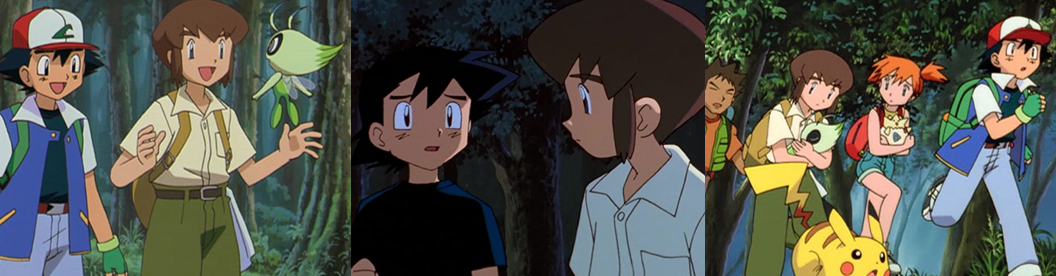
Ash and friends befriend a time-displaced boy and help protect an injured Celebi.

Pokémon 4Ever is the first of the Pokémon movies to begin with a helpful introduction; for any clueless parents watching or uninitiated kids, former Pewter City Gym Leader and Pokémon Breeder Brock (Stuart) delivers an opening monologue that establishes the world and Ash’s dreams of becoming a Pokémon master. As is often the case, Ash is so distracted by his unending desire to prove himself in battle that he almost misses his ferry to Arborville, a town built out of treehouses deep within a dense forest in the Johto region. On the way, they spot a Suicune (Tanaka) on the riverbank and perplexed by this unusual Pokémon, Ash calls his friend and mentor Professor Samuel Oak (Stuart Zagnit). Professor Oak identifies it as a Legendary Pokémon who “personifies the North Wind” and is capable of personifying water, something he offhandedly claims to have first-hand knowledge of. Excited at the prospect of encountering more rare Pokémon nearby, Ash naturally runs head-first into the forest and comes across Sammy, a time-displaced boy who’s jumped ahead forty years thanks to a panic-stricken Celebi. Despite an initial misunderstanding due to his confusion, Sammy quickly befriends Ash and his friends and eagerly joins them in seeking out Celebi and the renowned “Lake of Life”, though he lacks Ash’s adeptness for physical exertion. A Pokémon enthusiast who sketches wild Pokémon, Sammy bravely shields the Celebi and forms a bond with it not unlike the one between Ash and his long-time partner, Pikachu (Ikue Ōtani), fighting alongside both with his own Pokémon that pop from archaic PokéBalls.

The carefree Celebi is corrupted by a Dark Ball and only Suicune can help defend the forest!

First seen being pursued through the forest by a selfish hunter (Stuart), the fairy-like Celebi is one of a species of extremely rare Pokémon that is regarded as the “Voice of the Forest”. Like almost every Legendary Pokémon featured in the movies, Celebi is a Psychic-Type Pokémon but, in a change of pace, can’t telepathically communicate with its newfound friends and it’s barely able to defend itself with psychic barriers and vines. Instead, Celebi uses its unique time travel ability when in extreme distress, which transports it and quiet, unassuming Sammy, to the present day. Injured and weak, Celebi depends on the assistance of others to protect it, which the protagonists and wild Pokémon are only too happy to do. Once restored to full health, Celebi exhibits a joyful, childlike playfulness, heals Misty’s (Lillis) briefly-injured ankles and takes Ash and Sammy on a flight over the forest. Unfortunately, Celebi undergoes a dramatic change of character when captured and corrupted by one of the Iron-Masked Marauder’s “Dark Balls”; its powers are amplified and turned against the forest it so coveted, turning it into another of the evil-doer’s mindless slaves and encasing it within a “big twig monster”. Luckily, nature has a more proactive defender nearby to help out; Suicune, sensing the danger, spirits Ash, Sammy, and Pikachu to safety and bests the Iron-Masked Marauder’s Tyranitar (Unknown), though even Suicune’s power fails against Celebi’s monstrous form and it takes a desperate plea from Ash and Sammy to bring Celebi to its senses. As much as I like Suicune, I can’t help but be disappointed that the three Legendary Beasts were split up between movies and specials; Entei, Suicune, and Raikou wouldn’t appear together in a film until 2010 (ironically reuniting Suicune with Celebi, although they were all different versions of these Pokémon) but Suicune fares slightly better than Entei as it’s at least closer to its actual in-game depiction.
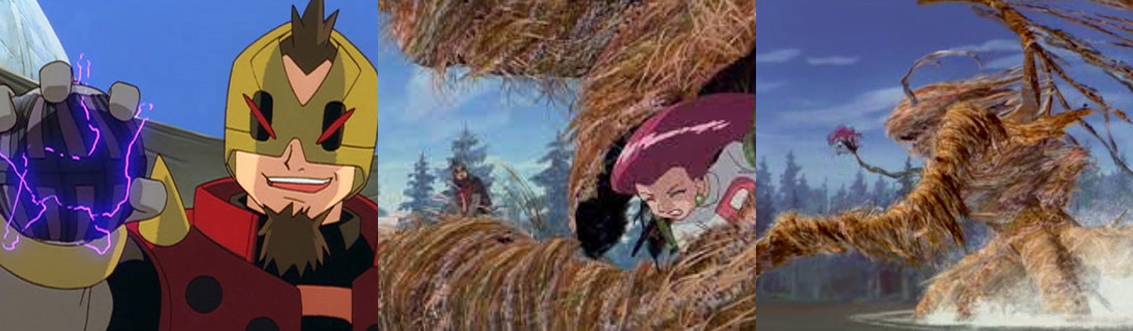
The Iron-Masked Marauder seeks to corrupt Celebi’s power and twist it to his own destructive whims.

Naturally, Ash and his friends are pursued by Jessie (Lillie), James (Stuart), and Meowth (Maddie Blaustein) of Team Rocket, who are instantly undone first when Jessie gets a leg cramp and then when they crash to the ground after delivering their motto. Although Sammy is concerned for their welfare, the others simply ignore them with barely a glance, severely diminishing what little threat they might’ve had in favour of the new villain, the reprehensible Iron-Masked Marauder. Although also allied with Team Rocket, this mysterious and egotistical foe has his own ambitions to overthrow Giovanni (Ed Paul) using Celebi’s time travelling powers. The Iron-Masked Marauder uses his custom-made Dark Balls to capture Pokémon and bend them to his will, favouring powerful Pokémon like Tyranitar that he turns “evil” and far more dangerous. Selfish, vindictive, and craving destruction, the Iron-Masked Marauder is about as one-dimensional a villain as you could ask for, lacking a true name and any motivation beyond power for the sake of power. Unlike Team Rocket, whose ambitious contraptions always fail them, the Iron-Masked Marauder helms a gigantic mechanical, spider-like walker and is so infamous and fearsome that Team Rocket are instantly besotted after witnessing his power. Bolstered by their newfound alliance, Team Rocket brazenly confront their enemies, backed up by the Iron-Masked Marauder’s formidable technology, which he uses to easily capture and corrupt Celebi and devastate the natural landscape. However, even Jessie, James, and Meowth are horrified when the dark Celebi twists the forest into a lumbering, kaiju-esque monstrosity and goes on a rampage, with the Iron-Masked Marauder at the helm and Jessie trapped within.

The Nitty-Gritty:
While there are often themes regarding the power and misuse of nature in Pokémon, often with the titular creatures at the forefront of these issues, they’re particularly prevalent in Pokémon 4Ever. This wouldn’t be the first or last time we’d see a diminutive, innocent Pokémon used for evil or a natural landscape plundered by a ruthless villain, but it’s all the more potent here since Celebi effectively “speaks” for nature itself, and represents its carefree spirit with its cheery demeanour. Thus, while it futilely lashes out with vines to protect itself, Celebi is by far the weakest and most vulnerable of the Legendary Pokémon seen so far; it’s entirely dependent on anonymity, the kindness of others, and the healing power of the Lake of Life, meaning it’s easily overwhelmed by the Iron-Masked Marauder’s Tyranitar. Paradoxically, Celebi is also one of the most powerful Legendary Pokémon because it can travel through time. This aspect is only really a small part of the movie, featuring as a local legend, Celebi’s signature ability, and a means to displace Sammy from time. However, this also introduces an interesting wrinkle in that this version of the movie explicitly reveals that Sammy is a young Professor Oak, suggesting Professor Oak favoured Ash because of the friendship they built as children and that his PokéDex came from his love of drawing the Pokémon he encountered as a boy. Most of Pokémon 4Ever takes place in a dense forest that is home to a shrine and the fabled Lake of Life, a healing water where Celebi is said to flourish. CGI is used to give the forest depth and speed to make Celebi’s flying more exciting, but the film is undeniably more like a longer episode of the anime with a greater budget and lacks the cinematic punch seen in the first two movies, despite some attempts to establish atmosphere with waterfalls and a dense fog.

Celebi is revived, the Marauder is defeated, and the forest is saved through the power of teamwork.

While CGI works for the various battles, sweeping scenes, and background elements of the movie, it falls completely short when bringing the corrupted Celebi’s forest-dragon form to life. A swirling mess of twigs and branches, this ugly monstrosity looks more like a heap of hideous wet autumnal grass than anything remotely intimidating, no matter how many mouth lasers it spits out. Due to its more whimsical nature, Pokémon 4Ever is surprisingly light on battles; much of the film is focused on Ash, Sammy, and Celebi’s friendship, so Misty and their newfound friends have little to do but offer support, though Brock does have his Onix (Unknown) help Suicune deal with Tyranitar. Consequently, battles are very brief due to the Iron-Masked Marauder’s corrupted Pokémon being so much more powerful and requiring either a bit of thought or a greater power to topple. Despite this, the forest is badly ravaged; although Ash and Sammy bring Celebi to its senses, the effort of it destroying its draconian body proves fatal and the Lake of Life is unable to revive it due to the damage caused by the battle. Luckily (and conveniently), Suicune is on hand to purify the lake, restoring it to full vitality and, after a brief period of doubt (Ash trying to force feed the shrivelled Celebi berries is particularly heart-breaking), Celebi as well. Following a victory lap with its kin, Celebi repays the favour when he plummets to the ground after dispatching the vengeful Iron-Masked Marauder, who’s left dishevelled, unmasked, and helpless to the mercy of the locals and wild Pokémon. With the forest restored, Suicune impassively departs and a grateful Celebi transports Sammy back to the past following a heartfelt farewell to his new friends. Although Ash is happy to see his friend returned home, he can’t help be sad but, when he shares the news of his adventure with Professor Oak, we learn that his promise to see Sammy again came true as the boy grew up to become his wise and friendly mentor.

The Summary:
I’ve made no secret about my love for the second generation of Pokémon; the Johto games remain my favourite in the entire franchise and a huge reason for that is both the simplicity of Pokémon and its popularity at the time. However, as much as I enjoy these games and this time in the franchise, even I have to admit that the Johto movies suffered from the law of diminishing returns; rather than getting bigger and more grandiose, the third and fourth movies opted for smaller, more interpersonal tales, which is fine but I wonder if children really watch Pokémon for this sort of content. Celebi is cute, for sure, and it makes a change to see a Legendary Pokémon onscreen that isn’t a rampaging powerhouse, but there’s not a lot of substance to Pokémon 4Ever to really keep me engaged. I appreciate the attempt to tell a more whimsical and carefree story, one that makes you re-evaluate Ash’s relationship with Professor Oak, but I can’t help but be disappointed with the execution. Perhaps if it had been done a little differently, like having the Iron-Masked Marauder commanding corrupted versions of the Legendary Beasts and Ash teaming up with Ho-Oh instead (or alongside Celebi). I think what fundamentally lets Pokémon 4Ever down is the lack of cinematic punch; as much as I love the soundtrack from Mewtwo Strikes Back, it’s a little cheap to recycle elements of its score, the opening titles are lazy and boring, and the lack of exciting battles or visually interesting CGI makes this easily one of the most forgettable Pokémon movies. There are no lessons on offer here that kids couldn’t learn from better animated movies or the Pokémon anime, which taught the same lessons about friendship and respecting nature and freedom on a regular basis, and even the allure of the elusive Celebi can’t save this one from being a disappointment.

My Rating:

Rating: 2 out of 5.

Could Be Better

Did you enjoy Pokémon 4Ever? What did you think to the choice to craft a more low-key, whimsical story? Did you like the depiction of Celebi and the friendship between it, Ash, and Sammy? What did you think to the Iron-Masked Marauder as the main antagonist and his corruption of other Pokémon? Were you disappointed that the Legendary Beasts were split up across the movies and specials? Which Pokémon game, generation, and creature is your favourite and why? How did you celebrate National Pokémon Day this year? Whatever your thoughts, drop them in the comments below or on my social media and be sure to check out my other Pokémon content.


Movie Night: Madame Web

Released: 14 February 2024
Director: S. J. Clarkson
Distributor: Sony Pictures Releasing
Budget: $80 million
Stars: Dakota Johnson, Tahar Rahim, Sydney Sweeney, Celeste O’Connor, Isabela Merced, and Adam Scott

The Plot:
After a near-death experience,.paramedic Cassandra “Cassie” Webb (Johnson) begins seeing glimpses of the future revolving around Ezekiel Sims (Rahim), a superpowered businessman determined to kill three teenagers before they can kill him in the future as Spider-Women, compelling Cassie to begrudgingly discover the truth of her past and protect the girls.

The Background:
After Sam Raimi’s Spider-Man trilogy (2000 to 2007) proved a phenomenal success, Marc Webb’s reboot films proved sadly mediocre and led to an unprecedented agreement between Sony Pictures and Marvel Studios that allowed the iconic wall-crawler to appear in the Marvel Cinematic Universe (MCU) and Sony to release tangentially-connected spin-offs featuring Spidey’s villains and side characters. Encouraged by the financial (if not critical) reception of their Venom (Various, 2018 to present) movies (and seemingly undeterred after the car-crash reception of Morbius (Espinosa, 2022)), Sony not only signed off on a solo project for Sergei Kravinoff/Kraven the Hunter, but also the enigmatic clairvoyant Cassandra Webb/Madame Web. Created by Dennis O’Neil and John Romita Jr., Madame Web first appeared in The Amazing Spider-Man #210 and significantly influenced Spider-Man’s battles against multiversal forces, but is perhaps best known for her inclusion in the Spider-Man animated series (1994 to 1998), where she was voiced by Joan Lee (wife of the legendary Stan Lee). Writing began on a Madame Web feature while Morbius was still in production and saw numerous rewrites, even after director S. J. Clarkson signed on and retooled it into Sony’s first female-centric Marvel film. Producer Lorenzo di Bonaventura expressed difficulties in adapting Madame Web’s clairvoyance to the screen and emphasising secrecy surrounding the project given her relative obscurity, a fact explicitly addressed by the inclusion of other, more recognisable Spider-Women. The cast appear to have been mislead as to the status of the film in the wider MCU; this may explain the bizarre marketing campaign that saw star Dakota Johnson seemingly openly criticise the film, though she wasn’t the only one. After numerous delays, Madame Web released to scathing reviews; the film made just shy of $100 million at the box office and critics attacked the poor dialogue and script, lacklustre special effects and pacing, and the blatant false advertising regarding three of the lead characters.

The Review:
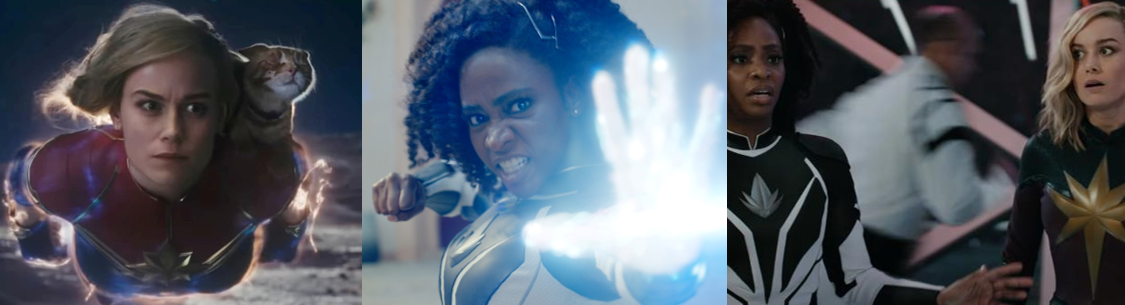
So, if I had a whole bunch of negativity towards making standalone, Spider-Man-less films about the likes of Eddie Brock/Venom and Doctor Michael Morbius, you can be damn sure that I was baffled to the point of insanity by the decision to make a solo Madame Web movie. Not only is she an extremely obscure Spider-Man character, but her depiction is generally as a wizened, blind mentor who manipulates Spider-Man like a chess piece as part of Marvel’s on-again/off-again insistence on convoluting Spidey’s origins and mythos with semi-paranormal cosmic ideas of Spider Totems and “Webs of Fate”. It’s ironic, really, as the concept could have worked a little better if Madame Web had been depicted as a Professor Charles Xavier/Professor X-type figure, mentoring and recruiting Spider-Women to oppose the Inheritors, despite my dislike for them, because at least then the focus would be on the spider-powered women and not this thoroughly unlikeable paramedic who, despite choosing a carer where she’s sworn to protect lives and being depicted as a workaholic who rushes to do that very thing, is reluctant to help the three girls targeted by Ezekiel Sims. Much of Cassie’s reluctance stems from her lingering feelings of abandonment, confusion about her true self and past, and what’s framed as an unconventional upbringing since her mother, Constance (Kerry Bishé), died during childbirth and Cassie was raised in the foster system, left with only mementos of her mother, Constance’s research into the near-mythical spiders of the Peruvian jungles, and the mistaken, childish belief that Constance cared more about her arachnids than raising her daughter. Consequently, Cassie has a bit of an abrasive edge to her; while she tirelessly works to save lives alongside her friend and partner, Ben Parker (Scott), she’s uncomfortable with receiving gratitude for this, has no idea how to act around children, and would much rather spend time in her apartment with a local stray cat than socialise with her colleagues or even Ben’s pregnant sister-in-law, Mary Parker (Emma Roberts). Her anxiety and social awkwardness is only exacerbated after she nearly drowns and is sporadically bombarded by visions of the past and near future, all framed by a mysterious web-like pattern, though she initially dismisses these visions and it takes her a ridiculously long amount of time to realise that they’re not only true, but that the fates she is witnessing can be changed.

Three girls destined for greatness must rely on Cassie’s sporadic clairvoyance to survive.

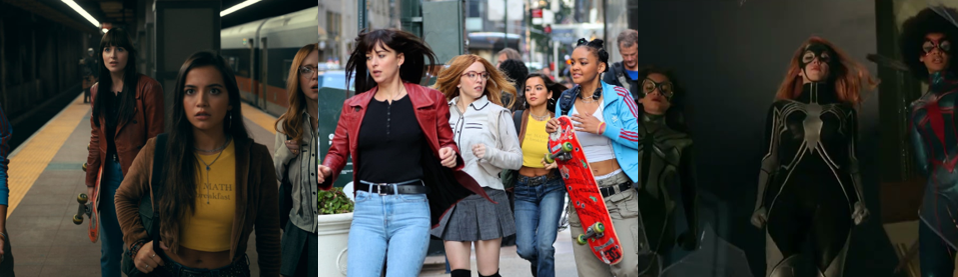
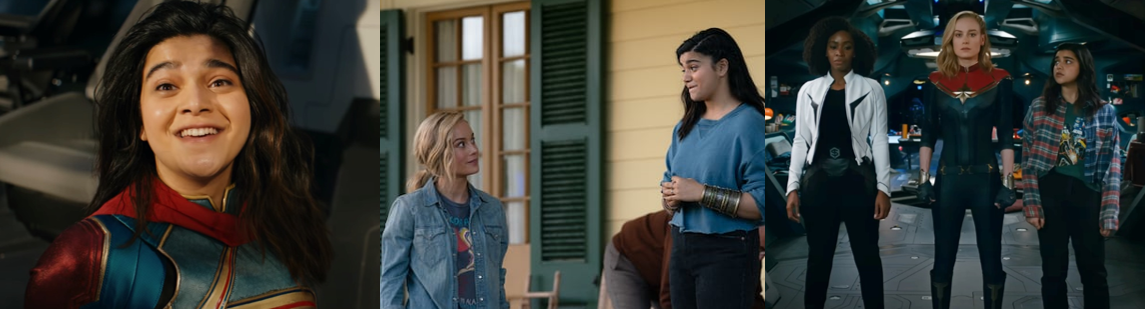
Central to her visions are four individuals – a violent killer clad in a somewhat-familiar spider-themed costume and possessing superhuman strength and spider-like abilities, and three twenty-somethings teenagers that Cassie sees horribly murdered by this assassin time and again. As fate would have it, their destinies are all intertwined and lead Cassie to encounter the three girls individually to establish some surface-level characteristics for the three that are partially developed as the film chugs along. Julia Cornwall (Sweeney) is the quiet, shy girl who’s struggling with her parents’ divorce, Anya Corazon (Merced) is both book smart (she literally wears a t-shirt proclaiming her love of “math”) and dealing with fending for herself after her father’s deportation, and skater Mattie Franklin (O’Connor) is the streetwise rude girl with a chip on her shoulder since she comes from money. The three couldn’t be more different but quickly form a genuinely enjoyable sisterhood after they’re saved by Cassie; while initially distrusting of her, they eventually come to believe in her janky clairvoyance after she saves them from Ezekiel multiple times. However, Cassie is seemingly impulsively compelled to do this, and it takes her a while to realise the responsibility she has towards the girls; she routinely abandons them, chastises them, and even jets off to Peru to investigate her origins and undergo a spiritual journey that finally teaches her that she has an obligation to protect the three with her abilities. The three girls do their best with the materials, appearing fun and likeable and adding some pathos to their characters through their shared feelings of abandonment, but the script is rarely in their favour. The same is true for Cassie, who constantly narrates her life like an idiot and acts very irrationally for a paramedic, though eventually she settles into the role of a reluctant surrogate mother and protector to the girls.

Ezekiel targets the girls to save his own life, but is a pretty weak and one-note villain.

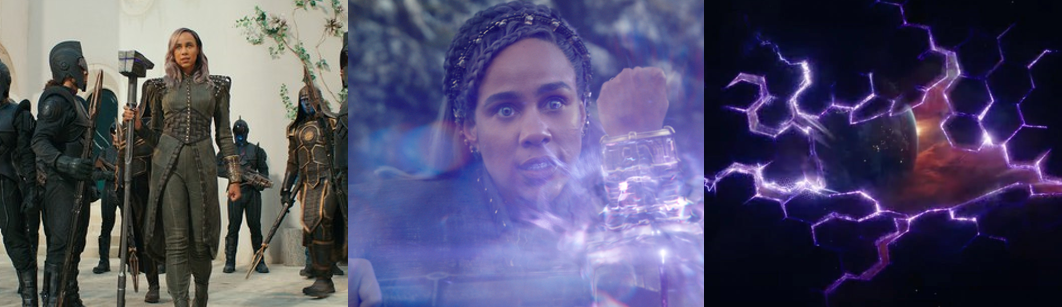
The girls are targeted by Ezekiel since he’s been plagued by visions of his death at their hands at some point in his future. Previously working alongside Constance, Ezekiel betrayed and killed her to get his hands on a mysterious spider that granted him his amazing powers, but also cursed him with the knowledge of his impending death. In the interim, he built a vast, indistinct corporate empire and has become obsessed with finding and killing the three Spider-Women who’ve haunted his nightmares, aided by his “girl in the chair”, Amaria (Zosia Mamet), who hacks into the police database and CCTV cameras all over the city to track the girls down. It’s not made clear why the Spider-Women would hunt down and kill Ezekiel in the future, or what he’s done that makes him such a diabolic villain except one confirmed kill, but boy does he like to mumble and grumble about how badly he wants them dead and his desire to ensure he lives on! As if having all the wealth and technology he needs at his disposal isn’t enough, Ezekiel also possesses spider-like powers; he can walk and climb on walls, leap vast distances, possesses superhuman strength and reflexes, and can poison his victims with a touch, eventually causing cardiac arrest. He also seems to display some degree of clairvoyance and psychic power to rival that of Cassie, communicating to her on the astral plane at one point, and dresses in an admittedly cool looking outfit when out on the prowl. How he changes in and out of this isn’t made clear either, however, as he’s often seen wearing the form-fitting suit in one scene and then fully in his business attire in the next with no explanation, and he’s routinely humiliated by Cassie since she can anticipate his actions ahead of time. While Cassie doesn’t demonstrate the same superhuman powers, the three girls do in the frantically-edited visions of the future, though it’s unclear how, when, or why they gained superhuman powers. Ezekiel does, however, share his powers with the mysterious Las Arañas, a secret Peruvian tribe who dress in makeshift jungle attire that’s very similar to Spider-Man’s and try to save Constance when she’s wounded, delivering Cassie and then later making her realise that her mother ventured into the jungle to save her, not because she didn’t care about her. Frankly, I find this whole aspect to be borderline insulting; I hate the idea of a tribe of Spider-People and of a spider species that can grant these powers as it diminishes Spider-Man’s uniqueness, though the depiction of the spider-powered people clambering and leaping about the place is pretty good and surprisingly horrific, especially when Ezekiel is tossing bodies around in Cassie’s visions.

The Nitty-Gritty:
There’s a shared feeling of abandonment between the four female leads; all of them feel like outsiders to some degree, isolated from others and even their families since they either don’t have a parental figure, or their parents don’t seem to care about them. While their individual personalities initially clash because of their different backgrounds and current social standing, they quickly bond once they realise how much they have in common, with the three girls, especially, forming a makeshift sisterhood due to their current circumstances. Although Julia is Cassie’s most vocal supporter, they initially believe she’s either crazy or just another adult they can’t rely on and decide to go against Cassie’s warnings and fend for themselves, an action that very nearly sees them all killed by Ezekiel before Cassie intervenes. She chastises them, angry at their irresponsible and reckless actions, but struggles to give them the answers they want and to properly care for them since he’s apparently so maladjusted that she can barely stand to be around her handful of friends, much less look after three scared teenagers. Thus, she turns to Ben to shelter the girls while she tries to find answers in Peru; this turns out to be a good decision since Ben is a much more emotionally stable individual. He deeply cares for his sister and is extremely excited about being an uncle, but is also devoted to his friend and partner, to the point where he resuscitates Cassie after she drowns, begs her to socialise with his family and their colleagues, and agrees to look after the girls even though he has no idea what kind of danger they’re in. As good as Adam Scott was in the role (I particularly liked the banter he shared with Cassie, which hinted at a former attraction, and his struggles to keep up with the girls), the only reason he’s here is for fan service: yes, he’s playing the future Uncle Ben and, through him, we even see the birth of his nephew (who ridiculously goes without a name) and get hints towards his future, despite Madame Web taking place in its own separate continuity from previous Spider-Man movies. There’s also something really weird about Julia, Anya, and Mattie all being older than Peter and the frustration of the three running around in normal street clothes instead of the awesome Spider-Women suits we barely get a glimpse of in their future.

In the absence of the Spider-Women, we’re left relying on Cassie’s visions and Ezekiel’s threat.

Yes, Madame Web is another great example of Sony lying to us; the trailers and posters showcased Julia, Anya, and Mattie as fully-empowered Spider-Women but this isn’t the case at all. I guessed that we wouldn’t see them suit up until the very end, but the truth is far worse; they only wear their costumes in fleeting visions, with no explanation of how they get their powers, and the film has the gall to setup a potential sequel that actually addresses these issues, but to me it’s a dropped ball that completely derails the movie. The bulk of Madame Web is focused on Cassie’s struggles to reconcile her past and understand her newfound powers; there are numerous scenes of her witnessing snapshots of the future, meaning we get a lot of time loops and confused looks from Cassie that border on the maniacal as she tries to understand what’s happening. Primarily, though, these visions are used as fake outs; almost every time, the scene will show Ezekiel coming in, wrecking fools, and killing his targets in an almost effortless manner, only to suddenly snap back to Cassie and show her taking action to avoid this fate. It’s all very reminiscent of the Final Destination films (Various, 2000 to present), which is fitting but kind of lowers a lot of the stakes since you can just assume every violent scene or action sequence is just a vision. When Ezekiel does get a chance to fight, he’s effectively peerless; none of the protagonists have the strength or ability to go toe-to-toe with him, meaning Cassie drives a lot of cars into him and catches him off-guard with her clairvoyant powers, leaving him perplexed and looking stupid. When the Las Arañas appear, it’s all shot with an unsettling, nightmarish shaky-cam filter that makes their appearances and abilities not only difficult to pin down, but also appear needlessly cartoonish.  There are some decent effects at times, such as when Cassie takes her spiritual journey and interacts with the Web of Fate and the lingering memory of her mother, and things are surprisingly grounded for a Sony Spider-Man-adjacent movie, with Ezekiel being unable to swing from webs and more reliant on his physical abilities. This, in conjunction with his intimidating costume, does paint him as a formidable figure; he’s almost like a slasher villain at times, draining the life from his victims, breaking their limbs, and pouncing like an animal, but this persona is awkwardly juxtaposed with his pandering civilian identity, where he may as well twirl an old-timey moustache as he spouts generic villain dialogue with little charisma or conviction.

Cassie accepts her fate to defeat Ezekiel and mentor the future Spider-Women.

So, all these recent revelations help Cassie make sense of her mother’s notebooks; while she previously resented Constance’s apparent fixation on her spider research, she realises that her destiny has been intertwined with Ezekiel’s since before her birth and takes herself to Peru to find answers. There, a Las Arañas, Santiago (José María Yazpik), helps her to realise that her mother was trying to cure her of some disease and that she has a greater destiny, one that will bestow her with “great power” once she accepts the “responsibility” that comes from her abilities. Before, she saved and sheltered the girls simply because it was the right thing to do; she had little interest in watching over them or bonding with them, or of their greater destinies as Spider-Women, but her spiritual journey motivates her to actively shield them from Ezekiel’s wrath, and gives her greater control over her future sight. After rescuing them and allowing Ben and Mary to get to safety, Cassie takes the girls to a fireworks warehouse and they finally set aside their differences to set a trap for Ezekiel, planting flares all over the place to cause a series of explosions. This actually causes quite a few issues for the protagonists, however, as the explosions destroy the helicopter Cassie called in to rescue them and eventually sees Julia, Anya, and Mattie separated and facing fatal falls. Luckily, Cassie masters her powers enough to…somehow…spiritually duplicate herself long enough to help the three to safety, incurring Ezekiel’s anger. Despite him being haunted by very specific visions of his death at the hands of the three Spider-Women, Cassie changes his fate and claims that she was always the one who was destined to end him (which doesn’t seem true, but okay) and lures him onto unstable ground, eventually causing him to plummet to his death and be crushed by debris. Cassie also takes a plunge but, luckily, she taught the girls CPR earlier and they’re able to revive her, though she’s not only inexplicably left paralysed with no explanation but also winds up blinded by a stray firework. Still, she’s not bothered by this; in fact, the film ends with her happier than ever since she can now, presumably, use the full extent of her psychic powers and clairvoyance to see and understand the future and is prepared not just to take on the three as their foster mother, but to mentor them into the Spider-Women they are destined to become…effectively ending the film where it really should’ve started! Like, why not have Cassie already be infirm but fully empowered and training, say, Julia, showing their origins through flashbacks and exposition, and have Julia be the point woman in recruiting Mattie and Anya when Ezekiel, an Inheritor assassin, targets them? It could’ve been Sony’s answer to the X-Men, in a way, and even take place in the same universe as their other pointless spin-offs, and might’ve been more enjoyable because then we would’ve gotten to see the gorgeous Sydney Sweeney in their slick, form-fitting Spider-Woman costume for a lot more of the runtime!

The Summary:
I went into Madame Web expecting it to be bad based on the trailer, the disaster that was Morbius, and my dislike for the concept in general. I tried to have an open mind, however; the cast, for example, intrigued me, as did the costume design, and to be fair there is the ghost of a semi-decent idea here, it just would’ve worked better as a side plot in a Spider-Man film or reworked to have Julia Carpenter/Spider-Woman at the forefront, with Cassie as a mentor figure. Any goodwill the film might’ve gotten from its Spider-Woman costumes is flushed down the toilet since we barely get a good look at these and the girls don’t even become Spider-Women in the movie; Ezekiel’s costume and action scenes somewhat make up for this, but he’s such an ineffectual and confusing villain that it’s hard to care when he’s onscreen. The relationship between the protagonists was somewhat enjoyable; I liked how the girls bonded, their shared feelings of abandonment, and them coming together as a surrogate family, but it’s executed so poorly and, although the girls do try, they’re all hampered by a really awful script. Dakota Johnson suffers from this the most, I think; she was some weird, awkward silences and quirks and is forced to spit out some really awful dialogue and nonsensical exposition. Add to that the fact that Cassie is a weird and pretty unlikeable character, abandoning and yelling at the girls even though she’s supposed to be a paramedic and you have a main character who’s hard to relate to, a villain as flat as a piece of paper, and three boisterous young girls who are completely wasted in this travesty of a film. It’s more than a step back for the genre; Madame Web harkens back to a time when superhero movies were not only afraid to use codenames and costumes, but outright ashamed of them, delivering cookie cutter dramas that falter at the first hurdle. It’s a sad state of affairs and I have lost all hope for Sony’s future Spidey-adjacent movies, and my expectations were already at the bottom of the barrel to begin with!

My Rating:

Rating: 1 out of 5.

Terrible

Did you enjoy Madame Web? If so…what’s the matter with you? What did you think to the performances and the dynamic between the four protagonists? Were you disappointed that the girls didn’t actually become Spider-Women in the film? What did you think to Ezekiel, his characterisation, and the nonsense about the Las Arañas? Do you think a Madame Web movie could ever work, or would you rather see a Spider-Woman take the forefront? Which Spider-Woman is your favourite? I’d love to know your opinion of Madame Web, so leave a comment below and be sure to check out my other Spider-Man and Marvel content.

Movie Night [PokéMonth]: Pokémon the Movie: Genesect and the Legend Awakened


Upon the release of Pokémon: Blue Version and Pokémon: Red Version (Game Freak, 1996), a new craze swept through playgrounds across the world. Entire generations grew up with Pokémon as clever marketing saw Nintendo’s newest franchise become a massively lucrative and popular multimedia powerhouse that endures to this day. Accordingly, February 27th is now internationally recognised as “National Pokémon Day”, which I’m expanding to an entire month of Pokémon every Tuesday in February, which is even more fitting given that February 6th is the day that Mew successfully gave birth to my favourite Pokémon, Mewtwo!


Released: 13 July 2013
Director: Kunihiko Yuyama
Distributor: Toho
Budget: Unknown
Stars: Sarah Natochenny, Miriam Pultro, Scottie Ray, Samia Mounts, Eileen Stevens, Jason Griffith, and Ikue Ōtani

The Plot:
Ash Ketchum (Natochenny) and his friends arrive in Pokémon Hills, where a Red Genesect (Ray) and its brethren seek to forcibly make their home. This attracts the attention of the Unovan Mewtwo (Pultro), who seeks not only to challenge the Genesect’s power but to shield them from the abuse of their human creators.

The Background:
It would be foolish to deny how influential Pokémon (Nintendo/Creatures/Game Freak, 1995 to present) has become ever since the first games were released. The success of the game is only ever half the story when it comes to Pokémon, however; the franchise has dominated a wide variety of media over the years, thanks in no small part to the still-ongoing anime series (1997 to present). Following the financial success of the aptly-titled Pokémon: The First Movie: Mewtwo Strikes Back (Yuyama, 1998), animated feature-length productions became commonplace for the franchise, with fifteen released by 2013 and the last three focused on promoting the fifth generation of the videogames. Reportedly, Genesect and the Legend Awakened drew inspiration from New York City for its setting but the main story surrounding the film was its inclusion of Mewtwo. While this isn’t surprising considering Mewtwo is one of franchise’s most popular characters, what made this different was that this version of the character was entirely new due to legal issues and therefore more recognisably female. Debuting at number two at the Japanese box office and going on to become the tenth highest-grossing film of the year in Japan, Genesect and the Legend Awakened received mostly mixed reviews; some praised for its darker tone and cinematic scope while others criticised the inclusion of a new Mewtwo and largely derivative plot.

The Review:
By the time of Genesect and the Legend Awakened, the anime was firmly entrenched in the Unova region and Ash and his faithful friend Pikachu (Ōtani) were traveling alongside Iris (Stevens), a Gym Leader specialising in Dragon-Type Pokémon and accompanied by Axew (Kayzie Rogers), and Cilan (Griffith), another of the region’s Gym Leaders who favoured Grass-Types. My experience with these seasons of the anime is almost entirely limited to the feature films that were released around this time, though the dynamic between the three really isn’t all the different from what was seen between Ash and his other travelling companions; they function as his moral support and guidance, but there are some interesting distinctions, such as Iris being a bit of a wild child and Cilan being very loquacious. The three find themselves in New Tork City, a bustling island metropolis that features a grand park right in the middle (a “Central Park”, if you will), Pokémon Hills, in which various Pokémon roam freely beneath a special dome and where Ash encounters the mysterious, armoured insectoid Pokémon known as Genesect (Stevens). Immediately intrigued by the strange creature, Ash is blown away when it showcases the ability to switch between a bipedal form and a super-fast, aerodynamic form that’s perfect for flying (and sky-surfing), and further stunned when it exhibits the ability to talk using telepathy. Ash and his friends are moved by the lost Genesect’s plight; it’s desperate to return “home” and Ash is determined to help it, only to incur the wrath of its overprotective patriarch, the Red Genesect, who regards all humans as a threat.

Ash and his friends are astounded by the Genesect and the sudden appearance of an all-new Mewtwo.

Luckily, Mewtwo is on hand to defend them, but its priority is safeguarding Pokémon rather than humans; although Ash briefly expresses familiarity with Mewtwo, he mentions nothing of his previous encounters with it and the two are strangers to each other, largely because this isn’t the same Mewtwo he’s met before. While Mewtwo focuses on helping the Genesect and defending the local Pokémon, Ash and the others are also assisted by a concerned Sableye (Bill Rogers) that’s driven from Pokémon Hills by the Genesect’s aggressive invasion, and befriend the friendly, childlike Genesect they first encounter. This friendly Genesect opposes Mewtwo’s belief that all the Genesect crave destruction and simply wants to go home, where its beloved Panna Lotus flowers bloom, a desire shared by its brethren and which makes them susceptible to the Red Genesect’s destructive whims. As ever, Ash is shadowed by Jessie (Michele Knotz), James (Carter Cathcart), and Meowth (ibid) of Team Rocket and meet a new friend, Eric (Jake Paque), a park ranger who oversees Pokémon Hills and brought and ancient Panna Lotus flowers there from Absentia Natural Park, an achievement he’s very proud of given the rarity of the flowers. Naturally, Eric primarily delivers exposition regarding the city and its famous Pokémon reserve and realises that the Genesect’s invasive nest poses a significant threat to the city as it directly siphons its power supply and he proves instrumental in restoring power to the city while the genetic Pokémon engage in a furious battle. Team Rocket’s desire to kidnap Pikachu gives way to a plot to capture the Genesect, and Mewtwo, not to curry favour with their boss but to realise their own ambitions for power. Of course, they’re easily dispatched by the Genesect, once again reducing them to a throwaway gag that has little impact on the plot. Similarly, there’s not much for Iris or Cilan to do here; when they are useful and bring a bunch of wild Pokémon to help quell the Genesect’s attack, they quickly realise that the brutal fight is misguided as the Genesect simply want to live in peace and are largely being forced to attack by the red-hued leader.

Mewtwo is compelled to help the Genesect, but the Red Genesect is determined to enforce its will.

One of the things I absolutely loved about Mewtwo Strikes Back was the sense of mystery and foreboding surrounding Mewtwo (Philip Bartlett). The entire opening sequence was devoted to its tragic origins and painting it as a destructive and slighted Pokémon, and from there it was kept shrouded in shadow and mystery before its big reveal. Much of that is tossed out of the window here; Mewtwo is the first character we see onscreen, blasting through the skies over the Unova region, and she is presented as being sociable with local Pokémon and enjoying testing her limits by freely assuming her Mega Mewtwo Y form. Although Pokémon are rarely identified by their gender in the anime (even Pikachu is generally just called “it”), I feel comfortable describing this Mewtwo as a female since her voice is clearly female and her Mega Mewtwo Y form clearly evokes female anatomy, all of which demonstrates that this is an entirely different character from the one we knew before even commenting on her more carefree nature.  In comparison, the Red Genesect and its brethren emerge from dark clouds and cross through frigid mountains, indicating that they don’t enjoy the same freedoms as Mewtwo. The Red Genesect is clearly positioned as the group’s leader; unlike its regular purple variants, it is forceful, commanding, and confident, exuding a maternal protectiveness over its kin and is fully capable of bending the other Genesect to its will when they hesitate to follow its commands. While all the Genesect see others, especially humans as a threat, they’re largely timid and childlike; the Red Genesect, however, is aggressive and forceful, attacking Mewtwo even after she helped its kin and leading the Genesect in an all-out assault against Pokémon Hills in order to build their nest.

The Nitty-Gritty:
The visual inspirations of New York City are undeniable in Genesect and the Legend Awakened; it’s normal for Pokémon to base its regions and towns on real places but the influence is so strong here that New Tork City may as well be the famed City That Never Sleeps. Not only is it a lively megalopolis with a central reservation for wild Pokémon, its skyline is dominated by skyscrapers, sirens are everywhere, it’s lit up at night with hustle and bustle, and humans and Pokémon work together to maintain the city. One thing I will say about the Pokémon movies is that their presentation definitely improved as the years went on; the blend between traditional animation and CGI is far less jarring than before and used to great effect whenever the Genesect and Mewtwo engage in battle or multiple Pokémon fill the screen. The Genesect are very unnerving Pokémon; they’re very rigid and almost robotic, but also capable of unleashing powerful elemental attacks with their different “Drives” and transforming into a faster form at will. Their childlike demeanour and blank expressions are also quite unsettling, making the Red Genesect’s domineering personality all the more unnerving as it barks orders and forces its kin to assert themselves even when they have no desire to.

Inexplicably, we have a new, female Mewtwo who distracts from the enjoyable moments.

So, it’s clear from the moment we first meet this Mewtwo that she’s different from the last one; this Mewtwo enjoys testing her powers, especially her Mega Evolution, even going so far as to breach the upper atmosphere to go beyond her limits. Like its more recognisably male counterpart, this Mewtwo was created by a group of scientists using Mew’s genetic material; however, she endured horrendous torture at the hands of her creators, seemingly destroying them in a bid for freedom and finding acceptance and friendship with Unova’s wild Pokémon rather than being driven to destroy humanity. Thus, just as the male Mewtwo wished to liberate Pokémon from human control and fought valiantly to keep its clones safe from persecution, this Mewtwo is very protective of Pokémon. She doesn’t hesitate to swoop in and carry the Genesect to safety when they’re threatened by an avalanche or to shield others from the Genesect; however, while she has no love for humans, she’s far less aggressive towards them and simply chooses to ignore them rather than directly target them. Mewtwo feels a kinship with the Genesect due to their similar backgrounds; like her, the Genesect were genetically recreated against their will after Team Plasma extracted their DNA from fossils. The comparisons don’t end there; just as Mewtwo was scientifically augmented to have incredible psychic powers, the Genesect were outfitted with powerful laser cannons, and they too also went on a destructive rampage soon after being awakened and have been searching for their place in the world ever since. Mewtwo’s first instinct is to help them but, when the Red Genesect proves hell-bent on destruction, she stands against them purely to protect the native Pokémon. Even now, I find the decision to introduce an all-new Mewtwo incredibly bizarre; I get that there were legal issues, but I feel like a more creative solution could’ve been found, or maybe just excise Mewtwo from the script altogether as it’s really weird that another Mewtwo was created by the exact same methods and resulted in an almost identical character; maybe if she had been shiny or spent the entire time in her Mega Evolution form it would’ve helped but, as is, it’s very confusing and distracting from everything else happening in the film.

After a selfless sacrifice and a vicious battle, the Red Genesect finally ceases its relentless attack.

Since Mewtwo so strongly associates with the Genesect’s plight, she’s eager to help them but is met with aggression at every turn from the Red Genesect, which refuses to listen to reason and forces Mewtwo to battle it in the heart of the city in an action-packed fight that resembles a kaiju battle! Mewtwo’s Mega Evolution gives her the speed and power she needs to match the Red Genesect’s unrelenting assault; she shields herself from its energy beams, vanishes in the blink of an eye, and moves so fast that time slows around her. Once again, Ash is compelled to throw himself in the line of fire to shield innocents from the Genesect’s relentless attack, only this time it’s the friendly Genesect that takes the hit, sacrificing itself to save its new friend. This only compels the Red Genesect to redouble its attack, however, which Mewtwo is more than willing to match; using her Mega Evolution, she takes on the Red Genesect and three remaining kin all by herself, easily dodging and countering their attacks with her blinding speed. Unfortunately, the city’s power supply is damaged during the fracas and the nest goes up in flames, trapping and threatening all within. Thankfully, the downed Genesect is revived by the sight of its beloved flowers and fights to put out the flames alongside the other Pokémon, saving the other Genesect and proving to them that they need not fear the world. Blinded by rage, the Red Genesect refuses to back down and even opens fire on its brethren; frustrated by the creature’s stubbornness, Mewtwo pushes herself beyond her limits to force the Red Genesect into the upper atmosphere, where they both finally realise that their lives have more meaning than pure destruction and that even anomalies such as them can coexist in the world. Moved by the sight of a world without boundaries, the Red Genesect finally relents, and the other Genesect work alongside the other Pokémon to save the two as they plummet to the ground on re-entry. Thanks to Ash’s friendship and help, Mewtwo relaxes her prejudices against humanity and, in the aftermath, the protagonists help their newfound friends construct a new nest in Absentia Natural Park, where the Panna Lotus flowers are plentiful, finally allowing them to build the home they’ve longed for since their resurrection.

The Summary:   
Genesect and the Legend Awakened is definitely one of the poignant Pokémon movies; generally, the films teach similar messages about acceptance and friendship and equality but, by retreading some of the same ground that we saw in Mewtwo Strikes Back, the film touches upon some of the more mature themes regarding identity and acceptance that made that first movie so memorable. As is often the case, there isn’t much for Ash’s supporting cast to do here, but there’s a decent enough reason for that; the plot is firmly focused on the dynamic and parallels between Mewtwo and the Genesect, especially the hyper-aggressive Red Genesect, which embodies all of the destructive prejudices of Mewtwo’s male counterpart and cares for nothing other than the survival of itself and its kin. This parallel works well in the film, since Mewtwo may not care for humans but she absolutely cares for the safety of Pokémon, and results in some explosive action sequences as we finally see Mewtwo unleashing her true power, but it’s hard to really be that invested since this isn’t the same Mewtwo we’ve come to know. I wish I could say that the movie is able to overcome this but, while it is entertaining in its own right, it just sticks out like a sore thumb; had this been the same Mewtwo, the juxtaposition of one genetically-engineered Pokémon opposing another, one that has learned to set aside hatred and violence, with a less morally inclined counterpart would’ve landed so much better. Ash could also have been more invested in Mewtwo’s battle, rather than simply helping out because he’s such a friendly kid, and Mewtwo’s story could’ve come full circle in a satisfying way. Instead, I just can’t help but keep asking why there’s another Mewtwo, how she can possibly be so similar to the other one, or wondering where the male Mewtwo is or if it even exists! If you’re able to set all this aside then this is a pretty decent Pokémon feature, one that delivers an important message, but personally I can’t really get past this decision and it makes the film more of an anomaly than anything else.

My Rating:

Rating: 3 out of 5.

Pretty Good

What did you think of Pokémon the Movie: Genesect and the Legend Awakened? Were you put off by the bizarre inclusion of a new version of Mewtwo or did her Mega Evolution make up for this? What did you think to the Genesect and their plight, specifically the Red Genesect’s vendetta? Were you disappointed that the supporting cast didn’t have much to do or did the visual spectacle distract from this? How are you celebrating Mewtwo’s birthday this year? Whatever you think about Genesect and the Legend Awakened, Mewtwo, and Pokémon in general, leave your thoughts in the comments below or leave a reply on my social media.

Movie Night [Sci-Fanuary]: Dredd


January sees the celebration of two notable dates in science-fiction history, with January 2 christened “National Science Fiction Day” to coincide with the birth date of the world renowned sci-fi writer Isaac Asimov, and HAL 9000, the sophisticated artificial intelligence of Arthur C. Clarke’s seminal 2001: A Space Odyssey (1968), being created on 12 January. This year, however, I’ve been spending every Thursday of January celebrating sci-fi’s toughest lawman, Judge Joseph Dredd!


Released: 7 September 2012
Director: Pete Travis
Distributor:
Entertainment Film Distributors
Budget: $30 to 45 million
Stars:
Karl Urban, Olivia Thirlby, Lena Headey, Wood Harris, and Domhnall Gleeson

The Plot:
In 2080, where most of the United States is a nuclear wasteland, humanity is packed into violent Mega-Cities where the only force for order are the Judges, who act as judge, jury, and executioner. Mega-City One’s top enforcer, the surly Judge Joseph Dredd (Urban) and his apprentice partner, psychic Judge Cassandra Anderson (Thirlby), are forced to bring order to a 200-storey high-rise block of apartments overtaken by resident drug lord, Madeline “Ma-Ma” Madrigal (Headey).

The Background:
Created by John Wagner, Carlos Ezquerra, and Pat Mills, grim-faced lawman of the future Judge Joseph Dredd first appeared in the pages of British science-fiction comic book 2000 AD in March 1977. The character and his unique brand of extreme political satire were met with near-instant popularity, meaning a live-action adaptation was all-but inevitable. Unfortunately, Judge Dredd (Cannon, 1995) failed to match the appeal of a similarly-themed action/sci-fi classic, RoboCop (Verhoeven, 1987), and ended up being such a critical and commercial failure that its leading man and Dredd’s co-creator were left dissatisfied with the results. It took the better part of ten years for the concept to be revisited for the silver screen in the form of a reboot that would take advantage of the growing popularity of 3D cinema. After writer Alex Garland’s initial draft proved a little too ambitious, he excised the Dark Judges and chose to focus on a typical, violent day in the life of the titular Judge. Karl Urban stepped into the role and underwent rigorous preparation to emphasise the rugged physicality of the character, which was more grounded in realism and this was reflected in Dredd’s redesigned outfit, which promoted practicality and durability above all else, and agreed wholeheartedly in keeping his face covered by the iconic helmet. The filmmakers aimed to take full advantage of the 3D effect when rendering the disorientating hallucinogenic effects of the “Slo-Mo” drug to craft some unique and violent action sequences. Unfortunately, Dredd’s $41.5 million gross meant that the film was a flop and any plans for a sequel were seemingly dashed. Critically, Dredd fared quite well; reviews praised Urban’s faithful portrayal of the character, his supporting cast, and the film’s impressive visual effects and it found an audience on home video, leading to petitions for a sequel. A comic book continuation and animated spin-off were produced and Urban was reported to be in talks to reprise his role for a TV series based around the character but, as of this writing, this has yet to materialise.

The Review:
I was just a kid when I watched Judge Dredd; granted, I’d read my fair share of the comics and was primarily a fan of any stories involving the Dark Judges and also a big RoboCop fan, so I remember being easily pleased by the film’s bombastic action and blunt one-liners. It’s fair to say, though, for as visually interesting as the film is, it somewhat misses the mark when it comes to being an accurate portrayal of the character. It’s not just the toothless violence and zany comedy, it’s the fundamental idea of trying to humanise the tough-as-nails embodiment of a fascist regime. I understand why this route was taken, and it’s not as if the comics haven’t endeavoured to show Judge Dredd isn’t completely unreasonable or devoid of compassion, but all the pieces for a decent adaptation of the character were in place but ultimately lost due to conflicts over the film’s tone. When I heard a new Judge Dredd movie was coming, I was cautiously optimistic; I’m a big fan of Karl Urban, he always does really well in every role he’s given so it was exciting for him to be the lead of a big action franchise, but I’ll admit that, somehow, Dredd passed me by. Perhaps it only got a limited release here in the UK, or was pulled from cinemas because of stiff competition, but I didn’t see it until I bought the DVD and I remember being sour about that as it turned out to be a surprisingly enjoyable sci-fi/action romp that is well deserving of its status as an under-appreciated cult classic.

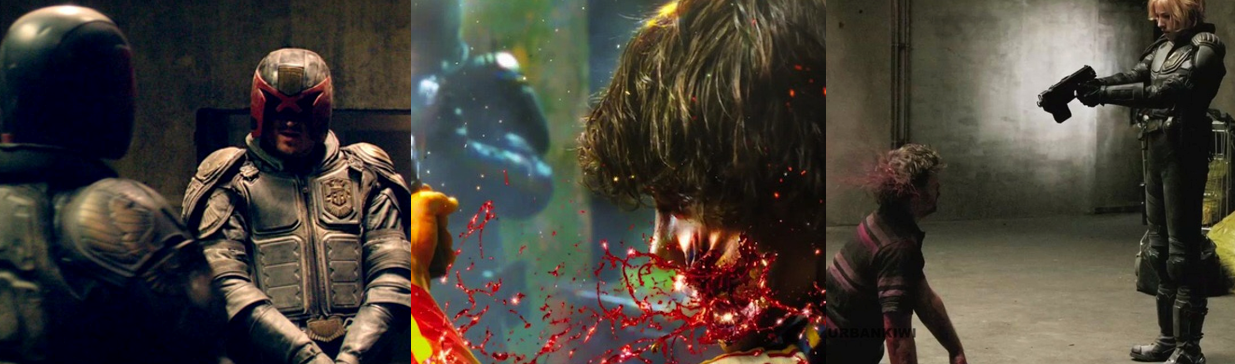
Stern Judge Dredd maintains his authority even when conducting a training assessment.

Dredd immediately takes centre stage here; don’t get me wrong, I love James Earl Jones as much as the next person, but there’s something decidedly gritty and Frank Miller-esque about having Dredd’s gravelly tone set the stage through voice over. Dredd makes pains to paint the Judge not as a crusader for justice, but as a beat cop who’s daily life is filled with violence and hardship; just seeing him tape his hands and shrug on his uniform is glimpse enough of the man behind the helmet, which obscures all but his constant scowl and presents him as a representative of the last bastion of law and order rather than some superhero. Dredd’s clearly been on the job a long time; he’s made a name for himself, is a senior street Judge, and is perfectly capable of handling situations by himself even when he’s outgunned or outmanned, and is portrayed as a very pragmatic and adaptable street cop. Little surprises him, he makes a point to priorities medical assistance for the wounded and clean up crews for the dead, and even choosing to stun rather than execute a couple of terrified kids when they try to kill him on Ma-Ma’s orders. As he takes his job very seriously, Judge Dredd has extremely high expectations of all Judges and that goes double for rookies like Judge Anderson. Although Dredd disapproves of Anderson being given one last shot to make the grade, he obeys orders and keeps a close eye on her assessment throughout the film, sternly letting her know how low her chances are and of his expectations of her. Highly adaptable and showing no fear, Dredd is at his most dangerous when backed into a corner but remains steadfastly committed to the job; even when Ma-Ma locks down Peach Trees and sets the entire complex against them, Dredd continues Anderson’s assessment and maintains a commanding authority throughout, even when confronted by corrupt Judges. There’s a drive in Dredd that’s beyond simple duty, however; even when back-up is imminent, Dredd opts to attack Ma-Ma head on rather than wait it out, and he continues to fight even after being gravely injured by a bullet to the abdomen.

Psychic rookie Anderson endures a trial by fire that sees her adopt some of Dredd’s harsher attitudes.

Given my fondness for the Dark Judges, I was happy to see Psi-Division’s Judge Anderson included in Dredd. Unlike her first appearance in the comics, Anderson is a rookie, an orphan who gained psychic abilities due to radiation fallout, who has failed to pass the bar required of Judges but whom the Chief Judge (Rakie Ayola) is keen to give a trial by fire since she’s by far the most powerful psychic they’ve ever encountered. At the start of the film, Anderson acts very much as an audience surrogate and a means of exposition; as part of her training, Dredd demands that she gives an assessment on their situation as it changes and offers up suggestions of how to proceed, and largely she acquits herself well. She’s clearly done her homework, which is more than evident in her just barely failing to pass the bar, but she’s untested in the field and that initially causes her to panic and hesitate where Dredd remains grim-faced and stoic. Unlike Dredd, who is simply trying to keep a lid on the powder keg of violence in the city, Anderson truly believes she can make a difference; she grew up as desperate and destitute as the inhabitants of Peach Trees and wants to help inspire the few good people who live in such squalor, an ambition even the stern Dredd sees as admirable. Indeed, initially Anderson is haunted at her first execution, Japhet (Scott Sparrow), and the guilt she feels at depriving his wife, Cathy (Nicole Bailey) and baby, but Anderson’s empathy, which would normally be seen as a positive and humanising characteristic, is toughened by her experiences as she learns to adopt Dredd’s hasher methods. While Dredd is somewhat dismissive of mutants like Anderson, her abilities come in handy more than once; it’s thanks to them that she’s able to read Kay’s (Harris) mind and link him to Ma-Ma, something which later comes to harden her character when he tries to taunt her with disturbing and violent sexual thoughts and she turns the tables on him with a confrontation in his mind that reveals the extent of Ma-Ma’s operation.

Callous and psychotic, drug kingpin Ma-Ma craves only power and violence.

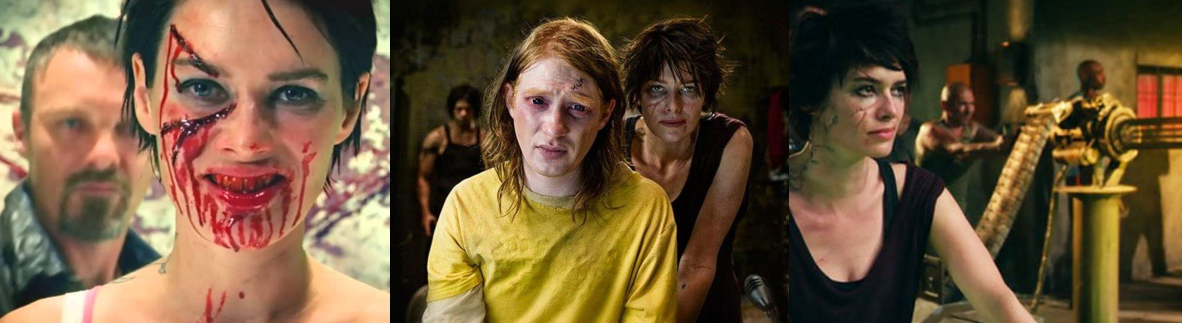
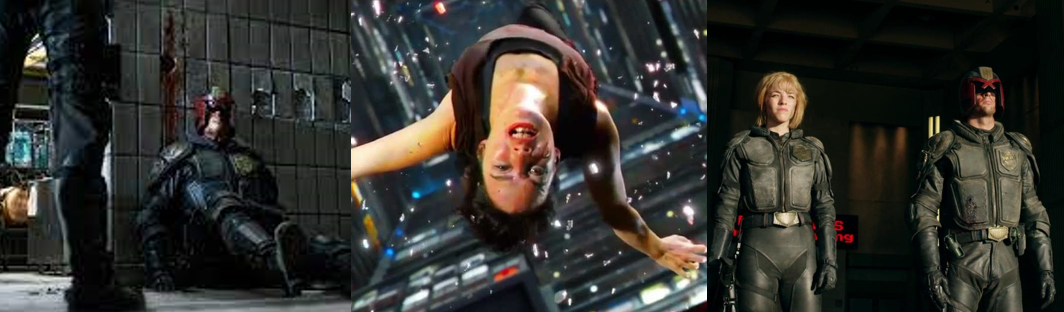
Rather than weave in some of Judge Dredd’s more recognisable villains, Dredd keeps things noticeably low-key and introduces a brand-new antagonist, former prostitute turned psychopathic drug kingpin Ma-Ma, who has taken root within the Peach Trees Mega Block. Hooked on Slo-Mo and scarred from a lifetime of abuse and torment, Ma-Ma is numb to all pain and emotion; she impassively orders the skinning and public execution of three rogue dealers, approving the use of Slo-Mo to draw out their agony, and who seized control of the entire tower through sheer violence and the scarcity of Judge presence at Peach Trees. So great is Ma-Ma’s power and influence that she’s not only able to coerce her genius and neurotic hacker (Gleeson) into locking down Peach Trees to contain the Judges she also orders that they be hunted down on pain of death and her influence extends into the justice system, seeing her pit Dredd against four of his corrupt peers. Beyond compassion, with a penchant for violence, Ma-Ma has inspired an almost cult-like following; while she’s no fighter, she has a legion of gun-toting followers who are fiercely loyal (even though she regularly punishes failure with death), though even she is enraged when Dredd callously tosses her right-hand man, Caleb (Warrick Grier), to his death. She’s so determined to stamp out the Judges that she thinks nothing of the innocent inhabitants caught in the crossfire and exhibits a lack of humanity that’s almost on par with Dredd’s, except even he prioritises life over death unless absolutely necessary. Although we don’t delve deeply into either Ma-Ma or Dredd’s personality, it’s explicitly conveyed that Ma-Ma has fought her whole life and is driven only by power. Effectively dead inside, it’s as though she’s sleepwalking through life, driven to experience some semblance of feeling before her inevitable death, something that makes her incredibly dangerous, not just because she has all the guns and all the power but also because she has no fear of death.

The Nitty-Gritty:
A major aspect of Dredd is just how desolate life is within Mega-City One; over 17000 crimes are reported within the city, and the Judges are only capable or responding to about 6% of them, meaning the city has basically lost itself to anarchy. In this harsh environment, only the strong survive, and Dredd is depicted as just that: a survivor. Unlike in the previous film, he’s not seen without his helmet save for a fleeting, obscured shot right at the beginning, which by itself more accurately reflects the character than the entirety of the last movie, but Dredd makes pains to shy away from delving too deeply into Dredd’s motivation or backstory. When probed by Anderson, we learn that he’s full of rage and control and something else, something explicitly unidentified but seen to be a code of honour that prioritises life and the law. Dredd does showcase a dry, sardonic sense of humour; gallows’ humour, if you will, offering perps the choice between a lifetime of imprisonment without parole or death, commenting on Anderson’s skills and lack of helmet, and daring Kay to save him some paperwork by just confessing to his crimes. Rather than try an humanise Dredd, something that’s completely unnecessary as he exists as the extreme personification of the fragile justice system, the movie wisely focuses on Anderson as a more morally guided and unsure Judge; she shows the empathy and exhibits the humanity, but ironically her character arc is learning to let go of such emotions and take on Dredd’s more pragmatic and hard-nosed approach towards criminals so that she too can survive on the streets.

Although trapped in a high-rise tower, Dredd still has plenty of toys at his disposal.

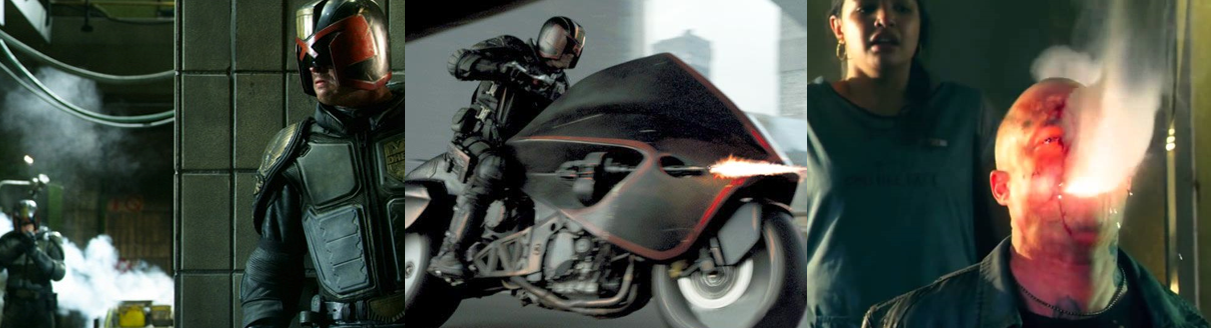
As ever, Mega-City One is a bleak, overpopulated, violent hell-hole; the Cursed Earth is only fleetingly seen and mentioned as the focus of Dredd is on the city itself, now no longer inspired by Blade Runner (Scott, 1982) or even that evocative of the source material and instead being a rundown mish-mash of existing US cities. In fact, the general rundown presentation of the city more recalls District 9 (Blomkamp, 2009), characterising the city as a much more grounded and realistic location which is actually in keeping with Dredd’s earliest appearances, before the term “Mega-City One” was coined. Amidst the ruins of the “old world” exist Mega Blocks, towering skyscrapers full to the brim with people from all walks of life, the streets are clogged with traffic and rioting, and hundreds of crimes break out every second of the day. Our time spent on the streets of Mega-City One is fleeting as, after responding to a homicide report at the Peach Trees Mega Block, Judge Dredd and Anderson are trapped in the futuristic tower block, cut off from backup, and left to deal not only with Ma-Ma’s crazy followers but the desperate inhabitants of Peach Trees who both refuse to shelter the Judges or out-right attack them to curry Ma-Ma’s favour. While restricting Dredd to such an unremarkable and claustrophobic environment may seem limited, it actually works quite well; the point of Dredd is not to be some world- or city-saving escapade, but to depict a typical, violent day in the life of the famous lawman, which is definitely succeeds at. Plus, Peach Trees is surprisingly diverse; it’s like a city within a city, containing living quarters in various states of disrepair, malls, drug dens, and its corridors and apartments acting as alleyways and crack houses, respectively. It’s in this desolate, rust-red tower block that the Blade Runner influence comes into play yet there’s still some impressive technology in Dredd’s gritty and grounded war-torn future; the Judges constantly monitor the city using advanced drones, impossibly huge skyscrapers pepper the city, and, while it can’t fly and has a more functional design, Dredd’s Lawmaster still allows him to easily chase down perps, fire upon them, and subdue lingering crowds. Dredd is again armed with the Lawgiver, which is still be tied to his genetic code so it’ll explode in the wrong hands and once again fires a variety of ammo, including hotshot rounds that burn a perp’s face from the inside out, high explosive rounds to blast through walls and blow off heads (!), and incendiary fire to immolate Ma-Ma’s followers along with half a floor of Peach Trees!

As good as the Judges look, the slow-motion and gritty violence and an undeniable highlight of the film.

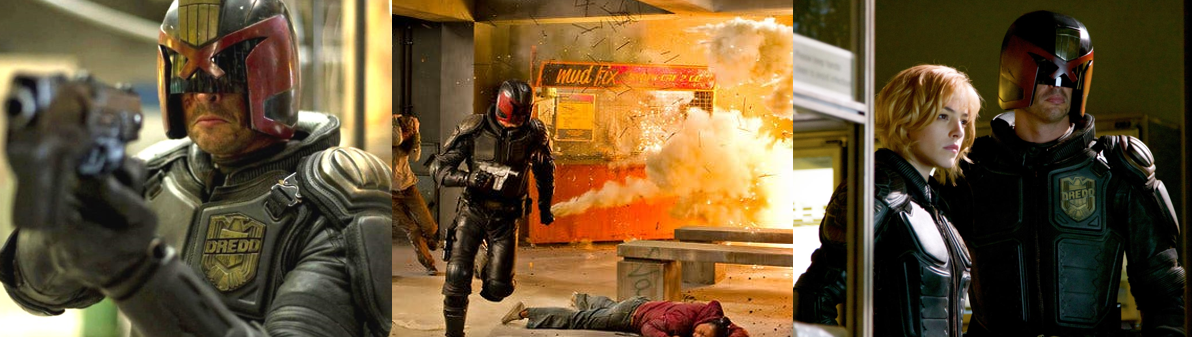
Although Dredd’s Judges don an extremely different uniform compared to the comics, I think it works really well; their helmets, especially, are as faithful as you could want, as are their badges, but the entire uniform is now more like practical riot gear rather than form-fitting spandex. Instead of heavy and cumbersome gold eagles and plates, they have reinforced armour that evokes the classic Judge imagery while still being believable. Of course, the big selling point of Dredd, like many films at the time, was its 3D effects. Dredd actually employs these effects into the plot and in an interesting way; whenever characters take a hit of Ma-Ma’s Slo-Mo drug, they’re inundated with a hallucinogenic high that sees them perceive time in slow motion. If its decidedly gloomy visuals and far grimmer interpretation of Judge Dredd didn’t immediately clue you in that Dredd was taking the character in a different direction, the film’s mature content soon will! There’s no “Drokk!” curses here (character’s drop the f-bomb at every turn) and no sugar-coating the bloodshed as perps are torn to shreds, often in agonising slow motion that really shows the bullets ripping through flesh and faces in gruesome detail. Easily the biggest and most explosive set piece in the film sees Ma-Ma’s gang unload on Dredd with three rotary cannons that tear through solid concrete and human flesh like they were tissue paper. Much of Dredd’s action scene involve him callously blasting at foes using his whittling ammunition; using cover and confusion from smoke and fire, Dredd guns down multiple armed foes with a deft grace thanks to Karl Urban carrying himself with a militaristic legitimacy. A bruiser of a fighter, Dredd absolutely brutalises even his fellow Judges in a fist fight, though for all his well-deserved reputation, he’s still a man and fully capable of being injured and enduring some harsh physical punishment as he insists on fighting through Ma-Ma’s forces.

Despite their injuries, the Judges topple Ma-Ma and emerge alive and ready for duty.

Ultimately, Anderson’s concerns that Kay will become a liability come to fruition when he desperately takes her hostage to try and appease Ma-Man and use her as leverage against Judge Dredd. Undeterred, Dredd issues a warning throughout the tower block, uttering the iconic “I am the law” line and putting all of Peach Trees on notice. Disgusted at his fellow Judge’s corruption, Dredd confronts them in Ma-Ma’s Slo-Mo factory in a tense game of cat and mouse where they debate the state of the city before engaging in a tense firefight that leaves Dredd with a bullet in his abdomen, but nonetheless victorious thanks to the timely intervention of Anderson, who fought her way out of Ma-Mas clutches after Kay’s overconfidence cost him a hand to her Lawgiver. After patching himself up and reloading, Dredd acknowledges the change in Anderson’s demeanour; despite already having failed since she lost her sidearm, she justifies letting the tormented hacker go free and joins Dredd in picking off Ma-Ma’s personal guard and breaching her quarters. There, they find she has rigged herself with a dead man’s switch; if she dies, a series of bombs will destroy the entire Mega Block. Undeterred, Dredd simply delivers a mortal wound and gives her a taste of her own medicine, dosing her up on Slo-Mo and sending her plummeting to her spectacular and oddly beautiful death, betting (rightfully so) that her device’s range won’t reach from the ground floor. Finally put out of her impassive misery, Ma-Ma rides the euphoria of her death before crashing to the ground in hauntingly glorious slow-motion. With the lockdown lifted, the Judges finally exit the building and Anderson, assuming she’s failed her evaluation, hands Dredd her badge. However, Dredd reveals to the Chief Judge that Anderson passed with flying colours and, despite his injuries, Dredd returns to his duties as Mega-City One’s top lawman with no fuss or fanfare.

The Summary:
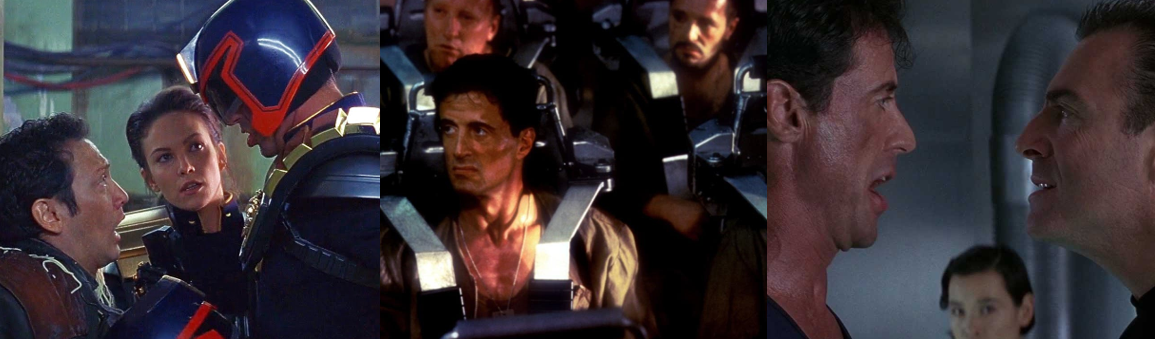
Unlike with Sylvester Stallone’s outing as the iconic lawman of the future, there’s no hesitation in crowing about my fondness for Dredd; it’s a decidedly more low-key offering for the hard-as-nails Judges but it benefits from it. It’s not some bombastic, clustered mess of visuals and jokes and opposing tones; it’s a dirty, grim and gritty affair that perfectly shows how every day, every battle, in Dredd’s life is a mini war all unto itself. Karl Urban is absolutely inspired in the role; an imposing bruiser, he convey so much emotion with the subtlest movements and twitches of his constantly-scowling mouth and delivers an understated, but nuance, performance with his gravelly tones. Olivia Thirlby and Lena Headey equally hold their own, with Thirlby’s turn as psychic Anderson and acting as the film’s more empathetic voice, one that’s forced to concede that Dredd’s view is the only one that can allow a Judge to survive, really helps the film standout from its predecessor. I’m no fan of excessive slow motion but it’s used sparingly and to great effect here, as is the use of CGI, but where Dredd really shines is in its costume design and grainy aesthetic. While it definitely shies away from Dredd’s more outlandish escapades, Dredd perfectly captures the grim, bleak spirit of the source material and it is, quite frankly, absolutely criminal that we never got to see a sequel as this is easily not only the best of the Judge Dredd movies but also a highly enjoyable action romp with the perfect balance of action, humour, gore, and political intrigue to finally do the character justice.

My Rating:

Rating: 4 out of 5.

Great Stuff

Did you enjoy Dredd? How do you think it compares to the previous live-action adaptation? What did you like to Karl Urban’s performance and this interpretation of Dredd? Did you like that the film told a more low-key story or would you have liked to see something a little grander in scope? Were you impressed by the film’s visual style, costume design, and use of slow motion? Would you have liked to see a sequel to Dredd or do you think it’s time for a new version of the character? Whatever you think, go ahead and leave a comment down below or on my social media and be sure to check out my other Judge Dredd content.
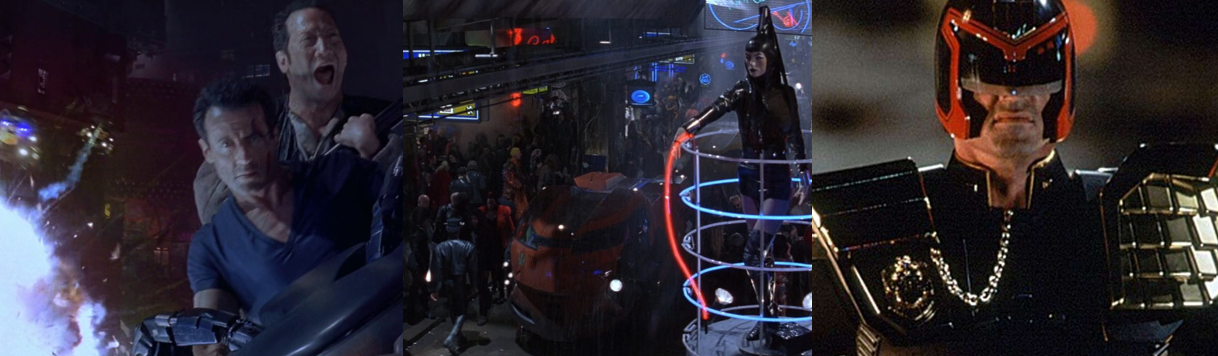
Movie Night [Sci-Fanuary]: Judge Dredd


January sees the celebration of two notable dates in science-fiction history, with January 2 christened “National Science Fiction Day” to coincide with the birth date of the world renowned sci-fi writer Isaac Asimov, and HAL 9000, the sophisticated artificial intelligence of Arthur C. Clarke’s seminal 2001: A Space Odyssey (1968), being created on 12 January. This year, however, I’m spending every Thursday of January celebrating sci-fi’s toughest lawman, Judge Joseph Dredd!


Released: 30 June 1995
Director: Danny Cannon
Distributor:
Buena Vista Pictures / Cinergi Productions
Budget: $85 to 90 million
Stars:
Sylvester Stallone, Armand Assante, Diane Lane, Rob Schneider, Jürgen Prochnow, and Max von Sydow

The Plot:
In the year 2080, the world has become a scorched wasteland and the Judges enforce martial law in the overpopulated Mega-Cities and Mega-City One’s most efficient and decorated officer, Judge Joseph Dredd (Stallone), is framed for murder by his own half-brother, the psychotic Rico (Asante), who plots to usurp the oppressive regime with an army of superhuman clones. 

The Background:
It was thanks to British science-fiction comic book 2000 AD and the work of John Wagner, Carlos Ezquerra, and Pat Mills that readers were introduced to Judge Joseph Dredd in March 1977, a tough-as-nails lawman known for his extreme political satire. Dredd’s subsequent popularity meant that Hollywood soon came calling, and long-time fan Danny Cannon pursued the project with a passion, even turning down the chance to helm Die Hard with a Vengeance (McTiernan, 1995) in favour of this adaptation. Although development stalled somewhat thanks to the similarly-themed action/sci-fi satire RoboCop (Verhoeven, 1987), production soon got underway once Sylvester Stallone was cast in the title role, beating out his action movie rival Arnold Schwarzenegger despite being unfamiliar with the character. The filmmakers looked to Blade Runner (Scott, 19982), to bring the sprawling Mega-City One to life and rejected designs from famed fashion mogul Gianni Versace for the film’s costumes. Initially shot to be an R-rated feature with a darker, satirical bent, Cannon clashed with Stallone over the direction of the film and was left so disappointed with the star’s insistence towards comedy that he vowed never to work with the Italian Stallion again. This was largely reflected in subsequent reviews, which criticised the film’s confused tone and disappointing production. While the visual appeal of the film has been praised, Stallone’s performance was not; the tie-in videogame was also a disappointment and a box office gross of under $115 million made the film a commercial flop. Both Stallone and Dredd co-creator John Wagner expressed disappointment with the film and it would take nearly twenty years for the character to return to cinema screens.

The Review:
As I mentioned in my review of Judge Dredd’s debut story, I’ve been a big fan of the character since I was a teenager, largely because of my dad. I was always ore drawn towards Dredd’s clashes against the Dark Judges and his more momentous storylines, such as “The Cursed Earth” (Mills, et al, 1978), “The Day the Law Died” (Wagner, et al,1978 to 1979), and “The Judge Child” (ibid, 1980), which is fitting since Judge Dredd draws several influences from these stories for its core narrative. I was just the right age for Judge Dredd; while I was regularly enjoying violent sci-fi romps like RoboCop, I also enjoyed colourful, action-packed sci-fi comedies like Demolition Man (Marco Brambilla, 1993), so my expectations for the film were simply to enjoy seeing a stern lawman of the future kicking ass in a visually entertaining environment. This means I have a certain level of nostalgia for the film; it was, after all, the only live-action Judge Dredd movie available for decades and it’s not as if the character had a more violent animated series to fall back on. At the time, if you wanted Judge Dredd, it was either this, the comics, or a handful of videogames, but that doesn’t mean that my opinion of the film hasn’t changed as I’ve gotten older and come to appreciate the subtle dark comedy and violent nature of the source material. It’s a shame as well since Judge Dredd gets off to a good start (it’s always a plus when James Earl Jones provides an opening narration) and has more positives in it than a lot of people like to acknowledge, but it fumbles on some of the most basic characterisations of its title character in order to appeal to a wider, more mainstream audience.

Hard-nosed Dredd is framed for murder and forced to confront his psychotic brother.

Don’t get me wrong, I totally understand this. R-rated movies like RoboCop might kick all the ass but they’re a bit of a risk for producers and investors, especially when it comes to comic book properties and especially back in 1993, when many superheroes where being bastardised commercialised for maximum profit. Thus, Judge Dredd, the straight-laced, grim-faced, by-the-book lawman of the future who is just as likely to prosecute innocent bystanders to nail a perp, is transformed from a tough, no-nonsense future cop into a more heroic figure over the course of the movie. Dredd starts out as a pragmatic and uncompromising officer; he shows no fear, even when outnumbered and outgunned, and has not hesitation in gunning down criminals to quell a riot. Similarly, he doesn’t hesitate to slap former convicted hacker Herman “Fergee” Ferguson (Schneider) with the maximum prison sentence simply for trying to save himself from being caught in the crossfire. Dredd’s rigid enforcement of the law has earned him quite the reputation; ordinary street punks fear him, and rightfully so, and his lack of humanity and propensity to favour summary execution draw criticism from fellow Judge Barbara Hershey (Lane) and Dredd’s mentor and father figure, Chief Justice Eustace Fargo (von Sydow), who orders him to spend time at the academy training the future generation of Judges not in combat but in the enforcement of ethics in an attempt to inject some humanity and compassion into Dredd’s approach. Although Dredd is clearly unhappy with this assignment, he follows his orders because he has such respect for his mentor and he truly believes in the world of the law, following the literal book to the letter and committing his very life and soul to upholding its ideals, even at the expense of his emotions and empathy.

Whether through compassion or “humour”, both Hershey and Fergie help to humanise Dredd.

Dredd’s cold demeanour is contrasted by Hershey, the closest thing he has to a friend. Although Dredd has respect for all of his peers, he openly acknowledges that Hershey is “one of the smartest of the new breed” and turns to her to defend him when he’s accused of murder out of respect for her capabilities. Unlike Dredd, Hershey is far more empathetic; she chastises herself when her rookie Judge is murdered on her watch and openly disagrees with Dredd’s philosophy that Dredd’s must commit their lives to the law until they either die on the streets of venture out into the Cursed earth for “retirement”. Indeed, she’s perfectly happy to openly criticise him for being too harsh and lacking in humanity and is both hut and betrayed when the evidence condemns him as a traitor. Moved by the emotional depths Dredd displays after learning of his true origins, she agrees to help him track down Rico both out of a genuine loyalty and affection for him and to avenge the losses her and her fellow Judges have suffered at Rico’s hands. Much of Judge Dredd comedy is focused on Dredd’s stoic demeanour and the awkwardness of him relying on others after he’s betrayed by the very system he dedicated his life to. Have no fear, though, as Fergie is here to act as the comic relief of the film and boy, does it start to grate very quickly. Unlike his simple-minded comic book counterpart, Fergie is a former hacker who, after serving his sentence, finds himself in the wrong place at the wrong time. Naturally, he objects to Dredd’s harsh sentencing and cannot help but laugh at the irony of the grim Judge being convicted for a crime he didn’t commit, but Fergie has no choice but to rely on Dredd when they crash in the Cursed Earth and end up in the clutches of the notorious Angel Gang. From there, Fergie acts as Dredd’s bungling sidekick; a dead weight he’s forced to lug around. Indeed, Fergie’s hacking talents really have no relevance until the last act; Dredd has Hershey and tech-savvy cadet Nathan Olmeyer (Balthazar Getty) to offer more practical help, so Fergie is literally just there to offer manic “humour” that basically amounts to him being a nuisance. However, his presence does tie into the film’s attempts to humanise Dredd; Dredd’s stoic façade and aggravation towards Fergie noticeably lifts as they spend more time together and there’s a genuine sense that the two have become begrudging friends by the finale.

Fargo reluctantly opts to step down to protect Dredd and the sanctity of the justice system.

The Judges have a great deal of resources at their command, from Lawgiver pistols that fire an array of ammo to Lawmaster bikes that let them blast through the skies (when they actually work). What they don’t have, however, is manpower; with the city growing more volatile, Judges such as Dredd are forced to rely on more extreme measures to safeguard the citizens, and this draws them much criticism from the likes of news reporter Vartis Hammond (Mitchell Ryan). Hammond’s sentiments are echoed by Chief Justice Fargo, a well-respected and long-tenured senior Judge who is burdened by the responsibilities he feels towards the welfare of Mega-City One. He’s reluctant to enforce harsher methods as he wants the Judges to stand for freedom and justice rather than oppression and, while he’s a figure that commands great respect, it’s undeniable that his beliefs are opposed by Dredd and even those in his council, like Judge Jürgen Griffin (Prochnow). Fargo is equally reluctant to reactive “Project: Janus”, an abortive attempt at cloning Judges rather than recruiting them, and is conflicted by his guilt and affection for Dredd, whom he sees as a son since he was cloned from his genetic material. After seeing Rico, Dredd’s clone brother, descend into madness, Fargo fears that he’s made a mistake in placing so much faith in Dredd but ultimately agrees with Griffin’s suggestion to take the Long Walk and spare Dredd’s life rather than risk the truth about Project: Janus being released and what little faith the people have in the justice system being compromised. A compelling and commanding presence, Fargo delivers much of the film’s emotional gravitas thanks to Max von Sydow’s alluring performance; his death is an emotional moment not just for the audience but for Dredd, too, who struggles with his turmoil of emotions his mentor’s revelations and passing stir up in him.

As if the corrupt Griffin wasn’t enough, Dredd has to contend with the cannibalistic Angel Gang.

Of course, it turns out that Fargo’s retirement is orchestrated by Judge Griffin in a conscious effort to remove him from the council, ascend to the role of Chief Justice, and coerce his fellow councilmembers into reactivating Project: Janus. Griffin sees the escalation of crime and violence in the city as an epidemic, one that must be stamped out with every resource at their disposal, in order to bring about “an ordered society”, even if it means suppressing basic human rights. To this end, he conspires to release Rico from his imprisonment, frame Dredd for the murder of Vartis Hammond and his fellow councilmembers, and instil his own brand of order to the city through the deployment of a new batch of genetically enhanced clones. Of all the character sin the film, I’d say that Griffin is the most changed from his comic book counterpart; here, he’s an ambitious and antagonistic schemer who wants to reshape the Judges into his own image, but even he is aghast when Rico tampers with the clones so that they’re born from his genetic material rather than the wise and benevolent council. Griffin is contrasted by the admirably faithful Angel Gang; a mutated group of in-bred misfits who have turned to cannibalism and madness in the wastelands of the Cursed Earth, the Angel Gang are comprised of patriarch Pa Angel (Scott Wilson) and his backwoods sons Junior (Ewen Bremner), Link (Phil Smeeton), and Mean Machine (Christopher Adamson). Unfortunately, we don’t learn too much about them except that they’re God-fearing misfits who openly torture and kill anyone who stumbles into their territory; Mean Machine Angel, always the most visually interesting and tragic of the family, is an obvious standout thanks to his raging temper and cybernetic enhancements but, sadly, they’re mainly included as a brief obstacle for Dredd to overcome while stranded in the radioactive wastelands and could’ve easily been replaced by the same nameless, faceless Judges who later enter the scene anyway, but I appreciate the effort used to translate them to the screen, however brief it was.

Bolstered by his robotic bodyguard, the psychotic Rico plans to cause cause across the city.

Our primary antagonist is, of course, the psychotic and strangely alluring Rico. Like in the comic books, Rico is Dredd’s clone brother but, unlike in the source material Dredd is unaware of this until late into the second act. While Dredd embodies the law and everything it stands for, Rico embodies chaos; a former Judge and Dredd’s only true friend, Rico turned to wholesale mayhem and destruction and was sentenced to death as a result, which directly contributed to Dredd adopting his cold-hearted demeanour. However, Judge Griffin intervened and saw to it that Rico was simply incarcerated so he could use him as his agent to bring about his new order for Mega-City One. Griffin unleashes Rico, hoping he’ll stir up anarchy, but quickly loses control over the maniacal killer, who reprograms a battered old Atomic, Bacterial and Chemical Warrior (ABC Warrior) to act as his bodyguard, murders the council, and sets about birthing his own bath of clones. Rico is an undeniable highlight of the movie thanks to Armand Asante’s snake-like performance; he’s constantly walking the fine line between reason and insanity, flipping on a dime between the two and coming across as a volatile and unpredictable personality with a surprising amount of depth. Rico was hurt when Dredd brought him to justice and feels betrayed by him, but also wishes Dredd to join him in restructuring the justice society, with Dredd as Chief Justice, in a bid to build a true family. Rico is also assisted by Doctor Ilsa Hayden (Joan Chen), a woman who’s primarily there to help Rico with the clone science and to give Hershey someone to fight in the finale; otherwise, she may as well not be there and she’s just a one-dimensional piece of ass-kicking eye candy that just stands next to Rico and reacts to his monologues.

The Nitty-Gritty:
It’s interesting that the tone of the film veers so far away from the more violent and dark humour of the source material, especially as the opening credits consist of a collage of various Judge Dredd and 2000 AD comic book covers as an acknowledgement of the film’s roots. To be fair, there is an attempt at evoking the violence of the comics throughout the movie; squibs and blood effects are prominent when characters are shot, especially during the opening Block War and subsequent shootouts, and Warden Miller (Maurice Roëves) suffers a particularly brutal shot to the throat during Rico’s escape. A lot of the more gruesome violence is rendered offscreen, but this is actually beneficial; when Rico orders the ABC Warrior to rip off Chief Justice Fargo’s arms and legs, the noise is enough to know how horrific that fate is, and there’s even a brief shot of the Angel Gang’s latest meal being chargrilled on a spit roast. It’s pretty obvious that the film was cut to avoid being slammed with a higher rating, but my main issue with the tone is the over-reliance on Fergie’s comedic mishaps to counterbalance the few, fleeting violent moments, though I do enjoy the dynamic between him and Dredd, especially when Dredd begrudgingly considers Fergie’s usefulness as a good luck charm and some of the Judge’s stoic one-liners. And Stallone has some great quips here, from his booming declaration of “I am…the law!”, his surly growl of “Courts adjourned”, and his explosive outburst in the trial scene! I also have to compliment Alan Silvestri’s rousing score; it strikes a fantastic balance between heroic, military-esque, and stirring and really bolsters the onscreen action as only Silvestri can.

While some effects haven’t aged well, overall the film holds up and impresses with its visuals.

One area where Judge Dredd really excels is in its visual aesthetic and presentation; obviously drawing much of its inspiration from Blade Runner, the film’s rendition of Mega-City One is as a sprawling, technologically advanced, overcrowded super-city that merges recognisable landmarks like the Statue of Liberty with impossibly high, futuristic skyscrapers. Neon signs, holographic projectors, and impressive technology such as flying cars, artificial intelligence, and mechanical conveniences are commonplace and many of them, like the Judge’s Lawmaster motorcycle, are comically unreliable. Indeed, there’s a definite sense of the city being cobbled together and everything has a very “lived-in” look; while the Judges have access to sleek toys and vehicles in contrast to the gritter back alleys where riots are frequent, there’s a definite sense that everyone’s just trying to make the best of what they have on offer, which ties in perfectly to the rising tensions in the streets over strained resources and overcrowding. The special effects hold up really well thanks to being a combination of miniatures, matte paintings, and practical effects; even the Cursed Earth and the exterior of Mega-City One have a grand sense of scale and CGI use is sporadic and not too glaring, though the Lawmaster chase through the city skyline does look a bit suspect. I can forgive this, however, as the flying vehicles and visual presentation is, overall, very impressive and very reminiscent of the source material. This is true of the Judge’s uniform; if anything, the film adheres too close to the source material here, translating the uniform into a form-fitting body suit bolstered by gleaming armour when it should probably be realised as something a bit more practical. Still, the Judges look great, especially Dredd; their helmets, badges, and armour are all extremely faithful to the source material and the same is true of Mean Machine Angel. My favourite of the Angel Gang, this psychotic cyborg is brought to gruesome life through the use of heavy prosthetics and my only complaint is that he doesn’t get much screen time. Similarly impressive is Rico’s recommissioned ABC Warrior; styled after Hammerstein and brought to live as a fully functioning practical effect, the ABC Warrior has a real weight and presence in the film and all of these real-life special effects make up for the few wonky special effects and help Judge Dredd stand the test of time even to this day, at least in terms of its visual appeal.

After a strong start, the movie commits the cardinal sin of removing Dredd’s helmet and making him a hero.

Of course, Judge Dredd betrays the very essence of the character within the first twenty minutes of its runtime when Dredd “[stands] at ease” and removes his helmet! I absolutely understand why this decision was made; if you’ve hired Sylvester Stallone, you want to see his face and it helps the character, and the actor, to express a greater range of motions but it undeniably goes against everything the character is known for. In the comics, Dredd essentially loses his humanity and individuality after Rico turns against the law, becoming the embodiment of the justice system, flaws and all, rather than a simple man. While he’s still that here and Dredd gives a particularly rousing speech to the young cadets regarding the level of commitment he expects from every Judge, the film is much more focused on humanising Dredd, turning him from a grim, almost robotic character and into a more compassionate, heroic figure… not unlike the narrative arc seen in RoboCop. Unfortunately this really doesn’t fit with Dredd’s characterisation and appeal; the whole point is that he’s a tough, but fair, enforcer of the law in an increasingly lawless society. Any political or social commentary is dumbed down in Judge Dredd, which approaches such aspects with a disappointingly toothless attack, but Dredd removing his helmet is basically a slap in the face to the audience, a way of saying “We’re here to make money”. The biggest irony of this is that the film has the perfect excuse to have its cake and eat it too; all they had to do was cast Stallone in a dual role, playing both Dredd and Rico, then he could’ve kept the helmet on and still been allowed to act with his face unobscured. Asante could’ve been cast as Judge Griffin since Prochnow isn’t exactly the most compelling presence in the movie (his performance is strangely exaggerated at times) and the script could’ve been rewritten to accommodate these alterations. I don’t know if that would’ve necessarily made the movie better but it would’ve at least stayed true to the spirit of the character and perhaps spared us the visual of the citizens cheering Dredd on in the finale like he’s a conquering hero, something his comic book counterpart would probably have deemed a public nuisance.

Dredd destroys his clones, dispatches Rico, and returns to duty as a street Judge.

Still, it’s hard to deny the gravitas that Asante brings to Rico and how captivating his performance is; Stallone definitely can act and has always stood out from his action hero peers as being more than a slab of meat, but he’s a little in over his head here and largely bolstered by his supporting cast as he focuses entirely on tweaking Dredd’s persona from an uncompromising man of the law to a more empathetic individual. Dredd undergoes a great deal of emotional turmoil in the film, from being betrayed and convicted by the system to discovering that he’s a clone of Fargo and that Rico is his genetic brother. The trial is particularly hard on Dredd, who knows he’s innocent but is convicted because of irrefutable genetic evidence, forcing him to see the flaws in the system, but he’s absolutely devastated when Fargo dies before his eyes after revealing the truth to him. After finally opening up to Hershey, Dredd gears up to confront his brother in the remains of the Statue of Liberty, where Project: Janus is situated. In this elaborate laboratory, Rico has spawned a new crop of clones using his own genetic material and, after Dredd refuses to join him in his campaign, Rico orders that the clones are hatched before they’re fully gestated, briefly forced Dredd to contend with the gruesome copies that are little more than monstrous drones. Although injured (by a shot that really should’ve been fatal…), Fergie is able to disable to ABC Warrior and Hershey fends off Dr. Hayden as the laboratory explodes around them, leaving Dredd and Rico to face off in a brutal fist fight in Lady Liberty’s head after just… ignoring the clones, which are basically just there for a jump scare. Despite clearly being Rico’s physical superior, Dredd ends up dangling precariously over a fatal drop after they exchange blows; luckily for Dredd, Rico can’t pass up the chance for one final monologue in which he chastises his brother’s lack of loyalty and vision, given Dredd the opportunity he needs to distract Rico with a flare, deliver one last one-liner, and sent him plummeting to his death. In the wake of Rico’s death, the truth about Griffin’s actions is broadcast, exonerating Dredd and leaving him in prime position to ascend to the role of Chief Justice. Surprisingly, the movie adheres to the spirit of the comics by having Dredd decline and recommit himself to his daily duties, and then deviates from it wildly by having him exhibit only confusion and intrigue rather than insult when Hershey plants a kiss on his lips.

The Summary:
So, yeah… I’m a little torn. If anyone knows the complexities of adaptation, it’s me, and I totally get that some things need to change to bring a concept to life. generally, I go into an adaptation looking to see how it stands by itself, what it does differently, and how it works in its new medium and genre and judge it according to those standards. By that measure, Judge Dredd is a pretty by-the-numbers sci-fi action/comedy; it’s colourful and visually stunning, with some decent action set pieces and humour (when Rob Schneider isn’t trying too hard) that has a certain appeal, especially for younger viewers. If you’ve seen Demolition Man, which came out only a couple of years before this, and Blade Runner, this is very much a mash up of those two, with a sprinkling of RoboCop in there; it’s not exactly ground-breaking, but the practical effects and visual presentation go a long way to making it an entertaining flick. Stallone does a decent job here; honestly, he was a great choice to play Judge Dredd and (literally) fills the boots well, carrying himself with a grim, stoic demeanour that perfectly contrasts with his stellar supporting cast. Unfortunately… it’s just not really Judge Dredd for me. it captures some of the essence of the source material, but not enough to truly do it justice. I can understand toning down the violence and changing some aspects, but removing the helmet was a big no-no. Obviously, it would’ve been a very different movie if Stallone had kept it on (and again, I don’t know if it’d really be “better”), but the key thing here is that Dredd’s character is changed to make him a more heroic figure, when that’s really missing the point of what Dredd’s all about. Ultimately, I think the filmmakers just played things too safe; this wasn’t a time when comic book movies were known for taking risks and that really shows here, resulting in a fun action romp but one that is more like a taster introduction to Dredd’s world rather than truly being representative of it, which is a shame.

My Rating:

Rating: 2 out of 5.

Could Be Better

What did you think to Judge Dredd’s live-action debut? Were you annoyed that he removed his helmet or do you think it made sense considering who was in the role? What did you like to Stallone’s performance and this interpretation of Dredd? Were you impressed by the film’s visuals, costume design, and special effects? What did you think to the plot regarding Dredd’s framing and his clash against Rico? Feel free to share your thoughts in the comments or on my social media and be sure to check out my other Judge Dredd content.
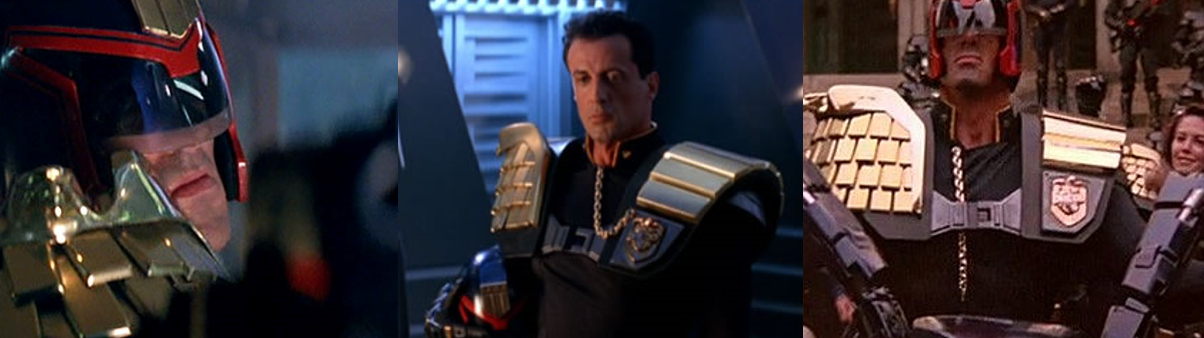
Movie Night: Aquaman and the Lost Kingdom

Released: 17 March 2023
Director: James Wan
Distributor: Warner Brothers
Budget: $205 million
Stars: Jason Momoa, Patrick Wilson, Yahya Abdul-Mateen II, Randall Park, Temuera Morrison, and Amber Heard

The Plot:
Desperate to find the means to avenge himself against Arthur Curry/Aquaman (Momoa), pirate David Kane/Black Manta (Abdul-Mateen II) stumbles upon the mythical Black Trident, which possesses him and compels him to unleash an ancient threat so powerful Aruthur is forced to join forces with his deposed brother, Orm Marius (Wilson).

The Background:
Back in 1941, Mort Weisinger and Paul Norris created the character of Arthur Curry as part of DC Comics’ (then known as National Comics) desire to capitalise on the success of Clark Kent/Superman and Bruce Wayne/Batman. Although subject to unfair ridicule over the years, Aquaman ultimately had the last laugh when, after years of Development Hell and aborted projects, his live-action debut was met with critical and financial success. Following a short-lived animated spin-off on HBO Max, a planned horror-themed spin-off was thankfully cancelled and a sequel was quickly greenlit; both Momoa and director James Wan were enthusiastic to explore other kingdoms and regions of Atlantis and the vast underwater realm, though the film attracted unwanted media attention when star Amber Heard was accused of abusing her husband, Johnny Depp. Many called for her to be recast and, while Warner Brothers initially shot this request down, it was reported that her role had been significantly reduced as a result of the circus of a trial that followed. The production also stalled due to the COVID-19 pandemic, which changed the release date numerous times but did give the visual effects team more time to work on the film. This apparently also involved excising cameo appearance from one or more Bruce Wayne/Batman actors as James Gunn geared up towards completely restarting the DCEU, with Gunn apparently providing some notes to the filmmakers. After much drama and delays, Aquaman and the Lost Kingdom finally released to largely negative reviews; critics attacked the brainless plot and clunky pacing, though Wan’s direction and Momoa’s enthusiastic performance were praised. As of this writing, the film has currently grossed $340.6 million at the box office but it’s largely academic; Momoa isn’t expected to reprise the role in Gunn’s new DC Universe and no new Aquaman projects have been announced yet, leaving the character essentially dead in the water no matter how much money the sequel makes,

The Review:
I was pleasantly surprised by Aquaman; it was big, colourful, mindless fun in an era when the DCEU was unnecessarily dark and bleak, and it altered Aquaman’s characterisation in a way that made him so much more entertaining and relatable. Jason Momoa attacks the role with such relish and natural charisma that it’s easy to overlook flaws in logic or pacing, and that same charm returns in this sequel. Of course, it helps that he’s disgustingly good looking and absolutely shredded, but Momoa’s Aquaman has the kind of Dude/Bro mentality and whimsical childishness that really brings a smile to my face. In this film, a lot has changed for the slovenly brute who once shunned humanity and responsibility; he’s now the King of Atlantis, doting father to Arthur Junior (Various), and loving husband to Y’Mera Xebella Challa (Heard). First, let’s address the elephant in the room: yes, Mera is in this movie but no, she does not have much of a role. In fact, given all the controversy surrounding Amber Heard, I was expecting Mera to be killed off and it does seem like that almost happened; instead, she’s merely severely wounded by Black Manta and taken out of the second act of the movie, only to make a minor reappearance at the end to help Arthur and Orm and get the baby to safety. I can fully understand this, and it’s not like her presence is really missed; she still impresses in her skin-tight outfit and gets to show off her hydrokinetic powers, but the plot doesn’t require her presence and it’s better she was given less prominence considering everything that happened. Interestingly, much of her character development from the first film is repeated with Orm; he’s prejudiced against the surface world like Mera was, confused by their words and ways, and slowly comes to enjoy some of our customs by the movie’s end, though these lessons are reframed in the context of Arthur encouraging a stronger bond between them and him pulling pranks on his relatively naïve younger brother by tricking him into thinking cockroaches are a delicacy!

Now a father dissatisfied with the crown, Arthur teams up with his brother to face a powerful threat.

So, there’s not much focus on the romance here; even Arthur’s father, lighthouse keeper Tom (Morrison) and Queen Atlanna (Nicole Kidman) don’t share a scene together until the start of the third act, and Arthur’s initial conversations with his father even somewhat imply that Atlanna is dead. She’s not, but her role here is equally minimal and simply the catalyst to unite her two estranged sons into joining forces. Instead, we’re left with Arthur, but that’s more than enough! Despite his big victory in the first film, Arthur is bored by the crown, his duties, and the endless politics of the Atlantean council, which handicap him with bureaucracy. A child of both worlds, he spends as much time out of the sea as he does in it to care for his son, something with many of his kingdom resent, and his desire to reveal Atlantis to the surface world and work with them to reduce pollution and climate change are continuously shot down. Frustrated by self-doubt about his role as a leader, Arthur is almost giddy when David Kane returns armed with a powerful trident of his own and wielding forgotten Atlantean technology. Kane’s plot to steal Atlantis’s highly volatile stockpiles of Orichalcum and exacerbate the heating of the world (which also causes a deadly plague to kill many Atlanteans, including Arthur’s mentor, Nuidis Vulko (Willem Dafoe), between movies) causes Arthur great distress. With no way of tracking Black Manta, Arthur enlists the help of King Nereus (Dolph Lundgren) and Topo the octopus to sneak into the desert prion where Orm is held captive and enlist his help since he’s the only one who may be able to lead them to Kane. Arthur jumps at the chance for some action, even if it risks all-out war breaking out, as he’s desperate to get into the thick of it again, to say nothing of trying to connect with his brother and settle the score with his old rival.

Orm is disgusted by his brother’s childishness but proves surprisingly trustworthy.

This dysfunctional dynamic is where the heart of Aquaman and the Lost Kingdom lies, and where much of its entertainment value comes from. Emaciated from his time in prison and embittered by his brutish brother’s lack of decorum when it comes to the throne, Orm is depicted as a conniving, untrustworthy bigot who lusts for power. Yet he agrees to help Arthur, and even stats he will willingly return to custody afterwards, out of loyalty to Atlantis, and never misses an opportunity to chastise his brother’s buffoonery and overreliance on his muscles. Orm emits a more stately persona, attempting to use diplomacy rather than brute force; he’s able to lead them to an underwater den of debauchery and an aquatic crime boss, the appropriately named Kingfish (Martin Short), to get information on Black Manta’s location and even drops condescending advice to Arthur about what it means to be a king. The banter and bickering between Arthur and Orm is great; Orm is visibly disgusted by his older brother, and the humiliation he felt at his hands, while Arthur tries to win him over with his boisterous personality and surface world benefits such as beer and cheeseburgers. Although King Nereus cautions about trusting Orm, the former Ocean Master proves surprisingly reliable; he never runs from a fight, doesn’t attempt to kill or sell out Arthur, and doesn’t even show envy at learned Arthur married Mera. Although it seems like Orm is happy to leave King Nereus to die, he saves the king and earns his respect in the process, and even readily joins Arthur in battling Black Manta when he could easily slip away and let them kill each other. Orm proves equally invaluable in delivering exposition about the Black Trident and the titular lost kingdom of Necrus, though the two brothers are briefly set against each other in the finale when Orm claims the Black Trident and briefly falls under its malicious sway.

Possessed and empowered by the Black Trident, Black Manta’s threat is significantly increased,

Established in the first film as a vengeful, sadistic mercenary, David Kane has become obsessed with discovering the secrets of Atlantis so he can repair his Black Manta suit and avenge himself on Aquaman. Kane’s fascination with Atlantis is shared by his reluctant scientific advisor, Doctor Stephen Shin (Park), who’s longing to see Atlantis is manipulated by Kane into helping him figure out Necrus’s ancient weapons. Once he finds the Black Trident, Kane is bombarded with visions, promises of power, and a superhuman lust to free the imprisoned King Kordax (Pilou Asbæk), who’s dark magic slowly infests Black Manta and drives him to the brink of insanity. Even Orm is stunned to learn of Black Manta’s newfound viciousness, which sees him threaten the entire world with climate instability simply for the sake of it rather than for any kind of ransom, and Kordax’s influence means Black Manta can now go toe-to-toe with both Aquaman and Orm without his power suit. However, he still utilises his technology, blasting his enemies with beams of intense energy and combines both science and magic (and a massive disrupter cannon on a repurposed Necrus ship) to showcase his new might. Black Manta’s need to awaken King Kordax and his list for revenge are so powerful that he targets Arthur’s family, critically wounding Mera and Tom and even kidnapping his son with the intention of using his blood to destroy the magic seal imprisoning the undead king. As for King Kordax, he’s more of an ethereal spirit, a ghastly skeletal wraith who whispers in Kane’s ear, possesses any who touch the Black Trident, and formally commanded a legion of undead warriors in battle against his brother, King Atlan (Vincent Regan). Desperate to return to unlife once more, he feeds the ego of whoever wields the Black Trident, compelling them to spill the blood of Atlan’s bloodline so that he and his army can ransack the entire globe!

The Nitty-Gritty:
Aquaman and the Lost Kingdom charts the natural next chapter in Arthur’s story; this loveable manchild feels increasing pressure on all sides to grow up and be more responsible as a husband, father, and leader, roles that he attacks with his usual juvenile vigour but which he finds himself questioning at times. Though devoted to his family, he finds the politics of the crown tedious and expresses dissatisfaction with the role, which he only fulfils out of obligation to his mother and his people. There’s no question that he’s a good father (indeed, Tom encourages Arthur to have more children!) or that he wants what’s best for Atlantis, but he desires a worldwide unity that the council aren’t willing to risk and struggles to balance both sides of his life. These issues are explored through his tumultuous relationship with Orm; both were denied a childhood together and are wary, if not frustrated, by each other, with only their love for Atlanna and Atlantis keeping their fragile alliance alive throughout most of the film. They’re two halves of the same coin, though, and both learn a lot from the other; Arthur learns more about what it takes to be a king and Orm learns to not be such a dick and enjoy other cultures. However, while they’re one of the best parts of the film, I would’ve liked to see a little more of this; perhaps a scene or two where Orm does abandon Arthur, or one where Arthur’s knowledge of the surface world helps Orm, or seeing Orm’s stoic disdain crack upon learning that he’s an uncle. The galvanising love show to them both by Atlan helps fill these gaps, as does the presence of King Nereus and the Brine King (John Rhys-Davies), who have their own issues with Orm, but it does feel like some scenes were left on the cutting room floor to keep the pace up.

The visuals and costumes continue to impress, and the fight are more personal this time.

Not that that’s a bad thing; Aquaman and the Lost Kingdom has a very brisk pace that doesn’t waste too much time, but it’s also learned to not interrupt every character moment with a dramatic explosion (there’s even a tongue-in-cheek reference to that at one point. The underwater realms are as captivating as ever, being a neon-drenched wonderland of strange, almost monstrous undersea races and futuristic technology alongside rusted apparatus and long forgotten ancient ruins. Aquaman’s ridiculously good orange/gold armour returns, looking better than ever, and he even gets a sleek, form-fitting black/blue suit and makes him invisible for a few moments at a time, perfect for sneaking into the arid desert prion and battling the dried-out, horrifying guards who dwell there. Although Orm is shafted in the costume department this time around, Mera still catches the eye in her tight little number and Black Manta steals every scene in his ludicrous saucer-like helmet. The fight sequences are much more intense this time, too; moving away from full-scale undersea battles to focus on gritty melee combat, the fights between Aquaman and Black Manta are great now that Kane has received a power boost and is a significant threat able to hideously burn even Atlantean flesh. There are a fair few visually interesting locations on offer as well, from the throne room and market square of Atlantis to the scorching desert and the overgrown, hazardous forest on Black Manta’s island (complete with volcano lair) thanks to the presence of polluting Orichalcum. A fair bit of the film involves ice and frozen locations, too, with Necrus and his army encased in an icy tomb, but overall I found the CGI and action sequences to be really well done; perhaps a bit less bombastic at times, but the focus on crafting meaningful fight scenes benefitted the plot greatly, I feel.

Arthur and Orm come together to defeat Black Manta and repair their relationship.

Despite working surprisingly well as a team, Arthur and Orm are unable to defeat Black Manta; they disrupt his operation, with the help of the remorseful Dr. Shin, but find Kane is willing to sacrifice Arthur Junior to set King Kordax free, leading to a more concentrated assault against Black Manta and the quickly rising undead army of the entrapped king. Determined to save his son, Aquaman battles Black Manta once more, only to find Kane has been fully overtaken by the malicious Kordax. Luckily, Mera and Orm are both on hand to get the baby to safety, but Orm falls under Kordax’s spell when saving Mera and his nephew from certain death. Although it seems like the two brothers are about to fight once more, Arthur tries a different approach, one influenced by his time with Orm and his desire to build bridges between them. Instead of fighting, Arthur also grabs the Black Trident and tries to reason with his brother, with both struggling against Kordax’s influence, and successfully talks Orm down. Orm then provides Arthur with the means to destroy the awakened undead king and finally acknowledges him as his brother in the aftermath, where all involved agree to say that Orm perished in the battle as thanks for his help. With Orm out exploring the surface world for the first time, Arthur makes the decision to finally reveal Atlantis to humanity, directly addressing the United Nations and calling for a global effort in reversing the damage done to the environment and thus ending the DCEU on a surprisingly hopeful message. Sure, the climate change aspects of the film are a little ham-fisted, but I think they’re to be expected in an Aquaman story, especially as suspicion of humankind is such a prominent aspect of the mistreated Atlanteans.

The Summary:
I was excited for an Aquaman sequel; I’ve loved Jason Momoa in the role right from the start and really enjoyed the first film, so it bugged me that Aquaman and the Lost Kingdom was delayed and pushed back and mired in controversy and said to be awful. It really isn’t, to be fair; it’s not as good as the first (though repeated viewings may change that opinion) but it’s not an incomprehensible mess, an ugly noise of awful CGI, or a lacklustre bore-fest either. It’s a fun, thrilling, and surprisingly intense adventure; Black Manta’s vendetta against Aquaman is deeply personal, as are the issues between Arthur and Orm, and the performances of those three actors really sell that. Kane is a cold-blooded, merciless pirate who blood on his mind; Orm is a bitter and resentful fallen king; and Arthur is just trying to do the right thing but struggling with his suitability to the throne. While the actors all do a fantastic job of embodying their roles, the visual effects are absolutely top-notch; I love seeing these characters come to life, Atlantis is a gorgeous undersea society, and the various dishevelled ruins and repurposed technology really give a sense of scale and time to this world. The bickering between Arthur and Orm more than makes up for Mera’s dramatically reduced role and makes this more of a dysfunctional buddy comedy at times, but the more personal and fierce fight sequences are just as appealing to me. It’s shame that the DCEU died out so quickly; I don’t relish having to restart Aquaman’s story and find a new actor for the role, but at least we have these two movies to show us what the character is capable of in the right hands. Ultimately, Aquaman and the Lost Kingdom may not be the best DCEU or superhero movie you’ll ever see, but I think it’s definitely high in the ranks and worth your time for the lead actor alone, but there’s plenty to enjoy beyond that if you’re simply looking for a fun and surprisingly intense action film.

My Rating:

Rating: 4 out of 5.

Great Stuff

Did you enjoy Aquaman and the Lost Kingdom? How do you think it compares against the first film and other DCEU movies? Did you enjoy Jason Momoa’s performance and Arthur’s relationship with Orm? Were you glad that Arthur Junior was spared the fate of his comic book counterpart? What did you think to Black Manta and his newfound power boost? Were you annoyed by the climate change plot, or did you find it suitable for the film? Who would you like to see portray Aquaman in James Gunn’s new DC Universe? Whatever your thoughts on Aquaman and the Lost Kingdom, and Aquaman in general, drop a comment below or on my social media.

Movie Night [Christmas Day]: Die Hard

Released: 15 July 1988
Director: John McTiernan
Distributor: 20th Century Fox
Budget: $25 to 35 million
Stars: Bruce Willis, Alan Rickman, Bonnie Bedelia, Reginald VelJohnson, Paul Gleason, and William Atherton

The Plot:
New York City police detective John McClane (Willis) arrives at the Nakatomi Plaza in Los Angeles to reconcile with his estranged wife, Holly Gennero-McClane (Bedelia). Things quickly turn south when Hans Gruber (Rickman) and his gang of terrorists take the building hostage, leaving McClane to wage a one-man war.

The Background
In 1979, writer Roderick Thorp published a sequel to his 1966 thriller, The Detective; inspired by The Towering Inferno (Guillermin, 1974), Nothing Lasts Forever was well-received and soon shopped around Hollywood, with Thorp hoping Frank Sinatra would reprise his role from the adaptation of The Detective (Douglas, 1968). Instead, the concept ended up in the hands of struggling screenwriter Jeb Stuart, who was given free reign as long as he retained the Christmas-in-Los-Angeles setting. Drawing from personal experiences with married life, Stuart reimagined Thorp’s aging detective, Joe Leland, into a flawed everyman, though remained largely faithful to the spirit of the source material. After Sinatra turned down the lead role, the project was offered to some of Hollywood’s biggest action stars, including Arnold Schwarzenegger and Sylvester Stallone, before Bruce Willis (then known more for his comedic efforts) was cast as the wisecracking John McClane and subsequently redefined not only his career, but the portrayal of action heroes in general. Die Hard was the silver screen debut for the late, great Alan Rickman, who was won over by the wit and intelligence of the script and even had some creative input on his character thanks to his theatre background. Screenwriter Steven E. de Souza came onboard for a rewrite, which framed the narrative as though Hans Gruber were the protagonist, though director John McTiernan allowed Willis and the other actors room to improvise during the shoot, which was based almost entirely in and around the Fox Plaza in Central City. Willis performed many of his own stunts, suffering partial hearing loss as a result; the stunts were dangerous and complex for cast and crew alike, though McTiernan couldn’t resist dropping Rickman early to produce a genuine look of fear for Gruber’s fall. In defiance of low expectations, Die Hard was a massive financial success, making around $140 million at the box office, revitalising both 20th Century Fox and the action genre. Although initial reviews were mixed, praising the direction and stunts but questioning Willis’s performance, the film was seen as a breakout role for the actor, one that redefined the action hero stereotype into a more vulnerable and snarky tough guy. After proving to be equally popular on home video, this success naturally translated into a sequel two years later, a venture that proved even more profitable and led to an entire franchise of additional sequels, videogames, and ancillary media of varying quality that nonetheless cemented Willis’s status as a smart-mouthed action hero.

The Review:
Believe it or not, but there was a time when I wasn’t much of a Die Hard fan. Despite growing up on action movies, specifically those starring Arnold Schwarzenegger, kid me always found Die Hard to be a little too slow and “grown up” compared to the Austrian Oak’s films. Eventually, however, I grew up a bit and did a binge watch of the then-trilogy of Die Hard films and realised what I’d been missing out on. Specifically, Bruce Willis establishing himself as a mainstream action icon with these films, in particular this first Die Hard movie, which is still the undeniable best of a surprisingly strong action franchise. McClane separates himself from his action movie counterparts by being the quintessential “Everyman”; he’s physically fit, yes, but not some musclebound brute and he’s far from invincible, gradually becoming more injured and fatigued as the movie goes on. He’s easy to relate to because he’s a very flawed character; his marriage is on the rocks, he’s seen as insubordinate and a liability by his peers, he makes mistakes, and he’s forced to adapt, always one wrong move away from certain death. This is in stark contrast to the likes of Schwarzenegger and Stallone; while they have certainly portrayed more grounded, vulnerable, and human characters, they’re best known for being virtually unstoppable and overcoming the odds through sheer brute force, whereas McClane has to use his wits, cunning, and sheer force of will to triumph.

Smart-mouthed John McClane is the only man tenacious enough to rescue the terrified hostages.

John McClane is portrayed very much as a fish out of water since he is both a New York City cop in the unfamiliar surroundings of Los Angeles and a rugged working man amidst a skyscraper full of well-heeled business types. Although rough around the edges, he’s treated warmly and with respect by Joseph Takagi (James Shigeta) and invited to join the Nakatomi Christmas party, but he’s focused solely on reconnecting with Holly, who has managed to build a successful career for herself without McClane, much to his chagrin. While he’s clearly still in love with her and wants to build bridges, if only for the sake of their young children, McClane is handicapped by a natural immaturity that causes only further arguments rather than him simply admitting to his mistakes. A career cop, McClane is always taking in his surroundings and has a suspicious nature that allows him to separate bullshitters like Harry Ellis (Hart Bochner) from the honest, like Argyle (De’voreaux White), his overly chatting limo driver. This talent goes hand in hand with his adaptability and stubborn nature, from which the film takes its title; though outnumbered and outgunned and definitely in way over his head, McClane keeps his wits about him and is always trying to find some way to get help or pick off his assailants and is intuitive enough to assess the threat posed by the terrorists based on their accents, firearms, and tactics. Basically caught with his pants down, McClane finds himself the only one capable of raising the alarm when Hans Gruber and his goons take over the tower, executing Takagi and taking his employees hostage while they work on breaking into the vault. Outnumbered, outgunned, and without even his shoes, McClane’s first instinct is to call for help, only to be repeatedly met with scepticism, endangering himself and forcing him to flee or fight, with tenacity in equal measure. Though armed only with his service pistol, McClane soon acquires a machine gun (“Ho-ho-ho”), but it’s not enough to tackle Gruber head-on. Instead, McClane fights with a brutal and rabid animal spirit; often physically outmatched by his foes, he takes quite a beating in every encounter and only emerges victorious due to his stubborn nature or taking risks that further damage his body, slicing his feet on glass shards, tumbling down stairs, getting shot, crawling through ventilation ducts, and defying physics and death alike with a desperate leap from the rooftop with only a firehose as a lifeline!

McClane’s only ally and supporter in rescuing his equally spirited estranged wife is Powell.

If anyone knows about McClane’s stubborn nature, it’s his wife, Holly. A driven and determined career woman, Holly moved to Los Angeles with their kids to make a go out of it in the corporate world and, despite McClane’s doubts (and hopes), actually succeeded in her new role. Though warm, kind, and friendly, Holly is sick of McClane’s thick-headed ways and bullish nature; she has no problem calling him out or standing up to him and just wants to be treated with some respect. Although he knows what he needs to do to repair their relationship, McClane struggles to express himself and often falls back on accusations and jealousy, widening the gap between them. When she’s taken hostage, Holly remains calm and composed but brings the same fiery energy when she’s forced to speak up for her fellow colleagues in place of Takagi; even Gruber comments on her dependable and forthright nature, which helps her act as a mediator between the groups in a far more effective way than her coked-up colleague, Ellis. When she learns that McClane is at large in the building and causing Gruber trouble, Holly begins to hope; despite their differences, she knows that McClane will fight to the bitter end to get the job done, but even she is shocked by the state he’s in by the end. While Los Angeles’ finest are often more of a hinderance than help to the fatigued and aggravated McClane, his most vocal supporter outside of the tower is Sergeant Al Powell (VelJohnson), a Twinkie-loving father to be who’s struggling with guilt after accidentally shooting a kid. Alerted to gunfire and a disturbance at Nakatomi Plaza, Powell is horrified by what’s happening inside. Going with his gut, Powell becomes McClane’s primary contact, much to the ire of Deputy Chief Dwayne T. Robinson (Gleason). While Robinson believes McClane is as much of a problem as the terrorists, if not one of them, and prefers to go by the book and suck up to Agent Johnson and Johnson (Robert Davi and Grand L. Bush) of the Federal Bureau of Investigation (FBI), Powell is much more “boots on the ground” and helps McClane stay sane and motivated and to stop and think about the big picture regarding the takeover.

McClane feels very unappreciated by the bureaucratic and arrogant pen-pushers on the outside.

Although he means well, Robinson is clearly not used to being in the field; he refuses to listen to McClane’s warnings and outright criticises his attempts to help and desperately tries to negotiate with Gruber, completely oblivious to the fact that he’s being played for a fool. When the LAPD’s Special Weapons and Tactics (SWAT) team try to storm the tower by force, he witnesses a taste of Gruber’s firepower when Gruber’s men shoot out their spotlights and destroy the armoured transport vehicle (APV) with a rocket launcher. Rather than thank McClane for his assistance, which sees him kill several of Gruber’s men with a hastily-constructed bomb, Robinson chastises him for damaging the building, but even his ineffectual nature pales in comparison to the arrogant and self-righteous FBI agents. Even Powell can see that the FBI are just like Robinson, working from a checklist and foolishly believing that they’re in charge of the situation without realising that they’re just expediating Gruber’s plan and causing unnecessary danger. Indeed, the agents are so arrogant that they personally accompany the helicopters to retrieve the hostages, relishing the chance to kick some ass and paying the ultimate price for it when they’re caught in an explosion, despite McClane’s best efforts to ward them off (which almost get him killed!) As if that wasn’t bad enough, snivelling reporter Richard Thornburg (Atherton) learns of the commotion and forces himself into the investigation, doing a deep dive on McClane and his family in order to advance his career. This directly impacts the finale when Gruber learns of Holly’s connection to McClane from Thornburg’s invasive and wholly inappropriate report, which see her kids and family plastered all over the media. This is enough to earn him her undying wrath and she gives him a good sock to the jaw after finally being rescued, proving that her drive to protect her family is just as strong as her husband’s.

Composed psychopath Hans and his goons are riled up by McClane’s cowboy vendetta.

So, to say McClane is against the odds is putting it mildly. With only a single security guard on duty, he has no backup inside the building against Gruber’s heavily armed and physically imposing forces. McClane immediately antagonises Gruber’s most brutish henchman, Karl Vreski (Alexander Godunov), after he kills Karl’s brother, Tony (Andreas Wisniewski), in a brutal scuffle. A cold-blooded and merciless killer, Karl swears revenge and his burning need to kill McClane sees him disregard Gruber’s orders, warn his allies not to rob him of his quarry, and ends with him hanging from a chain, seemingly dead because of his vendetta. Gruber’s other most notable ally is Theo (Clarence Gilyard), the group’s wisecracking and enthusiastic tech specialist who happily applies his skills to cracking Takgaki’s safe, seeing it as a personal challenge, and directs his allies in fending off the SWAT team, laughing with glee at how outmatched the LAPD are against their firepower and his intellect. And then there’s Hans himself, a smooth talking, eloquent, unnervingly polite terrorist who commands not just the respect and loyalty of his crew but the attention of every room and scene he’s in. While he’s a reasonable man, Gruber is as psychotic as his underlings when pushed; he thinks nothing of executing Takagi and Ellis and is fully prepared to kill everyone in the building to pull off his heist, despite agreeing to Holly’s terms to treat the hostages humanely. Although positioned and selling himself as a revolutionary terrorist fighting against oppression, he’s actually little more than a common thief as his goal is to steal $640 million in untraceable bearer bonds from Takagi’s vault and abscond to a faraway beach, free from persecution thanks to his elaborate and well-executed plan. While he’s largely the commanding voice of reason and directs his men to focus on the big picture, such as retrieving his C4 explosives rather than wasting time and energy hunting McClane, he didn’t factor a lone New York cop into his schemes and his demeanour noticeably becomes more frustrated the more his operation is scuppered by this smart-mouthed “cowboy”. Gruber even comes face to face with McClane at one point when looking for his detonators and gains a deeper understanding about his foe; though Gruber’s accent and charade are good, McClane shows he’s more than a meathead by seeing through the act, but Gruber matches him at every turn, ordering Karl to “shoot the glass” when he notices McClane’s bare feet and even taking Holly hostage to ensure their escape in the finale.

The Nitty-Gritty:
I’ve never understood the debate regarding Die Hard’s status as a Christmas movie. Every year, memes and posts and arguments rage about whether it “counts” as a Christmas movie when the evidence is pretty clear that it absolutely is a festive film. For starters, it takes place on Christmas Eve and at the Nakatomi Christmas party; that alone is enough to qualify in my book, but we’ve also got an abundance of Christmas decorations (including trees and presents), a hip Christmas song, and a Christmassy jingle laced into the film’s score. For me, all it takes is for a film to be set during the Christmas season for it to be considered a Christmas movie, making the entire debate redundant from my perspective; plus, it’s a great excuse to watch Die Hard while the turkey’s roasting. The Christmas setting is a great excuse to have Nakatomi Plaza be empty save for its partying employees; it also helps set up some great puns and aggrieved commentary from McClane, who regularly laments about how unfair the situation is. Thanks to a combination of fear, adrenaline, anxiety, and his own juvenile nature, McClane provides a running commentary throughout the film to himself, Powell, and his foes. It’s clear he does this to cope with the extreme danger of his situation, but it also showcases his investigative mind as he ponders the accents and gear of Gruber’s gang, chastises his own reckless behaviour and bad ideas at every opportunity, and assaults his enemies with colourful insults as much as bullets and body blows.

John McClane embodied a different type of action hero, a vulnerable, flawed, smart-ass everyman.

Whilst studying for my PhD thesis, I did a lot of background research into action cinema and, unsurprisingly, Die Hard came up quite a bit, especially regarding discussions of masculinity in Hollywood (and, specifically, this genre). For decades, action cinema and gender roles were defined by physicality; masculinity, especially, was embodied by hyper-masculine heroes like Schwarzenegger and Stallone, but this perception was challenged by the AIDS crisis and smaller, less troublesome statures and heroes became more prominent. Thus, not only did Stallone dramatically reconfigure his persona at this time, but McClane represented something very different to his peers; defined “through the voice, more wise-guy than tough-guy” (Tasker, 1993: 239), McClane was a “perpetual adolescent [who seemed] to be playing games”, cracking jokes and carrying “a sense of surprise and confusion that [the] explosive events are happening to him”. He thus personified the more relatable, rugged “Everyman” action hero; proactive individuals who faced danger not just with a fist or a gun but a smirk and a hefty amount of icy dialogue (ibid). However, McClane remains a figure of masculine power like his peers; Barry Grant (2007) noted that McClane survives multiple milestones throughout and ultimately triumphs, believing McClane’s heroics were linked to masculinity, patriarchy and their mythic representations since he conquers a clearly phallic structure, overcomes numerous male henchmen who challenge his masculinity, and ultimately defeats these villains to reclaim both his masculine potency and his wife. Indeed, Die Hard was noted by Steve Neale (2001) to be progressive in these gender codings as “fantasies of class- and gender-based resistance to the advent of a post-feminist/post-Fordist world [and] all the old lines of force and division between races, classes and genders are both transgressed and redrawn”. While you can read gender and political messages into almost any narrative, there’s some really interesting reading on the subject out there, especially in relation to Die Hard. I think what impresses me the most about this is how it allows the film, and this largely dismissed genre, to gain a bit more legitimacy in the eyes of academics; sure, it’s a bombastic action flick filled with blood squibs, wise cracks, and elaborate stunts but that doesn’t stop it from having intriguing academic appeal and opening discussions regarding gender roles.

Amidst the explosions and gunfights, Die Hard has a raw and brutal edge to its set pieces.

Indeed, while Die Hard is easily the most grounded and subdued of the franchise, which upped the ante to almost ridiculous (but no less entertaining) degrees, it still has some impressive set pieces, especially for a film set largely in one location. There’s the aforementioned APV assault, which sees the foyer rocked by explosions and ends with an impressive (if slightly dodgy) composite shot of McClane chucking C4 down an elevator shaft. And before this we have fun stuff like McClane blasting Marco (Lorenzo Caccialanza) through a table and then tossing him out a window, where he crashes onto Powell’s car and finally gets the LAPD out in full force. McClane’s fist fights with Tony and Karl are very brutal affairs; McClane takes quite a beating in each case and survives only by the skin of his teeth and is left sweaty and bloodied as a result. The damage he accumulates racks up to the point where he starts to consider that the odds aren’t looking too good in his favour; as he gingerly pulls glass shards from his feet, he tries to confide in Powell, who remains the steadfast voice of encouragement and hope. Things continue to escalate when Theo finally cracks the vault and Gruber enacts his final deception; he agrees to let the hostages go in exchange for safe passage on a helicopter, knowing full well that the FBI will double-cross him and rigging the rooftop landing pad to blow. Thanks to McClane, the hostages get to safety but Johnson and Johnson aren’t so lucky as their chopper is engulfed by the explosion. McClane, however, proves as resourceful as ever, leaping from the roof with a firehose as a makeshift safety line and smashing his way back into the building, narrowly avoiding a fatal fall in the process. Indeed, the film’s title is certainly apt as McClane continually avoids death even when he should probably have died several times over, though this takes a visual toll on his body and his mind as the film progresses, with him becoming noticeably bloodier and more desperate as things escalate.

An injured and exhausted McClane ultimately topples Gruber and reunites with his wife.

Thankfully, Powell in on hand to keep him together; their many radio exchanges see Powell shamefully admit to his mistake, which saw him transfer to a desk job and holster his revolver, an emotional arc that reaches a crescendo in the film’s final moments when Powell is forced to shoot Karl dead when he suddenly springs to life, thus allowing Powell to regain his confidence (and, if you want to read it that way, his own sense of masculinity; guns are a very phallic object, after all). After spending the whole movie pretending to be this cultured, intellectual terrorist revolutionary, Holly is disgusted and stunned to learn that Gruber’s simply in it for the money. Although many of his men have been killed by McClane, Gruber finally gets into Takagi’s safe and prepares to make his getaway, taking Holly as his hostage for collateral. However, McClane stumbles out from the embers, exhausted and bloody, to confront Gruber once more; as ever, though, he’s outnumbered and outgunned and dare not make a move since Gruber has Holly at gunpoint. With no other choice, McClane drops his gun and surrenders to Gruber, who prepares to shoot him and mockingly repeats a taunt McClane had flippantly thrown his way earlier, “Yippee-ki-yay, motherfuker”, causing them both to break out in laughter. This is all the distraction McClane needs to enact his final, desperate gambit; with his hands behind his head in a submissive gesture, he retrieves a pistol he taped to his back, guns down Eddie (Dennis Haden), and incapacitates Gruber with a shot, despite taking another bullet in the process. This sees the mortally wounded Gruber topple out the window, but he proves as persistent as his nemesis; caught up on Holly’s wristwatch (a gift from Takagi for her hard work), he prepares to shoot McClane only to be sent suddenly plunging to his death when McClane rips the watch from his wife’s wrist, symbolically shedding Holly from her career and returning her into the arms of her grateful and remorseful husband, their relationship having been galvanised by the whole traumatic ordeal.

The Summary:
Christmas is a great time of year. The food, the atmosphere, the presents…and the movies! Every year, I get to re-watch some of my favourite Christmas-themed films and Die Hard absolutely makes that list. Yes, you can (and should) watch it any time of the year but why not at Christmas, when the movie is set? Honestly, this is one of the all-time greats of the genre; more of an action/thriller, the film is a hugely entertaining depiction of one tenacious man’s fight against overwhelming odds and, while it can sometimes feel a little lengthy, it’s very fun and always enjoyable to watch every time. John McClane is a very different type of action hero; he’s vulnerable and flawed and has a smart mouth and a never-say-die attitude. He’s the perfect monkey wrench in Hans Gruber’s meticulous plot to get rich quick and the dichotomy between the two is half the fun of the movie. Even though they share very little screen time together, you can see them both growing more desperate and riled up and eager to take the other out as the film progresses, and this rising tension is both palpable and reflected in the escalating violence and destruction. I loved McClane’s snarky attitude, his quips and one-liners, and the humanising relationship between him and Al Powell, which really helps you remember that these action heroes are just normal people, deep down beneath the machismo. Another thing I love is how raw Die Hard is; it’s grounded and dirty and gritty and it really makes you feel it every time McClane takes a shot or a beating or a fall. Although it’s easy to just turn your brain off and enjoy a good time, I do like how the film invites deeper readings and academic discussion with its depiction of gender, masculinity, and violence. For me, Die Hard has endured the test of time; it reinvigorated the action genre and created one of the best protagonists of action cinema and it’s one of those films I both genuinely look forward to watching time and time again and which just gets better the more you watch it.
My Rating:

Rating: 5 out of 5.

Fantastic

Are you a fan of Die Hard? Did you like how it reinvigorated the action genre with a snarky everyman hero or are you a fan of the more over-the-top protagonists? What did you think to Hans Gruber’s plan, his portrayal, and his crew? Did you enjoy McClane’s tenacity and snarky attitude? What did you think to the set pieces? Do you consider Die Hard to be a Christmas movie? What are your plans for Christmas Day today? Whatever your thoughts, feel free to comment down before and have a great Christmas!

Movie Night [Doomsday]: Snowpiercer


Over the years, there have been many theories about when the world will end but one of the more prevalent was the mistaken belief that doomsday would befall us on December 21st 2012 based on the Mayan calendar ending on this day. Of course, not only did this not happen but it wasn’t even based on any actual fact to begin with. Still, doomsday scenarios and depictions of the end of the world have been an enduring genre in fiction so I figure today was a good day to dedicate some time to this popular concept.


Released: 29 July 2013
Director: Bong Joon-ho
Distributor: CJ Entertainment/Lionsgate
Budget: $40 million
Stars: Chris Evans, Song Kang-ho, Jamie Bell, Tilda Swinton, John Hurt, and Ed Harris

The Plot:
After an attempt to reverse global warming causes an ice age to render the Earth uninhabitable, the remnants of humanity are crammed into a circumnavigational train, the Snowpiercer, where the elite thrive in the extravagant front cars and the poor struggle in squalid tail-end compartments. With tensions rising, Curtis Everett (Evans) prepares to lead an uprising against the train’s domineering authority, represented by Minister Mason (Swinton).

The Background:
Snowpiercer began life as a French language graphic novel, Le Transperceneige (Lob, et al, 1982); after discovering a copy in a South Korean comic book shop in 2005, director Bong Koon-ho was immediately fascinated by the story’s depiction of social classes desperately vying for survival in a claustrophobic, post-apocalyptic scenario. Despite his fascination with the graphic novel, and having secured the rights to a live-action adaptation thanks to his friendship with fellow director Park Chan-wook, development of the film took a great deal of time to get off the ground. Star Chris Evans came on board (no pun intended) in 2012; although he brought with him a mainstream star power thanks to his prominence in the Marvel Cinematic Universe, Bong had to employ some clever filmmaking techniques to hide the actor’s muscular physique during filming. Featuring some complex practical and computer effects to render the titular train’s numerous cars and the desolate frozen wasteland of the outside world, Snowpiercer had the largest film budget of all time for any film with Korean investors but its theatrical release was limited to South Korea at the time. Still, while Snowpiercer’s box office may not have been the most spectacular, the film received largely positive reviews, was widely regarded as one of the best films of 2014, and eventually led to a television adaptation in 2020.

The Review:
Snowpiercer presents a unique spin on the concept of a global disaster movie; while we’ve seen ice ages and frozen Earth films before, I’m hard pressed to think of one where we were directly, unequivocally responsible for the planet becoming a block of ice and snow much less one where the few remnants of humanity were crammed inside a world-spanning, perpetual motion train.

The tail section lives in abject poverty and is routinely abused by the upper classes.

Immediately, the film’s depiction of class and social segregation is made explicitly clear; Curtis, his young friend Edgar (Bell), and his fellow lower classes are forced to live in abject poverty and extremely cramped, disgusting conditions like homeless vagrants. Muddy, dishevelled, and little more than meek, subservient cattle, the lower ends are fed nauseating protein blocks and held at the mercy of the upper classes and the train’s armed guards, who do not hesitate to beat them mercilessly or tear children away from their mothers. Curtis, a principal figurehead amidst the dregs of the train, is very much a reluctant leader and uncomfortable with his position after a traumatic experience in the past. Indebted to Gilliam (Hurt), the aged, half-crippled true leader of the resistance movement, Curtis begrudgingly uses his powers of observation and force of will to help co-operate with prisoner Namgoong “Nam” Minsoo (Kang-ho) in a desperate attempt to storm the train’s length to seize control of the engine (and, thus, the “world”), and kill its operator, Wilford (Harris).

Much to Curtis’s chagrin, Edgar worships and looks up to him as a leader and a brother.

Much to Curtis’s chagrin, Edgar worships him as a hero and leader and sees him as something of an older brother; optimistic and full of fight, Edgar is willing to follow Curtis into the fray, which greatly disturbs Curtis as he believes that Edgar is willing to die for nothing. Their relationship is one based on both necessity and a lifetime of lies as Curtis carries tremendous guilt after he nearly killed and ate Edgar when he was just a baby. Such abject mania and cannibalism was rife in the early days of the train and many of the back-end’s inhabitants, such as Gilliam, are missing limbs after being willingly (or forced) to offer sustenance to their fellow passengers.

Snowpiercer features a diverse cast, making communication another source of contention.

Snowpiercer features an extremely diverse cast, with many of the supporting characters being South Korean actors; the most prominent of which is Curtis’s contact, Nam, and his seventeen-year-old daughter, Yona (Ko Asung). Both are addicted to a coal-like waste by-product, Kronole, which offers abusers a hallucinogenic high, yet Nam is instrumental to their efforts since he designed all the doors and locks on the train and his daughter exhibits some degree of clairvoyance. Since Namgoong mainly communicates in Korean, Curtis and the others are forced to communicate with him through the use of an unreliable mechanical translation device, though there are many instances of subtitles as well.

Mason is an abominable, despicable coward who’s only looking after her own self interests.

The upper classes are condescending, well-kept, and ruthless individuals who regularly lord their position and power over the lower classes; none embody Wilford’s order or the will of the upper class more than the detestable Minister Mason. A comical figure in many ways, sporting a pompous Yorkshire accent, an elaborate sense of style, and a self-righteous attitude, she stresses the importance of social order and subjugation through capital punishment and fully believes that everyone, and everything, must adhere to their pre-ordained place to maintain society and order.

Against overwhelming odds and cruel oppressors, Curtis’s rebellion is a bloody and brutal affair.

Even after decades of suppression and failed revolutions, which have resulted in countless deaths and mutilations, the lower classes maintain a degree of resistance and fighting spirit; thankfully, those same years have taken their toll on the upper classes, who have not only become complacent but have also run out of bullets over the years. As a result, Curtis’s campaign to seize the train takes the guards completely off-guard and is, initially, somewhat successful. Along the way, they discover to repulsive truth behind the protein bars and are enamoured by seeing the sun, the outside world, and the opulence of the upper classes. Much death and violence accompany this push to the front, however, resulting in the sudden death of Edgar and turning Curtis’s mission into one of revenge as much as liberty.

The Nitty-Gritty:
Snowpiercer is an extremely bleak and claustrophobic tale, full of dark, desolate lighting and a surprising variety of environments considering the entire film takes place on overcrowded train carts. The back end is a grim, gloomy area that is little more than a slum but, as Curtis’s revolution proceeds through the train, environments become much more elaborate and ornate as we see the luxury and indulgence that the upper class surround themselves in.

The train’s construction and stability raises some questions but it’s definitely a unique premise.

This includes a fully-functioning school (which teaches the children of the upper class to respect and pay reverence to the train and to Wilford as though they are some kind of religious icon), lavish first-class cabins equipped with lighting, heating, and actual cooked food, and such extravagances as musicians and even a greenhouse, aquarium, and hot tubs. Of course, as with many post-apocalyptic tales, there are some questions raised by Snowpiercer’s concept and left unanswered: the train is, by definition, a perpetual motion engine that circles the world endlessly thanks to being powered by small children but, while we see it precariously clinging to the tracks throughout the film, it’s pretty obvious that the train, its tracks, or the many bridges would surely have degraded or been destroyed by the extreme cold.

It’s a hard life in an even harsher world and revolution carries a heavy cost.

Still, I can forgive a lot of these questions mainly because the film does go to some lengths to address some of the main ones (by explaining that Wilford had the foresight and the capital to prepare his train tracks and engine before the world went to Hell) and the rest are best left to one side as a degree of suspension of disbelief is necessary to allow the film to actually happen. Additionally, the overall concept of the subjugated lower classes rising in a desperate suicide mission to take control of the train is compelling enough to carry the film even through its more preposterous ideas. After a particularly bloody and costly battle through the train, Curtis secures safe passage through the train by taking Mason hostage and is disgusted to see the extent to which the upper classes indulge themselves. At the mercy of the lower classes, Mason’s previously haughty attitude and lofty position is shattered as she is force-fed the protein blocks and sells out her beloved Wilford purely to save her own wretched hide. Thankfully, as satisfying as it is to see her reduced to a blubbering wreck, she gets her ultimate comeuppance when she is duly executed by Curtis not only for the deaths and suffering she has willing taking part in over the years but also for indirectly being responsible for Gilliam’s death.

After Curtis rejects Wilford and derails the train, the two survivors face an uncertain future.

There are a number of dramatic twists that await Curtis at the head of the train; the first is that Gilliam and Wilford conspired to inspire Curtis’s rebellion simply to maintain the train’s delicate and ghastly self-sustaining ecosystem by killing off a large portion of the tail section. The second is that Wilford, seeing the need for a successor, offers Curtis the opportunity to take over as the train’s operator but, while he is tempted, having lost everything and in the face of mass executions, Curtis violently refuses when Yona reveals that the engine is powered by children from the tail section. In that moment, Curtis finally sacrifices not just a limb for his fellow passengers but also himself to derail the train and leave Yuna and the boy, Timmy (Marcanthonee Reis), to an uncertain future in a world that may be slowly thawing.

The Summary:
Snowpiercer is a fantastically dreary and depressing tale about the decaying and desperate remnants of humanity being forced into a claustrophobic space, separated by class and social standing, and forced to either scramble for survival and scraps and eek out a pathetic existence in the tail end or indulge in their every desire and whim at the front end. Trapped under the thumb of their oppressors and driven by hunger and desperation, Curtis is determined to see his mission through simply because of the suffering and death he has witnessed first-hand and his hatred of both himself and Wilford for forcing them to live in such conditions. As far as post-apocalyptic tales go, you could do a lot worse than Snowpiercer, which expertly focuses its narrative on this fragile ecosystem and presents a desolate, desperate tale of survival within a suffocating, oppressive space that separates it from its competition and results in a bleak and intense story of desperation and survival.

My Rating:

Rating: 3 out of 5.

Pretty Good

Are you a fan of Snowpiercer? How do you feel it holds up against other post-apocalyptic tales? Were you a fan of the social and class issues represented in the film and or did its bleak atmosphere put you off? Have you read the original graphic novel and, if so, how do you feel Snowpiercer works as an adaptation? Perhaps you were more a fan of the later television adaptation; if so, why is that and how does it compare to the film? How are you celebrating the end of the world today? Whatever your thoughts on Snowpiercer, feel free to leave a comment down below.

Movie Night [Christmas Countdown]: Home Alone

Released: 16 November 1990
Director: Chris Columbus
Distributor: 20th Century Fox
Budget: $18 million
Stars: Macaulay Culkin, Joe Pesci, Daniel Stern, Catherine O’Hara, John Heard, and Roberts Blossom

The Plot:
When bratty eight-year-old Kevin McCallister (Culkin) acts out the night before a family trip to Paris, his mother, Kate (O’Hara), makes him sleep in the attic. After the McCallisters mistakenly leave without Kevin, he is left to defend his home from career burglars Harry (Pesci) and Marv (Stern).

The Background:
A serious contender for the greatest Christmas movie ever made, Home Alone was the brainchild of writer and producer John Hughes, who conceived of the general premise while on holiday. Hughes parlayed with both Warner Bros. and 20th Century Fox to give himself a safety net should the film go over budget, and turned to Chris Columbus to direct after the latter had a falling out with star Chevy Chase. Although Hughes pushed for Macaulay Culkin to be cast, Columbus auditioned over two hundred children for the lead role before finally agreeing that Culkin was the best fit, and filming of nighttime scenes was restricted to accommodate his age. Co-star Joe Pesci proved more troublesome to the shoot than the child actor, however, as he was angered by the early starts and struggled to keep himself from swearing. The severity of the film’s stunts also caused some tension during filming, which resulted in Culkin being permanently scarred and a real tarantula being placed on co-star Daniel Stern’s face. Home Alone was a ridiculous success at the time, grossing over $475 million at the box office and being met by largely positive reviews. While the plot and its elaborate traps were criticised, the heart-warming comedy, performances, and Culkin gained the most praise. Over the years, it’s been pegged as a Christmas classic, despite sequels diluting the premise with redundant retreads, and is a Christmas tradition more many, including myself, over the festive season.

The Review:
It’s difficult to think of a movie more synonymous with the Christmas season than this one; maybe Miracle on 34th Street (Mayfield, 1984) or Santa Claus: The Movie (Szwarc, 1985), but it’s a tough call. It’s one of those Christmas movies that’s always on every year and has become as much of a tradition as crackers and pigs in blankets. The film is a whimsical family comedy, but you wouldn’t really know that from the opening moments; when we’re introduced to the lavish McCallister family home, it’s the definition of chaotic, with screaming kids running everywhere, arguing, and their parents being just as bad. They’re all in a tizzy because they’re leaving for the airport in the morning for a luxurious Christmas getaway to France, and so preoccupied with their own problems that none of them notice (or question) the uniformed police officer desperately trying to get their attention. Although they don’t suspect a thing since this was a simpler time, the cop is actually Harry in disguise, covertly casing the neighbourhood to get a sense of its security precautions, something that McCallister patriarch Peter (Heard) really doesn’t seem all that bothered about. Peter’s happy to rely on his automatic lights and locks and such, which really goes a long way to show you how much this unexplainably rich family takes their home (and everything, for that matter) for granted. All the stress of packing and organising such a huge trip means that matriarch Kate (O’Hara) has even less patience for her youngest son’s bratty behaviour than usual; the smallest of his siblings, Kevin is ridiculed by brutish older brother Buzz (Devin Ratray) and snobby sister Linnie (Angela Goethals) for his helplessness since he’s so reliant on his mother that he can’t even pack his own suitcase for the trip.

Fed up of his neglectful family, Kevin revels in finally having his freedom.

There’s a sense that Kevin is frequently forgotten or dismissed even without his extended family in the house; with them there, he hasn’t a chance of being attended to, loses his room to his tight-fisted and grouchy uncle Frank (Gerry Bamman), and is horrified at the prospect of sharing a bed with his young cousin, Fuller (Kieran Culkin), due to his bedwetting. In a house full of noise, Kevin’s only outlet is to be louder than everyone else; he brazenly backchats his mother, offers false apologies when he’s punished for acting out, and causes the ire of his entire family when he rightly lashes out at Buzz for eating his pizza. Despite there being plenty of blame to go around, it’s easier for Kate to punish Kevin by sending him up to the third floor, and Kevin spitefully protests this injustice by wishing that she (and all of them) would disappear and leave him alone. Of course, he has no idea that fate has conspired to make this wish come true; Kevin’s plane ticket was accidentally thrown away while cleaning up his mess, Peter accidentally unplugs the alarm clock and causes them to oversleep and rush around in a panic in the morning, and an annoying neighbourhood kid (Jeffrey Wiseman) throws off Heather McCallister’s (Kristin Minter) head count, meaning nobody notices that Kevin is missing until they’re halfway to Paris (and even then it’s a strange intuition Kate suddenly has for no real reason other than a mother’s instinct). Thus, Kevin’s stunned when he finds his house empty, but this turns to elation when he remembers all the awful things his family has said and done to him, and he immediately indulges his every whim. He robs Buzz’s “life savings” (accidentally trashing his room and setting his pet tarantula loose in the process), orders himself a cheese pizza, eats copious amounts of ice cream and junk food while watching trash TV, and generally has the time of his life, all while narrating to himself and occasionally calling out to his family to punish his behaviour. Of course, it’s not all fun and games for Kevin; he applies aftershave and ends up screaming in agony and is forced to go shopping for a new toothbrush and groceries, overpacking his bags and inadvertently shoplifting after being spooked by his neighbour, Old Man Marley (Blossom), whom he’s terrified of thanks to Buzz’s wild stories of his bloodlust.

As if scary Old Man Marley wasn’t bad enough, Kevin must protect his home from the Wet Bandits.

Although continuously terrified by the old man’s grim façade, this fear is just the start of Kevin’s troubles; unbeknownst to him, Harry and Marv have systematically been robbing every house in the neighbourhood since everyone’s gone away for the holidays and left their homes vulnerable. Although far from an intelligent crook, Harry is clearly the brains of the operation; he cases out each house, evaluating their potential and noting when their security measures, and chastises the dim-witted Marv for his perverse fixation on flooding houses to earn them a reputation as the “Wet Bandits”. While Harry is methodical and meticulous, Marv is loud and bumbling, focused more on haphazardly filling his swag bag rather than searching for high value items. Harry pegs the McCallister’s as the “silver tuna” (mainly because they live in a palace!) and is astonished to find the house seemingly occupied when they go to enter it. Night after night they are dissuaded by Kevin’s elaborate deceptions, mannequins and pulleys to trick them into thinking the house is occupied. Obsessed with ransacking the house, Harry follows Kevin and quickly deduces that he’s home alone; confident that the two of them and their crowbars can handle one little boy, Harry resolves to use force but even doesn’t account for how adaptable (and cruel) Kevin is when backed against the wall. What follows is an absolute massacre that sees the two thieves beaten up, knocked about, and brutalised by Kevin’s homemade traps, each one driving Harry further and further over the edge. Pesci shines in his role as the bad-tempered thief, and you can really tell from his indistinct mumbling, garbled curses, and rising frustration that he was really living his character’s aggravation with this obnoxious little foe.

With their trip ruined, a distraught Kate desperately tries to get back home to her son.

As this is going on, the story continuously jumps over to the McCallister’s, whose Christmas vacation is effectively ruined by the realisation that they left Kevin behind; though Buzz and Frank aren’t concerned, the fun and excitement of the trip has been sucked out of everyone else, compounded by them being stuck in an apartment with nothing to do while Peter waits to hear about potential flights. Wracked with guilt and determined to make it back by any means necessary, Kate stays at the airport and wait for a cancellation after every attempt to call their neighbours and elicit the police’s assistance conveniently fails. Although Kate convinces a kindly old couple (Bill Erwin and Billie Bird) to trade some cash and valuables for a plane trip back to the United States, she’s forced to bounce around airports since she can’t get a direct flight back and naturally becomes frustrated from exhaustion and desperation. Luckily for her, friendly polka musician Gus Polinski (John Candy) takes pity on her; after rambling about his band, their success overseas, and their own transportation issues, he offers her a ride in their van, which she gratefully accepts. Although relieved to finally be on her way, and finding kindred spirits in the band since they’ve lost a lot of time with their families while on the road, she’s bombarded by upbeat polka music and endures Gus’s bizarre story of the time he left his own son in a funeral parlour. While this makes for good comedy and helps to humanise Kate after she was such a snappy bitch, I do feel there could’ve been more to this, I assume they were only able to get the late, great John candy for a day or two so he’s just a glorified cameo but I would’ve liked to see Kate spend more time reflecting on her relationship with Kevin with Gus and the band and less time screaming at airport employees. Speaking of humanising, Kevin is surprised to find that Old Man Marley isn’t the grouchy killer he’d been led to believe; while seeking solace in church after regretting taking his family for granted, Kevin speaks with Marley and learns he’s been branded by cruel lies and is actually a kindly old man who’s estranged from his family. The conversation helps Kevin to better understand his own relationship with his family, galvanises his fighting spirit, and sees Marley become an unexpected saviour in the finale, all while reinforcing the true meaning of Christmas: family.

The Nitty-Gritty:
Home Alone is certainly a product of its time and is far from perfect, but it has a quaint charm that only increases with time. Nowadays, this situation would be resolved in a heartbeat as Kevin could easily call or message his family, but that wasn’t really possible in 1990. It also doesn’t help that the power and phone lines are temporarily (and conveniently) knocked out in the opening scene, limiting Kate’s options, or that everyone in their neighbourhood also happens to be out of town at the same time. I can excuse this just by looking at the McCallister’s house and their neighbourhood; this is clearly a wealthy area, populated by the same kind of people as the McCallister’s, so it makes sense that the well-to-do would jet off over Christmas. However, one thing I’ve never been able to believe is that the McCallister’s were able to get up, get changed, load all their shit into the airport buses, get to the airport, and still make their flight in less than an hour! Even if they hadn’t overslept, I find it very difficult to believe that they’d even get to the airport on time; the lack of airport security is somewhat believable as things were different back then but, realistically, they would’ve been stuck in traffic, at the airport waiting for a later flight, or forced to head home anyway since they should’ve gotten there a good two hours early. Does this detract from my enjoyment of the film? Not at all. It’s a fun little eccentricity that, as I say, only gets more amusing the further we get from the antiquated nineties.

Thanks to his traps, Kevin fends off the thieves and gratefully reunites with his family.

Although he’s just a little boy who is apparently incapable of doing anything without parental guidance, Kevin proves to be a capable and adaptable defender thanks to his many toys, his vast imagination, and his devious and sadistic nature. In less than an hour, he draws up a battle plan that sees him planting a nail on the cellar stairs, flash freezing the stone pathways and steps, leaving broken Christmas ornaments by the window, rigging paint cans, irons, and other items to bash the crooks, and even scorches Harry’s head with a blowtorch! Kevin shoots his foes in the face and crotch, sets up Micro Machines to trip them, and even makes use of Buzz’s pet tarantula when in a tight pinch. It’s all very amusing and entertaining stuff but, while Harry and Marv suffer only superficial and comical injuries as the film turns into a live-action cartoon, the implications of these booby traps are staggering as many would surely be fatal in real life! Although Kevin rigs his house with all these traps and pratfalls, he’s smart enough to have a back-up plan that sees him lure the Wet Bandits into a trap after alerting the police, only for the two to intercept him, battered and hungry for revenge. Luckily, Old Man Marley saves Kevin’s bacon and the two are apprehended, easily charged with all their crimes thanks to Marv’s flooding obsession, but Kevin is still left all alone and morose at having apparently wished away his family. Hoping for a Christmas miracle he tidies and decorates the house only to wake up and find it still empty. This is, of course, a fake-out as Kate arrives soon after, mere moments before the rest of the family, and reconciles with Kevin. Even Buzz is impressed that Kevin didn’t burn the house down, briefly showing Him respect before he sees the state of his room, and Kevin has an emotional embrace with his mother that echoes Marley’s own reconciliation with his estranged family, ending the film on a heart-warming note.

The Summary:
Christmas isn’t Christmas without Home Alone, but I do admit that my affection for the film has waned as I’ve gotten older and more cynical. There’s something about live-action, feel-good family movies that just doesn’t age as well as animated films, particularly when it comes to Looney Tunes-style violence that turns what was a grounded (if whimsical) film into a live-action cartoon, somewhat lowering the stakes even when Harry and Marv get their hands on Kevin. It also doesn’t help that I’ve never been a big fan of Macaulay Culkin; sure, he’s just a little boy here and he definitely does well in the role, but his delivery is a bit cringey at times and Kevin is so unlikeable in the opening and obnoxious when left alone that I find it hard to root for him. I enjoy the wish-fulfilment aspects of the film, where Kevin just goes nuts around the house and with food and acting like a grown-up while still being a little kid, and it’s definitely heart-warming seeing both him and Kate (and the rest of the family) realise how much they mean too each other. But, for me, the appeal of the film is the Wet Bandits; Marv might be an idiot, but Harry is so alluring as a cantankerous, scheming thief whose patience is pushed to the limit by Kevin’s traps and antics. Seeing them fall afoul of Kevin’s booby traps is still the best part of the film, even if it does drastically shift the tone, and I enjoyed the imagination and mischievousness behind Kevin’s antics and traps, I just wish that we’d had some inkling of his ability to set these up beforehand. He goes from a bratty, underappreciated kid to a free-spirited child to setting potentially lethal traps pretty quickly, which I guess speaks to how everyone (even he) underestimates him, but I could’ve done with this being fleshed out a little since we were specifically told that he was Les Incompétents. Ultimately, these are minor gripes from a bitter and aging film nerd; kids and youngsters will still find plenty to enjoy here, even if the film is heavily dated in some aspects, and Home Alone is still a staple of the festive season despite its flaws.

My Rating:

Rating: 3 out of 5.

Pretty Good

What do you think to Home Alone? Is it a Christmas tradition of yours or do you prefer another Christmas movie; if so, what is it? What did you think to Macaulay Culkin’s performance? Did you enjoy seeing his bobby traps in action? What did you think to the Wet Bandits and Kate’s desperate attempts to get home to her son? Have you ever been left home alone? What did you think to the film’s sequels? Whatever your thoughts, leave a comment below and be sure to check out my other Christmas movie reviews!

Movie Night: The Marvels

Released: 10 November 2023
Director: Nia DaCosta
Distributor: Walt Disney Studios Motion Pictures
Budget: $270 million
Stars: Brie Larson, Teyonah Parris, Iman Vellani, Zawe Ashton, and Samuel L. Jackson 

The Plot:
Whilst investigating a universal threat as a favour to Nick Fury (Jackson), Captain Carol Danvers/Captain Marvel (Larson) discovers an anomaly in the fabric of space and time caused by venge-seeking Kree commander Dar-Benn (Ashton). Coincidentally interacting with the anomaly at the same time as Captain Monica Rambeau (Parris) and Kamala Khan/Ms. Marvel (Vellani) use their own cosmic powers, Danvers finds herself switching places with the two heroes and forced to join forces with them to prevent Dar-Benn from destroying the people dearest to her. 

The Background:
After a 1953 lawsuit regarding Fawcett Comics’ Billy Batson/Captain Marvel, Marvel Comics got to trademark and publish their own “Captain Marvel” stories. While Stan Lee and Gene Colan’s Kree warrior is mostly remembered for his death from cancer in 1982, Mar-Vell was followed by a numerous successors, including Carol Danvers, who overcame online trolls with her critical and commercial debut. Talk of a sequel began before Captain Marvel’s (Boden and Fleck, 2019) release, with star Brie Larson wishing to see Kamala Khan/Ms. Marvel included and MCU head honcho Kevin Feige stating that Marvel Studios had some exciting ideas for a follow-up. After Larson cameoed in adjacent spin-off Ms. Marvel (Various, 2022), which introduced Kamala to the MCU, and Teyonah Parris portrayed a grown-up and superpowered Monica Rambeau in WandaVision (Shakman, 2021), the stage was set for a team-up of the cosmically-empowered heroines, especially after director Nia DaCosta was announced to be helming the sequel and exploring new perspectives on these characters. When other MCU productions caused changes to the script, the filmmakers shifted to focus on the dynamic between the three main characters, with numerous special effects studios contributing to the film’s cosmic scope. Following several delays, The Marvels finally released to polarising reviews; many criticised the surreal moments and rushed narrative and branded it as the worst MCU film to date, while others praised the performances (specifically Iman Vellani) and its fun, kinetic action sequences, Still, as of this writing, The Marvels has barely cleared $165 million at the box office, had the lowest opening weekend of any MCU movie, and is on track to be a box office bomb, leaving the future for these characters murky.

The Review:
I really enjoyed Captain Marvel. At the time, I was fully expecting the film to dictate the next phase of Marvel movies, positioning Captain Marvel as a powerful force in the MCU and establishing the shape-shifting Skrulls as an ongoing threat to these colourful characters. Sadly, however, that didn’t really happen; the movie subverted expectations and cast the Skrulls in a sympathetic light and attempts to make them more antagonistic were questionable, at best. Indeed, the Skrulls barely feature in The Marvels except for a brief sub-plot where Dar-Benn arrives on Tarnax, where they have established a refugee colony under the leadership of Emperor Dro’ge (Gary Lewis), under the guise of a peace treaty simply to create an unstable jump point that strips Tarnax of its atmosphere and forces the Skrulls from their world once more. Despite Captain Marvel having helped settle the colony, and the assistance of her and her new allies in evacuating much of Tarnax and arranging safe refuge with King Valkyrie (Tessa Thompson), Emperor Dro’ge is seen to have lost faith in Captain Marvel, primarily because he believes she ruined a chance for the Skrulls to return to prosperity in the Kree Empire and resents her for inviting conflict. Captain Marbel also ended with the promise of Carol avenging herself against her warmongering Kree superiors, a plot point that sadly sets a precedent for The Marvels as it’s simply rushed through, brushed aside, and barely explored, especially considering Carol’s destruction of the now-comic-accurate Supreme Intelligence is the catalyst not just for the slow destruction of the Kree home world, Hala, but also Dar-Benn’s entire vendetta against Captain Marvel. It’s a shame as I would’ve liked to see Carol fighting to free her adopted people from the manipulation and influence of the Supreme Intelligence, but it feels as though there was a Captain Marvel 2 we never got that actually told this story, including a rematch with Yon-Rogg (Jude Law) and her former Starforce allies, as all of this is relegated to a quick flashback and a brief scene where Carol awkwardly expresses guilt over setting the paper-thin plot of this movie in motion. 

Carol and Monica finally reunite, brush past their issues, and join forces.

So, what are we left with instead? Well, Captain Marvel has effectively lost herself to her work; she’s so busy investigating and confronting cosmic threats and trying to atone for essentially dooming Hala to destruction that she’s largely closed herself off to others. The only person she regularly talks to is Fury and the closest thing she has to a friend is the cat-like Flerken, Goose (Nemo and Tango); her shame at being labelled the murderous “Annihilator” has kept her away from Earth and her surrogate niece, Monica, earning her the new-empowered Captain’s resentment. Though haunted by the gaps in her memory and anxious about opening herself up to others, Carol is nonetheless excited to reunite with the grown-up Monica, even more so when she sees that Monica’s not only gained light-based powers of her own that allow her to become intangible, fire bursts of energy, and (eventually) fly, but also followed in and surpassed the footsteps of her mother, Captain Maria Rambeau (Lashana Lynch) by joining Fury’s Strategic Aerospace Biophysics and Exolinguistic Response (S.A.B.E.R.) crew. New to, and resistant towards, the superhero game (she actively resists being labelled with a code-name), Monica struggles to reconcile her conflicting emotions towards her Aunt Carol; on the one hand, she’s glad to be with her again but, on the other, she begrudges Carol for leaving her to face her mother’s death and life after the Blip alone. Still, Monica acquits herself well in this fast-paced cosmic adventure; her powers may be strangely defined, but she takes a commanding role in the threesome and quickly embraces and enjoys teaming up with Carol and Kamala. Because Captain Marvel has definitely been shown to be one of the (if not the most) powerful characters in the MCU, it can be difficult to imagine her struggling against any enemy or ever requiring a team, even though we saw that she is far from an infallible, unstoppable one-woman army in Avengers: Endgame (Russo and Russo, 2019).  

Kamala is the adorable heart and soul of the film and awestruck by her hero.

Still, The Marvels gets around Carol’s incredible and unmatched power through a unique and enjoyable body-swapping mechanic. Thanks to Dar-Benn’s actions and the similarities in their cosmic, light-based powers, Carol, Monica, and Kamala switch places whenever they use their powers in unison; this causes a great deal of distress for the young Ms. Marvel, who suddenly finds herself dumped halfway across the galaxy and fighting Kree warriors and her family – overbearing Muneeba Khan (Zenobia Shroff), astonished Yusuf Khan (Mohan Kapur), and exasperated Aamir Khan (Saagar Shaikh) – threatened by those same forces. Still, Kamala is the shining light in this film; her adorable, infectious enthusiasm is a joy to see and she’s genuinely excited to meet, and team up with, her lifelong hero. When there’s tension between Carol and Monica, Kamala acts as the intermediary, dishing out sympathy, excitement, and hugs despite how in over her head she is. Since Dar-Benn possesses the other mystical bangle, Kamala becomes a target for the fanatical Kree, who wishes to have both so that she can enact the full extent of her diabolical plan, and Kamala is determined to prove herself to Carol, Monica, Fury, and her family. However, as thrilling as it is for Kamala to bond with Carol and Monica (and they do develop a true, charming sisterhood over a few montages), she also learns how dangerous and bleak the superhero life is. Carol’s actions are not always virtuous and she’s forced to make hard choices as often as she is to visit planets like Aladna, where the inhabitants can only communicate through song and dance, though the experience galvanises Kamala’s spirit and inspires her to seek out other young heroes to form a team of their own. Fury was also quite enjoyable here; although he doesn’t work alongside Carol in the same way as the first film, The Marvels repositions him as the principal figurehead for Earth/galaxy relations and he takes an active role in guiding the Marvels and evacuating S.A.B.E.R.’s inhabitants using a clowder of Flerkens in another of the film’s strangely bizarre sequences. 

The vengeful Dar-Benn is a disappointingly bland and forgettable villain.

While the relationship between the Marvels is naturally at the forefront here, and is easily the best element of the film, other aspects are underdeveloped and rushed; The Marvels is the shortest MCU movie to date and really ploughs through all its characterisations and plot, which means things like Monica’s relationship towards Carol and Carol’s shame at her actions are touched upon and then quickly cast aside. However, the real casualty of the film’s brisk pace is the lead villain. Essentially just Ronan the Accuser (Lee Pace) again, Dar-Benn even wields Ronan’s mallet-like staff (which strangely still glows and demonstrates the same properties it did when it had the Power Stone in it), which just lends further credibility to my argument that Ronan should’ve been a recurring threat in the MCU. Dar-Benn sadly ends up as a throwback to villains like Ronan and Malekith (Christopher Eccleston), underdeveloped, one-dimensional bad guys who do “bad guy stuff” simply because the movie needs a bad guy. Dar-Benn’s vendetta is based on Carol destroying the Supreme Intelligence, an act that…somehow…had cataclysmic ramifications for Hala, including destroying its atmosphere, oceans, and even its sun, driving Dar-Benn to use the vaguely-defined bangle to rip open holes in space and time to suck these resources from Carol’s adopted worlds in what is, essentially, the villainous plot from Spaceballs (Brooks, 1987). A driven, fanatical patriot, Dar-Benn is a hero by her people and poses a significant threat to the Marvels thanks to her bangle absorbing their blasts, the power of her mallet, and the confusion caused by them switching bodies, but is ultimately overwhelmed without much trouble and destroyed by her own obsession. She’s sadly far from a memorable villain, despite her posing a legitimate threat to the universe, and is just another aspect of the film that’s not given enough time to flourish onscreen; it’s a real shame as I thought we were past the age of unforgettable, wasted villains in comic book movies but here’s The Marvels to prove me wrong and harken back to lacklustre movies like Fantastic 4: Rise of the Silver Surfer (Story, 2007). 

The Nitty-Gritty:
There are some themes at work in The Marvels, but they’re severely rushed and take a backseat to keeping the narrative and the action moving ever forwards. It’s as though the film is afraid to linger too long on complex emotions and characterisations, or like a good hour or so of the plot was excised in favour of wacky nonsense that bogs down the otherwise intriguing relationship between the Marvels. Monica resents Carol for leaving her and prioritising work over her friends and family, something we learn is as much because of Carol’s humiliation at dooming Hala to destruction as it is because of her duties to the cosmos. Carol believed she was liberating the Kree when she destroyed the Supreme Intelligence but was horrified by the consequences of her actions, which see the Kree brand her as the feared “Annihilator” and target her allies in recompense. While fangirl Kamala is overjoyed to meet and fight alongside her idol, she quickly learns how dangerous the superhero life is when she’s placed in constant danger (much to the concern of her family) and sees that, sometimes, heroes can’t save everyone. Her enthusiasm remains boundless, however, and she’s very much the heart that binds the Marvels together and makes their training montages and interactions even more enjoyable, but The Marvels is handicapped by some truly bizarre sequences. They trio travel to Aladna to warn of Dar-Benn’s threat, a planet where Carol is revered as a princess and married to the forgettable Prince Yan (Park Seo-joon), and where the inhabitants communicate through singing and dancing, forcing a really surreal musical number into the film that feels more at home in Taiki Waititi’s Thor movies (2017; 2022).  

Some fun action mechanics and impressive visuals can’t atone for the film’s more surreal moments,

The Marvels may also alienate those who haven’t seen the Ms. Marvel Disney+ series. Although Kamala and her family are introduced to unaware viewers, they still kind of appear from nowhere for the uninitiated, not unlike the mentions of Westview in Doctor Strange in the Multiverse of Madness (Raimi, 2022). I firmly believe we’re at a point where MCU fans are digesting every product the MCU puts out, so there probably aren’t many people who are confused when the Disney+ shows are referenced or appear in the movies, but this could escalate into a bigger problem in the future. Still, the inclusion of Ms. Marvel adds to the film’s frantic action sequences; it’s fun seeing the three stumble about, suddenly deposited in different locations and having to quickly adapt to save themselves, and others, as the situation dictates. Through some fun montages and learning to communicate, the Marvels overcome the issue of their body swapping to form a cohesive unit that both allows them to overwhelm Dar-Benn and keeps the ultra-powerful Captain Marvel from simply ending every threat by herself. Cosmic, space-based action is kept to a minimum this time around, with most of the special effects reserved for planetary destruction and depicting rips in the fabric of reality. I will say, though, that Ms. Marvel’s powers look a little iffy at times, though the film’s costumes make up for this, with Carol sporting some snug, sexy uniforms and Kamala getting a nice upgrade that sees her gain a whip-like scarf, though I didn’t care for Monica rejecting adopting a code name and tearing off the disco-wings of her Aladna outfit as, again, I thought we were past the age of mocking superhero tropes. 

The Marvels work together to defeat Dar-Bonn, but Monica sacrifices her freedom to save the galaxy,

So, Dar-Benn’s revenge sees her scour the universe for the sister bangle to Kamala’s heirloom; when combined with Ronan’s staff, this allows her to create unstable jump points that suck air, water, and the sun from worlds that are close to Carol, with the goal of restoring the Kree home world and delivering a decisive blow to Carol. Although she has an army of loyal soldiers at her back, this doesn’t really factor into Dar-Benn’s plan and the Kree exist primarily as cannon fodder for the Marvels to beat up as they save lives and try to confront the head of the snake. This confrontation takes place, naturally, on Dar-Benn’s command ship as she arrives to suck the life out of Earth’s sun and sees the Marvels working in unison to overwhelm their foe, ultimately (and inadvertently) mortally wounding her. Carol echoes Kamala’s compassion for the fallen Kree and, on Monica’s suggestion, offers to reignite Hala’s sun to atone for her actions, which Dar-Benn seems to agree to but she ultimately can’t let go of her vendetta and destroys herself after creating a massive tear in the fabric of reality. Luckily, the Marvels surmise that Carol and Kamala can recreate the energy used to create this tear and use it to empower Monica so she can close it, an action that must be performed from inside the rift and ultimately results in Monica seemingly sacrificing herself to save the universe. Changed by the experiences, Carol decides to spend more time on Earth to wait for Monica’s inevitable return, and Kamala heads out to start her own superhero team, with Fury spearheading the repairs to S.A.B.E.R. to monitor future intergalactic threats. Of course, Monica isn’t dead as a mid-credits scene shows her waking up in a hospital, overjoyed and overwhelmed to find her mother at her side. However, this is a variant of Monica’s mother, one who has adopted the Captain Marvel powers and codename of Binary and works alongside Doctor Henry “Hank” McCoy/Beast (Kelsey Grammer) at the X-Mansion. This was a fun stinger since recent MCU products have laid the groundwork for the X-Men and I enjoyed the inspiration from the nineties’ cartoon, but Beast was an unsightly CGI creation and I remain incredulous to Marvel’s resistance towards recasting new actors as the X-Men, and the idea that Mutants need to step through a tear in reality to exist in the MCU. 

The Summary:
I had high hopes for The Marvels; I really enjoyed Captain Marvel, and Ms. Marvel, and was interested to see Carol and Kamala meet onscreen, and explore the relationship between Carol and Monica. These aspects were, thankfully, exceedingly well realised; the three had some great chemistry, obviously had fun working together, and formed a fun sisterhood that perfectly balanced their different characters and experiences (and inexperiences, in some cases). I don’t normally like body swap narratives (and, in truth, it started to wear out its welcome here in the early going) but, for the most part, it was a fun inclusion; it was a unique way to nerf Captain Marvel’s vast cosmic powers and show her the benefits of working with others, and to repair the rift between her and Monica and induct Ms. Marvel into the wider superhero community. Sadly, that’s about where my praise for The Marvels ends; Dar-Benn is in the running for weakest MCU villain of all time, the plot was slapdash and simple, and any nuance or intrigue laced into the narrative was breezed through to get to the next wacky sequence. It honestly felt like major cuts were made, or we missed an entire movie, and I didn’t care for the half-assed characterisation of Dar-Benn or the mockery of superhero tropes, which are both negative elements of the genre that I thought we had moved on from. On the one hand, I liked that the film didn’t outstay its welcome and had a brisk pace, but I think the overall plot and characterisations (outside of the titular trio) suffered because of it. This is definitely a miss-fire for me, ultimately coming across as a film that exists for the sake of existing and setting up future MCU products rather than delivering a solid follow-up worthy of the principal cast.  

My Rating:

Rating: 3 out of 5.

Pretty Good

Did you enjoy The Marvels? What did you think to the dynamic between the trio and which of the three is your favourite? Did you like the film’s brisk pace, or do you agree that certain elements were rushed? Were you also disappointed in Dar-Benn? Are you also annoyed that the X-Men are being introduced as part of the multiverse? Would you like to see the Marvels join forces in a future MCU movie? Whatever your thoughts on The Marvels, leave a comment down below.