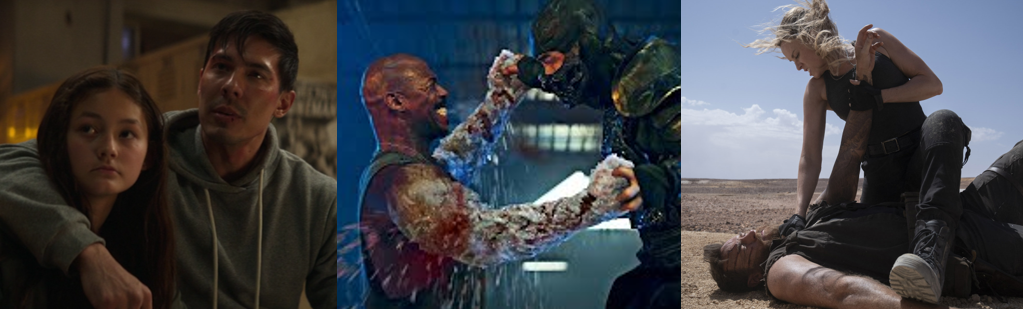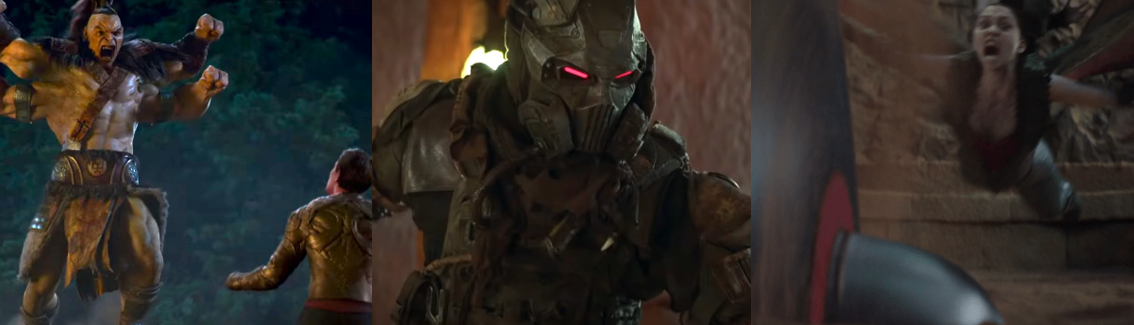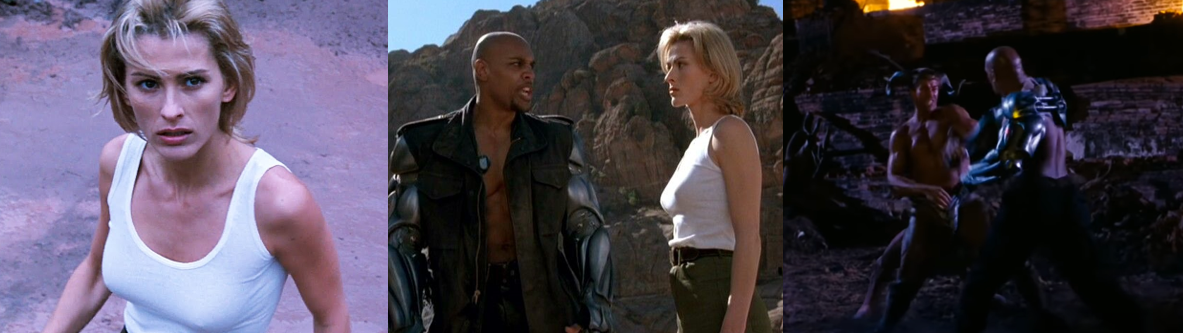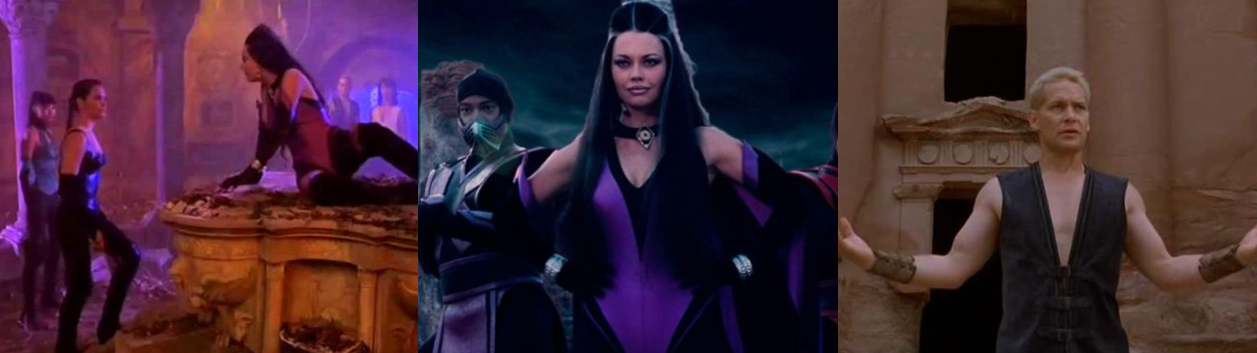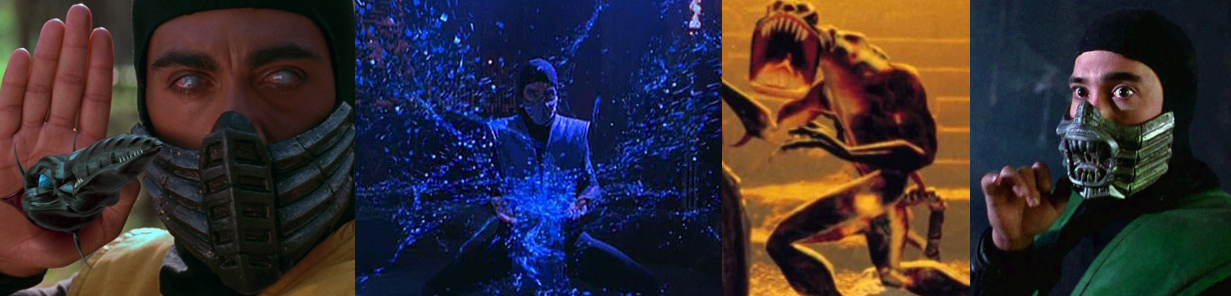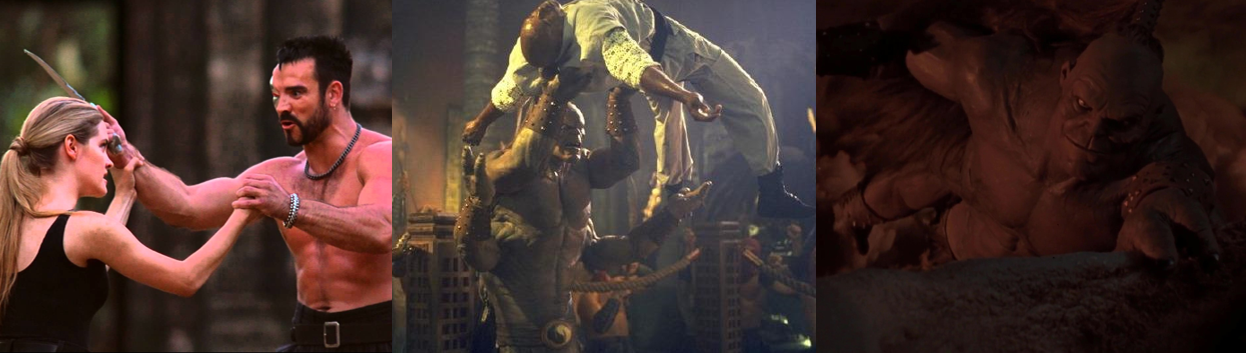
Screen Time [MK Day]: Mortal Kombat: Conquest: “Warrior Eternal” (E: 1/2)


This image has an empty alt attribute; its file name is mortalmonday.png

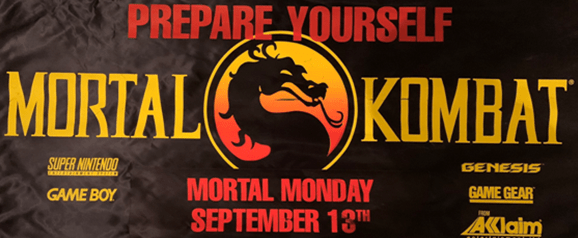
To celebrate the worldwide home console release of Mortal Kombat (Midway, 1992), 13 September 1993 was dubbed “Mortal Monday”. While I’m a day late this year, I always enjoy taking some time to celebrate this influential fighting series.


Episode 1 and 2: “Warrior Eternal”

Director: Oley Sassone
Air Date: 3 October 1998 and 10 October 1998
UK Network: Channel 4
Original Network: The WB Network / Turner Network Television (TNT)
Stars: Paolo Montalban, Daniel Bernhardt, Kristanna Loken, Bruce Locke, Jeff Meek, Chris Casamassa, and Jennifer Renton

The Background:
During the nineties, competitive fighting games took arcades by storm thanks to the many versions of Street Fighter II: The World Warrior (Capcom, 1991). Seeking to compete with Capcom, developers Ed Boon and John Tobias took inspiration from movies like Enter the Dragon (Clouse, 1973), Big Trouble in Little China (Carpenter, 1986), and Bloodsport (Arnold, 1988) to create an ultra-violent tournament fighter that changed the genre with its simple fighting mechanics and ultra-violent content. Development of a live-action Mortal Kombat began with producer Lawrence Kasanoff, who envisioned the venture as a multimedia franchise. Unfortunately, while he and director Paul W.S. Anderson delivered a surprisingly profitable cult hit, Mortal Kombats (ibid, 1995) reputation was tarnished by its laughably bad box office bomb of a sequel. However, Mortal Kombat: Annihilation (Leonetti, 1997) wasn’t the end of Kasanoff’s endeavours as this criminally under-rated and short-lived prequel series aired between 3 October 1998 and 22 May 1999. Though its schedule was often sporadic, Mortal Kombat: Conquest eventually followed episodes of World Championship Wrestling’s WCW Monday Nitro, resulting in cameos by WCW wrestlers, though the show ended on a frustrating cliff-hanger apparently due to its budget. Still, the series developed a cult following and was a spotlight for actors like Daniel Bernhardt and Kristanna Loken, some actors and sequences from the movies returned for the series, and Mortal Kombat: Conquest seems to have been subtly referenced in the franchise’s modern iterations.

The Plot:
Centauries ago, after safeguarding Earthrealm in a life-or-death tournament called “Mortal Kombat”, Kung Lao (Montalban) seeks a normal life with his love, Geneviere “Jen” Reyland (Renton). However, when fate and scorned sorcerer Shang Tsung (Locke) intervene, Kung Lao must team with an exiled guard and a thief to prepare for the next tournament.

The Review:
“Warrior Eternal” is the two-part pilot of Mortal Kombat: Conquest a prequel to the first two live-action movies that I watched diligently as a kid. We can tell right away that it’s a prequel not just because it’s set “centuries ago, in a time of darkness and fury” but because it presents younger versions of iconic Mortal Kombat characters Shang Tsung and Shao Kahn (Meek), Emperor of the all-conquering Outworld, but also liberally uses footage from those movies for establishing shots. Footage of Outworld and the Temple of Light establish this is the same continuity and, while they’re generally just random shots or short clips, it’s kind of fun to see shots of the Temple of Light repurposed here. It’s also clear that this is a prequel since we’re following the Great Kung Lao, distant ancestor of Liu Kang (Robin Shou), as he prepares to decide the fate of Earthrealm in the latest Mortal Kombat tournament. A humble man who’s been trained since birth to become the greatest Shaolin warrior, Kung Lao is described as the “best” Earthrealm has to offer and his mentor, the Thunder God Rayden (Meek), even says that, physically, no fighter can match him, a claim tested here and throughout the series. Naturally, Kung Lao is as aware of the realms and Mortal Kombat, and the otherworldly dangers of Outworld, as his fellow monks. While the city of Zhu Zin is close to the Temple of Light and many of its people are respectful of their monks and warriors, and even aware of Mortal Kombat, just as many remain ignorant and mock Kung Lao’s beliefs. Baron Reyland (John Reilly) is the embodiment of this, believing Kung Lao isn’t worthy of his daughter since the monk doesn’t place value in material or financial matters, showcasing that Kung Lao may be a knowledgeable warrior and deeply spiritual character, but he’s somewhat out of place with the world he fights so valiantly to protect.
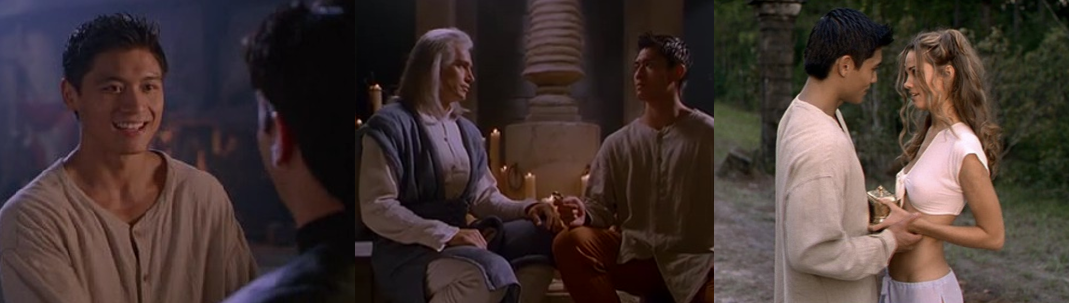
Friendly champion Kung Lao is torn between his destiny and his heart after a lifetime of combat.

Unlike Outworld’s forces, Kung Lao has no supernatural power and is simply at the peak of physical and spiritual ability. While he still has a lot to learn, his commitment to protecting his loved ones and his sheer force of will see him resist even Shang Tsung’s soul-stealing magic and push him to overcome even insurmountable odds. Yet, Kung Lao is often conflicted, doubting himself and his abilities, and initially rejects Rayden’s demands that he prepares the next generation of fighters to compete in Mortal Kombat. Kung Lao is haunted by visions of a disastrous future where his people (and Earthrealm) are slaughtered and he’s pummelled by a barely distinguishable CGI mess (presumably Goro). Despite these visions, Kung Lao resists his destiny to be with Jen, who’s apparently drawn to his belief that all life as sacred (even monsters like Shang Tsung), making him the opposite of her father. Kung Lao shows respect even to Shao Kahn and makes a point to take a higher path, being humble in his victory and even sparing Shang Tsung even though it comes back to bite him. Kung Lao is friendly to all, having befriended the baron’s guards, Takeda (Casamassa) and Siro (Bernhardt), and even stepping in to spare Taja (Loken). While Siro is incredibly overprotective of Jen, Kung Lao pacifies him with compliments but is obviously blinded by his love when he praises her playful sparring. This also sees Kung Lao lie to her regarding his visions since he wishes to shield her from such things. Kung Lao’s outraged when Baron Reyland denies his wish to marry Jen and resolves to abscond with her, hopeful to flee his nightmarish visions and be truly happy. However, he makes peace with the baron in his final moments but is annoyed for dismissing Rayden’s advice, and sparing Shang Tsung, when Jen’s life is endangered. Kung Lao’s understandably devested when Jen dies but finds solace in knowing she’s gone to a better place and in dedicating himself to training new fighters alongside Siro and Taja, just as Rayden encouraged.
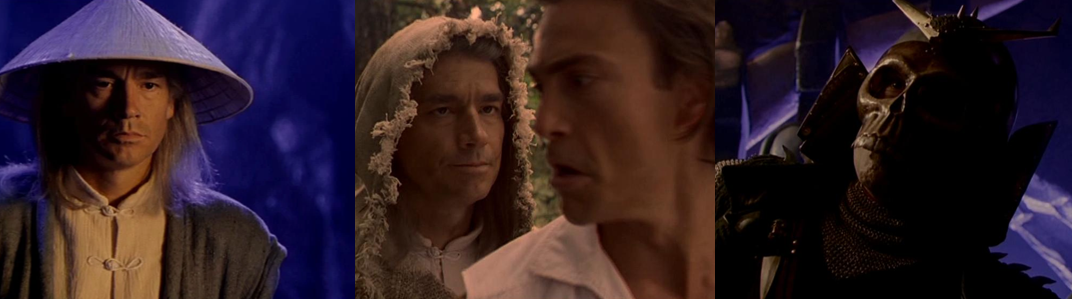
Meek impresses in his dual role as the wise-cracking Rayden and menacing Shao Kahn.

Like the movies, Rayden is presented as a mentor figure, while also giving a rundown on the Mortal Kombat tournament and the different realms that resembles the speeches his big-screen counterpart gave. Though he’s an aloof Thunder God with an odd sense of humour, Rayden directly oversaw Kung Lao’s training and gives him many pointers. However, Rayden is forbidden from directly interfering in mortal affairs, especially Mort Kombat, unless the unseen Elder God’s vaguely defined “rules” are broken, as the entire point is that mortals must defend their worlds. Often cryptic and mysterious, Rayden gives just enough hints, often pushing people where they need to be and surreptitiously manipulating them as required. Rayden sees things in very different terms to mortals, however, despite his clear love and affection for them. For him, it’s a simple choice of duty that Kung Lao accepts the responsibility of being Mortal Kombat champion and that the perks of being effectively immortal and serving the greater good outweigh fleeting love and friendships. Still, though exasperated with Kung Lao, Rayden understands his affection for Jen and helps point him find Scorpion by encouraging Kung Lao to figure out his visions. Jeff Meek pulls double duty as Shao Kahn, a menacing figure also handicapped by the Elder Gods’ rules since he cannot directly invade or attack Earthrealm without dire consequences. A master manipulator, shrewd warrior, and cunning strategist, Shao Kahn is constantly thinking up ways to bend or get around these rules, using hidden portals and third-party assassins and mercenaries and thus give Outworld the edge. Although not quite a petulant, childish figure like his movie counterpart, Shao Kahn is prone to fits of rage and mood swings that see him switch from morose and bored to spiteful and angered on a dime. Though he admires Shang Tsung’s ambition, Shao Kahn is a demanding, ruthless, and spiteful emperor, banishing Shang Tsung to the cobalt mines for his failure and deeply humiliated by Kung Lao’s victory.
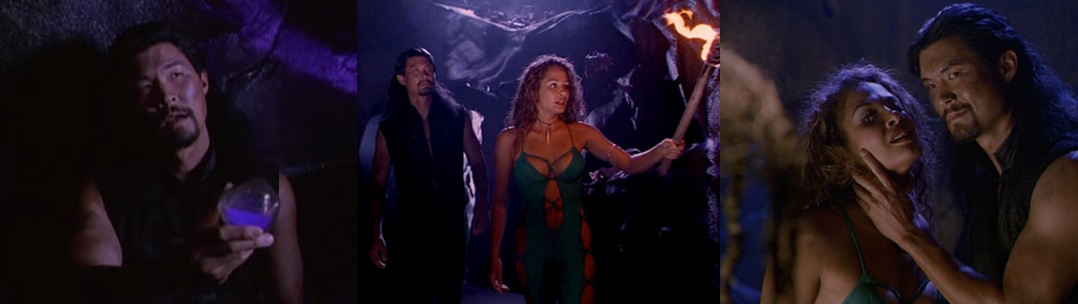
The humiliated Shang Tsung plots his revenge from the desolate cobalt mines.

However, in these first two episodes, Shao Kahn is merely a puppet master as he sets in motion many of the events and standards the series will follow. Shang Tsung stars as Shao Kahn’s loyal servant and greatest warrior, with aspirations of ruling alongside his emperor. However, he loses favour when he’s humbled and humiliated by Kung Lao, who shows him mercy, perhaps the greatest dishonour Shang Tsung could face. Shang Tsung’s disgrace and lust for revenge runs deep as he preyed upon Kung Lao’s insecurities and used his decades of fighting experience to put the Shaolin warrior on the ropes, only to be publicly defeated for the first time in who knows how long. Despite knowing Shao Kahn better than perhaps anyone, Shang Tsung begs for death rather than endure the constant torture inflicted upon him following his failure. Shao Kahn cruelly grants a reprieve by banishing the sorcerer to the cobalt mines, though the sorcerer’s powers aren’t negated there like the other inmates. While there, Shang Tsung aligns with the scheming Vorpax (Tracy Douglas), who’s immediately enticed by Shang Tsung, seeing him as a chance to escape. Although Shang Tsung is immune to her charms, asserting dominance over her, he’s convinced to bring her under his heel to get his revenge. Shang Tsung believes he’ll regain Shao Kahn’s favour if he kills Kung Lao and steals his soul. He thus uses black magic to bargain with the soul trapped within a scorpion and have it infect Takada, casting Scorpion as the first of many minions to target the Mortal Kombat champion.
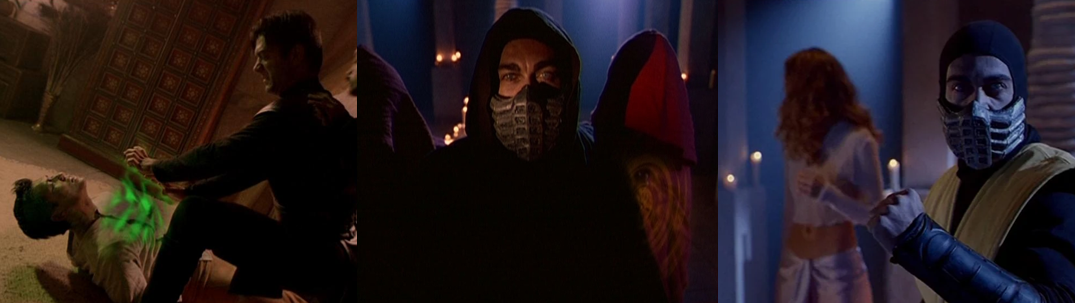
A radically different version of Scorpion steals the show with his malicious actions and fighting skill.

With Shao Kahn brooding in his palace and Shang Tsung confined to the cobalt mines, franchise favourite Scorpion acts as the primary antagonist here. Despite Mortal Kombat: Conquest set well before Hanzo Hasashi was born, it would’ve been folly not to include one of the most popular characters so the show dreams up a brand-new origin for Scorpion. To be fair, we never got any exposition about him in the films so it’s not really contradicting anything there. In this context, Scorpion was a deadly warrior confined to a real scorpion and stolen by Shao Kahn from a conquered realm. Thanks to Shang Tsung, Scorpion possesses Takada, one of the baron’s guards. While Takada was friendly with Kung Lao, he becomes a vindictive villain once consumed by Scorpion’s wicked demeanour. Mortal Kombat: Conquest gives Chris Casamassa a chance to flex his acting muscles alongside his physical ones, portraying Takada as a genial and loyal friend and Scorpion as a spiteful and cruel warrior. Sure, his line delivery is overly theatrical (“I’m going to kill you, Kung Lao” always makes me chuckle), but his fighting skills more than make up for it. Scorpion gains a new ability here to bring others under his sway, enchanting the Shaolin monks to give Siro and Taja someone to fight in the finale. Scorpion still has his snake-like spear-thing, which looks worse than ever and is easily dispatched by Kung Lao, though it’s okay as the Kung Lao/Scorpion fisticuffs are a highlight of these episodes. Scorpion even pulls off his teleport punch and creates ripples that impact the entire series – and Kung Lao’s life – by murdering Jen with a shitty looking fireball, returning to plague our heroes a few times despite inexplicably dropping into Hell (or the Netherrealm) upon defeat.
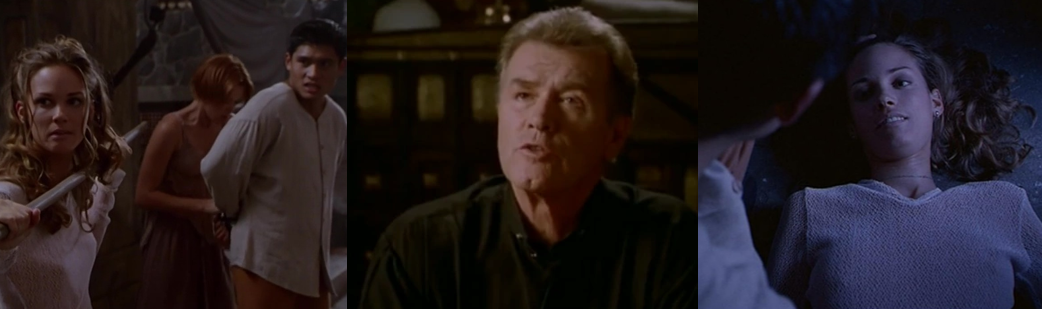
Despite her pretty face, the best thing Jen can do is die since she’s atrocious to watch.

If there’s a weak link in Mortal Kombat: Conquest, it is and has always been Jennifer Renton’s atrocious acting. Sure, she’s pretty enough but her delivery is robotic and impassionate and it’s legitimately painful whenever she’s on screen. Jen is extremely familiar with her bodyguard, Siro and Jen jumps at the chance to elope with Kung Lao for true happiness, which at least emphasises that she’s not as materialistic as her father. Jen surprisingly gets physical when she works with Taja to free Kung Lao and holds her father at spear-point, heartbroken at him forcing her to choose between the two men she loves. Jen’s recklessness costs her in the end, though, when she tries to interfere in Kung Lao’s fight with Scorpion and gets herself killed, ultimately gifting him the trading post to use as his base for the series. The greedy, cantankerous Baron Reyland operates from this central hub for trade and business in Zhu Zin, and cares only for profit and the power associated with money, believing his little empire to be more important than matters of life and death for the entire realm. When Kung Lao asks for his blessing, Baron Reyland treats the conversation like a trade dispute, criticising Kung Lao’s lack of financial prospects, despite being “well aware” of Mortal Kombat and its stakes. Baron Reyland demands Kung Lao abandon his faith or be forever denied access to his “property” (Jen), even threatening to have him executed if he persists. Thus, already angered at Siro’s betrayal and Jen’s rebelliousness, the baron praises Takada in apprehending Kung Lao and seemingly relishes ordering his execution. Baron Reyland is affronted when Jen and Taja save Kung Lao, disgusted and amazed at his daughter’s betrayal, but is offended when Takada employs sorcery to subdue Kung Lao. This proves to be the baron’s undoing as he’s impaled during the scuffle, though he makes amends with Kung Lao as he dies so…all’s well that ends well, I guess?
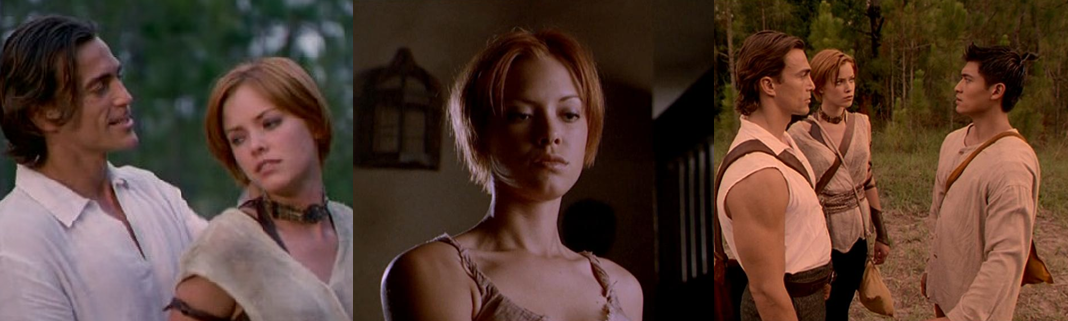
Although they get off on the wrong foot, the three protagonists eventually find common ground.

Finally, Kung Lao crosses paths with two characters who stick by him throughout the series: prideful and devoted bodyguard Siro and scrappy thief Taja. Siro is constantly at Jen’s side and, wishing only the best for her, allows her to leave with Kung Lao and humbly admits his betrayal to his master, taking his banishment despite the crippling blow to his pride and professional stature. An outspoken sceptic, Siro’s uncomfortable when visiting the Temple of Light with Jen and thus amazed when “Takada” leaps from the trading post without breaking his legs. Siro immediately gets off on the wrong foot with Taja when she and her cohorts attack him and Jen at the Temple of Light, with Siro easily besting the gorgeous thief and locking her up. However, Siro sets this aside following his encounter with Rayden and teams with Taja and Kung Lao to rescue Jen. Like Kung Lao, Siro is heartbroken at Jen’s death and despondent about his future before finding new meaning in aiding Kung Lao. Taja is equally cynical but more because of her harsh life stealing and fighting for survival. Defiant even when apprehended by Siro, Taja relies on her smart mouth when physically overpowered or shackled, visibly disgusted at being the baron’s slave and his advances towards her. When she learns of Kung Lao’s pending execution from an incognito Rayden, Taja’s compelled to intervene to ensure her own survival and out of gratitude for him sparing her life. Taja’s not afraid to fight dirty but pays her debts, quickly befriending Jen and showing regret at her harsh life and resorting to thievery, while also seeing it as the reality of her situation, confiding in Kung Lao that she dreams of the kind of luxuries Jen enjoys. Her insight into the baron’s dungeon serves Kung Lao well, as does her stealthier approach to situations as opposed to simply going in half-cocked. The experience changes Taja for the better, giving her an opportunity to do something useful with her life and, despite her doubts, she volunteers to aid Kung Lao in preparing for the next tournament.

The Summary:
I’ve always been a fan of Mortal Kombat: Conquest. It’s cheesy in just the right ways, with a lot of action and some fun reinterpretations of the videogame characters and their lore. Having said that, these aren’t the best episodes of the short-lived series. This makes sense in a way as they’re primarily designed to establish the characters, the show, and its format: Shao Kahn is a looming threat, Shang Tsung plunders the mine for new opportunities for revenge, and our three protagonists face constant battles both to gel as a team and define their destinies. This is all nicely laid out here but there are also some oddities. Kung Lao successfully defends Earthrealm and is charged with preparing for the next tournament, which isn’t for a “generation” (approximately twenty and thirty years). The Elder Gods decree that Kung Lao won’t age, but does that extend to his allies? I guess so, but I feel like the series might’ve benefited from taking place building to the next tournament. Kung Lao questions why Rayden can’t teach the new fighters and this is a great point as Rayden himself states that he’s guided Kung Lao’s training, and Kung Lao was trained to become as good as he is by the Order of Light, so all he really has to offer is first-hand insight into fighting Outworld’s forces, something I’m sure others could impart. Still, while Zhu Zin is obviously a set, it’s always bustling with extras thanks to being a market town and the restricted space is masqueraded (or, at least, justified) quite well. Also, although the violence of the videogames is again severely toned down, there’s still a fair bit of death and danger here. While this is largely embodied by Shang Tsung and Scorpion, who reduce people to ash or murder them with fireballs, Kung Lao’s not to be trifled with either as he’s not above killing when necessary.
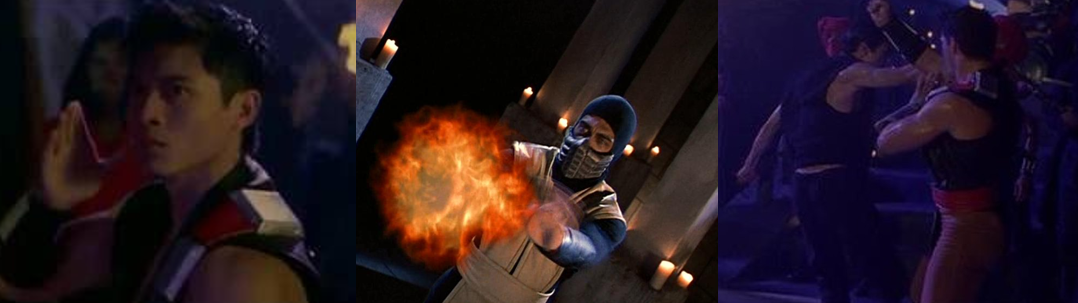
Despite some dodgy CGI, the visual references and impressive fights help the show stand out.

Regardless, Mortal Kombat: Conquest also evokes the movies with its intro sequence and the techno-beat soundtrack that punctuates each fight, and by including some interesting references the source material. Costume design remains as accurate to the videogames as in the first movie. Though it’s disappointing Kung Lao only dons his Mortal Kombat II (Midway, 1993) look for a brief scene and Rayden also ditches his iconic hat, I liked Rayden’s robes, Scorpion looks exactly as he did in the first movie, and Shang Tsung closely resembles his Mortal Kombat II appearance. It honestly doesn’t and wouldn’t make sense for Kung Lao to don that outfit anyway as that’s what his successor wore, but it would’ve been nice to mix up Kung Lao’s wardrobe by bringing it back, especially as they went to the trouble of making it. Shao Kahn veers towards cosplay at times, perhaps explaining why he only wears his helmet for one scene. He cuts an intimidating figure (even more so considering it’s Meek in a dual role) and I like the shattered skull mask he wears, but he can look a little goofy at times. Outworld is expanded to include Shao Kahn’s cold and empty throne room and the dingy cobalt mines, which rob anyone not from Earth of their supernatural powers. Jeff Meek shines as Rayden, channelling Christopher Lambert’s playful spirit of and marrying it with the demeanour of an exhausted teacher. While he admires human spirit and encourages free will, Rayden impresses the importance of preparing for the next tournament upon Kung Lao and, when he insists on defining his own destiny, Rayden assumes the guise of a beggar to manipulate Siro and Taja into helping Kung Lao escape from Baron Reyland. Rayden knows exactly how to manipulate Siro, questioning his integrity and insulting his pride to push him back to Zhu Zin to aid Kung Lao. Bruce Locke equally steals the show by channelling Cary-Hiroyuki Tagawa’s energy and menace to present Shang Tsung is a ruthless and vicious fighter who delights in stealing souls and is consumed with the need to avenge himself.
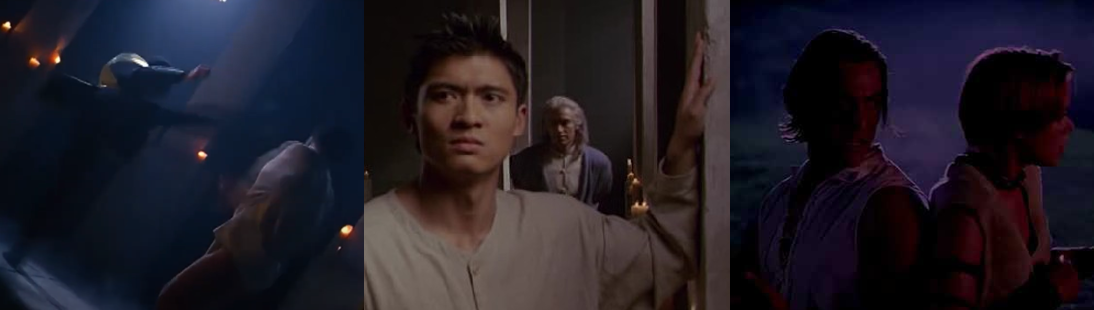
The ambitious fights counterbalance some cheesy moments and drama to lay the foundation for the show.

While the visual effects are often cartoonish, they’re clearly secondary to more traditional displays of martial arts and stunt work. Although the actors partake in each episode’s fights as much as possible, with Bruce Locke and Daniel Bernhardt putting in more of the work (thanks, largely to the latter’s unique stature and legitimate martial arts background), obvious stunt doubles are used for each fight, with Kristanna Loken noticeably being supplanted. While it’s jarring to edit close ups of the actors to sell the illusion, the fights are very well choreographed, with Christopher Leps, Marcus Young, J.J. Perry, and others bringing a grace and tactile believability to each. The battle between Kung Lao and Shang Tsung reflects the animosity between the two, with Shang Tsung growing increasingly frustrated and Kung Lao exuding the speed and precision that made him Earthrealm’s finest. Even when saddled with perhaps the fakest sword I’ve ever seen, Daniel Bernhardt shines, largely because you recognise that the actor is performing many of his stunts and fights. Siro isn’t as slick and graceful as Kung Lao but exudes physical power, having great reach with his kicks (his flying kick being particularly impressive), even if he is out of his depth against more otherworldly opponents. Though she lacks Kung Lao’s skill and Siro’s raw power, Taja is a scrappy fighter who uses underhanded tactics and is seemingly fearless. Kung Lao’s battles with Scorpion are an obvious highlight, with Casamassa bringing an aggression to Scorpion that paints him as a force to be reckoned with, even more so when tossing his snake-like appendage about (not a euphemism). It’s good that the action is so impressive as the drama between Kung Lao and Jen really drags these episodes down, largely because they lack chemistry and Renton’s awful performance. The sting of these scenes is eased by Meek’s theatrical performance as Shao Kahn, his dry sense of humour as Rayden, and a fun energy to the episodes. I got the sense everyone was having a good time and trying their best to start something, and the framework is definitely here, it would just take a few episodes to be as good as it could be.

My Rating:

Rating: 3 out of 5.

Pretty Good

Were you a fan of Mortal Kombat: Conquest back in the day? If so, what did you think to these first two episodes? Do you think I was too harsh on Jennifer Renton or do you agree that she was terrible? Which of the three main characters was your favourite and did you enjoy their chemistry? Were you surprised that Jeff Meek played two roles? What did you think of Scorpion’s new origin? Would you like to see a revival of Mortal Kombat: Conquest, or a new TVG show? How are you celebrating Mortal Kombat today? Whatever you think about Mortal Kombat: Conquest, leave a comment below, go check out my other Mortal Kombat content, and sign up to my Ko-Fi to suggest other Mortal Kombat: Conquest episodes for me to cover.

Movie Night [MK Day]: Mortal Kombat (2021)


This image has an empty alt attribute; its file name is mortalmonday.png

To celebrate the simultaneous worldwide release of Mortal Kombat (Midway, 1992) on home consoles, 13 September 1993 was dubbed “Mortal Monday”. Mortal Kombat’s move to home consoles impacted not only the ongoing “Console War” between SEGA and Nintendo but also videogames forever thanks to its controversial violence. Thus, it’s only fitting that we continue celebrating this influential fighting series every September 13th…except this year that clashes with Friday the 13th so…


Released: 23 April 2021
Director: Simon McQuoid
Distributor: Warner Bros. Pictures
Budget: $55 million
Stars: Lewis Tan, Jessica McNamee, Josh Lawson, Joe Taslim, Mehcad Brooks, Tadanobu Asano, and Chin Han

The Plot:
Struggling fighter Cole Young (Tan) is targeted by the relentless Bi-Han/Sub-Zero (Taslim), an assassin working under orders by the malevolent sorcerer Shang Tsung (Han) to kill Earthrealm’s chosen warriors before they can compete in the ages-old martial arts tournament known as Mortal Kombat.

The Background:
Inspired by the success of Street Fighter II: The World Warrior (Capcom, 1991), developers Ed Boon and John Tobias used innovative digitised sprites to unleash Mortal Kombat upon impressionable gamers. Attracting both popularity and controversy for its bloody content and gruesome “Fatalities”, Mortal Kombat soon expanded its scope not just with additional videogames but also into mainstream media thanks, largely, to catching the eye of producer Lawrence Kasanoff. Kasanoff envisioned a multimedia venture for the franchise and initially got off to a great start with the first live-action adaptation. Mortal Kombat (Anderson, 1995) became a cult hit that’s still one of the most highly regarded videogame adaptations ever made. Unfortunately, this success didn’t pan out quite as Kasanoff originally planned. A universally panned sequel was followed by lukewarm television ventures and talks of a third film evaporated into Development Hell. After the series made a dramatic comeback following Midway’s bankruptcy, hopes for a new Mortal Kombat movie were raised through the web series helmed by Kevin Tancharoen. Although he never got to direct a big screen adaptation, Tancharoen’s efforts were picked up by producer James Wan, writer Greg Russo, and director Simon McQuoid, with the trio determined to bring the franchise’s gory violence to life in all its glory. Despite long-running rumours of the original movie’s cast returning for another film, this new Mortal Kombat featured an all-new cast and attracted early controversy for creating a new audience surrogate and its poor use of Goro, now a disappointing CGI creature rather than a traditional effect. While the film’s $84.4 million box office made it a mild success, reviews were somewhat mixed. The fights and gore were praised but the characters, acting, and plot all drew criticism. Yet, despite it not living up to the standards set by the 1995 film, Mortal Kombat delivered some stellar fight scenes between the franchise’s most popular characters and was successful enough to warrant a 2025 sequel.

The Review:
I’ve always enjoyed the original Mortal Kombat movie. Even now, it’s still my favourite live-action adaptation of a videogame, to the point where I wrote an entire chapter of my PhD thesis about the film and its infamous legacy! I waited eagerly for the follow-up, only to be met with a surreal, nonsensical bombardment of noise and mess that basically killed the franchise dead. Even the relatively enjoyable television ventures couldn’t undo the damage, and Mortal Kombat was left to fester for years as fans waited for news of a third film or an all-out reboot. Those dreams were almost answered by Kevin Tancharoen, whose online videos showed a certain promise, but Warner Bros. randomly decided to go in a different direction and sign-off on this reboot instead. From the first trailers, things looked somewhat promising by focusing on bloody combat, the franchise’s trademark Fatalities, and with much of the marketing revolving around fan favourite ninjas Hanzo Hasashi/Scorpion (Sanada) and Sub-Zero. Indeed, Mortal Kombat immediately makes up for the character assassination these icons received under the direction of Paul W.S. Anderson by opening in 17th century Japan and depicting the wholesale slaughter of Hasahi’s ninja clan, the Shirai Ryu, at the hands of Bi-Han and his own ninja assassins, the Lin Kuei. Hasashi, an honourable family man who lives a relatively peaceful life tending to the land with his wife, Harumi (Yukiko Shinohara), and young son, Satoshi “Jubei” Hasashi (Ren Miyagawa), and infant daughter (Mia Hall). However, when his family and clan are threatened, Hasashi becomes a force to be reckoned with, making use of a digging trowel as a makeshift kunai to oppose the assassins, only to realise all-too-late that the attack was merely a distraction so the sadistic Bi-Han could leave Harumi and Jubei little more than ice sculptures for the grief-stricken Hasashi to find. 

A strong opening soon gives way to an audience surrogate no-one asked for.

Naturally, a fierce battle ensues between the two rivals that sees Bi-Han’s face permanently scarred and Hasashi stabbed and killed by his own weapon, condemning his soul of the hellish Netherrealm, ending his bloodline, and leaving the Lin Kuei victorious. Well…not quite, for Hasashi’s baby survived and was recovered by Raiden (Asano), God of Thunder and protector of Earthrealm, since it was foretold that the “blood of a Hasashi” would unite Earth’s champions against the realm-conquering Outworld. Honestly, Mortal Kombat might’ve fared better if the entirety of its runtime was built around the Hasashi/Bi-Han rivalry, taking place in the past and including select appearances from other prominent franchise characters. Instead, the story jumps ahead to 2021, a time when Outworld has won nine out of ten Mortal Kombat tournaments and needs just one more victory to legally invade our world. They have succeeded in this endeavour thanks to the unmatched sorcery and deceitful nature of Outworld representative Shang Tsung, an enigmatic man who uses any means at his disposal (including bending the sacred rules of the tournament) to preemptively target those destined to fight against Outworld. Thus, any Earthrealmer bearing a dragon-shaped birthmark is targeted by Shang Tsung’s lead assassin, Bi-Han, now clad in armour and taking the name Sub-Zero, who presumably retains his youth and vigour thanks to the sorcerer’s influence. Sub-Zero’s latest target is Cole Young, a down-on-his luck mixed martial artist who’s struggling with self-doubt and to make a career out of his skills to provide for his family, wife Allison (Laura Brent) and daughter Emily (Matilda Kimber). Once a champion fighter, Cole has been reduced to taking $200 fights to put food on the table and is thus incredulous when Jax shows up inquiring about his unique dragon mark. 

Cole is amazed when he’s drawn into a world of supernatural violence.

Cole is drawing into the crazy world of Mortal Kombat when Sub-Zero attacks him and his family at dinner, and it’s only the intervention of Jax that allows the Asano to escape. While Cole follows Jax’s instructions to meet with his partner, Sonya Blade (McNamee), Jax ends up mutilated when he battles Sub-Zero to cover Cole’s escape. Hopelessly outmatched despite his size and power, Jax has his arms frozen and shattered by the cruel cyromancer. Unlike Cole, and the other chosen warriors, Sonya does not carry a dragon mark, which is a source of great distress for her and something adversarial mercenary Kano (Lawson) and even Raiden mock her for. However, Sonya is acutely aware of Mortal Kombat, the threat against Earth, and the bizarre individuals associated with it. While Cole is sceptical, despite witnessing Sub-Zero’s abilities, his cynicism is quashed when another of Shang Tsung’s assassins, the voracious Syzoth/Reptile, who viciously attacks Sonya’s hideout. Since he’s her only chance to track down Raiden’s hidden temple, Sonya is forced to free Kano to assist in the fight. Although his face is mauled by the beast, Kano circumnavigates Reptile’s camouflage by stabbing him with a flare and proves his viciousness by tearing the Saurian’s heart out. While he’s a crude, crass, antagonistic criminal who can’t be trusted, Sonya is forced to bribe Kano with money she doesn’t have and he reluctantly joins the group, and the allies they find there, delighting in lording his superiority, verbally tearing them down, and excited at the prospect of gaining superpowers under Liu Kang’s (Lin) tutelage. Similar to Tancharoen’s previous adaptation, Mortal Kombat explains the videogames’ special moves not just in explicitly bestowing them to Shang Tsung’s demonic forces but in the concept of “Arcana”,  abilities unique to those with the dragon mark. Since she doesn’t have a mark, Sonya can’t unlock her power but is permitted to stay and help train the others, giving Kano ample opportunity to rile her up, though Cole also struggles to unlock his Arcana despite his efforts.

Raiden is unimpressed by Earthrealm’s chosen fighters.

Protected from Shang Tsung’s assassins by Raiden’s mystical barrier, Cole, Sonya, and Kano train alongside warrior monks Liu Kang and Kung Lao (Max Huang), who also tend to Jax’s wounds and furnish him with a rudimentary set of cybernetic arms. Like Cole, Jax is frustrated by his newfound handicap, but Liu Kang and Kung Lao strive to push them all to unlock their true potential to defend Earthrealm. Staunch believers in Raiden’s cause, Liu Kang and Kung Lao have already unlocked their Arcanas, demonstrating incredible abilities such as fireballs and teleportation, and Kung Lao also utilises his iconic razor-sharp hat. Although Liu Kang is sympathetic to their confusion, time is against the would-be champions and he and his fellow Shaolin repeatedly subject the group to intense sparring sessions to push their bodies and minds to the absolute limit. Unfortunately for them, the only one who achieves this is Kano who, angered by “Kung Pow’s” dismissive attitude towards him, suddenly fires lasers from his injured eye. Far from the wise, playful mentor of previous adaptations, this version of Raiden is a blunt deity. Indeed, he’s so disappointed by the fighters and Cole’s progress that he regularly runs them down and even out-right dismissing Cole when, after revealing his lineage as Hasashi’s ancestor, he expresses displeasure that the struggling fighter didn’t live up to the expectations set by his forefather. When returned to his family, however, Cole finally unlocks his Arcana to defend them from Prince Goro (Angus Sampson), a four-armed Shokan who attempts to kill them and is instead torn to pieces when Cole spontaneously grows organic armour that allows him to absorb any attack, grow tonfas to attack with, and grants him superhuman strength. 

Outworld’s monstrous forces meet gruesome ends at the hands of our heroes.

Galvanised by his awakened abilities and his victory over Goro, Cole reunites with his allies, now shaken following Kano’s betrayal. After a discussion with former ally Kabal (Daniel Nelson/Damon Herriman), Kano is convinced to betray Raiden, lowering the shield and allowing Shang Tsung’s assassins to attack. In the fracas, Jax unlocks his Arcana to save Sonya, upgrading his gaunt metal arms to more formidable appendages, but Kung Lao is lost when Shang Tsung steals his soul. Retreating to a void between realms to regroup, Cole shares a plan to target Shang Tsung’s warriors individually before teaming up to tackle Sub-Zero, their greatest threat, together. Like the original movie, Shang Tsung’s minions are given very little characterisation outside of two exceptions, Sub-Zero and Kabal. It’s genuinely upsetting seeing Goro reduced to an easily-dispatched underling and that more time wasn’t spent making Nitara (Mel Jarnson), Mileena (Sisi Stringer), and Reiko (Nathan Jones) more than lifeless minions for the good guys to fight. It seems the filmmakers were banking on Nitara’s and Mileena’s sex appeal (and the former’s unique, if poorly realised, vampiric abilities) and Reiko’s gargantuan stature to make up for this, but it doesn’t really work and it’s hard to care when they’re defeated, however gory it is, making me wish that Goro had taken Reiko’s place. Thankfully, Kabal somewhat makes up for this. He and Kano have the same snarky demeanour and Kabal has an awesome look, but we learn very little about their time together in the Black Dragon Clan and it’s weird that Liu Kang believed killing Kabal avenged Kung Lao’s death when Shang Tsung dealt the finishing blow. Similarly, Chin Han is as miscast as the sorcerer as Tadanobu Asano is as Raiden; neither can hold a candle to their predecessors or even their television counterparts and, while Han tries to exude an authoritative menace, both are very weak and forgettable in their roles. 

The Nitty-Gritty:
Similar to the much-maligned Mortal Kombat: Annihilation, faith in yourself and teamwork are core themes of this new Mortal Kombat. Much of Cole’s characterisation comes from his declining martial arts career; he went from a champion to a chump and he struggles with feelings of inadequacy and self-doubt, despite having a caring and supportive family behind him. It’s this, as much as his scepticism, that holds him back while training, and these issues are only compounded when Raiden literally tells him he was destined for more and has failed to accomplish even half of his potential. It’s thus telling that Cole’s Arcana awakens when he’s defending his loved ones, but it’s hard to deny that Cole’s bland and completely unnecessary character. The Mortal Kombat franchise has one of the biggest and most diverse rosters in all its genre but the filmmakers created a brand-new audience surrogate when Johnny Cage would’ve fulfilled this role just as well. Hell, it would only have taken a couple of slight tweaks to have Cage assume Cole’s role, and all the hints towards Cage’s future involvement can’t make up for his absence here. Cole’s struggles are echoed in both Jax and Sonya, who both face an uphill battle to overcome either their physical limitations or their lack of an official brand to contribute to Earthrealm’s defence, something they ultimately accomplish when forced to go beyond their limits to save their friends or avenge their losses. 

This adaptation is much more faithful to the violent nature of the source material.

While the first Mortal Kombat unquestionably captured the spirit of the source material, smartly drawing from martial arts cinema to focus more on memorable characters and fights than the trademark gore, this Mortal Kombat clearly draws from NetherRealm’s modern titles and even explicitly recreates Kung Lao’s infamous “Razor’s Edge” Fatality by having him slice Nitara in two with his hat! Similarly, Jax crushes Reiko’s head and Liu Kang conjures a flaming dragon to take out Kabal, just like in the videogames, and of course there’s Kano’s classic heart rip Fatality, which are all suitably gruesome and give the film an entertaining edge since it’s the first time we’ve seen such explicit gore in an official live-action adaptation of the famous franchise. Similarly, the film is full of cursing, with Kano clearly channelling the late Trevor Goddard into his performance as the bombastic and outrageous Kano to steal the show like his predecessor did with his rude quips and abrasive attitude. I do enjoy these more adult aspects of the film and, in many ways, they make it a superior and more faithful adaptation than the original film, but all the blood and swearing in the world can’t make up for bland characters and uninspiring acting. Say what you will about the original’s tame content but at least the main cast was charismatic and embodied their roles. I like the performances from Liu Kang and Kung Lao here but they show up so late into the story and we learn so little about them that it’s difficult to be too attached to them. Raiden is an unlikeable jackass, most of Shang Tsung’s underlings are disposable baddies to be offed, and once again Sonya fails to impress as a bad-ass female protagonist, coming across more like a spare part since she isn’t even a chosen warrior. It’s as though the filmmakers did the opposite of the original film, focusing on gore and spectacle over character and heart, meaning it also falls short of being a definitive adaptation and can’t even rely on a memorable soundtrack to get by since the remix of “Techno Syndrome” isn’t used as prominently as in the original film. 

The film’s bookended by the best parts and limp’s to an uninspired finish.

Mortal Kombat tries to claw back some credibility in the finale when, after dispatching Shang Tsung’s dull minions and finally granting Sonya an Arcana and a dragon mark when she kills Kano, Cole is drawn into a confrontation with Sub-Zero after he kidnaps Allison and Emily. Unfortunately, even with his organic armour, Cole is no match for the cold-blooded assassin. Luckily, however, Raiden gifted Cole his ancestor’s kunai, which returns Hasashi from the Netherrealm as the vengeful Scorpion. Thus, the film comes full circle as the two most popular characters battle once more, completely stealing the thunder from Cole and making all the time spent with the other characters largely superfluous. If Johnny Cage wasn’t going to be used in Cole’s place, Cole could’ve at least been a reincarnation of Hasashi or have been transformed into Scorpion by the Arcana or the kunai. Instead, Cole’s left freeing his family and watching from the sidelines as his ancestor avenges himself on his killer in a bloody battle that’s easily the best of the film. Again, this is why these two should’ve been the primary focus. If you’re not going to do the tournament anyway, you may as well focus on the two most interesting characters in the franchise, and Taslim and Sanada excel in their kinetic, brutal fight scenes. In this rematch, the two are far more equally matched and Scorpion takes his revenge, immolating the injured assassin alive. Strangely there’s a moment of sympathy for Sub-Zero that, like Shang Tsung’s throwaway line regarding the resurrection of his fallen forces, is potentially a hint at his return in the next instalment, possibly as Noob Saibot. In the aftermath, Hasashi charges Cole with protecting their bloodline and returns to the Netherrealm. As Shang Tsung threatened to bring an entire army to their door, the galvanised Cole readily accepts Raiden’s offer to find and train new warriors and heads out to recruit movie star Johnny Cage (Unseen) to the cause. 

The Summary:
I was pretty excited about Mortal Kombat at the time. I’d wanted to see a new adaptation for years and truly believed the original movie could be outdone if the filmmakers drew inspiration from it as much as the modern videogames. Obviously, nostalgia is a huge factor in the original’s appeal. Truthfully, it has many flaws that go beyond its tame nature, but it’s still an enjoyable action film, primarily because of the cast and execution. This Mortal Kombat stumbles somewhat in this aspect, predominantly because of its bland and unnecessary main character. Lewis Tan may have a good look and fight well, but he’s not much of an actor and it’s hard to be invested in Cole since I spent the entire time wondering why he’s even there. His Arcana wasn’t that great, either, and I’m not sure I liked this concept, while I’m on the subject. It worked as a goal for the characters to strive towards, but I honestly think it’s better to have the mortal warriors have to overcome fantastic abilities rather than giving everyone superpowers. The gore and Fatalities were great, as were many of the fight scenes and action sequences, and I enjoyed how closely these aspects mirrored the videogames. Sadly, this is juxtaposed with lacklustre version of Shang Tsung (because it’s hard to improve upon Cary-Hiroyuki Tagawa), an unlikeable rendition of Raiden, and a bizarrely unimpressive Goro who not only goes out like an idiot but is an awful CGI monstrosity. Indeed, for every aspect that works here, there’s two or three things that don’t, making this enjoyable enough but far from an improvement over the original film. It’s a shame as there’s a lot of potential here, and I’m sure viewers unfamiliar with the original movie will find a lot to like in this version. However, it missed the mark in a lot of ways for me, primarily in overcomplicating and overstuffing the narrative, making it a bit of a mess at times. 

My Rating:

Rating: 3 out of 5.

Pretty Good

Did you enjoy Mortal Kombat? What did you think to Cole Young; was he an interesting enough protagonist for you or did you find him a bit bland? Would you have preferred to see Johnny Cage in his role? What did you think to the blood, Fatalities, and fights? Were you also disappointed by the depiction of Raiden, Shang Tsung, and the underling villains? Would you have preferred to see Scorpion and Sub-Zero be the primary focus? Which Mortal Kombat characters would you like to see featured in a future film? How are you celebrating Mortal Kombat today? Whatever your thoughts, leave a comment below or on my social media and be sure to check out my other Mortal Kombat content across the site. 

Movie Night [MK Day]: Mortal Kombat: Annihilation


This image has an empty alt attribute; its file name is mortalmonday.png

To celebrate the simultaneous worldwide release of Mortal Kombat (Midway, 1992) on home consoles, 13 September 1993 was dubbed “Mortal Monday”. Mortal Kombat’s move to home consoles impacted not only the ongoing “Console War” between SEGA and Nintendo but also videogames forever thanks to its controversial violence and I think that it’s only fitting that we continue celebrating this influential fighting series every September 13th.


Released: 21 September 1997
Director: John R. Leonetti
Distributor: New Line Cinema
Budget: $30 million
Stars: Robin Shou, Talisa Soto, Brian Thompson, James Remar, Sandra Hess, Lynn Red Williams, Musetta Vander, and Reiner Schöne

The Plot:
Despite Liu Kang’s (Shou) victory in the Mortal Kombat tournament, Outworld emperor Shao Kahn (Thompson) bends the Elder Gods’ sacred rules and assaults Earthrealm. With Lord Rayden (Remar) weakened, Liu Kang and his friends have seven days to recruit new allies and learn the key to stopping Kahn’s invasion before all of Earthrealm is annihilated.

The Background:
As I’ve touched on before, competitive fighting games were all the rage in the nineties thanks to the many iterations of Street Fighter II: The World Warrior (Capcom, 1991). To compete with this title, developers Ed Boon and John Tobias, inspired by movies like Enter the Dragon (Clouse, 1973), Bloodsport (Arnold, 1988), and Big Trouble in Little China (Carpenter, 1986), created a tournament fighter that changed the genre thanks to its ultra-violent content. It was producer Lawrence Kasanoff who saw Mortal Kombat’s potential as a multimedia franchise and it was thanks to him, and director Paul W. S. Anderson, that we got the cult hit Mortal Kombat (ibid, 1995), which was both surprisingly profitable, widely recognised as one of the best videogame adaptations, and a principal influence on my PhD thesis. Unfortunately, you can’t talk about Mortal Kombat without mentioning its universally derided sequel. Rather than smartly infuse the relatively simply videogame lore with filmic inspirations, Kasanoff aimed to go bigger and more spectacular, stuffing the script with as many characters and references to the source material as possible in an effort to cater exclusively to Mortal Kombat’s growing fanbase. Paul W. S. Anderson passed on the director’s chair and only two members of the original cast returned for the sequel, which was full of cringe-worthy performances and terribly rendered CGI as New Line Cinema didn’t actually release the finished version of the film. This was reflected in the film’s dismal $51.3 million box office gross and scathing critical reception; everything from the confused narrative, underwhelming fight scenes, and the laughably bad acting has been highlighted as a negative, and rightfully so. Despite the film’s universally negative reception, Kasanoff’s multimedia ventures continued with the live-action prequel, Mortal Kombat: Conquest (1998 and 1999) but, while New Line Cinema initially had plans for a third film, the teases for it were cut from Annihilation and it remained in Development Hell for decades until the franchise was finally rebooted in 2021.

The Review:
I was such a huge fan of the original Mortal Kombat movie as a kid, and even now I still regard it as probably the best live-action videogame adaptation ever made. That’s hard for me to say as I loathe what Anderson did to the Resident Evil franchise (Capcom/Various, 1996 to present) with his filmic endeavours (Anderson/Various, 2002 to 2016) but it’s true; I remember renting it as a kid, basing an entire birthday around watching it, and even the day I bought the VHS copy from a market stall. My anticipation for the sequel was so high and it seemed like we were waiting for so long for it to come out but, in reality, it was only a couple of years. When Mortal Kombat: Annihilation finally did come out, all I remember seeing of it was the poster and that was enough to get me excited as I was eager to see that cliff-hanger ending resolved, but I missed out on seeing it at the cinema as it wasn’t very easy to get to the cinema at the time, so I didn’t see it until it came out on VHS some time later. I don’t remember what I thought to the film as a kid; I was probably just super happy to see all my favourite Mortal Kombat characters brought to life and given more screen time, but I do have a vague memory of thinking it wasn’t as good as the original film and, as I’ve gotten older and rewatched and even academically studied the film, that opinion has only grown stronger.

Things are off to a bad start right from the opening and only get worse from there….

Mortal Kombat: Annihilation opens with a quick recap of the last film; scenes of Mortal Kombat’s best fights and memorable moments (purposely cut to excise the original actors from the footage) play over Rayden’s narration as he brings us up to speed and we’re brought back to the ending of the first movie, but with some noticeable and jarring changes. You’ll spot these immediately since James Remar sounds nothing like Christopher Lambert (still the quintessential Raiden for me and it baffles me that he hasn’t done more voice work for the character, at least) and definitely doesn’t look anything like him. Sporting an entirely new outfit and a far more obvious wig, Remar fails to convey the same enigmatic presence as his predecessor but it doesn’t end there; Liu Kang is also wearing a completely different outfit and both Johnny Cage (Chris Conrad) and Lieutenant Sonya Blade (Hess) have been completely recast. Even more egregious is that Cage has his trademark sunglasses back, despite the fact they were crushed by the monstrous Goro (Tom Woodruff, Jr./Kevin Michael Richardson) in a pretty memorable sequence in the last film. Still, none of that really compares to the absolutely atrocious visual effects slashing across the sky and the arrival of Outworld Emperor Shao Kahn. Originally portrayed as a gigantic semi-translucent, monstrous figure voiced by the immortal Frank Welker and bursting from the Temple of Light, Kahn is now a far less intimidating muscular brute garbed in a Halloween costume and surrounded by a gaggle of porn stars, Gladiators, and cos-players and immediately lacks all of the subtle menace and nuance of Cary-Hiroyuki Tagawa’s menacing Shang Tsung.

Liu Kang must go on a bizarre quest to rescue Kitana and find the power to defeat Shao Kahn.

Still, let’s continue on. Like the last film, our main character is Liu Kang (thankfully still portrayed by the endlessly likeable and charismatic Robin Shou, whose martial arts prowess is one of Annihilation’s few highlights even if his acting ability isn’t quite enough to carry this mess of a script), whose elation at having overcome his personal demons, avenged his brother, and safeguarded Earthrealm from Outworld is immediately cut short by Shao Kahn’s arrival. Although he learned to trust in Rayden in the last film, and that all the legends he grew up hearing about were true, despite his scepticism, Liu Kang is angered that their victory, which the Elder Gods decreed would keep Earthrealm safe from invasion for at least one generation, was all for nothing thanks to Shao Kahn finding a loophole in the rules. Liu Kang’s anger only increases when Cage is unceremoniously killed right before his eyes, and his first instinct is to avenge his fallen friend, only to be told that he’s “no match for Kahn” and must embark on a perilous journey of self-discovery to find the power necessary to overcome the Emperor. Rayden splits the heroes into teams for this mission, and Liu Kang’s demeanour (but not his crotch) is softened by the presence of the beautiful Kitana (Soto), with whom he had a flirtatious romance in the last film. Here, they are ready to take the next step in their relationship, but this is suddenly ripped away from Liu Kang when the Edenian princess is kidnapped by the returning Scorpion (J. J. Perry/Ed Boon). Fraught with guilt over failing to keep her safe, Liu Kang is guided towards the elusive Nightwolf (Litefoot), a Native American mystic who endeavours to teach him to harness his “Animality” by undergoing a series of tests designed to focus his mind, body, and spirit for his inevitable fight against Shao Kahn.

Sonya, angry at Cage’s death, reluctantly teams with Jax, the charismatic everyman with bionic arms!

Although she has a new face, wardrobe, and haircut, the first thing you’ll notice about Sonya here is that she’s reverted back to being an angry, embittered, distrustful, and overall unlikeable character. She’s absolutely devastated when Cage is murdered and desperate to make Shao Kahn pay, but blinded by her grief and rage so Rayden has her journey to some facility to reunite with her partner, Major Jackson “Jax” Briggs (Lynn red Williams). Initially, Sonya rejects this idea as she doesn’t want to lose anyone else she cares about, and she carries a chip on her shoulder throughout the film and basically has to learn the same lessons about trusting others as she did in the first movie. While Mortal Kombat: Annihilation is littered with chaotic and random fight scenes, at least Liu Kang and Rayden are focused on opposing Shao Kahn; Sonya has no chance against the Emperor but has no other clear antagonist to focus on since Kano (Trevor Goddard) is dead, meaning she’s forced to settle for “leftovers” like Cyrax (J. J. Perry) and Ermac (John Medlen). Thankfully, she’s partnered up with Jax; for a former American Football player and Gladiator, Williams does a really good job in this role and has a down-to-earth, relatable charisma to him. As an everyman character who has no idea what’s going on, he’s a natural conduit for exposition and it’s fun seeing him react to the bizarre events happening all around him. Jax’s “thing” in this movie is that he struggles with self-confidence; to that end, he underwent a surgical procedure to graft cybernetic prosthetics to his already muscular arms to give him a power boost. Jax’s arms are a valuable asset, saving his life and even allowing him to cause shockwaves by hitting the ground, but Rayden and the others teach him that they’re merely a tool and that his true power comes from within. Unlike Sonya, Jax ends up squaring off with a clear rival in the finale, the half-human centaur Motaro (Deron McBee) and, in the process, overcomes his insecurities and sheds his mechanical arms to deliver a pretty cathartic beatdown on Kahn’s monstrous minion.

The plot revolves around Kitana and Sindel, but the actors struggle to convey this drama.

While she was mostly relegated to an alluring figure and a secondary mentor in the first film, Kitana takes on a much larger role in the sequel. Although she only gets a couple of fight scenes and ends up locked in a cage for her man to come and rescue her, Kitana is right at the forefront of the plot since her mother, Queen Sindel (Vander), is the key to Shao Kahn’s illegal invasion. Stunned to find her mother alive (and in perfect physical health), Kitana is even more heartbroken to find that Sindel has been corrupted by Kahn’s influence and that her resurrection has allowed him to bring destruction to Earthrealm. Confused by this turn of events, Rayden consults with the Elder Gods who advise him that the love Kitana has for her mother can break Kahn’s spell, restore her, and undo the damage caused and he blindly follows their instructions, even sacrificing his status as a Thunder God (and debuting an absolutely dreadful new appearance in the process that is anything but Raiden) in order to reunite the two. Unfortunately, they’ve all been duped by the corrupt Elder God Shinnok (Schöne) and lured into a trap; Sindel laughs in her daughter’s face when she tries to profess her love for her and Rayden is left powerless, resulting in his death at Kahn’s hands and Kitana having to battle her mother in the finale. Unfortunately, neither Talisa Soto nor Musetta Vander have the acting ability to pull any of this off; both are obviously stunningly beautiful, but Kitana and Liu Kang have all the chemistry of a wet paper bag and Sindel is little more than a cackling pantomime villain. Remar also suffers in this regard; if he’s trying to channel Lambert’s stoic playfulness, he fails miserably and just seems bored and confused, even during his terribly shot fight against the Reptiles (Mark Caso, Paul Driver, and Sultan Uddin).

Though he cuts an intimidating figure, Shao Kahn is simply trying to please his overbearing father.

However, they’re all Oscar-winning actors compared to the absolutely dreadful Brian Thompson. I actually like Thompson; he always plays big, brutish thugs really well when he crops up in supporting roles but he has neither the size nor the charisma to impress as Annihilation’s lead antagonist. Essentially coming across as a poor man’s Kurgan (Clancy Brown; a fitting comparison, for sure), Shao Kahn is a loud, arrogant bully with an overdeveloped sense of grandeur and a taste of pomp and ceremony. Upon arriving on Earthrealm, he attempts to establish himself as a meaningful threat by surrounding himself with his generals and killing Cage, but is easily outmatched by Rayden. Indeed, Rayden is only stopped from killing Kahn right then and there because the Emperor takes Cage as a hostage, and Rayden is so stunned to see one of his chosen mortals killed that he doesn’t even make good on his promise to “take” Kahn’s generals from him. While the heroes go off on their confusing missions, Kahn returns to his throne room and is content to allow the seven-day merger of Outworld and Earthrealm to take place without his direct involvement. However, if his cheap plastic armour and rubbish skull helmet didn’t diminish Kahn’s threat enough, his contentious relationship with his father, Shinnok, certainly does. Chastised at every turn by the corrupt Elder God, Kahn quickly turns from a brutish tyrant to a meek child desperate to impress his father, and he absurdly takes his anger out on his generals at every opportunity. Even this doesn’t make sense; why kill your underlings when you’re in the middle of an invasion? And Kahn’s lashing out at Rain for failing to kill Kabal and Stryker is super weird considering Shinnok chewed him out for sparing Rayden. Imagine if Shinnok had just killed Kahn for that, as he does his general? Absolutely ridiculous! Completely devoted to his witch-like queen and confidant in his victory, Kahn allows his troops to wreak havoc across the globe (though we barely see any of this) and is fixated only on killing Rayden and conquering Earthrealm in order to earn his father’s respect. Where Shang Tsung was a scheming, charismatic sorcerer, Shao Kahn is little more than a thug with delusions of grandeur and it’s hard to picture anyone bending the knee to him since he exhibits little of the threat that Tsung did beyond his admittedly impressive physical stature.

The Nitty-Gritty:
Contrary to my usual everyday mindset, I don’t actually like to be too negative in my reviews, or when watching movies or playing videogames or whatever, and when discussing Mortal Kombat: Annihilation for my PhD thesis I tried to come at it with a positive perspective. Primarily, this involved praising it for capturing the madcap nonsense of the franchise’s latter-day releases, like Ultimate Mortal Kombat 3 (Midway Games, 1995) and its successor, Mortal Kombat Trilogy (ibid, 1996). These were fighters crammed full of characters, bonkers finishing moves, and which tried to mash together all the established lore and many of the contradictory characters, which made for a pretty chaotic gaming experience but one full of variety (even if many characters were just palette swaps and many of the violent finishing moves were pretty lazy). Still, if all you cared about was seeing your favourite Mortal Kombat characters in one game, these two titles had you covered and, in that respect, Mortal Kombat: Annihilation delivers in terms of fan service. The plot is also a pretty close approximation of Mortal Kombat 3’s (Midway, 1995), which depicted Kahn resurrecting Sindel and leading an illegal invasion of Earthrealm, and the iconic theme song by The Immortals is back and has even been tweaked to include the new characters seen in this film. Unfortunately, that’s about where the praise ends for, while Mortal Kombat: Annihilation does feature a bunch of characters, hardly any of them have any personality or nuance to them. Instead, basically every character that isn’t a lead protagonist or antagonist is treated as badly as Scorpion (Chris Casamassa) and Sub-Zero (François Petit) were in the first film. Rain (Tyrone Wiggins) is here, and even gets a few lines, but is he a conflicted Edenian prince with control of water and lightning? No, he’s just another ninja who gets smashed into a fiery pit for angering his master.

Almost every Mortal Kombat character is shoe-horned into the film whether it makes sense or not.

An extremely poor rendition of Baraka (Dennis Keiffer) randomly shows up, looking more like a guy in a rubbery Halloween costume than a vicious mutated cannibal, and Mileena (Dana Hee) even makes a brief appearance to wrestle around in the mud with Sonya but is she depicted as Kitana’s bloodthirsty clone or stepsister? Is she bollocks. Hell, Sonya even mistakes her for Kitana at first, which makes absolutely no sense as she doesn’t look anything like Kitana; maybe if she’d also been played by Talisa Soto, and Jade (Irina Pantaeva) and Baraka had been dropped from the script, Mileena could’ve played a bigger role but, as is, she’s just some hot chick in a magenta outfit for Sonya to fumble around with. This even carries over to the finale, when Sonya takes on Ermac (who has just one line and isn’t even named), who randomly splits into two (actually this is Noob Saibot (J. J. Perry), who also isn’t named and is given no context) to double-team her but why the hell should we care when we don’t even know who these masked morons are? Still, at least these losers feature onscreen; “two of Earth’s warriors, Kabal and Stryker” aren’t even given that luxury and this absolutely ugly looking CGI monstrosity gets way more screen time than it deserves. Sadly, this continues with some of my favourite Mortal Kombat characters. Sub-Zero (Keith Cooke) makes a dramatic return, now sporting his bad-ass eye scar and actually being the younger brother of the previous one. He comes sliding in to save Liu Kang from Smoke (Ridley Tsui), who’s actually a combination of Smoke and Sektor, and deliver some clunky exposition about how the cyborg was reprogrammed by Kahn to target Liu instead of him (as in Sub-Zero). Why was Smoke going after Sub-Zero? Does he have any relation to Cyrax? Was he Sub-Zero’s former friend turned into a cyborg against his will and did Sub-Zero even care that he just killed his friend? None of these questions are answered as the film pauses for a pretty awesome battle between Sub-Zero and Scorpion which, despite being something I and many Mortal Kombat fans missed from the first film, also makes little sense as there’s no reason given in the film for the animosity between the two beyond the filmic Scorpion being evil and Sub-Zero trying to protect Kitana. Even crazier is the part where, after losing Kitana to Scorpion, Sub-Zero delivers a heartfelt plea to Liu Kang that “[he] alone [is] not ready for what’s ahead” and then disappears from the film! I just…what?! You just said that Liu Kang needs allies but you couldn’t stick around to help? What could Sub-Zero possibly have to do that’s more important?!

Many of the characters are just there for the sake of it and make very little impact as a result.

This does lead Liu Kang to Nightwolf, but he’s another throwaway character; sure, he looks the part but all he does is speak in riddles, knock Liu Kang out with a tomahawk, and prattle on some trite about his “Animality”. It’s assumed that Jade killed Nightwolf while Liu Kang underwent his little nightmare sequence but who the hell knows, and why the fuck where there suddenly Reptiles waiting to attack the heroes after Jade betrayed them?! Nothing makes any sense, and it’s frustrating as all they had to do was have Kahn’s minions be Motaro, Sindel, Scorpion, Mileena, and Sheeva (Marjean Holden) and things could’ve been much more streamlined. Oh, Jesus…I haven’t even talked about Sheeva, have I? Rather than portray her using animatronics like with Goro, Sheeva is simply another pantomime villain with some prosthetic arms who plays next to no role in the movie and is unceremoniously killed off without even having a proper fight scene! There’s one very brief scene where she and Motaro get into it over who should replace Rain as Kahn’s right-hand man, hinting at the rivalry between their races, but Sheeva may as well not even be in the fuckin’ movie as she does absolutely nothing before being squashed by a cage! Motaro comes off a little better, but not by much; Deron McBee at least looks to be enjoying himself in the role, which requires little more than for him to stand around with his flex on and look tough, and the filmmakers actually did a decent job of rendering his horse-like lower half using clever shots, some practical effects, and CGI. He certainly comes off a lot better than whatever the fuck that demonic monster-thing is, and absolutely should have taken that creature’s place, but unfortunately has absolutely none of the screen presence or importance of Goro since he’s hardly in the movie and only seen as a relevant factor in the finale.

Liu Kang is ultimately able to best Shao Kahn and save Earthrealm once again.

So…okay….Mortal Kombat: Annihilation decides that the complex and bonkers lore of the videogame just isn’t enough for the big-screen and makes some changes. I can understand that; change is inevitable in the adaptation process, but apparently the simple concept of “good versus evil” wasn’t enough for this movie and they had to shoe-horn in this bat-shit crazy familial link between Rayden, Shao Kahn, and Shinnok that has never been seen before or since. Apparently, Rayden and Shao Kahn are brothers and, eons ago, they fought for Shinnok’s approval; Rayden won, but couldn’t kill his brother and both have held a grudge ever since. Shinnok sees both his sons as being weak; Rayden for valuing life and being compassionate and Kahn for not killing Rayden or being more forceful in his endeavours, but he favours Shao Kahn since he at least values strength and power over loyalty and empathy. This weird inclusion is treated like a big deal; Jax is especially perturbed by the revelation and the mortals are left investing their hopes in Liu Kang since Rayden’s trustworthiness is called into question. The film then asks that we give two shits when Shao Kahn murders this abomination of an adaptation of Rayden, but it all just falls completely flat and is meaningless since the entire film has been about getting Liu Kang ready to fight Kahn, not Rayden. When Liu Kang and the Emperor finally square off, it’s nowhere near the intense or engaging martial arts contest like Liu vs. Tsung; indeed, the focus on delivering high quality martial arts is noticeably lacking all throughout Mortal Kombat: Annihilation and, instead, Shao Kahn throws his weight (but not his hammer, because that would be too cool, I guess) around until Liu Kang finally taps into his Animality and transforms into, hands down, the worst CGI effect I think I have ever seen…only for Kahn to top it with his own monstrous transformation. The two butt-ugly affronts to eyesight slap each other about a bit before inexplicably transforming back and being forced to battle in Mortal Kombat (now altered to remove Kahn’s powers, something we didn’t see in the last film where powers were fair game…). The loss of his powers puts Kahn at an immediate and irreconcilable disadvantage and Liu Kang easily finishes him off; although Kahn is ripped apart when his stupid little dragon tattoo bursts to life upon his defeat, his death is a far cry from seeing Tsung impaled on those spikes. With Kahn defeated and Shinnok turned into Tetris (Alexey Pajitnov, 1984) blocks, Sindel returns to normal, Rayden is resurrected and promoted to an Elder God, and all of Earthrealm is restored. In fact, everything returns to normal…except for Johnny Cage, whose body I assume is just lying on the ground somewhere…but that’s okay because all of the heroes are some bullshit family now, I guess.

The Summary:
Mortal Kombat set the standard for videogame adaptations; by drawing from some of the best martial arts movies and focusing on the relationships between the characters and crafting a fun, action-packed fantasy adventure, it absolutely delivered as an entertaining adaptation even without the franchise’s trademark gore. All of that goodwill was obliterated in the sequel, which took everything that worked in the first film and threw it out the window. No, sorry, not out the window; they threw it right in the fuckin’ bin! The only saving graces are the soundtrack, a handful of decent fight scenes (anything involving Liu Kang, Scorpion, and Sub-Zero), and seeing pretty much every single Mortal Kombat character brought to life but the execution misses the mark on almost every level. The acting is bad, the script is bad, the line delivery is bad; the new actors are dreadful, the costumes (while technically better) look far more like cheap cos-play than a high-budget production, and the CGI is more than atrocious…it’s God-awful! As nonsensical as the Mortal Kombat videogames could get at the time (and even now…), nothing makes sense in Mortal Kombat: Annihilation; why were those spheres in those tunnels? Who built them? Why? Why didn’t they just die when riding them? When Baraka falls into those flames, why is it recycled footage of Rain’s death? Why is Baraka even there? Why didn’t Sub-Zero help Liu Kang? Why did Rayden and presumably all those other lives lost in the attempted merger come back to life but not Johnny Cage? Just….I mean, holy God it is hard to defend this movie! Yes, Robin Shou is great. Yes, seeing Scorpion and Sub-Zero fight is great. Yes, Jax is a standout character, Motaro looks pretty good, and the film does a decent job of translating the bat-shit insanity of Mortal Kombat Trilogy to the screen but there’s just no heart, no logic, no sense to anything. It’s just a mish-mash of generally poor fight scenes, rubbish visual effects, appalling acting and a mind fuck of ideas and visuals that more resembles a music video than a coherent movie. It’s got some charm, and is probably appealing to kids hyped up on sugar, but your life would probably benefit from never watching this one even if it was for free.

My Rating:

Rating: 1 out of 5.

Terrible

Am I being too harsh on Mortal Kombat: Annihilation? Do you have any fond memories of this film? What did you think to the new cast and how did they compare to their predecessors? Which of the film’s fights was your favourite, and with characters would you have liked to see more from? Do you think the film juggled its many characters well or would you have preferred to see the cast cut down a little bit? Would you have liked to see a direct follow-up to this film or were you happy with the reboot we got? How are you celebrating Mortal Kombat’s release today? Whatever you think about Mortal Kombat: Annihilation, write your thoughts below.

Movie Night [MK Day]: Mortal Kombat (1995)


This image has an empty alt attribute; its file name is mortalmonday.png

To celebrate the simultaneous worldwide release of Mortal Kombat (Midway, 1992) on home consoles, 13 September 1993 was dubbed “Mortal Monday”. Mortal Kombat’s move to home consoles impacted not only the ongoing “Console War” between SEGA and Nintendo but also videogames forever thanks to its controversial violence and I think that it’s only fitting that we continue celebrating this influential fighting series every September 13th.


Released: 18 August 1995
Director: Paul W. S. Anderson
Distributor: New Line Cinema
Budget: $18 million
Stars: Robin Shou, Linden Ashby, Bridgette Wilson, Cary-Hiroyuki Tagawa, Trevor Goddard, Talisa Soto, and Christopher Lambert

The Plot:
To decide the fate of Earthrealm, warriors fight in a generational life-or-death tournament called “Mortal Kombat”, hosted by Outworld sorcerer Shang Tsung (Tagawa). Lord Rayden (Lambert), God of Thunder and protector of Earthrealm, gathers his forces but his chosen champions, disillusioned former monk Liu Kang (Shou), egotistical movie star Johnny Cage (Ashby), and stubborn soldier Lieutenant Sonya Blade (Wilson) must first overcome their own demons before they can hope to save their world.

The Background:
I’ve already detailed how, during the nineties, competitive fighting games were all the rage thanks to the many iterations of Street Fighter II: The World Warrior (Capcom, 1991). To compete with this title, developers Ed Boon and John Tobias took inspiration from movies like Enter the Dragon (Clouse, 1973), Bloodsport (Arnold, 1988) and Big Trouble in Little China (Carpenter, 1986) to create an ultra-violent tournament fighter that changed the genre with its simple fighting mechanics and controversial violence. Development of a live-action adaptation began with producer Lawrence Kasanoff, who saw the potential of the videogame not just as a live-action movie but as an entire multimedia franchise. Spearheaded by Kasanoff, the project took shape with the hiring of director Paul W. S. Anderson, who substituted the videogame’s brutal violence for a focus on the game’s more fantastical elements and martial arts. Although the filmmakers failed to secure Jean-Claude Van Damme for the film, they incorporated both ambitious animatronics and early CGI effects alongside Shou’s martial arts background to make the fights as engaging as possible to help bolster the special effects. Mortal Kombat was a smash hit, making over $122 million at the box office. While videogame adaptations are often criticised for being universally bad, Mortal Kombat was notably praised at the time and has gone on to break free of its cult following to be largely regarded as one of the best videogame adaptations. The film and its depictions of these characters came to be incredibly influential on the videogames and, while the sequel was a monumental flop, the original film has always been one of my favourites, so much so that I dedicated an entire year of my life to researching and studying it as part of my PhD thesis.

The Review:
I mentioned up top that Ed Boon and John Tobias were influenced by martial arts films like Enter the Dragon and action films like Big Trouble in Little China when developing Mortal Kombat, but this is honestly just scratching the surface of the influence of kung fu and martial arts movies on not just Mortal Kombat but the entire fighting game genre as we know it today. Martial arts (or wu xia pian) films been produced overseas since 1905, with kung fu movies being around since 1949, but became incredibly popular between the early-sixties through to the 1970s once Bruce Lee was introduced to the world in Five Fingers of Death/King Boxer (Chung, 1972). Bruce Lee’s skill, charisma, and heavily kinetic energy was the perfect platform for this new style of cinematic combat that emphasised realistic action and application of martial arts. Lee famously multiple martial arts styles into his trans-cultural Jeet Kune Do style that showcased the best of Chinese martial arts, and Enter the Dragon not only reinvented him as an introspective Shaolin monk who could instantly become a lethal whirlwind but it was also engineered as a showcase of Lee’s unparalleled charisma and unique choreography. Lee became a national (and international) sensation after the film’s success, but tragically died six days before Enter the Dragon’s U.S. premiere, and has “haunted” martial arts films for decades as producers and filmmakers both perverted his legacy by awkwardly using limited footage of him and presenting it as new and attempting to substitute him with lookalikes and replacements.

Enter the Dragon had a profound influence on the Mortal Kombat games and movie.

The most obvious link between the fighting videogames and martial arts films is their inclination towards tournament structures, which allows fights to be staged onscreen not merely for our viewing pleasure but as necessary narrative components. These battles become a literal “game of death” based around increasingly-difficult fights between diverse characters, and related the two mediums in their ability to instill an intense excitement in the viewer (and/or player) through the gratification (or humiliation) of the fight. The film’s influence on the fighting game genre couldn’t be more explicit in the first two Street Fighter games; the plots are essentially the same (evil mastermind hosts a fighting tournament) and characters (such as Ryu, Ken, Geki, and Balrog/Vega) owe their design and personalities to those seen in the film. However, it’s in the Mortal Kombat movie that we see the most direct influences of the film, and fittingly so; there’s something poetic about Enter the Dragon influencing the Mortal Kombat videogame and the Mortal Kombat adaptation turning to Lee’s popular martial arts classic for inspiration. Indeed, I’ve long argued that Mortal Kombat is essentially a remake of Enter the Dragon: a host of martial artists (including three distinct main characters) are drawn to a mysterious island to fight in a tournament and battle an aging madman. Despite their different levels of knowledge and skill, and their conflicting personalities, they bond and are faced with tougher and tougher opponents until the righteous monk ends the antagonist’s threat in one-on-one combat skewed in the bad guy’s favour. The structure of the narrative and fight scenes are all very reminiscent of Enter the Dragon, but made all the more unique through the steady introduction of Mortal Kombat’s more fantastical elements; these are introduced to us slowly throughout the film, and explained in a way that both we and our sceptical main characters can understand them. While this means that we don’t get to see many of the superhuman and mystical special moves of the videogames, it does help to keep the focus on the characters and the film’s impressive fight scenes.

Tormented by guilt and self-doubt, Liu Kang’s greatest enemy is himself.

Although Mortal Kombat has three main protagonists, it’s fundamentally Liu Kang’s story; the pure-hearted hero of the franchise since game one, Liu Kang is presented as a disenchanted and doubt-ridden former Shaolin monk who rejected his upbringing at the Temple of Light in favour of the bright lights and excitement of the United States. Having been raised with full knowledge of the Mortal Kombat tournament, Liu Kang believes that the legends of Outworld are little more than nonsense fairytales designed to indoctrinate and brainwash the Order’s pupils. Indeed, while his grandfather (Lloyd Kino) fully believes in the tournament and pays reverence to Lord Rayden, Liu Kang angrily rejects the stories and questions Rayden’s legitimacy out of anger since he believes that the Order’s teachings were directly responsible for the death of his younger brother, Chan (Steven Ho). Crucially, Liu Kang enters the tournament not to defend Earthrealm but to avenge his brother’s death and is stunned to learn that not only is Rayden truly the God of Thunder but all of the legends he grew up with about Outworld are true; he quickly turns from a sceptic to a source of exposition for his new allies, but remains haunted by his doubts regarding his destiny. Rayden claims that Liu Kang fled the temple because he couldn’t handle the responsibility that comes from being the “Chosen One” and Liu Kang struggles with his heritage as he’s the descendant of the Great Kung Lao, a martial artist who secured Earthrealm’s fate generations ago. As a result, Liu Kang’s greatest enemy is not the array of fantastical and monstrous fighters placed in his path by Shang Tsung, it is himself and his character arc involves learning to overcome his doubts and embrace his destiny as the saviour of Earthrealm.

The egotistical Johnny Cage sees to prove himself and provides much of the comic relief.

As charismatic and likeable as Liu Kang is, however, it’s the egotistical showboat Johnny Cage who steals the show at every opportunity. Played to perfection by Linden Ashby, Cage is an arrogant braggart and something of a diva when on set, but his failings as a character come from a deep-seated frustration at being labelled a fake by the press and media. In actual fact, Cage is one of the greatest martial artists in the world and the tournament gives him the opportunity to prove that on the grandest and greatest stage possible; desperate to be taken seriously as a fighter, he willingly makes the journey and remains oblivious to the tournament’s true purpose. Cage acts as the film’s comic relief and every line and character beat of his lands perfectly (his assumption that Liu Kang is a porter is hilarious, as is his struggles with his luggage upon arriving on the island, and he’s never a moment away from a witty retort); while Ashby is far from the accomplished martial artist like Shou, he holds his own in fight scenes and is presented in a way that plays into his strengths, which helps make Cage a very grounded and realistic character. Instantly taking a shine to Sonya, Cage tries and fails to win her over with his boastful character but soon forms a real bond with her, and Liu Kang, based on their shared sense of awe at the scale of the tournament. While Cage goes out of his way to protect Sonya out of a mixture of chivalry and confidence, his character arc is specifically geared towards accepting his limitations and his abilities; rather than rushing head-first into battle to prove himself a legitimate fighter, Cage must learn to use his head and plan ahead, something that he accomplishes when he’s able to outwit and outmatch the lumbering man-mountain that is Goro (Tom Woodruff Jr./Kevin Michael Richardson/Frank Welker).

Sonya is obsessed with her vendetta against Kano and is forced to learn to rely on others for help.

Finally, there’s Sonya Blade; a strict and focused soldier, Sonya is a grim and stoic young woman whose military drive has been superseded by a bloodthirsty vendetta against Kano (Goddard), the unscrupulous criminal who murdered her partner. Sonya has become so razor-focused on pursing Kano, that she ignores the warnings of her partner, “Jaxx” (Gregory McKinney), and boards Shang Tsung’s boat to apprehend her target. Accordingly, Sonya has no clue about what’s really going on and is incredulous to the advances of Shang Tsung and the supernatural events happening around her; of the three, she’s the most cynical and dismissive of the tournament’s true purpose and she remains obsessed with bringing Kano to justice even after learning of Mortal Kombat’s true nature and the legitimacy of its mystical elements. Initially, Sonya pursues Shang Tsung to get closer to Kano and is reluctant to join forces with Liu Kang and Johnny Cage; her character arc revolves around her being afraid to trust others, which goes a long way to explain her prickly demeanour as she makes a conscious effort to push others way to avoid losing someone she cares about, like her partner. This pays off in the finale, where she’s reduced to a mere hostage and is forced to rely on her newfound friends to come for her since she’s no match for Shang Tsung.

The enigmatic Shang Tsung has some formidable and sadistic minions at his disposal.

Speaking of whom, Cary-Hiroyuki Tagawa makes for a truly fearsome and enigmatic villain; Shang Tsung commands the screen whenever he appears with his presentation, charisma, line delivery, and tangible magnetism. Shang Tsung is presented as a cold, sadistic threat; despite appearing to be a middle-aged man, he’s described as being “far more dangerous” than even the fearsome Goro since he can literally steal souls at will. An alluring and cruel villain, Shang Tsung delights in witnessing his forces triumph over Rayden’s chosen warriors and exudes authority and menace simply by being present in a scene or with a few ominous words. His unsettlingly sexual perversion towards Sonya and vehement hatred of Liu Kang only add to his disturbing aura and, while he bends and manipulates events to avoid fighting Liu Kang, he proves himself to be every bit the formidable opponent in the finale thanks to his centuries of experience and the power and knowledge of the souls he has absorbed. Similarly, Trevor Goddard clearly threw everything he had into making Kano an absolutely reprehensible villain who makes a distinctive impression thanks to his guttural grunts, faux Australian accent, and sadistic mean streak that forever changed Kano’s portrayal in the videogames. Both villains convey so much personality and menace whenever they’re onscreen and through their sheer demeanour and a few lines of dialogue; we get a glimpse into Kano’s background but his callous mean streak and attitude help make him a surprisingly well-rounded character and elevate Kano beyond a mere one-dimensional henchman. Both Shang Tsung and his chief champion, Goro, are seeped in mystery and menace; each one are pawns of the ominous Emperor (voiced by Frank Welker) but are significant physical threats in their own right and there’s a real sense of desperation behind them as they’ve never been so close to absolute victory before and are determined to please their Emperor by besting Rayden’s warriors.

Our heroes meet a number of cryptic, ill-fated, and beautiful allies in their quest to save their world.

Like Tagawa, Lambert perfectly embodies Rayden and his portrayal of Rayden forever changed the Thunder God from a destructive deity who is blasé about destroying life into a wise and benevolent mentor figure; Lambert’s distinctive, rasping voice makes for a strangely ominous character who exudes an absolute confidence thanks to his status as a God. Rayden offers both cryptic council to the protagonists and exposits information about the tournament and the plot that is necessary for them (and us, the audience) to hear but it’s never laborious to sit through thanks to Rayden having a cackling, mocking sense of humour that makes for some truly amusing moments. Johnny Cage meets a fan and makes a fast friend in bit-player Art Lean (Kenneth Edwards), an original character who mainly exists simply to fuel Cage’s animosity towards Goro, and Liu Kang becomes enamoured by the alluring and mysterious Princess Kitana (Soto). Though not really asked to do more than be beautiful and captivating, Kitana plays a pivotal role in delivering another layer of exposition to the protagonists about Outworld and helping facilitate Liu Kang’s larger character arc, and the character is an interesting shade of grey in a film of extreme black and white since she’s technically allied with Outworld but is secretly plotting to aid Earthrealm since the Emperor destroyed her realm.

Despite some dodgy CGI and being reduced to minions, the three ninjas remain a highlight of the film.

The deck is definitely stacked against our heroes, though, as they are also faced with a couple of menacing ninjas, Sub-Zero (François Petit) and Scorpion (Chris Casamassa/Ed Boon), two largely mute henchmen whom Shang Tsung has made into mindless slaves with his power. As a big fan of both characters, I am understandably disappointed that their famous rivalry is entirely absent from the film and Mortal Kombat definitely set an annoying precedent for Scorpion being portrayed as a purely evil character (when, in actuality, he’s either neutral or the more virtuous of the two), but as a kid I had absolutely no complaints at all about how the two were portrayed because they stole every scene they were in. Both characters represent how dire the stakes are for our more recognisably human characters; Sub-Zero is able to summon ice and freeze opponents in an instant and Scorpion can send out a deadly, serpent-like tentacle at will and, while these effects haven’t aged too well (and it’s still really weird that Scorpion’s roped kunai was interpreted as a living extension of himself), they clearly define these characters as being otherworldly and a danger that is far beyond a simple martial arts contest. Compounding matters further is the presence of Reptile (Keith Cooke/Frank Welker), an absolutely ugly CGI monster that stalks Kitana (and our heroes) at every turn from the shadows; Reptile is constantly seen following the protagonists while cloaked but proves to be every bit as daunting an opponent as his videogame counterpart when he’s tossed into a corpse and takes physical form. Again, this is a very strange interpretation of the character, but my God does it make for an awesome fight scene between him and Liu Kang! Bolstered by Traci Lords’ incredible techno beat, “Control”, this fight represents Liu Kang’s final hurdle on the road to Shang Tsung and, when placed alongside the battles and scene-stealing, ominous presence of his similarly-attire cohorts, goes a long way to making the masked ninjas an undeniable highlight of the film even if it’s true that they were the most changed by the adaptation process.

The Nitty-Gritty:
One of the many ways Mortal Kombat has earned its reputation as one of the best videogame adaptations is in the fantastic and pulse-pounding techno-inspired soundtrack; the Immortals’ iconic title theme remains one of the best and most memorable theme songs of all time and I’m honestly disappointed that it hasn’t been evoked in the videogames more often. Many of the film’s characterisations and environments would eventually make their way into the videogames and other Mortal Kombat adaptations, with Cary-Hiroyuki Tagawa, especially, reprising his unforgettable role more than once, though again I can’t help but be disappointed that the film’s cast weren’t brought back to voice their polygonal counterparts sooner in the modern videogames, so iconic are their performances. I think what makes Mortal Kombat such a good videogame adaptation, though, is how perfectly it encapsulates the spirit of the source material; one of the difficulties of videogame adaptations is the fact that you’re taking an interactive medium and making it a purely passive piece of media, so the audience’s engagement with the media is very different. Players relish the opportunity to pummel their opponents and the thrill of making a comeback from a beating or executing one of the franchise’s patented Fatalities, so if you’re going to remove that element you need to replace it with an enjoyable film full of engaging characters and exciting action, and Mortal Kombat definitely delivers in that regard. This is why I continually argue that you can’t go into a videogame adaptation expecting it to be the same as the source material because, by its very nature as a different medium, it can’t be the same; instead, you have to see if it works as an enjoyable film first and foremost and then hope that it’s as faithful to the source material as the new medium allows.

Although the movie’s tamer than the videogames, it’s still pretty violent and captures the game’s spirit.

I can understand why fans of the videogame may have been disappointed that characters aren’t all tossing out fireballs and energy waves, however; such abilities are specifically limited to the forces of Outworld or magical beings like Rayden, which is a conscious decision that frames the foreign “other” and otherworldly aspects of the film as being strange, different, and (most importantly) a force to be feared. Sub-Zero and Scorpion are given basically no backstory in the film, and it’s heavily implied that they’re aligned with (or even part of) the mysterious Outworld, so when we see that they wield these incredible and deadly powers, we know that the odds are heavily stacked against our more traditionally-armed protagonists far beyond more explicit threats like the monstrous Goro. Of course, one of the disappointments about Mortal Kombat is the lack of gore and the tame nature of its Fatalities compared to the source material. This can be directly attributed to producer Lawrence Kasanoff, who specifically sold and marketing the Mortal Kombat property not on the violence, but on the story: Kasanoff saw the story as “the centre of the wheel and the videogame [as] the extension of one of the spokes” (Russell, quoting Kasanoff, 2012: 148), and as being “rich in mythology, character, adventure, excitement and positive messages” regarding the sanctity of life (Derek, 1996). Kasanoff believed in Mortal Kombat so much that he sold it as a multimedia franchise rather than simply one violent movie that would appeal to a small segment of the audience, and his focus on the story permeated every aspect of Mortal Kombat’s production: both writer Kevin Droney and director Paul W. S. Anderson emphasised the diversity and realism of the characters and worked to present intense and impactful martial arts fights that would live up to Lee’s high standards.

Focusing on the characters keeps the film entertaining and grounded, even when things get crazy.

Accordingly, much of the film’s appeal and popularity can be traced to the personalities of the three main characters and their supporting cast; each actor underwent unique and intense fight training so that they’d be able to pull off a lot of the moves seen onscreen and the rapport between Johnny Cage, Liu Kang, and Sonya Blade is one of the film’s many highlights. Ashby shines as the arrogant and snarky Cage, offering glib quips and conceited remarks about seemingly everything around him but still being brave-hearted and loyal. Robin Shou is so much more than a Bruce Lee standee, exhibiting a likeability and vulnerability as Liu Kang that makes him a compelling and enjoyable character to watch; he’s filled with doubts about his “destiny” and has been trying to hide from his true calling. He is unique among the three because he has been raised on the Mortal Kombat legend but is just as awestruck to find that it’s real and not just a myth; additionally, he has a further emotional stake in the tournament thanks to his personal animosity towards Shang Tsung, all of which tells a fantastic tale of a man learning to fulfil his true potential and safeguard the world in the process. If there’s a weak link of the three, it’s definitely Bridgette Wilson but, even then, it actually works in the context of the film: Sonya is a stoic, no-nonsense military brat who is obsessed with the mission and her vendetta against Kano. She has no time for Cage’s posturing, is highly sceptical of the supernatural and mystical events happening around her, and is focused solely on getting her hands on Kano. However, like the others, she has a lesson to learn (to trust) that comes to fruition as she bonds with her newfound allies and is forced to rely on them when she’s taken hostage in the finale.

The three ninjas deliver the film’s most intense and exciting fight scenes.

One element I’ve always enjoyed about Mortal Kombat is how well it juggles its pacing and cast; rather than cramming every single character from the first two games into the film, Mortal Kombat primarily focuses on the nine characters featured in the first game, with Kitana included as a further source of exposition and a potential love interest for Liu Kang. Sadly, for many fans (including myself), Sub-Zero, Scorpion, and Reptile suffer a bit from the film’s construction; while it makes sense for Reptile to be depicted as a minion of Shang Tsung, the brutal and complex rivalry between Sub-Zero and Scorpion is completely swept under the carpet to make them largely mute henchmen for the enigmatic sorcerer. Still, all three more than make up for this with their impressively faithful outfits and absolutely incredible fight scenes; the battles between Cage and Scorpion, Liu Kang and Sub-Zero, and Liu Kang and Reptile are three of the best (if not arguably the best) fights in the entire film, with each one doing a wonderful job of being both an intense and exciting martial arts showcase while capturing the spirit of the source material brilliantly. Cage/Scorpion is bolstered by being visually distinct from other fights in the film, beginning in a forest of dense, thin tree trucks and ending in what appears to be the Hell-like Netherrealm; not only that, but it features Scorpion’s iconic “Toasty!” Fatality and even a fun little nod to Cage’s Friendship. Liu Kang’s fights against the masked ninjas are far more intense, however, thanks largely to Shou’s involvement in the fight choreography and the undeniable skill of his onscreen opponents; Shou flips and kicks and strikes at his foes with an incredible intensity, and both Sub-Zero and Reptile prove themselves to be formidable and incredibly aggressive opponents. Reptile especially, pushes Liu Kang to the limit (it’s fitting that this is Liu Kang’s most difficult fight considering how cheap and challenging Reptile was in the original Mortal Kombat) and sparks a killer instinct in the former monk that serves him will in his climatic battle with Shang Tsung, while Sub-Zero’s ice powers force Liu Kang to act on Kitana’s cryptic advice to turn his opponent’s deadly magical abilities against him.

Goro, like Kano, is intimidating and menacing but ultimately defeated by his own hubris.

We see similar tactics in other fights in the film, too; while the battle between Kano and Sonya may be one of the weaker bouts (succeeded only by the half-hearted, semi-flirtatious “fight” between Liu Kang and Kitana), it’s quite brutal in its own way as Kano has no compunction about striking a woman or kicking her when she’s down. Kano’s arrogance in his greater strength and knowledge of Sonya’s abilities proves to be his downfall, however, as he’s easily caught off-guard by Sonya’s impressive (and incredibly sexy) head scissors and finally put out of his misery with a quick (if somewhat anti-climatic) neck snap. Fittingly, there’s a great deal of effort put into building up the reveal and threat of the monstrous Goro; this titanic creature may look a little too tall and janky nowadays but that doesn’t stop Goro from being a triumph of practical effects and complex animatronics that cost Amalgamated Dynamics $1 million to bring to life. The massive suit and puppet creature makes a lasting impression thanks to being an actual, tangible, in-camera effect and easily sits alongside Jim Henson’s best work; although his fight scenes are often, understandably, a little clunky (or avoided entirely in favour of a quick montage), Goro is presented as the ultimate, unconquerable force who can easily beat an opponent to death and shrug off attacks. Enraged at having witnessed the death of his friend, Art Lean, at the creature’s hands, Cage finally puts aside his ego (…mostly) to challenge Goro in order to take him off the board. What follows is an amusing and innovative glorified chase sequence rather than a traditional fight as Cage delivers his patented split/nut punch and then lures Goro to the top of a nearby mountain, where he’s able to catch the prideful champion by surprise and send him plummeting to his death.

Liu defeats Shang Tsung and frees Chan’s soul, but his victory is short lived when the Emperor shows up!

Of course, it all culminates with a showdown between Liu Kang and Shang Tsung; Shang Tsung does everything he can to avoid battling the descendant of his hated enemy but, when backed into a corner, accepts the challenge and relishes the opportunity to taunt and overwhelm the Shaolin monk with his impressive fighting skill. However, Liu Kang doesn’t just face one foe when fighting Shang Tsung, he faces three, both literally and figuratively; by calling upon the thousands of souls he has absorbed over his centuries of life, Shang Tsung is able to conjure a number of minions that Liu Kang must fight through and Liu Kang also has to face “himself” (as in, accept the destiny he has long avoided) and his worst fear. For Liu Kang, this is personified by his younger brother, Chan, whose form Shang Tsung assumes to lure Liu Kang into lowering his guard. However, thanks to Rayden’s teachings and the lessons he has learned throughout the film, Liu Kang finally accepts that he was powerless to help Chan, and all Shang Tsung’s deception does is give Liu Kang the motivation to pummel his foe into submission and deliver a blast (that somewhat resembles his trademark fireball) that sends the sorcerer careening down onto a bed of spikes below. Defeated, Shang Tsung instantly decays into a corpse and all of the souls he has taken are finally freed, allowing Liu Kang to have one final, emotional farewell with his brother and return to Earthrealm victorious. However, while he and his friends celebrate their victory, the Temple of Light suddenly bursts apart as the hulking, monstrous Emperor bursts onto the scene and ends the film on a massive cliffhanger that had me so excited for a follow-up…only to end up being massively disappointed (though that’s a story for another time).

The Summary:
It might be difficult for younger people to understand just how big of a deal Mortal Kombat was back in the day; videogame adaptations were still quite rare at the time and all me and my friends cared about was seeing our favourite videogame characters in a movie. It was exciting and mind-blowing, especially as we were big videogame fans and Street Fighter II and Mortal Kombat were so big and popular at the time; I remember going out of my way to rent Mortal Kombat on video to watch with my friends on my birthday, convincing my mum to let me buy a copy from a market stall, and waiting for what felt like an eternity for the sequel to come out, all while absorbing every piece of related media available that I could. It’s crazy how good this film is; yes, the plot is pretty basic, the concept is outlandish, and some of the performances and effects don’t land quite well, but the film is full of humour, character, and spectacular fight scenes that more than make up for these failings. By focusing on Mortal Kombat’s rich lore and marrying the series’ more fantastical elements with some grounded, relatable, and humorous characters, the film excels at being an entertaining fantasy/action piece. Bolstered by an iconic soundtrack and some fantastic performances from the main cast, Mortal Kombat more than makes an impression with its intense martial arts scenes and wonderfully transplants the themes and spirit of the source material into the familiar trappings of classic kung fu movies like Enter the Dragon. It’s astounding that more videogame adaptations (including those by this film’s director) weren’t able to learn from the standards set by Mortal Kombat; it’s difficult to adapt videogames into movies but I maintain that it’s not impossible, and one must strive to make an entertaining film first and foremost and then find ways for the source material to work in its new medium. Mortal Kombat does this expertly at a time when no one was expecting it and remains so much more than a cult classic; it’s honestly one of the most entertaining films I’ve ever seen and a must watch for fans of the series even with its tame depiction of the franchise’s more violent aspects.

My Rating:

Rating: 5 out of 5.

Fantastic

What are your thoughts on Mortal Kombat? How do you feel it holds up today and when compared to the sequels, remake, and other adaptations of the source material (and other videogames) that have come since? Which of the three protagonists your favourite? Were you a fan of the villains in the film and what did you think to the depiction of Goro and Reptile? Were you disappointed to see Scorpion and Sub-Zero neutured into mere henchmen? Do you have any fond memories of this film or the franchise from your childhood? Whatever you think about Mortal Kombat, either leave a comment on my social media or sign up and write your thoughts below.

If you’re interested in learning more about the history of Hong Kong cinema, the impact and legacy of Bruce Lee, and how Mortal Kombat was adapted into a feature film, check out my PhD thesis or some of these resouces:

Derek, S. C. (1996) A Writer’s Guide to Mortal Kombat.

Hunt, L. (2002) ‘‘I Know Kung Fu!’: The Martial Arts in the Age of Digital Reproduction’ in King, G. and Krzywinska, T. (eds.) ScreenPlay: videogames/interfaces. London: Wallflower Press: pages 196 to 201.
________ (2003) Kung Fu Cult Masters: From Bruce Lee to Crouching Tiger. London: Wallflower Press.

Logan, B. (1995) Hong Kong Action Cinema. London: Titan Books.

Russell, J. (2012) Generation Xbox: How Video Games Invaded Hollywood. East Sussex: Yellow Ant.

West, D. (2006) Chasing Dragons: An Introduction to the Martial Arts Film. London: I.B. Tauris & Co Limited.

Game Corner [MK Month]: Mortal Kombat 11 Ultimate (Xbox One)


To celebrate the simultaneous worldwide release of Mortal Kombat (Midway, 1992) on home consoles, 13 September 1993 was dubbed “Mortal Monday”. Mortal Kombat’s move to home consoles impacted not only the ongoing “Console War” between SEGA and Nintendo but also videogames forever thanks to its controversial violence. Fittingly, to commemorate this game-changing event, I’ve been dedicating every Monday of September to celebrating the Mortal Kombat franchise.


Released: 17 November 2020
Originally Released: 23 April 2019
Developer: NetherRealm Studios
Also Available For: Nintendo Switch, PC, PlayStation 4, PlayStation 5, Stadia, Xbox Series X

The Background:
Mortal Kombat was a phenomenal success for Midway; thanks to its controversial violence and unique digitised graphics, the game stood out from the likes of Street Fighter II: The World Warrior (Capcom, 1991). While the franchise went from strength to strength during the 2D era of gaming, Mortal Kombat struggled to really stand out amidst a slew of revolutionary 3D fighters and, following the lacklustre release of Mortal Kombat vs. DC Universe (Midway Games, 2008), the series looked to be in serious trouble after Midway went bankrupt in 2010. Thankfully, Warner Bros. Interactive stepped in and the Mortal Kombat team was rebranded as NetherRealm Studios. Their first order of business was to get their violent franchise back on track, which they did with Mortal Kombat (NetherRealm Studios, 2009), a particularly well-received reboot of the surprisingly convoluted lore. This gritty, violent reboot again stirred controversy but sales of the game alone were enough to cover the costs of Midway’s acquisition and work on a follow-up soon began.

After the disappointing Mortal Kombat vs. DC Universe, Mortal Kombat made an impressive comeback.

Mortal Kombat X (ibid, 2015) instantly impressed and out-did its predecessor in every way, being both the most violent entry and having the biggest launch in the franchise’s long history at the time. Mortal Kombat X also scored very well and the success of the game earned it not just a host of additional downloadable content (DLC) but also an expanded version, Mortal Kombat XL, in 2016. Keen to capitalise on the good will they had earned back with these releases, NetherRealm announced the development of Mortal Kombat 11 at the Games Awards 2018, a game that saw the triumphant return of actor Cary-Hiroyuki Tagawa to the role of Shang Tsung and sold over eight million copies by October 2020. Like its predecessors, Mortal Kombat 11 received an expanded addition that included all of its DLC fighters and even additional story mode content and was met with favourable reviews, though some criticised the randomisation of the game’s unlockables and the overreliance on grinding, mechanics that, for me, affected the appeal of Injustice 2 (ibid, 2017).

The Plot:
After the defeat of Shinnok at the conclusion of Mortal Kombat X, Raiden has become corrupted by the Elder God’s amulet and, angered at the Thunder God’s repeatedly meddling in the fabric of space and time, the keeper of time (and Shinnok’s mother), Kronika, plots to rewrite history to erase Raiden from existence. With past versions of classic Mortal Kombat characters showing up all over the place, and Earthrealm’s most dangerous and long-dead enemies forging an alliance to usher in Kronika’s “New Era”, Earthrealm’s Special Forces and allies face a battle against time itself to keep the realms from being torn asunder.

Gameplay:
As you might expect by now, Mortal Kombat 11 Ultimate is a 2.5D fighting game in which players can pick from one of thirty-seven characters and battle through the game’s single-player story mode, fight one-on-one against another player or computer-controlled opponent, battle their way though a variety of arcade-style towers, or challenge other players to a variety on online battles. Battles take place in a best-of-three format and against a time limit, though you can alter these settings (and many others, including the difficulty of computer-controlled opponents) from the game’s comprehensive menu to speed up gameplay or make it more accessible.

One of the things I love about Mortal Kombat is that gameplay and combos are generally easy to pick up.

As in the other 3D Mortal Kombat fighters, fights in Mortal Kombat 11 are extremely accessible and easy to master. You can attack your opponent with punches with either X or Y, kicks with A or B, block with RT, throw (again, this is more like a grapple) with LB or X and Y and a directional input, and interact with the game’s environments when indicated with RB. You can also dash towards and away from your opponent, jump in or crouch down to attack or avoid projectiles, and string together combos by pressing the attack buttons and using directional inputs quickly. The game features a comprehensive tutorial mode that teaches you all of the basics and intricacies of the game’s combat, which gets deeper and more complex depending on your skill level and who you play as but is still extremely easy for even novice players to pick up and pull off a few simple combos.

In addition to trademark special moves, characters can also pull off gruesome Fatal Blows.

Each character also boasts a number of special moves, also pulled off by a few simple button and directional inputs (back, forward, X, for example, or forward, down, B); these can be stringed together with combos and augmented with a well-timed press of RB (this will, however, drain a meter at the bottom of the screen but this will quickly refill in time). Unlike in the last two games, though, you can no longer build your meter towards a gruesome X-Ray move; instead, when your health is sufficiently depleted, you’ll have the option of pulling off a “Fatal Blow” once per fight (not per round) to mash your opponent into mush. While these are suitably impressive, violent, and gory, I have to say that I miss being able to build up to and pull off a momentum-changing special move whenever I want rather than when I’m near death. While special moves are pretty easy to perform, you can review them at any time from the pause menu and even “tag” team so they appear onscreen for easy reference, but I would have liked the option to pick and choose which ones are displayed for quick reference.

Fatalities are more visceral and gory than ever and see you dismembering and eviscerating your opponent.

As horrific as the Fatal Blows can be, though, the real star of the show is, once again, the game’s Fatalities, the trademark of the franchise. At the end of the deciding round (usually round two), you’ll be told to “Finish Him!!” (or her…) and given a short period of time to stand in a specific spot and enter another button combination to tear your opponent to pieces, usually resulting in their guts, brains, and eyes bursting from their body or them being shredded and blown apart. Every character has three Fatalities available to them: one that is readily available, one that is locked and must be unlocked in the Krypt (or looked up online…), and one that is assigned to pulling off special Fatalities in certain stages (“Stage Fatalities”, like the classic uppercut into an acid pit) and you can also find (or purchase) “Easy Fatality Tokens” to pull them off more easily and practice them in the Fatality Tutorial.

There’s more than one way to finish your opponent, including a couple of non-lethal options.

Fatalities aren’t the only way to finish your opponent, though; by following a specific set of instructions during a fight (such as not blocking or hitting a certain number of moves and ending the decisive round with a specific attack), you can once again end your foe with a “Brutality” (although, as Factions are no longer included, Faction Kills are also not present this time). You can also pull off a non-lethal “Friendship” if you don’t wish to eviscerate your opponent and even replenish a small portion of their health by showing “Mercy” to allow the fight to continue a little longer. There are benefits to finishing off your opponent, though, as this will award you Hearts, one of four different forms of in-game currency, additional Koins (the primary form on in-game currency), and contribute to your player level and allow you to unlock additional bonuses.

Once again, it’s going to take a lot of grinding to earn enough to unlock everything in the game.

One of the biggest complaints I had about Injustice 2 was the sheer abundance of different in-game currencies and the unfortunate emphasis on grinding for levels and unlockables and the randomness of the game’s loot crates. Sadly, Mortal Kombat 11 carries a lot of this forward; there are numerous customisation options available to you, from backgrounds and icons for your gamer card to individual gear and skins for each character but pretty much all of them are locked behind the game’s time-consuming grinding system. You earn Koins, Soul Fragments, Hearts, and Time Crystals by playing every single one of the game’s modes; while each of these can be spent in the Krypt to unlock chests and release souls (which will net you additional currency, skins, gear, augments, and Konsumables), Time Crystals can be spent in the in-game shop but, as items in the shop at so expensive, you’re encouraged to spend real world money to unlock additional stuff.

Battle through Klassic and online towers to earn rewards, see character endings, and unlock gear.

Unfortunately, while each character has a whole load of gear and skins and customisation options available to them, these are locked behind grinding; you can find many of these in the Krypt but others are unlocked by playing story mode, completing the character tutorials, or besting the game’s many towers. As in the classic 2D games, you can once again pick between three different towers (Novice, Warrior, and Champion); which tower you pick determines the amount of fighters you’ll face and the degree of the rewards you’ll earn from completion. You can also take on the Endless tower to face and endless number of opponents until you quit or are defeated and the Survival tower in which the damage you receive from each fight carries over to the next. Similar to Mortal Kombat X and Injustice 2, you can also challenge a number of different online towers, the “Towers of Time”; these provide you with a variety of challenges but are only available for a set amount of time before they’re replaced with a fresh challenge. However, you even access this mode you first need to clear a number of tutorials first, which seemed a bit redundant, and you will need to pay and also perform certain tasks (such as a certain amount of attacks or specials) to complete each character’s specific tower and unlock more gear and skins for them.

Timelines collide in the story mode, which occassionally asks you to pick between two fighters.

A big part of the game is its story mode; once again, the story is broken down into twelve chapters, with each chapter assigned to at least one character but, every now and then, you’ll be given the option of picking between two characters. It doesn’t really matter which character you pick, though, as you don’t even need to tick off all of these options to 100% the story mode and it hardly affects the narrative at all. Despite the fact that you can’t finish off and kill your opponents, the story mode is a great way to earn Koins and gear and get to grips with each character; the story sees characters from the past return to life as Kronika attempts to rewrite history, which effectively undoes a lot of the development done to the series in Mortal Kombat X but it’s a good excuse to have classic characters return to the series. You can set the difficulty setting for the story mode whenever you like but there are no Achievements tied to beating it or any of the other mode son higher difficulties but you do generally earn better rewards for taking on more difficult challenges.

Graphics and Sound:
Mortal Kombat 11 looks fantastic; character faces still look a bit shiny and odd at times (particularly the females) but there’s even less distinction between the in-game graphics and the many cutscenes you’ll see as you play through the story. Every character is full of life and little quirks, such as Liu Kang constantly hopping from foot to foot in true Bruce Lee style, Kano nonchalantly spitting on the floor, and Skarlet cutting herself open. If the winning fighter is too close to their fallen foe when a round ends, they’ll back away with their own unique animation and voice clips and taunts can be heard throughout each fight as you pull of special moves, combos, and gain victories. Unfortunately, as always, the developers continue to render the character’s different endings using a motion comic aesthetic and voice over rather than utilise the full motion CGI cutscenes used to great effect in the game’s story, which continues to be a disappoint for me and I’ve never really understood this choice.

While environmental interactions seem limited, they’re still a great way to deal some damage.

Where Mortal Kombat 11 fails a little bit is in the stages; stages are a big part of any fighting game but especially Mortal Kombat and NetherRealm Studios’ recent efforts since they introduced the concept of interacting with various parts of the environment. This returns again, allowing you to skewer opponents with spears, throw bodies at them, wall run out of harms way, or toss or wield a variety of weapons (such as a chainsaw and a sledgehammer) to deal additional damage. These will often finally utilise the gruesome x-ray feature that was a big part of the last two games (which can also be triggered with certain special moves and augmented specials) but it feels as though there are a lot less opportunities to interact with the background and pull off Stage Fatalities than normal, making environments look and feel very alive but being disappointingly light on interactive elements despite all of the cameos and interesting elements at work in the background.

The game goes to great lengths to recreate iconic environments and locations from the first two games.

One thing I did like, though, was the return of some classic stages from past Mortal Kombat games, such as the courtyard and the dead pool; the best stage for this is, easily, the Retrocade stage, which randomly generates pixel-perfect recreations of classic Mortal Kombat stages complete with music. The game also goes above and beyond to recreate Shang Tsung’s island in immaculate detail in the Krypt; not only does it feature every stage from the first Mortal Kombat but it also recreates scenes and locations from the brilliant Mortal Kombat (Anderson, 1995) and cameos and references to numerous Mortal Kombat characters, which makes it a fantastic area to explore that is sadly let down by how confusing the Krypt’s map system is. Not only that but Cary-Hiroyuki Tagawa lends his voice and likeness to Tsung once again, adding his unmatched gravitas to the character, and you can even buy a skin pack that adds skins for Sonya Blade, Johnny Blaze, and Raiden that adds three more likenesses and voices from the film.

As gruesome and visceral as the Fatalities are, the Fatal Blows are gloriously rendered in macabre detail.

While the game does excel in its many cutscenes and does a great job of telling its story with just the right level of cheese and seriousness, the main draw of the game is in its violence and gore and Mortal Kombat 11 certainly delivers in that respect. Skin is literally peeled from the bones, eyeballs fly in geysers of blood, bodies are dismembered, split into pieces, dissolved, and shredded, and limbs are torn apart in a variety of ghastly ways and it’s always a joy to see the horrifying ways characters are going to mutilate their opponents. The Fatal Blows are sometimes just as good, if not better, as any of the game’s Fatalities, with characters being stabbed, shot, and blasted in ways that would surely kill them only for the characters to hop right back up afterwards. While character’s clothes and accessories don’t rip or tear during the fights, they do seem to get stained by blood at times and skin can be seen baring wounds and scars from battle.

Enemies and Bosses:
As a fighting game, every single character in Mortal Kombat 11 is your enemy and you’ll be forced to do battle with all of them at least once, at some point, as you play through the story mode and arcade towers. Because every character controls and fights a little differently, with some focusing on ranged attacks or brawling while others emphasis slow but hard-hitting attacks, it’s best to sample each for yourself and to get an idea of your favourite character’s different abilities and variations in order to achieve success. Also crucial is mastering a handful of the game’s combos; many are as simple as X, X, Y or X, Y, X but others require directional inputs, longer button presses, and the co-ordinated stringing together of frame-perfect attacks and special moves. Luckily, though, every character usually has one or two simple combos for you to master so it’s simple enough for players of any skill level to pick up and play.

Your attack strategy may have to change depending on who you are fighting or playing as.

Some characters, though, play a little differently to others and this affects not only how you play but also how you fight them. Shang Tsung, for example, can not only steal the soul of his opponent, which not only drains their health but also has him assume their form and moveset for a short period, but can also morph into various masked ninjas from the franchise; Shao Kahn primarily attacks with his massive hammer, which can make his attacks slower; Jax Briggs can charge up his metal arms with punches and other attacks, which allows him to pull off his projectile attacks; and Erron Black can whip out a shotgun, which allows him to fire at and melee attack his opponent but also needs reloading and to be manually put away. Other opponents can be a lot cheaper than others; Noob Saibot, for example, is always a bit of a pain because of his vast array of teleporting attacks and the same applies to Mileena, who’s capable of quickly teleporting about the place and launching sais at you. There are also some returning favourites you’ll have to watch out for, such as Sub-Zero’s ice ball, Scorpion’s kunai spear, and Liu Kang’s lightning quick kicks and fireballs but the new characters have their own tricks to watch out for, too. Geras, for example, loves to spam his little sand pit trap and Certrion will spawn elemental hazards out of thin air to trap and hurt you.

Cyrax and Sektor can only be fought in the story and you’ll face tough boss battles in the Towers.

When playing through the game’s story mode, you’ll also have to fight a couple of familiar faces in the form of Cyrax and Sektor. These cybernetic ninjas sadly don’t make the cut this time around so they essentially fill the role of mini bosses, in a way, despite appearing quite early on in the story mode. In addition, there will also be time sin the story (and in certain towers) where you have to face two opponents in a handicap match very similar to the “Endurance” matches from the first game, which see your opponents automatically tag into battle once their comrade has fallen while you’re forced to continue with whatever health you have left. When taking on the Towers of Time, you’ll get to battle against a character that has been augmented to “boss” status; this means that you can’t use Konsumables and that your opponent will be super tough, requiring multiple players to take on the challenge while its active to help bring them down and earn rewards.

After Kronika is defeated you must choose between facing Fire God Liu Kang or Shang Tsung.

When you play the story mode or battle through one of the other towers, your final opponent will be Kronika, an unplayable boss character who presents a unique challenge compared to the likes of Shinnok and Shao Kahn. The battle against Kronika takes place in one round but is split between three fights against her and three different locations and time periods, with each phase seeing you having to battle a randomly generated opponent. Unlike other characters, Kronika cannot be thrown, staggered, or hit with a Fatal Blow; when you try any of these attacks and certain combos, she’ll take damage but you won’t see the usual animations play out, which can leave you open to one of her devastating attacks. Kronika likes to teleport around the arena and summon energy balls and projectiles but her most lethal attack is a time warp that renders you helpless and drains a massive chunk of your health bar, which basically means that it’s best to reach her final phase with as much health as possible or else you have to replay the entire fight from the beginning. At the conclusion of the Aftermath story mode, you have the choice of facing either Shang Tsung (who has usurped Kronika’s powers) or “Fire God” Liu Kang (a merged form of Liu Kang and Raiden) as your final opponent. Unlike Kronika, though, these are standard battles and subject to all the normal gameplay mechanics, meaning you’re free to hit your Fatal Blows and augmented special moves and combos without fear of being left vulnerable. Indeed, as long as you’re proficient enough with a few combos and special moves, these fights should be noticeably easier than the one against Kronika though be wary as Shang Tsung and Liu Kang are also much more versatile in their attacks than Kronika, who favours bursts of temporal energy over combo strings.

Power-Ups and Bonuses:
Like in Injustice 2, each character has a number of gear that can be equipped but, thankfully, unlike in that game, these do not affect the character’s stats or abilities and are merely cosmetic. As you battle with your character, their gear will level up and unlock up to three augment slots and you can then equip augments to their gear to increase their special attacks, defence, and other attributes to make them more efficient. Similar to Mortal Kombat X, each character has a number of variations available to them but, this time, it’s up to you to equip and assign these variations to each character; these are limited to three slots, which allow you to assign different special moves and abilities to each character to differentiate them (you can have Scorpion, for example, focus on flame or kunai attacks, or mix and match them). You can also assign different intros and outros for each variation (once you unlock these) and tweak their artificial intelligence (A.I.) stats to make them more focused on reversals or brawling, for example, or a more balanced fighter when taking part in A.I. Battles.

Equip Konsumables and augments to give you buffs and power-ups and make Towers a little easier.

To help you clear these modes, you can choose to have the computer battle through each tower on your behalf and also use up to four Konsumables to tip the odds in your favour. These allow you to flick the right analogue stick and call upon assistance from other characters or effects (such as a brief acid rain, missiles, or similar projectiles) and/or earn additional rewards from battle or performing finishers. Other times, especially in the Towers of Time, your opponents will have access to similar Konsumables and augments, which essentially recreates the Test Your Luck feature from Mortal Kombat (2009), and you’ll again have the option of teaming up with others to take on super tough boss battles.Each time you take on a tower, you’ll be asked to take on a number of “Dragon Challenges”; these appear at the bottom of the screen and ask you to do such tasks as switching stance, ducking, jumping, or performing (or not performing) a certain number of actions throughout the fight and the more you complete, the more additional Koins you can earn so I recommend drawing the fight out so that you can pull off as many as possible.

Additional Features:
There are fifty-eight Achievements on offer in Mortal Kombat 11 and, unlike most games, most of these are tied to repetitive actions rather than playing though the story mode. You’ll earn an Achievement for pulling off a certain number of Fatalities and Brutalities, one for performing two Fatalities with every character who isn’t a DLC fighter (which is a good way to test out each fighter), using a certain number of Konsumables, and opening a certain number of chests in the Krypt, for example. You’ll also earn Achievements for clearing the Klassic Tower with first one and then ten characters (why not all of them is beyond me), running five miles in the Krypt, and for taking part in A.I. and online battles and clearing half of (and all) of the main story mode.

All of the DLC is included as standard but, sadly, there are no additional Achievements tied to these.

Sadly, however, the Achievements do not extend to any of the DLC fighters or story content; there are no Achievements to be earned from clearing Aftermath or specifically tied to any of the DLC fighters, which is a real shame when you’ve got RoboCop and the Terminator in your game and when you consider that Mortal Kombat XL had sixty Achievements to earn, with an extra thirteen added with its DLC fighters. On the one hand, this does mean that it’s a lot easier to get Achievements in Mortal Kombat 11 since there are far less devoted to online play but, on the other, I was disappointed that the Achievements didn’t encourage more replayability and variety; instead, it’s all repetitive actions and nonstop grinding and I’d be pretty pissed off to have paid £40-odd for the Aftermath DLC and all those fighter packs only to find that they don’t come with any extra Achievements.

Some familiar faces and movie icons feature as guest fighters…and also the Joker, who I could live without.

Speaking of which, Aftermath and all of the DLC fighter packs and skins are included in Mortal Kombat 11 Ultimate (…except for those released after the game) but you should be aware that your previous save data from the base Mortal Kombat 11 is not compatible with Ultimate. This means that you can play Aftermath right away, if you want, and thus complete the actual story since the main story just kind of ends unresolved. The additional fighters include the likes of Spawn, RoboCop, the Terminator, and even John Rambo (with Keith David, Peter Weller, and Sylvester Stallone all lending their voice talents (and likeness, in Rambo’s case) to the game. You can also play as returning characters such as Sindel, Fujin, and one of my favourites, Rain though I question the inclusion of the Joker as I really think Pennywise the Dancing Clown would have fit a lot better. There are also a number of cheeky DC Comics skins and gear to equip that turn Cassie Cage into Harley Quinn, Geras into Darkseid, Kitana into Catwoman, and Baraka into Killer Croc and you can even dress Jacqui Briggs up in Spawn’s costume.

The Krypt is full of Easter Eggs and references to both the 1995 movie and the franchise’s long histor.y

Aside from fighting, much your time is also spent exploring the Krypt and spending all of your hard-earned currency on skins, gear, augments, and the like. The Krypt is the biggest it has ever been, encompassing the entirety of Shang Tsung’s island and is full of treasure chests, death traps, and references to the videogames and movies. Unfortunately, though, as great as the Krypt is for Easter Eggs and such, it’s a bitch to navigate; you can create shortcuts by smashing through walls and pulling levers and such but the map is dreadful and it can be extremely difficult to get to where you need to be as it relies on an awkward coordinate system. It’s also ridiculously expensive to open the chests, which can lead to you spending over 10,000 Koins just for some useless icons and concept art and it’ll cost you 100 Soul Fragments and 250 Hearts every time you want to open one of those chests. There’s a lot to see and do, though, with new areas to stumble across and fun little Easter Eggs to find but, again, no Achievements really tied to this; when I find the statue of Reptile’s reptilian form from the movie or examine Drahmin’s mask or find Goro’s corpse, I’d expect at least a fun little 5G Achievement but…nope.

The Summary:
I knew that we would eventually be getting Mortal Kombat 11 Ultimate and specifically held off from purchasing the base game or Aftermath while waiting for this release, which bundles 99% of the game’s content all onto one disc (well…technically it’s two…) for you to play at your leisure (after the lengthy download and installation process, of course). In many ways, I wasn’t disappointed; Mortal Kombat has never looked better, with blood and guts and gore being rendered in exquisitely visceral detail and the recreation of Shang Tsung’s island for the Krypt is stunning, full of little details and references that really reward my many years of fandom. Equally, the story mode and fights are brought to life fantastically and the scaled back approach to gear and customisation is appreciated since it means I don’t have to worry about my character being underpowered if they look how I want.

Mortal Kombat has arguably never looked better but the emphasis on grinding lets the game down.

Unfortunately, though, there are a few things that let it down. The Fatal Blow system is great but seems catered more to new players and a defensive playstyle; tying so much of the game to online servers results in a lot of dodgy slowdown and loading on the menus at times; locking everything behind the towers and such is fine but forcing players to grind for in-game currency to spend on even challenging those towers is not; the handful of Achievements might be pretty simple to get but there’s not a lot of variety or fun to them; and I question some of the choices made for the roster. First of all…why thirty-seven fighters? Why not go all-in and bring it up to a nice, even forty? Where are Takeda Takahasi and Kung Jin, the actual descendant of the Great Kung Lao? They weren’t exactly my favourite characters from Mortal Kombat X but they were just as important to the “new generation” of fighters as Cassie and Jacqui but they’re missing yet that lumbering oaf Kotal Kahn is still there. In the end, there’s a lot of fun to be had in Mortal Kombat 11 but it’s notably more finite and time-consuming than in the last two Mortal Kombat games; it’s not as bad with the randomness and loot boxes as Injustice 2 but some of the better skins and gear and such is still annoying locked away and will take a lot of time and effort to unlock, which is especially aggravating when the game uses four different types of in-game currency and yet your options for actually purchasing new stuff in-game are severely limited.

My Rating:

Rating: 3 out of 5.

Pretty Good

What are your thoughts on Mortal Kombat 11: Ultimate? Did you wait for this version to come out or did you buy the base game and DLC separate? Either way, do you think there was enough value for your money or, like me, were you disappointed to find the DLC didn’t have any new Achievements to earn? Which fighter in the game (or the franchise) is your favourite and why? What did you think to the story mode and the use of competing timelines to bring back classic characters? Were there any characters or features missing from the game for you? What did you think to the online options and the different towers the game had to offer? Which Mortal Kombat game, movie, comic, or other piece of media is your favourite? Whatever your thoughts on Mortal Kombat 11, or Mortal Kombat in general, leave a comment down below.

Game Corner [MK Month]: Mortal Kombat XL (Xbox One)


This image has an empty alt attribute; its file name is mortalmonday.png

To celebrate the simultaneous worldwide release of Mortal Kombat (Midway, 1992) on home consoles 13 September 1993 was dubbed “Mortal Monday”. Mortal Kombat’s move to home consoles impacted not only the ongoing “Console War” between SEGA and Nintendo but also videogames forever thanks to its controversial violence. Fittingly, to commemorate this game-changing event, I’ve been dedicating every Monday of September to celebrating the Mortal Kombat franchise.


Released: 1 March 2016
Originally Released: 13 April 2015
Developer: NetherRealm Studios
Also Available For: PlayStation 4 and Xbox Series X (XL Edition); PC and Mobile (Standard Edition)

The Background:
After gaining equal parts success, popularity, and controversy thanks to its peerless use of gore and violence and unique digitised graphics, the Mortal Kombat franchise (Various, 1992 to present) offered not only the first real competition for Street Fighter II: The World Warrior (Capcom, 1991) but also redefined videogames (especially fighting games) for years to come. After the series hit its peak in the mid-to-late nineties, Mortal Kombat struggled to find a footing in the emerging 3D fighter arena; however, after recovering from the poor reception of Mortal Kombat vs. DC Universe (Midway Games, 2008) and bankruptcy, Midway was bought by Warner Bros. Interactive, rebranded to NetherRealm Studios, and successfully got their ultra-violent fighting game franchise back on track after Mortal Kombat (NetherRealm Studios, 2011) was very well-received for its “back to basics” approach.

After MK9 breathed new life into the franchise, Mortal Kombat X took the story in a new direction.

Production of the next game in the series began in 2012 and much of the hype and marketing focused on the game featuring the most brutal and gruesome Fatalities in the series to date. Mortal Kombat X expanded upon not only the mechanics and story of its predecessor but also the content, featuring a wealth of new online modes that would come to be a signature of NetherRealm Studios, alongside far more downloadable content (DLC) than its predecessor. Sales and reviews of the game were incredibly strong, leading to the release of the XL version of the game about a year later; this version included all of the DLC and additional content released and continuing the game’s strong critical response and all but guaranteeing the production of the eleventh entry in the series.

The Plot:
Although Shao Kahn and his Outworld forces were defeated in Mortal Kombat (2009), much of Earthrealm’s forces were killed and enslaved by Quan Chi’s dark sorcery and put in service of his master, the fallen Elder God Shinnok. After Johnny Cage uses his mysterious latent powers to defeat Shinnok and many of their friends and allies are restored, a new generation of Earthrealm warriors are forced to put aside their egos and arrogance in order to prevent Shinnok’s resurrection and continue the uneasy truce Earthrealm has forged with Outworld.

Gameplay:
Like its predecessor, Mortal Kombat XL is a 2.5D fighting game in which players select one of thirty-three characters and take on the game’s single-player story mode, battle one-on-one against another player or computer-controlled opponent, or challenge a variety of arcade-style towers or other players in a variety of online battles. As is the Mortal Kombat tradition, fights take place in a three round format and against a time limit, though you can customise these settings (and many others, such as the difficulty of computer-controlled opponents) from in game’s options to speed up gameplay or make things more accessible.

While the controls stay the same, the overall fighting mechanics have been improved upon considerably.

Essentially, the game’s fighting mechanics are exactly the same as in the last game but tweaked and improved in numerous ways. You can throw punches with either X or Y, kicks with A or B, hold RT to block, perform a grapple-like throw with LB (or X and Y and a directional input), dash towards or away from your opponent (or hold RT to run, though this consumes the new stamina meter), jump in or crouch to attack or avoid projectiles, and string together combos by pressing the attack buttons and using directional inputs quickly. The game also expands on the tutorial of its predecessor to teach you the basics of the in-game combat, which gets deeper and more intricate as you learn more about the game’s combo system and stringing together basic attacks, combos, and special moves but, thanks to a refined and simplified control scheme and a much more user-friendly move list that is accessible by pausing a fight at any time, it’s very easy for even new players to perform a few simple combos and succeed in most fights.

You can now select three different fighting styles and X-Rays are more brutal than ever!

With a few simple directional and button inputs, you can also pull off a number of special moves, ranging from projectiles to grapples and elemental or telekinetic slams. This time around, though, every character has at least three different “variations” that alters their special moves and fighting style; this adds a great deal of variety to the game’s fights and means that you can focus on ranged attacks, grapples, or even summon minions to provide a modicum of assistance and can help make each character accessible to your fighting style. As you perform combos, special moves, and absorb damage, you’ll once again fill up the Super Meter at the bottom of the screen; this meter fills much faster than in the last game, allowing you to enhance your special moves with RT and pull off combo breakers much faster and more frequently. Once it’s completely full, you can once again pull off a devastating X-Ray move but, this time, you also have the option of enhancing your moves further with another tap of RT (though this will burn up your meter) and perform reversals and “block breakers” without draining your meter.

Grab an interactable object to put beat your foe and then rip their head off in gruesome fashion.

While the tag team system has been completely abandoned in Mortal Kombat XL, there are numerous opportunities in every stage for you to interact with the environment with a press of RB. This allows you to swing from vines, flip up walls, throw innocent bystanders, or use weapons to avoid incoming attacks or dish out a bit more damage to your opponent. Most stages have at least three of these but some have more, or less, and you can even set the game up to give you an audio indication of when you can interact with the environment or turn them off completely (though I don’t get why you’d do that). Of course, once you’ve drained your opponent’s health bar completely and won the decisive round of the fight, you’ll be given the chance to finish off your foe; by positioning yourself correctly and inputting some directional inputs and button presses fast enough, you’ll pull off a gruesome Fatality that will leave your opponent dismembered (usually with their brains, eyes, and/or other organs spilling from their remains).

Brutalities and Faction Kills offer new and horrific ways to leave your opponent a mangled corpse.

Every character has at least two Fatalities (in addition to special “Stage Fatalities” that can be performed on certain stages) available to them and, while you’ll have to unlock their inputs in the Krypt or look them up online in order to pull them off, you can view them at any time from the pause menu, practice them in the Fatality Tutorial mode, and earn (or buy) “Easy Fatality Tokens” to assist you. While “Babalities” (and all silly elements) are no longer present, Mortal Kombat XL sees “Brutalities” return to the franchise; by following a specific set of instructions during a fight (such as ending the fight with a throw or a stage interaction or performing a certain number of attacks during the final round), you’ll mutilate your foe with a sudden, vicious kill move. Another new addition to the game is that you’ll be asked to join one of four “Factions” for the purposes of online play; as part of this, you’ll also be able to pull off one of five “Faction Kills” by standing a jump distance away from your opponent during the “Finish Him/Her!!” command, holding block, and entering specific directional inputs.

Mortal Kombat XL expands upon your options for on- and offline play to add a lot of variety.

Every time you win a fight, you’ll earn Koins to spend in the Krypt, experience points (XP) to level up your user profile (which can also be customised with unlockable icons and backgrounds by winning fights, exploring the Krypt, and completing simple daily challenges), and points to aid your Faction. This allows you to increase your rank in your Faction, unlock access to more Faction Kills, and help your Faction to beat the others in an ongoing struggle for dominance. This is further aided by full on Faction War through a variety of towers and the regular Invasion of a super tough boss character that everyone in your Faction has to work to whittle down for more rewards, and you can change your Faction at any time to explore their different Faction Kills. Towers themselves are greatly expanded this time around; the traditional arcade ladder still has you tackling eight random opponents before battling Goro and Shinnok and unlocking your character’s ending but you can also take on daily, hourly, and premium challenge towers, and Test Your Might returns (though the other “Test” mini games are absent) in the tower mode as well. You can also tackle an Endless tower and a Survival mode that sees any damage you take carry over to the next fight and you can even create Tower Challenges for your friends to try out.

The story is a generational tale of new warriors rising up to combat the resurrected Shinnok.

Mortal Kombat (2009) sought to revitalise the franchise by retelling the events of the first three games in a cohesive way and making big changes for the series and Mortal Kombat XL’s story expands upon this greatly. Essentially a retelling of the events of Mortal Kombat 4 (Midway Games, 1997), the story deals with the emergence of a new generation of fighters and the building of inter-realm relations between Earthrealm and Outworld. Divided into twelve chapters, the story again has you playing as one character for each chapter, which continues to be an effective way of getting to grips with a wide variety of the game’s roster (though, again, you still can’t perform Fatalities in the story mode), and you can replay them at any time. While you won’t have to worry about fighting two characters at once this time, you will have to be on your toes as you’ll be asked to perform a handful of quick-time events (QTEs) during the story, which also features cameos not only from unplayable characters like Sareena, Li Mei, and Smoke but DLC characters like Tanya and Bo’ Rai Cho. Because the last game left many of the series staple character undead minions of Quan Chi, much of the story’s focus is on Johnny Cage rather than Liu Kang and the new generation of fighters (Cassie Cage, Kung Jin, Takeda Takahasi, and Jacqui Briggs) but, sadly, a lot of the unique appeal of these new characters is somewhat undermined by the inclusion of their parents (the more popular series staples like Johnny, Sonya Blade, and Jax). Equally, the story immediately backpedals on a lot of the changes made in the last game; Sub-Zero is no longer a cyborg, Scorpion is human now, and both of them (and Jax) have been freed from Quan Chi’s influence, which is a shame as it would have been cool to see a streamlined design for Cyber Sub-Zero but it is cool seeing Scorpion’s human form.

Graphics and Sound:
As great as Mortal Kombat (2009) looked, Mortal Kombat XL is a massive step forwards in terms of its graphics, presentation, and gore; character faces can be a bit shiny and unnerving in the story mode cutscenes but you won’t really notice this minor issue when locked in combat. Similarly, there’s basically no distinction between the cutscenes and in-game graphics, with only a change of lighting and camera positioning separating the two.

Mortal Kombat has never looked better but these improvements still don’t carry over to the endings.

This means that the game is presented so convincingly that it’s basically like playing a high quality CG cutscene and the character’s little quirks and mannerisms are emphasised even further; the winning character will back away from their fallen opponent between rounds, characters spit taunts after landing combos and special moves, and each one is injected with a high degree of personality to make them shine (Ferra and Torr, being two characters fighting in tandem with each other, are the perfect example of this but you’ll also get little moments like characters reloading or straightening their outfit). Even better is the fact that pre-fight introductions have been greatly expanded; characters will now trade dialogue with their opponent, which changes depending on who you’re facing and leads to some interesting references to previous games and rivalries. It thus remains a shame that NetherRealm Studios continue to offset all these impressive graphics with the motion comic-like sequences used to convey each character’s ending.

Stages come to life through numerous interactable elements, which also offer more unique Stage Fatalities.

Mortal Kombat XL’s stages are equally far more detailed and full of even more life than ever before thanks to the wide variety of stage interactions on offer. Aside from the returning Pit stage (which still has random fighters battling it out in the background), stages in Mortal Kombat XL are both new and immediately familiar; the Dead Woods and Sky Temple stages recall the Living Forest and the Courtyard, respectively, for example. You’ll also battle on a boat in the middle of a tumultuous storm as bodies rise and fall with the waves in the background, outside of the Lin Kuei palace, in the middle of a dense jungle, and even before the very life force of Earthrealm itself. Each stage has a fantastic field of depth and brought to life through the different interactions and Stage Fatalities on offer, which allow you to bash your foe’s skull in, toss hot coals at them, uppercut them into the sights of a machine gun, or feed them to a hungry kraken. 

X-Rays and Fatalities are more gruesome and disgusting than ever and emphasise dismemberment.

Characters still carry cuts and the wounds from their battle but their clothing no longer rips or tears as fights progress. However, the game’s graphical upgrade does mean more gore and more brutal Fatalities and X-Ray moves. X-Rays now lose the distorting x-ray effect and clearly show bones, muscles, and arteries snapping and splitting in gruesome, over the top detail as characters stab their foe through the eyes and deliver bone-breaking shots to their limbs. Similarly, Fatalities are much longer and gorier than ever and make Mortal Kombat (2009)’s look tame in comparison: Kung Lao forces his opponent face-first into his razor sharp buzzsaw-like hat, Kenshi cuts them into little bloody chunks with his telekinetically-controlled sword, Takeda and Ermac uses their whip and psychic powers, respectively, to rip out their opponent’s insides, and Reptile dissolves his foe in pools of acid. The game takes full advantage of its greater processing power to show guts and brains plopping out from their dismembered remains and characters being torn apart in explicit, sickening detail and there’s a definite sense that Mortal Kombat XL’s Fatalities were purposely designed to be as entertainingly disturbing as possible.

Enemies and Bosses:
As before, every character in Mortal Kombat XL will be your enemy at some point as you play through the story mode and many different towers; this time around, though, you don’t just need to worry about the fact that every character plays and controls a little differently but also has a variation that can fundamentally alter the way they fight. You might be expecting Scorpion, for example, to fight with his trademark kunai and fire breath but one of his variations adds additional sword attacks and another allows him to toss demons at you or hold you in place. This means that you’re asked to adapt your playstyle on the fly and experiment not only with different characters but their different variations as well; Kotal Kahn might be a lumbering, unwieldy lug but his War God variation affords him greater reach with his sword and D’Vorah might be a massive pain in the ass of a character but her different variations give her different rush and projectile attacks. It’s all about experimenting and seeing which variation of which character best suits your play style and finding ways to counteract the different moves and abilities afforded by your opponent’s variations.

The new characters are okay, if a little redundant and underwhelming, with Takeda shining the most.

Of course, there are quite a few new characters on offer in Mortal Kombat XL but, as unique as characters like Erron Black and Takeda are thanks to their long-range weaponry and whips, respectively, characters like Cassie and Jacqui are merely faster, weaker shadows of their parents (Johnny, Sonya, and Jax). Personally, as much as I like Johnny, Sonya, and Jax, I feel like the game missed a trick by not removing them from the roster and simply having their moves represented solely in the variations of their kids as it would help them stand out more but, as it is, I’d always pick to play as the iconic and capable Johnny than Cassie. Kung Jin, despite being related to Kung Lao, is basically a new version of Nightwolf, which hurts him a little, and Ferra/Torr (despite their unique symbiotic gameplay) are little more than an ape-like beast. Of all the new characters, Takeda was my favourite to play as thanks to how overpowered and versatile his whips were but the four generational characters left a lot to be desired in terms of their design and attire (but then, to be fair, Johnny also gets a pretty disappointing default attire this time around).

While there aren’t any secret fighters, Goro has been tweaked to be less of a cheap spam artist.

When playing the story mode, you’ll have to battle against Tanya at one point, which was the first hint towards some of the DLC characters that would round out the game’s roster. Similarly, originally, Goro was only available as a pre-order bonus and would await you as the penultimate boss in the traditional arcade ladder. Thankfully, Goro is nowhere near as cheap or as tough as in Mortal Kombat (2009); a far more balanced character, he still tanks your attacks with armour and is capable of dishing out a great deal of damage but it doesn’t feel like the game (and the character) has suddenly been ramped up when you face him (you can even perform finishing moves on him this time around). Fighting Goro really helps to emphasise how much fairer Mortal Kombat XL is over its predecessor; Breakers and parry moves are still a pain in the ass but the computer no longer hides behind their blocks and is nowhere near as cheap and frustrating as in Mortal Kombat (2009).

Even in his most demonic form, Shinnok is no Shao Kahn, which a good thing as the fight is actually fair!

At the conclusion of the story mode (and waiting at the end of the classic tower) is Shinnok (who is, unlike Shao Kahn in the last game, also a playable character). The fight against Shinnok is a standard two round affair that is far easier than battling Shao Kahn; first of all, you don’t have to worry about Shinnok hiding behind armour and spamming moves that drain half or all of your health in a few attacks and can freely jump in and attack Shinnok with a string of combos rather than camping out at the far edge of the screen and spamming your projectiles. Defeat him, however, and he transforms into the boss-exclusive “Corrupted Shinnok”, a demonic form that looks far more intimidating than it actually is. You are still free to attack at your leisure and however you prefer, which makes beating the arcade ladder much easier and far less frustrating than in the last game. Sadly, though, there are no secret or hidden fights to be found this time around, which is a shame.

Power-Ups and Bonuses:
Although it scales back on the available mini games and distractions, Mortal Kombat XL sees the return of the Test Your Might mini game and the Test Your Luck mode. Test Your Might is now confined to the towers and has you, once again, mashing buttons until the targeting reticule is in optimum position so you can hit LT and RT to smash a variety of materials. This quickly becomes incredibly difficult, though, and sees you frantically mashing buttons only to fail and see your character being killed as a result. Test Your Luck allows you to have up to seven different modifiers that will randomly select your opponent and cause a number of positive and negative effects to alter the fight; this can cause acid to rain down, Cyrax’s bombs to fly into the fight, dashing, blocking, or Breakers being disabled, an instant boost for your Super Meter or health, or characters to randomly fall asleep among many others. It remains a very fun and entertaining additional mode that adds a lot of chaos and variety to the game and there’s even a whole tower dedicated to this mode to really spice up your fights.

Test Your Luck and Dragon Challenges help to spice up fights considerably with random elements.

When tackling the Living Towers (either as part of a Faction or the timed tower challenges), you’ll also be tasked with completing a “Dragon Challenge” as indicated by an ethereal dragon flying around your next fight. This gives you the option of performing a specific task (such as landing certain attacks or not blocking) during the fight to earn additional Koins, XP, and points for your Faction. When tackling the Living Towers and Faction Towers, you’ll also find that your opponents are far more capable than in the regular arcade ladder on the easiest setting and that fights are often subject to Test Your Luck-style modifiers and, though Kombat Kodes are no longer a thing, you can evoke the spirit of those codes using the Kustom Kombat mode to set modifiers and fight-altering effects when fighting against a friend.

Additional Features:
Mortal Kombat XL offers sixty Achievements for you to earn, with only two being directly tied to the completion of the story mode. The others encourage you to experiment with all the different characters, variations, and game modes on offer, giving you Achievements for winning fights with every character variation, completing towers, performing jumps, throws, and Fatalities, and battling online. Best of all, the developers added thirteen additional Achievements when they released the DLC packs, with many of these directly tied to the DLC fighters, though a great deal of the game’s Achievements are tied to battling online, which can be tricky given how stupidly good players always seem to be online.

Mortal Kombat XL‘s guest fighters were a mixed bag but included some fun, smart, and fitting choices.

As in the last game, the DLC characters unfortunately don’t come with additional costumes but their appearance does change when you select their variations (Alien has a variation that spawns Baraka’s trademark arm blades, for example; both Jason Voorhees and Leatherface’s appearances alter to reflect their looks in different movies, and you can even choose to play as Cyber Sub-Zero by pressing up twice when selecting Triborg’s variation). The DLC fighters are an…interesting bunch; on the one hand, the game offers what I would consider to be underwhelming characters like Tanya and Bo’ Rai Cho (I seriously don’t get why Rain wasn’t upgraded to the main roster after the last game) while also bringing back an obscure character like Tremor and making the brilliant decision of combining the cybernetic ninjas into one character. Then there are the guest fighters; Predator was an awesome, inspiring inclusion (as was the skin packs that accompanied him) and including Alien was a logical choice but, as great as Jason is (one of his variations has him returning to life with a small bit of health after being defeated), it feels like a missed opportunity to have him in a game where Freddy Krueger is absent. Leatherface is a decent enough inclusion, to be sure, but hardly conjures the same visual as Freddy when set against Jason.

Explore the bigger, more detailed Krypt to spend your Koins on finisher inputs, concept art, and more.

Thankfully, though, the DLC characters aren’t completely mute this time around and there were loads of additional skins released for the game (some that were only unlockable by linking up to the mobile game) that include classic outfits (and Fatalities) and character cosplay. All of these are included as part of the XL version of the game but NetherRealm Studios did release a few additional skins after the XL edition released so, while it is the definitive, most complete version of the game, it’s not got 100% of the content as a result. Returning from Mortal Kombat (2009) is the Krypt, which is now a far more elaborate first-person jaunt through spooky, gothic environments; this time, you can also acquire a number of iconic items (such as Reptile’s Claw, Scorpion’s Spear, and Raiden’s Staff) to open up new areas and explore further. In the Krypt, you’ll be able to spend your Koins opening a whole bunch of chests to unlock concept art, finishing moves, and other goodies but, if that’s all too much work for you (and, honestly, it can be), you can pay real-world money to unlock everything in the Krypt.

There’s a lot of variety on offer thanks to Factions, online modes, and ever-changing towers.

Otherwise, you’ll earn rewards and Koins the old-fashioned way: grinding. Lots and lots of grinding. You’ll do this primarily by besting the game’s many towers with each fighter, performing finishing moves, and battling online. Online fights include standard one-on-one affairs and the “King of the Hill” mode where you sit and watch other players fight until it’s your turn and offer (and receive) “Respect” points. Sadly, however, I found online play far too difficult to be enjoyable; I don’t know what it is but online players always seem to move at lightning speed, stringing together nearly endless combos and attacking with an aggression that makes it almost impossible for you to win without a bit of luck and a lot of spamming. There is some attempt to encourage collaboration through the Faction mechanic but it’s tentative, at best; when an Invasion Boss becomes available, you’ll battle them alone rather than directly alongside other players and your Faction can easily win (or lose) without you being involved in any of the decisions at all.

The Summary:
Mortal Kombat XL takes everything that worked in Mortal Kombat (2009) and ramps it up to eleven; not only are the graphics leaps and bounds beyond the last game, the gameplay mechanics have been tweaked and adjusted and expanded upon to make the game far more accessible and enjoyable. The inclusion of intractable stage elements adds an additional layer to every fight and increases your immersion in the game and, thanks to the Super Meter filling faster and the wide array of offensive and defensive options available to you, fights are faster and more entertainingly gruesome than ever. Best of all, even with the continued inclusion of Breakers, parries, and having to hold block to press up for some finishing moves, the computer-controlled opponents are far less likely to hide behind their block or just smack you out of the air so fights are much more fun rather than becoming frustrating or annoying.

For me, Mortal Kombat XL is the best of NetherRealm Studios’ revived Mortal Kombat titles by far.

There’s very little at fault in Mortal Kombat XL for me; of all the NetherRealm Studios Mortal Kombat games, it’s easily my favourite and expands the story into new territory. While it’s a shame that some story elements were abandoned and a lot of the new characters are a bit underwhelming, the benefits on offer far outweigh the negative. Mortal Kombat XL also comes before NetherRealm Studios got greedy and locked everything behind numerous in-game currencies, grinding, and real-world purchases; the DLC was really well done and actually included additional Achievements, I enjoyed all of the different skins, and the game expands upon the Challenge Tower of the last game into a wide variety of different gameplay modes to keep you coming back for more (as if the horrific Fatalities weren’t enough).

My Rating:

Rating: 5 out of 5.

Fantastic

What did you think to the XL edition of Mortal Kombat X? Did you buy the base game and all the DLC packs separately or, like me, did you wait for this complete edition to release before buying the game? What did you think to the DLC characters this time around and the additional Achievements and skins made available? What did you think to the game’s story; did you like it as a retelling of Mortal Kombat 4 and an expansion into new territory or were you disappointed by the new fighters? What did you think to the new features, like the variations, Factions, and Living Towers, and which Faction was your preference? Were there any characters or features missing from the game for you? Which Mortal Kombat game, movie, comic, or other piece of media is your favourite? Whatever your thoughts on Mortal Kombat XL, or Mortal Kombat in general, leave a comment down below.

Game Corner [MK Month]: Mortal Kombat: Komplete Edition (Xbox 360)


To celebrate the simultaneous worldwide release of Mortal Kombat (Midway, 1992) on home consoles, today, 13 September 1993, was dubbed “Mortal Monday”. Mortal Kombat’s move to home consoles impacted not only the ongoing “Console War” between SEGA and Nintendo but also videogames forever thanks to its controversial violence. Fittingly, to commemorate this game-changing event, I’m dedicating every Monday of September to celebrating the Mortal Kombat franchise.


Released: 28 February 2012
Originally Released: 19 April 2011
Developer: NetherRealm Studios
Also Available For: PC, PlayStation 3, and PlayStation Vita

The Background:
Thanks, primarily, to its focus on gore and violence and unique digitised graphics, Mortal Kombat (Midway, 1992) was a phenomenal success for Midway and offered some real competition for Street Fighter II: The World Warrior (Capcom, 1991) in arcades and on home consoles. However, while the series seemed unstoppable during the 2D era of gaming, Mortal Kombat struggled to find a footing in the emerging 3D fighter arena and, thanks to the poor reception of Mortal Kombat vs. DC Universe (Midway Games, 2008), was in serious jeopardy after Midway went bankrupt in 2010. Luckily, Warner Bros. Interactive stepped in and the team, now rebranded to NetherRealm Studios, immediately set about getting their violent franchise back on track.

As good as some of the 3D games were, the series floundered compared to its former glory.

Simply called Mortal Kombat, the ninth entry in the franchise sought to return the series to its mature, bloody roots and was developed with a very “back to basics” approach in mind. Some of the more ridiculous elements from the series were removed and the game was developed to be both accessible through its fighting mechanics and technically impressive with its physics and gore. Although this once again stirred controversy, the game was incredibly well-received and its sales were enough to cover the costs of Midway’s acquisition. So popular and critically lauded was Mortal Kombat (2009) that the team were able to offer a number of additional fighters and skins in the form of downloadable content (DLC) and re-release the game with all these extra inclusions and this Komplete Edition was equally well-received upon release, effectively bringing new life into what looked to be a dead franchise.

The Plot:
Faced with defeat and Shao Kahn’s ultimate victory after the malevolent emperor lays claim to a God-like power, Raiden sends a message back through time to his younger self warning him of the coming events. This leads to a divergent timeline in which Raiden desperately attempts to interpret this grim warning of death and destruction whilst also coaching the Earthrealm warriors through slightly altered versions of events from the first three videogames.

Gameplay:
Like basically every single 3D Mortal Kombat title, Mortal Kombat: Komplete Edition is a 2.5D fighting game in which players pick from one of thirty-two characters and battle through the game’s single-player story mode, fight either one-on-one or two-on-two against another player or computer-controlled opponent, battle their way through an arcade ladder, or take on a series of increasingly difficult challenges and mini games based on your ability to follow an eyeball or mash buttons. Fights are preset to take place in a best-of-three format and against a time limit but you can alter these settings (and many others, including the difficulty of the game) from the game’s main menu to speed up gameplay or make it more accessible.

Pummel opponents with a simple, but surprisingly deep, array of combos and attacks.

Unlike the 3D Mortal Kombat fighters that preceeded it, which featured two different fighting styles and a weapon style for each character, Mortal Kombat goes back to its roots with simple, but surprisingly complex, fighting mechanics. You can attack your opponent with punches using X or Y, kicks with A or B, throw (more of a grapple, really) them with RB, and block incoming attacks by holding RT. You can also dash towards and away from your opponent, jump in or crouch down to attack or avoid projectiles, and string together combos by quickly pressing the attack buttons alongside directional inputs. The game includes a tutorial mode that teaches you all of the basics of the game’s combat, which is more complex depending on how skilled you are and which character you play as.

The game’s unique X-Ray feature allows you to see, in graphic detail, the damage your attacks inflict.

Each character comes loaded with their own unique special moves that you can perform using simple button and directional inputs (back, back, A, for example, or left, down, right, X); these can be stringed together with combos and enhanced with a well-timed press of RT when your “Super Meter” has reached the first tier. This will add a bit more impact and flair to your special move but, if you let the meter fill to the next tier (by landing special moves or taking damage), you’ll be able to pull off a “Breaker”, which will interrupt the opponent’s combo or attack if you manage to press RT and a direction at the right time. When the meter fills completely, you can blow the whole thing by pressing RT and LT at the same time to pull off a spectacularly gruesome “X-Ray” move that will see your character dealing massive damage with bone-breaking attacks. Be wary, though, as sometimes you need to be in a specific situation to pull these off; Cyber Sub-Zero’s X-Ray, for example, is performed in mid-air and Johnny Cage’s only works as a parry to incoming attacks.

Finish off your opponent by performing a Fatality and leaving them a dismembered, mutilated mess.

As you might expect, X-Rays are only outdone by the series’ trademark Fatalities; at the end of the deciding round (usually round two), you’ll be ordered to finish your opponent and given a very brief window of opportunity to stand in a specific spot and enter another button combination to tear your opponent to pieces, usually resulting in them being dismembered or beheaded or blown to shreds. Every character has at least two Fatalities available to them (in addition to a “Stage Fatality” that sees you ending your opponent using the environment in specific stages) but some have a third based on their classic Fatalities from the first game. One of the benefits to owning the Komplete Edition is that every Fatality is available right from the start, though you can still purchase them using the Koins you earn from fights in the game’s Krypt and can practice them to your heart’s content in the Fatality Tutorial. If you feel more like humiliating your opponent, though, you can choose to pull off a Babality instead, which will see you reduce your opponent to a crying infant. While these aren’t as horrific or entertaining as the gory Fatalities, you are awarded more Koins for pulling these off so there is an incentive to finishing your opponent as the more Koins you have, the more bonus content you can unlock in the Krypt. Noticeably, though, I found that combos, special moves, and especially finishing moves were actually harder to pull off here than I remember in the PlayStation 3 version and subsequent Mortal Kombat titles; often, my character would jump or dash when I pressed left or right and some of the button inputs are more difficult to pull off compared to later games because they require you to input more directional commands and even press up (which, to pull off, you need to hold down RB).

Team up with another player, or go it alone, to form a tag team and pull off tag team moves.

Unlike its subsequent titles, you don’t need to worry about amassing a bunch of different currency or unlocking a bunch of extraneous gear for your characters. Every time you perform certain combos, win fights, or complete challenges, you’ll earn Koins that can be spent in the Krypt to unlock concept art and such. When you complete the sole arcade ladder included in the game (which, despite having different difficulty settings, always has you fighting ten opponents), you’ll unlock your character’s ending and an alternate costume (though, again, these are all accessible right from the start in the Komplete Edition but still need to be unlocked/purchased to earn an Achievement). One thing that does separate Mortal Kombat from its successors is the inclusion of an optional tag mode; this allows you to tag between two fighters with a press of LB and even pull off tag team assist moves and have another player fight alongside you. You can even take on the arcade ladder in this mode, unlocking two endings for the price of one, and, while I usually dislike tag or team fighters, I give this one a pass as it’s an optional gameplay mode and not forced upon you.

The story mode contains familiar elements but also new events that changed the franchise’s direction.

Of course, one of the primary attractions of Mortal Kombat is its single player story mode that picks up right after the ending of Mortal Kombat: Armageddon (Midway Games, 2006) and sees you playing through an altered version of the first three games as the series goes back to its roots and, for the first time, details these events in a coherent and decisive way. The story is split into chapters, with each chapter dedicated to one of the Earthrealm warriors as they battle against the forces of Outworld (and even their own teammates at times). This is a great way to allow you to familiarise yourself with the vast majority of the game’s fighters and their unique combos and special moves and a great way to make some headway towards the game’s Achievements, though you cannot perform Fatalities or Babalities when playing the story mode. At times, you’ll also be tasked with fighting two opponents by yourself, which can be a bit unfair since you’re only given a single character and life bar and the game’s difficulty can be frustratingly unreasonable as the computer-controlled characters love to block and jump-kick you out of the air or pull off a devastating combo or X-Ray attack when you least expect it.

Graphics and Sound:
When I first played Mortal Kombat, it was a very impressive title and the most graphically advanced of the series up to that point. looking back at it now, it’s obviously not going to look as good as, say, Mortal Kombat 11 (NetherRealm Studios, 2019) but it still holds up really well, I think. Some character models (like Liu Kang, especially) are a little off but there’s very little distinction between the in-game graphics and those featured in the story mode’s cutscenes and characters are full of life and little quirks, like Reptile being hunched over and slobbering, the females all having amusing jiggle physics, and Kabal adjusting his breathing apparatus between rounds. Sadly, the developers chose to forgo full motion CGI cutscenes for the characters’ endings and, instead, utilise a motion comic-like aesthetic and voice over, which is a bit of a letdown considering how good the cutscenes are in the game.

The game recreates classic stages, including some of my favourites from Mortal Kombat 3.

Still, Mortal Kombat more than makes up for this with the variety and detail of its stages; while you can’t interact with your environment like in later games or smash your opponent into new areas, the game features lovingly realised recreations of stages from the first three games. You’ll battle in Shang Tsung’s courtyard while monks cheer you on, above a spike-filled pit while fighters can be seen battling in the background, and in Shao Kahn’s arena and throne room as he launches jeers and praise your way. One of my favourite Mortal Kombat games is Mortal Kombat 3 (Midway, 1995) and I’m happy to say that a lot of that game’s stages feature here as well, meaning you’ll not only once again battle in the city streets and in the subway but also on a rooftop while the city is being attacked and destroyed by dragons and other monstrosities in the background.

Stages come to life for certain Fatalities and characters shine in the story mode.

There’s loads of little details in the backgrounds of stages to liven things up and catch your attention; you’ll see random fighters and captives going at it, traffic and trains flying past, trees roaring at you, sacrificial rituals being performed, and even spot a few Easter Eggs and cameos if you look hard enough. Many of these come to the forefront when you perform a Stage Fatality, which sees you leaving your opponent in the middle of the road to be decapitated by an oncoming car, splattered against a subway train, careening down to a spiked pit, dunked into acid, or having their face melted off by the molten lava of the NetherRealm. Equally welcome are the many remixes of classic Mortal Kombat tracks, which do a great job of setting the mood and ambience for each stage, and the quality of the voice acting in the story mode’s cutscenes (with Johnny Cage being a particular highlight).

X-Rays display damage in graphic detail and characters carry the scars of battle as fights progress.

Such gruesome features are, obviously, a highlight of Mortal Kombat and only further emphasised through the game’s unique X-Ray mechanic. When you pull off your character’s X-Ray move, the game goes to great lengths to show the damage and brutality of your attacks on your opponent, meaning you’ll see ribs splinter, organs burst, and blood spew like a geyser. Even better, when characters take damage or are splattered by viscera this is reflected in their character models; as a result, at the end of a particularly gruelling fight, you’ll see that your character has bruises and cuts and that your clothes are torn and ripped (resulting in Scorpion’s exposed skull being visible, for example). Things only escalate when you pull off your character’s Fatality moves; while not as elaborate or horrific as those seen in subsequent Mortal Kombat games, these were easily the most realistic and gruesome seen in the series at the time. Perhaps inevitably, given how big the roster is, some are better than others but it’s fantastic seeing Noob Saibot literally tear his opponent in two, Scorpion melt his foe with his classic “Toasty!” Fatality, or seeing your battered opponent dismembered in a shower of guts and gore. Skin is peeled and melted away from the bone, limbs and heads are torn off with reckless abandon, and bodies are mutilated with a simple effectiveness that is the perfect way to put the exclamation point on a particularly gruelling fight.

Enemies and Bosses:
Being that it’s a fighting game, every character will be your enemy at some point and you’ll inevitably be forced to do battle with (and against) all of them at least once when you play through the story mode or take on the arcade ladder and Challenge Tower. Naturally, every character controls and fights a little differently; some are better suited to projectile-based attacks, others can snatch opponents out of the air with mid-air grabs, while others can turn invisible, intangible, or teleport across the arena to avoid attacks and land blows from behind. Therefore, you’re better off playing through the story mode and getting an idea of how many of the game’s characters play to see who works best for you; some characters, for example, might have trickier combos or special moves, while others might have parry attacks to help you interrupt combos and incoming attacks, but generally I find that you can usually find some simple combos and special moves that you can easily master for every character (and, if you ever need help, you can easily view your character’s moves from the pause menu at any time).

Experiment and gain experience fighting with, and against, each fighter to prepare yourself.

Again, it’s perhaps inevitable that some characters are more capable (or broken) than others: Kabal, for example, boasts a rush move that leaves your opponent spinning on the spot and open for an attack alongside two really good ranged attacks; Sub-Zero can, as always, freeze his opponent in a variety of ways; Shang Tsung is able to restore a little bit of health with his Soul Steal ability and even briefly morph into other fighters, giving him access to their specials and X-Rays at the same time; Noob Saibot can use portals to teleport behind you; and characters like Quan Chi and Sheeva can leap off the screen and come crashing down on your head. Then you get a guy like Kano, who can perform really useful cannonball rolls and air grabs but these can be tricky to pull off; similarly, Jax has a lot of grapple moves at his command but they require you to get quite close to your opponent so there’s some risk involved there. Other characters like Sindel are afforded great range thanks to her versatile and hip-like hair, and Ermac and the aforementioned Quan Chi can use their telekinesis and hypnotism, respectively, to disorient their opponent.

Goro and Kintaro pose a significant threat thanks to their sheer power and ability to tank your attacks.

When playing through the game’s story mode and the arcade ladder, you’ll also battle against a handful of unplayable boss characters. Two of the most prominent are Goro and Kintaro, massive four-armed half human dragons who can blast you with devastating fireballs, crush you from above, and deliver massive damage with just a few swings of their arms. These guys are made even more tank-like by their annoying ability to gain armour, rendering them largely immune to your attacks, shrugging off your offense, and being able to absorb a great deal of punishment. For these guys, I tend to favour leaping in with a jump-kick, landing a quick combo, and then hopping out of harm’s way; this is essential as it’ll help you to avoid the shockwaves of their ground attacks and gives you the chance to kick them out of the air and avoid their projectiles and X-Ray moves. Things get even more difficult, though, in the story mode and Challenge Tower missions that force you to battle both Shokan warriors in a one-on-two tag battle but, with clever use of your enhanced special moves and quick combos, they’re not too difficult to put down.

Stay far away from Shao Kahn and strike with projectiles or when he’s taunting.

The shit really hits the fan when you face off against Shao Kahn, however. Like Goro and Kintaro, Shao Kahn can tank your attacks with armour, spams his devastating moves like a newbie, and is capable of absorbing a great deal of punishment even on the game’s easiest setting. Shao Kahn will toss a spear at you, charge at you with his spiked shoulder, and wallop you with his devastating hammer, which can leave you dizzy and vulnerable and mean your health bar will be drained to nothing in just a few hits (or, like with the Shokan, basically instantly drained if he lands his X-Ray attack). However, Shao Kahn is also an egotistical blowhard and will often stop to taunt or laugh at you, leaving him wide open for a combo, X-Ray, or enhanced special. By far the easiest solution to defeating Shao Kahn, though, is to keep your distance at the far side of the screen and just spam your projectile attack, hitting an enhanced special as and when they’re available, and just staying the hell away from him. It’s cheap, and not very satisfying, but no cheaper than Shao Kahn and it gets the job done.

Four super tough secret fighters await you in the arcade ladder and will truly test your skills.

When playing through the single-player arcade ladder with more than one round activated, and after fulfilling certain conditions, you’ll also get the chance to battle against four hidden fighters. These guys are palette swapped variants of Reptile, Noob Saibot, Smoke, and Jade that, like in the first two games, boast the special moves of characters like Sub-Zero, Scorpion, Kitana, and Mileena and can only be fought against if you fight on specific stages and meet specific criteria (not blocking, winning rounds without taking damage, performing Fatalities, and so forth). The effort you have to go to, and the luck required, to even face these hidden fighters is matched only by their sheer difficulty; Noob Saibot and Smoke, especially, are lighting fast, love to block (even more so than your usual opponents), can tank your attacks even better than Shao Kahn, and will devastate you with their enhanced special moves. Sadly, even to this day, I’ve been unable to access the fight against Jade but I imagine she’s no walk in the park either after I was thoroughly trounced by Noob Saibot.

Power-Ups and Bonuses:
Since it lacks many of the features and customisation options of its successors, there’s not really a lot of in-game power-ups on offer in Mortal Kombat; some characters, like Noob Saibot and Quan Chi, can buff themselves and debuff their opponents with some of their special moves, which adds an extra wrinkle to the gameplay, but the main way that you’ll see power-ups granted to you is if you play the “Test Your Luck” mode or during the versus screen for a two-player fighter. Here, each player can press buttons on their controller to input a variety of “Kombat Codes” (which can be unlocked in the Krypt or found online) to change the parameters of the fight; this means you can disable blocking, power bars, throws, and specials or even fight without arms or heads!

Test Your Luck offers a great deal of entertainment and variety to the usual fights.

Similarly, in Test Your Luck, you’ll randomly be forced to fight with a variety of different effects in play, many of which are similar to those activated by the Kombat Codes. This means you can end up fighting with reduced health, upside down, as zombies, without arms or heads, or in pitch black while flames burst from the floor. It’s honestly one of the most entertaining additional modes in the game and really helps to spice up two-player fights as you never know what sort of effects are going to be activated, meaning that even seasoned players can be thrown off their game by the mode’s many different effects.

Additional Features:
As alluded to above, Mortal Kombat comes with fifty Achievements for you to earn; two of these are awarded just for playing through the story mode but you’ll get three more for beating the arcade mode once, with every fighter, and with a tag team. Other Achievements include performing every character’s X-Ray, Fatality, and forwards and backwards throw, unlocking every alternate costume, and spilling 10,000 pints of blood, all of which are pretty easy to do as you play through story mode and the arcade ladder. Some are tied to the game’s online modes, though, and are thus trickier to obtain now but by far the worse Achievements are ‘My Kung Fu is Strong’ and ‘My Kung Fu is Stronger’, which require to you gain mastery of first one and then every fighter in the game, which basically equates to many hundreds of hours of gameplay and is, frankly, pretty ridiculous.

The Challenge Tower hosts a wide variety of increasingly difficult challenges.

Unlike NetherRealm Studios’ later efforts, Mortal Kombat is actually quite light on additional gameplay modes; you can battle against other players online in ‘King of the Hill’ matches and the like but, rather than taking on ever-changing arcade towers, Mortal Kombat offers only the one Challenge Tower. This is a series of fights that begins as an extended tutorial and soon evolves into a variety of unique and increasingly difficult tasks; although you can skip the challenges by spending some Koins, you’ll need to best them all to unlock a super sexy alternate skin for Mileena and obtain 100% completion but this is easier said than done. Challenges range from simply defeating an opponent, completing a mini game, or taking part in a more unique task such as using (or spamming) a character’s projectile attack to take out waves of enemies. You’ll face off against a number of opponents not seen in the playable roster, which adds a bit of variety to the proceedings, but things quickly become increasingly difficult, frustrating, and down-right insane as you’ll eventually be asked to battle incredibly powerful versions of the likes of Goro, Kintaro, and Shao Kahn in a gauntlet and with only a single life bar, which frankly just isn’t worth the aggravation.

Complete mini games, spend your Koins in the Krypt, and view stats and models in the Nekropolis.

Outside of this mode, you can also take on classic Mortal Kombat mini games like “Test Your Might” as well as the very similar “Test Your Strike”. Both to these will see you mashing buttons until a bar fills up and then pressing LT or RT at just the right moment to smash a variety of materials. These start off easy enough but soon become incredible difficult and you’ll find yourself furiously mashing away only to fail at the last second when the bar dips too low. There’s also the “Test Your Sight” mini game, which sees you picking which cup hides a severed eyeball and is, comparatively, far less aggravating but, to complete all of these challenges and get 100% completion, you’ll need to play through the Challenge Tower. Then there’s the Krypt; unlike the elaborate, third-person quasi-adventure mode of later games, the Krypt here is a first-person jaunt through four nightmarish landscapes littered with gravestones, bodies, and tortured souls for you to free at the cost of some Koins. This will unlock concept art, renders, Fatality and Babality inputs, Kombat Codes, and alternate costumes, all of which you can view in the Gallery within the game’s Nekropolis. The Nekropolis also allows you to view the stats for each fighter (including total play time, blood spilt, Fatalities performed, and such), their endings, and their models. You can even apply various stages of battle damage to each model, which is kind of cool, and will gain a special item for each character when you complete the arcade ladder with them or unlock their alternate costume from the Krypt.

All four DLC fighters are included as standard but have no extra costumes or Achievements.

In the regular version of Mortal Kombat, you would unlock two additional fighters (Quan Chi and Cyber Sub-Zero) by completing the story mode but both of these are included right off the bat in the Komplete Edition. The inclusion of a cybernetic variant for Sub-Zero was interesting at the time but, sadly, was quickly undone in the very next game, as were many of the major ramifications of Mortal Kombat’s story. Finally, there’s the inclusion of every single downloadable fighter (apart from the PlayStation 3-exclusive Kratos); Mortal Kombat had some interesting DLC at the time, which included classic costumes (and Fatalities) for the likes of Sub-Zero and Scorpion, a brand new character based on a rumoured secret fighter, Skarlet, a surprise addition in the form of Kenshi, and one of my favourite ninja characters, Rain. It also set the trend for NetherRealm Studios’ later games by including a guest fighter from outside of the franchise, in this case Freddy Krueger from the Nightmare on Elm Street films (Various, 1984 to 2010). Sadly, however, none of the guest fighters speak (not even Freddy, despite the fact that Robert Englund provided the grunts and vocals for the character and his penchant for dark humour) or have alternate costumes and there are no additional Achievements tied to their inclusion; the Komplete Edition doesn’t even expand/update the player select screen to include them, which is a bit of a shame.

The Summary:
I have very fond memories of playing Mortal Kombat on the PlayStation 3; the fantastic retelling of the first three games was a great way to continue the franchise’s convoluted story while also streamlining it and making it cohesive for a change and the emphasis on unrepentant gore and violent combat was just the kick up the ass the series needed after getting sidetracked with all kinds of needless gimmicks. I remember the game being easy to pick up and play, with a surprising amount of depth to it, and offering a decent challenge the more you played and the more you tried to progress. Coming back to it with the Komplete Edition, much of my opinion remain the same; combat is fast and fluid, Fatalities and X-Rays are gruesome to behold and satisfying to watch, and the story does a great job of setting the stage for a new generation of fighters and new stories to be told.

While frustrating at times, Mortal Kombat did wonders for the series and finally got it back on track.

Sadly, though, there were some things that soured the experience for me: it’s clear that NetherRealm Studios refined the engine and the mechanics in the next game as the button inputs can be really finicky and aggravating at times; stages are nice and detailed but also lack an interactive elements outside of Stage Fatalities (even Mortal Kombat 3 let you smash your opponent into new areas); bosses like Goro, Kintaro, and Shao Kahn are super cheap and ridiculously annoying at times; and the computer just blocks way too often even on the easiest difficulty. This wouldn’t be so bad but you’re at risk of being hit with a Goddamn Breaker if you attack while they’re blocking; add to that the frustrating parry mechanics of guys like Liu Kang and Cyber Sub-Zero, Mileena and Noob Saibot’s overpowered teleport attacks, and the game not properly registering my inputs and it was needlessly exasperating at times. There’s still a lot to like here and it’s definitely worth your time but it clearly set the groundwork for bigger and better things in the far superior sequel, in my opinion.

My Rating:

Rating: 3 out of 5.

Pretty Good

What are your thoughts on the Komplete Edition of Mortal Kombat? Did you hold out for this version of the game or did you just get the base version and buy the DLC later? Were you a fan of how the game went back to basics and explored the roots of the series in a coherent and decisive way or would you have preferred to see the game try something truly new? Which fighter in the game (or the franchise) is your favourite and why? What did you think to the DLC characters and the game’s X-Rays and Fatalities? What did you think to the online options and the different towers the game had to offer? Which Mortal Kombat game, movie, comic, or other piece of media is your favourite? How are you celebrating Mortal Monday today? Whatever your thoughts on Mortal Kombat, leave a comment down below and check back in next Monday for more Mortal Kombat content.

Game Corner [MK Month]: Mortal Kombat Trilogy (PlayStation)


To celebrate the simultaneous worldwide release of Mortal Kombat (Midway, 1992) on home consoles, 13 September 1993 was dubbed “Mortal Monday”. Mortal Kombat’s move to home consoles impacted not only the ongoing “Console War” between SEGA and Nintendo but also videogames forever thanks to its controversial violence. Fittingly, to commemorate this game-changing event, I’m dedicating every Monday of September to celebrating the Mortal Kombat franchise.


Released: 10 October 1996
Developer: Avalanche Software
Also Available For: Game.com, Nintendo 64, PC, R-Zone, SEGA Saturn

The Background:
Cast your mind back, if you possibly can, to the 1990s when arcades were in full force. Competitive fighting games were suddenly all the rage thanks, largely, to the many iterations of Street Fighter II: The World Warrior (Capcom, 1991), a title that also saw great success on home consoles and had players queuing in droves to get a chance to play the arcade cabinet. Intending to compete with Capcom’s popular brawler, developers Ed Boon and John Tobias took inspiration from seminal fantasy and martial arts movies like Enter the Dragon (Clouse, 1973), Bloodsport (Arnold, 1988), and Big Trouble in Little China (Carpenter, 1986) and utilised unique, state of the art digitised graphics to bring their concept of an ultra-violent tournament fighter to life. Almost immediately, Mortal Kombat changed the genre with its simple fighting mechanics and over the top violence, which caused a great deal of controversy that led only to more extreme Mortal Kombat titles being produced.

Mortal Kombat Trilogy was the culmination of over five years of success for the franchise.

By 1996, it’s fair to say that the Mortal Kombat franchise was on a high; the live-action movie had released to surprising success the previous year, an animated series was due to air soon and a live-action series was on the horizon, and the games had seen great success on home consoles and many different iterations in the arcades. Mortal Kombat Trilogy was the culmination of the franchise’s 2D success; essentially an expanded version of Ultimate Mortal Kombat 3 (Midway Games, 1995), Mortal Kombat Trilogy assembled the biggest roster of fighters the series had ever seen and mashed together all of the stages, finishing moves, and stories of the first three games. Released exclusively on home consoles, each version of the game contained a number of differences that affected gameplay and player options and was received differently depending on which platform it was played. Given that my favourite release from the classic Mortal Kombat titles is Mortal Kombat 3 (Midway, 1995), Mortal Kombat Trilogy was a must-buy when I started collecting PlayStation games thanks to its expansive roster and sheer amount of ridiculous finishing moves but it can’t be denied that it was released at a time when Mortal Kombat fatigue was beginning to set in so it’ll be interesting to see how it holds up today.

The Plot:
Unlike other Trilogy” videogames, Mortal Kombat Trilogy is simply an expanded version of Mortal Kombat 3 and, thus, has very much the same plot. Having lost to Earthrealm in the ages-old tradition of Mortal Kombat, Outworld emperor Shao Kahn has his wife, Sindel, resurrected on Earthrealm, thus weakening the dimensional barriers and allowing him to embark on an all-out invasion campaign! In a desperate bid to oppose him, the Thunder God Raiden assembles a team of fighters to push back the Outworld forces and safeguard the realm.

Gameplay:
Since I grew up mostly playing Mortal Kombat 3  on the Mega Drive and PC, Mortal Kombat Trilogy is about as classic as classic can be for me when it comes to the old school, 2D style of the original games. Mortal Kombat Trilogy brings together every stage, finishing move, and character from the three (well, four if you count Ultimate Mortal Kombat 3 as a separate game) original games, transplanting their moves and appearance into Mortal Kombat 3’s game engine for the biggest and most expansive Mortal Kombat ever produced at that point. Players can pick from one of a whopping thirty-seven different fighters and battle their way through one-on-one arcade ladders in best of three-style bouts or form teams of two or eight to take on another player in team-based fights; if players want to fight one-on-one, though, a second player will have to press the start button when player one begins their journey up one of the game’s four different towers.

Combat couldn’t be simpler in Mortal Kombat Trilogy, awarding victory with minimal effort.

One of the things that I’ve always loved about Mortal Kombat is how much easier it is to pick up and play compared to Street Fighter II; you don’t need to worry about “frame cancels” or anything like that here. You simply pick a character and they all control exactly the same except for their special moves: Triangle and Circle allow you to kick, Square and X punch, you jump by pressing up on the directional pad (D-pad), block with L1 or R1, and can close the distance towards your opponent by holding down L2 or R2 to run (which is limited by a small stamina meter beneath your health bar). By pressing the D-pad in conjunction with these buttons, you can pull off combinations of attacks or send you opponent flying with a roundhouse kick or uppercut; you can also throw your opponent when you attack up close and can enable automatic combos from the game’s main menu to make combos even easier to pull off.

Characters are separated by their unique special moves, which can be chained together with combos.

Unlike modern fighters, Mortal Kombat Trilogy is quite barebones in terms of offering any kind of move list, tutorial, or practice mode. Thankfully, you can generally get by simply by mashing buttons and performing jumping attacks and by experimenting with the D-pad and buttons to pull off each character’s special moves. The usual button inputs are your best bet (down, forward, X or back, down, Triangle) but, if you’re struggling or new to the games, you can always look up the character’s special moves online. As every character basically controls the same (the only ones that are actually slower and more powerful are the boss characters like Goro and Shao Kahn), your preference will come down to who looks the coolest and who has the most accessible special moves; personally, I’ve always been a Sub-Zero guy. Mortal Kombat Trilogy offers two versions of the ice ninja, with each featuring slightly different moves and animations to separate them, but you might prefer to play as Jax (who has more grapple and stun options) or Sheeva (who can crush her foes beneath her feet) or characters like Raiden and Kung Lao who have a teleport ability. No matter who you pick, you have access to a projectile attack and numerous ways to pummel your opponent so it all comes down to who you like best and who you are most comfortable with.

There are now many different and brutal ways to finish off your opponent.

Mortal Kombat Trilogy is absolutely jam packed when it comes to finishing moves; every single character has two Fatalities, a non-lethal Friendship, an Animality, a Babality, can show Mercy to their opponent (thereby restoring a small slither of the opponent’s health), and can pull off a Brutality when the deciding round is over and you’re ordered to “Finish Him!” (or her, obviously). Some stages also allow you to pull off a “Stage Fatality” that will see the opponent sent plummeting to their death or thrown in front of an oncoming train but you’re only given a short window of time to enter the button combination for these moves and, if you miss it or are standing in the wrong place, you’ll be denied witnessing your opponent’s gruesome end. Sadly, there’s not a massive amount of variety on offer in Mortal Kombat Trilogy when it comes to gameplay. The first game broke up the mindless brutality with its “Test Your Might” challenges and Mortal Kombat 3 featured hidden mini games after you amassed a number of wins but neither of these features are present here. The “Endurance Round” makes an unwelcome return, however; when you play through the arcade ladder, you’ll have to endure at least one of these, which pits you against two opponents with two separate life bars while you only have one. You can experience this yourself in the game’s “2 on 2” mode, where you and another player pit teams of two against each other but, unfortunately, this mode can only be played with another player. Similarly, you can only play the “8 Player Kombat” mode (which is essentially a standard tournament bracket) against another human player, which is a bit of a shame as it would have been nice to take on both of these additional modes against computer-controlled opponents.

Graphics and Sound:
For me, it’s hard to beat Mortal Kombat Trilogy in terms of the classic, 2D, digitised look of the original games. Midway had really perfected the procedure by this point and the sprites are much more detailed and varied with some fun little touches (like Cyrax, Sektor, and Smoke’s throws all being this little mechanical arm that comes from their shoulders). Sure, there are a lot of palette-swapped ninjas and cybernetic characters but they all have different special moves and finishers and it never really felt that lazy to me (though, admittedly, that could be the nostalgia talking). As I mentioned, every character from the previous games features here but you’ll notice that Johnny Cage’s sprite has been completely redone from scratch and that he is missing his patented “nut punch” move due to legal issues with the original actor and the new characters lacking the appropriate reaction frames, respectively. Other characters, like Baraka, Rayden, and Stryker, actually gained additional moves to flesh out their moveset but, sadly, the developers didn’t go to the same amount of effort to animate some Fatalities, like Sub-Zero’s classic spine rip.

Sadly, some finishing moves are lazier and less impressive than others.

As you fight, character animations are still quite limited and you’ll notice that they often use the same types of punches, kicks, and postures for pulling off their moves or reaction to attacks. They become a lot more expressive when performing their finishing moves, however, with Kabal ripping off his face mask to reveal his disgusting visage, Sheeva stripping characters to the bone, and Liu Kang dropping a Mortal Kombat arcade cabinet on his opponent. Given that the game has such a large roster of characters, though, a lot of the Fatalities can be a bit lazy and boil down to a character being beheaded or exploding into a ridiculous amount of bones and skulls. Similarly, the Brutalities are just a long combo string that sees you pummel the opponent until they explode in gore and it definitely seems like the developers were beginning to run out of ideas for unique Fatalities for all the newer characters so I recommend sticking with characters who were in the original games as their finishers tend to have a bit more creativity involved.

Animalities are fun, if a bit inconsistent, but lazy Babalities exist just to humiliate your foe.

The Animalities, though, are notably ridiculous; characters will transform into glowing, ethereal creatures to kill their opponent but the actual animal transformation is generally the best part of these finishers as most of the actual deaths again boil down to a decapitation or explosion. Additionally, characters added after Mortal Kombat 3 oddly transform into more realistic looking creatures and Scorpion’s absence from that game means he doesn’t even turn into a scorpion, which is pretty crazy and I’m sure it couldn’t have been that hard to swap the code around to allow this. Friendships tend to be a bit more visually interesting and entertaining, though, featuring the likes of Kid Thunder and Kung Lao using his hat to play fetch with a doggy. Babalities are easily the laziest of the finishers, though, as the baby sprites don’t move and just sit there crying but I appreciate all of the variety on offer and it’s pretty easy to just stick to the more impressive finishers.

Stages old and new appear but I have a lot of nostalgia for the Mortal Kombat 3 stages.

Stages (actually referred to as “Kombat Zones”) are equally varied; you have to jump through a small hoop to actually pick which one you want to fight on but all the stages from the first there games are back, with a few minor changes (Shao Kahn replaces Shang Tsung in the background, for example). This is great for me as I always loved the stages in Mortal Kombat 3, which brought the series into more urban environments; many of these also feature stage transitions that allow you to uppercut your opponent up into another stage, which I always found massively satisfying. Otherwise, there’s not much you can interact with but there’s a fair amount of variety and interesting stuff in the stages to keep you occupied (the Soul Well, for example, or Cyrax being stuck in Jade’s Desert, the developer’s names appearing on tombstones, and the infamous fight between Hornbuckle and Blaze in the background of the Pit).

Story and endings are mostly relegated to simple text but the music and sound effects are top notch.

Mortal Kombat Trilogy is a little cheap when it comes to telling its story, however; the game’s plot is told through simple text at the start of the game interspersed with character biographies that you cannot freely view anywhere else in the game and, when you clear the arcade ladder, your character’s ending is conveyed through text and either a big character sprite that is simply their versus screen picture or a unique piece of artwork. The game makes up for this in the music and sound department, though; characters yell and grunt and scream, Shao Kahn narrates every fight and choice you make, and Dan Forden pops up to yell “Toasty!” from time to time as you land uppercuts. The music, which is all primarily from Mortal Kombat 3, is also some of my favourite; it’s very catchy and has a good beat and rhythm to it to help keep fights engaging and fun but I found that it cuts out if you pause the game for too long in mid-fight. There are also some noticeable load times between bouts, when performing finishers, and when Shang Tsung performs his morph ability (though you can toggle this in the options to reduce load times).

Enemies and Bosses:
Take another look at Mortal Kombat Trilogy’s large roster of character because you’ll be fighting every single one of them (with only three exceptions) at some point when playing through the arcade ladders. Similarly, you’ll have to learn the ropes for each of them if you want to see every character’s ending or try out a new fighter and you may find you favour some you wouldn’t expect (as a kid, I often played as the rather bland-looking Stryker simply because his Fatality was easy to pull off, for example). Every time you select one of the arcade ladders, you’ll face off against a number of random opponents one after another before being faced with at least one Endurance Round and the battle against the game’s two main boss characters. For the first two or three fights, you’ll probably find you can handle yourself pretty well, especially if playing on Very Easy (there’s no reason not to as you get to see the ending regardless), but the computer is no slouch and underestimating them can easily lead to your downfall.

Enemies each have their own attacks and techniques you’ll need to be aware of to succeed.

Your first few opponents may not attack much but, as you progress up the ladder, they’ll start busting out all kinds of combos to knock you off balance and drain your health faster than you can think. Blocking is your only real defense here and it’s sometimes better to be for defensive than offensive; I often struggle against Sonya Blade and Kano, two characters perfectly capable of attacking from a distance and juggling you with their special moves. Then there are fighters like Noob Saibot, Ermac, and Mileena; characters like these seem much more aggressive and cheap and are able to chain together teleports, combos, and special moves faster than you can press buttons. Baraka and Kitana are also annoying opponents to face later on as they can catch you off guard at seemingly any time with their blade slices or fan twirl, respectively, while Shang Tsung can easily sap your health if you get caught in his rising or horizontal fireballs (which often come in threes). Reptile and Smoke offer unique challenges in their ability to turn invisible; Sub-Zero can freeze you in place with an ice blast or an ice clone of himself, and Kabal is not only able to spin you dizzy with a rush attack but he can also fire bolts from his eyes and send a bladed saw spinning your way. All of this means that you can’t always approach every fight in the same way, especially on higher difficulty levels or as you progress as the computer doesn’t hesitate to throw everything it has at you even on the easiest difficulty setting.

Endurance Rounds will test your mettle against two fighters!

Unlike in other Mortal Kombat videogames, there are no secret fighters to battle in this game’s arcade modes, which is a bit of a shame. Instead, you’ll have to take on at least one Endurance Round; if you’re very unlucky, you’ll face two troublesome opponents here (like, say, Kitana and Sektor) and since you only have one life bar and the opponent has two, these can be quite the gruelling battles to get through. I will say, though, that on my last playthrough I was able to get past the one Endurance Round I had a lot faster and easier than the fight I had against Kano alone, so it could be that the computer’s aggression is tweaked a little in your favour for these bouts but, again, I wouldn’t rely on that.

Motaro is big and incredibly powerful but not very fast and quite a large target.

Although you can freely choose to play as Goro, Kintaro, Motaro, and Shao Kahn in this game, only Motaro acts as the penultimate boss and this massive centaur who is capable of teleporting around the screen, blasting or tripping you with his tail, knocking you silly with a mule kick, or smashing you across the screen with a single punch. Motaro’s strength is equalled only by his resilience and ability to reflect your projectiles back at you seemingly at random (sometimes I could freeze him with Sub-Zero’s ice blast and others times it bounced back at me; I think it happens when you attack as he’s teleporting). However, Motaro’s biggest weakness is in his sheer size; far bigger than Goro or Kintaro, he’s not especially fast and makes for a much bigger target, meaning that it’s easier to dive in with jump kicks, maybe a quick combo, and uppercut him as he’s pouncing around. Again, though, underestimate him at your peril as it only takes a few shots from him to drain your life bar completely.

Shao Kahn is the game’s toughest, cheapest opponent and is able to drain your health in just a few hits.

Finally, you’ll face off against the Outworld emperor, Shao Kahn, in the game’s toughest, cheapest, and most ridiculous battle by far. Any semblance of skill and strategy is rendered completely moot by Kahn’s awesome power and his annoying tendency to spam his moves over and over. Kahn can charge at you with a shoulder dash, smash into you with a knee attack, fire energy bolts from his eyes, and leave you stunned and staggered from a blow of his massive war hammer. He can also tank your attacks like a champ, blocks like a motherfucker, can send you flying with a single kick or punch, and doesn’t get staggered or stunned at all so you can jump in for a combo only to be defeated in a split second as he breaks through your attacks. The one saving grace is his arrogance; Kahn will stop to laugh or actively taunt you, which leaves him wide open for your attacks, but you can just as easily get your head caved in by his hammer as you move to take advantage of this brief window. It might just be me being paranoid but the computer’s aggression seems to dial up to eleven if you manage to win a round against Kahn; don’t be surprised if he suddenly spams his charge or eye blasts and drains your health in just a few hits and, honestly, every time I’ve managed to beat him as always felt more like luck than anything else.
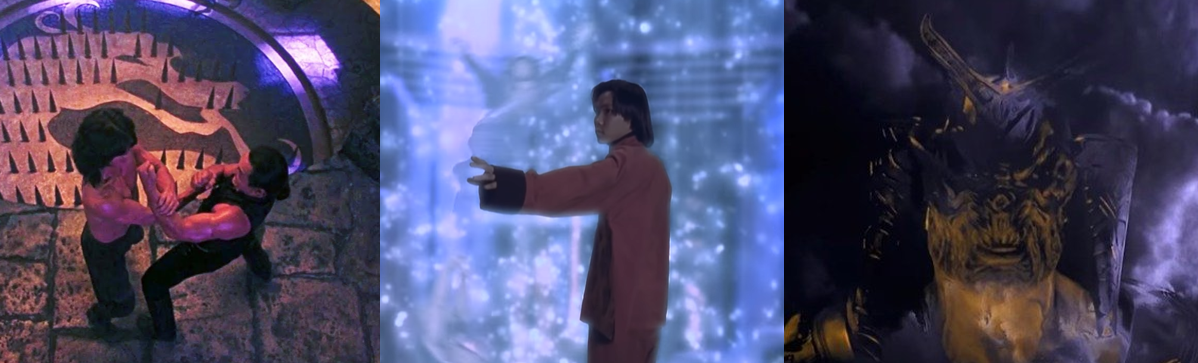
Power-Ups and Bonuses:
Being a simple one-on-one fighter, there aren’t really any power-ups to be found as you play through the game. The only advantage you have is the inclusion of the “Aggressor” bar; as you attack your opponent, the word “Aggressor” spells out, fills up, and begins to glow at the bottom of the screen and, once it’s completely full, your speed and attack power are greatly improved. This can be the difference between victory and defeat but it doesn’t last long and your opponent can also build up their own Aggressor meter but you are able to toggle it on and off in the options. Otherwise, you’ll be left relying on the game’s “Kombat Kodes” to spice up your battles; when you and a friend begin a fight, you’ll see little symbols at the bottom of the vs. screen that change as you press buttons. Input the right button presses and you can disable blocking, combos, throws, music and effects, health bars, and have the victor face certain boss fighters or other fighters. You can also enable special messages, mini games, explosive kombat, and unlimited run energy, all of which can make battles against friends a bit more fun and random.

Additional Features:
There’s not much else on offer in Mortal Kombat Trilogy; if you have a friend, you can battle against them in one-on-one, two-on-two, or in a tournament and there are a variety of options available in the game’s settings. Here you can select a difficulty level or disable blood, the in-game timer, and the vs. screens if you feel like it. Although there are no locked or unlockable characters this time around, you can press “Select” to select Rayden, Jax, Kano, and Kung Lao to play as their Mortal Kombat II (ibid, 1993) counterparts, which is a nice touch.

Enable one-button finishers or play as the Chameleon and Mortal Kombat II variants using button codes.

From the options menu, you can also input a button code to access some special options. Sadly, these aren’t as extensive as those in Mortal Kombat 3 but they can help make battling through the arcade a little easier as you can reduce the attack power of the bosses and enable one-button finishers and regenerating health (oddly, this regenerates both your health and that of your opponent, which is really annoying when facing Shao Kahn). Finally, I said there are no unlockable characters but that’s not entirely true; by pressing and holding certain buttons when selecting a male ninja, you’ll play as Chameleon, a semi-translucent ninja who randomly cycles through the colour schemes and attacks of the male ninjas. Kombat Kodes also exist to showcase all of the game’s finishers and such, which is cool, and you’ll get to play as the female Khameleon if you’re playing the Nintendo 64 version.

The Summary:
If you’re looking for the quintessential classic Mortal Kombat experience, it’s tough to get much better than Mortal Kombat Trilogy; the game takes all the advances and advantages of the more up-to-date game engine and mechanics and fills it with every single character, special move, and Fatality you could ask for. All of the stages, music, and characters are present and accounted for, making this the biggest and most ambitious Mortal Kombat videogame of its time, and it’s a must-buy for any fan of the series. Sadly, though, it’s not perfect; the game’s difficulty curve is steep and drastic, the loading and musical glitches were a bit annoying, and the lack of extra modes and options was disappointing. I like that they mashed everything together into one game but I can’t help but think that the developers missed a trick by not at least adding arcade towers to represent Mortal Kombat, Mortal Kombat II, Mortal Kombat 3, and Ultimate Mortal Kombat 3 if not have the three games included as part of the package. Instead, what we have here is, essentially, ULTIMATE Ultimate Mortal Kombat 3, a massive expansion of the third game rather than a true collection of the Mortal Kombat trilogy. Still, if you only want to buy one classic Mortal Kombat game, I would definitely recommend this one, especially if, like me, you’re a fan of Mortal Kombat 3. Those who prefer the first two games, though, may find it a little lacking and it’s a shame that there aren’t more options and variety on offer.

My Rating:

Rating: 3 out of 5.
Pretty Good

What are your thoughts on Mortal Kombat Trilogy? How do you feel it holds up today and when compared to the Mortal Kombat games that preceded it? Which of the three versions of Mortal Kombat 3 is your favourite? Perhaps you prefer a different Mortal Kombat game; if so, what is it? Which of the game’s roster and many finishing moves was your favourite? Would you like to see these classic Mortal Kombat  games re-released and remastered for modern consoles? Whatever you think about Mortal Kombat, leave a comment below and check in again next Monday for more Mortal Kombat content.