Mini Game Corner: Grim Fandango Remastered (Xbox One)

Released: 29 October 2020
Originally Released: 30 October 1998
Developer: Double Fine Productions
Original Developer: LucasArts
Also Available For: Mobile, Nintendo Switch, PC, PlayStation 4, PlayStation Vita

A Brief Background:
Grim Fandango was the brainchild of noted creator Tim Schafer, whose success with Full Throttle (LucasArts, 1995) allowed him to pitch a surreal, Day of the Dead-inspired concept that LucasArts hoped would revitalise the declining graphic adventure game genre. Despite initially being a PC-excusive title, Grim Fandango received widespread critical acclaim. For my part, I had been aware of the game thanks to gaming magazines and its enduring reputation as a much-loved title but it wasn’t until the Remastered version of the game became available on Xbox One that I actually got the chance to play, and finish, it for myself.

First Impressions:
Grim Fandango Remastered is a truly unique videogame with an equally unique concept; taking place in the Land of the Dead, players control a Grim Reaper, Manuel “Manny” Calavera, who is actually more like a corporate travel agent who inhabits a very film noir­-style version of the afterlife. The game takes a very bare-bones approach to its mechanics and interface; with no heads-up display (HUD) clogging up the screen, the game’s unique graphical style gets a chance to shine front and centre. Like the early Resident Evil titles (Capcom, 1996 to 2000), Grim Fandango utilises 3D models over static, pre-rendered backgrounds that must be interacted with to find objects, acquire clues, or advance the story. Unlike in those games, though, there’s very little in the way of onscreen prompts to point you in the direction you need to go, meaning that you have to interact with non-playable characters (NPCs) to figure out what’s going on.

Dialogue and character interactions are an important part of the game.

The world of Grim Fandango is populated by a wide variety of 1940/1950-inspired clichés, such as molls, femme fatales, gangsters, and the like, all of whom are skeletons within the Land of the Dead. When you talk to them, you are given a wide variety of dialogue options and conversations can drag on (…and on) for some time, fleshing out the world and the characters and delivering important exposition that you need to pay attention to or else you’ll end up wandering in circles. Helpfully, you can skip these dialogue sequences with the push of a button to speed things up, which is very useful on replays or if you make a mistake but can easily mean you miss out on vital information (as I did).

Manny’s scythe is easily his most versatile, if sparingly-used, item.

Perhaps fittingly, there’s no danger of losing, dying, or getting a game over here; there’s only a handful of moments where Manny takes any kind of damage or gets into a fight so you don’t need to worry about searching for health, power-ups, or extra lives. Unfortunately, a great deal of the game’s focus is on obtuse puzzles, which are solved either by acquiring and using certain items and bringing them to NPCs, performing frustrating time-sensitive tasks, and a lot of experimentation and trial-and-error puzzle. Manny can hold a wide variety of objects in his suit or cloak but the most useful and versatile of these is his scythe, which can be used to hook out of reach objects and interact with the environment. However, I found that, a lot of the time, I was holding objects with no idea of how to use them and questioning whether I would actually have been able to figure out how to progress without a guide.

My Progression:
To be fair, I did complete the game but, to be brutally honest, I didn’t enjoy it all that much and I was forced to turn to a guide soon into my play time. I managed to recruit the demon Glottis as my driver, visit the living world (which was a surrealist nightmare), and get into the office of Manny’s boss using the window but then found myself running around in the lobby and the few rooms available to me trying to figure out what to do with the assortment of balloon animals I had on me. As a result, I turned to a guide and, following it, proceeded to skip and rush though all of the game’s dialogue, story, and sequences in order to earn all of its Achievements. When I first started the game and saw that it was much different to what I expected (I thought it was a noir-style murder mystery but it turned out to be much more about Manny’s existential crisis and misadventures), I wasn’t expecting to actually enjoy or finish the game but, thanks to this approach, was able to blast through it in a day or so.

As great as the game looks, its puzzles can be needlessly frustratingly and vague.

Of course, the downside was that I largely missed out on the story and the more immersive aspects of the game but I found that it wasn’t really gripping me from the start, to be honest. As impressive as the game looks and as unique as its aesthetic style and concept is, I found the story a bit more convoluted than I expected and I was incredibly put off by some of the more frustrating puzzles. As I mentioned, there are times when it seems impossible to figure out what to do, like when you’re running around in a desolate forest trying to place a road sign in a pixel-perfect spot, or the puzzles were just needlessly annoying, such as lugging a giant axe around in a bathroom or desperately trying to move locks on a safe door or sing along with some literal worker bees.

BiteSizeGamesContinue

I went into Grim Fandango Remastered excited to experience this cult classic of a game, was impressed by is visuals and unique concept, but quickly became overwhelmed by the lack of direction and confusing elements. I’m all for being given a lot of leeway with exploration and experimentation but Grim Fandango was a little outside of my comfort zone. I can definitely see what people liked about it and I’m sure that fans of this genre of game were probably well in their element but, for all its impressive voice acting, innovation, and imagination, I can’t say that I was inspired to come back to the game after earning all of the Achievements. Are you a fan of Grim Fandango? How do you feel the Remastered version holds up to the original? What did you think to the game’s unique visual style and concept? Did you also struggle with the puzzles and figuring out what to do or were you fully immersed in the experience? Would you recommend that I revisit the game someday and play it properly to actually get a better idea of the story and characters or did you, too, simply blast through it to grab some easy Achievements? Whatever your thoughts on Grim Fandango, feel free to leave a comment down below.  

Mini Game Corner: Devil May Cry 4 (Xbox 360)

DMC4Logo

Released: January 2008
Developer: Capcom
Also Available For: Mobile, PC, PlayStation 3, PlayStation 4 (Remaster), Xbox One (Remaster)

A Brief Background:
Long before the God of War franchise (Various, 2005 to present) cornered the market when it came to hack and slash videogames, Capcom released a trilogy of titles that saw you cutting demons and angels alike into pieces with a giant sword and blasting them apart with pistols. After the success of Resident Evil 2 (Capcom, 1998), famed Resident Evil (ibid, 1996) director Hideki Kamiya began development on a new Resident Evil title for the PlayStation 2. However, when the game’s development began to veer further and further away from Resident Evil’s survival-horror aesthetics, Kamiya embraced this new direction and created an entirely new franchise with Devil May Cry (Capcom Production Studio 4, 2001). I’d been aware of the series for some time and, being a fan of hack and slash videogames, was eager to experience the games once I bought a PlayStation 3. I remember enjoying the title but ultimately being turned off by the repetitive nature of the game’s missions and boss battles, which are basically identically for both of the game’s playable characters. When I bought my Xbox 360 earlier this year, it coincidentally came with a copy of Devil May Cry 4 so, eager to snag a few additional Achievements, I attempted to rush through it again and see if it was still as enjoyable as before.

First Impressions:
Unlike previous games in the Devil May Cry series, Devil May Cry 4 begins with you not assuming the role of iconic series protagonist Dante but that of newcomer Nero. Functionally, Nero looks, acts, and even controls very similar to Dante (kind of making you question why Capcom bothered to make a new character in the first place…); Nero can attack enemies with his impossibly-large sword, the Red Queen, or stun them with his revolver, the Blue Rose. The more you mash the attack buttons, the higher a combo you’ll begin to build up; the better your combo, the better your grade. Additionally, if you successfully manage to complete missions and puzzles without using healing or recovery items, in a decent time, and with a consistently high style grade, you’ll receive better mission grades and therefore better rewards.

DMC4Gameplay
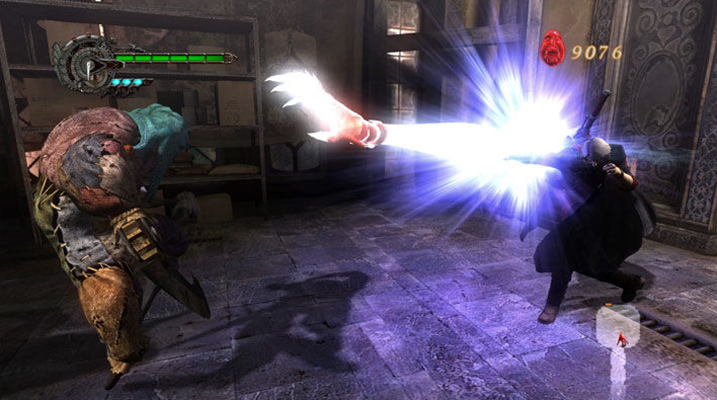
Nero’s demonic arm separates him from Dante.

What separates Nero from Dante is his Devil Bringer; a demonic arm that stretches out and allows him to cover large distances and grab, grapple, slam, and throw enemies and objects at his enemies. Eventually, he also gains access to the Devil Trigger, a state that allows him to charge his sword to unleash more powerful, flaming attacks, or explode into a demonic state for a short time to unleash stronger attacks. As you destroy enemies and certain parts of your environment, you’ll collect a bevy of Red Orbs; destroying enemies, bosses, and clearing missions also earns you Proud Souls, both of which can be used in the game’s Power Up menu. Here, you can trade Red Orbs for healing and recovery items to help you in the game’s more difficult missions or spend Proud Souls upgrading Nero’s abilities, unlocking new combos, faster moving speeds (a definite must), more powerful charged shots, and other similar power-ups. Unfortunately, every time you buy a recovery item, that item’s price shoots up, meaning you can’t just stockpile healing items as you’ll run out of Red Orbs pretty fast; occasionally, though, you can find these items hidden in the game’s missions. Devil May Cry 4’s story is told through in-game and pre-rendered cutscenes; these are pretty decent and full of frenetic, over-the-top action and dialogue and the story is pretty out there, with both Nero and Dante appearing to be infallible and superhuman in cutscenes which, unfortunately, doesn’t translate to their gameplay.

DMC4Bosses
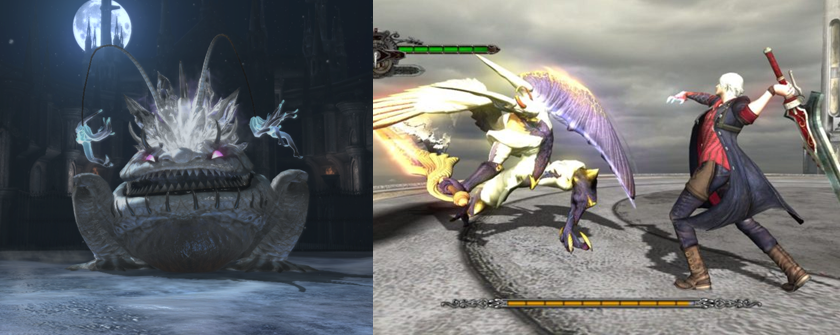
Bosses are big and impressive but often more frustrating than fun..

The in-game action is fast and frantic but if you don’t properly lock-on and focus on your enemies, or dodge and switch up your attack style accordingly, you can be pummelled into oblivion pretty easily, which can be frustrating. Fortunately, the game’s bosses are large and complex; they’re actually quite fun, despite some of them being frustrating and cumbersome. Bael and Dagon stand out as one of the game’s tougher bosses, for me; this horrific cross between a toad and an anglerfish hides in the snowy shadows, bursting out and swallowing you up to deal massive damage, and its tendency to enter an aggressive final stage is a theme you’ll find from all of the game’s bosses. You’ll hack away, draining their stupidly long health bar and desperately trying to avoid damage, and then they just freak out and throw everything they have at you, making already annoying and difficult battles like the one against Angelo Credo extremely aggravating.

My Progression:
I was quite enjoying Devil May Cry 4 for the most part; I chose to play on “Devil Hunter” mode (which is basically the game’s Hard mode) and the game’s difficulty increases steadily as you play. Initially, enemies aren’t much of an issue; there can be a lot of them and they take quite a beating before actually going down but, generally, they weren’t much of an issue. Then I noticed that they were respawning and that I was encountering far tougher enemies, such as the cloaked Mephisto, the ice-plated Frosts, and the always infuriating Angelos. As if that wasn’t bad enough, the game’s map leaves a lot to be desired; it’s functional and shows you where areas of interest, doors, and your last exit are and can be expanded similar to the maps in Resident Evil but, quite often, I would clear a room, solve a puzzle, or defeat a boss and then be left clueless as to where I was supposed to be going and what I was supposed to be doing. Just having an area light up on the map and a directional arrow appear would have been super helpful, or even a brief objective in the pause screen.

DMC4Mission10
Mission 10 culminates in a battle against Dante but I’m not sure I’ll reach this fight.

Anyway, I was fully expecting to clear the game with only a few annoying roadblocks; however, once I limped through a particularly trying boss battle against Angelo Agnus (a hovering, insect like monstrosity that spawns fireballs, flies into a razor-sharp whirlwind, and drains your health to replenish its own), I found myself faced with an exasperating trek back through the suitably gothic and nightmarish environment. Here I was faced with Faust, a more powerful form of the Mephisto enemies, and way too many armoured Angelo enemies; considering I was trying to be mindful of saving my recovery items for the game’s increasingly challenging boss battles and the game’s restrictive checkpoint and save system, I found myself basically rage quitting (though it was more like annoyed quitting) after a few failed attempts. I am so very close to the end of Nero’s story, though, and I know I have done it before so I am tempted to try and push through but, the moment the game becomes more annoying than fun, I know it’s time to take a bit of a break.

BiteSizeGamesContinue

Mission 10. Mission 10 out of 11 missions. Once I clear the eleventh mission, the game begins over from Dante’s perspective but getting there is proving more frustrating than enjoyable; plus, I still remember enough of the game’s massive, Lovecraftian final boss to know that things don’t get any easier. I haven’t checked if it’s possible but it might be better to notch the game’s difficulty down, or simply use a recovery item and hope that I earn enough Red Orbs to buy new ones for later use.

What did you think about Devil May Cry 4? Where do you rate it in the hierarchy of the Devil May Cry series? What do you think of newcomer Nero and the direction the game took? Whatever you think about Devil May Cry 4, or Devil May Cry in general, feel free to leave a comment.

Mini Game Corner: SEGASonic the Hedgehog (Arcade)

SEGASonicLogo

Released: 1993
Developer: SEGA AM3

A Brief Background:
I may have mentioned this before but, back in the early-nineties, SEGA’s super-speedy blue hedgehog of a mascot was on something of a roll; Sonic the Hedgehog (Sonic Team, 1991) had finally swayed videogame fans away from the Nintendo Entertainment System then, after the unforgettable and highly marketed release of Sonic the Hedgehog 2 (SEGA Technical Institute, 1992), Sonic’s status as a cultural icon was cemented. It was amidst the wave of Sonic’s incredible popularity that SEGA decided to develop a Sonic title for the arcades, most likely as the arcade scene was still a popular way of enjoying videogames even with the Console War right on the horizon. Although it wasn’t the first time SEGA tried to get a Sonic arcade game off the ground, SEGASonic the Hedgehog is, perhaps, the most infamous. Featuring the debut of Mighty the Armadillo and Ray the Flying Squirrel (two characters that were long-forgotten by SEGA until very recently) and forgoing Sonic’s trademark speed, SEGASonic used a trackball to control its three playable characters and was pretty much exclusively released in Japan. I actually got to play the game at SEGA World in London years and years ago, back when that was a thing, but the game has never been officially released or ported to other consoles since quietly disappearing from the arcade scene.

First Impressions:
SEGASonic makes an immediate impression simply through its bright, colourful graphics; the game features a charming cartoon-like aesthetic, featuring some extremely expressive and amusing animations and facial expressions from Sonic and his two friends. Captured by Doctor Eggman and forced to escape from his hazardous island, players are tasked with battling the game’s awkward trackball controls and navigating seven isometric levels.

Sonic, Mighty, and Ray must escape Eggman’s island.

Generally, players are chased by some kind of hazard (a wall of fire or a drilling machine, for example), must dodge past some kind of blockage (a cage, crumbling paths, or spiked walls and the like), and clamber across monkey bars to escape danger. Sonic, Mighty, and Ray all pretty much control exactly the same; no one character is faster than the other, they all have a Spin Attack, and the only real difference between them is the way they animate when performing certain actions (Ray uses his prehensile tail to climb, for example). Each character has a health bar, in a change for the series, which can be refilled by collecting the familiar Golden Rings generously scattered across the game’s maps, all while being chased by Doctor Eggman.

My Progression:
Unfortunately, as SEGASonic hasn’t been re-released or ported to home consoles, the only way to play the game now is using a ROM and an emulator. Equally unfortunate is the fact that the ROM I have for this game is very finicky and prone to crashing; as a result, I didn’t manage to get too far in the game before the emulator crashed and kicked me out of the game. I’m pretty certain that I managed to clear at least one level when I played the game at SEGA World but, on this playthrough, my ROM conked out on me shortly after clearing Trap Tower. I probably will reload my save state and go back to the game at some point to try and get a bit more playtime out of it but, as much as I love the obscurity and visual presentation of the game, the controls make it quite difficult to play (or, at least, play well).

BiteSizeGamesContinue

I love SEGASonic the Hedgehog; I would be so happy is SEGA got off their asses and made a real effort to put together a real, HD-quality port of the title that integrates modern analogue controls in place of the trackball. It, like Knuckles’ Chaotix (SEGA, 1995), is criminally under-rated, under-looked, and under-valued for its appeal and, considering SEGA loves to port and re-release their classic titles, it literally boggles my mind that we haven’t seen anything from this game in decades. The only thing holding it back from a full-blown replay is the dodgy controls (well, that and that unreliability of the ROM I have…); even when using a trackball, the game is difficult to control but, with analogue controls better and more sensitive than ever, I could see this game being a nice distracting for an hour or so if SEGA were to spruce it up and re-release it.

What do you think of SEGASonic the Hedgehog? What was your favourite of Sonic’s short-lived arcade games? Did you ever go to SEGA World in London? Share your thoughts in the comments.

Mini Game Corner: Mortal Kombat (Master System)

MKMSLogo

Released: 1994
Originally Released: 1992
Developer: Arena Entertainment / Probe Development / Midway
Original Developer: Midway
Also Available For: Arcade, Mega Drive, Mega-CD, Game Gear, Game Boy, Super Nintendo Entertainment System (SNES), PC, Amiga, PlayStation 2, PlayStation Portable, PlayStation 3, Xbox, Xbox 360

A Brief Background:
You’ve all heard of Mortal Kombat, right? The violent fighting game series that revolutionarily used digitised sprites instead of traditional 2D sprite art and was filled with all kinds of controversial violence and blood? These days, the blood and brutal Fatalities the series is known for don’t cause nearly as much outrage as they did back in the day but, in the early-nineties, parents and organisations alike were fuming at the levels of violence Mortal Kombat depicted. As you might expect, this meant that Mortal Kombat was massively successful; kids finally turned away from Street Fighter II: The World Warrior (Capcom, 1991) and wasted their hard-earned pocket money trying to tear their opponent’s spines from their bloodied bodies. Given its level of popularity, Mortal Kombat received numerous ports to home consoles; the Mega Drive version reigned supreme thanks to SEGA including the game’s trademark blood and Fatalities (albeit after a code was entered), while Nintendo lagged behind with heavily edited “Finishing Moves” and substituting blood for “sweat”. While the Mega Drive version is sluggish and hasn’t really aged very well, it’s got nothing on this Master System port!

First Impressions:
After slotting Mortal Kombat into the Master System, you’re treated with a long diatribe about “codes”, which was the developer’s sneaky way of telling you that you need to enter a code to enable blood in the game. I skipped this, however, and, as always, selected Sub-Zero to take on the game’s arcade ladder. The first thing you’ll notice is that Kano is missing from the game’s roster; the second thing you’ll notice is how absolutely God-awful the game’s graphics are! I grew up playing the Amiga version of Mortal Kombat but, mostly, was playing either Mortal Kombat 3 (Midway, 1995) on PC or Mega Drive (except for that odd period were I happened to have a copy of Mortal Kombat II (Acclaim Entertainment/Probe Development, 1994) for the Master System) so maybe I was a little spoiled but…my God, the graphics here are terrible! The downgrade to 8-bit has left the already-questionable digitised sprites looking blocky and blurry. Sprites seem to float or merge with the foreground and background, and so many frames of animation have been lost that there seems to be a delay in every button press!

MKMSMovesEtc
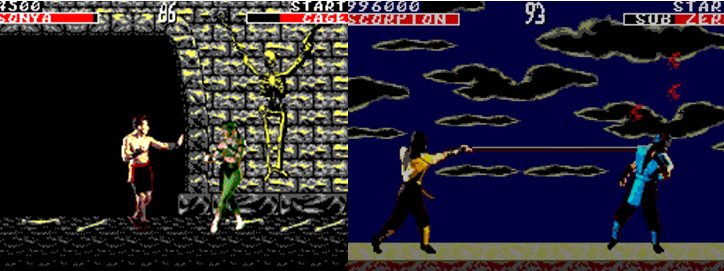
Backgrounds are okay and everyone has their special moves…but still

It’s not all bad, though; the backgrounds are okay, for the most part, those there’s a noticeable lack of stages here. Each character also has their signature moves but, thanks to the Master System’s two button setup, I couldn’t throw even one Ice Ball for the life of me. None of this changes the fact that the game plays like absolute garbage, though. One of the things I love about Mortal Kombat (especially the early titles) is how the game is easy to pick up and play and gets deeper the more you master its controls; unlike Street Fighter II and its sequels and spin-offs, you don’t have to stress yourself with worrying about “frame cancels” or whatever. Every Mortal Kombat character basically plays the same, with only their special abilities separating them, meaning it comes down to how good you are at getting through the opponent’s offense and landing your own.

My Progression:
In this version of Mortal Kombat, you can technically wipe the floor with the computer without any real problem; if you select the “Easy” difficulty, you can pretty much trounce every opponent with just flying kicks, rapid punches, and leg sweeps no matter how much better they are at throwing their projectiles at you. The issue is, though, that you have to battle against some really dodgy hit detection and slow-down; it’s like the game is taxing the Master System to its very limit, as you’ll slowly stutter through the air and punch through the opponent more often than not.

MKMSWin
At first, it’s not too difficult to get the win, especially on “Easy”.

When I fired the game up to have a quick playthrough, I selected the “Easy” difficulty, picked Sub-Zero (because…obviously…!), and played through the arcade ladder. I managed to get all the way to the Mirror Match without losing more than one round (Rayden turned out to be a cheap spam-artist) and was promptly, soundly defeated by my doppelgänger. Truthfully, I’m not too bothered about this as the one thing I always hated about Mortal Kombat was those damn annoying Endurance Matches, where you have to take on two opponents with two health bars while you only get one. That probably wouldn’t be so bad but you need to fight your way through three of these bloody things before you can take on Goro and, eventually, the game’s final boss, Shang Tsung.

BiteSizeGamesContinue

Honestly, the original Mortal Kombat has not aged well at all. The only version worth anyone’s time is the arcade version, and even that is slow and graphically sub-par to its later sequels. This 8-bit port of the game is a joke from top to bottom; it’s literally the poor man’s version of Mortal Kombat, made for those kids unfortunate enough to not be able to upgrade to the Mega Drive, and should be avoided at all costs. Am I being too harsh on the Master System port of Mortal Kombat? Which was your favourite version or sequel to Mortal Kombat? Do you have any fond memories of wasting your childhood away in arcades trying to set your opponent on fire? Write a comment below and let me know.

Mini Game Corner: The Witcher III: Wild Hunt (Xbox One)

Witcher3Logo

Released: May 2015
Developer: CD Projekt Red
Also Available For: PlayStation 4, PC, and Nintendo Switch

A Brief Background:
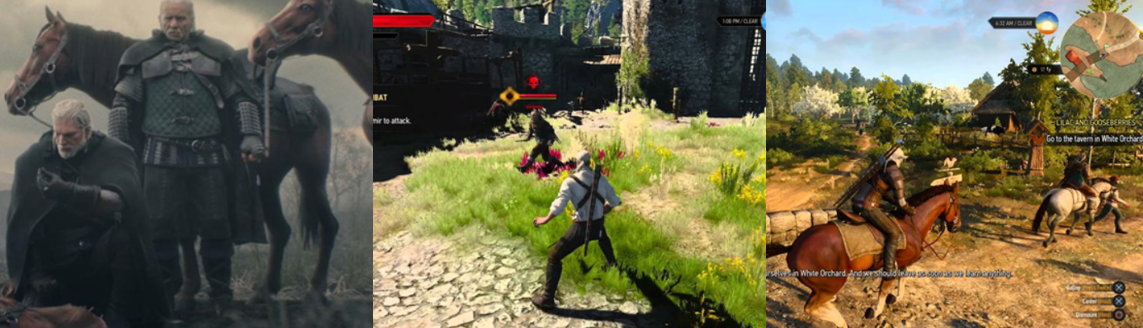
So, I’d heard of The Witcher III: Wild Hunt for a while now; my Twitter feed was full of praise for the game for some time and, even now, it crops up as being a really good, immersive combat/role-playing experience. Similarly, I’ve heard nothing but praise for the Netflix series, The Witcher (2019 to present), particularly for its portrayal of main character Geralt of Rivia (Henry Cavill), its violence, and its sex scenes. Given that I’m currently in lockdown due to the fact that the world has gone mad, I’ve started watching The Witcher and, while I’m only about six episodes in, I’ve liked what I’ve seen so far. With all that in mind, and at the urging of many of my peers, I decided to download The Witcher III: Wild Hunt as it’s currently on Xbox Game Pass. However, because I have a massive backlog at the moment and still have work to do at home, I can’t devote my entire focus to the game so I’m just going to briefly talk though my initial impressions of the game and leave it up to you guys to decide if I should make the time to continue playing.

First Impressions:
One of the reasons I hesitated to play The Witcher III: Wild Hunt sooner was simply that fact that I hadn’t played the previous games, am not familiar with The Witcher (Sapkowski, 1993 to 2013) series of fantasy novels, and I don’t really have the time to immerse myself fully into a layered role-playing experience. I should stress that I have only played about an hour or so of the game, and was skipping through the impressively-realised cutscenes in order to get straight to the gameplay but, from what I pieced together Geralt is a mutated monster-hunter, a Witcher, who is on a quest to located his adopted daughter, Ciri. From what I experienced, it seems the narrative jumps from a time in Geralt’s past (which acts as a convenient tutorial for the game’s mechanics) and a more tumultuous time in the present, where Geralt is far more cold and stoic.

The Witcher III has some impressive aesthetics, and Geralt certainly has a lot of options in combat.

Geralt can use his enhanced senses to scan his environment and interact with other characters and objects, this is necessary to find loot and other useful items that can be used to heal Geralt or crafted in what I am assuming is quite a layered crafting system. Combat is a simple, yet surprisingly complex affair; Geralt can target an enemy and attack with his sword using light and strong swipes. He can block and, with successful timing, parry incoming attacks and also use both throwing weapons (like bombs) and a range of magic (known as Signs) to protect himself or attack his enemies. Soon after completing the tutorial (which involved a bit of free-running around a town, where I accidentally leapt off too high a ledge and died…), you skip ahead in time and take control of a more seasoned Geralt, who is accompanied by his fellow Witcher, Vesemir. This is where you learn how to control Geralt’s horse, Roach, which looks to be your primary mode of transport, and battle monsters that roam the world map on your way to the first town, White Orchard, where you can visit a shop to sell and purchase items, take on various side quests, and interact with other characters using the game’s intricate dialogue wheel.

My Progression:
As I said, I only played for about an hour and, even then, I was rushing a bit as I was pushed for time. I literally made it to White Orchard, popped into a tavern, saved my game, and had to stop playing. However, even in that brief bit of time, it is clear how large and sprawling the scope of The Witcher III: Wild Hunt is; not only do you have multiple options to pick from when talking to other characters, but there are many side quests and additional concerns that crop up as you pursue the main story mode and also a lot to occupy yourself with in terms of crafting and item management. One thing I did like was the non-playable characters will react differently to you whether your sword is sheathed or not; during the tutorial, it was a sign that I wanted to spar and, in White Orchard, townsfolk would flee as I slaughtered their chickens and cows. Clearly, there’s a lot to get to grips with in The Witcher III: Wild Hunt and it’s not really a videogame geared towards a casual player or a quick run-through, as I did here. I’ve hardly scratched the surface of what the game has to offer and I’m already intimidated and, considering I have quite a backlog to work through, I’m not sure that I’ll be returning to Geralt’s adventures any time soon.

BiteSizeGamesContinue

What do you think of The Witcher III: Wild Hunt, and The Witcher series? Would you recommend putting the hours into mastering everything this game has to offer or do you feel that it was a bit over-rated? Whatever you think let me know in the comments.

Mini Game Corner: Mighty Morphin Power Rangers (Mega Drive)

MMPRLogo

Released: 1994
Developer: Banpresto/Nova
Also Available For: Super Nintendo Entertainment System, Game Boy, Game Gear, and Mega CD

The Background:
If you were a kid back in the early nineties, right after you finished up being obsessed with what we in the UK know as Teenage Mutant Hero Turtles (1987 to 1996), and before Pokémon (1997 to present) took my generation by storm, you were all about Mighty Morphin Power Rangers (1993 to 1996). Cobbled together from stock footage from the Japanese tokusatsu series Gosei Sentai Dairanger (1993 to 1994) and Ninja Sentai Kakuranger (1994 to 1995), Power Rangers focused on five teens “with attitude” (despite the fact they were a bunch of geeky do-gooders who couldn’t break a rule if they were held at gunpoint) imbued with superhuman powers and abilities. Harnessing the power of the dinosaurs, they could transform into martial arts superheroes and conjure giant mechs to battle against the forces of evil. To say Power Rangers was a cultural phenomenon would be an understatement; parents were outraged at the glorification of violence but we headed out in our droves to buy every bit of Power Rangers merchandise we could, from t-shirts to action figures. Given its dominion over the playground and the airwaves, you know that this also meant the franchise received its own multi-platform videogame that I’m sure hapless kids everywhere begged their parents to buy for them.

The Review:
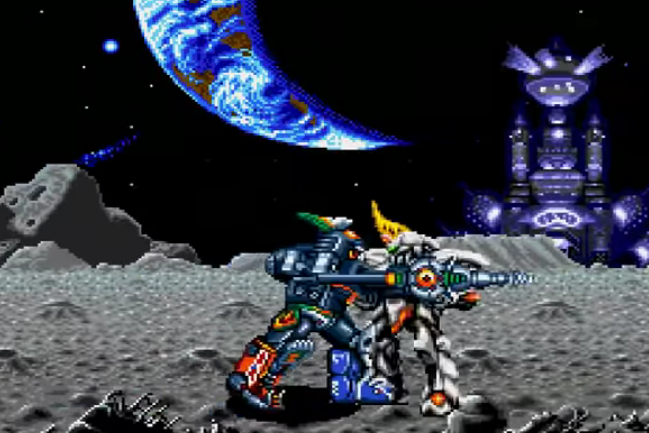
Mighty Morphin Power Rangers is a simple 2D fighting game; you can choose to battle head-to-head with a friend or take on the game’s Scenario Mode, where you’ll battle one of Rita’s minions in a format that will be more than familiar to anyone who has played a Street Fighter (Capcom, 1987 to present) videogame. However, Street Fighter II: The World Warrior (ibid, 1991) this is not; first of all, you’re (unsurprisingly) limited to only six playable characters (the titular Power Rangers). Each plays largely the same and the variations come only in their special attacks and weapons; the Red Ranger wields a sword but the Black Ranger has an axe, for example. After you face, and defeat, the evil Green Ranger (in my opinion, the greatest Power Ranger of all time), he becomes a playable character as well. There’s one main difference between playing as the Green Ranger compared to the other Rangers, though, and that’s in the game’s other battle mode. Once you defeat Rita’s monster, she’ll make it grow (as she is wont to do…) and the Rangers summon the Megazord to battle it. The Green Ranger, however, summons the Dragonzord but it basically amounts to the same thing: smash the buttons until you whittle away the enemy’s health bar and win.

MMPRFinal
The game’s literally over in less than an hour. It’s sad.

If you’re looking for depth…well, there isn’t any. Power Rangers the game has about as much depth and variety as Power Rangers the television show. I literally sat there, mashing buttons and hardly even trying, and never lost a single round. When I fought the Green Ranger as the Black Ranger, I did one whirlwind attack with Zack’s blade and won without Tommy landing a single hit! The game is also pathetically short; you always battle the monster on the same stage for the first fight but, once you’ve battled all five of Rita’s minions, the game is over and you’ve pretty much done everything Power Rangers has to offer in less than an hour. Unless you suck at videogames, but I’d wager even if that is the case you could beat Power Rangers without a great deal of difficulty.

MMPRGreen
Once you go Green you never go back…


Graphically, there’s not much to write home about; the sprites themselves are colourful and large and surprisingly detailed but not very animated. The backgrounds are even worse, being largely barren and devoid of life or character, and severely lacking in variety. It’s pretty much the same story for the game’s sound, too; there’s a noticeably bad rendition of the iconic Power Rangers theme and some shitty voice samples but the in-game sounds are muted and dull. Characters grunt and yelp a bit and Zords thud about but it all sounds so half-assed and a far cry from the loud, impactful sounds the Mega Drive is capable of producing. There are some nice cutscenes between battles that tell the story and evoke the same spirit as the television show but they don’t really contain much in the way of animation, meaning the game is outclassed by even some Master System titles in that regard.

MMPREnemies
Get used to seeing this same stage over and over…

As I mentioned above, the game has only five enemies to battle against. Sure, you face each one in two different types of battle but, if you’ve ever seen Power Rangers, you’ll know that doesn’t really mean much as the monster’s second form is literally just a bigger version of its first form. Goldar makes an appearance (he was the only monster I actually recognised…) but there’s no Putty Patrol to wade through and no Lord Zedd as the game is only pulling its inspiration from the first series of the show. Similarly, there aren’t any beyond the different weapons and abilities of the Power Rangers. The only thing to unlock here is the Green Ranger, which is the second battle and, once you have him, you’ll never pick another character because Tommy is the best character. Finally, you can battle against a friend but, honestly, I can’t see why you’d even bother.

MMPRSummary

The Summary:
Mighty Morphin Power Rangers may have been a cultural phenomenon but this videogame outing is a dreadful experience; the controls are sluggish, the battles are ridiculously easy, and the game is just boring from start to finish. I wouldn’t even recommend this to die-hard Power Rangers fans as there are far better Power Rangers videogames available; the game’s counterpart on the SNES, for example, or the one based on the movie. Either way, just don’t even give this the light of day and stick to playing Street Fighter II because the only thing “mighty” about this game is how bad it is.

My Rating:

Rating: 1 out of 5.

Terrible

Did you watch Power Rangers when it first aired? Who was your favourite Ranger and why was it the Green/White Ranger? Do you think I was too harsh on the Mega Drive videogame, or have a favourite Power Rangers videogame? Let me know in the comments.

Mini Game Corner: Shenmue (Xbox One)

ShenmueLogo

So, thanks to Xbox Game Pass, I finally got the chance to play the cult favourite role-playing videogame Shenmue (SEGA AM2/Ys Net, 1999/2019), which has been lauded as one of the Dreamcast’s most prolific titles and has a dedicated fanbase who have been called for HD remakes and a third entry for years. Once I saw that the game was available, I figured I’d give it a download and see if it was worth all the hype and fuss I’d heard about it. The closest I’d come to playing the game was playing as the series protagonist, Ryo Hazuki, in Sonic & Sega All-Stars Racing (Sumo Digital, 2010) so I was pretty interested to see if the title was worthy of its reputation.

ShenmueVoices.PNG
The game looks lovely but the characters sound dreadful…

Now, I’m massively swamped with videogames and movies to work through at the moment, so I glossed over the introduction and opening cutscenes but I gather (from what I’ve heard and the game itself that Ryo’s none-too-happy because some mysterious guys killed his father right in front of him so he sets out to bring them to justice. Probably as a result of the Xbox One version being more of a HD port than a straight-up remake, the game has a few issues with the quality of its voice acting; I normally don’t really moan about this as I enjoy stilted, daft voice acting but everyone in Shenmue sounds muffled and distorted, as though the voices didn’t get a nice HD filter like the charming blocky graphics.

ShenmueRobot
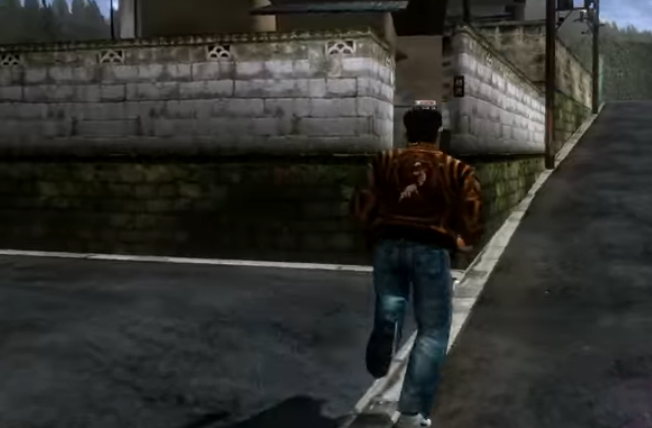
Ryo controls like a robot, for the most part.

That’s not a knock on the aesthetics; I love how polished it looks even though the engine has just been given a fresh coat of paint and I have no issues with the look of the game but the controls…that’s a different story. It took me a while to figure out how to get Ryo to do anything other than a stiff, robotic walk but finding the run button didn’t really help much as Ryo suddenly flew about like he was ice skating! Seriously, I don’t normally like to rag on a game’s controls of camera but Shenmue has really stiff, awkward controls that make controlling Ryo and navigating the fairly bustling townscape a hell of a chore. The camera is also a headache, wildly swooping all over the place and making it difficult to point Ryo in the right direction.

ShenmueLost
It’s not a big town but I still got a bit lost because everything looks the same!

Ryo has a little notebook, which is respect and admire, which tells him what he has to do and where he needs to go and keeps track of his progress and missions but it’s not actually that helpful at telling you where you need to go. I was tasked with going to someone’s house to find clues but literally every single house I went to was empty and I had no idea where to go or what to do.

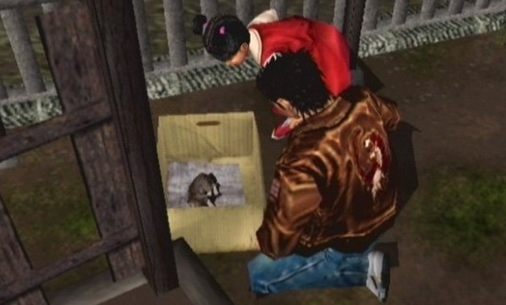
I did meet a little girl and pet her kitten, though.

ShenmueKitten.PNG
Unfortunately, the cute kitty didn’t convince me to play much further.

Honestly, it was a very quick play but I can’t say I was massively impressed or encouraged to play on. I could use a guide to get further into the game but, judging by how bad the controls and camera are, I dread engaging in combat or trying to tackle more complicated tasks. In the end, I don’t see myself coming back to Shenmue any time soon unless I manage to clear my backlog but what do you think? Did I give up too early? Are you a big Shenmue fan? Sound off below and try and convince me to push on.