Game Corner [Turtle Tuesday]: TMNT: Tournament Fighters (Xbox Series X)


Ever since Kevin Eastman and Peter Laird’s Teenage Mutant Ninja Turtles (TMNT) first debuted, the franchise has enjoyed worldwide mainstream success thanks to action figures, cartoons, and videogames. Since I found some free time this December, I’ve been spotlighting four such videogames every Tuesday of this festival season.


GameCorner

Released: 30 August 2022
Originally Released: 4 September 1993 (Mega Drive / SNES) / February 1994 (NES)
Developer: Digital Eclipse
Original Developer: Konami
Also Available For: Mega Drive, Nintendo Entertainment System (NES), Nintendo Switch, PC, PlayStation 4, PlayStation 5, Super Nintendo Entertainment System (SNES), Xbox One, and Xbox Series S

The Background:
There was only one franchise that dominated childhoods back in the late-eighties and early-nineties and that was the Teenage Mutant Ninja Turtles (or Teenage Mutant Hero Turtles for Brits like me); beginning life as a violent pastiche of comic book tropes, the TMNT’s popularity exploded into the massively successful cartoon and action figures, live-action movie adaptations, and many videogames. Spearheaded by Konami, the TMNT were equally successful with their arcade beat-‘em-ups and their home console ports, but this was also a time when Capcom had changed the face of both arcades and the competitive fighting scene with the many iterations of Street Fighter II: The World Warrior (Capcom, 1991), which was great success on home consoles and inspired a slew of knock-offs looking to cash in on Capcom’s success. The TMNT were amongst these with this one-on-one tournament fighter, which released in slightly different versions across three platforms at the time; the games took inspiration from the cartoons, movies, and the Archie spin-off comics but, while the 16-bit titles aped the combos and special moves of Street Fighter II, the 8-bit version had more in common with the likes of Yie Ar Kung-Fu (Konami, 1984) due to the NES’s limitations. Of the three, the SNES version was positively received despite being a Street Fighter II knock-off, the Mega Drive version was criticised for its sluggish controls and lacklustre presentation, while the NES version was seen as ambitious but unsurprisingly limited. All three games were lost to the midst of time, available only through emulators or extortionately expensive physical copies until they were included in this Cowabunga Collection alongside a host of other games and quality of life features.

The Plot:
The Turtles and their allies take part in a one-on-one tournament. In the Mega Drive version, the heroes battle across the alien worlds of Dimension X to rescue Splinter from their archnemesis, Oroku Saki/The Shredder, and their evil clones; in the NES version, the Shredder challenges them to defeat his latest plot for world domination; and in the SNES version, the heroes battle on a fighting game show to prove their mettle and earn some cold, hard cash.

Gameplay:
Regardless of which version of Teenage Mutant Ninja Turtles: Tournament Fighters you choose to play, the game is a standard 2D, one-on-one fighting game, with the 16-but versions of the game heavily borrowing their controls, combat, and presentation from Street Fighter II. Each game comes with a different roster of fighters, with ten fighters selectable in the SNES version, eleven available in the Mega Drive version, and seven in the NES version. Each version of the game allows you to customise the gameplay in some way, such as setting the difficulty level of the game (which directly impacts the ending and bosses you face), changing the time limit and amount of rounds to win (with the games defaulting to the standard best of three rounds), setting the speed of the game, setting the amount of credits you have to continue laying upon defeat, and eve setting the strength of your character and your opponent to establish any handicaps. These features don’t carry across to every version of the game, and some are slightly altered (the SNES version represents difficulty on a zero to seven scale, for example, while the NES uses a simple Easy, Normal, and Hard designation), but these options are generally consistent to those seen in Street Fighter II.

Each game sees you pummelling foes with a variety of moves and special attacks.

Combat, however, is a slightly different story and varies somewhat between each version; while the SNES version benefits from the additional buttons and mimics the directional input and button presses of Street Fighter II to pull off special moves, the Mega Drive and NES versions are limited by their control scheme layouts and the general presentation of the game. Indeed, the SNES version is more like Super Street Fighter II Turbo (Capcom, 1994), running much faster at its maximum speed and aping similar button combinations, while the Mega Drive version is far slower and reminds me more of the original, somewhat clunky first release of Street Fighter II. The NES version, as mentioned, is more like Yie Ar Kung-Fu and features little in the way of complex button combinations and special moves due to the limitation of the NES hardware. In the SNES version, you have two different types of punches and kicks; A and X launch a “normal” punch and kick while B and Y throw “fierce” variants. You can press up on the directional pad (D-pad) to jump and launch flying kicks and punches; when up close to an enemy, you’ll grab them and toss them in a unique throw move and you’ll use directional inputs and button presses (down, diagonal down-right, right, X, for example) to pull off each character’s special moves. When not playing in the game’s story mode, you’ll gradually fill up a gauge underneath your life bar; when this is full, you can use another simple button combination to unleash a devastating “Ultimate-Attack” that, unlike your regular attacks, actually damages the opponent through their block (though if they attack you during it you’ll fail and it’ll deplete if you don’t use it in time). Much of this is true of the Mega Drive version, but with some notable differences; there’s no special attack gauge, for starters, and no “fierce” attacks, you simply use X to punch and A to kick, and press Y to pull off a taunt (that seems to have no function). To pull off stronger attacks, you need to press the D-pad towards the opponent and then press X or A; you can still grab and throw your foe but special moves seem a lot harder to pull off (not least because the button inputs are missing from the strategy guide) and the game’s sluggish pace makes combat inconsistent and frustrating. It’s still more complex that the NES version, though; here, X punches and A kicks and that’s about it; you can use directional inputs and button presses to pull off special moves, but they’re extremely basic and the TMNT don’t even fight with their signature weapons in this game! Each game features a stun mechanic like in Street Fighter II, though; deal enough damage in a string of attacks and your opponent will be momentarily dazed and wide open for another combo or throw.

Although it lacks Nintendo’s bonus stages, the Mega Drive version has instant replays…

Some versions of the game do allow you to alter the button layout if you’re not happy with the default, and all three versions allow you to block by holding back on the D-pad (a mechanic I’ve always found awkward in fighting games; I much prefer a dedicated block button) but the SNES version also allows you to flip away from incoming attacks but only the NES version allows you to run towards your opponent by double tapping the D-pad. Each version also comes with a few gameplay options; you can take on the story mode (where you’re limited to playing as the TMNT), with cutscenes and a map screen (in the Mega Drive version) furthering the narrative between each bout, battle against a friend (or against the computer in the NES version), watch or practice the game in the SNES and Mega Drive versions, or take on a standard tournament mode. This also differs greatly between each version, with the SNES version taking the form of a broadcast and game show and featuring pre- and post-match dialogue and even tossing in a bonus stage where you rack up extra points and gold by smashing open safes in a bid to help break up the monotony. Although this is absent from the Mega Drive version, whose tournament simply goes from one fight to the next, every match is followed by an instant replay), bonus stages do appear in the NES version; here you have to smash through walls in the dojo for extra points, and all three will tally up certain criteria (health remaining, time left, whether you took damage or not) when you’re victorious to add to your score and this is the only version of the game to feature a high score table.

Each version offers a pretty tough challenge even on the easiest difficulty.

Each game comes with a natural, steady, and expected difficulty curve that I find is typical of most fighting games but synonymous with Street Fighter II; your ability to succeed will depend on how adept you are at pulling off the awkward special attacks and combos, especially as special attacks and throws deal way more damage than your regular attacks. The enemy AI, even on the easiest settings, is incredibly cheap in all three versions; your opponent will block almost constantly, is consistently able to attack and throw you through your attack animations, and they’re far more aggressive and skilled than I was, meaning I either had to fight hard and fast or be on the defensive. The difficulty and gameplay sliders can help with this, especially in the Mega Drive version, which allows you to reduce the rounds to win to one and set your speed and power to give you an advantage. Since the SNES version is the fastest of the three, combat can move at a breakneck speed, with rounds turning out of your favour in the blink of an eye, and you’ll be immediately at a disadvantage as you need to play on at least difficulty level three to even battle to true final boss and see the game’s best ending. This is even more demanding in the Mega Drive version, where you need to play on level eight to get the true ending; this version is so hampered by its plodding speed that it’s easy to get trapped in an unbreakable combo string and stunned into oblivion by your hyper-aggressive opponents. The NES version can be both paradoxically difficult and easy at the same time; there’s little benefit from picking one fighter over another as they’re all so limited but some, like Hothead, make for bigger targets while others, like Casey Jones, appear to be more agile. Either way, the limitations of the hardware make this a mundane back and forth affair that’s more about who can grab the power-up first rather than requiring any in-depth skill like the SNES version.

Graphics and Sound:  
Obviously, all three games look and sound very different. Of the three, the SNES version is the clear winner in terms of overall presentation; the game features more sound bites, big, bright, and well animated sprites and backgrounds, and the music is clearer and has more kick to it. The emphasis on story and cutscenes means there’s far more opportunities for big, partially animated sprite art here, with April O’Neil reporting on and interviewing characters before and after bouts and every fight in story mode being proceeded by dialogue between the fighters and the TMNT travelling to each location via their signature blimp. The characters in this version are clearly modelled more like the cartoon, with a hint of the live-action influence here and there, and they’re all large and full of attack and reaction frames. Sadly, the same isn’t true of the Mega Drive version; even the title screen and character select screen aren’t as impressive, though the game does include more palette swaps and some different fighters compared to its SNES counterpart. Sprites are smaller, however, duller, and seem to be missing some animation frames; everyone seems far meaner and more surly, as well, making this a very gritty and moody experience that seems to owe more to the original Mirage Comics, but it’s pretty obvious even to a die-hard SEGA fan like me which version has the better overall presentation. Naturally, the NES version is the most inferior in terms of graphics, character, and stage selection; however, while the TMNT don’t sport their signature weapons, they do have their own unique green palettes to separate them and the character designs seem to be drawing more from the first live-action movie than anything else. You won’t find much in the way of animation and variety here but it’s pretty ambitious, really; sprites have some decent details and special attacks, but the game suffers from black bars eating up a lot of the player’s screen.
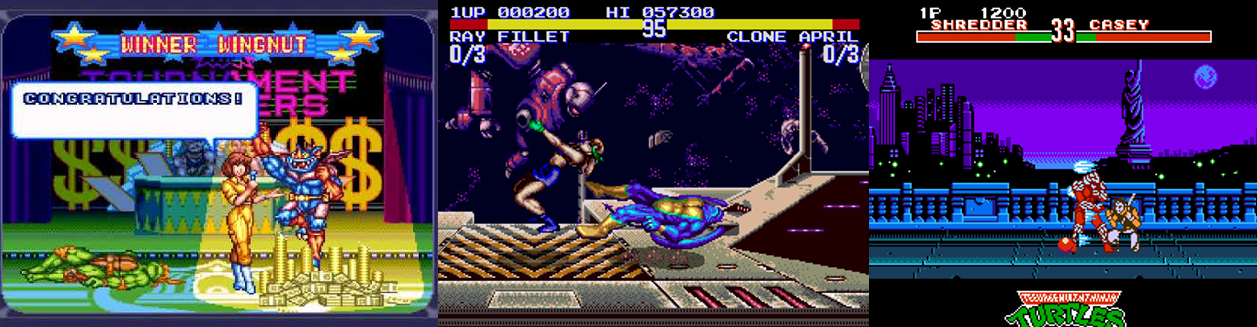
Presentation varies between the three, with the SNES being the clear superior.

Naturally, the stages you’ll fight in follow very much the same format; the SNES version features a variety of large and detailed environments set largely on Earth, with some even featuring destructible elements to smash your opponents into like in Street Fighter II. Also like in that game, you’ll see background characters and elements and characters cheering and watching the fight, including TMNT staples like Bebop and Rocksteady, Baxter Stockman in his fly form, and various Foot Soldiers. There’s always something going on in the SNES version, whether it’s a giant octopus, a band performing on stage, or a news report recording the action, and this version also includes better, more detailed and varied story cutscenes and even character bios in its attract mode. Comparatively, the Mega Drive version is an immediate disappointment; cutscenes are smaller and less interesting and the backgrounds, while surreal and often disturbing, are far more muted and feature almost no animation and absolutely no interactable elements. As this version of the game features a planet-hopping narrative, there are some bizarre stages to choose from, from an ice world complete with a submarine to an ocean planet with a sinking ship in the background, to the bleakness of the cosmic abyss, but it’s all so dull and lifeless even when there’s giant cycloptic magma creatures and dinosaurs looming in the background. Again, the NES version is hampered by its hardware and includes only four stages: the sewers, a subway station, the galley of a pirate ship, and the rooftops of New York City. This latter is the most impressive stage, showing the city and the Statue of Liberty at night and in all its 8-bit glory, and is preceded by a rare cutscene to set the stage for the final battle against the Shredder.

Enemies and Bosses:
As with all fighting games, every available character will eventually be your enemy at some point; button codes and the Cowabunga Collection’s enhancements allow you to play as the boss characters in the 16-bit versions of the game and the Mega Drive version even includes and practise mode to help you get to grips with your favourite character. Essentially, however, there’s minimal benefit to picking a certain character in each version of the game; all of them sport special moves that can match each other, with every character sporting projectiles, grabs, and powerful rushing or slamming attacks to deal heavy damage. However, there are some notable exceptions; as mentioned, Hothead is a unique character in the NES version, sporting a chunkier sprite and breathing fire, meaning his hit box is a little larger and the character is a little slower. In the Mega Drive version, Casey Jones can set bombs as traps, while characters like Chrome Dome and Krang can cover distances from a standstill with their extending arms and legs. Even on the easiest setting, the SNES version puts up quite a fight; I struggled against War in the first battle simply because of his ridiculous rolling throw and large swiping claws, and the Shredder proved quite formidable here thanks to his dashing uppercut, his flurry of punches, and his cheap tactics of spamming low kicks. The Rat King also proved a unique foe in this version as he relied more on wrestling moves, snatching you out of the air and grabbing you midway through your attacks to slam you to the ground, and you’ll really get a sense of how good or bad you are when you face off against your character in a mirror match.

You’ll need to challenge the game’s highest difficulties to achieve the best endings.

These are spiced up a bit in the Mega Drive version through the inclusion of evil clones, who sport a purple palette swap and constantly dog your progress throughout the game. The Mega Drive version also includes a unique character, Sisyphus, an alien beetle who spits a blue projectile at you and unleashes a rapid-fire horn attack. He’s not the only unique character, however; Ray Fillet, April O’Neil, and a Triceraton are also included in this version of the game, while Wingnut, Aska, and Armaggon round out the SNES roster, with each one bringing their own strengths and weaknesses. April was a surprisingly decent character to use as she has a very cheap crouching spam attack that’s great four countering the game’s aggressive enemies, but you can never count out the titular turtles, who can send ground sparks, spinning cyclones, and twirling kicks your way at any moment even in the NES version. Krang only appears as a boss in the Mega Drive version of the game; naturally, you battle him in the Technodrome as the penultimate boss and he’s able to extended his arms, slide at you with a kick, and fire missiles high and low from his robot body but his sprite just isn’t large or intimidating enough to evoke a sense of danger. Both 16-bit versions include the same final boss, Karai, who can only be fought on higher difficulty settings; on the SNES, you fight her on top of a speeding train, whereas you battle her in a traditional dojo on the Mega Drive. In both, she’s easily the most formidable fighter, which is accentuated on the SNES thanks to her larger sprite; she’s capable of crossing the screen with a devastating cartwheel kick, tossing out projectiles, diving from high above with flying kicks, and is overall a pretty tough customer thanks to her martial arts kicks and overly aggressive AI. Thanks to its limited roster, the Shredder is your final foe in the NES version of the game; fought on a rooftop like in the movie and original comic, Shredder again has a dashing uppercut, a flaming flurry of punches, and can send a ground shot your way but goes down just as easily as every other enemy in this version of the game.

Power-Ups and Bonuses:
As Tournament Fighters is styled heavily after Street Fighter II, for the most part, there aren’t any in-game power-ups for you to utilise. The SNES version includes that special gauge outside of the story mode, which is good for a dramatic finish, but this is completely absent from the Mega Drive version. The NES version, however, does feature a power-up; at some point in every battle, Splinter will drop a red ball into the arena, which you can collect by pressing down and X. While the exact button inputs aren’t explained, and it seems incredibly temperamental, you can then launch this ball at your enemy to deal massive (and, usually, decisive) damage and this will be your key to victory in almost every bout. Be warned, though, as your foe is also able to pick up the ball and you’ll lose it if you take too much damage.

Additional Features:
The additional features on offer differ somewhat between each version of Tournament Fighters but there is some overlap; each version includes a story and a tournament mode and allows players to go head-to-head, selecting their character, stage, and handicap modifiers as you’d expect from a one-on-one fighter. Each game includes a variety of endings depending on which character you play as and the difficulty you set the game to, encouraging multiple playthroughs if you can stand to tackle this game again. Of course, the Cowabunga Collection adds even more features to these games; you’ll get a generous 100G Achievement for completing each game, however, you need to beat each one of the higher/highest difficulty level and battle Karai for this to pop. You can also use the Left Bumper to rewind the gameplay and bring up save states and display options with the Right Bumper, which also allows you to look through the strategy guide for tips and move inputs, which is much appreciated. In addition to viewing each game’s box art and manuals, exploring their soundtracks, and switching between the American and Japanese versions, you can enhance each game in various ways: you can choose to play as the 16-bit bosses, access additional stages, increase the game’s speed, and enable extra lives, remove sprite and slowdown from the NES version and allow for Hothead versus Hothead fights if you wish.

The Summary:
Teenage Mutant Ninja Turtles: Tournament Fighters is a tough one for me. I’m really not the best at Street Fighter II and similar knock-off fighters; the button inputs and aggressive opponents always throw me off and playing these games is often more frustrating than fun. The TMNT aesthetic certainly suits the format; all of the character have unique attacks and represent both the cartoons, comics, toys, and movies from the time and anyone who’s ever played Street Fighter II, especially on home consoles, will be immediately familiar with the 16-but versions of the game. For me, the SNES version is the clear winner; not only does it look and sound the best of the three, it plays a lot better and there are far better opportunities for combos and special attacks. The story and tournament modes are also presented in a much more visually impressive way, the stages are livelier and more interesting, and the game is bolstered by the faster combat and fluid gameplay. It pains me to say it being a big SEGA fan, but the Mega Drive version just can’t compete with its SNES counterpart; everything’s smaller, grimier, and so slow and clunky. I actually prefer some of the roster here, having read a lot of the TMNT’s Archie Comics as a kid, but the gameplay and presentation lets these additions down considerably. Naturally, the NES version is the inferior of the three but, even so, it does a decent job with the limitations of its hardware. One-on-one fighters are never a good option on inferior hardware and the TMNT definitely benefitted more from their 8-bit sidescrolling adventures and brawlers, but there’s some ambitious elements here that make it an interesting option, at least, though it’s hard to believe anyone choosing to downgrade or settle for the NES version of the far superior SNES version. Overall, if you’re a fan of one-on-one fighters and Street Fighter II, you could do a lot worse than to give the SNES version of Tournament Fighters a whirl; the other two are worth a quick playthrough for a boost to your gamer score but I can’t see myself picking the Mega Drive or NES version on future playthroughs since the SNES version just leaves both in the dust with its superior options, gameplay, combat, and presentation.

Mega Drive Rating:

NES Rating:

SNES Rating:

Rating: 2 out of 5.

Rating: 1 out of 5.

Rating: 3 out of 5.

Could Be Better

Terrible

Pretty Good

What did you think to Teenage Mutant Ninja Turtles: Tournament Fighters? Which of the three did you own back in the day, or is your favourite to play in this collection? How do you think it compares to other one-on-one fighters, especially Street Fighter II? Which character was your favourite to play as in each version? Were you disappointed by the dip in graphical quality in the Mega Drive version? What did you think to the NES version and how it utilised the system’s limitations? Would you like to see another one-on-one tournament fighter from the TMNT? What did you think to the additional features added to the Cowabunga Collection? Whatever your thoughts on Tournament Fighters, go ahead and share them in the comments below.

Mini Game Corner: Urban Strike: The Sequel to Jungle Strike (Mega Drive)

Released: 4 March 1994
Developer: Granite Bay Software
Also Available For: Game Gear, Game Boy, Super Nintendo Entertainment System (SNES)

A Brief Background:
After the conclusion of the the Gulf War, Mike Posehn took the air rescue mechanics of Choplifter (Dan Gorlin, 1982) and expanded upon them to create Desert Strike: Return to the Gulf, a nonlinear, mission-based military title that placed players in a sandbox environment and did away with typical videogame mechanics like bosses and power-ups. When Desert Strike proved successful, producer Scott Berfield, game director John Manley, and associate producer Tony Barnes created a sequel that built upon the core mechanics of the original with new locations and vehicles. Jungle Strike: The Sequel to Desert Strike (High Score Productions/Granite Bay Software, 1993) was also was well received, despite criticisms of its difficulty curve, and a third entry was produced for the following year. Moving away from real-world conflicts and taking a slightly more futuristic slant, Urban Strike continued to refine the gameplay mechanics of the series while also mixing things up with sections that took place on foot, however many reviews reportedly found that the gameplay wasn’t innovative or different enough to be as interesting or engaging as it once was. Contemporary reviews echo this sentiment, criticising the game’s difficulty though none of this kept the series from continuing on for a couple more entries.

First Impressions:
Like the first two games, Urban Strike is a top-down, isometric shooter, now set in the far-flung future of 2001 and primarily playing in control of a Mohican helicopter to undertake some familiar missions across a variety of maps now exclusively based in the United States of America. As ever, you can customise your control scheme to your liking – the default settings see A fire your Hellfire missiles, B fire your Hydra Rockets, and C fire your chain gun – but the game now supports the Mega Drive’s six-button controller, which is super useful for the new drop feature that lets you dispose of cargo or smart bombs at the touch of a button. You can again choose to control your helicopter either with or without momentum to increase or decrease the realism of the gameplay, and select from various co-pilots, with some being more accurate or trigger happy and some missing in action and in need of rescue. So far, it’s all very familiar but, like Jungle Strike, you now have the option of taking the controls of two other vehicles: the much larger Blackhawk helicopter (which lakes Hellfire missiles and seems a bit slower but can hold twenty passengers rather than the usual six, making it perfect for the game’s many rescue missions) and the Ground Assault Vehicle (GAV), a heavily armoured transport that might be slow as all Hell but it can take a beating and deliver massive damage. While the game technically only has five campaigns, this number is increased by the newest gameplay feature, which sees you abandoning your vehicle and exploring labyrinthine facilities on foot!

The developers attempted to spice things up with new vehicles and even some on-foot sections.

Unfortunately, the grid-like control pattern makes these sections rather awkward; you’re also limited to your MX9 machine gun and have far less armour since your only protection is a flack vest, and the zoomed in isometric perspective causes the game’s otherwise impressive presentation to suffer in these rare sections. Luckily, opportunities to switch to other vehicles are much more frequent than in Jungle Strike, though I can’t say I was too impressed by the new vehicles on offer here. Similarly, your missions in each campaign are painfully similar to what’s come before; you start off in Hawaii (with three lives by default and again without any in-game music accompanying the action) and are tasked with destroying radar sites and stealth ships, rescuing Green Berets, and blowing up a bridge. Objectives also include transporting telescope mirrors to a barge, which means your winch is taken up carrying the object; if you press a button to drop your cargo, it’ll be lost, so I’m not really sure why this function was included (if you could drop it, pick up an ally, and then grab the object again it would make much more sense). The first map is pretty open and linear, with an abundance of fuel, armour, and ammo crates to be found; those you rescue will also repair some of your armour when you drop them off, which is helpful, though it’s still advised that you plan on optimal route to avoid running out of ammo or blowing up from lack of fuel. If you’re down in this manner, you’ll respawn with twenty-five units of fuel and full armour but you’ll get full fuel if you’re destroyed be enemy fire (though your weapons can only be replenished by ammo crates, so be careful not to accidentally destroy them!)

Graphically, the game impresses, but it’s gameplay has become quite repetitive by now.

From the pause menu, you can again see a pretty useful map of the area and cycle between mission objectives, notable highlights, and review your mission and current status. If you destroy the wrong targets or fail to rescue or secure others in time, you’ll be forced to return to base to restart from the beginning, so there’s again a fair amount of trial and error required to properly progress. Campaigns also include some hidden side missions, such as rescuing innocents from shark attacks and such, which will net you bonus points. While the first campaign is pretty simple stuff even without the helpful ten lives cheat code, campaign two takes its queue from the final level of Desert Strike and has you securing heavily-defended oil rigs, rescuing survivors from a sinking cruise ship (you’ll definitely need the Blackhawk for that one!), and securing a friendly Russian submarine. It’s a slightly tougher mission, made all the more challenging by the fact that some of your missions won’t appear on the game map until you complete earlier ones; you can’t swing by the cruise ship or fend off the gunboats by the submarine, for example, until you’ve secured the drilling platforms. Things get a bit tougher when you head inside an aircraft hanger and must navigate the maze, taking out turret columns and destroying fighter jets before activating a beacon. You’re then given 120 seconds to escape, but there’s no onscreen countdown, which is super annoying, and additional enemies pop up to obstruct you as you race for the exit ladder.

My Progression:
I believe this is my first time playing Urban Strike, but I went into it with a pretty fair idea of what to expect based on the last two games. Sadly, while the title screen is much improved and the explosion effects look a lot better this time around, things haven’t really progressed all that much; the graphics still have a fun, pseudo-3D feel but the cutscenes contain less animations than before and it feels like a bit of a step back from Jungle Strike in terms of variety and accessibility. Once again, there are no real bosses to speak of but you’ll counter more formidable and tougher enemy ships and helicopters as you progress; later missions have you commandeering a GAV to take out the heavily-armed militia or targeting bad guy Malone’s henchman as they speed away in cars, but you’ll face a similar assortment of turrets, jeeps, soldiers, and tank-like enemies as in the previous games.

Despite what the reviews said, I found to be just as tough as the first game!

While the on-foot sections are a bit ugly, the environments continue to be a vast improvement over Desert Strike, overall; the desert still crops up, naturally, but Urban Strike boasts cities, jungles, and even a pretty fun recreation of Las Vegas. Rendered in the black of night, the city is lit up by gunfire and explosions as much as the garish neon signs and let down only by the tedious objective of flying all over, avoiding enemy fire, to destroy a whole bunch of radar sites. After that, you’ll be struggling with your ammo as you’re forced to clear the Las Vegas Strip of enemies, and this mission proved to be too much for me in the end. But, truthfully, I’d tapped out in the previous mission; after destroying a bunch of guard towers and rescuing a bunch of prisoners of war in Mexico, the game required me to hack into the Gav to take control of one but, no matter what I tried, I kept picking the wrong fuse and was forced to abandon the mission. As before, the game is password-based; you get passwords to jump ahead to later campaigns, which is how I played the Las Vegas campaign, but you can’t input the ten lives code and then jump to a later level, and in-game extra lives are pretty scarce, so the difficulty curve was noticeably more like Desert Strike than Jungle Strike for me. It’s interesting for me, then, to learn that many reviews thought Urban Strike the easiest of the series so far; the missions are a little more tedious, often requiring you to rescue multiple targets, fend off waves of soldiers, or carry multiple objects from one point of the map to the other, which can be a drain on your resources. As ever, it’s thus important to plan your route and conserve your better weapons for when needed, but the shift towards more monotonous missions and the unsightly and awkward on-foot missions seems to have made the admittedly repetitive gameplay loop less exciting rather than injecting some variety to the formula.

So, again, I wasn’t quite able to finish Urban Strike; I did a lot better than with Desert Strike but I found the game to be a bit tougher than Jungle Strike, though I was surprised that I was even able to clear the second game. Although it’s just more of the same, with little in the way of gameplay or graphical progress or innovation, Urban Strike is still a really good game; the game is probably the smoothest of the three classics and the maps are all very distinct and much more interesting than being stuck in the desert but feel less visually interesting than in Jungle Strike. The two new vehicles area bit easier to control than those in the second game, but the Blackhawk is a bit too similar to the Mohican to really stand out and I really didn’t enjoy the on-foot sections, which were clunky and relied too much on maxes. Combat and gameplay are largely as exciting as ever, with lots to blow up and discover in each campaign; enemy fire can still destroy buildings and such, which is great, and it can be fun planning an optimal route to complete missions faster but, overall, this was just more of the same with little to really make it stand out from or surpass Jungle Strike.Still, I’d love to hear your thoughts on Urban Strike down in the comments or on my social media so please feel free to share your memories and opinions and check back in next Saturday for my thoughts on the fourth game in the franchise.

Game Corner: Jungle Strike: The Sequel to Desert Strike (Mega Drive)

Released: 16 December 1993
Developer: High Score Productions
Also Available For: Amiga, MS-DOS, Game Gear, Game Boy, Super Nintendo Entertainment System (SNES), PlayStation Portable

The Background:
Following the end of the the Gulf War, Mike Posehn expanded upon the air rescue mechanics of Choplifter (Dan Gorlin, 1982) to create Desert Strike: Return to the Gulf, a nonlinear, mission-based military title that took place in a sandbox environment and eschewed typical videogame mechanics like bosses and power-ups. Following that game’s success, producer Scott Berfield, game director John Manley, and associate producer Tony Barnes were tasked with creating the sequel, which retained the core mechanics of its predecessor alongside new locations and vehicles. The developers struggled to decode the graphics files and ensure that each version of the game ran smoothly, which was made much simpler thanks to Stuart Johnson’s map editor. Like its predecessor, Jungle Strike was well received upon release; the game has been praised for improving upon almost every aspect of the original, though the difficulty curve was again noted as a concern. Regardless, Jungle Strike his generally regarded as one of the top Mega Drive games of all time and was followed by a third entry on the same system in 1994 and two more titles across the next generation of home consoles.

The Plot:
General Kilbaba is dead but his son (…also named Kilbaba…) swears revenge against the United States of America for interfering in his father’s dreams of world domination. He teams up with notorious drug lord Carlos Ortega and establishes himself in South America, necessitating military intervention using a variety of well-armed vehicles.

Gameplay:
Just like the first game, Jungle Strike is an isometric action shooter in which you’re placed at the controls of a specialised Comanche helicopter and tasked with completing a variety of mission objectives, now across nine campaigns and taking place in a number of locations and maps rather than just out in the desert. Also as before, your Comanche has three types of weapons: a chain gun, rapid-fire Hydra missiles, and slow but powerful Hellfire missiles. You can change up the default buttons for these weapons and I absolutely recommend that you do since you don’t want to waste your more powerful rockets and, like last time, ammo and other resources are quite limited. You can choose between controlling “With Momentum” for a more realistic experience or “No Momentum” to make stopping easier, and can again pick between a number of different co-pilots, each with different strengths (some are better with the winch, which automatically picks up resources and people, while others are better shots), though the very best co-pilot is listed as missing in action (as are others) and needs to be rescued in a later mission. You also begin from the first campaign and are awarded a ridiculously long password after clearing each one so you can skip ahead. So far, so familiar.

In addition to the Comanche, there are new vehicles to control here, each with their own pros and cons.

Where the game differs, however, is not just in the variety of its locations but also in the new vehicles available to you; three additional vehicles can be found in three specific missions, with each controlling a little differently and offering new ways to traverse the maps and engage with the enemy. The first new vehicle is a hovercraft that can drop mines in the water and help you sink boats and submarines; it’s pretty decent to control, though the isometric angle can make it tricky to manoeuvre under bridges. Campaign five has you hop on a motorcycle, which is the only way of destroying the armoured trucks rolling around the map; small and spritely, the motorcycle can be a little difficult to control and isn’t really built for combat and feels a bit clunky. Finally, on the eighth campaign, you’ll uncover and control a stealth bomber; this thing is constantly moving, and your up and down inputs will cause it to descend and ascend, respectively. It has unlimited fuel and ammo, which is great for laying waste to targets, but it’s incredibly fragile, very difficult to manoeuvre (especially in tight corners), and you’re forced to both respawn at the landing strip where you first found it when downed and to successfully land it once your missions are complete. You get three lives to complete each campaign and, when they’re all lost, you have to start all over again with no checkpoints (though you can, very rarely find extra lives in the campaigns now). Pausing the game allows you to view a map of your current location and cycle through different points of interest, as well as review your mission objectives and status, which is super handy for when you want to plot an optimal route to pick up some supplies and take out some targets on the way to a certain objective. Your vehicle’s fuel, armour, and ammo are also all displayed here; you start with 100 units of fuel and 1000 units of armour, and will have your fuel replenished to 25 or 100 depending on how you’re shot down (if you’re shot down because of damaged, you won’t get full fuel, basically) but your ammo is extremely finite and can only be restored using ammo crates.

Many missions carry over from the first game and have you destroying or picking up targets.

You can also only carry six passengers at a time, so be sure to keep an eye on your current load and drop some off at a landing zone if need be, however it should be noted that you don’t need to rescue every prisoner of war (P.O.W.) or innocent you come across, nor do you have to engage with every enemy you see, either. In fact, since supplies can be so hard to come by, it’s actually advisable that you don’t waste resources destroying every enemy; indeed, I found a useful tactic was to position myself in such a way that enemies either couldn’t see and shoot at me or that caused their projectiles to attack and destroy buildings or other targets. As before, it’s generally advised to you complete missions in order and you usually have to do this as some campaigns only tell you what your other missions are once you’ve completed the ones available to you. In this regard, Jungle Strike is, like its predecessor, made to encourage multiple playthroughs; once you know where targets are and what your missions are, you can plan an optimal route, destroying targets like underground bunkers, power plants, and terrorist training grounds, rescuing agents, P.O.W. or capturing bad guys, and eliminating moving targets that are either difficult to trace, only show up with the right intel, or don’t show up at all. More than once, you’ll be tasked with protecting a Presidential escort (a limo in the first campaign and Air Force One in the last) from reprisals, which is quite fun; you’ll also need to find and sink nuclear submarines and stop the bad guys getting away with plutonium, destroy power transformer towers and uncover hidden nuclear chambers in the snowy wastes of campaign six, and rain fire on drug plantations and rocky outgrowths to uncover Tomahawk missiles. While many of Jungle Strike’s mission objectives aren’t much different to what we saw in Desert Strike, the variety is appreciated; sometimes you need to destroy up to thirteen different targets, often strewn all over the map, while others you don’t need to destroy or rescue everything and everyone, though you have to be careful to not be too trigger-happy and destroy vital targets as this’ll cause a complete mission failure. On the plus side, though, there’s rarely any timed tasks; you need to destroy four eighteen-wheelers carrying nuclear missions in the last campaign, and first capture and then eliminate the two antagonists before they can escape, but these come near the end of the game for an added challenge rather than being scattered throughout other campaigns.

Graphics and Sound:  
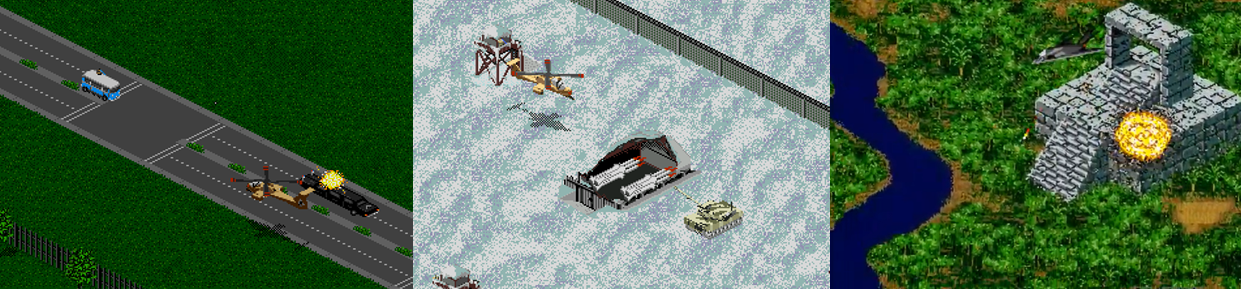
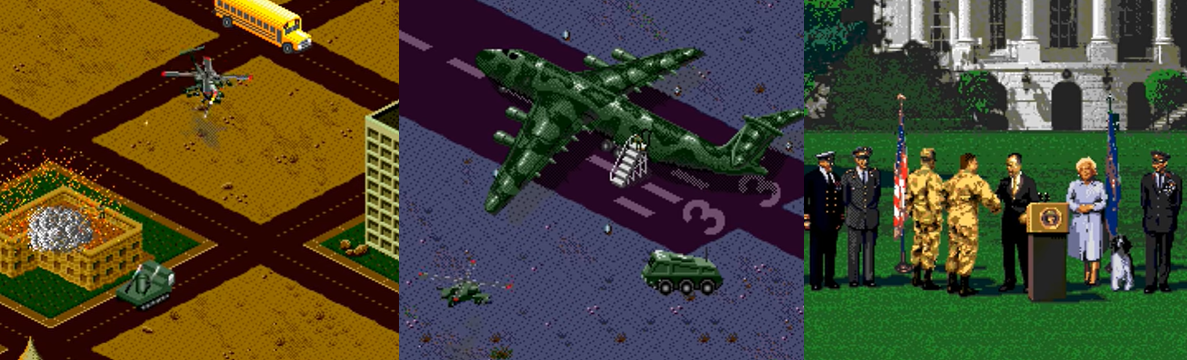
Graphically, not too much has changed or improved since Desert Strike beyond the title screen, which now uses a polygonal sprite for the Comanche, but the overall presentation of the game is vastly improved. Sprites, models, and environments are all very similar, with the same sound effects and use of text to convey mission completion, failure, the game’s story, and when you’re in a danger zone or running low on fuel or armour, but the maps are so much better this time around. Before, you just flew around the same area with a slight palette swap and some different structures here and there, with the most variety appearing in the final mission, but you instantly see how much more varied Jungle Strike is from the very first campaign, which sees you flying around an ambitious isometric recreation of Washington, D.C., complete with fully destructible White House and various other monuments (which also need protecting from enemy forces).

The graphics are much of the same, but overhauled and bolstered by a new vehicles and environments.

This carries through to the game’s other locations as well, which include an expanse of water with tiny islands dotted about and a large bridge running across it, and a couple of trips to the titular jungle (one at night, with low visibility, where explosions and gunfire light up the environment and two others in the day time, where rocky mountainsides, pyramid-like structures, and stone columns are plentiful). You’ll also fly through the frozen Soviet wastes and revisit the desert, both of which add to the visual variety of the game, and the pause menu and user interface have both been given a complete overhaul. Sadly, there’s still no in-game music, which can really make gameplay very monotonous, and it’s a shame as the title screen and story cutscenes are punctuated by some rocking tunes. These cutscenes are again made up of larger sprites and artwork, with some notable animation frames, but they do the job, as does the dialogue text; it’s fun seeing the Mad Man’s tanker truck explode in a blazing inferno and seeing your Comanche come in for a landing or launch a missile strike or your pilot character interrogate enemy agents helps to break up the gameplay a bit. It’s the 2.5D sprite work that steals the show, though; while the isometric perspective can make it a little difficult judge your precision and you can bonce off of buildings and rocks if you’re not careful, there’s a certain appeal to it and I always get a sense of satisfaction in seeing my missiles leave another enemy stronghold a flaming mess.

Enemies and Bosses:
While many of the enemy troops are functionally similar to the ones seen in Desert Strike, there’s been a few changes here; enemy soldiers still fire their guns and rockets at you, often masked by the foliage and environment, but you’ll also find seemingly innocuous civilian vehicles have been repurpose to either ferry bombs or fire at you and other targets. Guard towers, Gatling guns, and anti-aircraft placements are commonplace enemy targets, as are the smaller tanks and armour vehicles which patrol near to your mission objectives and fire bullets and missiles at you. You’ll also have to deal with a few more instances of gun boats and enemy helicopters, with these latter being able to be destroyed before they can take off, and stationary missile launchers which don’t pose a threat to you but are often heavily guarded. Thankfully, as mentioned, you can often strafe or position yourself in a way to avoid being damaged or have the enemy blast open jails and enemy stronghold son your behalf but be careful: destroyed buildings and targets are often as likely to hide an enemy unit as they are your object or some much-needed ammo. One of your more persistent and formidable enemies will be the Sheridan tanks and slow-moving mobile cannons, which can bring you down in just a few shots, and your own trigger finger; be sure to not just blast away at your targets in case you accidentally gun down someone you’re supposed to capture or destroy a nuclear warhead you’re meant to retrieve.

In place of traditional bosses, you’ll need to shoot down and destroy heavily armoured key targets.

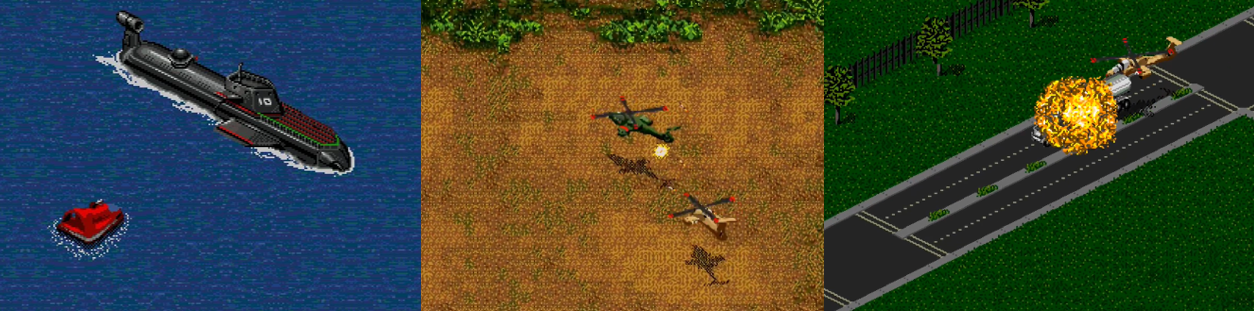
As before, the game doesn’t really include any traditional boss battles, but there are a few instances that could be said to count for them. In the second campaign, for example, you need to use your hovercraft’s mines and rockets to destroy some heavily armoured nuclear submarines (though actually placing said mine, and avoiding their rockets, is easier said than done, especially as their sprite tends to vanish if you’re too far away). In campaign five, you need to flush out five armoured cars that can only be destroyed with the motorcycle’s mines, and you’ll also be tasked with defending your co-pilot as he sets explosives in the war room in this campaign but, as no heavy artillery appears, it’s not so difficult. In campaign eight, you need to blow up these stone pyramids and destroy the nuclear warheads, detonators, and scientists within, which can be tricky as they’re well-guarded and the stealth bomber is clumsy to move around without crashing, but you’ll also need to blow a hole in the Drug Lord’s fortified bunker, then land so your co-pilot can drive a drunk into it for you to explode, and then shoot down his escape chopper and pick him up for due processing. The most annoying campaign is the ninth and final one, which has you frantically flying all over Washington for thirteen enemy vehicles and then destroying a bus and a fuel tanker with the Drug Lord and Mad Man on, respectively, before safeguarding the White House once more. It’s not exactly difficult to take these out, as long as you’re smart about your ammo and supplies, but actually locating most of these targets is nigh-on impossible as they don’t appear on the map.

Power-Ups and Bonuses:
As in the first game, you can fly over ammo crates, fuel tanks, and armour to restore each to full capacity. On many of the maps this time around, though, these resources are hidden behind pyramids, buildings, vehicles, and other destructible targets, meaning they don’t always appear on your map screen and you often have to waste ammo to resupply something else. Occasionally, you’ll be able to pick up an extra life and a quick winch, which speeds up your winch motion, and it’s beneficial to try and rescue the M.I.A. co-pilots, such as Wild Bill, as it can dramatically increase your accuracy, fire rate, and winch speed.

Additional Features:
There’s not really much on offer here; Jungle Strike’s additional content is all contained within the gameplay, and there are no other difficulty settings, multiplayer options, or game modifiers to speak of. You can find passwords online, however, that let you not only skip to later campaigns but also award you twenty-three lives (more than enough to finish every campaign in the game since the count resets to twenty-three at the start of each new campaign). Otherwise, your main objective for replaying the game (beyond it being fun) is to try and accumulate a higher score; there isn’t a scoreboard, however, so you’ll just have to note these down yourself.

The Summary:
I played both Desert Strike and Jungle Strike quite a bit as a kid, either on the Amiga or after borrowing them from friends. Although I struggled with Desert Strike and could barely finish the first campaign in that game, Jungle Strike was much easier and more forgiving for me to play through; everything that was so appealing in the first game is still here, but the added variety in the campaign maps, enemy units, and available vehicles makes it vastly superior in every way. While I was disappointed that the other vehicles weren’t available in my campaigns (and they probably could’ve been), they made those campaigns even more memorable, and I can understand their limited usage since their controls and weapons were a bit clunky and there were plenty of drawbacks to even the most powerful jets. Mission objectives are immediately familiar to anyone who’s played the last game, but they’re pretty fun to tackle, with only a handful being tedious and forcing you to search all over or destroy multiple targets. Managing your fuel and ammo is key to succeeding at Jungle Strike, which means you’ll either need a guide to plan an optimal route or use a bit of trial and error to figure out the best ways to go to take out a few targets, pick up some resources, and drop off any passengers. While it’s still disappointing that there’s no in-game music, the sheer visual variety on offer more than makes up for it; just getting away from the dreary desert makes Jungle Strike instantly better than the original and I really enjoyed all the destructible objects, recognisable landmarks, and little touches like cows and desert springs being scattered across the map. Overall, I would say I much preferred Jungle Strike as it was far more accessible and rewarding to play since I was actually complete and experience the entire game this time around, so I would absolutely recommend this one over the original for all the improvements it makes to the formula.

My Rating:

Rating: 4 out of 5.

Great Stuff

Did you enjoy Jungle Strike: The Sequel to Desert Strike? How do you think it compares to the first game, and it successors? Which of the new vehicles was your favourite? Did you like that the game featured more diverse environments? Which of the campaigns and missions was your favourite, or the hardest for you to complete? Whatever your thoughts on Jungle Strike, sign up to share them below or comment on my social media and check in next Saturday for my thoughts on the third game in the series.

Mini Game Corner: Desert Strike: Return to the Gulf (Mega Drive)

Released: March 1992
Developer: Electronic Arts
Also Available For: Amiga, MS-DOS, Mac OS, Master System, Lynx, Game Gear, Game Boy, SEGA Mega Drive Mini II, Super Nintendo Entertainment System (SNES), PlayStation Portable

A Brief Background:
By 15 March 1991, the Gulf War came to an end; after about six months of conflict and thousands left dead, the atrocities of the war would be felt for years to come and, naturally, this meant that Desert Strike caused some controversy when it was released due to the Gulf War being fresh in people’s minds. Desert Strike was spearheaded by Mike Posehn, who built off the air rescue mechanics of Choplifter (Dan Gorlin, 1982) by incorporating nonlinear, mission-based gameplay in a sandbox environment that eschewed typical videogame mechanics like bosses and power-ups. Inspired by Matchbox toys, Posehn designed the 3D models to resemble toys and programmed the game in such a way that players would be forced to restart if they went off-mission. Several months were spent perfecting the game’s physics and controls, all of which served it well upon release and Desert Strike has been highly praised as one of the Mega Drive’s top titles; reviews praised the graphics, the mission variety, and the strategy involved in tackling missions, though the difficulty curve and its more frustrating moments proved to be a cause of contention. Though many may have forgotten the series in recent years, Desert Strike kicked off a slew of similarly–themed sequels that built and improved upon the original’s formula; I used to play the Amiga version all the time back in the day and knew that the series was a must-buy once I really started collecting for the Mega Drive.

First Impressions:
Desert Strike is a top-down, isometric shooter in which players take the controls of an Apache helicopter and undertake a number of missions in a sandbox-like map in the middle of the Gulf Desert. At the start of the game, you can pick from a variety of control and gameplay options: by default, A fires your Hellfire missiles, B fires your Hydra missiles, and C fires your chain gun, but you can customise these to your liking. You can also choose to control the helicopter either from the cockpit (which makes movement a lot easier) from above (which leaves less room for error), or “with momentum” (the default setting, which has the helicopter move more realistically). I chose “from cockpit” and never had any issues with the control scheme; the helicopter is surprisingly manoeuvrable considering you’re essentially flying over a grid, and you can easily reverse away and bank out of firing range if need be. Once you’re happy with your controls, you can pick a co-pilot; while you’ll control the helicopter’s flying and weapons, the co-pilot you choose can greatly impact your gameplay as some cause the winch to jam while others are a bit more trigger happy. From there, you can either start from the game’s first campaign or enter a password to skip ahead to a later level, and you’ll be awarded with one of these codes after successfully completing each campaign. Sadly, despite some pumping tunes blaring during the title sequence and cutscenes, Desert Strike is devoid of in-game music, leaving only the sounds of your helicopter blades and weapons to hold your attention. Each of the campaigns also takes place on the exact same map, though the sand colour changes to indicate a different time of day and you’ll find different buildings, vehicles, and enemy placements in each campaign.

Check your map to identify mission objectives and targets to destroy or POWs to rescue.

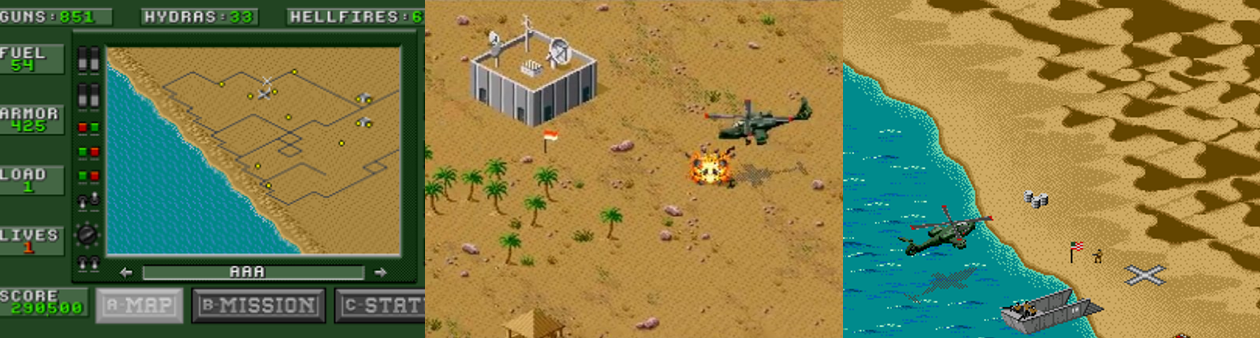
While you need to press C on the title screen to view the game’s story, mission debriefing and cutscenes will take place before each campaign (and during the mission when you rescue prisoners of war (POWs) or capture enemy commanders) using large, detailed, and partially animated sprite art and onscreen text. Once you start the campaign, you’ll need to fly from the frigate and to the desert, and right away you’ll see just how large the game map is. You can view the map from the pause menu and use the directional pad to switch between different mission objectives and points of interest on the map, which allows you to easily see where your next target is and what resources you can acquire along the way. You can also view the status of your missions, and get additional information about each one (this tells you how many POWs you need to rescue, or how many targets you need to destroy, in order to clear the mission). The instruction manual stresses that you complete each mission in order; if you don’t destroy the radar dishes first, you’ll encounter greater enemy resistance throughout the campaign, but it’s also advisable to clear out enemies or do some prep work on your way to your next objective (for example, if you’re going to fly past where an enemy spy is hiding, break them out and pick them up before destroying the power plant, then loop past the fuel on your way to taking out a SCUD Launcher). Since onscreen text is limited to warning you when you’re in a danger zone or low on fuel and armour and other situational notifications, you’ll only be able to keep track of your ammo, armour, fuel, lives, current load, and current score from the pause menu. Your helicopter’s chain gun is your weakest weapon, but also holds around a thousand rounds, meaning it’s sometimes better to hang back, angle yourself just right, and use the gun to blow open buildings rather than waste your more powerful missiles. Ammo crates are scattered all over the map, but ammunition is scarce; if you’re too trigger happy, you’ll have a hard (or almost impossible) time destroying the campaign’s bigger targets or tackling more formidable enemy units, like tanks and Rapiers.

Campaigns quickly get very challenging as you’re given a variety of missions to complete.

Your helicopter can take a decent amount of damage, but you’ll be reduced to smouldering wreckage under sustained heavy fire or if you’re not careful and bash into rocks or buildings. You start the game with three lives and, when they’re exhausted, you have to restart the entire campaign over. You can, however, earn additional lives by accumulating a high score or hop back into the later missions using the password system. If you die mid-campaign, you’ll respawn right where you failed but your weapons won’t be replenished after each death. You’ll get a bit of extra fuel, though, but it’s usually not enough to get to one of the handful of fuel drums also scattered across the map. As a result, you really have to think about the best routes and the most efficient way of tackling the missions; fuel, ammo, and armour all need to be considered so you can’t just fly in all guns blazing, and you can only carry six passengers at a time so you’ll need to be mindful of where the nearest landing zone is, too. Resources and passengers are automatically picked up by flying over them, which drops a winch for you to latch onto them. Your helicopter will also land so your co-pilot can get out and rescue targets, which leaves you flying about fending of heavily-armed enemy forces before recovering them, and you also won’t lose fuel when flying over the sea, which is useful in the game’s later campaigns. Missions are generally grouped into two categories: destroying targets and recovering targets. Radar dishes, power stations, airfields, and chemical weapons facilities all need taking out and you’ll need to recover both POWs and enemy commanders to learn the exact location of things like SCUD Launchers or bomb shelters. You’ll be orchestrating jail breaks, rescuing United Nations ambassadors, uncovering and destroying missile silos (before they launch their ordinance), airlifting soldiers from life rafts out in the ocean, and angling yourself just right to stop oil spills as you progress through the game. Practically every target is either defended by or soon reinforced by enemy forces, ranging from soldiers packing both machine guns and rocket launchers to tanks, AAA turrets, mobile Rapier launchers, and even an enemy helicopter in one of the later missions. There are no traditional bosses to speak of, but the more heavy-duty enemy vehicles can easily catch you in a crossfire, especially if you’ve wasted all your best ammo blasting buildings. Things would be a lot easier if you could restock your weapons, fuel, and armour at the frigate but this isn’t an option; rescuinf missing soldiers can restock your armour but resources are so scarce that you’re easily left with no better option than to completely start over since you won’t have the necessary weapons or fuel to continue, making for a challenging gameplay experience

My Progression:
I’ve played Desert Strike, and its sequel, before; as mentioned, I had it on the Amiga and I remember borrowing both from friends back in the day, but my memories are a little vague on the specifics. After replaying it on the Mega Drive, though, I can only conclude that my version must have been one of the many Amiga games I had that was cracked, allowing me to play with such benefits as infinite fuel, armour, and ammo as Desert Strike really is one of the most challenging Mega Drive titles I’ve played. Thankfully, it’s not unfair, exactly, just extremely frugal with its fuel, armour, and ammo and you really need to have a plan of attack in mind before taking on your objectives. If you run out of missiles destroying enemy vehicles or targets, you’ll never be able to destroy five out of the six SCUD Launchers before they fire their missiles, for example, so you shouldn’t just blast away willy-nilly or pick up ammo crates unless you need them, and while you do get extra points for destroying other targets and picking up soldiers, it’s best to stay on-task and only attack and rescue those that you need to. All of this is to say that I couldn’t get past the second campaign, and it was only through a great deal of trial and error that I was even able to beat the first campaign (!), which requires you to destroy three radar dishes, take out a power station, destroy some heavily-defended airfields, and then rescue a secret agent from a bunker while fending off enemy forces.

You’ll be hard pressed to take on the game’s later missions even with the level skip passwords.

Campaign two starts out with much of the same, asking you to destroy radar dishes, a power station, and a chemical weapons facility, but the resources are far scarcer are there are a lot more passengers that need picking up between the jail break and SCUD commanders, meaning you’ll be doing a lot of back and forth between landing zones. I was able to achieve all of these objectives except for destroying the SCUD Launchers as I was completely out of missiles by the time they appeared on my map and thus unable to destroy them before they launched their load. Even using the ten lives code didn’t really help here as I kept running out of the resources I needed to complete the campaign, so I used a password to jump ahead to the other campaigns and see how they fared. As you progress, not only do the number and aggression of the enemy forces increase, but so do your mission objectives: Campaign three has you rescuing U.N. ambassadors, destroying a chemical weapons complex, locating and destroying missile silos before they can launch, destroying a power station, blowing a hole in the Madman’s yacht and rescuing his hostages while fending off speedboats, and then protecting your co-pilot as he drives a bus to safety. I believe I died trying to locate the enemy ambassadors, so I tried the final campaign and was similarly met with failure. At first, you only get two objectives: destroy the tanks attacking an oil field and drop some commandos off to take the complex over and stop oil pumping into the sea with well-timed shots, but additional missions pop up soon after, including locating bomb shelters and destroying specific garbage trucks carrying bomb parts, but I was all out of ammo, fuel, and lives before I really got a chance to go any further than that.

Despite the fact that I couldn’t actually complete the game, and barely managed to clear even one campaign, I still really enjoy Desert Strike. While enemies and the game’s speed aren’t exactly action-packed or at a breakneck speed, combat is exhilarating as you need to try and circle around or stay out of firing range to quickly take out enemies or blow open buildings, without catching their attention and to conserve your more powerful weapons. The controls are surprisingly slick, and there’s a lot of little things to see and do in each campaign, from vehicles idling down the road, security checkpoints, POWs fighting with the enemy, enemy fire damaging buildings, and the amount of objectives crammed into each mission is staggering. In fact, there may be almost too much to do, certainly too much for the limited resources available; thus, Desert Strike is a game that involves a lot of strategy and asks that you plan out your route and how you tackle objectives and then restock your weapons, though the developers were really stingy with the fuel, ammo, and armour, which means that this isn’t really a game you can just casually playthrough. Still, it remains an under-rated Mega Drive classic and I’d love to hear your thoughts on Desert Strike down in the comments or on my social media so please feel free to share your memories and opinions and check back in next Saturday for my thoughts on the sequel.

Game Corner [Mickey Mouse Day]: World of Illusion Starring Mickey Mouse and Donald Duck (Mega Drive)


It’s November 18th, which means that it’s Mickey Mouse Day! Disney’s beloved mascot first debuted in Steamboat Willie (Disney and Disney, 1928) and has since become one of the most recognisable and influential cartoon characters in the world, the face of an entire multimedia conglomerate, and one of the most enduring and popular characters of all time, featuring in a variety of cartoons, videogames, and other merchandise.


GameCorner

Released: 14 December 1992
Developer: SEGA AM7
Also Available For: Mega Drive Mini

The Background:
As I’ve talked about a few times in the past, videogames based on popular Disney characters and licenses had quite the reputation back in the nineties and resulted in some of the best 8- and 16-bit action/platformers of the era. As Disney’s loveable and successful mascot, Mickey Mouse was obviously at the forefront of this but Disney’s foul-tempered fowl, Donald Duck, had his fair share of pixelated adventures over the years as well and what better way to guarantee a success than to team these two popular characters up in their own fantasy adventure. Taking inspiration from a variety of Disney’s animated feature films, most prominently Alice in Wonderland (Geronimi, Jackson, and Luske, 1951) and Snow White and the Seven Dwarfs (Hand, et al, 1937), and, despite how easy the game was, it was both reviewed very well at the time of release and fondly remembered years later.

The Plot:
While practising for their magic show, Mickey and Donald discover a magical box that sucks them into a bizarre magical world. Now, the two must join forces to travel across five treacherous fantasy worlds, defeat the evil Magic Master, and return home safely.

Gameplay:
World of Illusion Starring Mickey Mouse and Donald Duck is a 2D action/platformer in which, as you might be able to guess, players can pick between playing as Mickey or Donald or team up to play as both in simultaneous play. Whichever character you select, the game’s controls are basically the same and can be customised from the main “Options” menu; you can jump, hold down a button to dash ahead, and press down on the directional pad to duck. Although you cannot defeat enemies by jumping on their heads as is the standard of the majority of 2D platformers, Mickey and Donald can attack enemies with a swipe of their magician’s capes.

Attack with your magical cape and lend a hand to your partner to get through tight spots.

The cape produces a small flurry of magical sparkles, which can stun enemies if it grazes them or if they need more than one hit to defeat, and defeated enemies will be transformed into harmless forms (such as flowers or butterflies) when hit. There are actually some notable gameplay differences between Mickey and Donald as well; Mickey is able to crawl through small gaps but Donald gets his wide load stuck and will need pulling through with Mickey’s help. This means that, when playing as Donald alone, you’ll explore different levels compared to Mickey, which encourages at least two playthroughs of the game in order to see everything it has to offer. Additionally, when playing with a friend, you can help them out further by dropping a rope so they can reach higher level.

While not especially difficult, there are some annoying moments you’ll have to deal with.

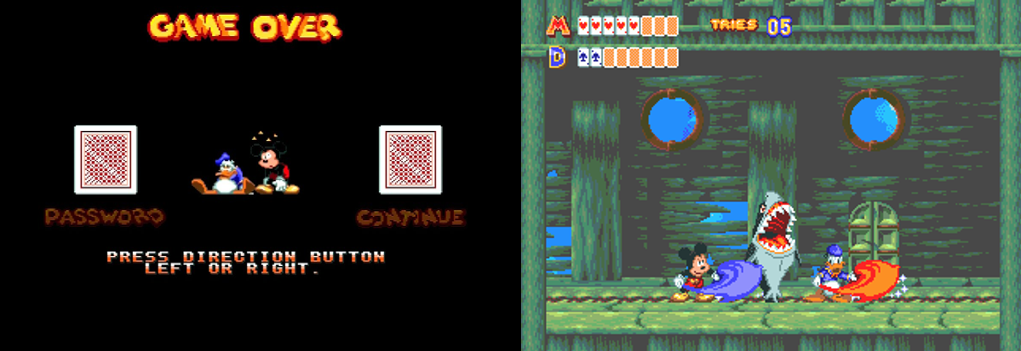
Mickey and Donald’s vitality is measured in magical playing cards; you begin the game with five cards, meaning you can take five hits before you lose one of your three “Tries”. You can, however, pick up Candy and Cake to restore one of all of your cards and are gifted with unlimited continues. However, when you lose all of your Tries and choose to continue, you’ll have to restart from the very first part of the level you were last on. When playing with a friend, you’ll share a stock of six Tries; when your partner loses a Try, you can expend one to revive them and, when you only have one left, the last player to die can choose to continue solo.

Some tricky jumps are made clunky thanks to the game’s extremely slow pace.

World of Illusion isn’t an especially long game; there are only five levels to venture through, with each one split into smaller sub-sections and with some minor puzzles and hidden paths or areas that you can find by exploring a bit. While these generally just lead you towards Candy or other power-ups, other times you’ll find short sub-areas to playthrough for similar bonuses. Each level only has a handful of enemies and none of them are particularly menacing but they do respawn if you end up having to backtrack and can cause you to fall down a bottomless pit if you’re hit mid-jump thanks to a bit of knockback damage. The game is also extremely slow; the dash function helps with that but, still, Mickey and Donald move painfully slowly and the game is more about taking your time and enjoying the moment rather than blasting through at breakneck speed, which is fine but it does feel like playing underwater sometimes since everything’s so sluggish.

Donald has his own unique levels and hazards to contend with.

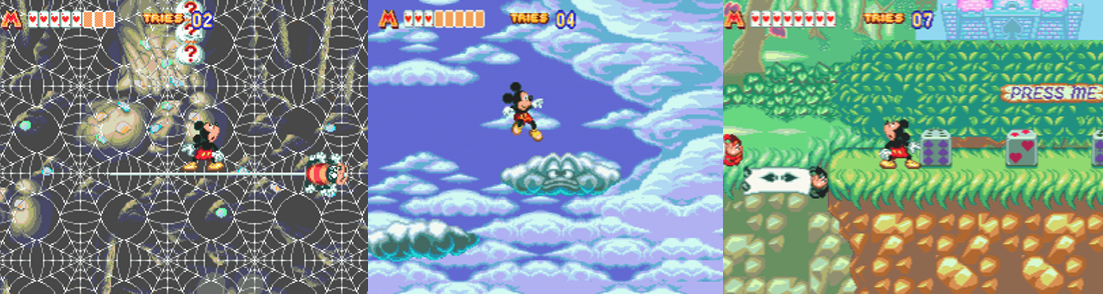
Your main concern in most levels will be dealing with the game’s platforming sections; mostly, this involves reaching the exit on the far right of the screen but other times you’ll be hopping from spider’s webs and web lines, floating leaves or clouds, and other similar platforms. These will invariably be large, small, moving, or even temporary; even solid ground isn’t safe in this respect as you’ll have to contend with floorboards cracking under your feet and dropping you to your death. Levels also contain a number of helpful gimmicks as well, though, such as see-saws, flowers, staples, and bottle corks that fling and spring you higher and further up the level and towards the goal.

Graphics and Sound:
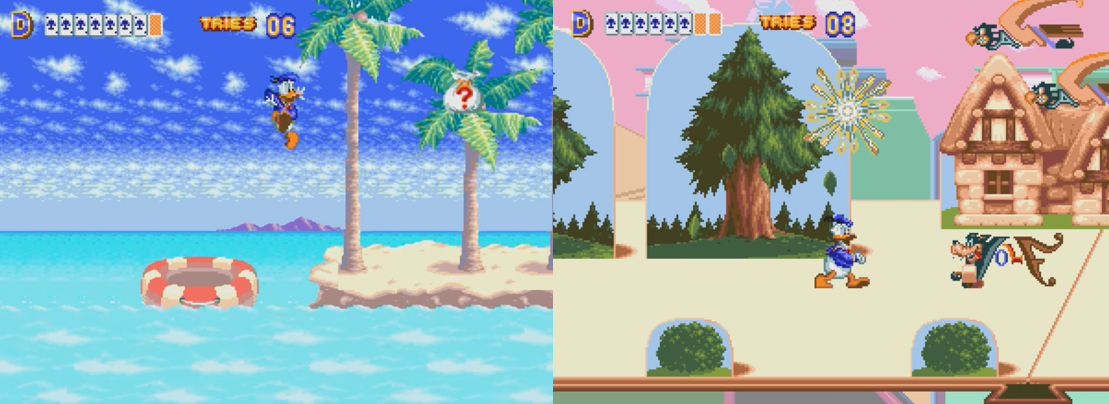
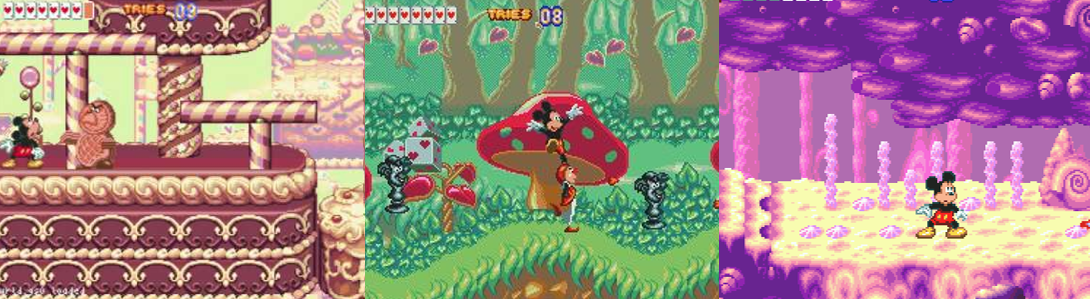
Like all of the 2D Disney videogames, World of Illusion features large, colourful, and charming cartoony graphics. Mickey and Donald both have amusing edge and idle animations and little reactions that perfectly capture their distinct personalities. There’s also a very small number of voice clips in the game; Mickey and Donald will yelp and squeal when attacked and give a cry of “Alakazam!” when performing their magic tricks, which is a lot of fun.

The game definitely looks the part but can be a bit muted and empty at times.

Enemies are similarly colourful and instantly recognisable from Disney’s classic animated films, such as Alice in Wonderland. The game also draws aesthetic influences form Pinocchio (Sharpsteen, Luske, et al, 1940) and The Little Mermaid (Clements and Musker, 1989), with all three films (and others) likewise evoked in the levels you’ll journey through. However, while levels are bright and very fitting, they’re every short and also very bland and empty in a lot of ways. Levels can be a bit inconsistent like that; the chocolate-and-sweetie-filled level is bursting with colour and sometimes there’s large trees or vines or other elements in the foreground or little details in the background, but other times they’re just very barren a bit muted.

The story is told using a fairytale book and in-game sprites with brief dialogue boxes.

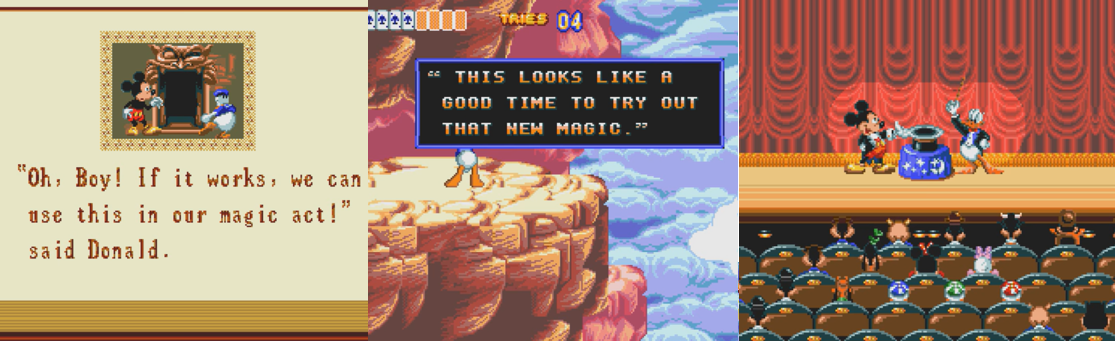
The game’s story is told through text in a storybook that can be skipped through, or entirely, at will; while these are only accompanied by static images, the supplementary music (and the music of the entire game) is suitably jaunty and uplifting (if nothing spectacular). After defeating the game’s bosses, a similar cutscene will play in which the characters learn their new magic and, at a few points, the game will use the in-game sprites and a speech box to convey dialogue. As is the case for many 2D videogames from this era, the cutscenes are most impressive for the opening (which pans through the theatre’s backstage area) and the ending (which differs for each character and in which the two perform their magic show before an auditorium full of Disney cameos) before heading off through the forest as the credits roll.

Enemies and Bosses:
While they draw inspiration from many of Disney’s most celebrated animated features, World of Illusion’s enemies aren’t really anything to shout or worry about. You’ll take on armoured bugs, avoid literal tiger sharks, swipe at carnivorous starfish, toy bi-planes, and spiders but none of them are really a threat as they come at you quite slowly and make for large targets. Eventually, you’ll have to contend with wild lightning striking at the ground and conjuring little flaming imps and come up against some more colourful and zany opponents, such as anthropomorphic biscuit men, sharks wielding saws, and rose-throwing playing cards from Alice in Wonderland.

While the spider boss couldn’t be simpler, the little dragons can be a bit tricky to land a hit on.

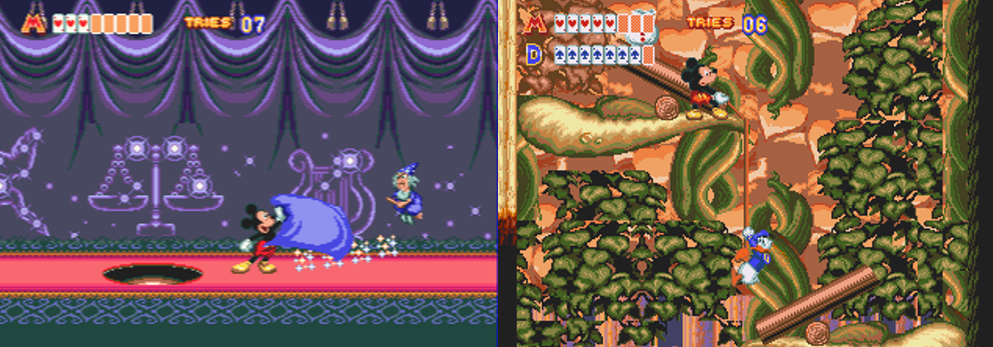
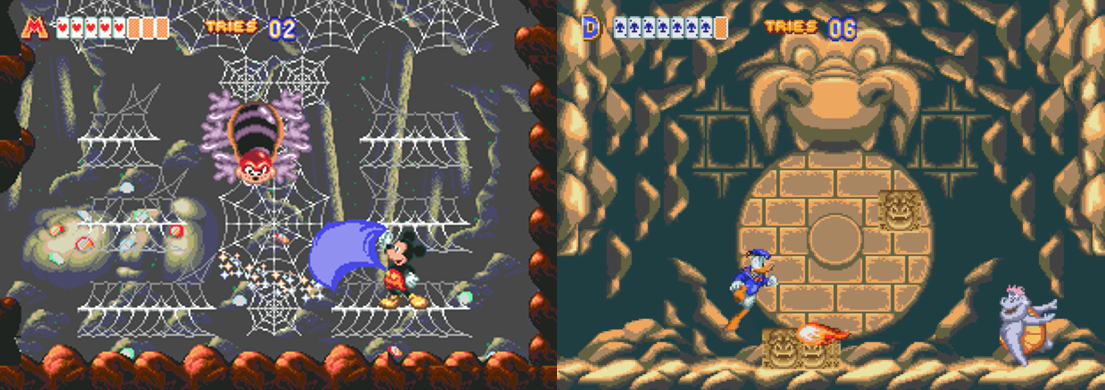
Each of the game’s levels culminates in a battle against a boss. The first of these is a giant spider that crawls down and across the webbing that is spreading across the background of the boss arena; sometimes it’ll crawl down harmlessly on the other side of the web and taunt you but, for the most part, it’s pretty easy to edge out of the way and swipe at it with your cape. The second boss you’ll face is a series of small dragons that resemble the one from The Sword in the Stone (Reitherman, 1963) or Pete’s Dragon (Chaffey, 1977); these little buggers will pop out from blocks, hop around, and spit fireballs at you but, again, it’s not exactly difficult to avoid them and it helps that they attack one at a time.

The sharks speed and unpredictability, and Mim’s erratic flight, make for challenging boss fights.

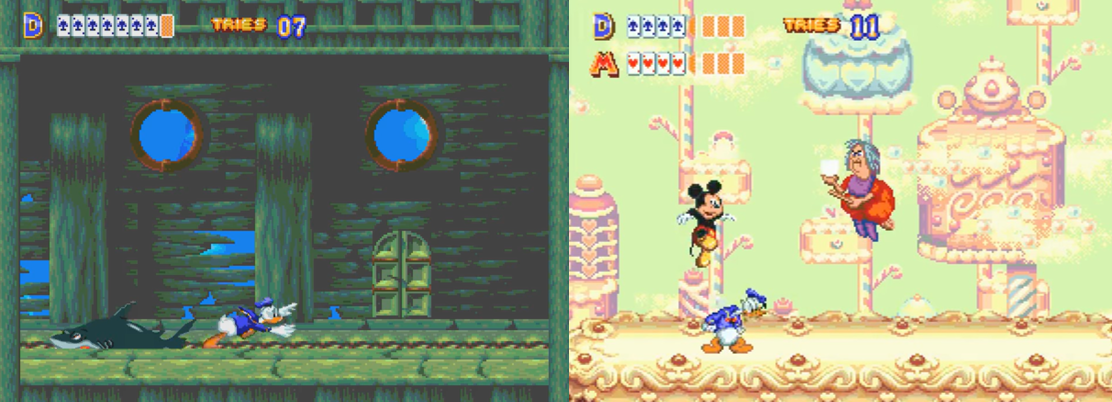
At the bottom of the sea, you’ll battle against a giant shark that rushes at you ominously beneath the floorboards of a sunken ship. When it charges towards you, jaws snapping, or leaps out from the ground to pounce at you, this is your moment to quickly attack and hop out of danger, but the shark’s speed and unpredictability actually makes this a somewhat challenging bout. Next, you’ll battle against Madam Mim, which was an amusing and entertaining surprise Mim flies about just above you on her broomstick and tosses flames down to the floor. You can easily jump up to attack her, though, and she stupidly drops down to the ground to taunt you, leaving herself wide open to reprisals in the process.

The Magic Master might be big and ugly but he’s sadly as simple as any of the other bosses.

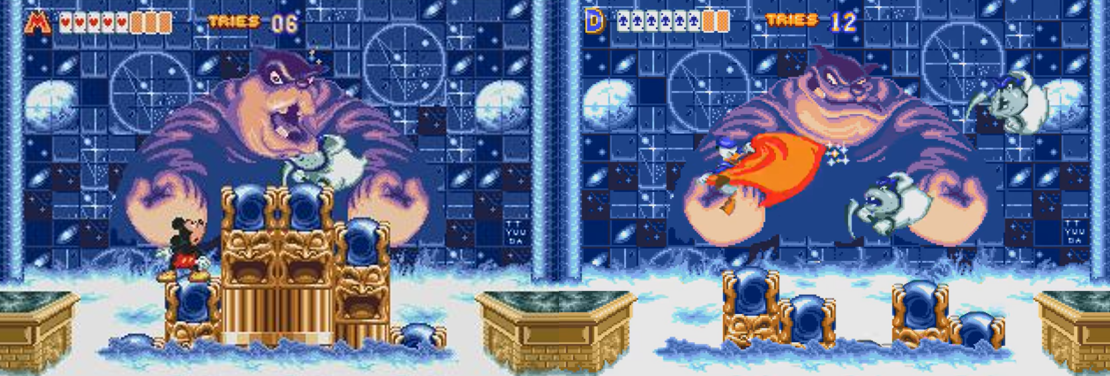
Finally, you’ll take on not the anthropomorphic cloud beast seen in the game’s cover art but the Magic Master, who is a gigantic background sprite and greatly resembles Mickey’s long-time nemesis, Pete. Taking place up in the clouds, this battle features randomly rising and falling columns that you can use to get close to the Magic Master’s big ol’ head and swipe at him with your cape. The boss conjures smaller, ghost-lime doubles of himself that resemble the Grim Reaper and float around the arena for a bit to damage you but, otherwise, is a bit of a pushover (especially if you have full health, which you probably will as there’s a number of health-restoring items on the way to the final confrontation).

Power-Ups and Bonuses:
There aren’t too many power-ups to pick up in World of Illusion; as I mentioned before, Candy and Cake will partially or full refill your health but you can also earn yourself an extra Try by either finding a magician’s hat or collecting fifty-two playing cards. You can also occasionally find a firework that will shower the screen in explosions and destroy all onscreen enemies or a Silver Card for a brief period of invincibility.

Mickey and Donald learn new magic tricks to help them progress through the game.

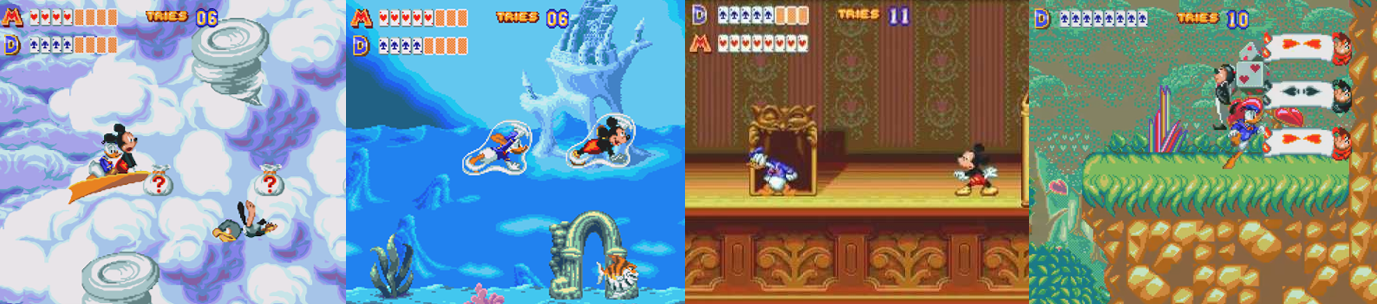
After defeating each of the bosses, Mickey and Donald will learn a new magical ability to help them progress in the next level. The first of these is a magic carpet, which you can cause to ascend by tapping the jump button and ride through the skies avoiding tornados and buzzards. Next, you’ll get a magic bubble that allows you to slo-oo-wly navigate the underwater stage, again by tapping the jump button. The next spell allows you to teleport across the library when you’re shrunk down and is probably the least interesting of all of the magic tricks. Finally you’ll be able to cause specific playing card enemies to arrange themselves into platforms and bridges to help you get through the iconic garden and dining hall from Alice in Wonderland. All of these are performed in specific circumstances rather than at will and don’t really afford you any useful in-game benefits beyond allowing you to get to the end of the level you’re on, though.

Additional Features:
That’s about it for World of Illusion. The game uses a password feature that allows you to warp to later levels as either Mickey, Donald, or both if you have to suddenly top playing but that’s about it. I’m a bit confused as to why the game has this password system, though, as it’s not exactly difficult and easy to fly through it in about a hour or so.

The Summary:
World of Illusion Starring Mickey Mouse and Donald Duck certainly looks and sounds the part of a typical 1990s D16-bit Disney videogame; it’s bright, fun, and full of gorgeously animated sprites and instantly recognisable Disney characters and locations. Mickey and Donald are always two of the most versatile characters in videogames, I find, and excel when dropped into fantastical environments and tasked with getting through them using a number of gimmicks; while the attack range of their magic capes leaves a lot to be desired, I enjoyed the magical spin on their arsenal and, especially, the flying carpet sections of the game. Sadly, though, it’s just a bit too short and bland in a lot of ways; two of the five bosses are just generic, large creatures and the game is just way too slow and sluggish through and through rather than being action-packed and entertaining. It’s a decent way to send an hour or so and fun to be able to team up with a friend for simultaneously play; it’s pretty cool how you get a slightly different experience when playing as each character but it’s lacking in a lot of content and options, some of which (such as score and certain gimmicks) actually featured in Castle of Illusion Starring Mickey Mouse (SEGA AM7, 199) which released three years earlier and stuff like that does bring the score down a little bit for me despite how striking the game’s presentation is.

My Rating:

Rating: 3 out of 5.

Pretty Good

What did you think about World of Illusion? Where does it sit in your hierarchy of 16-bit Disney games? Which of the 16-bit Disney was your favourite, or least favourite, and who is your favourite Disney character? How are you celebrating Mickey Mouse Day today? Whatever your thoughts on World of Illusion, and Disney and Mickey games in general, drop a comment below and share your thoughts and have a great Mickey Mouse Day!

Game Corner: SEGA’s Mega Machine

SEGA’s Mega Machine

On 29 October 1988, SEGA released the 16-bit Mega Drive (known as the SEGA Genesis in North America); far superior to Nintendo’s 8-bit Nintendo Entertainment System (NES), and bolstered by both an aggressive marketing campaign and the eventual release of Sonic the Hedgehog (Sonic Team, 1991), this release kicked off the “Console Wars” of the mid-nineties and changed the face of home consoles forever. This year, to celebrate this momentous occasion, I’m going to share some of my memories of this sleek, beautiful machine and the impact it had on my childhood. I was just a kid, something like six or eight, when I had what I am pretty sure was my first ever home console (and videogame) experience; I remember being at my aunt’s house and being introduced to the SEGA Master System II and, more specifically, Sonic the Hedgehog for the first time when I sat down to fumble my way through Sonic the Hedgehog’s (Ancient, 1991) Green Hill Zone. The colours, the sounds, and the user-friendly nature of the system clearly struck a chord with me and it wasn’t long (it was probably my birthday that same year) before my parents gifted me that very same machine and, as I recall, three titles: Spider-Man (Technopop, 1991), Trivial Pursuit: Genius Edition (Domark, 1992), and the aforementioned Sonic built-into the machine.

The Master System II served me well until I got a convertor unit for the Mega Drive.

For a long time, probably something like two or maybe even three years, the Master System more than met my demands. I amassed a pretty decent library considering money was a bit tight back in those days and wasted many hours playing a variety of 8-bit titles. One memory that sticks out for me in particular was when I had a friend come over to play games (this was, of course, back in the days when kids mostly only owned one machine so you had to actually go around someone’s house to play other consoles and games) and he was struggling to get past the Green Hill Zone boss. I took the controller from him and reached the last Zone of the game for the first time, which was quite the achievement for me at the time; though I distinctly recall not actually completing Sonic that day, I did eventually, and many times over. Another memory for me was when I discovered the elaborate method of activating Sonic the Hedgehog 2’s (Aspect, 1992) level select and actually being able to bypass the God-awful Sky High Zone. My love for videogames had well and truly began. I played the NES at a friend’s house, the PC at another friend’s, and enjoyed a handful of ZX Spectrum, MSX, and Amiga titles while routinely playing the Master System, reading Sonic the Comic (Fleetway, 1993 to 2002), and watching the likes of Captain N: The Game Master (1989 to 1991), Adventures of Sonic the Hedgehog (1993 to 1996), and GamesMaster (1992 to 1998).

The article I most attribute for selling me on the Mega Drive.

I bought videogame magazines from car boot sales, drooled over Master System games in the local game’s shop, and doodled pictures of Sonic and his friends at every opportunity. Then, one fateful day, I became aware of another SEGA console; one with far more detailed graphics, bigger, better games, and, more importantly, more Sonic titles. I can’t be exactly sure when I first became aware of the Mega Drive but I distinctly recall owning issue two of Mega (Future Publishing/Maverick Magazines, 1992 to 1995) which had a whole article devoted to the upcoming (or recently released) Sonic the Hedgehog 2 (SEGA Technical Institute, 1992). I was awe-struck; the sprites were so big and colourful, the graphics so crisp and detailed. Unlike in the 8-bit Sonic 2, Miles “Tails” Prower was actually a playable character…and he followed Sonic around onscreen, too! I’m sure I must have seen other photos, articles, and gameplay footage of the Mega Drive across the other magazines and shows I watched but this particular issue of Mega really sticks out in my mind; I read that article over and over, each time more and more attracted to the power and superior graphics of the Mega Drive.

The Mega Drive was for sharing back when I first got it but that was fine by me.

Another memory I distinctly have is pointing the machine out to my parents in an Argos catalogue and trying to explain the benefits of upgrading to SEGA’s newer, sexier console. As I said, money was tight back then for us; we weren’t exactly poor and destitute but we also weren’t rolling in disposable income so I’m sure the decision to buy a Mega Drive didn’t come easily for my parents. Thankfully, however, unlike a lot of parents these days, mine were cleaver and, that Christmas, I received the coveted SEGA Mega Drive and two games (Michael Jackson’s Moonwalker (SEGA, 1990) and my equally-coveted Sonic 2) on one proviso: it was to be a joint present for me to share with my older sister. I’m pretty sure that that gorgeous black machine, with its two control pads and those two fantastic games, was the only present either of us got that year, as well, but I didn’t care: I had it and that’s all that mattered. In 1983, an influx of home consoles, poorly-made titles, and a vastly oversaturated market caused the videogame industry to crash in spectacular fashion; what had once been a booming, attractive business had crumbled under the weight of expectation, success, and a market inundated with machines and titles that retailers just couldn’t sell. A few years later, the industry began to recover thanks to the release of the Nintendo Family Computer (Famicom); known as the NES outside of Japan, the machine was marketed not as a home videogame console but more as an “Entertainment System” (it wasn’t a “home console”, it was a “control deck” and the cartridges were “Game Paks” rather than “videogames”) to give it a better chance at selling in toy shops.

Super Mario Bros. catapulted Nintendo to mainstream success as the home console market leader.

Thanks to a lack of competition and the blockbuster success of Super Mario Bros. (Nintendo EAD, 1985), 30% of American households owned the NES by 1990 and Nintendo absolutely dominated the slowly re-emerging videogame market after the NES sold over 35 million units in the United States, a number that was far beyond those of other consoles and computers. Videogames were back, and more popular than ever, thanks to Nintendo’s efforts and high quality titles, and the industry once again became lucrative and profitably so, naturally, others wanted in on the action. Enter SEGA; formally one of the top five arcade game manufactures in the US, the videogame crash and a decline in the popularity of arcades had seriously hurt the company and led to its purchase by Bally Manufacturing and an eventual restructure towards the home console market with the SG-1000, a precursor to my beloved Master System. Though the console sold well in Japan, it barely made a dent thanks to Nintendo’s stranglehold on the market so, amidst growing competition, SEGA’s research and development team, led by Masami Ishikawa decided that the only way for SEGA to remain competitive was to incorporate a 16-bit microprocessor by adapting their successful SEGA System 16 arcade board into the architecture for a new home console. Mitsushige Shiraiwa led the team that designed the Mega Drive, drawing inspiration from audiophile equipment and automobiles, and the machine was purposely designed to appeal to gamers of all ages, rather than just children like Nintendo’s console.

Aggressive marketing and strong third party support also helped give SEGA the edge.

To impress customers with the system’s power, “16-bit” was slapped right onto the console itself in impressive, striking gold yet, despite shipping 400,000 units in its first year and producing a number of additional peripherals, the console’s launch was overshadowed by the released of Super Mario Bros. 3 (Nintendo EAD, 1988) and the system was unable to surpass the NES in terms of sales or popularity. For the Mega Drive’s release in North America, the system was rebranded as the “Genesis” and SEGA of America CEO Michael Katz spearheaded an aggressive marketing campaign to sell the power and superiority of the console compared to the NES. While the Genesis certainly did do what Nintendo didn’t, it still wasn’t enough to topple or compete with NES or their podgy little plumber. Thus, when Tom Kalinske replaced Katz as CEO, he developed a four-point plan that involved cutting the console’s price, create a U.S.-based team to develop games specifically for the American market, continue and expand their aggressive advertising campaigns, and bundle copies of the Genesis with the one game exclusively developed to overtake Mario once and for all: Sonic the Hedgehog. For a time, this plan worked wonderfully; bundling Sonic in with the Mega Drive gave SEGA the edge it needed as gamers who had been anticipating the release of Nintendo’s own 16-bit console, the Super Nintendo Entertainment System (SNES), bought a Mega Drive instead just to play Sonic. Sonic’s popularity also led to the Mega Drive outselling the SNES during the 1991 holiday season and, but 1992, SEGA had wrestling 65% of the market away from Nintendo and overtaken Nintendo as the home console market leader for the first time since 1985.

Had SEGA focused on the Mega-CD, things might’ve been very different for them.

With a focus more on arcade-quality titles, a willingness to consider a greater variety of genres and videogames compared to Nintendo, and Sonic’s explosive popularity as not just a videogame icon but a mainstream icon, SEGA seemed unstoppable. A sleeker, more streamlined version of the Mega Drive released in 1993 and the company even produced a special convertor unit that would allow gamers (such as myself) to play their Master System cartridges on the 16-bit console. SEGA were ahead of the times in many ways; unlike Nintendo, they released Mortal Kombat (Midway, 1993) with its signature blood and Fatalities intact through use of a special code, showing the machine (and the company) to be the more mature and “edgier” of the two, and SEGA soon began to experiment in both CD-based games and 32-bit graphics with the Mega/SEGA-CD and Mega/SEGA-32X add-ons. Unfortunately, despite showcasing some impressive graphics, CD-quality sound, and the sheer potential of these peripherals, producing such expensive add-ons to prolong the Mega Drive’s lifespan ultimately proved financially disastrous for SEGA. When research SEGA and their tumultuous history for my PhD thesis, I was disappointed to see how the company squandered all their success with blunder after blunder in this way. To me, they had the right idea with the Mega-CD and should have stuck with that. Had SEGA simply made the little-known SEGA Multi-Mega the standard and ditched all plans for both the 32X and the SEGA Saturn, producing all the games that released for those console (and the Mega-CD) as CD-based games, the company may have fared better heading into the sixth generation of gaming. I don’t know if would have been enough to make the Dreamcast more competitive but SEGA would definitely have been in a much better financial position without wasting all that money making expensive add-ons and inferior consoles.

My Mega Drive collection is still a work in progress but has always had some quality titles.

Still, it is what it is and, for many years, even when I owned a Nintendo 64, I still returned to the Master System and the Mega Drive. My library of Mega Drive games grew respectfully as I continued to indulge my love of colourful, action-packed action/platformers like Rocket Knight Adventures (Konami, 1993), Marko’s Magic Football (Domark, 1994), The Revenge of Shinobi (SEGA, 1989) and, of course, every Sonic title released for the console. However, to say that I was a fan of Sonic was an understatement; I remember incurring the wrath of my mother for not pausing Sonic 2 right as I beat the game for the first time to go for dinner and I must have played that game endlessly, rejoicing every time I got to play as Sonic and someone else got to play as Tails for a change. I distinctly remember getting Sonic & Knuckles (SEGA Technical Institute, 1994) for a birthday and that I got the game before I owned Sonic the Hedgehog 3 (ibid). I’m not sure exactly how that happened but I remember being fascinated by Sonic & Knuckles’ unique “lock-on” technology and being able to play as Knuckles the Echidna in Sonic 2. Some time later, while at a game’s shop in Northampton, I picked up an unboxed copy of Sonic 3 for £9 and, after reading a guide in Sonic the Comic that showcased the awesomeness of Super Sonic, Hyper Sonic, and the Doomsday Zone, eventually made it my top priority to unlock these forms and reach this final Zone in a precursor to my newfound desire to obtain as many Achievements as possible.

The Mega Drive was pretty great for multiplayer experiences, too.

It wasn’t just about Sonic, though; the Mega Drive was a great two-player console and I lost a lot of hours playing T2: The Arcade Game (Probe Software, 1991), Captain America and the Avengers (Data East, 1992), and Mortal Kombat 3 (Midway Games/Sculptured Software, 1995) even while I was playing the likes of WCW vs. nWo: World Tour (Asmik Ace Entertainment/AKI Corporation, 1997) and Quake 64 (Midway Games, 1998). While not every title I played or owned for the Mega Drive was a smash hit, I still managed to find plenty to love thanks to the eye-catching graphics, catchy tunes, generally tight controls and gameplay, and the sheer attractiveness of those black boxes and cartridges. I even got a lot of enjoyment out of games that were short-lived in my collection, like Cosmic Spacehead (Codemasters, 1993) and The Aquatic Games Starring James Pond and the Aquabats (Millennium Interactive, 1992), even though they may not have necessarily been the easiest or most suitable games for my tastes at the time. Sadly, as I mentioned, money was always an issue in keeping me from having a truly expansive Mega Drive library; I borrowed a few titles I never actually owned, like Taz in Escape from Mars (HeadGames, 1994) and Street Fighter II’: Special Champion Edition (Capcom, 1993) but, while I played the likes of Golden Axe (SEGA, 1988) and Zool: Ninja of the Nth Dimension (Gremlin Graphics, 1992) on the Amiga, I never actually owned them for the Mega Drive back in the day.

My original mega Drive still sits proudly in the actual, physical game corner.

Thus, once we tore down our unused garage and had a little log cabin built and my dream of having an actual, physical game corner quickly became a reality, I knew what my first priority would be: to build a respectable library of physical, complete Mega Drive games to play at my leisure. It’s an expensive and long-winded process thanks to the fact that complete versions of Mega Drive games can be quite expensive but it’s a much easier prospect than collecting for Nintendo’s 8-, 16-, and 64-bit consoles as Nintendo favoured flimsy cardboard boxes for their games so the only Mega Drive game you really have to worry about having a battered or ripped box is Sonic & Knuckles. I first made my steps towards building this library when I finally bought a boxed and complete version of Sonic 3 a few years ago and, since then, the collection has grown slowly, but steadily. I’m prepared to play the long game when it comes to completing my collection as, while my Odroid console is great for emulating thousands of games and there’s plenty of ports or collections of classic Mega Drive titles available for modern consoles, there’s nothing quite like seeing a shelving unit full of those gorgeous, bulky, black or blue boxes and slotting a physical cartridge into that very same Mega Drive my parents gifted me all those years ago.

What are your memories of the SEGA Mega Drive? When did you first play or own one and which model did you have? Perhaps you preferred Nintendo’s consoles; if so, why and share your memories of those days? Do you also believe that SEGA might still be something of a competitor in the home console industry had they avoided the 32X and the Saturn or do you think their downfall was inevitable given how crowded and competitive the home console market became? What are some of your favourite Mega Drive titles? How are you celebrating this momentous day today? No matter what your thoughts, please feel free to share your opinions and memories of the Mega Drive and this era of gaming below.

Game Corner [Spidey Month]: Spider-Man (Mega Drive)


Easily Marvel Comics’ most recognisable and popular superhero, unsuspecting teenage nerd Peter Parker was first bitten by a radioactive spider and learned the true meaning of power and responsibility in Amazing Fantasy #15, which was first published in August 1962. Since then, the Amazing Spider-Man has featured in numerous cartoons, live-action movies, videogames, action figures, and countless comic book titles and, in celebration of his debut and his very own day of celebration, I’ve been dedicating every Wednesday to talk about everyone’s favourite web-head!


Released: 1991
Developer: Technopop
Also Available For: Game Gear, Master System, and Mega-CD

The Background:
Shortly after debuting in the pages of Amazing Fantasy, Peter Parker/Spider-Man graduated to his own solo title and quickly became Marvel’s most popular comic book character. Accordingly, Spider-Man was one of the first of Marvel’s superheroes to make the jump to videogames. In the early nineties, SEGA held the licensing rights to produce home console games based on Marvel Comics characters and one of the first, and most popular, of these was Spider-Man (also known as Spider-Man vs. The Kingpin), a game I first played on the Master System before switching to the 16-bit version after being won over by the superior graphics.

The Plot:
Wilson Fisk, the Kingpin of Crime, has planted a nuclear bomb in New York City that is set to explode in twenty-four hours, distributed the keys to disarming the bomb to some of Spider-Man’s most lethal foes, and has even framed Spidey for the crime! And, as if all that wasn’t bad enough, Eddie Brock/Venom is stalking the city, further stacking the odds against the web-slinger.

Gameplay:
Spider-Man is a 2D, sidescrolling action/platformer with an emphasis on exploration and combat; given the nature of the plot, players have just twenty-four in-game hours to complete the game. Dawdle too long in the game’s locations and you’ll doom the entire city to destruction, which places a real anxiety into the gameplay which is, sadly, not reflected in the game’s mechanics.

Spidey’s webbing allows him to take out crooks and quickly traverse levels.

Obviously, you take control of Spider-Man, a clunky, stilted, and awkward character who displays all of Spidey’s trademark abilities: he can punch out goons with B, jump with C (be sure to hold the button for a higher jump), and cling to walls, ceilings, and backgrounds by pressing jump twice. He can also shoot webbing with A, which is perfect for taking out goons from a distance or up high as you can diagonally direct Spidey’s web; while you can’t shoot upwards, you can shoot a web out while jumping to swing along horizontally but, while this is great for covering large distances quickly, it’s not so great for the many instances of vertical movement.

Spidey’s webbing is super useful but you’ll need to earn cash from selling photos to refill it.

From the pause menu, you can select between two webs: a sticky web projectile and a web shield to help protect Spidey from damage. However, Spidey has a finite supply of webbing and, when he runs out, you’ll have to rely on your punches and jump kicks. After retrieving Parker’s camera from the Daily Bugle though, you can select his camera from the pause menu and take pictures of goons and bosses to earn cash and refill your webbing, but you only have a limited number of shots available so it’s best to save these for getting pictures of Spidey’s more recognisable enemies.

Control is sluggish and awkward, meaning Spidey lacks his trademark grace and agility.

Control is a major issue in Spider-Man; Spidey is slow moving, his punch doesn’t have a lot of reach, and not only is his hit box quite large but so are the ones of his enemies. You can get around this a bit with his webbing, jump kick, and crouching kick but, more often than not, you’ll clip through enemies and fly backwards when hit with attacks. However, the most frustrating thing about Spider-Man, and the game in general, is how janky the jumping and wall-climbing mechanics are; some levels, such as the city streets, easily allow you to climb walls in the backgrounds but others, like the caverns, don’t. In the warehouse and sewers, you’ll need to climb up vertical walls and ceilings to get through air vents and tunnels and navigate past crates and such, but you need to keep C held down to stay attached to the surface. Nowhere is the control more annoying than in the caverns level, a cramped and maze-like environment that restricts your movement and requires you to perform some tricky web-swings and jumps to progress, which can be frustrating to pull off as Spidey prefers to either just drop off ledges or bump his head on ceilings (or just get shot when he finally makes the jump).

Graphics and Sound:
Spider-Man is a bright and relatively detailed videogame; it was, however, an early release for the Mega Drive so it’s not exactly making the most of the 16-bit machine’s “blast processing” power. Spider-Man and his recognisable villains all look pretty good, especially Venom and Doctor Otto Octavius/Doctor Octopus, but the regular goons and enemies leave a lot to be desired.

While sprites are colourful and detailed enough, the levels are noticeably lacking in detail.

Where the game’s graphics really fall flat, though, are in the environments; New York City looks pretty good and you can clamber up the sides of buildings, stop a random street mugging, and even encounter J. Jonah Jameson on the streets but the warehouse isn’t exactly exciting or impressive. Central Park is quite dynamic, with benches, trees, water fountains, and an intractable fire hydrant but, like all of the game’s locations, it’s surprising barren in the background and lacking in depth. The power station tries to make up for this but ends up being more of a mess of greys and yellows, though there are, occasionally, some interesting elements to some levels (debris floating in the polluted sewer water, for example).

A variety of cutscene styles are employed to tell the game’s story, though the music is pretty poor.

Spider-Man’s story is told through the use of various different types of cutscenes: one is simply the Kingpin making spurious claims through news reports, another is simply the Spider-Man sprite walking in a black void while text scrolls on screen, another uses comic book-like panels and text to show Spidey interrogating his foes, and another use in-game sprites and a bit of text. As you might expect, the comic book panels and sprite-based cutscenes are much more interesting to look at but, even for an early Mega Drive title, they’re very basic. The music is even worse, being bland and uninspiring and, overall, the graphics, music, and presentation were actually better on the Master System, which also featured additional characters and features.

Enemies and Bosses:
While racing to confront his rogue’s gallery, Spidey comes up against a handful of hired goons; these guys will shoot at you with handguns from a distance and try to knife you when you get up close and, later, switch to using sniper rifles. You’ll also come up against such cliché enemies as bats, snakes, dogs, and rats and, in the first mission, will be attacked be one of New York’s finest as well. Levels also feature more formidable and elaborate enemies as well as alligators and “Mutant Jumpers” await you in the sewer, electrified bats fly at you at the power station, laser-firing turrets and ED-209-like robots patrol the caverns, and a giant ape will randomly show up in Central Park!

Ducking and using your webbing is the key to besting both Doc Ock and the Lizard.

The only way to disarm the Kingpin’s bomb is to retrieve five keys from some of Spidey’s most notorious foes; you’ll know when a boss or more powerful foe is near because Spidey’s spider-sense will go off and the music will change. The first you’ll battle (once getting past a rampant forklift truck) is Doc Ock, who awaits you in a dank warehouse and attacks you with his trademark arms. In the Master System version, you could web up his arms to hold his attacks at bay but, here, I found that didn’t seem to work so I just crouched under his attacks to get closer and attacked him that way. In the sewers, you’ll encounter Doctor Curt Connors/The Lizard, who scrambles about the place and whips at you with his tail; however, he also has a tendency to just crouch there looking scary so it’s pretty easy to fire webs at him and jump kick him into submission.

You’ll need to watch out for, and use, the environment to defeat Electro and the Sandman.

As you navigate through the power plant, you’ll be attacked by annoying bolts of electricity that, as you might expect, come from Max Dillon/Electro; Electro flies about the place on a cloud of lightning and shoots thunderbolts at you but his true threat comes from his ability to electrify the girders that you’ll no doubt be standing on so…make sure you’re not on them when that happens! Easily the most unique of the game’s bosses, though, is Flint Marko/The Sandman, who emerges from a sandpit in Central park, turns into sand to avoid your attacks, and attacks with extendable arms and by shooting sand-fists your way. He’s also invulnerable to your attacks so you need to turn around and web-swing back to the start of the level and use the fire hydrant to douse him in water and put an end to him.

Venom shows up more than once to constantly dog your progress and cause you grief.

One of the game’s more persistent bosses is Venom; Venom often shows up at the worst possible moments, such as during other boss fights and at the beginning of the street level (where you’ll also have to watch out for Jameson, who berates you and hurts you if you get too close). Each time you fight Venom, they bound overheard, fire webs at you, and punch you in the face but, generally, the best method of attack is to let them jump over your head, fire your own webs, and punch them whenever they come close. These fights get more difficult as the game progresses thanks to the presence of other enemies and bosses but, in the caverns, I found Venom got a bit stuck on a ledge just out of reach so I could just finish the level without fighting them.

After defeating Hobgoblin, you’ll battle basically every boss at once to get to the bomb!

The main enemy of the city level, though, is Jason Macendale, Jr/Hobgoblin, who flies around the rooftops of the city on his goblin glider and tosses a bunch of explosive pumpkin bombs down at you. Luckily, your diagonal webbing can make short work of Hobgoblin but his threat is magnified when you reach the Kingpin’s bomb, which is protected by all the bosses you’ve fought so far (with the odd exception of Doc Ock). Thus, you must battle the Lizard, Electro, Venom, and the Hobgoblin all at once, which is an impressive sight but extremely chaotic. It’s best to try and focus on one at a time, if possible, and take out guys like Hobgoblin and Electro because they can cause major headaches from the air.

If you’re able to keep M.J. from dying, you can batter the Kingpin into submission to win the day.

After defeating them all, you must select each of the five keys you’ve collected from the pause menu and insert them into the bomb in the correct order; each time you put a key in wrong, you’ll lose a chunk of time but, as long as you get it right and avoid a game over, you’ll be spared the constantly timer counting down. Next, you can pick up some health from the air vents and go one-on-one with a very squat and hunchback-looking Kingpin. This is easily the game’s toughest boss fight as the Kingpin deals massive damage with his big, meaty fists and it’s hard to tell when you’ve actually hit him. To make matters worse, Peter’s wife, Mary Jane Watson-Parker (who was kidnapped by Venom earlier in the game) is suspended over a fiery pit and you must web her chains to keep her from being lowered to her death. This is really tricky to do because your target is just off-screen and it’s hard to get the angle right to web her chains, to say nothing of the Kingpin’s persistent attacks. If M.J. is lowered into the pit, then it’s an instant game over…which is always fun.

Power-Ups and Bonuses:
Scattered throughout many of the game’s levels, you’ll find little Spider-Man icons which, when collected, will refill your health. From the pause menu, you’ll also see a little head icon; this is Peter’s head and selecting it will instantly teleport you to Peter’s apartment, where his health bar will slowly refill at the cost of your precious time. This is somewhat pointless as, when you return to the game, you have to start the level from the beginning again but you may have to sacrifice time for health in the game’s tougher moments since you only get one life to finish the game. You can continue if you fail but, again, this will cost you precious time. Otherwise, that’s it; the only way to refill your webbing is to take pictures of Spidey’s famous foes and there are no temporary power-ups or abilities available throughout the game.

Additional Features:
From the main “Options” menu, you can select from four different difficulty settings: Practice, Easy, Normal, and Nightmare. Be warned, however, as while these will, obviously  make the game easier or harder depending on your choice, you can’t progress beyond the sewers if you play on “Easy”. From the same menu, you can also set your stamina level and the amount of web cartridges you carry, which can be beneficial to keeping you alive and in the fight on the game’s more challenging levels. Sadly, that’s technically as far as it goes; in the Master System version, you could perform a trick to have Spidey wear his black suit and even play a cheeky mini game but you can’t to that here so the only other benefit available to you are the cheats. While in the “Options” menu, place your cursor on the “Difficulty” option and hold Start on controller two; hold A, B, and C and controller one and press up/right and you’ll see a !!! icon appear in the menu. Once you start the game, if you pause the action and press A, you’ll completely refill your webbing; B will refill your health, C will grant you a few seconds of invincibility, and pressing A, B, and C will skip you ahead to the next level. This is useful to progress you through the game but means nothing if you screw up with the bomb or in the final battle as you’ll still fail the game if you don’t defuse the weapon or keep M.J. safe.

The Summary:
I really enjoyed the Master System version of Spider-Man; I never finished it in the years when I owned it and stupidly sold it some time ago but it was bright and entertaining with some detailed sprites and backgrounds. As a result, I was really excited to play the Mega Drive version of the game, having been won over by screenshots of the game’s superior graphics. However, graphical superiority doesn’t actually translate into a better game; yes, Spidey and his villains look great but the game is a slow, plodding, awkward experience. Climbing walls and navigating through the game’s unfortunately cramped areas is a pain, the lack of viable health power-ups and extra web abilities is disappointing, and the challenge on offer is artificially high and ridiculously unfair at times. It’s a shame as it wouldn’t take much to make the game a bit more enjoyable; upping Spidey’s speed a bit and giving him a vertical web shot would have been a big help but, in the end, it’s a decent enough title but there are definitely better Spider-Man games to play on the 16-bit consoles.

My Rating:

Rating: 2 out of 5.

Could Be Better

Have you ever played the Mega Drive version of Spider-Man? If so, what did you think to it? How do you feel it holds up compared to the other versions of the game? How did you find the game’s controls and mechanics? Which of the bosses was your favourite? Did you ever defuse the Kingpin’s bomb and save M.J. or did you fail at the last hurdle? Which Spider-Man videogame is your favourite? Whatever your thoughts, feel free to leave a comment down below.

Mini Game Corner: The Terminator (Mega Drive)

Released: 1992
Developer: Probe Software
Also Available For: DOS, Game Gear, Master System, Mega-CD, Nintendo Entertainment System (NES), Super Nintendo Entertainment System (SNES)

A Brief Background:
The Terminator (Cameron, 1984) was a massive box office hit, catapulting star Arnold Schwarzenegger to superstardom, and making nearly $80 million at the box office against a paltry $6.4 million budget and quickly becoming a cult classic. Its incredible success not only led to numerous sequels and spin-offs at the cinema and in comic books but also a number of videogame adaptations, despite the film’s violence and mature content, released for virtually every home console available at the time. The Terminator was generally well-regarded at the time, with critics praising its digitised graphics and catchy music, although the game’s length and difficulty have drawn criticism.

First Impressions:
The Terminator begins hopefully enough; it features the opening text of the movie alongside a pretty decent recreation of the iconic Terminator theme and opening credits. It even includes a further piece of introductory text and dialogue between main character Kyle Reese and his commanding officer that gives the player the rundown on the game’s first mission. Once you move past these opening sections (and choose from a range of difficulty options in the game’s main menu), you’re dropping into the role of Reese in the middle of the war-ravaged Los Angeles of 2029. The controls are just about what you would expect from a run-and-gun title like this; the directional pad moves Reese around and allows him to duck to avoid incoming fire and scale ladders, the A button has you drop and detonate one of your few smart bombs to break down certain walls, B will cause you to either toss an infinite number of grenades or fire your weapon, and C performs a jump. You can alter these controls in the game’s options but, sadly, the controls aren’t the issue here; it’s the game’s literal immediate difficulty spike as, after a few steps to the right, you’ll immediately be fired upon by a Hunter Killer (HK) Tank! Touch its treadmills or get hit by its diagonal blasts and Reese will lose health; since you don’t have a gun, your only option is to lob grenades and it takes a shit load to finally put it down.

Once you enter the complex, you’re beset by an endless swarm of Terminators.

After that, a couple of steps after this, a HK Aerial will fly overhead dropping bombs on you! This one can’t be taken out so you’ll have to desperately try to avoid its bombs to make it down the ladder and into the Terminator base. Once in the underground base, you’ll be faced with an endless swarm of what appear to be T-600 model Terminators who blast at you with Plasma Rifles. Luckily, they’re quite slow and you can generally duck beneath their shots but they’ll also duck and shoot at you, which can be tricky to avoid as the ceiling’s quite low and stunts your jump. The main issue is the fact that the Terminators just. keep. coming without end; add to that the little mini tanks that are also in the area and that fact that you only get one life to complete the entire game and you’re in for a troublesome time right off the bat.

Fight through the maze to plant a bomb and get yourself off to the past.

The absolute worst thing, though, is that this opening stage is a bloody maze! It’s almost impossible to figure out where you’re supposed to go as everything looks the same. Sometimes you’ll reach a wall you can’t pass and will need to blow it up but if you waste your smart bombs, you can’t progress; other times, you’ll run around in circles being whittled down by the endless onslaught of Terminators desperately trying to find some health and ammo only to be gunned down. Eventually, you may stumble upon an orange section of the environment (the “Time Displacement Reactor” according to the manual) where you’re supposed to place a smart bomb to blow the facility but there’s no indication that you have to do this and, once you do, you’ll have to run out of the complex before it explodes! If you try to run to the right on the top level before doing this, you’ll be immediately killed by Skynet’s defence systems but you can just as easily be killed trying to escape.

My Progression:
If you’ve read some of my shorter features before, and the text above, then you know where this is going. I couldn’t even get past the first damn mission! A longplay I watched actually made this first mission seem pretty simple but, when trying to figure it out for myself on “Easy”, I kept getting turned around, running out of smart bombs, and trapped in the underground complex.

Get past the first mission (if you can…) to recreate more iconic scenes from the film.

From what I can gather, The Terminator isn’t an especially long game and can be beaten fairly quickly; sadly, I cannot comment on this as the developers sought to artificially extend the playtime of the game by making it a right ball-ache just trying to get through the first mission. Seems to me that they could have just as easily taken inspiration from the likes of Contra (Konami, 1987) and other run-and-game games available at the time. Endless swarms of enemies and a bit of a puzzle/maze layout aren’t necessarily bad gameplay mechanics in-and-of themselves but, here, they made the game needlessly frustrating and, even worse, the PAL version of the game doesn’t even include any cheat codes to help bypass these issues, meaning I’ll have to actually get good in order to progress!

BiteSizeGamesContinue

I was super excited to play The Terminator and pretty damn disappointed to find that the first mission is all-but impassable without knowing exactly what you have to do, where you need to go, and was full of endlessly spawning enemies. Add to that the fact that you only get one life for the whole game and it was a pretty dissatisfying experience. Still, have you ever played The Terminator on the Mega Drive? If so, were you able to get past the first mission and complete the game? Do you think I need to suck it up and give it another go or would you recommend playing a different version of the game, perhaps the Mega-CD version? Have you ever played a videogame where everything about it was really good and appealing but you just kept hitting a wall and couldn’t progress? What is your favourite Terminator or run-and-gun game? Are you excited for Judgment Day later this month? I have a few more Terminator articles coming to celebrate it so be sure to check back in next Sunday for more Terminator content.

Game Corner [Donald Duck Day]: QuackShot Starring Donald Duck (Mega Drive)


DonaldDuckDay

It’s June 9th, which means that it’s National Donald Duck Day! Disney’s foul-tempered fowl first debuted in The Wise Little Hen (Jackson, 1934) way, way back on 9 June 1934 and has since become one of the multimedia conglomerate’s most enduring and popular characters, featuring in a variety of cartoons, videogames, and other merchandise.


GameCorner
QuackShotLogo

Released: December 1991
Developer: SEGA
Also Available For: SEGA Saturn

The Background:
As I’ve said once or twice before, Disney had quite the reputation back in the nineties for licensing their popular characters and film franchises and producing some of the best 8- and 16-bit action/platformers on SEGA’s home consoles. Of all their enduring characters, Mickey Mouse, as the brand’s mascot, obviously featured in the majority of these titles but Donald Duck had his fair share of pixelated adventures over the years as well. Generally, Donald’s adventures were very similar to Mickey’s in that he would explore a fantasy world, generally trying to rescue his nephews Huey, Dewey, and Louie, and featured an abundance of jumping and platforming. QuackShot Starring Donald Duck was unique in that respect as, rather than bouncing on enemies and following a linear path from right to left, Donald becomes an Indiana Jones-type figure who travels the world in search of a lost treasure and the game featured a lot more backtracking and puzzle solving than most titles featuring Disney’s characters.

The Plot:
When flicking though a book in his Uncle Scrooge McDuck’s library, Donald stumbles across a map that leads to the lost treasure of King Garuzia, former ruler of the Great Duck Kingdom in ancient times. Alongside his three nephews, Donald hops in his biplane and heads out across the world to track down the lost treasure all while Big Bad Pete and his goons try to stop him at every turn and beat Donald to the treasure.

Gameplay:
QuackShot Starring Donald Duck is a 2D, sidescrolling action/platformer with a heavy emphasis on backtracking, exploration, and puzzle solving. Players take on the role of Donald Duck, decked out in an Indiana Jones-inspired getup, as he travels from Duckburg to Transylvania, to the South Pole and the ancient tomb of King Garuzia in pursuit of a lost treasure.

QuackShotControls
Run or slide to move a little faster and avoid a chargrilled butt.

Unlike other Disney titles, especially those starring either Donald or Mickey Mouse, QuackShot is a much slower, more methodical affair; Donald’s standard walking speed is painfully slow but, by holding down the A button, Donald will break out into what can best be described as a “spirited trot” for a few seconds, which really doesn’t speed things up all that much. When ducking, you can press the C button and Donald will slide forwards on his front, which is super handy for passing through small passageways and underneath spiked ceilings and can be a faster way of getting from start to finish.

QuackShotAttacks
Stun enemies with plungers or knock them out with popcorn.

Donald can also jump, as you might expect, but it’s more of a hop than anything else; Donald’s jumping height and distance is dependant on his momentum, angle, and the length at which you press the C button. Sadly, Donald cannot defeat enemies by jumping on them and is therefore entirely reliant on his special pop-gun to take out enemies. Donald’s gun can shoot out plungers to stun enemies so he can safely pass by or popcorn to permanently dispose of them; though he has unlimited plungers, Donald’s popcorn shots are limited and run out quite quickly as they fire in a spread. Plus, you know…enemies respawn after you leave the screen anyway so it’s better to just use the plungers.

QuackShotMap
Travel across the world using the map, checkpoints, and Donald’s handy-dandy biplane.

When you start QuackShot, you are presented with a map and can choose to travel to one of three destinations: Duckburg, Mexico, or Transylvania. Where you choose to go determines how far you can progress in the game; for example, if you visit Duckburg first, you’ll be soon stopped as you don’t have the ability to scale walls yet; if you visit Mexico, you’ll be told that you need a key to progress further; and, if you visit Transylvania first, you’ll need special ammo for your gun to progress further. In each case, a non-playable character (NPC) directs you to one of the other locations so you can get what you need to progress. Donald thus plants a flag (essentially a checkpoint) and you are able to call your nephews in your biplane to return to the map and travel elsewhere. Once you’ve cleared these first three areas, the map will expand and you’ll be able to travel to four new locations where the cycle repeats itself again; you can’t enter the temple in Egypt without retrieving the Sphinx Tear from the palace of the Maharajah and you can’t clear the Viking Ship of its ghost infestation without a special key from the South Pole, and so on. This partial progression and backtracking format makes the game much slower and requires a little more brain power than the average platformer; while NPCs always tell you where you need to go to progress in a particular level, if you miss that message and travel somewhere else instead, the only way to remind yourself of where you need to go is to hope that you remember where you just came from.

QuackShotTemper
Collect enough peppers and you’ll fly into a berserker rage.

Donald’s health is indicated by a small power meter in the game’s heads-up display (HUD); when attacked or otherwise hurt, Donald loses some of his power but can replenish his health by stunning or attacking enemies and picking up ice cream cones or a roast chicken (there’s something very disconcerting about a duck eating chicken to replenish its health…). Attacking enemies adds to your score, which is also displayed in the HUD, and you’ll be awarded with an extra life when you reach a high enough score; extra lives can also be found in levels as well and, if you die, you can grab these again to effectively have infinite lives but, should you exhaust all of your lives, the game has infinite continues so you can simply choose to restart from your last checkpoint. The HUD also shows Donald’s current temper; when he picks up enough red-hot chilli peppers, he flies into a berserker rage that renders him invincible for a few seconds and allows you to attack any particularly annoying enemies. These peppers are few and far between, however, so I didn’t find myself entering this state too often. Some levels feature bottomless pits and instant death traps (falling ceilings, water, or lava) as well so you’ll have to factor this in as you explore the game’s environments. As you explore each area and speak to NPCs, you can access an in-game menu with the Start button. This is how you can call your aircraft (which can only be done when near to a checkpoint flag), use certain items (though these will only work when you’re right next to where they need to be used), and read things such as your map or other items to help you solve puzzles. The game’s puzzles are generally simple enough, requiring you to hop over moving platforms, stun moving blocks so you can progress, or hitch a ride on passing enemies. Probably the game’s more troublesome puzzle comes when Donald is about to be crushed by a falling ceiling and you have to hop on certain blocks in the right order in order to halt it and keep you from being flattened.

Graphics and Sound:
As a Disney title on the SEGA Mega Drive, QuackShot looks just as gorgeous and appealing as the rest of their titles released around this time. Disney’s games are always bright, vibrant, and eye-catching and QuackShot is no different, with Donald, Pete, and the game’s various enemies and environments popping out and full of charm. When you leave Donald idle for some time, he’ll tap his foot impatiently like a certain blue hedgehog and he is full of life as he waddles and hops along. Levels aren’t quite as varied and unique as in some of Donald’s other outings, or those that feature Mickey; instead, you’ll visit more real-world locations than fantasy environments, which will see you walking through the streets and jumping across the rooftops of Duckburg, exploring the haunted lower depths of a Viking Ship, and traversing dangerous jungles.

QuackShotGraphics
QuackShot is colourful and lively, if a bit by the numbers.

They’re all pretty standard locations for your average action/platformer and they’re not especially teeming with life or background elements but they’re serviceable enough and generally quite short; you’ll play half a level and then have to jet off to another location before you can proceed any further, making playing both short and sweet but also quite long and complex. The game’s music is equally fun and lively and catchy enough but nothing especially ground-breaking or memorable. The game’s plot is told through a combination of stationary cutscenes and in-game dialogue boxes between Donald and recognisable characters like Goofy and Gyro Gearloose; they’re large and cartoony, though, and perfectly in keeping with the cartoon aesthetic of the videogame and certainly a lot more in-depth than those of other platformers from the same time period.

Enemies and Bosses:
While Mickey generally had to deal with some fantastical and outlandish enemies, Donald is faced with more lacklustre and generic enemies sucu as vampire bats (that travel along a straight line and are easily avoided), incorporeal ghosts that cannot be harmed, and birds that drop wasp nests or bombs on you. Donald will also butt heads with a number of Pete’s goons who shoot at you or toss bombs at your head, Vikings who hide in barrels and try to shoot you full of arrows, kangaroos (complete with boxing gloves), evil cactus plants that break apart for added annoyance, and even skeletons who try to throw their heads at you.

QuackShotBosses
Bosses are big and lively but pretty simple to put down.

While exploring Dracula’s Castle, you’ll also encounter a giant ghost who floats just out of reach and cannot be harmed; every so often, he breaks up into smaller ghosts before reforming and, rather than try to damage him, you actually have to find a certain platform that will take you to the castle’s upper levels and out of harm’s way. You’ll also come up against a few bosses on your travels, none of which really pose that much of a threat as long as you have enough health, ammo (if necessary), and can avoid their simple attack patterns. Donald has to fight against Count Dracula (easily dispatched by standing beneath him when he opens his cape and shooting plungers upwards), a ferocious fire-breathing tiger (dispatched by firing bubblegum shots when it’s jumping), and a possessed suit of Viking armour that constantly shields against your attacks and can only be harmed by hitting its head.

QuackShotPete
Pete finds his position as the game’s final boss usurped at the last second…

Eventually, you’ll face off against Pete himself in a bid to retrieve the map; this battle sees Pete circling the area in a massive press machine and attempting to squash Donald into a fine paste. Pete’s goons are also stationed around the arena to make hitting Pete in the face that much harder as you climb higher and higher up the arena but, like all the bosses, this is simply a test of patience rather than being an exercise in frustration.

QuackShotFinalBoss
The game’s true final boss isn’t much of a threat…

Once Pete is taken out, Donald heads over to the Great Duck Treasure Island, where the tomb of King Garuzia lies, to do battle with the knight guarding Garuzia’s treasure. As final battles go, this is a bit of a disappointment; the knight basically stays in the centre of the screen, twirling his sword and trying to fling it at you, and causing blocks to fall from the ceiling. He leaves himself wide open for your attacks, meaning it’s pretty simple to dodge the falling debris and blast him with your plungers or other weapons until he finally gives up King Garuzia’s treasure.

Power-Ups and Bonuses:
The only real power-up you can get through regular gameplay is the aforementioned red-hot chilli peppers; you can also collect bags of cash to increase your score, though, and find some cheeky shortcuts peppered through stages that lead either to stockpiles of items and ammo, extra lives and health, or hidden doors to progress further.

QuackShotWeapons
Donald’s plunger gets a few upgrades along the way.

As you explore, you’ll receive two upgrades for your pop-gun; the first changes your yellow plunger to a red one, which allows you to scale vertical walls with temporary platforms, and the second changes it to green and allows you to hitch a ride on flying enemies. Gyro also supplies you with bubblegum ammo, which allows you to break open walls and certain blocks so you can explore a bit more of the map and the game’s locations. These bubbles are quite slow and linger around the screen for some time, which can limit your firing speed (which is already quite slow to begin with).

Additional Features:
There’s not much replayability in QuackShot beyond playing through a perfectly acceptable action/platformer over and over. There’s no difficulty settings to choose from, no additional characters to unlock or play as, and there aren’t even any cheats or passwords to input. While this does mean you have to rely on old school gaming and memorisation to play through the game’s relatively short length, it also means that you can’t save your progress or jump to a later stage in the game if you have a power cut.

QuackShotBanner

The Summary:
Generally speaking, QuackShot Starring Donald Duck isn’t especially challenging but its pacing really ruins the many positive aspects of the game. Donald is so slow and clunky and the gameplay is so plodding and sluggish that there’s no real sense of urgency or agency to the game’s plot or action. QuackShot looks great and isn’t especially punishing or unfair but it’s nowhere near as action-packed or appealing as other Disney titles, even ones that also feature Donald Duck. Instead, you’re left with a perfectly average little title that looks and sounds great but doesn’t exactly leave you clamouring for more or especially excited.

My Rating:

Rating: 2 out of 5.

Could Be Better

What did you think of QuackShot Starring Donald Duck? Where do you rate the game compared to other Disney titles of that era? Do you agree that it’s not as appealing as other Disney videogames on the Mega Drive or did you find it to be just as enjoyable? Which was your favourite, or least favourite, and who is your favourite Disney character? How are you celebrating National Donald Duck Day? Whatever you think about QuackShot, Donald Duck, or Disney in general, drop a comment below and have a great Donald Duck Day!

Game Corner: Taz in Escape from Mars (Mega Drive)

Released: August 1994
Developer: HeadGames
Also Available For: Game Gear and Master System

The Background:
Following his debut in “Devil May Hare” (McKimson, 1954) as a dim-witted and voracious foil to Bugs Bunny (Mel Blanc), my absolute favourite Looney Tunes (1930 to present) character, the Tasmanian Devil (or simply “Taz”), became a recurring character in subsequent Looney Tunes cartoons before graduating to his very own show, Taz-Mania (1991 to 1995), as part of the Looney Tunes renaissance of the nineties. Although technically not tied into that cartoon or a sequel to Taz-Mania (Recreational Brainware/Various, 1992), and a fundamentally very different game altogether, Taz in Escape from Mars is emblematic of the character’s enduring popularity. Unlike the previous title, which I was inspired to play after enjoying the Master System version, Taz in Escape from Mars has always been a daunting prospect for me; the game’s reputation is somewhat mixed and I remember it being a tough experience the few times I borrowed it as a kid. However, given my love for the character, I was looking forward to sitting down and actually putting some real time into the game and seeing if I could overcome it after all these years.

The Plot:
Having amassed a collection of strange and wondrous alien creatures, Marvin the Martian comes to Earth to kidnap the insatiable Taz and cage him in a special zoo on Mars. Unimpressed at his predicament, Taz breaks free and goes on a rampage in a desperate attempt to return home.

Gameplay:
Like its predecessor, Taz in Escape from Mars (or Escape from Mars Starring Taz, as the title screen states) is a 2D, sidescrolling action/platformer which places you in the role of Taz, the ravenous Tasmanian Devil of Looney Tunes fame. Despite sharing many of the same sprites and fundamental mechanics as that game, however, Escape from Mars is a much bigger and more entertaining adventure with more interesting and varied mechanics, a faster pace, and much more freedom of movement (you can now freely move the screen’s camera up and down, for example).

Taz’s spin is a lot more versatile this time around and allows him to reach new areas.

As before Taz can pick up and use objects and use levers and other mechanisms with A, spin like a tornado with B, and jump with C. Unlike in the last game, Taz cannot defeat enemies or damage bosses by jumping on them but his spin attack is much faster and more useful this time around as you can use it to bounce Taz up narrow walls to reach higher areas. You can also hold down the B button to race across certain surfaces, including walls and ceilings, and to break through certain walls to avoid attacks and progress further.

Taz can temporarily grow or shrink in size in order to force his way onwards.

Taz, though still lacking in jumping and walking frames, also moves much faster and the controls, in general, are much tighter and more responsive. Best of all, Escape from Mars appears to be completely free of bottomless pits and instant death traps and has far more variety in the presence of teleporters, grow rays, and shrinking potions. When temporarily super-sized, Taz loses his spin attack but is invulnerable and can stomp his enemies into dust and, while shrunk, he can fit through smaller passageways (though he cannot attack or pick up items of food). Taz can also use his spin attack to tunnel through the dirt in Moleworld and you’ll notice that the game’s worlds and enemies are much more vivid, wacky, and memorable this time around.

A number of new mechanics and gimmicks help make the game bigger and more varied.

Not only is there more depth to the game’s environments, there are more interesting gimmicks in place, such as moving and temporary platforms, floating platforms, using mushrooms to ascend around spiked mazes, and jumping from cow to cow in the Mexican desert to say nothing of encountering more Looney Tunes characters, such as the Roadrunner and Yosemite Sam. You can also use Taz’s spin to go up and down spiral staircases in the Haunted Castle, traverse environments on floating cubes, and there are even some gravity-based mechanics at work in Marvin’s House. Taz can even enter an alien device and be duplicated a few times in this level and you’ll need to hop onto the doppelgänger’s head to reach higher areas. Having said that, though, the game manages to balance out all the improvements it makes on its predecessor with some annoying enemy and hazard placements (there are now two types of bombs, for example, that Taz will happily gobble down and get blown up for his troubles); some enemies, like the aforementioned Yosemite Sam, can’t be defeated and will attack you relentlessly. It can also be frustrating to enter the background through doorways only to instantly get stuck or become lost as you either can’t see where you need to go or there is nowhere to go, making the mechanic a bit pointless. By far the most annoying gimmick in the game are the lasers that instantly turn you to ash in Marvin’s House; you’ll have to desperately float and flail about using the gravity mechanics and attacking the laser generators from precariously small platforms in the hopes of reaching (and eating) the coveted exit sign.

Graphics and Sound:
Taz in Escape from Mars takes the charming, cartoony aesthetic from the previous game and expands upon it in every way. Taz’s sprite remains mostly the same except for a new coat of paint, which is a little disappointing as his jump is still lacking in frames and the developers didn’t even program him a new idle animation. They seem to have tried to make up for this by expanding and shrinking him, which is pretty neat, but these mechanics aren’t seen very often (I only grew big once in the entire game) so it would have been nice to see Taz’s sprites and range of motion expanded a bit more alongside his speed and abilities.

Levels are packed full with details and wacky cameos from Looney Tunes characters.

Taking Taz off-world, though, vastly improves the appeal of the game’s environments; big, colourful, and full of wacky enemies and elements, Escape from Mars’ levels are far more unique and appealing as Taz hops from planet to planet in an effort to get home. Taz’s journey takes him from Marvin’s zoo on Mars, to the purple sands of Moleworld, where he’ll be pursued by a giant drilling machine in a desperate auto-scrolling chase that is easily one of the more frustrating and nerve-wracking parts of the game. Planet X is one of the game’s more distinct locations; an alien, mushroom-filled world that features spiked walls and more than a few of those never-ending water slides that require you to jump off at the right moment to progress further. Eventually, Taz makes it back to Earth, specifically Mexico, where he has to jump across a stampede and then navigate through the maze-like city while bandits shoot at him, before ending up in what initially appears to be a quite out of place castle but soon transforms into a mad scientist’s dungeon.

Cutscenes make far better use of the in-game sprites and graphics and fit the game’s aesthetic.

Unlike the previous game, Escape from Mars skips using dialogue and awkwardly-drawn panels for its story and, instead, relies far more on in-game graphics and pantomime, which is all of great benefit as everything has a more cohesive and appealing aesthetic as a result. The music and sound effects are also much improved but, while you’re no longer bombarded with annoying sounds and weirdly-composed tunes, neither are anything particularly catchy or memorable, which is a bit of a shame as that was another area that needed much improvement.

Enemies and Bosses:
Another area where Escape from Mars out-does Taz-Mania is in the variety and appeal of its enemies; while no characters from Taz’s cartoon appear apart from Taz himself, the game makes up for this by swapping out bats and weird rock monsters for a handful of crazy alien foes who explode in a swirl of smoke when hit with Taz’s spin.

Escape from Mars is full of wacky alien enemies to help mix things up.

Marvin’s zoo and house, especially, are populated by weird alien frog-like creatures, robots, and his oft-seen minions, the Instant Martians, and his dog, K-9. You’ll also battle a variety of bandits, weird alien snails, raging bulls, and come across Yosemite Sam both in a gun-firing rage and protected by suits of armour. Witch Hazel even makes an appearance in the Haunted Castle, and what appear to be semi-cybernetic moles will blast at you with electrical bolts on Moleworld, and even Roadrunner and Wile E. Coyote will damage you if you slip off your stampeding convoy.

Bosses are much bigger and more complex so you’ll need to use Taz’s new abilities to their fullest.

It’s all very surreal and this is reflected in the game’s bosses, which are much bigger and require a bit more that just spinning into (and jumping on to) them this time around. The first boss is a massive alien elephant thing that swings its trunk at you in a clockwise and anti-clockwise motion and spits spiked balls into the arena. Thankfully, as I mentioned, Taz’s spin will now carry him along walls and ceilings, which allows you to avoid damage and ricochet into the creature’s antenna-like eyes when they briefly appear in order to damage it. The second boss is a giant drilling machine which attacks you in free fall. Using small and otherwise precarious platforms, you must dodge its laser-like whip and missile attacks and spin into the pilot when he pops out from the cockpit. Thankfully, if you fall from your platform, the battle simply continues and I strongly recommend landing on a bigger platform to give yourself more freedom of movement.

It’s tricky to hit the worm’s tail but it’s even harder to time your jumps over Toto.

On Planet X, you’ll battle a gigantic worm-like creature than bursts out from the walls of the arena but sports a big, flashing weak spot on its rear end. Spin into this and you’ll destroy each segment of the worm, making it faster and more aggressive as the fight goes on until only the head remains for the final blow. Things take a bit of a turn for the worst in Mexico, however, where you’ll battle the posturing Toro the Bull; Toro charges at you in a rage and will send you flying into the air with its horns before stopping and posing but don’t think that this is your window to attack! Instead, you have to stand in place while Toro charges his attack and then dash away from him and jump over him right at the last minute so that he runs head-first into the walls of the arena, which can be really difficult to do as he moves very quickly and tends to simply stop right before the wall.
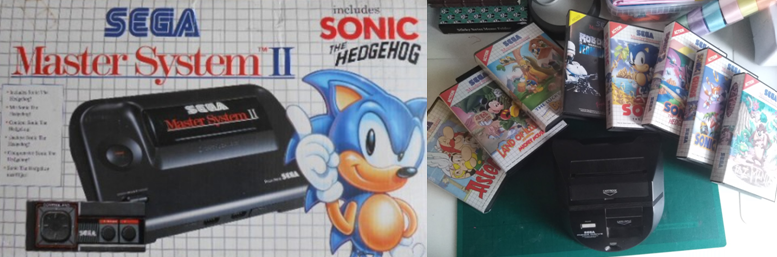
You’ll need to think outside the box and switch bodies with Gossamer to take it out!

Easily the most confusing and annoying boss comes at the end of the Haunted Castle, however. Here, you are charged at and punched by the big red furry monster Gossamer while a mad scientist blasts at you with laser bolts. Gossamer is completely invulnerable except for in the eyes; you must spin into its eyes a few times until it’s stunned and, hopefully, get it to collapse into one of the seats in the background. Once it’s sat down, dash over to the other seat and pull the lever and you’ll swap bodies with Gossamer, which will allow you to destroy the laser device and end this perplexing boss battle.

Marvin attacks in his giant mech and requires some tricky jumps to hit his weak spot.

The finale sees you taking on Marvin the Martian in a giant mech made in his image. The mech stamps around the arena and tries to kick at you but it also likes to stop and dance about with one of its massive feet. This is one of the trickier bosses as you must quickly jump up the platforms on its feet and legs and then launch a spin attack at the yellow plume on the “head” of the mech in order to damage it. Do this enough times and Marvin’s mech will collapse in a heap and Taz will finally be able to return to his peaceful life back in Tasmania.

Power-Ups and Bonuses:
As in Taz-Mania, Taz will automatically eat any items he comes across and you can blast them away with his spin attack. This means that he will explode if he eats bombs but will regain health if he eats junk food or first-aid kits and earn an extra life by chomping down on Taz icons. This time around, there seems to be a lot less health and far more bombs so, while there are a lot more opportunities to go blasting ahead, be sure to be mindful of your surroundings or you might miss some health when you need it the most. Also, don’t eat the cakes as they contain sticks of dynamite!

In addition to his fire breath, Taz can now spit rocks as well.

Taz can still breathe fire but, this time around, he has to gobble a can of gasoline rather than eating chili peppers. He can also eat boxes of rocks and spit a limited number of rocks at enemies as well, which is useful for taking out goofy aliens from afar and these projectile-based attacks are the only way of defeating some enemies, though there is no longer an invincibility star this time around.

Additional Features:
Unlike Taz-Mania, there are no difficulty options in Escape from Mars; what you see is what you get and you’ll just have to deal with it. However, like the last game, you can take advantage of a few cheats by holding A and B on controller one and B and C on controller two when on the SEGA logo screen. If you did it right, you’ll hear a bark and, when you pause the game and press A, a debug menu will appear that allows you to refill your health, skip to any level in the game, and activate “XY” mode that lets you move Taz around the level freely.

The Summary:
Taz in Escape from Mars is an improvement on its predecessor in almost every way; the core mechanics remain the same but expands upon them in just enough ways to make it a far more enjoyable experience. It’s funny because I distinctly remember this game being incredibly difficult back in the day but it was actually a lot more accessible than Taz-Mania, affording Taz a few new abilities and a greater range of movement and dramatically improving upon the level and enemy variety. Best of all, the game features no cheap deaths, bottomless pits, or instant death traps but it is populated by far more enemies and hazards. Sadly, a lot of the issues of the last game are still present and even made worse; sure, Taz is faster and more capable but he’s still a big, lumbering goof and levels might be more vibrant and interesting but they can still be frustrating and the music is still a let-down. Ultimately, Escape from Mars is a decent enough cartoony platformer to waste an hour or so on but it’s still a step behind other 16-bit games of the same genre and ends up being, in my opinion, about as enjoyable as its predecessor even with all the much-appreciated improvements.

My Rating:

Rating: 3 out of 5.

Pretty Good

Were you a fan of Taz in Escape from Mars? How do you think it compared to Taz-Mania and other 16-bit platformers? Were you a fan of Taz’s expanded moveset and the wackier levels and enemies of the game or were you disappointed to see the concept veer away from the Taz-Mania cartoon? Which Looney Tunes character and which of the old Looney Tunes videogames is your favourite? No matter what you think, leave a comment down below and let me know.