
Movie Night: Avengers Confidential: Black Widow & Punisher

Released: 25 March 2014
Director: Kenichi Shimizu
Distributor: Sony Pictures Home Entertainment
Budget: Unknown
Stars: Jennifer Carpenter, Brian Bloom, Grant George, JB Blanc, Eric Bauza, and John Eric Bentley

The Plot:
After interfering with a top secret mission, Frank Castle/The Punisher (Bloom) is apprehended by Strategic Hazard Intervention Espionage Logistics Directorate (S.H.I.E.L.D.) agent and Avenger Natasha Romanoff/Black Widow(Carpenter) and the two are ordered by director Nick Fury (Bentley) to stop the terrorist organisation known as Leviathan selling stolen S.H.I.E.L.D. technology.

The Background:
After his impressive debut in the pages of The Amazing Spider-Man #129, the Punisher quickly became one of Marvel’s most popular anti-heroes thanks to his tragic backstory and unwavering commitment to the eradication of crime. His popularity has led to the character appearing in a number of multimedia projects outside of the comics, including videogames and both live-action and animated portrayals. Between 2010 and 2011, Marvel Entertainment teamed up with Japanese animation studio Madhouse to produce four anime projects, known as Marvel Anime, to little success. Avengers Confidential: Black Widow & Punisher was the follow-up to those projects; released mid-way through “Phase Two” of the massively successful Marvel Cinematic Universe (MCU), the anime drew a mixed reception despite making over $1 million in domestic home video sales.

The Review:
The movie opens to find the Punisher monitoring a rise in criminal and gang activities, as well as newspaper reports on himself, from his apartment (which, as is tradition, doubles as his armoury) while Black Widow expresses frustration at the Punisher’s mounting reputation as a vigilante. The opening credits play over a very quick montage of stills and images that give a quick recap of each character’s background and origin, showing Frank’s time as a family man and the deaths of his family in a mob hit and Natasha’s time training as a spy and assassin and association with S.H.I.E.L.D.
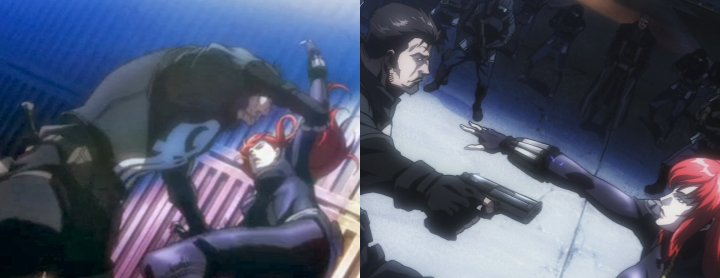
The Punisher and Black Widow appear to be physical equals but their fights are constantly interrupted.

The Punisher makes short, brutal work of some black-market weapons dealers, filling them with bullet holes and easily taking them apart by himself (despite them having more weapons and the numbers advantage) until only one man, Cain (Hebert) is left. Though disturbed at the high-tech weaponry Cain was selling, his efforts to torture more information out of the perp are interrupted by the arrival of Black Widow. Unimpressed with Fury’s operation and Widow’s criticism of his methods, a fight between the two ensues; though the Punisher demonstrates greater physical ability and immediately goes for his pistols, Widow is easily able to match him blow for blow with her superior acrobatic skill until Fury (modelled after his Ultimate and MCU counterpart) and his soldiers interrupt and Frank is subdued by one of Widow’s tranquiliser darts. However, during all the commotion, Cain manages to slip away unnoticed.
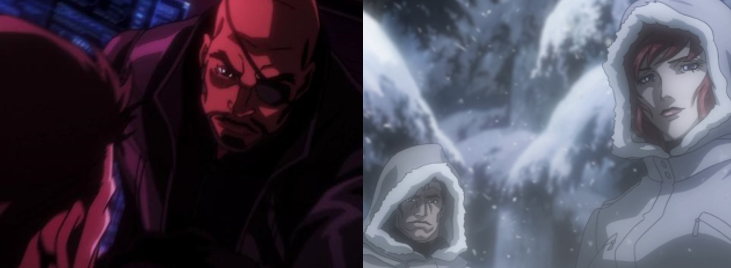
Fury manages to coerce Frank into teaming with Black Widow to infiltrate a Leviathan base.

Aboard the S.H.I.E.L.D. Helicarrier, Fury attempts to reconnect with Frank, whom he has a shared history with, and to impress upon him that his methods, while effective, are disrupting the bigger picture since he has started to interrupt S.H.I.E.L.D.’s procedures. Frank, however, is disgusted at the potential lives Fury’s methods have cost and it’s very quickly established that he and S.H.I.E.L.D., while working towards the same goal, are diametrically opposite. Still, Fury is able to inform Frank that the terrorist organisation Leviathan is selling stolen S.H.I.E.L.D. technology and the two are able to reach an agreement since the Punisher sees that the only reason he has been brought into custody is so that he can be unleashed upon Leviathan. Teamed with Black Widow, the Punisher shares the information Cain gave him and, begrudgingly, the two head to a Leviathan base in the frozen wastes of Slovenia; Widow exposits some background on Leviathan, who have grown into a sophisticated and deadly terrorist organisation that, it is soon revealed, has begun to experiment in created super soldiers and bioweapons. Thanks to their unique skills and training, the two are easily able to infiltrate the base and dispatch of the handful of guards with lethal effectiveness, but the Punisher immediately goes off script as soon as he spots Cain and another fight between the two breaks out.

Amadeus accidentally sends the Punisher on a rampage with Leviathan’s mind control technology.

This time, however, it’s much briefer and Frank simply storms out and leaves Widow to blindly follow Fury’s orders. Although he captures Cain, his efforts to torture him for more information are once again thwarted when Cain blinds him with a flash of light and slips away once more. Continuing on mission alone, Black Widow subdues the Leviathan scientists non-lethally before being attacked by her former lover, and ex-S.H.I.E.L.D. agent, Elihas Starr (George), who faked his death and has joined Leviathan. Angered at his betrayal, Widow is no match for Elihas, who easily avoids, counters, and matches her frantic attacks while expositing that he chose to develop super soldiers for Leviathan to prove himself worthy of being Natasha’s equal and partner. Elihas attempts to convince Widow into joining him in Leviathan but, though heartbroken at his betrayal, she vehemently rejects him and fights him with renewed vigour and purpose; the Punisher aids her and destroys the facility and the two bring Cain’s cell phone to S.H.I.E.L.D.’s resident kid super genius, Amadeus Cho (Bauza). Though slovenly, excitable, and a teenager pervert, Amadeus is able to decrypt the phone but inadvertently sets the flash function off once again, which puts the Punisher into a bloodthirsty trance that sees him killing numerous S.H.I.E.L.D. agents before he is brought back to his senses. However, while Widow advocates for the Punisher’s state of mind, he is shaken at his actions and willingly submits himself to S.H.I.E.L.D. incarceration after killing innocent men.
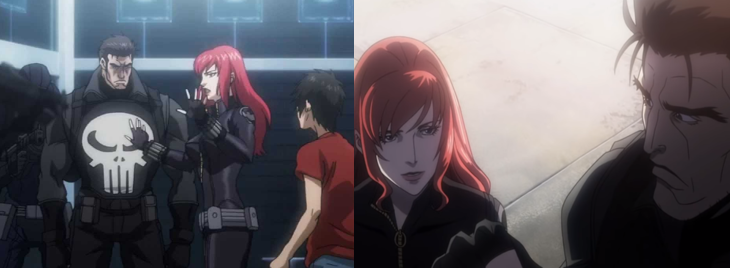
United by a common goal, the Punisher and Black Widow eventually form a mutual respect.

Natasha is left feeling further betrayed when Fury reveals that he not only knew about Elihas but was also fully aware that leviathan possessed mind control technology and that he had stolen the Avengers’ blood in order to create his super soldiers. This is, of course, perfectly in keeping with portrayals of Fury as the ultimate spy whose “secrets have secrets” but his willingness to sacrifice both her and the Punisher spurs Black Widow into defying Fury’s orders and convince the Punisher to help her bring down Elihas and Leviathan. This takes the two to an underworld auction in Mandripoor where Elihas’ super soldiers are being sold off to a number of Marvel’s notorious supervillains and, ultimately, forces the two to pool their resources as a more effective team rather than being at odds with each other. In the end, though the two have opposing methods and beliefs, they are able to find some common ground and build a mutual respect for each other’s methods that culminate sin Widow willingly letting Frank return to his never-ending, one man war on crime rather than arrest him as per Fury’s orders.

The Nitty-Gritty:
Of course, every anime lives and dies by the quality of its animation and Avengers Confidential is a pretty slick and smoothly animated feature. Blood and gore fly in the air with a beautiful grace and characters move with either grace and poise or a heavy, weighty physicality when not standing around like statues. Amadeus is probably the most over the top character in terms of his animation, which plays into his quirky and impulsive personality, and the film does a decent job of emphasising the differences between its two main characters through their movements and physicality as much as their personalities.
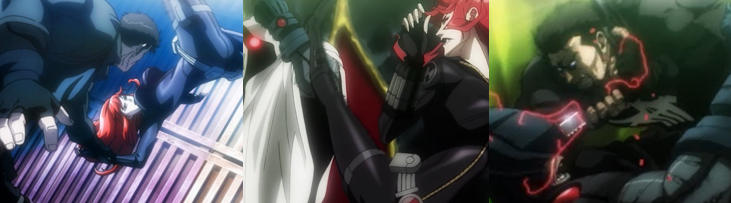
While the Punisher is a blunt, brutal instrument, Black Widow is sleek and efficient.

The Punisher is cold, blunt force while Black Widow is slick efficiency; the Punisher seems disconnected from humanity and focused only on solving problems in the most direct way possibly, while Widow (and Fury) are concerned with the bigger picture and a strategic approach to secured the safety of millions. The Punisher’s presence turns a lot of heads around S.H.I.E.L.D., who view him with a mixture of awe and fear, and he earns this reputation thanks to his vicious efficiency; when under the influence of Leviathan’s mind control, he resembles little more than an emotionless killing machine. In comparison, Widow is effortlessly smooth and sexy in her movements, moving like liquid and with a serene grace that allows her to easily incapacitate even larger foes. Initially, Elihas is positioned as the primary antagonist of the feature and, thanks to his rushed connection to Black Widow, ensures that Natasha has a more personal stake in the film’s events beyond simply doing her duty to safeguard the world from Leviathan’s technology. Elihas exposed himself to his own super soldier serum, augmenting his strength and abilities in an effort to prove himself worthy of Widow’s love; though he believe that she loved him in the past, he was spurred by her always choosing missions with the Avengers and her life as a superhero over him and resolved to find a way to truly be her equal. Elihas truly believes that S.H.I.E.L.D. is actually oppressing people rather than saving them and that war and conflict are inevitable; as a result, he is perfectly fine with escalating and even starting wars with Leviathan’s technology and resources and sees his super soldiers as the next logic step towards consolidating their influence on the world.
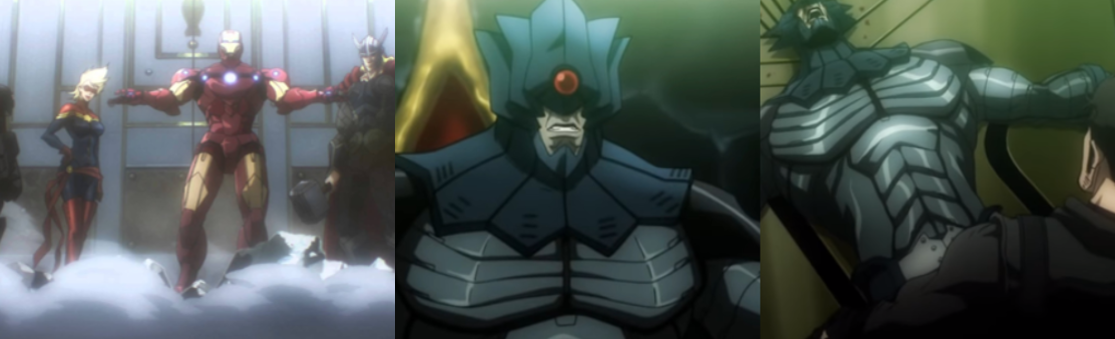
Both the Avengers and Orion show up too late to do much of anything.

Although the Avengers get top billing in the film’s title and feature prominently on the DVD artwork, they don’t actually play a big role in the film and only show up right at the end. Despite having defied Fury’s orders, Black Widow and the Punisher’s mission to stop Leviathan is provided much-needed support when Tony Stark/Iron Man (Matthew Mercer), Doctor Bruce Banner/The Hulk (Fred Tatasciore), Thor Odinson (Unknown), Clint Barton/Hawkeye (Mercer), James Rhodes/War Machine (Unknown), and Carol Danvers/Captain Marvel (ibid) all arrive to help fight off Leviathan’s super soldiers. This leads to some high-octane action but never really overshadows the more grounded and gritty storyline featuring the two leads, who remain at the forefront of the narrative thanks to Natasha’s arc with Elihas and the Punisher’s vendetta against Cain. This is made even more explicit with how unimpressed the Punisher is by Stark’s bravado and the Avengers’ powers and abilities; he’s there with a mission to fulfil and merely tolerates their presence rather than jumping at the chance to join forces with Earth’s Mightiest Heroes. The true head honcho of Leviathan is the mysterious Orion (Blanc), a semi-cybernetic, cloaked madman who doesn’t even physically appear until the last moments of the film. However, despite Orion’s influence and power, we learn basically nothing about him and he is ultimately unable to hold sway over Elihas; during his climatic and emotionally charged showdown with Black Widow, Elihas finally comes to his senses and realises that the love they two of them shared is still there. This proves to be his undoing, however, as he sacrifices himself to save Natasha’s life after Orion shoots at her and dies in her arms. The film does a decent, if rushed job, of trying to place some emotional significance on Elihas’s character and sacrifice but I find myself oddly apathetic since I have no idea who he is; all of their backstory is conveyed through flashbacks and is told to us. We never get to see them as a proper couple or in action together, which I feel hurts the emotional core of their story; he an extra five or ten minutes been included at the start of the film to show their relationship before his downfall, this might have gone a long way to addressing that issue.

The Summary:
Avengers Confidential: Black Widow & Punisher is a really weird production, to be honest; the animation is great and it has that slick, silky smooth quality that you expect from an anime and some brutal, bloody fight scenes but I’m not really sure what the purpose of it is. As far as I can tell, it’s not supposed to tie into any other Marvel production, which makes characters such as Elihas, Orion, and Leviathan very underdeveloped and inconsequential since I have no real personal stake in their story or motivations, and they exist solely to give the title characters someone to fight against and force an emotional conflict for Black Widow. I feel like Punisher is a strong enough character to have carried the anime by himself but, while it is interesting to juxtapose his more extreme measures with the likes of the Avengers and S.H.I.E.L.D., this doesn’t really work when partnering him with Black Widow. Sure, her methods and motivations are different enough but she’s still a spy, a former assassin, with plenty of “red in her ledger” so I can only imagine that she’s partnered with the Punisher to give the anime some sex appeal. In the end, it’s a short and decent enough story; it doesn’t really add anything new to the Punisher or show you anything you can’t see in other Marvel animations or productions but it manages to be just entertaining and action-packed enough to stay afloat despite its mediocre plot and characterisations.

My Rating:

Rating: 2 out of 5.

Could Be Better

Have you ever seen Avengers Confidential: Black Widow & Punisher; if so, what did you think to it and how do you think it holds up against Marvel’s other anime and animated depictions of these characters? What did you think to the concept of teaming these two up and the animation style? Do you think it would have been better to see a solo Punisher feature or to emphasise the more popular Avengers more or were you happy with the story it told? Do you know who Elihas Starr is and, if so, can you tell me why I should care? What is your favourite Punisher story, character, and adaptation (whether it be a movie or videogame)? How are you celebrating the Punisher’s debut this month? Whatever your thoughts on Avengers Confidential: Black Widow & Punisher, and the Punisher in general, drop a comment down below.


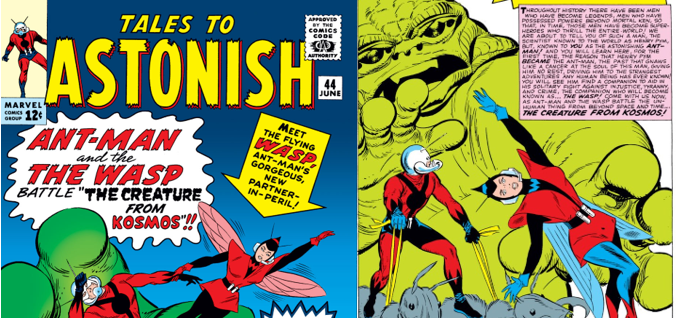
Back Issues: Tales to Astonish #44

Story Title: “The Creature from Kosmos!”
Published:
5 March 1963 (cover-dated June 1963)
Writers: Stan Lee and H. E. Huntley
Artist: Jack Kirby

The Background:
After featuring in the pages of Tales to Astonish #27, the legendary Stan Lee thought it would be fun to revisit the incredible shrinking man, Hank Pym, and recontextualise him as a size-changing superhero eight issues later. Ant-Man soon became the focal point of the Tales to Astonish publication and eventually help to found Marvel’s premiere superhero team, the Avengers, but he wasn’t alone in these endeavors. Created by Lee and H. E. Huntley, Janet van Dyne/The Wasp was only the second of Marvel’s female superheroes; fuelled by a need to avenge her father and a successful fashion designer in her own right (reflected in her many wardrobe changes), Janet became enamoured by Hank Pym (and seemingly every male hero in the Marvel universe) and, after years of will-they-won’t-they and petty spats, the two finally married in 1969. Life as a superhero and with Pym wasn’t easy for Janet; frequently depicted as some scatter-brained bimbo, Janet was forced to watch on helplessly as Pym rapidly switched between identities and created the deadly sentient murder machine Ultron, and was also infamously depicted as suffering physical abuse at Pym’s hands. Still, Janet made a bit of a mark in her own right over the years; she was the leader of the Avengers for a time, was believed dead for a short period, and an alternative version of her gave birth to a daughter, Hope, a supervillain known as the Red Queen. Although the character was unable to appear in the MCU’s first big crossover movie, the Wasp has featured in cameo roles in Marvel videogames and has shown up alongside Ant-Man in Marvel’s animated efforts; a brief cameo in Ant-Man (Reed, 2015) established that Pym (Michael Douglas) was devastated by her loss but he was overjoyed to be reunited with her in the sequel, where she was brought to life by veteran actor Michelle Pfeiffer.

The Review:
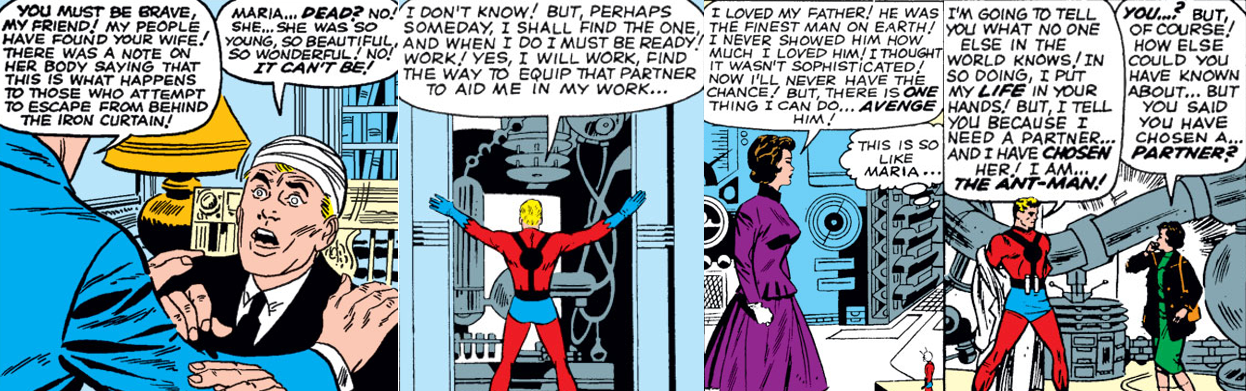
“The Creature from Kosmos!” (or: “Ant-Man and the wasp! Vs. The Creature from Kosmos!”) begins innocently enough in Dr. Hank Pym’s laboratory. By this point, Pym has fully embraced his role as Ant-Man; he’s got a snazzy form-fitting costume, has his Pym Particles (now in the form of gas pellets) built into his belt, and can control ants using a special cybernetic helmet that transmits “electronic-wave commands” to the insects. It’s not made clear exactly what Ant-Man is up to in the lab, and the first few panels seem to be there simply to give us some fun small-scale visuals to open the story. Whatever he was up to, Pym quickly grows to full size and broods over his lost love, Maria; I wasn’t aware of this until now, but Pym was previously married to a Hungarian immigrant and, when returning to Hungary for their honeymoon, Maria was abducted and killed to send a message to “those who attempt to escape from behind the Iron Curtain!” Grief-stricken and enraged, Pym took to the streets in a desperate bid to find those responsible and make them pay, only to end up in jail on the verge of a complete mental and physical breakdown. Filled with a burning desire to stamp out injustice, Pym threw himself into his work and the story retroactively states that his entire reasoning behind his shrinking serum and becoming Ant-Man was to make up for being unable to save Maria all those years ago. However, for all his scientific genius and passion, Pym despairs at how many times he’s cheated death and longs for a partner, someone to carry on his legacy should he fall in battle, and forgoes food and sleep working to equip this partner with the means to do so by studying the biology of wasps.

After losing his wife, Pym finds a kindred spirit (of sorts) in society girl Janet, who’s also suffered a loss.

Pym’s research is interrupted by the arrival of Doctor Vernon van Dyne, a fellow scientist who comes asking for Pym’s help with a Gamma ray beam he hopes to use to detect signs of life on other worlds. Pym, however, is not interested in the project since it’s a little outside of his field of expertise, and van Dyne leaves amicably enough, but Pym is left rattled by the startling resemble of van Dyne’s young daughter, Janet, to his lost Maria. Janet also feels an attraction towards Pym but dismisses him as another scientific bore and longs to connect with a more adventurous type of man. Van Dyne returns to his laboratory to try and boost his ray through his own method, but is stunned when an unspeakable, horrifying, malleable alien lifeform that is so monstrous to behold that van Dyne can scarcely lay his eyes on it. speaking through telepathy, the creature exposits that it is an outlaw from the planet Kosmos who was ostracised for trying to enslave its race. Having escaped along the path of van Dyne’s ray, the creature atomises the hapless scientist, leaving only smouldering remains for the heartbroken Janet, who had popped out for some revelry, to find. With no one else to turn to, Janet calls Pym for help but his dismisses her story as the ravings of a “bored society [playgirl]” and only springs into action as Ant-Man after news of van Dyne’s death reaches him from his network of ants across the city. Ant-Man catapults himself across the city using a pistol-like device that effectively allows him to travel vast distances much like Doctor Bruce Banner/The Hulk’s superhuman leaping, his landing safely cushioned by a gaggle of ants he commands to catch him. Rather than grow to full size to talk with Janet, Ant-Man remains shrunk down while he investigates van Dyne’s body and his wrecked machine, quickly coming to the conclusion (despite such things not being in his wheelhouse) that an alien lifeform was behind the grisly murder. Ant-Man is struck by Janet’s vow to avenge her father’s death, which has changed her demeanour (or, at least, his perception of her) from a “bored, flighty shell” to one of determination that only further reminds him of his beloved wife. After instructing Janet to call the federal Bureau of Investigation (F.B.I.), Ant-Man finds that his insectile companions are afraid of the alien since it secretes a mist containing traces of “formic acid” and is thus, apparently, analogous to an ant. Nevertheless, Ant-Man commands his ants to seek out the monstrous beast responsible for van Dyne’s death and returns to his laboratory to greet Janet in his civilian identity (since he told her to go to Pym after calling the F.B.I.).

Pym recruits Janet to help him defeat a horrifying alien, despite her inappropriate feelings towards him.

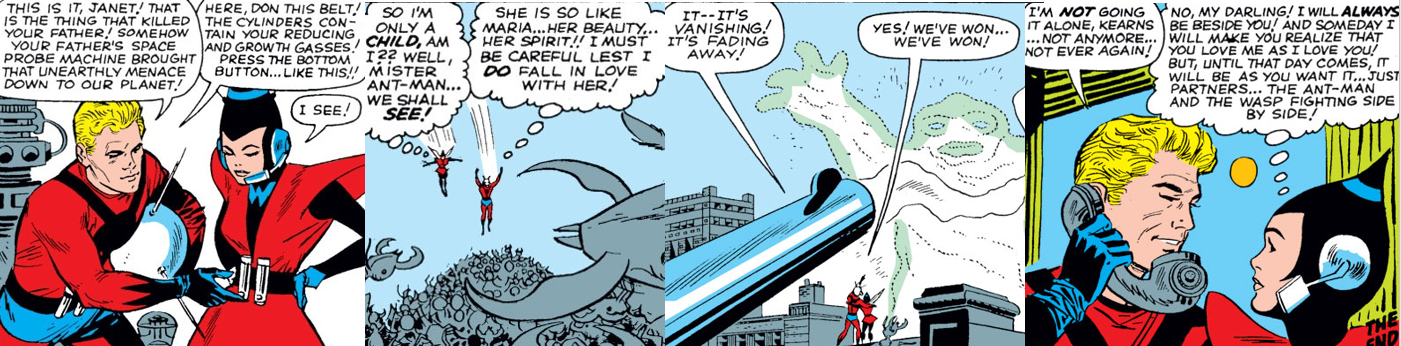
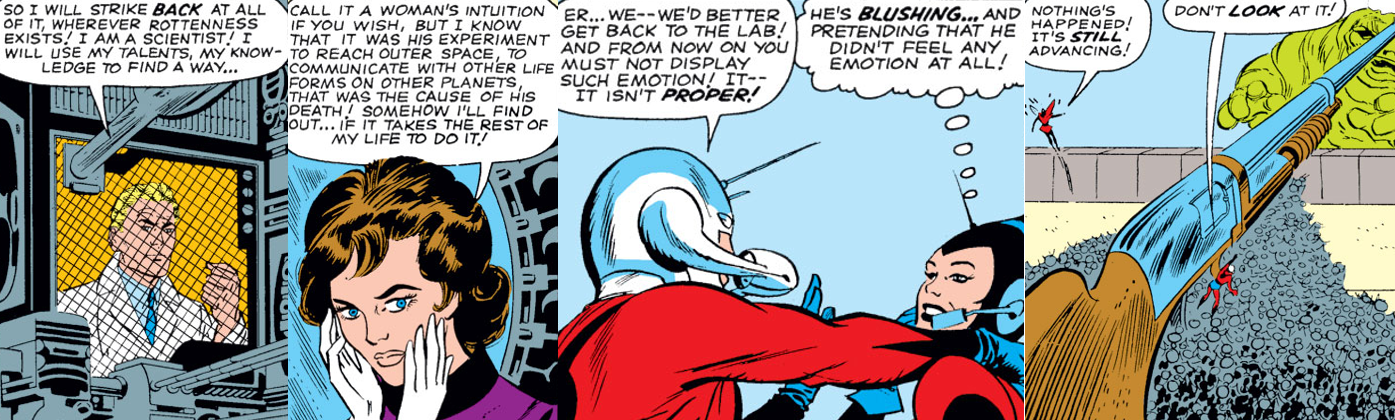
When Janet reaffirms that she is determined to hunt down her father’s killer, and to dedicate her life to the pursuit of all criminals, Pym is convinced that he’s finally found the partner he has longed for and reveals his duel identity to her, forcing her to swear to stand by him in the pursuit of justice as the Wasp. Pym radically implants synthetic cells below Janet’s skin tissue that all her to shrink to the size of a wasp and grow tiny wings and antennae to communicate with insects and furnishes her with a belt full of his special gas and a ridiculous costume to wear into battle. Janet is then forced to endure  atrial by fire as the ants report that the alien has been running amok through the city and is currently advancing towards the George Washington Bridge. Janet is so overjoyed by Pym’s generosity and the thrill of her new abilities that she blurts out a confession of love! Thankfully, I’m not the only that finds this incredibly shallow and inappropriate as Pym quickly rebukes her since she’s so much younger than him and he has no desire to fall in love again, but his thought balloons betray his harsh statements and Janet sees his rejection as a challenge to prove herself worthy of him. With the ants too afraid to directly oppose the creature, and the military’s full might useless against it, the Wasp throws herself at the alien in a bid to avenge her father and win Ant-Man’s affection, only to be captivated by the alien’s pheromones. After rescuing (and reprimanding) his headstrong new partner, Ant-Man stumbles upon a way to defeat the alien and rushes them back to his lab, where he whips up a chemical antidote to the monster’s formic acid, which he loads into the shells of a 12-gauge shotgun (!) to fire at the creature. With the alien rampaging through Wall Street, Ant-Man and the Wasp scurry on over with their weapon and give the creature both barrels, dispelling it and ending its threat once and for all. Both are so overjoyed at the result that they embrace and, while Ant-Man insists that such displays of emotion aren’t “proper”, the Wasp can’t help but see that he’s blushing beneath his helmet. The story ends with Pym elated to finally have a partner to fight crime alongside, and with Janet secretly vowing to make Pym realise that they’re meant to be and to fight by his side until they’re together as a loving couple.

The Summary:
Gee…well…where to start…? So, it was great to see a more familiar version of Ant-Man this time around. By this point, he’s firmly established himself as a costumed adventurer; he’s got the snazzy outfit, the fancy gadgets, and even a contact in the F.B.I. whom he liaises with. Ant-Man’s relationship with the ants is also far more amicable now thanks to his special helmet, which instantly translates his thoughts into commands for the ants and their “language” into English so he can easily get a lead on crimes and have a near-limitless communication network all across New York City. While his superhero career might be on the up, however, Hank Pym is given far more emotional depth through the tragic loss of his first great love and his desire to have a protégé to carry on his legacy. Heartbroken by Maria’s death, Pym his not interest in losing anyone ever again and is thus resistant to falling in love again; his only concern is opposing the forces of evil and stamping out criminal scum using his fantastic abilities and he simply wants a partner who will take up that mission should he fall in the line of duty.

I can’t decide which is worse, Pym and Janet’s unhealthy relationship of the forgettable alien villain.

He’s thus completely knocked for a loop when Janet enters his life and he’s instantly torn between her striking physical resemblance to Maria and her youth and perceived shortcomings. It’s only after the violent death of her father than Pym starts to see Janet differently; van Dyne’s death changes her, hardens her edge, and motivates her to not only avenge him but hunt down criminals everywhere much like Maria’s death motivated Pym, which makes it seem like they’re kindred spirits but actually is the beginning of a very toxic and unhealthy partnership. Pym is only interested in giving Janet the means to have her revenge when he sees her suffer a tragic loss; literally nothing else except her determination and likeness to Maria qualifies her to be his partner, yet he kits her out anyway and then admonishes her for flying head-first into battle without considering the consequences. Even worse, his need for a partner is so strong that he continues to let her tag along even after she randomly blurts out that she’s in love with him (despite dismissing him earlier) and continues to sweep her affections (and his own obvious attraction for her) under the rug in the hopes that they can focus on the greater good. It’s all very rushed, is what I’m getting at, and their relationship is off to a pretty bad start as Janet is only sticking around for the thrill of her new abilities and in the desperate hope to force Pym to admit her loves her, rather than actually following through on her promise to prove herself to him. The unnamed alien monster is thus pushed way to the background and sticks out like a sore thumb; it’s interesting that even the ants fear it and that it has all these vague, fear-inducing powers and appearances, but it doesn’t take much to dispatch it and I can’t help but feel like a more grounded threat, like gangsters or something, would’ve been better for the story. It seems like the alien’s simply there to “astonish” readers and be this visually alluring monster for the cover art and splash page as it seems completely out of place and overly fantastical for a story that’s trying to be this drama of love, loss, and legacy and ends up being this weird melting pot of manipulation and denial.

My Rating:

Rating: 2 out of 5.

Could Be Better

What did you think to the Wasp’s debut story? Did knowing Hank Pym suffered such a tragic loss change your perception of his character? What did you think to his motivations in recruiting Janet van Dyne and her characterisation in this story? Do you agree that the strange alien monster was out of place here or did it make the story more appealing for you? What are some of your favourite Wasp stories and moment? Sign up to leave your thoughts on Ant-Man and the Wasp below, or drop a comment on my social media, and be sure to check back next Friday for more Ant-Man content!

Back Issues: Tales to Astonish #27

Story Title: “The Man in the Ant Hill!”
Published:
28 September 1961 (cover-dated January 1962)
Writers: Stan Lee and Karry Lieber
Artist: Jack Kirby

The Background:
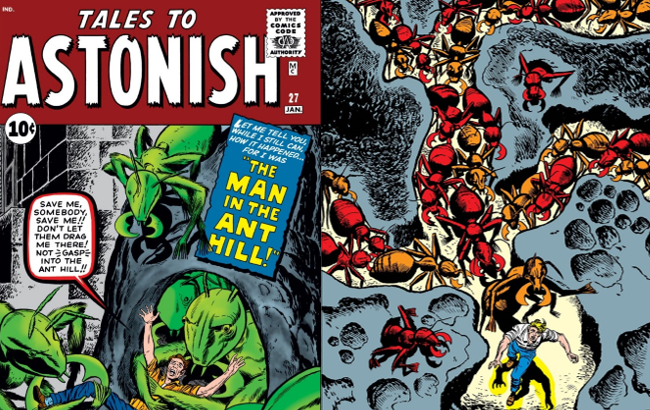
Although Hank Pym debuted in this story, he wouldn’t actually assume the identity of Ant-Man until eight issues later; the story’s premise of a man being shrunk down and hounded by insects did so well that the legendary Stan Lee thought it would be fun to return to the character, now in a more traditionally superheroic guise, and he soon became the focal point of the Tales to Astonish publication, gaining an attractive female partner and eventually helping to found Marvel’s premiere superhero team, the Avengers. All-too-soon, Pym’s mental and emotional stability began to be questioned; he rapidly switched between identities, such as Giant-Man, Goliath, and the ridiculously-named Yellowjacket, created one of the Avenger’s deadliest enemies in the sentient murder machine Ultron, and gained infamy for being abusive and hostile towards his wife. For such an obscure Marvel character, Ant-Man has often been a pivotal component to some of Marvel’s biggest stories and has featured fairly prominently in their animated ventures, while other characters have also assumed Pym’s mantle, especially during his periods of instability or death. Although the character was unable to appear in the MCU’s first big crossover movie, Ant-Man finally came to the big screen in 2015, with veteran actor Michael Douglas portraying Hank Pym as a volatile and flawed mentor figure while Paul Rudd took on the Ant-Man identity as his successor, Scott Lang.

The Review:
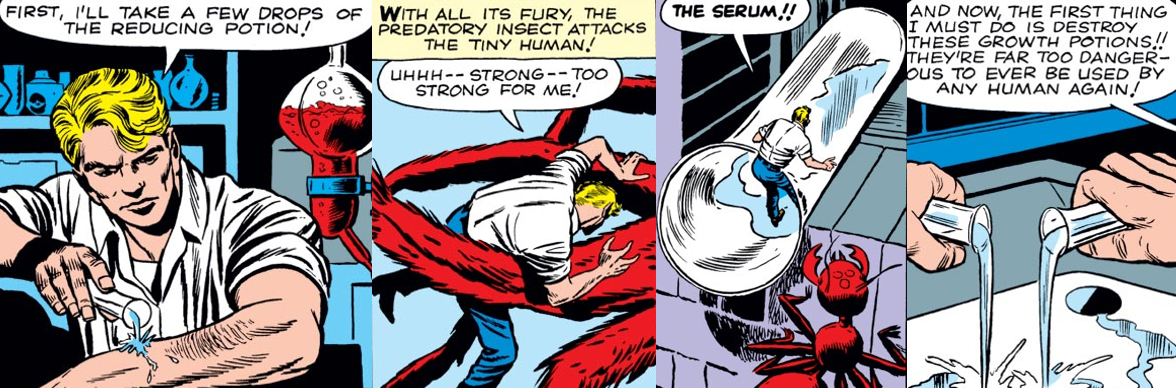
“The Man in the Ant Hill” doesn’t waste any time and begins with Dr. Hank Pym marvelling at the success of his mysterious chemical serum (now widely known as Pym Particles) which can shrink and grow any object at will. Pym marvels at his success and bitterly thinks back to how he was mocked and ridiculed by his peers in the scientific community, who saw his methods as little more than flights of fancy that distracted from more practical and realistic projects. Undeterred and resentful of their scorn, Pym refused to deviate from “things that appeal to [his] imagination” and vowed to show them up by becoming the greatest scientist ever with his incredible serum, which he believes will be a “boon […] for mankind” as any object, from food to even armies,  could be reduced in size to save on shipping costs and for rapid transport of vast quantities. So proud of his crowning glory is Pym that he doesn’t waste any time and jumps straight into human trials, dousing himself with his shrinking serum, but his elation quickly turns to horror as he realises that he’s shrinking too small too fast…and that he has no way of returning to normal!

Pym recklessly reduces himself in stature and narrowly escapes become dinner for some ants!

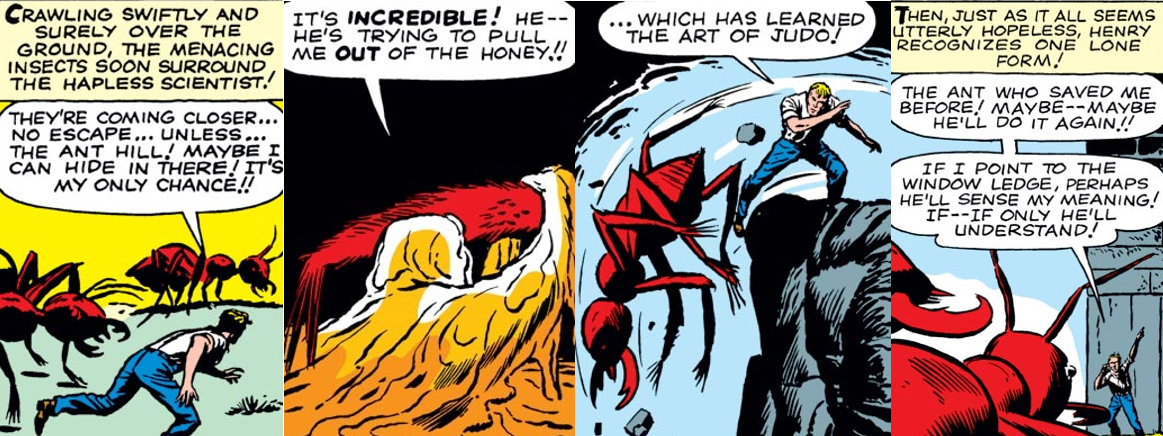
Reduced to the size of less than an ant and stumbling into the garden outside of his laboratory in a frantic state, Pym is further horrified when he’s spotted by an army of ants and chased into their vast network of dirt tunnels. Stuck in a pool of sticky honey, Pym faces certain death but is unexpectedly freed by an ant, only to be faced with a hoard of hungry insects eager to eat him up! Luckily for the misguided scientist, a lone matchstick sits in the cave and, with a well-timed throw of a rock-sized pebble, Pym is able to light a fire to keep his pursuers at bay. As he scrambles to safety using a make-shift lasso (which appears out of nowhere and with no explanation), Pym is attacked by another ant, which clamps him in its vice-like pincers. Thankfully, Pym has learned “the art of judo” and handily tosses the ant aside but, by the time he finally gets out of the dirt tunnel, he’s far too weal to climb up to his enlarging serum, much less fend off the ants. Luckily for him, the friendly ant carries him up to the window ledge and he leaps into the test tube, growing to full size once more. Relieved and elated to be normal again, Pym immediately dumps his serum down the drain, realising that it’s far too dangerous to be used ever again, and humbly agrees to turn his attentions to more practical projects in the future, leaving him to ponder the fate of that random ant that saved his life.

The Summary:
“The Man in the Ant Hill” is an exceptionally brief cautionary tale on the dangers of science and the foolish recklessness of man. Pym has very little characterisation beyond being a bit of an egomaniac; he’s ridiculed by his peers for his wild theories and so desperate to prove them wrong that he develops a serum that he fully believes will benefit the world for good, but doesn’t bother to test its success beyond the first few trials and thoughtlessly douses himself in it without a second’s hesitation. Shrunk to a fraction of his size, Pym doesn’t even allow his scientific reasoning or logic to keep him inside his laboratory, where his only hope of salvation lies, and stumbles outside where he’s easy prey to the ants that life in his garden.

A bizarre story full of conveniences and clichés about the dangers of scientific curiosity.

The artwork is simple and inoffensive; there’s a decent sense of scale at work here and  Pym is constantly portrayed as being smaller and weaker than the insects that hound him (at least until he’s actually caught by one, and then he’s somehow able to overpower it simply because the script says so and “judo”). Where the story falls apart for me, though, is in the random instance of one helpful ant; why is this one helping him when all the others want his blood? How did it understand that he wanted to be carried up to his window ledge? It’s awfully convenient to the story, for sure; about as convenient as a matchstick randomly being down in the tunnel and Pym’s uncanny throwing accuracy, but it’s a convenience that probably has to happen to allow Pym to safely return to full size and learn a valuable lesson in humility. Overall, it’s not a story that’s really going to blow your socks off with innovative art or complex themes; Pym suffers for his ignorance and arrogance as all reckless scientists must and the twist of an ant-sized man is fun, but it’s very much a product of its time and easily forgotten in the grand scheme of Ant-Man stories.

My Rating:

Rating: 2 out of 5.

Could Be Better

What did you think to Ant-Man’s first tentative appearance in Marvel Comics? Did Hank Pym’s plight strike a chord with you or were you unimpressed by his recklessness and stupidity? Why do you think that one ant helped him out? What are some of your favourite Ant-Man stories and moments, and who is your favourite Ant-Man? Sign up to leave your thoughts on Ant-Man below, or drop a comment on my social media, and be sure to check back next Friday for more Ant-Man content!

Back Issues [Sci-Fanuary]: Marvel Super-Heroes! #18


January sees the celebration of two notable dates in science-fiction history, with January 2 christened “National Science Fiction Day” to coincide with the birth date of the world renowned sci-fi writer Isaac Asimov, and HAL 9000, the sophisticated artificial intelligence of Arthur C. Clarke’s seminal 2001: A Space Odyssey (1968), being created on 12 January. Accordingly, I’ll be spending every Sunday of January celebrating sci-fi in all its forms.


Story Title: “Guardians of the Galaxy! Earth Shall Overcome!”
Published: January 1969
Writer: Arnold Drake
Artist: Gene Colan

The Background:
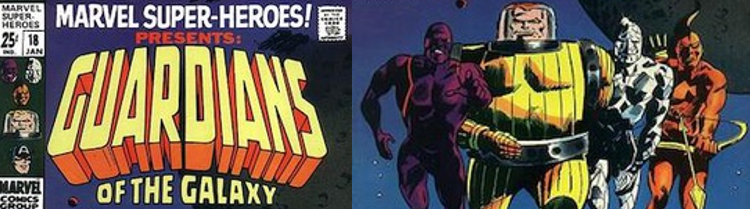
Nowadays, Marvel Comics’ Guardians of the Galaxy are quite a well-known team of reprobates thanks to their inclusion in the Marvel Cinematic Universe (MCU); when Guardians of the Galaxy (Gunn, 2014) was produced, it’s fair to say that the team (and the concept) was relatively obscure compared to other Marvel heavy-hitters like the Avengers and Peter Parker/Spider-Man. Fans of the films and the MCU may be surprised to learn that the cosmic team was quite different when they first debuted in the pages of Marvel Super-Heroes!, a Marvel spin-off title that told standalone side-stories and was responsible for debuting many of the publications supporting characters. The concept began life as an idea by writer and editor Roy Thomas about super-guerrillas fighting against Russians and Red Chinese that was altered into an interplanetary situation by writer Arnold Drake and the legendary Stan Lee. Despite strong sales of the team’s debut issue, the Guardians of the Galaxy remained dormant for about five years; eventually, though, the team earned their own solo series and underwent numerous alterations over the years before evolving into something resembling the team dynamic reflected in the MCU and it all began with this bizarre space adventure about a team of misfits from the year 3007.

The Review:
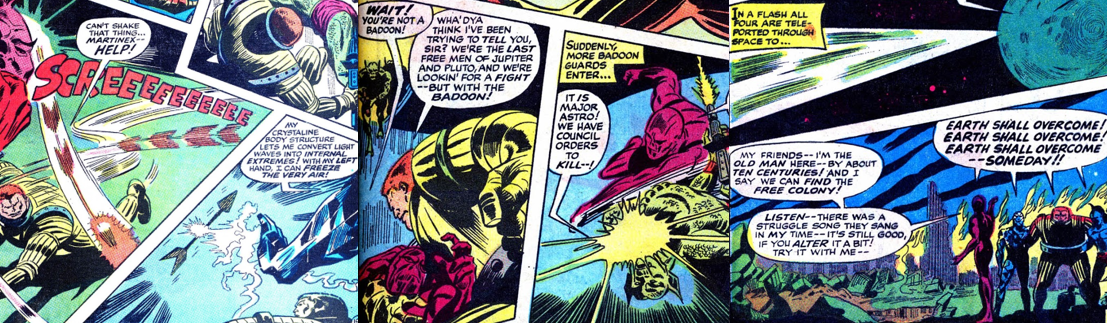
As mentioned at the end there, our story opens in the far-off future of 3007 to find the Earth, and dozens of other planets, united as the United Lands of Earth Federation (U.L.E.). However, conflict is still rife throughout the various star systems of the galaxy and it is into this squall that we are introduced to Charlie-27, a stout, semi-cybernetic inhabitant of Jupiter who is finally returning home after six months of “solitary space-militia duty”. Expecting a big parade for returning as a conquering hero, Charlie-27 is confused to find the immediate area deserted and lifeless except for a contingent of the nefarious Badoon, a reptilian race of warmongers who have overrun the entire planet and captured its inhabitants, including Charlie-27’s father. After disposing of a couple of Badoon using his massive bulk, Charlie-27 follows a prison transport and finds his fellow Jovians are being forced to mine “high-intensity Harkovite”, a substance that will cause them all to die of radiation poisoning within five days.

The crystal-bodied Martinex helps Charlie-27 escapes the Badoon forces who have over-run Pluto.

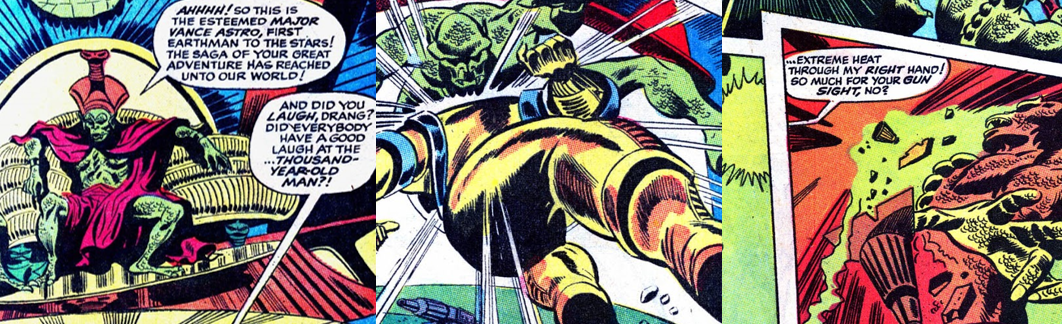
Realising that it is suicide to take on the invading Badoon forces alone, Charlie-27 desperately dives into a teleporter and randomly arrives on Pluto hoping to recruit an army to aid his cause and finding the ice-planet equally empty of life an, d overrun by the Badoon. Set upon by a Saturn Hound-Hawk, Charlie-27 is rescued by Martinex, a Pluvian man comprised entirely of a crystal-like substance. Though Maritinex harbours resentment to people like Charlie-27, who refer to him and his kind by the derogatory term “Rock Head” despite both races being descended from Earthman, Martinex catches the Jovian up with event son Pluto and uses a radio transmitter to cause a distraction that allows them to take a Tele-Train to Earth. Like Jupiter and Pluto, however, Earth has been enslaved by the Badoon; Drang, the Badoon supreme commander, is overjoyed to find his men has captured Major Vance Astro, the so-called “Thousand-Year-Old Man” who was the first Earthman to visit the stars. Curious to learn his story, Drang subjects Astro to a painful Memory Probe that quickly recaps how he came to be in the year 3007: back in 1988, Earth had established a small Moon colony and had started making excursions to Mars and Vance volunteered to be cryogenically frozen for a thousand years in a bid to explore beyond the reach of Earth’s solar system. Awakening a thousand years later, Vance was forced to remain forever garbed in a copper foil wrapping lest his centuries of slumber catch up to him and found his trip was ultimately futile as humanity learned to travel faster than light in the intervening years.

After a brief misunderstanding, the four misfits join forces against the Badoon as the Guardians of the Galaxy.

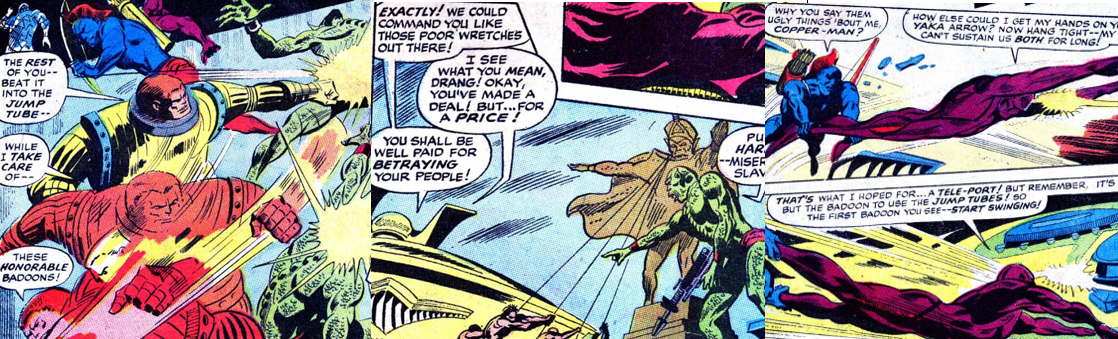
Thanks to his unique knowledge and experiences, Vance is spared the Badoon’s usual slave disk and seemingly agrees to aid Drang’s dreams of conquest. However, when Drang puts Vance’s loyalty to the test by having him execute his comrade, Yondu Udonta, Vance reveals it was all a ploy to reunite his blue-skinned friend with his special bow-and-arrow, which Yondu is able to control using whistles to take out Drang’s forces and allow them to escape. Vance and Yondu immediately run into Charlie-27 and Martinex, with each duo mistaking the other for an enemy; a fight between the two teams breaks out, in which Martinex showcases his ability to freeze air molecules and Vance reveals that he has (somehow…) acquired psychic powers, but they are soon interrupted by their actual enemy, the Badoon. United against a common foe, the group dispatch the Badoon guards and teleport themselves to New New York, determined to find the rumoured free colony and free the Earth from Badoon enslavement as the Guardians of the Galaxy.

The Summary:
When I went to see Guardians of the Galaxy, I was intrigued by the presentation of the film, which gave off vibes of Firefly (2002)/Serenity (Whedon, 2005) and the J. J. Abrams Star Trek films (2009; 2013), I knew absolutely nothing about the characters, the team, or the concept beyond a very rudimentary familiarity with the likes of Drax the Destroyer, Gamora, and Nebula thanks to having read The Infinity Gauntlet (Starlin, et al, 1991). No doubt to capitalise on the release and success of the first film, Marvel released a collection of Guardians of the Galaxy stories as part of their “Marvel Platinum” range of graphic novels and this is primarily where my experience of the comic book versions of the team comes from. Reading the Guardians’ debut issue is a bit jarring for anyone who is a fan of their MCU counterparts; the only character that carries over to the films is Yondu, here characterised as little more than a simpleton rather than the leader of a band of space pirates. There’s no Peter Quill/Star-Lord, no Drax, Rocket Raccoon, or Groot and rather than being a band of well-meaning reprobates, the original Guardians of the Galaxy are a rag-tag collection of oddballs united by a common cause.

This is a very different team of Guardians than you may be used to…

Each of the Guardians is the last of their kind either due to slavery or the slow passage of time and are very bold, independent characters…with the exception of Yondu, who is denied any kind of in-depth backstory and whose character is reduced to a couple of throw-away lines from Vance. Aesthetically, ‘Guardians of the Galaxy! Earth Shall Overcome!” is a bit of a mess; taking place in the far future, we find that colonisation has extended far into our solar system and rendered even gas giants like Jupiter entirely habitable but evolution has also caused Earthlings to adapt in radical ways to survive in their new environments. A lot of the backgrounds and the comic’s more cosmic-trappings are very reminiscent of the works of Jack Kirby but, while this is very fitting, it does make for quite a cluttered and messy presentation. The issue has its work cut out for it by introducing four brand-new characters in about thirty pages of story, something I find early Marvel Comics often struggled with, and while there are some interesting elements to each character (Charlie-27 seems to be going for a self-entitled righteousness, Martinex hints at possibly being racially targeted, Yondu is a monosyllabic grunt, and Vance has his whole, very rushed, “man out of time” thing going on), I can’t really say that I was massively blown away by either their characterisation or their abilities (which are, for the most part, vaguely defined).

The Badoon are a major invasion force for the fledgling Guardians to unite against.

I’m not massively familiar with the Badoon; from what I can tell, this story wasn’t their first appearance but they really don’t seem to be that much different from other monstrous, semi-humanoid galactic conquers like the Free and the Skrull (despite, obviously not having shape-shifting powers). As a villainous force to unite against, they’re relatively unremarkable; while we can assume that they’re a formidable force since they have completely enslaved Jupiter, Pluto, and the Earth, Drang’s forces crumble like paper whenever they engage with the Guardians. Still, they have the numbers advantage, which is a great way to show that even a veteran like Charlie-27 knows when to fight and when to flee, and it’s pretty clear that the main aim of this issue was to bring together these misfits to continue telling stories of their struggle against the Badoon in subsequent issues. Still, as interesting as it is to see how the Guardians first came about the Yondu’s wildly different initial characterisation, there’s not really a whole hell of a lot to really say about this first Guardians tale; this isn’t the team that’s been popularised in the decades since, inevitably the writing and presentation is a product of its time, and the art isn’t particularly engaging or eye-catching (or even good, at times) so this is more of a quaint look at the Guardians’ humble beginnings rather than a bombastic showcase of what the team is truly capable of and probably has more appeal to die-hard fans of Marvel’s cosmic stories than the more casual Guardians readers like myself.

My Rating:

Rating: 3 out of 5.

Pretty Good

Have you ever read the Guardians of the Galaxy’s debut story? If so, what did you think to it, especially compared to the various interactions of the team that have come since? What did you think to the idea of setting the story in the year 3007 and of the Badoon having conquered the solar system? Which of the original four characters was your favourite? Which version of the team is your favourite and why? Are you a fan of the Guardians of the Galaxy comics and, if so, did you like the MCU’s interpretations of the characters and concepts? Would you like to see the original team get a larger focus in the MCU someday? Share your thoughts on the Guardians of the Galaxy in the comments below and check in again next Sunday for more sci-fi content.

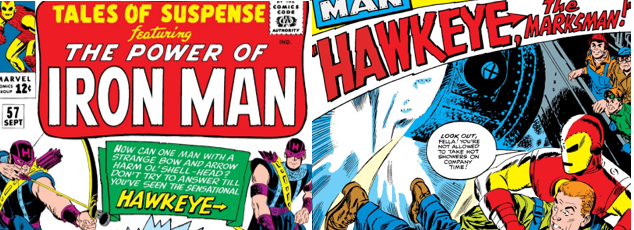
Back Issues: Tales of Suspense (Featuring the Power of Iron Man) #57

Story Title: “Hawkeye, The Marksman!”
Published:
1 September 1964
Writers: Stan Lee and Larry Lieber
Artists: Don Heck and Larry Lieber

The Background:
In November 1941, Mort Weisinger and George Papp introduced readers to Oliver Queen/Green Arrow, a crimefighting archer heavily influenced not just by Robin Hood and The Green Archer (Horne, 1940) but who also borrowed more than a few inspirations from Bruce/Wayne/Batman. In perhaps one of the more blatant borrowings from their competitor, Marvel Comics later introduced an archer of their own, Clint Barton/Hawkeye. Created by Stan Lee and Don Heck, Hawkeye was initially portrayed as a villainous character but would soon repent his mercenary ways and go on to not just be a member of the Avengers, but even lead his own off-shoot, the West Coast Avengers. Despite sharing a similar gimmick, Green Arrow and Hawkeye couldn’t be more different in terms of their personalities and status; indeed, while Hawkeye may have been a D-list hero in the grand scheme of Marvel Comics, he was involved in some of their most prominent storylines and became a household name thanks to Jeremy Renner’s portrayal of the character in the Marvel Cinematic Universe. Consequently, for many, the character is one of Marvel’s most relatable and inspirational heroes since he lacks any kind of superpowers and he’s even become a symbol of representation for the deaf community in recent years, and it all started here with his first appearance as an antagonist for ol’ shellhead himself, Tony Stark/Iron Man.

The Review:
It’s hard to say definitively, but I’m fairly certain that I’m far more familiar with the exploits of Green Arrow than Hawkeye. To be fair, it’s probably about 50/50; maybe weighted a little more towards Hawkeye as he tends to show up in the Avengers stories I’ve read. I mostly know Hawkeye from his appearances in the first season of the under-rated Iron Man cartoon (1994 to 1996) and from being a playable character in Captain America and the Avengers (Data East, 1991), both of which were firm staples of my childhood. I’m also relatively familiar with his background and characteristics, but have always been somewhat…meh about him. I don’t really care that he’s an archer or that he doesn’t have any superpowers, as plenty of superheroes get by just being regular people with extraordinary gifts, and I’ve never really questioned his capability as an Avenger, I’ve just never had much of an inclination to seek out any of his stories even though I’m a fan of Jeremy Renner’s portrayal of the character in the Marvel Cinematic Universe. Thus, I went into “Hawkeye, The Marksman!” without any real expectations and with an open mind, ready to see how Marvel handled his debut story, which opens with Iron Man heroically saving a factory worker from being doused by molten steel. This story is set during the time when the official line was that Iron Man was Tony Stark’s personal bodyguard, so no one really questions what ol’ shellhead is doing flying about one of Stark’s weapons facilities, but this also means that Harold “Happy” Hogan has no idea that he’s pouring his heart out to Stark himself when he asks Iron Man to grease the wheels with Stark’s secretary, Virginia “Pepper” Potts, to get him a date.

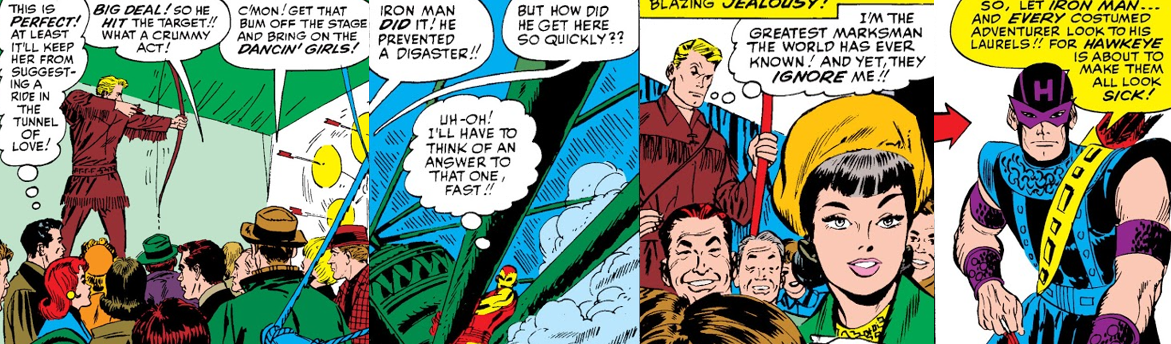
Hawkeye is so jealous of Iron Man that he crafts a costumed identity to earn the respect of the public.

While Stark now has a reputation as a womaniser, at this point he’s reluctant to get serious with any female since he’s entirely dependent on the transistor-powered device permanently grafted to his chest to keep him alive from the deadly shrapnel lodged dangerously close to his heart, and yet he longs for a more intimate relationship with Pepper and can’t help but feel jealous at Happy’s advances towards her. However, when Stark attempts to raise the subject with Pepper, he makes a poor attempt at it and she immediately assumes that he’s asking her out so she readily accepts, much to the heartache of Stark’s faithful footman. Rather than try and explain things to Pepper, or give her the brush off, Stark decides to take her on a date but not to a fancy theatre show or to dinner; instead, he takes her to Coney Island, where an archer known as Hawkeye fails to impress the sceptical crowd with his perfect marksmanship. While Stark is desperately hoping that Pepper doesn’t suggest riding the Tunnel of Love or moving on to a more intimate setting, fate intervenes (as it so often does in Marvel tales) when the Flying Pinwheel suddenly goes out of control, endangering the lives of its passengers. Seeing the crisis, Stark excuses himself with a paper-thin white lie (“I’ve got to call the factory!!”) so he can clamber into his Iron Man suit (which he generally carries around in a briefcase, though the artwork doesn’t show him holding it here…) and save the day, much to the adulation of the crowd. One man who’s not so impressed, however, is Hawkeye; annoyed that the audience dismisses him in favour of Iron Man, he sulks off to a “basement workshop” to put together a garish outfit for himself in order to emulate the Golden Avenger’s reverence as a costumed adventurer. Armed with little more than a quiver full of specially-made arrows and his unmatched marksmanship skills, Hawkeye vows to show up every other masked hero out there even without any superpowers and immediately feels the thrill of swinging across rooftops using his roped arrows and stopping a jewel thief with a perfect shot.

Assumed a thief, Hawkeye falls under Black Widow’s spell and is soon going up against Iron Man.

Unfortunately, Hawkeye’s decision not to deliver a fatal shot to the thief results in the crook getting away and, as the archer is investigating the loot of precious stones the man stole, he’s discovered by the cops and immediately pegged as the perpetrator. Choosing to run rather than waste time explaining himself, Hawkeye is randomly picked up by none other than alluring Russian superspy Natalia Romanova/Black Widow, herself also a recurring femme fatale for Iron Man during this time. Instantly smitten by the captivating spy, Hawkeye willing allows himself to be taken to her luxurious estate, where Black Widow is easily able to charm him into going up against Iron Man in exchange for upgrading his arsenal and the implied promise of winning her over if she’s able to defeat the Avenger. Speaking of whom, Stark’s personal life continues its drama as, when he goes to apologise to Pepper for leaving her high and dry, he finds that she’s soured on him and has finally agreed to date Happy (although she does this purely to make Stark jealous. Poor Happy!) To lure out his foe, Hawkeye easily sneaks into one of Stark’s factories and causes an explosion with one of his trick arrows; sure enough, the Avenger flies in to investigate and is startled when Hawkeye fires at him with arrows laced with a rust-inducing chemical. Realising that the substance is quickly hardening, Iron Man swiftly takes cover and removes his boots and gauntlets (and, as ever, I remain in awe of just how cloth-like Iron Man’s “armour” is). Hawkeye discovers the discarded pieces of Iron Man’s armour and is elated, hoping that analysing them will allow him to learn the Avenger’s secrets and increase his threat ten-fold; while he’s able to escape from the factory unopposed as Stark is frantically (and literally) re-arming himself with spare parts from the facility, it’s not long before Iron Man has tracked the archer down and run him off the road with a blast from his “Power Ray”.

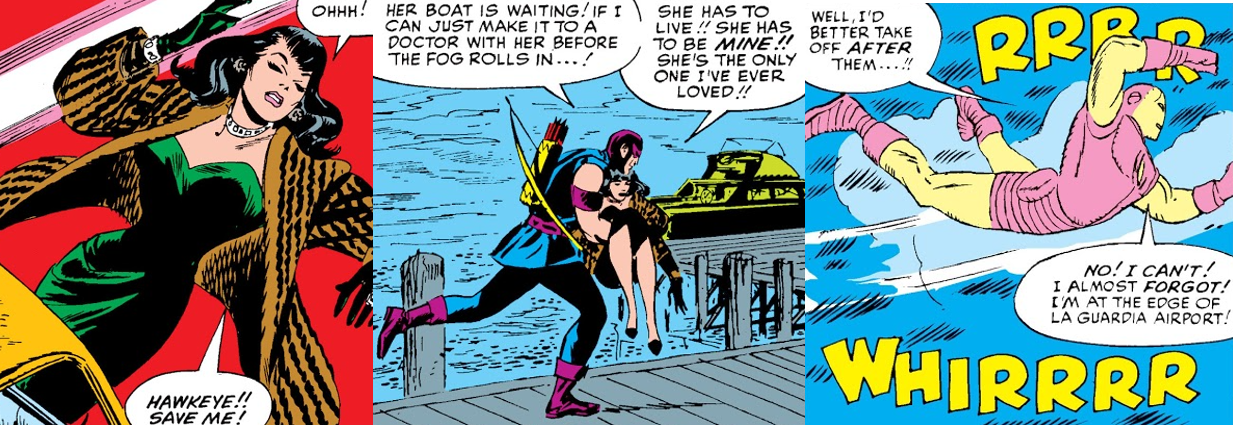
After injuring Black Widow, Hawkeye’s forced to retreat and Iron Man is unable to pursue them.

Since he’s run out of his special rusting arrows, Hawkeye is forced to rely on the rest of his quiver, which Iron Man is easily able to deflect with his magnetic Repulsor Beams. However, realising that his transistors can’t power his weapons forever, Iron Man tries to swoop down and subdue Hawekeye and ends up ensnared in nylon rope strands that restrain him for all of one panel. By the next panel, Iron Man is not only free but crashing into a wooden pier and flinging Hawkeye into the water, which effectively renders the archer unconscious. As the Black Widow looks on with unimpressed disgust, Hawkeye tries one last trick to complete his mission and win over the gratitude of the gorgeous Russian spy: a “Demolition Blast” arrow that he hopes will conquer the Armoured Avenger once and for all. Unfortunately, the arrow simply ricochets off Iron Man’s armoured hide and the resulting energy blast injures the Black Widow with a glancing blow. Grief stricken and aghast at having injured the “only one [he’s] ever loved”, Hawkeye ignores the stunned Iron Man in favour of spiriting the hurt spy to safety on her nearby boat. Thanks to a convenient fog descending, and the fly zone of La Guardia airport, Iron Man is unable to pursue the two and is forced to return to his factory to brood over his complicated social/love life and to wonder where and when his next threat will arise.

The Summary:
“Hawkeye, The Marksman!” actually ended up being a pretty decent little Iron Man story. I should also point out that I’m not massively familiar with Iron Man’s comics either, though I’ve read a decent amount thanks to the various Marvel Platinum complications that Marvel have published. Consequently, it was interesting to see Stark portrayed as a conflicted and lovelorn man who desperately wants to confess his love of Pepper but dare not because of his dependence upon his armour to stay alive. It was also interesting seeing him torn between his feelings for her and his loyalty towards Happy; he wants to do the right thing by his friend, however difficult and tragic that is for him personally, but at the same time he willingly takes Pepper to Coney Island on what she naturally assumes is a date since she’s also besotted by him. This paints Stark as a morally grey individual since he could have easily just given Pepper the brush-off, but he’s got eyes for her so of course he wants to spend time with her, though he also doesn’t want to step on his friend’s toes (even though he already did…) so he takes her to the least romantic place he can think of. If anyone looks really bad in all this, though, it’s Pepper; she’s infused with that besotted obsession that was all-too prevalent in comic books of this era so she naturally jumps at the chance to date Stark and then only agrees to go out with Happy because she wants to make Tony jealous.

Although he’s got no superpowers and is easily led astray, Hawkeye proves to be a formidable foe.

Thankfully, all of this is just a brief distraction from the main focus of the narrative, which is the introduction of Hawkeye. Here portrayed as a talented but underappreciated circus marksman, Hawkeye provides an interesting and little-seen glimpse into another side of Marvel’s fictional world. In Marvel Comics, the public are generally very fickle, easily forgetful and emotionally chaotic people who will laud the accolades of the Avengers one minute while hating and fearing Mutants and the likes of Peter Parker/Spider-Man the next while also tuning on them in either positive or negative ways on the flip of a coin. In a world so readily populated by super-powered individuals, what chance does a simple archer have of impressing the crowd? Thus, it’s no surprise that Hawkeye should feel jealous that Iron Man stole his thunder, consciously or not, and it’s somewhat understandable that he chooses to craft a brightly-coloured outfit for himself in order to share in some of the glory afforded to other costumed heroes. Unfortunately, his first tentative attempt at masked heroics ends with him being labelled a thief and then being manipulated by Black Widow; it really doesn’t take much more than a sultry glance and some irresistible charm from Madame Natasha for him to not only join her cause but to fall in love with her at first sight and, very quickly, Hawkeye’s initial plan to usurp his peers has been twisted into battling Iron Man on the urging of his newfound partner. The result is a surprisingly layered character; we don’t learn much about Hawkeye (his name and full origins are a mystery here) except that he craves acknowledgement of his unparalleled skills and is easily manipulated by a pretty face, and yet I find myself completely relating to his plight. While you could argue that he’s a naïve buffoon who allows himself to be manipulated, I see him as angry and misguided and trying to do the right thing but unable to resist the allure of the gorgeous Black Widow. Even more amusing his how completely clueless Iron Man is to all of this; he doesn’t even realise Black Widow is involved in the plot, treats Hawkeye as a mere annoyance, and is more concerned about his personal troubles than the archer’s threat. In the end, this was an entertaining introduction to Marvel’s most famous archer, who would go on to show additional layers to his personality and motivations in subsequent appearances, and I think the main takeaway from this was the tragedy that Hawkeye wished to be a celebrated hero like Iron Man and was quickly and easily led down a darker path mere moments into his debut as a costumed avenger.

My Rating:

Rating: 3 out of 5.

Pretty Good

Did you read “Hawkeye, The Marksman!” when it was first published? If so, what did you think to it at the time and what were your thoughts on Hawkeye? Did you enjoy his portrayal as a spurned archer looking for adulation or did you find him perhaps a bit corny? What did you think to Stark’s personal drama and did you enjoy Black Widow’s repeated attempts to defeat Iron Man during this time? What are some of your favourite Hawkeye stories and moments? Do you think he’s earned his place as an Avenger or do you find him to be a bit pointless? Whatever your thoughts on Hawkeye, feel free to sign up and leave them below or drop a comment on my social media, and check out my review of his Disney+ series.

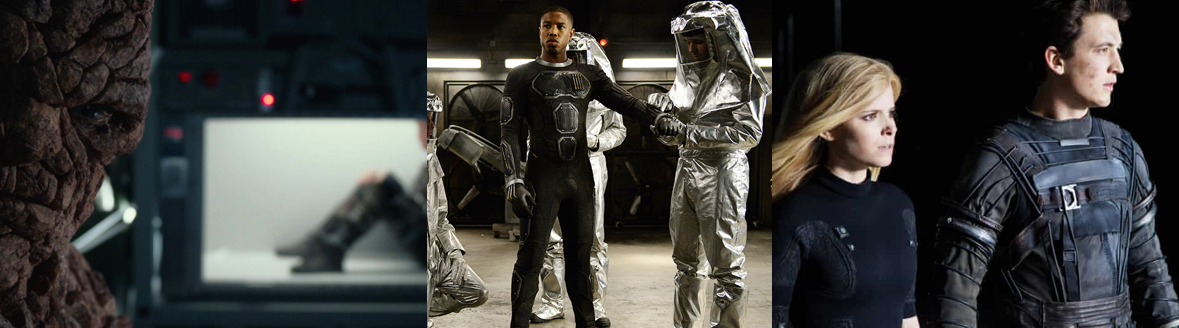
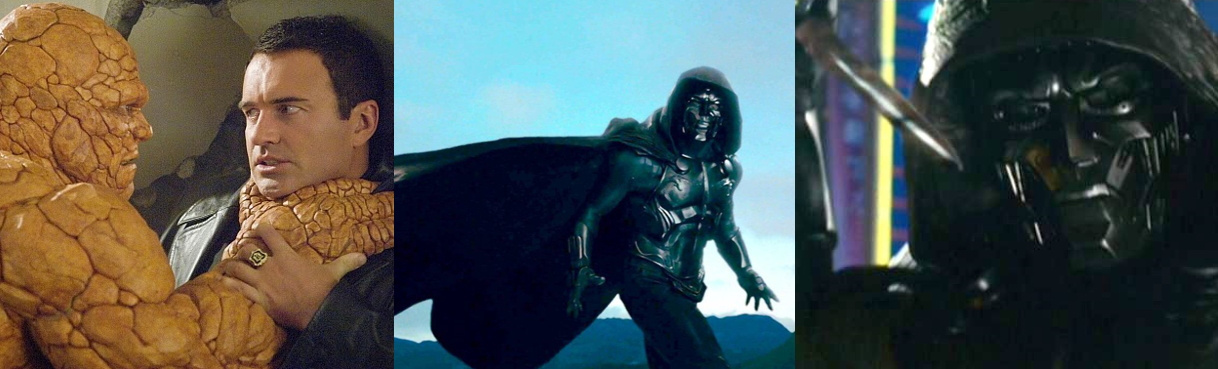
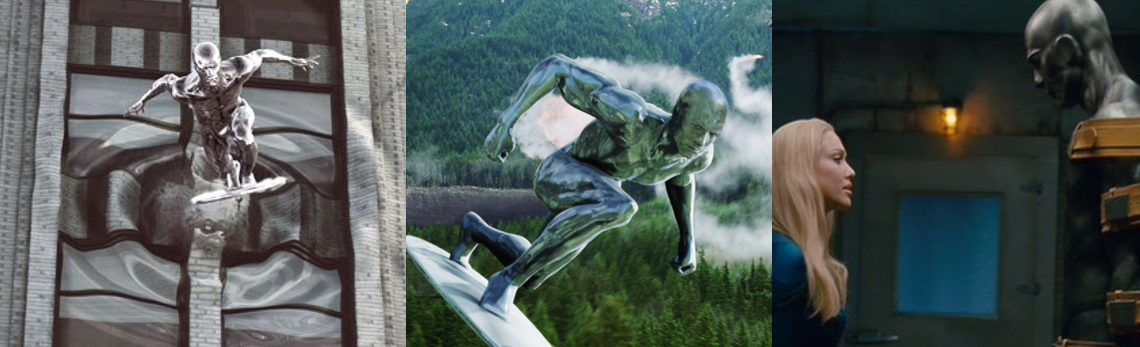
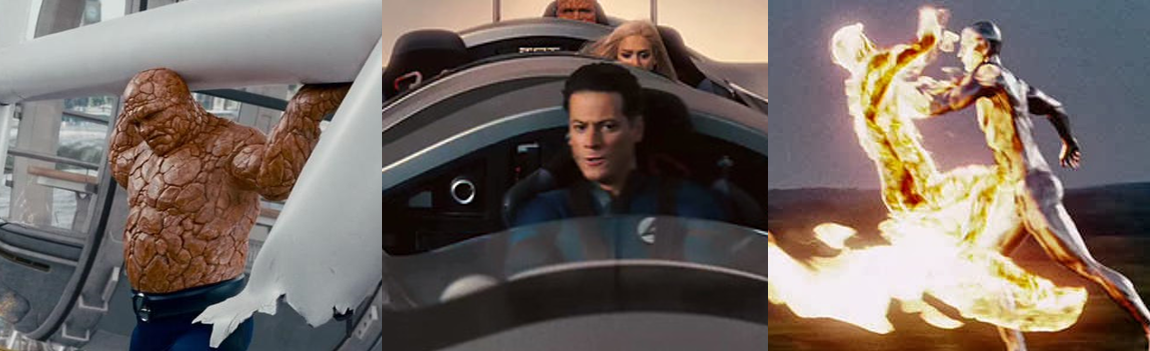
Movie Night [F4iday]: Fant4stic


In November 1961, Marvel Comics readers witnessed four intrepid explorers be forever changed by mysterious cosmic rays. Marvel’s “First Family” of superheroes were the first of many colourful superheroes for Marvel Comics and are more than deserving of some attention today.


Released: 7 August 2015
Director: Josh Trank
Distributor: 20th Century Fox
Budget: $120 to 155 million
Stars:
Miles Teller, Michael B. Jordan, Kate Mara, Jamie Bell, Toby Kebbell, Reg E. Cathey, and Tim Blake Nelson

The Plot:
Genius scientist Reed Richards’ (Teller) research into teleportation attracts the attention of Professor Franklin Storm (Cathey), who invites him to help complete Victor Von Doom’s (Kebbell) “Quantum Gate”, which he recklessly travels through to a parallel dimension alongside his co-workers. Though they are transformed by their exposure, Doom is stranded and Reed becomes a fugitive, but he is forced to repair his fractured relationships when Doom plots to harness the dimension’s  power for his own nefarious ends.

The Background:
Considering that there is some controversy surrounding the creation of Marvel’s First Family of superheroes, perhaps it’s fitting that Stan Lee and Jack Kirby’s dysfunctional family of intrepid adventurers has had a rocky road towards a big-budget, live-action adaptation. Although German producer Bernd Eichinger’s attempts to get a film off the ground resulted in the production being shut down and the negatives being confiscated to keep it from seeing the light of day, director Tim Story’s efforts at least resulted in actual movies being released. While the films were both modest successes at the box office, they were met with mixed reviews, despite praise for some of their performances, and plans for further movies and spin-offs were cancelled because of this mediocre reception. 20th Century Fox first announced their intentions to reboot the franchise in 2009; the initial script included another interpretation of Galactus but, when director Josh Trank signed on to the film, he immediately set about reworking the script into something more grounded and realistic. While Trank sought to evoke a specific tone and atmosphere with his new take on the Fantastic Four’s origin, other creators and producers offered contradictory statements regarding the reboot’s connection to Fox’s X-Men franchise (Various, 2000 to 2020), and the film attracted controversy by casting up-and-coming actor Michael B. Jordan in the role of Johnny Storm/The Human Torch, a character traditionally depicted as white (though Trank later revealed that he planned to make the entire Storm family black to create more diversity within the team). Additional problems occurred when 20th Century Fox ordered a number of reshoots after being dissatisfied with Trank’s efforts, and the film was further cut up and changed from Trank’s original vision in the editing room. The result was one of the most ridiculed superhero films ever made; Fant4stic’s underwhelming $167.9 million gross made it a box office flop and critics universally panned it, with even Trank actively distancing himself from the finished product. Although 20th Century Fox initially planned to produce a sequel, the film was quietly removed from their production slate; the characters subsequently became the property of Marvel Studios when Disney purchased 20th Century Fox in 2017 and another reboot was soon announced as part of the Marvel Cinematic Universe.

The Review:
While Tim Story’s Fantastic 4 movies may not have bee the greatest superhero or science-fiction tales ever produced, they were decent enough in their own right and seemed to be heading in the right direction with the second film; a third movie, and a spin-off, seemed likely and I have to say that I was a little let down that we never got to see another entry in that series of films. When I first heard that 20th Century Fox were producing a reboot, I was sceptical until I saw the first few trailers; the movie seemed to be advertised as a cross between Interstellar (Nolan, 2014) and easily Trank’s most notable film, the excellent Chronicle (Trank, 2012), with its darker, gritter approach and focusing more on the scientific aspects of the team. I was actually okay with this, and some of the casting changes, and barring one exception everything seemed to be shaping up okay…until I started hearing that it really wasn’t very good and saw how poorly it performed. When I first saw it, I remember actually thinking it wasn’t that bad, but it’s true that it’s probably my least-watched of the three commercially released movies.

Reed and Ben’s prototype for a teleporter eventually catches the attention of Franklin Storm.

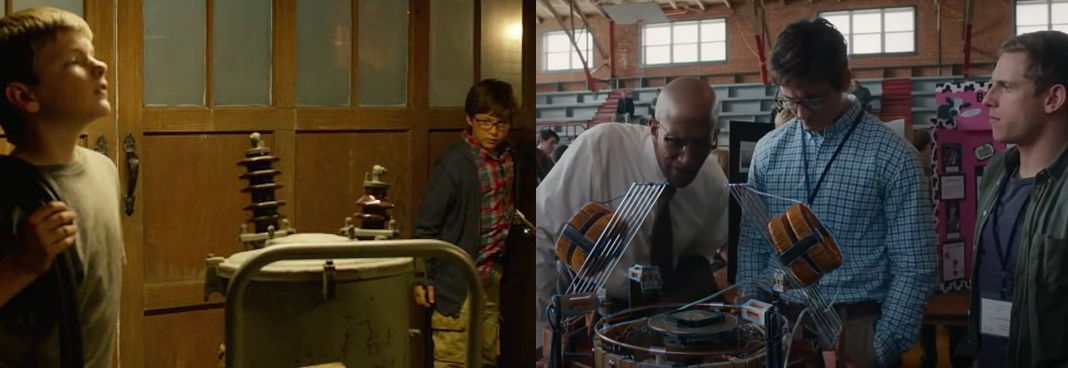
Fant4stic separates itself from its predecessors by beginning in 2007 to show us Reed’s childhood as a child genius (Owen Judge) who has aspirations of building a teleportation device; although he is mocked by students and even his teacher, Mr. Kenny (Dan Castellaneta), for his claims to already be building the device, he catches the eye of young Ben Grimm (Evan Hannemann). While Reed is unfazed by the mockery he receives, Ben comes from a rough neighbourhood and an even rougher home where he is continuously abused by his brutish older brother, Jimmy (Chat Hanks), and forms a fast friendship with Reed when he sees first-hand that the boy’s prototype (powered by a number of Nintendo 64’s and materials scrounged from Ben’s family junkyard) is able to transport matter to an unknown dimension (though it also causes a massive blackout in the process). Seven years later, the now grown-up friends confidently display their newest prototype at their high school’s science fair (despite clearly being in their mid-thirties rather than around seventeen/eighteen); although Reed’s device is still a little wonky and destructive, it nevertheless works but, oddly, Mr. Kenny continues to be unimpressed (labelling it as a magic trick), and Reed is left dejected at the response to his lifelong project.

Doom agrees to work with the team despite his distrust of the suits overseeing the project.

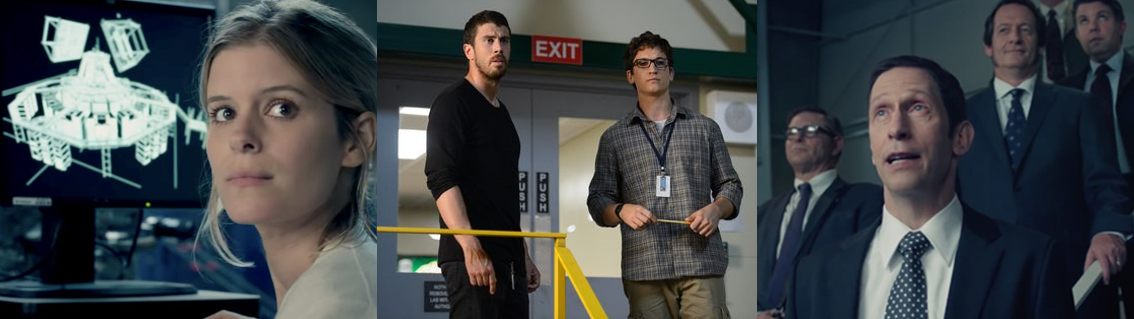
His sprits soon turn, however, when Dr. Storm and his daughter, Sue (Mara), approach him, seeing the potential in Reed’s research and impressed by his progress; Storm has been working on a similar project but has been unable to retrieve matter from the source dimension, and immediately offers Reed a full scholarship to the Baxter Foundation so that he can help them finalise an interdimensional transporter. Reed jumps at the chance to move to the city and be appreciated for his intellect for a change and, though it means being separated from his childhood friend, Ben fully supports his academic endeavours. Reed awkwardly tries to strike up a conversation with Sue, an intelligent young woman in her own right who uses music to help her concentrate on her work and specialises in “pattern recognition”. Still, Storm’s project attracts scrutiny from Doctor Harvey Allen (Nelson), who doesn’t subscribe to Storm’s claims of alternative dimensions, or his tendency to recruit children from science fairs or unpredictable wild cards like Victor Von Doom. Reimagined as a reclusive, unappreciated genius, Victor distrusts the military and governmental officials behind the Baxter Foundation but agrees to return to the project out of his affection and trust for Sue. Initially, Victor is so paranoid that he believes that Reed stole his research, but despite being critical of Reed’s childish drawings, is nevertheless impressed with his efforts; although he has little faith in the future of humanity or Storm’s dreams of using the Quantum Gate to repair the environmental damage done to the world, he’s willing to work alongside Sue and Reed on the proviso that they get to be the first ones through the gate to explore this mysterious other dimension.

The team is joined by Johnny and forever transformed by Planet Zero’s wild energies.

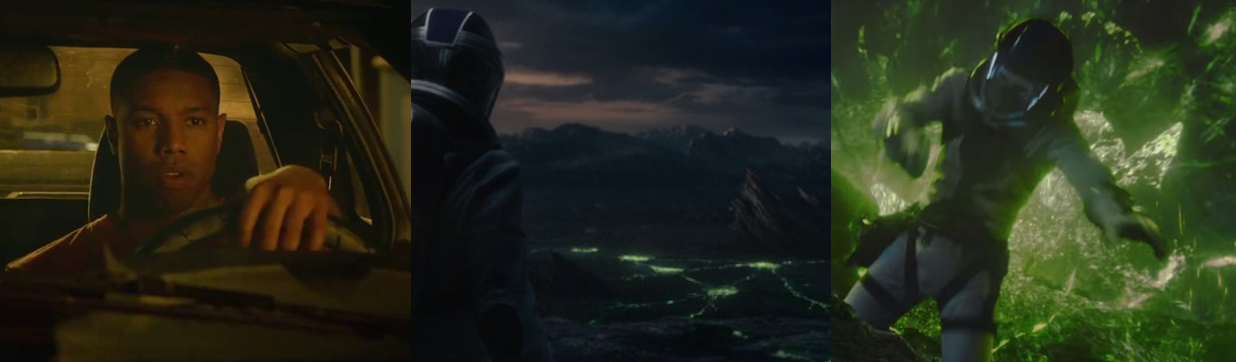
To complete the project, Storm drafts in his outspoken, hotshot son Johnny (Jordan), a rebellious youngster who’s more interested in street racing than putting his incredible engineering talents to good use alongside his father. Resentful of his father’s work, which has left him feeling undervalued, Johnny is forced to join the project after smashing up his car, but forms a fast friendship with Reed after he actually speaks to and treats him with some respect on a peer-to-peer level. In time, the four complete the Quantum Gate and successfully transport a chimp to this other dimension, dubbed “Planet Zero”, a primordial world of chaos that Storm believes holds the key to understanding human evolution and providing clean, renewable energy sources for the entire planet. However, the team is distraught and angered when Allen refuses to allow the four to be the first to travel to Planet Zero, resulting in them deciding the make the trip against orders after getting half-cut on alcohol. Intoxicated, Reed calls Ben and insists that he join them in making the trip, and in a bizarre turn of events Ben is transported alongside Reed, Johnny, and Victor while Sue…stays behind in the control room and wasn’t even asked to be a part of the experiment. In fact, she only finds out that they’re using the machine when her computer alerts her, meaning that she misses out on visiting the new world, which turns out to be an extremely hostile environment and home to a protoplasmic substance. However, when a series of eruptions force them back into the Quantum Gate, Victor is left stranded and the three are bombarded with the strange energy of the planet, which fundamentally alters their genetic structure to bond them with the four elements of the planet (with Sue being caught by a burst of energy from the returning gate).

The four’s powers are presented as monstrous, painful, and unstable genetic abnormalities to be feared.

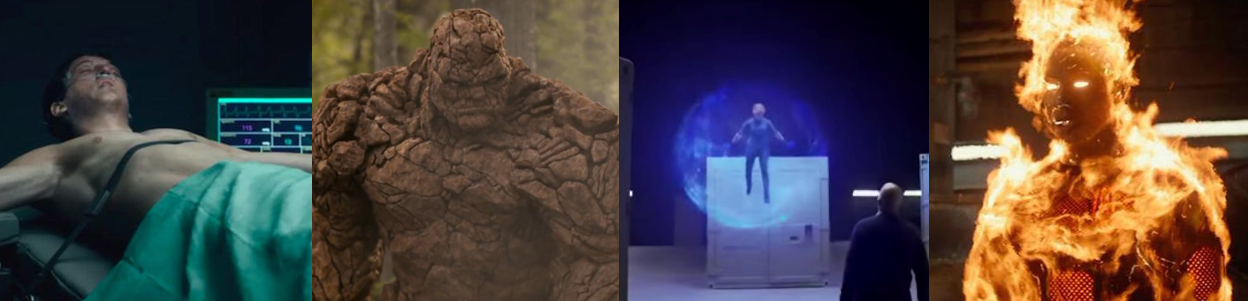
Unlike in the 1994 movie and Tim Story’s first film, the four are immediately and horrifically changed by this process; Johnny is left a burning body, Ben is buried under a pile of alien rocks, Sue flickers in and out of sight, and Reed’s limbs are left strewn around the ruined laboratory. Following this, the four are subjected to a series of studies and tests by governmental officials as their powers rage out of control. Interestingly, in this version of the story, neither Ben or Johnny can control their powers; Johnny requires a specially-modified suit to regulate his flames, and even Reed struggles to concentrate on keeping himself in proportion, making the four’s abilities far more monstrous and dangerous as a result. Since she wasn’t at ground zero like the others, Sue’s powers are far more stable and, in time and with training, she’s able to control them, but Ben is left in constant pain and horrified by his rock-like appearance. Terrified and guilt-ridden, Reed flees the facility and goes on the run in a desperate attempt to stabilise his condition and find a cure for Ben’s hideous affliction, however this results in Allen manipulating Ben into becoming a weapon for the government and preparing Johnny for the same fate. After a year in hiding, Reed is finally tracked down by Sue, brought in by the enraged Ben, and agrees to complete a new Quantum Gate in return for the resources to cure his friends, and himself, of their dangerous powers, only to find that Victor also survived and has been irrevocably and dangerously altered by Planet Zero.

The Nitty-Gritty:
I mentioned above that Fant4stic is far more focused on the scientific content of the film, and that’s true; once Reed arrives at the Baxter Foundation, he is awestruck by the scope, resources, and technology offered by the facility and much of the film’s first act is devoted entirely to the fledgling team and Victor’s efforts to finalise the Quantum Gate. This involves a hefty montage of such science stuff involving Reed and Victor scribbling on a whiteboard, Sue creating the team’s protective suits, and the construction of the Quantum Gate itself. This is juxtaposed with the four slowly bonding over time, sharing meals and a real enthusiasm for the work they’re doing, though Ben is noticeably absent from the entire team-building process as Reed never once thinks to bring him in on the project.

The government takes an immediate interest in the military applications of the four’s powers.

Once the team returns from Planet Zero, the film takes a dark and dramatic turn; as a stereotypical governmental sleazeball, Allen is determined to not only take advantage of Ben, Johnny, and Sue to sell them as assets to the military, but to also mine the transformative properties of Planet Zero for similar uses. While Johnny is all for using his powers for something worthwhile, and pushing them (and himself) to the limit, Sue is determined to not be used as some tool for the government like Ben, who has become a despondent and stoic killing machine in Reed’s absence. While I question the casting of Jamie Bell in the role of Ben since he lacks the physicality and stature typically associated with the character, he does a pretty good job at portraying a loyal friend to Reed and the Thing’s torment at the emotional and physical pained caused by his grotesque transformation. Kate Mara is a much better fit for Susan Storm compared to Jessica Alba since she’s not some glamorous supermodel cosplaying as the Invisible Girl; instead, she’s a smart and slightly quirky scientist in her own right and has far better chemistry with Reed and Johnny than Alba’s version of the character. All I ever hear is people banging on about the reshoots and Mara’s wig but I can’t say it really bothered me that much or was even something I noticed; similarly, I really enjoyed Teller’s version of Reed as an awkward but likeable young man who is incredibly smart but still very relatable, and Michael B. Jordan delivered a great performance as the Human Torch thanks to his boundless charisma. The only real criticism I had about the casting was to do with some of the script and narrative choices; leaving Ben out of the team means that we don’t really get to see the same rapport between him and Johnny as in the previous movies and comics (Johnny generally directs his snark towards Victor instead), but otherwise this was a really strong cast.

CGI is used to bring the four to life, and for the most part it holds up pretty well and does a decent job.

One area where Fant4stic excels above its predecessors is in the CGI and special effects used to bring the titular heroes to life; while I have to say that I do prefer a practical suit to be used for the Thing, the CGI employed here goes a long way to emphasising just how monstrous and fearsome this version of the character is. A hulking, destructive being of superhuman strength and durability, the tragedy of the Thing is only heightened by his grotesque appearance and his being turned into a weapon by Allen. Similarly, the fire effects used to render the Human Torch are worlds better than in the previous film and probably some of the best fire effects I’ve ever seen, resulting in him being a fittingly blazing inferno. Sue’s invisibility is about the same, though there’s more of a blue tint to her forcefields and such; generally, her powers are used more to protect the others from harm and to allow the Thing to get the drop on Doom in the finale, meaning the vast potential of her abilities is again set aside in favour of trying to highlight each member of the time. Finally, there’s Reed; while he looks a little plasticy when he’s all stretched out following his return to Earth, his elasticity mostly looks much better (while his cobbled together suit isn’t massively comic accurate, it seems more suited to the CGI than the blue used in the last films) and we even get a scene that better showcases his ability to disguise his features.

Doom ends up being a raggedy, obsessive ass who wants to reshape the world in his image.

Rather than being a despicable monarch or a sleazy corporate scumbag, this version of Victor Von Doom is an arrogant, cynical slimeball who believes himself to be the most intelligent person in any room and who is obsessed with Sue (why that has to keep happening in these films is beyond me). Determined that the world will remember his name for his contributions to science, he refuses to be forgotten in favour of some hot-shot astronaut and his obsessions lead to him blundering into Planet Zero’s protoplasmic substance without thought for the consequences, causing the planet to erupt around them, granting the four their powers, and leaving him stranded on Planet Zero, where he is consumed by its strange energies. Infused with his suit and with a mysterious, otherworldly power coursing through his veins, Victor is transformed into a monstrous and vicious being who exhibits deadly telekinetic powers that he uses to explode people’s heads, repel bullets, and lay waste to the facility in order to return to Planet Zero. Driven mad by his powers and time in isolation, Victor takes the name “Doom” and plans to turn the destructive energies of Planet Zero against the Earth in order to forever transform it, reshaping it in his own image in order to avenge himself on those who have wronged him, killing both Allen and Storm in the process and refusing to listen to reason. To put an end to Doom’s plot to destroy the world using a black hole, the four travel to Planet Zero, where they find themselves overwhelmed by Doom’s command of the landscape; when their individual efforts to stop Doom are met with failure, the four set aside their differences in order to work together to defeat him. Following a co-ordinated assault using all of their powers in unison, the four are able to set Doom up so that the Thing can smash him into his own energy beam, disintegrating him and sparing the Earth (though the immediate area is left devastated). In the aftermath, the four are commended by the United States government and enter into an agreement where they are afforded the freedom to operate independently in return for lending their services for the good of the world as a superpowered team.

The Summary:
I’m a bit torn, to be honest; I feel there’s a lot of potential in Fant4stic, especially in the cast and the general direction that the film took. Focusing on the science and being this more gritty, grim retelling of the team’s origin was a good way to separate it from what had come before (which, to be fair, is essential for a good reboot), but I can see why this would have put off long-term or even casual Fantastic Four fans. There are some stumbles in the story that I seriously doubt even a director’s cut could fix; not having Ben be part of the Quantum Gate team until the machine is complete being chief among them, as is Sue not accompanying the team to Planet Zero, both of which were very strange choices to make. I liked that the film tied the team’s origin in with an adaptation of the Negative Zone to help mix things up, and having the Thing be tormented by physical pain and turned into a tool for the military was an interesting wrinkle to add to the story, as was the focus on the government desiring to harness and manipulate the team’s powers and those of Planet Zero. As ever, it’s the depiction of Doom where the film falters; had the script stuck to the original idea of him being a herald for Galactus, this may have helped with this new depiction of the character, but this is still a far cry from the maniacal despot of the comics and I almost feel like it would’ve been better to leave Doom’s fate unresolved and have the team battle a Planet Zero native, someone like Annihilus maybe, and tie up Doom’s loose end in the sequel. But, then again, I doubt even that change would have helped a sequel being produced, and that’s a real shame as I feel like a follow-up could have really improved upon the missed potential of this film and given everyone a bit more time to shine. Overall, I find myself actually enjoying this more than I expected, but it’s maybe a little too far away from the source material and the core of what makes these characters work, though I don’t actually think it deserves as much hate as it often gets.

My Rating:

Rating: 2 out of 5.

Could Be Better

What did you think to Fant4stic? Were you a fan of the new cast and their depictions of the characters and what did you think to Johnny Storm being race swapped? Were you disappointed that Ben wasn’t a part of the machine’s construction and that Sue didn’t travel to Planet Zero? What did you think to the depiction of Victor Von Doom this time around? Do you think CGI is a better way to bring the Thing to life or did you prefer the practical suits of the previous films? Would you have liked to see a sequel to this film, or an extended director’s cut release someday? How have you been celebrating the debut of Marvel’s First Family this month? Whatever your thoughts on Fant4stic, leave a comment below.
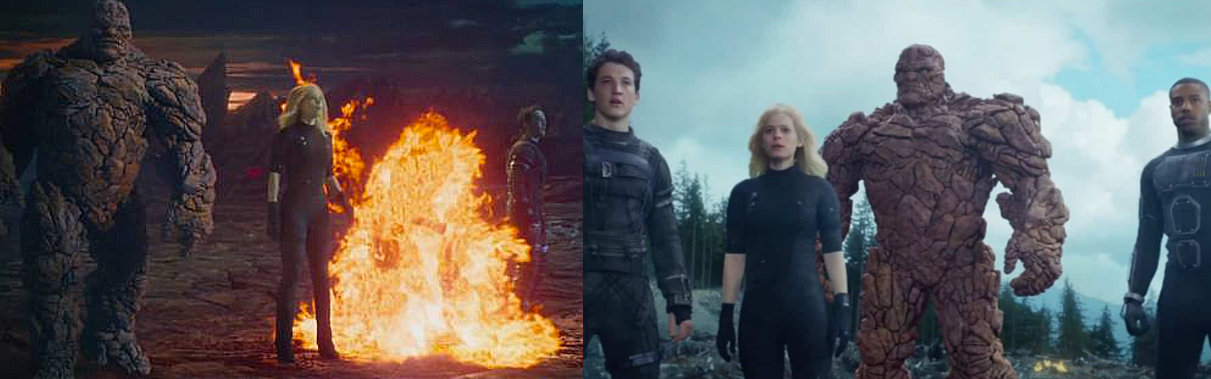
Movie Night [F4iday]: Fantastic 4: Rise of the Silver Surfer


In November of 1961, readers of Marvel Comics readers witnessed four intrepid explorers be forever changed by mysterious cosmic rays. On that day, they became known as the Fantastic Four, Marvel’s “First Family” of superheroes, and went on to be the first of many colourful superheroes for Marvel Comics as well as feature in numerous cartoons, videogames, and live-action movies. This year, I’ve been dedicating every Friday in November to commemorating the debut of Marvel’s most famous dysfunctional family.


Released: 15 June 2007
Director: Tim Story
Distributor:
20th Century Fox
Budget: $120 to 130 million
Stars:
Ioan Gruffudd, Jessica Alba, Chris Evans, Michael Chiklis, Julian McMahon, and Doug Jones/Laurence Fishburne

The Plot:
Doctor Reed Richards/Mister Fantastic (Gruffudd) and Susan Storm/The Invisible Girl (Alba) find their attempts to get married constantly interrupted by a media circus and the extraterrestrial “Silver Surfer” (Jones/Fishburne), who catches Victor Von Doom/Doctor Doom’s (McMahon) attention when it prepares the world for consumption by a cosmic being known only as “Galactus”.

The Background:
Stan Lee and Jack Kirby’s family of dysfunctional superheroes have had quite the chaotic journey to the big screen; their 1994 movie was never released and the eventual big-budget adaptation was met with mixed reviews after being in Development Hell for around ten years. Still, Fantastic 4s (Story, 2005) modest box office success of $333.5 million saw not only the release of an Extended Edition but also the return of director Tim Story and the entire cast for a sequel. Screenwriters Mark Frost and Don Payne came onboard to pen the screenplay and the duo drew significant inspiration from both the original “Galactus Trilogy” (Lee, et al, 1966) and an altered version of that same story seen in Ultimate Marvel (Ellis, et al, 2004 to 2006). The duo aimed to focus more on the enigmatic Silver Surfer than the Devourer of Worlds and there was a lot of speculation and anticipation surrounding the design of Galactus. Much of the film’s promotion was also focused around fan-favourite elements from the original Marvel Comics, such as the Fantasti-Car and the wedding between Reed and Sue, and practical elements such as Ben Grimm/The Thing’s suit were redesigned to allow actor Michael Chiklis to slip it off between takes. The titular Silver Surfer’s digital effects were the work of Weta Digital, who not only completely replaced stuntman Doug Jones with a sleek CGI model but also contributed to the design of Galactus. Fantastic 4: Rise of the Silver Surfer made about $32 million less than its predecessor, coming in with a box office of $301.9 million; though the film’s average review score is higher than the first film, it was also met with mostly mixed reviews, although the general consensus was that it was at least more entertaining than the first film. Plans for a sequel and a spin-off for the Silver Surfer were eventually quashed due to the overall lacklustre response to Story’s films. Thankfully, after a mediocre tie-in videogame and the disastrous decision reboot the franchise some eight years later, the Fantastic Four returned to prominence in the Marvel Cinematic Universe in 2025.

The Review:
Fantastic 4 wasn’t really a bad film, really, just quite underwhelming considering some of the outlandish cosmic adventures Marvel’s First Family often get up to. Do I expect them to battle the likes of Galactus and Kang the Conqueror in their first movie? No, of course not, but maybe exploring the Negative Zone and encountering someone like Annihilus could have been possible with a script re-write (Reed discovers the Negative Zone and that’s where they get their powers from, rather than them going to space) while building towards a showdown with Dr. Doom for the sequel (since he was so underutilised and bland in the first film) and maybe, maybe Galactus for the third and final movie. I can’t, however, say that I’m too surprised that Fantastic 4 got a sequel; back then, mediocre movies were getting sequels all the time and it just seemed natural to do, though I definitely am not a fan of the overly long and wordy “Rise of…” title (Fantastic Four: Doomsday would’ve been better in my opinion, but what the hell do I know, right?)

Reed and Sue’s wedding is disrupted by the arrival of the Silver Surfer, who causes global havoc.

Since the end of the last film, the Fantastic Four have become wildly beloved, popular, and successful superheroes; while Johnny Storm/The Human Torch (Evans) continues to revel in their celebrity status and indulge himself with merchandising and sponsorship deals, Sue is troubled by the constant media storm that surrounds their lives. It’s bad enough that the interference of the press has caused Reed and Sue to continuously postpone their wedding, but Sue worries about what sort of impact the attention they bring and the circus of their day-to-day lives will have on any children she and Reed may have in the future. Sue’s characterisation seems to have taken a bit of a step back in this regard; she actually seems to think it’s acceptable to prioritise her wedding day over the fate of the world, arguably costing Reed valuable time in finding a way to track the entity causing worldwide havoc, and while Alba seems more comfortable in the role of the team’s matriarch, something seems a bit…off about her this time around (I think it’s her dazzling contact lenses). The world is thrown into chaos when the mysterious entity known as the Silver Surfer arrives; wielding the same cosmic powers that gifted the Fantastic Four and Doom with their abilities (a neat little wrinkle that I actually really enjoyed), the Silver Surfer is able to dramatically affect weather patterns across the globe, drying up lakes, bring snowstorms to deserts, and disrupting electrical devices the world over.

General Hager isn’t impressed with Reed, or the four, whom he views as freaks.

Reed is troubled by the disruptions; despite promising Sue that he is going to focus on the wedding, he can’t help but investigate the disturbances and is intrigued to find a link between the cosmic radiation and their powers. Johnny is able to turn Reed’s fascination with the ongoing global disturbances to his advantage and blackmail Reed into having a bachelor party, and though Reed adamantly turns down General Hager’s (Andre Braugher) request that he and the four lend their expertise in solving the global crisis, he ultimately goes back on his word and develops a way of tracking the anomalies out of his desire to help and sheer scientific curiosity. Obviously, Sue is angered by this as she’s obsessed with having that one perfect day even if the entire world is being thrown into chaos around them; Reed is trying to please everyone, as always, but ultimately chooses to stand up to Hager’s abrasive nature and demand a little respect for him and his team if the military actually want them to help. When he sees how upset Sue gets by the whole media circus, however, Reed proposes that they leave it all behind after the wedding, but ultimately they’re both able to come to terms with their crazy lives by the conclusion of the film. The Thing, easily the heart of the team, is in a far better place this time around; having taken to wearing an array of clothes and noticeably much more comfortable with himself and being out in public, he’s developed a brotherly relationship with Johnny and has absolute faith in Reed, even when he predicts the end of the world and suggests the team go their separate ways.

Doom is still somewhat underutilised but comes across a bit better in this film.

Although Reed discovers that the Silver Surfer has been preparing worlds for their eventual destruction all across the universe, the entity’s arrival has a more direct impact on the team when it passes over Latveria and awakens Victor Von Doom. A scarred and ruined mess of a man, Doom begins the film in a much more fitting place than he left it (holed up in a grand castle, glaring at an array of monitors, filled with egotistical mania, and fully embracing his role as a scheming and bitter supervillain). After encountering the Silver Surfer, though, Doom’s appearance is sadly restored by the Surfer’s cosmic powers, ruining any menace he may have had in his armoured guise, and he goes right back to being a sleazy, suit-wearing scumbag. Doom even weasels his way into studying the Silver Surfer further by sharing his data with Hager, who orders him to work alongside the Fantastic Four, much to their chagrin. Of course, Doom’s intentions are far from virtuous; realising that the Silver Surfer draws his powers from his “board”, Doom seeks to separate the silver-hued entity from it, depowering the once-might Sentinel of the Spaceways, so that he can claim it for himself. This allows Doom to briefly come close to matching the formidable threat he poses in the comics, and even don a far more impressive and visually interesting set of armour and spit his famous “Richards!” line, but once again it’s too little too late and Doom gets far too little time in the spotlight.

Contact with the Silver Surfer causes Johnny to swap powers with his teammates.

Instead, much of the film is focused on exploring the impact that the Silver Surfer has on the Human Torch; although he seems perfectly happy living a shallow life of materialism and still likes to crack jokes at both Reed and the Thing’s expense as often as possible, Johnny doesn’t hesitate to take off after the Silver Surfer when he disrupts Reed and Sue’s wedding and finds himself changed as a result of physical contact with the entity. Consequently, Johnny switches powers whenever he touches his teammates, which allows the Thing a brief return to his human form (something that never comes up again, despite Ben’s promise) also causes chaos when the Fantastic Four try to intercept the Silver Surfer in London. Feeling isolated because of the danger he now poses to the team, Johnny is distraught to learn that Reed and Sue are willing to break up the band so that they can lead “normal” lives and is forced to learn to set aside his ego and put the team before himself. This all culminates in him absorbing the powers of the entire team in order to match Doom’s stolen cosmic powers in the finale, basically transforming him into a version of Kl’rt/Super-Skrull and kind of negating his character arc since it takes one individual with all of the team’s powers to defeat Doom rather than the combined efforts of the team proper.

The Nitty-Gritty:
Strangely, considering that Rise of the Silver Surfer essentially deals with the impending destruction of the entire world, the film’s tone is as light and whimsical as the last film, for the most part, but the comedy definitely lands a lot better this time around. Johnny’s wisecrack about the Thing’s blind girlfriend, Alicia Masters (Kerry Washington), potentially dying in a rockslide is hilarious, as is Sue using her powers to force Reed to listen to her, her “I’m on fire!” exchange with Reed, and Johnny’s all-too-brief transformation into a Thing-like creature. Having lived and operated together for some time now, the team has settled into their dysfunctional family dynamic quite nicely; out in the field, they tend to quarrel and discuss their personal dramas, which angers Hager, who sees them as freaks who can’t take threats seriously as they’re too busy bickering with each other. This leads to an impressive moment for Reed as he finally stands up for himself, and his team; in fact, Reed has adjusted to his role as the team’s leader extremely well compared to his characterisation in the first film. He’s still an easily distracted and awkward nerd, but he’s much more confidant in directing the team and keeping them focused in the field, at least until Johnny’s new powers cause disruption amongst the team.

The Silver Surfer prepares the world for this master’s arrival, who he dare not defy.

Sue ends up playing a pivotal role in humanising and characterising the mysterious Silver Surfer; a stoic and wholly alien lifeform, the entity is like living liquid metal, reflecting everything around him in his silvery skin and slicing through the air and even the vastness of space with a fluid-like ease. Impossibly fast and incredibly powerful, the Silver Surfer can not only cause chaotic events to happen all over the world and create ominous craters in the planet’s very crust, he’s also easily able to shrug off Doom’s electrical bolt, out-pace and exhaust Johnny in the upper atmosphere, and pass through Sue’s invisible barrier. Fascinated and intrigued by the Silver Surfer’s beauty, Sue questions the entity as to his motivations, which causes enough of a distraction to separate the Silver Surfer from his board and allow him to be captured by Doom and Hager. While the Silver Surfer has never exhibited such an obvious weakness in the comics, as far as I am aware, it’s necessary to render him vulnerable and exposit key information about the Silver Surfer’s master, the malevolent Galactus. Helpless and powerless without his board, the Silver Surfer reveals to Sue that he was once known as Norrin Radd and is bound to lead the entity to worlds for it to devour in order to spare his own, but takes no pleasure in this fact and finds himself besotted by Sue as she reminds him of his lost love. The Silver Surfer also reveals that his board draws Galactus closer, but initially refuses to use its power to repel his master since he dare not defy the World Devourer.

Some big set pieces and special effects keep things interesting, with the Silver Surfer being the highlight.

Surprisingly, the Fantastic Four’s costumes haven’t really been changed all that much from the last film; they seem a little darker, and maybe a little more refined here and there, but mostly appear to be identical, which is very unusual as superhero sequels usually always introduce new costumes for the characters. Thankfully, Doom definitely looks much better this time around; I could have done without seeing him return to normal in the middle there, but he definitely makes up for it in the finale with his more regal and detailed armour. The four have firmly established themselves in the Baxter Building and no longer have any money troubles; instead, they have all the resources they could ask for thanks to Reed’s patents and Johnny’s endorsement deals to franchise the team out to anyone and everyone. Reed’s focus is still on the science, and using his genius and the team’s abilities to help others, but he’s not above creating new toys for the team to use, such as the futuristic and criminally underused Fantasti-Car. While the Thing looks just as good as ever thanks to the impressive practical suit, some of the CGI and special effects have taken a bit of a hit, most notably Reed’s stretching powers (though this could just be because they’re showcased more often here). Still, the film has some impressive action set pieces on offer, such as the team’s efforts to repair the damaged London Eye, and the effects used to bring the Silver Surfer to life are absolutely top-notch. The Silver Surfer appears unsettlingly alien and unnaturally fluid; the chase between him and Johnny is quite exhilarating and the way he just kind of hovers and slips into frame is incredibly unnerving, and I think it was a wise move to spend more of the film focusing on the Silver Surfer as an antagonistic and mysterious force rather than the Devourer of Worlds.

Galactus may have just been a disappointing cosmic cloud but at least they tried to bring him to life.

Speaking of which, you can’t talk about this film without mentioning Galactus; one of Marvel’s most iconic and destructive cosmic entities, Galactus gained notoriety for being represented as a gigantic, abstract space cloud. I can understand the backlash about this as Galactus represents one of the most morally grey entities in the Marvel universe (he has to “eat” worlds in order to satisfy his great hunger, and does so not out of malice or evil but simply because he has to in order to survive and his existence is part of the cosmic balance of death and rebirth) and reducing him to a swirling, indistinct mass of cosmic energy is quite an insult to die-hard comic book fans. I can also understand the apprehension; these Fantastic Four movies are clearly drawing inspiration from Fox’s original X-Men trilogy (Various, 2000 to 2006) and going for a more grounded take on the comic’s more fantastical elements and the filmmakers definitely seem to have thought that a gigantic humanoid clad in purple armour stomping around New York City was probably a step too far. I, however, disagree and think these films (and any future Fantastic Four films) should totally embrace the more bonkers aspects of the source material, but I do have to applaud the filmmakers for even using Galactus in the first place. They didn’t have to do that and it’s pretty ballsy to jump into the character for the team’s second movie as how the hell do you top a world-devouring entity? Also, they seem to have pulled inspiration from “Gah Lak Tus”, the Ultimate version of the character that was a swarm of robotic drones rather than one massive being; the shadow and fiery silhouette of Galactus and his ship can also be briefly seen, hinting that the cloud is masking the being’s true form, and the proposed Silver Surfer spin-off was also supposed to reveal the character in full. Additionally, seeing  Galactus’ smoky tendrils devour that world at the start, watching it ominously advance through the galaxy and learning about its destructive history, and the shot of it preparing to swallow the Earth whole are all really effective at building a sense of awe and dread around the entity. I can definitely see that the filmmakers had some good intentions with the character but the execution does fall a bit flat; I think maybe it would have sufficed to see a gigantic hand reaching out from the cloud, or see hints of Galactus’ helmet poking through the storm and maybe his eyes glistening, but, again, I admire that they even tried to use the character, if nothing else.

After repelling Galactus, Reed and Sue finally marry and the Silver Surfer is freed from his master.

Despite the threat of Armageddon looming ever closer, Doom manipulates events to get his hands on the Silver Surfer’s board; conveniently cobbling together a wrist-mounted device that somehow allows him to assume control of the board, and thus the Surfer’s Power Cosmic, Doom kills Hager in spectacular fashion and refuses to give up his newfound power even in the face of worldwide destruction. In the process, Doom kills Sue when she takes a shot to protect the Silver Surfer, which finally convinces him to rebel against Galactus. After Johnny absorbs the abilities of his teammates in order to separate Doom from the board in an all-too-brief fist fight, thus restoring the Silver Surfer to full strength, the Silver Surfer uses the Power Cosmic to resurrect Sue and heads up into the atmosphere to confront Galactus as the titanic cloud prepares to drain all life and energy from the planet. There, in the centre of the swirling, chaotic mess of cosmic energy, he renounces his service and uses all of the board’s power to dissipate Galactus in a very obvious Christ metaphor, presumably transporting it away or destroying it outright, and is assumed dead from the exertion. In the aftermath, Johnny is returned to normal (though I think it would have been a nice touch to allow Ben to change to and from the Thing at will as a result of contact with the Silver Surfer), Reed and Sue finally marry in a small ceremony away from prying eyes, and the team resolves to stick together, even with the chaos of the superhero fame, while the Silver Surfer is revealed to have survived in the depths of space.

The Summary:
Well, this was certainly a step up from the last film; the cast, dialogue, and world definitely all seems to feel a lot more comfortable and work a lot better, and overall Fantastic 4: Rise of the Silver Surfer feels like a much more enjoyable movie since it doesn’t have to be bogged down with an origin story or explaining and exploring the team’s powers. The characters all seem very familiar with each other and gel as a dysfunctional family, operating as a cohesive team in the field while still bickering and having interpersonal dramas regarding their superhero celebrity status. The banter between Ben and Johnny remains the clear highlight of the four, though I much preferred Reed this time around (leadership definitely suits him), with Sue remaining the weak link for me just because of the way Jessica Alba is presented and the fact that she’s so woefully miscast as the Invisible Girl. Doom looked and acted a bit more like his boastful comic book counterpart, but was again way too underutilised for a villain of his stature, but thankfully the film does a brilliant job of bringing the Silver Surfer to life. Mysterious, powerful, and inhuman, the Silver Surfer is also vulnerable and tragic and a true visual marvel. Yes, it’s massively disappointing that one of Marvel’s most enigmatic and iconic entities is reduced to a mere cloud, but I do admire the filmmakers for daring to even utilise Galactus and it’s clear that they had plans to do him justice in a later film, but again I feel like if you’re going to go big like that just go all-in and leave it all on the table.

My Rating:

Rating: 3 out of 5.

Pretty Good

What did you think to Fantastic 4: Rise of the Silver Surfer? Did you feel it was an improvement over the last film or were you just as disappointed with this effort? What did you think to the sub-plot of Johnny being able to absorb the team’s powers? Did you like the depiction and characterisation of the Silver Surfer or do you feel he was a little underpowered compared to the source material? What was your reaction when Galactus appeared as a giant cloud and would you like to see the character done justice in the Marvel Cinematic Universe some day? How have you been celebrating the debut of Marvel’s First Family this month? Share your thoughts on Fantastic 4: Rise of the Silver Surfer in the comments below.

Back Issues: Fantastic Four #52/53

Writers: Stan Lee and Jack Kirby – Artist: Jack Kirby

Story Title: “The Black Panther!”
Published:
12 April 1966 (cover-dated July 1966)

Story Title: “The Way It Began…!”
Published:
10 May 1966 (cover-dated August 1966)

The Background:
The popular story behind the Fantastic Four is that Marvel Comics head honcho Martin Goodman wanted then-editor Stan Lee to create a superhero team in response to DC Comics’ Justice League of America. Lee used the opportunity to create stories and characters that appealed to him and drafted a quick synopsis of a dysfunctional superhero family for legendary Jack Kirby to work on, thus creating the “Marvel Method” of writer/artist collaboration. While Kirby disputed this story, the two are credited as co-creators of Marvel’s First Family – Doctor Reed Richards/Mister Fantastic, Susan Storm/The Invisible Girl, and her brother Johnny, the Human Torch, and Ben Grimm/The Thing – whose comic books eventually introduced characters and concepts that would forever impact Marvel Comics. One such character was T’Challa, the Black Panther, whose name and appearance actually predate the Black Panther Party in a strange coincidence; initially dubbed the Coal Tiger in Kirby’s concept art and briefly flirting with the name Black Leopard, the Black Panther is notable for being the first-ever black superpowered character in comic books. Like the Fantastic Four, Lee and Kirby disputed which of them came up with the character and concept of the Black Panther, though both claimed to have created the character out of a desire to include more racial diversity in their publications. Soon after his debut appearance, the Black Panther made several guest appearances in numerous Marvel Comics before hits first critically acclaimed series and graduating to a short-lived solo title in 1977. The Black Panther became a pretty consistent presence in Marvel’s line-up, building his own supporting cast, joining the Avengers, forming the super secret superhuman cabal known as the Illuminati, and featuring in a number of pivotal Marvel events and politically charged storylines. The Black Panther is also no stranger to adaptation, featuring in the 1994 Fantastic Four cartoon, getting his own Marvel Knights motion comic series, and being brought to life in live-action by the late Chadwick Boseman in the Marvel Cinematic Universe. Black Panther (Coogler, 2018) proved to be a spectacular critical and commercial success and, as the sequel is due out this Friday, this seems like a great excuse to revisit his debut story arc.

The Review:
“The Black Panther!” opens with three of the Fantastic Four (Reed, Sue, and Ben) flying through the skies of New York City in a fancy, high-tech craft unexpectedly gifted to Reed by a mysterious African chieftain known only as the Black Panther. Powered by magnetic waves, the ship is extremely nimble and manoeuvrable, but Ben is less than thrilled by the experience, which makes him more than a little air sick (to the surprise of even Sue, since Ben is an ex-air force pilot). After concluding their little joyride, the three land on the roof of the Baxter Building to chat with the Black Panther’s emissary; the enigmatic robed ambassador allows them to keep the futuristic craft if they accept an invitation to join the Black Panther (who goes unnamed beyond this throughout the arc) as honoured guests in the kingdom of Wakanda, where “the greatest hunt of all time” will be held in honour of their visit. Marvelling at the Wakandan’s clearly advanced technology and eager to see more, and noting that the team could do with a vacation, Reed accepts to invitation and the emissary sends word back to his nation using a peculiar communication device that uses “Cosmic Channel Waves” to instantaneously send messages across the globe. In the faraway jungle city of Wakanda, the chieftain rejoices at having correctly guessed that his invitation would be accepted and enters a vast, highly advanced bunker held within a colossal stone statue of a panther where he garbs the sleek, form-fitting “stalking costume” of the Black Panther to prepare for the team’s arrival.

The cunning Black Panther catches the Fantastic Four completely off guard.

Meanwhile, back in the U.S., the story switches over to Johnny Storm, who’s stressing over his recent exams when his teammates literally drop in on him to bring him along on their trip. Unfortunately for me (but not, as we’ll see, the team or the plot), Johnny asks to bring his roommate, college athlete Wyatt Wingfoot (one of comic’s most boring and unnecessary characters) along as well. Johnny is grateful for the distraction, however, as it keeps him from pining over Crystalia Amaquelin, a beautiful Inhuman girl he recently met who’s currently trapped (alongside the rest of her race) behind an impenetrable barrier (the story even briefly cuts away to show that all of the Inhumans’ incredible powers are as nothing compared to the “Negative Zone” shell that the mad Inhuman, Maximus Boltagon, has sealed them within). Once the team enter Wakanda, they’re both in awe, and suspicious, of the lush, verdant jungle that greets them. Although Wakanda shows no signs of industrialism or human pollution, it is merely a façade for the sprawling, technical jungle made up of a veritable chaos of computer dynamos, mechanical apparatus, and elaborate tubes and wires. Naturally, Reed is enthralled at the scientific wonders on display, but he tempers this with caution, which is only ignited when their guide suddenly spirits away to an elevator. Unimpressed with the wonderous technology surrounding them and suspecting a double-cross, the Thing leaps into action without hesitation and suffers a massive electric shock that leaves him “as weak as a blamed Yancy Streeter” (because we had to constantly have those Yancy Street references in Ben’s dialogue back then) and thus vulnerable when the Black Panther suddenly strikes to begin the great hunt…with the Fantastic Four as the prey! The Black Panther easily dodges Mr. Fantastic’s elongated fist, and just as easily tricks the Human Torch into flying into a fireproof trap that subdues him with an asbestos lining and powerful vacuum blasts. While the Black Panther watches them from the shadows, the Thing recuperates his strength and Wyatt and Reed stress that they need to think ahead as they have no idea what other boobytraps await them. In an effort to be useful and put his Native American ancestry to good use, Wyatt runs off to scout the area, meaning he’s not around when Wakandan soldiers suddenly rush in and blast Reed, Sue, and Ben with “magnetic polarity guns” that cause them to violently repel off each other like human pinballs.

After overcoming the Black Panther’s assault, the Fantastic Four learn his tragic origin.

Though the Invisible Girl tries to outwit their pursuer by turning invisible, the Black Panther’s keen senses easily lead him to her and he’s so fast that he’s able to leap inside of her forcefield as she’s raising it and render her unconscious with a blast of sleep gas. Rather than heed Wyatt and Reed’s suggestion, the Thing stops for a drink of water and finds his strength sapped once more, allowing the Black Panther (who boasts of being the continent’s boxing champion) to go toe-to-toe with him. In the end, though, it’s Ben’s impulsive nature that is his undoing as he blindly charges into a refrigeration unit and ends up frozen solid! Somehow, Wyatt stumbles across a hidden observation post and makes short work of those stationed there (though, realistically, you’d think Wakanda’s soldiers would stand more of a chance against some roided-up football star…), trashing the equipment to disrupt the Black Panther’s communications, but it’s of little consequence to the chieftain’s battle with Mr. Fantastic. Plunging the room into complete darkness, the Black Panther easily out-fights the elasticated scientist and successfully completes his hunt by trapping Reed in titanium cuffs. However, the Back Panther’s hard-fought victory is short lived as Wyatt frees Johnny from his trap, catching him completely off-guard; he’s even more off balanced when the entire team regroups around him, their strength restored and free from their confinement thanks to Wyatt and Johnny. Outnumbered and humbled in defeat, the Black Panther unmasks with the promise of revealing his motives and explaining his tragic origin story; this is related in “The Way It Began…!”, which finds the five being treated to a traditional Wakandan ceremony of friendship. Again, while the others are in awe of Wakanda’s technology and self-sufficient, primitive ways, the Thing is unimpressed and rudely dismissive of the Black Panther’s origin story since he’s seen it a hundred times in films and books about Tarzan. While casually lighting up a cigarette, the Black Panther regales them with the story of his warrior king father, T’Chaka, who pledged his life to defending the people’s virtually inexhaustible supply of super rare, super expensive, super absorbent “Vibranium”. However, when the unscrupulous mercenary known as Klaw, Master of Sound, led heavily armed goons into Wakanda to steal the Vibranium and power his “sound transformer” (which would let him change sound waves into any living form he can conceive), T’Chaka was brutally gunned down for opposing him. Despite the Wakandan’s advanced technology and tribal lifestyle, they are a largely peaceful nation and had no defence against Klaw’s machine guns and T’Chaka’s entourage are mercilessly gunned down, leaving only the young prince to stand against them.

The Fantastic Four hold back Klaw’s sound creatures while the Black Panther avenges his father.

As Klaw and his men burned down the village and slaughtered everyone, the grief-stricken youth turned Klaw’s sound blaster against him, destroying their weapons, damaging Klaw’s hand, and finally driving him from their lands in humiliation and defeat. Now, ten years later, the Black Panther has amassed a vast fortune from selling Vibranium to “various scientific foundations”, constructed his elaborate mechanised jungle “for a lark” to test his skills, and relates that his incredible superhuman abilities and senses come from special herbs and rigorous secret rituals. After a lifetime of preparation, he decided to hone all of his skills against the “supreme test”, the Fantastic Four, so that he’d know that he was truly ready to battle Klaw once more. Although the Black Panther knew that Klaw was planning to return at some point, the so-called Master of Sound conveniently makes his return in suitably dramatic fashion right as this origin story is wrapped up with a massive red gorilla made entirely of sound waves. Despite Wakanda’s best efforts, the beast absorbs any attack and hurls it back as a pure, devastating rush of destructive sound waves. Now that they’re all on the same page, the Fantastic Four (and Wyatt…) leap into action alongside the Black Panther to combat the beast, which shows no fear of the Human Torch’s flames and blasts the Thing aside with a sonic boom, completely invulnerable to conventional attack as it’s comprised of living sound and simply strikes back with a magnified version of whatever force is thrown at it. Rather than attack the creature head-on, the Black Panther goes directly to the most likely source of its creation, a large cave kitted out with more of Kirby’s bizarre mechanical art. There, he finds Klaw, now sporting a “force glove” in place of his shattered hand and the final version of his diabolical master conversion system, which allows him to sic a panther of pure sound energy onto his foe! Although the Thing is unable to triumph over another of Klaw’s creatures, this one a massive elephant, the Black Panther actually battles the panther to a standstill, much to Klaw’s shock. However, Klaw’s attempt to blast the Black Panther with his force glove results only in his beloved machine being destroyed, taking the entire cave and all his creatures with it. Finding solace in the defeat of his father’s killer, the Black Panther is encouraged to use his fortune and abilities to serve all of humanity rather than give up his crusade for justice. And what of Klaw? Defeated, humiliated, and desperate for revenge, he plunges into the master convertor and willingly transforms himself into a being of pure sound so that he may avenge himself on the Black Panther another day.

The Summary:  
This two-issue story arc did a decent job of introducing readers to this striking new character; clad all in black and sporting a superhuman agility and intelligence that is a cut above most Marvel characters, the Black Panther certainly makes an impression even beyond his race. Most prominently, he’s smart and capable enough to lure in the Fantastic Four (which includes one of Marvel’s smartest characters and is easily one of their most powerful and tightly-knit groups) and subdue them with relative ease thanks to his abilities and extensive research into the group. What better way to introduce a new character than by having him best the Fantastic Four, and not just through convenient or overpowered means but by using his wiles? Indeed, while the Black Panther’s abilities are somewhat vague (he boasts of his boxing prowess, agility, and keen senses but they’re not as dramatically on show as you might think) and Wakanda’s technology is seen as wonderous and almost magical, neither of these are explored in much detail so the Black Panther’s accomplishments seem more like skill than him being unnecessarily overpowered. Interestingly, there’s very little social commentary on the Black Panther’s race; Reed and the others are awestruck by Wakanda’s wealth and power and the mixture of traditions and technology, but never does anyone express incredulity that a Black man or a race of Black people could be powerful adversaries or allies. Even the Thing’s unimpressed demeanour is based more on his familiarity with pulp media rather than a disbelief in a Black man’s capabilities, and the entire experience is seen as an eye opening excursion for the team, who are completely caught off guard by how prosperous and dangerous such an out of the way nation is. Similarly, unlike many Black characters (and other characters at this time, particularly women and teenagers), the Black Panther and his cohorts never speak in some stereotypically contrived fashion; there’s no jive talk, no street slang, and no creole to depict them as being “lesser” or one-dimensional clichés and, instead, Wakanda is depicted as a place of very sacred traditions and an almost fantastical place with its mixture of technology and tribal customs.

While the Black Panther and Wakanda impressed, I wasn’t as taken by Wyatt Wingfoot or Klaw.

Although it seems like there’s a strange juxtaposition with this as Wakanda is comprised of a warrior race who wield both spears and special weapons and fully capable of creating these amazing technological wonders, but they’re easily gunned down by Klaw’s assault rifles and weapons, it’s clear that Wakanda has only fortified their defences and technology in the ten years since T’Challa’s death and that things were considerably less advanced before the chieftain’s son began accumulating his wealth and knowledge. There was a lot to like here; the action was fun, particularly in the Black Panther’s methods in subduing the Fantastic Four, and, while Sue often spouts some air-headed dialogue, it’s nowhere near as bad as the blatantly sexist and dismissive shit she normally says. If there are downsides, it’s Kirby’s surreal art (I’m not really a big fan of his overly elaborate and incomprehensible backgrounds) and the presence of Wyatt Wingfoot, who sticks out like a sore thumb and has no place running around with the Fantastic Four. He offers absolutely nothing to the story and he’s really just there to rescue the four after they’re subdued by the Black Panther, which seems incredibly lazy to me and completely unnecessary as the Black Panther later reveals that he had no evil intentions towards the team and probably would’ve set them free anyway. Klaw is also a pretty uninspiring and unnecessarily grandiose villain who basically amounts to a glorified ivory trader. He easily guns down T’Challa’s forces with his automatic weapons and the Black Panther’s entire mission is based on wanting to avenge his father’s death at the mercenary’s hands, but he doesn’t really have a visually interesting look (even after acquiring his metal hand…weapon…thing) and his sound creatures seemed overly cartoony. He’s basically just there to give the Black Panther and the Fantastic Four someone to fight against, spawning unbeatable sound creatures, and allowing the Black Panther to end the threat and thus further paint him as a formidable force. It’s a great cathartic moment for the new hero, for sure, but not a particularly interesting villain to pit him against and Klaw’s aspirations are ended pretty easily. These criticisms aside, the two issues are very enjoyable and it’s easy to see readers being interested to learn more about the Black Panther (whose true name we never learn) and Wakanda (whose society and traditions and technology are just barely touched upon), and I liked seeing the team completely overwhelmed by first his abilities and then Klaw’s sound monsters. For all their smarts and bluster, the Fantastic Four were very much on the back foot here, allowing the Black Panther to take the spotlight, and it went a long way to humbling the team and debuting this visually interesting character in a dynamic way.

My Rating:

Rating: 4 out of 5.

Great Stuff

What did you think to the Black Panther’s debut story arc? Did you enjoy seeing him running circles around the Fantastic Four or do you think he was a little too good in his first appearance? What did you think to Wakanda and Jack Kirby’s artwork? Are you a fan of Klaw or do you agree that he’s quite an underwhelming villain? What are your thoughts on Wyatt Wingfoot and the Inhumans sub-plot that both appeared in the comics at the time? What are some of your favourite Black Panther stories or moments? Whatever your thoughts on Black Panther, sign up to leave them below or drop a comment on my social media and be sure to check back in for more Fantastic Four and Black Panther content throughout November.

Movie Night [F4iday]: Fantastic 4: Extended Edition


In November of 1961, readers of Marvel Comics readers witnessed four intrepid explorers be bathed in mysterious cosmic rays and forever changed. On that day, they became known as the Fantastic Four, Marvel’s “First Family” of superheroes, and went on to be the first of many colourful superheroes for Marvel Comics as well as feature in numerous cartoons, videogames, and live-action movies. This year, I’m dedicating every Friday in November to commemorating the debut of Marvel’s most famous dysfunctional family.


Released: 8 July 2005
Director: Tim Story
Distributor:
20th Century Fox
Budget: $87.5 to 100 million
Stars:
Ioan Gruffudd, Jessica Alba, Chris Evans, Michael Chiklis, and Julian McMahon

The Plot:
When Doctor Reed Richards (Gruffudd) is forced to turn to unscrupulous Victor Von Doom (McMahon) to study cosmic energy, a cosmic rays crew transformed into superpowered beings. While Reed works to find a cure, Doom becomes consumed by his powers, forcing the dysfunctional group to set aside their differences and join forces as a superhero team.

The Background:
While I wasn’t really a fan of the Fantastic Four’s debut issue, Stan Lee and Jack Kirby’s the concept of a dysfunctional family of superheroes went on the be a cornerstone of Marvel Comics, and even saw a decent amount of success in cartoon adventures outside of the comics. Their first effort at a live-action movie, however, didn’t exactly go as smoothly; not only was it hampered by a shoestring budget but the film never saw the light of day as Marvel executive Avi Arad shut down the production and confiscated the film’s negatives to avoid the film’s release tarnishing their brand. German producer Bernd Eichinger still held the rights to the characters, however, and the 1994 film’s universal derision and rushed production didn’t preclude him from continuing to push for a big-budget adaptation of Marvel’s First Family. With Arad now onboard as a producer, Chris Columbus was initially signed on to write and direct a new film the following year; however, writers and directors continued to join and drop out of the project over the course of around ten years. Eventually, Tim Story, a fan of the comics, signed on for the job and production began in earnest in April of 2004. Star Michael Chiklis lobbied hard for the role of Ben Grimm/The Thing and to don a practical suit to bring the character to life, though the film underwent significant rewrites after the release of The Incredibles (Bird, 2004), which was arguably the best Fantastic Four movie not titled Fantastic Four. Although the film’s $333.5 million box office meant that Fantastic 4 was a decent box office success, the film was met with mixed to mediocre reviews (although the chemistry between Chiklis and co-star Chris Evans was highly praised). To build anticipation for the upcoming sequel, this Extended Edition of the film was released on home media that restored several deleted scenes (including a longer opening title sequence and a strange cameo by Hugh Jackman) to the film, and that will be the version I look at today.

The Review:
Rather than dwelling on the past of its core characters, Fantastic 4 focuses on the present, which is great for getting things going but leaves a few questions unanswered; at the start of the film, Reed and his best friend, former pilot and astronaut Ben Grimm (Chiklis), are presenting to Victor Von Doom the opportunity to study a vast cosmic cloud that hopes to uncover the secrets of life and cure diseases. However, this isn’t the first time Reed’s made this presentation; having been turned down by the National Aeronautics and Space Administration (NASA), and with time and money running out, the two are forced to turn to the “larger than life” Doom for help as they’re in financial ruin. Reed’s finances are in such dire straights that he is forced to sign over 75% of the proceeds and all of the patents to the research to Doom just to get the project off the ground. Reed is even further dumbstruck to find his former flame, Susan Storm (Jessica Alba), working as Doom’s Director of Genetic Research, but sets aside any grievances he has literally because he has no other choice and is determined to help people with his research.

Desperate for funding, Reed and Ben turn to the egotistical Victor Von Doom.

While Ben and Sue get along amicably enough and embrace each other as old friends, there are clearly some lingering issues between Reed and Sue; here, they were college sweethearts who dated pretty seriously for a time, but the relationship fell apart after Sue proposed them moving in together and Reed couldn’t quite take that next step. Indeed, Reed’s major character arc is balancing his obvious genius with his awkward social skills; his focus is always on the maths, the research, and the science, to the point where he is more interested in the uniforms made from “unstable molecules” than he is in how hot Sue looks in them (or anything for that matter). Sue is frosty towards Reed at the start of the film, but her icy demeanour soon melts as she sees his genius in action; it’s obvious that she’s still attracted to him, but she wants him to be proactive, take charge of his life, and be a little bold rather than always being so timid and clinical. While Doom believes that he has a chance with Sue, and can turn her head with money and wild gestures, she’s not interested in him beyond a professional relationship; something of a scientist herself, Sue is perfectly capable at holding her own when it comes to the science, which allows her to be so much more capable and world’s beyond the blond bimbo she was characterised as in the last film and the early comics. Sadly, though, as attractive as Jessica Alba is, I can’t help but feel like Sue was miscast; there’s a reason why Sue ends up in her underwear, after all, and it’s got nothing to do with how smart she is.

Conflict brews between the arrogant, hot-headed Human Torch and the gruff, tragic Thing.

Easily the standout characters in the film are Ben and Sue’s hotshot younger brother, Johnny Storm (Evans); while Ben is as gruff and grim as his namesake, he’s a consummate professional when it comes to his job and a stern military man, which is the perfect foil for Johnny’s brash arrogance. Relishing the opportunity to be his former commanding officer’s superior, Johnny takes every chance to wind Ben up and get under his skin; a show-off and an adrenaline junkie, Johnny cares more about the limelight and the attention than any kind of moral or scientific implications and prefers to flirt and hook up with as many attractive young women as he can rather than stay devoted to one, like Ben. Consequently, Johnny is the first and only one of the four to actually enjoy his newfound powers, which he immediately sets out to showcase and use for personal gain; his showboating only further aggravates Ben, whose monstrous appearance causes him to be shunned and feared by all, including his fiancé, and Sue’s efforts to curb Johnny’s behaviour do little to spare Ben’s pain.

Doom, a corporate scumbag, gains electrical powers and organic metal skin that send him into a frenzy!

Undeniably, the most altered character from the comic books is Victor Von Doom; rather than being a bombastic, egotistical monarch with a penchant for monologing and dark magic, this version of Doom is my absolute least favourite type of villain: a sleazy corporate slimeball dressed in a suit. Wealthy beyond measure, and chairman of Von Doom Enterprises, Doom has accumulated a vast amount of money and power and established a foothold in a number of scientific endeavours, not the least being his orbiting space station. However, he’s greedy and lustful and always wants more, especially that which he cannot have; despite his lofty stature, he delights in watching Reed squirm when he comes asking to use the space station and in lording himself over Reed’s genius, and he goes to any lengths, including referring to a proposal as a “promotion”, to try and woo Sue away from Reed and into his arms. Since his ties to Latveria are only vaguely hinted at (he doesn’t even have an accent or appear to be of gypsy descent), just about the only personality aspects Doom shares with his comic book counterpart are his hatred of Reed and his egomania. Doom is frustrated at having received a small facial scar from his time on the space station since it blights his perfect façade, but ironically only ruins his appearance further by indulging in his newfound powers, which escalates the organic metal infection to the point where he’s forced to hide behind an iron mask.

The team have plenty of time to interact and build their dysfunctional family dynamic.

Much of the film revolves around the four discovering their awesome new powers and trying to figure out how to first control, and ultimately cure, them; gifted to them by a mysterious cosmic storm, all five gain abilities that link their personality quirks with the elements (Reed’s “always stretching” so becomes fluid, Johnny’s a hot-head, Sue feels invisible around Reed, Ben is rough and rocky, and Victor is vain and cold), but Ben is permanently affected as he was outside of the space station’s protective shields, which is a nice way to address that lingering plot hole. Like in the 1994 film, Ben’s transformation takes some time to take effect, which is used largely for a genuinely hilarious wind-up on Johnny’s part, and Reed is somehow able to recoup finances enough to move them all into the Baxter Building to conduct tests on their newfound powers. Determined to restore Ben to normal, Reed works around the clock to try and recreate the cosmic storm, but Ben allows his frustration and despair to get the better of him and comes to blows with his friend, which also makes him easily manipulated by Doom. Although he tries to hide his transformation, Doom soon comes to enjoy the destructive potential of his powers, and embarks on a vendetta against Reed, whom he blames for costing him his good looks and his company. To that end, Doom takes the Thing out of the equation by curing him, freezes Reed with liquid nitrogen, tries to kill the Human Torch with a heat-seeking missile, and doesn’t hesitate to turn his devastating electrical blasts against the Invisible Girl in order to overpower them individually, and it’s only by putting their differences aside and coming together as a team that the four are able to overcome their foe.  

The Nitty-Gritty:
Released at a time when superhero films were still struggling to break into consistent, mainstream box office success, Fantastic 4 falters a little when it comes to its tone and direction; clearly, it’s straddling a fine line between a fun family adventure and a slightly campy kids’ movie, which is fine as the concept is quite whimsical and the four are known for having very fantastical adventures, but the film also wants to keep things grounded like X-Men (Singer, 2000) and Spider-Man (Raimi, 2002), so it never pushes the concept as far as it could possibly go. After the four’s big debut on the Brooklyn Bridge, they become instant celebrities (despite the Thing causing the accident…) but then withdraw from the public eye so that Reed can run his tests, which is largely where the film flounders; the four don’t really do anything of interest in that time, beyond Johnny’s motorcycle stunt show, which isn’t too great in terms of exciting or engaging the audience.

Distraught at his monstrous appearance, the Thing eventually grows tired of waiting for Reed’s cure.

However, in those moments, the film does do a far better job of developing and highlighting the unique dysfunctional family mechanic of the Fantastic Four. Sue struggles to maintain order as the default matriarch of the team and to keep the “kids”, Johnny and Ben, from arguing and getting under each other’s skin, and to help Reed better balance his time between work and relaxation. Guilt-ridden at the pain and trauma he has caused his friend, Reed works tirelessly to cobble together a suitably Jack Kirby-esque machine that he hopes will revert the Thing to normal, and Reed is so distraught by his friend’s outburst that he tests it on himself and nearly kills himself in the process. Annoyed at the constant criticism and lack of appreciation for their superpowers shown by his new teammates, Johnny revels in showing off his new abilities for the world to see, which only exacerbates the conflict between him and the others, especially Ben. Distraught at his grotesque appearance, Ben is only further dejected when his fiancé walks away from him and to find that his new rocky body is cumbersome, awkward, and hideous to others. While he finds momentary reprieve in using his newfound strength to put right the accident he unwittingly causes on the Brooklyn Bridge, he allows Doom to get in his head and is enraged to find Reed cosying up to Sue rather than making good on his promise to help, despite the fact that Reed has clearly been dedicating his every moment to fixing Ben’s predicament.

A combination of CGI and practical effects do a decent job of bringing the Fantastic Four to life.

Undeniably, the Thing’s practical suit is the film’s most impressive visual effect; due to being augmented by rocky sound effects and subtle CGI, there’s a real weight and physicality to the Thing thanks to the suit, which keeps him from appearing cartoony and out of place like some CGI characters from that time, such as such as Doctor Henry Jekyll/Mister Edward Hyde (Jason Flemyng) from The League of Extraordinary Gentlemen (Norrington, 2003). The Fantastic Four’s suits are also nicely translated to the screen; while they lean a little more towards the sexy onesie look than being realistically practical, the texture and colour look good and they’re a decent bridge between the bright, colourful costumes of the comics and the film’s more grounded direction. Doom eventually takes on an extremely faithful comic accurate look as well; however, it comes very late in the film and I feel his hood and outfit lacks detail in some areas, making him a far cry from the imposing despot who is one of Marvel’s most ruthless and formidable villains. Obviously, the CGI and special effects are going to be of a higher quality than the 1994 film, and for the most part the hold up pretty well (thanks, largely, to the film utilising practical effects, sets, and stunts that are merely augmented by CGI); the Human Torch’s flames look pretty good, though his flaming body effects can still be a little cartoony, and Reed’s elasticity is rendered quite well but again suffers from there being few instances where it can actually be of practical use. Sure, he rescues a man from falling off a bridge, ties Ben up, and helpfully directs a water hydrant in the finale, but Mister Fantastic never seems to get as many chances to shine through his powers as the others; the focus is always more on his genius, which is fine, but it can make for quite a bland character (in many of the promotional materials, for example, he’s just…standing there…). Sue’s powers extend beyond simple invisibility; she’s able to project invisible forcefields, which helps here to contain fire, form protective shields, and blast foes away, making her one of the most versatile in the team.

After some additional scenes, the four triumph over Doom and bask in their newfound glory.

This Extended Edition of the film also includes a number of new, extended, or alternate scenes; the first of these is seen right at the beginning where the film is proceeded by an animated set of credits showcasing the film’s key characters, followed by a couple of additional quick shots in the foyer of Von Doom Industries that establish what Doom’s company does and that it’s a bit of a snobby place to be. While some alterations are quite minor (such as Reed and Sue having a moment in his supply room, Johnny increasing the temperature in the lift to get women all hot and bothered, and Sue reading fan letters sent to the team), others are more poignant and add some punch to the film (like the Thing having additional interactions with blind artist Alicia Masters (Kerry Washington), Doom blasting a hole through one of his shareholders rather than simply electrocuting him, Victor trying to tempt Johnny away from the team with women and merchandising offers, and him being humbled while showing off). Of course, the most noticeable addition is a brief cameo by Hugh Jackman as Logan/Wolverine, which makes for quite an awkward scene as it’s basically a repetition of one that came right before it and the effect is more of a cheap CGI wash than Reed actually transforming his features. Still, the crux of the film remains unchanged; separately, the four are capable of great things but, together, they form an almost unbeatable team that is the perfect balance of power, intelligence, and charisma, though they struggle to build that rapport throughout the movie. Once Ben sees how vital his abilities as the Thing are to stopping Doom, he willingly subjects himself to the cosmic rays once more to battle Doom and free Reed, bringing the team together for a brief scuffle with Doom on the city streets that involves a lot standing around, exchanging blows and cliché lines from Doom, before Reed and the Thing knock their enemy off balance a bit so that the Invisible Girl and the Human Torch can superheat him and turn him into a living statue. In the aftermath, the four embrace their newfound powers and celebrity status as superheroes, with Reed and Sue rekindling their romance, the Thing accepting his new status quo, and Johnny reveling in their fame as Doom, who still shows signs of life, is shipped back to Latveria…

The Summary:
It’s not that Fantastic 4 is a bad film, it’s just that it’s a bit underwhelming considering the concept; I think it definitely played things a little too safe by leaning into that grounded sci-fi aesthetic of X-Men and could have benefitted from being a little more over the top and adventurous in its scope. As a fun, family movie, it works very well and I’m sure there’s a lot here for kids to enjoy, and there are a lot of positives to the film: the effects and presentation are really good, and Chris Evans and Michael Chiklis are fantastic in their roles. Of all the actors in the film, they perfectly capture their characters; Ben’s anguish is as much a highlight of the film as his rapport with Johnny, which basically saves it complete mediocrity. It’s a shame that they’re not in a better movie, to be honest, as they were perfectly cast and did a great job; Ioan Gruffudd is okay as Reed, if a little bland and wooden, and I like Jessica Alba but she really wasn’t right for this character. Of all the cast, though, Julian McMahon is the biggest misstep; I almost feel like it might have been better to save Dr. Doom for the sequel as he’s so neutered and lacklustre compared to the maniacal despot seen in the comics. Some decent comedy and fun action scenes help keep the film interesting, and it’s a reasonable first attempt at a big-budget adaptation of the team that’s bolstered a little further by the additions seen in this Extended Cut, but you’re not really missing much anything if you skip it, if I’m being brutally honest. I get that it’s a difficult and expensive concept to bring to life, but the Fantastic Four should be this wacky hybrid of science-fiction and fantasy, not a middling affair that plays it safe simply because grounded, semi-fantastical superhero films were the norm.

My Rating:

Rating: 2 out of 5.

Could Be Better

Were you a fan of Fantastic 4? Which of the cast and characters was your favourite and what did you think to the relationship between Johnny and Ben? What did you think to the film’s portrayal of Dr. Doom and do you think that the character got shafted a little here? Were you a fan of the direction the film took or do you think it played things a little too safe? How are you celebrating the debut of Marvel’s First Family this month? Whatever you think about Fantastic 4, leave a comment below.
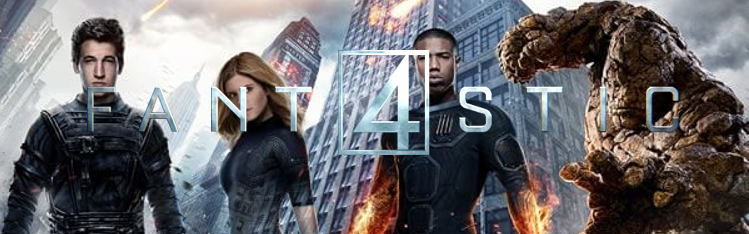
Game Corner [Wolvie Wednesday]: X-Men Origins: Wolverine: Uncaged Editon (Xbox 360)


When readers were first introduced to the character of James Howlett, better known by the names “Logan” and “Wolverine”, it was in the pages of The Incredible Hulk. From his first full debut in issue 181 all the way back in November 1974 to him officially joining the X-Men in 1975, the character has become one of Marvel Comics’ most recognisable and enduring superheroes, regularly featuring in solo and team comics, cartoons, movies, videogames, and countless other merchandise.


Uncaged Edition

Released:  May 2009
Developer: Raven Software
Also Available For: Mobile, Nintendo DS, Nintendo Wii, PC, PlayStation 2 PlayStation 3 PlayStation Portable

The Background:
20th Century Fox profited greatly after acquiring the X-Men movie rights from Marvel Comics. Under their banner, the first three X-Men movies (Various, 2000 to 2006) made over $600 million and, eager to capitalise on that financial success and the popularity of their star, Hugh Jackman, they quickly began production of a spin-off film focusing solely on breakout star Wolverine. While X-Men: Origins Wolverine (Hood, 2009) proved a financial success, reviews ranged from mixed to scathing (unfairly, in my opinion) but the same couldn’t be said about the obligatory tie-in videogame. Developed by Raven Software, the game was a violent hack-and-slash adventure that expanded upon the film’s storyline using elements from the comic books and emphasised frenetic, gory violence very much like the God of War videogames (Santa Monica Studio/Various, 2005 to present). X-Men Origins: Wolverine: Uncaged Edition was highly regarded by critics and fans alike as one of the most enjoyable and entertaining videogame adaptations ever made.

The Plot:
Decades before he joined the X-Men, Logan (a Mutant with retractable bone claws, a superhuman healing factor, and heightened senses) was a part of William Stryker’s Team X and operated under the codename Wolverine. After many years working alongside his half-brother, Victor Creed, Logan walked away from his violent life only to be forced back into the fight (and to undergo a radical procedure to bond indestructible Adamantium to his skeleton) when Victor killed his lover.

Gameplay:
X-Men Origins: Wolverine is a hack-and-slash action brawler with very light platforming and puzzle elements that sees you cast into the role of the titular Mutant, who has the voice and likeness of X-Men star Huge Jacked-Man Hugh Jackman. The story can largely be summarised as taking “inspiration” from the movie, as the narrative constantly switches back to Africa to follow Wolverine’s final mission with Team X, and to the present day of the mid-1980s in a truncated and decidedly different, if similar, version of the events from the film. The gameplay is primarily geared towards slicing and dicing enemies with Wolverine’s bone or Adamantium claws in a variety of gruesome ways: Wolverine can attack with quick, light strikes with X, heavier attacks with Y (which can also be charged by holding the button), and string together successive presses of X and Y to pull off devastating combos (which you can review at any time from the pause menu) that turn Wolverine into a whirling dervish.

Lunge at enemies, unleash your Fury Attacks, and use Feral Senses spot environmental kill spots.

Wolverine can also jump with A, cling to ledges and climb certain walls, block, reflect, or counter incoming attacks with the Left Trigger, and grab enemies with B. Once grabbed, you can mash X to pummel them or toss them at other enemies (or into instant death environmental traps), or charge Y to perform a “Quick Kill”. Wolverine can also dash ahead with the Left Bumper but I found that this was a bit clunky and awkward as there is a delay between Wolverine stopping at the end of the dash and returning to a run, so it’s far better to press the Right Bumper and LB to perform a rolling dodge instead. One of Wolverine’s most useful skills, though, is his lunge attack. By holding RB to target enemies, you can then press LB to leap towards your target and attack them with X, B, or Y to quickly pounce across gaps and from target to target, which is endlessly satisfying when overrun by enemies. As you progress through the game, you’ll also unlock four Fury Attacks that can be unleashed when your Rage Meter is full and by pressing the Right Trigger and either A, B, X, or Y. Each of these can also be upgraded further and will see Wolverine fly into a berserker rage and becoming a spinning whirlwind of claws and death as you mash buttons to extend the duration of his onslaught. Wolverine also has the benefit of his heightened senses; by pressing up on the directional pad (D-pad), you’ll see the body heat of nearby enemies, climbable ledges and surfaces, footprints when tracking targets, and an ethereal blue light that points you in the right direction in a mechanic very similar to the Detective Vision from the Batman: Arkham games (Rocksteady Studios/Various, 2009 to 2015), though much more basic.

Puzzles are pretty simple and amount to little more than button mashing or powering up consoles.

While the environments you find yourself in are quite linear, they are also made up of a lot of dark, grey corridors, so Wolverine’s Feral Senses are helpful for keeping you on track and spotting opportunities to instantly kill your opponents. I’m not sure why but the developers also allowed you to sheath and unsheathe your claws by pressing down on the D-pad; this doesn’t really seem to do anything but I guess it adds to the immersion of being Wolverine and, very rarely, you’ll be able to instantly kill enemies by sneaking up behind him and pressing either B or X. A good 90% of the game is made up of mindless hack-and-slash combat, usually restricting you to a set area and fending off waves of enemies who can seem never-ending at times. Other times, though, you’ll need to pull off some tricky jumps and awkward platforming; mostly, this isn’t a problem, but that are times when you have to jump from platforms and ledges or ropes and it can be very difficult to make even simple jumps thanks to the dodgy camera and invisible barriers nudging you to your death. Wolverine will also have to zip down wires to cross gaps, precariously walk across balance beams and girders, and occasionally pull or push large objects (usually crates or jeeps) by holding B. Other times, you’ll need to mash A to turn a wheel to open a door or find a crank or power source and carry it to a power node by picking it up with B. It’s all very simple and puzzles generally don’t become more taxing than that, standing on pressure pads, or scaling towers. Given his Mutant abilities, Wolverine is extremely durable, able to sustain prolonged gunfire and attacks and continue fighting. Your health bar will automatically regenerate if you avoid attacks for a few seconds but you can still be “captured” if your bar is completely drained and your vital organs are damaged so, while you can largely leap head-first into situations and groups of enemies, it’s best to keep an eye out from spiked traps and avoid being set on fire or pummelled by larger enemies.

Gameplay is mixed up by a few different sections and mechanics, some more welcome than others.

Wolverine’s biggest danger in this regard is falling while trying to jump or navigating across bottomless pits or large chasms; if you fall, you’ll have to restart from your last checkpoint but, thankfully, checkpoints are quite numerous and generally always come right before a tricky situation. Gameplay is further mixed up by a few quick-time events (QTEs), mainly when opening doors, and slightly different camera angles and chase sequences, such as when Wolverine has to race down the spill well of the Alkali Lake facility and leap from jeep to jeep, dispatching enemies as a wall of water comes inexorably after him. Other times, helicopters will fire at you relentlessly and you’ll have to dart between platforms and cover to avoid fire or frantically run and jump across surfaces that crumble beneath your feet. In another mission, you have to lunge at enemies on speedboats down a racing river; if you fall in the water, you’ll have to restart but you eventually commandeer a machine gun turret and can fire wildly at your pursuers by holding RT. One particularly annoying mission has you dodging between metal shields as automatic turrets fire at you; you’ll need to activate a console to put the shields in place to stave off the heavy ordinance and use similar consoles to position teleporters around the sentinel facility.

Graphics and Sound:
Generally speaking, X-Men Origins: Wolverine looks pretty good; environments can be a bit bland and drab at times but you’re constantly hopping back to the jungles of Africa, which helps add a bit of visual variety to the game even if the environments remain quite linear and have very few opportunities for you to explore in a meaningful way. Character models are decent enough but the developers clearly put the most time and effort into the titular character; no other character from the movie save Victor Creed bares the voice or likeness of their actor, which is disappointing, and most of the enemies you encounter are largely generic soldiers with little to really make them stand out. As mentioned, Wolverine spends a lot of his time flashing back to Africa; here; you’ll run through the ruin-strewn jungle and encounter a number of machete-wielding natives and ancient booby traps and such. It’s a stark contrast to the boring, grey corridors of Alkali Lake (a location I could live with never having to see again) but the game claws back (no pun intended) some visual variety in the Sentinel facility and the casino where you pursue and battle Remy Lebeau/Gambit. These locations are much more interesting to look at, being a vast technological complex full of intricate machinery and Sentinel parts and a neon-drenched skyscraper that sees you climbing horizontally and vertically, respectively.

Environments can be dark, drab, and bland but some manage to stand out regardless.

It’s a shame, then, that the game doesn’t change the location of its finale, which sees you back in dull, concrete surroundings on Three Mile Island, but I did enjoy the visual of battling Wade Wilson/Weapon XI/Deadpool atop the cooling tower like in the movie. The game’s story is largely told during gameplay using the in-game graphics, often with Wolverine conversing with his superiors or allies via an earpiece (again, very similar to the Batman: Arkham games). There are some CG cutscenes here, though, which are quite blurry and muddy as you might expect from an Xbox 360 title. Similarly, the music isn’t really anything to shout about; it’s not exactly memorable or catchy and the only thing really salvaging the audio presentation is Jackman’s unparalleled work as the titular character. There was, however, quite a bit of slowdown whenever there was a lot happening onscreen and the game doesn’t do a very good job of masking its loading times; often, the game stops completely and you’re left with a “Streaming…” message while it loads the next area, which interrupted the flow of the game considerably at times. You’ll find some interesting audio logs and references to (and cameos from) some recognisable X-Men characters, though, and the final cutscene even places Wolverine in the “Days of Future Past” (Claremont, et al, 1981) timeline.

The game’s biggest appeal is in its graphic violence and gore in depicting Wolverine’s brutal nature.

Where the game excels, though, is in its unrelenting gore and violence; ironically, X-Men Origins: Wolverine is more violent and uncompromising than the film it’s based on, meaning that kids who enjoyed the film probably weren’t old enough to play the game at the time! As Wolverine takes damage, his skin and clothing is torn and shredded, revealing his Adamantium skeleton, which is both gruesome and fantastic to see. The wounds heal up over time but you’ll often be running around with a fully metallic arm or half a metal skull, which is something we really haven’t seen in the films yet. When attacking enemies, Wolverine can slice off limbs, impale them on the environment, and set them alight or electrocute them with environmental hazards and you’ll often see dismembered bodies writhing on the floor in agony and heads flying from their shoulders. One of the most brutal kills in the game comes when Wolverine rips a helicopter pilot out of his cockpit and forces him head-first into the blades! There’s no nonsensical censoring in this game; it’s bloody, violent action all the way through and this really helps to make the repetitive hack-and-slash gameplay more interesting and entertaining.

Enemies and Bosses:
As mentioned previously, the majority of the enemies you’ll encounter in the game are machine gun-toting soldiers; when in Africa, you’ll fight wild natives who wield machetes but you’ll also battle some rather generic-looking robots when breaching the Sentinel facility. It doesn’t take long for you to encounter more formidable variants of these enemies, such as the Machete Champion (who can set you ablaze), shield carrying soldiers (whose guard you must break with a charged heavy attack), soldiers packing grenade launchers (whose projectiles you must reflect back), and even invisible enemies (“Ghosts”) who carry shotguns and are be dispatched by grabbing them and tapping Y to blow their heads off. You’ll also come up against more monstrous enemies such as the lava-and-rock-covered Leviathan and the Weaponized Experiment Neurodindritic Incident Gamma Zero (W.E.N.D.I.G.O.) prototypes; these are best attacked with your Fury Attacks as they charge at you, deliver big damage with their swings, and can catch you in mid-air as you lunge if you don’t get around behind them. As you damage the Leviathan, it’ll protect itself with tougher rock and start tossing and smashing boulders at you so you’ll have to lunge at it whenever possible and you’ll soon be faced with two to four of these enemies at a time so it’s best to get a rhythm on.

You’ll be leaping at a lot of helicopters but especially to bring down the sharp-shooting Agent Zero.

You’ll also have to fight “Jungle Mutants” like Shifter, a blue energy being who teleports about the place, traps you in electrical prisms of light, and can duplicate itself (but is, thankfully, easily dispatched with environmental kills). The first time you encounter these enemies, they act as sub-bosses but quickly become regular enemies and you’ll often be faced with a variety of different opponents and forced to adapt to each on the fly. A recurring element in the game are the helicopters that are sent to bring you down; at least three times you’ll have to outrun these pursuers and then lunge at them, moving the left analogue stick to avoid being shot at and smashing your way into the cockpit with X or Y to bring them down. There’s a particularly gruelling battle that has you dodging helicopter fire as four W.E.N.D.I.G.O.s attack you at once but, thankfully, enemies can damage each other so you can position the beasts into each other’s attacks and the bullets from the helicopter. Prior to this battle, you’ll also have to contend with a pretty unique switch in perspective as David Nord/Agent Zero takes shots at you with his sniper rifle and you control Wolverine from the perspective of Nord’s sniper scope.

Creed is a far less pivotal or threatening figure in the game despite being fought twice.

The first real boss you’ll battle is Victor, Logan’s stepbrother (though this plot point, like a lot of plot points from the film, is nowhere near as relevant or emphasised as in the movie). You’ll fight Victor twice throughout the game, with the first bout taking place in and outside of a bar and the second inside of Stryker’s island base, just like in the film. Victor mirrors many of your own abilities and can lunge, swipe, and claw at you; he can also grab you to deliver combos and you’re in just as much danger of being impaled on the environment throughout the game as he and your other enemies are. Still, Victor isn’t much of a threat; although he boasts the same healing factor as Wolverine, I never actually noticed his health regenerating in either fight and it’s pretty simple to lunge at him, block and counter his attacks, and either use the environment or your Fury Attacks to whittle his health down and defeat him in both battles.

The Sentinel poses a formidable threat and must be attacked both on the ground and in mid-air!

As you might expect given that you end up in a Sentinel facility, you’ll have to battle with a Sentinel prototype as well. The first time you encounter the Sentinel, it’s in pieces and you have to solve a bit of a track puzzle to position its hand in place to attack its head but, despite your efforts, Bolivar Trask activates the prototype and you have to fight it outside the facility. The Sentinel is suitably massive and stomps around the place, leaps at you to cause shockwaves, fires laser blasts from its hand, and grabs you to blast you with its eyebeams in a homage to that iconic “Days of Future Past” cover art. To battle the Sentinel, you need to attack its feet and hands; this is best done by luring it towards the electrified panels on the floor, which will stun it for longer (though it’s difficult to tell that you’re actually dealing damage to it because of its high health bar). Once you damage it enough, it’ll take off and you’ll have to freefall down to it, dodging or ploughing through debris and guiding Wolverine to its thrusters. Eventually, you’ll do enough damage that Wolverine targets its main power source, which requires you to mash B to rip open its chest plate before it can blast you.

While the Blob is simple, Gambit leads you on an elaborate chase and is the most frustrating boss.

Immediately after felling the Sentinel, you’ll fight with Fred Dukes/The Blob; unlike in the movie, this fight takes place in a supermarket full of destructible elements. The Blob is very similar to the Leviathan and W.E.N.D.I.G.O. enemies and will charge at you and repel your lunges with his drum-like belly. Once you damage him enough, though, he’ll try to squash you with a belly flop, which stuns him long enough for you to lunge or mount him and claw at him and force him into walls to bring him down. Immediately after that fight, you’ll have to battle what was, for me, the most annoying, frustrating, and long-winded boss of the entire game: Gambit. Gambit attacks with his staff and kinetically-charged playing cards, which must be countered and reflected back, respectively, to stun him. What makes this boss so annoying, though, is that you fight him a whole bunch of times and are forced to chase through up and through a skyscraper. Eventually, you battle him on giant neon letters, lunging at him when he charges and destroys them and mashing A when he tosses you over the edge. This was, honestly, the most exasperating part of the entire game as each fight with Gambit just went on and on and it seemed never-ending; of all the characters and Mutants in the game, I never would have expected Gambit to be so versatile, resilient, and challenging!

Deadpool will push your button mashing skills to breaking point!

After the finale battle with Victor, you are forced to battle Deadpool at Three Mile Island. If you haven’t seen the film, you might be a bit confused about who Deadpool is since he barely appears at all in the game’s story but he’s a pretty formidable boss in his own right. Fighting him is, essentially, the same as fighting Victor except that you’ll damn near break your wrist trying to mash A following a counter of his blades and it’s a two-stage boss fight. In the first, you fight him in an ordinary area of the island, avoiding his spinning blades and jumping attacks and whittling his health down with your Fury Attacks but, in the second, you battle him atop a cooling tower. Here, he demonstrates his ability to teleport and will blast at you with optic blasts that can destroy parts of the environment. Still, he’s pretty easy to defeat; you simply block his attacks, unleash your Fury Attacks, and lunge at him after he fires his eye beams. When you’ve dealt enough damage, the QTE becomes easier to pull off and is a great way to deal additional damage; while Deadpool’s health doesn’t regenerate during the fight, it will fill up at least once, which can make this rather long-winded and frustrating but it’s nothing compared to fighting Gambit!

Power-Ups and Bonuses:
As you battle enemies and destroy crates, you’ll earn red Rage Orbs to fill up your Rage Meter and experience points (XP) that will see you level-up in time. Levelling up increases your health meter and earns you Skill Points, which you can spend in the “Character” sub-menu. Here, you can increase your maximum health, Rage Meter, and the damage and duration and effectiveness of your Fury Attacks. Each one will cost you more Skill Points as you upgrade them, though, so it’s best to either stock up or focus on one attribute to upgrade at a time. You can also boost your health and earn additional Skill Points by finding power-ups hidden in each environment, generally just off to one side or the opposite way from where you’re being directed to go. Every time you fight and defeat enemies, you’ll also fill up a “Reflex” meter in the Character sub-menu; when each of these is mastered, you’ll find that you deal more damage to, and have a greater defence against, the game’s enemies, which adds an extra incentive to combat. Finally, you’ll also find “Mutagens” hidden throughout the game; up to three of these can eventually be equipped and each one can also by upgraded further to increase you damage, Fury Attacks, or regenerative capabilities as well as boosting the speed which you build up your Reflexes.

Additional Features:
There are fifty Achievements for you to earn throughout the game, the majority of which you’ll get just by playing through the story mode. You get Achievements for killing up to 2000 enemies, performing lunges and Quick Kills, tossing enemies from high ledges, and clearing each chapter of the main story. As you explore your environment, you’ll also find dead bodies and acquire Dog Tags for XP and which count towards Achievements and you’ll need to venture off the beaten path a little bit or attack enemies and bosses in specific ways to get some of the more obscure Achievements but you can track your progress towards them at any time from the “Statistics” menu. When you first start the game, you can select to play on “Easy” or “Normal” difficulty; you may as well pick “Easy” as the only difficulty-based Achievement comes after you clear the game and unlock “Hard” mode. Once you beat the game, though, you can replay any mission you like and pick a costume to wear beforehand but you’ll lose all of your saved progress and upgrades if you want to get the “Walking Death” Achievement so I’d recommend clearing the game and mopping up any Achievements you’ve missed tied to kills and Dog Tags and such before playing on Hard.

Unlock some cool classic costumes and beat the game to access a harder difficulty mode.

Also hidden throughout the game are a number of different Wolverine action figures; finding enough of these will unlock a special challenge from the main menu. Here, you’re pitted against three different Wolverines and, when you defeat them, you’ll unlock a new costume to wear including Wolverine’s classic brown-and-tan outfit, his yellow-and-blue spandex, and his awesome black-and-grey X-Force outfit. There are actually more action figures than you need but collecting them only awards you an XP boost rather than the likes of Wolverine’s Weapon-X outfit or movie costume, and there is a fourth challenge available but it seems that this was a Gamestop exclusive unlockable that would give you access to the X-Men’s Danger Room and it doesn’t appear to be accessible now. Sadly, that’s about it as far as bonus content goes; you can enter some codes to make the game easier but you won’t be able to get Achievements with these activated and it’s a shame that there aren’t more costumes to unlock.

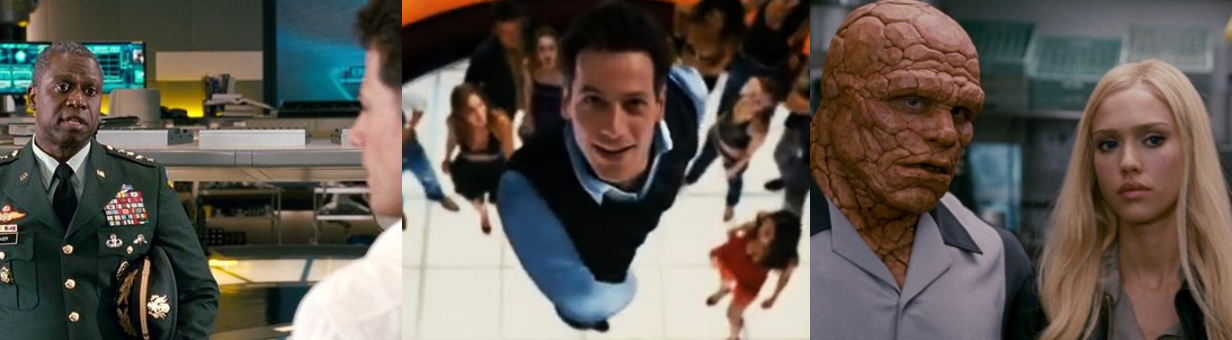
The Summary:
I was very much looking forward to playing X-Men Origins: Wolverine; I’d heard time and time again that it was one of the best licensed videogames out there and actually better than the movie (which I have always considered to be pretty enjoyable and under-rated). However, I was surprised to find that all of the praise I had heard about the game didn’t relate to it doing a very good job of recreating the events of the movie. To be fair, a lot of licensed videogames falter a bit in this regard but X-Men Origins: Wolverine does a pretty lacklustre job of rushing through the film’s story, glossing over Team X and Wolverine’s relationship with the team and his brother, and simultaneously paying lip service to the film’s narrative while also awkwardly staying beholden to it in other ways. The game excels when it veers from the film’s plot, to be honest, and I can’t help but think it would have been better for it to act as a prequel and sequel to the movie rather than actually including events from the film. The sections in Africa are much more visually interesting than those in Alkali Lake (even though the developers tried to mix things up a bit by stripping you of your powers here) and I’d rather infiltrate a Sentinel production plant than visit Stryker’s bland island. This would also have given the developers the opportunity to include more characters, enemies, and elements from the comic books; they hint at this with the final cutscene but fall back on disposable grunts and characters from the movie rather than the likes of Mister Sinister or Omega Red. Thanks to its gore, violence, and frenetic gameplay, X-Men Origins: Wolverine is definitely a fun, if monotonous, experience; it’s probably the best and most accurate videogame portrayal of Wolverine ever made and is worth a play if only to see him hack up enemies and be stripped to his metal skeleton but there’s not a lot in terms of replayability and will probably be a mediocre distraction for fans of the hack-and-slash genre.

My Rating:

Rating: 3 out of 5.

Pretty Good

Are you a fan of the videogame adaptation of X-Men Origins: Wolverine? Did you prefer it to the movie? How do you feel it compares to other hack-and-slash videogames? Were you a fan of the gratuitous violence and gore? What did you think to the game’s interpretation of the film’s plot; were you also a bit perturbed by the truncated narrative or did you prefer the alterations presented in the game? Which of the bosses was your favourite or most frustrating? Which of Wolverine’s costumes was your default? Which X-Men or Wolverine videogame is your favourite and why? How are you celebrating Wolverine’s debut this month? Whatever your thoughts on X-Men Origins: Wolverine, or Wolverine and the X-Men in general, drop a comment down below.