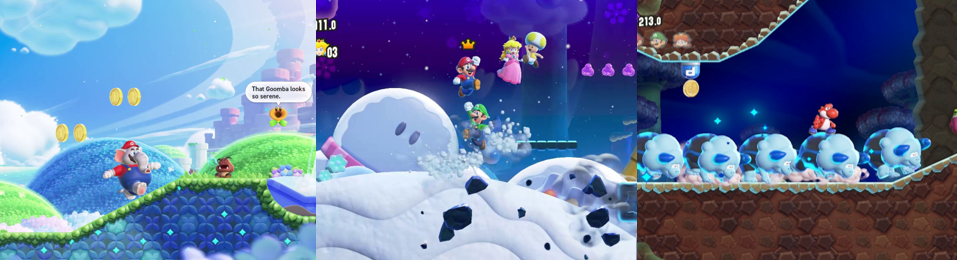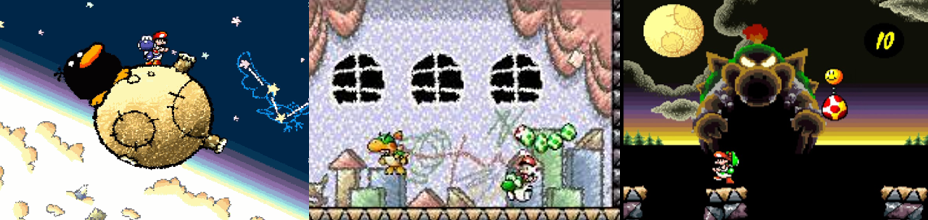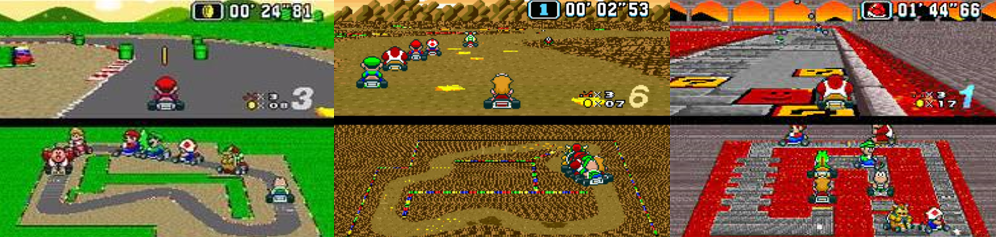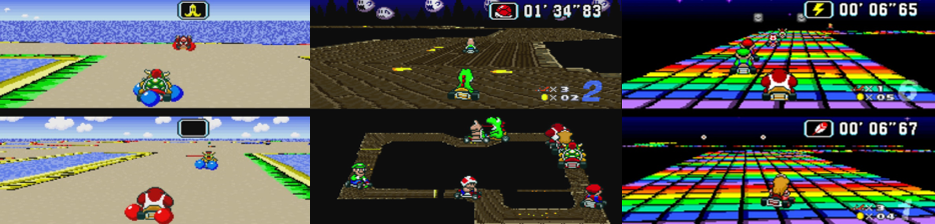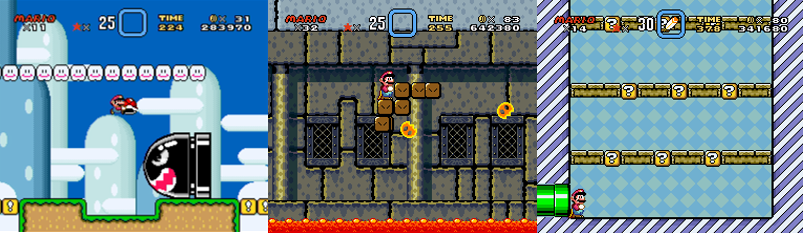
Game Corner [Mario Month]: Super Mario Bros. Wonder (Nintendo Switch)


So, for no better reason than “Mar.10” resembling Mario’s name, March 10th is widely regarded as being “Mario Day”, a day to celebrate Nintendo’s portly plumber, an overalls-wearing mascot who literally changed the videogame industry forever and shaped the home console market of the nineties.

Released: 20 October 2023
Developer: Nintendo EPD

The Background:
Following the collapse of the videogame industry from a slew of overpriced consoles and mediocre titles, Nintendo revitalised the landscape with Super Mario Bros. (Nintendo EAD, 1985). Once the “Console Wars” of the mid-nineties ended, Nintendo and their famous mascot became an innovative and reliable staple of the videogame industry. After successfully transitioning into 3D gaming, Nintendo continued to pay homage to Mario’s 2D roots with hit 2.5D titles. Shiro Mouri, director of New Super Mario Bros. U Deluxe (Nintendo EAD, 2012), returned to develop Super Mario Bros. Wonder and he and his team worked without a deadline, allowing them far more freedom to develop new ideas. Producer Takashi Tezuka suggested implementing a gimmick that would alter the game’s locations in fun and wacky ways, birthing the “Wonder Flower” mechanic, and features and accessibility options were implemented to make the game appealing to players of all ages. A live commentary feature was scrapped early on, long-time Mario voice actor Charles Martinet was replaced for the first time following his retirement, and Mouri also personally lobbied for Princess Daisy to be included so girls (specifically his daughters) would have more playable options. Super Mario Bros. Wonder was met with widespread acclaim; critics adored the gameplay innovations and responsive controls, and it sold 4.3 million units in its first two weeks alone.

The Plot:
While visiting the Flower Kingdom, Mario and his friends are stunned when Bowser, King of the Koopas, steals the Wonder Flower, turns himself into a giant flying fortress, and wreaks havoc throughout the kingdom. Our heroes thus travel across this new land to gather the Royal Seeds and stop their nemesis.

Gameplay and Power-Ups:
Like its 2- and 2.5D predecessors, Super Mario Bros. Wonder is a 2.5D action platformer, albeit one that gives players twelve characters to pick from and offers four player co-op, both on- and offline. Players journey across the Flower Kingdom collecting golden Coins (100 of which will grant a 1-Up), stomping on Goombas, and leaping to flagpoles to clear the six main stages (known as “Worlds”) alongside Prince Florian, a caterpillar-like character who pops out when you’re idle and chimes in during cutscenes. Regardless of which character you select, they all control the same with the exception of Yoshi, who can flutter jump by holding A (giving you a bit more airtime to clear gaps) and eats enemies and spits them back out with B. Otherwise, you can pick from two control schemes and choose to play with or without motion controls. The setup I chose saw me jumping or swimming with A (holding it to jump higher), running and picking up certain objects (like Koopa shells) by holding B (releasing it to launch my item upwards or straight ahead), and ground pounding by pressing ZL in mid-air to squash enemies and break blocks. Y brought up an emoji wheel to communicate to other players and X either placed a standee (used to revive players in co-op) or spawned an item balloon when I had one saved up. Pressing R performed a spin jump and jumping against walls and vertical surfaces performed a wall jump. You can also hold down when on slopes to slide into enemies, and pressing the L and R triggers together in co-op sees you become a ghost to float around stages. Also, you can jump atop and ride Yoshi players in multiplayer and press B to perform your special attacks when you have a power-up item.

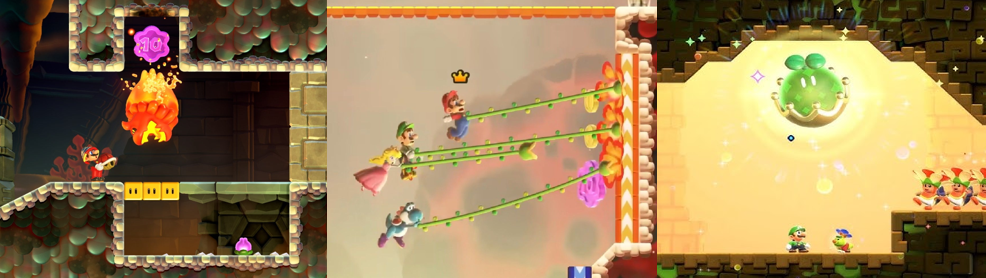
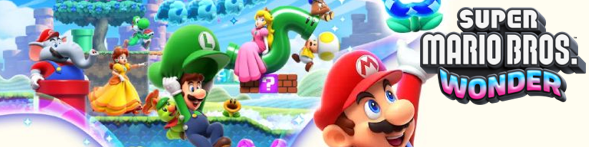
Mario and friends utilise new power-ups and the Wonder Flowers to explore this new kingdom.

As you might expect, grabbing a Super Mushroom allows your character to grow and take an extra hit and break certain blocks. Get hit when in your small form and you’ll lose a life, respawning either at the beginning of the stage or from the last checkpoint you touched. Touching a checkpoint automatically causes you to grow if you’re small, rare green mushrooms grant extra lives and Fire Flowers let you toss fireballs to defeat enemies and melt ice blocks. Blue Coins appear when you hit P Switches, POW blocks defeat all onscreen enemies and break all visible blocks, and Super Stars make you invincible for a short time and add a somersault to your jump. This is all very familiar but Super Mario Bros. Wonder does add in three new power-ups. The Bubble Flower sees you throw bubbles to trap and defeat enemies and make temporary platforms, the Drill Mushroom lets you dig into floors and ceilings to reach new areas, and the Elephant Fruit transforms you into a rotund elephant that smacks enemies with its trunk and sprays water to cause various effects whenever you enter a fountain. If you have one power-up active, you’ll store the next one as a bubble, which is very useful as an extra chance to bypass tricky areas, and you can even commandeer Lakitu’s cloud or ride Missile Megs and Ancient Dragons to clear gaps. Wonder Flowers are the game’s biggest new feature and temporarily alter the game’s environments or your character’s appearance to mix things up. You’ll see Warp Pipes come to life, adopt a top-down perspective, float around in zero gravity, race to collect Wonder Tokens, ride along stampeding enemies, get chased by King Boo, and even explore in near darkness when the Wonder Flower is collected. These also transform you into new forms, such as a Goomba (stunting your jump but allowing you to safely cross spikes), a Biyon (stretching your character considerably), a Hoppycat (increasing your jump height), a floating balloon, granting you the Metal Cap power-up, and allowing you to stick to walls and ceilings as a Wubba, amongst other effects. These effects are sometimes timed but will last until you find a Wonder Seed or clear the stage and really add to the visual variety and mix up the gameplay as you never know what effect the Wonder Flower will have.

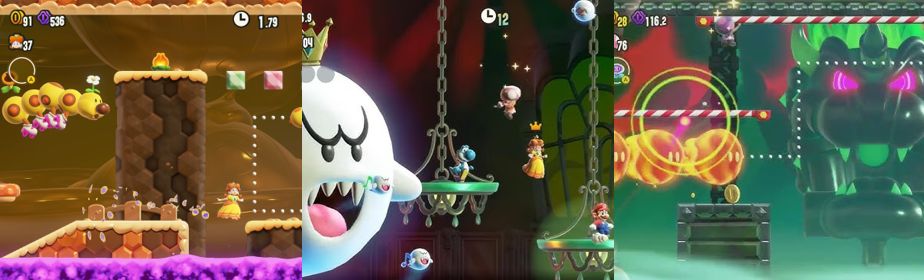
You’ll need all your skills and the game’s Badges to find all the collectibles and stop Bowser.

Sadly, this variety doesn’t extend to the playable characters as much as I’d like. Luigi jumps higher and has less traction than the others, Toad seems to have floatier jumps, and the Yoshis and Nabbit are invulnerable to damage (but can still lose lives), but Princess “Peach” Toadstool doesn’t have her glide ability and I question the logic behind having three Toads and four Yoshis rather than putting in Wario and Waluigi. Still, the game does allow for some character customisation in the form of “Badges”, which are either bought using the new purple Flower Coins (with three 10-Flower Coins hidden in most stages) and by conquering bite-sized Badge Challenge levels. You can equip one Badge at a time and each one grants different buffs or abilities, such as allowing you to glide by holding R, adding to your wall jump, increasing your running or swimming speed, and allowing you to snag platforms with a vine. Other abilities are more passive, such as allowing you to sense nearby collectibles, giving you a one-time save from instant-death traps like pits and lava, or turning every power-up into a specific item. You can also earn “Expert” Badges that further increase your running speed and add a limited double jump, turn you invisible (actually more trouble than it’s worth), add a spring to your step for added jump height, or allow you to hear strange voices. While it’s fun challenging for and collecting the Badges, I stuck with the Parachute Cap for my entire playthrough bar one or two exceptions as it was far more useful to add a short glide to my arsenal than anything else. You can also spend your Flower Coins on new standees (which are randomised), 1-Ups, Wonder Seeds, and paying off the local Poplins to repair bridges or smash rocks to create shortcuts and open new areas on the overworld. Furthermore, if you search hard enough, you’ll not only uncover new stages to challenge but also meet Captain Toad, who’ll gift you some Flower Coins, alongside visiting the locals to get Wonder Seeds or be told of regional issues caused by Bowser’s influence.

There’s a lot of challenge and variety on offer thanks to the Wonder Flowers.

While Super Mario Bros. Wonder contains many of the same gimmicks and mechanics you’d expect from a Super Mario title (platforming, taking Warp Pipes, smashing blocks, climbing vines, sliding on ice, and dodging fireballs are all common tropes recreated here), the game is structured more like an obstacle course than ever before. You’ll be taking Warp Pipes to the foreground and background, pushing pipes and blocks to clear paths, entering doors and taking leaps of faith, hopping to moving, spinning, and temporary platforms, and dashing across zip lines to reach new areas. Like many Super Mario games, there are often hidden exits to find (generally by collecting or avoiding Wonder Flowers), you’ll need to face Boos to stop them in their tracks or lure them into the light to destroy them, and bottomless pits, boiling lava, and toxic gunk will instantly end your run if you’re not careful. You must also avoid giant spiked balls, lure Bulrushes and Konks into smashing through blocks, outrun shadowy enemies who relentlessly chase you, time your jumps to avoid being hit by Hoppycats, stay out of reach of Maw-Maws so they eat enemies instead of you, and hold B to unzip the background, unwrap Mumsys, and send Revvers dashing. Sometimes, you’ll grab keys to open doors; others, you’ll be climbing or shimmying across striped poles. Often, you’ll touch Wow Buds to spawn Coins or cause platforms to appear, move, or sway. Balloons must be popped, balloon-like enemies need to be carefully bounced across to clear gaps, and rhythm platforms and mushroom trampolines will have you timing your jumps to progress higher. You’ll also cross hazards in rolling wheels or on rafts made from dinosaur fossils, and transport to the clouds using Propeller Flowers. Timer Switches activate block platforms for a short time, Bowser’s ship fires from the background, you’ll ride an out-of-control avalanche, race against Wiggler, and battle through autoscrolling sections on Bower’s battleships, dodging Bullet Bills and flame bursts that’ll test your reaction times. The difficulty spike is pretty fair, and each stage has a star difficulty to alert you to the challenge on offer. Things never get too tricky and you can always purchase additional lives from the shop, though the game does ramp up as you progress and offer incredibly tough missions up in the Special World.

Presentation:
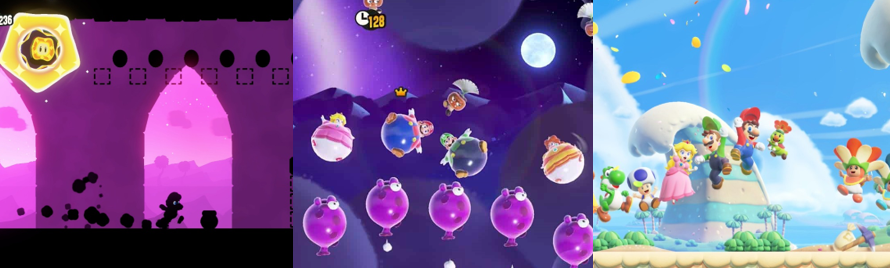
Super Mario Bros. Wonder is, in a word, gorgeous. 2.5D Mario has never looked or played better than here, with the game performing incredibly well throughout and the action never slowing down. It helps that most stages are bite-sized obstacle courses and that there’s a lot happening in every stage. Talking Flowers are everywhere, offering encouragement, calling for help, or commenting on the effects of Wonder Flowers. These, as mentioned, alter the stages so drastically that it’s almost like having two versions of most stages at times. They’ll be plunged into darkness, surreal colours bombard the player, and a kaleidoscope of bizarre and amusing effects spawn once you touch them, making for an enjoyable twist on the tried-and-tested formula. Mario and his friends might not play as differently as I’d like but they’re full of life and personality. Chattering through gibberish and pantomime movements, they hop and explore like never before, with caps flying off as you jump or fall or being swiped when you enter pipes. Your Elephant form squeezes through narrow passageways and Prince Florian pops out whenever you’re left idle or finish a stage. The game takes into account which character you’re playing as, too, with character-specific hidden blocks appearing in stages, personalised flags appearing at checkpoints and end goals, and the in-game text referring to whomever you’re controlling at that time. The music is as catchy and whimsical as ever; classic Super Mario tunes return, as you’d expect, as end of stage and power-up jingles but also for bonus stages and boss battles. The story is light-hearted and secondary to the action, for the most part, but just different enough to be unique. Peach isn’t a damsel in distress, for example, Bowser’s ominous ship form looms in the centre of the overworld, and you’re even actively searching for lost Poppins when you explore the Fungi Mines.

Mario has never looked better in this colourful, quirky adventure.

While Super Mario Bros. Wonder doesn’t break the mould that much when it comes to its stage designs, everything looks great and there are a lot of stages on offer in each World, with each sporting a unique and interconnected overworld. Things start relatively familiar in Pipe-Rock Plateau, where Warp Pipes are prevalent and you’ll be bouncing from Hoppos, before taking a turn for the surreal in Fluff-Puff Peaks. With the action mostly up in the clouds, you’ll be adding to your temporary platform in “Cruising with Linking Lifts” and slipping on icy platforms as you make way for Pokipedes on their set paths. Shining Falls adds an isometric aesthetic to its overworld and offers unique platforming challenges as the Hoppycats copy your jumps, the Anglefish fly from different directions, and you race along at high speeds on Zip Tracks. The Sunbaked Desert sees new stages appear from the arid sands as you explore or open by performing tasks on the overworld, and its stages have a tangible Arabian theme. You’ll be exploring a door maze in the Shova Mansion, gatecrashing the Ninji’s jump party, and exploring pyramid-like tombs for goodies. Things take an ominous turn in the Fungi Mines, where toxic clouds and goop lurk amongst haunted mansions and destructive rifts in the fabric of reality. The Deep Magma Bog overworld is not only the most menacing yet but also a maze of tunnels and paths. Its stages are volcano themed and feature dinosaur bones, fireballs, and flaming enemies who rush from the walls. As you explore the overworld, Kamek occasionally spawns huge Bowser-themed battleships not unlike those seen in Super Mario Bros. 3 (Nintendo EAD, 1988). Here, the game becomes an autoscrollers and you’re forced to avoid numerous hazards and destroy the central core, which doubles as a baddy maker. Finally, simple cutscenes and interactions with the locals pepper the action, with the game concluding with an all-out frenzy to get the highest score during the credits as recycled (now non-lethal) hazards fly past.

Enemies and Bosses:
Many of Mario’s most recognisable enemies make a return in Super Mario Bros. Wonder. Goombas will snooze in stages and wander or float about, Piranha Plants of various sizes pop up from pipes to bite you or spit fireballs, green and red Koopas trot about or flutter in the air, Bullet Bills blast across the screen, Boos shy away from your gaze, and Hammer Bros toss hammers in an annoying arc, as ever. Mechakoopas patrol Bowser’s battleships and castles, Pokeys wander the desert, Lakitus drop Spinys, Thwomps try to crush you, and Cheep Cheeps swim about underwater to get in your way. These are joined by some new enemies, with some offering different mechanics. The Babooms, for example, shoot fireworks that can be used to defeat enemies above you. Blewbirds fire their beaks, which then become platforms, Bloomps can be bounced on to clear gaps, Bulrushes can be ridden, and Wonder Hoppins can be tricked into smashing through the stage to make new paths. Mumsys must be unwrapped by grabbing their handle, Noknoks masquerade as doors, Renketsu Search Killers offer themselves as temporary, explosive platforms, and Skedaddlers spit seeds and run off with collectibles. Shovas push pipes and blocks about, Smogrins lurk near tricky jumps, you can swing across gaps by grabbing Tailys, and Wubbas will cut through sticky goo that slows you down. Spikes, flame bursts, electrical sparks, giant balls, toxic gunk, and crushing pistons are persistent hazards, with you often bouncing from enemies to avoid them or luring nearby foes into unwittingly aiding you.

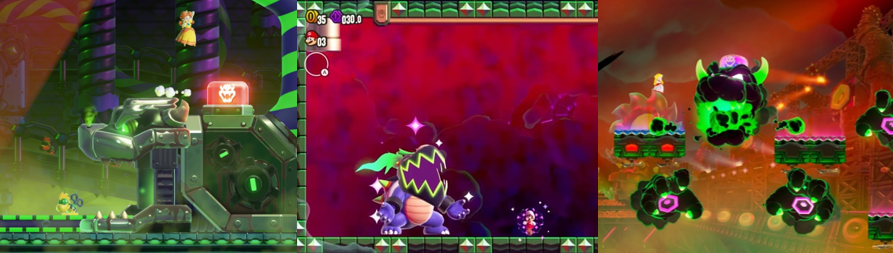
The game’s disappointingly light on bosses but goes all-out for the finale.

Sadly, Super Mario. Bros Wonder is disappointingly light on unique boss battles, a trend I’ve noticed in a lot of 2- and 2.5D Mario adventures. While larger variants of certain enemies do exist (King Boo being the most memorable), they’re more like chase sections rather than boss battles. The Mecha Makers are close to a boss in that you have to avoid hazards on the conveyer belt and smash the big red button to down Bowser’s battleships, but that’s being generous. Since Bowser’s busy being a giant, living ship, you’ll instead battle Bowser Jr. to clear four of the six main Worlds and retrieve the Royal Seeds and remove Bowser’s defences. Each battle against Bowser Jr. is a two-stage affair, with the first simply having you avoid his shell spin, jumps, and occasional fireball. After one hit, he transforms into Wonder Bowser Jr. and alters the terrain and your abilities somewhat. In the first fight, either you or he will change size; in the second, the rising and falling platforms alternate between being ice or jelly; in the third, water floods the arena (either above or below); and, in the fourth, Wonder Bowser Jr. distracts you with clones and by having you fight in the dark. While these fights can be tricky without any power-ups on hand, it only takes a couple of hits to defeat Bowser’s kid and his attack pattern doesn’t change much. You never battle Kamek, which is a shame, and Bowser Jr. is ultimately done in for good in a cutscene, which is also disappointing. After braving Bowser’s Rage Stage, you’ll face off against Castle Bowser in a somewhat harrowing, multi-stage final fight. In each phase, Castle Bowser spawns more hands to rain flaming Piranha Plants or to try and slam you. You must time your jumps to gain a boost from the rhythm blocks to either dispose of the hands or smack the weak spot under his chin, which he shields with his extra hands. As the battle progresses, Castle Bowser retreats to the background and fires larger Piranha Plants that can be tricky to dodge, alternates the floor to screw up your jumps, and tosses big, spiked balls that bounce around the arena. Power-ups are occasionally deposited as well and, after enough hits, a big button appears on Castle Bowser’s head that you must propel up to to end to his latest mad scheme.

Additional Features:
As mentioned, there are three 10-Flower Coins to find the game’s main stages and you’re encouraged to snag the top of every flagpole. Like the collection of Wonder Seeds, these statistics are recorded on your save file, though they appear to have no other function other than bragging rights (and, in the case of Flower Coins, allowing you to buy items). You must search high and low for every Badge Challenge and hidden sage if you want to earn every Badge in the game and enough Wonder Seeds to progress through the story. You can easily review each stage from the main map and jump to any stage where it shows you’ve missed anything, though you’ll need a guide or to pay attention to the overworld to spot when stages have secret exits. Bonus levels appear that bombard you with Coins, you can take a break by searching for Flower Tokens or taking out enemies across various arenas, and you can hunt across each map in search of Captain Toad. Eventually, you’ll unlock the Special World, where ten additional, super tough stages await, each one themed after the main Worlds and remixing hazards and enemies in new, challenging ways. Clear them all and you’ll gain access to a new Poplin House and earn yourself a congratulatory message and the Sound Off? Badge, though personally I couldn’t even clear one of the Special World’s stage…so good luck to you! Finally, of course, you can tackle any of the game’s stages in multiplayer, vying for Coins, power-ups, and a high score at the end, though I wasn’t able to play this so I can’t say how good or bad it is.

The Summary:
While I usually prefer Mario’s 3D adventures due to his 2D outings being slippery and unfamiliar to my SEGA-hardened gaming skills, I’ve really enjoyed his 2.5D titles and was blown away by Super Mario Bros. Wonder. Visually, the game is such a treat to behold; I loved all the little, goofy details and the whimsical (yet familiar) nature of the Flower Kingdom. I loved the callbacks to Mario’s previous adventures, with some returning gimmicks and mechanics, and the new abilities were a real treat. While the Bubble and Elephant forms weren’t that special, the Wonder Flower mechanics really helped to inject new life into the tried-and-tested Mario formula. I loved how unpredictable it was, how it reimagined stages and decades old fixtures like Goombas and Warp Pipes in fun new ways, and how it bombarded you with such an array of visually interesting mechanics. The new Worlds were also very enjoyable; I liked how the stages were short obstacle courses that never outstayed their welcome. The level of challenge was just right, with the game being upfront about when things get trickier and the onus being on the player to have the right skills accumulated or Badges equipped. The Badge mechanic was a little wasted on me but may have more appeal in multiplayer, and I was disappointed by the poor variety of the boss battles. There really was no excuse not to have Kamek be a boss fight at least once and I do think the developers sell the franchise short by not doing more with the likes of King Boo. Similarly, the character selection could’ve been better; I don’t get why Wario and Waluigi are always shafted or why Peach and Princess Daisy don’t have unique attributes. These negatives are mere nit-picks, however, to the overall enjoyment and fun on offer in Super Mario Bros. Wonder. It really does feel like a brand-new addition to the classic games and I liked how it provided just enough of a spin on the usual formula to be a wholly unique and accessible experience.

My Rating:

Rating: 5 out of 5.

Fantastic

Did you enjoy Super Mario Bros. Wonder? How do you feel it compares to other Mario titles, specifically the previous 2.5D Super Mario games? Which of the playable characters was your go-to and were you disappointed that they didn’t have more unique playstyles? What did you think to the new power-ups and the Wonder Flower mechanic? Were you disappointed by the lack of variety in the boss battles? Did you ever conquer the Special World? How did you celebrate Mario’s birthday this year? Whatever your thoughts on Super Mario Bros. Wonder, feel free to share them below and be sure to check out my other Mario content!

Game Corner [Mario Month]: Super Mario RPG (Nintendo Switch)


So, for no better reason than “Mar.10” resembling Mario’s name, March 10th is widely regarded as being “Mario Day”, a day to celebrate Nintendo’s portly plumber, an overalls-wearing mascot who literally changed the videogame industry forever and shaped the home console market of the nineties.


Released: 17 November 2023
Originally Released: 9 March 1996
Developer: ArtePiazza
Original Developer: Square
Original Version Also Available For: Nintendo Wii, Nintendo Wii U, Super Nintendo Entertainment System (SNES) Classic Edition, SNES

The Background:
Shigeru Miyamoto’s portly plumber, Super Mario, took the gaming world by storm with Super Mario Bros. (Nintendo R&D4, 1985). All of a sudden, videogames were back in vogue following the infamous industry crash and all-out war was on the horizon as SEGA and Nintendo pitted their colourful characters against each other. If there’s one avenue where Mario always won out, though, it was his versatility. Mario has seen considerable success with even his spin-off games, so it was perhaps only a matter of time before he ventured into the role-playing game (RPG) arena. It was Miyamoto who wished to make a Mario-based RPG and, luckily, his desire coincided with RPG developer Square longing to make a bigger impact outside Japan. Initial meetings saw the developers decide upon an isometric, action-oriented RPG that incorporated 3D models and married Mario’s platforming gameplay with the turn-based gameplay mechanics made famous in Square’s Final Fantasy games (Various, 1987 to present). The result was Super Mario RPG: Legend of the Seven Stars, which became the third highest-selling game in Japan in 1996 and was met with rave reviews that praised the graphics and soundtrack, though the battle system was criticised for being simplistic. Still, the game gained a reputation as one of Mario’s finest adventures and its popularity led not just to spiritual successors and ports, but also to this modern remake. Developers ArtePlaza expanded upon the original game with new battle mechanics and updated visuals, and it was met by equally positive reviews for its faithful, but modernised, reimagining of the SNES classic.

The Plot:
After rescuing Princess “Peach” Toadstool from Bowser, King of the Koopas, Mario reluctantly joins forces with his enemy (and some new allies) when the Smithy Gang makes a play for the legendary Star Pieces.

Gameplay and Power-Ups:
As the title suggests, Super Mario RPG is an RPG in which you control, battle, and interact with various characters from the colourful Super Mario franchise. Primarily, you control Mario and navigate a cutesy isometric reimagining of the Mushroom Kingdom, chatting to various non-playable characters (NPCs) such as the many Toads that make up the kingdom’s citizenship, to sentient frogs, moles, and anthropomorphic weaponry. However, Mario is joined by up to four additional companions who can be freely swapped in and out of your party from either the battle screen or the main menu, accessed with +. Oddly, there are only five characters to pick from; six would’ve made more sense to me, then you’d have two physical specialists, two magic specialists, and two durable tanks. Mario must always be in your party and your party is limited to a maximum of three. Luckily, everyone receives experience points (EXP) from battles whether they’re active or not, and they’ll even be revived with a single health point (HP) upon victory if they’re defeated. The game’s controls are somewhat situational, as you’d expect from an RPG: you press A to interact with NPCs or confirm menu selections, whether in battle or a shop, while B lets Mario jump, either to (amusingly) prove his identity or hop to various platforms, or lets you defend in battle. Y opens the “Special” menu in battle, where you select a Special move to unleash, while X opens the “Item” menu and lets you select an item to use. Similarly, you can press Y or X in the overworld to select from restorative items. You can use the Left or Right triggers to toggle the dash, or set this from the main menu using +. From here, you can shuffle your party, review their Special moves, equip weapons, armour, and accessories, review story progress from the in-game journal, and check out the Monster List (essentially a bestiary). You can also adjust the battle mechanics and the game’s difficulty, an option immediately made available upon starting the game, though I found the game’s “Normal” mode to be pretty easy to plough through.

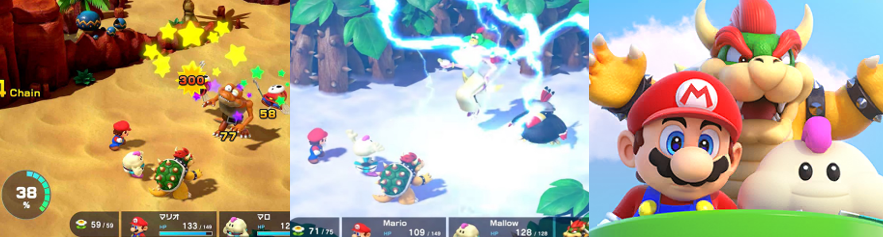
Use each character’s special moves, or pull off a team attack, to decimate enemies.

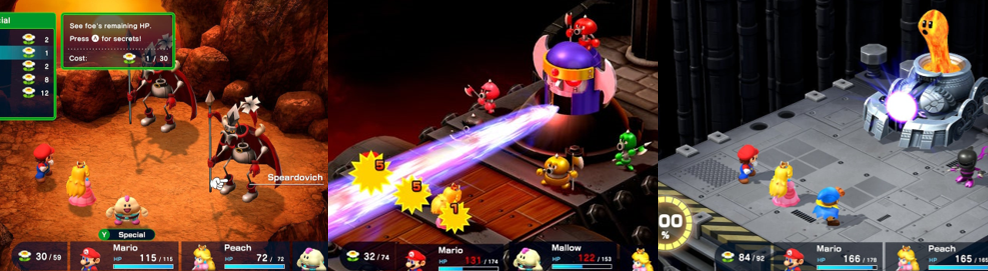
Though triggered by touching onscreen enemies (most of which respawn indefinitely or when you leave the screen), combat is turn-based like in traditional Final Fantasy RPGs. I thought I would gain a turn advantage by preemptively touching enemies but that doesn’t seem to be the case. Your level and “speed” stat seem to determine who strikes first, though I found you usually always get the first hit unless facing a “Special Enemy” or a boss. In battle, you pick a physical attack with A; an onscreen indicator prompts you to hit A again to deal additional damage and the timing is crucial to sweeping enemies as the extra hit can damage every foe. It’s equally important to tap A at the right time when being attacked as this will either reduce the damage dealt or negate it entirely. As mentioned, you can adopt a defensive stance with B; B also gives you the option of running from a battle, something also assisted by certain items (while others allow you to restart the fight if it’s going south). You can also use Special attacks with Y, however these consume Flower Points (FP). Each attack costs a different amount of FP (at least 2 FP and sometimes as much as 16 FP) and FP is shared amongst your entire Party. This means you really have to think about using the more powerful, costly Special attacks as you might run out of FP when you need to be healed or revived. Some enemies are weak to elemental attacks like fire and lightning, which is something to consider when picking Special attacks, and you can restore and even increase your FP with Honey Syrup and various flower-based items. As you deal damage, you’ll build both a combo meter and an “Action Gauge”. When this gauge is full, you can press – to pull off a team-based attack for big damage or call in Toad for helpful buffs. Additionally, as you attack and defeat enemies, you’ll earn similar buffs that up your attack, defence, or “luck” for that battle or restore your HP. However, simultaneously, you must be wary of status effects; enemies can put you to sleep, poison you, weaken your attack or defence while upping theirs, and turn you into mushrooms or scarecrows. While all these ailments are undone upon victory and some are only temporary, you can cure them using items or magic spells, and other items (such as the various bombs and even items that summon Yoshi) will aid you in attacking or neutralising enemies. However, defeat isn’t always a massive issue; checkpoints and manual save points are plentiful and the game’s very generous with its restorative buffs. Your HP and FP is occasionally fully restored after certain battles, too, and you can of course pay to stay at various inns to refill both.

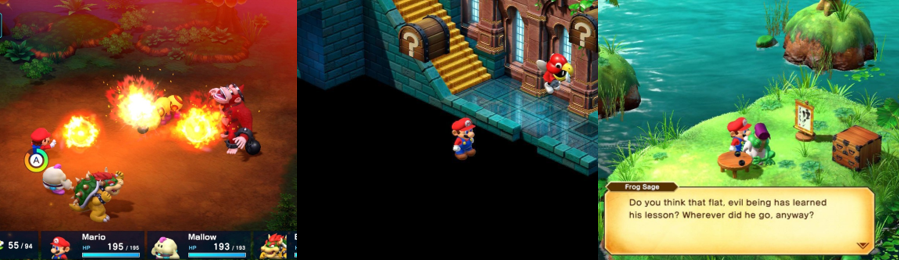
Level-up to gain new Special attacks, search for secrets, and chat to NPCs for guidance.

Each character falls into a certain class: Mario is an all-rounder, for example, while Peach favours restorative magic and Bowser is a heavy-hitter. While you’ll mostly be hitting A at the right time to increase your attack power and radius, you’ll sometimes rotate the left stick or rapidly tap or even hold down A to charge a meter. Additionally, different character combinations result in different team-based attacks and it’s important to think about each character’s strengths and weaknesses, especially when levelling-up. After accumulating enough EXP, you’ll gain a level and can pick to buff either physical power and defence, your overall HP, or magic attack and defence. You can also equip weapons, armour, and accessories to boost these stats, and others; Mario gains hammers and Koopa shells, for example, while Mallow uses sticks and cymbals, and the timing of your button presses changes with each. Accessories can also negate status effects, too, protecting you from sleep or poison, or alerting you to hidden blocks in the overworld. While your inventory isn’t unlimited, any additional items you get but cannot carry are automatically transferred to Mario’s house to use later and winning battles also earns you Coins to spend in shops, though you can also get Coins from hitting blocks and items from treasure chests. Sometimes, after winning a fight, you’ll play a game where you must find Yoshi, which doubles (or costs you) the Coins or EXP you earn. Defeating Special Enemies and opening chests also awards Frog Coins to be spent elsewhere, and you can trade Coins for points or rarer items. It pays to chat to every NPC you encounter, too, as some will gift you items, flesh out the lore, offer aid, or point you in the right direction if you somehow get lost. This isn’t easy to do as not only do you have the journal, but the overworld map includes helpful flags to point you in the right direction. Sometimes, you must talk to specific NPCs to get key items, hit switches, or even use whirlpools to walk underwater to progress and you’ll occasionally find hidden paths or doors that lead to goodies, sometimes by entering a pipe like in a traditional Mario game.

Tricky platforming, some basic puzzles, and a few fun mini games help to offer some variety.

Yes, there are some simple puzzles to solve, such as pressing switches, navigating mazes, crossing invisible platforms, remembering codes, and rearranging paintings. In the platforming sections, you’ll use springs or flowers to jump higher and regularly hop up walls or across gaps or lava pits using moving, collapsing, or temporary platforms (and even Parakoopas). Thanks to the isometric angle and Mario’s slippery feet, this can be a bit tricky but, luckily, you’ll usually land on or in water and simply loop back to try again, and even hitting lava doesn’t doesn’t drain your HP. It can be difficult to judge the distance between gaps, though, and you’re often dodging Thwomps, fireballs, and other enemies while hopping to small square platforms, which can make these sections needlessly annoying. Easily the worst instance of this, for me, was when scaling the vines to reach Nimbus Land. You must angle yourself just right (and know to jump to spawn a hidden platform) to hop to the vines and it was very easy to slip off and have to start over. Similarly, in the end game, you must tackle four out of six obstacle courses to reach Exor, two are simple battle gauntlets, two are tricky platforming sections, and two are timed quizzes! The gameplay loop is further broken up by mini games: you’ll be careening around a minecart track like Indiana Jones, tumbling down a waterfall, racing against Yoshis in the Yoshi Derby, hopping on Goombas, playing tunes on tadpoles, jumping from rolling barrels amidst a raging river, and collecting beetles. Most of these mini games can be repaid (for a price) and will net you extra rewards (as well as the Coins you can grab along the way), and you’ll eventually access a casino and even a secret super boss! Additionally, certain story events and having specific characters in your party rotation will change the overworld and battle system. For example, when in Bowser’s Keep, having Bowser in your Party causes his minions to flee and Mallow’s royal heritage gains access to the hot springs in Nimbus Land.

Presentation:
I’ve only briefly played Super Mario RPG before, but I remember being a little put off by the original’s 3D-to-2D aesthetic, which made everything look a little unsightly and pixelated. That’s definitely not the case here, though! This slick remake has given everything a plasticine, diorama-like makeover that gives the impression of playing with chibi-style toys, not unlike the same aesthetic adopted by The Legend of Zelda: Link’s Awakening (Grezzo, 2019). The pre-rendered cutscenes are gorgeous; every character has a fun victory pose and does a little dance when they level-up and, while you can skip the team attack cutscenes, they look so good that I just let them play. While all the characters are lively, adorable, and animated, Mario naturally stands out from the bunch. Unlike the others, he can’t talk (not even gibberish), so he pantomimes every action, recapping the plot (sometimes too much) with an excitable enthusiasm, vehemently shaking his head at the suggestion that he’s one of Bowser’s minions, and consoling his friends (even Bowser) when they experience hardship. Bowser gets a lot of nuance here, too; he throws himself at obstacles and proudly boasts of his superiority but is humiliated at being kicked out of his keep. Our two original characters, Mallow and Geno, fare pretty well, too. Mallow starts out as clumsy and unsure of himself, but gains confidence thanks to Mario and discovering his true heritage while Geno (a puppet brought to life by a star) fights to repair Star Road with a passion, resulting in a bittersweet ending when the puppet returns to being just a toy. Equally, the game is bolstered by a jovial and familiar soundtrack. This version lets you pick from the classic soundtrack and the modern remix, with both being enjoyable, and I loved hearing familiar Final Fantasy sound effects and seeing fun Easter Eggs like a curtain that turns Mario 8-bit and references to other Nintendo properties.

While the game looks and sounds amazing, some environments were a little visually bland.

As great as the game looks and sounds, however, I was a bit let down by the environments. While the overworld map is large and varied, the actual locations you explore are a far cry from the fantastical whimsy of other Mario games. You spend a lot of time in grassy areas or underground caves, which is very familiar, or at cliffsides and near lakes, before exploring such exotic locations as…a mountain, a mine, and a haunted pirate ship (actually, that one’s not bad!) You’ll venture into the pyramid-like Belome Temple, the autumnal maze in Bean Valley, and the rocky innards of an active volcano, but it’s not all that memorable and seems incredibly safe. Things get visually interesting in Nimbus Land, Star Hill, and the Weapon’s World, but these are juxtaposed by Bowser’s uninspired keep, the relatively barren Booster Tower, and the dense Forest Maze. Many areas, such as the Kero Sewers, sea, and Pipe Vault are restrictive and linear thanks to the isometric aesthetic, looping or forcing you to solve a maze to progress, while others (Land’s End and Nimbus Castle, for example) are robbed of the scope that makes the various towns so much fun to explore. While Bowser’s Keep is simply the same lava and stone-filled castle you’d expect from the Koopa King, I liked that battles took place on the chandeliers and that there were more branching paths. The Weapon’s World and Factory stood out at the end just for offering some visual variety, with their cogs, conveyor belts, and ominous atmosphere, but I do think Super Mario RPG missed a trick in not making areas more distinct. Sure, some towns have been affected by the Smithy gang and will be restored to life and order by your actions, but why not make Mole Mountains an ice mountain with snow and such? Or do more with the water gimmick at the Seaside, perhaps have parts of Seaside Town underwater or flooded?

Enemies and Bosses:
A slew of Mario’s most recognisable enemies crop up all throughout Super Mario RPG, generally acting as disposable pawns to rack up for EXP: Goombas, Spikeys, Gobys, Shy Guys (and their many variants), Bob-ombs, Piranha Plants, Bloopers, Wigglers, Chain Chomps, Boos, Lakitus and various Koopas (from Sky Troopas to bulbous Heavy Troopas and Dry Bones) and even variants of Donkey Kong show up in some form or another and, generally, aren’t much of a threat. There are exceptions, though: you can encounter numerous enemies in one battle, and mixtures of them, and some (like Dry Bones) can only be defeated by Special attacks or are susceptible to elemental attacks. Other enemies include rats, various insects like stinger-firing Buzzers, tricky Crooks and Ninjas (who can teleport, often flee from battle, and (in the latter case) launch an attack upon defeat), Pandorite (sentient treasure chests that spit up enemies), anthropomorphic vegetables, puppets and jesters, and even giant crustaceans and reanimated mastodon bones. While some enemies (like the Orbisons) can recover their health and that of their allies and others (like Stumpets and Reachers) look intimidating, some (like Geckits) are just as likely to attack themselves and their allies as they are you. Sure, some enemies are larger or inflict status effects, but they’re mostly all a joke; you easily dispatch entire groups with well-timed presses of A and without even using Special attacks. Even larger, more formidable enemies are easily trounced if you keep your level and stats high and time your button presses. Hippopos, Doppels, and Corkpedites can easily have their elemental weaknesses exploited, though you will have to be wary of Special Enemies, variants of almost every enemy who hit harder and can take more damage and should be targeted first. Also, you’ll need to watch for certain powerful or unblockable attacks; kamikaze attacks, unavoidable boulders, large explosions, and gigantic lasers can decimate your party if you’re not careful. Thus, it pays to have plenty of restorative items or keep Peach or Mallow around to restore your life or get rid of annoying status effects.

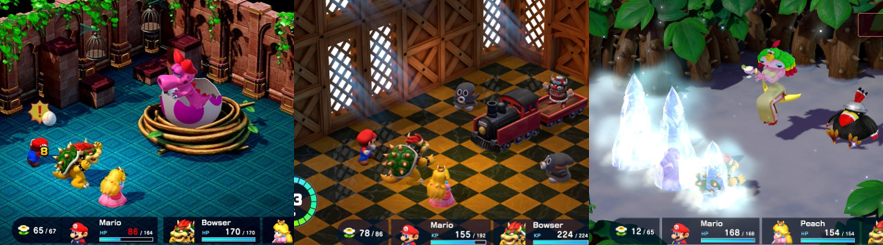
While there are many bosses to fight, few pose a significant challenge.

Battles are frequent in Super Mario RPG but ridiculously simple; I trounced most enemies simply by tapping A, meaning combat gets quite tedious at times. Unfortunately, the combat loop isn’t changed much by the game’s bosses, despite how many you’ll encounter. Your first boss battle is, fittingly, against Bowser; taking place up on the chandeliers and with Peach held hostage, you simply target the chain holding Bowser aloft and you’ll come out victorious. Next, you’ll battle the Hammer Bros, who toss hammers and up their valour but aren’t much of a threat, and have your first encounter with Croco. Croco’s a little trickier as you must chase him through a looping maze, battling waves of disposable enemies before getting to him, where he’ll bite and toss explosives and enemies. When on the Sunken Ship, you’ll battle King Calamari, a giant Blooper whose tentacles burst through the floorboards and who spits ink at you. Birdo also makes an appearance, encountered at Nimbus Castle after shattering her egg; as is her nature, Birdo spits eggs but these can be attacked to deal damage to her. Bowser’s magical minion, Wizakoopa, also appears, brainwashed to oppose his master and summoning the powerful fire-breathing dragon Bahamutt, as well as boasting elemental spells. Other bizarre bosses include the multi-headed Pihana Plant Megasmilax, the dog-like Belome (who eats party members and spits up clones), the ambitious Punchinello (who tosses various Bob-ombs), and the deluded Booster, whose circus-themed minions kidnap Peach and force her into a wedding, leading you to defeat them and attack an elaborate wedding cake! You’ll also battle the trident-wielding pirate leader Johnny and the sultry Valentina, who relies on her bird-like minion Dodo in battle, with him pecking at and whisking away party members, while she relies on numerous magical spells.

The Smithy Gang is mostly a joke until the end game, when things get tougher.

Mario and their friends quest to recover the seven Star Pieces, with most being guarded by the Smithy Gang. This gaggle of anthropomorphic weapons thus represent the primary bosses of the game, with the pogo-sword-riding Mack being the first you encounter (once you dispatch his Bodyguards, of course). Bowyer represents one of the more unique boss battles as he’ll fire arrows that disable A, X, and Y inputs for a few turns, forcing you to utilise different attack strategies or even spend a few turns defending before you can attack again. Speardovich creates a double to aid him in battle while the ridiculous (but strangely familiar) Axem Rangers force you to battle them all at once, eventually bolstered by their airship, The Blade, and its super-powerful Breaker Beam. The opening chandelier battle is revisited in the end game where you battle the katana-wielding Boomer, who switches between blue and red forms, being weak to physical and magical attacks, respectively. In the Weapon’s World, you encounter the giant alarm clock Count Down; you can knock off its Ring-a-Dings and target its sand timer to neutralise it, but it’ll unleash different magical attacks depending what time its hands land on. You’ll also battle Cloaker and Domino, with one favouring physical attacks and the other magical, and both hopping into snake-lime mechs when their partner is defeated. Finally, the Smithy Gang’s factory is home to three armour-clad, axe-swinging administrators and the diminutive Factory Chief and the devastating Gunyolk, a tank-like cannon that also uses the Breaker Beam attack alongside powerful abilities like Electroshock and Fire Saber. The Smithy Gang are usually always accompanied by minions. In the Weapon’s World and Factory, Machine Made duplicates of some bosses appear as regular enemies alongside metallic variants of regular baddies, though it’s usually better to simply focus on the boss as this ends the bout.

The final slew of bosses caught me off-guard with their difficulty spike.

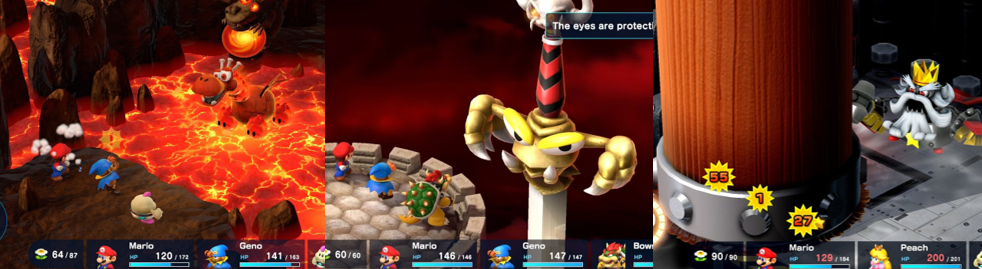
While most bosses don’t pose a problem, four stand out as surprisingly formidable. First is the Czar Dragon, a gigantic (if comical) dragon comprised of Lava Bubbles. The Czar Dragon bites, casts Flame Wall and Water Blast, and fires flaming projectiles, as well as protecting itself with Lava Bubbles. Defeating it sees it rise again as Zombone, which isn’t one-shotted by Pure Water like other undead enemies (though this item does cause it to attack itself) and has even more powerful attacks at the cost of being more vulnerable to Mario’s jump attacks and Mallow’s thunderbolts. Fittingly, given his high rank and him invading Bowser’s Keep, Exor was also a tough encounter. Fought on the keep roof, Exor cannot be harmed until you take out at least one of its eyes and even then it causes trouble with Venom Drool, Aurora Flash, and Lulla-Bye. Defeating him transports you to the Weapon’s World and a final showdown with Smithy, the Smithy Gang leader and the toughest fight yet. Smithy is fought in two phases: in the first phase, Smithy fires bullets, smacks you with his large sledgehammer, and crushes the party with a giant…well, crusher. A smelter also spawns Shypers to whittle your HP down, so it’s a good idea to have Peach on hand as many of Smithy’s attacks damage the entire party. With no weaknesses, Smithy is a tough fight if you’re ill-prepared and it only gets tougher when you drop to the basement and he transforms his head into various forms (a tank, a magician, a treasure chest, and a mask). Each has their own HP and is capable of dishing out status effects, instant-KO blasts, and healing him. You can target his body to help take the pressure off, but I say just go to town on his big stupid head, keep healing and reviving as needed, and use elemental attacks on the right heads to win. But, after all that, there’s an even more powerful optional boss you can take on!

Additional Features:
Considering this is an RPG, there isn’t really much to do in Super Mario RPG beyond the main story. The game is surprisingly linear, guiding you to each location with very few instances of backtracking, side quests, or fetch quests. When you are given a fetch quest, it’s generally something you do naturally. You’re given the item in one town and deliver in the next, rather than going back and forth like in other adventure games. Thus, when you beat the game and start a “Clear Data File”, you’re returned to Mario’s house before the final battle and can revisit every area but there are only a few final tasks to do. First, the Monster List needs to be completed (though this should be mostly full by this point) and you can freely listen to the game’s soundtrack. Next, you can challenge Bowser’s Keep again to acquire any additional weapons you missed when taking on the six obstacle courses. There are also 39 hidden treasure chests to find (greatly aided by equipping the Signal Ring) to snag every item in the game (though, again, this is somewhat pointless once you’ve cleared the main story). You can view the “Play Report” to see how well you did at the mini games and pay to take them on again to improve your score, stay at the luxurious Marrymore Hotel, complete a tedious guessing game to access the casino, and taken on tougher versions of the game’s bosses. Easily the most prominent additional challenge is the secret super boss, Culex. By purchasing expensive fireworks in Moleville and trading them for a special stone in the same town, you open a locked door in Monstro Town and take on the game’s toughest challenge, a 16-bit, cross-dimensional Final Fantasy being that boasts a new 3D form in this version and represents the greatest challenge on offer in the game.

The Summary:
I’ve long wanted to play through Super Mario RPG. Being a SEGA kid, my only avenues for this were emulation but, even when I got the SNES Classic and Nintendo Switch Online, I hesitated to start a game because of the time needed to complete an RPG. When this remake was announced, I knew the time had finally come to change that and I have to say that it was well worth the wait. Super Mario RPG is a gorgeous, fun, surprisingly engaging romp that brings Mario and his friends (and enemies) to life in a unique way. The new battle mechanics and accessibility on offer are fantastic, meaning you’re constantly rewarded during and after battles and there’s always something to see, either in the background or the character animations and interactions. The gameplay was simplicity itself, even by classic Final Fantasy standards. Turn-based RPGs are always my preferred style for the genre, and Super Mario RPG adopts these mechanics beautifully. Unfortunately, the game is extremely easy; I didn’t mind this as I wasn’t looking for an uphill battle, but things did get a bit tedious after a while. The incorporation of “traditional” platforming mechanics was also a bit clunky, as were some of the mini games. The isometric perspective and restrictions of the genre didn’t really lend themselves to these aspects, though I appreciated the attempt to mix up the gameplay loop. While I was disappointed by some of the environment, and that Luigi didn’t appear as a playable character and that more post-game content and side missions weren’t included in this version, I enjoyed my time with Super Mario RPG. Mallow and Geno quickly grew on me, I liked seeing Bowser teaming up with Mario and Peach given more agency, and I was a big fan of the boss designs (despite how easy they were), the graphics, and Mario’s jovial animations. In the end, if you have a kid who you want to introduce to the RPG genre, you could do a lot worse than Super Mario RPG. And, if you played the original as a kid, I’d wager this is just the right hit of nostalgia for you.

My Rating:

Rating: 4 out of 5.

Great Stuff

What did you think to the Switch remake of Super Mario RPG? Have you ever played the original and, if so, how does this compare to it? Which characters made it into your team and what did you think to the original characters created for this game? How did you get on with the simplistic battle mechanics and bosses and were you also annoyed by the awkward isometric platforming? Did you ever defeat Culex and complete the Monster List? Would you have liked to see other new features added to the game? Which Super Mario spin-off is your favourite and how are you celebrating Nintendo’s mascot this month? Feel free to share your memories and opinions of Super Mario RPG in the comments and please check out my other Mario content across the site!

Mini Game Corner [Mario Month]: Super Mario 64 DS (Nintendo DS)


So, for no better reason than “Mar.10” resembling Mario’s name, March 10th is widely regarded as being “Mario Day”, a day to celebrate Nintendo’s portly plumber, an overalls-wearing mascot who literally changed the videogame industry forever and shaped the home console market of the nineties.


Released: 21 November 2004
Originally Released: 23 June 1996
Developer: Nintendo EAD
Also Available For: Nintendo 64, Nintendo Switch, and Nintendo Wii (Virtual Console, original version only)

A Brief Background:
After rebuilding the videogame industry following its horrific crash in 1983, Nintendo embarked on a “Console War” with SEGA. Their two mascots – Super Mario and Sonic the Hedgehog – were at the forefront, creating celebrated 16-bit classics that defined a generation. By the end of the nineties, though, 2D graphics were out and the race was on to produce the first commercially viable 3D home consoles. While SEGA struggled to get started with expensive add-ons for the Mega Drive, Nintendo shunned CD-based technology in favour of traditional cartridges, and launched their Nintendo 64 console with Super Mario 64, a critical and financial success that set the standard for 3D platformers. In mid-2002, former Nintendo president Hiroshi Yamauchi proposed the idea of a dual-screen console, a portable system Nintendo hoped would propel them back to the top of the industry. An expanded version of Super Mario 64 was developed as a launch title for this new console, the Nintendo DS. Originally titled Super Mario 64 x4, the game featured graphical upgrades to the textures and character models and was a huge success, selling 11.06 million copies worldwide. It was also met with rave reviews that praised the addictive gameplay and additional characters but criticised the clunky control scheme.

The Review:
So, let’s address the elephant in the room first: why just a mini review for this remaster of Super Mario 64? Well, primarily it’s because much of the core gameplay, mechanics, and elements of the original game are retained here. The story is largely the same: Princess “Peach” Toadstool invites Mario, Luigi, and (strangely) Wario to her castle for cake but, when they disappear inside, Yoshi has to go rescue them. The gameplay loop is the same (enter magical paintings to be transported to action stages where you collect Power Stars to open new doors and access new areas of the castle), and everything I said about the original game in my initial review still stands here. Thus, I think it’s more productive to focus on what’s different about this version. Namely, the controls; while all four characters perform the same basic actions as Mario (though only he can wall jump), you now control them with the directional pad (D-pad) or, *shudder*, the touchscreen and stylus. This is problematic in many ways; Super Mario 64 DS is a fully 3D gaming world, and yet these controls make the characters clunky and tank-like. It’s also not helpful having to hold Y to dash, which can make performing long jumps or running attacks problematic as your fingers get in the way. If you play the game on the Nintendo 3DS, as I did for this playthrough, you can use the analogue stick but you don’t get true analogue control. Instead, the same janky tank controls are mapped to the stick, making the precision platforming, running, and combat mechanics much more of a chore to pull off in this version, which is a real shame. Although you have greater camera control with the Left bumper, touch screen, and X (which zooms out), the camera is still aggravating, regularly getting stuck on the environment or adopting a poor angle. However, I did like how the touchscreen displays a helpful map at all times and highlights any available Power Stars or character caps. One of the most noticeable changes to the gameplay is that Super Mario 64 DS now features 150 Power Stars rather than the original 120, and you now need 80 of them to access the final confrontation with Bowser, King of the Koopas. As I’ve 100% both this and the original version before, my goal for this playthrough was simply to reach that final fight, hence again why this is just a mini review as I didn’t strive for 100% completion.

You’ll need everyone’s unique powers and skills to hunt down a whopping 150 Power Stars!

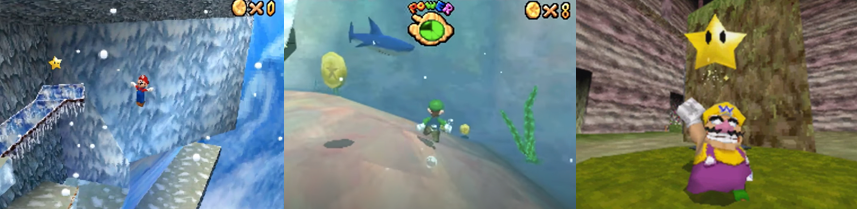
Although each character has their own unique mechanics, attributes, power-ups, and controls a little differently, they all share a basic move set that’s immediately familiar to players of the original game. B allows them to jump; tapping it three times while running executes a triple jump to reach higher areas. Holding R and pressing B pulls off a backwards somersault and doing the same while running performs a long jump, while holding left or right on the control stick and pressing B executes a side jump. Tapping B also allows you to swim; you can hold the button for slower, more precise movement but keep in mind that some characters also swim faster than others. A allows you to talk with non-playable characters (NPCs), read signs for tips, pick up certain objects, and perform a melee attack. You tap A three times for a three-hit combo, press A when running for a dive, or hold R and press A for a sweeping kick. You can also jump and press R in mid-air to perform a ground pound to crush enemies, and simply hop on most enemies to defeat them or get a boost to higher levels. Your health is measured in a colourful pie chart that depletes as you take damage, get set on fire, or when underwater. You must collect coloured Coins or run through Hearts to replenish it or grab an air bubble or resurface when swimming. The basic gameplay structure remains unchanged except each level (or “Course”) has an additional mission, and some missions have been altered to take advantage of the new characters’ abilities. You’ll still be jumping to moving, spinning, and temporary platforms, activating switches, running up walls, utilising cannons, smashing blocks, pounding stakes, raising and lowering water, catching rabbits, climbing fences, defeating enemies, finding Red Coins, and speeding down slides on your butt to complete missions.

Alongside their shared skills, characters have unique abilities modelled after the original game’s caps.

The biggest change to the gameplay is the inclusion of three new characters. You begin controlling Yoshi, who swallows enemies with A, lays an egg with R, and tosses said egg with A (or simply spits the enemy out if you prefer). Yoshi also performs a “flutter” jump by holding B to give him a bit more airtime and temporarily breathes fire with a Power Flower, which is great for melting ice blocks. Luigi is the fastest, slipperiest of the characters; he also has a flutter jump but can spin in the air off a back somersault to cross wider gaps. Luigi can also briefly run across the surface of water and temporarily turn invisible when he grabs the Power Flower, effectively replacing the Vanish Cap from the original game. Wario is the smallest, stoutest, and slowest of the four but also the most powerful. He can break black blocks swing and throw opponents in Vs. Mode, and temporarily turn invincible when grabbing the Power Flower, meaning he replaces the Metal Cap. Mario has all his original abilities, including temporarily flying with the Wing Cap with a feather (which remains as awkward as ever) but he can now inflate like a balloon and float with the Power Flower. Although you must unlock Mario, Luigi, and Wario, you can assume their form and powers by defeating enemies who wear their caps or finding their caps in the Courses, though you’ll lose their abilities when you take damage. You can manually switch characters by visiting the switch room, which is located where the Princess’s Secret Slide was (and still is) but you can only battle Bowser as Mario. The Super Mushroom also makes a return here, briefly enlarging your character and allowing them to plough through enemies and obstacles and earn extra lives. You can also still ride discarded Koopa shells to speed around Courses, and all the character models and game textures have received a nice upgrade, making everything even more colourful and detailed even on the DS’s smaller screen.

Old bosses have received a graphical overhaul and been joined by new baddies and Courses.

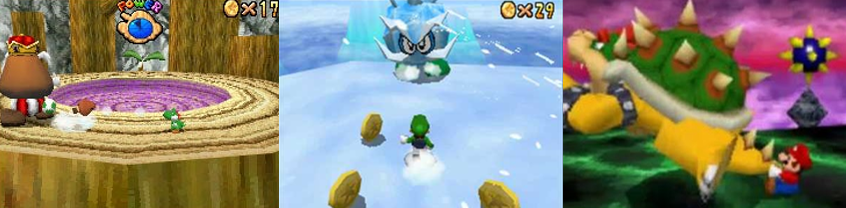
While the same selection of Courses are present here, there are some new bonus areas to visit to find new Secret Stars or character portraits, which take you to new mini obstacle courses not unlike the Bowser Courses. These culminate in a boss battle against the three new bosses who guard the keys needed to rescue Mario, Luigi, and Wario. The first, Goomboss, is fought with Yoshi; this enlarged Goomba chases you around a tree stump platform. He gets faster as the fight progresses and can only be damaged by dashing behind him, swallowing his Goomba minions, and spitting them at him. Luigi is rescued by clearing a small looping carousel maze and battling King Boo, who’s the same as the Big Boo bosses except you sometimes use the giant mirror to spot him closing in. Finally, Wario’s key is guarded by Chief Chilly, a larger version of the Chilli Bully from Snowman’s Land and fought similar to other Bullies, but with the twist that the arena is super slippery, surrounded by burning cold ice water, and Chief Chilly destroys the stage as the fight progresses. All the previous bosses return, unchanged except for their new character models and altered dialogue depending on who you’re playing with, but there are now two battles against King Bob-omb, with the first one being fought with Yoshi and containing new mechanics. This time, King Bob-omb hurls his explosive minions at you and you must spit them back, which is kinda fun, though you can fight him in the same way as before (running behind him and tossing him) when playing as other characters or using their caps. Bowser’s battles are also the same, though slightly more challenging thanks to the clunky controls. You must best a dangerous obstacle course beforehand that’s now home to two hidden Power Stars before battling Bowser in borderless arenas. Bowser will stomp about, spitting fire (which homes in on you and rains from the sky in the final bout) and even tip or destroy the stage in later encounters. You defeat him by running behind him, grabbing his tail, and swinging him into one of the nearby mines. You’ll need to do this once in the first two fights and three times in the last to be victorious and see the slightly altered ending, where all the characters get cake.

There are more missions, more Power Stars, more rabbits, and even loads of unlockable mini games.

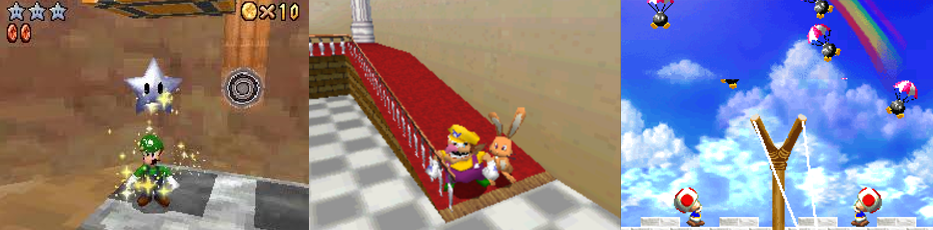
As mentioned, every Course now has eight Power Stars to collect rather than seven. You complete missions for seven of them but earn an eighth for collecting 100 Coins in every Course, and each Course has an additional mission tied to one of two new mechanics. One is the Star Switch, which causes a Power Star to temporarily spawn somewhere in the Course and gives you a short time limit to get to it, usually by platforming, wall jumping, or utilising the character’s Flower powers. The other is collecting five Silver Stars, smaller Stars dotted around Courses that fly out of you when hit and spawn a Power Star when collected. There are also a bunch of rabbits to catch in and outside Peach’s castle; seven for each character (as indicated by their colour) that appear when you’ve collected a certain number of Power Stars. Catching them doesn’t award you a Power Star like when you catch Mips in the original game, but instead unlocks mini games to play in the Rec Room. These are assorted button- and touchscreen-based distractions that see you matching pairs of cars, rubbing the screen to reveal Boos, touching the right character faces amidst a sea of others, bouncing Mario past Shy Guys, playing slot machines, launching balls, and shooting parachuting Bob-ombs from the sky. There are thirty-six mini games to unlock and play, with each one awarding you Power Stars as points, and they’re an interesting addition, though I didn’t spend much time on them. The squishy Mario face mechanic from the original game has been expanded to other characters and a limited drawing canvas, you now only get three save files instead of four, and while the cannon outside the castle does unlock after you get 150 Power Stars, it simply leads to a Wing Feather for Mario and another rabbit for Luigi. Courses have had some graphical updates as well: Coins are now 3D objects, Peach has a new hairstyle, Bob-omb Battlefield is noticeably more autumnal than before, Hazy Maze Cave’s toxic gas is a different colour and Dorrie now wears swimming goggles, and the secret Courses where you once activated the different caps are now just challenges for Power Stars. Everything looks far superior, despite the smaller screen size, and sounds way better, but issues from the original game still persist. The camera, obviously, is the main one, as is the character’s tendency to just randomly slip or detach from platforms. Finally, while you get more guidance this time around, it can still be difficult to know how to clear certain missions without consulting an online guide.

The Summary:  
I loved Super Mario 64. Like almost everyone back in the day, it was the first Nintendo 64 game I owned and I played it constantly, though I was never able to get all 120 Power Stars. Ironically, however, I was able to get all 150 Power Stars when I first owned Super Mario 64 DS. I sold the game back then, choosing the more traditional, refined, and enjoyable experience offered by New Super Mario Bros. (Nintendo EAD, 2006) but, after playing the Nintendo Switch port and realising the 3DS analogue stick could be used to play the game (and being a big fan of Wario), I felt compelled to revisit it. Sadly, the analogue stick didn’t help with the game’s clunky control scheme and the camera is just as bad as ever, so this is a bit of a step down compared to its Nintendo 64 predecessor despite all the extra features, but it’s still a really fun game. I think that’s a testament to just how well Super Mario 64 was made. It’s still a readily accessible and surprisingly deep 3D platformer with a lot of varied locations and missions to playthrough. This version of the game impresses with its graphical overhaul, new Courses and boss battles, and the three new characters. While I rarely played as Yoshi, I enjoyed running around as Luigi and Wario and the cap-swapping mechanic and I liked how they each took on the cap power-ups from the original game. It’s a shame the Bowser fights weren’t tweaked to utilise each character’s unique move set, but they get Courses and missions tailored to them, so I think it balances out. While I didn’t play the mini gams or the Vs. Mode, I had a lot of fun plugging away at this remake of a classic. I’d love to see this get a proper HD port to the Nintendo Switch, though, to further refine its niggling issues. Still, as is, this is a great way to revisit Super Mario 64 and well worth your time, if you can cope with the odd tank-like control scheme.

My Rating:

Rating: 4 out of 5.

Great Stuff

Was Super Mario 64 DS a part of your Nintendo DS library? What did you think to the new control scheme and visual overhaul? Which of the new characters and power-ups was your favourite? What did you think to the new missions, additional Power Stars and Courses, and the new bosses? Did you ever collect all 150 Power Stars? What other Nintendo 64 game do you think deserve a remaster? How are you celebrating Super Mario this month? Whatever you think, comment below and let me know and don’t forget to check out my other Mario content.
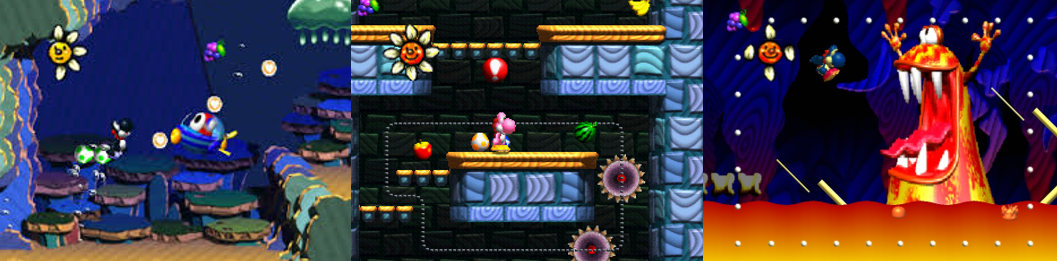
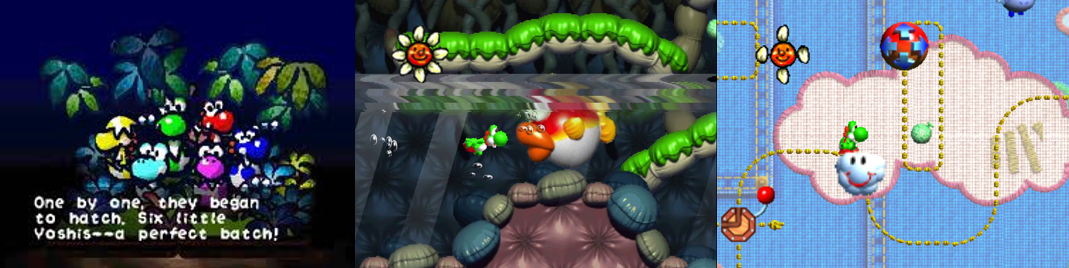
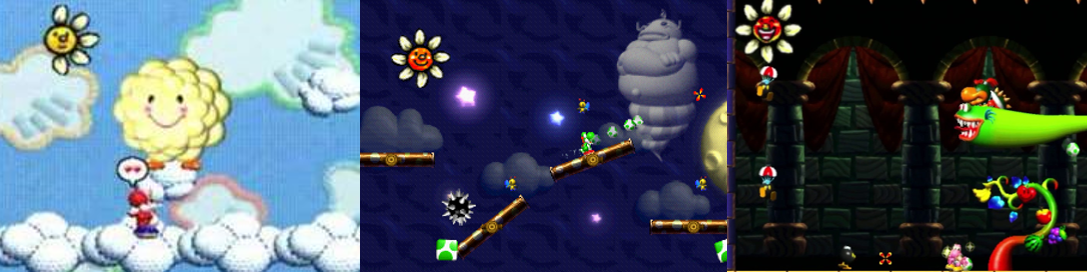
Game Corner [Mario Month]: Super Mario World 2: Yoshi’s Island (Nintendo Switch)


So, for no better reason than “Mar.10” resembling Mario’s name, March 10th is widely regarded as being “Mario Day”, a day to celebrate Nintendo’s portly plumber, an overalls-wearing mascot who literally changed the videogame industry forever and shaped the home console market of the nineties.


Released: 26 May 2023
Originally Released: 5 August 1995
Developer: Nintendo
Original Developer: Nintendo EAD
Also Available For: Game Boy Advance, Nintendo 3DS, Nintendo Wii, Nintendo Wii U, Super Nintendo Entertainment System (SNES) Classic Edition, SNES

The Background:
When the videogame industry collapsed under the weight of overpriced consoles and disappointing titles, Nintendo swooped in and revitalised the industry with the runaway success of Super Mario Bros. (Nintendo EAD, 1985). Despite a bizarre development, Super Mario Bros. 2 (Nintendo R&D4, 1986) was also a much praised best-seller, and Mario’s star rose further following the unique marketing strategy behind Super Mario Bros. 3 (ibid, 1988). This culminated in what many have deemed Mario’s greatest 2D outing, Super Mario World (Nintendo EAD, 1990), a title specifically designed to showcase the processing power of the SNES. The game also introduced one of Mario’s most popular supporting characters, Yoshi, who took the spotlight in Super Mario World’s sequel thanks to designer Shigefumi Hino. For this not-inconsiderable-task, Hino and his team opted to produce a more relaxed gameplay experience, doing away with the timer and a traditional health system and emphasising exploration. To further distinguish the game, the team introduced an egg-throwing mechanic and focused on a linear story to make the game more accessible to younger players. Artist Hisashi Nogami came up with the game’s distinctive colouring-book aesthetic, which was painstakingly brought to life by hand drawing every aspect. The game’s late release for the SNES also allowed the team to utilise everything the machine had to offer, including enlarging and rotating sprites and backgrounds. Yoshi’s Island proved a hit, eventually selling over 4 million units and being met with widespread acclaim. Reviews raved about the colourful graphics, the innovative gameplay, and the surprising scale of the title, and the game was largely cemented Yoshi’s legacy in Super Mario canon. The game was followed by a divisive sequel for the Nintendo 64, a couple of spin-off games, follow-ups for the Nintendo DS and 3DS, and many other Yoshi-centric games before being ported to multiple virtual consoles, including being made available for the Nintendo Switch Online service in 2023.

The Plot:
Years ago, Kamek attacked a stork delivering baby brothers Mario and Luigi. While Baby Luigi was kidnapped, Baby Mario fell onto the back of Yoshi, whose friends helped deliver him across Yoshi’s Island, conquering Kamek’s enlarged minions and confronting the Magikoopa – and his diminutive master, Baby Bowser – to rescue Baby Luigi.

Gameplay and Power-Ups:
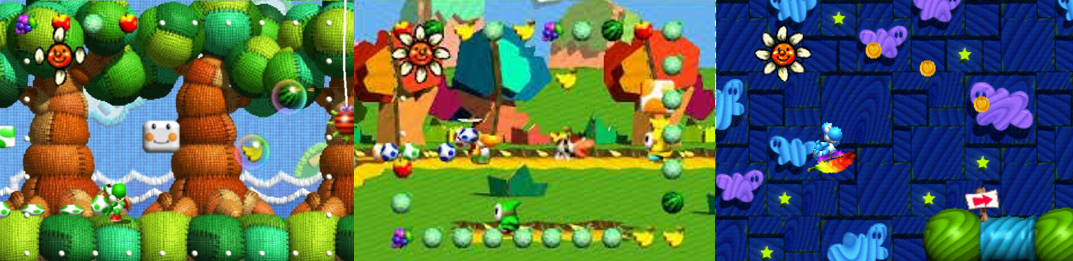
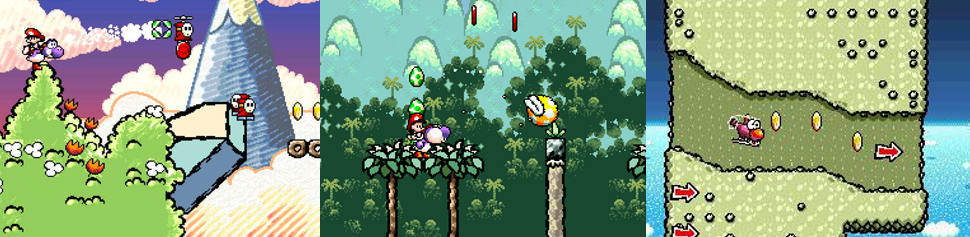
Essentially, Yoshi’s Island is a 2D, sidescrolling action/platformer like its predecessor, but it’s also a very different gameplay experience for a typical Super Mario title. For starters, you play as one of many different-coloured Yoshi’s, each sporting the same moves and abilities, and Mario is simply a baby on your back who acts as your life meter. After starting the game and picking a save file, you can pick between two control schemes, though the default is perfectly acceptable. Yoshi jumps with the B button and holding it performs a little “flutter” by kicking his legs, giving him more airtime to reach platforms. You can chain these together when falling to extend your jump and press down in mid-air to perform a butt stomp to pound down switches and stakes, smash through the environment, and defeat enemies. Enemies are also defeated by simply jumping on them, or gobbling them up with Yoshi’s tongue. Pressing Y sees him swallow them and you can either press it again to spit them out or press down to turn them into an egg. You can store up to six eggs at a time and throw them by pressing A to bring up an aiming reticle, hold either the Left or Right bumper to steady the ever-moving crosshair, and press A again. Some enemies can’t be swallowed or turned into eggs; in the latter case, you simply spit them out again but, in the former, you use other means to defeat them. Yoshi can also get eggs from hitting blocks and Egg Plants and find them scattered around the game’s many colourful environments. Green-spotted eggs are the standard, but you can also use yellow-spotted eggs that cause enemies to drop Yellow Coins, red-spotted eggs cause them to drop two health-replenishing Stars, and Flashing Eggs cause them to drop Red Coins. This can be a bit cumbersome at times; Yoshi can only aim in an arc, so you must pause the reticle or ricochet your shot to hit your targets. However, it’s easy to get distracted with the aiming system and either take damage or fall to your death. Some enemies can even steal your eggs and, while you’re never short on replacement eggs, it can leave you vulnerable and restricted when you exhaust your supply.

Toss eggs, eat melons, or transform into various forms to progress through colourful Worlds.

Yoshi also gobbles different-coloured watermelons to gain temporary additional attacks. Green watermelons let you spit seeds, red watermelons let you breathe fire, and blue watermelons let you freeze enemies, all of which are quite powerful and often more useful alternatives to throwing eggs. Yoshi can also, oddly, briefly transform into vehicular forms, the most common being his helicopter form that sees him awkwardly fly about, avoiding enemies and collecting Coins and passing over large gaps to a Yoshi Block. Another common transformation is Yoshi’s Mole Tank that lets him automatically dig through dirt, but you’ll also become a missile-firing submarine, a small train capable of riding tracks set into the background, and a car to plough through enemies. Similarly, Yoshi pushes Chomp Rocks to decimate anything in his path and reach higher areas, and Baby Mario even briefly takes centre stage when you find a Super Star. This turns Yoshi into a giant egg and lets you control “Powerful Mario”, who’s invincible, floats using his cape, and dashes across spike beds and up walls and ceilings with Y, though you must grab more Super Stars to maintain the form. Finally, Yoshi can jump on a pair of skis in certain snow-themed Worlds, dashing down snow at high speeds and turning into an uncontrollable snowball if he hits an object. Additionally, Special Items are won by playing the game’s Bonus Challenges. Here, you can earn extra lives and special one-use items you can select from the pause menu. These include POW Blocks that turn all onscreen enemies into Stars, instant refills for your eggs, instantly grant you one of the three watermelon power-ups, reveal hidden items in the level, grant you Stars to refill your health, and transform all onscreen enemies into Winged Clouds, though you can’t use Special Items in boss battles.

Watch out for your bawling companion when you’re going for those enticing collectibles.

As mentioned, Baby Mario is Yoshi’s life meter; when Yoshi’s hit, Baby Mario floats away in a bubble, screaming his head off, and you have a few seconds to retrieve him before he’s carried away. This meter slowly refills after you save him and is replenished and boosted by collecting Stars, usually by breaking crates or shooting Winged Clouds. Enemies like the annoying Bandits, Fishing Lakitu, and propeller-powered Green Toadies can also steal Baby Mario, so you must take them out or avoid them, and you’ll want to save him as quickly as possible because that scream gets really annoying! Like previous Super Mario titles, Yoshi’s Island features a map system, but one laid out more like a storybook. There are six Worlds with eight core levels, including a mini boss fort and a boss castle, alongside two bonus levels for each World. Levels are generally just a few screens but can be quite long. I really felt like my playthrough dragged quite a bit as things can be quite slow and the map progression isn’t very exciting. Throughout each level, you can find Yellow Coins (100 grant an extra life), extra lives, floating 1-Ups, giant eggs to defeat all onscreen enemies, and Message Blocks for gameplay tips. There are thirty Stars to find, twenty red Coins, and five Flowers in each level. Sometimes these are carried by Fly Guys, sometimes you need a transformation, and sometimes Winged Clouds spawn them, but they’re often either out in the open, tucked away, or require some tricky platforming to snag. Getting them all nets you the best completion score for each level and unlocks the secret levels for each World. However, it’s not easy collecting everything as some stuff is cleverly hidden behind the foreground, requiring you to enter areas from different positions, or is just out of reach and requires some clever egg bouncing. Occasionally, you’ll find some helpful characters to give you an assist. The enthusiastic pup Poochy carries you over dangerous terrain, happily gobbling up any enemies in his path, Huffin Puffin’s chicks substitute for eggs, and large, amorphous ghosts indirectly aid you by carrying platforms through spiked passageways.

Despite its whimsical appearance, the game can be surprisingly long and challenging.

Considering it’s his home turf, Yoshi’s Island is a hazardous place for the friendly dinosaurs; areas are filled with bottomless pits, instant-death spikes and lava, haunted ruins, and small, but dangerous, enemies. While the game isn’t especially difficult, the challenge ramps up as the Worlds slowly become more like dangerous obstacle courses that will test your jumping, egg-shooting, and reaction times. Like Mario, Yoshi can be a little slippery; he makes for quite a big target and is completely vulnerable when aiming, too. Thus, it’s easy to get blindsided by enemies, especially those hiding in the background or constantly spawning from pipes. Yoshi uses hills, slopes, and hidden tunnels to get around, as well as various platforms; these rise, fall, move along a track, or require you to jump on each in turn, rotating in a wheel to progress. Sometimes you’ll be locked into a maze-like loop and need to find a key; sometimes you’ll hit Winged Clouds to create bridges or spawn vines to get higher. Other times, you’ll knock buckets into water or lava to progress, quickly hop between platforms while a Shark Chomp chases you, or be forced to stay on the move in autoscrolling sections (with some even forcing you to the left!) You’ll ride balloons, run and jump to timed destructible platforms, be flung across the screen by spinning logs, play Breakout (Atari, Inc., 1976) to destroy coloured blocks with your eggs, watch for Chomps flying from the background and creating bottomless pits, spring to higher areas, ride circles that change direction when you jump off them, and cross a chasm on a deflating giant balloon. Thankfully, you can pass through sparkling rings to create a checkpoint and lives are quite easy to build up, but things do get surprisingly challenging as the game progresses. Flipping spiked platforms, mazes of dark sewers and pipes, and claustrophobic quartz caves are juxtaposed with bright, cheery exteriors that also hide many dangers, the most annoying being the Fuzzies. These fluffy puffs fill the screen when they appear and touching them sends everything into a psychedelic haze and messes with your controls for a few seconds, meaning it’s even easier to slip or run off a platform to your doom.

Presentation:
Yoshi’s Island not only plays very differently to other Super Mario games, it also looks very different. The entire game is styled after a children’s colouring book, with pastels and crayon effects used in place of traditional coloured backgrounds, giving the entire game a whimsical feel that’s perfectly in keeping with the baby-centred focus and its status as a more child-friendly gameplay experience. The Yoshis are all very fun sprites; they do a little dance when idle and react comically when hurt or performing their flutter jump. Baby Mario is very animated when separated from Yoshi, bawling his head off in his bubble and encouraging you to retrieve him as quickly as possible, and the game’s cutscenes utilise a storybook aesthetic that makes it feel like you’re playing through a bedtime picture book. Every level pops with colour and environmental effects; sometimes it’s a bright sunny day, sometimes it’s the red hue of dusk, sometimes it’s a starry night, and you’ll see birds, mountains, giant flowers, waterfalls (and lavafalls), giant mushrooms, and thin trees in the foreground. There’s a lot of depth to each area; I particularly liked levels where Chomps fly at the screen and destroy the ground, and the many caves where little details are hidden way back, and you’ll often open up tunnels by leaping at walls or avoid leaping fish and water jets when paddling through or jumping over water. Blizzards are commonplace in World 5, often blanketing the screen as you ride ski lifts and melt ice blocks, and you’re forced to navigate labyrinthine forts and castles, taking different paths to find keys or get past spike beds. It’s all very colourful and playful, which is reflected in the infectious soundtrack and amusing Yoshi sounds peppered throughout the game. This lulls you into thinking it’s a simple kid’s platformer, making the sudden challenging sections even more jarring.

The game’s visual presentation is incredible, emphasising a vivid storybook aesthetic.

Yoshi’s Island was a late release for the SNES and, as such, effectively uses all the machine’s vaulted power. Parallax scrolling and sprite manipulation are abundant, with Kamek enlarging regular enemies and inanimate objects into large bosses and huge, amorphous enemies stretching and filling the screen at times. This is equally reflected in the giant eggs and transformation sequences, and the scaling all works beautifully to add to the depth of each level. Typically, levels will consist of some common themes, such as a grassy starting area, a cavernous second area, and a final area that takes place in the skies or over a pit. You’ll venture into many dark caves, where things are far more claustrophobic and maze-like, as well as sewers or areas were it’s so dark Yoshi is lit by a single light source. While the forts and castles can be quite samey, they do mix things up a bit by featuring dilapidated backgrounds and a spooky ambiance further emphasised by the resident Boos and ghosts. The grassier areas are where the game shines for me; I love seeing fields and mountains in the background and hopping to the precarious log platforms, or taking the smaller platforms on tracks, or interacting with the environment using Yoshi’s transformations. Everything’s so lively that it’s easy to be surprised by enemies that pop up from pipes, fly from above, or sneak in from the background. I also enjoyed how the time of day changed, when the game leaned into its dinosaur theme to show skeletal remains and tar-like dirt, and the impressive quasi-3D rotating map that wasn’t utilised enough for my liking.

Enemies and Bosses:
Although it takes a while to encounter them, some of Mario’s most famous enemies make an appearance in Yoshi’s Island. You’ll come across Koopa Troopers and their flying variants, the Para-Koopa, shy Boos who cover their faces when you look at them, disposable Goombas, the ever-annoying Lakitu (who tosses Spin Eggs at you), and ravenous piranha plants. The most prominent returning enemy are the Shy-Guys, who come in an assortment of colours and variations, such as hovering overhead and dropping bombs, turning giant spiked maces, fatter ones, and ones that run around on fire. Yoshi’s Island is home to some unique and annoying new enemies, too, such as Frog Pirates who’ll steal Baby Mario, somewhat familiar blue hedgehogs who defend themselves with their quills, tiny Mousers who steal your eggs, and large lava, ghost, and aquatic enemies who pop up from liquid or the walls. Some enemies are more annoying, like the inedible Ravens and the spiky Tap-Taps, while others are more tricky. Spookies can be ridden but can’t be defeated by jumping on them and will steal Baby Mario if they’re hiding a Bandit, one of the most annoying enemies in the game. Equally frustrating are the Grunts, whose spiked helmets must be knocked off to make them vulnerable, the Sluggers that deflect your projectiles, and the karate-and-ki-throwing Zeus Guys. Many enemies are small are relatively harmless, but there’s so many and they pop up so frequently that it’s easy to take a hit. Others, like the piranha plants and Blow Hards either pop up at the worst moments or are placed on walls, ceilings, and platforms when you’re trying to jump about or ride platforms. Others are very large and must be pelted with eggs to whittle them down or fend them off, and you’ll even get attacked by an enemy masquerading as a collectable Flower!

The gigantic bosses look intimidating but they’re mostly a cakewalk.

With the exception of World 6, each World boasts two bosses: a mini boss hiding in the World’s fort and the actual boss holed up in the World’s castle. Each time, Kamek enlarges a regular enemy or inanimate object, kicking off the fight, which typically involves a large but cumbersome and surprisingly limited enemy filling the screen and must be hit with eggs to defeat, with other smaller enemies or Egg Plants providing ammo. World 1 sees you battling Burt the Bashful and Salvo the Slime, which are both ridiculously easy. Simply hide in the ditches and fire eggs as Burt slowly bounces around, then pelt Salvo with eggs, shrinking him with each hit and gobbling his minions, easily avoiding the lava below. World 2 features fights against ghosts, the Bigger Boo and Roger the Potted Ghost, with the Bigger Boo requiring you to ricochet your eggs to damage him, becoming intangible, and accompanied by bat-like Fangs who act as ammo. Roger tries to push you back and spits homing blue flames but is super easy to defeat as you just need to push his plant pot until he topples over the edge. In World 3, you’ll be swallowed by a gigantic Frog Pirate and need to fire eggs at his dangling uvula, dodging his gastric acid and the gigantic enemies that also drop in, which is quite a visually fun fight. Afterwards, you battle the Naval Piranha, who’s a little tricker. You must jump when it lunges and eat the Nipper Spores, then quickly ricochet eggs to hit the target at its base, though you can apparently one-shot it before the fight even starts. World 4 sees you encounter a massive Milde who wanders back and forth, requiring you to butt stomp from above, splitting her into smaller Puchipuchi L and, finally, regular Mildes. Hookbill the Koopa had me confused for a bit; this enlarged Koopa slowly lumbers around and performs a belly flop, spitting out eggs whenever you jump on his shell, but is invulnerable until you hit his head. Hit him enough times and he’ll topple onto his shell, exposing his stomach for a butt stomp, which took me a while to figure out.

The final bosses require a little more strategy and offer a bit more challenge.

World 5’s Sluggy the Unshaven was also a bit troublesome. This ghost-like blob’s gelatinous skin sags when you shoot eggs at it, and it slowly tries to force you over the edge. However, if you target the same spot, you’ll deal damage and eventually defeat it by striking its heart. Raphael the Raven was also quite unique as he flings you to a small moon where he relentlessly chases you in a rotating circle and creates shockwaves. To damage him, you must butt stomp the wooden stakes so the opposite one pops out as he’s passing over it, which can be difficult to time due to the nauseating rotation. Finally, in World 7, the invincible Tap-Tap the Red Nose hops about until you destroy the coloured blocks and drop him in lava. Kamek then chases you through the castle, firing magical bolts and teleporting away, and you eventually battle his cantankerous master, Baby Bowser. Baby Bowser was a bit difficult to figure out, too. He toddles about in his playroom, causes big shockwaves with a belly flop, and swats Baby Mario away so he can ride Yoshi, but is completely invulnerable. Instead, you must cause your own shockwaves with a butt stomp, though Kamek embiggens the enraged turtle king for the true final battle. This takes place on the castle roof during a nighttime storm and sees Big Baby Bowser slowly stomp towards you from the background. You must dodge the rocks he rains down and his massive fireballs while simultaneously avoiding the gaps he creates in the ground and swallowing Baron von Zeppelins. You must use your eggs to blast him in the face, which can be tricky due to how far away he is. If he gets too close, he’ll instantly kill you so you must frantically target just the right place to deal damage and force him back. Repeat this seven times, being mindful of the crumbling ground as the fight progresses, and Baby Bowser finally goes down, allowing the Mario brothers to be safely delivered to their parents.

Additional Features:
When you complete each level, you can tackle a Bonus Challenge if the goal ring lands on a Flower or a Mini Battle by finding a hidden key and entering a locked shack. These see you tossing or popping balloons, matching cards, uncovering matching pairs, gathering Coins against a time limit, attacking enemies with watermelon seeds, and playing roulette and a slot machine. It’s a nice distraction to play these mini games and they award Special Items and a load of extra lives, especially by abusing the Nintendo Switch Online’s rewind and save state features, which make the game a breeze even with its lengthy playtime. Each World also contains two bonus levels, with the Extra levels unlocked when you score a perfect 100 on all the regular levels. These extra levels are shorter, contain no checkpoints, and generally revolve around a gimmick, such as Poochy, traversing Grinder-infested vines, tackling a confusing maze, and a ski run down a mountain in pursuit of Kamek. The game has three save files for multiple playthroughs and you can replay all previous levels with the exception of the opening tutorial-esque stage, though I’m not sure when or how the game saves (I assume it’s after you beat each level). There are no rewards for 100% completion, so you can’t pick which coloured Yoshi you ride or choose to carry Baby Luigi or anything, and there are no two-player options here beyond players taking turns to play.

The Summary:
This isn’t my first time playing Super Mario World 2: Yoshi’s Island. I’ve played it on emulators in the past as part of my fascination with the SNES library, but this is the first time I’ve completed the game. Yoshi’s Island definitely makes a strong visual impression; the story is at the forefront here, as are cute, colouring book graphics and whimsical, charming music. The sprites and environments are absolutely gorgeous and some of the best the SNES had to offer, boasting vivid areas, a greater level of detail and depth, and bundles of charm and life to every sprite. As annoying as Baby Mario’s screaming is, I liked the mechanic as a health meter and an incentive not to get hit, though it can be a mad scramble to rescue him that costs you life anyway. Unfortunately, I didn’t feel the same about Yoshi’s egg throwing; while he’s versatile enough, if as slippery as Mario, his egg-aiming and throwing gameplay can be cumbersome, especially when you’re on moving platforms or surrounded by enemies, making it difficult to make split second decisions. It worked in the boss battles, which were fun, and I really liked the enlarged sprites and technical tricks on show, though the bosses were generally a complete joke and I only really struggled with a few. The levels beforehand, though, can become surprisingly challenging. Bottomless pits and instant death traps increase, as do the moving and confusing gimmicks, and it’s often tempting to risk death to grab those elusive collectibles. Overall, this was enjoyable, but Yoshi’s Island is more fun to look at than play at times. It’s a bit slow and clunky, the levels can outlive their stay quite quickly, and there wasn’t as much variety in the Worlds as I would’ve liked or expected from a Super Mario title. Still, it’s something a little different and provides a unique, colourful twist on the usual Super Mario formula so I’d say it’s worth checking out, but I’d much rather play Super Mario World again than this.

My Rating:

Rating: 3 out of 5.

Pretty Good

Was Super Mario World 2: Yoshi’s Island in your SNES library back in the day? What did you think to the new gameplay mechanics and how do you think it compares to Super Mario World? Did you enjoy the colourful, colouring book presentation and the egg-based mechanics? Were you annoyed by Baby Mario’s screaming, and did you ever score 100 on every stage? Are you a fan of Yoshi and, if so, which of his games is your favourite? How are you celebrating Mario’s birthday this year? Whatever your thoughts on Super Mario World 2: Yoshi’s Island, feel free to share them below and be sure to check out my other Mario content!

Mini Game Corner [Mario Month]: Super Mario Kart (Nintendo Switch)


So, for no better reason than “Mar.10” resembling Mario’s name, March 10th is widely regarded as being “Mario Day”, a day to celebrate Nintendo’s portly plumber, an overalls-wearing mascot who literally changed the videogame industry forever and shaped the home console market of the nineties.


Released: 2 April 2010
Originally Released: 27 August 1992
Developer: Nintendo EAD
Also Available For: Nintendo 3DS, Nintendo Wii, Nintendo Wii (Virtual Console, original version only), Super Nintendo Entertainment System (SNES), SNES Classic Edition

A Brief Background:
After the videogame industry crumbled under the weight of overpriced consoles and mediocre titles, Nintendo stepped in and revitalised the industry with the runaway success of Super Mario Bros. (Nintendo EAD, 1985). In spite of its bizarre development, Super Mario Bros. 2 (Nintendo R&D4, 1986) was also a highly praised best-seller, and Mario’s popularity and success was assured following the unique marketing strategy of the third title. By 1992, right in the midst of the “Console Wars”, Mario had made an impressive leap into the 16-bit arena and branched out into numerous spin-offs, including cameos, puzzle games, and even educational titles, but Mario Kart is perhaps Mario’s greatest spin-off series. Now known for birthing the mascot racer subgenre and comprised of multiple titles, Super Mario Kart was developed with the simple goal of simultaneously displaying two players at the same time, a mechanical feature that separated it from other racers and would be present even in single-player mode. It wasn’t until the game was a few months into development that the idea of adding Mario characters was hit upon, and the game impressed at the time by taking advantage of the SNES’ “Mode 7” capabilities. Indeed, Super Mario Kart was a critical and commercial hit lauded for its innovative gameplay, its challenging (yet fun) difficulty, and it was highly ranked as one of the greatest SNES titles.

The Review:
I was a SEGA kid growing up. My only experiences of the Super Mario franchise came from his Game Boy titles and the times I would visit a friend and play SNES with him. I don’t believe he ever owned Super Mario Kart, so my experiences with the game came much later, when I was older and more jaded. Indeed, I’m not a big fan of racing games; I enjoyed Sonic the Hedgehog’s attempts to ape Super Mario Kart’s success, but I’ve never been a fan of racers. Super Mario Kart has always had an appeal to me, though. I may have had more experience with its Nintendo 64 follow-up as a kid, but its cartoony graphics and brand appeal have always called to me. This is the first time I’ve really spent any time with the game, though. Sure, I’ve raced a bit here and there, but I’d never sat down and played through it before. It turns out that, for all its visual appeal and its undoubtable gaming legacy, Super Mario Kart is quite short on features, meaning a shorter review feels more appropriate. Following the fun title screen where the racers mess with each other on a 2D plane, players are given a few options. You can play a one- or two-player game, tackle the grand prix (GP) or time trial modes, and pick a “class” to play on. For my playthrough, I chose the “50cc” class but the harder “100cc” class is also available, with the even more challenging “150cc” class and nightmare-inducing Rainbow Road course being unlocked if you best these latter courses (or choose to play the “SP” version on Nintendo Switch, which has every course unlocked). From there, you select your racer; I imagine each character has different states, with Toad being faster and weaker and the likes of Bowser and Donkey Kong Jr. being slower and tougher. I played as Mario, Luigi, Bowser, and Toad and found they all handled about the same, but I’m pretty sure some are faster than others (bigger characters certainly make for larger targets, if nothing else).

Race across colourful courses as some of gaming’s most recognisable characters.

You can then pick a cup to race for. You’ll race on five courses for each cup and must finish in the top three to qualify, earning points for where you place and gaining 1-ups and a spot on the coveted podium if you race well. B sees you accelerate, A brakes, allows you to drift, and uses an item, X changes the view on the lower screen to either the course map or a rear view, and L and R let you hop over hazards. Since many courses include tight bends and turns, it’s probably beneficial to master the drift function. Unfortunately, I found it a bit finnicky and often span out more often than not, so it was easier for me to simply plough ahead and release B to make those tight turns. Players collect Coins scattered around every course that increase their acceleration, losing them whenever they bump into other racers, and can drive over ? blocks to acquire a random item. Players can place banana peels to cause other racers to spin out, get a much-needed boost from a Mushroom (though I found few courses had straight paths to take full advantage of this), blast other racers with either a Green Shell (which fires straight ahead or can be left on the track like the banana peel) or a Red Shell (which targets the nearest racer), gain a few extra Coins, hop over obstacles with the Feather’s spinning jump, shrink the other racers with a lightning bolt, or gain temporary invincibility with a Starman. In the game’s two-player “Battle Mode”, you can also acquire a Boo, which turns you invisible, invulnerable, and steals an item from an opponent. Additionally, the computer-controlled racers have access to extra items that you never get: Yoshi, for example, tosses eggs onto the track, Bowser spits fireballs, and Princess “Peach” Toadstool and Toad lay Poison Mushrooms that shrink anyone that drives over them. As you progress through the courses, the racetracks not only become more challenging but include ramps and speed boost arrows that can give you an advantage.

Take on the battle mode, or harder classes, to access the game’s most challenging tracks.

Courses are themed after recognisable locations from the Mario series, including Chocolate Island, Boo’s Mansion, and Bowser’s Castle. While things start off pretty easy on Mario Circuit 1, even this course has warp pipes you must avoid and some tricky bends. Hazards become more apparent very quickly, with Donut Plains 1 including a lake you can fall into and muddy water that’ll mess up your controls, and Ghost Valley 1 introduces ramps and gaps in the course you can fall down. If you take a plunge into water or off the course, you’ll lose valuable time (and probably your position) as Lakitu sets you back down, though Super Mario Kart oddly forces players to complete five laps to win, so you’ll probably catch up if you’re lucky. Courses are relatively short, to be fair, which probably explains why you complete five laps instead of the traditional three. Bowser’s Castle usually represents the toughest challenge of any cup, featuring lava pits and Thwomps that squash you or push you back. Other hazards include oil slicks, cracked ice, and Monty Moles that pop up from holes and cling onto your racer. The Star Cup and unlockable Special Cup contained the most visually interesting tracks for me, with Koopa Beach being a fun dash over shallow water and between sandy land masses and Vanilla Lake offering a unique challenge with its ice blocks and snow drifts. Graphically, the game is very impressive; racers all react and showcase a lot of personality both on the course, on the map, and on the podium. Courses are bright and colourful, for the most part, and have a lot of variety, from wooden tracks to stone paths, with the tougher tracks either having destructible blocks or not barriers at all to cause a fall, bumpy surfaces to jiggle you about, or even alternate routes or bridges.

The Summary:
I can totally see why people enjoyed Super Mario Kart so much back in the day. I’m sure it was a blast playing against friends and battling for pole position, as well as racing to complete each cup. I completed the “50cc” class, getting first place in every race (thanks, largely, to the Nintendo Switch’s rewind function, I admit) and enjoying each character’s podium celebration. The game definitely ramps up in the “100cc” class, though, with the CPU racers blasting off and gaining on you with a surprising aggression. It was only by booting up the “SP” version that I got a taste of the “150cc” class, which is even tougher, and had a quick race on Rainbow Road, a psychedelic track of twists and turns designed to send you plummeting into the void. Still, I enjoyed the time I put into the game. Each character is full of personality and it’s fun to see them idling around the course on the bottom screen or reacting to a win (or loss). However, I did have some issues with Super Mario Kart. Five courses for each cup with five laps each got a bit tiresome for me, some of the turns and hazard placements were aggravating, and I never seemed to get any good items when I was racing, often being lumbered with Coins or banana peels. While the game does look great, it’s a bit hard on the eyes at times; courses and the backgrounds get very pixelated and distracting, which caused me to make mistakes. Vanilla Lake and Coco Island, for all their unique appeal, were the worst offenders in this regard. Still, it’s pretty fun to tackle the easier courses and cups and just blast around a colourful track with some of gaming’s most recognisable characters. The music is jaunty and memorable, the gameplay is pretty solid (as long as you make good use of your brake and items), and I can’t deny the game’s impact on the genre. However, it’s possible that I would enjoy Super Mario Kart more if I played with a friend, and I do think I’d be more inclined to play one of the modern iterations of the game rather than this classic, but obviously dated, title.

My Rating:

Rating: 3 out of 5.

Pretty Good

Was Super Mario Kart part of your SNES library back in the day? Which racer was your favourite? Did you ever best the “150cc” class? Which item did you find the most enjoyable to use? Do you think the game still holds up today? Which Mario Kart title is your favourite? How are you celebrating Super Mario this month? Whatever you think, comment below and let me know and don’t forget to check out my other Mario content.
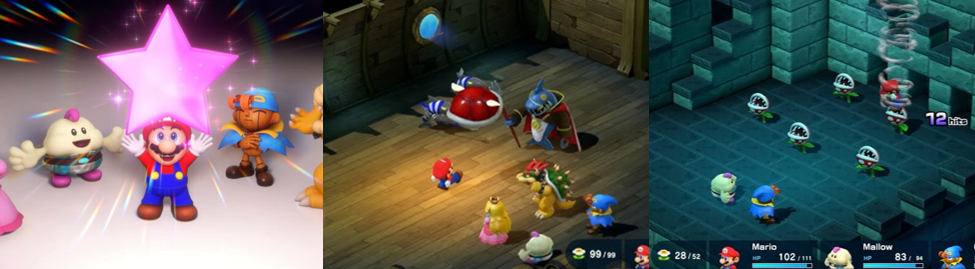
Game Corner [Mario Month]: Super Mario World (Nintendo Switch)


So, for no better reason than “Mar.10” resembling Mario’s name, March 10th is widely regarded as being “Mario Day”, a day to celebrate Nintendo’s portly plumber, an overalls-wearing mascot who literally changed the videogame industry forever and shaped the home console market of the nineties.


Released: 3 September 2020
Originally Released: 21 September 1990
Developer: Nintendo
Original Developer: Nintendo EAD
Also Available For: Game Boy Advance, Nintendo 3DS, Nintendo Wii, Nintendo Wii U, Super Nintendo Entertainment System (SNES) Classic Edition, SNES

The Background:
After the videogame industry crumbled under the weight of overpriced consoles and mediocre titles, Nintendo basically saved the industry with the runaway success of Super Mario Bros. (Nintendo EAD, 1985). Despite its bizarre development, Super Mario Bros. 2 (Nintendo R&D4, 1986) was also a highly praised best-seller, and Mario’s star only rose thanks to the unique marketing strategy behind Super Mario Bros. 3 (ibid, 1988) and that game also being a critical and commercial hit. In 1990, Nintendo were preparing to launch the 16-bit powerhouse that was the SNES and getting back into the thick of the “Console Wars”. Although the developers had to adapt to the new hardware, producer and Mario creator Shigeru Miyamoto was excited by the prospect of imaging new ideas, such as finally implementing a dinosaur companion for Mario. The goal was to refine Mario’s mechanics, impress gamers and critics with the SNES’s graphical capabilities, and deliver a fun, but challenging, gameplay experience to help sell their new console. Super Mario World exceeded in this goal; the award-winning game became the best-selling title for the SNES and has been inundated with widespread critical acclaim ever since its release. The game was adapted into cartoons and comics, resulted in an equally successful spin-off series for Yoshi, in addition to being ported and remastered to new consoles over the years. Its legacy is so strong that it was naturally included as a launch title for the Nintendo Switch Online service in 2020, which is the version I’m reviewing here.

The Plot:
When Mario, Luigi, and Princess “Peach” Toadstool visit Dinosaur Land, the princess is kidnapped by Bowser, King of the Koopas. Alongside their new dinosaur friend, Yoshi, the Super Mario Bros. must liberate the island from Bowser’s Koopaling progeny and confront Bowser in his castle to rescue the princess.

Gameplay:
Like its predecessors, Super Mario World is a 2D, sidescrolling platformer in which players play as ether Mario or Luigi and journey across seven levels (referred to as “Worlds”) and two bonus Worlds, hopping on Bowser’s minions, collecting power-ups, and grabbing Coins for points and extra lives, all while racing against a timer. As is also tradition, the game features two play modes; one where you go solo and one where you switch between the brothers after each level to allow two players to go head-to-head, taking different routes on the large, varied, interconnected overworld and lending extra lives if required. Unlike in previous 2D Super Mario games, you can’t change the control scheme here, so you’ll be pressing B to jump (ranging from a little hop to a higher jump the longer you press the button) and swim, A to perform the new spin jump (which allows you to defeat certain armoured enemies and break blocks beneath your feet) and holding X or Y to run. You can get quite a bit of speed this time, too, which allows you to glide and fly across levels when you’re powered up by the Cape Feather or run up walls in certain situations. You can also hold X or Y to grab items like Koopa shells, blocks, and keys; these can now be thrown upwards, increasing your range of attack options and opening up new areas to explore. Finally, you can look up, scroll the screen with the left and right triggers, and duck; if you run and duck, you can slip through small gaps and reach bonus areas and secret exits.

Traverse a colourful new land using Mario’s new companion and power-up!

Interestingly, I didn’t notice any difference between Mario and Luigi; Luigi doesn’t jump higher or have less traction, meaning the differences between the two are a simple palette swap, which is odd considering they played differently in Super Mario Bros. 2. The brothers are joined by a new companion in this game, Yoshi. If you hit enough blocks, you’ll eventually spawn in a Yoshi egg, from which this helpful little dinosaur will hatch. Players can ride Yoshi and press X or Y to extend his sticky tongue and eat fruit or enemies, the latter of which can either be swallowed, spat out as Koopa shells, allow Yoshi to breathe fire, and add a “flutter” motion to his jump. Yoshi allows players to do everything they normally can but with the added bonus of acting as a permanent shield; when hit while riding Yoshi, you won’t power down and can simply hop back on him to continue onwards, but you can’t use your Fire Flower abilities while riding him and Yoshi isn’t able to climb vines and won’t accompany you into fortresses or castles. Yoshi can also gain the ability to fly, easily allowing you to cheese through levels, and you can sacrifice him for a boost jump if you’re feeling sadistic. Some levels also include different coloured Mini-Yoshis; carry these until they eat five pieces of fruit or enemies or a single power-up and they grow into an adult Yoshi, and other levels see you riding atop bulbous Monty Moles to safely cross spiked hazards. Mario and Luigi can also use springs to get around, often needing to pick up and toss them to clear higher obstacles, and these are much easier to control than in Super Mario Bros.: The Lost Levels (Nintendo R&D4, 1986); swimming and autoscrolling levels also return, but again I had no issues in dealing with these as the game’s mechanics were so refined. Another new addition is the “Item Stock” in the heads-up display (HUD); if you’re already powered up, new power-ups you acquire are stored in this box and will automatically drop down when you take a hit (or press ‘Select’), which can be a life saver, though you can’t stockpile power-ups on the overworld anymore. Another new feature is the addition of checkpoints mid-way through levels, which I find interesting as these levels felt shorter and far less frustrating than Super Mario Bros. 3’s; hitting this while in your base form will also automatically power you up, too.

The game’s challenge is very fair, offering fun visuals and incentives to keep playing.

Super Mario World gives you three save files to play with and the chance to manually save at certain points, such as after toppling a Koopaling or visiting a Switch Palace. Every level has a secret exit, sometimes accessed via a key or by taking a different route; this allows access to new areas on the overworld and to secret levels and Switch Palaces, where you activate giant-coloured switches to make their corresponding-coloured blocks solid and thus protect you from hazards in levels. This opens the game up to some replay value as you explore each level looking for secrets and new paths, and you’re given some hints towards this through the Message Blocks that convey story text and helpful tips. As ever, you can hop into pipes to find shortcuts, bonus areas, and explore caves and flooded sections; you can take vines up to the clouds, ride platforms, hop off Koopa Paratroopers, and make use of temporary blocks and platforms. Many Worlds contain Ghost Houses that are filled with shy Boos and feature a maze-like element; you’ll need to find the correct door, often by generating temporary platforms or paths using a Switch Block, all while avoiding the ghostly enemies and bottomless pits within. Other levels are autoscrollers that force you to make split-second decisions with your jumps; castles and fortresses are filled with lava, narrow hallways, rotating spiked maces, and crushing Thwomps, often all at once and in close-quarters situations to test your mettle. You’ll need to awkwardly create paths using Control Coins, activate spotlights in Bowser’s Castle, and deal with pipes that now go up and down and blast you through the sky. The background can also move vertically, requiring you to quickly take refuge in safe areas, and you’ll even be climbing on fences, bashing enemies and flipping around to the other side to avoid dangers. Massive, spiked columns crushing trunks, suffocating tar, painful spikes, and bottomless pits increase in their abundance, but Super Mario World is quite generous with its lives; you can find hidden areas where you play mini games to earn a whole bunch of extra lives, in addition to 1-Up Mushrooms popping out from blocks, the background, and being awarded for collecting Coins and defeating enemies.

Graphics and Sound:
I was a SEGA kid growing up, so my exposure to the SNES came mainly from a friend who owned the console and a few games. Because of this, I’ve long been fascinated by the “other side” and, when I think of SNES, Super Mario World is one of the first games I think of because of its absolutely gorgeous presentation. This was a dramatic step up from Mario’s 8-bit adventures, featuring a colourful (and surprisingly unique) set of Worlds that really showcased the little things that made the SNES so impressive. Things like Mario’s cap flying back when he falls and bopping fruits on the trees to a touch of parallax scrolling, sprite zooming, and the ever-changing overworld mean Super Mario World remains the quintessential 2D Mario experience for me. Sure, there’s no difference between the brothers other than a palette swap but they’re much bigger and more detailed than ever before here; the addition of Yoshi also cannot be understated, especially as it wasn’t possible to include a character like this in Mario’s 8-bit adventures, and I loved how much quirky, cartoony humour was packed into the enemies, who swoop at you, are very expressive, and appear so much more versatile than simply wandering aimlessly around. Although Super Mario World recycles many of its music tracks for its various Worlds, this is the game I think of when I think of Mario music; every tune is so catchy and upbeat and stays in your head, and I relish hearing that end of level jingle and seeing Mario throw up the peace sign each time.

The game is deceptively big, colourful, and includes more story than ever before.

Super Mario World’s Worlds veer slightly away from elemental themes and more towards the fantastical; you’ll still be exploring thick forests, crossing bridges and bodies of water, venturing into caves, and hopping to mushroom-themed platforms, but there’s a fitting prehistoric bent to the majority of the game. Caves are filled with tar, glittering crystals, or frozen masses of ice; you’ll see hills and mountains in the backgrounds, cross plains filled with dinosaur-like enemies, and ride across lava on platforms made of skulls! Some Worlds are shorter than others, like the sky-themed Twin Bridges with its log platforms and track-based platforms guarded by saws, or contain unique overworld elements, like the Forest of Illusion, which requires you to explore to find the right exit and open up more of the map screen. Spooky levels like the Ghost Houses and the Sunken Ghost Ship impressed in their ambiance; there’s an ominous fog in the air, a creepy melody playing, and lightning flashing in the background, and I loved how the Sunken Ghost Ship was a wrecked recreation of the various Airships from Super Mario Bros. 3. The overworld changes as you find new exits, creating shortcuts and even changing seasons as you find more exits; this also allows you to take a shorter, far easier path to the final fight in the Valley of Bowser and avoid the pain of navigating the doorways and challenge of the longer path. Story is emphasised much more here, with text and fun little cutscenes pushing you onward after clearing each castle but, while Luigi’s sprite features in the cutscenes, the story text doesn’t change to reference him, which is a bit of a shame.

Enemies and Bosses:
Many of Mario’s common enemies make a return here, including Goombas, various Koopa Troopers, Boos, the always-annoying Lakitu, and Bullet Bills, but these also come in new variants, meaning you’ll see rings of Boos, Boos disguised as blocks, and Boos that aren’t as shy as their peers and attack from the shadows, Super Koopas that dive from above, and many of them fill the screen either as expected or floating along in bubbles. Super Mario World sees the debut of enemies such as Magikoopas (who teleport in to fire a magical blast and are immune to our regular jump), Wigglers (who get very mad when you hop on them), the screen-filling Banzai Bills and Big Boos, alongside large, weird green bubbles, a lava dinosaur, and other dinosaur-themed enemies who wander about, breathe fire, or take a couple of hits to defeat. By far the most aggravating new addition is Chargin’ Chuck, a turtle protected by American football gear who can charge at you (destroying any blocks in their way), duplicate themselves, toss various projectiles (from footballs to rocks), summon other enemies, and prove highly resistant to your attacks thanks to their padding. You’ll also have to watch out for the Amazing Flyin’ Hammer Brother, who swoops overhead tossing an endless supply of hammers at you, and Sumo Brothers, who spawn flaming pillars with their jumping stomp.

Although enjoyable and cartoonish, the boss battles are a little too repetitive and easy.

In the game’s fortresses, you’ll battle four Reznors, fire-spitting Triceratopses on small, rotating platforms stationed over a bridge that slowly disintegrates over a pool of lava. The only way to attack the Reznor’s is from beneath, which is pretty simple despite their many fireball projectiles. In the Donut Secret House, you’ll battle a Big Boo, one that doesn’t freeze when you face it and instead fades in and out; while Big Boo can’t hurt you, his regular Boo minions can, and you’ll need to grab the blocks conveniently placed underfoot to defeat him. Like in Super Mario Bros. 3, you’ll have to defeat Bowser’s children, the Koopalings; but, while they differ in their abilities since they no longer have magic wands, they’re no less disappointing since all but one of them recycle three specific attack patterns. Iggy and Larry Koopa are fought on a tipping platform in a lava pool where you must avoid their shell attack and fireballs and bop on them to force them into the lava, Morton and Roy run up the arena walls and try to drop on you from above, and Lemmy and Wendy O Koopa fire bouncing projectiles and decoys, but you can easily avoid these and hop on them when they pop out from the pipes. The only Koopaling with his unique attack strategy is Ludwig von Koopa, who spins about in his shell and spits fireballs, but none of the Koopalings present much of a challenge and they’re actually easier to beat than before! When you finally reach the Valley of Bowser, you’ll battle the Koopa King on the castle roof; while a unique battle since you can only damage Bowser by timing throws of his Mechakoopas, it also doesn’t present much of a challenge. Bowser hides in his Koopa Clown Car, floating out of reach and tossing Mechakoopas in the first phase; in the second, he tries to crush you with a massive ball, and the third sees him bounce around in desperation. Between each phase, fireballs will rain from the sky and Peach will toss you a Super Mushroom, making this battle even easier, and I was a bit disappointed that it didn’t require you to do anything other than toss stuff upwards so it hits Bowser’s head.

Power-Ups and Bonuses:
All of Mario’s signature power-ups return here, including the Super Mushroom, 1-Up Mushroom, the always-useful Fire Flower, and the invincibility-granting Super Star. Mario can again commandeer Lakitu’s cloud to briefly fly over levels, collect Coins for points and extra lives, and can even find rare Moon items that grant three extra lives. In addition to Yoshi, Super Mario World’s new power-up is the Cape Feather, which adds a cape to your sprite to swipe away enemies, slow your descent, and rocket you into the sky with a fun (if, at times, clunky) gliding/flying mechanic that can reach new areas and exits, cheese entire sections, and see you crashing into the ground for a massive area attack. You can also grab a Power Balloon to temporarily become inflated and cross gaps, collect five Yoshi-branded Dragon Coins in each level for a 1-Up, and grab random power-ups from Roulette Blocks.

Additional Features:
There are ninety-six exits to find in Super Mario World, with the total amount you’ve found being tracked on your save file; there are also four Switch Palaces to find, up to three secret areas for most levels, and a whole bunch of Dragon Coins to collect if you feel like giving yourself an extra challenge. Finding secret exits is the only way to warp to Star World, which not only offers additional platforming challenges but also acts as a fast travel point across the overworld. Clearing Star World unlocks the game’s greatest challenge, Special Zone, which boasts eight demanding levels that owe their difficulty to Super Mario Bros.: The Lost Levels. Although there are no additional or remixed bosses to fight here, you’ll need all your patience and platforming skill to get past their gaps and wild enemy placements. Clearing this World permanently changes the overworld to an autumnal theme and changes some of the enemy sprites to have comical Mario faces, and you can skip right to this state (and access all hidden levels) by selecting the “SP Version” of the game from the Nintendo Switch Online menu. Naturally, this version of the game includes helpful save states and rewind functions; you’ll also find additional cutscenes and gameplay changes (particularly to Luigi), and various unlockables and enhancements in the Game Boy Advance version.

The Summary:
I’ve played Super Mario World before, on original hardware, emulation, and the SNES Mini and I have beaten it in the past, but never in a proper, sit-down, focused playthrough like this. After struggling with 2D Mario, and being aggravated by Super Mario Bros. 3, I was worried that I was in for more of the same here, but it was pleasantly surprised by how much I enjoyed this gameplay experience. Mario and Luigi are so much better to control here now that they’re not slipping and sliding all over the place; the levels are fun, colourful platforming challenges with perfectly fair hazards and completion requirements; and the overall presentation is the best that 2D Mario has ever been, even accounting for the various 16-bit remakes. Although the game felt a little shorter and lacking in some features, it’s got some fun secret paths and invites exploration, as well as back-loading the adventure with some pretty challenging bonus levels. I really enjoyed how it carried over certain Mario tropes (the stone-and-lava castles, the whimsical nature, the underground and water sections, etc) without falling into the cliché of having elemental-themed Worlds. The dinosaur theme was fun and one I’d like to see revisited in a future game; Yoshi made for a fantastic new mechanic and companion, more than making up for the otherwise disappointing power-ups. While I was again let down by the bosses, I can’t fault Super Mario World; it just is SNES-era gaming to me and its many positives, particularly in the visuals, the soundtrack, the controls, and the level of challenge it offers, more than outweigh any concerns so I’m very happy to have finally given it the time and attention it deserves.

My Rating:

Rating: 5 out of 5.

Fantastic

Was Super Mario World in your SNES library back in the day? How do you feel it compares other Mario titles, specifically the 2D adventures? What did you think to Yoshi and the new cape power-up? Did you ever discover all the secret exits and beat the secret Worlds? Were you also disappointed by the boss battles? Would you like to see a return to Dinosaur Island? How are you celebrating Mario’s birthday this year? Whatever your thoughts on Super Mario World, feel free to share them below or drop a comment on my social media and be sure to check out my other Mario content!

Game Corner [Mario Month]: Super Mario Advance 4: Super Mario Bros. 3 (Game Boy Advance)


So, for no better reason than “Mar.10” resembling Mario’s name, March 10th is widely regarded as being “Mario Day”, a day to celebrate Nintendo’s portly plumber, an overalls-wearing mascot who literally changed the videogame industry forever and shaped the home console market of the nineties.


Released: 11 July 2003
Originally Released: 23 October 1988
Developer: Nintendo R&D2
Original Developer: Nintendo R&D4
Also Available For: Nintendo Entertainment System (NES), Nintendo Switch Online, Nintendo Wii, Nintendo Wii U, Playchoice-10, Super Nintendo Entertainment System (SNES) Classic Edition, SNES

The Background:
Following the infamous videogame crash after an influx of numerous overpriced consoles and mediocre titles, Nintendo were propelled to the forefront of the dying market by the unprecedented success of Super Mario Bros. (Nintendo EAD, 1985). Surprisingly, considering the game’s success and popularity, development of its sequel became one of the most bizarre stories in all of gaming. Since the difficulty of Super Mario Bros. 2 (Nintendo R&D4, 1986) caused concern for Nintendo of America, whimsical Mario clone Yume Kōjō: Doki Doki Panic was retooled into an official Super Mario Bros. sequel and, despite its vast differences, became a highly praised best-seller. After briefly toying with employing an isometric perspective for the third game, developer Shigeru Miyamoto sought to both return to Mario’s roots and vastly expand upon his world and repertoire through new power-ups and a gaggle of new mini bosses based both on his staff and famous classical musicians. A shortage of ROM chips saw the release of Super Mario Bros. 3 significantly delayed; however, Nintendo used this time to employ a unique marketing strategy by licensing their products to be included in the kids adventure film The Wizard (Holland, 1989), with Super Mario Bros. 3 featured as a centrepiece. This resulted not only in many watching The Wizard just to get a glimpse of Mario’s latest adventure but also in the game becoming a best-seller for the NES and being universally praised upon release. Super Mario Bros. 3 was so influential and celebrated that it formed the basis of a new Super Mario Bros. cartoon and the game has received several ports, including a 16-bit remaster for the SNES as part of Super Mario All-Stars (Nintendo EAD, 1993). This version of the game served as the basis for the later Game Boy Advance port, which was the fourth in the Super Mario Advance series of re-releases for the popular handheld. Featuring updated graphics and vocal performances from Mario voice actor Charles Martinet, Super Mario Advance 4 was also compatible with the short-lived e-Reader add-on (unless you lived in Europe) and the game was met with equally positive reviews that lauded the recreation of Mario’s classic gameplay and the expansion of his world and abilities, despite the smaller screen resolution and lack of additional content.

The Plot:
When the Koopalings, the children of the Koopa King Bowser, conquer each of the seven kingdoms of the Mushroom World by stealing magical wands from their kings, it’s up to the Super Mario Bros. to travel to each kingdom, retrieve the stolen wands, and confront Bowser his own realm, the Dark Land.

Gameplay:
As is generally the case for a classic 2D Super Mario videogame, Super Mario Bros. 3 is a 2D, sidescrolling action/platformer in which players must make their way through eight Worlds, each containing up ten Levels, running, jumping, and hopping from blocks and fantastical enemies to reach an end goal, this time in the form of a square that, when hit, will award an item card (collecting three of the same will award an extra life). This version of the game offers three save files and you can pick two ways to play, either as Mario alone or as Mario and Luigi, with you swapping between characters after losing a life or from the overworld map, and even being able to lend extra lives to the other player if they’ve run out. The controls are as simple as you could want from this type of game: A is for jumping and B is for running. However, holding A will see you jump higher and further, holding B for an extended time sees you build up the P Meter and break out into a sprint to cover greater distances (or even fly with certain power-ups), and you can also pick up blocks and certain enemies with B, similar to Super Mario Bros. 2, which can be tossed at other enemies or used to blow up or break through blocked walls. Pressing down will not only see you crouch to avoid projectiles but also allows you to slide down slopes to take out enemies or fit through small gaps when running, though I found it’s usually easier to use the character’s smaller base form to accomplish this. While both Mario and Luigi have the same capabilities, there are differences; Luigi is taller and has a little flutter jump to make him a superior jumper, but he’s also much slipperier to control and that’s really saying a lot considering how poor Mario’s traction is in this game!

Mario is back, bigger than ever and with a whole host of new abilities at his disposal!

Although it’s a shame to go from playing as four characters to just two, Super Mario Bros. 3 makes up for this by being absolutely massive! Each World has its own distinctive overworld, with different layouts, animations, and music accompanying them; you move across the map to access each Level or a Toad House to play a mini game, but you can also use pipes to warp around to different areas, access shortcuts, and take on optional battles against the likes of the Hammer Bros. for additional power-ups. While you’re not free to go wherever you like, there are options to skip Levels using these power-ups and other shortcuts, though you won’t get a “Perfect Clear” if you don’t conquer each Level and Fortress contained in each World. Levels are presented as short obstacle courses that gradually test your patience, platforming skills, and deductive reasoning; things start out simple enough, with you jumping to blocks, over gaps, and warping about using pipes against a variable time limit, knocking off enemies to increase your score and earn extra lives, but things quickly become very tricky once the hazards and requirements start to ramp up. Falling or temporary platforms, moving platforms, and projectile spitting enemies are commonplace here, as are respawning enemies, nigh-invincible enemies (unless you have a block or power-up handy), and you’ll often find yourself either trapped in a tight corner or sent plummeting to your death thanks to various hidden blocks popping up at the worst possible times! Sometimes, you’ll hit a block and a power-up will pop out; mostly, you’ll get Coins, but other times a climbable vine will lead to a secret power-up room, a P-Switch to grab some Coins, or the Level’s exit. Other times, you need to hop to erratic moving platforms, bounce off flying enemies for an extra boost, toss Bob-ombs to break through walls, or even grab a series of Starmen to make yourself invincible and bypass spikes, snapping piranhas, and flame bursts. Each World ends with you battling across the Koopaling’s Airships, dodging Bullet Bills, cannonballs, hopping across bolts, and avoiding jet flames as the screen bounces and tilts about. In World 8, you’ll also have to hop across tanks in a horizontal scroller, dodging many of the same obstacles, which naturally represent some of the hardest and most aggravating challenges in the game.

You’ll need all the help you can get to beat the rising difficulty and tricky platforming challenges!

While many of the game’s hazards and enemies will inevitably repeat, they are often used in creative and more difficult ways later in the game, from simple stuff like mixing different enemies into the Levels to more annoying inclusions, like constantly respawning enemies or platforms coming to life beneath your feet, or having to bounce perfectly off music note blocks and run across falling platforms. You’ll sometimes have to swim underwater, tapping A or making use of the Mario’s new Frog Suit power-up to more efficiently bypass Cheep-Cheeps and Bloopers; other times, the Levels autoscroll horizontally, vertically, and diagonally, putting your reaction times and platform skills to the test. There are also a number of looping mazes, often involving pipes or the lava-infested Fortresses, with some having exits so obscure that you’ll have no choice but to consult a guide (World 6-5, for example, traps you in an endless loop and forces you to awkwardly fly up a specific part of the stage using the Raccoon Suit while holding a Koopa shell to break through some blocks and reach the exit, none of which is very intuitive). As if the small platforms, singular blocks, and broken bridges aren’t bad enough, you’ll also have to contend with projectiles, blocks coming to life, timid ghosts who chase you when your back is turned, bottomless pits, instant-death lava, temporary moving platforms that you must jump on to change their direction to progress upwards, suffocating quicksand, leaps of faith, and treacherous platforming nightmares up in the clouds. Thankfully, you have infinite continues; when you lose all your lives, you can continue on with a fresh stock, though your score resets to zero. You’re prompted to save your game after clearing every Fortress and Airship, though you can manually create a temporary save at any time from the pause menu if you need to take a break. Gameplay is mixed at the Toad Houses, where you play various mini games for power-ups and extra lives; these reset after you lose all your lives and continue your game but can be really tricky. One sees you having to stop sliding tiles at just the right time, which I found all-but impossible; one sees you turning over cards to find doubles; the other has you picking from three chests; or you can fight a couple of Hammer Bros. to earn a chest containing a random power-up.

Graphics and Sound:  
This version of Super Mario Bros. 3 may very well be the best, visually speaking; while some changes were inevitably made to accommodate for the Game Boy Advance’s hardware and software specifications, the presentation is absolutely top-notch. The game pops with vibrant colours at all times, with some fun visuals in the backgrounds (such as big green hills, pyramids, clouds, and Bowser portraits), and a lot of visual variety even when some Levels recycle assets from others (the Fortresses, Airships, and most underwater Levels are the most obvious examples). Palm trees, icy platforms and slippery, snowy landscapes, unstable or incomplete bridges over water filled with ravenous fish or bubbling lava, and block- or cloud-based environments are commonplace, as you’d expect, but you can also venture underground into dank caves, crystalline mines, and sewage systems filled with a network of pipes and a wraparound screen feature similar to the original Mario Bros. (Nintendo R&D1, 1983). World 4 was one of my favourites as everything is gigantic here, including the pipes and enemies, turning even regular Koopas into monstrous foes, but I quite enjoyed the jaunts into the desert areas, even with that maniacal sun chasing after me! World 6 was one of my least favourites as everything’s covered in snow and ice, making a slippery game a hundred times more difficult to play, and the pipe mazes of World 7 also caused quite a headache. Things get suitably ominous in World 8, a lava-filled hellscape full of tanks, submarines, and airships; even the overworld is affected, restricting your vision until you clear certain Levels, and dropping you into darkened deserts and deep jungles filled with tricky platforming sections.

The game is whimsical and colourful, with some fun tunes and great visual variety.

One added benefit to being on the Game Boy Advance is the inclusion of voice samples; Mario and Luigi will shout with joy and wail in pain whenever they snag a power-up or lose a life, respectively, and the game is bolstered by some of the catchiest tunes in the entire franchise. While many of these are recycled across the game’s many Worlds, they never fail to be infectious and keep things whimsical, even when you’re tearing your hair out because you somehow slipped off a platform or weren’t quite pixel-perfect enough to make a jump. A couple of cutscenes also help punctuate the action; dialogue boxes have the Toads pleading for help when you reach each World’s castle and see the state of their king (there’s even a Yoshi cameo at one point); you’ll see the brothers hop onto the Airships and fall from the sky in triumph after securing each magic wand, and Princess Peach (and, later, Bowser) leaves letters for you containing words of encouragement and rare power-ups (or, in Bowser’s case, a final challenge). If you manage to get to the secret warp zone, you can skip ahead to different Worlds, which alters the order you play the game and also results in different cutscenes playing (such as seeing the Koopalings invade a castle beforehand) if you, for example, skip right to the final confrontation before besting the other Worlds. World 3 also has you control a little raft to get to different Levels and Toad Houses, World 2 contains pyramids for you to scale and conquer, and World 8 is littered with tanks and dangerous optional squares that pit you against some of the game’s toughest foes while hopping across a lava pit using precarious platforms! Although neither character has any idle animations, they can transform into a variety of super fun different forms with their different power-ups and everything runs very smoothly. This version of the game even includes a brand new opening cutscene, styled like a pantomime, in which Peach begs for help after the Koopalings attack, and you’ll even spot her screaming for help when battling your way through World 8.

Enemies and Bosses:
Unlike Super Mario Bros. 2, which featured entirely new and fantastical enemies, Super Mario Bros. 3 features the return of many of Bowser’s most recognisable minions: Goombas, Koopa Troopas, Bloopers, Bullet Bills, Cheep-Cheeps, Spinys, Piranha Plants, and the ever-annoying Lakitus are constant hazards across each of the game’s eight Worlds. Spinys will drop from the ceiling and dash at you, Koopas will re-emerge from their shells if you hold them too long, and both them and the Goombas can be seen fluttering around with wings this time. The Hammer Bros. also return, usually guarding the end of Level goal or as mini boss challenges on the overworld; boomerang and fire-flinging variants also crop up, as do larger Sledge Bros., who can stun you with a ground slam. The only enemy to return from Super Mario Bros. 2 is the Bob-ombs, who will be endlessly spat out of cannons or spawn into areas where you need to use them to break certain blocks, and Super Mario Bros. 3 sees the debut of Mario staples such as the Thwomps (massive, angry blocks that try to crush you), Boos (shy ghosts who freeze when you’re facing them), Big Bertha (a massive Cheep-Cheep who’ll swallow you whole if you get too close), Chain Chomps (ravenous Pac-Man-like mouths attached to chains), and Dry Bones (skeletal Koopas that reassemble after being jumped on). You’ll also have to try and dodge the annoying wrenches tossed by the endlessly respawning Rocky Wrenches on the Airship Levels, be aware of spikes and blocks tossed by smaller enemies, hop across gaps on giant cannonballs, quickly jump over laser-spitting Bowser Statues, and run for your life when the Angry Sun swoops out of the sky!

Considering how tough it is to get to them, it’s a shame there’s not more variety to the Boom Boom fights.

While you can challenge the Hammer Bros. and their variants by landing on them on the overworld, it is possible to skip these confrontations; when you battle them, it’s highly advisable that you have the Fire Flower power-up, which makes short work of their constant stream of projectiles, and defeating them can net you a nifty rare power-up and make traversing the overworld a little easier. These mini bosses might be optional, but if you’re going for 100% completion then you’ll definitely have to battle one at the end of World 8-Tanks and you’ll need to go head-to-head with Bowser’s primary henchman, Boom Boom, on numerous occasions. Boom Boom awaits at the end of every Fortress in the game and acts as a mini boss throughout World 8; generally, getting to him is tougher than the battle itself as Boom Boom waits at the end of lava-, fireball-, Thwomp-, and hazard-filled obstacle courses that can really test your endurance. Boom Boom himself is fought in an enclosed arena, sometimes with mid-air blocks that act as obstacles, sometimes with an icy floor to send you sliding right into him, and sometimes he takes to the sky with wings and dive bombs you. In each fight, the strategy is the same: Boom Boom will wander back and forth, occasionally leaping at you with his spiked shell or diving at you from the sky, and you must hop on his head three times (or blast him three times with a power-up) to be victorious. If you’re playing the Nintendo Switch version, or the Japanese version of this game with the e-Reaper feature, you’ll also battle two Boom Booms at once on the World-e map, but I have to say that fighting this guy over and over, sometimes up to four times for each World, quickly grew as tedious as the multiple encounters with Birdo in Super Mario Bros. 2 and it’s a real shame that more variety wasn’t included here (like giving Boom Boom different power-ups or having more hazards in the arena).

There’s not much to the game’s boss battles, with even Bowser being pretty simple to best at the end.

Sadly, this disappointment also extends to the Koopaling you encounter at the conclusion of each Airship. Each Koopaling wields a magic wand that fires a projectile into the cramped arena and jumps around, often retreating into their spiked shell to protect themselves, and can be defeated in three hits. While Wendy O. Koopa and Iggy Koopa can jump a little higher than others, which can mess up your attack strategy, Roy and Ludwig von Koopa can stun you by creating earthquakes, which leaves you vulnerable to their slow magic projectiles. Wendy and Lemmy Koopa are probably the most unique and memorable of the seven as Wendy fills the screen with candy rings that bounce all over the place and Lemmy rolls about on a magical ball firing smaller balls that can hurt you or be used as platforms to avoid his erratic rolling and bop him on the head. Again, though, while each of the Koopalings looks different and has slightly different attack patterns, they’re all basically the same; if you can reach them with a Fire Flower or Hammer Suit then you’re laughing, but the hardest thing about most of them is that you have the suffer through the entire Airship course all over again if you die fighting them. Their father, Bowser, appears only as the final boss of the game; after enduring some of the game’s hardest Levels, defeating more Boom Booms and dodging a whole host of enemies and hazards, you’ll reach Bowser’s Castle, a maze-like shrine to the Koopa King with branching and looping paths and lava pits. Bowser himself spits fireballs at you that you must duck or jump over and will leap into the air to crush you with a butt stomp; simply dash underneath him and cause him to destroy some of the blocks. Do this three times in the same area (or manage to blast him with enough projectiles) and he’ll plummet to his doom, leaving you to free Princess Peach and restore the peace to the land. You’ll also battle him twice more in World-e, with one battle being functionally the same and the second being made harder by the presence of unbreakable blocks included on the floor.

Power-Ups and Bonuses:
After being disappointed by the lack of power-ups in Super Mario Bros. 3, I’m happy to say the Super Mario Bros. 3 goes above and beyond with its power-ups! Staples such as the 1-Up Mushroom, Super Mushroom, and Fire Flower return, granting an extra life, an extra hit, and the ability to throw fireballs, respectively, alongside Coins that grant extra lives when 100 are collected and the Starman, which grants brief invincibility. Super Mario Bros. 3 also debuts some brand new power-ups that have since become franchise staples, such as the warp whistle and cloud that will teleport you across the overworld, Blue Coins (though they have no additional value), hammers to break overworld blocks, and a music box to send enemies to sleep in this same area. Mario and Luigi also have some new forms here, such as the Frog Suit (which allows greater movement when underwater at the cost of impeding land movement), the Hammer Suit (which lets you toss a bunch of hammers and protect yourself from projectiles and the cost of sliding down hills), and by far my favourite Mario power-ups: the Super Leaf and Tanooki Suit. These grant you cute little raccoon ears and a tail (or a full raccoon suit, respectively) that lets you attack with a tail swipe, flutter jump by tapping A, and fly through the sky after building up enough speed. Pressing down and B while wearing the Tanooki Suit also transforms you into a statue to avoid damage from enemies and projectiles, and you can fly indefinitely when awarded with a P-Wing, easily allowing you to soar over the game’s more troublesome sections. There’s also an additional, somewhat secret power-up in the game; if you defeat a the shoe-wearing Goombas in World 5-3 in just the right way, you can hop into the shoe and safely pass over spikes and defeat spiked enemies, all while retaining any other power-ups you already have.

Additional Features:
There are eight Worlds to explore in Super Mario Bros. 3, but that doesn’t mean you have to conquer every Level or Fortress found in each. The warp whistle and Lakitu’s Cloud items will let you skip entire Worlds and Levels if you wish, though you won’t be greeted with a “perfect” completion screen and the score on the save file menu won’t be at its maximum until you beat every Level in the game. There are numerous extra lands and shortcuts to find on the overworld that lead to Toad Houses where you can play mini games for extra power-ups, but some just lead to dead ends unless you beat Levels to unlock the gates or use a hammer item to smash the rock blocking your path. The NES and SNES versions of the game see players compete head-to-head to see who will challenge a Level, but this is entirely absent from this game as a traditional two-player mode is omitted. As mentioned, there is a whole extra World to explore included here, one that includes power-us, collectibles, and features from previous and subsequent Super Mario games, but it’s locked out from the European version of the game so the only way you can play World-e is to either import the game, cards, and e-reader or just play the re-release on Nintendo Switch Online. However, this version does still include a 16-bit remake of Mario Bros. that you can select from the main menu. This version of the game can be played with others and features all-new backgrounds, assets, and music; new POW Blocks, the Super Mario Bros. 2 power squat jump, and quality of life features have also been included, but there are no mirror mode, harder difficulty, or other unlockables included in this version of Super Mario Bros. 3.

The Summary:
I knew what I was getting into when I chose to play this version of Super Mario Bros. 3; I didn’t actually have to play the Game Boy Advance version as I could’ve made things a lot easier on myself and played the Nintendo Switch Online or SNES Mini version but I decided that I wanted to experience the game on real hardware, especially as I just so happened to own the Game Boy Advance cart. In the end, I was conflicted: on one hand, this is a massively enjoyable platformer, with some of my favourite tunes and power-ups and containing a sprawling, surprisingly varied gameworld. Super Mario Bros. 3 definitely set a new standard for the franchise, which would pretty much always include an overworld, multiple power-ups, shortcuts, and battles against the Koopalings. Levels are short, action-packed obstacle courses that will really test your skills as a player; there are a lot of opportunities to snag new power-ups, different ways to tackle each Level depending on what you have in your inventory, and I the overall presentation is whimsical and fanciful. However, on the other hand, Super Mario Bros. 3 can be hard as balls sometimes! Now, granted, I’m not the most accomplished 2D Mario player; I often struggle with the precision platforming, abundance of death pits and instant-death traps, and Mario’s notorious lack of traction, but I was frequently left frustrated with Super Mario Bros. 3’s repetitive and uninspired bosses, almost unfair level of challenge, and the unintuitive methods required to beat certain Levels. For a game as big as this is, it’s really a shame that so much gets recycled; I don’t understand why every World ends with an Airship when assets for a Tank and Submarine-based variant exist in World 8 and could’ve mixed things up a bit. I don’t get why every Fortress has to include a fight against Boom Boom when we could’ve fought a Sledge Bro or Big Bertha or given him some different power-ups. And the final battle against Bowser was pretty underwhelming, to the point where I was expecting a second phase and genuinely surprised when the ending cutscene played. In the end, this is easily the best of the NES Mario games; it’s large and packed full of stuff to do, but is mired by a difficulty curve that is just a little too frustrating for me at times (though probably well within the skills of a more accomplished Mario gamer).

My Rating:

Rating: 3 out of 5.

Pretty Good

Did you enjoy Super Mario Bros. 3? Which version of the game is your favourite and which console did you first play it on? Were you disappointed that there weren’t more characters to play as or did you feel like the new power-ups made up for this? Did you also struggle with the traction and platforming challenges on offer here? Were you disappointed by the repetitive stage design and bosses or did the sheer size of the game balance this out? Which power-up or World was your favourite, and did you ever play through World-e? How are you celebrating Mario’s birthday this year? Whatever your thoughts on Super Mario Bros. 3, feel free to share them below or drop a comment on my social media and be sure to check out my other Mario content across the site!

Game Corner [Mario Month]: Super Mario Bros.: The Lost Levels (Nintendo Switch)


So, for no better reason than “Mar.10” resembling Mario’s name, March 10th is widely regarded as being “Mario Day”, a day to celebrate Nintendo’s portly plumber, an overalls-wearing mascot who literally changed the videogame industry forever and shaped the home console market of the nineties.


Released: 10 April 2019
Originally Released: 3 June 1986
Developer: Nintendo
Original Developer: Nintendo R&D4
Also Available For: Famicom Disk System, Game & Watch, Game Boy Advance, Game Boy Color, Nintendo 3DS, Nintendo Wii, Nintendo Wii U, Super Nintendo Entertainment System (SNES) Classic Edition, SNES

The Background:
After the videogame industry crumbled following an influx of overpriced consoles and mediocre titles, Nintendo effectively saved the industry with the blockbuster success of Super Mario Bros. (Nintendo EAD, 1985). However, despite that game’s success, the development of its sequel is one of the most bizarre stories in all of gaming; Super Mario Bros. 2 (Nintendo R&D4, 1986) released in Japan a year later and was basically a remixed version of the first game, one that was much harder and therefore ran the risk of alienating Western gamers. Thus, Nintendo of America thought it more prudent to reskin whimsical Mario clone Yume Kōjō: Doki Doki Panic into an official Super Mario Bros. videogame and were rewarded with a critically acclaimed best-seller. As for the original Super Mario Bros. 2, it also proved a best-seller in Japan, one that became notorious for its high level of difficulty and obscurity as the “black sheep” of the franchise. It would be some seven years before Western gamers got to officially experience the game when it was re-branded as The Lost Levels and given a 16-bit makeover for Super Mario All-Stars (Nintendo EAD, 1993). Since then, the game as been included in subsequent ports and re-releases (including the Nintendo Switch Online service, which I’m reviewing here), but has never lost the stigma as being one of the most difficult games of its era.

The Plot:
The Mushroom Kingdom has been invaded by Bowser, King of the Koopas, and his Koopa Troopa army. After Bowser transforms the citizens into inanimate objects and kidnaps Princess Toadstool, Mario and Luigi set out across the hazardous Mushroom Kingdom to rescue the princess from his clutches!

Gameplay:
If you’ve played the original Super Mario Bros. then you’ll know exactly what to expect from The Lost Levels. Players are given four save files, two control schemes, and two characters to pick from, Mario and Luigi. You can’t swap between the two after picking one and their basic controls are what you’d expect: I chose control scheme “Type B”, which mapped jump to the A and Y buttons and the dash function to B and X. You can hold down the dash button to run faster, which enables you to clear greater gaps and even jump higher, something that’s absolutely necessary in this game since large, bottomless, instant death gaps are plentiful and you’ll need to make precise jumps with very little room to manoeuvre to blocks that are just out of reach. As ever in 2D Super Mario games, traction can be an issue; it’s not uncommon for Mario to simply slip off platforms and blocks to his doom because of his momentum and this issue is exacerbated when playing as Luigi, who slips all about the place but can also jump higher and further and fall slower than his big brother. Your basic goal is also exactly the same as in Super Mario Bros.: race against a timer towards a flagpole at the end of each World and battle against one of Bowser’s fakes in a suitably ominous and hazardous castle before having a final showdown with the Koopa King.

A greater level of challenge awaits in this glorified expansion.

So far, everything’s very familiar but you’ll notice the enhanced difficulty and skill required from the moment you start World 1-1; obstacles and enemies are far more plentiful compared to the first game and you’ll be required to perform all manner of frustrating actions, such as perfectly timing running jumps across death pits, ducking to slide under narrow passages, and avoiding a myriad of hazards, including fire bars (including much longer variants and ones crammed into cramped corridors), leaping Cheep-Cheeps, and the game’s newest hazards on the block, the Poison Mushroom and upside-down pipes containing hungry Piranha Plants. Platforms and blocks are often hovering over death pits and bodies of water, with many either collapsing beneath you, being much smaller than you’d expect, or tricky to jump to. You can make use of springs to rocket out of frame and cross larger gaps, and a wind gimmick for the same effect, but it’s incredibly difficult to judge how to use and control these mechanics, especially with all the enemies onscreen. You’ll also have to make use of Koopa Paratroopers and Bullet Bills to gain an extra boost to higher or further areas, navigate coral reefs full of enemies (including fire bars), and make use of shortcuts using vines and pipes to pick up Coins for extra lives that you most definitely will require to succeed. By far the worst aspect of much of the game’s platforming is how precise you need to be; you often need to dash and jump across multiple blocks and platforms, sometimes from a complete standstill, to progress, or awkwardly drop down to lower platforms or pipes, which is incredibly frustrating as you’re just continuously falling to your death over and over. Not only that but invisible blocks will often box you in or drop you to your death and many of the castle stages loop around, requiring you to somehow intuit (or guess through trial and error, or just use a guide like I did) that correct path, all while desperately trying to not get hit or killed before reaching the boss.

It’s going to take all of your skill (and patience) to overcome this frustrating game.

You’ll often be riding small platforms across wider gaps, bopping on enemies or hopping over blocks to continue onwards, or making use of weighted platforms to gain a bit of extra height for a tricky jump. Some Worlds contain a long stretch of broken bridges, with Cheep-Cheeps flying in all over the place to hurt or indirectly aid you with an extra boost. You’ll need to run and jump beneath Piranha Plants, duck at the last second and in tight corners to avoid being hit by fire bars, and even encounter enemies and hazards in bizarre places (like Bloopers being outside of the water and Koopa Troopas being in the water!) If you found Super Mario Bros. too easy, then The Lost Levels is the game for you! Almost every World plays like some kind of nightmarish debug mode or test stage, with every hazard and enemy in Mario’s then-limited library dotted haphazardly around every screen to sap you back to your base form or steal another of your lives. Mario can only take one hit before reverting to his small form, whether he has a Fire Flower or not, and extra lives aren’t exactly plentiful; because of the Poison Mushroom’s threat, you’re better off relying on Coins for extra tries but I am honestly astounded that anyone was able to play through this game back in the day without the benefit of the Switch’s save states and rewind features. Since you can’t go back (unless you’re in a looping level), you’re often stuck with very little room to charge up a jump and the sheer amount of trial and error required to beat even the earlier stages is almost laughably frustrating. You’ll need to hop from spring to spring, barely being able to judge where you’ll land and often just bouncing pathetically or slipping to your doom, get smacked in the face by a Hammer Bro or a Bullet Bill if you run too far ahead, and the amount of times I got stuck, the timer racing down, trying to hop up to blocks just out of reach was endlessly annoying. You really need to flawless with your jumps and the way you bounce off enemies; underwater, things are generally a lot easier as you just have to swim past hazards but even then you have to be careful not to get sucked below the screen, meaning The Lost Levels offers a challenge beyond what I think even the most hardened NES players were used to back in the day.

Graphics and Sound:
Thanks to the 16-bit coat of paint offered by Super Mario All-Stars, The Lost levels looks fantastic; there’s a whimsical, fairytale-like quality to everything and Worlds are bolstered by traditional Super Mario overworld, underground, underwater, and castle themes. Although Mario and Luigi can’t look up, their sprites are big and chunky so you never lose track of them and they always stand out against the backgrounds, which is where much of the game’s appeal came from for me. Worlds have been remixed not just in their difficulty and enemy and hazard placement, but their visuals as well; grass sprouts from the ground, snow covers the landscape, many Worlds now take place at night beneath a blanket of blinking stars, and you’ll see smiley faces on hills and clouds scrolling past lazily as you frantically avoid enemies and obstacles. It’s everything you’d expect from this era of Super Mario; flag poles raise as you reach your goal (Mario even throws up a peace sign to celebrate), coral weeds ripple underwater, and you always know when time is about to run out or you’ve picked up a power-up.

While the 16-bit overhaul makes it very nice to look at, many gimmicks and assets are recycled.

The variety on offer in the game’s Worlds is, however, sadly lacking; you’ll see the same handful of environments repeated again and again, just with different configurations of enemies. This means a lot of those night skies and snow, vaguely mushroom-shaped hills, and waterfalls and rapids beneath random assortments of platforms but it does mean you’ll encounter tougher and more annoying enemies like the Hammer Bros. and Bullet Bills in places you might not expect. The best environments, at least visually, are the castles; you’ll see portraits of Bowser, staircases, and big wooden doors in the backgrounds, flashes of lightning through the windows, and be assaulted by lava and other fire hazards. Another great environment is when you head up into the clouds, which is very whimsical, or the few occasions when you spot Goomba columns and looming castles in the background. The game runs nice and smoothly, meaning many of my pratfalls were down to my lack of skill, but is completely devoid of any story. However, to compensate for this, you’ll spot different enemies revealing themselves as posing as Bowser and rescue a bunch of different Toads in each castle, with their animations and skylarkings helping to numb the pain you feel each time you realise the princess is in another castle and you have another gauntlet to endure. When you do finally rescue Princess Toadstool, you’re rewarded with a nice bit of sprite art of Mario getting a kiss and then challenged to continue on to even harder Worlds, where the placement of enemies, platforms, and hazards becomes even more ridiculous!

Enemies and Bosses:
Every enemy for Super Mario Bros. returns here, but in new and surprising configurations that can make even basic enemies like Goombas and Koopa Troopas more dangerous. For example, these guys might spawn in on stairs or walk on destructible blocks above you, meaning you can accidentally drop them down to your level, often boxing you in with them, and they can appear near firebars, Bullet Bills, or other hazards and tricky areas to trip you up and act as additional boosts for your jumps. You need to be especially careful with Koopa Troopas as they will right themselves when hit or their shells will come flying back at you, but this is useful for taking out bigger groups of them and other enemies. Way more enemies appear onscreen at any one time here than in Super Mario Bros., as evident in the Worlds where Cheep-Cheeps constantly leap out from water or the void, Koopa Paratroopas fly about, and Lakitu hovers overhead. Lakitu is at his dirt worst here, dropping Spineys and getting in the way of your jumps and springs and you can’t even steal his cloud for an advantage. Buzzy Beetles also cause a problem as they can’t be defeated with your regular jump, Worlds are often littered with Bullet Bills firing both high and low to constantly keep you guessing and on your toes (or to act as a makeshift bridge across gaps, if you’re feeling brave) and I rarely saw a pipe that wasn’t hiding a Pihana Plant!

All the Hammer Bros. and fake Bowsers around can’t stand up to your Fire Flower!

The most prominent enemies you’ll encounter, though, are the excess of Hammer Bros. that now populate many of the Worlds; sometimes there’s just one, sometimes two or three, but they’re always annoying as they hop up and down blocks and toss a whole mess of hammers at you. If you have a Fire Flower or a Super Star then they’re much easier to deal with but, without these, you’ll need to strategically run underneath them and bump the block they’re standing on, risk a hit to just get away, or time your runs or jumps to get past them, which can be tricky. Additionally, you’ll also face Bowser at the end of each castle; however, these are all fakes except for the final boss of Worlds 8-4 and D-4. As ever, there are two ways to defeat Bowser and his fakes: either run under him when he jumps or jump over him when you can to hit the axe and drop him to his doom or plug away with fireballs if you have a Fire Flower. Bowser’s strategies are very predictable and repetitive, but no less dangerous; you’ll see his fireballs long before you encounter him and these can be tricky to avoid when there’s a fire bar, low ceiling, or blocks restricting the arena. Eventually, Bowser will toss hammers at you like a Hammer Bro, making him even tougher without a Fire Flower, and you’ll have to battle his fakes as sub-bosses in Worlds 8-4 and D-4, which can also be quite the challenge without a Fire Flower. Bowser’s sprite is also quite large, and he tends to hop about and move back and forth, meaning you might take a hit trying to get past him, but you can easily do that to defeat him with no trouble at all in almost every encounter.

Power-Ups and Bonuses:
Sadly, there’s nothing new on offer here; you can pick up Coins scattered throughout every World and hidden in “bonus” areas and grabbing 100 will grant you an extra life. Occasionally, you’ll find 1-Up Mushrooms in blocks to also get an extra try, but make sure you’re not fooled by the damaging Poison Mushroom. You can also find Super Stars to make yourself temporarily invincible, which is great for barging through waves of enemies, but your most useful power-up to have on hand is the Fire Flower. This makes the Hammer Bros. and bosses a breeze and gives you a much needed edge, but be careful not to accidentally blast a Koopa Paratroopa you need to reach a higher area. I have to say, though, that it’s a bit of a shame that there wasn’t at least one new power-up to go alongside with the Poison Mushroom and add a little more variety to the aggravating gameplay.

Additional Features:
At first glance, The Lost Levels is as barebones as Super Mario Bros.; there’s no two-player option here, despite Luigi’s presence, and your main option for experiencing a different game is to switch to the green-clad plumber. However, many Worlds continue hidden paths to bonus areas containing Coins and acting as shortcuts, and there’s even a few Warp Zones you can use to skip ahead to later Worlds. Although I was sometimes able to break through the ceiling and bypass some underground levels, I never actually found any Warp Zones in my playthrough, meaning I was dumped into World 9 after rescuing Princess Toadstool and tasked with taking on an even tougher challenge. What follows are five new Worlds (World 9 and World A to D) that contain even more random, hazardous, and downright despicable enemy and obstacle placements. If you manage to best the main game, these will push you to breaking point as you need to spring-jump over bodies of water, cross small elevator platforms, and make even more insane jumps to reach the flagpole. More Hammer Bros. and fake Bowsers await you here as well to really pile on the challenge and I was surprised by how the game just kept going and going! However, I have to say again that the Switch’s rewind and save state feature is the only reason I pressed forward; the amount of times I had to rewind certain jumps and sections showed me that I wouldn’t have a chance without these features so I honestly have no idea how anyone played this or the NES original back in the day as it’s just excruciating difficult!

The Summary:
I was really anxious about playing Super Mario Bros.: The Lost Levels. Of all the 2D Super Mario games, it’s the one I’ve played the least and considering how much I struggle with the gameplay and mechanics of the original Super Mario Bros., I wasn’t exactly relishing tackling a much harder challenge. I can totally understand why The Lost Levels didn’t make it out of Japan as Super Mario Bros. 2; not only is it insanely difficult compared to the first game, there’s just not enough different about it. For me, the game would work much better if it were scaled down a little and incorporated into Super Mario Bros. as the second, harder game mode for experienced players. I can imagine a lot of gamers might’ve been disappointed to find that this version of Super Mario Bros. 2 was just the first game remixed, recycled, and ramped up to be ball-breakingly hard and I’m glad that it’s become more of a curio than a staple of the series. The Lost Levels is a treat to look at; I love the 16-bit overhaul and the little touches here and there, but again I think more could’ve been done to make it a stronger alternative to other 2D Mario games, such as an additional power-up, maybe a bit more variety in the bosses and Worlds other than just re-skins, or just allowing players to swap between Mario and Luigi between Worlds. Ultimately, your enjoyment of The Lost Levels depends entirely on how good you are at Super Mario Bros. but I’d wager even competent players will struggle to beat the game’s maddening levels and hazards. Because of this, I definitely recommend playing a version of the game such as this with the quality of life safety nets they offer, but can’t really recommend it beyond that unless you feel like having your skill as a Mario gamer put to the ultimate test.

My Rating:

Rating: 2 out of 5.

Could Be Better

Are you a fan of Super Mario Bros. The Lost Levels? Do you prefer it to the US version of Super Mario Bros. 2? What did you think to the difficulty and challenge on offer here? Were you disappointed by the lack of new power-ups? Did you manage to beat the game without rewind or save state features? How are you celebrating Mario’s birthday this year? Whatever your thoughts on Super Mario Bros. The Lost Levels, feel free to share them below or drop a comment on my social media and be sure to check out my other Mario content!

Game Corner [Mario Month]: Super Mario Bros. 2 (Nintendo Switch)


So, for no better reason than “Mar.10” resembling Mario’s name, March 10th is widely regarded as being “Mario Day”, a day to celebrate Nintendo’s portly plumber, an overalls-wearing mascot who literally changed the videogame industry forever and shaped the home console market of the nineties.


Released: 3 September 2020
Originally Released: 14 July 1993
Developer: Nintendo
Original Developer: Nintendo R&D4
Also Available For: Arcade, Game Boy Advance, Nintendo Entertainment System (NES), Nintendo Wii, Nintendo Wii U, Satellaview, Super Nintendo Entertainment System (SNES) Classic Edition, SNES

The Background:
When the videogame industry crumbled following an influx of overpriced consoles and mediocre titles, Nintendo swooped in and effectively saved the industry with the runaway success of Super Mario Bros. (Nintendo EAD, 1985), which marked an early victory in the subsequent “Console Wars” of the mid-nineties. However, as successful and popular as that game was, development of its sequel is one of the most bizarre stories in all of gaming; Super Mario Bros. 2 (Nintendo R&D4, 1986) released in Japan a year later and was, essentially, a remixed version of the first game that included a higher challenge of difficulty. When Nintendo of America saw this, they were wary of alienating their players, especially as videogames were only just recovering from the industry crash of 1982, so they decided it would be better to reskin whimsical Mario clone Yume Kōjō: Doki Doki Panic into an official Super Mario Bros. videogame. Although the gameplay was noticeably changed from its predecessor, Super Mario Bros. 2 was both a best-seller and highly praised; when it came time for Nintendo to release their game-changing SNES, Nintendo not only developed a 16-bit remaster of Super Mario Bros. 2 for the Super Mario All-Stars (Nintendo EAD, 1993) compilation title, they also included a 16-bit version of the original version of the game, though retitled The Lost Levels (ibid). Another remastered version of Super Mario Bros. 2 was later released on the Game Boy Advance, and all versions of the game were made available on the Nintendo Switch Online service, which is the version I am looking at here.

The Plot:
While sleeping, Mario dreams of a staircase leading to Subcon, a mysterious dreamland facing invasion from the villainous frog tyrant Wart. When Mario awakens, he recruits his brother, Luigi, Toad, and Princess “Peach” Toadstool to help liberate Subcon from Wart.

Gameplay:
Like its predecessor (and the vast majority of the classic Super Mario Bros. videogames), Super Mario Bros. 2 is a 2D, sidescrolling platformer but that’s about where the similarities to Super Mario Bros. end. The game is made up of seven Worlds, each with three different levels (except for World 7, which has only two); the timer is gone, as is the player’s score, but players can still jump with A or B and run by holding either X or Y (these controls can also be slightly tweaked from the game select menu). You can use the dash to jump higher and further, but combat is made far more methodical and clunky by the fact that you can no longer defeat enemies by jumping on them. If you jump on an enemy’s head, you’ll simply stand on them as they wander or fly around or take damage and you can only defeat enemies by holding X or Y to pick them up (or pull up various vegetables, bombs, and other offensive items from grass patches) and then toss them at other enemies. While this is similar to the combat mechanics of one of my favourite Mario spin-offs, Wario Land: Super Mario Land 3 (Nintendo R&D1, 1994), it’s made all the more awkward as you need to time your throws carefully to knock out enemies and enemies respawn the moment the screen scrolls along, meaning it’s usually better to just avoid enemies altogether. Additionally, you can’t climb vines or ladders while holding throwable items, though there are times when the screen loops horizontally like in the original Mario Bros. (Nintendo R&D1, 1983), which can help you avoid enemies and hazards.

Mario and friends have new abilities but rely on tossing objects at their foes.

Another new mechanic is the charged jump ability shared between the four playable characters. By holding down on the directional pad, your character will duck and begin to flash; pressing A or B will then see them jump higher than normal, which is crucial to reaching out of the way platforms. This time around, players can pick from four different characters, each with slightly different gameplay mechanics. Mario is an all-rounder, with average speed and jumping abilities, and is the most familiar and easiest to control; Luigi is taller, has a higher jump, and can also perform a “flutter jump” for extra height and distance but is a bit slower and slipperier than Mario. Toad is the smallest but also the strongest, but his jumping ability is so bad that you’ll be relying on the charged jump to reach higher platforms; Peach is also quite tall and can glide along using her dress, but she’s also the weakest and the slowest of the four. You can pick your character at the start of every stage or after losing a life, and it can help to break up the gameplay to switch them up; you also might find it better to pick Luigi or Peach for stages that require more horizontal traversal or are focused more on platforming as their extra jumping powers can be useful here. There are no flagpoles to reach here; instead, your goal is to go from the left side of the screen to the right (except for one level where you need to ride an albatross to the left), defeat a mini boss (usually a coloured variant of Birdo) and grab a Crystal Ball to open the Mask Gate and complete the level.

While magic doors and vertical areas are common, there’s not much gameplay variety.

Another major change is the incorporation of a heart-based life meter; players start with five lives and can take two hits, though these can both be extended by finding Hearts, uprooting 1-Ups, or winning the bonus stages you play after clearing each level. If you only have two hearts and take a hit, you’ll shrink to a smaller form but will grow again upon replenishing your life bar and your life bar automatically resets to two at the start of every level. Another new mechanic is the use of secret doors; you’ll often uproot a bottle of Magic Potion that, when thrown, creates a door to “Sub-space”, a brief, inverted version of your current location where you can often find 1-Ups and Coins to play the bonus games. You’ll also be charged with retrieving keys to open locked doors; once you grab a key, Phantos will relentlessly chase you until you find and unlock the door, which can be harrowing and frustrating especially when trying to avoid other enemies. Bottomless pits are again commonplace, but you’ll also have to contend with spikes, conveyer belts, destructible walls and platforms, and occasionally have to commandeer an enemy (or a temporary magic carpet) to bypass gaps or quicksand. There are no underwater levels in Super Mario Bros. 2, but you’ll often be hopping across logs to get past waterfalls, digging through dirt while avoiding Shyguys in gameplay similar to Dig Dug (Namco, 1981), stacking up Mushroom Blocks to reach higher platforms, climbing chains, vines, and ladders to progress, and even hopping into the odd rocket ship to travel even higher.

Graphics and Sound:
Since this version of Super Mario Bros. 2 was remastered for the more powerful SNES, the graphical upgrade from the first game is immediate and obvious. However, you’ll still see an improvement in the sprite details, colours, and quality even if you play the original 8-bit version, where everything is far more vivid and defined compared to the basic pixel art of Super Mario Bros. However, as impressive as it is that we’re actually able to play as four relatively distinct characters, with their own strengths and weaknesses and detailed sprites, some corners have been cut; none of the characters has an idle animation and they can’t look up, for example, and the intelligence and presentation of the enemies leaves a lot to be desired (many simply wander in predictable patterns, often to their deaths, or constantly spawn in to cause you headaches). Although the game’s soundtrack is still limited to a few tracks, they’re very jaunty and memorable and, in my view, some of the more influential themes and sound effects in the early games. Another new feature here is the inclusion of text that actually explains the (admittedly weak and bizarre) story and the use of large, partially animated pixel art in the ending, which includes a somewhat questionable bestiary rather than developer credits.

Despite the colourful graphics, things disappointingly get very repetitive very quickly.

As disappointing and awkward as I found the combat to be, I was equally disappointed by the level variety on offer in Super Mario Bros. 2; like the first game, locations are limited, recycled, and generally just palette and asset swaps, which really limits the game. While there are many times when you can enter a jar or a door and travel to cave-like areas or enter large stone towers or pyramids to tackle vertical-scrolling platform challenges, you’ll mostly be going from left to right through the same plains, deserts, and waterfalls in every World. Occasionally, you’ll see something different in the background, like the starry night sky or mountaintops or pyramids, or you’ll be in an ice-themed world covered in snow and ice blocks, or venture into a pyramid filled with hieroglyphics, but it all gets very samey very quickly. Things only really get visually interesting in the boss rooms, which feature colourful LEGO-like blocks, and in Worlds 4 and 7, where you have to hop across whales and use their waterspouts to progress across the hazardous water and which takes place amongst the clouds, respectively.

Enemies and Bosses:
While Super Mario Bros. 2 features an entirely new set of enemies (the Goombas are completely absent and the only hint of Koopa Troopers is when you unearth shells to toss at enemies), it also introduces some of the most recognisable enemies to the franchise. Right at the forefront are the Shyguys, diminutive, masked baddies who wander to and fro, constantly spawn from pots, or hop up and down and spit projectiles at you. This game also marks the first appearance of the Bob-omb (an anthropomorphic bomb that wanders about until it explodes are can be tossed to defeat enemies or break open certain walls) and Pokey, a wriggly caterpillar-type enemy that you can use to ride over quicksand. Other enemies include the bird-like Tweeters, fireball-spitting Pansers, rideable enemies such as Pidgit and Ostro, Cobrats (snakes the ambush you from jars and spit at you) and you’ll even come across Shyguys rolling around on cannons! The Phantos are easily the most annoying enemy; these mask-like bastards come to life when you grab a key and chase you until you drop the key or unlock the door; they cannot be picked up and can only be defeated if you grab a Starman (and even then another one spawns in!)

There’s a startling lack of variety and challenge in the game’s repetitive bosses.

Although you’ll face a mini boss at the end of every level and each World is guarded by an actual boss, Super Mario Bros. 2 equally fails to impress in both departments. The most common recurring mini boss is Birdo, with a different-coloured variant fought in every first and second level and each one spitting more projectiles at a faster rate or being in a slightly more awkward position, such as on the high ground, on a conveyer belt, or in an enclosed area. Birdos will spit out eggs which you must jump on and toss back at them; occasionally, you’ll have to use Mushroom Blocks instead or even ride their eggs to clear large gaps, but you’ll always have to watch out for their fireballs and can defeat them with three hits. Fighting Birdo is basically preparation for each of the game’s bosses, with the first, Mouser, setting the bar low for the rest of the game. Mouser pops up three times and each time you need to intercept or pick up his bombs and toss them back at him to damage him, which can be tricky as the fuses are quite short and he tends to move about on his platform a lot. The hydra-like Tryclyde also appears twice; both times it spits a bunch of fireballs from its heads and you need to toss Mushroom Blocks at it to be victorious. Thankfully, things get a little more interesting (and challenging) when battling Fryguy, Clawgrip, and the Mask Gate; Fryguy will float about a bit harmlessly enough but splits into four smaller Fry Guys upon defeat, the crab-like Clawgrip throws rocks at you like he’s Donkey Kong in an interesting spin on the Mouser fight, and the sentient Mask Gate caught me completely off-guard as I wasn’t expecting the exit to come alive and start attacking me! Once you’ve bested all of these using the same tactic of grabbing items and throwing them at them until they keel over, you’ll battle Wart to decide the fate of Subcon. Unlike the other bosses, Wart is invulnerable except for when his mouth is open and he’s spitting a spray of bubbles into the arena; this is your brief opening to grab a vegetable from the Dream Machine in the background and toss one at him to score a hit. Successfully dodge his one attack and hit him six times and Wart will be defeated, liberating the land and waking Mario from his slumber.

Power-Ups and Bonuses:
Although players are far less reliant on power-ups to stay alive thanks to the new life bar system, some familiar power-ups do exist in Super Mario Bros. 2; you can uproot mushrooms to helpfully increase your maximum heart count, grab a 1-Up mushroom for an extra life, and snag Coins to play the bonus game and win a few more extra tries. As you play, you’ll also spot cherries dotted all over the place; while these appear to have no purpose, if you grab five in a row it’ll cause a Starman to spawn, which will grant you a brief period of invincibility. Similarly, when you defeat eight enemies in a row, a Heart will float up from the bottom of the screen so you can replenish your health. The POW Block also returns and will instantly defeat all onscreen enemies when thrown, and (after plucking four vegetables in a row) you’ll also unearth a stopwatch that will briefly freeze all enemies.

Additional Features:
There really isn’t much of anything extra to do or see in Super Mario Bros. 2; there’s no two player mode (though you can still take it in turns to tackle each level, I guess), no hard mode to unlock, and the only real replay value is in tackling different levels with different characters and exploring any areas of Sub-space you might’ve missed. When you finish the game, each character is given a “contributor” tally that I assume displays how often you picked that character, but it’s ultimately meaningless and there isn’t even a high score table for you to work towards. You can save and continue (or save and quit) from the pause menu at any time, but this is somewhat negated by the Switch’s save state ability and life-saving rewind function, which I am not ashamed to say I exploited at every opportunity to cheese past the game’s more frustrating sections or revert back to before I entered a dead end or down the wrong path.

The Summary:
I was really on the fence about playing through Super Mario Bros. 2; not only do I notoriously struggle with Mario’s early 2D adventures, but I also wasn’t looking forward to the awkward gameplay mechanics introduced in this game. I really don’t like that enemies suddenly can’t be defeated by jumping on them, which severely limits the game’s action-orientated gameplay and forces you to take things much slower and more cautiously as you pick up enemies or unearth vegetables to toss at foes, only to miss your target and be left either taking a hit or simply rolling your eyes and bypassing the enemy completely. While the visuals are colourful and fun, the lack of variety in the locations and bosses was really disappointing; I got very tired of seeing the same plains and backgrounds repeated over and over and battling Birdo more times than I could count. Similarly, while it seems fun and adds a little spice to have four slightly different characters available to you, I really only noticed a difference in gameplay when playing as slippery, unwieldy Luigi or Peach and I definitely felt the absence of some decent power-ups, like the Fire Flower. Similar to the dramatic left-turn Nintendo took with Zelda II: The Adventure of Link (Nintendo R&D4, 1987), Super Mario Bros. 2 is just too different from its predecessor; the use of a traditional life bar system and hampering Mario’s jumping abilities just makes this another bog-standard platformer and easily one of the most bizarre and forgettable pit stops in the portly plumber’s career, no matter how prominent some of its enemies and characterisations might’ve been for the franchise.
My Rating:

Rating: 2 out of 5.

Could Be Better

Did you enjoy Super Mario Bros. 2? How do you feel it compares other Mario titles, specifically the first Super Mario Bros.? Which of the playable characters was your favourite and why? Do you prefer this version over the Japanese version of Super Mario Bros. 2? Were you also disappointed by the lack of variety in the environments and boss battles? What did you think to Subcon and would you like to see Wart return to the franchise? How are you celebrating Mario’s birthday this year? Whatever your thoughts on Super Mario Bros. 2, feel free to share them below or drop a comment on my social media and be sure to check out my other Mario content!

Back Issues [Mario Month]: Super Mario Bros. #1


So, for no better reason than “Mar.10” resembling Mario’s name, March 10th is widely regarded as being “Mario Day”, a day to celebrate Nintendo’s portly plumber, an overalls-wearing mascot who literally changed the videogame industry forever and shaped the home console market of the nineties.


Published: April 1990

Story Title: “The Legend”
By: George Caragonne, Art Nichols, Jade, P. Zorito, and Janet Jackson

Story Title: “Piranha-Round Sue”
By: Bill Valley, Mark McClellan, George Wildman, Jade, P. Zorito, Janet Jackson

Story Title: “Koopa’s Believe It or Else!”
By: John Walker, Ken Lopez, and Barry Goldberg

Story Title: “Cloud Nine”
By: John Walker, George Wildman, Jade, P. Zorito, Andrea Brooks, and The Gradations

The Background:
By the early 1990s, Nintendo’s mushroom-stomping mascot had firmly established himself as an icon not just in the videogame industry but in mainstream pop culture as well; with more than sixty videogames already released, and with Super Mario All-Stars (Nintendo EAD, 1993) being a blockbuster release for Nintendo (and a major player in the on-going “Console Wars” between Nintendo and SEGA), merchandising and licensing opportunities naturally increased as Nintendo sought to capitalise on the portly plumber’s popularity. Between 1990 and 1991, Nintendo partnered with Valiant Comics to published comic book adaptations of some of their biggest and most successful franchises, and Super Mario was naturally at the forefront of this. Mario’s Valiant adventures were based not just on his videogame adventures, but also his depiction in the animated Super Mario Bros. Super Show! (1989), and Mario featured in a number of Valiant’s comics, either as the main character or in cameo roles.

The Review:
Valiant’s Nintendo comics were basically like printed versions of their DiC cartoons and were short, slapstick, fun-filled adventures punctuated by advertisements both fake and real (mostly for videogames, other Valiant comics, and radical nineties toys and such). As a result, there are four stories contained in Mario’s debut issue, with two full length adventures and two interludes to pad out the comic, which was the style of many publications for younger kids as opposed to comics by DC and Marvel Comics, which generally had the one story contained in its page alongside ads and such. The first story is a two-page introduction to the general concept of the Super Mario Bros., their world, and their adventures; according to “The Interlude”, the magical Mushroom Kingdom was a peace-loving land of mushroom people until the evil King Bowser Koopa and his forces invaded the land and terrorised the kingdom’s patriarch, the Mushroom King, and his daughter, Princess Toadstool. Fortunately, their plight reached Mario and Luigi, two plumber brothers who “hungered for justice and thirsted for freedom” who heard the Princess’s cries for help through their pipes and…somehow (presumably by jumping in the pipes? It’s not made clear) journeyed to the Mushroom Kingdom with tools in hand to defeat Bowser, push back his troops, and rescue the Princess and then presumably stuck around for more adventures based on their experiences. The first story, “Piranha-Round Sue”, finds the Mushroom Kingdom being over-run by the titular piranha plants (leading to a somewhat amusing gag about the plants being “revolting”). The King doesn’t see this as nearly as much of a pressing issue as his current predicament; Koopa has randomly turned him into a chameleon and the King needs Mario and Toad to retrieve the Magic Wand to restore him. Quite how, where, and when this transformation took place isn’t established, but if you’re willing to overlook that then you’re probably willing to overlook the convenience of a Magic Wand only being located in the piranha’s headquarters in World One.

Despite Piranha-Sue’s best efforts, Mario and Toad restore the King using the Magic Wand.

Although Mario’s exasperated by the King’s distracted nature, he is gifted a “Green Gecko Gem” that protects him (but not Toad…) from “only the strongest enemies” at the cost of them being unable to touch anyone else, and the two head out to get the wand. Almost immediately Toad gets left behind and Mario delights in being able to plough through Goombas without issue, allowing Piranha Sue to easily get into Toad’s ear and manipulate him into getting a hold of the Green Gecko Gem in the promise of a fleeting moment of power as King of the Mushroom Kingdom, but of course it’s a trap to get the gem into the hands of her fellow piranhas so they can be free of Koopa’s service. While Mario’s busy collecting Coins with reckless abandon, he stumbles upon the Magic Wand just randomly sitting under a rock and is startled to find Toad on the verge of going over a tumultuous waterfall and drowning in the water. However, Mario hesitates to act since he can’t touch Toad and doesn’t want to abandon the gem in case someone steals it, but finally drops both the gem and the wand when Piranha Sue drags the mushroom retainer under the water. Although Toad is saved, Piranha Sue swipes both items and instantly declares herself to be the new rule of the world; unfortunately for her, Koopa was just off panel and took offense to her declaration. Despite the gem covering her in a protective aura, Koopa is able to grab her in a strangle hold and reprimand her for her insolence and discards both items since he believes the gem is worthless and Mario swapped out the wand for a fake on Toad’s suggestion. Victorious, the two return to the castle and change the Mushroom King back to normal, though his subjects are dismayed to find he has developed a taste for flies.

The Mario brothers foil Koopa’s attempt to ruin the cranky King’s reputation.

The comic then shifts to a one-page fake infomercial, of sorts, “Koopa’s Believe It or Else!”, a series of random gags and panels that tell us such tall tales as “Koopa” meaning “Thing of beauty” in “lizard language”, stuffed plumber’s caps being a delicacy in the Mushroom Kingdom, the Mushroom King having over 2,000,000 crowns but only one pair of socks, and a gag about a plumber actually making a house call that’s lost on me since I’ve never experienced an issue with plumbers not coming when I call them out. Following this odd segue, the issue ends with another full-length story, “Cloud Nine”, which finds the Mushroom King aggravated to be woken up in a mood so foul that he chases his sentient alarm clock and dumps boiling hot water on Luigi’s crotch! The King complains that his bed is so lumpy and uncomfortable that he can’t sleep, so Mario and Luigi take him to a shop to purchase a new bed. The Marios are stunned to find the King unsatisfied with the shop’s selection as they’re too hard, too soft, too lumpy, and not lumpy enough, and so distracted by his erratic behaviour that they completely miss Koopa switching places with the shopkeeper. Any suspicions they might have about this shady new character are quickly forgotten when the shop (really Koopa’s minion, Pidget), announces a 100% off sale on all plumbing supplies, easily allowing Koopa to spirit the King up to the 2,927th floor to try out his “Cloud Nine” mattresses. Introduced to the “Cumulo-Nimbus Special”, the King instantly falls into a much-needed deep sleep and is unwittingly whisked away across the kingdom. In the middle of despairing over the King’s disappearance, Mario and Luigi spot the cloud bed flying overhead and give chase, though they’re unable to stop Koopa from framing the King for causing bed weather over the land. Eager to stop the King from tarnishing his reputation further, Mario and Luigi hop into a biplane and catch up to the slumbering King, with Mario using his plumbing tools to…fix the leak in the cloud…? and stop the rain. With the King well rested, his mood noticeably improves (though he still doesn’t have a new bed…) and he regales his subjects with a bizarre dream he had where the plumbers harpooned Koppa in the butt and had the biplane carry him out into the faraway Fungus Forest while the repaired cloud blasted him with lightning, bringing the story and the issue to a close.
The Summary:
Super Mario Bros. #1 is a fun enough comic; it’s a pretty juvenile and slapstick series of adventures and gag strips that definitely doesn’t take itself too seriously and leans very heavily into puns, sight jokes, and kid-friendly cartoony situations. If you’ve ever watched an episode of the Super Mario Bros. Super Show! then you’ll be more than familiar with this sense of humour and presentation, which is a great way to capture the fantastical whimsy of the source material. When you think about it, Super Mario Bros. has always had a weird premise and an oddball sense of humour; fire-breathing turtle-dragons, sentient mushrooms, subjects being turned into blocks, and all kinds of weird power-ups and collectibles make this a light-hearted and fanciful world that’s clearly separate from ours. Like the cartoons, Valiant’s comics run with the idea that Mario and Luigi hail from Brooklyn and what we know was the “real world” and bring their plumbing expertise to the fantastical Mushroom Kingdom, making them hardworking, everyday heroes thrust into the roles of heroes in a magical world, which was also reflected in the anime and live-action movie and is a plot point that’s largely been ignored these days.

A fun, whimsical comic book adventure with some amusing gags and references to the videogames.

One thing I enjoyed about the comic was its juxtaposition of the surreal cartoon version of Mario with more traditional elements from the source material; Mario and Toad’s search for the Magic Wand is framed to resemble gameplay from the videogames, with cameos from Goombas, musical blocks, and even showing Mario grabbing a whole bunch of Coins and stuffing them into a bag so he can buy a new adjustable socket wrench set. Indeed, “Piranha-Round Sue” is the best story in the comic in terms of fidelity to the source material, with Mario utilising a power-up (one not seen in the game, but still…), his incredibly jumping prowess to hop over pipes and piranhas in his search for the Magic Wand, and he’s teamed up with Toad to evoke Super Mario Bros. 2 (Nintendo R&D4, 1988). “The Interlude” is a similarly faithful recreation of the popular canon at the time and a summation of the first videogame, with Mario and Luigi trumping Koopa’s forces and even using the Fire Flower power-up (though without changing colours), and even “Cloud Nine” feature some call-backs to the videogames, such as the cloud-based stages, even though the story’s much more in line with the cartoons. Overall, I have a soft spot for Valiant’s Nintendo comics, especially their Super Mario Bros. publications as they reflect a different, far more whimsical time when adaptations just kind of did whatever they wanted as long as it was fun and entertaining for kids. The artwork, while a little sloppy and rushed at times (character dimensions and spatial awareness suffer a bit), perfectly reflects the Mario cartoons from the time and there were some fun moments that made me chuckle, so this was an enjoyable debut issue for the world’s most famous plumber brothers.

My Rating:

Rating: 3 out of 5.

Pretty Good

Have you ever read Valiant’s Nintendo comics, specifically their Super Mario Bros. publications? What did you think to them? Were you a fan of the comic continuing the slapstick nature of the cartoon and splicing in some references to the videogames? Are you glad that the franchise has slightly moved away from these depictions or do you miss when the Mario’s were plumbers from the real world? Did you read and collect Valiant’s Nintendo comics? If so, what were some of your favourite stories and moments in their publications? Did you enjoy Mario’s other comic book adaptations as well and would you like to see another produced some time? Feel free to leave your thoughts on Valiants Super Mario and Nintendo comics down below by signing up or on my social media, and thanks for being a part of Mario Month this year.