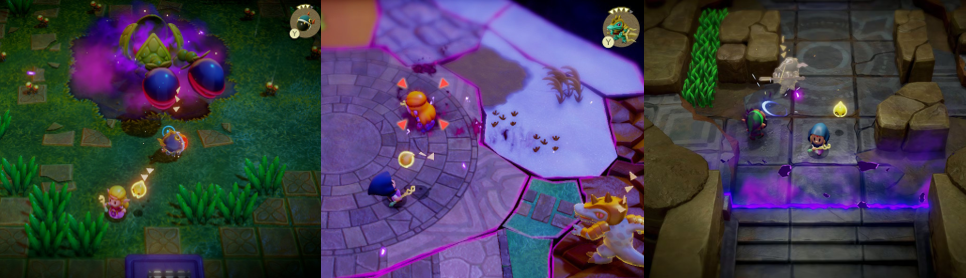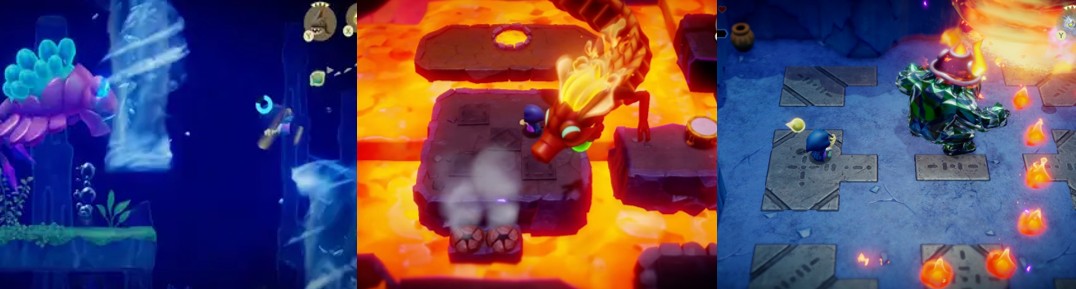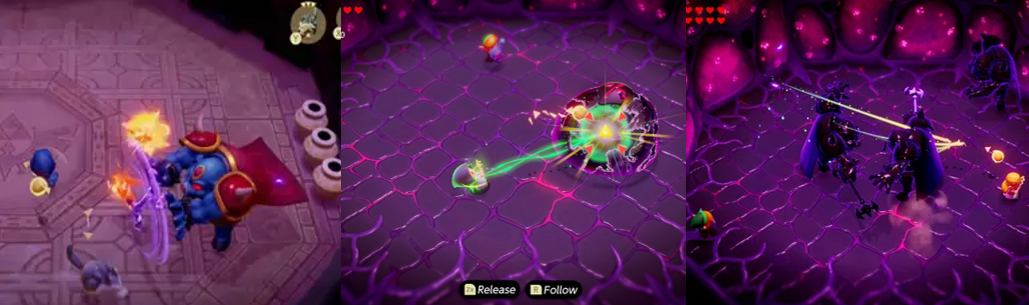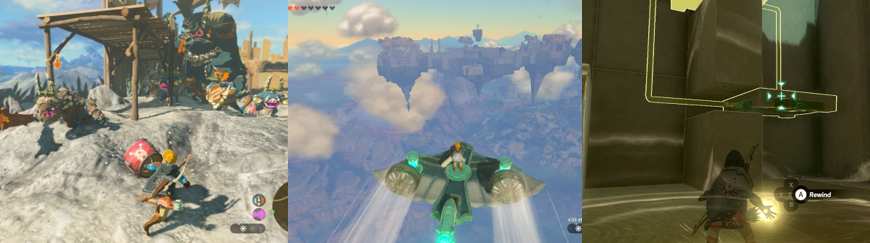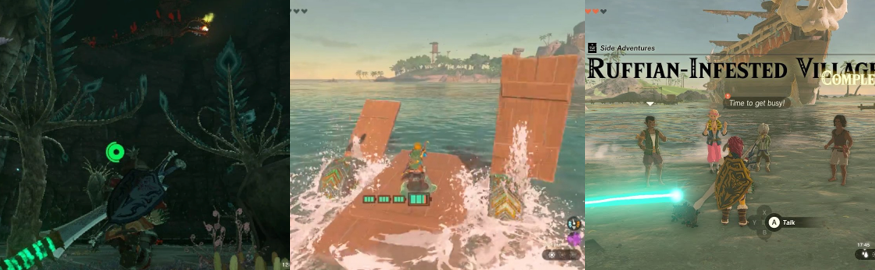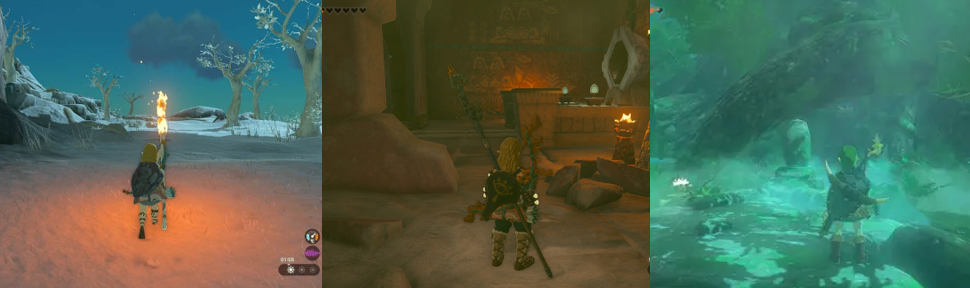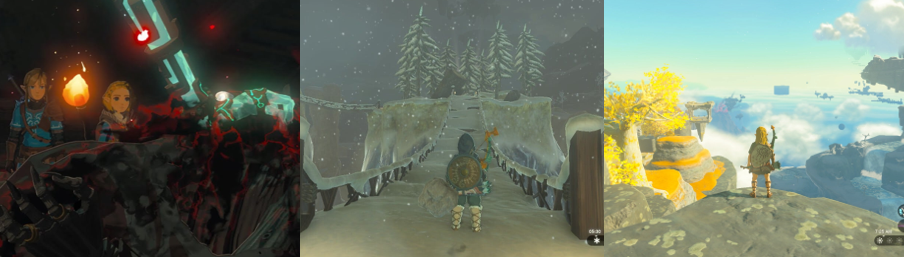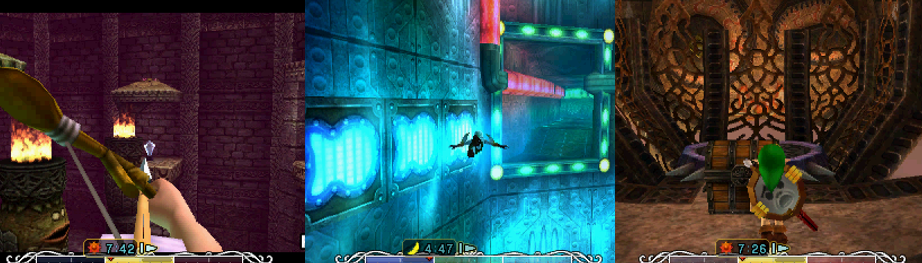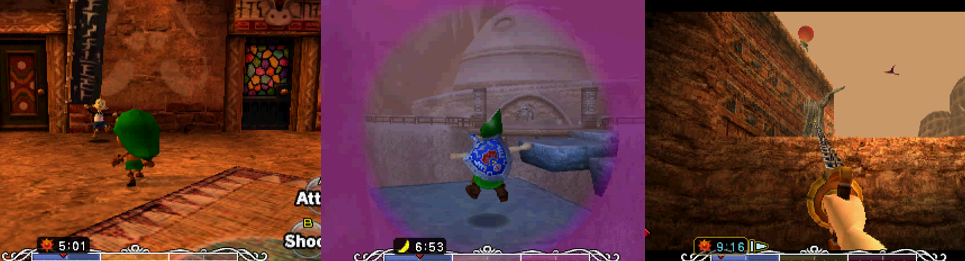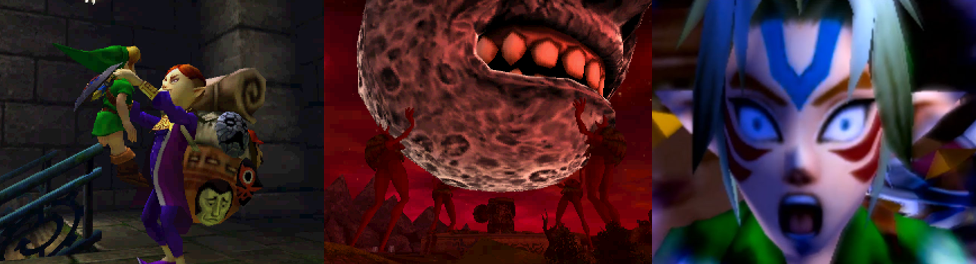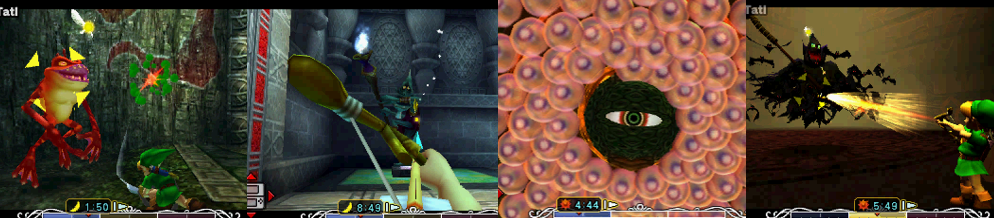
Game Corner [Zelda Month]: The Legend of Zelda: Tears of the Kingdom (Nintendo Switch)


On 21 February 1986, The Legend of Zelda (Nintendo EAD, 1986) was first released in Japan. The creation of legendary game designer Shigeru Miyamoto and Takashi Tezuka, The Legend of Zelda launched one of Nintendo’s most popular franchises. This year, I’ve been dedicating every Friday to Nintendo’s most famous silent protagonist, Link and his vast and enduring fantasy world of sword and sorcery.


Released: 12 May 2023
Developer: Nintendo EPD

The Background:
Selling over 6.5 million copiesThe Legend of Zelda was a big hit for the Nintendo Entertainment System (NES) and kickstarted one of Nintendo’s most lucrative and popular franchises of all time. After a successful jump to 3D with The Legend of Zelda: Ocarina of Time (ibid, 1998), Zelda titles have only gotten more ambitious with each successive entry, though none were more ambitious than the critical and commercial success of The Legend of Zelda: Breath of the Wild (Nintendo EPD, 2017). While producing the downloadable content for Breath of the Wild, the developers had so many ideas that they were inspired to create a follow-up title and sought to expand upon the existing world and game engine with new areas. The Dungeons were revised to be more visually unique compared to the last game and the developers added a building mechanic to allow players to craft new vehicles and expand their exploration potential, with Link’s new abilities presenting new challenges for the developers to overcome. Like its predecessor, The Legend of Zelda: Tears of the Kingdom was met with universal acclaim; reviews praised the expanded map, the implementation of Link’s new abilities, and the expansive story. While the Dungeon design and performance was criticised, the game still sold 21.04 million copies worldwide and won numerous awards.

The Plot:
Years after Breath of the Wild, Link and Zelda discover the rancid “Gloom” seeping from the depths beneath Hyrule, heralding Ganondorf’s return. When Zelda disappears and the Master Sword is shattered, Link turns to an ancient race to combat the Dark King once more.

Gameplay and Power-Ups:
Like its predecessor, The Legend of Zelda: Tears of the Kingdom is an open-world action/adventure game in which players control Link (in one of the rare instances of him not only having that name but being the same incarnation) and explore the vast wilds of Hyrule, a diverse and treacherous land of sword and sorcery. Fundamentally, the controls and basic gameplay mechanics remain unchanged from Breath of the Wild, for better or worse. You press A to talk to Hyrule’s many and varied non-playable characters (NPCs), interact with the environment or pick up objects (stones, weapons, etc), and open treasure chests. To run, simply hold B but keep an eye on your stamina wheel as Link will quickly get exhausted unless you expand it by conquering the returning mini Dungeons (again dubbed “Shrines”). Y swings your currently equipped weapon in a simple combo; hold it to charge up a spin but, again, watch your stamina as you don’t want to end up dizzy and vulnerable. X jumps, with Link deftly hopping over most low objects or executing a jumping attack; you’ll also use this to clamber up walls and surfaces (again, stamina willing). When in combat, press ZR to target the nearest enemy and raise your currently equipped shield to fend off attacks. Successfully tap A while raising your shield to perform a “Perfect Guard” that reflects certain attacks and leaves enemies stunned (though I still can’t get the timing right). Similarly, pressing X at just the right time to dodge an attack allows you to hit a powerful “Flurry Rush” to whittle down their health. Pressing in the left stick sees Link crouch and stealthily sneak around, allowing for one-hit strikes, and you can hold down R when at full health to unleash a Sword Beam.

Link’s returning abilities are bolstered by bizarre building and fusing mechanics.

As before, Link can utilise almost anything as a weapon; sticks, skeletal arms, various swords, clubs, and axes are all acquired by defeating enemies or exploring your surroundings. Each has a different power rating that determines not just how much damage it does, but also how durable it is. The lower the rating, the more likely your weapon will shatter after a few hits. Wooden weapons also catch fire and metal weapons attract lightning, so you must swap them out or drop them to avoid taking damage or being caught short. Similarly, items like pot lids, wooden circles, and iron shields can defend against incoming attacks and have the same elemental issues to consider. Link also acquires various bows, with some firing more shots at the cost of their durability and others hitting harder; similar effects are also applied to weapons and shields. Link can also throw items and attach them to his arrows for additional effects, such as blowing up rock walls and enemy hoards with Bomb Flowers, freezing them with Ice Fruit, or setting vines and baddies alight with Fire Fruit. In Tears of the Kingdom, this comes courtesy of Link’s new Purah Pad, and upgrade to the previous game’s Sheikah Slate, which quickly allows him to “Fuse” objects to his arsenal. This is a versatile ability, allowing you to Fuse items to your swords (and even combine weapons) for added effects and damage. Fuse makes shields more durable or rocket you into the air with…well, an attached rocket…and is also essential for solving puzzles since you must cobble together wooden boards to create bridges, rafts, or more complex vehicles. You can manipulate almost anything with the “Ultrahand” ability, which telekinetically picks up objects to be awkwardly rotated to solve puzzles or piece together your creations. Eventually, you learn the “Autobuild” ability that makes this much easier but at the cost of “Zonaite”, a new mineral that powers your creations and allows your gliders to fly, your fans to blow, and your carts to roll along. Perhaps Link’s most useful new ability is “Ascend”, which sees him clip upwards through the environment when able, eliminating the need to expend stamina climbing rugged mountains and sheer walls. Link can also rewind time, to a limited degree, with “Recall”, allowing him to dart into the sky by reversing the direction of falling debris and bypass raging lava flows on makeshift rafts.

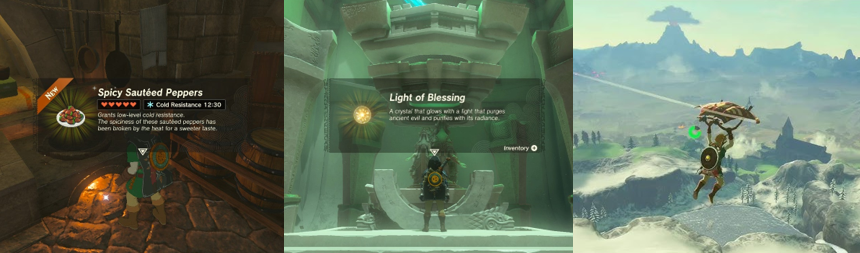
Cook meals and earn Light of Blessings to increase your maximum health and stamina.

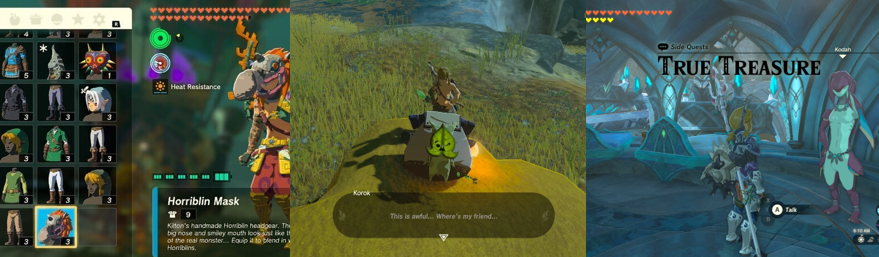
As before, Link’s weapon inventory is painfully limited. It can be expanded by finding Korok seeds, but only one slot at a time and the cost increases as you progress. Link’s defensive options are also tied to his outfits, which are found in chests, tied to tricky side quests, or bought from various shops for ridiculous prices. Instead of relying on gathering Rupees, you’re better off selling the precious gems you find by smashing rocks with rock-Fused weapons. You’ll need to do this as Link won’t last long in extreme heat or cold without the right outfits, and some offer additional perks such as speeding up your swimming rate, rocketing you up waterfalls, resisting elements, and upping your attack and defence. Rather than collecting hearts from defeated enemies, Link can either spend Rupees at an inn, collect a “Light of Blessing” from Shrines, or cook meals. This time, any meals you cook are recorded for easy reference; meals can also have added effects, such as temporarily increasing your maximum hearts and stamina wheel. To permanently extend these, you must trade four Light of Blessings at prayer statues dotted around Hyrule to gain either a new heart container or an extra slither to your stamina wheel, a process that remains as tedious as before. Similarly, you can still sneak up on and tame wild horses, adding them to stables and calling them with a whistle. If you have a Breath of the Wild save file, your horses will even be carried over, which is nice. There is a generous fast track mechanic, as before, but you must again activate towers (revealing more of the map in the process) or beat Shrines to utilise this. Finally, you can jump from high places and glide using your Paraglider and, though you can’t drop bombs like before, you can whip out your bow and use the slowdown effect to pick enemies off and, eventually, speed up your gliding with a gust of wind.

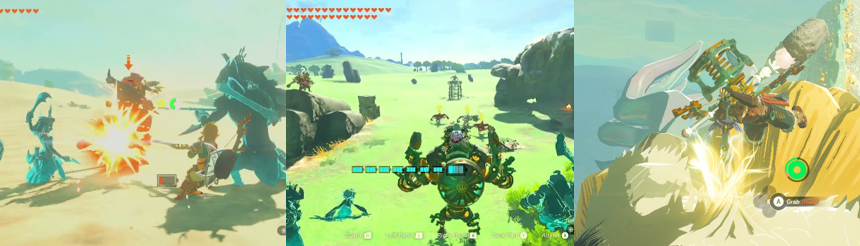
The Sages fight alongside you, though it takes all your strength to retrieve the Master Sword.

Like in Breath of the Wild, Link is aided in his journey by reincarnations of the ancient Sages. Following the main story quest (something easily done from the extensive “Adventure Log”) sees you conquer five ancient “Temples” and encounter these allies, who then join your quest, in spirit. Tulin blasts a gust of wind that speeds up your gliding and blows over enemies; Yunobo cannonballs ahead, setting fire to grass and smashing rocks; Sidon protects you with a water shield and blasts foes with a burst of water; Riju adds a lightning bolt to your arrows; and you can pilot Mineru’s mech, attaching various accessories to essentially make a Rock ’Em Sock ’Em Robot. Each ability has a cooldown element (with Mineru’s abilities tied to Zonite) and each Saga follows you on the overworld unless dismissed, battling enemies and bosses alongside you to take some of the heat off you. Mineru is especially usefully when explore the “Depths”, a vast, pitch-black, incredible dangerous environment found beneath Hyrule and accessed via chasms. Down here, you’ll activate Lightroots and toss Brightbulbs to brighten up the area and encounter vast deposits of “Gloom”, a Malice-like substance that permanently saps your maximum health unless you recharge at Lightroots or cook special food. Mineru walks through Gloom and lava without fear, but you must watch for Gloom-infected enemies and the horrific Gloom Spawn, which essentially act as this game’s second counterpart to the Guardians (the first being the various Zonai Constructs). While it’s not necessary to explore the entirety of the Depths, you will visit there many times throughout the story, and it can be beneficial to venture down there to collect powerful weapons or Poes to obtain new clothing. Additionally, you can blast up to the skies to explore various disparate floating ruins not a million miles away from the floating islands of Skyloft. Up here, you’ll find mine carts, caves, and the remnants of the Zonai people, alongside additional Shrines and rewards. The skies are also great for scoping out points of interest on the surface, such as Shrines, towns, or the various geoglyphs that dot Hyrule’s landscape. If you’re really lucky, you’ll spot one of four elemental dragons who can be farmed for precious minerals, with one in particular (the Light Dragon) awarding the legendary Master Sword if you have enough stamina to retrieve it.

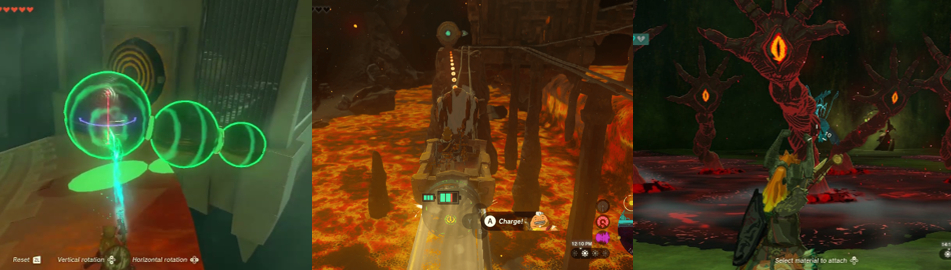
Puzzles and traversal are made more challenging with the building mechanics and spiteful Gloom.

Hyrule’s surface remains relatively unchanged from Breath of the Wild; many of the same towns, locations, and landmarks can still be found, though with some alterations. Lurelin Village has been infested with ruffians who need to be fought off, for example; the Rito Village has been beset by a blizzard; and the Gorons have become obsessed with Marbled Rock Roast. The Korok Forest and eerie Lost Woods are shrouded by an impassable mist, Hyrule Castle floats above a chasm of Gloom thanks to the “Upheaval” caused by Ganondorf’s awakening, and Zora’s Domain is polluted by sludge. You must clear out these issues with both your items and by completing Temples, which are thankfully far more visually distinct this time around. Rather than every Temple relying on a clunky rotating gimmick and a repetitive Sheikah aesthetic, they’re much more traditional in their depiction and use of elemental themes. You’ll solve a primary puzzle in each, from activating propellers to unlock giant locks, hitting gongs to release padlocks, powering up water wheels and ancient batteries, and collecting Mineru’s parts. While you do collect keys, this element is downplayed, though you still activate levers and switches (albeit with Ultrahand). Typically, you’re more likely to be moving or combining items, rolling giant balls into targets, and either using Ascend or fans to progress upwards. The Water Temple has a unique gravity gimmick that sees you float around in bubbles, you’ll get a prelude to the Lightning Temple’s boss battle before entering, and the Fire Temple is full of mine carts that require you to switch tracks by firing Yunobo at targets. Just getting to the Temples is a feat in itself, with you forced to venture higher and higher into the skies and cross flying ships to reach the Wind Temple and explore the murky Depths to find the Spirit Temple. Hyrule Castle again acts as a Temple, one guarded by powerful enemies and covering Gloom, and you must venture deep into the hazardous, Gloom-filled chasm beneath it to confront the Demon King. Shrines are far more challenging and diverse this time around, ranging from combat challenges to logic puzzles that’ll have you using Link’s Purah Pad abilities in unexpected ways or battling enemies with makeshift items.

You’ll search high and low and build all sorts to help out Hyrule’s inhabitants.

Like Breath of the Wild, Tears of the Kingdom is an unforgiving experience. Link begins with three hearts and acquiring more is a chore since you’re forced to seek out Shrines (something made much easier by completing a side quest to add the Sensor to your Purah Pad). Even then, having more health can be detrimental since it means consuming more food to replenish your health and Link is frustratingly weak at times. Even simple encounters can end in a game over, meaning it’s often better to just sprint past enemies to preserve your weapons, health, and sanity. To make matters worse, all enemies and treasure respawn when the “Blood Moon” rises, meaning the environment never gets any less dangerous. This remains a frustrating experience for me as I enjoy the combat in the Zelda games but the risk/reward of battling even simple enemies often isn’t worth it. Add to that the frustrating weather effects, which see you slip down mountains, tumble about like a ragdoll from a lightning strike, and collapse from heat exhaustion and you have a game that can be a chore to play. While the Gloom and the Depths can largely be avoided, you’ll endure both eventually and they’re a major headache as it’s not fun to stumble about in the darkness, have your hearts sapped away, and then be surprised by a Gloom-infected rematch with a boss! It seems like every NPC has a story to tell and a mission for you, be it reuniting lost Koroks, exploring wells, seeking out evidence of Zelda sightings, or bringing musicians to the Great Fairies so you can upgrade your clothing (for a small free…) Sometimes, you’re forced to battle waves of enemies or NPCs will turn out to be the aggravating Yiga Clan in disguise. Other times, you’re performing glorified fetch quests for minimal rewards or cobbling together constructs to help Addison campaign for President Hudson. Some Shrines only reveal themselves after you retrieve their crystal, either by battling a mini boss or solving some tedious nearby puzzle; others offer no challenge at all, making for a nice change of pace. Link’s building abilities can result in some remarkable craft, from boats to full-blown planes, but it can be annoying rotating pieces into position, and you’ll expend a lot of your resources to get all the pieces you need and power everything.

Presentation:
Link’s model, like all the character models, appears essentially unchanged from Breath of the Wild save for some different attire and his new monster arm. When in sweltering heat, he pants and sweats; when in blistering cold, he shivers; and when standing too close to an explosion, he catches fire. Although he doesn’t speak save for some grunts, there are dialogue options here and there that show is does communicate with those around him. Other NPCs communicate through traditional text boxes or voice acting, which is generally saved for the more dramatic cutscenes and the various memories. Link’s companions have a fair bit of personality, with Yunobo being a standout for me since he’s brainwashed into turning against his people and then determined to make up for it with an enthusiastic gusto! Tears of the Kingdom takes the expansive overworld from Breath of the Wild and expands upon it considerably. The surface is largely the same from what I remember, featuring towns, swamps, mountains, a massive volcano, and rushing waters. Settlements like Kakariko Village and Hateno Village remain, with Link now having a home and encountering many of the same NPCs (some of whom recognise him and others who strangely don’t). The landscape is altered by the presence of chasms leading to the Depths but still contains hidden caves, stables, the ruins of the old world, and recognisable landmarks like the Temple of Time. Hyrule is gigantic and full of different cultures, from the distrustful Gerudo in the arid desert to the proud Zora in their waterfall kingdom. Each area has different weather effects to worry about, from stifling heat to bitter cold, something exacerbated by random thunderstorms and the titanic elemental Gleeoks. There’s also a day/night cycle present, some mist and fog effects here and there, and a real sense of the world having changed both between games and from the fallout of the Upheaval, which sees debris rain from the skies and uncovers long-forgotten ruins that you must explore and decipher.

Hyrule is bigger and more varied (and dangerous) than ever.

By their very nature, the Depths aren’t as immediately impressive simply because they’re seeped in darkness. It’s an oppressive, bleak, and dangerous environment with no inhabitants save for Ganondrof’s minions, the remains of a Zonai outpost, and Robbie’s tentative efforts to explore the Gloom-infested environment. Still, there is a lot to see here once you illuminate your surroundings; Zonai depots, lava flows, and Gloom-versions of the game’s bosses all dwell alongside Bargainer statues where you trade your Poes and rusted weapons you can take. The skies aren’t much better, being a fragmented series of ruins, tracks, and Zonai deposits that you must often glide between. The Shrines have been redesigned (for the worst, in my opinion) and returning areas like Hyrule’s labyrinths and even the elegant castle have an added danger thanks to being infested by Gloom. Shrine interiors are very similar to what we saw in Breath of the Wild, favouring substance over style and restricting your abilities so you can’t just glide to the exit. They retain the ancient mixture of science and magic from Breath of the Wild, but I remain unimpressed by how tedious it gets searching for Shrines just to get enough Light of Blessings to gain one extra heart that’s immediately shattered by Gloom. Still, as mentioned, the Temples are much improved this time around. They not only have a better visual identity but contain more interesting puzzles and a greater enemy variety. The standout for me was the Lightning Temple, which sits within a vast pyramid in the storm-swept Gerudo Desert and is home to the mummified Gibdos. I felt like a proper tomb raider shifting blocks and riding wind currents in here, though the Fire Temple also impressed by being an abandoned mine within a volcano. The Spirit Temple was the most disappointing since it simply hosts a boss battle, but the journey to it through the Construct Factory in the murky Depths was challenge enough.

The world and story have been expanded and changed by the recent, cataclysmic events.

Tears of the Kingdom makes great use of ambient sound for the most part. There’s no sweeping Zelda theme when galloping across the overworld here; just the sounds of enemies approaching or light piano tunes. This changes once you get into battles, ramping up the anxiety when you’re suddenly attacked by a spear-wielding Moblin and battling the finnicky controls as you tumble down a mountainside. Music really only plays a role in the game’s cutscenes, however, which can be replayed from the Adventure Log. Like its predecessor, Tears of the Kingdom invites you to challenge yourself; if you’re brave (or stupid), you can head right to the final confrontation (and win!) and you’re free to explore every area out of sequence, for the most part. The map and Adventure Log can quickly become cluttered with waypoints and primary and optional quests, making it difficult to remember where you’re going and what’s happening next. However, I never experienced any performance issues save for one terrifying moment where the game crashed during the Yunobo fight. The environment renders well; wild animals and NPCs roam freely with no slowdown or noticeable pop-up, though the weather effects do help mask this at times, I feel. Traversing the surface is far less hazardous thanks to the absence of Guardians but the Gloom Hands definitely get your blood pumping when they slither to life and relentlessly chase you across walls and ceilings. Long-time Zelda fans should also enjoy the various nods to previous games in the names of certain locations and NPCs, as in the last game, and Tears of the Kingdom definitely feels like a celebration of the franchise’s rich history as much as anything else. Probably the best callback for me was exploring Hyrule Castle again; though much more restricted thanks to the Gloom and the damage, it was fun revisiting the library and royal rooms. Unfortunately, the plot lost me a bit; I still don’t understand why no one makes a connection between Ganondorf and Calamity Ganon and I must have been distracted when the game explained why Zelda’s been sighted across Hyrule when she’s actually flying through the skies as the Light Dragon.

Enemies and Bosses:
As far as I could tell and remember, every enemy encountered in Breath of the Wild reappears here, sporting the same strengths and weaknesses and dropping the same items upon defeat. Hyrule is full of sentient trees, jelly-like Chuchus, odd Pebblits, bat-like Keese, and rock-spitting Octoroks. These common enemies aren’t much to shout about, popping up as you explore and generally being more a nuisance than a threat, but the land is also patrolled by Ganondorf’s more organised and formidable forces. The most commonly encountered are the squawking Bokoblins, often found around campfires, guarding towers, or riding Battle Talus’s. They’re often subordinate to their more challenging silver-clad commanders, trailing behind bulbous Boss Bokoblins, or taking orders from large, goblin-like Moblin. Skeletal variants of these are also encountered, some ride horses on the overworld, and Gloom-infested variants swarm the Depths, but they’re also echoed in the cave-dwelling, ape-like Horriblins. Exploring deserts, swamps, and water-rich areas sees you surprised by the lizard-like Lizalfos, who spit water and turn invisible, and you’ll often face a double threat as Aerocudas patrol the skies. Bokoblins, Moblins, and Lizalfos wield various weapons, from swords to lances and bows, and will call for backup upon spotting you, making even a handful of them a significant threat. Various Wizzrobes are also encountered, often skipping and teleporting about and firing different elemental magic, and the Yiga Clan will jump you when you least expect it, disappearing in a puff of smoke and charging you with their blades. You’ll also contend with mummified Gibdos both on the ground and in the air, though fire- and lightning-based attacks make short work of them. Various armed Zonai Constructs test your combat prowess, acting as smaller but no less threatening counterparts to Breath of the Wild’s Guardians.  

Formidable and horrific mini bosses roam Hyrule and launch surprise attacks!

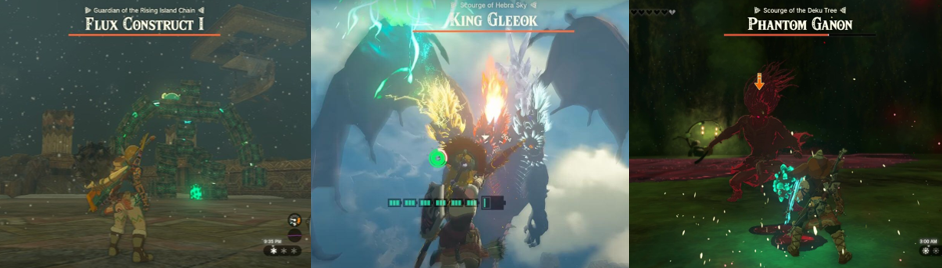
Hyrule is also populated by various mini bosses. Boss Bokoblins are larger versions of regular Bokoblins that wield big clubs and can take quite a beating, caves house different elemental Like-Likes, and giant stone Talus’ assemble from the environment to catch you by surprise, with their only real weak point being the Ore Deposit on their heads. If you’re really unlucky, a massive cyclopean Hinox will wake up and chase you (though targeting the eye turns the tide in your favour), mutated crocodile-like Molduga burrow through the Gerudo Desert and in the sands of the Depths, and a combination of the two, the Frox, also appears down there, sporting the same weaknesses as both. Flux Constructs are usually found in the skies; these sentient Zonai cubes are controlled by a central cube that must be targeted before they pummel you into the stone. Master Kohga also returns, having dropped to the Depths and mastered the Autobuild ability to fashion giant trucks, flying machines, and even a mech to rival Mineru. Though he’s more troublesome this time around, he’s quite susceptible to arrows in each encounter. Before he joins your cause, you must fight the brainwashed Yunobo, dodging his cannonball-like roll in a prelude to one of Ganondorf’s devastating charge attacks. Though far less prominent (at least in my playthrough), powerful, centaur-like Lynels still exist in Hyrule, with a silver variant encountered in the Gloom-filled Depths prior to battling Ganondorf. They’re joined by the various elemental Gleeoks, massive, three-headed dragons that breathe fire, frost, and lightning and are lorded over by an even tougher king. I’m gonna be honest and say I never fought these; I saw them flying around or standing atop mountains and felt their power in the intense weather effects they emit, but didn’t dare test myself against them (or the Lynels, for that matter). Similarly, I simply fled from every Gloom Swarm so I wouldn’t be decimated by Phantom Ganon, though you’re forced to fight this terrifying foe at least twice, once when exploring Hyrule Castle and again to free the Great Deku Tree. Phantom Ganon acts as an appetiser for Ganondrof’s battle, charging with a sword, striking with a lance, causing massive shockwaves with a club, duplicating himself, and spreading Gloom everywhere in easily some of the toughest battles in the game.

The five Scourges are visually distinct and range from simple to frustratingly challenging.

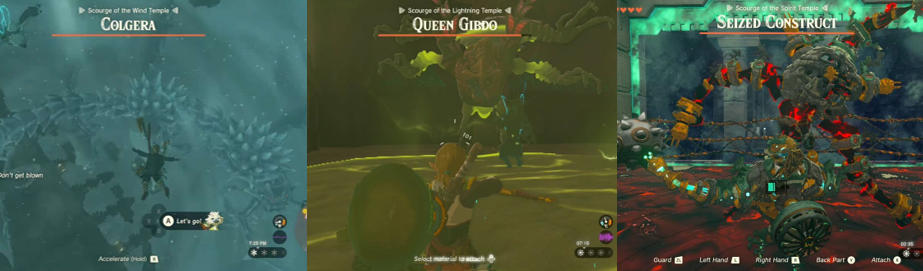
Each Temple houses at least one boss, a “Scourge”, that is, thankfully, not simply a variant of Ganon this time around. You can tackle these in any order but I first battled Colgera, Scourge of the Wind Temple, a gigantic insectoid creature that flies up from within the Wind Temple and forces you to battle it in mid-air (not unlike the game’s final challenge). Colgera emerges from portals and fires ice shards from its body, unwittingly exposing its weak spot, which you must target with Fire Arrows (using Keese eyeballs to help aid your aim). Tornados keep you in the air and Tulin gives you a speed boost, but this wasn’t an especially taxing boss, even when its weak spot switches to its underbelly in the second phase. Next, I battled the Water Temple’s Mucktorok (after getting to grips with Sidon’s abilities in battle with the Sludge Like), a cackling little imp who rides a Molduga-like sludge shark. You must blast this with Sidon’s water wave, clearing a path through the sludge, avoiding its spit attack and shockwaves and chasing the slippery devil down to give it a good thrashing. To enter the Fire Temple, you first dispatch the volcanic dragon, Moragia, that’s attached to Death Mountain by flying around on a nearby Zonai flyer and firing Yunobo at it. Inside, you’ll face the Marbled Gohma, a spider-like rock beast that tries to stomp you and fires explosive chunks of rock. You must fire Yunobo at its legs, crippling it so you can pummel its eye, then send Yunobo rolling up to smack it when it retreats to the ceiling. The difficulty noticeably spikes when you face Queen Gibdo in the Lightning Temple, mainly because you’re so reliant upon Riju’s lightning attacks and lightning-adjacent attachments to your bow. The battle’s further complicated by the Gibdos she spawns in, distracting you and making things very frustrating and difficult near the end. In comparison, the Seized Construct is much easier. Fought in an electrified boxing ring with you controlling Mineru, this thing’s a breeze with the right attachments as you stun it with your arm cannon and smash it into the electrified ropes using a wrecking ball.

Ganondorf throws his forces at you, decimates your health, and then becomes a titanic dragon!

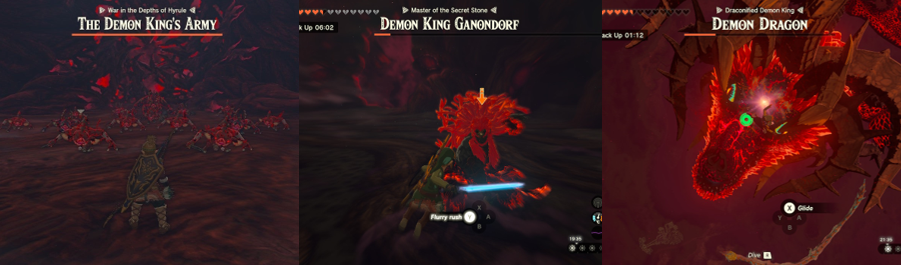
These bosses return in the Depths, if you fancy testing your skills further, and are fought as part of the final battle, much like in the last game. If you best them prior to confronting Ganondorf, however, you obviously won’t need to worry about them. The King of Evil is no joke, however, and is fought in an aggravating multi-stage battle. First, you and the Sages face four waves of Gloom-infested enemies, collecting their loot and hoping you have enough Gloom-resistant armour or food to survive the next stage. Here, you face Ganondorf one-on-one in a fight functionally identical to those against Phantom Ganon. Ganondorf switches between a sword, spear, club, and bow, inflicting Gloom damage with each hit and both parrying and perfect-dodging your attacks. With the right timing, you can whittle him down with the Master Sword; attack-boosting gear and food is a must here, as is Gloom food, but you can also fire Bomb Flowers, Rubies, and Gibdo Bones to take chunks off his health. Victory sees Ganondrof duplicate himself, gaining a ridiculously long health bar in the process. Though the Sages help you, they mostly end up cluttering the screen so it’s advisable to take to the air however you can (Fusing a rocket or Autobuilding something) to litter the battlefield with Rubies and Bomb Flowers. After many deaths, I finally got lucky and got Ganondorf back to half health, which returns the fight to a one-on-one contest. Unfortunately, the Demon King is faster and stronger than ever, sending waves of Gloom and Gloom projectiles, causing Gloom shockwaves, and charging at you, leaving a trail of Gloom in his wake. Luckily, you can strike his projectiles to stun him and, with the right food and a little luck, he’ll eventually be bested. In his rage, Ganondorf consumes his Secret Stone and transforms into a gigantic dragon! Zelda, as the Light Dragon, swoops in to save you, keeping you from falling to your doom, and giving you a boost to reach the Demon Dragon’s back. This stage is mostly a formality, however; just avoid the Gloom scales and target the Gloom pustules on the Demon Dragon’s back. When you get the chance to target the Sacred Stone on his forehead, hold Y to deliver the killing blow and then dive through the sky to rescue Zelda in freefall!

Additional Features:
There are 152 Shrines to find across the skies and surface of Hyrule. Each one houses a chest that contains a weapon or some kind of treasure and also awards a Light of Blessing. With four of them, you can trade for an extra heart or an extra sliver of your stamina wheel, which can make combat and exploration much less of a headache. There are also 120 Lightroots in the Depths which, like the Skyview Towers, simply exist as fast travel points (though Lightroots also restore your Gloom-shattered hearts). There are now a whopping 1000 Koroks to find; some are under rocks, some require transporting to their friends, and some task you with solving puzzles. Finding them all expands your inventory and again awards you with a useless (but golden) piece of poop. You’ll also find loads of treasure chests in every area of Hyrule; some house Rupees or rare materials, some gift weapons, and some have clothing. Collecting all three pieces of an armour set can award additional buffs both by default and courtesy of a Great Fairy, and you can dress Link up as his dark counterpart, an enraged God, and even to resemble various enemies. Some materials can be dyed to further customise them and you can further bolster your stats by cooking food, with recipes being saved for further use. Your horses can also be upgraded and customised; by discovering stables and boarding your horse, you’ll earn “Pony Points” to trade in for harnesses and accessories to complete side quests.

Hundreds of treasures, collectibles, and side quests await in this sprawling adventure.

Speaking of, there are loads of optional missions in Tears of the Kingdom. Some are pretty simple, like liberating villages from enemy hordes or retrieving Shrine stones. Others see you gathering materials, photographing enemies and objects, investigating Zelda sightings, and recovering lost or stolen items. Completing side quests earns you Rupees and other rewards, such as food, additional shops, and even armour. Helping Robbie with his research not only upgrades the Purah Pad to detect Shrines and other targets, it also adds the “Hero’s Path” mode to the tablet so you can see where you’ve travelled and gifts you “Travel Medallions” that are essential when fighting your way to Ganondorf. Misko will mark the locations of rare treasure on your map, allowing you to find new armour sets, dogs can be befriended to dig up treasure chests, shop prices can be reduced, and the truth about Zelda’s draconification can be discovered if you explore high and low. Completing the game adds a star to your save file but returns you to your last manual save before battling Ganondorf, meaning you never get to see peace returned to the land on your save file. You can go back and finish any tasks remaining, however, exploring Hyrule Castle docks for the powerful Hylian Shield and collecting Poes to collect new gear. Tears of the Kingdom is also compatible with Amiibos, allowing you to scan in entire armour sets quickly and easily. Sadly, the Master Cycle from Breath of the Wild’s downloadable content isn’t available (though you can build a close approximation) and there is currently no additional content available for the game, but it’s not as if there aren’t hours of content to return to once you’ve completed the main story.

The Summary:
Since I struggled with The Legend of Zelda: Breath of the Wild, I was hesitant to get into the sequel, and these fears were entirely justified. The weapon durability mechanic is as tedious as ever, forcing me to run from most encounters when I’d rather be fighting like in the Nintendo 64 games. Link is frustratingly fragile, easily being killed by even the weakest of enemies, and the entire game is an uphill battle to learn and improve. Link’s new abilities do mitigate these issues somewhat; you can effectively double your weapon inventory by Fusing swords and shields together, though often at the cost of holding a shield. I was also very pleased by how much easier the five main bosses were compared to Breath of the Wild’s and how much more visually unique the Temples were. Getting to them was a chore at times but it was much closer to a traditional Zelda experience once I was inside. The Shrine mechanic is as annoying as before, though, and I wish there was a “Novice” option to give you at least one set of weapons that don’t break and that allocated hearts to one set of Shrines and stamina to the other. I didn’t really like the focus on building; it was finnicky to rotate and Fuse things together to solve puzzles and the vehicles weren’t very fun to control. The mechanic didn’t work for Banjo-Kazooie so I don’t see why Nintendo thought it’d work for Zelda, and it just got in the way most of the time. I liked seeing how Hyrule had changed, with familiar areas altered from the passage of time, and how much bigger the world was, but I hated the Gloom mechanic, the sky islands were dull, and battling Ganondorf was like chewing nails. The story was convoluted and somewhat lost amidst all the hundreds of other sub-plots and side quests, though I enjoyed seeing bigger, more ferocious optional bosses patrolling the overworld. Despite all the changes, though, The Legend of Zelda: Tears of the Kingdom still feels like a glorified expansion pack of its predecessor. I had the same issues as before, if not more thanks to the new inclusions, but remain impressed by the scope and sheer scale of the world, so I think it’s fair to give it the same rating as Breath of the Wild and stay in the minority of people who just don’t click with this approach to the Zelda franchise.

My Rating:

Rating: 3 out of 5.

Pretty Good

What did you think to The Legend of Zelda: Tears of the Kingdom? How do you think it holds up against its predecessor and were you excited to revisit this world? What did you think to Link’s new abilities, specifically the building and Fusing mechanics? Were you also frustrated by the Depths and the dangerous Gloom? Did you also find the main bosses easier than Breath of the Wild’s only to struggle against Ganondorf? Did you ever complete all the side quests and find all the Koroks? Which Zelda game is your favourite and how did you celebrate the franchise this month? Whatever your thoughts on Tears of the Kingdom, drop a comment down below and go check out my other Zelda reviews.

Game Corner [Zelda Month]: Hyrule Warriors: Definitive Edition (Nintendo Switch)


On 21 February 1986, The Legend of Zelda (Nintendo EAD, 1986) was first released in Japan. The creation of legendary game designer Shigeru Miyamoto and Takashi Tezuka, The Legend of Zelda launched one of Nintendo’s most popular franchises. This year, I’ve been dedicating every Friday to Nintendo’s most famous silent protagonist, Link and his vast and enduring fantasy world of sword and sorcery.

Released: 18 May 2018
Originally Released: 14 August 2014
Developer: Omega Force / Team Ninja
Also Available For: Nintendo Wii U (Original Version), Nintendo 3DS (Legends Version)

The Background:
The Legend of Zelda has consistently been one of Nintendo’s most popular, celebrated, and successful franchises and one of the reasons for this is the consistent quality of its games. While Zelda titles have often included unique gimmicks to separate them from each other, the tried-and-true sword and sorcery formula has remained present throughout the series. Indeed, Nintendo’s few attempts at veering away from this formula have resulted in mediocrity, at best, and ridicule, at worst. It was therefore surprisingly (to me, at least) when Nintendo joined forces with Koei Tecmo to produce a spin-off game, one that incorporated the chaotic hack-and-slash action of Koei Tecmo’s popular Dynasty Warriors series (Omega Force, 1997 to 2018). Long-time Zelda producer, Eiji Aonuma jumped at the chance to do something new with the franchise and the game pulled inspirations from across the entire Zelda series and eventually achieved Koei Tecmo’s president Yoichi Erikawa’s dream of selling of a million copies. Initially released on the Wii U and bolstered by a slew of downloadable content (including a previously cut female version of Link), Hyrule Warriors garnered positive reviews, with critics praising the merging of the two franchises while criticising the repetitive gameplay. In 2016, the game was ported to the Nintendo 3DS as Hyrule Warriors Legends; it included all previous downloadable content, a new Fairy system, and new gear for existing characters as well as a code to upload these additions to the Wii U version. Although reviews still praised the port, the limitations of the 3DS hardware (even when playing on the more powerful New Nintendo 3DS) were highlighted as negatives. Regardless, a newer port later came to the Nintendo Switch; billed as the Definitive Edition, this version included everything from the previous games alongside some new costumes. It was also received much more favourably, perhaps contributing to the release of a sequel title in 2020.

The Plot:
In an alternative timeline, the sorceress Cia seeks to resurrect the King of Evil, Ganon, by waging war against the kingdom of Hyrule. To defend her kingdom, Princess Zelda recruits lowly knight Link, the bearer of the Triforce of Courage, to amass an army of familiar faces against Ganon’s dark forces.

Gameplay and Power-Ups:
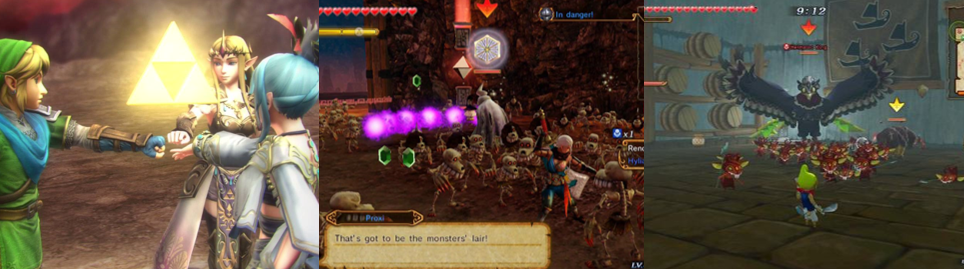
This is the Definitive Edition of Hyrule Warriors, a third-person hack-and-slash action//adventure in which players take control of Link (and many other new and familiar faces from across the Legend of Zelda franchise) to plough their way through seemingly endless hordes of enemies, many of them also series staples. Although each character has their own strengths and weaknesses, they share similar attributes, abilities, and control methods, with a couple of exceptions. Players can fully customise their control scheme but, by default, you’ll throw a regular attack with Y, a combo attack with X, a special attack (when your Special Attack Gauge is full) with A, and dodge with B. You can string together presses of Y and end them with X to pull off combos and character-specific special attacks (such as Link’s trademark sword spin), with more being unlocked as you defeat enemies, earn Materials, and level-up. I preferred to mix these buttons up, assigning B to the regular attack, special to Y, combo to X, and dodge to A but it’s entirely up to you. L targets nearby enemies (an occasionally finnicky system that can keep you from targeting the right enemy if larger bosses are around), ZL guards, R unleashes a powerful “Focus Spirit” attack when the Magic Power meter is full, and ZR lets you use sub-items, such as bombs, arrows, or bottles to restore or buff your character. Later on, if you have a Fairy in a bottle, you can press in the right stick to activate Fairy Magic. You can also switch items by pressing left and right on the directional buttons, or switch characters by pressing up and down. Characters are largely differentiated by their stats; Darunia and Impa, for example, are slower but more powerful characters compared to Sheik and Ruto. Their weapons are also a factor, with Wizzro favouring blasts of dark energy, Midna riding and attacking with Link’s wolf form and her malleable hand, and Young Link having a unique Focus Spirit ability that allows him to potentially retain an empowered state indefinitely.

Cut through endless waves of enemies with special attacks and sub-weapons.

As you defeat the game’s near-infinite enemies, your Special Attack gauge will fill; you can also collect Force Fragments from enemies or pots to fill it faster, and increase its length by levelling-up. Similarly, the Magic Power meter fills by collecting Magic Jars, with these collectibles being as abundant as the hearts and Rupees that enemies, pots, and chests drop all over the map. When these meters are full, you can pull off more powerful special, character-specific attacks that change depending on which weapon you have equipped and any elemental effects associated with that weapon. For example, Lana can equip a spell book or a spear and Link can equip both a Magic Rod with fire properties and swords (including the legendary Master Sword), with each weapon unleashing different special attacks (often with cameos by other Zelda staples, such as Dark Link or the Great Deku Tree). Focus Spirit is a little different and more universal; activating it empowers you for a short time, negating any knockback and instantly exposing an enemy’s “Weak Point Gauge” if you perform a special attack. The Weak Point Gauge appears on tougher enemies and bosses; draining this lets you perform a bigger, more devastating attack to dramatically reduce or completely destroy your target. Other enemies, mini boss types like enemy commanders and such, are susceptible to specific sub-weapons. Bombs against shield Moblins, arrows against the Deku Babas, the hammer against the Blins; whatever the case, an onscreen indicator shows which sub-weapon is most effective against your target. Sub-weapons can also be temporarily powered up from random pick-ups and to activate switches, cross gaps, or stun giant bosses. When equipped with a bottle, your character can drink various potions for buffs and restorative effects, or utilise Fairy Magic in much the same way. Finally, activating Owl Statues across each map sets up warp points so you can quickly teleport to different areas using the ocarina.

The sheer amount of objectives and notifications means it’s probably best to play with a friend.

The game’s onscreen map shows the locations of allies, enemies, bosses, and other notable objectives and items. It’ll display which of your allies are talking, flash when Keeps are in danger, and show the many different objectives that pop up throughout each mission. Pressing + pauses the action and accesses a more comprehensive map. From here, you can check mission dialogue and objectives, review the controls, create a manual save point (though checkpoints occur during most missions), and issue orders to your allies. This is crucial as the game progresses and more objectives appear in each mission; ideally, you want four playable characters in each mission, each powerful enough to hold their own in battle, and to order them to different objectives. The AI attacks enemies and bosses, with allies reducing a boss’s health and defence, but they do tend to wander about or stay in place and I often found it difficult to select a specific target from the map. Ideally, you want to play Hyrule Warriors with a friend as the game can get very chaotic; tutorials, dialogue, objectives, and notifications swamp the already messy battlefield. While you can turn some of these and other onscreen effects off to clear things up, it can make it easy to fail missions if you miss an objective. Luckily, mission success is often malleable; you can lose a Keep or have captains and commanders flee and not fail the mission, and you can fail side missions (usually escorting an ally, defending a Mama Cucco, or defeating Messenger enemies) and still continue. However, if a primary ally (usually Princess Zelda) or your main Allied Base falls, you’ll restart from the last save, checkpoint, or the start of the mission.

Combat is fun and satisfying, if chaotic and often repetitive.

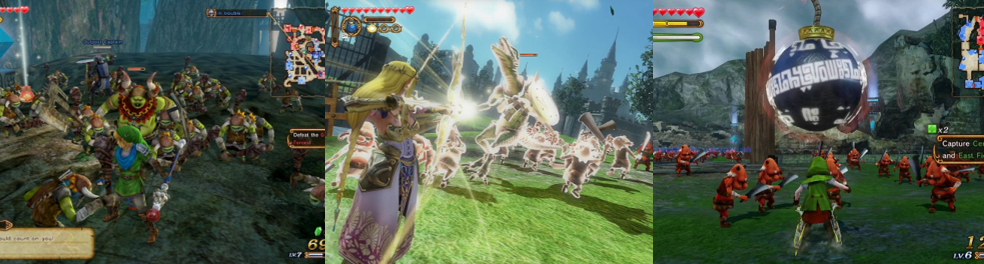
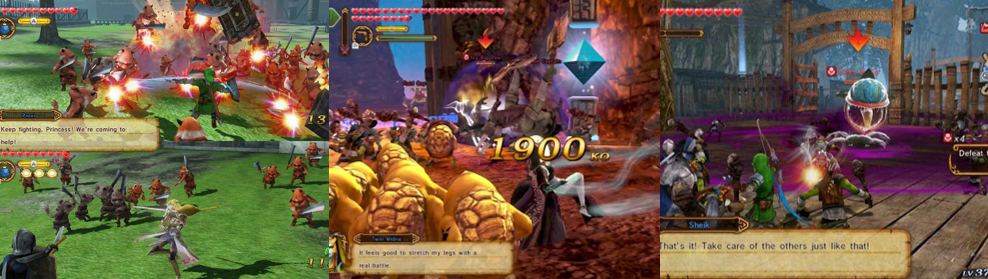
“Chaotic” is definitely the best word to describe Hyrule Warriors; enemies spawn (or pop) in constantly, swarming from Outposts and Keeps that must be captured to secure your position on each map. Mission objectives usually always boil down to capturing as many as four Keeps or strategic locations, such as the Fairy Fountain (which you activate with B to weaken bosses or otherwise aid your allies). Sometimes, you’ll intercept giant Bombchus to keep them from damaging or destroying Keeps. Other times, you’ll defend against enemy commanders, searching for allies or the correct enemy in a swarm of doubles, or taking out Transport troops and Keep Saboteurs. Generally, it’s not a massive issue if a Keep falls, but it is inconvenient. To secure a Keep, you must drain its energy bar by defeating the enemies housed there. This spawns the Keep Boss, who’s easily defeated, and secures the Keep for yourself, occasionally spawning a treasure chest containing Rupees, a weapon, a Heart Piece, or other item. If a Keep or Outpost is captured by the enemy, simply retake it in the same manner. Other times, allies will call for aid; you must rush to them and enter the glowing circle around them to rescue them and restore their health, and you must do this for certain allies (again, Zelda, but often Darunia or Impa and the like) for the mission to continue. Often, enemy Keeps are locked, forcing you to find alternative routes or, you guessed it, search for and destroy specific enemies to open the doors. Combat is satisfying and fun; you plough through hundreds and thousands of enemy troops with relative ease when playing on “Easy” mode, especially with a higher level character. However, it can become frustrating and repetitive; when there are four or five different objectives and you’re bombarded by notifications, it can be hard to know what you should prioritise. Things can get very frantic when playing alone as you’re constantly switching characters and warping across the map to put out fires, so to speak.

You’re encouraged to battle over and over to level-up and buff your weapons and skills.

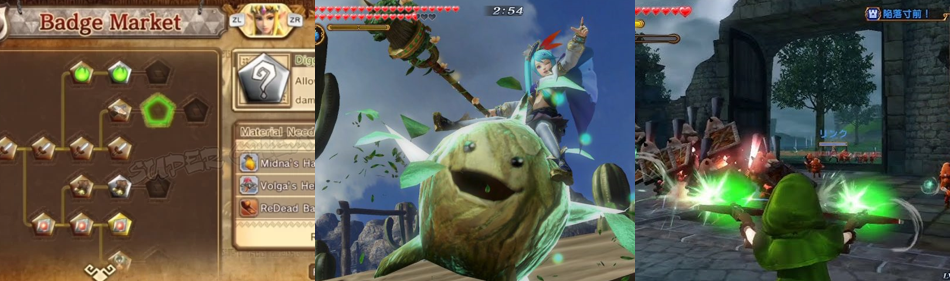
Defeating enemies earns you experience points (EXP), which allow you to level-up and become stronger. It also earns you power-ups, Materials, and Rupees. Outside of battle, Materials and Rupees are used to further improve your character. They unlock “Badges” that gift additional combos, attacks, and increase their stats and meters in the attack skill tree. You can unlock additional bottles and improve their defence against elemental attacks, reduce knockback and stun, and other defensive buffs; or you can speed up how fast your meters fill or how quickly you take Keeps. You can also spend Rupees to quickly level-up any characters you haven’t used much (since AI-controlled characters don’t appear to level-up) or new characters you’ve unlocked, or spend them in the Smithy. Here, you sell or fuse weapons to reduce your inventory and add extra buffs to weapons. Weapons will either have no “slots” or as many as three, allowing them to be empowered to strengthen your regular or special attacks, earn extra EXP, spawn extra Rupees, deal elemental damage, and so forth. Initially, your inventory is quite limited, but it expands as you progress through the story, though I found it easier to stick with the most powerful weapon and sell the weaker ones and rarely saw a benefit of fusing weapons. There’s also an apothecary, where you mix new potions and elixirs, and you’ll gain new items and sub-weapons from treasure chests. After clearing each mission in “Legend Mode”, you can replay it either in this mode or with any character in “Free Mode”. You can play on a harder difficulty to earn more rewards, or search for the elusive and skittish Gold Skulltulas, which add to various portraits and unlocks additional maps and bonuses. On the whole, Hyrule Warriors is quite easy; if you stick to one or two characters as I did (usually Link), you can become very powerful very quickly. However, it’s easy to get caught off-guard when stronger enemies or multiple objectives pop-up. The game obviously gets tougher on harder difficulties as enemies are stronger and deal more damage, and some missions add additional hazards, such as lightning strikes, bombardments, and health-sapping auras.

Presentation:
I first played Hyrule Warriors on the 3DS, where the game was serviceable but the hardware struggled with all the enemies and action, causing some slowdown an pop-up. I specifically bought the Definitive Edition to mitigate these issues and, for the most part, the upgrade is immediate and welcome. The game still suffers from a bit of pop-up and occasional slowdown when there’s a lot happening onscreen or when you’ve completed a mission (meaning many battles abruptly end). There are also noticeable loading times between missions (though tips, fun 8-bit graphics, and story dialogue help to speed them up), but the game performs really well otherwise. Hyrule Warriors mostly pulls its locations and characters from Zelda’s 3D adventures, recreating and reimagining areas such as Hyrule Field and Hyrule Castle, the Twilight Realm, and Skyloft as restrictive sandbox battlefields populated by Keeps, pots, and occasional bridges, dips, and alternate paths. These locations are rather hit and miss; later, you’ll battle in cel-shaded arenas like Windfall Island, which are far more vibrant and fun than the dense, confusing forest or the apocalyptic wastelands ruled by Ganon or the relatively sparse Gerudo Desert. One enjoyable exception was Lake Hylia, which includes not just the lakeside area but the labyrinthine catacombs of the Water Temple. Indeed, with the game’s emphasis on fast-paced, chaotic combat, it’s no surprise that the locations are rather bland. Sometimes, bridges will crumble and you’ll hookshot over gaps, or lightning and other bombardments will fall, or there’ll be plumes of lava or some limited scenery to see (fortifications, usually, or ruins). However, the environments are there to contain you, not distract you, and are largely fun, if limited, nostalgia trips to Zelda’s 3D games.

The game redesigns classic Zelda characters and locations into a new style.

Character models far much better, despite constantly being in motion, attacking, or being bashed about. While I’m not a big fan of Link’s weird scarf, he’s well represented, pulling off all his signature attacks with the same gusto I’d expect from his first 3D adventure. This extends to other playable characters, who all exude their own personalities and fighting styles (helped by intro and outro cutscenes): Darunia is a mighty Goron warrior swinging a giant hammer, Fi gracefully flies and dances about, and Ruto conjures water geysers as she attacks. New characters like Agatha, Volga, and Cia also impress, spawning large magical allies, transforming into dragons, and conjuring dark minions, respectively. Each character has a few costumes to unlock and is fully voiced, with the exception of Link (who talks via a fairy appropriately named “Proxie”) and certain cutscenes, furthering the convoluted plot and alerting you to objectives. Outside of battle, the narrative is told through impressive, high-quality pre-rendered cutscenes that show these heroes coming from across all the Zelda timelines to combat Cia’s threat and Ganon’s return, and they were a joy to watch for how lovingly they recreated the 3D Zelda games. Similarly, the game’s soundtrack includes orchestral remixes of classic Zelda tunes, especially those associated with each of the environments, and collecting Materials and weapons plays a remix of the “Get Item” Zelda jingle. The character selection is impressive, with each having different weapons and attack animations, some more elaborate than others to include cameos and references from across the franchise, and I was really impressed by the stability and options offered, alongside the presentation. Things can get very cluttered and frantic, but Hyrule Warriors is a great homage to the entire Zelda franchise, even with its restrictive environments.

Enemies and Bosses:
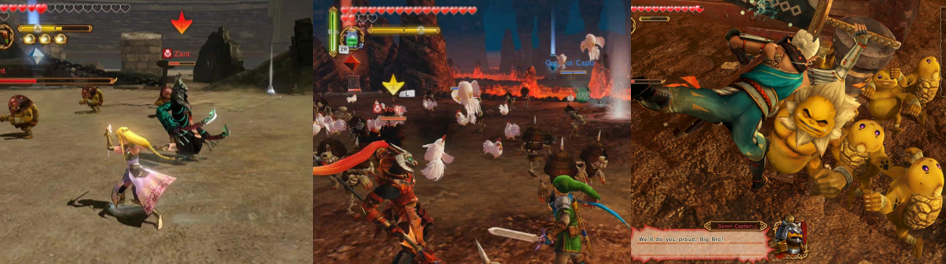
There are seemingly infinite enemies in Hyrule Warriors, technically speaking, with maps being flooded by monstrous beings recognisable to long-time Zelda fans, most of them being simple cannon fodder to up your combo, EXP, Rupee, and KO count. You’ll cut through swarms of relatively harmless Bokoblins, Miniblins, and Stalchilds (and even Gorons and Hyrulian Soldiers when playing as bad guys or they’re turned against you), which offer only a token resistance. Amongst them, you’ll encounter more formidable commanders, captains, summoners (who quickly become a priority to keep enemy forces down), and the like who target your allies or Keeps and must be prioritised. From there, it only escalates: Dinolfos, Lizalfos, and elemental Poes appear spewing fire, welding stronger weapons, or teleporting and firing elemental or dark projectiles, respectively. Darknuts, Shield Moblins, and Big/Stone Blins put up a tougher fight thanks to their greater armour and more powerful attacks, Gibdos and ReDeads can freeze you in your tracks and spew a heart-sapping poisonous aura, and Aeralfos hover overhead, swopping down and spewing fire. Deku Babas also emit a poisonous aura and are only vulnerable to arrows; Beamos status will blast away unless you explode them with bombs; Cuccos will turn against you if their mother is defeated; Manhandla Stalks burst from the ground to take a bite out of you; and elemental Chuchus need a good whack with your hammer. You’ll also contend with traitorous or mind-controlled forces, restless spirits of dead soldiers, and dark doppelgängers of all the game’s playable characters, with Dark Link being especially notable as numerous versions of him spawn in across maps and must be taken down.

You’ll battle the same boss enemies again and again in a bid to control each map.

These dark doppelgängers often serve as the primary target of a mission, but you’ll also battle the real versions of these on more than one occasion, especially in “Legend Mode”. You’ll battle the likes of Volga, Wizzro, Ghirahim, and Zant more than once, with boss encounters against these often taking place multiple times across a mission. Often, you encounter the boss early on, causing them to flee to the fortified Keep. Defeating enemies or activating a Fairy Fountain draws them out or weakens them, kicking off a rematch, though sometimes you’ll battle two at once or at different times in a mission. One may appear as an ally and then turn against you, adding more enemies to your path, or they’ll summon a Giant Boss to distract you so they can increase their power and send more troops against you, your allies, and your Allied Base. Often, you’ll also battle traditionally heroic characters like Lana, Impa, and Darunia, either because they’ve been corrupted or you’re playing one of Cia’s missions. Either way, these battles aren’t much different than facing regular enemies or their commanders: simply lock on and pummel away, dodging and blocking as needed and unleashing your special attacks whenever possible. Sure, Ghirahim is pretty swift, Volga becomes a gigantic fire-breathing dragon, Wizzro can be a pain in the ass, and Zant can crush you with totem poles, but I never had any issues battling the playable characters when they appeared as bosses. Cia and Ganondorf put up a bit more of a fight, but this was mainly due to them being invulnerable, magically empowered, or hidden behind dark forcefields or fortified Keeps. In these instances, you must cut off the dark power protecting them by, you guessed it, capturing Keeps, defeating enemies, and activating Fairy Fountains. It’s advisable to order your allies to target these bosses to whittle them down and reduce their defences, but I actually had more trouble against Phantom Ganon than regular Ganondorf since the phantom conjured duplicates and did a bit more than aggressively swipe with his swords.

Your allies and sub-weapons are instrumental in besting the game’s Giant Bosses.

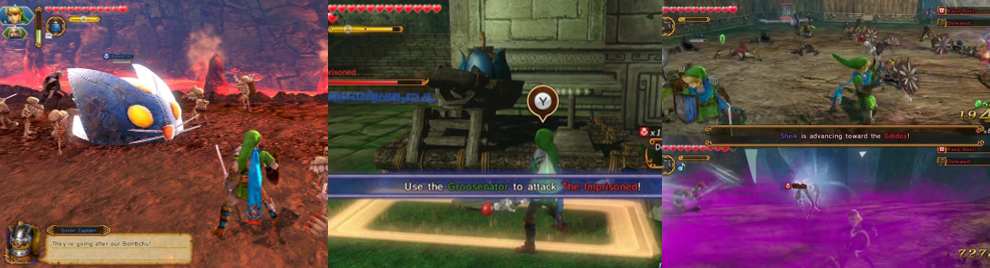
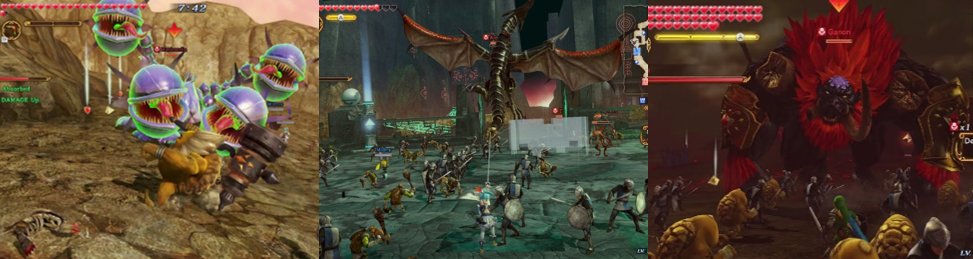
As mentioned, these bosses are often joined by Giant Bosses, with multiple sometimes spawning across the map and causing a real headache on the harder missions. These include series staples such as the massive, armoured spider queen Gohma, the fire-breathing dragon King Dodongo, and the monstrous plant-creature Manhandla. These can be some of the most annoying encounters due to having to whittle down their Weak Point Gauge, their high health pool, and the ways you must attack them. Gohma, for example, shields itself from all regular attacks and is only vulnerable when you shoot its laser-blasting eye with an arrow. Similarly, the rolling, rampaging King Dodongo can only be stunned by tossing bombs into its mouth, the Argorok can only be brought down by hookshotting its tail when it glows blue, and you’ll only get to go nuts on the Helmaroc King after whacking its head with your hammer. By far the worst of these for me was the Manhandla, which can only be stunned with the boomerang and, even then, there’s a small window where you can do this. The rest of the time, it spits seeds and bombs about the place completely impervious, making it the most aggravating of the Giant Bosses, especially when it teams up with the others! Another Giant Boss you face (and even control in one mode) is Ganondorf’s true form: the Dark Beast, Ganon. Accompanied by a perpetual lightning storm and attacking with claw and tail swipes, Ganon incorporates the attacks and the associated weaknesses of the other Giant Bosses, meaning you toss bombs when he’s charging a fireball, fire arrows when he charges a laser blast, hookshot his tail when it glows blue, and throw your boomerang after a seed bombardment. You must gather all your allies around Ganon to weaken him, but you’ll only defeat him once Zelda gifts you the Light Arrows in a cutscene. When playing as Ganon in “Ganon’s Fury”, you’ll battle the other Giant Bosses in kaiju fights. However, despite Ganon’s vast size and incredible power, he struggles against these (and, strangely, even regular enemies and commanders) in a straight up fight. Finally, you’ll also contend with the Imprisoned and its smaller minions; this aggravating walking slug can only be brought down by attacking its toes and can send you flying or stun you with paralyzing stomps and a big slam.

Additional Features:
There are 100 Gold Skulltulas to find in Hyrule Warriors, with one appearing for a short time in each mission. Collecting them uncovers a picture; there are thirteen of these to uncover, and completing them adds to the game’s options and maps. Completing each mission in “Legend Mode” unlocks it in “Free Play” mode, allowing you to tackle any mission with any character and grind up their level. Since this is the Definitive Edition of Hyrule Warriors, the DLC missions are available as you play through “Legend Mode”. These see you playing a side mission as Linkle, utilising her unique dual crossbows to prove her worth in recycled maps against recycled enemies and bosses, and secondary side missions as Cia and Ganondorf. These act as a prequel and midquel to the main story and see you cutting down Gorons and Hyrule’s finest and recruiting (or outright controlling) dark allies like Wizzro, Volga, and Ghirahim. Finally, there’s an epilogue to the main story where the cel-shaded world of The Legend of Zelda: The Wind Waker (Nintendo EAD, 2002) bleeds into that of Hyrule Warriors, resulting in you teaming up with Tetra and battling the Helmaroc King and Phantom Ganon to stave off the incursion. As mentioned, there are three difficulty settings (“Easy”, “Normal”, and “Hard”), with the even harder “Hero Mode” unlocked after beating “Legend Mode”. The game can be played with another player as well, which I think I would recommend given how chaotic battles can get, and you can test your mettle in the game’s “Challenge Mode”. Here, you’ll be tasked with defeating set numbers of enemies against a time limit, though this is easier said than done as not only are the enemies far stronger, but you also often have to content with multiple, far tougher Giant Bosses stomping about the place. You can also customise your fairy setup in “My Fairy” mode, but I couldn’t access this despite acquiring fairies in “Adventure Mode” (I think you may need an empty bottle on hand for this to activate).

Play Linkle’s story, rampage as Ganon, or test your mettle in the comprehensive “Adventure Mode”.

There’s also the aforementioned “Ganon’s Fury” mode, where you rampage as Ganon, wiping out hordes of enemies and battling other Giant Bosses, sometimes without the ability to restore your health or against a time limit. Sadly, I found this mode wasn’t as enjoyable as it could’ve been as Ganon is surprisingly weak. The major source of replayability in Hyrule Warriors, though is “Adventure Mode”. Unlocked after you clear “Legend Mode”, “Adventure Mode” is a series of additional maps and challenges all themed around different games from the Zelda series. There are two maps based on the first game, one for Link’s first Game Boy adventure, a Wind Waker map, and others themed around his other 3D adventures. Generally, these boil down to the same gameplay loop of taking Keeps and defeating enemies, but they carry a few more modifiers. Manual saves appear to be deactivated, for example, as the missions are much shorter. You’re more likely to be fighting against a time limit, for example, or encountering heart-sapping Keeps. Fun new additions include competing with other forces for KOs or Rupees or taking quizzes where you must defeat the right enemy. Map items acquired in this mode allow you to search for and uncover secrets using bombs, candles, and the like, unlocking new Heart Pieces, costumes, and even characters like the Skull Kid and Marin. These maps can get very difficult thanks to additional concerns: the “Master Quest” map includes stronger enemies, for example; the Wind Waker map includes wind elements, the Majora’s Mask (Nintendo EAD, 2000) map resets with a devastating moon strike after you’ve exhausted your turns; and you must watch out for Nightmare’s influence and portals to Lorule on the Link’s Awakening (ibid, 1993) and A Link Between Worlds (ibid, 2013) maps, respectively. As fun as these maps are, though, it’s the same repetitive gameplay loop over and over and you’ll need a decent guide to unlock all the extras, and even need to find all the Skulltulas to unlock all the maps!

The Summary:
I knew that Hyrule Warriors wasn’t optimised for the 3DS when I bought it, but I got it anyway as I’m a big fan of the Zelda series and the gameplay looked fast-paced and hectic. Given I didn’t own a Wii U, this was my only way of playing the game and I remember enjoying it at the time as a bit of mindless fun, so I jumped at the chance to upgrade to this Definitive Edition of the game. The upgrade is readily apparent; the game shines on the Nintendo Switch, performing leagues better and packing all the extra content into one convenient package but still leaving plenty of stuff for you to unlock and discover. The character roster is great, as are the references to the franchise in their appearances, moves, and interactions. While the locations aren’t as impressive, they do what they’re made to do, which is provide a limited, recognisable sandbox for you to plough through thousands of disposable pawns with ease, and the music is absolutely on point. Sadly, the gameplay loop can be very mind-numbing and, at times, aggravating. As the game progresses, the action becomes a chaotic assault on your senses as you desperately try to spread yourself across the map and solve every problem to reap the best regards. This means Hyrule Warriors is probably best played with a friend so you can share the anxiety of having multiple objectives at once, but it’s perfectly do-able alone as long as you know what missions can be prioritised over others. This also means that Hyrule Warriors is probably best enjoyed in short bursts rather than one long session. Missions can get repetitive and annoying as enemies disappear and reappear and the goal posts constantly move, but it’s endlessly satisfying cutting them down with your powered-up character, taking out those annoying Giant Bosses, and snagging new rewards. The sheer variety and content packed into the “Adventure Mode” is daunting, to say the least, and I don’t know if I’ll ever 100% even a single map, much less the entire game, but it’s good to know it’s always there to pick up and bash out a few missions when I need to wind down.

My Rating:

Rating: 4 out of 5.

Great Stuff

Have you ever played Hyrule Warriors? If so, what did you think to this definitive Edition of the game? Which character was your favourite? What did you think to the chaotic gameplay and playable roster? Have you ever played the Dynasty Warriors games and, if so, do you think the formula translated well into the Zelda series? Did you ever find all the Gold Skulltulas? Which of the “Adventure Mode” maps was your favourite? Would you like to see more Zelda spin-off titles? How are you celebrating the Zelda franchise today? Whatever your thoughts on Hyrule Warriors and the Zelda games, feel free to leave them below or on my social media, and be sure to check out my other Zelda content across the site!

Game Corner [Zelda Month]: The Legend of Zelda: Majora’s Mask 3D (Nintendo 3DS)


On 21 February 1986, The Legend of Zelda (Nintendo EAD, 1986) was first released in Japan. The creation of legendary game designer Shigeru Miyamoto and Takashi Tezuka, The Legend of Zelda launched one of Nintendo’s most popular franchises. This year, I’ve been dedicating every Friday to Nintendo’s most famous silent protagonist, Link and his vast and enduring fantasy world of sword and sorcery.


Released: 13 February 2015
Originally Released: 27 April 2000
Developer: Grezzo
Original Developer: Nintendo EAD
Original Version Also Available For: GameCube, Nintendo 64, Nintendo Switch, Nintendo Wii, Nintendo Wii U  

The Background:
An instant classic upon release, The Legend of Zelda (mostly) went from strength to strength as the concept was refined and expanded throughout Nintendo’s handheld ventures and 16-bit era. Following a long development period, the franchise made a phenomenally successful jump to 3D with The Legend of Zelda: Ocarina of Time (Nintendo EAD, 1998). Following its success, Nintendo originally sought to create a remixed version for the ill-fated 64DD peripheral, which would eventually become the “Master Quest” version of the game. Designer Eiji Aonuma was unenthusiastic about this, so series creator Shigeru Miyamoto challenged the team to create an entirely new 3D Zelda adventure using Ocarina of Time’s assets in just one year. Aonuma recruited designer Yoshiaki Koizumi to adapt his concept of a time loop gameplay mechanic; Koizumi also (literally) dreamt up the idea of the impending threat of a falling Moon. Realising that Ocarina of Time’s players would be a little older, Aonuma purposely aimed for a bleaker, more melancholy tone for the game, which was bolstered by the Expansion Pak that allowed the game to run much smoother and boast more complex visuals compared to Ocarina of Time. The Legend of Zelda: Majora’s Mask was a critical and commercial success; reviews praised the new gameplay mechanics and it quickly gained a reputation as one of the darker, more sombre entries in the franchise. Following a handful of re-releases, and the success of Ocarina of Time’s 3D remake, Nintendo and Grezzo immediately began work on giving Majora’s Mask the same treatment. Alongside graphical improvements, the team purposely aimed to make Majora’s Mask 3D more accessible and included numerous quality-of-life features that were criticised by some. Despite this, the game received positive reviews praising the updated visuals, mechanics, and new elements and the game retained its status as one of the franchise’s most under-rated entries.

The Plot:
After saving Hyrule and being returned to his childhood, Link is jumped by a Skull Kid and has his horse, Epona, stolen. Pursuing the thief to the bizarre world of Termina, Link must manipulate a three-day cycle to stop the possessed sprite from destroying the land.

Gameplay and Power-Ups:
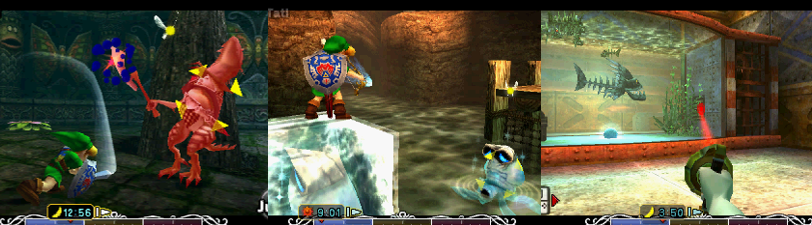
The Legend of Zelda: Majora’s Mask is a 3D action/adventure game that’s built upon the same game engine as its predecessor, Ocarina of Time, and therefore shares many of the same controls, gameplay mechanics, and features. In a rarity for the franchise, players control the same Link is in the previous game, though returned to his child body (and you can change his name when starting a new file) and exploring a bizarre new land filled with many familiar, but noticeably different, characters. Link’s goal is simple: he has three days to stop the possessed Skull Kid from destroying Clock Town and all of Termina with a giant, nightmare-fuelled moon. To do this, players journey to four areas adjacent to Clock Town, tackle the dungeons (or “Temples”) found there, and defeat the bosses within to awaken the Four Giants, the only beings physically capable of pushing back the Moon. However, your mission is compounded by the ever-present time limit, the drama and side quests of the various non-playable characters (NPCS) Link meets, and the numerous magical masks he obtains along the way. Link’s abilities will be immediately familiar to any returning Ocarina of Time players: A sees you talk to NPCs, open chests, and interact with the environment while B lets you attack with your sword, swiping, stabbing, and even jumping when used in conjunction with A. The Left Trigger activates “L-Targeting”, allowing you to lock on to enemies, NPCs, and other targets and expands your attacking options by letting you raise your shield to deflect attacks and projectiles with the Right Trigger, side hop, backflip, and leap into action.

Though a child, Link is as competent as he was as an adult with his weapons and items.

You assign different weapons and items to the X and Y buttons, while other items are assigned to the I and II slot on the touchscreen for easy use. By default, your trusty ocarina and, later, the Pictograph Box are selectable from the top and bottom left of the touchscreen, which is also where you’ll find your map, health (represented as hearts), magic meter, and item and mask menu. Though a child, Link eventually acquires many weapons he utilised as an adult. These are found within the game’s Temples and are often necessary to defeat the mini boss and main boss within, as well as being used to solve various puzzles. You can acquire the Hero’s Bow and a variety of elemental arrows, allowing you to attack enemies from afar, hit switches, burn objects, and create ice platforms where indicated. Bombs and Bombchus are used to blow upon walls and discover secrets, Deku Sticks allow you to light torches, Deku Nuts briefly stun certain enemies, and you can snag on to certain targets and parts of the environment with the Hookshot to cross gaps or bring items to you. Magic Beans can be planted to create platforms to new areas, the Lens of Truth will reveal hidden paths and secrets while draining your magic, and you can capture life-restoring Fairies or store various potions in one of Link’s many bottles. Players can also strengthen their sword by following a specific side quest; though the Razor Sword is only temporary and will eventually dull, it can be further (and permanently) upgraded to the Gilded Sword. Similarly, you can earn yourself the massive Great Fairy’s Sword and obtain the light-reflecting Mirror Shield, and eventually purchase large Powder Kegs to destroy larger boulders. Link can also expand his inventory with bigger quivers, bomb bags, and wallets. Though you lose all your Rupees and ammo stock whenever you travels back in time, you can bank your Rupees in Clock Town and will find plenty of ammo by cutting up grass and defeating enemies.

Link’s masks afford him unique new abilities, though the controls can be finnicky and clunky.

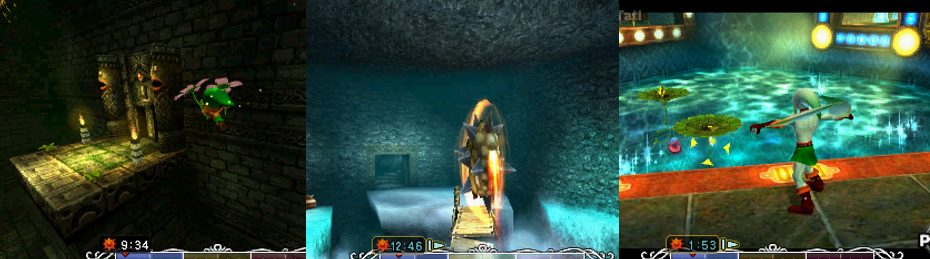
The Ocarina of Time is again used to manipulate the flow of time. You’ll need to travel back in time multiple times as you’ll get a game over once you reach the end of the third day. Luckily, you can speed up and slow down the flow of time to give yourself more time to complete tasks or jump to specific time periods to complete side quests. Other ocarina songs warp you to the various Owl Statues across Termina, where you can also manually save your game, call Link’s trusty steed, Epona, once you rescue her, access certain Temples, and heal disturbed or unquiet spirits to obtain new masks. Majroa’s Mask big gimmick is the mask system; Link will assume three distinct forms (a Deku Scrub, a Goron, and a Zora) throughout the game, each with different playstyles and lacking his traditional weapons. Deku Link is small and spritely, spitting bubbles from his nose and using Deku Flowers to launch into the air and temporarily fly about like a helicopter. Goron Link is big, slow, and powerful, smashing foes with his fists, slamming the ground, and barrelling along in a spiked ball to cross gaps. Zora Link is sleek and agile, easily cutting through water, walking across the seabed, and tossing boomerang-like fins from his arms. Well, I say “easily” but Zora Link can be finicky to control, often ploughing into walls and being a pain. Each of these forms has their own musical instrument in place of the ocarina and is used not just in their main Temple, but to solve other puzzles and complete side quests, such as purchasing Deku deeds, competing in high-speed, aggravating Goron races, and racing against beavers. Link’s other masks all have special abilities, too, such as the Bunny Hood doubling his running speed, the Blast Mask exploding like a bomb, the Great Fairy’s Mask attracting Stray Fairies, and the Captain’s Hat allowing you to command Stalchildren. The Stone Mask renders you functionally invisible, the All-Night Mask keeps you awake, and the Giant’s Mask transforms Link into a hulking giant for a kaiju-esque boss battle. With the exception of the three main masks, all these masks are optional and obtained through side quests, but it pays to acquire them all to make your life (and the endgame) so much easier.

Termina is full of NPCs, mini games, and side quests that will reward you handsomely.

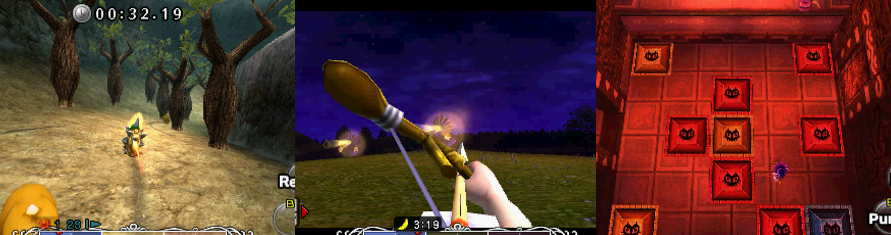
Termina is full of NPCs, all of whom have different thoughts on the current situation and different issues to deal with. Over the course of the three days, you’ll interact with them several times, with key events being recorded in your handy-dandy Bomber’s Notebook so you can keep track of what’s going on and when. This functionality is great for new players and for people like me, who like to efficiently complete the game’s side quests as quickly as possible. Because of the time travel and three-day loop, you’ll repeat certain events and trigger certain cutscenes multiple times, requiring you to rescue old ladies and injured witches, follow shady characters, and retrieve certain items to complete side quests. Many side quests are ongoing, requiring multiple steps (such as reuniting Anju and Kafei, which will take you right up to the last minute of game time and sees Link and Kafei working together to solve switch-based puzzles in Sakon’s hideout) or occur at specific times (such as the surreal defence of Romani Ranch against alien invaders!) Other quests are more low-key, such as using the Bremen Mask to engross little chicks, defending Cremia’s milk delivery from the Gorman Brothers, besting the various shooting galleries and fishing holes, and delivering fish to the Marine Research Lab. Other side quests can be quite involved, such as reuniting the frog choir, using all of Link’s transformations to form a band, digging up treasure with Dampé, and challenging the mini bosses to a rematch. You’ll also be using all your weapons and skills in Gold Skulltula Houses, taking pictures with your Pictograph Box, visiting Gossip Stones, and answering the Keaton’s quizzes. Your reward for these endeavours is either a new mask, a Piece of Heart to extend your maximum health, a bottle, or some Rupees, all key items to assist your adventure.

The four Temples are packed with new and familiar puzzles and fitting gimmicks.

Each Temple houses not just a new weapon and the usual map and compass, but fifteen Stray Fairies which must be freed and collected, usually by enticing them with the Great Fairy’s Mask. Find them all and you’ll earn Link’s patented Super Spin Attack (hold B to charge up a magic-draining spin attack), double your magic meter, increase your defence, and earn the aforementioned powerful (if unwieldy) Great Fairy’s Sword. It’s worth collecting these as you explore the Temples to avoid having to return later. Time is always against you in Majora’s Mask, so be sure to play the Inverted Song of Time to stave off Termina’s inevitable doom. Though the game only has four Temples, getting to them is a task in itself: Link must follow cheeky monkeys and sneak into the Deku Palace, feed and soothe the Goron Elder’s son and then use the Lens of Truth and Goron Lullaby to bypass the Biggorn protecting Snowhead Temple with a blizzard, mess about finding seven Zora Eggs to summon a giant turtle to reach the Great Bay Temple, and battle through the undead minions of Ikana Canyon and scale up a puzzle-landed rockface to reach the Stone Tower Temple. While each contains many recycled elements from Ocarina of Time (torches, switches (timed or otherwise), climbable and destructible walls, etc), each also boasts a maze-like structure and fitting gimmick. Woodfall Temple is full of poisonous water and large gaps you must fly over as Deku Link, Snowhead Temple features both lava and ice, ramps to careen over and weighted switches to pound as Goron Link, and a large central pillar that needs to be brought down to reach the boss. The Great Bay Temple is, obviously, water-based, featuring a maze of rushing currents, jet streams, and propellers. You must use the Ice Arrows to create platforms and solve puzzles and pay attention to the helpful colour-based indicators to know where new paths have opened up. The Stone Tower Temple is two dungeons in one, featuring a gimmick where you flip the area upside down to access new areas, light-based puzzles using the Mirror Shield, and plenty of opportunities to use the Elegy of Emptiness to create a soulless duplicate of Link to press down switches. As you’d expect, each Temple also contains a mini boss, a warp point, numerous small keys to open locked doors, and a big Boss Key to access the Temple guardian.

Presentation:
Even in its original Nintendo 64 incarnation, Majora’s Mask had Ocarina of Time beat hands down when it comes to visuals. Although the game always had a bit of a blurry look thanks to it taxing the console (and the Expansion Pak) to its limits, the graphical upgrade was apparent right away in something as simple as Link actually having his sash and his jumping animations being more dynamic. In the 3DS version, the visuals are as improved as they were in Ocarina of Time 3D, reducing the blur in favour of clarity, adding more emotion to Link’s face, and allowing players to immerse themselves in the world (and induce a headache) with the 3D slider. At first glance, Majora’s Mask seems like a smaller sandbox to its predecessor; you spend a lot of time in one central location and there are only four Temples, after all. However, the opposite quickly proves to be true; not only are there more NPCs onscreen at any one time, their personalities, positions, and roles change across the three-day cycle, adding an unexpected level of depth and emotion to this bizarre adventure. In addition to a day and night cycle and each area of Termina sporting different weather effects and seasons, the world is far more diverse than before. Great Bay, for example, is a vast beach home to the Pirate’s Cove, Gerudo Lagoon, and Zora Cape, a coral-like town that puts Zora’s Domain to shame. Similarly, the Southern Swamp sees Koume and Kotake offer a boat ride through the sweltering foliage, a confusing monkey-filled maze, and the nigh-impenetrable Deku Palace, where the woodland folk don’t take kindly to strangers.

Termina is a diverse land with many areas to explore and environmental effects.

Easily the most impressive area, for me, was Snowhead Mountain. Like Zora’s Domain, Termina’s Goron population have been crippled by inclement weather; in this case, a raging blizzard. Snow and ice covers the environment and the weather has claimed many Goron lives and hides many secrets but, unlike in Ocarina of Time, the snow will melt when you best Snowhead Temple, just as the Southern Swamp with become more habitable. Sadly, travelling back in time undoes these actions and you’ll need to beat the Temple bosses again to re-restore the lands, but just the fact that you can undo the damage done to Termina and see NPCs celebrating in their newfound lives adds so much more gravitas to the game. It compels you to journey on and assist more NPCs, which rewards you with more lore and items, and makes Termina so much richer compared to the more stagnate Hyrule in Ocarina of Time. Ikana Canyon is a desolate, dangerous area filled with undead monsters, rolling rocks, an abandoned village, and the forgotten ruins of Ikana Castle, with its light-based puzzles and spooky inhabitants. The Stone Tower that leads you to the Stone Tower Temple is quite the feat, requiring you to scale it in various creative ways, all before you even flip the Temple on its head to tackle it upside down. Even exploring Termina Field is an adventure in itself; all sorts of respawning enemies lurk in the grasslands, and you can visit the observatory, Romani Ranch, and discover numerous hidden areas all by experimenting with your weapons, mask abilities, and exploring the rich and detailed world. Although the Song of Soaring, Bunny Hood, and Goron abilities make traversal simple, you can rescue Epona and race around on her as Young Link to tick off another desire from Ocarina of Time (though I admit that I rarely used her since she can’t access every area).

This is easily one of the darkest and most bizarre Zelda adventures.

Majora’s Mask is easily one of the most bizarre and bleak Zelda adventures. Right from the beginning, the story starts with a melancholy tone, with Link wandering the lands in search of Navi, only to have his horse and ocarina stolen by the Skull Kid and his mischievous fairy companions, lost in a strange land, and transformed into a Deku Scrub! Like in Ocarina of Time, Link is partnered with a fairy, but Tatl is no Navi; she’s rude, obnoxious, and rarely gives much help when searching for an enemy’s weak spot. Over the course of the game, the two find common ground as Tatl’s concern for her friend and her brother, Tael, grow, and Link’s courage is called upon again to aid the aggressive and slightly demonic Happy Mask Salesman in retrieving Majora’s Mask. Most interactions take place using the in-game engine and simple text boxes, but horrific (thankfully skippable) cutscenes play every time you put on a transformation mask, suitably dramatic cutscenes play when Temples rise up or NPCs are laid to rest to increase Link’s abilities, and you’ll get helpful reminders when day turns to night turns to day and the countdown to destruction looms closer. Speaking of which, the grim-faced Moon looms ominously overhead, growing closer and closer and causing small earthquakes. NPCs become more fearful or flee as the game progresses, and woe befall anyone who lets the timer runs out and must watch the Moon obliterate the land! While many of the assets, models, and elements are recycled from Ocarina of Time, they’re all much improved, with characters constantly on the move and doing their own thing, which you can track with the Bomber’s Notebook. Many musical cues and tracks return as well, though the Termina Field Overture is far more bombastic and engaging for me, and each area boasts a fittingly twisted soundtrack that’s both familiar and unique. The 3DS version changes up the presentation a bit, redesigning the countdown timer, area intros, and tidying up the graphics and assets to really make the colours pop, add helpful guidelines to certain areas, and even mixes up the puzzles and locations of certain items.

Enemies and Bosses:
In keeping with the recycling of Ocarina of Time’s assets, Majora’s Mask returns many enemies from the previous game, such as the shield-sucking Like Likes, bat-like Keese (also in fire and ice variants), crab-like Tektites, Poes, Wolfos, crow-like Guays, Peahats, Octoroks (and their larger cousins), Deku Babs, Lizalfos and Dinolfos. Anyone who’s played Ocarina of Time will know how to tackle these enemies, which usually comes down to firing arrows or strategic use of L-Targeting, and the same is largely true of many of the new enemies featured here. You’ve got your normal, smaller foes like beetle-like Hiploops, electrical Dragonflies, Giant Bees, and skeletal fish, but you’ll also contend with strange foes like the Dexihand, Eyegore, and Goron-like Nejirons. Snappers are best taken out by lying in wait in a Deku Flower and exploding up beneath them; snowball-tossing Eenos are susceptible to Fire Arrows; the various ChuChus can be popped to quickly earn health and ammo; and you’re better off simply defending against or firing arrows at the “Real” Bombchus that scurry about. Some enemies will better test your swordsmanship, such as the Garos and returning Gerudos and Iron Knuckles (who attack faster and more aggressively as their armour is destroyed), while you can command the Stalchilds and even avoid or converse with Gibdos and ReDeads with certain masks. Similarly, you can bypass the Death Aros altogether with the Stone Mask, must switch to sub-weapons or play the Song of Storms when touched by a Blue Bubble, and keep an eye out for the vulture-like Takkuri flying around Termina Field to avoid having your items stolen.

Even familiar mini bosses require a bit more strategy to overcome.

Each Temple houses at least one mini boss who must be overcome, sometimes multiple times, usually to obtain the Boss Key or the dungeon’s weapon. Many of these will be familiar not just to players of Ocarina of Time, but also long-time Zelda fans: Dinolfos and Iron Knuckles appear more than once and fit into this category, for example, but Majora’s Mask sees the return of series staples such as Wart and Wizzrobe. Wizzrobe is fought multiple times in multiple Temples, teleporting about, creating illusionary doubles, and attacking with fire or ice magic. Wart appears in the Great Bay Temple and is, as usual, a giant eye surrounded by bubbles that Link must destroy to get a clear shot at its pupil, while being mindful of it firing them as projectiles and bouncing around in a frenzy. The Gekko appears twice in the game, first riding a Snapper and attacked via a Deku Flower and then encased within a giant, gelatinous substance that must be frozen with Ice Arrows and shattered to attack the slippery devil. In the Ikana Graveyard, Link chases the gigantic Captain Keeta, fending off his lackeys and hacking the giant’s legs to get his attention. You must avoid his swipes and flaming barriers and pelt him with arrows to stun him, but the main issue here is keeping up with him so he doesn’t flee (but that’s what Hylia created the Bunny Hood for!) Stone Tower Temple is home to two more tough mini bosses: first up is the Garoa Master, a teleporting assassin who drops from the ceiling and attacks with a charge. Stay away from his attacks to strike back when his guard is lowered, and be sure to keep your distance when he’s beaten as he’ll blow himself up with a bomb! Defeating him earns you the Light Arrows, which are key to dispelling the bats protecting Gomess. Gomess attacks with a scythe that can cut through your shield, so be sure to jump-slash his exposed heart when you see an opening.

Bosses have been redesigned to have new phases and weak spots, which can be aggravating.

Naturally, you’ll have to best each Temple’s boss to awaken one of the Four Giants and acquire their remains. If you played Majora’s Mask on the Nintendo 64, you’ll be in for a surprise here as each boss has been fundamentally changed, somewhat simplifying them and expanding their attack patterns to allow for new ways to beat them. First up is Odolwa, a manic swordman who dances about and strikes with a gigantic blade. Originally, you’d use arrows or bombs to stun him and strike with your sword, but now you must brave being roasted alive as Deku Link to attack from above, exposing a big slimy eye that is a recurring weak spot for the 3DS version’s bosses. I always found Goht one of the more annoying bosses; the fight takes place on a never-ending track filled with ramps and Magic Jars and sees Goht gallop along, tossing bombs, causing rocks to fall, or summoning a thunder bolt. You’re encouraged to race after him as Goron Link, picking up speed to ram him and topple him over to attack his exposed eye, but you can actually just stand by the entrance and pelt him with arrows or even toss a bomb at him to speed things up. Gyorg was initially a pretty simple affair, testing your patience by having you wait on the central platform to shoot him as he jumps over then ram into him as Zora Link. Now, there’s a second phase that’s completely underwater; you must desperately avoid the mines and detach them to stun Gyorg, blasting his giant eye where possible, something made quite troublesome with the clunky swimming mechanics. Similarly, Twinmold is completely different; originally, you’d be forced to don the Giant’s Mask and attack the worm’s heads or tails with your sword while keeping your magic topped up. Now, you only earn the Giant’s Mask after pelting the boss’s first phase with arrows and must stomp about as Giant Link engaging Twinmold in a fist fight, then grab its tail when it’s stunned. Again, this is a much more aggravating boss battle because of this; Giant Link is a slow, lumbering character compared to the slipper Twinmold and your magic drains very quickly, causing the fight to drag unnecessarily.

Majora’s many forms and difficulty are rendered mute with the overpowered Fierce Deity Mask.

Once they’re all beaten, you must return to Clock Town on the final day and play the Oath to Order. This summons the Four Giants and stop the Moon from falling, but causes the Skull Kid to freak out and the demonic Majora to assume full control. You’re then transported to the strangely idyllic Moon’s surface, where you must challenge four short, troublesome obstacle courses themed around each Temple. If you’ve collected every additional mask, you can trade them all in here and gain the Fierce Deity Mask, which can only be worn in boss rooms and transforms you into a hulking adult equipped with a massive sword that fires magic-draining energy beams when L-Targeting. This is the only way I’ve battled the game’s final boss, Majora itself, which has three distinct forms: Majora’s Mask, Majora’s Incarnation, and Majora’s Wrath. You can tackle each using arrows and bombs and traditional tactics, but I never have. I simply L-Target the weird, increasingly grotesque demon and fling sword beams at it until it’s defeated. Its attacks include charging at Link like a buzzsaw, shooting a reflectable beam of fire, circling at super-fast speeds, firing energy blasts, dodging your conventional attacks, and attacking with two disturbingly organic tentacle-like whips. Majora also attacks using the boss’s remains and by summoning spiky, spinning tops and can cut through your shield if you’re not careful, but none of this is a concern with the overpowered Fierce Deity Mask.

Additional Features:
There are fifty-two Heart Pieces to find all around Termina; some are hidden in secret holes, some are up trees or require your weapons to access, some are gifted to you as rewards, and some require you to complete side quests. You’ll be dancing with the Rosa Sisters, giving a weird, disembodied hand some toilet paper, stopping a timer at exactly ten seconds, checking mailboxes, and besting the shooting galleries to acquire these helpful upgrades. Your main objective throughout the game is to acquire all the different masks, which requires interacting with all the NPCs and keeping an eye on their routines with the Bomber’s Notebook. While some masks are more useful than others, each has a specific function and will allow you to get other masks, Heart Pieces, or rewards depending on who you interact with when wearing them. Similarly, it’s worth seeking out the upgrades to Link’s sword, wallet, and items, if only to further explore the world, and making sure you bank your Rupees before resetting the three-day cycle. You’ll also find many Gossip Stones placed all over that will give you hints if you interact with them while wearing the Mask of Truth, and the Sheikah Stones return from Ocarina of Time 3D to provide you with more detailed directions if you get stuck. The manual save system has been revamped, with additional Owl Statues appearing in the game (though you can’t warp to all of them), and some of the rewards and side quests have been changed. Most notably, Link can now acquire seven empty bottles (which is, admittedly, a little excessive), with the last gifted after completing a new side quest involving the Gorman Troupe. Another new feature is the inclusion of two fishing holes, which you can either pay to use or acquire a pass to fish for various fish, though there are no rewards tied to this beyond trying to snag the legendary Lord Chapu-Chapu. Since the game resets when you go back in time, there’s no Boss Rush Mode this time around and, sadly, the developers didn’t see fit to include a mirrored Master Quest mode, though you now have three save slots instead of just two.

The Summary:
The debate about which game is better, Ocarina of Time or Majora’s Mask, is seemingly never-ending and, honestly, it’s a tough choice. Majora’s Mask is definitely a more daunting challenge; I can play through Ocarina of Time with my eyes closed but I’ve never beaten Majora’s Mask without a guide, purely because I want to complete all the side quests before facing Majora at the end and have the overpowered Fierce Deity Mask on hand. Yet, Majora’s Mask is such a step up in terms of visuals, scope, and world-building. Termina feels alive in ways Hryule does not and the stakes feel so much higher since you can see how the impending doom affects the different NPCs. The three-day cycle is as daunting as it is annoying at times, resetting all your hard work but also pushing you to restore the next area and save this bizarre land. Majora’s Mask may seem smaller due to its more focused approach, but the game and its land is as big (if not bigger) than Ocarina of Time, expanding upon and improving every element of its predecessor and really making you feel the gravitas of its bleak narrative. Link may not acquire any new weapons here, but the mask-based gameplay mixes the formula up in surprising ways, changing Link’s form and altering the way you play (even if the controls can be a struggle at times). The 3DS version makes way more changes to the original game compared to Ocarina of Time 3D and, while some (like the simplified bosses and tweaked controls) can be frustrating, the benefits outweigh these issues. The expanded Bomber’s Notebook, being able to jump to specific time periods, and the changes to side quests help make the game accessible and fresh for old and new players, in my eyes. Ultimately, I think Majora’s Mask is a dark horse of the franchise; it’s an incredibly engaging experience, packed with side quests upon side quests, and more than stands alongside its predecessor as one of Link’s finest (if surreal) adventures.

My Rating:

Rating: 5 out of 5.

Fantastic

Have you ever played the Nintendo 3DS remaster of Majora’s Mask? If so, what did you think to the graphical overhaul and additional features included? Which of the masks and many side quests was your favourite? Would you like to see this version ported to the Nintendo Switch to make it more accessible? Did you own Majora’s Mask back in the day? If so, did you ever tackle the final boss without the Fierce Deity Mask? Were you a fan of the three-day cycle? I’d love to hear your memories of Majora’s Mask so leave a comment below and go check out my other Zelda content! 

Game Corner [Zelda Month]: The Legend of Zelda: The Minish Cap (Nintendo Switch)


On 21 February 1986, The Legend of Zelda (Nintendo EAD, 1986) was first released in Japan. The creation of legendary game designer Shigeru Miyamoto and Takashi Tezuka, The Legend of Zelda launched one of Nintendo’s most popular franchises. This year, I’m dedicating every Friday to Nintendo’s most famous silent protagonist, Link and his vast and enduring fantasy world of sword and sorcery.


Released: 9 February 2023
Originally Released: 4 November 2004
Developer: Capcom / Flagship
Also Available For: Game Boy Advance and Nintendo Wii U

The Background:
After making an immediate impact upon its release, The Legend of Zelda franchise was further refined and expanded throughout Nintendo’s handheld ventures and 16-bit era, but changed forever after a successful jump to 3D with The Legend of Zelda: Ocarina of Time (Nintendo EAD, 1998). After further 3D success with the bleak follow-up, The Legend of Zelda: Majora’s Mask (ibid, 2000), Nintendo surprised everyone by adopting a cartoony, cel-shaded aesthetic for Link’s GameCube debut, The Legend of Zelda: The Wind Waker (ibid, 2002). The visuals were as widely praised as the gameplay and The Wind Waker enjoyed rave reviews, prompting Nintendo to adopt the style for further adjacent, handheld adventures. After a successful collaboration with Capcom and Flagship on The Legend of Zelda: Oracle of Ages and Oracle of Seasons (Flagship, 2001), the teams returned to develop a new Zelda title for the Game Boy Advance, a spiritual successor to The Wind Waker and The Legend of Zelda: A Link to the Past (Nintendo EAD, 1991) whose story and aesthetic mirrored a whimsical fairy tale. Development specifically focused on Link’s new ability to shrink in size, thereby opening new avenues for exploration and puzzle solving, and providing some unique new items for players. The Legend of Zelda: The Minish Cap was a best-selling title for the Game Boy Advance and was met with critical acclaim. Reviews gushed over the cartoony art style, innovative dungeon designs and puzzles, and the new shrinking mechanic, though its short length and repetitive elements were criticised. Despite winning a Game of the Year award, The Minish Cap was stuck as a ridiculously expensive Game Boy Advance exclusive for many years until finally being made available on Nintendo’s online stores.

The Plot:
Apprentice blacksmith Link accompanies his childhood friend, Princess Zelda, to the Picori Festival, where monsters are unleashed by the evil wizard Vaati. With Zelda petrified, Link teams with wise-cracking magical hat Ezlo and assists the pixie-like Minish people in restoring the legendary Picori Blade to confront the threat.

Gameplay and Power-Ups:
The Legend of Zelda: The Minish Cap is a traditional, 2D, top-down action/adventure game in which players take control of Link (or whatever they choose to name him), in the “toon” style of his Wind Waker counterpart, and embark on a quest to save Hyrule, and the Princess Zelda, from new sorcerer on the block, Vaati. As a Game Boy Advance title, the controls are as basic as it gets and akin to the previous handheld Zelda titles. You equip any of Link’s weapons and items to either A or B and then use that button to attack, defend, hit switches, solve puzzles, and whatever else your items are capable of. The Right Trigger performs a roll, speeding up your travel time, and also performs similar actions to A (like speaking to non-playable characters (NPCs) and opening chests). R is also the only way to open locked doors, which can be clunky as it would’ve been easier for Link to simply manually use any keys he possesses. The Left Trigger also performs a dedicated function, fusing “Kinstones” with NPCs, which I’ll detail in a bit. The + button pauses the game and brings up your inventory screen, the pretty basic map (which uncovers the more you explore and highlights notable areas), a subscreen showing how close you are to extending your health bar, total Mysterious Seashells and Tiger Scrolls, and allows you to save the game or enter “sleep” mode. As I’ll also get into in a bit, Link is joined by a hat-shaped companion, the insolent Ezlo, who constantly interrupts your gameplay to offer blindingly obvious advice that would make Navi blush. Also like Navi, you can choose to ask him for a tip by pressing -, though I’d just as soon never speak to him again. As you’d expect, Link acquires his standard sword and shield but the enigmatic Grimblade Brothers will teach additional sword techniques, such as a rolling attack, the aerial downthrust, and patented moves like the Sword Beam and Spin Attack. Some of these are more like padding, though, such as Link having to learn to attack with his sword when running with the Pegasus Boots.

Link’s traditional and new weapons are brought to colourful, cartoony life.

Many of Link’s recognisable weapons return here and function exactly as you’d expect. The bow and arrow lets you to hit eye switches and take out Eyegore statues, bombs blow up walls and discover new areas, and you can purchase a boomerang to stun targets or hit switches. This can be further upgraded into the Magical Boomerang, allowing you to manually direct it. Eventually, you can swap out the regular bombs for remotely detonated ones (though there are few benefits to this) and obtain the optional (and missable) Light Arrows for extra arrow damage. The Flame Lantern lights up dark areas, ignites torches, and burns certain enemies and spider webs. The Roc’s Cape lets you jump and glide short distances, the aforementioned Pegasus Boots let you run really fast, and the Ocarina of Wind warps you to any Wind Crests you’ve uncovered. The Minish Cap debuts three new items: the Cane of Pacci (which flips certain enemies and objects and creates temporary boosters in holes to launch you higher), the Gust Jar (which sucks up enemies, propels you across gaps when used on spring mushrooms, and turns lily pads into rafts), and the Mole Mitts (which dig through dirt). The Flippers, Grip Ring, and Power Bracelet are all passive items that don’t need to be equipped to use and let you swim and dive, climb certain walls, and pick up and toss jars and such, respectively. Link can capture life-restoring Fairies or store potions in bottles, increase his total bomb and arrow inventory with bigger bags and quivers, and also carry more Rupees by finding bigger wallets. Link’s sword is progressively empowered as you acquire the four Elements, duplicating Link into as many as four copies to push bigger blocks, step on or slash switches, and attack enemies, as well as fire a special beam that restores petrified NPCS. Finally, you can upgrade the shield into the reflective Mirror Shield, though this requires awakening a sleeping Biggoron and waiting for him to finish chewing on it.

Link’s shrinking ability doesn’t live up to its potential, and Kinstones are overused.

Link’s newest gimmick in The Minish Cap is the ability to shrink to microscopic size, courtesy of Ezlo’s magic. This is performed primarily at magical tree stumps and allows you to enter small holes, climb small steps and vines, and access out of the way places. When shrunk, you’ll interact with the pixie-like Picori tribe (or “Minish”) scattered throughout Hyrule (once you’ve consumed a Jammer Nut, that is) and be given additional side quests and assistance from them. In this form, Link takes more damage and his weapon usage is limited, but he can talk to animals and cross small lily pads. Occasionally, Minish Link enters Armos statues to activate or deactivate them and the action frequently zooms in to follow him up rafters, into the Minish towns, and through enlarged (from your perspective) areas, like in Honey, I Shrunk the Kids (Johnston, 1989). Apart from this, Ezlo is more a hinderance than anything; he’s obnoxious and rude and demanding and pops up to point out the obvious, severely dumbing down puzzles and interrupting the gameplay. The other big mechanic here is Kinstones; as you slash bushes, defeat enemies, and open chests, you’ll find several coloured Kinstone pieces. These are fused with certain NPCs to alter the overworld in different ways. This may involve spawning a treasure chest containing another Kinstone, or Magical Seashells, or a Big Rupee, or even a much tougher gold enemy for an additional challenge. Fusing removes vines to open new areas, parts waterfalls, drains ponds, and even spawns in NPCs for you to trade and train with. You can buy Kinstones, but they cost a lot and it’s not really worth it as you’ll inevitably find them on your travels, and none of the main variants are necessary to complete the story, though the benefits (extra hearts, Rupees, and training with the uncovered Grimblades) can be worthwhile. Specifically, fusing with Din, Farore, and Nayru spawns Lucky Butterflies which, when touched, increase your digging, shooting, and swimming speed. The only time you’re required to fuse Kinstones is when you find golden ones, such as in Cloud Tops, where you navigate a maze of clouds, floating about to find different halves of golden Kinstones to activate five propellers and be blasted up to the Palace of Winds.

I would’ve liked to see more creative use of the duplication feature in puzzle solving.

Link’s shrinking ability isn’t just used on the overworld; you’ll frequently shrink in Dungeons to reach new areas and progress. As ever, Dungeons contain a map, compass, and new weapon to aid your journey, as well as secret areas, switches, and stairways to other floors. Sometimes, you’ll drop or push blocks to lower levels; others, you’ll push levers to let in sunlight to melt blocks. Frequently, you must eliminate all enemies to open doors, or push jars or statues onto switches for the same effect, though it’s much more likely you’ll be duplicating Link to solve these puzzles. Tornados carry you across bottomless pits, moving platforms carry you across gaps, and floors are often covered in collapsing tiles, spikes, or rolling spiked logs that must be avoided. You’ll jump up to mesh bridges (and down through certain holes), hop up and across cloud platforms, push ice blocks into place, cross gaps using powerful wind blasts from propellers (in conjunction with the Roc’s Cape), and spring across chasms with the Gust Jar. There’s a giant rotating barrel in the Deepwood Shrine which must be rotated to progress, high-speed mine carts in the Cave of Flames that you redirect with switches, the Fortress of Winds is a veritable labyrinth of floors and dirt, the Temple of Droplets is a largely pitch-black mixture of ice and water, and the Palace of Winds offers the constant threat of falling to your doom. For the game’s final Dungeon, Vaati corrupts Hyrule Castle, transforming it into a monster-infested Hell filled with recycled enemies and hazards from previous Dungeons. While largely inspired by A Link to the Past and Link’s previous handheld entries, it’s in Dark Hyrule Castle where I saw some of the strongest parallels as exploring the Dungeons, battling Darknuts, and restoring the petrified NPCs was very similar to Link’s celebrated 16-bit adventure. Sadly, only two of the Dungeons are Minish-sized (the Deepwood Shrine and Palace of Droplets). Though you don’t really notice as you’re exploring these Dungeons, the developers did include larger variants of common enemies as boss battles. Still, I feel they didn’t take full advantage of Link’s new miniature perspective in these (or other) areas as the shrinking mechanic was more of a gimmick or hinderance a lot of the time.

Presentation:
I’ll be the first to admit that I never really cared for The Wind Waker’s cartoony aesthetic. It’s grown on me over time, but I much prefer the more realistic, fantasy-orientated style of Link’s other 3D adventures. However, it works really well here; probably better than in 3D. Link is super expressive; from his grunts and yells (carried over from this 3D titles) to his messy bed hair, his look of sheer panic on a runaway minecart, and the way he races around when on fire. He’s a jaunty little cartoon sprite, bobbing along and reacting to everything around him. Ezlo is very animated as well, popping up on Link’s head to react to and comment on their surroundings or the plot, and all the NPCs are similarly cartoony and fun to behold. Many will be familiar to long-time Zelda players, such as Malon (with her milk cart and nearby farm), Dampé the grave keeper, Ingo (now a real estate developer), and Gorons intent on ploughing through a rocky underpass. Many characters fuse Kinstones with you to solve a personal crisis, such as the overworked mailman, the librarian searching for lost books, and a poor man haunted by a restless spirit. The Minish Cap is a little light on new races but there are anthropomorphic characters to find, animals to chat to (as a Minish), and, of course, the gnome-like Picori tribe. These peaceful little sprites have a main village and live in little mushroom houses or up in the rafters, their homes made out of barrels, walls made of books, and heating provided by flickering candles. When Link is turned microscopic on the overworld, a helpful bubble indicates where he is. Though his actions are limited, he has full access to his arsenal when the game zooms in, casting dirt paths with the shadows of grass and blocking his path with chestnuts and such. Minish-Link must avoid cats looking to swipe him and relies on lily pads to cross water until he gets the Flippers, and you must be on the lookout for small holes, paths of flowers, and flappable objects to progress and shrink or return to full size.

The “Toon” style really suits the traditional Zelda aesthetic and brings Hyrule to life.

The Minish Cap’s overworld and Dungeons are heavily reminiscent of A Link to the Past, mixing locations such as ruins, a swamp, and Hyrule Castle itself with areas I’m more familiar with from the 3D games, like Lake Hylia and Lon Lon Ranch. Mt. Crenel acts as a Death Mountain substitute, featuring falling boulders, climbable walls, tornados to fly you about, and a Minish mine where Melari repairs the broken Picori Sword. Like the Swamp of Evil, Castor Wilds is a murky swamp full of thorns; you’ll need the Pegasus Boots to navigate this area, and shrink to clamber inside Armos Statues within the maze-like ruins. Finally, the Flame Lantern lights your way in the desolate Royal Valley, which contains a looping maze in its haunted forest. Aside from the Minish Village, Cloud Tops and the Palace of Winds and the Temple of Droplets impressed me the most, visually. The other Dungeons are very formulaic, despite some fun perspective and depth effects, but these three have you up in the clouds or high in the sky or navigating a frozen labyrinth, respectively, which really mixes up the formula. Dark Hyrule Castle is similar, putting an ominous spin on the palace’s ornate rooms and recycling all previous hazards, but I was disappointed that the Dungeons didn’t utilise Link’s new miniature perspective to make their visuals and layouts standout more from the likes of A Link to the Past. Instead, The Minish Cap often resembles a toon-ified version of that game, doing little to stray from the usual stone trappings of those Dungeons and being a little too familiar at times. Still, there are fun touches, like the Biggoron atop Veil Falls, the big bell in the bustling Hyrule Town, guards to sneak past, and occasional weather effects. The game’s story is all relayed though text boxes, as usual, but key events are told using stained glass murals, Wind Waker-style art is showcased in the end credits, and the sprite-based cutscenes are full of cartoony life. The music is as infectious as ever, with familiar and slightly tweaked classic Zelda tracks at the forefront (many I mostly recognised from A Link to the Past and Ocarina of Time), though new areas and Minish locations have a spirited flavour that adds to the game’s whimsical, fairytale-like charm.

Enemies and Bosses:
All of Zelda’s most recognisable enemies make a return in The Minish Cap, though redesigned to evoke the toon style of The Wind Waker. This is most evident in the Moblins, who charge with spears or fire arrows and have much more life and detail compared to past 2D Zelda titles In some cases. This ups the challenge represented by some enemies, such as the various Dark Knights you’ll encounter. These are essentially mini bosses and swarm Dark Hyrule Castle, defending against your attacks and landing powerful sword swipes and even boasting a charged thrust. Your best bet against these enemies is to hop over them with the Pegasus Boots and attack from behind, a tactic mirrored when facing the Ball and Chain Soldiers. Other enemies require strategic use of your other items, such as using the Gust Jar to suck up and fire out the annoying Peahats or pull the masks off Helmasaurs, tossing your boomerang at Sparks, or using the Cane of Pacci to flip Spiked Beetles and attack their vulnerable underbelly. Like Likes masquerade as Rupees and steal your items, Keatons and Takkuris make you drop Rupees on contact, Madderpillars (also a kind of mini boss) fly into a rage with you bop their noses and attack their tails, and you’ll even encounter Bob-ombs and Lakitus. ChuChus fry you, Floor and Wall Masters return you to the Dungeon entrance, and Octorocks and Deku Scrubs are subdued by deflecting their projectiles. Cloud Piranhas snap at you from the clouds, fake doors crush you, and Acro-Bandits leap from the ground in a swaying tower. You’ll also battle elemental Wizzrobes, who teleport about shooting ice, fire, or lightning; Stalfos leap and toss their bones at you; and Slugglas drop from above. By the time you reach Dark Hyrule Castle, rooms are filled with an assortment of these enemies. Though you can often simply bypass them, you’ll need to defeat a gauntlet of them before Vaati completes his macabre ritual to reach the petrified Princess Zelda in the finale.

Too few bosses require the shrinking mechanic, but they’re mostly big, fun challenges.

The Minish Cap is surprisingly light on bosses; four of its five main bosses guard an Element, which empowers your sword and duplicates Link, relinquishing a Heart Piece to extend your life bar. The first boss you battle is a gigantic green ChuChu; well, it’s actually a regularly sized one but you’re in Minish form, so it appears huge. A blue variant appears later in the game too, now sporting electrified skin, but the tactic of sucking at its “feet” with the Gust Jar and whacking it with your sword when it’s stunned remains the same. Next, you face the turtle-like lava dinosaur Gleek, which sits in a pool of lava and spits fireballs in a circular motion. You must run behind it and flip its shell with the Cane of Pacci to race up its neck and attack the crystal on its back. In retaliation, it rains rocks and breathes fire, making the fight more difficult as it progresses. Mazaal is the only one of the main bosses to incorporate the shrinking mechanic in. A strange, disembodied Aztec head and fists, he is stunned by shooting and slashing the jewels on his hands (which try to crush and hit you). You then shrink, enter his head, and attack the glowing pillar to deal damage. As the fight progresses, you use the Mole Mitts in his head and dodge a Shrink Ray attack from his eyes. The Big Octorok is fought in a shallow pool that it freezes, reducing your traction and making avoiding its pellets much harder. Well, I say “avoid” but you actually smack these back with your sword to stun it, allowing you to set fire to the petal on its back. This causes rocks to rain down and the Big Octorok to freak out; it also charges, spins around, and creates a smokescreen to limit visibility. Finally, the Gyorg Pair are easily the most unique boss in the game. This fight takes place in the skies of Hyrule on the back of two manta ray-like creatures. When riding the red one, you must dodge the smaller blue one and its fireballs and duplicate Link to attack the red one’s eyeballs. You then hop to the blue one, slashing its eyeballs, and repeat, watching for smaller green variants that fly past.

Vaati assumes some familiar forms in his attempt to spread darkness throughout Hyrule.

After battling past the many Darknuts that haunt Dark Hyrule Castle, you’ll finally confront the master swordsman and corrupted sorcerer, Vaati. Vaati takes many forms, one similar to Agahnim, one like Arrghus or Vitreous, and one like Nightmare’s final form, Dethl. The first form, “Vaati Reborn”, morphs him into a dangerous sorcerer protected by many small, spinning eyes. These encircle him, distracting you as he shoots fireballs, and must be destroyed to expose his big, eyeball-like weak spot. After enough hits, he encases the eyes in protective shields that must be sucked off with the Gust Jar. The eyes also fire vertical laser beams (just stand between them) and Vaati erratically teleports, making him a harder target to hit. For his second form, “Vaati Transfigured”, fought immediately after in a psychedelic landscape, Vaati takes his obsession with eyes to the next level. In this fight, you shoot arrows at the small sphere surrounding the central body to uncover four red eyeballs. You must then duplicate Link into the same formation and attack, continuing your assault when he’s stunned. However, Vaati spews destructible spiked balls and a spread of electrifying balls, which can be tricky to dodge especially considering his large hit box. After he’s defeated and Princess Zelda is revived, Dark Hyrule Castle collapses and Vaati’s true, final form, “Vaati’s Wrath” emerges. In this form, he pursues you, again firing balls of electricity, and sends his extendable claw arms under the ground to attack. When one pops up, stun it with the Cane of Pacci, shrink down, and venture inside to destroy the one real bladed eyeball amongst the fakes to literally disarm him. Repeat for the other arm and Vaati sends four electrical orbs your way from the small eyes in front of him, as well as a spread of larger orbs. To win, simply avoid the spread and duplicate Link in a line to deflect his smaller shots with your sword (the timing can be tricky), which will stun him and soon end his dreams of conquest.

Additional Features:
As you’d expect, there are forty-four Pieces of Heart to find all around Hyrule. Collecting four will extend your life bar, so they’re worth seeking out. While some are just lying in the open, others require your items to reach or are gifted by fusing Kinstones. Opening chests, defeating enemies, and cutting grass also sees you collect Magical Seashells. Unlike the similar items from Link’s Awakening, these are essentially infinite in number (though your inventory maxes out at 999) and are traded for figurines in Hyrule Town, similar to the Pictobox side quest in The Wind Waker. This is quite a time-consuming task, however, as you must speak to the proprietor, set how many Magical Seashells you wish to trade (with the percentage of a new figurine increasing the more you wager), and then pull a lever to get an egg-like capsule containing the figure. The more places you explore and the more NPCs you meet, the more figurines you can get, with your Magical Seashells being replaced by the Carlov Medal once you obtain all 136 figurines. This, in turn, opens Baris’s house, gitfting you another Piece of Heart and the Phonograph, which acts as a sound test for the game. Similar to the Magical Seashells, there are a near-infinite number of coloured Kinstones to find. Fusing with NPCs unlocks new areas and gifts rewards that aid your quest, and completing all fusions awards you with a Tingle Trophy. Clearing the game earns you a Triforce stamp on your save game file; you can have up to three of these and also change the language to suit you. Finally, the Nintendo Switch version lets you play the European and North American releases (with subtle differences between them), rewind should you make a mistake, and create save states at will, dramatically reducing the game’s already low difficulty.

The Summary:
I’ve wanted to play The Legend of Zelda: The Minish Cap for the longest time. Finding a physical copy was expensive, even unboxed, so I consoled myself with the knowledge that it would be another Zelda game that passed me by…until I upgraded my Nintendo Switch subscription and finally dug into it. Visually, the game is very impressive; colourful and lively, The Minish Cap is like playing a cartoon and I really enjoyed how it translated a Wind Waker aesthetic onto a traditional Link to the Past formula. The core gameplay is as reliable as ever; Link has some fun new toys to play with that mix things up, like the Gust Jar and Mole Mitts, though I do feel these could’ve been emphasised more. Similarly, the shrinking mechanic became tedious after a while. Generally, it’s simply anther way to get from one place to another and fuse with different NPCs rather than changing the puzzles in a meaningful way. Likewise, while the graphics represented these sections well, I think the developers could’ve done more with it, such as more bigger enemies and obstacles that meant using the duplication feature in interesting ways, rather than just hitting switches. Ezlo was also a pain in the ass, thankfully rectified in the post-game, and the Kinstone fusing got old quickly, too. This mechanic replaces traditional fetch and trading quests and is used as a shorthand for everything, limiting your exploration options and adding an element of grinding. The bosses were fun, if too few in number, but Vaati wasn’t the most enigmatic or threatening villain and the story felt uncharacteristically low stakes for a Zelda game. As a spiritual successor to A Link to the Past and the handheld games, The Minish Cap does well and the core Zelda gameplay is always enjoyable, but I don’t think this one lived up to its full potential and it ended up being more of a chore at times.

My Rating:

Rating: 4 out of 5.

Great Stuff

Was The Legend of Zelda: The Minish Cap a staple of your Game Boy Advance library back in the day? Were you a fan of the Wind Waker art style and, if so, what did you think to the way it was implemented here? Did you enjoy the shrinking mechanic and the Kinstone fusions or did they become tedious for you, too? Did you ever fuse every Kinstone and collected every figurine? What did you think to Vaati as a villain? Would you like to see the Minish return? Which Zelda game is your favourite and how are you celebrating the franchise this month? Whatever your thoughts, share them below and be sure to check out my other Zelda content on the site.

Game Corner [Zelda Month]: The Legend of Zelda: A Link Between Worlds (Nintendo 3DS)


On 21 February 1986, The Legend of Zelda (Nintendo EAD, 1986) was first released in Japan. The creation of legendary game designer Shigeru Miyamoto and Takashi Tezuka, The Legend of Zelda launched one of Nintendo’s most popular franchises. This year, I’ve been dedicating every Wednesday to Nintendo’s most famous silent protagonist, Link and his vast and enduring fantasy world of sword and sorcery.


Released: 22 September 2013
Developer: Nintendo EAD

The Background:
Selling well over 6.5 million copies and widely regarded as one of the greatest adventure games of all time, Shigeru Miyamoto’s original Legend of Zelda was a big success for Nintendo. Although its sequel was a more divisive title, it also sold well but both paled in comparison to the, game-changing, widely acclaimed best-seller that was The Legend of Zelda: A Link to the Past (Nintendo EAD, 1991). Not content with setting the template for the series going forward, A Link to the Past was also followed by a comic book and manga adaptation and an enhanced Game Boy Advance port. In 2009, development began on a new Zelda game for the Nintendo DS, one that emphasised communication. Miyamoto nixed this concept, however, and suggested a gameplay mechanic that would allow Link to merge onto walls as a 2D image; although this was met with praise, development was shelved to focus on launch games for the Wii U. The project was revived after the success of The Legend of Zelda: Ocarina of Time 3D (Grezzo, 2011) with an all-new team in place and reconfigured into a direct follow-up to A Link to the Past release exclusively on Nintendo’s 3DS system. The game’s top-down perspective raised a number of challenges for the team, resulting in a more slanted, 2.5D perspective to allow for greater field of view. Since the 2D mechanic had already changed their approach to puzzles and dungeons, the team also sought to give players more freedom by allowing them to rent items to proceed as they wished. A Link Between Worlds released to widespread acclaim and became the second highest scoring 3DS game of 2013; reviews praised the innovative gameplay, the rental system and the level of challenge it offered, as well as the visuals and music.

The Plot:
Apprentice blacksmith Link quests to rescue Princess Zelda from the clutches of the evil sorcerer Yuga, who seeks to resurrect the demon king Ganon using the power of the Seven Sages. When Yuga escapes through a rift into the parallel world of Lorule, Link follows, aided by a magic bracelet that allows him to merge into walls as a 2D painting.

Gameplay:
The Legend of Zelda: A Link Between Worlds is a top-down, 2.5D action/adventure game that’s stylised in classic Legend of Zelda fashion; more than anything, the game is essentially an updated version of A Link to the Past, taking place in the same world, featuring many of the same characters and locations, and updating the gameplay mechanics to utilise the optional 3D effects of the Nintendo 3DS and the touch screen. Series protagonist Link is now able to travel in all directions smoothly and effortlessly with the 3DS control stick; he still can’t jump but he’s able to pick up and throw pots, small (and, later, larger) rocks, and open chests and doors with A and attack enemies with his sword using B. Holding down B will see Link charge up and release his patented Spin Attack and, when he acquires the Master Sword later on, he’ll send out an energy waves when at full health. When Link gets a shield, it’s assigned to the Left trigger; holding L will defend Link from most attacks and, later, defend against certain magical and energy-based attacks. Both of these items are automatically assigned to their respective buttons and cannot be swapped out, but Link will naturally acquire other items throughout the game which can be assigned to the Y button via the touch screen.

Link must now rent his equipment and their use is tied to an energy meter, which has pros and cons.

Items are incorporated very differently in A Link Between Worlds than in other Zelda games. While Link will still find the odd weapon or upgrade in a big chest in the game’s many dungeons, the majority of his weapons are now rented from the mysterious Ravio, a tradesman located in Lorule. Link has an energy meter that depletes as he uses each item but which will replenish over time, effectively giving him infinite ammo; energy potions found by slashing grass, smashing pots, or defeating enemies will also fill this gauge and you can even extend the length of it later in the game. When you rent an item, it’s yours to keep until your hearts are depleted; then it returns to Ravio’s shop and you need to rent it again, however you can later permanently purchase each item at the cost of a few thousand Rupees and also upgrade their efficiency and range by finding lost Maiamais throughout the two worlds. This system offers a range of freedom rarely seen in the Zelda series and effectively means you can tackle the game’s dungeons in any order you wish, however you will need to explore some dungeons first to find a key item needed to access or complete others. Personally, I’m not a huge fan of this system; I constantly walk around slashing at everything to fill up my Rupees, meaning I was easily able to rent every item and, later, purchase them all to load Link up with all of his weapons early on and a lot of the fun of exploring a dungeon is now lost as defeating a mini boss generally only yields a warp point or opens the way to the boss key rather than awarding an item.

Link can now become a 2D painting to reach new areas, avoid detection, and outsmart certain bosses.

A Link Between Worlds’ other big mechanic is Link’s ability to merge with walls and become a 2D painting for as long as his energy gauge lasts. This is often used in clever ways to add new dimensions to the dungeons, allowing you to race around the perimeter of a room or tower to reach new areas, switches, chests, and levels to progress. When in his 2D form, Link cannot attack or do anything except run, but that’s okay as you won’t have to worry about enemies until the finale. While Link cannot bypass cracks or blockades in this form, he can attach to other surfaces; so you’ll often merge with a moving block and then merge into another to reach a higher or further platform and it can be pretty interesting to play around with the mechanic. As the game progresses, this system is essential as it’s the only way to travel to and from Hyrule and Lorule; ominous dark slits appear all over the map and allow you to travel to each world and, since Lorule is in a fragmented state, you’ll need to go to certain areas of Hyrule, travel between a rift, and then work your way to your destination in Lorule. Despite this, however, I don’t think the mechanic lives up to its full potential; it’s essentially just a quirky means of solving puzzles and navigating dungeons and to travel between worlds and I do feel like the developers missed an opportunity to expand upon it with 2D sidescrolling sections or mini games. There are hidden challenge rooms you can find that often make innovative use of the mechanic, but it’s rare that you’ll need it in a boss battle and a lot of the uses it has could’ve easily been supplanted by your items.

Link’s items and new abilities will allow him to reach new areas and solve puzzles.

Thanks to the 3DS’ dual screens, the bottom screen makes item management and map navigation easier than ever. You can switch between the Hyrule and Lorule maps at the press of the screen, view your Rupee count and see how many Maiamais are hidden in each area, zoom in, and even place pins over the map (though you can’t label them so this can get a little messy). You can freely shuffle about your items and even make use of a quick-item function (though I never had a need for this); later, you receive a bell that lets you fast travel across the map courtesy of Irene the witch and her flying broomstick. This lets you fast travel to any of the weather vanes you’ve activated across the map; these vanes also act as your primary save point, which is a bit of a pain as I much prefer being able to save at any time and the vanes also have the gumption to encourage you to take a break if you’ve been playing for a while. If you’ve played A Link to the Past, the game world will be immediately familiar to you; even many of the dungeons are the same and the game has a very similar structure, with Link being tasked to find three pendants before venturing to a dark version of Hyrule to rescue the seven Sages. Link’s ability to navigate the world depends on what items you have; you won’t be able to blow up rocks without bombs, for example, or cross the desert without the sand rod or swim in water without the flippers and these items are also essential for uncovering secret caves, shortcuts, fairy fountains, and other areas. One new aspect you’ll come across a couple of times is the big bomb flower; you’ll need to press A to have this large bomb follow you and safely guide it to large cracked rocks to access new areas, but you need to be careful as one hit or knock and it’ll explode prematurely.

Puzzles and hazards feature in dungeons that’re largely vertically aligned to use the 3D feature.

For the most part, puzzles and dungeons will be immediately familiar to any Zelda player, especially anyone who’s played A Link to the Past. You’ll be lighting torches with your lamp and fire rod, or extinguishing them, to open doors or spawn chests, acquiring small keys to unlock doors, climbing ladders and stairs, riding a variety of moving, spinning, and temporary platforms, and activating a number of switches and pressure pads. Sometimes this means dragging a statue onto them, other times you need to trick a Wallmaster into hitting them, and occasionally you need to do both while standing on a third. Blue and red switches will raise and lower their respective walls, partially invisible platforms and mazes dog your progress, requiring more innovative use of flames, and you’ll be hammering down pegs or springs to reach new areas, crossing narrow platforms, and pulling or hookshotting levers to open doors. A couple of times, you’ll need to find eyeball-like orbs to toss into statues to progress, or create temporary platforms using the ice rod, or melt away blocks of ice while skidding on slippery floors. You’ll be diving into water, crossing lava pits on pop-up columns that you must also guide boulders over, riding wind currents, dropping caged bridges to create safe passage, and making use of warp tiles to fast travel about. Many dungeons require more vertical navigation to utilise the 3D function, meaning you need to find new ways to travel upwards, push statues or fall down to lower levels to reach items and doors. You’ll also need to watch for flaming hazards and spiked logs, use your bombs to bring in some light to solve puzzles, use your hookshot to pull rafts across water and lava, navigate foggy mazes, rescue a thief girl and bring her safely to the dungeon’s exit, and even travel outside of some dungeons to reach new areas. Thankfully, you can make use of each dungeon’s compass to help you find your way and you automatically have a map available when you enter, though the only way to save is to exit to the outside, which respawns any enemies you’ve defeated.

Graphics and Sound:  
Since I am a big fan of the classic, top-down perspective, I cannot fault A Link Between Worlds’s presentation. This was the best that a 2.5D Zelda had looked at the time and I love how the game has a kind of plasticine/figurine look that brings the characters to life in a way that recalls both the toon style and the classic Link to the Past aesthetic. Link is a squat, chubby little swordsman who grunts, screams, and pants as he attacks, gets hurt, or is low on health. He trots around nicely, all of his attacks and weapons are crisp and smooth, and he exudes a lot of personality and determination in his stances, victory poses, and facial expressions during the game’s few more dynamic cutscenes. For the most part, the game uses traditional text boxes and in-game graphics as non-playable characters (NPCs) deliver exposition or threats to Link but, sometimes, the game switches to a more cinematic presentation to showcase Yuga’s power or introduce new elements, like the 2D mechanic and Lorule.

Hyrule is largely the same as before but brought to vivid life by the colourful, 2.5D aesthetic.

As already stated, the game world is an almost exact recreation of the Hyrule seen in A Link to the Past; all the areas from that game are back, brought to life in eye-catching 2.5D and bolstered by the 3D effect if you can stomach it. There are numerous little new touches here, too, such as birds that fly away as you come close, Majora’s Mask appearing as an Easter Egg, and an array of paintings inside the now peaceful Hyrule Castle. Locations such as the Eastern Palace, Tower of Hera, Desert Palace, and Skull Woods all return, as do the Lost Woods (where you must again venture to claim the Master Sword), Kakariko Village (complete with Cuccos and blacksmith), the haunted graveyard, Zora’s Domain, Lake Hylia, and Death Mountain (complete with falling rocks from the erupting volcano). This naturally means that you’ll venture into many of the same dungeons, though the means by which you enter and their layouts and rewards are somewhat different, and that the game includes many remixed themes from A Link to the Past. One thing I really enjoyed about the soundtrack was how it slowly builds up in the early going; the full, triumphant Zelda theme doesn’t kick in until you acquire the Master Sword, allowing for a clear and recognisable feeling of accomplishment. This is matched by the progressive difficulty of the game; to start with, the dungeons are quite short, and the enemies only take a few swipes of even your normal sword to kill but, once you travel to Lorule (via a quick little cutscene that only slightly outstays its welcome), the dungeons become much more complex and the enemies, especially those on the overworld, become much tougher.

While similar to the Dark World, Lorule is its own beast, with remixed dungeons, enemies, and bosses.

Although functionally similar, both in concept and visual execution, to A Link to the Past’s Dark World, Lorule is actually a completely different, desolate parallel dimension. Despite this, many of its areas are analogous to the Dark World and its dungeons, including a ransacked version of Kakariko Village, the Thieves’ Town, a skeleton-infested perversion of the Lost Woods, a poisonous and murky swamp, and the lava-spewing horrors of Turtle Rock. Perhaps my favourite aspect of Lorule was that Death Mountain is now a frozen wasteland and home to the Ice Ruins which, while essentially a remixed version of A Link to the Past’s Ice Palace, was enough of an alteration to hammer home how different the two worlds are. This is further reinforced by the different, far more ominous overworld theme, the fragmented nature of Lorule (some areas are inaccessible without finding a rift part in Hyrule), and the tumultuous dirge hanging over the central Lorule Castle. It’s a far cry from Ganon’s Tower and the Pyramid of Power, but Lorule Castle is seeped in a dark energy that can only be breached by the Sages’ power and the Triforce of Courage and is a perverted mirror of Hyrule Castle, awash in thunder and lighting and featuring almost every gimmick seen in previous dungeons, alongside some remixed boss battles. Furthermore, Lorule is home to counterparts of Link, Zelda, and even Ganon in the form of Princess Hila, Ravio (spoilers!), and Yuga as well as a gaggle of thieves and distraught citizens just trying to survive as their world crumbles around them.

Enemies and Bosses:
Both Hyrule and Lorule are populated by swarms of enemies who will be immediately familiar to A Link to the Past players. Blobs (including regular green one and electrifying yellow ones), bees, crows, Chasupas, Tektites, Deadrocks, Octoroks, Popos, rats, Poes, sand crabs, Ropes, and Like-Likes are commonplace across Hyrule but, once Yuga’s plan is set in motion, sword, spear, and archer soldiers start patrolling the overworld as well. Variants of these can be found in Lorule, such as the Dactos, Hyus, Ropas, and snap dragons but Lorule’s enemies are far more dangerous than Hyrule’s. Guys like the bomb- (or snowball) tossing Hinox, pig-like Taros, flame-spewing Zarak, shield-carrying Moblins, and far tougher Lorule soldiers can not only take a lot of punishment but also dish it out, too, immediately turning your carefree adventure into a fight for survival. And this isn’t even factoring in the formidable Lynels, teleporting elemental Wizzrobes, mummy-like Gibdos and the Freezors (who are extremely susceptible to fire…), jellyfish-like Biris, cyclopean Eyegores, mimicking Goriyas, and terrifying Wallmasters. Some enemies, like the mace-wielding soldiers, nimble Stalfos, sand worm-like Devalants, sliding Pengators, and flaming Gimos act as mini bosses in the game’s dungeons. Generally, this means they attack as a group or alongside other hazards, like flying tiles, moving platforms, or flaming obstacles, though the two flaming Heedles have lava pools in their path and require the tornado rod to defeat and you’ll need to time your attack against the Gigabari and it spawn to avoid being electrocuted.

Although easy enough in their first encounters, the game’s returning bosses are more formidable later.

The first boss you’ll face is the game’s primary antagonist, Yuga, who you first battle in the Eastern Palace. Yuga fires projectiles from across a pit hazard and hides in the wall as a painting when you get close, so you need to stun him with arrows to land a hit. As the battle progresses, Yuga gets faster and more aggressive and races around the room as a painting but you can simply wait for him to pop out to continue your assault. The second boss I fought was Moldorm, one of many returning bosses from A Link to the Past. This large, spherical worm-like thing slivers about on a small caged platform trying to knock you over the edge or down a hole into the bladed hazards below. Simply avoid this and slash at its tail to defeat it but beware as it becomes faster and more erratic as the fight progresses. I finished up Link’s initial quest by facing Margomill, a strange column with a fearsome central eye that awaits in the House of Gales; Margomill spins around the room trying to push you down the bottomless pit that surrounds the platform you battle it on. You’ll need to use the tornado rod to avoid its attack and reach its eye; however, every time you deal damage, it grows a new part to its body to make the eye harder to reach. Both Yuga and Moldrom return as mini bosses in Lorule and Hyrule Castle, respectively; while Moldorm isn’t too difficult, despite the expanding and contracting walls making it a close-quarters fight, Yuga is far more formidable. In this bout, you must strike the correct duplicate of Yuga or be forced to fend off increasing waves of enemies while avoiding his various magical projectiles. The real Yuga is identified through his glowing staff, but this battle can get pretty tough if you don’t keep your eyes open; at the same time, I found it just as easy to camp out in a corner and slash away, dodging his projectiles until I hit the right Yuga!

Bosses will be more or less challenging depending on the order you challenge them and the items you have.

Once you’re in Lorule, you can effectively tackle its dungeons and bosses in any order provided you’re renting the right equipment. The first of the next set of seven bosses I fought was Stalblind, a monstrous spirit armed with a large sword and shield who you battle on a small platform surrounded by a bottomless pit. Stalblind makes innovative use of the 2D mechanic in that you need to merge onto his shield to stun him so you can attack, though you’ll need to avoid his dark magic. Stalblind’s attacks become more aggressive, but also more predictable, as the fight progresses; he eventually ditches his shield, busts out his own version of the Spin Attack, and even sends his head flying around to spit fire at you, though he’s left vulnerable when his sword gets stuck in the ground. As I next took on the Desert Palace next, I fought Zaganaga; this was quite a complex battle as you need to use the sand rod to create temporary platforms and reach the smaller columns to attack Zaganaga, who constantly moves around the arena and spits projectiles. Eventually, it switches to a far more devastating blast of sand and proved to be my first real challenge of the game, meaning my next boss, the returning Arrghus, was a cake walk in comparison. As long as you have the hookshot, Arrghus is barely a threat; simply extract the Arrgi surround it and destroy them, then avoid being squashed as it bounces around and the jets of steaming hot water and it’ll go down in no time. I fought Grinexx next, which is a massive rock turtle who blasts lava plumes up from a lava pit below. As it passes by the gaps in your platform, you must drop ice on it with the ice rod to damage it and eventually bring it to the surface. Then you need to attack its snapping head while blocking or avoiding its spinning shell attack and explosive shockwave for a fun battle that’s not too challenging as long as you’re quick on your feet and with the ice rod.

Repackaged bosses offer new challenges and some even require the use of Link’s new 2D abilities.

After that, I ventured to the Dark Palace and fought the Gemesaur King, which is functionally the same as A Link to the Past’s Helmasaur King; in addition to swinging its massive tail, the Gemasaur King spits crystals in a spread and is protected by its gem-encrusted helmet, which you must shatter with bombs. Once this is destroyed, Rupees scatter about, the Gemesaur King’s projectiles increase, and it snuffs out the torches to try and trample you in the dark. Relight the torches to expose it and unload with your sword to finally put it down for good but watch for its bite and surprising speed! The Knucklemaster awaits in the ominous Skull Woods; a giant Wallmaster encased in a gauntlet and sporting another glaring eye, this creature mainly attacks by flying at you as a clenched fist. You need to merge with the walls or use the tornado rod to avoid this attack and stun it so you can hit it, but it’ll get pissed off and try and squash you, which also causes it to destroy large chunks of the floor and thereby restrict your movements, but this was still another fun and pretty simple boss battle. The last of the regular bosses I fought was Dharkstare, which is basically the same boss as A Link to the Past’s Kholdstare; you need to melt its protective ice barrier with the fire rod while avoiding it as it hops about. You can then attack the unshielded monster, but it’ll speed up and become more aggressive as it takes damage; Dharkstare also encases you in use using a triangle of freezing energy and can be quite a frenetic boss, but it’s not too challenging to tackle, even when it doubles its freezing projectiles, despite the slippery ground and bottomless pit.

Yuga channels the power and ferocity of Ganon for an epic, multi-stage final battle!

Once you’ve rescued the seven Sages, you’ll venture into Lorule Castle. Here, you’ll battle Moldorm, Gigabari, and Arrghus again in slightly different and more taxing encounters, alongside battling a Lorule soldier wielding a flaming mace; defeating all four will break the seal on the door and allow you to reach the top floor of the castle and its throne room, where Hilda (who had previously offered assistance as a disembodied voice) turns against you to acquire the Triforce and save her land. Her agent in this endeavour is an empowered version of Yuga, who fuses with Ganon’s Dark Beast form and gains both his dark power and the power of the Triforce of Courage for a two-stage final battle that’s fundamentally very similar to the final showdown against Ganon from A Link to the Past. Yuga Ganon wields a large trident that blocks your attacks and he also teleports around the throne room; you need to avoid his swipes and strike from behind with your sword, or from a distance with your bow. As he takes damage, Yuga Ganon will add thrusts and a charging attack to his arsenal, as well as rain projectiles down on you and toss his trident in a spinning arc. Once you’ve defeated his first form, he’ll absorb Hilda and the Triforce of Wisdom; now, he floats above the arena and launches projectiles that you must deflect back at him in a game of dead man’s volley. Succeed and he’ll be forced into a 2D painting; since he’s invulnerable to conventional damage, Zelda will gift you the Bow of Light, which you can only use when you’re in 2D and in this battle. You need to merge with the wall, distract him with a Light Arrow, then unmerge and merge behind him to force him out of the wall so you can attack with your sword. After that, Yuga Ganon adds a charge to his 2D attack, forcing you out of the wall faster, and finally shrugs your arrow off entirely, forcing you to fire it in the opposite direction for the final blow, with him summoning purple blasts of energy that turn into unblockable and unkillable bats between hits

Power-Ups and Bonuses:
As ever, Link will pick up Rupees and hearts to purchase new items and replenish his health, respectively. Fairy fountains will also refill his health, or yield small fairies that you can catch in a net and keep in a bottle to refill some of your hearts when you’re defeated. Link can also store various potions in his bottles, which he can have brewed up for him by gifting the various monster parts he finds to an old witch. Link’s maximum health can be increased by finding four Pieces of Heart or defeating bosses, which yields a Heart Container; as mentioned, he can also increase his energy gauge by finding the Stamina Scroll but he can find a Blue and Red Mail that will not only change his outfit but also dramatically increase his resistance to damage. Finally, the Bee Badge has wild bees help rather than hinder you, the Zora’s Flippers allow you to swim and dive in water, and the Pegasus Boots let you charge around with the Right trigger to knock down keys or shake Maiamais, Rupees, or apples out of trees. Many of Link’s most recognisable weapons return in A Link Between Worlds; the bombs, boomerang, hookshot, and bow are all present and accounted for and function exactly as you’d expect. I never really found much use for the boomerang, especially compared to the fire and ice rod, which are essential for a couple of dungeons. The sand rod is only really useful in and around the Desert Palace, same with the tornado rod, which I didn’t use much past the House of Gales. You can also get a pair of Hint Glasses, which will expose a helpful ghost who will offer assistance in exchange for a Play Coins (acquired automatically if you walk around with the 3DS in your pocket). You can also purchase scoot fruit and foul fruit, which allow you to quickly exit dungeons and defeat all onscreen enemies, respectively, and upgrade the efficiency, range, and effectiveness of each of Link’s weapons by finding all one-hundred lost Maiamai and bringing them to their mother.

Additional Features:
These lost Maiamai are all over Hyrule and Lorule; you’ll hear them squeak when they’re close by and your map will show you how many are in a given arena, and you’ll need to knock them out of trees, uncover rocks, cut down grass, and push them off walls using your 2D ability. Finding all one-hundred will upgrade Link’s Spin Attack to the more powerful Great Spin Attack in addition to powering up each of his weapons. There are also five bottles to be found, with some being gifted after you complete tasks, though there’s no trading sequence to complete here. There are a couple of challenges available to you, from navigating obstacle courses to races, Rupee-collecting games, and Octoball Derby, all of which yield Rupees or a Piece of Heart. There are twenty-eight Pieces of Heart to be found, either in hidden caves, these mini games, or accessed using your different items and collecting them all with vastly increase your chances at the Treacherous Tower, where the Tower of Hera once stood. In here, you’ll face off against waves of enemies in three different difficulty modes, with each one costing more to take on, culminating in a boss battle and earning you higher Rupee rewards and eventually an upgraded net. You can also acquire a pouch that lets you use two items instead of just one, find Master Ore that is used to upgrade the Master Sword, and completing the game will unlock the more challenging “Hero Mode” for you to play through.

The Summary:
This was only my second playthrough of The Legend of Zelda: A Link Between Worlds, and I first cleared it before I beat its predecessor, A Link to the Past, and yet I really enjoyed this fun little handheld throwback to a new-bygone era of Zelda gaming. Don’t get me wrong, I enjoy the large, expansive open world nature of modern Zelda games but the top-down, 2D/2.5D perspective is very nostalgic and timeless for me and always my preference. The game looks and sounds fantastic; at the time, it really was the most visually impressive revamp of the classic Zelda style and it’s great to see this world come to life with this plasticine aesthetic. I enjoyed how the game was both familiar and yet different enough to be its own beast; it’s extremely similar to A Link to the Past and, in many ways, is a modern remake of that game but has enough new mechanics to be unique. I may not have loved the rental system, energy gauge, or the 2D mechanics, but they added new levels of freedom to the tried-and-true Zelda gameplay; I just think they could’ve done a little more with them rather than make them simple gimmicks. Although I didn’t play with the 3D effects on, the game is nicely geared towards it with a lot of vertical sections; I enjoyed the remixed tunes and locations, and the returning or altered bosses, even though the game was a little too easy at times thanks to my habit of farming Rupees and your ability to hold 9999 right off the bat (wallet restrictions might’ve helped with this). Ultimately, this was a really enjoyable, classic Zelda experience with a sprinkling of fun new mechanics and colourful characters that worked perfectly as a follow-up to A Link to the Past while still expanding upon that game’s lore in interesting ways.

My Rating:

Rating: 4 out of 5.

Great Stuff

Have you ever played The Legend of Zelda: A Link Between Worlds? If so, how do you think it compares to A Link to the Past and did it work as a sequel for you? What did you think to Lorule and do you think there was enough to distinguish it from the Dark World? Did you enjoy the rental system and Link’s ability to turn into a 2D painting? Which of the dungeons, bosses, and weapons was your favourite? What did you think to the visual presentation of the game and the incorporation of the 3D mechanic? Did you ever find all of the lost Maiamai and fully upgrade Link’s arsenal? How are you celebrating the franchise this month? Whatever your thoughts on A Link Between Worlds, leave a comment below or share them on my social media.

Game Corner [Zelda Month]: The Legend of Zelda: Oracle of Ages / Oracle of Seasons (Nintendo Switch)


On 21 February 1986, The Legend of Zelda (Nintendo EAD, 1986) was first released in Japan. The creation of legendary game designer Shigeru Miyamoto and Takashi Tezuka, The Legend of Zelda launched one of Nintendo’s most popular franchises. This year, I’m dedicating every Wednesday to Nintendo’s most famous silent protagonist, Link and his vast and enduring fantasy world of sword and sorcery.


Released: 27 July 2023
Originally Released: 27 February 2001
Developer: Nintendo
Original Developer: Flagship
Also Available For: Game Boy Color, Nintendo 3DS (Virtual Console)

The Background:
My very first introduction to the Legend of Zelda series (Nintendo EAD/Various, 1986) was The Legend of Zelda: Link’s Awakening (ibid, 1993) on the original Game Boy, which began life as an unsanctioned side project of programmer Kazuaki Morita and became a critically acclaimed best-seller for the system, a success that Nintendo duplicated with its Game Boy Color upgrade in 1998. Link’s Awakening was followed by two relatively obscure and hard to come by Zelda titles that initially came from Yoshiki Okamoto’s desire to remake the original game for the Game Boy Color. Zelda creator Shigeru Miyamoto suggested making a trilogy of interconnected games that would directly communicate with each other through the use of shared assets and passwords, but the logistical challenge of this forced the developers to scale the project down to two games. The technical limitations of the Game Boy Color also caused the developers significant issues, but they were bought more time to refine the concept when the release of the Game Boy Advance was pushed back, giving them that chance to incorporate elements from the 3D Zelda titles. The games sold over 3.96 million copies, making them a commercial success, and they were met with rave reviews that praised their visuals and the replay value offered by the password system. However, many gamers (like myself) were unable to legitimately play the games for an affordable price for some seventeen years, when they were finally added to the Nintendo 3DS Virtual Console, but a whole new generation of gamers were able to experience these often-forgotten games when they were added to the Nintendo Switch Online service in 2023.

The Plot:
In Oracle of Ages, Link finds himself in Labrynna and charged with rescuing Nayru, the Oracle of Ages, from the evil clutches of Veran by travelling through time to collect the eight Essences of Time. In Oracle of Seasons, Link must rescue Din, the Oracle of Seasons, from the evil Onox, questing for the eight Essences of Nature and battling wild elements. Defeating these evil forces brings Link into a final confrontation with Twinrova, who wish to sacrifice Princess Zelda to resurrect the dark lord Ganon!

Gameplay: 
If you’ve played the original Link’s Awakening, or any of the top-down Zelda titles, then the Oracles games will be immediately familiar to you. You’re given three save slots, the ability to rename your character, and dropped into one of two fantasy worlds, Labrynna or Holodrum, and tasked with questing to retrieve eight mystical items to rescue each game’s Oracle and restore the lands from evil. Since these were Game Boy Color titles, the Oracles games operate on a very simple two-button setup; players can enter the inventory menu by pressing ‘Start’ and equip two items, one to A and one to B, to use to defeat enemies, solve puzzles, and open new paths. Primarily, this will be your sword and shield; Link can attack in four directions or charge up his trademark Spin Attack to attack in a circle and can defend himself from incoming attacks by holding down the shield button. As you progress through both games, you’ll acquire these weapons, and other items either by finding them in one of the dungeons, buying them from one of the many shops, or being gifted them by a friendly non-playable character (NPC). Initially, you can’t access anything, not even the pause menu, and you later must equip two specific items in conjunction to get past obstacles, such as using the Pegasus Seeds and Roc’s Feather to clear longer gaps. 

Link must channel the seasons and time itself to save these chaotic lands.

Link’s journey takes him all over each land and both are filled with enemies and hazards; some are easily overcome with your basic sword, others require more tactical use of your weapons (such as directing the Magical Boomerang to hit switches or dropping bombs to blow open cracks in walls), and it’s worth attacking most enemies, cutting grass, and digging up dirt to unearth hearts, Rupees, and ammo to keep yourself well stocked. Link begins with three hearts (or four, it seems, in a “Linked Game”) and can replenish them with hearts or extend his life bar by finding Heart Containers, but you’ll need Rupees and Ore Chunks to purchase items from shops. All of this is very familiar to any Zelda fan, exposing hidden paths and even switching to a sidescroller perspective in certain areas, but there are a couple of gimmicks that make each game stand out. First, each game contains two overworld maps; in Oracle of Ages, you’ll travel hundreds of years into the past and in Oracle of Seasons you’ll travel back and forth to the underground realm of Subrosia. Travelling to the past alters the landscape somewhat, allowing you to access new areas by warping to dead ends in one era, and changing events in the past will affect the future as well. In addition, Link’s swimming abilities are greatly expanded upon in Ages; you’ll get to dive deep underwater and explore coral-filled areas to progress, and not just in the overworld, where you’ll visit Zora’s Domain, but in dungeons, too. In comparison, Subrosia is a more fragmented landscape; here, you’ll find your way blocked by rivers of magma, the environment beset by exploding volcanos, and inhabited by cloaked, dwarf-like people obsessed with ore and mining. Subrosia is also home to the Temple of Seasons, which you gain additional access to as you conquer dungeons and acquire new gear, which in turn powers up the Rod of Seasons and allows you to change the seasons in Holodrum. 

In addition to underwater and sidescrolling sections, Link has animal friends to help him out.

You’ll find tree stumps all around Holodrum and, from these, you can wield the Rod of Seasons to cycle between spring, summer, autumn, and winter, with each season altering the landscape in some way. Winter sees snow pile up, for example creating higher paths and snow piles that need digging up; autumn sees mushrooms bloom, allowing you to pick them up to access new paths, spring activates flowers that boost you to higher levels, and summer sees climbable vines appear on the overworld. You’ll often need to switch seasons regularly to access different areas and then backtrack to reach a new path, and the seasons change sporadically as you explore, creating new obstacles and requiring you to switch weapons. Eventually, Link also gains the ability to fast travel around the map with Warp Seeds, to swim and dive in water, and to call an animal companion to help get past specific obstacles, though you won’t be using magic in either game. In Ages, time travel is initially quite limited as you need to use the Harp of Ages at specific points, but eventually you gain the ability to freely travel back and forth through time to solve puzzles, complete fetch quests, and access new dungeons and regions. Almost every task in Ages is some kind of convoluted puzzle or fetch quest requiring you to talk to numerous NPCs and travel between eras multiple times just to access a Dungeon Key. Easily the most frustrating example of this is when Link visits Tokay Island and has all his equipment stolen by the lizard-like Tokay; you’ll need to track each piece down one at a time and use them, in conjunction with time travel shenanigans (such as pushing seeds next to walls so the sprout into climbable vines), to retrieve everything so you can continue on your quest.

Puzzles are a huge aspect of Ages, including some annoying coloured-based puzzles.

Like Link’s Awakening, Link is tasked with visiting eight dungeons in each game to acquire new items, conquer the bosses within, and claim the eight mystical objects needed to confront each game’s big bad. Although Ages focuses more on puzzles and Seasons is more action-orientated, many familiar Zelda puzzles are found in each game. You’ll be stepping on or pushing pots or statues onto switches, defeating groups of enemies, pushing blocks (either in a specific way or onto certain tiles), lighting torches, and taking stairs or dropping through holes to access new areas, open doors, or acquire keys to progress further. Like in Link’s Awakening, you’ll use sidescrolling sections to hop to moving blocks, Thwomps, climb ladders, or swim past Cheep Cheeps, though both games place great emphasis on mine carts; you’ll ride these to new areas in the dungeons, hitting switches to change their direction or lighting torches as you speed past. Each dungeon hides a Compass and Map to help you navigate and you’ll unlock a warp point after defeating the mini boss, which is useful when you have to backtrack to find or use keys and items. In Seasons, many puzzles are solved by using Link’s Magnetic Gloves to move magnetic balls and hover over gaps on small rotating diamonds, or by dropping blocks down to lower levels, or activating bridges across gaps and you’ll need to be quick on your feet or to hide behind your shield when the floor suddenly collapses or comes to life to attack you. Occasionally, you’ll lose traction in icy areas, navigate maze-like woods, play hide and seek, and be sent to take out fortified areas or rescue animal companions to reach new areas to say nothing of dodging fireballs, floor spikes, crushing weights, and rolling logs. While puzzles appear in Seasons, they’re far more prominent in Ages, with the most infamous being those involving pushing a coloured cube in a specific way so it lands on the right coloured tile, or using the Cane of Somaria to create a block to press multiple switches at once, or rearranging statues. You’ll enter rooms where you need to step on all the tiles in a specific path to access keys, or jump to coloured tiles to make them all match up, or defeat coloured Gels when the room is a specific colour. Sometimes you’ll need to navigate invisible paths (where the Cane of Somaria again comes in handy), bomb walls or blocks in mazes, navigate past bladed obstacles or arrows, and even change the dungeon layout entirely, though oddly the time travel and season gimmicks rarely play a part within the dungeons.

Graphics and Sound: 
Both Oracles games heavily reuse assets from Link’s Awakening, recycling sprites, environmental details, and certain gimmicks and presenting them in new ways. This could be seen as a negative but something about the presentation makes the games pop in a way that outdoes its predecessor; maybe it’s that the games were purposely built for the Game Boy Color or the influence from The Legend of Zelda: Ocarina of Time (Nintendo EAD, 1998), which sees familiar tunes and species from that game (particularly the Gorons and Zoras) integrated on the small screen. NPCs are much livelier and more integrated into the plot as well; engagements with them carry over between games, changing your interactions with them, and you’ll find all sorts of fun NPCs on offer in both games, from a hyperactive child, to talking animals, to lovesick anthropomorphic trees, lost souls, and skeletal pirates. Each game may visually resemble the other and Link’s Awakening but they’re noticeably different; the changing seasons mean you effectively have four different overworld maps in Seasons and the past of Ages is far less vibrant and more a work in progress, with each time period (and Holodrum and Subrosia) having their own overworld themes or variations on the classic Zelda theme. Link directly changes each area in various ways, from altering the seasons to unlocking gates, flooding areas with water or lava, to allowing a pirate ship stuck between worlds to venture from the sands of Subrosia to the docks of Holodrum. Travelling through time lets you explore ancient Labrynna, where towns are still being built, Queen Ambi and her palace are prominent, and the towering and dangerous Restoration Wall leads to the decimated Symmetry Village, a location you directly improve by travelling through time.

The anime aesthetic and visual borrowings from the 3D games add to the colourful variety.

One area where both games shine is the incorporation of large sprite art for various cutscenes, such as the opening and when Link meets the Oracles. These are rendered in an anime style that recalls the artwork of The Legend of Zelda: A Link to the Past (Nintendo EAD, 1991) and are partially animated. These are used sparingly, however, and the in-game sprites are once again relied on to convey the bulk of each game’s story, with dialogue boxes and input from the Maku Tree (or consultation with an Owl Statue or some chatty birds) guiding you or offering hints. Perhaps as a consequence, the games include some new and updated sprites; while Link is largely unchanged and many of the enemies are recycled from Link’s Awakening, NPCs are more varied than ever and there are some large and detailed boss sprites. The overworld greatly benefits from this newfound attention to detail; Goron City, Zora’s Domain, and the various towns and castles are bustling and varied, with both games including fun elements from Ocarina of Time (like Jabu-Jabu) alongside guessing games, target practise, and aggravating dancing mini games (which are especially prominent in Ages). Sadly, the same can’t be said about the dungeons; many are largely interchangeable and contain the same recycled elements, though they naturally get bigger, more maze-like, and more complex to reflect a rise in difficulty. These means that, while some have different colour palettes and may feature greater emphasis on water, gaps, or other hazards, there’s not much to differentiate them as you’ll see the same gimmicks recycled, though they are used in ways that continually tax you. Of the two, Oracle of Ages has the better, more varied dungeons; Jabu-Jabu’s Belly is largely flooded, requiring you to dive to access new areas, Crown Dungeon makes better use of the coloured block gimmick, and generally there is a lot more to do in Ages’ dungeons, even though this can be frustrating as you need to do a lot of wandering around, backtracking, and trial and error to access keys and doors.

Enemies and Bosses: 
As near as I can tell, every enemy in the Oracles games is recycled from Link’s Awakening with the exception of the Lynel, a tough centaur-like wolf that deals as much damage as it can absorb. Otherwise, you’ll be encountering various Moblins and Darknuts (who wield spears, swords, and spiked maces), Octoroks, shield-eating Like Likes, snake-like Ropes, bat-like Keese, and electrifying Buzz Blobs. Some will attack when you cut down grass or fall from the sky, like the Floor- and Wallmasters that spawn in to drag you back to a dungeon entrance or the ghost-like Ghinis that haunt various graveyards. Anti-Fairies will bounce around, similar to Bubbles, chipping away at your hearts; Arm-Mimics copy your every move, mummy-like Gibdos shrug off your shots, Wizzrobes constantly teleport in and out shooting energy waves at you, the Mini Masks must be attacked from behind (or have their metal masks removed), and you’ll need to take cover behind the environment to avoid being blasted by Beamos statues and be quick on your feet to outrun the many small and large blade traps. Some enemies are hiding in plain sight, such as the Old Men who will rob you, the wandering witch who steals items from you if you bump into her, or the guards fastidiously overseeing Queen Ambi’s grounds. While enemies are shared across both games, a couple are unique to each; you’ll only encounter Candleheads in Ages and Magnites in Seasons, for example, though this element could’ve been expanded upon to give each game their own unique enemies.

When bosses aren’t being recycled from previous games, they require your various sub weapons.

Each game features nine mini bosses, with two being shared between the games; the Great Moblin and Vire, who you’ll have to battle in a fortified keep and the Ancient Ruins, respectively. While Vire attacks exactly as in Link’s Awakening, flying about and shooting coloured projectiles and splitting into smaller parts and only being vulnerable when charging, the Great Moblin is fought after avoiding his fortress cannons with your animal companion then tossing his own bombs back at him. Some of Ages’ mini bosses will be readily familiar to players of Link’s Awakening as Smasher and the Angler Fish return, and even the Giant Ghini can be traced back to that game, though their attack patterns are altered; you still need to throw Smasher’s balls back at it but they now disappear after a short time, the Angler Fish is fought on the ground (though still from a side-on perspective) and has additional bubble attacks, and the Giant Ghini is now a more formidable foe accompanied by smaller minions and capable of charging you. Ages also has three unique mini bosses; Subterror is a mole-like monster you dig up with your shovel, the Armos Warrior is a giant Armos whose shield can only be destroyed by tossing its huge sword back at it, and the Blue Stalfos is a Grim Reaper-like foe whose energy balls must be reflected back at it. Another returning boss from Link’s Awakening is Façade, who’s fought twice in Seasons but defeated in the same way as ever (simply bomb its face when it appears on the ground and watch for falling rocks). Seasons also has you fight the Brother Goriyas (who toss a boomerang between each other), three Omuais (who you must yank out of the water to attack), the Agahnim-like Agunima (who, like Agahnim, splits into copies and fires magical bolts at you and can only be defeated when all the torches are lit), the sabretoothed ball of teeth known as Syger (who’s only weak spot is the red ball on his tail), the two mischievous Poe Sisters, and the elemental spirit Frypolar, who can only be defeated by tossing its own icicle constructs back at it. 

Returning bosses are given new life and made more dangerous than ever,

There are also eight primary bosses in each game, with a final boss to be conquered at the end. Although each game has unique bosses, six of Seasons’ bosses return from the first Legend of Zelda game. Aquamentus, Dodongo, Gohma, Digdogger, Manhandla, and Gleeok all return here, with Manhandla and Gleeok being two of the toughest. Manhandla can only be damaged by attacking its beak-like mouths when they’re open; unfortunately, this is also when they spit projectiles, and its attacks only increase as each “head” is knocked off, exposing its vulnerable insides. The two-headed dragon Gleeok again remains stationary and spits fireballs from its heads, one of which will fly about after being severed, but it’s actually easier to battle than in the original game. Mothula returns from A Link to the Past, with a similar attack strategy of circling the room and firing at you; though the moving floor is gone, you’ll need to watch for holes and jump over gaps to attack Mothula when it lands. This means that Seasons’ sole unique boss is the Medusa Head, which teleports about, turns you to stone, and fires a massive laser beam from its eyes but is easily stunned with your Pegasus Seeds. Aquamentus still spits fireballs, but now also has a charge attack; you must first force the Dodongo to swallow a bomb and then toss it onto the spikes surrounding the arena with the Power Bracelet; you’ll need to avoid being grabbed and tossed by Gohma’s claw, sever it, and then shoot its eye; and finally make use of the spiked magnetic ball to smash Digdogger and its mini doubles into the ground. 

Unique perspectives and methods are required to topple many of the game’s tougher bosses.

In comparison, Ages’ bosses are exclusive to that game, which helps to make it more unique, though some are reminiscent of previous Zelda bosses (Ramrock, for example, resembles King Bongo Bongo, though you defeat it by timing bomb throws into its giant stone hands). The first boss you’ll face is Pumpkin Head, who wanders around shooting a spread of fireballs; his only weak spot is his torso, which you attacked to grab and toss his jack-o’-lantern head to reveal its true form. The Head Thwomp is pretty unique as it’s fought from the side-on perspective and sees Link hopping around avoiding projectiles and falling rocks and dropping bombs into the boss’s head to make its expression change to red, causing damage and dropping hearts or bombs. The Shadow Hag also requires a unique strategy to defeat; she splits into multiple shadow forms and protects herself with moths, meaning you must fire a seed so it ricochets back into her. Eyesoar also requires the use of one of Link’s other weapons to damage; it protects itself with smaller eyes and relentlessly moves towards Link, so you need to clear them away and snag it with your Switch Hook to stun it and whack it with your sword. Smog is probably Ages’ most aggravating boss; it is fought in four rounds, each with a different arrangement of blocks, and its smaller form charges around tossing fireballs. You need to strategically place blocks with the Cane of Somaria to get the smaller parts to converge into one, which you can then attack, which each stage getting more difficult as Smog adds lightning attacks to its arsenal. The Octogon constantly swims around Link spitting projectiles at him; you need to angle your seed shooter to attack its weak spot on the back, and dive underwater to smack it with your sword, which can get quite chaotic. You’ll need to use these same seeds when battling the Veran-possessed Queen Ambi as this is the only way to drive Veran’s spirit from her body so you can stun her with the Switch Hook and attack with your sword. The Switch Hook’s upgraded form, the Long Hook, is also the only way you’ll defeat Palsmarine, two jellyfish-like enemies who can only be damaged by causing them to run into each other’s attacks.

As if the monstrous final bosses weren’t bad enough, a deranged version of Ganon also appears.

Once you’ve collected the eight mystical artifacts in each game, you break the spell keeping you from the big bads. In Ages, you battle the evil witch Veran at the Black Tower, a maze-like castle filled with Lynels and Wizzrobes, and whose battle consists of two phases. First, Veran summons Dark Links to distract you, dashes about, and throws a variety of fireballs. Once defeated, she transforms into three monstrous forms: a large beetle that crashes to the ground to temporarily cause acidic hazards to appear, a large bee that quickly flies around and slows your movements with its barrage of stingers, and a horrific spider that stuns and slams you with its web. These forms are random (I never actually saw the bee form) and require different strategies, such as attacking the beetle’s face, firing a seed at the bee, and tossing bombs at the spider. In Seasons, the antagonist is the formidable, heavily armoured General Onox whose castle is a labyrinth filled with some of the game’s toughest enemies and a rematch with Façade. When you reach Onox, he first swings and hurls a massive, spiked mace, causes boulders to rain down, and stuns you with whirlwinds and the only way to damage him is with your Spin Attack and swipe the Rod of Seasons when he uses Din to shield himself. Afterwards, you drop down a hole and face Onox’s dragon form! You need to avoid his flaming projectiles and being squashed by his claws and hop onto his hands to slash at the crystal on his head, which can be tricky if you cheese your jump. If you’ve cleared a Linked Game, you’ll be dropped into the Room of Rites to rescue Princess Zelda. This means battling Koume and Kotake, first separately (reflecting their elemental attacks back at each other) and then in their fused state as Twinrova (which conjures flaming pits or turns the floor to ice and must be stunned with Mystery Seeds) not unlike in Ocarina of Time. Defeat the witches and they’ll sacrifice themselves to resurrect Ganon, forcing you to fight an unhinged version of the Gerudo King in a battle not unlike A Link to the Past. Ganon teleports around the room and unleashes some devastating attacks, such as a charged swipe of his trident, stunning you with a ground-quaking drop, or charging up a huge energy ball. Ganon can only be damaged with a Spin Attack so you need to unleash it and quickly jump or dash away to avoid being hit, the timing of which can be tricky but I actually found this an easier bout than in A Link to the Past as there’s less to worry about onscreen.

Power-Ups and Bonuses: 
One aspect not carried over from Link’s Awakening are the temporary power-up Acorns; Link also won’t be getting new tunics either, which is a shame, but in their place is the Ring system. As you explore, you’ll find Gasha Seeds that can be planted in soil patches; these blossom into acorns that gift you Rings, or you can find them in chests or buy them from shops. Take them to Vasu the jeweller to appraise them for 20 Rupees and you can equip a Ring to enable certain effects, such as doubling your attack power, sensing secrets, increasing your throw distance, and even turning Link into an Octorok! Some Rings have negative effects as well, such as upping your attack power at the cost of you taking more damage, or no effect at all and simply being keepsakes. You can eventually hold multiple Rings in your Ring Box, but you can only equip one at a time so it’s best to think about what benefits you might need in the long-term. Another new aspect are the animal companions; Ricky the boxing kangaroo, Moosh the flying bear, and Dimitri the friendly Dodongo will help you throughout your quest, ploughing through hazards, flying you over gaps, and scaling waterfalls, respectively, when you call for their help but you’ll eventually have to settle on one as your primary companion, which is then reflected in the Linked Game. 

Link’s new weapons and companions provide new ways to traverse and solve puzzles.

Another new aspect here is that Link utilises a slingshot or a seed shooter rather than his traditional bow and arrows; the slingshot can fire a variety of seeds, from Ember Seeds to Mystery Seeds. The slingshot can even be upgraded to fire three shots at once, a luxury not afforded to the seed shooter (though you can aim your shots to ricochet to their target). Link’s seeds are very useful as well; the Gale Seeds allow him to warp, and the Pegasus Seed awkwardly take the place of the Pegasus Boots, allowing Link to run fast for a short period of time. Otherwise, weapons and items are very familiar; Link can toss bombs or a boomerang, pick up rocks with the Power Bracelet, and jump gaps with the Roc’s Feather. Many of his weapons can be upgraded, such as Link’s sword powering up to shoot a beam when he’s at full health and his shield deflecting incoming attacks, but two of the most useful upgrades are Age’s upgraded Mermaid Suit, which lets you dive and attack underwater, and Seasons’ upgraded Roc’s Cape, which lets you glide over gaps. Ages’ Cane of Somaria is required to press multiple switches at once to solve puzzles, as is the Switch and Long Hook, which let you switch places with diamonds, jars, and other objects to clear gaps, defeat or damage certain enemies, and press switches. Link will also make good use of the Harp of Ages and Rod of Seasons to travel through time and change up the seasons on the overworld, respectively, and playing a Linked Game allows you to access additional weapons, such as homing Bombchus, the Biggoron’s Sword, and the Mirror Shield.

Additional Features: 
As ever, Link can extend his health by collecting Heart Containers; you’ll be granted an extension for every four you find or after beating a dungeon boss, allowing you to extend Link’s health to sixteen hearts. Link’s weapons can also be upgraded, though some are optional and require you to explore or perform certain tasks. As you explore the overworlds, you’ll come across hidden caves containing Rupees or fairy fountains to replenish your health, and find Maku Seeds which must be planted to acquire new Rings. Both games include a lengthy trading sequence where you exchange key items between NPCs, fleshing out the world, your relationships with the characters, and earning the Noble Sword in the process. Almost every area requires some kind of fetch quest in Ages, such as finding Mystery Seeds to meet Queen Ambi to get the bombs you need to enter the Wing Dungeon, travelling back and forth between time to placate the Gorons, or acquiring a sea chart and talking to Tingle to reach Crescent Island. There are some stronger golden variants of enemies to find and defeat in Seasons that will net you the powerful Red Ring, and you can transfer elements from one game to another after completing them and earning a password. This begins a Linked Game, where you start with four hearts instead of three and with a weapon in your inventory; certain NPC interactions will change, the Hero’s Cave will be considerably more challenging and reward special Rings, Rings and other special items can also be transferred via passwords, and each game includes additional features (such as a familiar 2D rescue of Princess Zelda in Ages and a rematch with the Great Moblin in Seasons) that are only accessible this way and thus encourage multiple playthroughs. 

Various side quests and a unique link feature expand the games.

Once you’ve cleared one game and then completed a Linked Game, you can experience the “Hero’s Game” to experience the other game as intended and also access the true final challenge of both games. If you play each game normally, you’ll receive a code to use in the other game; playing a Linked Game sees NPCs reference your heroics and actions from the other game, as well as providing you with additional passwords you can use to access extra items and bonuses. If you play a Linked Game through to the end, you’ll automatically be taken to the Room of Rites to battle Twinrova and Ganon; defeating them gifts you the “Hero’s Secret”, which essentially allows you to play the original, unlinked version of the other game but with more hearts and being able to transfer over your Rings. It’s a pretty unique feature and invites multiple playthroughs, though it does lock some traditional Zelda elements (such as the Mirror Shield and Master Sword) off from you as these can only be accessed with the codes. Back in the day, you could automatically play a Linked Game using a Game Boy link cable; the Nintendo Switch Online version doesn’t currently allow you to jump straight into a Linked Game, but you can choose between the NTSC and PAL versions (though I’m not sure what the difference is between the two) and make use of save states and the rewind feature to make the experience a lot less difficult.

The Summary: 
For the longest time, the Oracles games were inaccessible to me; as prices soared and I upgraded past the original Game Boy, they became unplayable outside of emulation until they were finally released digitally. I’ve played through both before on the Nintendo 3DS but that was ages ago and I’ve hesitated to revisit them due to the playtime needed to properly experience both, and that’s a mistake on my part as they really are some fun, challenging, and vibrant Zelda adventures. While it’s fun warping between different time periods in Ages, I feel this mechanic wasn’t as prominent as it could’ve been; rarely do your actions in the past impact the future (these events are more noticeable in cutscenes) and I would’ve liked to see more visual differences between the past and present, like a decimated present that gets fixed as you visit the past. In comparison, I really enjoyed the season mechanic in Seasons; being able to manually cause snow or a blazing summer is fun and opens new opportunities for exploration, even if it’s not utilised outside of the overworld. I do have some gripes, but they’re mainly due to limitations of the hardware; for example, it’s annoying having to equip the Power Bracelet every time you need to use it and as good as the map is when you’re warping, it’s not always clear where you’re going. Although the weapons and items aren’t much to shout about and the bland dungeons disappointed me, I enjoyed how much the overworld popped and the boss battles presented; I liked all the returning battles, but the original ones were even better, but I quickly became frustrated with Ages’ focus on repeating puzzles and forcing you to run all over the place for the most mundane tasks. Although the linking system is a little clunky and it’s a shame we didn’t get a third game (and I feel a modern remake would be better served packing all two-and-a-bit games together), I liked the increased emphasis on interactions with NPCs and the incorporation of the animal companions, however brief they are. Including aspects from Ocarina of Time was also a great idea, and the epilogue offered by the Linked Game made for a satisfying conclusion, though again I think more could’ve been done with this feature. In the end, this was like one big Zelda experience spread over two titles…mainly because that’s exactly what it was! Seasons was more my speed overall, but there were elements I liked from Ages like the more varied overworld. Play both back-to-back for the complete experience and you can’t go wrong, though it can’t be denied that there’s a little lacking from each due to them having different mechanics and equipment. 

My Rating:

Rating: 4 out of 5.

Great Stuff

Have you ever played the Oracles games? Which one did you prefer? Did you like that they incorporated elements from the 3D Zelda titles? What did you think to the different overworlds and gameplay mechanics? Did you prefer travelling through time or altering nature? What did you think to the recycled bosses from previous Zelda games? Did you ever link both games and see the true ending? Would you like to see these games remade like Link’s Awakening was? How are you celebrating The Legend of Zelda this month? Leave your thoughts and comments below or on my social made and go read some of my other Zelda reviews on the site!

Game Corner [Zelda Month]: The Legend of Zelda: A Link to the Past (Nintendo Switch)


On 21 February 1986, The Legend of Zelda (Nintendo EAD, 1986) was first released in Japan. The creation of legendary game designer Shigeru Miyamoto and Takashi Tezuka, The Legend of Zelda launched one of Nintendo’s most popular franchises. This year, I’m dedicating every Wednesday to Nintendo’s most famous silent protagonist, Link and his vast and enduring fantasy world of sword and sorcery.


Released: 5 September 2019
Originally Released: 21 November 1991
Developer: Nintendo
Original Developer: Nintendo EAD
Also Available For: Game Boy Advance, Nintendo 3DS (Virtual Console), Nintendo Wii, Nintendo Wii U, Satellaview, Super Nintendo Entertainment System (SNES) Classic Edition, SNES

The Background:
Created by designer Shigeru Miyamoto, The Legend of Zelda was purposely designed to emphasise exploration and experimentation, with Miyamoto drawing inspiration from his childhood love of exploring forests and caves. The game was a massive success for Nintendo, selling well over 6.5 million copies and being widely regarded as one of the greatest adventure game of all time. Miyamoto followed this breakout hit with a decidedly different experience; Zelda II: The Adventure of Link (Nintendo R&D4, 1987) remains one of the franchise’s more divisive titles for ditching the top-down perspective in favour of traditional 2D sidescrolling sections, incorporating a level-up mechanic, and its unreasonable difficulty spikes that saw even Miyamoto express regret over the game’s execution, which was simply hampered by the hardware of the time. Though the game sold well and was met with positive reviews, and is often seen as being ahead of its time, Miyamoto returned to the top-down perspective for the third entry, which he initially planned to include a party of protagonists and which was developed to showcase the power of Nintendo’s new 16-bit console. Utilising a 8 Mbit cartridge as opposed to the usual 4 Mbit allowed A Link to the Past to be the largest and most detailed Zelda adventure yet; graphical decompression and clever use of overlays allowed the game to include two worlds, the bright and vibrant Hyrule and its far more desolate (and game-changing) Dark World counterpart, resulting in what many have deemed to be the greatest Legend of Zelda game of all time. This was reflected upon the game’s release, with it becoming a best-selling SNES title and being accompanied by overwhelmingly positive reviews. Not only was A Link to the Past host to one of gaming’s most obscure Easter Eggs, adapted into both a comic book and a manga, and eventually followed by a direct sequel, it was ported to the Game Boy Advance alongside some additional gameplay mechanics and elements and made available on numerous later Nintendo consoles for new generations to play.

The Plot:
A young apprentice named Link takes up his uncle’s sword and shield to rescue Princess Zelda from the clutches to the malevolent sorcerer Agahnim. However, Agahnim is merely a pawn of the King of Evil, Ganon, who imprisons seven maidens in the Dark World, a dimension of evil and chaos, into which Link must venture to restore peace to Hyrule.

Gameplay:
The Legend of Zelda: A Link to the Past is a top-down adventure game in which players once again assume the role of Link, a young boy in a green tunic whom they can now rename from the file selection screen in order to personalise their quest. In many ways, the game is an expanded and enhanced remake of the original Legend of Zelda and follows many of the same gameplay tropes, but also brought them to life in ways that would come to define the franchise for decades. The game employs a simple control scheme, with Link enjoying a greater freedom of movement compared to the Nintendo Entertainment System (NES) releases thanks to the SNES’s hardware; in this version of the game, you can control Link with either the left stick or the directional buttons, which offers even more freedom of movement. There are multiple functions tied to the A button; it allows you to grab and throw objects (bushes, pots, rocks, bombs, and so forth), open chests to acquire new items and keys, advance dialogue boxes and, later, you can hold it down to charge up a running dash when you get your hands on the Pegasus Shoes. Once you acquire your uncle’s sword and shield, B allows you to attack enemies with slashes; holding down B will charge Link’s patented Spin Attack to defeat multiple enemies at once and, when you later upgrade to the fabled Master Sword, your sword will shoot out a swirling energy projectile when you’re at full health. Link’s shield is automatically equipped and will defend against most projectiles, but you’ll need to upgrade it to fend off later energy attacks. The Y button allows you to use an equipped item; you’ll find and acquire many different items from chests and helpful non-playable characters (NPCs) and you can equip them using the ‘Start’ button. These range from familiar weapons like the boomerang, bow and arrows, and bombs, to items that drain your magic meter (including magic powder, the lantern, and the elemental rods) and consumables stored in bottles. As is often the case, Link cannot jump; he can drop down from ledges or through holes and climb up ladders and staircases but you won’t be performing any mid-air attacks here. The Pegasus Shoes do allow you to blast yourself over some gaps, however, but mostly you’ll be relying on the hookshot, magic platforms, and various other means to progress. As Hyrule is bigger than ever, this means a great deal of backtracking, exploration, and trial and error; often, areas will be blocked off by larger rocks, bodies of water, or even ancient texts or the use of powerful magic medallions.

Link embarks on his biggest adventure yet, solving puzzles and acquiring new items to progress.

Link’s quest will take him all across Hyrule, which you can view at any time with the X button; story-specific locations are indicated on this map but you’ll need to converse with NPCs and pay attention to signs and dialogue to work out where you need to go. There’s a degree of freedom here but the game’s dungeons are best conquered in numerical order so you have all the tools you need to progress; there’s nothing worse than venturing all the way to the swamp to find you need the Book of Muldora to read the ancient text and open up the dungeon, or making it all the way to the top of Death Mountain without the Quake Medallion. Thankfully, you can later acquire a flute to fast travel across the map and make use of the Zora Flippers to warp to various points using whirlpools, but it can be difficult figuring out where you need to go and what you need to do. To start with, you’ll need to travel to three dungeons and acquire three magical pendants in order to rescue Princess Zelda. This offers a taste of A Link to the Past’s formula and sees you venturing into hazardous dungeons, acquiring new items in each along with a map and compass to help you navigate via a grid-like map on the menu screen, and defeating a boss. Dungeons are typically maze-like, growing more complex and involved as the game progresses, and contain many puzzles that you’ll soon become familiar with: you’ll be pulling levers, defeating all enemies, and stepping on switches to open doors or spawn chests containing keys, pushing blocks, activating crystal switches to raise and lower coloured blocks, struggling on ice and moving platforms and paths, dodging fireballs, running across narrow paths as they collapse beneath you, lighting torches, and blowing up weak walls to find new areas. When in dungeons, you can find special tiles to converse with the wise Sahasrahla for hints, but mostly you have to figure out what you’re doing on your own, which can quickly become very tough; it’s easy to end up wandering around aimlessly, taking out the respawning enemies and searching every nook and cranny to try and progress. Some dungeons require you to venture outside and change something on the overworld in order to progress, such as opening a dam, navigating a haunted forest, or using your magical medallions. Others see you dropping through or pushing blocks down specific holes to reach chests, warping around on tiles, escorting NPCs, blasting across lava pits through pipes, creating your own platforms with a magic wand, avoiding various spiked hazards, and lighting up dark areas with your lantern or by blowing up cracked floor tiles.

Link travels to the desolate Dark World to free the seven maidens and confront Ganon.

Just reaching the dungeons can be a quest in itself as you venture through caves, guide NPCs to safety, pay a cheeky monkey to open the way, buy a bigger bomb to blow open a wall, and figure out the path through the misty Lost Swords to retrieve the legendary Master Sword. Most prominent, however, is the presence of the Dark World; this ashen, nightmarish dimension is reached through warp tiles found across Hyrule and will render you defenceless without the aid of a special item. When in the Dark World, the map changes in various ways; not only are the enemies tougher, the overall atmosphere more ominous, and the land reduced to an apocalyptic hellscape, but certain paths are now blocked and alternative ones are opened up, and just navigating this hazardous landscape is made all the more difficult as a result (and the fact that you can’t use your flute to warp about). Link can return to Hyrule at any time using a Magic Mirror, which also leaves behind a sparkling warp point to quickly shunt back to the Dark World if necessary, and you’ll be jumping between these two worlds to solve puzzles, access new dungeons, and progress through the story. As the game progresses, things get noticeably tougher for Link; newer, more powerful enemies appear on the map and the dungeons get longer and more complicated, though you can pay a fortune teller to point you in the right direction. You can also find fairy fountains to replenish your health (but not your magic), acquire Heart Pieces and Heart Containers to extend and refill your health, and purchase various useful items from shops or from NPCs using Rupees, Hyrule’s traditional currency. Be sure to save your game often; you’ll be returned to the title screen and won’t restart at full health, but this allows you to pick from various starting points, which can make getting around easier. There are also some distractions on offer to help break things up, such as a time trial race, a shooting gallery, a chest opening game, and numerous hidden rooms; often, these award Rupees and Heart Pieces, but you’ll occasionally encounter NPCs in need of assistance who will bestow you with a new item or upgrade your existing ones (though often at a price).

Graphics and Sound:  
Without a doubt, A Link to the Past is the finest 2D Zelda experience on offer. The first game was ambitious but painfully limited in its visuals, but this isn’t an issue here thanks to the SNES’s greater power. The game absolutely pops with colour and variety; parts of Hyrule are often overcast by raging thunder and rainstorms, each compass point of the map feels distinct from the others while still being logically connected, and there’s an incredible amount of detail packed into every aspect of the game. No longer an obscure mish-mash of green and brown pixels, Link is an expressive and colourful sprite; he doesn’t have any idle animations but he strains with effort when pushing and pulling rocks, sports a mop of red hair, holds up items and his sword in triumph, collapses comically in defeat, flashes his skeleton when he’s electrocuted, and the Game Boy Advance port even includes sound bites from his 3D adventures. The game’s NPCs are also far more varied and lively; inhabitants of Kakariko Village will scream and run into their houses, alerting the guards when you’re near, a lazy thief naps outside the swamp, a mysterious flute boy plays for an audience of cute little woodland critters before vanishing, the blacksmith worries for the fate of his brother, two lumberjacks hack away at a tree at the foot of Death Mountain, and various fairies and sea-dwelling creatures await in caves and bodies of water. When in the Dark World, Link will be able to talk to more monstrous NPCs and is transformed into a strange, bunny-like creature devoid of weapons. When he acquires upgrades to his tunic, sword, and shield, Link’s sprites change colours so you can see this progression and even the game’s enemies exhibit a lot of personality, charging at you the moment they see you and hopping and stomping about the place.

Easily the most beautiful, varied, and detailed 2D Zelda game ever made.

Hyrule is larger, more varied, and more luscious than ever before; at the centre is Zelda’s Castle, a massive structure of stone and regality where Ganon’s forces constantly patrol. To the North looms Death Mountain, identified by its confusing network of dark caves and the constant barrage of falling boulders falling; to the East lies the Desert of Mystery, a scorching desert filled with cacti plants and ancient ruins; South is home to Lake Hylia, with Hyrule’s rivers eventually taking you to the outskirts of Zora’s Domain; and heading West will taking you to the murky swamps, the bustling Kakariko Village, and the misty and mysterious Lost Woods. You’ll be exploring and opening up new areas in each of these locations throughout the game, lifting rocks to discover hidden pathways, blasting open caves, and altering the landscape with your items and magic. Link enters many buildings on his quest, such as the church-like Sanctuary (and its network of rat-infested sewers), shops, and other homesteads, and will explore forests, a haunted graveyard, and caves. There are always enemies, NPCs, and other objects to encounter and interact with in every area but, when you travel to the Dark World, even the friendliest of areas becomes far more ominous as wrecked houses, rotting trees, and bones of titanic animals litter the landscape. Zelda’s Castle is replaced by a gigantic and foreboding Pyramid of Power, the bright and sunny sky replaced by an unsettling dusk (or raging thunderclouds around Death Mountain), and even Kakariko Village is replaced by the post-apocalyptic Village of Outcasts. Both the swamp and the Lost Woods become dangerous and haunted wastelands, Lake Hylia is transformed into a polluted sea home to a frozen temple, Ganon’s magically sealed tower looms atop Death Mountain, and the entire overworld takes on a dark, depressing colour palette to separate it from its livelier counterpart.

While dungeon interiors and gimmicks get recycled, the story is suitably epic and engaging.

Much of this visual variety doesn’t really translate to the game’s interior locations; caves are mostly the same, sometimes being darker, more maze-like, or requiring different items to bypass hazards and pits but mostly utilising the same sprites. The dungeons are generally distinguishable only by their different colour palettes and altered layouts, but there are some exceptions; the Eastern Palace sports bulbous cycloptic statues, the Tower of Hera features more vertical traversal and pits, the Dark Palace has ramps you need to propel yourself off with the Pegasus Shoes, you’ll lose a lot of traction in the Ice Palace and need to open floodgates to traverse the Swamp Palace, find yourself heading outside to reach new areas of the Skull Woods, and will navigate a series of platforms in the cavernous Turtle Rock. All the puzzles, gimmicks, and most of the enemies you’ve encountered will be recycled in each dungeon, especially the final one, Ganon’s Tower, a perverted mirror of Zelda’s Castle that features a veritable gauntlet against everything you’ve encountered previously. As visually impressive as the game is, the music is equally memorable; things start out dark and ominous but the iconic Legend of Zelda theme kicks in triumphantly once you bring Princess Zelda to Sanctuary and will accompany you on the overworld from then on. Dungeons and boss battles are punctuated by suitable menacing overtures, victorious symphonies play whenever you conquer a dungeon or acquire a new item, and more calming, even melancholic melodies play whenever the story is being related through dialogue. The game’s few cutscenes are rendered entirely using the in-game sprites and graphics, with simply dialogue boxes being the order of the day, but there are some impressive instances of layering (paths, bridges, and walkways overlapping with lower areas), weather effects (lightning, rain, clouds, even a brief drought), parallax scrolling (particularly when at the peak of Death Mountain), and even a 3D effect to render the legendary Triforce onscreen.

Enemies and Bosses:
The forces of darkness are many and varied throughout Hyrule; Link will have to fend off smaller, weaker enemies like bat-like Keese, snake-like Ropes, crows, rats, crabs, and even killer bees if he disturbs the wrong tree with his Pegasus Shoes. River Zoras pop up from the various streams around the map to spit projectiles at you, thieves steal your ammo, Rupees, and even your weapons, Buzz Blobs will electrocute you if struck with your sword, and you can’t even attack the chicken-like Cuccos without facing harsh retribution. Hyrule is filled with strange monsters, too, such as the spider-like Tektites, Goomba-like Deadrocks (which turn to stone when struck), annoying Anti-Fairies that bounce around and reduce your magic and your health on contact, Armos Knights that tremble to life and bounce around when you touch them, and helmeted enemies that have an annoying tendency to send you ricocheting down pits. Ganon’s forces are far more dangerous and versatile, however; his knights come in various different colours and sporting various weapons, from swords, spears, bows and arrows, bombs, and even chained maces. Octoroks wander about spitting rocks at you, their balloon-like counterparts explode when hit, Wizzrobes teleport about firing energy waves, Beamos statues blast you with a high-powered laser beam, pig-like Moblins attack with spears, and you’ll find more than a few hulking, bomb-tossing Hinox in the Dark World. Ganon’s Tower is guarded by the tough Lynels, centaur-like creatures that spit fireballs at you and require an upgraded sword to defeat; Pikkus and Goriyas also prove troublesome as they mirror your movements, while Eyegroes are best defeated with your arrows. Stalfos and Gibdos are also quite common, with the former jumping about or throwing bones at you and the latter proving almost as difficult to dispatch as the Freezors and Geldman unless you utilise your elemental rods. You should also watch for Wallmasters dropping from above to return you to the dungeon entrance, indestructible Chain Chomps, and the dragon-like Zazaks.

The first four bosses return in Ganon’s Tower with slight variations to make them tougher.

By far the most intimidating of Ganon’s regular enemies, however, are the Stalfos Knights; unlike other Zelda games, A Link to the Past doesn’t contain any mini bosses but these large, sword-wielding skeletons almost fit the bill. However, they’re easily reduced to a pile of bones with a swipe of your sword and dropping a bomb on their remains will finish them off before they can reform to pester you again. Your quest will see you battling twelve mammoth bosses, with four of them being encountered again in the gruelling gauntlet that is Ganon’s Tower. The first boss you’ll face is actually six large Armos Knights; they’ll bounce around in a circle, expanding and constricting and charging at you, but you can make short work of them using the bow and arrows as opposed to even your upgraded Master Sword, though the fight is made tricker in Ganon’s Tower thanks to the ice covering the floor. Next, you’ll face three Lanmola, giant worms that burst from the sand and send small rocks flying your way; as long as you avoid these projectiles, and their writhing bodies, they’re pretty easy to defeat, especially if you use the Ice Rod, though you’ll also need to watch for a fireball-spitting statue when facing them in Ganon’s Tower. The last Pendant is defended by Moldorm, a large, strange worm-like creature that slithers erratically around a small platform. Its only weak point is its tail and Link will bounce back, most likely down to a lower floor, if he attacks any other part of the creature; though the surface area of the rematch against Moldorm is even smaller in Ganon’s Castle, this fight is a joke with the fully powered-up Master Sword. Once you have all three Pendants of Virtue, you can confront the dark wizard Agahnim in Hyrule Castle; Agahnim cannot be attacked directly with any of your weapons, instead you need to deflect his projectiles back at him much like boss battles in later Zelda games. Agahnim will teleport around the enclosed arena and charge up a projectile, but you can only hit the large, flaming ones back at him and these can sometimes go off course; when you face him again in Ganon’s Tower, he duplicates himself to make things tougher, but it can actually speed things up as you potentially get three shots to reflect back at him.

The difficulty of bosses varies wildly, with some being pushovers and others proving more troublesome.

After being sent to the Dark World, Link must defeat seven more bosses before having a final showdown with Ganon. First up is the gigantic Helmasaur King, a dragon-like creature whose weak spot is initially hidden behind a mask. Using the Magic Hammer, Link can break and eventually destroy this mask to target the Helmasaur King’s glowing weak spot with either his sword or arrows, but players will need to watch out for the creature’s extendable spiked tail and the fireballs it spits from its mouth. Though visually less intimidating, Arrghus is a slightly more laborious boss; Link must use his hookshot to extract and destroy the individual Arrgi protecting this jellyfish-like creature until Arrghus is fully exposed, after which it tries to crush Link and moves erratically around the room, being vulnerable only upon landing but causing splash damage if you’re not careful. Mothula awaits in the Skull Woods and is perhaps the most difficult boss so far thanks to its crazed movements making it best to use the magic-consuming Fire Rod, the moving floor sending you into the spiked hazards surrounding the arena (which also move at you), and the creature itself both trying to ram you and firing lasers, though you can make things easier if you have a Golden Bee in a bottle as this will attack the boss and allow you to focus on avoiding damage. You’ll battle Blind the Thief in Gargoyle’s Domain only after exposed an NPC you’ve rescued into the light and revealing her to be this demonic former thief in disguise. Blind hovers about shooting lasers and can only be damaged by hitting his head; eventually, his shroud drops and he sends his head floating around the arena to blast at you independently from his body, which sprouts another head for up to three times the danger, but it’s not especially difficult to avoid these heads and the fight’s all the easier since you don’t need to make use of the dungeon’s weapon to defeat Blind.

Trinexx was the only Dark World boss who caused me trouble, and you’ll only fight Dark Link on the GBA.

This isn’t quite true of Kholdstare, a bulbous eye that you must first free from its block of ice using either the Fire Rod or the Bombos Medallion while avoiding the blocks of ice it drops from above. Once freed, Kholdstare splits into three and just kind of wanders about doing nothing, making it a ridiculously easy boss. Vitreous provides a bit more of a challenge; another eye-themed boss, this glaring monster sits in a puddle of swamp water and is protected by several smaller eyeballs, which it also uses as projectiles. The sword, bow, and hookshot are all useful here but you need to watch out for the erratic bolts of lightning Vitreous will occasionally send your way; once all the smaller eyes are gone, Vitreous resorts to bouncing around in a temper tantrum, leaving it vulnerable. If you venture into Turtle Rock without some green potion or, at the very least, having awoken the Mad Batter to reduce your magic consumption, Trinexx can prove to be especially difficult. This massive rock-like dragon sports three heads: a red one the breathes fire, a blue one that freezes the ground and ruins your traction, and a stone one that extends at you. You need to use the Fire Rod on the red head and the Ice Rod on the blue head, but don’t just fire away willy-nilly; time your attack to hit and stun the head and then switch to you sword because you’ll have no way of damaging either head if you run out of magic. Once these two heads are destroyed, Trinexx dramatically (and explosively) changes into a snake-like form, frantically slithering about but easily finished off by swiping its glowing middle section. If you’re playing the Game Boy Advance version of the game, you can also tackle the optional Palace of the Four Sword dungeon, where four dark variations of Link reside; each one is battled separately and showcases many of the same attacks and abilities as Link, such as his Pegasus Shoes and Magic Cape, while also unleashing their own versions of the Spin Attack and even a jumping strike. Blind, Mothula, the Helmasaur King, and Arrghus are also battled again in this dungeon, which rewards Link with the Four Sword.

Ganon is unquestionably the toughest boss in the game and will put your skills and patience to the limit.

Regardless of which version of A Link to the Past you’re playing, your adventure culminates in the hardest and longest dungeon of the game, Ganon’s Tower. Here, many of the game’s enemies and almost all the hazards and gimmicks you’ve encountered are recycled, with some of the toughest enemies attacking in large groups and you being forced to battle the first four bosses again with slightly different variations to each. It’s absolutely essential that you fully upgrade the Master Sword and your bow and arrows before tackling this dungeon, as it leads directly into the final confrontation with Ganon and you’ll need the Silver Arrows to finish him off. Assuming his monstrous pig form, Ganon awaits in the Pyramid of Power and is easily the game’s hardest and most laborious boss and will put all of your skills to the test. Make sure you’re swiping as soon as you drop into the arena to land a couple of free shots on him while he’s gloating, then avoid his trident when he tosses it at you; Ganon is invulnerable and intangible when teleporting but is open to a few good hits before he throws his trident so make sure you get them in while you can. The second phase greatly increases the difficulty; Ganon will surround himself with tiny flames that he transforms into indestructible bats to use as projectiles, making it very difficult to get close and land a hit. In the third phase, these bats leave a circle of fire around Ganon, who stomps about and destroys the tiles lining the outside of the room. After a few more hits, Ganon will extinguish the two torches and become invisible as well as intangible; you must light both torches to expose his location, hit him with your sword, and then fire a Silver Arrow at him when he turns blue. Do this four times and the King of Evil will finally be defeated, restoring peace to Hyrule, but make no mistake this is a gruelling encounter; you’ll need all four bottles filled with a variety of restorative potions in order to best him, or make liberal use of the Switch’s save and rewind feature to get around his more erratic and frustrating attack patterns.

Power-Ups and Bonuses:
If you’re anything like me, you play your Legend of Zelda games constantly swiping at bushes, breaking pots, and defeating enemies to fill up your health, magic, ammo, and Rupees. Link can carry 999 Rupees, which is an easy enough limit to reach thanks to the many secret Rupee rooms and chests found all over the place, and can spend these on potions, ammo, shields, and other items in various shops. Some prices are higher than others, however; you’ll need to toss an extortionate amount of Rupees into the Lake of Happiness to increase the maximum number of arrows and bombs you can carry, and it’ll cost you a whopping 500 Rupees to acquire the Zora’s Flippers so you can swim, but tempering your sword is surprisingly cheap. Other times, you simply need to find hidden fairies or NPCs who will provide new items or upgrade existing weapons like your sword, bow, and boomerang for free or locate the Big Key and the large chest in each dungeon to acquire some nifty new gear. Link begins his journey with a regular sword but later embarks on a quest to acquire the legendary Master Sword, which boasts a higher attack power and a variation on the Sword Beam; this can then be tempered and finally magically upgraded into the far stronger Golden Sword. Similarly, his shield can be upgraded to defend against small fireballs and is later replaced by the Mirror Shield, which reflects laser bolts.

You’ll need to explore both worlds to uncover all the game’s weapons, items, and upgrades.

Many recognisable Zelda weapons and items are up for grabs here. Link can toss a boomerang as a ranged weapon, blow open walls with bombs, shoot enemies from afar with his bow and arrows, and cross gaps with the hookshot (which, like the boomerang, can also pick up faraway items). Link can dash across the screen and swim when he acquires the Pegasus Shoes and Zora Flippers, respectively, lift heaver objects with the Power Glove and Titan’s Mitt, call a bird to fast travel across Hyrule with the flute (more of an ocarina, really…), dig up items with a shovel, pound down certain blocks with the Magic Hammer, and capture bugs and restorative fairies with the bug-catching net (providing he has one, or all, of the four empty bottles). There are also many magical items available: the Bombos, Ether, and Quake Medallions cause the ground to explode, call down a lightning storm which also illuminates hidden paths, and unleash a shockwave, respectively, while the Cane of Byrna and Cane of Somaria protect Link with a magical barrier and spawn moveable blocks, respectively. The Magic Cape also renders you invisible and invincible for as long as you have it equipped and your magic meter lasts, and you’ll find both a blue and red mail that not only change Link’s sprite but also greatly reduce the amount of damage he takes.

Additional Features:
There’s a fair amount to do in A Link to the Past, though some Zelda staples are noticeably missing; there is no trading sequence here, no fishing game, and no collectibles to trade in for upgrades and other items. You can find items such as a mushroom and NPCs like the blacksmith’s brother to acquire new items, and will receive upgrades from fairy fountains and such, and there are four empty bottles to be discovered. These can be filled with coloured potions to restore your health and magic, fairies to resurrect you, and bugs to attack your enemies so they’re well worth tracking down. There are also twenty-four Heart Pieces scattered throughout Hyrule and the Dark World; every time you collect four, you’ll gain an extra heart of health and you’ll also get a whole new one for every boss you defeat, bringing Link’s health up to a maximum of twenty hearts. You can also reduce the amount of magic you use by half, are required to locate the Moon Pearl to freely move about in the Dark World, and can find hidden rooms (usually behind destructible walls) that yield Rupees and other goodies. You get three save files to play on and can take on Ganon as many times as you like after finishing the game, and hunt down any items and Heart Pieces you’ve missed, though there’s no second, harder adventure to unlock here. This version of the game also allows up to four save states and lets you rewind the game if you make a mistake, which is a godsend for some of the tougher areas, and the Game Boy Advance version of the game includes an optional dungeon, two additional quests that yield new items, and a multiplayer mode in which two to four players work together to solve puzzles and defeat bosses.

The Summary:
There’s a reason why The Legend of Zelda: A Link to the Past is so lauded within the Zelda community. It really was the greatest Zelda experience at the time, expanding upon the ambitious but limited first adventure and the aspiring attempt of the second game to be a more elaborate role-playing experience, and delivering the quintessential Legend of Zelda formula that was retained even when the series moved into 3D. A Link to the Past has long eluded me; growing up a SEGA kid, I wouldn’t get the chance to play it until I went out of my way to buy the Game Boy Advance port, which I was able to play through all the way to the final battle but never actually carried through to finish the game. The Nintendo Switch version offers gamers far more options to make this difficult adventure title a little easier thanks to the rewind function and save states, but this is still a title that refuses to hold your hand; the overworld is large and full of secrets, enemies, NPCs, and locations to explore, some of which are relevant and others you’ll have to come back to later when you have the right items. The presentation is absolutely top-notch; it’s a colourful, very detailed title that showcases the power of the SNES, with only a few moments of slowdown caused when there’s a little too much happening on the screen. The inclusion of the Dark World helps to keep things visually interesting, creating a distinct atmospheric vibe between the vibrant Hyrule and its desolate dark counterpart. The dungeons are a little too samey and confusing at times, some of the bosses were a bit disappointing, and it was lacking a few of the more prominent side quests and distractions that made later Zelda games so much fun to revisit, but I loved the sheer amount of detail packed into every aspect of the game. I didn’t grow up with A Link to the Past so I can’t say it’s my favourite of the classic Zelda games, but after finally playing it all the way through and really experiencing everything it has to offer, it definitely belongs in the top five of all-time Zelda greats and it’s obvious to me that this game alone fully justified the purchase of a SNES back in the day as it’s a fantastic showcase of everything that console was capable of.

My Rating:

Rating: 5 out of 5.

Fantastic

Was The Legend of Zelda: A Link to the Past a part of your SNES library back in the day? If not, when did you first play the game and how do you think it compares to other Zelda titles, particularly the two that came before it? What did you think to the introduction of the Dark World and Link’s quest to rescue the seven maidens? Which of the dungeons, bosses, and weapons was your favourite? What did you think to the visual presentation of the game, and would you say that A Link to the Past is the best 2D Zelda title? Did you ever find all of the Heart Pieces and fully upgrade Link’s arsenal? How are you celebrating the franchise today? Whatever your thoughts on A Link to the Past, leave a comment below or share them on my social media.

Game Corner [Zelda Month]: Zelda II: The Adventure of Link (Nintendo Switch)


On 21 February 1986, The Legend of Zelda (Nintendo EAD, 1986) was first released in Japan. The creation of legendary game designer Shigeru Miyamoto and Takashi Tezuka, The Legend of Zelda launched one of Nintendo’s most popular franchises. This year, I’m dedicating every Wednesday to Nintendo’s most famous silent protagonist, Link and his vast and enduring fantasy world of sword and sorcery.


Released: 16 January 2019
Originally Released: 14 January 1987
Developer: Nintendo
Original Developer: Nintendo R&D4
Also Available For: Famicom Disk System, Game Boy Advance, GameCube, Nintendo 3DS (Virtual Console), Nintendo Entertainment System (NES), NES Classic Edition, Nintendo Wii, Nintendo Wii U

The Background:
The brainchild of designer Shigeru Miyamoto, The Legend of Zelda purposely emphasised exploration and experimentation based on Miyamoto’s childhood love of exploring forests and caves. Selling well over 6.5 million copies, the game was a massive success and has been widely recognised as one of the greatest adventure games ever made. A sequel was released the very next year, one that proved to be one of the more divisive titles in the franchise for abandoning almost all of the original’s gameplay mechanics, This, however, was Miyamoto’s intention all along; he assembled an all-new team for Zelda II and infused traditional role-playing game (RPG) mechanics with both the adventuring gameplay of the first game and the sidescrolling action of the likes of Super Mario Bros. (Nintendo R&D4, 1985) and CastleVania (Konami, 1986). Emphasising tactical combat, obscure dialogue, and levelling-up to improve your abilities, Zelda II was a stark contrast to the first game but, surprisingly, this didn’t impact its sales or reception at the time. The game sold nearly 4.40 million copies worldwide and was apparently met with positive reviews for its unique presentation, expansion of the formula, and challenging gameplay. However, while many consider it a hidden and underappreciated gem in the series, Zelda II retains a largely negative reception; interestingly, while Miyamoto returned to the familiar top-down formula for the far more successful sequel, Zelda II went on to influence the franchise’s larger narrative and jump to 3D. The game has been re-released multiple times, though never with any enhancements beyond save states and rewinds, to allow new generations of players to form their own opinions of this black sheep of the franchise,

The Plot:
After saving the kingdom of Hyrule, fated hero Link must embark on a new quest to awaken Princess Zelda’s slumbering ancestor by placing six crystals in six temples, all while contending with monstrous forces seeking to revive the Dark Lord, Ganon, using Link’s blood!

Gameplay:
Zelda II: The Adventure of Link is a 2D action/adventure game in which players assume the role of the titular green tunic-clad protagonist and journey across the fantasy land of Hyrule, which is divided into forests, deserts, caves, and towns, searching for six crystals to revive a sleeping princess. At first glance, things are somewhat similar to the last game; you’re given three save files which you can name (though this name isn’t reflected in the in-game dialogue) and dropped into the game world after a bit of story text for context. However, as soon as you take control of Link, the differences between the first and second games become immediately apparent; firstly, Link begins in Zelda’s throne room in a traditional sidescrolling format like Super Mario Bros. This comparison becomes increasingly apt as you play with the controls and progress through the game; pressing B or X will see Link swipe with his sword, unleashing his patented Sword Beam when at full health, while A jumps! Jumping?! In a Zelda game? Outrageous! Link can also crouch (though less to duck beneath projectiles and more to perform a low attack) and holds a shield that will defend against some incoming ranged and melee attacks, but that’s it for his options at the start of the game. As soon as you leave the throne room, the game suddenly switches to a top-down view, but one markedly different to that of the first game; rather than presenting an action-oriented overworld, Zelda II takes more inspiration from traditional RPGs like Final Fantasy (Square, 1987) this time, with a few interactable elements and swarms of random battles appearing on the map. 

Gameplay is now infused with RPG elements, placing more emphasis on interaction and combat.

Yes, as you move around the overworld, little black monsters will randomly appear and make a beeline for you; if you come into contact with them, you’ll be warped to a sidescrolling section where you’ll either have to battle past enemies, simply walk offscreen, hop between platforms and over hazards, or collect special items to exit to the overworld. The enemies you face are determined by the sprite that touches you, the area you’re in, and how far into the game you are; touching a Bot-like enemy usually puts simpler enemies in your path, but touching a larger monster will spawn a greater challenge. Sometimes, these sidescrolling sections are mandatory to progress; you’ll randomly be deposited into a lava-filled cave, onto a bridge swarming with Bago-Bagos, or into a haunted graveyard and will have to fight your way out to move on. Defeating enemies will usually (but, annoyingly, not always) award experience points (EXP); yes, like other RPGS, Link must now gain EXP to level-up and increase his attack, health, and magic, all of which is essential for overcoming the game’s more challenging enemies and bosses. Occasionally, you’ll find Point Bags (either out in the open or dropped by defeated enemies) which will give you an EXP boost, and conquering each of the game’s Palaces will automatically award you with a free level. Link can level-up to a maximum level of eight and you’ll be able to select whether its your health, magic, or attack that’s increased each time you level-up, but the amount of EXP you need to level-up increases each time so it’s definitely worth defeating as many enemies as you can and grabbing all the Point Bags you see to get stronger faster. If you were paying attention there, you’ll have seen I mentioned magic; Zelda II introduced magic to the franchise, though it’s used a little differently than you might think. Each town Link visits shelters a wise old man who will freely teach you a spell (though sometimes you need to perform tasks, such as talking to specific non-playable characters (NPCs) or jumping down chimneys, to reach the old man). Pressing + brings up your list of spells and displays how many points they cost to use; you can then press – to perform the spell, though you can only perform them in sidescrolling sections, and the effects will only last for as long as the screen you’re on. Spells range from reducing the damage you take to changing your Sword Beam into a fireball and increasing your jump height and they’re absolutely essential for clearing the game’s Palaces. 

Zelda II is frustratingly obtuse at times and features an inconsistent difficulty level.

The first game is notoriously obtuse, rarely giving you much guidance about where to go and what to do, and Zelda II tries to address this by placing more emphasis on interacting with NPCs but, unfortunately, mistranslations muddy the water and leave you either with nonsense vagaries or out-right lies. In each of the game’s towns, Link can talk to NPCs for “hints” or have his health and magic restored, though some NPCS are actually enemies in disguise! There are also times when you need to perform fetch quests or talk to specific NPCs to gain new items or access to new areas; it’s again all annoyingly vague so I’d recommend just cutting out the middleman and using a guide right from the start. All the walkthroughs and level-ups in the world can’t help you when it comes to the game’s difficulty, though; while Zelda II is light on puzzles, requiring little more than the acquisition of keys and the use of certain items on the overworld, its Palaces are often sprawling mazes filled with instant-death lava or water and frustrating enemies, many of whom either take multiple hits to defeat or can resist your Sword Beam, making it useless a lot of the time. While enemies won’t respawn screen to screen, some come in seemingly endless swarms, others are invisible or invincible without certain items or spells, and others are placed in cramped hallways, making attacking and avoiding their attacks extremely aggravating. Perhaps because he’s not used to hopping over platforms, Link’s momentum is a bit janky here, meaning it’s easy to slip or bounce into death pits, and he also flies back upon taking damage, easily costing you a life. Yes, Zelda II also uses a life system; you start with three lives and, when they’re drained, you’re given the option to save your game or continue, which will return you to North Castle or the start of the current Palace, respectively, reducing your current accumulated EXP to zero in the process. While I can just about forgive a lot of the game’s oddities, the combat is awful here; since many enemies block your Sword Beam, you’ll be relying on jumping slashes to attack them, and Link’s range of attacks is sadly limited even after he gains new sword abilities, meaning combat is often as much of a chore as the tricky platforming and insane difficulty spikes peppered throughout the game. 

Graphics and Sound:
Fundamentally, Zelda II is graphically superior to the last game; the sidescrolling sections allow for greater detail in the sprites, particularly Link, and more detailed backgrounds than in the last game. Depending on where you are, you’ll load into various different areas on the overworld, from swamps that restrict your walking speed, to forests and traditional caves. The game’s Palaces share the same Roman-inspired aesthetic, featuring bricks and columns and statues and elevators, but each has a different colour palette and utilises its labyrinthine nature in different ways, such as incorporating crumbling platforms, destructible or falling blocks, lava pits, hidden drops, or pits that lead to lower areas. While Link looks more impressive than in the last game, he has no idle poses and his animation frames are severely limited; his sprites change when you acquire new moves or utilise certain spells, but he’s still limited by the NES hardware so he’s little more than a clunky lug here. Indeed, Zelda II may have been a little too ambitious for the time as the game’s performance struggles noticeably when enemies swarm on the overworld and when there are multiple sprites onscreen in the sidescrolling sections. Sprite flickering, slowdown, and even some glitches are surprisingly commonplace, which is odd considering how well made the first game was and how simplistic so much of the game is. Zelda II even struggles in the various towns, when NPCs wander around, going in and out of houses, to say nothing of the haunted graveyards and hazardous bridges, and you’ll see a lot of sprite tearing and performance issues when battling against the game’s bosses, too. 

While the game is a graphical improvement, it’s perhaps too ambitious for the NES hardware.

On the plus side, Zelda II includes some chirpy and memorable tunes; the main Zelda theme is here, of course, and the main Palace and boss themes are fun little earworms (which is good as you’ll be hearing them again and again). Sound effects like Link’s Sword Beam and blocking projectiles and nice and clear, too, and there’s a decent amount of variety in the game’s locations, if not in the Palaces, which are very copy/paste even with their different colour schemes. Occasionally, you’ll find areas on the overworld where you need to use certain items, either manually (like the hammer and flute) or automatically (like the raft), and there are even some hidden paths and tiles that lead to Point Bags, Magic Jars, or upgrades to your health or magic bar.  Although Zelda II emphasises interacting with NPC, dialogue is extremely limited and littered with mistranslations; thankfully, you can simply hit B to skip dialogue without missing out on the benefits, such as having your health restored. Cutscenes are basically non-existent here; there’s a little animation on the title screen, some story text, and some flashing visuals when you defeat a boss, but that’s basically it until you reach the final Palace. Zelda II is one of the few Zelda games where series antagonist Ganon doesn’t appear at all (unless you lose all your lives and then he’ll taunt you from the Game Over screen) and it also doesn’t feature Link’s iconic secondary weapons like the boomerang or bow and arrow, meaning things get very basic and repetitive very quickly. 

Enemies and Bosses:
A wide variety of monstrous beings will dog Link’s progress in the game’s sidescrolling sections and Palaces, many of them new and unique to this game (as far as I can tell). We’ve got the standard bat-, bird-, snake-, spider-, and jelly-like cannon fodder that swoop, spit, and pounce about, annoying skeletal fish that leap out from water and spit projectiles, and ghostly eyeballs and floating heads that swarm the screen endlessly, bobbing about and decimating your health bar in seconds. It’s not long before you’re challenged by more frustrating enemies; Moblins, Iron Knuckles, Lizalfos, and Stalfos quickly become commonplace, defending against your Sword Beam and attacking with daggers, swords, maces, tridents, and even jump attacks. It can be difficult to land hits on them since you’re reliant on your jumping attacks and their projectiles can be incessant, making them frustrating encounters even when you’re at a higher level. This threat is escalated by the likes of the Doomknockers, Fokkas, Fokkerus, and various teleporting wizards; these guys will hop about, toss a barrage of axes or flames, and need the use of a spell in the latter’s case to even defeat. Toss in the barrage of damage sponge Bubbles, expendable Wosus, fireball-spitting statues, and worm-like creatures and it quickly becomes an uphill battle getting past even the simplest of areas as you have to avoid attacks or switch up your playstyle to overcome the enemies before you.  

The game’s enemies and bosses can be aggravating due to the clunky combat mechanics.

Seven crystals in seven Palaces means, you guessed it, eight bosses to overcome in Zelda II, including the game’s true final boss. This time around, the bosses all have a life bar, similar to the Mega Man series (Capcom, 1987 to present), and drop a key after being defeated, which unlocks the Palace exit. The first boss you encounter is the horse-headed Mazura, whose armour protects him from all your attacks and whose swinging mace will decimate you if it makes contact. Your best bet here is to avoid being backed into a corner and activate your Shield spell to reduce the damage you take since you’ll need to use jumping slashes to hit his only weak point, his head. You’ll use these same tactics against the second boss, Jermafenser, a massive armour-clad knight whose head will detach after a few hits! However, Jermafenser is a bit of a joke; your shield will block his projectiles and, by this point, you should have the downward thrust, which makes short work of him, meaning the journey through Death Mountain and battles against the aggravating Dairas is more of a challenge! The third boss you encounter, Rebonack, is essentially a blue Iron Knuckle on a mechanical horse. He’ll charge across the screen and try to skewer you with his lance, meaning you need to time a downward thrust to rob him of his steed, after which you simply need to block, jump, or duck to defend against his barrage of daggers and attack his head as you would a normal Iron Knuckle. What makes Rebonack unique, though, is that you battle him again later in the game as he appears twice more as a mini boss in Three-Rock Palace, though he’s even easier in these encounters since you’re more powerful at that point. When you reach the Great Palace, you’ll also encounter another mini boss-like enemy, a Giant Bot that splits into several regular Bots upon being hit and slows the game to a crawl as a result. 

Many bosses are surprisingly disappointing and nowhere as challenging as the journey to them.

Journeying through Maze Island Palace will see Link clash with the wizard-like Carock, which is essentially a larger Wizzrobe variant. Because of this, battling it is extremely easy as you can simply activate the Reflect spell and crouch down in a corner; Carock will teleport about firing energy waves at you, but Reflect will send them right back, killing it in seconds. In comparison, the hulking Gooma is more of a challenge; slow and lumbering and wielding a spiked, chained ball, this monster requires a lot of patience as you use the Jump, Shield, and Life spells to avoid and endure his attacks and land hits to his torso. The dragon-like Barba was probably a lot harder in the original game but is made a lot easier with the Nintendo Switch’s rewind feature; it randomly rises from one of three lava pits to spew easily-voidable flame breath at you, so you need to be in the right spot to attack its head when it appears, which is easy to do when you can rewind the game on the fly! The penultimate boss, Thunderbird, poses the most significant challenge; not only must you reach it with a full magic bar since you need to cast Thunder to make it vulnerable, but it floats about spitting endless fireballs and can only be damaged by hitting its face. Once you defeat it, you’ll go straight to the final room and boss, with the damage and magic you lost fighting Thunderbird carrying over. Thankfully, the final boss, Dark Link, can be a bit of a let down; while Link’s shadow copies all his sword attacks and blocks yours with his shield, you can crouch or stand in the corner and easily cheese him, making the final challenge extremely anti-climactic considering how tough the rest of the game is. 

Power-Ups and Bonuses:
Unlike most Zelda games, Zelda II doesn’t include Rupees or shops and defeated enemies will not drop hearts to refill your life meter. The only way to restore Link’s health is to find a fairy on the overworld or in a sidescrolling section, level-up, visit an NPC at a town, or find a Heart Container, meaning you’ll mostly be relying on spells like Shield and Life to help reduce damage and restore your health. On the plus side, NPCs will aid you for free, though you’ll sometimes have to jump through some hoops to reach the old man and helpful knights who provide new spells and attacks. Although Link doesn’t get to use iconic sub-weapons like the bombs or hookshot, he can acquire items in each Palace to aid his quest; many of these are passive, automatically activating once you acquire them, such as the candle, raft, boots, key, and magic cross. These automatically light up dark areas, reveal hidden enemies, allow you to traverse streams or bodies of water, and open every door in the game unlike items like the hammer, flute, handy glove, which are activated on the overworld in the case of the former and powerup your sword attacks in the case of the latter to let you smash blocks. 

In place of his usual weapons, Link utilises spells and new sword attacks to progress.

Link is taught eight spells throughout the game that are required to conquer the Palaces. Some are more tactical than others; for example, you don’t have to cast Shield or Life if you’re skilled enough to defeat enemies and bosses with little to no damage, and I only cast Spell a few times in dungeons swarming with Girubokkus and Moas since it turns them (and many other enemies) into harmless Bots. However, you absolutely will need to cast Jump to increase your jump height and reach new areas, you’ll need Fairy to transform into a tiny fairy and bypass larger gaps, and Fire and Reflect are both necessary to defeat certain enemies. Thunder, the most powerful spell in the game, will obliterate all onscreen enemies but it costs so much to use that I only employed it against Thunderbird since that’s the only time it’s unavoidable. Link can also learn two additional sword attacks, the downward and upward thrust, which are super useful for defeating enemies beneath and above him, though it’s not going to help you against Iron Knuckles and other similar enemies, which is annoying. Finally, in addition to finding Point Bags and magic jars, you’ll occasionally come across Link Dolls that will grant you an extra life, though this is sometimes detrimental as it means wasting more time just trying to save the game. 

Additional Features:
As is tradition for the Zelda franchise, numerous Heart Containers can be found all across Hyrule; acquiring these will refill and extend your health bar, and you only need to find one to do this rather than four or five like in other games. Additionally, Magic Containers will do the same thing for your magic bar, so it’s worth exploring a bit to find these, even if it means battling more enemies. As alluded to earlier, some NPCs will only help you after you’ve performed certain tasks or spoken to certain characters; there’s a mirror, water, and kidnapped child to find in order to learn certain spells, Link will need to use Jump and Spell to reach certain houses or unearth areas, and you’ll need to use the flute and hammer on the overworld to eliminate otherwise impassable monsters or reveal hidden areas. Finishing the game allows you to save and alters your save file; selecting it will begin the game anew, with all your spells and level-ups intact, though you’ll have to find all the items and beat all the Palaces again. You can skip to this game by selecting the “SP” version from the Nintendo Switch Online menu, and of course you can abuse the rewind and save state feature to make the game a bit less challenging, but it’s still a tough experience even with these quality-of-life features. 

The Summary:
I put off playing Zelda II: The Adventure of Link for years; I purposely downloaded it for the Nintendo Wii just to play it years ago but never actually sat down with it until this playthrough, and even then I was very reluctant after all the negativity surrounding it. Unfortunately, I have to say that the criticism this game often gets is entirely justified; it’s such a radical departure from the first game that it’s almost like a completely different game, and the challenge it offers is neither fun or rewarding. Things start out okay enough, but the difficulty spikes dramatically once you reach Death Mountain (the second area of the game, I might add!) and then becomes wildly inconsistent after that. Sometimes you’ll be bombarded with small, annoying enemies and projectiles or forced to fight tricky enemies like Iron Knuckles in narrow hallways, and other times rooms will be largely empty or contain simple platforming sections. I wasn’t a fan of the basic overworld, the aggressive random battle system, or the switch to a sidescrolling perspective; this only works in small doses in Zelda games and the NES just isn’t capable of giving Link the range of movement or attack options required to best utilise this perspective. I didn’t mind the level-up mechanics, or the use of spells, and grinding wasn’t too much of a slog for me unless I was battling Iron Knuckles, but the spells were quite mundane and circumstantial, and I missed using other weapons and solving puzzles. Instead, the game relies on mazes, vague hints, and trial and error to nudge you along, making for a confusing and aggravating experience as I don’t like referring to a walkthrough when I’m playing games. I liked the music, and aspects of the graphics, and the bosses were visually quite impressive, if mostly ridiculously easy compared to what you go through to reach them. Ultimately, I don’t think you’re missing out if you’ve never played this one; it’s a curious oddity in the franchise, one that’s easily skipped over in favour of the more enjoyable sequels, but it could provide some enjoyment for nostalgic gamers seeking to relive the days when videogames were unnecessarily difficult.

My Rating:

Rating: 2 out of 5.

Could Be Better

Have you ever played Zelda II: The Adventure of Link? Were you put off by the changes to the gameplay and mechanics, or did you enjoy that it mixed up the formula? What did you think to the game’s difficulty and use of RPG mechanics? Did you struggle to work out where to go and what to do? Which of the game’s spells and bosses was your favourite? What did you think to the final boss? Would you like to see Zelda II remade or a return to this style of game for the franchise? How are you celebrated The Legend of Zelda this month and where games are your favourite? Whatever your thoughts, leave a comment below and maybe check out my other Zelda content. 
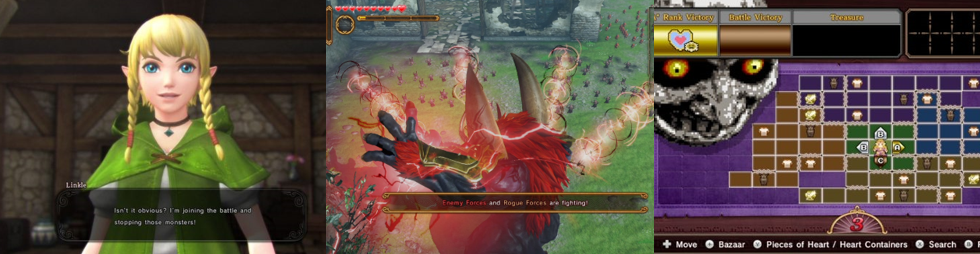
Game Corner [Zelda Day]: The Legend of Zelda: Skyward Sword HD (Nintendo Switch)


On 21 February 1986, The Legend of Zelda (Nintendo EAD, 1986) was first released in Japan. The creation of legendary game designer Shigeru Miyamoto and Takashi Tezuka, The Legend of Zelda launched one of Nintendo’s most popular franchises, with its silent protagonist, Link, and his vast fantasy world of sword and sorcery not only enduring over time but constantly evolving and improving as the series progressed.


Released: 16 July 2021
Originally Released: 18 November 2018
Developer: Tantalus Media
Original Developer: Nintendo EAD
Also Available For: Nintendo Wii

The Background:
I’d like to think that even Nintendo couldn’t have predicted just how impactful the Legend of Zelda series’ (Nintendo EAD/Various, 1986) first foray into 3D was going to be; their attempts to follow up on the unprecedented success of The Legend of Zelda: Ocarina of Time (Nintendo EAD, 1998) resulted in one of the franchise’s darkest and most underappreciated entries, and Nintendo were keen to appeal to a wider audience with Ocarina of Time’s spiritual successor, The Legend of Zelda: Twilight Princess (ibid, 2006), which proved to be an the incredible success for Nintendo’s fledgling GameCube. Having turned the videogame industry on its head with the Nintendo Wii, producer Eiji Aonuma aimed to build upon the expansive nature of Ocarina of Time and Twilight Princess to present the biggest and most detailed Zelda gameworld to date by offering something new through the Wii’s unique motion controls, more elaborate sword combat, a greater focus on exploration, and providing an origin story for the Master Sword. Since I struggle a bit with the Wii’s ridiculous motion controls, I missed out on Skyward Sword when it first released, but it was a massive critical success; considering how widely praised the game was, it was perhaps inevitable that Nintendo would produce a high definition remake for the Nintendo Switch as part of the 25th anniversary of the Legend of Zelda series. The long-rumoured upgrade of the lauded title was developed by Tantalus Media and the gameplay mechanics were redesigned so players could use either the Joy-Cons or a more traditional control scheme, alongside numerous other quality of life improvements to the graphics, frame rate, and save feature. Preorders for Skyward Sword HD sold out on Amazon, and the game sold over 3.6 million units worldwide; however, while it was met with largely positive reviews, it did score less than the original version. Still, reviews praised the more focused gameplay mechanics compared to other, larger Zelda games, and its technical achievements, though faced some criticism for the dated motion controls.

The Plot:
Positioned as the first adventure in the Legend of Zelda timeline, Skyward Sword details the origins of the powerful Master Sword as Link, resident of the floating island of Skyloft, embarks on a quest to rescue Zelda, his childhood friend, after she is kidnapped and taken to the Surface, an abandoned land below the clouds, by the malevolent Ghirahim as part of a plot to awaken an ages-old darkness upon the world.

Gameplay:
The Legend of Zelda: Skyward Sword is a partially open world action/adventure in which players once again assume the role of an incarnation of Link, here a knight-in-training on an island above the clouds. Right away, players have two control options available to them that allows them to utilise motion controls much like the original Nintendo Wii release or to use a more traditional control scheme; however, while this latter option is more comfortable for me, it’s very different from how a Zelda game traditionally plays. A is now an action button that allows you to open doors and chests, talk to non-playable characters (NPCs), and pick up items; B is used to put your weapons away or can be help down while running or otherwise moving for a burst of speed (though you can’t hold it down indefinitely or you’ll drain your stamina wheel and be left defenceless as Link tries to catch his breath), X is mainly used to charge ahead when on your Loftwing, and Y isn’t really used at all. Consequently, sword combat is mapped to the right analogue stick; you can hold ZL to target enemies or interactable objects and flick the stick to unleash a sword attack (perhaps because of this, Link is now right-handed, as opposed to the traditional left). This actually took me a bit of time to adapt to as Link seems to swing his sword in the opposite direction you flick (swinging left with you flick to the right, for example), which can make activating certain switches and attacking some enemies tricky as you need to swing where there’s an opening.

Use motion controls, or the analogue stick, to attack and deflect and consult Fi for advice.

If you knock an enemy down, they’ll sometimes be left open for a “Fatal Blow” that allows you to leap at them for an instant kill, and Link and both perform is signature spin attack, jump swing, and also stab at enemies with his sword. Eventually, you’ll also learn the “Skyward Strike” which sees Link hold his sword aloft to charge it and then sending out an energy wave to damage enemies from a distance, which is a handy feature. Link can also defend himself with his shield by holding ZL and perform a shield bash, which doubles as a parry, by pressing in the left analogue stick. Unfortunately, the vast majority of the game’s shields can be burnt or broken, meaning you’ll either need to upgrade them to toughen them up, buy now ones, or complete a side quest to get a more durable shield. Like many 3D Zelda games, Link automatically jumps from ledges; he can also hang down, shimmy along, and climb vines, all of which will drain your stamina meter. Link can also swing from ropes to reach new areas, which can be a bit tricky to perform as you need to aim yourself with the left stick and flick the right stick up and down in just the right motion to get the momentum you need. Chatting with some NPCs will also offer you a few dialogue options, which don’t really factor into the plot or change their perception of you, but they do help to give Link a little bit more characterisation this time around. Once Link acquires the Master Sword, he also gains one of the most annoying travelling companions I’ve ever had the misfortune of being lumbered with as Fi, the spirit of the sword, acts as a guide, navigator, and tutorial to the player very much in the same way as Navi did back in the day. You can call upon Fi at anytime using the directional pad (D-pad) to gain insight into targeted enemies, remind yourself of your current objective, or get some advice, but she also pops up uninvited at various points to hold your hand or point out the obvious. She also helps you to search for objectives, treasure, and other items by using the sword’s “Dowsing” ability, which puts you into a first-person mode and guides you towards your set target.

Link can sour through the clouds, burrow underground, and must brave trials without the aid of his gear.

You can bring up the map using the – menu and set markers to also help guide you in the right direction, which is very useful as it can be easy to get turned around a bit. One thing to keep in mind here is that there are no manual saves; you need to find a Bird Statue to manually save your progress to one of three save files, though there is an autosave feature that effectively adds as a checkpoint system. Similar to The Legend of Zelda: The Wind Waker (Nintendo EAD, 2002), the game’s overworld is a series of islands and set areas connected by a large void, in this case the open sky; Link can fly to new destinations using his Loftwing, which replaces the traditional horse, by tapping A to ascend and B to slow down or charge into enemies using X. You’ll be utilising the Loftwing a lot to travel back and forth between the three main areas of the game, as well as Skyloft and the smaller items as the story demands, but you can five down to any Bird Statue in any area and exit dungeons (or teleport to the Sky) from these same statues, though you can’t fast travel between destinations using this system. Though Link takes fall damage, you’ll soon acquire a Sailcloth that lets you glide to the ground from high falls by holding ZR (though you can’t actually manoeuvre him while he’s descending). This also allows you to ride air currents upwards and you’ll eventually gain the ability to swim and even twirl through and jump out of the water very much like Zora Link in The Legend of Zelda: Majora’s Mask (ibid, 2000). Link also later acquires the Digging Mitts, which allow him to burrow underground and crawl through narrow caves, smashing boulders and activating switches to progress further, and also gets his hands on the Goddess’s Harp that lets him open up new areas by strumming the stings with well-timed movements of the right stick, which is a far cry from the ocarina playing or wind conducting from previous games. Link will also have to complete four trials in the “Silent Realm”; here, he loses all of his equipment and items and must race around collecting fifteen Sacred Tears across the map while avoiding the ghost-like Watchers and making sure you don’t touch the Waking Water or your Spirit Vessel doesn’t deplete as this will awakens the Guardians, who will hunt you down and eject you from the dimension upon impact, forcing you to begin all over again.

You’ll constantly be travelling back and forth between three areas in search of key items.

Although Skyward Sword looks like the biggest Zelda experience ever seen at the time, it really doesn’t actually feel that way; I’d argue that Twilight Princess felt much bigger and more connected thanks to actually having a large overworld with different routes and areas all linked together. In Skyward Sword, you’ll be spending most of your time travelling back and forth between the three main regions on the Surface (Faron Woods, Eldin Volcano, and the Lanayru Desert), Skyloft, and the Thundercloud up in the Sky. Each area is an isolated environment; you won’t find any routes or means to travelling from Faron Woods to Eldin Volcano beyond flying there on your Loftwing, but each of those regions does have a few other areas that you’ll explore as the game progresses. The Lanayru Desert, for example, is home to a treacherous desert, the Temple of Time, and a mine, all of which you’ll need to explore at various points. The main quest of the game asks Link to travel to each area thee times and acquire one of three different key items or meet three different objectives each time. At first, you’ll need to find three stone fragments form each region to access the Thundercloud; then, you need to find three Sacred Flames to power up the Master Sword. Then, you need to travel back again and find three pieces of the Song of the Hero and access the game’s final dungeon, all of which can get a bit repetitive even though the enemies and the environments do change which each revisit. Faron Woods becomes flooded, for example, and Eldin Volcano erupts, and you’ll find new regions opening up with your new gear and completing story-based tasks, such as Lake Floria just off Faron Woods, the ghostly Sandship and Rickety Coaster in Lanayru Desert’s Sand Sea (both of which are accessed by piloting a boat armed with a cannon), and at one point you’ll find yourself relieved of your weapons and gear and having to escape (and retrieve them) from Eldin Volcano without being spotting in an expansion of the Gerudo Fortress section of Ocarina of Time.

There are many puzzles here, from hitting switches, to crossing lava, and rearranging the environment.
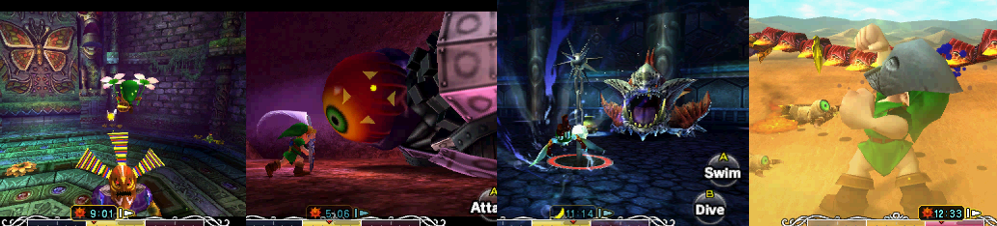
Naturally, you’ll visit a number of dungeons in your quest, which (as is tradition) are realised as elemental-themed temples. Inside, you’ll find small keys to opens doors and a Dungeon Map (which now reveals Bird Statues, chests, and points of interest by default to replace the Compass) to help you progress, and you’ll need to clear rooms of enemies, activate switches and pressure pads, and take on sub-bosses to acquire the temple’s new weapon, which will allow you to progress further and tackle the boss. Sometimes you’ll need to move a weighted block onto a switch or out of the way to climb a ladder; other times, you’ll need to hit switches to raise or lower water and lava, cut through cobwebs, send eyeballs spinning, and shoot or hit faraway switches to open doors. Link will also need to hit plant bulbs (or carry them on the tip of his sword) to create temporary platforms in lava, grapple to floating plants or specific targets with the Clawshots, toss or guide bombs into baskets to create platforms over quicksand, and sever ropes to lower drawbridges. In Lanayru Desert, the majority of the puzzles are based around the “Timeshift Stones” which, when struck, will turn part of the immediate area from a desolate desert into a vibrant landscape, causing enemies, switches, equipment, and even land formations to form so you can progress. Many puzzles require you to carry a Timeshift Stone around or placing it in a specific area to lower one barrier while activating another, which is quite a unique and creative mechanic that really makes you think about how to tackle puzzles. All of these puzzle gimmicks and mechanics are revisited in the game’s final area, Sky Keep, which also features a unique and annoying gimmick that sees you rearranging the different rooms of the temple to open up new paths and acquire the three pieces of the Triforce.

Graphics and Sound:
The Legend of Zelda: Skyward Sword certainly looks impressive; this HD version of the game has potentially upscaled the graphics to make everything very vibrant and moody, when necessary, and the game employs an aesthetic style that merges the fantastical realism of Twilight Princess with the cartoony presentation of The Wind Waker. In addition to having dialogue options during some conversations, Link continues to showcase a variety of facial expressions to help flesh out his otherwise silent character, and you’ll be hearing a lot of gibberish (mainly from Fi) when talking to others. Otherwise, there is no voice acting here, as is to be expected from a Zelda title; some dialogue can be sped up by pressing B and you can skip some cutscenes entirely by pressing the – button, but it can mean you’re left a bit clueless afterwards. Although each region is populated by unique NPCs, many of which are new to the series (such as the Ancient Robots but, while Parellas replace Zoras, Gorons are still present in the game), you’ll find the vast majority in Skyloft. Here, you can chat to Headmaster Gaepora, buy, sell, and upgrade items in the market, and will come across Link’s obnoxious rival, Groose, whose pratfalls and antagonism eventually turns into heroism as he helps aid Link’s quest to rescue Zelda.

Areas have a lot of see and do, and even change as the story progresses.

The game also features an appropriately operatic score that includes new renditions of the iconic Legend of Zelda main theme and versions of memorable tunes such as “Zelda’s Lullaby”; when you engage with enemies, successive strikes also speeds up the tempo of the battle music to help keep the adrenaline pumping and each area is nicely punctuated by both ambiant sounds and a fitting soundtrack. Skyloft is an impressive starting area and a pretty large central hub; you’ll find rooms to sleep in to pass the time and replenish your health, the market, a graveyard, and a practice hall to work on your sword techniques. While the Sky is basically just a barren void, there are small islands and rocks floating around that you can visit to find chests, mini games, and a prominent side quest centred around the Lumpy Pumpkin establishment. Shafts of red, yellow, green, and blue light will point you towards the three main regions and wherever you’ve placed a marker, and you’ll need to dodge Octoroks spitting rocks at you and tornados that will blow you off your Loftwing. The inside of the Thundercloud is initially best by storms and lightning and home to both one of the more annoying push puzzles in the game and the decidedly Wind Fish-like Levias, a gigantic whale that flies through the sky and clears the air after you free him from the parasite that has infected him. Although it’s possible to advance and alter the time of day by sleeping in beds, this rarely factors into the main plot, but it does turn Skyloft from a safe, vibrant location to a dangerous area as enemies spawn in under the cover of darkness. Similarly, when taking on the four Trial Gates, the immediate area takes on a darker, more ethereal quality as shadows become more prominent and glowing magical barriers bar your progress.

Areas are quite large and varied, but not as connected as in other Zelda videogames.

The game’s three main regions are based around classic Zelda tropes such as the forest, volcano, and desert, while also incorporating themes like water, wind, and time into their later areas. You can create shortcuts in each but pushing logs and mine carts, blowing up rocks, or grabbing levers to open gates (and also using your new weapons), but the areas will fundamentally change as the story progresses. Faron Woods start off as a kind of confusing wooded area that leads onto a cliffside leading to the Skyview Temple, a water and bug-infested cave or sorts, is home to a great tree, and also leads to a flowing river that takes you to Lake Florina (which later floods the woods) and the Ancient Cistern, a kind of steampunk-like Temple whose golden Oriental aesthetic hides a scary underground area. Eldin Volcano is full of lava and steep hills for you to run up while avoiding boulders tossed by enemies; enemies also wait atop wooden columns that you can knock over with bombs, and you’ll run around on a spherical rock, lobbing bombs are walls and trying to not burn your ass in the Earth Temple. Later, the whole area is covered in ash as the volcano erupts and you need to sneak around and recover your gear, avoiding spotlights, and douse face statues with water to gain access to the Fire Sanctuary, where you’ll be digging through the dirt with the Mogma Mitts. Lanayru Desert sees you racing across quicksand, using the map and markers to avoid sinking, activating three power generators to raise the Mining Facility, an area which springs to life with the Timeshift Stones to reveal conveyer belts, wind-powered platforms, and all manner of mechanical obstacles. You’ll also use one of these Timeshift Stones to safely cross the Sand Sea and ride the Rickety Coaster’s insane mine cart, and awaken the long-dead dragon that resides in the Lanayru Gorge.

Enemies and Bosses:
Longtime fans of the franchise will recognise many of the enemies that crop up in Skyward Sword, most of which are tailored to the game’s new combat system; Deku Babas and Bokoblins, for example, need specific horizontal or vertical swipes of your sword to dispatch, and this is carried through to tougher enemies like the Lizalfos and Stalfos. While you can easily mow down the bat-like Keese and Chuchus with reckless abandon, you’ll have to factor in elemental variants that will electrocute or burn you, you generally can’t just swipe away at enemies; you’ll need to either cut down Beamos columns and stab them in the “eye” or shoot an arrow at them from afar to destroy them, reflect back Sentrobe missiles with well-timed swings of your sword, run up and over Moblin shields to attack them from behind, drag Furnix to the ground with your Whip, blow the spinning magnets atop the Armos’ heads with the Gust Bellows to expose their weak spot, and toss water on Magmanos to turn it to stone and chip away with your sword. Enemies become tougher and more prevalent as the game progresses, causing less dangerous areas to become more hazardous as shield-carrying Moblins wander about and archer Bokoblins take shots at you from above; these latter can also call in reinforcements with horns, carry bombs, and even take on a zombie-like appearance to cause even more bother.

While you’ll fight some of the sub-bosses ore than once, nothing’s more persistent than the Imprisoned.

Naturally, each of the game’s Temples is home to a sub-boss as well as the main boss. These are often newer, tougher enemies that soon become part of the regular ensemble you encounter, such as the Lizalfos, Moblins, and Moldorms. Lizalfos can be tricky to defeat as they swipe at you with their tails, guard against your attacks with their armoured arms, and breath fire, but you can parry their attacks to leave them open to your attacks, which is a system that serves you well for other sub-bosses like the Stalfos and its four-armed cousin, the Stalmaster. You can use a similar tactic against the two skeletal pirates, LD-0016 Scervo and LD-003D Dreadfuse, who swipe at you with a sword and hook hand and try to force you back into a spiked wall as you try to sever their limbs and force them off a narrow walkway. Easily the most recurring (and frustrating) sub-boss is “The Imprisoned”, a gigantic beast who you must defeat three times, with each battle getting harder and adding new wrinkles. The Imprisoned can only be hurt by attacking its toes; slice off all eight and you then have to frantically run around it to attack the sealing spike in its head, but it causes shockwaves with each step, crawls around in an invulnerable state, tries to climb upwards, and even flies in later encounters. Groose is on hand to help you in the latter two battles; you can switch to him to catapult bombs at the creature to stun it, and will need to perfectly fire Link at the creature’s head to finish it off for good before it can reach the Sealed Temple, which will cause a game over and force you to begin the fight all over again.

You’ll fight Ghirahim three times, with the final battle somehow easier than the first.
Another boss you’ll encounter numerous times throughout the main story is the game’s primary antagonist, Ghirahim the Demon Lord, who serves as the boss of the Skyview Temple, Fire Sanctuary, and the penultimate boss of the game. Ghirahim is perhaps one of the most frustrating boss characters I’ve ever fought as all of your weapons and tactics are useless and must be set aside for patience and well-timed strikes; Ghirahim can easily block, avoid, parry, and even steal your sword while tossing hard-to-avoid daggers at you, charging in for big damage, and teleporting all over the place. However, you’ll notice that he mirrors the position of your sword; so, if his hand is on the left, lure him in and strike from any direction other than left. When he teleports, roll or dash away and hell get stuck in the ground, leaving him open for a flurry, and you can utilise the same tactics as with Stalfos and the Stalmaster and strike at him wherever his swords aren’t positioned when he brings out his own blade. You can also interrupt his charging attack with a well-timed strike, but these can be pretty tough battles though, ironically, I actually found the final encounter with him to be the easiest of the three (potentially because I had actually figured out how to fight him by this point). This is a three-stage encounter against Ghirahim’s true form that you must wade through a hoard of enemies to even get to; you start off on a magical platform and must perform shield parries to expose the glowing jewel in his chest that can only be damaged with stabs. Hit a few to knock him down to the next platform and perform a Fatal Blow to deal damage and trigger the next phase, which sees him busting out his daggers, and his final phase where he shields himself with a gigantic sword. However, you can chop away at this with repeated swipes of the Master Sword to leave him defenceless and finally put him down for good soon after, which actually makes for a pretty exhilarating final battle against the so-called Demon Lord.

Bosses are large and quiet inventive, requiring interesting uses of your weapons to stun and defeat.

Outside of these fights with Ghirahim, you’ll also have to contend with some pretty inventive, if a bit aggravating, boss battles. The insectoid Scaldera awaits at the end of the Earth Temple and sees you rolling bombs into is rocky hide, and gaping mouth, while avoiding fireballs (and getting blown up yourself), to crack its outer shell and swipe at its exposed eye. Moldarch awaits in the Lanayru Mining Facility and Lanayru Shipyard; this giant scorpion clamps you in its pincers and swipes at you with its tail, but can be hurt by swiping at the eyes in its appendages. When it burrows under the sand, you’ll need to blow the sand away with the Gust Bellows to get it to emerge so you can stab it in the face. Koloktos guards the Ancient Cistern and is probably the first most visually interesting and mechanically engaging boss battle; you basically need to avoid the blades it tosses at you and dodge out of the way when it swings its swords at you, and then use your Whip to detach the arms and use one of the dropped swords to slash at its legs and main body. Eventually, it starts to attack more aggressively, meaning you’ll need to use the nearby columns for cover, and you’ll need to slash at its repeatedly with its own weapon to cut it down to size and finish it off. The Cthulu-like Tentalus attacks the Sandship, smashing its squid-like tentacles through the hull, flooding, and capsizing the boat and leading to a dramatic confrontation in the storm swept deck of the ship. You’ll need to run about avoiding the tentacles as they burst through the deck, or slice them in half with a Skyward Strike, then avoid being swatted by them to shoot an arrow into the beast’s eye to down it and slash at it with your sword. When Tentalus switches to the upper deck, it lashes at you with its Medusa-like hair, which you must wade through with sword slashes to get the final blow on the massive sea creature. After enticing out Levias with a massive cauldron of Pumpkin Soup, Link must chase after the gigantic whale on his Loftwing, charging into the eye-ball tentacles that sprout from its hide, before landing on its back and battling Bilocyte. This is easily the easiest boss battle in the entire game and simple requires you to reflect Bilocyte’s projectiles with swipes of your sword, then attack its head when it gets stunned.

Demise, a precursor to Ganon, challenges you to a relatively simple sword fight in the finale.

After defeating all of the game’s bosses, travelling back and forth, and collecting everything the plot requires you to get, Ghirahim kidnaps Zelda and flees through the Fate of Time to the past, where he sets a whole hoard of enemies against you that you must wade through before battling the Demon Lord for the last time. Even if you’re victorious though, the Imprisoned rises one last time and begins absorbing Zelda’s essence, allowing the demonic Demise to be reborn. After dispatching Ghirahim and reverting him to his natural form of a sword, the malevolent demon transports away to another dimension to await your final challenge. I recommend preparing yourself for this final battle, and saving your game, before following Demise and engaging with him in a one-on-one sword battle with two phase; first, you need to keep your guard up and parry Demise’s attacks to leave him momentarily vulnerable to a sword swipe. Demise will occasionally charge at you, but also keeps you on your toes with fake-out attacks, but the main issue you’ll have here is timing your parries properly and not letting your shield break. In the second phase, lightning strikes all around, charging both Demise’s sword and yours; holding the Master Sword aloft will let you charge it for a Skyward Strike, which will both counteract Demise’s own energy beam and stun him long enough for you to strike. Ultimately, it’s not a particularly difficult battle, but the atmosphere and music definitely help to make it quite engaging, it’s just a shame that it involves so much waiting and strategy. While there is no boss battle in the Sky Keep (beyond rematches with some of the sub-bosses), you can unlock a boss rush, of sorts, after resurrecting and restoring Lanayru the dragon. Lanayru allows you to battle every boss in the game (aside from Levias and Bilocyte) in succession, with only the items he held when he first fought them, or playthrough the Silent Realm challenges again in order to earn rewards such as Rupees, treasures, a Heart Piece, or the indestructible Hylian Shield.

Power-Ups and Bonuses:
As you embark on your epic quest, a wide variety of recognisable pick-ups and power-ups are at your disposal; slashing bushes, pots, rolling into trees, and defeating enemies will yield hearts to refill your health and Rupees, which can be spent buying new gear, potions, and upgrades for your gear. You’ll also find Stamina Fruit scattered all over the place, which will refill your stamina meter, and Goddess Cubes, which can be dispelled with a Skyward Strike and allow you to open special chests all over the place and gain more Rupees or treasures. I recommend scooping a fairy up in your bottle so you can restore six hearts upon defeat and you can buy potions for your empty bottles, which will replenish your health or stamina meter, but you can’t permanently upgrade the stamina meter, acquire new tunics, or learn any magic. Defeating bosses will yield a Heart Container, and you’ll occasionally find Heart Pieces all over the place, four of which will also increase your maximum health by one heart.

In addition to additional weapons and gear, you can also purchase upgrades for your items.

Each of the games dungeons includes a new weapon for you to add to your inventory: the Beetle allows you to pilot a little mechanical beetle to hit switches, defeat or stun enemies, and drop bombs; the Clawshots let you grapple to vines and specific targets (and even disarm enemies); the Whip lets you pull switches and swing from certain hooks; you can roll or toss bombs to blow upon certain rocks; the Digging and Mogma Mitts let you dig up collectibles or burrow underground; the Slingshot and Bow let you shoot at enemies and targets from a distance; and the Gust Bellows disorientates enemies and lets you move platforms or blow away sand. You can also buy new gear from the market, such as extra bomb bags and quivers to increase your maximum capacity, shields to defend yourself, and a Bug Net to capture bugs that can be sold in Skyloft. As you explore, you’ll find a variety of treasures that can be used to upgrade your gear in Skyloft to increase their damage or range. Furthermore, key items like the Water Dragon Scale and Fireshield Earrings allow you to swim and withstand extreme heat and you can also purchase expensive extras from Beedle to increase your adventure pouch, expand your wallet, and spawn additional health among other things.

Additional Features:
There are sixteen different treasures and twelve bugs to find throughout Skyward Sword, in addition to twenty-seven Goddess Cubes to activate, thus awarding yourself additional Rupees and gear. There are also twenty-four Heart Pieces to find, which will extend your maximum health to twenty hearts, and a number of side quests available to keep you busy. The owner of the Lumpy Pumpkin will have you ferrying hot soup, collecting pumpkins, and playing the harp with his daughter (both extremely tricky mini games) in order to make up for damaging his property, the Thrill Digger has you digging in specific spots for Rupees, and you can dive for Rupees after fixing up Fun Fun Island. You can also rapidly slice bamboo sticks with your upgraded sword and shoot arrows at pumpkins for additional awards, but the most prominent side quest is the pursuit of “Gratitude Crystals”. After finding a lost girl in Skyloft, the cursed   Batreaux asks you to help others to earn these crystals and bring them to him to receive big Rupee rewards, a Heart Piece, the biggest wallet available, and also restore him (as in Batreaux) to human. These crystals are earned from helping NPCs in various ways, such as bringing a scrap of paper to a mysterious man in a toilet, bringing medicine for a wounded Loftwing, and repairing the fortune teller’s crystal ball. After completing the game for the first time, you can create a new save file that allows you to play through in “Hero Mode” where the enemies are tougher and shuffled about and neither enemies or pots will drop hearts, making the game much more challenging (although the Skyward Strike does instantly charge).

The Summary:
After struggling to get to grips with, and properly enjoy, The Legend of Zelda: Breath of the Wild (Nintendo EPD, 2017), I was somewhat excited to finally get the chance to play Skyward Sword, a title I had long avoided as I have no desire to play any game, much less a Zelda game, using purely motion controls. Although it took me a little while to adjust to the analogue-based combat and camera controls, both of which are a little clunky due to the control mapping, I found a lot to enjoy in this game. The focus on using specific sword swipes to defeat enemies and bosses made this a very unique Zelda experience, but did make the combat a bit awkward at times, especially with the reversed controls. The visual presentation was very good, but I do feel like many of the areas are much too empty and restricted; since the game’s set in a world of disparate islands above the clouds and a surface accessible only from specific points, it didn’t really feel like a large, interconnected world and reminded me a little too much of the wide, largely empty ocean from The Wind Waker. Flying on the Loftwing was fun, and the boss battles were very engaging and inventive; even the battles against Ghirahim, despite being frustrating at times, were interesting as it required more than just slashing at them mindlessly but the game really lets itself down with the constant back and forth. I feel like it might’ve been better to have areas like Lake Floria as separate as the other regions, just so that the world felt a little bigger and had a bit more variety, but continuously having to revisit the three main regions again and again find something else in each area quickly became repetitive and disappointing, even when the areas visually changed. The lack of tunics and customisation options for Link was a shame, though I felt the game had a better balance between the stamina meter and destructible items compared to Breath of the Wild, which went way overboard in those aspects. Ultimately, there’s a lot to like here and it’s a perfectly enjoyable Zelda title, but, despite being visually superior, I think I still prefer Twilight Princess as it did a much better job of crafting a large, interconnected fantasy world with a lot of variety and a better mixture of new and old gameplay elements.

My Rating:

Rating: 3 out of 5.

Pretty Good

Have you played this HD version of The Legend of Zelda: Skyward Sword? How do you feel it compares to the original Wii release and were would you rank it amongst all the other Zelda titles? Were you a fan of the motion controls and the switch to a vast world above the clouds? Which of the dungeons and bosses was your most, or least, favourite? What did you think to the constant back and forth between the same areas? Which of the Silent Realm trials was the hardest for you? Were you able to find all of the bugs and treasures? Which Zelda game is your favourite and how are you celebrating the franchise today? Whatever your thoughts on Skyward Sword, sign up to leave a comment below, or let me know on my social media.

Game Corner [Zelda Day]: The Legend of Zelda: Link’s Awakening (Nintendo Switch)


On 21 February 1986, The Legend of Zelda (Nintendo EAD, 1986) was first released in Japan. The creation of legendary game designer Shigeru Miyamoto and Takashi Tezuka, The Legend of Zelda launched one of Nintendo’s most popular franchises, with its silent protagonist, Link, and his vast fantasy world of sword and sorcery not only enduring over time but constantly evolving and improving as the series progressed.


Released: 20 September 2019
Originally Released: 6 June 1993
Developer: Grezzo
Original Developer: Nintendo EAD
Also Available For: Game Boy, Game Boy Color, Nintendo 3DS Virtual Console (Original/DX release)

The Background:
As some of you may be aware, my very first introduction to the Legend of Zelda series (Nintendo EAD/Various, 1986) was with The Legend of Zelda: Link’s Awakening (ibid, 1993) on the original Game Boy. Beginning as an unsanctioned side project of programmer Kazuaki Morita and evolving from a desire to port the incredibly successful Legend of Zelda: A Link to the Past (ibid, 1991), it was genuinely impressive how the developers were able to cram so much into such a small cartridge. Link’s Awakening was critically acclaimed and is widely considered to be one of the best Game Boy titles ever released. The game received a slightly enhanced colour upgrade on the Game Boy Color in 1998, which was also received very well, but I was stunned when Nintendo announced an all-new, high definition remake for the Switch in 2019 as the game always felt like more of a cult favourite compared to other mainstream Zelda titles. The Switch remake of Link’s Awakening was spearheaded by Grezzo, the development team who had ported and enhanced Zelda’s Nintendo 64 efforts to the Nintendo 3DS, and the team immediately sought to separate the game from other Zelda titles by not only returning to the classic top-down perspective but adopting a quasi-isometric, diorama-inspired look that made the entire game appear to be constructed out of plasticine figures. Upon release, Link’s Awakening was met with glowing reviews as critics praised the visual presentation, music, and quality of life improvements; it was also the fastest-selling Switch game of 2019 and scored very highly across the board, assuring that Link’s Awakening was finally recognised as one of the best Zelda titles out there.

The Plot:
After defeating the dark wizard Ganon and rescuing Princess Zelda, Link embarks on a quest across the sea in search of enlightenment and ends up caught in a terrible storm and washing up on the shores of the mysterious Koholint Island. Link finds the island tormented by monsters who are the creation of the malevolent “Shadow Nightmares”, a dark entity who will do anything to keep the legendary Wind Fish from waking. However, Link takes up his sword and shield to oppose Nightmare, only to discover that not everything is as it seems on the all-too-familiar Koholint Island…

Gameplay:
The Legend of Zelda: Link’s Awakening is a top-down (well, more like a slightly isometric) action/adventure role-playing title in which players are placed into the familiar green hat and tunic of Link, the long-running protagonist of the series. As is the case in many Zelda titles, you can customise Link’s name at the file select screen; you get three save files (and a temporary autosave file) that you can personalise, and characters will refer to you by that name throughout the story. For those keeping track, this is the same Link who starred in A Link to the Past, making Link’s Awakening one of the rare Zelda titles to feature the same Link, and which possibly explains the many similarities between the two titles. Link begins the game with three hearts representing his health and stripped of his sword, shield, and all of his recognisable weapons but is quickly provided with his trusty shield, with is mapped to the ZR button and allows him to block incoming attacks and push through certain enemies. You’re then tasked with using the shield to head down to the beach and retrieve your sword, which is mapped to the B button; you can tap B to swipe at enemies or hold the button to charge up Link’s trademark Spin Attack, which sees him spin around in a circle and damage any nearby enemies once the button is released. Link can also pick up and throw certain items and objects (such as Cukkos and, later, pots), using the A button but he’ll need to journey to a whopping nine dungeons to retrieve the rest of his gear and further explore the mysterious Koholint Island.

After acquiring his sword, Link sets out on a new adventure fill with hijinx and dangers.

Along the way, Link will encounter a number of non-playable characters (NPCs), most of whom offer hints about where to go next, ask for specific items to be brought to them as part of the elaborate trading sequence, or comment on the events happening in the game or on the island in general. Some will actually follow you around, which becomes necessary to enter specific dungeons; a blue-hued rooster will follow you and allow you to fly over gaps to reach the Eagle’s Tower, for example, a ghost will start to follow you and eventually gift you an empty bottle, and Link’s saviour, Marin, will accompany him to move a walrus out of the way and let him access Yarna Desert. Not all NPCs are entirely harmless, though; attack Cukkos or dogs and they’ll hit you back, you’ll need to use a Chain Chomp to navigate through the Gopongo Swamp, and the shopkeeper will electrocute you to death and you’ll be branded a “THIEF” for the rest of the game if you steal from him. As mentioned, Link’s health is measured in hearts; as you explore, you may find Heart Pieces hidden in caves, buried underground, under water, or generally strewn around the environment. Collect four of these, and your maximum health will be refilled, and you’ll automatically gain an extra heart after defeating each dungeon’s Nightmare boss. Unlike a number of other Zelda games, players don’t need to worry about a magic gauge in Link’s Awakening; instead, there’s a greater emphasis on collecting Rupees, the currency in the Zelda franchise, in order to purchase additional items, objects for the trading sequence, and even collectibles such as Heart Pieces. Rupees are primarily found by slashing grass, defeating enemies, digging in the ground, and opening treasure chests and Link appears to be able to hold 9999 Rupees, so you don’t need to worry about upgrading his wallet or anything. I tend to spend my time in Zelda games furiously swiping at grass and defeating onscreen enemies, so I’m used to collecting as many Rupees as possible, but other players may find it a bit tedious, though it’s absolutely necessary if you want to progress because you need the shovel and the bow in order to access later areas and you’ll never collect everything the game has to offer without paying money for some of them first.

Koholint Island is huge and full of pick-ups, warps, NPCs, and enemies.

You can jump to the equipment subscreen at any time with the + button; here, you can view key items you’ve collected and assign two items from your inventory to the X and Y buttons, save or load your game, or flick over to the map screen (which can also be accessed with -) to plot a route to your next destination. The map is initially shrouded in fog but more of it is revealed as you explore, and you can use pins in to set reminders for yourself; Link can also review “memories” from this screen, which allow you to re-read advice from the mysterious Owl and certain previous conversations so you know where you’ve been and get some idea of where to go next. The Owl will appear in key areas across the overworld offering hints and encouragement, and you can call Ulrira in Mabe Village for further hints, but you’re basically free to explore at your leisure. You won’t be able to access certain areas without weapons or items from dungeons, though, and generally you need to tackle the dungeons in a specific order so that you can access the next, but your journey across Koholint Island eventually gets easier as you defeat the Nightmare bosses. Initially, you won’t be able to lift rocks, clear gaps, or swim, for example, but you’ll acquire the tools necessary to overcome these obstacles in the dungeons; similarly, you can activate fast travel warp points and, later, learn a song for your ocarina that will enable you to use these freely.

Dungeons are filled with puzzles, some simple like pushing blocks and others more frustrating.

Still, the game doesn’t make too much of an effort to hold your hand and it can be tricky to figure out where to go next, meaning that you have to be a little proactive to figure things out and experiment a bit. This is especially true in the game’s dungeons, which can be quite labyrinthine and see you travelling between different floors and acquiring small keys to unlock doors. Each dungeon has a compass and a map that will greatly assist with your progress; these allow you to see all possible routes and even indicate when there’s a chest or item in a room, but they’re often locked behind a series of puzzles. These may be as simple as stepping or pushing a block on a switch, pulling a pulley, pushing blocks together, or defeating all onscreen enemies but they get tougher as the game progresses. Sometimes you’ll have to defeat enemies in a specific order, or guide a pathmaker around to create temporary paths, or pick up and throw a weighted ball into columns, or toss some chess pieces in just the right way so they land in specific spots (a very frustrating mechanic, for sure). Sometimes, rooms and hidden passageways are hidden behind breakable walls (which must be exploded with bombs) or rocks (which must be lifted up) both in dungeons and on the overworld; other times, you’ll need to hunt down specific items or work through a looping maze in the right order, and you can even increase the game’s challenge by playing in “Hero” mode from the file select screen (which sees you taking twice as much damage and losing the benefit of enemies dropping hearts).

Graphics and Sound:
Honestly, screenshots do not do this game justice; the plastic figurine look used to bring this world to life is absolutely amazing and I find it such an adorable, whimsical stylistic choice that really makes everything vivid and charming to behold. The soundtrack is equally imaginative, composed primarily of woodwind instruments and flutes and such, and adds a lot of appeal to the game and even features a bit of the classic chip-tune music in the credits, which was a nice touch. You know things are kicking up a notch after Link acquires his sword and Koji Kondo’s iconic Zelda theme kicks in, but each area is brought to life as much by the music as the attractive visual style of the game and all of the characters and models are full of visual quirks and charming little animations that just make the game a joy to play and look at.

The game’s visual style and variety is charming and gorgeous, and it even includes some anime cutscenes.

Koholint Island is quite a large area for Link to explore and full of many of the usual Zelda environments and trappings; he begins in a quiet little village and journeys to a desert, a crumbling tower, a boulder-strewn mountain top, and a desolate swamp while traversing a vast field peppered with enemies, obstacles, and such sights as a graveyard, bridges, a castle, and a foggy forest. Contrary to the original title, and other top-down Zelda titles at the time, the entire overworld is connected without any screen transitions unless you enter a building or cave, which really helps speed traversal up and makes the world feel interconnected and alive. Some NPCs will relocate as the story progresses, which is fun, and you’ll often be required to take the long way around to reach some of the dungeons (especially in the first instance), though the interiors of the dungeons are often somewhat interchangeable. This isn’t always the case, of course; Bottle Grotto (fittingly) contains a lot of bottles), Catfish’s Maw and Angler’s Tunnel veer more towards water elements and puzzles, and Turtle Rock features and abundance of lava, and you’ll notice more and more maze-like elements as the difficulty of the dungeons progresses. Every dungeon also features at least one 2.5D sidescrolling area that sees you using ladders, moving platforms, and the Roc’s Feather to hop around in short platforming sections and the game is opened and ended by some beautiful (if very brief) anime cutscenes, and while there is no voice acting, sound bites and voice clips accompany both Link’s attacks and reactions and the in-game text boxes.

Enemies and Bosses:
Koholint Island is inhabited by a number of recognisable Zelda enemies and traps that will constantly try to impede Link’s quest; you’ll encounter stone-spitting Octorocs, spider-like Tektites, and annoying Zora’s will pop out of water to fire projectiles at you. Zols often appear in dungeons, with the red variants multiplying with each hit, bat-like Keese and the snake-like Ropes often appear in caves, and you’ll even encounter a number of enemies that can’t be traditionally bested. Most of your enemies can be dispatched with just one swipe of your sword, but others require a bit more strategy: the Moblins and Darknuts will defend against your attacks with their shields and must be stunned by deflecting their sword swipes, Spiny Beetles and Helmasaurs must have their rocks and masks removed to better attack them, and the Pols Voice can’t be damaged by your sword at all. Oddly, Link’s Awakening contains a number of enemies from the Super Mario franchise (Various, 1983 to present): Thwomps, Bob-ombs, Goombas, and Shy Guys are all over the place, and you’ll even come across an evil version of Kirby!

A number of mini bosses must be defeated to activate warp points ad acquire new weapons.

Each dungeon, and certain other areas in the game, features at least one mini boss; defeating these will activate a warp point in the dungeon and often leads to you acquiring the weapon or item necessary to defeating the Nightmare boss. These range from larger versions of regular enemies, such as the Moblin Chief and Armos Knight, and familiar Zelda enemies like the Master Stalfos (who must be damaged with bombs when reduced to a pile of bones) and Gohma (who can only be damaged by firing arrows into their open eyes. The most recurring of these is the golem-like Hinox, which will grapple you or throw bombs your way, but are easily defeated with your trusty sword, and you’ll sometimes have to battle more than one in the later dungeons. Often, these require a little more strategy than the average enemy; you need to jump over the Spike Roller’s spiked pole to get to him, toss bombs into the Dodongo Snakes’ mouths, and can only defeat Rover by throwing its weighted ball back at it, but you’re usually rewarded with a life-restoring fairy for your efforts (to say nothing of the extra weapons).

After a simple first boss, you’ll need to use Link’s new weapons and be adaptable to triumph.

Each dungeon contains a magical instrument that is guarded by one of eight Nightmares; often, the key to defeating the Nightmare will lie in the weapon you acquire in that dungeon, and each one gets progressively difficult as you journey on. The first boss, Moldorm, is a walk in the park: this worm-like creature randomly pulsates around the enclosed arena and can only be hurt by hitting the glowing weak spot on its tail, which will send it into a frenzy and cause it to become more and more aggressive as the fight progresses. In the Bottle Grotto, you’ll battle the clown-like Genie, who tosses fireballs at you and hides in his bottle to avoid your attacks. You’ll need to grab the bottle and throw it against the wall to crack and, eventually break it, then swipe at Genie when it becomes corporeal to finish it off. The Slime Eye at the end of Key Cavern requires use of the Pegasus Boots to split it in two so you can swipe at its eye, but the two gooey monsters will drop down from the ceiling to either land on you or stun you with a shockwave, making them tricky to land a hit on at times. The fearsome Angler Fish is fought in a 2.5D perspective and underwater, meaning that your movements are as limited as your attack options; you’ll need to swim your way past the debris it drops from the ceiling, fending off its smaller minions as you try and swipe at the glowing tendril on its head.

Bosses get increasingly tougher as the game progresses but are generally not too challenging.

Probably one of the more difficult bosses for me was the Slime Eel; this fight is complicated by a mace-like tentacle in the middle of the stage that you must jump over as you try and snag the boss’s head with your hookshot and expose its weak spot. Facade can also be a bit tricky; this gigantic face leers at you from the floor and causes tiles and pots to fly at you from all around the room and can only be damaged by placing bombs on it while watching for the holes it causes to form in the arena. When you finally manage to reach the top of Eagle’s Tower (easily one of the game’s more obtuse and annoying dungeons), you’ll battle the Evil Eagle; this giant bird hovers just out of reach and tries to skewer you with feathers, charges at you with its beak, and flaps its wings to try and force you from the platform and to the spikes below. Thankfully, it’s easy enough to shield against his attacks and toss your boomerang up at him, or fire off arrows and swipe at him as he flies past trying to attack you. The final dungeon is guarded by  Hot Head, an anthropomorphic fireball that emerges from a lava pit to blast molten rock at you, and which can only be damaged with the Magic Rod. Once you’ve blasted away its outer shell, it’ll bounce all around the arena trying to pummel you to death, but is easily finished off if you keep your wits about you.

The game’s final boss assumes many forms, with some representing the game’s toughest challenge.

Once you’ve acquired all of the magical instruments, you can scale Mount Tamaranch to play the “Ballad of the Wind Fish” on your ocarina and gain access to the Wind Fish’s Egg; however, this final dungeon is a looping maze that you’ll never be able to navigate without completing the trading sequence and acquiring the magnifying glass to read a book in the Mabe Village library that has directions to the final boss. Shadow Nightmares is easily, and fittingly, the toughest boss in the game and boasts six distinct forms: the first is a giant Zol that bounces and materialises around the arena and can only be damaged by sprinkling Magic Powder on it. Next, the boss assumes the form of Araghim from A Link to the Past and is battled in very much the same way; Araghim teleports around and fires two types of projectiles at you, one that explodes in your face and one a fireball that can be smacked back to damage him. Afterwards, the boss becomes a shadow version of Moldorm, which is a bit of a let-down, but it more than makes up for it by assuming the form of Ganon! Hands down the hardest fight in the game, Ganon twirls his trident and fires flaming bats at you before tossing his trident your way, giving you a very limited window to loop around behind him or charge into him with your sword. The next form is simply a Lanmola that cannot be damaged by your sword but only needs to be hit once with another weapon to force the boss into its final, truest form: Dethl. A large, shadow, pulsating mass sporting two mace-like tentacles, Dethl isn’t really too difficult to defeat; simply jump over its arms and fire arrows into its big green eye when it opens and the Shadow Nightmares will finally be destroyed, the Wind Fish will awaken, and Koholint Island will disappear forever.

Power-Ups and Bonuses:
As mentioned, it doesn’t take too long for Link to reacquire his traditional sword and shield, and as you progress through the game’s dungeons you’ll acquire a number of recognisable weapons and items to add to Link’s arsenal, such as the Power Bracelet to lift items (and the Powerful Bracelet to lift even larger items), the hookshot to stun enemies from a distance and cross certain gaps using stones and other specific parts of the environment, bombs to blast open walls and defeat groups of enemies, bottles to store life-restoring fairies, and an ocarina that is useful for accessing certain areas, warping across the map, and accessing the final boss.

Link can acquire some familiar weapons and even pick-up temporary power-ups.

Other pivotal items include the shovel (which is necessary for digging up collectibles), the traditional boomerang (which can only be acquired through the trading sequence), and the bow (which must be purchased). Magic Powder allows you to damage certain enemies and light fires (but becomes completely redundant once you acquire the Magic Rod), you can fire bomb arrows by equipping the bow and the bombs at the same times, the Mirror Shield lets you reflect lasers and certain projectiles, and the Roc’s Feather allows you to jump. The Pegasus Boots let you charge ahead (and can be used in conjunction with the Roc’s Feather to clear longer gaps), the flippers let you swim and dive under water, and you can sometimes find Secret Medicine to restore your health upon death. Additionally, you’ll sometimes come across temporary power-ups: the Guardian Acorn and Piece of Power will temporarily reduce the amount of damage you take and increase your attack power, respectively, which can be super useful in certain situations.

Additional Features:
There are thirty-two pieces of heart to find scattered throughout Koholint Island’s overworld, which will increase your health up to twenty hearts; sometimes you’ll dig these up or knock them out of trees, other times you can buy or find them in hidden caves or under water and such, and other times you can play for them in mini games. These include a mechanical claw game and a fishing game, both found in Mabe Village and costing you some Rupees to play; manoeuvring the claw and landing a big fish can be a bit tricky, but it’ll grant you an extra bottle, Heart Piece, ammo and Rupees, items for the trading sequence and a number of Secret Seashells. There are fifty Secret Seashells to find, and it’s well worth your time seeking them out with your shovel, lifting rocks, and exploring with your different weapons and items as they can be cashed in at the Seashell Mansion to gift you with a sensor that alerts you when they’re closer and a more powerful sword that fires out an energy beam when your hearts are full. As alluded to, there’s a lengthy trading sequence that’s necessary to acquire the boomerang and navigate to the final boss; this sees you acquiring specific key items (such as bananas, a Yoshi doll, and a magnifying lens) and bringing them to specific NPCs to swap for another item, which is a fun little distraction that gives you an excuse to talk to as many characters as possible.

Search for Seashells, switch to a new tunic, and create your own dungeons!

There are also figurines to collect and place on certain stands in houses (though I was only able to find two) and the Color Dungeon from the GameBoy Color version is also present. This optional, additional dungeon can be missed but it’s well worth your time seeking out as, once you best its enemies and puzzles, and defeat the gigantic Hardhit Beetle, you’ll be able to pick from either a blue or red runic to increase your defence or attack power, respectively (personally, I chose the red tunic as I’m a more offensive player). Finally, there’s a new addition to the game in the form of Chamber Stones; these must be brought to Dampé, who will challenge you to create custom dungeons by mixing and matching rooms, puzzles, sub-bosses, and bosses from the game’s existing dungeons. Each time you beat a regular dungeon, and Dampé’s tutorials, you’ll gain additional Chamber Stones, +Effect Panels, and collectibles and it’s quite a fun little addition since you can create your own dungeons to play through and challenge others to complete.
The Summary:
Even after all this time, I still adore The Legend of Zelda: Link’s Awakening; it was the first Zelda game I ever played and owned, and I used to enjoy playing through it on the old GameBoy brick even before I picked up the Virtual Console version of the GameBoy Color deluxe version, so I was super excited to hear that it was being completely rebuilt for the Nintendo Switch. This new version is everything the original game was but rendered in such gorgeous detail that it’s so much more than just a throwback to a simpler time of Zelda videogames; the plastic figurine aesthetic is charming and whimsical and I’d love to see it evoked for future recreations of older Zelda titles, and it may very well be the most visually appealing game I’ve played on the Nintendo Switch so far (and yes, that includes it’s bigger and more expansive cousin). It’s amazing how big Link’s Awakening is; it definitely feels like there’s more in this version of the game, but the developers didn’t add any new dungeons or areas or anything (which is a bit of a shame, to be honest). It’s just that big of a game, which just makes the original seem even more impressive in hindsight. There’s loads to do and keep you busy here, from backtracking to previous areas, to hunting down collectibles, to completing the trading sequence and, of course, tackling the game’s dungeons, and the game is just the right level of challenge; some puzzles and dungeons are trickier and tougher than others, but that’s par for the course of a Zelda title. Honestly, it’s worth picking up for the gorgeous graphical style and music as much as the engaging, classic Zelda gameplay and I can only hope that Nintendo revisit some of Link’s earlier adventures in the same way going forward.

My Rating:

Rating: 5 out of 5.

Fantastic

Have you played this new version of The Legend of Zelda: Link’s Awakening? How do you feel it compares to the original and its colourised counterpart and where would you rank it amongst all the other Zelda titles, specifically the 2D adventures? Were you a fan of the more surreal narrative elements in the game, and the difficulty and challenge it offered? Which of the dungeons and Nightmares was your most, or least, favourite? Were you able to navigate the Wind Fish’s Egg without directions? Did you ever steal from the shopkeeper? Were you able to find all of the Secret Seashells? Which Zelda game is your favourite and how are you celebrating the franchise today? Whatever your thoughts on Link’s Awakening, sign up to leave a comment below, or let me know on my social media.